Upgrade to Pro — share decks privately, control downloads, hide ads and more …

Collective Predictive Coding Hypothesis: Emerge...

Collective Predictive Coding Hypothesis: Emergence of Language and Cooperative Behaviors

Keynote by Tadahiro Taniguchi at the 7th International Conference on Active Inference (IWAI 2026), 15 October 2026.

Connecting symbol emergence, decentralized Bayesian inference, collective active inference, and human–AI co-creative learning.

Avatar for Tadahiro Taniguchi

Tadahiro Taniguchi

October 15, 2026

More Decks by Tadahiro Taniguchi

Other Decks in Science

Transcript

  1. Collective Predictive Coding Hypothesis: Emergence of Language and Cooperative Behaviors

    Tadahiro Taniguchi 1) Professor, Graduate School of Informatics, Kyoto University 2) Visiting Professor, Research Organization of Science and Technology, Ritsumeikan University 3) Director, AIRoA 4) Principal Investigator, ALIFE Institute 7th International Conference on Active Inference (IWAI 2026) Keynote Speech, 15 October 2026 1
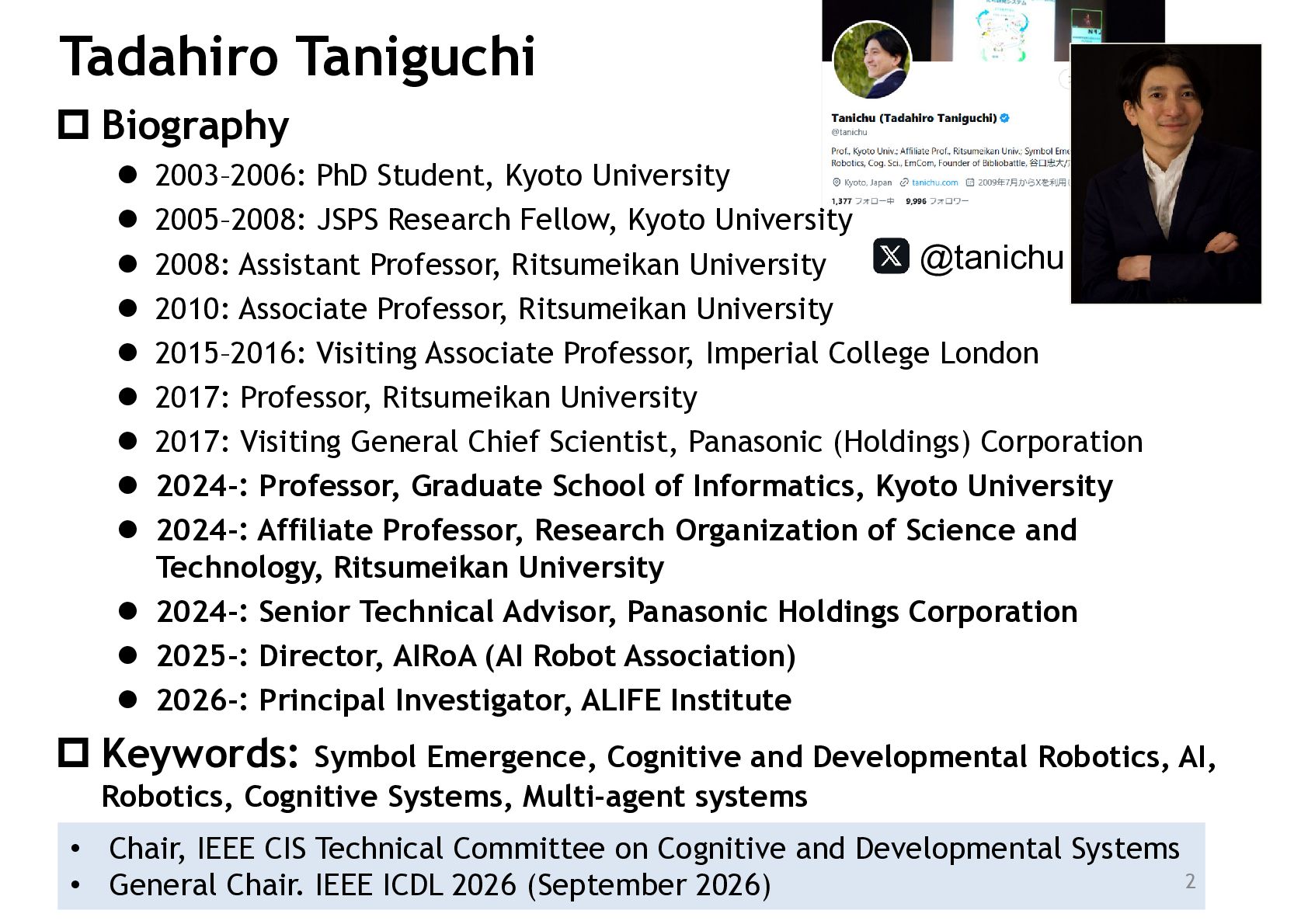
  2. Tadahiro Taniguchi  Biography  2003–2006: PhD Student, Kyoto University

     2005–2008: JSPS Research Fellow, Kyoto University @tanichu  2008: Assistant Professor, Ritsumeikan University  2010: Associate Professor, Ritsumeikan University  2015–2016: Visiting Associate Professor, Imperial College London  2017: Professor, Ritsumeikan University  2017: Visiting General Chief Scientist, Panasonic (Holdings) Corporation  2024-: Professor, Graduate School of Informatics, Kyoto University  2024-: Affiliate Professor, Research Organization of Science and Technology, Ritsumeikan University  2024-: Senior Technical Advisor, Panasonic Holdings Corporation  2025-: Director, AIRoA (AI Robot Association)  2026-: Principal Investigator, ALIFE Institute  Keywords: Symbol Emergence, Cognitive and Developmental Robotics, AI, Robotics, Cognitive Systems, Multi-agent systems • Chair, IEEE CIS Technical Committee on Cognitive and Developmental Systems 2 • General Chair. IEEE ICDL 2026 (September 2026)
  3. Agenda 1. Introduction: Symbol Emergence Systems 2. Generative Emergent Communication:

    Language Games as Decentralized Bayesian Inference 3. Collective Predictive Coding Hypothesis 4. Cooperation and Collective Active Inference 5. Modeling Human–AI Society 6. Conclusion 3
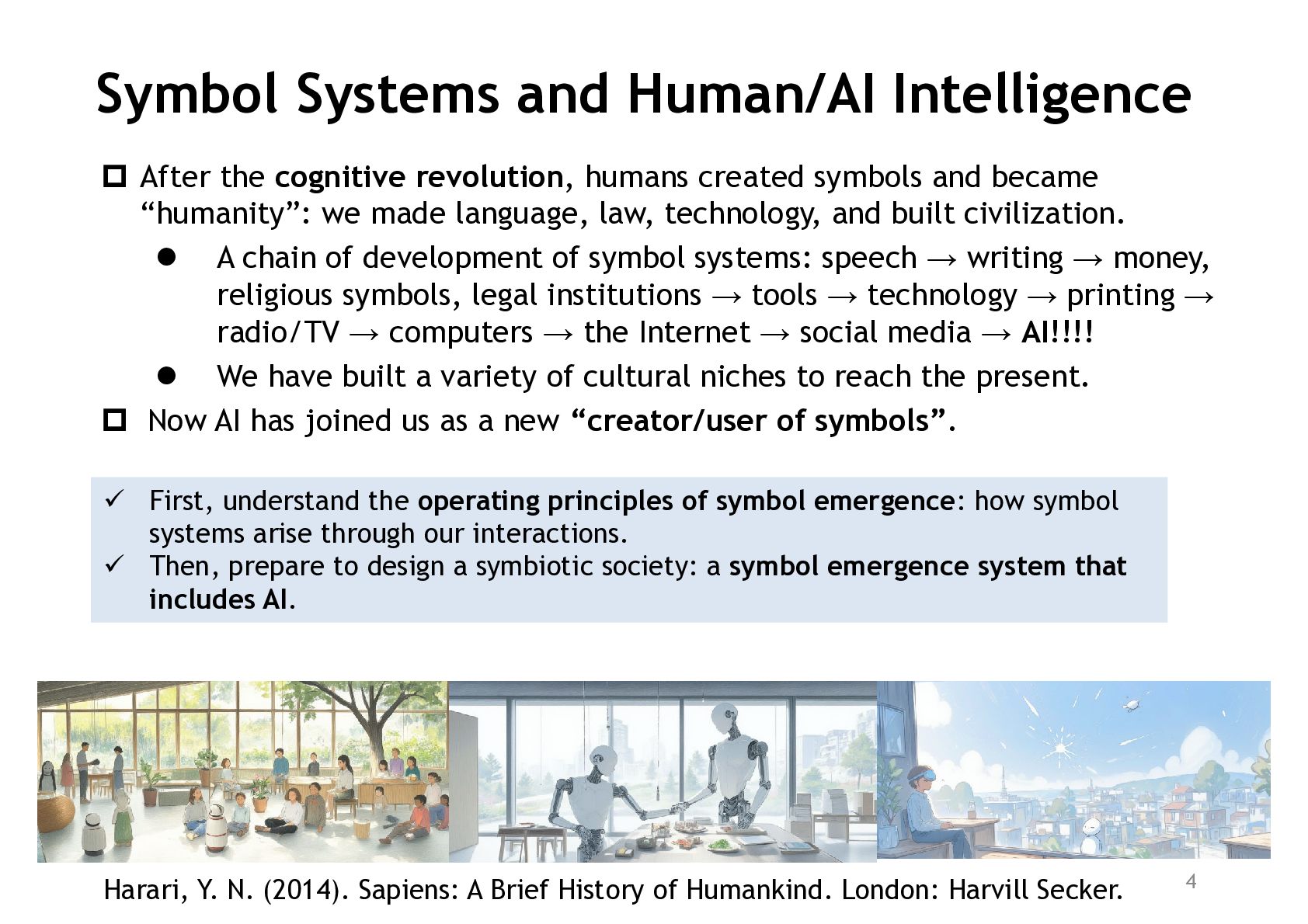
  4. Symbol Systems and Human/AI Intelligence  After the cognitive revolution,

    humans created symbols and became “humanity”: we made language, law, technology, and built civilization.  A chain of development of symbol systems: speech → writing → money, religious symbols, legal institutions → tools → technology → printing → radio/TV → computers → the Internet → social media → AI!!!!  We have built a variety of cultural niches to reach the present.  Now AI has joined us as a new “creator/user of symbols”.  First, understand the operating principles of symbol emergence: how symbol systems arise through our interactions.  Then, prepare to design a symbiotic society: a symbol emergence system that includes AI. Harari, Y. N. (2014). Sapiens: A Brief History of Humankind. London: Harvill Secker. 4
  5. Symbol emergence systems [Taniguchi+ 2016] Symbol emergence (language evolution) by

    groups Representation learning (world modeling) by individuals Tadahiro Taniguchi, Takayuki Nagai, Tomoaki Nakamura, Naoto Iwahashi, Tetsuya Ogata, and Hideki Asoh, Symbol Emergence in 5 Robotics: A Survey, Advanced Robotics, 30(11-12) pp.706-728, 2016. DOI:10.1080/01691864.2016.1164622
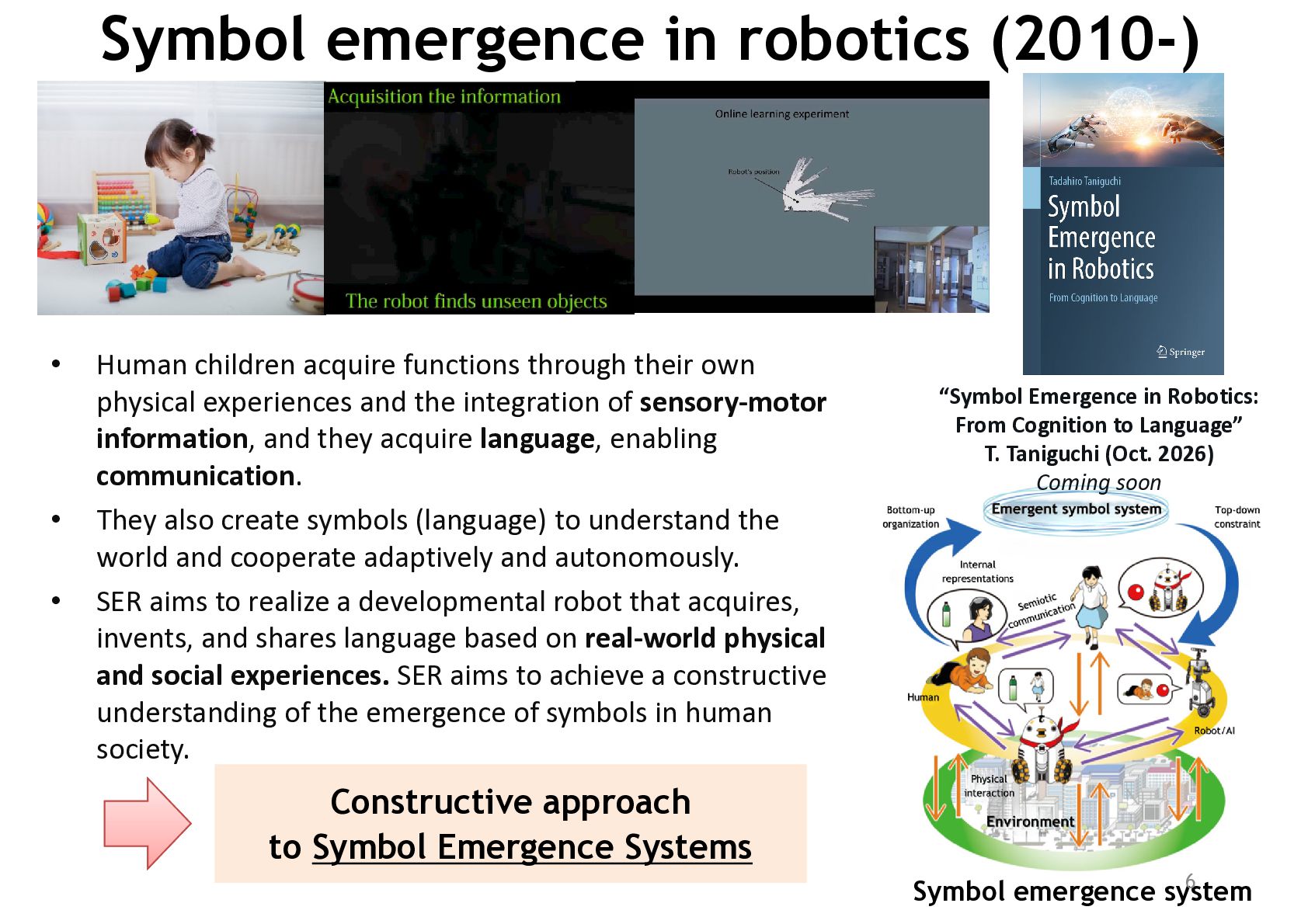
  6. Symbol emergence in robotics (2010-) • • • Human children

    acquire functions through their own physical experiences and the integration of sensory-motor information, and they acquire language, enabling communication. They also create symbols (language) to understand the world and cooperate adaptively and autonomously. SER aims to realize a developmental robot that acquires, invents, and shares language based on real-world physical and social experiences. SER aims to achieve a constructive understanding of the emergence of symbols in human society. “Symbol Emergence in Robotics: From Cognition to Language” T. Taniguchi (Oct. 2026) Coming soon Constructive approach to Symbol Emergence Systems 6 Symbol emergence system
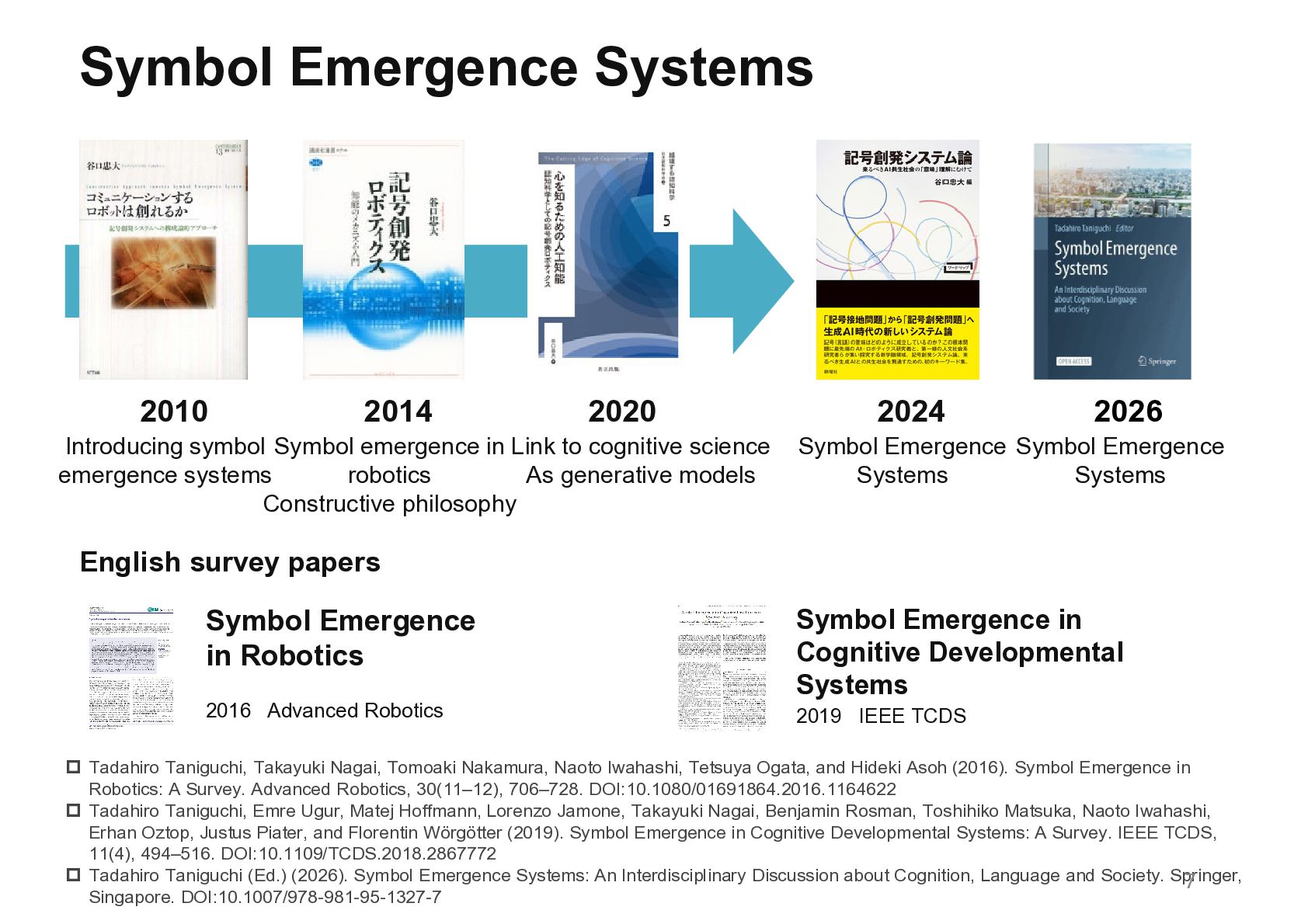
  7. Symbol Emergence Systems 2010 2014 2020 Introducing symbol Symbol emergence

    in Link to cognitive science emergence systems robotics As generative models Constructive philosophy 2024 2026 Symbol Emergence Symbol Emergence Systems Systems English survey papers Symbol Emergence in Robotics 2016 Advanced Robotics Symbol Emergence in Cognitive Developmental Systems 2019 IEEE TCDS  Tadahiro Taniguchi, Takayuki Nagai, Tomoaki Nakamura, Naoto Iwahashi, Tetsuya Ogata, and Hideki Asoh (2016). Symbol Emergence in Robotics: A Survey. Advanced Robotics, 30(11–12), 706–728. DOI:10.1080/01691864.2016.1164622  Tadahiro Taniguchi, Emre Ugur, Matej Hoffmann, Lorenzo Jamone, Takayuki Nagai, Benjamin Rosman, Toshihiko Matsuka, Naoto Iwahashi, Erhan Oztop, Justus Piater, and Florentin Wörgötter (2019). Symbol Emergence in Cognitive Developmental Systems: A Survey. IEEE TCDS, 11(4), 494–516. DOI:10.1109/TCDS.2018.2867772  Tadahiro Taniguchi (Ed.) (2026). Symbol Emergence Systems: An Interdisciplinary Discussion about Cognition, Language and Society. Springer, 7 Singapore. DOI:10.1007/978-981-95-1327-7
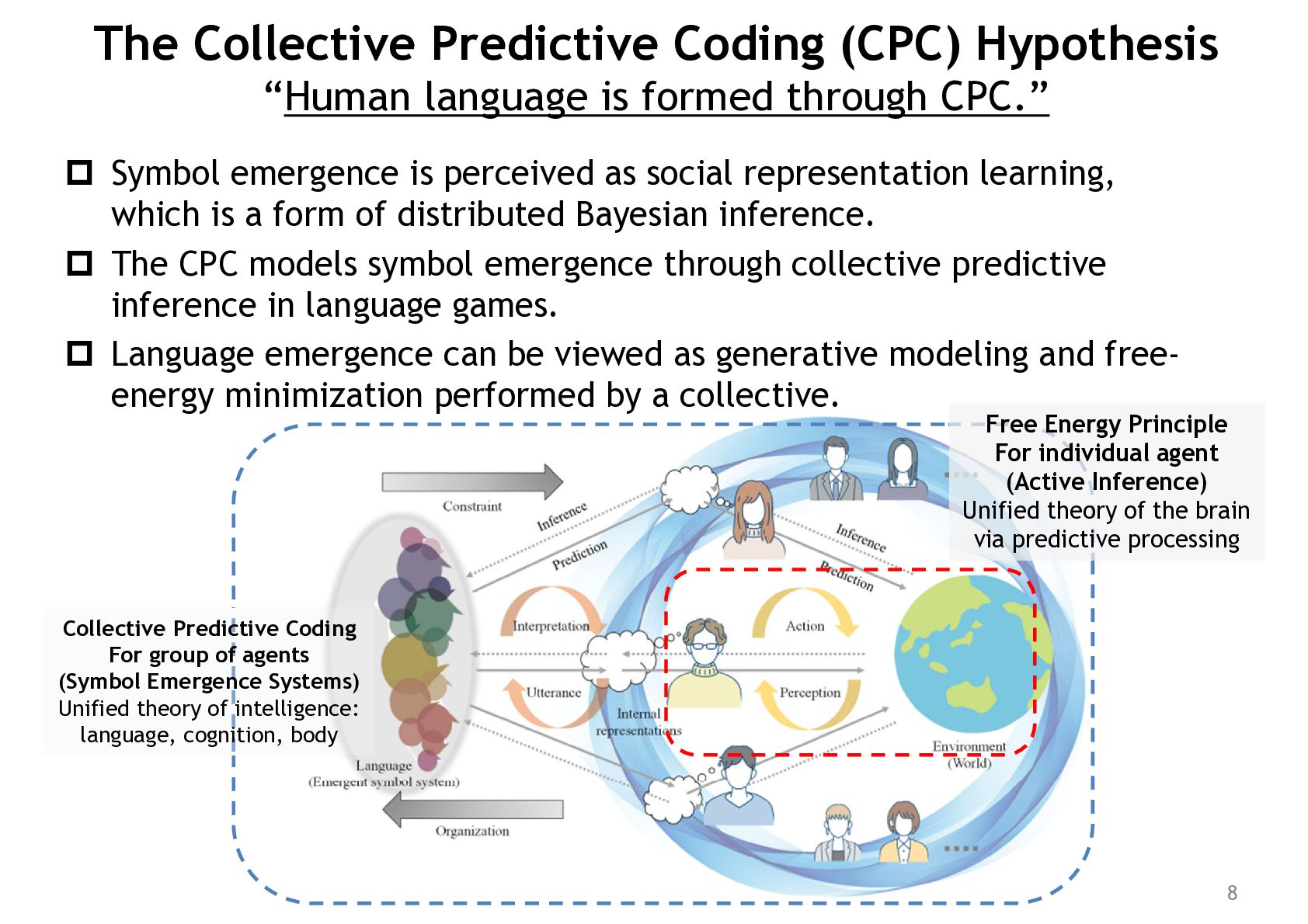
  8. The Collective Predictive Coding (CPC) Hypothesis “Human language is formed

    through CPC.”  Symbol emergence is perceived as social representation learning, which is a form of distributed Bayesian inference.  The CPC models symbol emergence through collective predictive inference in language games.  Language emergence can be viewed as generative modeling and freeenergy minimization performed by a collective. Free Energy Principle For individual agent (Active Inference) Unified theory of the brain via predictive processing Collective Predictive Coding For group of agents (Symbol Emergence Systems) Unified theory of intelligence: language, cognition, body 8
  9. Agenda 1. Introduction: Symbol Emergence Systems 2. Generative Emergent Communication:

    Language Games as Decentralized Bayesian Inference 3. Collective Predictive Coding Hypothesis 4. Cooperation and Collective Active Inference 5. Modeling Human–AI Society 6. Conclusion 9
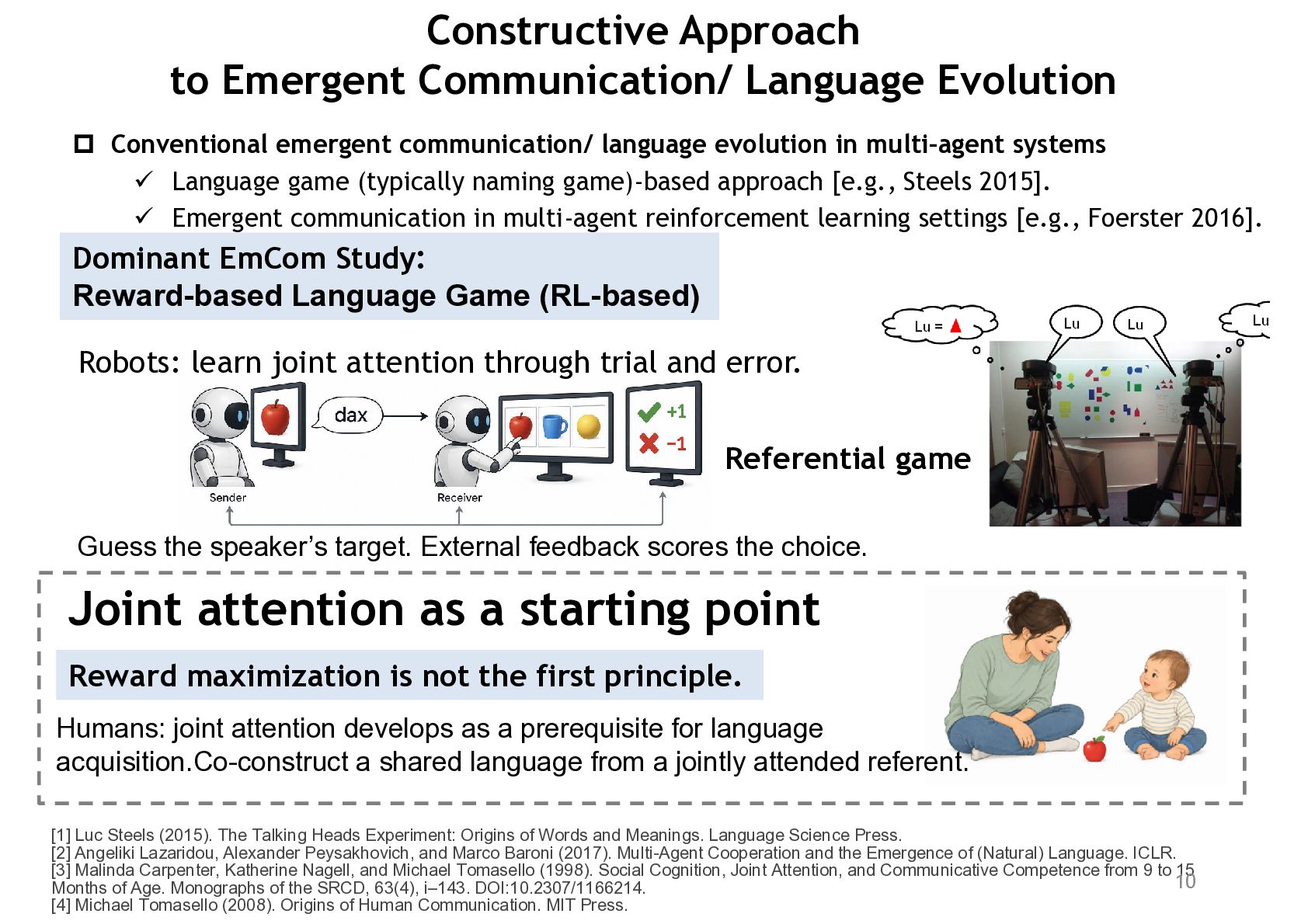
  10. Constructive Approach to Emergent Communication/ Language Evolution  Conventional emergent

    communication/ language evolution in multi-agent systems  Language game (typically naming game)-based approach [e.g., Steels 2015].  Emergent communication in multi-agent reinforcement learning settings [e.g., Foerster 2016]. Dominant EmCom Study: Reward-based Language Game (RL-based) Robots: learn joint attention through trial and error. Referential game Guess the speaker’s target. External feedback scores the choice. Joint attention as a starting point Reward maximization is not the first principle. Humans: joint attention develops as a prerequisite for language acquisition.Co-construct a shared language from a jointly attended referent. [1] Luc Steels (2015). The Talking Heads Experiment: Origins of Words and Meanings. Language Science Press. [2] Angeliki Lazaridou, Alexander Peysakhovich, and Marco Baroni (2017). Multi-Agent Cooperation and the Emergence of (Natural) Language. ICLR. [3] Malinda Carpenter, Katherine Nagell, and Michael Tomasello (1998). Social Cognition, Joint Attention, and Communicative Competence from 9 to 15 10 Months of Age. Monographs of the SRCD, 63(4), i–143. DOI:10.2307/1166214. [4] Michael Tomasello (2008). Origins of Human Communication. MIT Press.
  11. Metropolis-Hastings naming game [Taniguchi+ 2023] Outline 1. 2. 3. 4.

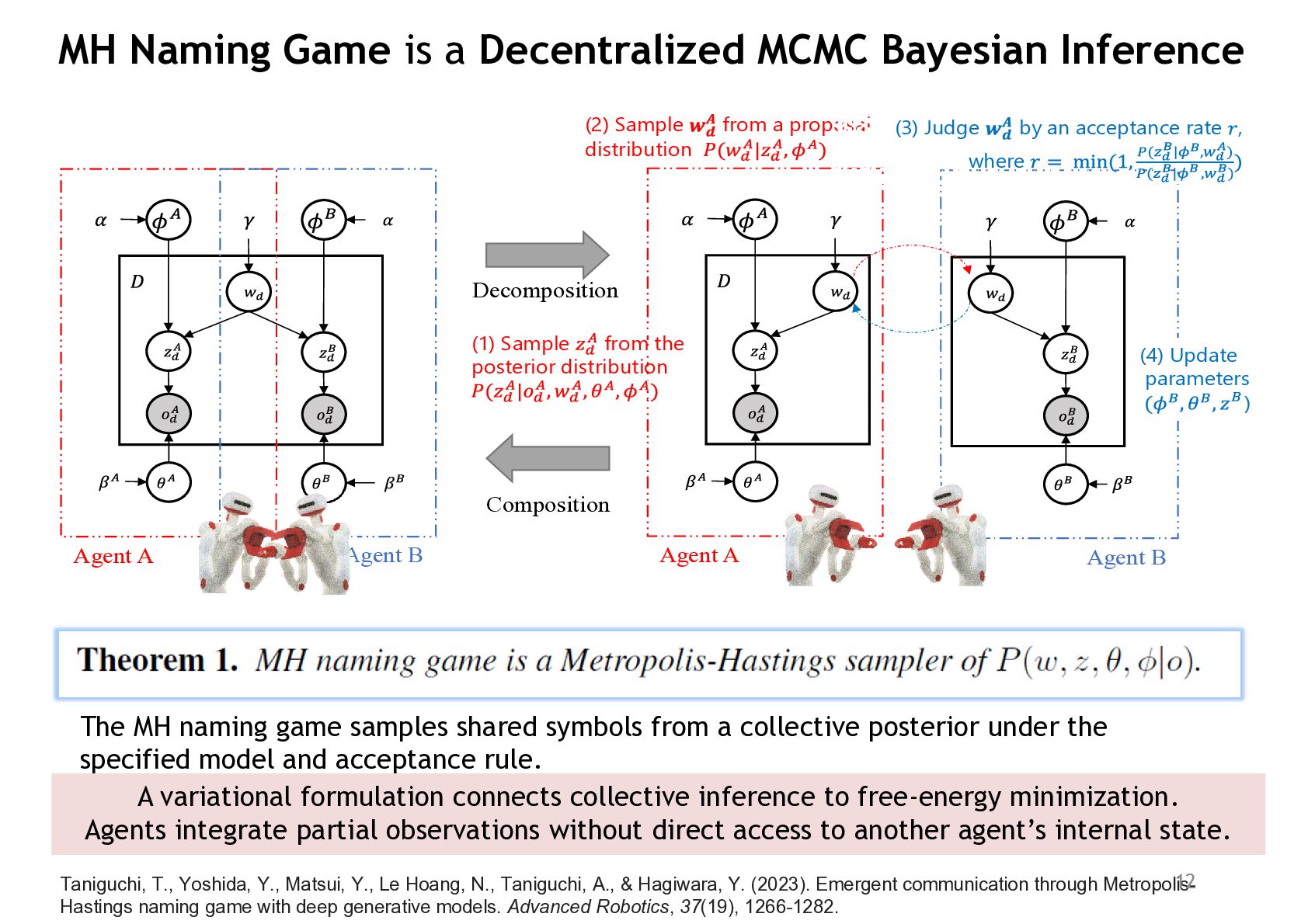
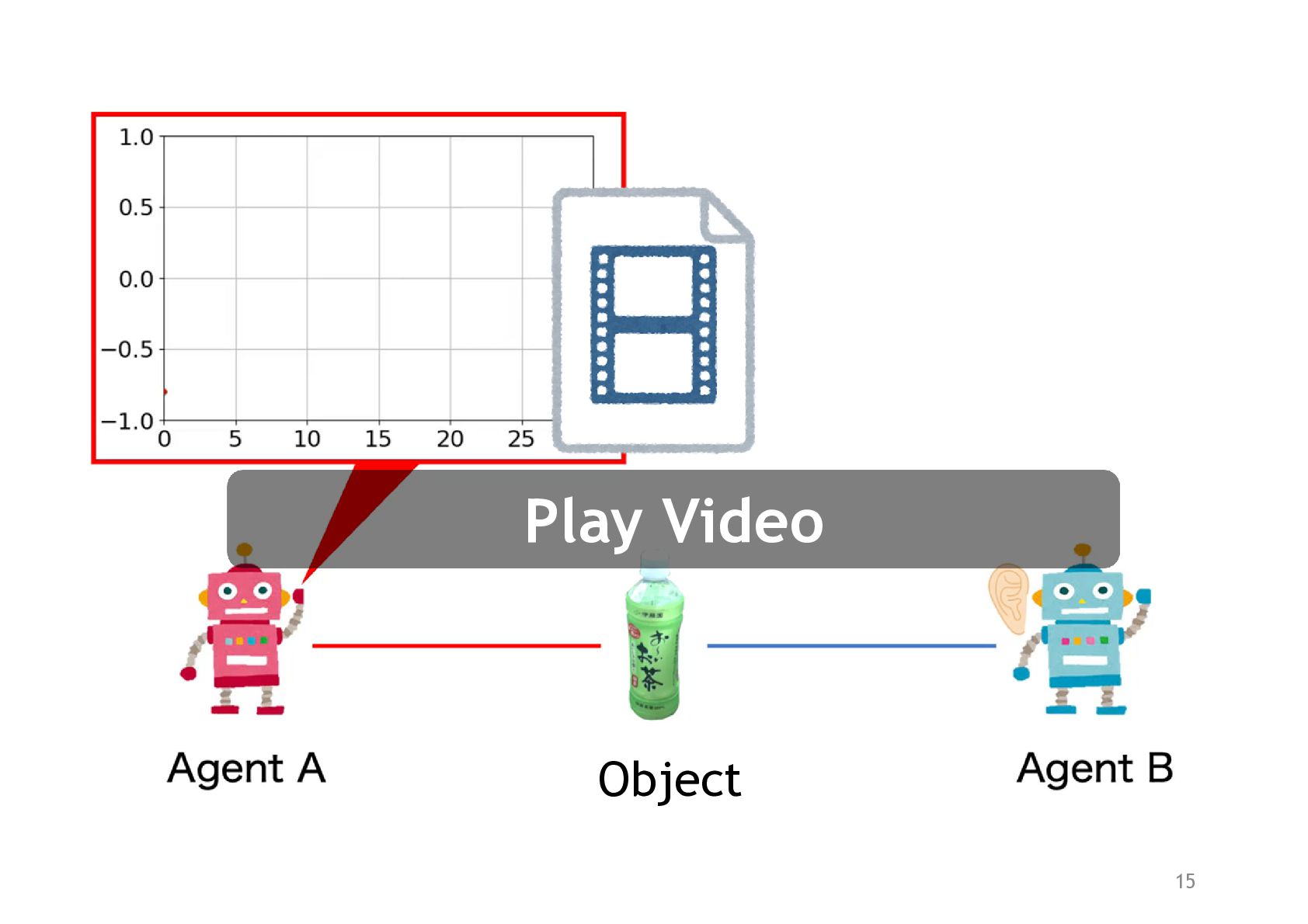
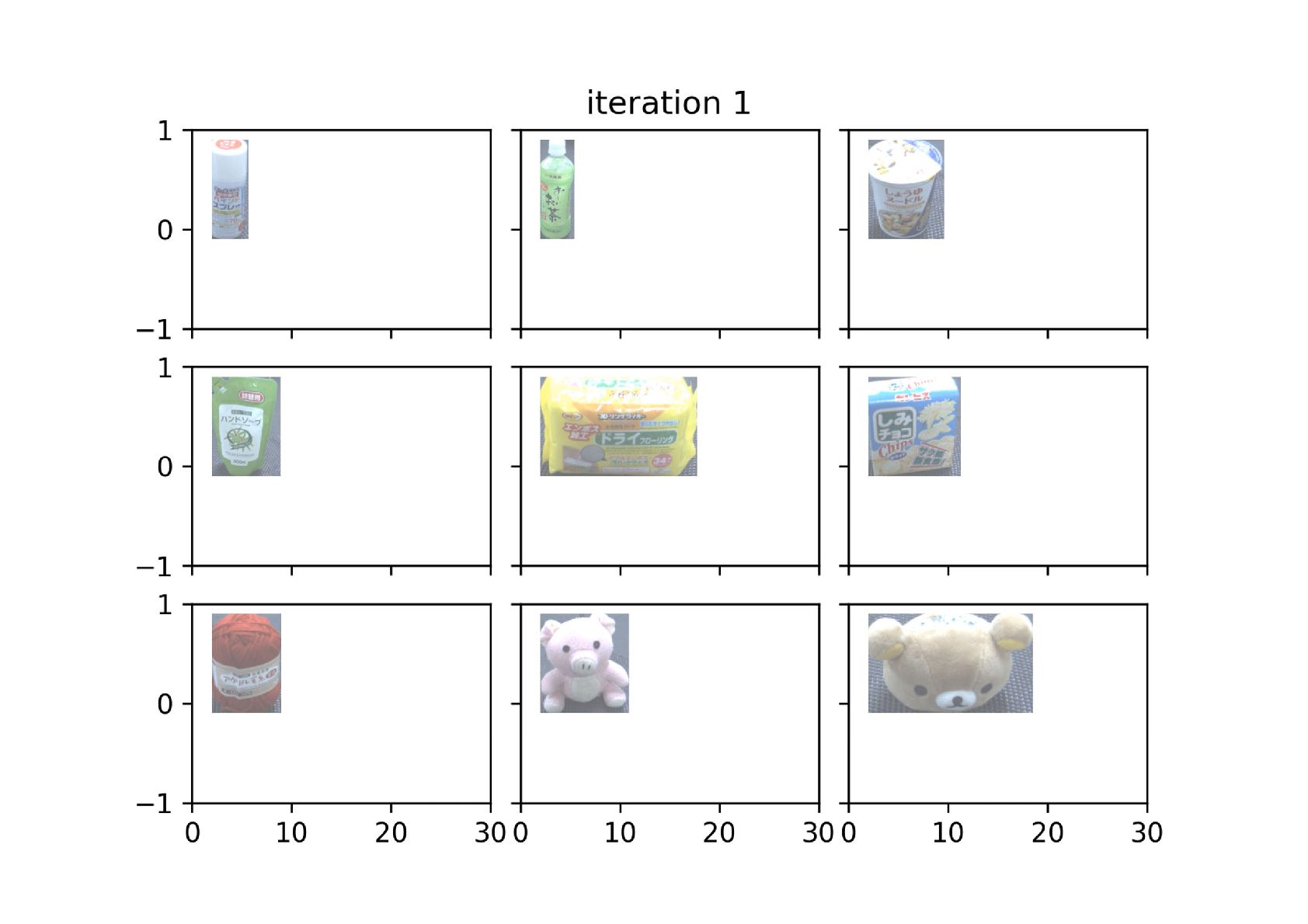
    Perception: Speaker and Listener agents (Sp and Li) observe the d-th object and infer their internal representations (assuming joint attention). Communication: Speaker tells the name of the object probabilistically. The Listener determines if it accepts the naming with a certain probability depending on its belief state. Learning: After the communication is performed, the Listener updates its internal parameters for representation learning and naming. Turn taking: Speaker and Listener alternate their roles and go back to 1. The ratio of how well the other person's name matches your beliefs to how well the name you assumed yourself matches them.  Taniguchi, T., Yoshida, Y., Matsui, Y., Le Hoang, N., Taniguchi, A., & Hagiwara, Y. (2023). Emergent communication through Metropolis-Hastings naming game with deep generative models. Advanced Robotics, 37(19), 1266–1282.  Yoshinobu Hagiwara, Hiroyoshi Kobayashi, Akira Taniguchi and Tadahiro Taniguchi, Symbol Emergence as an Interpersonal Multimodal Categorization, Frontiers in Robotics and AI, 6(134), 11 pp.1-17, 2019
  12. MH Naming Game is a Decentralized MCMC Bayesian Inference (2)

    Sample distribution from a proposal (3) Judge by an acceptance rate , where Decomposition (1) Sample from the posterior distribution (4) Update parameters ) Composition Agent A Agent B Agent A Agent B The MH naming game samples shared symbols from a collective posterior under the specified model and acceptance rule. A variational formulation connects collective inference to free-energy minimization. Agents integrate partial observations without direct access to another agent’s internal state. 12 Taniguchi, T., Yoshida, Y., Matsui, Y., Le Hoang, N., Taniguchi, A., & Hagiwara, Y. (2023). Emergent communication through MetropolisHastings naming game with deep generative models. Advanced Robotics, 37(19), 1266-1282.
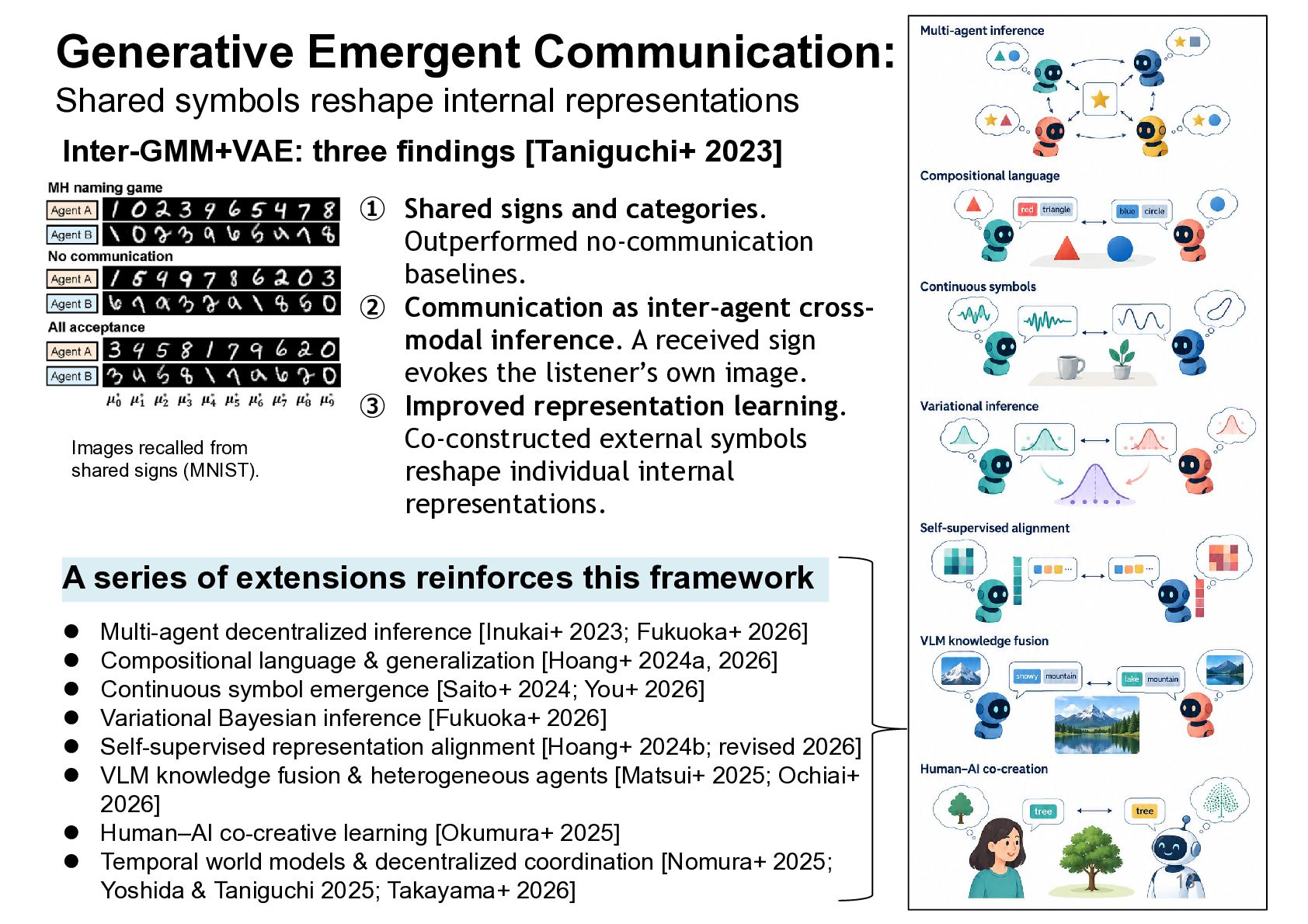
  13. Generative Emergent Communication: Shared symbols reshape internal representations Inter-GMM+VAE: three

    findings [Taniguchi+ 2023] Images recalled from shared signs (MNIST). ① Shared signs and categories. Outperformed no-communication baselines. ② Communication as inter-agent crossmodal inference. A received sign evokes the listener’s own image. ③ Improved representation learning. Co-constructed external symbols reshape individual internal representations. A series of extensions reinforces this framework Multi-agent decentralized inference [Inukai+ 2023; Fukuoka+ 2026] Compositional language & generalization [Hoang+ 2024a, 2026] Continuous symbol emergence [Saito+ 2024; You+ 2026] Variational Bayesian inference [Fukuoka+ 2026] Self-supervised representation alignment [Hoang+ 2024b; revised 2026] VLM knowledge fusion & heterogeneous agents [Matsui+ 2025; Ochiai+ 2026]  Human–AI co-creative learning [Okumura+ 2025]  Temporal world models & decentralized coordination [Nomura+ 2025; Yoshida & Taniguchi 2025; Takayama+ 2026]       13
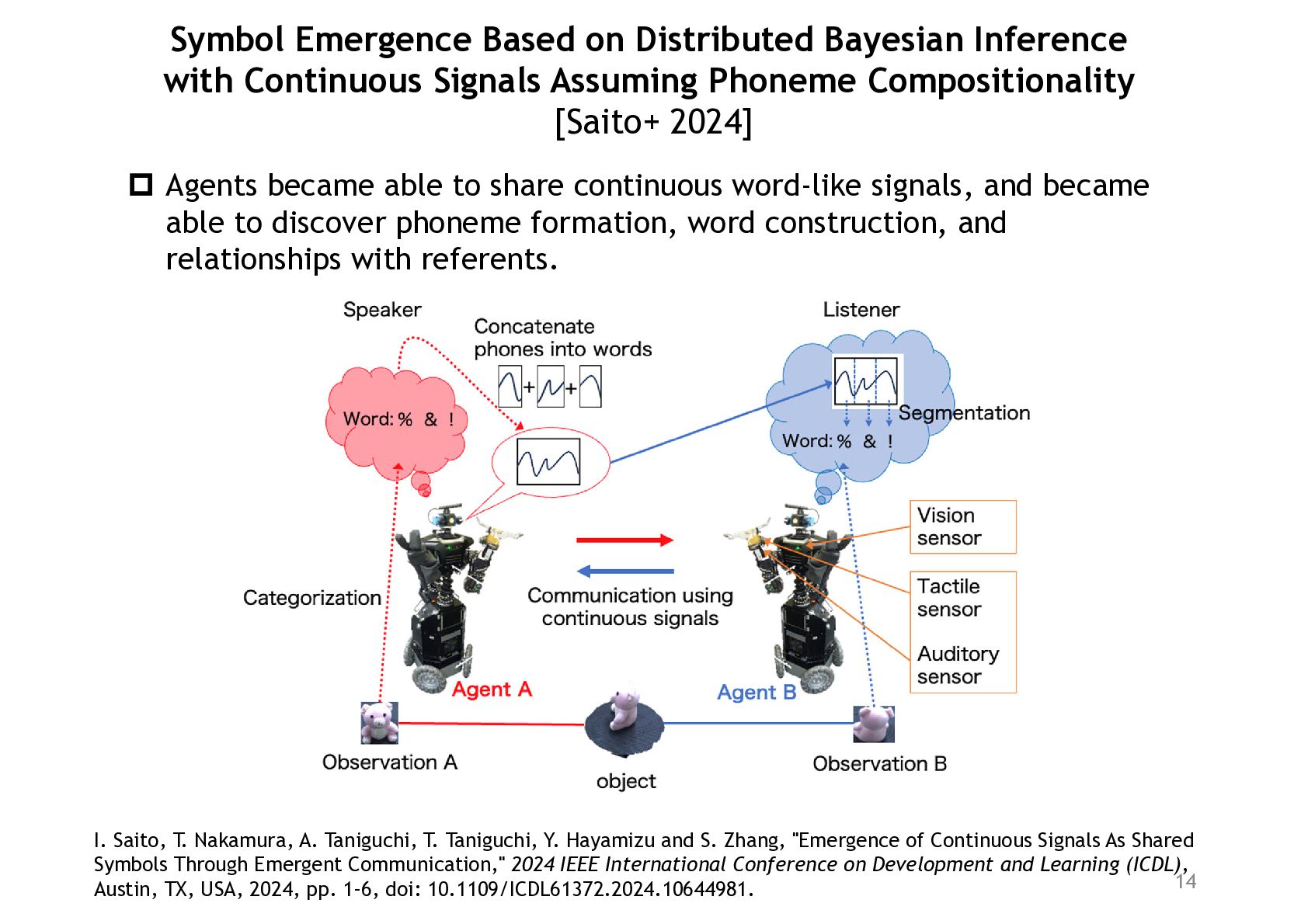
  14. Symbol Emergence Based on Distributed Bayesian Inference with Continuous Signals

    Assuming Phoneme Compositionality [Saito+ 2024]  Agents became able to share continuous word-like signals, and became able to discover phoneme formation, word construction, and relationships with referents. I. Saito, T. Nakamura, A. Taniguchi, T. Taniguchi, Y. Hayamizu and S. Zhang, "Emergence of Continuous Signals As Shared Symbols Through Emergent Communication," 2024 IEEE International Conference on Development and Learning (ICDL), 14 Austin, TX, USA, 2024, pp. 1-6, doi: 10.1109/ICDL61372.2024.10644981.
  15. 16

  16. Agenda 1. Introduction: Symbol Emergence Systems 2. Generative Emergent Communication:

    Language Games as Decentralized Bayesian Inference 3. Collective Predictive Coding Hypothesis 4. Cooperation and Collective Active Inference 5. Modeling Human–AI Society 6. Conclusion 17
  17. Symbol emergence systems [Taniguchi+ 2016] Symbol emergence (language evolution) by

    groups Representation learning (World modeling) by individuals Tadahiro Taniguchi, Takayuki Nagai, Tomoaki Nakamura, Naoto Iwahashi, Tetsuya Ogata, and Hideki Asoh, Symbol Emergence in 18 Robotics: A Survey, Advanced Robotics, 30(11-12) pp.706-728, 2016. DOI:10.1080/01691864.2016.1164622
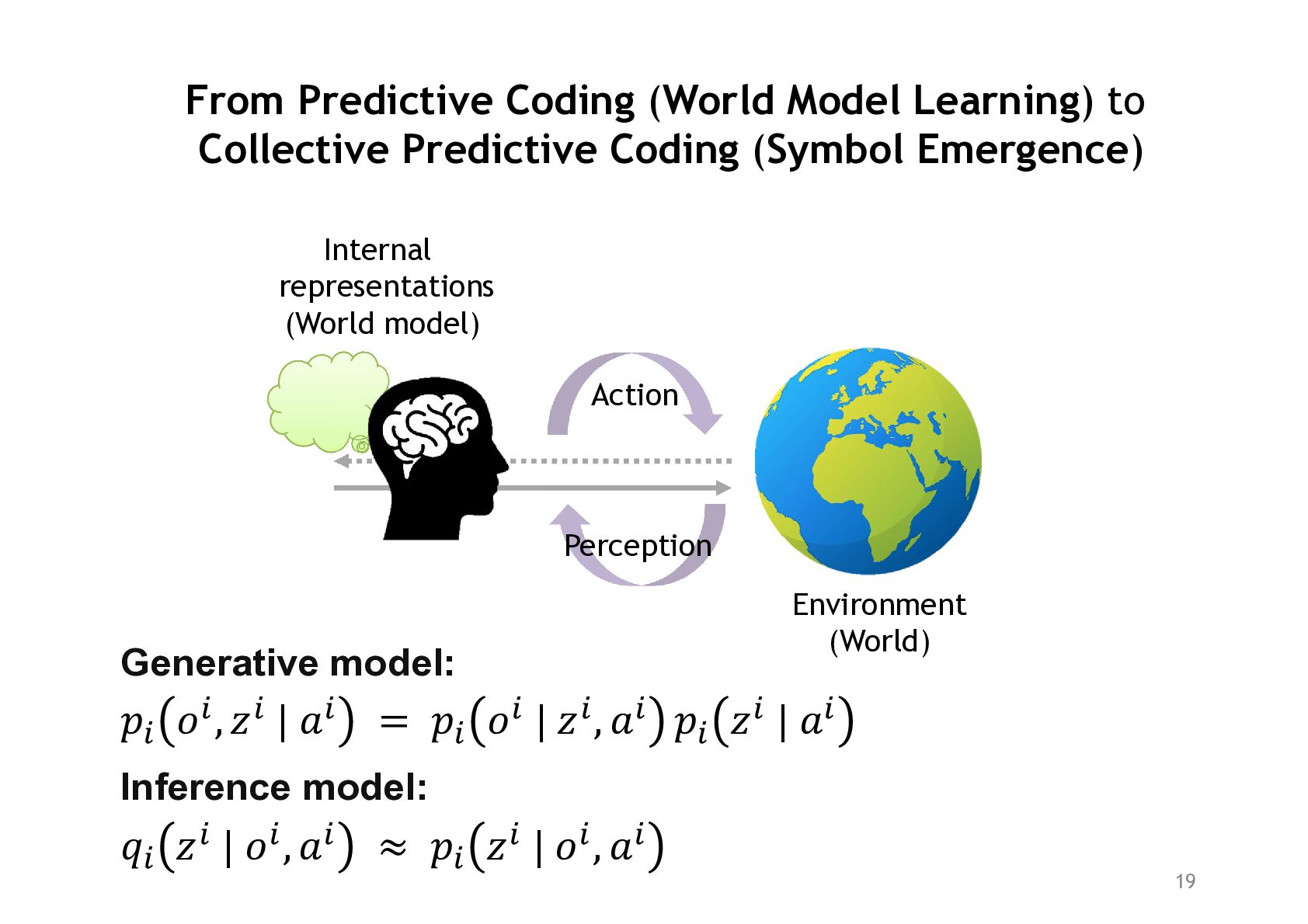
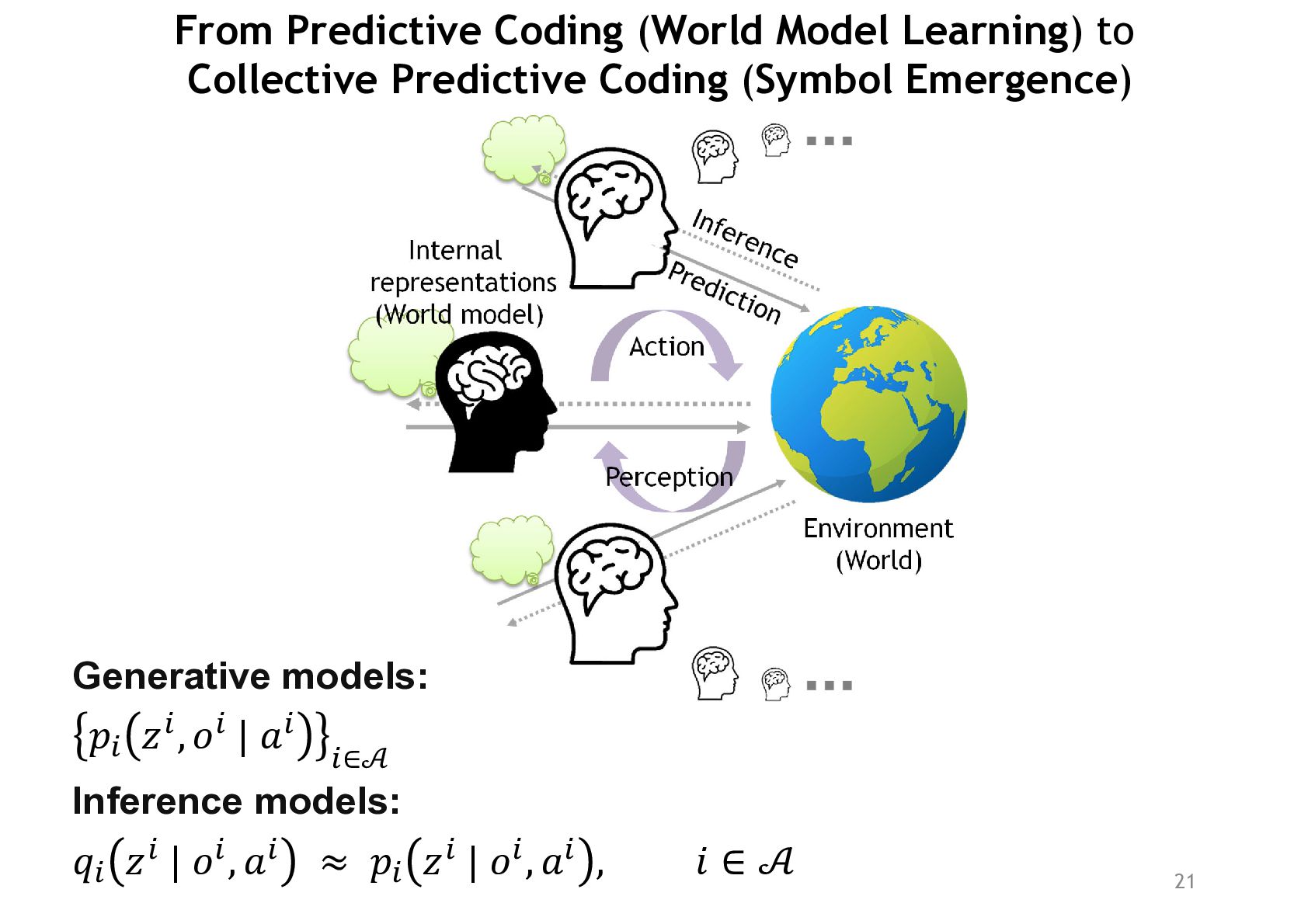
  18. From Predictive Coding (World Model Learning) to Collective Predictive Coding

    (Symbol Emergence) Internal representations (World model) Action Perception Generative model: 𝑝 𝑜 ,𝑧 | 𝑎 Environment (World) 𝑝 𝑜 | 𝑧 ,𝑎 𝑝 𝑧 | 𝑎 Inference model: 𝑞 𝑧 | 𝑜 ,𝑎 𝑝 𝑧 | 𝑜 ,𝑎 19
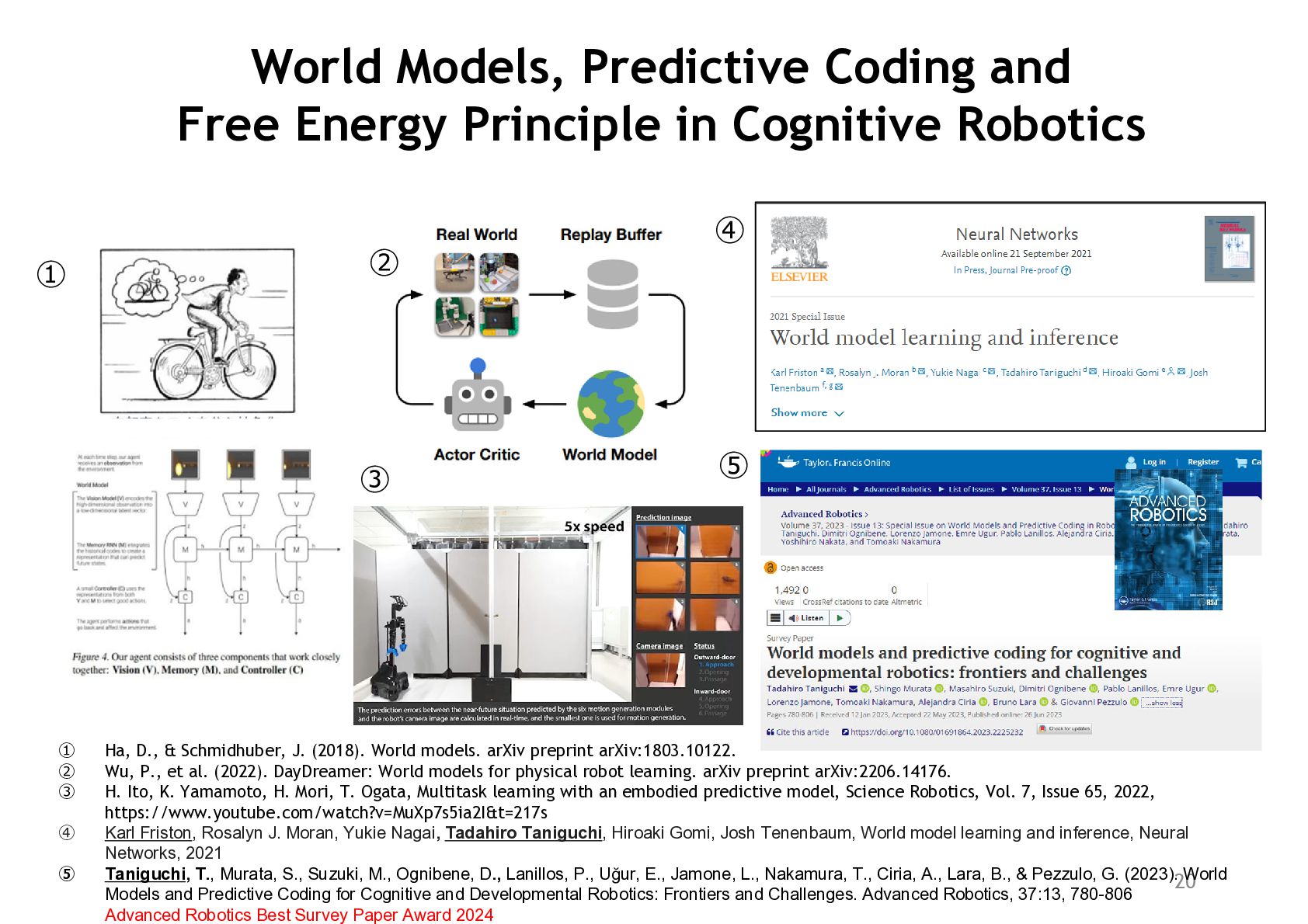
  19. World Models, Predictive Coding and Free Energy Principle in Cognitive

    Robotics ① ② ③ ① ② ③ ④ ⑤ ④ ⑤ Ha, D., & Schmidhuber, J. (2018). World models. arXiv preprint arXiv:1803.10122. Wu, P., et al. (2022). DayDreamer: World models for physical robot learning. arXiv preprint arXiv:2206.14176. H. Ito, K. Yamamoto, H. Mori, T. Ogata, Multitask learning with an embodied predictive model, Science Robotics, Vol. 7, Issue 65, 2022, https://www.youtube.com/watch?v=MuXp7s5ia2I&t=217s Karl Friston, Rosalyn J. Moran, Yukie Nagai, Tadahiro Taniguchi, Hiroaki Gomi, Josh Tenenbaum, World model learning and inference, Neural Networks, 2021 Taniguchi, T., Murata, S., Suzuki, M., Ognibene, D., Lanillos, P., Uğur, E., Jamone, L., Nakamura, T., Ciria, A., Lara, B., & Pezzulo, G. (2023). World 20 Models and Predictive Coding for Cognitive and Developmental Robotics: Frontiers and Challenges. Advanced Robotics, 37:13, 780-806 Advanced Robotics Best Survey Paper Award 2024
  20. From Predictive Coding (World Model Learning) to Collective Predictive Coding

    (Symbol Emergence) Generative models: 𝑝 𝑧 ,𝑜 | 𝑎 ∈𝒜 Inference models: 𝑞 𝑧 | 𝑜 ,𝑎 𝑝 𝑧 | 𝑜 ,𝑎 , 𝑖∈𝒜 21
  21. [rev] From Predictive Coding (World Model Learning) to Collective Predictive

    Coding (Symbol Emergence) Generative model: 𝑝 𝑤, 𝐳, 𝐨 | 𝐚 𝑝 𝑤 𝑝 𝑜 | 𝑧 , 𝑎 𝑝 𝑧 | 𝑤, 𝑎 ∈𝒜 Inference model: 𝑞 𝑤, 𝐳 | 𝐨, 𝐚 𝐳 𝑧 ∈𝒜 , 𝑞 𝑤|𝐳 𝐨 𝑜 𝑞 𝑧 | 𝑜 ,𝑎 ∈𝒜 ∈𝒜 , 𝐚 𝑎 ∈𝒜 𝑝 𝑤, 𝐳 | 𝐨, 𝐚 w: shared external symbol 22
  22. [rev] From Predictive Coding (World Model Learning) to Collective Predictive

    Coding (Symbol Emergence) Generative model: 𝑝 𝑤, 𝐳, 𝐨 | 𝐚 𝑝 𝑤 𝑝 𝑜 | 𝑧 , 𝑎 𝑝 𝑧 | 𝑤, 𝑎 ∈𝒜 Inference model: 𝑞 𝑤, 𝐳 | 𝐨, 𝐚 𝑞 𝑤|𝐳 𝐳 𝑧 ∈𝒜 , 𝐨 𝑜 𝑞 𝑧 | 𝑜 ,𝑎 ∈𝒜 ∈𝒜 , 𝐚 𝑎 ∈𝒜 𝑝 𝑤, 𝐳 | 𝐨, 𝐚 w: shared external symbol 23
  23. [rev] From Predictive Coding (World Model Learning) to Collective Predictive

    Coding (Symbol Emergence) Generative model: 𝑝 𝑤, 𝐳, 𝐨 | 𝐚 𝑝 𝑤 𝑝 𝑜 | 𝑧 , 𝑎 𝑝 𝑧 | 𝑤, 𝑎 ∈𝒜 Inference model: 𝑞 𝑤, 𝐳 | 𝐨, 𝐚 𝑞 𝑤|𝐳 𝐳 𝑧 ∈𝒜 , 𝐨 𝑜 𝑞 𝑧 | 𝑜 ,𝑎 ∈𝒜 ∈𝒜 , 𝐚 𝑎 ∈𝒜 𝑝 𝑤, 𝐳 | 𝐨, 𝐚 w: shared external symbol 24
  24. [rev] From Predictive Coding (World Model Learning) to Collective Predictive

    Coding (Symbol Emergence) Generative model: 𝑝 𝑤, 𝐳, 𝐨 | 𝐚 𝑝 𝑤 𝑝 𝑜 | 𝑧 , 𝑎 𝑝 𝑧 | 𝑤, 𝑎 ∈𝒜 Inference model: 𝑞 𝑤, 𝐳 | 𝐨, 𝐚 𝑞 𝑤|𝐳 𝐳 𝑧 ∈𝒜 , 𝐨 𝑜 𝑞 𝑧 | 𝑜 ,𝑎 ∈𝒜 ∈𝒜 , 𝐚 𝑎 ∈𝒜 𝑝 𝑤, 𝐳 | 𝐨, 𝐚 w: shared external symbol 25
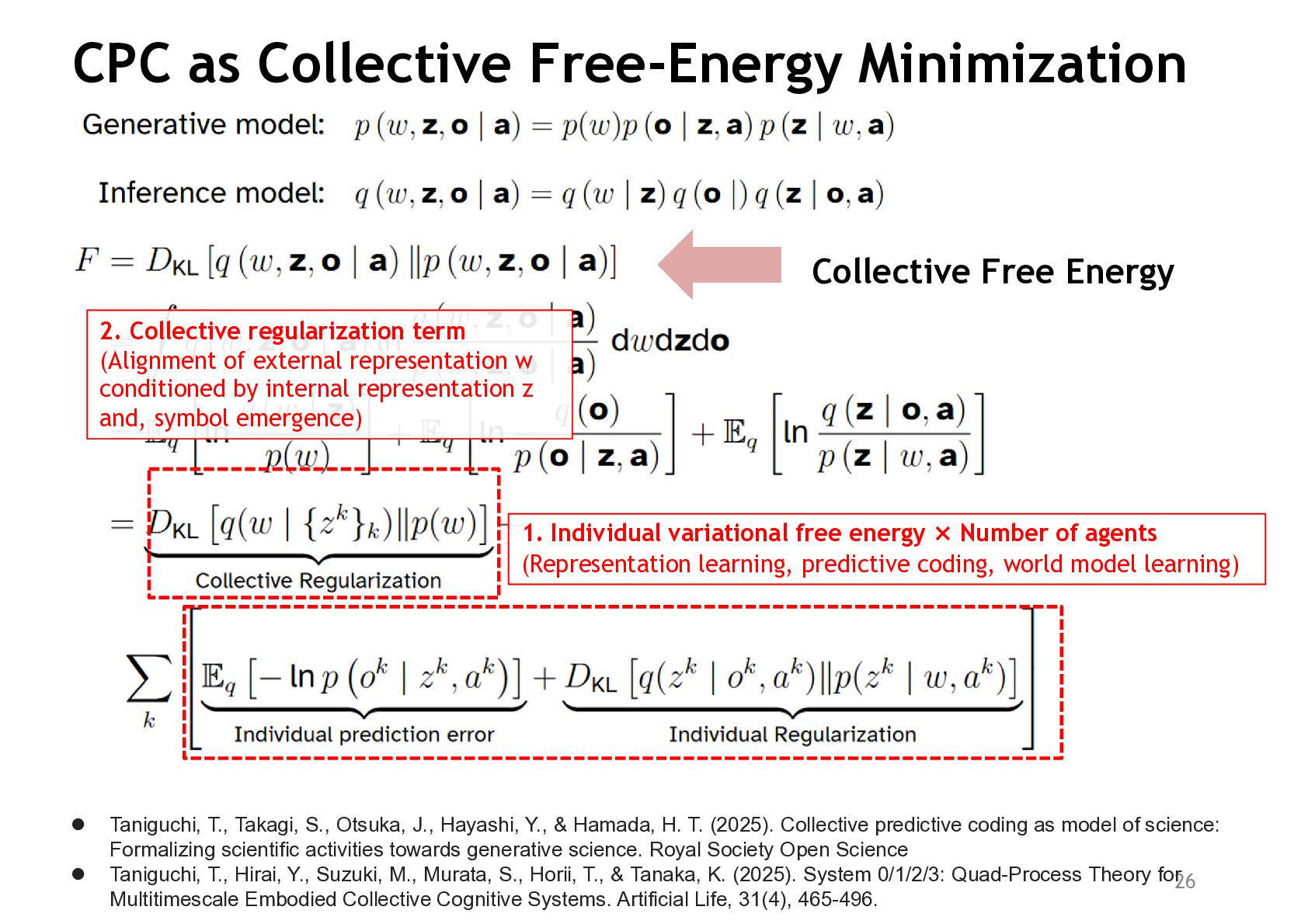
  25. CPC as Collective Free-Energy Minimization Collective Free Energy 2. Collective

    regularization term (Alignment of external representation w conditioned by internal representation z and, symbol emergence) 1. Individual variational free energy × Number of agents (Representation learning, predictive coding, world model learning)   Taniguchi, T., Takagi, S., Otsuka, J., Hayashi, Y., & Hamada, H. T. (2025). Collective predictive coding as model of science: Formalizing scientific activities towards generative science. Royal Society Open Science Taniguchi, T., Hirai, Y., Suzuki, M., Murata, S., Horii, T., & Tanaka, K. (2025). System 0/1/2/3: Quad-Process Theory for26 Multitimescale Embodied Collective Cognitive Systems. Artificial Life, 31(4), 465-496.
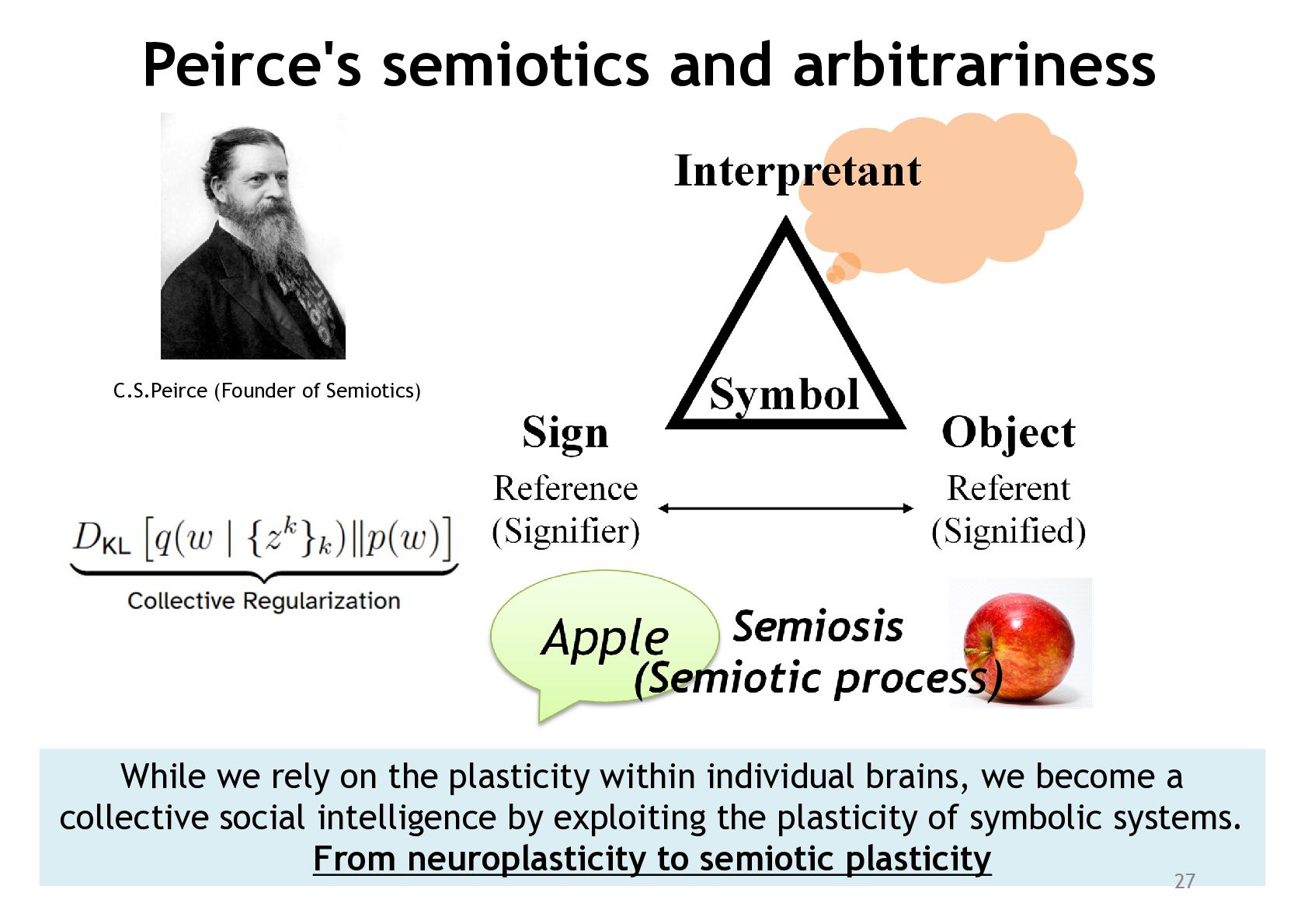
  26. Peirce's semiotics and arbitrariness C.S.Peirce (Founder of Semiotics) ss) While

    we rely on the plasticity within individual brains, we become a collective social intelligence by exploiting the plasticity of symbolic systems. From neuroplasticity to semiotic plasticity 27
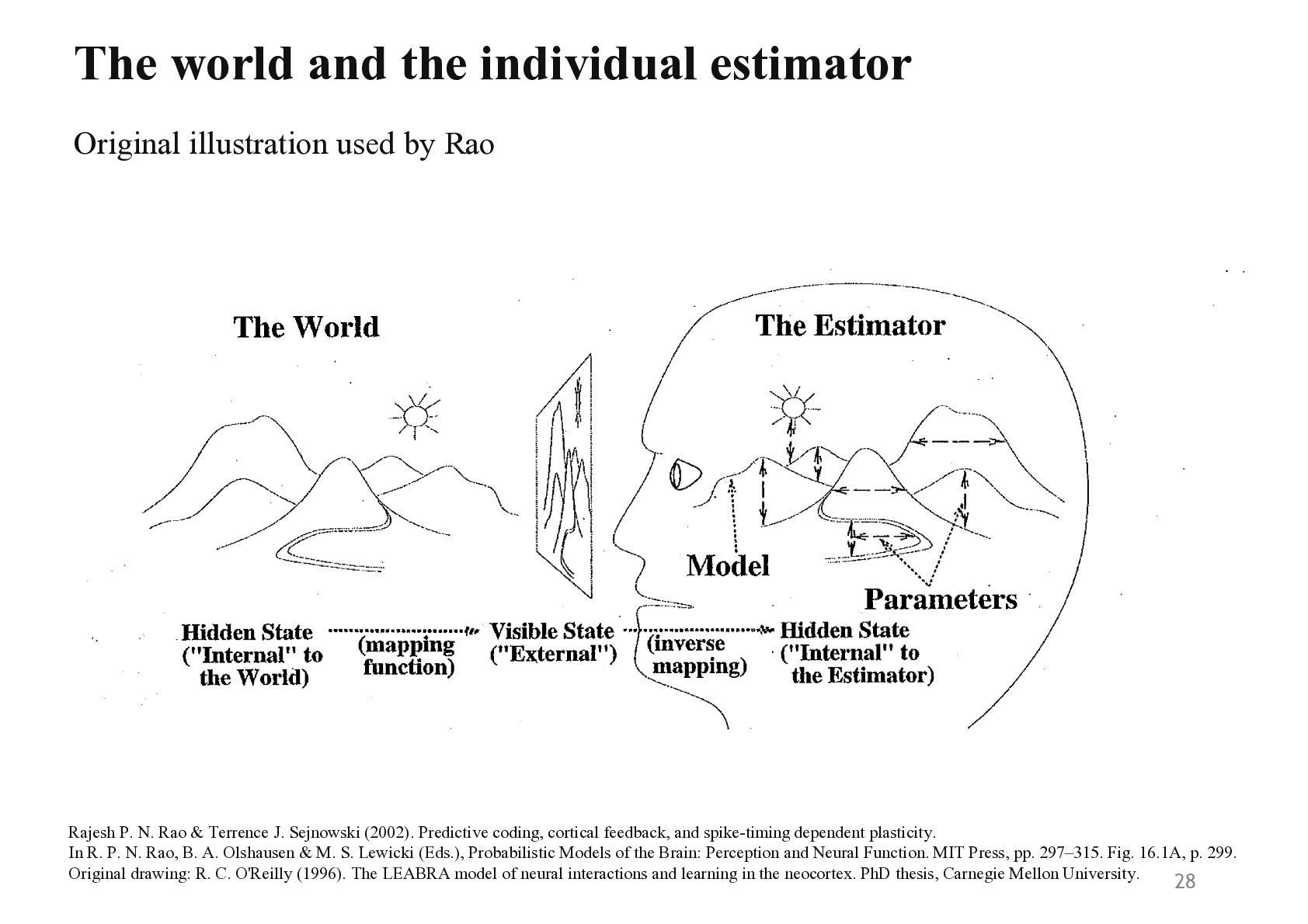
  27. The world and the individual estimator Original illustration used by

    Rao Rajesh P. N. Rao & Terrence J. Sejnowski (2002). Predictive coding, cortical feedback, and spike-timing dependent plasticity. In R. P. N. Rao, B. A. Olshausen & M. S. Lewicki (Eds.), Probabilistic Models of the Brain: Perception and Neural Function. MIT Press, pp. 297–315. Fig. 16.1A, p. 299. Original drawing: R. C. O'Reilly (1996). The LEABRA model of neural interactions and learning in the neocortex. PhD thesis, Carnegie Mellon University. 28
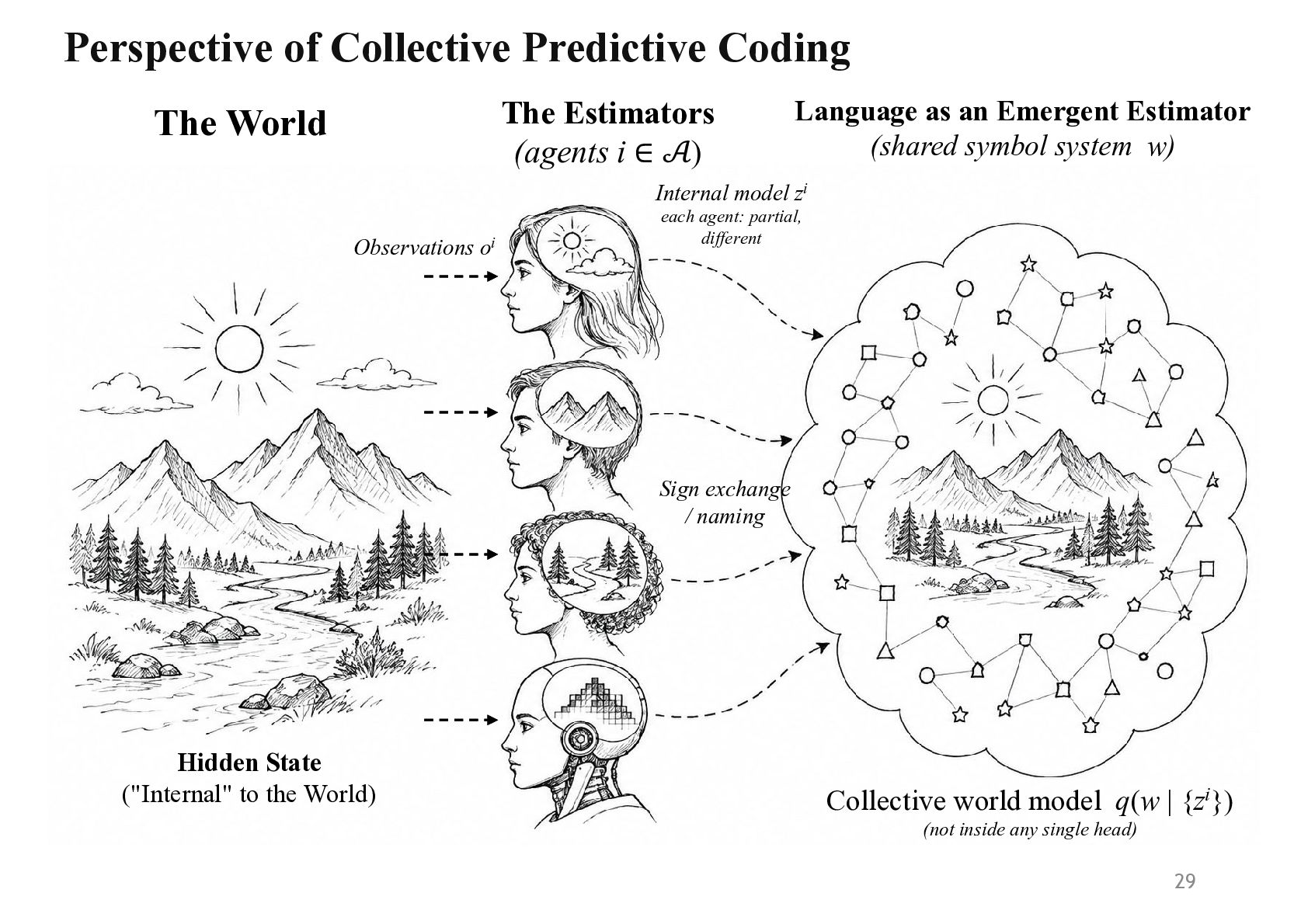
  28. Perspective of Collective Predictive Coding The Estimators (agents i ∈

    𝒜) The World Language as an Emergent Estimator (shared symbol system w) Internal model zi Observations oi each agent: partial, different Sign exchange / naming Hidden State ("Internal" to the World) Collective world model q(w | {zi}) (not inside any single head) 29
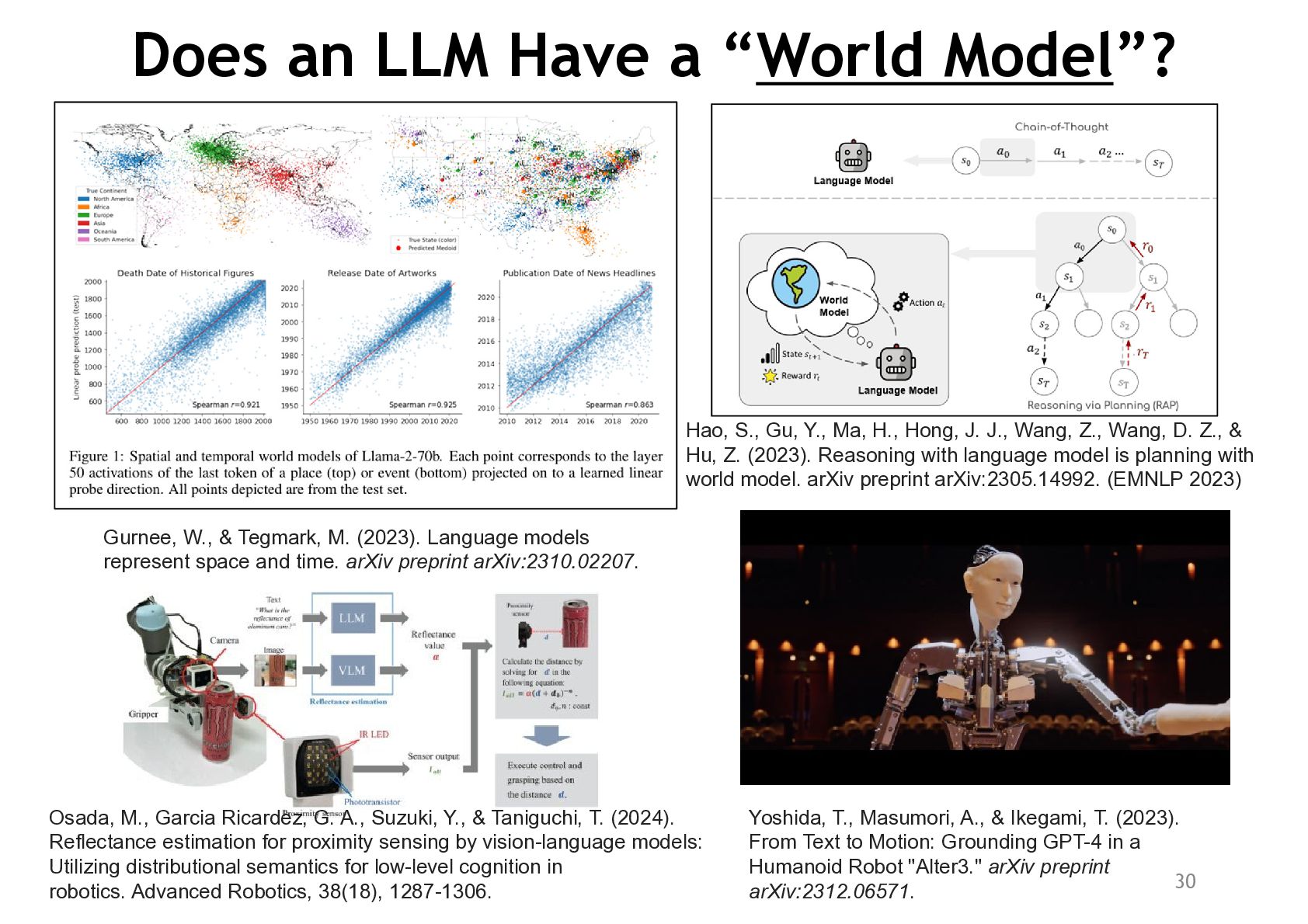
  29. Does an LLM Have a “World Model”? Hao, S., Gu,

    Y., Ma, H., Hong, J. J., Wang, Z., Wang, D. Z., & Hu, Z. (2023). Reasoning with language model is planning with world model. arXiv preprint arXiv:2305.14992. (EMNLP 2023) Gurnee, W., & Tegmark, M. (2023). Language models represent space and time. arXiv preprint arXiv:2310.02207. Osada, M., Garcia Ricardez, G. A., Suzuki, Y., & Taniguchi, T. (2024). Reflectance estimation for proximity sensing by vision-language models: Utilizing distributional semantics for low-level cognition in robotics. Advanced Robotics, 38(18), 1287-1306. Yoshida, T., Masumori, A., & Ikegami, T. (2023). From Text to Motion: Grounding GPT-4 in a Humanoid Robot "Alter3." arXiv preprint 30 arXiv:2312.06571.
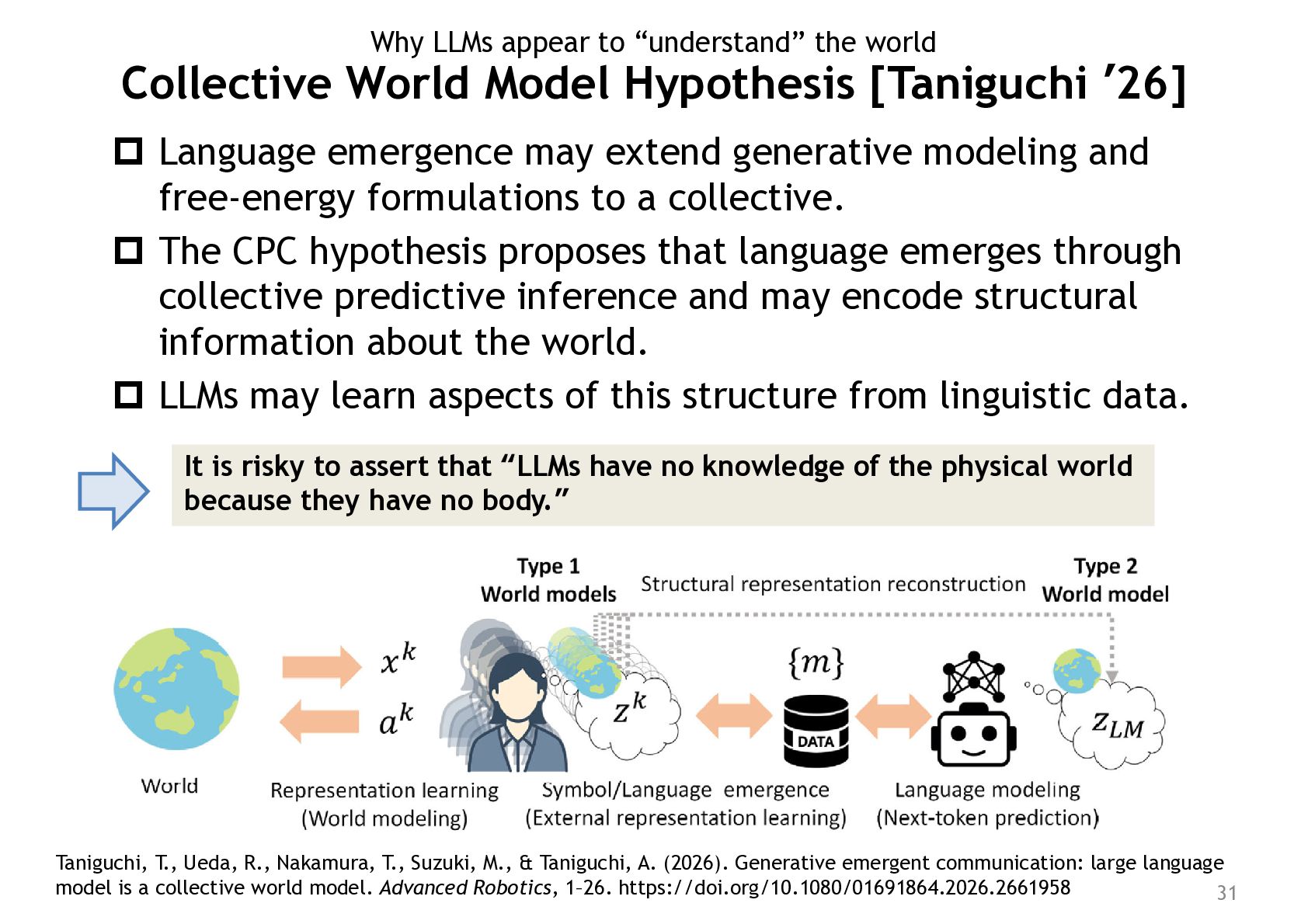
  30. Why LLMs appear to “understand” the world Collective World Model

    Hypothesis [Taniguchi ʼ26]  Language emergence may extend generative modeling and free-energy formulations to a collective.  The CPC hypothesis proposes that language emerges through collective predictive inference and may encode structural information about the world.  LLMs may learn aspects of this structure from linguistic data. It is risky to assert that “LLMs have no knowledge of the physical world because they have no body.” Taniguchi, T., Ueda, R., Nakamura, T., Suzuki, M., & Taniguchi, A. (2026). Generative emergent communication: large language model is a collective world model. Advanced Robotics, 1–26. https://doi.org/10.1080/01691864.2026.2661958 31
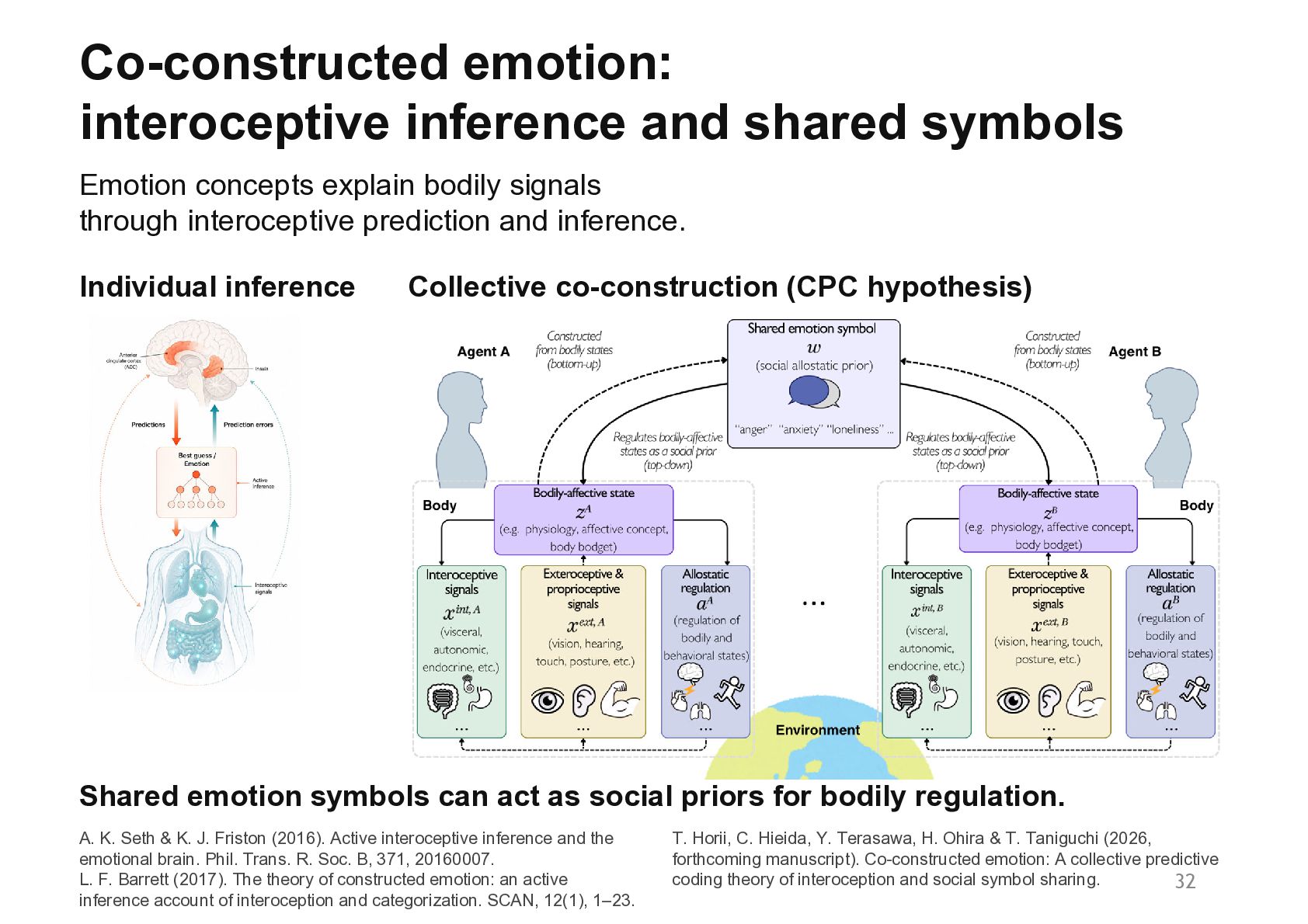
  31. Co-constructed emotion: interoceptive inference and shared symbols Emotion concepts explain

    bodily signals through interoceptive prediction and inference. Individual inference Collective co-construction (CPC hypothesis) Shared emotion symbols can act as social priors for bodily regulation. A. K. Seth & K. J. Friston (2016). Active interoceptive inference and the emotional brain. Phil. Trans. R. Soc. B, 371, 20160007. L. F. Barrett (2017). The theory of constructed emotion: an active inference account of interoception and categorization. SCAN, 12(1), 1–23. T. Horii, C. Hieida, Y. Terasawa, H. Ohira & T. Taniguchi (2026, forthcoming manuscript). Co-constructed emotion: A collective predictive coding theory of interoception and social symbol sharing. 32
  32. Agenda 1. Introduction: Symbol Emergence Systems 2. Generative Emergent Communication:

    Language Games as Decentralized Bayesian Inference 3. Collective Predictive Coding Hypothesis 4. Cooperation and Collective Active Inference 5. Modeling Human–AI Society 6. Conclusion 33
  33. [rev] Communication and cooperation: stable symbols beyond private utility Communication

    shapes the shared world model that cooperation relies on. Shared mapmaking: private reward maximization Shared mapmaking: predictive world modeling Private incentives can bias reports and distort the shared world model. Integrate observations and revise the map for predictive consistency. The strategy so far: shift symbol emergence from policy optimization to multi-agent world modeling. Vincent P. Crawford & Joel Sobel (1982). Strategic Information Transmission. Econometrica, 50(6), 1431–1451. Naoto Yoshida & Tadahiro Taniguchi (ICONIP 2025). Reward-Independent Messaging for Decentralized Multi-agent Reinforcement Learning. Neural 34 Information Processing, pp. 367–382.
  34. [rev] MARL-CPC: Reward-Independent Messaging for Decentralized Multi-agent RL N. Yoshida

    & T. Taniguchi (ICONIP 2025) Proposed collective objective; experiments: CPC+RL CPC messaging with independent RL Observer: asymmetric information Agent A: no reward. Agent B: rewarded for finding the target. Messages support state inference. RL gradients do not train the CPC module. Independent agents; no shared parameters. Episode length and group welfare: IQM, 10 runs; 95% CIs. CPC learns useful messages even when communicating brings no reward to the sender. Yoshida & Taniguchi. Reward-Independent Messaging for Decentralized Multi-Agent Reinforcement Learning. ICONIP 2025, pp. 367–382. arXiv:2505.21985 Best Paper Award Runner-Up 35 at ICONIP 2025.
  35. [rev] Dreamer-CPC: Message Learning with Decentralized World Models T. Takayama,

    N. Yoshida & T. Taniguchi (accepted at ICONIP 2026) Proposed collective objective; experiments: CPC+RL CPC messaging in DreamerV3 CatchApple: predict through occlusion Each agent learns messages from world-model states that encode history. Observer: no reward. Catcher: reward for a catch. World models and messages are learned jointly. Policies learn through imagined message exchange. Episode return: IQM, 10 runs; 95% CIs. Messages grounded in temporal world-model states Takayama, Yoshida & Taniguchi. Dreamer-CPC: Message Learning with World Models for support coordination under occluded observations. Decentralized Multi-agent Reinforcement 36 Learning. accepted at ICONIP 2026.
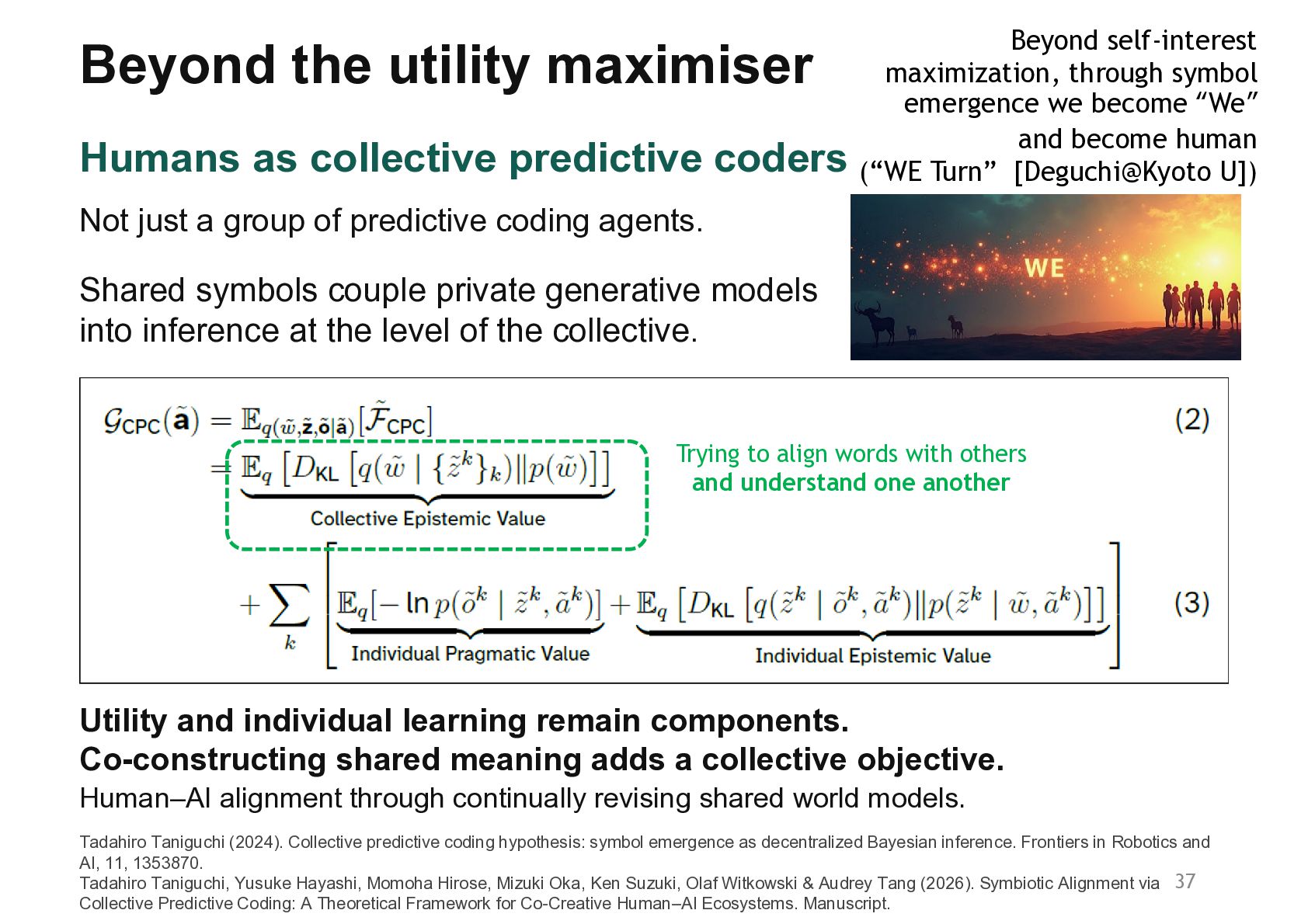
  36. Beyond self-interest maximization, through symbol emergence we become “We” and

    become human Humans as collective predictive coders (“WE Turn” [Deguchi@Kyoto U]) Beyond the utility maximiser Not just a group of predictive coding agents. Shared symbols couple private generative models into inference at the level of the collective. Trying to align words with others and understand one another Utility and individual learning remain components. Co-constructing shared meaning adds a collective objective. Human–AI alignment through continually revising shared world models. Tadahiro Taniguchi (2024). Collective predictive coding hypothesis: symbol emergence as decentralized Bayesian inference. Frontiers in Robotics and AI, 11, 1353870. Tadahiro Taniguchi, Yusuke Hayashi, Momoha Hirose, Mizuki Oka, Ken Suzuki, Olaf Witkowski & Audrey Tang (2026). Symbiotic Alignment via 37 Collective Predictive Coding: A Theoretical Framework for Co-Creative Human–AI Ecosystems. Manuscript.
  37. Agenda 1. Introduction: Symbol Emergence Systems 2. Generative Emergent Communication:

    Language Games as Decentralized Bayesian Inference 3. Collective Predictive Coding Hypothesis 4. Cooperation and Collective Active Inference 5. Modeling Human–AI Society 6. Conclusion 38
  38. [rev] Language Games as Decentralized Bayesian Inference The MH naming

    game and scientific publication are structurally analogous  The MH naming game samples shared symbols from a collective posterior under the specified model and acceptance rule.  A variational formulation connects collective inference to freeenergy minimization.  Peer review: Structural analogy, not a literal MH algorithm.  This motivates CPC as a Model of Science (CPC-MS). 39
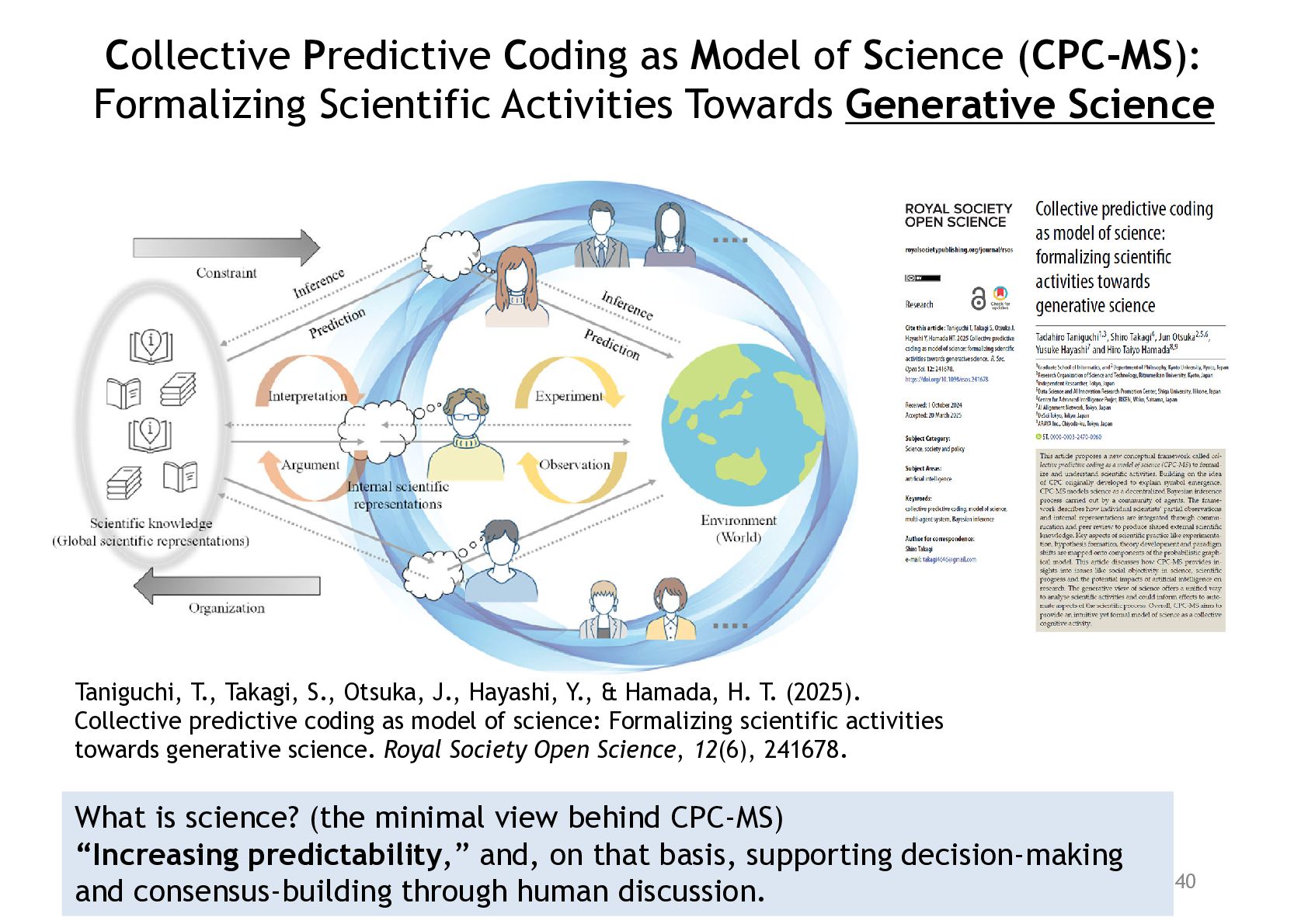
  39. Collective Predictive Coding as Model of Science (CPC-MS): Formalizing Scientific

    Activities Towards Generative Science Taniguchi, T., Takagi, S., Otsuka, J., Hayashi, Y., & Hamada, H. T. (2025). Collective predictive coding as model of science: Formalizing scientific activities towards generative science. Royal Society Open Science, 12(6), 241678. What is science? (the minimal view behind CPC-MS) “Increasing predictability,” and, on that basis, supporting decision-making and consensus-building through human discussion. 40
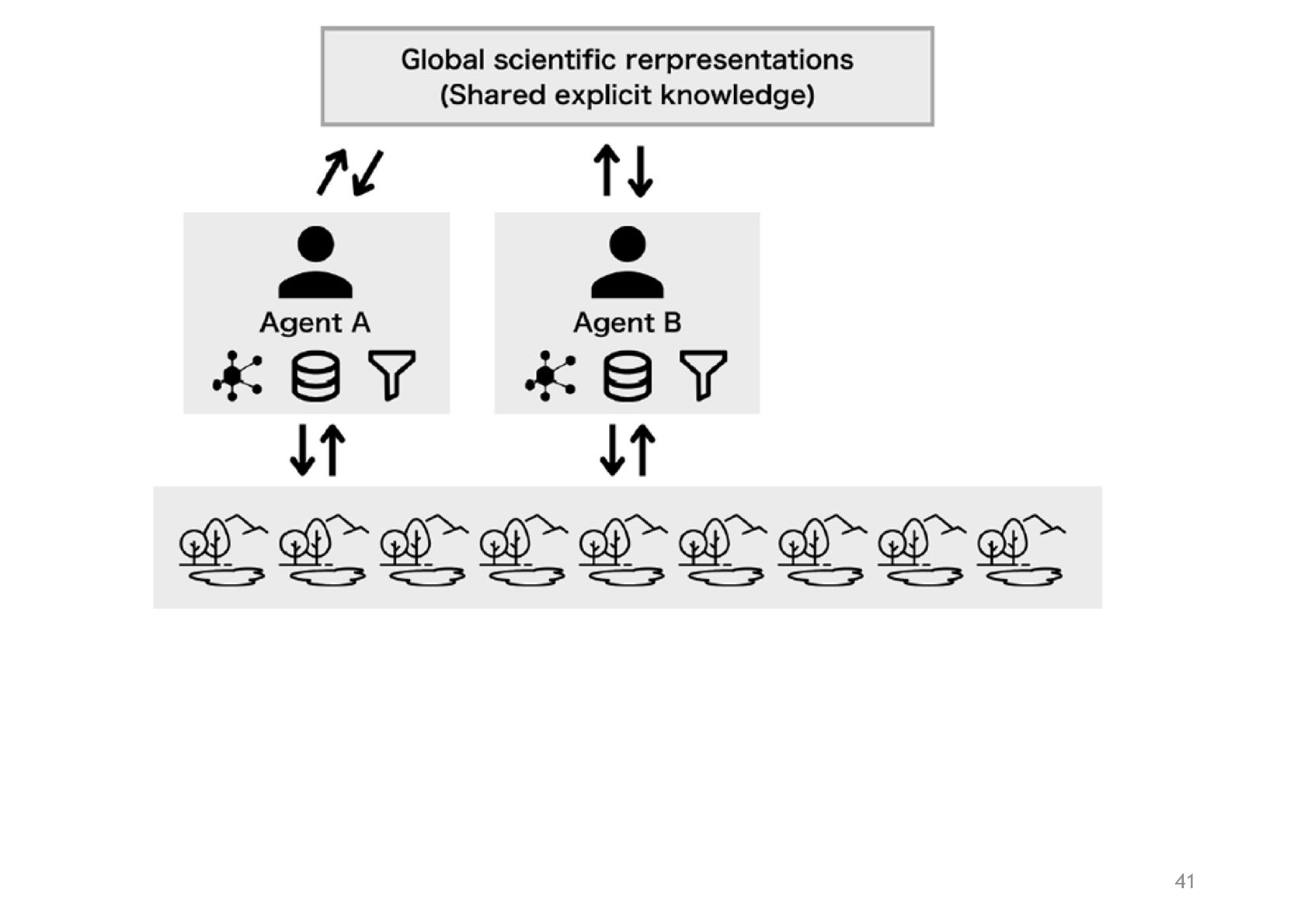
  40. 41

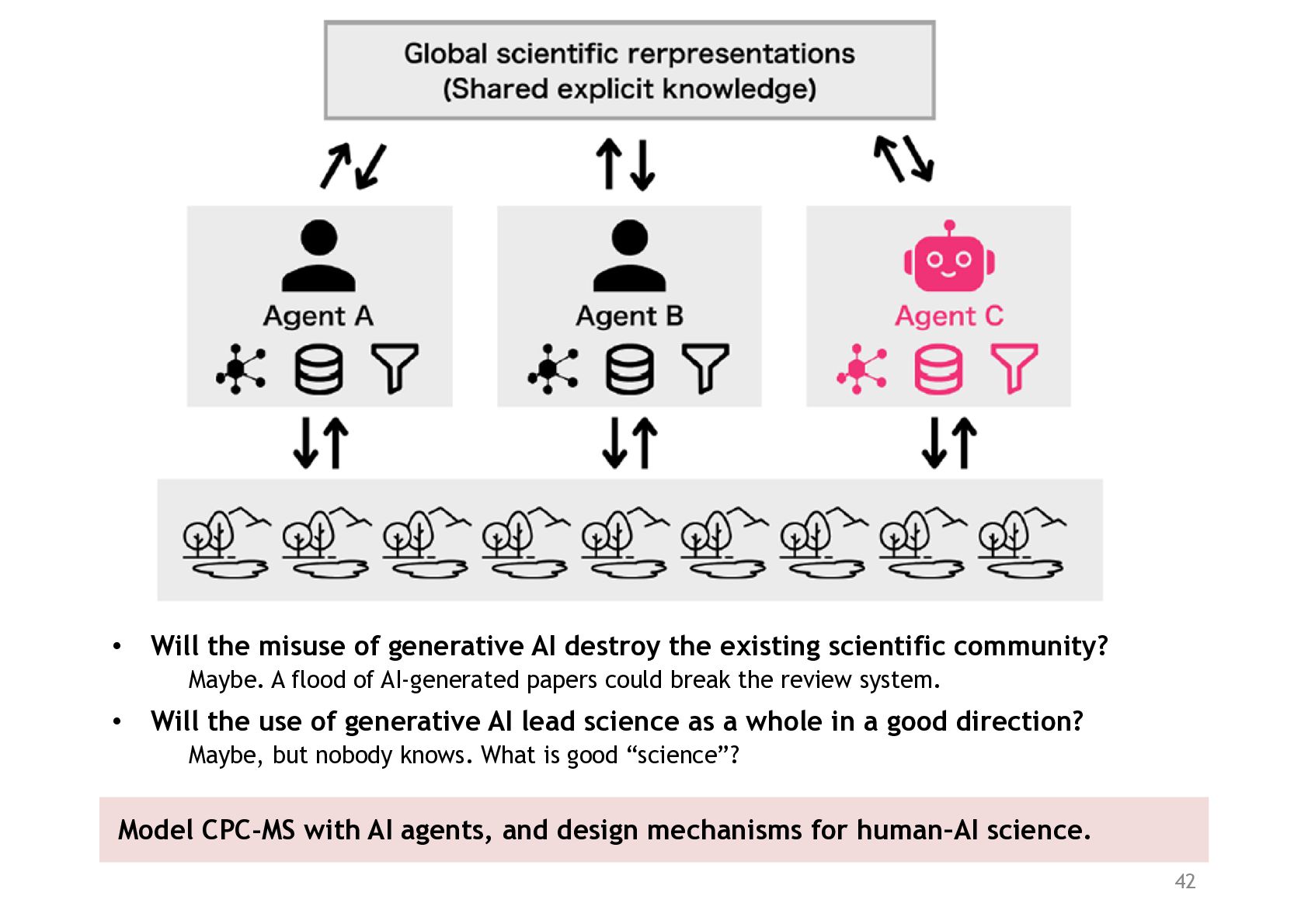
  41. • Will the misuse of generative AI destroy the existing

    scientific community? Maybe. A flood of AI-generated papers could break the review system. • Will the use of generative AI lead science as a whole in a good direction? Maybe, but nobody knows. What is good “science”? Model CPC-MS with AI agents, and design mechanisms for human–AI science. 42
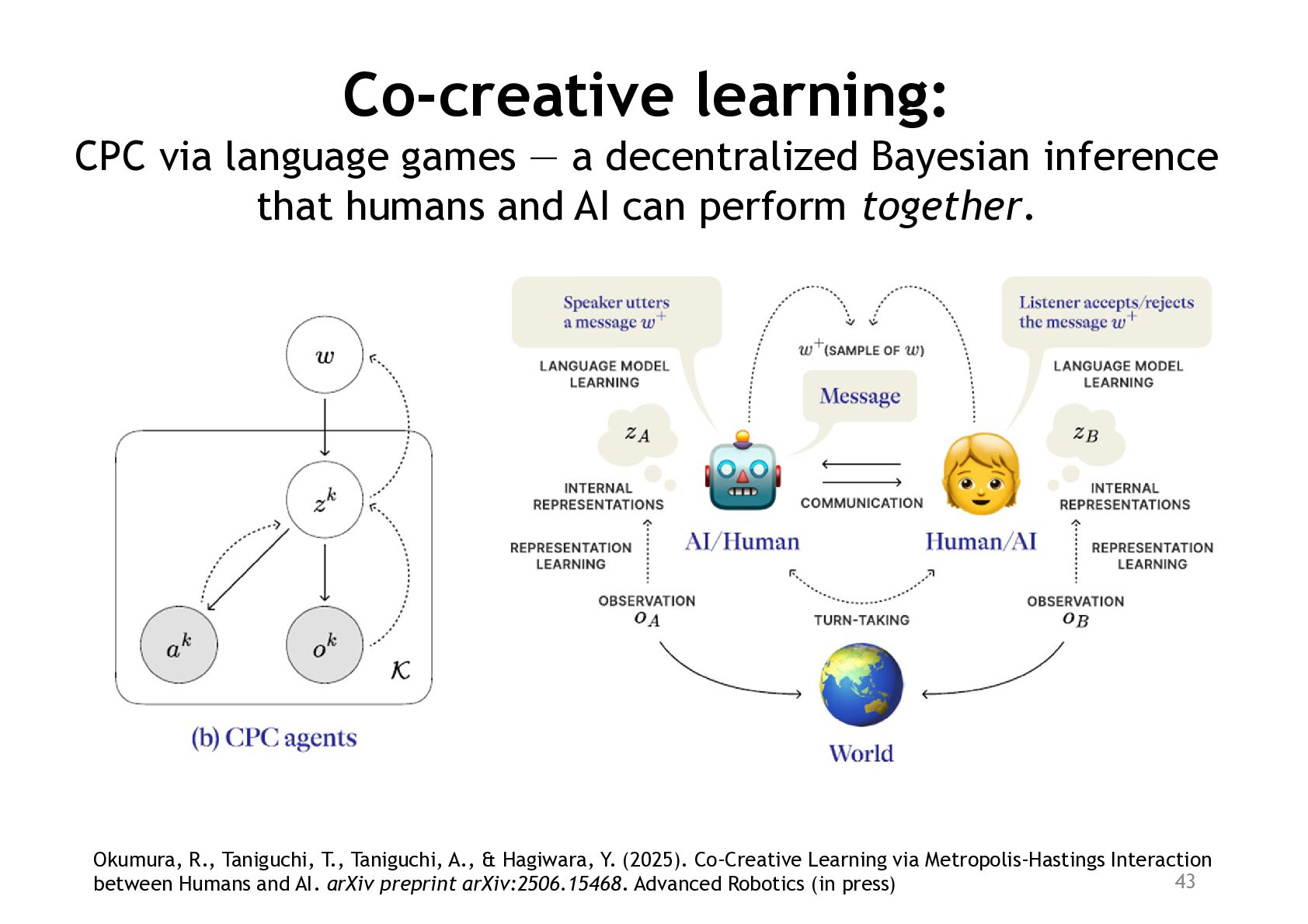
  42. Co-creative learning: CPC via language games — a decentralized Bayesian

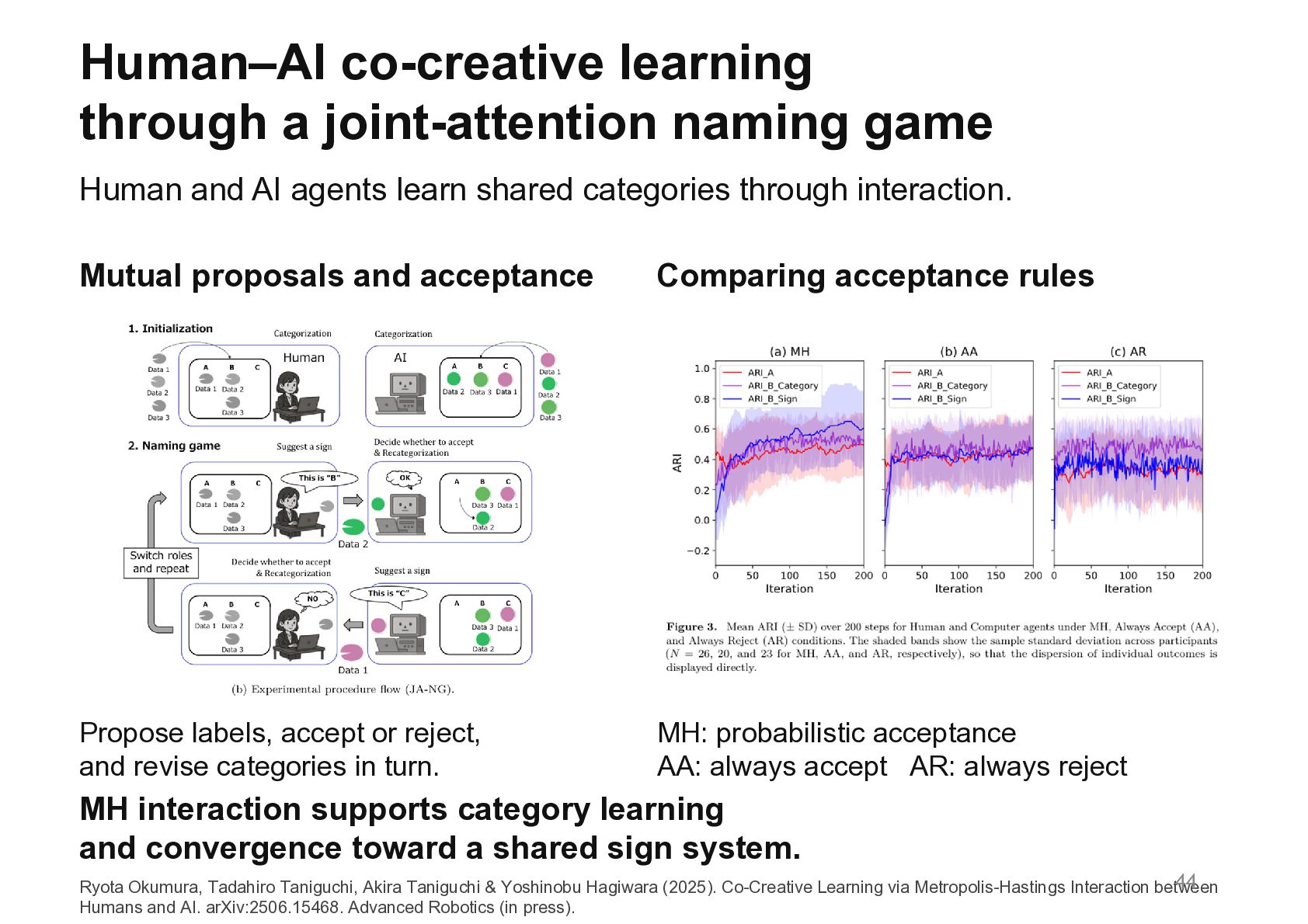
    inference that humans and AI can perform together. Okumura, R., Taniguchi, T., Taniguchi, A., & Hagiwara, Y. (2025). Co-Creative Learning via Metropolis-Hastings Interaction 43 between Humans and AI. arXiv preprint arXiv:2506.15468. Advanced Robotics (in press)
  43. Human–AI co-creative learning through a joint-attention naming game Human and

    AI agents learn shared categories through interaction. Mutual proposals and acceptance Comparing acceptance rules Propose labels, accept or reject, and revise categories in turn. MH: probabilistic acceptance AA: always accept AR: always reject MH interaction supports category learning and convergence toward a shared sign system. 44 Ryota Okumura, Tadahiro Taniguchi, Akira Taniguchi & Yoshinobu Hagiwara (2025). Co-Creative Learning via Metropolis-Hastings Interaction between Humans and AI. arXiv:2506.15468. Advanced Robotics (in press).
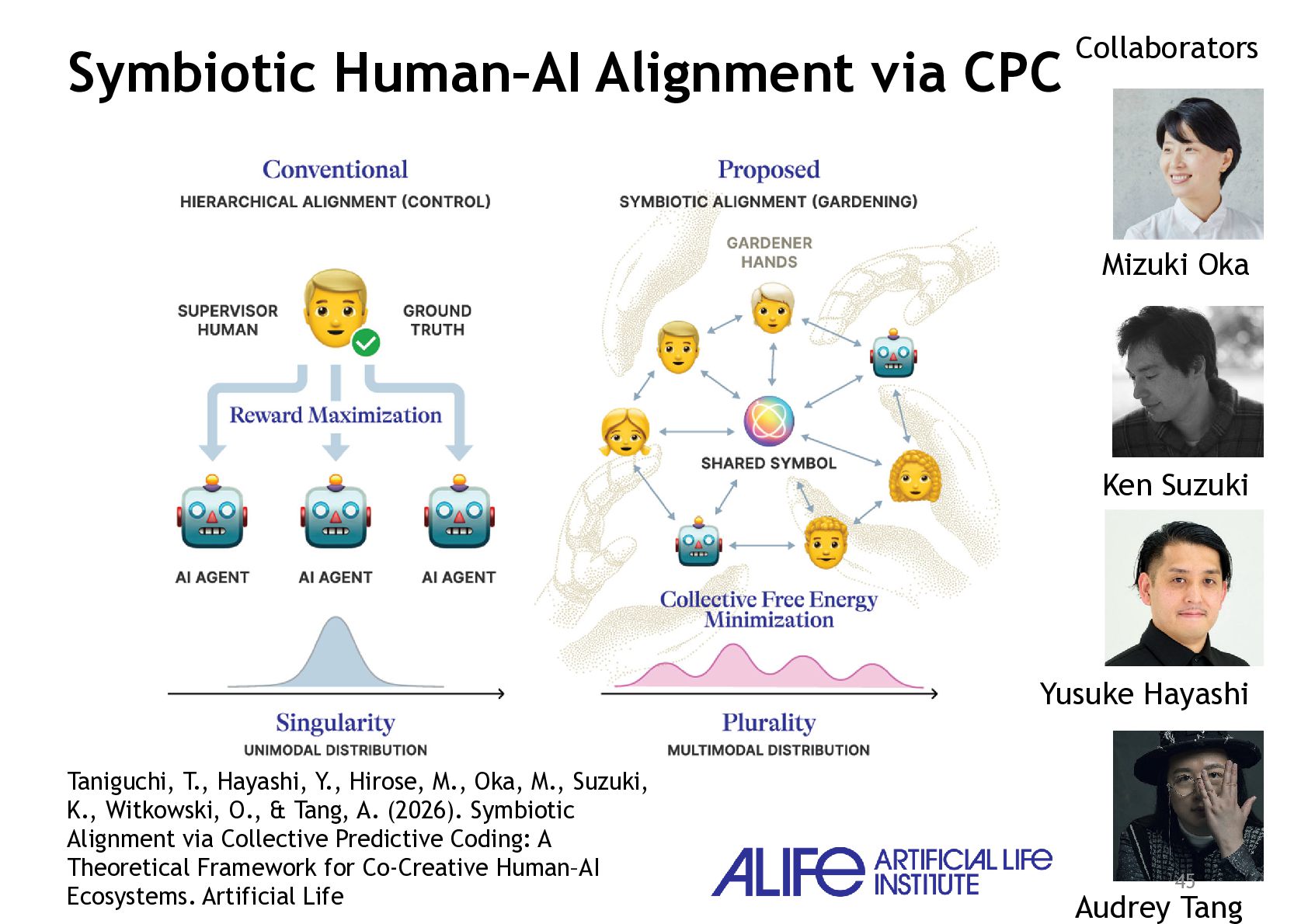
  44. Symbiotic Human–AI Alignment via CPC Collaborators Mizuki Oka Ken Suzuki

    Yusuke Hayashi Taniguchi, T., Hayashi, Y., Hirose, M., Oka, M., Suzuki, K., Witkowski, O., & Tang, A. (2026). Symbiotic Alignment via Collective Predictive Coding: A Theoretical Framework for Co-Creative Human–AI Ecosystems. Artificial Life 45 Audrey Tang
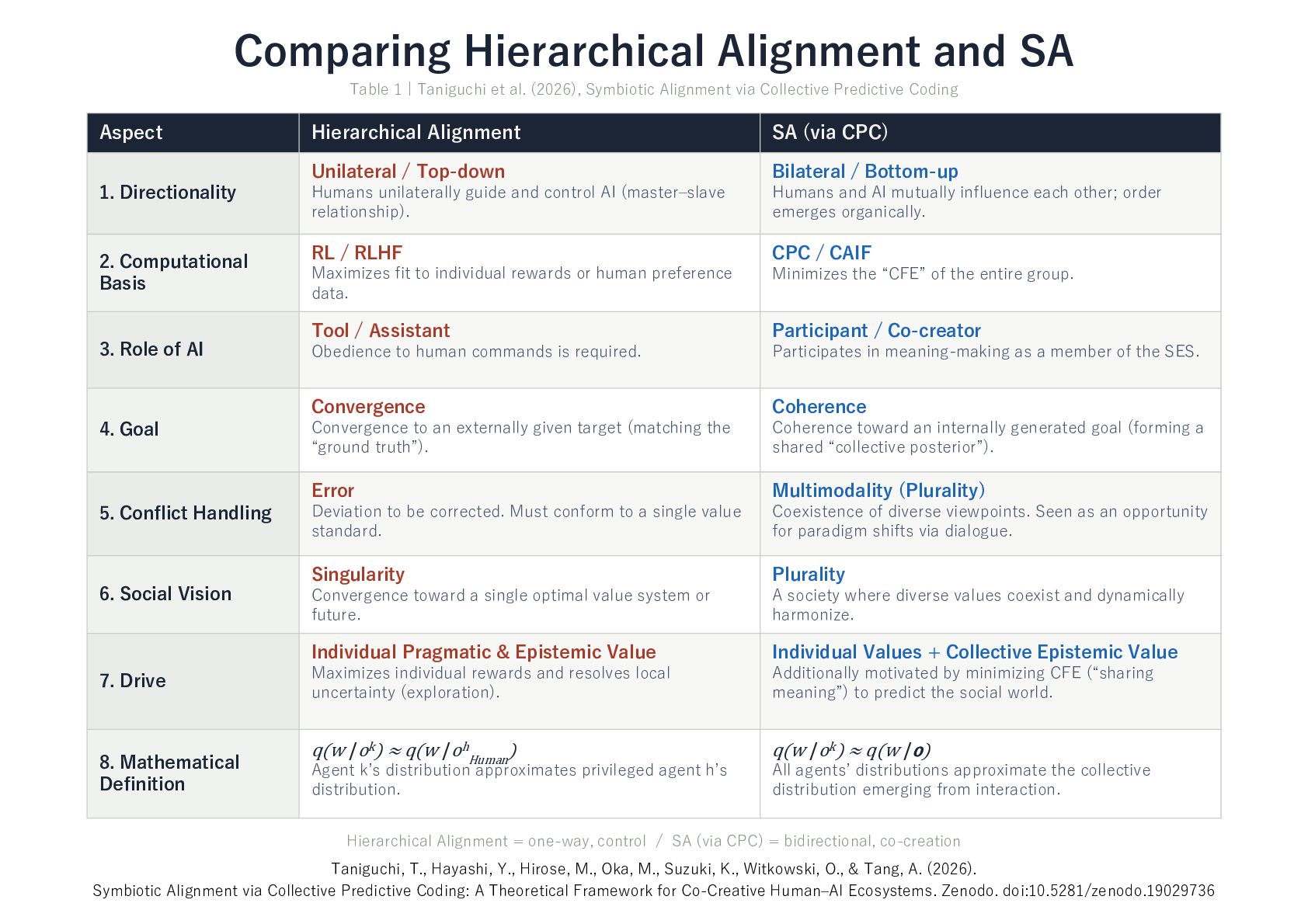
  45. Comparing Hierarchical Alignment and SA Table 1 | Taniguchi et

    al. (2026), Symbiotic Alignment via Collective Predictive Coding Aspect 1. Directionality 2. Computational Basis 3. Role of AI 4. Goal 5. Conflict Handling 6. Social Vision 7. Drive 8. Mathematical Definition Hierarchical Alignment SA (via CPC) Unilateral / Top-down Bilateral / Bottom-up Humans unilaterally guide and control AI (master‒slave relationship). Humans and AI mutually influence each other; order emerges organically. RL / RLHF CPC / CAIF Maximizes fit to individual rewards or human preference data. Minimizes the “CFE” of the entire group. Tool / Assistant Participant / Co-creator Obedience to human commands is required. Participates in meaning-making as a member of the SES. Convergence Coherence Convergence to an externally given target (matching the “ground truth”). Coherence toward an internally generated goal (forming a shared “collective posterior”). Error Multimodality (Plurality) Deviation to be corrected. Must conform to a single value standard. Coexistence of diverse viewpoints. Seen as an opportunity for paradigm shifts via dialogue. Singularity Plurality Convergence toward a single optimal value system or future. A society where diverse values coexist and dynamically harmonize. Individual Pragmatic & Epistemic Value Individual Values + Collective Epistemic Value Maximizes individual rewards and resolves local uncertainty (exploration). Additionally motivated by minimizing CFE (“sharing meaning”) to predict the social world. q w | ok q w | ok q w | ohHuman Agent kʼs distribution approximates privileged agent hʼs distribution. q w|o All agentsʼ distributions approximate the collective distribution emerging from interaction. Hierarchical Alignment = one-way, control / SA (via CPC) = bidirectional, co-creation Taniguchi, T., Hayashi, Y., Hirose, M., Oka, M., Suzuki, K., Witkowski, O., & Tang, A. (2026). Symbiotic Alignment via Collective Predictive Coding: A Theoretical Framework for Co-Creative Human‒AI Ecosystems. Zenodo. doi:10.5281/zenodo.19029736
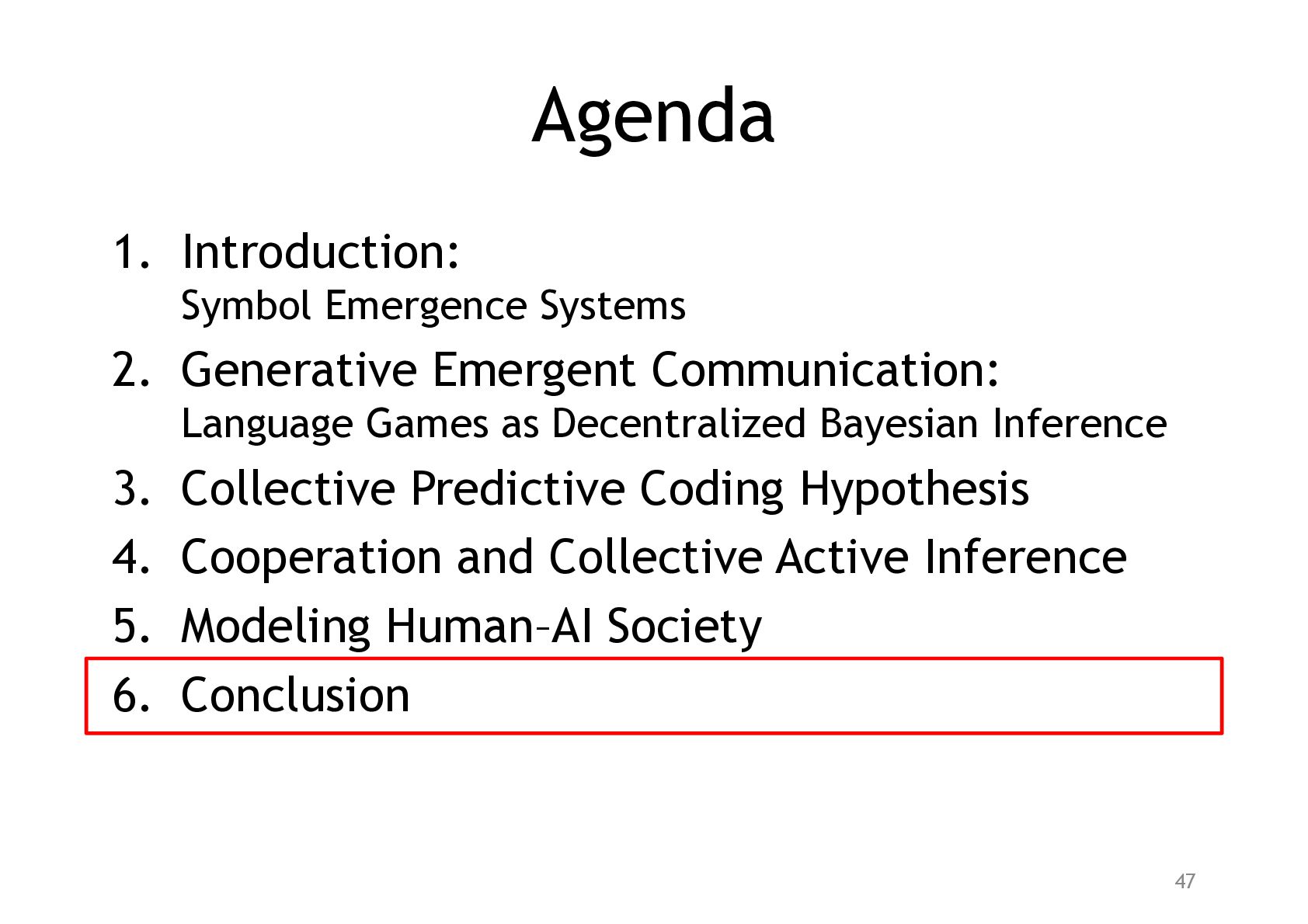
  46. Agenda 1. Introduction: Symbol Emergence Systems 2. Generative Emergent Communication:

    Language Games as Decentralized Bayesian Inference 3. Collective Predictive Coding Hypothesis 4. Cooperation and Collective Active Inference 5. Modeling Human–AI Society 6. Conclusion 47
  47. Summary • Language games: MH naming games form shared symbols

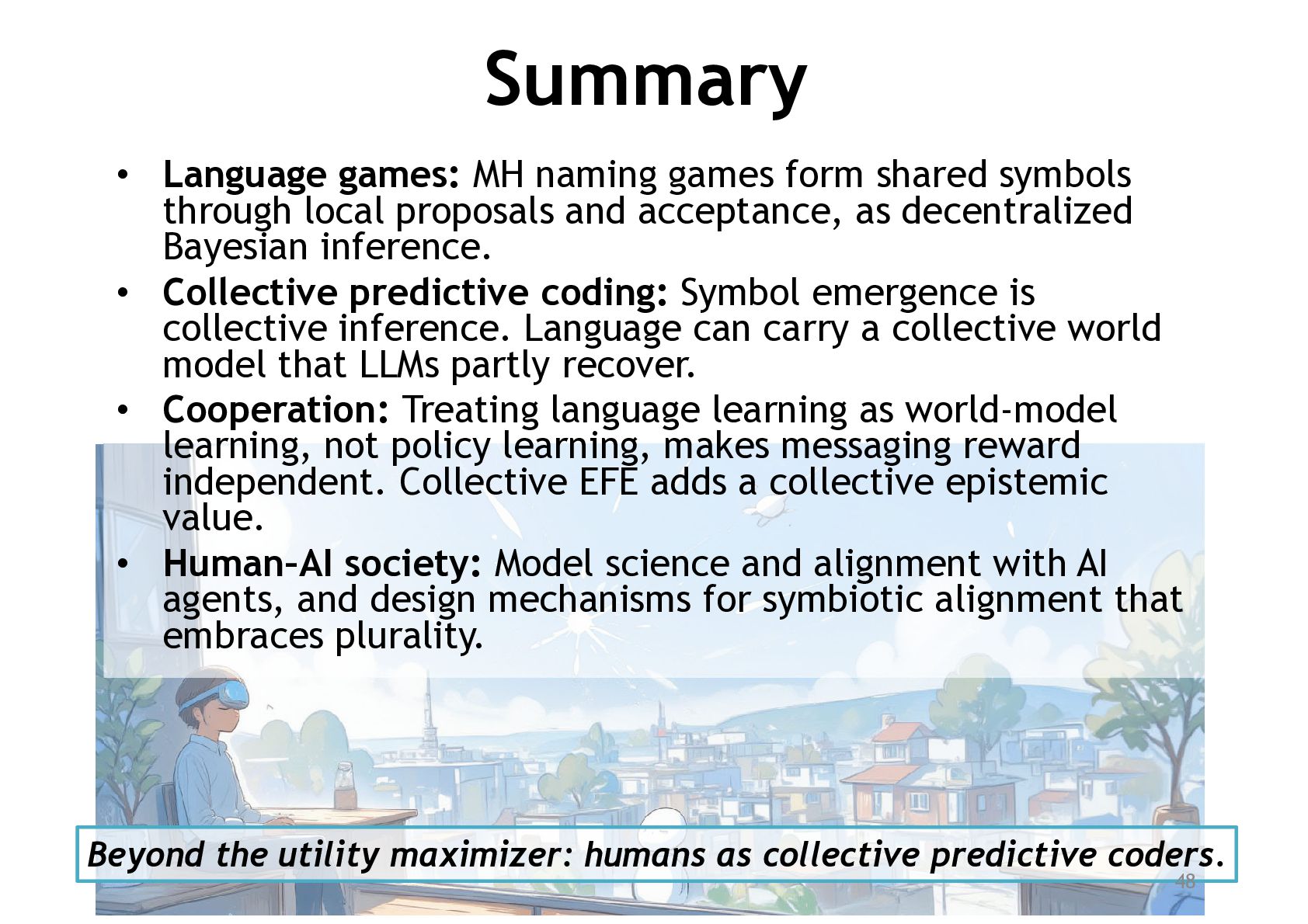
    through local proposals and acceptance, as decentralized Bayesian inference. • Collective predictive coding: Symbol emergence is collective inference. Language can carry a collective world model that LLMs partly recover. • Cooperation: Treating language learning as world-model learning, not policy learning, makes messaging reward independent. Collective EFE adds a collective epistemic value. • Human–AI society: Model science and alignment with AI agents, and design mechanisms for symbiotic alignment that embraces plurality. Beyond the utility maximizer: humans as collective predictive coders. 48
  48. Closing Remarks Beyond the Individual Brain: Collective Active Inference •

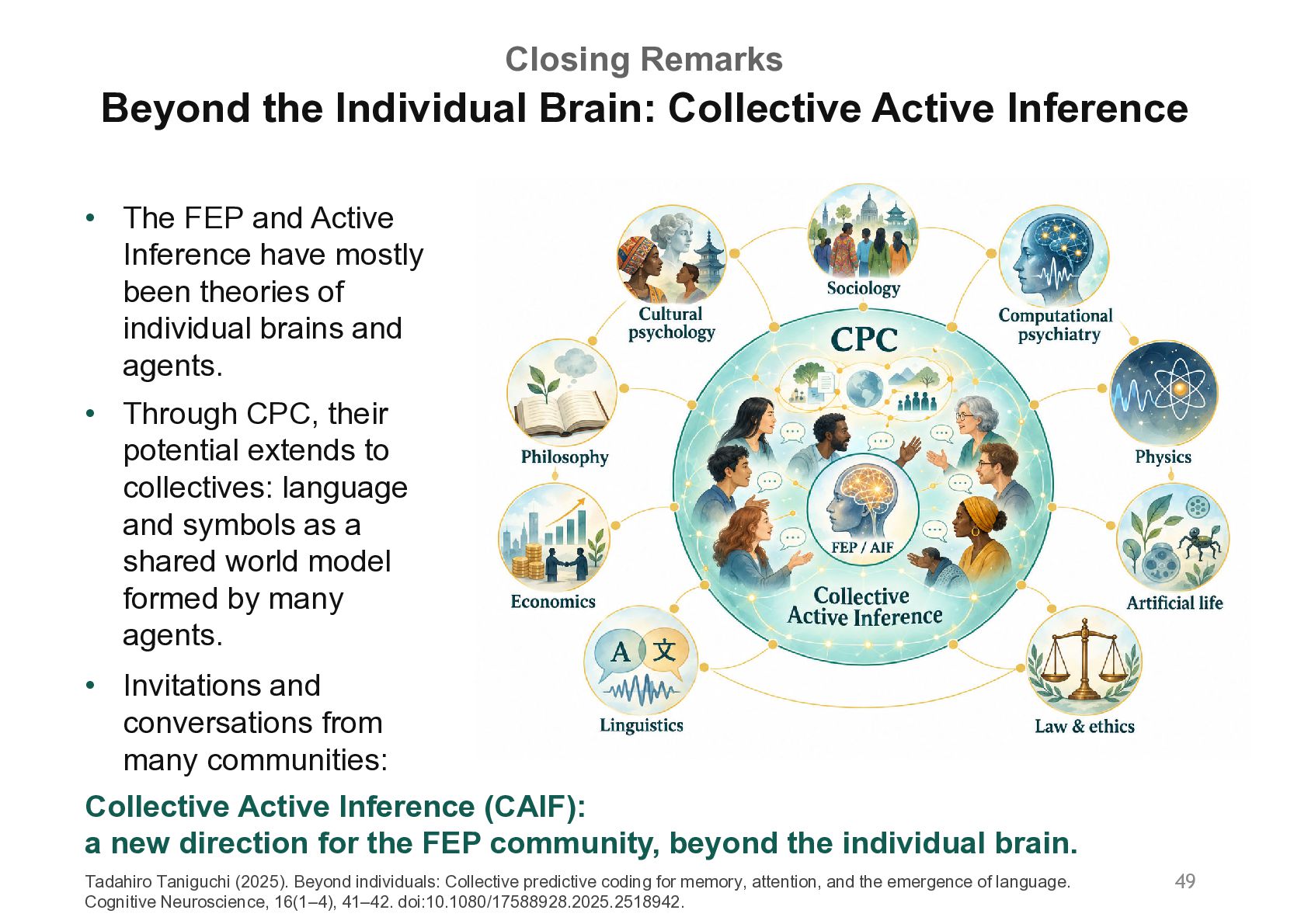
    The FEP and Active Inference have mostly been theories of individual brains and agents. • Through CPC, their potential extends to collectives: language and symbols as a shared world model formed by many agents. • Invitations and conversations from many communities: Collective Active Inference (CAIF): a new direction for the FEP community, beyond the individual brain. Tadahiro Taniguchi (2025). Beyond individuals: Collective predictive coding for memory, attention, and the emergence of language. Cognitive Neuroscience, 16(1–4), 41–42. doi:10.1080/17588928.2025.2518942. 49
  49. Tadahiro Taniguchi (Editor) “Symbol Emergence Systems: An Interdisciplinary Discussion about

    Cognition, Language and Society” Springer, Open Access (2026) Information Email: [email protected] X (personal): @tanichu 50