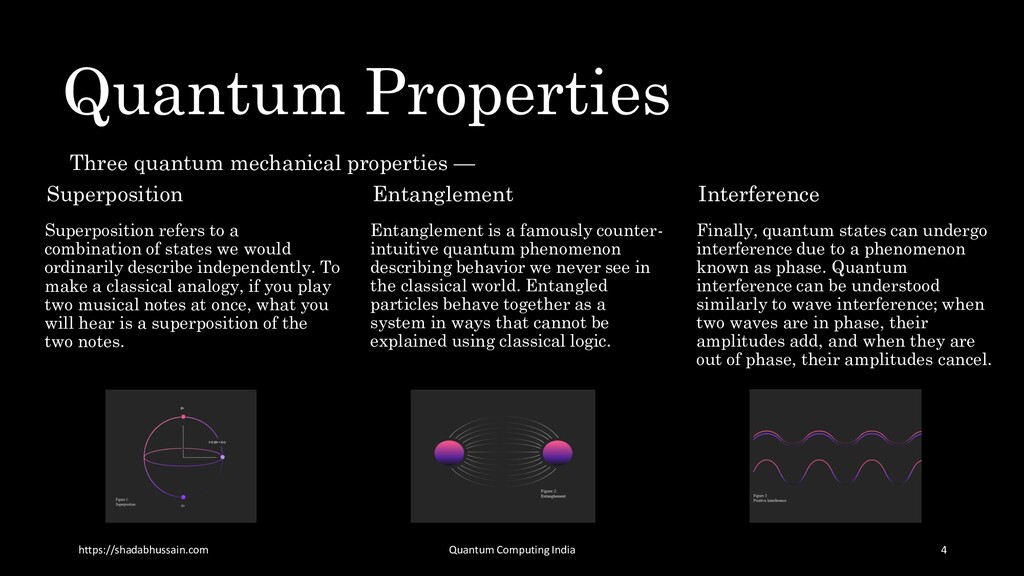
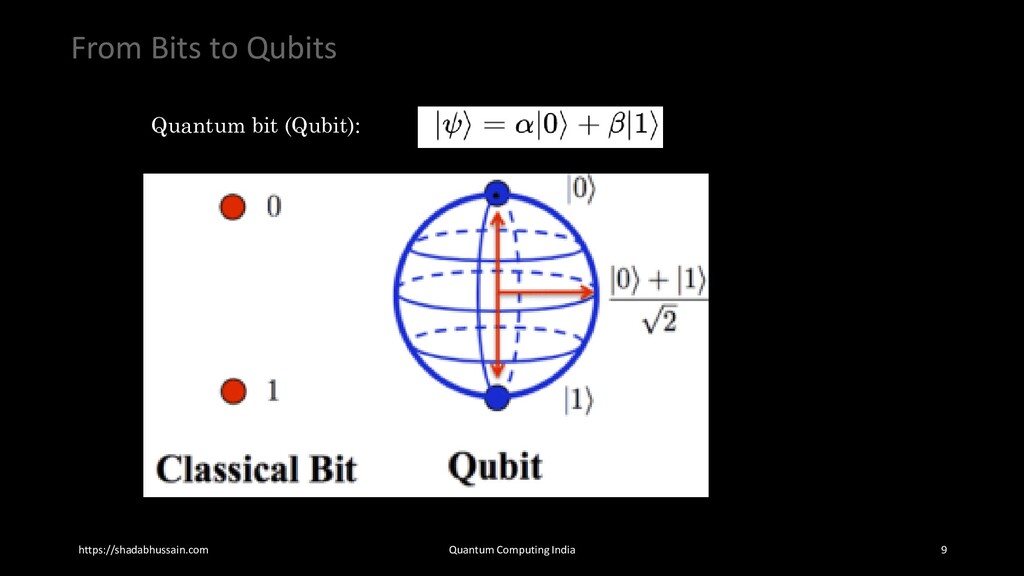
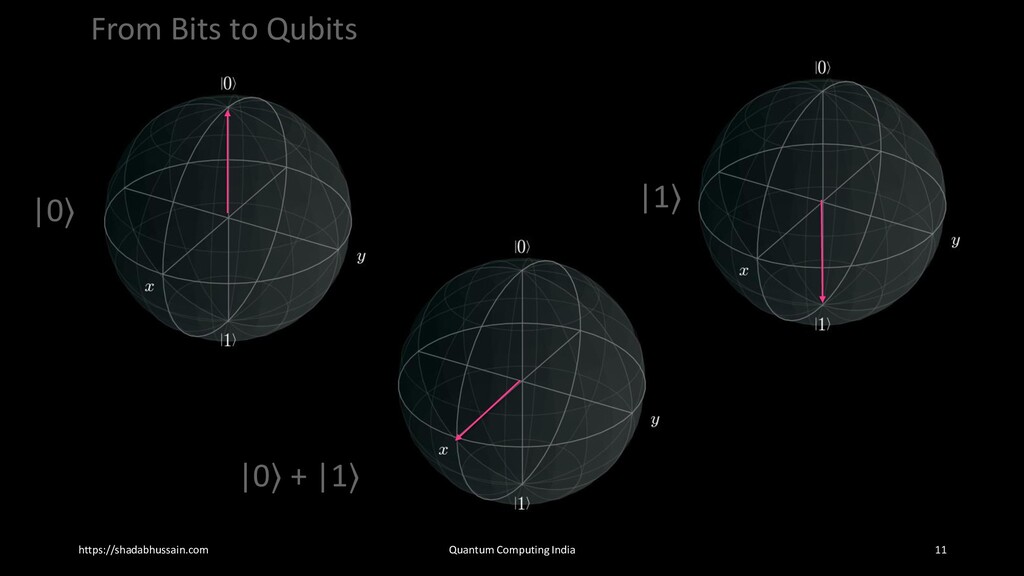
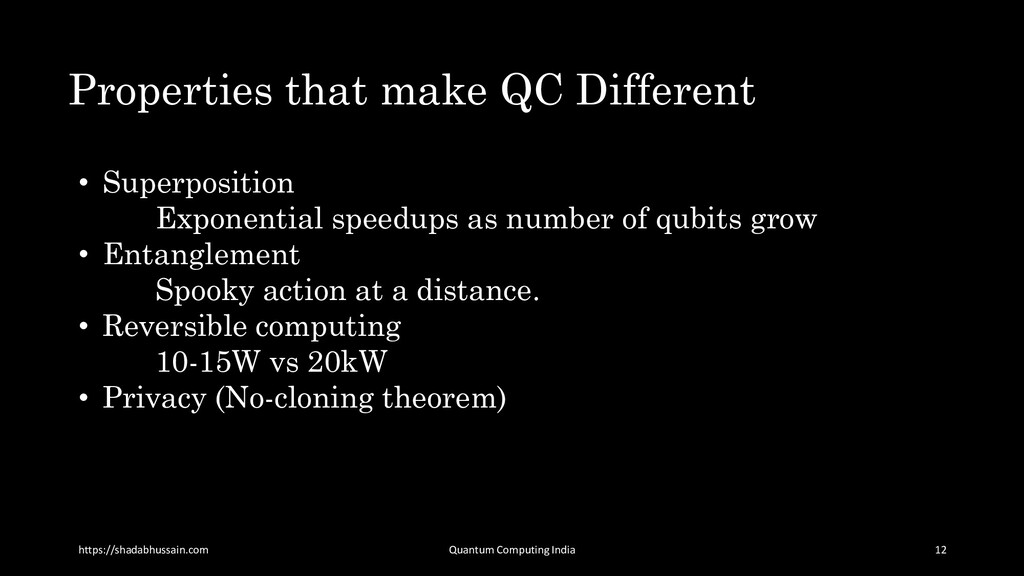
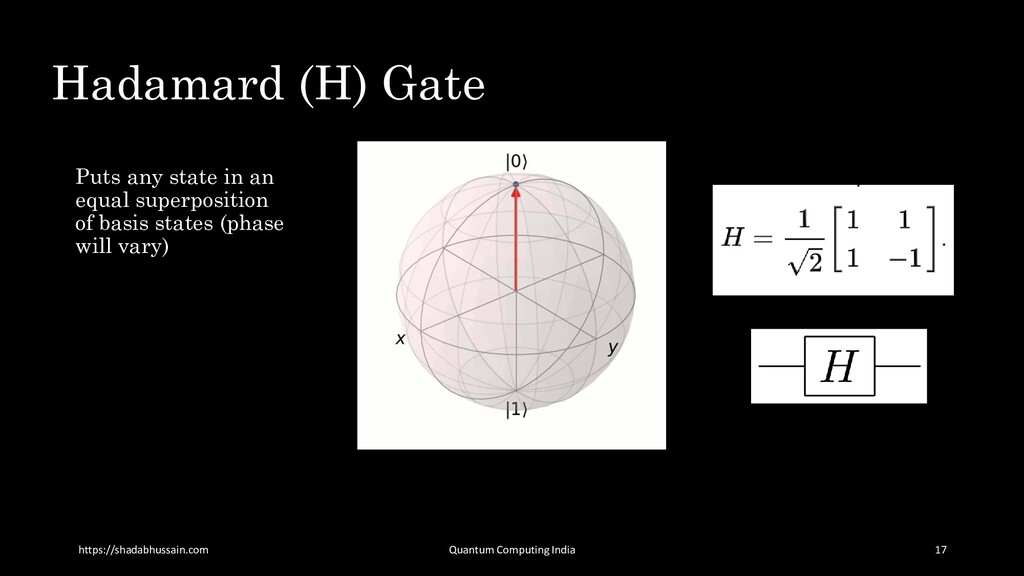
properties — Superposition Superposition refers to a combination of states we would ordinarily describe independently. To make a classical analogy, if you play two musical notes at once, what you will hear is a superposition of the two notes. Entanglement Entanglement is a famously counter- intuitive quantum phenomenon describing behavior we never see in the classical world. Entangled particles behave together as a system in ways that cannot be explained using classical logic. Interference Finally, quantum states can undergo interference due to a phenomenon known as phase. Quantum interference can be understood similarly to wave interference; when two waves are in phase, their amplitudes add, and when they are out of phase, their amplitudes cancel.
• Superposition Exponential speedups as number of qubits grow • Entanglement Spooky action at a distance. • Reversible computing 10-15W vs 20kW • Privacy (No-cloning theorem)
and retain qubits due to decoherence • High amount of noise • Need for better quantum algorithms (Optimization) • Algorithms like Shor’s can’t be implemented today • All hardwares have their own pros and cons • Data storage? • Debugging?
with Noisy Intermediate-Scale Quantum (NISQ) Computers • Apache 2.o License • Designed to be backend agnostic • Includes out-of-the-box local simulators and support for running on IBMQ
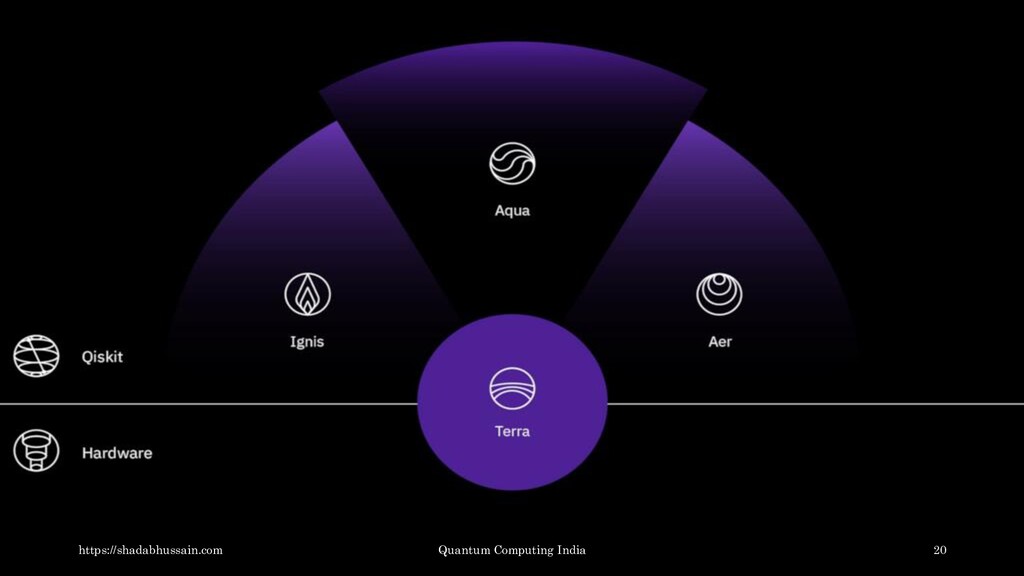
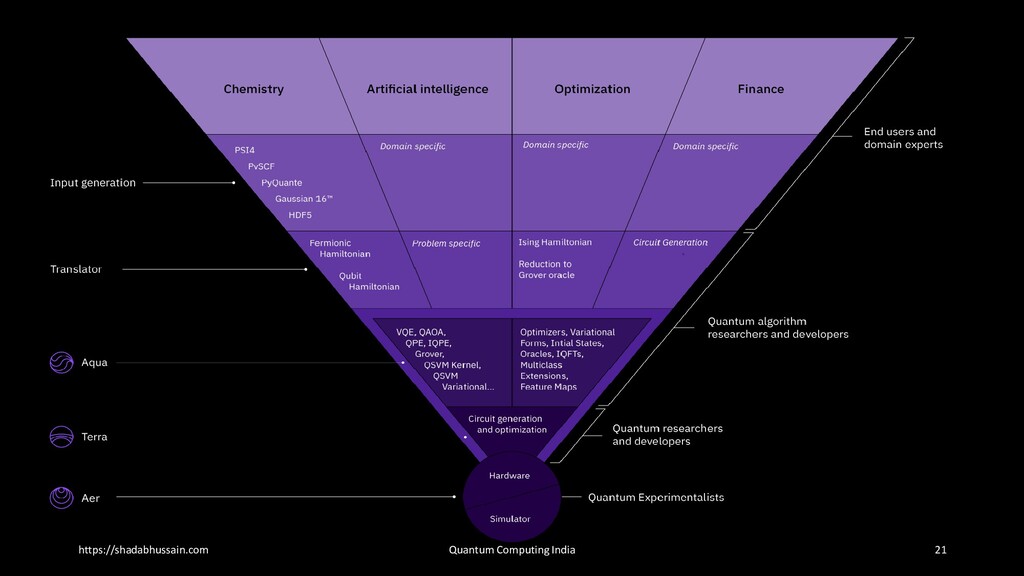
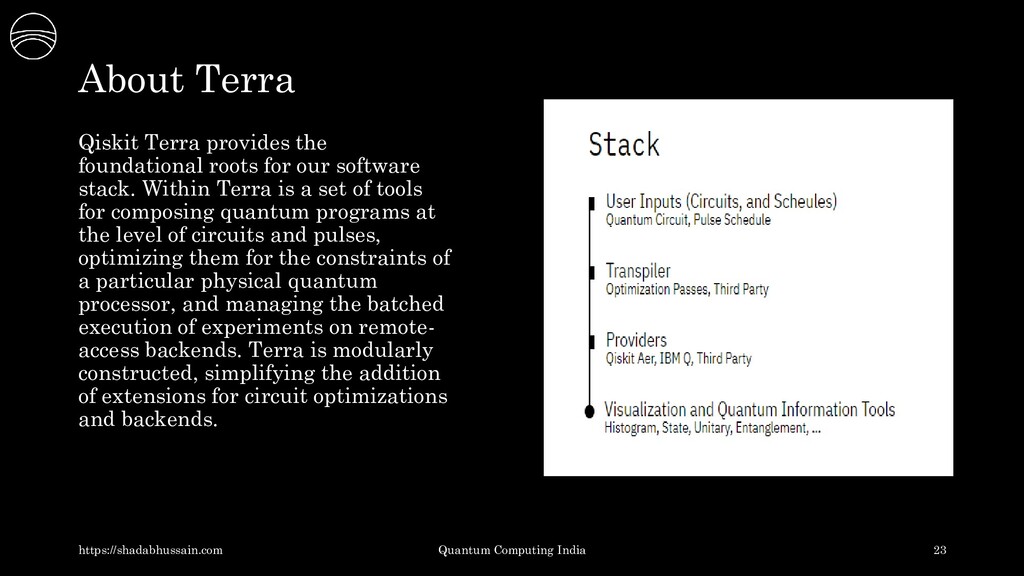
the foundational roots for our software stack. Within Terra is a set of tools for composing quantum programs at the level of circuits and pulses, optimizing them for the constraints of a particular physical quantum processor, and managing the batched execution of experiments on remote- access backends. Terra is modularly constructed, simplifying the addition of extensions for circuit optimizations and backends.
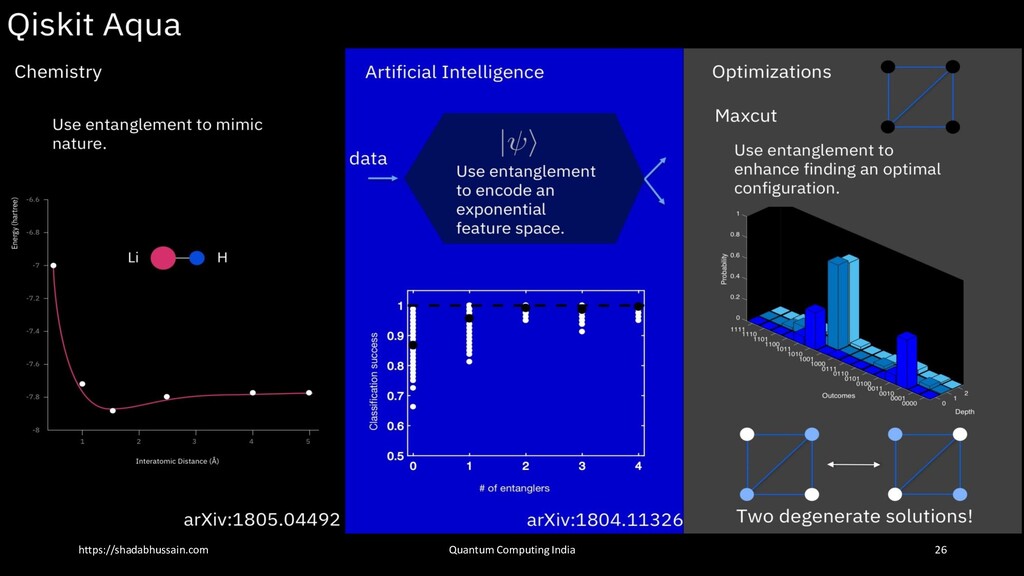
a library of cross-domain quantum algorithms upon which applications for near- term quantum computing can be built. Aqua is designed to be extensible, and employs a pluggable framework where quantum algorithms can easily be added. It currently allows the user to experiment on chemistry, AI, optimization and finance applications for near-term quantum computers.
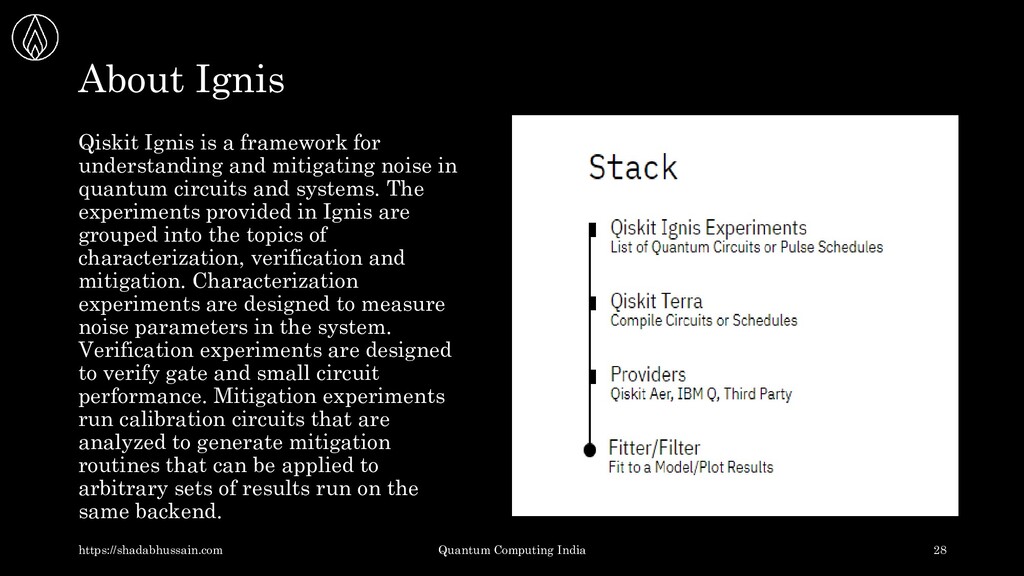
a framework for understanding and mitigating noise in quantum circuits and systems. The experiments provided in Ignis are grouped into the topics of characterization, verification and mitigation. Characterization experiments are designed to measure noise parameters in the system. Verification experiments are designed to verify gate and small circuit performance. Mitigation experiments run calibration circuits that are analyzed to generate mitigation routines that can be applied to arbitrary sets of results run on the same backend.
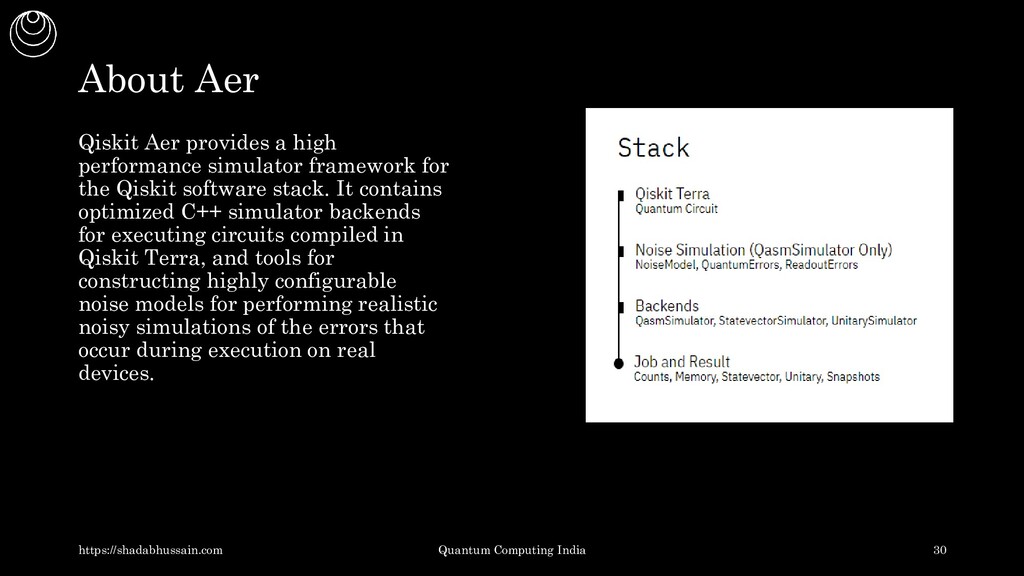
a high performance simulator framework for the Qiskit software stack. It contains optimized C++ simulator backends for executing circuits compiled in Qiskit Terra, and tools for constructing highly configurable noise models for performing realistic noisy simulations of the errors that occur during execution on real devices.


 techwithshadab
 finengine
 takmin
 colopl
 yazm
yazm
 daidaidai
 tsukuboshi
 sansantech
 recruitengineers
 sh_fk2
 gionn
gionn
 murachiakira
 shisyu_gaku
 iamctodd
 ammeep
 honzajavorek
 bermonpainter
 jct
jct
 bkeepers
 honnibal
 ryanjones
 trishagee
 keithpitt
 jnunemaker
 mkilby