• save money (if your board is faulty you’ll know it faster than if you sent it out to be made and a week later you’re out cash and time) • learn more about electricity (component placement) • learn your circuit • once your circuit is down, it’s locked down (less sleepless nights for you finding the *one wire that was in the wrong place • circuits are attractive and neat • next level (form and function) • your friends will be impressed Sunday, March 31, 2013
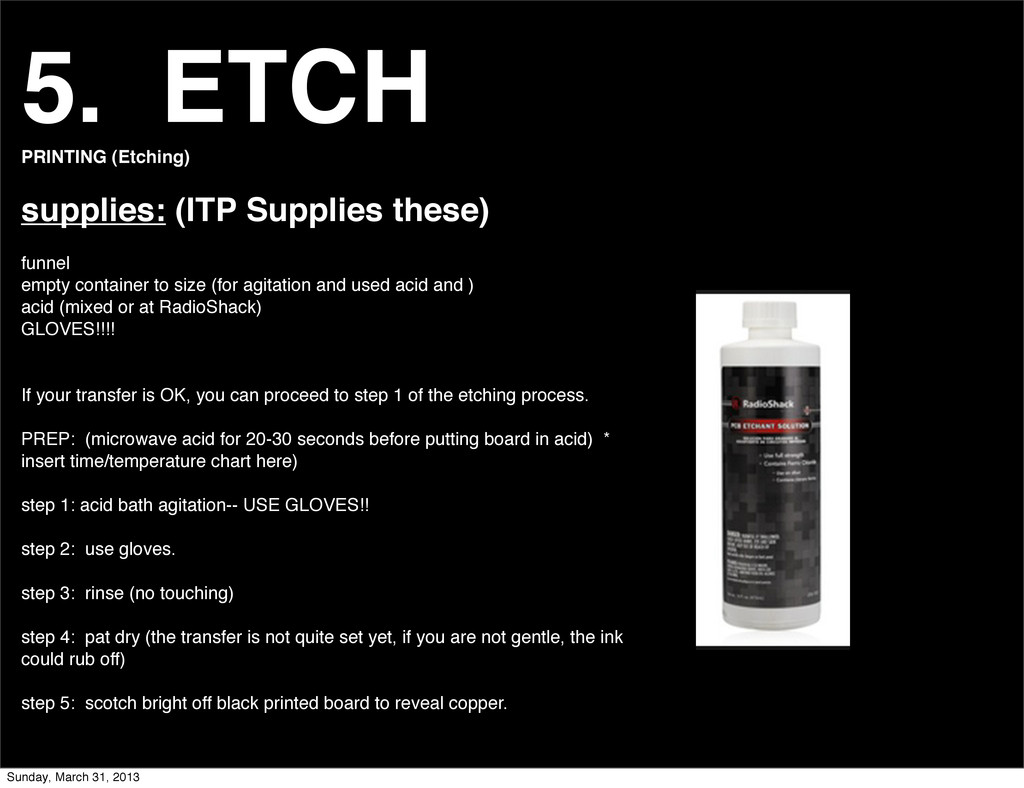
container to size (for agitation and used acid and ) acid (mixed or at RadioShack) GLOVES!!!! If your transfer is OK, you can proceed to step 1 of the etching process. PREP: (microwave acid for 20-30 seconds before putting board in acid) * insert time/temperature chart here) step 1: acid bath agitation-- USE GLOVES!! step 2: use gloves. step 3: rinse (no touching) step 4: pat dry (the transfer is not quite set yet, if you are not gentle, the ink could rub off) step 5: scotch bright off black printed board to reveal copper. Sunday, March 31, 2013
bright pad PCB paper ( can use magazine paper) copper PCB board tape scissors (cut your board and transfer to size) water paper towel Sharpie marker (for filing in traces/touch ups on transfer) steps: step 1: prepare the PCB board with ScotchBrite (in a circular motion scrub the copper until it is shiny) step 2: lay artwork print out face down onto prepared PCB board (you can use a tiny bit of tape to tag the layout onto the copper, but be sure to tape outside the parameter of the layout) step 3: run PCB board with printout (face to face) through the laminator 2-3 times step 5: let the water do the work (if using the PCB blue paper, it will release on itʼs own/ if using magazine paper, you will gently rub the artwork from the copper) equipment: (in wet lab) laminator printer Sunday, March 31, 2013


 temple
 sansantech
 mohab1
 riyaamemiya
 pfn
pfn
 rfdnxbro
 kenichiodo
 onk
onk
 takonda
 greenmidori
 taketakekaho
 endonanana
 akitoshiga
 skoyamalab
 samlambert
 nwiizo
 marcelosomers
 madoxten
 mkilby
 ryanjones
 garrettdimon
 aki_iinuma
 aleyda
 rkendrick25
 lara
lara