RubyKaigi 2025: Class New, A New Approach
Sponsored
·
 Your Podcast. Everywhere. Effortlessly.
Share. Educate. Inspire. Entertain. You do you. We'll handle the rest.
→
Your Podcast. Everywhere. Effortlessly.
Share. Educate. Inspire. Entertain. You do you. We'll handle the rest.
→

Share
Embed
RubyKaigi 2025: Class New, A New Approach
This talk is about optimizing Class#new. I gave the talk at RubyKaigi 2025

Aaron Patterson
May 15, 2025
Transcript
130 slides
-
Study Class#new implementation We can’t speed it up if we
don’t know how it works! -
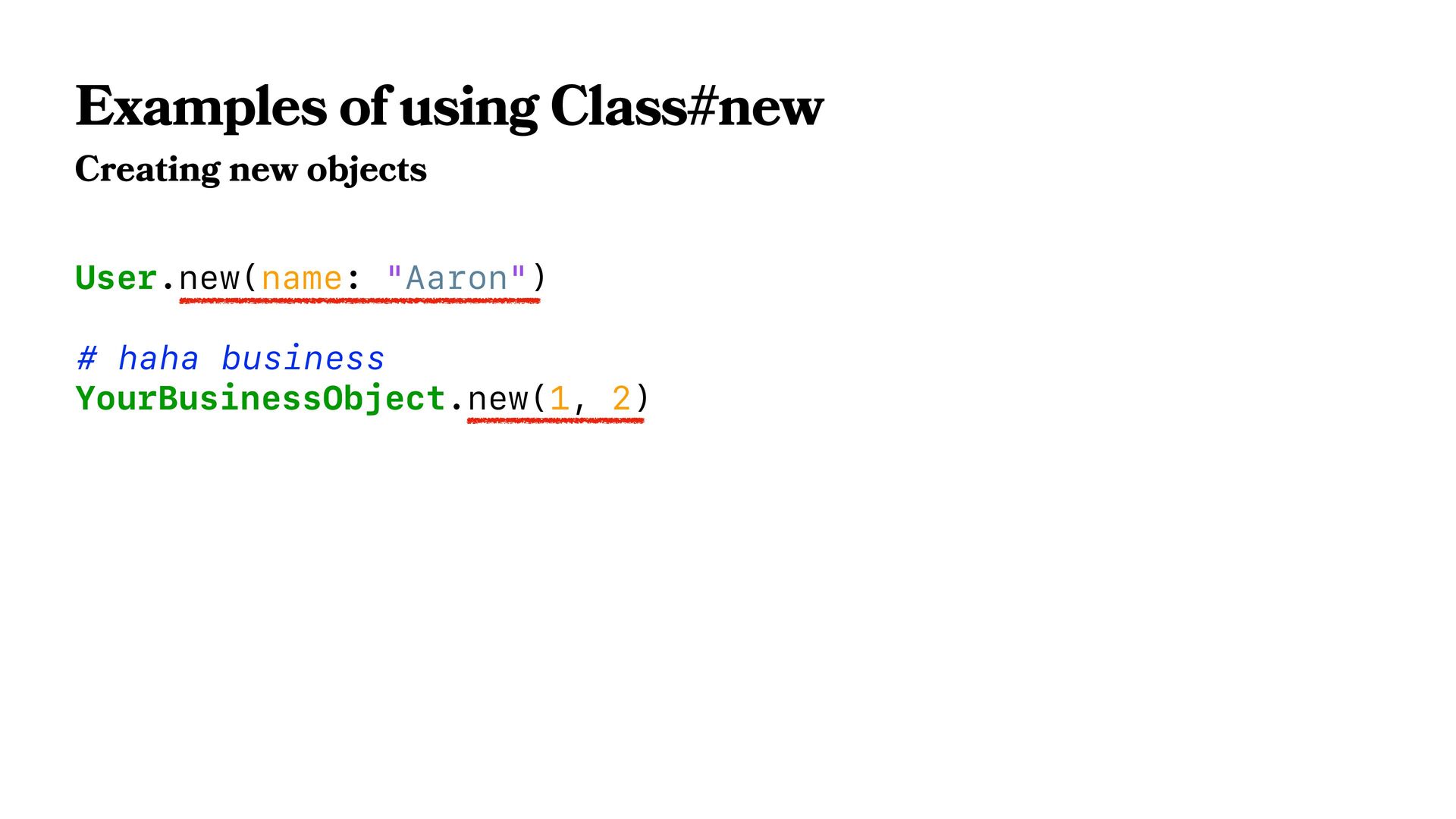
Examples of using Class#new Creating new objects User.new(name: "Aaron") #
haha business YourBusinessObject.new(1, 2) -
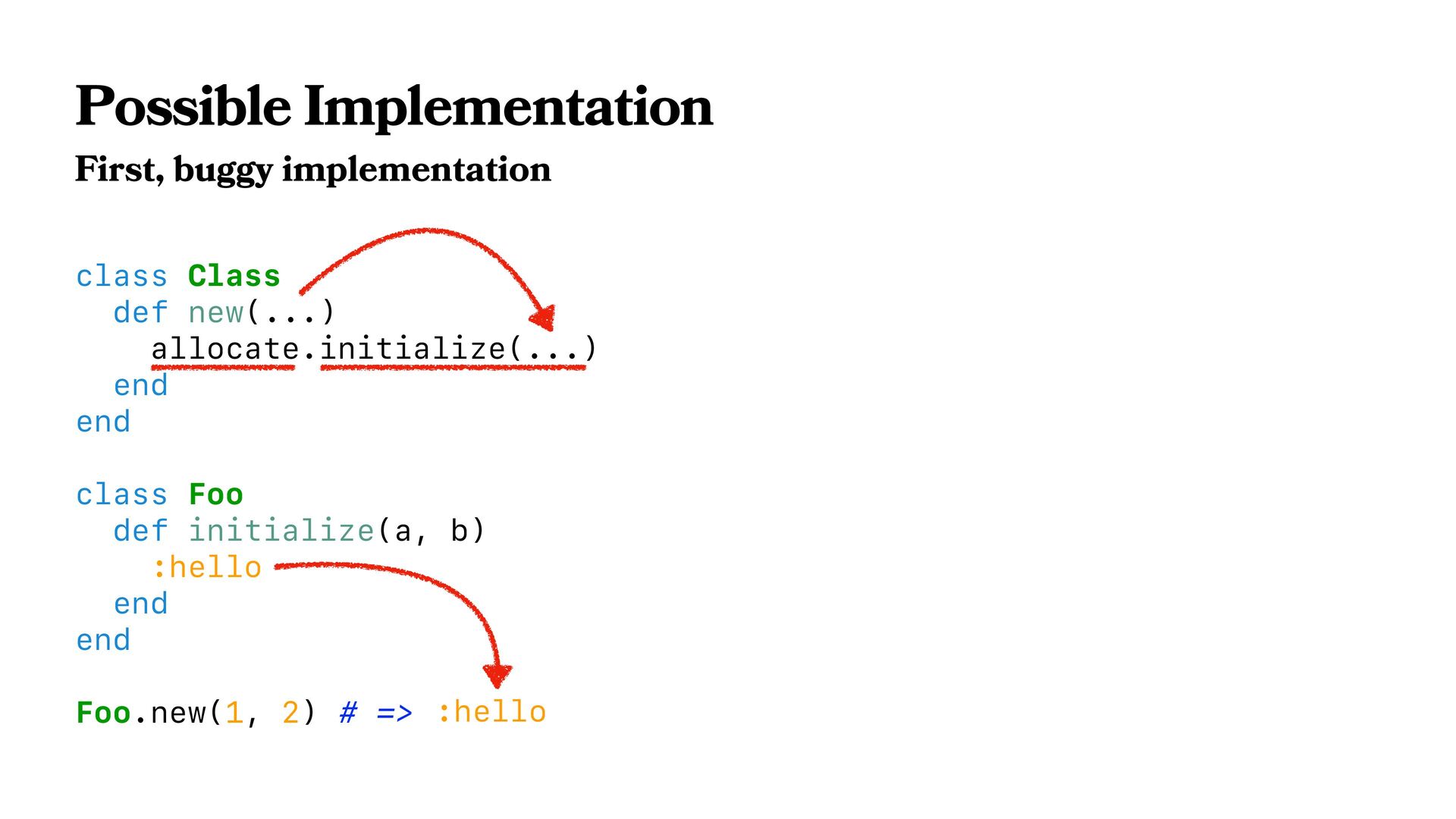
class Class def new(...) allocate.initialize(...) end end class Foo def
initialize(a, b) :hello end end Foo.new(1, 2) # => ??? :hello Possible Implementation First, buggy implementation -
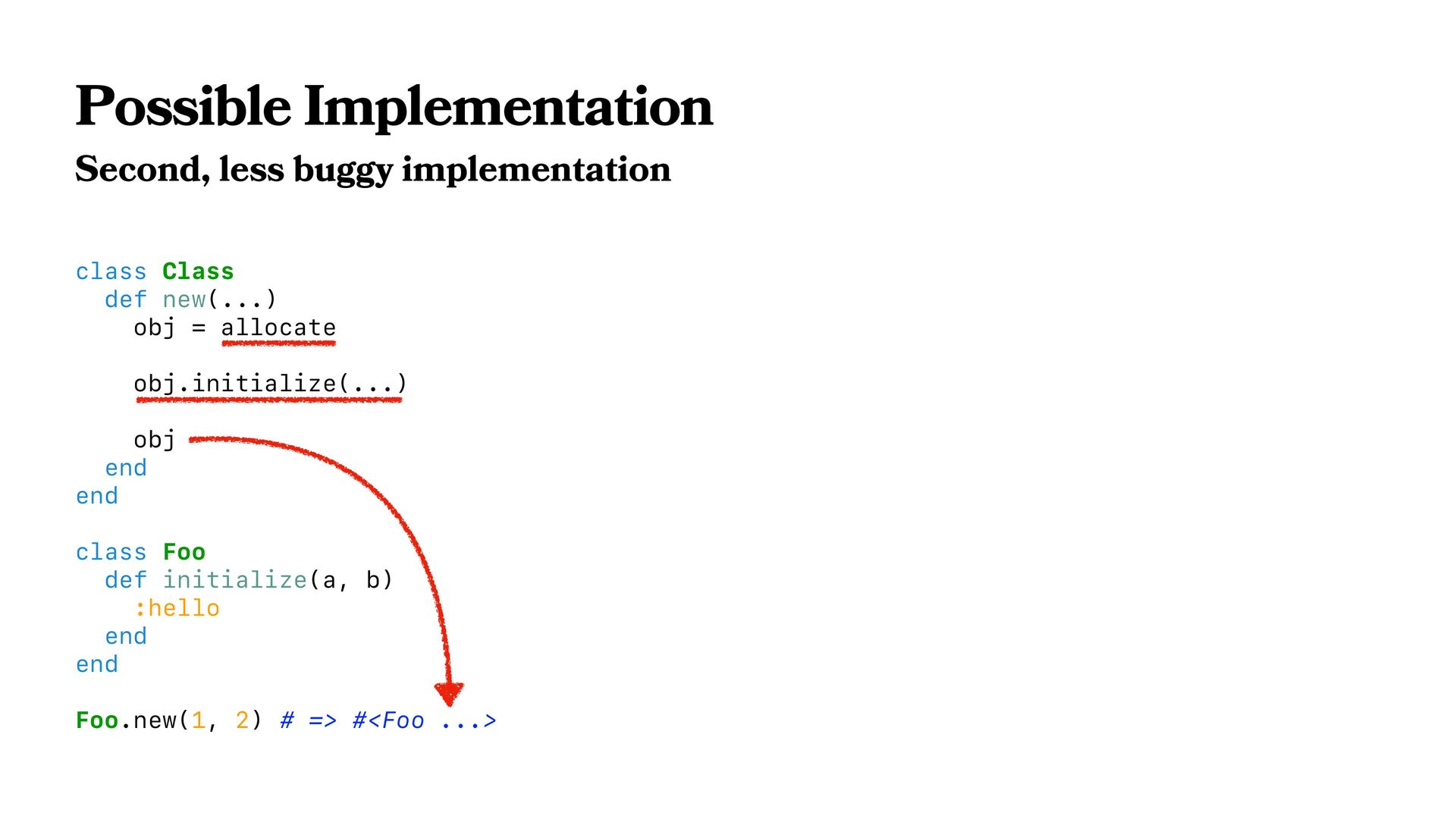
Possible Implementation Second, less buggy implementation class Class def new(...)
obj = allocate obj.initialize(...) obj end end class Foo def initialize(a, b) :hello end end Foo.new(1, 2) # => #<Foo ...> -
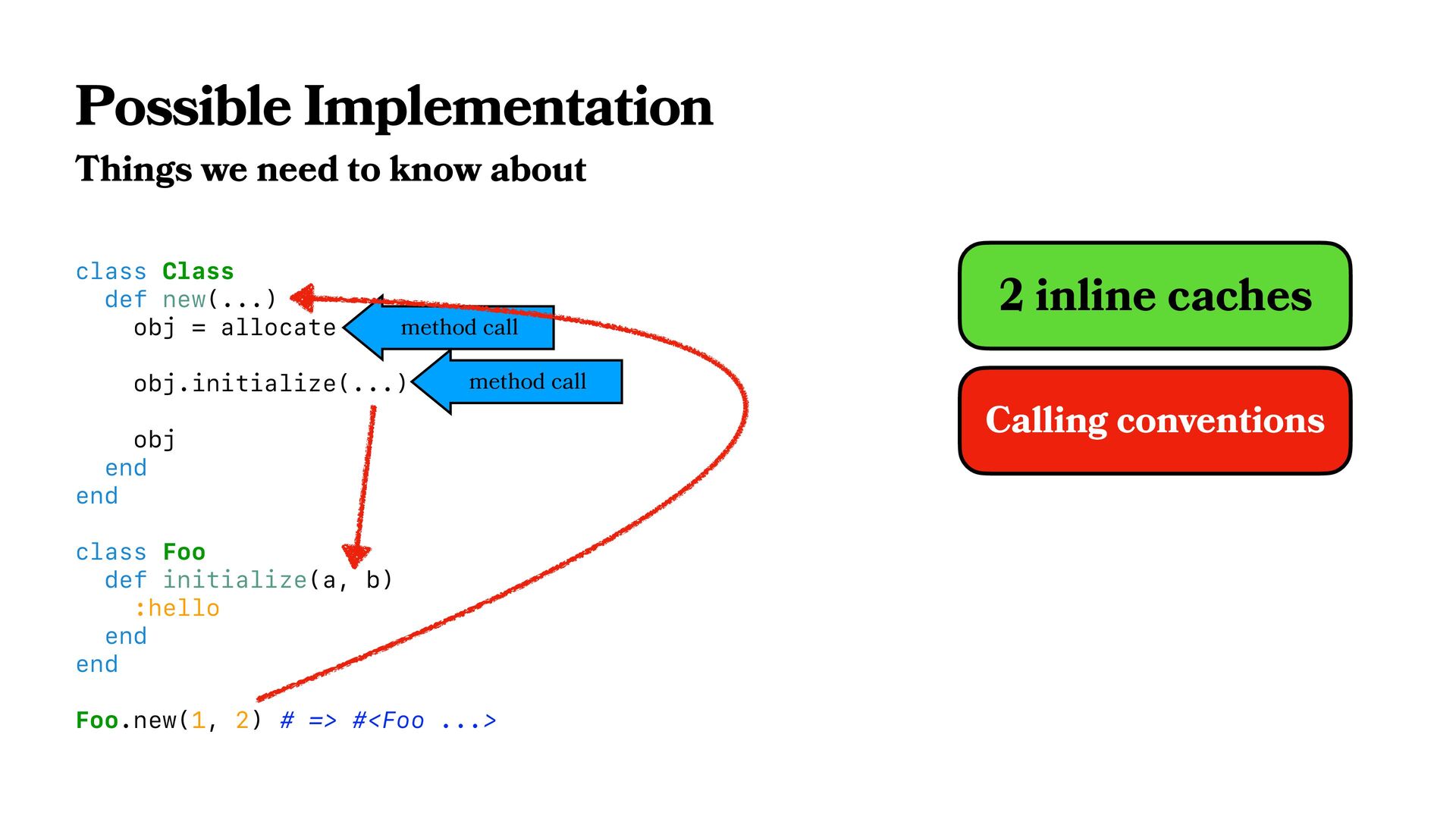
Possible Implementation Things we need to know about class Class
def new(...) obj = allocate obj.initialize(...) obj end end class Foo def initialize(a, b) :hello end end Foo.new(1, 2) # => #<Foo ...> method call method call 2 inline caches Calling conventions -
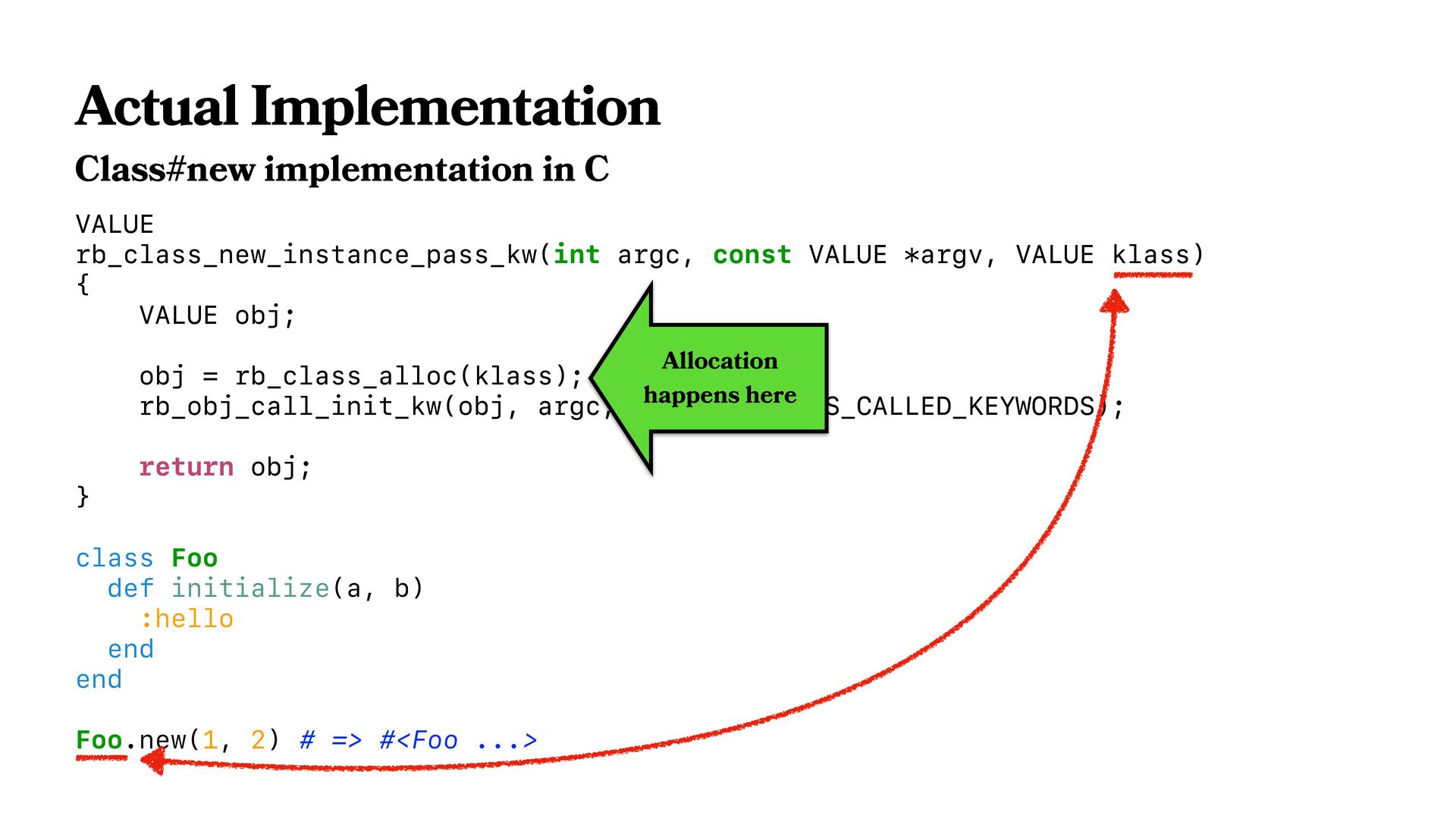
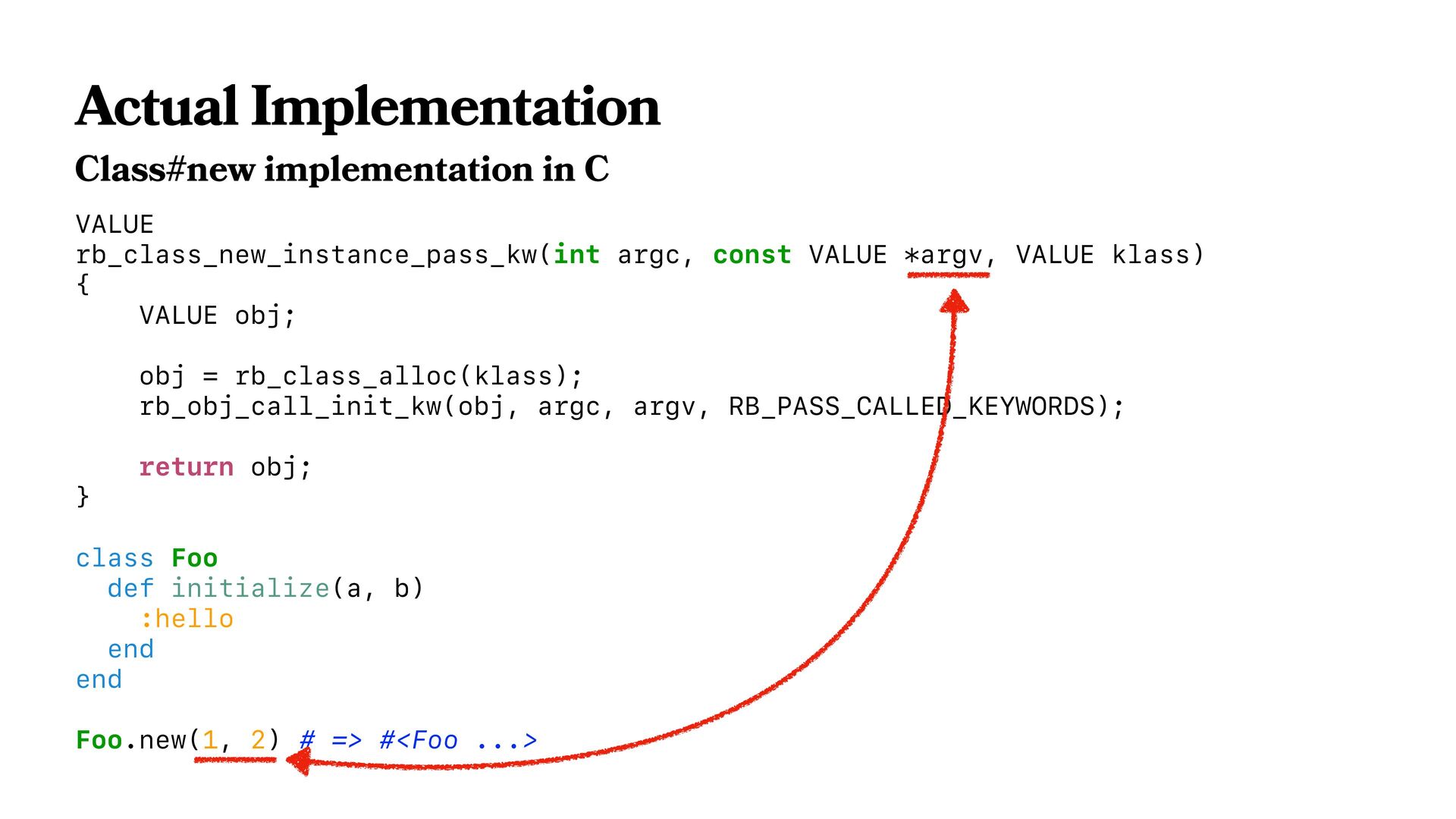
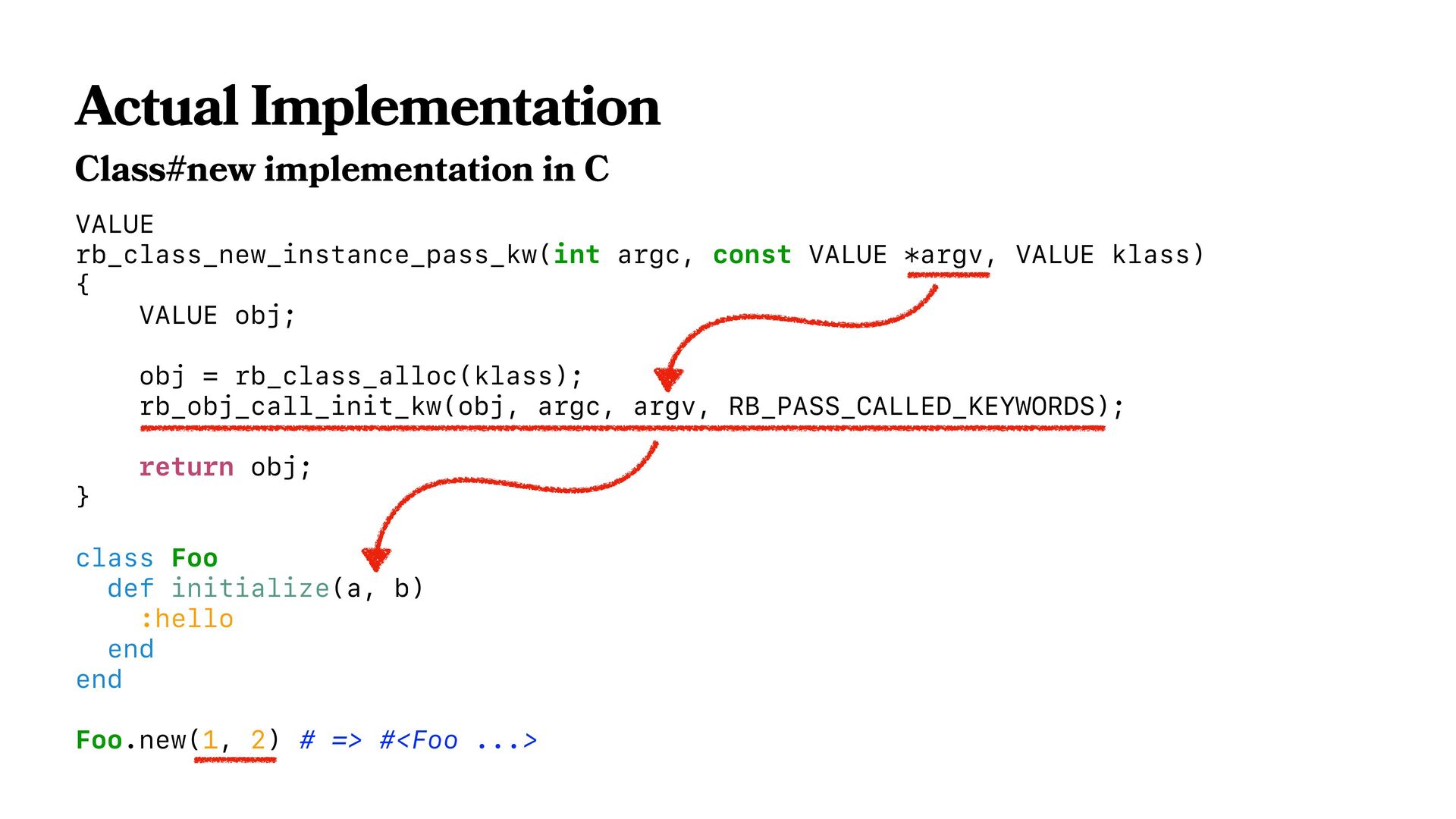
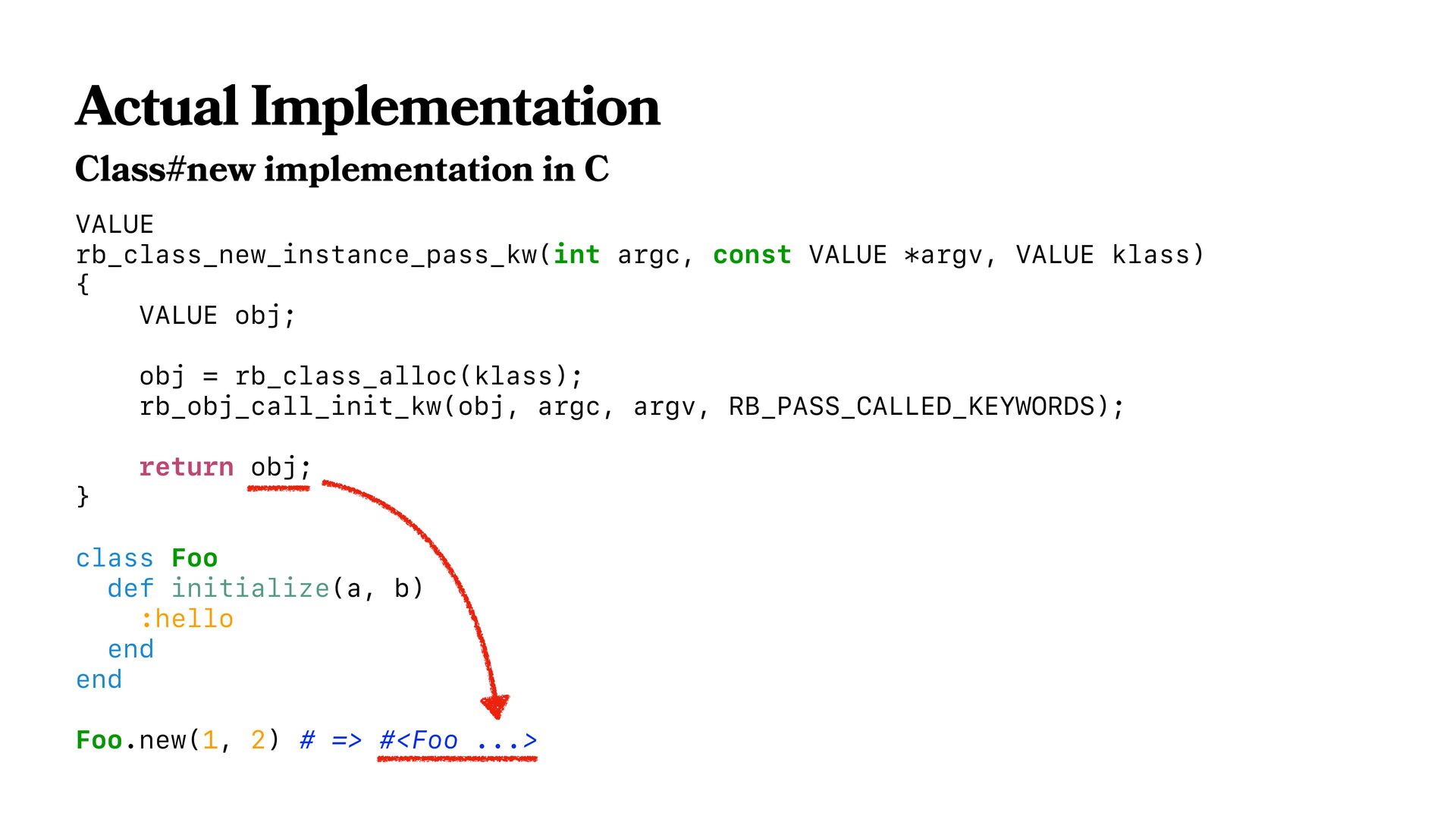
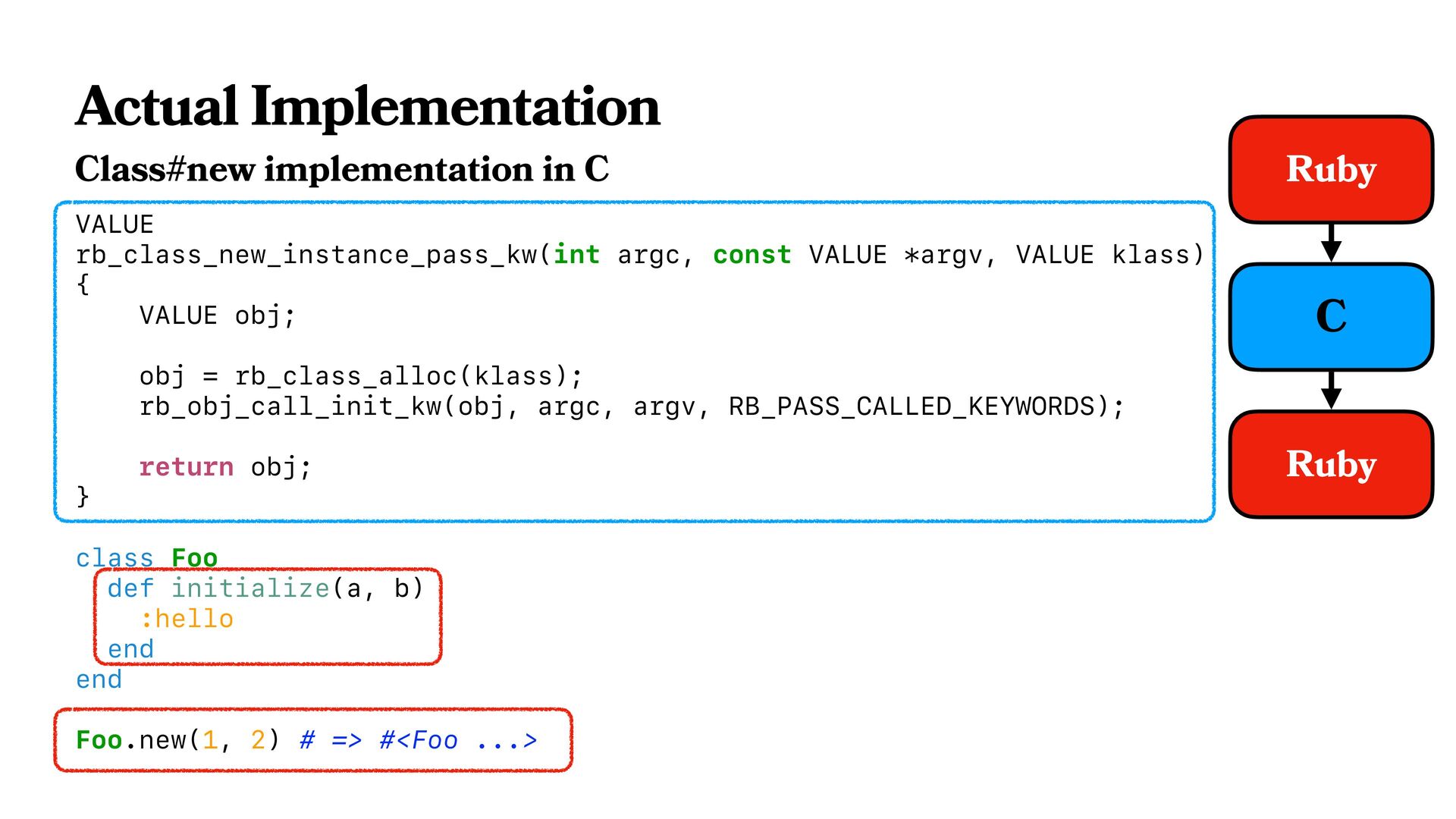
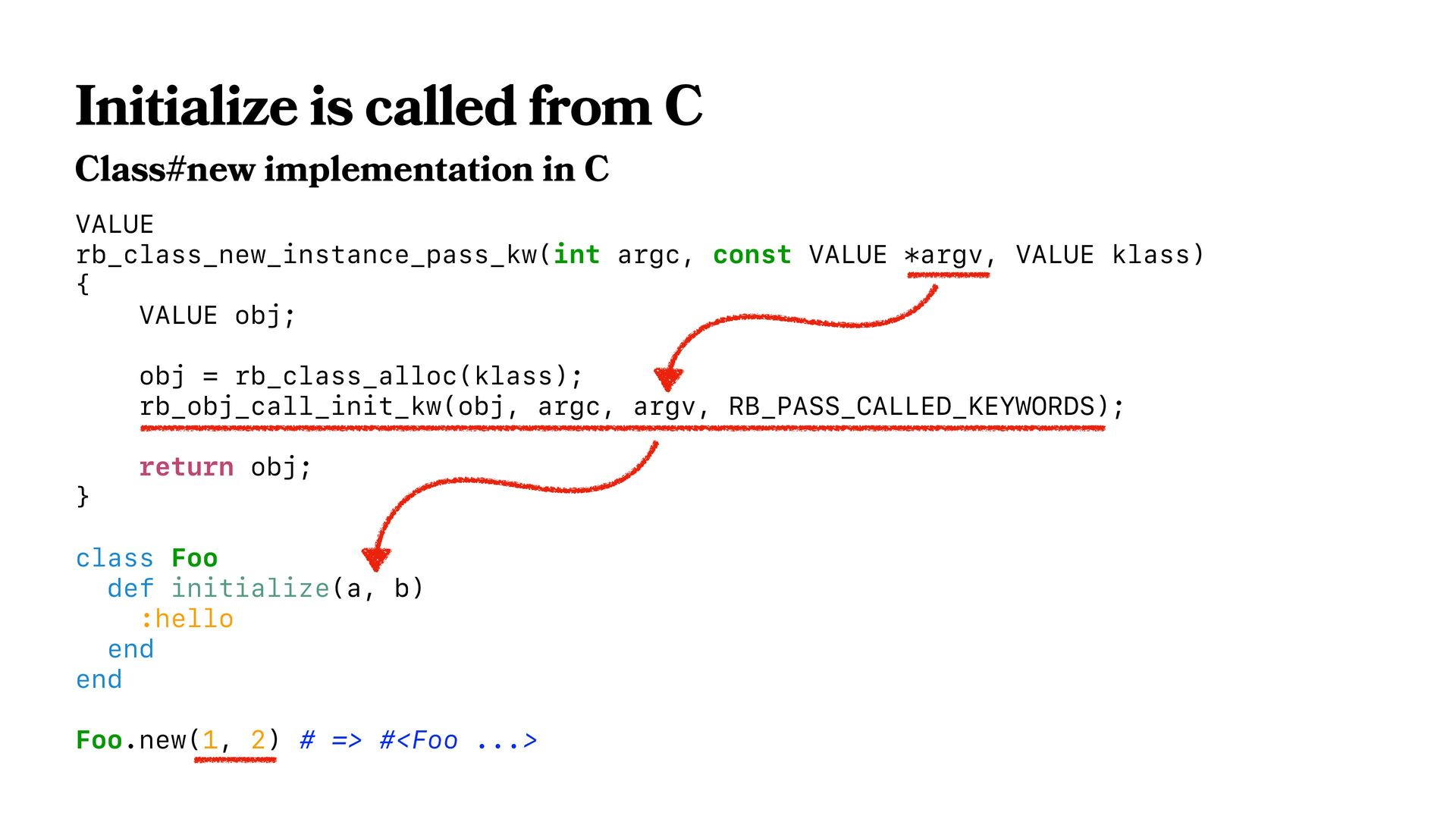
Actual Implementation Class#new implementation in C VALUE rb_class_new_instance_pass_kw(int argc, const
VALUE *argv, VALUE klass) { VALUE obj; obj = rb_class_alloc(klass); rb_obj_call_init_kw(obj, argc, argv, RB_PASS_CALLED_KEYWORDS); return obj; } class Foo def initialize(a, b) :hello end end Foo.new(1, 2) # => #<Foo ...> VALUE rb_class_new_instance_pass_kw(int argc, const VALUE *argv, VALUE klass) { VALUE obj; obj = rb_class_alloc(klass); rb_obj_call_init_kw(obj, argc, argv, RB_PASS_CALLED_KEYWORDS); return obj; } class Foo def initialize(a, b) :hello end end Foo.new(1, 2) # => #<Foo ...> Allocation happens here -
VALUE rb_class_new_instance_pass_kw(int argc, const VALUE *argv, VALUE klass) { VALUE
obj; obj = rb_class_alloc(klass); rb_obj_call_init_kw(obj, argc, argv, RB_PASS_CALLED_KEYWORDS); return obj; } class Foo def initialize(a, b) :hello end end Foo.new(1, 2) # => #<Foo ...> Actual Implementation Class#new implementation in C -
VALUE rb_class_new_instance_pass_kw(int argc, const VALUE *argv, VALUE klass) { VALUE
obj; obj = rb_class_alloc(klass); rb_obj_call_init_kw(obj, argc, argv, RB_PASS_CALLED_KEYWORDS); return obj; } class Foo def initialize(a, b) :hello end end Foo.new(1, 2) # => #<Foo ...> Actual Implementation Class#new implementation in C C Ruby Ruby -
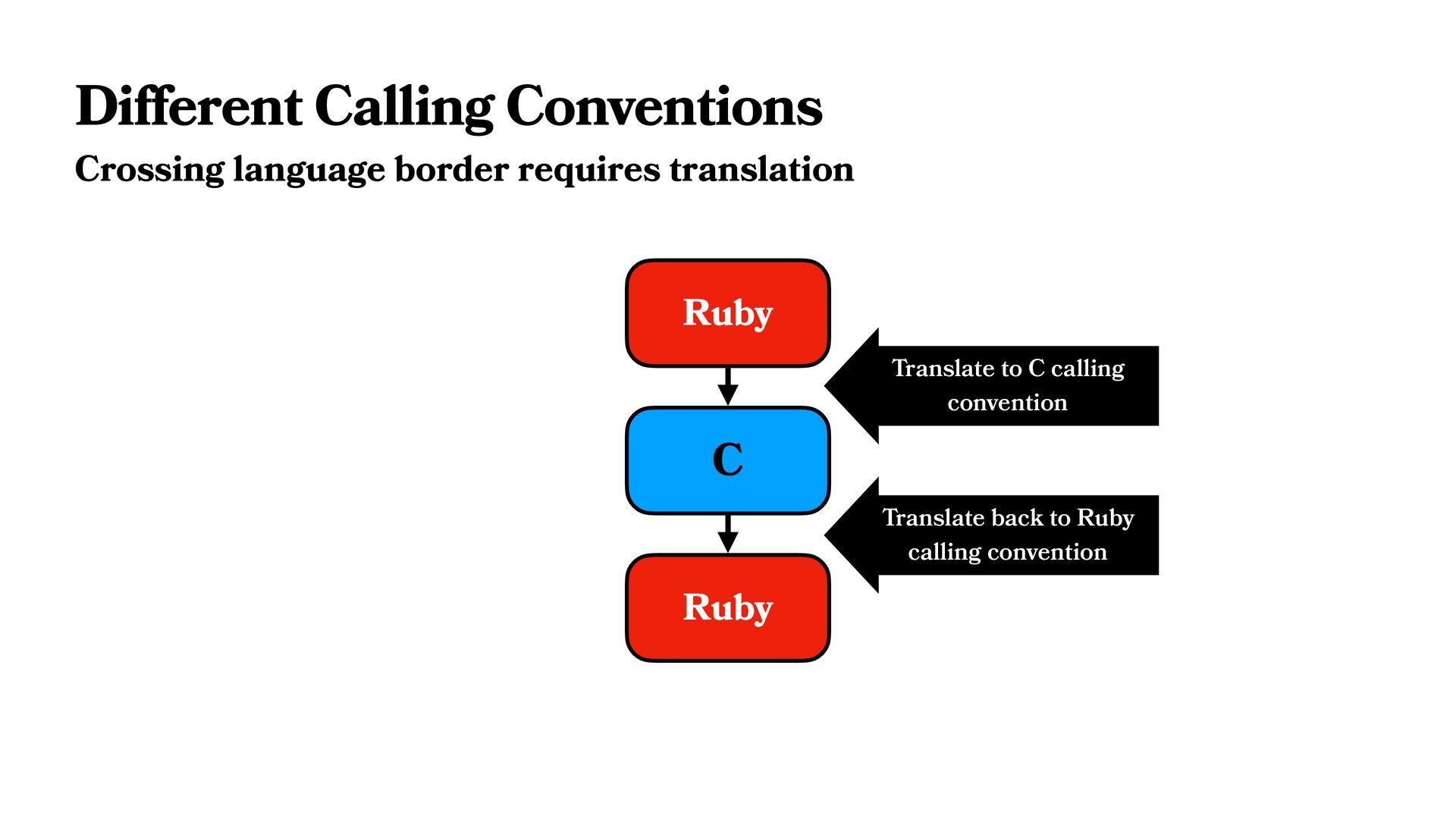
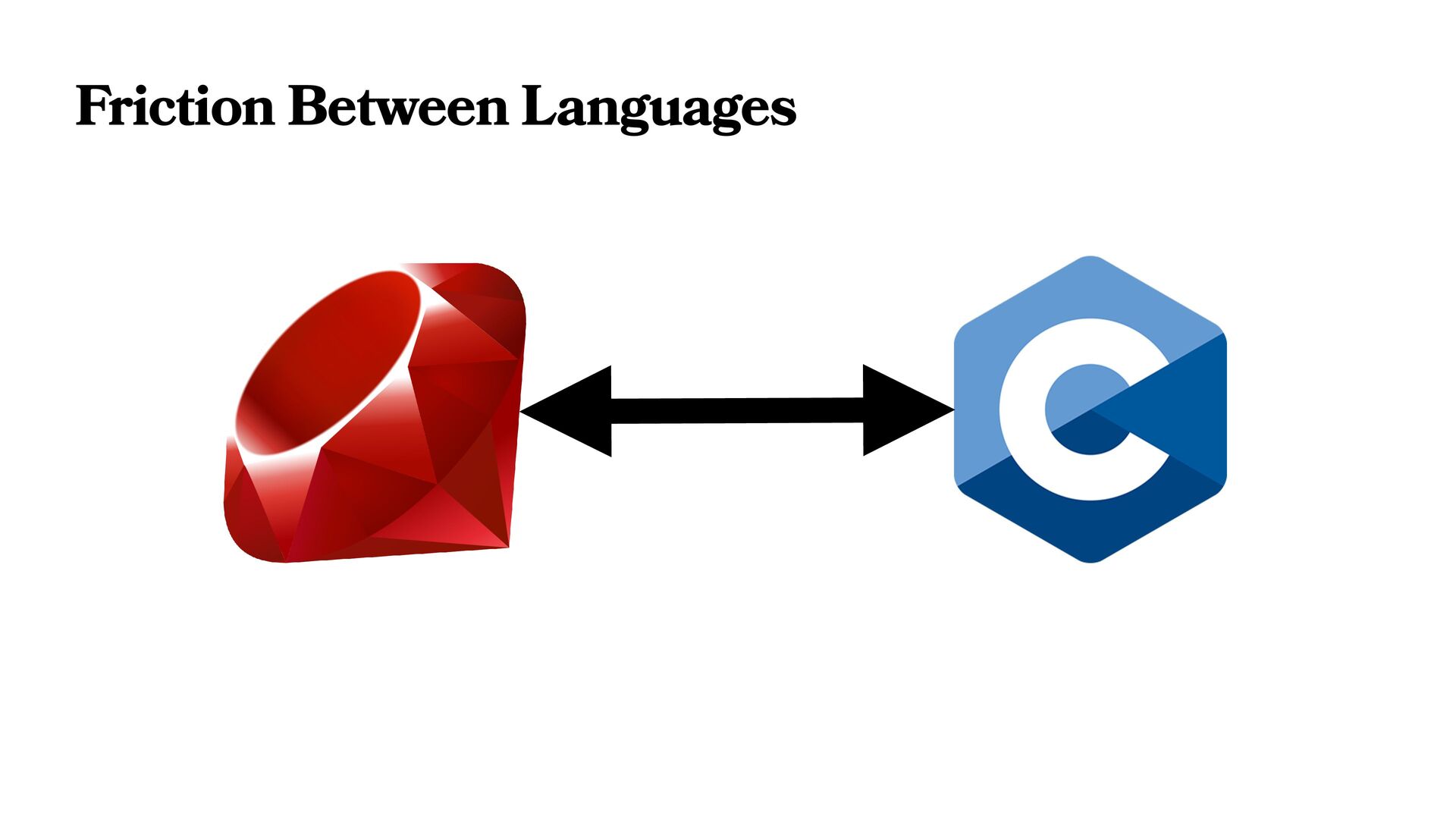
Different Calling Conventions Crossing language border requires translation C Ruby
Ruby Translate to C calling convention Translate back to Ruby calling convention -
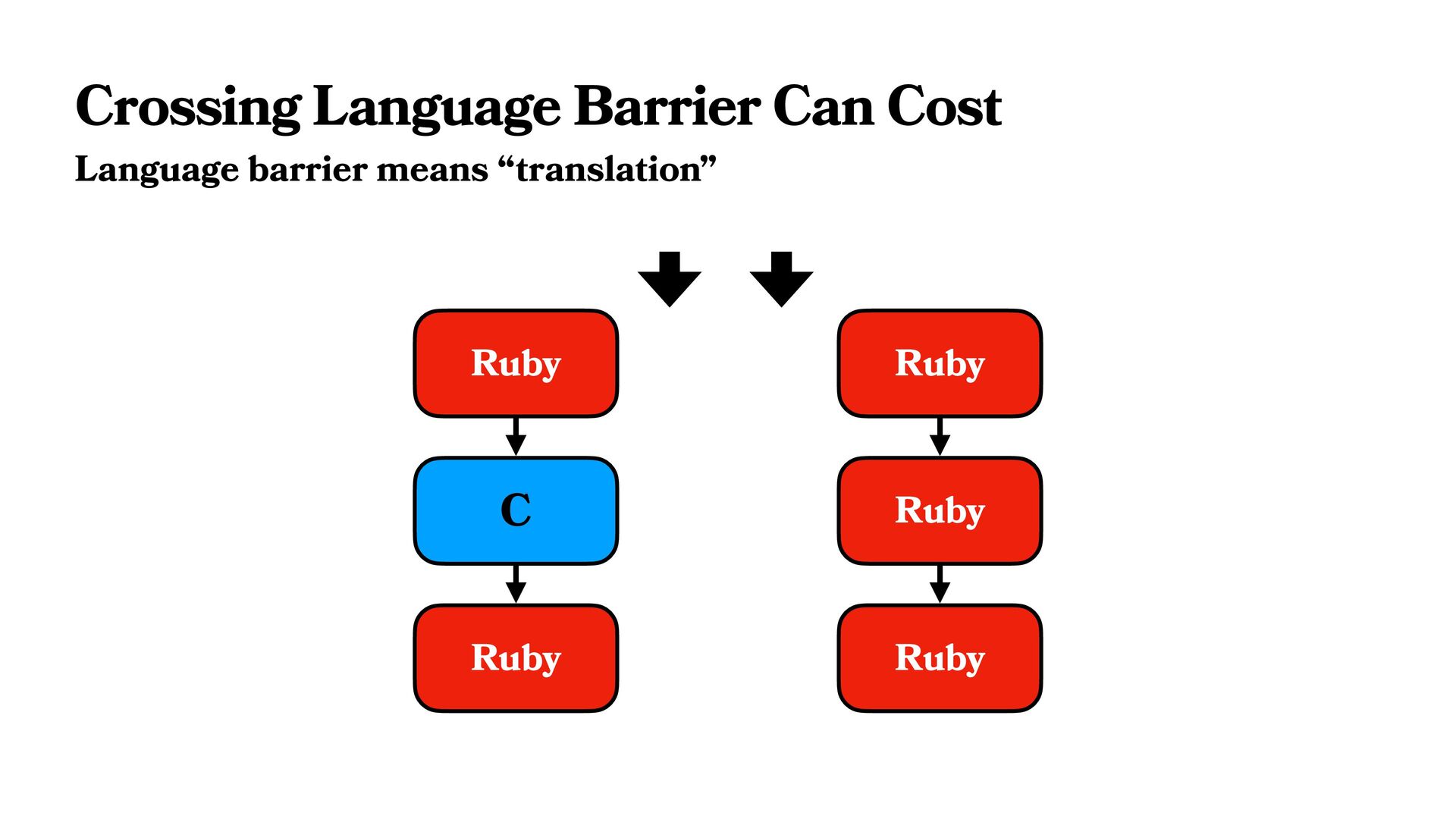
Crossing Language Barrier Can Cost Language barrier means “translation” C
Ruby Ruby Ruby Ruby Ruby -
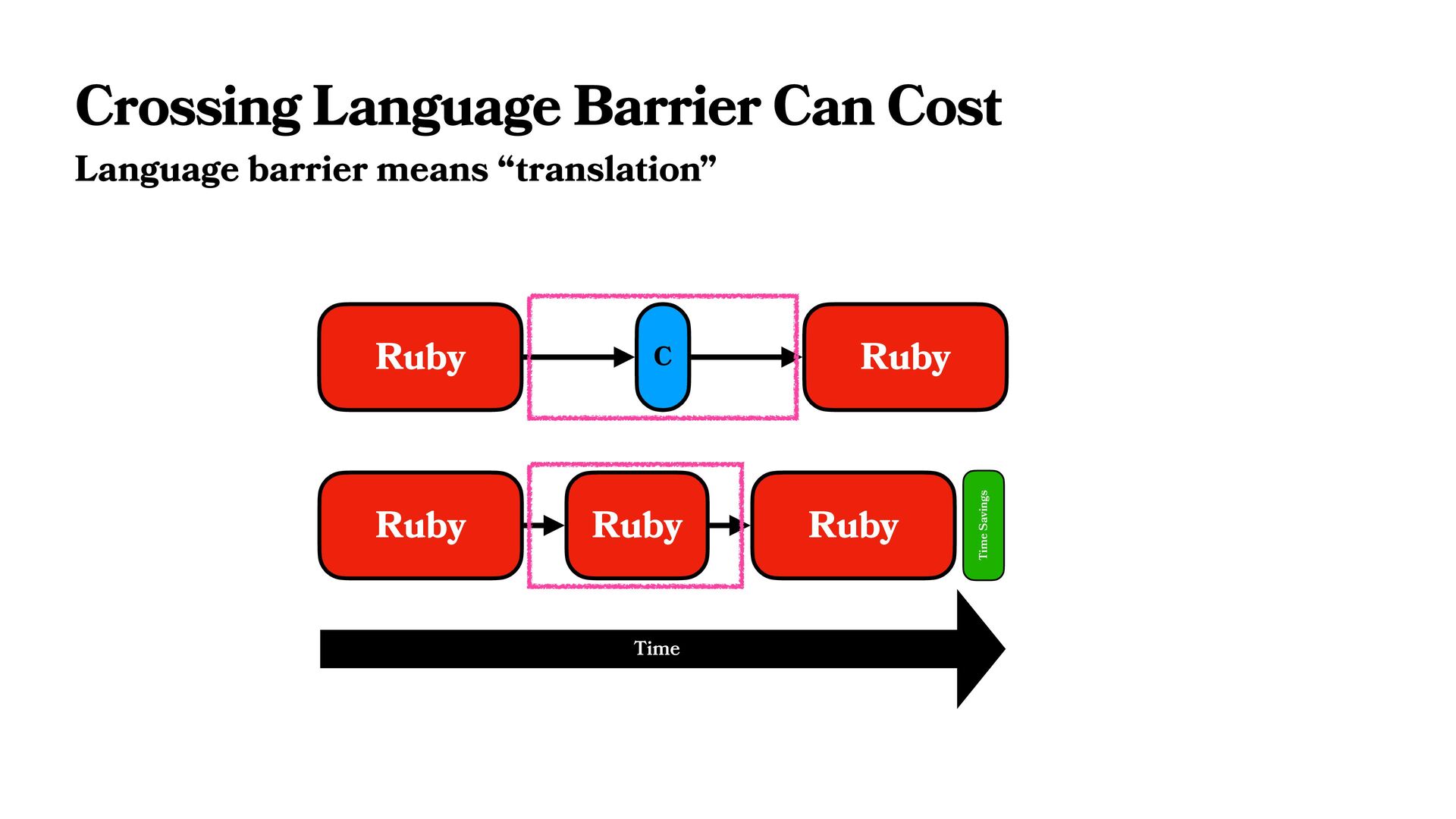
Crossing Language Barrier Can Cost Language barrier means “translation” C
Ruby Ruby Ruby Ruby Ruby Time Time Savings -
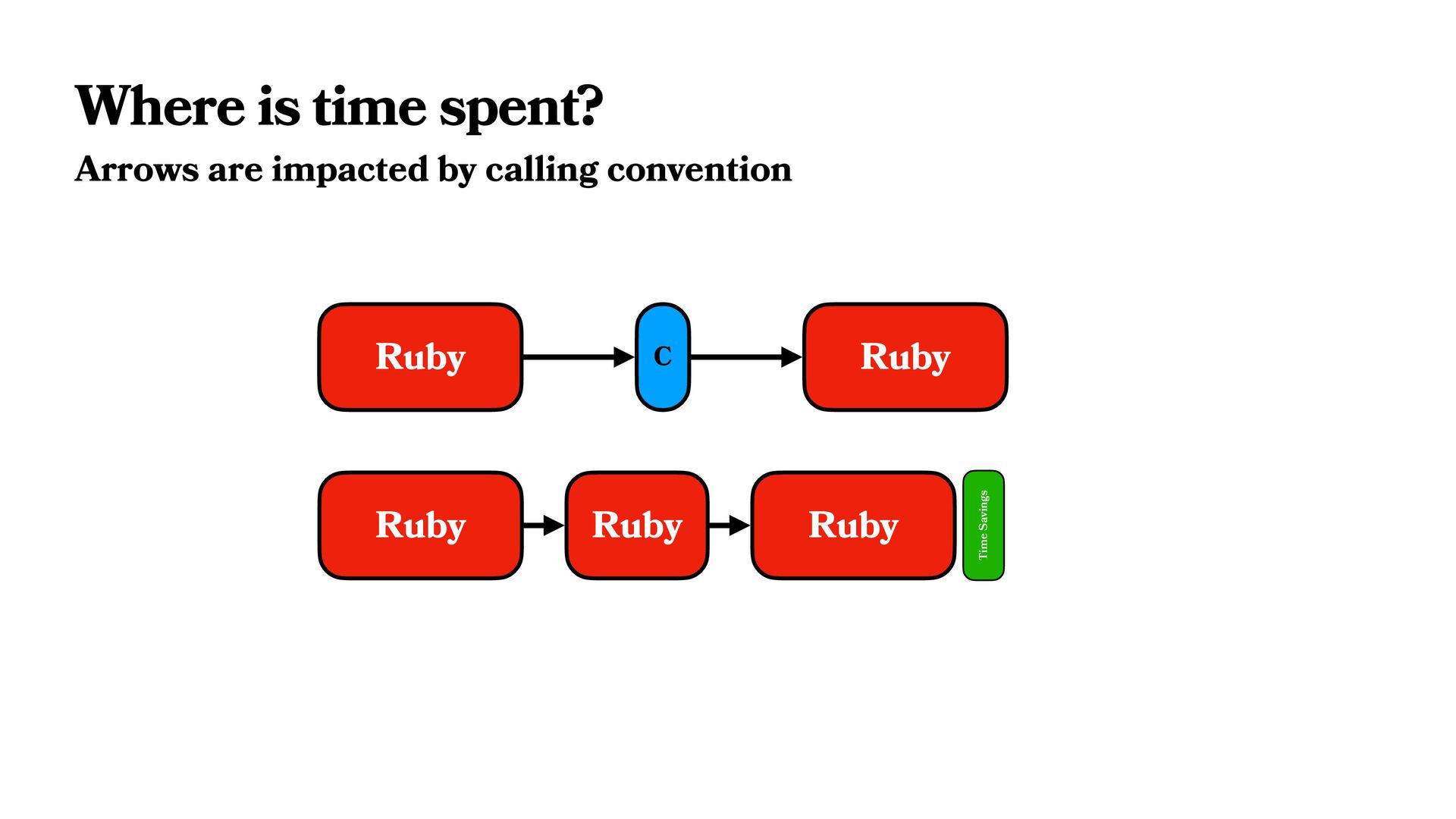
Where is time spent? Arrows are impacted by calling convention
C Ruby Ruby Ruby Ruby Ruby Time Savings -
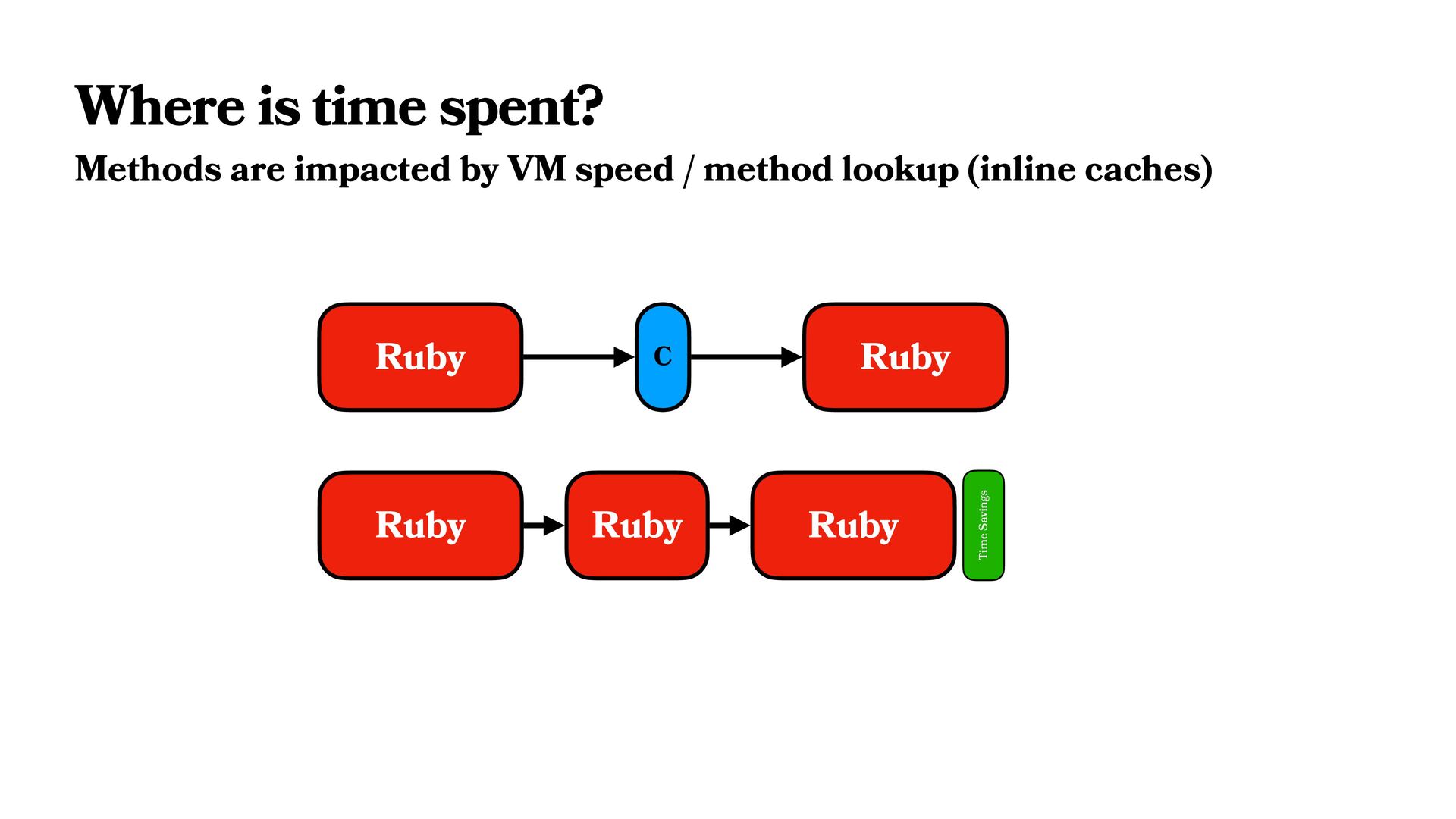
Where is time spent? Methods are impacted by VM speed
/ method lookup (inline caches) C Ruby Ruby Ruby Ruby Ruby Time Savings -
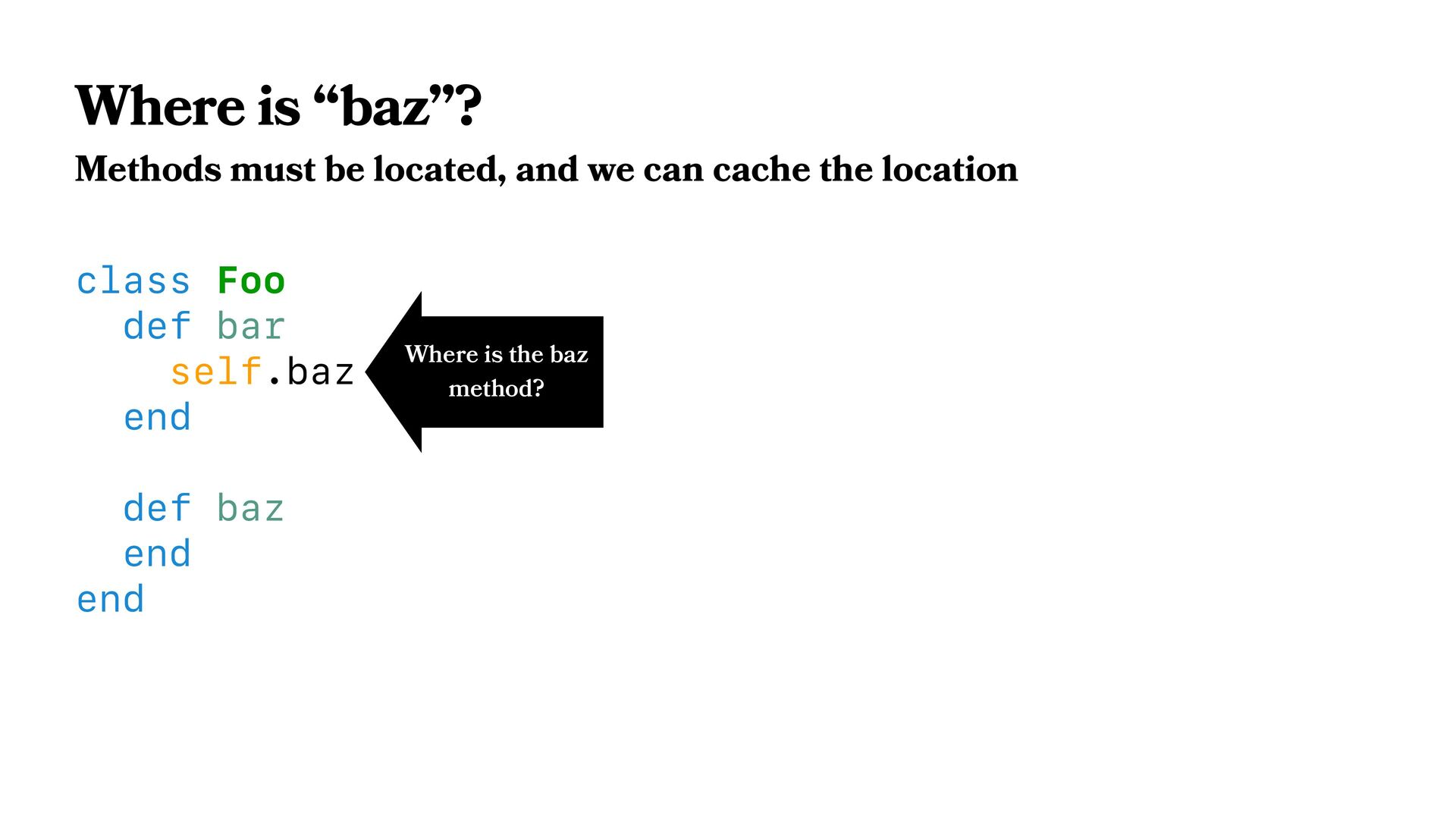
Where is “baz”? Methods must be located, and we can
cache the location class Foo def bar self.baz end def baz end end Where is the baz method? -
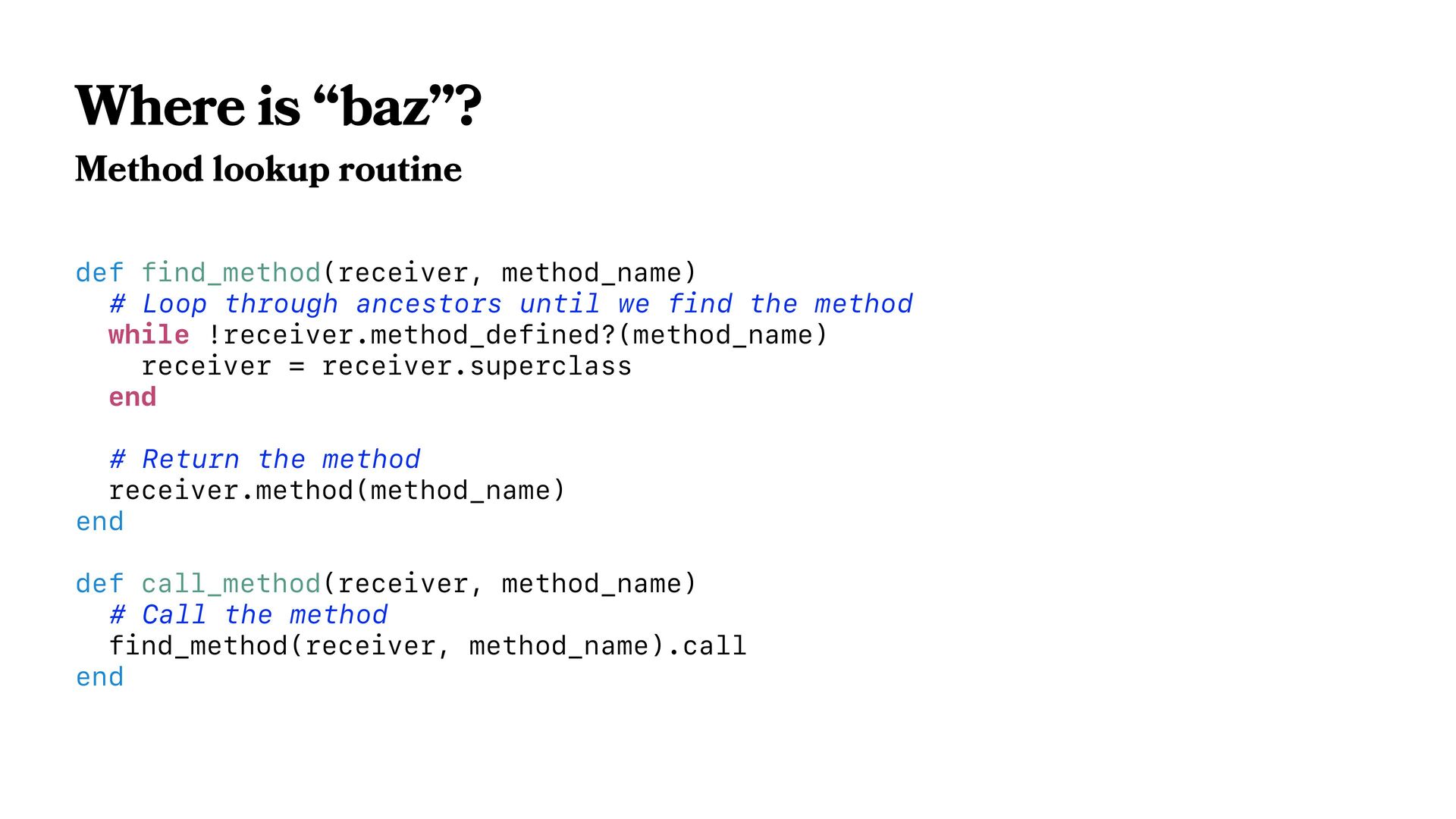
Where is “baz”? Method lookup routine def find_method(receiver, method_name) #
Loop through ancestors until we find the method while !receiver.method_defined?(method_name) receiver = receiver.superclass end # Return the method receiver.method(method_name) end def call_method(receiver, method_name) # Call the method find_method(receiver, method_name).call end -
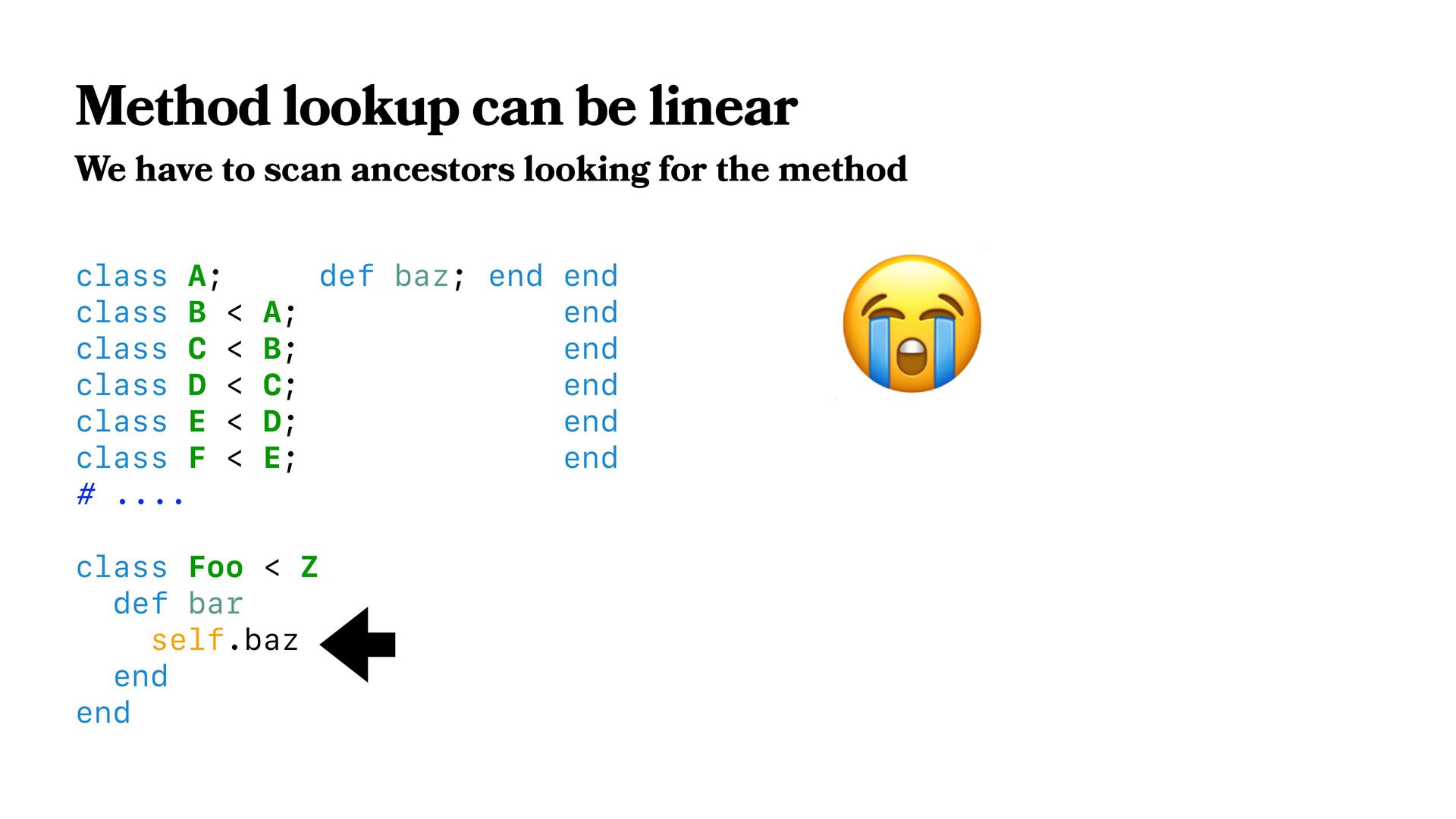
Method lookup can be linear We have to scan ancestors
looking for the method class A; def baz; end end class B < A; end class C < B; end class D < C; end class E < D; end class F < E; end # .... class Foo < Z def bar self.baz end end 😭 -
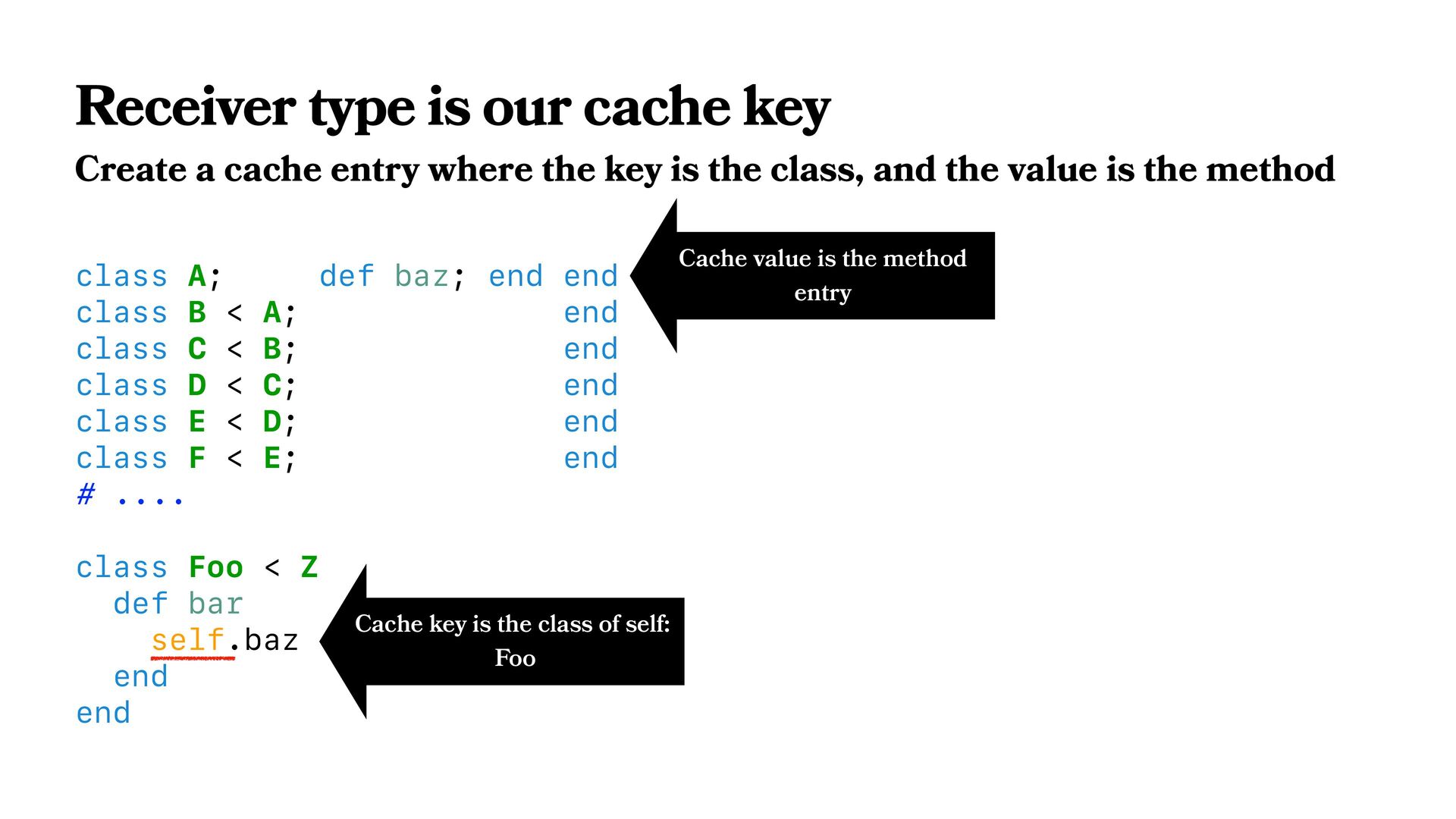
Receiver type is our cache key Create a cache entry
where the key is the class, and the value is the method class A; def baz; end end class B < A; end class C < B; end class D < C; end class E < D; end class F < E; end # .... class Foo < Z def bar self.baz end end Cache key is the class of self: Foo Cache value is the method entry -
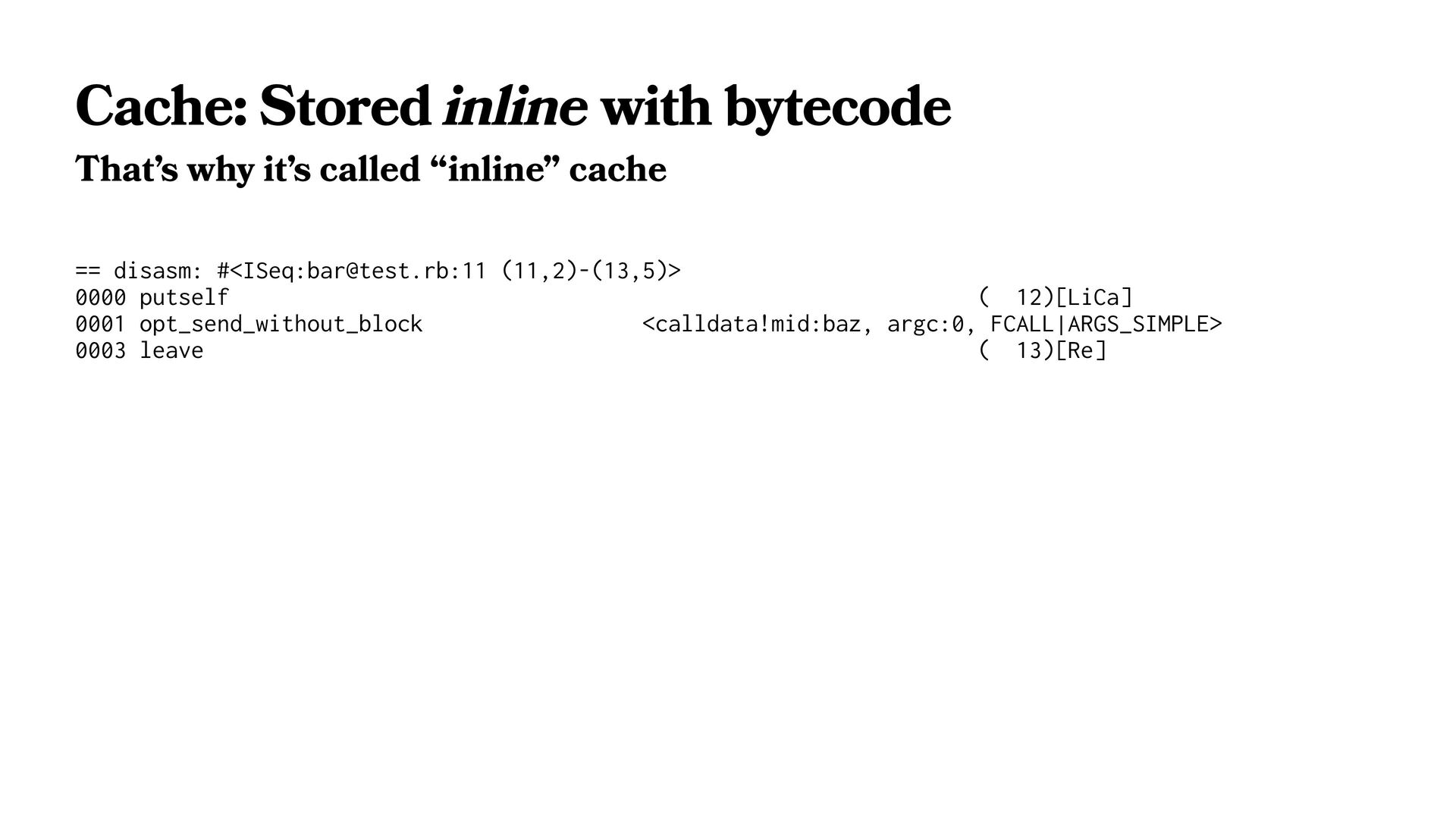
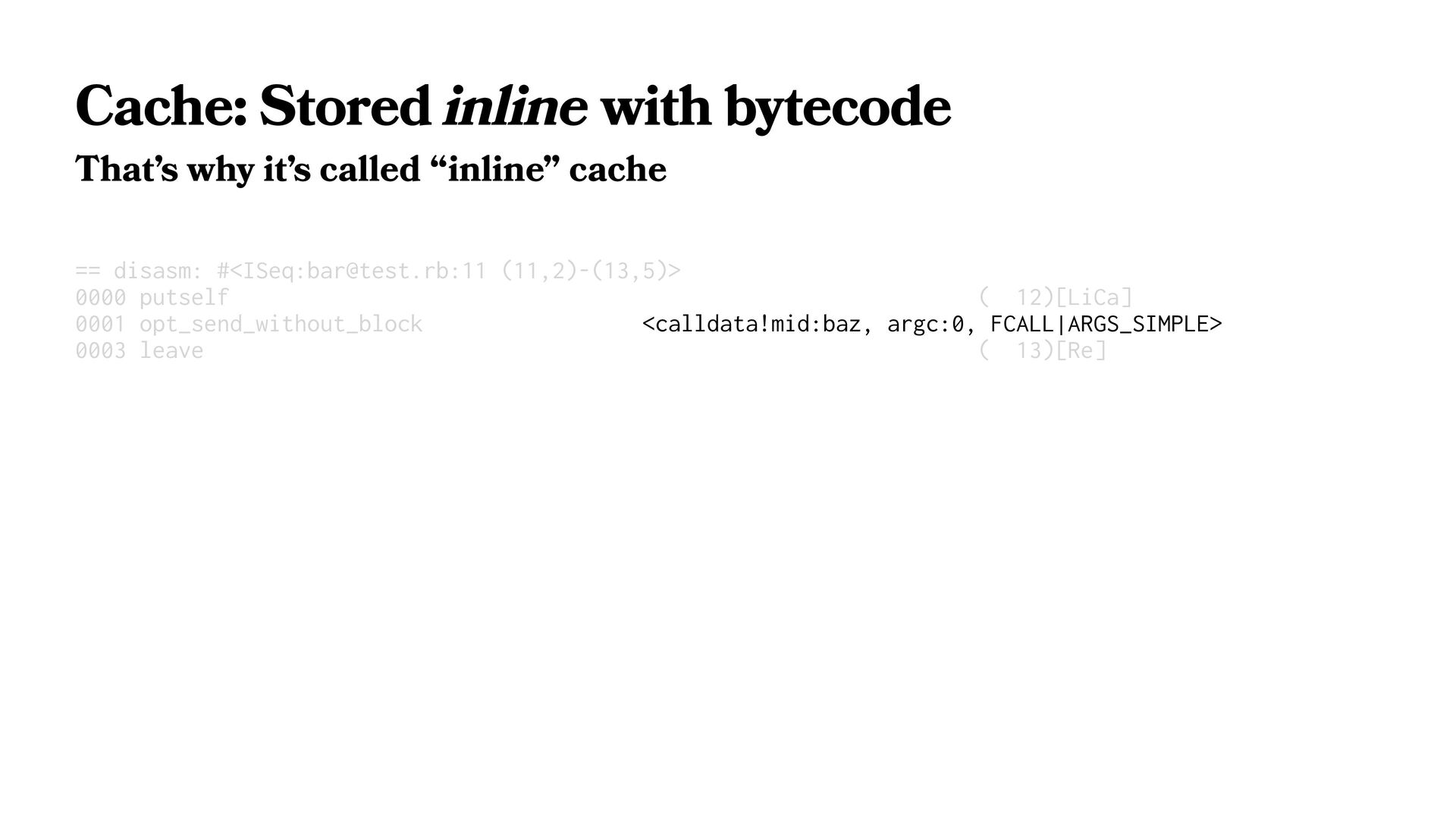
Cache: Stored inline with bytecode That’s why it’s called “inline”
cache == disasm: #<ISeq:[email protected]:11 (11,2)-(13,5)> 0000 putself ( 12)[LiCa] 0001 opt_send_without_block <calldata!mid:baz, argc:0, FCALL|ARGS_SIMPLE> 0003 leave ( 13)[Re] -
Cache: Stored inline with bytecode That’s why it’s called “inline”
cache == disasm: #<ISeq:[email protected]:11 (11,2)-(13,5)> 0000 putself ( 12)[LiCa] 0001 opt_send_without_block <calldata!mid:baz, argc:0, FCALL|ARGS_SIMPLE> 0003 leave ( 13)[Re] -
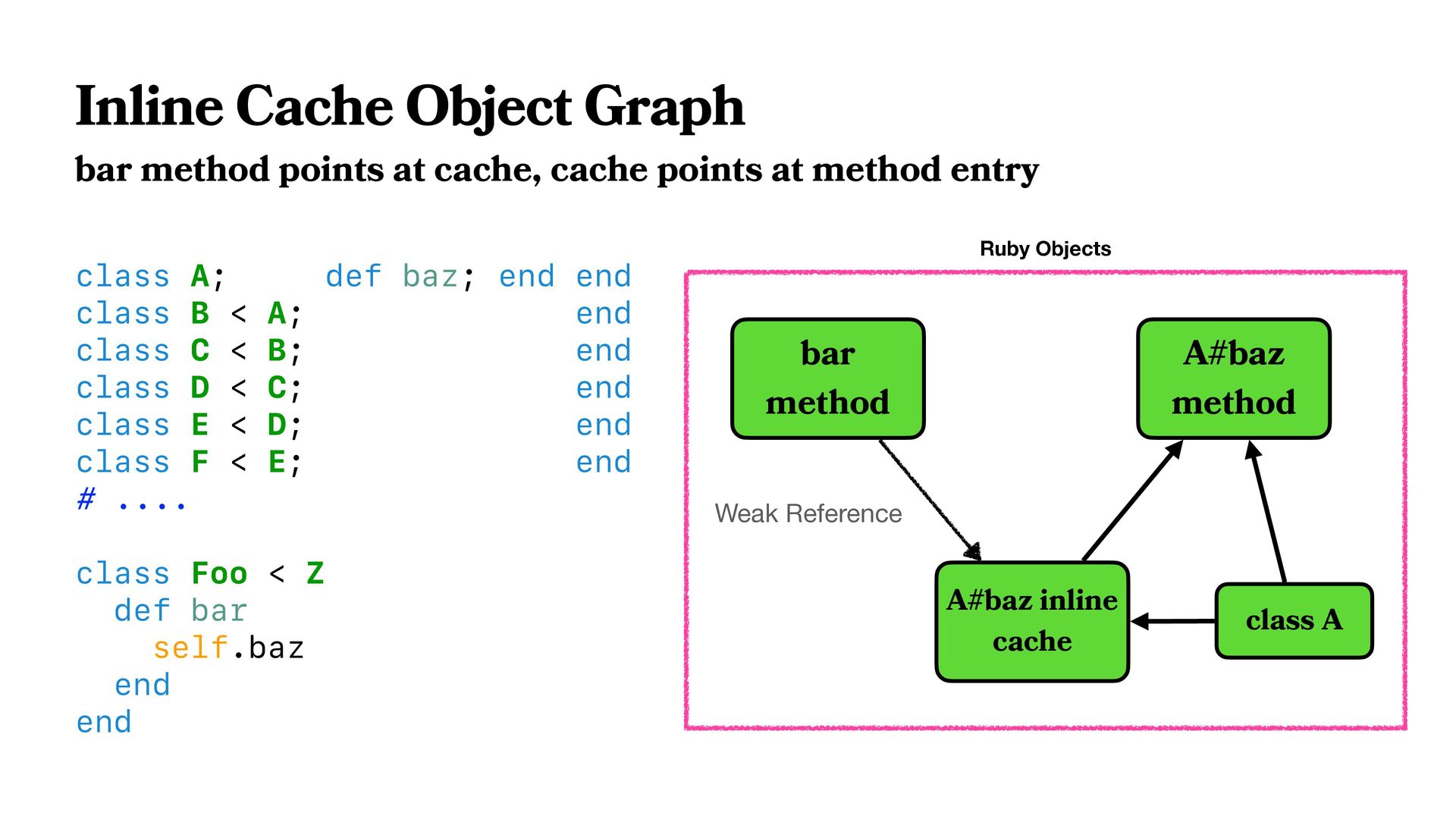
Inline Cache Object Graph bar method points at cache, cache
points at method entry class A; def baz; end end class B < A; end class C < B; end class D < C; end class E < D; end class F < E; end # .... class Foo < Z def bar self.baz end end bar method A#baz inline cache A#baz method Weak Reference Ruby Objects class A -
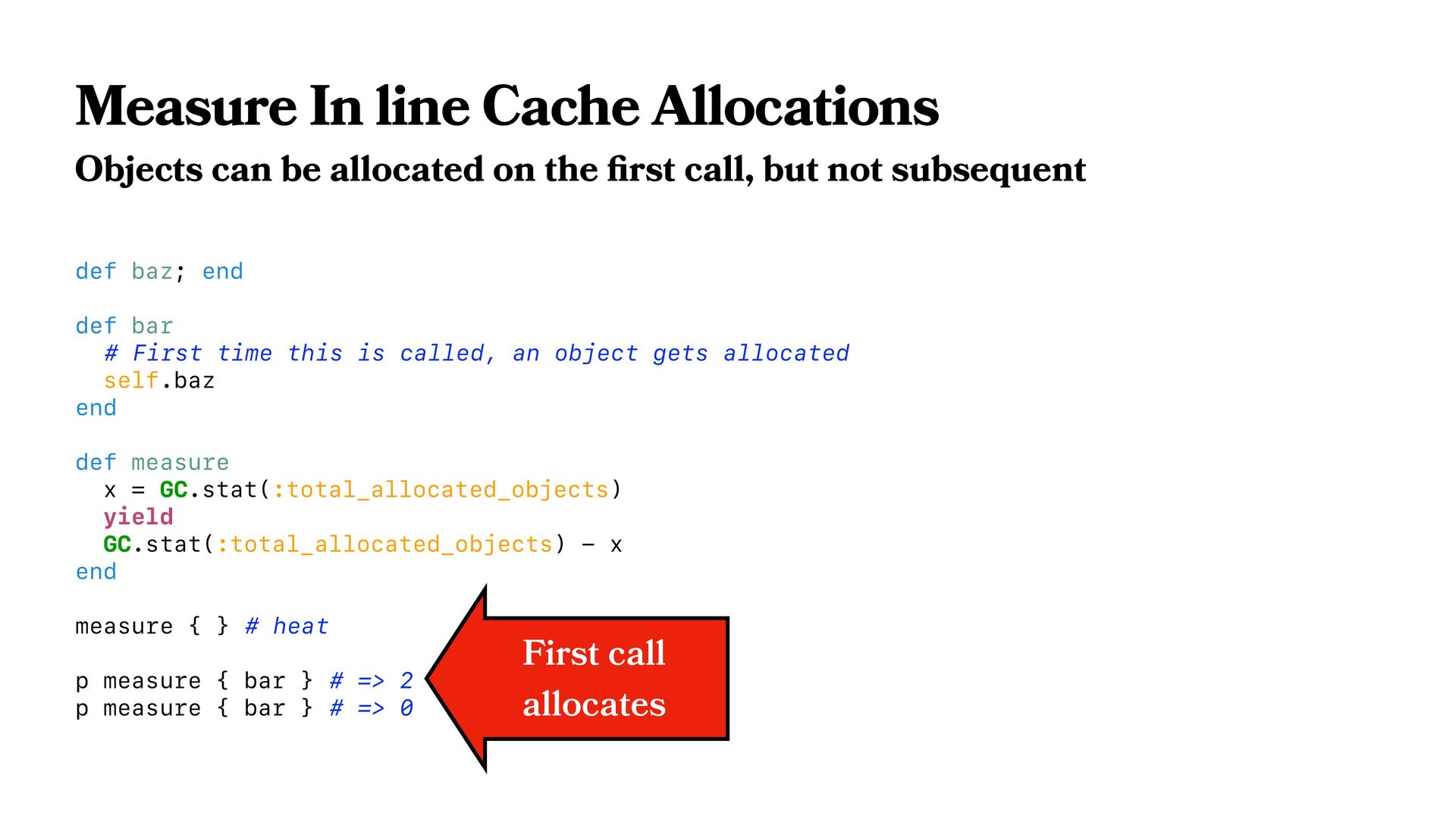
Measure In line Cache Allocations Objects can be allocated on
the fi rst call, but not subsequent def baz; end def bar # First time this is called, an object gets allocated self.baz end def measure x = GC.stat(:total_allocated_objects) yield GC.stat(:total_allocated_objects) - x end measure { } # heat p measure { bar } # => 2 p measure { bar } # => 0 First call allocates -
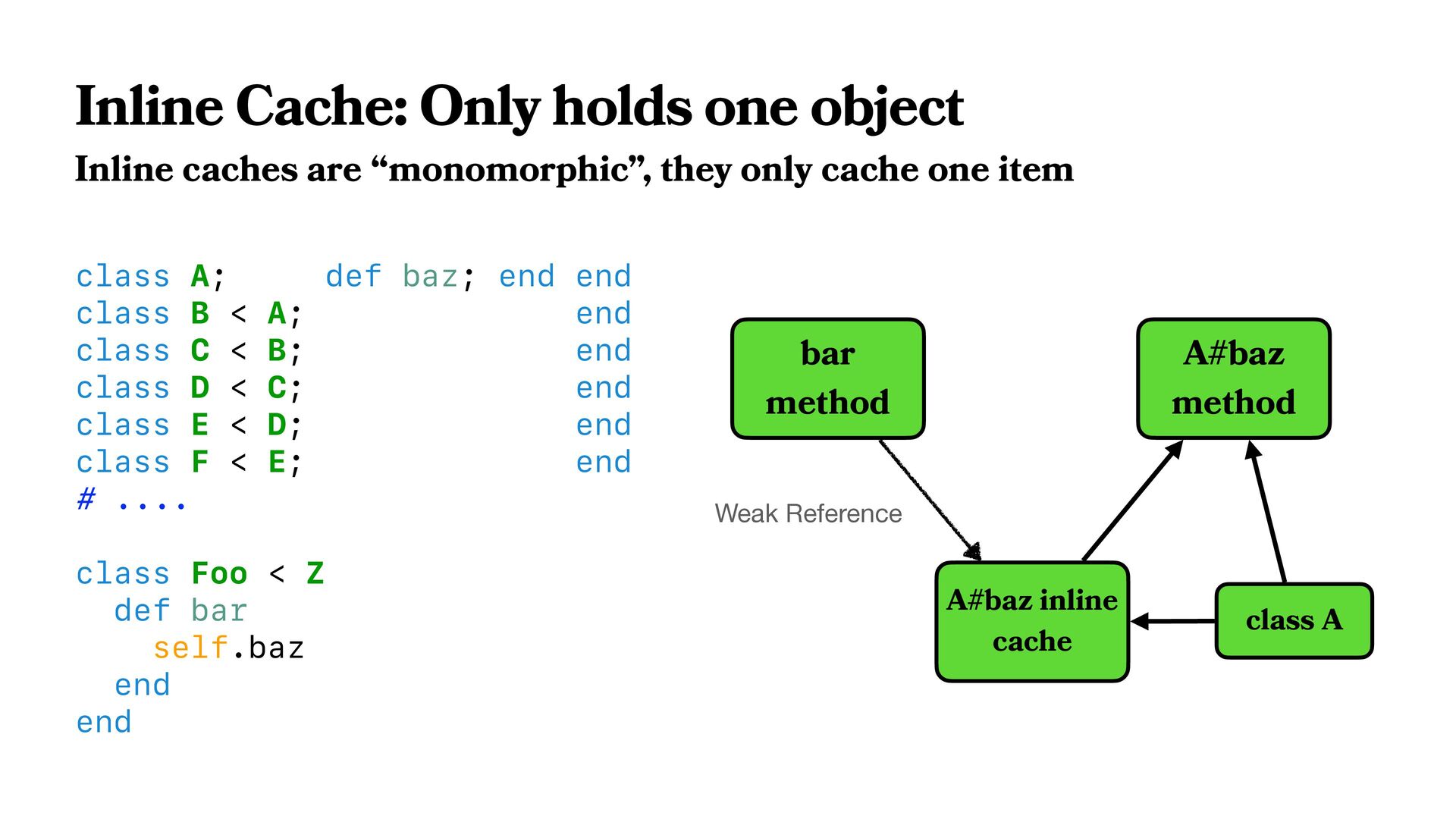
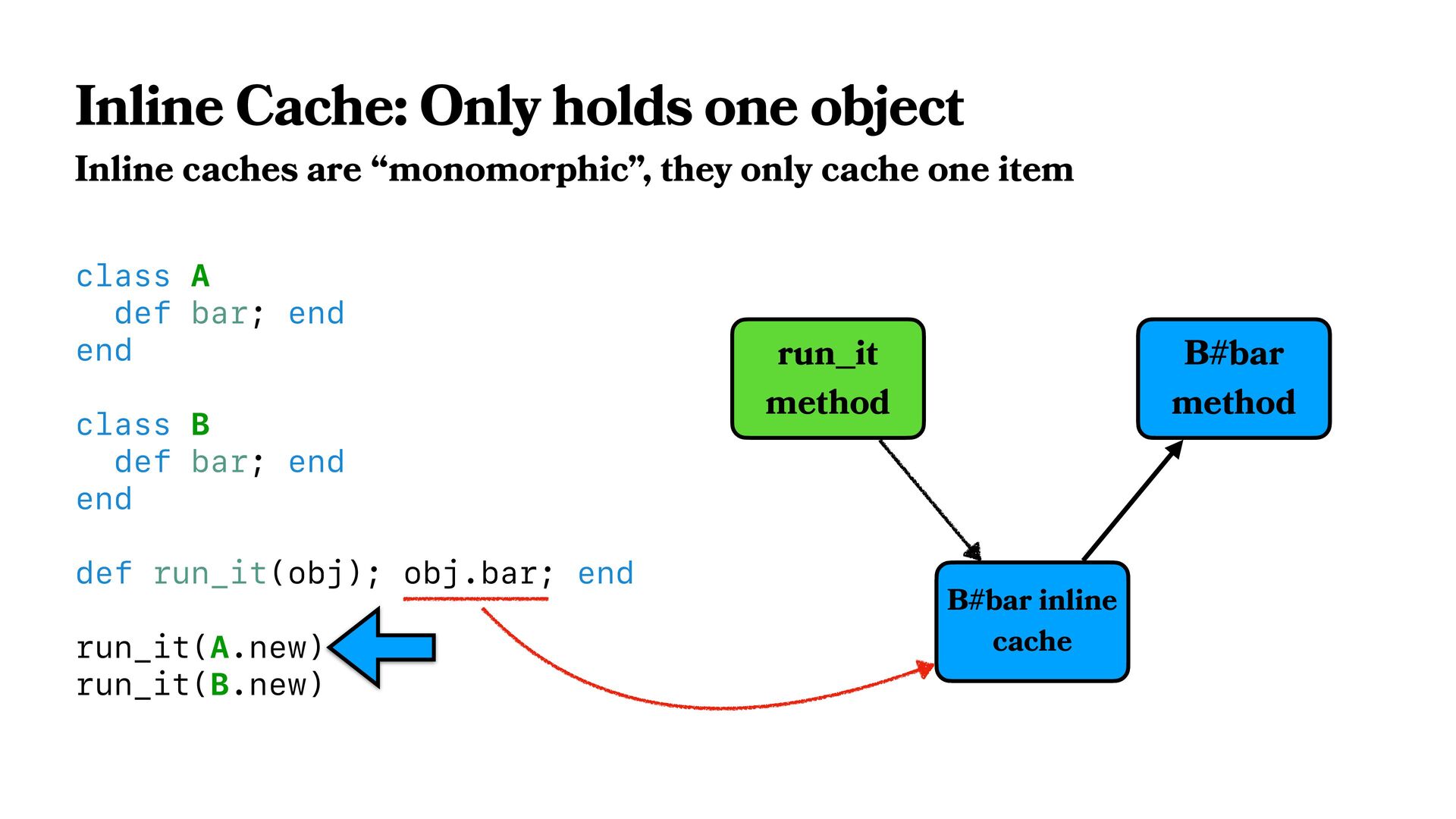
Inline Cache: Only holds one object Inline caches are “monomorphic”,
they only cache one item class A; def baz; end end class B < A; end class C < B; end class D < C; end class E < D; end class F < E; end # .... class Foo < Z def bar self.baz end end bar method A#baz inline cache A#baz method Weak Reference class A -
Inline Cache: Only holds one object Inline caches are “monomorphic”,
they only cache one item class A def bar; end end class B def bar; end end def run_it(obj); obj.bar; end run_it(A.new) run_it(B.new) run_it method A#bar inline cache A#bar method B#bar inline cache B#bar method -
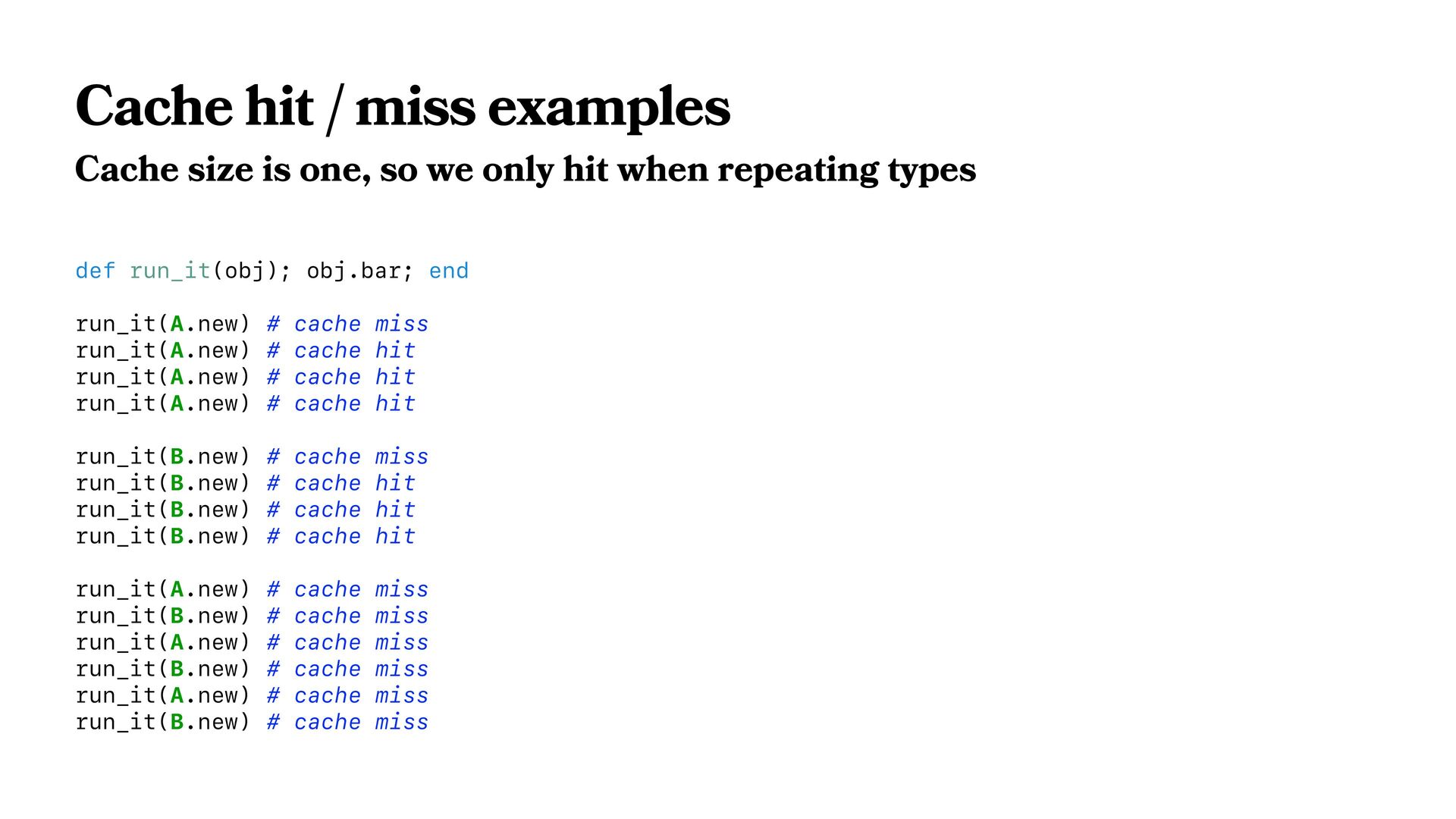
Cache hit / miss examples Cache size is one, so
we only hit when repeating types def run_it(obj); obj.bar; end run_it(A.new) # cache miss run_it(A.new) # cache hit run_it(A.new) # cache hit run_it(A.new) # cache hit run_it(B.new) # cache miss run_it(B.new) # cache hit run_it(B.new) # cache hit run_it(B.new) # cache hit run_it(A.new) # cache miss run_it(B.new) # cache miss run_it(A.new) # cache miss run_it(B.new) # cache miss run_it(A.new) # cache miss run_it(B.new) # cache miss -
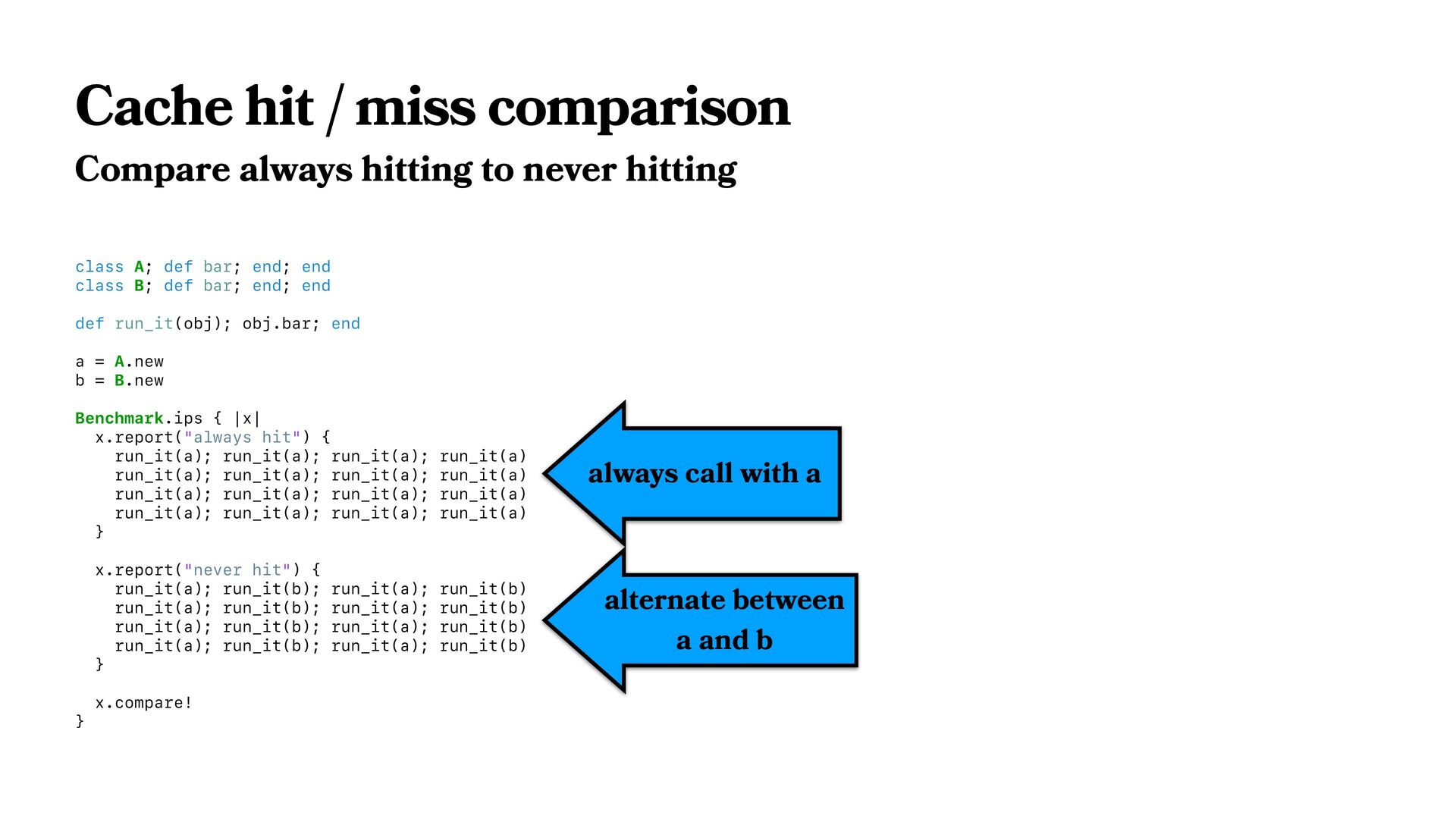
Cache hit / miss comparison Compare always hitting to never
hitting class A; def bar; end; end class B; def bar; end; end def run_it(obj); obj.bar; end a = A.new b = B.new Benchmark.ips { |x| x.report("always hit") { run_it(a); run_it(a); run_it(a); run_it(a) run_it(a); run_it(a); run_it(a); run_it(a) run_it(a); run_it(a); run_it(a); run_it(a) run_it(a); run_it(a); run_it(a); run_it(a) } x.report("never hit") { run_it(a); run_it(b); run_it(a); run_it(b) run_it(a); run_it(b); run_it(a); run_it(b) run_it(a); run_it(b); run_it(a); run_it(b) run_it(a); run_it(b); run_it(a); run_it(b) } x.compare! } always call with a alternate between a and b -
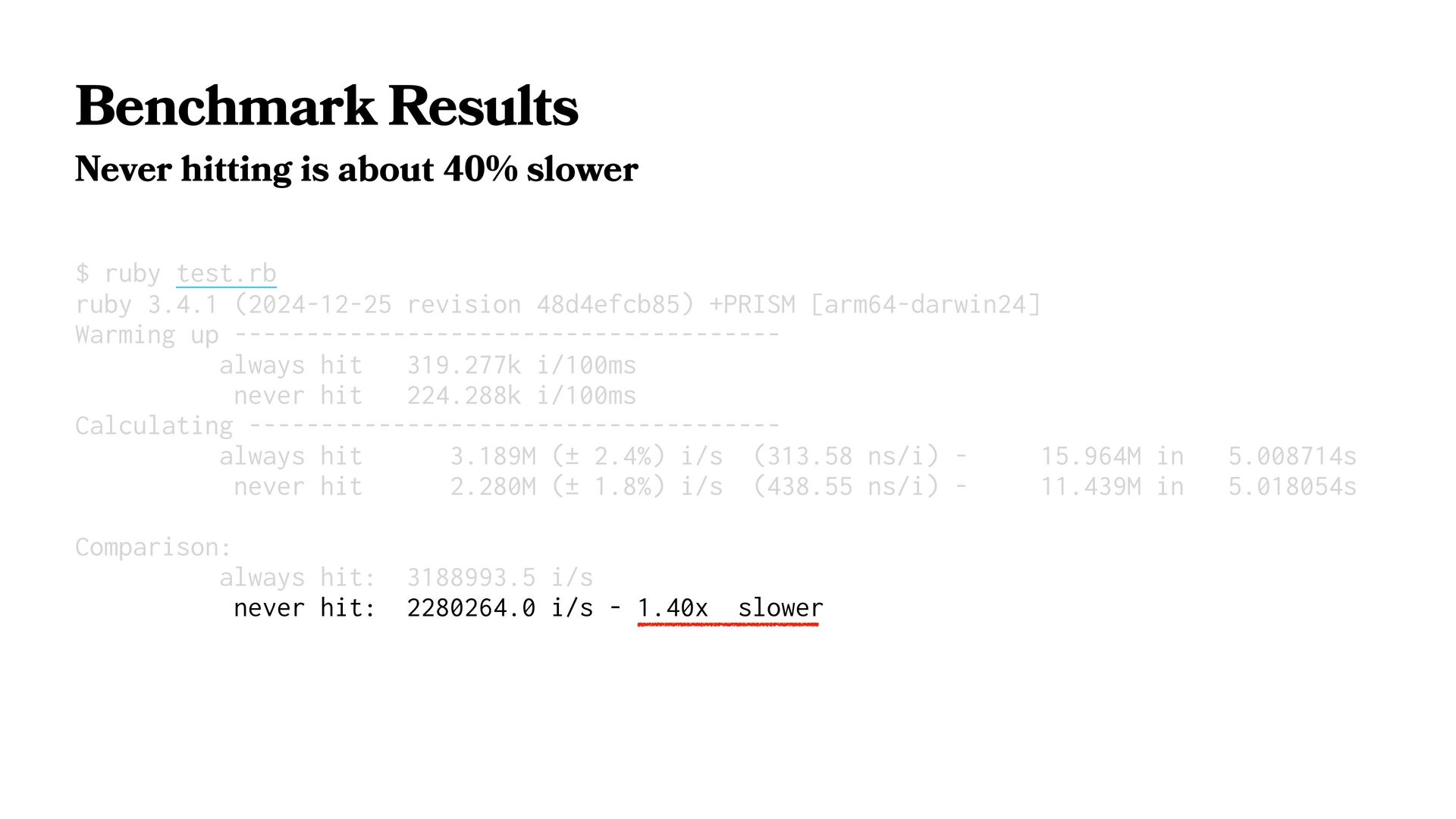
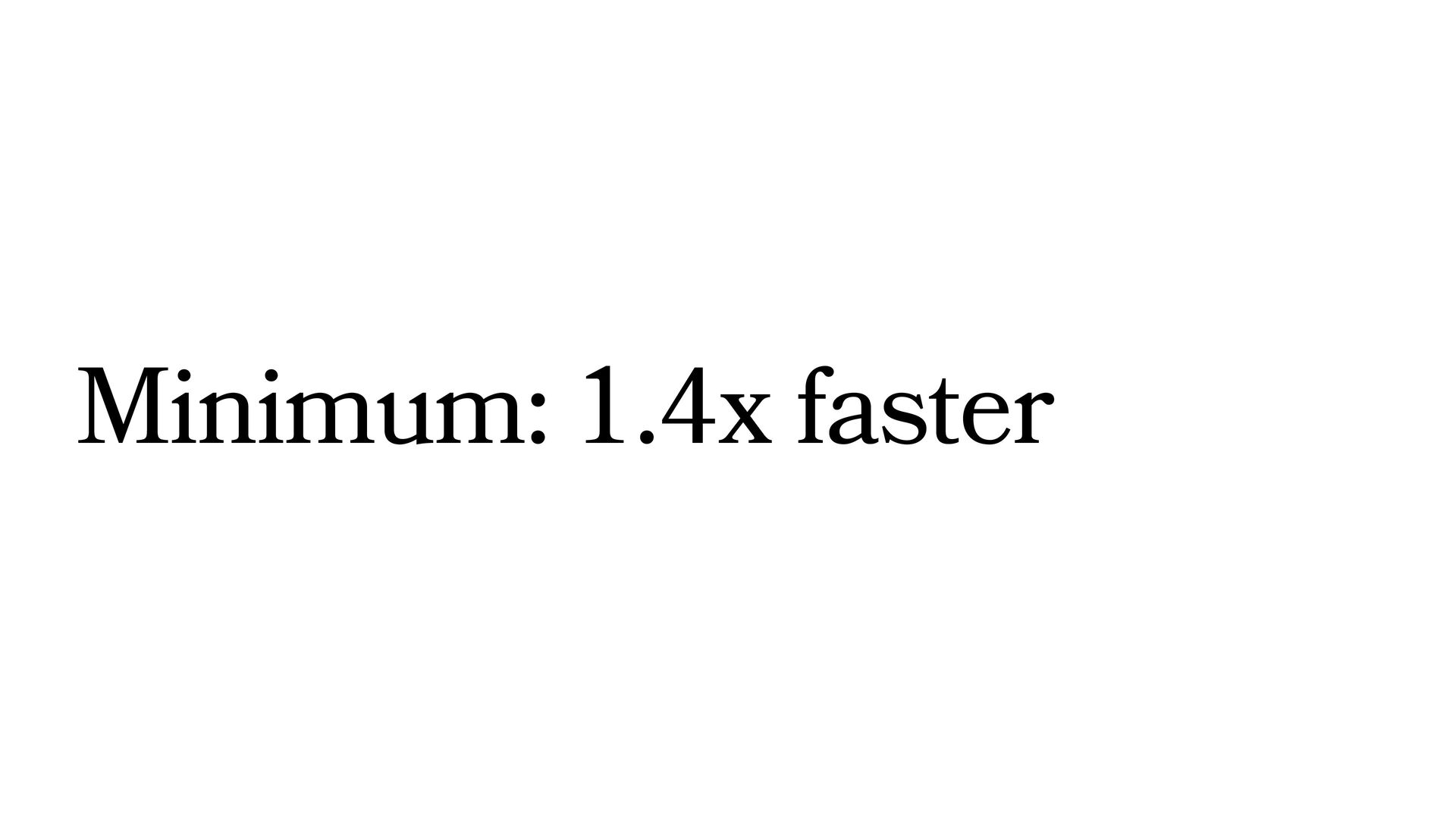
Benchmark Results Never hitting is about 40% slower $ ruby
test.rb ruby 3.4.1 (2024-12-25 revision 48d4efcb85) +PRISM [arm64-darwin24] Warming up -------------------------------------- always hit 319.277k i/100ms never hit 224.288k i/100ms Calculating ------------------------------------- always hit 3.189M (± 2.4%) i/s (313.58 ns/i) - 15.964M in 5.008714s never hit 2.280M (± 1.8%) i/s (438.55 ns/i) - 11.439M in 5.018054s Comparison: always hit: 3188993.5 i/s never hit: 2280264.0 i/s - 1.40x slower $ ruby test.rb ruby 3.4.1 (2024-12-25 revision 48d4efcb85) +PRISM [arm64-darwin24] Warming up -------------------------------------- always hit 319.277k i/100ms never hit 224.288k i/100ms Calculating ------------------------------------- always hit 3.189M (± 2.4%) i/s (313.58 ns/i) - 15.964M in 5.008714s never hit 2.280M (± 1.8%) i/s (438.55 ns/i) - 11.439M in 5.018054s Comparison: always hit: 3188993.5 i/s never hit: 2280264.0 i/s - 1.40x slower -
VALUE rb_class_new_instance_pass_kw(int argc, const VALUE *argv, VALUE klass) { VALUE
obj; obj = rb_class_alloc(klass); rb_obj_call_init_kw(obj, argc, argv, RB_PASS_CALLED_KEYWORDS); return obj; } class Foo def initialize(a, b) :hello end end Foo.new(1, 2) # => #<Foo ...> Initialize is called from C Class#new implementation in C -
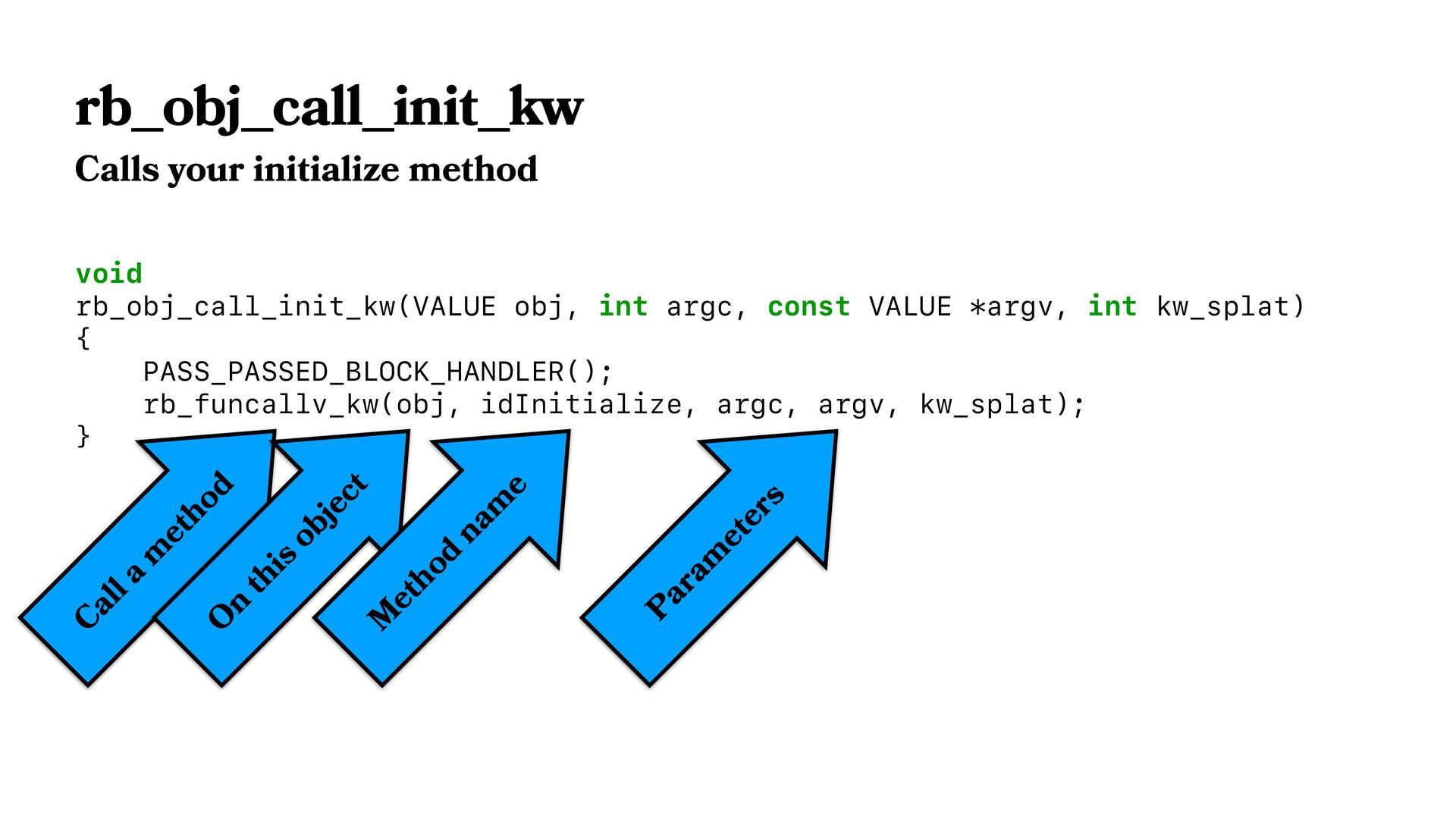
rb_obj_call_init_kw Calls your initialize method void rb_obj_call_init_kw(VALUE obj, int argc,
const VALUE *argv, int kw_splat) { PASS_PASSED_BLOCK_HANDLER(); rb_funcallv_kw(obj, idInitialize, argc, argv, kw_splat); } Call a m ethod O n this object M ethod nam e Param eters -
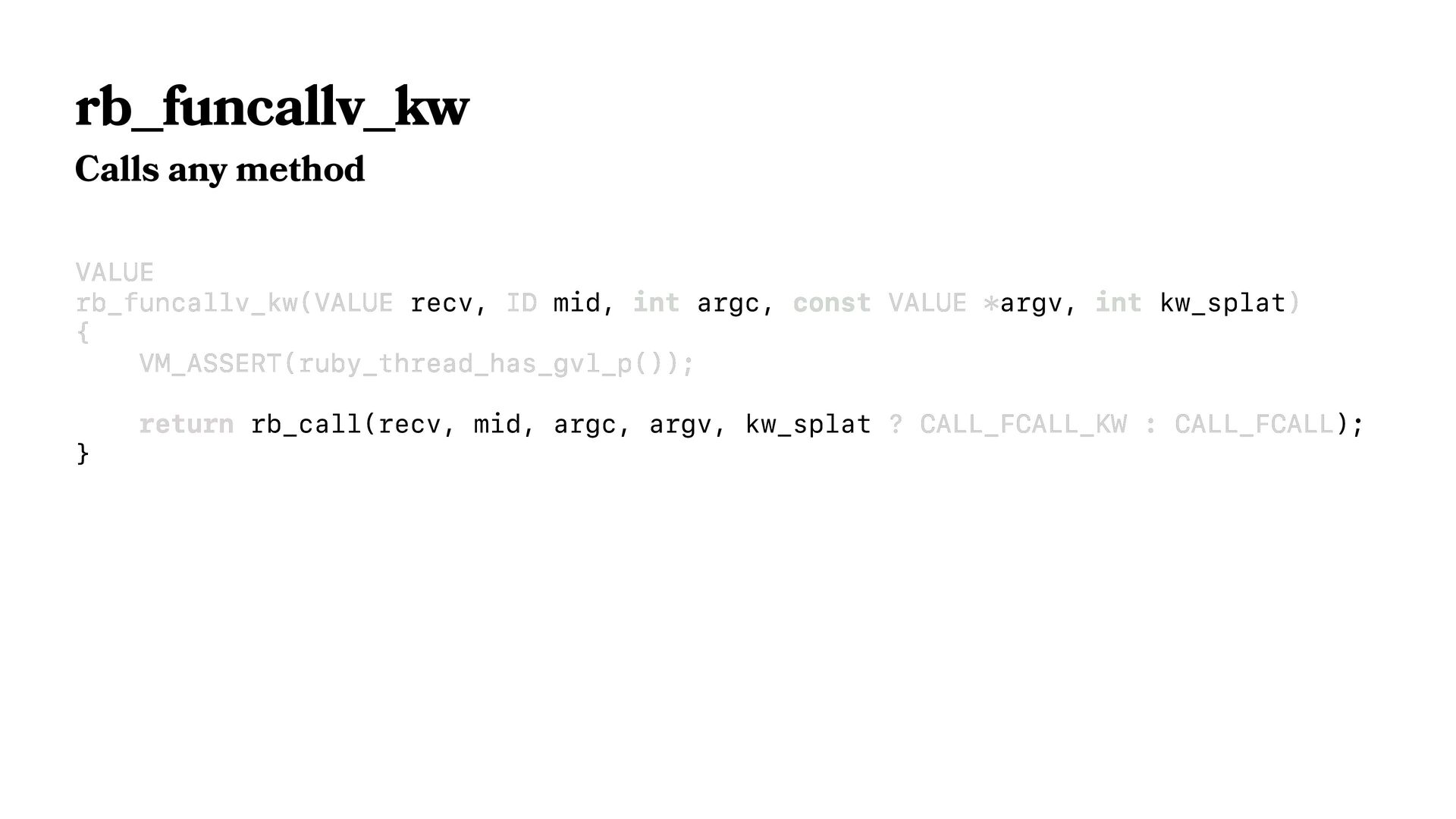
rb_funcallv_kw Calls any method VALUE rb_funcallv_kw(VALUE recv, ID mid, int
argc, const VALUE *argv, int kw_splat) { VM_ASSERT(ruby_thread_has_gvl_p()); return rb_call(recv, mid, argc, argv, kw_splat ? CALL_FCALL_KW : CALL_FCALL); } VALUE rb_funcallv_kw(VALUE recv, ID mid, int argc, const VALUE *argv, int kw_splat) { VM_ASSERT(ruby_thread_has_gvl_p()); return rb_call(recv, mid, argc, argv, kw_splat ? CALL_FCALL_KW : CALL_FCALL); } -
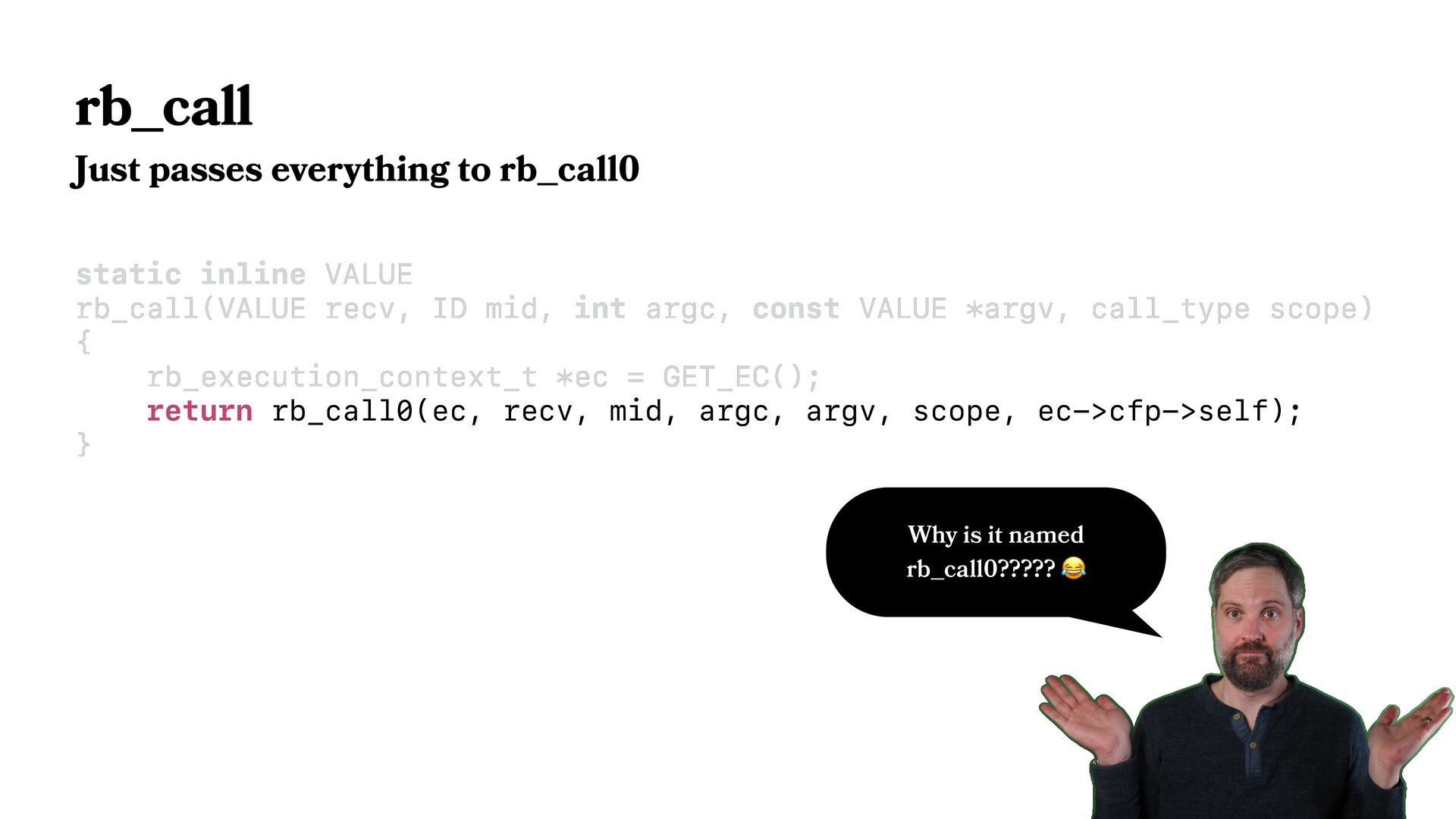
rb_call Just passes everything to rb_call0 static inline VALUE rb_call(VALUE
recv, ID mid, int argc, const VALUE *argv, call_type scope) { rb_execution_context_t *ec = GET_EC(); return rb_call0(ec, recv, mid, argc, argv, scope, ec->cfp->self); } static inline VALUE rb_call(VALUE recv, ID mid, int argc, const VALUE *argv, call_type scope) { rb_execution_context_t *ec = GET_EC(); return rb_call0(ec, recv, mid, argc, argv, scope, ec->cfp->self); } Why is it named rb_call0????? 😂 -
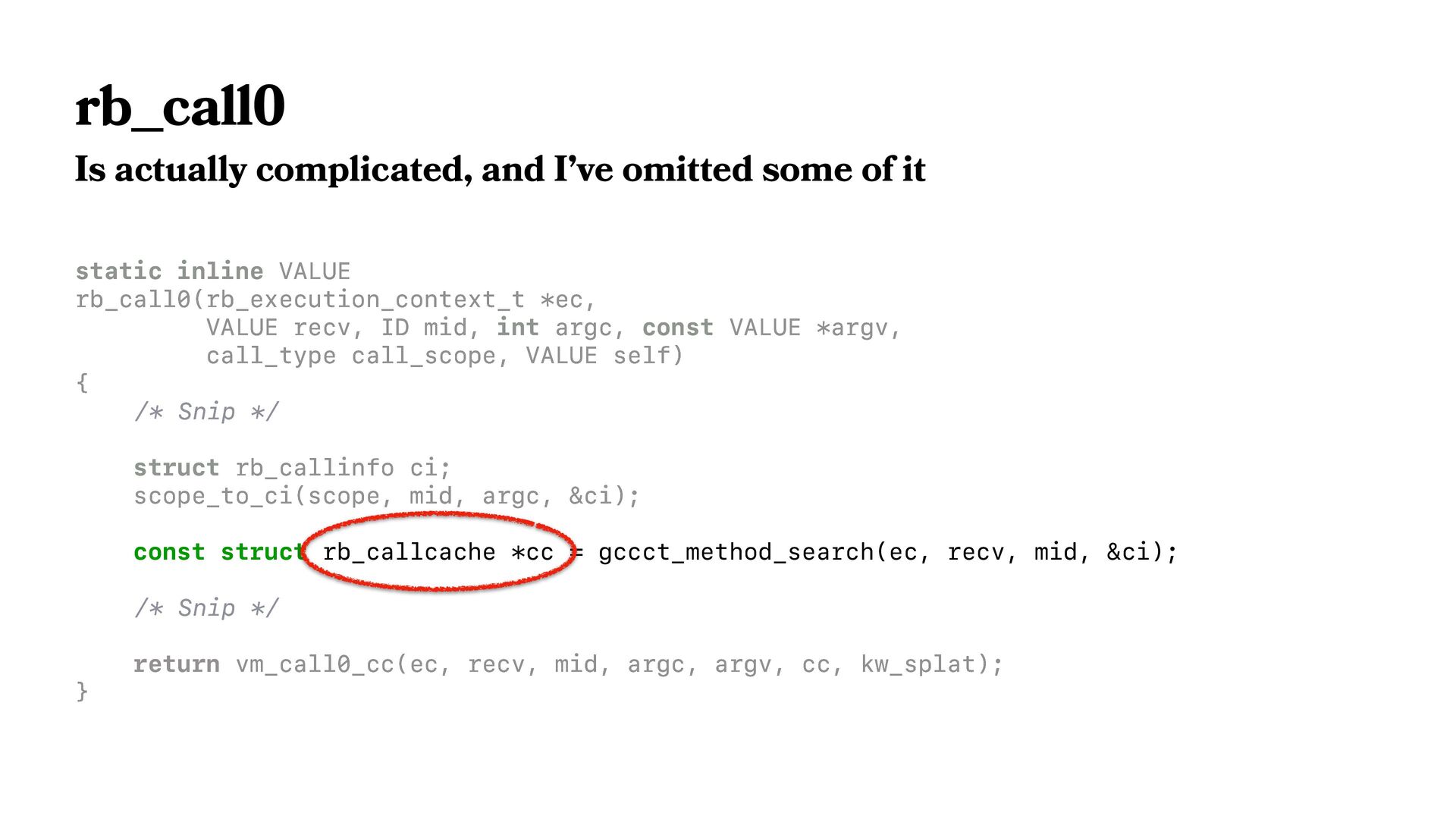
rb_call0 Is actually complicated, and I’ve omitted some of it
static inline VALUE rb_call0(rb_execution_context_t *ec, VALUE recv, ID mid, int argc, const VALUE *argv, call_type call_scope, VALUE self) { /* Snip */ struct rb_callinfo ci; scope_to_ci(scope, mid, argc, &ci); const struct rb_callcache *cc = gccct_method_search(ec, recv, mid, &ci); /* Snip */ return vm_call0_cc(ec, recv, mid, argc, argv, cc, kw_splat); } static inline VALUE rb_call0(rb_execution_context_t *ec, VALUE recv, ID mid, int argc, const VALUE *argv, call_type call_scope, VALUE self) { /* Snip */ struct rb_callinfo ci; scope_to_ci(scope, mid, argc, &ci); const struct rb_callcache *cc = gccct_method_search(ec, recv, mid, &ci); /* Snip */ return vm_call0_cc(ec, recv, mid, argc, argv, cc, kw_splat); } -
If Ruby methods store caches in byte code, where do
C functions store them? -
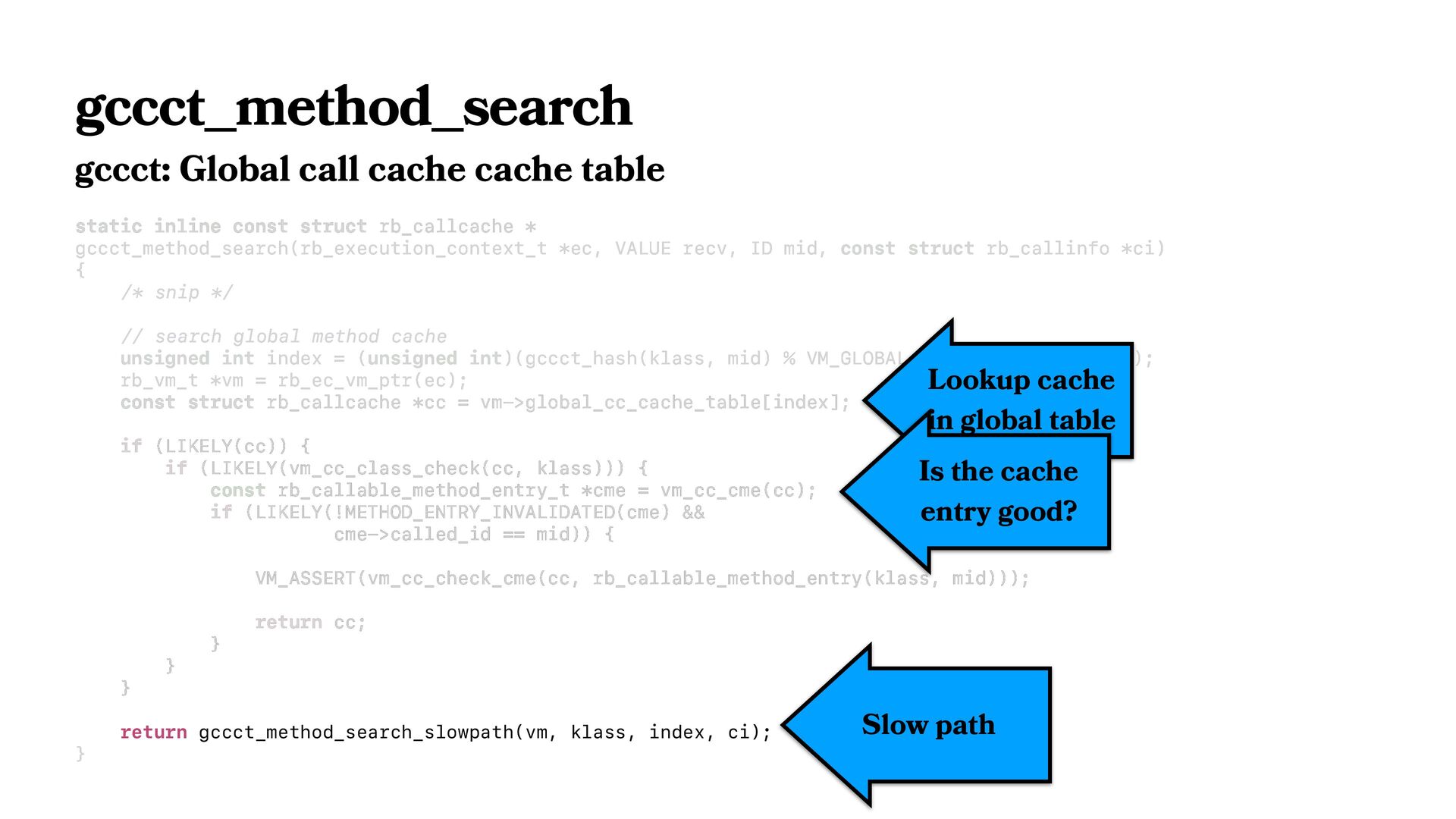
gccct_method_search gccct: Global call cache cache table static inline const
struct rb_callcache * gccct_method_search(rb_execution_context_t *ec, VALUE recv, ID mid, const struct rb_callinfo *ci) { /* snip */ // search global method cache unsigned int index = (unsigned int)(gccct_hash(klass, mid) % VM_GLOBAL_CC_CACHE_TABLE_SIZE); rb_vm_t *vm = rb_ec_vm_ptr(ec); const struct rb_callcache *cc = vm->global_cc_cache_table[index]; if (LIKELY(cc)) { if (LIKELY(vm_cc_class_check(cc, klass))) { const rb_callable_method_entry_t *cme = vm_cc_cme(cc); if (LIKELY(!METHOD_ENTRY_INVALIDATED(cme) && cme->called_id == mid)) { VM_ASSERT(vm_cc_check_cme(cc, rb_callable_method_entry(klass, mid))); return cc; } } } return gccct_method_search_slowpath(vm, klass, index, ci); } static inline const struct rb_callcache * gccct_method_search(rb_execution_context_t *ec, VALUE recv, ID mid, const struct rb_callinfo *ci) { /* snip */ // search global method cache unsigned int index = (unsigned int)(gccct_hash(klass, mid) % VM_GLOBAL_CC_CACHE_TABLE_SIZE); rb_vm_t *vm = rb_ec_vm_ptr(ec); const struct rb_callcache *cc = vm->global_cc_cache_table[index]; if (LIKELY(cc)) { if (LIKELY(vm_cc_class_check(cc, klass))) { const rb_callable_method_entry_t *cme = vm_cc_cme(cc); if (LIKELY(!METHOD_ENTRY_INVALIDATED(cme) && cme->called_id == mid)) { VM_ASSERT(vm_cc_check_cme(cc, rb_callable_method_entry(klass, mid))); return cc; } } } return gccct_method_search_slowpath(vm, klass, index, ci); } static inline const struct rb_callcache * gccct_method_search(rb_execution_context_t *ec, VALUE recv, ID mid, const struct rb_callinfo *ci) { /* snip */ // search global method cache unsigned int index = (unsigned int)(gccct_hash(klass, mid) % VM_GLOBAL_CC_CACHE_TABLE_SIZE); rb_vm_t *vm = rb_ec_vm_ptr(ec); const struct rb_callcache *cc = vm->global_cc_cache_table[index]; if (LIKELY(cc)) { if (LIKELY(vm_cc_class_check(cc, klass))) { const rb_callable_method_entry_t *cme = vm_cc_cme(cc); if (LIKELY(!METHOD_ENTRY_INVALIDATED(cme) && cme->called_id == mid)) { VM_ASSERT(vm_cc_check_cme(cc, rb_callable_method_entry(klass, mid))); return cc; } } } return gccct_method_search_slowpath(vm, klass, index, ci); } static inline const struct rb_callcache * gccct_method_search(rb_execution_context_t *ec, VALUE recv, ID mid, const struct rb_callinfo *ci) { /* snip */ // search global method cache unsigned int index = (unsigned int)(gccct_hash(klass, mid) % VM_GLOBAL_CC_CACHE_TABLE_SIZE); rb_vm_t *vm = rb_ec_vm_ptr(ec); const struct rb_callcache *cc = vm->global_cc_cache_table[index]; if (LIKELY(cc)) { if (LIKELY(vm_cc_class_check(cc, klass))) { const rb_callable_method_entry_t *cme = vm_cc_cme(cc); if (LIKELY(!METHOD_ENTRY_INVALIDATED(cme) && cme->called_id == mid)) { VM_ASSERT(vm_cc_check_cme(cc, rb_callable_method_entry(klass, mid))); return cc; } } } return gccct_method_search_slowpath(vm, klass, index, ci); } Lookup cache in global table Is the cache entry good? Slow path -
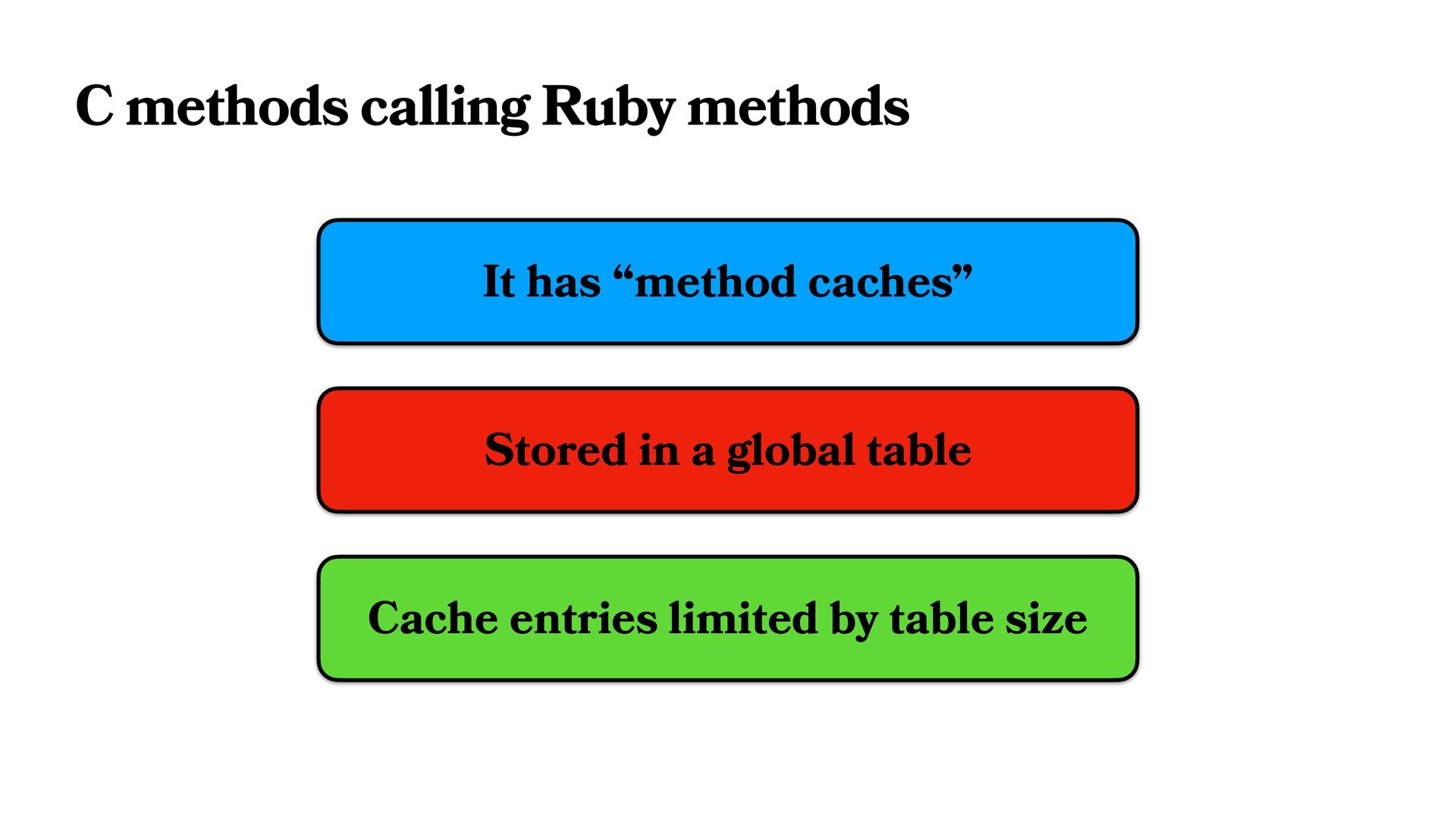
C methods calling Ruby methods It has “method caches” Stored
in a global table Cache entries limited by table size -
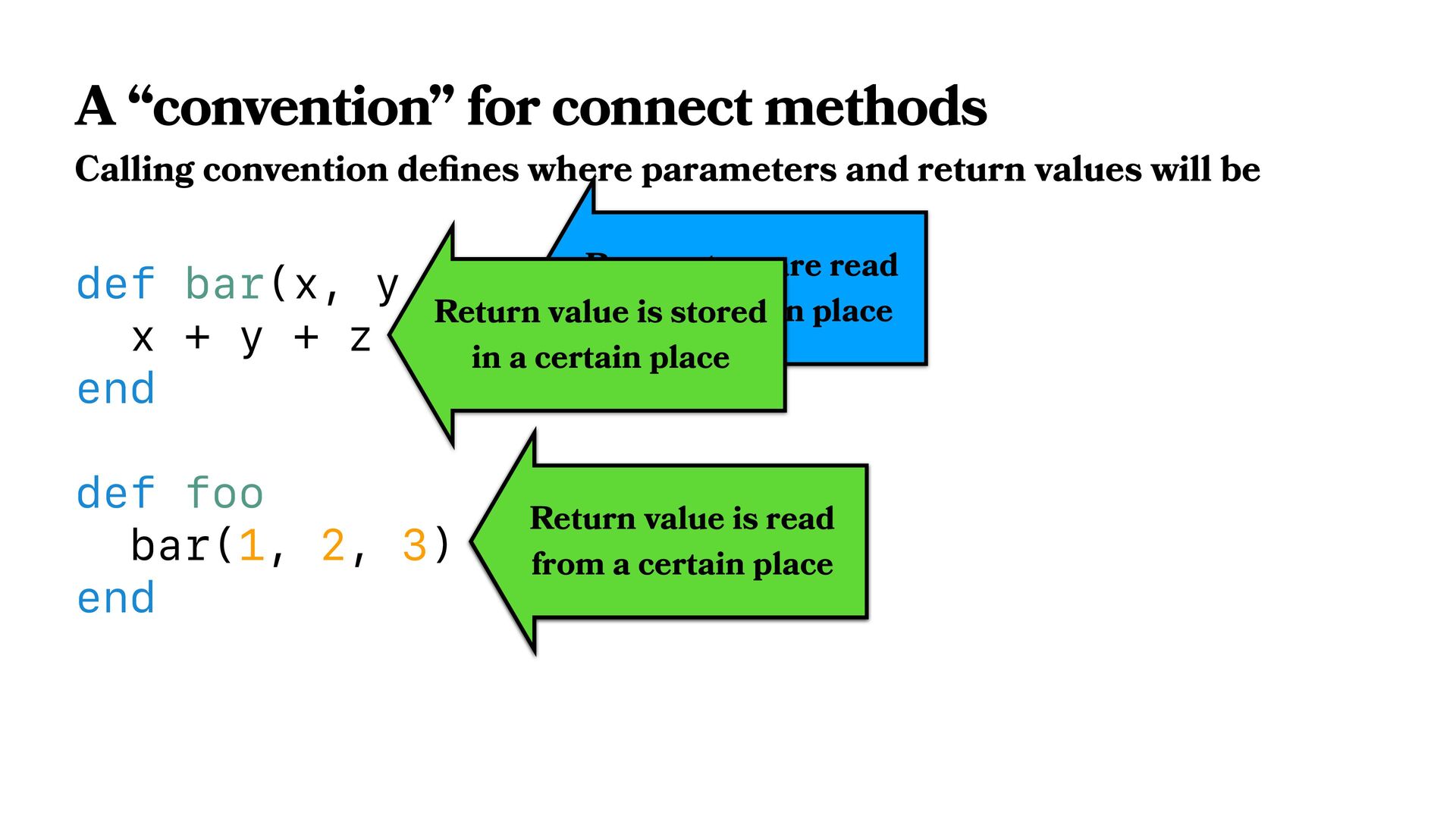
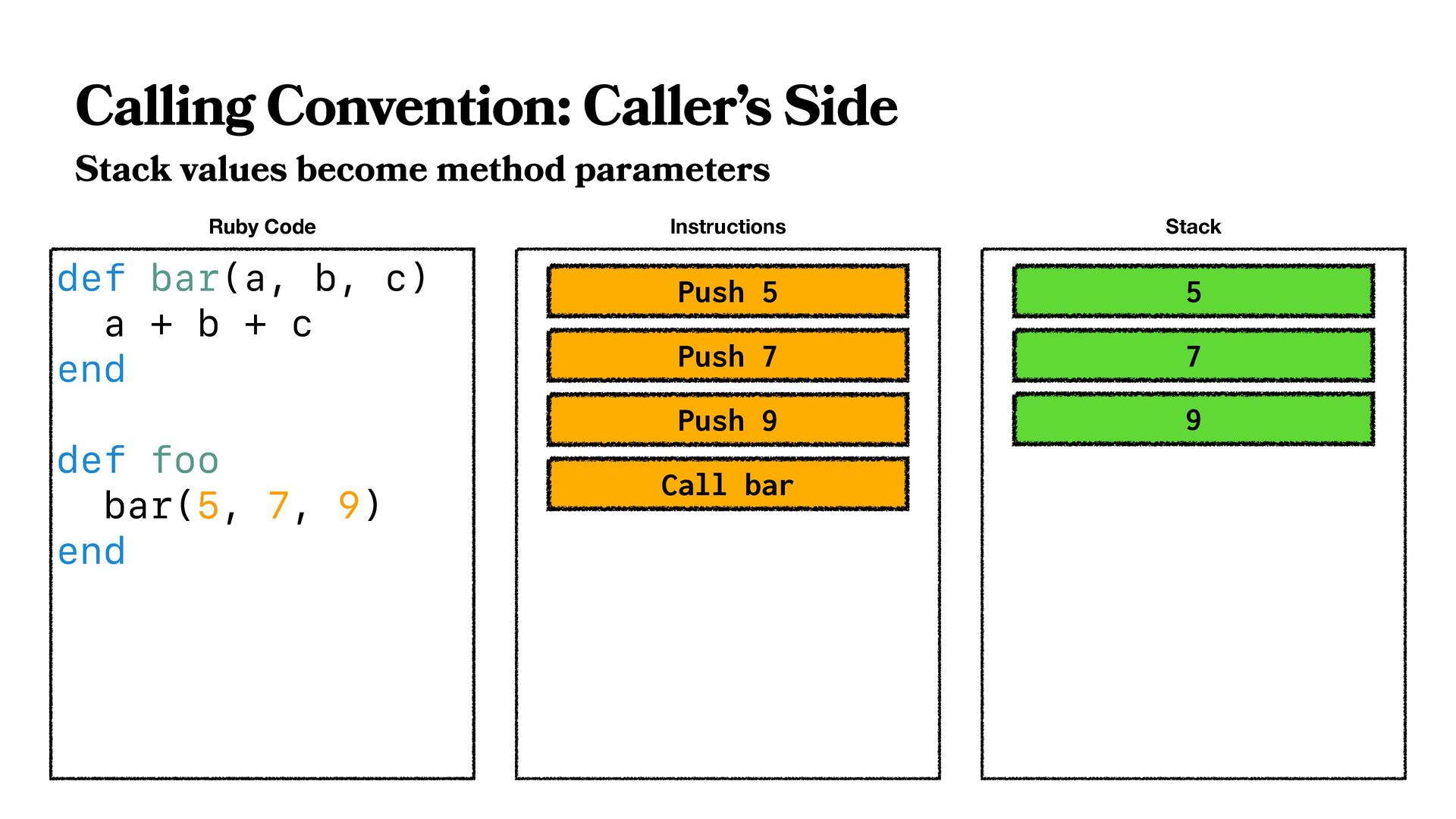
A “convention” for connect methods Calling convention de fi nes
where parameters and return values will be def bar(x, y, z) x + y + z end def foo bar(1, 2, 3) end Arguments are stored in a certain place Parameters are read from a certain place Return value is stored in a certain place Return value is read from a certain place -
def bar(a, b, c) a + b + c end
def foo bar(5, 7, 9) end Ruby Code Calling Convention: Caller’s Side Stack values become method parameters def bar(a, b, c) a + b + c end def foo bar(5, 7, 9) end Ruby Code Push 5 Instructions Stack 5 Push 7 Push 9 7 9 Call bar -
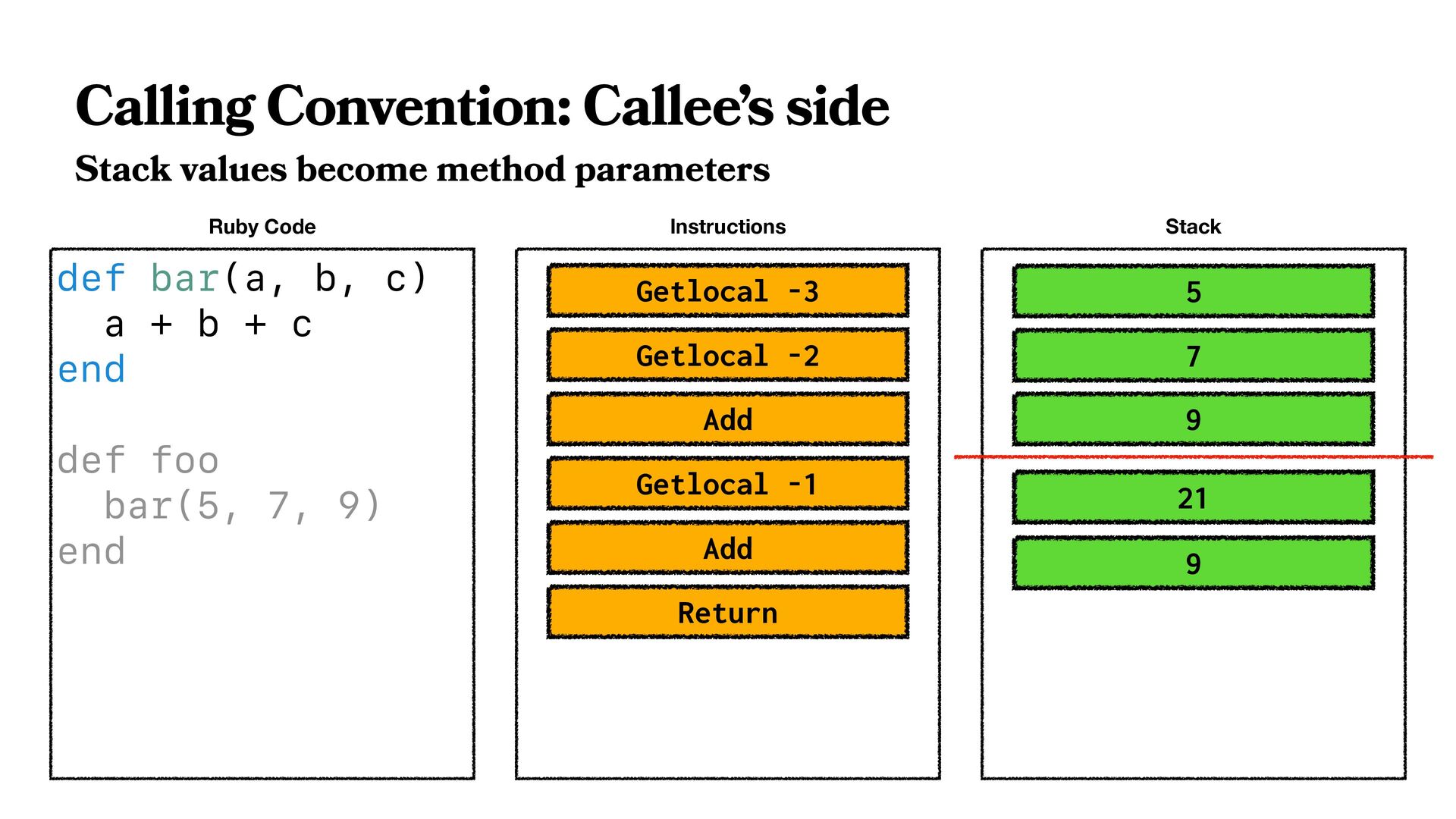
def bar(a, b, c) a + b + c end
def foo bar(5, 7, 9) end Ruby Code Calling Convention: Callee’s side Stack values become method parameters Instructions Stack 5 Getlocal -3 Getlocal -2 Add Getlocal -1 Add 7 9 5 12 21 Return 7 9 -
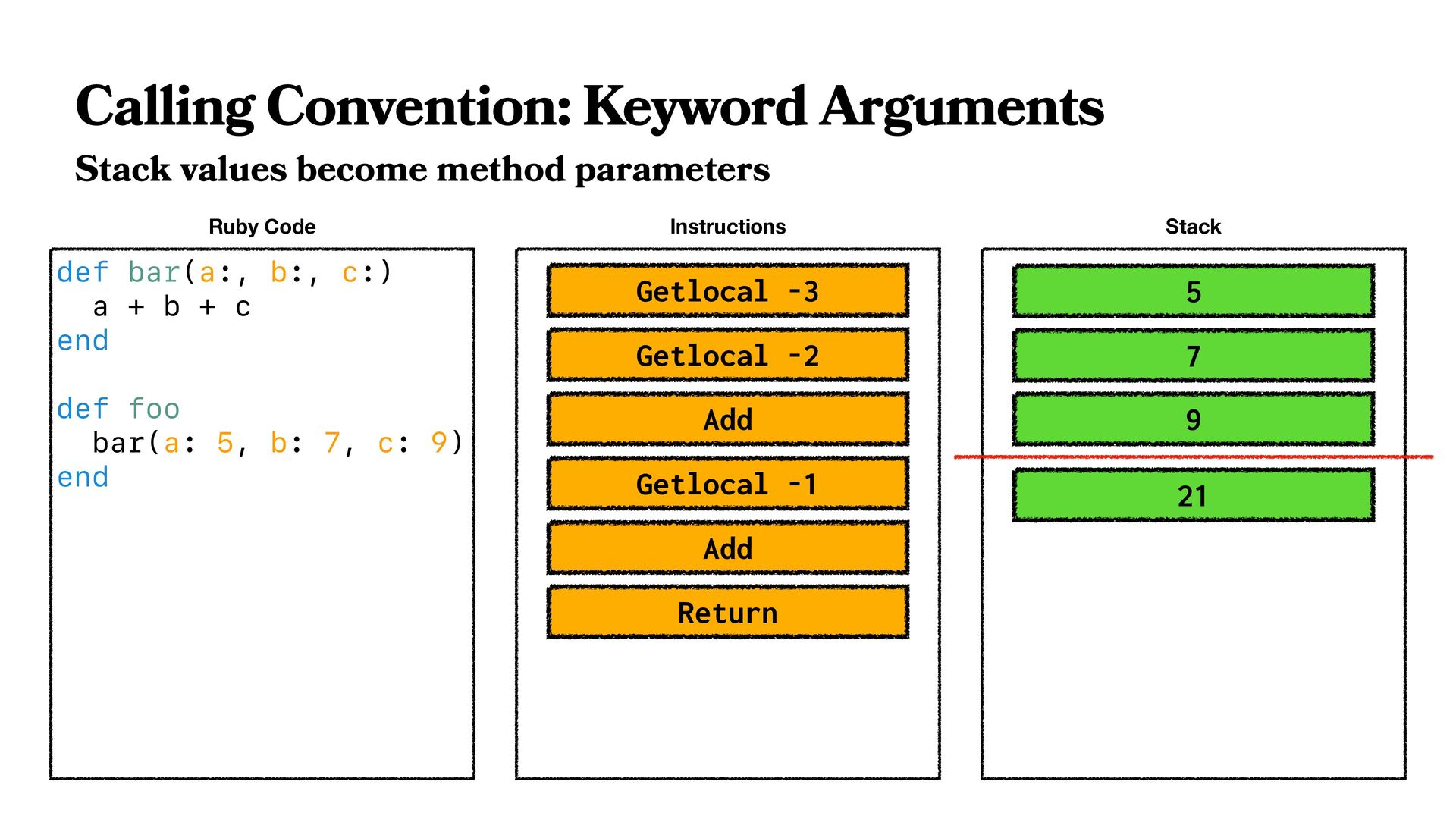
Calling Convention: Keyword Arguments Stack values become method parameters def
bar(a:, b:, c:) a + b + c end def foo bar(a: 5, b: 7, c: 9) end Ruby Code Instructions Stack 5 Getlocal -3 Getlocal -2 Add Getlocal -1 Add 7 9 5 12 21 Return -
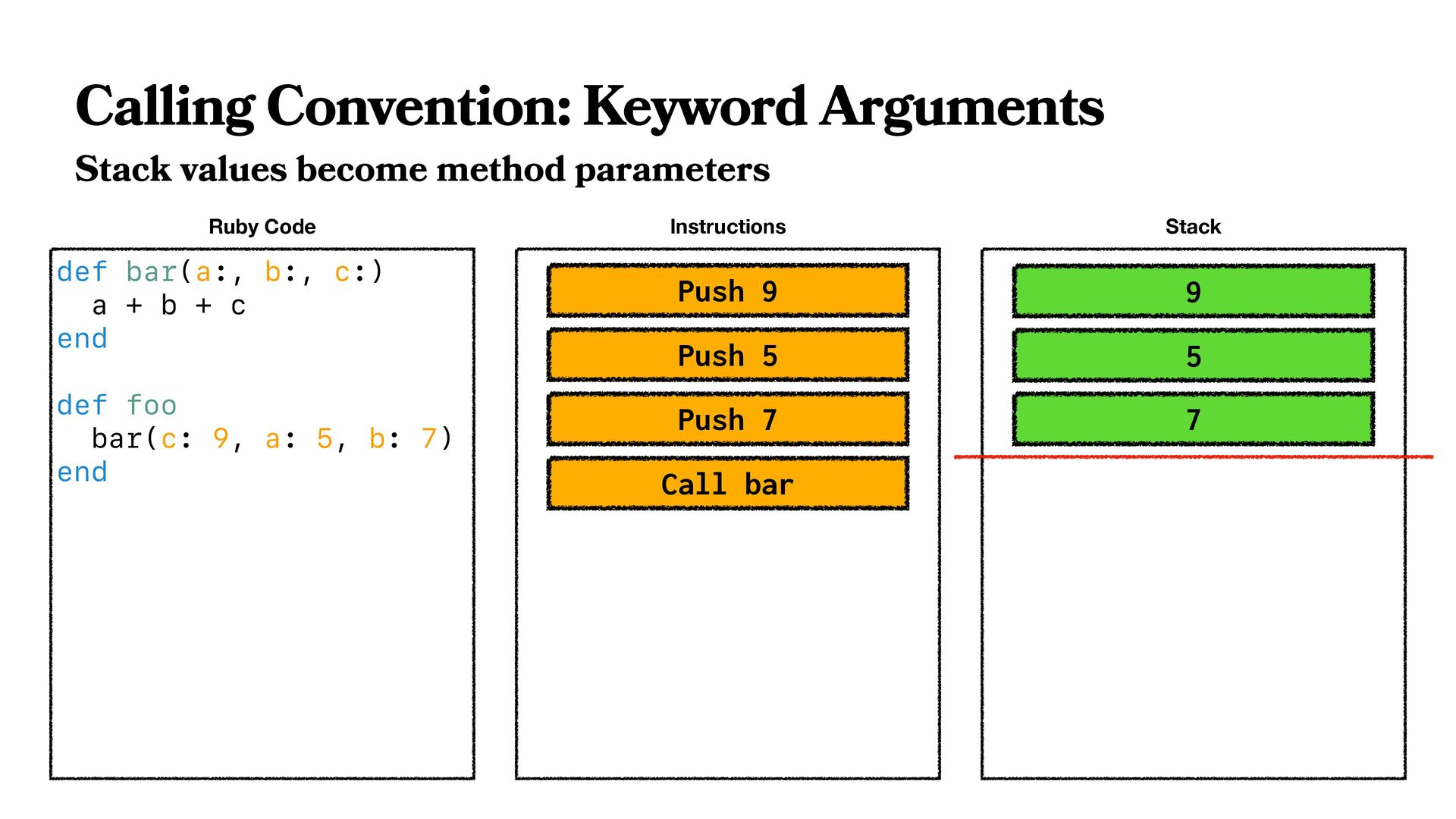
Calling Convention: Keyword Arguments Stack values become method parameters def
bar(a:, b:, c:) a + b + c end def foo bar(c: 9, a: 5, b: 7) end Ruby Code Instructions Stack 9 Push 9 Push 5 Push 7 Call bar 5 7 -
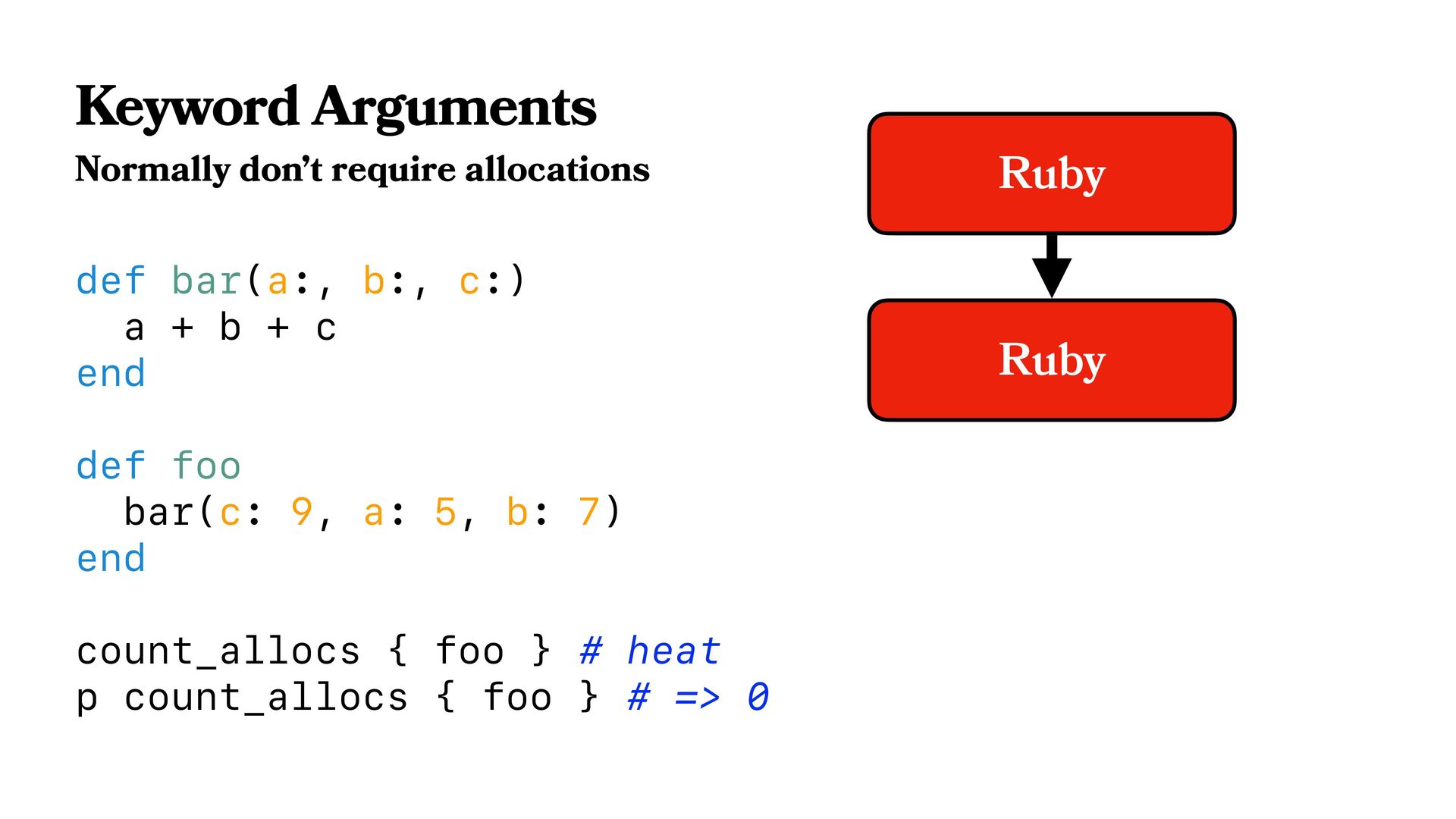
Keyword Arguments Normally don’t require allocations def bar(a:, b:, c:)
a + b + c end def foo bar(c: 9, a: 5, b: 7) end count_allocs { foo } # heat p count_allocs { foo } # => 0 Ruby Ruby -
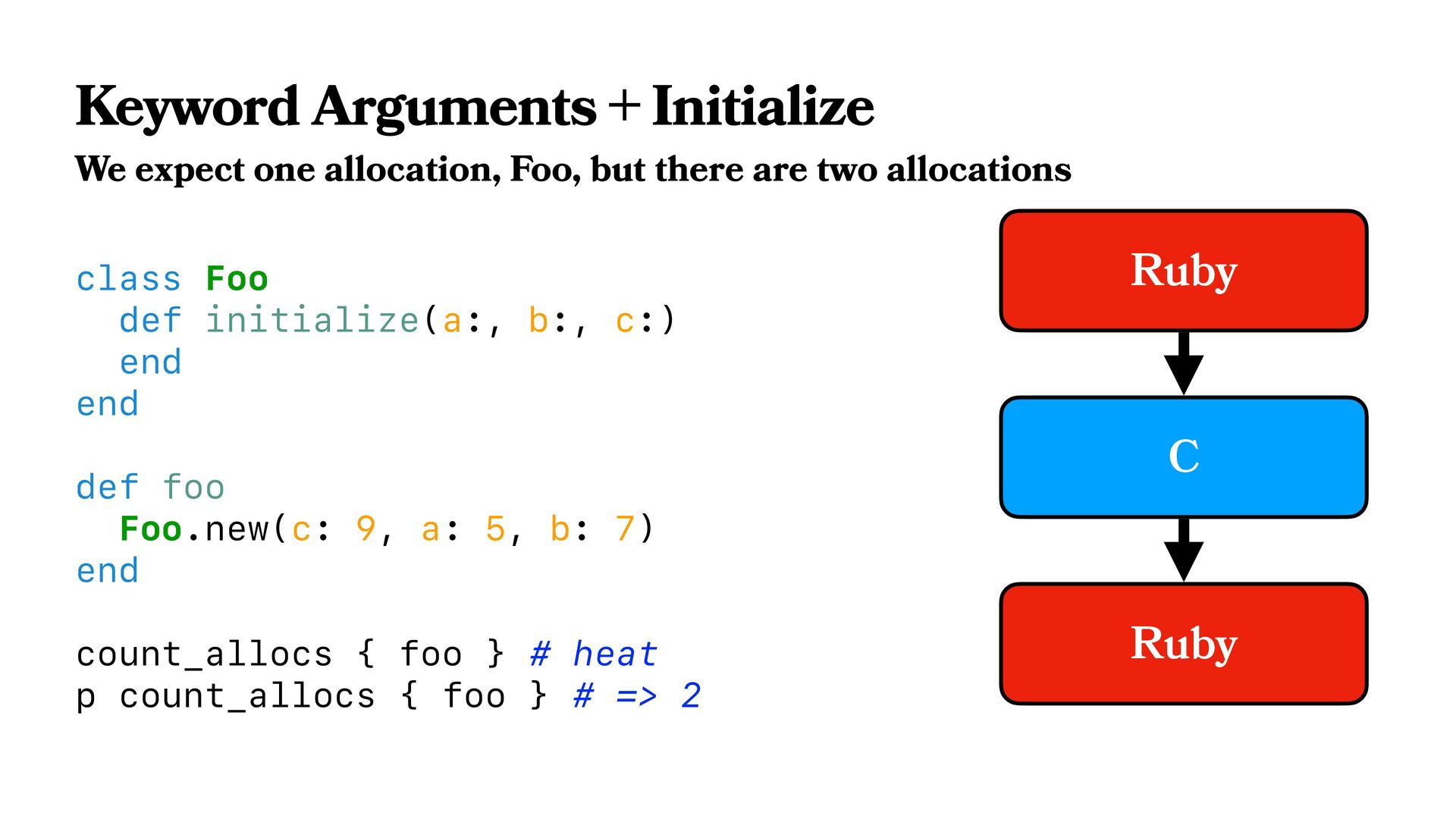
Keyword Arguments + Initialize We expect one allocation, Foo, but
there are two allocations class Foo def initialize(a:, b:, c:) end end def foo Foo.new(c: 9, a: 5, b: 7) end count_allocs { foo } # heat p count_allocs { foo } # => 2 Ruby C Ruby -
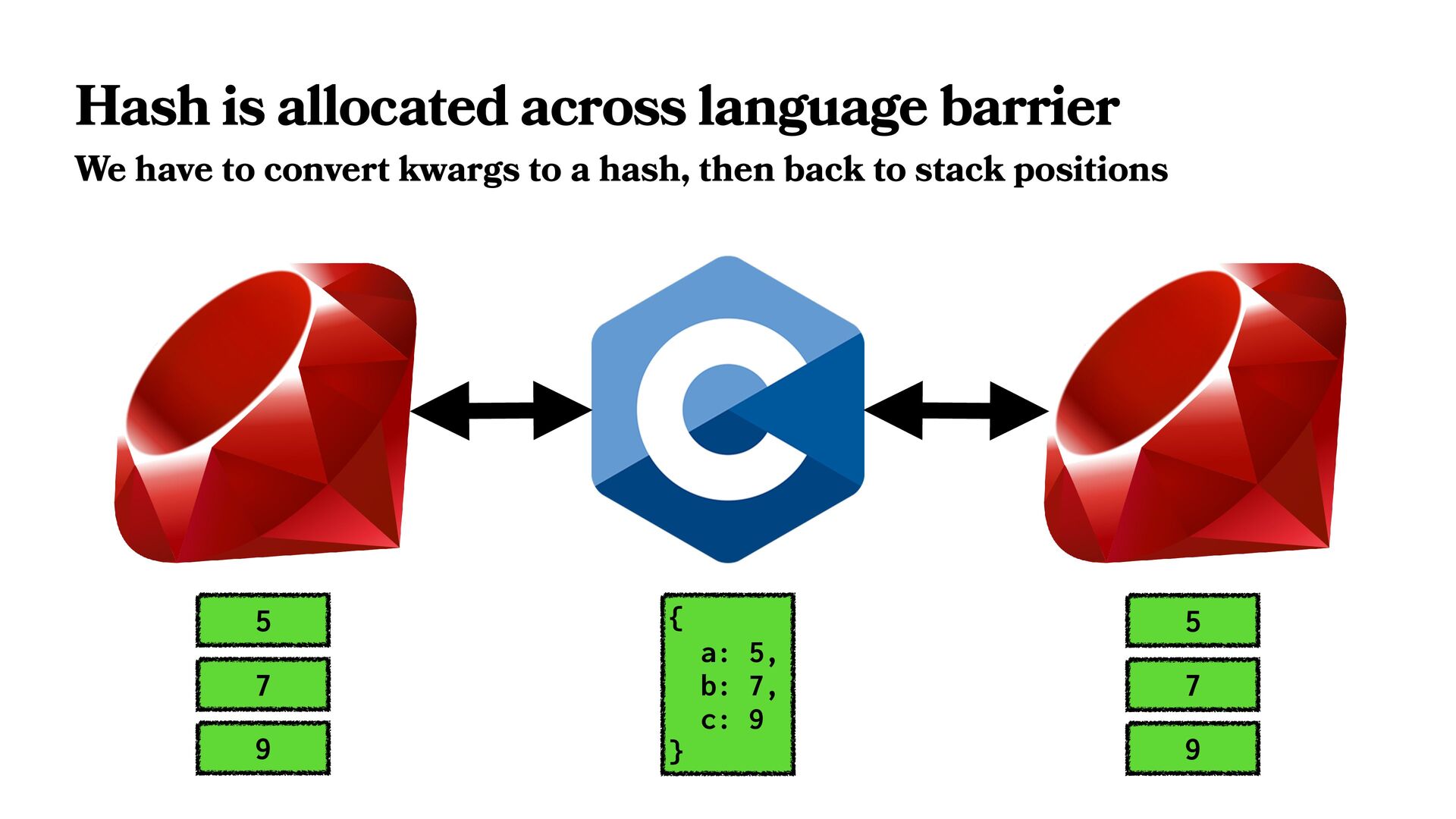
Hash is allocated across language barrier We have to convert
kwargs to a hash, then back to stack positions 5 7 9 { a: 5, b: 7, c: 9 } 5 7 9 -
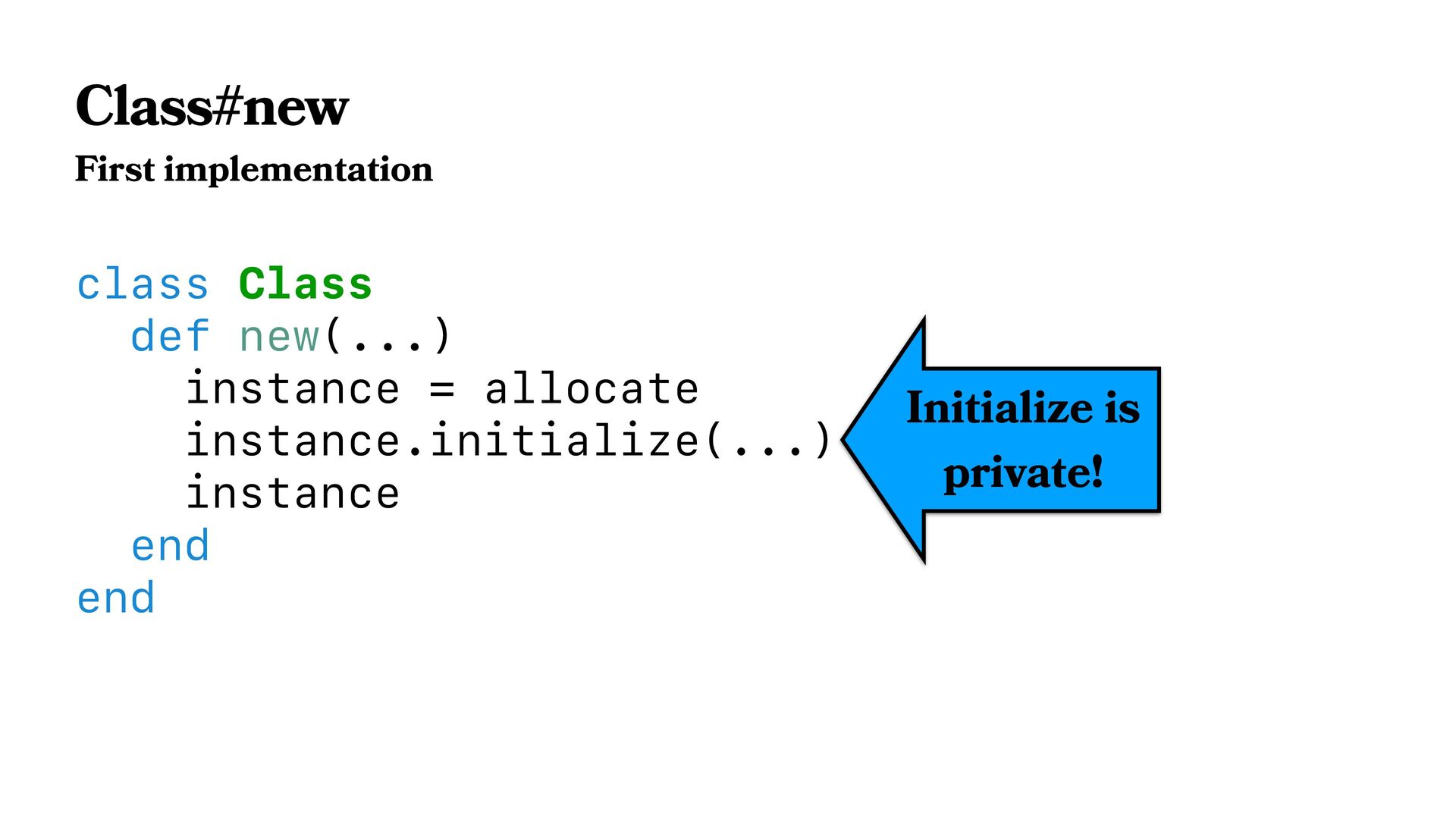
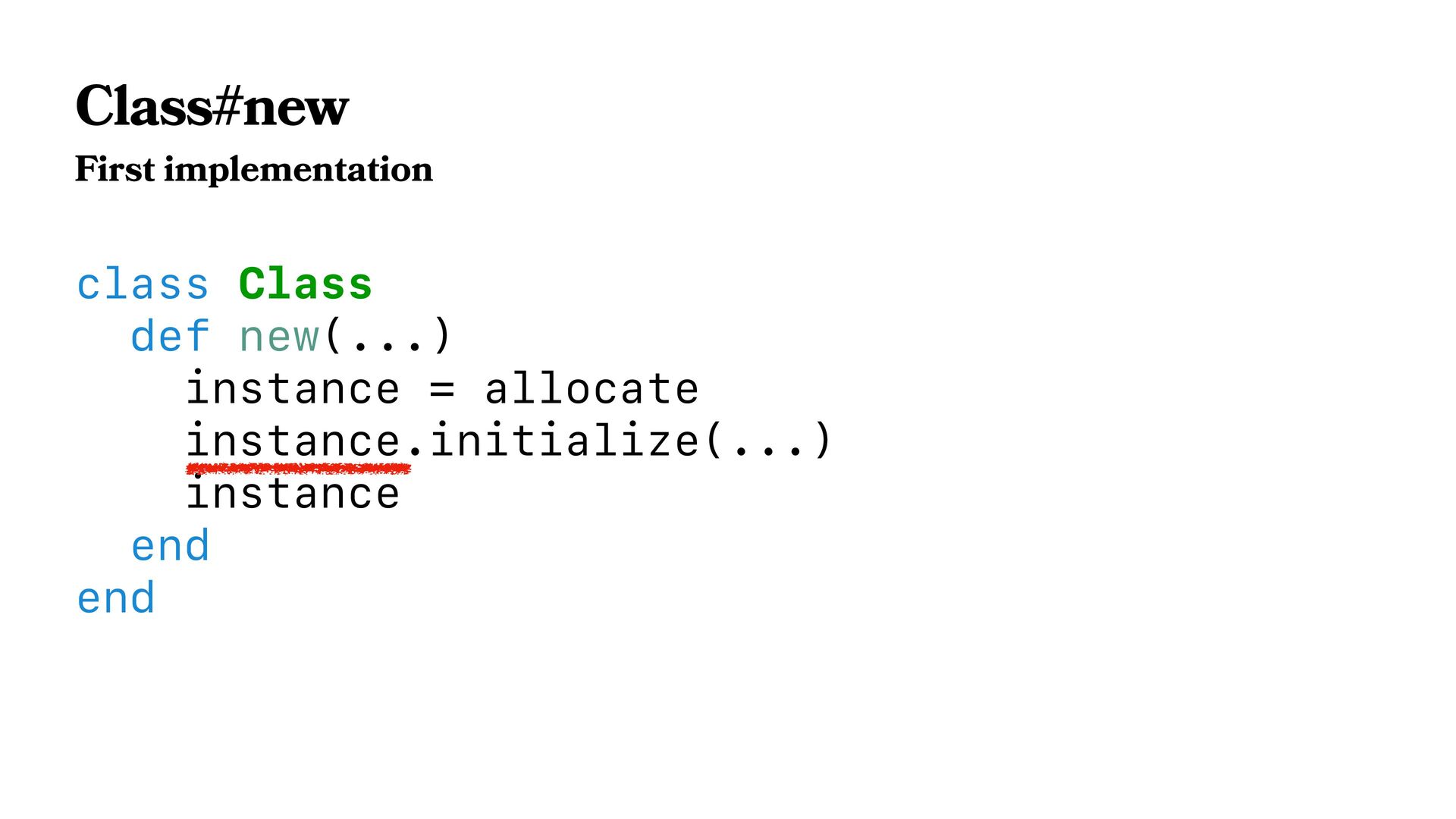
Class#new First implementation class Class def new(...) instance = allocate
instance.initialize(...) instance end end Initialize is private! -
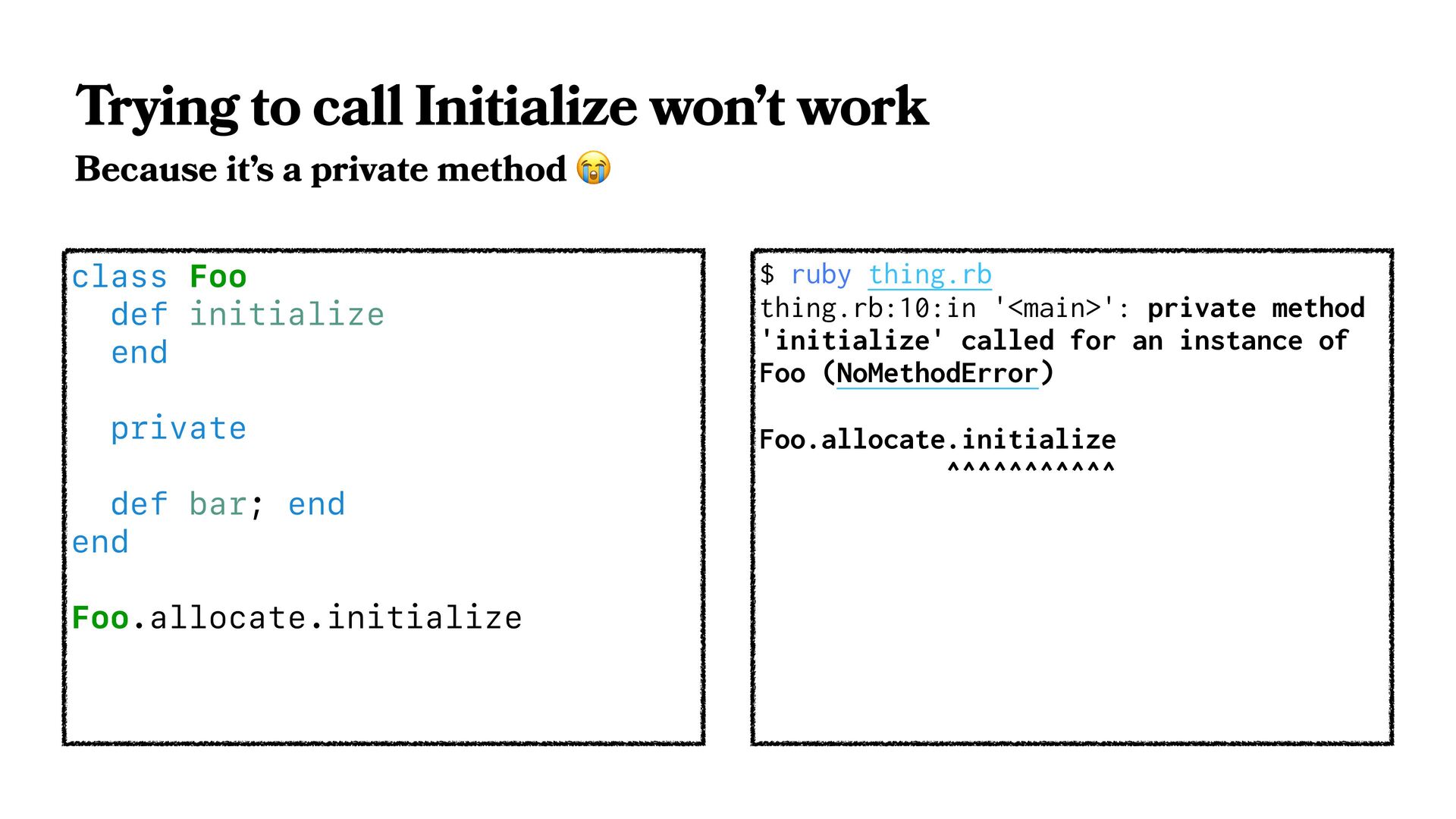
Trying to call Initialize won’t work Because it’s a private
method 😭 class Foo def initialize end private def bar; end end Foo.allocate.initialize $ ruby thing.rb thing.rb:10:in '<main>': private method 'initialize' called for an instance of Foo (NoMethodError) Foo.allocate.initialize ^^^^^^^^^^^ -
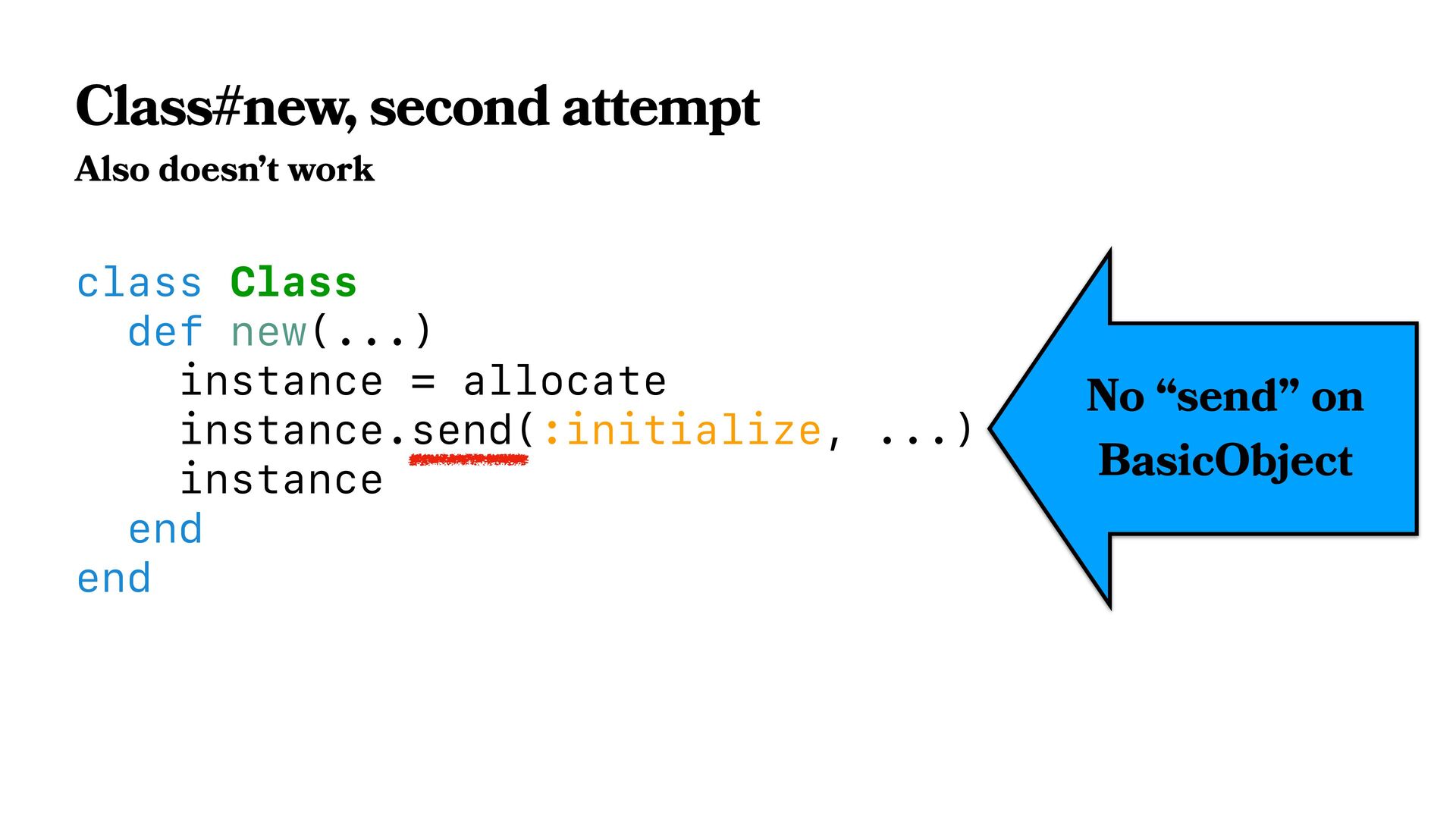
Class#new, second attempt Also doesn’t work class Class def new(...)
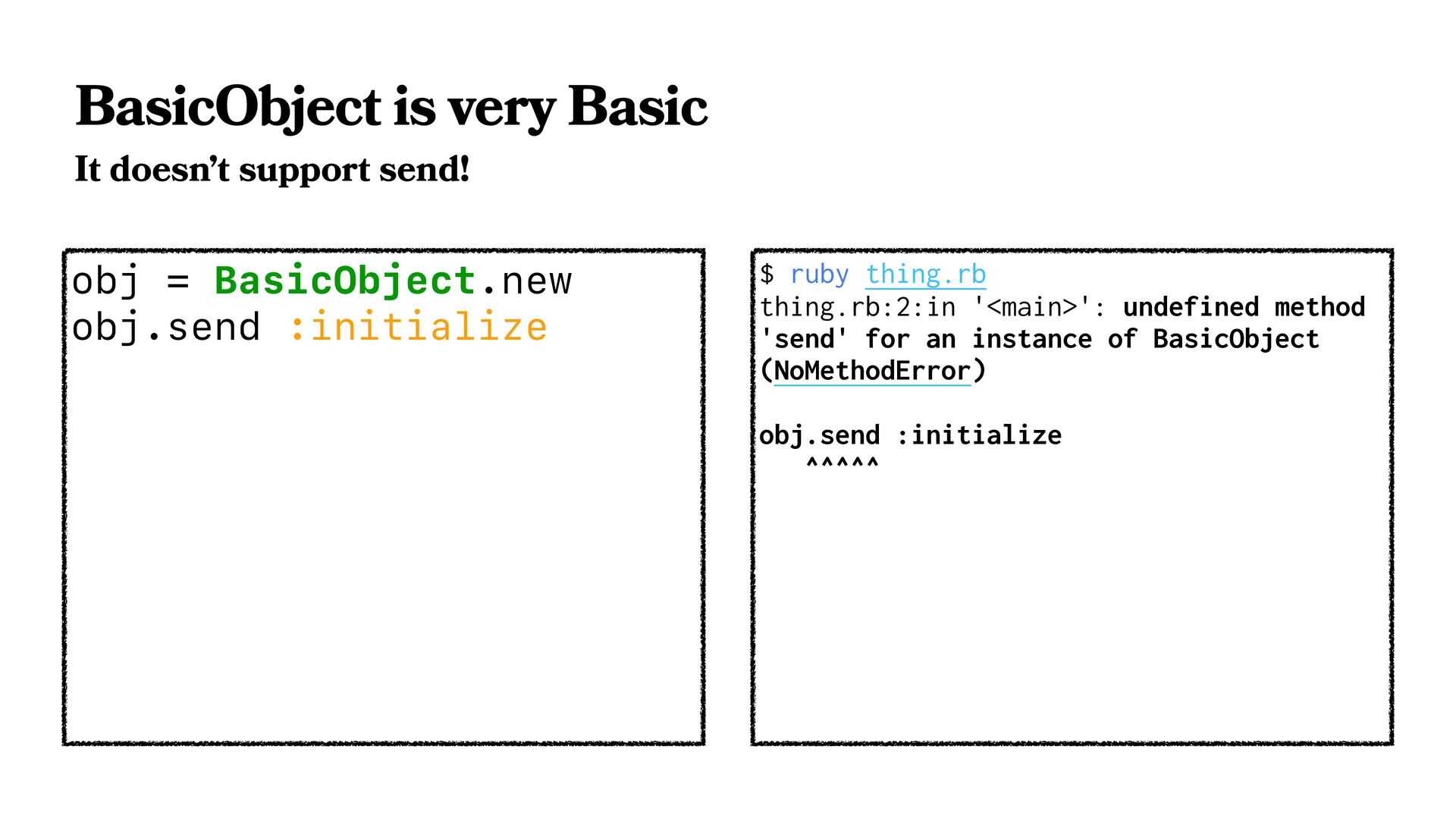
instance = allocate instance.send(:initialize, ...) instance end end No “send” on BasicObject -
BasicObject is very Basic It doesn’t support send! obj =
BasicObject.new obj.send :initialize $ ruby thing.rb thing.rb:2:in '<main>': undefined method 'send' for an instance of BasicObject (NoMethodError) obj.send :initialize ^^^^^ -
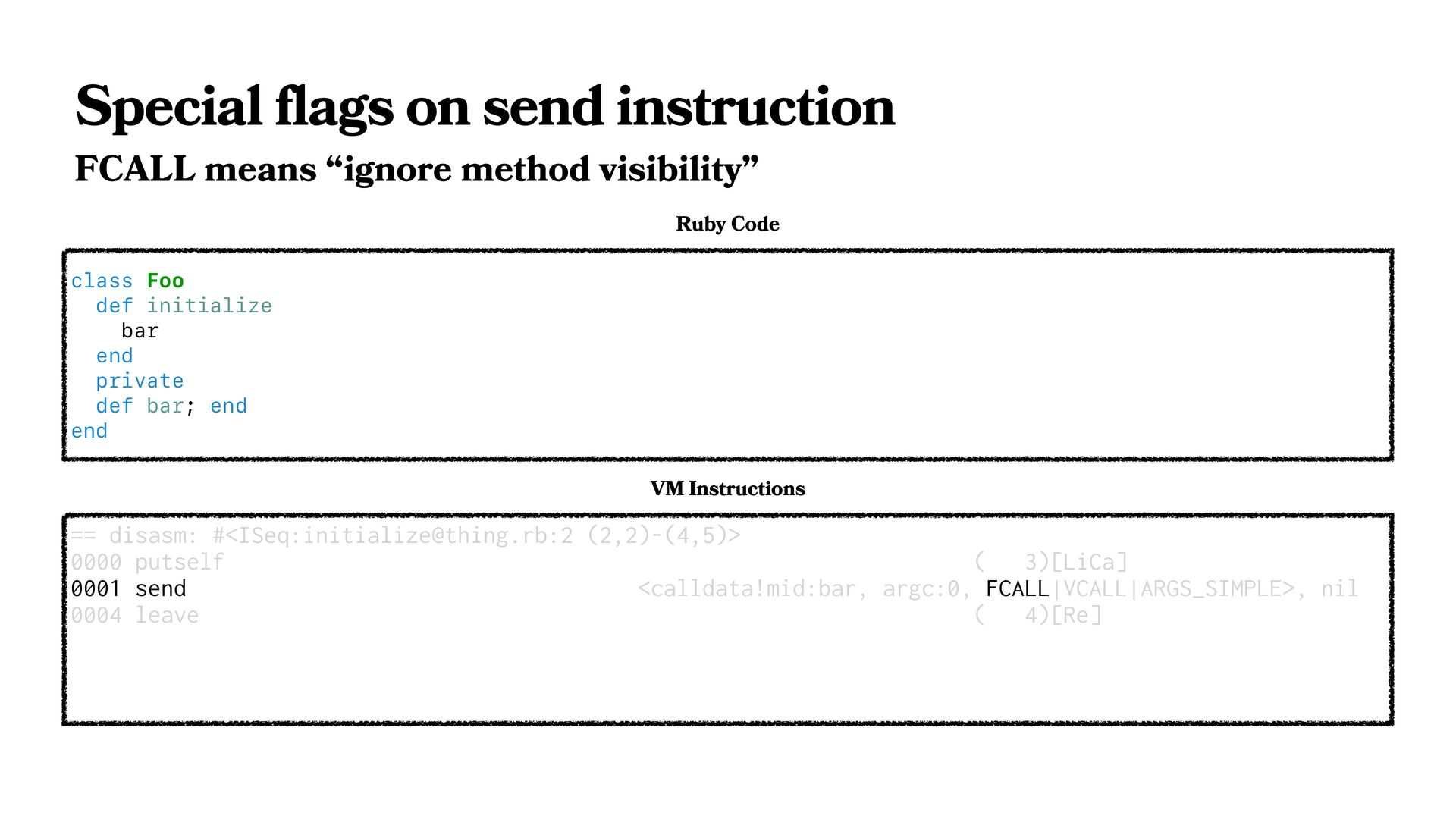
Special flags on send instruction FCALL means “ignore method visibility”
class Foo def initialize bar end private def bar; end end Ruby Code == disasm: #<ISeq:[email protected]:2 (2,2)-(4,5)> 0000 putself ( 3)[LiCa] 0001 send <calldata!mid:bar, argc:0, FCALL|VCALL|ARGS_SIMPLE>, nil 0004 leave ( 4)[Re] VM Instructions == disasm: #<ISeq:[email protected]:2 (2,2)-(4,5)> 0000 putself ( 3)[LiCa] 0001 send <calldata!mid:bar, argc:0, FCALL|VCALL|ARGS_SIMPLE>, nil 0004 leave ( 4)[Re] VM Instructions -
Class#new First implementation class Class def new(...) instance = allocate
instance.initialize(...) instance end end -
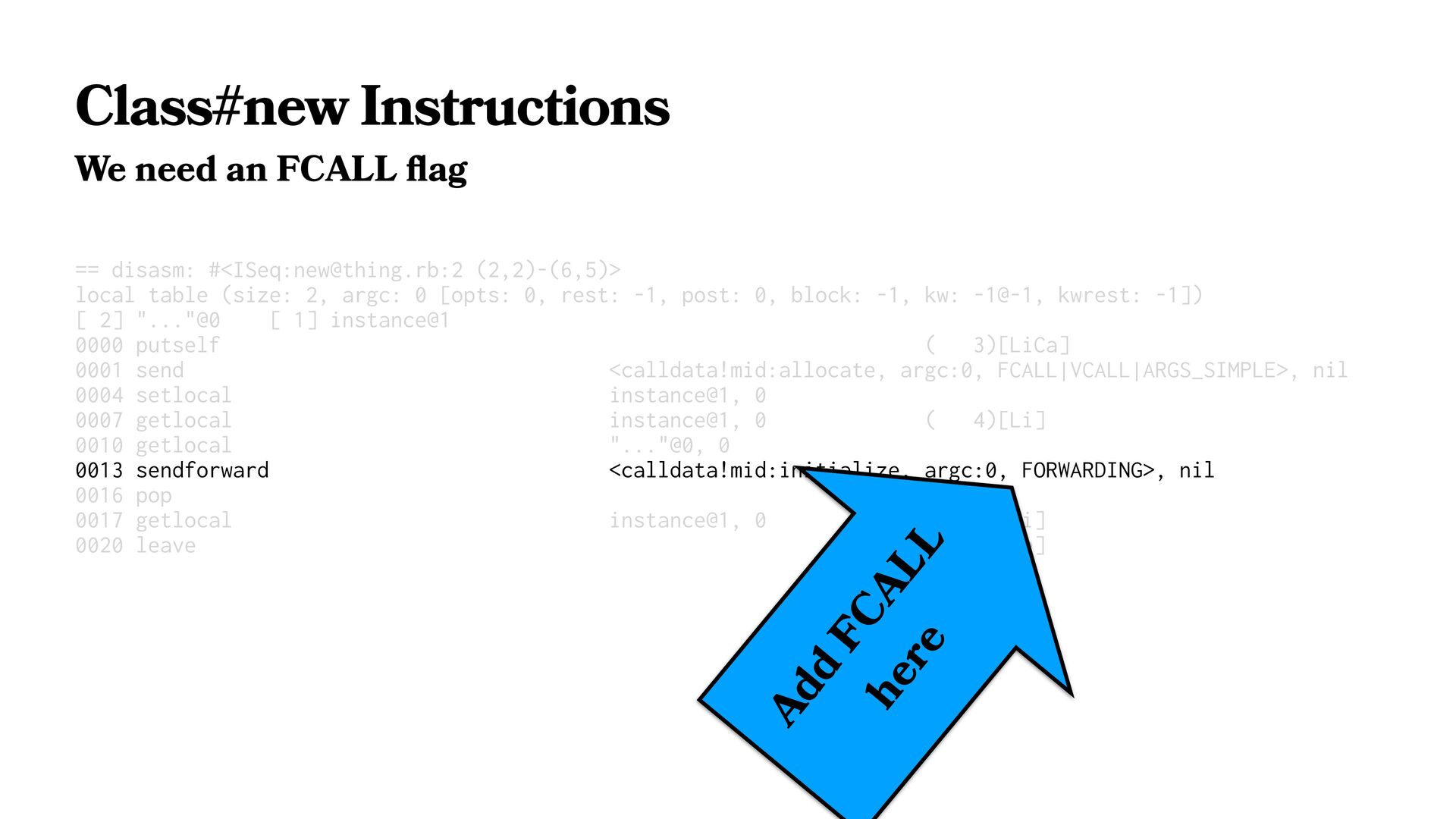
Class#new Instructions We need an FCALL fl ag == disasm:
#<ISeq:[email protected]:2 (2,2)-(6,5)> local table (size: 2, argc: 0 [opts: 0, rest: -1, post: 0, block: -1, kw: -1@-1, kwrest: -1]) [ 2] "..."@0 [ 1] instance@1 0000 putself ( 3)[LiCa] 0001 send <calldata!mid:allocate, argc:0, FCALL|VCALL|ARGS_SIMPLE>, nil 0004 setlocal instance@1, 0 0007 getlocal instance@1, 0 ( 4)[Li] 0010 getlocal "..."@0, 0 0013 sendforward <calldata!mid:initialize, argc:0, FORWARDING>, nil 0016 pop 0017 getlocal instance@1, 0 ( 5)[Li] 0020 leave ( 6)[Re] == disasm: #<ISeq:[email protected]:2 (2,2)-(6,5)> local table (size: 2, argc: 0 [opts: 0, rest: -1, post: 0, block: -1, kw: -1@-1, kwrest: -1]) [ 2] "..."@0 [ 1] instance@1 0000 putself ( 3)[LiCa] 0001 send <calldata!mid:allocate, argc:0, FCALL|VCALL|ARGS_SIMPLE>, nil 0004 setlocal instance@1, 0 0007 getlocal instance@1, 0 ( 4)[Li] 0010 getlocal "..."@0, 0 0013 sendforward <calldata!mid:initialize, argc:0, FORWARDING>, nil 0016 pop 0017 getlocal instance@1, 0 ( 5)[Li] 0020 leave ( 6)[Re] Add FCALL here -
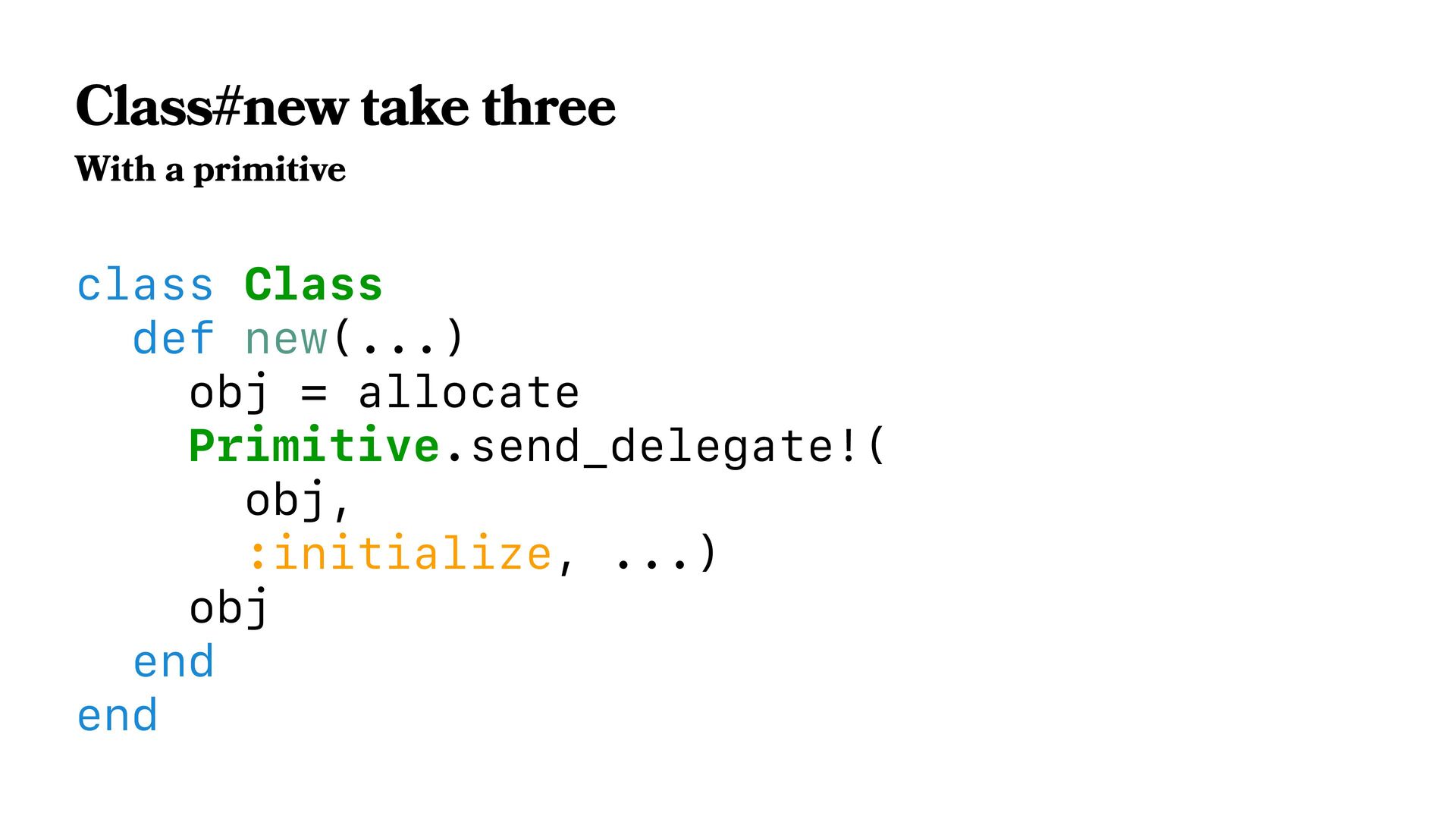
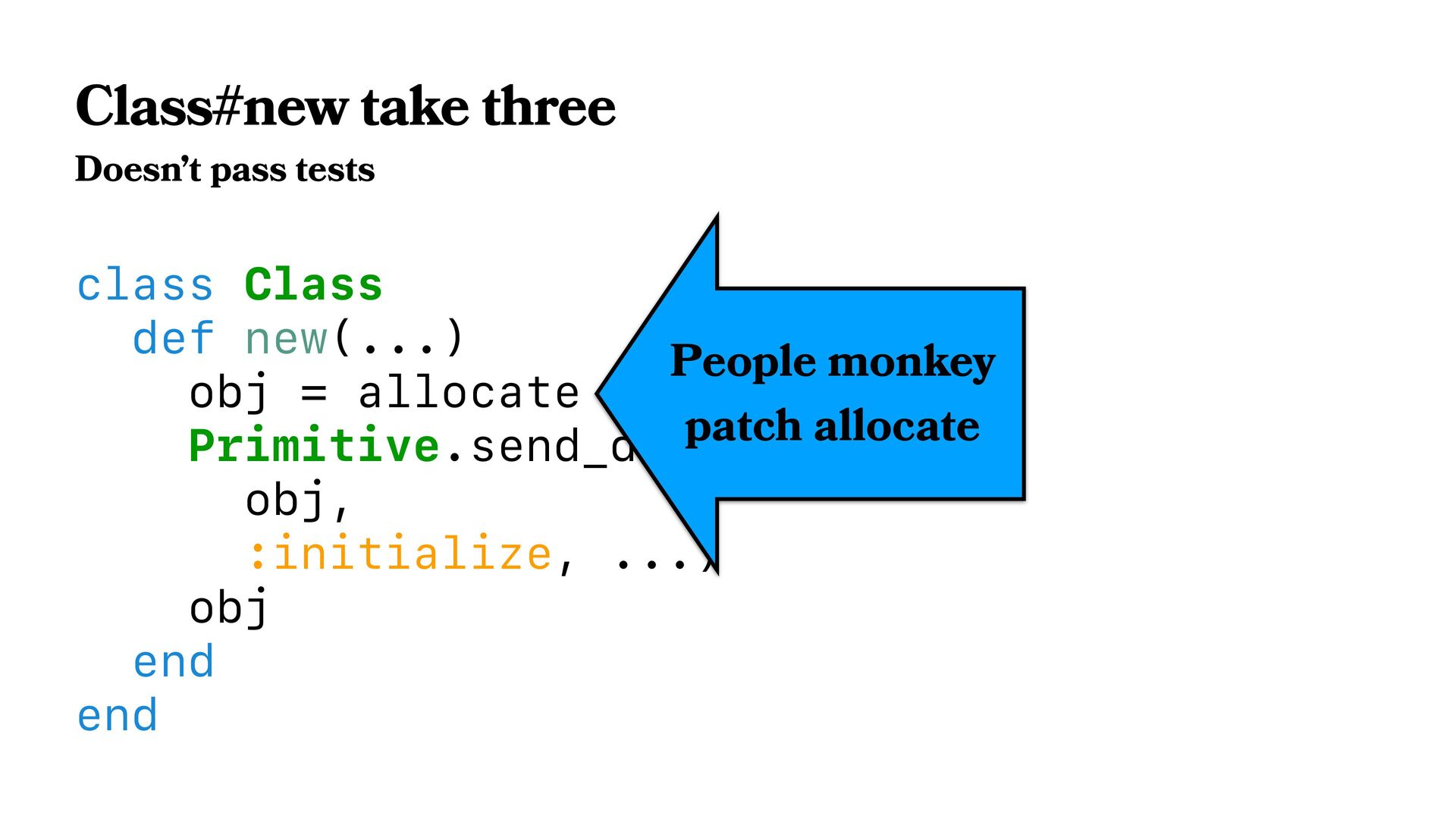
Class#new take three With a primitive class Class def new(...)
obj = allocate Primitive.send_delegate!( obj, :initialize, ...) obj end end -
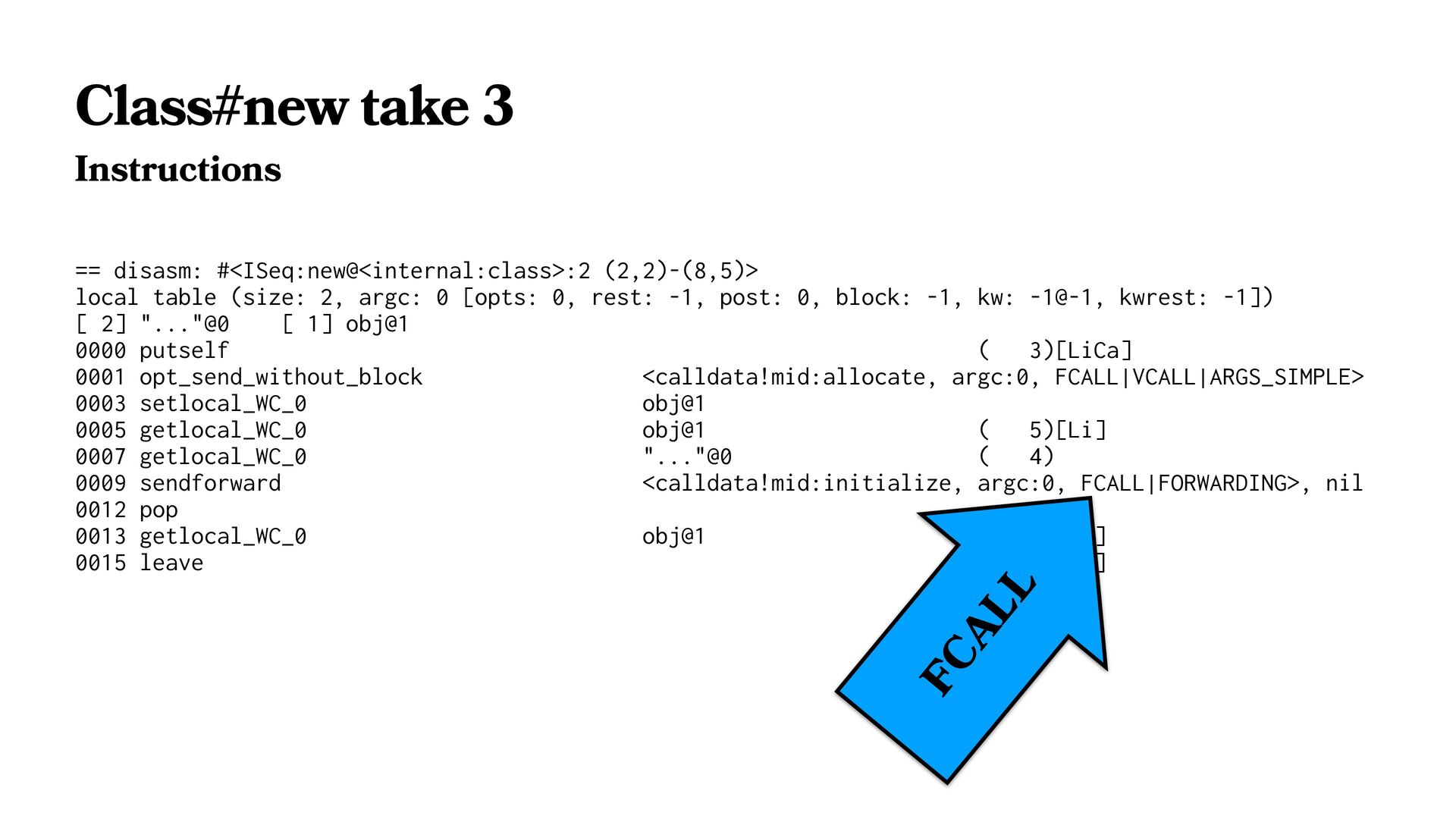
== disasm: #<ISeq:new@<internal:class>:2 (2,2)-(8,5)> local table (size: 2, argc: 0
[opts: 0, rest: -1, post: 0, block: -1, kw: -1@-1, kwrest: -1]) [ 2] "..."@0 [ 1] obj@1 0000 putself ( 3)[LiCa] 0001 opt_send_without_block <calldata!mid:allocate, argc:0, FCALL|VCALL|ARGS_SIMPLE> 0003 setlocal_WC_0 obj@1 0005 getlocal_WC_0 obj@1 ( 5)[Li] 0007 getlocal_WC_0 "..."@0 ( 4) 0009 sendforward <calldata!mid:initialize, argc:0, FCALL|FORWARDING>, nil 0012 pop 0013 getlocal_WC_0 obj@1 ( 7)[Li] 0015 leave ( 8)[Re] Class#new take 3 Instructions == disasm: #<ISeq:new@<internal:class>:2 (2,2)-(8,5)> local table (size: 2, argc: 0 [opts: 0, rest: -1, post: 0, block: -1, kw: -1@-1, kwrest: -1]) [ 2] "..."@0 [ 1] obj@1 0000 putself ( 3)[LiCa] 0001 opt_send_without_block <calldata!mid:allocate, argc:0, FCALL|VCALL|ARGS_SIMPLE> 0003 setlocal_WC_0 obj@1 0005 getlocal_WC_0 obj@1 ( 5)[Li] 0007 getlocal_WC_0 "..."@0 ( 4) 0009 sendforward <calldata!mid:initialize, argc:0, FCALL|FORWARDING>, nil 0012 pop 0013 getlocal_WC_0 obj@1 ( 7)[Li] 0015 leave ( 8)[Re] FCALL -
Class#new take three Doesn’t pass tests class Class def new(...)
obj = allocate Primitive.send_delegate!( obj, :initialize, ...) obj end end People monkey patch allocate -
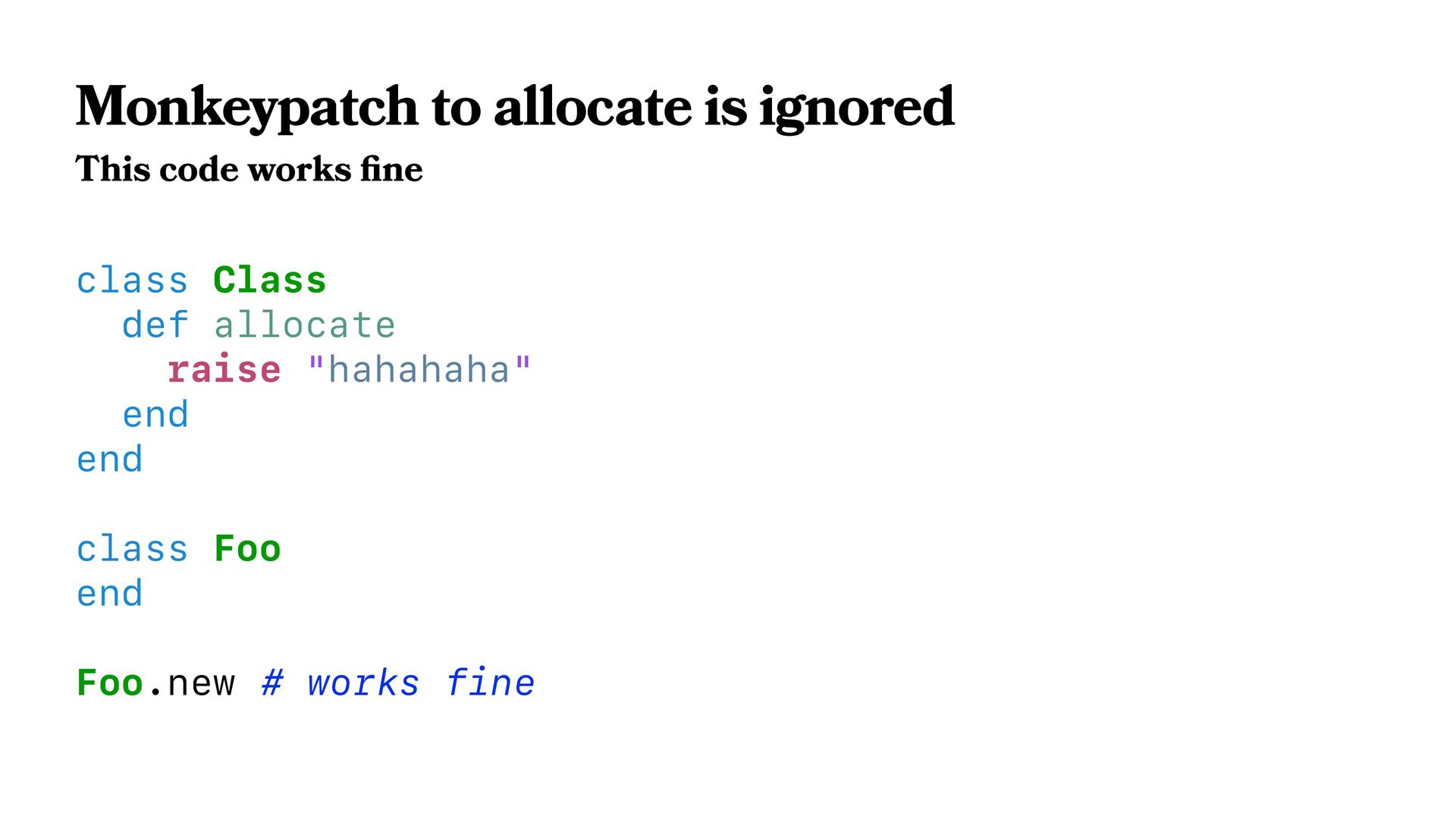
Monkeypatch to allocate is ignored This code works fi ne
class Class def allocate raise "hahahaha" end end class Foo end Foo.new # works fine -
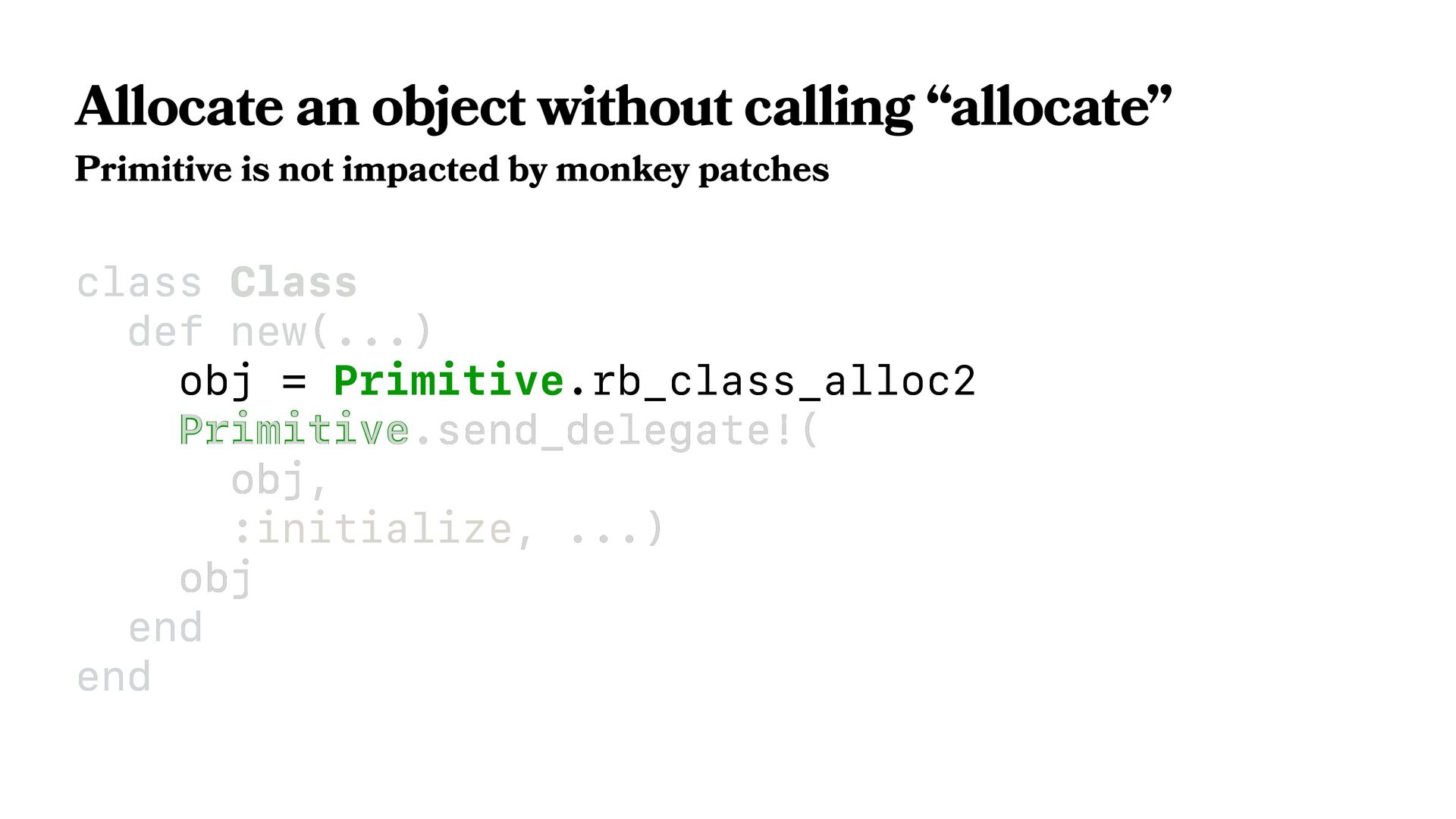
Allocate an object without calling “allocate” Primitive is not impacted
by monkey patches class Class def new(...) obj = Primitive.rb_class_alloc2 Primitive.send_delegate!( obj, :initialize, ...) obj end end class Class def new(...) obj = Primitive.rb_class_alloc2 Primitive.send_delegate!( obj, :initialize, ...) obj end end -
Class#new instruction sequence Allocating a new object: 8 instructions obj
= Primitive.rb_class_alloc2 Primitive.send_delegate!( obj, :initialize, ...) obj Ruby Code allocate Instructions Stack setlocal getlocal getlocal send pop getlocal leave new instance ... -
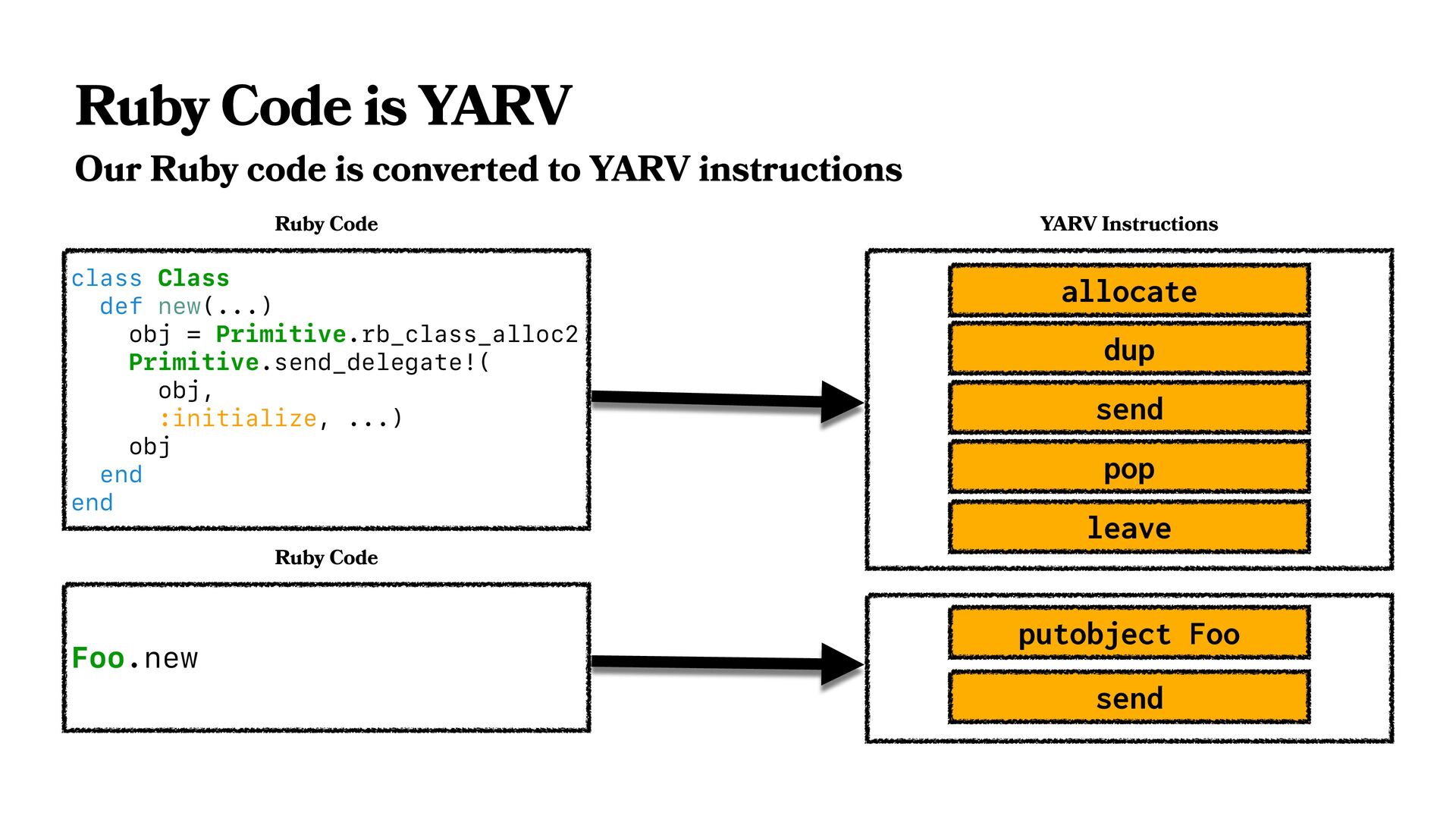
Ruby Code is YARV Our Ruby code is converted to
YARV instructions class Class def new(...) obj = Primitive.rb_class_alloc2 Primitive.send_delegate!( obj, :initialize, ...) obj end end Ruby Code YARV Instructions allocate send pop leave dup Foo.new Ruby Code putobject Foo send -
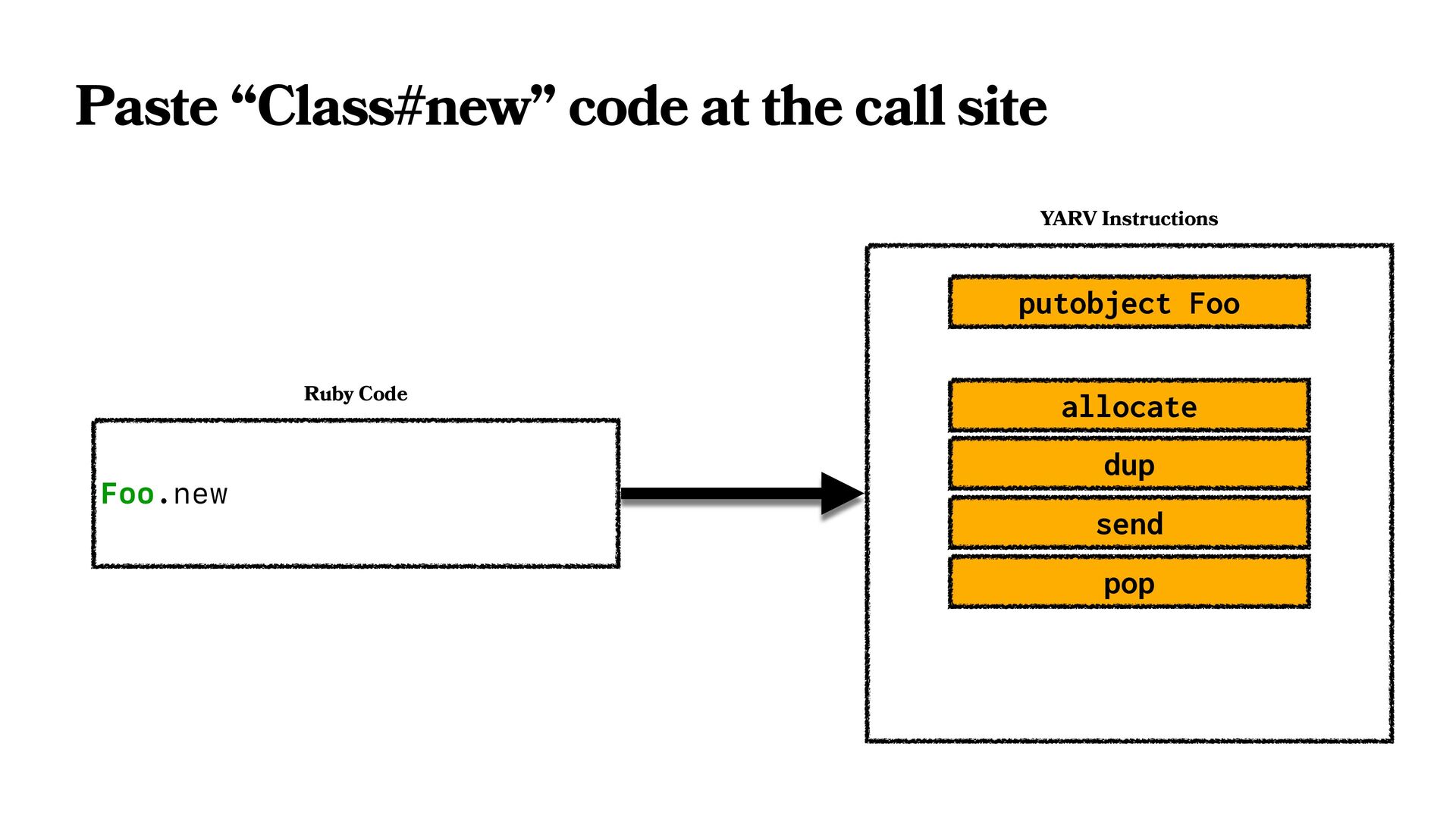
YARV Instructions Paste “Class#new” code at the call site allocate
send pop dup Foo.new Ruby Code putobject Foo -
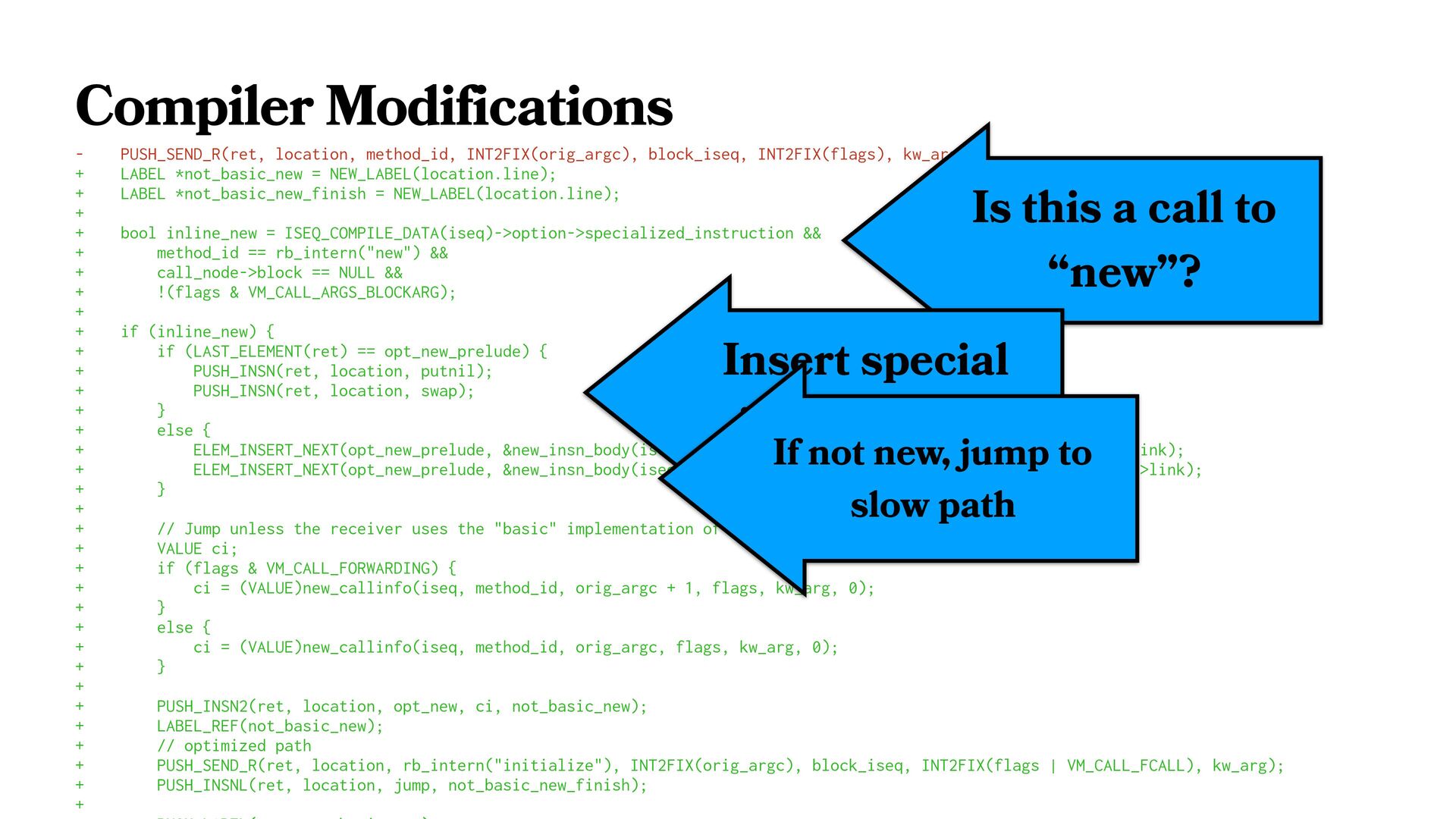
Compiler Modifications - PUSH_SEND_R(ret, location, method_id, INT2FIX(orig_argc), block_iseq, INT2FIX(flags), kw_arg);
+ LABEL *not_basic_new = NEW_LABEL(location.line); + LABEL *not_basic_new_finish = NEW_LABEL(location.line); + + bool inline_new = ISEQ_COMPILE_DATA(iseq)->option->specialized_instruction && + method_id == rb_intern("new") && + call_node->block == NULL && + !(flags & VM_CALL_ARGS_BLOCKARG); + + if (inline_new) { + if (LAST_ELEMENT(ret) == opt_new_prelude) { + PUSH_INSN(ret, location, putnil); + PUSH_INSN(ret, location, swap); + } + else { + ELEM_INSERT_NEXT(opt_new_prelude, &new_insn_body(iseq, location.line, location.node_id, BIN(swap), 0)->link); + ELEM_INSERT_NEXT(opt_new_prelude, &new_insn_body(iseq, location.line, location.node_id, BIN(putnil), 0)->link); + } + + // Jump unless the receiver uses the "basic" implementation of "new" + VALUE ci; + if (flags & VM_CALL_FORWARDING) { + ci = (VALUE)new_callinfo(iseq, method_id, orig_argc + 1, flags, kw_arg, 0); + } + else { + ci = (VALUE)new_callinfo(iseq, method_id, orig_argc, flags, kw_arg, 0); + } + + PUSH_INSN2(ret, location, opt_new, ci, not_basic_new); + LABEL_REF(not_basic_new); + // optimized path + PUSH_SEND_R(ret, location, rb_intern("initialize"), INT2FIX(orig_argc), block_iseq, INT2FIX(flags | VM_CALL_FCALL), kw_arg); + PUSH_INSNL(ret, location, jump, not_basic_new_finish); + Is this a call to “new”? Insert special instructions If not new, jump to slow path -
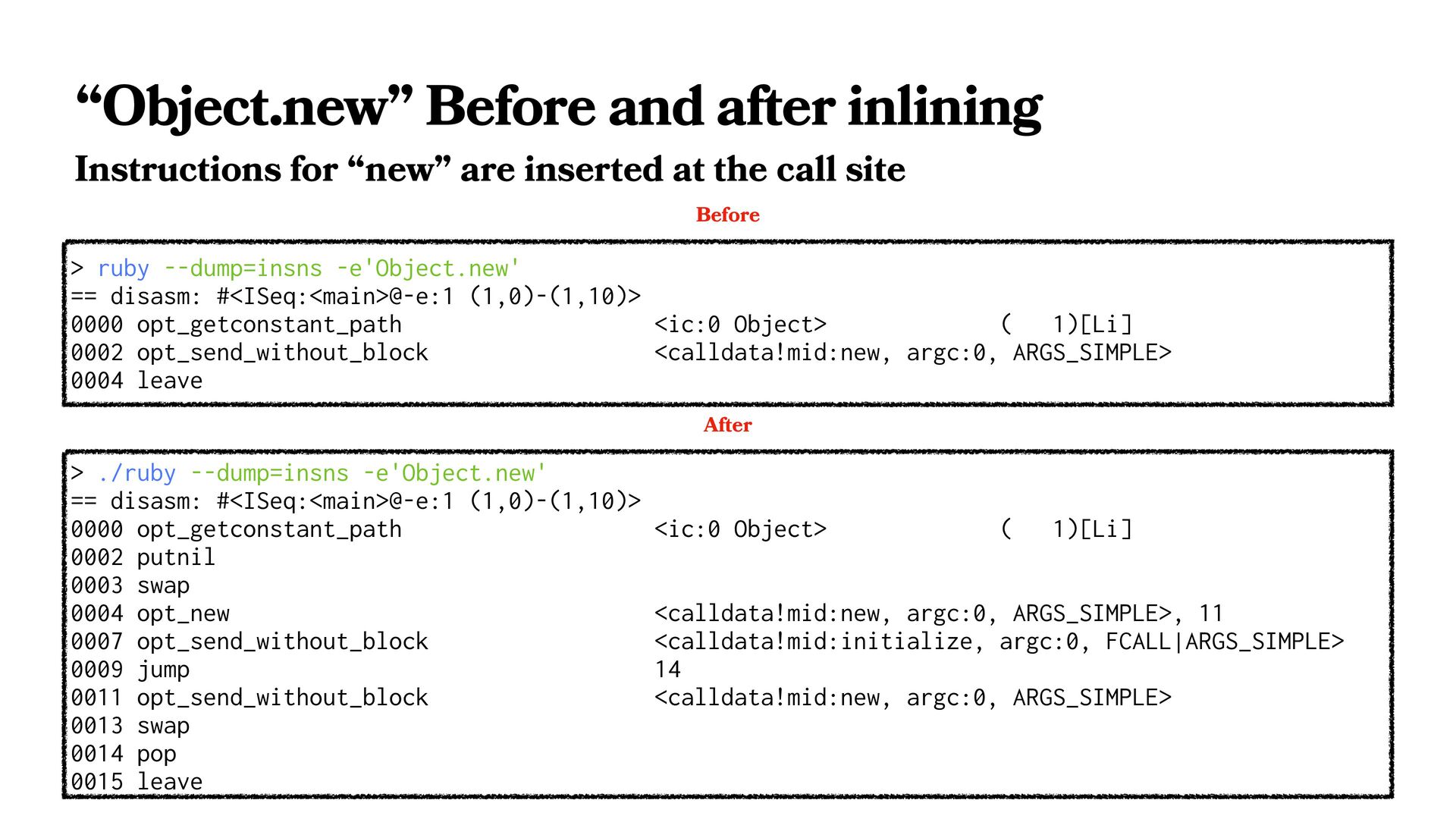
“Object.new” Before and after inlining Instructions for “new” are inserted
at the call site > ruby --dump=insns -e'Object.new' == disasm: #<ISeq:<main>@-e:1 (1,0)-(1,10)> 0000 opt_getconstant_path <ic:0 Object> ( 1)[Li] 0002 opt_send_without_block <calldata!mid:new, argc:0, ARGS_SIMPLE> 0004 leave Before > ./ruby --dump=insns -e'Object.new' == disasm: #<ISeq:<main>@-e:1 (1,0)-(1,10)> 0000 opt_getconstant_path <ic:0 Object> ( 1)[Li] 0002 putnil 0003 swap 0004 opt_new <calldata!mid:new, argc:0, ARGS_SIMPLE>, 11 0007 opt_send_without_block <calldata!mid:initialize, argc:0, FCALL|ARGS_SIMPLE> 0009 jump 14 0011 opt_send_without_block <calldata!mid:new, argc:0, ARGS_SIMPLE> 0013 swap 0014 pop 0015 leave After -
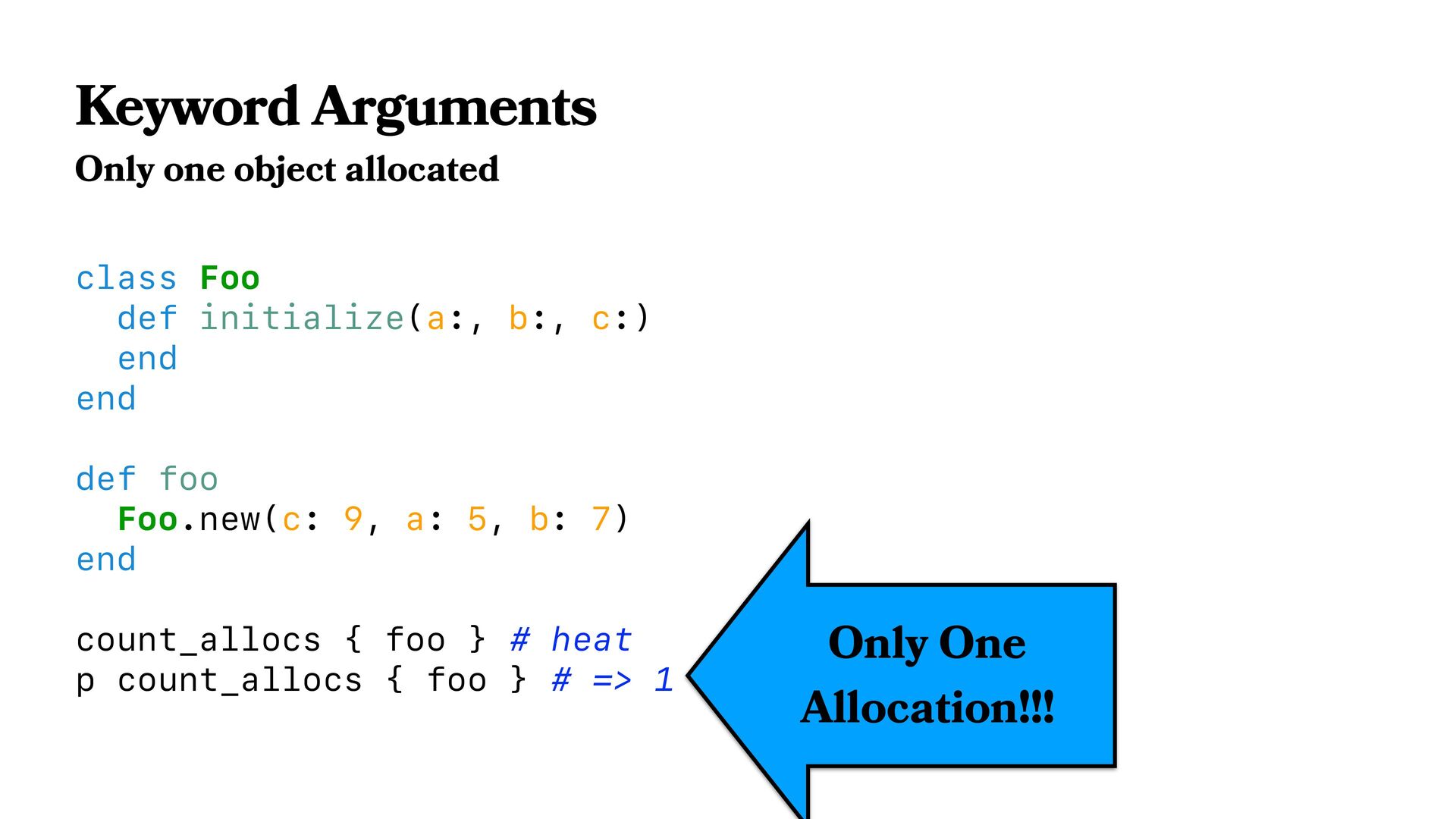
Keyword Arguments Only one object allocated class Foo def initialize(a:,
b:, c:) end end def foo Foo.new(c: 9, a: 5, b: 7) end count_allocs { foo } # heat p count_allocs { foo } # => 1 Only One Allocation!!! -
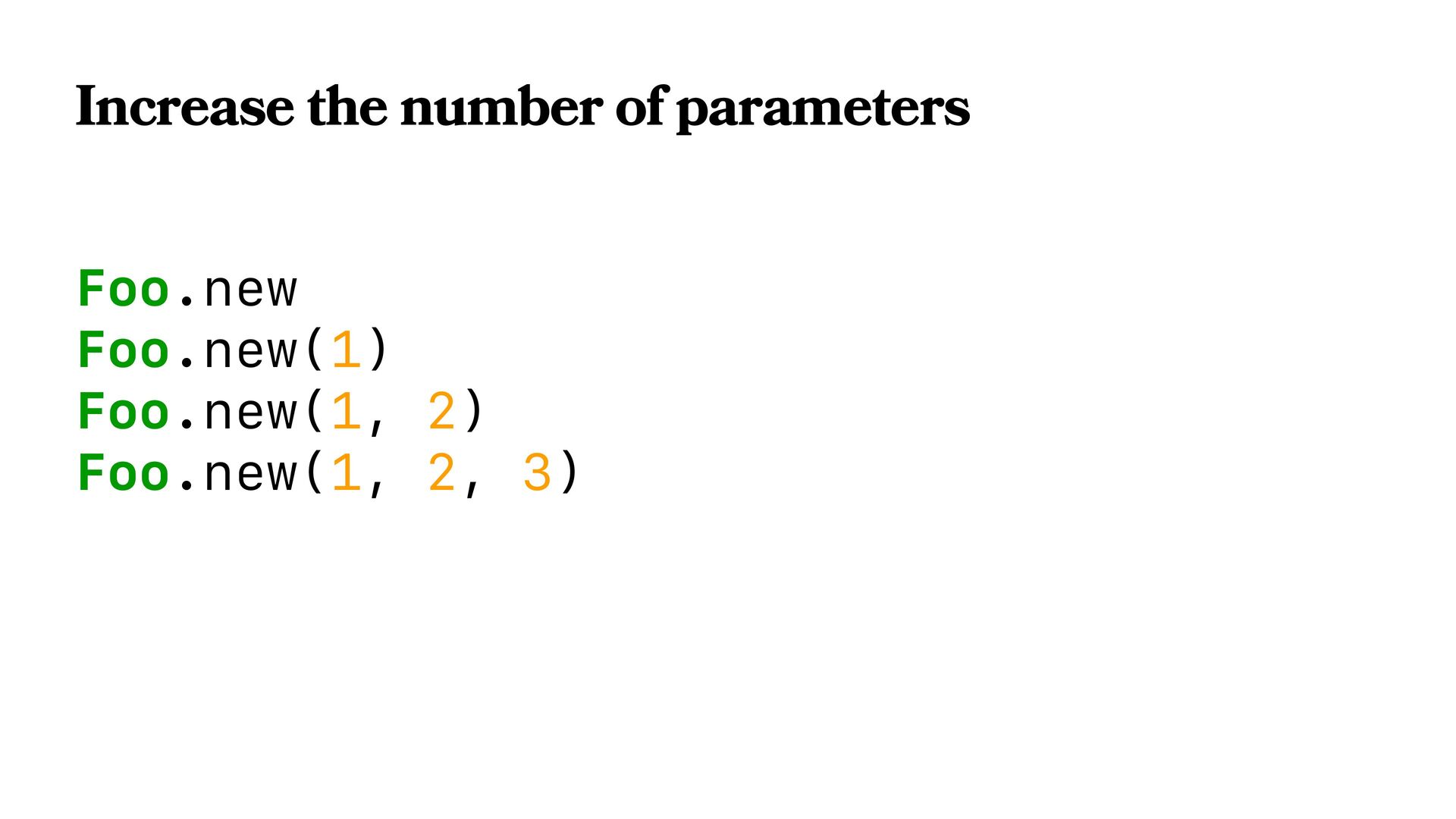
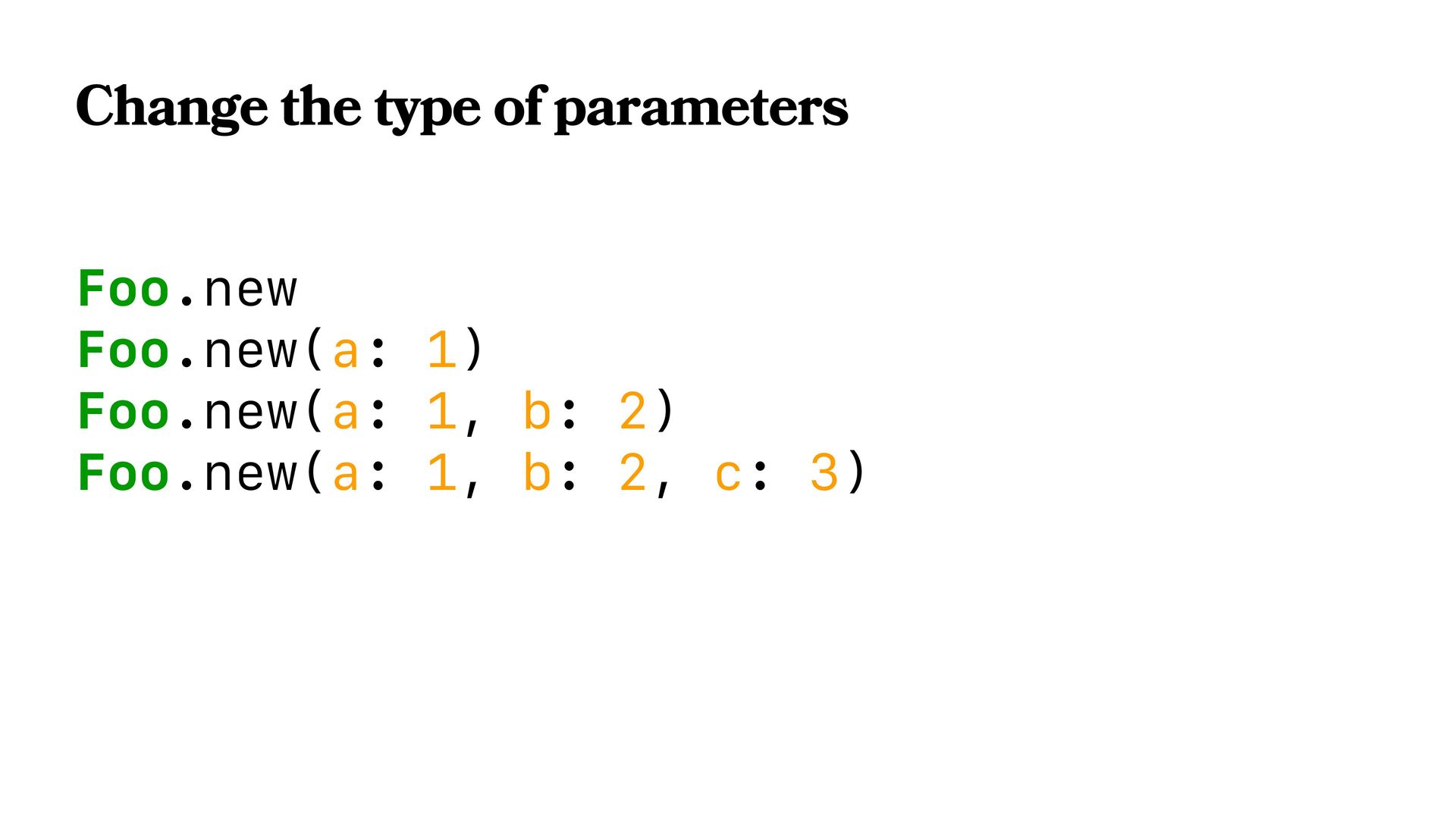
Change the type of parameters Foo.new Foo.new(a: 1) Foo.new(a: 1,
b: 2) Foo.new(a: 1, b: 2, c: 3) -
Vary the type of object Foo.new Bar.new Foo.new Bar.new Foo.new
Bar.new Foo.new Bar.new -
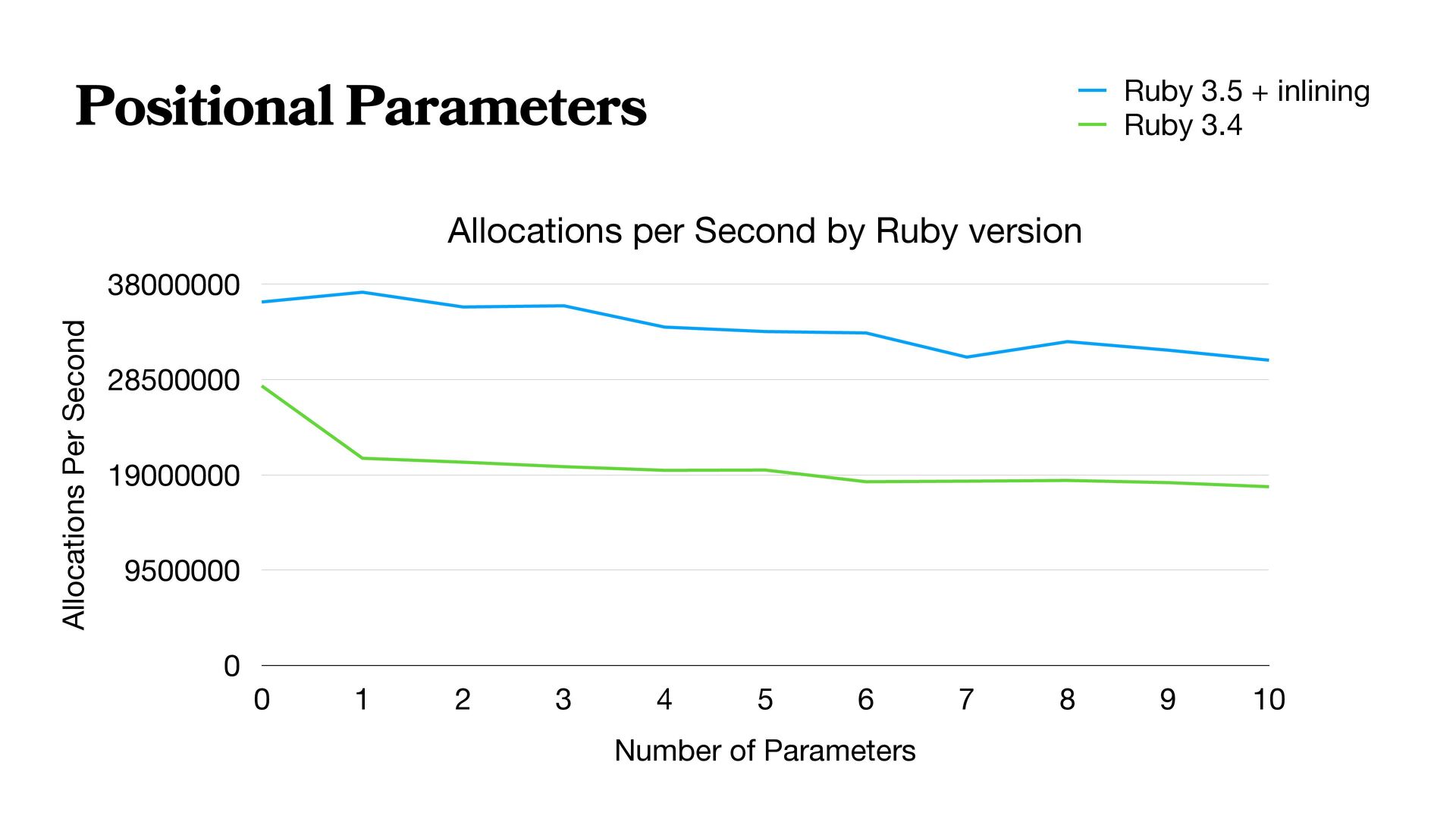
Positional Parameters Allocations per Second by Ruby version Allocations Per
Second 0 9500000 19000000 28500000 38000000 Number of Parameters 0 1 2 3 4 5 6 7 8 9 10 Ruby 3.5 + inlining Ruby 3.4 -
Keyword Parameters Allocations per second by Ruby version Allocations Per
Second 0 10000000 20000000 30000000 40000000 Number of Parameters 0 1 2 3 4 5 6 7 8 9 10 Ruby 3.5+inlining Ruby 3.4 -
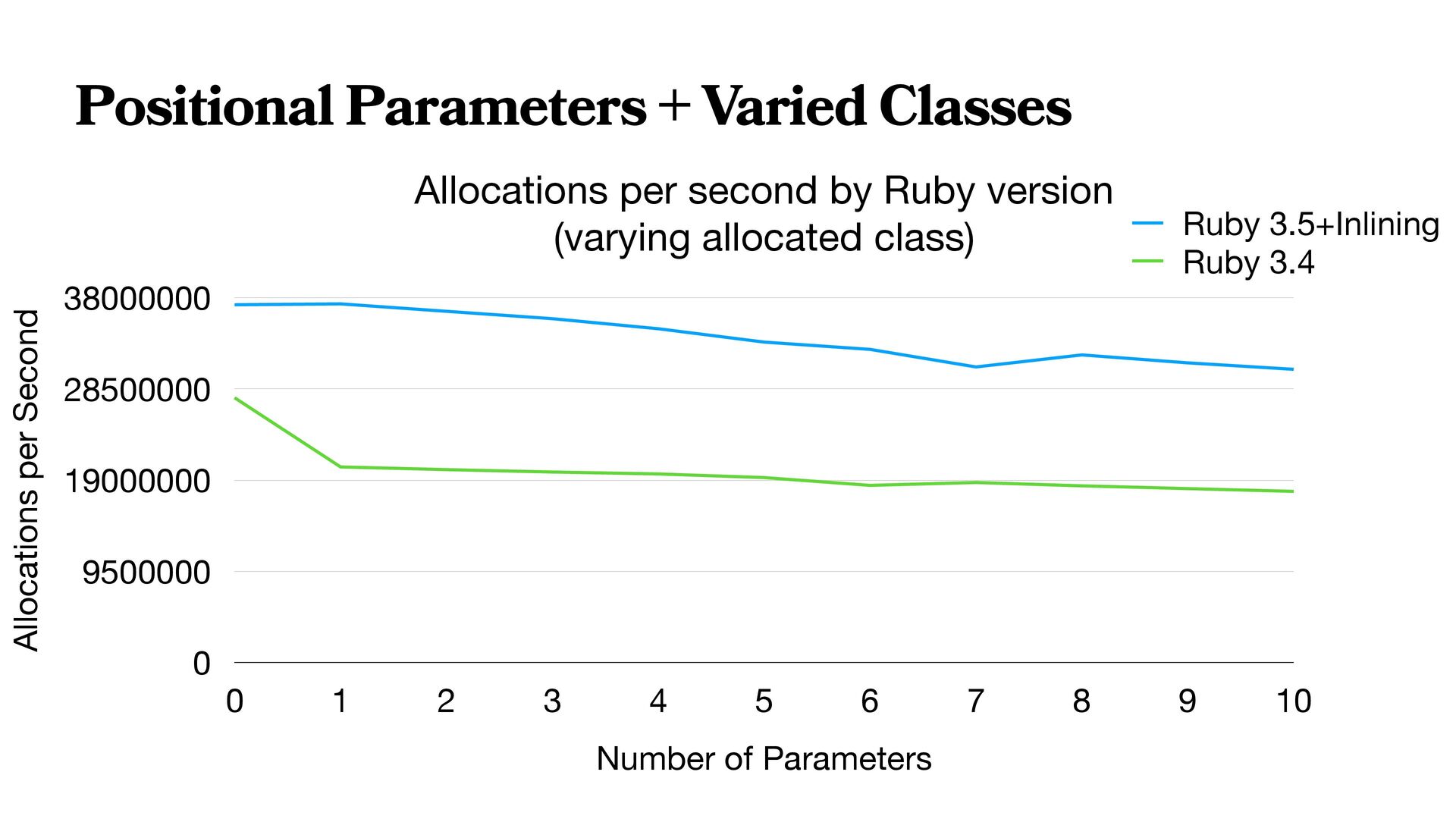
Positional Parameters + Varied Classes Allocations per second by Ruby
version (varying allocated class) Allocations per Second 0 9500000 19000000 28500000 38000000 Number of Parameters 0 1 2 3 4 5 6 7 8 9 10 Ruby 3.5+Inlining Ruby 3.4 -
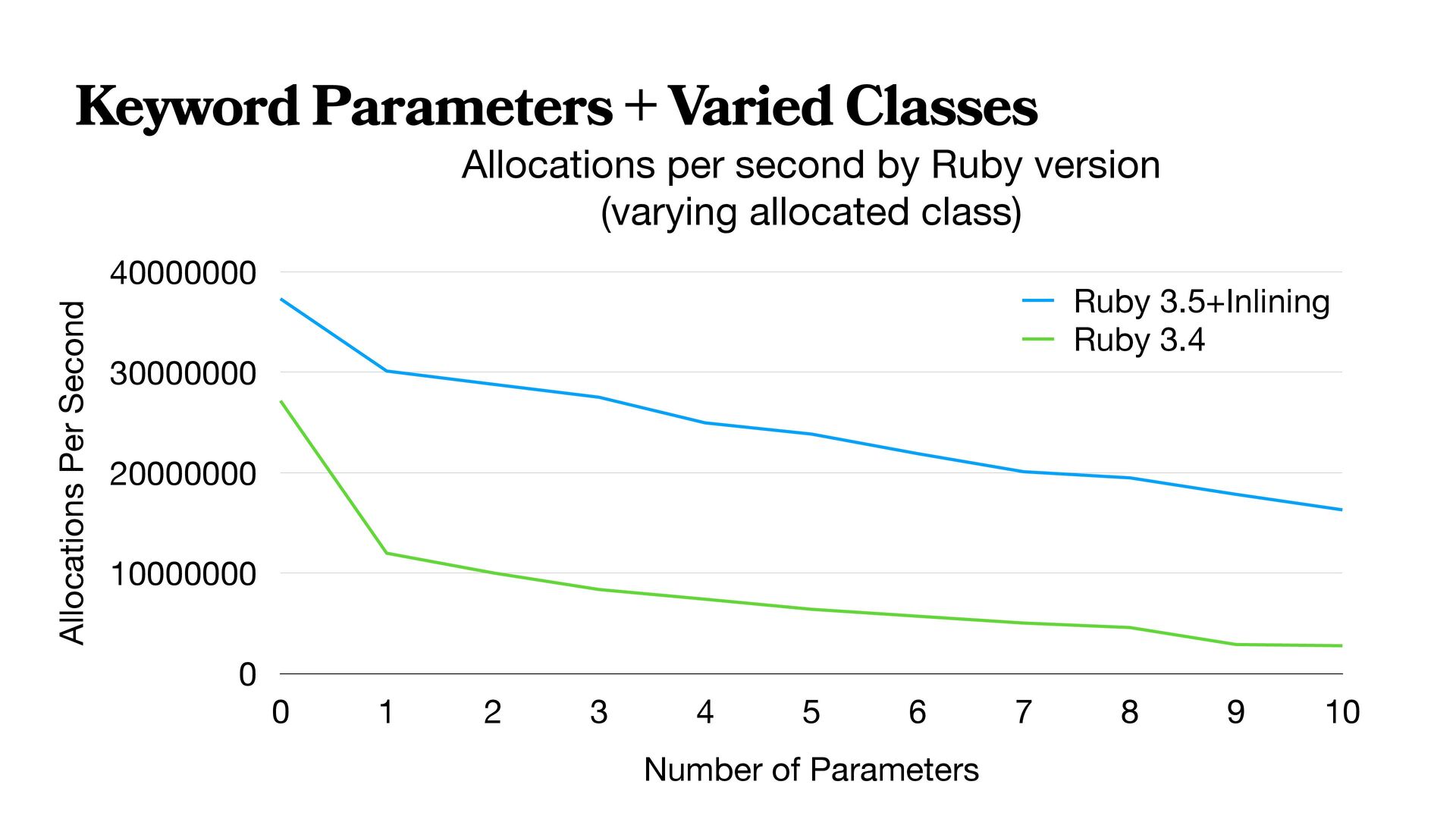
Keyword Parameters + Varied Classes Allocations per second by Ruby
version (varying allocated class) Allocations Per Second 0 10000000 20000000 30000000 40000000 Number of Parameters 0 1 2 3 4 5 6 7 8 9 10 Ruby 3.5+Inlining Ruby 3.4 -
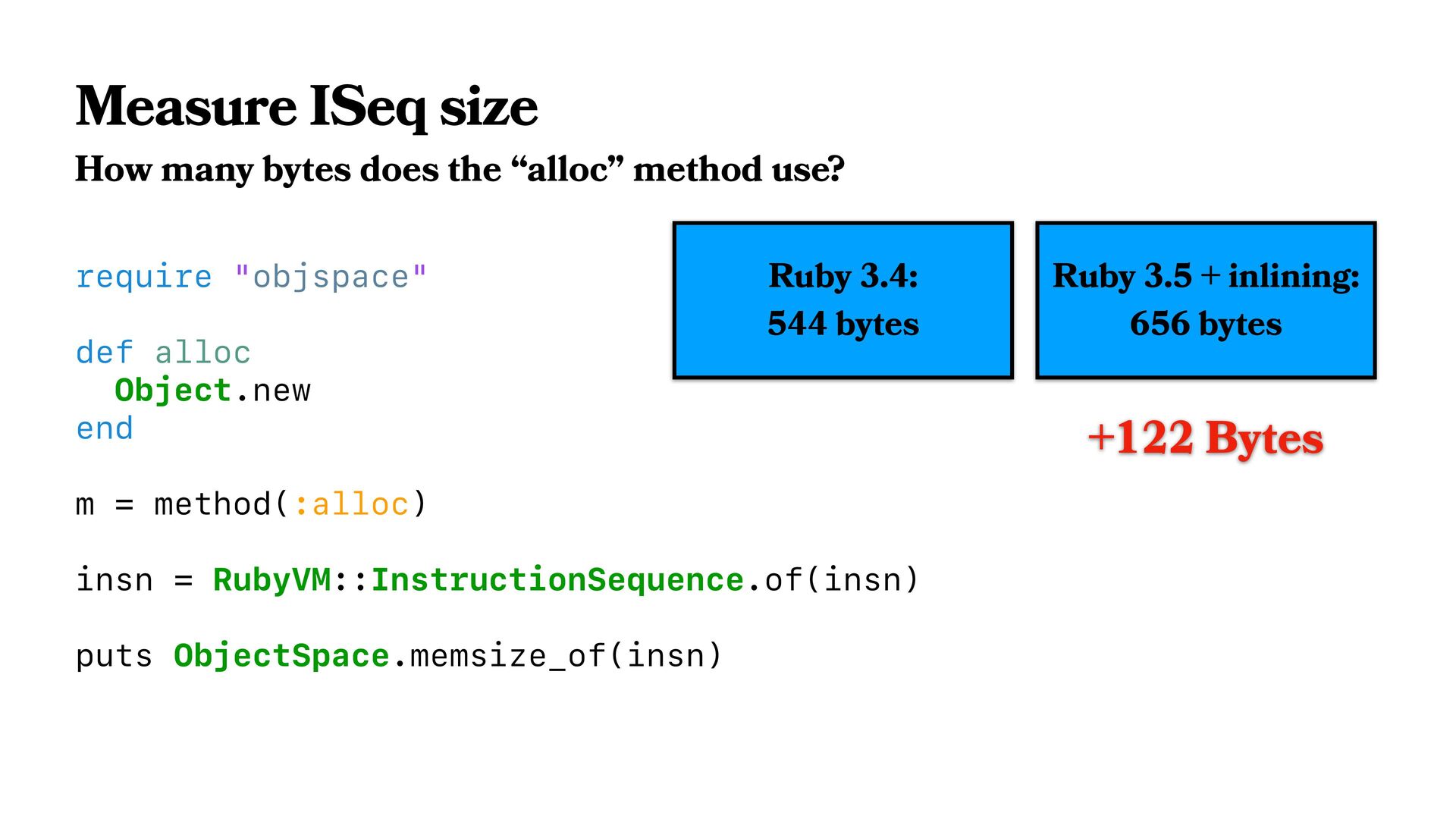
Measure ISeq size How many bytes does the “alloc” method
use? require "objspace" def alloc Object.new end m = method(:alloc) insn = RubyVM::InstructionSequence.of(insn) puts ObjectSpace.memsize_of(insn) Ruby 3.5 + inlining: 656 bytes Ruby 3.4: 544 bytes +122 Bytes -
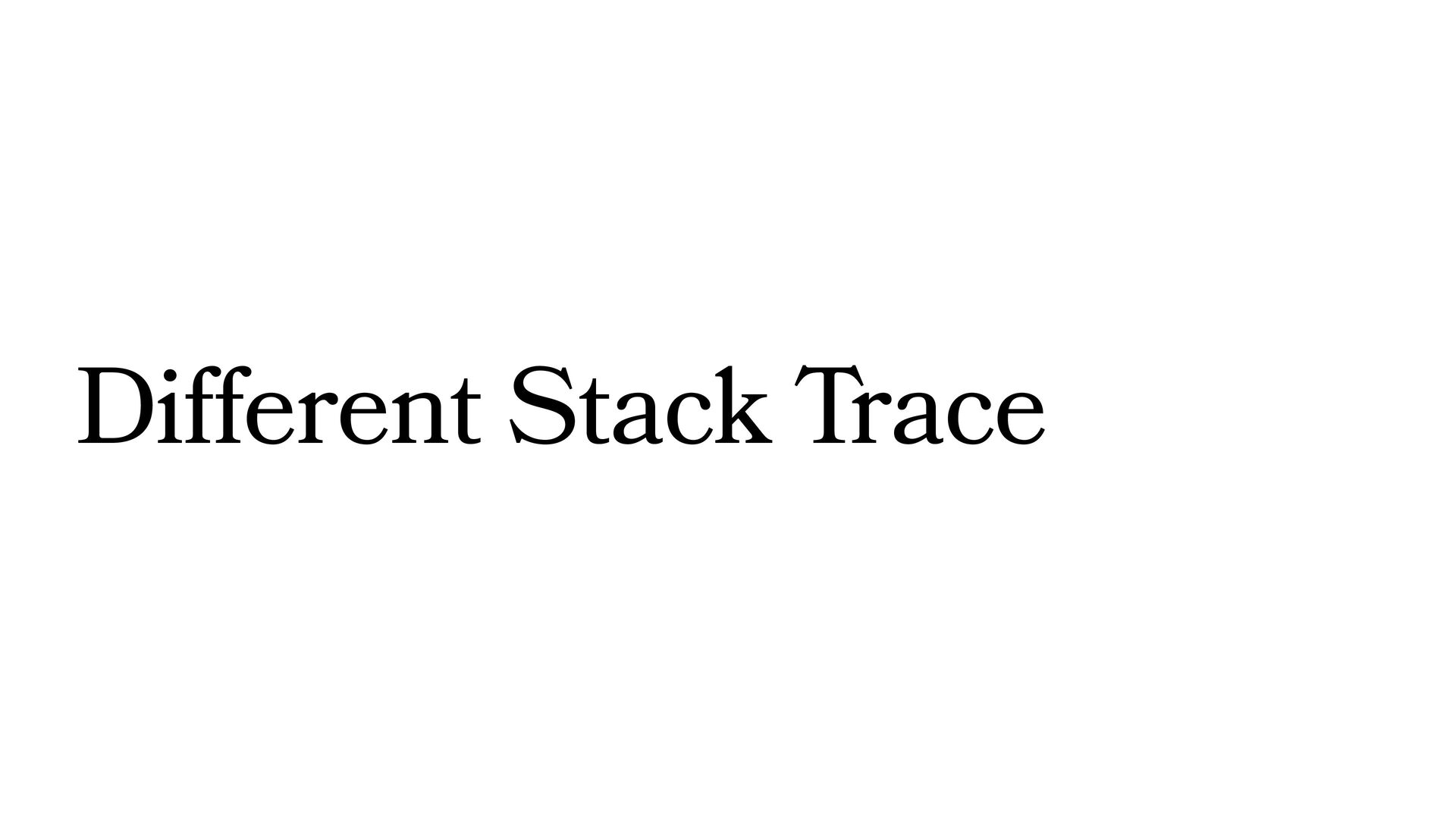
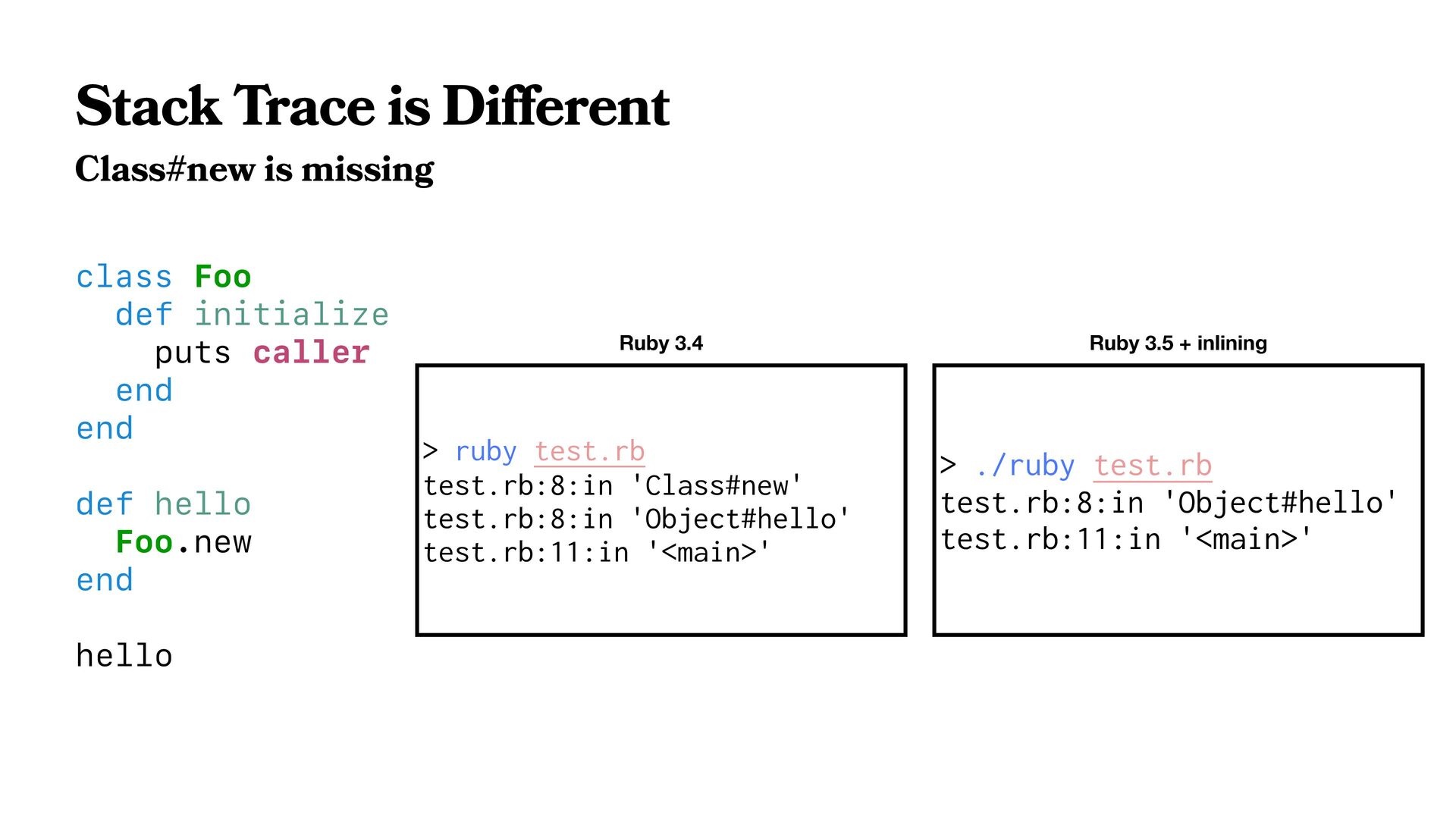
Stack Trace is Different Class#new is missing class Foo def
initialize puts caller end end def hello Foo.new end hello > ruby test.rb test.rb:8:in 'Class#new' test.rb:8:in 'Object#hello' test.rb:11:in '<main>' Ruby 3.4 > ./ruby test.rb test.rb:8:in 'Object#hello' test.rb:11:in '<main>' Ruby 3.5 + inlining
 tenderlove
 aleyda
 lfama
 gr2m
 jmmastey
 mkilby
 palkan
 asonas
 marcelosomers
 techseoconnect
 sergeychernyshev
 destraynor
 ryanjones