Upgrade to Pro — share decks privately, control downloads, hide ads and more …

Leaving the Hyperscalers Without Leaving the Ga...

Leaving the Hyperscalers Without Leaving the Game: Building Our AI Solutions with Open Source Models

How do you move away from Big Tech AI while your teams keep working? At Paperjam, a Luxembourg media and business company, we’re changing the engines of the plane in mid-flight.

This talk is a logbook, written as we make the decisions:

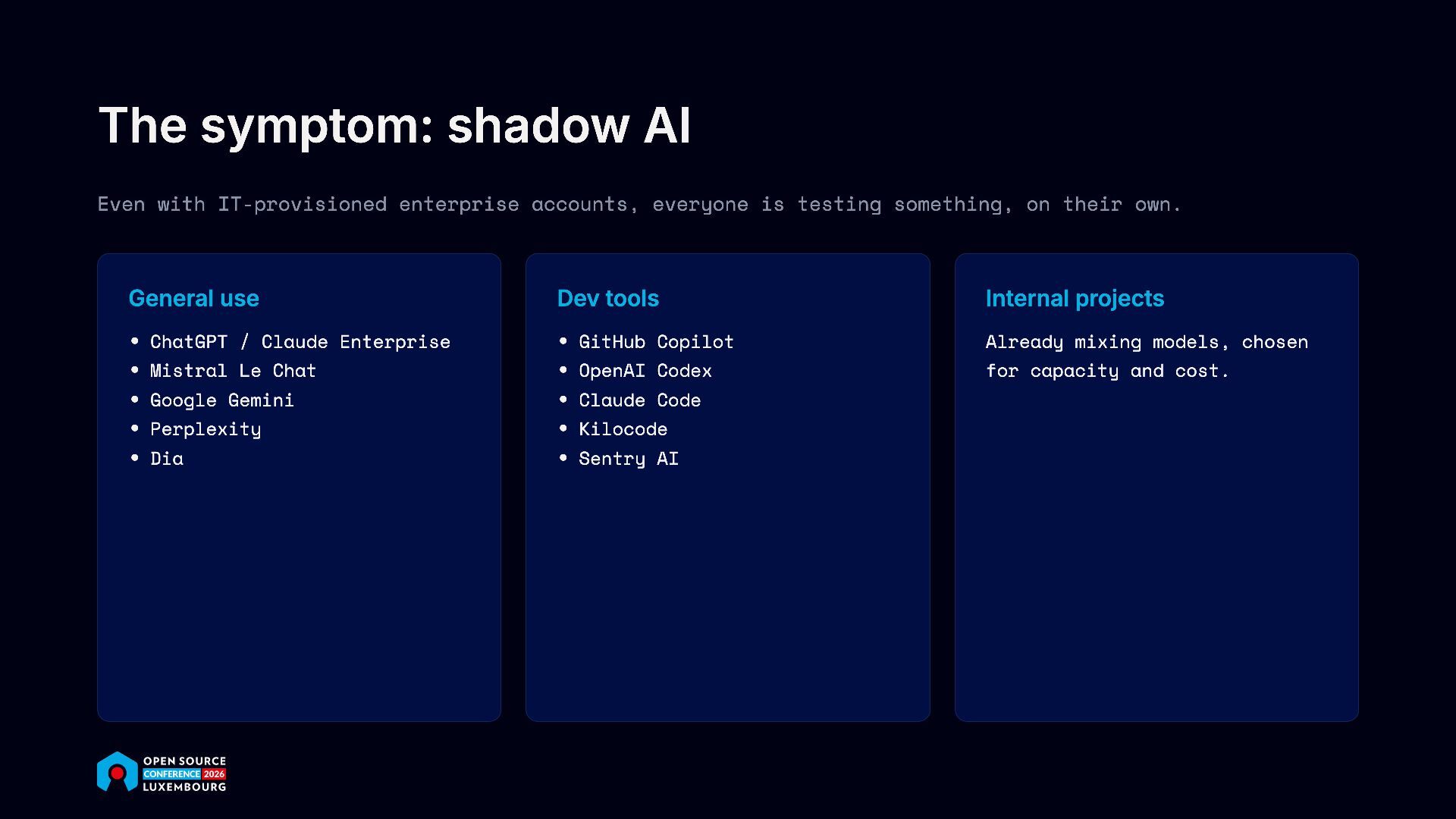
- Shadow AI: plenty of tools, very little coherence
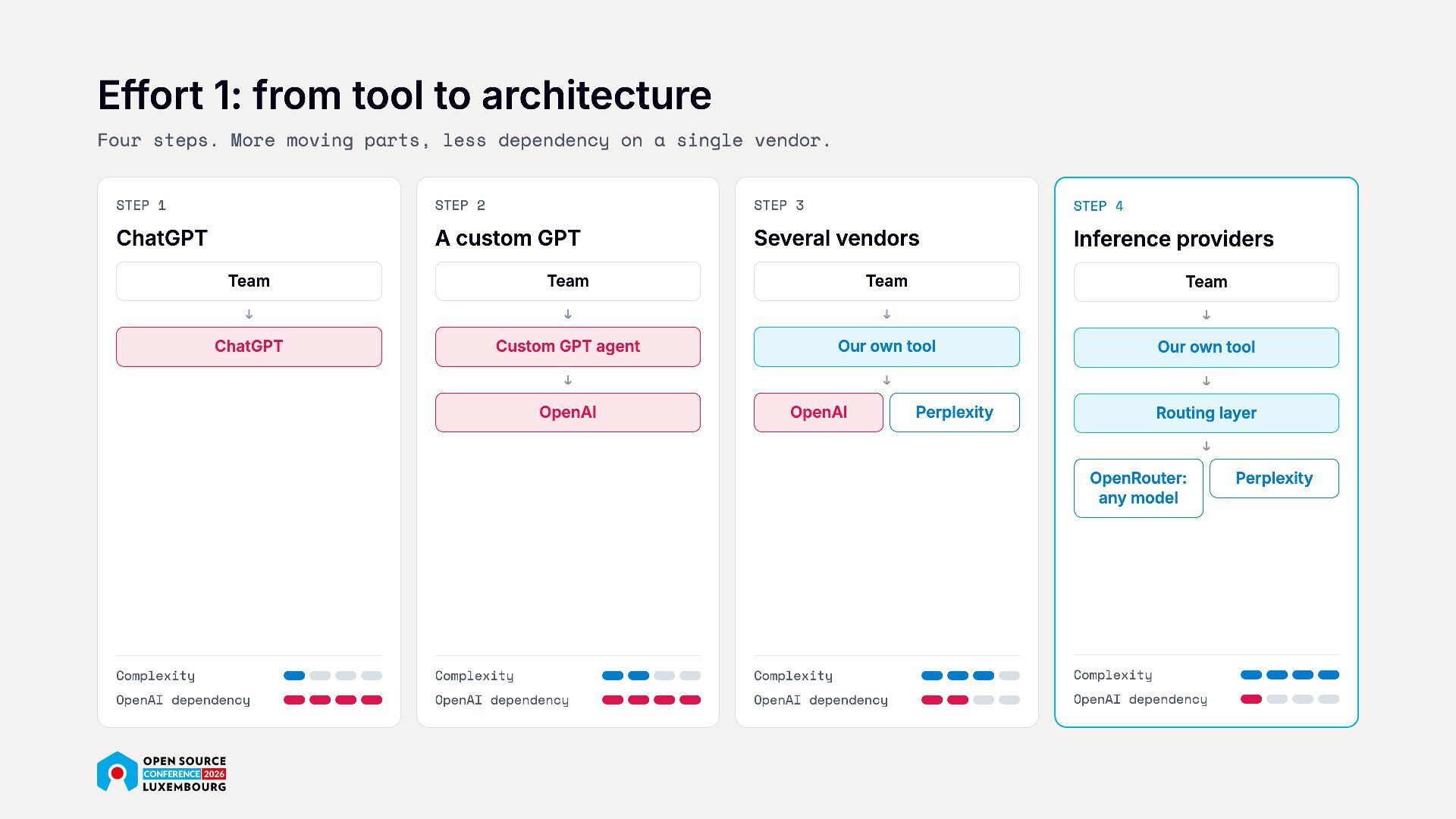
- From ChatGPT to our own architecture, in four steps: more complexity, less dependency on a single vendor
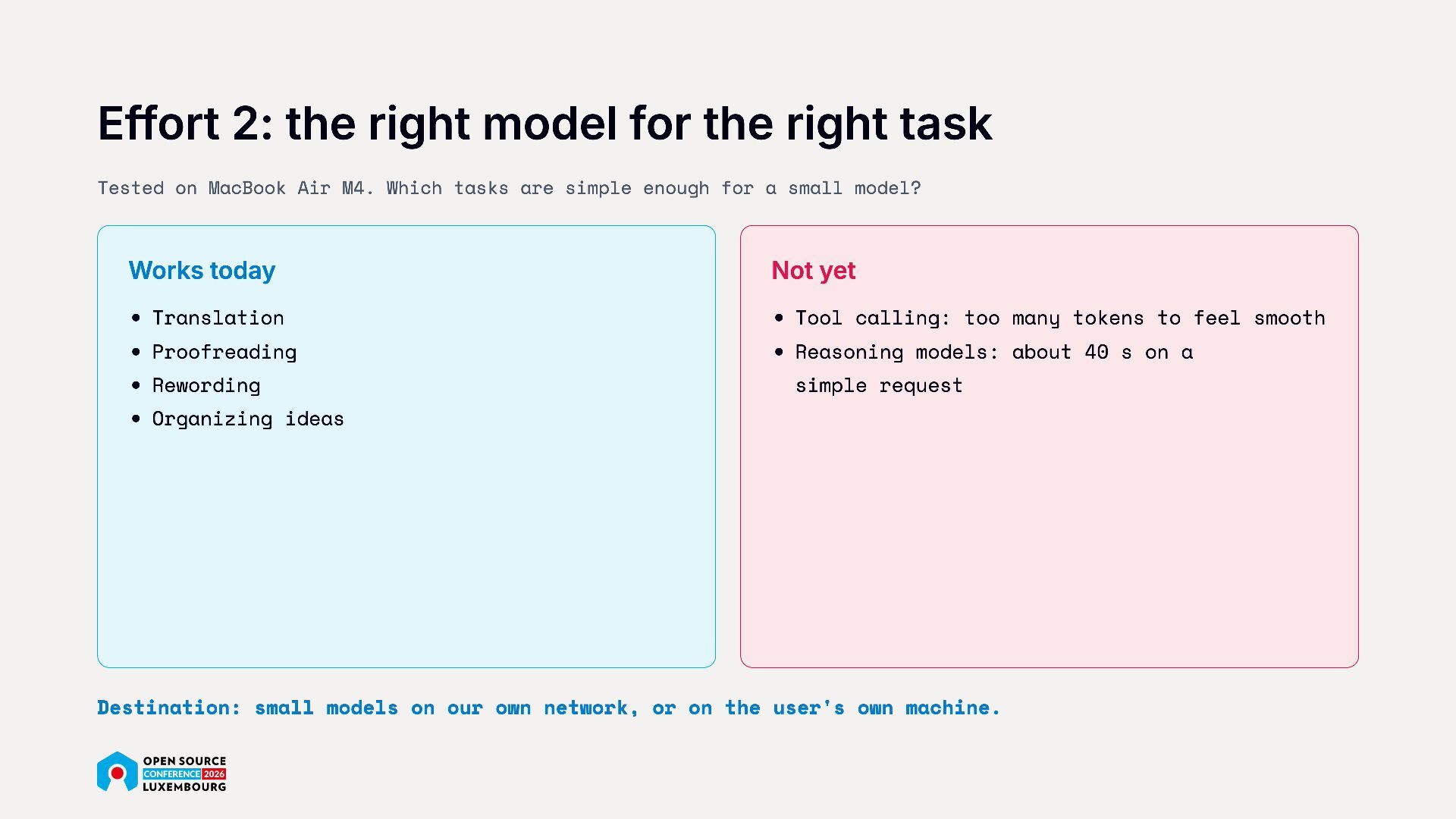
- Right-sizing models: what small open-weight models already handle on a MacBook Air M4, and where they still hit the wall
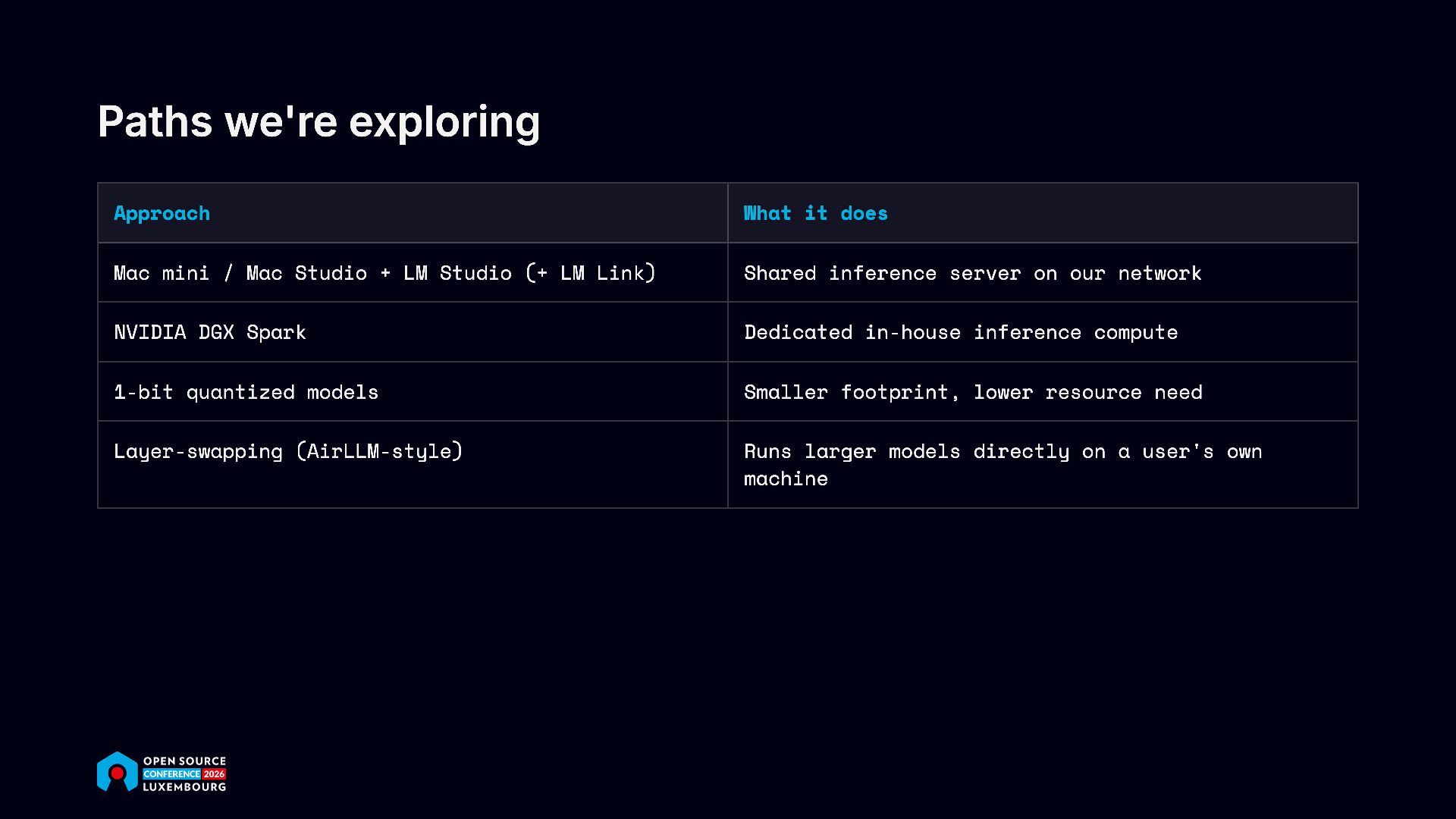
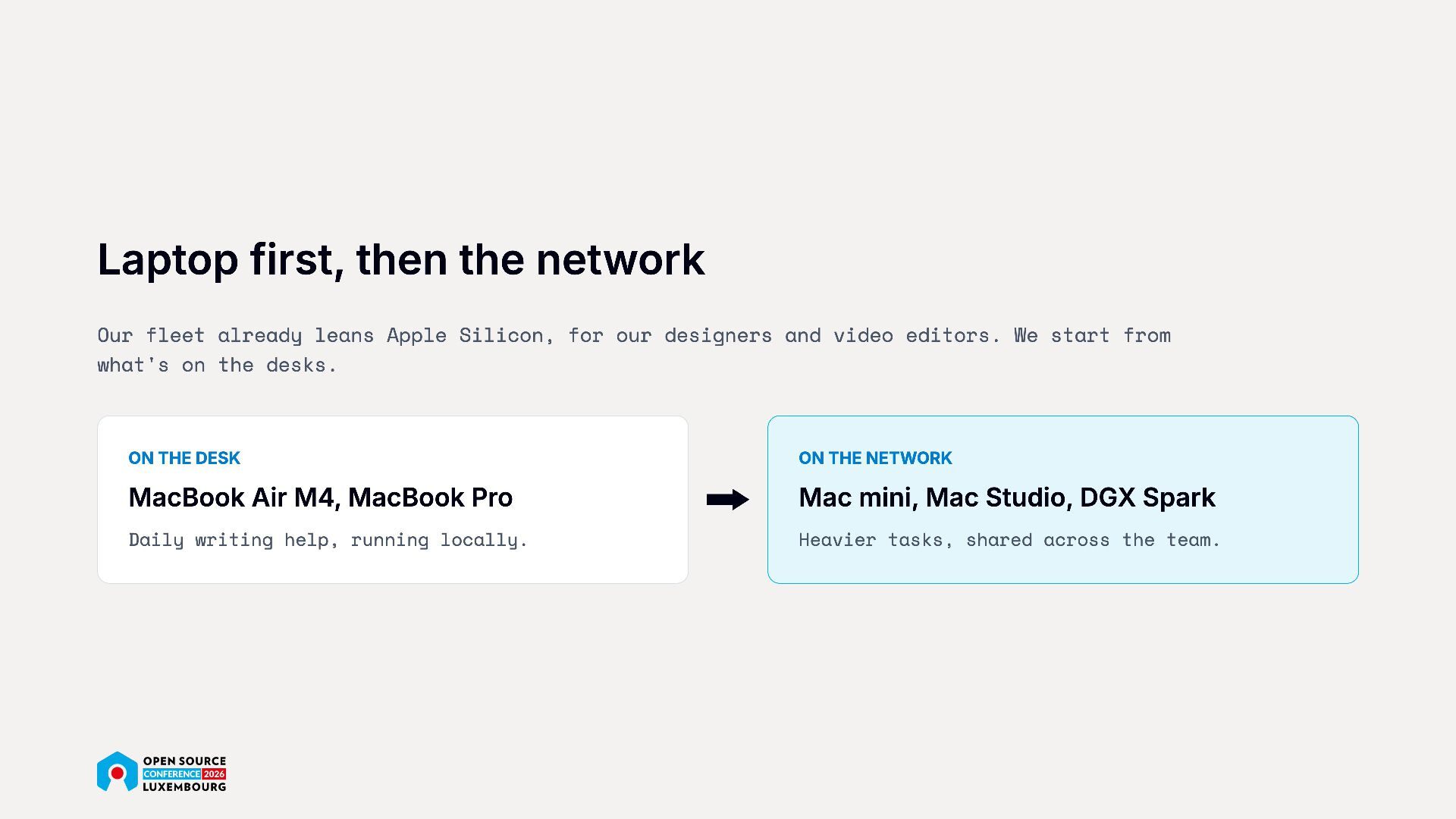
- Laptop first, then the network: Mac mini, Mac Studio, DGX Spark, quantized models
- Real pitfalls, including a tool with better output than ChatGPT that nobody uses
- The risks we’re addressing: economic, geopolitical, environmental, technological and sovereignty

Everything here applies to schools and universities too: same tool sprawl, same “one size fits all” offers, and even higher stakes around student data and AI literacy.

Presented at the Open Source Conference Luxembourg 2026, Academia & EdTech track, Belval, October 7, 2026.

Avatar for Thibault Milan

Thibault Milan

October 13, 2026

More Decks by Thibault Milan

Other Decks in Technology

Transcript

  1. OPEN SOURCE CONFERENCE LUXEMBOURG • OCT 7, 2026 Leaving the

    Hyperscalers Without Leaving the Game Building our AI solutions with open source models Thibault Milan Head of Digital & Platforms, Paperjam
  2. "Leaving the hyperscalers is easy to say." The real question

    is: leaving for where? A logbook, written while we make the decisions.
  3. The symptom: shadow AI Even with IT-provisioned enterprise accounts, everyone

    is testing something, on their own. General use Dev tools Internal projects ChatGPT / Claude Enterprise GitHub Copilot Already mixing models, chosen Mistral Le Chat OpenAI Codex for capacity and cost. Google Gemini Claude Code Perplexity Kilocode Dia Sentry AI
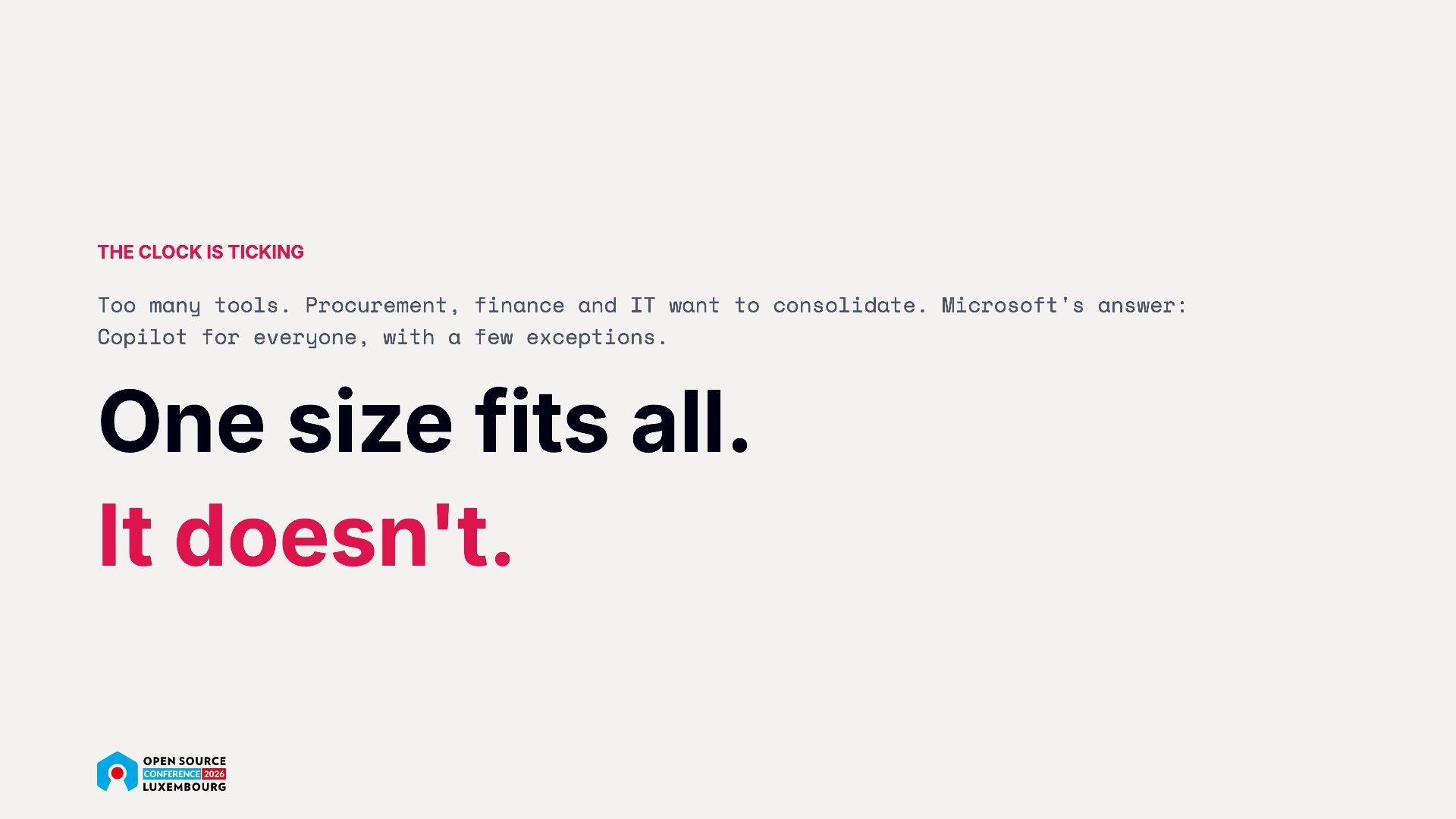
  4. THE CLOCK IS TICKING Too many tools. Procurement, finance and

    IT want to consolidate. Microsoft's answer: Copilot for everyone, with a few exceptions. One size fits all. It doesn't.
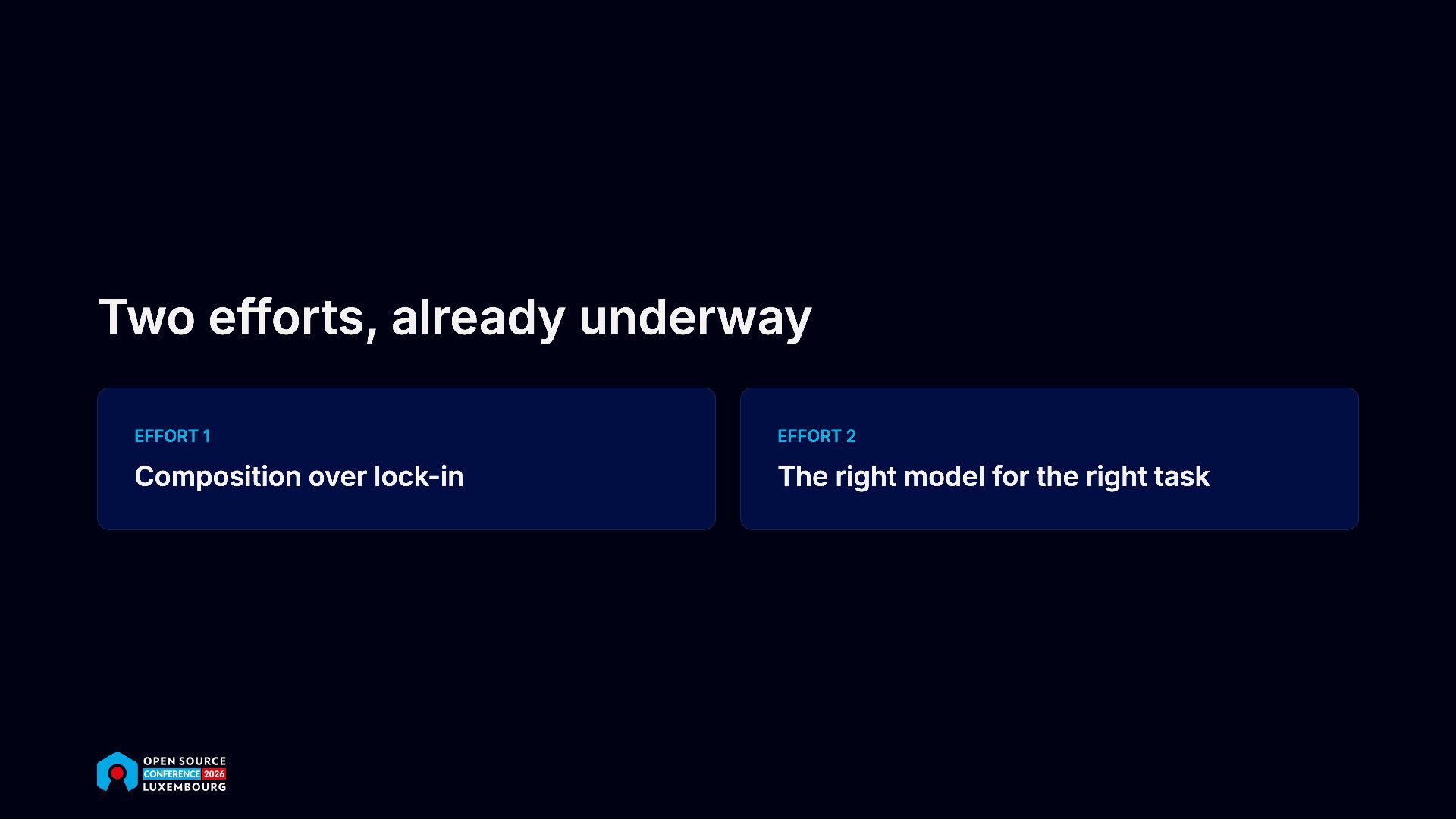
  5. Two efforts, already underway EFFORT 1 EFFORT 2 Composition over

    lock-in The right model for the right task
  6. Effort 1: from tool to architecture Four steps. More moving

    parts, less dependency on a single vendor. STEP 1 STEP 2 STEP 3 STEP 4 ChatGPT A custom GPT Several vendors Inference providers Team Team Team Team ChatGPT Custom GPT agent Our own tool Our own tool OpenAI OpenAI Perplexity Routing layer OpenRouter: any model Complexity Complexity Complexity Complexity OpenAI dependency OpenAI dependency OpenAI dependency OpenAI dependency Perplexity
  7. Effort 2: the right model for the right task Tested

    on MacBook Air M4. Which tasks are simple enough for a small model? Works today Not yet Translation Tool calling: too many tokens to feel smooth Proofreading Reasoning models: about 40 s on a Rewording simple request Organizing ideas Destination: small models on our own network, or on the user's own machine.
  8. Paths we're exploring Approach What it does Mac mini /

    Mac Studio + LM Studio (+ LM Link) Shared inference server on our network NVIDIA DGX Spark Dedicated in-house inference compute 1-bit quantized models Smaller footprint, lower resource need Layer-swapping (AirLLM-style) Runs larger models directly on a user's own machine
  9. Laptop first, then the network Our fleet already leans Apple

    Silicon, for our designers and video editors. We start from what's on the desks. ON THE DESK ON THE NETWORK MacBook Air M4, MacBook Pro Mac mini, Mac Studio, DGX Spark Daily writing help, running locally. Heavier tasks, shared across the team.
  10. THE DREAM Bring our users to a quality level close

    to what they already get from consumer generative AI, often not that great, let's be honest. But on open-weight models. Running at the edge, or locally.
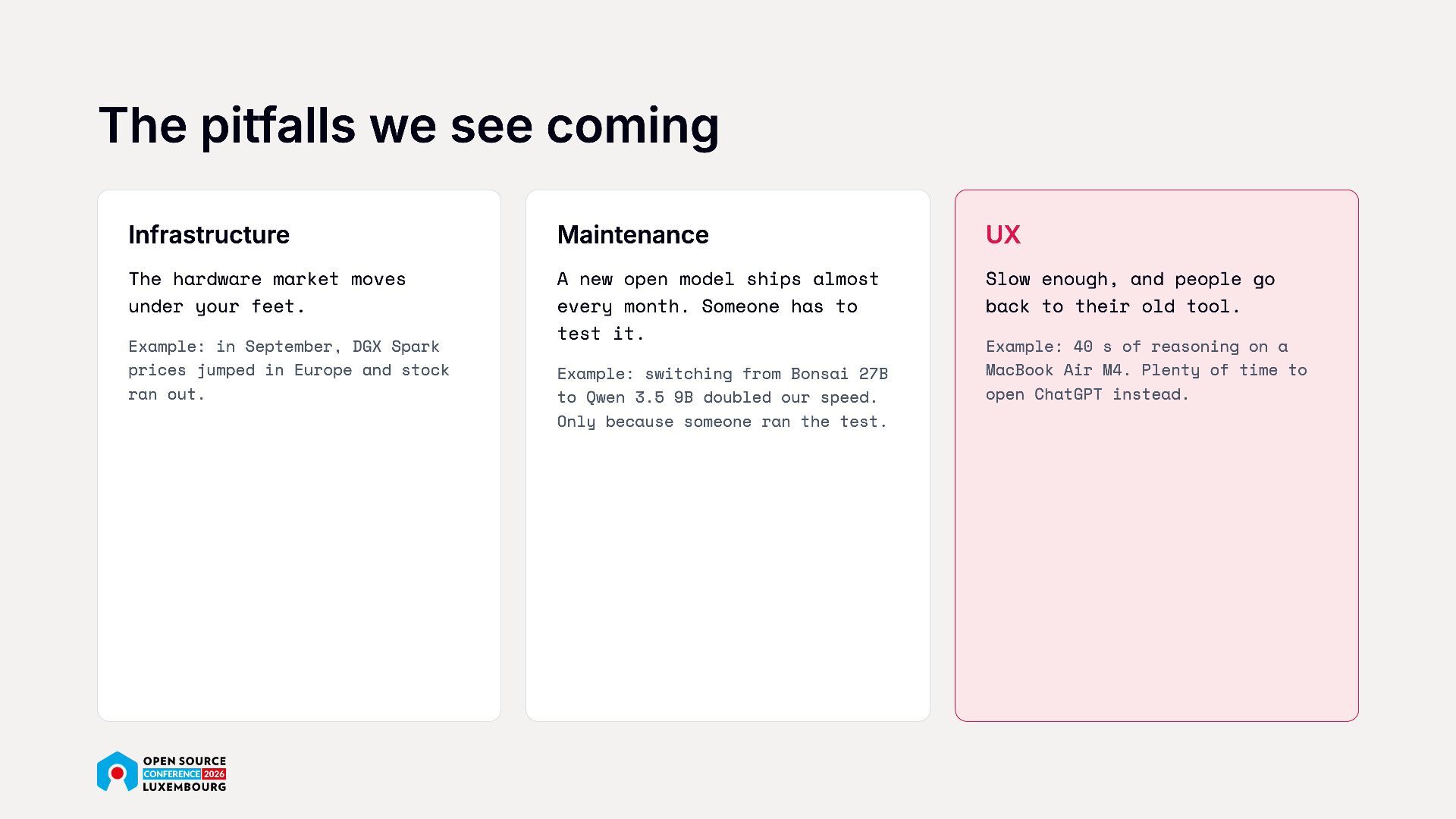
  11. The pitfalls we see coming Infrastructure Maintenance UX The hardware

    market moves under your feet. A new open model ships almost every month. Someone has to test it. Slow enough, and people go back to their old tool. Example: in September, DGX Spark prices jumped in Europe and stock ran out. Example: switching from Bonsai 27B to Qwen 3.5 9B doubled our speed. Only because someone ran the test. Example: 40 s of reasoning on a MacBook Air M4. Plenty of time to open ChatGPT instead.
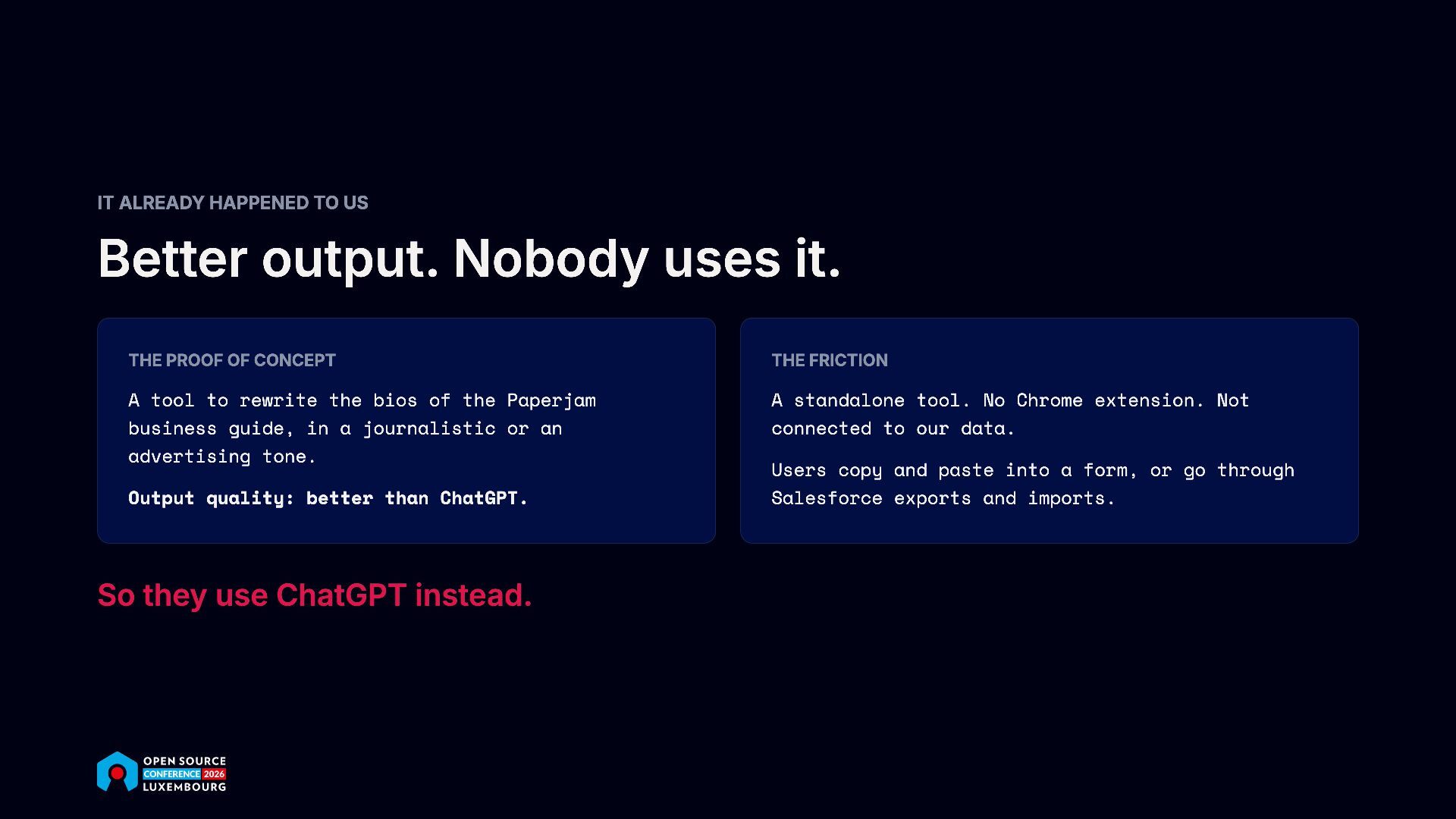
  12. IT ALREADY HAPPENED TO US Better output. Nobody uses it.

    THE PROOF OF CONCEPT THE FRICTION A tool to rewrite the bios of the Paperjam A standalone tool. No Chrome extension. Not business guide, in a journalistic or an connected to our data. advertising tone. Output quality: better than ChatGPT. So they use ChatGPT instead. Users copy and paste into a form, or go through Salesforce exports and imports.
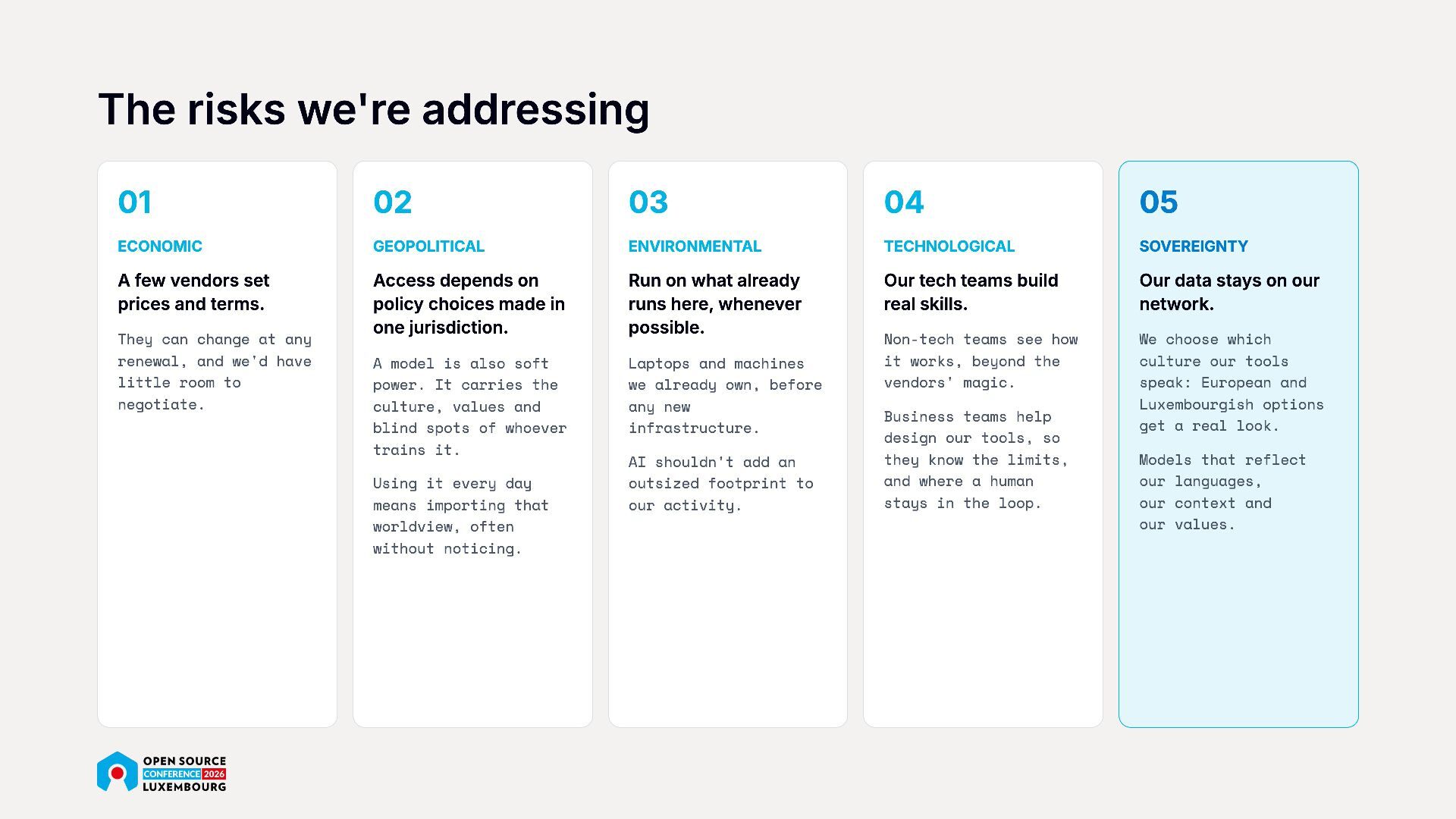
  13. The risks we're addressing 01 02 03 04 05 ECONOMIC

    GEOPOLITICAL ENVIRONMENTAL TECHNOLOGICAL SOVEREIGNTY A few vendors set prices and terms. Access depends on policy choices made in one jurisdiction. Run on what already runs here, whenever possible. Our tech teams build real skills. Our data stays on our network. Non-tech teams see how We choose which A model is also soft Laptops and machines power. It carries the culture, values and we already own, before any new it works, beyond the vendors' magic. culture our tools speak: European and blind spots of whoever trains it. infrastructure. They can change at any renewal, and we'd have little room to negotiate. Using it every day means importing that worldview, often without noticing. AI shouldn't add an outsized footprint to our activity. Business teams help design our tools, so they know the limits, and where a human stays in the loop. Luxembourgish options get a real look. Models that reflect our languages, our context and our values.
  14. An AI as good as what our teams already use.

    But ours. On our machines. Dependent on no one. Not dogma. A strategic choice we own.