2026 EDITION How to Read a Peptide Certificate of Analysis & Lab Report Plus: How to Tell If a Peptide Supplier Is Legit or a Scam in Canada A field guide to HPLC purity, mass-spectrometry identity confirmation, and the twelve red flags that separate a genuine third-party lab report from a fabricated one. HPLC & LC-MS ICP-MS Heavy Metals PUBLISHED BY AIX Peptides Education · aixpeptides.com/coa LAL Endotoxin Legit vs. Scam Signals Health Canada Advisory RA-81874 SCOPE Research-use-only reference material — not health or dosing guidance
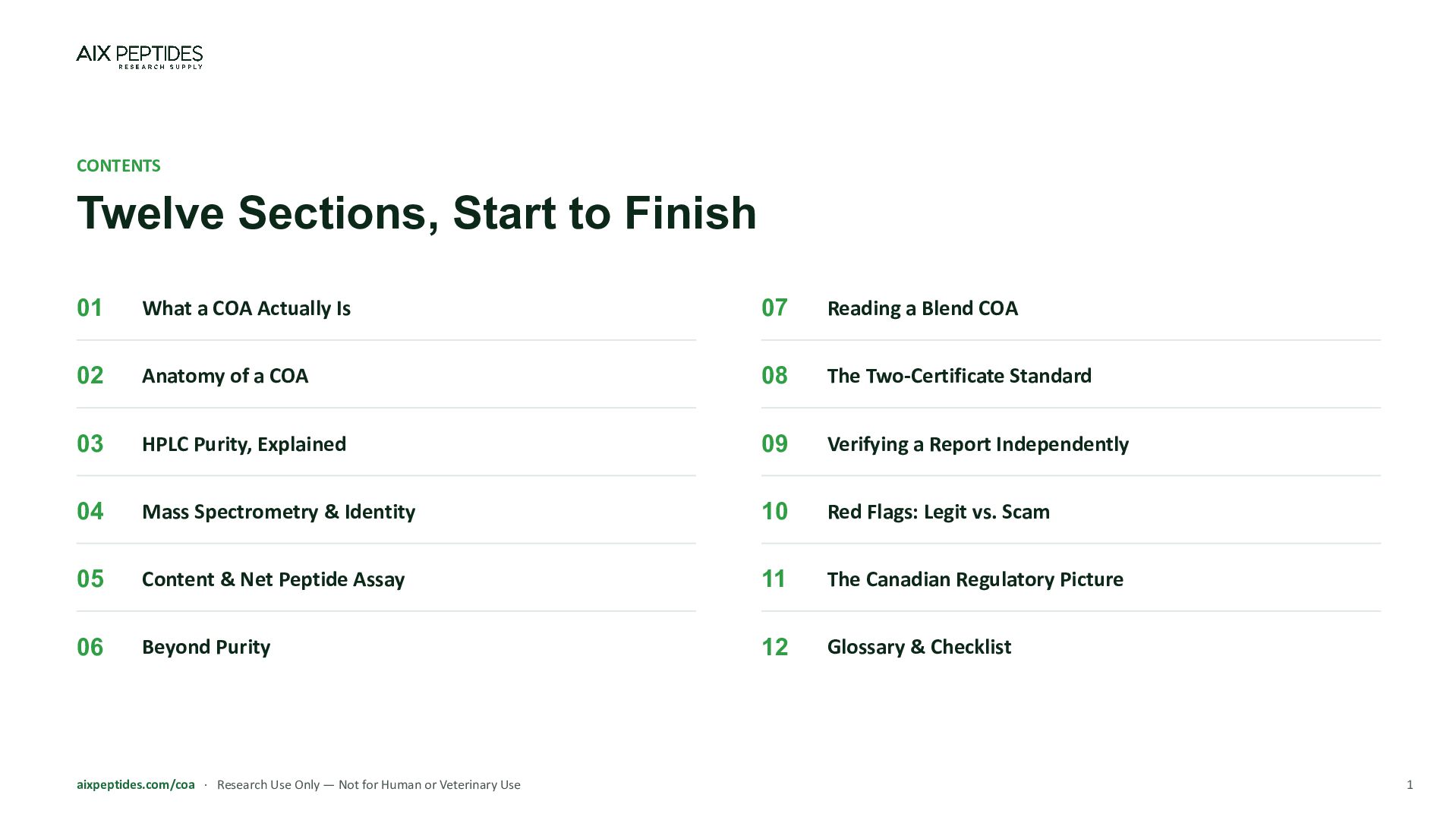
Actually Is 07 Reading a Blend COA 02 Anatomy of a COA 08 The Two-Certificate Standard 03 HPLC Purity, Explained 09 Verifying a Report Independently 04 Mass Spectrometry & Identity 10 Red Flags: Legit vs. Scam 05 Content & Net Peptide Assay 11 The Canadian Regulatory Picture 06 Beyond Purity 12 Glossary & Checklist aixpeptides.com/coa · Research Use Only — Not for Human or Veterinary Use 1
Products Learning to tell a legitimate peptide supplier from a scam in Canada starts with the one document nearly every seller shows you — and almost no buyer actually reads properly: the Certificate of Analysis. A polished website, fast shipping, and confident marketing copy are trivial to fake. A genuine, verifiable, lot-matched COA is not — which is exactly why it's the single 1 doc. The single document this entire guide is about — and the one almost no buyer reads properly before trusting a supplier. strongest signal available to a researcher deciding whether a supplier is trustworthy. aixpeptides.com/coa · Research Use Only — Not for Human or Veterinary Use 2
what HPLC, mass spectrometry, and the other tests on a Certificate of Analysis actually measure. aixpeptides.com/coa · Research Use Only — Not for Human or Veterinary Use 3
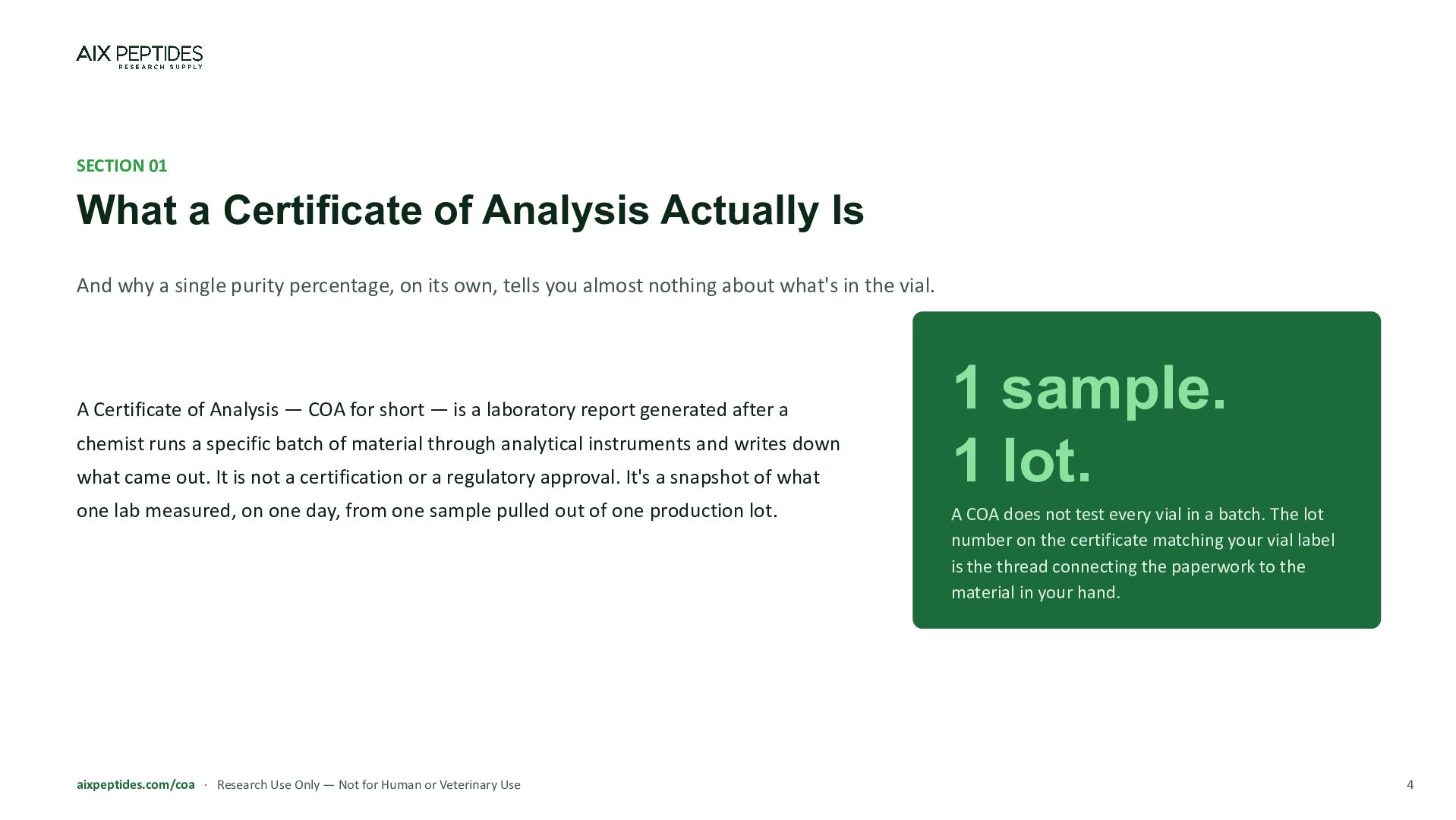
why a single purity percentage, on its own, tells you almost nothing about what's in the vial. A Certificate of Analysis — COA for short — is a laboratory report generated after a chemist runs a specific batch of material through analytical instruments and writes down what came out. It is not a certification or a regulatory approval. It's a snapshot of what one lab measured, on one day, from one sample pulled out of one production lot. aixpeptides.com/coa · Research Use Only — Not for Human or Veterinary Use 1 sample. 1 lot. A COA does not test every vial in a batch. The lot number on the certificate matching your vial label is the thread connecting the paperwork to the material in your hand. 4
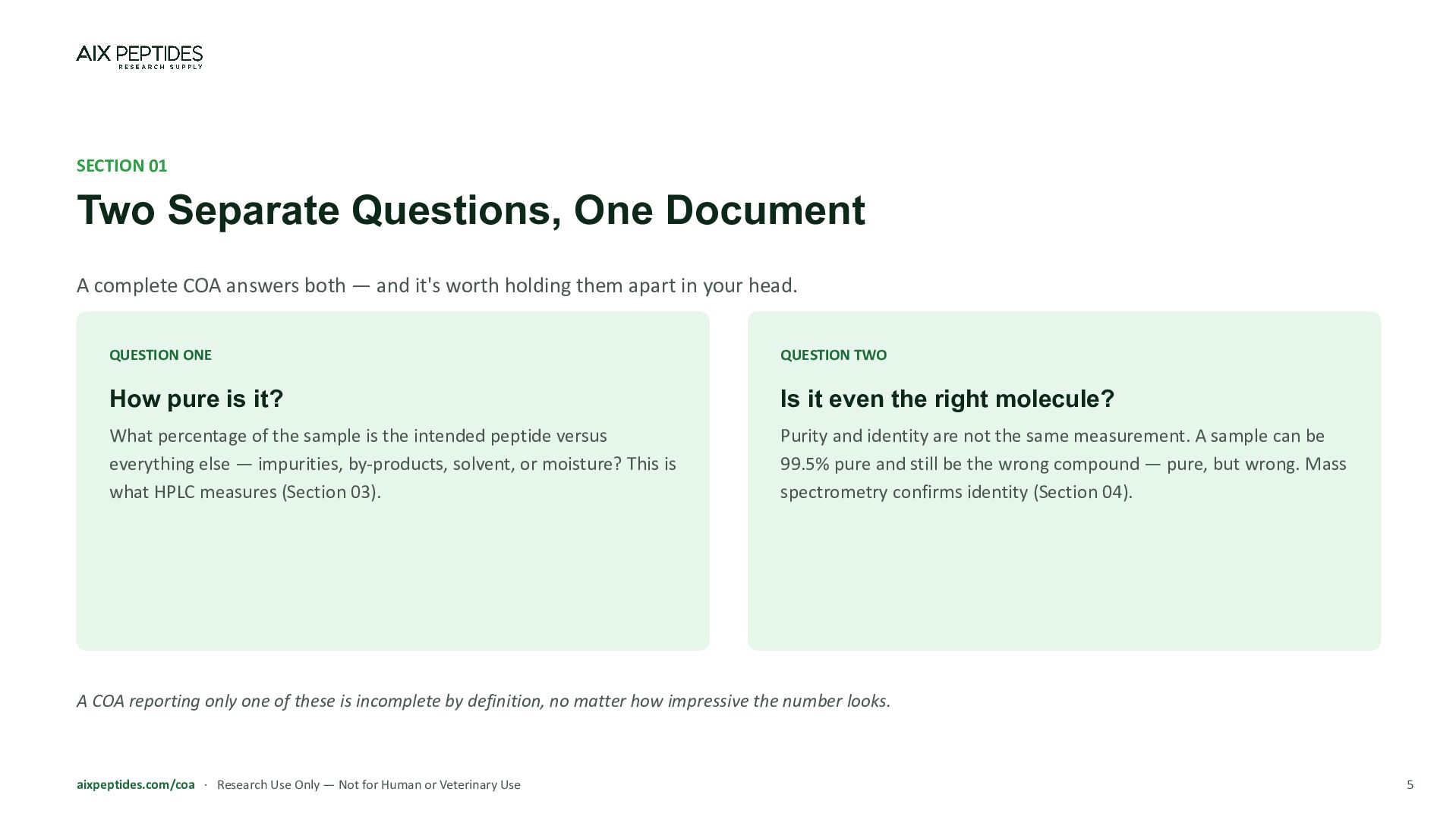
answers both — and it's worth holding them apart in your head. QUESTION ONE QUESTION TWO How pure is it? Is it even the right molecule? What percentage of the sample is the intended peptide versus everything else — impurities, by-products, solvent, or moisture? This is what HPLC measures (Section 03). Purity and identity are not the same measurement. A sample can be 99.5% pure and still be the wrong compound — pure, but wrong. Mass spectrometry confirms identity (Section 04). A COA reporting only one of these is incomplete by definition, no matter how impressive the number looks. aixpeptides.com/coa · Research Use Only — Not for Human or Veterinary Use 5
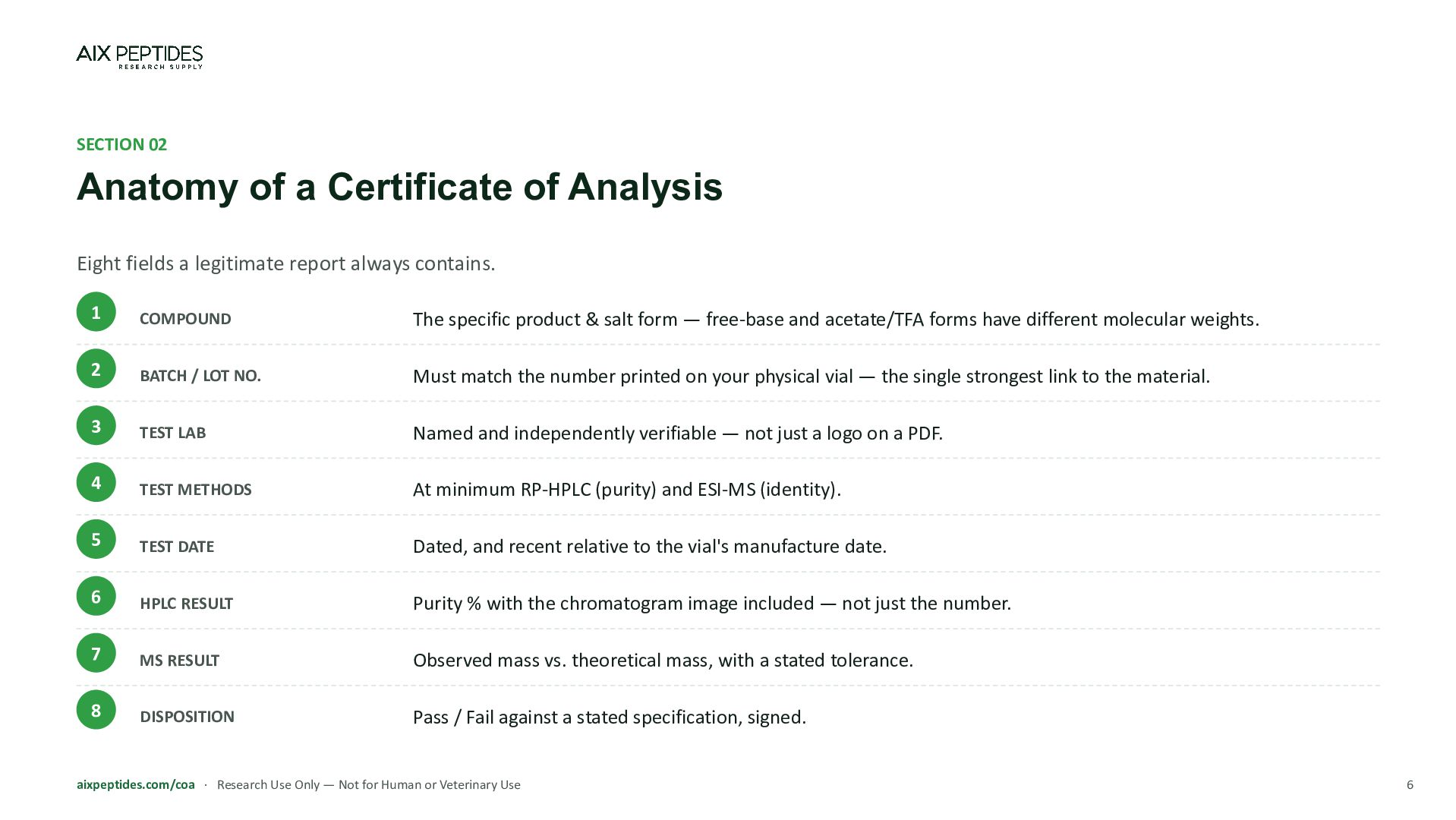
a legitimate report always contains. 1 COMPOUND The specific product & salt form — free-base and acetate/TFA forms have different molecular weights. 2 BATCH / LOT NO. Must match the number printed on your physical vial — the single strongest link to the material. 3 TEST LAB Named and independently verifiable — not just a logo on a PDF. 4 TEST METHODS At minimum RP-HPLC (purity) and ESI-MS (identity). 5 TEST DATE Dated, and recent relative to the vial's manufacture date. 6 HPLC RESULT Purity % with the chromatogram image included — not just the number. 7 MS RESULT Observed mass vs. theoretical mass, with a stated tolerance. 8 DISPOSITION Pass / Fail against a stated specification, signed. aixpeptides.com/coa · Research Use Only — Not for Human or Veterinary Use 6
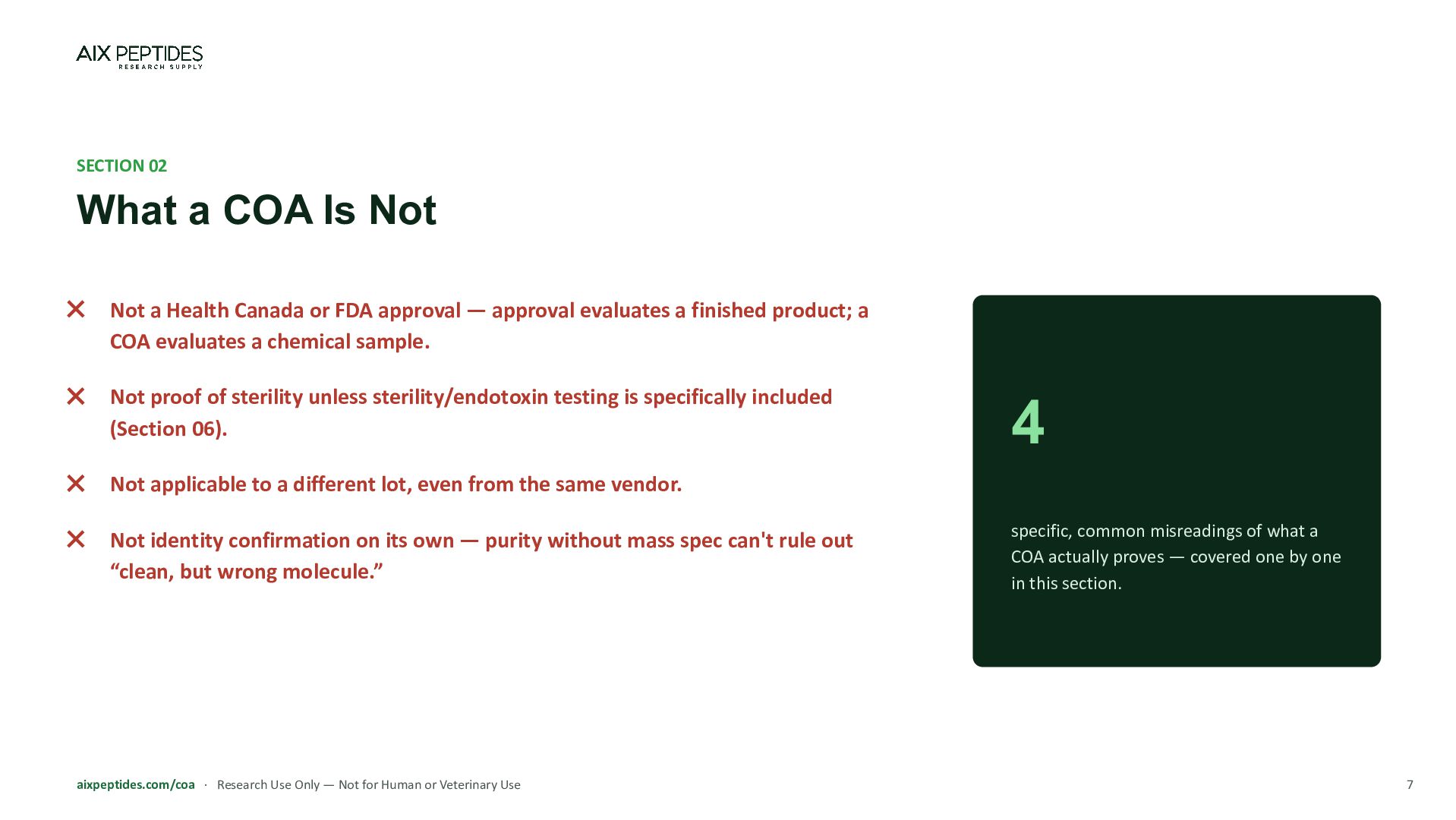
Health Canada or FDA approval — approval evaluates a finished product; a COA evaluates a chemical sample. ✕ Not proof of sterility unless sterility/endotoxin testing is specifically included (Section 06). 4 ✕ Not applicable to a different lot, even from the same vendor. ✕ Not identity confirmation on its own — purity without mass spec can't rule out “clean, but wrong molecule.” aixpeptides.com/coa · Research Use Only — Not for Human or Veterinary Use specific, common misreadings of what a COA actually proves — covered one by one in this section. 7
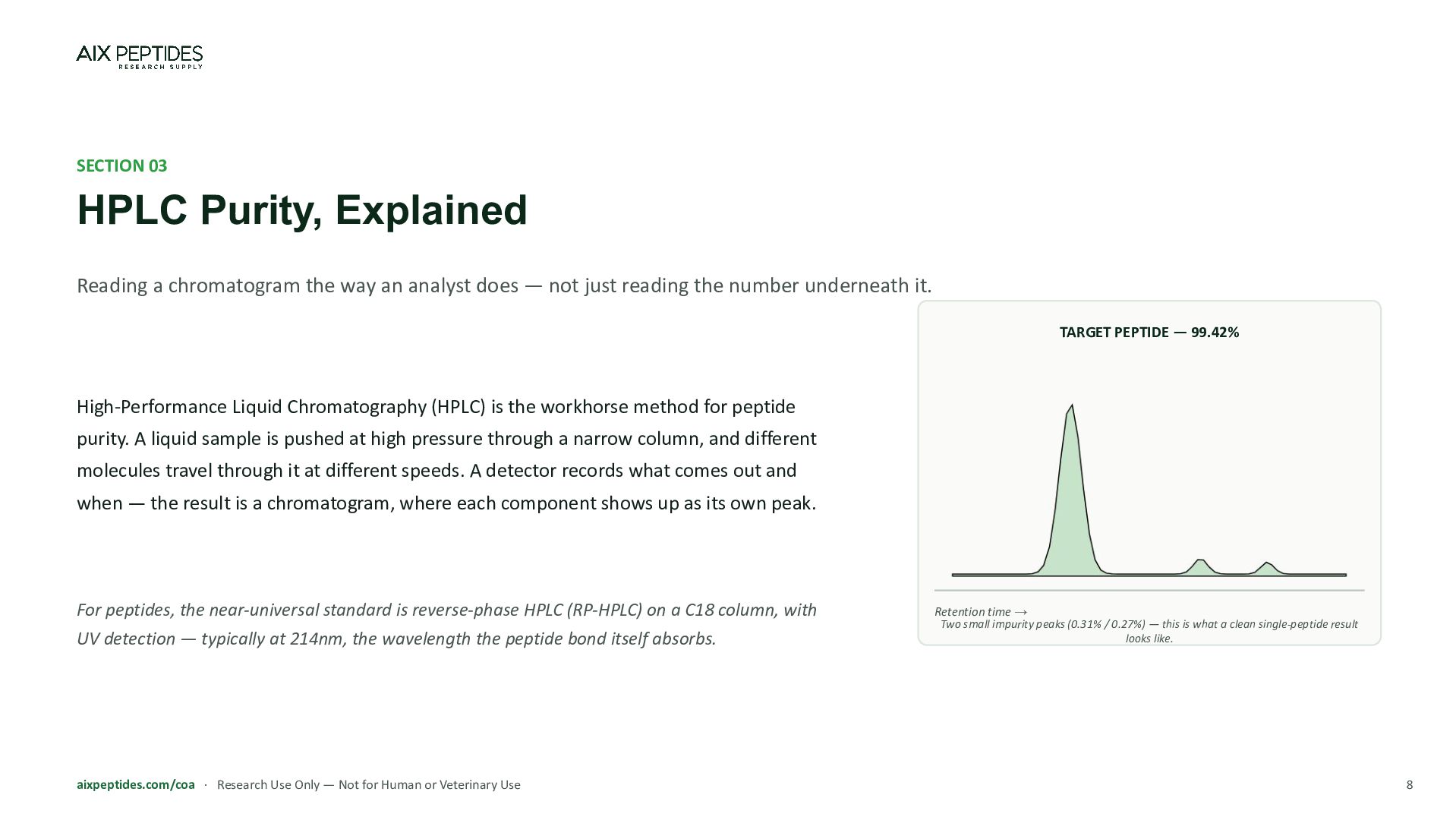
an analyst does — not just reading the number underneath it. TARGET PEPTIDE — 99.42% High-Performance Liquid Chromatography (HPLC) is the workhorse method for peptide purity. A liquid sample is pushed at high pressure through a narrow column, and different molecules travel through it at different speeds. A detector records what comes out and when — the result is a chromatogram, where each component shows up as its own peak. For peptides, the near-universal standard is reverse-phase HPLC (RP-HPLC) on a C18 column, with UV detection — typically at 214nm, the wavelength the peptide bond itself absorbs. aixpeptides.com/coa · Research Use Only — Not for Human or Veterinary Use Retention time → Two small impurity peaks (0.31% / 0.27%) — this is what a clean single-peptide result looks like. 8
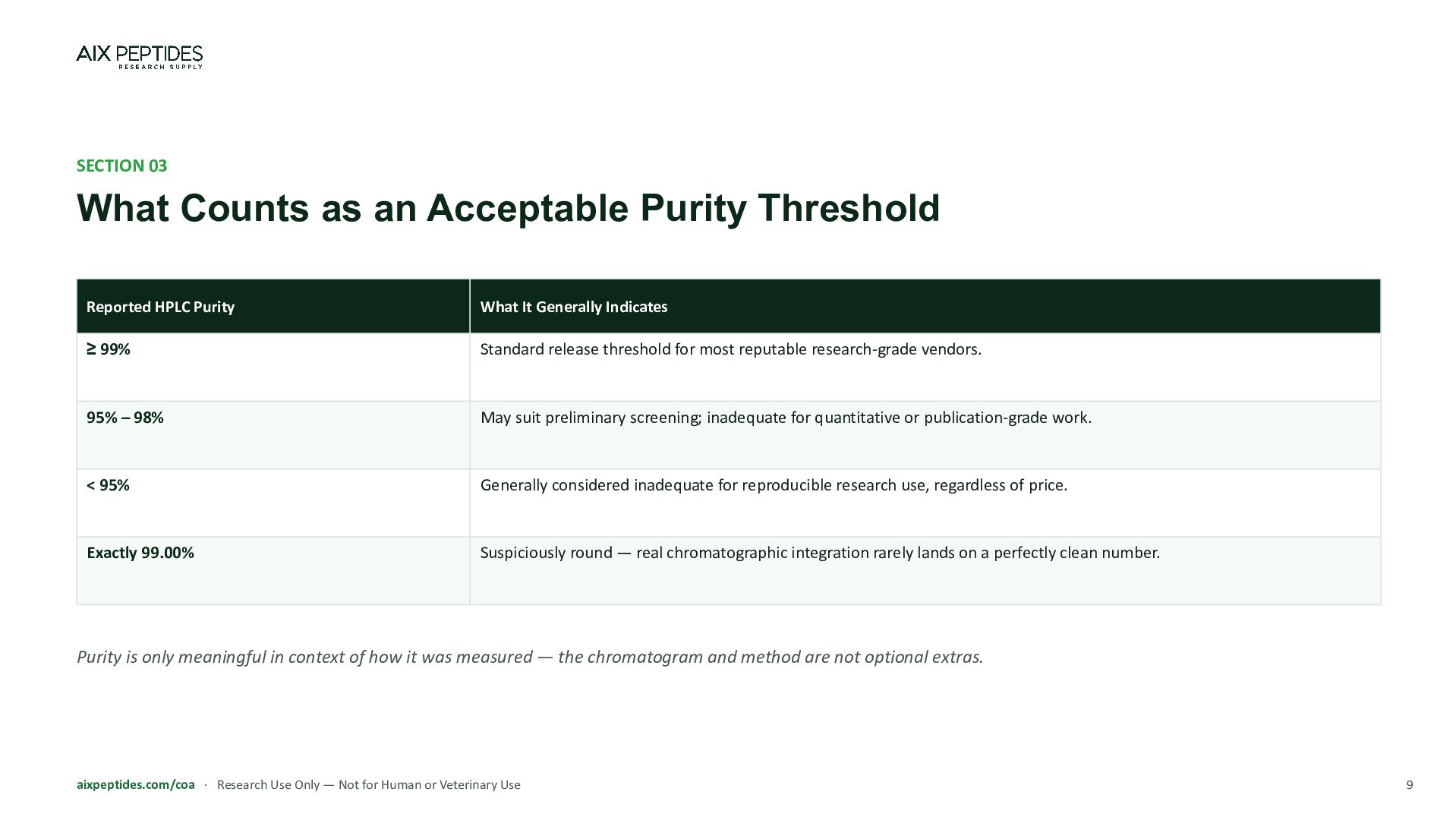
HPLC Purity What It Generally Indicates ≥ 99% Standard release threshold for most reputable research-grade vendors. 95% – 98% May suit preliminary screening; inadequate for quantitative or publication-grade work. < 95% Generally considered inadequate for reproducible research use, regardless of price. Exactly 99.00% Suspiciously round — real chromatographic integration rarely lands on a perfectly clean number. Purity is only meaningful in context of how it was measured — the chromatogram and method are not optional extras. aixpeptides.com/coa · Research Use Only — Not for Human or Veterinary Use 9
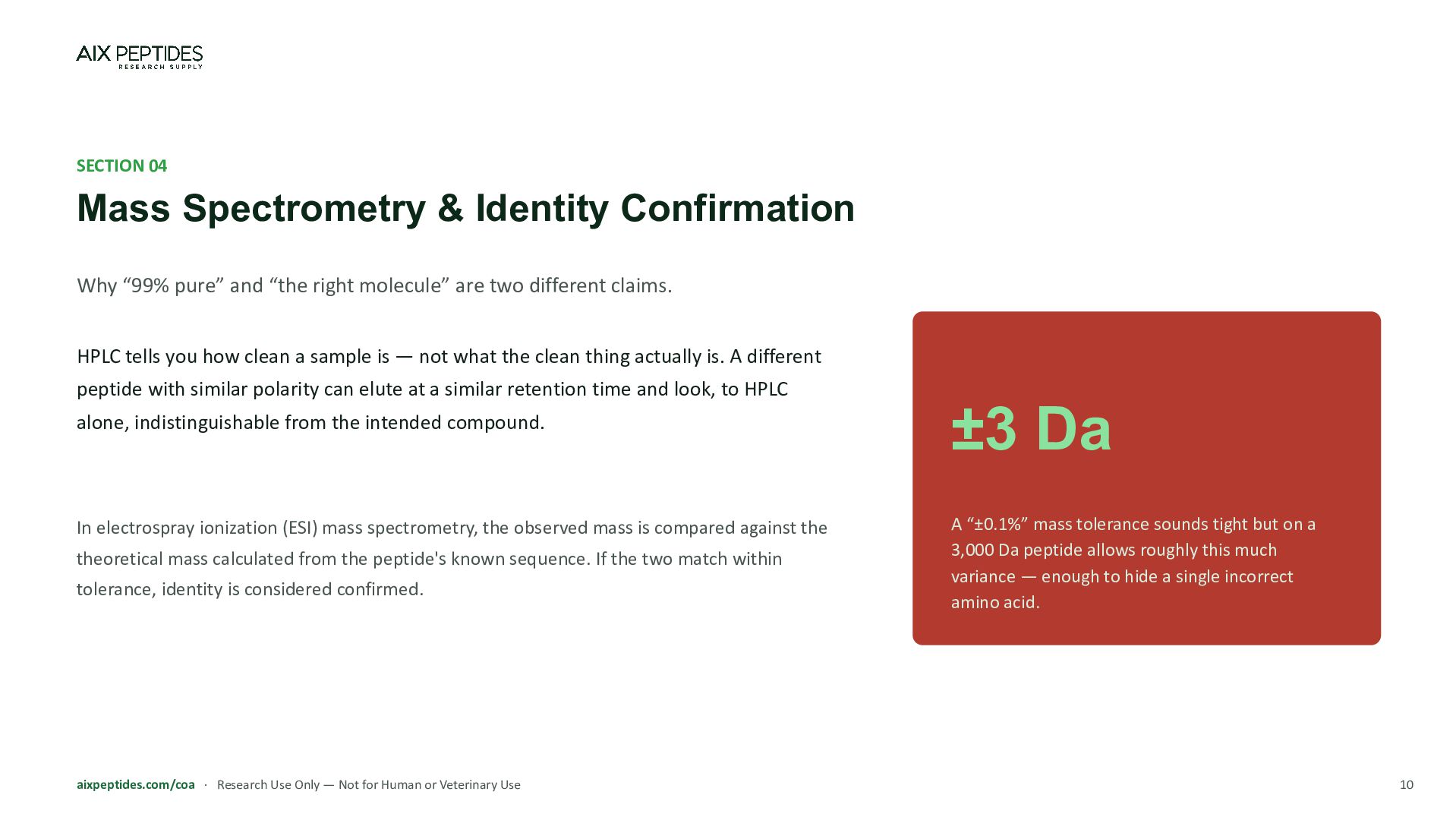
and “the right molecule” are two different claims. HPLC tells you how clean a sample is — not what the clean thing actually is. A different peptide with similar polarity can elute at a similar retention time and look, to HPLC alone, indistinguishable from the intended compound. ±3 Da In electrospray ionization (ESI) mass spectrometry, the observed mass is compared against the A “±0.1%” mass tolerance sounds tight but on a 3,000 Da peptide allows roughly this much variance — enough to hide a single incorrect amino acid. theoretical mass calculated from the peptide's known sequence. If the two match within tolerance, identity is considered confirmed. aixpeptides.com/coa · Research Use Only — Not for Human or Veterinary Use 10
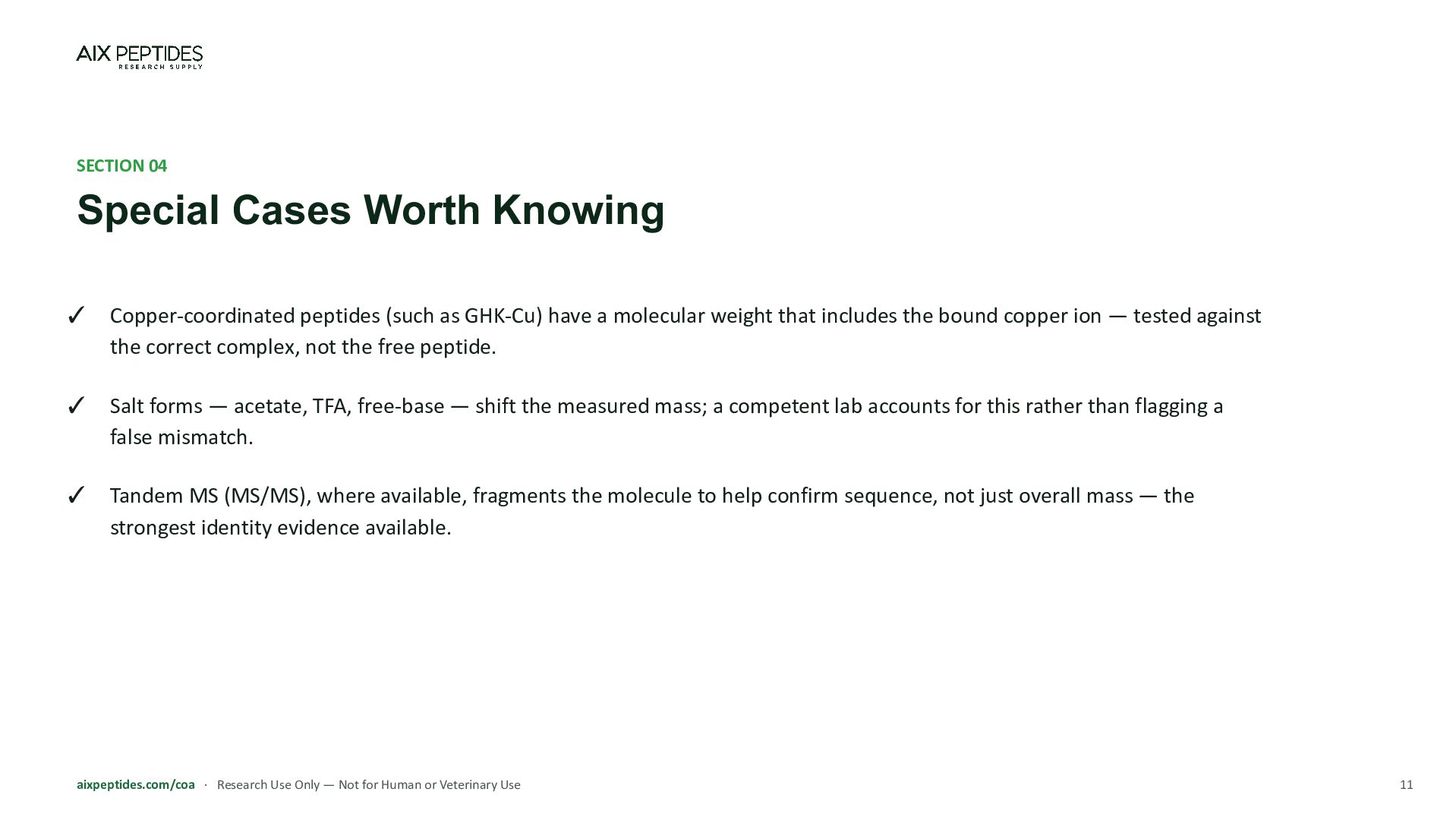
as GHK-Cu) have a molecular weight that includes the bound copper ion — tested against the correct complex, not the free peptide. ✓ Salt forms — acetate, TFA, free-base — shift the measured mass; a competent lab accounts for this rather than flagging a false mismatch. ✓ Tandem MS (MS/MS), where available, fragments the molecule to help confirm sequence, not just overall mass — the strongest identity evidence available. aixpeptides.com/coa · Research Use Only — Not for Human or Veterinary Use 11
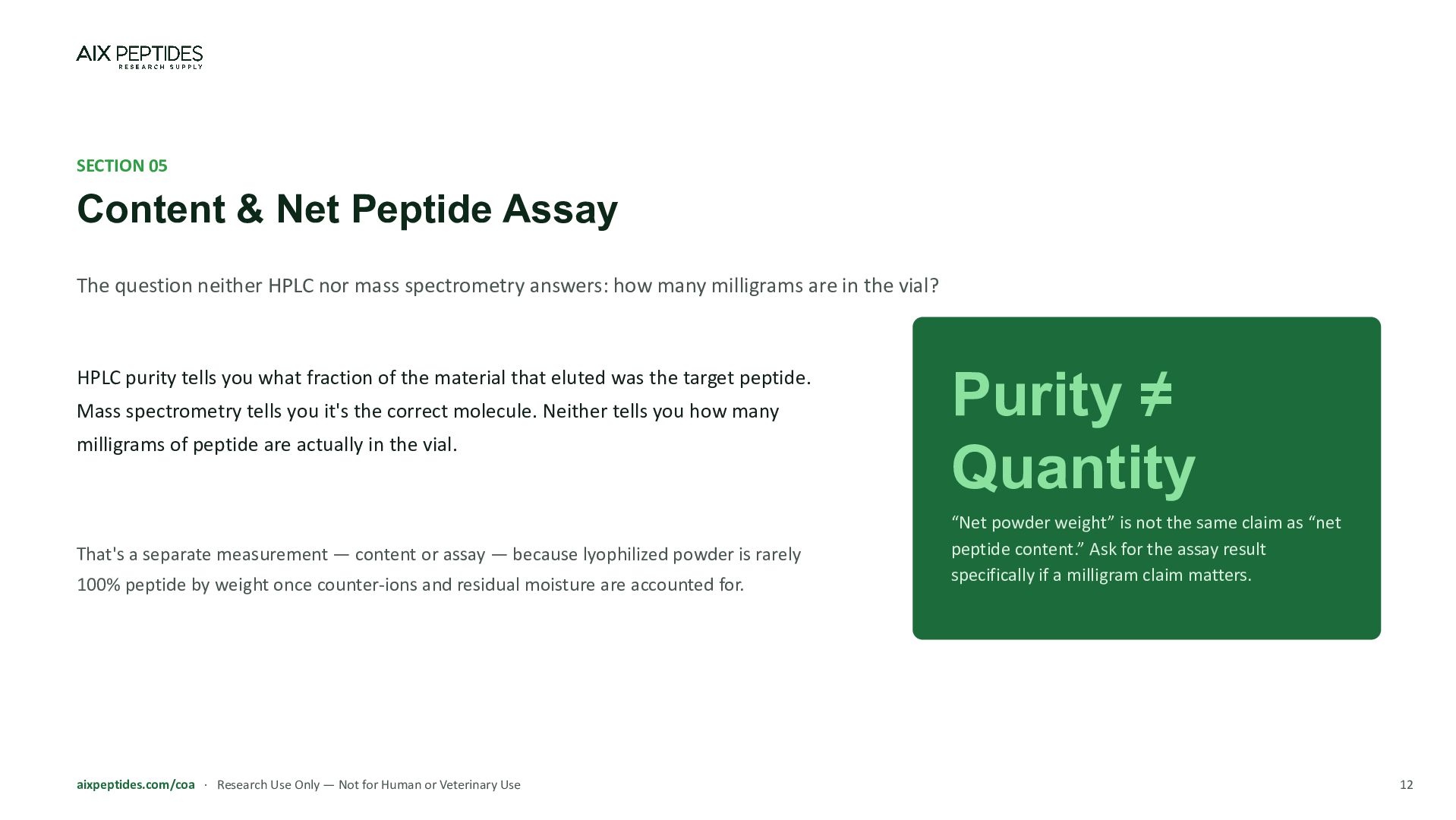
HPLC nor mass spectrometry answers: how many milligrams are in the vial? HPLC purity tells you what fraction of the material that eluted was the target peptide. Mass spectrometry tells you it's the correct molecule. Neither tells you how many milligrams of peptide are actually in the vial. That's a separate measurement — content or assay — because lyophilized powder is rarely 100% peptide by weight once counter-ions and residual moisture are accounted for. aixpeptides.com/coa · Research Use Only — Not for Human or Veterinary Use Purity ≠ Quantity “Net powder weight” is not the same claim as “net peptide content.” Ask for the assay result specifically if a milligram claim matters. 12
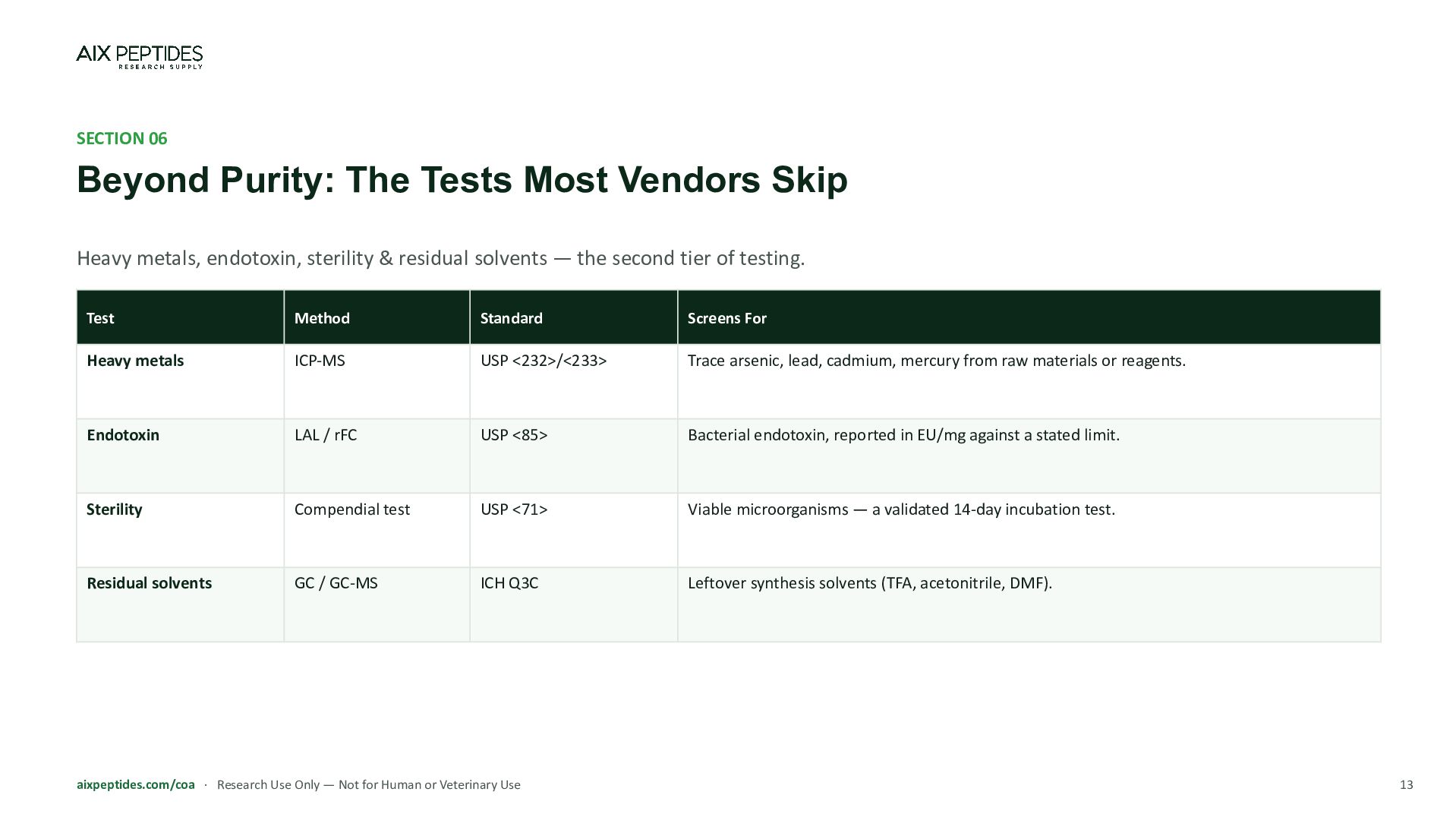
metals, endotoxin, sterility & residual solvents — the second tier of testing. Test Method Standard Screens For Heavy metals ICP-MS USP <232>/<233> Trace arsenic, lead, cadmium, mercury from raw materials or reagents. Endotoxin LAL / rFC USP <85> Bacterial endotoxin, reported in EU/mg against a stated limit. Sterility Compendial test USP <71> Viable microorganisms — a validated 14-day incubation test. Residual solvents GC / GC-MS ICH Q3C Leftover synthesis solvents (TFA, acetonitrile, DMF). aixpeptides.com/coa · Research Use Only — Not for Human or Veterinary Use 13
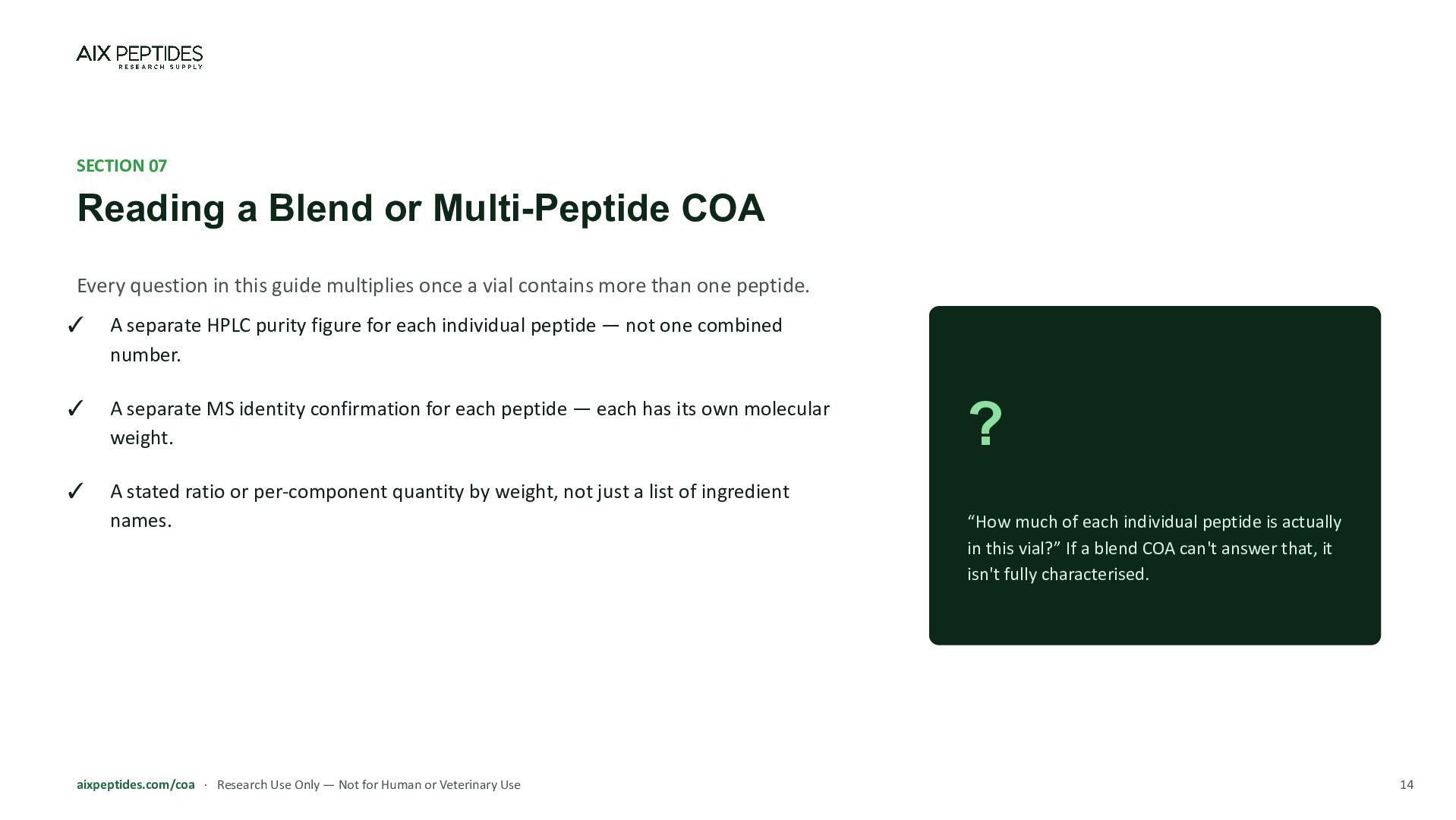
in this guide multiplies once a vial contains more than one peptide. ✓ A separate HPLC purity figure for each individual peptide — not one combined number. ✓ A separate MS identity confirmation for each peptide — each has its own molecular weight. ✓ A stated ratio or per-component quantity by weight, not just a list of ingredient names. aixpeptides.com/coa · Research Use Only — Not for Human or Veterinary Use ? “How much of each individual peptide is actually in this vial?” If a blend COA can't answer that, it isn't fully characterised. 14
to independently check a report, and the specific signs that separate a legitimate supplier from a scam. aixpeptides.com/coa · Research Use Only — Not for Human or Veterinary Use 15
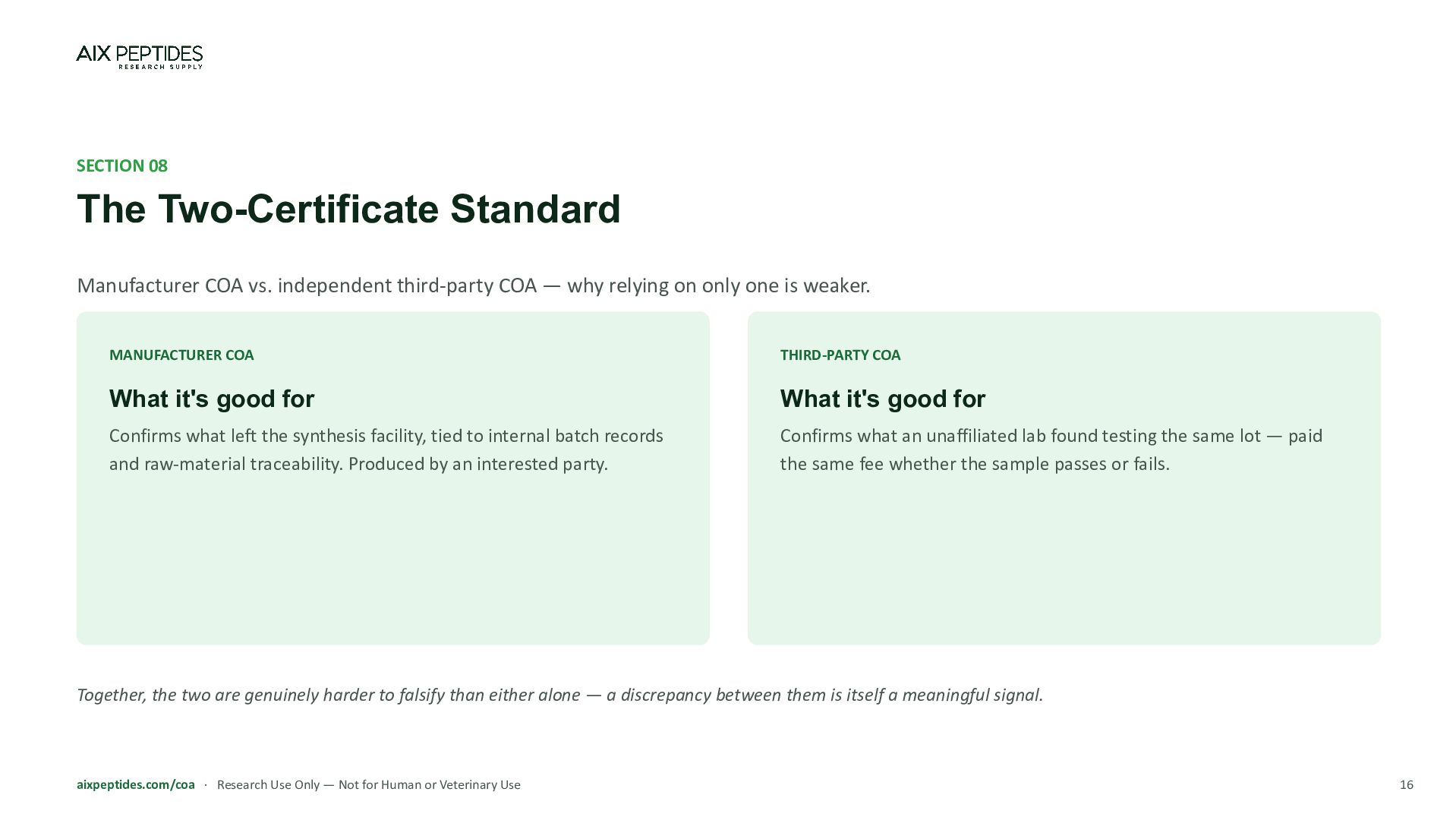
COA — why relying on only one is weaker. MANUFACTURER COA THIRD-PARTY COA What it's good for What it's good for Confirms what left the synthesis facility, tied to internal batch records and raw-material traceability. Produced by an interested party. Confirms what an unaffiliated lab found testing the same lot — paid the same fee whether the sample passes or fails. Together, the two are genuinely harder to falsify than either alone — a discrepancy between them is itself a meaningful signal. aixpeptides.com/coa · Research Use Only — Not for Human or Veterinary Use 16
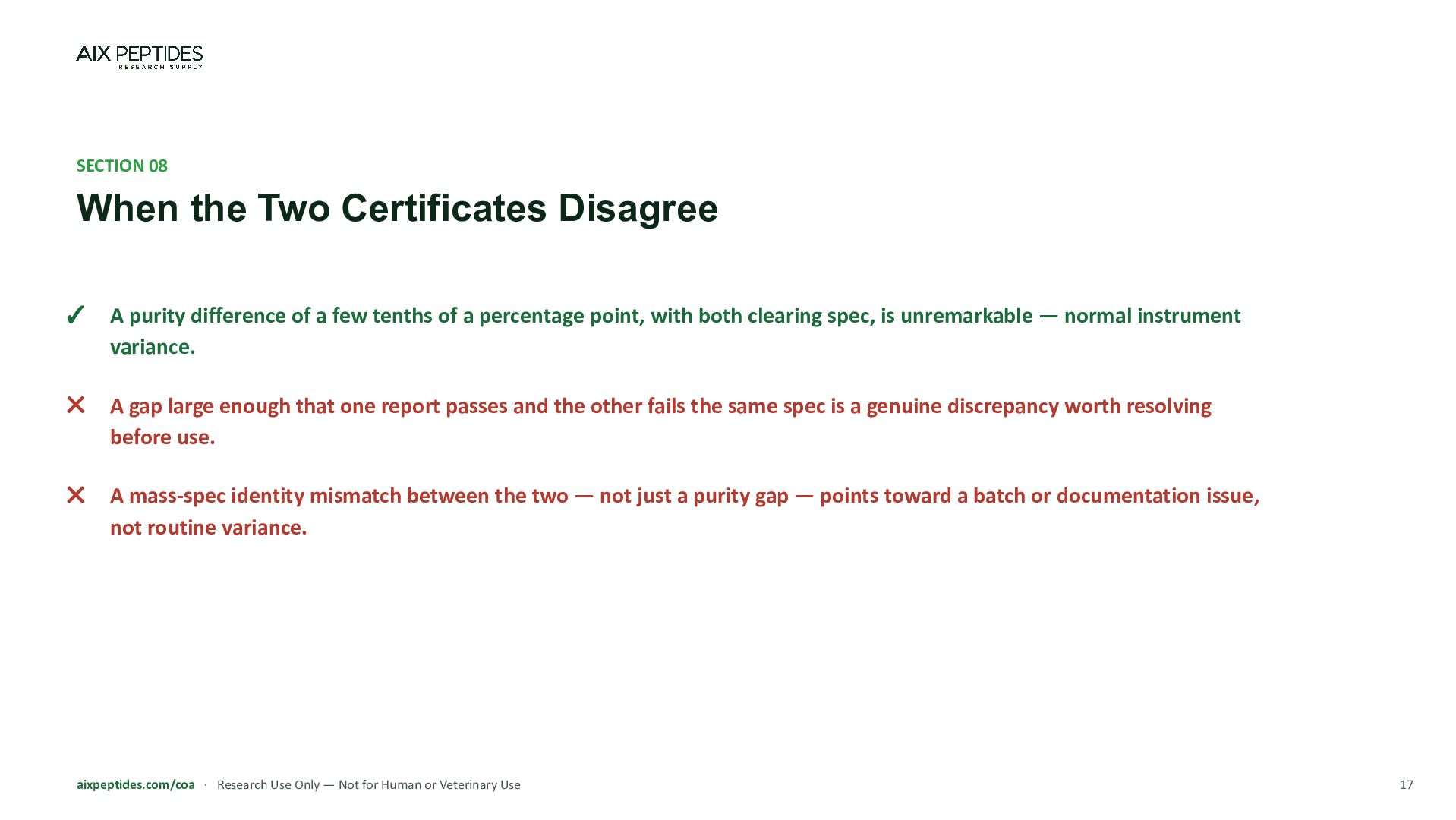
difference of a few tenths of a percentage point, with both clearing spec, is unremarkable — normal instrument variance. ✕ A gap large enough that one report passes and the other fails the same spec is a genuine discrepancy worth resolving before use. ✕ A mass-spec identity mismatch between the two — not just a purity gap — points toward a batch or documentation issue, not routine variance. aixpeptides.com/coa · Research Use Only — Not for Human or Veterinary Use 17
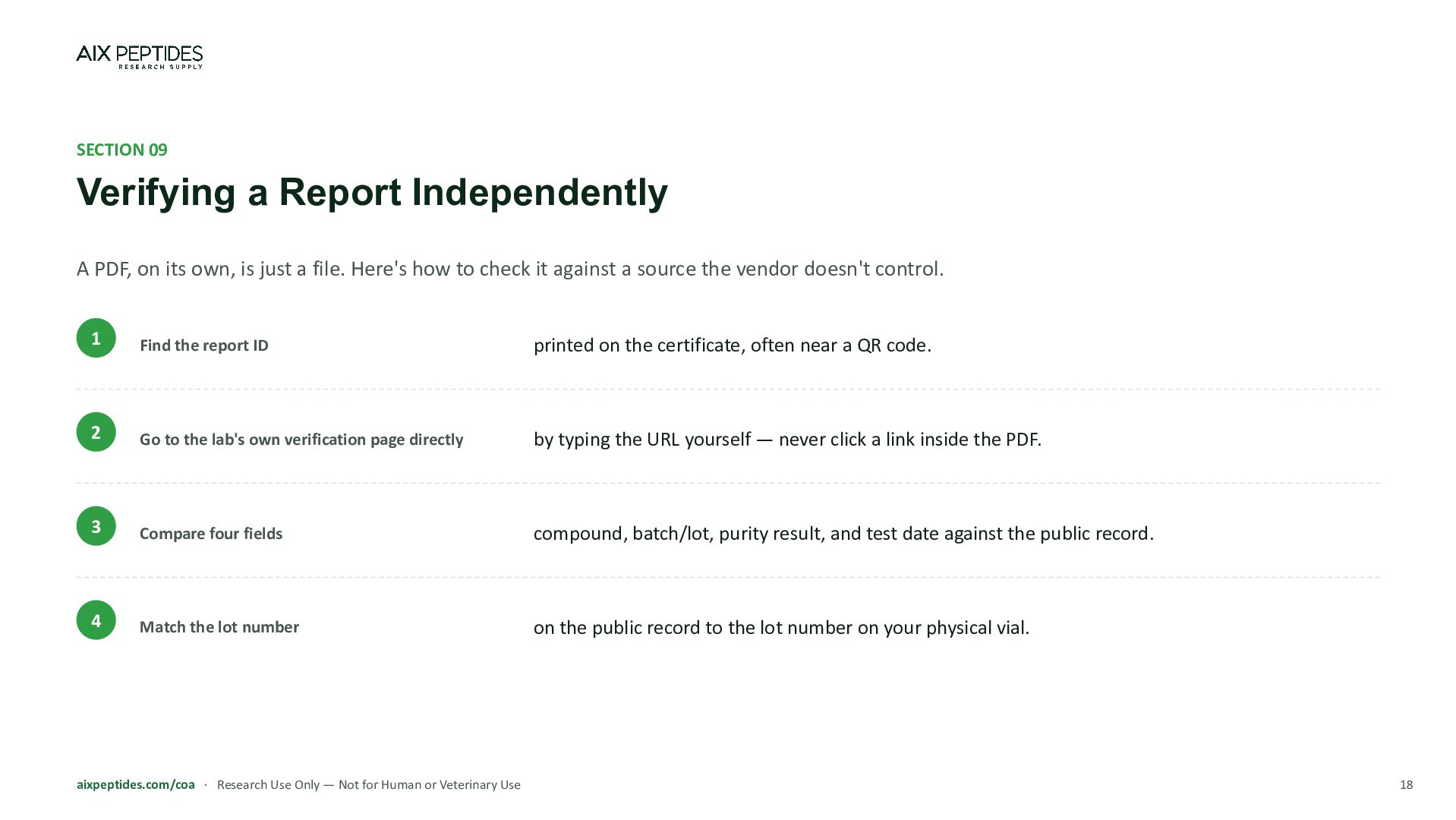
own, is just a file. Here's how to check it against a source the vendor doesn't control. 1 Find the report ID printed on the certificate, often near a QR code. 2 Go to the lab's own verification page directly by typing the URL yourself — never click a link inside the PDF. 3 Compare four fields compound, batch/lot, purity result, and test date against the public record. 4 Match the lot number on the public record to the lot number on your physical vial. aixpeptides.com/coa · Research Use Only — Not for Human or Veterinary Use 18
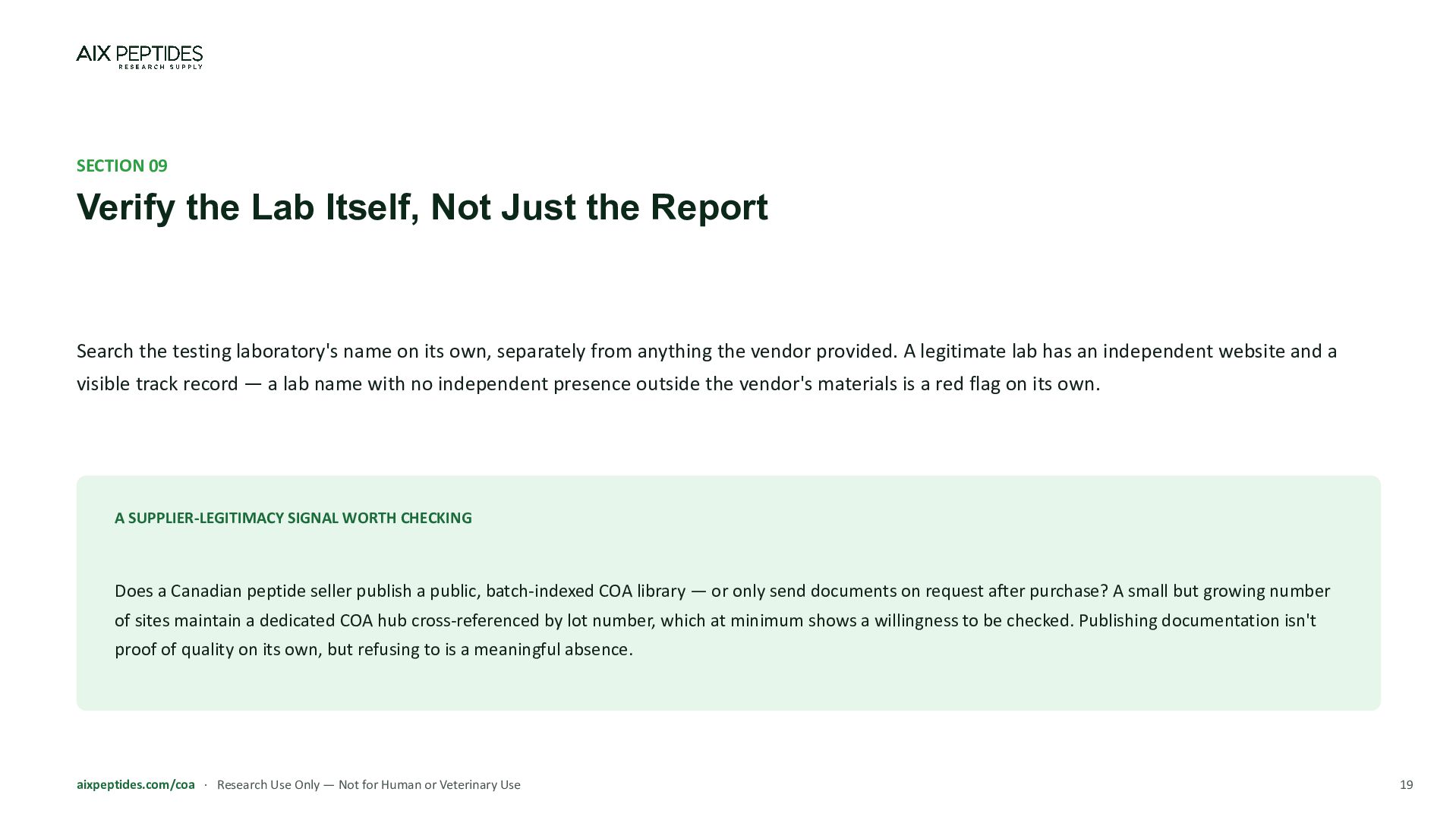
Search the testing laboratory's name on its own, separately from anything the vendor provided. A legitimate lab has an independent website and a visible track record — a lab name with no independent presence outside the vendor's materials is a red flag on its own. A SUPPLIER-LEGITIMACY SIGNAL WORTH CHECKING Does a Canadian peptide seller publish a public, batch-indexed COA library — or only send documents on request after purchase? A small but growing number of sites maintain a dedicated COA hub cross-referenced by lot number, which at minimum shows a willingness to be checked. Publishing documentation isn't proof of quality on its own, but refusing to is a meaningful absence. aixpeptides.com/coa · Research Use Only — Not for Human or Veterinary Use 19
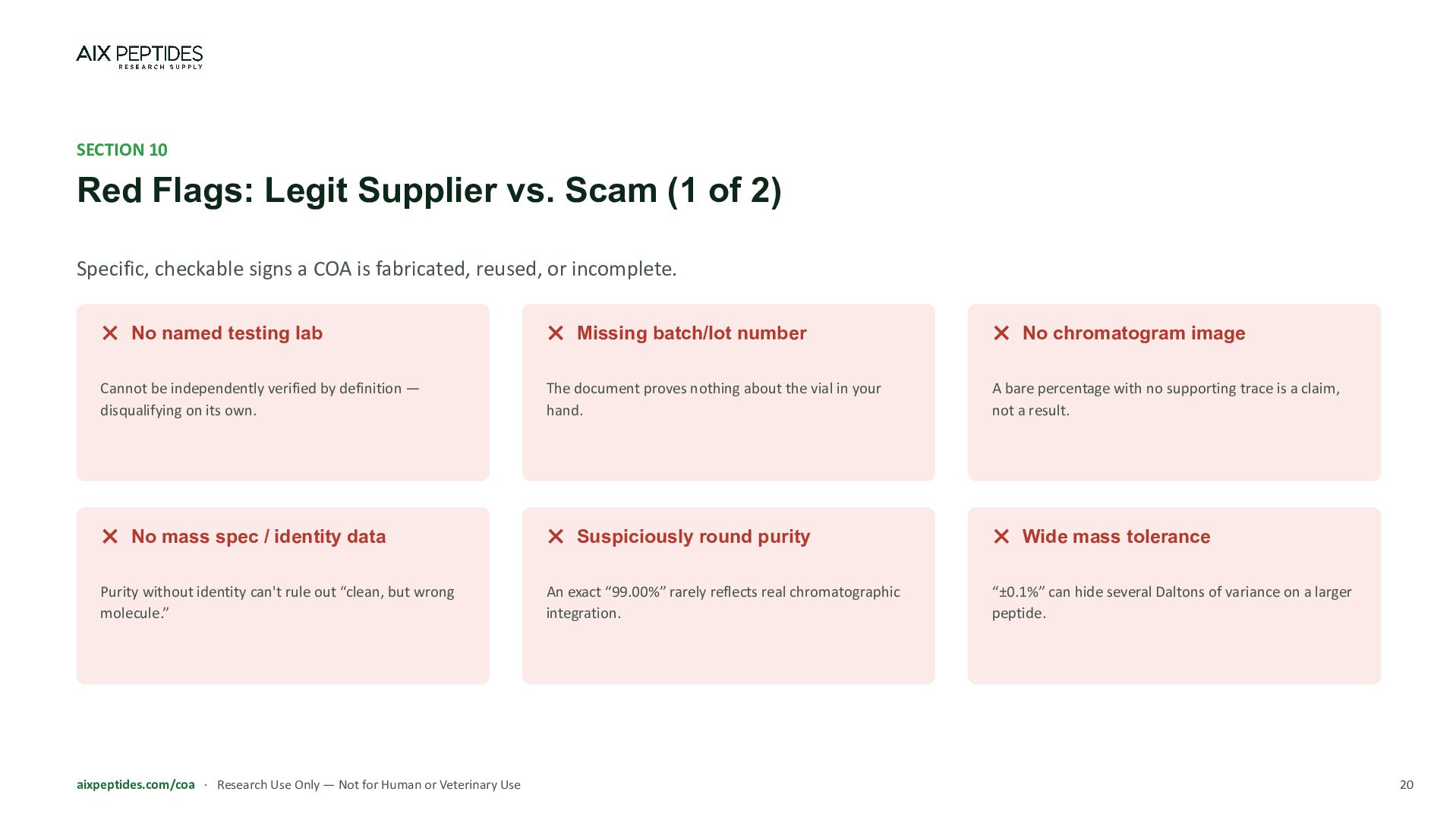
2) Specific, checkable signs a COA is fabricated, reused, or incomplete. ✕ No named testing lab ✕ Missing batch/lot number ✕ No chromatogram image Cannot be independently verified by definition — disqualifying on its own. The document proves nothing about the vial in your hand. A bare percentage with no supporting trace is a claim, not a result. ✕ No mass spec / identity data ✕ Suspiciously round purity ✕ Wide mass tolerance Purity without identity can't rule out “clean, but wrong molecule.” An exact “99.00%” rarely reflects real chromatographic integration. “±0.1%” can hide several Daltons of variance on a larger peptide. aixpeptides.com/coa · Research Use Only — Not for Human or Veterinary Use 20
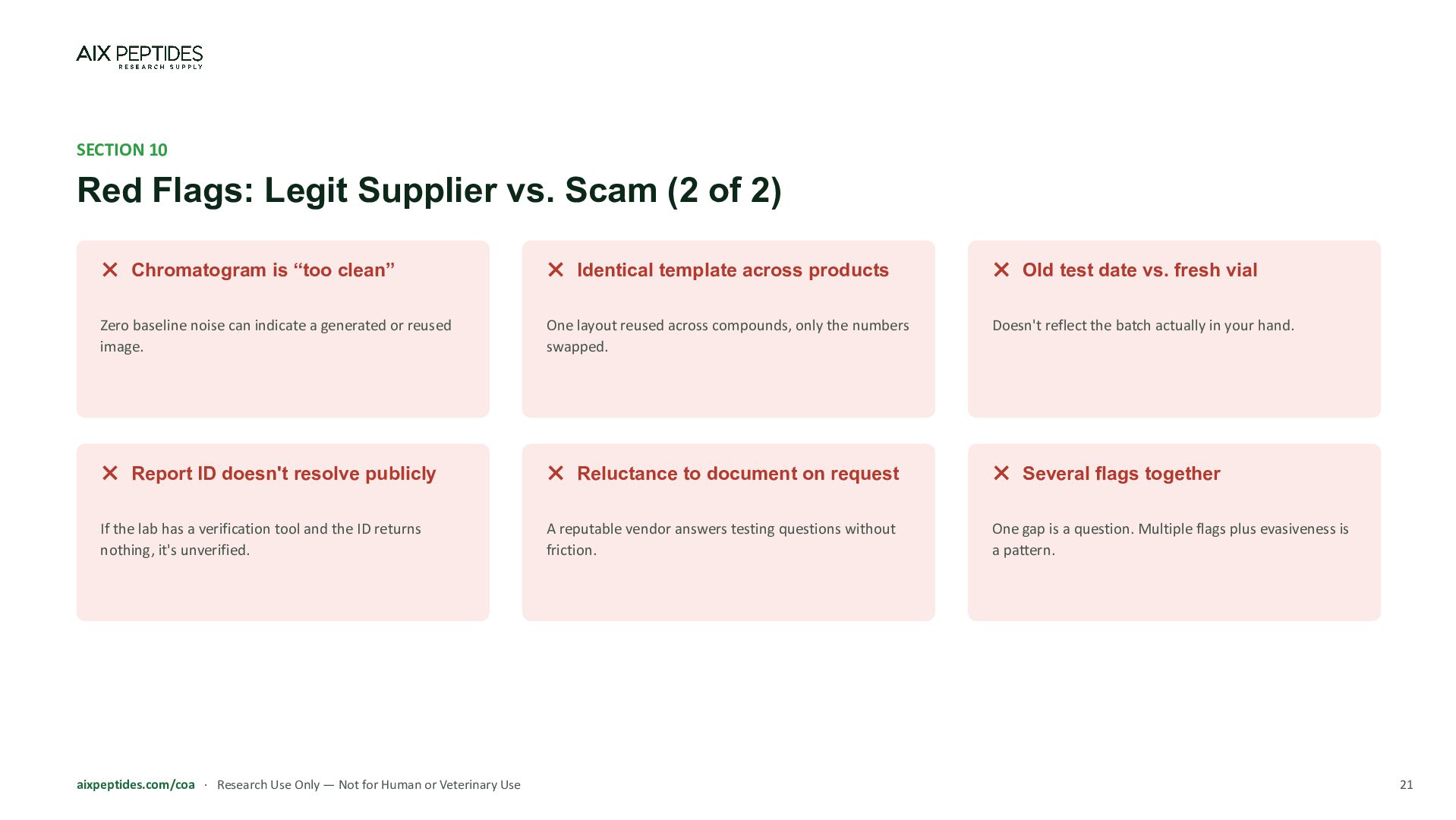
2) ✕ Chromatogram is “too clean” ✕ Identical template across products ✕ Old test date vs. fresh vial Zero baseline noise can indicate a generated or reused image. One layout reused across compounds, only the numbers swapped. Doesn't reflect the batch actually in your hand. ✕ Report ID doesn't resolve publicly ✕ Reluctance to document on request ✕ Several flags together If the lab has a verification tool and the ID returns nothing, it's unverified. A reputable vendor answers testing questions without friction. One gap is a question. Multiple flags plus evasiveness is a pattern. aixpeptides.com/coa · Research Use Only — Not for Human or Veterinary Use 21
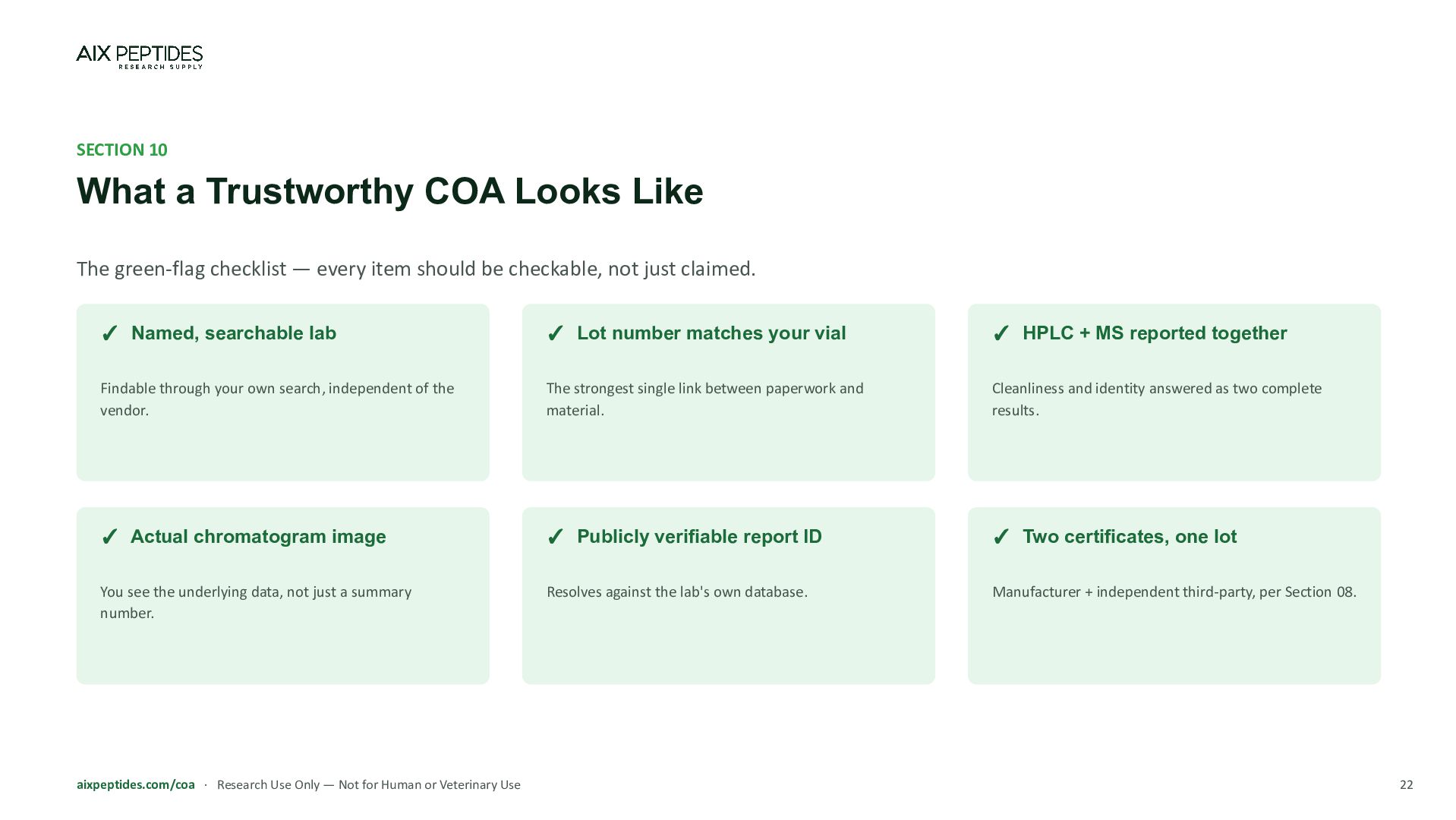
checklist — every item should be checkable, not just claimed. ✓ Named, searchable lab ✓ Lot number matches your vial ✓ HPLC + MS reported together Findable through your own search, independent of the vendor. The strongest single link between paperwork and material. Cleanliness and identity answered as two complete results. ✓ Actual chromatogram image ✓ Publicly verifiable report ID ✓ Two certificates, one lot You see the underlying data, not just a summary number. Resolves against the lab's own database. Manufacturer + independent third-party, per Section 08. aixpeptides.com/coa · Research Use Only — Not for Human or Veterinary Use 22
the regulatory backdrop, a glossary, and a printable verification checklist. aixpeptides.com/coa · Research Use Only — Not for Human or Veterinary Use 23
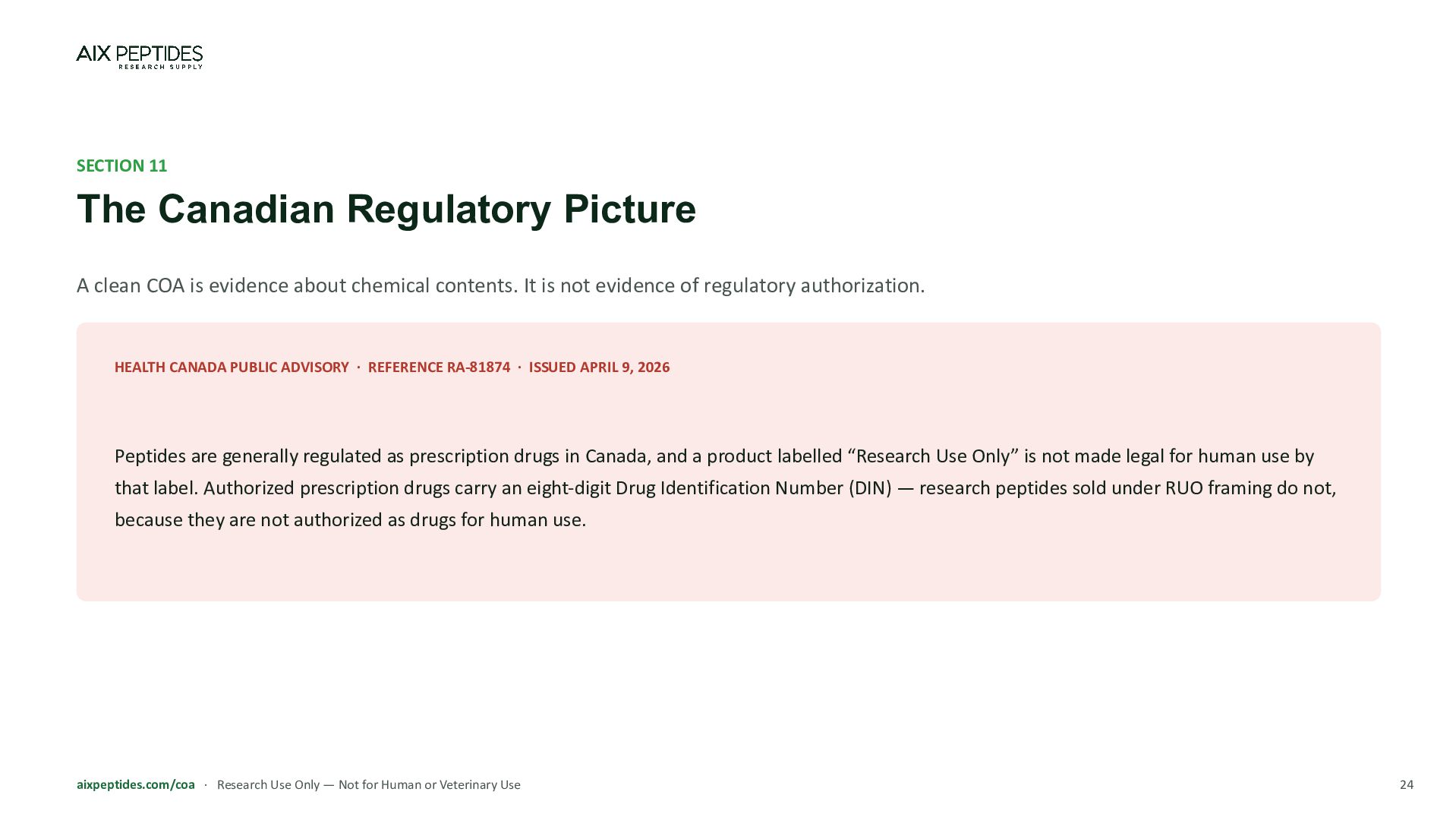
evidence about chemical contents. It is not evidence of regulatory authorization. HEALTH CANADA PUBLIC ADVISORY · REFERENCE RA-81874 · ISSUED APRIL 9, 2026 Peptides are generally regulated as prescription drugs in Canada, and a product labelled “Research Use Only” is not made legal for human use by that label. Authorized prescription drugs carry an eight-digit Drug Identification Number (DIN) — research peptides sold under RUO framing do not, because they are not authorized as drugs for human use. aixpeptides.com/coa · Research Use Only — Not for Human or Veterinary Use 24
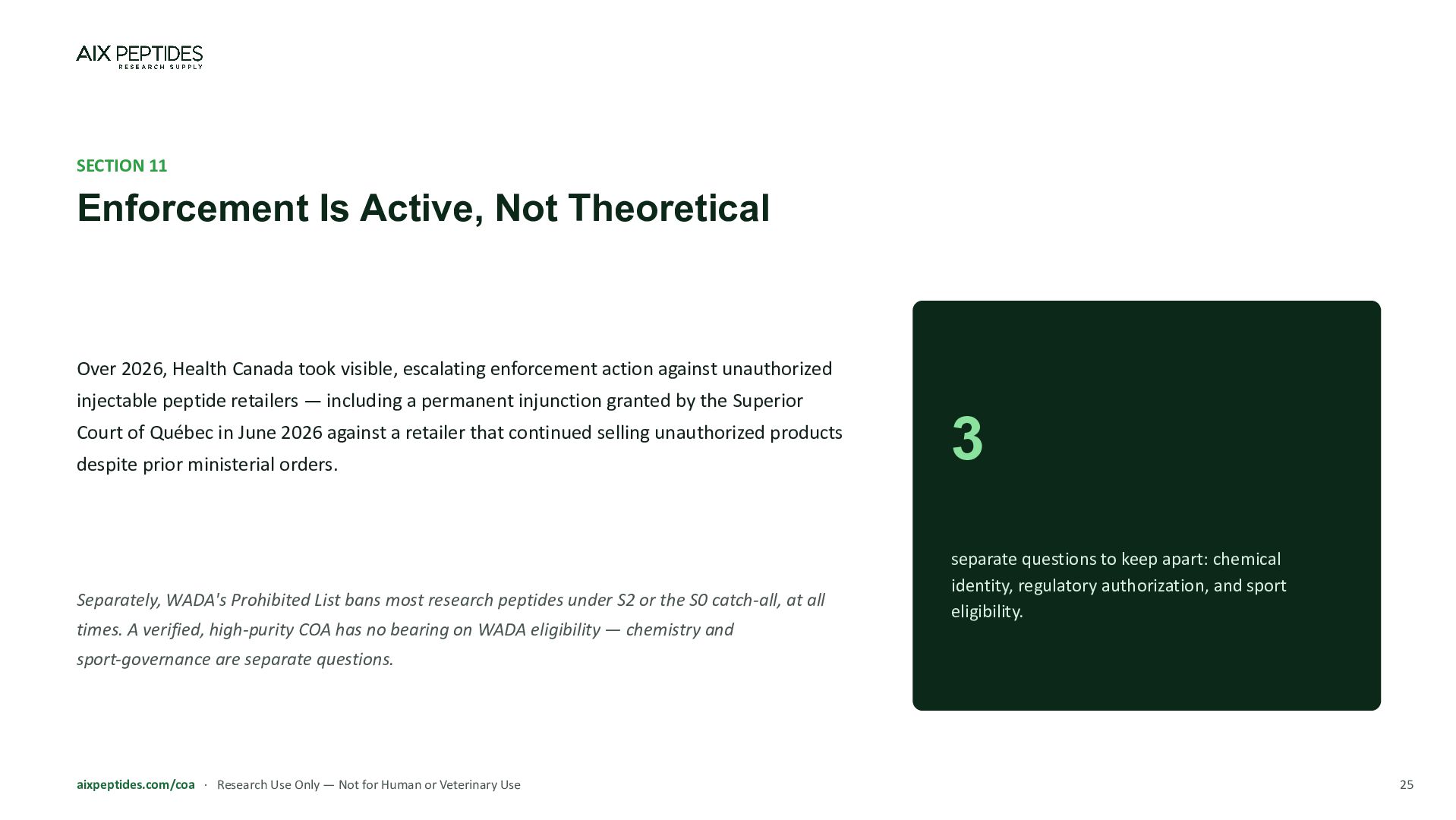
Canada took visible, escalating enforcement action against unauthorized injectable peptide retailers — including a permanent injunction granted by the Superior Court of Québec in June 2026 against a retailer that continued selling unauthorized products despite prior ministerial orders. Separately, WADA's Prohibited List bans most research peptides under S2 or the S0 catch-all, at all times. A verified, high-purity COA has no bearing on WADA eligibility — chemistry and 3 separate questions to keep apart: chemical identity, regulatory authorization, and sport eligibility. sport-governance are separate questions. aixpeptides.com/coa · Research Use Only — Not for Human or Veterinary Use 25
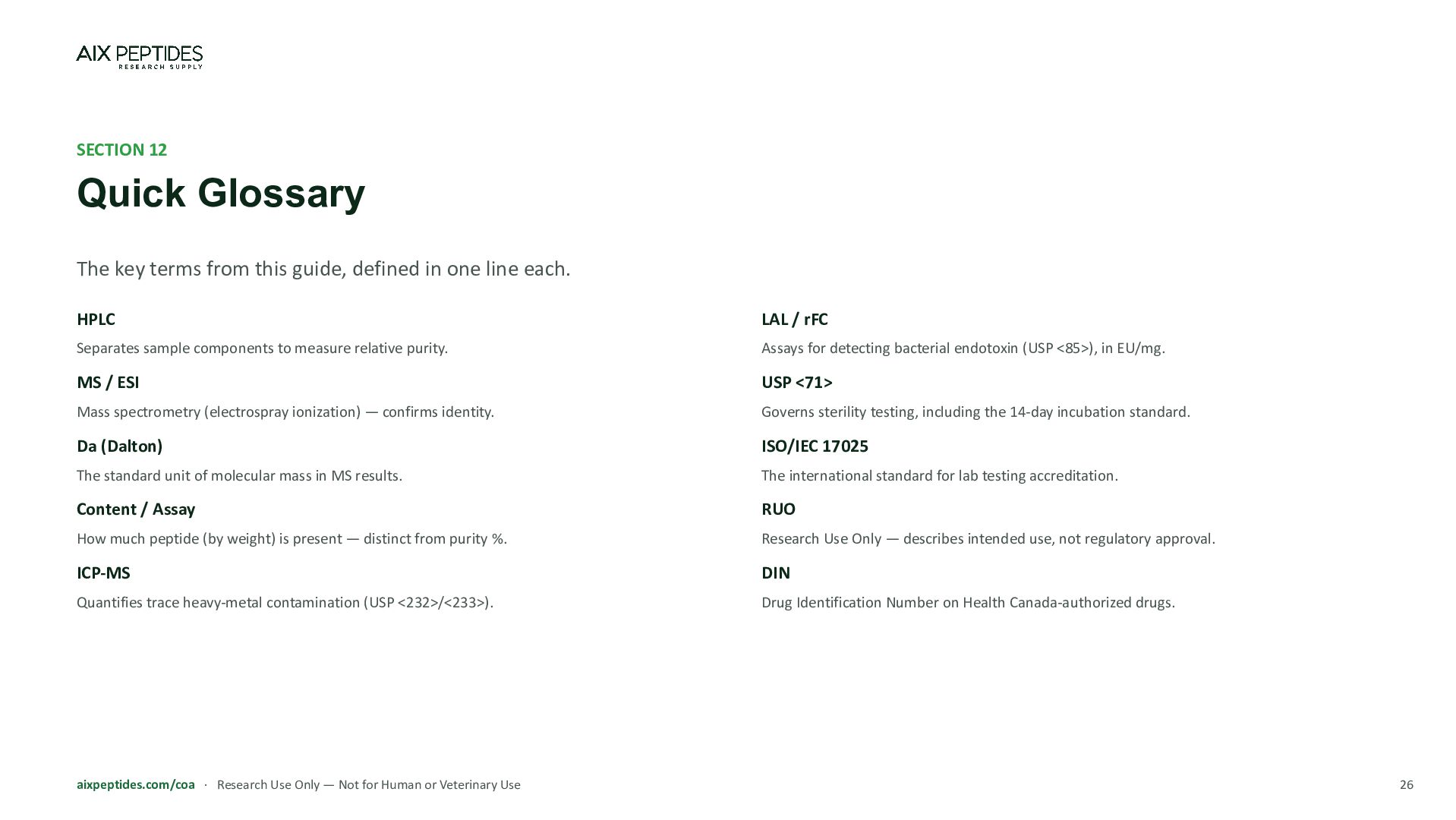
defined in one line each. HPLC LAL / rFC Separates sample components to measure relative purity. Assays for detecting bacterial endotoxin (USP <85>), in EU/mg. MS / ESI USP <71> Mass spectrometry (electrospray ionization) — confirms identity. Governs sterility testing, including the 14-day incubation standard. Da (Dalton) ISO/IEC 17025 The standard unit of molecular mass in MS results. The international standard for lab testing accreditation. Content / Assay RUO How much peptide (by weight) is present — distinct from purity %. Research Use Only — describes intended use, not regulatory approval. ICP-MS DIN Quantifies trace heavy-metal contamination (USP <232>/<233>). Drug Identification Number on Health Canada-authorized drugs. aixpeptides.com/coa · Research Use Only — Not for Human or Veterinary Use 26
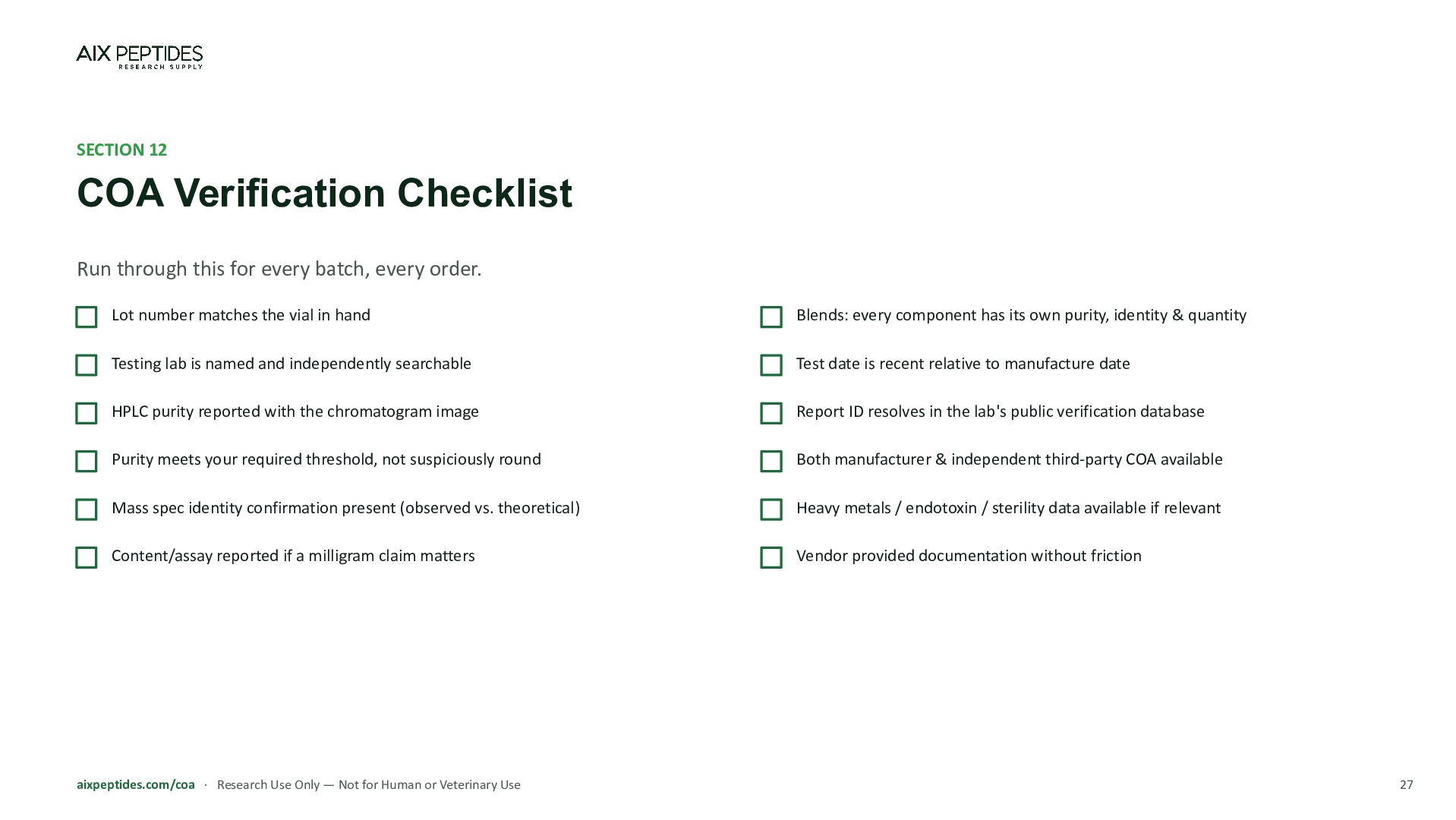
batch, every order. Lot number matches the vial in hand Blends: every component has its own purity, identity & quantity Testing lab is named and independently searchable Test date is recent relative to manufacture date HPLC purity reported with the chromatogram image Report ID resolves in the lab's public verification database Purity meets your required threshold, not suspiciously round Both manufacturer & independent third-party COA available Mass spec identity confirmation present (observed vs. theoretical) Heavy metals / endotoxin / sterility data available if relevant Content/assay reported if a milligram claim matters Vendor provided documentation without friction aixpeptides.com/coa · Research Use Only — Not for Human or Veterinary Use 27
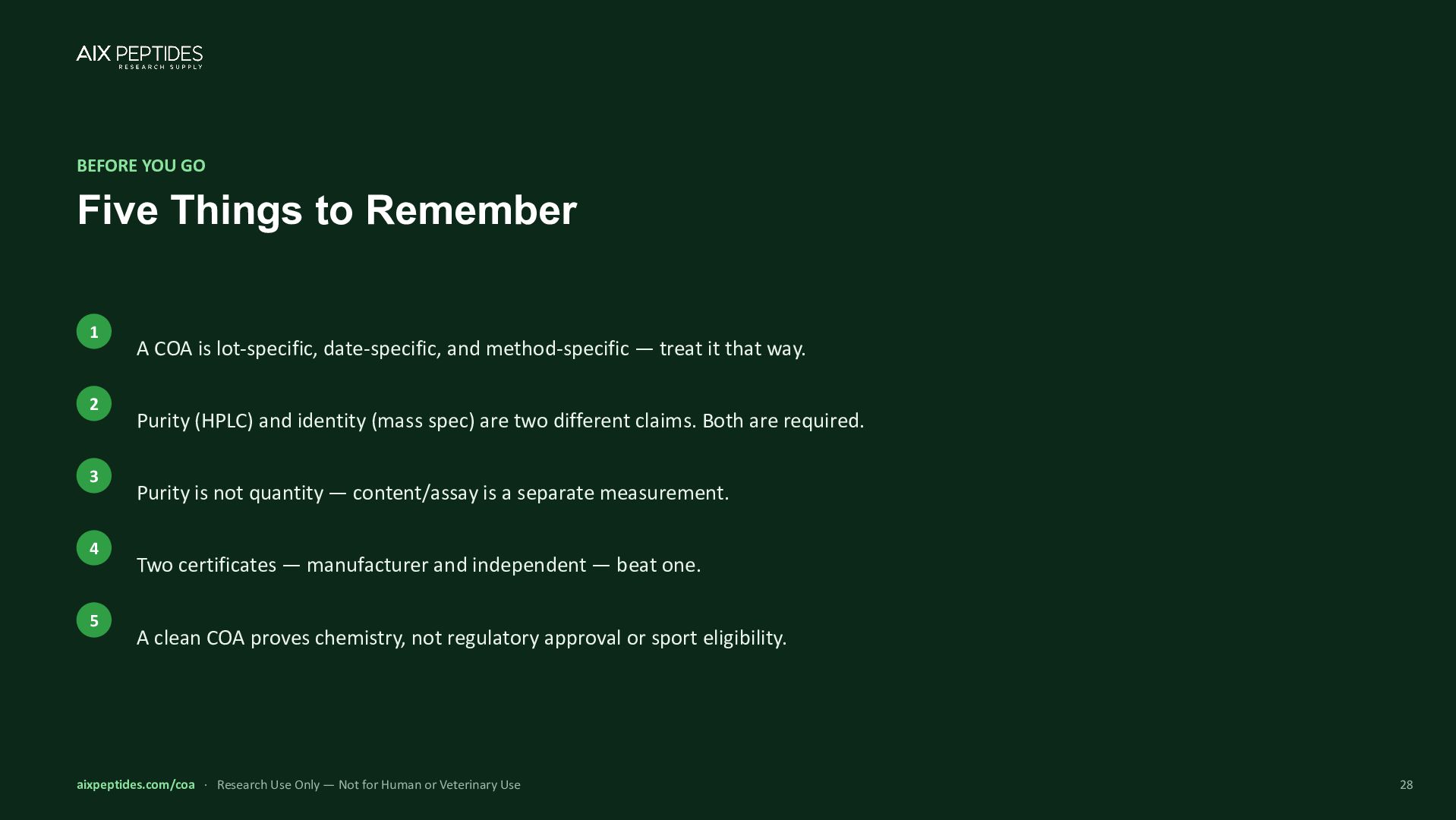
4 5 A COA is lot-specific, date-specific, and method-specific — treat it that way. Purity (HPLC) and identity (mass spec) are two different claims. Both are required. Purity is not quantity — content/assay is a separate measurement. Two certificates — manufacturer and independent — beat one. A clean COA proves chemistry, not regulatory approval or sport eligibility. aixpeptides.com/coa · Research Use Only — Not for Human or Veterinary Use 28
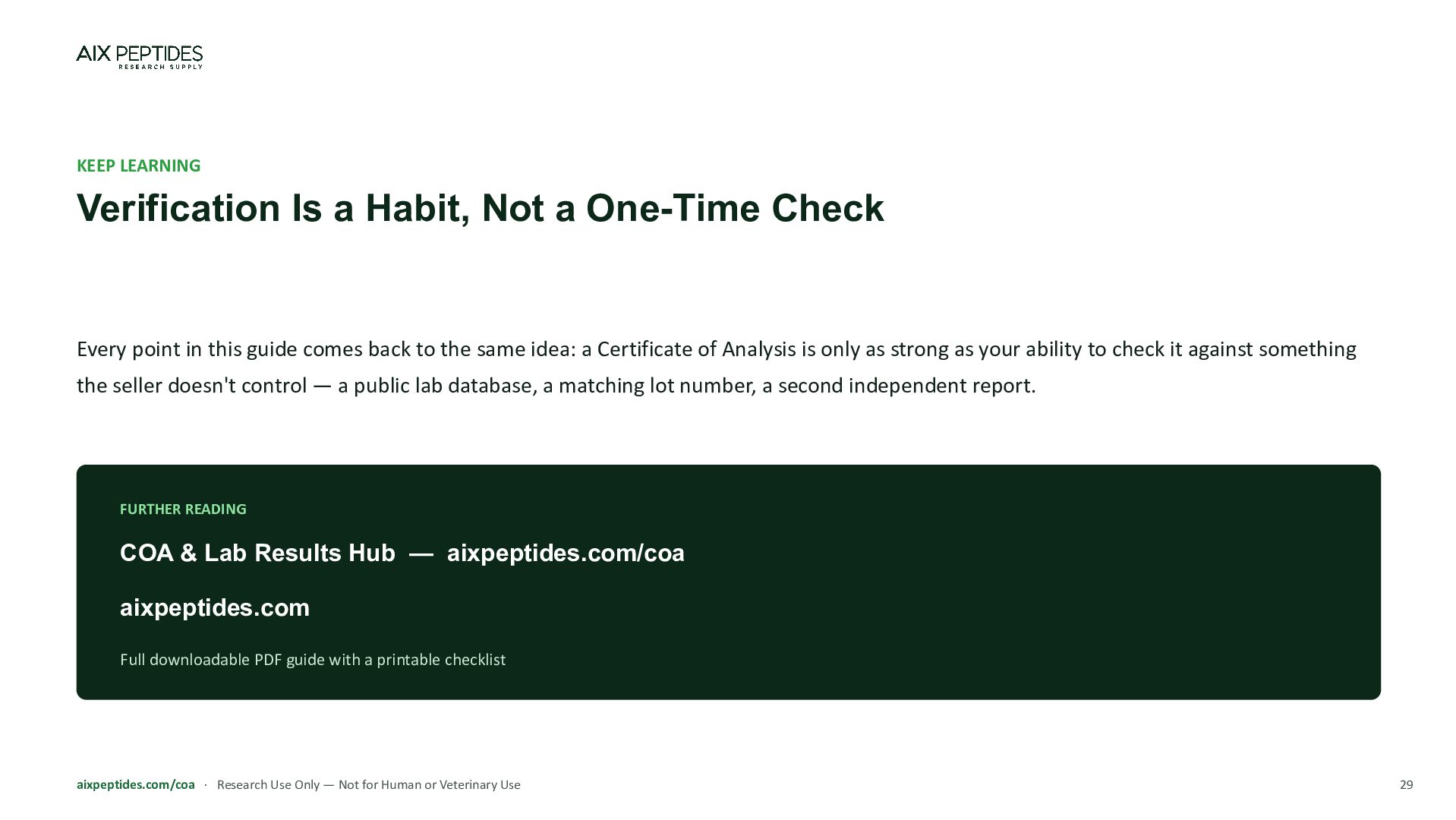
Every point in this guide comes back to the same idea: a Certificate of Analysis is only as strong as your ability to check it against something the seller doesn't control — a public lab database, a matching lot number, a second independent report. FURTHER READING COA & Lab Results Hub — aixpeptides.com/coa aixpeptides.com Full downloadable PDF guide with a printable checklist aixpeptides.com/coa · Research Use Only — Not for Human or Veterinary Use 29


 speakbuddy
 m3c
 shunsuke_takeuchi
 kojima1
 neuroenergia
 gatechnologies
 mediphone
 makaibito
 so_kotani
 kazumakitao
 codingconduct
 szymonslowik
 lfama
 eileencodes
 chikuwait
 axbom
 quramy
 stephenakadiri
 jnunemaker
 carmenintech
 mongodb
 marketingsoph