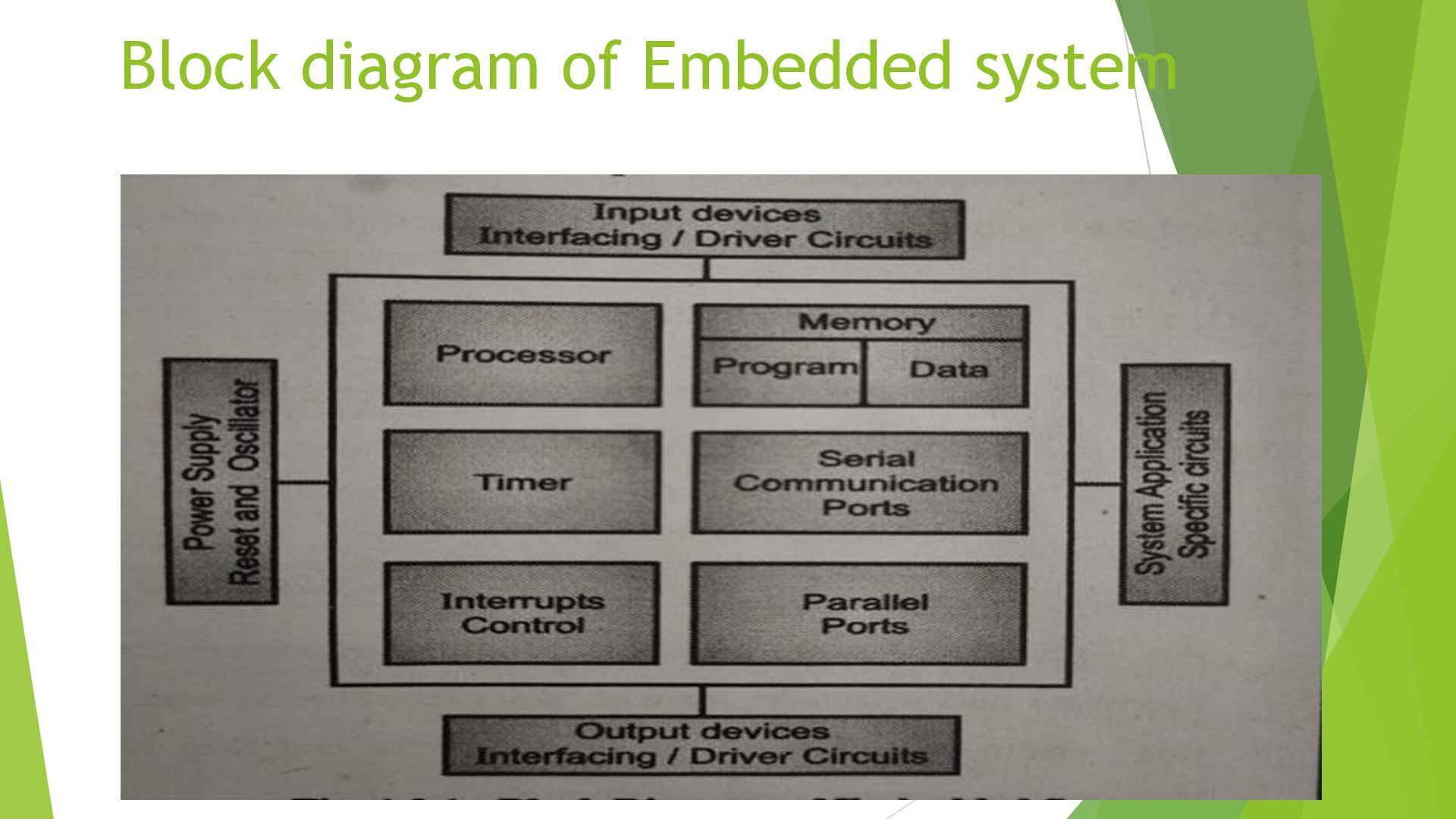
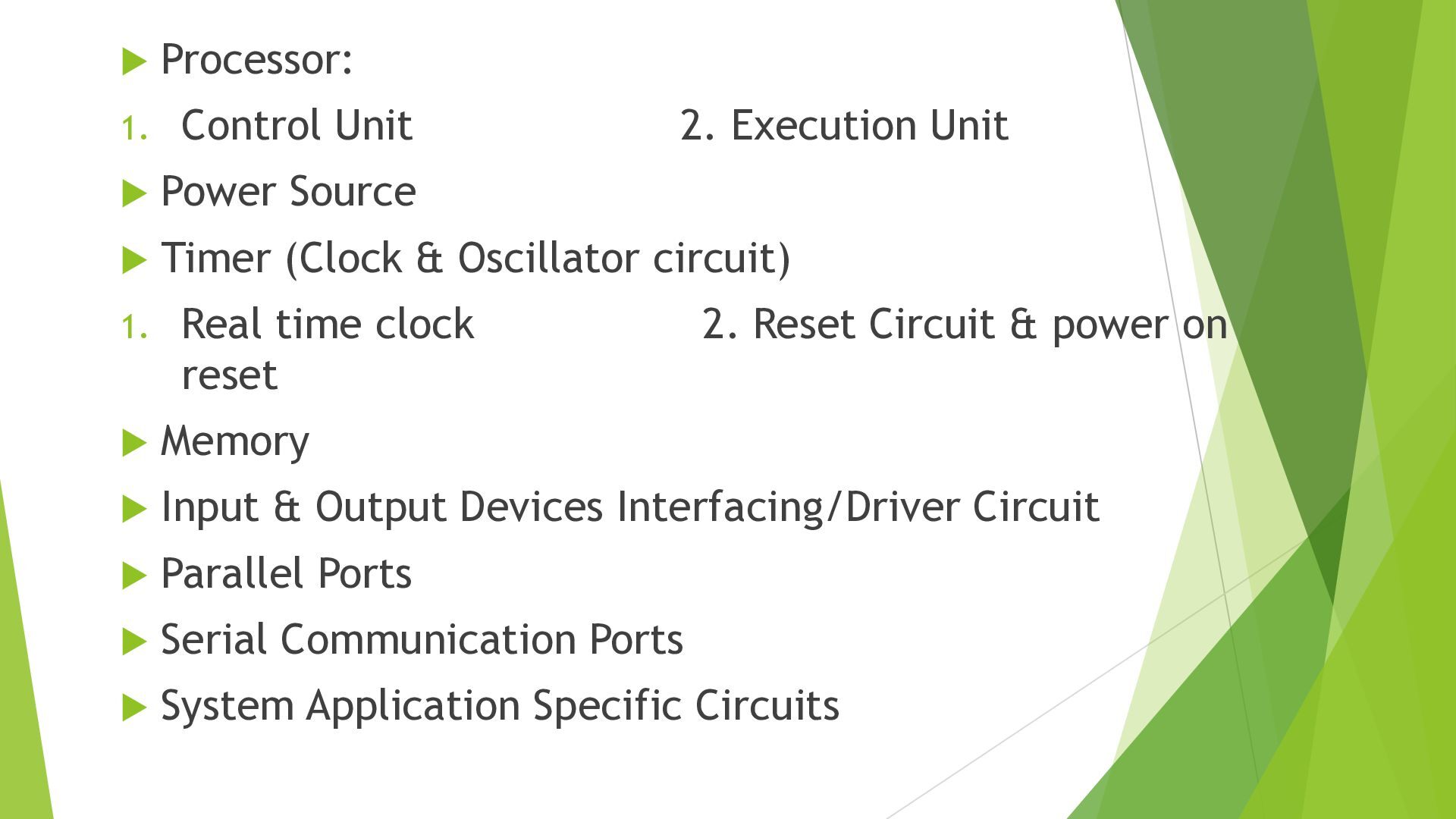
Source Timer (Clock & Oscillator circuit) 1. Real time clock reset 2. Reset Circuit & power on Memory Input & Output Devices Interfacing/Driver Circuit Parallel Ports Serial Communication Ports System Application Specific Circuits
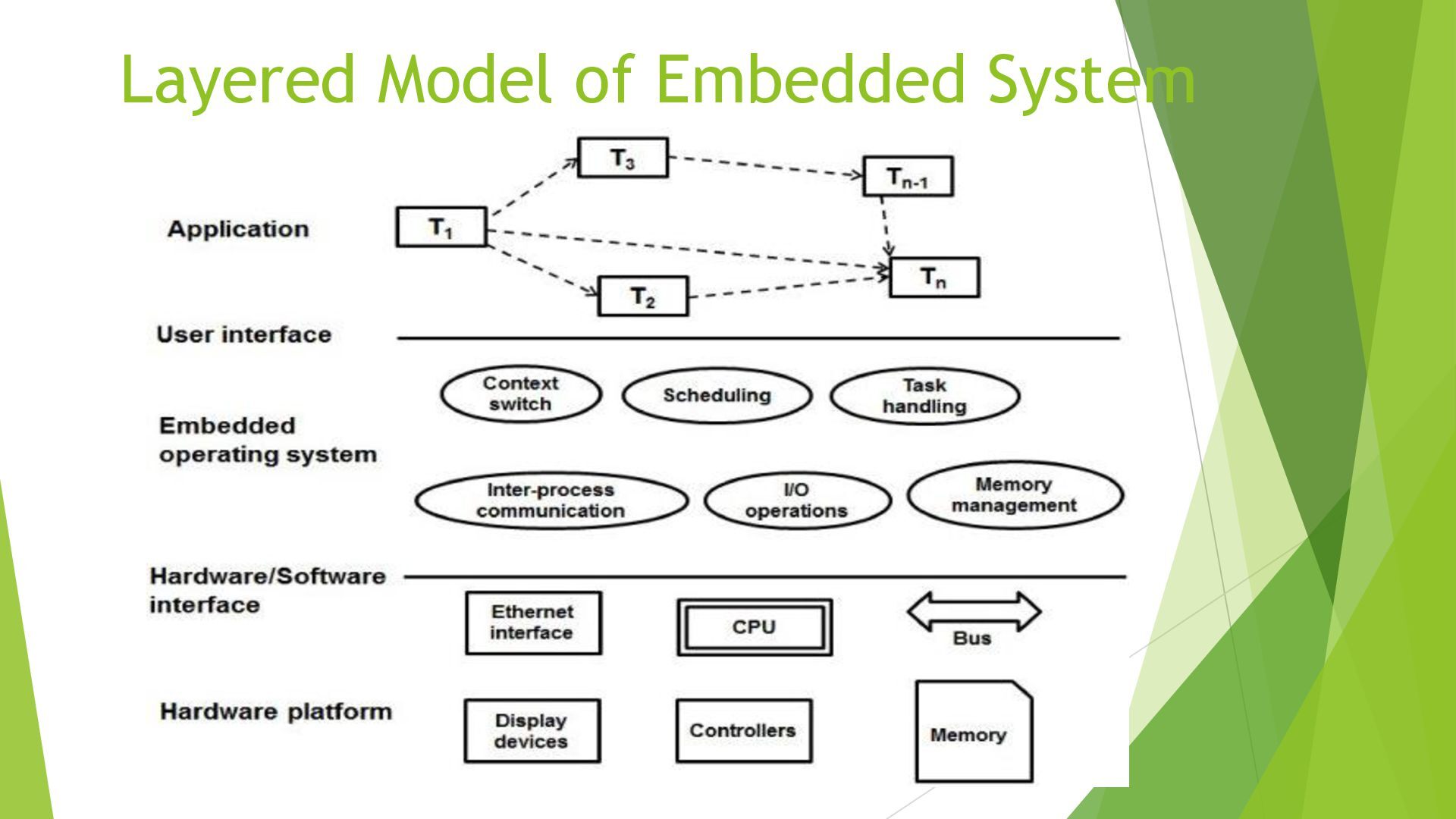
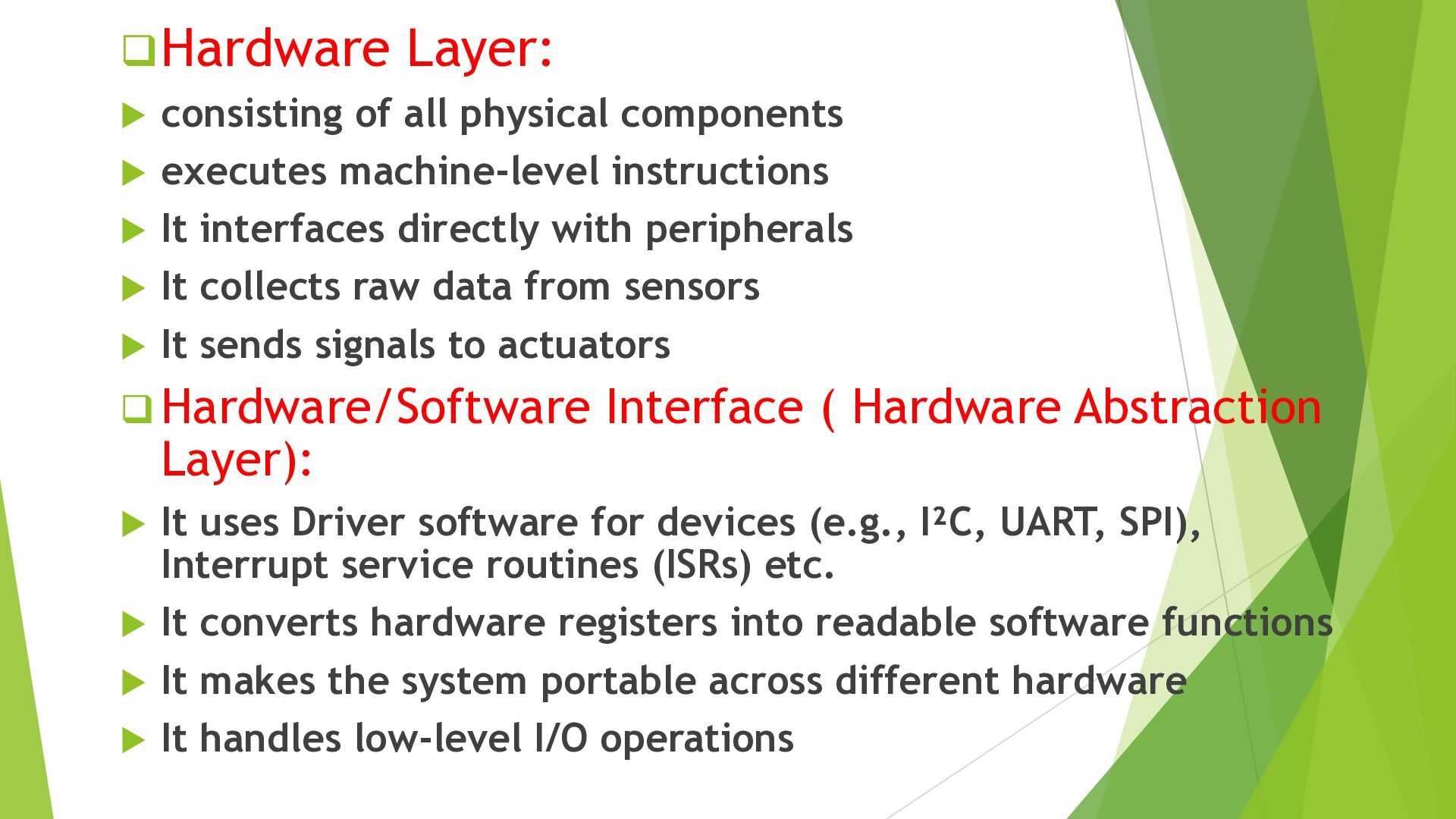
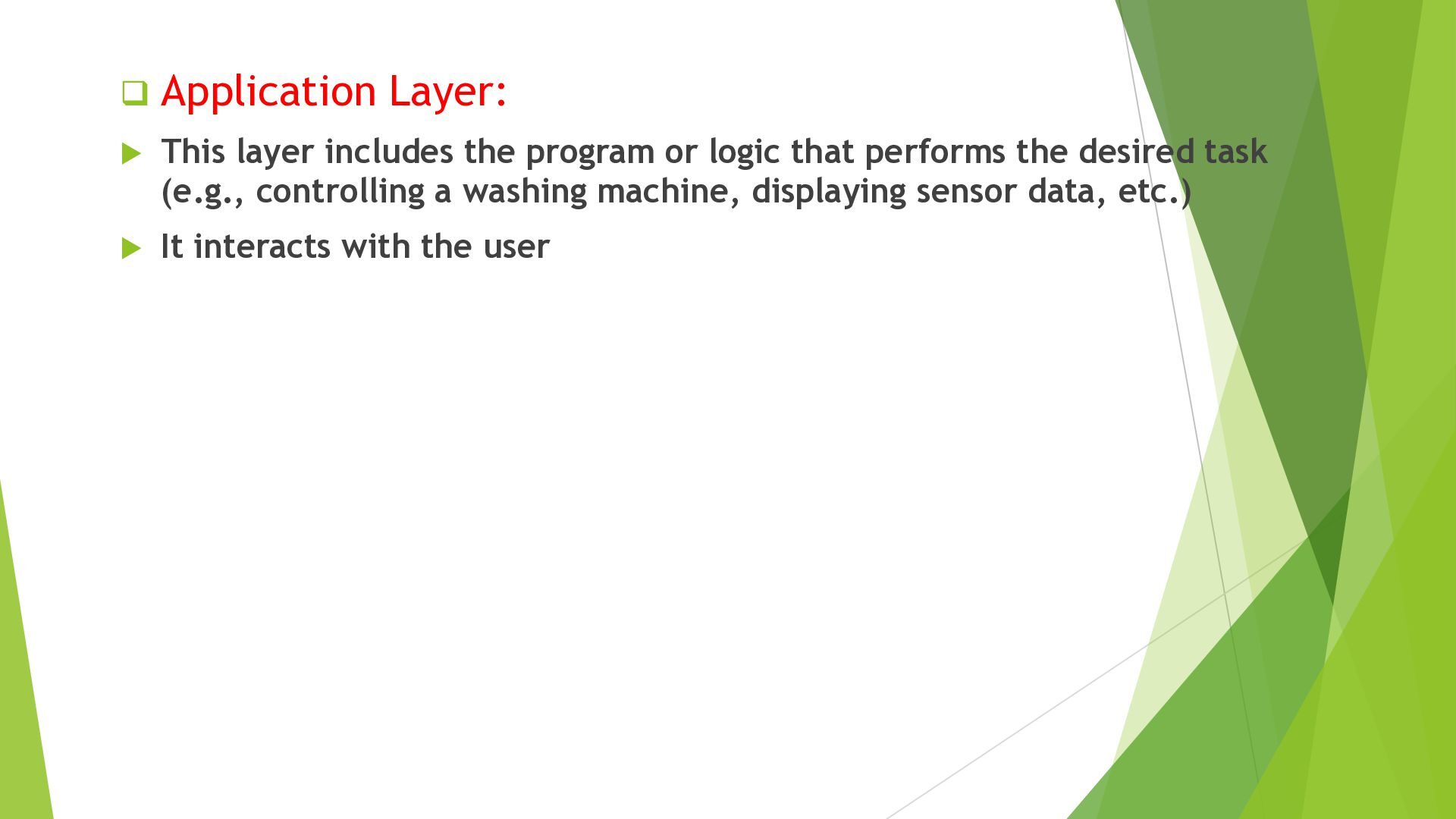
executes machine-level instructions It interfaces directly with peripherals It collects raw data from sensors It sends signals to actuators ❑ Hardware/Software Interface ( Hardware Abstraction Layer): It uses Driver software for devices (e.g., I²C, UART, SPI), Interrupt service routines (ISRs) etc. It converts hardware registers into readable software functions It makes the system portable across different hardware It handles low-level I/O operations
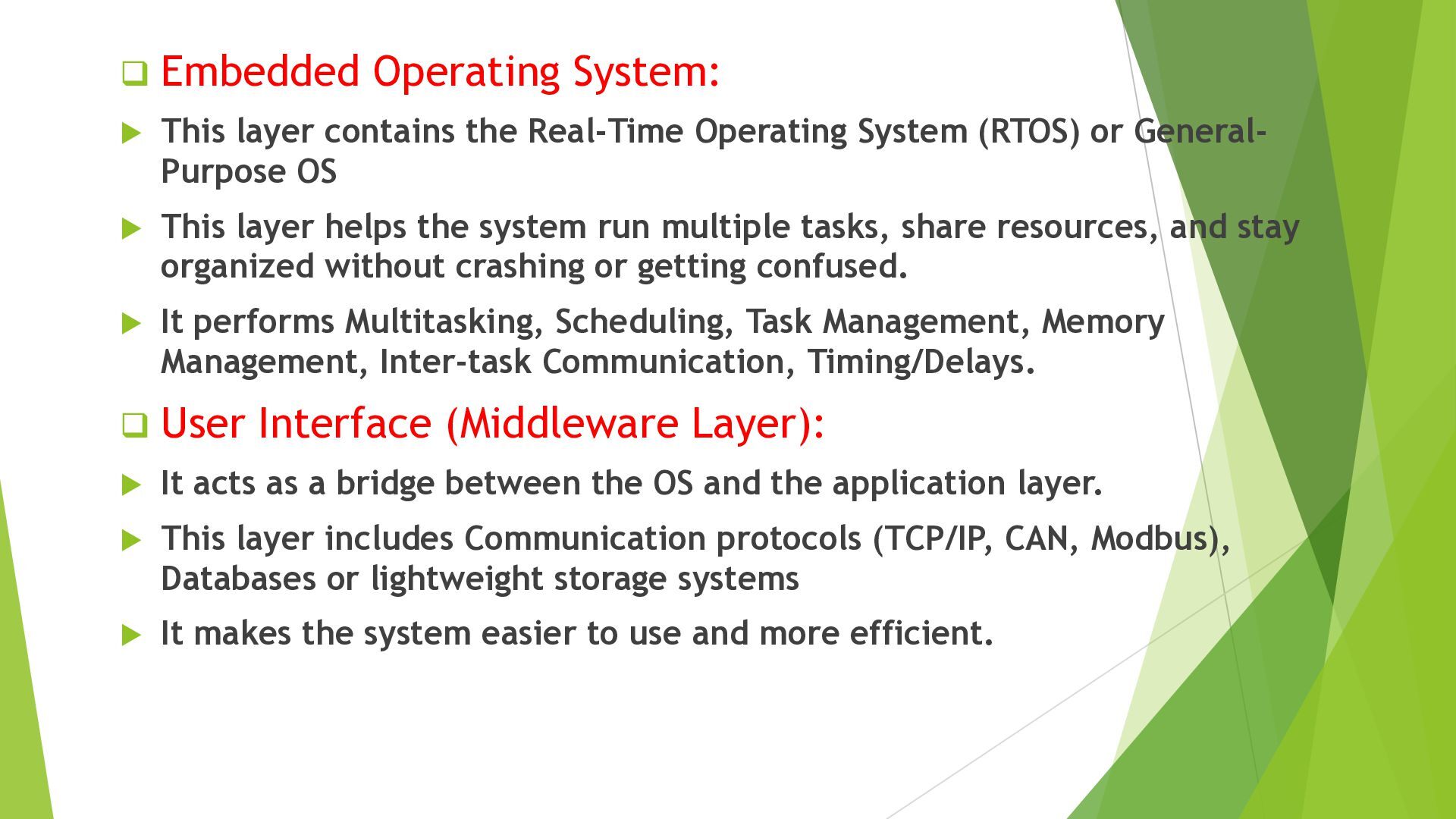
Operating System (RTOS) or General- Purpose OS This layer helps the system run multiple tasks, share resources, and stay organized without crashing or getting confused. It performs Multitasking, Scheduling, Task Management, Memory Management, Inter-task Communication, Timing/Delays. ❑ User Interface (Middleware Layer): It acts as a bridge between the OS and the application layer. This layer includes Communication protocols (TCP/IP, CAN, Modbus), Databases or lightweight storage systems It makes the system easier to use and more efficient.
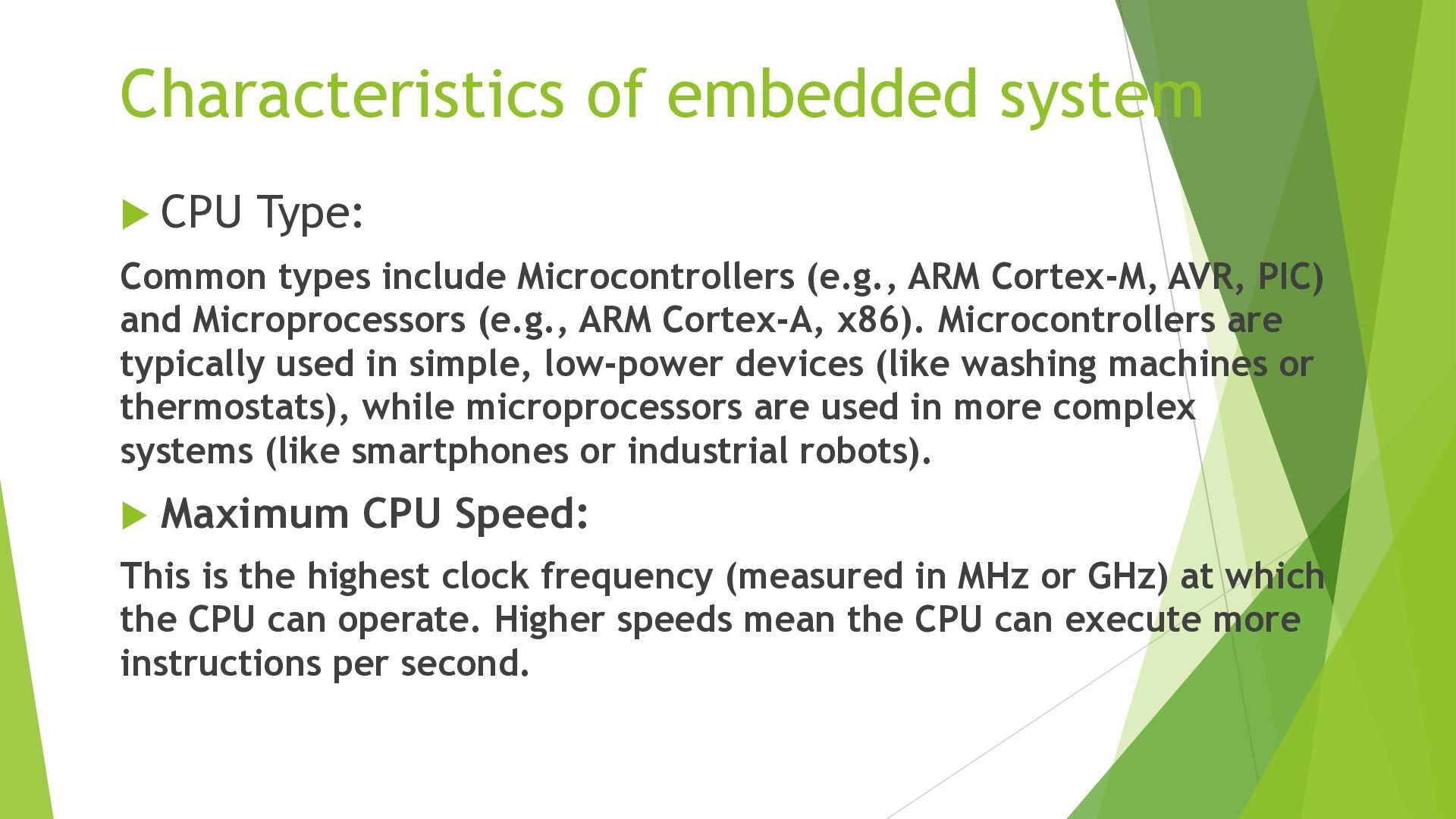
Microcontrollers (e.g., ARM Cortex-M, AVR, PIC) and Microprocessors (e.g., ARM Cortex-A, x86). Microcontrollers are typically used in simple, low-power devices (like washing machines or thermostats), while microprocessors are used in more complex systems (like smartphones or industrial robots). Maximum CPU Speed: This is the highest clock frequency (measured in MHz or GHz) at which the CPU can operate. Higher speeds mean the CPU can execute more instructions per second.
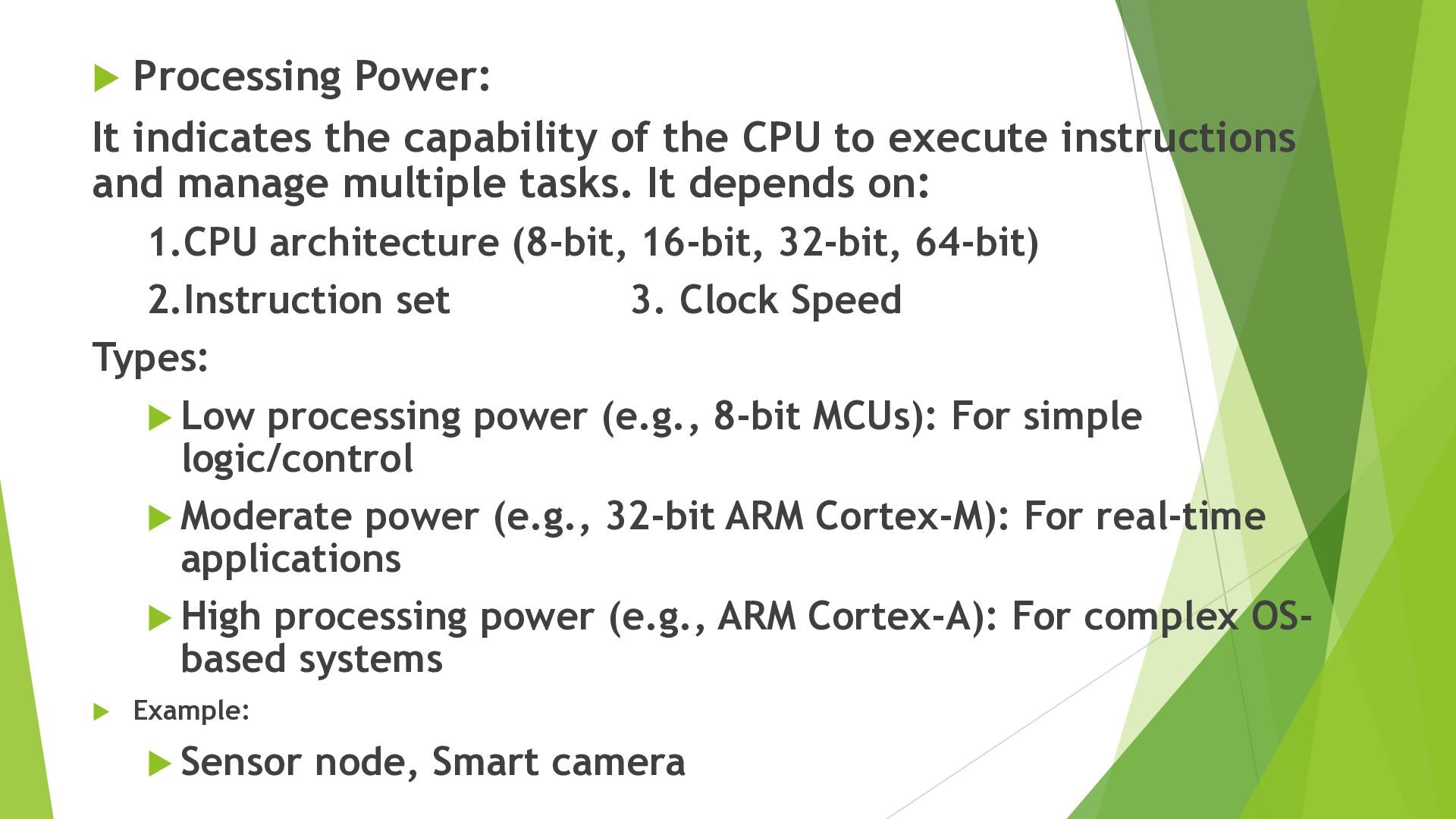
to execute instructions and manage multiple tasks. It depends on: 1.CPU architecture (8-bit, 16-bit, 32-bit, 64-bit) 2.Instruction set 3. Clock Speed Types: Low processing power (e.g., 8-bit MCUs): For simple logic/control Moderate power (e.g., 32-bit ARM Cortex-M): For real-time applications High processing power (e.g., ARM Cortex-A): For complex OSbased systems Example: Sensor node, Smart camera
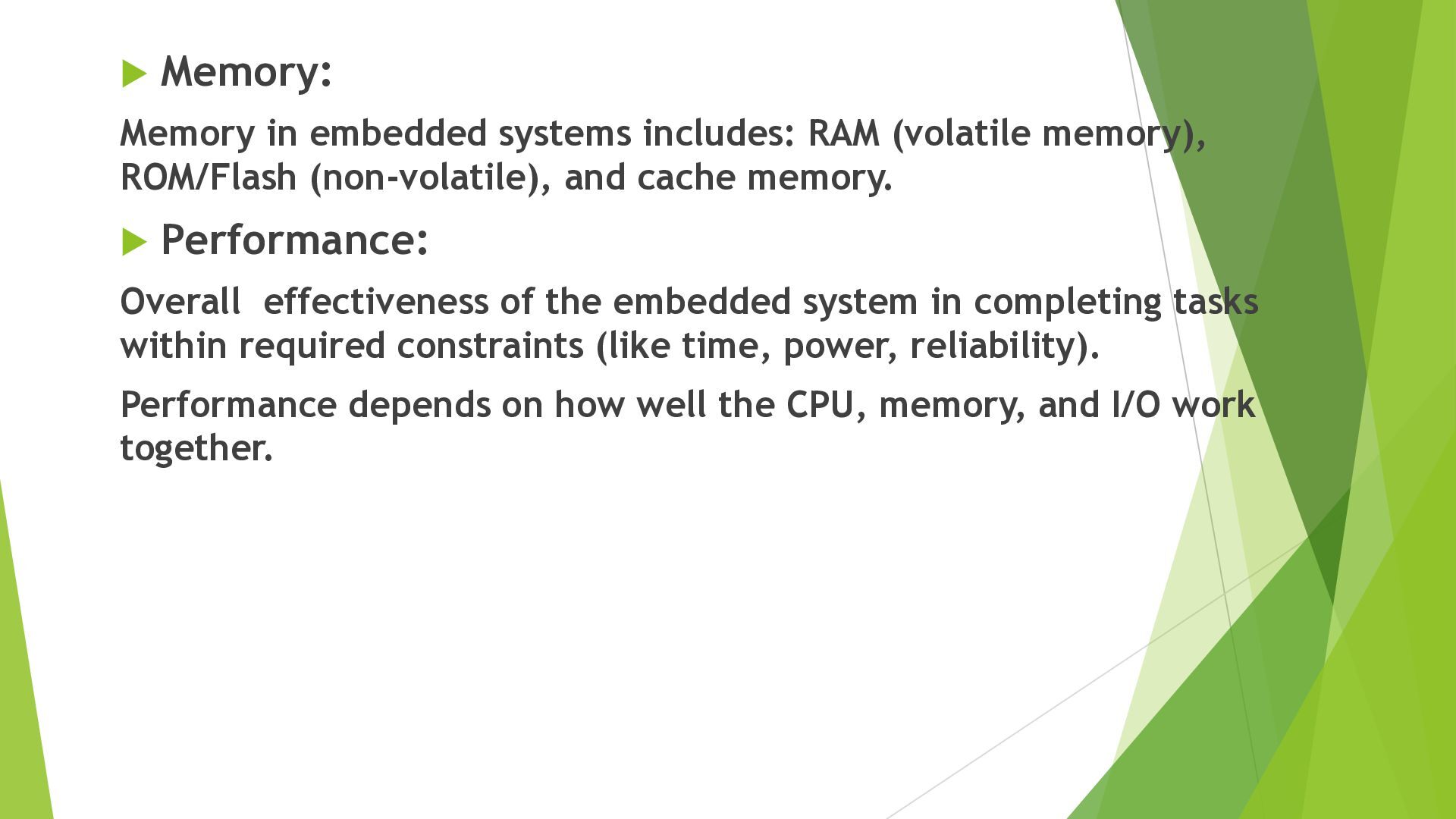
ROM/Flash (non-volatile), and cache memory. Performance: Overall effectiveness of the embedded system in completing tasks within required constraints (like time, power, reliability). Performance depends on how well the CPU, memory, and I/O work together.
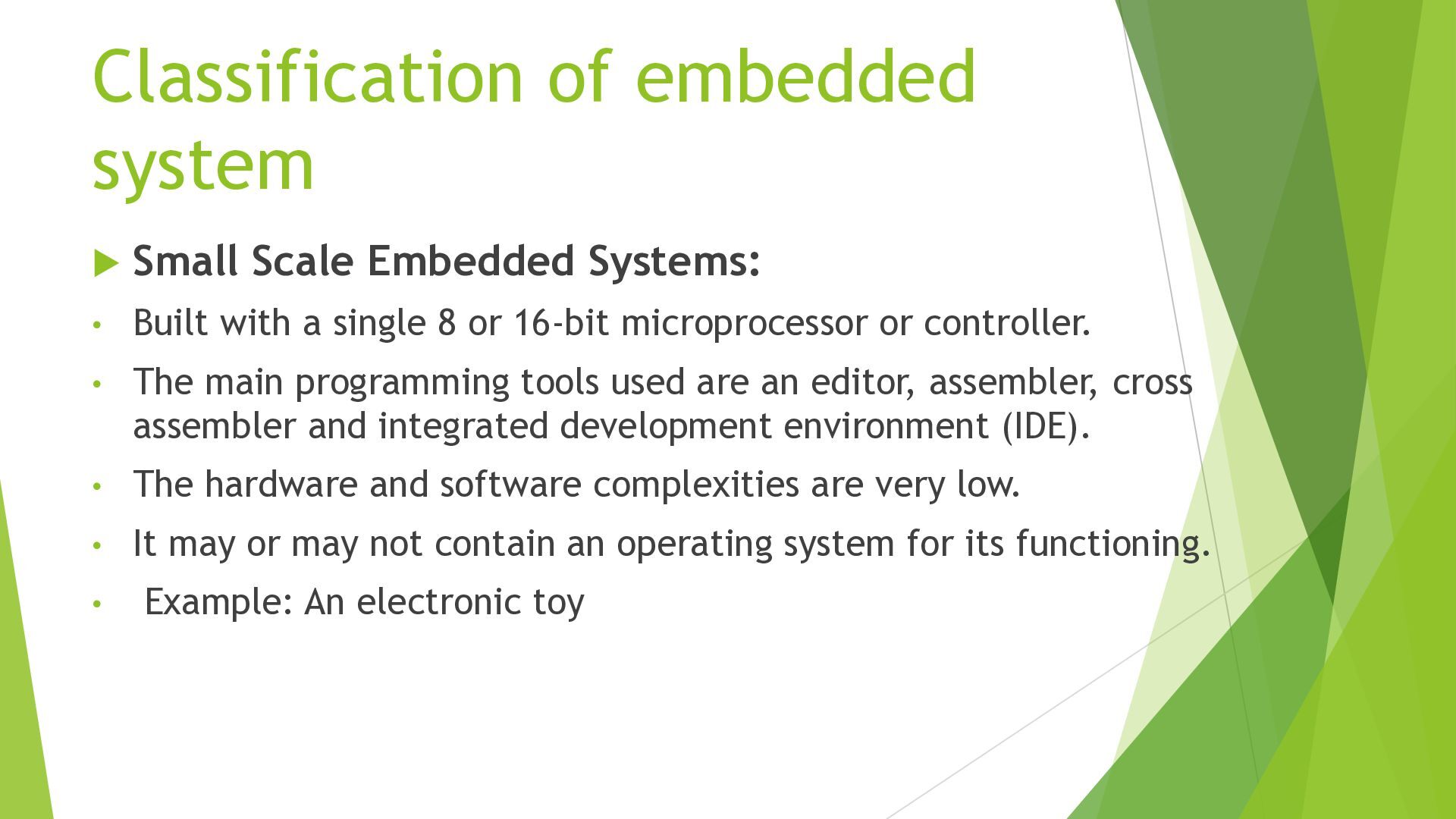
Built with a single 8 or 16-bit microprocessor or controller. • The main programming tools used are an editor, assembler, cross assembler and integrated development environment (IDE). • The hardware and software complexities are very low. • It may or may not contain an operating system for its functioning. • Example: An electronic toy
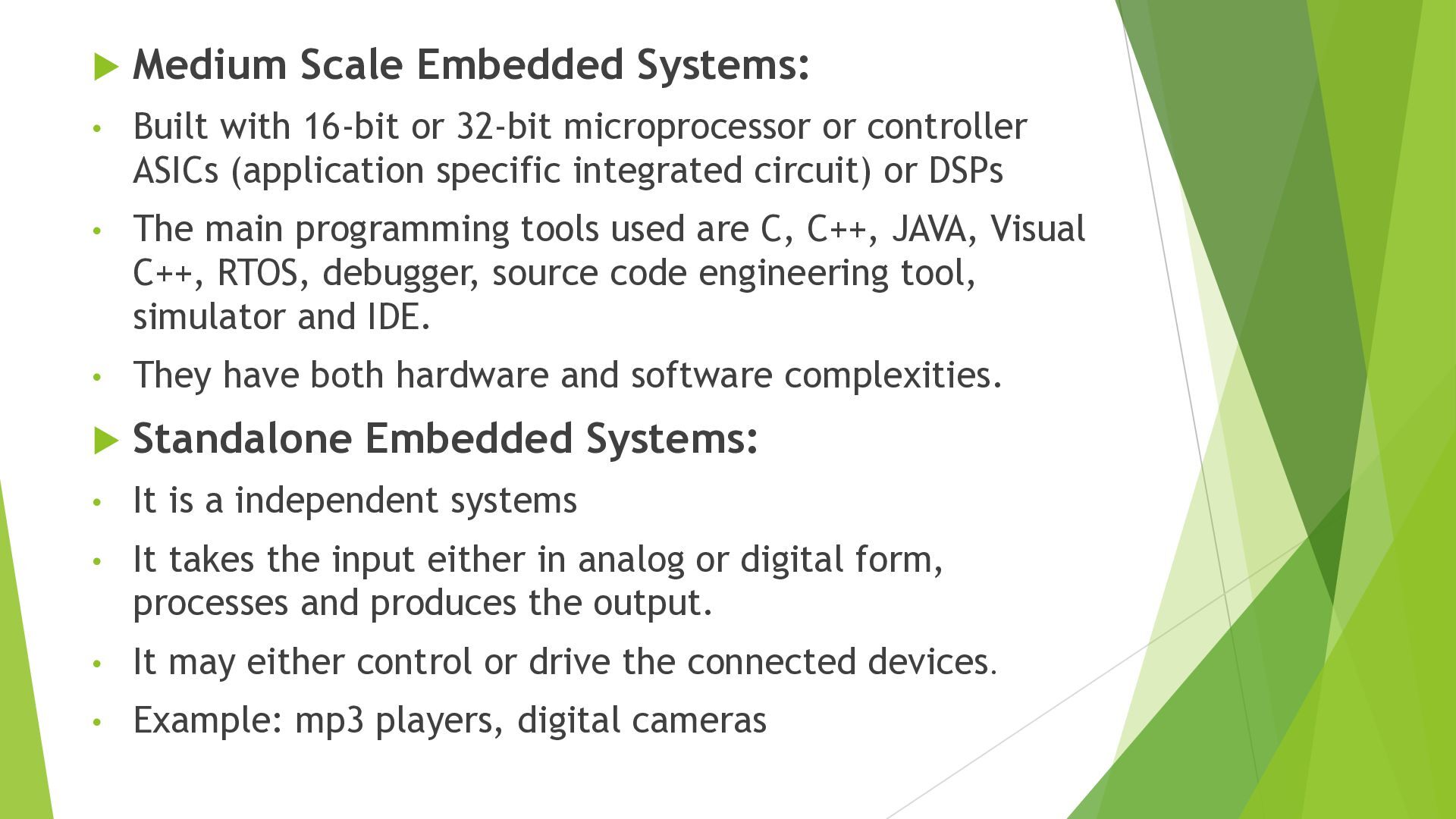
32-bit microprocessor or controller ASICs (application specific integrated circuit) or DSPs • The main programming tools used are C, C++, JAVA, Visual C++, RTOS, debugger, source code engineering tool, simulator and IDE. • They have both hardware and software complexities. Standalone Embedded Systems: • It is a independent systems • It takes the input either in analog or digital form, processes and produces the output. • It may either control or drive the connected devices. • Example: mp3 players, digital cameras
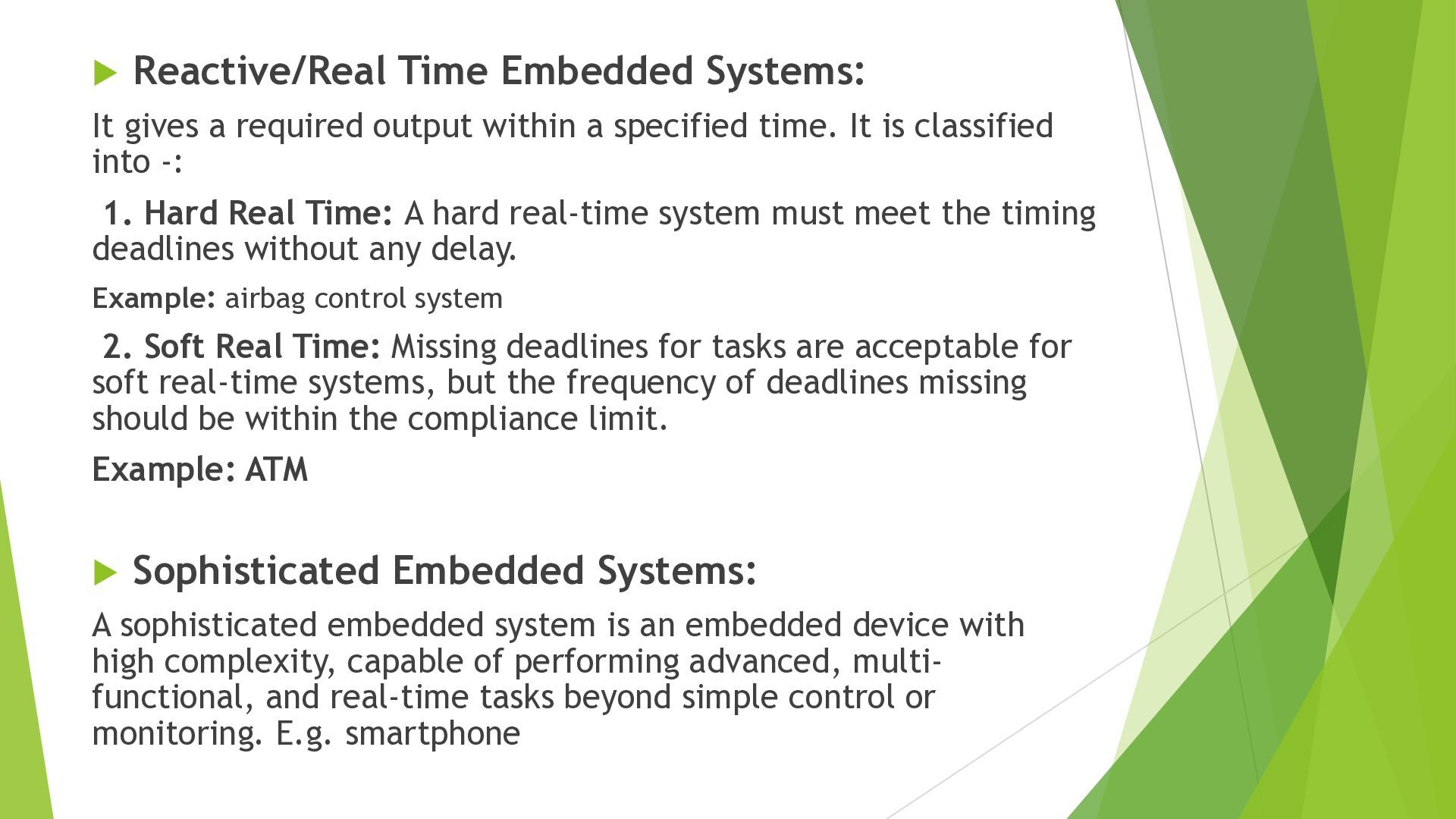
within a specified time. It is classified into -: 1. Hard Real Time: A hard real-time system must meet the timing deadlines without any delay. Example: airbag control system 2. Soft Real Time: Missing deadlines for tasks are acceptable for soft real-time systems, but the frequency of deadlines missing should be within the compliance limit. Example: ATM Sophisticated Embedded Systems: A sophisticated embedded system is an embedded device with high complexity, capable of performing advanced, multifunctional, and real-time tasks beyond simple control or monitoring. E.g. smartphone
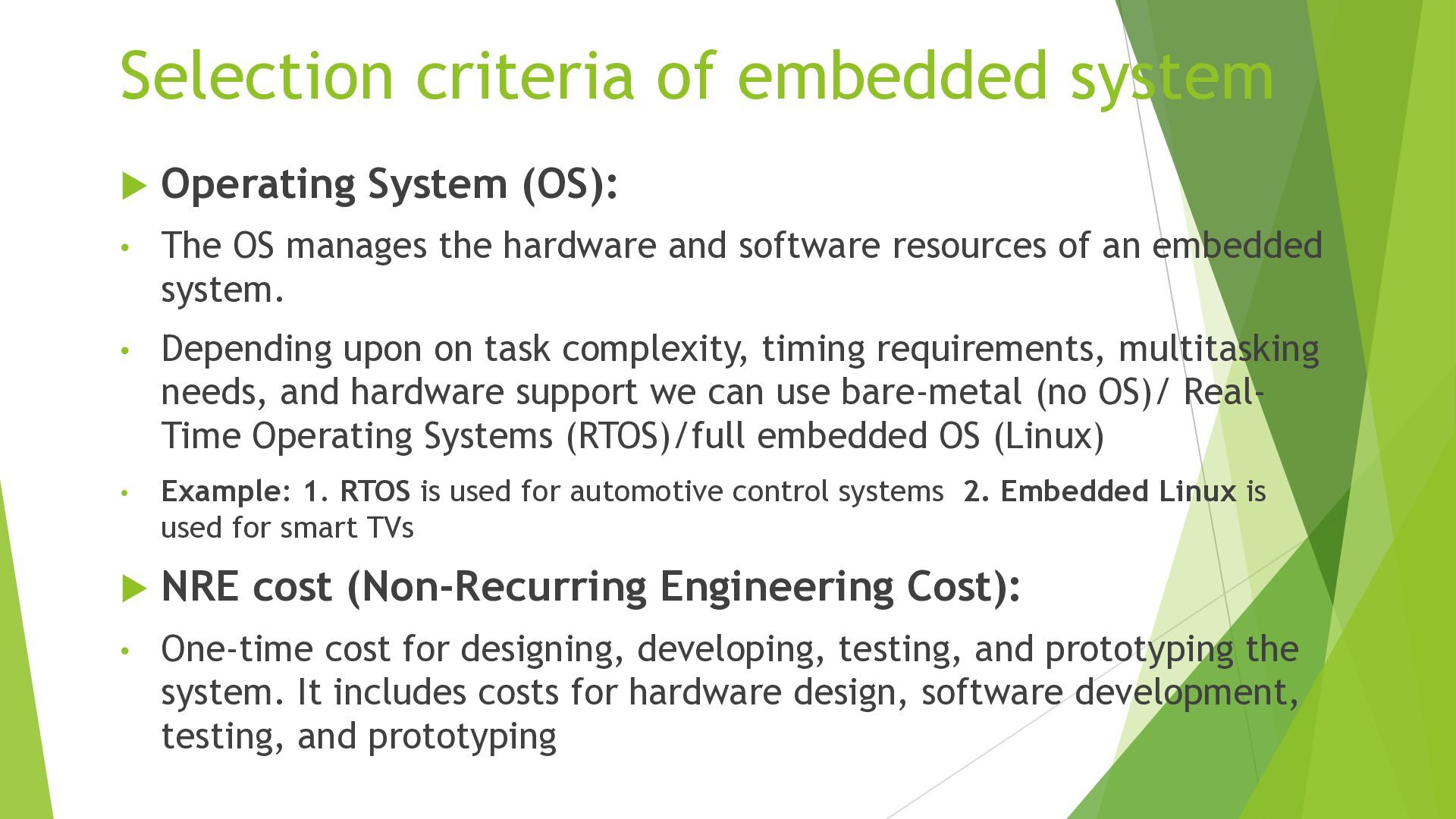
The OS manages the hardware and software resources of an embedded system. • Depending upon on task complexity, timing requirements, multitasking needs, and hardware support we can use bare-metal (no OS)/ RealTime Operating Systems (RTOS)/full embedded OS (Linux) • Example: 1. RTOS is used for automotive control systems 2. Embedded Linux is used for smart TVs NRE cost (Non-Recurring Engineering Cost): • One-time cost for designing, developing, testing, and prototyping the system. It includes costs for hardware design, software development, testing, and prototyping
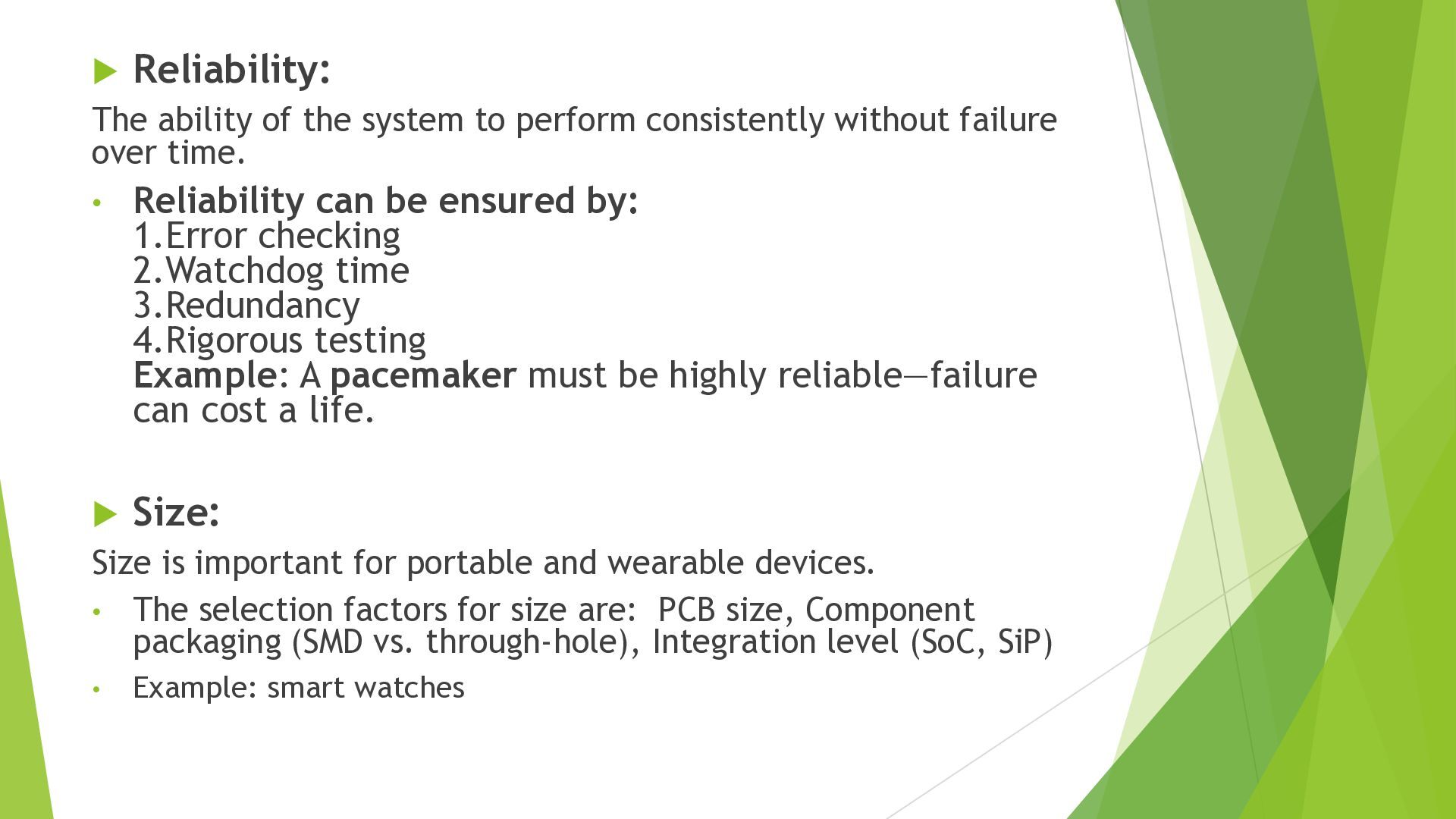
without failure over time. • Reliability can be ensured by: 1.Error checking 2.Watchdog time 3.Redundancy 4.Rigorous testing Example: A pacemaker must be highly reliable—failure can cost a life. Size: Size is important for portable and wearable devices. • The selection factors for size are: PCB size, Component packaging (SMD vs. through-hole), Integration level (SoC, SiP) • Example: smart watches
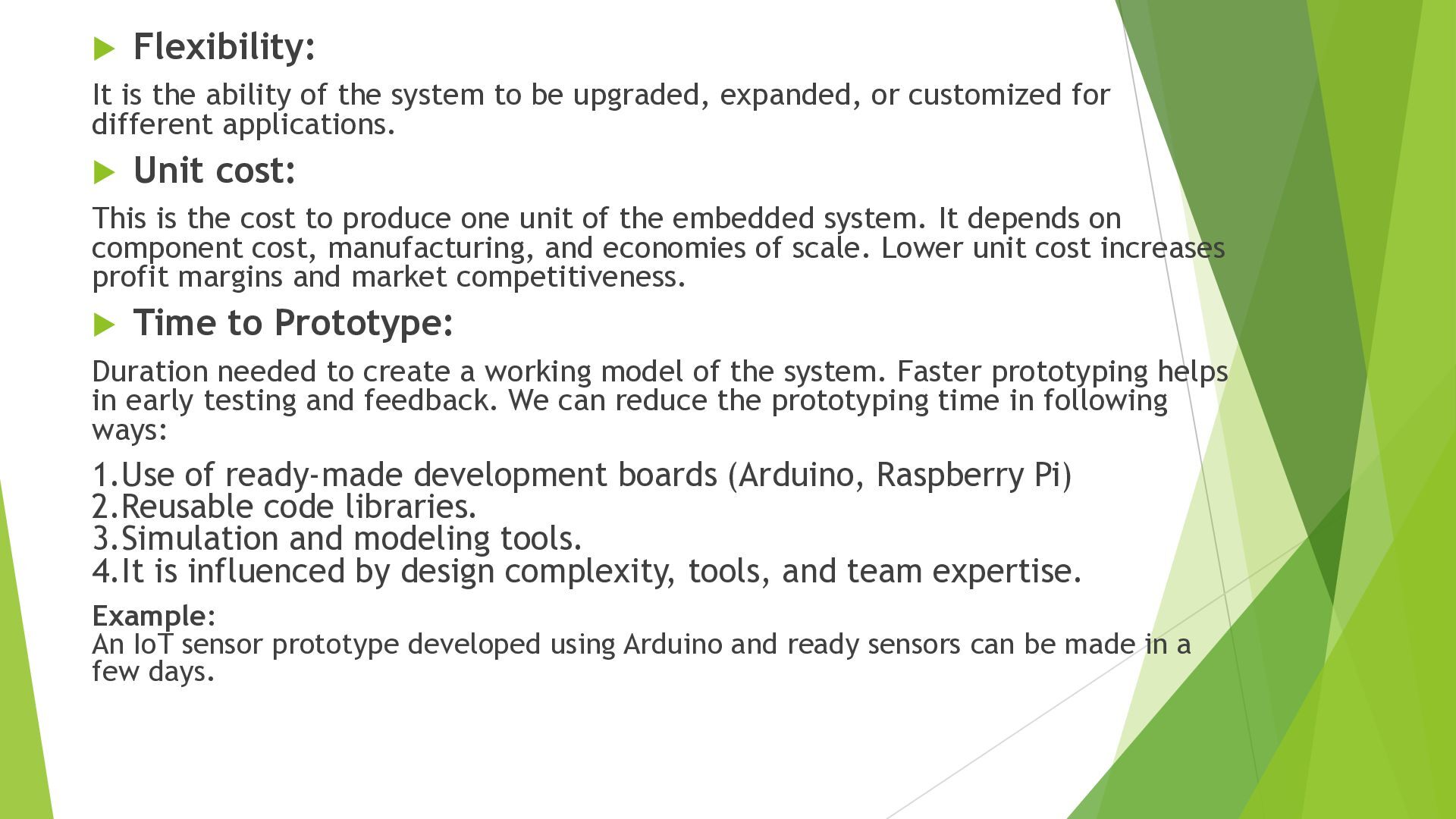
be upgraded, expanded, or customized for different applications. Unit cost: This is the cost to produce one unit of the embedded system. It depends on component cost, manufacturing, and economies of scale. Lower unit cost increases profit margins and market competitiveness. Time to Prototype: Duration needed to create a working model of the system. Faster prototyping helps in early testing and feedback. We can reduce the prototyping time in following ways: 1.Use of ready-made development boards (Arduino, Raspberry Pi) 2.Reusable code libraries. 3.Simulation and modeling tools. 4.It is influenced by design complexity, tools, and team expertise. Example: An IoT sensor prototype developed using Arduino and ready sensors can be made in a few days.
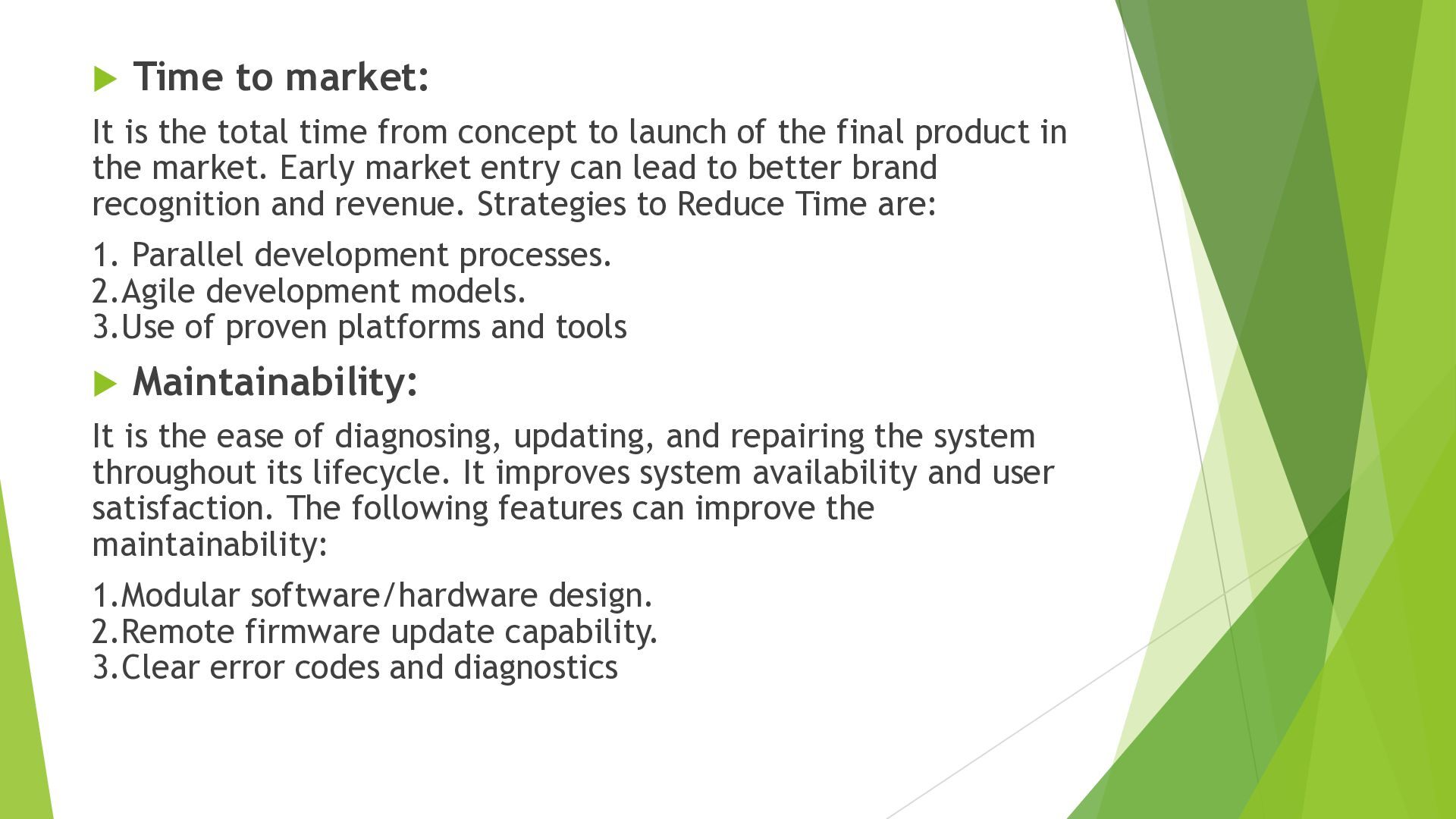
concept to launch of the final product in the market. Early market entry can lead to better brand recognition and revenue. Strategies to Reduce Time are: 1. Parallel development processes. 2.Agile development models. 3.Use of proven platforms and tools Maintainability: It is the ease of diagnosing, updating, and repairing the system throughout its lifecycle. It improves system availability and user satisfaction. The following features can improve the maintainability: 1.Modular software/hardware design. 2.Remote firmware update capability. 3.Clear error codes and diagnostics
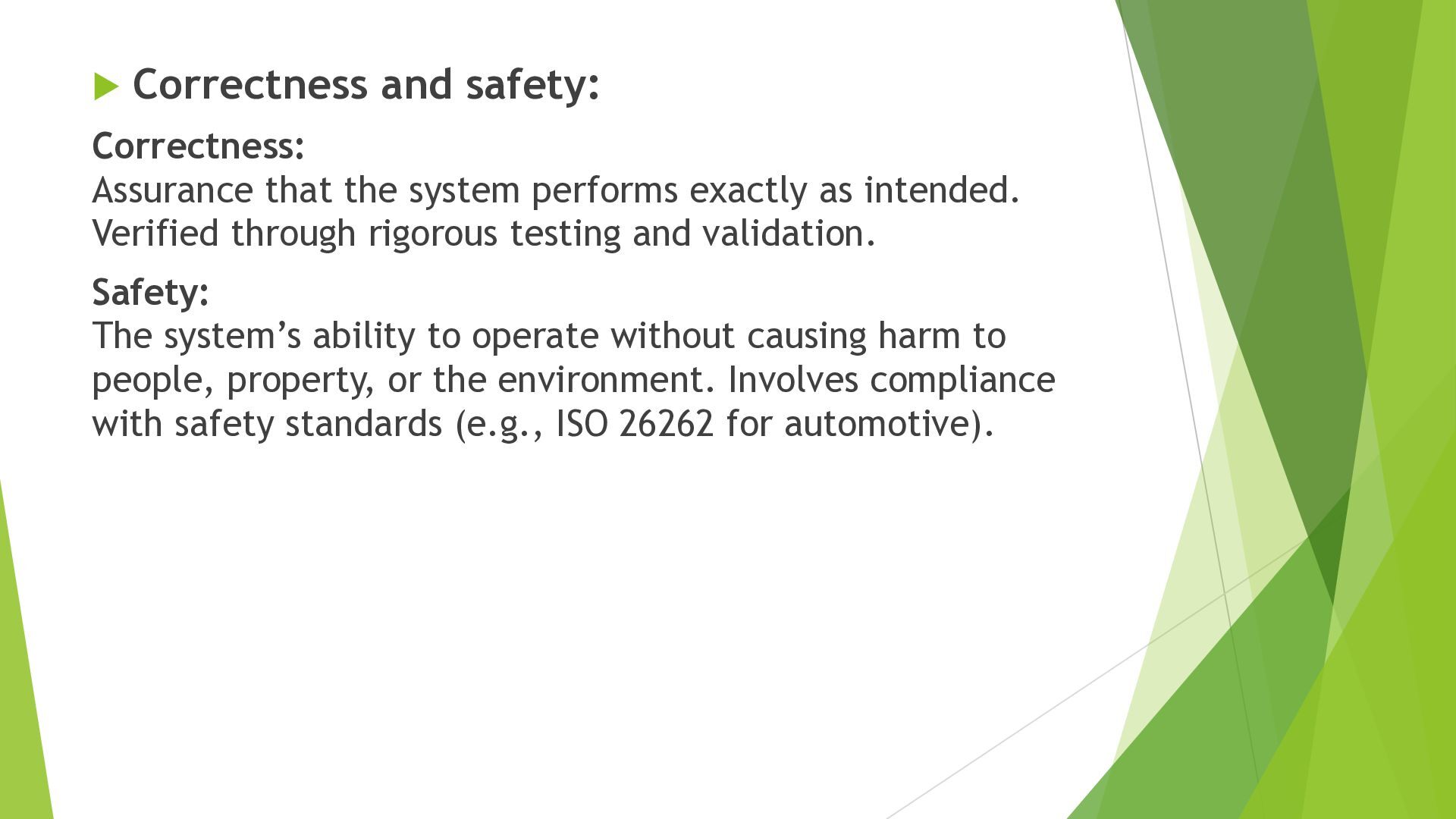
exactly as intended. Verified through rigorous testing and validation. Safety: The system’s ability to operate without causing harm to people, property, or the environment. Involves compliance with safety standards (e.g., ISO 26262 for automotive).


 signer
 robintux
 hiola
 eller86
 ytapples613
 auctria
 terazawa
 rashwhitman
 naochim2026
 pawan_pharm
 drpoonamkc
 soudai
 codingconduct
 elsirapls
 szymonslowik
 smashingmag
 techseoconnect
 samtorres
 andyhume
 chrislema
 jct
 lauravandoore
 brad_frost
 ipullrank