instances of examples into non-known groups according to some common relations or affinities. Example Market segmentation of customers Example Social network communities
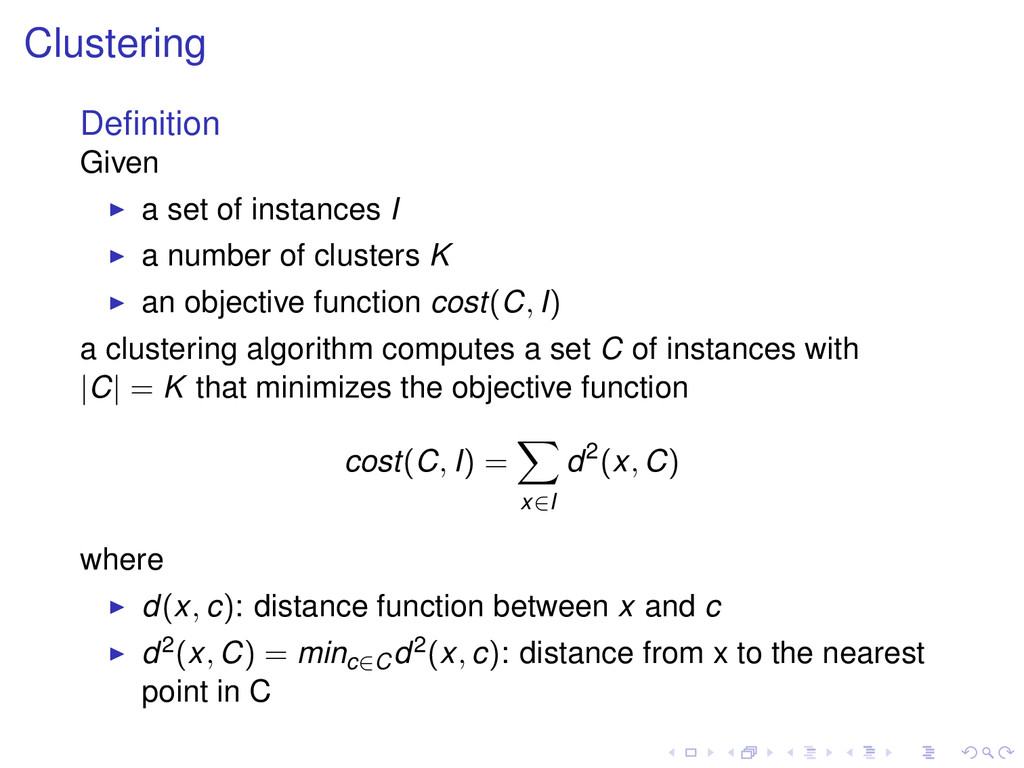
of clusters K an objective function cost(I) a clustering algorithm computes an assignment of a cluster for each instance f : I → {1, . . . , K} that minimizes the objective function cost(I)
of clusters K an objective function cost(C, I) a clustering algorithm computes a set C of instances with |C| = K that minimizes the objective function cost(C, I) = x∈I d2(x, C) where d(x, c): distance function between x and c d2(x, C) = minc∈C d2(x, c): distance from x to the nearest point in C
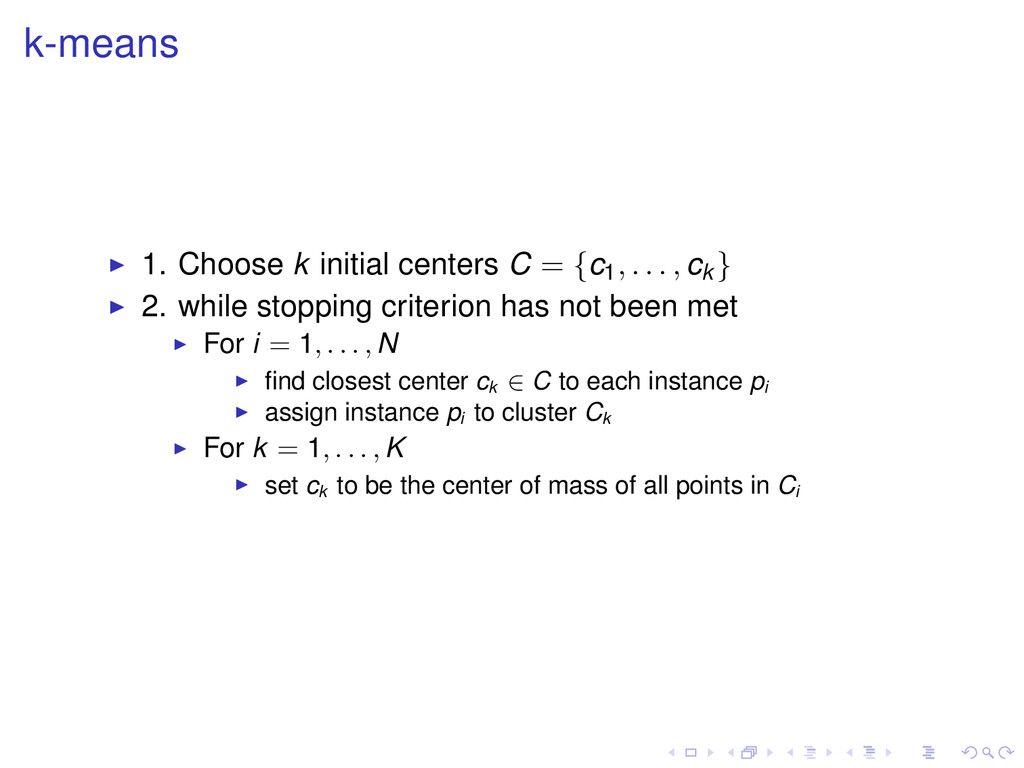
. . , ck } 2. while stopping criterion has not been met For i = 1, . . . , N find closest center ck ∈ C to each instance pi assign instance pi to cluster Ck For k = 1, . . . , K set ck to be the center of mass of all points in Ci
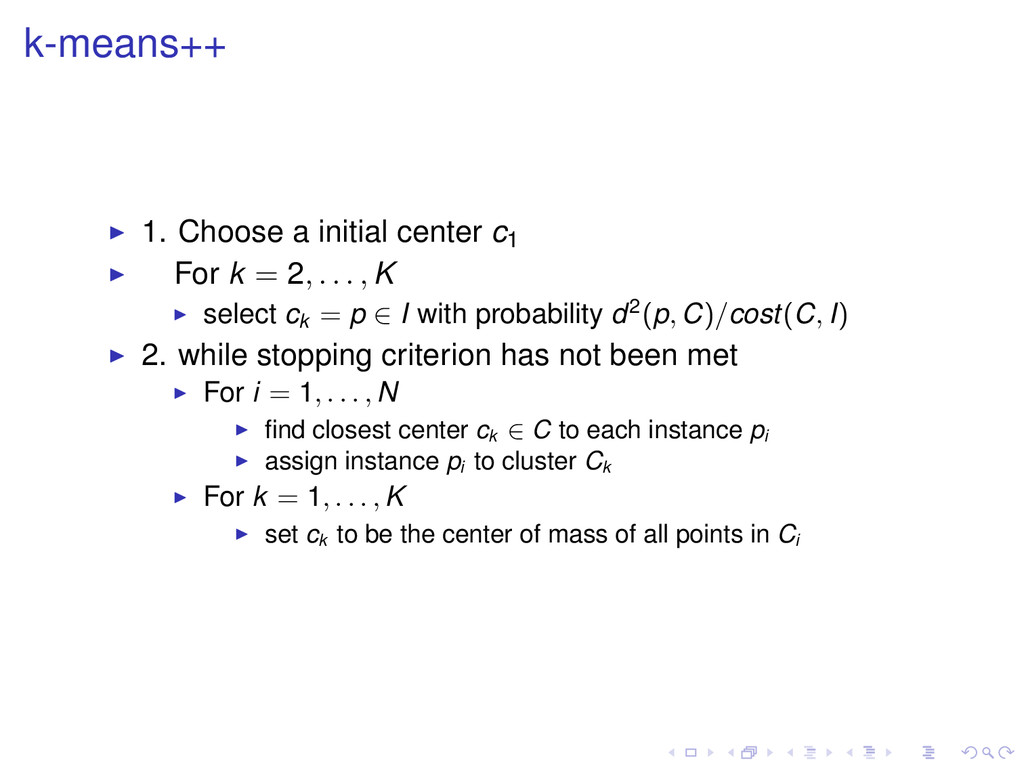
2, . . . , K select ck = p ∈ I with probability d2(p, C)/cost(C, I) 2. while stopping criterion has not been met For i = 1, . . . , N find closest center ck ∈ C to each instance pi assign instance pi to cluster Ck For k = 1, . . . , K set ck to be the center of mass of all points in Ci
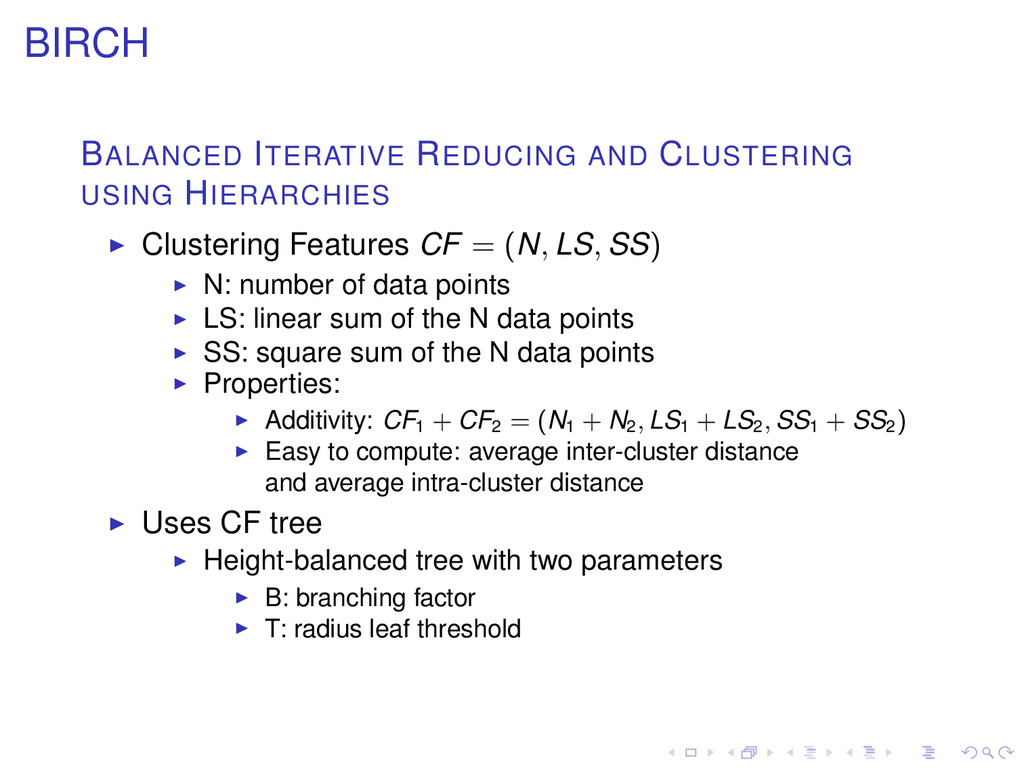
CF = (N, LS, SS) N: number of data points LS: linear sum of the N data points SS: square sum of the N data points Properties: Additivity: CF1 + CF2 = (N1 + N2 , LS1 + LS2 , SS1 + SS2 ) Easy to compute: average inter-cluster distance and average intra-cluster distance Uses CF tree Height-balanced tree with two parameters B: branching factor T: radius leaf threshold
Scan all data and build an initial in-memory CF tree Phase 2: Condense into desirable range by building a smaller CF tree (optional) Phase 3: Global clustering Phase 4: Cluster refining (optional and off line, as requires more passes)
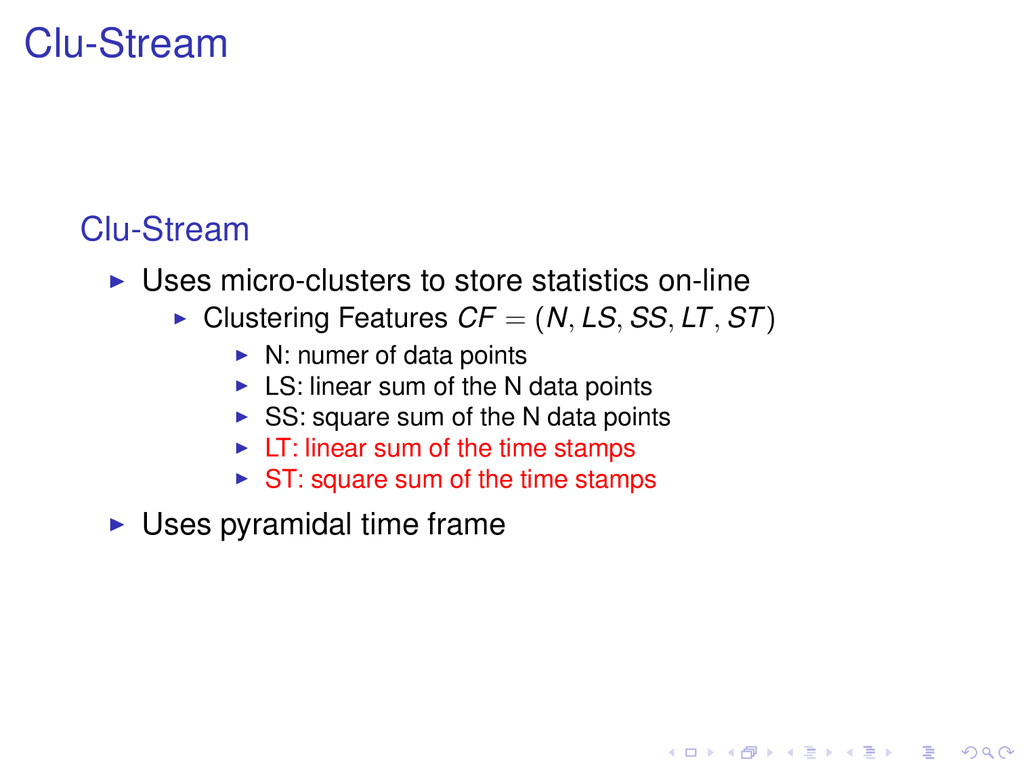
CF = (N, LS, SS, LT, ST) N: numer of data points LS: linear sum of the N data points SS: square sum of the N data points LT: linear sum of the time stamps ST: square sum of the time stamps Uses pyramidal time frame
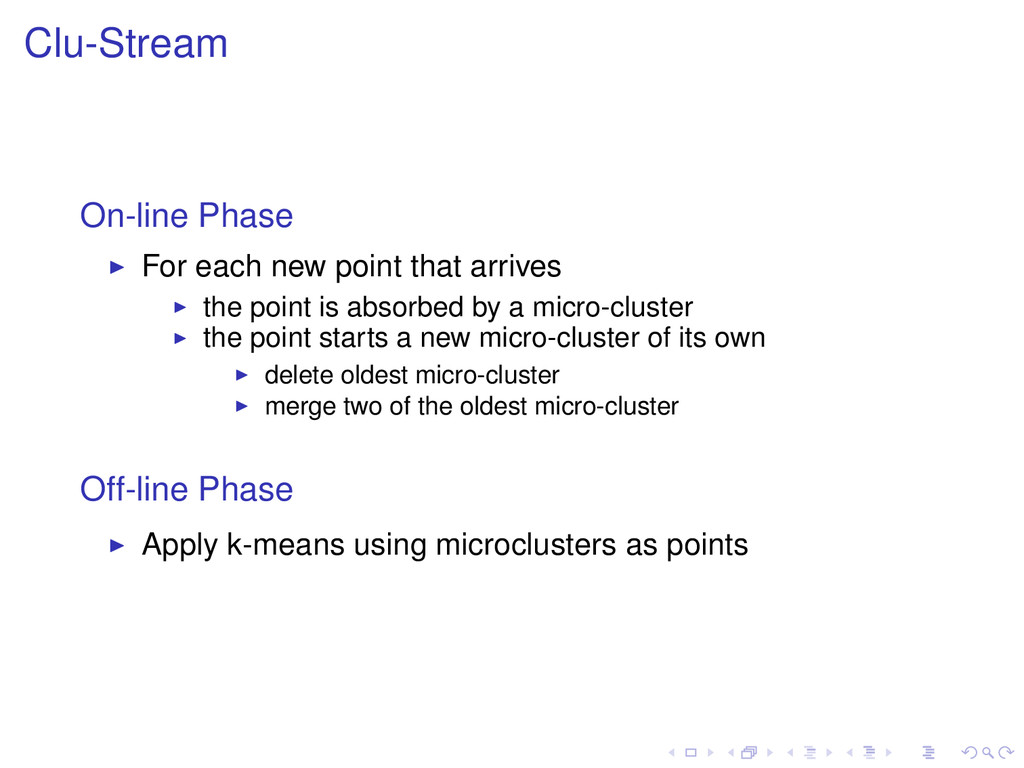
point is absorbed by a micro-cluster the point starts a new micro-cluster of its own delete oldest micro-cluster merge two of the oldest micro-cluster Off-line Phase Apply k-means using microclusters as points
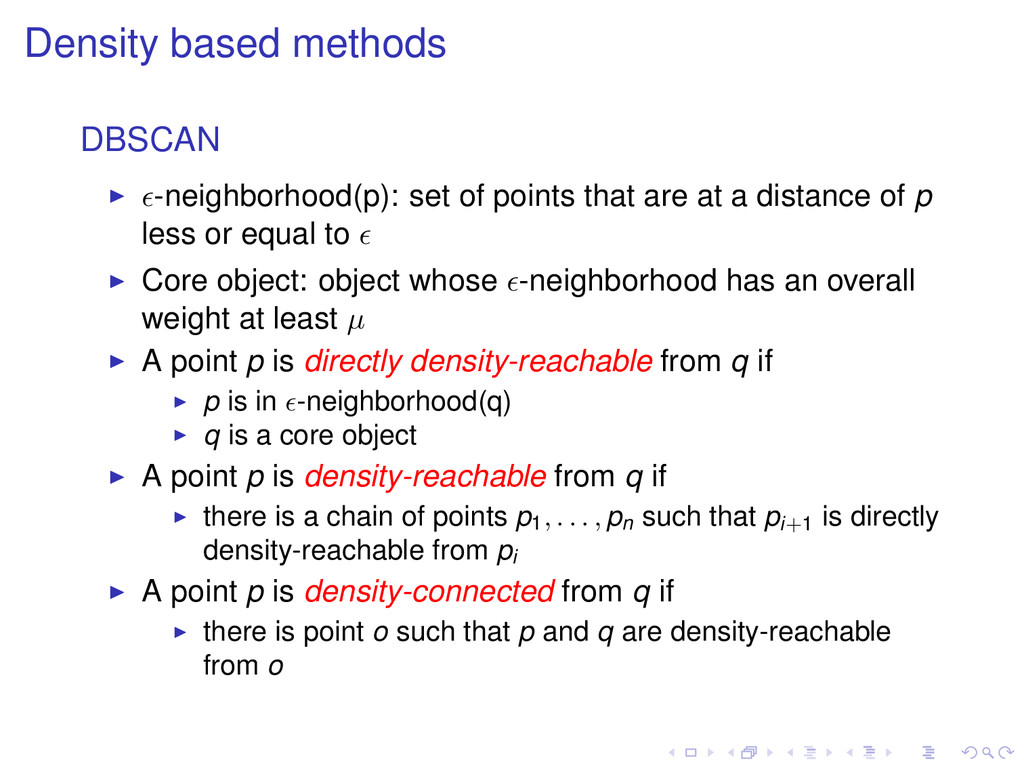
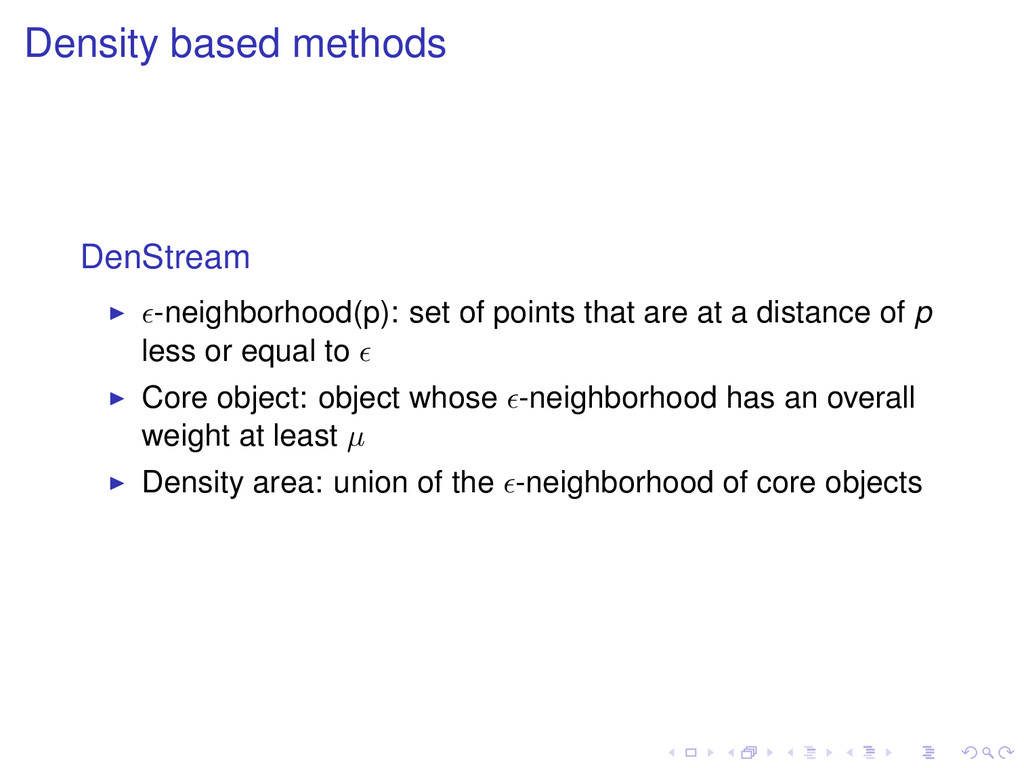
at a distance of p less or equal to Core object: object whose -neighborhood has an overall weight at least µ A point p is directly density-reachable from q if p is in -neighborhood(q) q is a core object A point p is density-reachable from q if there is a chain of points p1, . . . , pn such that pi+1 is directly density-reachable from pi A point p is density-connected from q if there is point o such that p and q are density-reachable from o
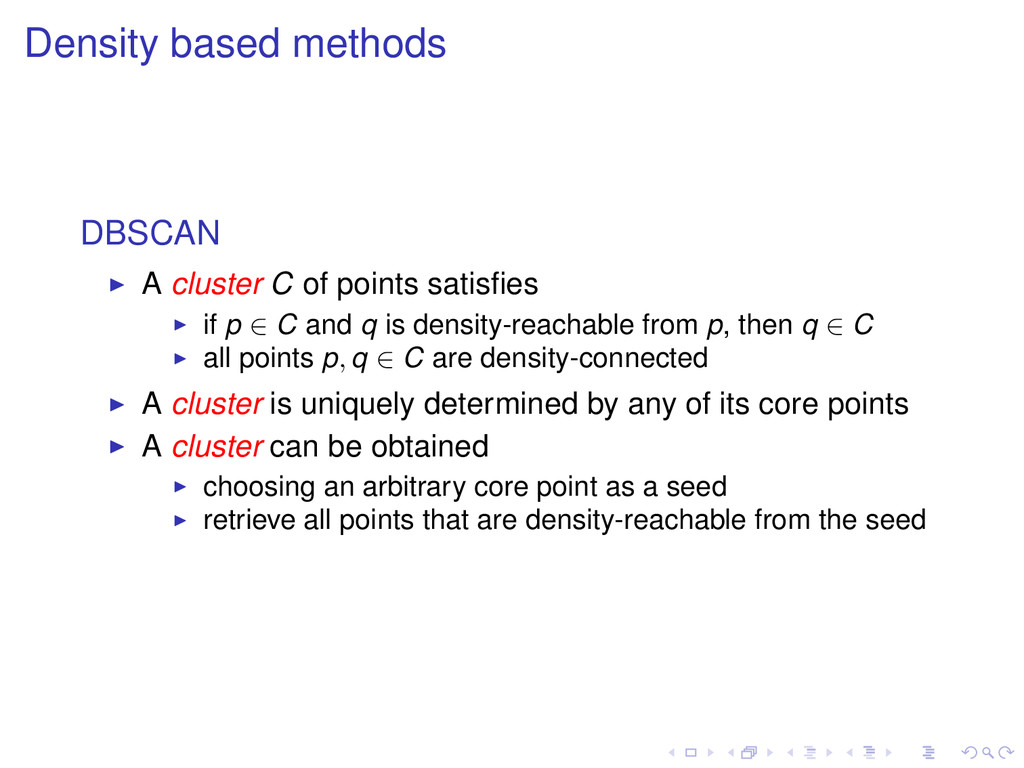
if p ∈ C and q is density-reachable from p, then q ∈ C all points p, q ∈ C are density-connected A cluster is uniquely determined by any of its core points A cluster can be obtained choosing an arbitrary core point as a seed retrieve all points that are density-reachable from the seed
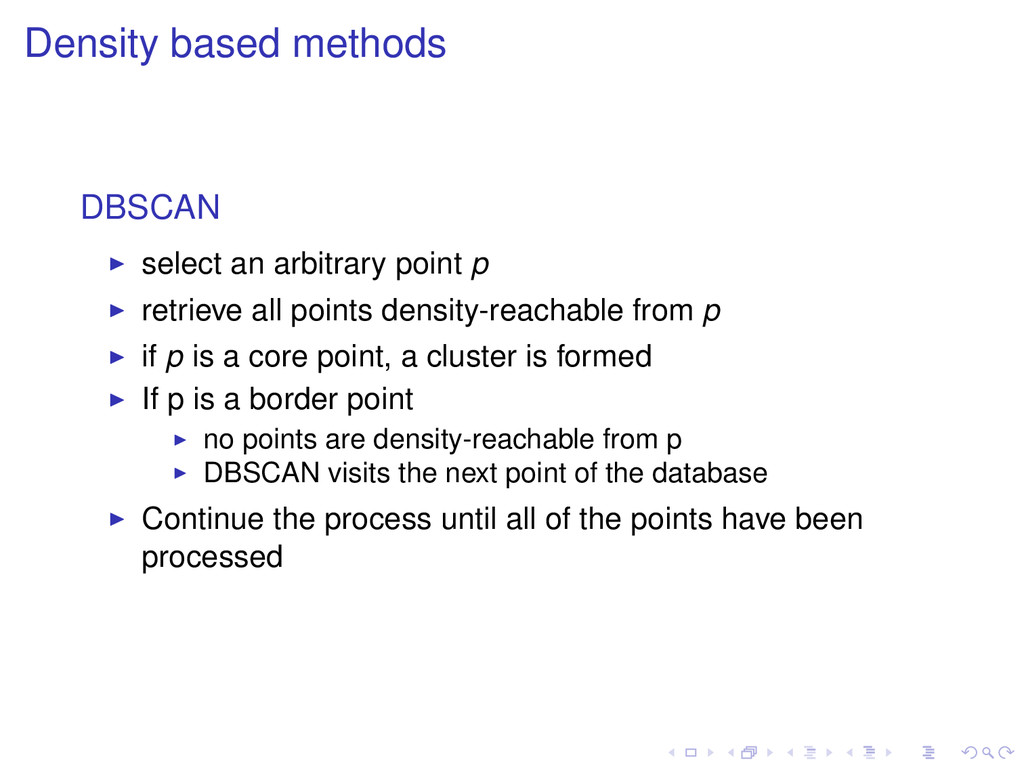
all points density-reachable from p if p is a core point, a cluster is formed If p is a border point no points are density-reachable from p DBSCAN visits the next point of the database Continue the process until all of the points have been processed
at a distance of p less or equal to Core object: object whose -neighborhood has an overall weight at least µ Density area: union of the -neighborhood of core objects
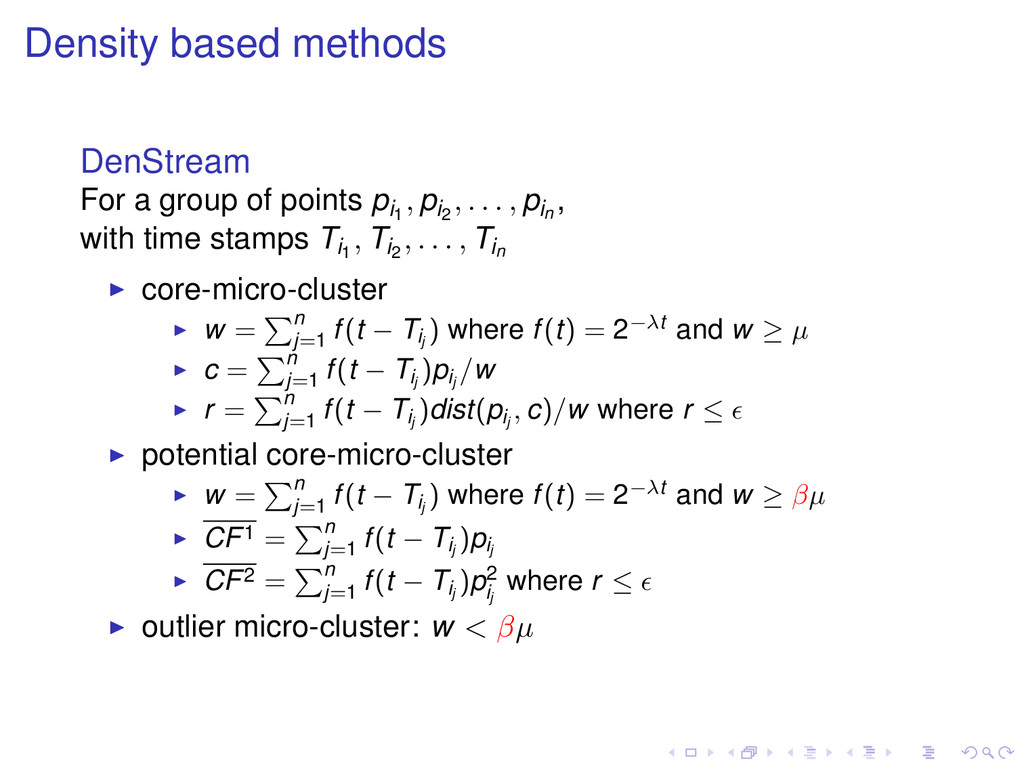
, pi2 , . . . , pin , with time stamps Ti1 , Ti2 , . . . , Tin core-micro-cluster w = n j=1 f(t − Tij ) where f(t) = 2−λt and w ≥ µ c = n j=1 f(t − Tij )pij /w r = n j=1 f(t − Tij )dist(pij , c)/w where r ≤ potential core-micro-cluster w = n j=1 f(t − Tij ) where f(t) = 2−λt and w ≥ βµ CF1 = n j=1 f(t − Tij )pij CF2 = n j=1 f(t − Tij )p2 ij where r ≤ outlier micro-cluster: w < βµ
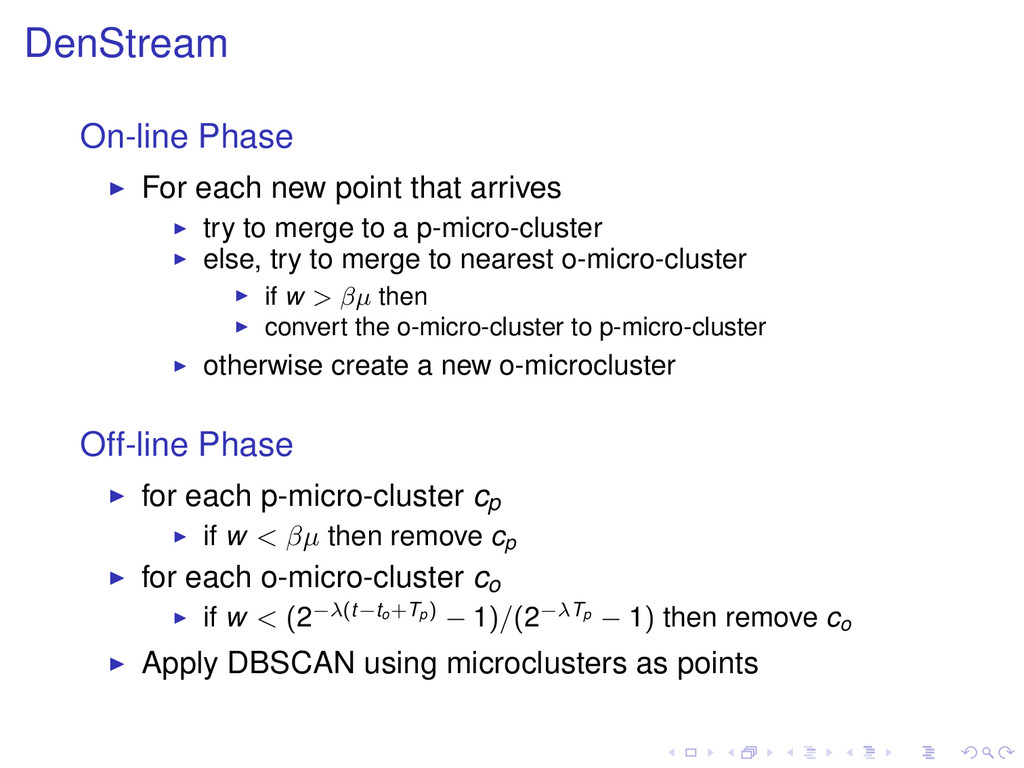
to merge to a p-micro-cluster else, try to merge to nearest o-micro-cluster if w > βµ then convert the o-micro-cluster to p-micro-cluster otherwise create a new o-microcluster Off-line Phase for each p-micro-cluster cp if w < βµ then remove cp for each o-micro-cluster co if w < (2−λ(t−to+Tp) − 1)/(2−λTp − 1) then remove co Apply DBSCAN using microclusters as points
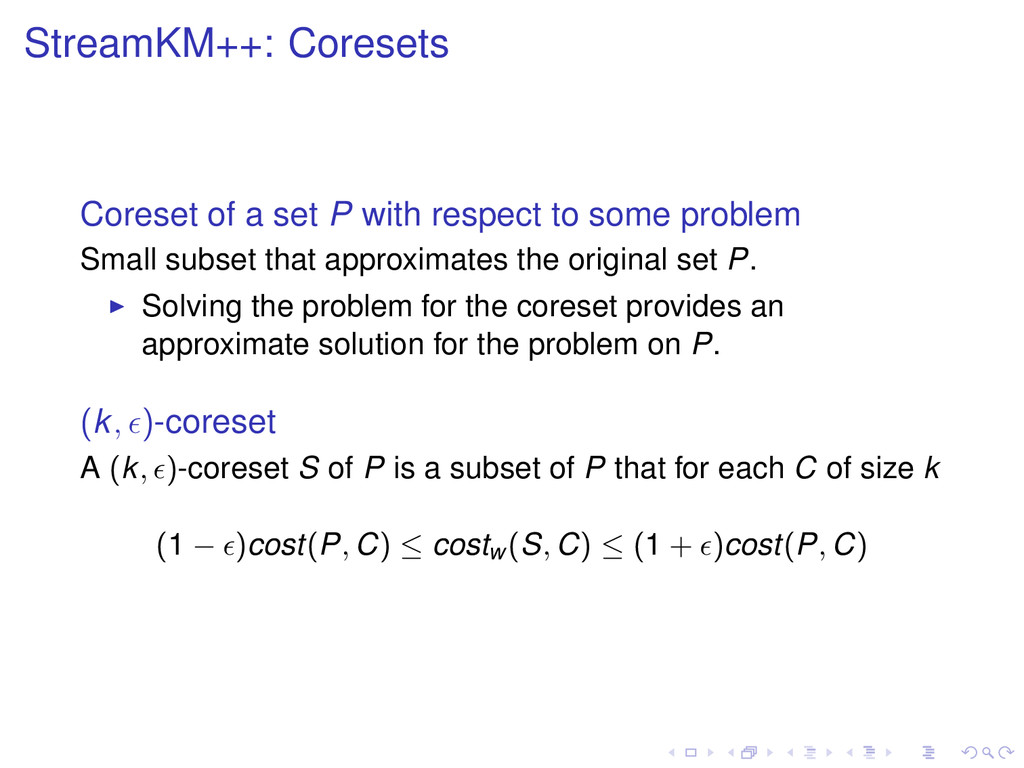
some problem Small subset that approximates the original set P. Solving the problem for the coreset provides an approximate solution for the problem on P. (k, )-coreset A (k, )-coreset S of P is a subset of P that for each C of size k (1 − )cost(P, C) ≤ costw (S, C) ≤ (1 + )cost(P, C)
random Choose a new sample point denoted by qt+1 from Pl according to d2 Based on ql and qt+1, split Pl into two subclusters and create two child nodes StreamKM++ Maintain L = log2 ( n m ) + 2 buckets B0, B1, . . . , BL−1


 abifet
 shunk031
 takasehideki
 imai448
 polipoli
 shiell
 koide3
 s_mizuki_nlp
 sishi
sishi
 yumulab
 institutdelelevage
 analokmaus
 tenderlove
 davidcarrasco
 csswizardry
 apolaine
 frankvandijk
 tammielis
 helmedeiros
 brad_frost
 morganepeng
 schlessera
 pwiseman
 kimpetersen