Share
Embed
Puppet for dummies - PHP|Tek 2012
Joshua Thijssen
May 23, 2012
Transcript
86 slides
-
Puppet for Dummies PHP|Tek - Chicago - USA May 23,
2012 woensdag 23 mei 12 -
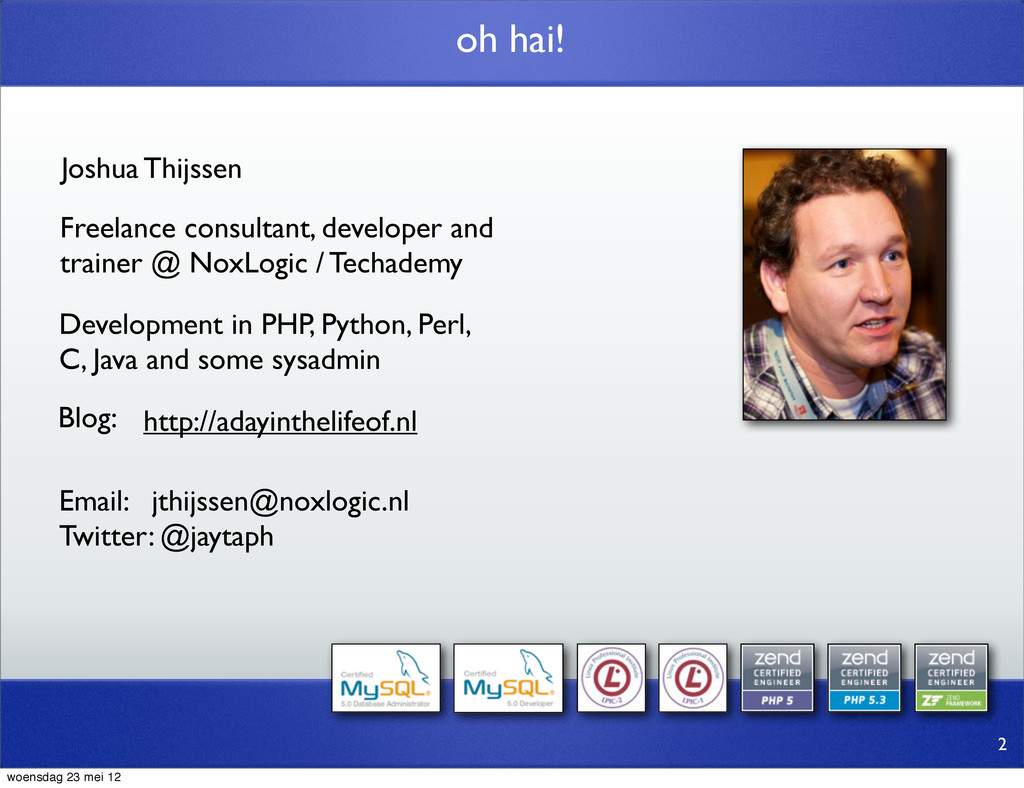
Joshua Thijssen Freelance consultant, developer and trainer @ NoxLogic /
Techademy Development in PHP, Python, Perl, C, Java and some sysadmin Blog: http://adayinthelifeof.nl Email: [email protected] Twitter: @jaytaph oh hai! 2 woensdag 23 mei 12 -
“People are finally figuring out puppet and how it gets
you to the pub by 4pm. Note that I’ve been at this pub since 2pm.” - Jorge Castro 4 woensdag 23 mei 12 -
Puppet is a (not necessarily the) solution for the following
problem: How do we setup, manage, synchronize, and upgrade our internal and external infrastructure? 6 woensdag 23 mei 12 -
LAMPGMVNMCSTRAH-stack Linux Apache MySQL PHP Gearman MongoDB CouchDB Solr Tika
Redis ActiveMQ Hadoop Varnish Ngnix Memcache 9 woensdag 23 mei 12 -
➡ Solution 1: We don’t, 10 How do we control
our infrastructure? woensdag 23 mei 12 -
➡ Solution 1: We don’t, ➡ Solution 2: We outsource,
10 How do we control our infrastructure? woensdag 23 mei 12 -
➡ Solution 1: We don’t, ➡ Solution 2: We outsource,
➡ Solution 3: We automate the process. 10 How do we control our infrastructure? woensdag 23 mei 12 -
➡ It’s not funny: you find it more often than
not. Especially inside small development companies. ‣ Solution 1: we don’t 11 woensdag 23 mei 12 -
➡ It’s not funny: you find it more often than
not. Especially inside small development companies. ➡ Internal sysadmin, but he’s too busy with development to do sysadmin. ‣ Solution 1: we don’t 11 woensdag 23 mei 12 -
➡ It’s not funny: you find it more often than
not. Especially inside small development companies. ➡ Internal sysadmin, but he’s too busy with development to do sysadmin. ➡ We only act on escalation ‣ Solution 1: we don’t 11 woensdag 23 mei 12 -
➡ It’s not funny: you find it more often than
not. Especially inside small development companies. ➡ Internal sysadmin, but he’s too busy with development to do sysadmin. ➡ We only act on escalation ➡ reactive, not proactive ‣ Solution 1: we don’t 11 woensdag 23 mei 12 -
➡ Expensive $LA’s. ➡ What about INTERNAL servers like your
development systems and infrastructure? ‣ Solution 2: we outsource 12 woensdag 23 mei 12 -
➡ Expensive $LA’s. ➡ What about INTERNAL servers like your
development systems and infrastructure? ➡ Fight between stability and agility. ‣ Solution 2: we outsource 12 woensdag 23 mei 12 -
➡ Expensive $LA’s. ➡ What about INTERNAL servers like your
development systems and infrastructure? ➡ Fight between stability and agility. ➡ Does your hosting company decide on whether you can use PHP5.3??? ‣ Solution 2: we outsource 12 woensdag 23 mei 12 -
‣ Solution 3: we do it ourselves and automate 13
woensdag 23 mei 12 -
➡ We are in charge. ‣ Solution 3: we do
it ourselves and automate 13 woensdag 23 mei 12 -
➡ We are in charge. ➡ You can do what
you like ‣ Solution 3: we do it ourselves and automate 13 woensdag 23 mei 12 -
➡ We are in charge. ➡ You can do what
you like ➡ Use: cfEngine, chef, puppet. ‣ Solution 3: we do it ourselves and automate 13 woensdag 23 mei 12 -
➡ We are in charge. ➡ You can do what
you like ➡ Use: cfEngine, chef, puppet. ➡ When done right, maintenance should not be difficult. ‣ Solution 3: we do it ourselves and automate 13 woensdag 23 mei 12 -
➡ Open source configuration management tool. ➡ Written in Ruby
➡ Open source: https://github.com/puppetlabs ➡ Commercial version available (puppet enterprise) 15 woensdag 23 mei 12 -
➡ Don’t tell HOW to do stuff. ➡ Tell WHAT
to do. ¹ ¹ It’s not actually true, but good enough for now... 16 woensdag 23 mei 12 -
➡ Don’t tell HOW to do stuff. ➡ Tell WHAT
to do. ¹ ¹ It’s not actually true, but good enough for now... “yum install httpd” “apt-get install apache2” 16 woensdag 23 mei 12 -
➡ Don’t tell HOW to do stuff. ➡ Tell WHAT
to do. ¹ ¹ It’s not actually true, but good enough for now... “yum install httpd” “apt-get install apache2” “install and run the apache webserver” 16 woensdag 23 mei 12 -
Puppet CA Puppet Master Puppet Agent Puppet Agent Puppet Agent
https 19 woensdag 23 mei 12 -
➡ Agent “calls” the puppet master. ➡ Agent sends “facts”
to the master. 20 woensdag 23 mei 12 -
➡ Agent “calls” the puppet master. ➡ Agent sends “facts”
to the master. ➡ Master creates “catalog” from the manifests and facts, sends to agent. 20 woensdag 23 mei 12 -
➡ Agent “calls” the puppet master. ➡ Agent sends “facts”
to the master. ➡ Master creates “catalog” from the manifests and facts, sends to agent. ➡ Agent sets up system according to the catalog. 20 woensdag 23 mei 12 -
➡ Agent “calls” the puppet master. ➡ Agent sends “facts”
to the master. ➡ Master creates “catalog” from the manifests and facts, sends to agent. ➡ Agent sets up system according to the catalog. ➡ Agent reports status to master. 20 woensdag 23 mei 12 -
➡ Catalogs are “compiled” manifests ➡ Manifests are puppet definitions
21 woensdag 23 mei 12 -
➡ Catalogs are “compiled” manifests ➡ Manifests are puppet definitions
➡ <filename>.pp 21 woensdag 23 mei 12 -
➡ Catalogs are “compiled” manifests ➡ Manifests are puppet definitions
➡ <filename>.pp ➡ Puppet DSL 21 woensdag 23 mei 12 -
➡ Catalogs are “compiled” manifests ➡ Manifests are puppet definitions
➡ <filename>.pp ➡ Puppet DSL ➡ De-cla-ra-tive language 21 woensdag 23 mei 12 -
➡ Catalogs are “compiled” manifests ➡ Manifests are puppet definitions
➡ <filename>.pp ➡ Puppet DSL ➡ De-cla-ra-tive language ➡ Version your manifests! (git/svn) 21 woensdag 23 mei 12 -
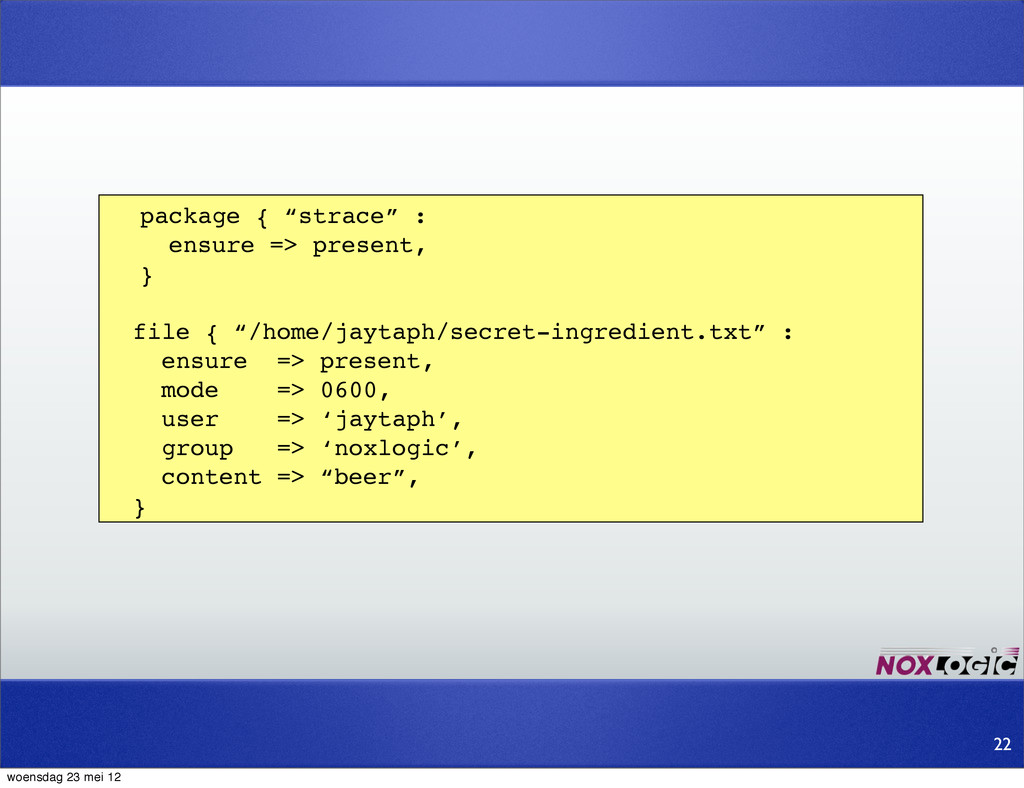
package { “strace” : ensure => present, } file {
“/home/jaytaph/secret-ingredient.txt” : ensure => present, mode => 0600, user => ‘jaytaph’, group => ‘noxlogic’, content => “beer”, } 22 woensdag 23 mei 12 -
package { “httpd” : ensure => present, } service {
“httpd”: running => true, enable => true, } 23 woensdag 23 mei 12 -
package { “httpd” : ensure => present, } service {
“httpd”: running => true, enable => true, } require => Package[“httpd”], 23 woensdag 23 mei 12 -
‣ Different distributions, different names Centos / Redhat service: httpd
package: httpd config: /etc/httpd/conf/httpd.conf vhosts: /etc/httpd/conf.d/*.conf Debian / Ubuntu service: apache2 package: apache2 config: /etc/apache2/httpd.conf vhosts: /etc/apache2/sites-available 24 woensdag 23 mei 12 -
class apache { package { “apache”: case $operatingsystem { centos,
redhat { $packagename = “httpd” } debian, ubuntu { $packagename = “apache2” } default : { fail(‘I don’t know this OS/distro’) } } name => $packagename, ensure => installed, } service { “apache” : running => true, enable => true, require => Package[“apache”], } } 25 woensdag 23 mei 12 -
[root@puppetnode1 ~]# facter --puppet architecture => x86_64 fqdn => puppetnode1.noxlogic.local
interfaces => eth1,eth2,lo ipaddress_eth1 => 192.168.1.114 ipaddress_eth2 => 192.168.56.200 kernel => Linux kernelmajversion => 2.6 operatingsystem => CentOS operatingsystemrelease => 6.0 processor0 => Intel(R) Core(TM)2 Duo CPU T7500 @ 2.20GHz puppetversion => 2.6.9 ‣ A simple list with info (also useable in your own tools) 26 woensdag 23 mei 12 -
node “web01.example.org” { include apache } node /^db\d+\.example\.org$/ { package
{ “mysql-server” : ensure => installed, } } 27 /etc/puppet/manifests/site.pp: woensdag 23 mei 12 -
node “web01.example.local” { $webserver_name = “web01.example.local” $webserver_alias = “www.example.local” $webserver_docroot
= “/var/www/web01” include apache } node “web02.example.local” { $webserver_name = “web02.example.local” $webserver_alias = “crm.example.local” $webserver_docroot = “/var/www/web02” include apache } 28 woensdag 23 mei 12 -
http://docs.puppetlabs.com/references/stable/type.html ➡ Almost everything. ➡ Standard 48 different resource types
➡ Ranging from “file” to “cron” to “ssh_key” to “user” to “selinux”. ➡ Can control your Cisco routers and windows machines too (sortakinda) 30 woensdag 23 mei 12 -
31 class joindin::web { include apache # include phpmyadmin if
needed if $params::phpmyadmin == true { include joindin::web::phpmyadmin } # Configure apache virtual host apache::vhost { $params::host : docroot => '/vagrant/src', template => 'joindin/vhost.conf.erb', port => $params::port, require => Package["apache"], } https://github.com/jaytaph/joind.in/tree/puppet woensdag 23 mei 12 -
32 ... # Install PHP modules php::module { 'mysql': }
php::module { "pecl-xdebug" : require => File["EpelRepo"], # xdebug is in the epel repo } # Set development values to our php.ini augeas { 'set-php-ini-values': context => '/files/etc/php.ini', changes => [ 'set PHP/error_reporting "E_ALL | E_STRICT"', 'set PHP/display_errors On', 'set PHP/display_startup_errors On', 'set PHP/html_errors On', 'set Date/date.timezone Europe/London', ], require => Package['php'], notify => Service['apache'], } } # End class woensdag 23 mei 12 -
33 ➡ Puppet went from v0.25 to v2.6. ➡ REST
interface since 2.6. XMLRPC before that. ➡ One binary to rule them all (puppet). ➡ Puppet v2.7 switched from GPLv2 to apache2.0 license. woensdag 23 mei 12 -
34 So how does Puppet benefit me as a DEVELOPER?
woensdag 23 mei 12 -
35 ➡ Keep all developers in sync ➡ Keep your
DTAP in sync ➡ Lets infrastructure be a part of your project woensdag 23 mei 12 -
Vagrant is a tool for building and distributing virtualized development
environments. 37 woensdag 23 mei 12 -
Vagrant::Config.run do |config| config.vm.box = 'centos-62-64-puppet' config.vm.box_url = 'http://../centos-6.2-64bit-puppet-vbox.4.1.12.box' #
Forward a port from the guest to the host, which allows for outside # computers to access the VM, whereas host only networking does not. config.vm.forward_port 80, 8080 config.vm.provision :puppet do |puppet| puppet.manifests_path = "puppet/manifests" puppet.module_path = "puppet/modules" puppet.manifest_file = "main.pp" puppet.options = [ '--verbose', ] end end Vagrantfile 38 woensdag 23 mei 12 -
➡ Downloads (optionally) the base box ➡ Deploys and boots
up a new VM ➡ Runs the provisioner (puppet) ➡ Profit! 40 woensdag 23 mei 12 -
Multi VM’s Vagrant::Config.run do |config| config.vm.box = 'centos-62-64-puppet' config.vm.box_url =
'http://../centos-6.2-64bit-puppet-vbox.4.1.12.box' config.vm.define :web do |web_config| web_config.vm.host_name = 'web.example.org' web_config.vm.forward_port 80 8080 ... end config.vm.define :database do |db_config| db_config.vm.host_name = 'db.example.org' db_config.vm.forward_port 3306 3306 ... end end Vagrantfile 41 woensdag 23 mei 12 -
➡ Puppet agent “calls” the master every 30 minutes. ➡
But what about realtime command & control? ➡ “Puppet kick”... (meh) ➡ MCollective (Marionette Collective) 43 woensdag 23 mei 12 -
➡ Which systems running a database and have 16GB or
less? ➡ Which systems are using <50% of available memory? ➡ Restart all apache services in timezone GMT+5. 44 woensdag 23 mei 12 -
ACTIVEMQ Client MCollective Server Node Middleware Client MCollective Server MCollective
Server ‣ Middleware takes care of distribution, ‣ queued, broadcast etc.. Collective 45 woensdag 23 mei 12 -
Filter out nodes based on facts $ mc-facts operatingsystem Report
for fact: operatingsystem CentOS found 3 times Debian found 14 times Solaris found 4 times $ mc-facts -W operatingsystem=Centos operatingsystemrelease Report for fact: operatingsystemrelease 6.0 found 1 times 5.6 found 2 times 47 woensdag 23 mei 12 -
➡ Display all running processes ➡ Run or deploy software
➡ Restart services ➡ Start puppet agent ➡ Upgrade your systems ➡ Write your own agents! 48 woensdag 23 mei 12 -
➡ Configuration management tool. ➡ Focusses on “what” instead of
“how”. ➡ Scales from 1 to 100K+ systems. ➡ Uses descriptive manifests. ➡ Vagrant for setting up your development environments. 50 woensdag 23 mei 12 -
➡ Useful for sysadmins and developers. ➡ Keeps your infrastructure
in sync. ➡ Keeps your infrastructure versioned. ➡ Infrastructure as part of your projects. ➡ MCollective controls your hosts based on facts, not names. 51 woensdag 23 mei 12 -
There is no reason NOT to manage your infrastructure. Having
only 3 servers is NOT a reason. 52 You will be able to join the rest of us in the pub early. Don’t “install” development environments, build them! woensdag 23 mei 12 -
Please rate my talk on joind.in: http://joind.in/6515 Thank you 54
Find me on twitter: @jaytaph Find me for development and training: www.noxlogic.nl Find me on email: [email protected] Find me for blogs: www.adayinthelifeof.nl woensdag 23 mei 12