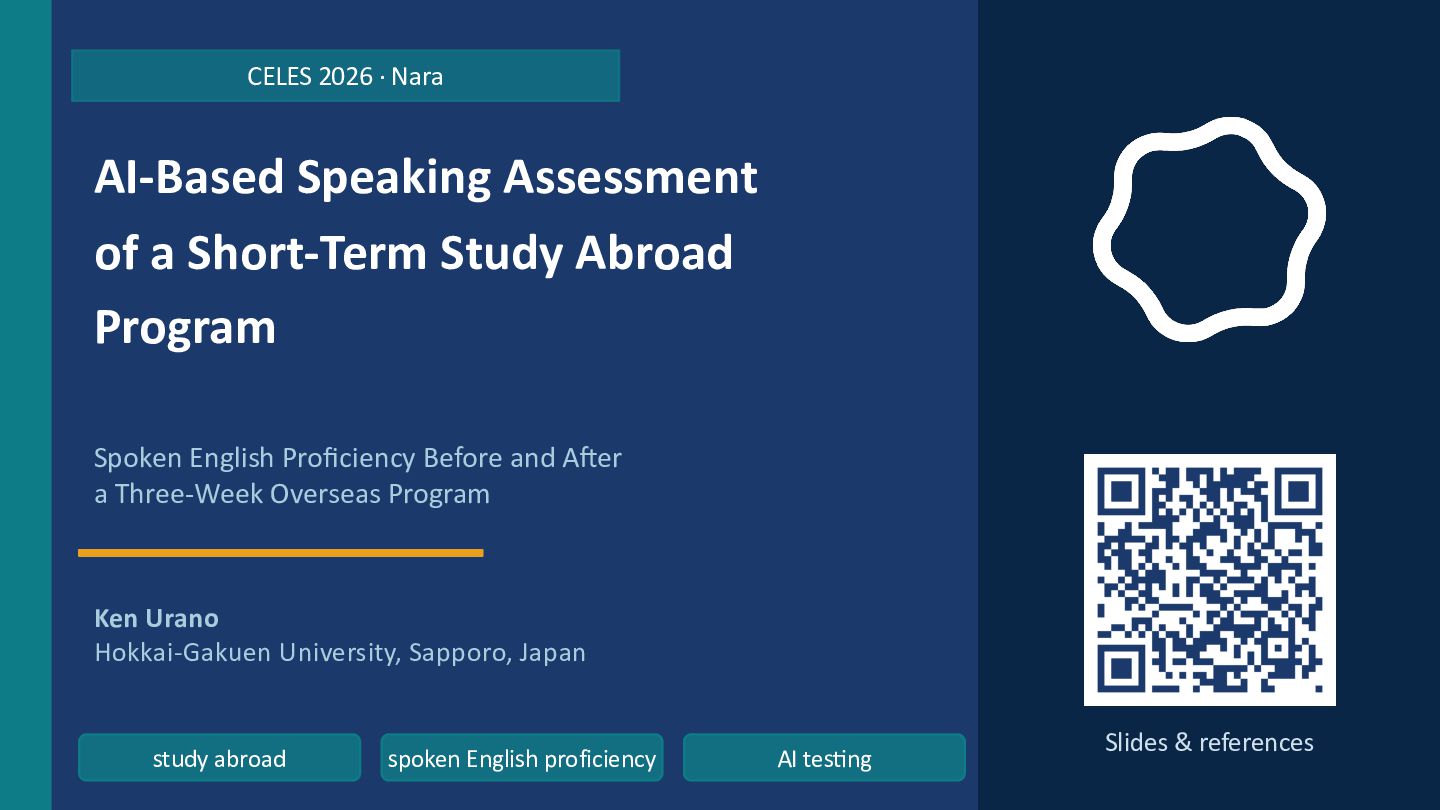
Study Abroad Program Spoken English Proficiency Before and After a Three-Week Overseas Program Ken Urano Hokkai-Gakuen University, Sapporo, Japan study abroad spoken English proficiency AI tes8ng Slides & references
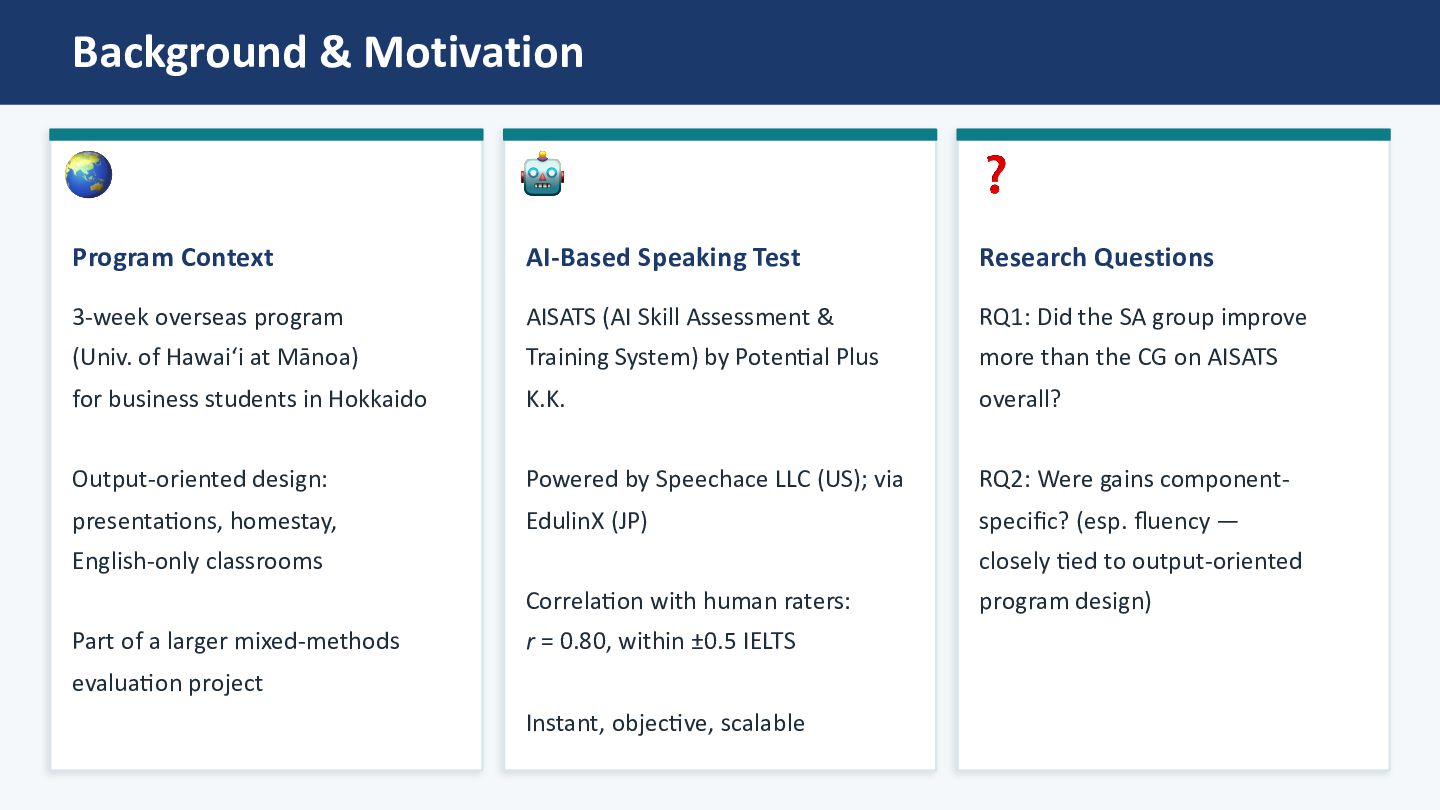
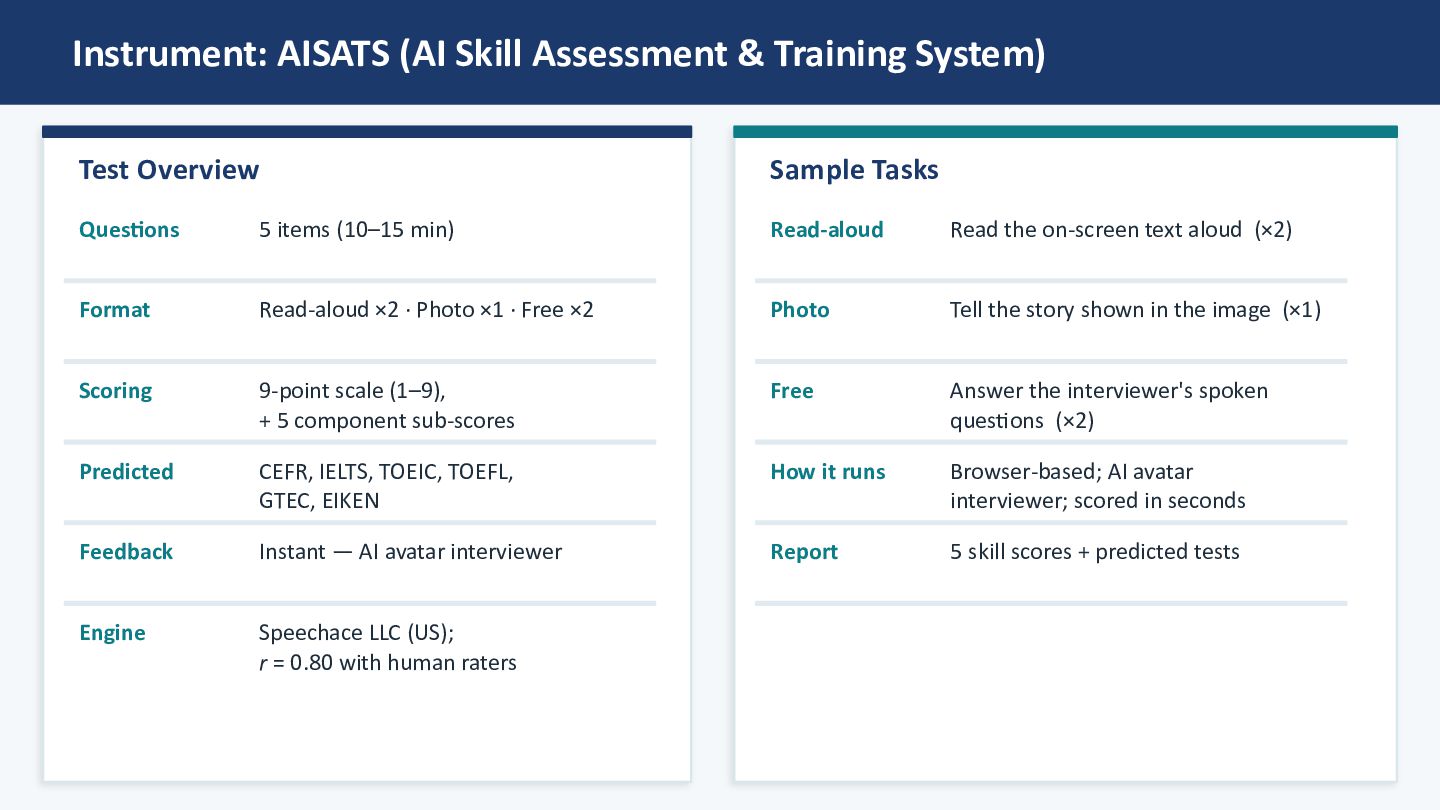
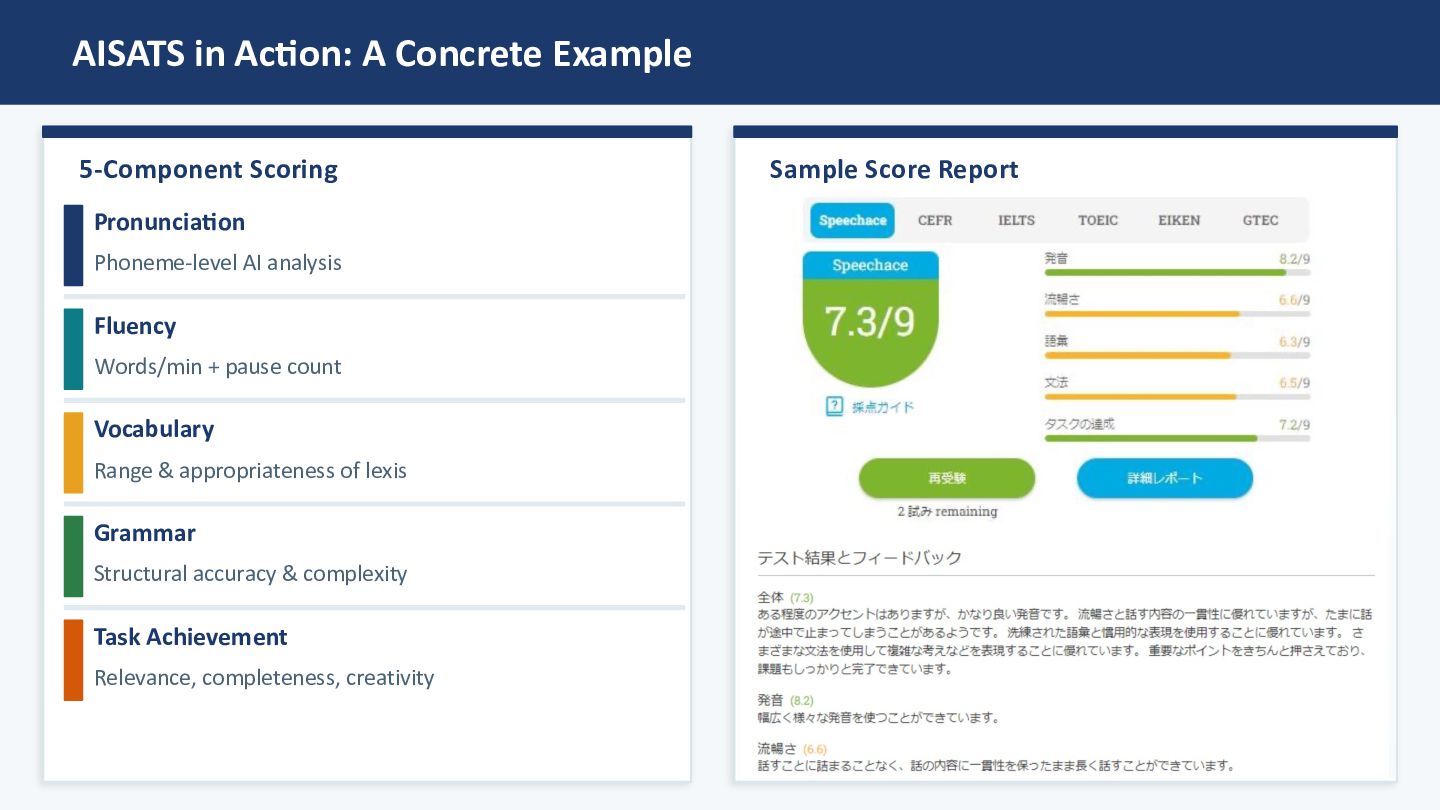
of Hawaiʻi at Mānoa) for business students in Hokkaido Output-oriented design: presentations, homestay, English-only classrooms Part of a larger mixed-methods evaluation project 🤖 AI-Based Speaking Test AISATS (AI Skill Assessment & Training System) by Poten8al Plus K.K. Powered by Speechace LLC (US); via EdulinX (JP) Correla8on with human raters: r = 0.80, within ±0.5 IELTS Instant, objec8ve, scalable ❓ Research Questions RQ1: Did the SA group improve more than the CG on AISATS overall? RQ2: Were gains component- specific? (esp. fluency — closely tied to output-oriented program design)
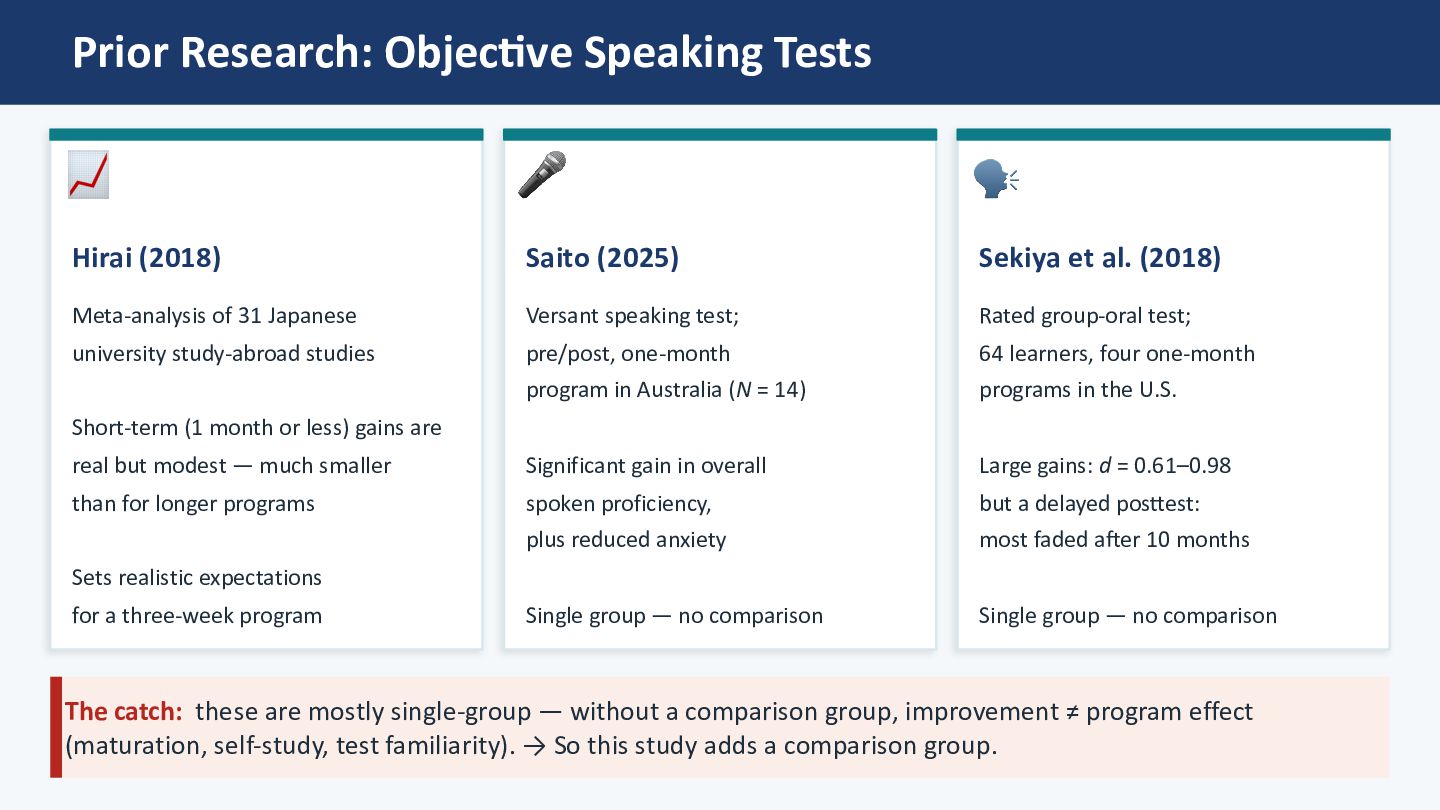
31 Japanese university study-abroad studies Short-term (1 month or less) gains are real but modest — much smaller than for longer programs Sets realistic expectations for a three-week program 🎤 Saito (2025) Versant speaking test; pre/post, one-month program in Australia (N = 14) Significant gain in overall spoken proficiency, plus reduced anxiety Single group — no comparison 🗣 Sekiya et al. (2018) Rated group-oral test; 64 learners, four one-month programs in the U.S. Large gains: d = 0.61–0.98 but a delayed posttest: most faded after 10 months Single group — no comparison The catch: these are mostly single-group — without a comparison group, improvement ≠ program effect (maturaKon, self-study, test familiarity). → So this study adds a comparison group.
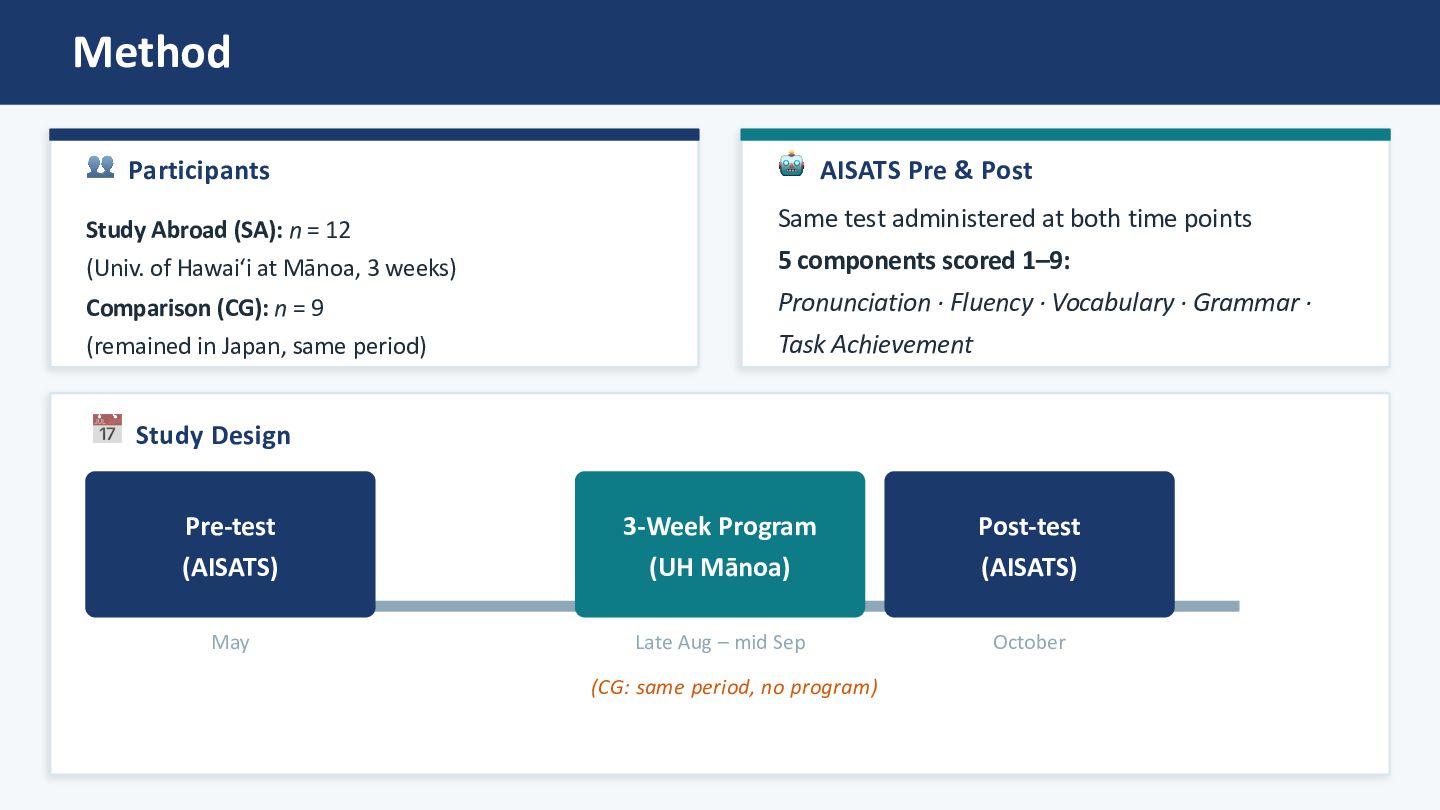
of Hawaiʻi at Mānoa, 3 weeks) Comparison (CG): n = 9 (remained in Japan, same period) 🤖 AISATS Pre & Post Same test administered at both time points 5 components scored 1–9: Pronunciation · Fluency · Vocabulary · Grammar · Task Achievement 📅 Study Design Pre-test (AISATS) May 3-Week Program (UH Mānoa) Late Aug – mid Sep Post-test (AISATS) October (CG: same period, no program)
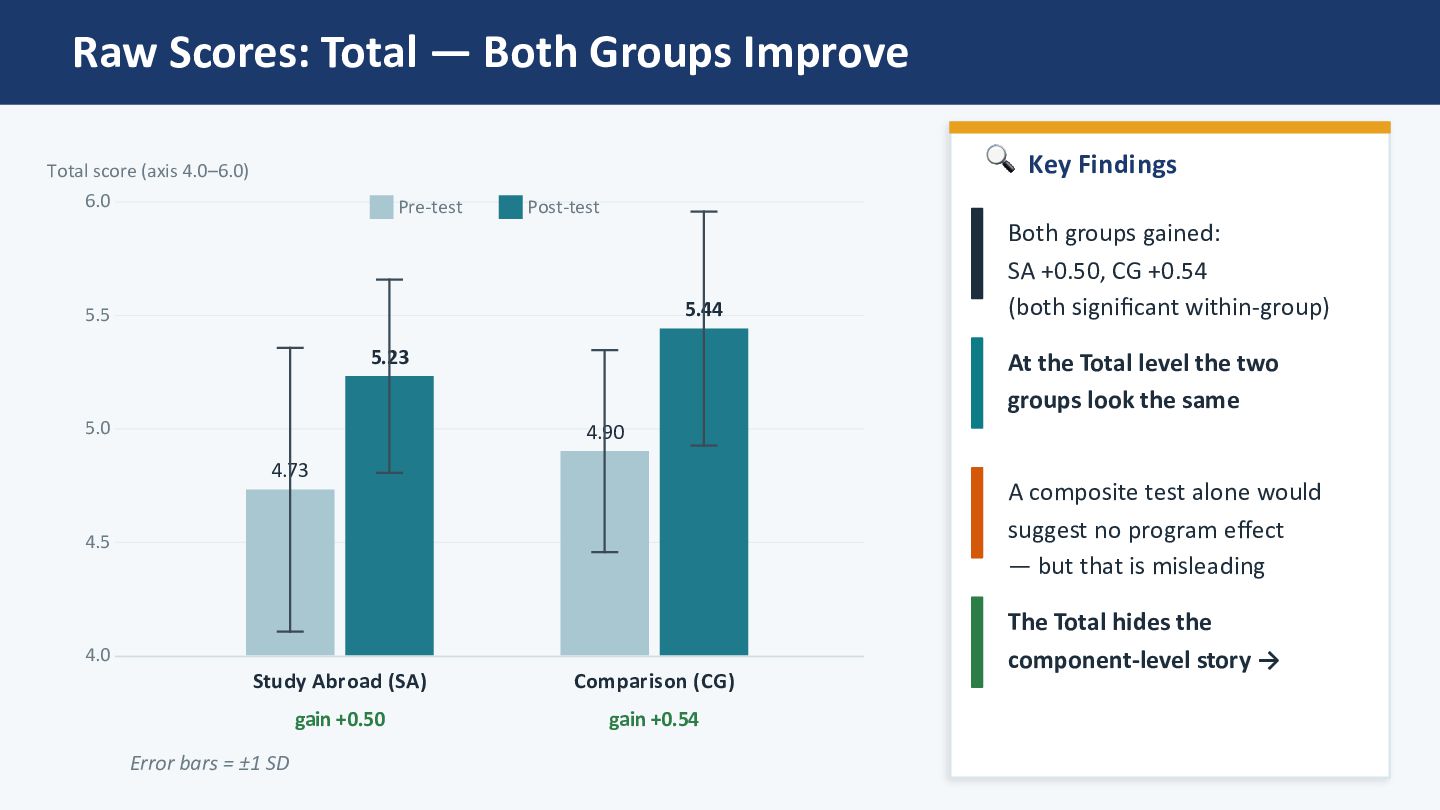
5.5 6.0 4.73 5.23 Study Abroad (SA) gain +0.50 4.90 5.44 Comparison (CG) gain +0.54 Pre-test Post-test Total score (axis 4.0–6.0) 🔍 Key Findings Both groups gained: SA +0.50, CG +0.54 (both significant within-group) At the Total level the two groups look the same A composite test alone would suggest no program effect — but that is misleading The Total hides the component-level story → Error bars = ±1 SD
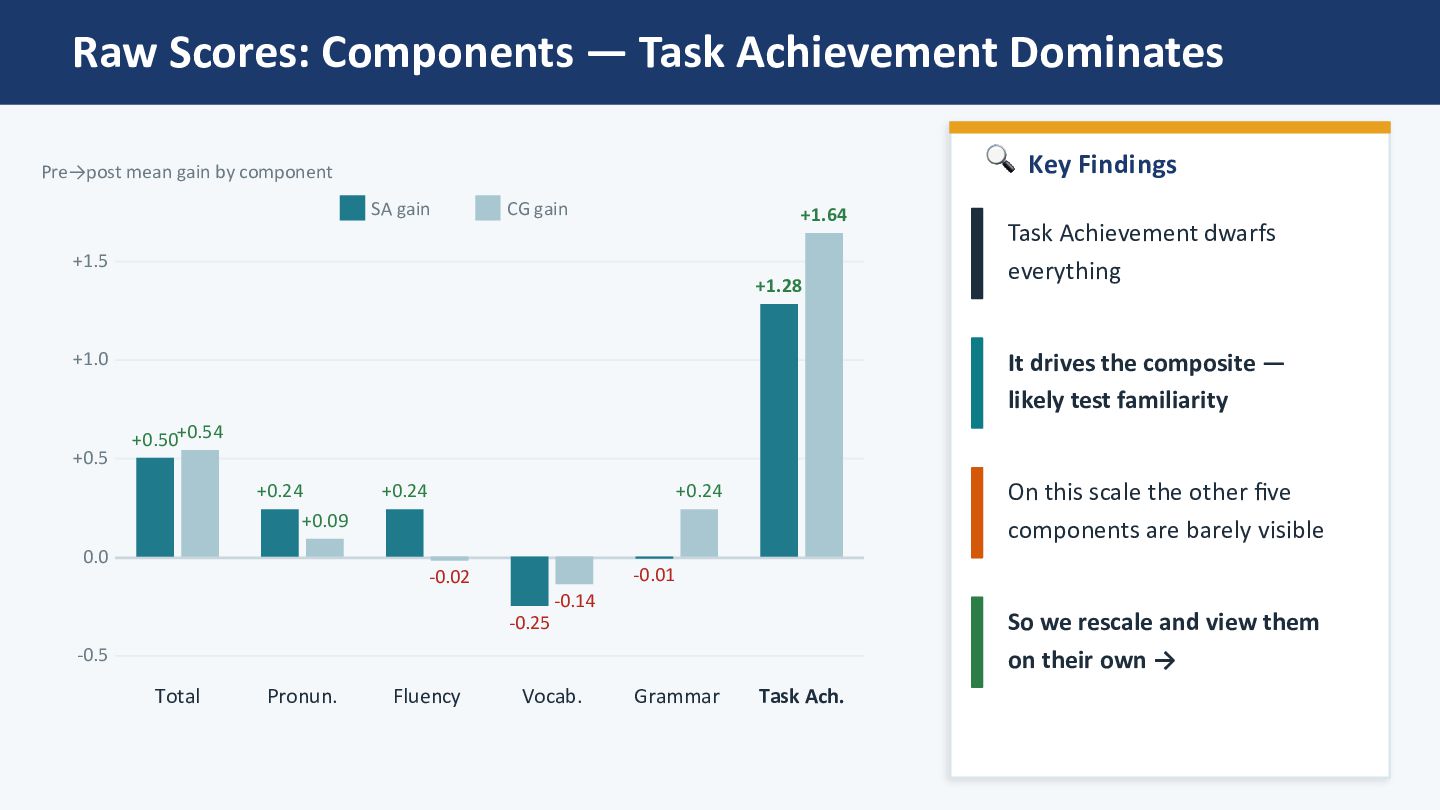
+1.0 +1.5 +0.50+0.54 Total +0.24 +0.09 Pronun. +0.24 -0.02 Fluency -0.25 -0.14 Vocab. -0.01 +0.24 Grammar +1.28 +1.64 Task Ach. SA gain CG gain Pre→post mean gain by component 🔍 Key Findings Task Achievement dwarfs everything It drives the composite — likely test familiarity On this scale the other five components are barely visible So we rescale and view them on their own →
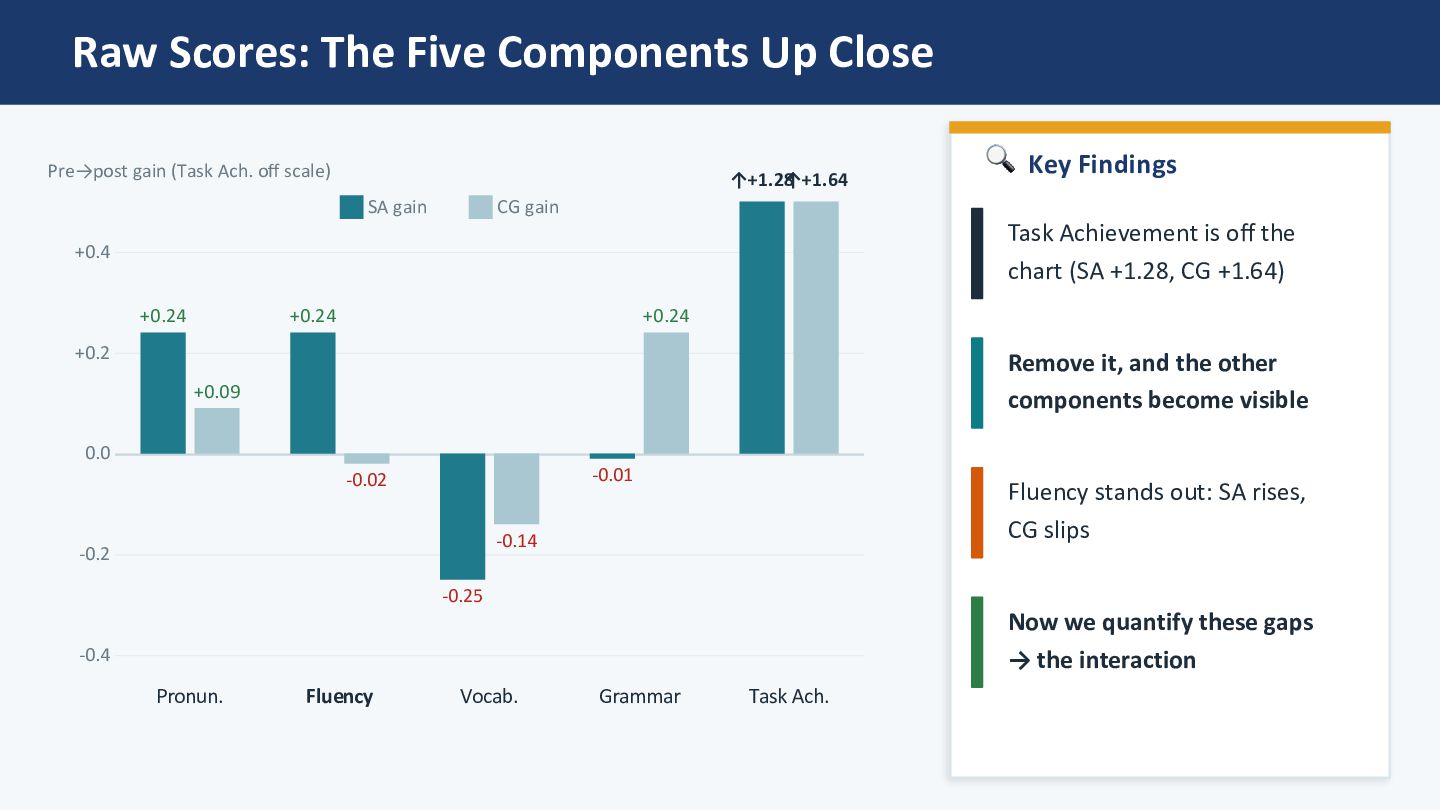
+0.2 +0.4 +0.24 +0.09 Pronun. +0.24 -0.02 Fluency -0.25 -0.14 Vocab. -0.01 +0.24 Grammar ↑+1.28 ↑+1.64 Task Ach. SA gain CG gain Pre→post gain (Task Ach. off scale) 🔍 Key Findings Task Achievement is off the chart (SA +1.28, CG +1.64) Remove it, and the other components become visible Fluency stands out: SA rises, CG slips Now we quan)fy these gaps → the interac)on
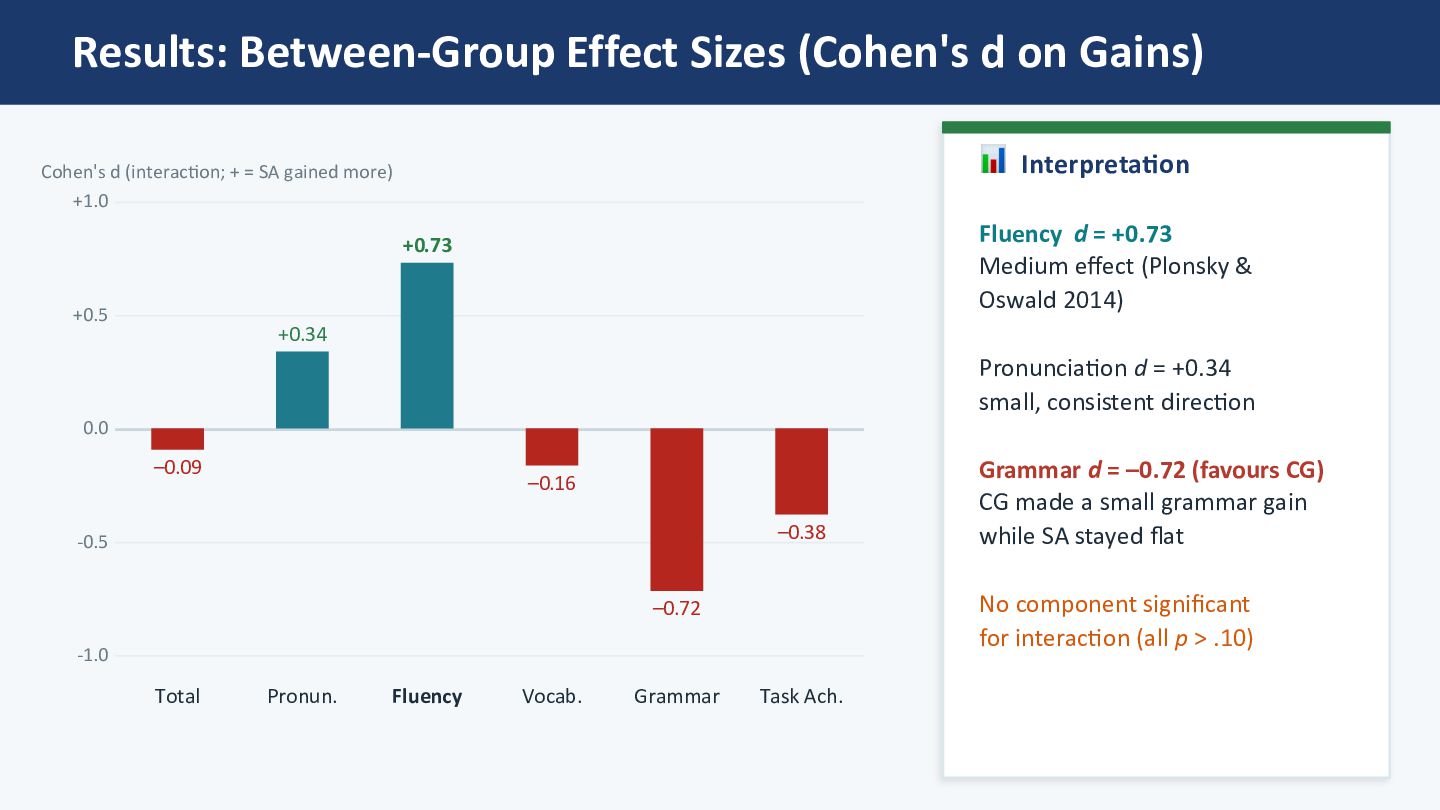
0.0 +0.5 +1.0 –0.09 Total +0.34 Pronun. +0.73 Fluency –0.16 Vocab. –0.72 Grammar –0.38 Task Ach. Cohen's d (interacMon; + = SA gained more) 📊 Interpretation Fluency d = +0.73 Medium effect (Plonsky & Oswald 2014) Pronunciation d = +0.34 small, consistent direction Grammar d = –0.72 (favours CG) CG made a small grammar gain while SA stayed flat No component significant for interaction (all p > .10)
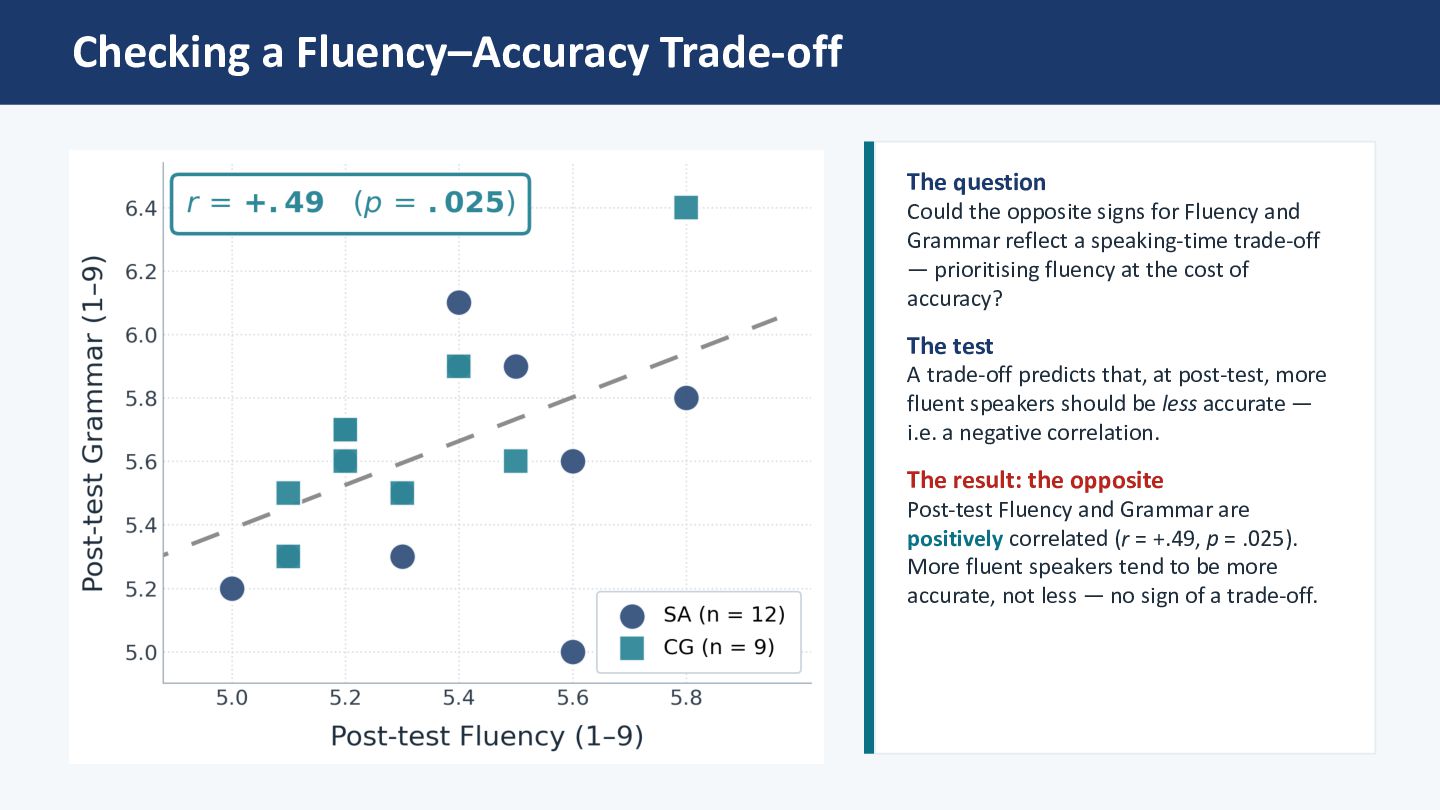
for Fluency and Grammar reflect a speaking-time trade-off — prioritising fluency at the cost of accuracy? The test A trade-off predicts that, at post-test, more fluent speakers should be less accurate — i.e. a negative correlation. The result: the opposite Post-test Fluency and Grammar are positively correlated (r = +.49, p = .025). More fluent speakers tend to be more accurate, not less — no sign of a trade-off.
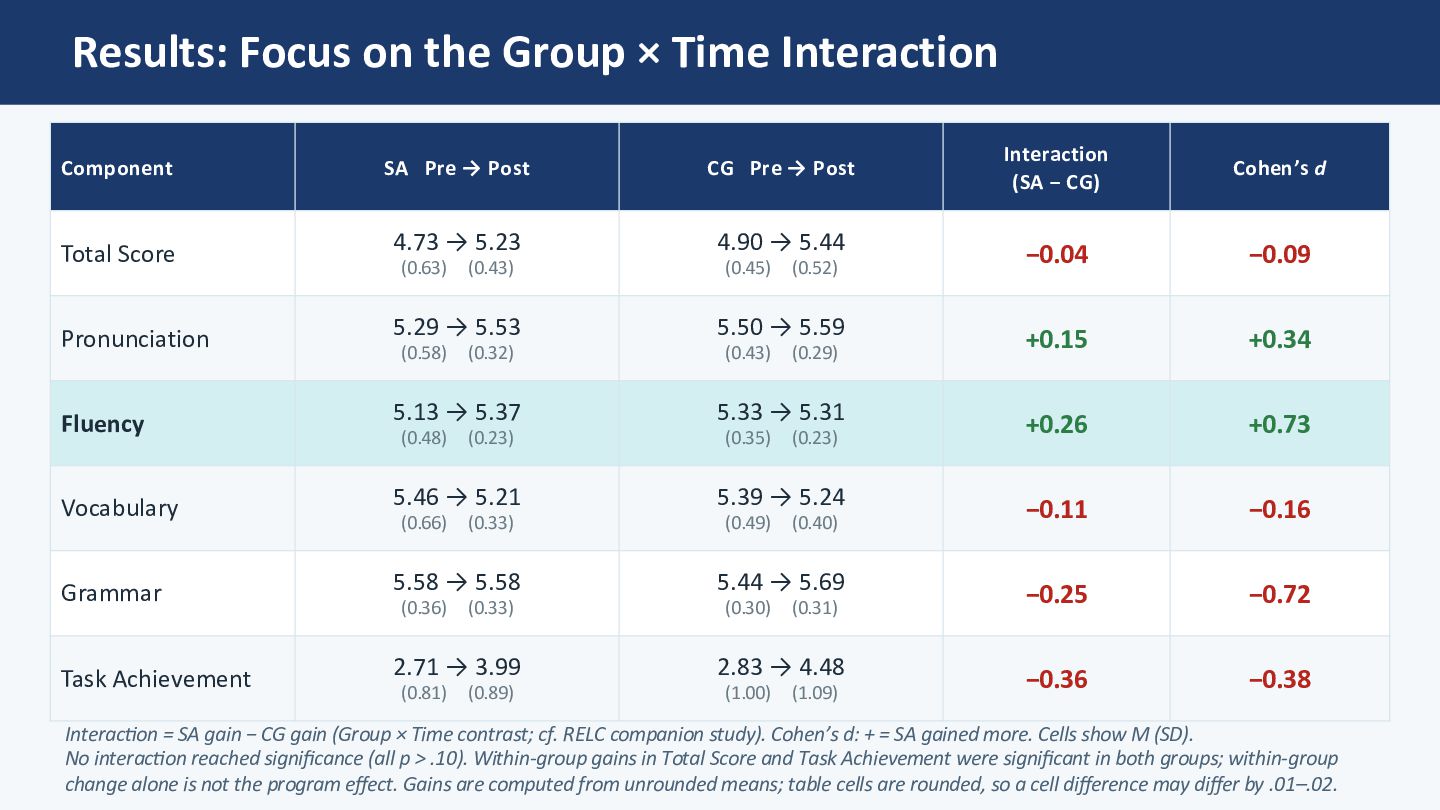
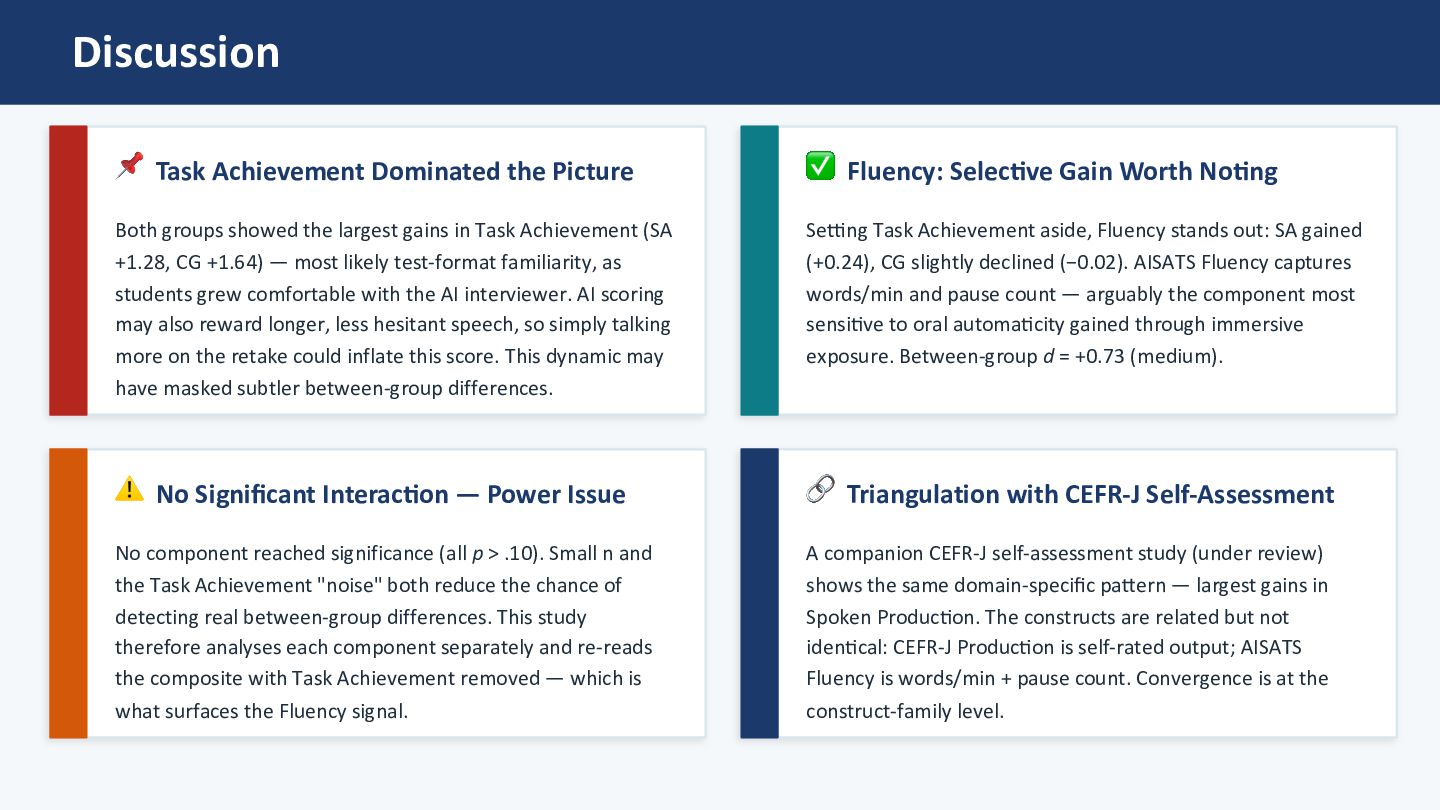
the largest gains in Task Achievement (SA +1.28, CG +1.64) — most likely test-format familiarity, as students grew comfortable with the AI interviewer. AI scoring may also reward longer, less hesitant speech, so simply talking more on the retake could inflate this score. This dynamic may have masked subtler between-group differences. ✅ Fluency: SelecZve Gain Worth NoZng Setting Task Achievement aside, Fluency stands out: SA gained (+0.24), CG slightly declined (−0.02). AISATS Fluency captures words/min and pause count — arguably the component most sensitive to oral automaticity gained through immersive exposure. Between-group d = +0.73 (medium). ⚠ No Significant InteracZon — Power Issue No component reached significance (all p > .10). Small n and the Task Achievement "noise" both reduce the chance of detec_ng real between-group differences. This study therefore analyses each component separately and re-reads the composite with Task Achievement removed — which is what surfaces the Fluency signal. 🔗 Triangulation with Self-Assessment A companion CEFR-J self-assessment study (under review) shows the same domain-specific padern — largest gains in Spoken Produc_on. The constructs are related but not iden_cal: CEFR-J Produc_on is self-rated output; AISATS Fluency is words/min + pause count. Convergence is at the construct-family level.
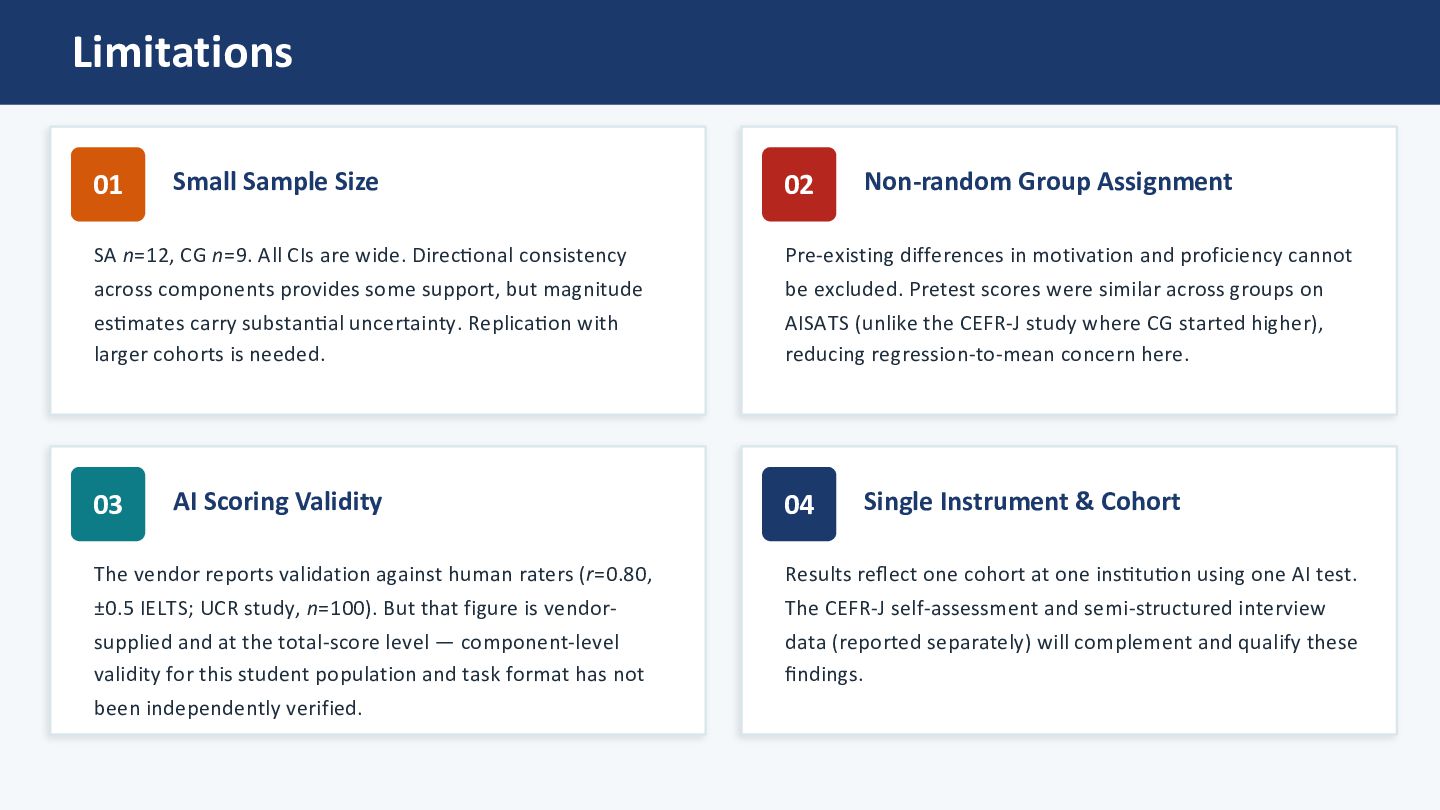
n = 9. All CIs are wide. Directional consistency across components provides some support, but magnitude estimates carry substantial uncertainty. Replication with different cohorts is expected. 02 Non-random Group Assignment Pre-existing differences in motivation and proficiency cannot be excluded, but the pretest scores were similar across groups on AISATS. 03 AI Scoring Validity The vendor reports validation against human raters (r =.80, ±0.5 IELTS; UCR study, n = 100). But that figure is vendor- supplied and at the total-score level — component-level validity for this student population and task format has not been independently verified. 04 Single Instrument & Cohort Results reflect one cohort at one ins_tu_on using one AI test. The CEFR-J self-assessment and semi-structured interview data (reported separately) will complement and qualify these findings.
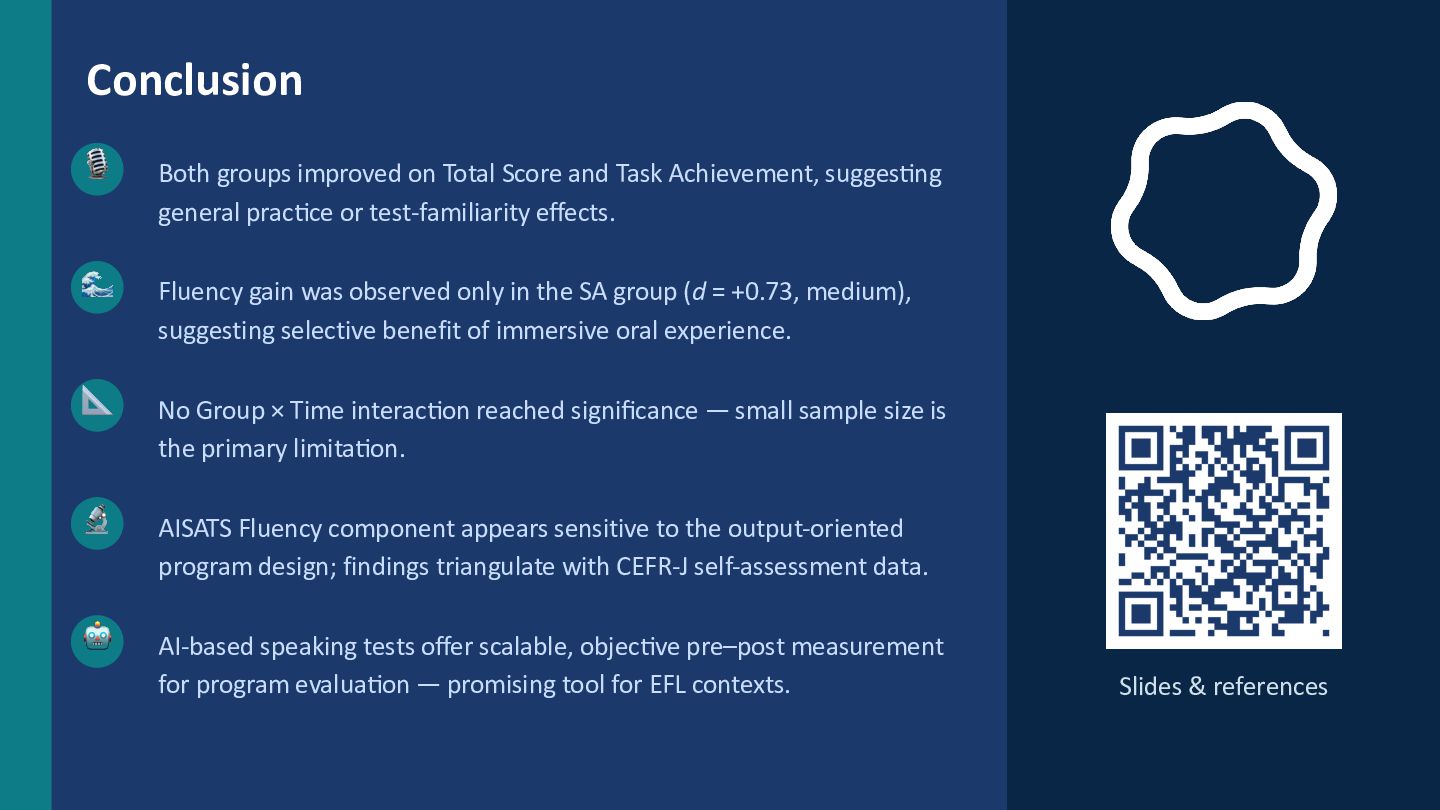
Achievement, suggesKng general pracKce or test-familiarity effects. 🌊 Fluency gain was observed only in the SA group (d = +0.73, medium), suggesting selective benefit of immersive oral experience. 📐 No Group × Time interaction reached significance — small sample size is the primary limitation. 🔬 AISATS Fluency component appears sensiKve to the output-oriented program design; findings triangulate with self-assessment data. 🤖 AI-based speaking tests offer scalable, objecKve pre–post measurement for program evaluaKon — promising tool for EFL contexts. Slides & references
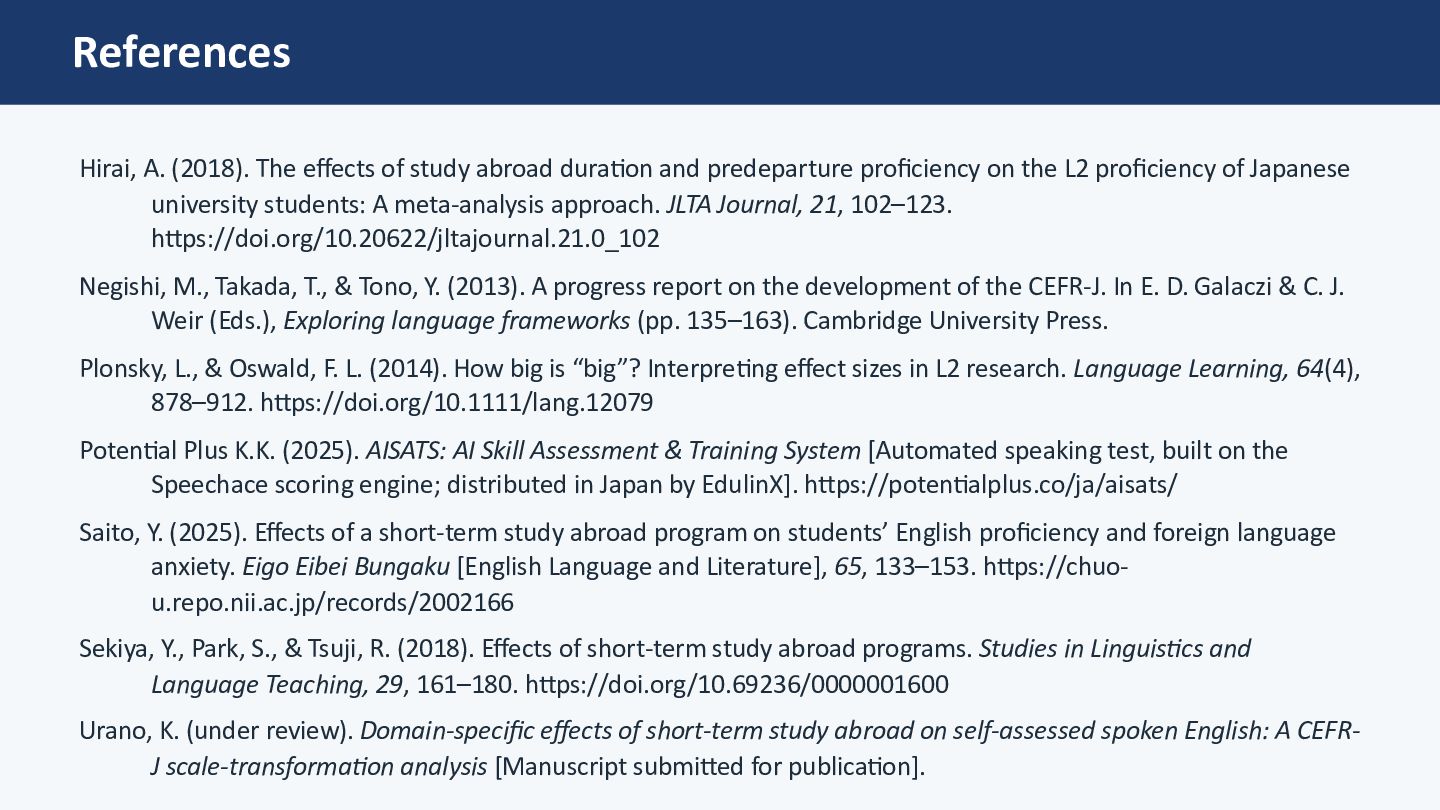
and predeparture proficiency on the L2 proficiency of Japanese university students: A meta-analysis approach. JLTA Journal, 21, 102–123. hcps://doi.org/10.20622/jltajournal.21.0_102 Negishi, M., Takada, T., & Tono, Y. (2013). A progress report on the development of the CEFR-J. In E. D. Galaczi & C. J. Weir (Eds.), Exploring language frameworks (pp. 135–163). Cambridge University Press. Plonsky, L., & Oswald, F. L. (2014). How big is “big”? InterpreKng effect sizes in L2 research. Language Learning, 64(4), 878–912. hcps://doi.org/10.1111/lang.12079 PotenKal Plus K.K. (2025). AISATS: AI Skill Assessment & Training System [Automated speaking test, built on the Speechace scoring engine; distributed in Japan by EdulinX]. hcps://potenKalplus.co/ja/aisats/ Saito, Y. (2025). Effects of a short-term study abroad program on students’ English proficiency and foreign language anxiety. Eigo Eibei Bungaku [English Language and Literature], 65, 133–153. hcps://chuo- u.repo.nii.ac.jp/records/2002166 Sekiya, Y., Park, S., & Tsuji, R. (2018). Effects of short-term study abroad programs. Studies in LinguisNcs and Language Teaching, 29, 161–180. hcps://doi.org/10.69236/0000001600 Urano, K. (under review). Domain-specific effects of short-term study abroad on self-assessed spoken English: A CEFR- J scale-transformaNon analysis [Manuscript submiced for publicaKon].


 uranoken
 cbtlibrary
 juanmartin2026
 ssmedikasda
 drpoonamkc
 tasusu
 hiola
hiola
 ainischool
 pawan_pharm
 eller86
 spring_aki
 jcasabona
 destraynor
 akademiya2063
 cassininazir
 rakko
rakko
 wayneb77
 mkilby
 mayatellez
 techseoconnect
 sarafernandez
 michielstock