Share
Embed
The Task is not the End: The Role of Task Repetition and Sequencing In Language Teaching
Talk at Nara University of Education ELT Study Group Regular Meeting
December 14, 2024
Ken Urano
December 14, 2024
Transcript
77 slides
-
The Task is not the End: The Role of Task
Repetition and Sequencing In Language Teaching Ken Urano ([email protected]) Hokkai-Gakuen University https://www.urano-ken.com/research/nara2024 Nara University of Education ELT Study Group Regular Meeting December 14, 2024 -
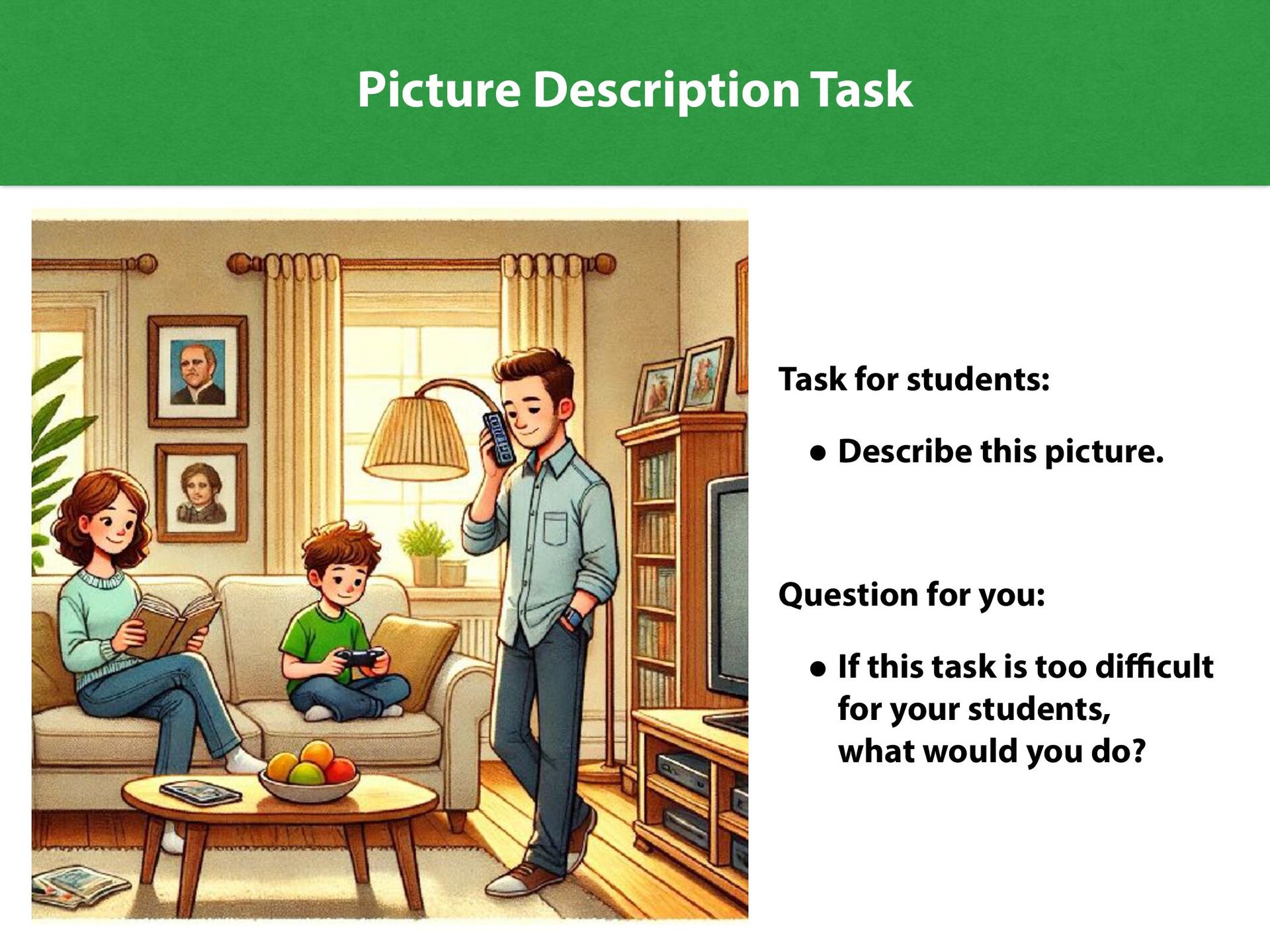
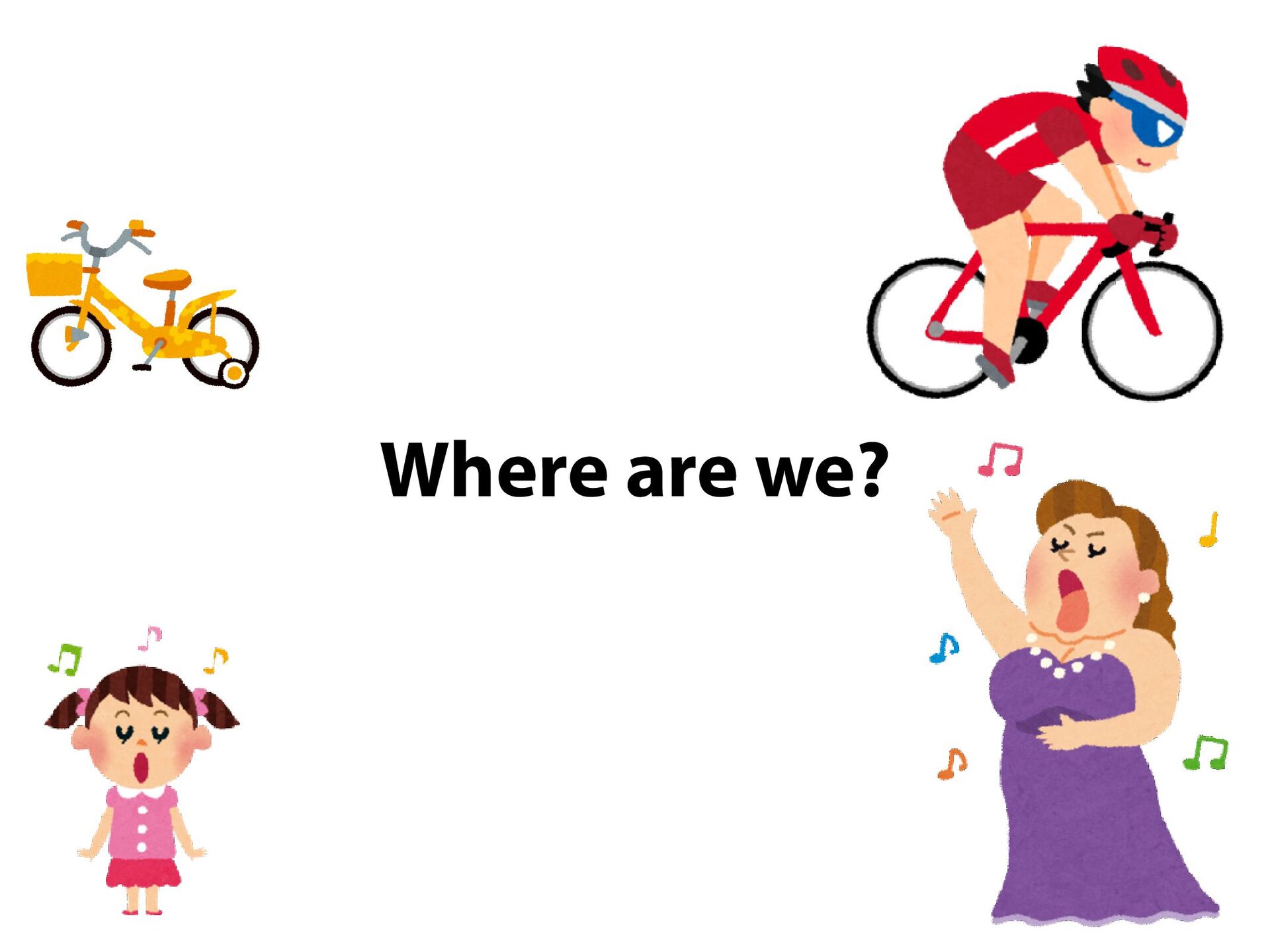
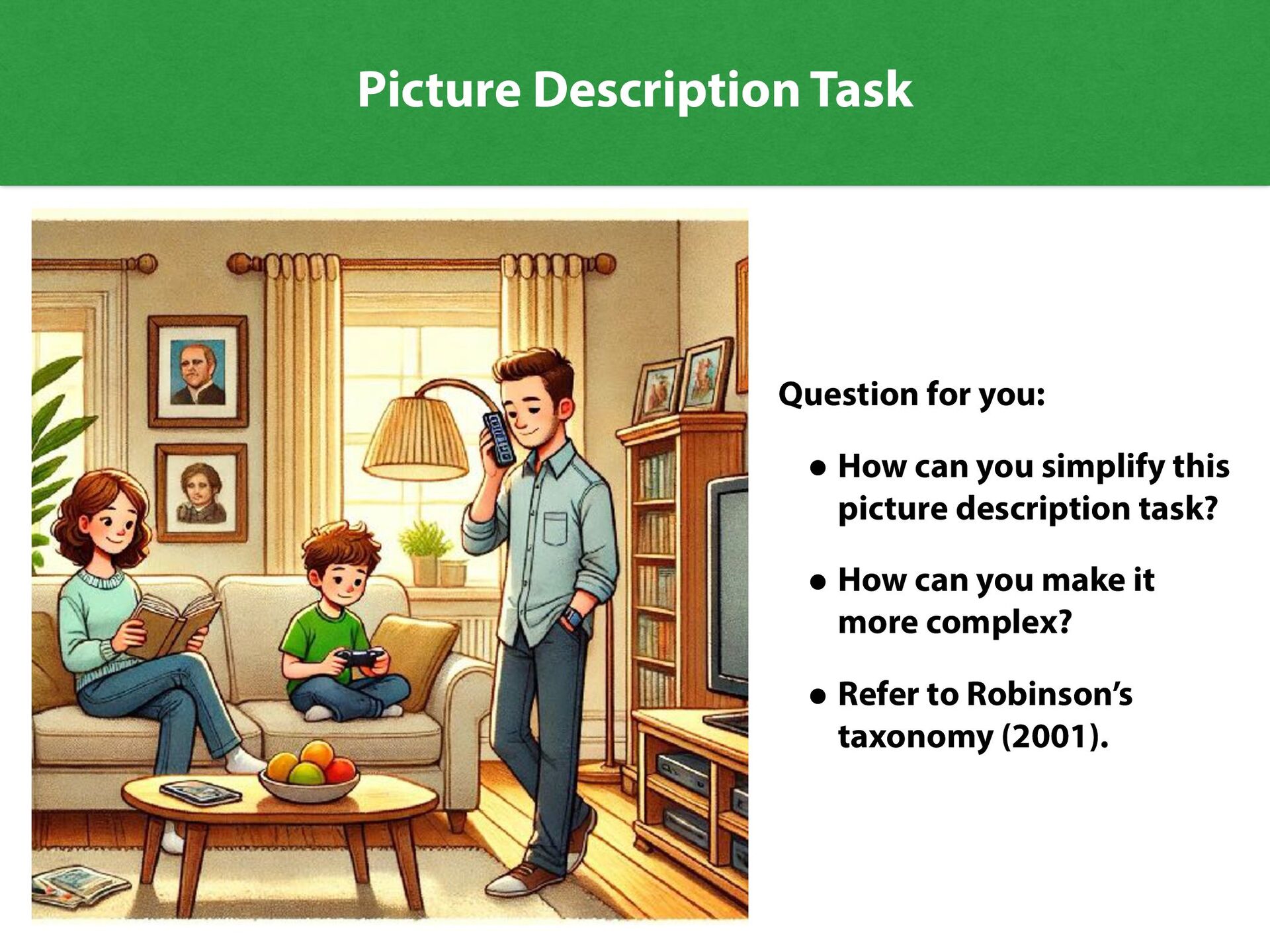
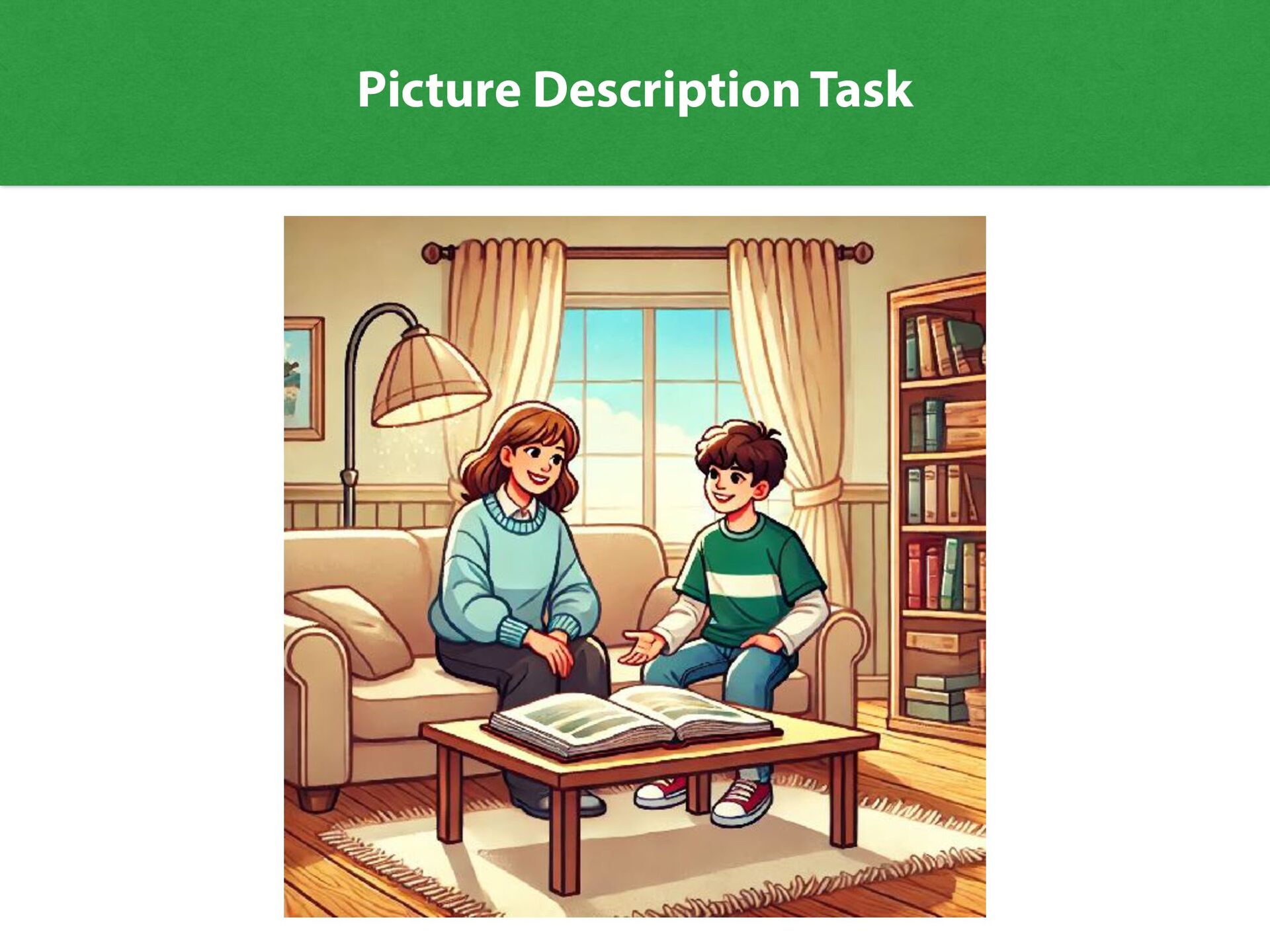
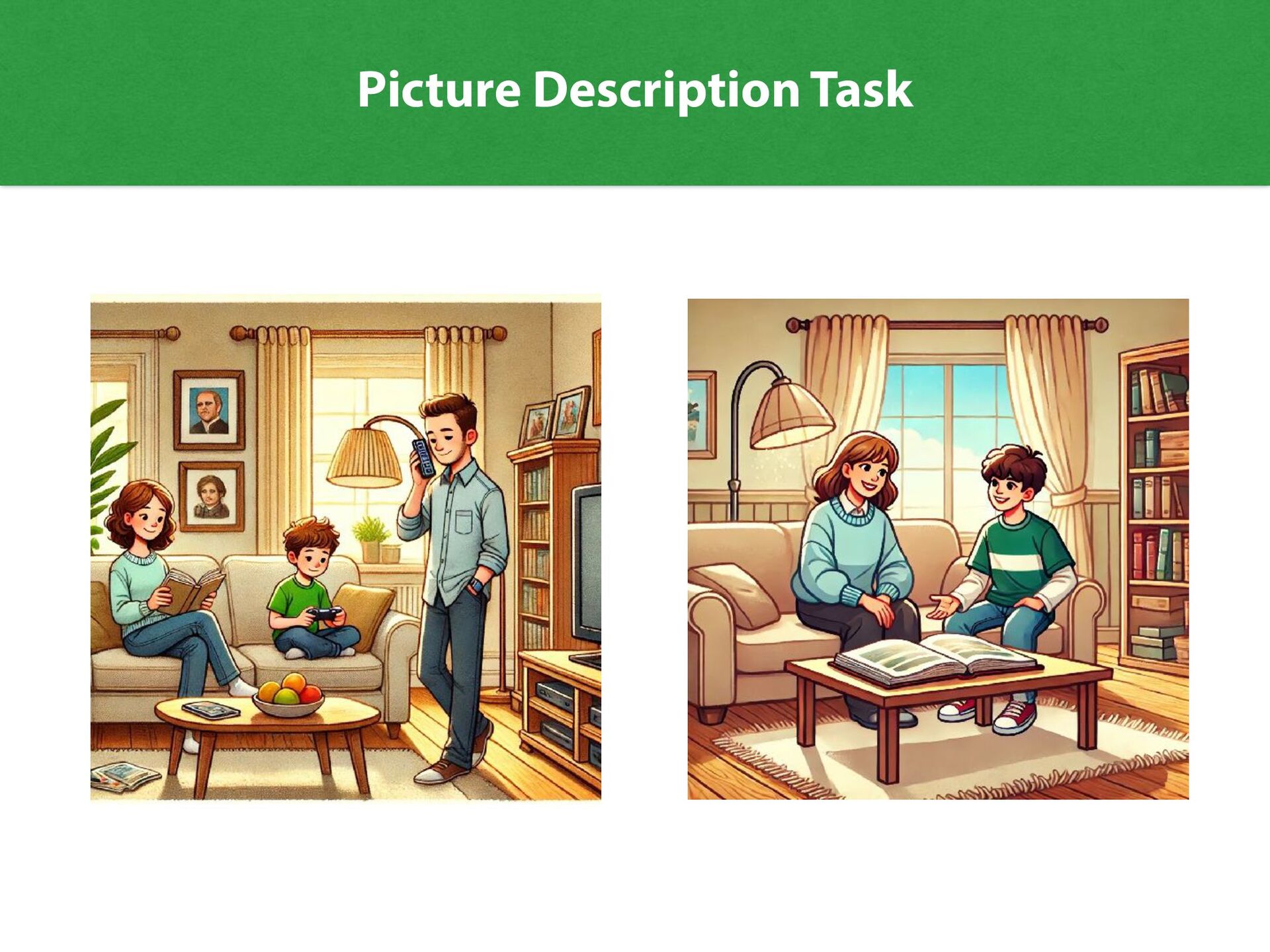
Picture Description Task Task for students: • Describe this picture.
Question for you: • If this task is too di ffi cult for your students, what would you do? -
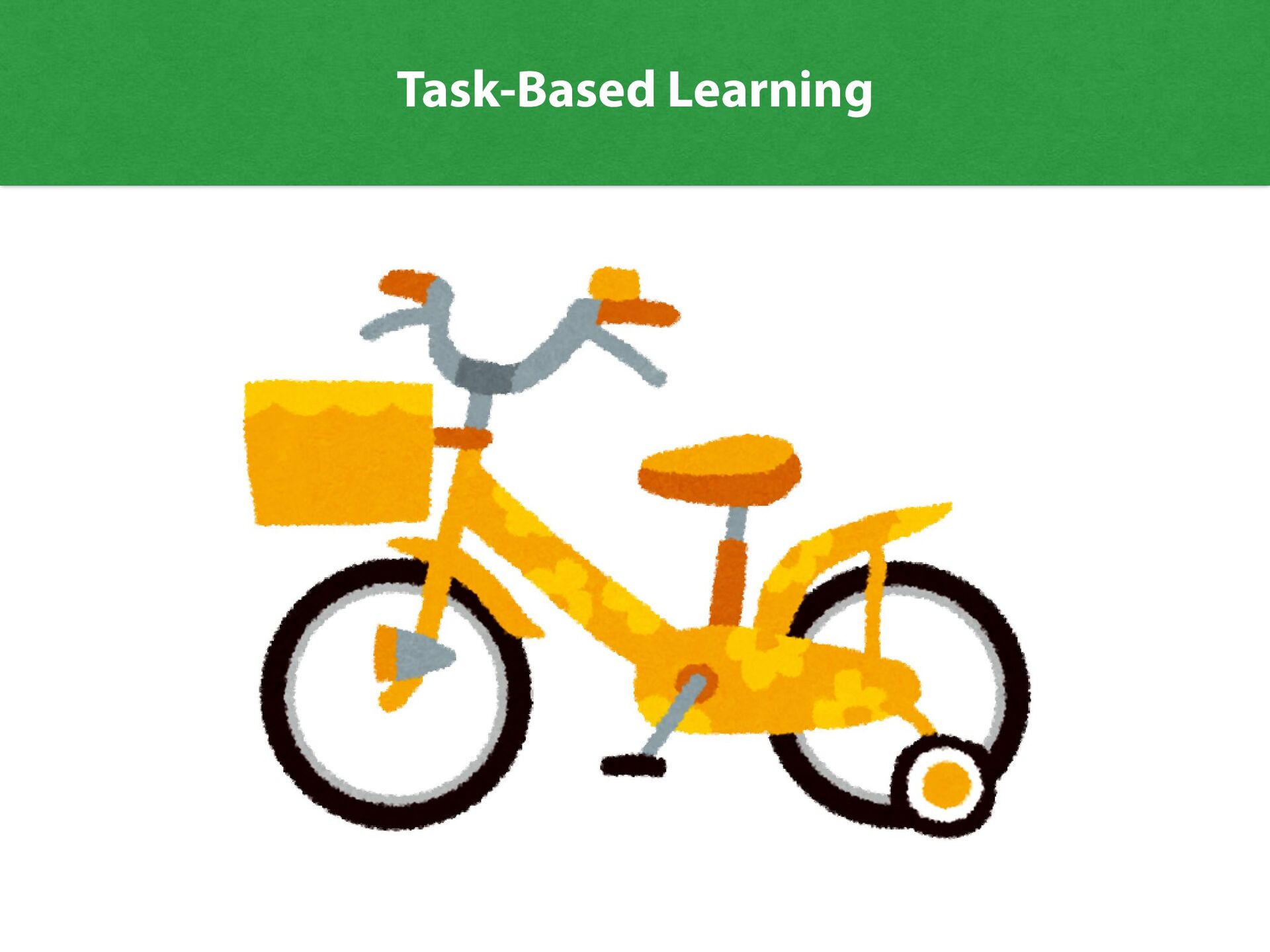
Riding a bicycle requires certain skills, including: Using both hands
to control the bike Keeping the balance Pedaling the bike Using the brakes Task-Based Learning -
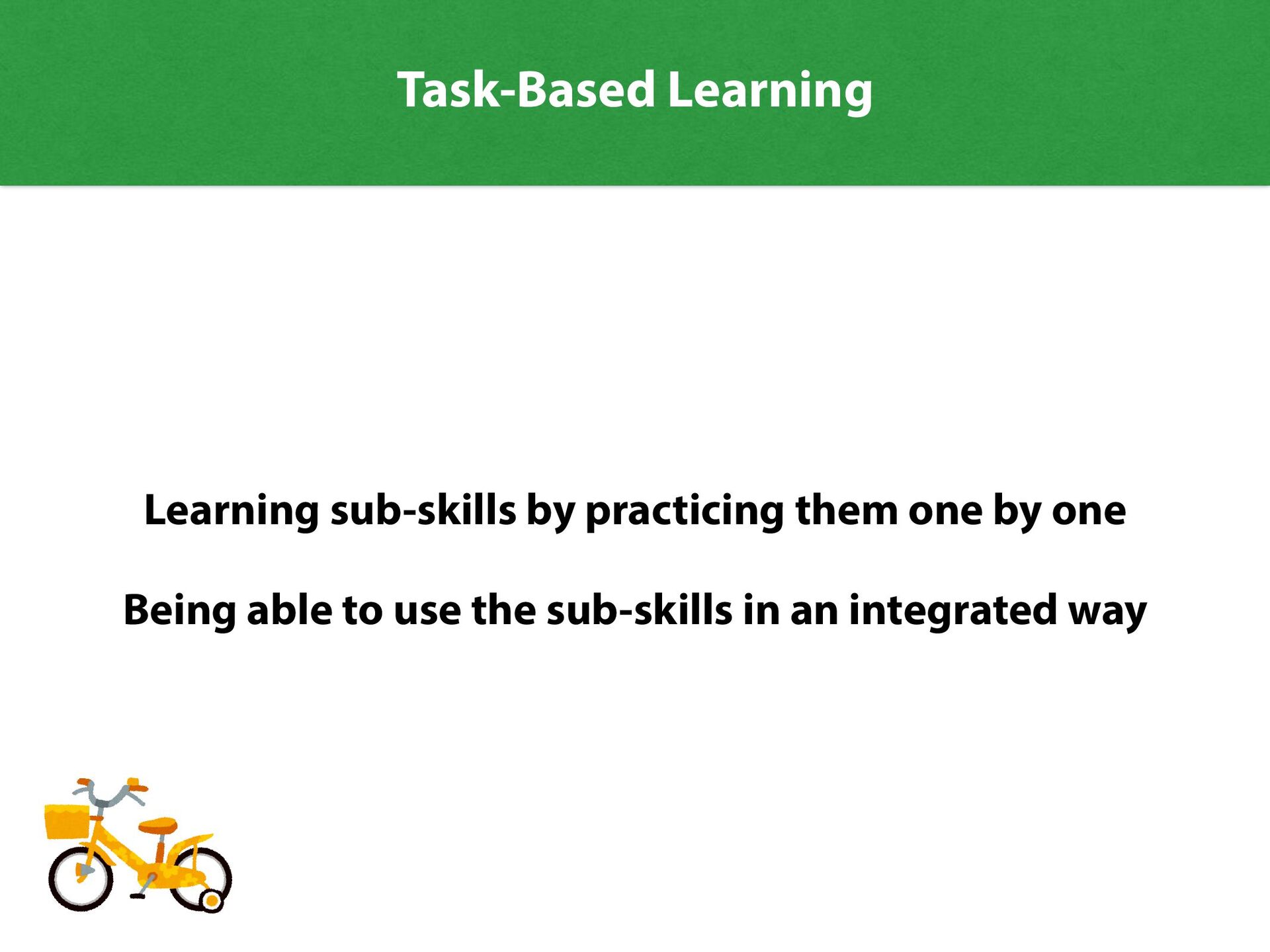
Learning sub-skills by practicing them one by one Being able
to use the sub-skills in an integrated way Task-Based Learning -
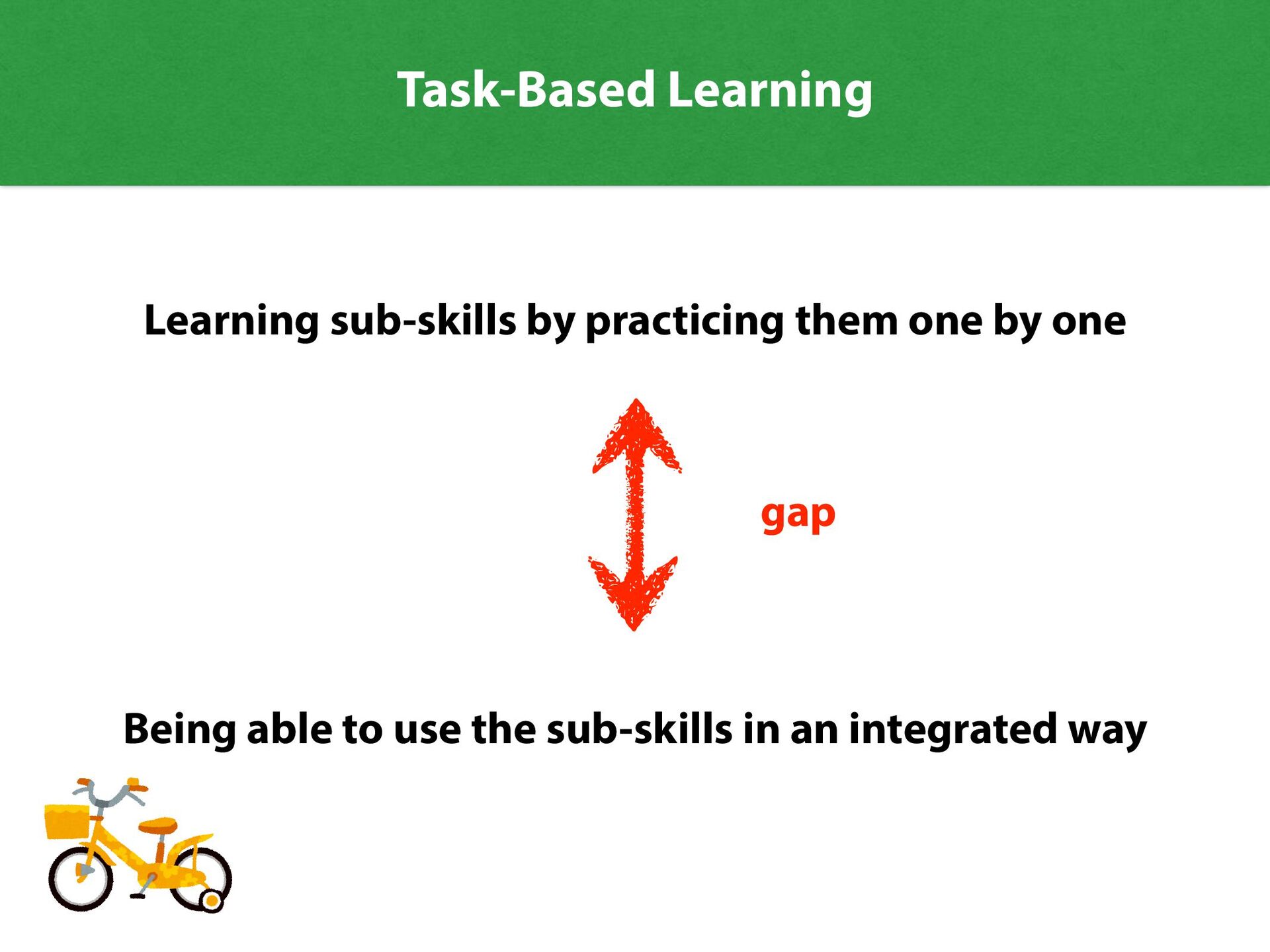
Learning sub-skills by practicing them one by one Being able
to use the sub-skills in an integrated way gap Task-Based Learning -
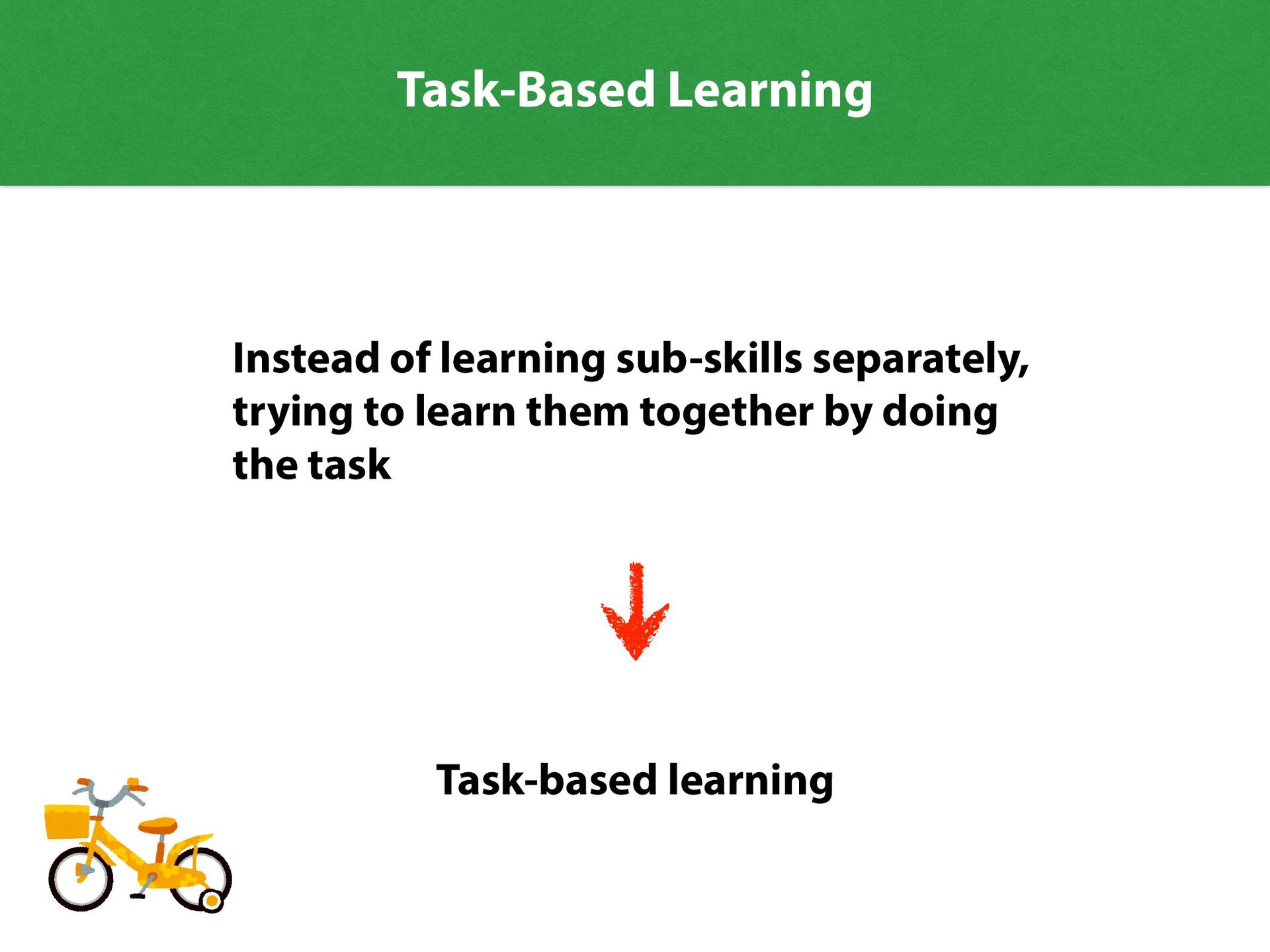
Instead of learning sub-skills separately, trying to learn them together
by doing the task Task-based learning Task-Based Learning -
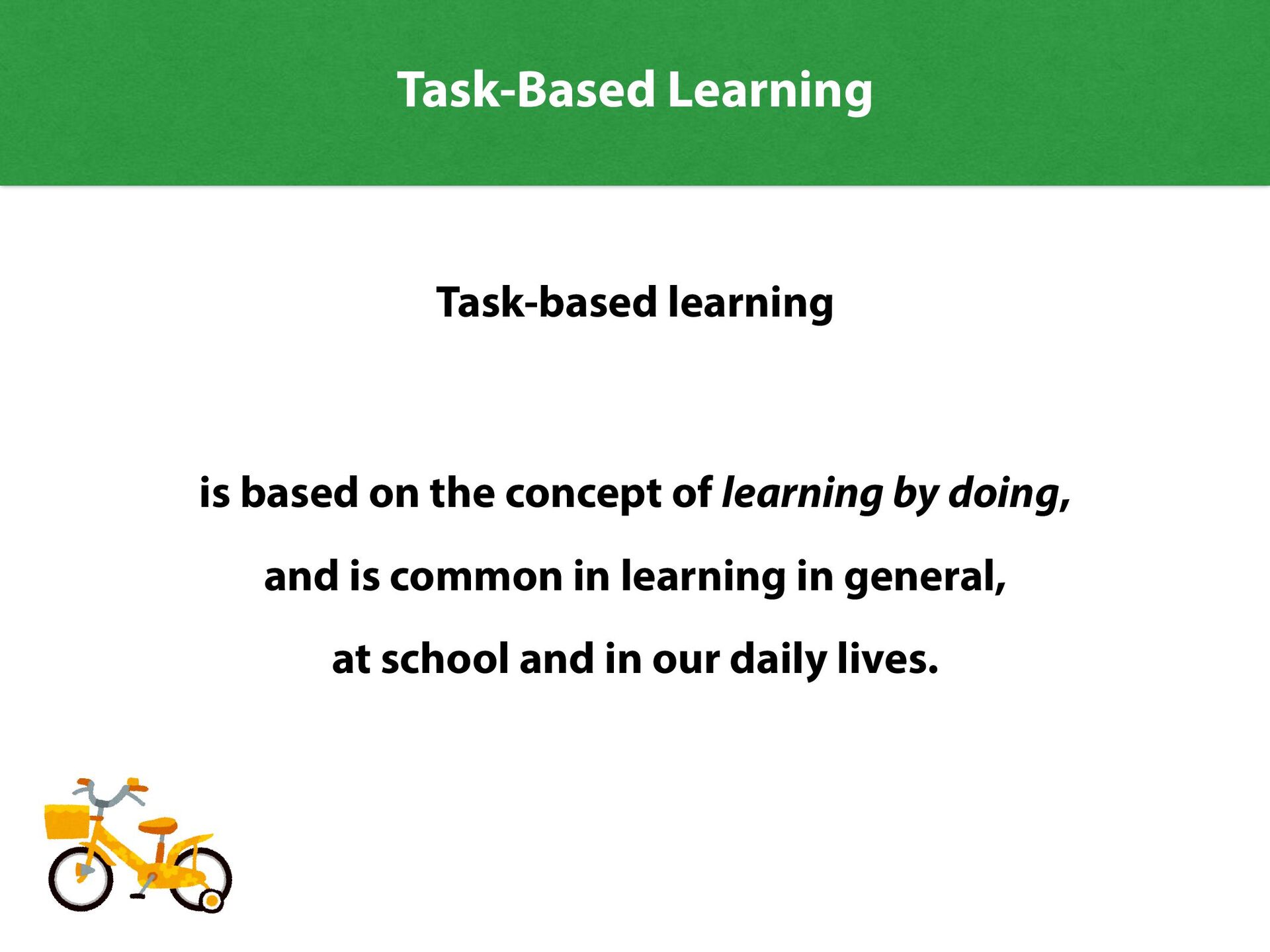
is based on the concept of learning by doing, and
is common in learning in general, at school and in our daily lives. Task-Based Learning Task-based learning -
If the ultimate goal is to achieve very high skills,
it might make sense to train sub-skills separately. Task-Based Learning -
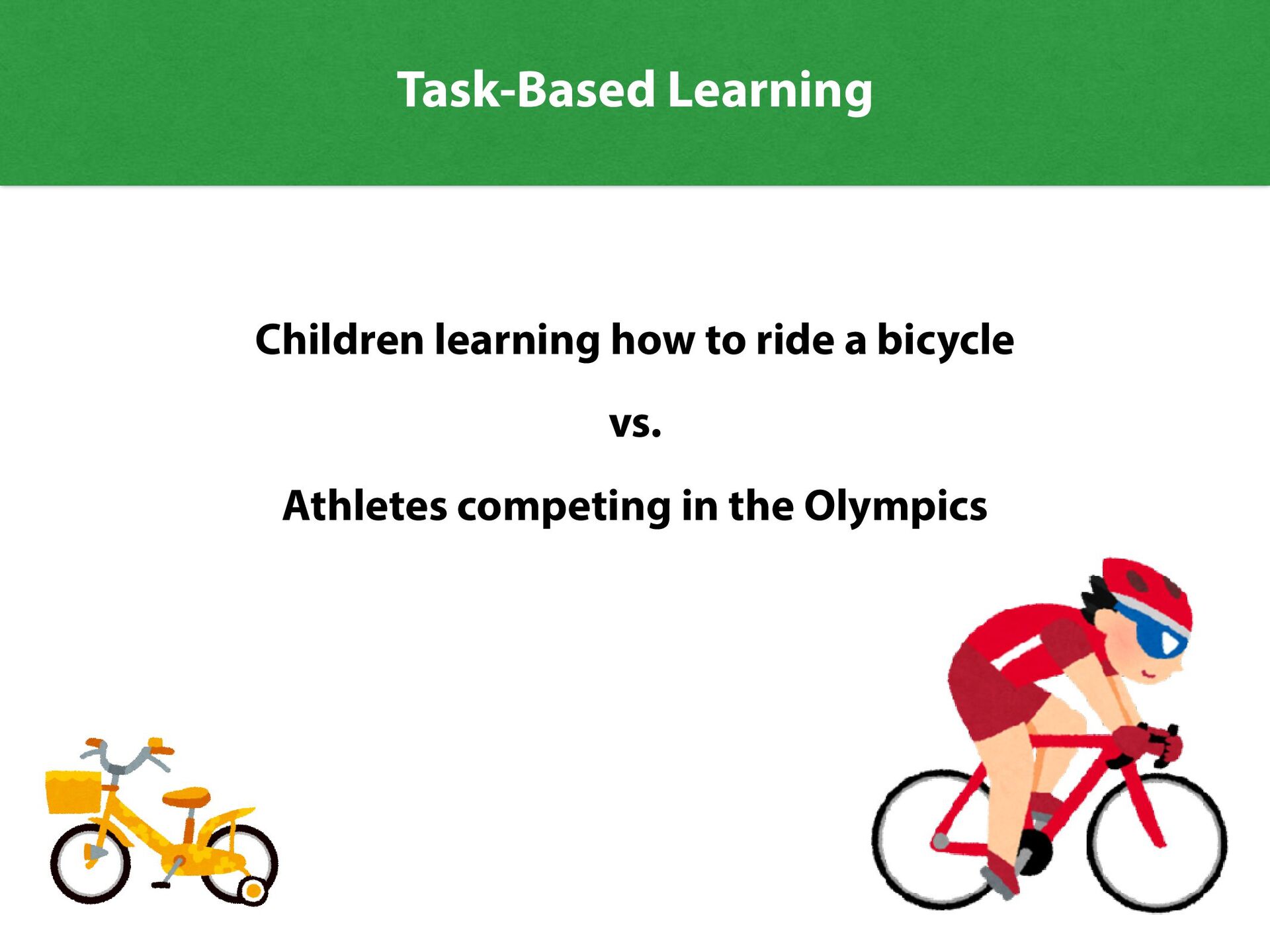
Children learning how to ride a bicycle vs. Athletes competing
in the Olympics Task-Based Learning -
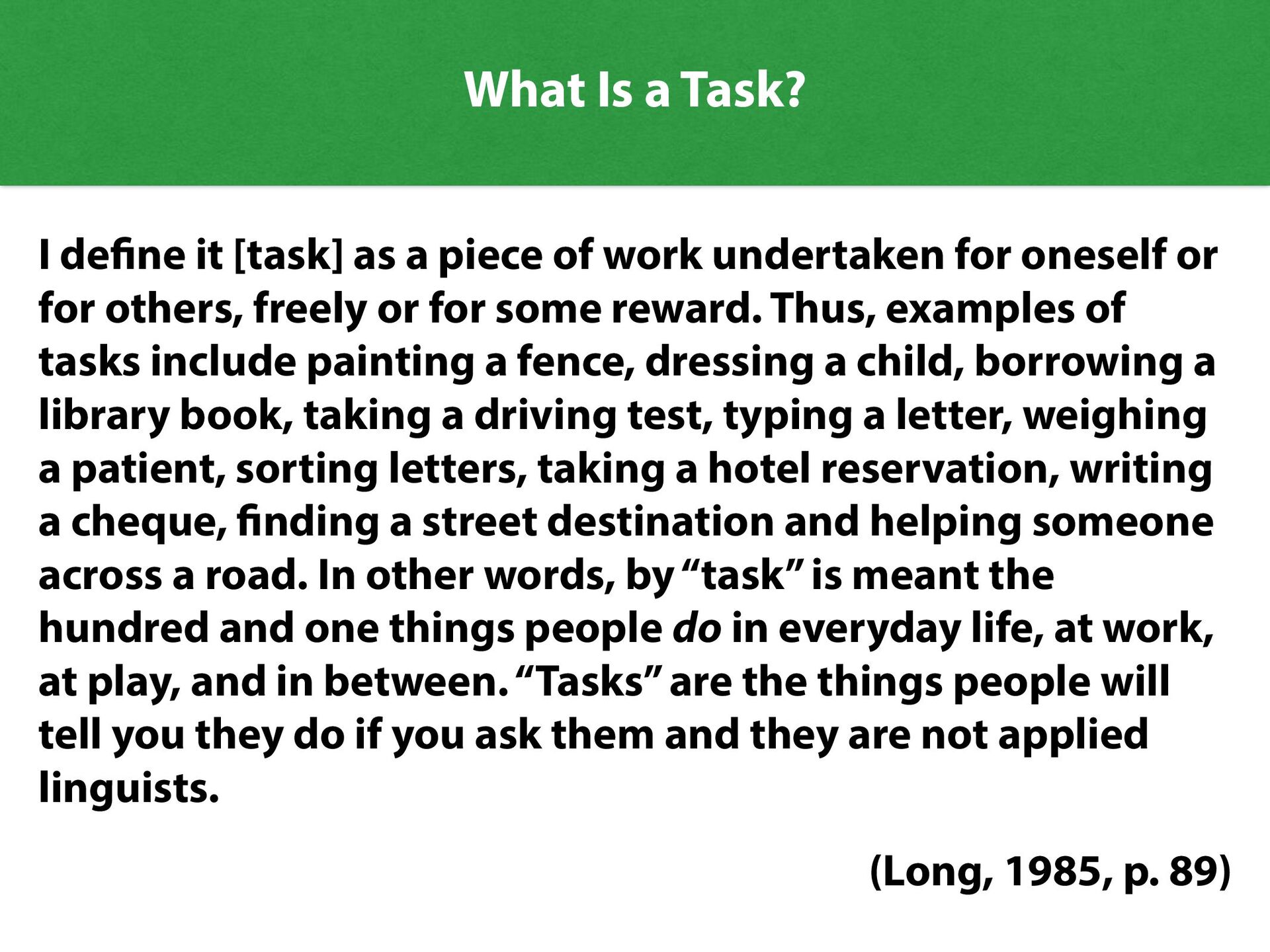
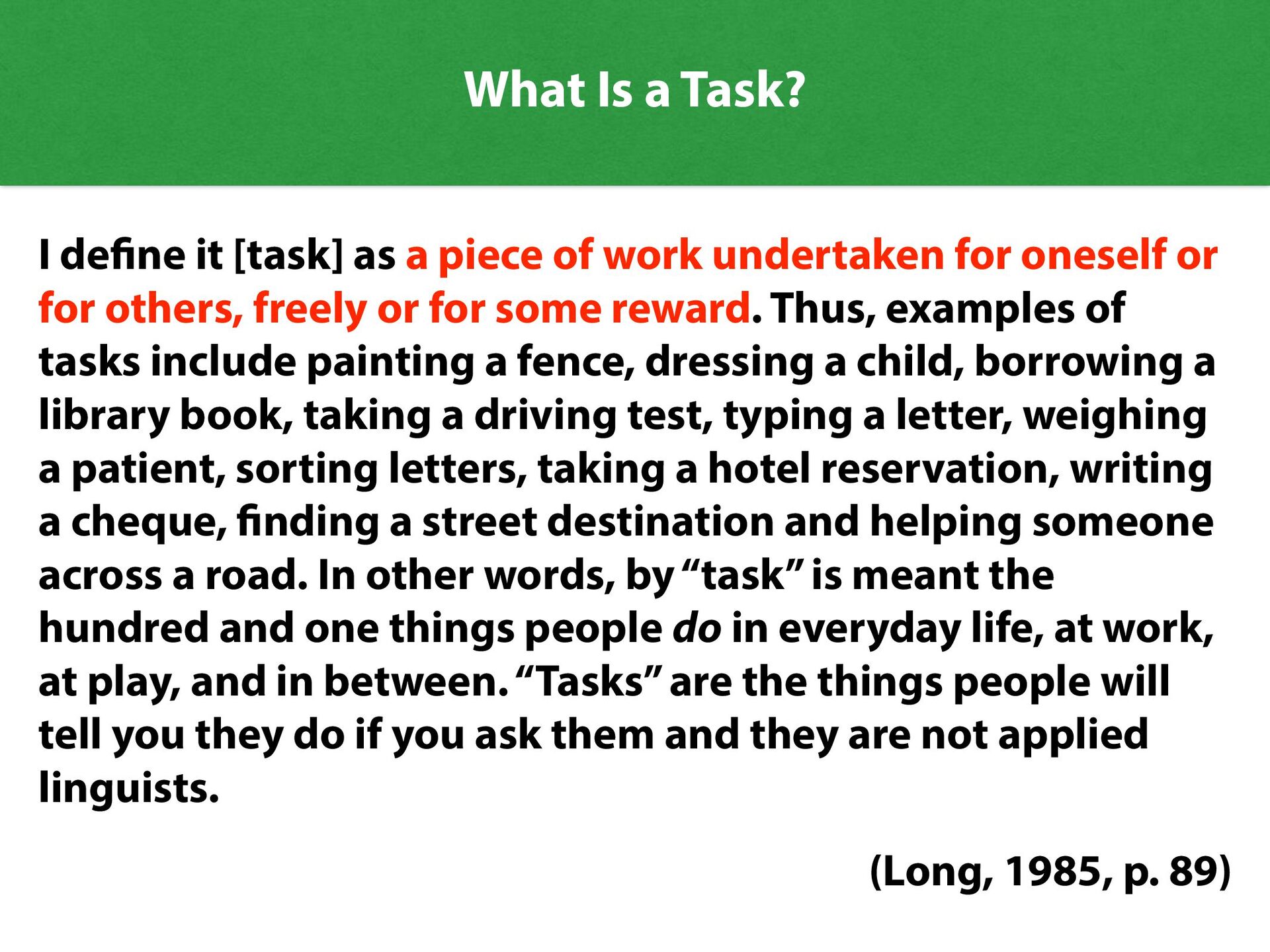
What Is a Task? I de fi ne it [task]
as a piece of work undertaken for oneself or for others, freely or for some reward. Thus, examples of tasks include painting a fence, dressing a child, borrowing a library book, taking a driving test, typing a letter, weighing a patient, sorting letters, taking a hotel reservation, writing a cheque, fi nding a street destination and helping someone across a road. In other words, by “task” is meant the hundred and one things people do in everyday life, at work, at play, and in between. “Tasks” are the things people will tell you they do if you ask them and they are not applied linguists. (Long, 1985, p. 89) -
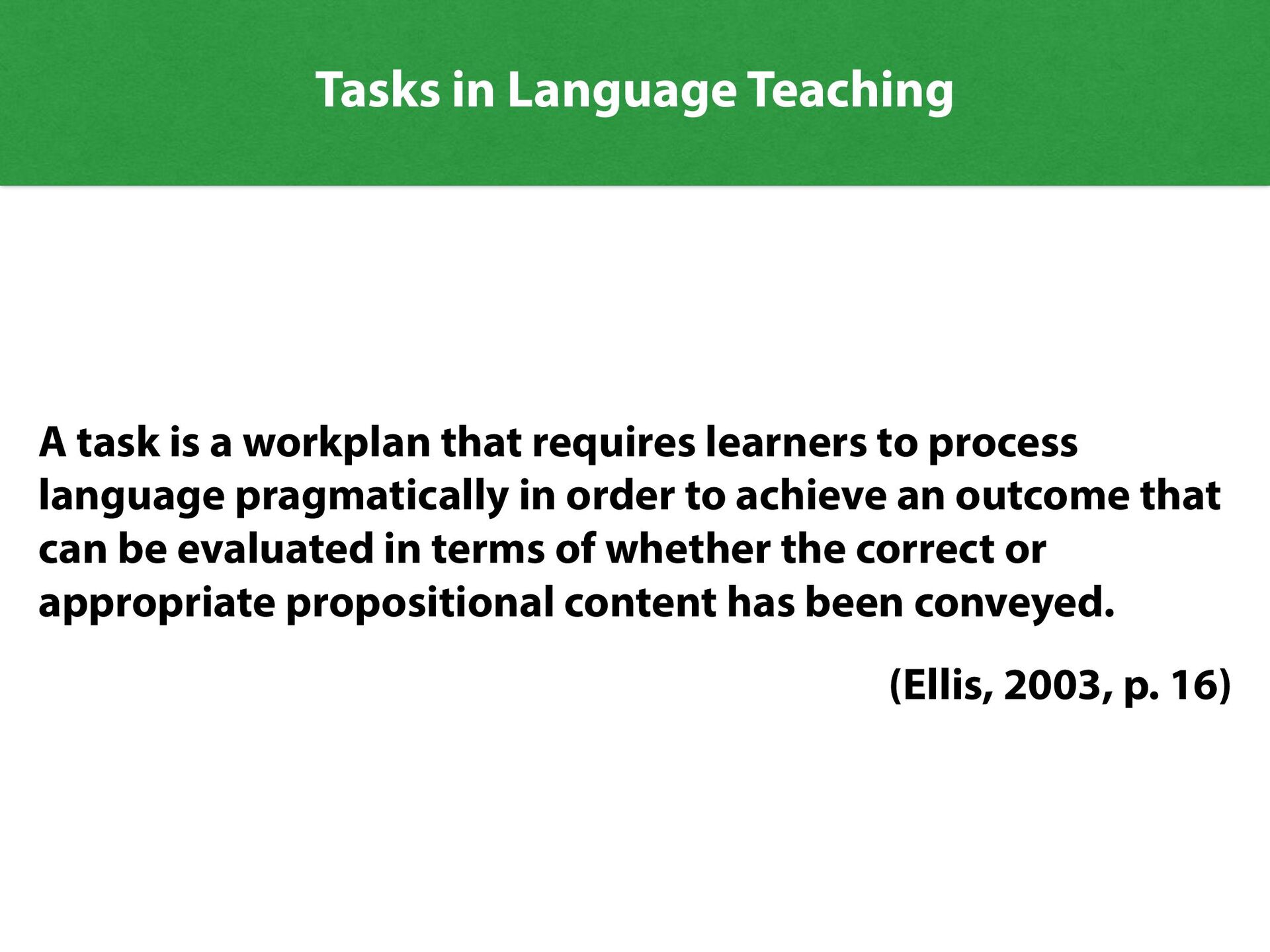
Tasks in Language Teaching A task is a workplan that
requires learners to process language pragmatically in order to achieve an outcome that can be evaluated in terms of whether the correct or appropriate propositional content has been conveyed. (Ellis, 2003, p. 16) -
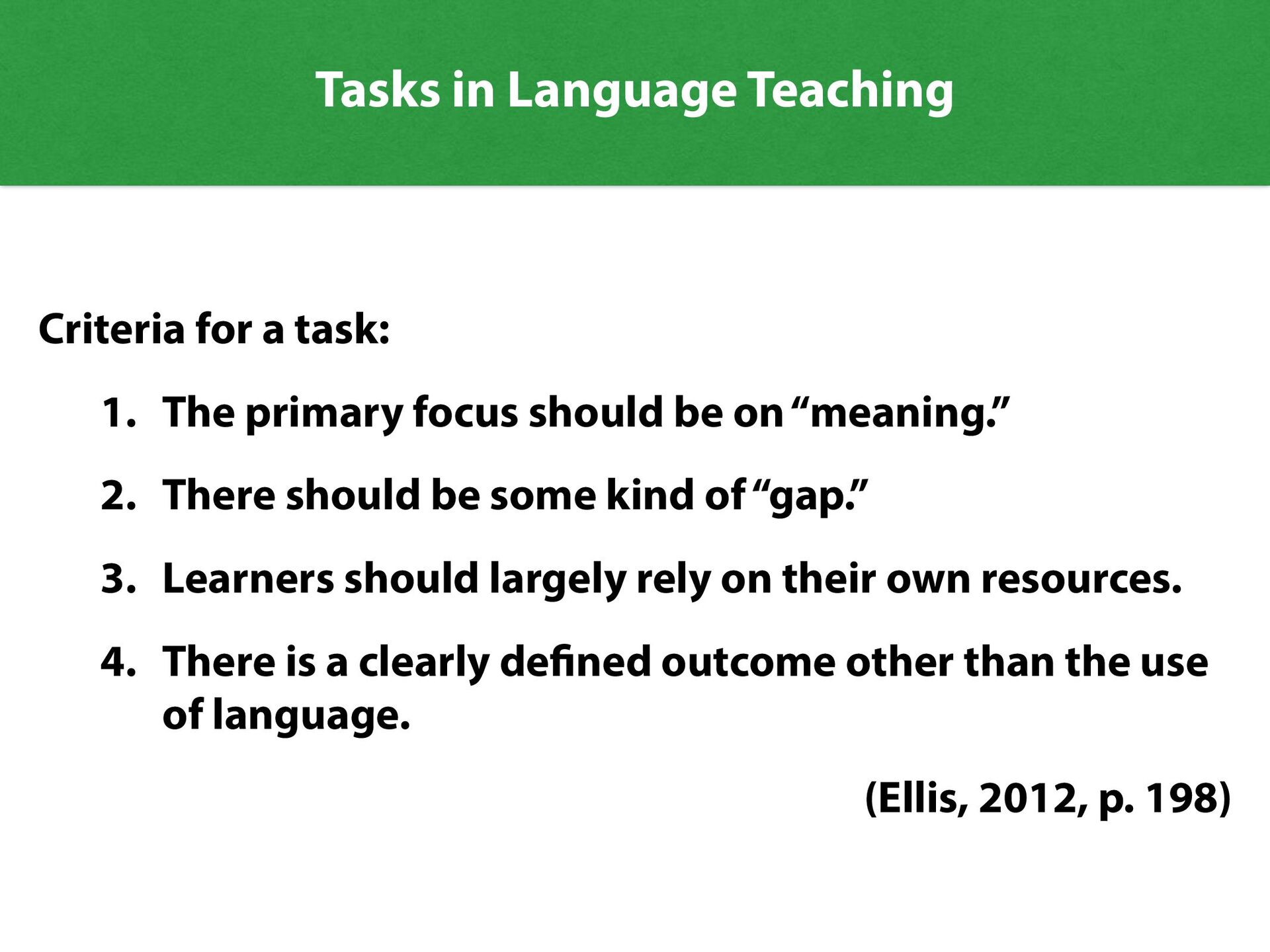
Criteria for a task: 1. The primary focus should be
on “meaning.” 2. There should be some kind of “gap.” 3. Learners should largely rely on their own resources. 4. There is a clearly de fi ned outcome other than the use of language. (Ellis, 2012, p. 198) Tasks in Language Teaching -
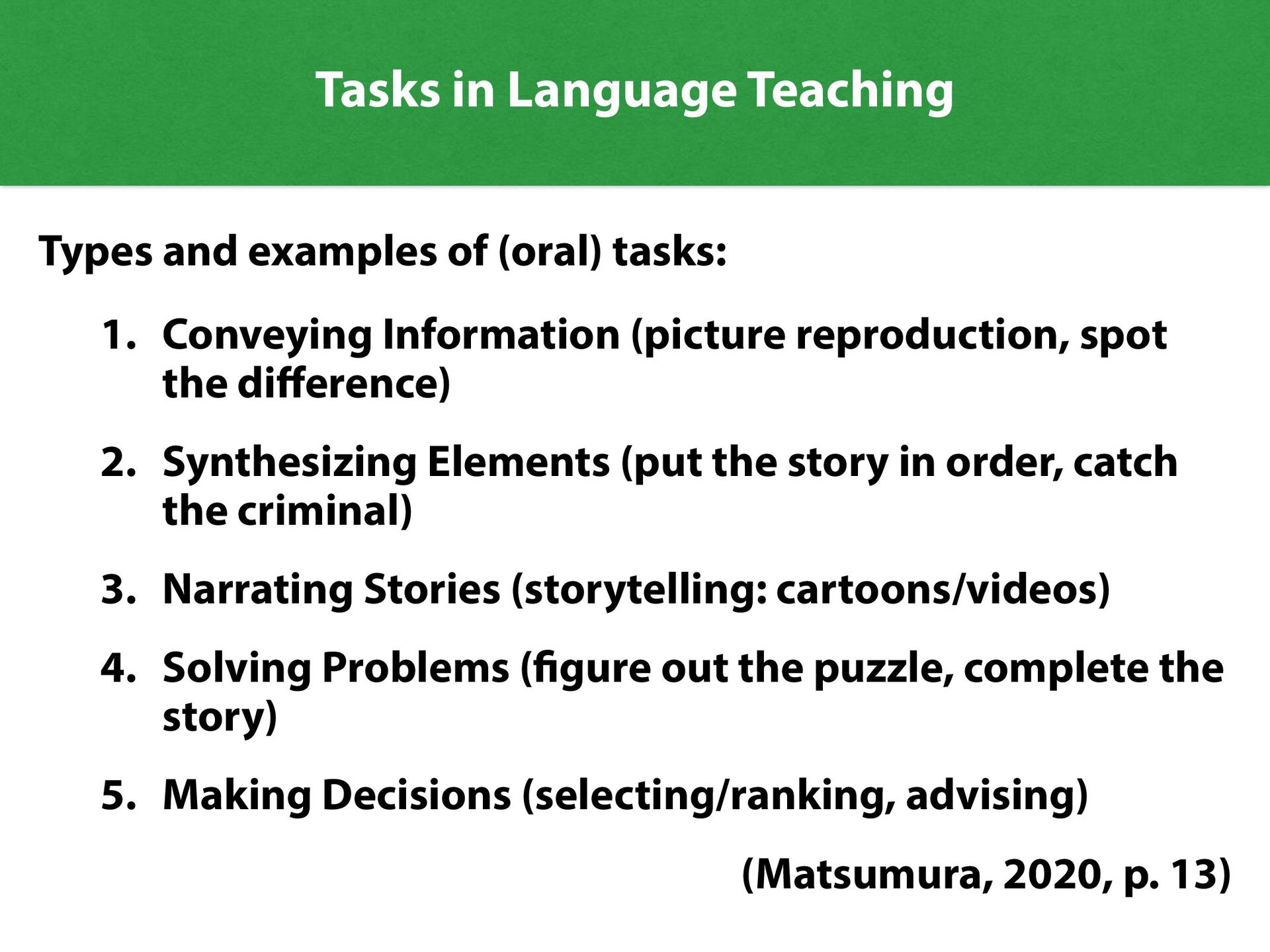
Types and examples of (oral) tasks: 1. Conveying Information (picture
reproduction, spot the di ff erence) 2. Synthesizing Elements (put the story in order, catch the criminal) 3. Narrating Stories (storytelling: cartoons/videos) 4. Solving Problems ( fi gure out the puzzle, complete the story) 5. Making Decisions (selecting/ranking, advising) (Matsumura, 2020, p. 13) Tasks in Language Teaching -
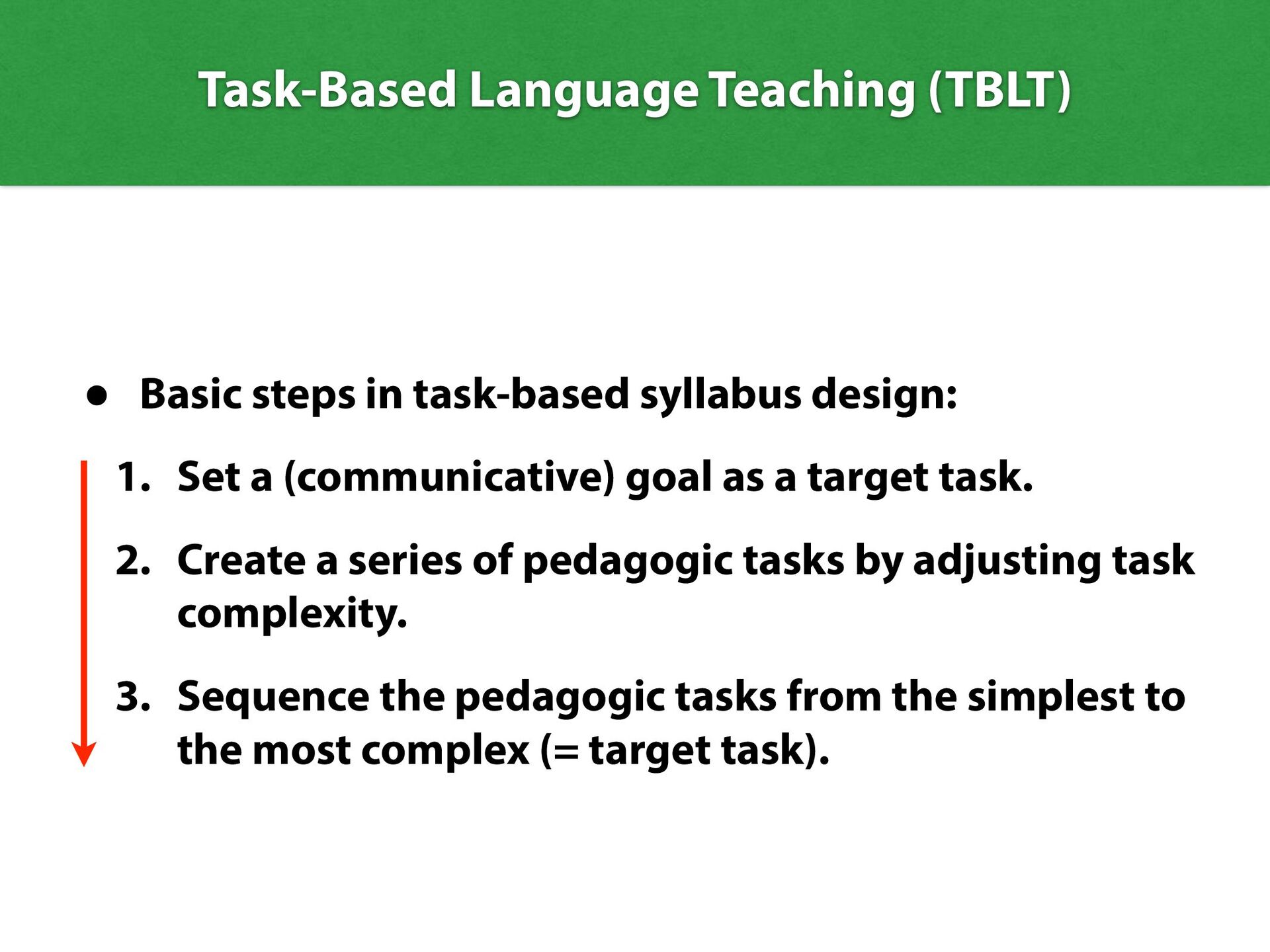
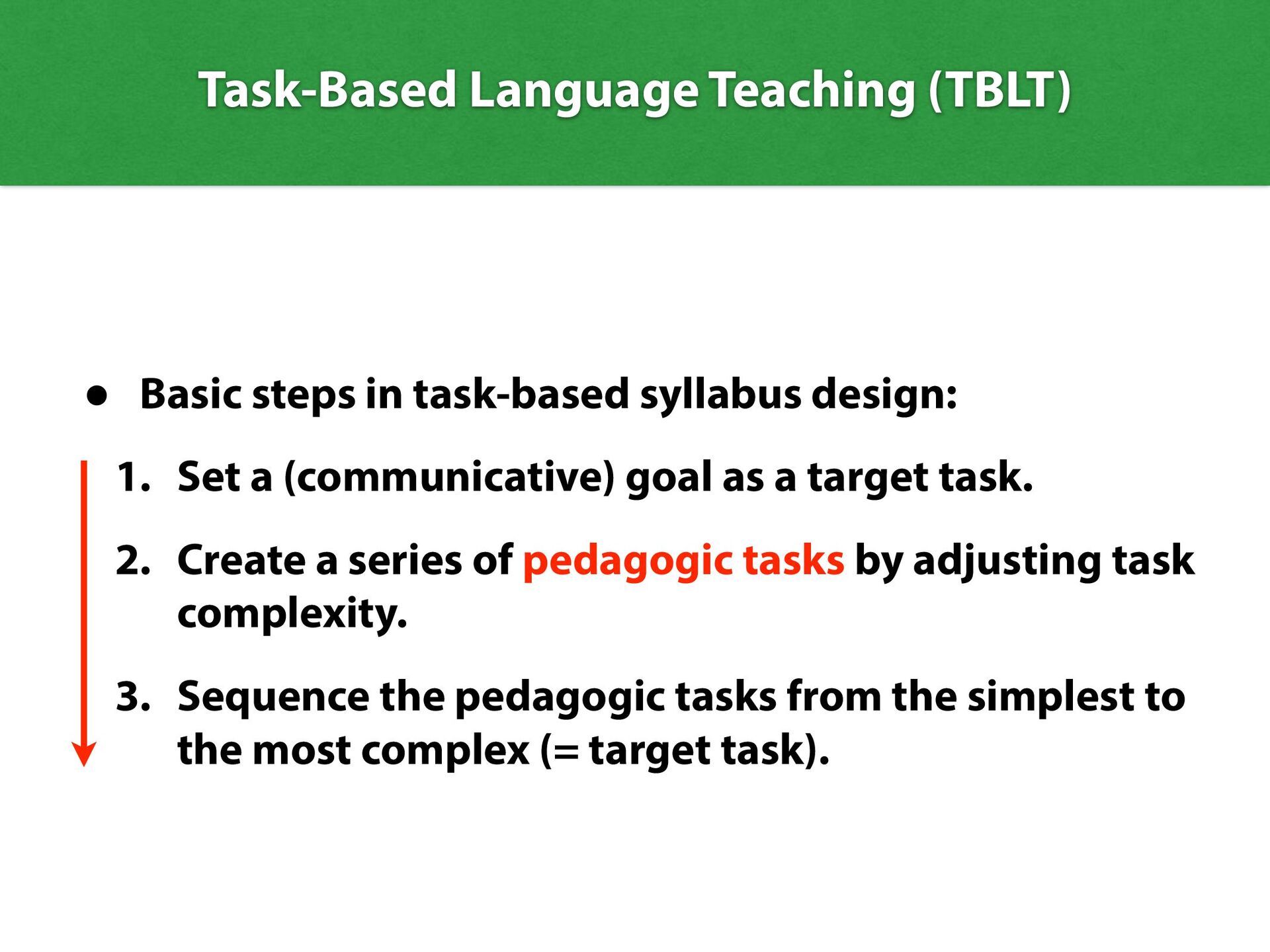
Task-Based Language Teaching (TBLT) • Basic steps in task-based syllabus
design: 1. Set a (communicative) goal as a target task. 2. Create a series of pedagogic tasks by adjusting task complexity. 3. Sequence the pedagogic tasks from the simplest to the most complex (= target task). -
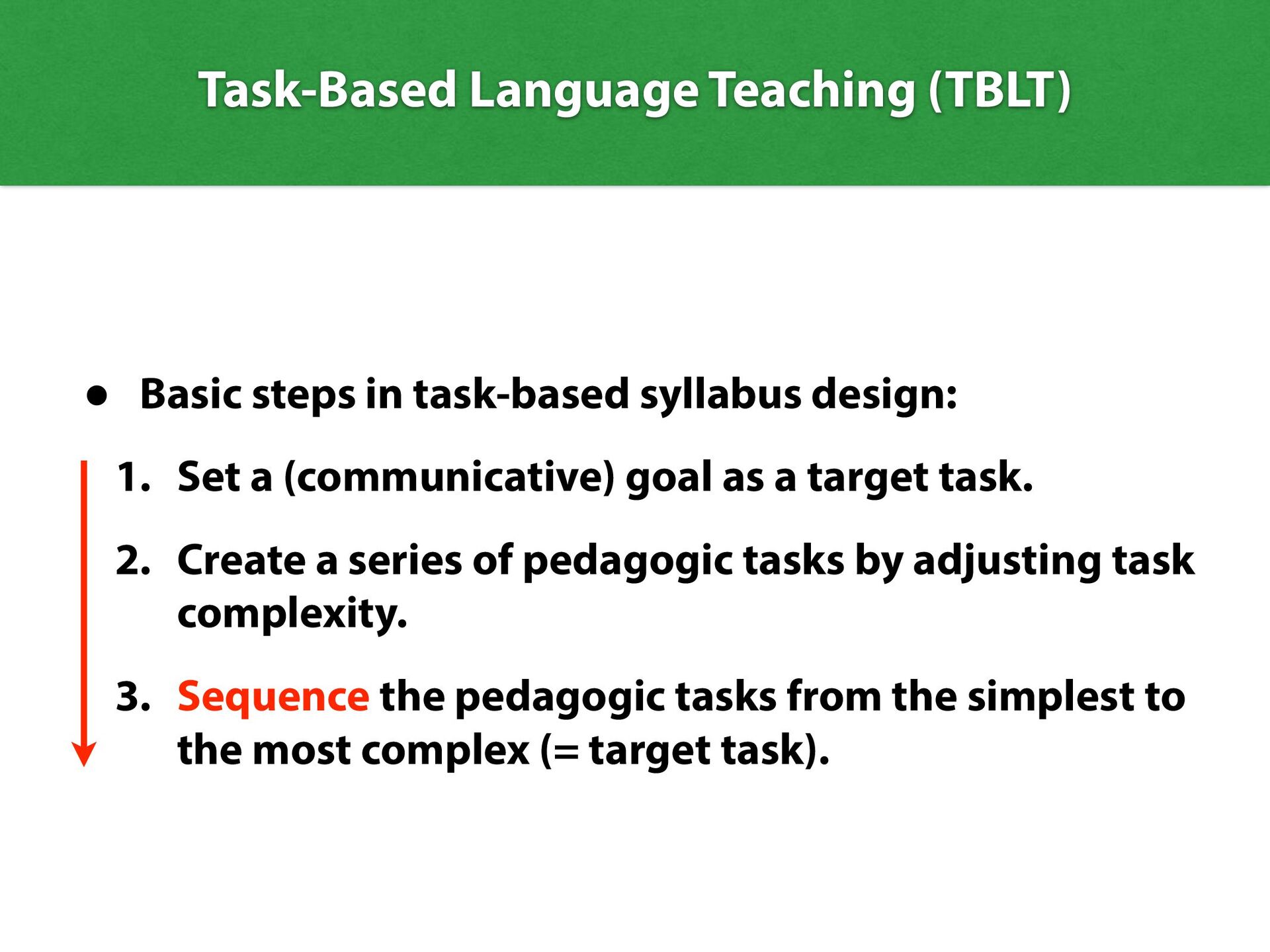
• Basic steps in task-based syllabus design: 1. Set a
(communicative) goal as a target task. 2. Create a series of pedagogic tasks by adjusting task complexity. 3. Sequence the pedagogic tasks from the simplest to the most complex (= target task). Task-Based Language Teaching (TBLT) -
• Basic steps in task-based syllabus design: 1. Set a
(communicative) goal as a target task. 2. Create a series of pedagogic tasks by adjusting task complexity. 3. Sequence the pedagogic tasks from the simplest to the most complex (= target task). Task-Based Language Teaching (TBLT) -
• Basic steps in task-based syllabus design: 1. Set a
(communicative) goal as a target task. 2. Create a series of pedagogic tasks by adjusting task complexity. 3. Sequence the pedagogic tasks from the simplest to the most complex (= target task). Task-Based Language Teaching (TBLT) -
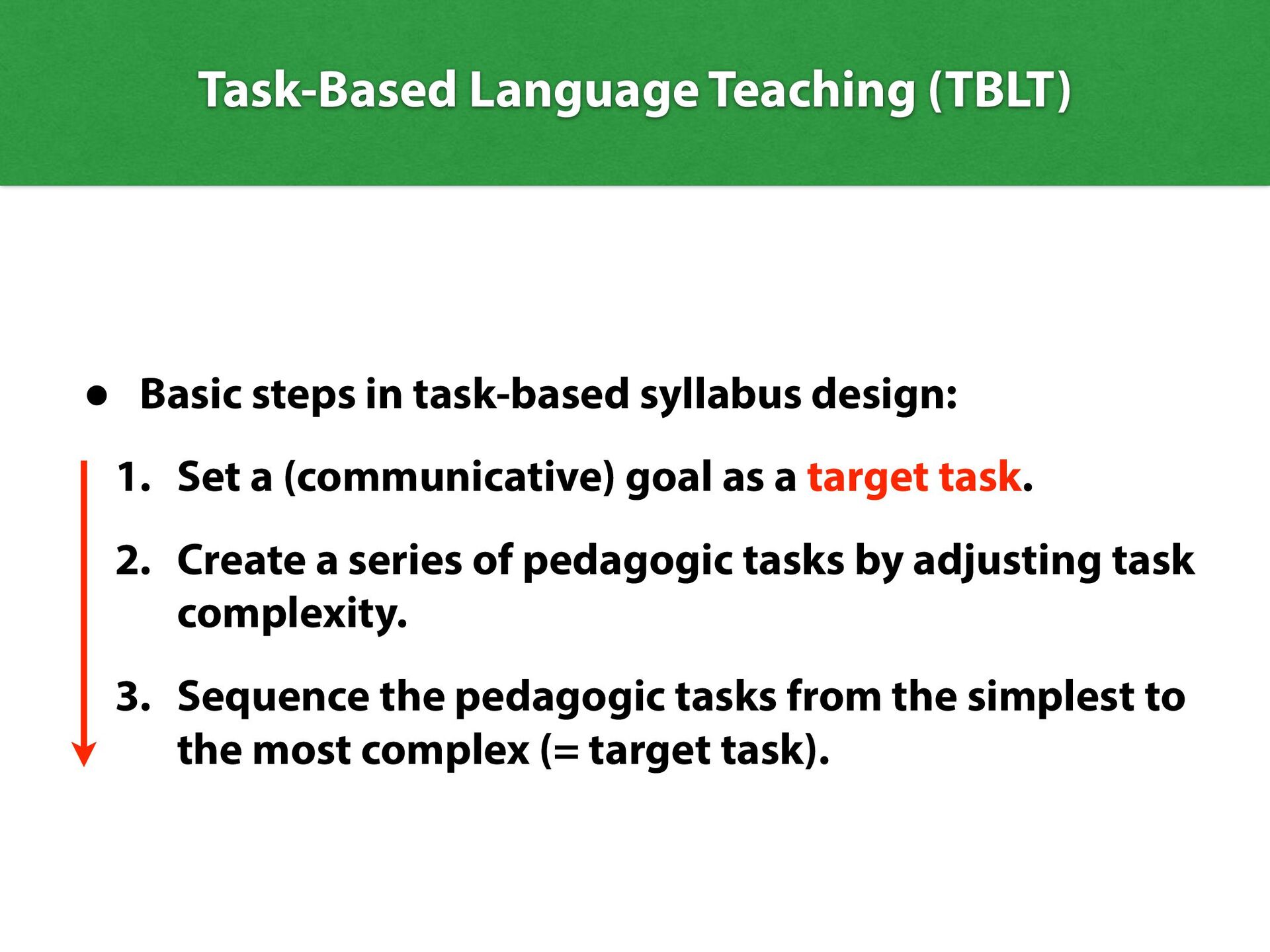
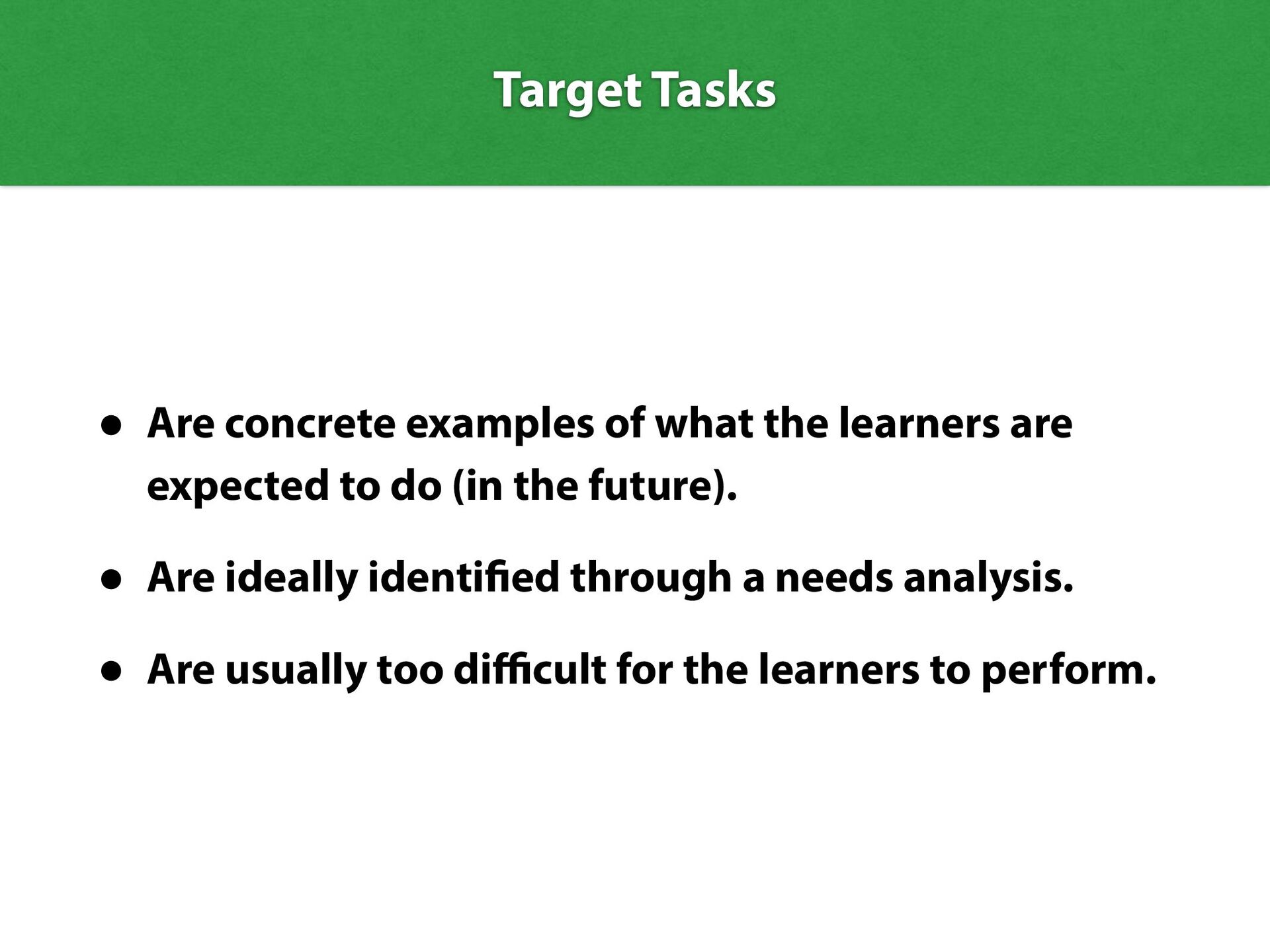
Target Tasks • Are concrete examples of what the learners
are expected to do (in the future). • Are ideally identi fi ed through a needs analysis. • Are usually too di ffi cult for the learners to perform. -
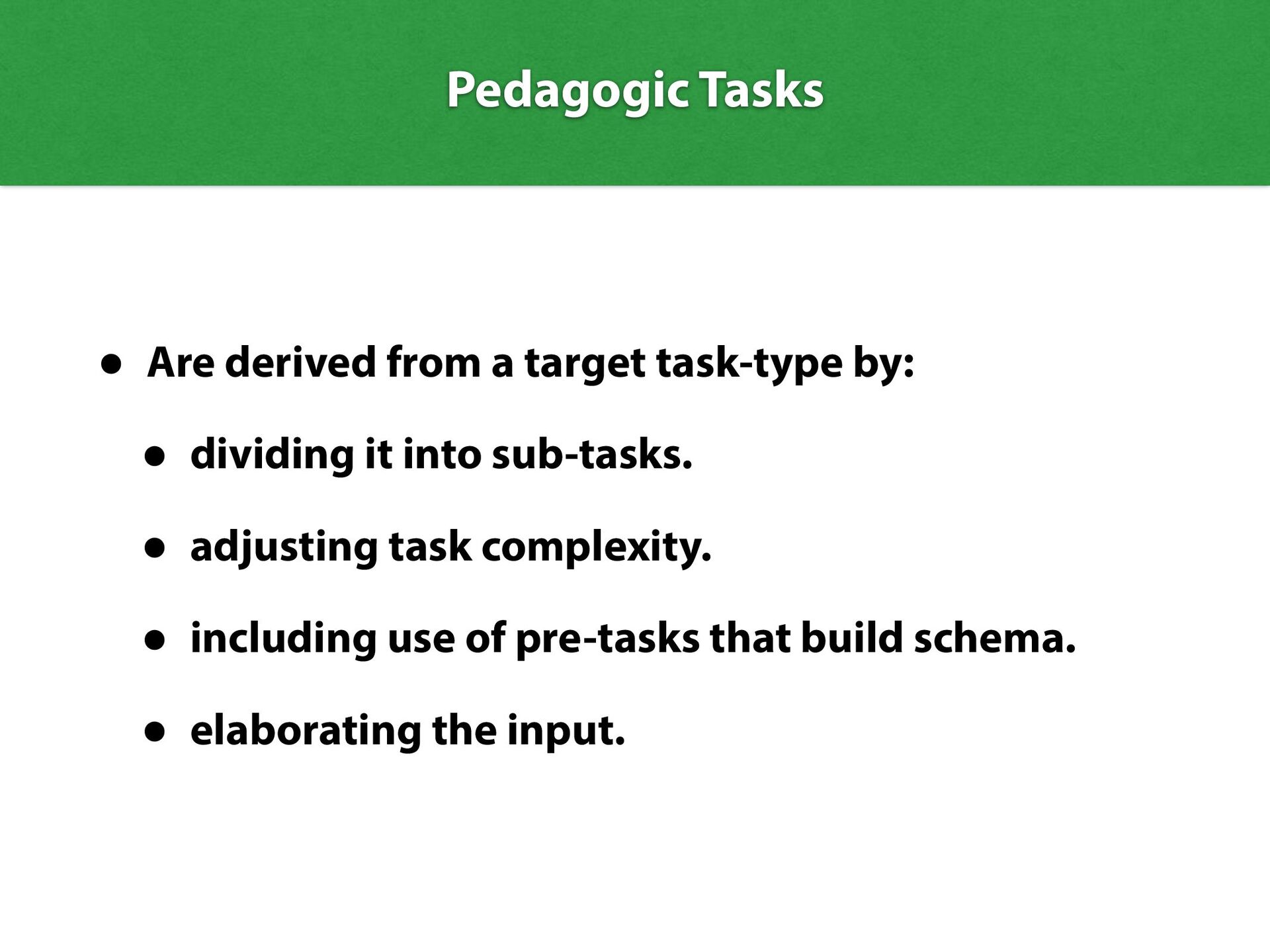
Pedagogic Tasks • Are derived from a target task-type by:
• dividing it into sub-tasks. • adjusting task complexity. • including use of pre-tasks that build schema. • elaborating the input. -
Pedagogic Tasks • Are derived from a target task-type by:
• dividing it into sub-tasks. • adjusting task complexity. • including use of pre-tasks that build schema. • elaborating the input. -
The “Bicycle” Task Target task: To ride a bicycle on
their own in the neighborhood. -
The “Bicycle” Task Target task: To ride a bicycle on
their own in the neighborhood. -
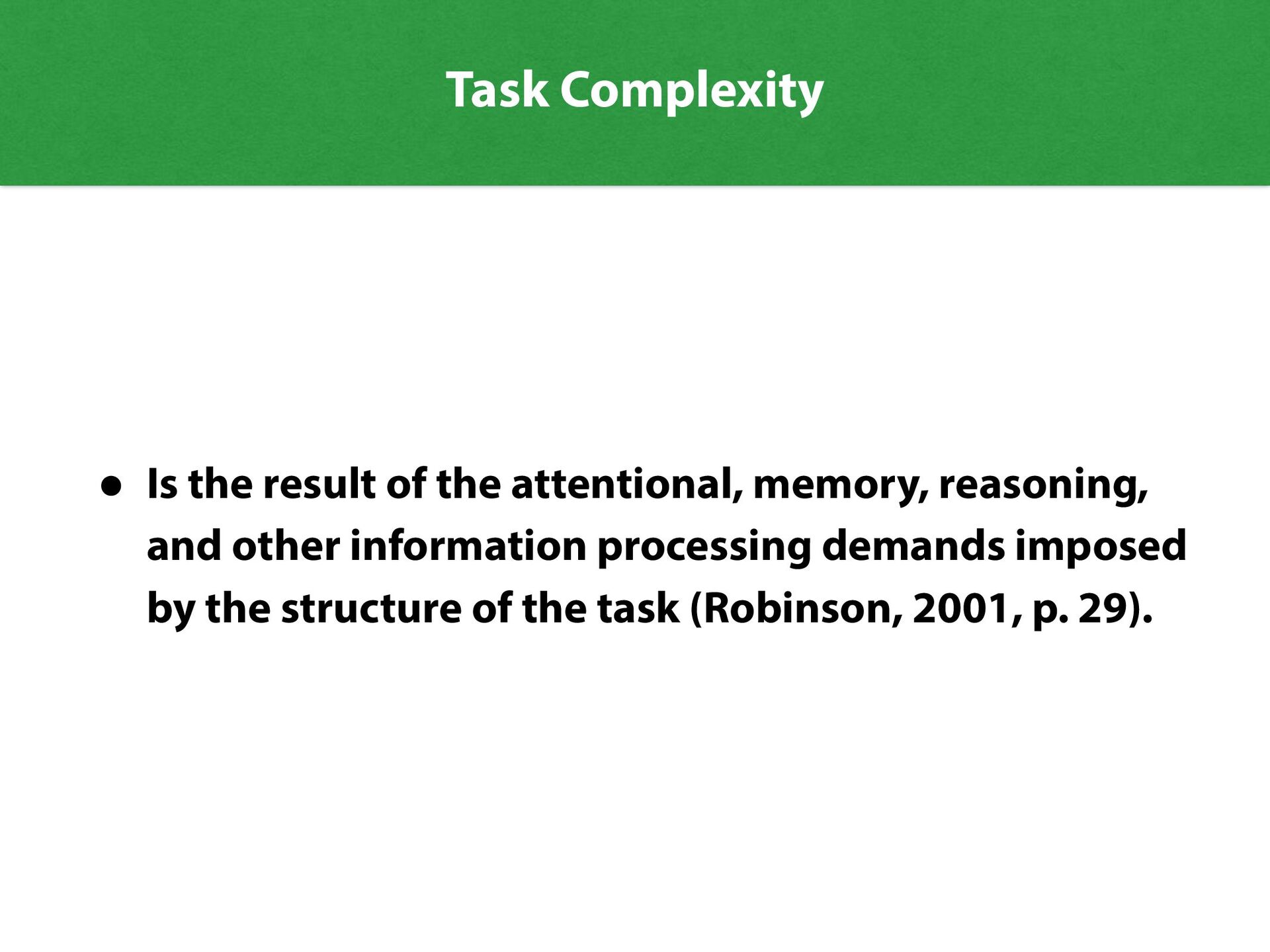
Task Complexity • Is the result of the attentional, memory,
reasoning, and other information processing demands imposed by the structure of the task (Robinson, 2001, p. 29). -
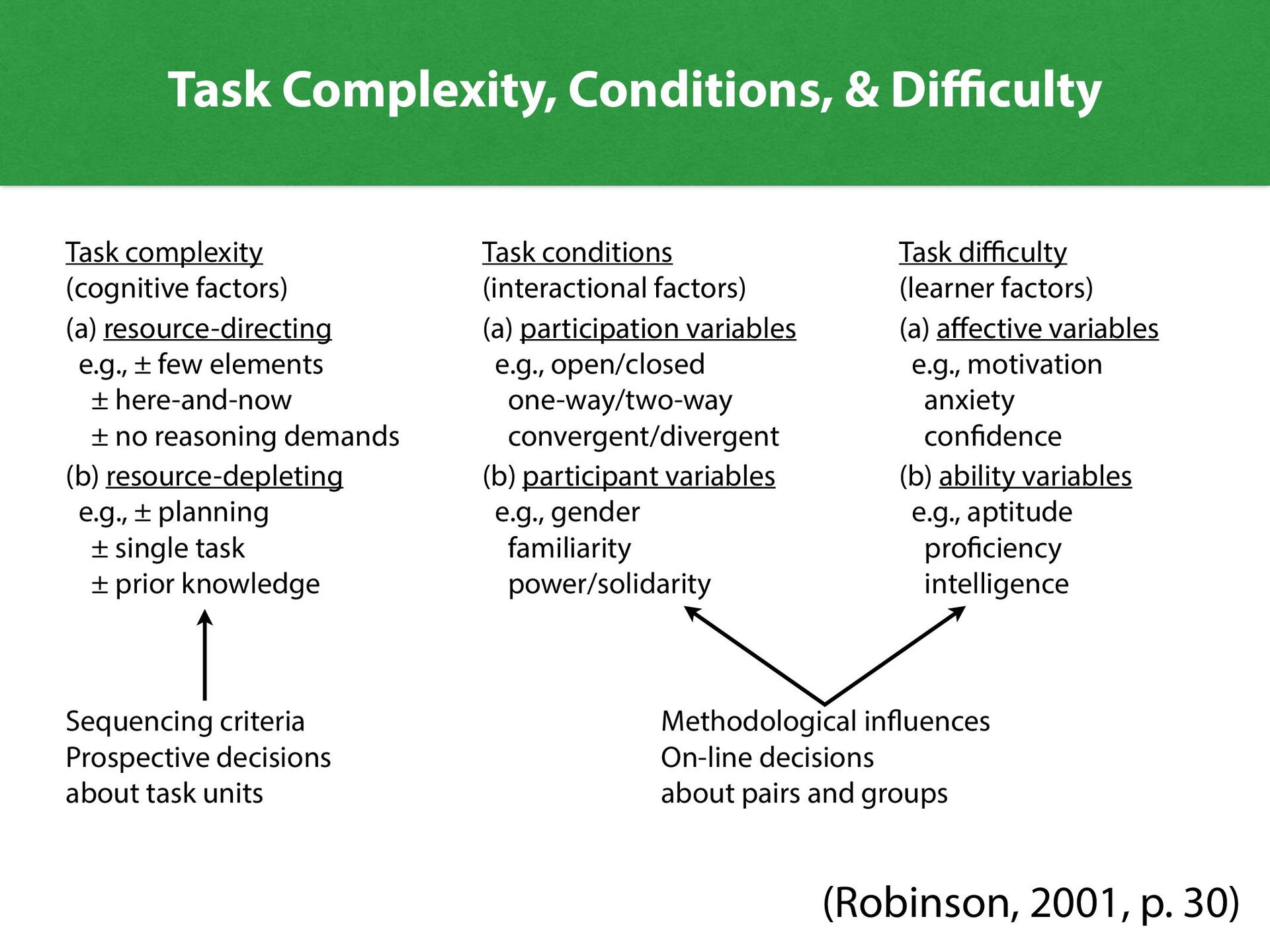
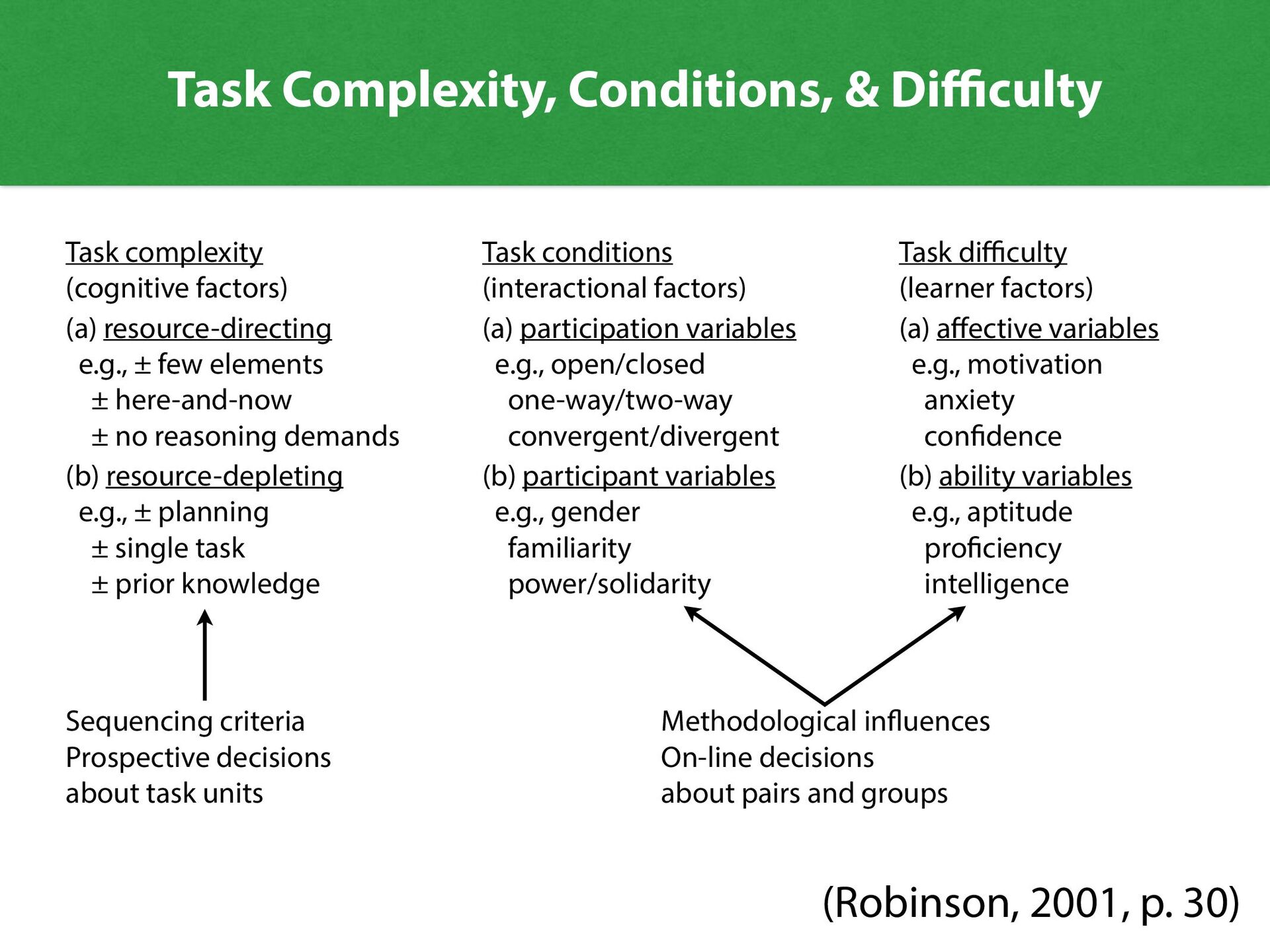
Task Complexity, Conditions, & Di ffi culty Task complexity (cognitive
factors) Task conditions (interactional factors) Task di ff i culty (learner factors) (a) resource-directing e.g., ± few elements ± here-and-now ± no reasoning demands (a) participation variables e.g., open/closed one-way/two-way convergent/divergent (a) a ff ective variables e.g., motivation anxiety con fi dence (b) resource-depleting e.g., ± planning ± single task ± prior knowledge (b) participant variables e.g., gender familiarity power/solidarity (b) ability variables e.g., aptitude pro fi ciency intelligence Sequencing criteria Prospective decisions about task units Methodological in fl uences On-line decisions about pairs and groups (Robinson, 2001, p. 30) -
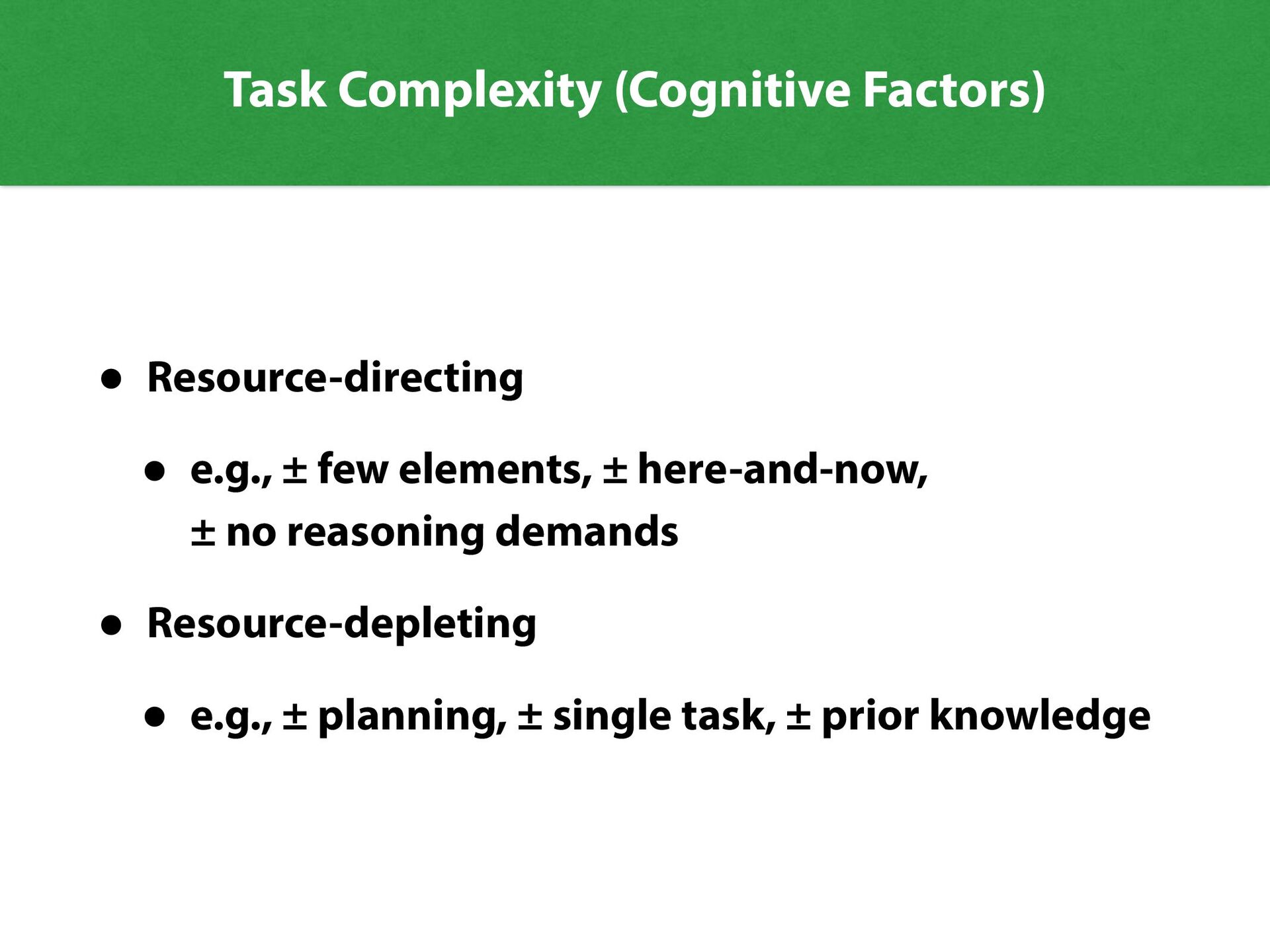
Task Complexity (Cognitive Factors) • Resource-directing • e.g., ± few
elements, ± here-and-now, ± no reasoning demands • Resource-depleting • e.g., ± planning, ± single task, ± prior knowledge -
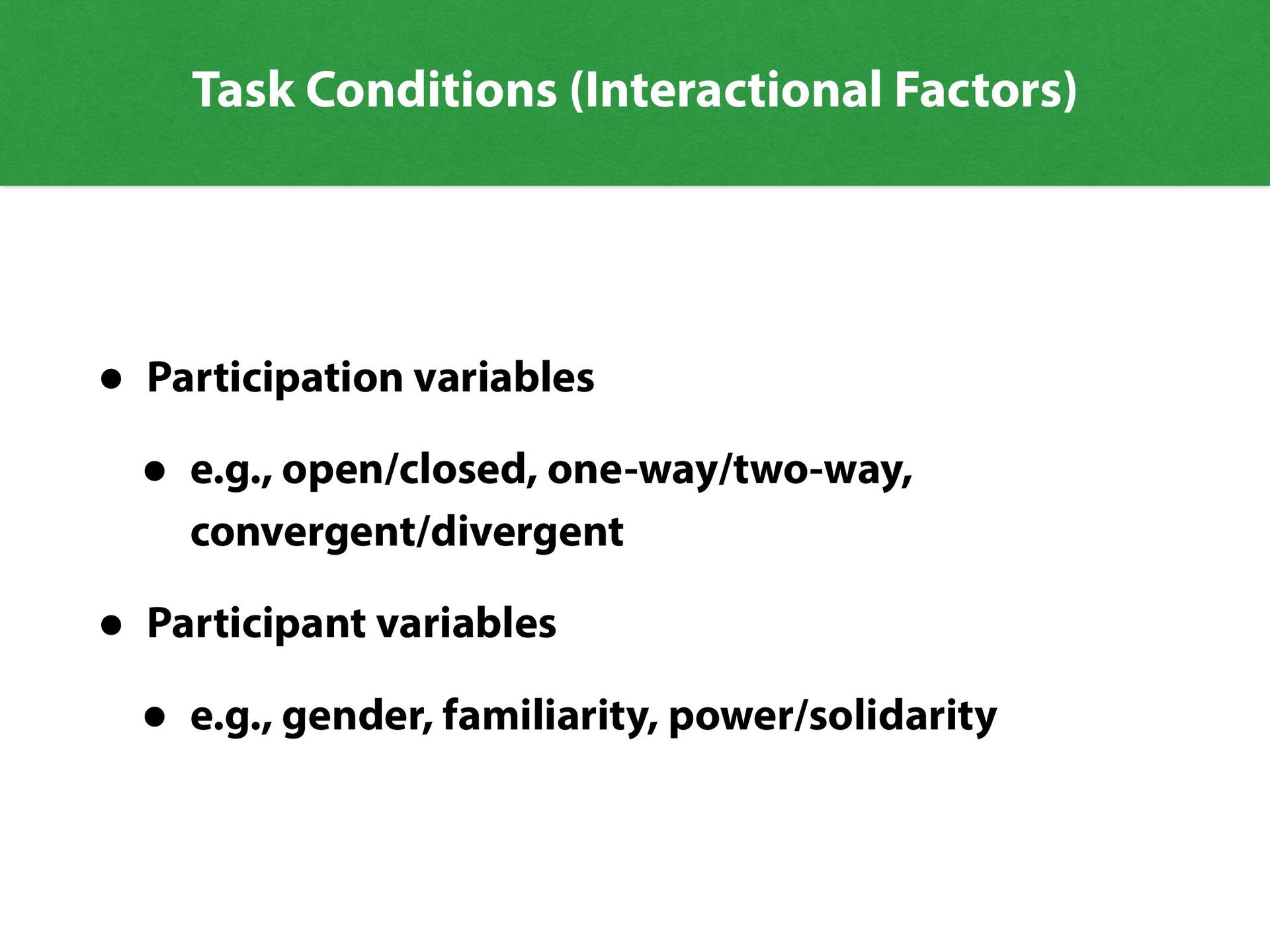
Task Conditions (Interactional Factors) • Participation variables • e.g., open/closed,
one-way/two-way, convergent/divergent • Participant variables • e.g., gender, familiarity, power/solidarity -
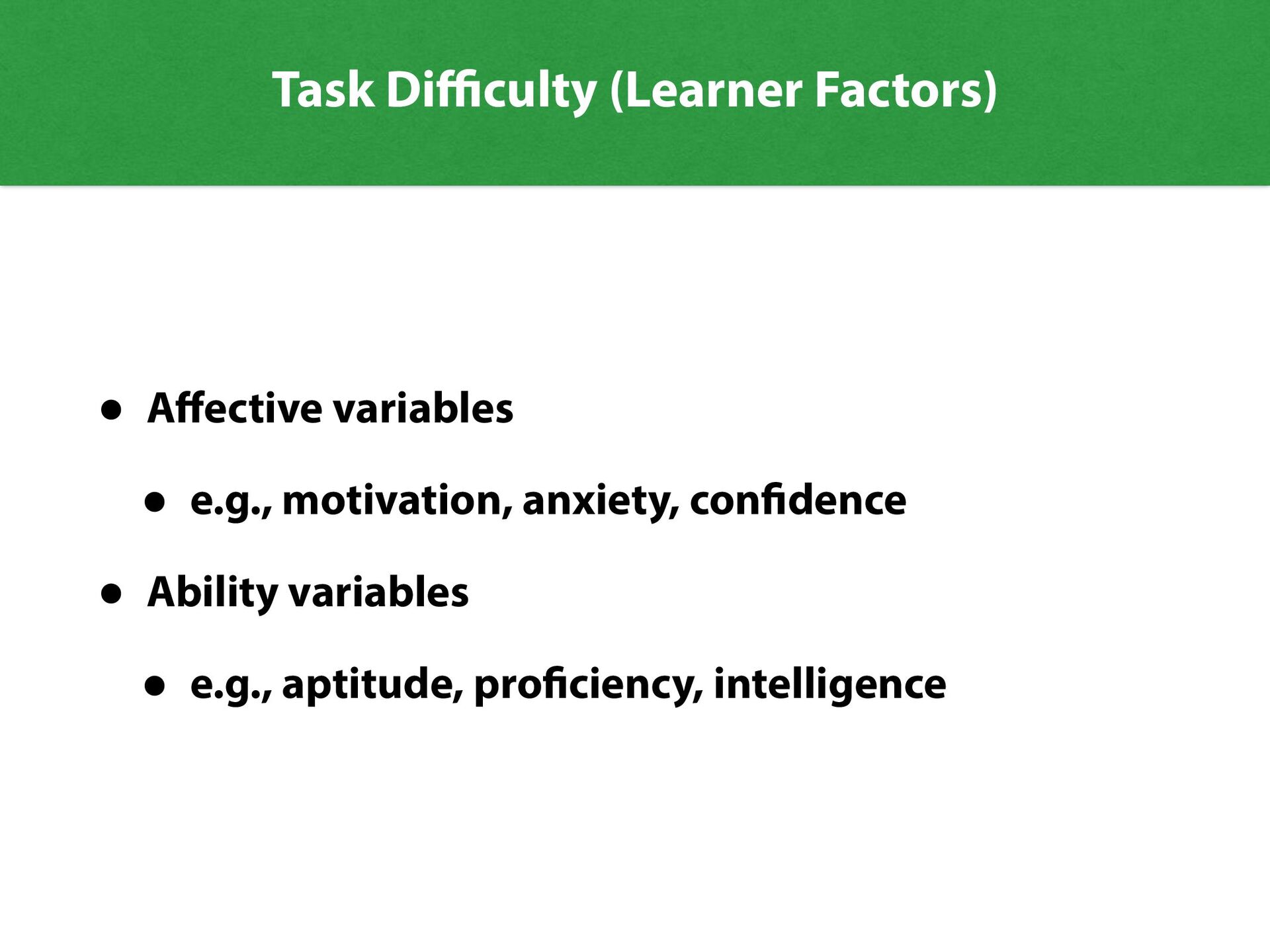
Task Di ff i culty (Learner Factors) • A ff
ective variables • e.g., motivation, anxiety, con fi dence • Ability variables • e.g., aptitude, pro fi ciency, intelligence -
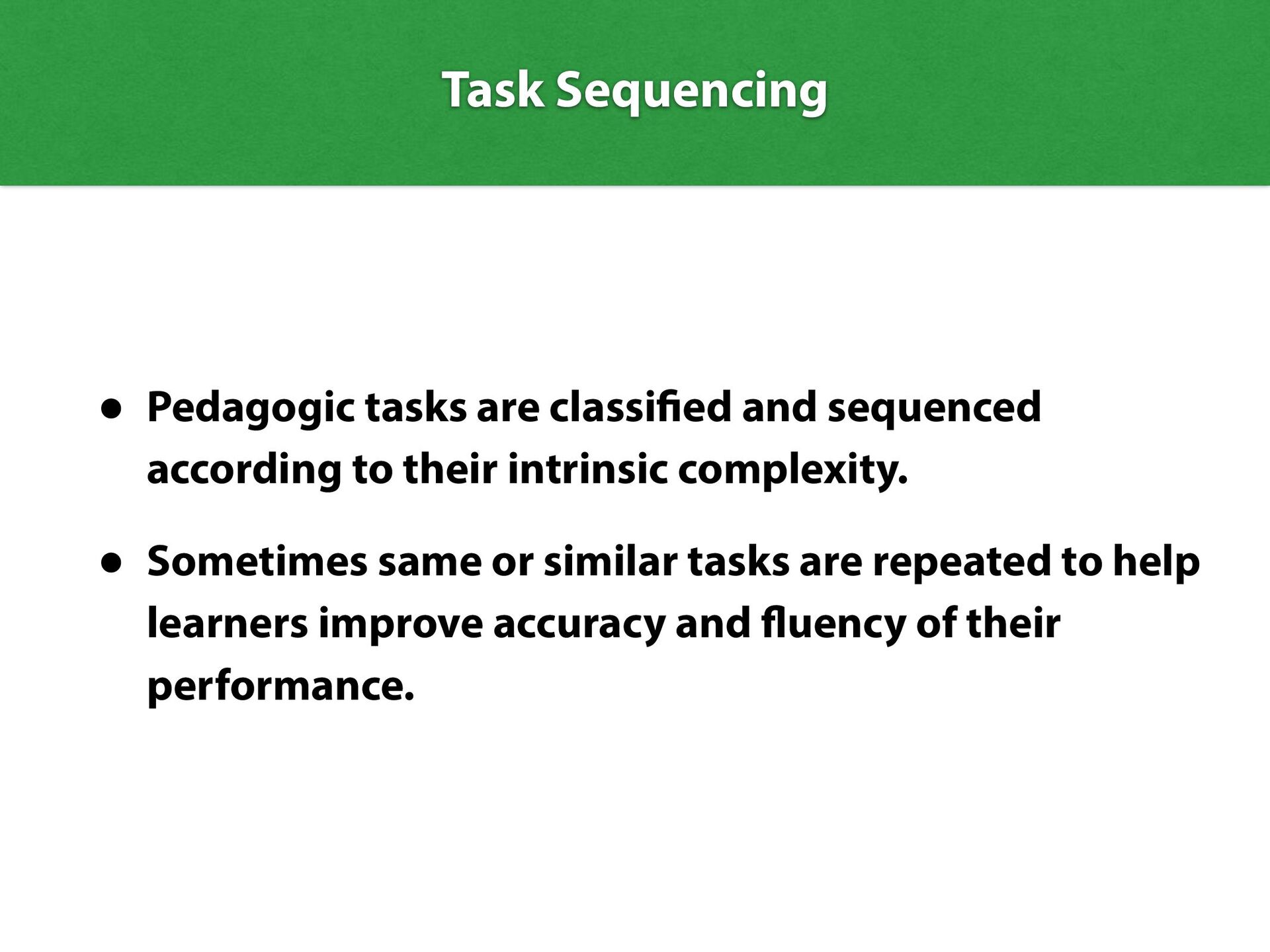
Task Sequencing • Pedagogic tasks are classi fi ed and
sequenced according to their intrinsic complexity. • Sometimes same or similar tasks are repeated to help learners improve accuracy and fl uency of their performance. -
Quick Summary • Task-based learning in general • Tasks in
language teaching • Task-based language teaching (TBLT) • Target tasks & pedagogic tasks • Task sequencing -
Picture Description Task Question for you: • How can you
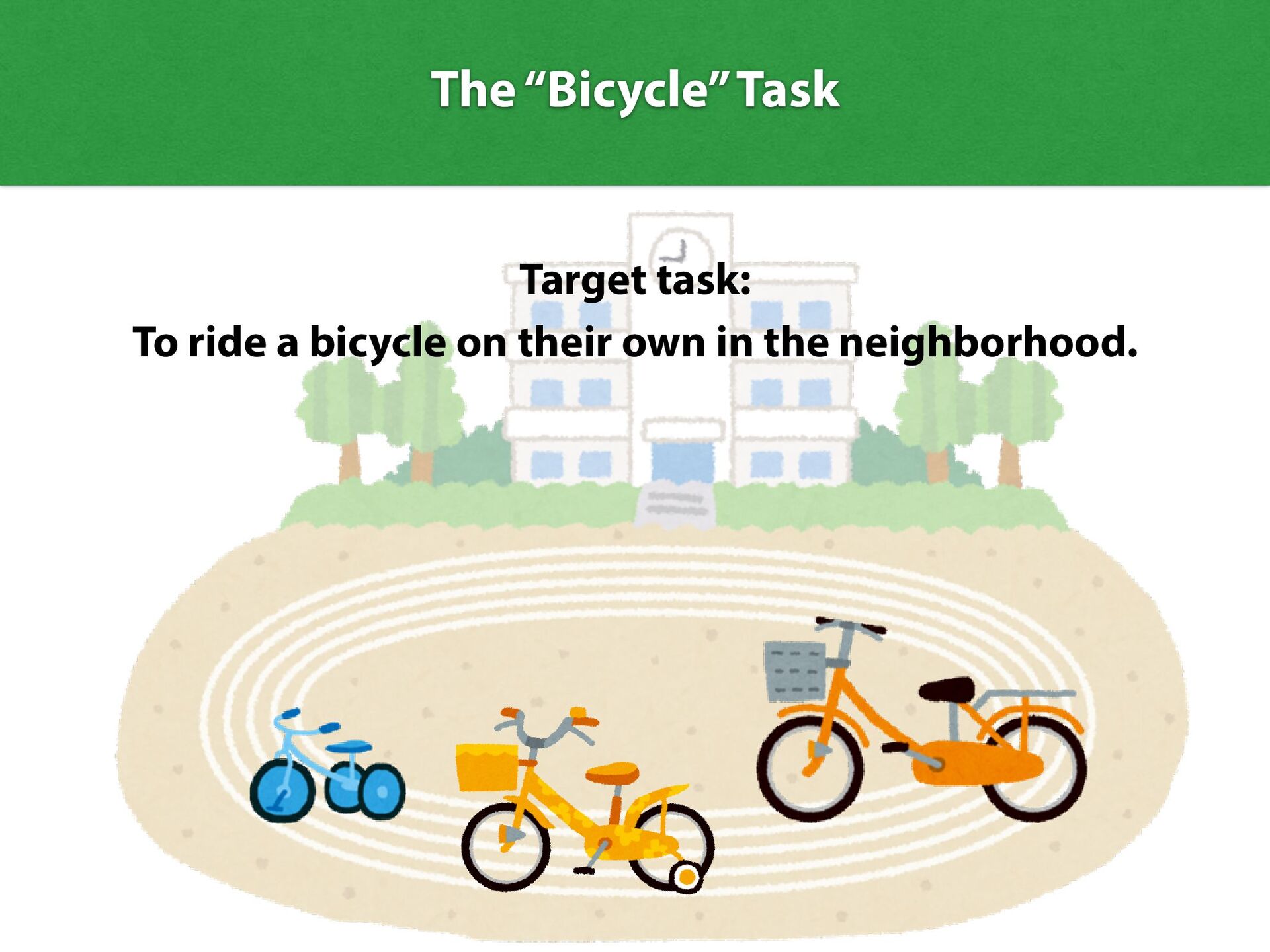
simplify this picture description task? • How can you make it more complex? • Refer to Robinson’s taxonomy (2001). -
Task Complexity, Conditions, & Di ffi culty Task complexity (cognitive
factors) Task conditions (interactional factors) Task di ff i culty (learner factors) (a) resource-directing e.g., ± few elements ± here-and-now ± no reasoning demands (a) participation variables e.g., open/closed one-way/two-way convergent/divergent (a) a ff ective variables e.g., motivation anxiety con fi dence (b) resource-depleting e.g., ± planning ± single task ± prior knowledge (b) participant variables e.g., gender familiarity power/solidarity (b) ability variables e.g., aptitude pro fi ciency intelligence Sequencing criteria Prospective decisions about task units Methodological in fl uences On-line decisions about pairs and groups (Robinson, 2001, p. 30) -
Task Repetition • Task repetition is considered to improve task
performance (e.g., Bygate 2001, Fukuta, 2016, Lambert et al., 2016). • Task repetition is perceived positively by learners (Ahmadian et al., 2017). -
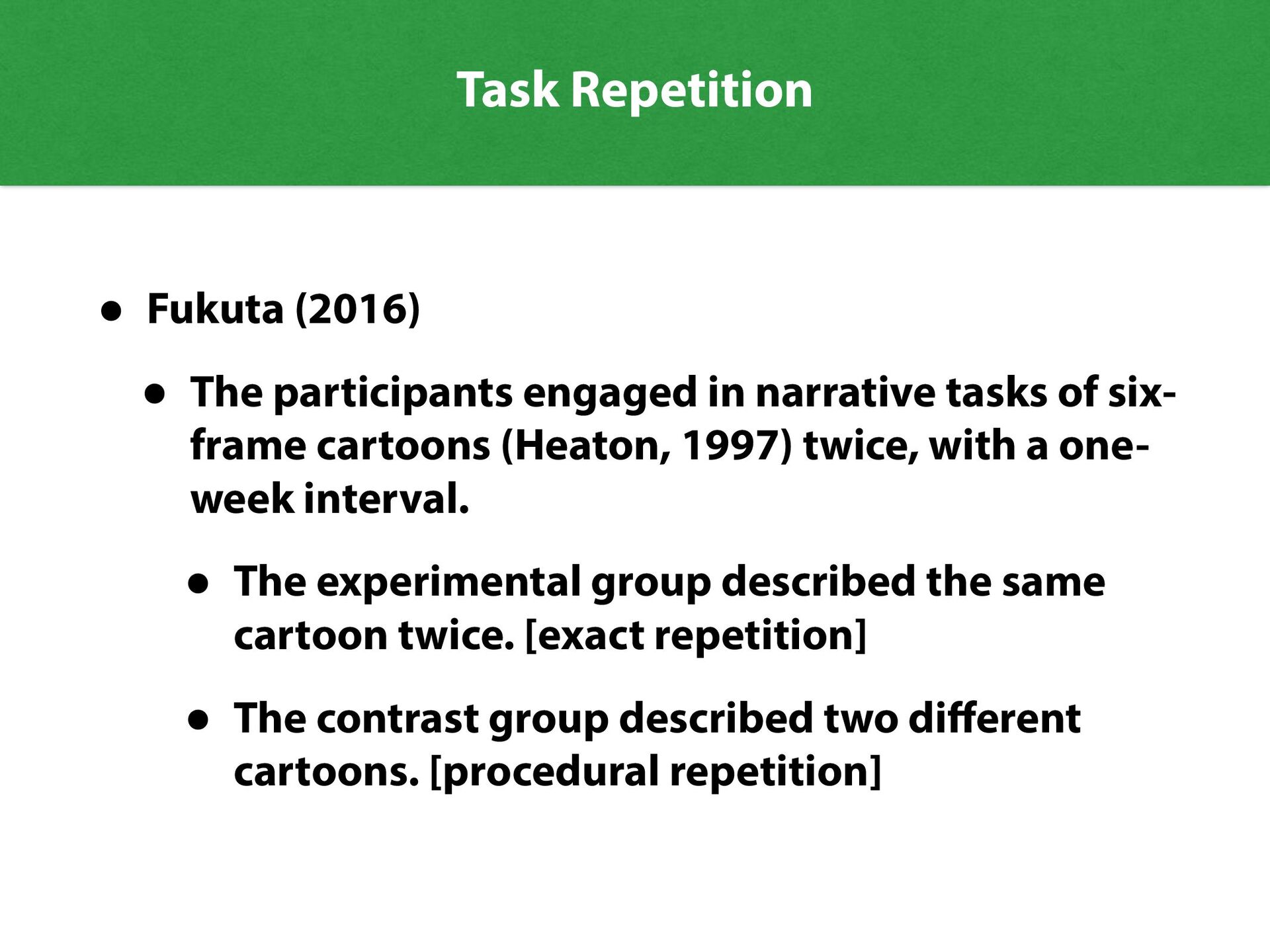
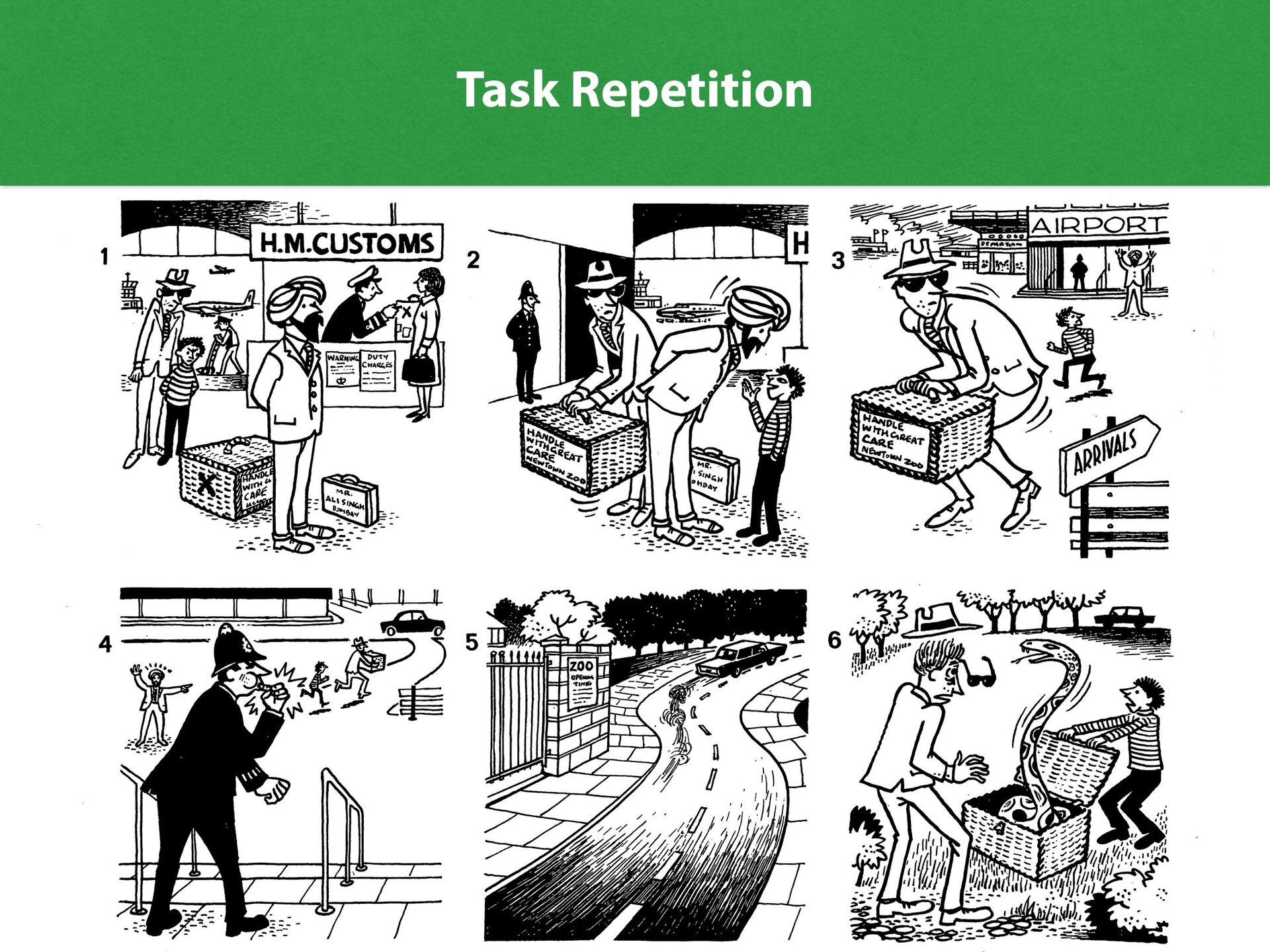
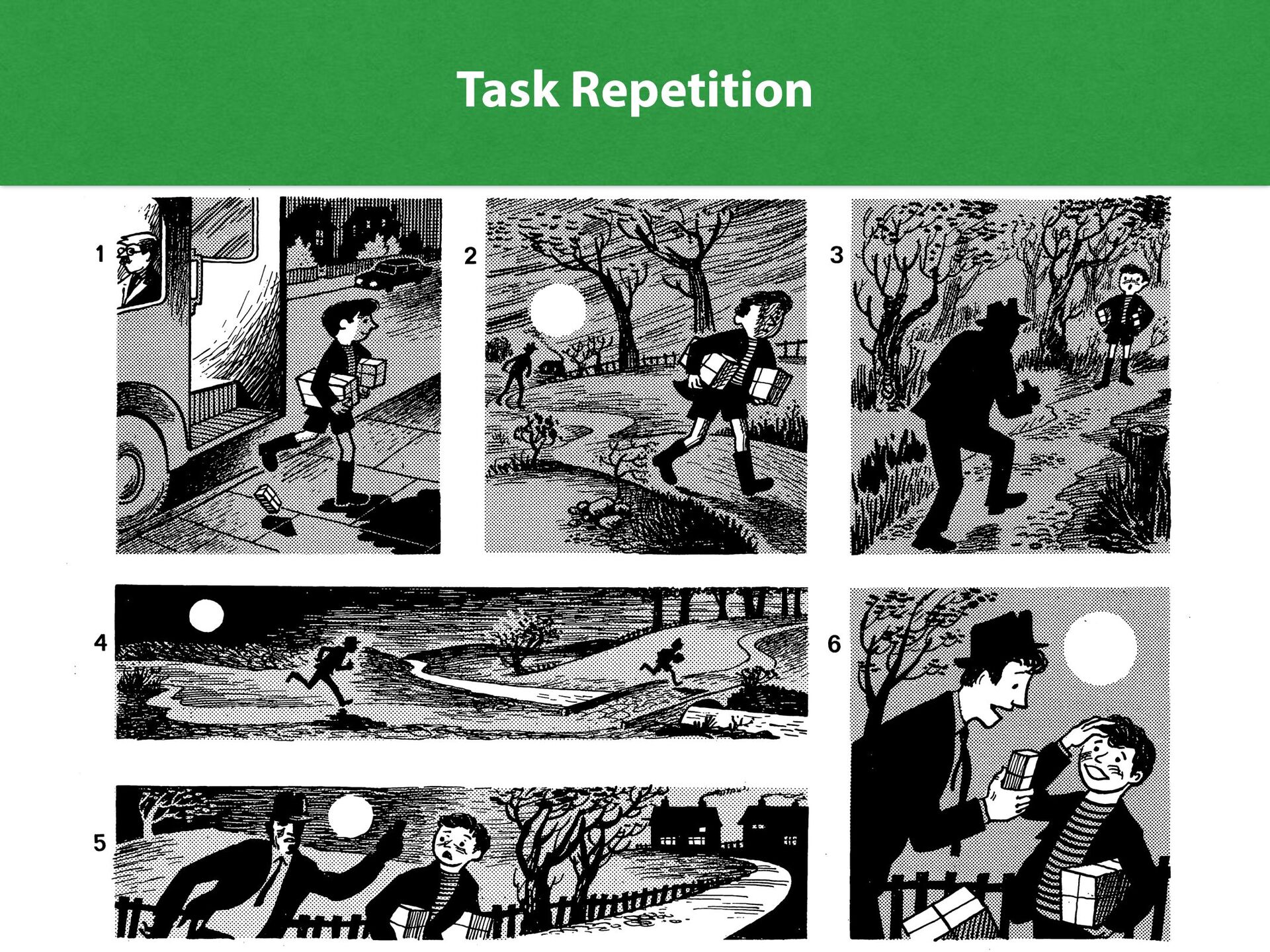
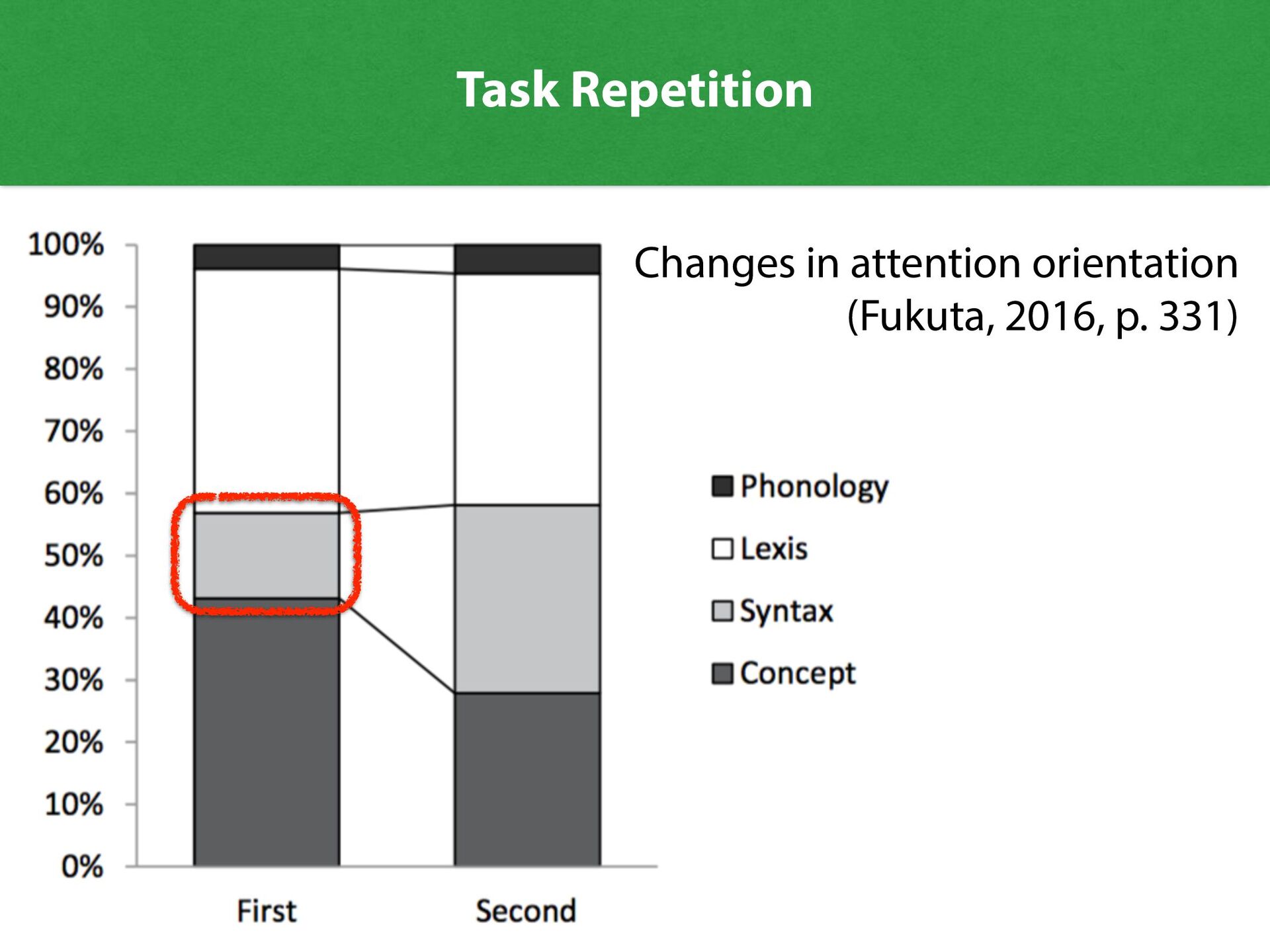
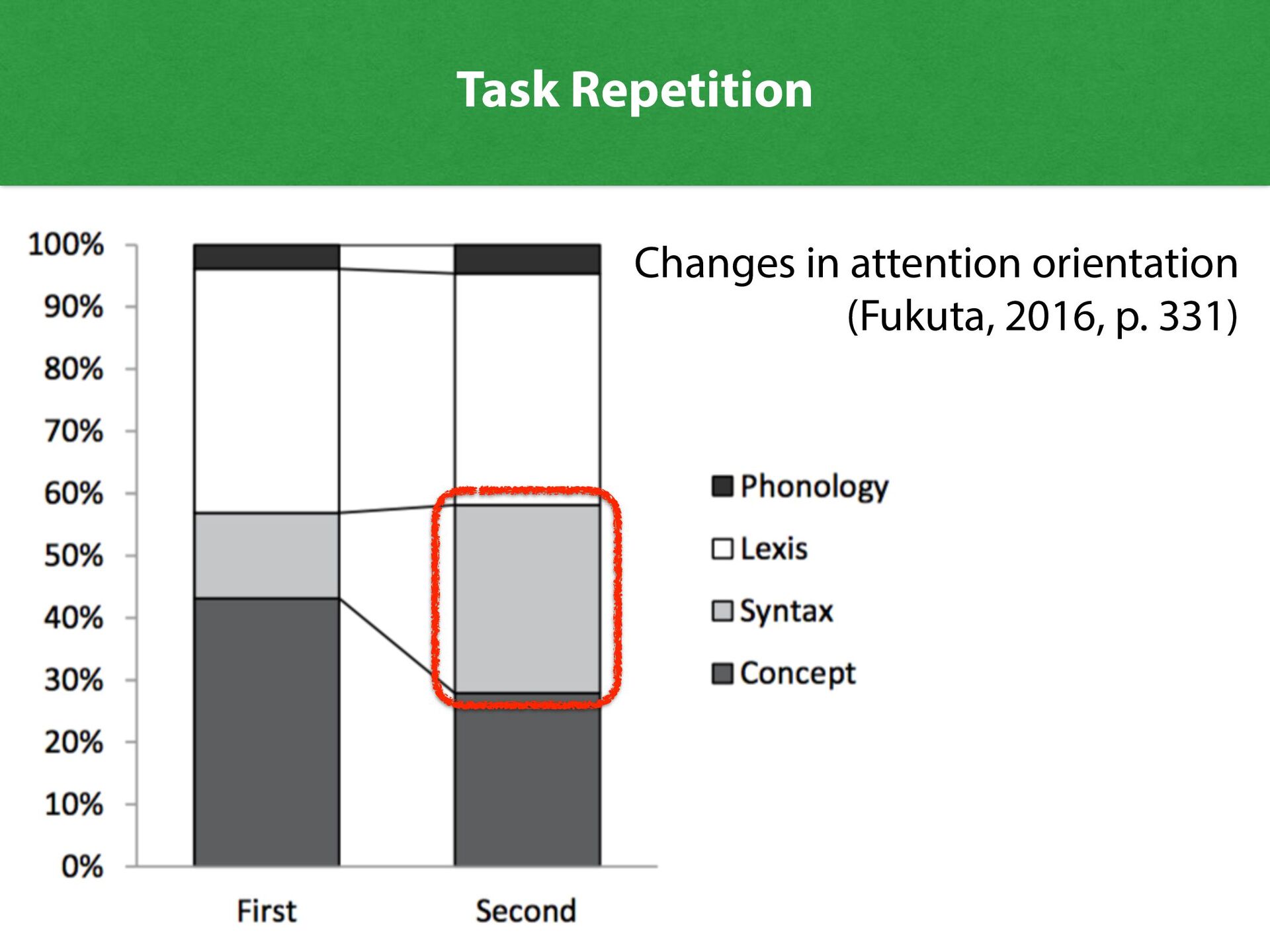
Task Repetition • Fukuta (2016) • The participants engaged in
narrative tasks of six- frame cartoons (Heaton, 1997) twice, with a one- week interval. • The experimental group described the same cartoon twice. [exact repetition] • The contrast group described two di ff erent cartoons. [procedural repetition] -
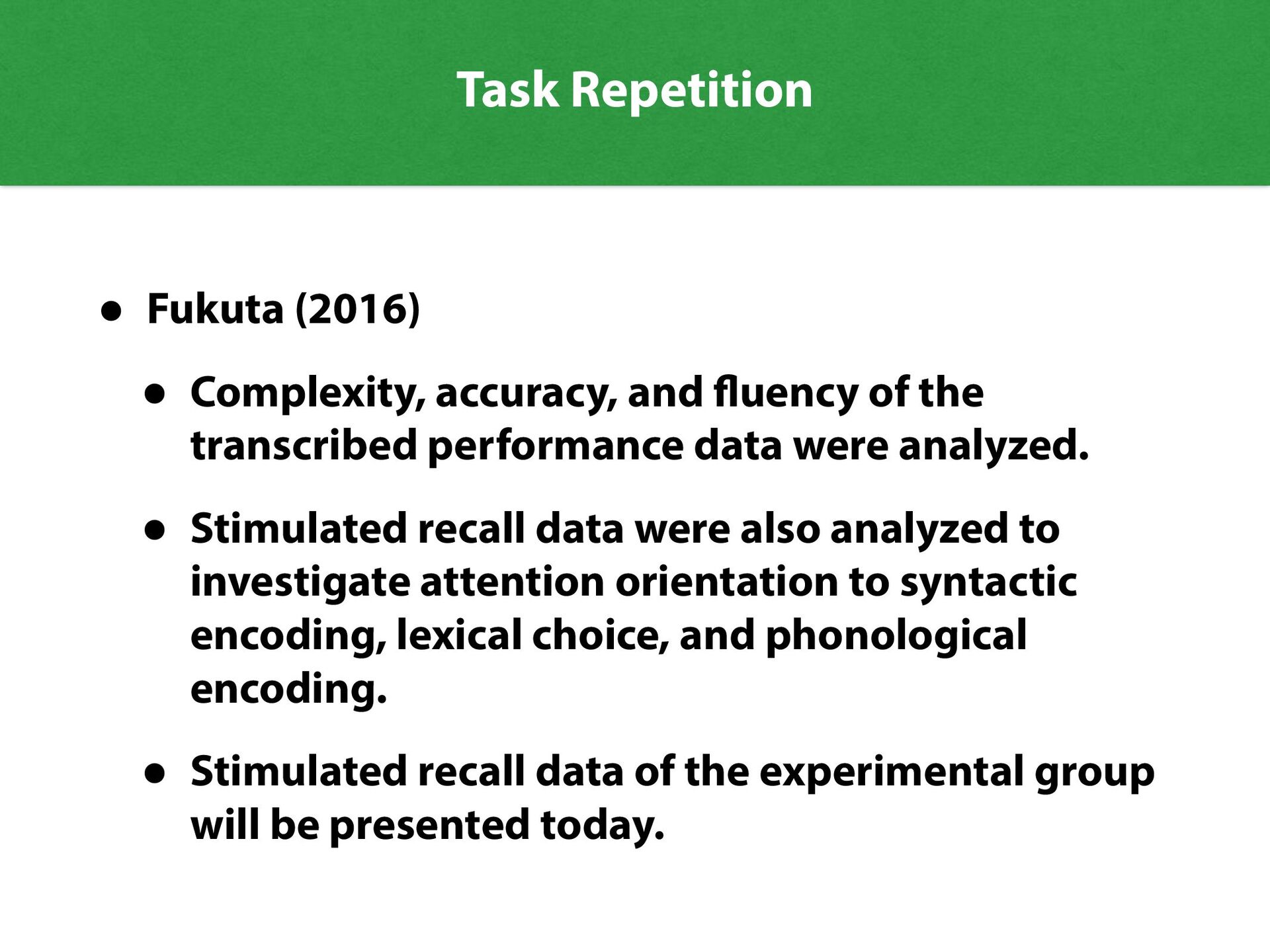
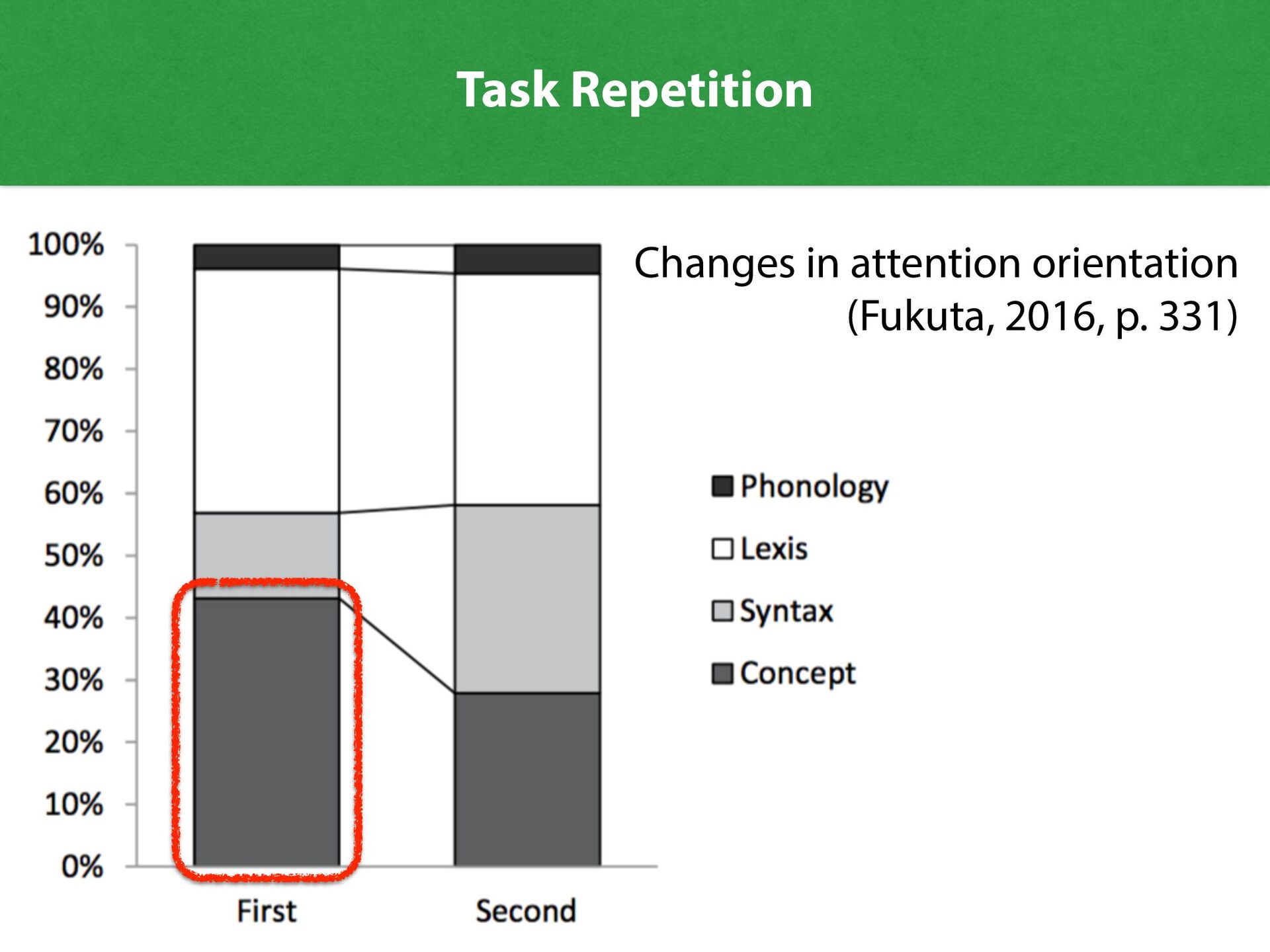
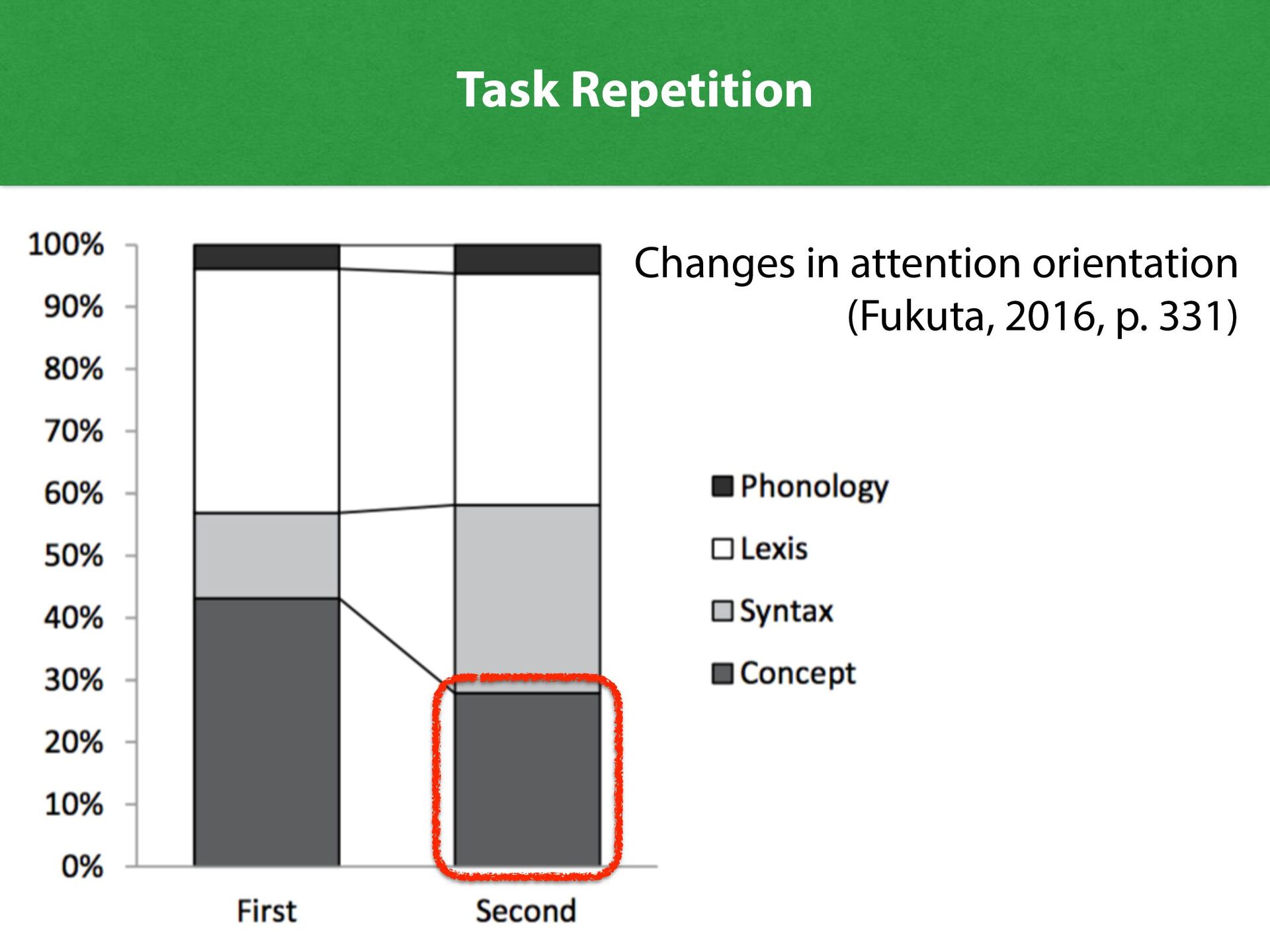
Task Repetition • Fukuta (2016) • Complexity, accuracy, and fl
uency of the transcribed performance data were analyzed. • Stimulated recall data were also analyzed to investigate attention orientation to syntactic encoding, lexical choice, and phonological encoding. • Stimulated recall data of the experimental group will be presented today. -
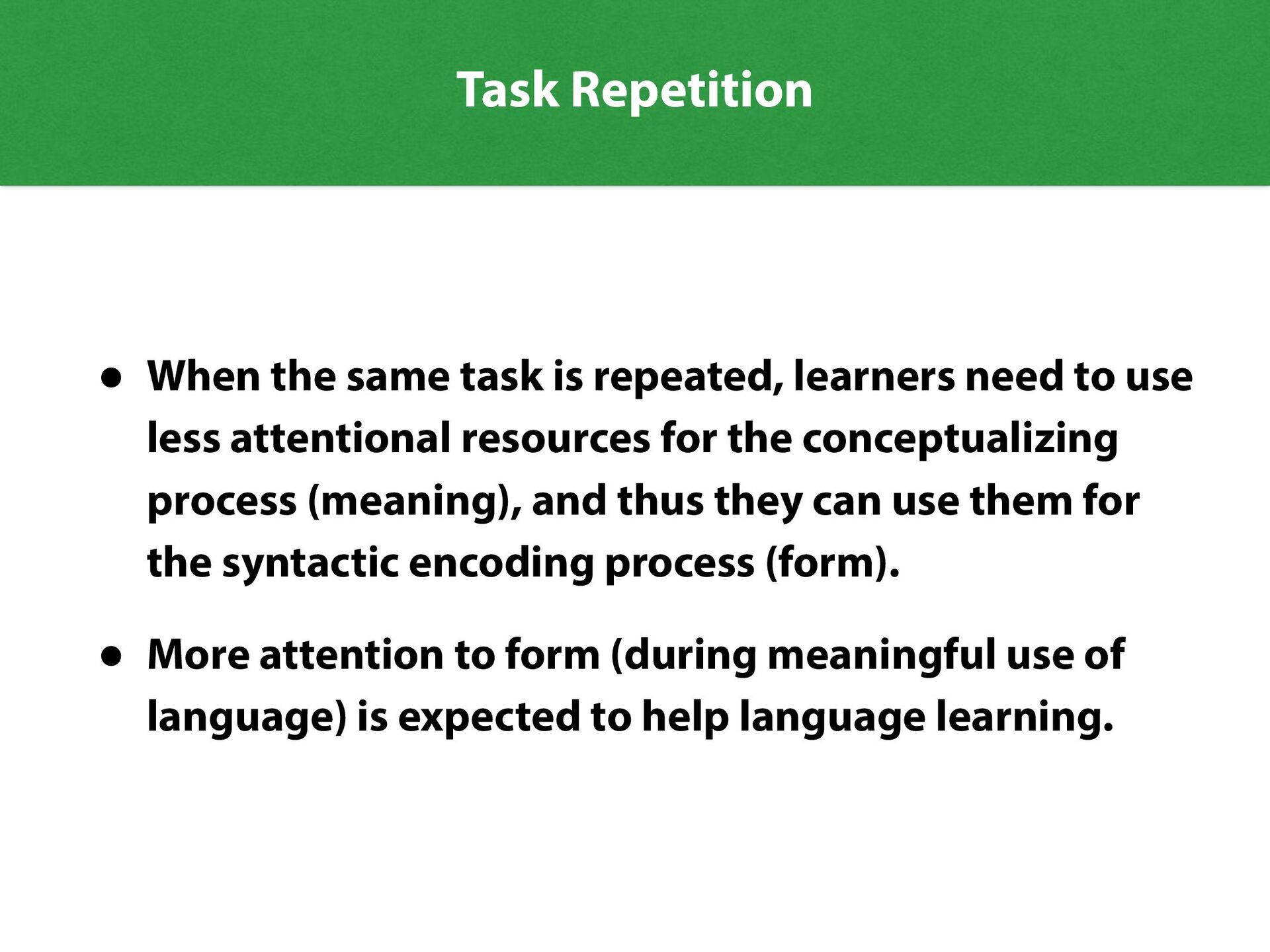
Task Repetition • When the same task is repeated, learners
need to use less attentional resources for the conceptualizing process (meaning), and thus they can use them for the syntactic encoding process (form). • More attention to form (during meaningful use of language) is expected to help language learning. -
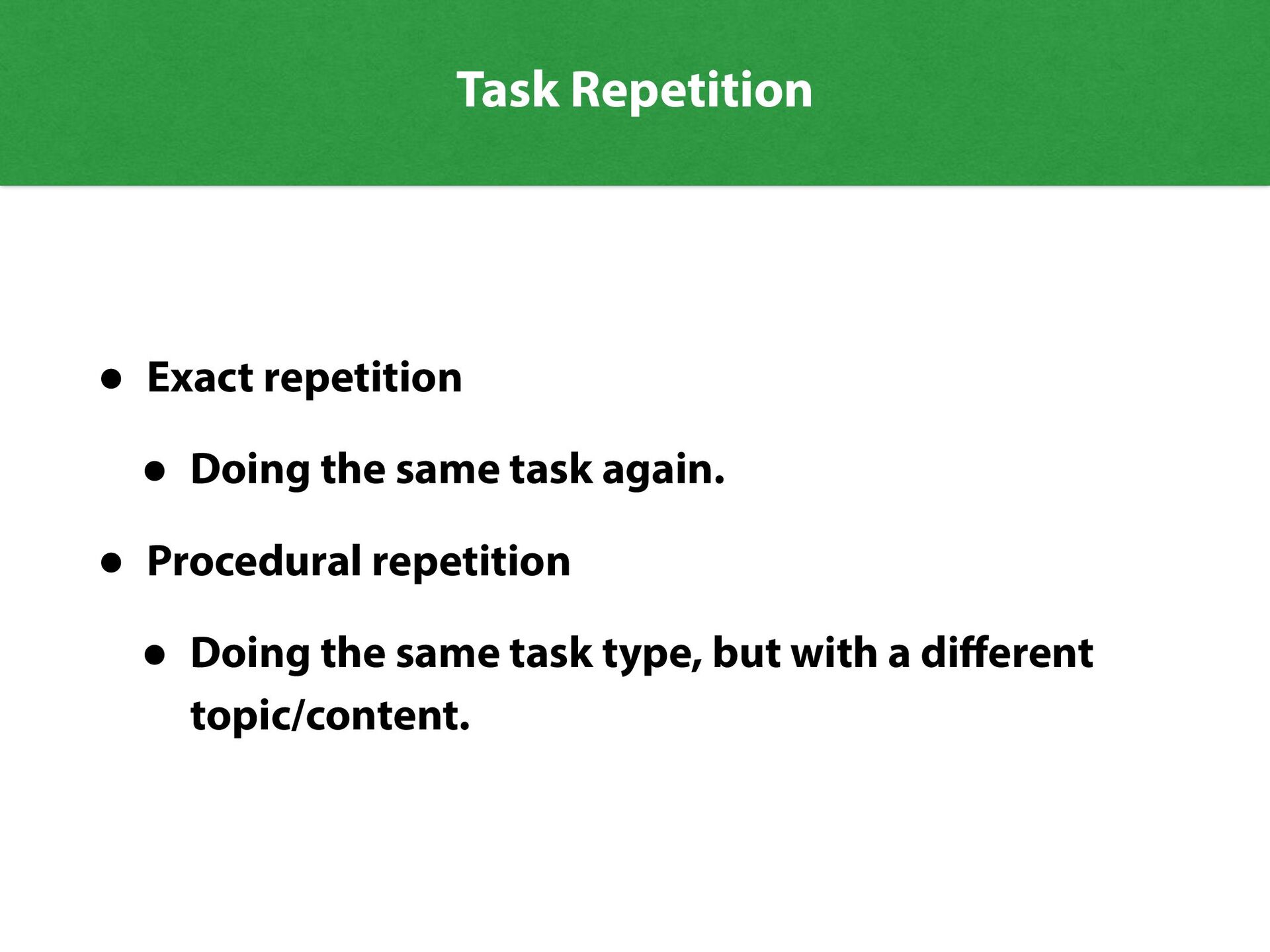
Task Repetition • Exact repetition • Doing the same task
again. • Procedural repetition • Doing the same task type, but with a di ff erent topic/content. -
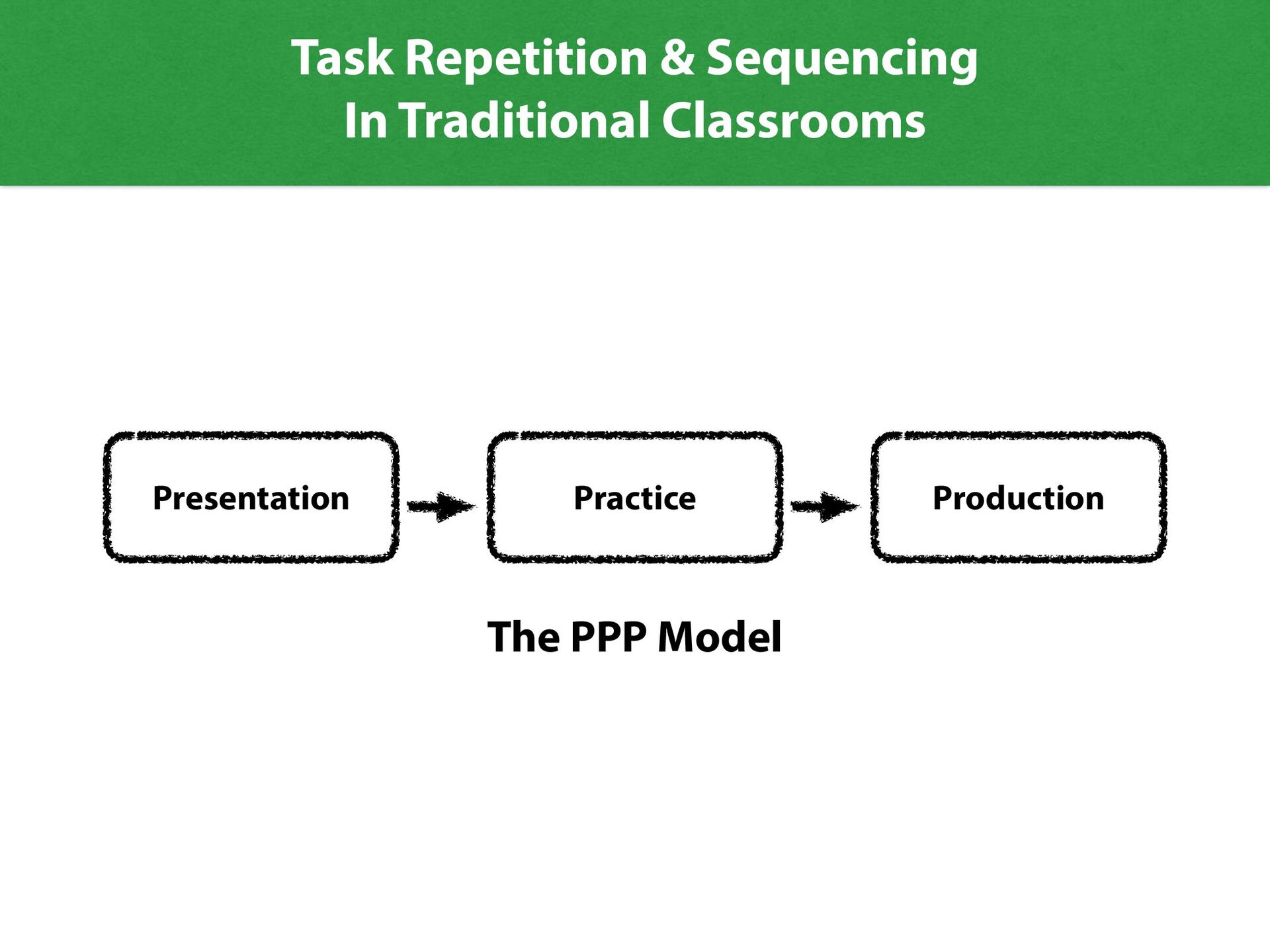
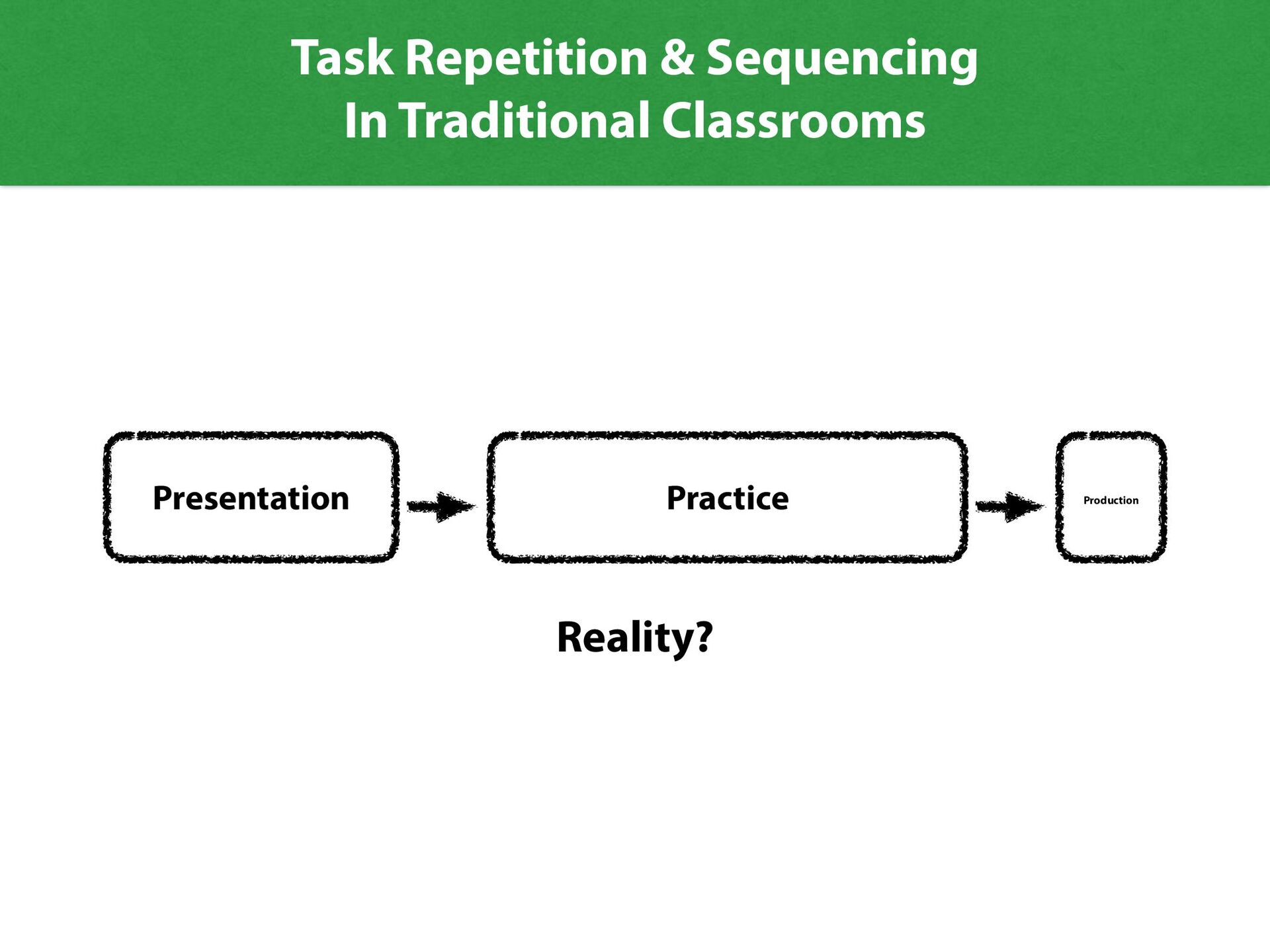
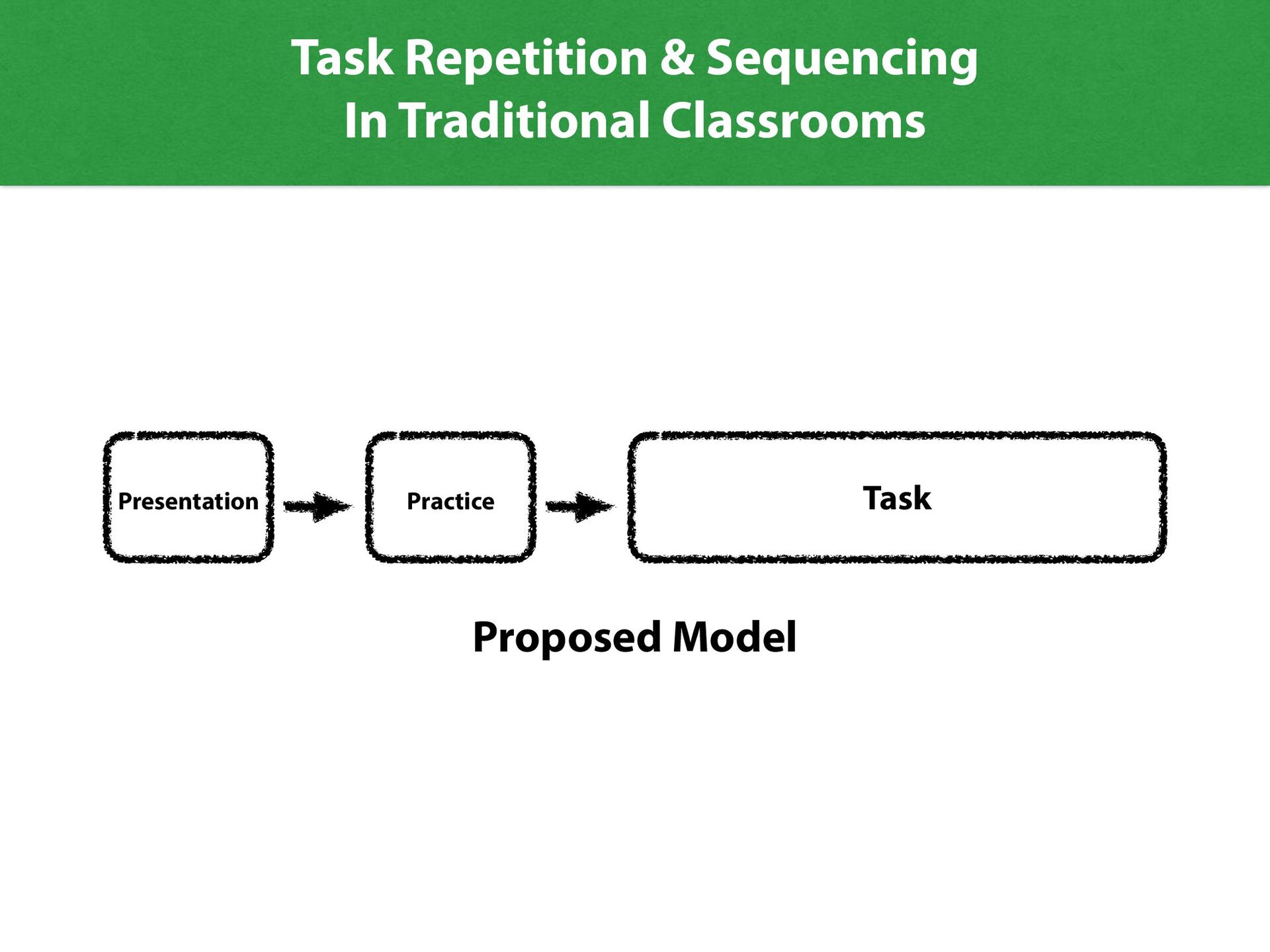
Task Repetition & Sequencing In Traditional Classrooms Proposed Model Task
Presentation Practice -
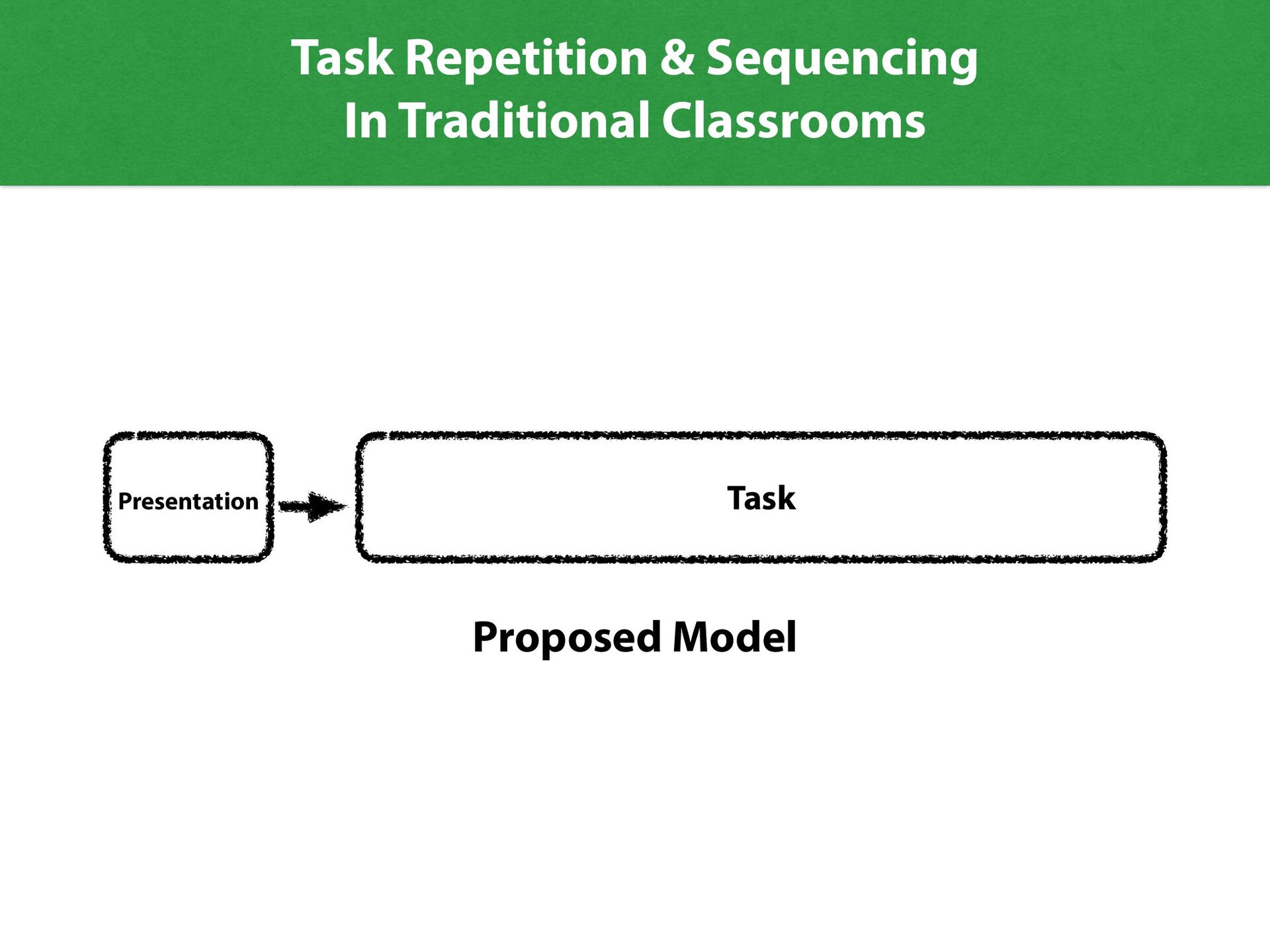
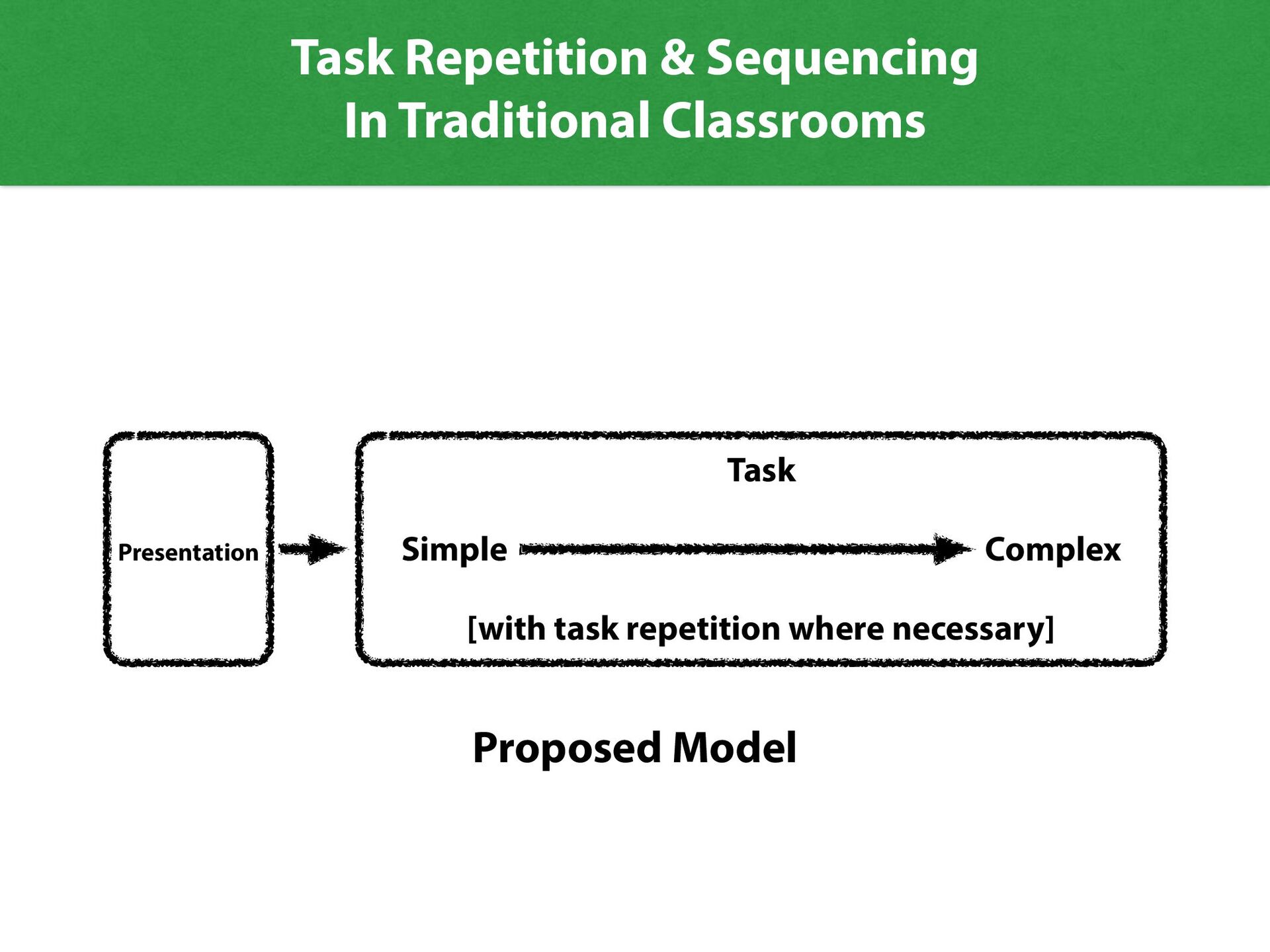
Task Repetition & Sequencing In Traditional Classrooms Task Simple Complex
[with task repetition where necessary] Proposed Model Presentation -
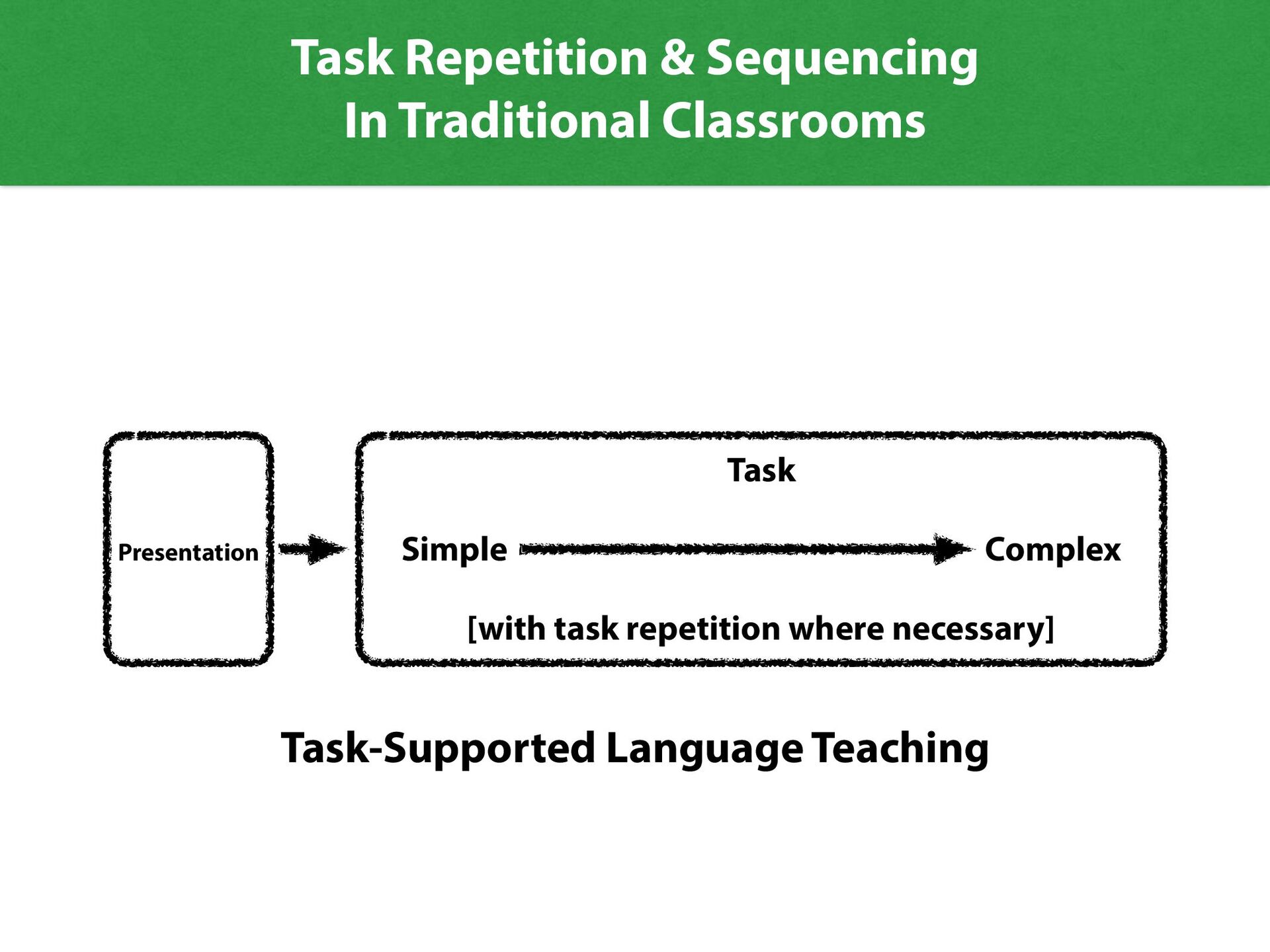
Task Repetition & Sequencing In Traditional Classrooms Task Simple Complex
[with task repetition where necessary] Task-Supported Language Teaching Presentation -
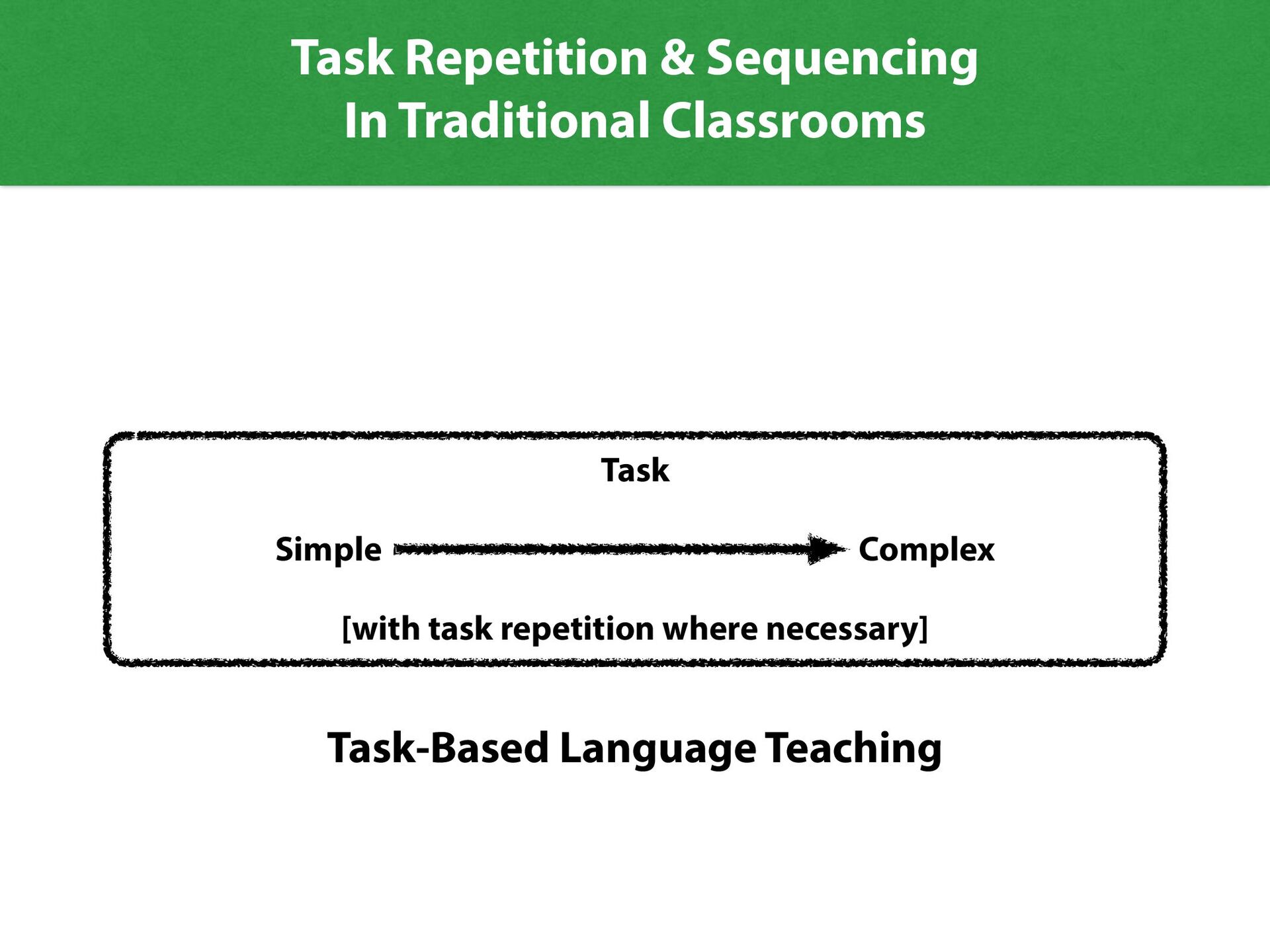
Task Repetition & Sequencing In Traditional Classrooms Task Simple Complex
[with task repetition where necessary] Task-Based Language Teaching -
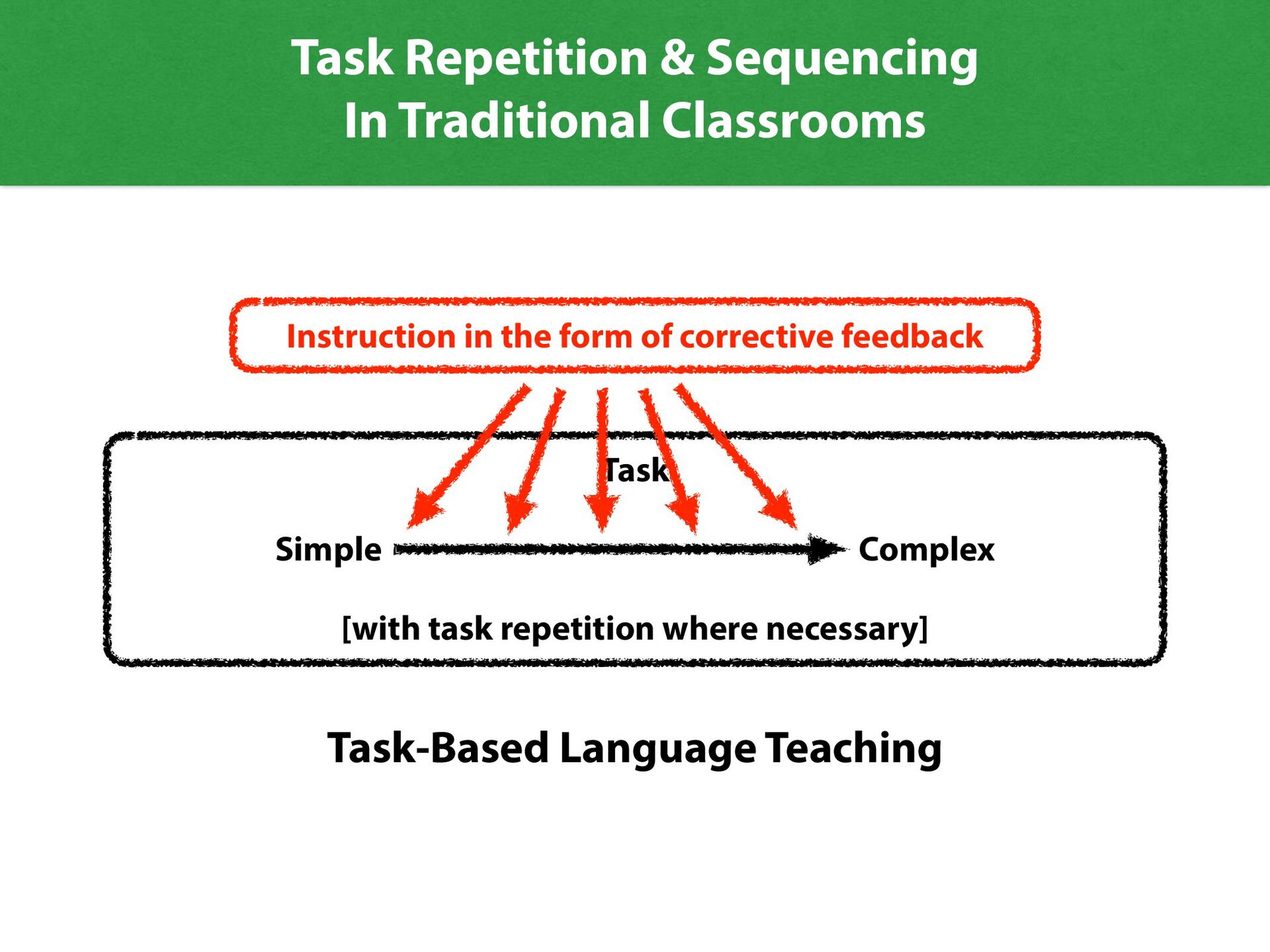
Task Repetition & Sequencing In Traditional Classrooms Task-Based Language Teaching
Task Simple Complex [with task repetition where necessary] Instruction in the form of corrective feedback -
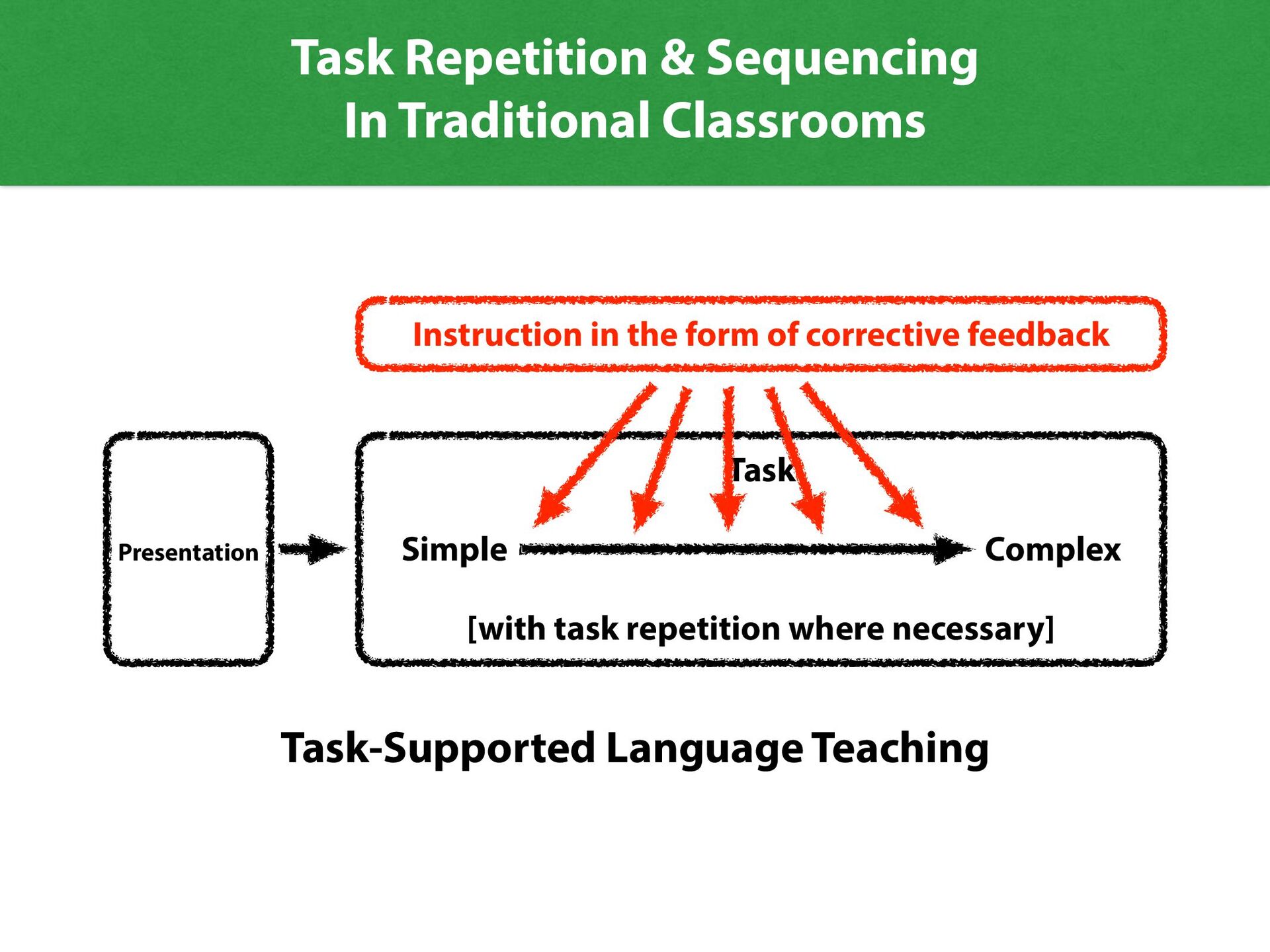
Task Repetition & Sequencing In Traditional Classrooms Task Simple Complex
[with task repetition where necessary] Task-Supported Language Teaching Presentation Instruction in the form of corrective feedback -
Summary Summary • Task-based learning in general • Tasks-based language
teaching • Target tasks & pedagogic tasks • Task sequencing • Task repetition • PPP & task-supported language teaching Ken Urano [email protected] https://www.urano-ken.com/research/nara2024 -
• Ahmadian, M. J., Mansouri, S. A., & Ghominejad, S.
(2017). Language learners’ and teachers’ perceptions of task repetition. ELT Journal, 71(4), 467–477. https://doi.org/10.1093/elt/ccx011 • Bygate, M. (2001). E ff ects of task repetition on the structure and control of oral language. In M. Bygate, P. Skehan, & M. Swain (Eds.), Researching pedagogic tasks: Second language learning, teaching and testing (pp. 23–48). Longman. • Ellis, R. (2003). Task-based language learning and teaching. Oxford University Press. • Ellis, R. (2012). Language teaching research and language pedagogy. Wiley-Blackwell. • Fukuta, J. (2016). E ff ects of task repetition on learners’ attention orientation in L2 oral production. Language Teaching Research, 20, 321–340. http://dx.doi.org/10.1177/1362168815570142 • Heaton, J. (1997). Beginning composition through pictures. Longman. • Lambert, C., Kormos, J., & Minn, D. (2017). Task repetition and second language speech processing. Studies in Second Language Acquisition, 39, 167–196. https://doi.org/10.1017/S0272263116000085 • Long, M. H. (1985). A role for instruction in second language acquisition: Task-based language teaching. In K. Hyltenstam & M. Pienemann (Eds.), Modeling and assessing second language development (pp. 77–99). Multilingual Matters. • Matsumura, M. (2020). দଜণل. λεΫͷجૅࣝ. Ճ౻༝ਸɾদଜণلɾPaul Wicking. (ฤ). ʰίϛϡχ έʔγϣϯɾλεΫͷΞΠσΞͱϚςϦΞϧ: ڭࣨͱੈքΛͭͳ͙ӳޠतۀͷͨΊʹʱ(pp. 10–24). ࡾमࣾ. • Robinson, P. (2001). Task complexity, task di ffi culty, and task production: Exploring interactions in a componential framework. Applied Linguistics, 22, 27–57. https://doi.org/10.1093/applin/22.1.27 References