Upgrade to Pro — share decks privately, control downloads, hide ads and more …

Carpenter, Hammer, Morris, and Nadav-Manes "The...

Carpenter, Hammer, Morris, and Nadav-Manes "The Next Chapter for CCLP: From Recommended Practice to Reality"

This presentation was given by Todd Carpenter of NISO, Sebastian Hammer of Index Data, Jill Morris of The Partnership for Academic Library Collaboration and Innovation (PALCI), and Boaz Nadav-Manes of Lehigh University for the "Collaborative Collections Lifecycle Project (CCLP) Fall 2026 Public Update Webinar." This NISO event was held October 20, 2026.

More Decks by National Information Standards Organization

Other Decks in Education

Transcript

  1. Collaborative Collections Lifecycle Infrastructure Project (CCLP) 1. Introduction & Background

    2. Current state of the project 3. Project Lighthouse 4. CYCLOPS Software Development 5. Ways to Engage 6. Q&A Discussion
  2. Thank you for the support! CCLP is a collaboration of

    80+ representatives from libraries, consortia, publisher, aggregator, and service provider partners relevant to the ecosystem. The CCLP project was made possible in part by the Institute of Museum and Library Services (IMLS) Grant #: LG-252384-OLS-22. It is a project working to redefine the ways in which libraries collaborate throughout the collections lifecycle process that will produce middleware/software in support of recommended practice. For more information about this grant visit: https://www.imls.gov/grants/awarded/lg-252384-ol s-22 CCLP developed out of discussions that began in 2019. Phase 1 of the project was funded for three years in 2022 by IMLS.
  3. QUESTION: “What’s one obstacle you’ve encountered when trying to collaborate

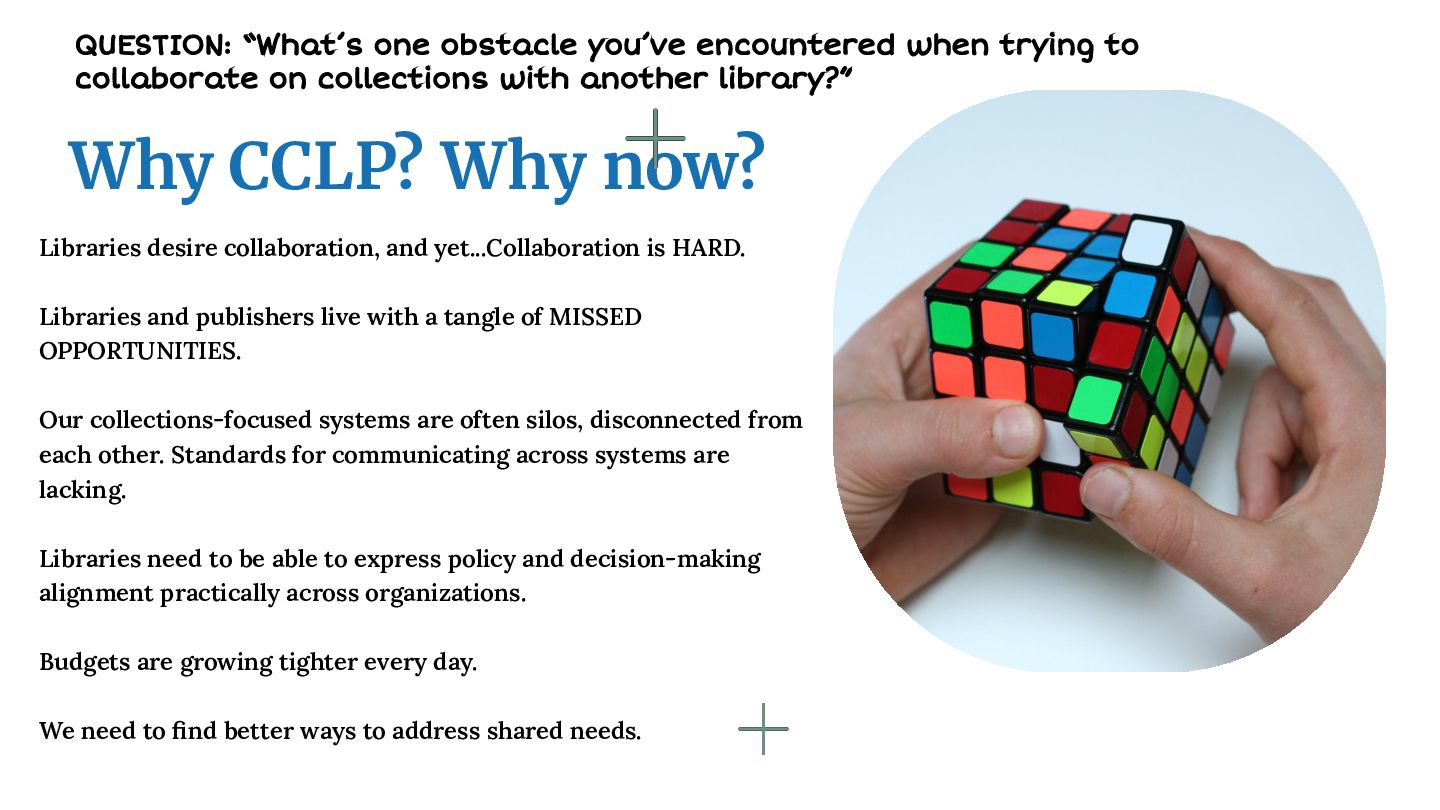
    on collections with another library?” Why CCLP? Why now? Libraries desire collaboration, and yet...Collaboration is HARD. Libraries and publishers live with a tangle of MISSED OPPORTUNITIES. Our collections-focused systems are often silos, disconnected from each other. Standards for communicating across systems are lacking. Libraries need to be able to express policy and decision-making alignment practically across organizations. Budgets are growing tighter every day. We need to find better ways to address shared needs.
  4. Vision: Empower Network-First Collecting At Scale Mission Through collaboration and

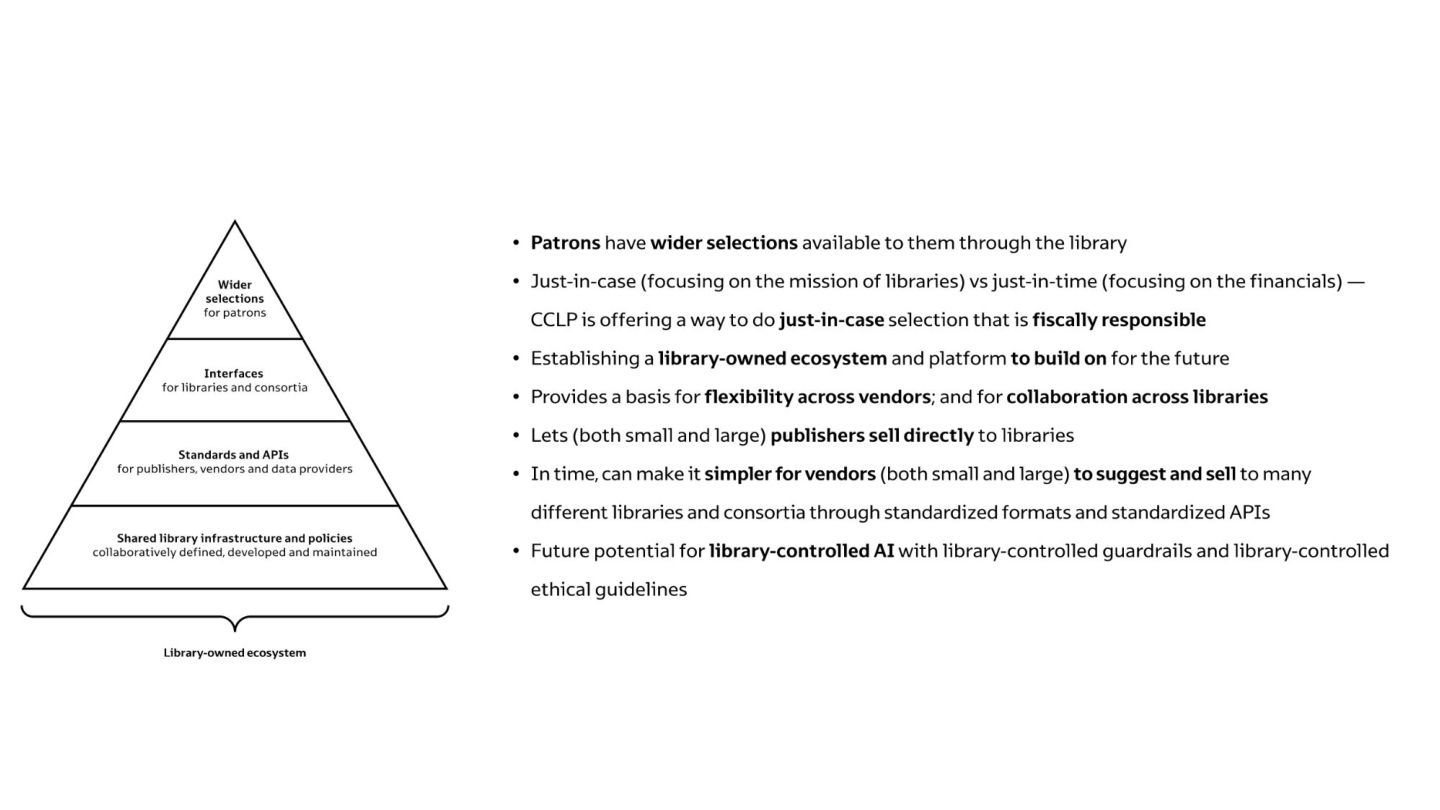
    innovation with trusted partners in an interoperable, community-owned infrastructure, CCLP will create best practices, improve standards, and develop prototype middleware to empower value-driven library collecting, increase collection diversity, availability and access, and improve stewardship and institutional efficiency in a collaboration-first environment.
  5. Core Values and Principles Co-ownership of project outputs Provider-neutral approaches

    Interoperability Engagement of community promoting mutual understanding & stewardship for collaborating around collections, including models/mechanisms for acquiring and accessing open content Cost-effective, highly practical and usable solutions Data privacy & security http://cclproject.org
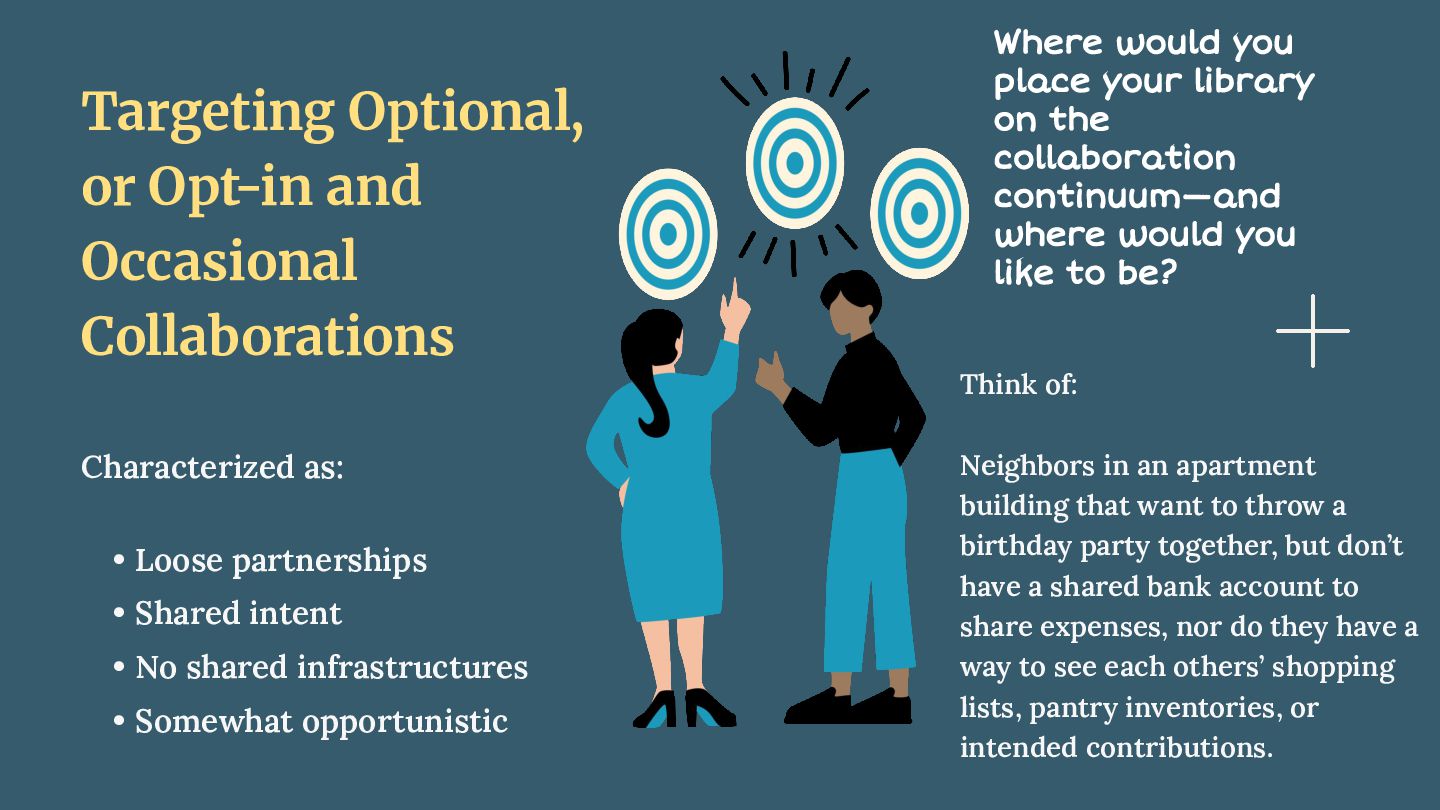
  6. Targeting Optional, or Opt-in and Occasional Collaborations Characterized as: •

    Loose partnerships • Shared intent • No shared infrastructures • Somewhat opportunistic Where would you place your library on the collaboration continuum—and where would you like to be? Think of: Neighbors in an apartment building that want to throw a birthday party together, but don’t have a shared bank account to share expenses, nor do they have a way to see each others’ shopping lists, pantry inventories, or intended contributions.
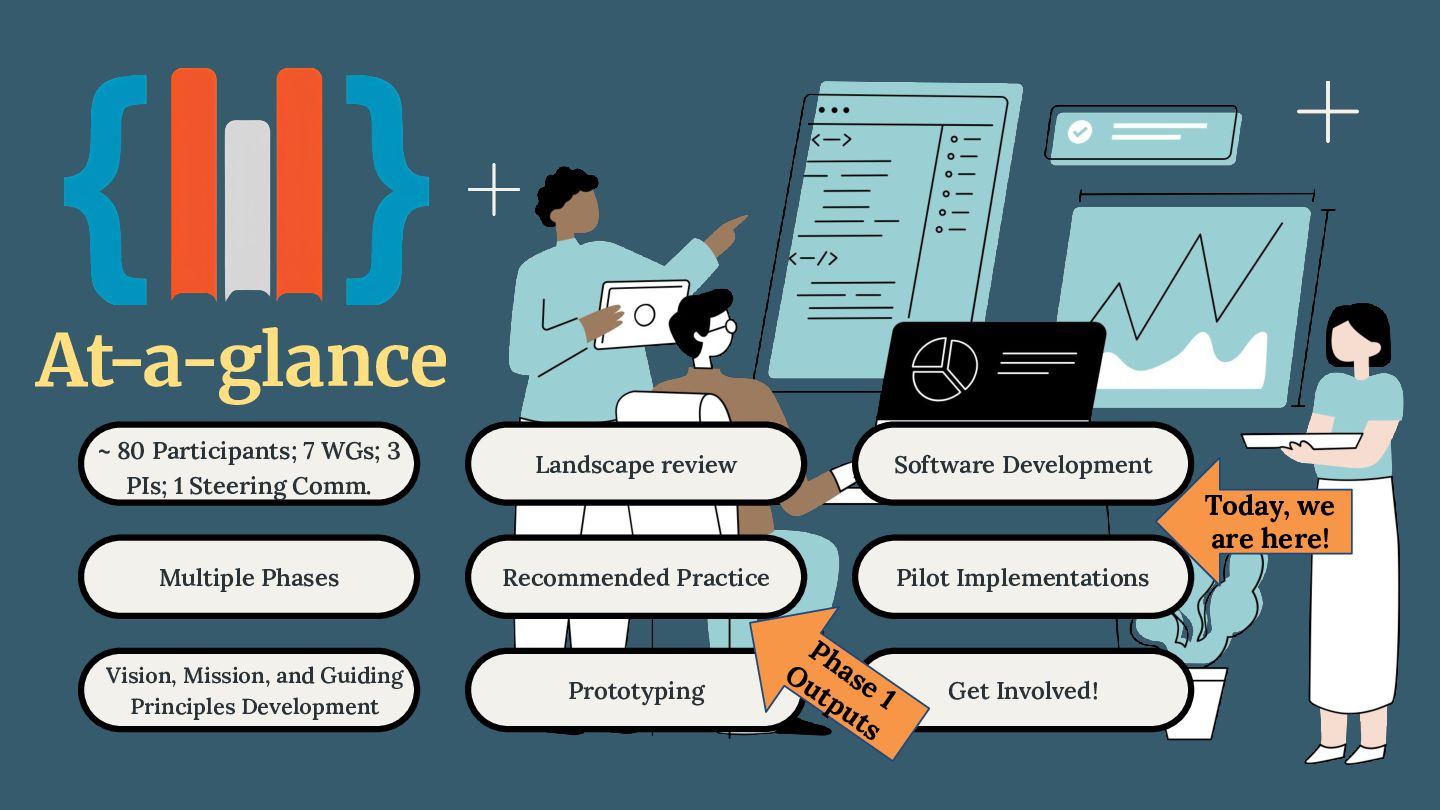
  7. At-a-glance ~ 80 Participants; 7 WGs; 3 PIs; 1 Steering

    Comm. Landscape review Multiple Phases Recommended Practice Vision, Mission, and Guiding Principles Development Software Development Today, we are here! Prototyping Pilot Implementations P Ou hase tp 1 ut s Get Involved!
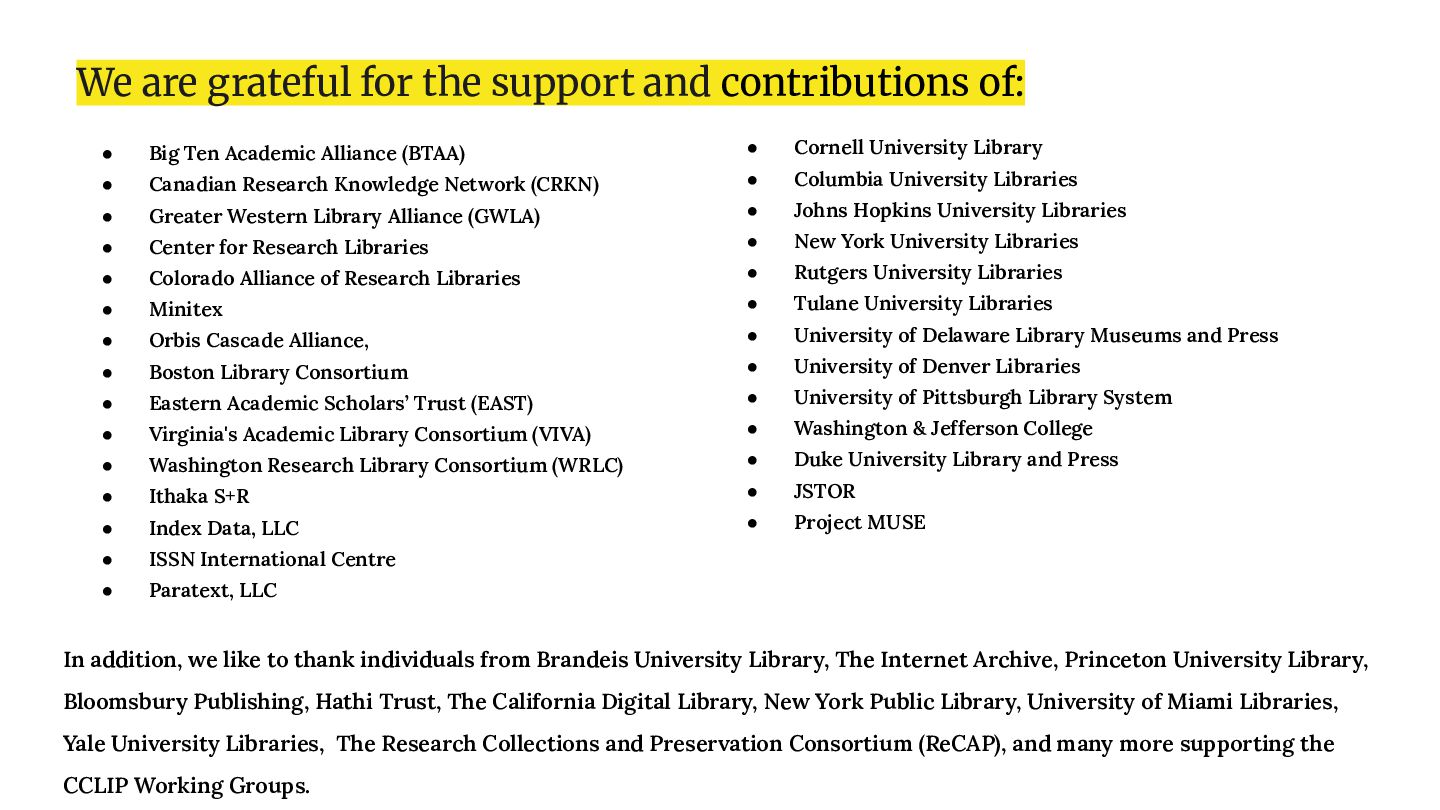
  8. We are grateful for the support and contributions of: •

    Big Ten Academic Alliance (BTAA) • Cornell University Library • Canadian Research Knowledge Network (CRKN) • Columbia University Libraries • Greater Western Library Alliance (GWLA) • Johns Hopkins University Libraries • Center for Research Libraries • New York University Libraries • Colorado Alliance of Research Libraries • Rutgers University Libraries • Minitex • Tulane University Libraries • Orbis Cascade Alliance, • University of Delaware Library Museums and Press • Boston Library Consortium • University of Denver Libraries • Eastern Academic Scholars’ Trust (EAST) • University of Pittsburgh Library System • Virginia's Academic Library Consortium (VIVA) • Washington & Jefferson College • Washington Research Library Consortium (WRLC) • Duke University Library and Press • Ithaka S+R • JSTOR • Index Data, LLC • Project MUSE • ISSN International Centre • Paratext, LLC In addition, we like to thank individuals from Brandeis University Library, The Internet Archive, Princeton University Library, Bloomsbury Publishing, Hathi Trust, The California Digital Library, New York Public Library, University of Miami Libraries, Yale University Libraries, The Research Collections and Preservation Consortium (ReCAP), and many more supporting the CCLIP Working Groups.
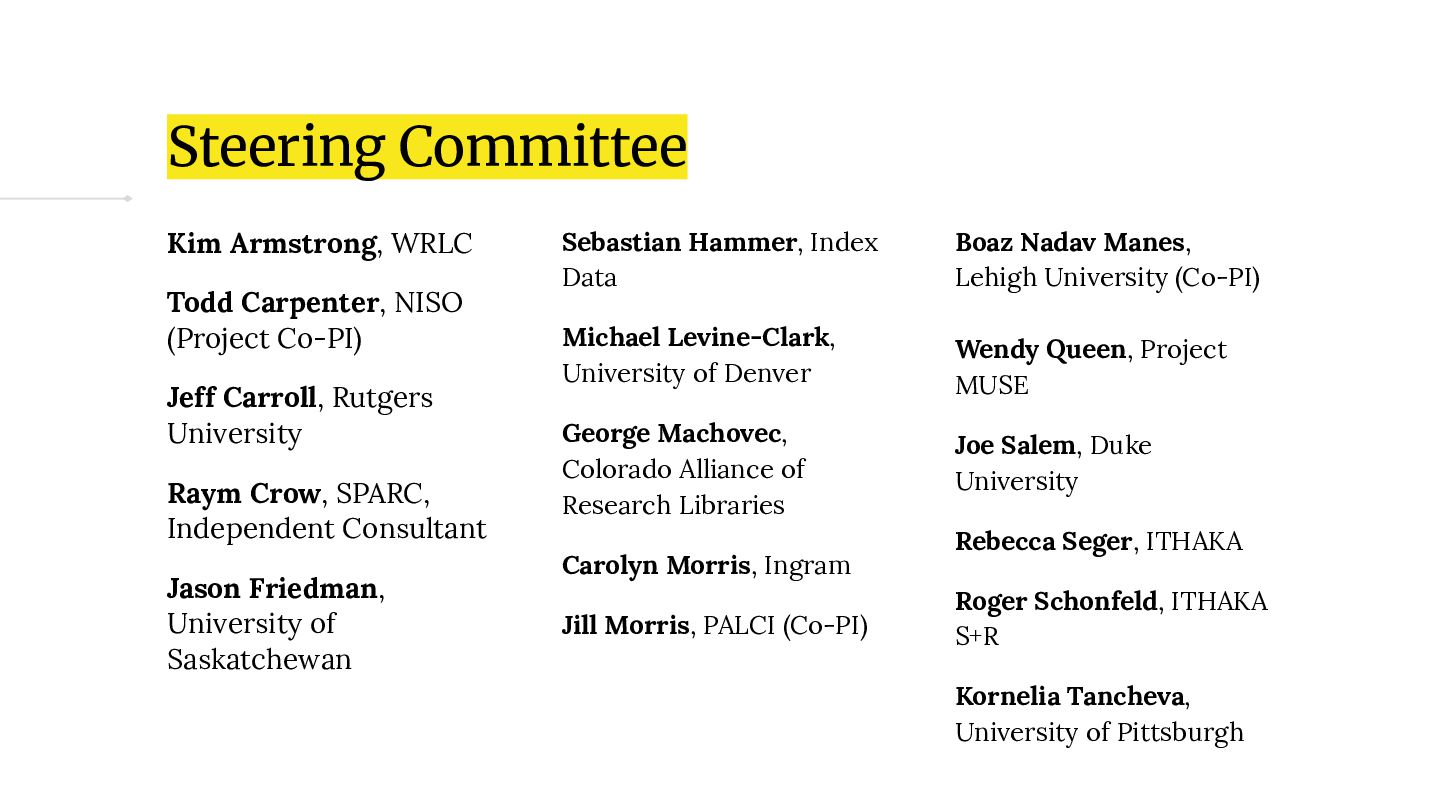
  9. Steering Committee Kim Armstrong, WRLC Todd Carpenter, NISO (Project Co-PI)

    Jeff Carroll, Rutgers University Raym Crow, SPARC, Independent Consultant Jason Friedman, University of Saskatchewan Sebastian Hammer, Index Data Boaz Nadav Manes, Lehigh University (Co-PI) Michael Levine-Clark, University of Denver Wendy Queen, Project MUSE George Machovec, Colorado Alliance of Research Libraries Joe Salem, Duke University Carolyn Morris, Ingram Jill Morris, PALCI (Co-PI) Rebecca Seger, ITHAKA Roger Schonfeld, ITHAKA S+R Kornelia Tancheva, University of Pittsburgh
  10. The NISO CCLIP Recommended Practice Purpose: Identify gaps, barriers, and

    recommend practices/opportunities for collaborative collections activities within our scope for this phase of the project
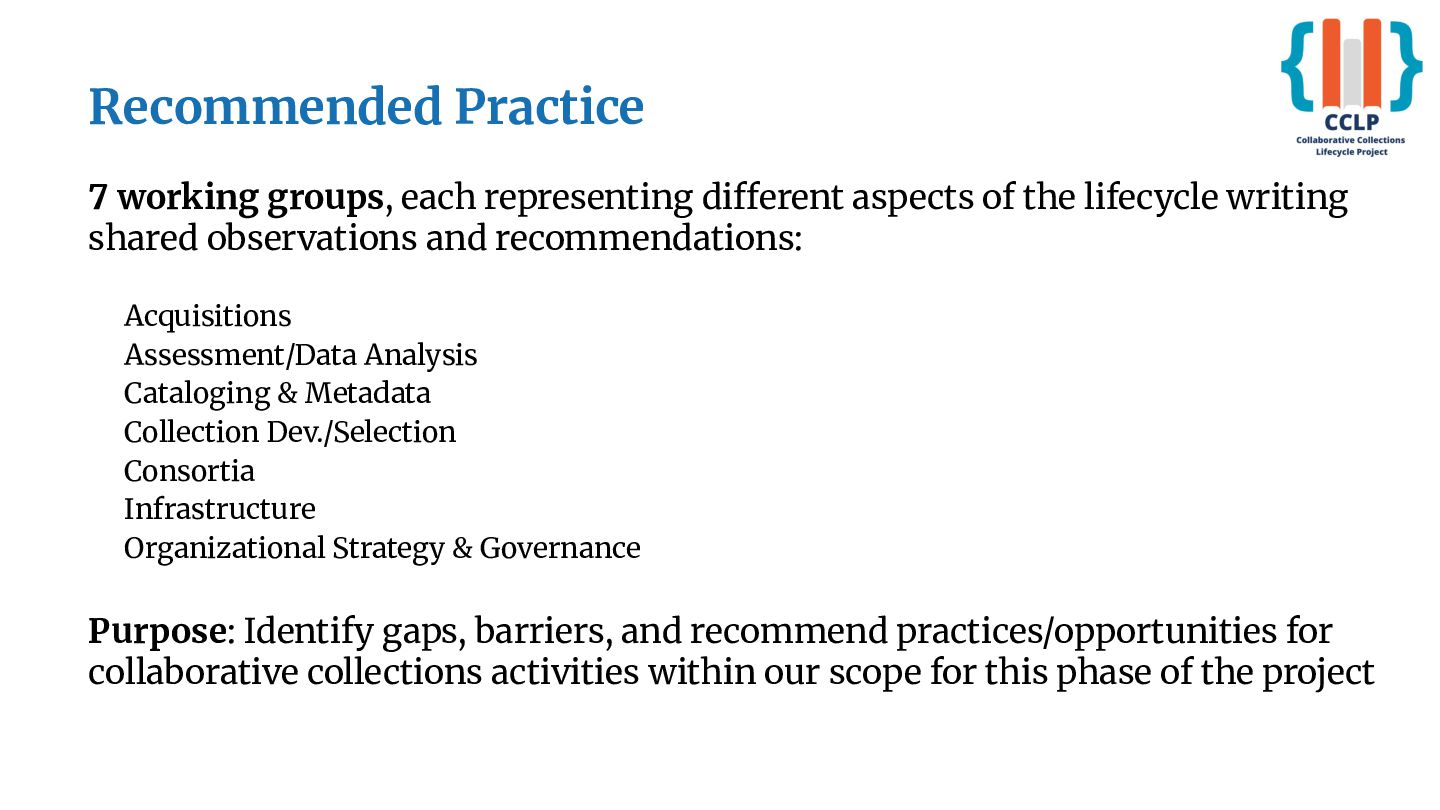
  11. Recommended Practice 7 working groups, each representing different aspects of

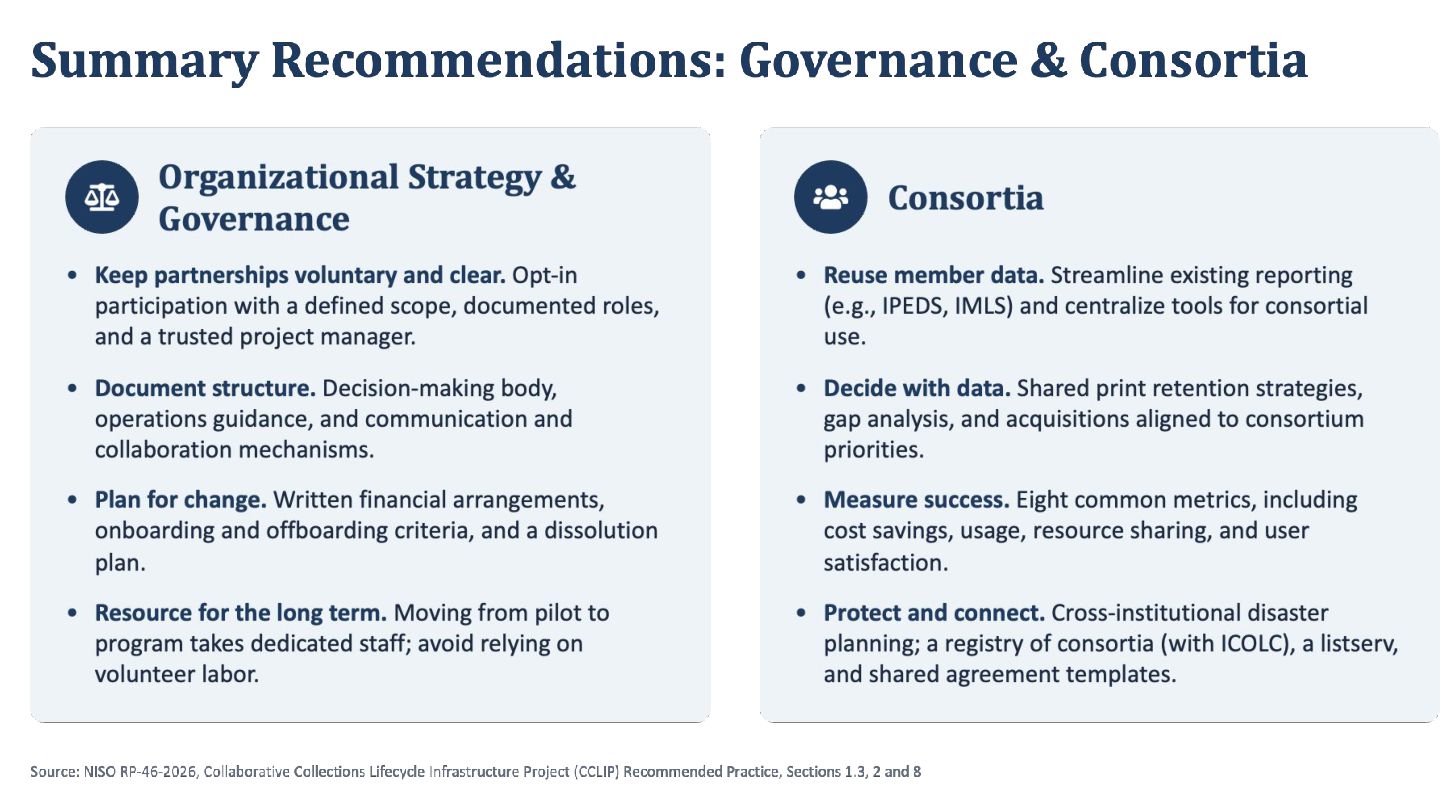
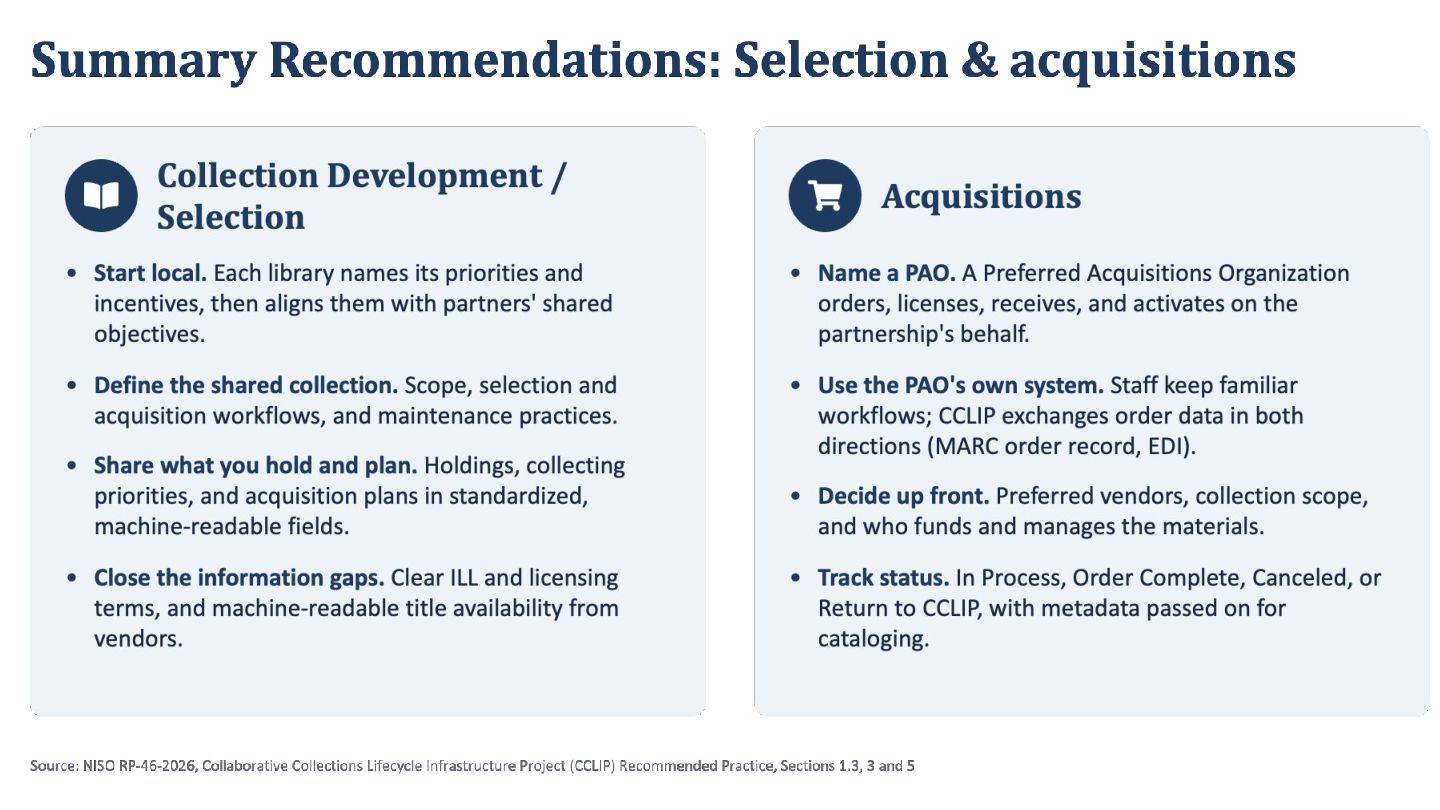
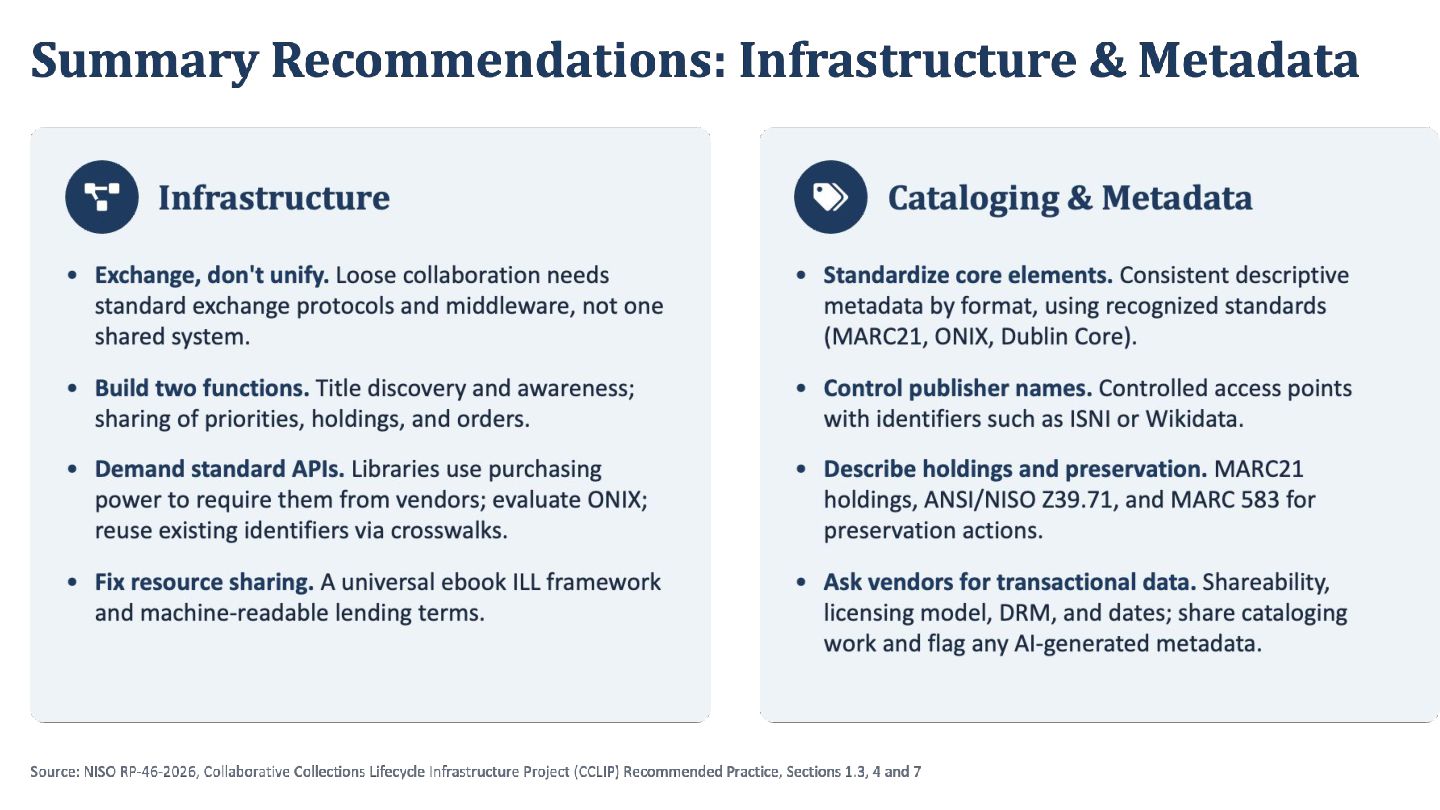
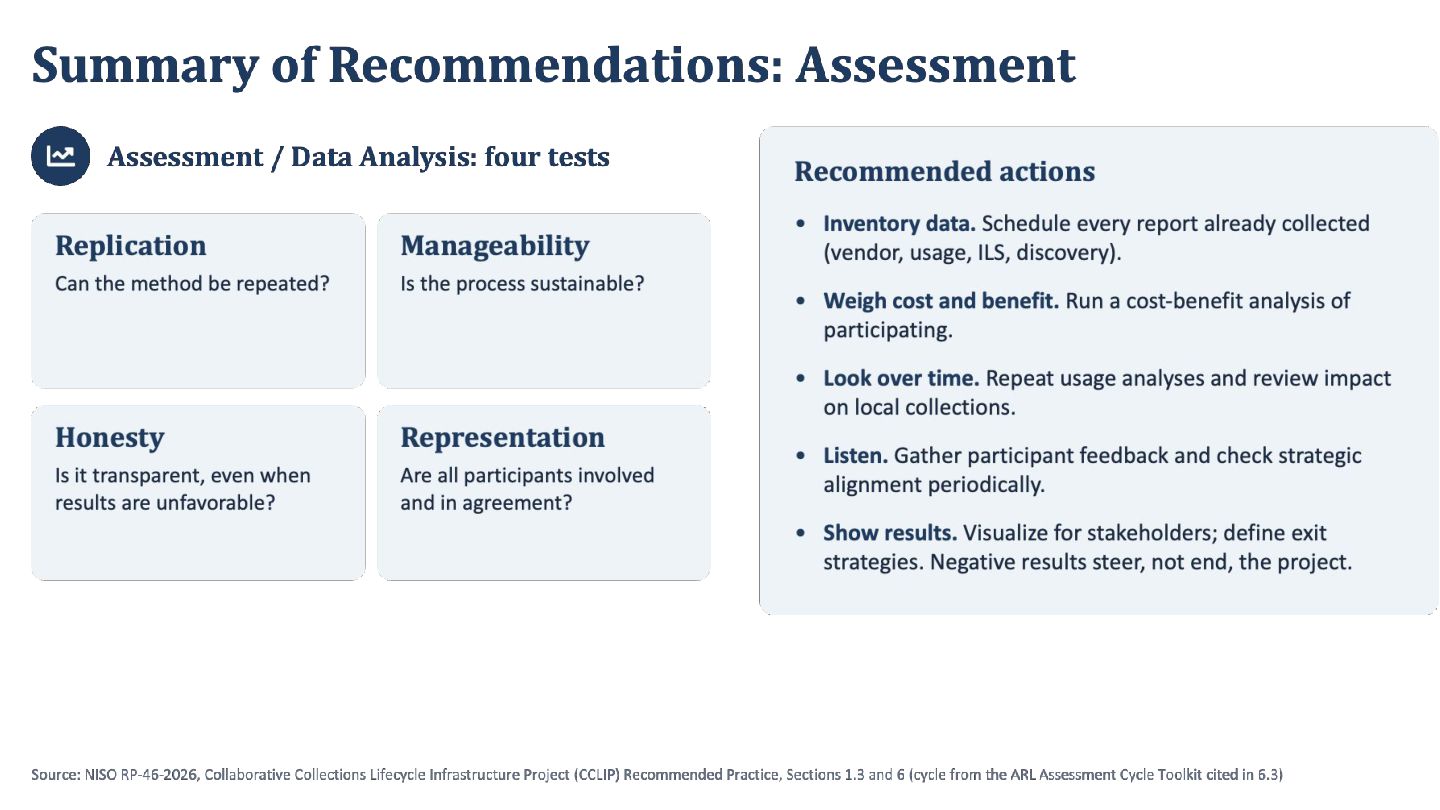
    the lifecycle writing shared observations and recommendations: Acquisitions Assessment/Data Analysis Cataloging & Metadata Collection Dev./Selection Consortia Infrastructure Organizational Strategy & Governance Purpose: Identify gaps, barriers, and recommend practices/opportunities for collaborative collections activities within our scope for this phase of the project
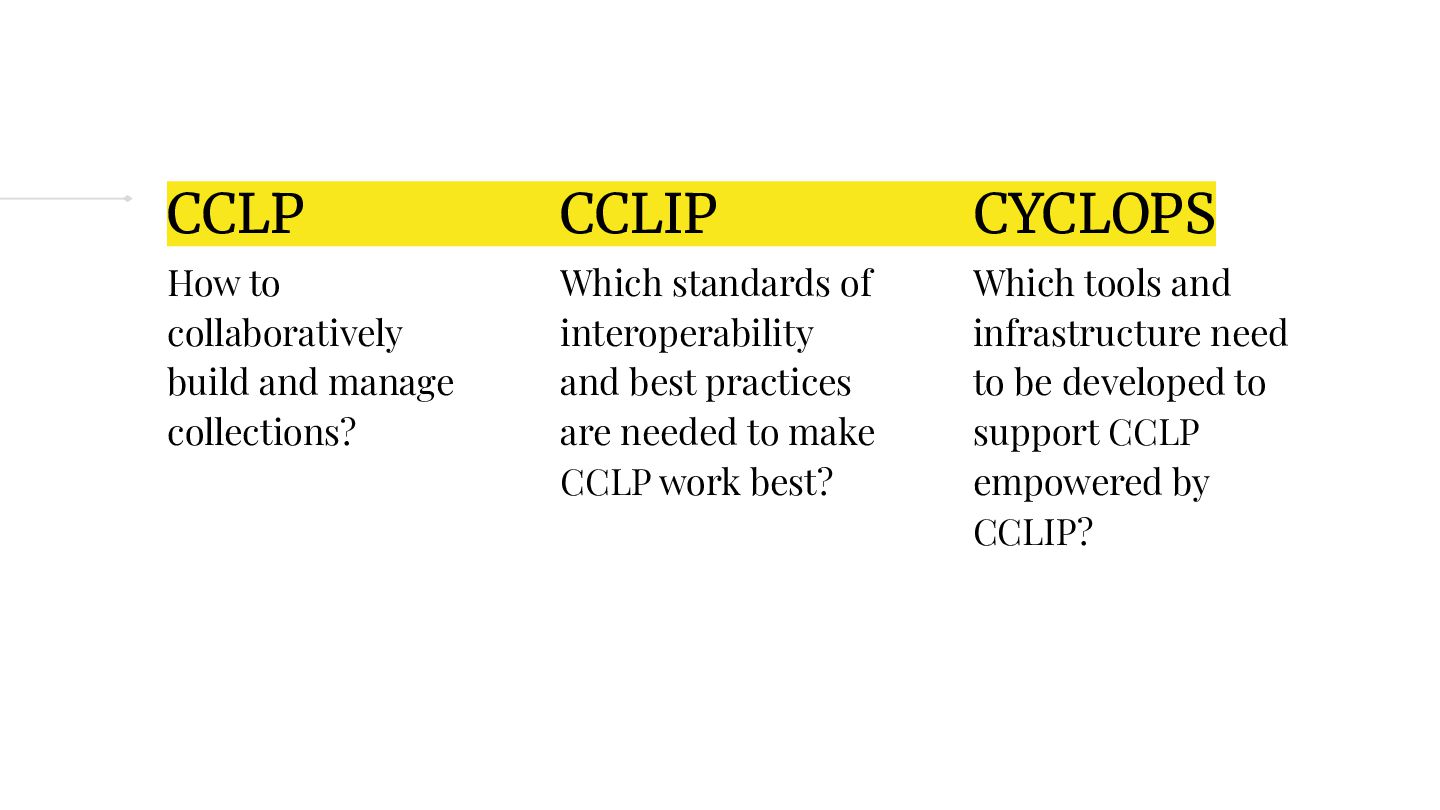
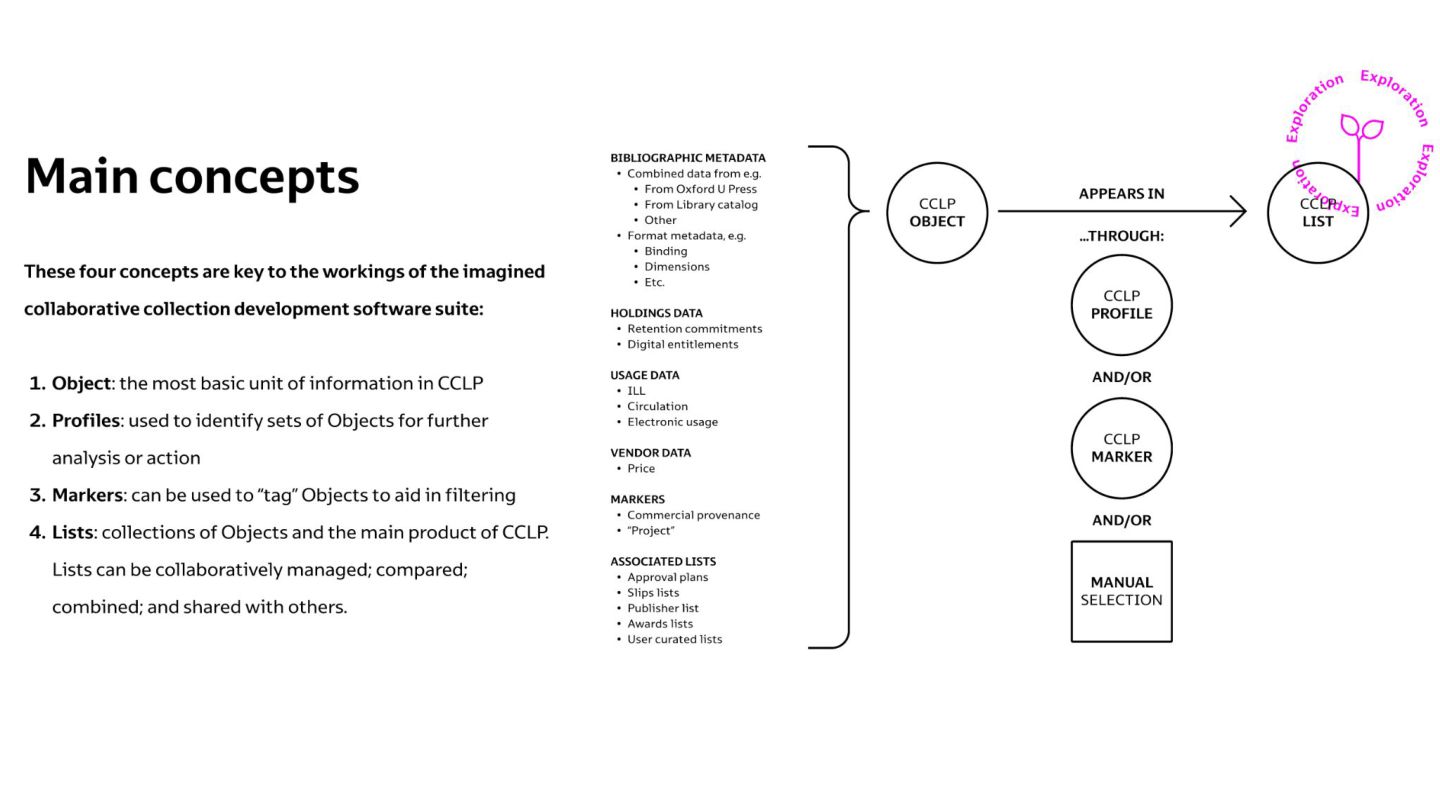
  12. CCLP CCLIP CYCLOPS How to collaboratively build and manage collections?

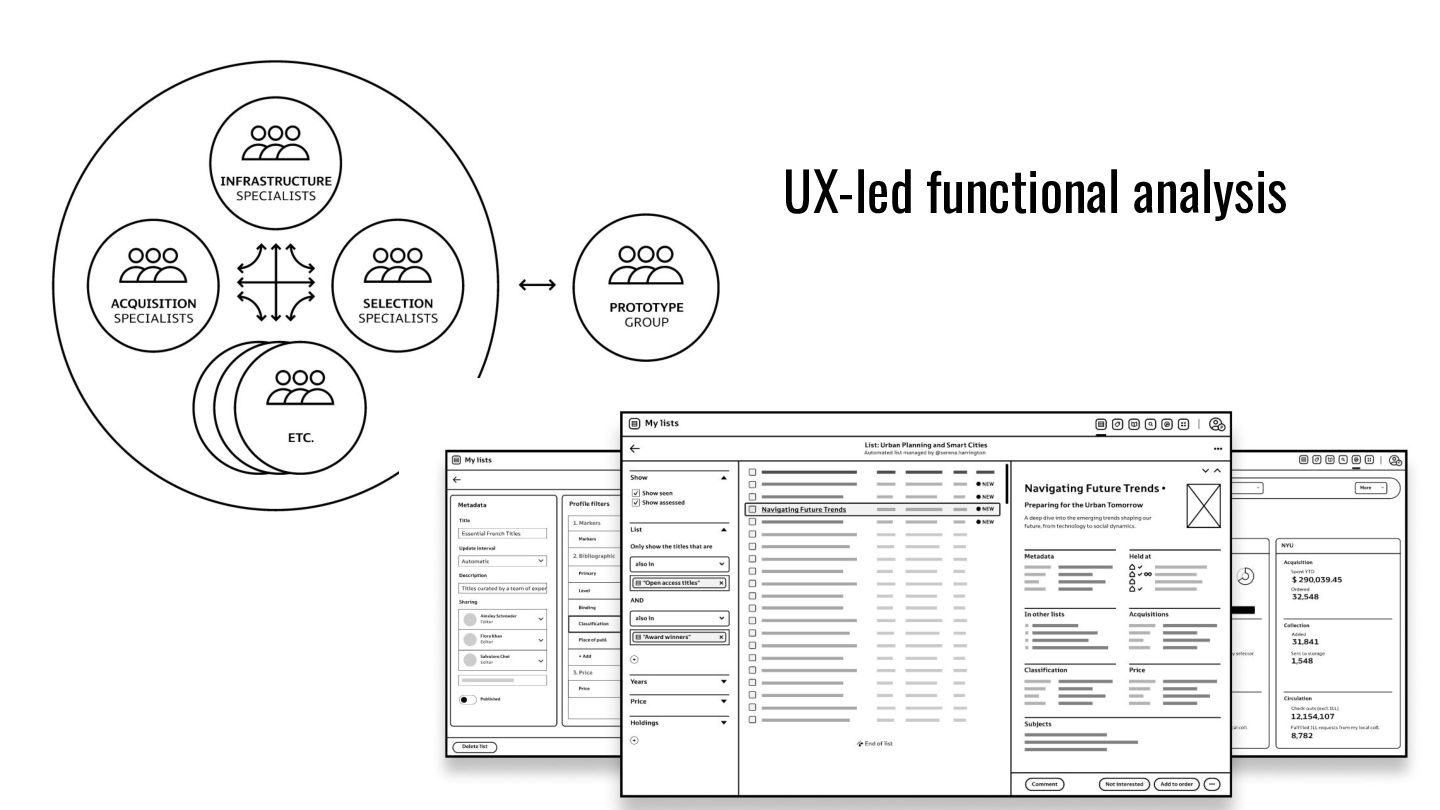
    Which standards of interoperability and best practices are needed to make CCLP work best? Which tools and infrastructure need to be developed to support CCLP empowered by CCLIP?
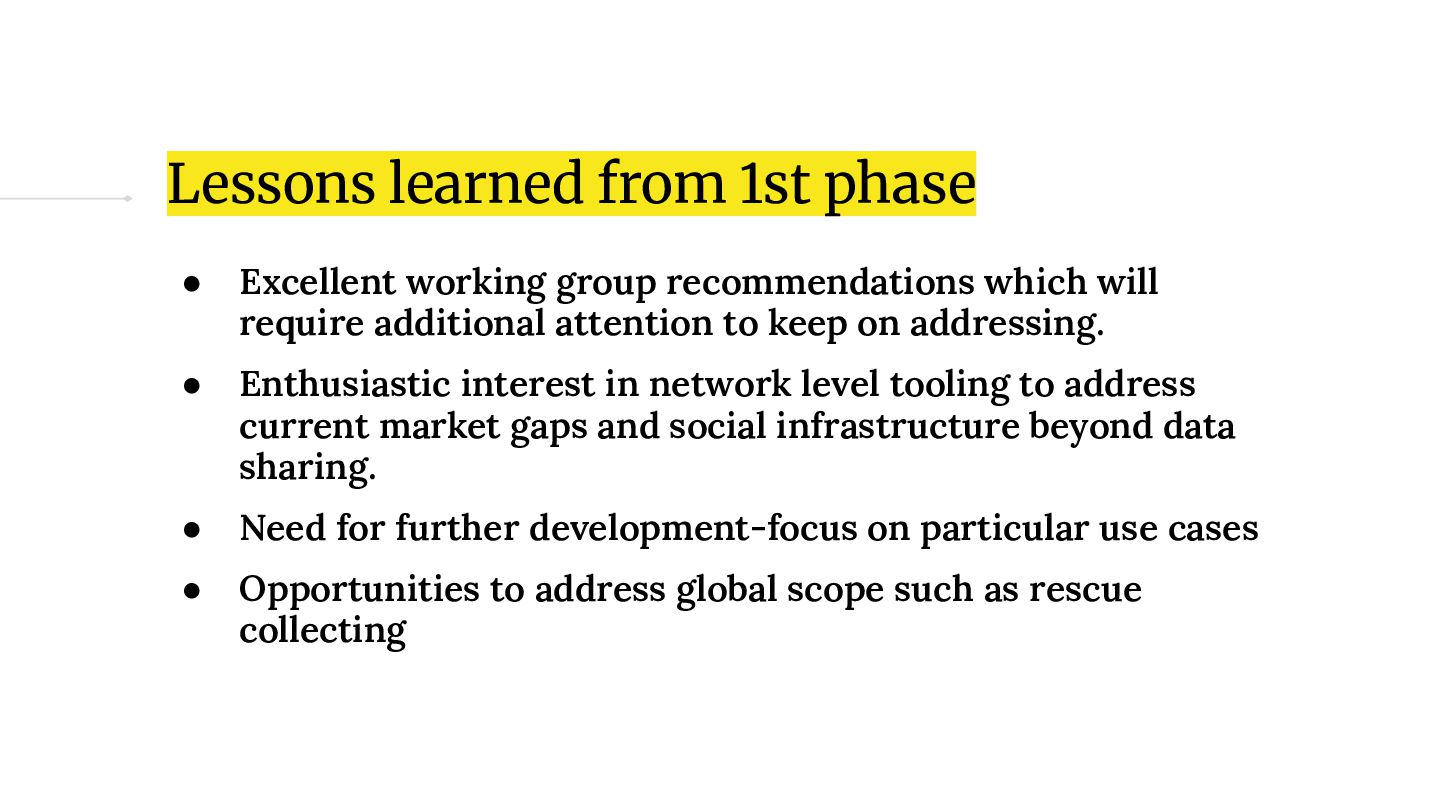
  13. Lessons learned from 1st phase • Excellent working group recommendations

    which will require additional attention to keep on addressing. • Enthusiastic interest in network level tooling to address current market gaps and social infrastructure beyond data sharing. • Need for further development-focus on particular use cases • Opportunities to address global scope such as rescue collecting
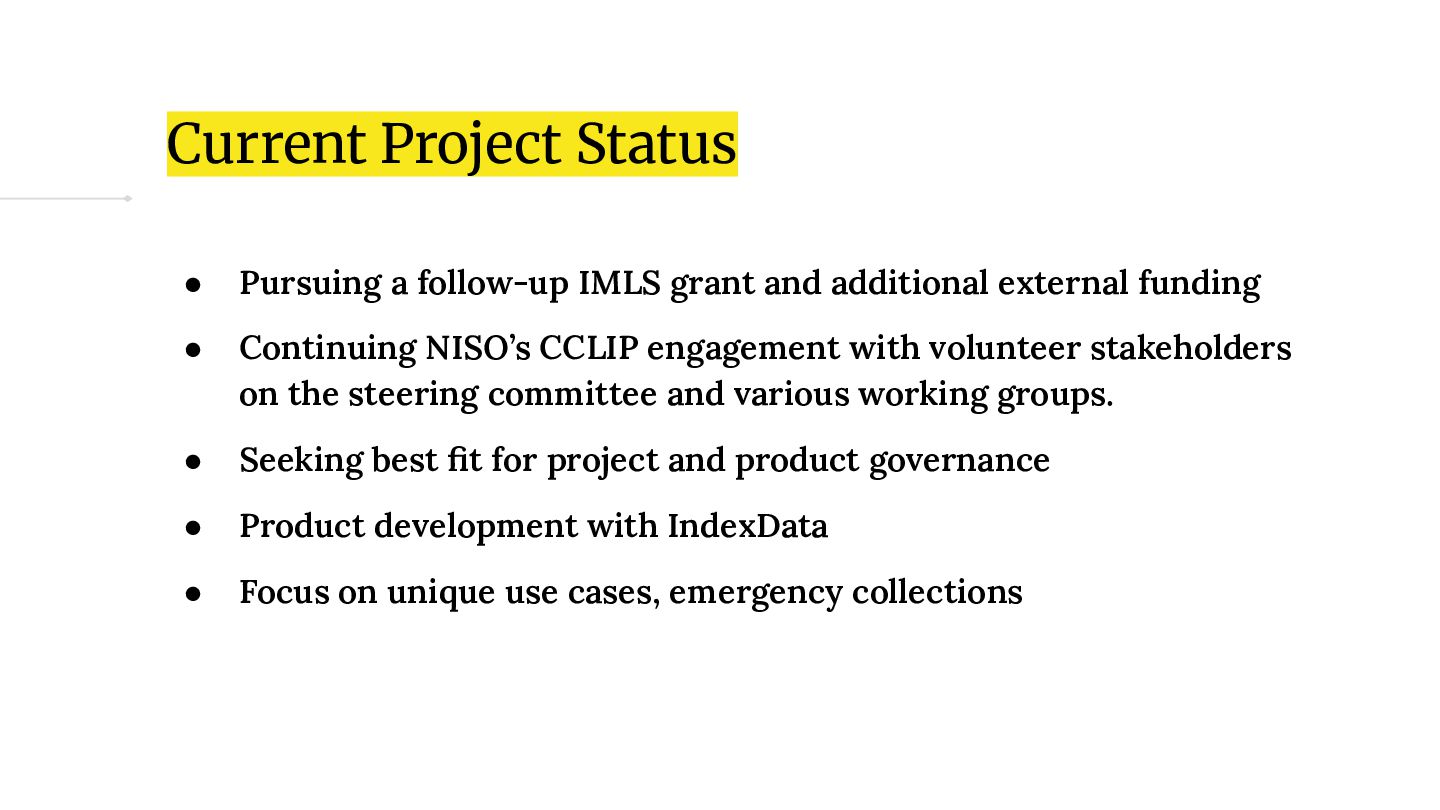
  14. Current Project Status • Pursuing a follow-up IMLS grant and

    additional external funding • Continuing NISO’s CCLIP engagement with volunteer stakeholders on the steering committee and various working groups. • Seeking best fit for project and product governance • Product development with IndexData • Focus on unique use cases, emergency collections
  15. Project Lighthouse: Proof of Concept Turning shared infrastructure into shared

    intelligence A joint* CYCLOPS implementation pilot project of Lehigh University PALCI Index Data *This project phase was made possible by contributions from the contributors above and the University of Pittsburgh Libraries
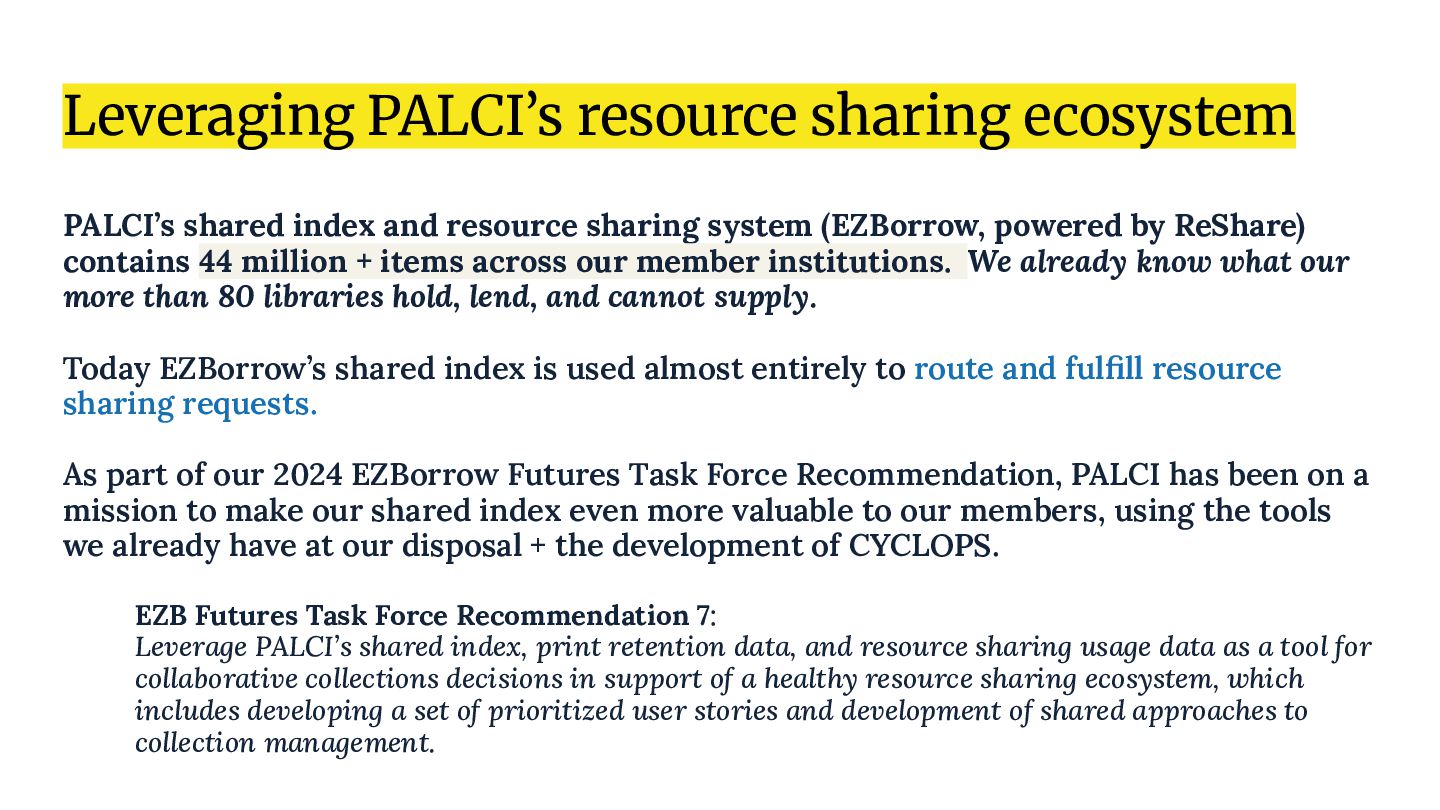
  16. Leveraging PALCI’s resource sharing ecosystem PALCI’s shared index and resource

    sharing system (EZBorrow, powered by ReShare) contains 44 million + items across our member institutions. We already know what our more than 80 libraries hold, lend, and cannot supply. Today EZBorrow’s shared index is used almost entirely to route and fulfill resource sharing requests. As part of our 2024 EZBorrow Futures Task Force Recommendation, PALCI has been on a mission to make our shared index even more valuable to our members, using the tools we already have at our disposal + the development of CYCLOPS. EZB Futures Task Force Recommendation 7: Leverage PALCI’s shared index, print retention data, and resource sharing usage data as a tool for collaborative collections decisions in support of a healthy resource sharing ecosystem, which includes developing a set of prioritized user stories and development of shared approaches to collection management.
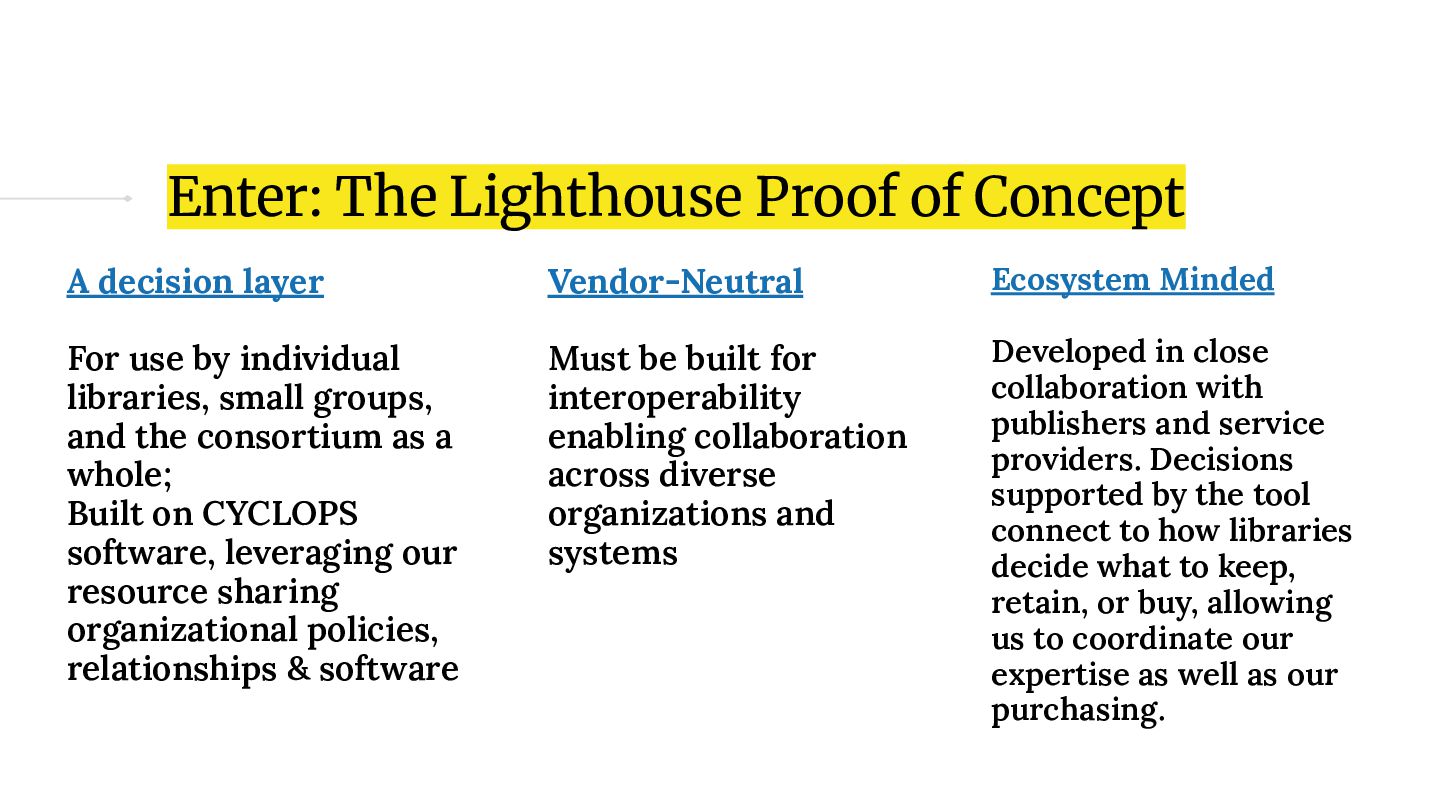
  17. Enter: The Lighthouse Proof of Concept A decision layer Vendor-Neutral

    Ecosystem Minded For use by individual libraries, small groups, and the consortium as a whole; Built on CYCLOPS software, leveraging our resource sharing organizational policies, relationships & software Must be built for interoperability enabling collaboration across diverse organizations and systems Developed in close collaboration with publishers and service providers. Decisions supported by the tool connect to how libraries decide what to keep, retain, or buy, allowing us to coordinate our expertise as well as our purchasing.
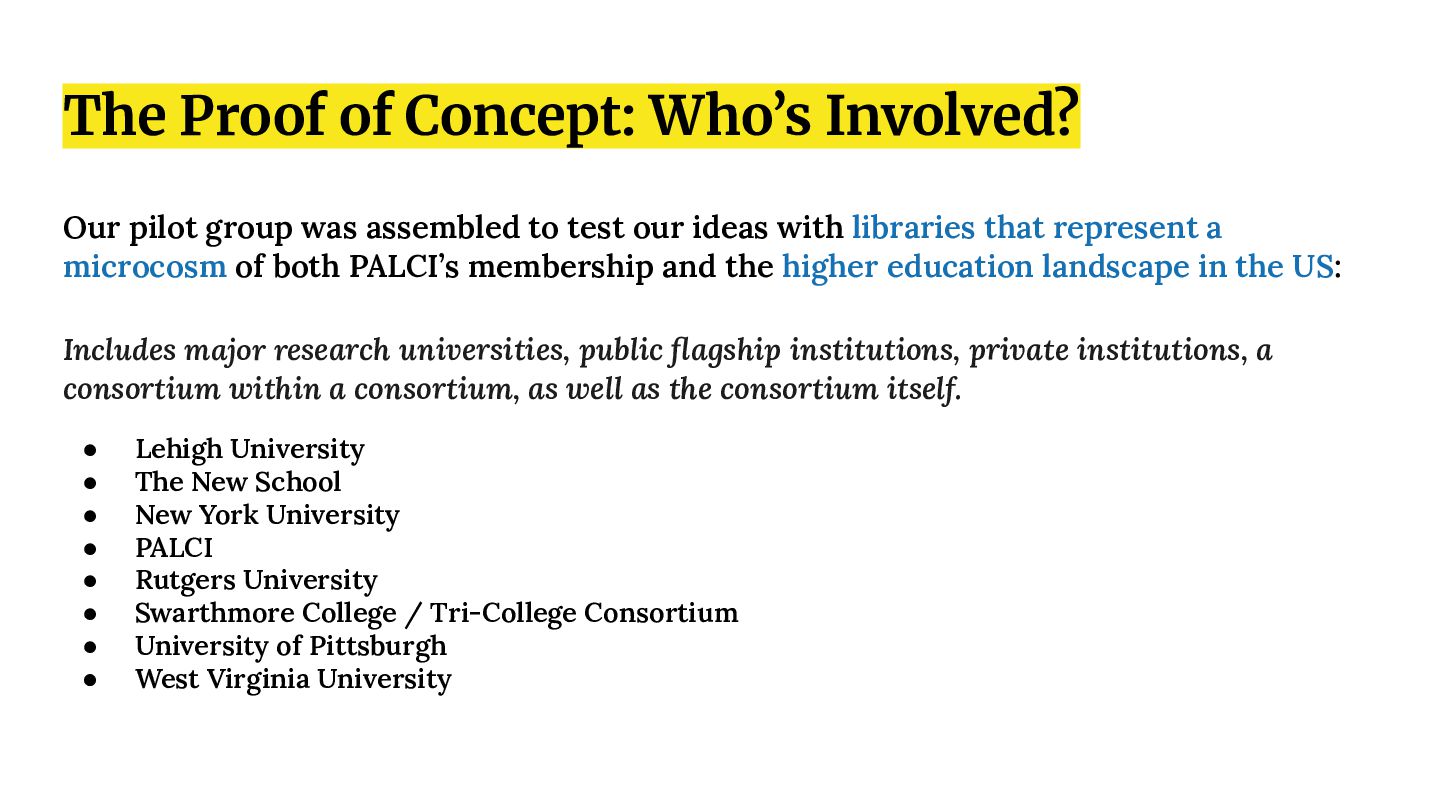
  18. The Proof of Concept: Who’s Involved? Our pilot group was

    assembled to test our ideas with libraries that represent a microcosm of both PALCI’s membership and the higher education landscape in the US: Includes major research universities, public flagship institutions, private institutions, a consortium within a consortium, as well as the consortium itself. • • • • • • • • Lehigh University The New School New York University PALCI Rutgers University Swarthmore College / Tri-College Consortium University of Pittsburgh West Virginia University
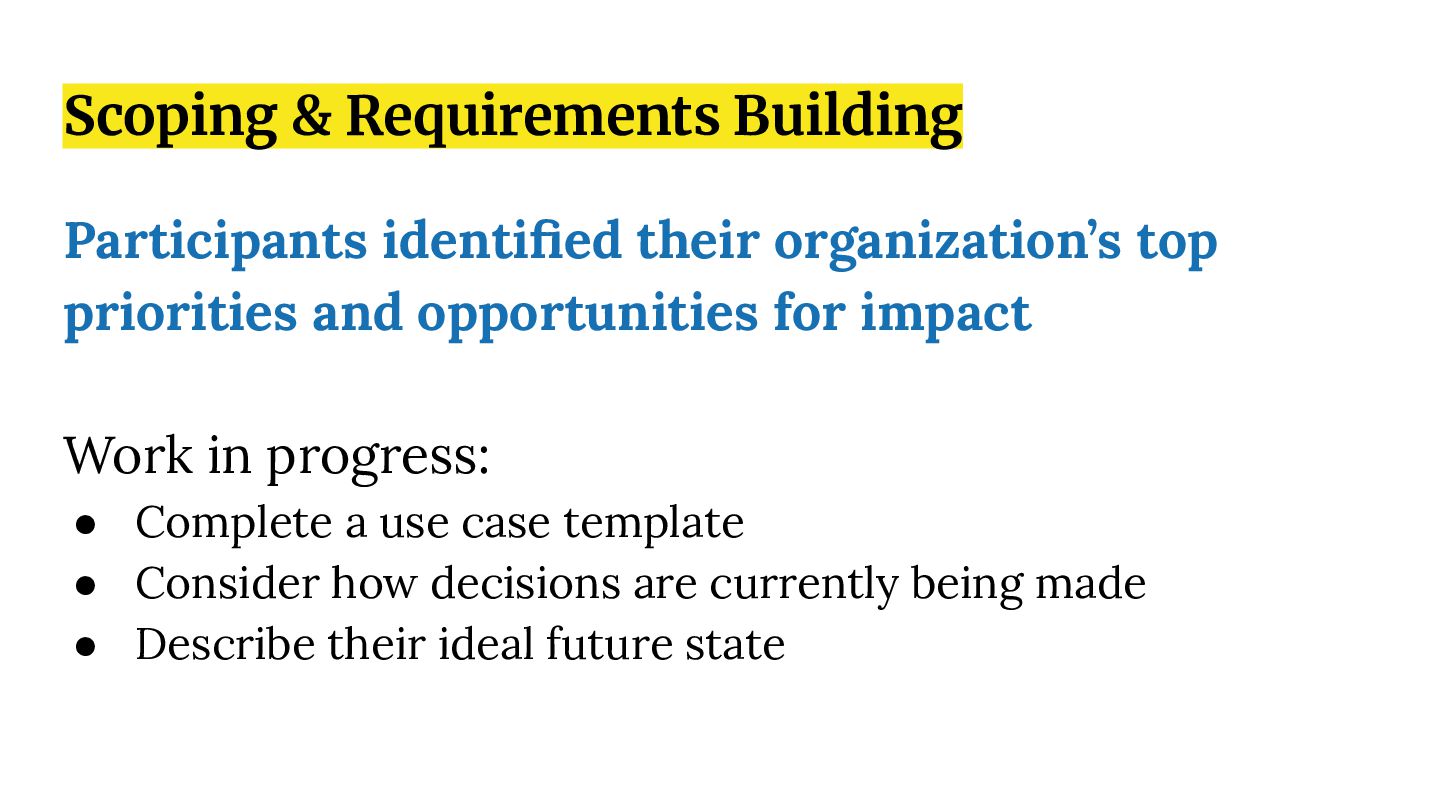
  19. Scoping & Requirements Building Participants identified their organization’s top priorities

    and opportunities for impact Work in progress: • Complete a use case template • Consider how decisions are currently being made • Describe their ideal future state
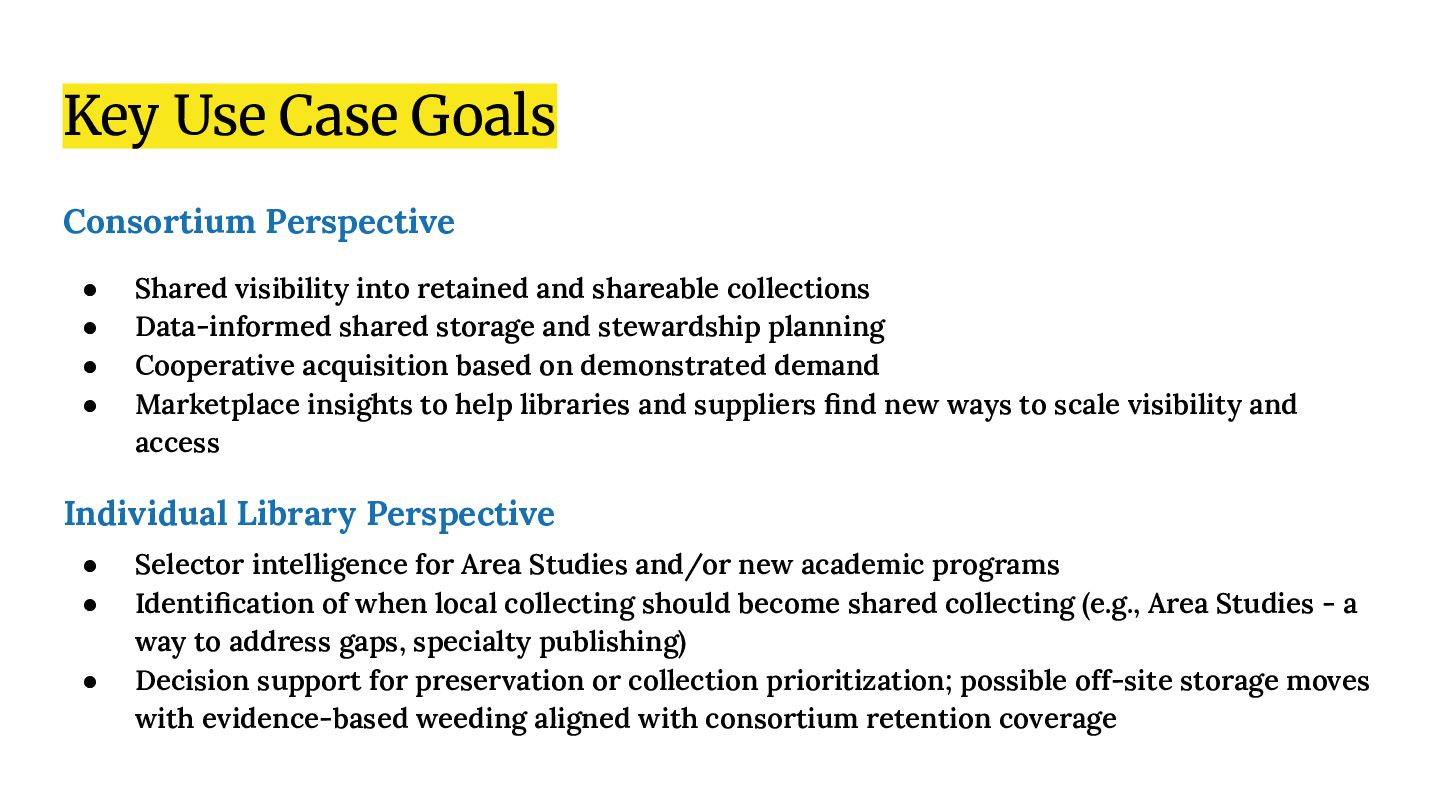
  20. Key Use Case Goals Consortium Perspective • • • •

    Shared visibility into retained and shareable collections Data-informed shared storage and stewardship planning Cooperative acquisition based on demonstrated demand Marketplace insights to help libraries and suppliers find new ways to scale visibility and access Individual Library Perspective • • • Selector intelligence for Area Studies and/or new academic programs Identification of when local collecting should become shared collecting (e.g., Area Studies - a way to address gaps, specialty publishing) Decision support for preservation or collection prioritization; possible off-site storage moves with evidence-based weeding aligned with consortium retention coverage
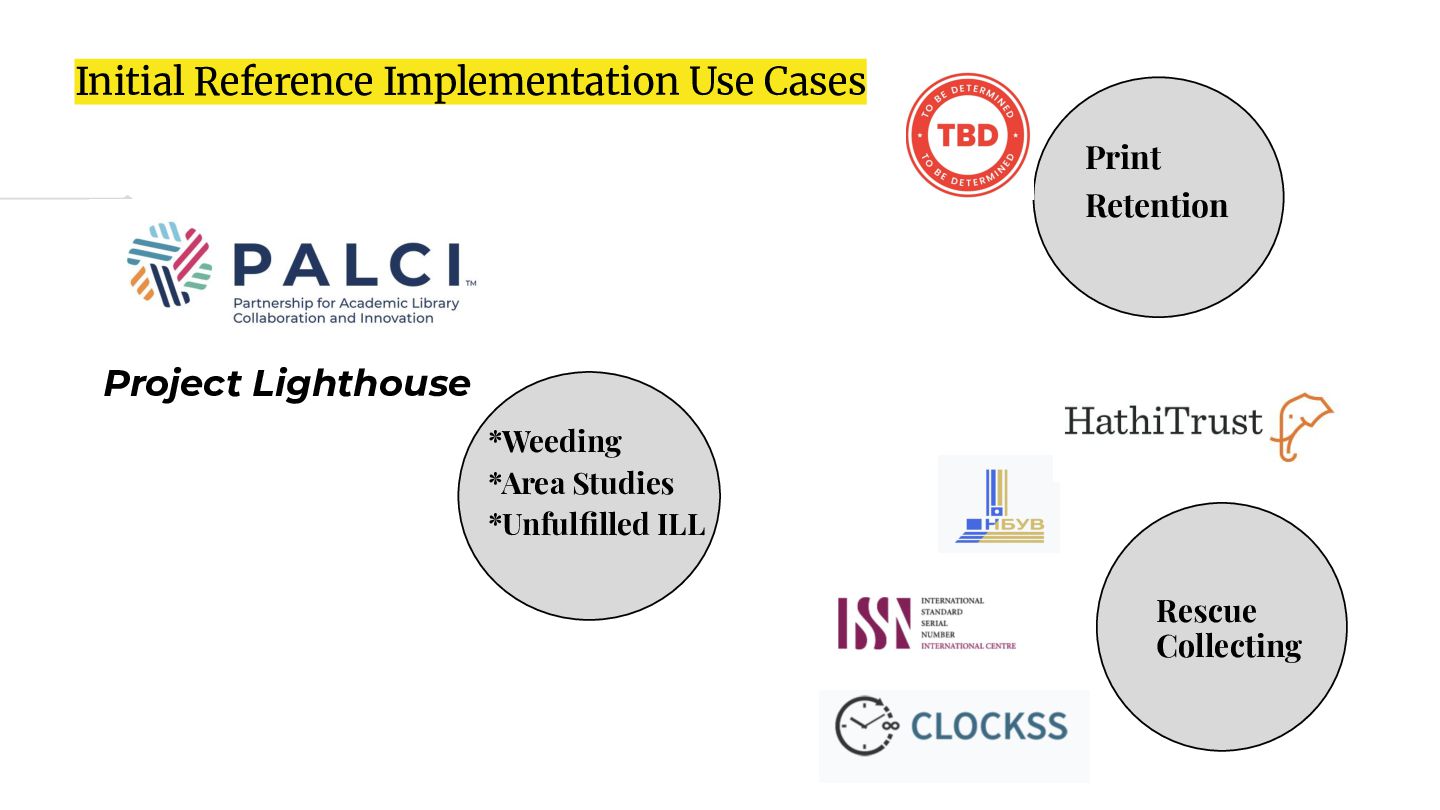
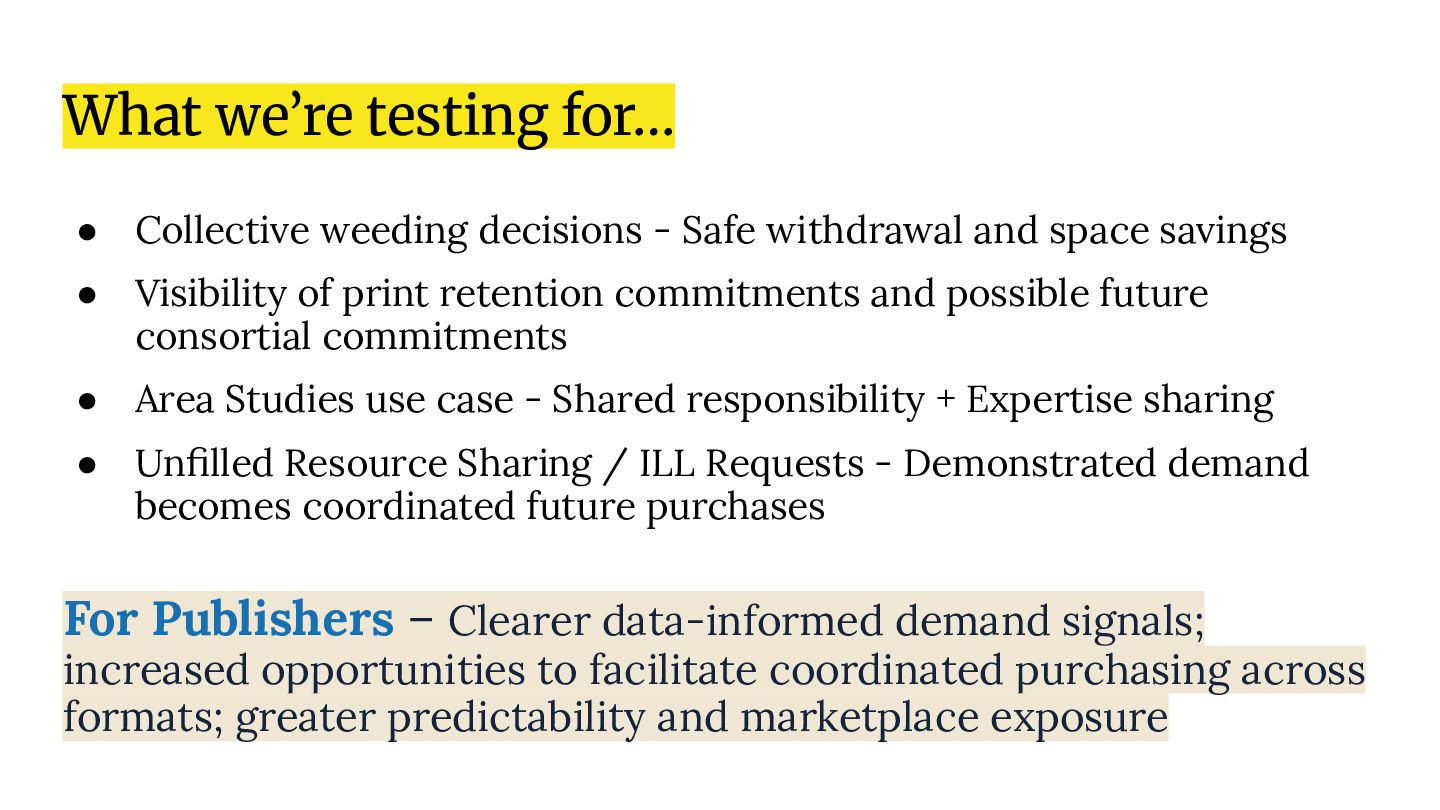
  21. What we’re testing for… • Collective weeding decisions - Safe

    withdrawal and space savings • Visibility of print retention commitments and possible future consortial commitments • Area Studies use case - Shared responsibility + Expertise sharing • Unfilled Resource Sharing / ILL Requests - Demonstrated demand becomes coordinated future purchases For Publishers – Clearer data-informed demand signals; increased opportunities to facilitate coordinated purchasing across formats; greater predictability and marketplace exposure
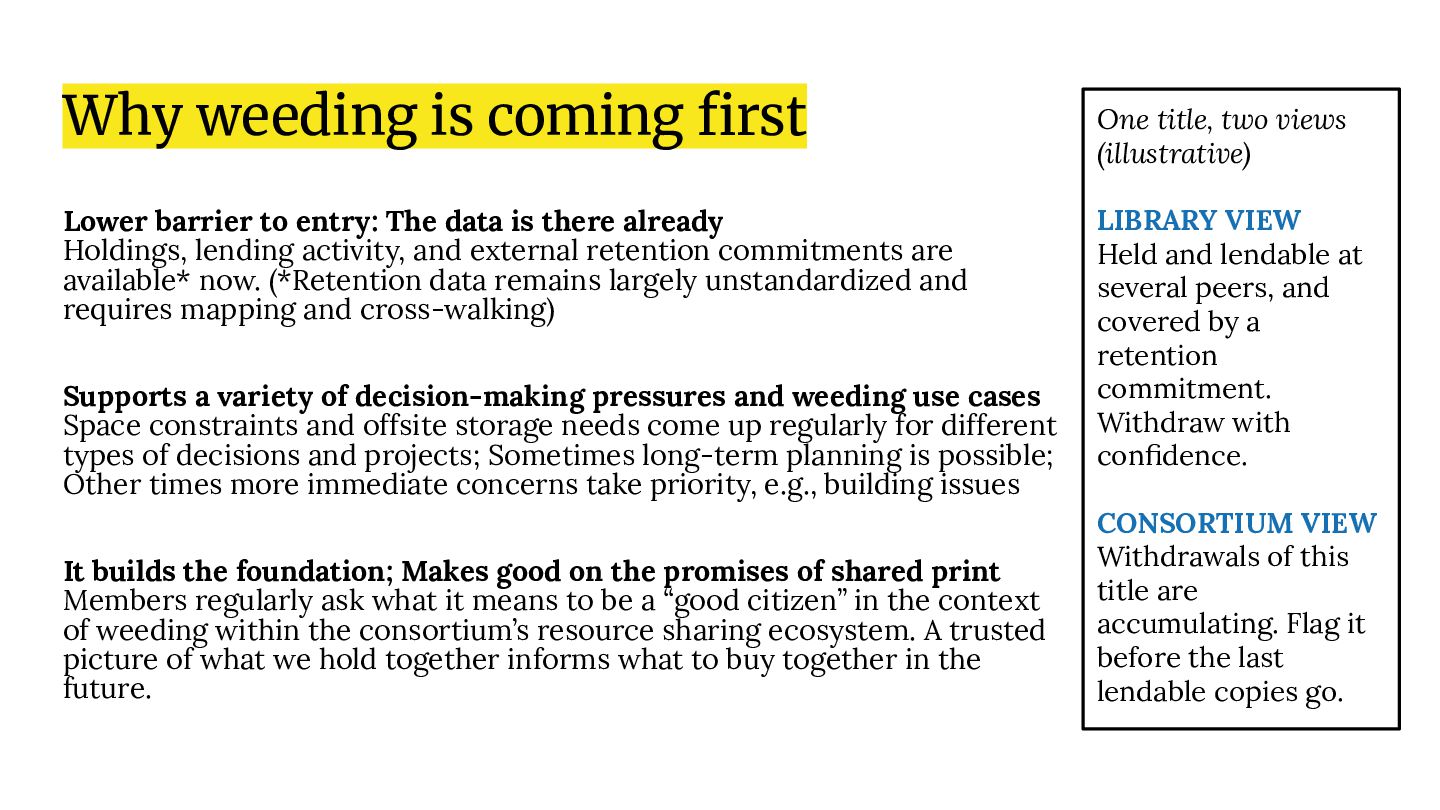
  22. Why weeding is coming first Lower barrier to entry: The

    data is there already Holdings, lending activity, and external retention commitments are available* now. (*Retention data remains largely unstandardized and requires mapping and cross-walking) Supports a variety of decision-making pressures and weeding use cases Space constraints and offsite storage needs come up regularly for different types of decisions and projects; Sometimes long-term planning is possible; Other times more immediate concerns take priority, e.g., building issues It builds the foundation; Makes good on the promises of shared print Members regularly ask what it means to be a “good citizen” in the context of weeding within the consortium’s resource sharing ecosystem. A trusted picture of what we hold together informs what to buy together in the future. One title, two views (illustrative) LIBRARY VIEW Held and lendable at several peers, and covered by a retention commitment. Withdraw with confidence. CONSORTIUM VIEW Withdrawals of this title are accumulating. Flag it before the last lendable copies go.
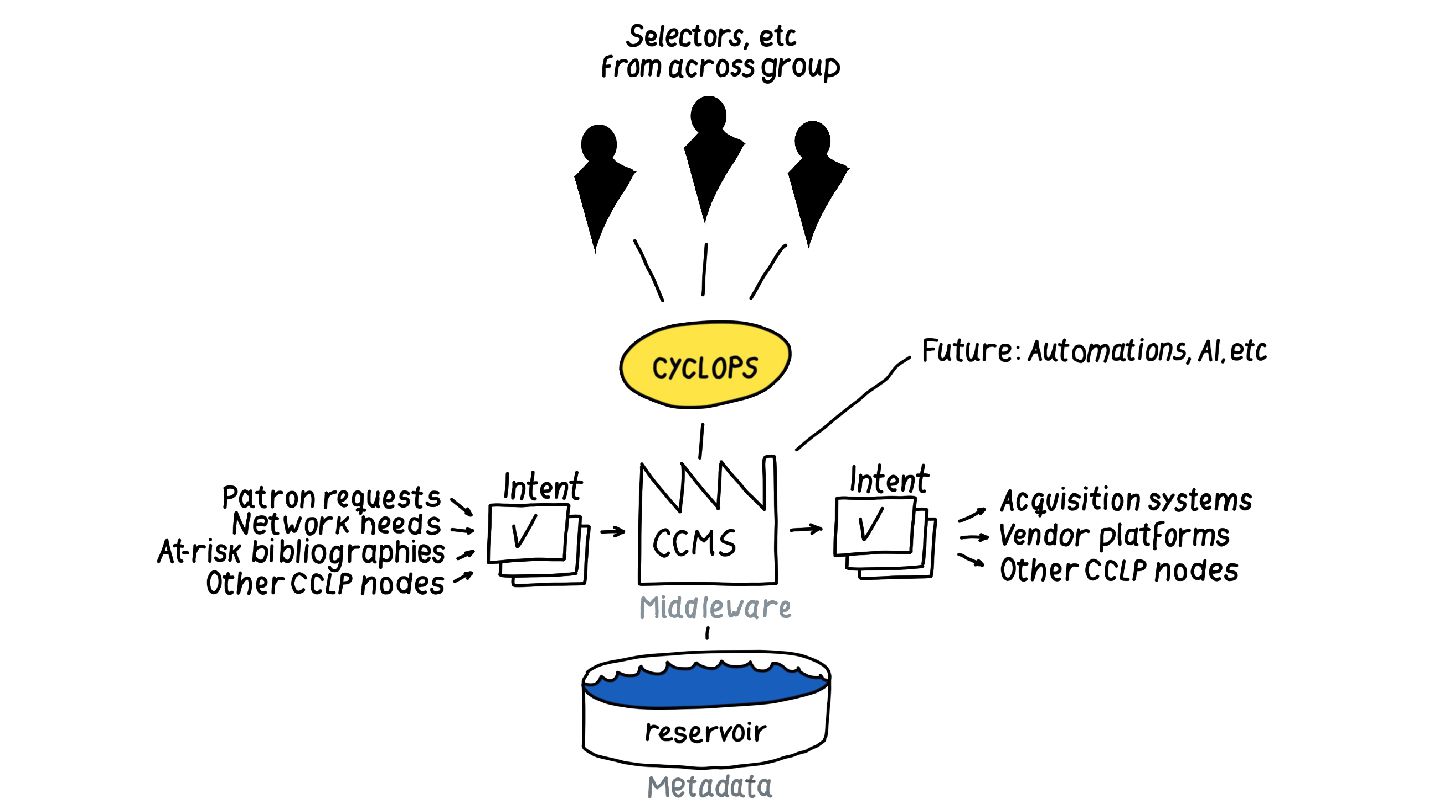
  23. Taking the Recommended Practice to the Next Step: Current Gaps
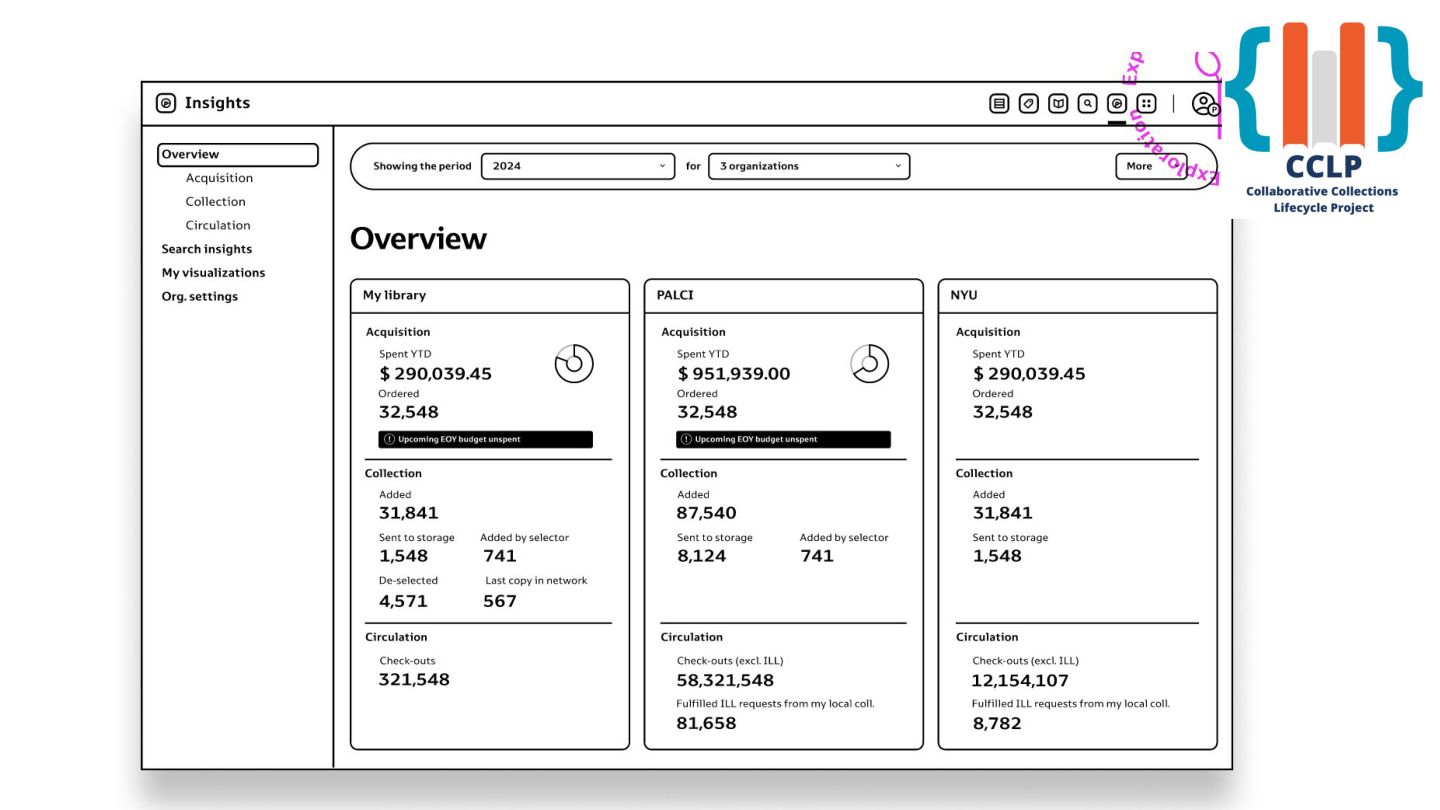
    and Opportunities for Standards Retention Commitments - machine readable, standardized formatting Marketplace Metadata - what’s available to buy and in what formats? Through which channels? Under what terms? Collection Intentions & Decisions - recording our reasoning to allow library expertise to travel together with the collections data
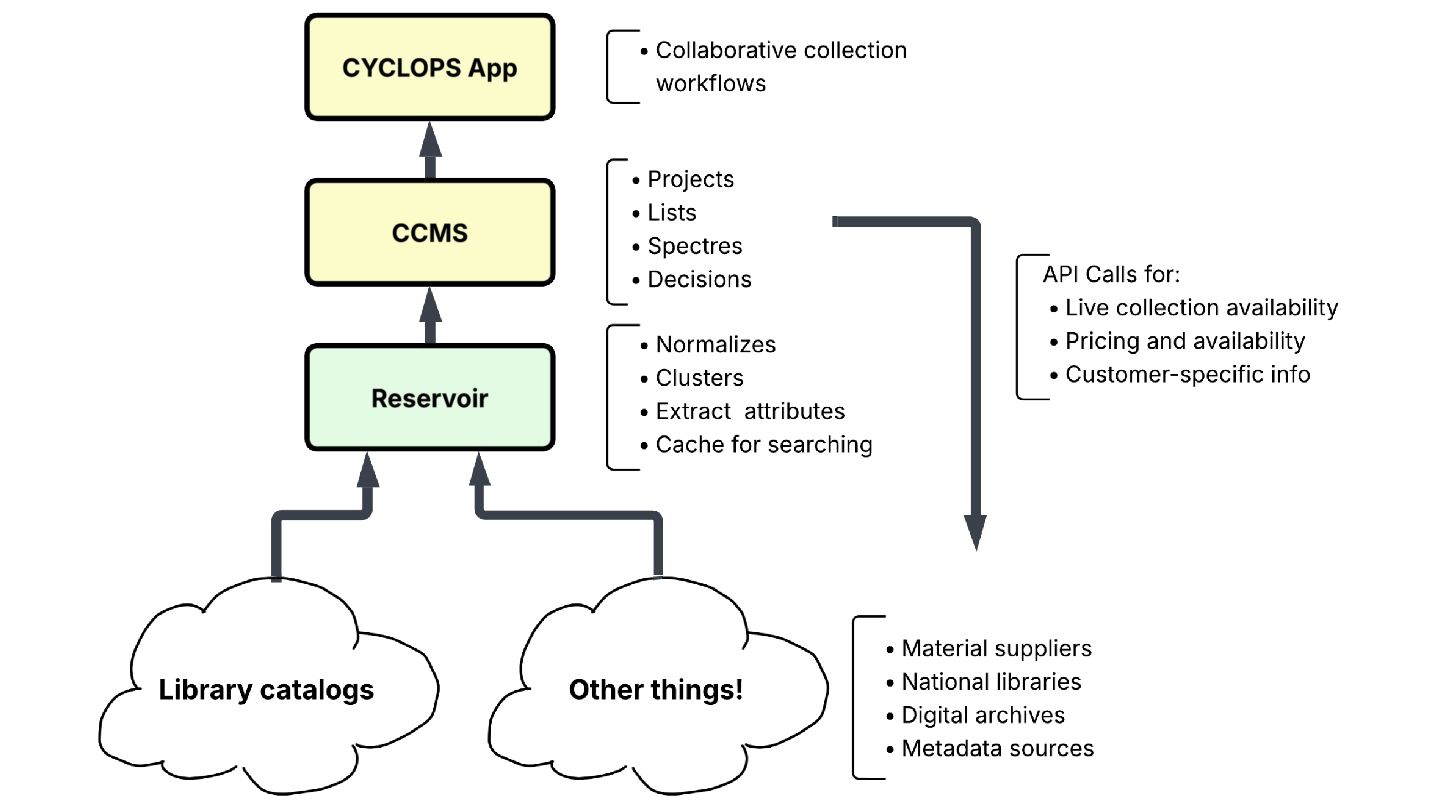
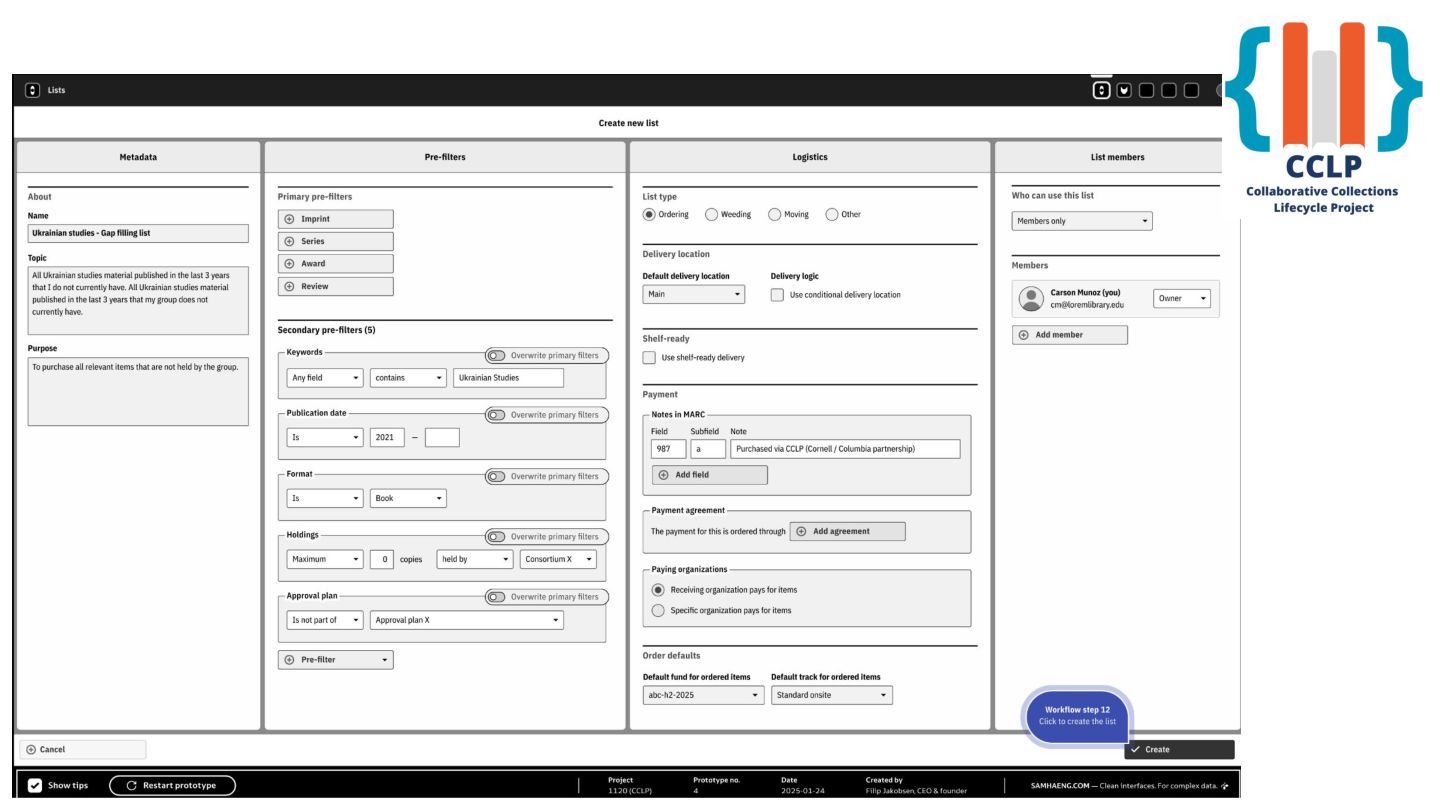
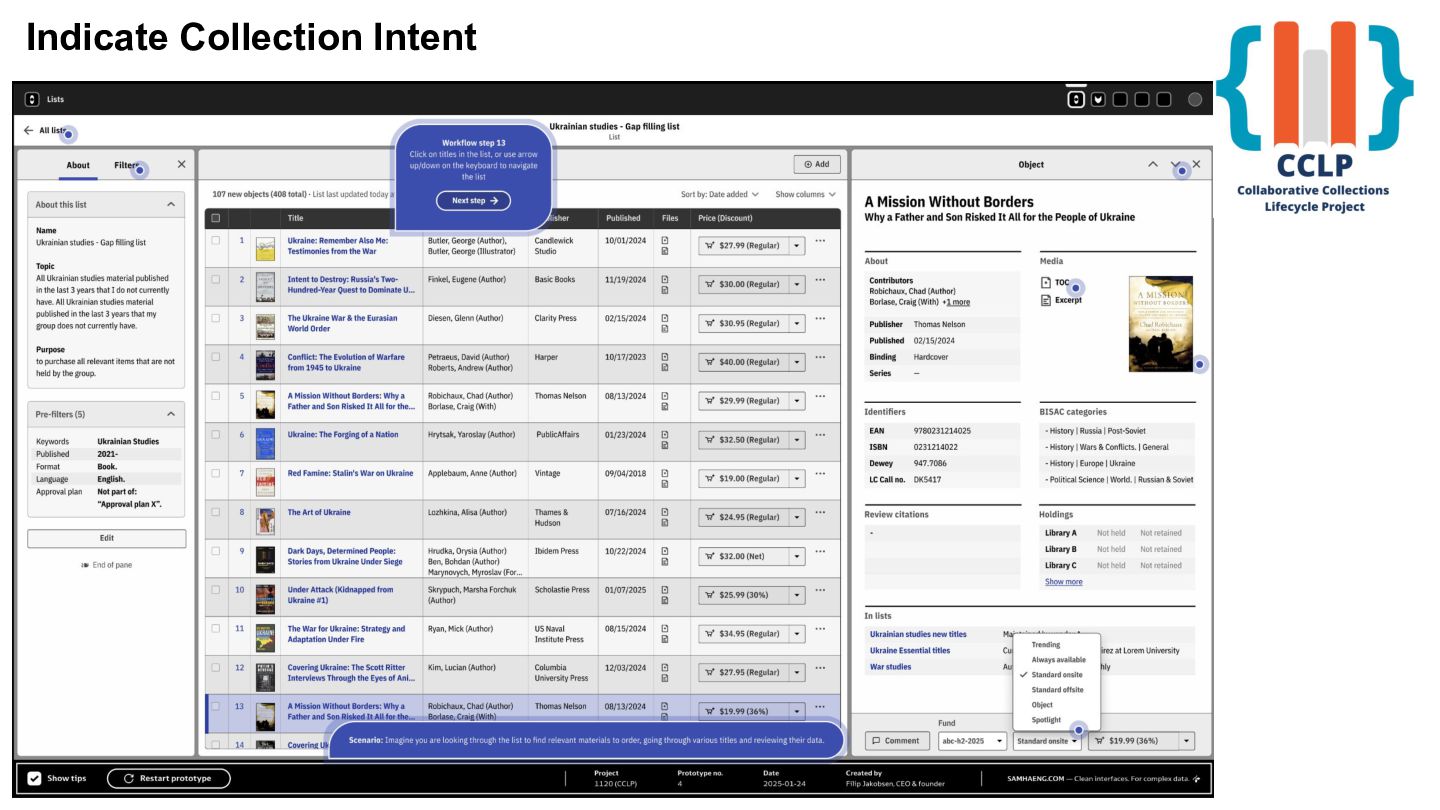
  24. Path to CYCLOPS - UX Design and Prototype Development Technical

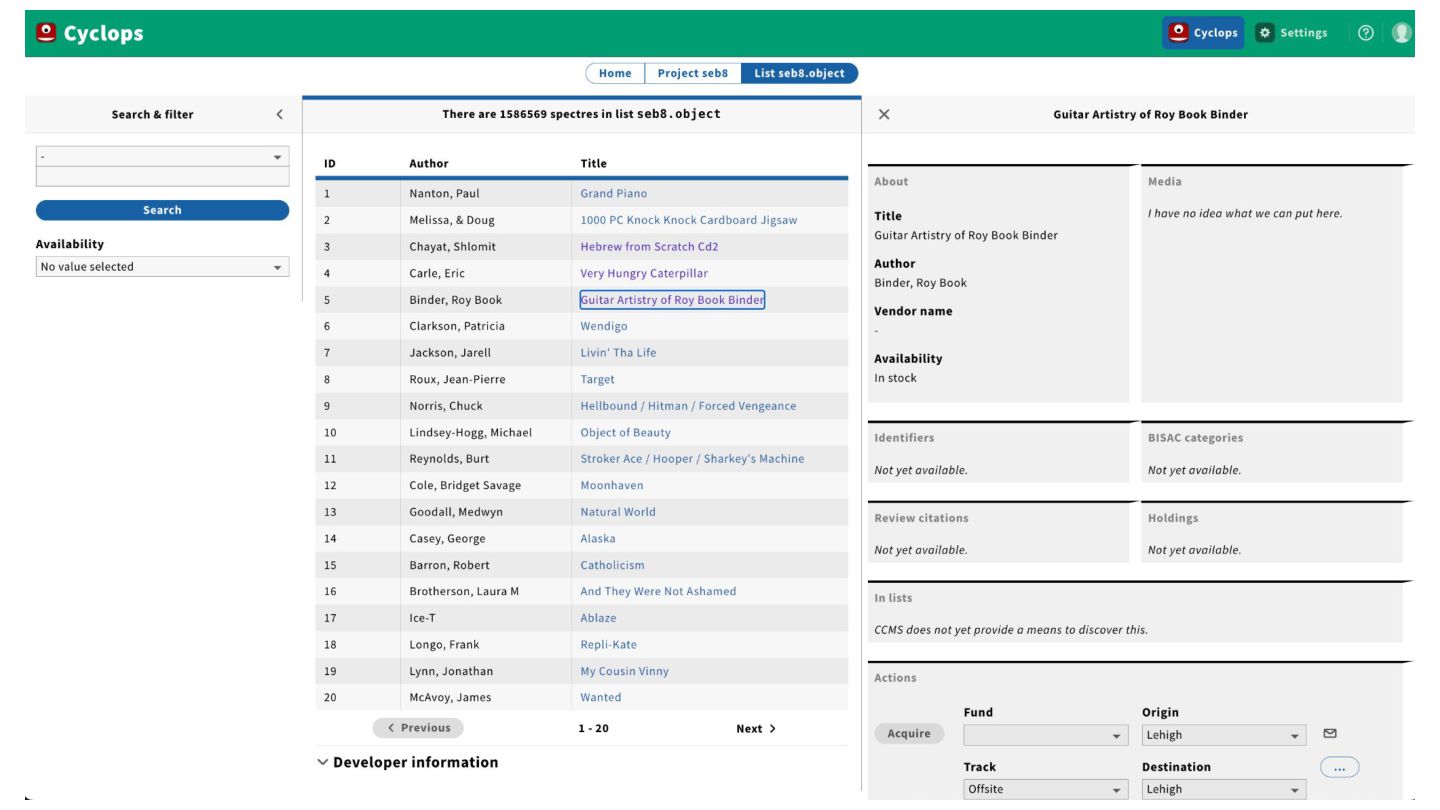
    Project Lead Team Sebastian Hammer, Index Data Filip Jakobson, UX Design Lead Boaz Nadav Manes, Lehigh University (Co-PI) Carolyn Morris, Ingram Initial UX work is completed
  25. You’re Invited! Ways to get involved: - Consider the Recommendations

    from the perspective of your role in your institution; what might implementation look like at your organization? What might you adjust? Give us feedback! - Encourage adoption of the guidance in your organization. Seek cooperative collections opportunities and share your learnings - Get involved in the next phase of the project - implementation and piloting + continued development efforts