Upgrade to Pro — share decks privately, control downloads, hide ads and more …

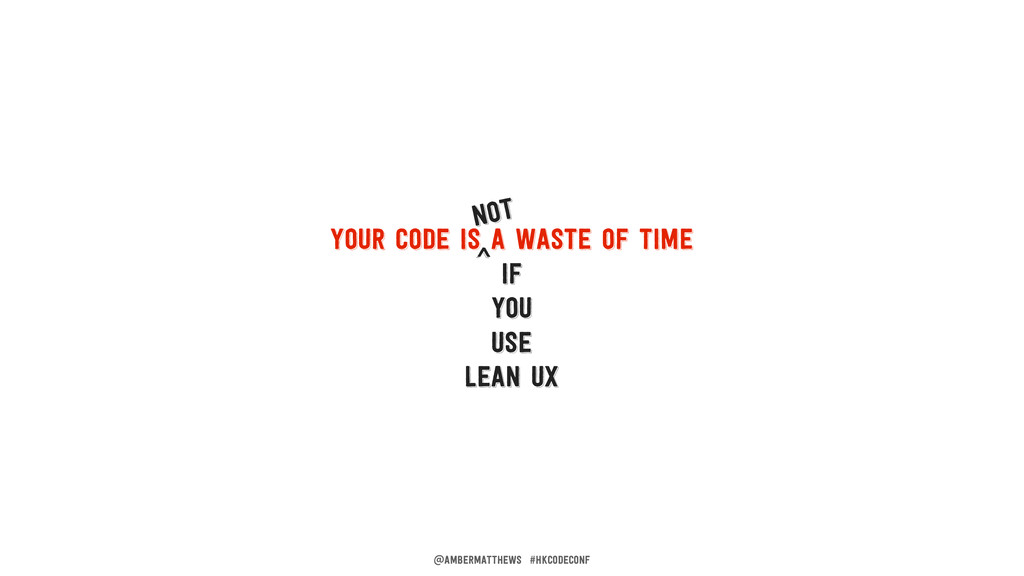
Your Code Is A Waste Of Time (if you don't ask ...

Sponsored · Ship Features Fearlessly Turn features on and off without deploys. Used by thousands of Ruby developers.
Avatar for @ambermatthews @ambermatthews
September 06, 2014

Your Code Is A Waste Of Time (if you don't ask why you are writing it in the first place)

Talk about Lean UX given at Hong Kong Codeaholics #codeconf 2014.

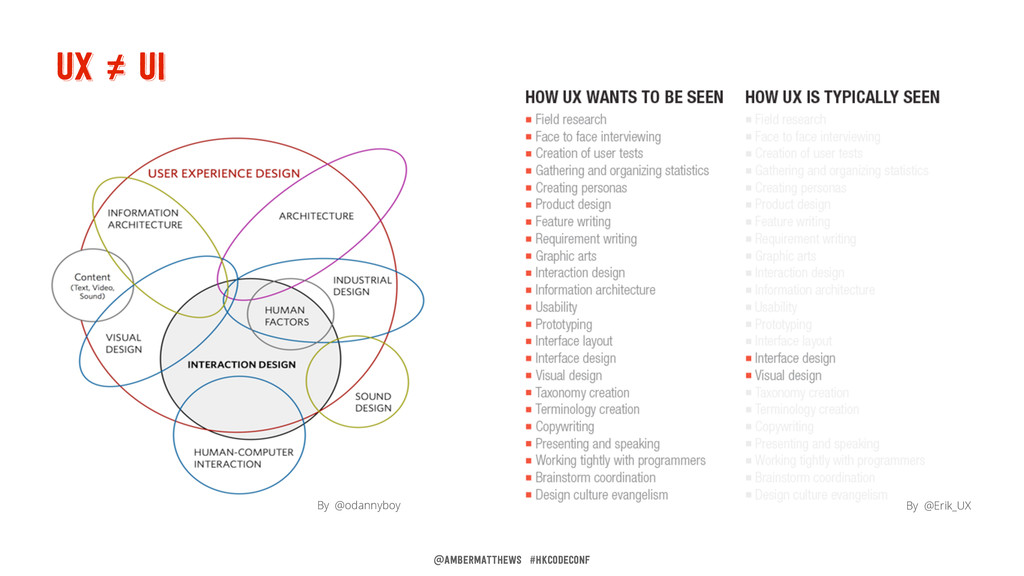
30 minute overview of the foundations of UX, design thinking, agile methodology, lean startup. Looking at assumptions, hypothesis statements, personas, journey maps, measurement and UX ≠ UI.

Avatar for @ambermatthews

@ambermatthews

September 06, 2014
Tweet

Other Decks in Design

Transcript

  1. @ambermatthews #hkcodeconf your code is a waste of time IF

    you don’t ask why you are writing it in the first place
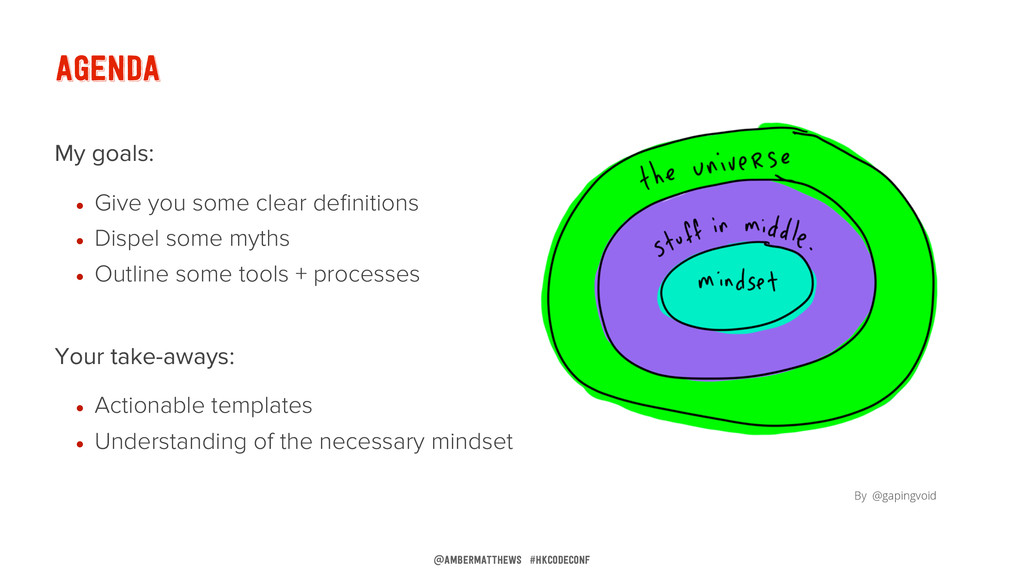
  2. @ambermatthews #hkcodeconf My goals: • Give you some clear definitions

    • Dispel some myths • Outline some tools + processes Your take-aways: • Actionable templates • Understanding of the necessary mindset By @gapingvoid AGENDA
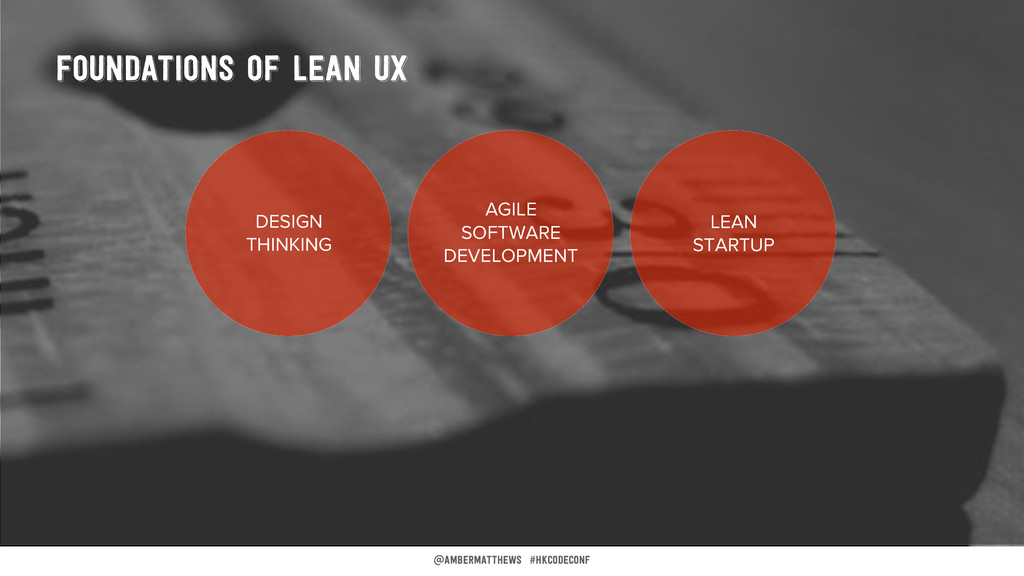
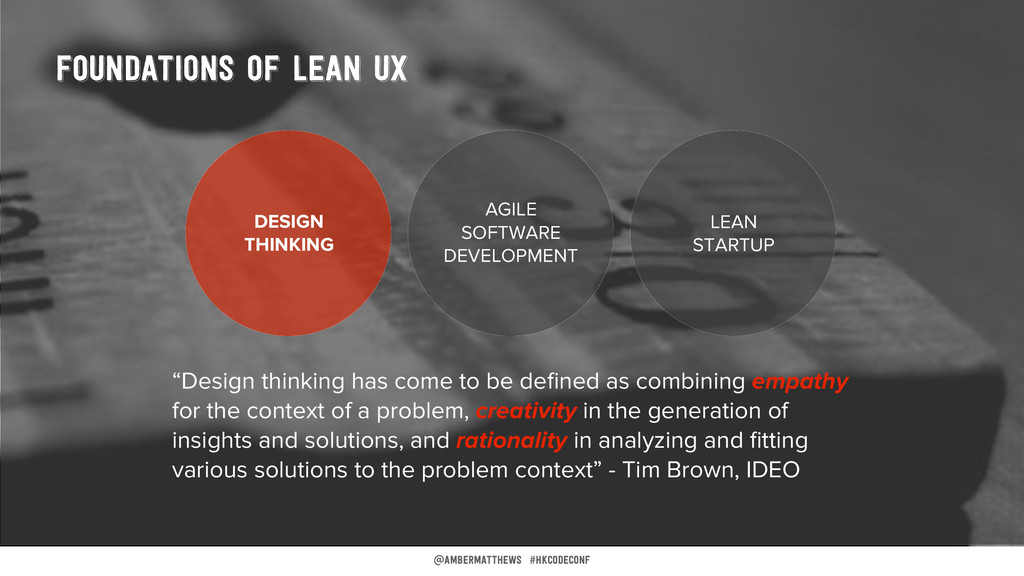
  3. @ambermatthews #hkcodeconf FOUNDATIONS OF LEAN UX AGILE SOFTWARE DEVELOPMENT DESIGN

    THINKING LEAN STARTUP “Design thinking has come to be defined as combining empathy for the context of a problem, creativity in the generation of insights and solutions, and rationality in analyzing and fitting various solutions to the problem context” - Tim Brown, IDEO
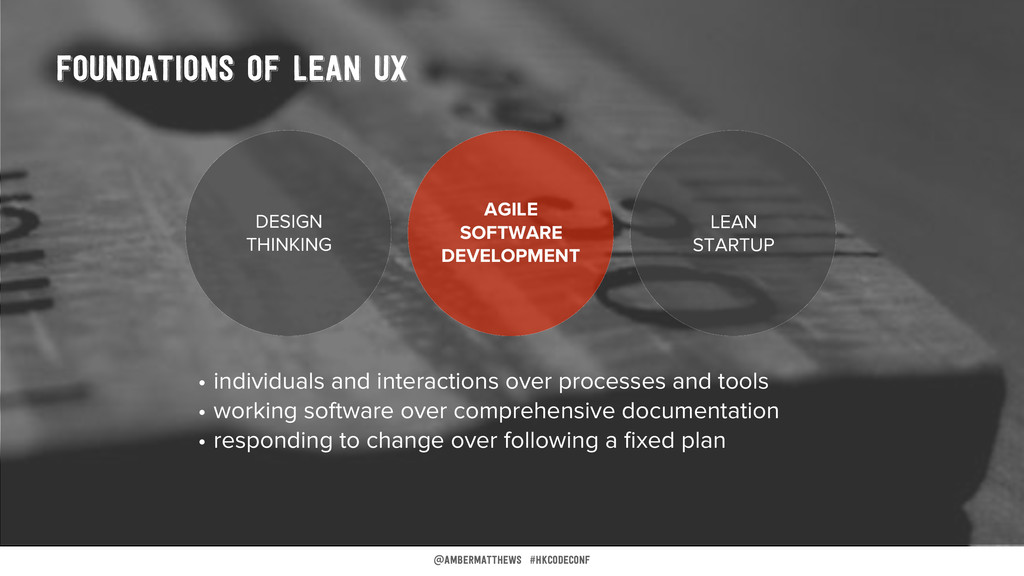
  4. @ambermatthews #hkcodeconf FOUNDATIONS OF LEAN UX AGILE SOFTWARE DEVELOPMENT DESIGN

    THINKING LEAN STARTUP • individuals and interactions over processes and tools • working software over comprehensive documentation • responding to change over following a fixed plan
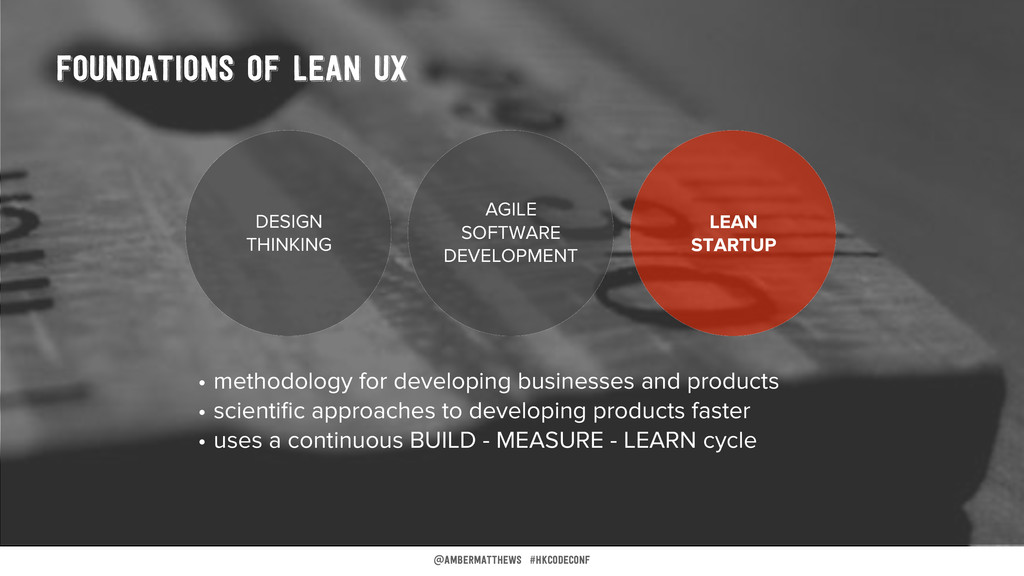
  5. @ambermatthews #hkcodeconf FOUNDATIONS OF LEAN UX AGILE SOFTWARE DEVELOPMENT DESIGN

    THINKING LEAN STARTUP • methodology for developing businesses and products • scientific approaches to developing products faster • uses a continuous BUILD - MEASURE - LEARN cycle
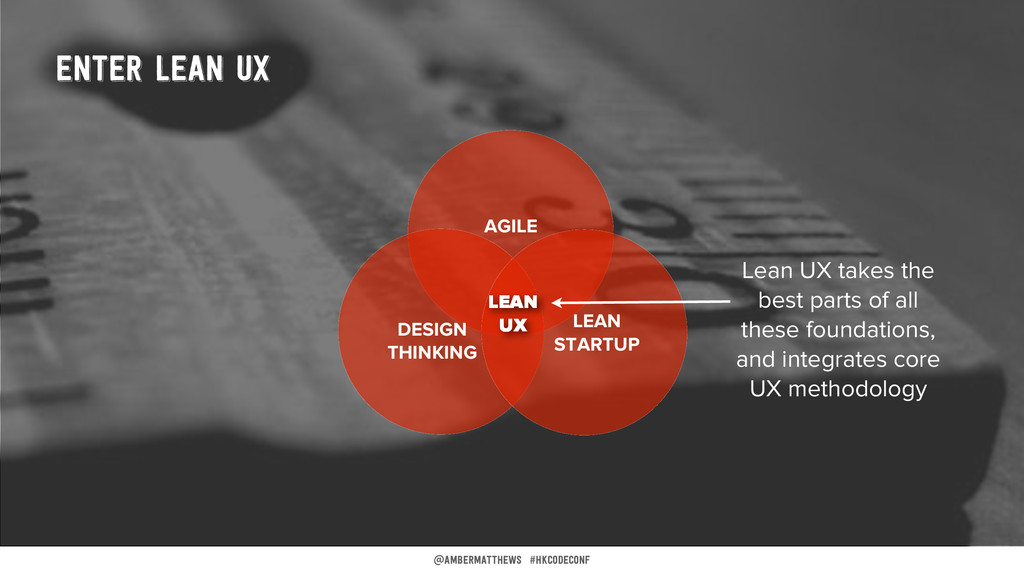
  6. @ambermatthews #hkcodeconf ENTER LEAN UX DESIGN THINKING LEAN STARTUP AGILE

    LEAN UX Lean UX takes the best parts of all these foundations, and integrates core UX methodology
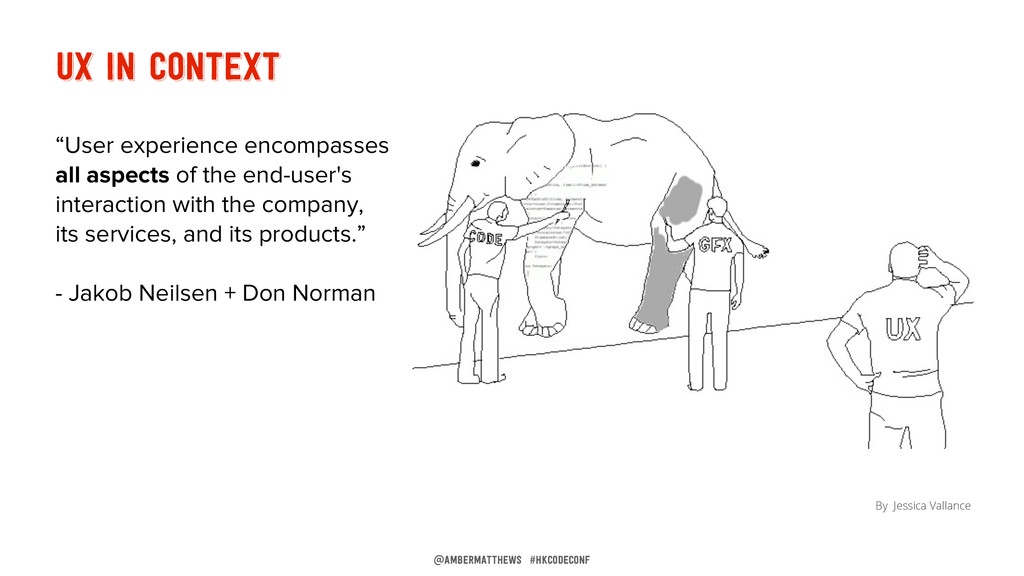
  7. @ambermatthews #hkcodeconf UX in context “User experience encompasses all aspects

    of the end-user's interaction with the company, its services, and its products.” - Jakob Neilsen + Don Norman By Jessica Vallance
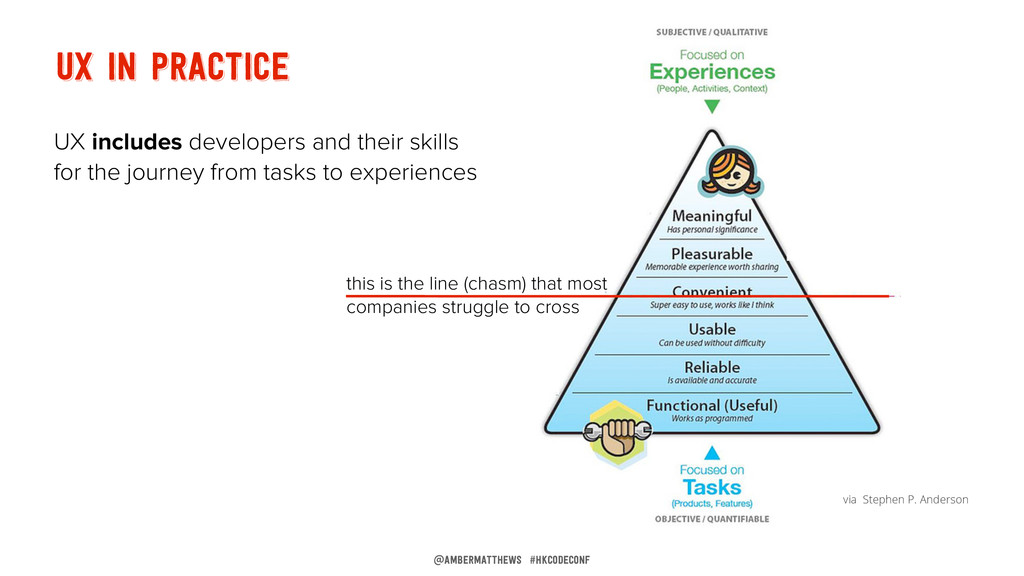
  8. @ambermatthews #hkcodeconf UX IN PRACTICE UX includes developers and their

    skills for the journey from tasks to experiences this is the line (chasm) that most companies struggle to cross via Stephen P. Anderson
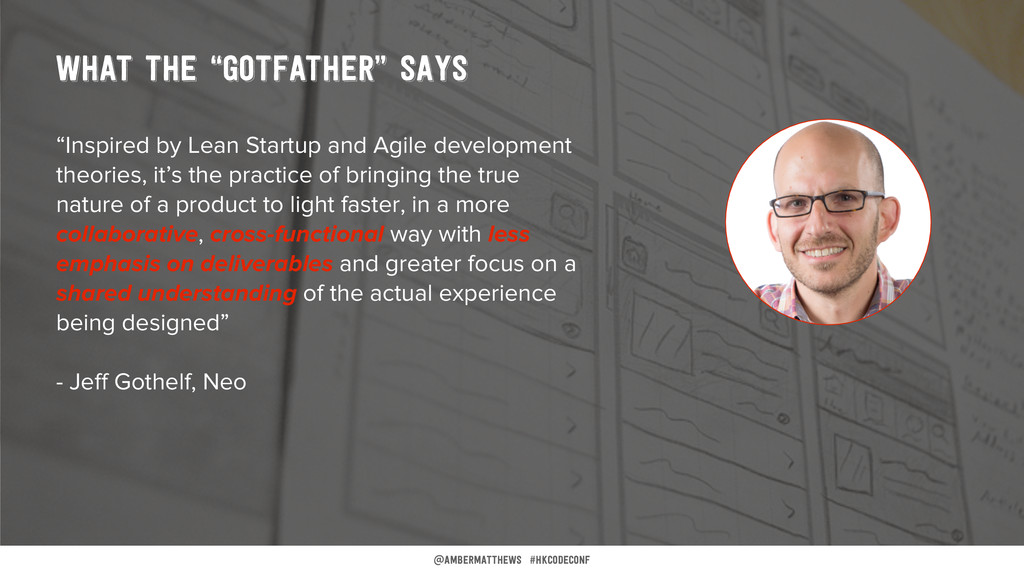
  9. @ambermatthews #hkcodeconf WHAT THe “GOTFATHER” Says “Inspired by Lean Startup

    and Agile development theories, it’s the practice of bringing the true nature of a product to light faster, in a more collaborative, cross-functional way with less emphasis on deliverables and greater focus on a shared understanding of the actual experience being designed” - Jeff Gothelf, Neo
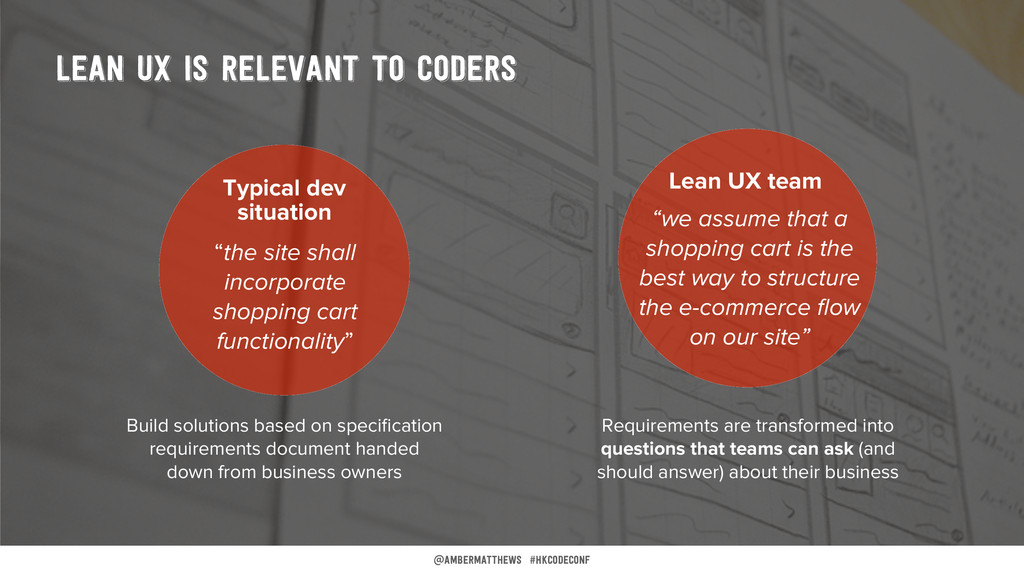
  10. @ambermatthews #hkcodeconf LEAN UX is RELEVANt TO CODERS “the site

    shall incorporate shopping cart functionality” “we assume that a shopping cart is the best way to structure the e-commerce flow on our site” Requirements are transformed into questions that teams can ask (and should answer) about their business Lean UX team Typical dev situation Build solutions based on specification requirements document handed down from business owners
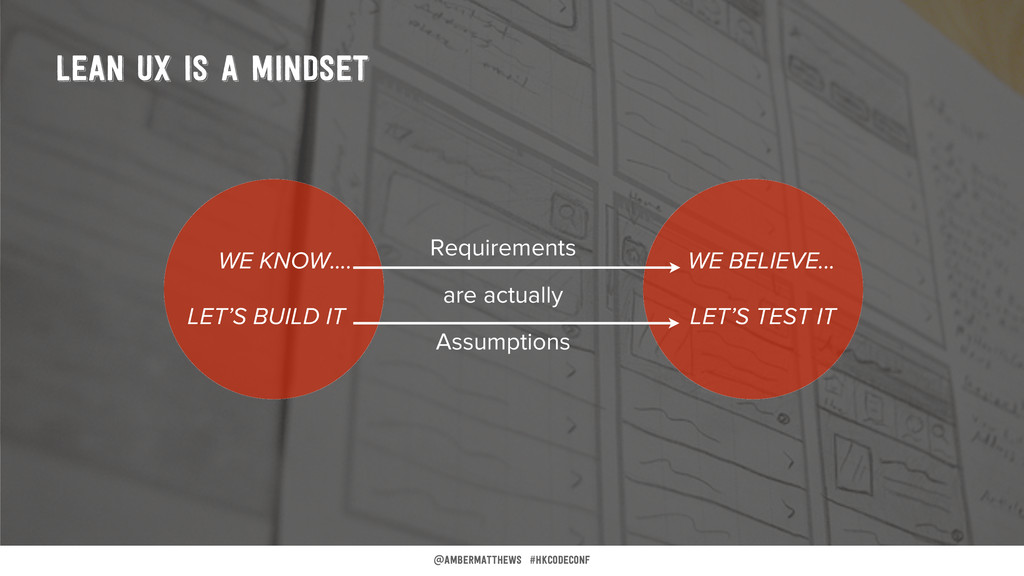
  11. @ambermatthews #hkcodeconf LEAN UX is a mindset WE KNOW.... WE

    BELIEVE... LET’S BUILD IT LET’S TEST IT Requirements are actually Assumptions
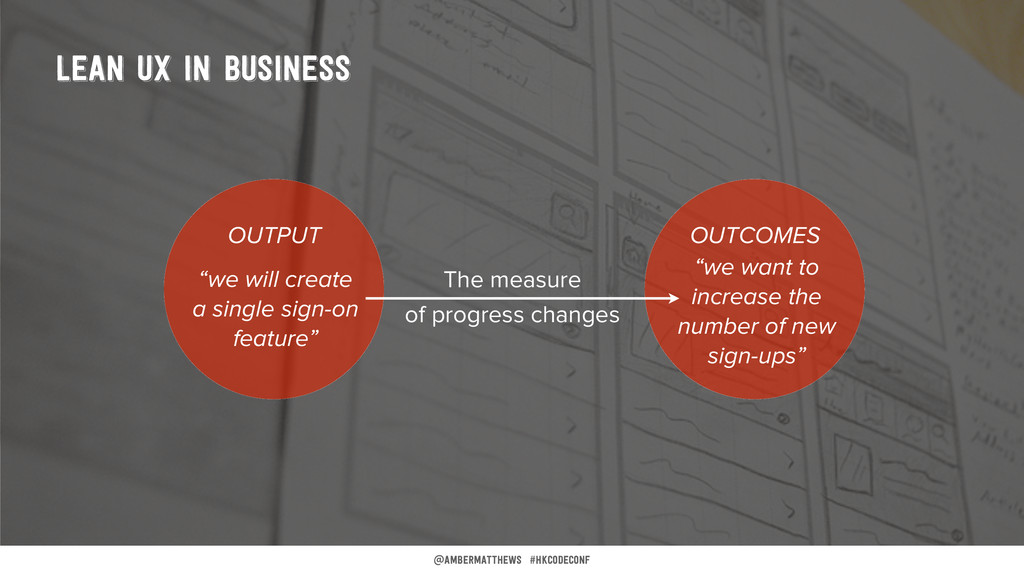
  12. @ambermatthews #hkcodeconf LEAN UX IN BUSINESS The measure of progress

    changes OUTPUT OUTCOMES “we will create a single sign-on feature” “we want to increase the number of new sign-ups”
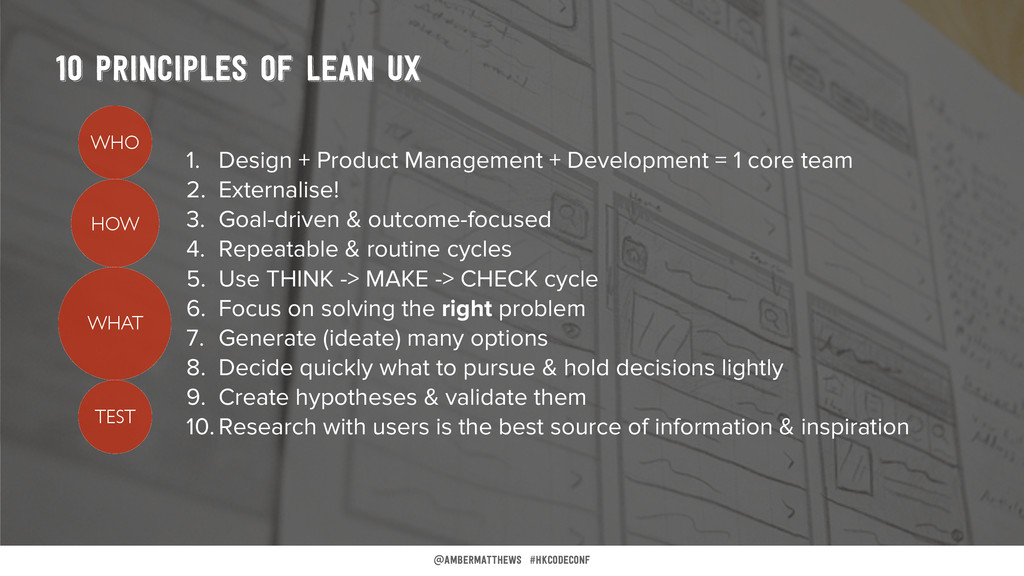
  13. @ambermatthews #hkcodeconf 10 PRINCIPLES OF LEAN UX 1. Design +

    Product Management + Development = 1 core team 2. Externalise! 3. Goal-driven & outcome-focused 4. Repeatable & routine cycles 5. Use THINK -> MAKE -> CHECK cycle 6. Focus on solving the right problem 7. Generate (ideate) many options 8. Decide quickly what to pursue & hold decisions lightly 9. Create hypotheses & validate them 10. Research with users is the best source of information & inspiration WHO HOW WHAT TEST
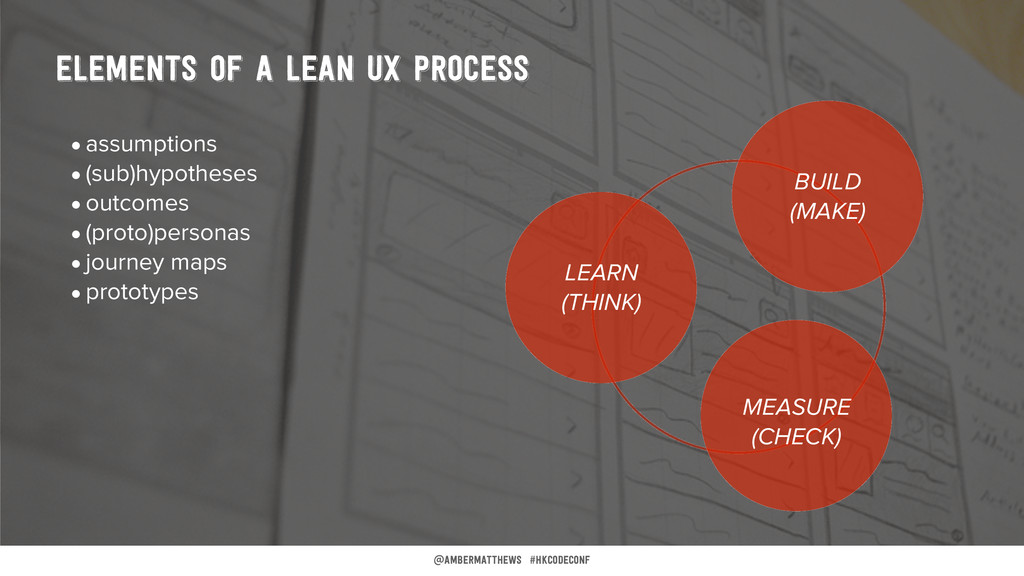
  14. @ambermatthews #hkcodeconf ELEMENTS OF a LEAN UX process •assumptions •(sub)hypotheses

    •outcomes •(proto)personas •journey maps •prototypes BUILD (MAKE) MEASURE (CHECK) LEARN (THINK)
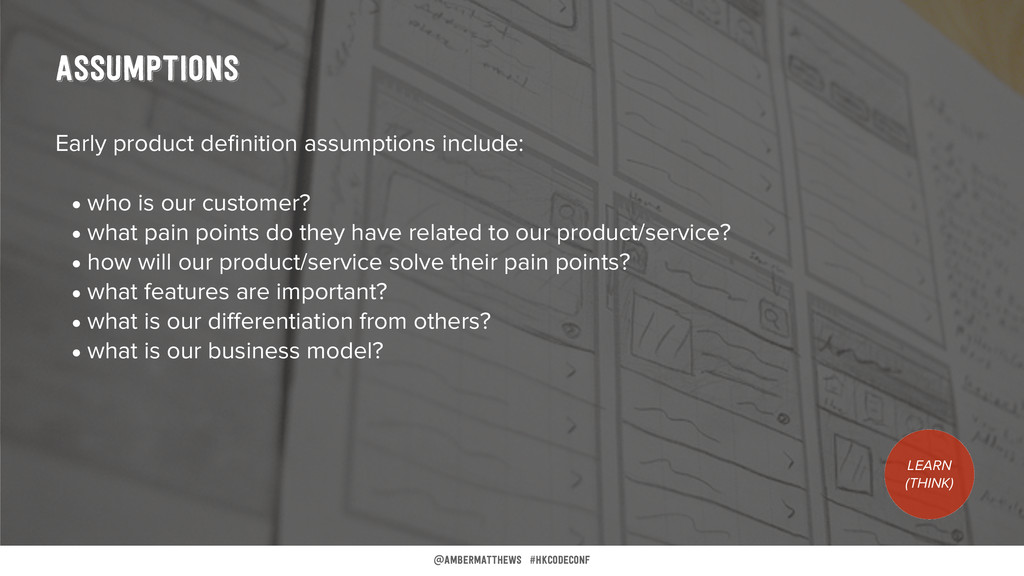
  15. @ambermatthews #hkcodeconf ASSUMPTIONs Early product definition assumptions include: • who

    is our customer? • what pain points do they have related to our product/service? • how will our product/service solve their pain points? • what features are important? • what is our differentiation from others? • what is our business model? LEARN (THINK)
  16. @ambermatthews #hkcodeconf PROBLEM STATEMENT template LEARN (THINK) [Our service/product] was

    designed to achieve [these goals]. We have observed that the product/service isn’t meeting [these goals] which is causing [this adverse effect] to our business. How might we improve [service/product] so that our customers are more successful based on [these criteria].
  17. @ambermatthews #hkcodeconf We believe [this statement is true]. We will

    know we’re [right / wrong] when we see the following feedback from the market: [qualitative feedback] and / or [quantitative feedback] and / or [key performance indicator change]. hypothesis template LEARN (THINK)
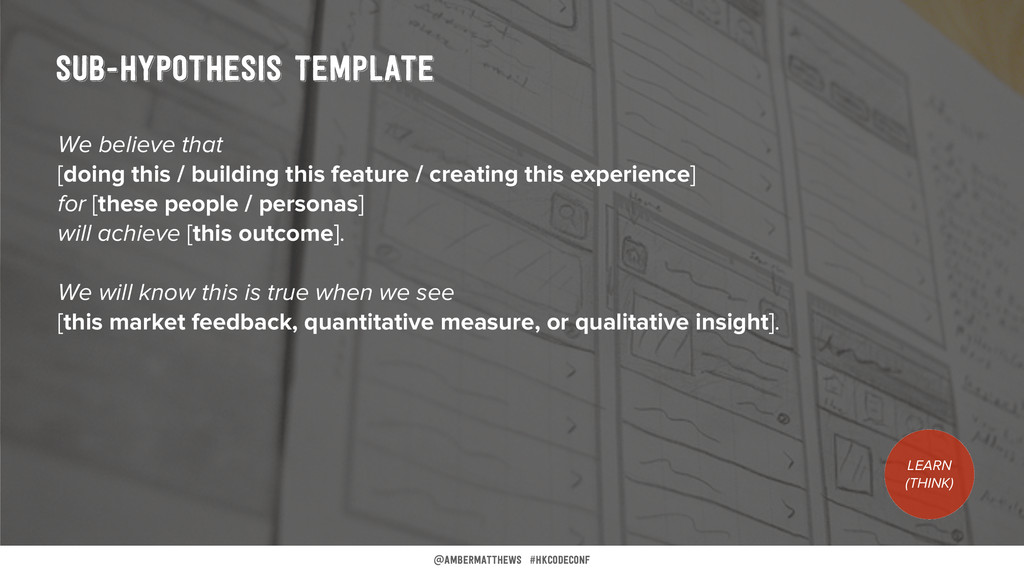
  18. @ambermatthews #hkcodeconf We believe that [doing this / building this

    feature / creating this experience] for [these people / personas] will achieve [this outcome]. We will know this is true when we see [this market feedback, quantitative measure, or qualitative insight]. SUB-hypothesis template LEARN (THINK)
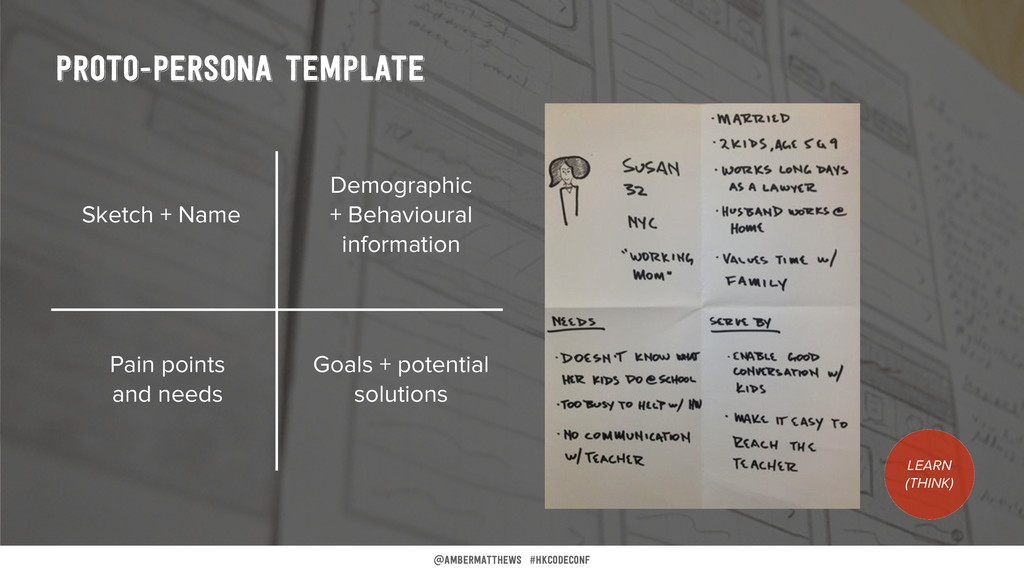
  19. @ambermatthews #hkcodeconf Sketch + Name PROTO-PERSONA template Demographic + Behavioural

    information Pain points and needs Goals + potential solutions LEARN (THINK)
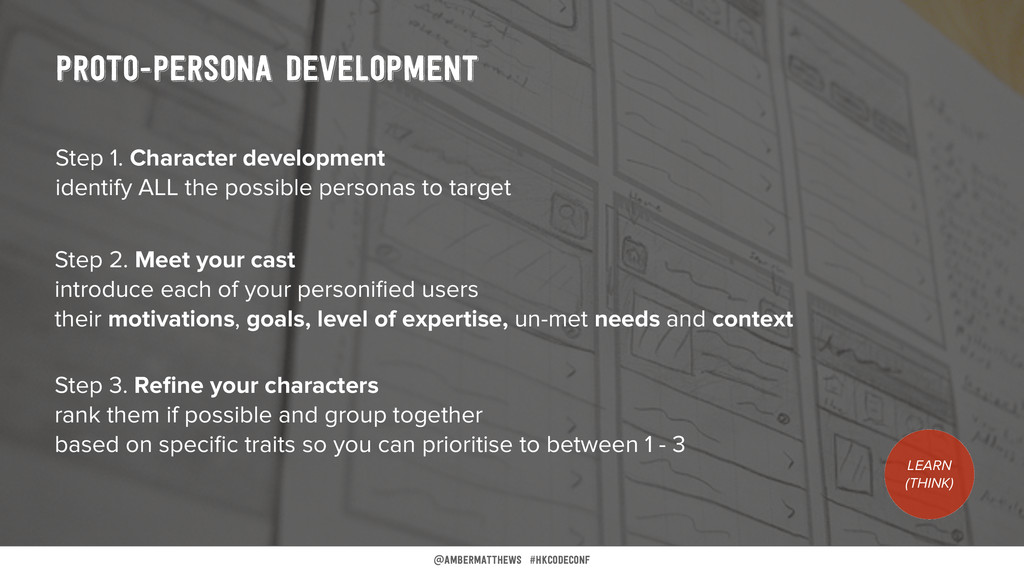
  20. @ambermatthews #hkcodeconf Step 1. Character development identify ALL the possible

    personas to target PROTO-PERSONA Development Step 2. Meet your cast introduce each of your personified users their motivations, goals, level of expertise, un-met needs and context Step 3. Refine your characters rank them if possible and group together based on specific traits so you can prioritise to between 1 - 3 LEARN (THINK)
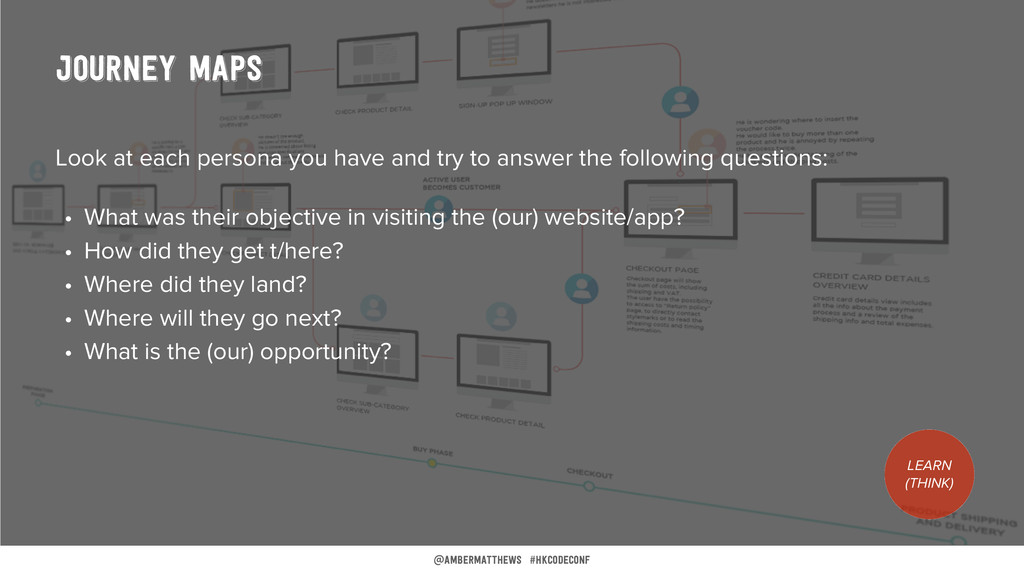
  21. @ambermatthews #hkcodeconf Journey MapS Look at each persona you have

    and try to answer the following questions: • What was their objective in visiting the (our) website/app? • How did they get t/here? • Where did they land? • Where will they go next? • What is the (our) opportunity? LEARN (THINK)
  22. @ambermatthews #hkcodeconf PROTOTYPING Prototypes come in various guises and fidelities,

    depending on what you are trying to test: • landing pages • sign up buttons • emails • Google adwords BUILD (MAKE)
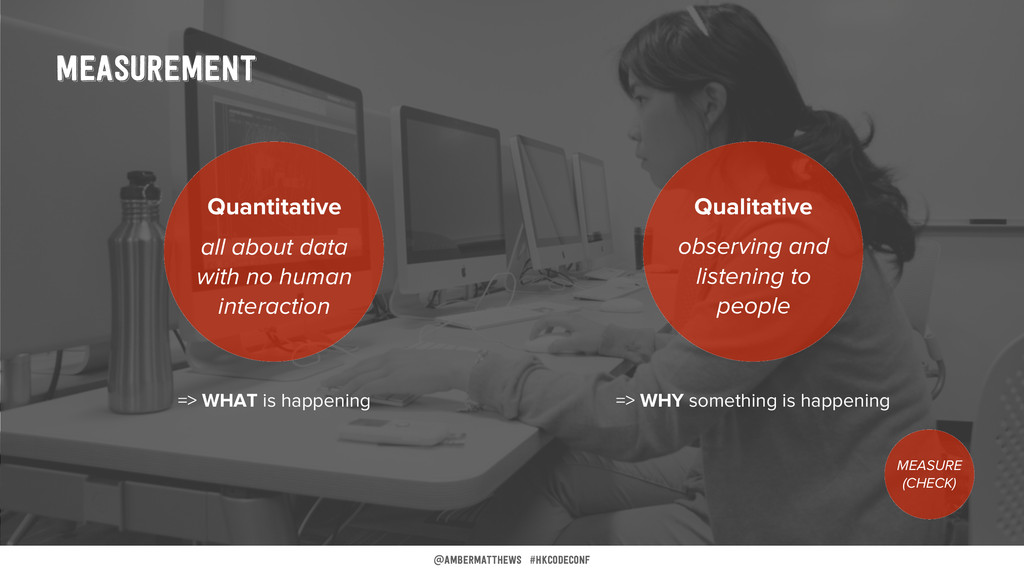
  23. @ambermatthews #hkcodeconf MEASUREMENT Qualitative Quantitative observing and listening to people

    all about data with no human interaction => WHAT is happening => WHY something is happening MEASURE (CHECK)
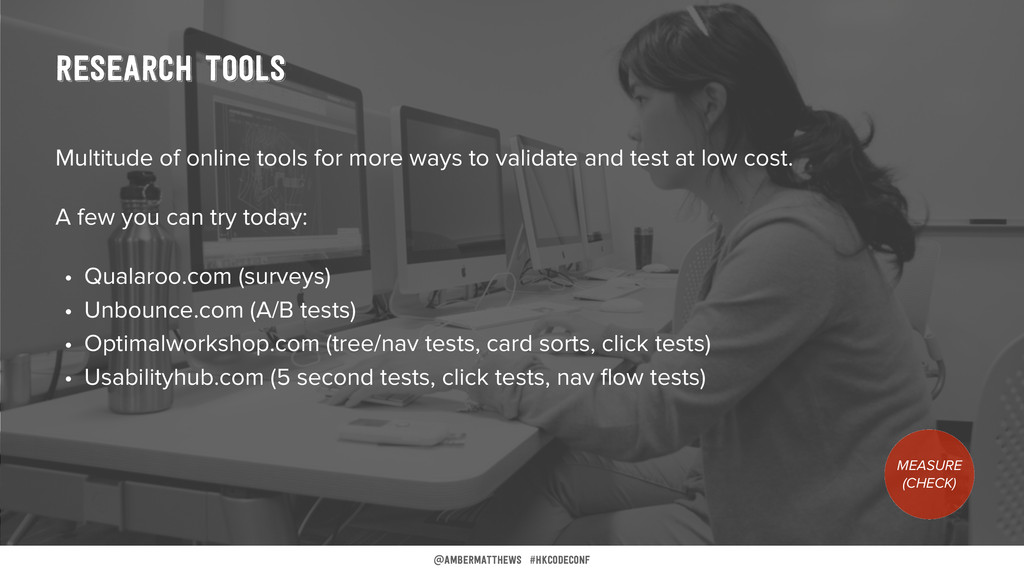
  24. @ambermatthews #hkcodeconf RESEARCH TOOLS Multitude of online tools for more

    ways to validate and test at low cost. A few you can try today: • Qualaroo.com (surveys) • Unbounce.com (A/B tests) • Optimalworkshop.com (tree/nav tests, card sorts, click tests) • Usabilityhub.com (5 second tests, click tests, nav flow tests) MEASURE (CHECK)
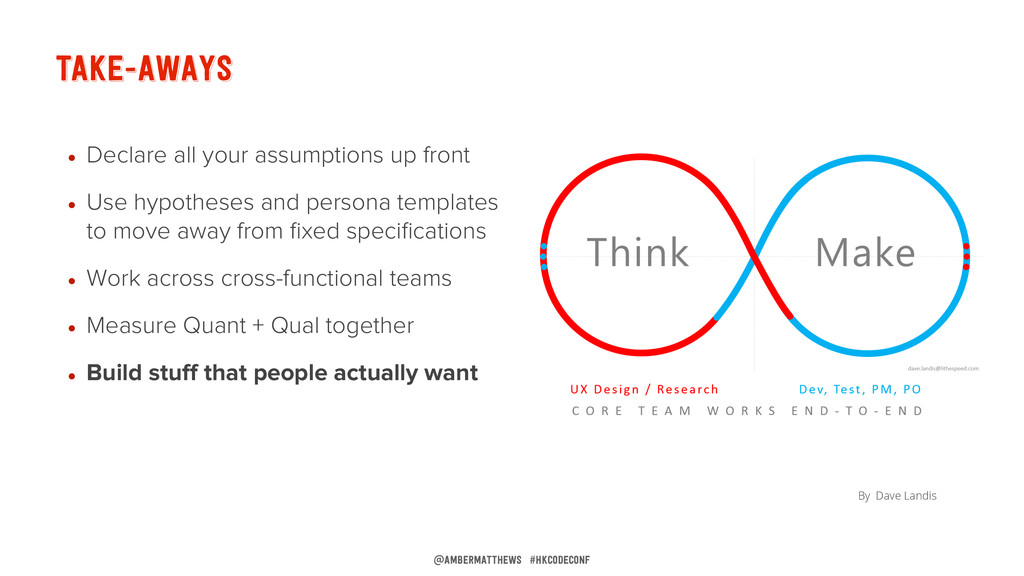
  25. @ambermatthews #hkcodeconf • Declare all your assumptions up front •

    Use hypotheses and persona templates to move away from fixed specifications • Work across cross-functional teams • Measure Quant + Qual together • Build stuff that people actually want By Dave Landis TAKE-AWAYS