Upgrade to Pro — share decks privately, control downloads, hide ads and more …

How to ace the ACT: a complete strategy guide f...

Sponsored · Your Podcast. Everywhere. Effortlessly. Share. Educate. Inspire. Entertain. You do you. We'll handle the rest. →

How to ace the ACT: a complete strategy guide for 2026

Avatar for North American Tutors

North American Tutors

October 03, 2026

Other Decks in Education

Transcript

  1. How to ace the ACT: a complete strategy guide for

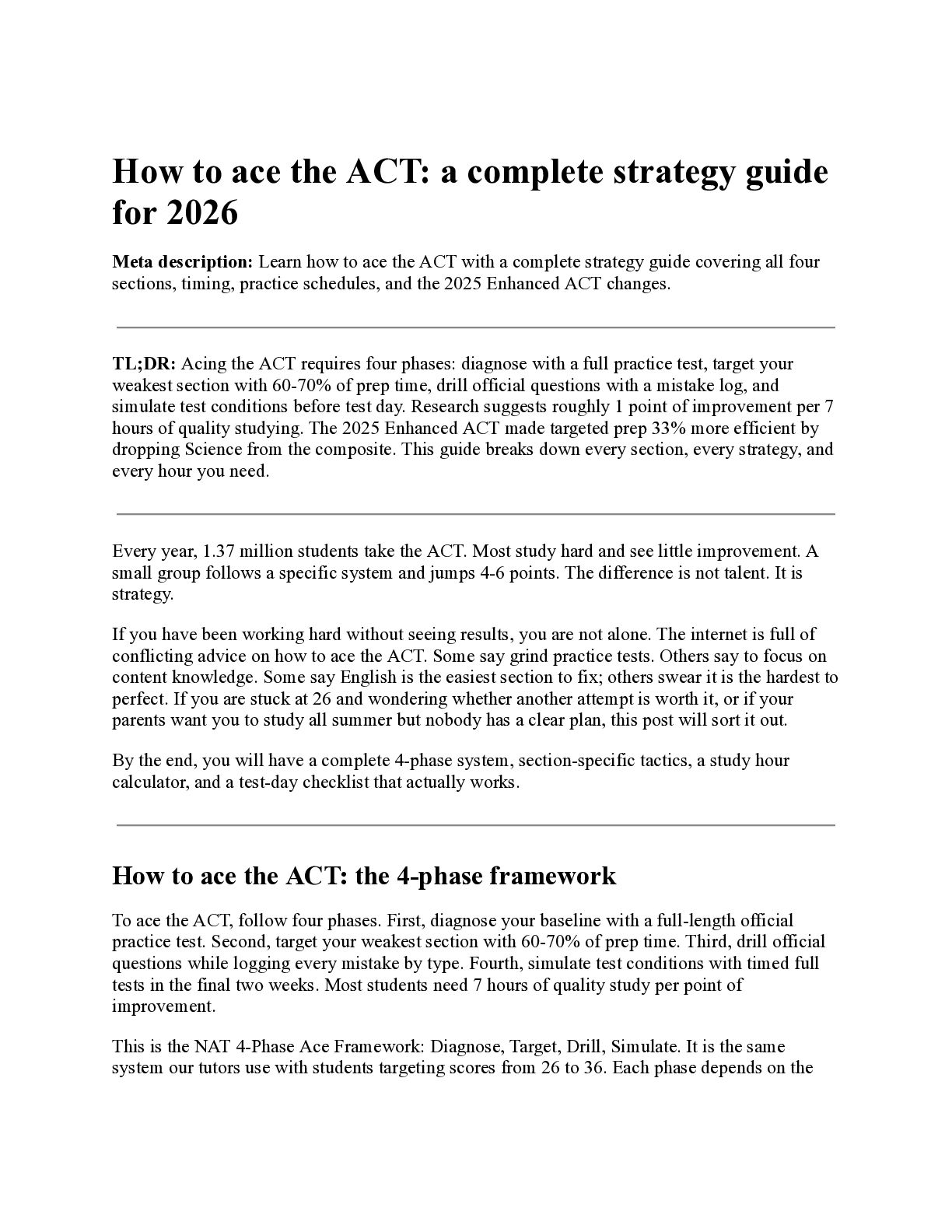
    2026 Meta description: Learn how to ace the ACT with a complete strategy guide covering all four sections, timing, practice schedules, and the 2025 Enhanced ACT changes. TL;DR: Acing the ACT requires four phases: diagnose with a full practice test, target your weakest section with 60-70% of prep time, drill official questions with a mistake log, and simulate test conditions before test day. Research suggests roughly 1 point of improvement per 7 hours of quality studying. The 2025 Enhanced ACT made targeted prep 33% more efficient by dropping Science from the composite. This guide breaks down every section, every strategy, and every hour you need. Every year, 1.37 million students take the ACT. Most study hard and see little improvement. A small group follows a specific system and jumps 4-6 points. The difference is not talent. It is strategy. If you have been working hard without seeing results, you are not alone. The internet is full of conflicting advice on how to ace the ACT. Some say grind practice tests. Others say to focus on content knowledge. Some say English is the easiest section to fix; others swear it is the hardest to perfect. If you are stuck at 26 and wondering whether another attempt is worth it, or if your parents want you to study all summer but nobody has a clear plan, this post will sort it out. By the end, you will have a complete 4-phase system, section-specific tactics, a study hour calculator, and a test-day checklist that actually works. How to ace the ACT: the 4-phase framework To ace the ACT, follow four phases. First, diagnose your baseline with a full-length official practice test. Second, target your weakest section with 60-70% of prep time. Third, drill official questions while logging every mistake by type. Fourth, simulate test conditions with timed full tests in the final two weeks. Most students need 7 hours of quality study per point of improvement. This is the NAT 4-Phase Ace Framework: Diagnose, Target, Drill, Simulate. It is the same system our tutors use with students targeting scores from 26 to 36. Each phase depends on the
  2. one before it. Skip the diagnostic, and you go into

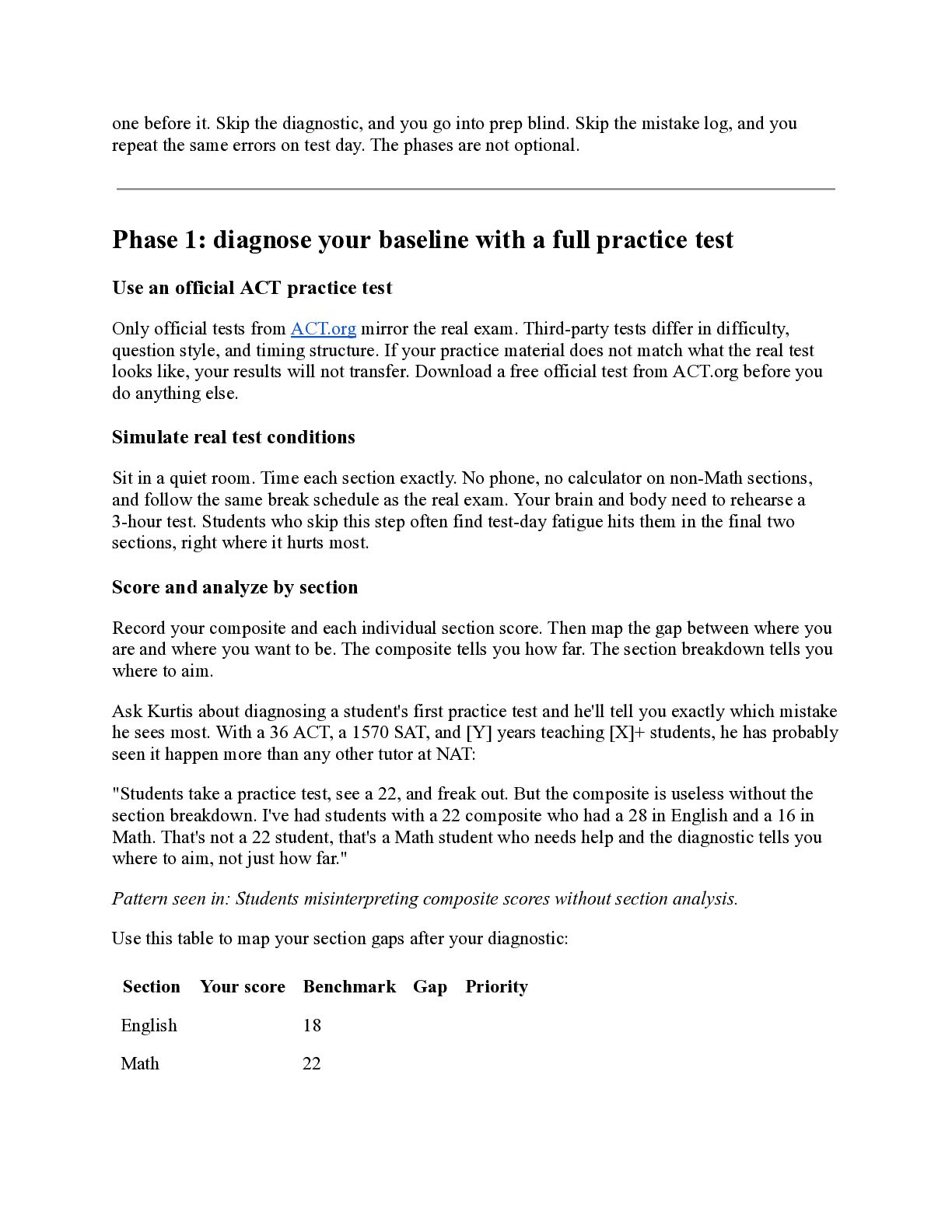
    prep blind. Skip the mistake log, and you repeat the same errors on test day. The phases are not optional. Phase 1: diagnose your baseline with a full practice test Use an official ACT practice test Only official tests from ACT.org mirror the real exam. Third-party tests differ in difficulty, question style, and timing structure. If your practice material does not match what the real test looks like, your results will not transfer. Download a free official test from ACT.org before you do anything else. Simulate real test conditions Sit in a quiet room. Time each section exactly. No phone, no calculator on non-Math sections, and follow the same break schedule as the real exam. Your brain and body need to rehearse a 3-hour test. Students who skip this step often find test-day fatigue hits them in the final two sections, right where it hurts most. Score and analyze by section Record your composite and each individual section score. Then map the gap between where you are and where you want to be. The composite tells you how far. The section breakdown tells you where to aim. Ask Kurtis about diagnosing a student's first practice test and he'll tell you exactly which mistake he sees most. With a 36 ACT, a 1570 SAT, and [Y] years teaching [X]+ students, he has probably seen it happen more than any other tutor at NAT: "Students take a practice test, see a 22, and freak out. But the composite is useless without the section breakdown. I've had students with a 22 composite who had a 28 in English and a 16 in Math. That's not a 22 student, that's a Math student who needs help and the diagnostic tells you where to aim, not just how far." Pattern seen in: Students misinterpreting composite scores without section analysis. Use this table to map your section gaps after your diagnostic: Section Your score Benchmark Gap Priority English 18 Math 22
  3. Reading 22 Science 23 The benchmarks above are the ACT

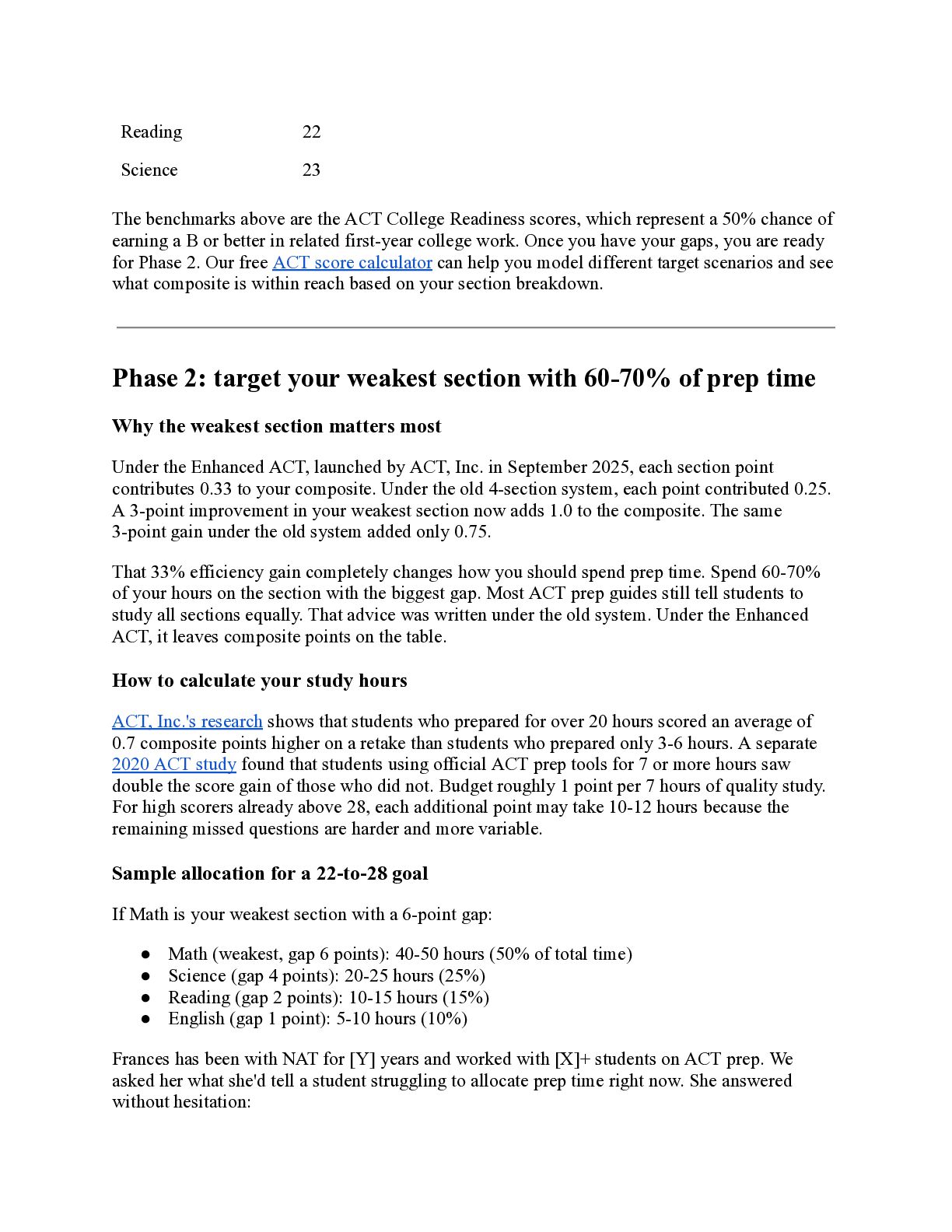
    College Readiness scores, which represent a 50% chance of earning a B or better in related first-year college work. Once you have your gaps, you are ready for Phase 2. Our free ACT score calculator can help you model different target scenarios and see what composite is within reach based on your section breakdown. Phase 2: target your weakest section with 60-70% of prep time Why the weakest section matters most Under the Enhanced ACT, launched by ACT, Inc. in September 2025, each section point contributes 0.33 to your composite. Under the old 4-section system, each point contributed 0.25. A 3-point improvement in your weakest section now adds 1.0 to the composite. The same 3-point gain under the old system added only 0.75. That 33% efficiency gain completely changes how you should spend prep time. Spend 60-70% of your hours on the section with the biggest gap. Most ACT prep guides still tell students to study all sections equally. That advice was written under the old system. Under the Enhanced ACT, it leaves composite points on the table. How to calculate your study hours ACT, Inc.'s research shows that students who prepared for over 20 hours scored an average of 0.7 composite points higher on a retake than students who prepared only 3-6 hours. A separate 2020 ACT study found that students using official ACT prep tools for 7 or more hours saw double the score gain of those who did not. Budget roughly 1 point per 7 hours of quality study. For high scorers already above 28, each additional point may take 10-12 hours because the remaining missed questions are harder and more variable. Sample allocation for a 22-to-28 goal If Math is your weakest section with a 6-point gap: •​ Math (weakest, gap 6 points): 40-50 hours (50% of total time) •​ Science (gap 4 points): 20-25 hours (25%) •​ Reading (gap 2 points): 10-15 hours (15%) •​ English (gap 1 point): 5-10 hours (10%) Frances has been with NAT for [Y] years and worked with [X]+ students on ACT prep. We asked her what she'd tell a student struggling to allocate prep time right now. She answered without hesitation:
  4. "The new ACT, it actually rewards focused prep more than

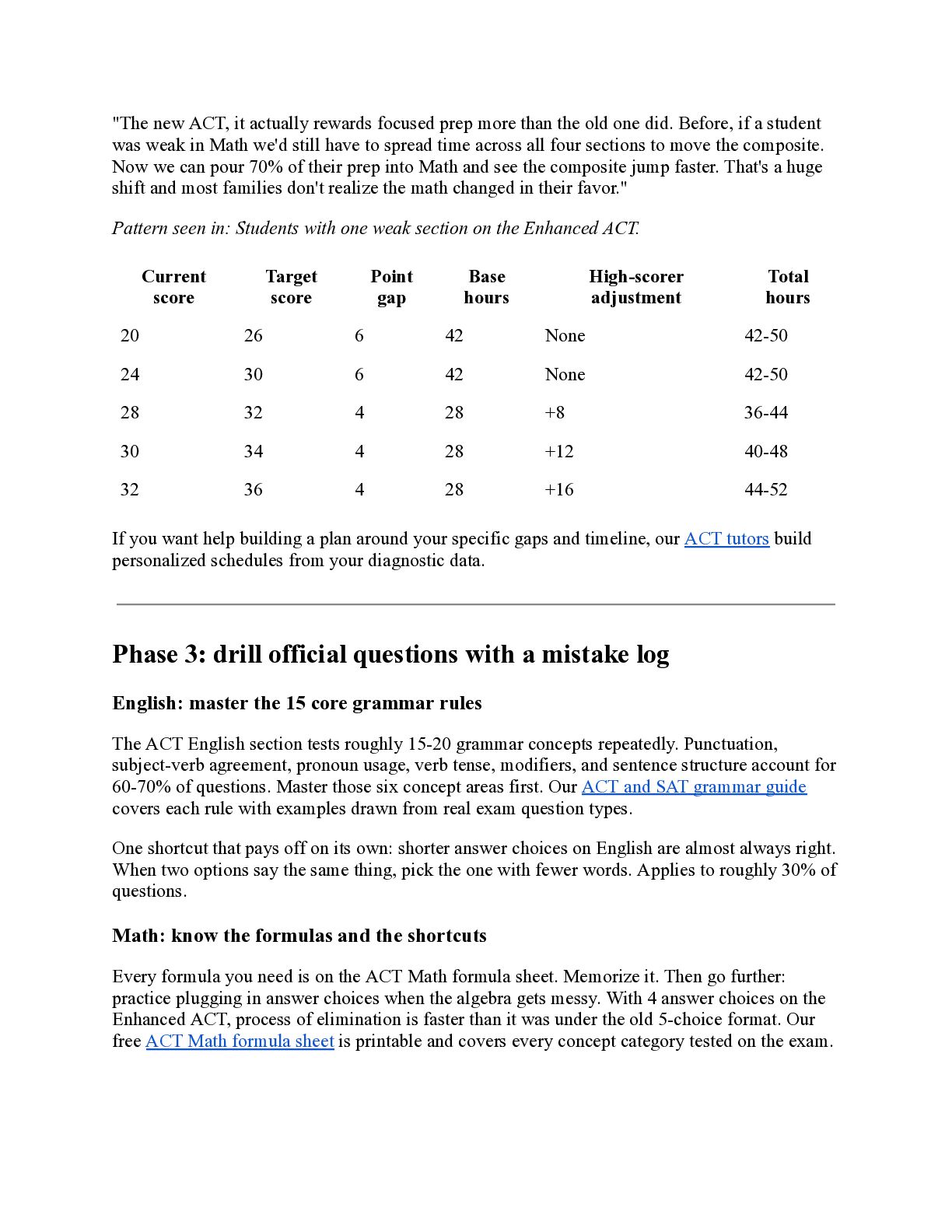
    the old one did. Before, if a student was weak in Math we'd still have to spread time across all four sections to move the composite. Now we can pour 70% of their prep into Math and see the composite jump faster. That's a huge shift and most families don't realize the math changed in their favor." Pattern seen in: Students with one weak section on the Enhanced ACT. Current score Target score Point gap Base hours High-scorer adjustment Total hours 20 26 6 42 None 42-50 24 30 6 42 None 42-50 28 32 4 28 +8 36-44 30 34 4 28 +12 40-48 32 36 4 28 +16 44-52 If you want help building a plan around your specific gaps and timeline, our ACT tutors build personalized schedules from your diagnostic data. Phase 3: drill official questions with a mistake log English: master the 15 core grammar rules The ACT English section tests roughly 15-20 grammar concepts repeatedly. Punctuation, subject-verb agreement, pronoun usage, verb tense, modifiers, and sentence structure account for 60-70% of questions. Master those six concept areas first. Our ACT and SAT grammar guide covers each rule with examples drawn from real exam question types. One shortcut that pays off on its own: shorter answer choices on English are almost always right. When two options say the same thing, pick the one with fewer words. Applies to roughly 30% of questions. Math: know the formulas and the shortcuts Every formula you need is on the ACT Math formula sheet. Memorize it. Then go further: practice plugging in answer choices when the algebra gets messy. With 4 answer choices on the Enhanced ACT, process of elimination is faster than it was under the old 5-choice format. Our free ACT Math formula sheet is printable and covers every concept category tested on the exam.
  5. The 25-15-10 pacing rule works for most students: 25 minutes

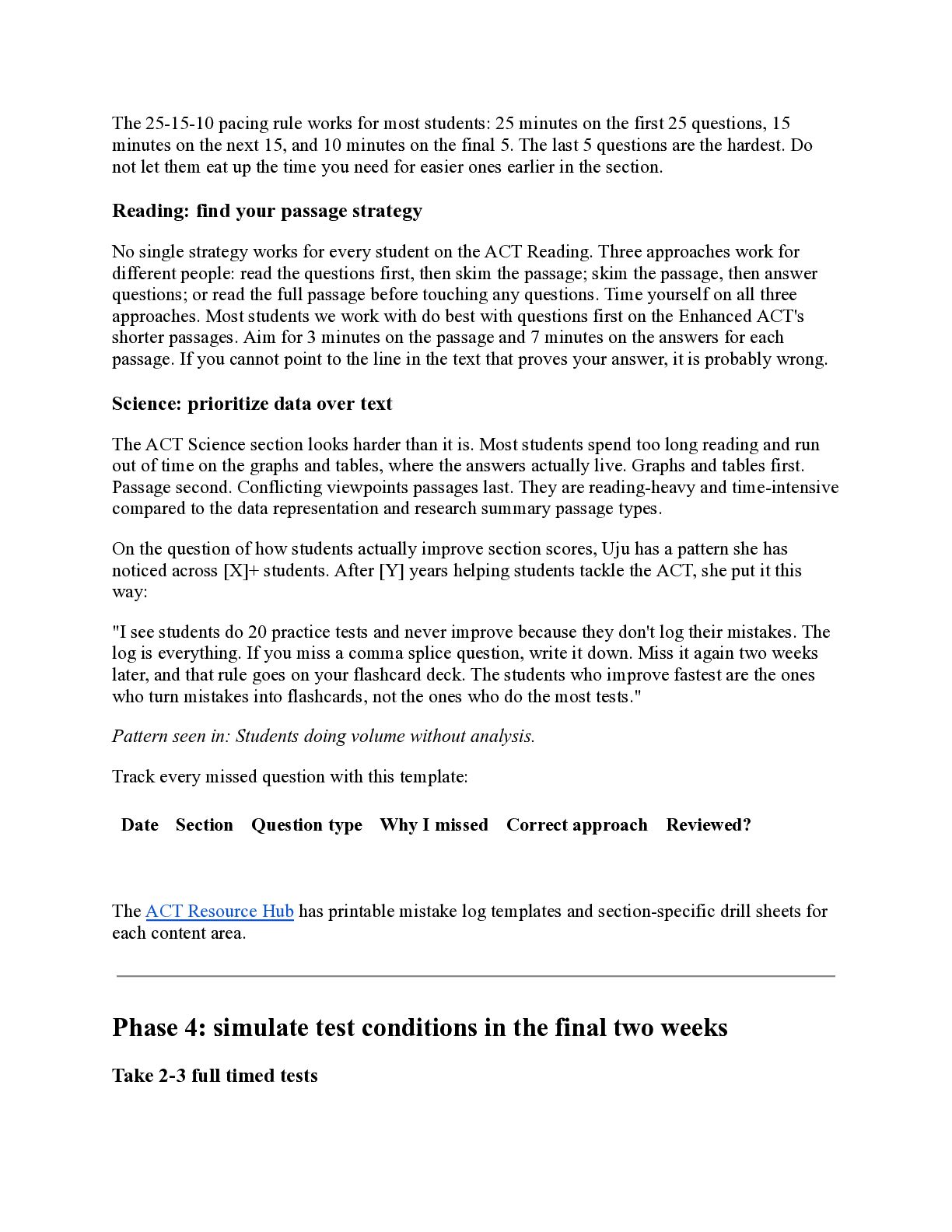
    on the first 25 questions, 15 minutes on the next 15, and 10 minutes on the final 5. The last 5 questions are the hardest. Do not let them eat up the time you need for easier ones earlier in the section. Reading: find your passage strategy No single strategy works for every student on the ACT Reading. Three approaches work for different people: read the questions first, then skim the passage; skim the passage, then answer questions; or read the full passage before touching any questions. Time yourself on all three approaches. Most students we work with do best with questions first on the Enhanced ACT's shorter passages. Aim for 3 minutes on the passage and 7 minutes on the answers for each passage. If you cannot point to the line in the text that proves your answer, it is probably wrong. Science: prioritize data over text The ACT Science section looks harder than it is. Most students spend too long reading and run out of time on the graphs and tables, where the answers actually live. Graphs and tables first. Passage second. Conflicting viewpoints passages last. They are reading-heavy and time-intensive compared to the data representation and research summary passage types. On the question of how students actually improve section scores, Uju has a pattern she has noticed across [X]+ students. After [Y] years helping students tackle the ACT, she put it this way: "I see students do 20 practice tests and never improve because they don't log their mistakes. The log is everything. If you miss a comma splice question, write it down. Miss it again two weeks later, and that rule goes on your flashcard deck. The students who improve fastest are the ones who turn mistakes into flashcards, not the ones who do the most tests." Pattern seen in: Students doing volume without analysis. Track every missed question with this template: Date Section Question type Why I missed Correct approach Reviewed? The ACT Resource Hub has printable mistake log templates and section-specific drill sheets for each content area. Phase 4: simulate test conditions in the final two weeks Take 2-3 full timed tests
  6. In the final two weeks, take 2-3 full-length official practice

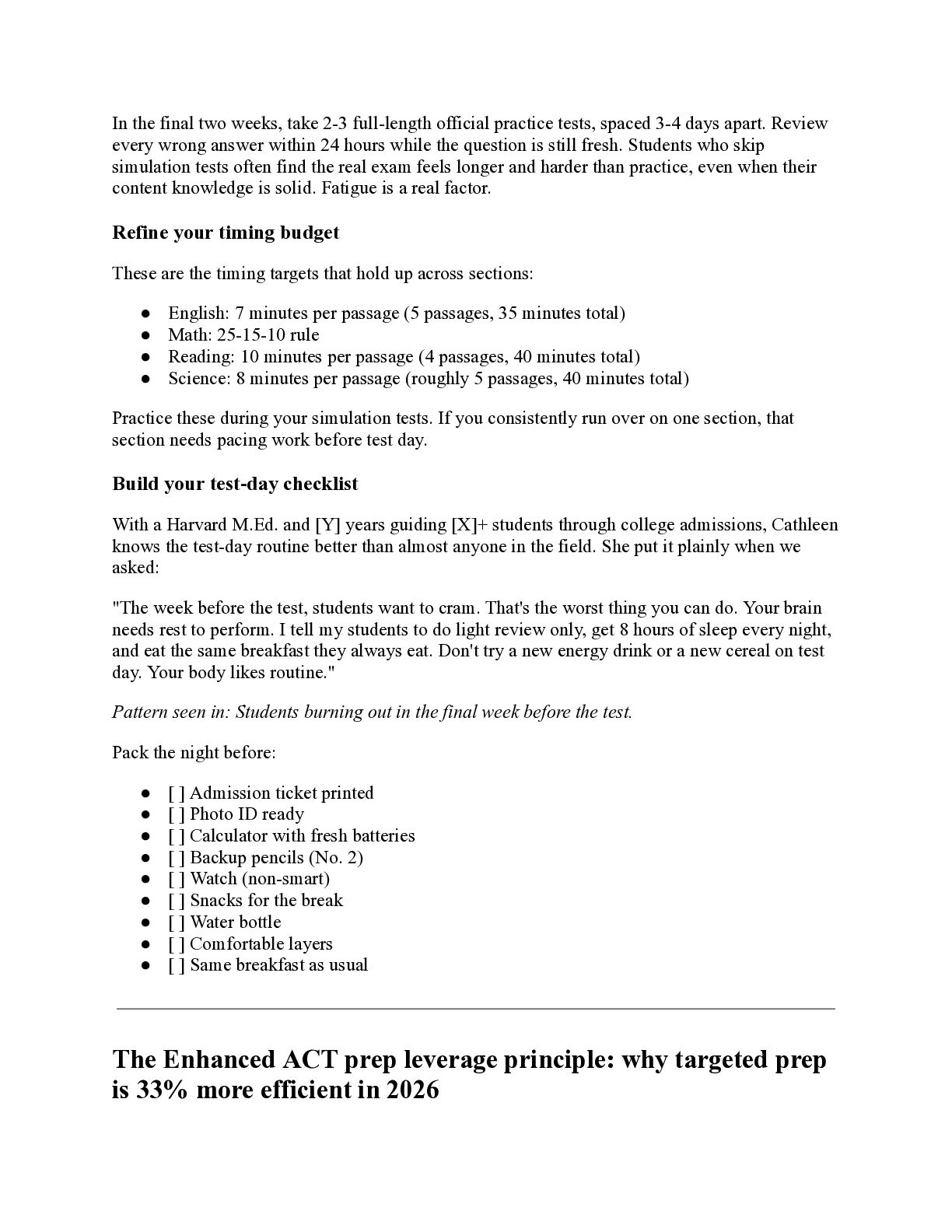
    tests, spaced 3-4 days apart. Review every wrong answer within 24 hours while the question is still fresh. Students who skip simulation tests often find the real exam feels longer and harder than practice, even when their content knowledge is solid. Fatigue is a real factor. Refine your timing budget These are the timing targets that hold up across sections: •​ English: 7 minutes per passage (5 passages, 35 minutes total) •​ Math: 25-15-10 rule •​ Reading: 10 minutes per passage (4 passages, 40 minutes total) •​ Science: 8 minutes per passage (roughly 5 passages, 40 minutes total) Practice these during your simulation tests. If you consistently run over on one section, that section needs pacing work before test day. Build your test-day checklist With a Harvard M.Ed. and [Y] years guiding [X]+ students through college admissions, Cathleen knows the test-day routine better than almost anyone in the field. She put it plainly when we asked: "The week before the test, students want to cram. That's the worst thing you can do. Your brain needs rest to perform. I tell my students to do light review only, get 8 hours of sleep every night, and eat the same breakfast they always eat. Don't try a new energy drink or a new cereal on test day. Your body likes routine." Pattern seen in: Students burning out in the final week before the test. Pack the night before: •​ [ ] Admission ticket printed •​ [ ] Photo ID ready •​ [ ] Calculator with fresh batteries •​ [ ] Backup pencils (No. 2) •​ [ ] Watch (non-smart) •​ [ ] Snacks for the break •​ [ ] Water bottle •​ [ ] Comfortable layers •​ [ ] Same breakfast as usual The Enhanced ACT prep leverage principle: why targeted prep is 33% more efficient in 2026
  7. Most ACT prep guides still give the same advice they

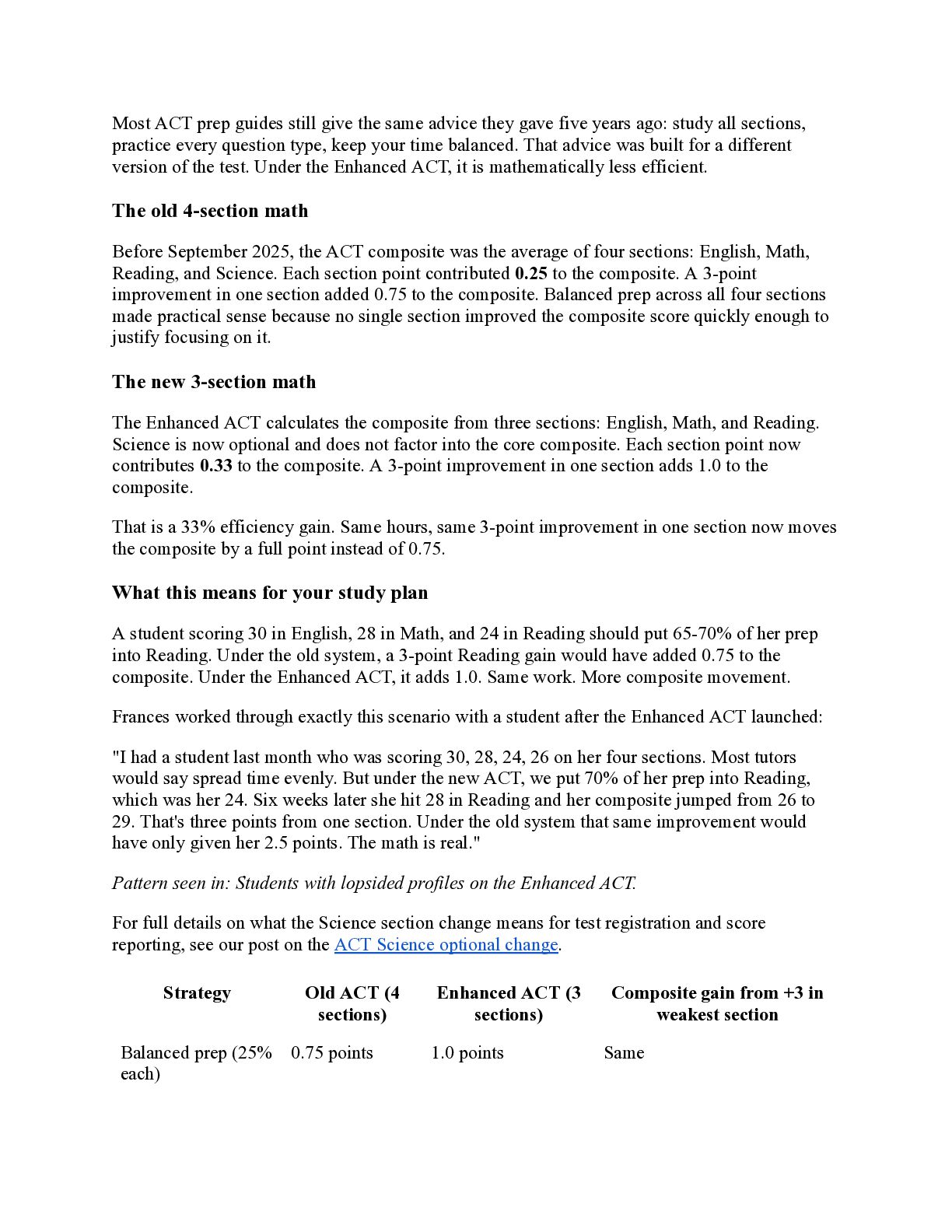
    gave five years ago: study all sections, practice every question type, keep your time balanced. That advice was built for a different version of the test. Under the Enhanced ACT, it is mathematically less efficient. The old 4-section math Before September 2025, the ACT composite was the average of four sections: English, Math, Reading, and Science. Each section point contributed 0.25 to the composite. A 3-point improvement in one section added 0.75 to the composite. Balanced prep across all four sections made practical sense because no single section improved the composite score quickly enough to justify focusing on it. The new 3-section math The Enhanced ACT calculates the composite from three sections: English, Math, and Reading. Science is now optional and does not factor into the core composite. Each section point now contributes 0.33 to the composite. A 3-point improvement in one section adds 1.0 to the composite. That is a 33% efficiency gain. Same hours, same 3-point improvement in one section now moves the composite by a full point instead of 0.75. What this means for your study plan A student scoring 30 in English, 28 in Math, and 24 in Reading should put 65-70% of her prep into Reading. Under the old system, a 3-point Reading gain would have added 0.75 to the composite. Under the Enhanced ACT, it adds 1.0. Same work. More composite movement. Frances worked through exactly this scenario with a student after the Enhanced ACT launched: "I had a student last month who was scoring 30, 28, 24, 26 on her four sections. Most tutors would say spread time evenly. But under the new ACT, we put 70% of her prep into Reading, which was her 24. Six weeks later she hit 28 in Reading and her composite jumped from 26 to 29. That's three points from one section. Under the old system that same improvement would have only given her 2.5 points. The math is real." Pattern seen in: Students with lopsided profiles on the Enhanced ACT. For full details on what the Science section change means for test registration and score reporting, see our post on the ACT Science optional change. Strategy Old ACT (4 sections) Balanced prep (25% 0.75 points each) Enhanced ACT (3 sections) Composite gain from +3 in weakest section 1.0 points Same
  8. Targeted prep (70% weakest) 0.75 points 1.0 points 33% more

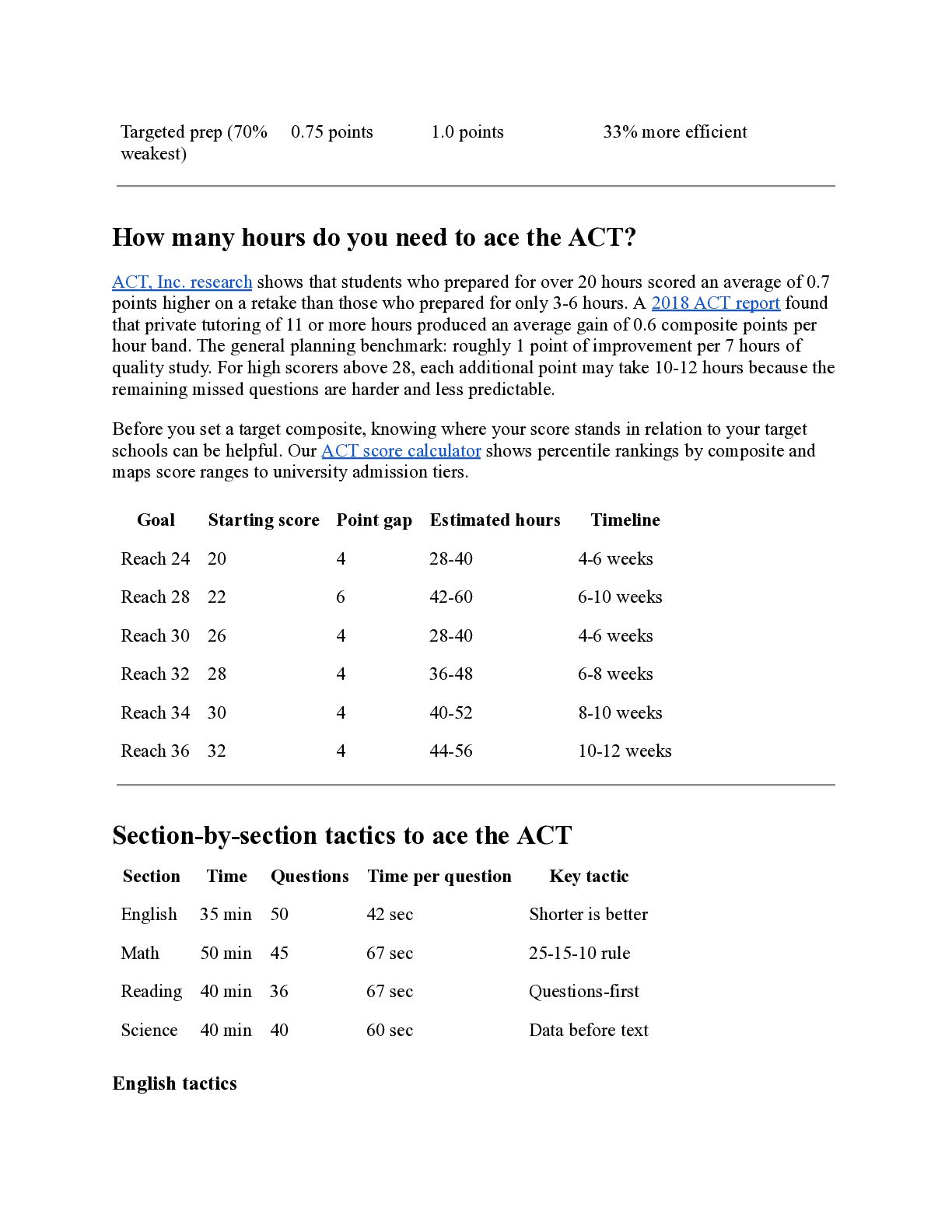
    efficient How many hours do you need to ace the ACT? ACT, Inc. research shows that students who prepared for over 20 hours scored an average of 0.7 points higher on a retake than those who prepared for only 3-6 hours. A 2018 ACT report found that private tutoring of 11 or more hours produced an average gain of 0.6 composite points per hour band. The general planning benchmark: roughly 1 point of improvement per 7 hours of quality study. For high scorers above 28, each additional point may take 10-12 hours because the remaining missed questions are harder and less predictable. Before you set a target composite, knowing where your score stands in relation to your target schools can be helpful. Our ACT score calculator shows percentile rankings by composite and maps score ranges to university admission tiers. Goal Starting score Point gap Estimated hours Timeline Reach 24 20 4 28-40 4-6 weeks Reach 28 22 6 42-60 6-10 weeks Reach 30 26 4 28-40 4-6 weeks Reach 32 28 4 36-48 6-8 weeks Reach 34 30 4 40-52 8-10 weeks Reach 36 32 4 44-56 10-12 weeks Section-by-section tactics to ace the ACT Section Time Questions Time per question English 35 min 50 42 sec Shorter is better Math 50 min 45 67 sec 25-15-10 rule Reading 40 min 36 67 sec Questions-first Science 60 sec Data before text 40 min 40 English tactics Key tactic
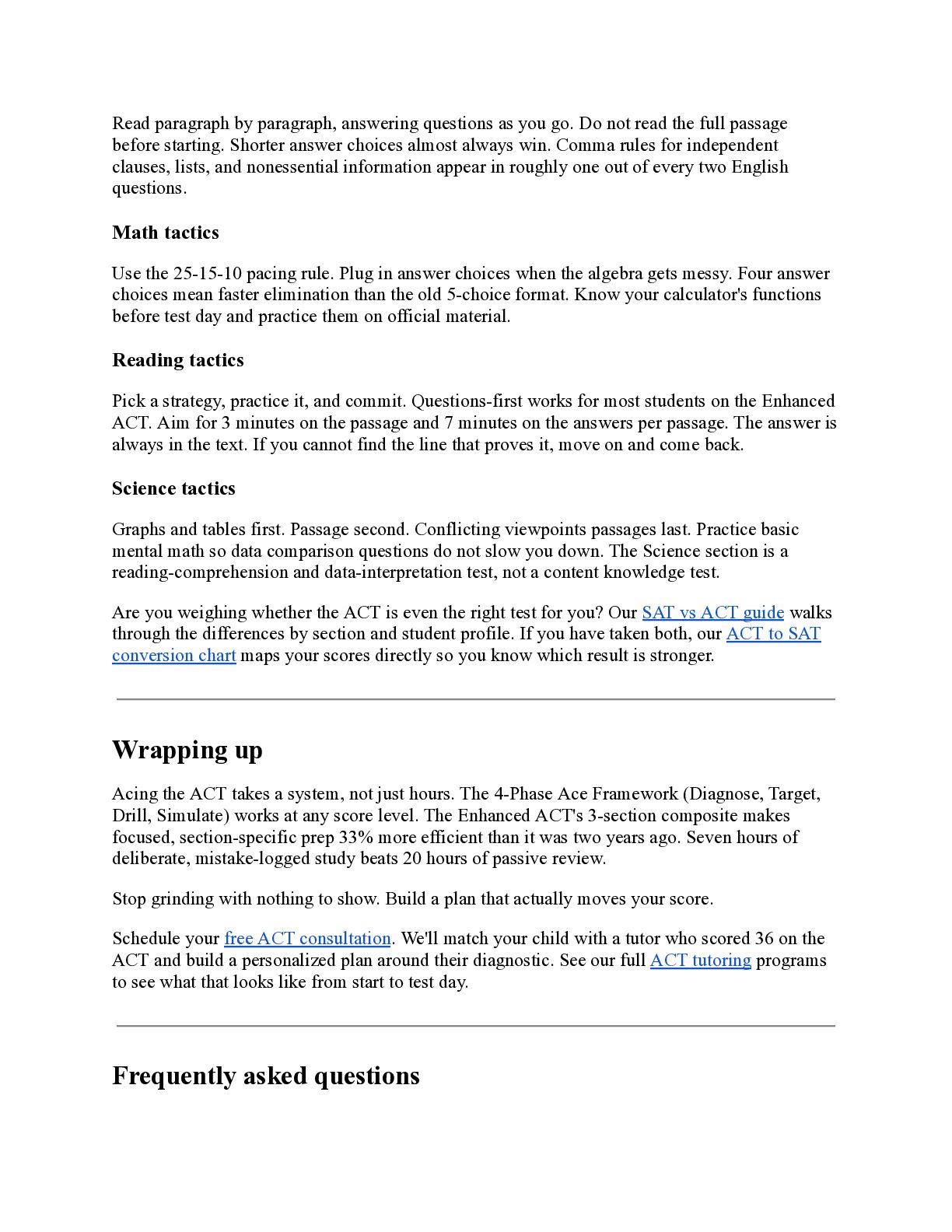
  9. Read paragraph by paragraph, answering questions as you go. Do

    not read the full passage before starting. Shorter answer choices almost always win. Comma rules for independent clauses, lists, and nonessential information appear in roughly one out of every two English questions. Math tactics Use the 25-15-10 pacing rule. Plug in answer choices when the algebra gets messy. Four answer choices mean faster elimination than the old 5-choice format. Know your calculator's functions before test day and practice them on official material. Reading tactics Pick a strategy, practice it, and commit. Questions-first works for most students on the Enhanced ACT. Aim for 3 minutes on the passage and 7 minutes on the answers per passage. The answer is always in the text. If you cannot find the line that proves it, move on and come back. Science tactics Graphs and tables first. Passage second. Conflicting viewpoints passages last. Practice basic mental math so data comparison questions do not slow you down. The Science section is a reading-comprehension and data-interpretation test, not a content knowledge test. Are you weighing whether the ACT is even the right test for you? Our SAT vs ACT guide walks through the differences by section and student profile. If you have taken both, our ACT to SAT conversion chart maps your scores directly so you know which result is stronger. Wrapping up Acing the ACT takes a system, not just hours. The 4-Phase Ace Framework (Diagnose, Target, Drill, Simulate) works at any score level. The Enhanced ACT's 3-section composite makes focused, section-specific prep 33% more efficient than it was two years ago. Seven hours of deliberate, mistake-logged study beats 20 hours of passive review. Stop grinding with nothing to show. Build a plan that actually moves your score. Schedule your free ACT consultation. We'll match your child with a tutor who scored 36 on the ACT and build a personalized plan around their diagnostic. See our full ACT tutoring programs to see what that looks like from start to test day. Frequently asked questions
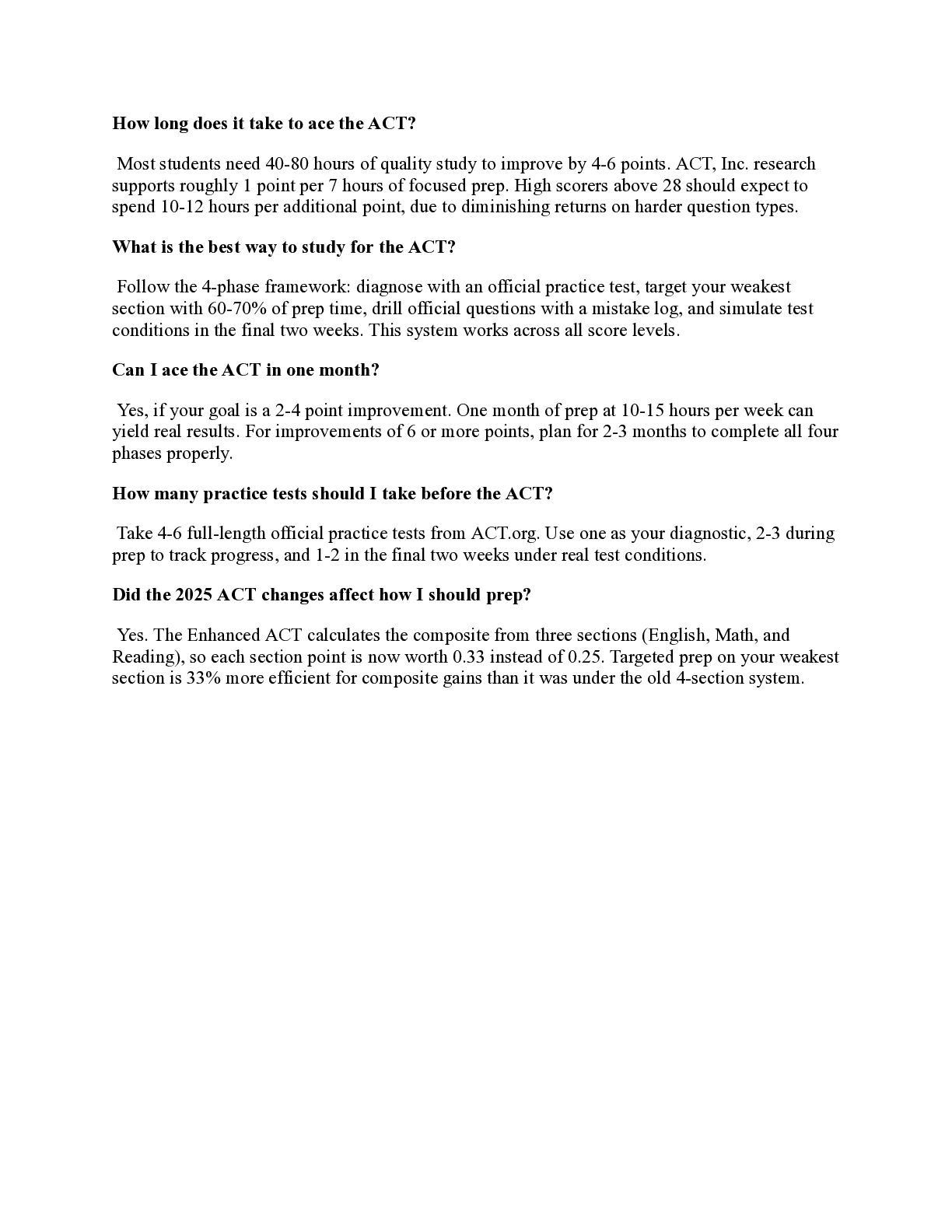
  10. How long does it take to ace the ACT? Most

    students need 40-80 hours of quality study to improve by 4-6 points. ACT, Inc. research supports roughly 1 point per 7 hours of focused prep. High scorers above 28 should expect to spend 10-12 hours per additional point, due to diminishing returns on harder question types. What is the best way to study for the ACT? Follow the 4-phase framework: diagnose with an official practice test, target your weakest section with 60-70% of prep time, drill official questions with a mistake log, and simulate test conditions in the final two weeks. This system works across all score levels. Can I ace the ACT in one month? Yes, if your goal is a 2-4 point improvement. One month of prep at 10-15 hours per week can yield real results. For improvements of 6 or more points, plan for 2-3 months to complete all four phases properly. How many practice tests should I take before the ACT? Take 4-6 full-length official practice tests from ACT.org. Use one as your diagnostic, 2-3 during prep to track progress, and 1-2 in the final two weeks under real test conditions. Did the 2025 ACT changes affect how I should prep? Yes. The Enhanced ACT calculates the composite from three sections (English, Math, and Reading), so each section point is now worth 0.33 instead of 0.25. Targeted prep on your weakest section is 33% more efficient for composite gains than it was under the old 4-section system.