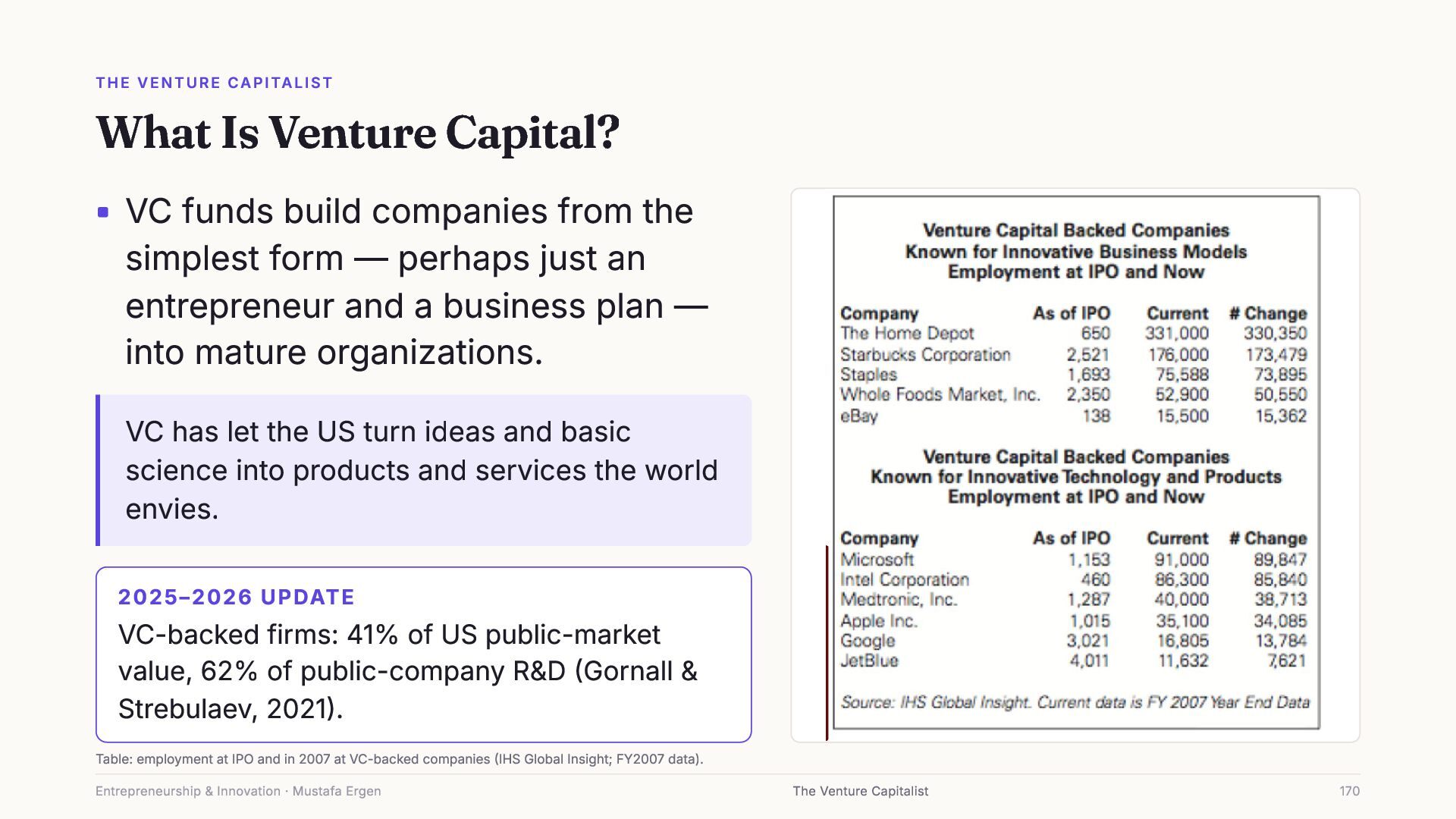
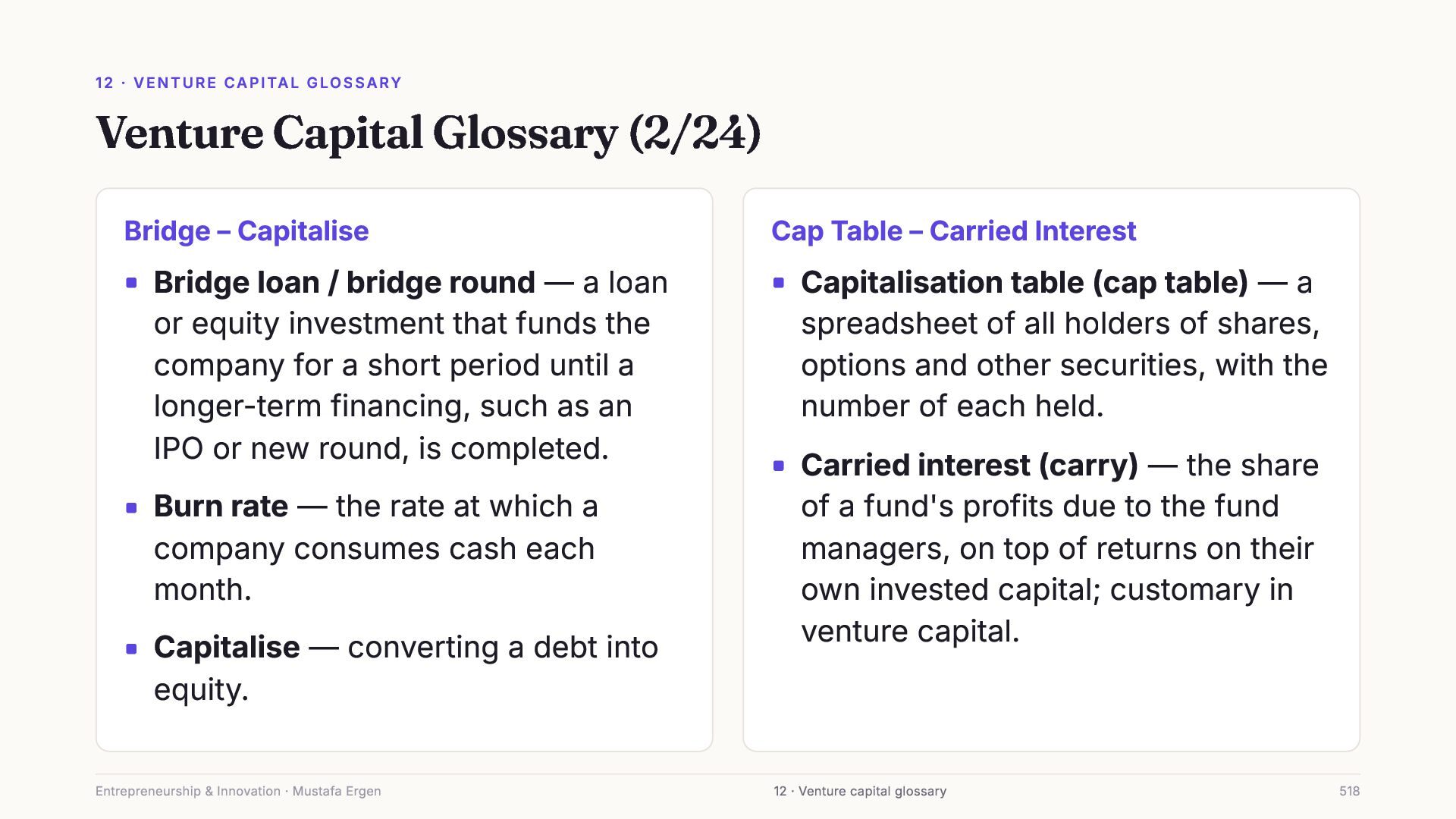
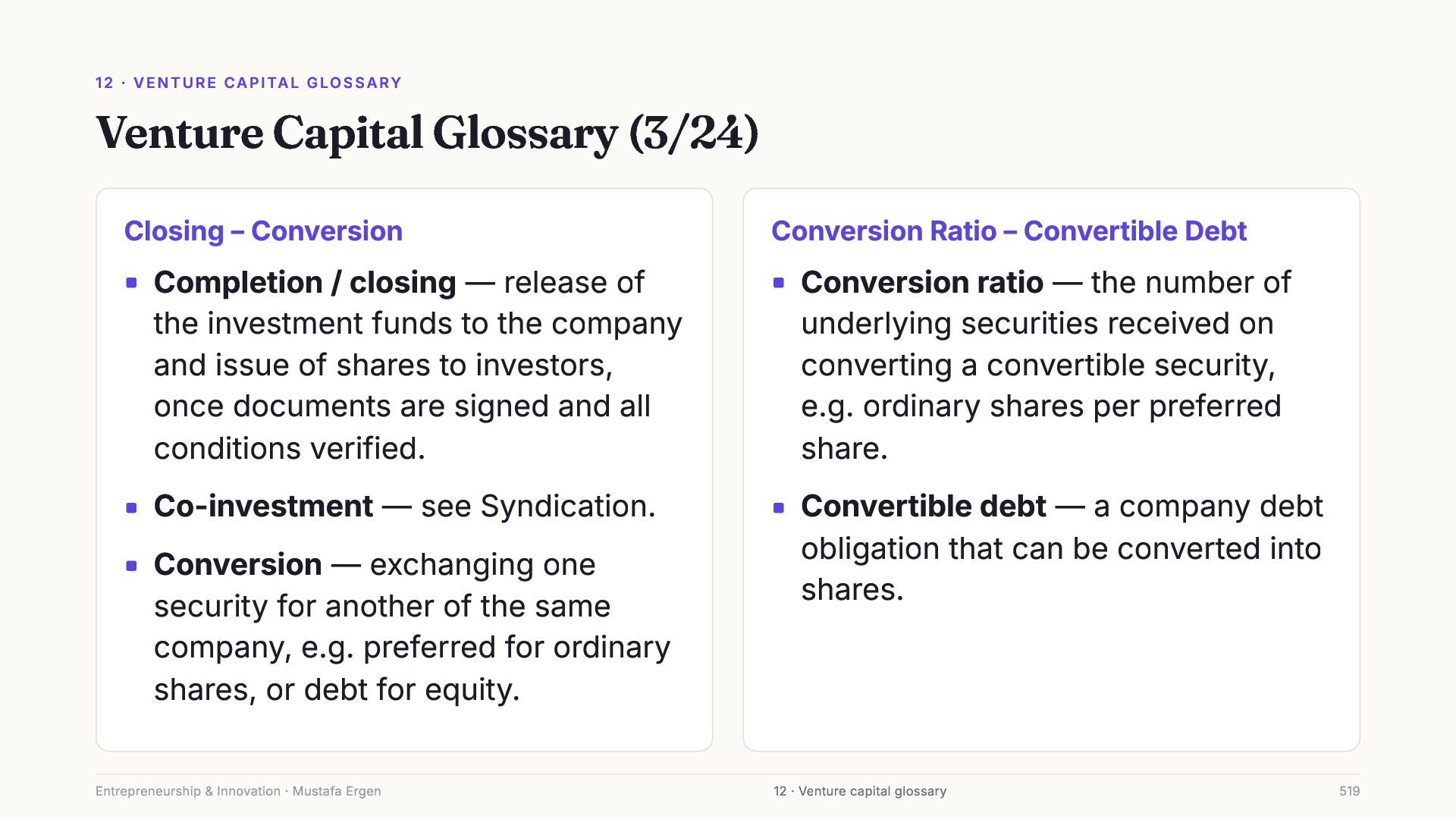
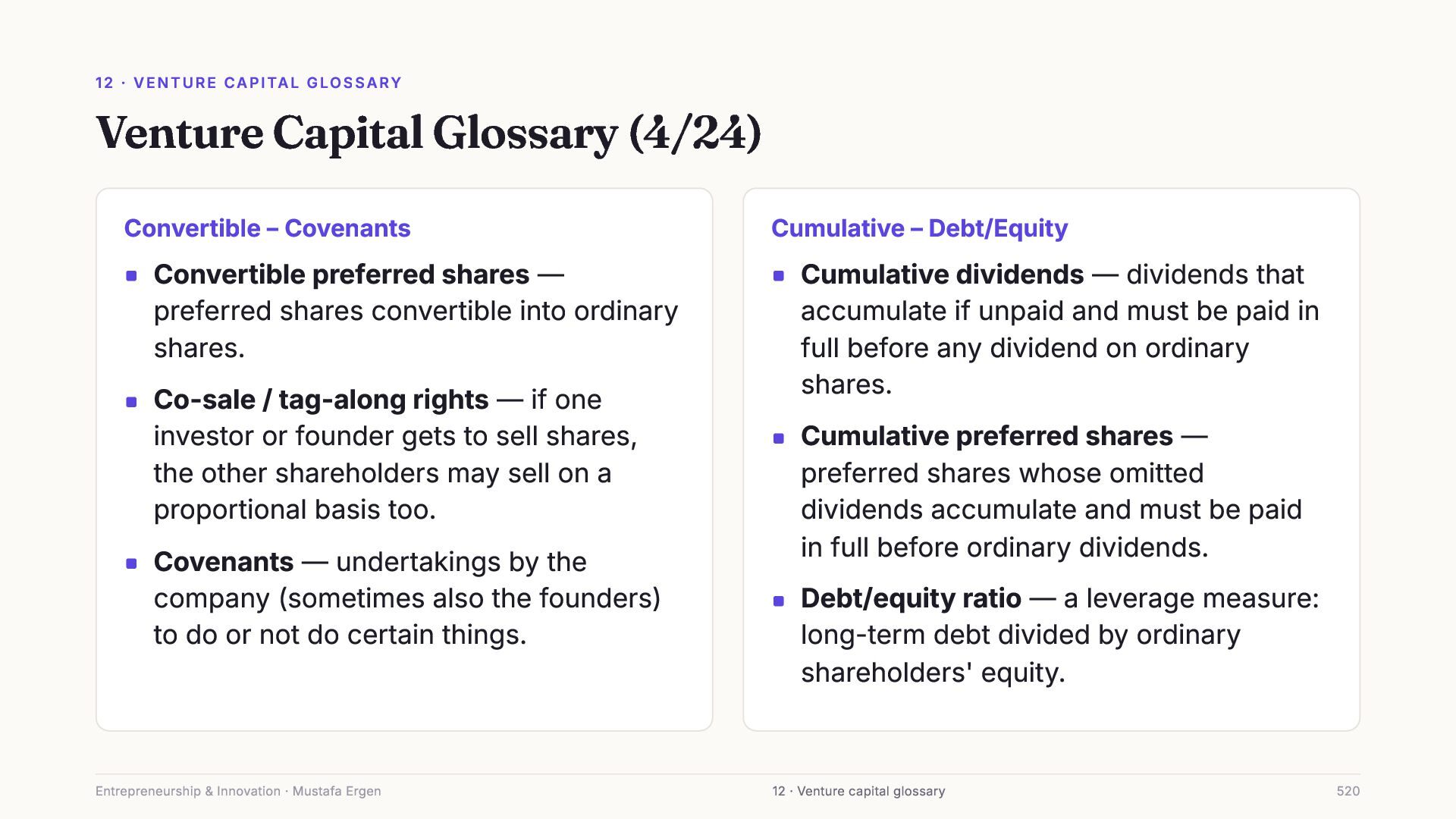
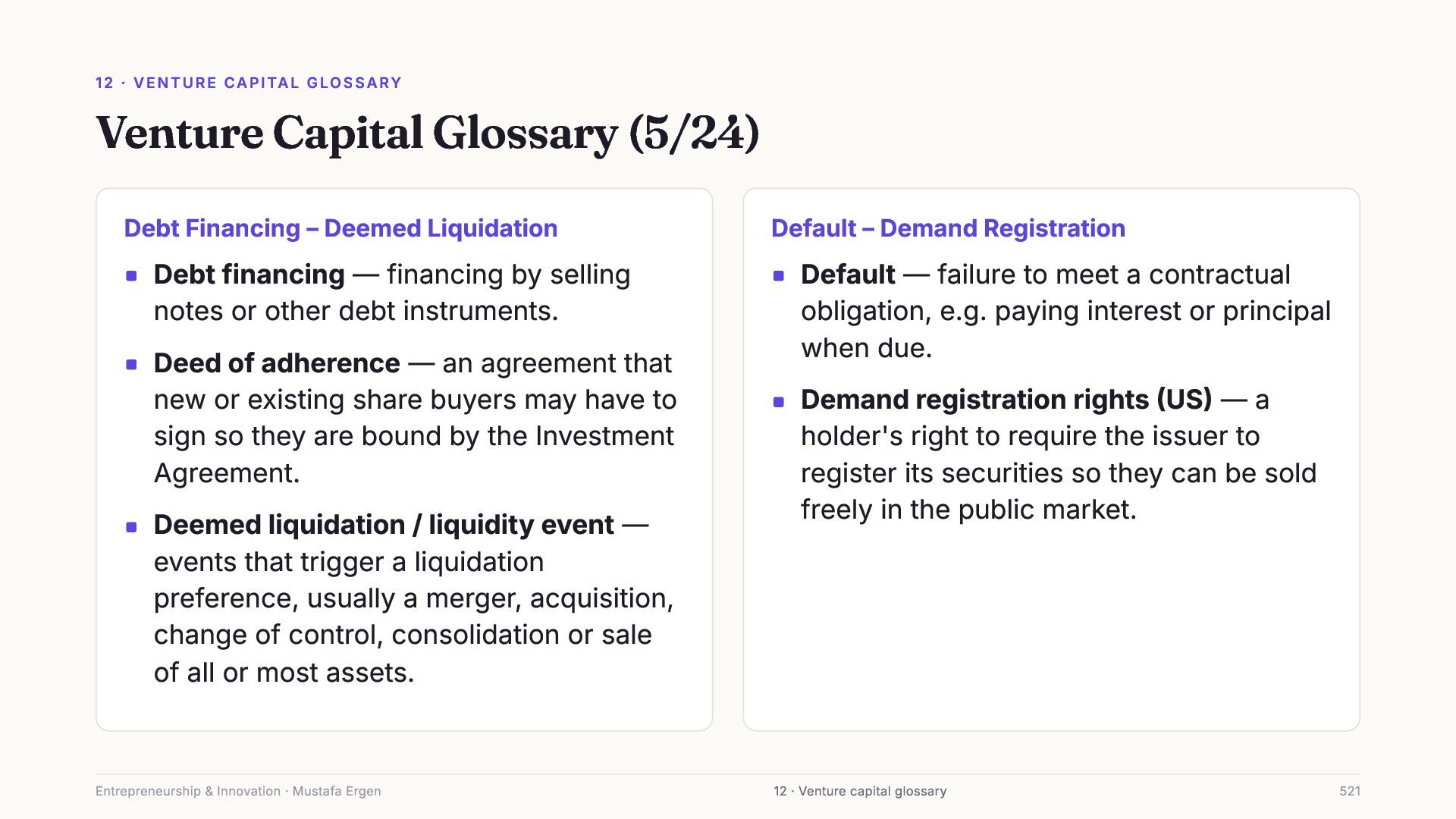
Share
Embed
Introduction to Entrepreneurship and Innovation — 2026 Revised Edition
A comprehensive 829-page collection of lecture notes by Prof. Dr. Mustafa Ergen on high-tech entrepreneurship and innovation. Revised in 2026 from the original 2011 material, it covers Silicon Valley’s history, startup strategy, venture capital, fundraising, financials, recruitment, term sheets, board governance, entrepreneurial mindset, and emerging venture trends.

Altan Atabarut
October 29, 2026
Transcript
829 slides
-
Mustafa Ergen Introduction to Entrepreneurship and Innovation Lecture notes on
high-tech entrepreneurship · revised 2026 edition of the 2011 original, slide for slide Prof. Dr. Mustafa Ergen mustafaergen.com -
Entrepreneurship and Innovation About: a comprehensive guide to high-tech entrepreneurship
and innovation. These notes cover the foundation, priorities, financing, recruitment, venture capital, business development, board governance, and trends and statistics of a startup. They also cover entrepreneurial attributes: leadership, commitment, determination, perseverance, goal-oriented problem solving, team building and more. The aim: to give the reader the understanding that has worked so well in Silicon Valley for a long time. Entrepreneurship & Innovation · Mustafa Ergen 2 -
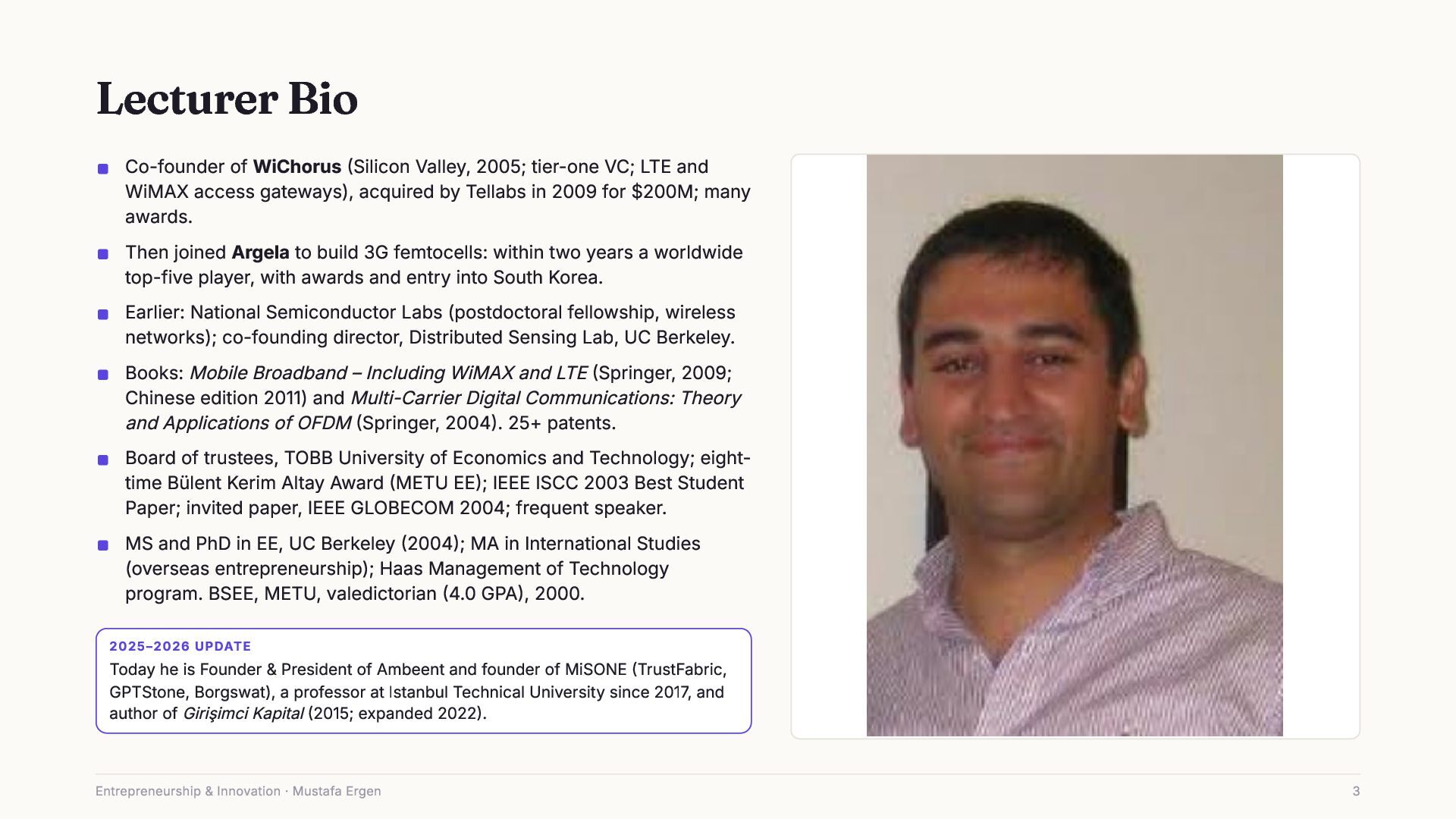
Lecturer Bio Co-founder of WiChorus (Silicon Valley, 2005; tier-one VC;
LTE and WiMAX access gateways), acquired by Tellabs in 2009 for $200M; many awards. Then joined Argela to build 3G femtocells: within two years a worldwide top-five player, with awards and entry into South Korea. Earlier: National Semiconductor Labs (postdoctoral fellowship, wireless networks); co-founding director, Distributed Sensing Lab, UC Berkeley. Books: Mobile Broadband – Including WiMAX and LTE (Springer, 2009; Chinese edition 2011) and Multi-Carrier Digital Communications: Theory and Applications of OFDM (Springer, 2004). 25+ patents. Board of trustees, TOBB University of Economics and Technology; eighttime Bülent Kerim Altay Award (METU EE); IEEE ISCC 2003 Best Student Paper; invited paper, IEEE GLOBECOM 2004; frequent speaker. MS and PhD in EE, UC Berkeley (2004); MA in International Studies (overseas entrepreneurship); Haas Management of Technology program. BSEE, METU, valedictorian (4.0 GPA), 2000. 2025–2026 UPDATE Today he is Founder & President of Ambeent and founder of MiSONE (TrustFabric, GPTStone, Borgswat), a professor at Istanbul Technical University since 2017, and author of Girişimci Kapital (2015; expanded 2022). Entrepreneurship & Innovation · Mustafa Ergen 3 -
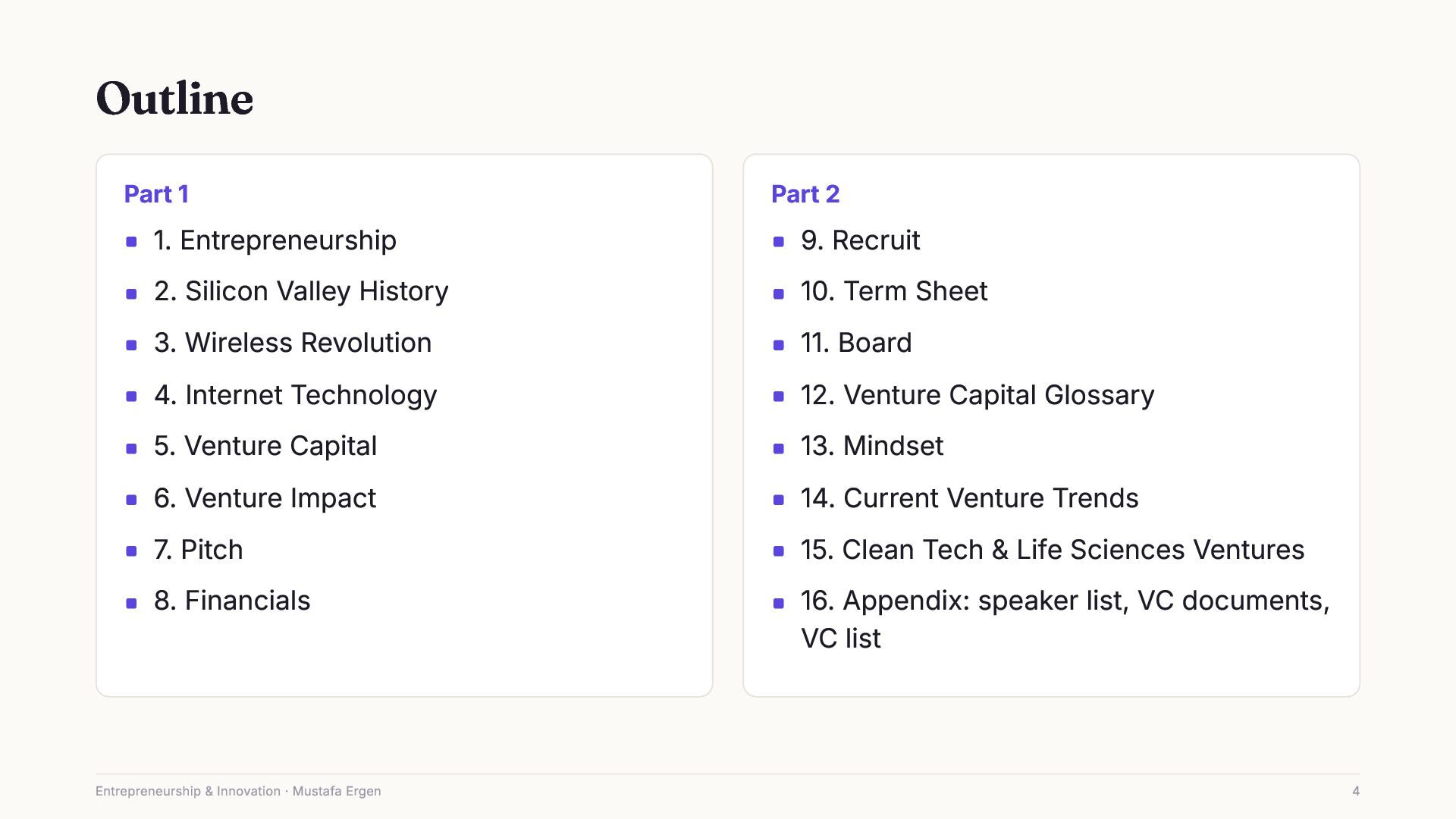
Outline Part 1 1. Entrepreneurship 2. Silicon Valley History 3.
Wireless Revolution 4. Internet Technology 5. Venture Capital 6. Venture Impact 7. Pitch 8. Financials Entrepreneurship & Innovation · Mustafa Ergen Part 2 9. Recruit 10. Term Sheet 11. Board 12. Venture Capital Glossary 13. Mindset 14. Current Venture Trends 15. Clean Tech & Life Sciences Ventures 16. Appendix: speaker list, VC documents, VC list 4 -
01 Introduction to Entrepreneurship and Innovation What an entrepreneur is,
how the idea evolved, and what it takes to start, run and grow a venture. Entrepreneurship & Innovation · Mustafa Ergen 01 · Introduction to Entrepreneurship and Innovation 5 -
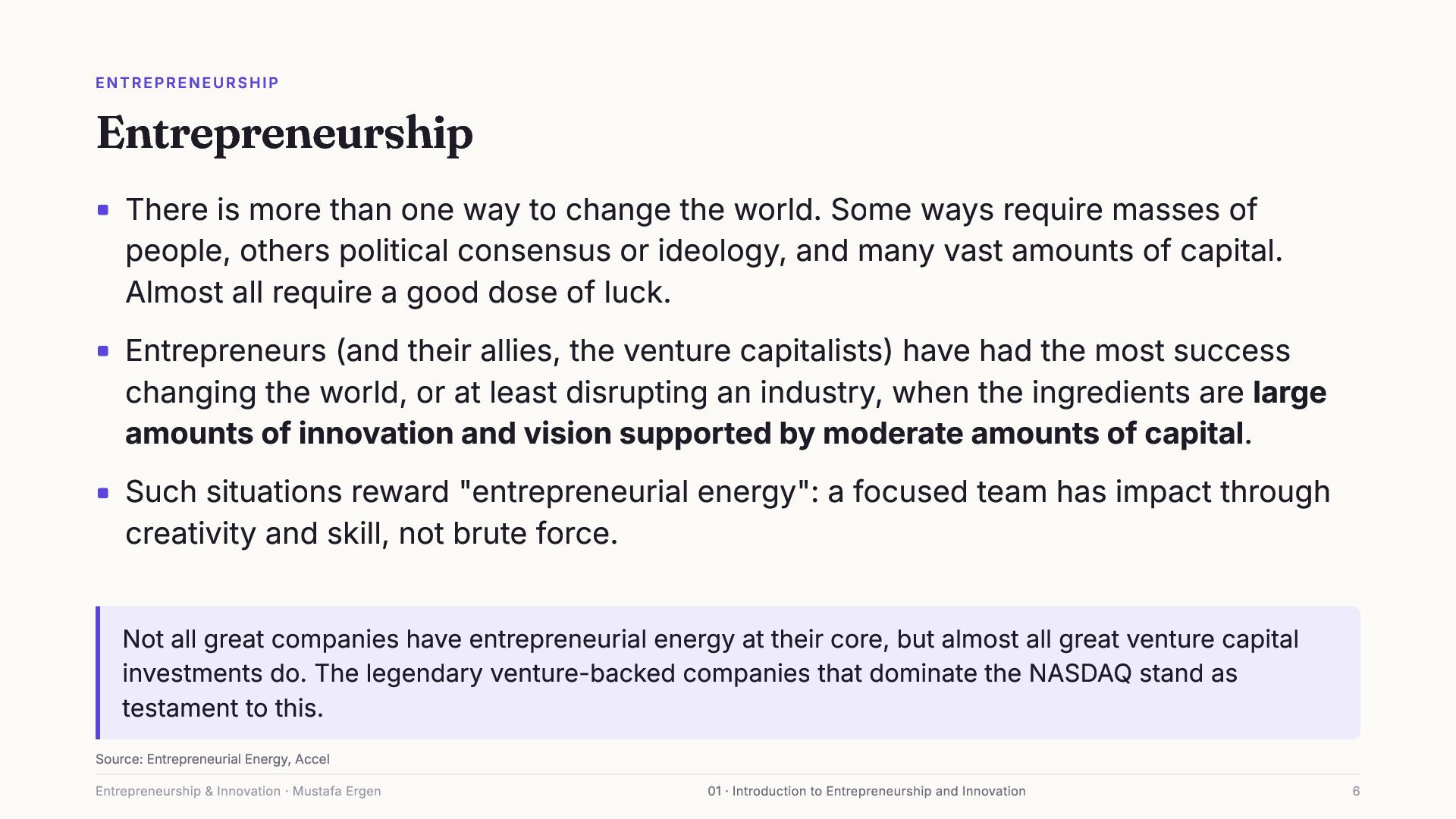
ENTREPRENEURSHIP Entrepreneurship There is more than one way to change
the world. Some ways require masses of people, others political consensus or ideology, and many vast amounts of capital. Almost all require a good dose of luck. Entrepreneurs (and their allies, the venture capitalists) have had the most success changing the world, or at least disrupting an industry, when the ingredients are large amounts of innovation and vision supported by moderate amounts of capital. Such situations reward "entrepreneurial energy": a focused team has impact through creativity and skill, not brute force. Not all great companies have entrepreneurial energy at their core, but almost all great venture capital investments do. The legendary venture-backed companies that dominate the NASDAQ stand as testament to this. Source: Entrepreneurial Energy, Accel Entrepreneurship & Innovation · Mustafa Ergen 01 · Introduction to Entrepreneurship and Innovation 6 -
ENTREPRENEURSHIP Entrepreneur An entrepreneur is a person who has possession
of a new enterprise, venture or idea and is accountable for the inherent risks and the outcome. Entrepreneurship & Innovation · Mustafa Ergen 01 · Introduction to Entrepreneurship and Innovation 7 -
ENTREPRENEURSHIP The World of the Entrepreneur A new business is
born every 11 seconds in the United States. A study of influential Americans named the defining issue of the 21st century: entrepreneurship. One in 12 Americans is actively involved in trying to start a new business. Entrepreneurship & Innovation · Mustafa Ergen 01 · Introduction to Entrepreneurship and Innovation 8 -
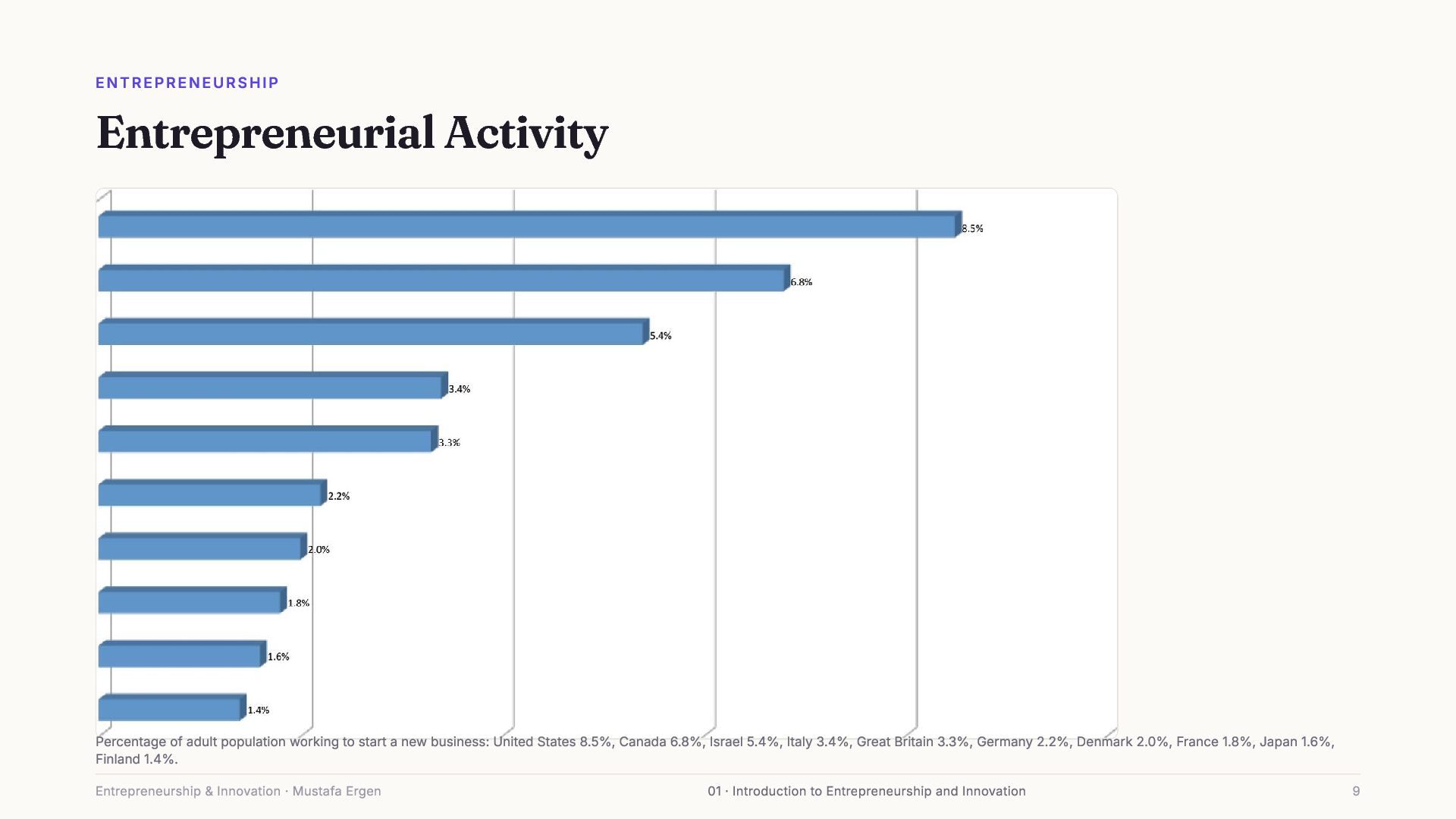
ENTREPRENEURSHIP Entrepreneurial Activity Percentage of adult population working to start
a new business: United States 8.5%, Canada 6.8%, Israel 5.4%, Italy 3.4%, Great Britain 3.3%, Germany 2.2%, Denmark 2.0%, France 1.8%, Japan 1.6%, Finland 1.4%. Entrepreneurship & Innovation · Mustafa Ergen 01 · Introduction to Entrepreneurship and Innovation 9 -
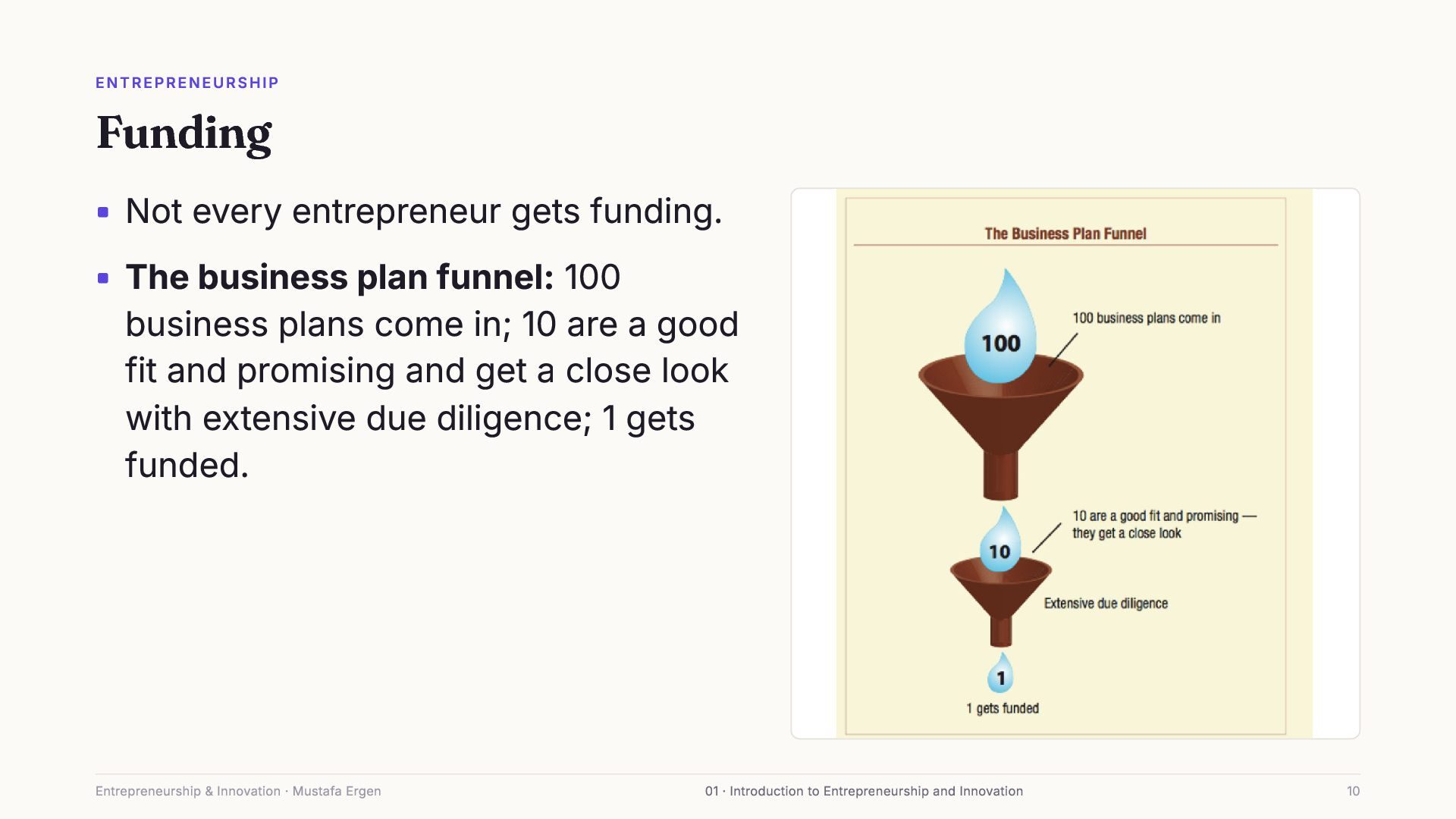
ENTREPRENEURSHIP Funding Not every entrepreneur gets funding. The business plan
funnel: 100 business plans come in; 10 are a good fit and promising and get a close look with extensive due diligence; 1 gets funded. Entrepreneurship & Innovation · Mustafa Ergen 01 · Introduction to Entrepreneurship and Innovation 10 -
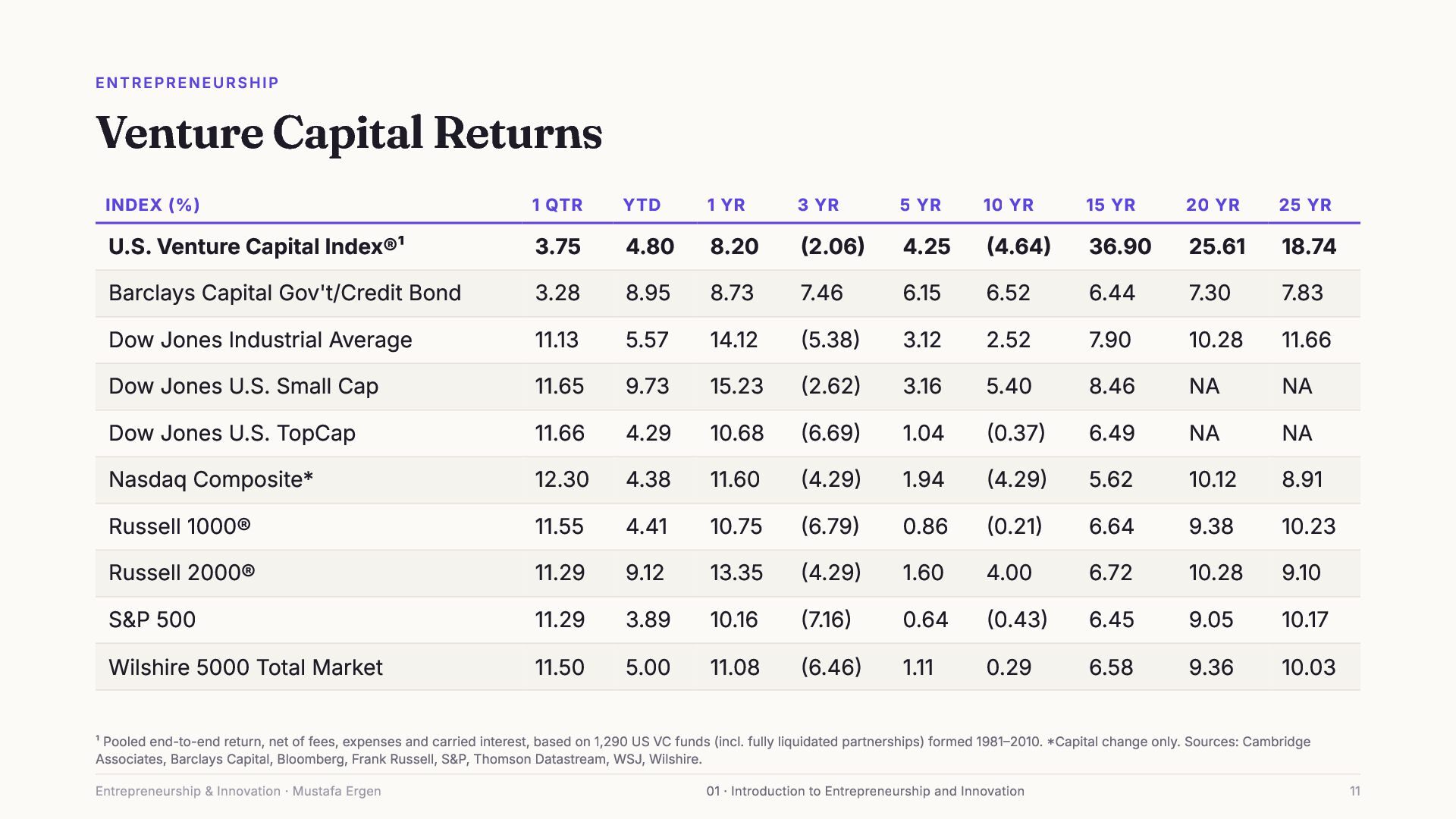
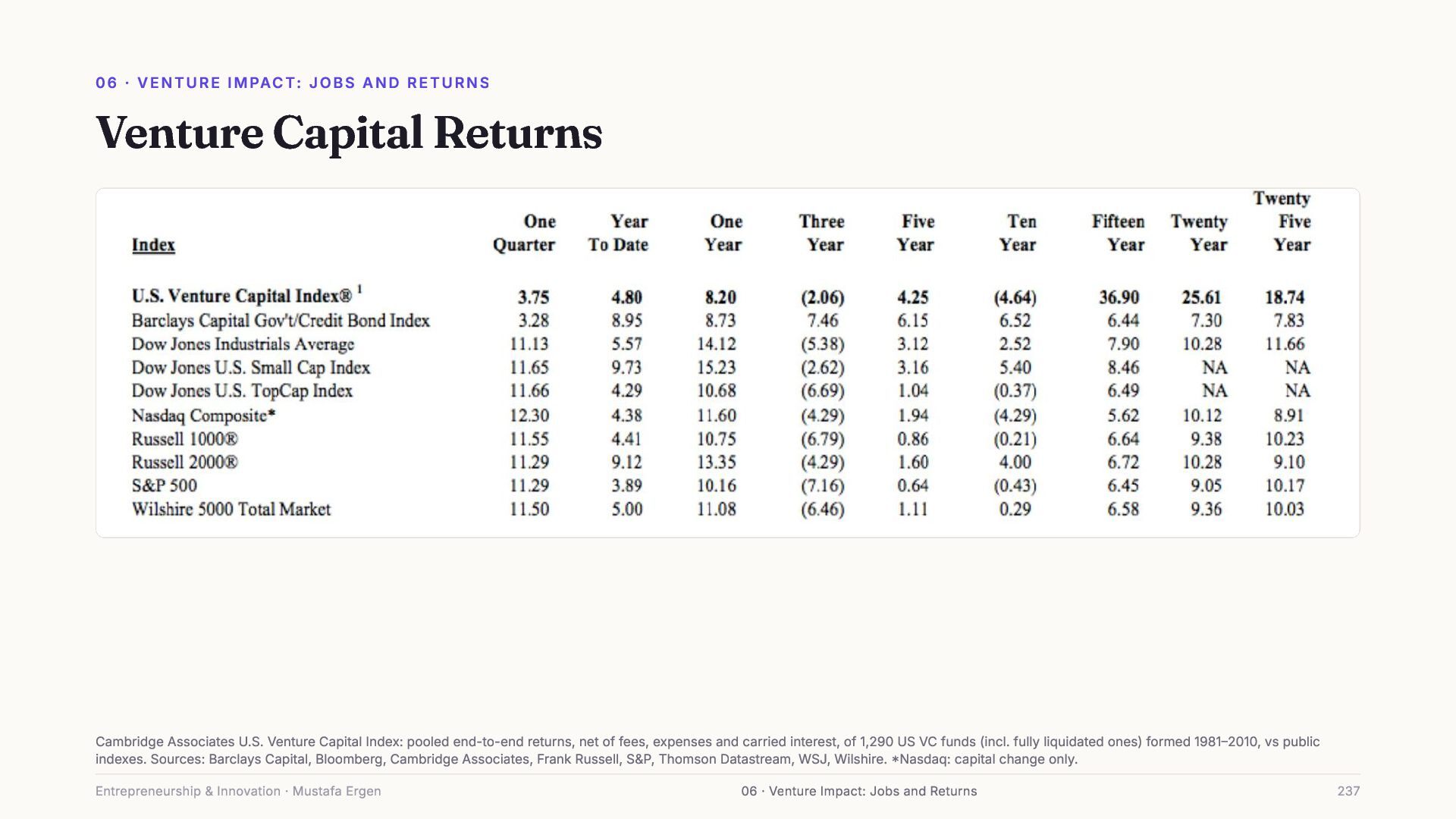
ENTREPRENEURSHIP Venture Capital Returns INDEX (%) 1 QTR YTD 1
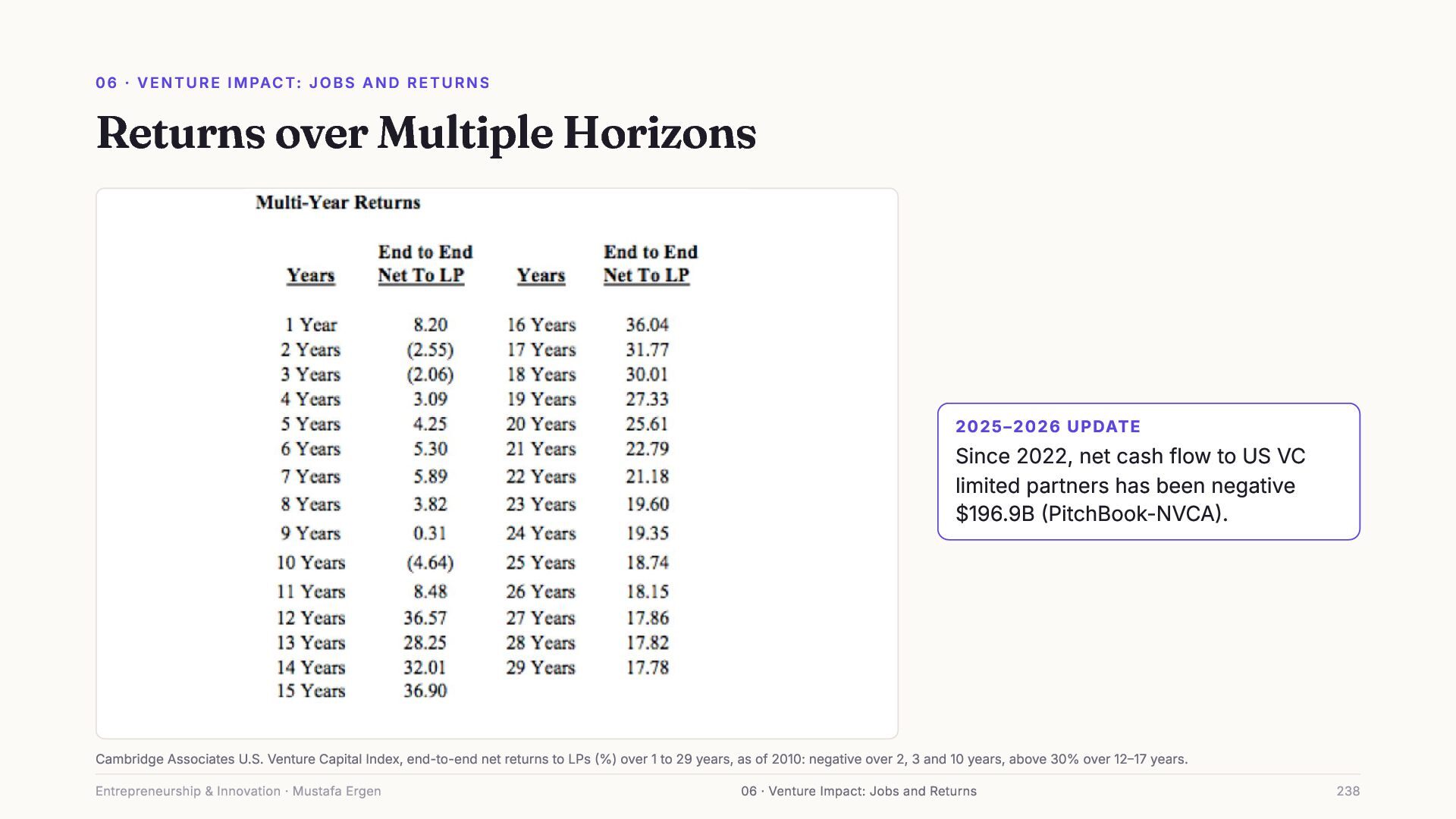
YR 3 YR 5 YR 10 YR 15 YR 20 YR 25 YR U.S. Venture Capital Index®¹ 3.75 4.80 8.20 (2.06) 4.25 (4.64) 36.90 25.61 18.74 Barclays Capital Gov't/Credit Bond 3.28 8.95 8.73 7.46 6.15 6.52 6.44 7.30 7.83 Dow Jones Industrial Average 11.13 5.57 14.12 (5.38) 3.12 2.52 7.90 10.28 11.66 Dow Jones U.S. Small Cap 11.65 9.73 15.23 (2.62) 3.16 5.40 8.46 NA NA Dow Jones U.S. TopCap 11.66 4.29 10.68 (6.69) 1.04 (0.37) 6.49 NA NA Nasdaq Composite* 12.30 4.38 11.60 (4.29) 1.94 (4.29) 5.62 10.12 8.91 Russell 1000® 11.55 4.41 10.75 (6.79) 0.86 (0.21) 6.64 9.38 10.23 Russell 2000® 11.29 9.12 13.35 (4.29) 1.60 4.00 6.72 10.28 9.10 S&P 500 11.29 3.89 10.16 (7.16) 0.64 (0.43) 6.45 9.05 10.17 Wilshire 5000 Total Market 11.50 5.00 11.08 (6.46) 1.11 0.29 6.58 9.36 10.03 ¹ Pooled end-to-end return, net of fees, expenses and carried interest, based on 1,290 US VC funds (incl. fully liquidated partnerships) formed 1981–2010. *Capital change only. Sources: Cambridge Associates, Barclays Capital, Bloomberg, Frank Russell, S&P, Thomson Datastream, WSJ, Wilshire. Entrepreneurship & Innovation · Mustafa Ergen 01 · Introduction to Entrepreneurship and Innovation 11 -
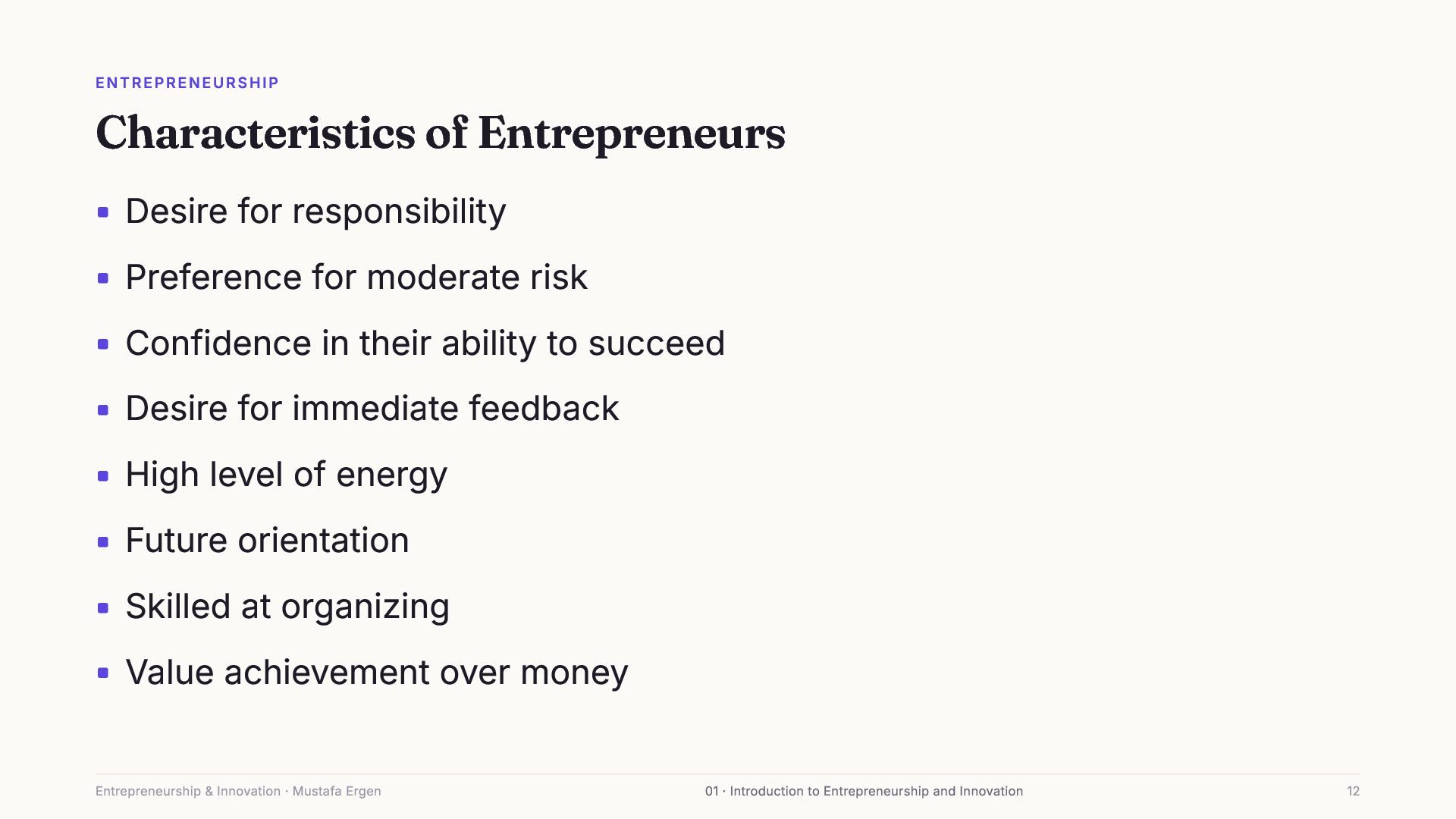
ENTREPRENEURSHIP Characteristics of Entrepreneurs Desire for responsibility Preference for moderate
risk Confidence in their ability to succeed Desire for immediate feedback High level of energy Future orientation Skilled at organizing Value achievement over money Entrepreneurship & Innovation · Mustafa Ergen 01 · Introduction to Entrepreneurship and Innovation 12 -
ENTREPRENEURSHIP Themes At the center: defining entrepreneurship. The themes around
it: The entrepreneur Innovation Organization creation Creating value Profit or nonprofit Growth Uniqueness Process Entrepreneurship & Innovation · Mustafa Ergen 01 · Introduction to Entrepreneurship and Innovation 13 -
ENTREPRENEURSHIP Entrepreneurship Theory: 18th Century Richard Cantillon coins the term
entrepreneur ("go-between" or "betweentaker"). The entrepreneur bears risks and plans, supervises, organizes and owns the factors of production. Entrepreneurship & Innovation · Mustafa Ergen 01 · Introduction to Entrepreneurship and Innovation 14 -
ENTREPRENEURSHIP Entrepreneurship Theory: 19th Century Jean-Baptiste Say proposed that profits
from entrepreneurship were separate from profits of capital ownership. A distinction was made between those who supplied funds and earned interest, and those who profited from managerial abilities. Entrepreneurship & Innovation · Mustafa Ergen 01 · Introduction to Entrepreneurship and Innovation 15 -
ENTREPRENEURSHIP Entrepreneurship Theory: 20th Century Joseph Schumpeter described the entrepreneur
as an innovator, someone who "creatively destructs". Peter Drucker described the entrepreneur as someone who maximizes opportunity. Entrepreneurship & Innovation · Mustafa Ergen 01 · Introduction to Entrepreneurship and Innovation 16 -
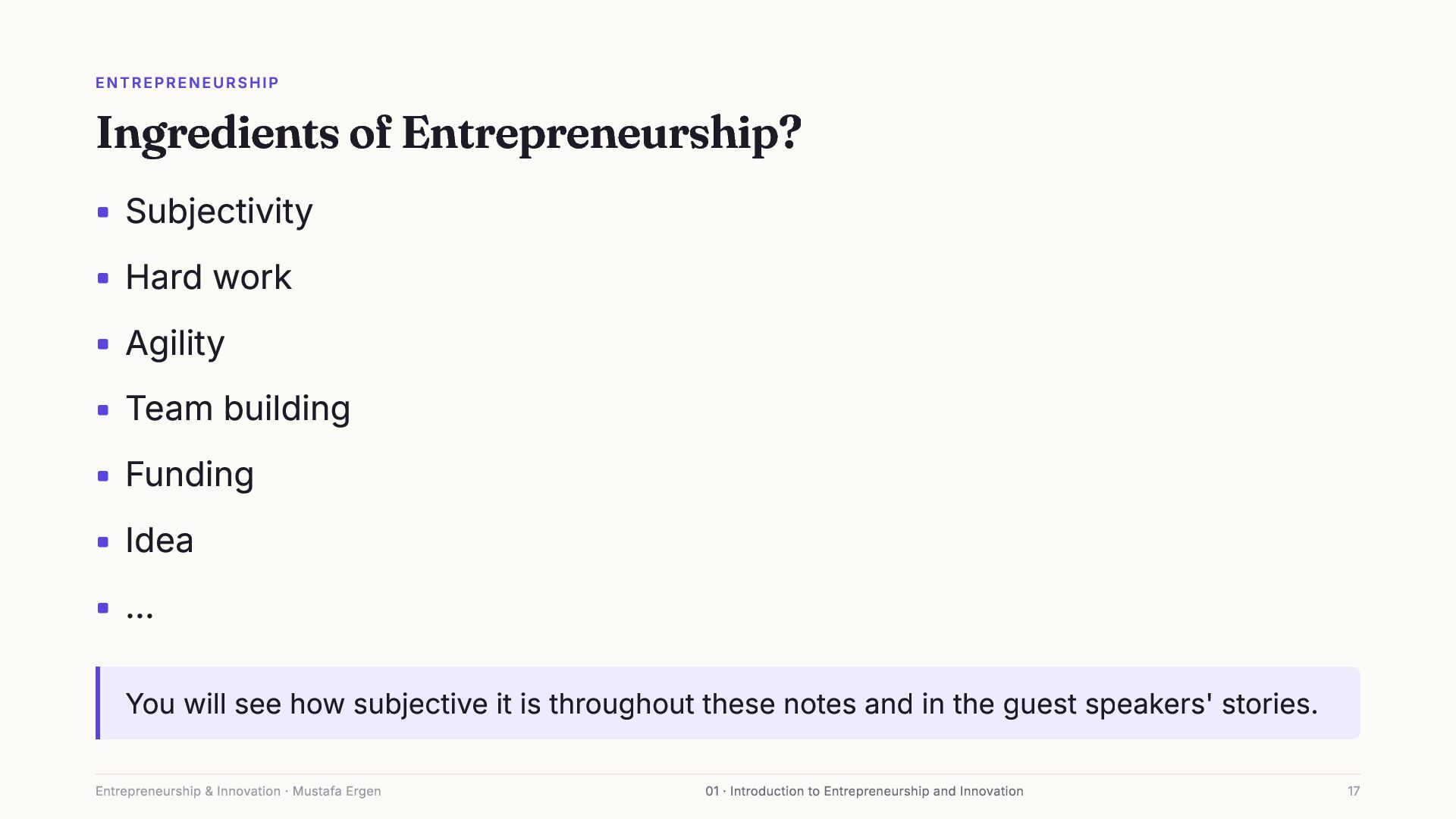
ENTREPRENEURSHIP Ingredients of Entrepreneurship? Subjectivity Hard work Agility Team building
Funding Idea … You will see how subjective it is throughout these notes and in the guest speakers' stories. Entrepreneurship & Innovation · Mustafa Ergen 01 · Introduction to Entrepreneurship and Innovation 17 -
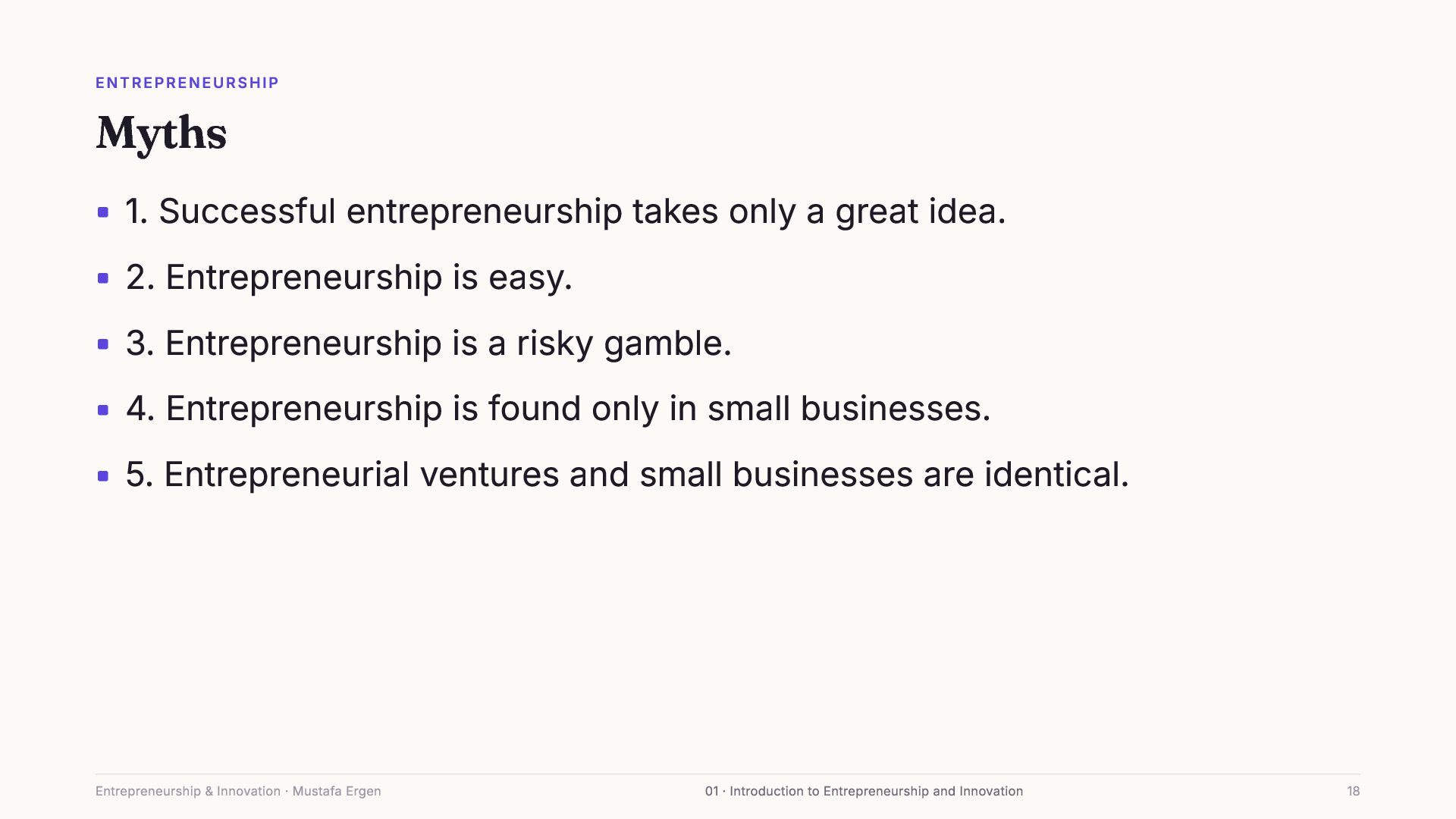
ENTREPRENEURSHIP Myths 1. Successful entrepreneurship takes only a great idea.
2. Entrepreneurship is easy. 3. Entrepreneurship is a risky gamble. 4. Entrepreneurship is found only in small businesses. 5. Entrepreneurial ventures and small businesses are identical. Entrepreneurship & Innovation · Mustafa Ergen 01 · Introduction to Entrepreneurship and Innovation 18 -
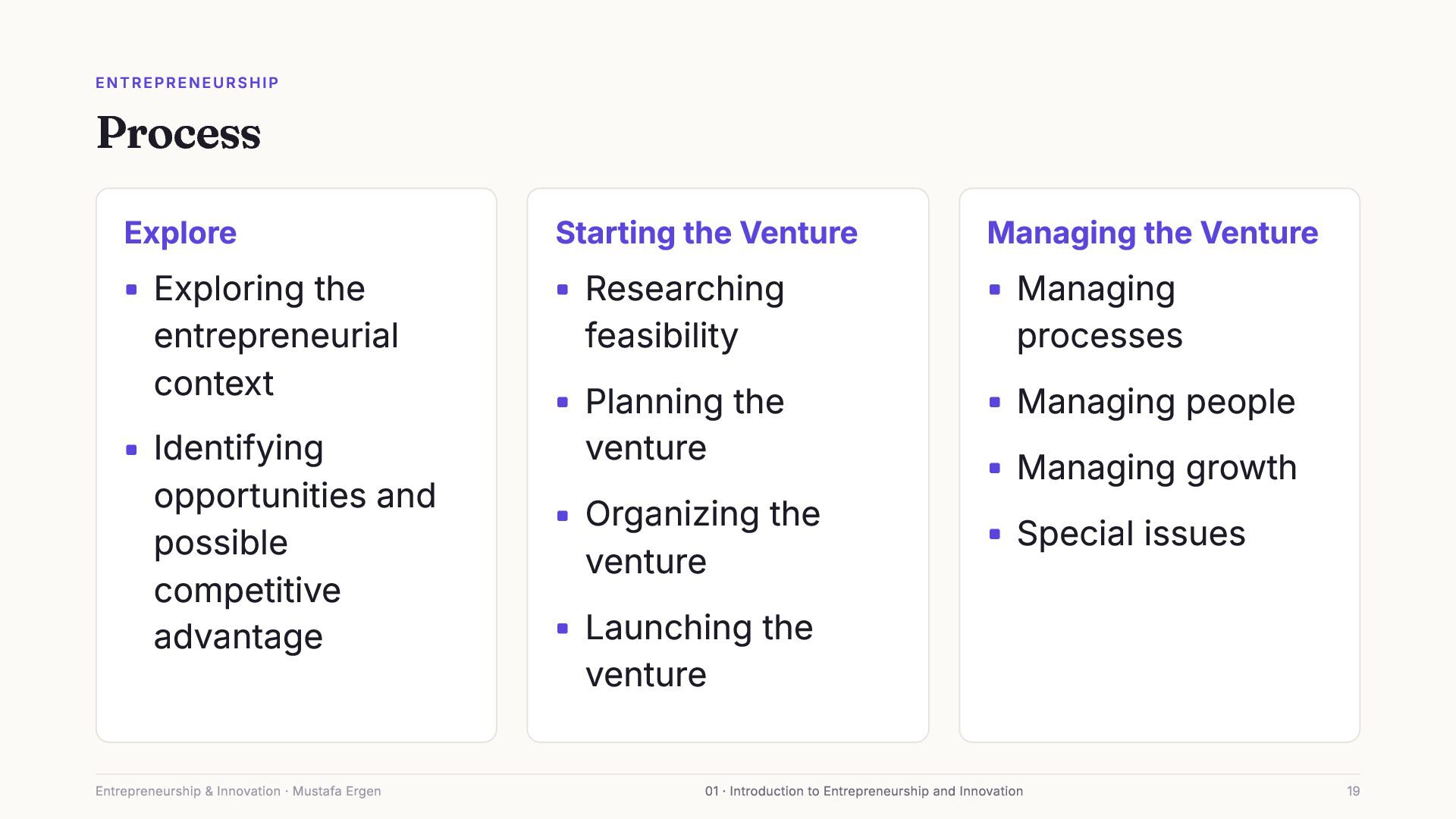
ENTREPRENEURSHIP Process Explore Exploring the entrepreneurial context Identifying opportunities and
possible competitive advantage Entrepreneurship & Innovation · Mustafa Ergen Starting the Venture Managing the Venture Researching feasibility Planning the venture Organizing the venture Launching the venture Managing processes Managing people Managing growth Special issues 01 · Introduction to Entrepreneurship and Innovation 19 -
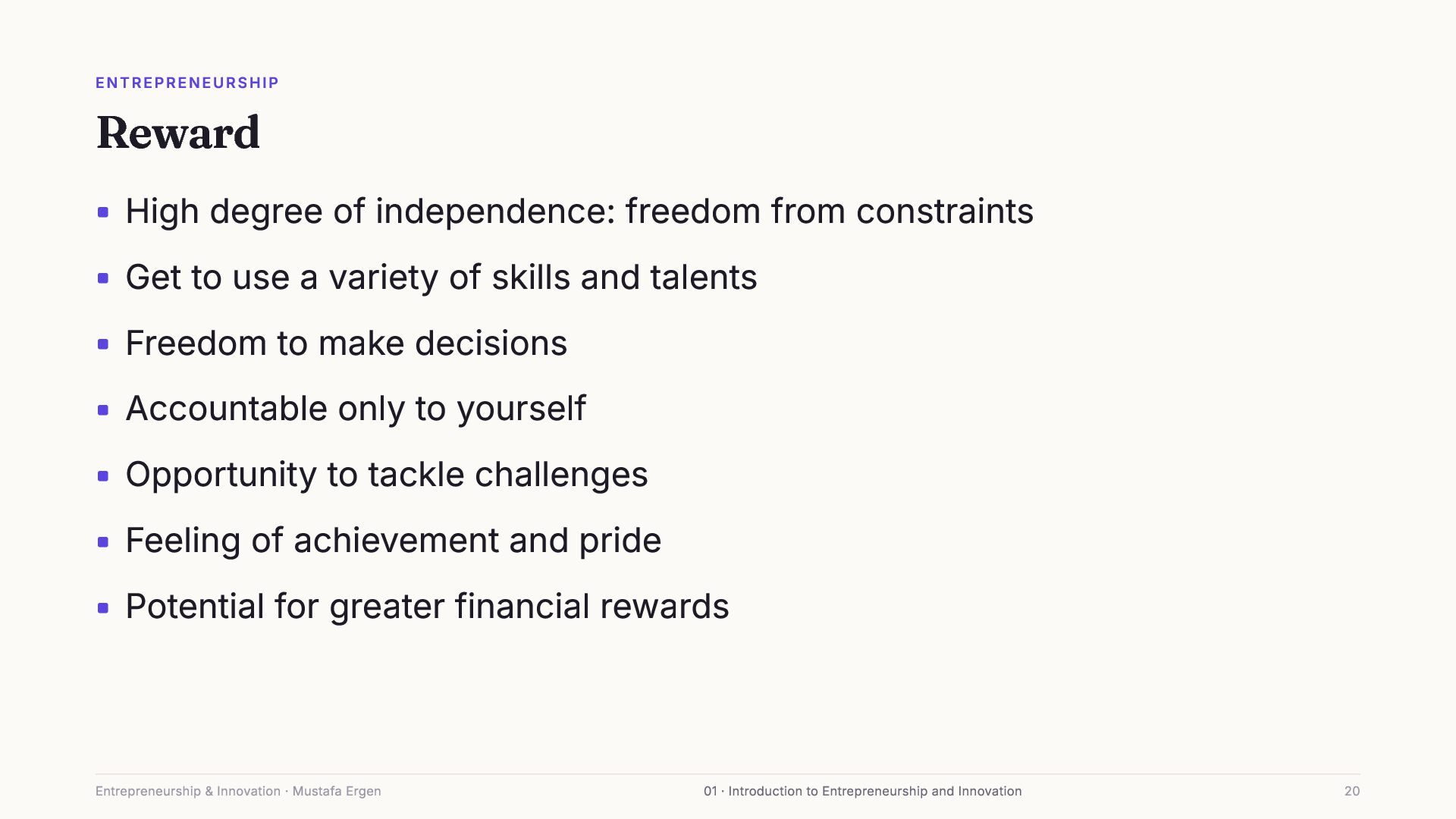
ENTREPRENEURSHIP Reward High degree of independence: freedom from constraints Get
to use a variety of skills and talents Freedom to make decisions Accountable only to yourself Opportunity to tackle challenges Feeling of achievement and pride Potential for greater financial rewards Entrepreneurship & Innovation · Mustafa Ergen 01 · Introduction to Entrepreneurship and Innovation 20 -
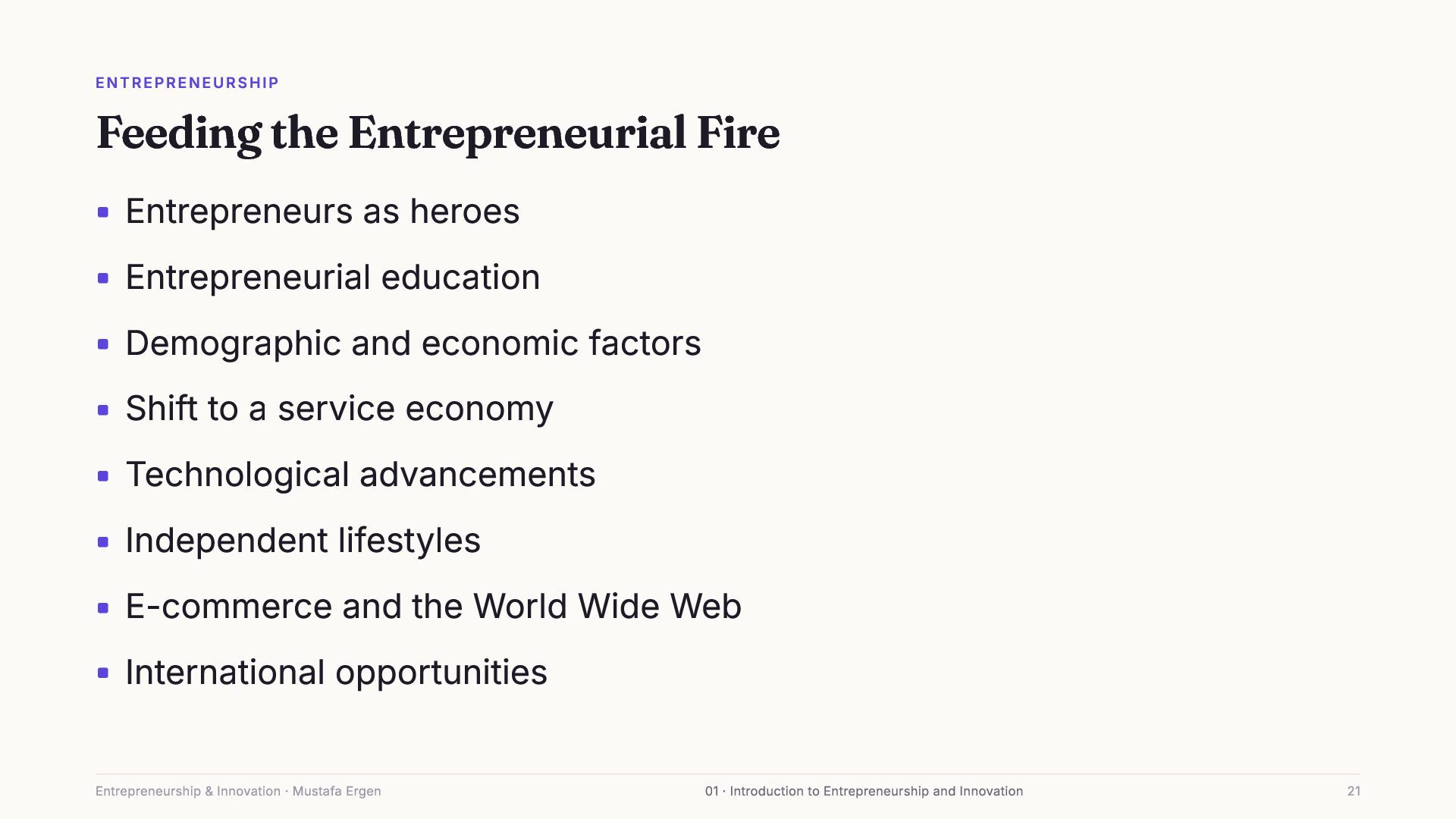
ENTREPRENEURSHIP Feeding the Entrepreneurial Fire Entrepreneurs as heroes Entrepreneurial education
Demographic and economic factors Shift to a service economy Technological advancements Independent lifestyles E-commerce and the World Wide Web International opportunities Entrepreneurship & Innovation · Mustafa Ergen 01 · Introduction to Entrepreneurship and Innovation 21 -
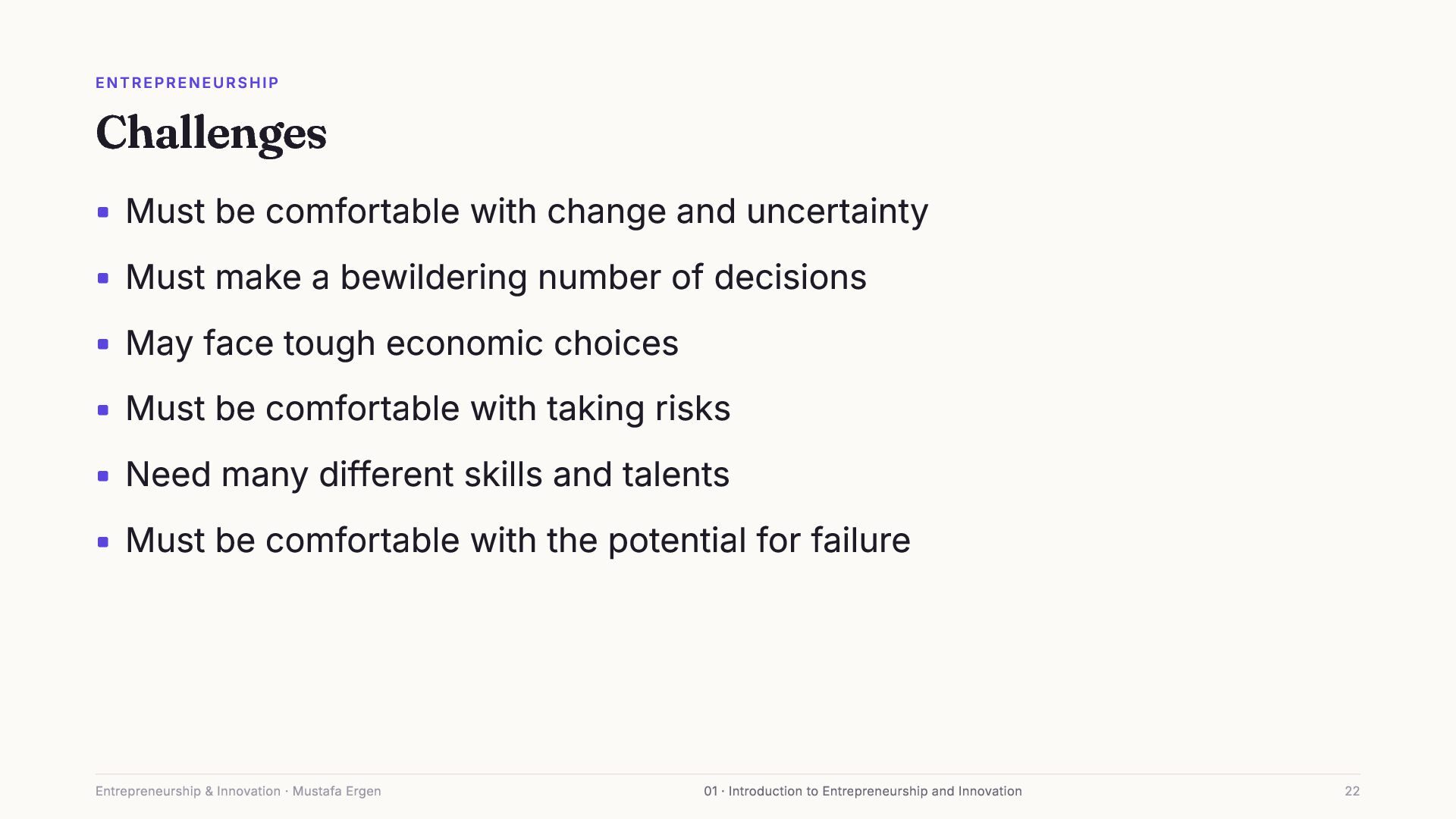
ENTREPRENEURSHIP Challenges Must be comfortable with change and uncertainty Must
make a bewildering number of decisions May face tough economic choices Must be comfortable with taking risks Need many different skills and talents Must be comfortable with the potential for failure Entrepreneurship & Innovation · Mustafa Ergen 01 · Introduction to Entrepreneurship and Innovation 22 -
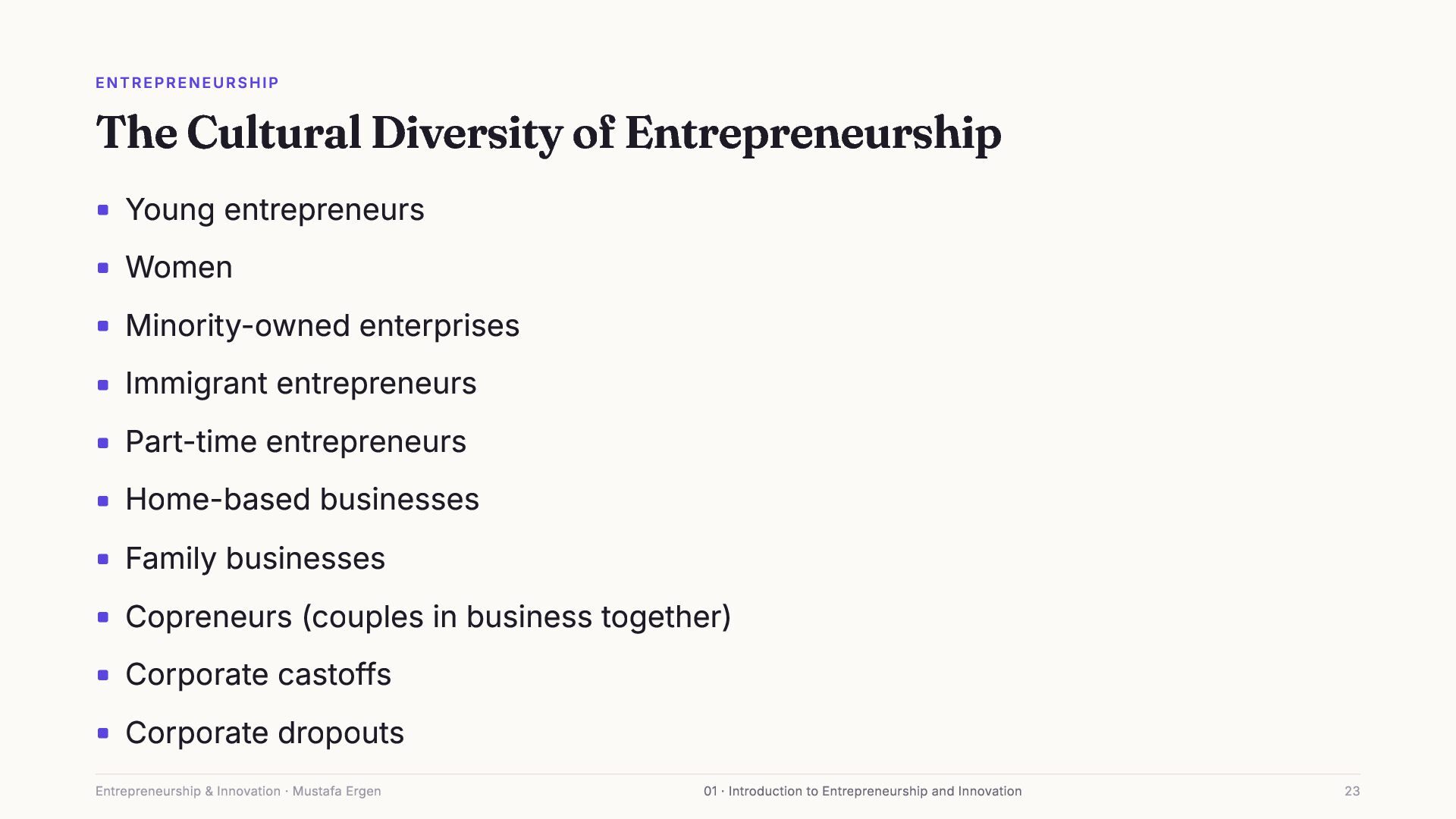
ENTREPRENEURSHIP The Cultural Diversity of Entrepreneurship Young entrepreneurs Women Minority-owned
enterprises Immigrant entrepreneurs Part-time entrepreneurs Home-based businesses Family businesses Copreneurs (couples in business together) Corporate castoffs Corporate dropouts Entrepreneurship & Innovation · Mustafa Ergen 01 · Introduction to Entrepreneurship and Innovation 23 -
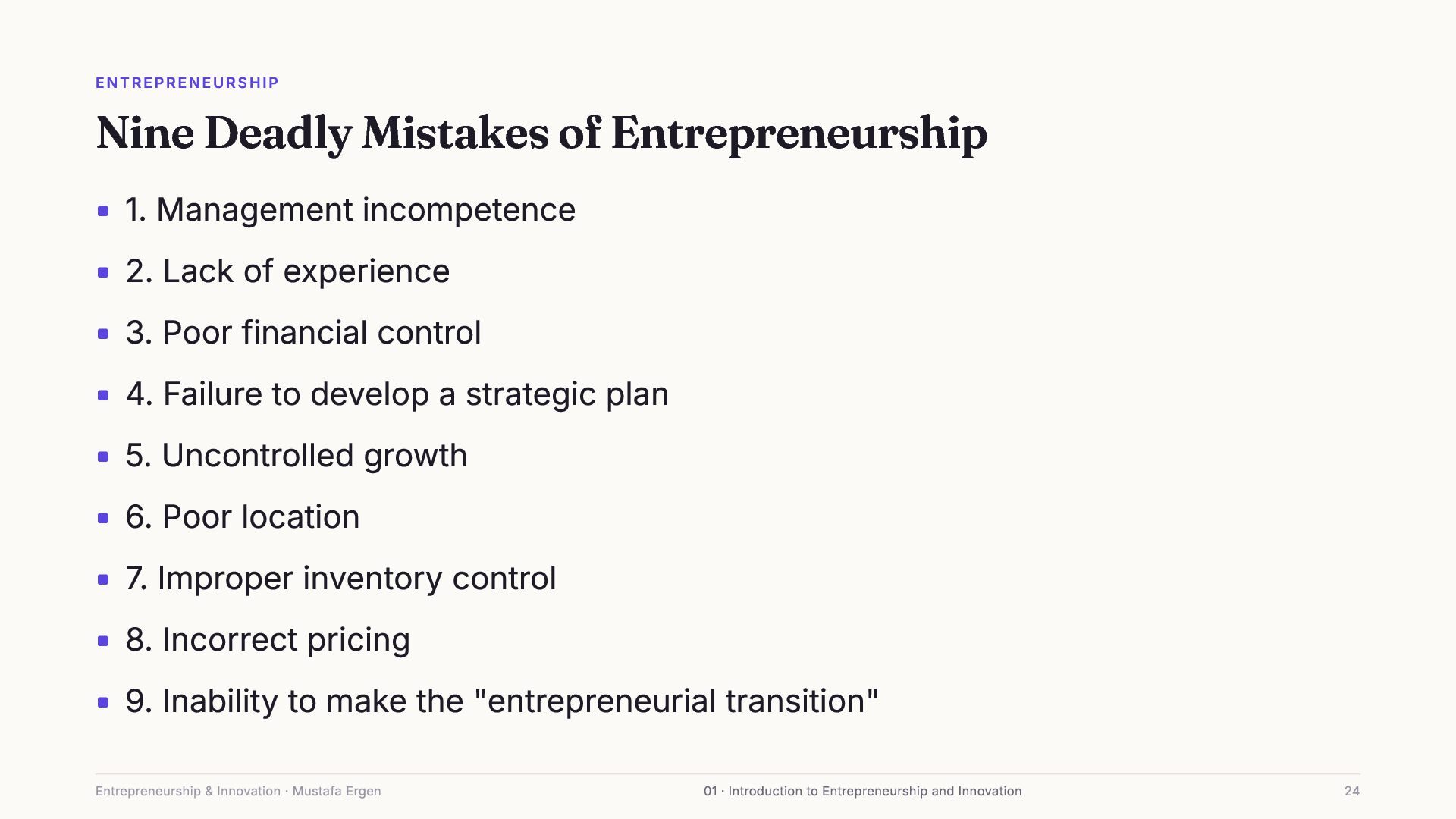
ENTREPRENEURSHIP Nine Deadly Mistakes of Entrepreneurship 1. Management incompetence 2.
Lack of experience 3. Poor financial control 4. Failure to develop a strategic plan 5. Uncontrolled growth 6. Poor location 7. Improper inventory control 8. Incorrect pricing 9. Inability to make the "entrepreneurial transition" Entrepreneurship & Innovation · Mustafa Ergen 01 · Introduction to Entrepreneurship and Innovation 24 -
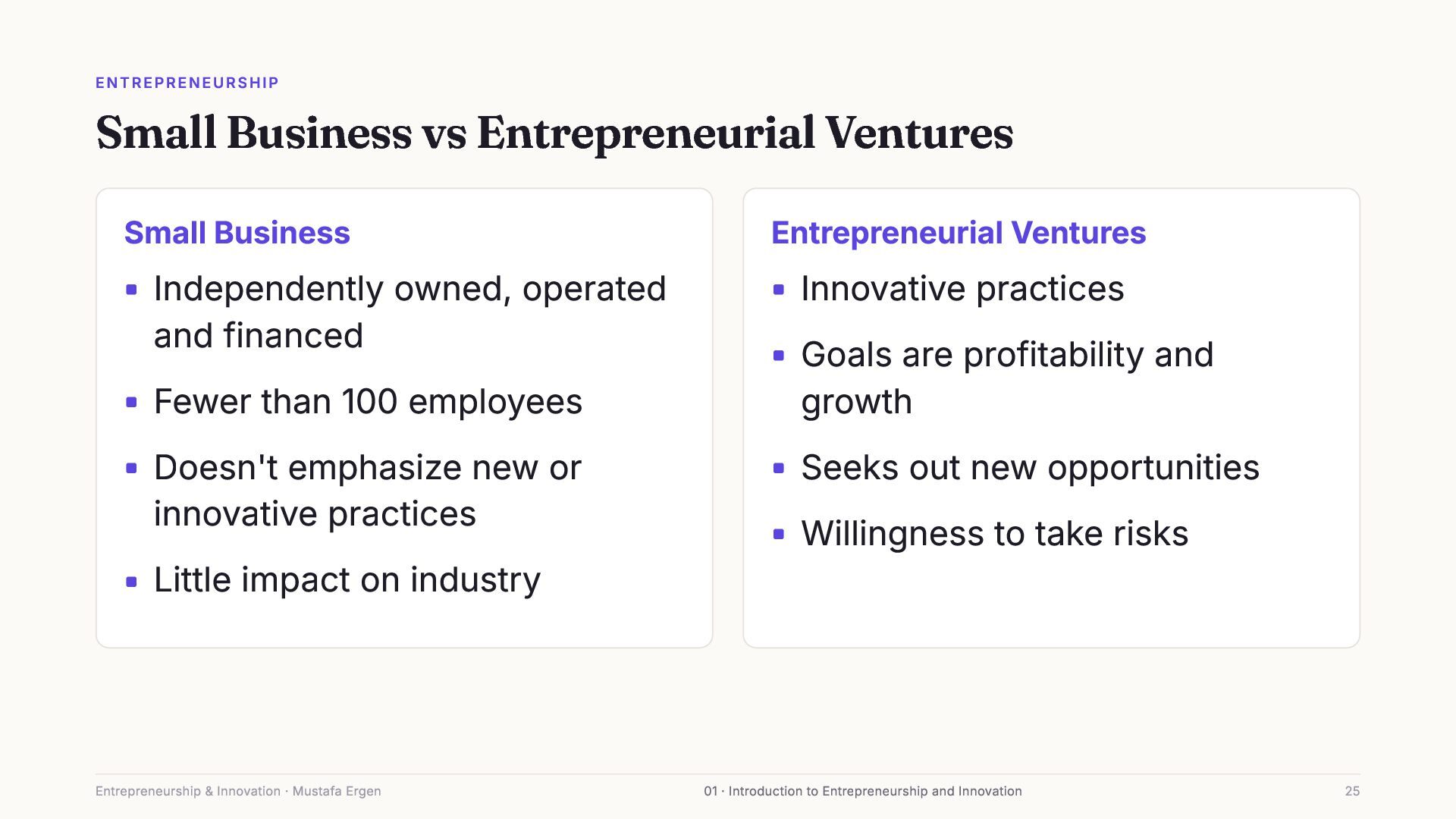
ENTREPRENEURSHIP Small Business vs Entrepreneurial Ventures Small Business Independently owned,
operated and financed Fewer than 100 employees Doesn't emphasize new or innovative practices Little impact on industry Entrepreneurship & Innovation · Mustafa Ergen Entrepreneurial Ventures Innovative practices Goals are profitability and growth Seeks out new opportunities Willingness to take risks 01 · Introduction to Entrepreneurship and Innovation 25 -
ENTREPRENEURSHIP Benefits of Small Business Ownership The opportunity to: create
your own destiny make a difference reach your full potential reap unlimited profits contribute to society and be recognized for your efforts do what you enjoy and have fun at it Entrepreneurship & Innovation · Mustafa Ergen 01 · Introduction to Entrepreneurship and Innovation 26 -
ENTREPRENEURSHIP Drawbacks of Small Business Ownership Uncertainty of income Risk
of losing your entire investment Long hours and hard work Lower quality of life until the business gets established High levels of stress Complete responsibility Discouragement Entrepreneurship & Innovation · Mustafa Ergen 01 · Introduction to Entrepreneurship and Innovation 27 -
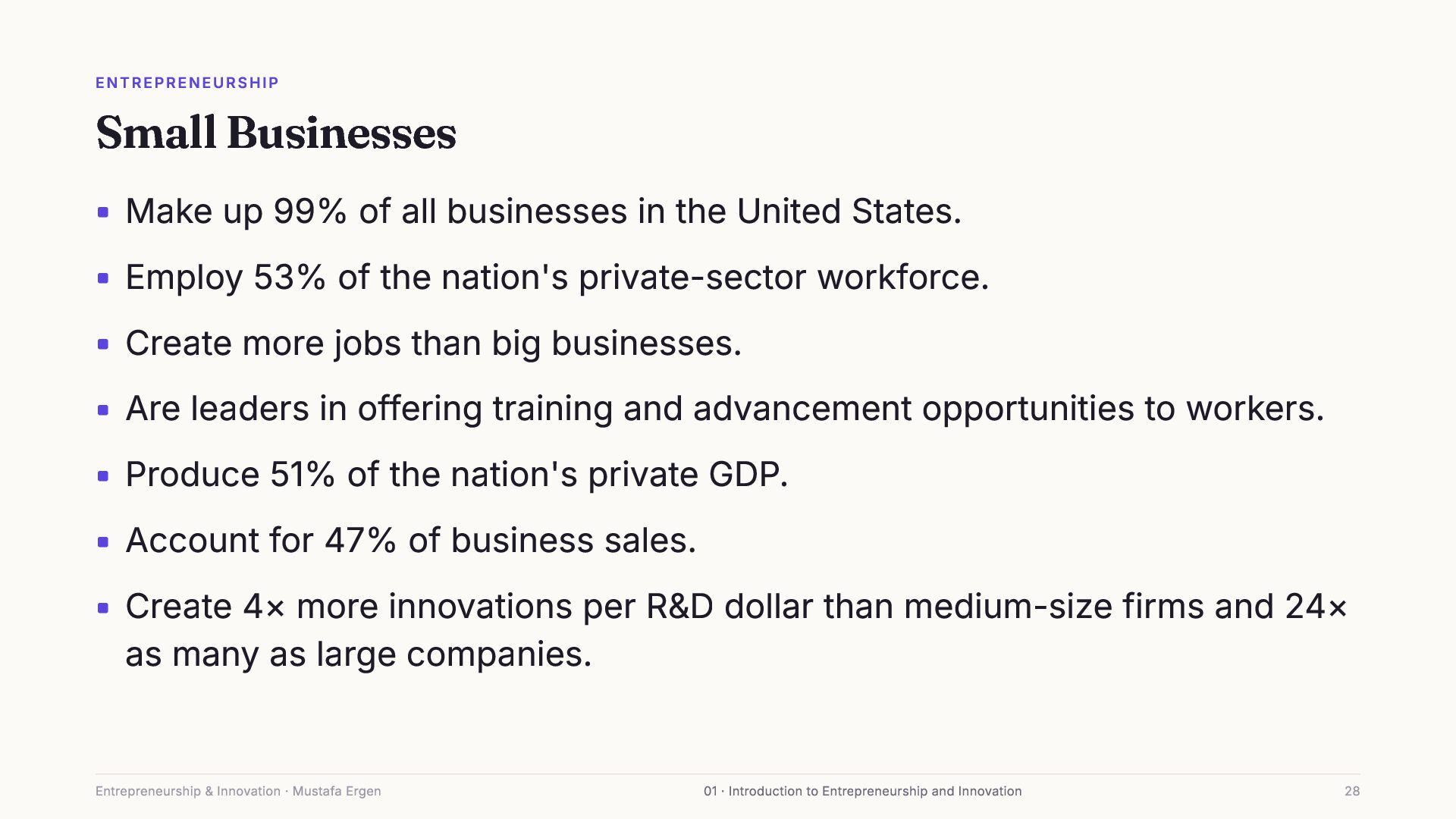
ENTREPRENEURSHIP Small Businesses Make up 99% of all businesses in
the United States. Employ 53% of the nation's private-sector workforce. Create more jobs than big businesses. Are leaders in offering training and advancement opportunities to workers. Produce 51% of the nation's private GDP. Account for 47% of business sales. Create 4× more innovations per R&D dollar than medium-size firms and 24× as many as large companies. Entrepreneurship & Innovation · Mustafa Ergen 01 · Introduction to Entrepreneurship and Innovation 28 -
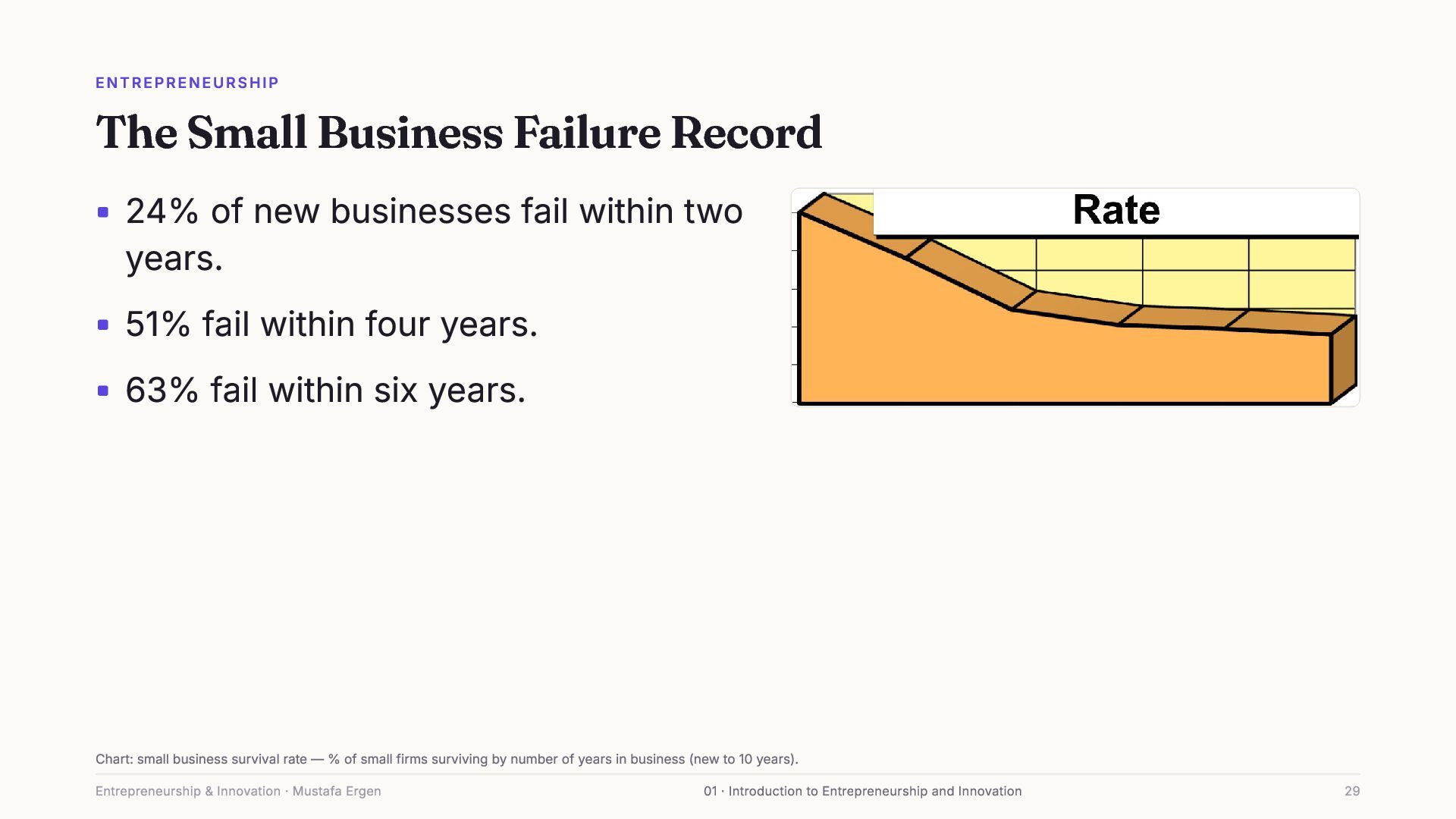
ENTREPRENEURSHIP The Small Business Failure Record 24% of new businesses
fail within two years. 51% fail within four years. 63% fail within six years. Chart: small business survival rate — % of small firms surviving by number of years in business (new to 10 years). Entrepreneurship & Innovation · Mustafa Ergen 01 · Introduction to Entrepreneurship and Innovation 29 -
ENTREPRENEURSHIP Avoiding the Pitfalls of Small Business Failure Know your
business in depth Develop a solid business plan Manage financial resources Understand financial statements Learn to manage people effectively Keep in tune with yourself Entrepreneurship & Innovation · Mustafa Ergen 01 · Introduction to Entrepreneurship and Innovation 30 -
02 Wireless & Internet Revolution How personal technology is changing
the world, and what invention, innovation, venture capital and a local ecosystem each add to a startup. Entrepreneurship & Innovation · Mustafa Ergen 02 · Wireless & Internet Revolution 31 -
W I R E L E S S & I
N T E R N E T R E VO L U T I O N Links for Ideas US Angel Investors Y Combinator Founders Den Dogpatch Labs TechCrunch Etohum NVCA 2025–2026 UPDATE Y Combinator went on to create the SAFE (2013; post-money SAFE 2018, now the US seed standard) and has invested a standard $500K per company since 2022 (YC). Entrepreneurship & Innovation · Mustafa Ergen 02 · Wireless & Internet Revolution 32 -
W I R E L E S S & I
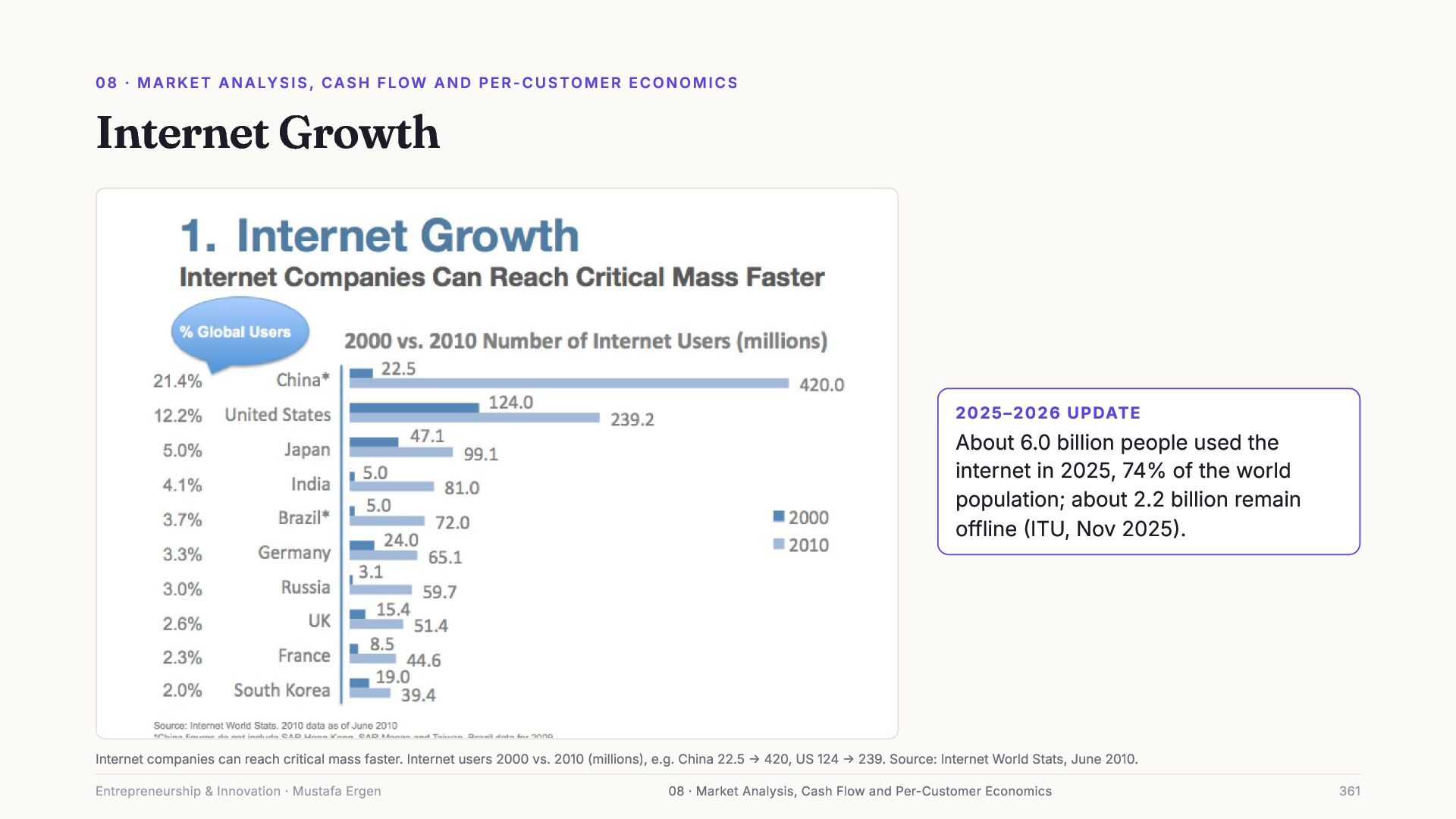
N T E R N E T R E VO L U T I O N Is the Wireless Revolution a New Renaissance? The Renaissance brought religion and free thinking to ordinary people. Electronics is doing the same, personalizing everything for us: – Personal computer – Pocket phone – Handheld devices – Internet: ordinary people access information – Social networking – Etc. 2025–2026 UPDATE About 6.0 billion people (74% of the world) used the internet in 2025, while ~2.2 billion remain offline (ITU); 5G subscriptions reached ~2.9 billion by end-2025 (Ericsson). Entrepreneurship & Innovation · Mustafa Ergen 02 · Wireless & Internet Revolution 33 -
W I R E L E S S & I
N T E R N E T R E VO L U T I O N Success Invention Innovation (invention to market) Planning, execution, perseverance (sustaining innovation) Xerox: invention, no innovation Apple: innovation, no invention Google: – Invention and innovation from a Stanford grad – Execution from a Berkeley grad Entrepreneurship & Innovation · Mustafa Ergen 02 · Wireless & Internet Revolution 34 -
W I R E L E S S & I
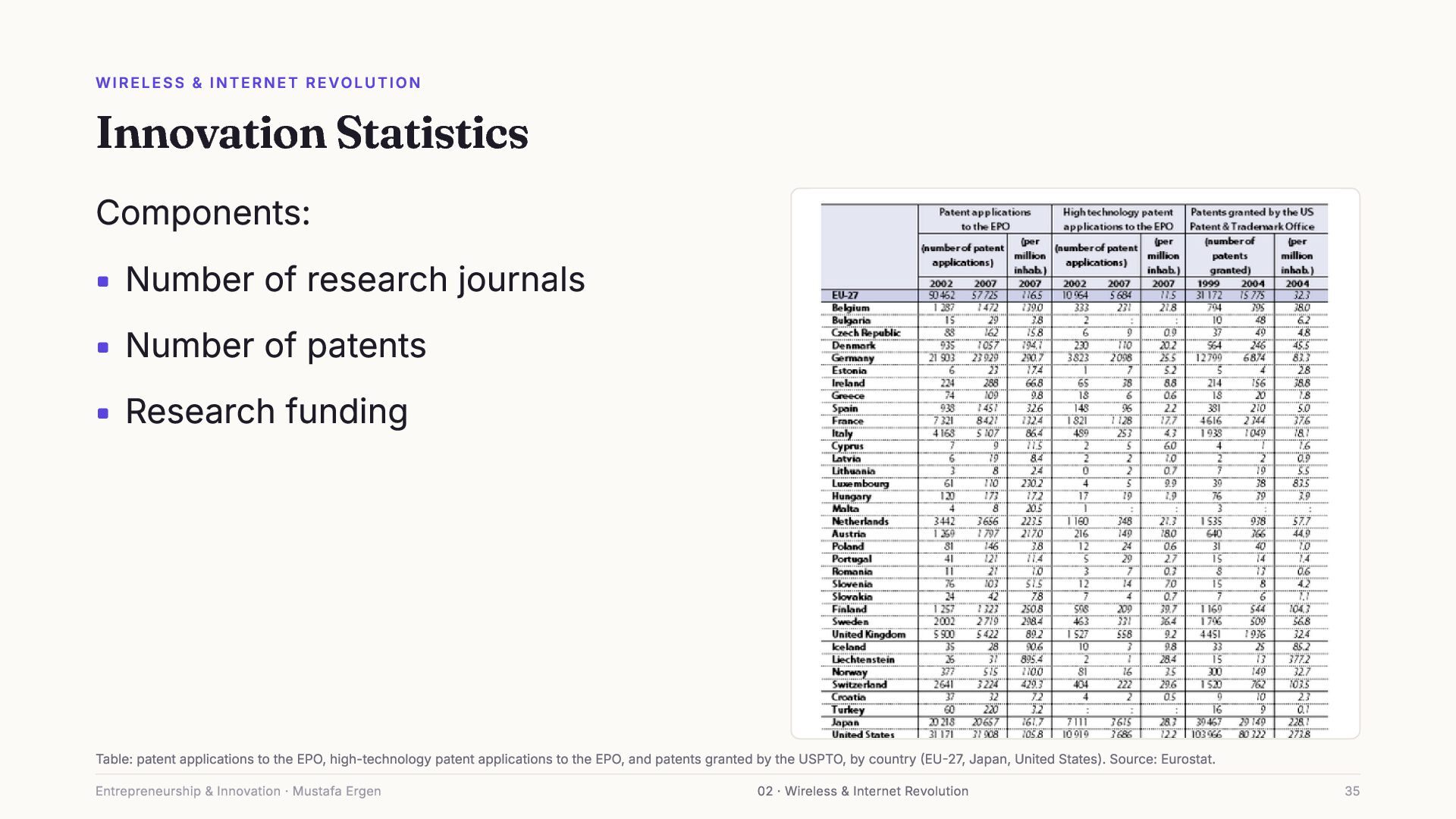
N T E R N E T R E VO L U T I O N Innovation Statistics Components: Number of research journals Number of patents Research funding Table: patent applications to the EPO, high-technology patent applications to the EPO, and patents granted by the USPTO, by country (EU-27, Japan, United States). Source: Eurostat. Entrepreneurship & Innovation · Mustafa Ergen 02 · Wireless & Internet Revolution 35 -
W I R E L E S S & I
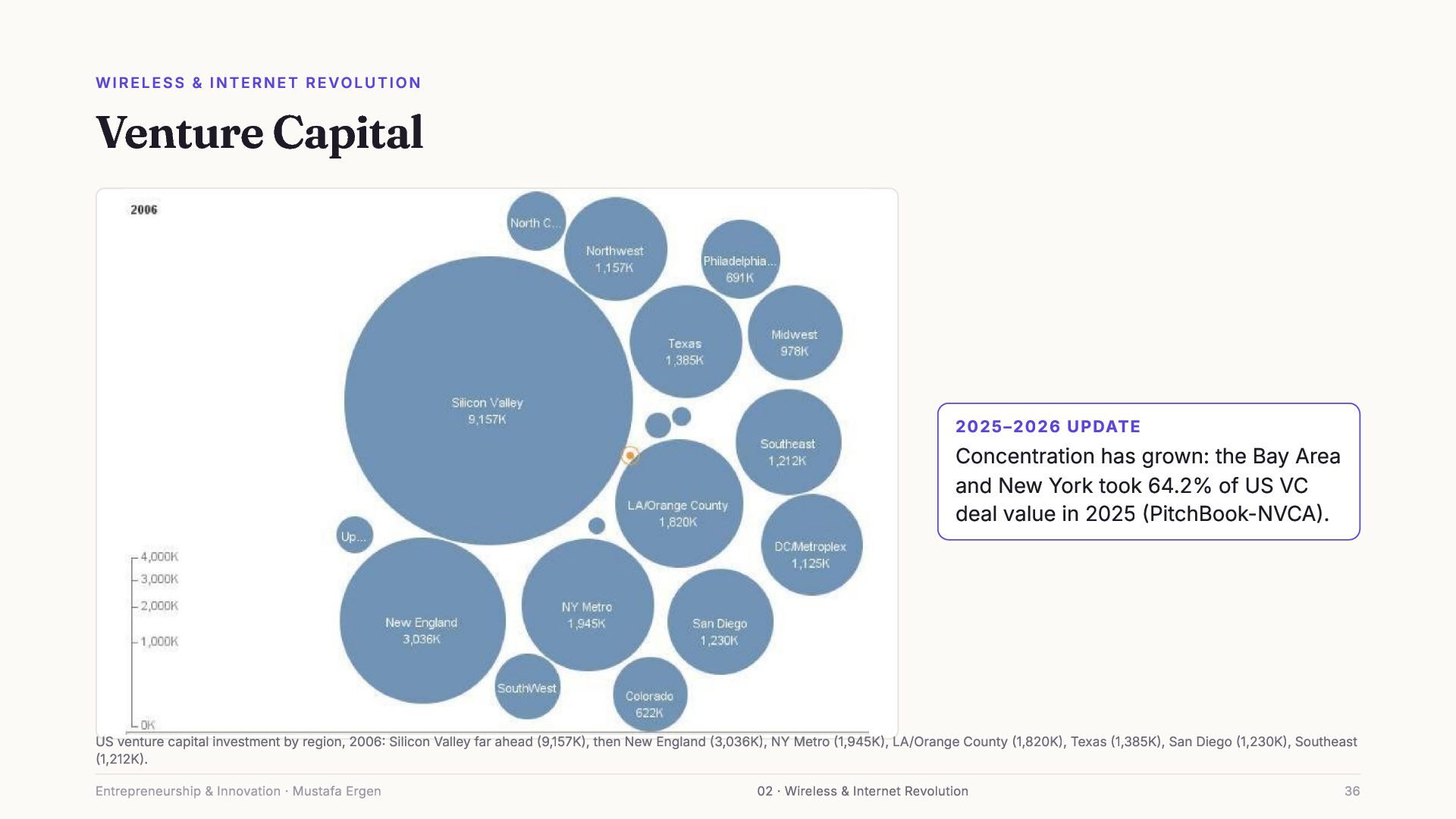
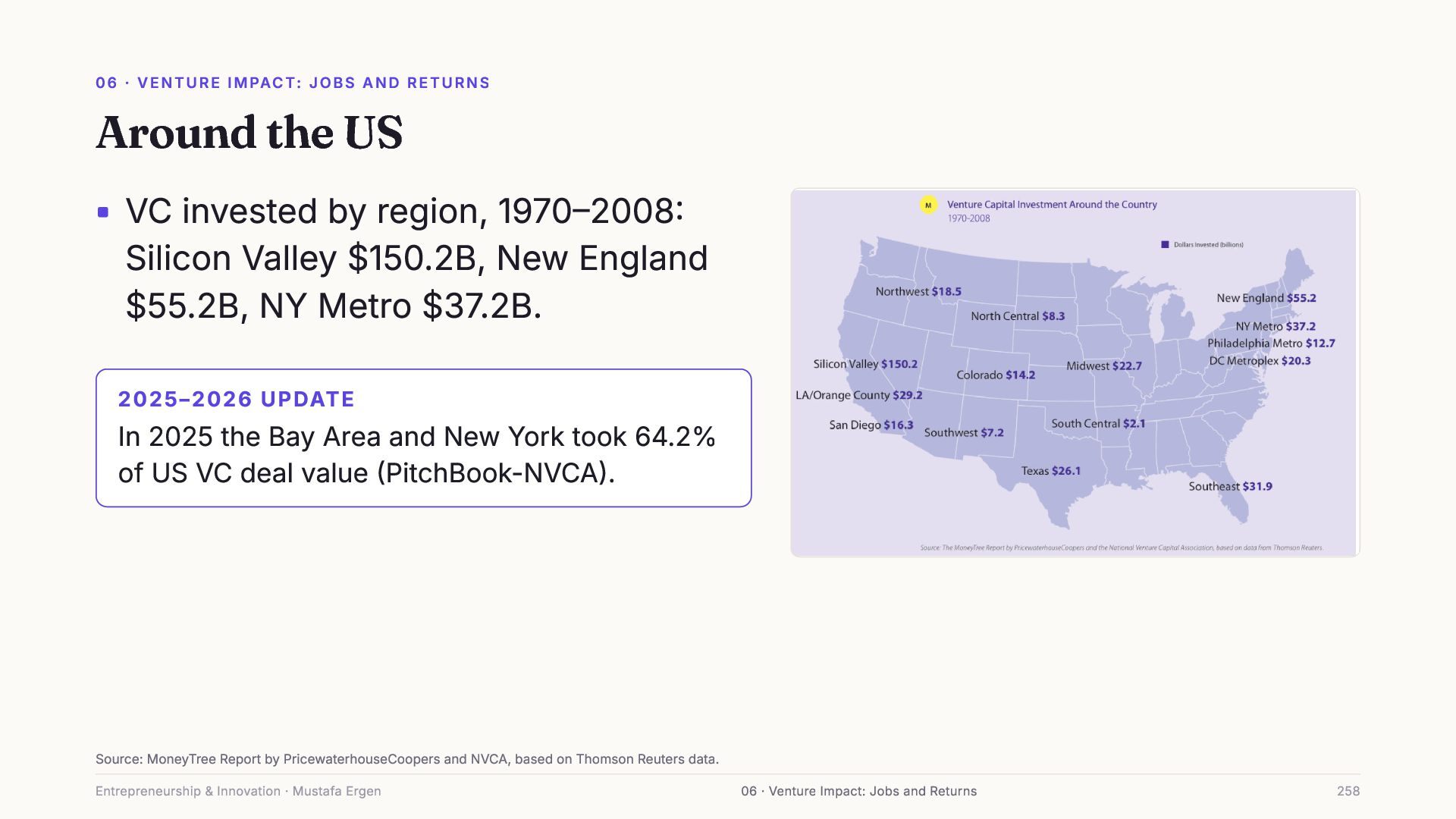
N T E R N E T R E VO L U T I O N Venture Capital 2025–2026 UPDATE Concentration has grown: the Bay Area and New York took 64.2% of US VC deal value in 2025 (PitchBook-NVCA). US venture capital investment by region, 2006: Silicon Valley far ahead (9,157K), then New England (3,036K), NY Metro (1,945K), LA/Orange County (1,820K), Texas (1,385K), San Diego (1,230K), Southeast (1,212K). Entrepreneurship & Innovation · Mustafa Ergen 02 · Wireless & Internet Revolution 36 -
W I R E L E S S & I
N T E R N E T R E VO L U T I O N Silicon Valley: What Do They Have? Venture capital, with an exit strategy Research at local universities: Stanford and Berkeley Research funding "Wild" free thinkers A complex combination of ecosystems Entrepreneurship & Innovation · Mustafa Ergen 02 · Wireless & Internet Revolution 37 -
W I R E L E S S & I
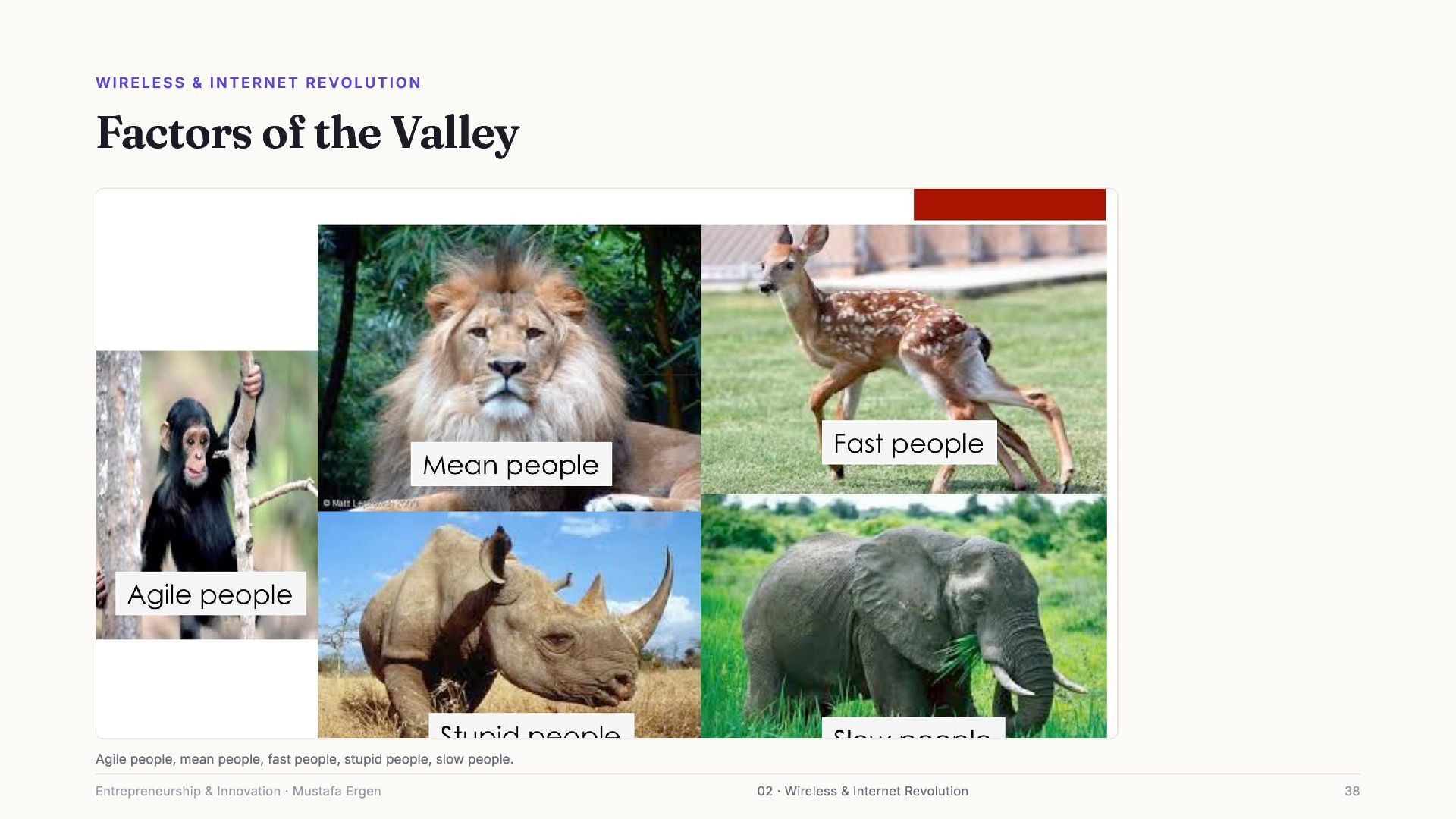
N T E R N E T R E VO L U T I O N Factors of the Valley Agile people, mean people, fast people, stupid people, slow people. Entrepreneurship & Innovation · Mustafa Ergen 02 · Wireless & Internet Revolution 38 -
W I R E L E S S & I
N T E R N E T R E VO L U T I O N Why the US? People and technology Scientific and technology education – Curricula can be changed by the faculty, without government approval. Centers of excellence in research Talent pool: the ability to attract the best to the region (compare with Europe) People in universities and companies interested in high risk and high reward Entrepreneurship & Innovation · Mustafa Ergen 02 · Wireless & Internet Revolution 39 -
W I R E L E S S & I
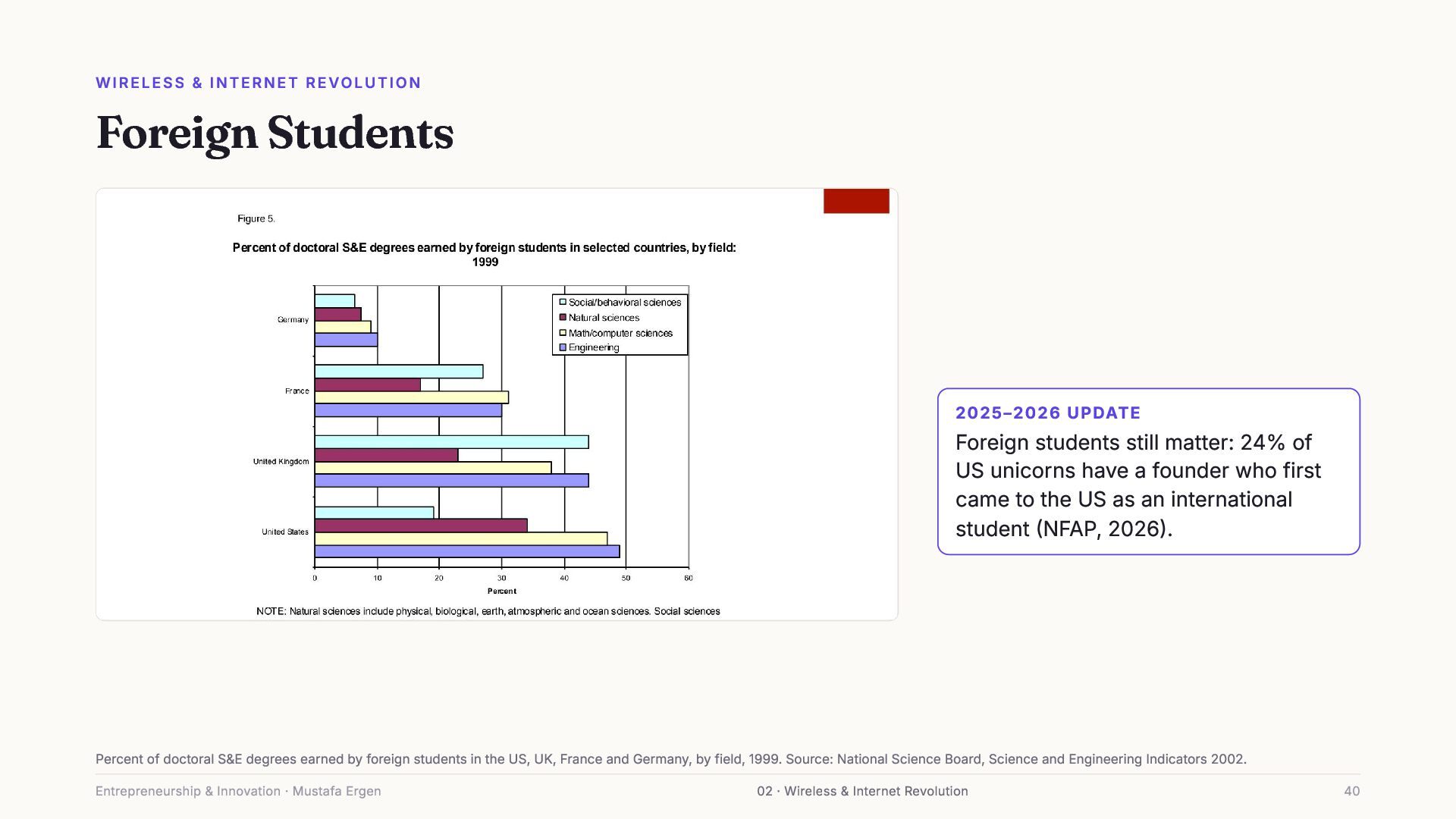
N T E R N E T R E VO L U T I O N Foreign Students 2025–2026 UPDATE Foreign students still matter: 24% of US unicorns have a founder who first came to the US as an international student (NFAP, 2026). Percent of doctoral S&E degrees earned by foreign students in the US, UK, France and Germany, by field, 1999. Source: National Science Board, Science and Engineering Indicators 2002. Entrepreneurship & Innovation · Mustafa Ergen 02 · Wireless & Internet Revolution 40 -
W I R E L E S S & I
N T E R N E T R E VO L U T I O N Economic Model Flexibility in the economic model: – Silicon Valley: hire and fire at will – Europe: hire but no fire (France: hire, never fire) – Turkey: hire, ? (fill in the blank) – XXXX: hire, no fire, since he fires you by votes Entrepreneurship & Innovation · Mustafa Ergen 02 · Wireless & Internet Revolution 41 -
W I R E L E S S & I
N T E R N E T R E VO L U T I O N US Universities Essential in the development of the economic model, both directly and indirectly Curricula are constantly changed and adapted, with worldwide appeal The goal of the US university system is equal impact at home and abroad Responses to new economic conditions are immediate Entrepreneurship & Innovation · Mustafa Ergen 02 · Wireless & Internet Revolution 42 -
W I R E L E S S & I
N T E R N E T R E VO L U T I O N Attributes of a Startup Enterprise Do not be a "me too" A discrete and defendable market niche A differentiated technology with a sustainable competitive advantage Adaptable executive teams An investment group that brings marketing and operational expertise – A bank lends; a VC invests for shares – Good VC: doesn't leave, stays with the company to the last point (e.g., Greylock, MDV, Benchmark, Mayfield) – Bad VC: closes and starts over (Sequoia, in the original's example) Entrepreneurship & Innovation · Mustafa Ergen 02 · Wireless & Internet Revolution 43 -
W I R E L E S S & I
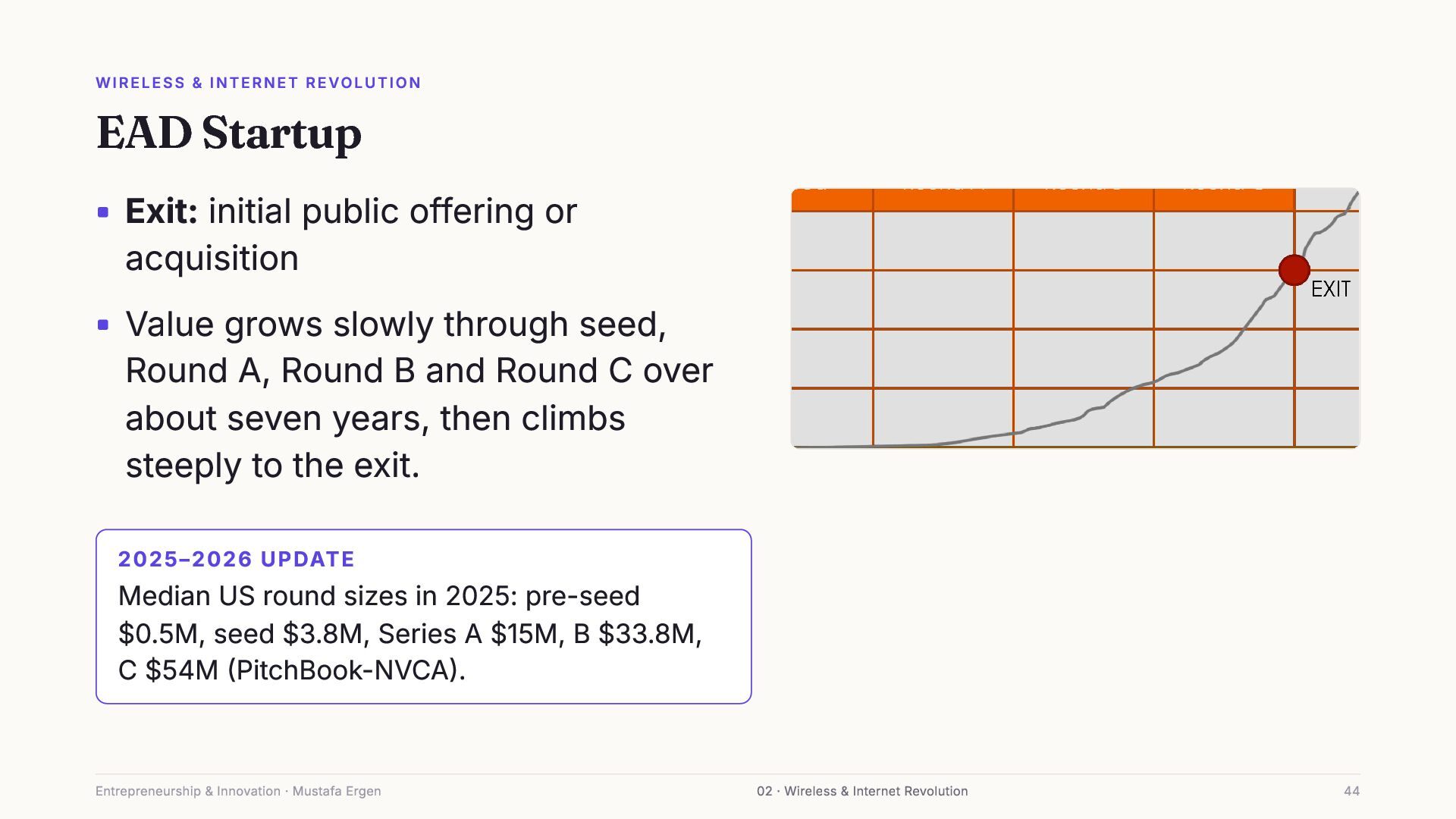
N T E R N E T R E VO L U T I O N EAD Startup Exit: initial public offering or acquisition Value grows slowly through seed, Round A, Round B and Round C over about seven years, then climbs steeply to the exit. 2025–2026 UPDATE Median US round sizes in 2025: pre-seed $0.5M, seed $3.8M, Series A $15M, B $33.8M, C $54M (PitchBook-NVCA). Entrepreneurship & Innovation · Mustafa Ergen 02 · Wireless & Internet Revolution 44 -
W I R E L E S S & I
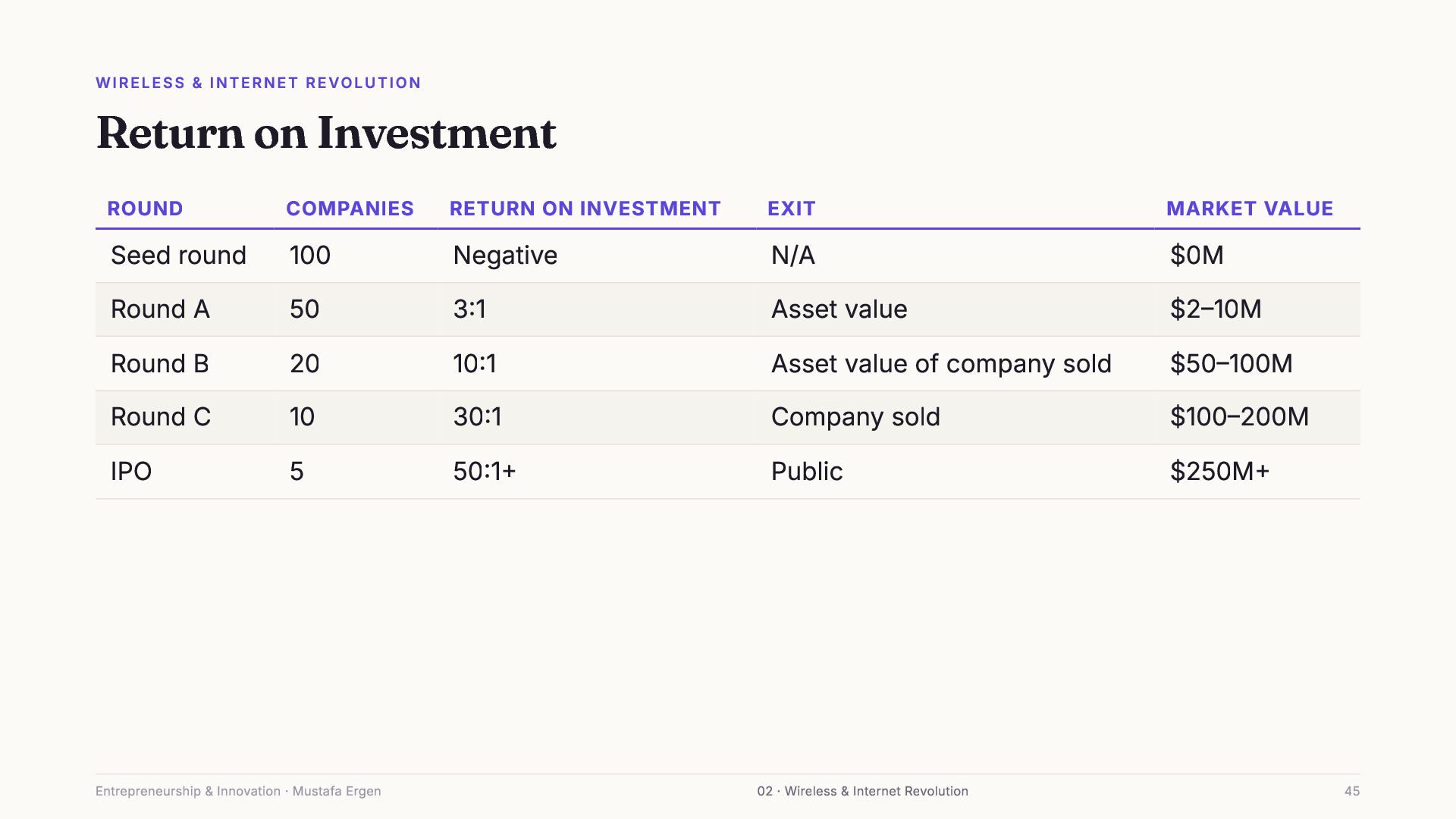
N T E R N E T R E VO L U T I O N Return on Investment ROUND COMPANIES RETURN ON INVESTMENT EXIT MARKET VALUE Seed round 100 Negative N/A $0M Round A 50 3:1 Asset value $2–10M Round B 20 10:1 Asset value of company sold $50–100M Round C 10 30:1 Company sold $100–200M IPO 5 50:1+ Public $250M+ Entrepreneurship & Innovation · Mustafa Ergen 02 · Wireless & Internet Revolution 45 -
W I R E L E S S & I
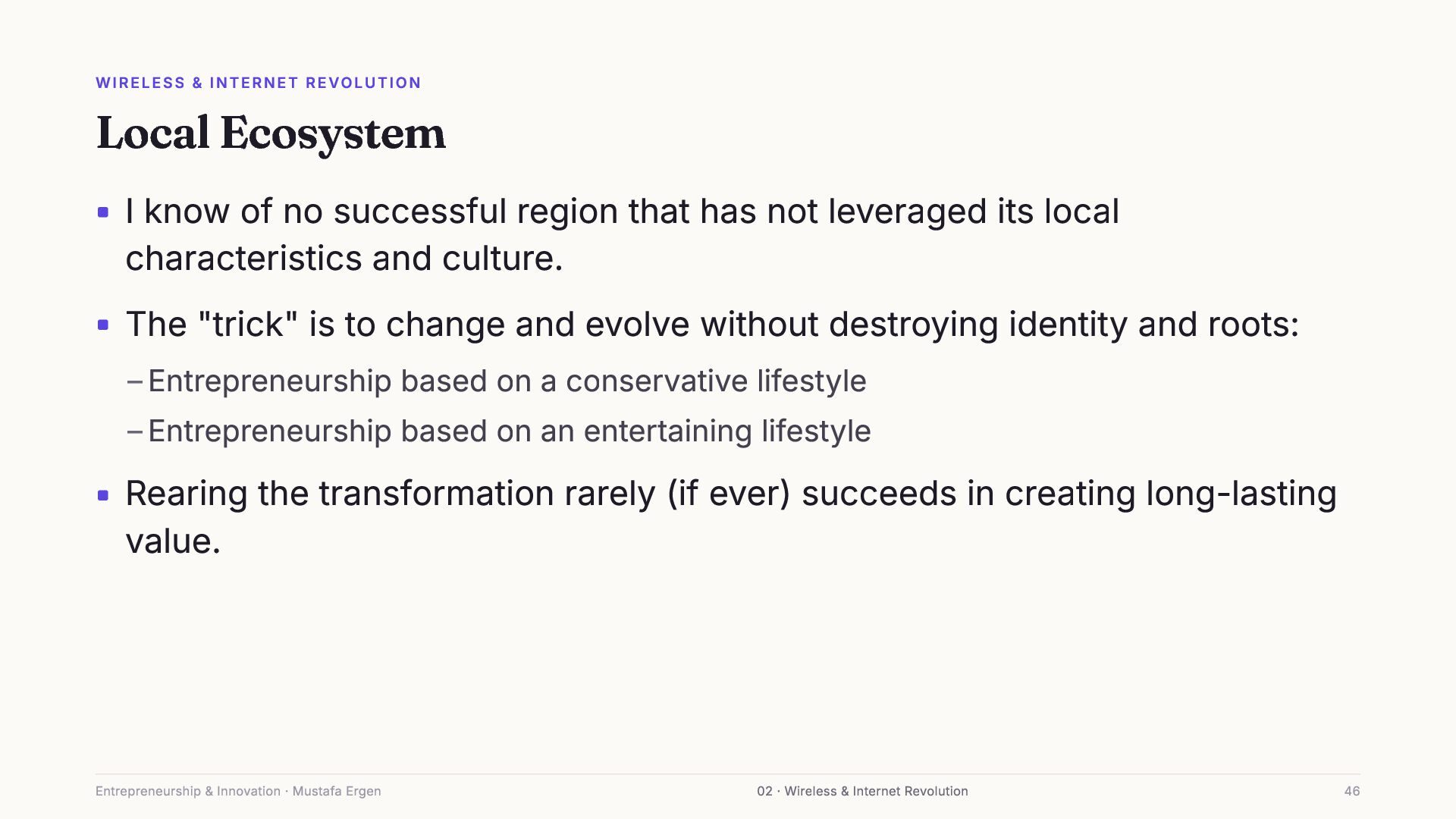
N T E R N E T R E VO L U T I O N Local Ecosystem I know of no successful region that has not leveraged its local characteristics and culture. The "trick" is to change and evolve without destroying identity and roots: – Entrepreneurship based on a conservative lifestyle – Entrepreneurship based on an entertaining lifestyle Rearing the transformation rarely (if ever) succeeds in creating long-lasting value. Entrepreneurship & Innovation · Mustafa Ergen 02 · Wireless & Internet Revolution 46 -
W I R E L E S S & I
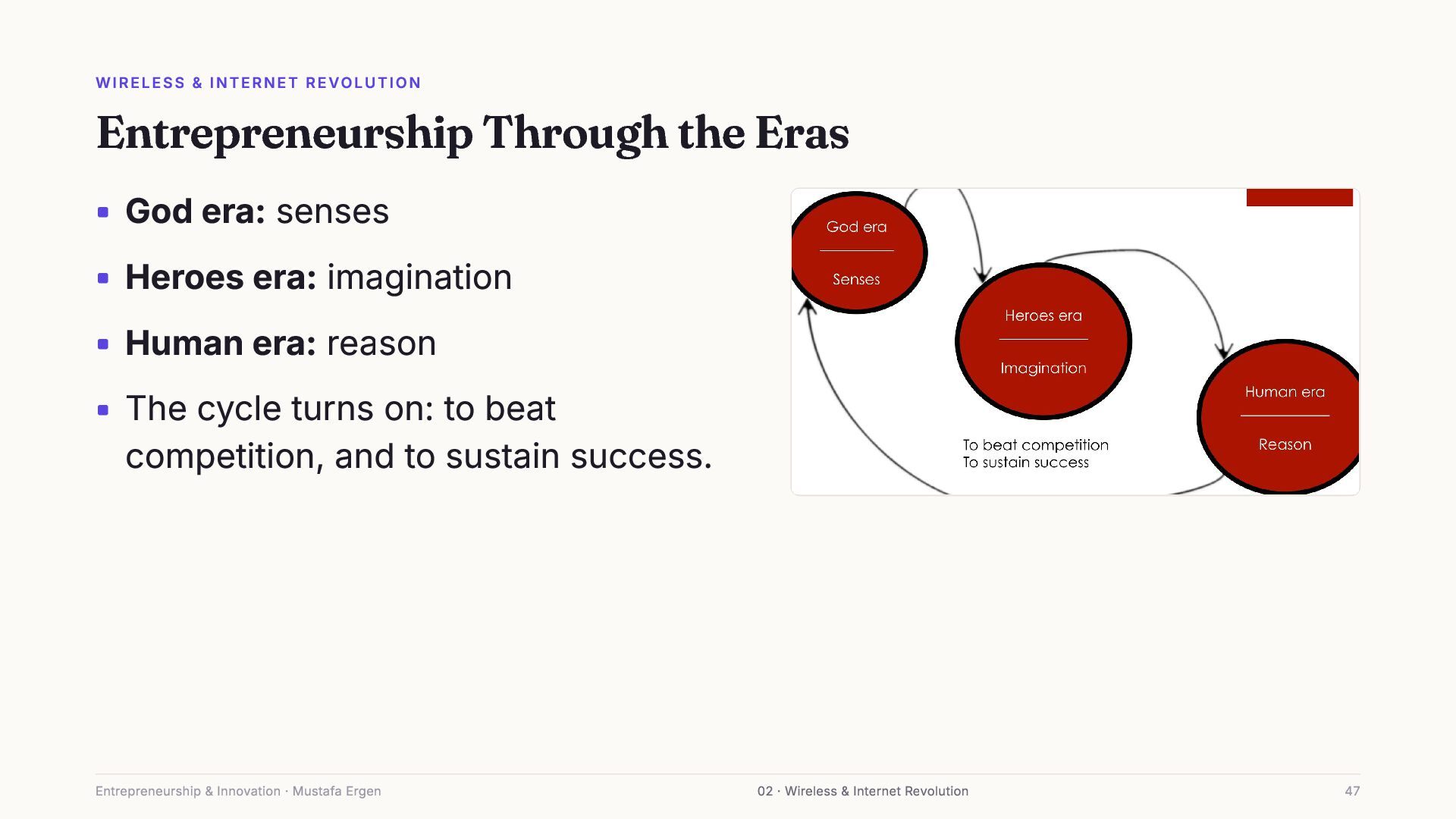
N T E R N E T R E VO L U T I O N Entrepreneurship Through the Eras God era: senses Heroes era: imagination Human era: reason The cycle turns on: to beat competition, and to sustain success. Entrepreneurship & Innovation · Mustafa Ergen 02 · Wireless & Internet Revolution 47 -
W I R E L E S S & I
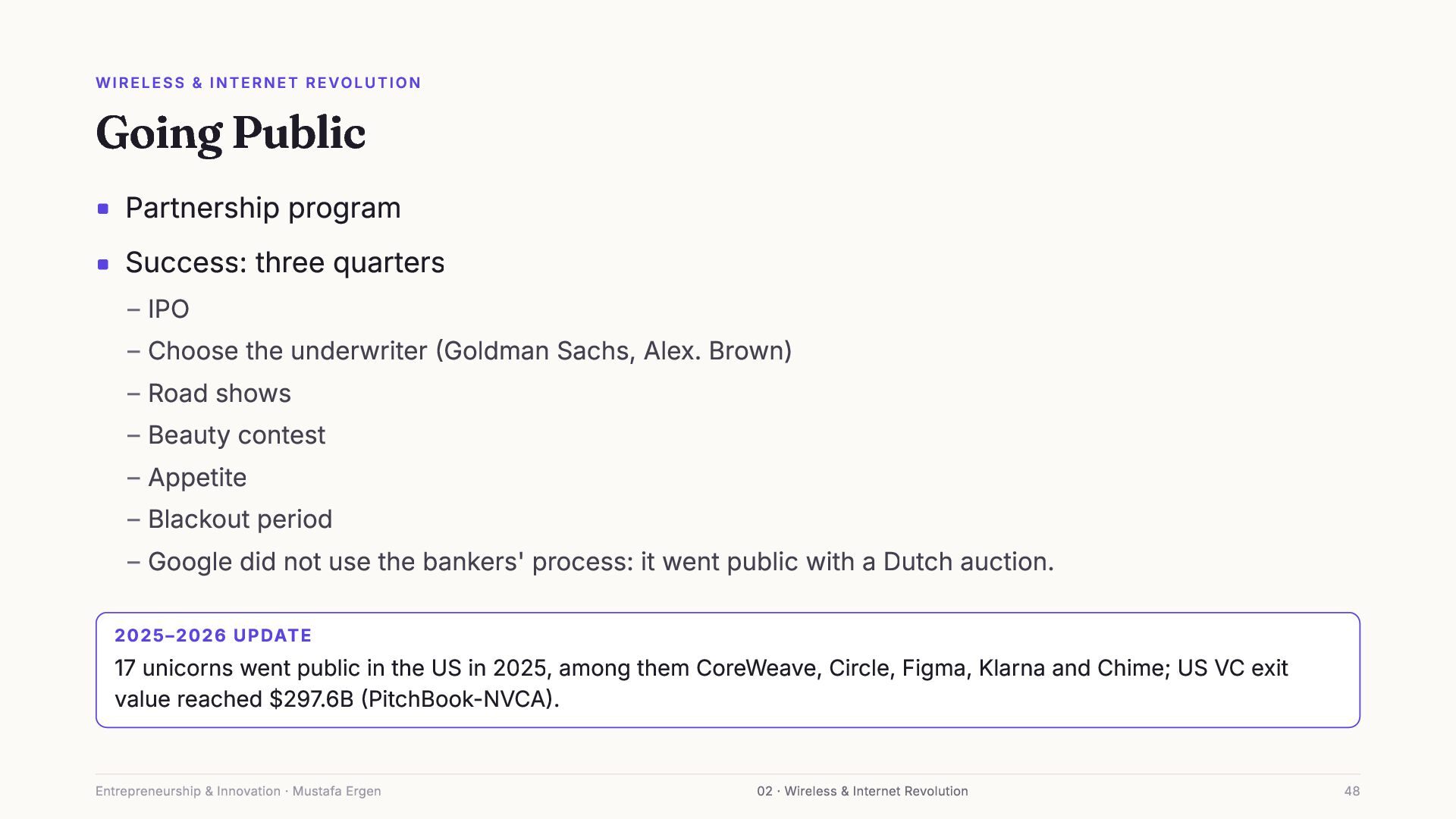
N T E R N E T R E VO L U T I O N Going Public Partnership program Success: three quarters – IPO – Choose the underwriter (Goldman Sachs, Alex. Brown) – Road shows – Beauty contest – Appetite – Blackout period – Google did not use the bankers' process: it went public with a Dutch auction. 2025–2026 UPDATE 17 unicorns went public in the US in 2025, among them CoreWeave, Circle, Figma, Klarna and Chime; US VC exit value reached $297.6B (PitchBook-NVCA). Entrepreneurship & Innovation · Mustafa Ergen 02 · Wireless & Internet Revolution 48 -
W I R E L E S S & I
N T E R N E T R E VO L U T I O N Scalability Become big – Big fish eat small fish – If you cannot eat, be eaten. Entrepreneurship & Innovation · Mustafa Ergen 02 · Wireless & Internet Revolution 49 -
W I R E L E S S & I
N T E R N E T R E VO L U T I O N Startup vs Small Business Small business (KOBİ / SME), prevalent in Europe – Not small but not big – No tendency to become big Become BIG — as big as you can: – Hire professionals – Get more investment – Give out your stock – Do not become family (mi familia) oriented – Either invest or buy in A SMALL COMPANY is bad for the ecosystem: no growth Entrepreneurship & Innovation · Mustafa Ergen 02 · Wireless & Internet Revolution 50 -
W I R E L E S S & I
N T E R N E T R E VO L U T I O N Business Plan A business plan is like demonstrating a theorem. What is your hypothesis? What is your theory? Execution is the proof of the theory: – What is your market? – WHAT IS THE SIZE OF YOUR MARKET? – Who are your competitors? – How do you revolutionize the market? – What are your assumptions? Entrepreneurship & Innovation · Mustafa Ergen 02 · Wireless & Internet Revolution 51 -
W I R E L E S S & I
N T E R N E T R E VO L U T I O N Growth Predictability and growth Linearity builds value Invest and build: the P&L suffers – Earnings go down Why buy companies? – They cannot invest in research themselves – It is a way of investing – Dilutive deal (their technology is vital): never happens – Lucrative deal (your technology): never happens Entrepreneurship & Innovation · Mustafa Ergen 02 · Wireless & Internet Revolution 52 -
W I R E L E S S & I
N T E R N E T R E VO L U T I O N Profit and Loss Statement (P&L) A financial statement that summarizes the revenues, costs and expenses incurred during a specific period, usually a fiscal quarter or year. It shows a company's ability to generate profit by increasing revenue and reducing costs. The balance sheet, income statement and statement of cash flows are a company's most important financial statements. Each matters on its own, but they are meant to be analyzed together. Entrepreneurship & Innovation · Mustafa Ergen 02 · Wireless & Internet Revolution 53 -
W I R E L E S S & I
N T E R N E T R E VO L U T I O N Monopolies: Great Research Bell Labs Xerox – 80 percent of innovation came from them Why guilt? – We have to give back IBM, when it was a monopoly Entrepreneurship & Innovation · Mustafa Ergen 02 · Wireless & Internet Revolution 54 -
W I R E L E S S & I
N T E R N E T R E VO L U T I O N Road to Success Simplicity and elegance Keep your eye on the ball – Implementation deviates from specification Build on a solid foundation Entrepreneurship & Innovation · Mustafa Ergen 02 · Wireless & Internet Revolution 55 -
W I R E L E S S & I
N T E R N E T R E VO L U T I O N Next Generation Enzymes Proteins DNA strands Synthetic biology 2025–2026 UPDATE AI-driven biology now draws large rounds: Isomorphic Labs raised $600M in March 2025, while developing a new drug still costs $2B+ and takes 10–15 years. Entrepreneurship & Innovation · Mustafa Ergen 02 · Wireless & Internet Revolution 56 -
W I R E L E S S & I
N T E R N E T R E VO L U T I O N Venture Capital Is Different From… Hedge funds Private equity – Good for badly managed companies Entrepreneurship & Innovation · Mustafa Ergen 02 · Wireless & Internet Revolution 57 -
W I R E L E S S & I
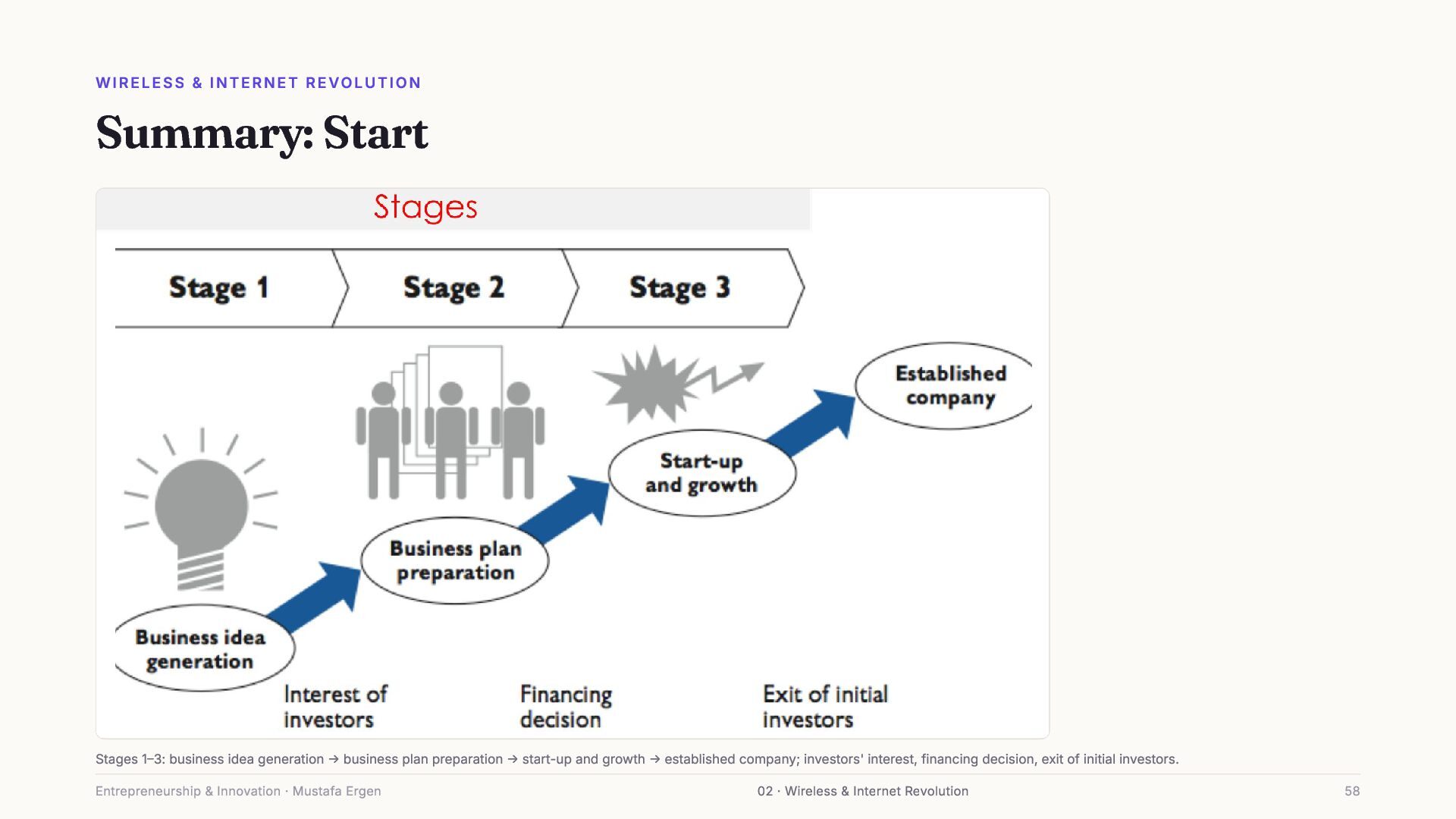
N T E R N E T R E VO L U T I O N Summary: Start Stages 1–3: business idea generation → business plan preparation → start-up and growth → established company; investors' interest, financing decision, exit of initial investors. Entrepreneurship & Innovation · Mustafa Ergen 02 · Wireless & Internet Revolution 58 -
W I R E L E S S & I
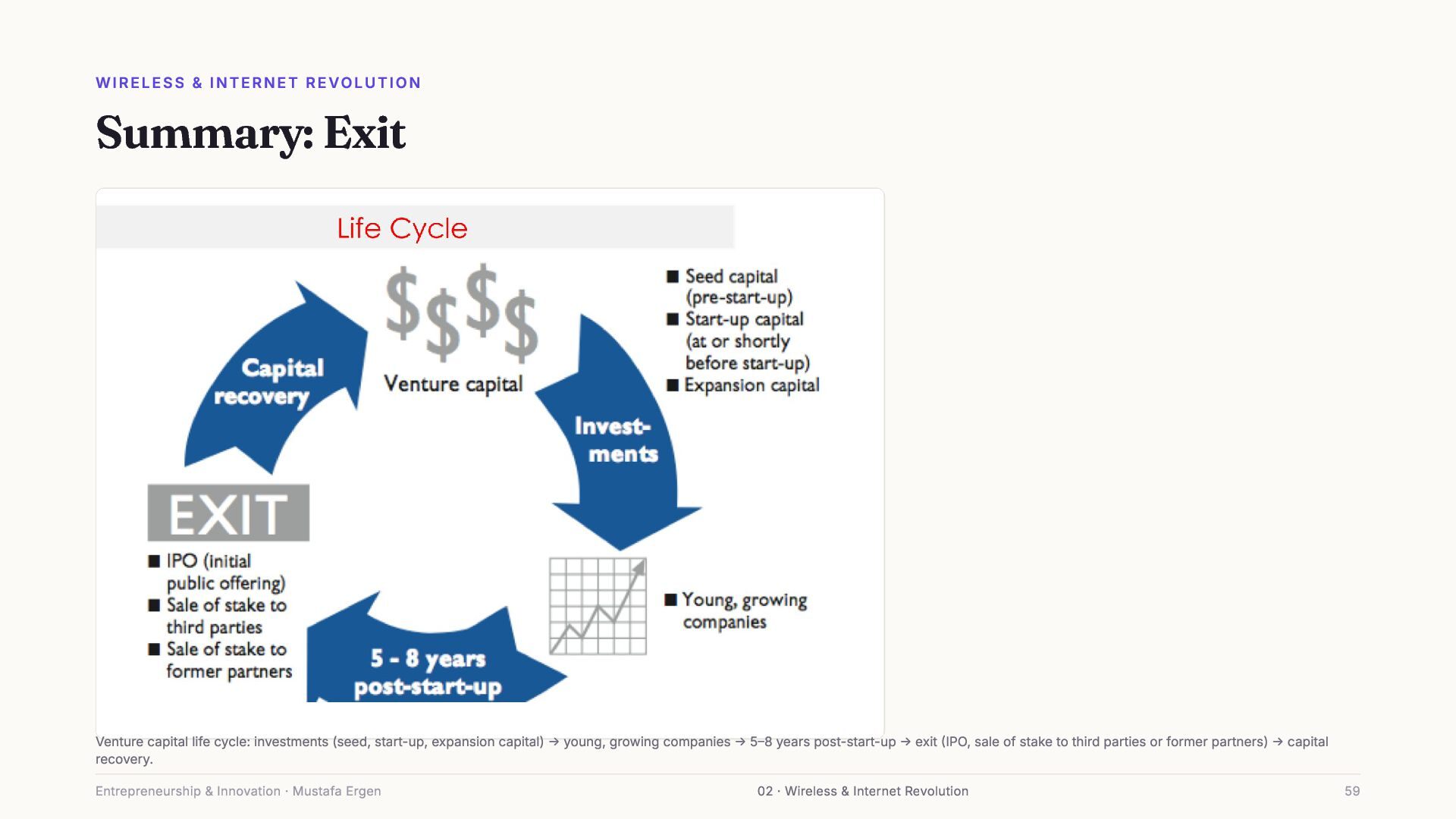
N T E R N E T R E VO L U T I O N Summary: Exit Venture capital life cycle: investments (seed, start-up, expansion capital) → young, growing companies → 5–8 years post-start-up → exit (IPO, sale of stake to third parties or former partners) → capital recovery. Entrepreneurship & Innovation · Mustafa Ergen 02 · Wireless & Internet Revolution 59 -
W I R E L E S S & I
N T E R N E T R E VO L U T I O N Why Can't We, and How Can We? Capital is there, but no venture capitalists The best managers and programmers are not there Risk-taking is not there Experienced people Family-oriented structure Regulations and rules Hire and fire at will Don't make the mass stay where it is; let's create mass Stock options – Restricted stock; holding stock before exercise Taxation 2025–2026 UPDATE Türkiye today: ~$589M invested in startups in 2025 across ~306 rounds (startups.watch), 8 Türkiye-founded companies valued at $1B+ (Dealroom), and licensed equity crowdfunding platforms since 2021. Entrepreneurship & Innovation · Mustafa Ergen 02 · Wireless & Internet Revolution 60 -
W I R E L E S S & I
N T E R N E T R E VO L U T I O N Diversity Immigrant entrepreneurs and foreign-born professionals, scientists and engineers make a significant contribution to the US economy. Since 1990, immigrants have started 1 in 4 (25%) of US venture-backed public companies. This proportion shows the advantage the United States gains from an open legal immigration system. 2025–2026 UPDATE Today 455 of 775 US unicorns (59%) have an immigrant founder, up from 55% in 2018 and 2022 (NFAP, 2026). Entrepreneurship & Innovation · Mustafa Ergen 02 · Wireless & Internet Revolution 61 -
W I R E L E S S & I
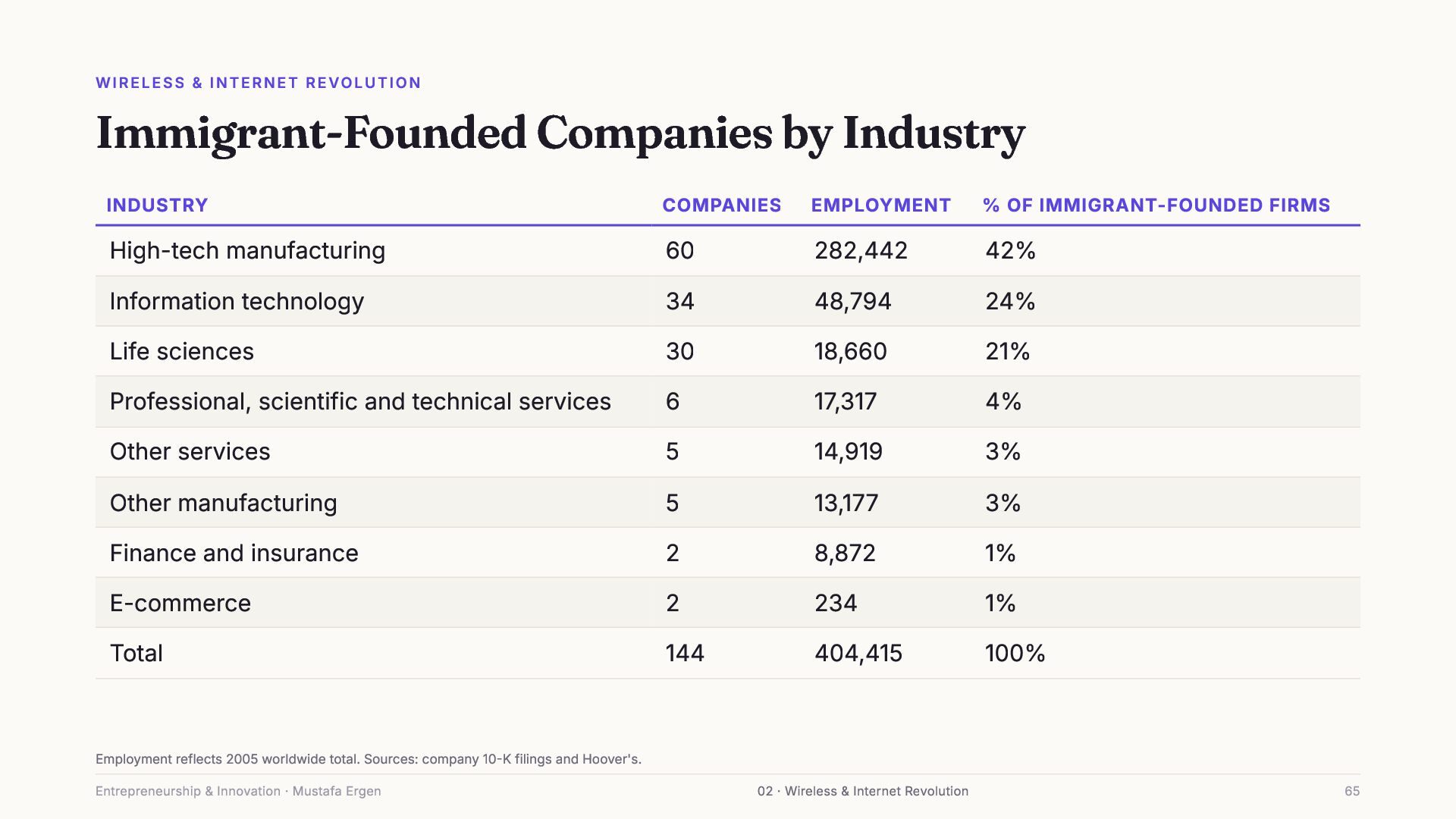
N T E R N E T R E VO L U T I O N Immigrant-Founded The market capitalization of publicly traded, immigrant-founded, venture-backed US companies exceeds $500 billion. An example of the enormous wealth-creating ability of immigrant entrepreneurs. These companies employ about 220,000 people in the US and over 400,000 worldwide. Immigrants started over 40% of the venture-backed US public companies in technology manufacturing. 2025–2026 UPDATE Immigrant-founded US unicorns are now worth $5.0T combined; 66% of US unicorns were founded by immigrants or children of immigrants (NFAP, 2026). Entrepreneurship & Innovation · Mustafa Ergen 02 · Wireless & Internet Revolution 62 -
W I R E L E S S & I
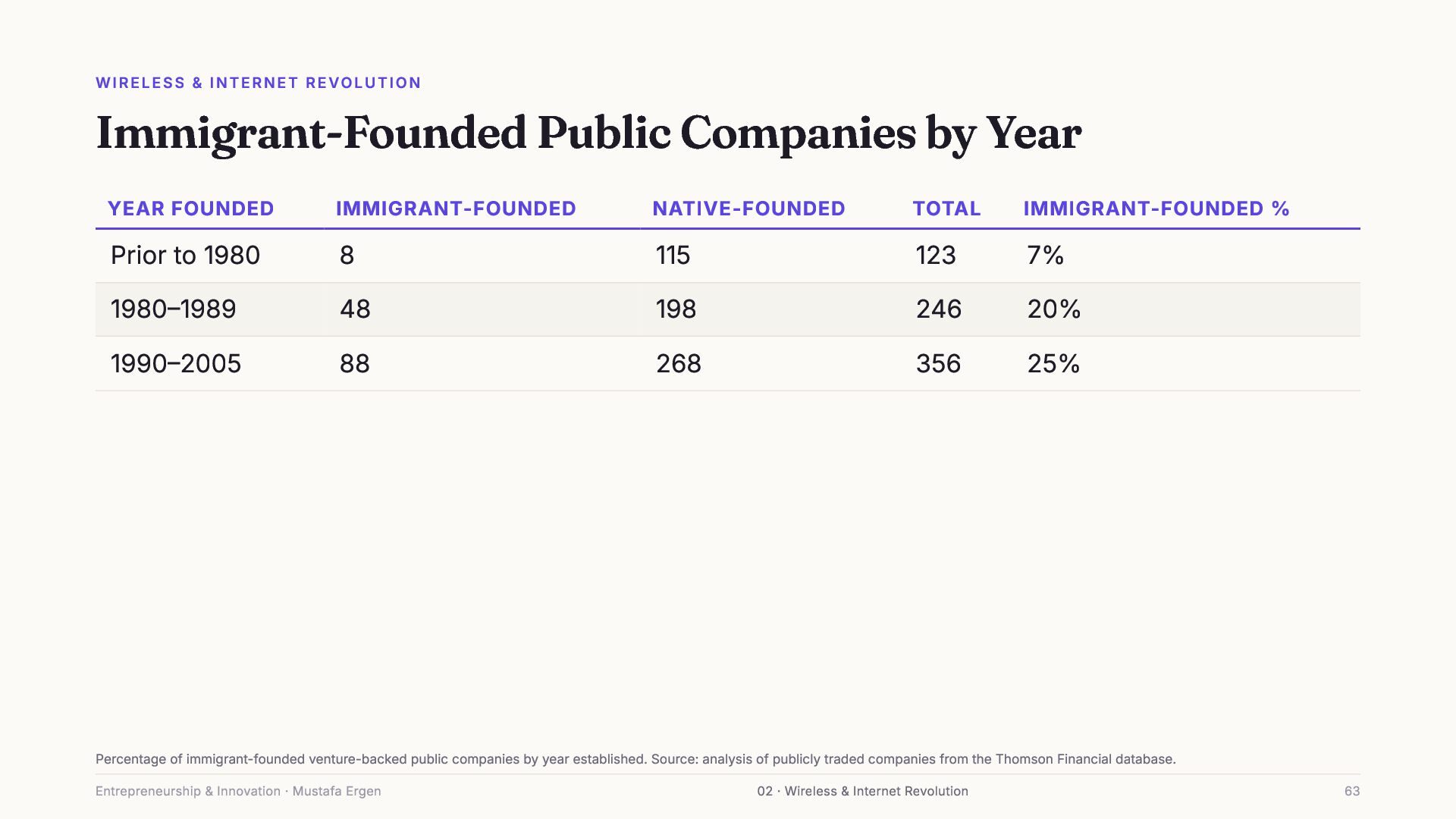
N T E R N E T R E VO L U T I O N Immigrant-Founded Public Companies by Year YEAR FOUNDED IMMIGRANT-FOUNDED NATIVE-FOUNDED TOTAL IMMIGRANT-FOUNDED % Prior to 1980 8 115 123 7% 1980–1989 48 198 246 20% 1990–2005 88 268 356 25% Percentage of immigrant-founded venture-backed public companies by year established. Source: analysis of publicly traded companies from the Thomson Financial database. Entrepreneurship & Innovation · Mustafa Ergen 02 · Wireless & Internet Revolution 63 -
W I R E L E S S & I
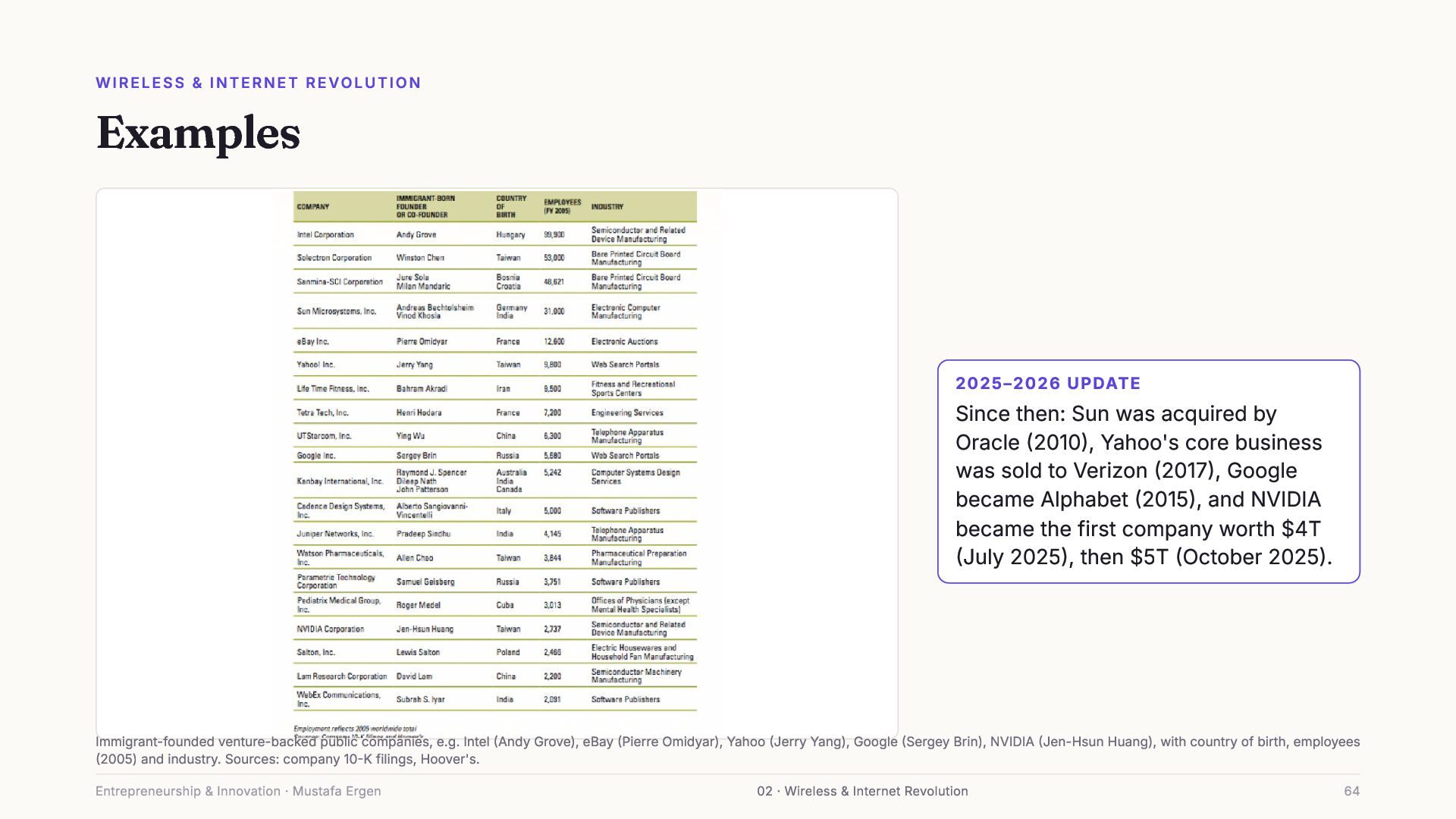
N T E R N E T R E VO L U T I O N Examples 2025–2026 UPDATE Since then: Sun was acquired by Oracle (2010), Yahoo's core business was sold to Verizon (2017), Google became Alphabet (2015), and NVIDIA became the first company worth $4T (July 2025), then $5T (October 2025). Immigrant-founded venture-backed public companies, e.g. Intel (Andy Grove), eBay (Pierre Omidyar), Yahoo (Jerry Yang), Google (Sergey Brin), NVIDIA (Jen-Hsun Huang), with country of birth, employees (2005) and industry. Sources: company 10-K filings, Hoover's. Entrepreneurship & Innovation · Mustafa Ergen 02 · Wireless & Internet Revolution 64 -
W I R E L E S S & I
N T E R N E T R E VO L U T I O N Immigrant-Founded Companies by Industry INDUSTRY COMPANIES EMPLOYMENT % OF IMMIGRANT-FOUNDED FIRMS High-tech manufacturing 60 282,442 42% Information technology 34 48,794 24% Life sciences 30 18,660 21% Professional, scientific and technical services 6 17,317 4% Other services 5 14,919 3% Other manufacturing 5 13,177 3% Finance and insurance 2 8,872 1% E-commerce 2 234 1% Total 144 404,415 100% Employment reflects 2005 worldwide total. Sources: company 10-K filings and Hoover's. Entrepreneurship & Innovation · Mustafa Ergen 02 · Wireless & Internet Revolution 65 -
W I R E L E S S & I
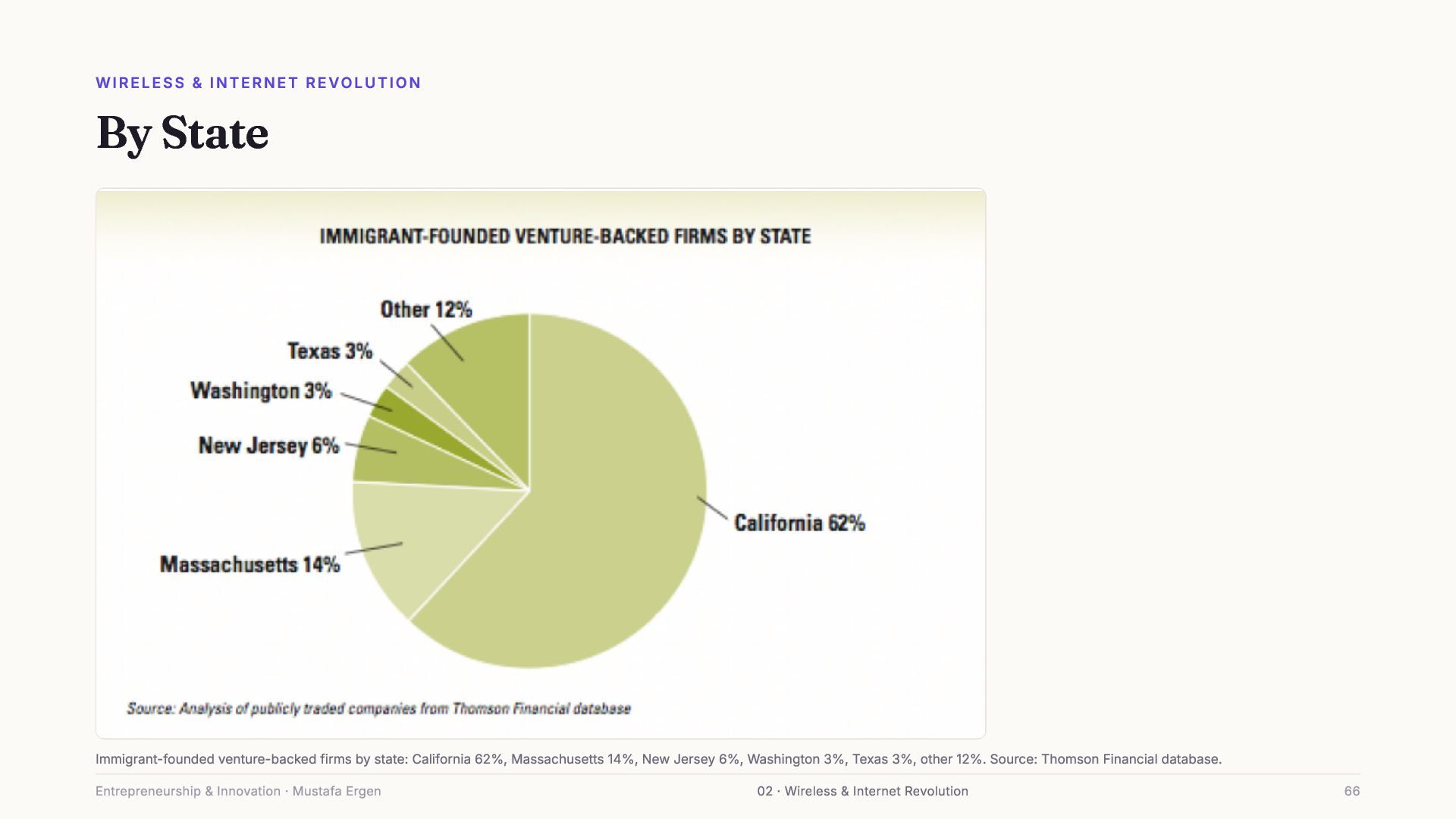
N T E R N E T R E VO L U T I O N By State Immigrant-founded venture-backed firms by state: California 62%, Massachusetts 14%, New Jersey 6%, Washington 3%, Texas 3%, other 12%. Source: Thomson Financial database. Entrepreneurship & Innovation · Mustafa Ergen 02 · Wireless & Internet Revolution 66 -
W I R E L E S S & I
N T E R N E T R E VO L U T I O N References Notes of A. L. Sangiovanni-Vincentelli American Made, by Stuart Anderson and Michaela Platzer Entrepreneurship & Innovation · Mustafa Ergen 02 · Wireless & Internet Revolution 67 -
03 Silicon Valley History From radio and vacuum tubes to
HP, Shockley and Fairchild: how the Valley was born. Entrepreneurship & Innovation · Mustafa Ergen 03 · Silicon Valley History 68 -
S I L I C O N VA L L
E Y H I S TO RY Silicon Valley History Gold rush, movies and electronics Academic excellence and garages – De Forest: vacuum tubes (1906) – Hewlett-Packard: HP (1939) – SRI: Stanford Research Institute – Fairchild – Intel – Google In 1971, trade press reporter Don Hoefler used "Silicon Valley" for the chip-making firms on the Peninsula, and the name stuck. Almost from the start it stood for more than chip making. Entrepreneurship & Innovation · Mustafa Ergen 03 · Silicon Valley History 69 -
S I L I C O N VA L L
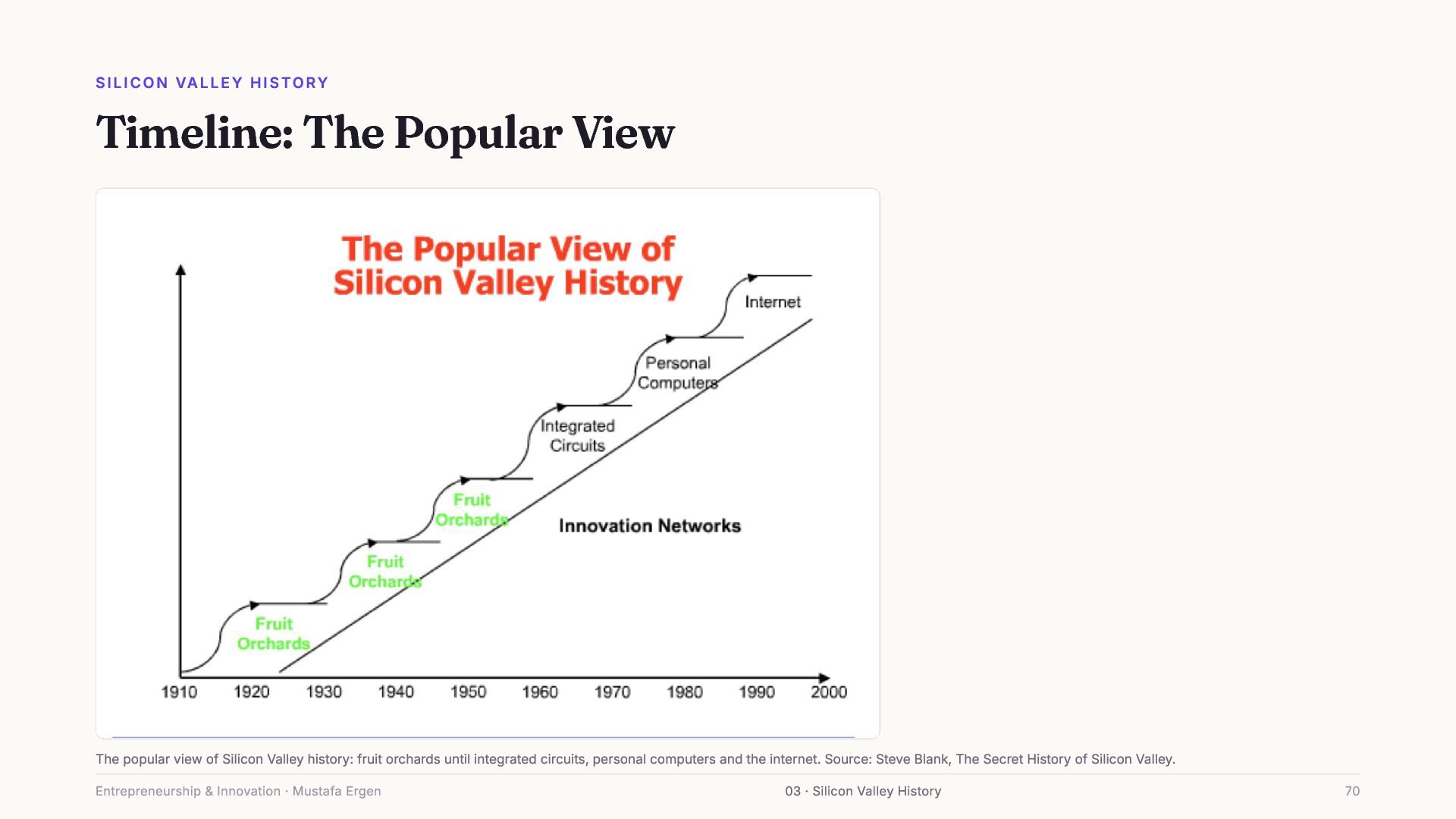
E Y H I S TO RY Timeline: The Popular View The popular view of Silicon Valley history: fruit orchards until integrated circuits, personal computers and the internet. Source: Steve Blank, The Secret History of Silicon Valley. Entrepreneurship & Innovation · Mustafa Ergen 03 · Silicon Valley History 70 -
S I L I C O N VA L L
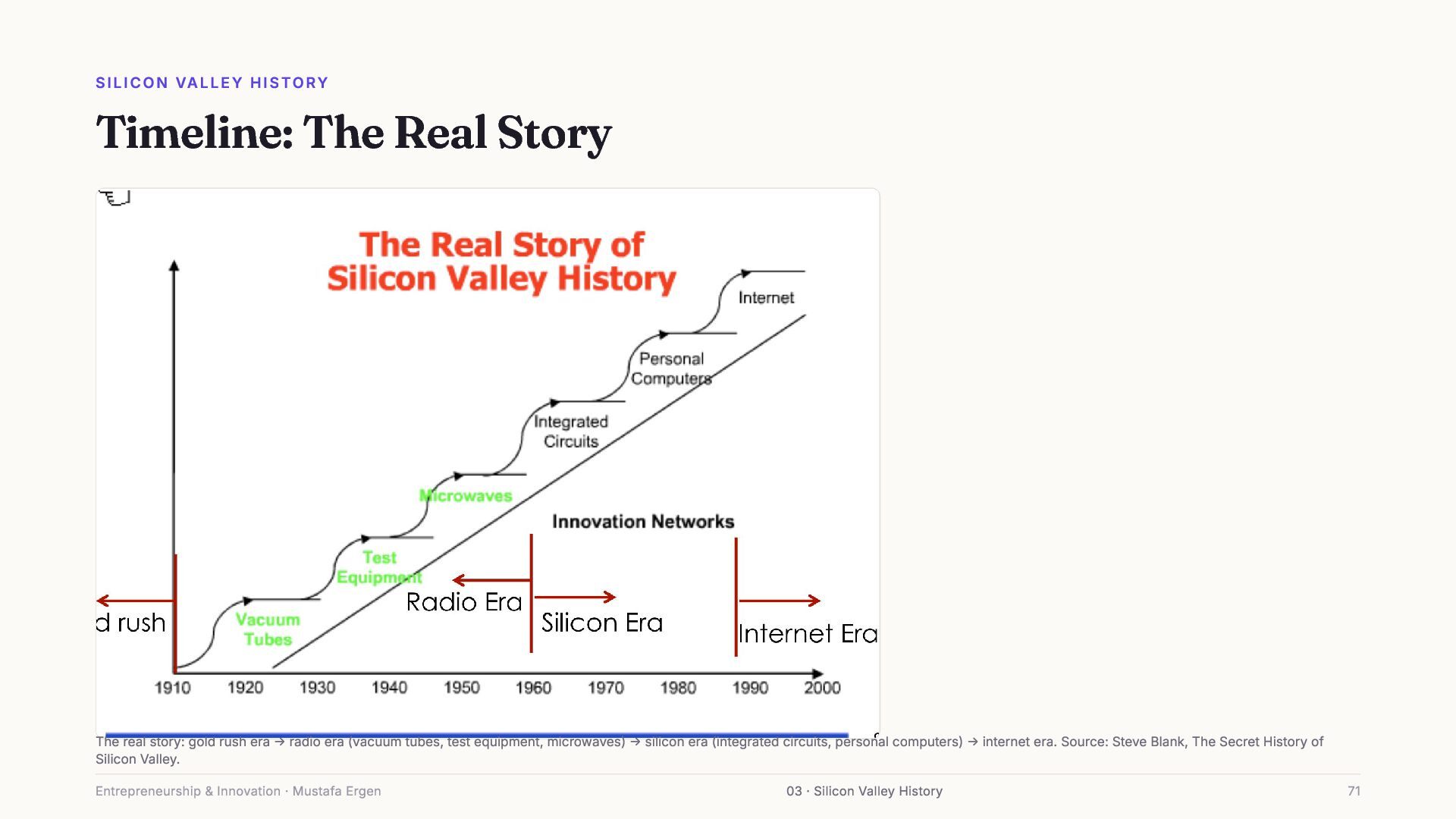
E Y H I S TO RY Timeline: The Real Story The real story: gold rush era → radio era (vacuum tubes, test equipment, microwaves) → silicon era (integrated circuits, personal computers) → internet era. Source: Steve Blank, The Secret History of Silicon Valley. Entrepreneurship & Innovation · Mustafa Ergen 03 · Silicon Valley History 71 -
Radio Era The Valley's first chapter: hobbyist radio engineers, Federal
Telegraph and the vacuum tube. Entrepreneurship & Innovation · Mustafa Ergen Radio Era 72 -
S I L I C O N VA L L
E Y H I S TO RY Silicon or Radio? The Valley's culture formed around radio in the 1900s: engineers in hobby clubs who brainstormed, borrowed equipment, spun new companies out of old ones, and built a meritocracy of those who made electronics cheaper, faster and better. In 1909 Stanford graduate Cyril Elwell acquired radio patents and persuaded Stanford officials, including President David Starr Jordan, to finance Federal Telegraph Co. in Palo Alto. The same year in San Jose, Charles Herrold started a school for radio engineers and began broadcasting: "Broadcasting's Forgotten Father" (PBS, 1994). The region then had none of its cachet relative to New York, New Jersey and Boston. Impressed US naval officials gave Federal Telegraph huge contracts in World War I: the first, but not the last, time war fueled the region's tech firms. Entrepreneurship & Innovation · Mustafa Ergen Radio Era 73 -
S I L I C O N VA L L
E Y H I S TO RY Radio Around 1910, Peter Jensen and Edwin Pridham left Federal Telegraph to start an R&D firm in a garage in Napa to improve loudspeakers. In 1917 they formed Magnavox, which built public address systems for WWI warships. The war's end took the wind out of the region's sails. Eastern radio powers, notably RCA, dominated the 1920s and 1930s. The entrepreneurial fire cooled but did not die. The next chapter is the familiar tale of Hewlett and Packard hatching the region's first technology giant in a Palo Alto garage. Fuller versions of the story also credit their mentor, Stanford engineering professor Frederick Terman. Source: San Francisco Chronicle (SFGate), 29 Sep 2007 Entrepreneurship & Innovation · Mustafa Ergen Radio Era 74 -
S I L I C O N VA L L
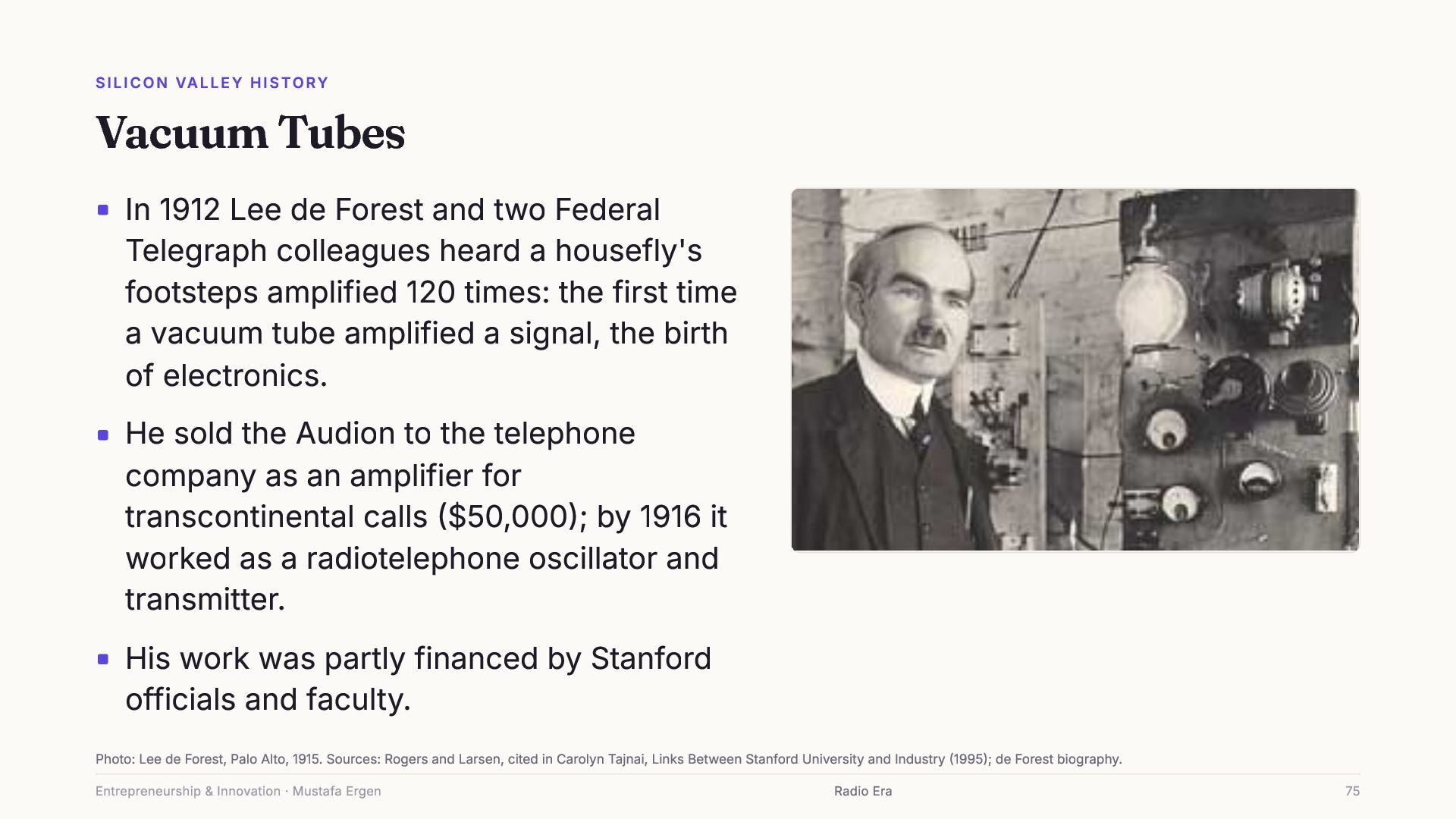
E Y H I S TO RY Vacuum Tubes In 1912 Lee de Forest and two Federal Telegraph colleagues heard a housefly's footsteps amplified 120 times: the first time a vacuum tube amplified a signal, the birth of electronics. He sold the Audion to the telephone company as an amplifier for transcontinental calls ($50,000); by 1916 it worked as a radiotelephone oscillator and transmitter. His work was partly financed by Stanford officials and faculty. Photo: Lee de Forest, Palo Alto, 1915. Sources: Rogers and Larsen, cited in Carolyn Tajnai, Links Between Stanford University and Industry (1995); de Forest biography. Entrepreneurship & Innovation · Mustafa Ergen Radio Era 75 -
S I L I C O N VA L L
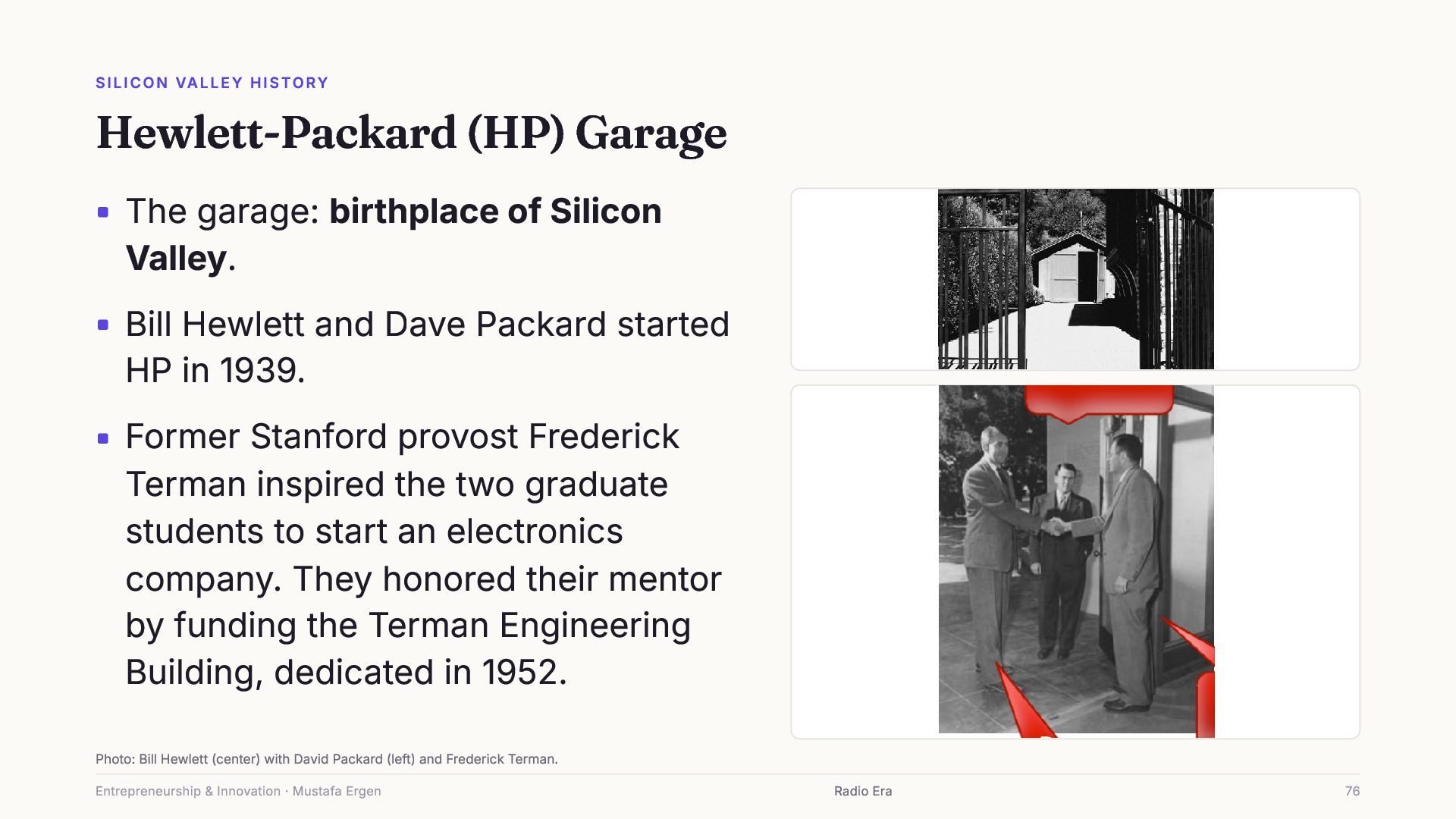
E Y H I S TO RY Hewlett-Packard (HP) Garage The garage: birthplace of Silicon Valley. Bill Hewlett and Dave Packard started HP in 1939. Former Stanford provost Frederick Terman inspired the two graduate students to start an electronics company. They honored their mentor by funding the Terman Engineering Building, dedicated in 1952. Photo: Bill Hewlett (center) with David Packard (left) and Frederick Terman. Entrepreneurship & Innovation · Mustafa Ergen Radio Era 76 -
S I L I C O N VA L L
E Y H I S TO RY HP History Hewlett and Packard tossed a coin to decide between "Hewlett-Packard" and "PackardHewlett". From the 1940s into the 1990s HP made electronic test equipment (signal generators, voltmeters, oscilloscopes, frequency counters and more), often more sensitive and precise than rivals. First hit: the HP200A audio oscillator. A small light bulb used as a temperature-dependent resistor let them sell it for $54.40 when rivals charged over $200. The 200 series ran until at least 1972: 33 years. An early customer, Walt Disney, bought eight 200B oscillators ($71.50 each) to certify Fantasound systems for Fantasia. HP is the symbolic founder of Silicon Valley, though it began semiconductor work (HP Associates, c. 1960) only after the "Traitorous Eight" left Shockley to create Fairchild in 1957. Entrepreneurship & Innovation · Mustafa Ergen Radio Era 77 -
Silicon Era William Shockley, the "Traitorous Eight" and the founding
of Fairchild Semiconductor. Entrepreneurship & Innovation · Mustafa Ergen Silicon Era 78 -
S I L I C O N VA L L
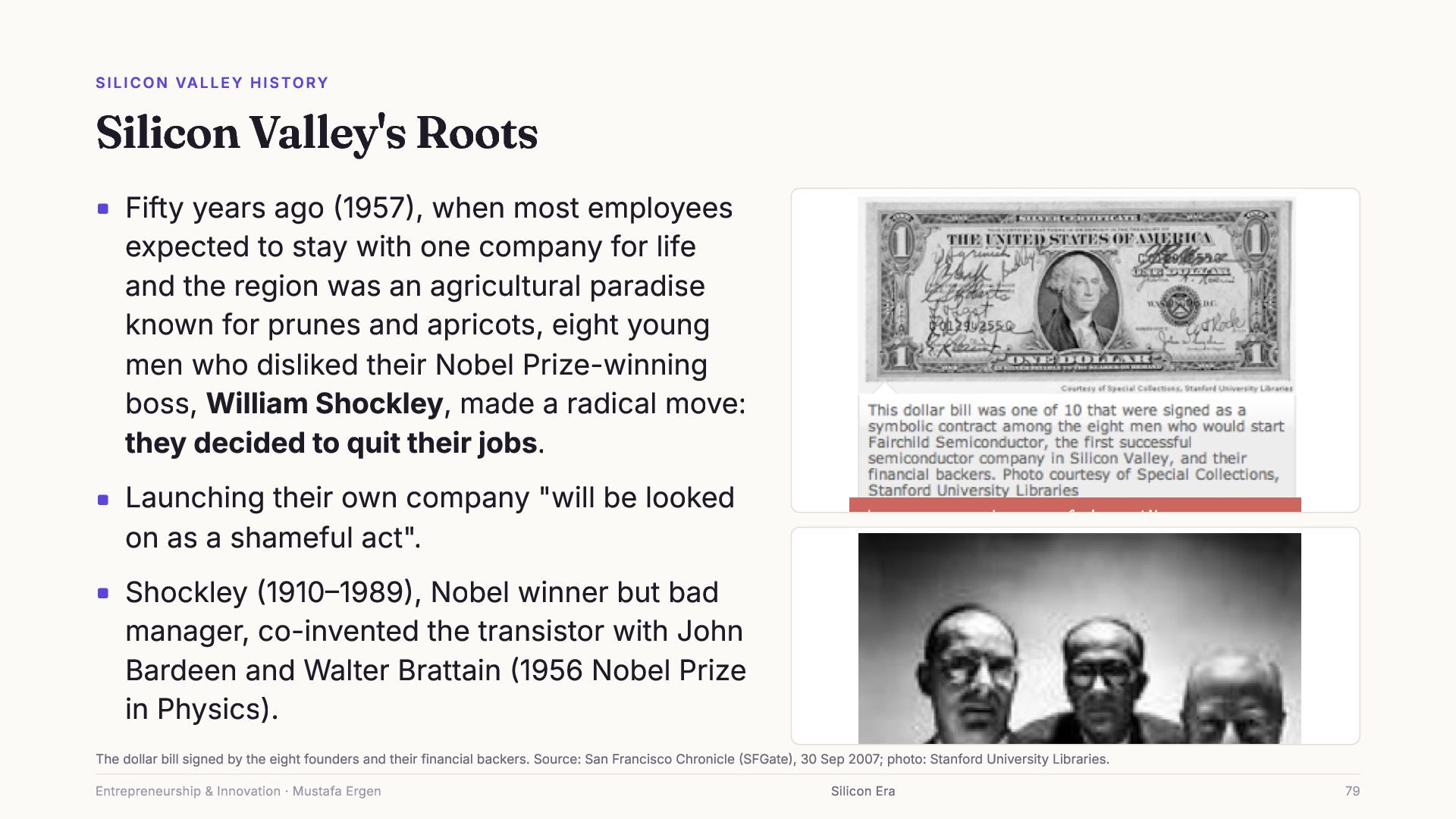
E Y H I S TO RY Silicon Valley's Roots Fifty years ago (1957), when most employees expected to stay with one company for life and the region was an agricultural paradise known for prunes and apricots, eight young men who disliked their Nobel Prize-winning boss, William Shockley, made a radical move: they decided to quit their jobs. Launching their own company "will be looked on as a shameful act". Shockley (1910–1989), Nobel winner but bad manager, co-invented the transistor with John Bardeen and Walter Brattain (1956 Nobel Prize in Physics). The dollar bill signed by the eight founders and their financial backers. Source: San Francisco Chronicle (SFGate), 30 Sep 2007; photo: Stanford University Libraries. Entrepreneurship & Innovation · Mustafa Ergen Silicon Era 79 -
S I L I C O N VA L L
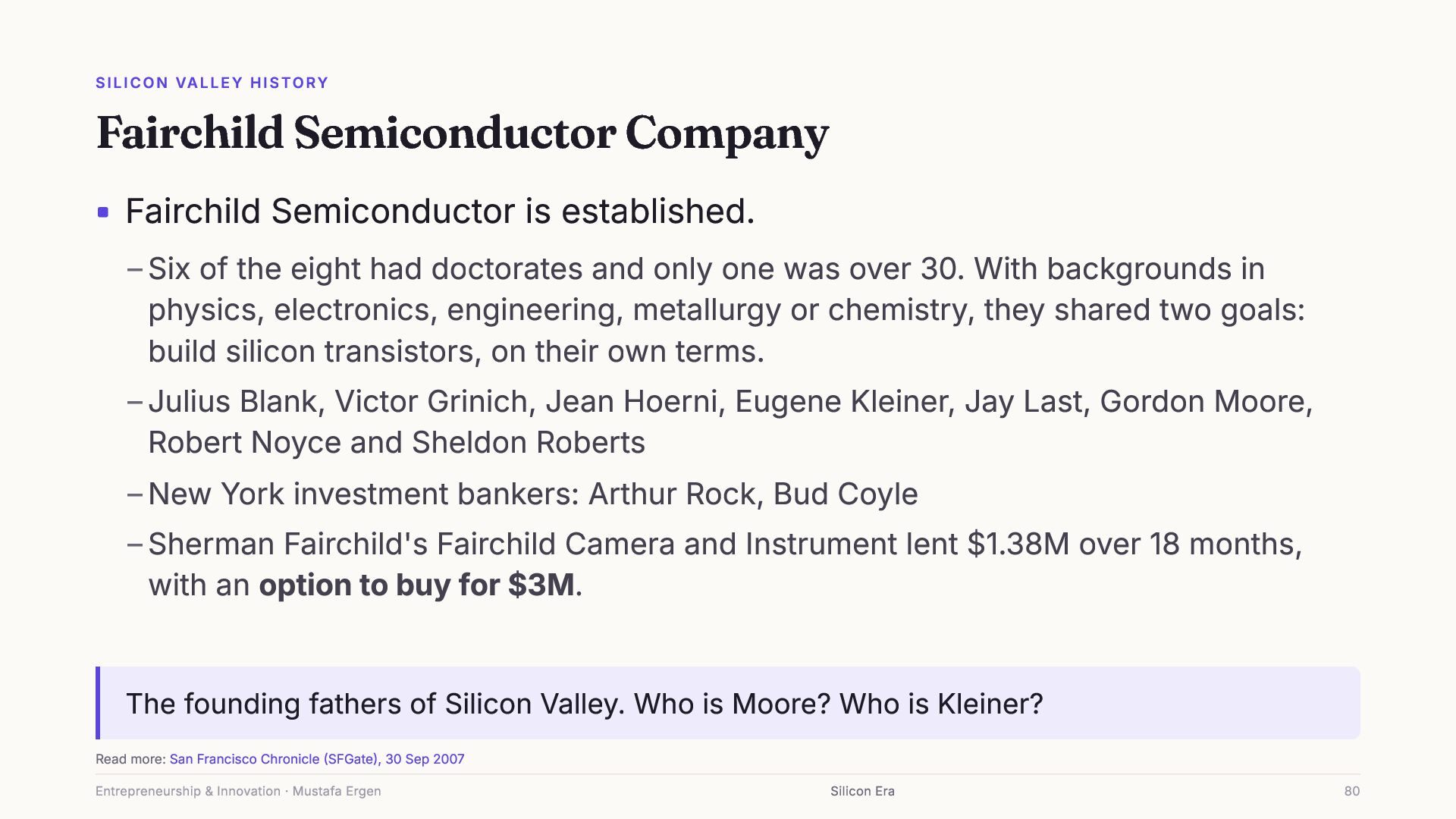
E Y H I S TO RY Fairchild Semiconductor Company Fairchild Semiconductor is established. – Six of the eight had doctorates and only one was over 30. With backgrounds in physics, electronics, engineering, metallurgy or chemistry, they shared two goals: build silicon transistors, on their own terms. – Julius Blank, Victor Grinich, Jean Hoerni, Eugene Kleiner, Jay Last, Gordon Moore, Robert Noyce and Sheldon Roberts – New York investment bankers: Arthur Rock, Bud Coyle – Sherman Fairchild's Fairchild Camera and Instrument lent $1.38M over 18 months, with an option to buy for $3M. The founding fathers of Silicon Valley. Who is Moore? Who is Kleiner? Read more: San Francisco Chronicle (SFGate), 30 Sep 2007 Entrepreneurship & Innovation · Mustafa Ergen Silicon Era 80 -
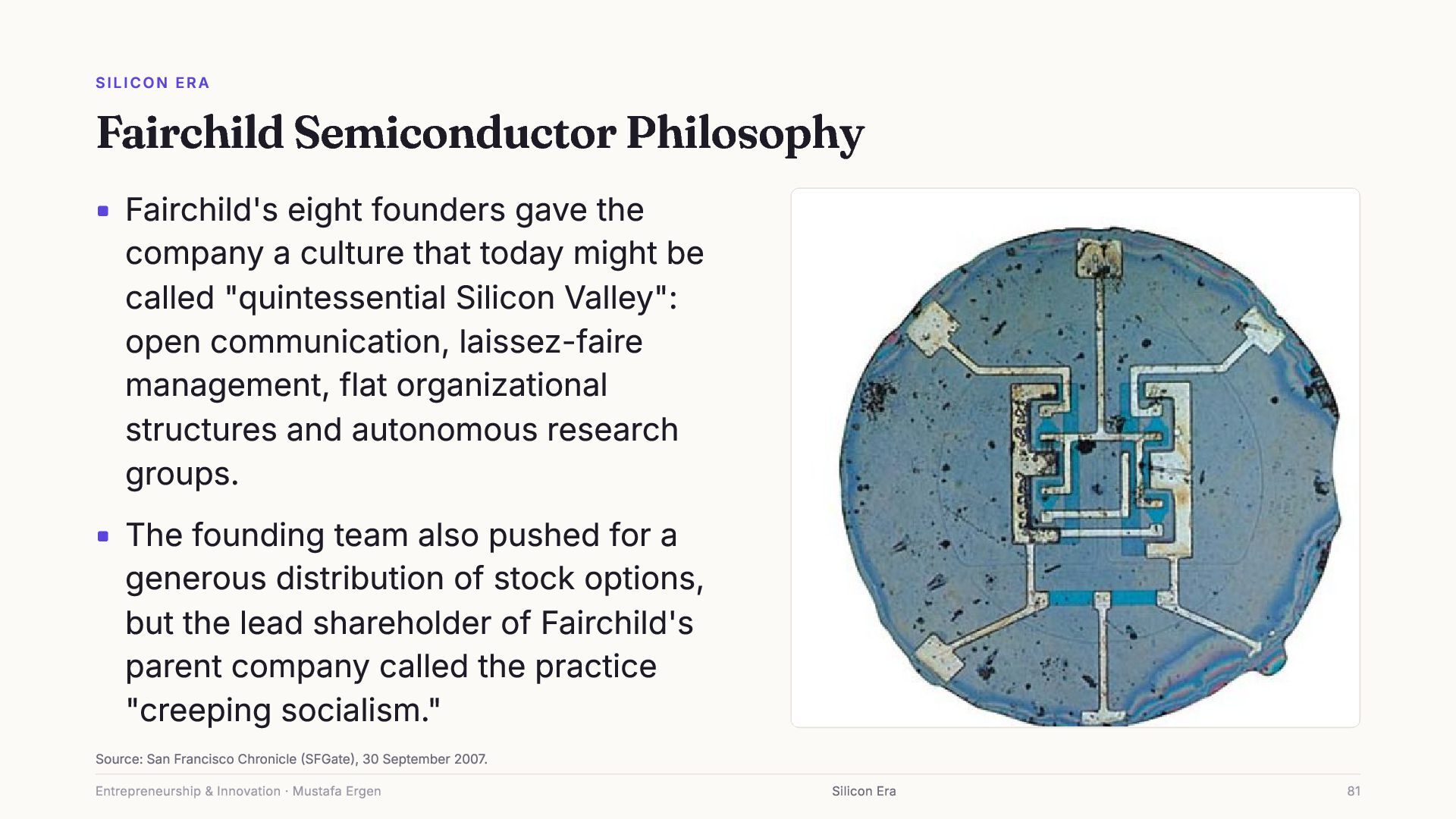
SILICON ERA Fairchild Semiconductor Philosophy Fairchild's eight founders gave the
company a culture that today might be called "quintessential Silicon Valley": open communication, laissez-faire management, flat organizational structures and autonomous research groups. The founding team also pushed for a generous distribution of stock options, but the lead shareholder of Fairchild's parent company called the practice "creeping socialism." Source: San Francisco Chronicle (SFGate), 30 September 2007. Entrepreneurship & Innovation · Mustafa Ergen Silicon Era 81 -
SILICON ERA The Fairchildren Fairchild was one of the first
companies to use offshore labor to assemble and test its microchips. Fairchild employees formed dozens of startups (dubbed the "Fairchildren"), several of which are still at the heart of the $228 billion global semiconductor industry. – Andy Grove of Intel, Jerry Sanders of AMD, and Charlie Sporck and Floyd Kvamme of National Semiconductor all worked at Fairchild. Fairchild's founders and employees went on to create no fewer than 65 technology companies. Source: San Francisco Chronicle (SFGate), 30 September 2007. Entrepreneurship & Innovation · Mustafa Ergen Silicon Era 82 -
SILICON ERA Transistor History William Shockley left Bell Labs in
1954 to start his own company in Palo Alto, California — the seed of Silicon Valley. Young engineers such as Gordon E. Moore and Robert N. Noyce joined the Shockley company. In 1957 Moore, Noyce and their colleagues — the "traitorous" ones, as Shockley came to call them — set up Fairchild. 1959: Fairchild introduced the new planar technology. Jack Kilby (Texas Instruments) and Robert Noyce (Fairchild) each conceived the integrated circuit in 1959. Texas Instruments called it "the most significant development by Texas Instruments since … the commercial silicon transistor." Entrepreneurship & Innovation · Mustafa Ergen Silicon Era 83 -
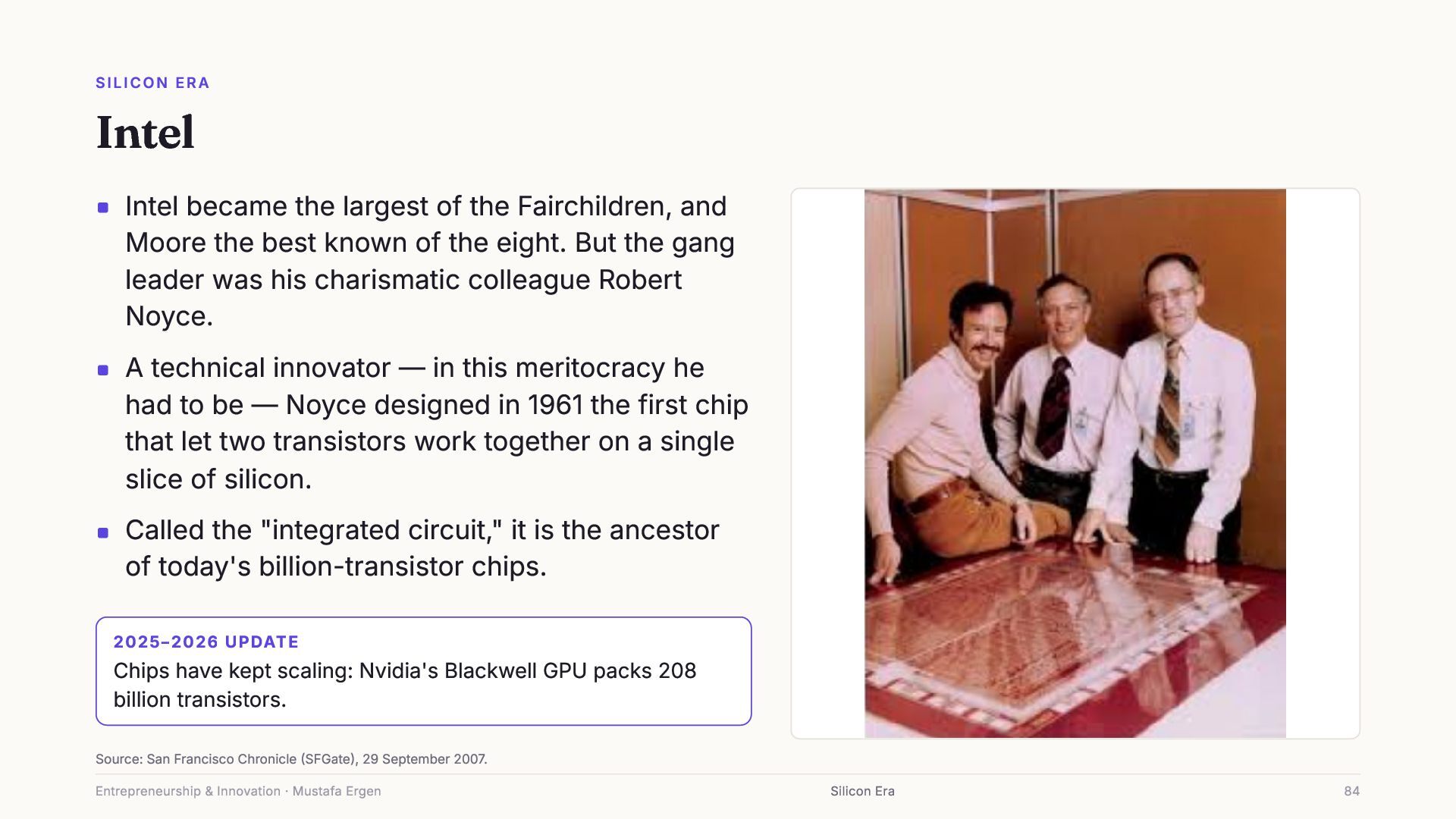
SILICON ERA Intel Intel became the largest of the Fairchildren,
and Moore the best known of the eight. But the gang leader was his charismatic colleague Robert Noyce. A technical innovator — in this meritocracy he had to be — Noyce designed in 1961 the first chip that let two transistors work together on a single slice of silicon. Called the "integrated circuit," it is the ancestor of today's billion-transistor chips. 2025–2026 UPDATE Chips have kept scaling: Nvidia's Blackwell GPU packs 208 billion transistors. Source: San Francisco Chronicle (SFGate), 29 September 2007. Entrepreneurship & Innovation · Mustafa Ergen Silicon Era 84 -
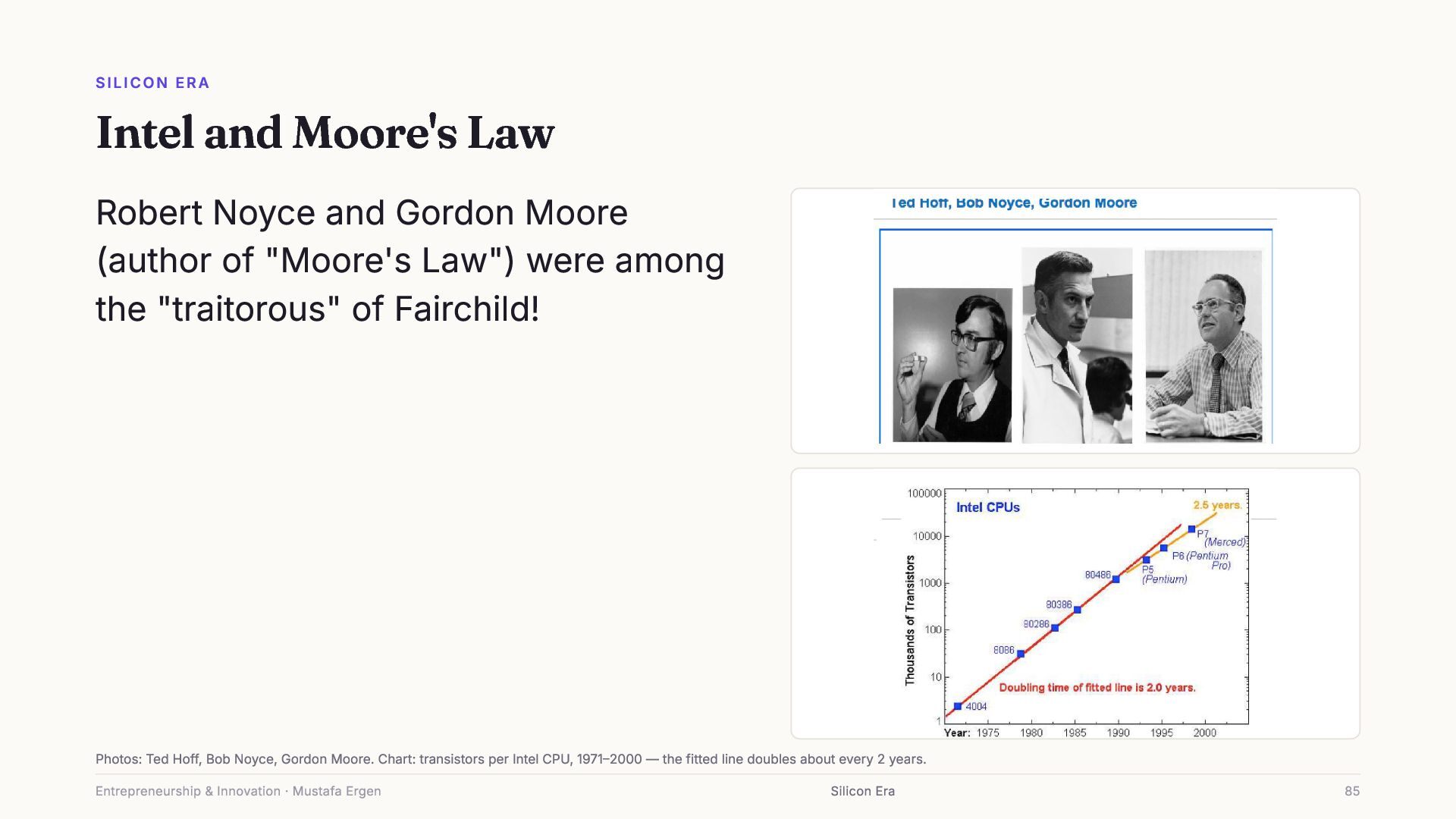
SILICON ERA Intel and Moore's Law Robert Noyce and Gordon
Moore (author of "Moore's Law") were among the "traitorous" of Fairchild! Photos: Ted Hoff, Bob Noyce, Gordon Moore. Chart: transistors per Intel CPU, 1971–2000 — the fitted line doubles about every 2 years. Entrepreneurship & Innovation · Mustafa Ergen Silicon Era 85 -
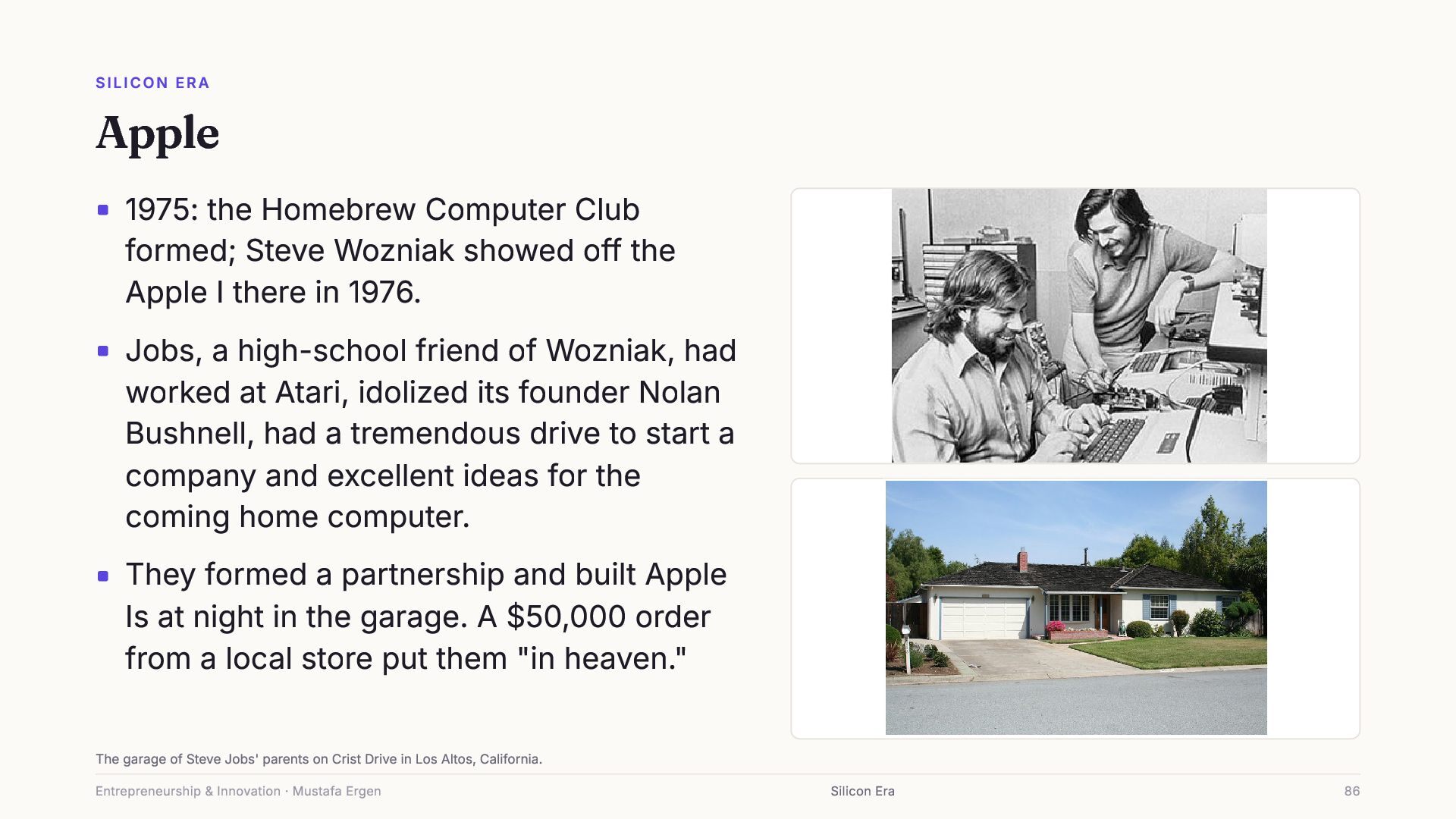
SILICON ERA Apple 1975: the Homebrew Computer Club formed; Steve
Wozniak showed off the Apple I there in 1976. Jobs, a high-school friend of Wozniak, had worked at Atari, idolized its founder Nolan Bushnell, had a tremendous drive to start a company and excellent ideas for the coming home computer. They formed a partnership and built Apple Is at night in the garage. A $50,000 order from a local store put them "in heaven." The garage of Steve Jobs' parents on Crist Drive in Los Altos, California. Entrepreneurship & Innovation · Mustafa Ergen Silicon Era 86 -
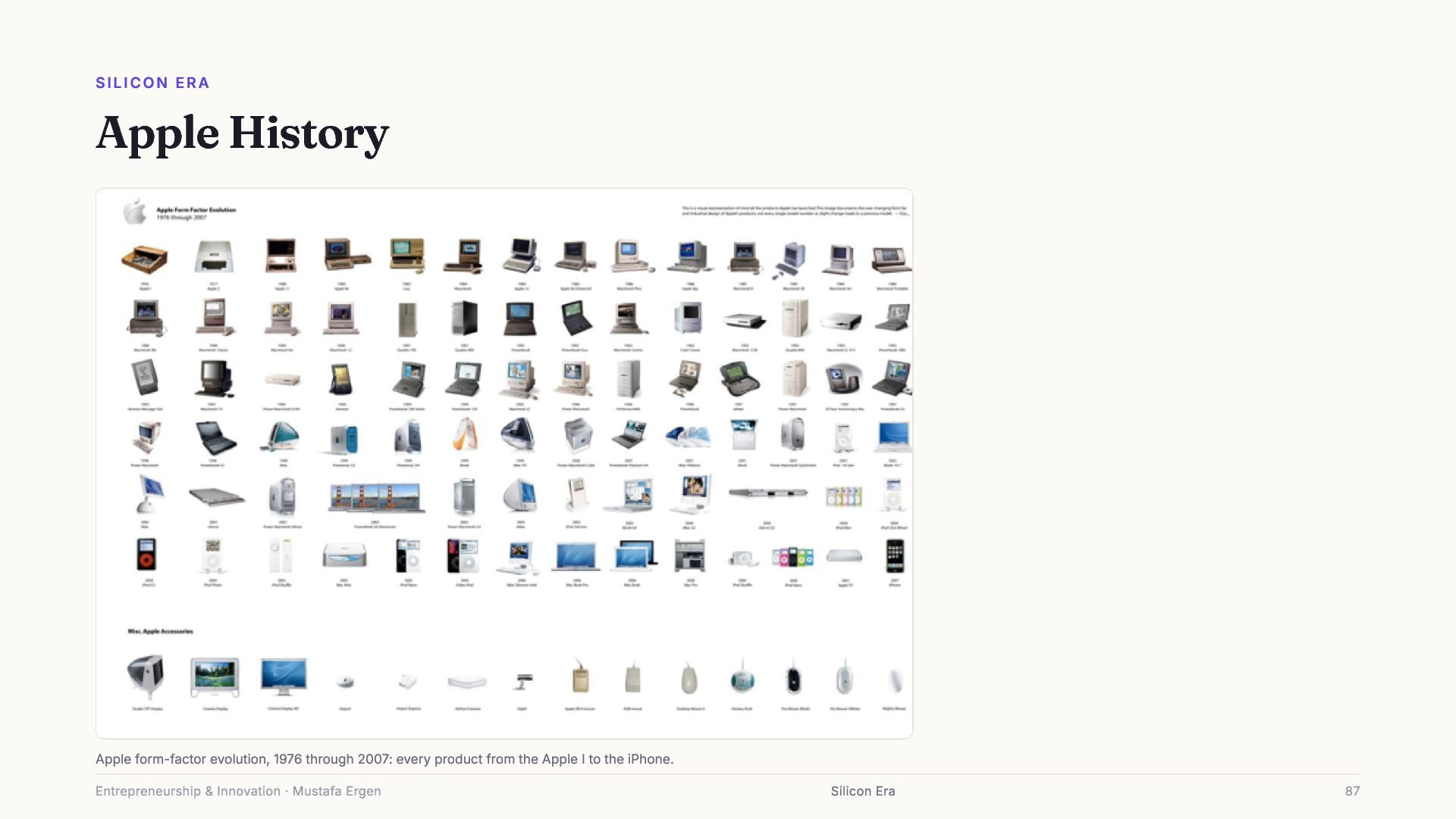
SILICON ERA Apple History Apple form-factor evolution, 1976 through 2007:
every product from the Apple I to the iPhone. Entrepreneurship & Innovation · Mustafa Ergen Silicon Era 87 -
SILICON ERA Government and Military Funding The Soviet launch of
Sputnik on 4 October 1957 prodded the United States to modernize its missile and space program. The newfangled silicon chips were considered vital — albeit costly — components. Historian Paul Ceruzzi writes that NASA and the Defense Department bought so many "that the price dropped from $1,000 a chip to between $20 and $30." Source: San Francisco Chronicle (SFGate), 29 September 2007. Entrepreneurship & Innovation · Mustafa Ergen Silicon Era 88 -
SILICON ERA From Integrated Circuit to PC and Internet By
the 1970s Silicon Valley was poised to capitalize on new civilian technologies like PCs, as exemplified by Apple Computer. In the 1980s excitement shifted to scientific workstations and networking devices from firms like Sun Microsystems and Cisco Systems, and to software like the version of UNIX perfected at UC Berkeley. In the 1990s the point-and-click browser popularized by Netscape ignited the dotcom boom. After a painful bust and slow recovery, the rise of Google and social networks such as Facebook signals another wave of entrepreneurship. 2025–2026 UPDATE Facebook went public in May 2012 and was renamed Meta in 2021; Google was restructured as Alphabet in 2015. Source: San Francisco Chronicle (SFGate), 29 September 2007. Entrepreneurship & Innovation · Mustafa Ergen Silicon Era 89 -
SILICON ERA SRI — Stanford Research Institute SRI International, founded
as Stanford Research Institute, is one of the world's largest contract research institutes. The trustees of Stanford University established it in 1946 as a center of innovation to support economic development in the region. It was later incorporated as an independent non-profit organization under U.S. and California law. SRI's headquarters are in Menlo Park, California, near the Stanford campus. Entrepreneurship & Innovation · Mustafa Ergen Silicon Era 90 -
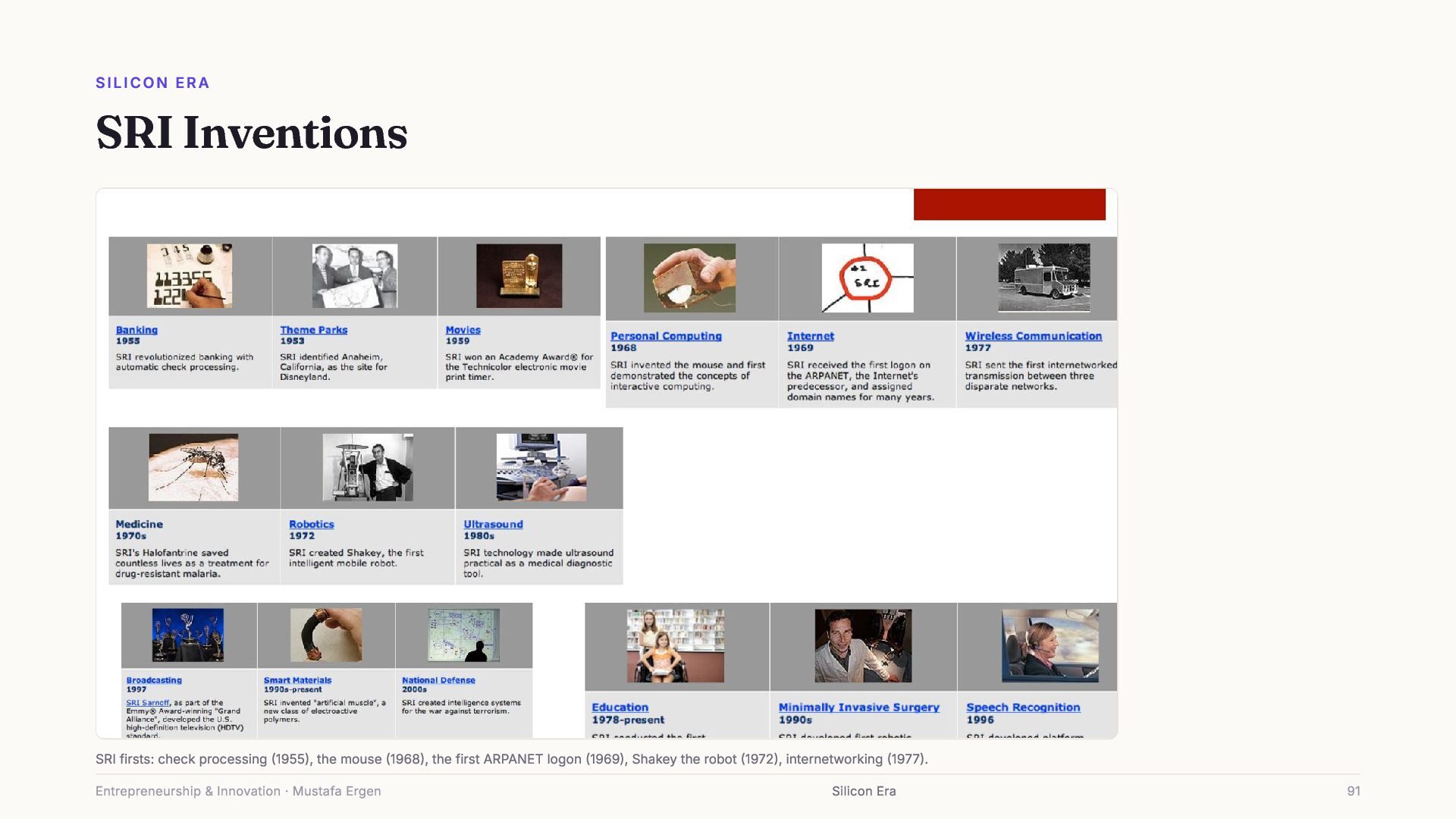
SILICON ERA SRI Inventions SRI firsts: check processing (1955), the
mouse (1968), the first ARPANET logon (1969), Shakey the robot (1972), internetworking (1977). Entrepreneurship & Innovation · Mustafa Ergen Silicon Era 91 -
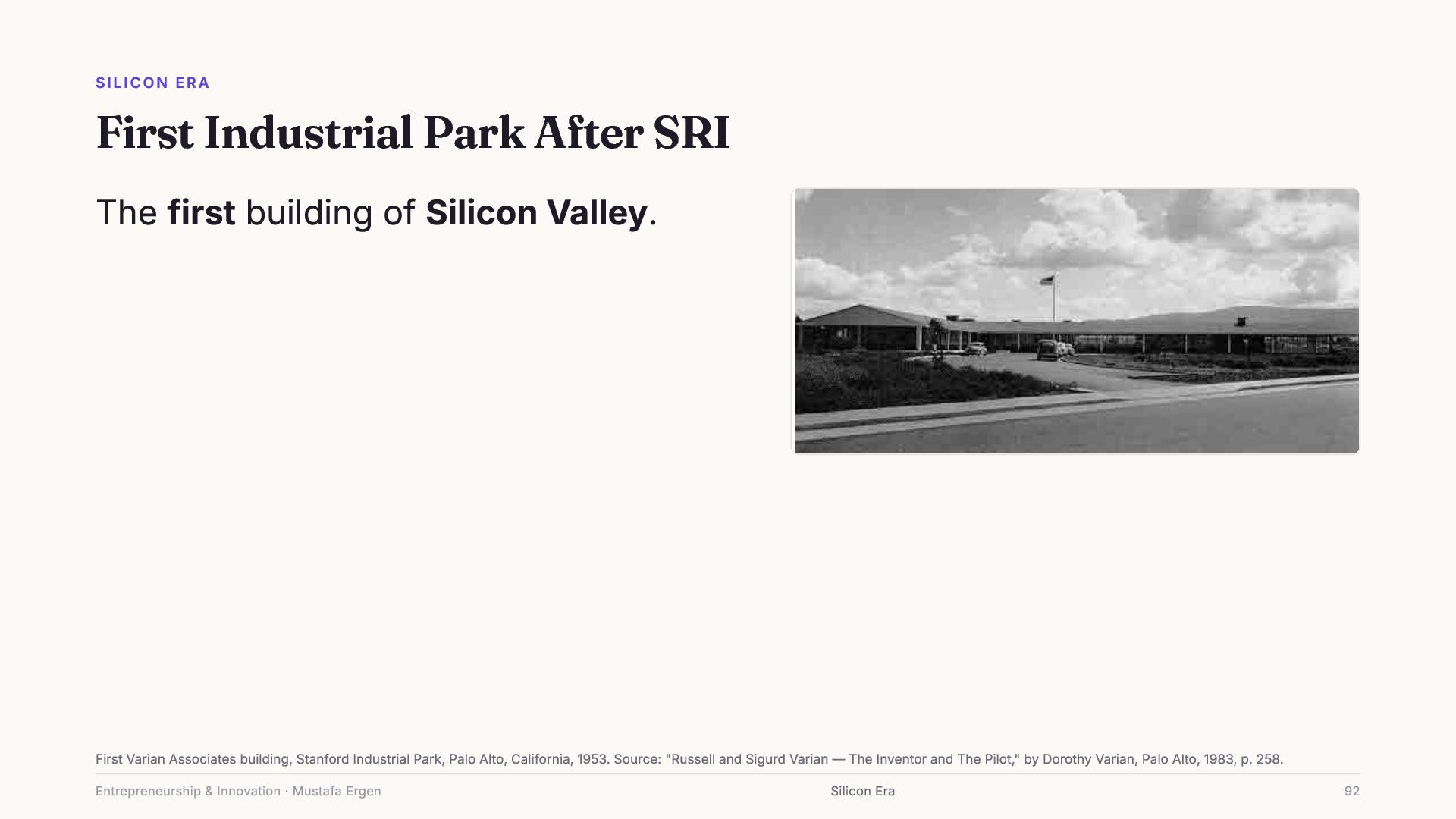
SILICON ERA First Industrial Park After SRI The first building
of Silicon Valley. First Varian Associates building, Stanford Industrial Park, Palo Alto, California, 1953. Source: "Russell and Sigurd Varian — The Inventor and The Pilot," by Dorothy Varian, Palo Alto, 1983, p. 258. Entrepreneurship & Innovation · Mustafa Ergen Silicon Era 92 -
SILICON ERA Stanford's Role Carolyn Tajnai describes this part of
Stanford's history: "In the 1950s the idea of building an industrial park arose. The university had plenty of land — over 8,000 acres — but needed money to finance its rapid postwar growth. Leland Stanford's bequest prohibited selling the land, but nothing prevented leasing it. Long-term leases proved just as attractive to industry as outright ownership; thus the Stanford Industrial Park was founded, to create a center of high technology close to a cooperative university. It was a stroke of genius. Terman, calling it 'our secret weapon,' suggested leases be limited to high-technology companies that might benefit Stanford. In 1951 Varian Associates signed a lease and in 1953 moved into the park's first building. Eastman Kodak, General Electric, Preformed Line Products, Admiral, Shockley Transistor Laboratory of Beckman Instruments, Lockheed, Hewlett-Packard and others soon followed." Source: Carolyn Tajnai, "Fred Terman, the Father of Silicon Valley," 1995. Entrepreneurship & Innovation · Mustafa Ergen Silicon Era 93 -
SILICON ERA Silicon Valley Companies Started by Students Hardware: Apple,
Cisco and Sun. (Dell too, but in Texas.) Software: too many to count … Internet search engines: Inktomi, Yahoo, Ask and Google. Social networks: Facebook, Twitter, LinkedIn and Friendster. Others: InfoSeek, Powerset (Bing), eBay and Craigslist. 2025–2026 UPDATE Twitter was bought by Elon Musk in 2022 and renamed X; Microsoft bought LinkedIn in 2016 ($26.2B); Yahoo's core business was sold to Verizon in 2017. Entrepreneurship & Innovation · Mustafa Ergen Silicon Era 94 -
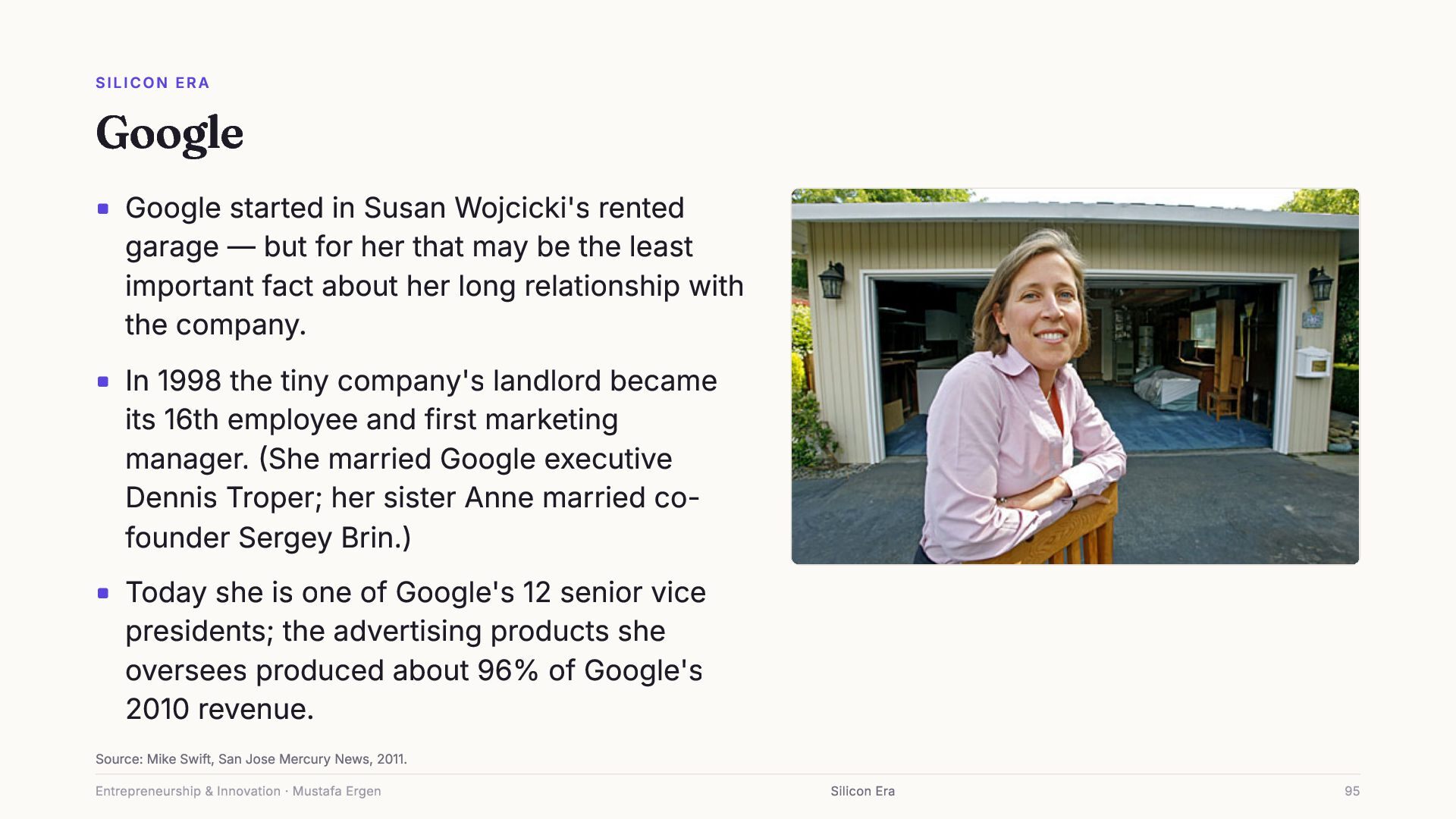
SILICON ERA Google Google started in Susan Wojcicki's rented garage
— but for her that may be the least important fact about her long relationship with the company. In 1998 the tiny company's landlord became its 16th employee and first marketing manager. (She married Google executive Dennis Troper; her sister Anne married cofounder Sergey Brin.) Today she is one of Google's 12 senior vice presidents; the advertising products she oversees produced about 96% of Google's 2010 revenue. Source: Mike Swift, San Jose Mercury News, 2011. Entrepreneurship & Innovation · Mustafa Ergen Silicon Era 95 -
SILICON ERA When Did Silicon Valley Start? Some claim Silicon
Valley started in the radio era. Others date it to Fairchild, since the notion that the Fairchild founders created the valley is justified by what financier Arthur Rock brought to the party: the money to bankroll bold engineers. "The venture capital sector really arises along with the semiconductor industry," according to historian Christophe Lécuyer. "Once the venture capital is in place, it makes all the other things possible." Start: radio? silicon? venture capital? Source: San Francisco Chronicle (SFGate), 29 September 2007. Entrepreneurship & Innovation · Mustafa Ergen Silicon Era 96 -
SILICON ERA Why California and Not Other States? Which historical
feature of Silicon Valley was instrumental in its development? Views differ widely. Many point to the unique features of Stanford University. Others note that the Valley is an exceptionally pleasant place to live on the Pacific coast, so researchers, engineers and programmers who come rarely want to leave. Those seeking government funding for a research park stress that the Valley formed at a peak of the Cold War, when high-tech firms enjoyed a "windfall" of defense programs. A unique California law, enacted for the sake of gold miners, helped power the high-tech boom in Silicon Valley. Source: Gregory Gromov, "A Legal Bridge Spanning 100 Years: From the Gold Mines of El Dorado to the 'Golden' Startups of Silicon Valley." Entrepreneurship & Innovation · Mustafa Ergen Silicon Era 97 -
SILICON ERA The 1872 Law The law declared void any
contract between employer and employee that restricted the employee's freedom to change employers — even to join a competitor. Any agreement signed earlier, such as an employment contract signed on hiring, that limited the right to choose one's workplace was unenforceable; the conflicting clauses were void. First enacted in 1872 in California's Civil Code, it is now Business and Professions Code §16600: "Except as provided in this chapter, every contract by which anyone is restrained from engaging in a lawful profession, trade, or business of any kind is to that extent void." As a result, in Silicon Valley several standard U.S. legal practices are de facto cancelled. 2025–2026 UPDATE §16600 still voids non-competes; SB 699 and AB 1076 (effective 2024) extend this to non-competes signed out of state. Entrepreneurship & Innovation · Mustafa Ergen Silicon Era 98 -
SILICON ERA Non-Compete and Non-Disclosure Agreements Almost anyone hired by
a high-tech company in nearly any U.S. state signs an agreement not to work for competitors for a set period (usually two years) after leaving: the Non-Compete Agreement (NCA). Employees usually also sign an agreement not to disclose, without the employer's express written permission, confidential information about the company that they learn on the job: the Non-Disclosure Agreement (NDA). Entrepreneurship & Innovation · Mustafa Ergen Silicon Era 99 -
SILICON ERA Why This Law? To understand why lawmakers adopted
this framework in California in 1872 — and not in another state or era — it is worth examining how California became the 31st U.S. state. Silicon Valley was essentially built on groundwork laid by its first inhabitants: the gold seekers. El Dorado County is two or three hours by car from Silicon Valley, but 100 years separate the first mining camps (1848–1851) from the first high-tech firms in Stanford's industrial park. The law aimed to reduce shootings around the gold mines. A fortune-seeker, venturesome and armed to the teeth, who lost a dispute in court might settle it the Wild West way. So a law was needed to sharply reduce the chance that disputes between mine owners and hired hands would turn violent. Entrepreneurship & Innovation · Mustafa Ergen Silicon Era 100 -
SILICON ERA Gold Mine Disputes The owner of a registered
gold claim generally had far more motivation than his employees to resolve every business problem in a court of law. So California's lawmakers protected the employee by guaranteeing the most peaceful way of resolving any problem with the owner: to turn and walk away to one of the surrounding claims and their potential new employers. Crucially, the law guaranteed workers of any level the right to leave an employer and immediately — without legal obstacles — take a position anywhere, even with the former employer's competitor in a neighboring mine. Entrepreneurship & Innovation · Mustafa Ergen Silicon Era 101 -
SILICON ERA Valley History: 1848–1872 1848 — the first year
of the Gold Rush. Gold is found in El Dorado County near Sacramento, and "El Dorado" enters the vocabulary of treasure-seekers worldwide. 1849 — the first tens of thousands of gold-seekers arrive in California, then still Mexican territory where only about 2,000 Americans lived: the "Forty-niners." 1850 — California becomes a state, "The Golden State." 1853 — new arrivals exceed 300,000. 1872 — drawing on two decades of regulating violent business disputes, California adopts its Civil Code with a provision guaranteeing employees the freedom to choose their place of work. Entrepreneurship & Innovation · Mustafa Ergen Silicon Era 102 -
SILICON ERA Valley History: 1891–1956 1891 — former governor Leland
Stanford founds Stanford University. 1910 — Lee de Forest, inventor of the triode (1908 patent), arrives in the Bay Area. The triode became critical to long-distance telephony, radio, television, radar and early digital electronics. His arrival began turning the area into a world center of electronics talent; World War I defense contracts gave it a first boost, and it reached critical mass in the decade after World War II. 1951 — Stanford Industrial Park is set up as a high-tech center in partnership with the university; Varian, General Electric and Eastman Kodak are among the first tenants. 1956 — William Shockley, co-inventor of the transistor, founds Shockley Semiconductor in Mountain View: the baton passes from the vacuum-tube triode to the solid-state one. Entrepreneurship & Innovation · Mustafa Ergen Silicon Era 103 -
SILICON ERA Valley History: 1957–1971 1957 — the "Traitorous Eight"
leave Shockley Semiconductor to found Fairchild Semiconductor. 1968 — two of them, Robert Noyce and Gordon Moore, leave Fairchild to found Intel. In just 20 years, eight former Shockley employees gave rise to 65 new enterprises, which did the same in turn. Conflicts between creative teams and veteran managers were common in every U.S. industrial park. But outside California, non-compete agreements that new recruits must sign restrict leaving for a rival or starting a competing company. They act like graphite rods in a nuclear reactor, slowing the chain reaction of new startups. 1971 — the press coins the term "Silicon Valley." 2025–2026 UPDATE The US FTC's 2024 nationwide non-compete ban was struck down in court and dropped in 2025, so most states still enforce non-competes. Entrepreneurship & Innovation · Mustafa Ergen Silicon Era 104 -
SILICON ERA The 1872 Law's Weight in Gold Gold Rush
output was about $80 million a year in period dollars — about $2 billion in today's money. Compare that with the "gold mines" found by Silicon Valley companies, which could multiply from the first generation of startups only thanks to the 1872 law. The New York Times called Apple's impact "the iPhone Gold Rush"; Apple's 2010 sales were about $60 billion. Intel — like many Valley startups, it would not have begun without the law — produced about $40 billion of sales in 2010 from its "silicon gold mine." This modern gold extraction, legally a legacy of the Gold Rush, has earned tens of thousands of Valley companies hundreds of billions of dollars. Entrepreneurship & Innovation · Mustafa Ergen Silicon Era 105 -
SILICON ERA Route 128 The Route 128 region around Boston
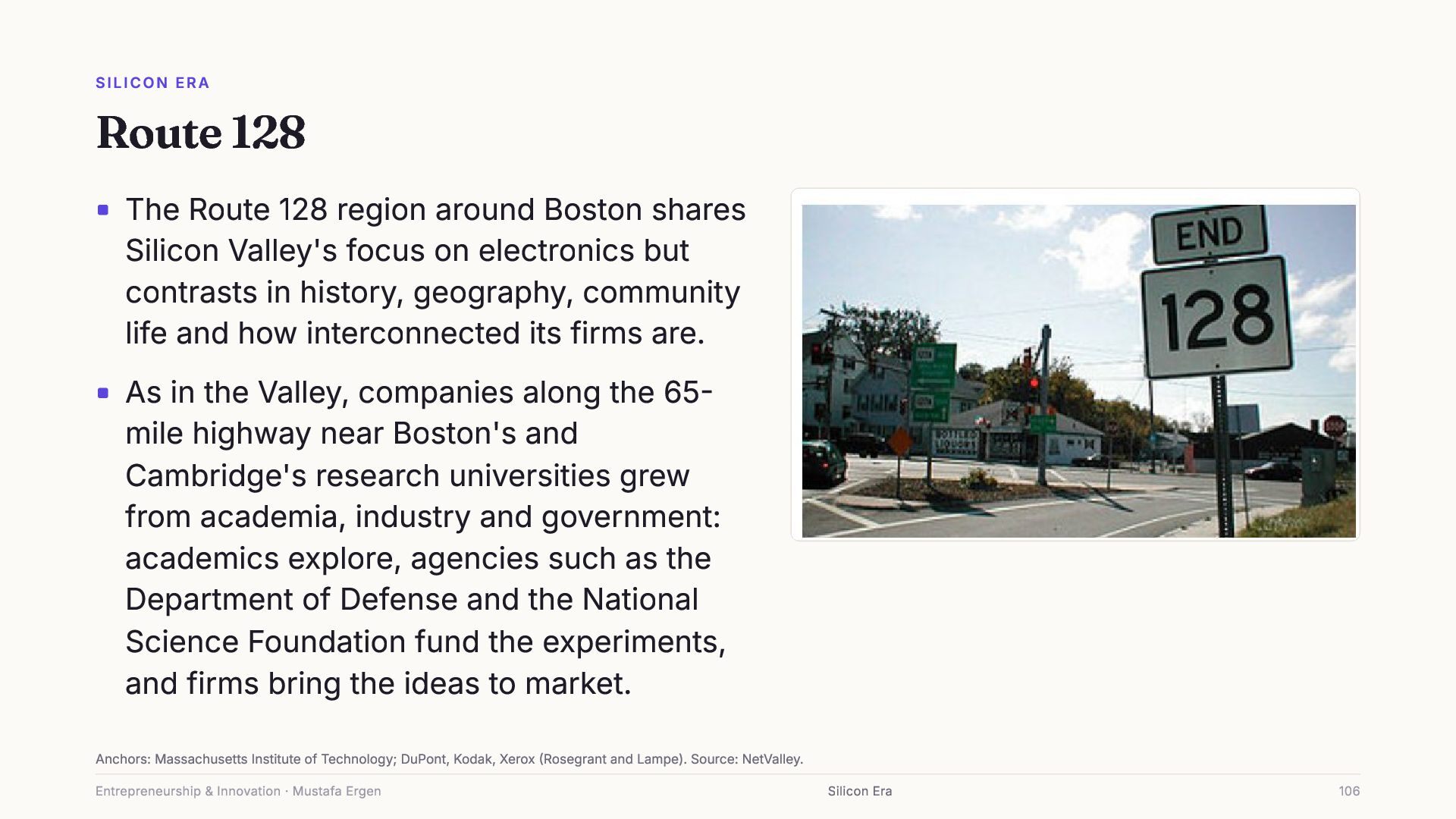
shares Silicon Valley's focus on electronics but contrasts in history, geography, community life and how interconnected its firms are. As in the Valley, companies along the 65mile highway near Boston's and Cambridge's research universities grew from academia, industry and government: academics explore, agencies such as the Department of Defense and the National Science Foundation fund the experiments, and firms bring the ideas to market. Anchors: Massachusetts Institute of Technology; DuPont, Kodak, Xerox (Rosegrant and Lampe). Source: NetValley. Entrepreneurship & Innovation · Mustafa Ergen Silicon Era 106 -
SILICON ERA Route 128 vs Silicon Valley Silicon Valley: regional
network Promotes collective learning and flexible adjustment among companies making specialty products in related technologies. Dense social networks and an open labor market encourage entrepreneurship and experimentation. Firms compete hard while learning from each other through informal communication and collaboration. Boundaries within and between companies, and with universities and trade associations, are porous. Route 128: independent companies Dominated by a few relatively vertically integrated corporations that keep to themselves. Secrecy and corporate loyalty govern relations with customers, suppliers and competitors, favoring stability and self-reliance. Hierarchies keep authority centralized; information flows vertically. Boundaries between and within companies stay distinct. These two systems illuminate the different fates of the two economies. Entrepreneurship & Innovation · Mustafa Ergen Silicon Era 107 -
SILICON ERA Characteristics of the Valley Job mobility shows the
networks' success: average turnover at small and mid-size firms was 35%, and average job tenure in the 1980s about two years. With so many tech firms close together, people could change employers without moving house or changing their children's school. The Valley's attitude catalyzed risk-taking: small groups of dissatisfied employees tinkered with their own ideas after work. Roles became interchangeable — employers became employees, co-workers became competitors. Engineers were loyal to technology and their peers more than to any single firm. The regional motto: "Competition demands continuous innovation, which in turn requires cooperation among firms." Fast flows of practical information became the currency of choice, driving diversification, flexibility and resilience. Hierarchies were weak; from Hewlett and Packard on, firms sought close employer–employee interaction and gave divisions broad autonomy. Source: AnnaLee Saxenian, Regional Advantage, 1994. Entrepreneurship & Innovation · Mustafa Ergen Silicon Era 108 -
SILICON ERA Constant Revolution Technological innovation produces constant revolution. Large
pools of venture capital mean ideas turn into products more rapidly. But it also means existing companies that do not move fast are left behind and ultimately destroyed. For engineers, you may become wealthy through stock options — or unemployed when your employer goes extinct. IBM and AT&T once offered stability and lifetime employment, and at the start of the 1980s seemed unassailable. IBM set the standards; the industry was "IBM and the BUNCH" (Burroughs, Univac, NCR, CDC, Honeywell). By the decade's end IBM had shed tens of thousands of employees and was viewed as a "mainframe dinosaur"; the BUNCH were gone or shadows of their former selves. Entrepreneurship & Innovation · Mustafa Ergen Silicon Era 109 -
SILICON ERA DEC Digital Equipment Corp. (DEC) rose while IBM
declined; at its zenith it was the second-largest U.S. computer company. In the early 1980s the DEC VAX delivered computing power at a fraction of IBM's cost. DEC sold PDP-11 and VAX systems to scientists and engineers, then made big inroads into commercial computing. DEC was seen as cutting-edge and a top place for young engineers. In 1989 Eugene Brooks of Lawrence Livermore Labs wrote "Attack of the Killer Micros," on the impact of exponentially rising microprocessor power. DEC already felt it: the VAX and microVAX could not compete with Sun's UNIX workstations and with PCs. Sales declined and never recovered; DEC was eventually bought by Compaq, a maker of Intel-based PCs. Entrepreneurship & Innovation · Mustafa Ergen Silicon Era 110 -
SILICON ERA SGI The revolutionary effect of technology is accelerating.
Silicon Graphics Inc. (SGI) was founded in 1982 by James Clark, then a Stanford professor. Like the DEC VAX, the SGI workstation was coveted by engineers and scientists. It visualized large physics data sets and rendered graphics for movies like Jurassic Park. In 1996, at the apex of its success, SGI founded its Silicon Studios subsidiary. Three years later SGI was struggling, its profits turned to losses. Faster Intel PC processors and graphics chips from S3, later 3Dfx and Nvidia, put SGI into a decline from which it may never recover. 2025–2026 UPDATE Nvidia, then one of the small graphics-chip challengers, became the first company to reach $4T in market value (July 2025), then $5T (October 2025). Entrepreneurship & Innovation · Mustafa Ergen Silicon Era 111 -
SILICON ERA Eras of Silicon Valley Silicon: the Valley got
its name from semiconductor companies, starting with Shockley Semiconductor; Moore and Noyce left to found Fairchild and later Intel. Chip firms are now a minority, but the Valley still has some of the world's best VLSI designers. Hewlett-Packard also belongs to this era. Software and PC: software companies like Oracle, and companies built on the microprocessor like Apple and Sun; also the era of mini-computers built from medium-scale integrated circuits. Web 1.0: networking and Internet startups. Cisco and 3Com were founded in the microprocessor era; Cisco grew explosively in the Internet boom. Next: the post-Internet-boom era, unfolding now. 2025–2026 UPDATE The current era is AI: it took 65.4% of 2025 US venture deal value (PitchBook-NVCA). Entrepreneurship & Innovation · Mustafa Ergen Silicon Era 112 -
SILICON ERA The Internet Bubble Much is made of the
Mosaic browser and HTML, but popular Internet use was made possible by cheap 14.4K modems, which appeared around 1994. One year later, on 9 August 1995, Netscape's IPO ignited the Internet boom and insane stock valuations for Internet companies. Designing and building a computer system takes two to three years: even with VLSI, the boards, power supply, cooling and enclosure must be designed and manufactured. It took Compaq a decade to build a billion-dollar valuation; Netscape did it in one year. The boom attracted huge pools of venture capital — mostly to Internet companies, but also to many other startups. Entrepreneurship & Innovation · Mustafa Ergen Silicon Era 113 -
SILICON ERA Conclusion Resources: – Excellent academic institutions: UC Berkeley
and Stanford – Culture: Gold Rush mentality – Past successes: HP, Intel and Oracle – Ready capital (VC community) – Minimal bureaucracy – Experienced talent from around the world Silicon Valley promotes collective learning and flexible adjustment among companies that make specialty products within a broad range of related technologies (Saxenian, 1994). 2025–2026 UPDATE Capital is still concentrated here: the Bay Area and New York took 64.2% of 2025 US venture deal value (PitchBookNVCA). Entrepreneurship & Innovation · Mustafa Ergen Silicon Era 114 -
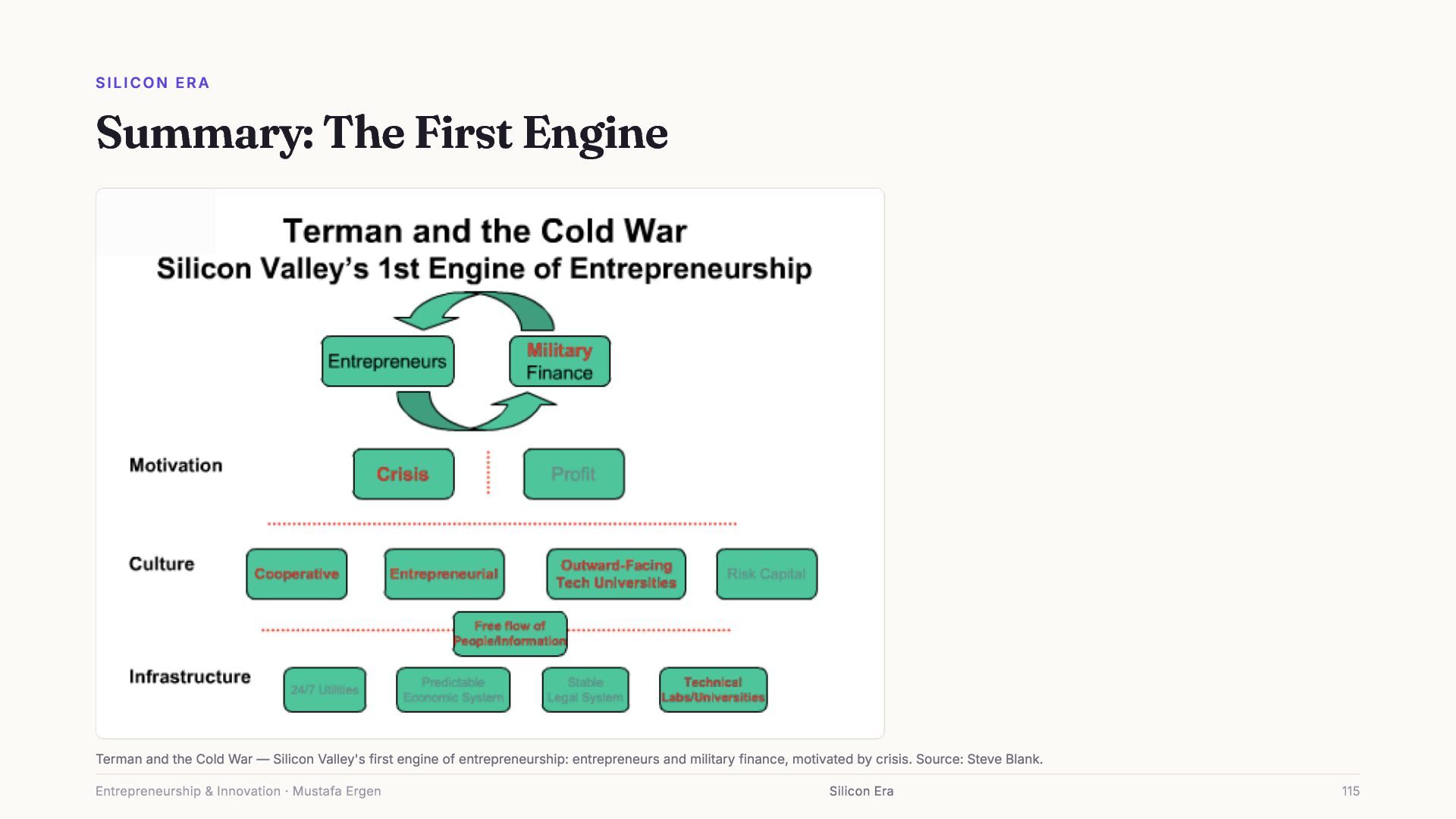
SILICON ERA Summary: The First Engine Terman and the Cold
War — Silicon Valley's first engine of entrepreneurship: entrepreneurs and military finance, motivated by crisis. Source: Steve Blank. Entrepreneurship & Innovation · Mustafa Ergen Silicon Era 115 -
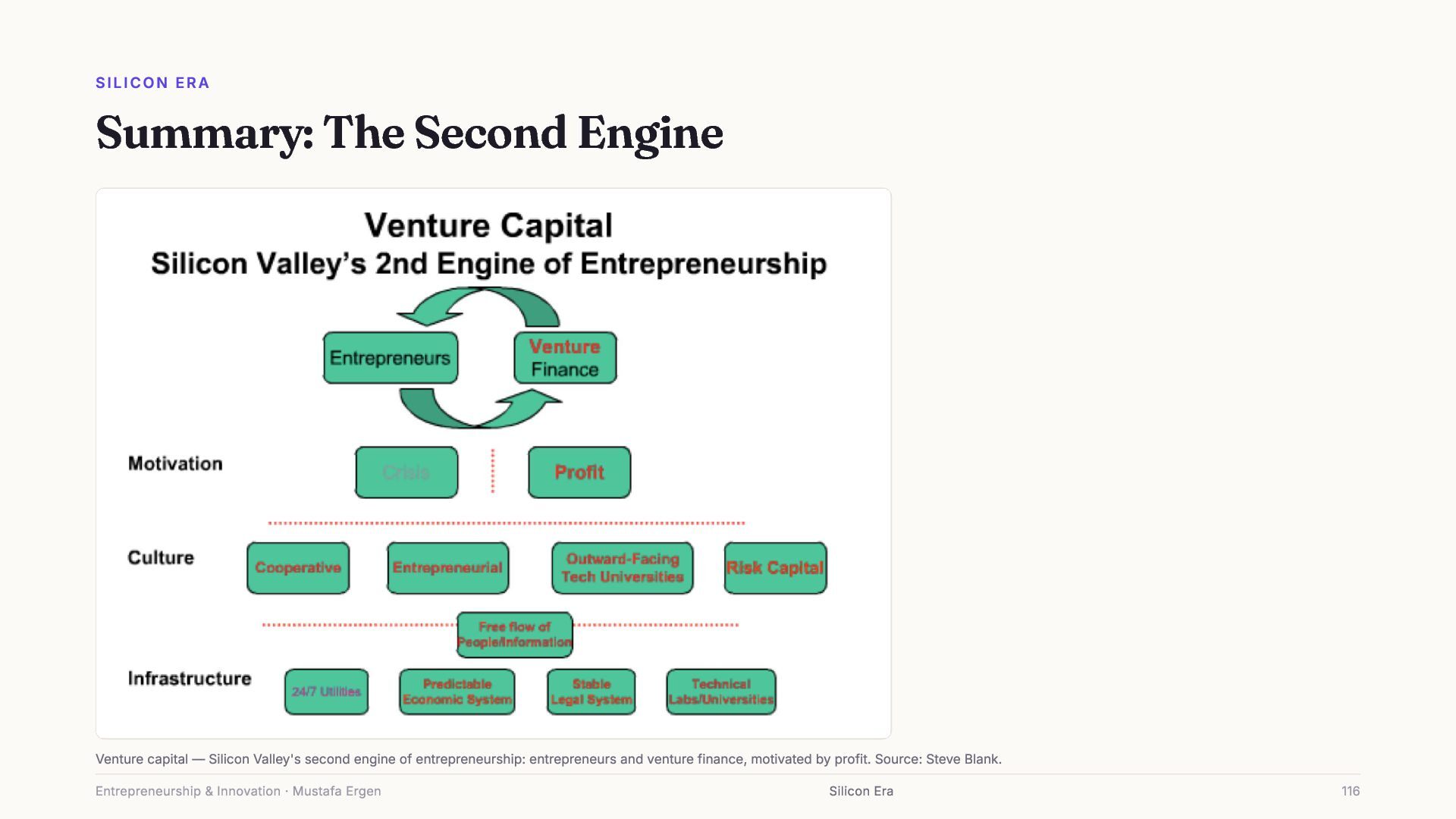
SILICON ERA Summary: The Second Engine Venture capital — Silicon
Valley's second engine of entrepreneurship: entrepreneurs and venture finance, motivated by profit. Source: Steve Blank. Entrepreneurship & Innovation · Mustafa Ergen Silicon Era 116 -
04 The Internet: Web 0.0 to Web 3.0 and SoLoMo
How the Internet evolved — from early ideas of knowledge sharing and ARPANET to Web 1.0, Web 2.0, the semantic web and the Social-LocalMobile trends. Entrepreneurship & Innovation · Mustafa Ergen 04 · The Internet: Web 0.0 to Web 3.0 and SoLoMo 117 -
0 4 · T H E I N T E
R N E T: W E B 0.0 TO W E B 3.0 A N D S O LO M O Outline Web 0.0 Web 1.0 Web 2.0 Web 3.0+ In parallel: the history of venture capital. Entrepreneurship & Innovation · Mustafa Ergen 04 · The Internet: Web 0.0 to Web 3.0 and SoLoMo 118 -
0 4 · T H E I N T E
R N E T: W E B 0.0 TO W E B 3.0 A N D S O LO M O The Concept of Knowledge Sharing Augmentation of human intellect: Formatting directives Context-sensitive help Distributed client-server architecture Uniform command syntax Universal "user interface" front-end module Multi-tool integration Grammar-driven command language interpreter Protocols for virtual terminals and remote procedure calls Compilable "Command Meta Language" Entrepreneurship & Innovation · Mustafa Ergen 04 · The Internet: Web 0.0 to Web 3.0 and SoLoMo 119 -
0 4 · T H E I N T E
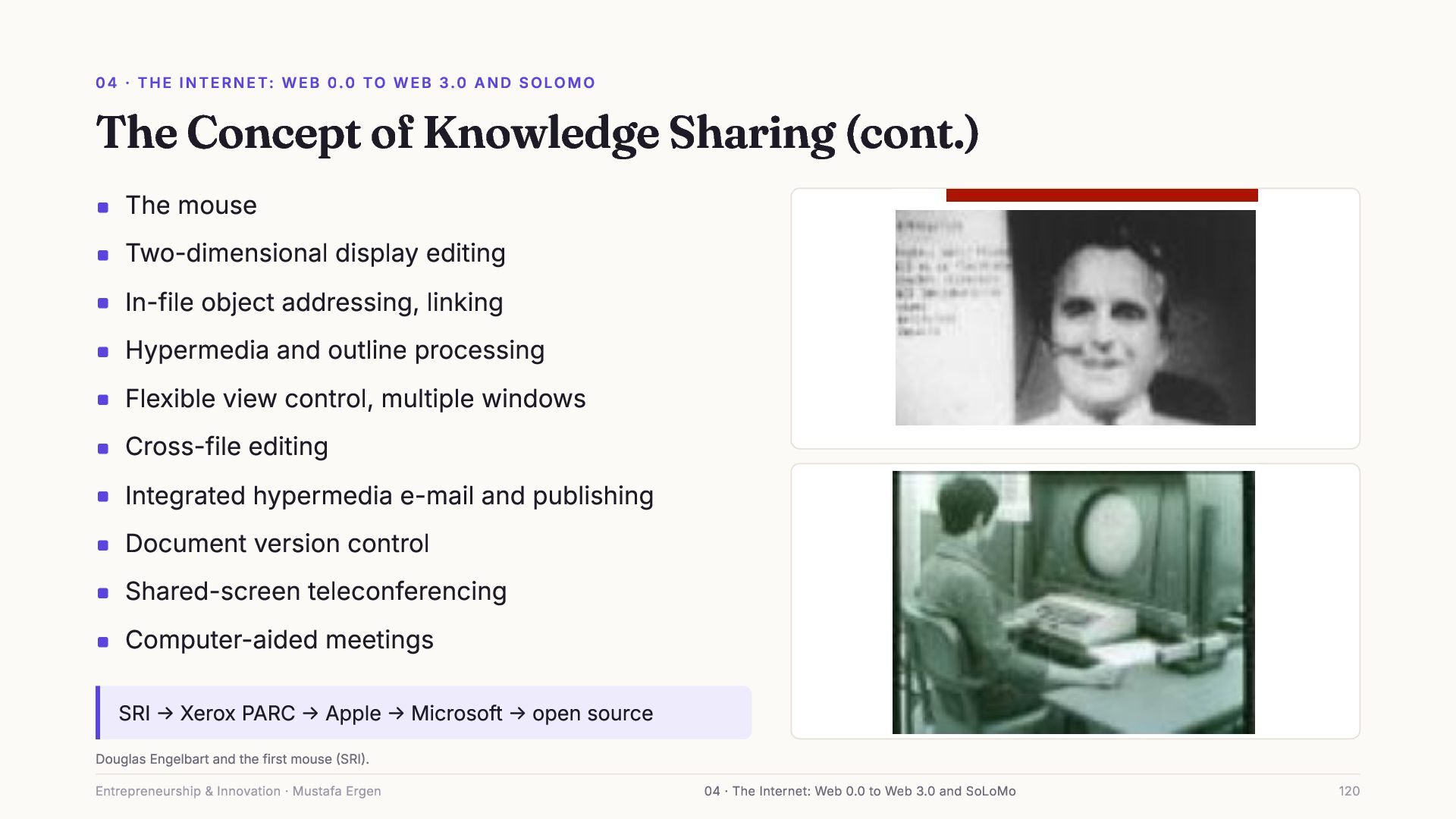
R N E T: W E B 0.0 TO W E B 3.0 A N D S O LO M O The Concept of Knowledge Sharing (cont.) The mouse Two-dimensional display editing In-file object addressing, linking Hypermedia and outline processing Flexible view control, multiple windows Cross-file editing Integrated hypermedia e-mail and publishing Document version control Shared-screen teleconferencing Computer-aided meetings SRI → Xerox PARC → Apple → Microsoft → open source Douglas Engelbart and the first mouse (SRI). Entrepreneurship & Innovation · Mustafa Ergen 04 · The Internet: Web 0.0 to Web 3.0 and SoLoMo 120 -
0 4 · T H E I N T E
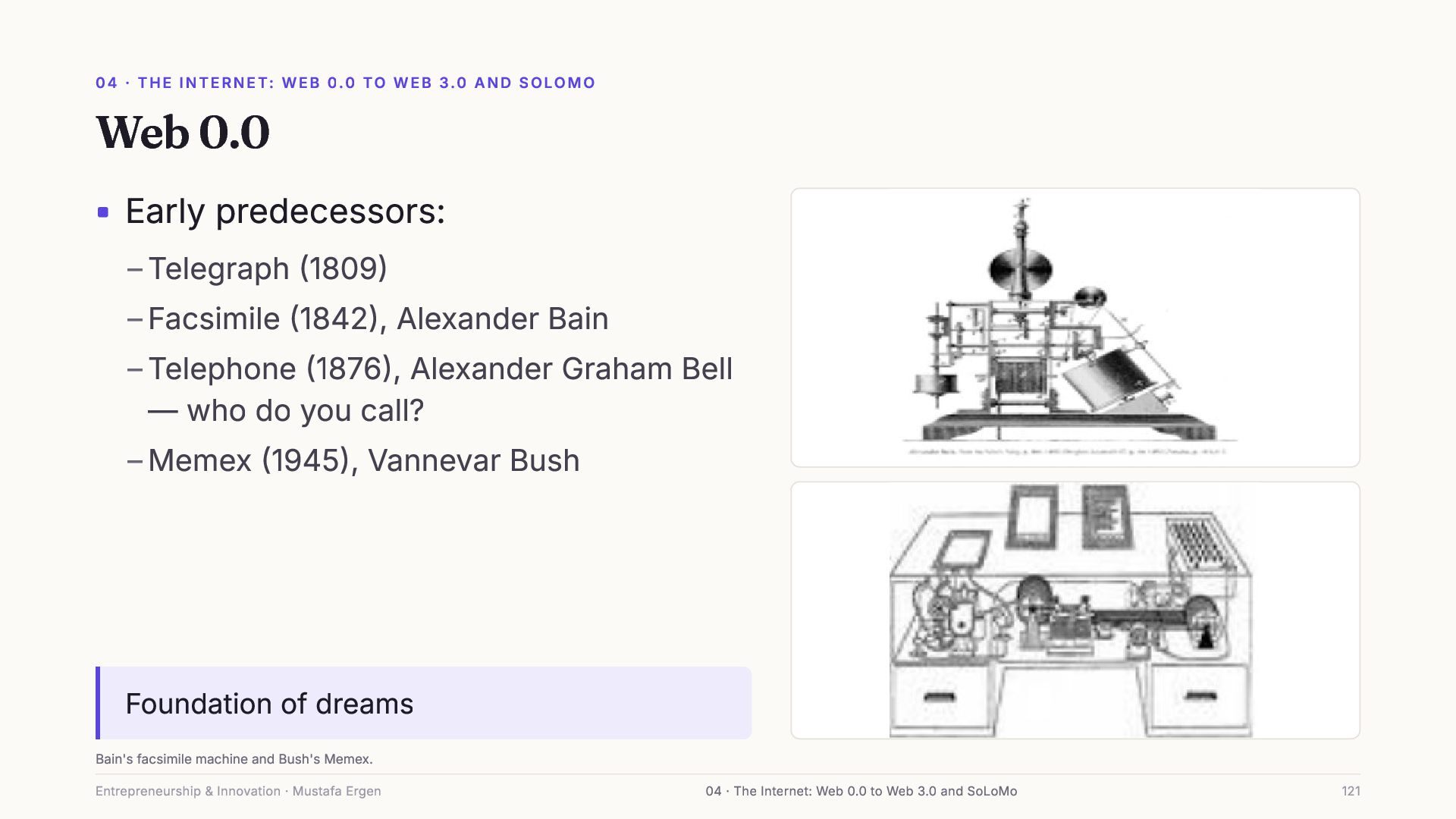
R N E T: W E B 0.0 TO W E B 3.0 A N D S O LO M O Web 0.0 Early predecessors: – Telegraph (1809) – Facsimile (1842), Alexander Bain – Telephone (1876), Alexander Graham Bell — who do you call? – Memex (1945), Vannevar Bush Foundation of dreams Bain's facsimile machine and Bush's Memex. Entrepreneurship & Innovation · Mustafa Ergen 04 · The Internet: Web 0.0 to Web 3.0 and SoLoMo 121 -
0 4 · T H E I N T E
R N E T: W E B 0.0 TO W E B 3.0 A N D S O LO M O History of the Internet The Internet was the result of visionary thinking by people in the early 1960s who saw great potential value in letting computers share information on research and development in scientific and military fields. Entrepreneurship & Innovation · Mustafa Ergen 04 · The Internet: Web 0.0 to Web 3.0 and SoLoMo 122 -
0 4 · T H E I N T E
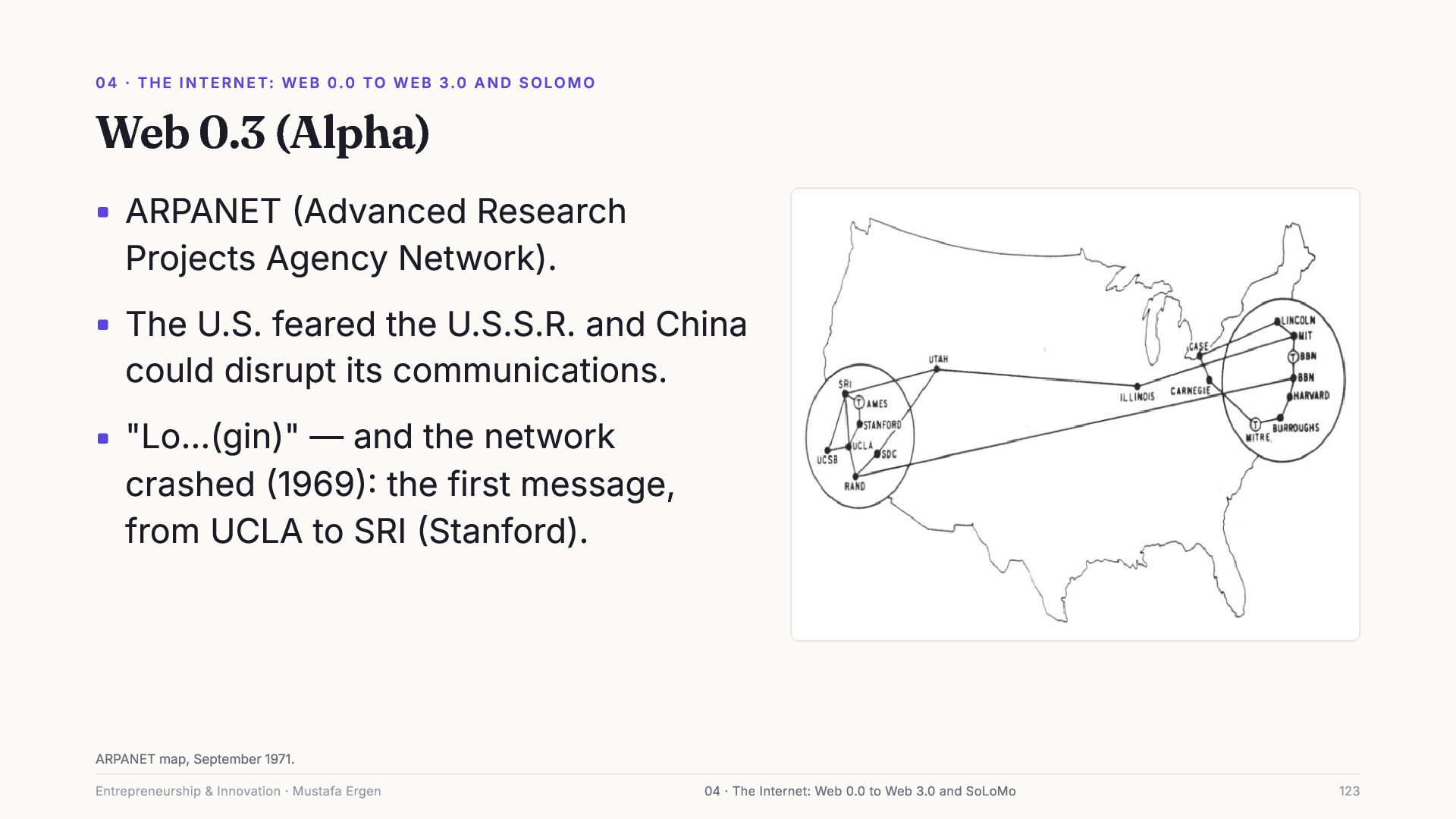
R N E T: W E B 0.0 TO W E B 3.0 A N D S O LO M O Web 0.3 (Alpha) ARPANET (Advanced Research Projects Agency Network). The U.S. feared the U.S.S.R. and China could disrupt its communications. "Lo…(gin)" — and the network crashed (1969): the first message, from UCLA to SRI (Stanford). ARPANET map, September 1971. Entrepreneurship & Innovation · Mustafa Ergen 04 · The Internet: Web 0.0 to Web 3.0 and SoLoMo 123 -
0 4 · T H E I N T E
R N E T: W E B 0.0 TO W E B 3.0 A N D S O LO M O ARPANET J.C.R. Licklider of MIT first proposed a global network of computers in 1962 and moved to the Defense Advanced Research Projects Agency (DARPA) in late 1962 to lead the work. Leonard Kleinrock of MIT, later UCLA, developed the theory of packet switching, the basis of Internet connections. In 1965 Lawrence Roberts of MIT connected a Massachusetts computer with a California computer over dial-up phone lines: wide-area networking was feasible, but circuit switching was inadequate. Kleinrock's packet-switching theory was confirmed. Roberts moved to DARPA in 1966 and developed his plan for ARPANET. These visionaries, and many more unnamed here, are the real founders of the Internet. Entrepreneurship & Innovation · Mustafa Ergen 04 · The Internet: Web 0.0 to Web 3.0 and SoLoMo 124 -
0 4 · T H E I N T E
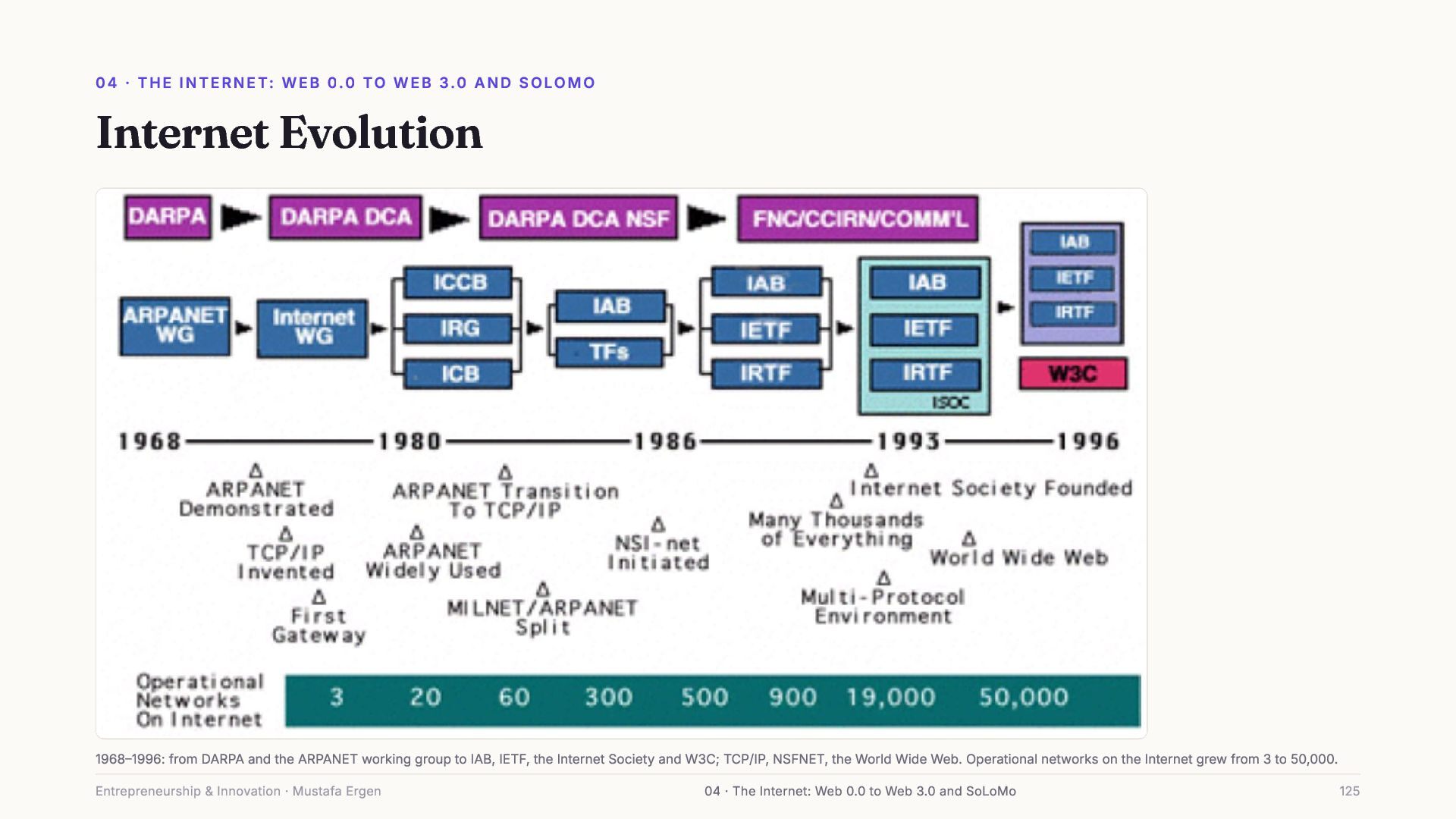
R N E T: W E B 0.0 TO W E B 3.0 A N D S O LO M O Internet Evolution 1968–1996: from DARPA and the ARPANET working group to IAB, IETF, the Internet Society and W3C; TCP/IP, NSFNET, the World Wide Web. Operational networks on the Internet grew from 3 to 50,000. Entrepreneurship & Innovation · Mustafa Ergen 04 · The Internet: Web 0.0 to Web 3.0 and SoLoMo 125 -
0 4 · T H E I N T E
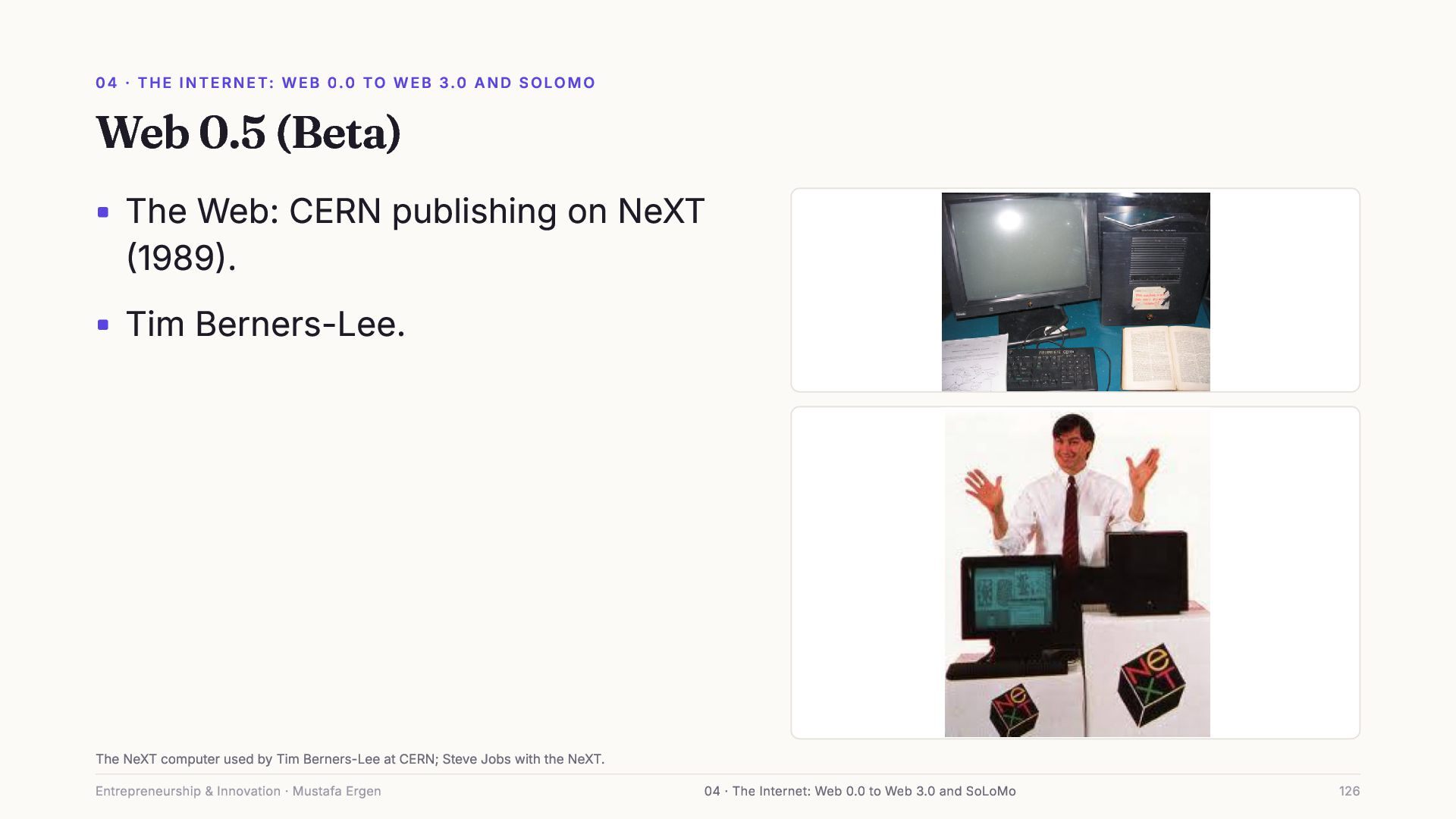
R N E T: W E B 0.0 TO W E B 3.0 A N D S O LO M O Web 0.5 (Beta) The Web: CERN publishing on NeXT (1989). Tim Berners-Lee. The NeXT computer used by Tim Berners-Lee at CERN; Steve Jobs with the NeXT. Entrepreneurship & Innovation · Mustafa Ergen 04 · The Internet: Web 0.0 to Web 3.0 and SoLoMo 126 -
0 4 · T H E I N T E
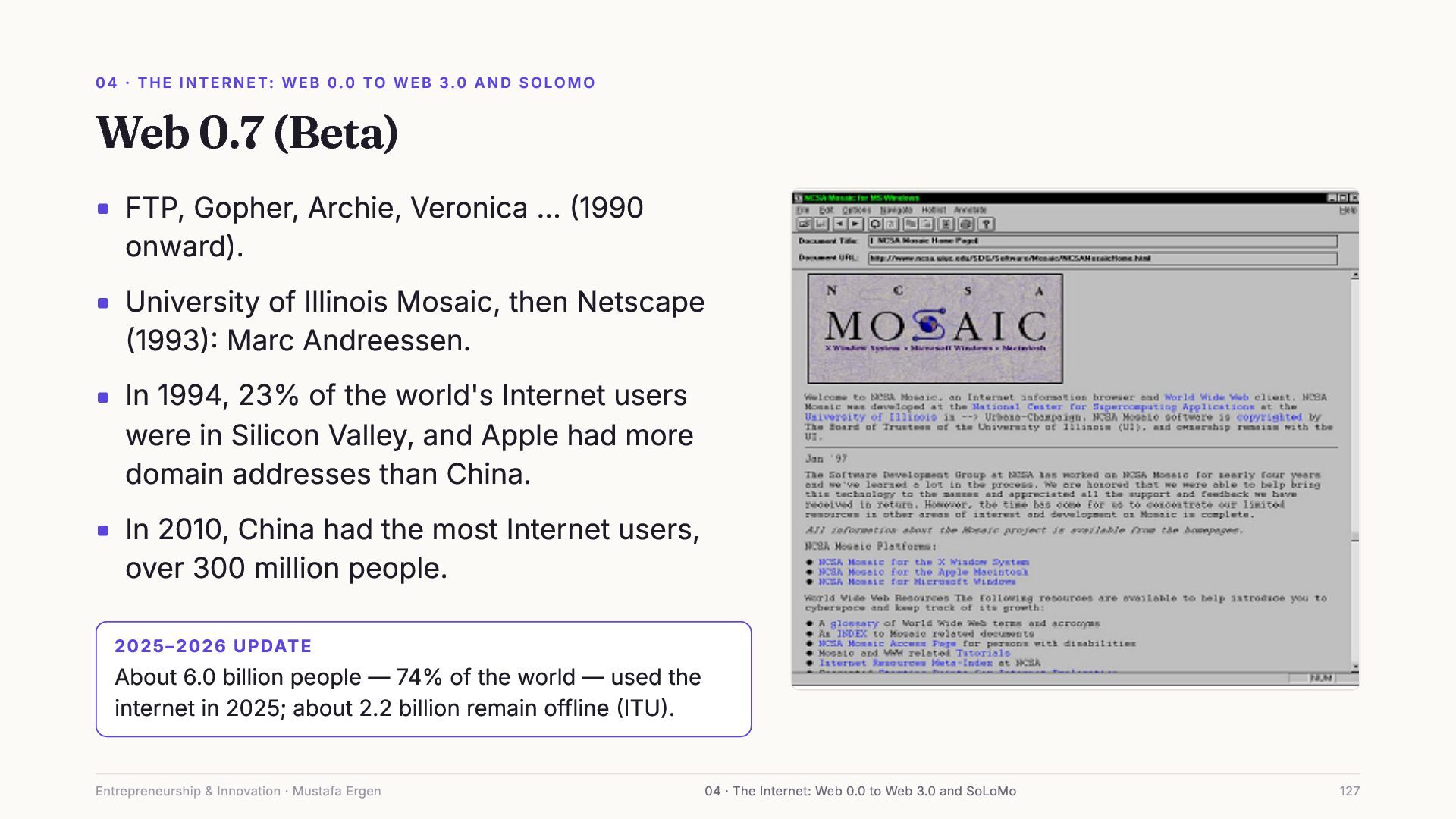
R N E T: W E B 0.0 TO W E B 3.0 A N D S O LO M O Web 0.7 (Beta) FTP, Gopher, Archie, Veronica … (1990 onward). University of Illinois Mosaic, then Netscape (1993): Marc Andreessen. In 1994, 23% of the world's Internet users were in Silicon Valley, and Apple had more domain addresses than China. In 2010, China had the most Internet users, over 300 million people. 2025–2026 UPDATE About 6.0 billion people — 74% of the world — used the internet in 2025; about 2.2 billion remain offline (ITU). Entrepreneurship & Innovation · Mustafa Ergen 04 · The Internet: Web 0.0 to Web 3.0 and SoLoMo 127 -
0 4 · T H E I N T E
R N E T: W E B 0.0 TO W E B 3.0 A N D S O LO M O Internet Web 1.0 1993: the U.S. Congress enacted .com legislation. 1995: Internet commerce is a $0 billion industry. 2010: Internet commerce advertising is $25 billion. Founders: Len Bosack and Sandra Lerner (Cisco), Jerry Yang and David Filo (Yahoo), Jeff Bezos (Amazon), Woz and Jobs (Apple), Pierre Omidyar (eBay), Steve Kirsch (Infoseek, $10 million). Foundation of dreams Entrepreneurship & Innovation · Mustafa Ergen 04 · The Internet: Web 0.0 to Web 3.0 and SoLoMo 128 -
0 4 · T H E I N T E
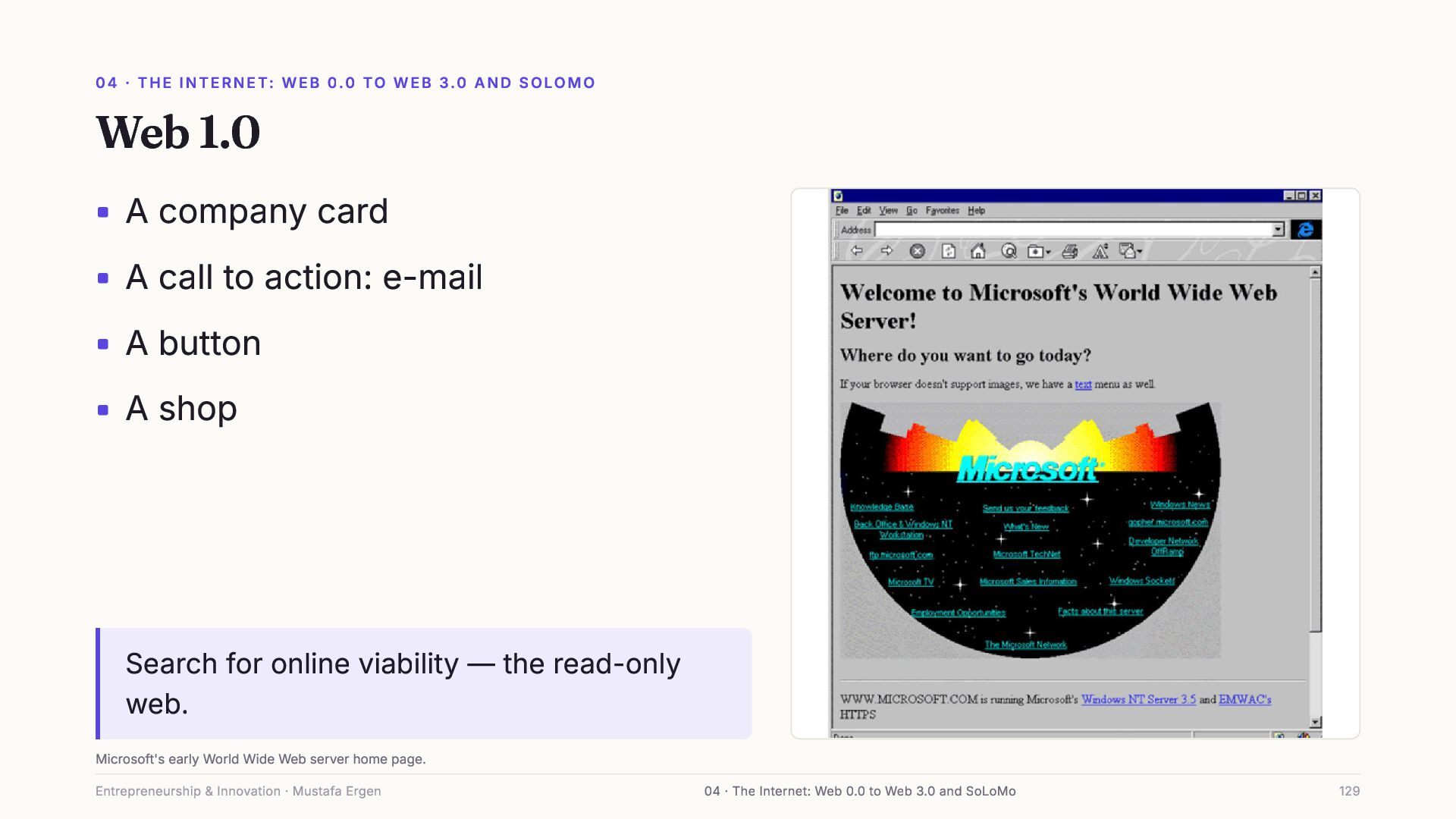
R N E T: W E B 0.0 TO W E B 3.0 A N D S O LO M O Web 1.0 A company card A call to action: e-mail A button A shop Search for online viability — the read-only web. Microsoft's early World Wide Web server home page. Entrepreneurship & Innovation · Mustafa Ergen 04 · The Internet: Web 0.0 to Web 3.0 and SoLoMo 129 -
0 4 · T H E I N T E
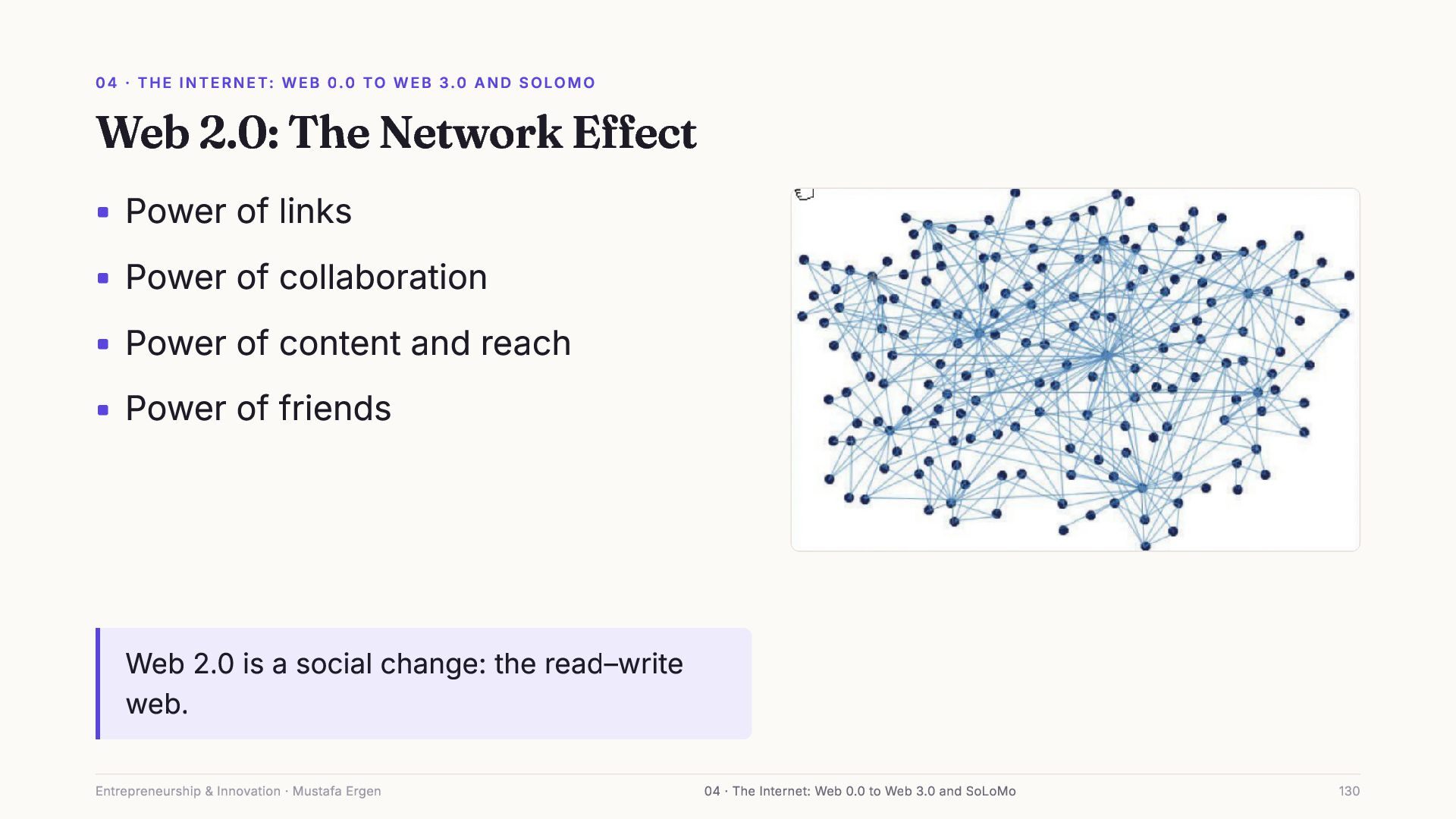
R N E T: W E B 0.0 TO W E B 3.0 A N D S O LO M O Web 2.0: The Network Effect Power of links Power of collaboration Power of content and reach Power of friends Web 2.0 is a social change: the read–write web. Entrepreneurship & Innovation · Mustafa Ergen 04 · The Internet: Web 0.0 to Web 3.0 and SoLoMo 130 -
0 4 · T H E I N T E
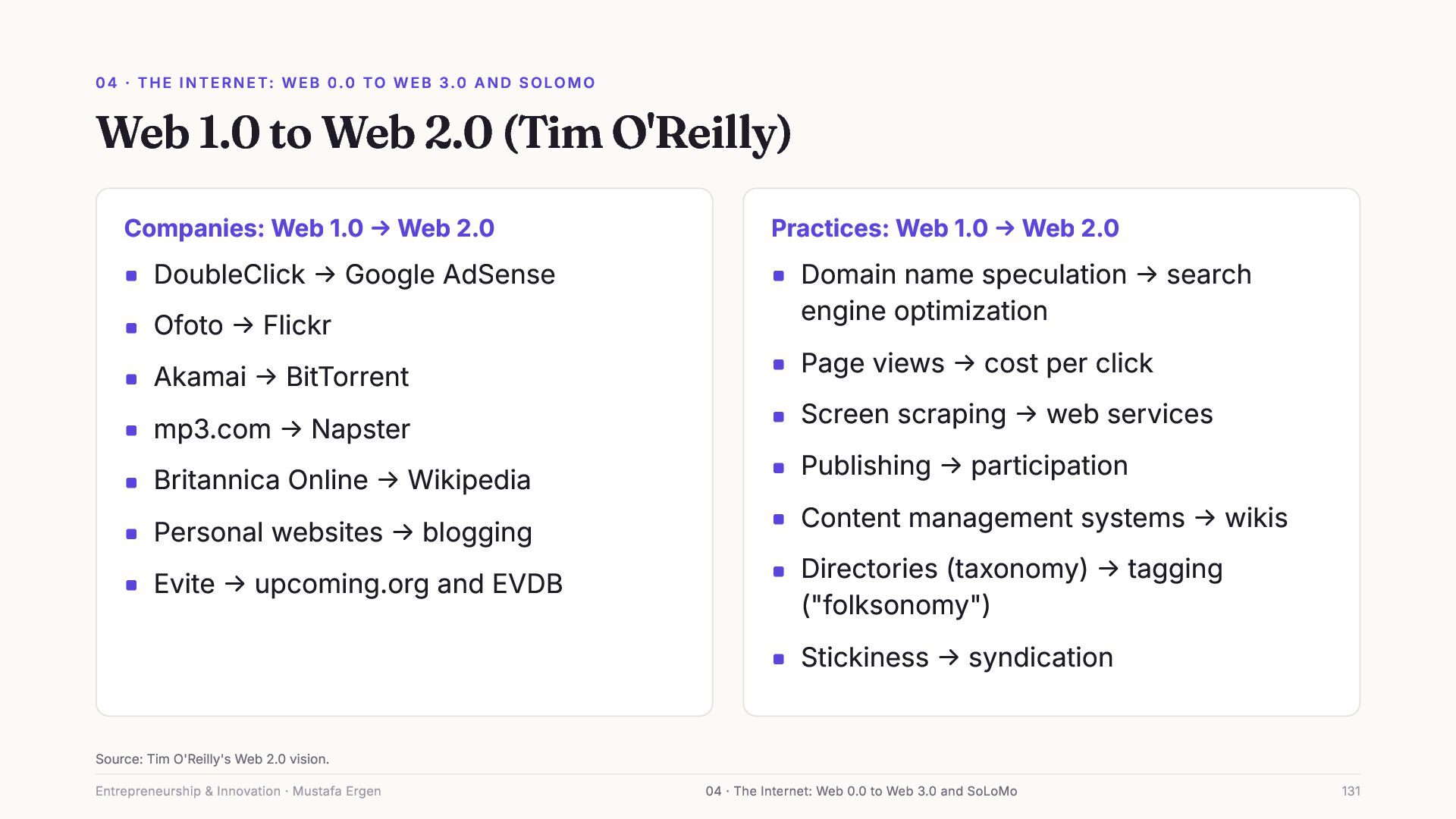
R N E T: W E B 0.0 TO W E B 3.0 A N D S O LO M O Web 1.0 to Web 2.0 (Tim O'Reilly) Companies: Web 1.0 → Web 2.0 DoubleClick → Google AdSense Ofoto → Flickr Akamai → BitTorrent mp3.com → Napster Britannica Online → Wikipedia Personal websites → blogging Evite → upcoming.org and EVDB Practices: Web 1.0 → Web 2.0 Domain name speculation → search engine optimization Page views → cost per click Screen scraping → web services Publishing → participation Content management systems → wikis Directories (taxonomy) → tagging ("folksonomy") Stickiness → syndication Source: Tim O'Reilly's Web 2.0 vision. Entrepreneurship & Innovation · Mustafa Ergen 04 · The Internet: Web 0.0 to Web 3.0 and SoLoMo 131 -
0 4 · T H E I N T E
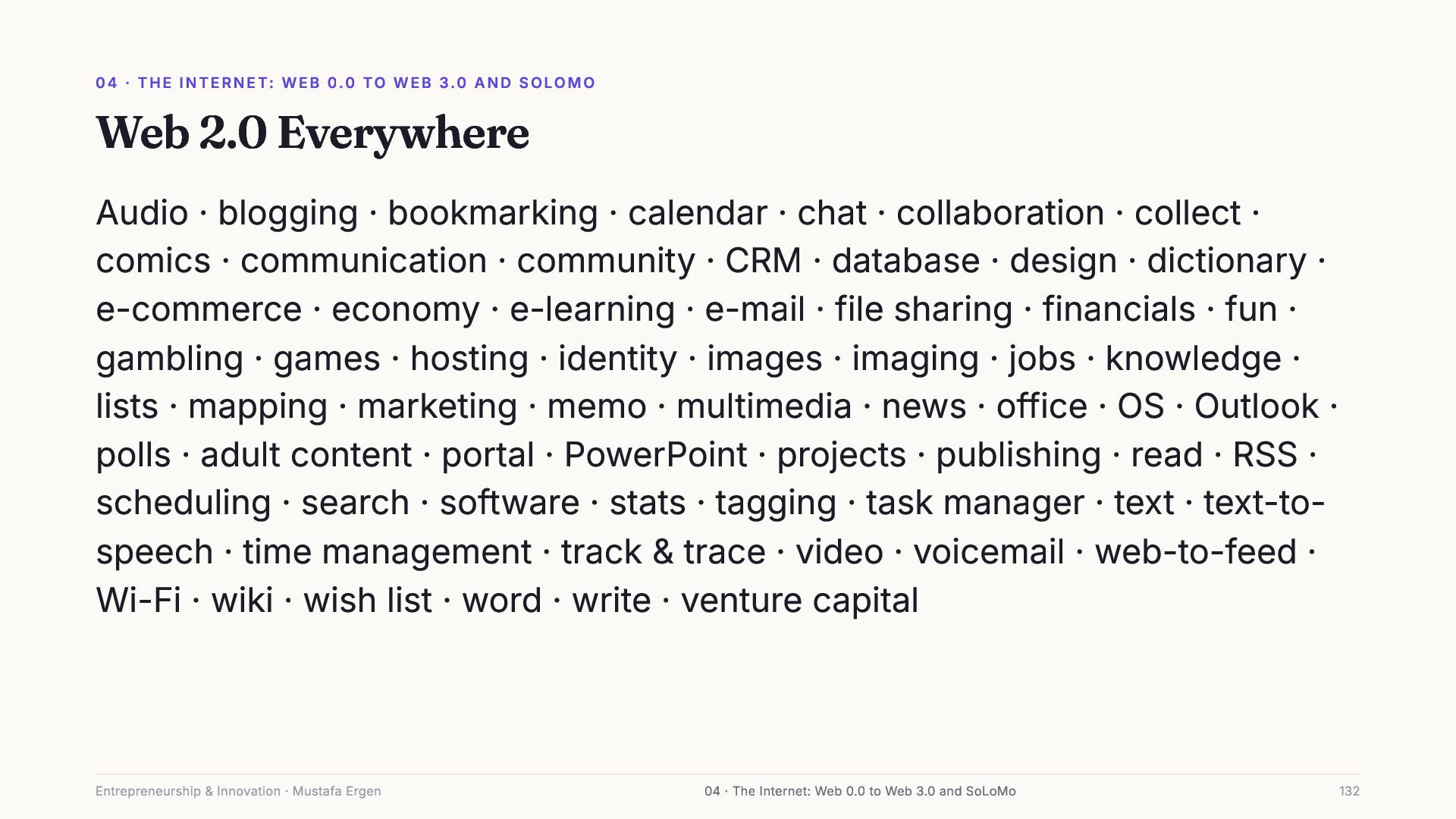
R N E T: W E B 0.0 TO W E B 3.0 A N D S O LO M O Web 2.0 Everywhere Audio · blogging · bookmarking · calendar · chat · collaboration · collect · comics · communication · community · CRM · database · design · dictionary · e-commerce · economy · e-learning · e-mail · file sharing · financials · fun · gambling · games · hosting · identity · images · imaging · jobs · knowledge · lists · mapping · marketing · memo · multimedia · news · office · OS · Outlook · polls · adult content · portal · PowerPoint · projects · publishing · read · RSS · scheduling · search · software · stats · tagging · task manager · text · text-tospeech · time management · track & trace · video · voicemail · web-to-feed · Wi-Fi · wiki · wish list · word · write · venture capital Entrepreneurship & Innovation · Mustafa Ergen 04 · The Internet: Web 0.0 to Web 3.0 and SoLoMo 132 -
0 4 · T H E I N T E
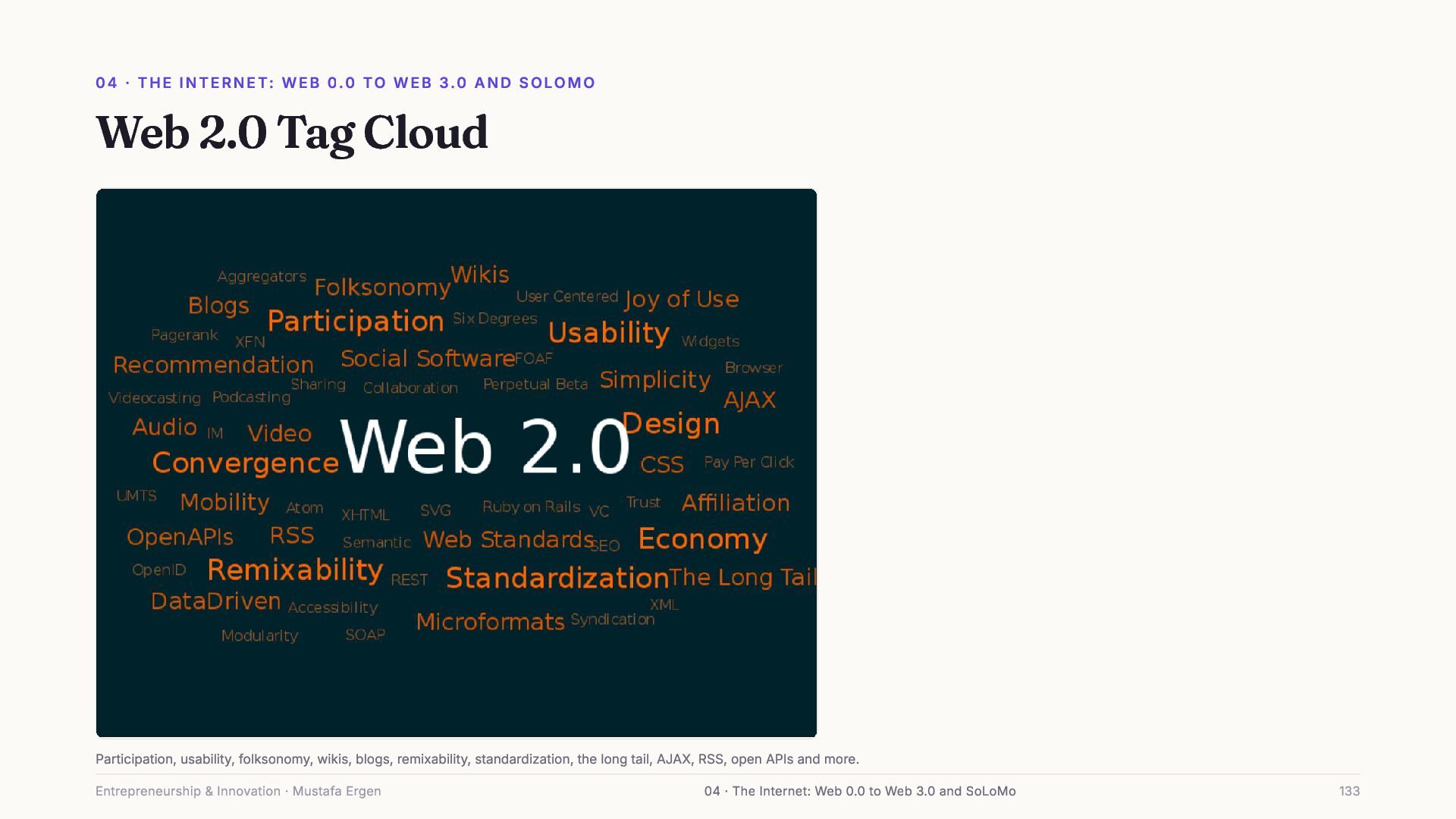
R N E T: W E B 0.0 TO W E B 3.0 A N D S O LO M O Web 2.0 Tag Cloud Participation, usability, folksonomy, wikis, blogs, remixability, standardization, the long tail, AJAX, RSS, open APIs and more. Entrepreneurship & Innovation · Mustafa Ergen 04 · The Internet: Web 0.0 to Web 3.0 and SoLoMo 133 -
0 4 · T H E I N T E
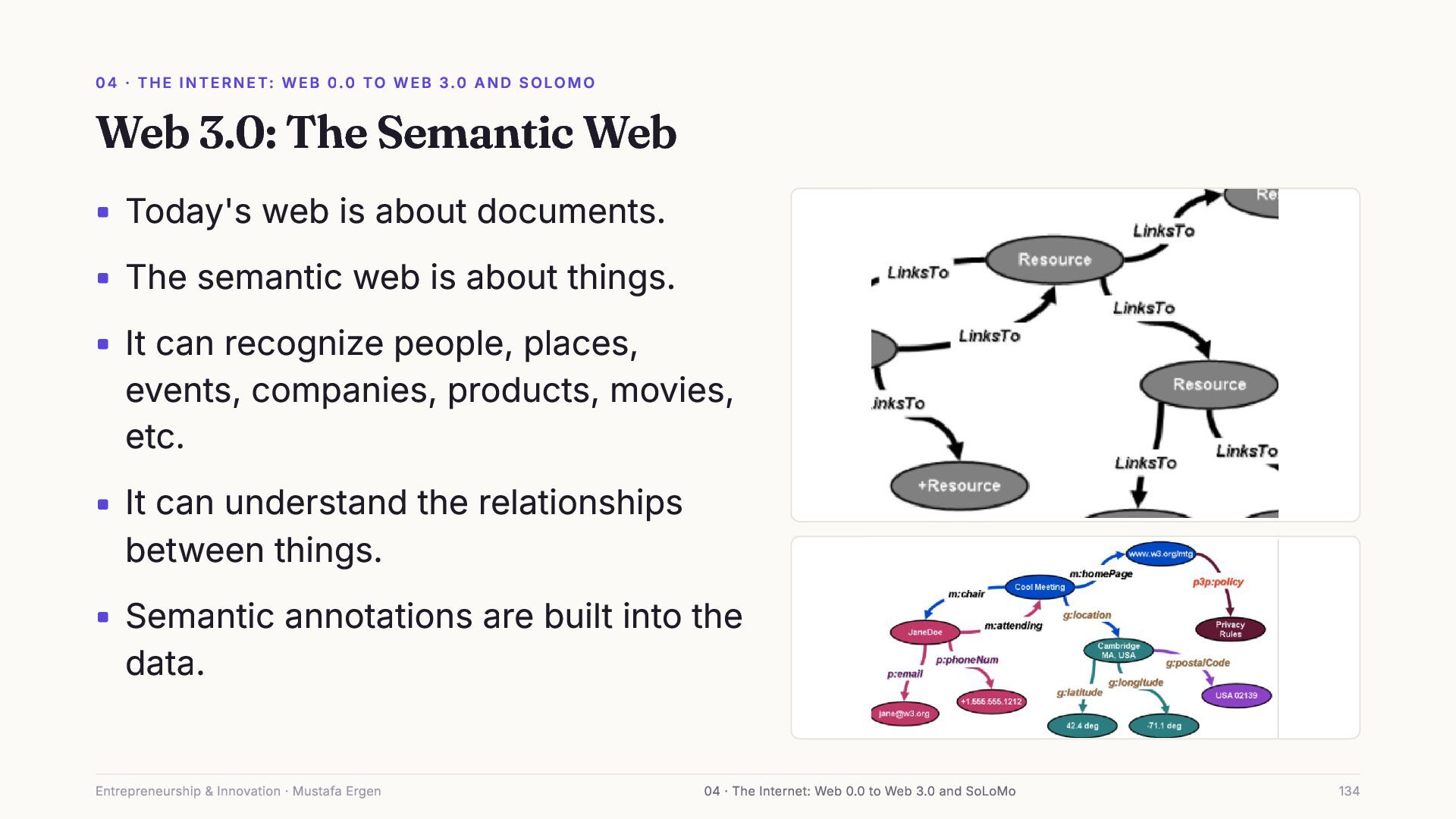
R N E T: W E B 0.0 TO W E B 3.0 A N D S O LO M O Web 3.0: The Semantic Web Today's web is about documents. The semantic web is about things. It can recognize people, places, events, companies, products, movies, etc. It can understand the relationships between things. Semantic annotations are built into the data. Entrepreneurship & Innovation · Mustafa Ergen 04 · The Internet: Web 0.0 to Web 3.0 and SoLoMo 134 -
0 4 · T H E I N T E
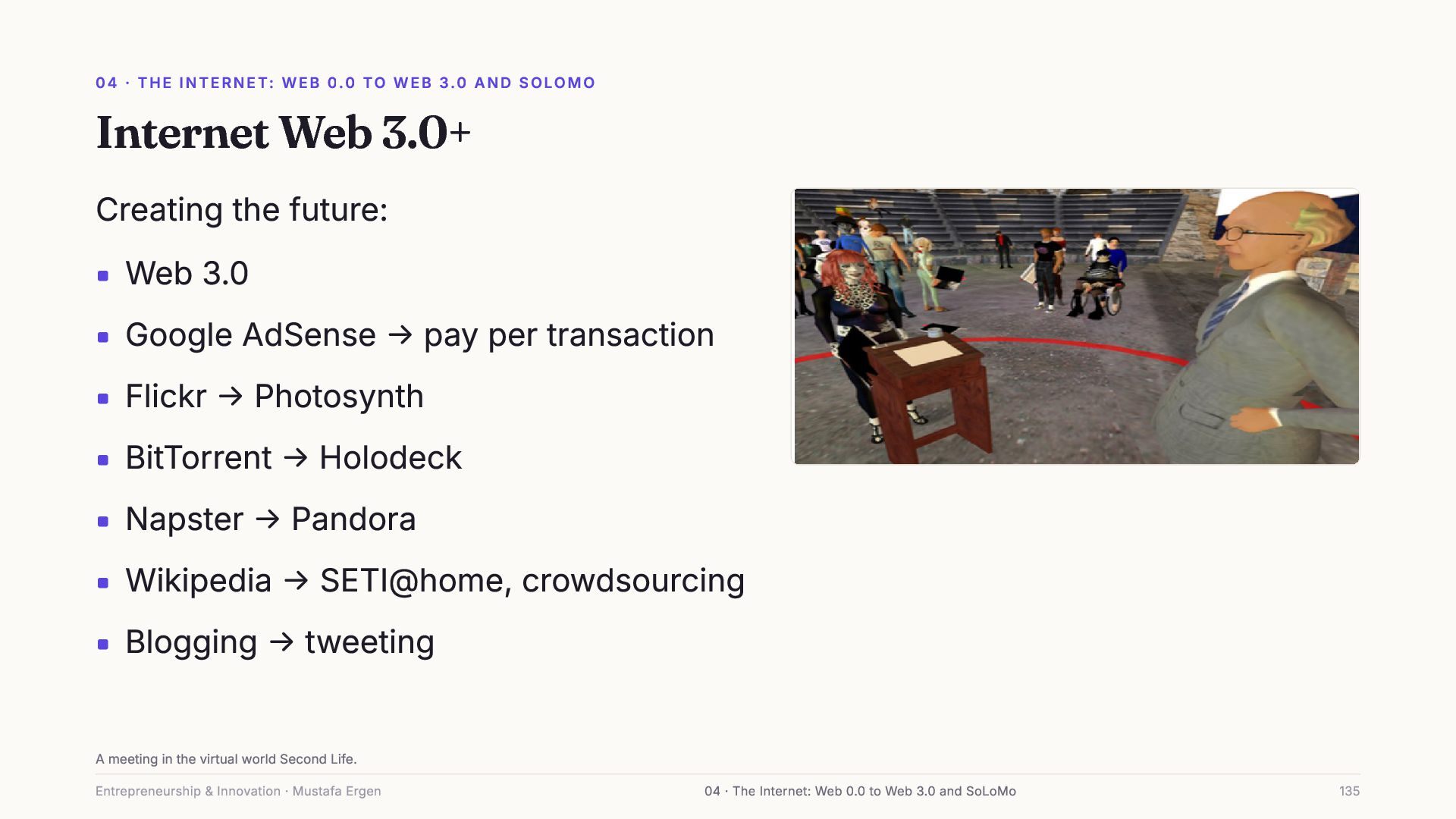
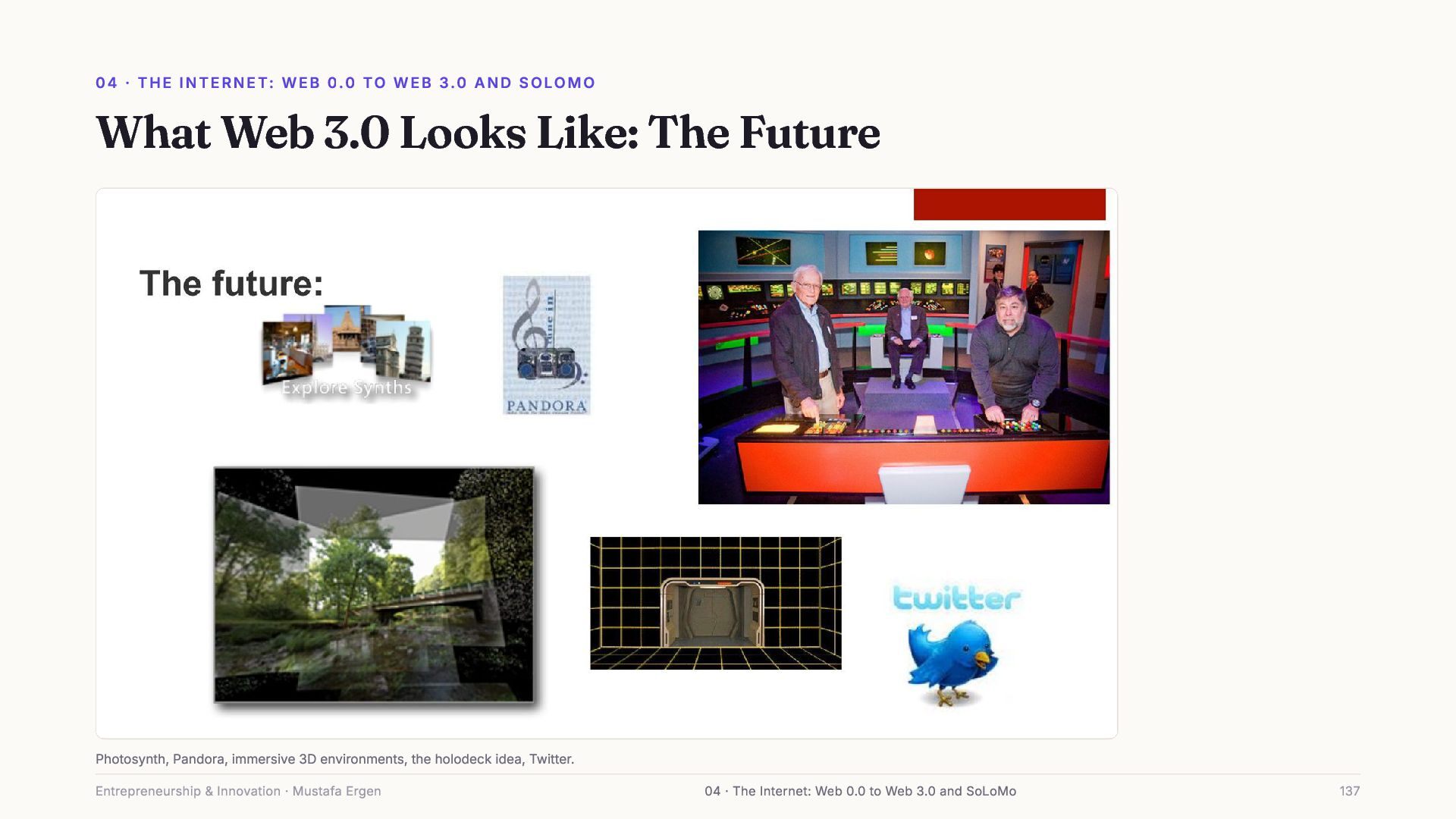
R N E T: W E B 0.0 TO W E B 3.0 A N D S O LO M O Internet Web 3.0+ Creating the future: Web 3.0 Google AdSense → pay per transaction Flickr → Photosynth BitTorrent → Holodeck Napster → Pandora Wikipedia → SETI@home, crowdsourcing Blogging → tweeting A meeting in the virtual world Second Life. Entrepreneurship & Innovation · Mustafa Ergen 04 · The Internet: Web 0.0 to Web 3.0 and SoLoMo 135 -
0 4 · T H E I N T E
R N E T: W E B 0.0 TO W E B 3.0 A N D S O LO M O Internet Web 3.0+ (cont.) Upcoming.org → spontaneous crowd formation Search engine optimization → anticipating needs and solutions Cost per click → sales commission Web services → cloud hosting Publishing → participation Wikis → VR collaboration Tagging ("folksonomy") → augmented reality Syndication → the semantic web Entrepreneurship & Innovation · Mustafa Ergen 04 · The Internet: Web 0.0 to Web 3.0 and SoLoMo 136 -
0 4 · T H E I N T E
R N E T: W E B 0.0 TO W E B 3.0 A N D S O LO M O What Web 3.0 Looks Like: The Future Photosynth, Pandora, immersive 3D environments, the holodeck idea, Twitter. Entrepreneurship & Innovation · Mustafa Ergen 04 · The Internet: Web 0.0 to Web 3.0 and SoLoMo 137 -
0 4 · T H E I N T E
R N E T: W E B 0.0 TO W E B 3.0 A N D S O LO M O Internet Web 3.0+: Tools Tools for creating the future: Social networking: Facebook, Twitter and Foursquare Augmented reality: Second Life, Spore and The Sims Open collaboration: peer-to-peer, virtual projects, viral learning, crowdsourcing Smartphones and sensors: classrooms, communities, clustering and shared knowledge Ubiquitous computing: monitoring the world around us 2025–2026 UPDATE Facebook was renamed Meta in 2021; Twitter was bought by Elon Musk in 2022 and renamed X. Entrepreneurship & Innovation · Mustafa Ergen 04 · The Internet: Web 0.0 to Web 3.0 and SoLoMo 138 -
0 4 · T H E I N T E
R N E T: W E B 0.0 TO W E B 3.0 A N D S O LO M O After the Internet: Business Plan 2.0 1. Find the problem 2. Find the solution 3. Find the customer 4. Iterate (and be passionate about it) (No business plan) Entrepreneurship & Innovation · Mustafa Ergen 04 · The Internet: Web 0.0 to Web 3.0 and SoLoMo 139 -
0 4 · T H E I N T E
R N E T: W E B 0.0 TO W E B 3.0 A N D S O LO M O Trends Social Local Mobile Cloud SoLoMo: Social + Local + Mobile Mobile TV 3G, 4G–LTE, small cells, WiMAX 2025–2026 UPDATE 5G reached about 2.9 billion subscriptions at end-2025 and 3.1 billion in Q1 2026, roughly a third of all mobile subscriptions (Ericsson). Entrepreneurship & Innovation · Mustafa Ergen 04 · The Internet: Web 0.0 to Web 3.0 and SoLoMo 140 -
0 4 · T H E I N T E
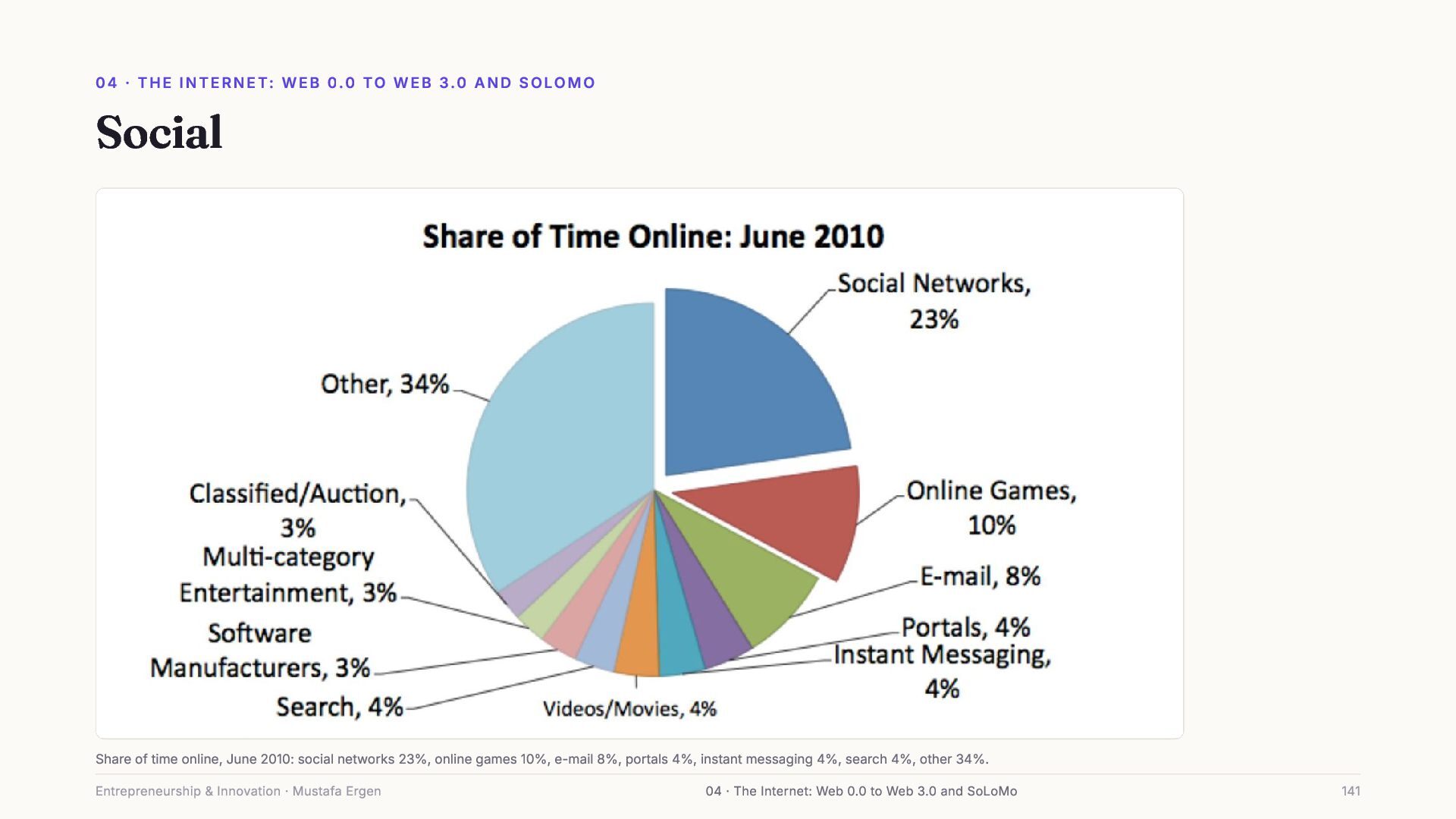
R N E T: W E B 0.0 TO W E B 3.0 A N D S O LO M O Social Share of time online, June 2010: social networks 23%, online games 10%, e-mail 8%, portals 4%, instant messaging 4%, search 4%, other 34%. Entrepreneurship & Innovation · Mustafa Ergen 04 · The Internet: Web 0.0 to Web 3.0 and SoLoMo 141 -
0 4 · T H E I N T E
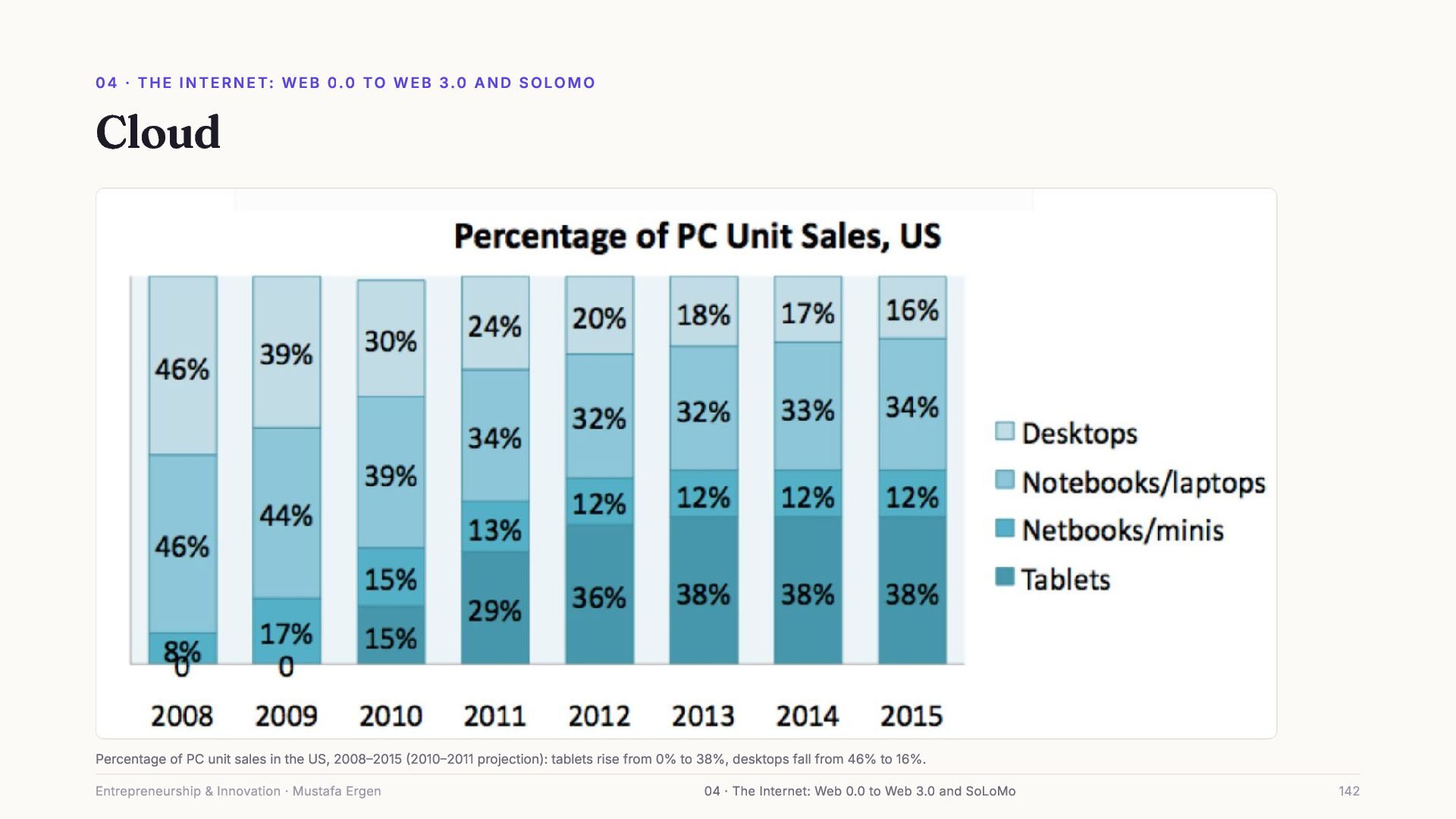
R N E T: W E B 0.0 TO W E B 3.0 A N D S O LO M O Cloud Percentage of PC unit sales in the US, 2008–2015 (2010–2011 projection): tablets rise from 0% to 38%, desktops fall from 46% to 16%. Entrepreneurship & Innovation · Mustafa Ergen 04 · The Internet: Web 0.0 to Web 3.0 and SoLoMo 142 -
0 4 · T H E I N T E
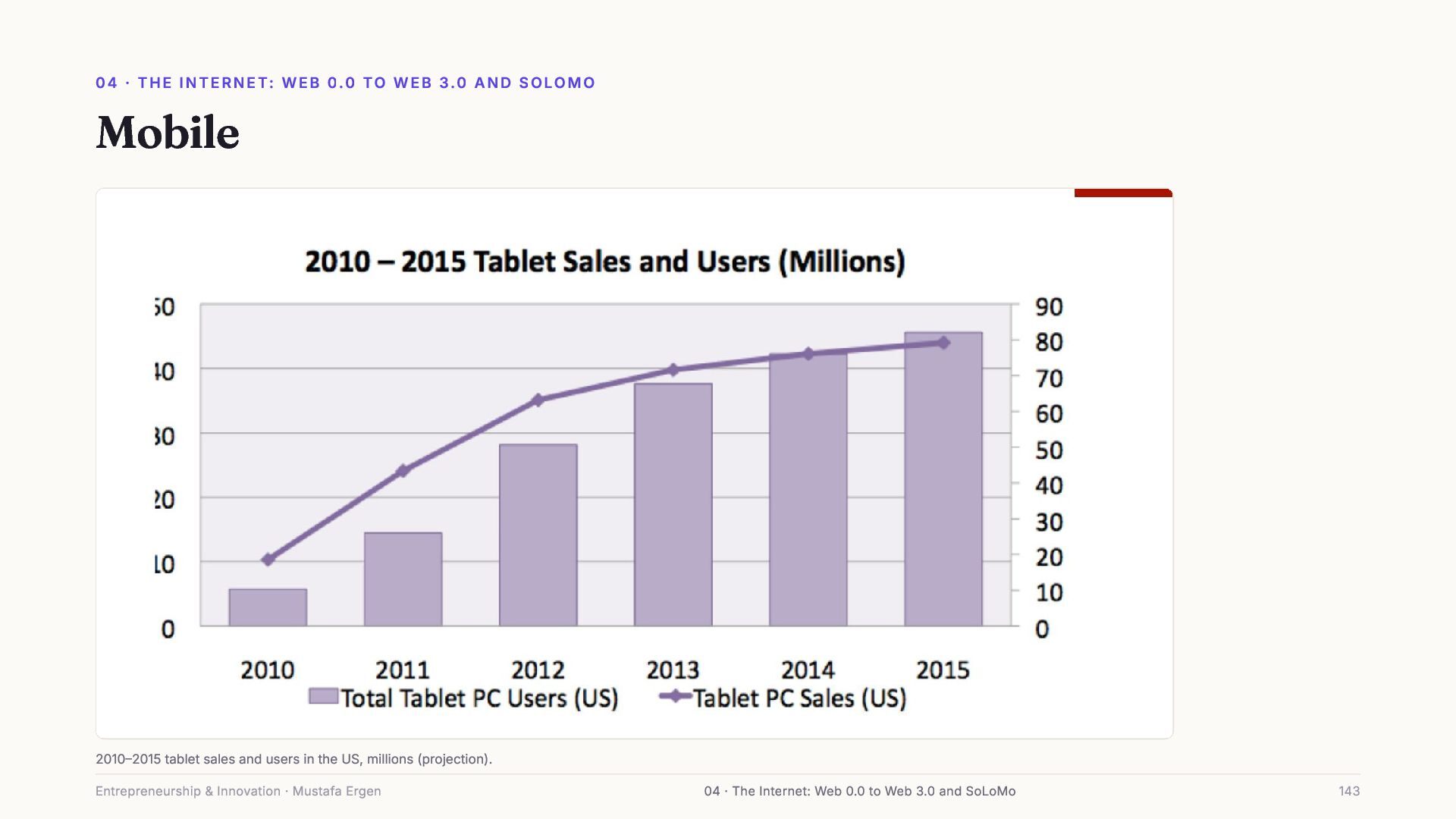
R N E T: W E B 0.0 TO W E B 3.0 A N D S O LO M O Mobile 2010–2015 tablet sales and users in the US, millions (projection). Entrepreneurship & Innovation · Mustafa Ergen 04 · The Internet: Web 0.0 to Web 3.0 and SoLoMo 143 -
0 4 · T H E I N T E
R N E T: W E B 0.0 TO W E B 3.0 A N D S O LO M O iPhone Apple iPhone: cumulative units shipped, September 2011 – September 2014 (projection). Entrepreneurship & Innovation · Mustafa Ergen 04 · The Internet: Web 0.0 to Web 3.0 and SoLoMo 144 -
05 Funding and Venture Capital Where entrepreneurs find capital: personal
savings, friends and family, angels, corporations, venture capitalists and public markets. Entrepreneurship & Innovation · Mustafa Ergen 05 · Funding and Venture Capital 145 -
0 5 · F U N D I N G
A N D V E N T U R E CA P I TA L Funding Types of capital and the sources of equity financing. Entrepreneurship & Innovation · Mustafa Ergen 05 · Funding and Venture Capital 146 -
0 5 · F U N D I N G
A N D V E N T U R E CA P I TA L The "Secrets" of Successful Financing 1. Choosing the right sources of capital is a decision that will influence a company for a lifetime. 2. The money is out there; the key is knowing where to look. 3. Creativity counts. Entrepreneurs must be as creative in their search for capital as in developing their business ideas. Entrepreneurship & Innovation · Mustafa Ergen 05 · Funding and Venture Capital 147 -
0 5 · F U N D I N G
A N D V E N T U R E CA P I TA L Three Types of Capital Fixed: buys the permanent or fixed assets of the business (buildings, land, equipment, etc.). Working: supports the small company's normal short-term operations (inventory, bills, wages, salaries, etc.). Growth: helps the small business expand or change its primary direction. Entrepreneurship & Innovation · Mustafa Ergen 05 · Funding and Venture Capital 148 -
0 5 · F U N D I N G
A N D V E N T U R E CA P I TA L Equity Capital Represents the personal investment of the owner(s) in the business. Is called risk capital because investors risk losing their money if the business fails. Does not have to be repaid with interest like a loan. Means the entrepreneur must give up some ownership of the company to outside investors. Entrepreneurship & Innovation · Mustafa Ergen 05 · Funding and Venture Capital 149 -
0 5 · F U N D I N G
A N D V E N T U R E CA P I TA L Sources of Equity Financing Personal savings Friends and family members Angels Partners Corporations Venture capital companies Public stock sale Entrepreneurship & Innovation · Mustafa Ergen 05 · Funding and Venture Capital 150 -
0 5 · F U N D I N G
A N D V E N T U R E CA P I TA L Personal Savings The first place an entrepreneur should look for money. The most common source of equity capital for starting a business. Outside investors and lenders expect the entrepreneur to put some of her own capital into the business before they invest theirs. Sweat equity and personal risk equity (non-monetary) also count. Entrepreneurship & Innovation · Mustafa Ergen 05 · Funding and Venture Capital 151 -
0 5 · F U N D I N G
A N D V E N T U R E CA P I TA L Friends and Family Members After emptying her own pockets, an entrepreneur should turn to those most likely to invest in the business: friends and family members. Survey: 10% of business owners turn to family and friends for capital. Careful! Inherent dangers lurk in family and friendly business deals, especially those that flop. Entrepreneurship & Innovation · Mustafa Ergen 05 · Funding and Venture Capital 152 -
0 5 · F U N D I N G
A N D V E N T U R E CA P I TA L Friends and Family: Guidelines Guidelines for family and friendship financing deals: Consider the impact of the investment on everyone involved; keep the arrangement "strictly business." Settle the details up front. Create a written contract. Treat the money as "bridge financing." Develop a payment schedule that suits both parties. Entrepreneurship & Innovation · Mustafa Ergen 05 · Funding and Venture Capital 153 -
0 5 · F U N D I N G
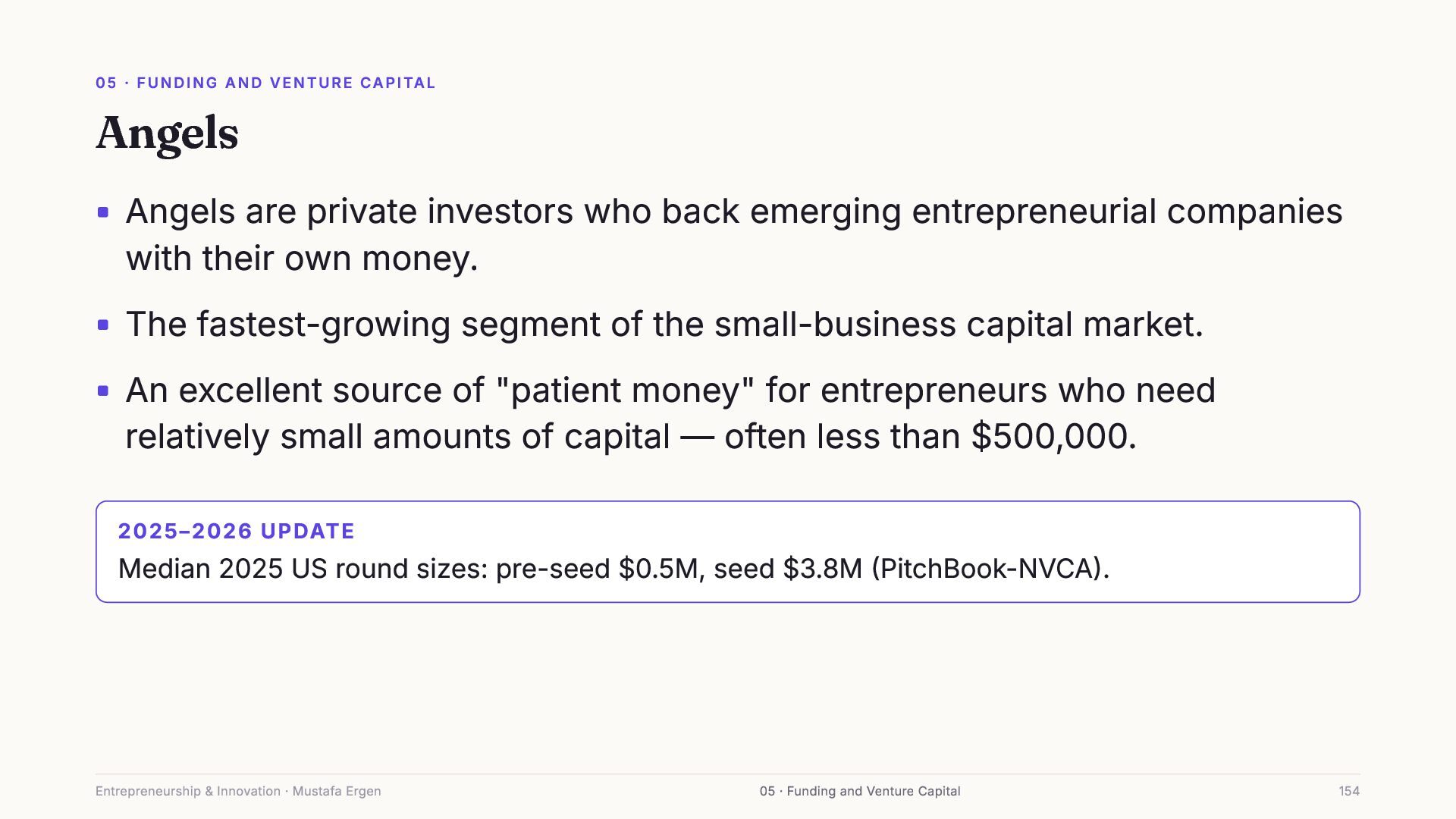
A N D V E N T U R E CA P I TA L Angels Angels are private investors who back emerging entrepreneurial companies with their own money. The fastest-growing segment of the small-business capital market. An excellent source of "patient money" for entrepreneurs who need relatively small amounts of capital — often less than $500,000. 2025–2026 UPDATE Median 2025 US round sizes: pre-seed $0.5M, seed $3.8M (PitchBook-NVCA). Entrepreneurship & Innovation · Mustafa Ergen 05 · Funding and Venture Capital 154 -
0 5 · F U N D I N G
A N D V E N T U R E CA P I TA L Finding Angels Key: finding them! Angels almost always invest locally and can be found through networks. The typical angel accepts 30% of the proposals presented and has invested an average of $131,000 in 3.5 businesses. What do angels look for? – Exciting ideas with clear potential – A way to help a trusted friend Entrepreneurship & Innovation · Mustafa Ergen 05 · Funding and Venture Capital 155 -
0 5 · F U N D I N G
A N D V E N T U R E CA P I TA L Corporate Venture Capital 30% of all venture capital investments come from corporations. About 900 large corporations around the globe invest in startup companies. Capital is just one benefit; corporate partners may share marketing and technical expertise. 2025–2026 UPDATE Corporations took part in about 21% of 2025 US venture deals (PitchBook-NVCA). Entrepreneurship & Innovation · Mustafa Ergen 05 · Funding and Venture Capital 156 -
0 5 · F U N D I N G
A N D V E N T U R E CA P I TA L Venture Capitalists More than 3,000 venture capital firms operate across the United States. Most venture capitalists seek investments of $3–10 million in companies with high-growth and high-profit potential. Business plans face an extremely rigorous review: less than 1% are accepted. 2025–2026 UPDATE In 2025, 537 new US VC funds raised $66.1B, the fewest funds in a decade; median deal sizes were $15M for Series A and $33.8M for Series B (PitchBook-NVCA). Entrepreneurship & Innovation · Mustafa Ergen 05 · Funding and Venture Capital 157 -
0 5 · F U N D I N G
A N D V E N T U R E CA P I TA L How Venture Capital Firms Invest Most venture capitalists take an active role in managing the companies they invest in. Many focus their investments on specific industries they know well. Most often, venture capitalists invest in a company across several stages. Entrepreneurship & Innovation · Mustafa Ergen 05 · Funding and Venture Capital 158 -
0 5 · F U N D I N G
A N D V E N T U R E CA P I TA L Going Public Initial public offering (IPO): a company raises capital by selling shares of its stock to the public for the first time. In a typical year about 550 companies make IPOs. Few companies with annual sales below $10 million go public. A common exit strategy for investors (but it needs strong justification). 2025–2026 UPDATE In 2025, 17 US unicorns went public, including CoreWeave, Circle, Figma, Klarna and Chime; US VC exit value reached $297.6B (PitchBook-NVCA). Entrepreneurship & Innovation · Mustafa Ergen 05 · Funding and Venture Capital 159 -
0 5 · F U N D I N G
A N D V E N T U R E CA P I TA L Advantages of Going Public Ability to raise large amounts of capital Improved corporate image Improved access to future financing Attracting and retaining key employees Using stock for acquisitions Listing on a stock exchange Entrepreneurship & Innovation · Mustafa Ergen 05 · Funding and Venture Capital 160 -
0 5 · F U N D I N G
A N D V E N T U R E CA P I TA L Disadvantages of Going Public Dilution of the founders' ownership Loss of control Loss of privacy Reporting to the SEC Filing expenses Accountability to shareholders Pressure for short-term performance Timing Entrepreneurship & Innovation · Mustafa Ergen 05 · Funding and Venture Capital 161 -
0 5 · F U N D I N G
A N D V E N T U R E CA P I TA L The Registration Process (S-1 Filing) Choose the underwriter (who sells the stock) Negotiate a letter of intent (fees) Prepare the registration statement (including the risks) File with the SEC Wait to "go effective" (information you may release is limited) Meet state requirements Entrepreneurship & Innovation · Mustafa Ergen 05 · Funding and Venture Capital 162 -
0 5 · F U N D I N G
A N D V E N T U R E CA P I TA L Simplified Registrations and Exemptions Regulation S-B (small US businesses only) Regulation D, Rule 504 – Small Company Offering Registration (SCOR) – Limited legal help required – No SEC filing – Marketing the offering is allowed – Maximum $1 million in a 12-month period Regulation D, Rules 505 and 506 – Private placements to a maximum of 35 non-accredited investors – Some limits on the total amount that can be raised Section 4(6) – offerings to accredited investors Entrepreneurship & Innovation · Mustafa Ergen 05 · Funding and Venture Capital 163 -
0 5 · F U N D I N G
A N D V E N T U R E CA P I TA L Simplified Registrations and Exemptions (Cont.) Rule 147 (intrastate offerings) Regulation A (few restrictions, but expensive) Direct stock offering on the World Wide Web – Direct Public Offering (DPO) – The prospectus must still meet SEC requirements Foreign stock markets (sometimes easier, but often more volatile) Entrepreneurship & Innovation · Mustafa Ergen 05 · Funding and Venture Capital 164 -
0 5 · F U N D I N G
A N D V E N T U R E CA P I TA L Debt Financing Must be repaid with interest. Is carried as a liability on the company's balance sheet. Can be just as difficult to secure as equity financing, even though sources of debt financing are more numerous. Can be expensive, especially for small companies, because of the risk/return trade-off. Convertible loans are very popular when an IPO might be the exit strategy. 2025–2026 UPDATE At the seed stage the SAFE, created by Y Combinator in 2013 (post-money version 2018), has become the US standard alternative to convertible notes. Entrepreneurship & Innovation · Mustafa Ergen 05 · Funding and Venture Capital 165 -
0 5 · F U N D I N G
A N D V E N T U R E CA P I TA L Sources of Debt Capital Commercial banks Entrepreneurship & Innovation · Mustafa Ergen 05 · Funding and Venture Capital 166 -
0 5 · F U N D I N G
A N D V E N T U R E CA P I TA L Internal Methods of Financing Factoring – selling accounts receivable outright Leasing assets rather than buying them Credit cards Entrepreneurship & Innovation · Mustafa Ergen 05 · Funding and Venture Capital 167 -
The Venture Capitalist Who venture capitalists are, how their funds
work and what they bring to a startup besides money. Entrepreneurship & Innovation · Mustafa Ergen The Venture Capitalist 168 -
T H E V E N T U R E
CA P I TA L I S T A Passion for Innovation Not all venture capitalists start out as business people. Many come to the industry after successful careers as scientists, engineers or doctors. Driven by a desire to find new and better ways of doing things, they combine their industry expertise with their experience as entrepreneurs to identify the most promising innovations in their fields — and then build companies around them. Entrepreneurship & Innovation · Mustafa Ergen The Venture Capitalist 169 -
T H E V E N T U R E
CA P I TA L I S T What Is Venture Capital? VC funds build companies from the simplest form — perhaps just an entrepreneur and a business plan — into mature organizations. VC has let the US turn ideas and basic science into products and services the world envies. 2025–2026 UPDATE VC-backed firms: 41% of US public-market value, 62% of public-company R&D (Gornall & Strebulaev, 2021). Table: employment at IPO and in 2007 at VC-backed companies (IHS Global Insight; FY2007 data). Entrepreneurship & Innovation · Mustafa Ergen The Venture Capitalist 170 -
T H E V E N T U R E
CA P I TA L I S T Risk Capital VC firms are professional, institutional managers of risk capital that enables and supports the most innovative and promising companies. This money funds new ideas that could not be financed by banks, that threaten established products of corporations, and that typically need five to eight years to launch. VC is unique as an asset class: it is an equity investment in a company whose stock is essentially illiquid and worthless until the company matures five to eight years later. Follow-on investment provides more funding as the company grows. These rounds, typically every year or two, are also equity, with shares allocated among investors and management at an agreed valuation. Unless the company is acquired or goes public, there is little actual value: VC is a long-term investment. Entrepreneurship & Innovation · Mustafa Ergen The Venture Capitalist 171 -
T H E V E N T U R E
CA P I TA L I S T More Than Money The US venture industry provides the capital to create some of the most innovative and successful companies. But venture capital is more than money. VC partners become actively engaged with a company, typically taking a board seat. With a startup, daily interaction with the management team is common, which limits the number of startups any one fund can invest in. Few entrepreneurs approaching VC firms realize that they are essentially asking for 1/6 of a person! For every 100 business plans that reach a VC firm, usually only 10 or so get a serious look, and only one gets funded. Entrepreneurship & Innovation · Mustafa Ergen The Venture Capitalist 172 -
T H E V E N T U R E
CA P I TA L I S T One Part Nature, Two Parts Nurture Unlike most investors, VCs provide more than money: they guide the company through multiple rounds of financing. At each stage the company must meet milestones to receive fresh funds. If it misses them, or its risk profile changes with market conditions or regulation, the VC's duty to its limited partners requires walking away. Patience, hands-on guidance and a willingness to take risk and fail make VC unique as an asset class. In no other ecosystem are all stakeholders aligned around one objective: company growth. This drives economic growth, creates more jobs than other asset classes and has set the US economy apart. VCs typically sit on portfolio boards and help with resources, marketing contacts and management hiring — partners until the company can stand on its own. Entrepreneurship & Innovation · Mustafa Ergen The Venture Capitalist 173 -
T H E V E N T U R E
CA P I TA L I S T Why Venture Capital? Many technologies developed by VC-backed firms are truly disruptive; larger companies do not embrace them because they could cannibalize their current products. With the emphasis on quarterly results, many large public companies cut R&D and product development when times get tight. Many talented teams have come to venture capital after their projects were turned down by their own companies. Entrepreneurship & Innovation · Mustafa Ergen The Venture Capitalist 174 -
T H E V E N T U R E
CA P I TA L I S T The Venture Capital Firm Venture capitalists usually team up with like-minded professionals with complementary backgrounds and sector expertise to set up VC firms. These firms work as small, tight-knit teams that share risks and responsibilities. In 2008 the average venture firm had nine investing professionals. Through their firms, VCs pool their own money with funds from institutional investors such as pension funds, endowments and foundations. These investors become limited partners in the firm's funds, which typically target specific industries (e.g. information technology, life sciences, clean technology). Limited partners? Entrepreneurship & Innovation · Mustafa Ergen The Venture Capitalist 175 -
T H E V E N T U R E
CA P I TA L I S T Structure Investors → Limited partnership → General partners → Ventures A VC firm typically creates a limited partnership, with the investors as limited partners (LPs) and the firm itself as the general partner (GP). Each fund is a separate partnership, set up once the firm has commitments from its investors — say $100 million. Money is drawn from investors as investments are made; for each first investment the fund typically reserves three to four times as much for follow-on rounds. Over three to eight years the firm works with the founders to grow the company; the payoff comes when it is acquired or goes public. Of the companies funded, only one in six ever goes public and one in three is acquired. Entrepreneurship & Innovation · Mustafa Ergen The Venture Capitalist 176 -
T H E V E N T U R E
CA P I TA L I S T Venture Funds Venture funds have a life span of about 10 years. In the first several years, VCs invest in promising new companies that become the fund's portfolio. Over the fund's life these companies are nurtured in the hope that they will be acquired or go public at a premium to the total invested — the exit. Neither the VCs nor the limited partners see a return unless the fund's successful exits outweigh its losses. About one-third of portfolio companies fail, so the winners must win big. Because VC is high-risk, investors expect higher returns than from other asset classes — and over the long term the industry has typically outperformed public markets. Entrepreneurship & Innovation · Mustafa Ergen The Venture Capitalist 177 -
T H E V E N T U R E
CA P I TA L I S T Where Does the Money Come From? Investors Sources of US venture fund commitments: pension funds 42%, finance and insurance 25%, endowments and foundations 21%, individuals and families 10%, corporations 2%. Entrepreneurship & Innovation · Mustafa Ergen The Venture Capitalist 178 -
T H E V E N T U R E
CA P I TA L I S T What You Give Employees: Stock Options What are employee stock options worth? Three reasons to work for a startup: – Interesting, leading-edge projects – Smart, motivated and interesting colleagues – You might make real money on your stock options Two related reasons to think twice: – The startup may fail. – You may become unemployed and have a hard time finding a new job. Startups grant options to attract talented engineers to a venture that might fail, and to compensate staff for long hours and stress. Failure is rarely discussed in Silicon Valley mythology. Entrepreneurship & Innovation · Mustafa Ergen The Venture Capitalist 179 -
T H E V E N T U R E
CA P I TA L I S T Organization Example The VCs fund the startup; in return the first VC round usually takes about 60% of the company's stock. Of the 40% allocated to employees, at least half (20%) is usually reserved for future hires (engineers, VP marketing, VP sales). A serious startup has a CEO, a CFO/VP operations, at least one VP of engineering and one or two senior engineers — often people who joined before funding and may have worked without salary. This founding group splits the remaining 20%: the CEO gets about 5%, the others 2–4% each. A senior engineer with hard-to-find skills may be offered around 1%; most engineers get options for 0.5% or less of the first-round stock. Entrepreneurship & Innovation · Mustafa Ergen The Venture Capitalist 180 -
T H E V E N T U R E
CA P I TA L I S T Economic Alignment of All Stakeholders VC is rare among asset classes in that success is truly shared. It is not driven by quick returns or transaction fees. Economic success comes when the stock price rises above the purchase price. After a strong IPO or acquisition, the stock price reflects the company's success. The entrepreneur benefits from appreciated stock and options. Rank-and-file employees have historically done well with their options too. The exit funnel for 11,686 companies first funded 1991–2000: 14% went public, 33% acquired, 18% known failed, 35% still private or unknown (most quietly failed). Entrepreneurship & Innovation · Mustafa Ergen The Venture Capitalist 181 -
T H E V E N T U R E
CA P I TA L I S T Venture Capital Controls the Startup The critical role of capital in developing technology also reflects the balance of power in the computer industry. Most startups are controlled by the board members who represent the venture capital. They can, and do, fire the founders. Engineers do not much like the idea that capital holds most of the power. In some cases the VC board members are MBAs who have accomplished less than the founders. The founders had the insight and did the hard work, yet the company is controlled by "shallow capitalists". Engineers tend to discount the power and importance of capital. Entrepreneurship & Innovation · Mustafa Ergen The Venture Capitalist 182 -
T H E V E N T U R E
CA P I TA L I S T Outside the US The spread of venture capital to other countries is gated by each country's or region's: – cultural fit – tolerance for failure – services infrastructure that supports developing companies – intellectual property protection – efficient capital markets – willingness of big business to buy from small companies Entrepreneurship & Innovation · Mustafa Ergen The Venture Capitalist 183 -
T H E V E N T U R E
CA P I TA L I S T VC Participates Besides funding, venture investors instill in their portfolio companies key cultural practices and traits that keep them growing over the long term: – an appreciation for continuous R&D – the habit of setting and reaching milestones – strong corporate governance – the ability to pivot in uncertain markets and adjust business plans when needed – a global approach to operations These tenets drive companies in their formative years and remain part of their DNA long after — often letting them grow faster and longer than non-venture counterparts. Entrepreneurship & Innovation · Mustafa Ergen The Venture Capitalist 184 -
T H E V E N T U R E
CA P I TA L I S T Venture Capital Nourishes Entire Industries VC has turned life-changing innovations into entirely new industries. 1970s: biotechnology, via pioneers like Genentech and Amgen. 1980s: software and semiconductors became prime drivers of the US economy. 1990s: online retailing (Amazon, eBay); today clean technology is poised to extend this legacy. 2025–2026 UPDATE The next wave was AI, with 65.4% of 2025 US deal value (PitchBook-NVCA); climate tech drew $40.5B globally in 2025 (Sightline Climate). Entrepreneurship & Innovation · Mustafa Ergen The Venture Capitalist 185 -
T H E V E N T U R E
CA P I TA L I S T Penchants for Prescience and Risk Given the high failure rate, VCs focus only on innovations that could revolutionize existing industries or create new ones — biotechnology, built on Genentech and Amgen, is an example of the latter. Other areas of venture innovation: semiconductors, software and the Internet. In the 21st century, VCs are poised to create a new sector — clean technology — with the same promise for jobs and growth. Ironically, finding innovative ideas isn't the hard part: government- and universityfunded research produces new discoveries all the time. The challenge is judging which innovations can become viable products and services, then building companies from scratch to sell them. Entrepreneurship & Innovation · Mustafa Ergen The Venture Capitalist 186 -
T H E V E N T U R E
CA P I TA L I S T How Do VCs Think and Work? Tales of formulas on cocktail napkins exaggerate, but VCs often start with little more than an idea in a rudimentary business plan. So they vet rigorously: of every 100 plans, an estimated 10 reach due diligence and only one gets funded. Investing at the earliest stage is extraordinarily risky. Young companies have no collateral for bank loans, no assets or track record for private equity, and no short-term gains for hedge funds. VCs take on this risk, providing capital in exchange for equity. The goal: grow the company until it can go public or be acquired — when the firm and its LPs earn a return if the exit is worth more than the total invested. Entrepreneurship & Innovation · Mustafa Ergen The Venture Capitalist 187 -
T H E V E N T U R E
CA P I TA L I S T Changing the World For decades the US VC industry has been the envy of the world, spurring high-tech industries and household names: Amazon, Google, Apple, Cisco, Staples, eBay. These successes made the US a magnet for the world's best scientists and entrepreneurs. Other countries now emulate the US model through tax and regulatory policy and stronger IP protection — more innovation worldwide, but more competition for venture dollars. US primacy is no longer a given. US policymakers must weigh new rules carefully against the risk of hobbling one of America's most decisive competitive advantages of the past half century. With supportive policy, VC remains a key ingredient of innovation — with entrepreneurial spirit, science and an appetite for risk. Entrepreneurship & Innovation · Mustafa Ergen The Venture Capitalist 188 -
T H E V E N T U R E
CA P I TA L I S T Venture-Created Technologies Venture capital has played a role in creating many high-tech industries: Information technology Biotechnology Medical devices Network security Online retailing and social media Clean technology Entrepreneurship & Innovation · Mustafa Ergen The Venture Capitalist 189 -
T H E V E N T U R E
CA P I TA L I S T How VCs Evaluate VCs evaluate potential investments based on: Management team Concept Scalability Market conditions Fit with the fund's objectives Capital needs Potential returns Entrepreneurship & Innovation · Mustafa Ergen The Venture Capitalist 190 -
T H E V E N T U R E
CA P I TA L I S T The Funding Decision VCs consistently believe the "people" factor is paramount. In both 2001 and 2010, the strength of the management team was the most important factor in deciding to fund a venture, followed by market sector. Proprietary product or service and business model trailed slightly behind market sector. Most important factors in the decision to fund a venture (total = 100), 2001 vs 2010. Source: Spencer Stuart / NVCA survey. Entrepreneurship & Innovation · Mustafa Ergen The Venture Capitalist 191 -
T H E V E N T U R E
CA P I TA L I S T CEO Traits The traits most often rated "very important" for VC-backed CEOs are those valued in any leader: ethics/integrity, leadership and the ability to attract top talent. Vision and fundraising matter more than a decade ago: vision ranked 4th in 2010 (7th in 2001), fundraising 5th (8th in 2001). Most important characteristics for VC-backed CEO candidates, 2010. Source: Spencer Stuart / NVCA survey. Entrepreneurship & Innovation · Mustafa Ergen The Venture Capitalist 192 -
T H E V E N T U R E
CA P I TA L I S T People "Finding the right CEO and judging people in general is the toughest part of our job." How hard is it to attract and retain top CEO talent compared to 2001? Equally difficult 58%, less difficult 25%, more difficult 17%. Entrepreneurship & Innovation · Mustafa Ergen The Venture Capitalist 193 -
T H E V E N T U R E
CA P I TA L I S T CEO Candidates In many firms, closer ongoing assessment after the hire could be the greatest potential improvement in the industry's talent management. Preferred leadership profile for emerging sectors without an established CEO pool: proven VC-backed CEOs from other sectors 53%, promising entrepreneurs without CEO experience 34%, largecompany executives 13%. Entrepreneurship & Innovation · Mustafa Ergen The Venture Capitalist 194 -
T H E V E N T U R E
CA P I TA L I S T Liquidity A longer path to liquidity. Median company age at acquisition: 3.9 years (2001) vs 7.8 years (2009); at IPO: 6 vs 10 years. Source: NVCA. Entrepreneurship & Innovation · Mustafa Ergen The Venture Capitalist 195 -
T H E V E N T U R E
CA P I TA L I S T Investment Regions 2025–2026 UPDATE The US still leads: $339.4B of US VC deal value in 2025 (PitchBook-NVCA) against $425B of global venture funding (Crunchbase); trackers use different methods. Share of surveyed US VC firms' investments by region, 2010: North America 91%, Asia 3%, Europe 3%, Middle East 1%, Central/South America 1%. Entrepreneurship & Innovation · Mustafa Ergen The Venture Capitalist 196 -
T H E V E N T U R E
CA P I TA L I S T CEO Compensation How portfolio-company CEO pay changed over the past 10 years (2010 survey): more cash and more equity 47%, more cash and less equity 27%, less cash and more equity 21%, less cash and less equity 4%. Entrepreneurship & Innovation · Mustafa Ergen The Venture Capitalist 197 -
T H E V E N T U R E
CA P I TA L I S T New Trends Some characteristics and attitudes of VC investors have stayed stable, but there are interesting new trends as the industry adapts to a changing environment. – VC firms are taking a more structured approach to building strong, independent and diverse boards for their companies. – They assess portfolio management more rigorously and continuously, in response to the longer average tenure of management teams. Spencer Stuart and the NVCA launched a study in March 2010 on the characteristics, skills and experience required of VC-backed CEOs: in-depth interviews with VC leaders plus a survey of 200+ NVCA members, following a similar study in 2001. Entrepreneurship & Innovation · Mustafa Ergen The Venture Capitalist 198 -
Venture Capital History From Renaissance trading voyages to Silicon Valley
funds: how risk capital evolved alongside technology. Entrepreneurship & Innovation · Mustafa Ergen Venture Capital History 199 -
V E N T U R E CA P I
TA L H I S TO RY Technology, Politics and Capital Markets Computer scientist and science fiction writer Vernor Vinge writes of a technological singularity, where technology accelerates so fast that it moves in entirely unexpected directions. What engineers and computer scientists sometimes forget: technological evolution does not spring from information and ideas alone. Technological progress is built on political and financial systems that took hundreds of years to evolve. Social and financial systems reflect the accepted thinking of a broad group of people, and they evolve much more slowly than science and engineering. Entrepreneurship & Innovation · Mustafa Ergen Venture Capital History 200 -
V E N T U R E CA P I
TA L H I S TO RY Free Flow of Information High-quality scientific research depends on the free flow of information. The rise of totalitarian states has always stifled both political and scientific ideas. Even in the United States, a long and successful fight was waged to make cryptography research and engineering publicly available. This has enabled many technologies, including secure financial transactions over computer networks. Entrepreneurship & Innovation · Mustafa Ergen Venture Capital History 201 -
V E N T U R E CA P I
TA L H I S TO RY Capital Technology consumes capital as well as ideas and information. Liquid, transparent capital markets are critical for its development. Every piece of technology we use moved from concept to reality because of capital expenditure. Except for technology developed by large companies like IBM, Sony and Nokia, every piece of computer and networking technology we use exists because of strong US capital markets. 2025–2026 UPDATE Nokia sold its phone business to Microsoft in 2013–14. Entrepreneurship & Innovation · Mustafa Ergen Venture Capital History 202 -
V E N T U R E CA P I
TA L H I S TO RY Venture Capital Commercial venture capital — a wealthy individual providing capital for an enterprise — has probably existed since the Middle Ages (e.g. the 1400s), in industries like British wool cloth manufacturing. Entrepreneurship & Innovation · Mustafa Ergen Venture Capital History 203 -
V E N T U R E CA P I
TA L H I S TO RY Maritime Trade and Piracy The first high-risk, high-reward commercial enterprises were maritime trade and piracy. In the Renaissance, trade in spices, tea and coffee produced huge profits — and huge risks: ships could be lost to weather, navigation errors or pirates. Syndicates of wealthy merchants leased a ship, hired the captain and financed the cargo; fortunes were made or lost on a single voyage. Piracy also offered huge profits, especially once gold flowed from the New World to Spain and Portugal. Conflict between Spain and England legitimized British pirates, and venture capital bought and provisioned ships for a share of captured Spanish gold. Venture-backed pirates included Sir Francis Drake, who also had the backing of Elizabeth I. Entrepreneurship & Innovation · Mustafa Ergen Venture Capital History 204 -
V E N T U R E CA P I
TA L H I S TO RY The Mass Market Wealth and energy have always been linked. Humans and animals powered the world until the late 18th century, when the steam engine brought the first industrial revolution. The technology explosion produced vast wealth: steam-driven pumps made deep mining of gold, coal and diamonds possible. Steam-driven blast furnaces enabled steel production on an unprecedented scale. These industries had an appetite for capital like the steam engine's for coal. Capital markets evolved along with the new technology. Entrepreneurship & Innovation · Mustafa Ergen Venture Capital History 205 -
V E N T U R E CA P I
TA L H I S TO RY Steam Engine to Inventor The steam engine also began the era of the inventor, with dreams and, they hoped, a profitable innovation. The problem was funding. In the 19th and early 20th centuries, venture capital came from three sources: – Wealthy individuals – Banks – Existing enterprises All three are conservative and tend to fund proven ventures (e.g. mining, manufacturing). In the 1930s and 1940s none of them would fund Chester Carlson, the inventor of xerography. His first funding came from the Battelle Memorial Institute, a research institute originally set up to fund innovation in metallurgy. Entrepreneurship & Innovation · Mustafa Ergen Venture Capital History 206 -
V E N T U R E CA P I
TA L H I S TO RY The Modern Venture Fund Modern venture funds appeared only in the 1960s. One of the first was Davis and Rock, founded by Arthur Rock, a lead investor in Intel. Rock also helped arrange funding for Fairchild Semiconductor, which spun off Intel, National Semiconductor and AMD. The huge returns from successful deals encouraged new venture groups. Wealth created in the computer industry was plowed back into new companies. Eugene Kleiner, a Fairchild co-founder, became a founding partner of Kleiner Perkins, a pioneering Silicon Valley venture firm. In a historical irony, Intel co-founder Robert Noyce provided funding for Intel's arch-rival, AMD. Entrepreneurship & Innovation · Mustafa Ergen Venture Capital History 207 -
V E N T U R E CA P I
TA L H I S TO RY Founders Become Venture Capitalists VC lets people who became wealthy in the computer industry grow their wealth and stay part of the fast-moving industry. Paul Allen, who founded Microsoft with Bill Gates, invested in startups through Vulcan Ventures. Ann Winblad, who made a fortune selling her software company, cofounded Hummer Winblad, a VC firm investing in software. VC is no longer limited to Silicon Valley insiders: Venrock Associates, founded by the Rockefeller family, invested in Intel and Apple, among others. Many pension funds and university endowments invest part of their holdings in VC; Harvard, for example, invested $1 million in MasPar Computer Corp. Entrepreneurship & Innovation · Mustafa Ergen Venture Capital History 208 -
V E N T U R E CA P I
TA L H I S TO RY Before the Internet Before the Internet frenzy, the classic venture-funded company had three rounds: – an initial round to build the basic product – a follow-on round to build the product and fund marketing and sales – a final round to fund a second-generation product and take the company to an IPO Each round dilutes the employees' percentage of the total shares outstanding. The financing chain through the innovative company's life cycle: contests and incubators, business angels, seed capital, venture capital, extension capital and markets. Entrepreneurship & Innovation · Mustafa Ergen Venture Capital History 209 -
V E N T U R E CA P I
TA L H I S TO RY Example: Dilution Across Rounds ROUND FUNDING TOTAL SHARES EMPLOYEE SHARE VALUATION PER SHARE 1 $8,000,000 40,000,000 40% $0.20 2 $12,000,000 66,000,000 25% $0.50 3 $20,000,000 84,181,818 19% $1.10 At the IPO the stock is valued at $2.00/share. The underwriters want a $10/share offer price, so a reverse stock split adjusts the share count. Your stake in the company is worth $800,000. Entrepreneurship & Innovation · Mustafa Ergen Venture Capital History 210 -
Venture Capital Statistics The US venture market around 2010–2011 in
numbers: exits, funds, sectors, regions and stages. Entrepreneurship & Innovation · Mustafa Ergen Venture Capital Statistics 211 -
V E N T U R E CA P I
TA L S TAT I S T I C S VC Exits 2025–2026 UPDATE US VC exit value peaked at $864.2B in 2021, fell to $117.0B in 2023 and recovered to $297.6B in 2025 (PitchBook-NVCA). Share of VC exits by IPO vs M&A: 1991–2000, IPO 58% and M&A 42%; 2001–2009, IPO 12% and M&A 88%. Entrepreneurship & Innovation · Mustafa Ergen Venture Capital Statistics 212 -
V E N T U R E CA P I
TA L S TAT I S T I C S Trends in 2000/2001 INDICATOR 2000 / 2001 TREND DIRECTION Valuations Very high Falling Capital availability Substantial Beginning to tighten Fund commitments $83B and a big overhang Shrinking Number of active firms 1,338 At a high but going down Tracking index – NASDAQ 4,000 Falling rapidly Technology spending Historically high Dropping quickly Entrepreneurship & Innovation · Mustafa Ergen Venture Capital Statistics 213 -
V E N T U R E CA P I
TA L S TAT I S T I C S The Trend in 2011 2025–2026 UPDATE US VC deal value reached $339.4B in 2025, with AI taking 65.4%, while commitments to new funds fell to $66.1B (PitchBook-NVCA). Economic situation in 2011: moderate valuations, adequate capital, fund commitments ~$12B, ~300 active firms, NASDAQ ~2,800 with the IPO market open, stable technology spending. Entrepreneurship & Innovation · Mustafa Ergen Venture Capital Statistics 214 -
V E N T U R E CA P I
TA L S TAT I S T I C S Current Trends: 1990, 2000, 2010 2025–2026 UPDATE New US VC funds raised a peak of $222.9B in 2022, but only $66.1B in 2025 across 537 funds, the fewest in a decade (PitchBook-NVCA). US venture industry in 1990, 2000 and 2010: firms, funds, professionals, capital raised and under management, average and largest fund size. Entrepreneurship & Innovation · Mustafa Ergen Venture Capital Statistics 215 -
V E N T U R E CA P I
TA L S TAT I S T I C S US Venture Capital Under Management ($ Billions) 2025–2026 UPDATE Unrealized value held in US VC funds reached a record $1.02 trillion (PitchBook-NVCA). US venture capital under management, 1985–2010. Entrepreneurship & Innovation · Mustafa Ergen Venture Capital Statistics 216 -
V E N T U R E CA P I
TA L S TAT I S T I C S Venture Capital Investments in 2010 2025–2026 UPDATE In 2025, AI companies took 65.4% of US VC deal value and 39.4% of deal count (PitchBook-NVCA). 2010 investments by sector: software 18%, biotechnology 17%, industrial/energy 16%, medical devices 10%, IT services 8%, media 6%, others smaller. Entrepreneurship & Innovation · Mustafa Ergen Venture Capital Statistics 217 -
V E N T U R E CA P I
TA L S TAT I S T I C S 2010 Investments by State 2025–2026 UPDATE The Bay Area and New York together took 64.2% of 2025 US deal value (PitchBook-NVCA). California alone took 50% of the $22.0B invested in 2010 (39% of companies), followed by Massachusetts (11%) and New York (6%). Entrepreneurship & Innovation · Mustafa Ergen Venture Capital Statistics 218 -
V E N T U R E CA P I
TA L S TAT I S T I C S Funding Stages 2025–2026 UPDATE Median 2025 US deal sizes: pre-seed $0.5M, seed $3.8M, Series A $15M, B $33.8M, C $54M, D+ $100M (PitchBook-NVCA). Share of 2010 investment by stage: seed 8%, early stage 24%, expansion 39%, later stage 29%. Entrepreneurship & Innovation · Mustafa Ergen Venture Capital Statistics 219 -
V E N T U R E CA P I
TA L S TAT I S T I C S IPOs 2025–2026 UPDATE 17 VC-backed unicorns went public in 2025, including CoreWeave, Circle, Figma, Klarna and Chime (PitchBookNVCA). Number of US venture-backed IPOs and offer amount ($B), 1985–2010. Entrepreneurship & Innovation · Mustafa Ergen Venture Capital Statistics 220 -
V E N T U R E CA P I
TA L S TAT I S T I C S North America: Number of Investments, 2010 2025–2026 UPDATE US VC deal count was about 16,709 in 2025, after a peak of 19,634 in 2021 (PitchBook-NVCA); the 2010 count of ~3,300 used a different methodology (PwC MoneyTree). Number of companies receiving venture investment by state, 2010. Entrepreneurship & Innovation · Mustafa Ergen Venture Capital Statistics 221 -
V E N T U R E CA P I
TA L S TAT I S T I C S North America: Capital Invested, 2010 ($ Millions) 2025–2026 UPDATE US VC deal value was $339.4B in 2025, against about $22B in 2010 (PwC MoneyTree); the two series use different methodologies (PitchBookNVCA). Venture capital invested by state, 2010 ($ millions). Entrepreneurship & Innovation · Mustafa Ergen Venture Capital Statistics 222 -
V E N T U R E CA P I
TA L S TAT I S T I C S Sectors in 2010: Number of Companies 2010 Internet-related vs non-Internet-related investments by industry (number of companies): 1,403 Internet-related and 1,346 other, 2,749 in total; software led with 689. Entrepreneurship & Innovation · Mustafa Ergen Venture Capital Statistics 223 -
V E N T U R E CA P I
TA L S TAT I S T I C S Sectors in 2010: Dollars Invested 2025–2026 UPDATE Half of 2025 US deal value went to 0.05% of deals (PitchBook-NVCA) — mega-rounds such as OpenAI's $40B at a $300B valuation (March 2025). 2010 Internet-related vs non-Internet-related investments by industry ($ millions): $8,952.9M Internet-related and $13,022.0M other, $21,974.8M in total. Entrepreneurship & Innovation · Mustafa Ergen Venture Capital Statistics 224 -
V E N T U R E CA P I
TA L S TAT I S T I C S IPO Breakdown, Q1 2011 2025–2026 UPDATE Soon after came Groupon's IPO (2011) and Facebook's (May 2012). Venture-backed IPOs in the US, Q1 2011: 14 offerings raising $1,375.8M — 7 in information technology, 6 in life sciences, 1 consumer. Entrepreneurship & Innovation · Mustafa Ergen Venture Capital Statistics 225 -
V E N T U R E CA P I
TA L S TAT I S T I C S M&A Industry Breakdown, Q1 2011 2025–2026 UPDATE Later landmark deals: Facebook bought Instagram ($1B, 2012) and WhatsApp ($19B, 2014); in 2025 Meta paid $14.3B for 49% of Scale AI. Venture-backed M&A, Q1 2011: 109 deals, $5,891.2M disclosed value; IT 74 deals, life sciences 23, non-high-tech 12. Source: Thomson Reuters & NVCA. Entrepreneurship & Innovation · Mustafa Ergen Venture Capital Statistics 226 -
V E N T U R E CA P I
TA L S TAT I S T I C S Related Venture Capital Literature Books Mastering the VC Game – Jeffrey Bussgang The Masters of Private Equity and Venture Capital – Robert Finkel Digging for Disclosure – Kenneth Springer and Joelle Scott The Start-Up Game – William H. Draper Private Equity as an Asset Class – Guy FraserSampson Creative Capital: Georges Doriot and the Birth of Venture Capital – Spencer Ante The Venture Capital Cycle (2nd ed.) – Paul Gompers and Josh Lerner Entrepreneurship & Innovation · Mustafa Ergen More books The Money of Invention – Paul Gompers The First Venture Capitalist: Georges Doriot on Leadership, Capital and Business Organization – Udayan Gupta (2004) Done Deals: Venture Capitalists Tell Their Stories – Udayan Gupta (2000) eBoys: The First Inside Account of Venture Capitalists at Work – Randall Stross (2000) Venture Capital at the Crossroads – William Bygrave and Jeffry Timmons (1992) Venture Capital Statistics 227 -
V E N T U R E CA P I
TA L S TAT I S T I C S Angels and Venture Capital in Turkey Innovent · Young Turk Ventures Teknoloji Yatırım A.Ş. · Golden Horn & Timar Ventures Galata Business Angels · Lab-X iLab · 212 Venture Capital 2025–2026 UPDATE Turkish startups raised about $589M across ~306 rounds in 2025, down from ~$1.1B in 2024 (startups.watch). Entrepreneurship & Innovation · Mustafa Ergen Venture Capital Statistics 228 -
V E N T U R E CA P I
TA L S TAT I S T I C S Turkish Venture Capital Big Band Ventures · KOBİ Girişim İş Girişim Sermayesi · Rhea Girişim Sermayesi Esas Holding · Fiba Kapital Holding Sedes Holding · TurkVen Private Equity 2025–2026 UPDATE Total Turkish startup deal volume, including M&A, was $1.4B in 2025, down from $2.6B in 2024 (KPMG Türkiye). Entrepreneurship & Innovation · Mustafa Ergen Venture Capital Statistics 229 -
V E N T U R E CA P I
TA L S TAT I S T I C S Turkish Venture Capital (Cont.) Brightwell Holding Abraaj Capital Actera Advent Carlyle NBGI NBK Egesea Entrepreneurship & Innovation · Mustafa Ergen Venture Capital Statistics 230 -
V E N T U R E CA P I
TA L S TAT I S T I C S Turkish Venture Capital (Cont.) Templeton Darby · Global Investment House Inventram · Endeavor Etohum · METUTECH-BAN Özyeğin Girişim Factory 2025–2026 UPDATE A newer channel: equity crowdfunding, under SPK rules since 2019 with licensed platforms since 2021. Entrepreneurship & Innovation · Mustafa Ergen Venture Capital Statistics 231 -
V E N T U R E CA P I
TA L S TAT I S T I C S Some VC Investments in Turkey Investments Mynet – Tiger Yemeksepeti – EFF Cember.net – EFF, Xing GittiGidiyor – eBay Nokta – Intel Capital BeFunky.com – Golden Horn Ventures Grou.ps – Golden Horn Ventures Yoghurt – Golden Horn Ventures Trendyol – Tiger Peak Games – Hummingbird Ventures Investments (cont.) Markafoni – Trayas; Galata Business Angels Selp, NanoTeco, Maxima – Innovent AirTies – Ziya Boyacıgiller, GBA Groupanya – Young Turk Ventures P.I. Works – Abraaj Capital Kariyer.net – iLab Pegasus Air – Esas Holding Digiturk – TurkVen, Providence 2025–2026 update: Zynga bought Peak Games for $1.8B (2020); Trendyol, majority-owned by Alibaba, is a decacorn; Dealroom counts 8 Türkiye-founded companies valued at $1B+. Entrepreneurship & Innovation · Mustafa Ergen Venture Capital Statistics 232 -
V E N T U R E CA P I
TA L S TAT I S T I C S References Ian Kaplan, Venture Capital and Start-up Companies: Technology, Politics and Capital Markets, May 2001 (revised September 2005). IHS Global Insight, Venture Impact: The Economic Importance of Venture Capital-Backed Companies to the U.S. Economy, 2009. NVCA, Emerging Best Practices for Building the Next Generation of VentureBacked Leadership. William Quigley (Clearstone), A Venture Capital Revival Is Upon Us. Entrepreneurship & Innovation · Mustafa Ergen Venture Capital Statistics 233 -
V E N T U R E CA P I
TA L S TAT I S T I C S From Idea to Influential Company The HackFWD startup flowchart: from inspiration and prototype through funding, beta and public launch to an influential company — or solid growth, trade sale or a missed opportunity. Entrepreneurship & Innovation · Mustafa Ergen Venture Capital Statistics 234 -
06 Venture Impact: Jobs and Returns How venture-backed companies create
jobs and economic growth, and what venture funds have returned to their investors. Entrepreneurship & Innovation · Mustafa Ergen 06 · Venture Impact: Jobs and Returns 235 -
0 6 · V E N T U R E
I M PAC T: J O B S A N D R E T U R N S Venture Impact Like ripples from a raindrop on a lake, innovation's effects fan out from the heart of the economy, bringing opportunities for growth and progress with every wave. VCs keep seeking these opportunities and funding ground-breaking ideas in good times and bad — turning single ideas into economic growth. This growth can create entire new industries, offering opportunities to all segments of the workforce. The venture industry is committed to being an important part of economic growth, technological advancement and the ongoing improvement of quality of life. Entrepreneurship & Innovation · Mustafa Ergen 06 · Venture Impact: Jobs and Returns 236 -
0 6 · V E N T U R E
I M PAC T: J O B S A N D R E T U R N S Venture Capital Returns Cambridge Associates U.S. Venture Capital Index: pooled end-to-end returns, net of fees, expenses and carried interest, of 1,290 US VC funds (incl. fully liquidated ones) formed 1981–2010, vs public indexes. Sources: Barclays Capital, Bloomberg, Cambridge Associates, Frank Russell, S&P, Thomson Datastream, WSJ, Wilshire. *Nasdaq: capital change only. Entrepreneurship & Innovation · Mustafa Ergen 06 · Venture Impact: Jobs and Returns 237 -
0 6 · V E N T U R E
I M PAC T: J O B S A N D R E T U R N S Returns over Multiple Horizons 2025–2026 UPDATE Since 2022, net cash flow to US VC limited partners has been negative $196.9B (PitchBook-NVCA). Cambridge Associates U.S. Venture Capital Index, end-to-end net returns to LPs (%) over 1 to 29 years, as of 2010: negative over 2, 3 and 10 years, above 30% over 12–17 years. Entrepreneurship & Innovation · Mustafa Ergen 06 · Venture Impact: Jobs and Returns 238 -
0 6 · V E N T U R E
I M PAC T: J O B S A N D R E T U R N S Returns by Industry Cambridge Associates: pooled gross mean IRR (%) of US VC-backed companies by year of initial investment (1997–2009) and industry, as of 30 September 2010. Entrepreneurship & Innovation · Mustafa Ergen 06 · Venture Impact: Jobs and Returns 239 -
0 6 · V E N T U R E
I M PAC T: J O B S A N D R E T U R N S Returns by Sector Cambridge Associates benchmark statistics: US VC-backed companies' since-inception IRR (%) by initial investment year and sector (life sciences, Internet, telecom), as of 30 September 2010. Entrepreneurship & Innovation · Mustafa Ergen 06 · Venture Impact: Jobs and Returns 240 -
0 6 · V E N T U R E
I M PAC T: J O B S A N D R E T U R N S Venture Impact 2008: VC-backed companies had 12.1M jobs (11% of private sector) and $2.9T revenue (21% of GDP). 2006–2008 growth: jobs 1.6% vs 0.2%; revenue 5.3% vs 3.5% for the whole economy. 2025–2026 UPDATE VC-backed firms = 41% of US public-market value and 62% of public-company R&D (Gornall & Strebulaev, Stanford, 2021). Source: NVCA, Venture Impact (IHS Global Insight), 2009 ed. — extends the "ripple effect" tracked since the first edition (2001). Entrepreneurship & Innovation · Mustafa Ergen 06 · Venture Impact: Jobs and Returns 241 -
0 6 · V E N T U R E
I M PAC T: J O B S A N D R E T U R N S Outperformance Venture-backed companies outperformed the overall economy in creating jobs and growing revenue. Venture capital's focus on innovative, high-growth-potential companies continues to produce some of the US economy's best performers. These companies are wired to drive change and to capitalize on it. Entrepreneurship & Innovation · Mustafa Ergen 06 · Venture Impact: Jobs and Returns 242 -
0 6 · V E N T U R E
I M PAC T: J O B S A N D R E T U R N S New Industries The venture capital industry keeps growing entire new industries almost from scratch. In recent decades VC played an instrumental role in creating high-tech, high-growth industries such as information technology, biotechnology, semiconductors and online retailing. 2008 investment data suggested that other critical industries, such as clean technology and social media, would join that list. 2025–2026 UPDATE Both did: social media produced Facebook (IPO 2012, renamed Meta 2021), and climate tech drew $40.5B of global venture and growth investment in 2025 (Sightline Climate). Entrepreneurship & Innovation · Mustafa Ergen 06 · Venture Impact: Jobs and Returns 243 -
0 6 · V E N T U R E
I M PAC T: J O B S A N D R E T U R N S Regional Impact Venture capital's impact across the country grows through the continued development of regional VC hubs. Established hubs such as California and New England kept performing well in jobs, revenue and dollars invested, but several upstarts outpaced them in growth. Regions such as the Pacific Northwest, the Mid-Atlantic and the Southwest keep building venture and entrepreneurial ecosystems that will serve them well economically over time. 2025–2026 UPDATE Money has since concentrated again: the Bay Area and New York took 64.2% of US VC deal value in 2025 (PitchBook-NVCA). Entrepreneurship & Innovation · Mustafa Ergen 06 · Venture Impact: Jobs and Returns 244 -
0 6 · V E N T U R E
I M PAC T: J O B S A N D R E T U R N S Key Statistics Total venture investment from 1970 to 2008: $456 billion into more than 27,000 companies. For every dollar of venture capital invested from 1970 to 2008, $6.36 of revenue was generated in 2008. In 2008, one US job existed for every $37,702 of venture capital invested. 2025–2026 UPDATE US VC deal value in 2025 alone was $339.4B, across ~16,709 deals (PitchBook-NVCA). Source: NVCA, Venture Impact (IHS Global Insight), 2009 edition. Entrepreneurship & Innovation · Mustafa Ergen 06 · Venture Impact: Jobs and Returns 245 -
0 6 · V E N T U R E
I M PAC T: J O B S A N D R E T U R N S Economic Benefit US venture-backed companies, 2000– 2008: – Jobs: 8.7 million → 12.1 million – Revenue: $1.5 trillion → $2.9 trillion Economic benefit of US venture-backed companies, 2000–2008 (NVCA, Venture Impact). Entrepreneurship & Innovation · Mustafa Ergen 06 · Venture Impact: Jobs and Returns 246 -
0 6 · V E N T U R E
I M PAC T: J O B S A N D R E T U R N S Employment 12.1 million jobs at venture-backed companies in 2008. That is 11% of total private-sector employment of 115 million jobs. Employment at venture-backed companies as a percent of private-sector employment, 2008 (NVCA, Venture Impact). Entrepreneurship & Innovation · Mustafa Ergen 06 · Venture Impact: Jobs and Returns 247 -
0 6 · V E N T U R E
I M PAC T: J O B S A N D R E T U R N S Employment and Revenue Growth Annual growth 2006–2008, venturebacked vs total private sector: – Employment: 1.6% vs 0.2% – Revenue: 5.3% vs 3.5% Employment and revenue growth at venture-backed companies vs the total economy, 2006–2008 (NVCA, Venture Impact). Entrepreneurship & Innovation · Mustafa Ergen 06 · Venture Impact: Jobs and Returns 248 -
0 6 · V E N T U R E
I M PAC T: J O B S A N D R E T U R N S Revenue Venture-backed companies: $2.9 trillion in revenue (2008). Total US GDP: $14.3 trillion. Venture-backed revenue equals 21% of GDP. Revenue at venture-backed companies relative to US GDP, 2008 (NVCA, Venture Impact). Entrepreneurship & Innovation · Mustafa Ergen 06 · Venture Impact: Jobs and Returns 249 -
0 6 · V E N T U R E
I M PAC T: J O B S A N D R E T U R N S Venture Capital Investment in the US Peak in 2000: $101.8B into 6,334 companies. 2008: $28.1B into 3,276 companies. 2025–2026 UPDATE US VC deal value: $358.2B in 2021, $339.4B in 2025 (65.4% to AI) (PitchBook-NVCA). Source: MoneyTree Report by PricewaterhouseCoopers and NVCA, based on Thomson Reuters data. Entrepreneurship & Innovation · Mustafa Ergen 06 · Venture Impact: Jobs and Returns 250 -
0 6 · V E N T U R E
I M PAC T: J O B S A N D R E T U R N S Venture-Backed Company Employment INDUSTRY (TOP FIVE, 2008) VENTURE-BACKED EMPLOYMENT TOTAL EMPLOYMENT VC-BACKED SHARE Software 817,166 1,008,929 80.99% Telecommunications 736,961 994,862 74.08% Semiconductors 309,437 418,998 73.85% Networking and equipment 392,505 668,058 58.75% Electronics/instrumentation 271,224 528,148 51.35% Venture-backed company employment as a percentage of total industry employment, top five sectors, 2008 (NVCA, Venture Impact). Entrepreneurship & Innovation · Mustafa Ergen 06 · Venture Impact: Jobs and Returns 251 -
0 6 · V E N T U R E
I M PAC T: J O B S A N D R E T U R N S Venture-Backed Company Revenue TOTAL SECTOR REVENUE ($M) VC-BACKED SHARE Electronics/instrumentation 129,597 193,427 67.00% Semiconductors 86,776 157,660 55.04% Telecommunications 256,136 501,729 51.05% Biotechnology 209,358 444,028 47.15% Computers and peripherals 315,054 711,331 44.29% INDUSTRY (TOP FIVE, 2008) VENTURE-BACKED REVENUE ($M) Venture-backed company revenue as a percentage of industry revenue, top five sectors, 2008 (NVCA, Venture Impact). Entrepreneurship & Innovation · Mustafa Ergen 06 · Venture Impact: Jobs and Returns 252 -
0 6 · V E N T U R E
I M PAC T: J O B S A N D R E T U R N S Venture Capital Investment in Clean Technology Clean tech (renewables, recycling, electric cars, clean water, grid management, batteries) comes at a critical time for the US economy. VC investment: $0.4B (2004) → $4.1B (2008). 2025–2026 UPDATE Global climate-tech investment reached $40.5B in 2025; 44% of energy funding went to fusion and fission (Sightline Climate). Source: MoneyTree Report by PricewaterhouseCoopers and NVCA, based on Thomson Reuters data. Entrepreneurship & Innovation · Mustafa Ergen 06 · Venture Impact: Jobs and Returns 253 -
0 6 · V E N T U R E
I M PAC T: J O B S A N D R E T U R N S Employment at Venture-Backed Companies Top 15 states by 2008 employment at venture-backed companies headquartered in the state. Leaders: California (3.9 million), New York (1.7 million), Texas (0.9 million). Employment at venture-backed companies headquartered in the state, 2008 (NVCA, Venture Impact). Entrepreneurship & Innovation · Mustafa Ergen 06 · Venture Impact: Jobs and Returns 254 -
0 6 · V E N T U R E
I M PAC T: J O B S A N D R E T U R N S Revenue at Venture-Backed Companies Top 15 states by 2008 revenue of venture-backed companies headquartered in the state. Leaders: California ($997B), New York ($329B), Texas ($222B). Revenue at venture-backed companies headquartered in the state, 2008 (NVCA, Venture Impact). Entrepreneurship & Innovation · Mustafa Ergen 06 · Venture Impact: Jobs and Returns 255 -
0 6 · V E N T U R E
I M PAC T: J O B S A N D R E T U R N S Employment Growth Fastest job growth at venture-backed companies, 2006–2008 (compound annual rate): – Washington 5.6%, Maryland 3.7%, Massachusetts 3.1% California ranked 8th (2.1%). Employment growth of venture-backed companies headquartered in the state, 2006–2008 (NVCA, Venture Impact). Entrepreneurship & Innovation · Mustafa Ergen 06 · Venture Impact: Jobs and Returns 256 -
0 6 · V E N T U R E
I M PAC T: J O B S A N D R E T U R N S Revenue Growth Fastest revenue growth at venturebacked companies, 2006–2008 (compound annual rate): – Washington 13.4%, Maryland 9.3%, Arizona 8% California ranked 9th (5.5%). Revenue growth of venture-backed companies headquartered in the state, 2006–2008 (NVCA, Venture Impact). Entrepreneurship & Innovation · Mustafa Ergen 06 · Venture Impact: Jobs and Returns 257 -
0 6 · V E N T U R E
I M PAC T: J O B S A N D R E T U R N S Around the US VC invested by region, 1970–2008: Silicon Valley $150.2B, New England $55.2B, NY Metro $37.2B. 2025–2026 UPDATE In 2025 the Bay Area and New York took 64.2% of US VC deal value (PitchBook-NVCA). Source: MoneyTree Report by PricewaterhouseCoopers and NVCA, based on Thomson Reuters data. Entrepreneurship & Innovation · Mustafa Ergen 06 · Venture Impact: Jobs and Returns 258 -
07 The Business Pitch What a good investor pitch contains,
slide by slide, with example decks. Entrepreneurship & Innovation · Mustafa Ergen 07 · The Business Pitch 259 -
07 · T H E B U S I N
E S S P I TC H Outline Pitch template Examples Entrepreneurship & Innovation · Mustafa Ergen 07 · The Business Pitch 260 -
07 · T H E B U S I N
E S S P I TC H A Good Pitch 14 key slides, and what each should say. Adapted from Barış Karadoğan's slides (www.karadogan.net). Entrepreneurship & Innovation · Mustafa Ergen 07 · The Business Pitch 261 -
07 · T H E B U S I N
E S S P I TC H 1 · Mission Statement Show: A one-liner about the company. Example: "Amazon.com for dating" The investor thinks: "Why should I be interested in this?" Entrepreneurship & Innovation · Mustafa Ergen 07 · The Business Pitch 262 -
07 · T H E B U S I N
E S S P I TC H 2 · Market Show: How big is it? How is it growing? Example: 100M singles in the US, 150M in Europe – Online dating costs $20/month The investor thinks: "Can I build a billion-dollar company?" Entrepreneurship & Innovation · Mustafa Ergen 07 · The Business Pitch 263 -
07 · T H E B U S I N
E S S P I TC H 3 · Problem Show: How big is the customer's problem? Example: Finding a soul mate is hard and takes time. The investor thinks: "Can I get good gross margins?" Entrepreneurship & Innovation · Mustafa Ergen 07 · The Business Pitch 264 -
07 · T H E B U S I N
E S S P I TC H 4 · Solution to the Problem Show: What is your unique solution? Example: We will build an accurate matching engine. The investor thinks: "Why hasn't anybody done this before?" Entrepreneurship & Innovation · Mustafa Ergen 07 · The Business Pitch 265 -
07 · T H E B U S I N
E S S P I TC H 5 · Team Show: Names and experience. Example: Built a service and got 10M subscribers before. The investor thinks: "Would I bet my children's future on them?" Entrepreneurship & Innovation · Mustafa Ergen 07 · The Business Pitch 266 -
07 · T H E B U S I N
E S S P I TC H 6 · Technology Show: What is the key technology? Is it defensible? Example: A patented, accurate matching engine. The investor thinks: "Will it take 1 or 5 years to do it?" Entrepreneurship & Innovation · Mustafa Ergen 07 · The Business Pitch 267 -
07 · T H E B U S I N
E S S P I TC H 7 · Customers Show: Who is paying for the product? Example: We launched and have 200K users. The investor thinks: "Does the value proposition hold water?" Entrepreneurship & Innovation · Mustafa Ergen 07 · The Business Pitch 268 -
07 · T H E B U S I N
E S S P I TC H 8 · Per-Customer Economics The most important slide — universal across all businesses: – What will customers pay? – What is the cost of goods? – What does it cost to acquire a customer? – What does it cost to service a customer? – What is the churn? The investor thinks: "What's a customer worth?" Entrepreneurship & Innovation · Mustafa Ergen 07 · The Business Pitch 269 -
07 · T H E B U S I N
E S S P I TC H 9 · Go to Market Show: How do you get in front of the customer? Example: We advertise online. The investor thinks: "How will the channel affect the company?" Companies must innovate in business model and go-to-market, not only technology: superior technology is rarely enough without a scalable way to distribute it, ideally through existing channels or new ones co-opted from adjacent markets. Entrepreneurship & Innovation · Mustafa Ergen 07 · The Business Pitch 270 -
07 · T H E B U S I N
E S S P I TC H 10 · Milestones Show: When is the beta? When is the product ready? Example: This round will get us to 2M users. The investor thinks: "Where will this financing get me? Can I exit or get a step-up?" Entrepreneurship & Innovation · Mustafa Ergen 07 · The Business Pitch 271 -
07 · T H E B U S I N
E S S P I TC H 11 · Financials Show: Income statement, balance sheet, cash flow. Example: Our numbers are realistic even if they are off by 2x. The investor thinks: "Are these numbers credible?" Entrepreneurship & Innovation · Mustafa Ergen 07 · The Business Pitch 272 -
07 · T H E B U S I N
E S S P I TC H 12 · Competition Show: A 2x2 matrix, with the most important variables on the axes. Example: It will take 3 years for others to catch up. The investor thinks: "Does this team understand its competition?" Entrepreneurship & Innovation · Mustafa Ergen 07 · The Business Pitch 273 -
07 · T H E B U S I N
E S S P I TC H 13 · Financing History Show: How much money have you raised to date? What are you raising now? Example: We've been frugal and will continue to be so. The investor thinks: "Who are these investors? Do I trust them?" Entrepreneurship & Innovation · Mustafa Ergen 07 · The Business Pitch 274 -
07 · T H E B U S I N
E S S P I TC H 14 · Why This VC? Show: Why do you want this investor? Example: You can help us with xyz relationships. The investor thinks: "Flattery will get you anywhere!" Entrepreneurship & Innovation · Mustafa Ergen 07 · The Business Pitch 275 -
07 · T H E B U S I N
E S S P I TC H Rules for Slides Show faces. Use your team's photos, not just a list of names — investors invest primarily in people, so feature them. Keep it simple. The less text, the better. Tell a story. Product and team matter, but share the journey and offer investors a ride. Never read your slides. Investors are judging who you are and how well you sell your vision; reading kills the passion. Slides carry supporting data only. What you say counts most. Most importantly: slides can't look into people's eyes. You can — your eyes sell your vision, passion, enthusiasm and the journey you want to share. Entrepreneurship & Innovation · Mustafa Ergen 07 · The Business Pitch 276 -
07 · T H E B U S I N
E S S P I TC H Example: Short Pitch Deck A real deck built on five core slides: 365 Days, $10 Million, 3 Rounds, 2 Companies, All With 5 Magic Slides TechCrunch, 2 November 2010 — the template that follows uses a fictional company, AcmePower. Entrepreneurship & Innovation · Mustafa Ergen 07 · The Business Pitch 277 -
07 · T H E B U S I N
E S S P I TC H Cover Slide Template cover: company name, corporate tagline, founder's name and title. Entrepreneurship & Innovation · Mustafa Ergen 07 · The Business Pitch 278 -
07 · T H E B U S I N
E S S P I TC H AcmePower Snapshot One slide with founder, location and founding year, investors, financials (Series A $1.0M raised 04/2009, raising $6M Series B), key employees, advisors and technology. Entrepreneurship & Innovation · Mustafa Ergen 07 · The Business Pitch 279 -
07 · T H E B U S I N
E S S P I TC H AcmePower 2009 by the Numbers Revenue, net income and burn; server, usage and employee metrics; development stats (releases, uptime) — placeholders for your own numbers. Entrepreneurship & Innovation · Mustafa Ergen 07 · The Business Pitch 280 -
07 · T H E B U S I N
E S S P I TC H Activity Streams Are the Future of Collaboration Every 20 years a new widespread form of enterprise collaboration is adopted: telephone (1950), fax (1970), email (1990), activity streams (2010). Entrepreneurship & Innovation · Mustafa Ergen 07 · The Business Pitch 281 -
07 · T H E B U S I N
E S S P I TC H Demo Transition This slide should be blank as you transition to a laser-focused product demo of no more than 3 minutes. Make sure to rehearse. ("I rehearsed ~150 times using ScreenFlow so I could review the playback.") Entrepreneurship & Innovation · Mustafa Ergen 07 · The Business Pitch 282 -
07 · T H E B U S I N
E S S P I TC H AcmePower Customer Overview An analyst quote on the market (Gartner), then logos of live customers, implementations/contracts and pilots & pipeline. Entrepreneurship & Innovation · Mustafa Ergen 07 · The Business Pitch 283 -
07 · T H E B U S I N
E S S P I TC H 2010: Where We Are Going Focus, pipeline and business development statements, five future product innovations and what we need (executive, talent, Series B), beside a product screenshot. Entrepreneurship & Innovation · Mustafa Ergen 07 · The Business Pitch 284 -
07 · T H E B U S I N
E S S P I TC H Supporting Slides In-depth background of each team member A couple of existing customer case studies outlining the value proposition A couple of slides on customer acquisition strategy Deep technology overview Target customer profiles Market size opportunity Entrepreneurship & Innovation · Mustafa Ergen 07 · The Business Pitch 285 -
07 · T H E B U S I N
E S S P I TC H Example: Long Pitch Deck Startup pitch for ZapMeals.com Entrepreneurship & Innovation · Mustafa Ergen 07 · The Business Pitch 286 -
07 · T H E B U S I N
E S S P I TC H Startup Pitch Example company: ZapMeals.com Entrepreneurship & Innovation · Mustafa Ergen 07 · The Business Pitch 287 -
07 · T H E B U S I N
E S S P I TC H ZapMeals "Closing the gap between your mouse and your tummy" Entrepreneurship & Innovation · Mustafa Ergen 07 · The Business Pitch 288 -
07 · T H E B U S I N
E S S P I TC H 10 Points Points 1–5 1. Mission 2. Problem 3. Solution 4. Market size 5. Business model Entrepreneurship & Innovation · Mustafa Ergen Points 6–10 6. Proprietary tech 7. Competitors 8. Marketing plan 9. Team 10. Financing 07 · The Business Pitch 289 -
07 · T H E B U S I N
E S S P I TC H Company & Mission ZapMeals is an online meal order and delivery service matching hungry consumers with great local food preparers — "eBay for takeout orders." Our mission: help people make, deliver and eat great fast food. Our promise: we don't make "fast food" great; we make great food fast. Entrepreneurship & Innovation · Mustafa Ergen 07 · The Business Pitch 290 -
07 · T H E B U S I N
E S S P I TC H Problem: Fast Food… Isn't Either Preparers Is there a market for my cooking? Restaurants have high startup costs. Delivery is tough to do fast, warm and well. Entrepreneurship & Innovation · Mustafa Ergen Consumers It's tough to find good fast food. What's the best / cheapest / fastest place to order from? It's been 30 minutes — where's my order? 07 · The Business Pitch 291 -
07 · T H E B U S I N
E S S P I TC H The ZapMeals Solution Help part-time and small-time cooks get started in the food business, quickly and inexpensively. Help consumers find great fast food: search by cuisine, price, rating and delivery time. Orders are picked up and delivered by a network of independent agents, tracked online in real time via Google or Yahoo Maps. Entrepreneurship & Innovation · Mustafa Ergen 07 · The Business Pitch 292 -
07 · T H E B U S I N
E S S P I TC H Screenshots / Demo A walk through the beta site: chef sign-up, search, order tracking. Entrepreneurship & Innovation · Mustafa Ergen 07 · The Business Pitch 293 -
07 · T H E B U S I N
E S S P I TC H Demo: Chef Sign-Up A home chef registers: photo, contact, bio, meal prep time, insurance and license, and the days and hours they cook. Entrepreneurship & Innovation · Mustafa Ergen 07 · The Business Pitch 294 -
07 · T H E B U S I N
E S S P I TC H Demo: Search by Takeout Time "Mediterranean food in 30 minutes or less" — nine home chefs found, each with prep, delivery and total time, on a map. Entrepreneurship & Innovation · Mustafa Ergen 07 · The Business Pitch 295 -
07 · T H E B U S I N
E S S P I TC H Demo: Order Tracking Meal progress (ordered 12 minutes ago, delivery in 8), the delivery agent's on-time rating, and live position on the map. Entrepreneurship & Innovation · Mustafa Ergen 07 · The Business Pitch 296 -
07 · T H E B U S I N
E S S P I TC H Size of Market Top down – $511 billion spent dining out annually (Restaurant Association of America) Bottom up – 100M people eat out every day – Today ~4% of meals are ordered online (= 4M orders/day) – In 5 years, 25% of all meals ordered online (= 25M orders/day) – Average takeout order: $14 – Available total market: $350M daily, more than $125B annually Entrepreneurship & Innovation · Mustafa Ergen 07 · The Business Pitch 297 -
07 · T H E B U S I N
E S S P I TC H Business Model Transactional – Charge a 15% food prep fee (min $1) – Charge a 15% food delivery fee (min $1) Advertising – Charge small preparers per click-through ("SEM for food") – Charge larger preparers for premium / sponsored listings Supplies, equipment, insurance – Provide supplies and education for ZapMeals preparers – Free licensing for preparers who buy $250 of equipment – Insure against food inspection issues via a large group policy Entrepreneurship & Innovation · Mustafa Ergen 07 · The Business Pitch 298 -
07 · T H E B U S I N
E S S P I TC H Technology ZapMeals has developed a proprietary least-cost routing and matching algorithm for ordering and delivery. Our secret sauce: "Search by Takeout Time" – Estimated food preparation time (historical) – Delivery distance (how far away) – Delivery provider (on-time record) – Delivery stats shown in real time via Yahoo! or Google Maps (+ GPS) Entrepreneurship & Innovation · Mustafa Ergen 07 · The Business Pitch 299 -
07 · T H E B U S I N
E S S P I TC H Competitors Online Waiter.com CampusFood.com Delivery.com Ehungry.com …all of the above source from restaurants only Entrepreneurship & Innovation · Mustafa Ergen Offline McDonald's KFC / Taco Bell Subway …and your mom! 07 · The Business Pitch 300 -
07 · T H E B U S I N
E S S P I TC H Marketing Plan Partner with notable foodie bloggers AdWords campaigns in regional metros Generate SEO traffic via food listing pages Distribution partnership with Tastyr.com – 700 food preparers in San Francisco – Q3 rollout to 3–4 West Coast urban areas Order discounts for reviews and referrals – "Get $3 off your order if you write a review" – "Delivery is free if you refer 3 friends!" Entrepreneurship & Innovation · Mustafa Ergen 07 · The Business Pitch 301 -
07 · T H E B U S I N
E S S P I TC H Team Wayne Lambright, CEO & co-founder – 10 years of community site development / online sales – 5 years of software development on Macromedia Dreamweaver / UltraDev Ivan Krasnov, CTO & co-founder – BSEE, Taganrog State University of Radio Engineering (TSURE) – 7 years of software development in an SEI Level 5 organization – 5 years managing overseas development teams Entrepreneurship & Innovation · Mustafa Ergen 07 · The Business Pitch 302 -
07 · T H E B U S I N
E S S P I TC H Financing Raised a $250K seed round in January 2007 – Gil Penchina, CEO of Wikia (ex-eBay) – Jeff Clavier, SoftTech VC (Userplane, Truveo, MyBlogLog) – Dave McClure (ex-PayPal, SimplyHired) Seeking a $1.5M Series A – $4.5M pre-money valuation – Targeted closing: 15 September 2025–2026 UPDATE Round sizes have grown: the median 2025 US seed deal was $3.8M and the median Series A $15M (PitchBook-NVCA). On the original slide this whole section is stamped "JUST KIDDING". Entrepreneurship & Innovation · Mustafa Ergen 07 · The Business Pitch 303 -
07 · T H E B U S I N
E S S P I TC H Oops! Just kidding SuperNova 2007 :) The ZapMeals deck was a mock example pitch, shown at the SuperNova 2007 conference. Entrepreneurship & Innovation · Mustafa Ergen 07 · The Business Pitch 304 -
07 · T H E B U S I N
E S S P I TC H Example: Long Pitch Deck YouPhonics template deck with a tongue-in-cheek pitch: HeroLink Entrepreneurship & Innovation · Mustafa Ergen 07 · The Business Pitch 305 -
07 · T H E B U S I N
E S S P I TC H Cover Slide Company logo Presented to: name, company, email Contact: the presenter's name and email Entrepreneurship & Innovation · Mustafa Ergen 07 · The Business Pitch 306 -
07 · T H E B U S I N
E S S P I TC H The Team Aidan Nulman, business generalist: University of Toronto (Psychology), 17 years of industry experience, loves Darkwing Duck bnotions, development team Jet Cooper, design team For each partner: what they do, their clients, their location Entrepreneurship & Innovation · Mustafa Ergen 07 · The Business Pitch 307 -
07 · T H E B U S I N
E S S P I TC H Problem 1 New York City spends over $80,000,000/year on inefficient public security. Of the money spent on police, 60% goes to the streets and 40% is wasted. Entrepreneurship & Innovation · Mustafa Ergen 07 · The Business Pitch 308 -
07 · T H E B U S I N
E S S P I TC H Solution 1 HeroLink pairs superheroes with cities for cheaper, more efficient public security. Less money: 95% goes to the streets, only 5% is wasted. Entrepreneurship & Innovation · Mustafa Ergen 07 · The Business Pitch 309 -
07 · T H E B U S I N
E S S P I TC H Problem 2 Superheroes can't easily navigate their professional circles. Batman → ??? → Superman: thumbs up or thumbs down? Entrepreneurship & Innovation · Mustafa Ergen 07 · The Business Pitch 310 -
07 · T H E B U S I N
E S S P I TC H Solution 2: Collaborative Suite HeroLink helps superheroes better track their professional relationships. Batman → YouPhonics → Superman Entrepreneurship & Innovation · Mustafa Ergen 07 · The Business Pitch 311 -
07 · T H E B U S I N
E S S P I TC H Solution 2: Collaborative Suite Like a LinkedIn for superheroes! Entrepreneurship & Innovation · Mustafa Ergen 07 · The Business Pitch 312 -
07 · T H E B U S I N
E S S P I TC H Stop: Demo Time Pause the slides and show the product. Entrepreneurship & Innovation · Mustafa Ergen 07 · The Business Pitch 313 -
07 · T H E B U S I N
E S S P I TC H Target Market HeroLink will serve the following markets: – Superheroes (5,000) – Major cities ($80,000,000 each) – Justice Leagues (250) Entrepreneurship & Innovation · Mustafa Ergen 07 · The Business Pitch 314 -
07 · T H E B U S I N
E S S P I TC H Revenue Sources: Subscriptions and Commissions HERO LEAGUE CITY (SUBSCRIPTION) CITY (COMMISSION) Cost Free! $100/month Based on size 5% of deals Features Private social network for superheroes; recommendations; health and city updates Private workspace for your league (up to 10 members) City officials see information; deals limited to $50,000/year City officials see information; deals with heroes in all price ranges Acquisition Hero conventions; skywriting; bus banners Individual sales to league leaders Direct mail; affiliate program Direct mail; affiliate program Entrepreneurship & Innovation · Mustafa Ergen 07 · The Business Pitch 315 -
07 · T H E B U S I N
E S S P I TC H Competition Is Avoiding This Niche's Unique Needs FEATURE YOUPHONICS League support ✓ ✓ ✓ ✓ Fanbase growth – Connect with peers Protection from KNOWN villains Protection from ALL villains Connect heroes with cities who need 'em Entrepreneurship & Innovation · Mustafa Ergen ✓ LINKEDIN ✓ ✓ – FACEBOOK ✓ ✓ – ✓ ✓ ✓ ✓ – – 07 · The Business Pitch CITY OF HEROES – ✓ ✓ – – – 316 -
07 · T H E B U S I N
E S S P I TC H Go to Market: 3 Phases Hero adoption (0–9 months) Skywriting for flying heroes Bus ads for poor heroes Booth space at hero conventions Entrepreneurship & Innovation · Mustafa Ergen City platform (3–12 months) Sign on 5 beta cities Build the platform to their specs 07 · The Business Pitch City rollout (12–24 months) Publicly release the city platform through city halls Affiliate program Direct mail to city halls 317 -
07 · T H E B U S I N
E S S P I TC H To Date: Progress on Multiple Fronts Heroes 10 heroes signed on already Including Batman and Darkwing Duck Entrepreneurship & Innovation · Mustafa Ergen Cities Technology Letter of intent from the Mayor of New York Montreal, Toronto and Chicago signed on as beta cities 07 · The Business Pitch YouPhonics platform built, ready for launch State-of-the-art villain detection system approved by the JLA 318 -
07 · T H E B U S I N
E S S P I TC H Revenue Projections Up and to the right! Entrepreneurship & Innovation · Mustafa Ergen 07 · The Business Pitch 319 -
07 · T H E B U S I N
E S S P I TC H Investment Sought HeroLink is looking to raise $250,000–$400,000 for: – Personnel: 3 developers, 1 designer, myself – Web services: hosting, bandwidth, email – Miscellaneous: office space/tech, legal fees, travel, marketing, contingency 2025–2026 UPDATE For comparison, the median 2025 US pre-seed deal was $0.5M and the median seed deal $3.8M (PitchBook-NVCA). Entrepreneurship & Innovation · Mustafa Ergen 07 · The Business Pitch 320 -
07 · T H E B U S I N
E S S P I TC H Closing Slide Example pitch deck: Youphonics. Entrepreneurship & Innovation · Mustafa Ergen 07 · The Business Pitch 321 -
07 · T H E B U S I N
E S S P I TC H A Good Venture Pitch Hi, I'm … from … The problem we're solving is … Our solution is … Our target market is … We will acquire customers by … We make money by … Our key competition is … We're better because … Our team is … What we'll do next is … Currently, we are seeking … To summarize … "What is the VC thinking?" Entrepreneurship & Innovation · Mustafa Ergen 07 · The Business Pitch 322 -
07 · T H E B U S I N
E S S P I TC H A Good Venture Pitch Hi, I'm … from … The problem we're solving is … Our solution is … Our target market is … We will acquire customers by … We make money by … Our key competition is … We're better because … Our team is … What we'll do next is … Currently, we are seeking … To summarize … "What is the VC thinking?" Entrepreneurship & Innovation · Mustafa Ergen 07 · The Business Pitch 323 -
08 Market Analysis, Cash Flow and PerCustomer Economics Building a
financial model, understanding per-customer economics, and how financials feed into valuation. Entrepreneurship & Innovation · Mustafa Ergen 08 · Market Analysis, Cash Flow and Per-Customer Economics 324 -
0 8 · M A R K E T A
N A LY S I S , CAS H F LOW A N D P E R - C U S TO M E R E C O N O M I C S 1. Focus on Expenses Start your financial model by estimating your expenses. People are the foundation of successful startups, so start with your hiring plan: – the types of positions you'll need to hire, – when you'll need to hire them, – and how much you'll pay them (salary, benefits and equity). Estimate office expenses, rent, insurance, legal, accounting, taxes, equipment, and travel and entertainment costs. Leave space in your model for marketing, hosting, sales support and delivery costs to fill in later. Entrepreneurship & Innovation · Mustafa Ergen 08 · Market Analysis, Cash Flow and Per-Customer Economics 325 -
0 8 · M A R K E T A
N A LY S I S , CAS H F LOW A N D P E R - C U S TO M E R E C O N O M I C S 2. Product/Service Is Built, Marketed, Sold and Delivered Build your revenue plan bottom-up: a concrete, tactical look at every step from plan to customer. How long will it take to develop the product and build the organization? How do your sales staff, website and channel budgets translate into impressions, click-throughs, visitors, trials and sales? The model depends on the business: B2B or B2C? Freemium? Tiered price points? Onetime or subscription sales? How long does the average customer stay? Consider pricing, discounts, coupons, free trials, payment timing and invoice collection. Add partners, commissions, affiliate fees, monthly and per-transaction costs, and the hosting and support your sales level needs. Combine expenses and revenue into your first profit and loss statement. Entrepreneurship & Innovation · Mustafa Ergen 08 · Market Analysis, Cash Flow and Per-Customer Economics 326 -
0 8 · M A R K E T A
N A LY S I S , CAS H F LOW A N D P E R - C U S TO M E R E C O N O M I C S 3. Assumptions, Market and Projections How big is the addressable market for your product or service, and is it growing or declining? Who are your major competitors, and what share of the market do they hold today? What share of the market do you expect to capture within 3 months, 6 months and a year? Is that reasonable? Analyze key metrics and drivers. Which assumptions have the most impact on your projections? Would a small change in price have a big impact on profits? Iterate and refine the model by testing, analyzing, benchmarking and running it past people you trust. Entrepreneurship & Innovation · Mustafa Ergen 08 · Market Analysis, Cash Flow and Per-Customer Economics 327 -
0 8 · M A R K E T A
N A LY S I S , CAS H F LOW A N D P E R - C U S TO M E R E C O N O M I C S 4. Create Detailed Financial Statements If you're early-stage and not raising money, you probably won't need the detailed statements late-stage investors expect. A balance sheet, cash flow statement, financing structure and cap table require some finance and accounting knowledge. Look for template models online and talk to other entrepreneurs, potential investors and consultants. Don't hire someone just to build a financial model. Either work with a consultant who is good at turning strategy into Excel formulas while you learn how models work, or hire someone in your business who can build the basic models your stage needs. You won't need a CFO until you have significant traction and opportunities that justify a quality startup CFO. Entrepreneurship & Innovation · Mustafa Ergen 08 · Market Analysis, Cash Flow and Per-Customer Economics 328 -
0 8 · M A R K E T A
N A LY S I S , CAS H F LOW A N D P E R - C U S TO M E R E C O N O M I C S Summary If you can answer all these questions, you've done the analysis needed to build a strong financial model. It won't be completely right, but that's not the point. Entrepreneurship & Innovation · Mustafa Ergen 08 · Market Analysis, Cash Flow and Per-Customer Economics 329 -
0 8 · M A R K E T A
N A LY S I S , CAS H F LOW A N D P E R - C U S TO M E R E C O N O M I C S Per-Customer Economics Unit price or revenue per customer Cost to acquire a customer Cost to serve a customer Entrepreneurship & Innovation · Mustafa Ergen 08 · Market Analysis, Cash Flow and Per-Customer Economics 330 -
0 8 · M A R K E T A
N A LY S I S , CAS H F LOW A N D P E R - C U S TO M E R E C O N O M I C S 1. Unit Price or Revenue per Customer How much will you charge one customer for one product? – The simpler the answer, the faster your business will be understood. – Whether you charge per user, per server or per download, you need to set a price, or a range of prices for different packages. – If you offer several packages at different prices, discuss average prices. Simplicity is the goal: early-stage businesses win their first key supporters most easily when the revenue plan can be calculated in your head. Entrepreneurship & Innovation · Mustafa Ergen 08 · Market Analysis, Cash Flow and Per-Customer Economics 331 -
0 8 · M A R K E T A
N A LY S I S , CAS H F LOW A N D P E R - C U S TO M E R E C O N O M I C S 2. Cost to Acquire a Customer How much does it cost to acquire a new customer? – Whether you sell to consumers or to enterprises, winning customers has a direct or indirect cost. – If you sell direct, factor in the cost of attracting customers to use and buy your product, and how that cost will change over time. – Even better, explain how you can influence acquisition costs to your advantage. – If you sell to enterprises, you face the cost of the sales process; the same discussion about change over time applies. Entrepreneurship & Innovation · Mustafa Ergen 08 · Market Analysis, Cash Flow and Per-Customer Economics 332 -
0 8 · M A R K E T A
N A LY S I S , CAS H F LOW A N D P E R - C U S TO M E R E C O N O M I C S 3. Cost to Serve a Customer Once a customer has signed on, how much customer care is needed to keep them? – The cost to serve must be added to the cost to acquire to estimate the profitability of each new customer relationship. – Internet businesses, especially highly self-service ones, have cut the cost to serve dramatically. – If you provide ongoing service that requires incremental effort, that cost may make some revenue levels per customer unprofitable. – As with the cost to acquire, the key questions are how it will develop and how it can be influenced over time. Entrepreneurship & Innovation · Mustafa Ergen 08 · Market Analysis, Cash Flow and Per-Customer Economics 333 -
0 8 · M A R K E T A
N A LY S I S , CAS H F LOW A N D P E R - C U S TO M E R E C O N O M I C S Summary This analysis can also be called per-customer economics: 1. unit price, 2. cost to serve, 3. cost to acquire. These three elements can seem simplistic, yet they are often overcomplicated or simply overlooked. Their value in explaining your business cannot be overstated. Breaking a venture into a few key assumptions helps enormously in convincing early supporters that the idea is viable. Separating these numbers strengthens the overall business plan and invites thoughtful discussion from anyone evaluating it. Only when the interplay of these revenues and costs is understood, even as assumptions, can a real evaluation of the business model begin. Entrepreneurship & Innovation · Mustafa Ergen 08 · Market Analysis, Cash Flow and Per-Customer Economics 334 -
0 8 · M A R K E T A
N A LY S I S , CAS H F LOW A N D P E R - C U S TO M E R E C O N O M I C S Business Plan Template: Web A sample financial model for a web startup, sheet by sheet. Entrepreneurship & Innovation · Mustafa Ergen 08 · Market Analysis, Cash Flow and Per-Customer Economics 335 -
0 8 · M A R K E T A
N A LY S I S , CAS H F LOW A N D P E R - C U S TO M E R E C O N O M I C S Business Model Template Comparables on user growth rates, virality and churn Customer acquisition and sales methods and costs Price points and conversion rates for your business model and sector Payment processing rates and fraud/chargeback levels Contractor and salary rates (both "startup discounted" and market) for your hires Customer support method and costs, and how they scale with customers True travel costs (often underestimated) Expected concurrency rates and visit frequency Download size per visit, if a web company Architecture scaling: owned vs. managed hosting vs. cloud, and how servers and costs scale Entrepreneurship & Innovation · Mustafa Ergen 08 · Market Analysis, Cash Flow and Per-Customer Economics 336 -
0 8 · M A R K E T A
N A LY S I S , CAS H F LOW A N D P E R - C U S TO M E R E C O N O M I C S Hints to Examine Are there variables where a slight change makes a massive difference? Are your fundraising milestones well matched to your product and financial milestones? When do you hit monthly breakeven? How many users must you acquire and keep to reach breakeven? How much money will you have spent in total to get to breakeven? Are you scaling costs adequately to serve a large user base in later years? Can you believe any of it? Cross-check, second-guess, and don't buy too deeply into your own assumptions and guesses! Entrepreneurship & Innovation · Mustafa Ergen 08 · Market Analysis, Cash Flow and Per-Customer Economics 337 -
0 8 · M A R K E T A
N A LY S I S , CAS H F LOW A N D P E R - C U S TO M E R E C O N O M I C S General & Administrative Template sheet: G&A headcount, IT and telephony, office, travel and professional services costs by month. Entrepreneurship & Innovation · Mustafa Ergen 08 · Market Analysis, Cash Flow and Per-Customer Economics 338 -
0 8 · M A R K E T A
N A LY S I S , CAS H F LOW A N D P E R - C U S TO M E R E C O N O M I C S Cash Template sheet: totals for users, revenue, costs and EBITDA, cumulative P&L and cash in bank. Entrepreneurship & Innovation · Mustafa Ergen 08 · Market Analysis, Cash Flow and Per-Customer Economics 339 -
0 8 · M A R K E T A
N A LY S I S , CAS H F LOW A N D P E R - C U S TO M E R E C O N O M I C S Staff Template sheet: roles by category (corporate, technology, sales & marketing, support) with phase 1 and phase 2 salaries. Entrepreneurship & Innovation · Mustafa Ergen 08 · Market Analysis, Cash Flow and Per-Customer Economics 340 -
0 8 · M A R K E T A
N A LY S I S , CAS H F LOW A N D P E R - C U S TO M E R E C O N O M I C S Users Template sheet: monthly new registered users, churn by month of joining, total active users and premium subscribers. Entrepreneurship & Innovation · Mustafa Ergen 08 · Market Analysis, Cash Flow and Per-Customer Economics 341 -
0 8 · M A R K E T A
N A LY S I S , CAS H F LOW A N D P E R - C U S TO M E R E C O N O M I C S Revenue Template sheet: user behavior (visits, downloads, peak concurrency), subscription, display advertising and sponsor revenue. Entrepreneurship & Innovation · Mustafa Ergen 08 · Market Analysis, Cash Flow and Per-Customer Economics 342 -
0 8 · M A R K E T A
N A LY S I S , CAS H F LOW A N D P E R - C U S TO M E R E C O N O M I C S Cost of Revenues Template sheet: hosting and infrastructure, bandwidth, cloud fees, payment processing and customer support costs. Entrepreneurship & Innovation · Mustafa Ergen 08 · Market Analysis, Cash Flow and Per-Customer Economics 343 -
0 8 · M A R K E T A
N A LY S I S , CAS H F LOW A N D P E R - C U S TO M E R E C O N O M I C S Technology & Marketing Template sheet: technology and sales & marketing headcount, marketing, customer acquisition, PR, travel and conference budgets. Entrepreneurship & Innovation · Mustafa Ergen 08 · Market Analysis, Cash Flow and Per-Customer Economics 344 -
0 8 · M A R K E T A
N A LY S I S , CAS H F LOW A N D P E R - C U S TO M E R E C O N O M I C S Financial Summary Template sheet: annual users, revenue, costs, EBITDA and year-end headcount, 2010–2013. Entrepreneurship & Innovation · Mustafa Ergen 08 · Market Analysis, Cash Flow and Per-Customer Economics 345 -
0 8 · M A R K E T A
N A LY S I S , CAS H F LOW A N D P E R - C U S TO M E R E C O N O M I C S Users Users remaining (churn) and premium conversion by month after joining. Entrepreneurship & Innovation · Mustafa Ergen 08 · Market Analysis, Cash Flow and Per-Customer Economics 346 -
0 8 · M A R K E T A
N A LY S I S , CAS H F LOW A N D P E R - C U S TO M E R E C O N O M I C S User Growth Active users, subscribers and subscriber share, January 2010 – December 2013. Entrepreneurship & Innovation · Mustafa Ergen 08 · Market Analysis, Cash Flow and Per-Customer Economics 347 -
0 8 · M A R K E T A
N A LY S I S , CAS H F LOW A N D P E R - C U S TO M E R E C O N O M I C S Cost Headcount by function (corporate, technology, sales & marketing, customer support), 2010–2013. Entrepreneurship & Innovation · Mustafa Ergen 08 · Market Analysis, Cash Flow and Per-Customer Economics 348 -
0 8 · M A R K E T A
N A LY S I S , CAS H F LOW A N D P E R - C U S TO M E R E C O N O M I C S Revenue Monthly revenue vs. total costs, January 2010 – December 2013. Entrepreneurship & Innovation · Mustafa Ergen 08 · Market Analysis, Cash Flow and Per-Customer Economics 349 -
0 8 · M A R K E T A
N A LY S I S , CAS H F LOW A N D P E R - C U S TO M E R E C O N O M I C S Financials to Valuation Financials are needed to estimate the funding required, and they are one of the indicators of a venture's valuation in due diligence. Due diligence covers an investigation of a business or person before signing a contract, or an act carried out with a certain standard of care. It can be a legal obligation, but the term more often applies to voluntary investigations. A common example is the process in which a potential acquirer evaluates a target company or its assets before an acquisition. Entrepreneurship & Innovation · Mustafa Ergen 08 · Market Analysis, Cash Flow and Per-Customer Economics 350 -
0 8 · M A R K E T A
N A LY S I S , CAS H F LOW A N D P E R - C U S TO M E R E C O N O M I C S Valuation What ultimately matters to investors and private equity practitioners is the cash distributed to them over the life of the fund, compared with the money originally put in. But a typical venture fund lives at least 10 years, longer in life sciences. During that time the fund reports progress to its limited partners. This usually means quarterly portfolio updates and a complete audited annual financial statement. A typical venture fund pays out very little money in its first four or five years. 2025–2026 UPDATE Unrealized value in US VC funds is a record $1.02 trillion, and net cash flow to LPs has been negative by $196.9B since 2022 (PitchBook-NVCA, end-2025). Entrepreneurship & Innovation · Mustafa Ergen 08 · Market Analysis, Cash Flow and Per-Customer Economics 351 -
0 8 · M A R K E T A
N A LY S I S , CAS H F LOW A N D P E R - C U S TO M E R E C O N O M I C S Winner Every portfolio company is funded with high expectations, but it can take several years to tell whether a company is a likely winner. So tracking portfolio progress requires the venture or private equity firm to estimate the success of its investee companies. Most investors and fund managers agree that financial measures mean little in a fund's first three or so years; after that, the fund wants to show progress to its investors. This is where specific valuation rules and processes become important. The agreed valuation procedures for each portfolio company become the basis for assessing progress as the fund matures and finally distributes cash to investors. Entrepreneurship & Innovation · Mustafa Ergen 08 · Market Analysis, Cash Flow and Per-Customer Economics 352 -
0 8 · M A R K E T A
N A LY S I S , CAS H F LOW A N D P E R - C U S TO M E R E C O N O M I C S EBITDA Portfolio company valuation is more art than science, especially for prerevenue or even pre-EBITDA companies. Even so, most limited partner agreements (LPAs) that establish a venture fund require the firm to provide quarterly and annual financial statements under Generally Accepted Accounting Principles (GAAP). GAAP requires fair value measurement for portfolio positions, so most GPs must issue financial statements using fair value. Entrepreneurship & Innovation · Mustafa Ergen 08 · Market Analysis, Cash Flow and Per-Customer Economics 353 -
0 8 · M A R K E T A
N A LY S I S , CAS H F LOW A N D P E R - C U S TO M E R E C O N O M I C S Evolution of Valuation Guidelines, 1989–2007 (1) The timeline below reviews efforts to create comprehensive portfolio company valuation guidelines in the US. 1989–1990: Investors, private equity fund managers and fund-of-funds managers formed a group to develop portfolio company valuation guidelines. Contrary to a persistent rumor, the NVCA did not endorse, adopt or publish them. 1990s: Without NVCA endorsement, the guidelines became accepted practice across much of the US industry, especially venture capital, and were widely (wrongly) attributed to the NVCA. National associations, in Europe and elsewhere, built local guidelines on them; by 2005 there had been several European and British versions. 2003: A self-appointed group of practitioners formed the Private Equity Industry Guidelines Group (PEIGG), similar in make-up to the 1989–90 group; valuation guidelines were the first of four planned initiatives. December 2003: After extensive industry input and review, including from the NVCA, PEIGG issued its first guidelines. Entrepreneurship & Innovation · Mustafa Ergen 08 · Market Analysis, Cash Flow and Per-Customer Economics 354 -
0 8 · M A R K E T A
N A LY S I S , CAS H F LOW A N D P E R - C U S TO M E R E C O N O M I C S Evolution of Valuation Guidelines, 1989–2007 (2) March 2004: The NVCA board issued a statement of support, but not endorsement, consistent with input from its CFO Task Force, members and board. March/April 2004: The Institutional Limited Partners Association (ILPA) welcomed NVCA support, especially for GPs and LPs mutually agreeing on the valuation process. PEIGG also welcomed it. July 2004: PEIGG issued guidance on controversial paragraph 30, which allows and requires non-round write-ups in certain circumstances, the most debated provision. September 2004: On input from ILPA and others, PEIGG made minor wording changes in two paragraphs (version 2), partly inspired by the NVCA's March 2004 statement. October 2004: ILPA endorsed the PEIGG guidelines. December 2004: GPs prepared for their first audits under AICPA's SAS 101: if an entity claims to report "fair value", as GAAP requires, auditors must document and test it. Entrepreneurship & Innovation · Mustafa Ergen 08 · Market Analysis, Cash Flow and Per-Customer Economics 355 -
0 8 · M A R K E T A
N A LY S I S , CAS H F LOW A N D P E R - C U S TO M E R E C O N O M I C S Evolution of Valuation Guidelines, 1989–2007 (3) March 2005: The NVCA board updated its statement to refer to the September 2004 PEIGG version and made the document widely available to members. April 2006: Three European associations (AFIC, BVCA, EVCA) released guidelines citing IASB rules. US reviewers found them more formulaic than PEIGG and only partly GAAP-compliant; 30 non-US associations endorsed them, but they got little traction in the US. September 2006: FASB issued its fair value standard, FAS 157; only a few of its 145 pages concern venture and private equity funds. Some auditors required compliance before the 2008 effective date. March 2007: PEIGG revised its guidelines to reflect FAS 157. September 2007: The NVCA board reaffirmed its position, referring to the latest version. March 2008: The IPEV Guidelines board relaunched with 5 US practitioners, aiming to converge PEIGG and IPEV. August 2008: The SEC proposed a roadmap toward global accounting standards (IFRS). Sources: privateequityvaluation.com; sec.gov (press release 2008-184). Entrepreneurship & Innovation · Mustafa Ergen 08 · Market Analysis, Cash Flow and Per-Customer Economics 356 -
0 8 · M A R K E T A
N A LY S I S , CAS H F LOW A N D P E R - C U S TO M E R E C O N O M I C S Valuation Before Microsoft: IPO 1986, revenues $198M (1986) and $346M (1987), IPO valuation ~$650M (~1.8× revenue). Cisco: IPO 1990, revenues $69M (1990) and $183M (1991), IPO valuation ~$225M (~1.25× revenue). Entrepreneurship & Innovation · Mustafa Ergen 08 · Market Analysis, Cash Flow and Per-Customer Economics 357 -
0 8 · M A R K E T A
N A LY S I S , CAS H F LOW A N D P E R - C U S TO M E R E C O N O M I C S Valuation Now 2025–2026 UPDATE Facebook went public in May 2012 and was renamed Meta in 2021. In 2025, 17 US unicorns went public, including CoreWeave, Circle, Figma, Klarna and Chime (PitchBook-NVCA). Pre-money IPO valuations ($B): Cisco 0.23, Amazon 0.44, Microsoft 0.065 (earlier tech cycles) vs. VMware 12, Google 40, Facebook 70 (new tech cycle). Public investors participated in 99% of the terminal value of the earlier companies. Entrepreneurship & Innovation · Mustafa Ergen 08 · Market Analysis, Cash Flow and Per-Customer Economics 358 -
0 8 · M A R K E T A
N A LY S I S , CAS H F LOW A N D P E R - C U S TO M E R E C O N O M I C S Pre-Money Valuation 2025–2026 UPDATE US VC-backed exit value was $297.6B in 2025, up from $154.5B in 2024 but well below the 2021 peak of $864.2B (PitchBook-NVCA). Mean company age at IPO (years) and mean pre-money valuation at IPO ($M), 1990–2009. Entrepreneurship & Innovation · Mustafa Ergen 08 · Market Analysis, Cash Flow and Per-Customer Economics 359 -
0 8 · M A R K E T A
N A LY S I S , CAS H F LOW A N D P E R - C U S TO M E R E C O N O M I C S What Is the Reason for the Jump? Three reasons: – Internet growth – Capital markets – Global Entrepreneurship & Innovation · Mustafa Ergen 08 · Market Analysis, Cash Flow and Per-Customer Economics 360 -
0 8 · M A R K E T A
N A LY S I S , CAS H F LOW A N D P E R - C U S TO M E R E C O N O M I C S Internet Growth 2025–2026 UPDATE About 6.0 billion people used the internet in 2025, 74% of the world population; about 2.2 billion remain offline (ITU, Nov 2025). Internet companies can reach critical mass faster. Internet users 2000 vs. 2010 (millions), e.g. China 22.5 → 420, US 124 → 239. Source: Internet World Stats, June 2010. Entrepreneurship & Innovation · Mustafa Ergen 08 · Market Analysis, Cash Flow and Per-Customer Economics 361 -
0 8 · M A R K E T A
N A LY S I S , CAS H F LOW A N D P E R - C U S TO M E R E C O N O M I C S Capital Markets Capital markets are better informed: a proliferation of technology specialists in public markets. Hedge fund industry growth (number of funds and AUM), 1990–2009. Entrepreneurship & Innovation · Mustafa Ergen 08 · Market Analysis, Cash Flow and Per-Customer Economics 362 -
0 8 · M A R K E T A
N A LY S I S , CAS H F LOW A N D P E R - C U S TO M E R E C O N O M I C S Global 2025–2026 UPDATE Groupon went public in 2011. Going global, faster: startups expand offshore earlier in their lifecycle. GDP 2000 → 2010 ($T): Brazil 0.6 → 2.0, India 0.5 → 1.4, China 1.2 → 5.7 (IMF). Groupon already had 35 international offices. Entrepreneurship & Innovation · Mustafa Ergen 08 · Market Analysis, Cash Flow and Per-Customer Economics 363 -
0 8 · M A R K E T A
N A LY S I S , CAS H F LOW A N D P E R - C U S TO M E R E C O N O M I C S References 24waystostart.com: Unit economics (2010) 24waystostart.com: Four steps to building the perfect financial model (2010) Giff Constable: Freemium business model template (2009) William Quigley (Clearstone): "A Venture Capital Revival Is Upon Us" Entrepreneurship & Innovation · Mustafa Ergen 08 · Market Analysis, Cash Flow and Per-Customer Economics 364 -
09 Recruitment Building the company: leadership, organization, hiring and culture.
Entrepreneurship & Innovation · Mustafa Ergen 09 · Recruitment 365 -
09 · RECRUITMENT How to Build the Company? Plan Recruitment
Administration Entrepreneurship & Innovation · Mustafa Ergen 09 · Recruitment 366 -
09 · RECRUITMENT Leadership The process of influencing and inspiring
others to work toward a common goal, and then giving them the power and freedom to achieve it. Entrepreneurs take on many roles in their companies, but none is more important than that of leader. Entrepreneurship & Innovation · Mustafa Ergen 09 · Recruitment 367 -
09 · RECRUITMENT Effective Leaders (1) Create a set of
values and beliefs for employees and passionately pursue them. Define, and constantly reinforce, their vision for the company. Respect and support their employees. Set the example for their employees. Create a climate of trust in the organization. Focus employees' efforts on challenging goals and keep them driving toward those goals. Entrepreneurship & Innovation · Mustafa Ergen 09 · Recruitment 368 -
09 · RECRUITMENT Effective Leaders (2) Provide the resources employees
need to achieve their goals. Communicate with their employees. Value the diversity of their workers. Celebrate their workers' successes. Encourage creativity among their workers. Maintain a sense of humor. Entrepreneurship & Innovation · Mustafa Ergen 09 · Recruitment 369 -
09 · RECRUITMENT Effective Leaders (3) Create an environment in
which people have the motivation, the training and the freedom to achieve the goals they have set. Become a catalyst for change when change is needed. Keep their eyes on the horizon. Entrepreneurship & Innovation · Mustafa Ergen 09 · Recruitment 370 -
09 · RECRUITMENT Four Vital Tasks of a Leader 1.
Hire the right employees and constantly improve their skills. 2. Build an organizational culture and structure that let the company reach its potential. 3. Motivate workers to higher levels of performance. 4. Plan for "passing the torch" to the next generation of leadership. Entrepreneurship & Innovation · Mustafa Ergen 09 · Recruitment 371 -
09 · RECRUITMENT Early Stages: Plan Decide on employee status
Find good employees Outsource human resources Understand employment law Understand employee-related tax issues Decide on employee benefits Consider employee training Set up payroll services Plan for retirement Entrepreneurship & Innovation · Mustafa Ergen 09 · Recruitment 372 -
09 · RECRUITMENT Organization Structures: Mechanistic Characteristics High specialization Rigid
departmentalization Clear chain of command Narrow span of control Centralized High formalization Entrepreneurship & Innovation · Mustafa Ergen Appropriate For Cost efficiencies are critical Large organizations (2,000+ people) Standardized products produced in a routine manner Relatively stable external environment 09 · Recruitment 373 -
09 · RECRUITMENT Organization Structures: Organic Characteristics Cross-functional teams Free
flow of information Wide span of control Decentralized Low formalization Entrepreneurship & Innovation · Mustafa Ergen Appropriate For Innovation is critical Smaller organizations Customized products produced in a flexible setting Dynamic, complex and uncertain external environment 09 · Recruitment 374 -
09 · RECRUITMENT Standard Org Chart The generic organization chart
can be your starting point: customize it to reflect the size and structure of your venture. Like the chart, the role descriptions here can be customized for each team member. In an early-stage startup none of this has to apply yet, but in the long run this is the structure you need to converge to. Entrepreneurship & Innovation · Mustafa Ergen 09 · Recruitment 375 -
09 · RECRUITMENT Standard Organization Top Board CEO (name), with
business development and sales & marketing (member names or titles and organizations) CTO (member names or titles) Engineering (name) Entrepreneurship & Innovation · Mustafa Ergen Teams Definition Project management: customer support, administrative assistant Software team: software team lead, team members Hardware team: hardware team lead, team members 09 · Recruitment A hierarchical organization is a structure in which every entity in the organization, except one, is subordinate to a single other entity. 376 -
09 · RECRUITMENT Flat Organization A flat organization structure is
also called a horizontal organization. It is "flat" because it has no (or few) levels of hierarchy between managers and staff. The aim is to motivate staff by giving them more say in decision making and more involvement in the business. This structure generally improves motivation, but it has disadvantages too: staff must be well trained to take on participation and responsibility. Entrepreneurship & Innovation · Mustafa Ergen 09 · Recruitment 377 -
09 · RECRUITMENT Board Members Who They Are A group
of investors, the CEO and founders, responsible for business issues affecting the company. They may: – have budget approval authority – decide on changes in goals and scope – be the highest authority for resolving issues or disputes Entrepreneurship & Innovation · Mustafa Ergen Role Description Ensure the company is aligned with its strategy and compliant with policy Ensure good use of assets Help resolve strategic issues and risks Approve or reject changes with a high impact on timelines and budget Assess progress and report to senior management and higher authorities Advise on business issues; use influence to help achieve outcomes Review and approve final deliverables 09 · Recruitment 378 -
09 · RECRUITMENT Advisory Committee What It Is An advisory
committee is a group of people who provide advice to the company. Role Provide insights to the team on: – market interests – technical questions – other relevant initiatives Help resolve issues and risks Use influence and authority to help the company achieve its outcomes Talk about the company within their networks Entrepreneurship & Innovation · Mustafa Ergen 09 · Recruitment 379 -
09 · RECRUITMENT Role of a CEO & President CEO
Background The CEO has overall responsibility for meeting requirements within the agreed time, cost, scope and quality constraints set out in the plan. The CEO reports to the board. Entrepreneurship & Innovation · Mustafa Ergen Role Description Supervise and give direction to the team Chair board meetings Keep the plan, schedule and budget up to date; detect and manage variances Execute to make the company successful 09 · Recruitment 380 -
09 · RECRUITMENT Outsourcing Human Resources Why Outsource Many small
companies outsource payroll, tax filing, unemployment insurance claims, benefits administration, health and productivity, accounting and more, to save time, cut costs and increase efficiency. As a small business owner, weigh the cost of your own time against the cost of HR outsourcing firms. A few to get you started: Ceridian, Alcott Group, TriNet. Entrepreneurship & Innovation · Mustafa Ergen Benefits HR outsourcing firms can give undivided attention to details, so papers are filed properly and the company complies with tax and employment rules. A third-party accounting agency ensures trustworthy figures and reduces the opportunity for fraud. Small businesses that outsource HR often gain efficiency and quality by spending more time on what they do best, rather than paperwork. 09 · Recruitment 381 -
09 · RECRUITMENT How to Avoid Hiring Mistakes (1) Look
inside the company first Encourage employee referrals Make job ads stand out Use the internet as a recruiting tool Recruit on campus Use headhunters Entrepreneurship & Innovation · Mustafa Ergen 09 · Recruitment 382 -
09 · RECRUITMENT How to Avoid Hiring Mistakes (2) Forge
relationships with schools and other sources of workers Consider offbeat recruiting techniques Offer what workers want Entrepreneurship & Innovation · Mustafa Ergen 09 · Recruitment 383 -
09 · RECRUITMENT Hiring the Right Employees Conduct a job
analysis and create practical job descriptions and job specifications Plan an effective interview Conduct the interview Check references Entrepreneurship & Innovation · Mustafa Ergen 09 · Recruitment 384 -
09 · RECRUITMENT Conducting a Job Analysis Create a job
description: a written statement of the duties, responsibilities, reporting relationships, working conditions, and materials and equipment used in a job. Create a job specification: a written statement of the qualifications and characteristics needed for a job, stated in terms such as education, skills and experience. Entrepreneurship & Innovation · Mustafa Ergen 09 · Recruitment 385 -
09 · RECRUITMENT How to Write a Job Description Basic
sections of a job description: – Job title – Department – Location of the position (if there are multiple locations) – Title of supervisor – Pay grade or level (if your company has this) – Type of employment, such as full-time or part-time – FLSA status (exempt or non-exempt) Entrepreneurship & Innovation · Mustafa Ergen 09 · Recruitment 386 -
09 · RECRUITMENT Skills, Knowledge, Ability (SKA) 1. An SKA
is something a worker knows or can do that enables them to perform the job's duties. Basic categories include vocational (work content) skills, mathematical skills, reasoning, language skills (reading, writing, speaking), human relations and self-management. 2. Each SKA statement should indicate what ability, at what level or in what amount, and (optionally) in what context and for what purpose. – Example: "Skill in reading English words, simple sentences and numbers on documents so that they can be properly filed." 3. Use examples from the job to define the SKA concisely. 4. Avoid subjective modifiers such as "high level", which mean something different to each person. Entrepreneurship & Innovation · Mustafa Ergen 09 · Recruitment 387 -
09 · RECRUITMENT Sample Job Description Position: Senior software engineer.
Purpose: Develops information systems by studying operations; designing, developing and installing software solutions; supports and develops the software team. Duties: Studies information needs and systems flow; evaluates operational feasibility; documents solutions (flowcharts, diagrams, clear code); designs system specifications and standards; recommends changes in policies and procedures; keeps knowledge up to date; protects confidential information; mentors software engineers. Skills: Analysis, software design, documentation, testing, programming, development process and architecture, coaching. Adapted from a Monster.com sample job description. Entrepreneurship & Innovation · Mustafa Ergen 09 · Recruitment 388 -
09 · RECRUITMENT Some Sites to Post Jobs General AOL
CareerBuilder.com Jobster.com Monster.com Yahoo HotJobs Kariyer.net LinkedIn Entrepreneurship & Innovation · Mustafa Ergen Startup-Focused GoBigNetwork.com: one-stop shop for startups to write business plans, find funding and locate employees. HotStartupJobs.com: aggregates startup listings from many sites. Jobs.Mashable.com: marketplace with categories for listing and finding jobs. NeoHire.com: browse jobs by category, add them to a basket and apply to all of them at once. 09 · Recruitment 389 -
09 · RECRUITMENT Startup Job Posting Sites Listings and Matching
nPost.com: startup listings plus 225+ interviews with people at the companies about what they do and look for. StartupAgents.com: startups and candidates build profiles to find a match; free for candidates, paid for employers. StartupJobs.biz: small board with unique listings, searchable by job type or occupation. Startuply.com: Web 2.0 and startup jobs across industries, by job type. Entrepreneurship & Innovation · Mustafa Ergen Search Tools StartupZone.com: search by occupation, location or funding stage. VentureLoop.com: internships for students at certain schools; jobs by country or occupation. CoNotes.com: only startup jobs, since 2007. Dice.com: jobs by city or skill category. ejob.com: staffing in and around Silicon Valley. 09 · Recruitment 390 -
09 · RECRUITMENT Planning an Effective Interview (1) Develop a
set of core questions and ask them of every candidate. Ask open-ended questions rather than ones that call for "yes" or "no" answers. Create hypothetical situations candidates would face on the job and ask how they would handle them. Entrepreneurship & Innovation · Mustafa Ergen 09 · Recruitment 391 -
09 · RECRUITMENT Planning an Effective Interview (2) Probe for
specific examples in the candidate's work history that demonstrate the necessary traits and characteristics. Ask candidates to describe a recent success and a recent failure, and how they dealt with them. Entrepreneurship & Innovation · Mustafa Ergen 09 · Recruitment 392 -
09 · RECRUITMENT Conducting an Effective Interview Break the ice.
Goal: to defuse nervous tension. Ask questions. – Remember the 25/75 rule (you talk 25% of the time, the candidate 75%). – Keep it legal! Sell the candidate on the company. The best candidates will have other offers; your job is to convince them your company is a great place to work. Entrepreneurship & Innovation · Mustafa Ergen 09 · Recruitment 393 -
09 · RECRUITMENT Checking References Checking an applicant's references is
an important way to protect a company from a "bad hire." Is it really necessary? Yes! According to the Society for Human Resource Management, more than half of all candidates exaggerated or falsified information on their résumés. Entrepreneurship & Innovation · Mustafa Ergen 09 · Recruitment 394 -
09 · RECRUITMENT Company Culture The distinctive, unwritten, informal code
of conduct that governs the behavior, attitudes, relationships and style of an organization. "The way we do things around here." In small companies, culture plays as important a part in gaining a competitive edge as strategy does. See the Amy's Ice Creams example. Entrepreneurship & Innovation · Mustafa Ergen 09 · Recruitment 395 -
09 · RECRUITMENT Characteristics of "Cool" Companies Respect for work–life
balance Sense of purpose Sense of fun Diversity Integrity Participative management Learning environment Entrepreneurship & Innovation · Mustafa Ergen 09 · Recruitment 396 -
09 · RECRUITMENT Six Styles Craftsman Classic Coordinator Entrepreneur-plus-employee team
Small partnership Big-team venture Entrepreneurship & Innovation · Mustafa Ergen 09 · Recruitment 397 -
09 · RECRUITMENT Advantages of Work Specialization Economic advantages: –
Efficient use of employee skills – Employee skills can improve through repetition – Easier and less costly to train employees – Minimizes resource waste – Encourages development of specialized equipment and machinery Entrepreneurship & Innovation · Mustafa Ergen 09 · Recruitment 398 -
09 · RECRUITMENT Disadvantages of Work Specialization Human disadvantages: –
Boredom – Stress – Fatigue – Poor work quality – Lower productivity – May lead to absenteeism and turnover Entrepreneurship & Innovation · Mustafa Ergen 09 · Recruitment 399 -
09 · RECRUITMENT Common Errors with Teams Assigning teams inappropriate
tasks Creating "make-nice teams" Failing to provide adequate training for team members and team leaders Sabotaging teams with underperformers Switching to team responsibilities but keeping pay individually oriented Entrepreneurship & Innovation · Mustafa Ergen 09 · Recruitment 400 -
09 · RECRUITMENT What Makes Teams Succeed? Make sure teams
are appropriate for the company and the nature of its work. Make sure teams are appropriate for the task to be accomplished. Form teams around the natural workflow and give them specific tasks to accomplish. Entrepreneurship & Innovation · Mustafa Ergen 09 · Recruitment 401 -
09 · RECRUITMENT What Makes Teams Succeed? (cont.) Provide adequate
support and training for team members and leaders. Involve team members in deciding how their performance will be measured, what will be measured and when. Make at least part of team members' pay dependent on team performance. Entrepreneurship & Innovation · Mustafa Ergen 09 · Recruitment 402 -
09 · RECRUITMENT The Challenge of Motivating Workers Empowerment Job
design Rewards and compensation Feedback Entrepreneurship & Innovation · Mustafa Ergen 09 · Recruitment 403 -
09 · RECRUITMENT Empowerment Gives workers at every level of
the organization the power, freedom and responsibility to control their own work, make decisions and take action to meet the company's objectives. Requires a different style of management from that of the traditional manager. Is built on sharing information, authority and power. Entrepreneurship & Innovation · Mustafa Ergen 09 · Recruitment 404 -
09 · RECRUITMENT Empowerment Works Best When the Owner… Is
confident enough to give workers all the authority and responsibility they can handle. Plays the role of coach and facilitator, not meddlesome boss. Recognizes that empowered employees will make mistakes. Hires people who can blossom in an empowered environment. Entrepreneurship & Innovation · Mustafa Ergen 09 · Recruitment 405 -
09 · RECRUITMENT Empowerment Works Best When the Owner… (cont.)
Trains workers to continuously upgrade their skills. Trusts workers to do their jobs. Listens to workers when they have ideas, solutions or suggestions. Shares information with workers, perhaps through open-book management. Recognizes workers' contributions. Entrepreneurship & Innovation · Mustafa Ergen 09 · Recruitment 406 -
09 · RECRUITMENT Job Design Strategies Job simplification: breaks work
down into its simplest form and standardizes each task. Job enlargement (horizontal job loading): adds more tasks to a job to broaden its scope. Job rotation: cross-trains workers so they can move from one job in the company to others, giving them a greater number and variety of tasks. Often used with a skill-based pay system. Entrepreneurship & Innovation · Mustafa Ergen 09 · Recruitment 407 -
09 · RECRUITMENT Job Design Strategies (cont.) Job enrichment (vertical
job loading): builds motivators into a job by adding planning, decision-making, organizing and controlling functions, which were traditionally managerial tasks. Five core characteristics: – Skill variety – Task identity – Task significance – Autonomy – Feedback Entrepreneurship & Innovation · Mustafa Ergen 09 · Recruitment 408 -
09 · RECRUITMENT Job Design Strategies: Flexible Time Flextime: employees
build their work schedules around a set of "core hours" (such as 11 a.m. to 2 p.m.) but are flexible about when they start and stop work. Job sharing: two or more people share a single full-time job. Entrepreneurship & Innovation · Mustafa Ergen 09 · Recruitment 409 -
09 · RECRUITMENT Job Design Strategies: Flexible Place Flexplace: employees
work somewhere other than the traditional office, such as a satellite branch closer to their homes or, in some cases, at home. Telecommuting: employees working from home use modern communications equipment to connect to their workplace. Entrepreneurship & Innovation · Mustafa Ergen 09 · Recruitment 410 -
09 · RECRUITMENT Rewards and Compensation The key to using
rewards to motivate workers is tailoring them to the needs and characteristics of each individual worker. Money is an effective motivator, up to a point: – Pay-for-performance systems – Stock options Entrepreneurship & Innovation · Mustafa Ergen 09 · Recruitment 411 -
09 · RECRUITMENT Rewards and Compensation (cont.) Intangible rewards such
as praise, recognition and celebrations can be very powerful, yet inexpensive, motivators. What kinds of motivators would you rely on if your company's workforce consisted mainly of "Generation Xers"? Entrepreneurship & Innovation · Mustafa Ergen 09 · Recruitment 412 -
09 · RECRUITMENT The Feedback Loop 1 · Decide What
to Measure 2 · Decide How to Measure Choose the performance that matters Set the method and the standards 3 · Compare Against Standards Compare actual performance against the standards 4 · Take Action Act to improve performance The loop then starts again: deciding what to measure. Entrepreneurship & Innovation · Mustafa Ergen 09 · Recruitment 413 -
09 · RECRUITMENT Guidelines for Successful Performance Appraisals Link the
employee's performance to the job description. Establish meaningful, job-related, observable, measurable and fair performance criteria. Prepare for the appraisal by outlining the key points you want to cover with the employee. Invite the employee to evaluate his or her own job performance against the criteria. Entrepreneurship & Innovation · Mustafa Ergen 09 · Recruitment 414 -
09 · RECRUITMENT Performance Appraisal Guidelines (cont.) Be specific. Keep
a record of employees' critical incidents, both positive and negative. Discuss the employee's strengths and weaknesses. Incorporate the employee's goals into the appraisal. Keep the evaluation constructive. Entrepreneurship & Innovation · Mustafa Ergen 09 · Recruitment 415 -
09 · RECRUITMENT Performance Appraisal Guidelines (cont.) Focus on behaviors,
actions and results. No surprises, for either the employee or the business owner. Plan for the future: smart business owners spend about 20% of an appraisal discussing past performance and 80% developing goals, objectives and a plan for improving future performance. Entrepreneurship & Innovation · Mustafa Ergen 09 · Recruitment 416 -
09 · RECRUITMENT Family Businesses Make up 90% of all
US businesses. Make up one-third of the Fortune 500 companies. Unfortunately, only 30% of first-generation businesses survive into the second generation. Of those that do, only 12% make it to the third generation. Entrepreneurship & Innovation · Mustafa Ergen 09 · Recruitment 417 -
09 · RECRUITMENT Why Is Management Succession So Difficult? No
management succession plan! 81% of all business founders intend to pass their companies on to their children. But 25% of family business owners have no formal management succession plan. Entrepreneurship & Innovation · Mustafa Ergen 09 · Recruitment 418 -
09 · RECRUITMENT The Succession Plan Step 1: Select the
successor. Step 2: Create a survival kit for the successor. Step 3: Groom the successor. Step 4: Build an environment of trust and respect. Step 5: Cope with the financial realities of estate and gift taxes. Entrepreneurship & Innovation · Mustafa Ergen 09 · Recruitment 419 -
09 · RECRUITMENT Coping With Estate Taxes Buy/sell agreement Lifetime
gifting Trusts – Bypass trust – Irrevocable life insurance trust – Irrevocable asset trust – Grantor-retained annuity trust (GRAT) Estate freeze Family limited partnership (FLP) Entrepreneurship & Innovation · Mustafa Ergen 09 · Recruitment 420 -
09 · RECRUITMENT Serial Founder A week's schedule of a
serial founder. Entrepreneurship & Innovation · Mustafa Ergen 09 · Recruitment 421 -
10 Term Sheet What a term sheet is, the terms
it contains, and a worked example of how they play out. Entrepreneurship & Innovation · Mustafa Ergen 10 · Term Sheet 422 -
10 · TERM SHEET Outline What is a term sheet?
Which terms does it contain? An example of a term sheet Entrepreneurship & Innovation · Mustafa Ergen 10 · Term Sheet 423 -
10 · TERM SHEET Private Equity The generally accepted term
for the industry as a whole, encompassing: – management buy-out activity – management buy-in activity – venture capital, which relates exclusively to the seed through expansion stages of investment. Entrepreneurship & Innovation · Mustafa Ergen 10 · Term Sheet 424 -
10 · TERM SHEET Term Sheet A term sheet is
a document that outlines the key financial and other terms of a proposed investment. – It is the basis for drafting the investment documents. – It is not usually intended to be legally binding. – It contains conditions that must be met before the investment is completed, known as conditions precedent. Entrepreneurship & Innovation · Mustafa Ergen 10 · Term Sheet 425 -
10 · TERM SHEET What a Term Sheet Encompasses Subscription
Agreement: number and class of shares, payment terms, and the representations and warranties given (qualified by a disclosure letter). Shareholders' or Investors' Rights Agreement: investor protections, including consent rights, rights to board representation and non-compete restrictions. Articles of Association: the rights attaching to each share class, the procedures for issuing and transferring shares, and the holding of shareholder and board meetings. Entrepreneurship & Innovation · Mustafa Ergen 10 · Term Sheet 426 -
10 · TERM SHEET Investment Round An investment round is
led by one venture capital firm, which puts together a syndicate before or after the term sheet is agreed and then coordinates it until the round is completed. The syndicate usually comprises some or all of the existing investors plus some new ones, one of whom typically leads the round. Once agreed, lawyers use the term sheet as the basis for drafting the investment documents. Entrepreneurship & Innovation · Mustafa Ergen 10 · Term Sheet 427 -
10 · TERM SHEET The Investment Process A venture capital
round is usually led by one firm, which puts together a syndicate before or after the term sheet is agreed and coordinates it until the round is completed. The syndicate usually comprises some or all of the existing investors and some new ones, one of whom typically leads. Two main sources of institutional funding for Series A and beyond: venture capital funds (including venture capital trusts, VCTs) and corporate strategic investors. Once all parties agree, lawyers draft the investment documents from the term sheet. The more detailed the term sheet, the fewer issues left to agree during drafting. The process can be complex: lawyers familiar with VC transactions help minimize both time and cost. Entrepreneurship & Innovation · Mustafa Ergen 10 · Term Sheet 428 -
10 · TERM SHEET Undiluted Share Capital "NewCo" is spun
out of an academic institution to exploit intellectual property developed by a scientist (the founder) while employed there. The institution assigns its intellectual property rights (IPR) to NewCo in return for a 50% shareholding. The founder, whose research created the IPR, owns the other 50% through founder shares. NewCo's start-up capital structure: – Founder: 50 ordinary shares, £50 invested at £1 per share – Institution: 50 ordinary shares, £50 invested at £1 per share – Undiluted share capital: 100 shares Entrepreneurship & Innovation · Mustafa Ergen 10 · Term Sheet 429 -
10 · TERM SHEET Seed Round NewCo attracts a seed
investor: a venture capital company specializing in very earlystage companies. They agree a pre-money valuation of £200,000 and that NewCo needs to raise £200,000: – to run experiments that prove the principle of the technology, so it can raise its next round; – the seed investor also requires an option pool to help attract new staff. The seed round, fully diluted: – Founder(s): £50 invested, 50 shares, value £100,000 – Institution: £50 invested, 50 shares, value £100,000 – Seed investor: £200,000 for 100 new 'A' shares, value £200,000 – Option pool: 20 options – Total: £200,100 invested; 200 shares + 20 options = 220 fully diluted; shares valued at £400,000 Entrepreneurship & Innovation · Mustafa Ergen 10 · Term Sheet 430 -
10 · TERM SHEET Type of Share Preferred shares: a
class of shares to which certain rights attach. – VCs typically prefer them because they invest more than the founders but do not control day-to-day management. – If a preferred class already exists, new investors typically create a new series of preferred shares to distinguish their rights (voting, financial, etc.). – This is common practice because each series is usually issued at a different valuation and in different circumstances, and so carries a different risk profile. Entrepreneurship & Innovation · Mustafa Ergen 10 · Term Sheet 431 -
10 · TERM SHEET Valuation and Milestones Investors and the
company agree a valuation before the new round: the pre-money valuation. It sets the price per share paid on completion: the purchase price. Example: pre-money valuation £200,000 and 100 ordinary shares, so £2,000 per share. The fully diluted share count includes: – shares issued by the company – shares allocated to the employee option pool – other shares for options, warrants, convertible debt or other commitments The post-money valuation is the company's value immediately after the round: – £440,000 = £2,000 × (200 shares + 20 options) Entrepreneurship & Innovation · Mustafa Ergen 10 · Term Sheet 432 -
10 · TERM SHEET Investment Tranches Venture capital investors do
not want to invest everything on completion. Instead they invest in tranches, subject to technical and/or commercial targets (milestones) being met. The milestones are set out in the Subscription Agreement. Missing a milestone does not automatically mean the investors will withhold the additional money, but they may seek to negotiate different terms for those amounts. 2025–2026 UPDATE The NVCA model legal documents, updated in October 2025, now add standard tranche mechanics (NVCA). Entrepreneurship & Innovation · Mustafa Ergen 10 · Term Sheet 433 -
10 · TERM SHEET Ratchet A ratchet adjusts the shareholdings
of the investors and the founders according to the company's performance or the returns on exit (an exit ratchet). It is mainly used to bridge widely differing views of a company's value, or to give founders extra rewards for delivering excellent returns to investors. Ratchets can be complicated in operation: think them through carefully because of tax issues, and to avoid later conflicts of interest between the founders, the company and its other shareholders. Entrepreneurship & Innovation · Mustafa Ergen 10 · Term Sheet 434 -
10 · TERM SHEET Dividend Rights VCs often invest in
early-stage companies in an intense growth phase. The aim is to grow the business and its value and realize a return on investment (ROI) on exit, typically a multiple of the amount invested. Such companies usually reinvest in growth rather than pay dividends. Sometimes dividends are prohibited, possibly for a limited period. Sometimes a cumulative dividend accrues until the exit. Entrepreneurship & Innovation · Mustafa Ergen 10 · Term Sheet 435 -
10 · TERM SHEET Liquidation Preference and Deemed Liquidation A
right VC investors may require in recognition of the risk they bear on their capital. There are many variations, but typically, if the company is liquidated or undergoes a deemed liquidation, the preferred shareholders receive a set amount of the proceeds before any other shareholders. The preference may equal the preferred shareholders' investment, or a multiple of it. Investors usually want it to apply not only to a liquidation or winding up but also to a deemed liquidation: a merger, acquisition, change of control, consolidation or sale of all or most assets, and sometimes an IPO or qualified exit. 2025–2026 UPDATE In 2025 the large majority of US VC rounds used a 1× non-participating liquidation preference. Entrepreneurship & Innovation · Mustafa Ergen 10 · Term Sheet 436 -
10 · TERM SHEET Liquidation Preference: Example HOLDER (STAKE) PREFERENCE
£200,000 EXIT £1,000,000 EXIT Investor (50%) None £100,000 £500,000 Investor (50%) 1× £200,000 £200,000 preference + £400,000 (share of £800,000 balance) Investor (50%) 2× £200,000 £400,000 preference + £300,000 (share of £600,000 balance) University (25%) None £50,000 £250,000 University (25%) 1× 0 £200,000 University (25%) 2× 0 £150,000 Founder (25%) None £50,000 £250,000 Founder (25%) 1× 0 £200,000 Founder (25%) 2× 0 £150,000 Entrepreneurship & Innovation · Mustafa Ergen 10 · Term Sheet 437 -
10 · TERM SHEET Redemption The right to require the
company, under certain conditions, to buy back its own shares from investors at a fixed price. It may apply if there has been no exit within a pre-determined period. If the company fails to redeem when asked, investors may gain improved rights, such as enhanced voting rights. Not appropriate for every investment; not allowed, or limited (e.g. to a percentage of issued shares), in some jurisdictions. It can also discourage a company from breaching its obligations by giving the investor a quick way to dispose of its shares. Where local law forbids redemption, the alternative is a conditional right to put (sell) shares to the founders at a fixed price. Entrepreneurship & Innovation · Mustafa Ergen 10 · Term Sheet 438 -
10 · TERM SHEET Conversion Rights Where preferred shares may
be converted into ordinary shares, investors generally require the right to convert at any time, at an initial ratio of 1:1. Conversion is normally delayed until exit, so investors do not lose the rights attached to the preferred shares. The ratio is adjusted for any reorganization of the company's capital structure. In some jurisdictions, adjusting the ratio provides a form of anti-dilution protection. If a dilutive event has raised the ratio, the investor may choose, or be compelled, to convert immediately before a liquidity event (such as a trade sale or an IPO). Entrepreneurship & Innovation · Mustafa Ergen 10 · Term Sheet 439 -
10 · TERM SHEET Automatic Conversion of Share Classes Investors
are usually required to convert all their shares into ordinary shares before the company lists on a public exchange. VCs often require automatic conversion of all share classes immediately before an IPO. They want it to apply only when the IPO is likely to give them enough liquidity after any lock-up period. So they define criteria in advance for a Qualified IPO: e.g. certain exchanges, recognized national underwriters, a valuation above a threshold and minimum gross proceeds. Otherwise they could lose all their preferential rights even if the company lists at a low value on a minor exchange. Entrepreneurship & Innovation · Mustafa Ergen 10 · Term Sheet 440 -
10 · TERM SHEET Anti-dilution Protects the value of investors'
stake if new shares are issued at a lower valuation than they paid (a down round). A formula calculates new shares the investors receive for no or minimal cost, offsetting the dilutive effect of the cheaper shares. Variations of the formula give different degrees of protection: – Full ratchet keeps the investors' full ownership at the same level or value in a down round. – Others compensate partly and let ownership fall; the most common is weighted average. The protection required depends on factors such as the valuation at investment and the expected need for further financing. Entrepreneurship & Innovation · Mustafa Ergen 10 · Term Sheet 441 -
10 · TERM SHEET Founder Shares Founders and senior management
are usually central to a VC's decision to invest. Having backed a team they trust, investors want it to stay in place and deliver the business plan. So founders and key managers (sometimes all shareholder-employees) who leave within a set period must offer their shares back to the company or other shareholders. The price depends on the departure: market value for a good leaver, considerably less for a bad leaver, e.g. someone who breached the employment contract or resigned within a set period. The board often decides whether to apply the bad leaver provisions. Entrepreneurship & Innovation · Mustafa Ergen 10 · Term Sheet 442 -
10 · TERM SHEET Vesting In addition to, or instead
of, leaver provisions, investors may put founder shares on a vesting schedule so founders do not leave in the short term. Holders must stay employed, or engaged as consultants, for a set period to own all their shares outright. Shares may vest straight-line or on any negotiated basis; founders may have different schedules reflecting their contributions. Example: 12.5% of the shares vest each year, so 12.5%, 25%, 37.5% and 50% have vested cumulatively after 12, 24, 36 and 48 months. Entrepreneurship & Innovation · Mustafa Ergen 10 · Term Sheet 443 -
10 · TERM SHEET Pre-emption Rights on New Share Issues
In any future share offering, a VC investor will want the right to maintain at least its percentage stake by participating up to its pro rata holding, on the same terms as other investors. In the UK and most Continental European jurisdictions this right is provided automatically by law, although it can be waived. If the new offering is priced below the investor's earlier valuation, it may also receive shares under its anti-dilution rights. Some issues are usually exempt, such as anti-dilution shares and shares issued on the exercise of options. Entrepreneurship & Innovation · Mustafa Ergen 10 · Term Sheet 444 -
10 · TERM SHEET Right of First Refusal, Co-sale and
Tag-along Contractual terms between shareholders, usually set out in the Articles of Association. Right of first refusal (ROFR): a shareholder selling shares must first offer them to the shareholders who hold the ROFR. – Usual exceptions: transfers by individuals to close relatives and trusts, and by investors to third parties, to each other or within their group. – The ROFR process can add several weeks to a sale. Co-sale / tag-along: the other shareholders can insist the buyer purchase the same percentage of their shares at the same price and terms, which can make shares harder to sell. VCs invest largely on the strength of the founders and managers, so they do not want them selling out while the VC is still invested. Investors therefore often require ROFR and co-sale rights on any founder or key-manager sale, sometimes even a ban on selling for a set period. Entrepreneurship & Innovation · Mustafa Ergen 10 · Term Sheet 445 -
10 · TERM SHEET Drag-along and Bring-along Drag-along (or bring-along):
if a set percentage of shareholders (or of one class) vote to sell to a buyer, all shareholders must sell their shares to that buyer. In early rounds it often needs the consent of holders of at least a majority of the investors' shares. Useful when buyers want 100% of the company, to avoid duties to minority shareholders after the acquisition. Many jurisdictions provide a legal route, usually once a third party holds at least 90% (a squeeze-out), though it is usually subject to court review. VCs may require exceptions where they cannot be forced to sell: e.g. if they would not receive cash or marketable securities, or would have to give the buyer representations, warranties, indemnities or covenants (such as non-compete and nonsolicitation of employees). Entrepreneurship & Innovation · Mustafa Ergen 10 · Term Sheet 446 -
10 · TERM SHEET Representations and Warranties VCs expect representations
and warranties from key founders and management and, where allowed, from the company. Purpose: give investors a complete and accurate picture of the company's condition and history, so they can assess the risks before investing. They typically cover legal existence and share capital, financial statements, business plan, assets (especially IP), liabilities, material contracts, employees and litigation. No company is perfect: the warrantors list exceptions in a disclosure letter (schedule of exceptions). Investors are deemed to know anything disclosed there and cannot claim breach of warranty for it. Warrantors must reimburse investors if warranties prove inaccurate or exceptions were not fully disclosed. Limits on their exposure are negotiated and vary with the severity of the breach, the size of the investment and the warrantors' resources. Entrepreneurship & Innovation · Mustafa Ergen 10 · Term Sheet 447 -
10 · TERM SHEET Voting Rights VC investors have certain
consent and voting rights attached to their class of shares. Preferred shares may carry the same votes as ordinary shares at a general meeting or, where allowed, more than one vote per share in certain circumstances. If an event changes the conversion ratio, the votes carried by the investors' shares are often adjusted automatically to reflect the ratio at the time of the vote. Entrepreneurship & Innovation · Mustafa Ergen 10 · Term Sheet 448 -
10 · TERM SHEET Protective Provisions and Consent Rights Investors
normally require that certain actions need the consent of a majority (or other set percentage) of their class or series: the investor majority. – Consent may be split between the investor majority, the investor director(s) and the board. Major changes typically need investor-majority or investor-director consent; urgent operational matters are left to the board. – Alternatively, each of the largest investors may hold specific consent rights, protecting it from actions that could harm the value of its investment. Covered actions include, among many others: – changes to share classes, share rights or capital structure; issuing new shares – mergers and acquisitions, sale of major assets, winding up or liquidation – declaring dividends, debt above a set amount, appointing key managers, materially changing the business plan These rights matter most to investors who do not appoint a director to the board. Entrepreneurship & Innovation · Mustafa Ergen 10 · Term Sheet 449 -
10 · TERM SHEET Board of Directors and Board Observer
Investors require the company to have an appropriate board of directors. – Some Continental European jurisdictions (e.g. Germany) require a two-tier board, a management board and a supervisory board; where it is optional (e.g. France), some investors prefer one board. Investors prefer a majority of non-executive directors (not company employees). That may be impractical for small companies, but one or two non-executives is usual. One or more non-executives are appointed by the investors under the investment documents. Some investors never appoint a director, because of conflicts of interest and liability, and instead appoint a board observer, who attends meetings but takes no part in decisions. Boards generally meet monthly, especially in early-stage companies with active investors. Entrepreneurship & Innovation · Mustafa Ergen 10 · Term Sheet 450 -
10 · TERM SHEET Information Rights To monitor their investment,
investors need regular updates on the company's financial condition and budgets, plus a general right to visit the company and examine its books and records. This sometimes includes direct access to the auditors and bankers. The obligations typically cover timely delivery of audited annual financial statements, annual budgets, and unaudited monthly and quarterly statements. In some Continental European jurisdictions all shareholders must be treated equally, so information given to one must be given to all. Entrepreneurship & Innovation · Mustafa Ergen 10 · Term Sheet 451 -
10 · TERM SHEET Exit Investors want a path to
an exit, most often selling their shares after an IPO or taking part in a sale. Sometimes the threshold for a liquidity event or conversion is a qualified exit: conversion becomes compulsory only if the IPO meets that definition. A qualified exit is usually a sale or an IPO on a recognized exchange above a set value, ensuring investors a minimum return. Investors usually require undertakings from the company and other shareholders to seek a listing or trade sale within a limited period, typically five to seven years depending on stage and maturity. If no such exit is achieved, investors often build in structures to withdraw some or all of their investment (such as liquidation preference and redemption rights). Entrepreneurship & Innovation · Mustafa Ergen 10 · Term Sheet 452 -
10 · TERM SHEET Registration Rights A US securities-law concept
alien to many European companies and investors. – Needed because securities can be offered for public sale in the US (with some exceptions) only after registration with the SEC. – Registration requires the company to disclose extensive information on its operations and finances, which is time-consuming and costly. Unlike in Europe, where all shares usually become tradable on listing, a company registering in the US need not register all its outstanding shares. Unregistered shares can trade only in very restricted circumstances, which can greatly reduce their value. So investors in US companies (or those that may list in the US) usually require a Registration Rights Agreement, giving demand rights and piggy-back rights (to join any other registration) and allocating the costs and liabilities. Entrepreneurship & Innovation · Mustafa Ergen 10 · Term Sheet 453 -
10 · TERM SHEET Confidentiality, IP Assignment and Non-compete Every
company should have certain agreements with its employees. For technology start-ups this generally means: – Confidentiality Agreements: protect trade secrets, know-how, customer lists and other sensitive information. – IP Assignment Agreements: ensure IP developed by academic institutions, or by employees before they joined, belongs to the company. – Employment or Consultancy Agreements: ensure all IP developed by employees belongs to the company. In academic spin-outs, founders are often consultants to the company while remaining employees of the institution, at least until the company is more established. Investors also want key founders and managers to sign Non-compete Agreements: the investment rests largely on their technology and experience, and leaving for a competitor could badly hurt the company's value. These are included in the Investment Agreement too, giving investors a direct right of action. 2025–2026 UPDATE California (Business & Professions Code §16600) still voids non-competes, and SB 699 and AB 1076 (2024) extend this to out-of-state ones; the US FTC's 2024 nationwide ban was struck down and dropped in 2025. Entrepreneurship & Innovation · Mustafa Ergen 10 · Term Sheet 454 -
10 · TERM SHEET Employee Share Option Plan An employee
share option plan (ESOP) reserves a percentage of the company's shares for option grants to current and future employees (and certain others), at the discretion of a management committee. It gives employees an incentive by letting them share in the financial rewards of the company's success. Investors typically want 10–20% of the share capital reserved in an ESOP, creating an option pool. The company can then issue shares under the plan without further investor approval. Founders and managers with significant shareholdings may be excluded from the ESOP. Entrepreneurship & Innovation · Mustafa Ergen 10 · Term Sheet 455 -
10 · TERM SHEET Transaction and Monitoring Fees Investors are
usually paid a fee by the company to cover the internal and external costs of the investment process. In some jurisdictions this might constitute illegal financial assistance. Some investors require an annual monitoring fee for their level of involvement with the company, in addition to the usual reimbursement of travel and out-of-pocket expenses. Entrepreneurship & Innovation · Mustafa Ergen 10 · Term Sheet 456 -
10 · TERM SHEET Confidentiality All exchanges of confidential information
between potential investors and the company should be covered by a Confidentiality Agreement. It should be signed as soon as investment discussions begin. If it has not been, a confidentiality restriction should be included in the term sheet. Entrepreneurship & Innovation · Mustafa Ergen 10 · Term Sheet 457 -
10 · TERM SHEET Exclusivity Once a term sheet is
signed, investors carry out due diligence on the company (technical, commercial, legal and/or financial). They usually give the company a list of areas they want to cover and information they want to receive. It can take several weeks or even months, often with third-party advisers (lawyers, accountants, consultants). Investors do not want to incur this expense only to find the company has accepted money from other investors. So some ask for an exclusivity period during which the company may not seek investment from third parties. A breach results in a financial penalty for the company and the founders. Entrepreneurship & Innovation · Mustafa Ergen 10 · Term Sheet 458 -
10 · TERM SHEET Enforceability Apart from the clauses on
confidentiality, transaction fees and exclusivity, a signed term sheet is not intended to be legally binding. In some Continental European jurisdictions, however, there is a duty to act in good faith when deciding not to proceed, either at all or on the terms set out in the term sheet. There, investors or the company may not be able to walk away from, or unilaterally change, the term sheet without a justifiable reason. Entrepreneurship & Innovation · Mustafa Ergen 10 · Term Sheet 459 -
10 · TERM SHEET Conditions Precedent The term sheet includes
a full list of conditions to be met before investment. Investment usually depends on agreeing definitive legal documents, satisfactory due diligence, and approval by each investor's Investment Committee. Due diligence can cover commercial, scientific and IP review; current trading and forecasts; existing and proposed management service contracts; financial history and current position; a full or targeted legal review; key-man insurance if not in place; and references and checks on key employees. Founders and senior managers are often required to sign Employment or Consultancy Agreements approved by the investors. For investment from VCTs, tax clearance from the Inland Revenue (UK tax authority) must be obtained first. Entrepreneurship & Innovation · Mustafa Ergen 10 · Term Sheet 460 -
10 · TERM SHEET Reference A Guide to Venture Capital
Term Sheets, British Private Equity & Venture Capital Association (BVCA) 2025–2026 UPDATE In the US, the NVCA model legal documents were updated in October 2025 (charter, stock purchase, investors' rights, ROFR/co-sale) and the voting agreement in June 2026 (nvca.org/model-legal-documents). Entrepreneurship & Innovation · Mustafa Ergen 10 · Term Sheet 461 -
11 The Board The duties, alignment, governance and internal controls
of a venturebacked company's board, stage by stage. Entrepreneurship & Innovation · Mustafa Ergen 11 · The Board 462 -
1 1 · T H E B OA R D
Joining the Board You have become a director of a venture capital-backed company (VCBC). What level of board governance knowledge should you have? Entrepreneurship & Innovation · Mustafa Ergen 11 · The Board 463 -
1 1 · T H E B OA R D
The Typical VC-Backed Board Privately held venture capital-backed company (VCBC) boards have a very high percentage of inexperienced corporate directors. First-time entrepreneurs who become founding CEOs often become corporate directors even before they raise their first institutional round of venture capital. Taking venture capital is always a choice, but there is no opting out of the legal responsibilities of corporate directors. Entrepreneurship & Innovation · Mustafa Ergen 11 · The Board 464 -
1 1 · T H E B OA R D
VC Boards Are Unique VCBC boards face challenges particular to emerging companies in rapidly changing competitive markets. VCBCs develop through four distinct stages: – (1) seed funding and product/technology/service development – (2) early commercialization – (3) late-stage expansion – (4) liquidity through an acquisition or an initial public offering (IPO) As companies grow in size and invested capital, boards typically grow from 3 to as many as 7 members, adding more independent directors, especially if the company wants to go public. Through this evolution, business processes grow more complex and boards are naturally exposed to conflicts of interest among their members. Entrepreneurship & Innovation · Mustafa Ergen 11 · The Board 465 -
1 1 · T H E B OA R D
Self-regulation Private companies are exempt from most of Sarbanes-Oxley (SOX) and other rules that impose governance standards on public companies, but it is in the VC industry's interest to develop and proactively follow governance best practices for private companies. Otherwise, lawmakers, agencies or courts are likely to impose regulation from outside, without deep knowledge of what makes entrepreneurs and their ecosystem unique. Failing to respond to changing governance expectations could also expose VCBC directors to personal liability. Most important, good governance practices help us build better companies. Entrepreneurship & Innovation · Mustafa Ergen 11 · The Board 466 -
1 1 · T H E B OA R D
How to Achieve an Aligned and Effective Board The legal fiduciary duties of board service are owed to all shareholders, not just to the class in which a VC director's firm has invested. At a minimum, the board must agree on common goals and basic tenets of behavior. All boards are made up of individuals with differing interests and responsibilities outside the boardroom, but inside it they must serve common goals. Entrepreneurship & Innovation · Mustafa Ergen 11 · The Board 467 -
1 1 · T H E B OA R D
Align Expectations A key feature of effective boards is that they deliberately align expectations: – The board is economically and strategically aligned within itself. – The board's expectations of the CEO, and the CEO's expectations of the board, are mutually well understood. Entrepreneurship & Innovation · Mustafa Ergen 11 · The Board 468 -
1 1 · T H E B OA R D
Four Main Areas of Economic Alignment To align the board economically, four areas of investment strategy should be considered: Exit plans: VCs should openly discuss expected exit values (or ranges) so management, likely the final arbiter of any M&A, shares them. Investors in the same round may differ: one happy to sell for $100M, another needing $300M even to consider a deal. Exit timing: discuss timeframes openly. Some investors will wait longer than others, especially when VCs joined in different rounds, years apart. Investment expectations: be candid about follow-on reserves; some funds reserve 1–3× or more of their initial investment. The whole board should know each investor's reserves and conditions. Syndication expectations: some VCs follow a "fully funded syndicate" model, backing the company through liquidity; others expect new investors in later rounds. Discuss this openly, so the company does not recruit new investors if current ones do not want outside capital. Entrepreneurship & Innovation · Mustafa Ergen 11 · The Board 469 -
1 1 · T H E B OA R D
Behavior of the Board One of the board's most important jobs is to promote effective behavior in the boardroom, so management can focus on running the business without distractions from boardroom intrigue and political maneuvering. This does not mean the CEO should not work actively with the board; it means that work should be geared toward building the business. Meeting legal governance requirements is important, but not sufficient. Directors should help the board do its best job to promote the company's interests and maximize shareholder value. Peer review and self-evaluation can bring greater director accountability, better education and governance practices suited to private companies. Entrepreneurship & Innovation · Mustafa Ergen 11 · The Board 470 -
1 1 · T H E B OA R D
Governance Process and Internal Controls Who owns the governance education process on the board? Someone on the board MUST own the process of educating directors about their responsibilities and running director evaluations. Whether that owner is a VC, the CEO or an independent director is secondary. At a minimum, the CEO should start a board discussion to assign this responsibility. Because VCBC boards change greatly in size and composition over their life cycle, not every process applies to every company, especially at the earlier stages. Entrepreneurship & Innovation · Mustafa Ergen 11 · The Board 471 -
1 1 · T H E B OA R D
Audit Committee Audit committee oversight varies with development stage Applying sound governance standards to an emerging company does not end in the boardroom. From a compliance standpoint, the most critical board committee is the audit committee, whose duty of oversight centers on assessing the adequacy of the company's internal controls. Key questions about a company's internal controls are measured against its stage of development, and so its operational complexity, to suggest control levels that match its governance processes and maturity. Entrepreneurship & Innovation · Mustafa Ergen 11 · The Board 472 -
1 1 · T H E B OA R D
Internal Controls at the Seed/R&D Stage Even a small company that sells nothing yet has purchasing and disbursements, payroll, treasury, fixed assets, equity and stock administration, and financial reporting. Risks around cash disbursements depend largely on the volume and type of transactions. The board should set thresholds for board approval and approve management authorization levels. The board is usually close to financial metrics, such as spending levels, which serve as effective monitoring controls. Awareness of fraud risk (small companies often have segregation-of-duties issues) and an understanding of key financial processes, on top of the board's review of metrics, should normally cover the typical risks. Entrepreneurship & Innovation · Mustafa Ergen 11 · The Board 473 -
1 1 · T H E B OA R D
Internal Controls in Early Commercialization Moving from product development to generating revenue is one of the hardest transitions for emerging companies: priorities are reset and new senior people come on board. These newcomers did not live through the "birthing" of the development program, which can stress the earlier team. As the operating model is established, the company's accounting policies take shape (e.g. how what is sold drives revenue recognition). This is the time to assess what accounting expertise is needed and what is in place. Accounting has grown complex, especially for small organizations; larger companies often have a Chief Accounting Officer or similar. Entrepreneurship & Innovation · Mustafa Ergen 11 · The Board 474 -
1 1 · T H E B OA R D
Questions for the Audit Committee A Chief Accounting Officer is not practical for a small company with limited resources, so the full board, or at least the audit committee, should ask: What are our critical accounting policies (and the applicable technical literature)? What experience and expertise do we have in-house? Is our finance team deep enough for someone to review complex accounting judgments, or do we rely on the "preparer" to get it right? If we lack the expertise, can we train existing staff to own areas of accounting complexity? As the finance team grows (from early commercialization to expansion), what accounting skills should our next hire have? What processes identify new accounting issues and whether they apply to us? Is the ongoing training of finance staff sufficient to maintain competence? Do we need outside parties to supplement our skills in specific areas? Entrepreneurship & Innovation · Mustafa Ergen 11 · The Board 475 -
1 1 · T H E B OA R D
Internal Controls in Late-Stage Expansion As annual revenue growth accelerates, the company should adopt more formal risk-assessment processes for financial-reporting risk, addressing questions such as: – What are the significant accounting processes? – What are the areas of accounting complexity? – Where is my highest risk of material misstatement? Entrepreneurship & Innovation · Mustafa Ergen 11 · The Board 476 -
1 1 · T H E B OA R D
Other Factors in Risk Assessment Factors to consider as management prepares, and the board reviews, process- and account-level risks: Materiality to the financial statements Level of accounting and reporting complexity Account characteristics (transactional and routine, or estimates and non-routine) Fraud risk inherent in the account or process Volume of activity Volatility Other reporting considerations inherent in the account or process The risk assessment guides monitoring; the audit committee or board should also weigh known weaknesses (especially reported significant deficiencies or material weaknesses) and the maturity of financial reporting. Entrepreneurship & Innovation · Mustafa Ergen 11 · The Board 477 -
1 1 · T H E B OA R D
Anticipating a Liquidity Event (IPO or Acquisition) Whether or not an IPO is expected, public-company accounting and governance standards matter, because acquisition by a public company is likely. Companies without proper internal controls may get a lower acquisition valuation than those with well-defined controls and high governance standards. Many companies start SOX compliance as they approach an IPO, often as an early implementation. SOX work can be scaled to the risk assessments so far, the timing and probability of the event, and the type of exit. Activities and milestones depend on: – the risk-assessment process and risk tolerance – perceived process maturity – anticipated remediation, including known significant deficiencies and material weaknesses – existing control documentation and current control monitoring Board involvement and monitoring will follow from the agreed SOX activities. Entrepreneurship & Innovation · Mustafa Ergen 11 · The Board 478 -
B OA R D · R E A D I
N G Development Stage Matrix A page from "The Basic Responsibilities of VC-Backed Company Directors" (NVCA, October 2007): for each stage from seed to liquidity, the typical board size (3–4 rising to 7+), the mix of management, VC and independent directors, and the governance and internal-control processes to consider. Entrepreneurship & Innovation · Mustafa Ergen 11 · The Board 479 -
1 1 · T H E B OA R D
Board Composition There is no firm rule for VCBC board size or composition: as small groups, boards are heavily shaped by individual personalities, relationships and skill sets. With the average time from founding to exit at six years when the paper was written, the longest in over a decade, boards should watch their composition to avoid duplicated skills. VCBCs should build boards whose members have different strengths: technical, operational, financial, managerial. VCs' skills should complement those of the independent directors, who may bring different but relevant domain expertise, such as the accounting credentials audit committee chairs need. Source: The Basic Responsibilities of VC-Backed Company Directors (October 2007). Entrepreneurship & Innovation · Mustafa Ergen 11 · The Board 480 -
1 1 · T H E B OA R D
Role of Board Observers Some investors, particularly strategic investors in later-stage rounds, negotiate the right to have a representative, a board observer, attend board and committee meetings and receive the materials distributed to directors. An observer does not have the legal status of a director: no right to vote on board matters and no fiduciary duties. The observer's role should therefore be set out in a contract between the company and the investor. For example, the company will often require that the observer: – treats all information received as confidential; and – may be excluded from board meetings (and board materials) if he or she has a conflict of interest or if participation would harm the company's attorney-client privilege. Entrepreneurship & Innovation · Mustafa Ergen 11 · The Board 481 -
1 1 · T H E B OA R D
Role of Company Counsel Directors often ask whom company counsel represents: investors, founders, the board, management or employees? Company counsel represents the company and plays an important role in advising the board on its legal responsibilities. Counsel often helps the board with: – Discharging its fiduciary duties (e.g. in equity financings and liquidity events) – Complying with legal and regulatory requirements (e.g. option-granting practices and procedures) – Structuring and implementing governance policies (e.g. audit and compensation committee charters, codes of business conduct) – Advising on management matters (e.g. CEO compensation and management changes) – Documenting board and committee actions (e.g. preparing and approving minutes) Entrepreneurship & Innovation · Mustafa Ergen 11 · The Board 482 -
1 1 · T H E B OA R D
Legal and Business Basics Before Joining a Board What to cover 1. The board's essential role 2. General duties and responsibilities of private company directors 3. Summary of the legal requirements of board service 4. Common characteristics of effective and of ineffective private company boards and directors 5. Minimum service expectations for directors of VC-backed companies: all directors, management directors, independent directors, VC directors Entrepreneurship & Innovation · Mustafa Ergen How to use it Before the board's first meeting, and whenever a new director joins, distribute the following material to all board members and review it briefly at the start of the meeting. This should easily take no more than 15 minutes. An in-person initial meeting with new directors to review their key responsibilities and the board's process and culture is also recommended. 11 · The Board 483 -
1 1 · T H E B OA R D
The Board's Essential Role Maximize shareholder value for all of the company's shareholders Attract, recruit and retain a talented management team and board members Mentor, task and measure the executive team Provide insight, business perspective and expertise otherwise unavailable to the management team Oversee and promote fiscal, legal and ethical governance standards Entrepreneurship & Innovation · Mustafa Ergen 11 · The Board 484 -
1 1 · T H E B OA R D
General Duties and Responsibilities Serve as fiduciaries for all shareholders Hire, evaluate and fire the CEO, and approve the selection of officers Oversee company performance and establish oversight mechanisms Review and confirm basic company objectives and business strategy Identify barriers to the company's progress and deal with them proactively Inquire into performance deficiencies and set metrics for measurement and remediation Seek continuity and strengthen the board Approve equity incentives and set executive compensation Oversee regulatory and legal compliance Entrepreneurship & Innovation · Mustafa Ergen 11 · The Board 485 -
1 1 · T H E B OA R D
Legal Requirements: Duty of Care Duty of care – Requires a director to act with the care that an ordinarily prudent person in a like position would exercise under similar circumstances. Directors are required to: – obtain the information they believe is reasonably necessary to make a decision – make due inquiry – make informed decisions in good faith Entrepreneurship & Innovation · Mustafa Ergen 11 · The Board 486 -
1 1 · T H E B OA R D
Legal Requirements: Duty of Loyalty Duty of loyalty A director must act in the best interests of the corporation, not in the interest of the director or a related party. Issues often arise when the director has a conflict of interest: – the director or a related party has a personal financial interest in a transaction with the company (e.g. the inherent conflict between VCs as directors and as representatives of their funds) – the director usurps a "corporate opportunity" that belongs to the company – the director represents a third-party corporation whose objectives conflict with the company's best interests – the director abdicates the oversight role and does not act in good faith Good faith Examples of not acting in good faith: consciously or recklessly not devoting enough time to required duties; disregarding known risks; failing to exercise oversight on a sustained basis. State corporate laws generally have procedures for interested transactions and corporate opportunities, such as full disclosure and approval by disinterested directors. Failure to act in good faith can expose a director to personal liability for breaches of the duty of care or to loss of coverage under indemnification provisions or insurance. Entrepreneurship & Innovation · Mustafa Ergen 11 · The Board 487 -
1 1 · T H E B OA R D
Legal Requirements: Confidentiality and Disclosure Duty of confidentiality – A subset of the duty of loyalty: a director must keep non-public information about the company confidential. Duty of disclosure – Under the duties of care and loyalty, a director must take reasonable steps to ensure that the company gives its stockholders all material information about any matter on which stockholder action is sought. Entrepreneurship & Innovation · Mustafa Ergen 11 · The Board 488 -
1 1 · T H E B OA R D
Business Judgment Rule Creates a presumption that, in making a business decision, the directors acted on an informed basis, in good faith and in the honest belief that the action was in the company's best interests. It helps protect directors from personal liability for allegedly bad business decisions by shifting the burden of proof to a plaintiff who claims the directors did not meet their fiduciary duties. The presumption and its protections are lost if the directors involved are not disinterested, do not make appropriate inquiry before deciding, or fail to establish adequate oversight mechanisms. Entrepreneurship & Innovation · Mustafa Ergen 11 · The Board 489 -
1 1 · T H E B OA R D
Effective Boards: Common Characteristics Establish a clear, mutual understanding of expectations between the directors and the CEO Conduct a formal annual performance evaluation of the CEO Hold routine executive sessions of non-management board members only Have directors who work as a team and make important contributions outside the boardroom Entrepreneurship & Innovation · Mustafa Ergen 11 · The Board 490 -
1 1 · T H E B OA R D
Effective Boards: In the Boardroom Encourage open, honest communication Resolve differences of opinion constructively and quickly Have directors who are accountable to each other Promote continuing director education on current best practices Know their responsibilities as directors; arrive at the meeting informed, knowing the industry and the company's place in it Do not attack the CEO or other board members when they answer questions; communicate freely outside the boardroom Where appropriate, offer a different perspective as an individual member of the group The board must challenge the CEO and the team, but respectfully and without personal animus; the CEO's credibility should not be undermined in front of his or her team, even during a transition. Entrepreneurship & Innovation · Mustafa Ergen 11 · The Board 491 -
1 1 · T H E B OA R D
Ineffective Boards and Directors (1/2) Fail to communicate, both in and out of the boardroom Suffer from denial: fail to act and make decisions Fail to reconcile diverging viewpoints Avoid addressing existing conflicts Regularly hold excessively long board meetings (over three hours without a strategic planning or other extraordinary agenda) Allow the use of PDAs and computers during meetings for purposes unrelated to board business Feel compelled to say something and be heard, regardless of whether their comments are relevant or effective Entrepreneurship & Innovation · Mustafa Ergen 11 · The Board 492 -
1 1 · T H E B OA R D
Ineffective Boards and Directors (2/2) Become disengaged because they feel their opinion no longer matters, for example after a strategic disagreement Fail to resolve disagreements quickly and constructively Do not attend board meetings regularly Send inconsistent messages between the meeting and their behavior afterwards (passive-aggressive behavior) Defer to lead investors who discourage constructive discussion from the rest of the board – Smaller firms in particular are afraid to break ranks with a dominant investor for fear of missing future deals. – They should speak up and express their views independently. Entrepreneurship & Innovation · Mustafa Ergen 11 · The Board 493 -
1 1 · T H E B OA R D
Minimum Expectations: All Directors Attend all board meetings (barring unexpected emergencies) Prepare in advance for board meetings and conferences Keep communication with the board open, not only at meetings but whenever pertinent information needs to be shared Communicate openly and honestly with each other Discuss points of difference openly rather than resisting passively Be available for informal consultation with management and the board outside the normal board schedule Entrepreneurship & Innovation · Mustafa Ergen 11 · The Board 494 -
1 1 · T H E B OA R D
Minimum Expectations: Management Directors Keep communication with the board open, not only at meetings but whenever pertinent information needs to be shared Provide adequate, timely information so the board can fulfil its duties Prepare board materials that enable in-depth discussion of requested topics Respond positively to board input Deliver good and bad news promptly, directly and in a balanced way Engage with non-management directors between board meetings Proactively draw on directors' know-how, contacts and ability to help promote the business Avoid surprises at the board meeting Entrepreneurship & Innovation · Mustafa Ergen 11 · The Board 495 -
1 1 · T H E B OA R D
Minimum Expectations: Independent Directors Work as a team with fellow board members Serve as a sounding board for the CEO and, in some cases, a mentor Provide an independent perspective and constructive input Chair or serve on board committees that require independent directors Mediate between management and investor directors when conflicts of interest arise in financial negotiations and other matters, and act as disinterested directors on those matters Entrepreneurship & Innovation · Mustafa Ergen 11 · The Board 496 -
1 1 · T H E B OA R D
Minimum Expectations: VC Directors Understand the company's competitive position and follow developments in its industry Help the company close new business and build sales outside the board meeting Serve as a sounding board for the CEO and, in some cases, a mentor Proactively share relevant knowledge from their portfolio experience with fellow directors Be available for informal consultation outside the normal board schedule Take a lead role in financing the company Contribute knowledge and experience during liquidity events Distinguish between their responsibilities as directors and their role within their fund Invite and respect input from non-VC directors, even those with much smaller ownership stakes Entrepreneurship & Innovation · Mustafa Ergen 11 · The Board 497 -
1 1 · T H E B OA R D
You Are a Board Member: Evaluate Yourself How should you evaluate your own participation on the board? Each director should work through a list of questions once a year on whether he or she has properly fulfilled the obligations of board service. The self-evaluation should be a formal agenda item once a year. In addition, each director should ask one overall question: Did I meet the minimum expectations for myself as a director of this company? Entrepreneurship & Innovation · Mustafa Ergen 11 · The Board 498 -
1 1 · T H E B OA R D
Sample Director Self-Evaluation Did I attend every board meeting? Did I consistently read the material before the meeting? Did I consult the CEO before the meeting as needed, to know what the agenda will emphasize and what help is needed from me and from the board? Did I work with the company outside the board on any projects and get to know the management team and other key contributors? Did I communicate with fellow directors as needed on alignment of interests? Did I contribute positively and at least try to make a difference? Did I establish and maintain an effective oversight role? Did I stay focused in the meeting and limit PDA or laptop use to breaks? Did I identify, and discuss with co-directors, any potential conflicts of interest? Entrepreneurship & Innovation · Mustafa Ergen 11 · The Board 499 -
1 1 · T H E B OA R D
Annual CEO Performance Review Boards should conduct a formal annual performance evaluation of the CEO. Anecdotal evidence suggests the CEO is the least reviewed employee of the typical venturebacked company. A board would hardly let the CEO adjust salaries or grant options without first reviewing employee performance. Why hold the board to a lower standard for the CEO? A board review process is essential for managing expectations between the board and the CEO. It need not be cumbersome or tied to compensation; it is a chance to make sure the CEO and board agree on current objectives and priorities. It can be especially useful to combine the board's review with a 360-degree review by all of the CEO's direct reports. Entrepreneurship & Innovation · Mustafa Ergen 11 · The Board 500 -
1 1 · T H E B OA R D
CEO Review: Recommendations Use one short written questionnaire for both directors and direct reports. Separate the reviewers: a designated non-management director collects the directors' answers; an outside consultant or the head of HR does the same for the CEO's direct reports. The board reviewer consolidates the director questionnaires into one consensus document shared among directors. The designated director coordinates with whoever runs the 360 review and receives a written synopsis of the direct reports' comments. Comments stay anonymous but not confidential (e.g. "one employee felt the CEO did not do X enough, but most disagreed"). The designated director compares both reports and writes a final report for the CEO reflecting the consensus of team and board. Two directors deliver it to the CEO orally, discuss the conclusions, then hand over a written copy signed by the entire board. Entrepreneurship & Innovation · Mustafa Ergen 11 · The Board 501 -
1 1 · T H E B OA R D
Annual Board Peer Review VCs on private company boards usually get their seats through contractual or charter provisions, but this does not absolve them of the responsibility to be effective directors. Peer review can surface issues that are hard to raise face to face, such as contribution, communication, accessibility, engagement, professionalism and courtesy, and can greatly improve how the whole board functions. The later the company's stage of development, the greater the need for good self-evaluation and peer review. Entrepreneurship & Innovation · Mustafa Ergen 11 · The Board 502 -
1 1 · T H E B OA R D
Peer Review: Logistics for Implementation The questionnaire that follows is completed confidentially and individually by each director, and sent confidentially to a third party (the company's outside counsel or an outside facilitator), who aggregates and reviews the comments. An annual board self-evaluation creates a channel for disagreements or misalignments that directors may be reluctant to raise openly. Treated as a safety valve and a consensus-building tool, the review can only be a positive force on the board. Entrepreneurship & Innovation · Mustafa Ergen 11 · The Board 503 -
1 1 · T H E B OA R D
Reference Adapted from A Simple Guide to the Basic Responsibilities of VC-Backed Company Directors by the Working Group on Director Accountability and Board Effectiveness. Originally released January 2007; expanded October 2007. Entrepreneurship & Innovation · Mustafa Ergen 11 · The Board 504 -
B OA R D · Q U E S T
I O N N A I R E Board Peer Review Questionnaire (1/4) A confidential assessment of the board as a group, rated from 1 (completely false) to 4 (unqualifiedly true). Section 1, structure and composition: board size, committees, composition and director performance. Entrepreneurship & Innovation · Mustafa Ergen 11 · The Board 505 -
B OA R D · Q U E S T
I O N N A I R E Board Peer Review Questionnaire (2/4) Management director performance and familiarity with the company, then Section 2, board culture and communication: CEO–board and director–director communication, effectiveness, initiative and support of management. Entrepreneurship & Innovation · Mustafa Ergen 11 · The Board 506 -
B OA R D · Q U E S T
I O N N A I R E Board Peer Review Questionnaire (3/4) Candor, collegiality and relationships, then Section 3, board information: accuracy, relevance, digestibility and timeliness of information, access to management and handling of director requests. Entrepreneurship & Innovation · Mustafa Ergen 11 · The Board 507 -
B OA R D · Q U E S T
I O N N A I R E Board Peer Review Questionnaire (4/4) Section 4, board process: agendas, meeting time, number and conduct of meetings and executive sessions, ending with a yes/no question on whether the self-evaluation process itself works. Entrepreneurship & Innovation · Mustafa Ergen 11 · The Board 508 -
12 Venture capital glossary Frequently asked questions about venture capital
and an A–Z glossary of the terms used in venture deals. Entrepreneurship & Innovation · Mustafa Ergen 12 · Venture capital glossary 509 -
1 2 · V E N T U R E
CA P I TA L G LO S SA RY Venture Capital FAQ (1/7) What kind of investors are venture capitalists? – Professional investors who specialize in funding and building young, innovative companies. They are long-term, hands-on investors who work actively with entrepreneurial teams to build great companies. Where do venture capitalists get their money? – Most VC firms raise their funds from institutional investors (pension funds, insurance companies, endowments, foundations) and high-net-worth individuals. – The investors in the fund are limited partners; the VCs who manage it are general partners, with a fiduciary responsibility to the limited partners. Entrepreneurship & Innovation · Mustafa Ergen 12 · Venture capital glossary 510 -
1 2 · V E N T U R E
CA P I TA L G LO S SA RY Venture Capital FAQ (2/7) How many venture capital firms are there in the US? – About 794 in 2009, managing roughly $179 billion. What is the average size of a venture fund? – In 2009, the average venture fund was $151 million. How many companies receive venture capital each year? – In 2009, VCs invested about $18 billion in nearly 2,400 companies. 2025–2026 UPDATE In 2025 US VC deal value reached $339.4B across ~16,709 deals, while new funds raised only $66.1B across 537 funds, the fewest in a decade (PitchBook-NVCA). Entrepreneurship & Innovation · Mustafa Ergen 12 · Venture capital glossary 511 -
1 2 · V E N T U R E
CA P I TA L G LO S SA RY Venture Capital FAQ (3/7) What types of companies and industries do VCs invest in? – Mostly young, private companies with great potential for innovation and growth. – VCs were instrumental in building the computer, biotechnology and communications industries. – Today most venture capital goes to high technology: software, biotech, medical devices, media and entertainment, wireless, Internet and networking. – In the last five years VCs have also committed to clean technology: renewable energy, environmental and sustainability technologies, power management. – VCs also back innovative companies in traditional industries: consumer products, manufacturing, financial services, healthcare services, business products and services. 2025–2026 UPDATE AI took 65.4% of 2025 US deal value (PitchBook-NVCA); climate tech drew $40.5B of global venture and growth investment in 2025 (Sightline Climate). Entrepreneurship & Innovation · Mustafa Ergen 12 · Venture capital glossary 512 -
1 2 · V E N T U R E
CA P I TA L G LO S SA RY Venture Capital FAQ (4/7) What impact does venture capital have on the economy? – VC is a catalyst for job creation, innovation, technology, international competitiveness and tax revenues. – The 2009 Venture Impact study (IHS Global Insight): originally venture-backed companies accounted for 12.1 million US jobs and over $2.9 trillion in revenue (2008 data). How are VCs different from other investors? – They are long-term investors who take a very active role; they expect a return only after 7–10 years on average. – The investment begins a long relationship: VCs add capital and management expertise, help build strong teams, manage rapid growth and broker strategic partnerships. 2025–2026 UPDATE Gornall & Strebulaev (Stanford, 2021): VC-backed companies make up 41% of US public-market value and 62% of US public companies' R&D. Entrepreneurship & Innovation · Mustafa Ergen 12 · Venture capital glossary 513 -
1 2 · V E N T U R E
CA P I TA L G LO S SA RY Venture Capital FAQ (5/7) How do VCs realize a return on their investment? – Portfolio companies are private. VCs typically realize a return when the company goes public (IPO) or is merged with or acquired by another company (M&A). What percentage of venture-backed companies succeed? – VCs invest in high-risk companies but manage the risk at portfolio level. – Roughly 40% of venture-backed companies fail, 40% return moderate amounts of capital, and only 20% or fewer produce high returns. – That small share of high-return deals is mostly why venture capital has consistently outperformed the public markets. Entrepreneurship & Innovation · Mustafa Ergen 12 · Venture capital glossary 514 -
1 2 · V E N T U R E
CA P I TA L G LO S SA RY Venture Capital FAQ (6/7) How does angel investing differ from venture capital? – VC firms are professional investors who devote 100% of their time to investing in and building innovative companies on behalf of third parties, their limited partners. – Angels are a more informal network of investors who invest for their own account. – Typically, angels invest less than $1 million in a company, while VCs usually invest more than $1 million. 2025–2026 UPDATE Round sizes have grown: median 2025 US pre-seed $0.5M, seed $3.8M, Series A $15M (PitchBook-NVCA). Entrepreneurship & Innovation · Mustafa Ergen 12 · Venture capital glossary 515 -
1 2 · V E N T U R E
CA P I TA L G LO S SA RY Venture Capital FAQ (7/7) What is the difference between venture capital and private equity? – VC is a subset of private equity, which also includes buyouts and mezzanine investing. – VC funds young, fast-growing private companies; buyout and mezzanine investors focus on more mature companies. – VCs invest cash for equity and, unlike buyout investors, do not use leverage. What impact does corporate venture investing have? – Many corporations have long been active VC investors, often co-investing with traditional VCs. – Besides capital, they can give portfolio companies access to corporate distribution channels and important strategic partners. 2025–2026 UPDATE Corporates participated in about 21% of 2025 US venture deals (PitchBook-NVCA). Entrepreneurship & Innovation · Mustafa Ergen 12 · Venture capital glossary 516 -
1 2 · V E N T U R E
CA P I TA L G LO S SA RY Venture Capital Glossary (1/24) Angels – Anti-dilution Angels — high-net-worth individuals who provide seed money to very early-stage companies, usually from their own money rather than institutional funds. Anti-dilution provisions — protect an investor when later shares are issued at a lower price, by adjusting the option price or conversion ratio or by issuing new shares. Entrepreneurship & Innovation · Mustafa Ergen As Converted – Audit Committee As converted basis — preferred shares' rights (e.g. voting, dividend participation) determined as if the shares had been converted into ordinary shares, with any necessary adjustments. Audit committee — board committee with a majority of independent (nonexecutive) directors; selects and oversees the outside auditors and other audit work. "Independent" is defined differently across markets. 12 · Venture capital glossary 517 -
1 2 · V E N T U R E
CA P I TA L G LO S SA RY Venture Capital Glossary (2/24) Bridge – Capitalise Bridge loan / bridge round — a loan or equity investment that funds the company for a short period until a longer-term financing, such as an IPO or new round, is completed. Burn rate — the rate at which a company consumes cash each month. Capitalise — converting a debt into equity. Entrepreneurship & Innovation · Mustafa Ergen Cap Table – Carried Interest Capitalisation table (cap table) — a spreadsheet of all holders of shares, options and other securities, with the number of each held. Carried interest (carry) — the share of a fund's profits due to the fund managers, on top of returns on their own invested capital; customary in venture capital. 12 · Venture capital glossary 518 -
1 2 · V E N T U R E
CA P I TA L G LO S SA RY Venture Capital Glossary (3/24) Closing – Conversion Completion / closing — release of the investment funds to the company and issue of shares to investors, once documents are signed and all conditions verified. Co-investment — see Syndication. Conversion — exchanging one security for another of the same company, e.g. preferred for ordinary shares, or debt for equity. Entrepreneurship & Innovation · Mustafa Ergen Conversion Ratio – Convertible Debt Conversion ratio — the number of underlying securities received on converting a convertible security, e.g. ordinary shares per preferred share. Convertible debt — a company debt obligation that can be converted into shares. 12 · Venture capital glossary 519 -
1 2 · V E N T U R E
CA P I TA L G LO S SA RY Venture Capital Glossary (4/24) Convertible – Covenants Convertible preferred shares — preferred shares convertible into ordinary shares. Co-sale / tag-along rights — if one investor or founder gets to sell shares, the other shareholders may sell on a proportional basis too. Covenants — undertakings by the company (sometimes also the founders) to do or not do certain things. Entrepreneurship & Innovation · Mustafa Ergen Cumulative – Debt/Equity Cumulative dividends — dividends that accumulate if unpaid and must be paid in full before any dividend on ordinary shares. Cumulative preferred shares — preferred shares whose omitted dividends accumulate and must be paid in full before ordinary dividends. Debt/equity ratio — a leverage measure: long-term debt divided by ordinary shareholders' equity. 12 · Venture capital glossary 520 -
1 2 · V E N T U R E
CA P I TA L G LO S SA RY Venture Capital Glossary (5/24) Debt Financing – Deemed Liquidation Debt financing — financing by selling notes or other debt instruments. Deed of adherence — an agreement that new or existing share buyers may have to sign so they are bound by the Investment Agreement. Deemed liquidation / liquidity event — events that trigger a liquidation preference, usually a merger, acquisition, change of control, consolidation or sale of all or most assets. Entrepreneurship & Innovation · Mustafa Ergen Default – Demand Registration Default — failure to meet a contractual obligation, e.g. paying interest or principal when due. Demand registration rights (US) — a holder's right to require the issuer to register its securities so they can be sold freely in the public market. 12 · Venture capital glossary 521 -
1 2 · V E N T U R E
CA P I TA L G LO S SA RY Venture Capital Glossary (6/24) Dilution – Disclosure Letter Dilution — reduction of an investor's percentage holding when new securities are issued. Directors & officers (D&O) insurance — liability cover for legal costs and claims by shareholders, creditors or others arising from directors' or officers' acts or omissions. Disclosure letter — a letter from the founders (and possibly key managers) and the company setting out exceptions to the representations and warranties. Entrepreneurship & Innovation · Mustafa Ergen DCF – Dividends Discounted cash flow (DCF) — an appraisal method reflecting the time value of money and a project's total profitability over its life. Divestment — disposal of a business or business segment. Dividends — part of profits paid to shareholders as cash, extra shares or other assets. 12 · Venture capital glossary 522 -
1 2 · V E N T U R E
CA P I TA L G LO S SA RY Venture Capital Glossary (7/24) Down Round – Due Diligence Down round — a financing round at a lower valuation than the previous round. Drag-along / bring-along — if a set percentage of shareholders agree to sell, they can compel the others to sell too, so a buyer can acquire 100% of the company. Due diligence — researching a business and its management before deciding to invest. Entrepreneurship & Innovation · Mustafa Ergen Early Stage – Earnings Early-stage capital — financing to start commercial manufacturing and sales, following seed capital. Earnings — profits after expenses. 12 · Venture capital glossary 523 -
1 2 · V E N T U R E
CA P I TA L G LO S SA RY Venture Capital Glossary (8/24) EBITDA – Equity EBIT / EBITDA — earnings before interest and taxes / before interest, taxes, depreciation and amortisation; often used in valuing a company. Employee share option plan (ESOP) — a scheme that lets employees acquire shares in the company they work for. Equity — ownership interest in a company, represented by shares. Entrepreneurship & Innovation · Mustafa Ergen Exclusivity – Exit Mechanism Exclusivity agreement — often negotiated by an investor syndicate: a period in which the company and/or its shareholders may not negotiate with other investors. Exercise price — the price at which an option or warrant can be exercised. Exit mechanism — the method by which a VC eventually sells out of an investment. 12 · Venture capital glossary 524 -
1 2 · V E N T U R E
CA P I TA L G LO S SA RY Venture Capital Glossary (9/24) Exit Strategy – Follow-on Exit strategy — scenarios for liquidating an investment at the maximum return; for VC-backed companies, typically an IPO or a sale to or merger with a larger company. Flotation — obtaining a listing (IPO) on a stock exchange. Follow-on round — additional investment by existing and/or new investors, sometimes provided for in the initial investment documents. Entrepreneurship & Innovation · Mustafa Ergen Founder Shares – Full Ratchet Founder shares — shares issued to founders, usually at a low price compared with investors. See also Sweat equity. Full ratchet — anti-dilution that resets the option or conversion price to the lowest price at which the company later sells ordinary shares (or equivalents). 12 · Venture capital glossary 525 -
1 2 · V E N T U R E
CA P I TA L G LO S SA RY Venture Capital Glossary (10/24) Fully Diluted – GAAP Fully diluted share capital — the issued share capital if all options and other subscription rights were exercised. Fully participating — a liquidation preference giving a fixed priority payment plus a pro-rata share, with other classes, of the remaining proceeds. GAAP — generally accepted accounting principles: rules and procedures accepted by the accounting profession. Entrepreneurship & Innovation · Mustafa Ergen Good Leaver – Independent Director Good leaver / bad leaver — criteria applied to a departing employeeshareholder to decide whether his or her shares must be sold, and at what price. Independent / outside director — a nonexecutive board member who is neither an employee nor affiliated with a controlling shareholder; definitions vary by country and market. 12 · Venture capital glossary 526 -
1 2 · V E N T U R E
CA P I TA L G LO S SA RY Venture Capital Glossary (11/24) Information Rights – Institutional Information rights — the contractual right to company information, to attend board meetings, etc.; typical for VCs in private companies. Initial public offering (IPO) — a company's first sale of shares to the public on a market such as a stock exchange; before it the company is privately held. Also called flotation, float, going public or listing. Institutional investor — an organisation investing its own or entrusted assets: banks, pension funds, insurers, mutual funds, university endowments. Entrepreneurship & Innovation · Mustafa Ergen Intangibles – IP Intangibles — non-physical assets that have value, e.g. intellectual property rights such as trademarks and patents. Intellectual property (IP) — the patents, licences, copyrights, trademarks and designs owned by a company. 12 · Venture capital glossary 527 -
1 2 · V E N T U R E
CA P I TA L G LO S SA RY Venture Capital Glossary (12/24) IRR – Investment Agreement Internal rate of return (IRR) — the interest rate that equates the present value of future returns with the initial investment; heavily affected by the timing of the exit. Investment agreement — summary of the main investment terms: amounts and types of shares issued and investor rights such as veto and information rights. Entrepreneurship & Innovation · Mustafa Ergen Key Man – Lead Investor Key man insurance — life insurance the company takes out on key employees, usually the CEO and those ultimately responsible for developing the technology. Lead investor — in a syndicated investment, the investor who leads negotiation of the terms and manages due diligence. 12 · Venture capital glossary 528 -
1 2 · V E N T U R E
CA P I TA L G LO S SA RY Venture Capital Glossary (13/24) Licence – Liquidation Preference Licence agreement — lets a licensee use certain commercial and/or IP rights, e.g. a research institution licensing IP to an investee company. Liquidation / winding up — sale of all assets for distribution to creditors and shareholders in priority order, through insolvency or by shareholder agreement. Liquidation preference — a negotiated right for certain investors to have all or most of their investment repaid if the company is liquidated; often also triggered by a deemed liquidation. Entrepreneurship & Innovation · Mustafa Ergen Liquidity – Listing Liquidity — converting an asset (such as shares) into cash. Listing — a company whose shares trade on a stock market is said to be listed. 12 · Venture capital glossary 529 -
1 2 · V E N T U R E
CA P I TA L G LO S SA RY Venture Capital Glossary (14/24) Lock-up – Milestone Lock-up — an underwritingagreement provision that bars insiders and private equity investors from selling for a period after a public offering (usually 180 days after an IPO). Milestone — a contractual target the company must meet; often a condition for releasing further financing. Entrepreneurship & Innovation · Mustafa Ergen NPV – New Money Net present value (NPV) — the current value of future cash flows discounted back to today at a stated rate. NewCo — a newly formed investee company. New money — funds from an investor who is not yet a shareholder. 12 · Venture capital glossary 530 -
1 2 · V E N T U R E
CA P I TA L G LO S SA RY Venture Capital Glossary (15/24) Non-executive – Options Non-executive director — a part-time director with the same legal responsibilities as executive colleagues; can act independently, take a long-term view and protect shareholders. Investors often appoint one to monitor their investment. Non-qualified IPO — an IPO that is not a qualified IPO. Options — the right, but not the obligation, to buy or sell a security at a set price (or range) within a given period. Entrepreneurship & Innovation · Mustafa Ergen Ordinary Shares – Par Ordinary shares — equity shares entitled to all income and capital left once all other classes and creditors are satisfied. Outside director — see Independent director. Par — the nominal amount the issuer assigns to a security; for equity usually tiny and unrelated to market price. 12 · Venture capital glossary 531 -
1 2 · V E N T U R E
CA P I TA L G LO S SA RY Venture Capital Glossary (16/24) Pari Passu – Patent Pari passu — equally, without preference; describes securities of equal priority. Participating preferred shares — preferred shares that receive their stated dividend and liquidation preference and also share in dividends and distributions on ordinary shares. Patent — the exclusive right to make, use or sell an invention or process for a set period. Entrepreneurship & Innovation · Mustafa Ergen Pay to Play – Piggy-back Pay to play — investors must take part in later rounds or forfeit certain rights, such as anti-dilution. Piggy-back registration rights (US) — the right to have one's holdings included whenever the issuer files a registration statement. 12 · Venture capital glossary 532 -
1 2 · V E N T U R E
CA P I TA L G LO S SA RY Venture Capital Glossary (17/24) Post-money – Pre-emption Post-money valuation — a private company's value right after its latest round: total fully diluted shares × the latest round's share price. Pre-emption right — the right to join a financing so one's percentage ownership stays the same afterwards; sometimes also used for a right of first refusal on other investors' shares. Entrepreneurship & Innovation · Mustafa Ergen Preferred Ordinary (UK) Preferred ordinary shares (UK) — also called A ordinary or (cumulative convertible participating) preferred ordinary shares: equity with preferred rights, ranking ahead of ordinary shares for income and capital; once repaid, both classes may share any surplus pari passu. Income rights may be a fixed dividend (e.g. 8% of the subscription price) and/or a participating dividend, a defined share of profits (e.g. 5% of pre-tax profits). 12 · Venture capital glossary 533 -
1 2 · V E N T U R E
CA P I TA L G LO S SA RY Venture Capital Glossary (18/24) Pre-money – Put Option Pre-money valuation — a private company's value before its latest round of financing. Put option — the holder's right to sell shares to the grantor at a set (strike) price at some future time. Entrepreneurship & Innovation · Mustafa Ergen Qualified IPO – Recapitalisation Qualified IPO — an IPO giving the company at least a set market value (often a multiple of the investment valuation), with a fully underwritten raise of a set amount. Recapitalisation — reorganising the capital structure through new cash and/or replacing current shareholders; an alternative exit for VCs. 12 · Venture capital glossary 534 -
1 2 · V E N T U R E
CA P I TA L G LO S SA RY Venture Capital Glossary (19/24) Ratchets – Redeemable Ratchets — final equity split between shareholder groups depends on the company's future performance or the VC's return, so management can increase its stake if the company does especially well. Redeemable shares — shares the company can be required, or has the right, to repurchase at a predetermined value. Entrepreneurship & Innovation · Mustafa Ergen Registration – Remuneration Registration rights (US) — a shareholder's right to take part in registering the issuer's stock for resale in the public market. Remuneration / compensation committee — board committee, typically majority independent, that reviews and sets pay for certain executives and may allocate employee share options. 12 · Venture capital glossary 535 -
1 2 · V E N T U R E
CA P I TA L G LO S SA RY Venture Capital Glossary (20/24) Reps & Warranties – Non-competes Representations and warranties — statements by founders, key managers and (where law allows) the company on its past and present condition, e.g. lawful operation, no bad debts, ownership of assets. A breach lets investors claim damages and, if fundamental, terminate. Restrictive covenants / non-competes — undertakings by founders and key managers limiting competing activities during and after their employment or consultancy, to protect the business and its value. Entrepreneurship & Innovation · Mustafa Ergen ROFR – ROI Right of first refusal (ROFR) — a right, often given to VCs, to buy other shareholders' shares before they can be sold to a third party. ROI — return on investment. 12 · Venture capital glossary 536 -
1 2 · V E N T U R E
CA P I TA L G LO S SA RY Venture Capital Glossary (21/24) Secured Debt – Series Secured debt / loan — a loan where the lender gains title to specific assets if an interest or principal payment is missed. Seed capital — capital to develop a business concept (business plan, prototypes, further research) before market launch and large-scale manufacturing. Series — a VC financing round; successive rounds are lettered A, B, C, etc. Entrepreneurship & Innovation · Mustafa Ergen Shareholders' Agreement – Option Shareholders' / investor rights agreement — many shareholder rights sit in the public Articles of Association (in the UK, filed at Companies House); rights to be kept confidential go in a private Shareholders' Agreement. If it also covers share subscription, it is often called the Investment Agreement. Share option — an agreement to buy or sell shares within a stipulated time at a set price. 12 · Venture capital glossary 537 -
1 2 · V E N T U R E
CA P I TA L G LO S SA RY Venture Capital Glossary (22/24) Subscription – Sweat Equity Subscription agreement — the terms on which an investor subscribes for shares in a company; if it also covers shareholders' rights, it may be called the Investment Agreement. Sweat equity — shares given to a founder in recognition of the effort ("sweat") spent getting the company started. Entrepreneurship & Innovation · Mustafa Ergen Syndication Syndication — a group of investors joining together on a deal that none would take on alone, because of the risk or the amount needed; there is usually a lead investor. 12 · Venture capital glossary 538 -
1 2 · V E N T U R E
CA P I TA L G LO S SA RY Venture Capital Glossary (23/24) Trade Sale – Tranching Trade sale — sale of a company to another company; a more common exit than flotation. Trade secret — non-public information (formula, pattern, device, process) that gives its holder a competitive advantage; may include customer lists, marketing or business plans and supplier details. Tranching — investment in stages, each dependent on meeting targets or milestones. Entrepreneurship & Innovation · Mustafa Ergen Transfer Restrictions – Use of Proceeds Transfer restrictions — limits on founders, management or investors selling shares for a set period or until certain conditions are met. Use of proceeds — what the company intends to do with the new funds; documents often require the funds to be used for that purpose. 12 · Venture capital glossary 539 -
1 2 · V E N T U R E
CA P I TA L G LO S SA RY Venture Capital Glossary (24/24) Vesting Vesting — options or shares granted subject to a period of service or milestones vest once these are met; the holder can then exercise the options or has full rights to the shares. Entrepreneurship & Innovation · Mustafa Ergen Warrant – Weighted Average Warrant — another word for an option to buy a security; generally used for options the company gives to outside investors (not officers or employees). Weighted average — anti-dilution that adjusts an early investor's option price or conversion ratio by a weightedaverage formula based on the price and number of shares the company later sells. 12 · Venture capital glossary 540 -
1 2 · V E N T U R E
CA P I TA L G LO S SA RY Reference A Guide to Venture Capital Term Sheets, British Private Equity & Venture Capital Association (BVCA) Entrepreneurship & Innovation · Mustafa Ergen 12 · Venture capital glossary 541 -
13 Mindset The attitudes and habits of an entrepreneur, and
how to build a global entrepreneur mindset. Entrepreneurship & Innovation · Mustafa Ergen 13 · Mindset 542 -
13 · MINDSET Risk Taking % STRONGLY AGREE + AGREE
US EU CHINA In general, I am willing to take risks 82% 65% 65% I like situations in which I compete with others 77% 55% 69% When facing difficult tasks, I am certain that I will accomplish them 96% 81% 91% Flash Eurobarometer (December 2009), via Gallup: attitudes toward entrepreneurship and entrepreneurs in the 27 EU member states, the US, 50 Chinese cities and a handful of other countries. Entrepreneurship & Innovation · Mustafa Ergen 13 · Mindset 543 -
13 · MINDSET Individual Attitudes In individual attitudes related to
entrepreneurship, the US seems to have a cultural advantage over the European Union. Americans see themselves as risk takers, competitive, and able to accomplish difficult tasks. Further research is needed on how such attitudes relate to actual entrepreneurial activity, and how much they matter compared with other factors, such as the desire to be self-employed, and practical considerations like available capital and training. Entrepreneurship & Innovation · Mustafa Ergen 13 · Mindset 544 -
13 · MINDSET Are You a Self-Starter? Nothing in business
happens by itself. As the owner, you are responsible for everything, from setting your firm's vision to setting the daily work schedule. The fact that you are exploring business ownership and asking questions is a good sign. Entrepreneurship & Innovation · Mustafa Ergen 13 · Mindset 545 -
13 · MINDSET Are You a Positive Thinker? The moment
you become a business owner, you represent yourself, your business and your expectations for success. What you say and do must convey confidence and commitment to moving forward. Employees who sense these qualities will share your determination to succeed, even in difficult circumstances. If you work alone, there will be days when you have to be your own cheerleader. Entrepreneurship & Innovation · Mustafa Ergen 13 · Mindset 546 -
13 · MINDSET Are You Disciplined? Your days of the
"9-to-5 routine" are over. Running a small business requires a continuous commitment to quality and detail. You cannot afford to cut corners, miss deadlines or make promises beyond your capabilities. If you run the business from home, you must resist temptations and distractions to get your work done. Entrepreneurship & Innovation · Mustafa Ergen 13 · Mindset 547 -
13 · MINDSET Are You a Lifelong Learner? Entrepreneurs who
continually seek information, new ideas and sound advice have the best chance of success. Being attuned to market trends and issues makes it easier to adapt products and services to customers' needs and preferences. You are also better placed to strengthen your competitive advantage and efficiency, and to address potential problems before they harm your business. Entrepreneurship & Innovation · Mustafa Ergen 13 · Mindset 548 -
13 · MINDSET Can You Market Yourself and Your Business?
Some people struggle here because of the negative (and often unfair) connotations of being a "salesperson." No business, however good, will succeed without some kind of marketing. The good news: promoting your business is easier than you may think, as long as you know what to do and how to do it. After all, we all enjoy saying good things about ourselves. Craft and tell your story the right way, and more people will be willing and eager to hear it. Entrepreneurship & Innovation · Mustafa Ergen 13 · Mindset 549 -
13 · MINDSET Can You Be Objective? Your ideas and
practices may seem "bulletproof," but reality may be very different. – Is there really a need for this product or service in your area? – Are the hours of operation fair to your employees? – Is renting equipment better than owning it? A good business owner examines an issue from many perspectives and understands the strengths and limitations of each. Entrepreneurship & Innovation · Mustafa Ergen 13 · Mindset 550 -
13 · MINDSET Investing in Yourself With the right entrepreneurial
mindset, are you set for great success? Unfortunately, life is not that simple: it takes more. Many people invest time and effort in their current jobs, hoping their boss will notice and promote them. That is not the key to becoming an entrepreneur. People fail to realize they must invest in themselves, their greatest asset. Start investing in yourself: do research and acquire the right knowledge. If you need to invest some money, do it. Successful entrepreneurs decide fast based on calculated risk, and dare to try different things to succeed. Entrepreneurship & Innovation · Mustafa Ergen 13 · Mindset 551 -
13 · MINDSET Accept Failure Life is not as smooth
as one would like. In building a business, you are bound to face many failures along the way. Treat every failure as a lesson, and learn from every one you face. You must have the desire to succeed, persistence and an unwillingness to quit. The more you fail at the start, the more you will achieve later, as you become smarter. Entrepreneurship & Innovation · Mustafa Ergen 13 · Mindset 552 -
13 · MINDSET Global Entrepreneur Mindset Risk/reward Reputation Relationships "Actively
take a risk every day + work to spread your reputation + develop and improve your relationships." Entrepreneurship & Innovation · Mustafa Ergen 13 · Mindset 553 -
13 · MINDSET Risk/Reward Entrepreneurship is built on taking risk
in expectation of a reward or return. Entrepreneurs are willing to put their reputation and financial security on the line because they believe in an idea and that it will pay off. They consciously risk their time and money, often on an uncertain venture. Culture and custom matter: a culture can support entrepreneurs by accepting failure, valuing individualism, celebrating heroic icons and retelling rags-to-riches stories. The US is an enormous breeding and training ground for global entrepreneurs because the story of the successful entrepreneur is part of its culture. Entrepreneurship & Innovation · Mustafa Ergen 13 · Mindset 554 -
13 · MINDSET Reputation Angel investors invest in competent entrepreneurs,
not just ideas. Business partners join reputable business people and known leaders, and even talented employees will risk working for an entrepreneur they believe in. Today much can be done to enhance your reputation and spread the word about who you are. Reputation is essential to your success: embrace risk, don't fear failure, and manage your reputation. Entrepreneurship & Innovation · Mustafa Ergen 13 · Mindset 555 -
13 · MINDSET Relationships Relationships with your prospects, customers and
clients. Your past networks: bosses, fellow employees, teachers, classmates, all of your networks. Entrepreneurs are the PR, marketing and sales departments, whether or not they employ someone in those roles. You are the face of the company (did we say reputation is important?). Build and nurture your network of influential people, and ask for their help. Entrepreneurship & Innovation · Mustafa Ergen 13 · Mindset 556 -
13 · MINDSET Developing a Global Entrepreneur Mindset (I) 1.
Increase your global IQ – Travel and enjoy an international lifestyle – Watch international news every day (BBC, CNN) – Read international blogs and newsletters every day 2. Become a student of the business model – As you read about and review businesses, think about the business model. Ask: "Would it work here? Would it work there?" Business models cross borders more easily than people. Entrepreneurship & Innovation · Mustafa Ergen 13 · Mindset 557 -
13 · MINDSET Developing a Global Entrepreneur Mindset (II) 3.
Increase your global network – Find foreigners and expats in your home town and go to dinner with them – Eat at foreign restaurants and go to local community fairs – Join networking groups with foreigners, online and offline A global-minded entrepreneur enters a new situation with many more questions than answers, assumptions or presumptions. Ask wherever you go: – "What do you have in your home country that is great?" "What do you miss most from home?" – "What problems do you see here that you wish you could fix?" "What is missing here that you remember from home?" Entrepreneurship & Innovation · Mustafa Ergen 13 · Mindset 558 -
13 · MINDSET Developing a Global Entrepreneur Mindset (III) 4.
Develop your global skills – Learn a new language: set a goal for a minimum level of fluency, and as it grows, add more languages. One global entrepreneur who speaks six languages calls this skill irreplaceable for truly understanding many cultures. – Join an international club or group, and seek international professionals among your social media friends: you are a reflection of the people you surround yourself with. – Travel overseas and take a class while abroad; even a class with tourists from other countries will expand your global network. Entrepreneurship & Innovation · Mustafa Ergen 13 · Mindset 559 -
13 · MINDSET Developing a Global Entrepreneur Mindset (IV) A
global entrepreneur mindset helps you understand the complexities of global competitors and customers, leverage global supply-chain relationships, stay aware of political and economic influences, and seize the many global opportunities others miss. It is the ability to avoid assuming that all cultures are the same, without being paralyzed by the complexity of their differences. Think globally: pay attention to what is going on around the world. Act globally: live global, network global, and launch companies, products and services with global potential. Entrepreneurship & Innovation · Mustafa Ergen 13 · Mindset 560 -
13 · MINDSET The Social Network (2010) Hollywood made The
Social Network to tell the Facebook story. Exercise: analyse the character of Zuckerberg in the film. 2025–2026 UPDATE Facebook went public in May 2012 and renamed itself Meta in 2021. Stills from The Social Network (Columbia Pictures, 2010). Entrepreneurship & Innovation · Mustafa Ergen 13 · Mindset 561 -
13 · MINDSET Zuckerberg's Mindset (1) He tried several other
ideas; none worked, but they built experience. He takes the idea from Harvard Connection and drops that team brutally, because he doesn't need them. He gives 30% to the CFO because he needs money. He codes himself, then gives 5% each to his marketing and software-guru roommates, but nothing to the two students who offered help early on: he shares only when he needs to. He draws inspiration from real-world problems (e.g. the relationship status). Unlike the CFO, he keeps making the right calls: no ads for monetisation, user-friendliness first, and he fights for his decisions. He starts to think the CFO contributes nothing but money. The film is fiction: the character need not be the real Zuckerberg. Haven't we heard the same about Steve Jobs and Wozniak? Entrepreneurship & Innovation · Mustafa Ergen 13 · Mindset 562 -
13 · MINDSET Zuckerberg's Mindset (2) He keeps his edge
alive by playing on "exclusivity" (the initial idea), moving from universities to the public; that is how Facebook spread further than MySpace, Orkut and others. He moves to Silicon Valley; he can grasp the right ideas and doesn't insist his own are superior (many came from the Napster founder). His company comes first, not his friends: he drops the CFO, then the Napster founder, when their contributions become useless or harmful. He thoroughly understands the social network and wants to build the platform: right time, right people, right place. He is focused. Anything else? Entrepreneurship & Innovation · Mustafa Ergen 13 · Mindset 563 -
14 Current Venture Trends and Statistics Where venture money went
around 2010–2011: the largest US rounds, investment by industry and region, and global investor sentiment after the 2008–2009 recession. Entrepreneurship & Innovation · Mustafa Ergen 14 · Current Venture Trends and Statistics 564 -
1 4 · C U R R E N T
V E N T U R E T R E N D S A N D S TAT I S T I C S U.S. The United States: largest venture rounds, clean-tech investment, deals and dollars by industry, and the rise of new venture regions. Entrepreneurship & Innovation · Mustafa Ergen 14 · Current Venture Trends and Statistics 565 -
1 4 · C U R R E N T
V E N T U R E T R E N D S A N D S TAT I S T I C S Largest US Venture Capital Investments, 2011 AMOUNT BUSINESS DESCRIPTION $201,686,400 BrightSource Energy: develops utility-scale solar power plants $200,000,000 Develops plastic circuits for mass applications $111,920,900 Fisker Automotive: designs and manufactures electric vehicles $108,000,200 Manufactures semiconductors for general-purpose chips $78,575,100 Manufactures thin-film solar cells $77,000,100 Beyond Oblivion: digital music service $76,400,000 Coda Automotive: manufactures electric vehicles $75,000,000 Developer of facilities converting municipal solid waste $72,000,400 Biotechnology research services $70,000,000 User virtualisation solutions for enterprises Since then: BrightSource's Ivanpah solar plant opened in 2014; Fisker Automotive went bankrupt in 2013. Entrepreneurship & Innovation · Mustafa Ergen 14 · Current Venture Trends and Statistics 566 -
1 4 · C U R R E N T
V E N T U R E T R E N D S A N D S TAT I S T I C S Corporate VC Investment in Clean Technology YEAR # DEALS # COMPANIES $M INVESTED YEAR # DEALS # COMPANIES $M INVESTED 1995 36 29 75.89 2003 60 51 252.86 1996 47 40 147.07 2004 87 66 439.54 1997 48 39 145.82 2005 93 80 500.78 1998 39 35 118.24 2006 154 121 1,689.96 1999 47 38 213.80 2007 249 204 2,654.96 2000 52 42 600.35 2008 295 236 4,069.96 2001 64 55 383.55 2009 220 180 2,281.60 2002 64 57 361.92 2010 284 233 3,695.22 Source: PricewaterhouseCoopers/NVCA MoneyTree Report, data: Thomson Reuters. Entrepreneurship & Innovation · Mustafa Ergen 14 · Current Venture Trends and Statistics 567 -
1 4 · C U R R E N T
V E N T U R E T R E N D S A N D S TAT I S T I C S Total US VC Investment: Deals by Industry, 1995–2001 INDUSTRY 1995 1996 1997 1998 1999 2000 2001 Software 434 686 815 970 1,405 2,136 1,275 Biotechnology 177 236 246 278 266 357 332 Medical devices 180 213 271 292 284 293 255 Industrial/energy 130 160 218 191 203 257 204 Telecommunications 140 212 269 338 533 867 493 Media and entertainment 143 190 223 271 706 942 369 IT services 61 124 166 205 453 698 329 Networking and equipment 81 123 140 213 290 483 335 Semiconductors 62 71 114 120 148 254 206 All other industries 479 620 766 846 1,303 1,752 781 Total 1,887 2,635 3,228 3,724 5,591 8,039 4,579 Number of deals; nine largest industries shown, the rest combined. Source: PwC/NVCA MoneyTree Report, data: Thomson Reuters. Entrepreneurship & Innovation · Mustafa Ergen 14 · Current Venture Trends and Statistics 568 -
1 4 · C U R R E N T
V E N T U R E T R E N D S A N D S TAT I S T I C S Total US VC Investment: Deals by Industry, 2002–2008 INDUSTRY 2002 2003 2004 2005 2006 2007 2008 Software 988 943 926 912 962 982 1,004 Biotechnology 317 351 394 393 465 498 499 Medical devices 235 246 277 284 361 399 403 Industrial/energy 131 133 145 149 223 309 364 Telecommunications 280 215 222 244 317 284 235 Media and entertainment 161 136 141 205 328 399 405 IT services 176 150 161 165 228 276 298 Networking and equipment 228 186 193 181 136 143 106 Semiconductors 164 211 249 223 249 221 200 All other industries 497 429 449 476 518 574 568 Total 3,177 3,000 3,157 3,232 3,787 4,085 4,082 Number of deals; nine largest industries shown, the rest combined. Source: PwC/NVCA MoneyTree Report, data: Thomson Reuters. Entrepreneurship & Innovation · Mustafa Ergen 14 · Current Venture Trends and Statistics 569 -
1 4 · C U R R E N T
V E N T U R E T R E N D S A N D S TAT I S T I C S Total US VC Investment: Deals and Dollars, 2008–2011 INDUSTRY DEALS 2009 DEALS 2010 DEALS 2011* $M 2011* $M 2010 $M 2009 $M 2008 Software 727 876 187 1,114 4,309 3,439 5,370 Biotechnology 434 473 85 784 3,765 3,682 4,491 Medical devices 338 347 79 602 2,394 2,634 3,555 Industrial/energy 254 294 75 1,034 3,502 2,494 4,549 Telecommunications 134 142 28 142 984 526 1,469 Media and entertainment 267 316 73 555 1,681 1,610 1,847 IT services 233 306 76 517 1,891 1,397 2,113 Networking and equipment 105 63 15 111 656 816 701 Semiconductors 124 132 23 274 1,044 720 1,516 All other industries 425 498 95 741 3,036 2,064 3,046 Total 3,041 3,447 736 5,873 23,263 19,383 28,657 *2011 = first quarter only. Nine largest industries shown, the rest combined. Source: PwC/NVCA MoneyTree Report, data: Thomson Reuters. Entrepreneurship & Innovation · Mustafa Ergen 14 · Current Venture Trends and Statistics 570 -
1 4 · C U R R E N T
V E N T U R E T R E N D S A N D S TAT I S T I C S A 2007 Study New York, March 11, 2008: while Silicon Valley and New England remain the country's leading regions for venture capital investment, they are not the fastest growing, according to the MoneyTree Report by PricewaterhouseCoopers and the National Venture Capital Association (NVCA), based on Thomson Financial data. Entrepreneurship & Innovation · Mustafa Ergen 14 · Current Venture Trends and Statistics 571 -
1 4 · C U R R E N T
V E N T U R E T R E N D S A N D S TAT I S T I C S New Regions Over the last ten years, smaller pockets in non-traditional venture regions have seen impressive growth in the number of companies funded each year. New Mexico and Pittsburgh have not had a strong venture presence in the past but have recently shown notable signs of growth. Larger metropolitan areas such as Seattle, Los Angeles and the Washington DC metro area have been quietly growing their venture base over the last ten years. 2025–2026 UPDATE Concentration has since increased: the Bay Area and New York took 64.2% of 2025 US deal value (PitchBook-NVCA). Entrepreneurship & Innovation · Mustafa Ergen 14 · Current Venture Trends and Statistics 572 -
“ Venture capital growth is extremely organic. Once a critical
mass of companies is funded in a region, a new ecosystem develops. Start-ups breed innovative thinkers and entrepreneurs who, in turn, attract venture capitalists. For regions without a large indigenous investor base, it is important to give outside VCs a reason to visit. Mark Heesen, president of the NVCA Entrepreneurship & Innovation · Mustafa Ergen 14 · Current Venture Trends and Statistics 573 -
1 4 · C U R R E N T
V E N T U R E T R E N D S A N D S TAT I S T I C S Regions: Growth from 1997 to 2007 REGION COMPANIES 2007 INVESTMENT 2007 ($M) COMPANIES 1997 INVESTMENT 1997 ($M) CHANGE, COMPANIES CHANGE, INVESTMENT New Mexico 21 128.26 3 27.03 650% 375% Pittsburgh/Tristate 44 198.17 12 32.32 267% 513% Seattle 132 1,253.41 65 403.20 103% 211% Los Angeles 124 1,146.04 73 459.41 72% 155% Washington DC Metroplex 180 1,282.16 105 558.24 71% 130% Source: PwC/NVCA MoneyTree Report. Entrepreneurship & Innovation · Mustafa Ergen 14 · Current Venture Trends and Statistics 574 -
1 4 · C U R R E N T
V E N T U R E T R E N D S A N D S TAT I S T I C S Global Trends How venture capitalists around the world saw the market after the 2008–2009 recession: stages, sectors, regions, investors and the role of governments. Entrepreneurship & Innovation · Mustafa Ergen 14 · Current Venture Trends and Statistics 575 -
1 4 · C U R R E N T
V E N T U R E T R E N D S A N D S TAT I S T I C S Global Trends in Venture Capital: The Survey Respondents by location: U.S. 44%, Europe excl. UK 21%, Asia-Pacific 16%, the Americas excl. U.S. 10%, UK 7%, Israel 2%. By firm type: 72% venture capital, 28% private equity and venture capital. 2025–2026 UPDATE Global venture funding reached $425B in 2025 (+30% on 2024), about half of it to AI (Crunchbase). Source: Deloitte, Global Trends in Venture Capital 2009 Global Report. Entrepreneurship & Innovation · Mustafa Ergen 14 · Current Venture Trends and Statistics 576 -
1 4 · C U R R E N T
V E N T U R E T R E N D S A N D S TAT I S T I C S Global Economic Recession of 2008–2009 Today's economic environment is dramatically different from the one VCs operated in five years ago. Then, the industry was recovering from the tech bubble and just beginning to globalise. Today the economy is in a far different place, but there are still signs of optimism. VCs are more attuned to the global economy. Some sectors (semiconductors, telecom) are maturing, while clean technologies and life sciences are emerging with great growth potential. With this shake-up, VCs are adjusting their strategies to weather the storm and build a foundation to thrive. One trend unchanged for five years: VCs' interest in China and India. Regardless of firm size, investors are intrigued by these two countries. Entrepreneurship & Innovation · Mustafa Ergen 14 · Current Venture Trends and Statistics 577 -
1 4 · C U R R E N T
V E N T U R E T R E N D S A N D S TAT I S T I C S Impact of the Global Recession: Stage Investment strategy by stage, by assets under management: most firms kept their strategy; 30–44% shifted to later-stage and existing portfolio companies, only 2–8% to early stage. Source: Deloitte 2009. Entrepreneurship & Innovation · Mustafa Ergen 14 · Current Venture Trends and Statistics 578 -
1 4 · C U R R E N T
V E N T U R E T R E N D S A N D S TAT I S T I C S Impact of the Global Recession: Capital Level of investment by assets under management: 32–51% expected to invest less; larger firms (over $500M) cut most. Source: Deloitte 2009. Entrepreneurship & Innovation · Mustafa Ergen 14 · Current Venture Trends and Statistics 579 -
1 4 · C U R R E N T
V E N T U R E T R E N D S A N D S TAT I S T I C S Change in Sectors 2025–2026 UPDATE The expected shift has run its course: in 2025 AI took 65.4% of US venture deal value (PitchBook-NVCA). Expected change in capital invested over the next three years: clean technologies led (63% increase), semiconductors trailed (50% decrease). Source: Deloitte 2009. Entrepreneurship & Innovation · Mustafa Ergen 14 · Current Venture Trends and Statistics 580 -
1 4 · C U R R E N T
V E N T U R E T R E N D S A N D S TAT I S T I C S Change in Clean Technologies Expected change in clean-tech investment over the next three years, by respondent location: 50–73% expected an increase everywhere. Source: Deloitte 2009. Entrepreneurship & Innovation · Mustafa Ergen 14 · Current Venture Trends and Statistics 581 -
1 4 · C U R R E N T
V E N T U R E T R E N D S A N D S TAT I S T I C S Change in Regions Expected change in investment by target region over the next three years: Asia excl. India (50% increase) and India (43%) led. Source: Deloitte 2009. Entrepreneurship & Innovation · Mustafa Ergen 14 · Current Venture Trends and Statistics 582 -
1 4 · C U R R E N T
V E N T U R E T R E N D S A N D S TAT I S T I C S Change in Asia-Pacific Expected change in investment in Asia-Pacific (excl. India) over the next three years, by respondent location. Source: Deloitte 2009. Entrepreneurship & Innovation · Mustafa Ergen 14 · Current Venture Trends and Statistics 583 -
1 4 · C U R R E N T
V E N T U R E T R E N D S A N D S TAT I S T I C S Change in India Expected change in investment in India over the next three years, by respondent location. Source: Deloitte 2009. Entrepreneurship & Innovation · Mustafa Ergen 14 · Current Venture Trends and Statistics 584 -
1 4 · C U R R E N T
V E N T U R E T R E N D S A N D S TAT I S T I C S Investors 2025–2026 UPDATE LP appetite tightened again after 2022: new US VC funds raised $66.1B in 2025 across 537 funds, the fewest in a decade (PitchBook-NVCA). Expected effect of the crisis on limited partners' willingness to invest in VC over the next three years: only governments were expected to increase (54%); banks were expected to pull back most. Source: Deloitte 2009. Entrepreneurship & Innovation · Mustafa Ergen 14 · Current Venture Trends and Statistics 585 -
1 4 · C U R R E N T
V E N T U R E T R E N D S A N D S TAT I S T I C S Governments Actions governments can take to foster innovation in the next twelve months: favourable tax policy (59%), more support for entrepreneurship (50%), access to private capital (39%). Multiple answers allowed. Source: Deloitte 2009. Entrepreneurship & Innovation · Mustafa Ergen 14 · Current Venture Trends and Statistics 586 -
1 4 · C U R R E N T
V E N T U R E T R E N D S A N D S TAT I S T I C S Government Actions In-depth view of the top choice, favourable tax policy for entrepreneurial and venture development, by location (50–76%; highest in the U.S.). Source: Deloitte 2009. Entrepreneurship & Innovation · Mustafa Ergen 14 · Current Venture Trends and Statistics 587 -
1 4 · C U R R E N T
V E N T U R E T R E N D S A N D S TAT I S T I C S What Governments Should Improve Actions to improve conditions for VCs in the next 12 months: policies to motivate institutional investors (58%), endowments and family offices (39%), tax liberalisation (36%). Source: Deloitte 2009. Entrepreneurship & Innovation · Mustafa Ergen 14 · Current Venture Trends and Statistics 588 -
15 New Venture Trends Two sectors that venture capital expected
to grow: life sciences and clean energy. Entrepreneurship & Innovation · Mustafa Ergen 15 · New Venture Trends 589 -
15 · NEW VENTURE TRENDS Trends New trends – Life
sciences – Clean energy Entrepreneurship & Innovation · Mustafa Ergen 15 · New Venture Trends 590 -
15 · NEW VENTURE TRENDS Life Science Ventures How venture
capital builds the life sciences sector: investment, employment, acquisitions and the hurdles of regulation. Entrepreneurship & Innovation · Mustafa Ergen 15 · New Venture Trends 591 -
15 · NEW VENTURE TRENDS The Life Sciences Sector Venture
capitalists are committed to growing the life sciences sector. Since 2002, over $29 billion of venture capital has flowed into life sciences, at a growing pace: $7.2 billion in 2006 alone, 28% of all venture investment. Experts agree that virtually the entire biotech industry, and most major medical-device breakthroughs, would not exist without venture capital. In 2006, VC-backed life sciences companies held 54% of the sector's employment and 60% of its revenue: 493,800 jobs and $132 billion. More than 100 venture-backed life sciences IPOs since 2002. Entrepreneurship & Innovation · Mustafa Ergen 15 · New Venture Trends 592 -
15 · NEW VENTURE TRENDS Life Sciences Companies Impact of
discoveries by venture-backed life sciences companies: – Saves millions of lives – Improves medical procedures – Reduces health-care costs – Brings overall economic benefits to the U.S. economy Entrepreneurship & Innovation · Mustafa Ergen 15 · New Venture Trends 593 -
15 · NEW VENTURE TRENDS Life Sciences Investment Venture capital
life sciences investment vs. total VC investment, 2002–2006: from $5.0B of $21.8B to $7.2B of $25.5B. Source: PwC/NVCA MoneyTree Report, data: Thomson Financial. Entrepreneurship & Innovation · Mustafa Ergen 15 · New Venture Trends 594 -
15 · NEW VENTURE TRENDS Venture Capital Investment, 1998 and
2006 VCs invested $7.2 billion in life sciences in 2006, up from $2.8 billion in 1998; the share of total VC rose from 13% to 28%. For 20 years, VC has enabled the most promising life sciences companies to do groundbreaking research while building viable businesses that bring innovative products to market and contribute to the U.S. economy. Source: PwC/NVCA MoneyTree Report, data: Thomson Financial. Entrepreneurship & Innovation · Mustafa Ergen 15 · New Venture Trends 595 -
15 · NEW VENTURE TRENDS Investment in Biotechnology VCs have
invested heavily in biotechnology and in medical devices and equipment. Biotechnology: more than 420 deals totalling $4.5 billion in 2006, vs. $3.2 billion in 2002 and $1.6 billion in 1998. Medical devices and equipment: $2.7 billion in some 300 deals in 2006, vs. $1.8 billion in 2002. VC invested in medical devices alone rose by nearly 60% between 2004 and 2006. Entrepreneurship & Innovation · Mustafa Ergen 15 · New Venture Trends 596 -
15 · NEW VENTURE TRENDS Venture Investment in Life Sciences
Venture investment in life sciences is highly beneficial to the U.S. economy. Employment at VC-backed life sciences companies reached almost 494,000 in 2006, up from about 381,000 in 2003: 54% of total life sciences employment (Global Insight). In 2006, 40% of all biotech employment was at companies that started with venture capital; in medical devices, 83%. VC-backed biotech companies grew employment by 9.2% a year (2003– 2006), far above the 4.3% compound growth of the whole biotech industry. Entrepreneurship & Innovation · Mustafa Ergen 15 · New Venture Trends 597 -
15 · NEW VENTURE TRENDS Pharmaceutical and Life Sciences Corporations
VCs fund only companies with truly fundamental innovation; many of these discoveries are revolutionary enough to disrupt markets and industry segments. Many large pharmaceutical and life sciences corporations treat young VCbacked companies as their de facto R&D pipeline. So VC-backed companies are often acquired by these larger organisations for their disruptive technologies. From 2002 to 2006, close to 200 VC-backed life sciences companies were acquired for their innovations. Entrepreneurship & Innovation · Mustafa Ergen 15 · New Venture Trends 598 -
15 · NEW VENTURE TRENDS Average Cost to Develop One
Medicine Average cost (in 2000 dollars): $138M in 1975, $318M in 1987, $802M in 2000. Regulatory hurdles: FDA approval, USPTO patents, CMS (Medicare and Medicaid) payment, Sarbanes-Oxley compliance. 2025–2026 UPDATE Developing a new drug now costs $2B+ and takes 10–15 years. Chart source: Pharmaceutical Research and Manufacturers of America (PhRMA). Entrepreneurship & Innovation · Mustafa Ergen 15 · New Venture Trends 599 -
15 · NEW VENTURE TRENDS Venture-Backed Life Sciences Employment, 2003
and 2006 SECTOR VC-BACKED 2003 VC-BACKED 2006 TOTAL 2006 VC-BACKED SHARE 2006 Biotechnology 190,600 247,900 627,600 40% Medical devices and equipment 190,200 245,900 294,900 83% Life sciences total 380,800 493,800 922,500 54% Source: Global Insight. Entrepreneurship & Innovation · Mustafa Ergen 15 · New Venture Trends 600 -
15 · NEW VENTURE TRENDS Revolutionary Innovations of Venture-Backed Medical
Startups DISEASE INNOVATIVE TREATMENT EXAMPLES Heart disease Angioplasty, aortic aneurysm stent grafts, atherectomy, minimally invasive bypass, electro-ablation, implantable defibrillators, Integrilin and ReoPro Cancer Doppler ultrasound, minimally invasive biopsy, prostate-specific antigen (PSA), MRI, Avastin, Erbitux, Gliadel, Herceptin, Rituxan and Velcade Stroke MRI and tissue plasminogen activator (TPA) Respiratory disease FluMist and ventilators Diabetes Glucose self-monitoring devices and recombinant human insulin Spinal injuries Kyphoplasty, artificial spinal discs and spinal fusion cages Entrepreneurship & Innovation · Mustafa Ergen 15 · New Venture Trends 601 -
15 · NEW VENTURE TRENDS Medical Technology Revolutionises Breast Biopsies
OPEN SURGICAL BIOPSY MINIMALLY INVASIVE BIOPSY Incision size 1.5–2" 0.12–0.2" Procedure time 2–4 hours 30–60 minutes Recovery time Several hours Immediate Scarring Substantial Minimal Cost $1,169–$1,360 $517–$855 Source: AdvaMed. Entrepreneurship & Innovation · Mustafa Ergen 15 · New Venture Trends 602 -
15 · NEW VENTURE TRENDS Clean-Tech Ventures Where the entrepreneurial
opportunities lie in energy: solar, consumer energy management, the smart grid, storage and the role of utilities and aggregators. Entrepreneurship & Innovation · Mustafa Ergen 15 · New Venture Trends 603 -
15 · NEW VENTURE TRENDS Areas of Clean Tech 2025–2026
UPDATE Global climate-tech venture and growth investment was $40.5B in 2025; of the ~$14.4B going to energy, 44% went to fusion and fission (Sightline Climate). Areas of clean tech for planned investments: energy generation 24.2%, energy efficiency 17.7%, water and wastewater 9.8%, energy storage 8.6%. Entrepreneurship & Innovation · Mustafa Ergen 15 · New Venture Trends 604 -
15 · NEW VENTURE TRENDS Demand or Supply Side Conventional
wisdom says capital-efficient, entrepreneur-friendly opportunities are on the "demand side" of energy: – energy consumption management – energy-efficient products – demand response management Entrepreneur-friendly opportunities also exist on the "supply side". Entrepreneurship & Innovation · Mustafa Ergen 15 · New Venture Trends 605 -
15 · NEW VENTURE TRENDS Solar Energy Solar has been
the dominant category for venture investment in energy for several years, focused mainly on new materials and manufacturing. As solar deployment gains scale, new opportunities are emerging around underserved parts of the solar ecosystem. 2025–2026 UPDATE Solar module prices have fallen roughly 90% since 2010. Entrepreneurship & Innovation · Mustafa Ergen 15 · New Venture Trends 606 -
15 · NEW VENTURE TRENDS How a Solar System Works
Sunlight hits the solar panels; the current passes a charge controller to a battery system (DC power) and/or an inverter (AC power). Entrepreneurship & Innovation · Mustafa Ergen 15 · New Venture Trends 607 -
15 · NEW VENTURE TRENDS The Inverter The inverter is
an interesting part of the system for several reasons. It is the most despised part of the chain: it accounts for most failures in the field and stubbornly resists cost reduction because of its Edison-era architecture. As cell prices drop, the inverter's share of system cost rises, making it an increasingly important economic focus and an attractive target for reinvention by entrepreneurs. Entrepreneurship & Innovation · Mustafa Ergen 15 · New Venture Trends 608 -
15 · NEW VENTURE TRENDS Value-Added Services Value-added capabilities such
as monitoring, optimisation, control and storage can significantly strengthen the business case for solar and accelerate its adoption in new markets. Entrepreneurship & Innovation · Mustafa Ergen 15 · New Venture Trends 609 -
15 · NEW VENTURE TRENDS Green Energy As consumers' "green"
consciousness rises, opportunities open to serve this emerging media and commerce segment; the Internet will be a driving force. Many consumers take an ever greater interest in their energy consumption. This drives them to seek more energy-efficient products (e.g. the Prius), understand their own energy usage and compare their "green-ness" with others. Entrepreneurship & Innovation · Mustafa Ergen 15 · New Venture Trends 610 -
15 · NEW VENTURE TRENDS Control Actual control of the
key electric devices in the home. – How to engage consumers in energy consumption is the central question: finegrained control is moot if the consumer isn't paying attention. – Strategic question: go to market with and through the utility, or go after the consumer directly? – The utility is a powerful channel, but its sales cycle is long, and its complex business model and motivations may not align with a consumer energy startup. – Going direct poses the classic online customer-acquisition challenge, but could create a valuable new consumer Internet brand. Entrepreneurship & Innovation · Mustafa Ergen 15 · New Venture Trends 611 -
15 · NEW VENTURE TRENDS Solar Demand Forecast, 2007–2012 Base-case
and downside global solar demand (MW-dc) with annual growth rates; 2008–2012 are estimates. Graph: Greentech Media and Prometheus Institute. Entrepreneurship & Innovation · Mustafa Ergen 15 · New Venture Trends 612 -
15 · NEW VENTURE TRENDS Smart Grid The electricity distribution
network is emerging as the next great opportunity in communications. It carries many of the same promises and challenges as prior waves in networking. Smart grid elements: utility communications, advanced metering, distributed generation and storage, plug-in hybrids, smart end-use devices. Entrepreneurship & Innovation · Mustafa Ergen 15 · New Venture Trends 613 -
15 · NEW VENTURE TRENDS The Electric Grid Many new
forces are pushing the electric grid to its limits. When most of the grid was built, no homes or businesses had central air conditioning, now its largest load. New loads once unimagined (computers, 60"+ plasma TVs, even plug-in hybrid cars) are becoming staples of the American household. Peak load is growing faster than off-peak, creating an unbalanced, inefficient system, made worse by virtually no storage on the grid. Until the recent recession and the first drop in demand since WWII, supply could not keep up and capacity margins fell, so interest from government, regulators and utilities in new technologies grew. Entrepreneurship & Innovation · Mustafa Ergen 15 · New Venture Trends 614 -
15 · NEW VENTURE TRENDS Smart Grid: a $100+ Billion
Market by 2030 Forecast of smart grid spending, 2009–2030: advanced metering infrastructure (AMI), demand response, advanced transmission and distribution. Source: Morgan Stanley Research estimates. Entrepreneurship & Innovation · Mustafa Ergen 15 · New Venture Trends 615 -
15 · NEW VENTURE TRENDS AMR and AMI Automated meter
reading (AMR), meant to save utilities the cost of manual reads, has grown into a vision of a complex, two-way information and communication network over the grid. The vision extends beyond the meter into homes and businesses, giving utilities granular visibility and control of demand, which today is outside their control except for manual dealings with their largest customers. Most venture investment here has gone to the networking infrastructure for the smart grid (AMI, Advanced Metering Infrastructure). Entrepreneurship & Innovation · Mustafa Ergen 15 · New Venture Trends 616 -
15 · NEW VENTURE TRENDS Software Platforms Opportunities lie in
the software platforms integral to this new infrastructure and the applications built on them. A new generation of infrastructure software will be needed, much as the IP revolution in telecom opened the door to new software architectures before consolidation took hold. New entrants must integrate with legacy back-office and operations systems and compete with software incumbents already filling gaps in their smart grid portfolios. Entrepreneurship & Innovation · Mustafa Ergen 15 · New Venture Trends 617 -
15 · NEW VENTURE TRENDS The Smart Grid Market The
smart grid market is very large: every device connected to the grid is a candidate for a technology upgrade, and every individual, home and business is a customer for new energy hardware, software and services. We expect it to be fertile ground for investment for many years to come. Entrepreneurship & Innovation · Mustafa Ergen 15 · New Venture Trends 618 -
15 · NEW VENTURE TRENDS Energy Storage Energy storage could
"change the game" in how electricity is generated, distributed and consumed. This potential has gone unrealised for decades, but there is reason for optimism behind a new generation of aspirants. 2025–2026 UPDATE Lithium-ion battery prices have fallen roughly 90% since 2010. Entrepreneurship & Innovation · Mustafa Ergen 15 · New Venture Trends 619 -
15 · NEW VENTURE TRENDS Energy and Social Internet-based consumer
plays that engage the consumer, build a community and discern purchasing intent, all around green themes and market segments. Entrepreneurship & Innovation · Mustafa Ergen 15 · New Venture Trends 620 -
15 · NEW VENTURE TRENDS The Energy Data Cloud An
authoritative repository application to which other applications must interface. It would naturally underpin a future "Energy Data Cloud", home to the customer's energy data, operational applications and analytics. It would also be the natural integration point between the enterprise and the rest of the grid: energy service aggregators, energy markets and intermediaries, grid operators and even utilities. Vendors that gain a footprint through rock-solid business cases will win the chance to contend for the Energy Data Cloud title. Entrepreneurship & Innovation · Mustafa Ergen 15 · New Venture Trends 621 -
15 · NEW VENTURE TRENDS Getting Engaged Apart from a
few die-hard energy geeks, people are not very interested in slicing and dicing the kWh they consume, which explains why ever more granular presentation of raw data hasn't taken off. A new tack is needed to win consumer mindshare, and social media will be a large part of the equation. Entrepreneurship & Innovation · Mustafa Ergen 15 · New Venture Trends 622 -
15 · NEW VENTURE TRENDS Utilities The utility offers scale,
but can be a challenging partner for entrepreneurial innovators. Utilities cast such a long shadow in energy that they are the most obvious partner for smart grid ventures seeking large-scale distribution. Yet working in harmony with a utility is rarely easy for fast-moving startups. Utilities have their own business models, policy goals, political considerations, regulatory obligations, operational priorities and culture. Most of these are foreign to entrepreneurs from other industries; a startup that wants the utility's scale must learn to work in this strange world. Entrepreneurship & Innovation · Mustafa Ergen 15 · New Venture Trends 623 -
15 · NEW VENTURE TRENDS The Consumer Energy Platform Once
the consumer is engaged, further steps in relationship and demand management become possible. With the consumer finally paying attention, richer interactions and transactions open up. One avenue is active control: equipping the most engaged consumers with grid-connected devices (communicating thermostats, "smart plugs") and enrolling them in consumer-friendly demand response programmes. Entrepreneurship & Innovation · Mustafa Ergen 15 · New Venture Trends 624 -
15 · NEW VENTURE TRENDS The Role of the Aggregator
Energy market structure and operations create openings for technologyenabled, market-savvy intermediaries. An aggregator/service-provider model gains control of a large pool of loads and assets and monetises them in the energy markets in an optimised way. Demand response aggregators already use the simplest form and will aim for more automation, more monetisation and a wider base of assets and loads. – Variations by target market (commercial and industrial, or consumers?) and target megawatts (EVs, storage, building systems?). – Some will integrate all the way to owning assets, a more capital-intensive version of the same play. Entrepreneurship & Innovation · Mustafa Ergen 15 · New Venture Trends 625 -
15 · NEW VENTURE TRENDS Top Venture Capital Clean Technology
Sectors, 2009 TECHNOLOGY SECTOR AMOUNT INVESTED % OF TOTAL Solar $1.2 billion 21% Transportation (electric vehicles, advanced batteries, fuel cells) $1.1 billion 20% Energy efficiency $1.0 billion 18% Biofuels $554 million 10% Smart grid $414 million 7% Water $117 million 2% Source: Cleantech Group (cleantech.com). Entrepreneurship & Innovation · Mustafa Ergen 15 · New Venture Trends 626 -
15 · NEW VENTURE TRENDS Clean Technology VC Investment by
Year North America, Europe and Israel, China, India: 2002: $908M (164 deals) · 2003: $1,260M (301 deals) 2004: $1,322M (333 deals) · 2005: $1,994M (381 deals) 2006: $4,519M (409 deals) · 2007: $6,053M (488 deals) 2008: $8,465M (567 deals) · 2009 (prelim.): $5,641M (557 deals) 2025–2026 UPDATE Global climate-tech venture and growth investment reached $40.5B in 2025, up 8% (Sightline Climate; other trackers $38–49B). Source: Cleantech Group (cleantech.com). Entrepreneurship & Innovation · Mustafa Ergen 15 · New Venture Trends 627 -
15 · NEW VENTURE TRENDS Five Largest Clean Technology Rounds,
2009 Solyndra (USA) – thin-film solar (CIGS) – $198 million A123 Systems (USA) – advanced batteries – $100 million Landis+Gyr (Switzerland) – smart meters – $100 million Silver Spring Networks (USA) – smart grid – $100 million V-Vehicle (USA) – car maker – $100 million 2025–2026 UPDATE Solyndra, the largest round of 2009, went bankrupt in 2011. Source: Cleantech Group (cleantech.com). Entrepreneurship & Innovation · Mustafa Ergen 15 · New Venture Trends 628 -
15 · NEW VENTURE TRENDS References Entrepreneurial Energy, P. Wagner
et al., Accel Entrepreneurial Energy 2.0, P. Wagner, Accel Cleantech Group press release, 6 January 2009: cleantech.com/about/pressreleases/20090106.cfm Entrepreneurship & Innovation · Mustafa Ergen 15 · New Venture Trends 629 -
16 Appendix Guest speakers: entrepreneurs and investors from the Turkish
technology ecosystem. Entrepreneurship & Innovation · Mustafa Ergen 16 · Appendix 630 -
16 · APPENDIX Guest Speakers Entrepreneurs and investors who shared
their experience as guest speakers in spring 2011. The bios that follow are as written at the time. Entrepreneurship & Innovation · Mustafa Ergen 16 · Appendix 631 -
16 · APPENDIX Guest speaker: Cemil Türün Founder and CEO
of Yogurtistan Since 1995, he and his friends at Yogurt Technologies have built products and projects at the intersection of marketing, technology and design. A pioneer of web technologies in Turkey, he was behind many firsts: corporate site, advergame, SMS marketing campaign, 3D video game. Teaches his signature course "Cyberculture" at Istanbul universities. Since 2007 they have been building Yogurtistan, a browser-based 3D social network soon to launch. Bio as of 2011. Entrepreneurship & Innovation · Mustafa Ergen 16 · Appendix 632 -
16 · APPENDIX Guest speaker: Bülent Kaytaz Founder and CEO,
Argela Technologies Over 25 years in design, development, business development and leadership in telecommunications. Earlier, founder and managing director of Oksijen Technology (intelligent network infrastructure, service delivery and value-added service platforms for wireless and wireline networks); within three years it won strong regional growth and global visibility for Turkish telecoms. At Alcatel, he managed key communications and Internet software projects for 10 years in Belgium, Norway and Turkey. B.S. in electrical and electronics engineering, Marmara University; MIS degree and MBA, European University, Belgium. Bio as of 2011. Entrepreneurship & Innovation · Mustafa Ergen 16 · Appendix 633 -
16 · APPENDIX Guest speaker: Tuğrul Tekbulut Chairman of the
Board, Logo A founding member of LOGO; graduated in electrical engineering from Boğaziçi University (1980), master's from the same department (1983). In 1984 he and his friends founded the software venture now under Logo Group. Led many civil initiatives on IT, entrepreneurship and innovation: co-founded the Turkish Informatics Foundation and the Turkish Software Industrialists Association; founded TÜSİAD's Entrepreneurship and Innovation Working Group. Chaired TÜBİSAD (Informatics Industry Association) in 2006–2009; currently Chairman of Logo Group. Bio as of 2011. Entrepreneurship & Innovation · Mustafa Ergen 16 · Appendix 634 -
16 · APPENDIX Guest speaker: Selçuk Atlı Co-founder, iletken Technologies
Fulbright scholar and Internet entrepreneur. iletken builds smart systems that help online services recommend relevant products and content and personalise user experiences; founded in garage mode in 2009, now based in Maslak, Istanbul. Graduate studies in Semantic Web and Technology Commercialization at Rensselaer Polytechnic Institute (Fulbright); earlier master's studies at Politecnico di Milano. B.S. in Computer Science, graduated as valedictorian. Also a singer-songwriter with bands in Istanbul, Milan and New York: soundcloud.com/selcukatli. Bio as of 2011. Entrepreneurship & Innovation · Mustafa Ergen 16 · Appendix 635 -
16 · APPENDIX Guest speaker: Mehtap Mae Özkan Founder and
Managing Partner, Golden Horn Ventures and TIMAR Ventures, early- to expansion-stage VC firms in Turkey. Over 15 years of technology and startup experience; Chief Technologist, VP of Product Management and Chief Architect at several startups and software companies. Worked with Microsoft and Nokia on strategy, technology and product development (web services, enterprise security, connectivity, integration); evangelised technology for Microsoft in the US, Europe and South Africa. Investor and board member: Grou.ps, Yogurt, BeFunky, Soundklan, Yogurt 3D Engine, Livego. Speaker at Tech-Ed, Comdex and InternetWorld; co-author of the Web Services Implementation Guide. Bio as of 2011. Entrepreneurship & Innovation · Mustafa Ergen 16 · Appendix 636 -
16 · APPENDIX Guest speaker: Cem Sertoğlu Founder and Managing
Partner, Young Turk Ventures: investments in Grou.ps, YemekSepeti.com, Wikimart.ru, CivicSolar and Grupanya. Earlier, General Partner at iLab, Turkey's largest Internet investment firm: key to its minority stake in GittiGidiyor; co-founder and CEO of the Turkish social network Mondus. Before moving to Istanbul in 2005: co-founder (1999) and CEO of SelectMinds, a leading enterprise social networking provider; before that, VP of U.S. operations at Farmer & Co., a London strategy consultancy. Economics degree, University of Texas at Austin; published in Harvard Business Review; member of YPO Istanbul. Bio as of 2011. Entrepreneurship & Innovation · Mustafa Ergen 16 · Appendix 637 -
16 · APPENDIX Guest speaker: Tümay Asena Co-founder and CEO,
Nokta Teknoloji Graduated from Bilkent University in 1996 and completed the E-commerce and CIS programmes at UC Berkeley. In 2002 he founded Nokta İnternet Teknolojileri with five partners. Responsible for Nokta's business development in North America and the UK, he took over its Turkish media operations in 2006. Currently CEO of Nokta; 37 years old and married. Bio as of 2011. Entrepreneurship & Innovation · Mustafa Ergen 16 · Appendix 638 -
16 · APPENDIX Guest speaker: Ziya Boyacıgiller Investor, entrepreneur, mentor:
early-stage investments in technology start-ups in Silicon Valley and Istanbul (USA: Formative Ventures, Aeroprise, FusionOps; Turkey: AirTies, Artesis, Vistek). Consulting member of Endeavor Turkey and Inovent; teaches entrepreneurship to MBA students at Sabancı University; copresident of the National Innovation Initiative's Financing of Innovation group; founding member of Galata Business Angels. Founding partner of Maxim Integrated Products (1983–2000), rising to Business Unit VP/GM and helping build it past $1 billion in revenue. Earlier: mixed-signal CMOS design at Intersil, incl. the first digitally calibrated 14-bit data converters; founded E/Z CAD in the late 1970s. MSc in Engineering, UCLA; BSEE, Boğaziçi University. Mission: a world-class tech entrepreneurship environment in Turkey. Bio as of 2011. Entrepreneurship & Innovation · Mustafa Ergen 16 · Appendix 639 -
16 · APPENDIX Guest speaker: Cem Soysal CEO, Inventram Began
as an engineer in 1987; in 1992 Director of Information Systems in the US textile sector; from 1994 System Group Manager at the Istanbul Stock Exchange's information systems centre. 1997–2002: General Manager of Vestelnet, which he launched within Zorlu Holding; with creative marketing models such as VeezyGo it reached $74M in sales and became Turkey's secondlargest ISP. 2003–2005: Group President at Teknoloji Holding; then Group President of portal and content companies at Doğan Holding. 2007: Country Manager of Fujitsu Siemens Computers Türkiye, growing revenue to $117M; 2010: General Manager of Inventram, founded within Koç Holding. Civil engineering, Istanbul Technical University; MS in Computer Science, Pace University; marketing management, Columbia University. Bio as of 2011. Entrepreneurship & Innovation · Mustafa Ergen 16 · Appendix 640 -
A P P E N D I X · VC
D O C U M E N T S Term Sheet Summary of the key terms of a Series A preferred stock financing: valuation, liquidation preference, dividends, conversion, anti-dilution, voting, board, investor rights. Mostly non-binding; it guides the lawyers who draft the definitive agreements. Exhibit A shows the pre- and post-financing capitalization table. Original NVCA sample document, reproduced as published (2011). The current version is at nvca.org/model-legal-documents (updated October 2025). Entrepreneurship & Innovation · Mustafa Ergen 16 · Appendix 641 -
A P P E N D I X · VC
D O C U M E N T S Term Sheet — Page 1 of 16 Original NVCA sample document, reproduced as published (2011). The current version is at nvca.org/model-legal-documents (updated October 2025). Entrepreneurship & Innovation · Mustafa Ergen 16 · Appendix 642 -
A P P E N D I X · VC
D O C U M E N T S Term Sheet — Page 2 of 16 Entrepreneurship & Innovation · Mustafa Ergen 16 · Appendix 643 -
A P P E N D I X · VC
D O C U M E N T S Term Sheet — Page 3 of 16 Entrepreneurship & Innovation · Mustafa Ergen 16 · Appendix 644 -
A P P E N D I X · VC
D O C U M E N T S Term Sheet — Page 4 of 16 Entrepreneurship & Innovation · Mustafa Ergen 16 · Appendix 645 -
A P P E N D I X · VC
D O C U M E N T S Term Sheet — Page 5 of 16 Entrepreneurship & Innovation · Mustafa Ergen 16 · Appendix 646 -
A P P E N D I X · VC
D O C U M E N T S Term Sheet — Page 6 of 16 Entrepreneurship & Innovation · Mustafa Ergen 16 · Appendix 647 -
A P P E N D I X · VC
D O C U M E N T S Term Sheet — Page 7 of 16 Entrepreneurship & Innovation · Mustafa Ergen 16 · Appendix 648 -
A P P E N D I X · VC
D O C U M E N T S Term Sheet — Page 8 of 16 Entrepreneurship & Innovation · Mustafa Ergen 16 · Appendix 649 -
A P P E N D I X · VC
D O C U M E N T S Term Sheet — Page 9 of 16 Entrepreneurship & Innovation · Mustafa Ergen 16 · Appendix 650 -
A P P E N D I X · VC
D O C U M E N T S Term Sheet — Page 10 of 16 Entrepreneurship & Innovation · Mustafa Ergen 16 · Appendix 651 -
A P P E N D I X · VC
D O C U M E N T S Term Sheet — Page 11 of 16 Entrepreneurship & Innovation · Mustafa Ergen 16 · Appendix 652 -
A P P E N D I X · VC
D O C U M E N T S Term Sheet — Page 12 of 16 Entrepreneurship & Innovation · Mustafa Ergen 16 · Appendix 653 -
A P P E N D I X · VC
D O C U M E N T S Term Sheet — Page 13 of 16 Entrepreneurship & Innovation · Mustafa Ergen 16 · Appendix 654 -
A P P E N D I X · VC
D O C U M E N T S Term Sheet — Page 14 of 16 Entrepreneurship & Innovation · Mustafa Ergen 16 · Appendix 655 -
A P P E N D I X · VC
D O C U M E N T S Term Sheet — Page 15 of 16 Entrepreneurship & Innovation · Mustafa Ergen 16 · Appendix 656 -
A P P E N D I X · VC
D O C U M E N T S Term Sheet — Page 16 of 16 Entrepreneurship & Innovation · Mustafa Ergen 16 · Appendix 657 -
A P P E N D I X · VC
D O C U M E N T S Stock Purchase Agreement The agreement under which investors buy the Series A shares: price, closing mechanics, the company's representations and warranties, investors' representations, conditions to closing. Schedules and exhibits list the capitalization, disclosures and related agreements. Original NVCA sample document, reproduced as published (2011). The current version is at nvca.org/model-legal-documents (updated October 2025). Entrepreneurship & Innovation · Mustafa Ergen 16 · Appendix 658 -
A P P E N D I X · VC
D O C U M E N T S Stock Purchase Agreement — Page 1 of 53 Original NVCA sample document, reproduced as published (2011). The current version is at nvca.org/model-legal-documents (updated October 2025). Entrepreneurship & Innovation · Mustafa Ergen 16 · Appendix 659 -
A P P E N D I X · VC
D O C U M E N T S Stock Purchase Agreement — Page 2 of 53 Entrepreneurship & Innovation · Mustafa Ergen 16 · Appendix 660 -
A P P E N D I X · VC
D O C U M E N T S Stock Purchase Agreement — Page 3 of 53 Entrepreneurship & Innovation · Mustafa Ergen 16 · Appendix 661 -
A P P E N D I X · VC
D O C U M E N T S Stock Purchase Agreement — Page 4 of 53 Entrepreneurship & Innovation · Mustafa Ergen 16 · Appendix 662 -
A P P E N D I X · VC
D O C U M E N T S Stock Purchase Agreement — Page 5 of 53 Entrepreneurship & Innovation · Mustafa Ergen 16 · Appendix 663 -
A P P E N D I X · VC
D O C U M E N T S Stock Purchase Agreement — Page 6 of 53 Entrepreneurship & Innovation · Mustafa Ergen 16 · Appendix 664 -
A P P E N D I X · VC
D O C U M E N T S Stock Purchase Agreement — Page 7 of 53 Entrepreneurship & Innovation · Mustafa Ergen 16 · Appendix 665 -
A P P E N D I X · VC
D O C U M E N T S Stock Purchase Agreement — Page 8 of 53 Entrepreneurship & Innovation · Mustafa Ergen 16 · Appendix 666 -
A P P E N D I X · VC
D O C U M E N T S Stock Purchase Agreement — Page 9 of 53 Entrepreneurship & Innovation · Mustafa Ergen 16 · Appendix 667 -
A P P E N D I X · VC
D O C U M E N T S Stock Purchase Agreement — Page 10 of 53 Entrepreneurship & Innovation · Mustafa Ergen 16 · Appendix 668 -
A P P E N D I X · VC
D O C U M E N T S Stock Purchase Agreement — Page 11 of 53 Entrepreneurship & Innovation · Mustafa Ergen 16 · Appendix 669 -
A P P E N D I X · VC
D O C U M E N T S Stock Purchase Agreement — Page 12 of 53 Entrepreneurship & Innovation · Mustafa Ergen 16 · Appendix 670 -
A P P E N D I X · VC
D O C U M E N T S Stock Purchase Agreement — Page 13 of 53 Entrepreneurship & Innovation · Mustafa Ergen 16 · Appendix 671 -
A P P E N D I X · VC
D O C U M E N T S Stock Purchase Agreement — Page 14 of 53 Entrepreneurship & Innovation · Mustafa Ergen 16 · Appendix 672 -
A P P E N D I X · VC
D O C U M E N T S Stock Purchase Agreement — Page 15 of 53 Entrepreneurship & Innovation · Mustafa Ergen 16 · Appendix 673 -
A P P E N D I X · VC
D O C U M E N T S Stock Purchase Agreement — Page 16 of 53 Entrepreneurship & Innovation · Mustafa Ergen 16 · Appendix 674 -
A P P E N D I X · VC
D O C U M E N T S Stock Purchase Agreement — Page 17 of 53 Entrepreneurship & Innovation · Mustafa Ergen 16 · Appendix 675 -
A P P E N D I X · VC
D O C U M E N T S Stock Purchase Agreement — Page 18 of 53 Entrepreneurship & Innovation · Mustafa Ergen 16 · Appendix 676 -
A P P E N D I X · VC
D O C U M E N T S Stock Purchase Agreement — Page 19 of 53 Entrepreneurship & Innovation · Mustafa Ergen 16 · Appendix 677 -
A P P E N D I X · VC
D O C U M E N T S Stock Purchase Agreement — Page 20 of 53 Entrepreneurship & Innovation · Mustafa Ergen 16 · Appendix 678 -
A P P E N D I X · VC
D O C U M E N T S Stock Purchase Agreement — Page 21 of 53 Entrepreneurship & Innovation · Mustafa Ergen 16 · Appendix 679 -
A P P E N D I X · VC
D O C U M E N T S Stock Purchase Agreement — Page 22 of 53 Entrepreneurship & Innovation · Mustafa Ergen 16 · Appendix 680 -
A P P E N D I X · VC
D O C U M E N T S Stock Purchase Agreement — Page 23 of 53 Entrepreneurship & Innovation · Mustafa Ergen 16 · Appendix 681 -
A P P E N D I X · VC
D O C U M E N T S Stock Purchase Agreement — Page 24 of 53 Entrepreneurship & Innovation · Mustafa Ergen 16 · Appendix 682 -
A P P E N D I X · VC
D O C U M E N T S Stock Purchase Agreement — Page 25 of 53 Entrepreneurship & Innovation · Mustafa Ergen 16 · Appendix 683 -
A P P E N D I X · VC
D O C U M E N T S Stock Purchase Agreement — Page 26 of 53 Entrepreneurship & Innovation · Mustafa Ergen 16 · Appendix 684 -
A P P E N D I X · VC
D O C U M E N T S Stock Purchase Agreement — Page 27 of 53 Entrepreneurship & Innovation · Mustafa Ergen 16 · Appendix 685 -
A P P E N D I X · VC
D O C U M E N T S Stock Purchase Agreement — Page 28 of 53 Entrepreneurship & Innovation · Mustafa Ergen 16 · Appendix 686 -
A P P E N D I X · VC
D O C U M E N T S Stock Purchase Agreement — Page 29 of 53 Entrepreneurship & Innovation · Mustafa Ergen 16 · Appendix 687 -
A P P E N D I X · VC
D O C U M E N T S Stock Purchase Agreement — Page 30 of 53 Entrepreneurship & Innovation · Mustafa Ergen 16 · Appendix 688 -
A P P E N D I X · VC
D O C U M E N T S Stock Purchase Agreement — Page 31 of 53 Entrepreneurship & Innovation · Mustafa Ergen 16 · Appendix 689 -
A P P E N D I X · VC
D O C U M E N T S Stock Purchase Agreement — Page 32 of 53 Entrepreneurship & Innovation · Mustafa Ergen 16 · Appendix 690 -
A P P E N D I X · VC
D O C U M E N T S Stock Purchase Agreement — Page 33 of 53 Entrepreneurship & Innovation · Mustafa Ergen 16 · Appendix 691 -
A P P E N D I X · VC
D O C U M E N T S Stock Purchase Agreement — Page 34 of 53 Entrepreneurship & Innovation · Mustafa Ergen 16 · Appendix 692 -
A P P E N D I X · VC
D O C U M E N T S Stock Purchase Agreement — Page 35 of 53 Entrepreneurship & Innovation · Mustafa Ergen 16 · Appendix 693 -
A P P E N D I X · VC
D O C U M E N T S Stock Purchase Agreement — Page 36 of 53 Entrepreneurship & Innovation · Mustafa Ergen 16 · Appendix 694 -
A P P E N D I X · VC
D O C U M E N T S Stock Purchase Agreement — Page 37 of 53 Entrepreneurship & Innovation · Mustafa Ergen 16 · Appendix 695 -
A P P E N D I X · VC
D O C U M E N T S Stock Purchase Agreement — Page 38 of 53 Entrepreneurship & Innovation · Mustafa Ergen 16 · Appendix 696 -
A P P E N D I X · VC
D O C U M E N T S Stock Purchase Agreement — Page 39 of 53 Entrepreneurship & Innovation · Mustafa Ergen 16 · Appendix 697 -
A P P E N D I X · VC
D O C U M E N T S Stock Purchase Agreement — Page 40 of 53 Entrepreneurship & Innovation · Mustafa Ergen 16 · Appendix 698 -
A P P E N D I X · VC
D O C U M E N T S Stock Purchase Agreement — Page 41 of 53 Entrepreneurship & Innovation · Mustafa Ergen 16 · Appendix 699 -
A P P E N D I X · VC
D O C U M E N T S Stock Purchase Agreement — Page 42 of 53 Entrepreneurship & Innovation · Mustafa Ergen 16 · Appendix 700 -
A P P E N D I X · VC
D O C U M E N T S Stock Purchase Agreement — Page 43 of 53 Entrepreneurship & Innovation · Mustafa Ergen 16 · Appendix 701 -
A P P E N D I X · VC
D O C U M E N T S Stock Purchase Agreement — Page 44 of 53 Entrepreneurship & Innovation · Mustafa Ergen 16 · Appendix 702 -
A P P E N D I X · VC
D O C U M E N T S Stock Purchase Agreement — Page 45 of 53 Entrepreneurship & Innovation · Mustafa Ergen 16 · Appendix 703 -
A P P E N D I X · VC
D O C U M E N T S Stock Purchase Agreement — Page 46 of 53 Entrepreneurship & Innovation · Mustafa Ergen 16 · Appendix 704 -
A P P E N D I X · VC
D O C U M E N T S Stock Purchase Agreement — Page 47 of 53 Entrepreneurship & Innovation · Mustafa Ergen 16 · Appendix 705 -
A P P E N D I X · VC
D O C U M E N T S Stock Purchase Agreement — Page 48 of 53 Entrepreneurship & Innovation · Mustafa Ergen 16 · Appendix 706 -
A P P E N D I X · VC
D O C U M E N T S Stock Purchase Agreement — Page 49 of 53 Entrepreneurship & Innovation · Mustafa Ergen 16 · Appendix 707 -
A P P E N D I X · VC
D O C U M E N T S Stock Purchase Agreement — Page 50 of 53 Entrepreneurship & Innovation · Mustafa Ergen 16 · Appendix 708 -
A P P E N D I X · VC
D O C U M E N T S Stock Purchase Agreement — Page 51 of 53 Entrepreneurship & Innovation · Mustafa Ergen 16 · Appendix 709 -
A P P E N D I X · VC
D O C U M E N T S Stock Purchase Agreement — Page 52 of 53 Entrepreneurship & Innovation · Mustafa Ergen 16 · Appendix 710 -
A P P E N D I X · VC
D O C U M E N T S Stock Purchase Agreement — Page 53 of 53 Entrepreneurship & Innovation · Mustafa Ergen 16 · Appendix 711 -
A P P E N D I X · VC
D O C U M E N T S Management Rights Letter and Legal Opinion Management rights letter: gives a venture fund rights to consult with and advise management — needed by funds that rely on the US ERISA "venture capital operating company" exemption. Model legal opinion: an example of the opinions company counsel gives investors at closing (due incorporation, authority, valid issuance of shares). Original NVCA sample document, reproduced as published (2011). The current version is at nvca.org/model-legal-documents (updated October 2025). Entrepreneurship & Innovation · Mustafa Ergen 16 · Appendix 712 -
A P P E N D I X · VC
D O C U M E N T S Management Rights Letter and Legal Opinion — Page 1 of 10 Original NVCA sample document, reproduced as published (2011). The current version is at nvca.org/model-legal-documents (updated October 2025). Entrepreneurship & Innovation · Mustafa Ergen 16 · Appendix 713 -
A P P E N D I X · VC
D O C U M E N T S Management Rights Letter and Legal Opinion — Page 2 of 10 Entrepreneurship & Innovation · Mustafa Ergen 16 · Appendix 714 -
A P P E N D I X · VC
D O C U M E N T S Management Rights Letter and Legal Opinion — Page 3 of 10 Entrepreneurship & Innovation · Mustafa Ergen 16 · Appendix 715 -
A P P E N D I X · VC
D O C U M E N T S Management Rights Letter and Legal Opinion — Page 4 of 10 Entrepreneurship & Innovation · Mustafa Ergen 16 · Appendix 716 -
A P P E N D I X · VC
D O C U M E N T S Management Rights Letter and Legal Opinion — Page 5 of 10 Entrepreneurship & Innovation · Mustafa Ergen 16 · Appendix 717 -
A P P E N D I X · VC
D O C U M E N T S Management Rights Letter and Legal Opinion — Page 6 of 10 Entrepreneurship & Innovation · Mustafa Ergen 16 · Appendix 718 -
A P P E N D I X · VC
D O C U M E N T S Management Rights Letter and Legal Opinion — Page 7 of 10 Entrepreneurship & Innovation · Mustafa Ergen 16 · Appendix 719 -
A P P E N D I X · VC
D O C U M E N T S Management Rights Letter and Legal Opinion — Page 8 of 10 Entrepreneurship & Innovation · Mustafa Ergen 16 · Appendix 720 -
A P P E N D I X · VC
D O C U M E N T S Management Rights Letter and Legal Opinion — Page 9 of 10 Entrepreneurship & Innovation · Mustafa Ergen 16 · Appendix 721 -
A P P E N D I X · VC
D O C U M E N T S Management Rights Letter and Legal Opinion — Page 10 of 10 Entrepreneurship & Innovation · Mustafa Ergen 16 · Appendix 722 -
A P P E N D I X · VC
D O C U M E N T S Investors' Rights Agreement Registration rights (demand, piggyback, S-3), information and inspection rights, pre-emptive (pro-rata) rights on new securities, and other covenants of the company. Survives until an IPO or sale of the company. Original NVCA sample document, reproduced as published (2011). The current version is at nvca.org/model-legal-documents (updated October 2025). Entrepreneurship & Innovation · Mustafa Ergen 16 · Appendix 723 -
A P P E N D I X · VC
D O C U M E N T S Investors' Rights Agreement — Page 1 of 43 Original NVCA sample document, reproduced as published (2011). The current version is at nvca.org/model-legal-documents (updated October 2025). Entrepreneurship & Innovation · Mustafa Ergen 16 · Appendix 724 -
A P P E N D I X · VC
D O C U M E N T S Investors' Rights Agreement — Page 2 of 43 Entrepreneurship & Innovation · Mustafa Ergen 16 · Appendix 725 -
A P P E N D I X · VC
D O C U M E N T S Investors' Rights Agreement — Page 3 of 43 Entrepreneurship & Innovation · Mustafa Ergen 16 · Appendix 726 -
A P P E N D I X · VC
D O C U M E N T S Investors' Rights Agreement — Page 4 of 43 Entrepreneurship & Innovation · Mustafa Ergen 16 · Appendix 727 -
A P P E N D I X · VC
D O C U M E N T S Investors' Rights Agreement — Page 5 of 43 Entrepreneurship & Innovation · Mustafa Ergen 16 · Appendix 728 -
A P P E N D I X · VC
D O C U M E N T S Investors' Rights Agreement — Page 6 of 43 Entrepreneurship & Innovation · Mustafa Ergen 16 · Appendix 729 -
A P P E N D I X · VC
D O C U M E N T S Investors' Rights Agreement — Page 7 of 43 Entrepreneurship & Innovation · Mustafa Ergen 16 · Appendix 730 -
A P P E N D I X · VC
D O C U M E N T S Investors' Rights Agreement — Page 8 of 43 Entrepreneurship & Innovation · Mustafa Ergen 16 · Appendix 731 -
A P P E N D I X · VC
D O C U M E N T S Investors' Rights Agreement — Page 9 of 43 Entrepreneurship & Innovation · Mustafa Ergen 16 · Appendix 732 -
A P P E N D I X · VC
D O C U M E N T S Investors' Rights Agreement — Page 10 of 43 Entrepreneurship & Innovation · Mustafa Ergen 16 · Appendix 733 -
A P P E N D I X · VC
D O C U M E N T S Investors' Rights Agreement — Page 11 of 43 Entrepreneurship & Innovation · Mustafa Ergen 16 · Appendix 734 -
A P P E N D I X · VC
D O C U M E N T S Investors' Rights Agreement — Page 12 of 43 Entrepreneurship & Innovation · Mustafa Ergen 16 · Appendix 735 -
A P P E N D I X · VC
D O C U M E N T S Investors' Rights Agreement — Page 13 of 43 Entrepreneurship & Innovation · Mustafa Ergen 16 · Appendix 736 -
A P P E N D I X · VC
D O C U M E N T S Investors' Rights Agreement — Page 14 of 43 Entrepreneurship & Innovation · Mustafa Ergen 16 · Appendix 737 -
A P P E N D I X · VC
D O C U M E N T S Investors' Rights Agreement — Page 15 of 43 Entrepreneurship & Innovation · Mustafa Ergen 16 · Appendix 738 -
A P P E N D I X · VC
D O C U M E N T S Investors' Rights Agreement — Page 16 of 43 Entrepreneurship & Innovation · Mustafa Ergen 16 · Appendix 739 -
A P P E N D I X · VC
D O C U M E N T S Investors' Rights Agreement — Page 17 of 43 Entrepreneurship & Innovation · Mustafa Ergen 16 · Appendix 740 -
A P P E N D I X · VC
D O C U M E N T S Investors' Rights Agreement — Page 18 of 43 Entrepreneurship & Innovation · Mustafa Ergen 16 · Appendix 741 -
A P P E N D I X · VC
D O C U M E N T S Investors' Rights Agreement — Page 19 of 43 Entrepreneurship & Innovation · Mustafa Ergen 16 · Appendix 742 -
A P P E N D I X · VC
D O C U M E N T S Investors' Rights Agreement — Page 20 of 43 Entrepreneurship & Innovation · Mustafa Ergen 16 · Appendix 743 -
A P P E N D I X · VC
D O C U M E N T S Investors' Rights Agreement — Page 21 of 43 Entrepreneurship & Innovation · Mustafa Ergen 16 · Appendix 744 -
A P P E N D I X · VC
D O C U M E N T S Investors' Rights Agreement — Page 22 of 43 Entrepreneurship & Innovation · Mustafa Ergen 16 · Appendix 745 -
A P P E N D I X · VC
D O C U M E N T S Investors' Rights Agreement — Page 23 of 43 Entrepreneurship & Innovation · Mustafa Ergen 16 · Appendix 746 -
A P P E N D I X · VC
D O C U M E N T S Investors' Rights Agreement — Page 24 of 43 Entrepreneurship & Innovation · Mustafa Ergen 16 · Appendix 747 -
A P P E N D I X · VC
D O C U M E N T S Investors' Rights Agreement — Page 25 of 43 Entrepreneurship & Innovation · Mustafa Ergen 16 · Appendix 748 -
A P P E N D I X · VC
D O C U M E N T S Investors' Rights Agreement — Page 26 of 43 Entrepreneurship & Innovation · Mustafa Ergen 16 · Appendix 749 -
A P P E N D I X · VC
D O C U M E N T S Investors' Rights Agreement — Page 27 of 43 Entrepreneurship & Innovation · Mustafa Ergen 16 · Appendix 750 -
A P P E N D I X · VC
D O C U M E N T S Investors' Rights Agreement — Page 28 of 43 Entrepreneurship & Innovation · Mustafa Ergen 16 · Appendix 751 -
A P P E N D I X · VC
D O C U M E N T S Investors' Rights Agreement — Page 29 of 43 Entrepreneurship & Innovation · Mustafa Ergen 16 · Appendix 752 -
A P P E N D I X · VC
D O C U M E N T S Investors' Rights Agreement — Page 30 of 43 Entrepreneurship & Innovation · Mustafa Ergen 16 · Appendix 753 -
A P P E N D I X · VC
D O C U M E N T S Investors' Rights Agreement — Page 31 of 43 Entrepreneurship & Innovation · Mustafa Ergen 16 · Appendix 754 -
A P P E N D I X · VC
D O C U M E N T S Investors' Rights Agreement — Page 32 of 43 Entrepreneurship & Innovation · Mustafa Ergen 16 · Appendix 755 -
A P P E N D I X · VC
D O C U M E N T S Investors' Rights Agreement — Page 33 of 43 Entrepreneurship & Innovation · Mustafa Ergen 16 · Appendix 756 -
A P P E N D I X · VC
D O C U M E N T S Investors' Rights Agreement — Page 34 of 43 Entrepreneurship & Innovation · Mustafa Ergen 16 · Appendix 757 -
A P P E N D I X · VC
D O C U M E N T S Investors' Rights Agreement — Page 35 of 43 Entrepreneurship & Innovation · Mustafa Ergen 16 · Appendix 758 -
A P P E N D I X · VC
D O C U M E N T S Investors' Rights Agreement — Page 36 of 43 Entrepreneurship & Innovation · Mustafa Ergen 16 · Appendix 759 -
A P P E N D I X · VC
D O C U M E N T S Investors' Rights Agreement — Page 37 of 43 Entrepreneurship & Innovation · Mustafa Ergen 16 · Appendix 760 -
A P P E N D I X · VC
D O C U M E N T S Investors' Rights Agreement — Page 38 of 43 Entrepreneurship & Innovation · Mustafa Ergen 16 · Appendix 761 -
A P P E N D I X · VC
D O C U M E N T S Investors' Rights Agreement — Page 39 of 43 Entrepreneurship & Innovation · Mustafa Ergen 16 · Appendix 762 -
A P P E N D I X · VC
D O C U M E N T S Investors' Rights Agreement — Page 40 of 43 Entrepreneurship & Innovation · Mustafa Ergen 16 · Appendix 763 -
A P P E N D I X · VC
D O C U M E N T S Investors' Rights Agreement — Page 41 of 43 Entrepreneurship & Innovation · Mustafa Ergen 16 · Appendix 764 -
A P P E N D I X · VC
D O C U M E N T S Investors' Rights Agreement — Page 42 of 43 Entrepreneurship & Innovation · Mustafa Ergen 16 · Appendix 765 -
A P P E N D I X · VC
D O C U M E N T S Investors' Rights Agreement — Page 43 of 43 Entrepreneurship & Innovation · Mustafa Ergen 16 · Appendix 766 -
A P P E N D I X · VC
D O C U M E N T S Right of First Refusal and Co-Sale Agreement If a founder wants to sell shares, the company and then the investors can buy them first (right of first refusal). Investors who don't buy can sell alongside the founder on the same terms (co-sale / tag-along). Original NVCA sample document, reproduced as published (2011). The current version is at nvca.org/model-legal-documents (updated October 2025). Entrepreneurship & Innovation · Mustafa Ergen 16 · Appendix 767 -
A P P E N D I X · VC
D O C U M E N T S Right of First Refusal and Co-Sale Agreement — Page 1 of 24 Original NVCA sample document, reproduced as published (2011). The current version is at nvca.org/model-legal-documents (updated October 2025). Entrepreneurship & Innovation · Mustafa Ergen 16 · Appendix 768 -
A P P E N D I X · VC
D O C U M E N T S Right of First Refusal and Co-Sale Agreement — Page 2 of 24 Entrepreneurship & Innovation · Mustafa Ergen 16 · Appendix 769 -
A P P E N D I X · VC
D O C U M E N T S Right of First Refusal and Co-Sale Agreement — Page 3 of 24 Entrepreneurship & Innovation · Mustafa Ergen 16 · Appendix 770 -
A P P E N D I X · VC
D O C U M E N T S Right of First Refusal and Co-Sale Agreement — Page 4 of 24 Entrepreneurship & Innovation · Mustafa Ergen 16 · Appendix 771 -
A P P E N D I X · VC
D O C U M E N T S Right of First Refusal and Co-Sale Agreement — Page 5 of 24 Entrepreneurship & Innovation · Mustafa Ergen 16 · Appendix 772 -
A P P E N D I X · VC
D O C U M E N T S Right of First Refusal and Co-Sale Agreement — Page 6 of 24 Entrepreneurship & Innovation · Mustafa Ergen 16 · Appendix 773 -
A P P E N D I X · VC
D O C U M E N T S Right of First Refusal and Co-Sale Agreement — Page 7 of 24 Entrepreneurship & Innovation · Mustafa Ergen 16 · Appendix 774 -
A P P E N D I X · VC
D O C U M E N T S Right of First Refusal and Co-Sale Agreement — Page 8 of 24 Entrepreneurship & Innovation · Mustafa Ergen 16 · Appendix 775 -
A P P E N D I X · VC
D O C U M E N T S Right of First Refusal and Co-Sale Agreement — Page 9 of 24 Entrepreneurship & Innovation · Mustafa Ergen 16 · Appendix 776 -
A P P E N D I X · VC
D O C U M E N T S Right of First Refusal and Co-Sale Agreement — Page 10 of 24 Entrepreneurship & Innovation · Mustafa Ergen 16 · Appendix 777 -
A P P E N D I X · VC
D O C U M E N T S Right of First Refusal and Co-Sale Agreement — Page 11 of 24 Entrepreneurship & Innovation · Mustafa Ergen 16 · Appendix 778 -
A P P E N D I X · VC
D O C U M E N T S Right of First Refusal and Co-Sale Agreement — Page 12 of 24 Entrepreneurship & Innovation · Mustafa Ergen 16 · Appendix 779 -
A P P E N D I X · VC
D O C U M E N T S Right of First Refusal and Co-Sale Agreement — Page 13 of 24 Entrepreneurship & Innovation · Mustafa Ergen 16 · Appendix 780 -
A P P E N D I X · VC
D O C U M E N T S Right of First Refusal and Co-Sale Agreement — Page 14 of 24 Entrepreneurship & Innovation · Mustafa Ergen 16 · Appendix 781 -
A P P E N D I X · VC
D O C U M E N T S Right of First Refusal and Co-Sale Agreement — Page 15 of 24 Entrepreneurship & Innovation · Mustafa Ergen 16 · Appendix 782 -
A P P E N D I X · VC
D O C U M E N T S Right of First Refusal and Co-Sale Agreement — Page 16 of 24 Entrepreneurship & Innovation · Mustafa Ergen 16 · Appendix 783 -
A P P E N D I X · VC
D O C U M E N T S Right of First Refusal and Co-Sale Agreement — Page 17 of 24 Entrepreneurship & Innovation · Mustafa Ergen 16 · Appendix 784 -
A P P E N D I X · VC
D O C U M E N T S Right of First Refusal and Co-Sale Agreement — Page 18 of 24 Entrepreneurship & Innovation · Mustafa Ergen 16 · Appendix 785 -
A P P E N D I X · VC
D O C U M E N T S Right of First Refusal and Co-Sale Agreement — Page 19 of 24 Entrepreneurship & Innovation · Mustafa Ergen 16 · Appendix 786 -
A P P E N D I X · VC
D O C U M E N T S Right of First Refusal and Co-Sale Agreement — Page 20 of 24 Entrepreneurship & Innovation · Mustafa Ergen 16 · Appendix 787 -
A P P E N D I X · VC
D O C U M E N T S Right of First Refusal and Co-Sale Agreement — Page 21 of 24 Entrepreneurship & Innovation · Mustafa Ergen 16 · Appendix 788 -
A P P E N D I X · VC
D O C U M E N T S Right of First Refusal and Co-Sale Agreement — Page 22 of 24 Entrepreneurship & Innovation · Mustafa Ergen 16 · Appendix 789 -
A P P E N D I X · VC
D O C U M E N T S Right of First Refusal and Co-Sale Agreement — Page 23 of 24 Entrepreneurship & Innovation · Mustafa Ergen 16 · Appendix 790 -
A P P E N D I X · VC
D O C U M E N T S Right of First Refusal and Co-Sale Agreement — Page 24 of 24 Entrepreneurship & Innovation · Mustafa Ergen 16 · Appendix 791 -
A P P E N D I X · VC
D O C U M E N T S Model Indemnification Agreement The company agrees to indemnify its directors and officers for claims arising from their service, and to advance legal expenses. Protects investor-appointed directors; often extended to the venture fund itself. Original NVCA sample document, reproduced as published (2011). The current version is at nvca.org/model-legal-documents (updated October 2025). Entrepreneurship & Innovation · Mustafa Ergen 16 · Appendix 792 -
A P P E N D I X · VC
D O C U M E N T S Model Indemnification Agreement — Page 1 of 28 Original NVCA sample document, reproduced as published (2011). The current version is at nvca.org/model-legal-documents (updated October 2025). Entrepreneurship & Innovation · Mustafa Ergen 16 · Appendix 793 -
A P P E N D I X · VC
D O C U M E N T S Model Indemnification Agreement — Page 2 of 28 Entrepreneurship & Innovation · Mustafa Ergen 16 · Appendix 794 -
A P P E N D I X · VC
D O C U M E N T S Model Indemnification Agreement — Page 3 of 28 Entrepreneurship & Innovation · Mustafa Ergen 16 · Appendix 795 -
A P P E N D I X · VC
D O C U M E N T S Model Indemnification Agreement — Page 4 of 28 Entrepreneurship & Innovation · Mustafa Ergen 16 · Appendix 796 -
A P P E N D I X · VC
D O C U M E N T S Model Indemnification Agreement — Page 5 of 28 Entrepreneurship & Innovation · Mustafa Ergen 16 · Appendix 797 -
A P P E N D I X · VC
D O C U M E N T S Model Indemnification Agreement — Page 6 of 28 Entrepreneurship & Innovation · Mustafa Ergen 16 · Appendix 798 -
A P P E N D I X · VC
D O C U M E N T S Model Indemnification Agreement — Page 7 of 28 Entrepreneurship & Innovation · Mustafa Ergen 16 · Appendix 799 -
A P P E N D I X · VC
D O C U M E N T S Model Indemnification Agreement — Page 8 of 28 Entrepreneurship & Innovation · Mustafa Ergen 16 · Appendix 800 -
A P P E N D I X · VC
D O C U M E N T S Model Indemnification Agreement — Page 9 of 28 Entrepreneurship & Innovation · Mustafa Ergen 16 · Appendix 801 -
A P P E N D I X · VC
D O C U M E N T S Model Indemnification Agreement — Page 10 of 28 Entrepreneurship & Innovation · Mustafa Ergen 16 · Appendix 802 -
A P P E N D I X · VC
D O C U M E N T S Model Indemnification Agreement — Page 11 of 28 Entrepreneurship & Innovation · Mustafa Ergen 16 · Appendix 803 -
A P P E N D I X · VC
D O C U M E N T S Model Indemnification Agreement — Page 12 of 28 Entrepreneurship & Innovation · Mustafa Ergen 16 · Appendix 804 -
A P P E N D I X · VC
D O C U M E N T S Model Indemnification Agreement — Page 13 of 28 Entrepreneurship & Innovation · Mustafa Ergen 16 · Appendix 805 -
A P P E N D I X · VC
D O C U M E N T S Model Indemnification Agreement — Page 14 of 28 Entrepreneurship & Innovation · Mustafa Ergen 16 · Appendix 806 -
A P P E N D I X · VC
D O C U M E N T S Model Indemnification Agreement — Page 15 of 28 Entrepreneurship & Innovation · Mustafa Ergen 16 · Appendix 807 -
A P P E N D I X · VC
D O C U M E N T S Model Indemnification Agreement — Page 16 of 28 Entrepreneurship & Innovation · Mustafa Ergen 16 · Appendix 808 -
A P P E N D I X · VC
D O C U M E N T S Model Indemnification Agreement — Page 17 of 28 Entrepreneurship & Innovation · Mustafa Ergen 16 · Appendix 809 -
A P P E N D I X · VC
D O C U M E N T S Model Indemnification Agreement — Page 18 of 28 Entrepreneurship & Innovation · Mustafa Ergen 16 · Appendix 810 -
A P P E N D I X · VC
D O C U M E N T S Model Indemnification Agreement — Page 19 of 28 Entrepreneurship & Innovation · Mustafa Ergen 16 · Appendix 811 -
A P P E N D I X · VC
D O C U M E N T S Model Indemnification Agreement — Page 20 of 28 Entrepreneurship & Innovation · Mustafa Ergen 16 · Appendix 812 -
A P P E N D I X · VC
D O C U M E N T S Model Indemnification Agreement — Page 21 of 28 Entrepreneurship & Innovation · Mustafa Ergen 16 · Appendix 813 -
A P P E N D I X · VC
D O C U M E N T S Model Indemnification Agreement — Page 22 of 28 Entrepreneurship & Innovation · Mustafa Ergen 16 · Appendix 814 -
A P P E N D I X · VC
D O C U M E N T S Model Indemnification Agreement — Page 23 of 28 Entrepreneurship & Innovation · Mustafa Ergen 16 · Appendix 815 -
A P P E N D I X · VC
D O C U M E N T S Model Indemnification Agreement — Page 24 of 28 Entrepreneurship & Innovation · Mustafa Ergen 16 · Appendix 816 -
A P P E N D I X · VC
D O C U M E N T S Model Indemnification Agreement — Page 25 of 28 Entrepreneurship & Innovation · Mustafa Ergen 16 · Appendix 817 -
A P P E N D I X · VC
D O C U M E N T S Model Indemnification Agreement — Page 26 of 28 Entrepreneurship & Innovation · Mustafa Ergen 16 · Appendix 818 -
A P P E N D I X · VC
D O C U M E N T S Model Indemnification Agreement — Page 27 of 28 Entrepreneurship & Innovation · Mustafa Ergen 16 · Appendix 819 -
A P P E N D I X · VC
D O C U M E N T S Model Indemnification Agreement — Page 28 of 28 Entrepreneurship & Innovation · Mustafa Ergen 16 · Appendix 820 -
A P P E N D I X · VC
D O C U M E N T S Venture Capital Organizations 2011 list of venture capital associations: regional US organizations, young VC/PE groups and associations outside the United States. Many have since merged or renamed; the main national bodies today include NVCA (US), Invest Europe and BVCA (UK). Original NVCA sample document, reproduced as published (2011). The current version is at nvca.org/model-legal-documents (updated October 2025). Entrepreneurship & Innovation · Mustafa Ergen 16 · Appendix 821 -
A P P E N D I X · VC
D O C U M E N T S Venture Capital Organizations — Page 1 of 8 Original NVCA sample document, reproduced as published (2011). The current version is at nvca.org/model-legal-documents (updated October 2025). Entrepreneurship & Innovation · Mustafa Ergen 16 · Appendix 822 -
A P P E N D I X · VC
D O C U M E N T S Venture Capital Organizations — Page 2 of 8 Entrepreneurship & Innovation · Mustafa Ergen 16 · Appendix 823 -
A P P E N D I X · VC
D O C U M E N T S Venture Capital Organizations — Page 3 of 8 Entrepreneurship & Innovation · Mustafa Ergen 16 · Appendix 824 -
A P P E N D I X · VC
D O C U M E N T S Venture Capital Organizations — Page 4 of 8 Entrepreneurship & Innovation · Mustafa Ergen 16 · Appendix 825 -
A P P E N D I X · VC
D O C U M E N T S Venture Capital Organizations — Page 5 of 8 Entrepreneurship & Innovation · Mustafa Ergen 16 · Appendix 826 -
A P P E N D I X · VC
D O C U M E N T S Venture Capital Organizations — Page 6 of 8 Entrepreneurship & Innovation · Mustafa Ergen 16 · Appendix 827 -
A P P E N D I X · VC
D O C U M E N T S Venture Capital Organizations — Page 7 of 8 Entrepreneurship & Innovation · Mustafa Ergen 16 · Appendix 828 -
A P P E N D I X · VC
D O C U M E N T S Venture Capital Organizations — Page 8 of 8 Entrepreneurship & Innovation · Mustafa Ergen 16 · Appendix 829
 atabarezz
 masakiokuda
 prabenok
 karnelson84
 jmdc
 o2mami
 flyle
 ggen
 tablecheckac
 sixtypercent
 stuartwintertear
 hrm
 plott
 eileencodes
 sarafernandez
 lfama
 konakalab
 danielanewman
 kristinabergwall1
 mfonobong
 jeffersonlam
 tammyeverts
 tamaranovitovic
 nikkihalliwell
 trishagee