Share
Embed
Forrester wave 2026 AI Platforms, Q3 2026
Forrester Wave, it's an independent research evaluation that compares enterprise technology vendors based on their current product capabilities, strategy, and customer feedback.
In its Q3 2026 AI Platforms report, Forrester assessed 15 vendors, placing them into three categories: Leaders, Strong Performers, and Contenders.
The evaluation covers everything from data science and foundation models to agent development, application generation, governance, and execution infrastructure.
In simple terms, **it measures how well AI platforms can build, deploy, and manage real enterprise AI applications, and how prepared their vendors are for what's next.

Altan Atabarut
November 15, 2026
Transcript
16 slides
-
The Forrester Wave™: AI Platforms, Q3 2026 WAV E R
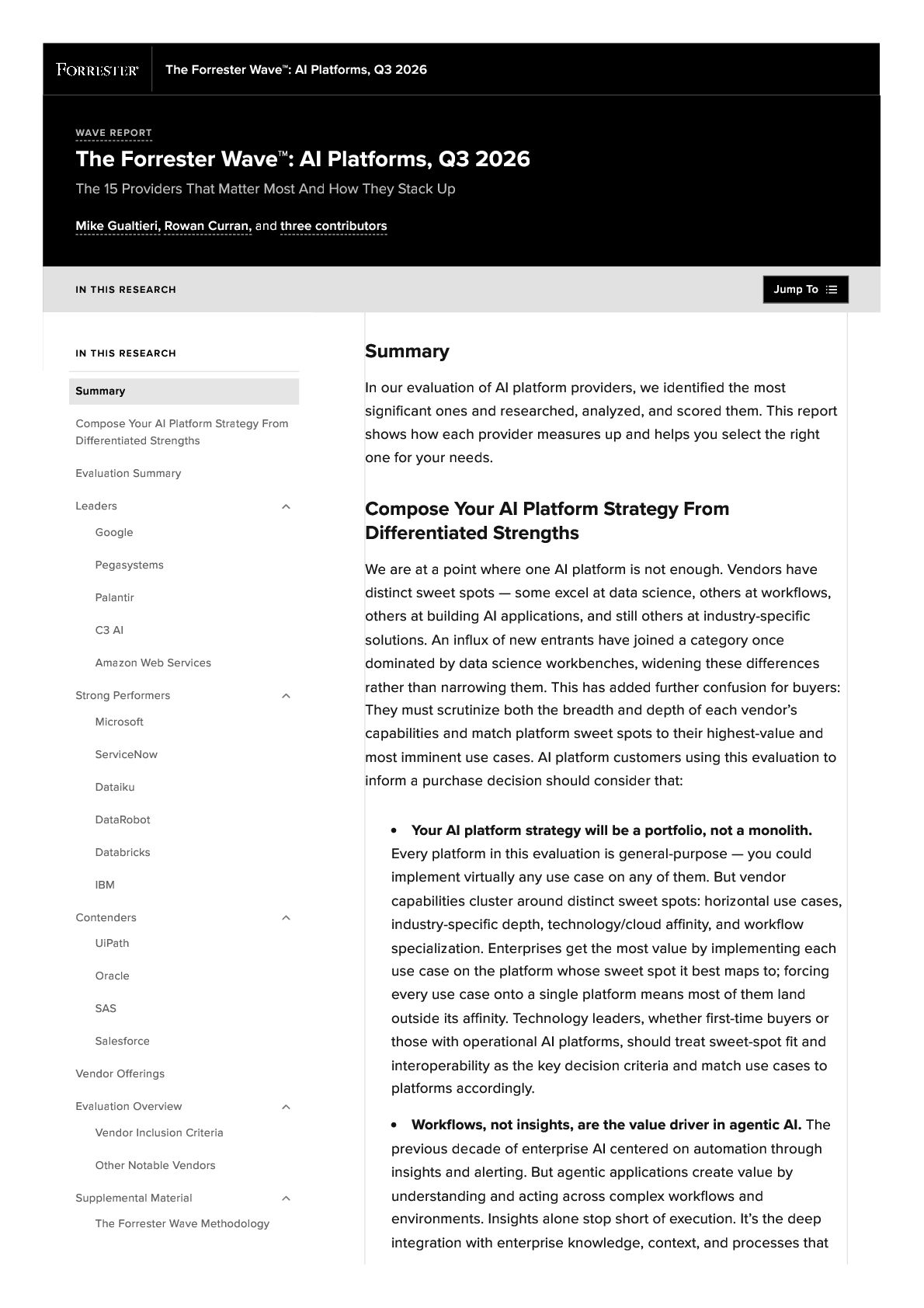
E P O RT The Forrester Wave™: AI Platforms, Q3 2026 The 15 Providers That Matter Most And How They Stack Up Mike Gualtieri, Rowan Curran, and three contributors Jump To IN THIS RESEARCH IN THIS RESEARCH Summary Summary In our evaluation of AI platform providers, we identified the most Compose Your AI Platform Strategy From Differentiated Strengths Evaluation Summary Leaders Google significant ones and researched, analyzed, and scored them. This report shows how each provider measures up and helps you select the right one for your needs. Compose Your AI Platform Strategy From Differentiated Strengths Pegasystems We are at a point where one AI platform is not enough. Vendors have Palantir distinct sweet spots — some excel at data science, others at workflows, C3 AI Amazon Web Services Strong Performers Microsoft others at building AI applications, and still others at industry-specific solutions. An influx of new entrants have joined a category once dominated by data science workbenches, widening these differences rather than narrowing them. This has added further confusion for buyers: They must scrutinize both the breadth and depth of each vendor’s capabilities and match platform sweet spots to their highest-value and ServiceNow most imminent use cases. AI platform customers using this evaluation to Dataiku inform a purchase decision should consider that: DataRobot Your AI platform strategy will be a portfolio, not a monolith. Databricks Every platform in this evaluation is general-purpose — you could IBM implement virtually any use case on any of them. But vendor Contenders capabilities cluster around distinct sweet spots: horizontal use cases, industry-specific depth, technology/cloud affinity, and workflow UiPath specialization. Enterprises get the most value by implementing each Oracle use case on the platform whose sweet spot it best maps to; forcing SAS Salesforce Vendor Offerings every use case onto a single platform means most of them land outside its affinity. Technology leaders, whether first-time buyers or those with operational AI platforms, should treat sweet-spot fit and interoperability as the key decision criteria and match use cases to platforms accordingly. Evaluation Overview Vendor Inclusion Criteria Other Notable Vendors Supplemental Material The Forrester Wave Methodology Workflows, not insights, are the value driver in agentic AI. The previous decade of enterprise AI centered on automation through insights and alerting. But agentic applications create value by understanding and acting across complex workflows and environments. Insights alone stop short of execution. It’s the deep integration with enterprise knowledge, context, and processes that -
Integrity Policy turns AI into completed work. Technology leaders should
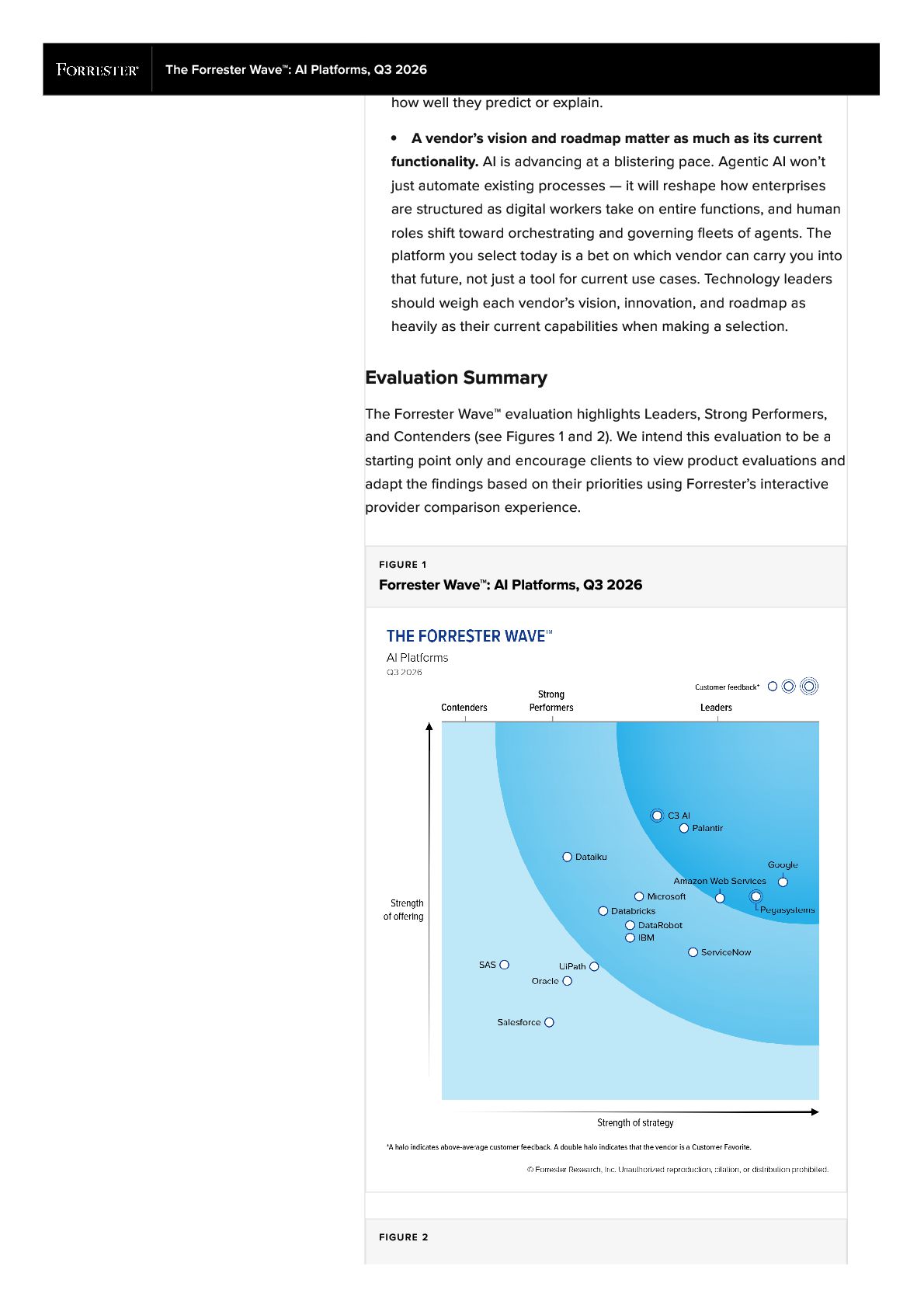
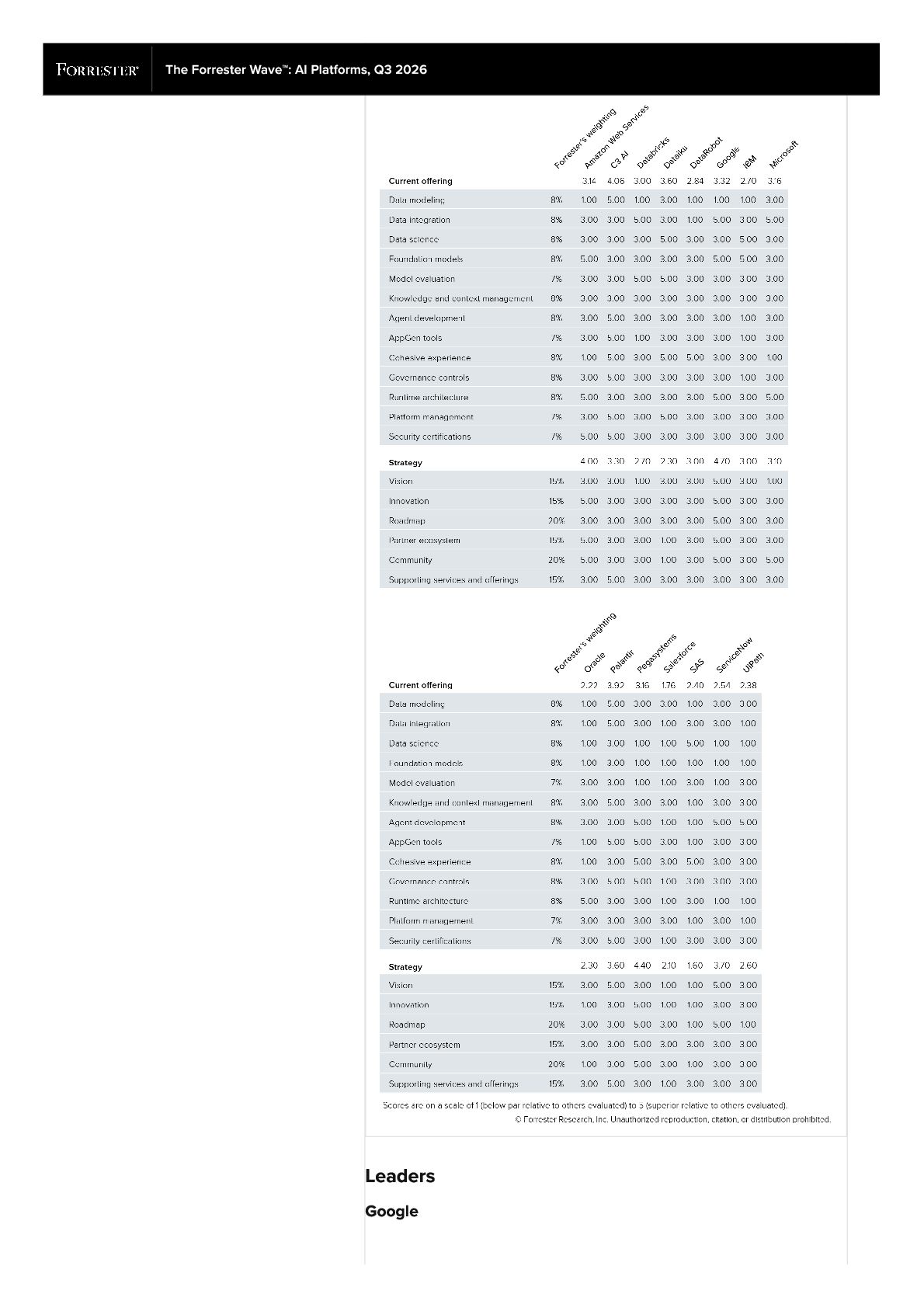
evaluate The Forrester Wave™: AI Platforms, Q3 2026 platforms on how well they model and execute processes, not just on how well they predict or explain. A vendor’s vision and roadmap matter as much as its current functionality. AI is advancing at a blistering pace. Agentic AI won’t just automate existing processes — it will reshape how enterprises are structured as digital workers take on entire functions, and human roles shift toward orchestrating and governing fleets of agents. The platform you select today is a bet on which vendor can carry you into that future, not just a tool for current use cases. Technology leaders should weigh each vendor’s vision, innovation, and roadmap as heavily as their current capabilities when making a selection. Evaluation Summary The Forrester Wave™ evaluation highlights Leaders, Strong Performers, and Contenders (see Figures 1 and 2). We intend this evaluation to be a starting point only and encourage clients to view product evaluations and adapt the findings based on their priorities using Forrester’s interactive provider comparison experience. FIGURE 1 Forrester Wave™: AI Platforms, Q3 2026 FIGURE 2 -
Forrester Wave™: AI Platforms Scorecard, Q3 2026 The Forrester Wave™:
AI Platforms, Q3 2026 Leaders Google -
Google’s AI platform includes data science and analytics tools as
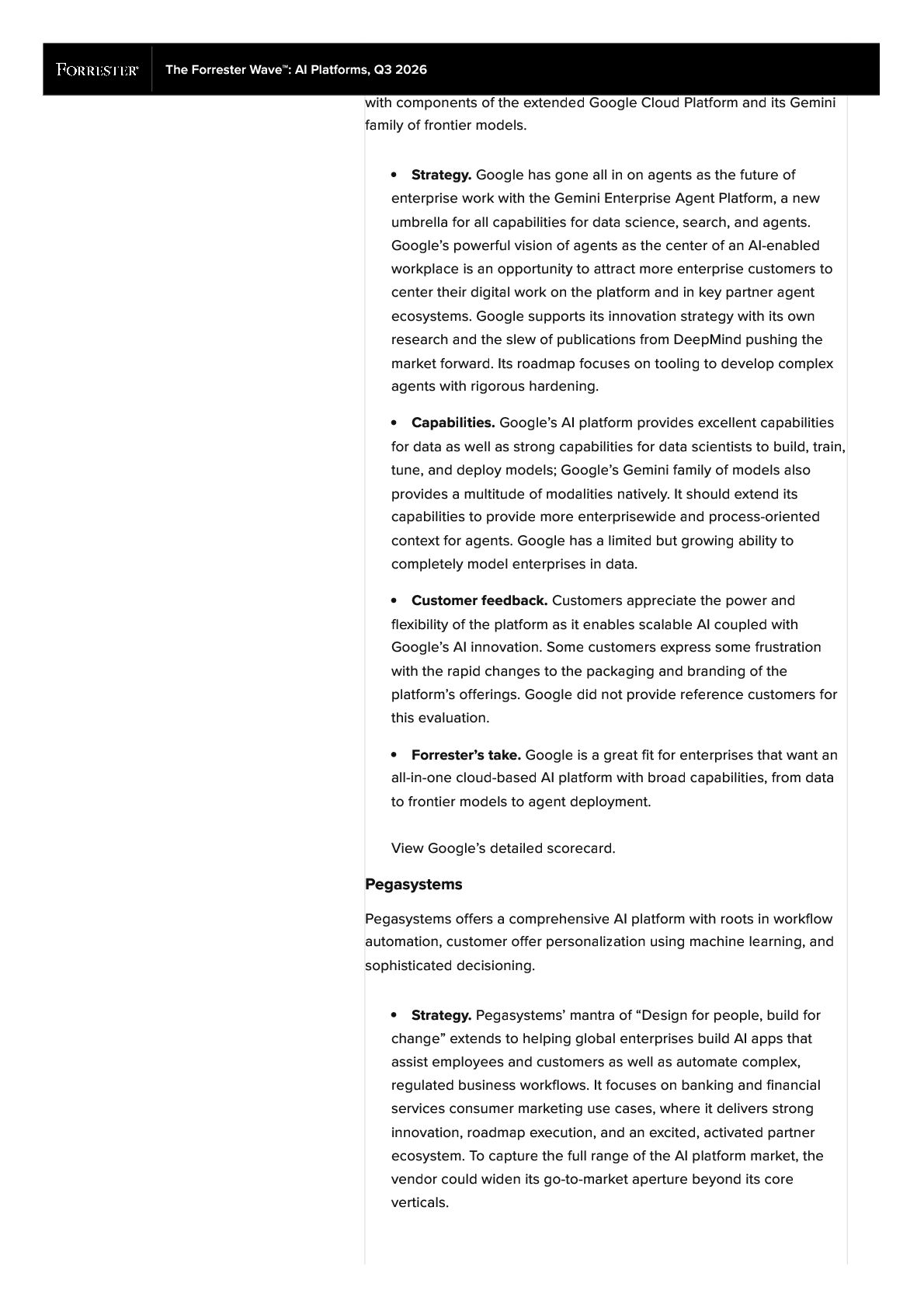
well as The Forrester Wave™: AI Platforms, Q3 2026 capabilities for AI and agentic application development. It supports these with components of the extended Google Cloud Platform and its Gemini family of frontier models. Strategy. Google has gone all in on agents as the future of enterprise work with the Gemini Enterprise Agent Platform, a new umbrella for all capabilities for data science, search, and agents. Google’s powerful vision of agents as the center of an AI-enabled workplace is an opportunity to attract more enterprise customers to center their digital work on the platform and in key partner agent ecosystems. Google supports its innovation strategy with its own research and the slew of publications from DeepMind pushing the market forward. Its roadmap focuses on tooling to develop complex agents with rigorous hardening. Capabilities. Google’s AI platform provides excellent capabilities for data as well as strong capabilities for data scientists to build, train, tune, and deploy models; Google’s Gemini family of models also provides a multitude of modalities natively. It should extend its capabilities to provide more enterprisewide and process-oriented context for agents. Google has a limited but growing ability to completely model enterprises in data. Customer feedback. Customers appreciate the power and flexibility of the platform as it enables scalable AI coupled with Google’s AI innovation. Some customers express some frustration with the rapid changes to the packaging and branding of the platform’s offerings. Google did not provide reference customers for this evaluation. Forrester’s take. Google is a great fit for enterprises that want an all-in-one cloud-based AI platform with broad capabilities, from data to frontier models to agent deployment. View Google’s detailed scorecard. Pegasystems Pegasystems offers a comprehensive AI platform with roots in workflow automation, customer offer personalization using machine learning, and sophisticated decisioning. Strategy. Pegasystems’ mantra of “Design for people, build for change” extends to helping global enterprises build AI apps that assist employees and customers as well as automate complex, regulated business workflows. It focuses on banking and financial services consumer marketing use cases, where it delivers strong innovation, roadmap execution, and an excited, activated partner ecosystem. To capture the full range of the AI platform market, the vendor could widen its go-to-market aperture beyond its core verticals. -
Capabilities. Pegasystems’ agent and app development tools The Forrester Wave™:
AI Platforms, Q3 2026 excel, especially for workflows via its Blueprint capability. Its user experience is cohesive and addresses multiple user needs, which can be powerful but also overwhelming for users. Outside the core process design and AppGen experiences, Pegasystems is on par with its peers in platform management and security. Pegasystems could improve its competitiveness by adding to and improving its data science capabilities, frontier model evaluation, and tuning tools. Customer feedback. Customers appreciate the platform’s ease of use for technical developers and business users alike in creating hybrid workflows that combine business processes with agents. Some customers note that the platform’s extensive feature set can create a pronounced learning curve to use the platform. Only one of Pegasystems’ reference customers responded to Forrester’s outreach for this evaluation. Forrester’s take. Pegasystems is a good fit for customers that wish to implement complex, regulated workflows using AI agents. View Pegasystems’ detailed scorecard. Palantir Palantir’s Artificial Intelligence Platform (AIP) is an ontology-driven AI application development platform. It supports the development, deployment, and scaling of AI applications and agentic workflows. Strategy. Palantir’s strategy is to build and offer a platform that can accommodate the world’s most difficult and highest-return AI use cases — a vision that translates to a platform that excels not only at data modeling and integration but also at implementing agentic AI workflows, full application development, and secure enterprise-grade deployments. Comprehensive forward-deployed engineering consulting services ensure that client deployments result in outsized business value. Palantir can improve its partner ecosystem by forging stronger alliances with domain specialists and system integrators to accelerate growth in diverse industries. Capabilities. Palantir’s platform takes data modeling to the next level with its ontology tools. It enables enterprises to rapidly build and operationalize complex, mission-critical AI solutions at scale with excellent data integration, tools to develop full applications, governance, and security certifications. Palantir could improve the platform’s user interface to accelerate the adoption of second and subsequent use cases by customers’ AI development teams. Customer feedback. Customers appreciate the focus and intelligence of Palantir’s implementation teams. Some note that Palantir charges a premium for this level of support. Palantir did not provide reference customers for this evaluation. Forrester’s take. Palantir is an excellent choice for enterprises that are ready to dive head-first into high-value AI with complex use cases embodied in new applications. -
The Forrester Wave™: AI Platforms, Q3 2026 View Palantir’s detailed
scorecard. C3 AI Founded in 2009, C3 AI initially focused on energy management solutions before expanding to cover internet-of-things applications for industries like utilities, defense, and financial services. It now provides AI production solutions for industry-specific and cross-vertical use cases. Strategy. C3 AI’s strategy is to focus on the highest-impact industry use cases by delivering prebuilt solution accelerators on a unified AI platform that supports full application and agent development. While its overall strategy has remained consistent, leadership changed in recent years. With the previous CEO now back at the helm, C3 AI is positioned to regain momentum. C3 AI is looking to expand its potential customer base by lowering its initial costs; it could also strengthen its position by broadening its go-to-market efforts and partner ecosystem to drive faster adoption beyond its core industries. Capabilities. C3 AI’s key strength lies in how its capabilities work together in a cohesive development environment that spans data modeling through agent deployment; this is backed by dozens of solution accelerators and excellent governance controls. The company has excellent or solid scores across all major functional categories, but it could become more competitive by improving its data integration, data science, and foundation model capabilities. Customer feedback. Customers rave about the business value of the use cases they’ve implemented and C3 AI’s “white glove” implementation and ongoing service. Some are surprised that the company’s strategy has not led to faster growth. Forrester’s take. C3 AI is a strong strategic choice for enterprises that want to focus on high-value industry use cases in order to outmaneuver competitors. View C3 AI’s detailed scorecard. Amazon Web Services Amazon Web Services (AWS) includes SageMaker (data science and ML), Bedrock (foundation models), and Bedrock AgentCore (agentic platform) in its AI platform. It supports these with its enterprise cloud infrastructure. Strategy. AWS’s AI platform strategy is to provide the most powerful and customizable platform for AI enterprises that need to offer highly scalable training and inference for training and tuning models. It uses its outstanding partner ecosystem to give data scientists, developers, and operations teams the capacity to offer the richest AI experiences possible. Its innovation also shines, with the Nova family of foundation models delivering reliable and economical models that drive quantifiable value in enterprise processes. -
Capabilities. AWS’s platform provides outstanding infrastructure The Forrester Wave™: AI
Platforms, Q3 2026 as well as scalable training and inferencing for traditional ML and foundation models. AWS has strong tooling that enables data scientists to train, build, and deploy custom models as well as a rich array of models available on the platform. It also provides a unique Nova Forge offering that lets enterprises build custom pretrained models. AWS’s platform currently lacks a strong cross-platform data modeling capability, while the cohesion of the user experience across all AI platforms services lags its competitors. Customer feedback. Customers like AWS’s powerful underlying capabilities and infrastructure that developers can use to deploy enterprise-grade agentic AI, particularly AgentCore runtime. However, they often describe the overall experience as complex and fragmented, requiring deep AWS expertise and substantial custom integration work across multiple services. Amazon Web Services’ reference customers did not respond to Forrester’s outreach for this evaluation. Forrester’s take. Amazon Web Services is a good choice for companies that want a robust runtime and infrastructure platform to build agents as well as a rich set of tools that data scientists and developers can use to train and deploy models and agentic applications. View Amazon Web Services’ detailed scorecard. Strong Performers Microsoft Microsoft’s Azure AI platform is a suite of cloud-based AI and services and developer tools, including Azure AI Foundry. It supports the full lifecycle of AI applications, including copilots and agents, across enterprise environments. Strategy. Microsoft has focused on enabling companies to build “the agentic enterprise,” but it has struggled to clearly differentiate its agentic capabilities or expand on its early lead in broad Copilot deployments. It has a real opportunity to leap ahead if it can leverage its deep understanding of customers’ systems of work with Microsoft Fabric to support the context of meaningful agentic actions for customers. Its recently announced Frontier Tuning capabilities also aim to empower business users with more powerful model customization. Microsoft has increased its investment in its native families of foundation models in recent years, and it now positions its MAI models as on par with the leading frontier labs. Capabilities. Microsoft’s platform provides comprehensive support for AI needs of all types. The platform’s notable runtime architecture serves as a powerful foundation for enterprise agents. It has solid capabilities in many areas essential for the next generation of AI, such as data modeling, while excellent data integration functionality supports data science model development and agentic -
context management. However, the platform’s potential is somewhat The Forrester
Wave™: AI Platforms, Q3 2026 constrained by a lack of cohesive experiences across these tools and interfaces. Customer feedback. Customers like Microsoft AI Foundry’s integration with their existing systems of work and its connection to their enterprise knowledge through its data fabric, but can struggle connecting the products for strategic success. Microsoft did not provide reference customers for this evaluation. Forrester’s take. Microsoft is a great fit for companies that can capitalize on the potential of its data fabric and deep integrations into many enterprise systems of work. View Microsoft’s detailed scorecard. ServiceNow ServiceNow provides enterprise workflow and automation capabilities and has expanded its portfolio through acquisitions, including data.world and Moveworks in 2025. Its offerings include an AI-driven work platform that supports enterprise use cases. Strategy. ServiceNow’s impressive vision is to build a complete system of work that provides visibility and clarity for all enterprise knowledge and workflows — and then build transformative AI applications on top of that. Integrating ServiceNow’s knowledge graphs into a single view of the entire enterprise is a key part of that strategy, allowing clients to make comprehensive cross-enterprise decisions transparently and effectively. The vendor has a steep hill to climb to connect this tantalizing vision to real-world execution: Its noteworthy roadmap focuses on enabling an ecosystem of agents for its customers, with a strong emphasis on agentic governance and control. Capabilities. ServiceNow’s platform excels with strong capabilities for process-oriented agent builders with knowledge graphs, which offer effective context management for agents. Its platform lets developers, business users, and AI engineers collaborate on building agents and apps in a cohesive experience with strong governance controls. The platform offers less support for training, evaluating, and tuning both ML and foundation models. Customer feedback. Customers like the vision and pace of innovation that ServiceNow provides in the agentic space, and they praise the service and support they received. They note that the vendor’s current vision is a bit too far ahead of customers’ current capabilities. Forrester’s take. ServiceNow is a great fit for enterprises that want to build a process-oriented AI strategy around capturing and managing a “system of work.” View ServiceNow’s detailed scorecard. -
Dataiku The Forrester Wave™: AI Platforms, Q3 2026 Dataiku was
founded in 2013 with a focus on data science and machine learning. It now provides an AI platform that enables data scientists and business teams to build, deploy, and govern AI applications and agents at scale. Strategy. Dataiku’s vision centers on empowering collaborative teams across data science and business functions to accelerate AI adoption across the enterprise. To support this, it continues to invest in expanding its platform’s reach and usability with solid innovation; its roadmap also supports a growing range of AI initiatives while maintaining its strong focus on time to value. However, Dataiku needs to enhance its partner ecosystem and go-to-market efforts to broaden adoption beyond its core user community. Capabilities. Dataiku stands out with its data science capabilities, model evaluation tools, governance, platform management, and a cohesive user experience. Its UI is beautifully designed for multiple enterprise personas, while its LLM Mesh provides sophisticated governance and monitoring of all types of foundation models. The vendor has effective capabilities for developing agents but must work to expand its process understanding and control. Customer feedback. Customers highlight the platform’s collaborative environment and ability to accelerate time to value for AI projects, but they would like more flexibility in pricing for the platform’s rapidly emerging AI capabilities. Some note that they have not yet used its newer agentic capabilities. Forrester’s take. Dataiku is a strong choice for enterprises seeking a collaborative AI platform with robust data science and governance capabilities that can scale from analytics to production AI agents. View Dataiku’s detailed scorecard. DataRobot DataRobot offers a platform that focuses on AI development, governance, operations, and infrastructure for mission-critical agentic AI workloads with a heritage of strong data science. Strategy. DataRobot’s vision is to help enterprises create a mission-critical agent workforce with guardrails on multicloud, hybrid, and on-premises environments. Consistent with its long-held vision of democratizing data science and insights, DataRobot wants to enable all enterprise users to build AI agents while maintaining enterprise guidance and guardrails. It supports this vision with solid innovation, roadmap, and partnerships. Capabilities. DataRobot’s platform provides an excellent project- oriented experience that encompasses the requirements, training, testing, and deployment of machine learning models as well as the tuning and alignment of foundation models. Data scientists, business -
developers, and AI engineers can all collaborate easily on the
The Forrester Wave™: AI Platforms, Q3 2026 platform using DataRobot’s solid tools for agentic and AI application development, governance, and model evaluation. However, DataRobot’s data modeling capabilities currently lag behind some of its peers in this evaluation. Customer feedback. Customers appreciate DataRobot’s ability to enable diverse teams of business and technical users to deploy and manage models at scale; they also like its AI governance capabilities. Some customers note that big data processing is mostly achieved in a different platform. Forrester’s take. DataRobot is a good fit for enterprises that want a platform that helps diverse groups of stakeholders collaborate to build AI agents that can be deployed both on-premises and/or multicloud. View DataRobot’s detailed scorecard. Databricks Databricks is a cloud-agnostic AI platform provider with a strong basis in data management and engineering. Its data platform has been widely adopted in the enterprise. Strategy. Databricks’ vision is to offer enterprises an AI platform that can ground AI in enterprise data that is both scalable and governed. Databricks must expand its planned role in the enterprise ecosystem beyond delivering insights to driving processes if it’s going to compel enterprises to build more extensive and complex agents on its platform. Its innovation, roadmap, partner ecosystem, community, and supporting services offer a solid basis for developing its vision. Capabilities. Databricks has excellent data integration capabilities that allow users to bring any enterprise data source into its data lake and use it for agentic and AI apps. It has a solid platform for training and building data science models, and Agent Bricks offers effective tooling to support enterprise agent development, although it lags in some key adjacent capabilities. For example, it needs to improve data modeling for enterprise workflows to enable enterprises to realize the full potential of agents. It also lacks strong AppGen tools. Databricks has effective capabilities for governance and security, a cohesive platform experience, and a flexible and scalable runtime architecture. Customer feedback. Customers use Databricks as a foundational data platform to drive their AI capabilities. Not all customers are satisfied with Agent Bricks, despite its functional capabilities. Forrester’s take. Databricks is a good fit for enterprises that need to establish a robust home for their data as an integral part of their AI strategy as well as those that want to deploy agents flexibly across clouds. -
The Forrester Wave™: AI Platforms, Q3 2026 View Databricks’ detailed
scorecard. IBM IBM’s watsonx portfolio of AI products includes watsonx.ai, watsonx Orchestrate, and watsonx.data. It supports AI use cases, such as data science, model management, agent orchestration, and automation services. Strategy. IBM aims to deliver a versatile AI platform that leverages its deep data science heritage to address a broad range of enterprise use cases across industries. The vendor continues to invest in model training, tuning, and integration with its existing automation portfolio, backed by its extensive global services and a large partner network; it’s also maintaining its research and innovation work with the Granite family of models. IBM could further strengthen its position by expanding its focus on full application development capabilities to compete more effectively in the broader AI platform market. Capabilities. IBM excels at data science capabilities for a wide variety of model types, training methods, and tuning techniques, and it stands out with a broad family of foundation models for more unique use cases. Although it gains solid scores for many other capabilities, IBM lags when it comes to data modeling, agent development, AppGen tools, and governance controls: It needs to enable developers to create a user interface layer for AI solutions that need it. Customer feedback. Customers appreciate the breadth and depth of IBM’s data science capabilities and the addition of advanced AI services that build on their existing IBM investments. Some customers are confused about what does and doesn’t comprise IBM’s AI offerings. IBM did not provide reference customers for this evaluation. Forrester’s take. IBM is a good choice for enterprises that require deep data science capabilities and a proven platform for complex AI initiatives across multiple model types and industries. View IBM’s detailed scorecard. Contenders UiPath UiPath brings its robotic process automation (RPA) heritage to the AI platform space. Its UiPath Platform supports the creation of intelligent agents that can orchestrate and execute complex actions on existing enterprise IT systems. Strategy. UiPath’s vision is to provide a control layer for enterprise AI, augmented by the integrations and context of its platform’s business knowledge. It leverages its deep expertise in automation to -
deliver AI agents that extend seamlessly into legacy and modern
IT The Forrester Wave™: AI Platforms, Q3 2026 environments. It continues to invest in expanding its agent capabilities and partner ecosystem to drive adoption in automationheavy industries. UiPath needs to strengthen its roadmap, which it could do by adding industry-specific solution accelerators that focus on complex, highly consequential use cases. Capabilities. UiPath’s agent development functionality shines, as it offers a vast library of tools that connect and act on existing IT systems. It also provides solid capabilities for enterprises wanting to build data models to support AI applications and agentic workflows via components like Data Fabric. UiPath could improve its competitiveness by adding data science capabilities to create predictive models and providing data processing capabilities to handle very large datasets and streaming data. Customer feedback. Customers praise the platform’s ability to quickly automate previously intractable processes across disparate systems. Some note a steep learning curve to understand all the built-in robotic process automation agent tools. Forrester’s take. UiPath is best suited for enterprises that want to use AI to automate the last mile of complex automations on existing IT systems. View UiPath’s detailed scorecard. Oracle Oracle provides a wide range of enterprise data, analytics, and infrastructure capabilities, reflecting its history in the enterprise software market. Its OCI AI platform and agentic capabilities are part of its broad portfolio and have had a more measured initial rollout than some of its peers’ offerings. Strategy. Oracle aims to build a set of best-in-class foundations for its platform and enable deep tooling around key capabilities. Its vision as an AI platform is distinct from many other vendors in the market, focusing specifically on supporting as many third-party and open agentic frameworks as possible to build on its platform with as little effort as possible. This is likely to appeal to those that don’t want to shift platforms to support agentic AI. However, Oracle’s strategy of supporting third-party frameworks has meant less emphasis on internal innovation. Capabilities. Oracle gives developers a powerful and scalable runtime architecture for building agentic apps at scale. It has solid capabilities for building and deploying agents, with a distinctive approach of focusing on enabling open-source and external agent builder platforms to accelerate development on its platform with prebuilt integrations and templates. To appeal to new customers, Oracle must improve in areas like data modeling, integration, and science; it must also provide a cohesive experience for multiple types of users working on the same AI projects. -
Customer feedback. Customers say they use Oracle for core The
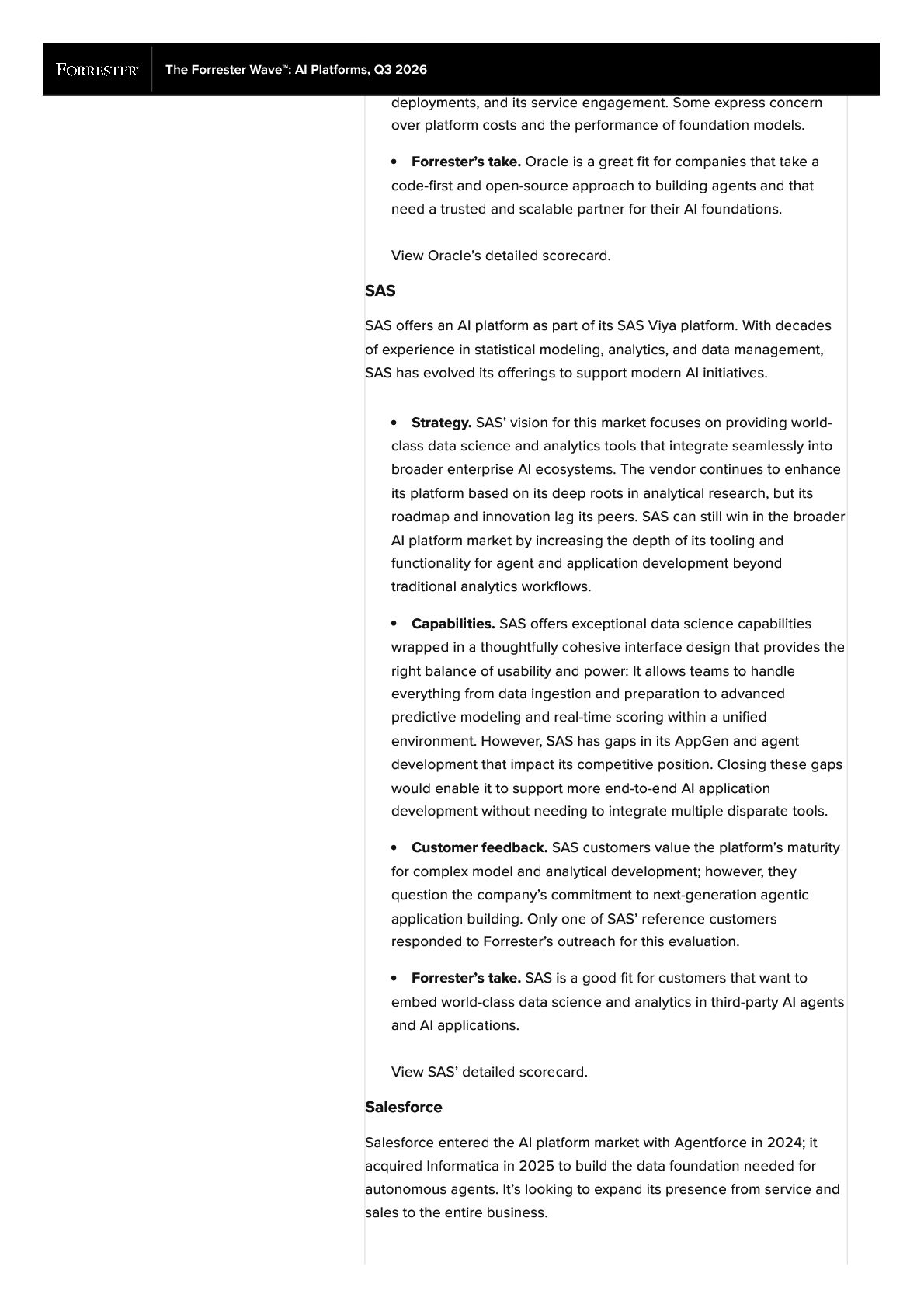
Forrester Wave™: AI Platforms, Q3 2026 agentic capabilities like data security and privacy, flexible cloud deployments, and its service engagement. Some express concern over platform costs and the performance of foundation models. Forrester’s take. Oracle is a great fit for companies that take a code-first and open-source approach to building agents and that need a trusted and scalable partner for their AI foundations. View Oracle’s detailed scorecard. SAS SAS offers an AI platform as part of its SAS Viya platform. With decades of experience in statistical modeling, analytics, and data management, SAS has evolved its offerings to support modern AI initiatives. Strategy. SAS’ vision for this market focuses on providing world- class data science and analytics tools that integrate seamlessly into broader enterprise AI ecosystems. The vendor continues to enhance its platform based on its deep roots in analytical research, but its roadmap and innovation lag its peers. SAS can still win in the broader AI platform market by increasing the depth of its tooling and functionality for agent and application development beyond traditional analytics workflows. Capabilities. SAS offers exceptional data science capabilities wrapped in a thoughtfully cohesive interface design that provides the right balance of usability and power: It allows teams to handle everything from data ingestion and preparation to advanced predictive modeling and real-time scoring within a unified environment. However, SAS has gaps in its AppGen and agent development that impact its competitive position. Closing these gaps would enable it to support more end-to-end AI application development without needing to integrate multiple disparate tools. Customer feedback. SAS customers value the platform’s maturity for complex model and analytical development; however, they question the company’s commitment to next-generation agentic application building. Only one of SAS’ reference customers responded to Forrester’s outreach for this evaluation. Forrester’s take. SAS is a good fit for customers that want to embed world-class data science and analytics in third-party AI agents and AI applications. View SAS’ detailed scorecard. Salesforce Salesforce entered the AI platform market with Agentforce in 2024; it acquired Informatica in 2025 to build the data foundation needed for autonomous agents. It’s looking to expand its presence from service and sales to the entire business. -
Strategy. Salesforce has recently shifted from a “build it here”
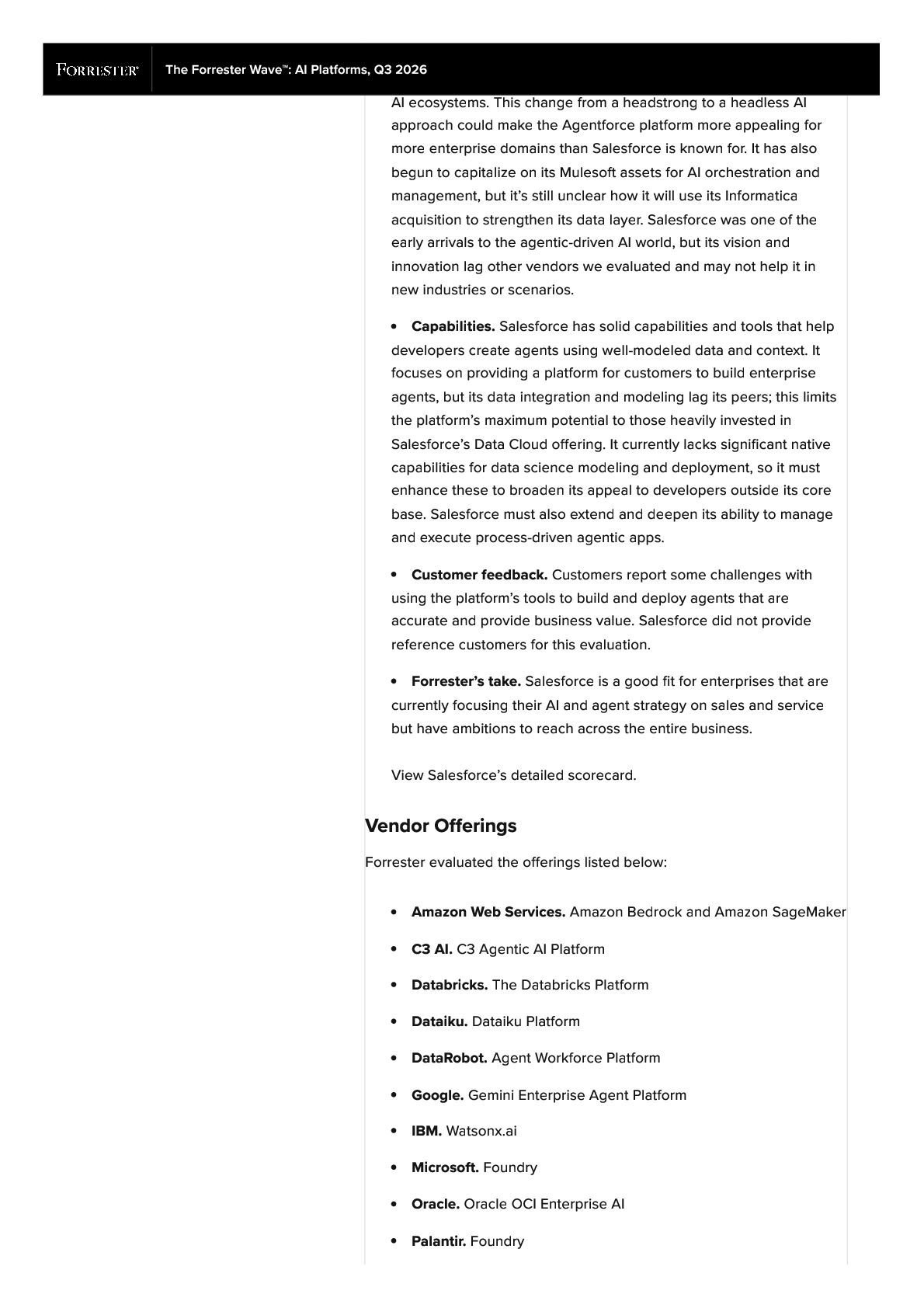
The Forrester Wave™: AI Platforms, Q3 2026 approach to seeing Agentforce as a component in broader enterprise AI ecosystems. This change from a headstrong to a headless AI approach could make the Agentforce platform more appealing for more enterprise domains than Salesforce is known for. It has also begun to capitalize on its Mulesoft assets for AI orchestration and management, but it’s still unclear how it will use its Informatica acquisition to strengthen its data layer. Salesforce was one of the early arrivals to the agentic-driven AI world, but its vision and innovation lag other vendors we evaluated and may not help it in new industries or scenarios. Capabilities. Salesforce has solid capabilities and tools that help developers create agents using well-modeled data and context. It focuses on providing a platform for customers to build enterprise agents, but its data integration and modeling lag its peers; this limits the platform’s maximum potential to those heavily invested in Salesforce’s Data Cloud offering. It currently lacks significant native capabilities for data science modeling and deployment, so it must enhance these to broaden its appeal to developers outside its core base. Salesforce must also extend and deepen its ability to manage and execute process-driven agentic apps. Customer feedback. Customers report some challenges with using the platform’s tools to build and deploy agents that are accurate and provide business value. Salesforce did not provide reference customers for this evaluation. Forrester’s take. Salesforce is a good fit for enterprises that are currently focusing their AI and agent strategy on sales and service but have ambitions to reach across the entire business. View Salesforce’s detailed scorecard. Vendor Offerings Forrester evaluated the offerings listed below: Amazon Web Services. Amazon Bedrock and Amazon SageMaker C3 AI. C3 Agentic AI Platform Databricks. The Databricks Platform Dataiku. Dataiku Platform DataRobot. Agent Workforce Platform Google. Gemini Enterprise Agent Platform IBM. Watsonx.ai Microsoft. Foundry Oracle. Oracle OCI Enterprise AI Palantir. Foundry -
Pegasystems. Pega Infinity The Forrester Wave™: AI Platforms, Q3 2026
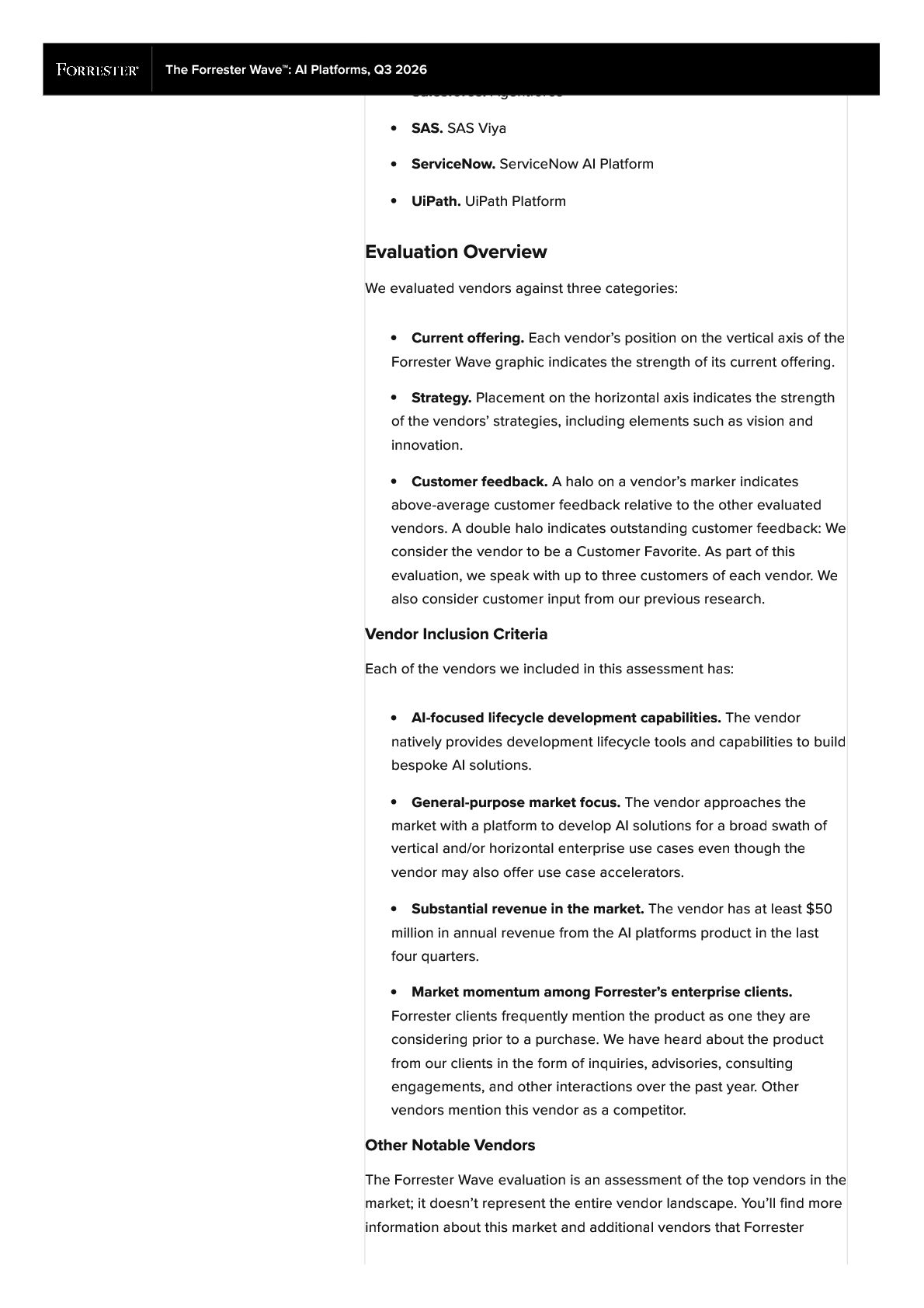
Salesforce. Agentforce SAS. SAS Viya ServiceNow. ServiceNow AI Platform UiPath. UiPath Platform Evaluation Overview We evaluated vendors against three categories: Current offering. Each vendor’s position on the vertical axis of the Forrester Wave graphic indicates the strength of its current offering. Strategy. Placement on the horizontal axis indicates the strength of the vendors’ strategies, including elements such as vision and innovation. Customer feedback. A halo on a vendor’s marker indicates above-average customer feedback relative to the other evaluated vendors. A double halo indicates outstanding customer feedback: We consider the vendor to be a Customer Favorite. As part of this evaluation, we speak with up to three customers of each vendor. We also consider customer input from our previous research. Vendor Inclusion Criteria Each of the vendors we included in this assessment has: AI-focused lifecycle development capabilities. The vendor natively provides development lifecycle tools and capabilities to build bespoke AI solutions. General-purpose market focus. The vendor approaches the market with a platform to develop AI solutions for a broad swath of vertical and/or horizontal enterprise use cases even though the vendor may also offer use case accelerators. Substantial revenue in the market. The vendor has at least $50 million in annual revenue from the AI platforms product in the last four quarters. Market momentum among Forrester’s enterprise clients. Forrester clients frequently mention the product as one they are considering prior to a purchase. We have heard about the product from our clients in the form of inquiries, advisories, consulting engagements, and other interactions over the past year. Other vendors mention this vendor as a competitor. Other Notable Vendors The Forrester Wave evaluation is an assessment of the top vendors in the market; it doesn’t represent the entire vendor landscape. You’ll find more information about this market and additional vendors that Forrester -
considers to be notable for enterprise clients in our corresponding
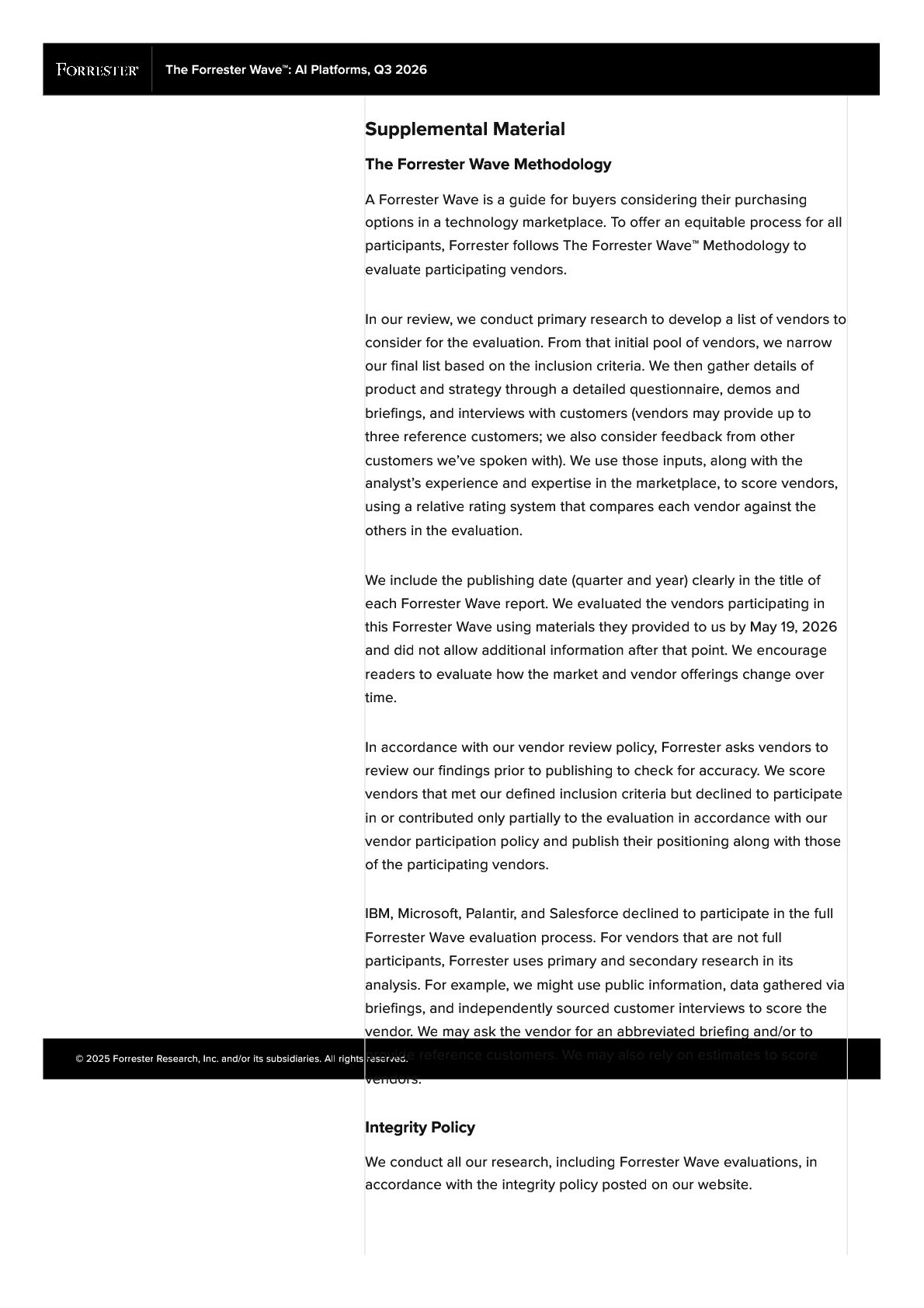
The Forrester Wave™: AI Platforms, Q3 2026 report: The AI Platforms Landscape, Q1 2026. Supplemental Material The Forrester Wave Methodology A Forrester Wave is a guide for buyers considering their purchasing options in a technology marketplace. To offer an equitable process for all participants, Forrester follows The Forrester Wave™ Methodology to evaluate participating vendors. In our review, we conduct primary research to develop a list of vendors to consider for the evaluation. From that initial pool of vendors, we narrow our final list based on the inclusion criteria. We then gather details of product and strategy through a detailed questionnaire, demos and briefings, and interviews with customers (vendors may provide up to three reference customers; we also consider feedback from other customers we’ve spoken with). We use those inputs, along with the analyst’s experience and expertise in the marketplace, to score vendors, using a relative rating system that compares each vendor against the others in the evaluation. We include the publishing date (quarter and year) clearly in the title of each Forrester Wave report. We evaluated the vendors participating in this Forrester Wave using materials they provided to us by May 19, 2026 and did not allow additional information after that point. We encourage readers to evaluate how the market and vendor offerings change over time. In accordance with our vendor review policy, Forrester asks vendors to review our findings prior to publishing to check for accuracy. We score vendors that met our defined inclusion criteria but declined to participate in or contributed only partially to the evaluation in accordance with our vendor participation policy and publish their positioning along with those of the participating vendors. IBM, Microsoft, Palantir, and Salesforce declined to participate in the full Forrester Wave evaluation process. For vendors that are not full participants, Forrester uses primary and secondary research in its analysis. For example, we might use public information, data gathered via briefings, and independently sourced customer interviews to score the vendor. We may ask the vendor for an abbreviated briefing and/or to © 2025 Forrester Research, Inc. and/or its subsidiaries. All rights provide reserved. reference customers. We may also rely on estimates to score vendors. Integrity Policy We conduct all our research, including Forrester Wave evaluations, in accordance with the integrity policy posted on our website.
 atabarezz
 takumi4327
 takeuchigroup
 shunsuke_takeuchi
 kawanotron
 tkt42u19421
 sasakendayo
 ediel
 progmat
 tablecheckac
 bft_recruit
 maijun
 yusukiwashita
 nwiizo
 zakiyama
 nonsquared
 sergeychernyshev
 dougneiner
 aleyda
 leimatthew05
 palkan
 eitanlees
 tammyeverts
 bryan
 holman