Share
Embed
Entrepreneurship & Innovation — 2026 Edition (Short Version)
A concise, 203-page guide to high-tech entrepreneurship by Prof. Dr. Mustafa Ergen. Fully revised for 2026, it covers the Silicon Valley model, technology waves including AI, startup funding and venture capital, pitch development, financials and valuation, team building, term sheets, board governance, founder mindset, and Türkiye’s startup ecosystem. Includes current market data, AI business economics, modern fundraising instruments, and practical lessons for building and scaling a technology company.

Altan Atabarut
October 29, 2026
Transcript
203 slides
-
Mustafa Ergen Entrepreneurship & Innovation Lecture notes on high-tech startups
— from idea to company, capital, team and scale Prof. Dr. Mustafa Ergen 2026 edition · mustafaergen.com -
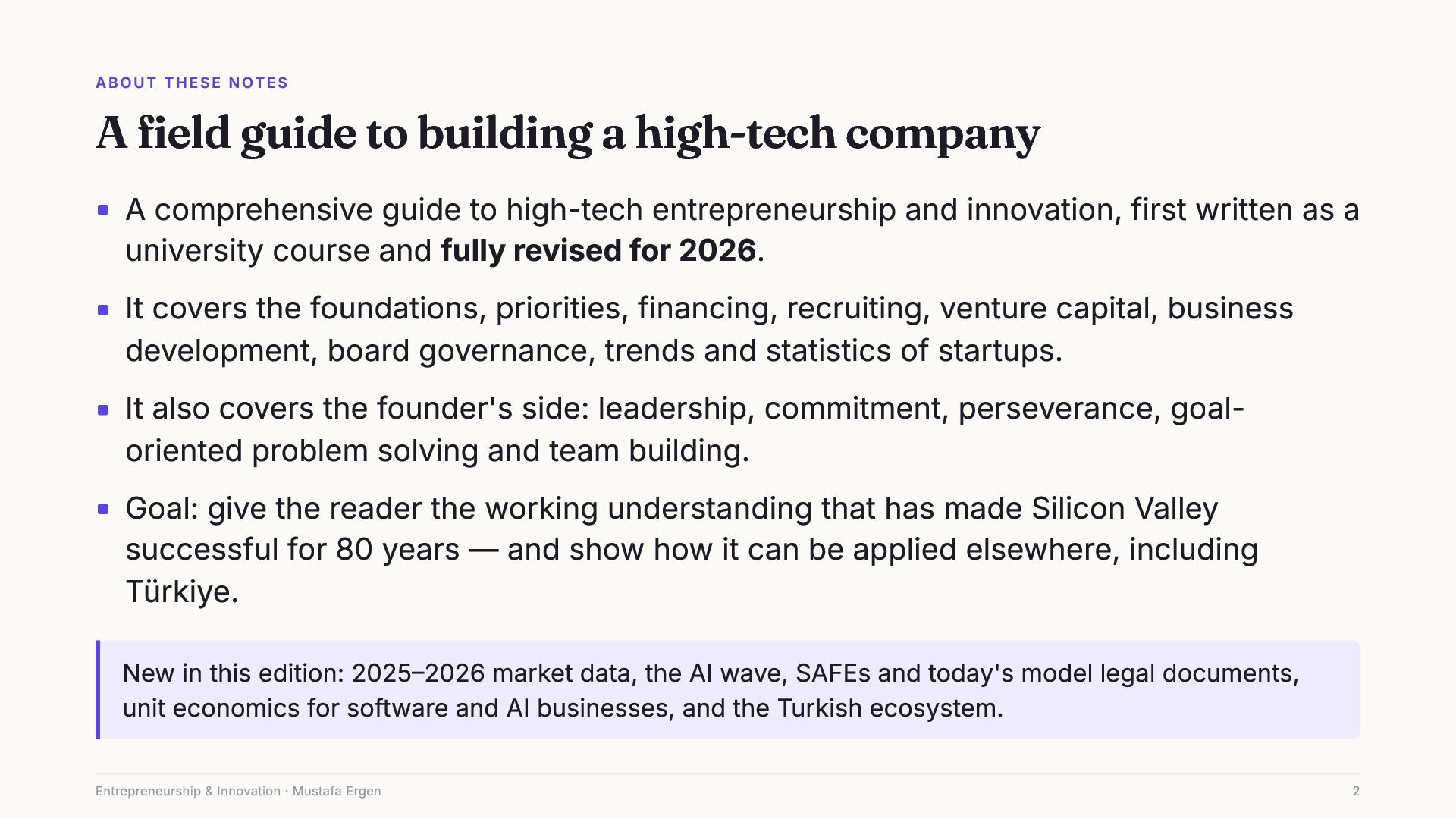
A B O U T T H E S E
N OT E S A field guide to building a high-tech company A comprehensive guide to high-tech entrepreneurship and innovation, first written as a university course and fully revised for 2026. It covers the foundations, priorities, financing, recruiting, venture capital, business development, board governance, trends and statistics of startups. It also covers the founder's side: leadership, commitment, perseverance, goaloriented problem solving and team building. Goal: give the reader the working understanding that has made Silicon Valley successful for 80 years — and show how it can be applied elsewhere, including Türkiye. New in this edition: 2025–2026 market data, the AI wave, SAFEs and today's model legal documents, unit economics for software and AI businesses, and the Turkish ecosystem. Entrepreneurship & Innovation · Mustafa Ergen 2 -
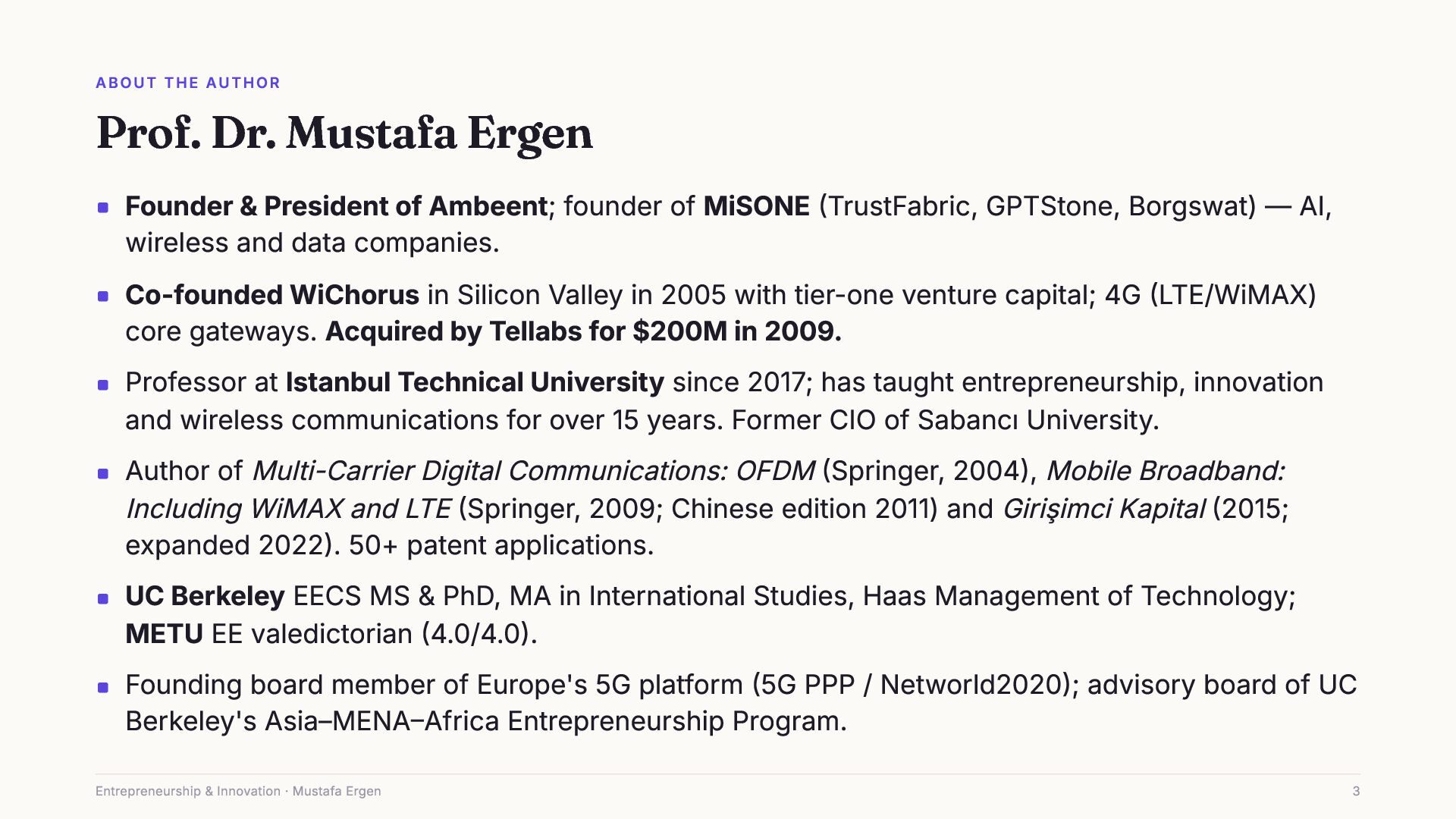
A B O U T T H E AU T
H O R Prof. Dr. Mustafa Ergen Founder & President of Ambeent; founder of MiSONE (TrustFabric, GPTStone, Borgswat) — AI, wireless and data companies. Co-founded WiChorus in Silicon Valley in 2005 with tier-one venture capital; 4G (LTE/WiMAX) core gateways. Acquired by Tellabs for $200M in 2009. Professor at Istanbul Technical University since 2017; has taught entrepreneurship, innovation and wireless communications for over 15 years. Former CIO of Sabancı University. Author of Multi-Carrier Digital Communications: OFDM (Springer, 2004), Mobile Broadband: Including WiMAX and LTE (Springer, 2009; Chinese edition 2011) and Girişimci Kapital (2015; expanded 2022). 50+ patent applications. UC Berkeley EECS MS & PhD, MA in International Studies, Haas Management of Technology; METU EE valedictorian (4.0/4.0). Founding board member of Europe's 5G platform (5G PPP / Networld2020); advisory board of UC Berkeley's Asia–MENA–Africa Entrepreneurship Program. Entrepreneurship & Innovation · Mustafa Ergen 3 -
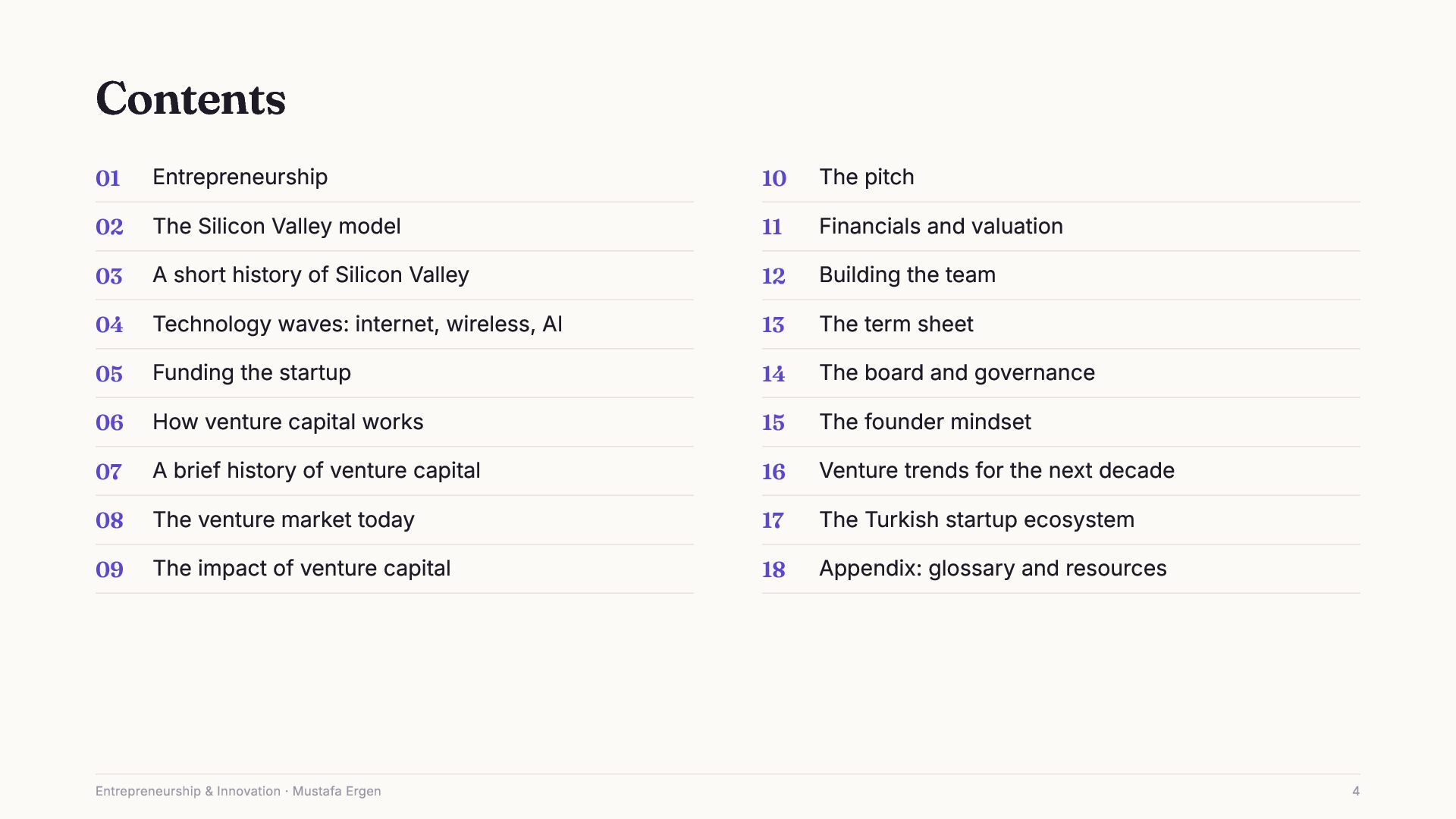
Contents 01 Entrepreneurship 10 The pitch 02 The Silicon Valley
model 11 Financials and valuation 03 A short history of Silicon Valley 12 Building the team 04 Technology waves: internet, wireless, AI 13 The term sheet 05 Funding the startup 14 The board and governance 06 How venture capital works 15 The founder mindset 07 A brief history of venture capital 16 Venture trends for the next decade 08 The venture market today 17 The Turkish startup ecosystem 09 The impact of venture capital 18 Appendix: glossary and resources Entrepreneurship & Innovation · Mustafa Ergen 4 -
01 Entrepreneurship What an entrepreneur is, why entrepreneurs change industries,
and why a startup is not a small business. Definitions History of the idea Entrepreneurship & Innovation · Mustafa Ergen Myths Rewards and risks Startup vs small business 01 · Entrepreneurship Deadly mistakes 5 -
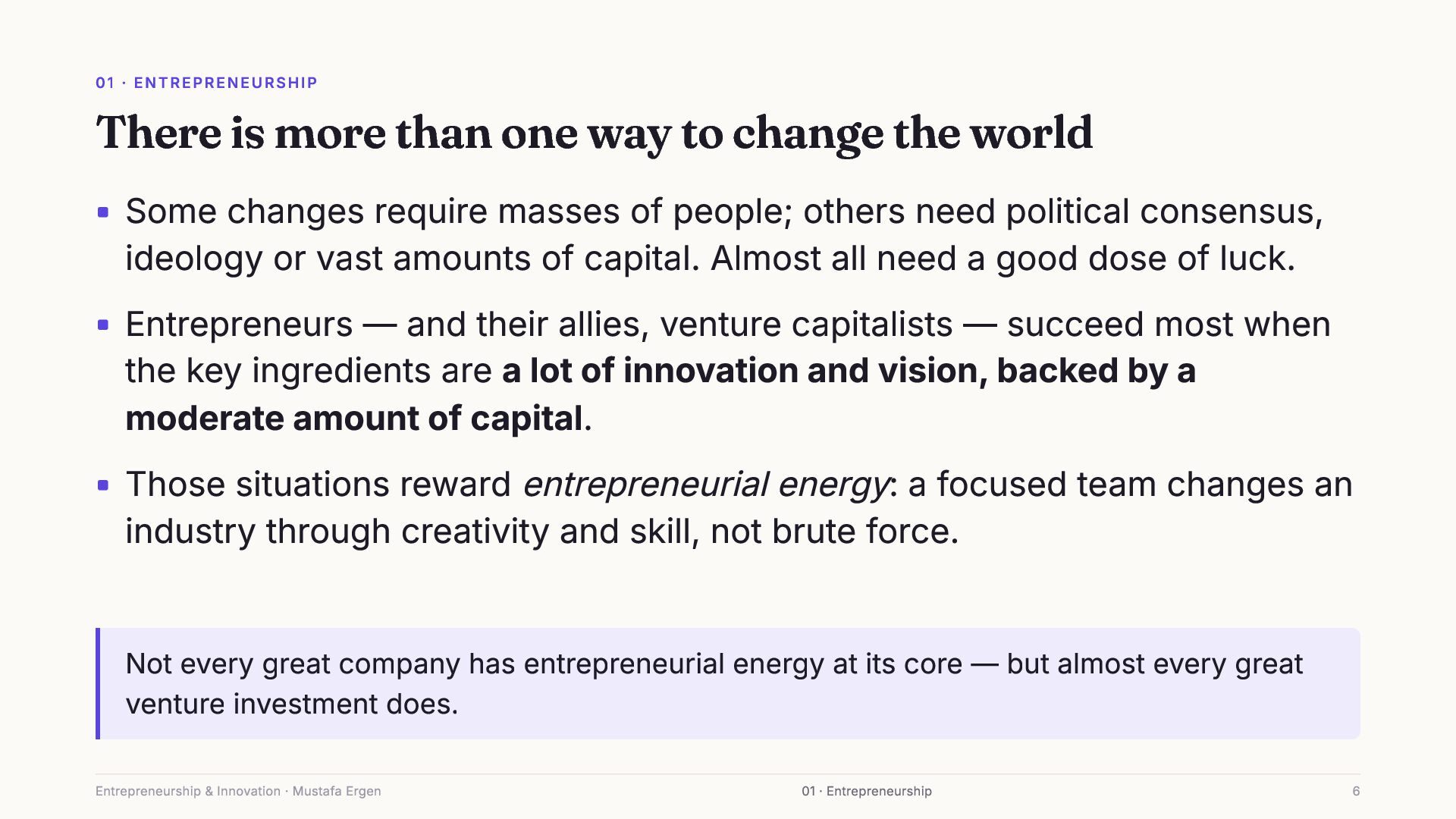
01 · ENTREPRENEURSHIP There is more than one way to
change the world Some changes require masses of people; others need political consensus, ideology or vast amounts of capital. Almost all need a good dose of luck. Entrepreneurs — and their allies, venture capitalists — succeed most when the key ingredients are a lot of innovation and vision, backed by a moderate amount of capital. Those situations reward entrepreneurial energy: a focused team changes an industry through creativity and skill, not brute force. Not every great company has entrepreneurial energy at its core — but almost every great venture investment does. Entrepreneurship & Innovation · Mustafa Ergen 01 · Entrepreneurship 6 -
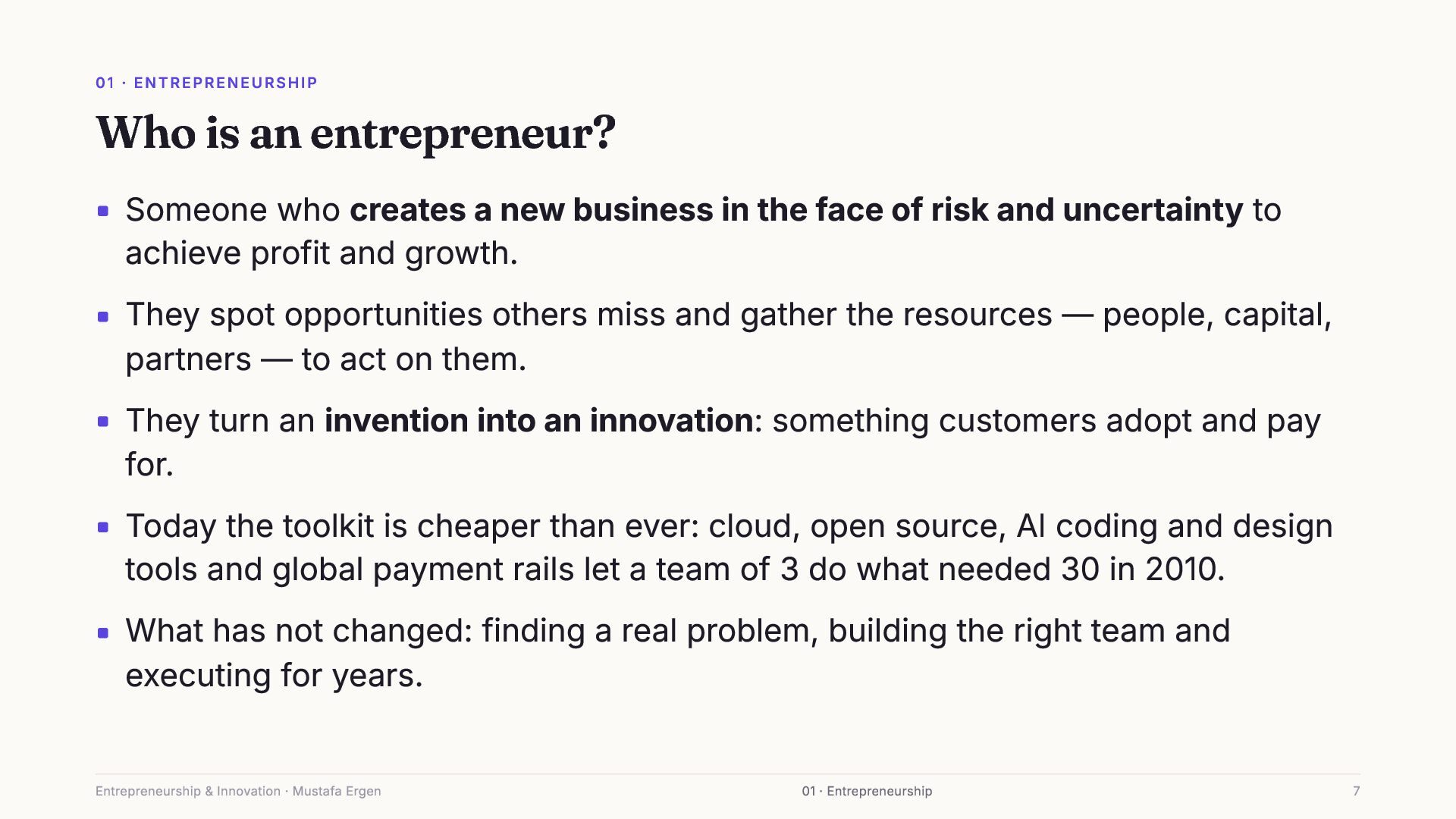
01 · ENTREPRENEURSHIP Who is an entrepreneur? Someone who creates
a new business in the face of risk and uncertainty to achieve profit and growth. They spot opportunities others miss and gather the resources — people, capital, partners — to act on them. They turn an invention into an innovation: something customers adopt and pay for. Today the toolkit is cheaper than ever: cloud, open source, AI coding and design tools and global payment rails let a team of 3 do what needed 30 in 2010. What has not changed: finding a real problem, building the right team and executing for years. Entrepreneurship & Innovation · Mustafa Ergen 01 · Entrepreneurship 7 -
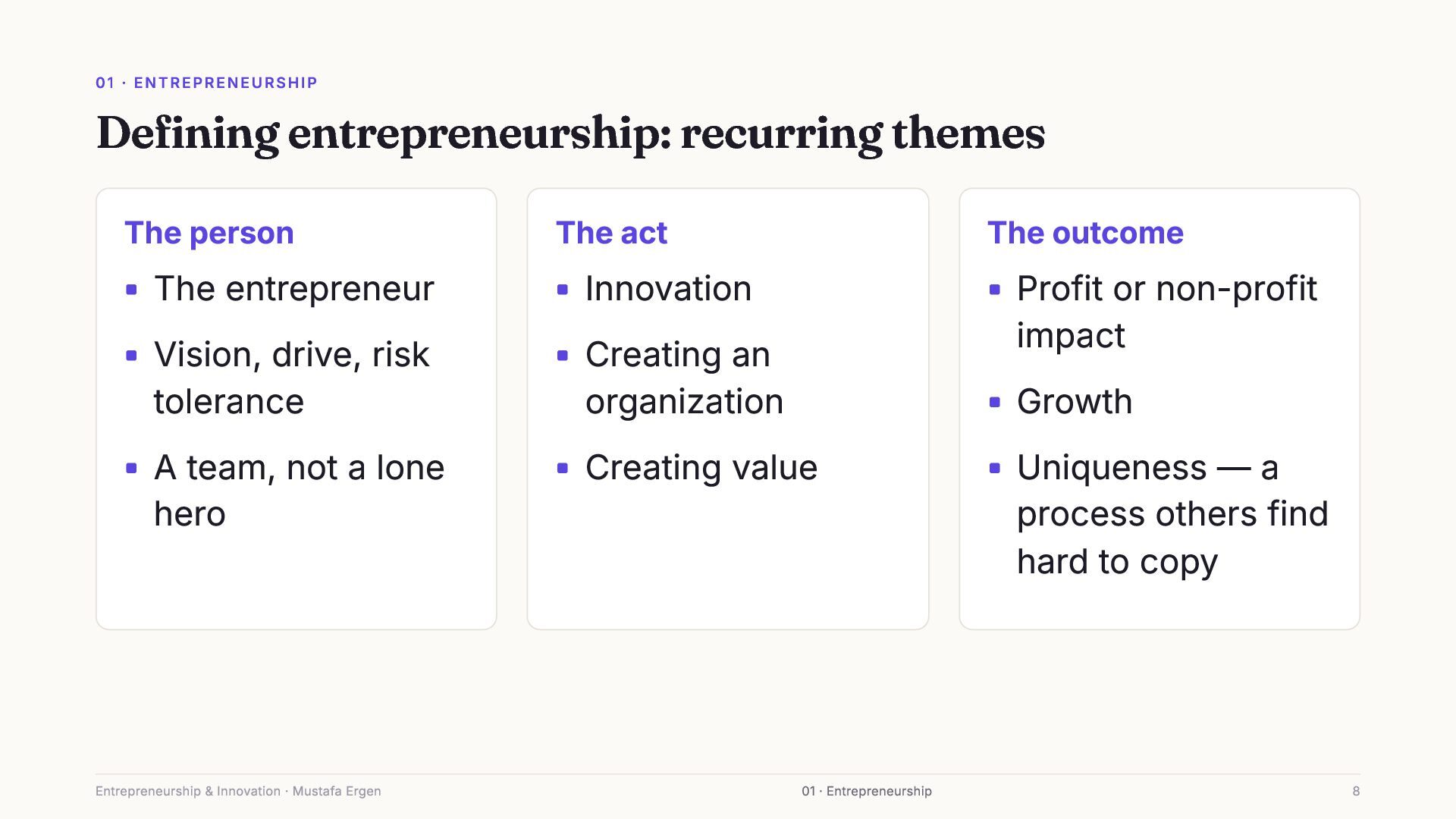
01 · ENTREPRENEURSHIP Defining entrepreneurship: recurring themes The person The
entrepreneur Vision, drive, risk tolerance A team, not a lone hero Entrepreneurship & Innovation · Mustafa Ergen The act The outcome Innovation Creating an organization Creating value 01 · Entrepreneurship Profit or non-profit impact Growth Uniqueness — a process others find hard to copy 8 -
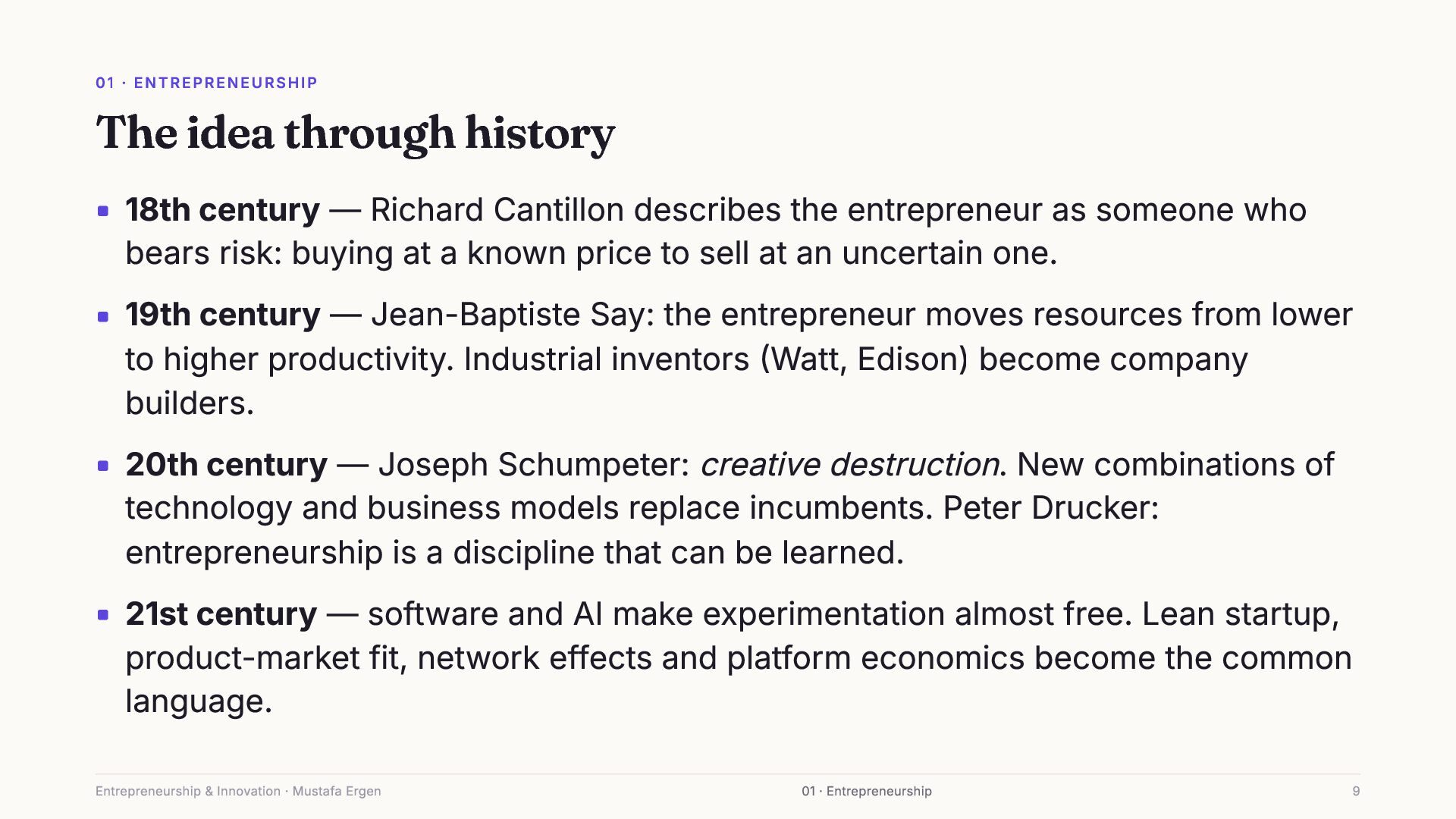
01 · ENTREPRENEURSHIP The idea through history 18th century —
Richard Cantillon describes the entrepreneur as someone who bears risk: buying at a known price to sell at an uncertain one. 19th century — Jean-Baptiste Say: the entrepreneur moves resources from lower to higher productivity. Industrial inventors (Watt, Edison) become company builders. 20th century — Joseph Schumpeter: creative destruction. New combinations of technology and business models replace incumbents. Peter Drucker: entrepreneurship is a discipline that can be learned. 21st century — software and AI make experimentation almost free. Lean startup, product-market fit, network effects and platform economics become the common language. Entrepreneurship & Innovation · Mustafa Ergen 01 · Entrepreneurship 9 -
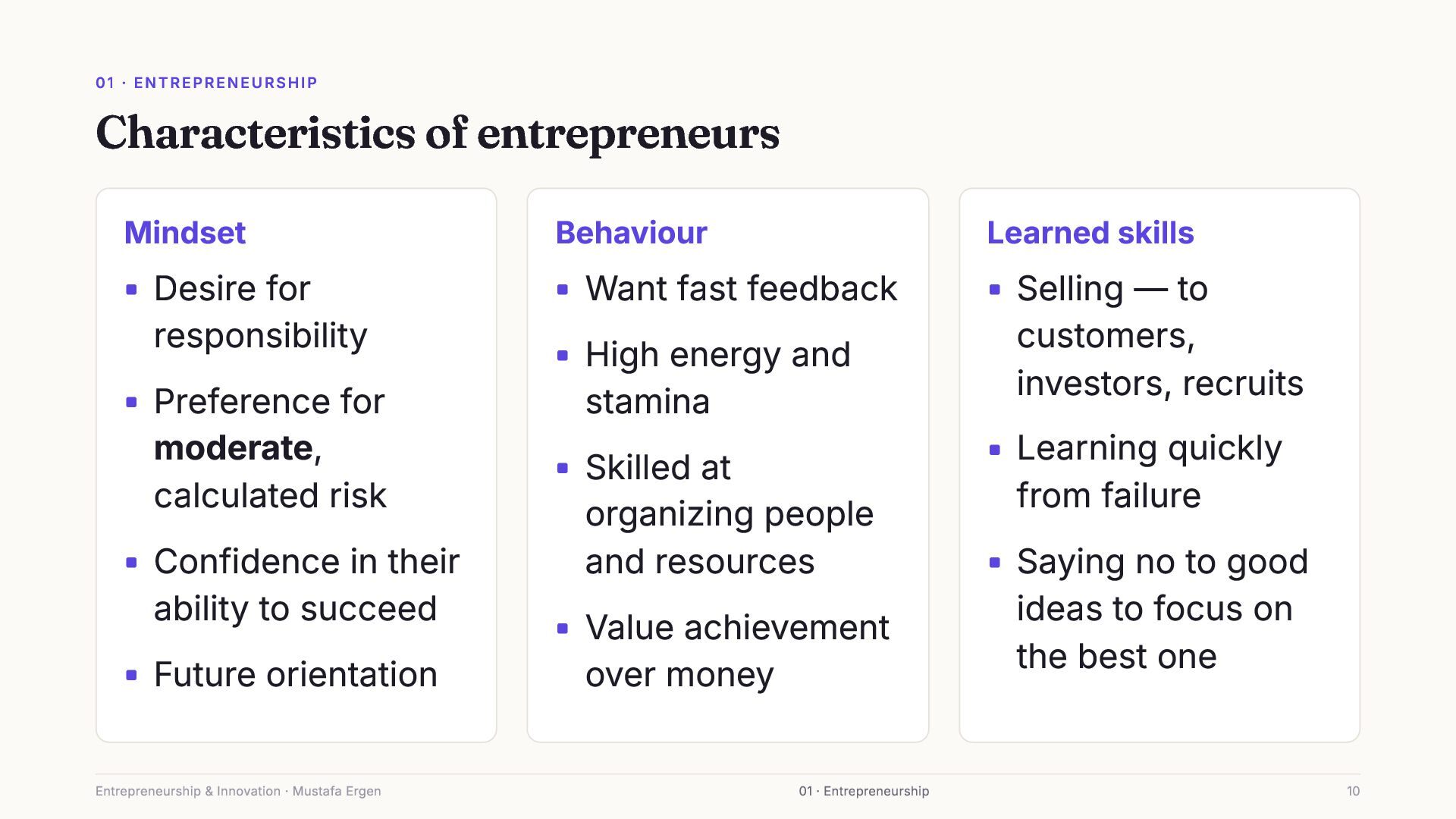
01 · ENTREPRENEURSHIP Characteristics of entrepreneurs Mindset Desire for responsibility
Preference for moderate, calculated risk Confidence in their ability to succeed Future orientation Entrepreneurship & Innovation · Mustafa Ergen Behaviour Learned skills Want fast feedback High energy and stamina Skilled at organizing people and resources Value achievement over money 01 · Entrepreneurship Selling — to customers, investors, recruits Learning quickly from failure Saying no to good ideas to focus on the best one 10 -
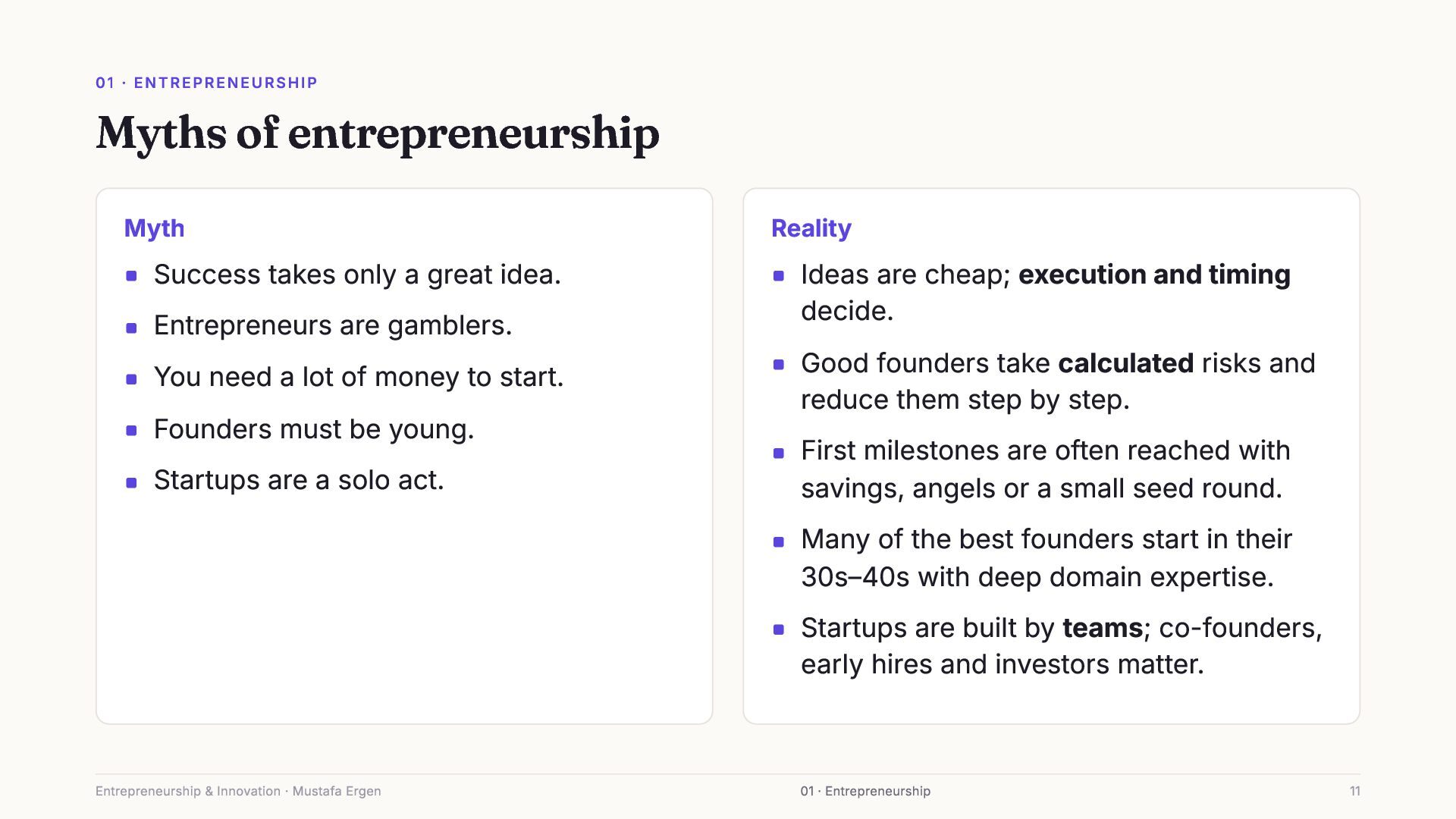
01 · ENTREPRENEURSHIP Myths of entrepreneurship Myth Success takes only
a great idea. Entrepreneurs are gamblers. You need a lot of money to start. Founders must be young. Startups are a solo act. Entrepreneurship & Innovation · Mustafa Ergen Reality Ideas are cheap; execution and timing decide. Good founders take calculated risks and reduce them step by step. First milestones are often reached with savings, angels or a small seed round. Many of the best founders start in their 30s–40s with deep domain expertise. Startups are built by teams; co-founders, early hires and investors matter. 01 · Entrepreneurship 11 -
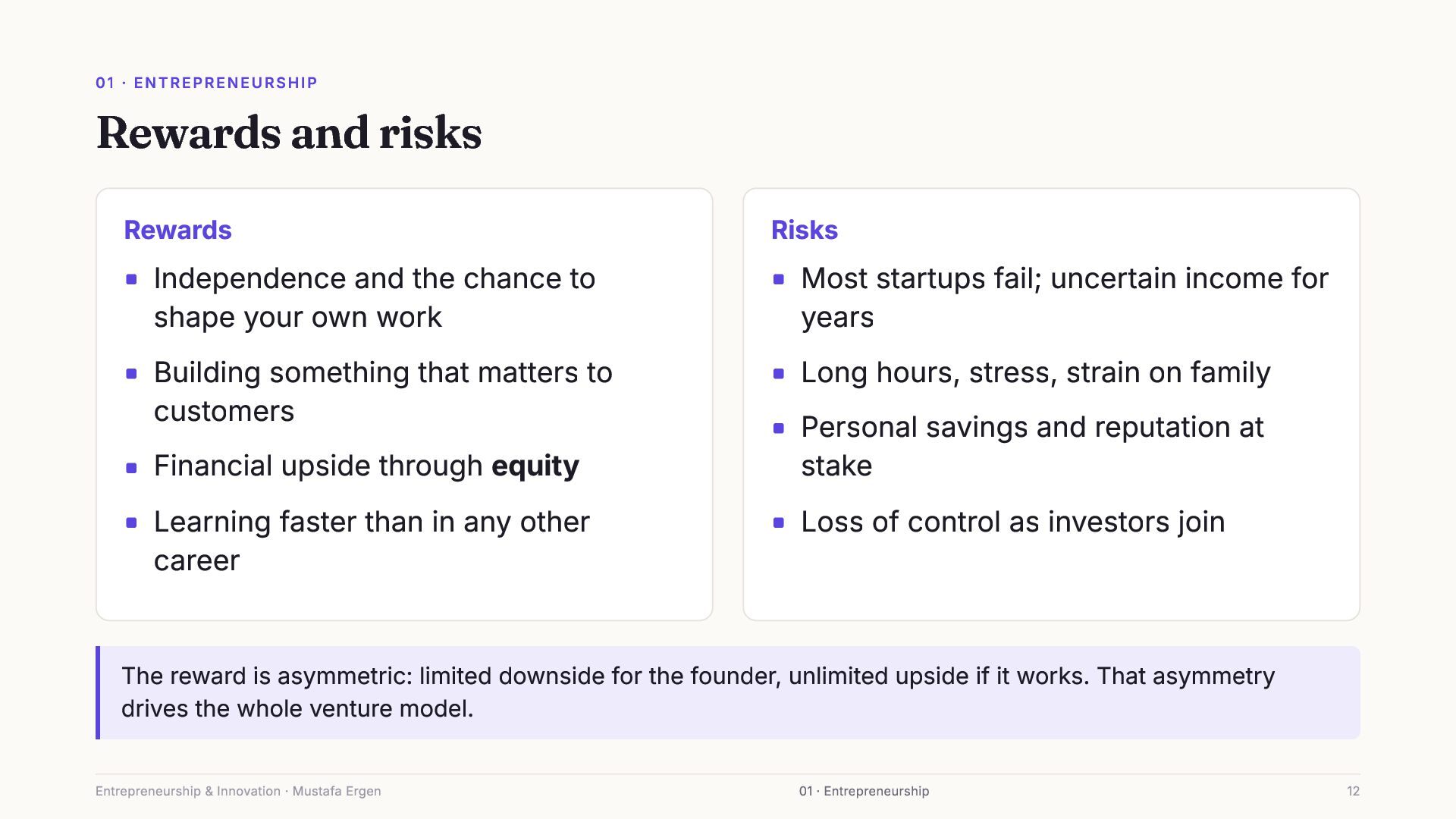
01 · ENTREPRENEURSHIP Rewards and risks Rewards Independence and the
chance to shape your own work Building something that matters to customers Financial upside through equity Learning faster than in any other career Risks Most startups fail; uncertain income for years Long hours, stress, strain on family Personal savings and reputation at stake Loss of control as investors join The reward is asymmetric: limited downside for the founder, unlimited upside if it works. That asymmetry drives the whole venture model. Entrepreneurship & Innovation · Mustafa Ergen 01 · Entrepreneurship 12 -
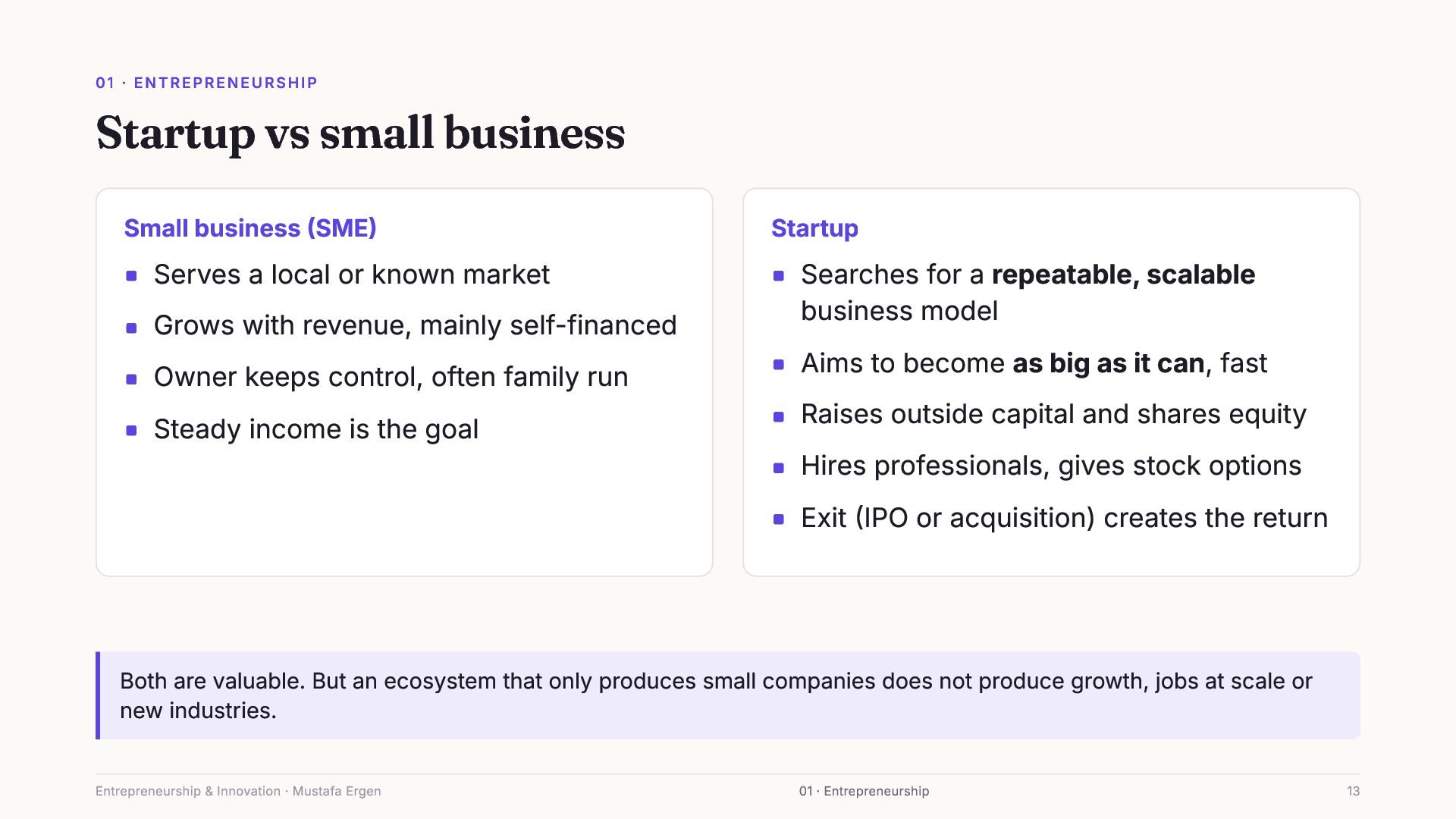
01 · ENTREPRENEURSHIP Startup vs small business Small business (SME)
Serves a local or known market Grows with revenue, mainly self-financed Owner keeps control, often family run Steady income is the goal Startup Searches for a repeatable, scalable business model Aims to become as big as it can, fast Raises outside capital and shares equity Hires professionals, gives stock options Exit (IPO or acquisition) creates the return Both are valuable. But an ecosystem that only produces small companies does not produce growth, jobs at scale or new industries. Entrepreneurship & Innovation · Mustafa Ergen 01 · Entrepreneurship 13 -
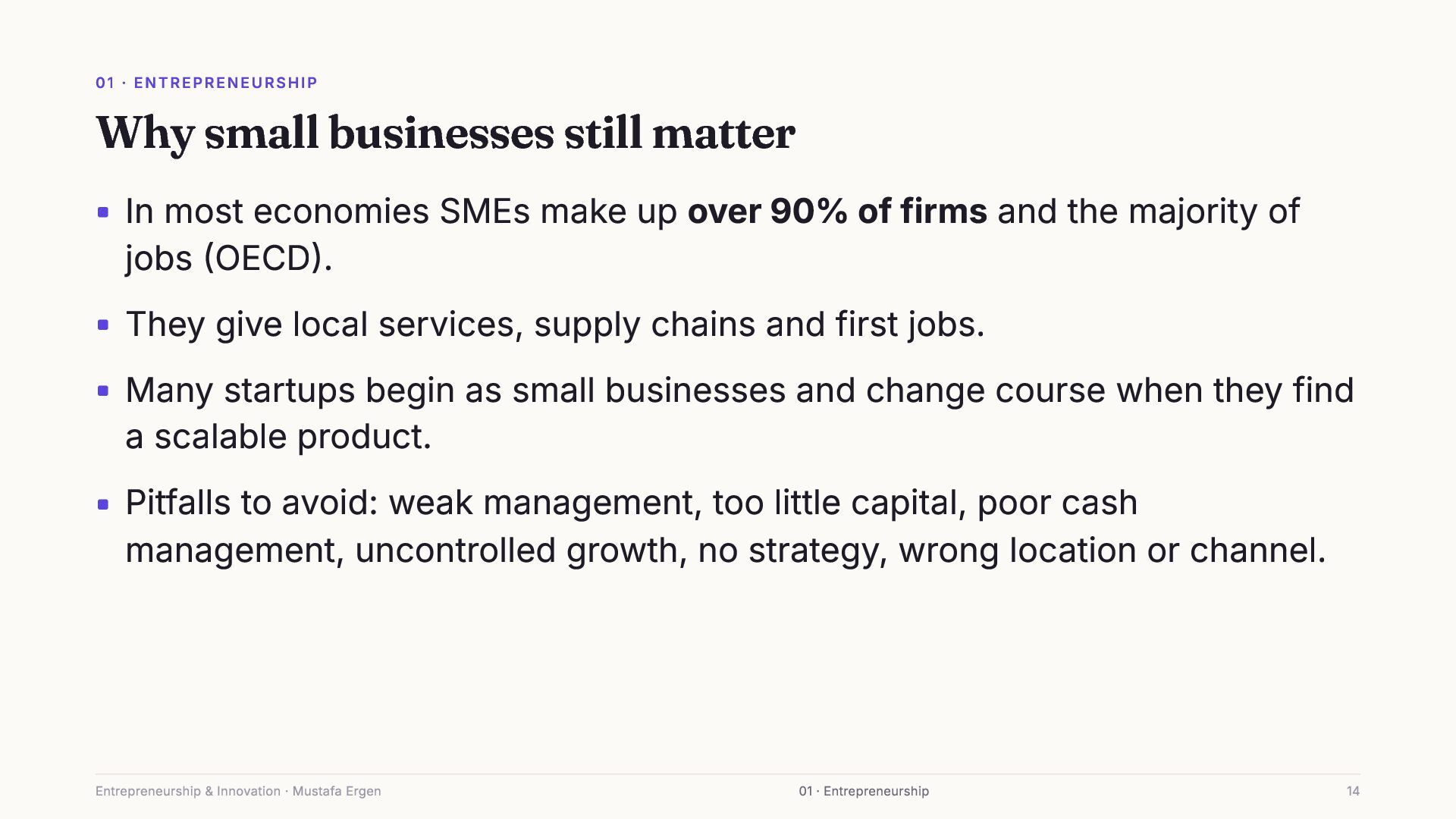
01 · ENTREPRENEURSHIP Why small businesses still matter In most
economies SMEs make up over 90% of firms and the majority of jobs (OECD). They give local services, supply chains and first jobs. Many startups begin as small businesses and change course when they find a scalable product. Pitfalls to avoid: weak management, too little capital, poor cash management, uncontrolled growth, no strategy, wrong location or channel. Entrepreneurship & Innovation · Mustafa Ergen 01 · Entrepreneurship 14 -
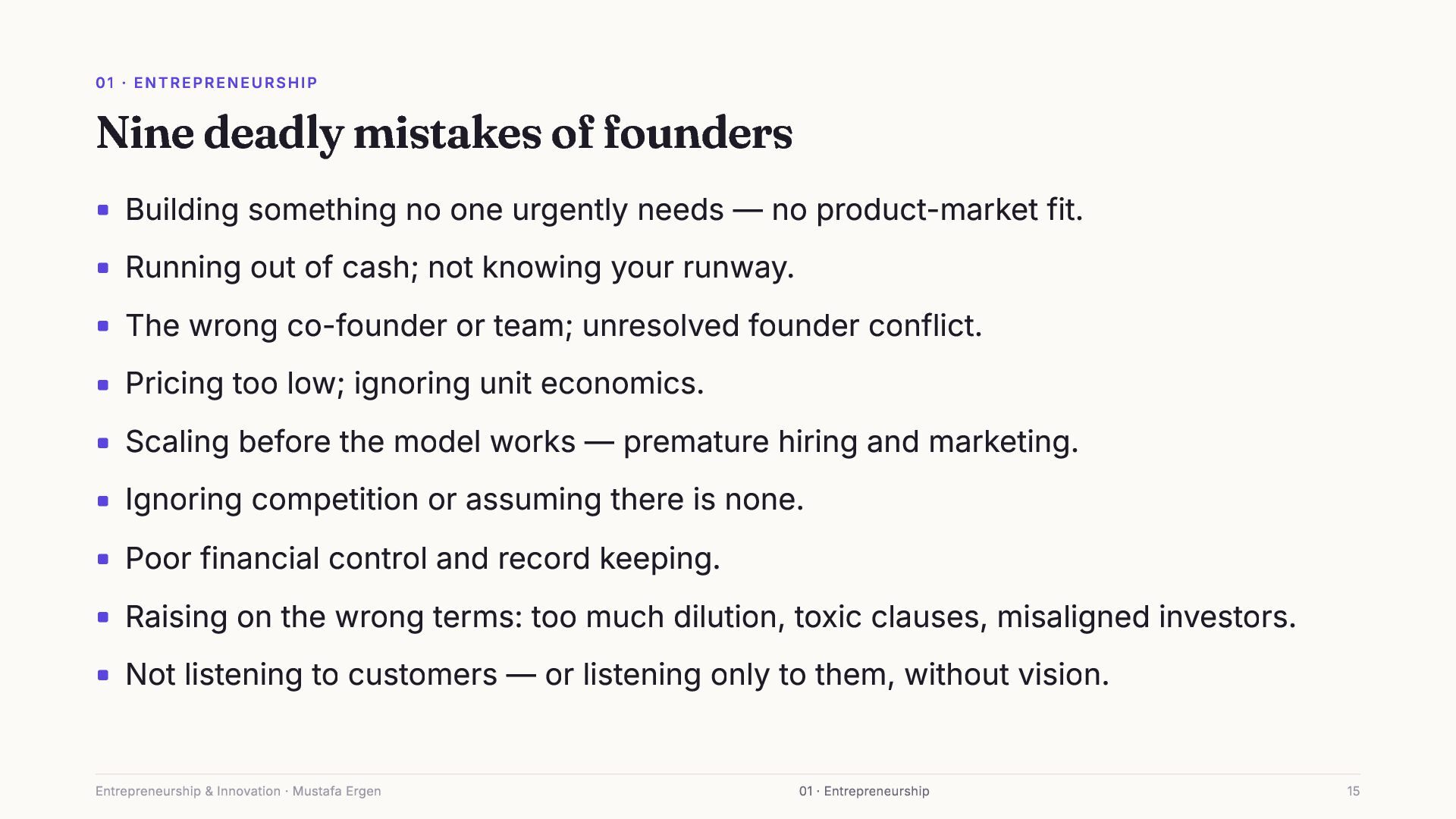
01 · ENTREPRENEURSHIP Nine deadly mistakes of founders Building something
no one urgently needs — no product-market fit. Running out of cash; not knowing your runway. The wrong co-founder or team; unresolved founder conflict. Pricing too low; ignoring unit economics. Scaling before the model works — premature hiring and marketing. Ignoring competition or assuming there is none. Poor financial control and record keeping. Raising on the wrong terms: too much dilution, toxic clauses, misaligned investors. Not listening to customers — or listening only to them, without vision. Entrepreneurship & Innovation · Mustafa Ergen 01 · Entrepreneurship 15 -
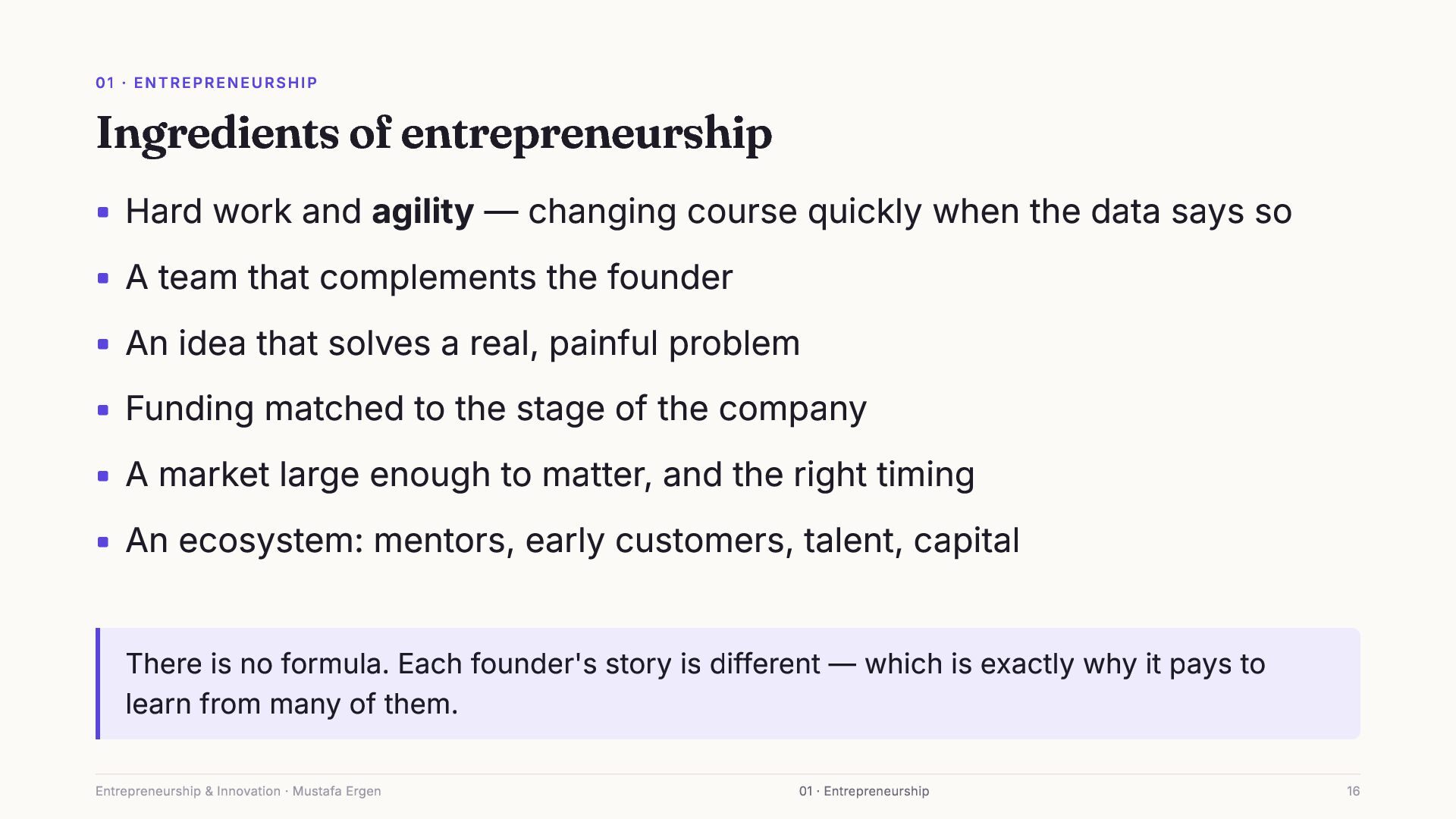
01 · ENTREPRENEURSHIP Ingredients of entrepreneurship Hard work and agility
— changing course quickly when the data says so A team that complements the founder An idea that solves a real, painful problem Funding matched to the stage of the company A market large enough to matter, and the right timing An ecosystem: mentors, early customers, talent, capital There is no formula. Each founder's story is different — which is exactly why it pays to learn from many of them. Entrepreneurship & Innovation · Mustafa Ergen 01 · Entrepreneurship 16 -
02 The Silicon Valley model Why one region keeps producing
world-changing companies — and what other ecosystems can copy. Invention vs innovation Ingredients of the Valley Why the US Immigrant founders Exit and scale Lessons for other ecosystems Entrepreneurship & Innovation · Mustafa Ergen 02 · The Silicon Valley model 17 -
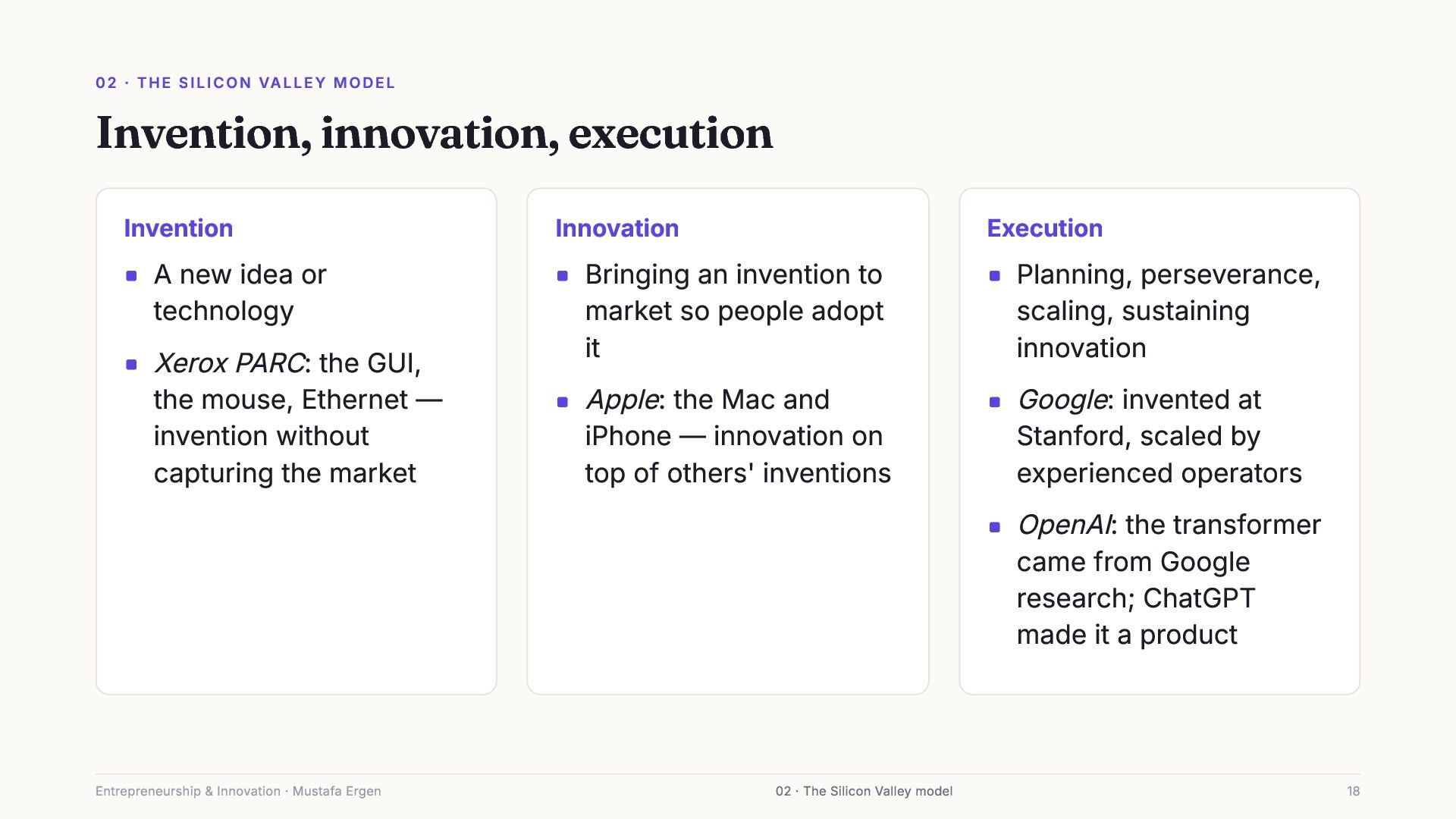
0 2 · T H E S I L I
C O N VA L L E Y M O D E L Invention, innovation, execution Invention A new idea or technology Xerox PARC: the GUI, the mouse, Ethernet — invention without capturing the market Entrepreneurship & Innovation · Mustafa Ergen Innovation Execution Bringing an invention to market so people adopt it Apple: the Mac and iPhone — innovation on top of others' inventions 02 · The Silicon Valley model Planning, perseverance, scaling, sustaining innovation Google: invented at Stanford, scaled by experienced operators OpenAI: the transformer came from Google research; ChatGPT made it a product 18 -
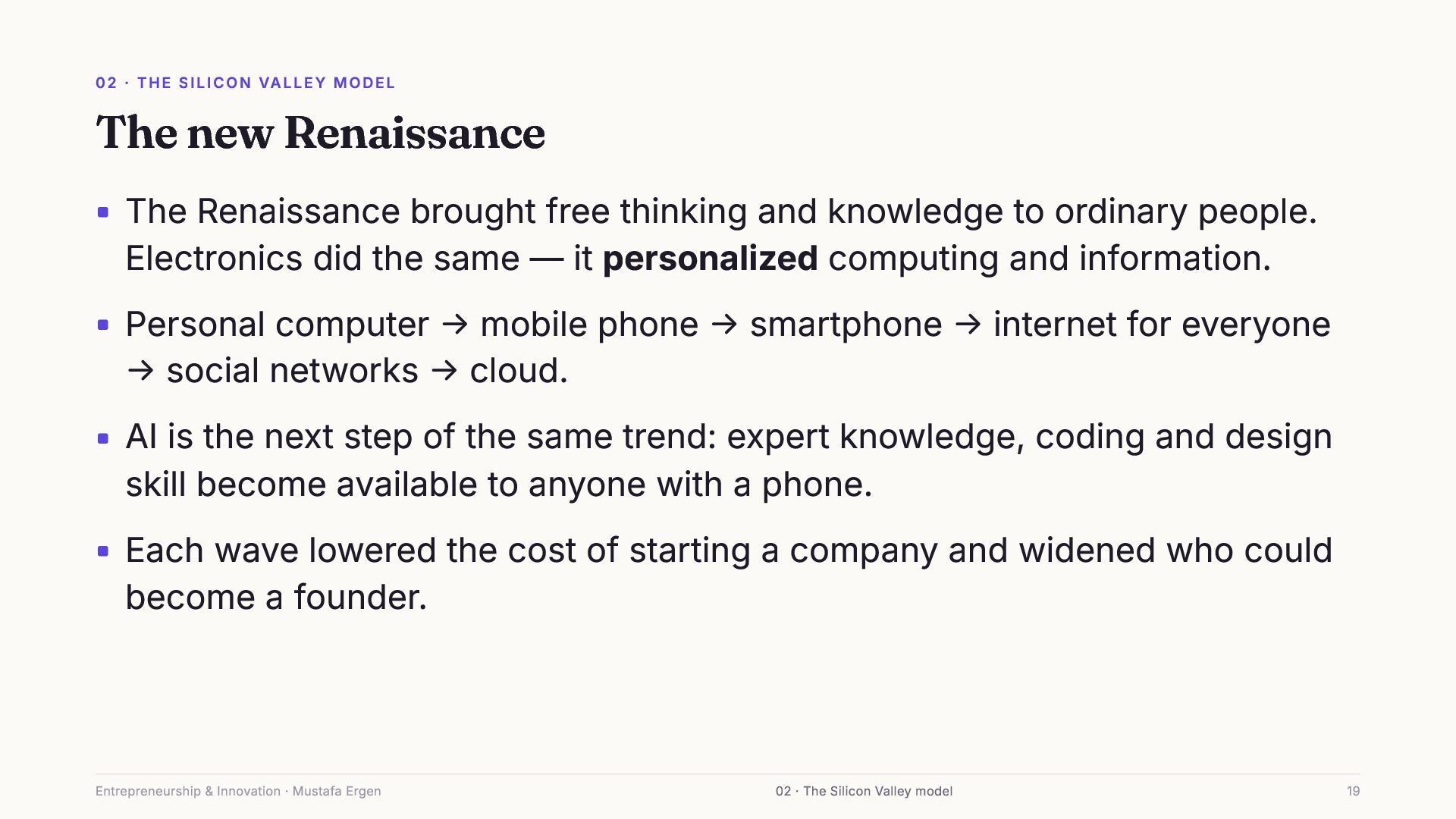
0 2 · T H E S I L I
C O N VA L L E Y M O D E L The new Renaissance The Renaissance brought free thinking and knowledge to ordinary people. Electronics did the same — it personalized computing and information. Personal computer → mobile phone → smartphone → internet for everyone → social networks → cloud. AI is the next step of the same trend: expert knowledge, coding and design skill become available to anyone with a phone. Each wave lowered the cost of starting a company and widened who could become a founder. Entrepreneurship & Innovation · Mustafa Ergen 02 · The Silicon Valley model 19 -
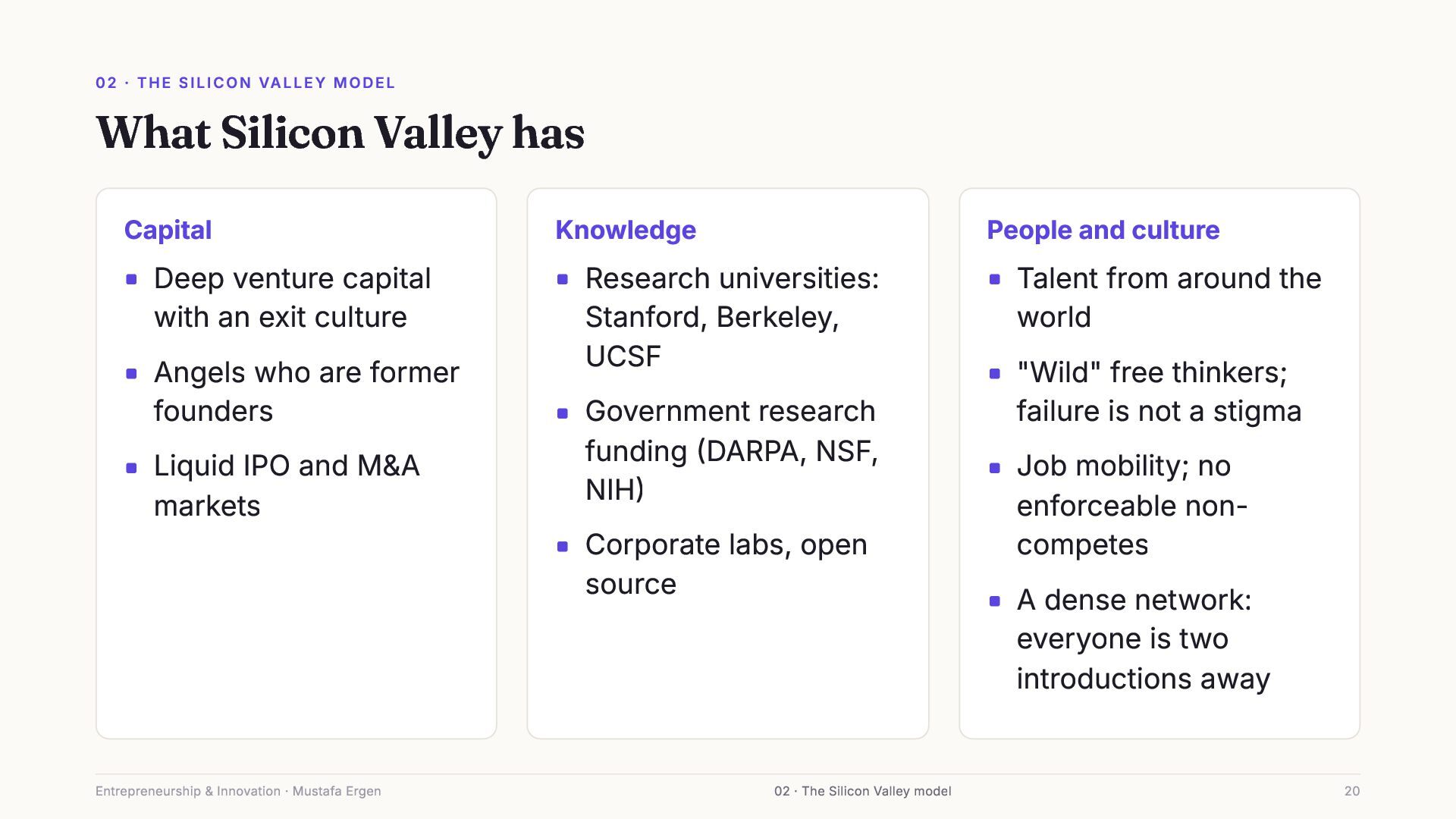
0 2 · T H E S I L I
C O N VA L L E Y M O D E L What Silicon Valley has Capital Deep venture capital with an exit culture Angels who are former founders Liquid IPO and M&A markets Entrepreneurship & Innovation · Mustafa Ergen Knowledge People and culture Research universities: Stanford, Berkeley, UCSF Government research funding (DARPA, NSF, NIH) Corporate labs, open source 02 · The Silicon Valley model Talent from around the world "Wild" free thinkers; failure is not a stigma Job mobility; no enforceable noncompetes A dense network: everyone is two introductions away 20 -
0 2 · T H E S I L I
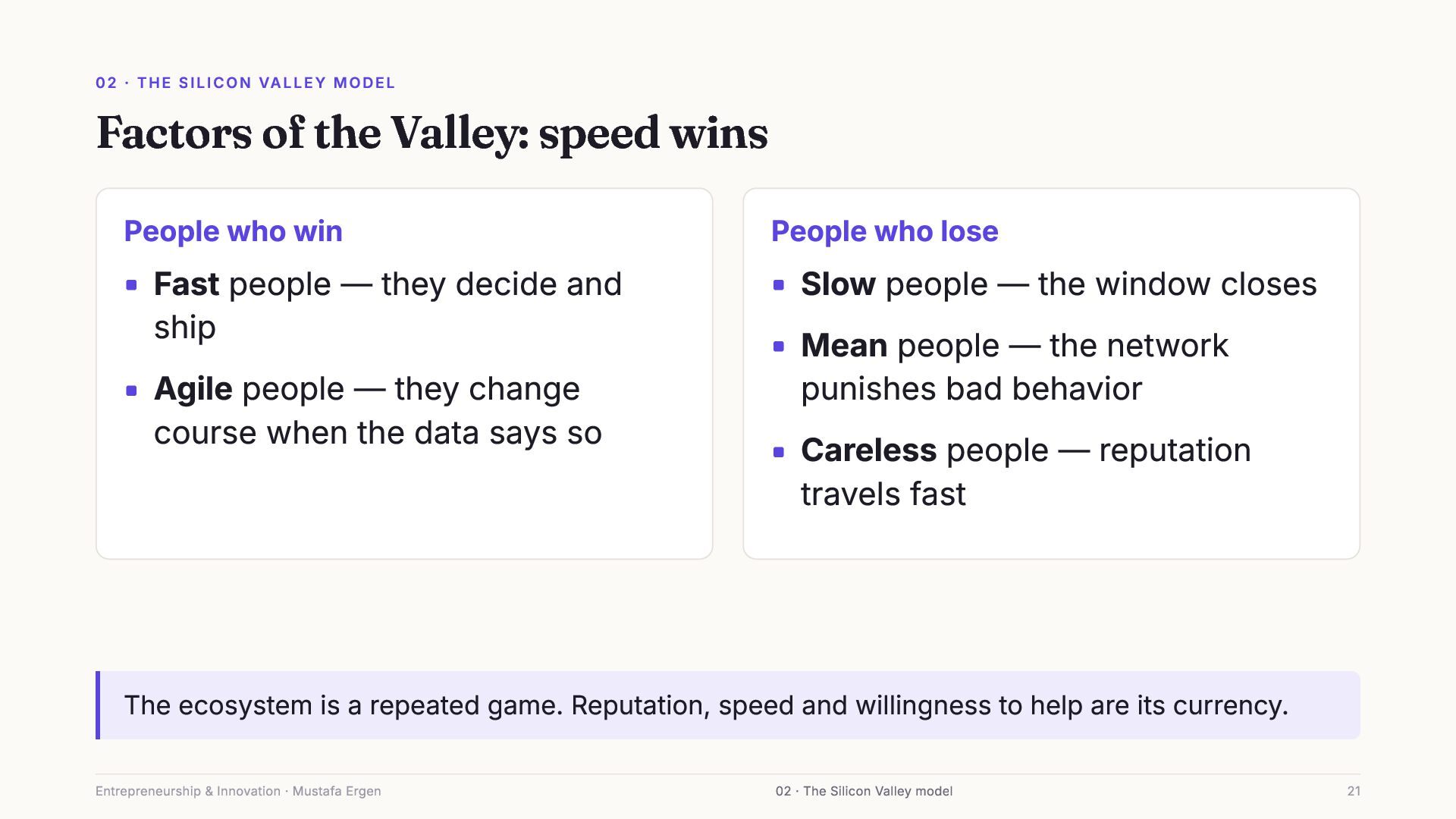
C O N VA L L E Y M O D E L Factors of the Valley: speed wins People who win Fast people — they decide and ship Agile people — they change course when the data says so People who lose Slow people — the window closes Mean people — the network punishes bad behavior Careless people — reputation travels fast The ecosystem is a repeated game. Reputation, speed and willingness to help are its currency. Entrepreneurship & Innovation · Mustafa Ergen 02 · The Silicon Valley model 21 -
0 2 · T H E S I L I
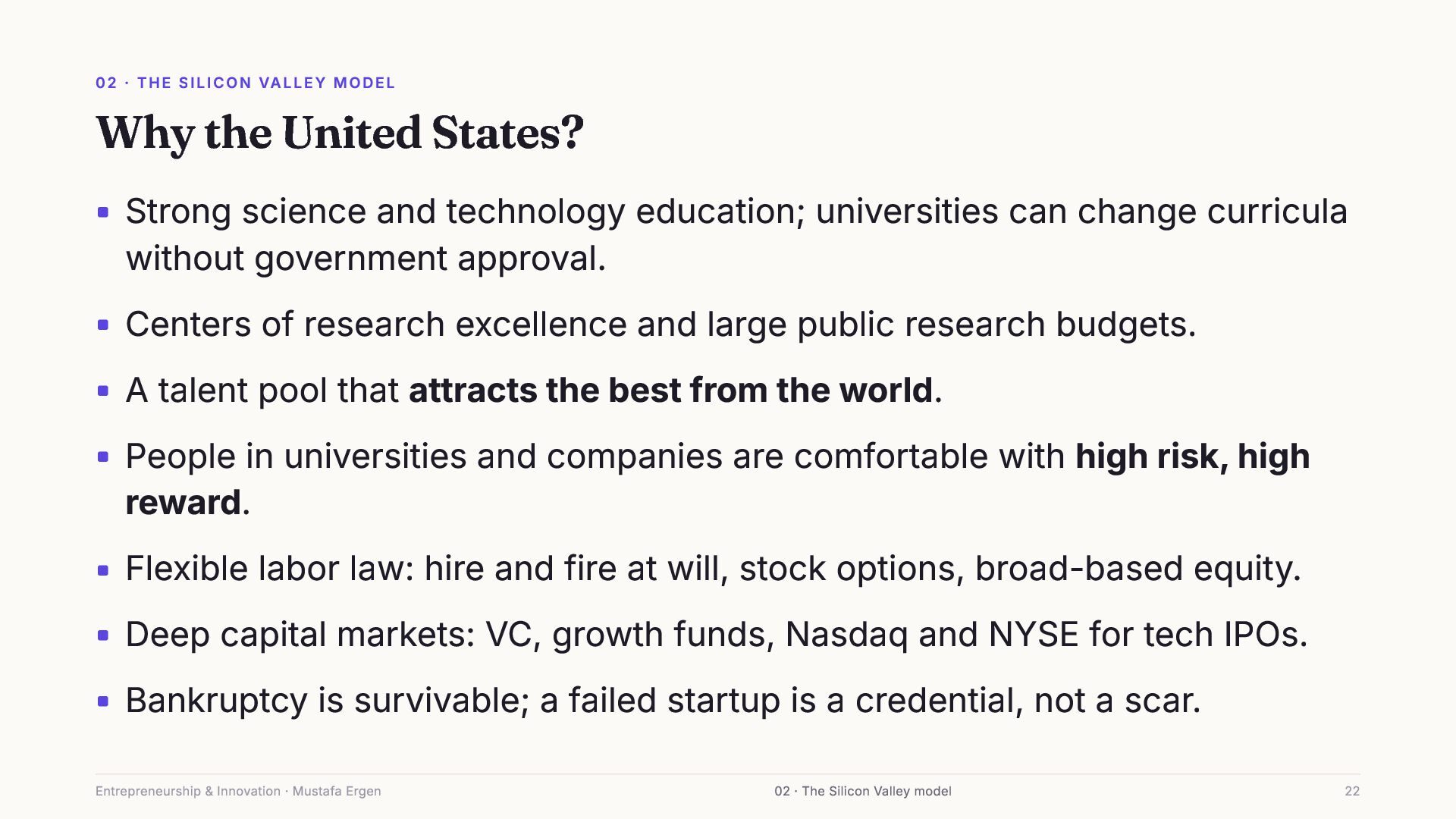
C O N VA L L E Y M O D E L Why the United States? Strong science and technology education; universities can change curricula without government approval. Centers of research excellence and large public research budgets. A talent pool that attracts the best from the world. People in universities and companies are comfortable with high risk, high reward. Flexible labor law: hire and fire at will, stock options, broad-based equity. Deep capital markets: VC, growth funds, Nasdaq and NYSE for tech IPOs. Bankruptcy is survivable; a failed startup is a credential, not a scar. Entrepreneurship & Innovation · Mustafa Ergen 02 · The Silicon Valley model 22 -
0 2 · T H E S I L I
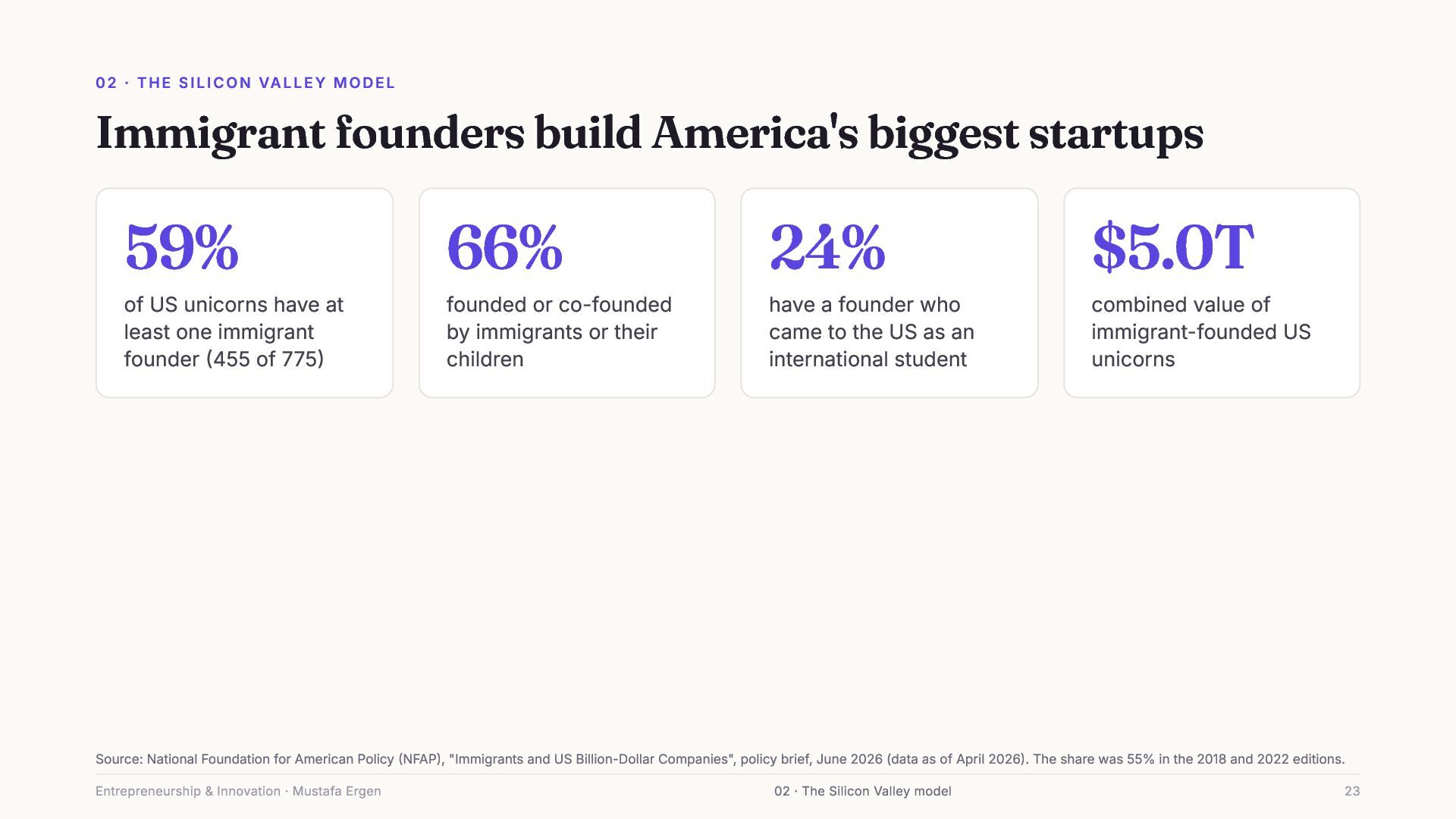
C O N VA L L E Y M O D E L Immigrant founders build America's biggest startups 59% of US unicorns have at least one immigrant founder (455 of 775) 66% founded or co-founded by immigrants or their children 24% have a founder who came to the US as an international student $5.0T combined value of immigrant-founded US unicorns Source: National Foundation for American Policy (NFAP), "Immigrants and US Billion-Dollar Companies", policy brief, June 2026 (data as of April 2026). The share was 55% in the 2018 and 2022 editions. Entrepreneurship & Innovation · Mustafa Ergen 02 · The Silicon Valley model 23 -
0 2 · T H E S I L I
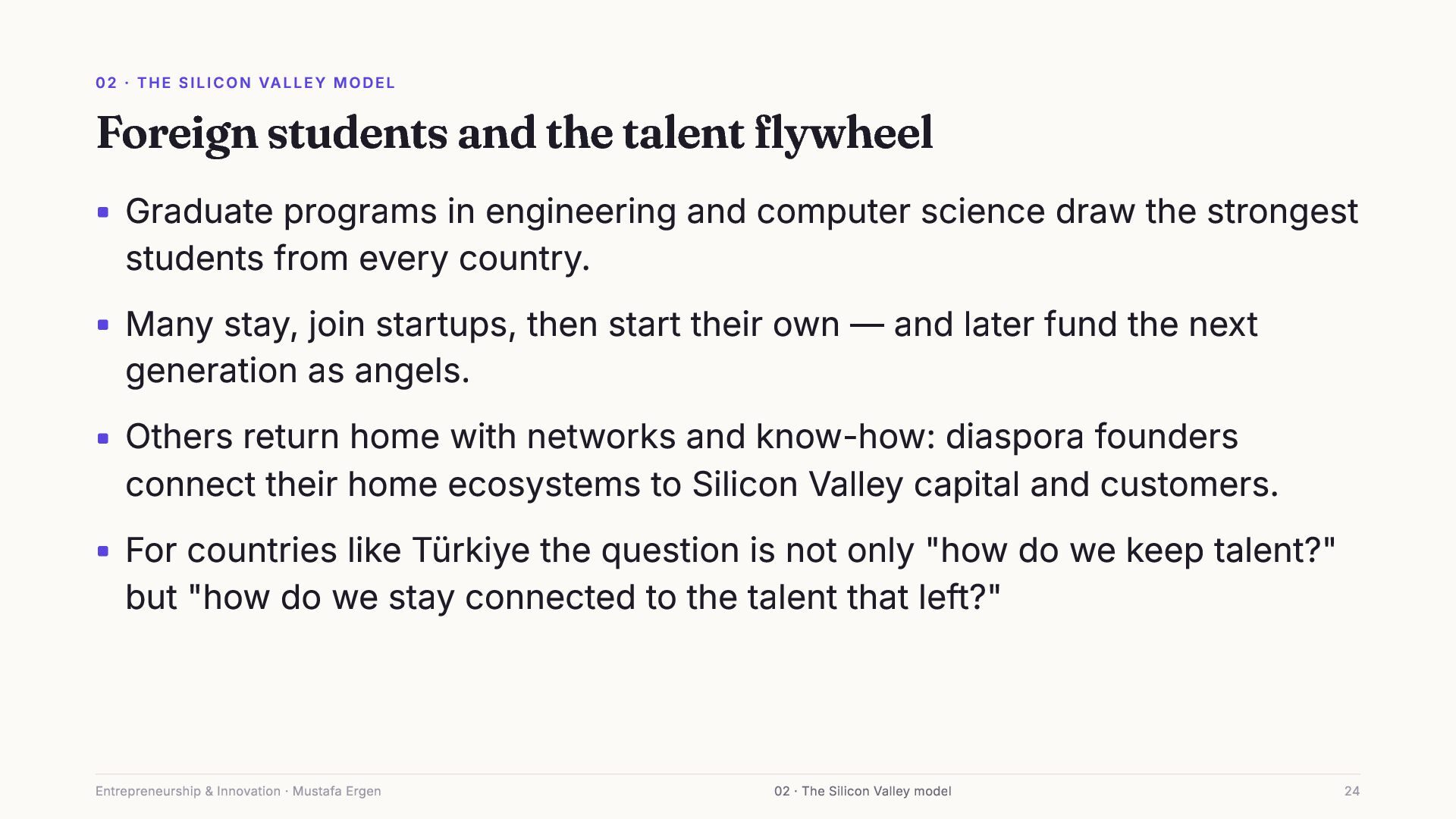
C O N VA L L E Y M O D E L Foreign students and the talent flywheel Graduate programs in engineering and computer science draw the strongest students from every country. Many stay, join startups, then start their own — and later fund the next generation as angels. Others return home with networks and know-how: diaspora founders connect their home ecosystems to Silicon Valley capital and customers. For countries like Türkiye the question is not only "how do we keep talent?" but "how do we stay connected to the talent that left?" Entrepreneurship & Innovation · Mustafa Ergen 02 · The Silicon Valley model 24 -
0 2 · T H E S I L I
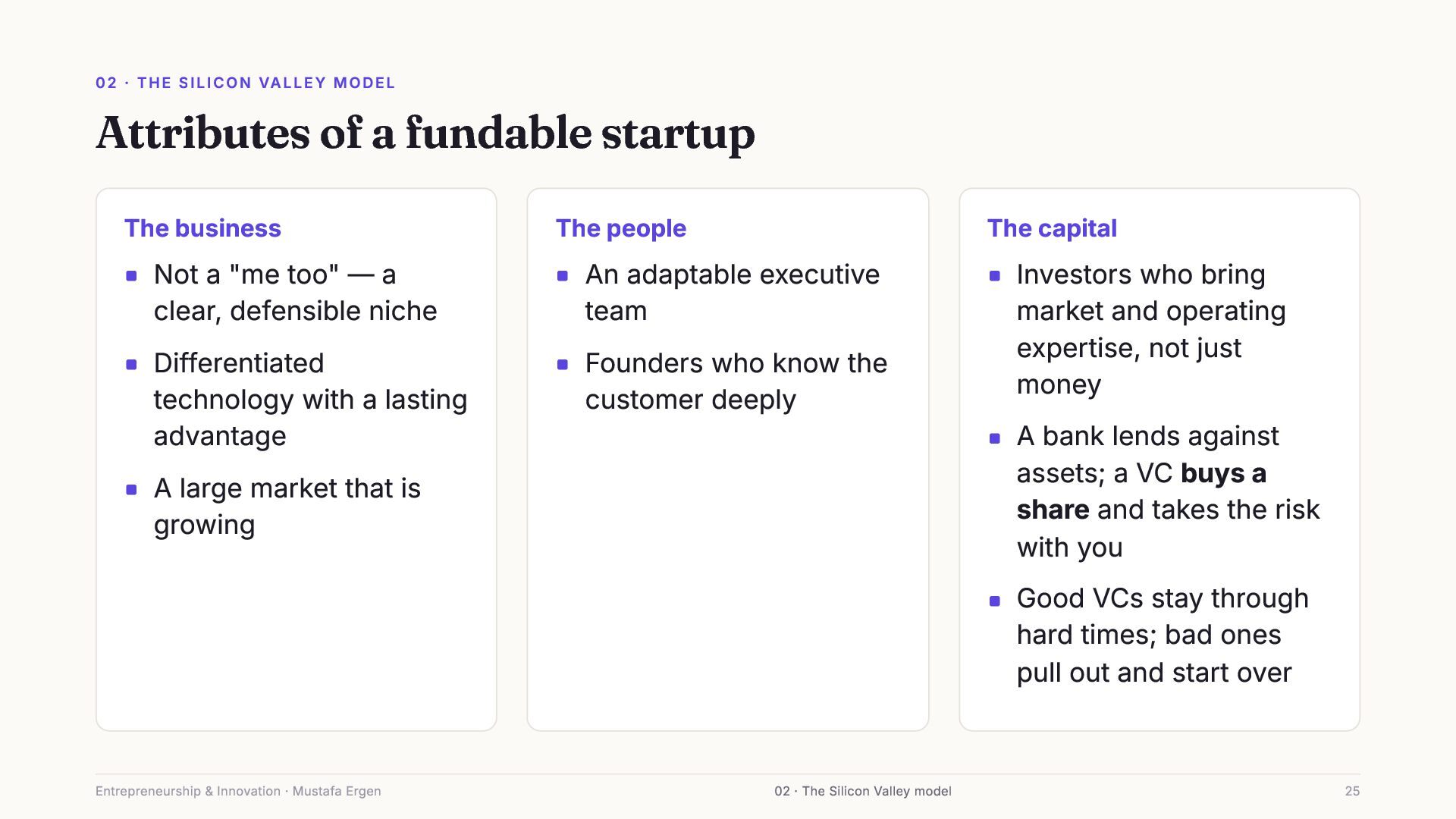
C O N VA L L E Y M O D E L Attributes of a fundable startup The business Not a "me too" — a clear, defensible niche Differentiated technology with a lasting advantage A large market that is growing Entrepreneurship & Innovation · Mustafa Ergen The people The capital An adaptable executive team Founders who know the customer deeply 02 · The Silicon Valley model Investors who bring market and operating expertise, not just money A bank lends against assets; a VC buys a share and takes the risk with you Good VCs stay through hard times; bad ones pull out and start over 25 -
0 2 · T H E S I L I
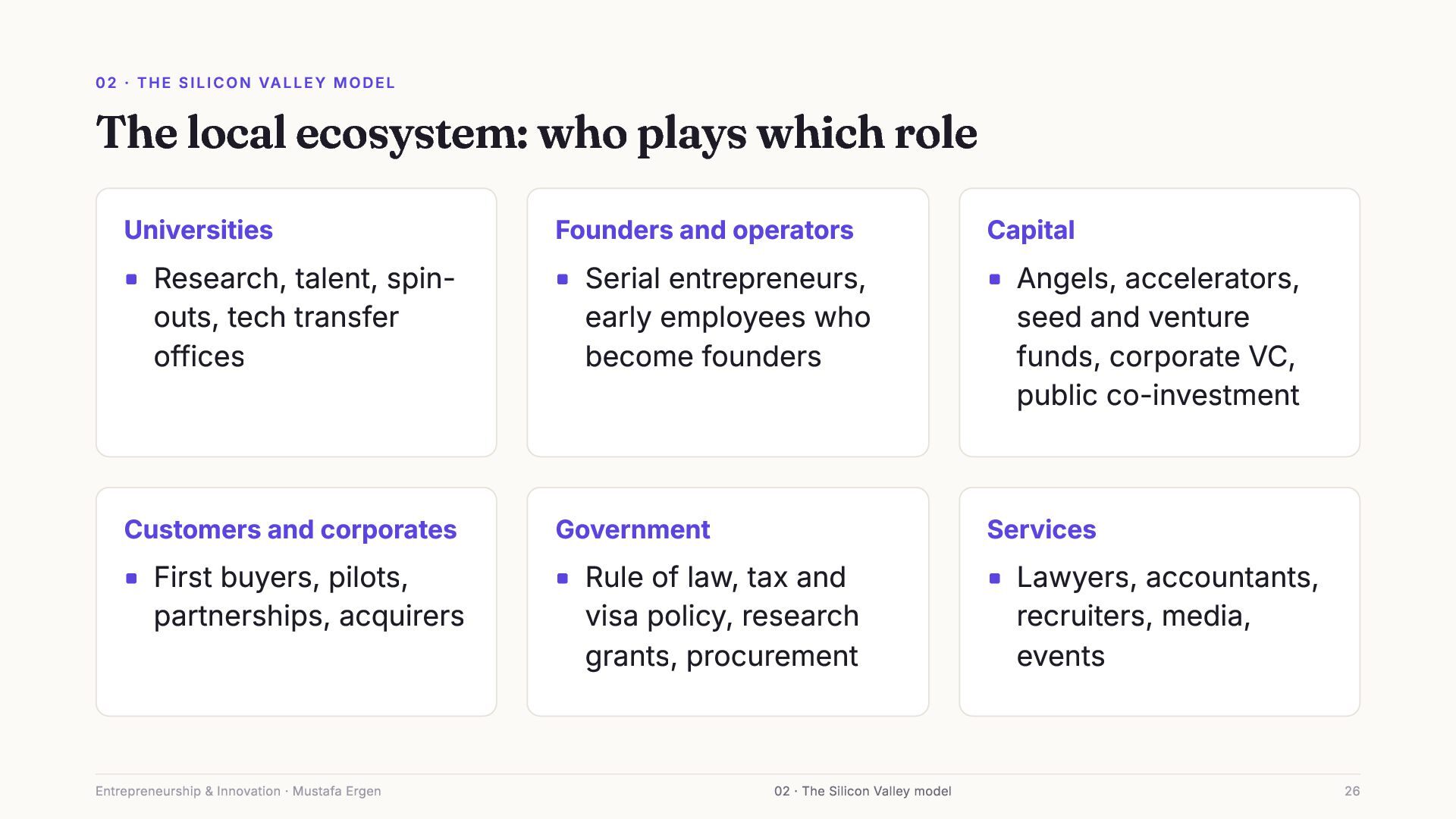
C O N VA L L E Y M O D E L The local ecosystem: who plays which role Universities Research, talent, spinouts, tech transfer offices Customers and corporates First buyers, pilots, partnerships, acquirers Entrepreneurship & Innovation · Mustafa Ergen Founders and operators Serial entrepreneurs, early employees who become founders Government Capital Angels, accelerators, seed and venture funds, corporate VC, public co-investment Services Rule of law, tax and visa policy, research grants, procurement 02 · The Silicon Valley model Lawyers, accountants, recruiters, media, events 26 -
0 2 · T H E S I L I
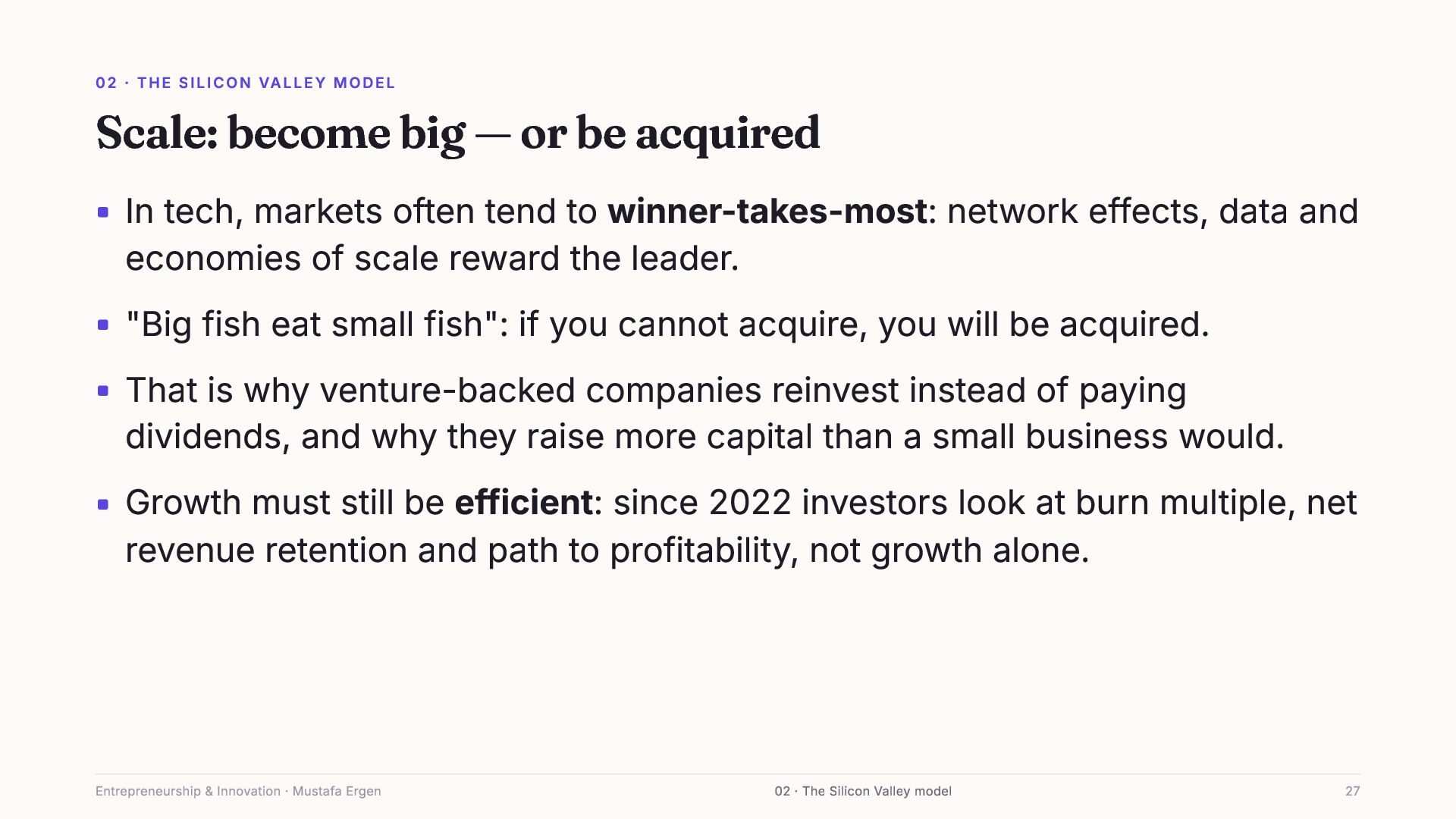
C O N VA L L E Y M O D E L Scale: become big — or be acquired In tech, markets often tend to winner-takes-most: network effects, data and economies of scale reward the leader. "Big fish eat small fish": if you cannot acquire, you will be acquired. That is why venture-backed companies reinvest instead of paying dividends, and why they raise more capital than a small business would. Growth must still be efficient: since 2022 investors look at burn multiple, net revenue retention and path to profitability, not growth alone. Entrepreneurship & Innovation · Mustafa Ergen 02 · The Silicon Valley model 27 -
0 2 · T H E S I L I
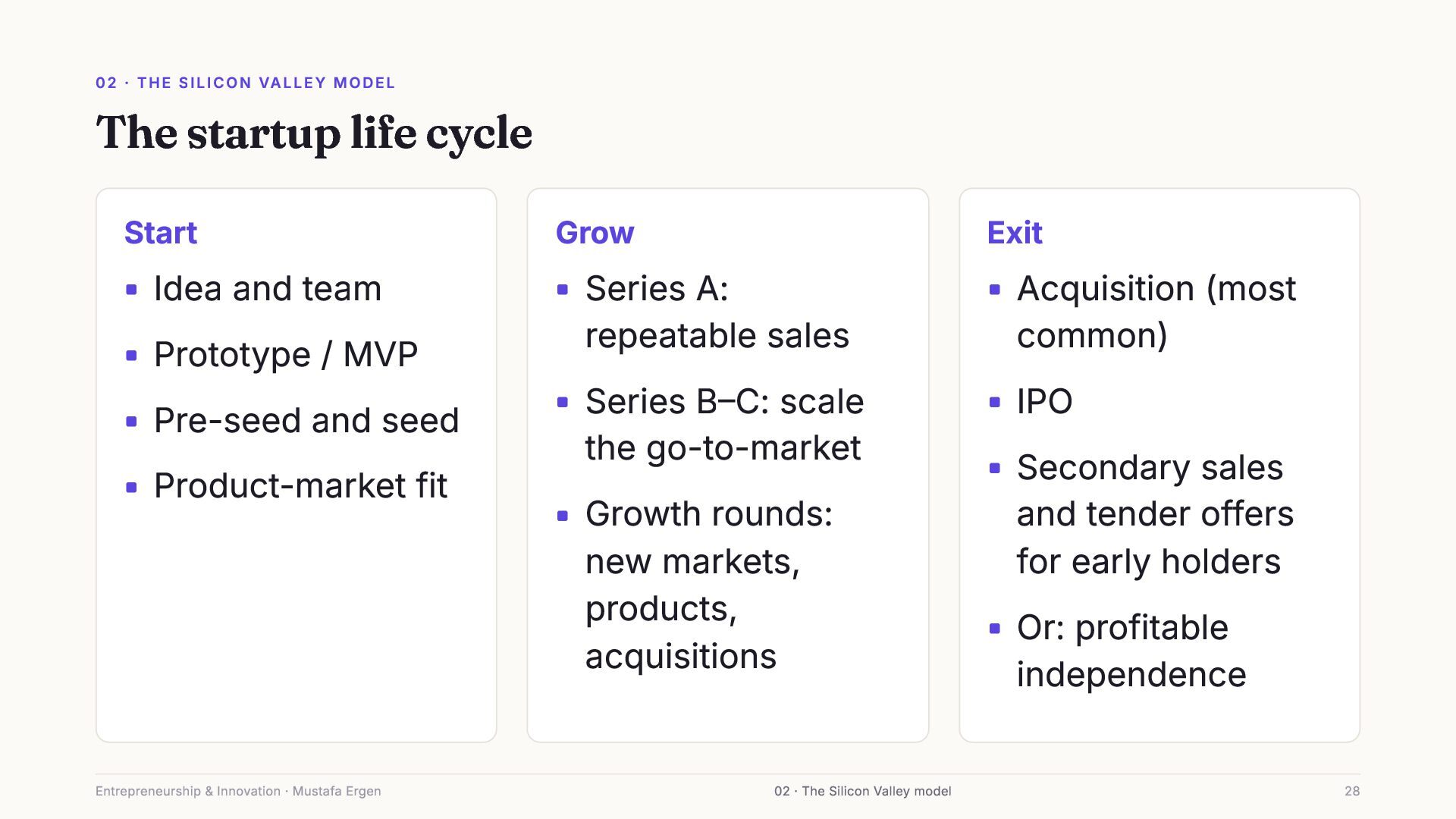
C O N VA L L E Y M O D E L The startup life cycle Start Idea and team Prototype / MVP Pre-seed and seed Product-market fit Entrepreneurship & Innovation · Mustafa Ergen Grow Exit Series A: repeatable sales Series B–C: scale the go-to-market Growth rounds: new markets, products, acquisitions 02 · The Silicon Valley model Acquisition (most common) IPO Secondary sales and tender offers for early holders Or: profitable independence 28 -
0 2 · T H E S I L I
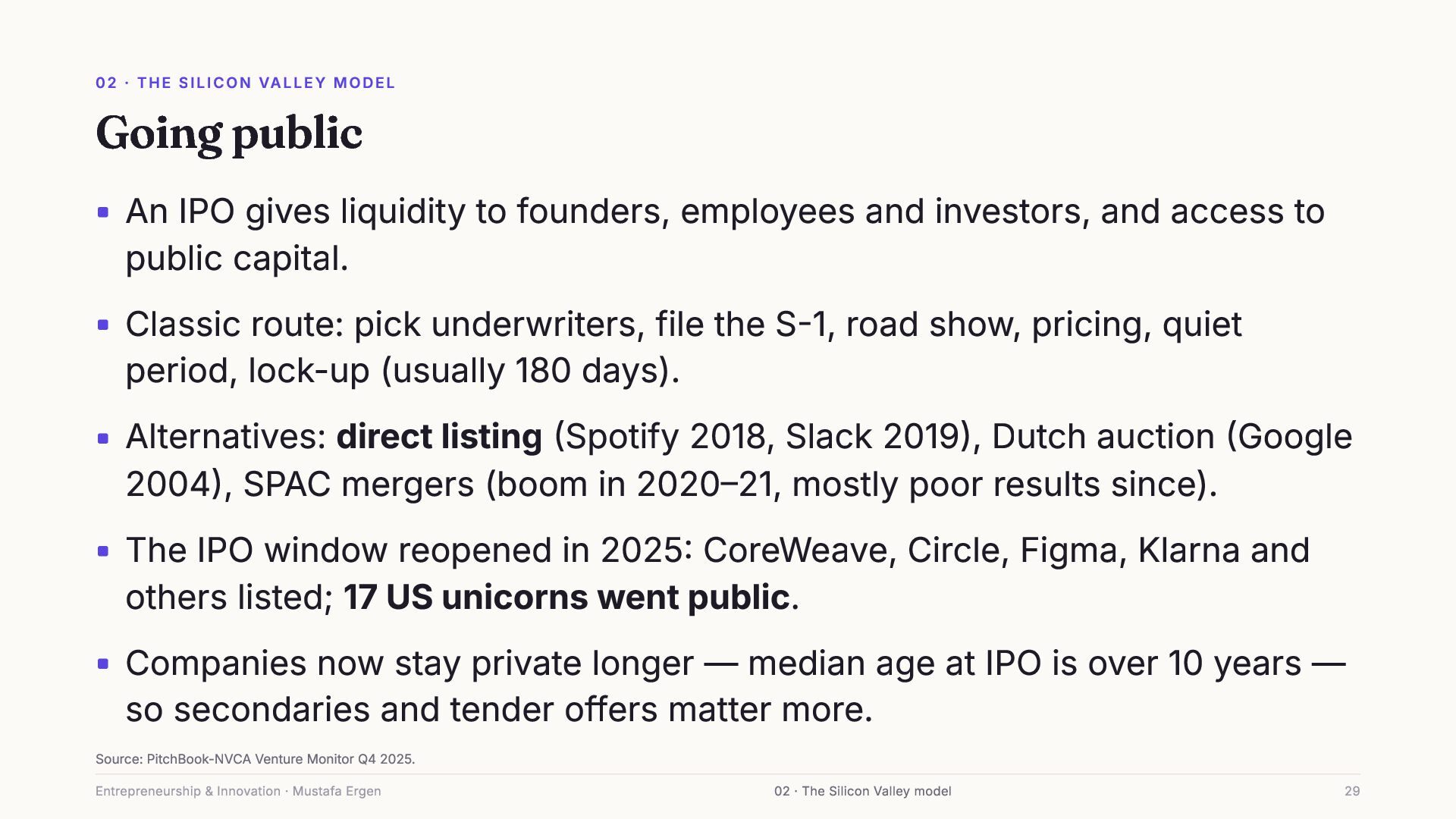
C O N VA L L E Y M O D E L Going public An IPO gives liquidity to founders, employees and investors, and access to public capital. Classic route: pick underwriters, file the S-1, road show, pricing, quiet period, lock-up (usually 180 days). Alternatives: direct listing (Spotify 2018, Slack 2019), Dutch auction (Google 2004), SPAC mergers (boom in 2020–21, mostly poor results since). The IPO window reopened in 2025: CoreWeave, Circle, Figma, Klarna and others listed; 17 US unicorns went public. Companies now stay private longer — median age at IPO is over 10 years — so secondaries and tender offers matter more. Source: PitchBook-NVCA Venture Monitor Q4 2025. Entrepreneurship & Innovation · Mustafa Ergen 02 · The Silicon Valley model 29 -
0 2 · T H E S I L I
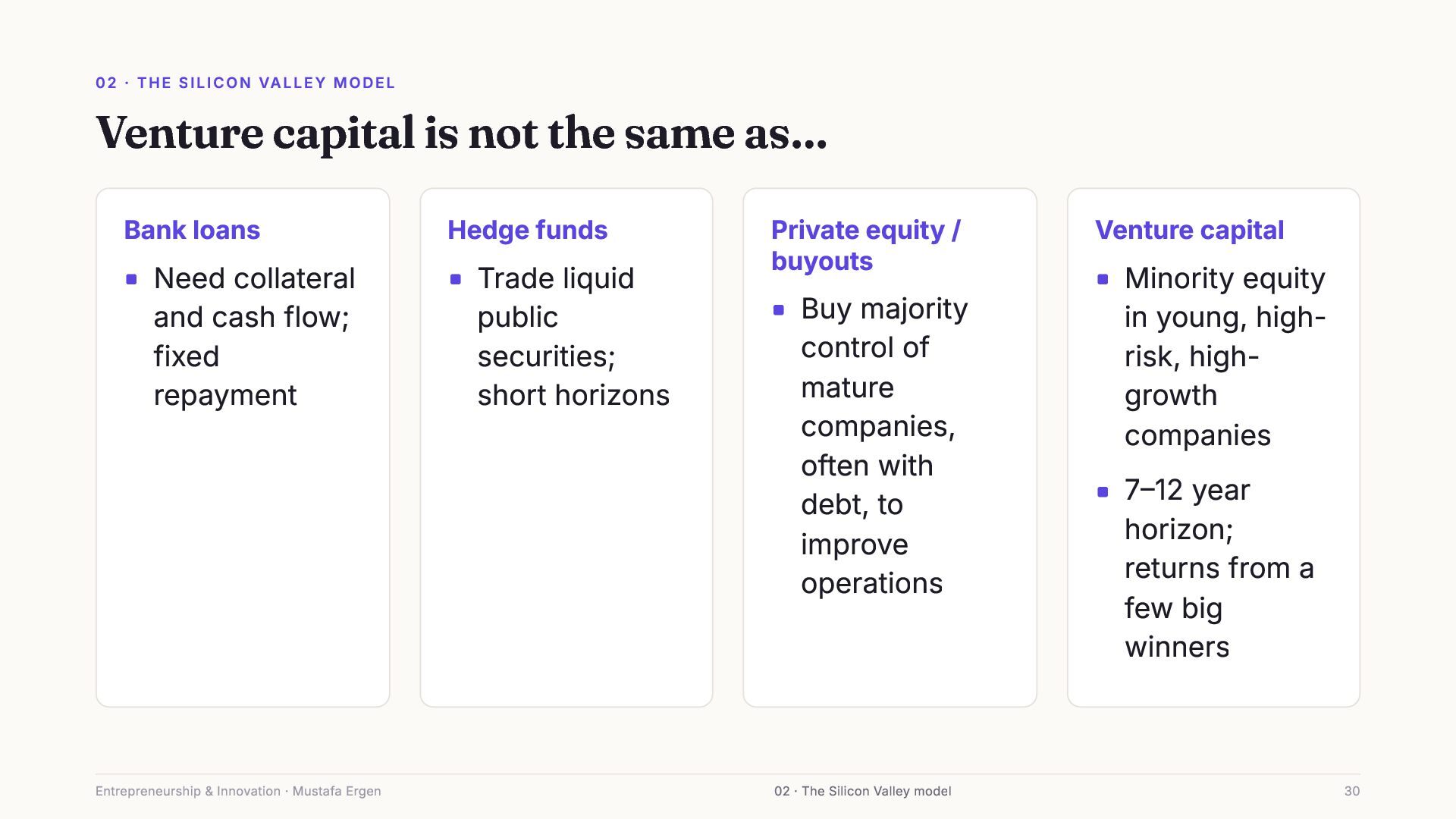
C O N VA L L E Y M O D E L Venture capital is not the same as… Bank loans Need collateral and cash flow; fixed repayment Entrepreneurship & Innovation · Mustafa Ergen Hedge funds Trade liquid public securities; short horizons Private equity / buyouts Buy majority control of mature companies, often with debt, to improve operations 02 · The Silicon Valley model Venture capital Minority equity in young, highrisk, highgrowth companies 7–12 year horizon; returns from a few big winners 30 -
0 2 · T H E S I L I
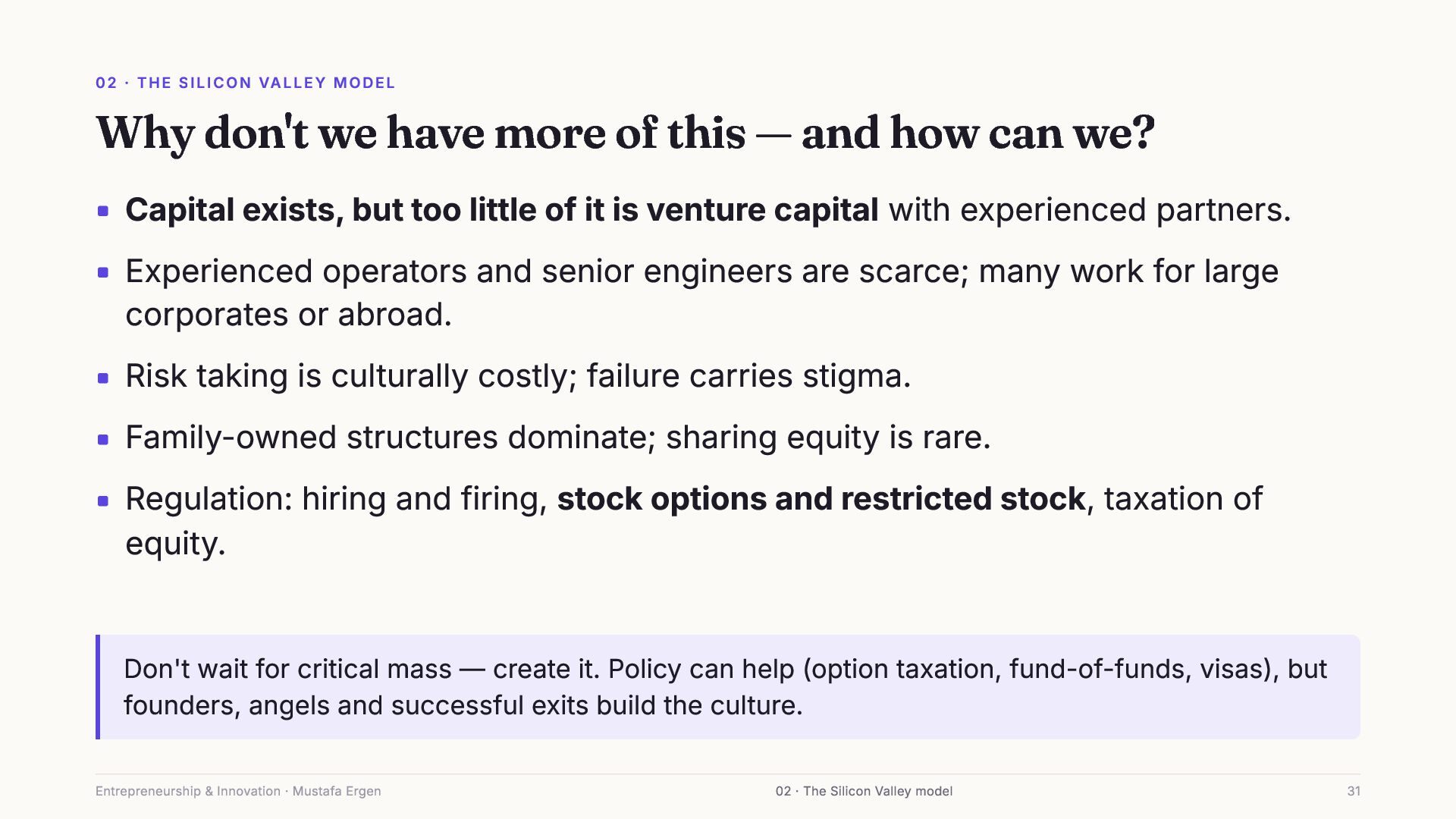
C O N VA L L E Y M O D E L Why don't we have more of this — and how can we? Capital exists, but too little of it is venture capital with experienced partners. Experienced operators and senior engineers are scarce; many work for large corporates or abroad. Risk taking is culturally costly; failure carries stigma. Family-owned structures dominate; sharing equity is rare. Regulation: hiring and firing, stock options and restricted stock, taxation of equity. Don't wait for critical mass — create it. Policy can help (option taxation, fund-of-funds, visas), but founders, angels and successful exits build the culture. Entrepreneurship & Innovation · Mustafa Ergen 02 · The Silicon Valley model 31 -
03 A short history of Silicon Valley From radio hobbyists
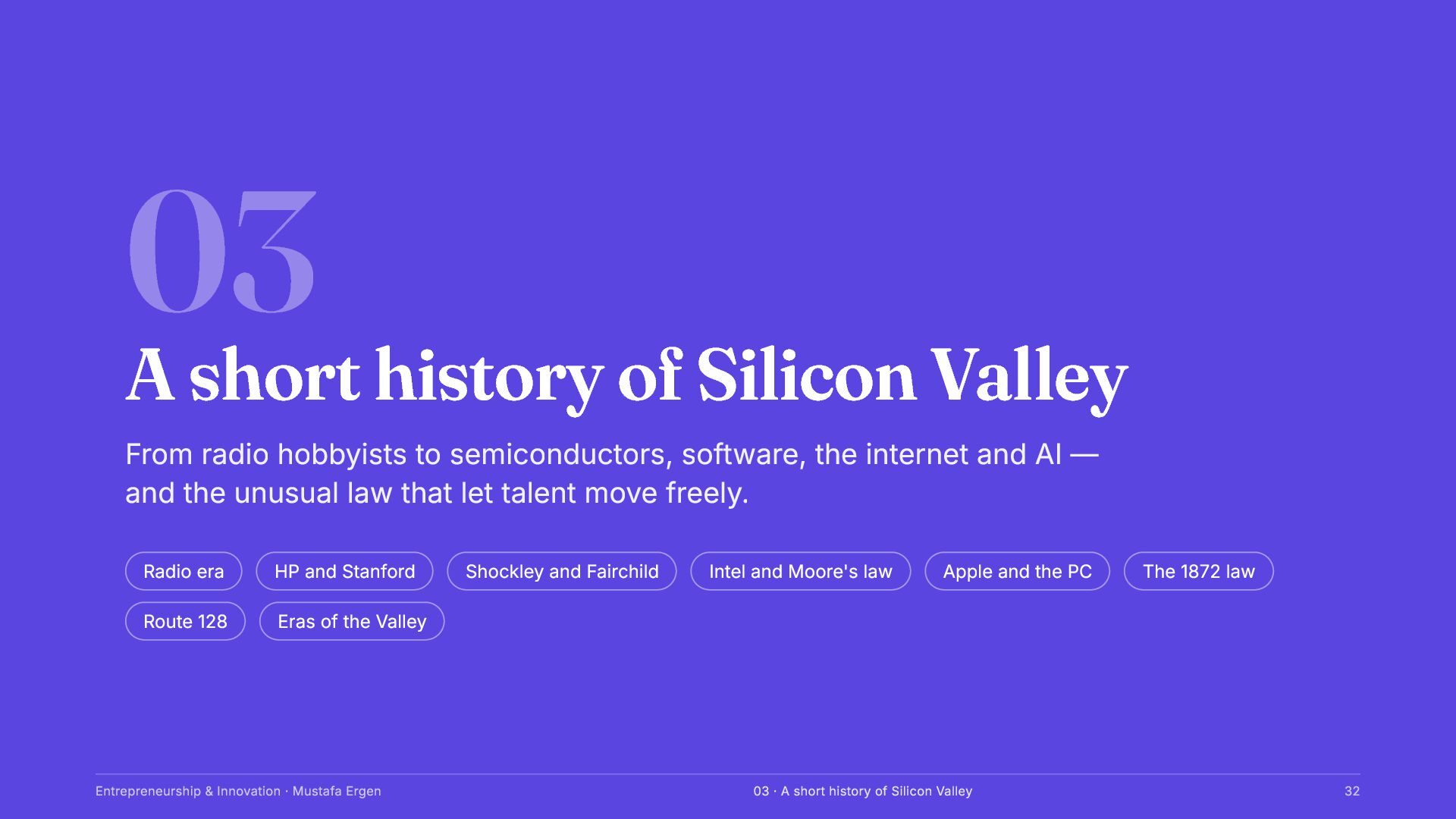
to semiconductors, software, the internet and AI — and the unusual law that let talent move freely. Radio era HP and Stanford Route 128 Eras of the Valley Entrepreneurship & Innovation · Mustafa Ergen Shockley and Fairchild Intel and Moore's law Apple and the PC 03 · A short history of Silicon Valley The 1872 law 32 -
0 3 · A S H O R T H
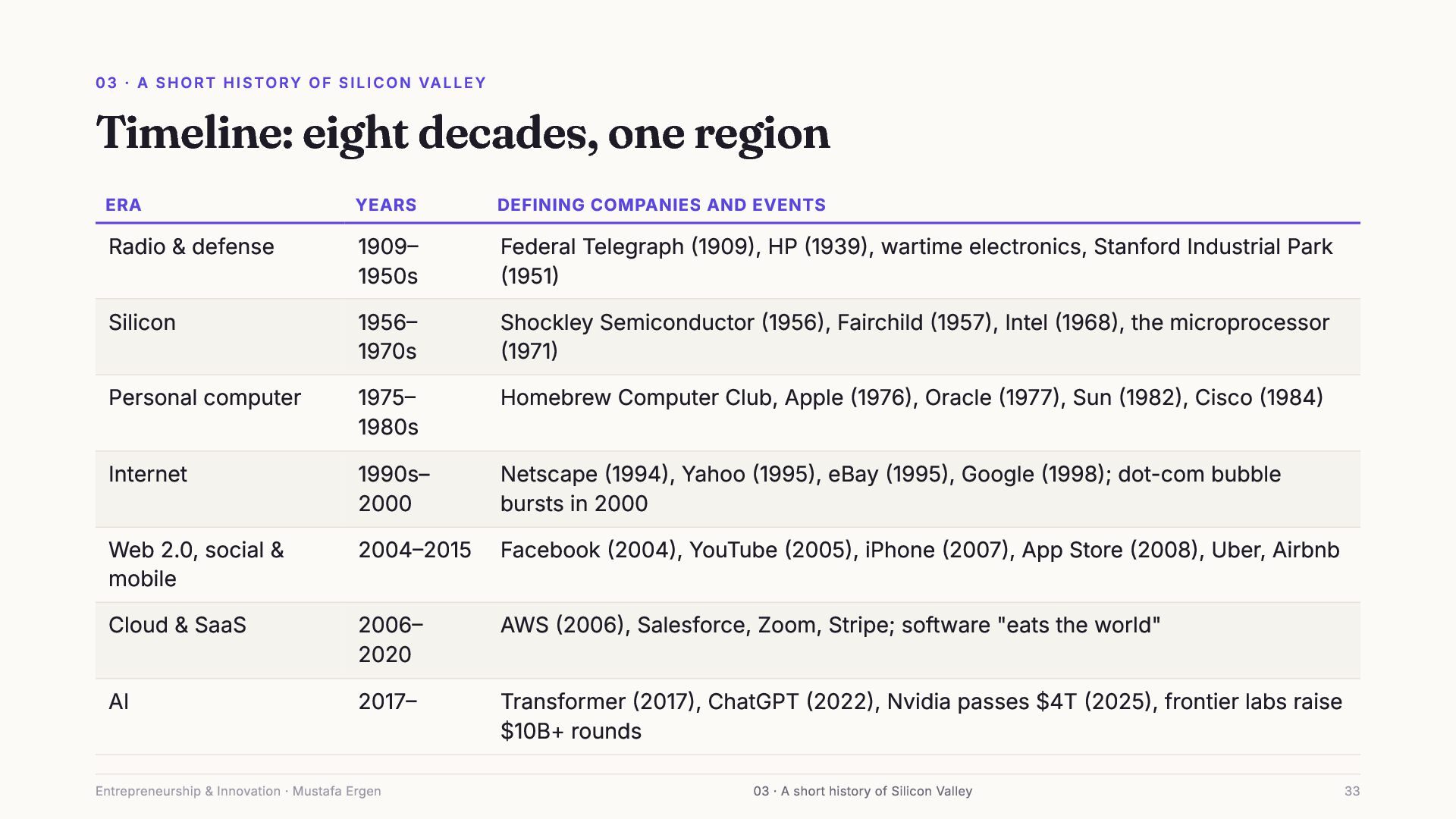
I S TO RY O F S I L I C O N VA L L E Y Timeline: eight decades, one region ERA YEARS DEFINING COMPANIES AND EVENTS Radio & defense 1909– 1950s Federal Telegraph (1909), HP (1939), wartime electronics, Stanford Industrial Park (1951) Silicon 1956– 1970s Shockley Semiconductor (1956), Fairchild (1957), Intel (1968), the microprocessor (1971) Personal computer 1975– 1980s Homebrew Computer Club, Apple (1976), Oracle (1977), Sun (1982), Cisco (1984) Internet 1990s– 2000 Netscape (1994), Yahoo (1995), eBay (1995), Google (1998); dot-com bubble bursts in 2000 Web 2.0, social & mobile 2004–2015 Facebook (2004), YouTube (2005), iPhone (2007), App Store (2008), Uber, Airbnb Cloud & SaaS 2006– 2020 AWS (2006), Salesforce, Zoom, Stripe; software "eats the world" AI 2017– Transformer (2017), ChatGPT (2022), Nvidia passes $4T (2025), frontier labs raise $10B+ rounds Entrepreneurship & Innovation · Mustafa Ergen 03 · A short history of Silicon Valley 33 -
0 3 · A S H O R T H
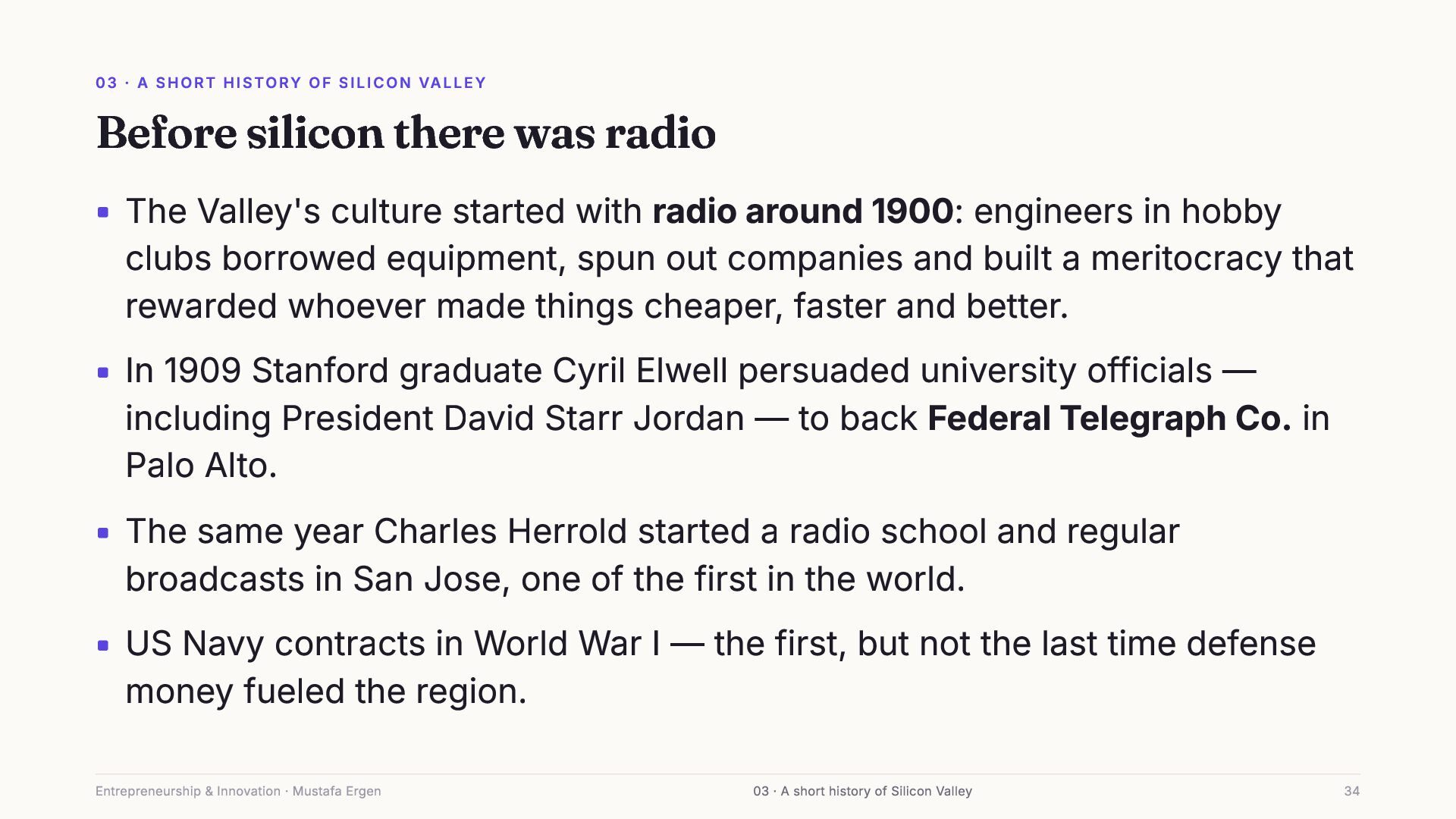
I S TO RY O F S I L I C O N VA L L E Y Before silicon there was radio The Valley's culture started with radio around 1900: engineers in hobby clubs borrowed equipment, spun out companies and built a meritocracy that rewarded whoever made things cheaper, faster and better. In 1909 Stanford graduate Cyril Elwell persuaded university officials — including President David Starr Jordan — to back Federal Telegraph Co. in Palo Alto. The same year Charles Herrold started a radio school and regular broadcasts in San Jose, one of the first in the world. US Navy contracts in World War I — the first, but not the last time defense money fueled the region. Entrepreneurship & Innovation · Mustafa Ergen 03 · A short history of Silicon Valley 34 -
0 3 · A S H O R T H
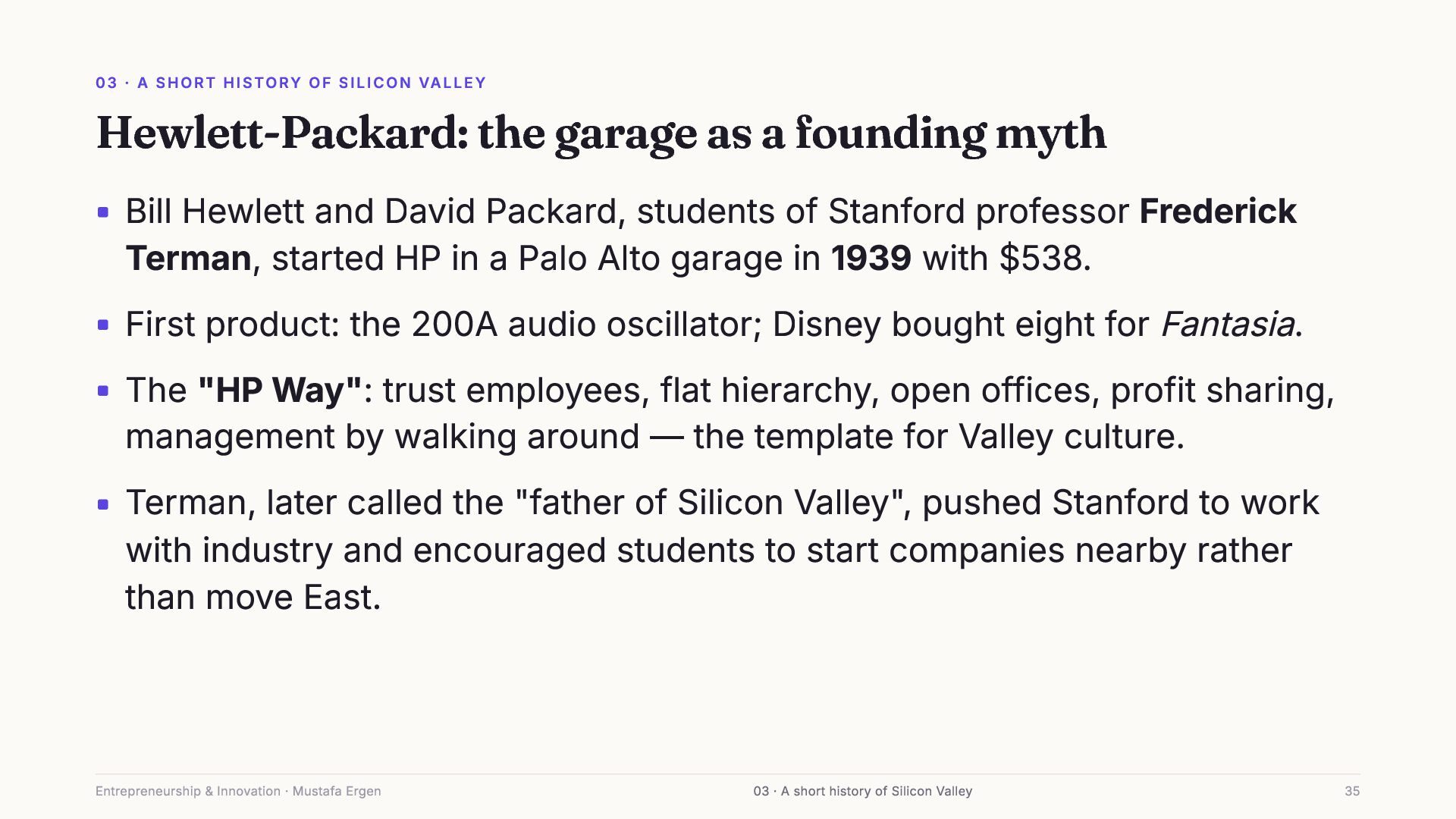
I S TO RY O F S I L I C O N VA L L E Y Hewlett-Packard: the garage as a founding myth Bill Hewlett and David Packard, students of Stanford professor Frederick Terman, started HP in a Palo Alto garage in 1939 with $538. First product: the 200A audio oscillator; Disney bought eight for Fantasia. The "HP Way": trust employees, flat hierarchy, open offices, profit sharing, management by walking around — the template for Valley culture. Terman, later called the "father of Silicon Valley", pushed Stanford to work with industry and encouraged students to start companies nearby rather than move East. Entrepreneurship & Innovation · Mustafa Ergen 03 · A short history of Silicon Valley 35 -
0 3 · A S H O R T H
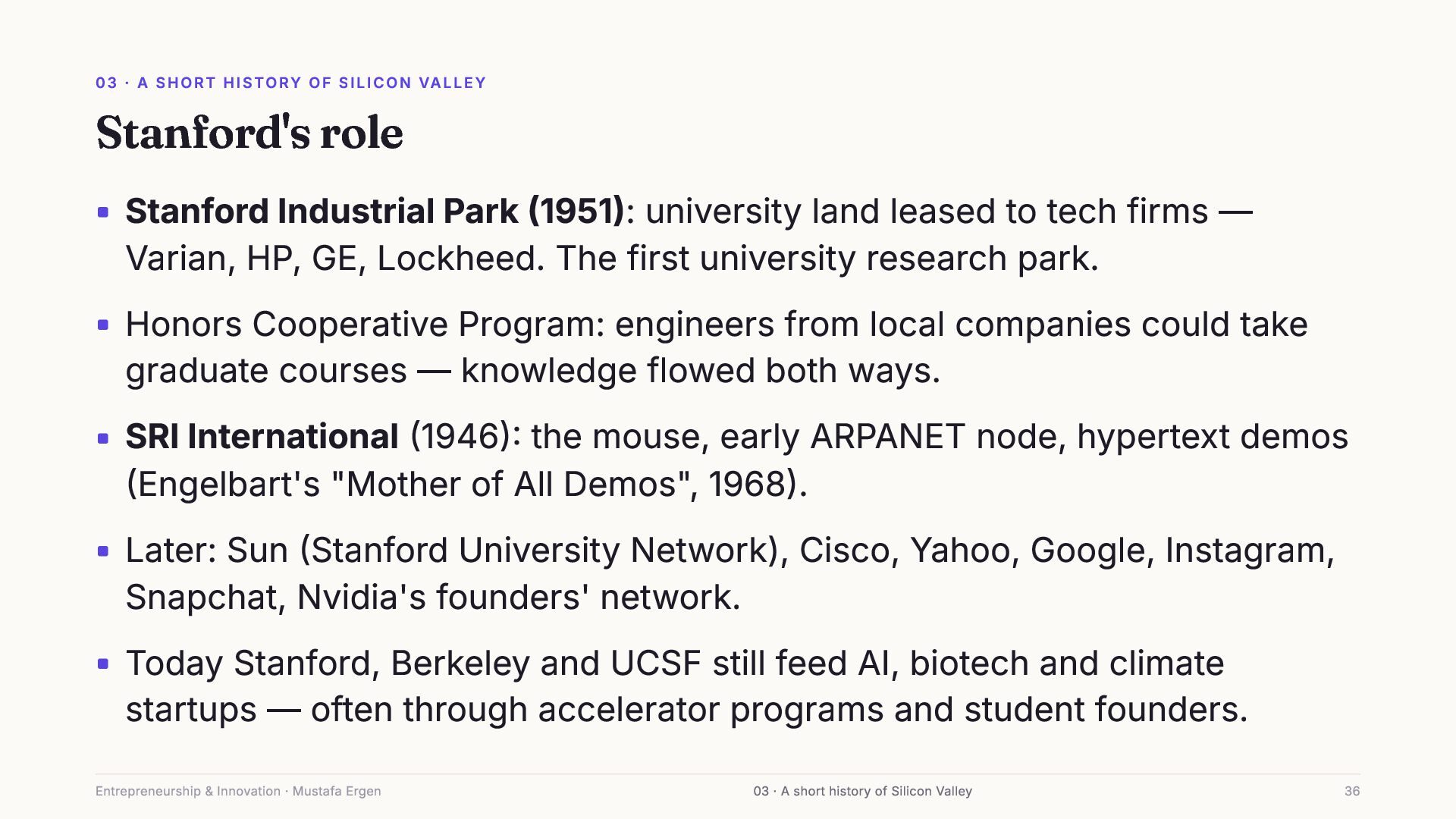
I S TO RY O F S I L I C O N VA L L E Y Stanford's role Stanford Industrial Park (1951): university land leased to tech firms — Varian, HP, GE, Lockheed. The first university research park. Honors Cooperative Program: engineers from local companies could take graduate courses — knowledge flowed both ways. SRI International (1946): the mouse, early ARPANET node, hypertext demos (Engelbart's "Mother of All Demos", 1968). Later: Sun (Stanford University Network), Cisco, Yahoo, Google, Instagram, Snapchat, Nvidia's founders' network. Today Stanford, Berkeley and UCSF still feed AI, biotech and climate startups — often through accelerator programs and student founders. Entrepreneurship & Innovation · Mustafa Ergen 03 · A short history of Silicon Valley 36 -
0 3 · A S H O R T H
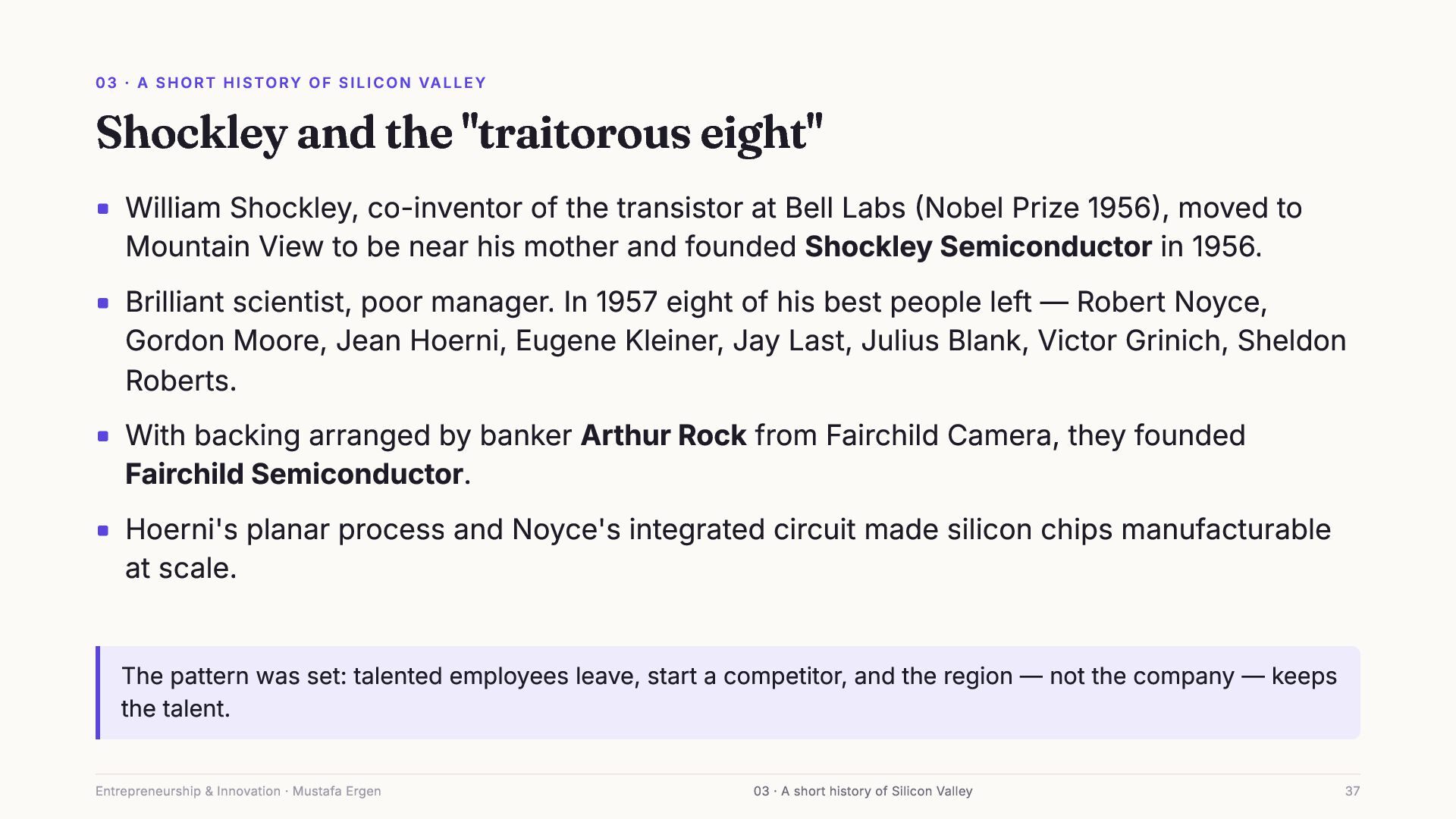
I S TO RY O F S I L I C O N VA L L E Y Shockley and the "traitorous eight" William Shockley, co-inventor of the transistor at Bell Labs (Nobel Prize 1956), moved to Mountain View to be near his mother and founded Shockley Semiconductor in 1956. Brilliant scientist, poor manager. In 1957 eight of his best people left — Robert Noyce, Gordon Moore, Jean Hoerni, Eugene Kleiner, Jay Last, Julius Blank, Victor Grinich, Sheldon Roberts. With backing arranged by banker Arthur Rock from Fairchild Camera, they founded Fairchild Semiconductor. Hoerni's planar process and Noyce's integrated circuit made silicon chips manufacturable at scale. The pattern was set: talented employees leave, start a competitor, and the region — not the company — keeps the talent. Entrepreneurship & Innovation · Mustafa Ergen 03 · A short history of Silicon Valley 37 -
0 3 · A S H O R T H
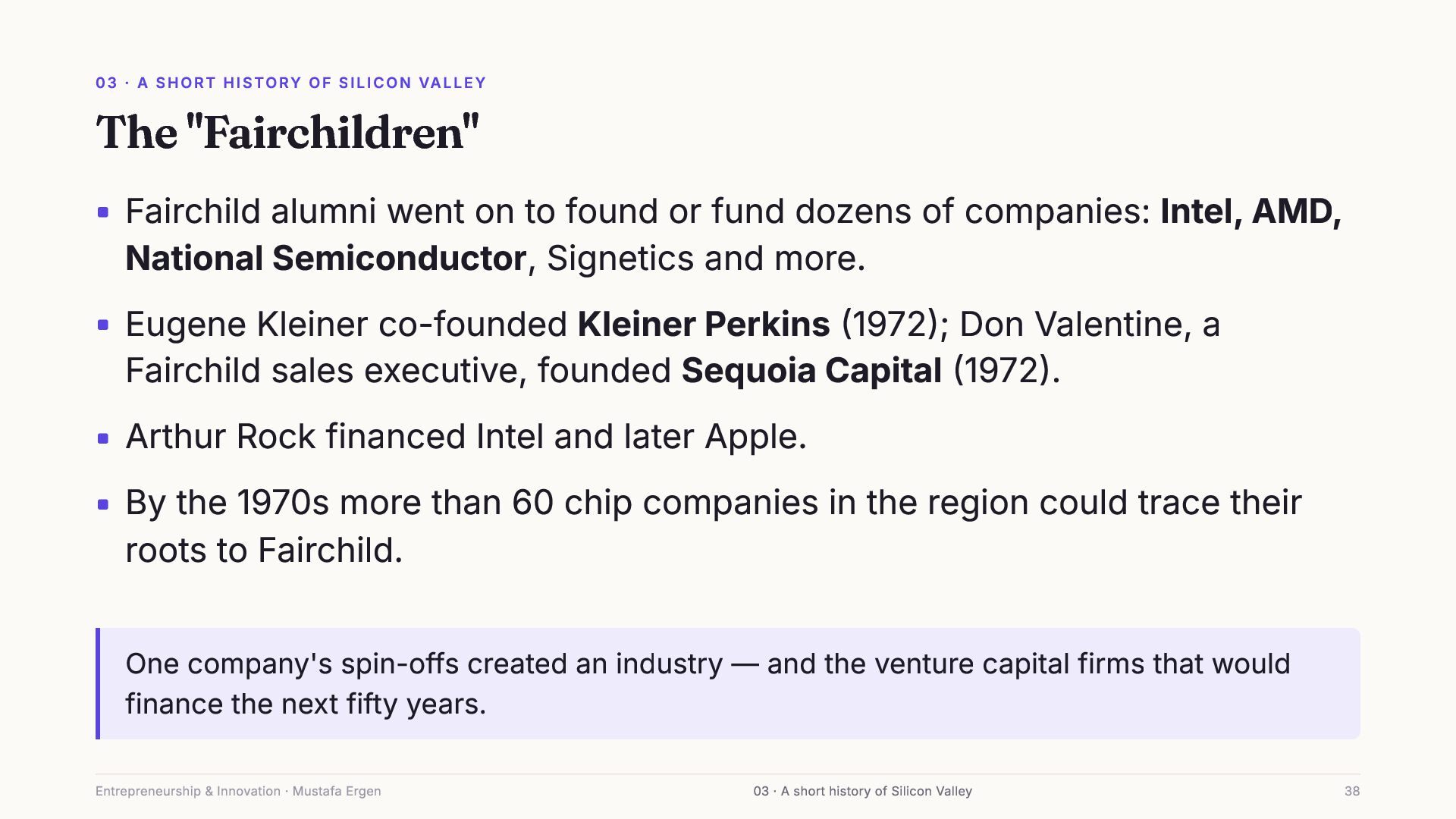
I S TO RY O F S I L I C O N VA L L E Y The "Fairchildren" Fairchild alumni went on to found or fund dozens of companies: Intel, AMD, National Semiconductor, Signetics and more. Eugene Kleiner co-founded Kleiner Perkins (1972); Don Valentine, a Fairchild sales executive, founded Sequoia Capital (1972). Arthur Rock financed Intel and later Apple. By the 1970s more than 60 chip companies in the region could trace their roots to Fairchild. One company's spin-offs created an industry — and the venture capital firms that would finance the next fifty years. Entrepreneurship & Innovation · Mustafa Ergen 03 · A short history of Silicon Valley 38 -
0 3 · A S H O R T H
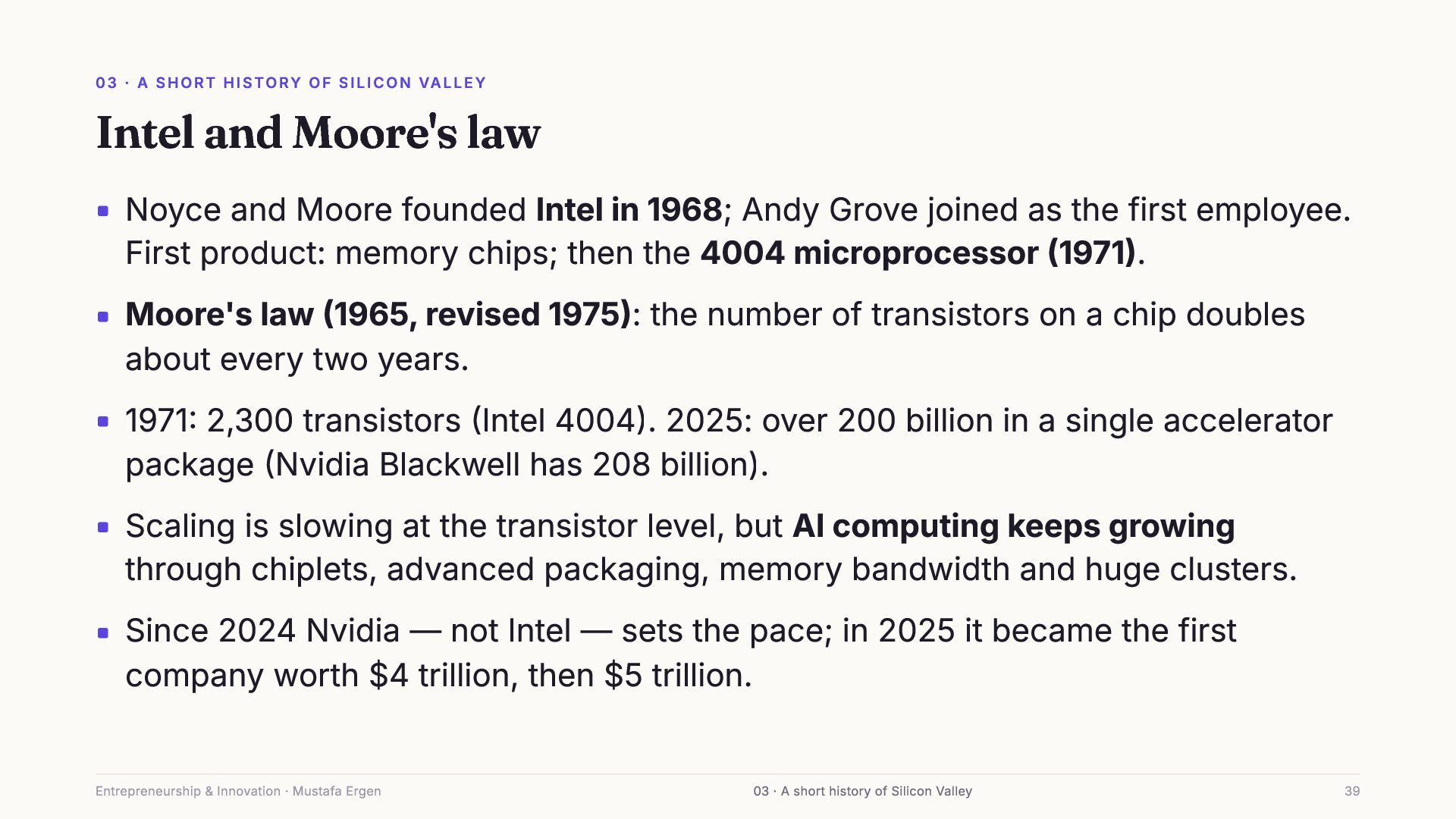
I S TO RY O F S I L I C O N VA L L E Y Intel and Moore's law Noyce and Moore founded Intel in 1968; Andy Grove joined as the first employee. First product: memory chips; then the 4004 microprocessor (1971). Moore's law (1965, revised 1975): the number of transistors on a chip doubles about every two years. 1971: 2,300 transistors (Intel 4004). 2025: over 200 billion in a single accelerator package (Nvidia Blackwell has 208 billion). Scaling is slowing at the transistor level, but AI computing keeps growing through chiplets, advanced packaging, memory bandwidth and huge clusters. Since 2024 Nvidia — not Intel — sets the pace; in 2025 it became the first company worth $4 trillion, then $5 trillion. Entrepreneurship & Innovation · Mustafa Ergen 03 · A short history of Silicon Valley 39 -
0 3 · A S H O R T H
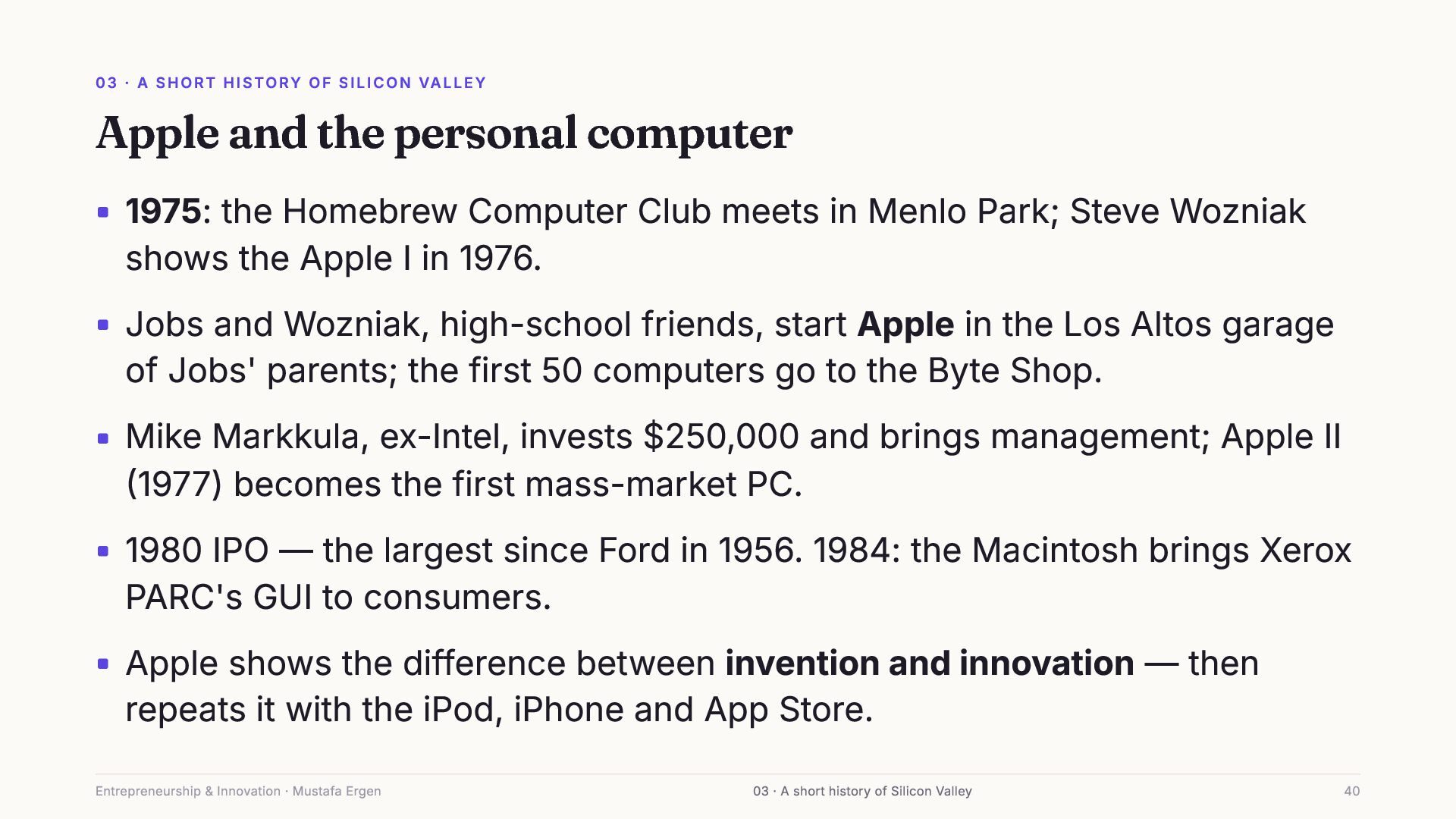
I S TO RY O F S I L I C O N VA L L E Y Apple and the personal computer 1975: the Homebrew Computer Club meets in Menlo Park; Steve Wozniak shows the Apple I in 1976. Jobs and Wozniak, high-school friends, start Apple in the Los Altos garage of Jobs' parents; the first 50 computers go to the Byte Shop. Mike Markkula, ex-Intel, invests $250,000 and brings management; Apple II (1977) becomes the first mass-market PC. 1980 IPO — the largest since Ford in 1956. 1984: the Macintosh brings Xerox PARC's GUI to consumers. Apple shows the difference between invention and innovation — then repeats it with the iPod, iPhone and App Store. Entrepreneurship & Innovation · Mustafa Ergen 03 · A short history of Silicon Valley 40 -
0 3 · A S H O R T H
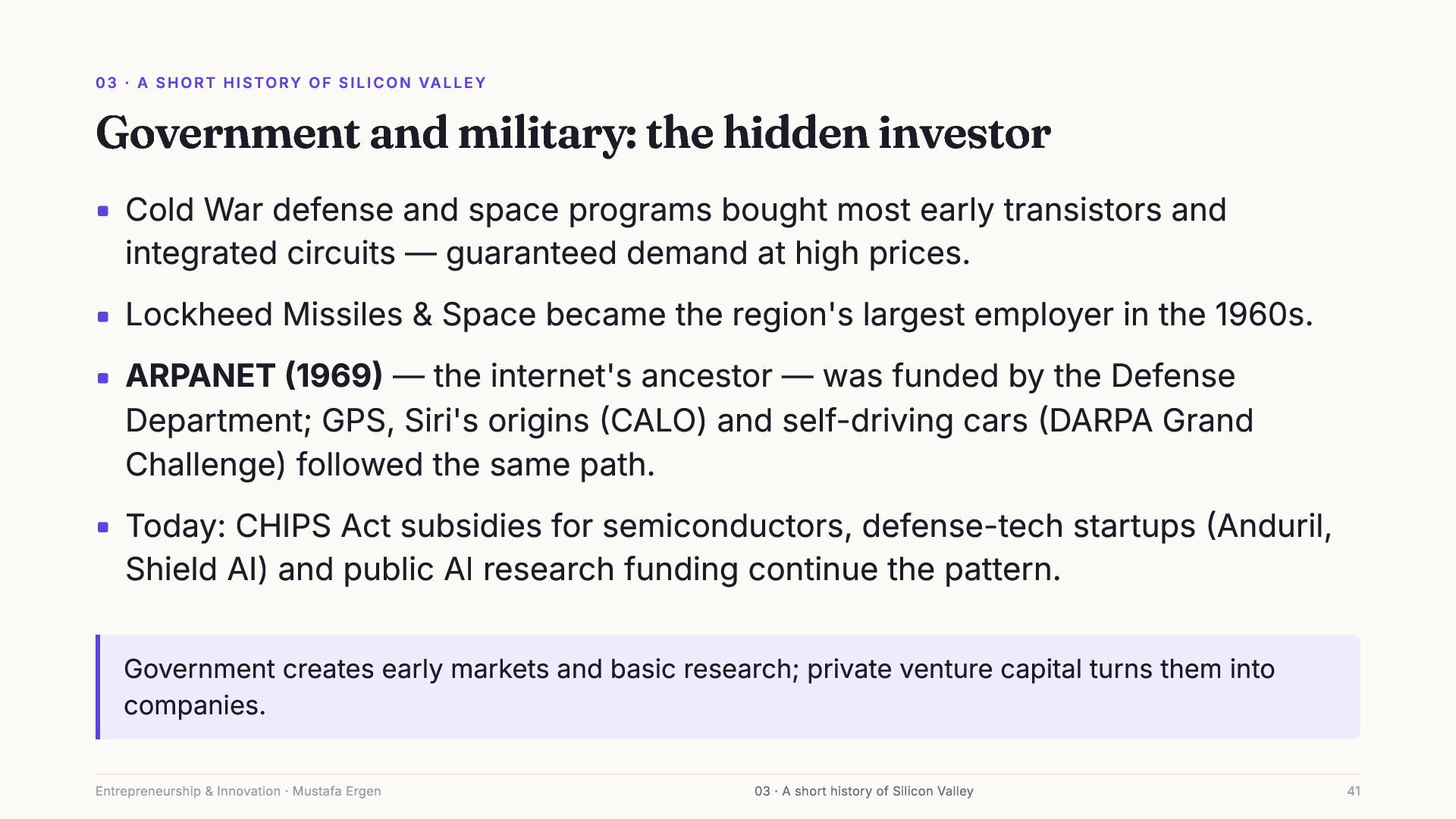
I S TO RY O F S I L I C O N VA L L E Y Government and military: the hidden investor Cold War defense and space programs bought most early transistors and integrated circuits — guaranteed demand at high prices. Lockheed Missiles & Space became the region's largest employer in the 1960s. ARPANET (1969) — the internet's ancestor — was funded by the Defense Department; GPS, Siri's origins (CALO) and self-driving cars (DARPA Grand Challenge) followed the same path. Today: CHIPS Act subsidies for semiconductors, defense-tech startups (Anduril, Shield AI) and public AI research funding continue the pattern. Government creates early markets and basic research; private venture capital turns them into companies. Entrepreneurship & Innovation · Mustafa Ergen 03 · A short history of Silicon Valley 41 -
0 3 · A S H O R T H
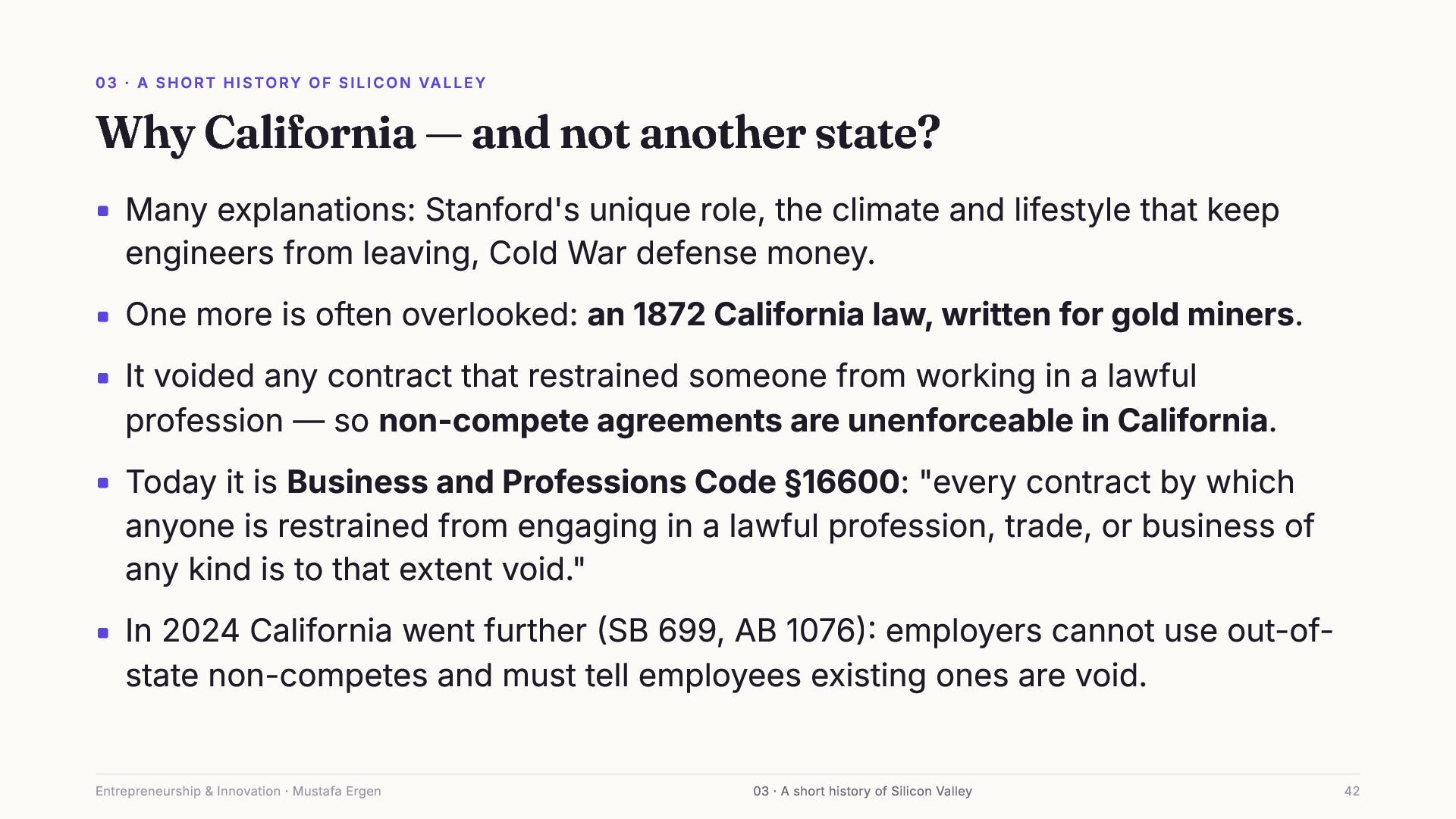
I S TO RY O F S I L I C O N VA L L E Y Why California — and not another state? Many explanations: Stanford's unique role, the climate and lifestyle that keep engineers from leaving, Cold War defense money. One more is often overlooked: an 1872 California law, written for gold miners. It voided any contract that restrained someone from working in a lawful profession — so non-compete agreements are unenforceable in California. Today it is Business and Professions Code §16600: "every contract by which anyone is restrained from engaging in a lawful profession, trade, or business of any kind is to that extent void." In 2024 California went further (SB 699, AB 1076): employers cannot use out-ofstate non-competes and must tell employees existing ones are void. Entrepreneurship & Innovation · Mustafa Ergen 03 · A short history of Silicon Valley 42 -
0 3 · A S H O R T H
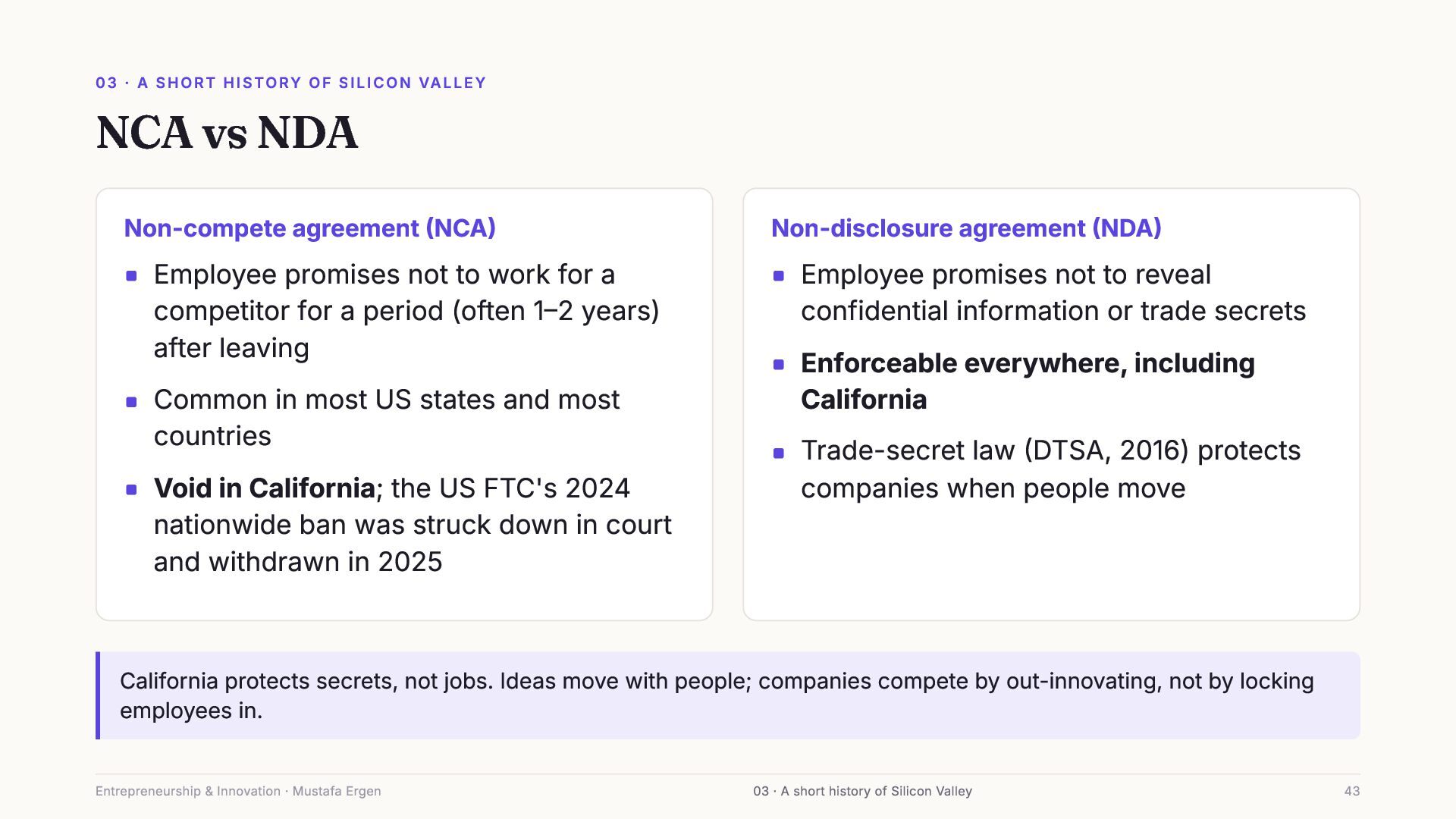
I S TO RY O F S I L I C O N VA L L E Y NCA vs NDA Non-compete agreement (NCA) Employee promises not to work for a competitor for a period (often 1–2 years) after leaving Common in most US states and most countries Void in California; the US FTC's 2024 nationwide ban was struck down in court and withdrawn in 2025 Non-disclosure agreement (NDA) Employee promises not to reveal confidential information or trade secrets Enforceable everywhere, including California Trade-secret law (DTSA, 2016) protects companies when people move California protects secrets, not jobs. Ideas move with people; companies compete by out-innovating, not by locking employees in. Entrepreneurship & Innovation · Mustafa Ergen 03 · A short history of Silicon Valley 43 -
0 3 · A S H O R T H
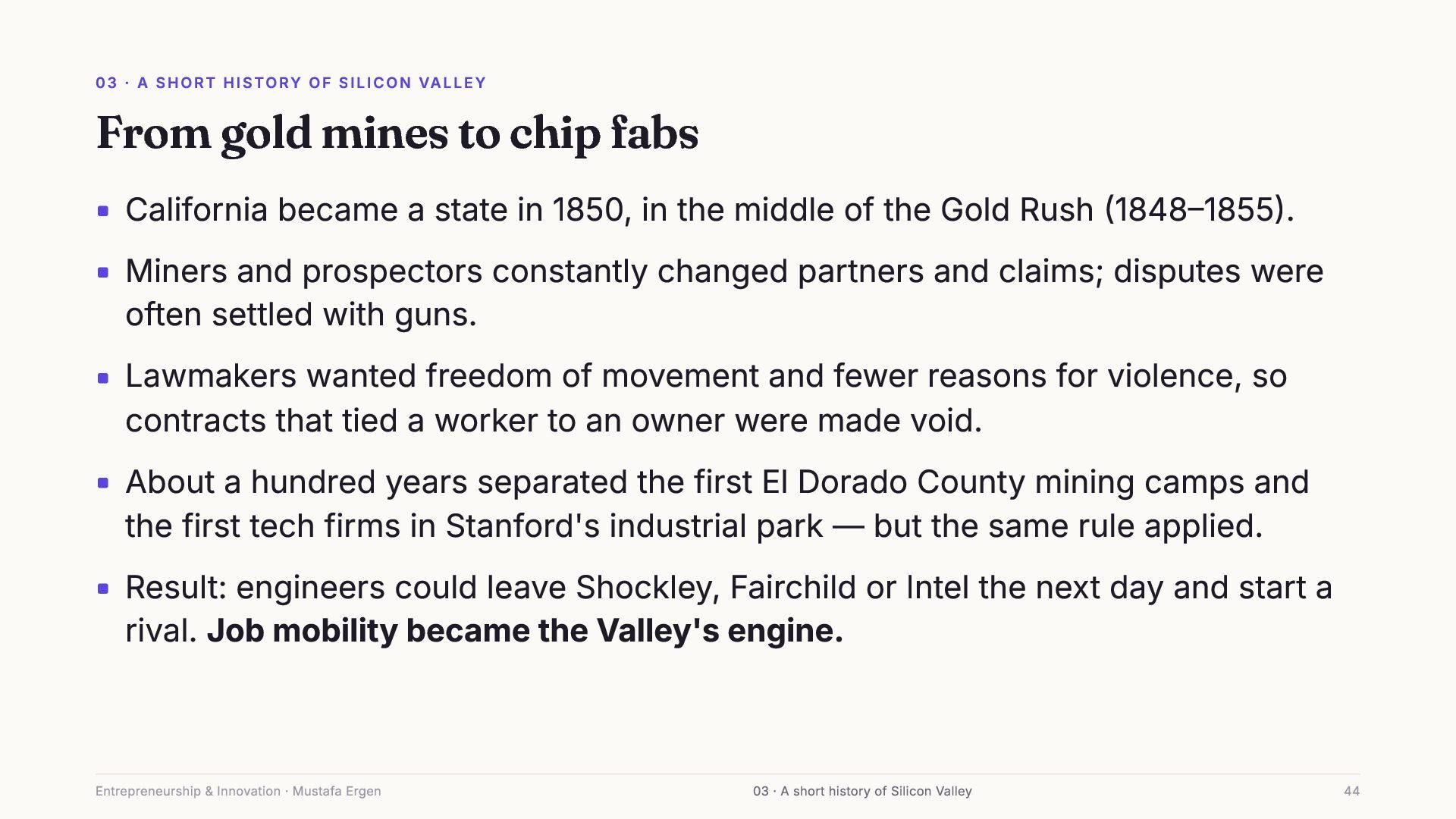
I S TO RY O F S I L I C O N VA L L E Y From gold mines to chip fabs California became a state in 1850, in the middle of the Gold Rush (1848–1855). Miners and prospectors constantly changed partners and claims; disputes were often settled with guns. Lawmakers wanted freedom of movement and fewer reasons for violence, so contracts that tied a worker to an owner were made void. About a hundred years separated the first El Dorado County mining camps and the first tech firms in Stanford's industrial park — but the same rule applied. Result: engineers could leave Shockley, Fairchild or Intel the next day and start a rival. Job mobility became the Valley's engine. Entrepreneurship & Innovation · Mustafa Ergen 03 · A short history of Silicon Valley 44 -
0 3 · A S H O R T H
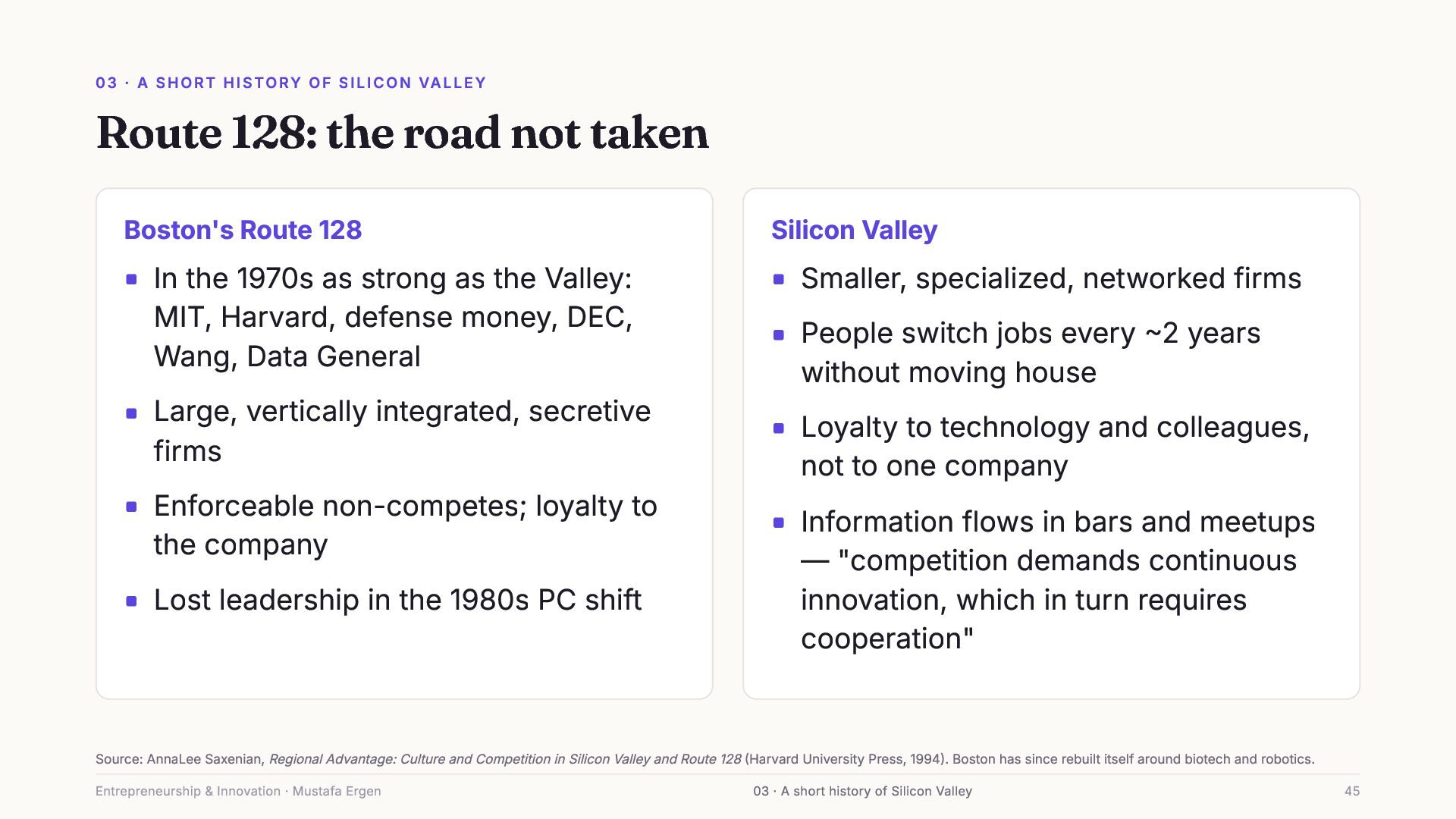
I S TO RY O F S I L I C O N VA L L E Y Route 128: the road not taken Boston's Route 128 In the 1970s as strong as the Valley: MIT, Harvard, defense money, DEC, Wang, Data General Large, vertically integrated, secretive firms Enforceable non-competes; loyalty to the company Lost leadership in the 1980s PC shift Silicon Valley Smaller, specialized, networked firms People switch jobs every ~2 years without moving house Loyalty to technology and colleagues, not to one company Information flows in bars and meetups — "competition demands continuous innovation, which in turn requires cooperation" Source: AnnaLee Saxenian, Regional Advantage: Culture and Competition in Silicon Valley and Route 128 (Harvard University Press, 1994). Boston has since rebuilt itself around biotech and robotics. Entrepreneurship & Innovation · Mustafa Ergen 03 · A short history of Silicon Valley 45 -
0 3 · A S H O R T H
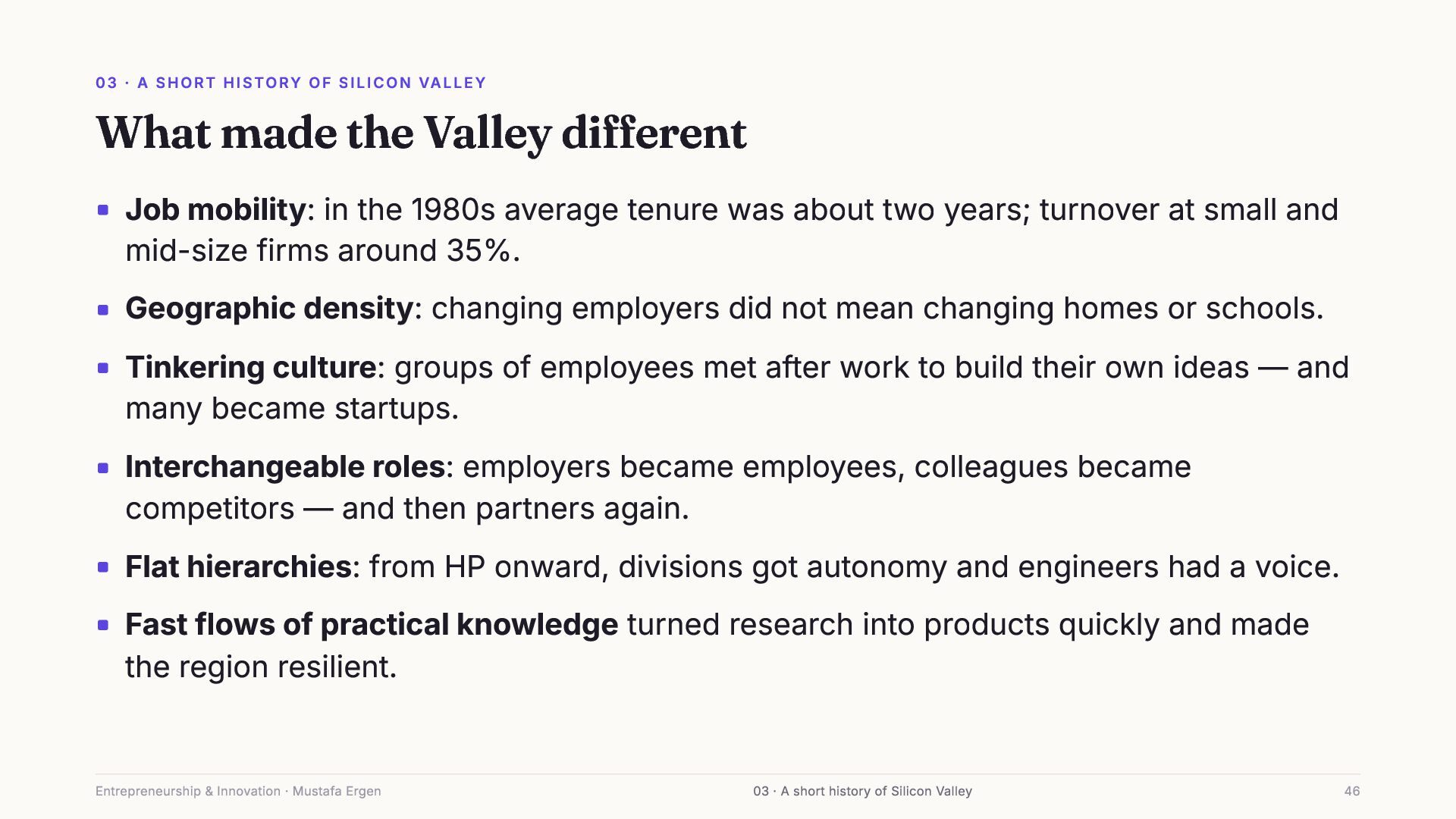
I S TO RY O F S I L I C O N VA L L E Y What made the Valley different Job mobility: in the 1980s average tenure was about two years; turnover at small and mid-size firms around 35%. Geographic density: changing employers did not mean changing homes or schools. Tinkering culture: groups of employees met after work to build their own ideas — and many became startups. Interchangeable roles: employers became employees, colleagues became competitors — and then partners again. Flat hierarchies: from HP onward, divisions got autonomy and engineers had a voice. Fast flows of practical knowledge turned research into products quickly and made the region resilient. Entrepreneurship & Innovation · Mustafa Ergen 03 · A short history of Silicon Valley 46 -
0 3 · A S H O R T H
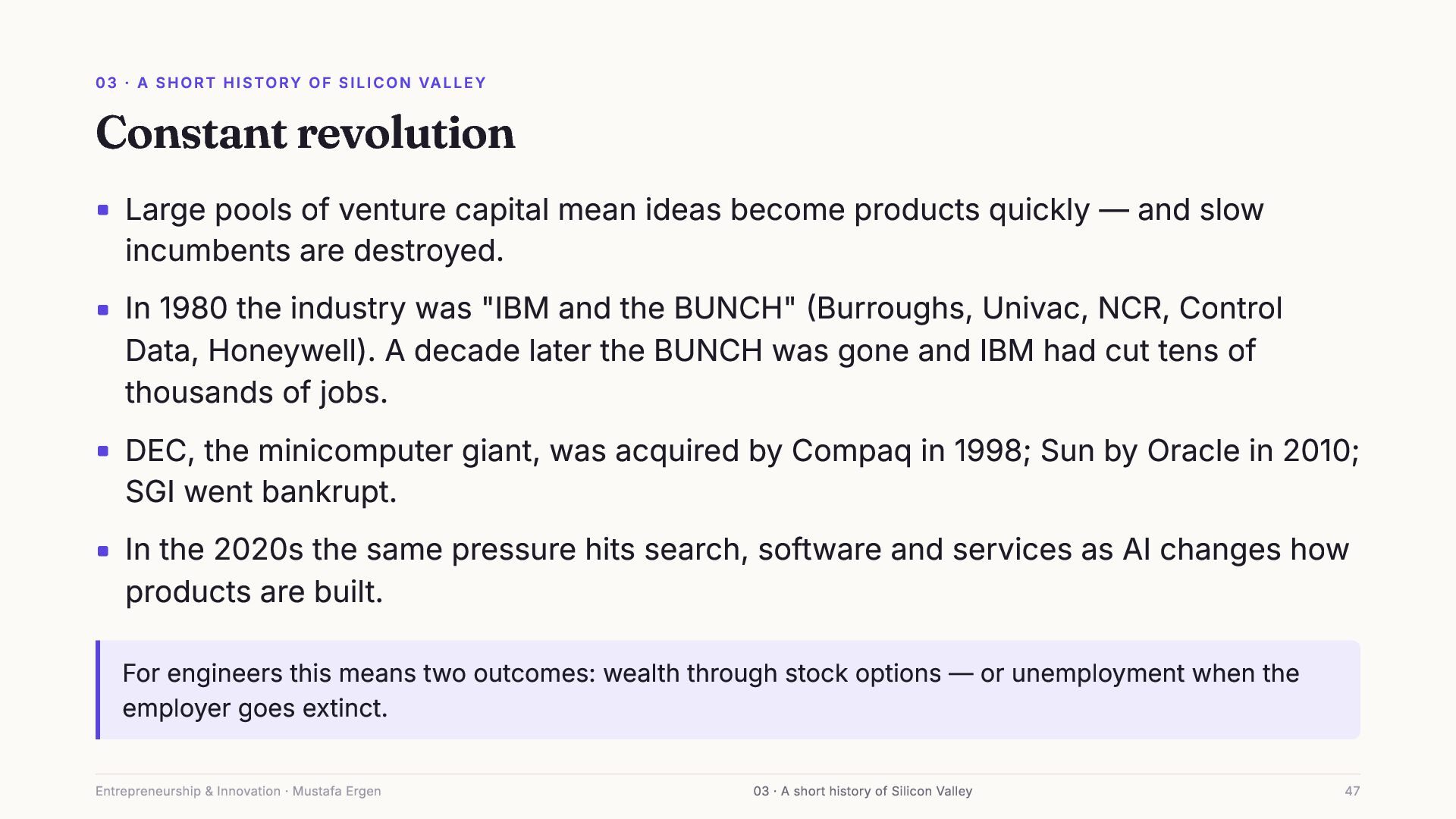
I S TO RY O F S I L I C O N VA L L E Y Constant revolution Large pools of venture capital mean ideas become products quickly — and slow incumbents are destroyed. In 1980 the industry was "IBM and the BUNCH" (Burroughs, Univac, NCR, Control Data, Honeywell). A decade later the BUNCH was gone and IBM had cut tens of thousands of jobs. DEC, the minicomputer giant, was acquired by Compaq in 1998; Sun by Oracle in 2010; SGI went bankrupt. In the 2020s the same pressure hits search, software and services as AI changes how products are built. For engineers this means two outcomes: wealth through stock options — or unemployment when the employer goes extinct. Entrepreneurship & Innovation · Mustafa Ergen 03 · A short history of Silicon Valley 47 -
0 3 · A S H O R T H
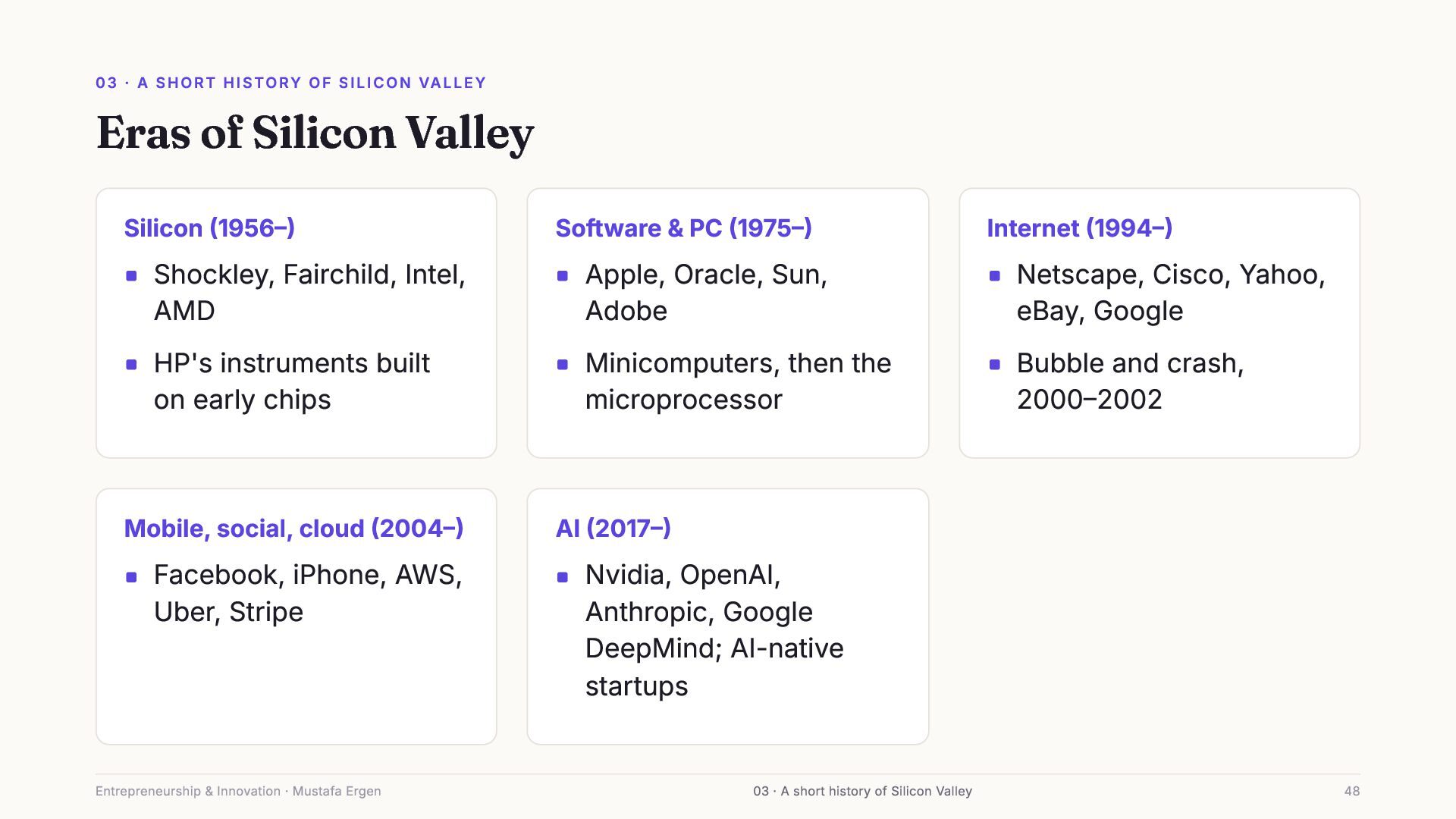
I S TO RY O F S I L I C O N VA L L E Y Eras of Silicon Valley Silicon (1956–) Shockley, Fairchild, Intel, AMD HP's instruments built on early chips Mobile, social, cloud (2004–) Facebook, iPhone, AWS, Uber, Stripe Entrepreneurship & Innovation · Mustafa Ergen Software & PC (1975–) Apple, Oracle, Sun, Adobe Minicomputers, then the microprocessor Internet (1994–) Netscape, Cisco, Yahoo, eBay, Google Bubble and crash, 2000–2002 AI (2017–) Nvidia, OpenAI, Anthropic, Google DeepMind; AI-native startups 03 · A short history of Silicon Valley 48 -
0 3 · A S H O R T H
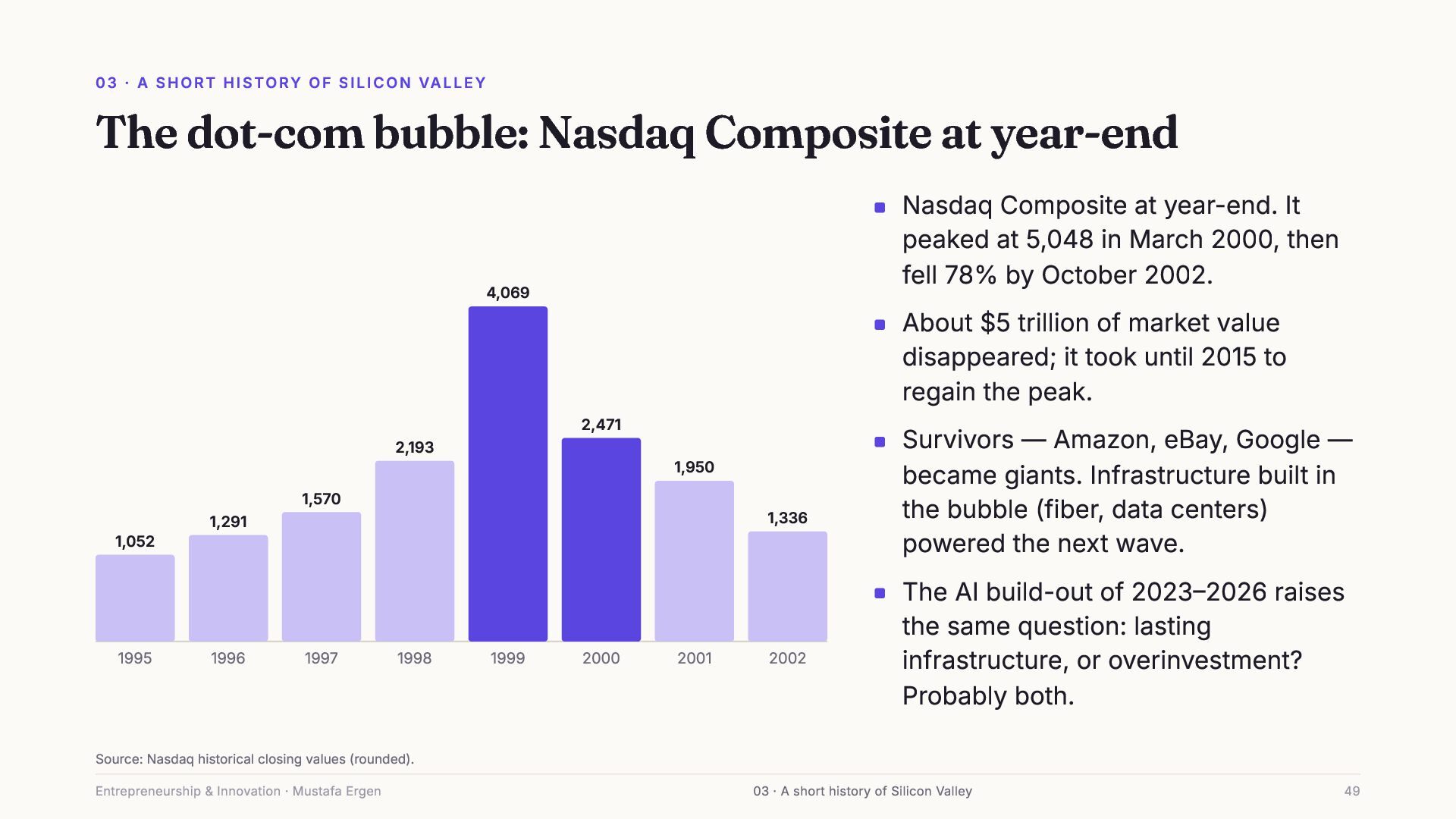
I S TO RY O F S I L I C O N VA L L E Y The dot-com bubble: Nasdaq Composite at year-end 4,069 2,471 2,193 1,052 1995 1,291 1996 1,950 1,570 1997 1,336 1998 1999 2000 2001 2002 Nasdaq Composite at year-end. It peaked at 5,048 in March 2000, then fell 78% by October 2002. About $5 trillion of market value disappeared; it took until 2015 to regain the peak. Survivors — Amazon, eBay, Google — became giants. Infrastructure built in the bubble (fiber, data centers) powered the next wave. The AI build-out of 2023–2026 raises the same question: lasting infrastructure, or overinvestment? Probably both. Source: Nasdaq historical closing values (rounded). Entrepreneurship & Innovation · Mustafa Ergen 03 · A short history of Silicon Valley 49 -
04 Technology waves: internet, wireless, AI How each new platform
— the web, mobile broadband, cloud and now AI — created a new generation of companies. Knowledge and networks From ARPANET to Web 1.0 Web 2.0 and network effects Mobile and wireless Cloud AI Entrepreneurship & Innovation · Mustafa Ergen 04 · Technology waves: internet, wireless, AI 50 -
0 4 · T E C H N O LO
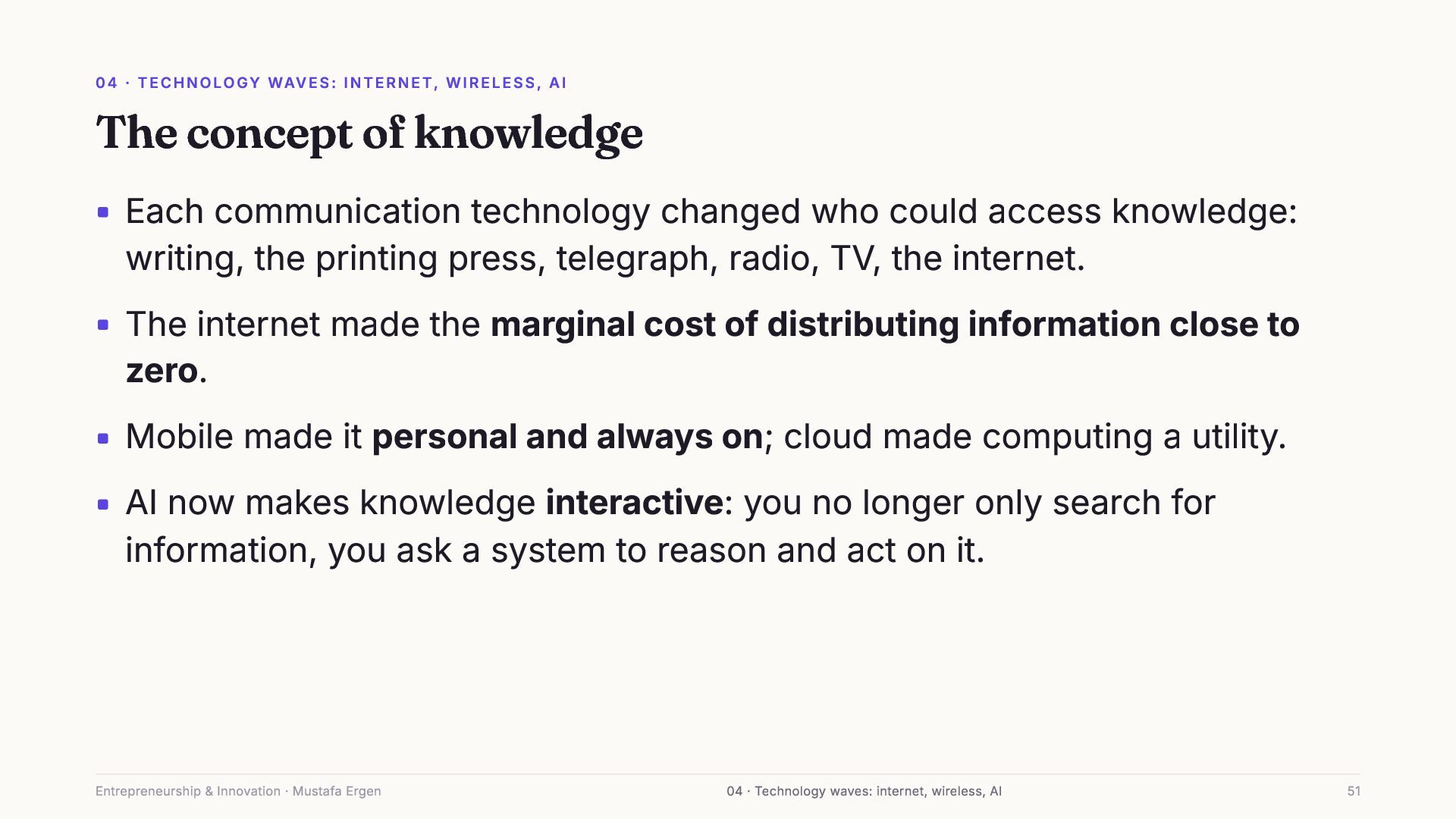
GY WAV E S : I N T E R N E T, W I R E L E S S , A I The concept of knowledge Each communication technology changed who could access knowledge: writing, the printing press, telegraph, radio, TV, the internet. The internet made the marginal cost of distributing information close to zero. Mobile made it personal and always on; cloud made computing a utility. AI now makes knowledge interactive: you no longer only search for information, you ask a system to reason and act on it. Entrepreneurship & Innovation · Mustafa Ergen 04 · Technology waves: internet, wireless, AI 51 -
0 4 · T E C H N O LO
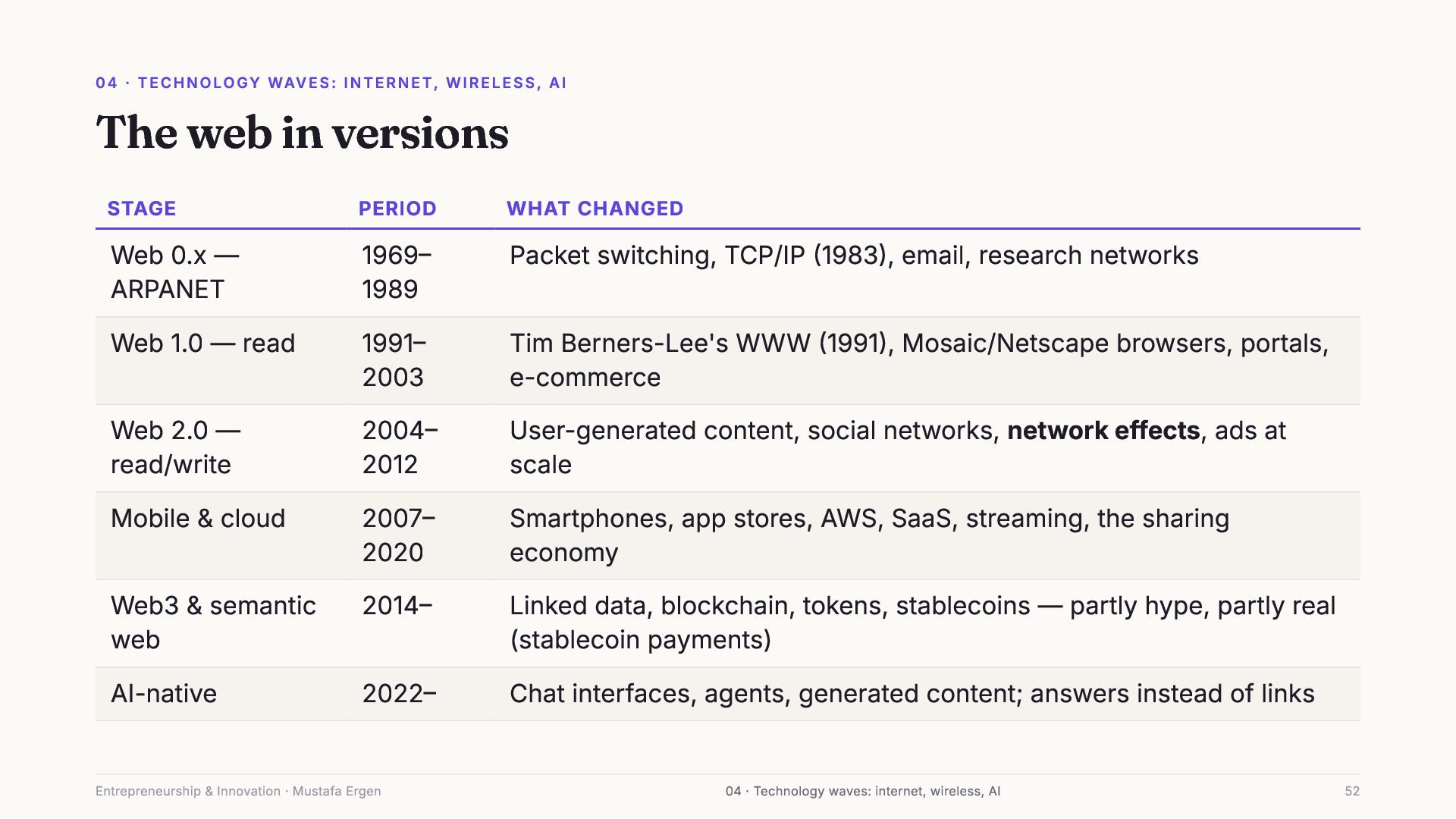
GY WAV E S : I N T E R N E T, W I R E L E S S , A I The web in versions STAGE PERIOD WHAT CHANGED Web 0.x — ARPANET 1969– 1989 Packet switching, TCP/IP (1983), email, research networks Web 1.0 — read 1991– 2003 Tim Berners-Lee's WWW (1991), Mosaic/Netscape browsers, portals, e-commerce Web 2.0 — read/write 2004– 2012 User-generated content, social networks, network effects, ads at scale Mobile & cloud 2007– 2020 Smartphones, app stores, AWS, SaaS, streaming, the sharing economy Web3 & semantic web 2014– Linked data, blockchain, tokens, stablecoins — partly hype, partly real (stablecoin payments) AI-native 2022– Chat interfaces, agents, generated content; answers instead of links Entrepreneurship & Innovation · Mustafa Ergen 04 · Technology waves: internet, wireless, AI 52 -
0 4 · T E C H N O LO
GY WAV E S : I N T E R N E T, W I R E L E S S , A I ARPANET and the birth of the internet 1969: first ARPANET message between UCLA and SRI ("LO" — the system crashed before "LOGIN"). 1970s: packet switching, email (1971), TCP/IP designed by Vint Cerf and Bob Kahn (1974); ARPANET switches to TCP/IP on 1 January 1983. 1989–1991: Tim Berners-Lee at CERN invents the World Wide Web; 1993 Mosaic browser; 1994 Netscape. 1995: commercial traffic opens up; Amazon and eBay launch. The internet was built on open standards — no single company owned it, which let anyone build on top. Entrepreneurship & Innovation · Mustafa Ergen 04 · Technology waves: internet, wireless, AI 53 -
0 4 · T E C H N O LO
GY WAV E S : I N T E R N E T, W I R E L E S S , A I Web 2.0 and network effects Network effect: each new user makes the product more valuable for all users — phones, marketplaces, social networks, payment systems. Strong network effects create winner-takes-most markets: Facebook, YouTube, LinkedIn, Airbnb, Uber. Types: direct (social), two-sided (marketplaces), data network effects (more usage → better product), ecosystem (developers on a platform). Startups attack incumbents by finding a niche where the network can start small and dense — Facebook began at Harvard, Airbnb in event cities. Entrepreneurship & Innovation · Mustafa Ergen 04 · Technology waves: internet, wireless, AI 54 -
0 4 · T E C H N O LO
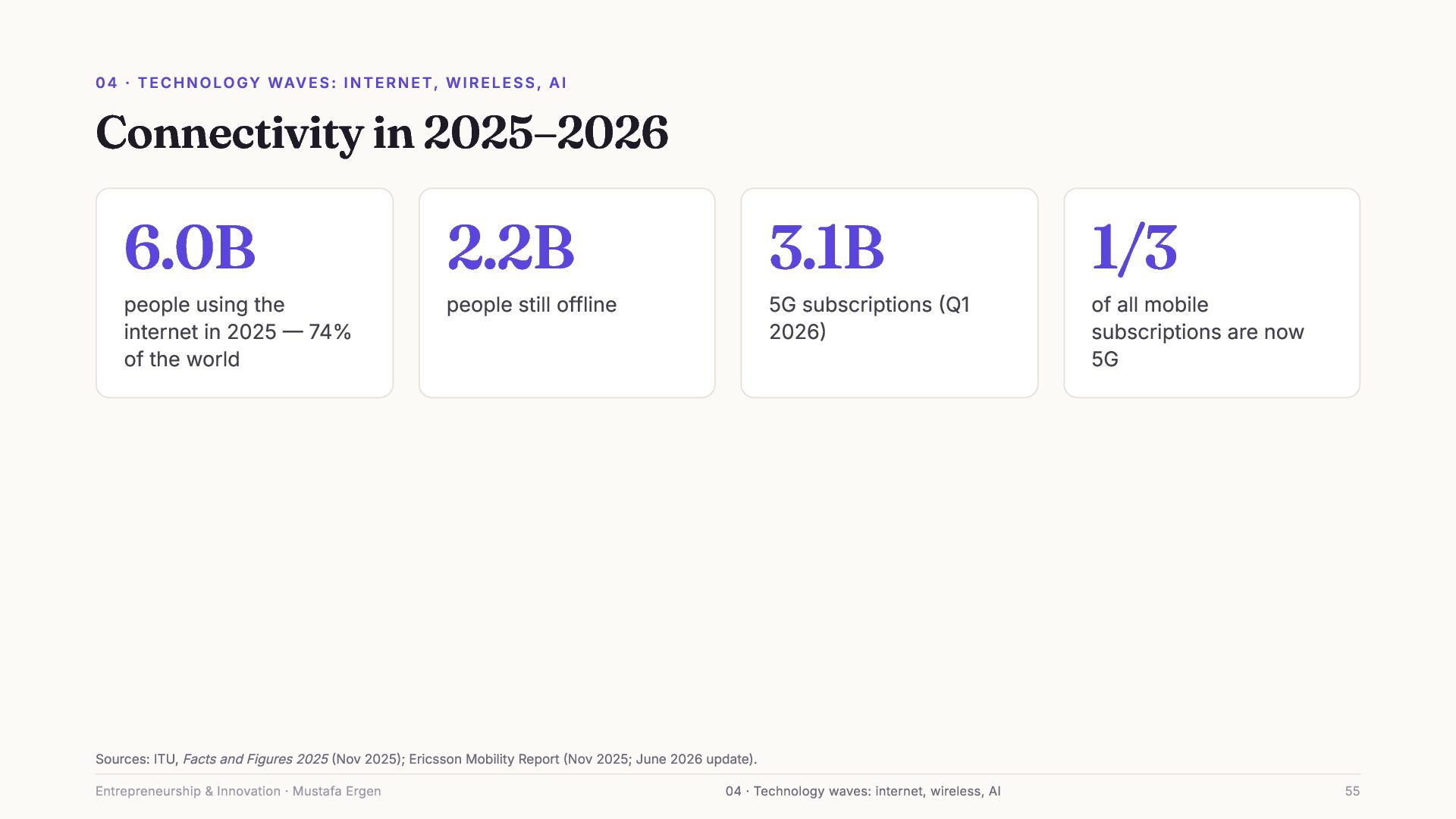
GY WAV E S : I N T E R N E T, W I R E L E S S , A I Connectivity in 2025–2026 6.0B people using the internet in 2025 — 74% of the world 2.2B 3.1B people still offline 5G subscriptions (Q1 2026) 1/3 of all mobile subscriptions are now 5G Sources: ITU, Facts and Figures 2025 (Nov 2025); Ericsson Mobility Report (Nov 2025; June 2026 update). Entrepreneurship & Innovation · Mustafa Ergen 04 · Technology waves: internet, wireless, AI 55 -
0 4 · T E C H N O LO
GY WAV E S : I N T E R N E T, W I R E L E S S , A I The wireless revolution 1G analog (1980s) → 2G digital voice and SMS (1991) → 3G mobile data (2001) → 4G LTE broadband (2009) → 5G (2019) → 6G research for ~2030. Each generation took about ten years and created new company categories: SMS services, mobile web, app economy, ride-hailing, mobile payments, short video. 4G made the smartphone a computer; 5G adds low latency, massive IoT, private networks and fixed wireless access. Behind every generation is a standards race (3GPP) and an infrastructure industry: chips, base stations, core networks, spectrum. Startups win when they ride the platform early — WiChorus built 4G core gateways before LTE networks launched and was acquired by Tellabs in 2009. Entrepreneurship & Innovation · Mustafa Ergen 04 · Technology waves: internet, wireless, AI 56 -
0 4 · T E C H N O LO
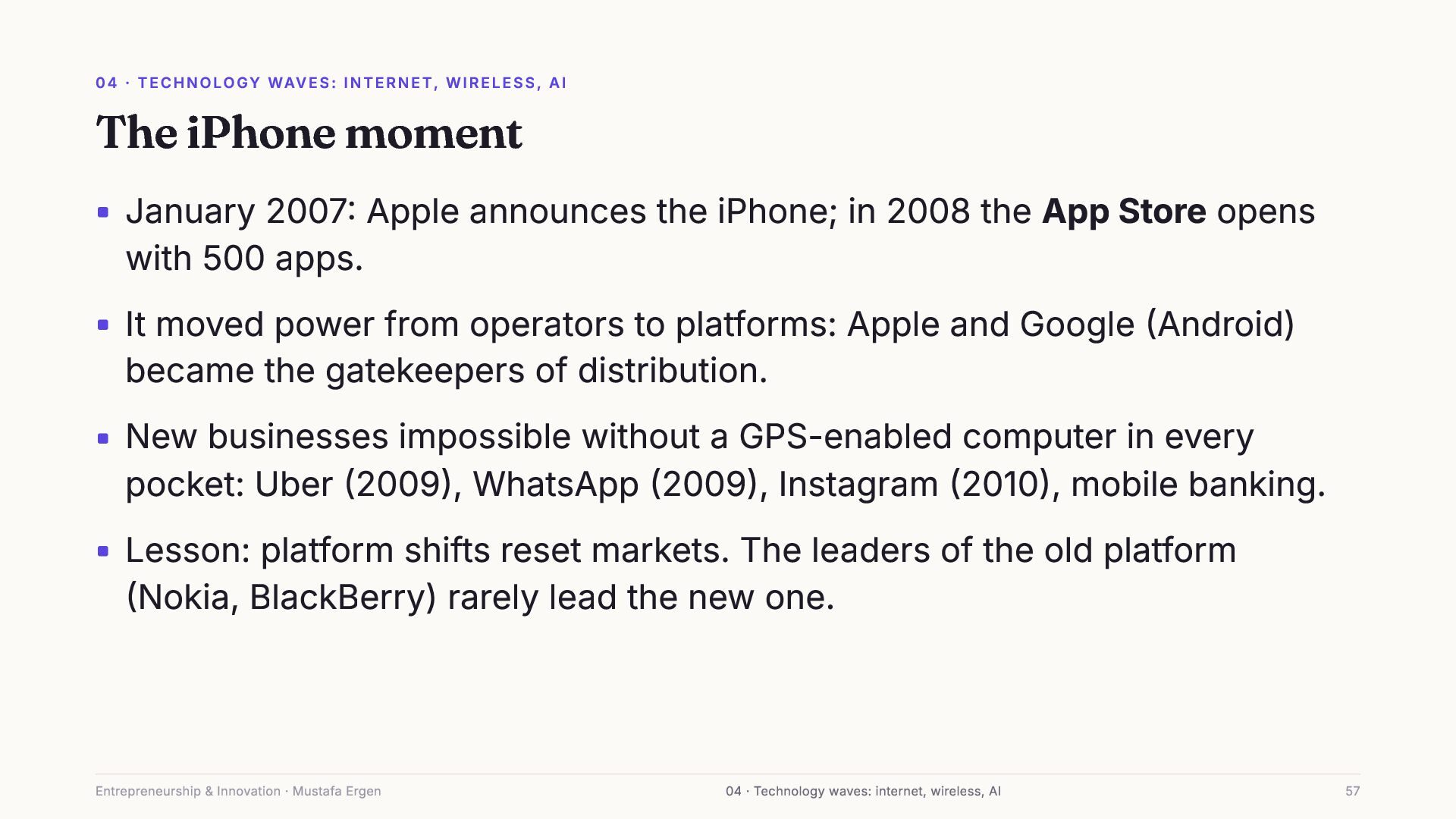
GY WAV E S : I N T E R N E T, W I R E L E S S , A I The iPhone moment January 2007: Apple announces the iPhone; in 2008 the App Store opens with 500 apps. It moved power from operators to platforms: Apple and Google (Android) became the gatekeepers of distribution. New businesses impossible without a GPS-enabled computer in every pocket: Uber (2009), WhatsApp (2009), Instagram (2010), mobile banking. Lesson: platform shifts reset markets. The leaders of the old platform (Nokia, BlackBerry) rarely lead the new one. Entrepreneurship & Innovation · Mustafa Ergen 04 · Technology waves: internet, wireless, AI 57 -
0 4 · T E C H N O LO
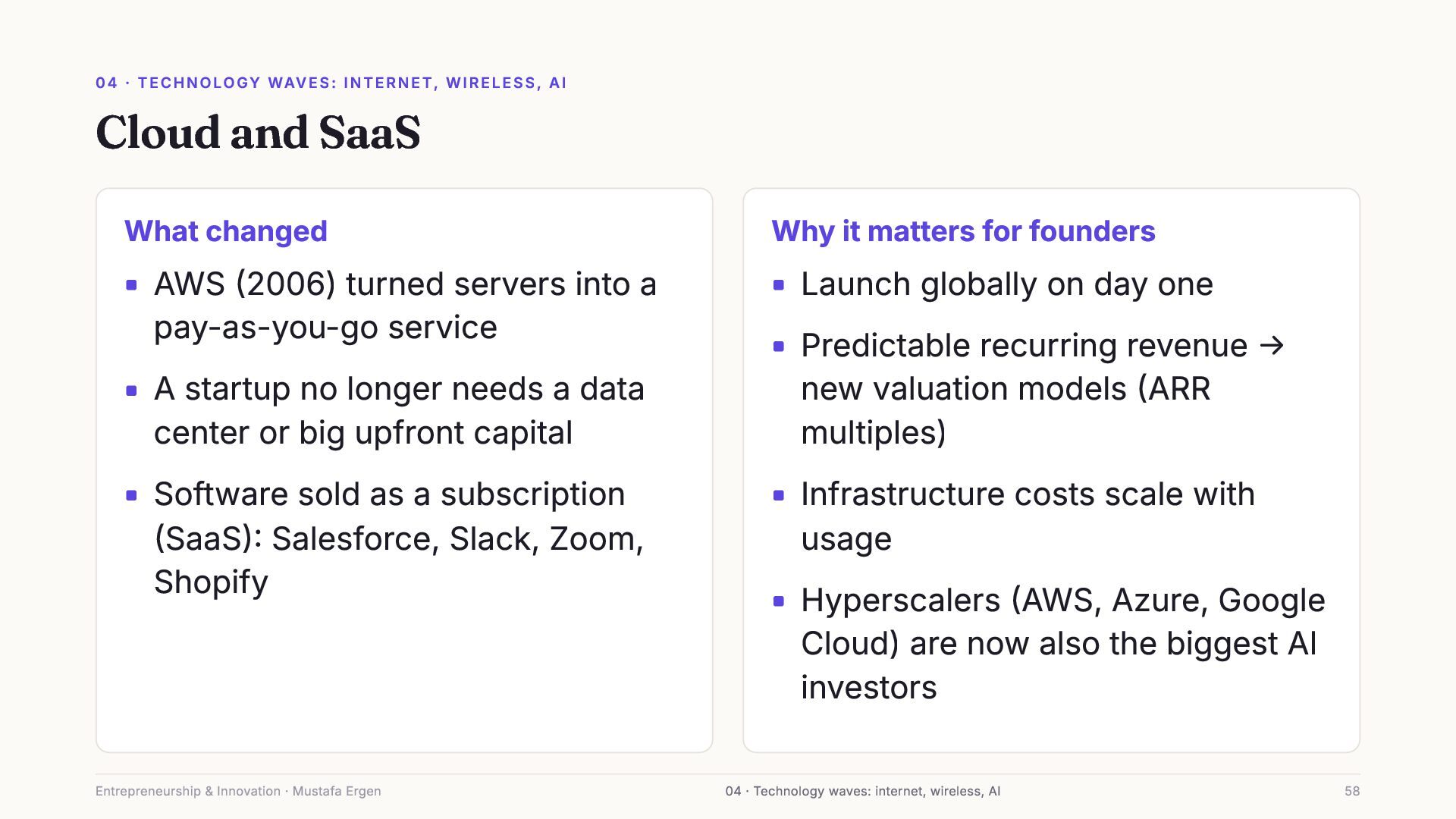
GY WAV E S : I N T E R N E T, W I R E L E S S , A I Cloud and SaaS What changed AWS (2006) turned servers into a pay-as-you-go service A startup no longer needs a data center or big upfront capital Software sold as a subscription (SaaS): Salesforce, Slack, Zoom, Shopify Entrepreneurship & Innovation · Mustafa Ergen Why it matters for founders Launch globally on day one Predictable recurring revenue → new valuation models (ARR multiples) Infrastructure costs scale with usage Hyperscalers (AWS, Azure, Google Cloud) are now also the biggest AI investors 04 · Technology waves: internet, wireless, AI 58 -
0 4 · T E C H N O LO
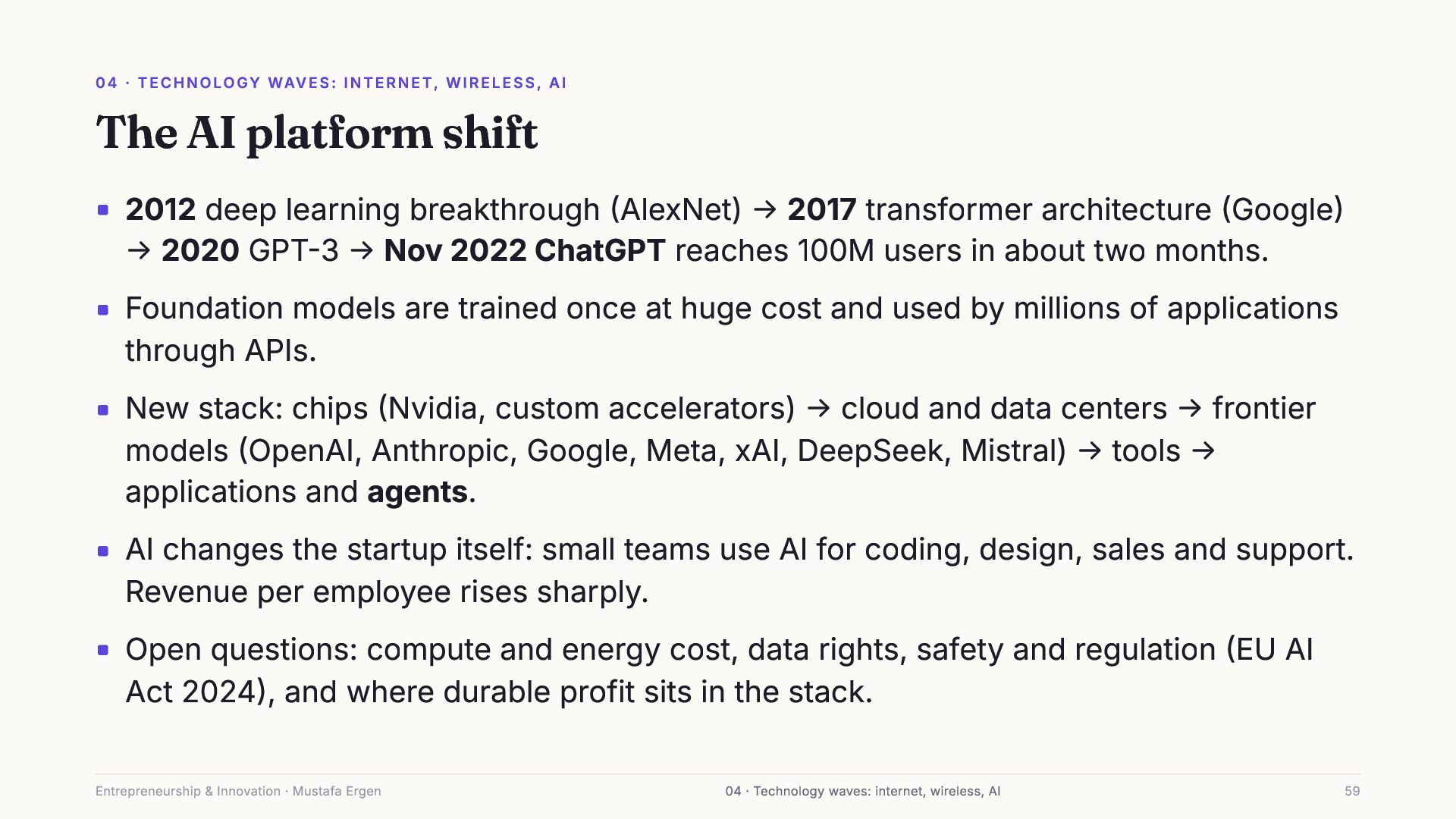
GY WAV E S : I N T E R N E T, W I R E L E S S , A I The AI platform shift 2012 deep learning breakthrough (AlexNet) → 2017 transformer architecture (Google) → 2020 GPT-3 → Nov 2022 ChatGPT reaches 100M users in about two months. Foundation models are trained once at huge cost and used by millions of applications through APIs. New stack: chips (Nvidia, custom accelerators) → cloud and data centers → frontier models (OpenAI, Anthropic, Google, Meta, xAI, DeepSeek, Mistral) → tools → applications and agents. AI changes the startup itself: small teams use AI for coding, design, sales and support. Revenue per employee rises sharply. Open questions: compute and energy cost, data rights, safety and regulation (EU AI Act 2024), and where durable profit sits in the stack. Entrepreneurship & Innovation · Mustafa Ergen 04 · Technology waves: internet, wireless, AI 59 -
0 4 · T E C H N O LO
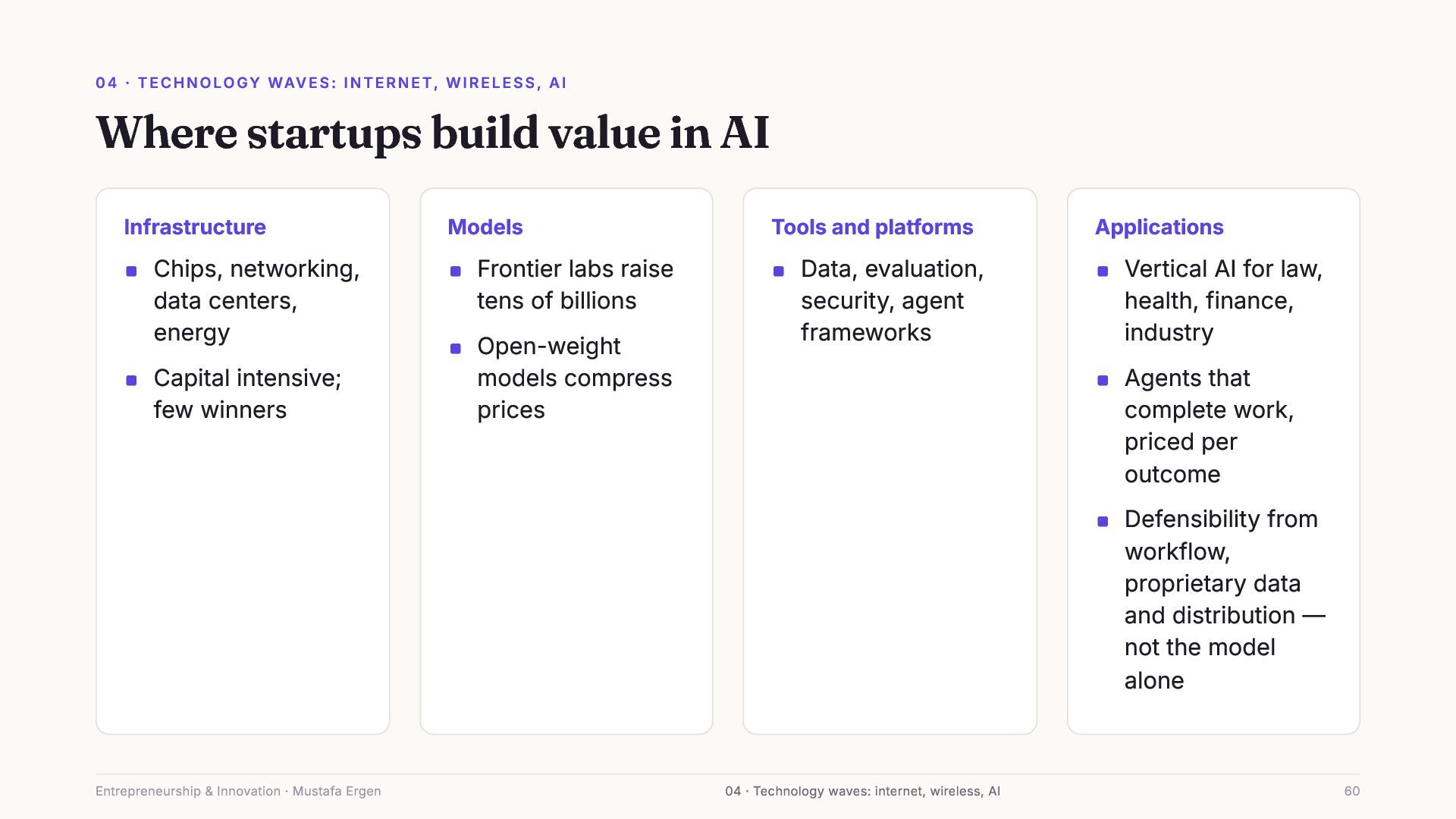
GY WAV E S : I N T E R N E T, W I R E L E S S , A I Where startups build value in AI Infrastructure Chips, networking, data centers, energy Capital intensive; few winners Entrepreneurship & Innovation · Mustafa Ergen Models Frontier labs raise tens of billions Open-weight models compress prices Tools and platforms Data, evaluation, security, agent frameworks 04 · Technology waves: internet, wireless, AI Applications Vertical AI for law, health, finance, industry Agents that complete work, priced per outcome Defensibility from workflow, proprietary data and distribution — not the model alone 60 -
05 Funding the startup Sources of capital, from personal savings
to IPO — and which one fits which stage. Three types of capital Bootstrapping Friends & family Angels and accelerators SAFEs Venture capital Debt and alternatives Entrepreneurship & Innovation · Mustafa Ergen 05 · Funding the startup 61 -
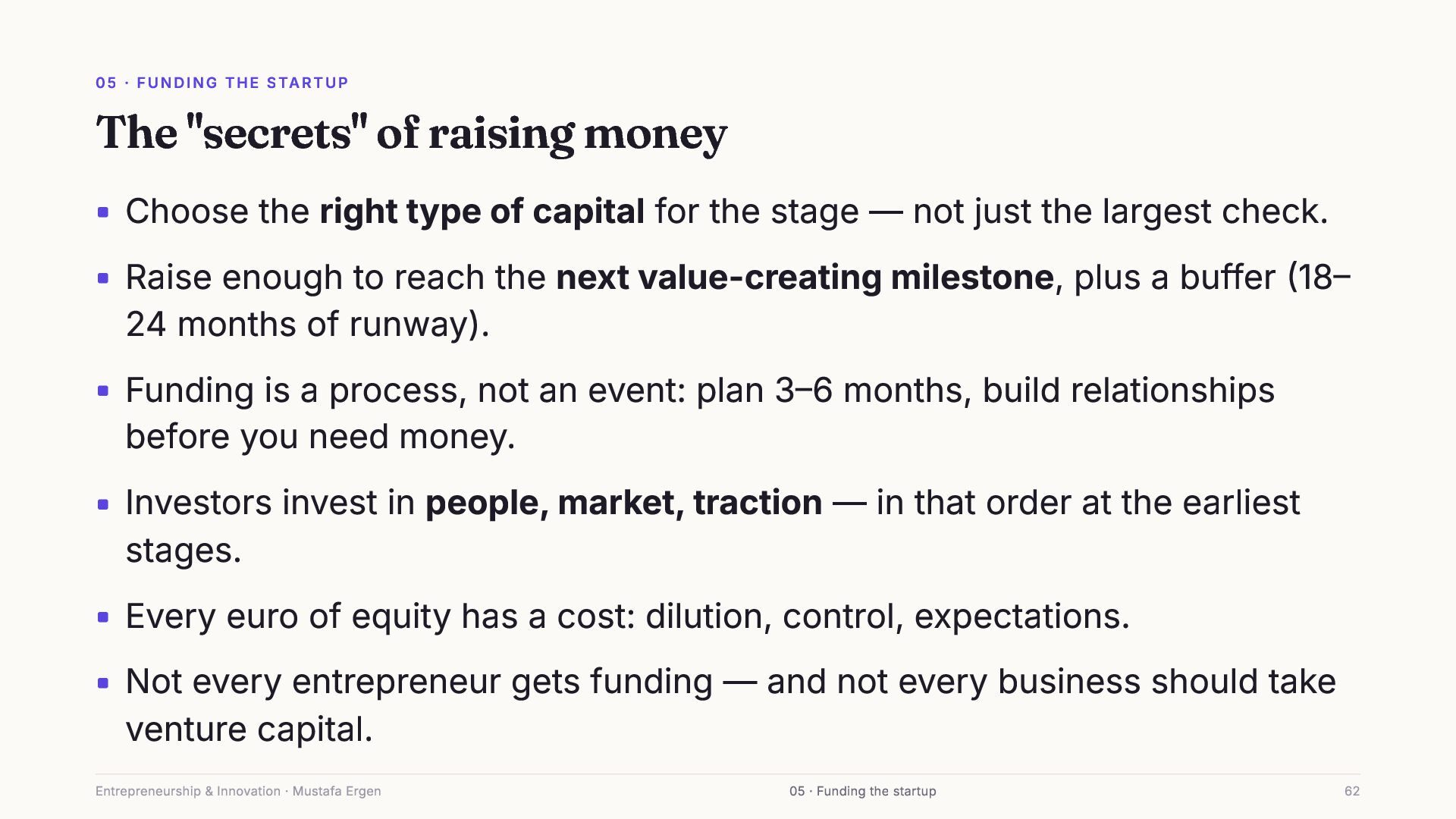
0 5 · F U N D I N G
T H E S TA R T U P The "secrets" of raising money Choose the right type of capital for the stage — not just the largest check. Raise enough to reach the next value-creating milestone, plus a buffer (18– 24 months of runway). Funding is a process, not an event: plan 3–6 months, build relationships before you need money. Investors invest in people, market, traction — in that order at the earliest stages. Every euro of equity has a cost: dilution, control, expectations. Not every entrepreneur gets funding — and not every business should take venture capital. Entrepreneurship & Innovation · Mustafa Ergen 05 · Funding the startup 62 -
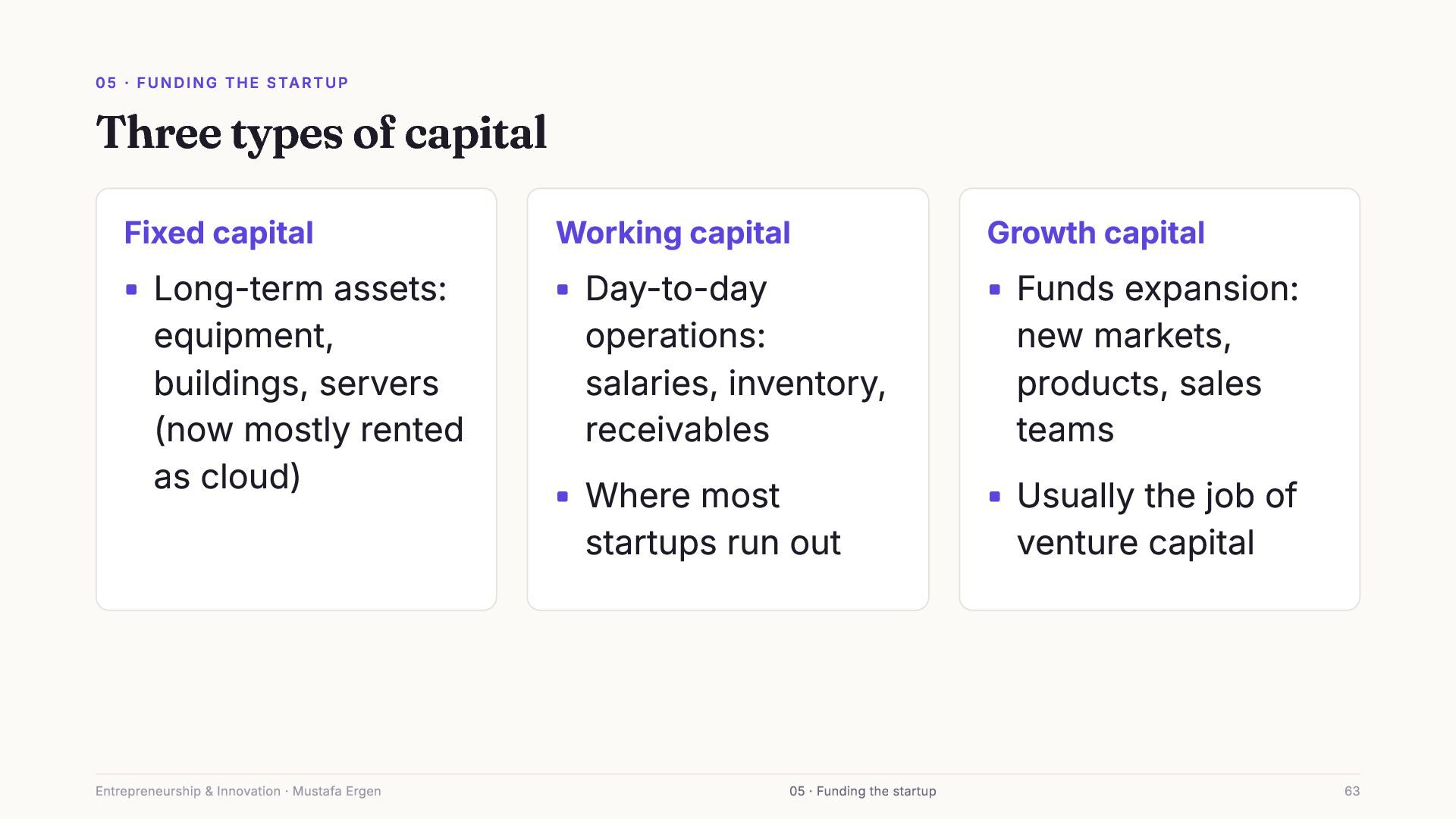
0 5 · F U N D I N G
T H E S TA R T U P Three types of capital Fixed capital Long-term assets: equipment, buildings, servers (now mostly rented as cloud) Entrepreneurship & Innovation · Mustafa Ergen Working capital Day-to-day operations: salaries, inventory, receivables Where most startups run out 05 · Funding the startup Growth capital Funds expansion: new markets, products, sales teams Usually the job of venture capital 63 -
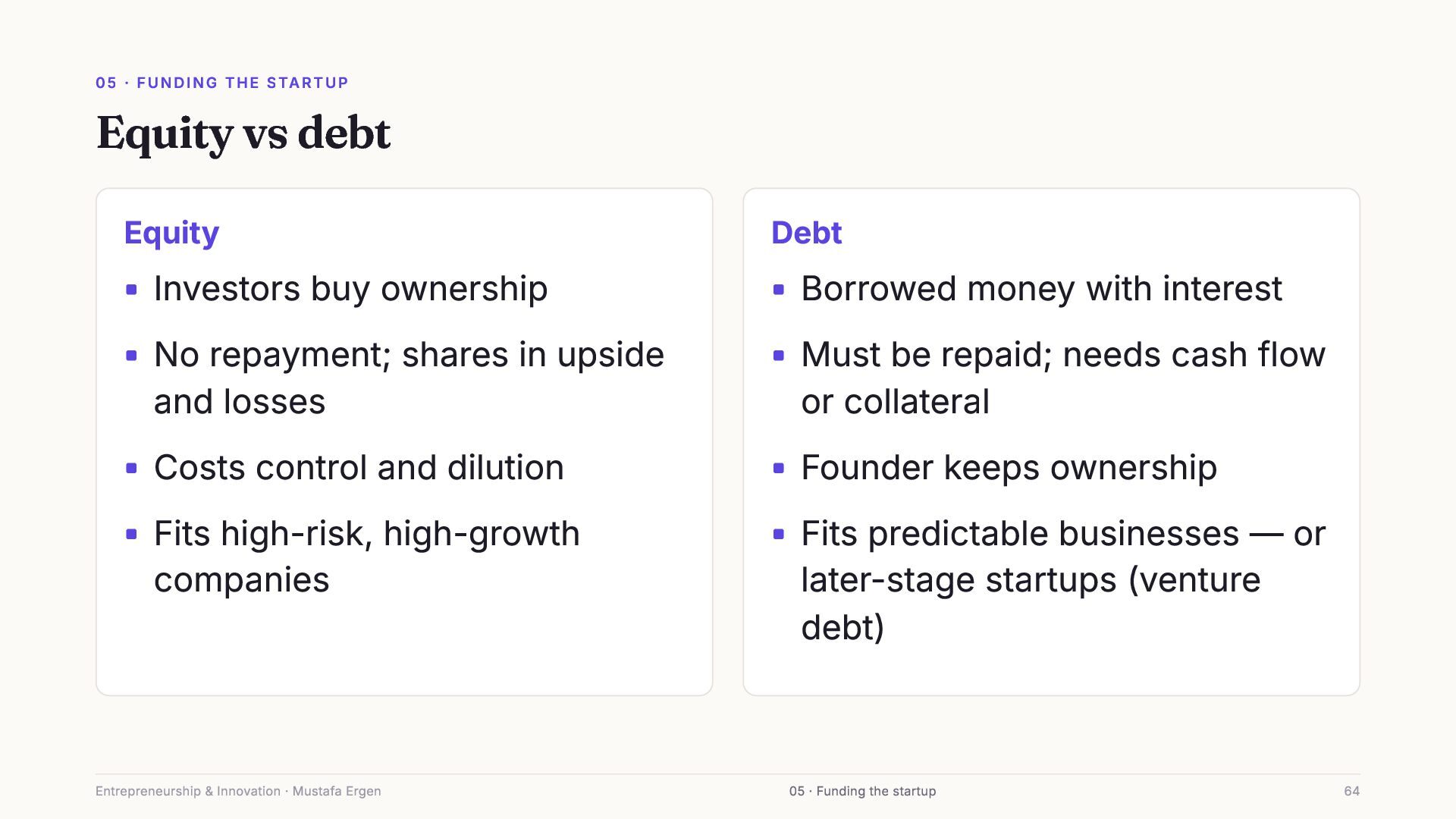
0 5 · F U N D I N G
T H E S TA R T U P Equity vs debt Equity Investors buy ownership No repayment; shares in upside and losses Costs control and dilution Fits high-risk, high-growth companies Entrepreneurship & Innovation · Mustafa Ergen Debt Borrowed money with interest Must be repaid; needs cash flow or collateral Founder keeps ownership Fits predictable businesses — or later-stage startups (venture debt) 05 · Funding the startup 64 -
0 5 · F U N D I N G
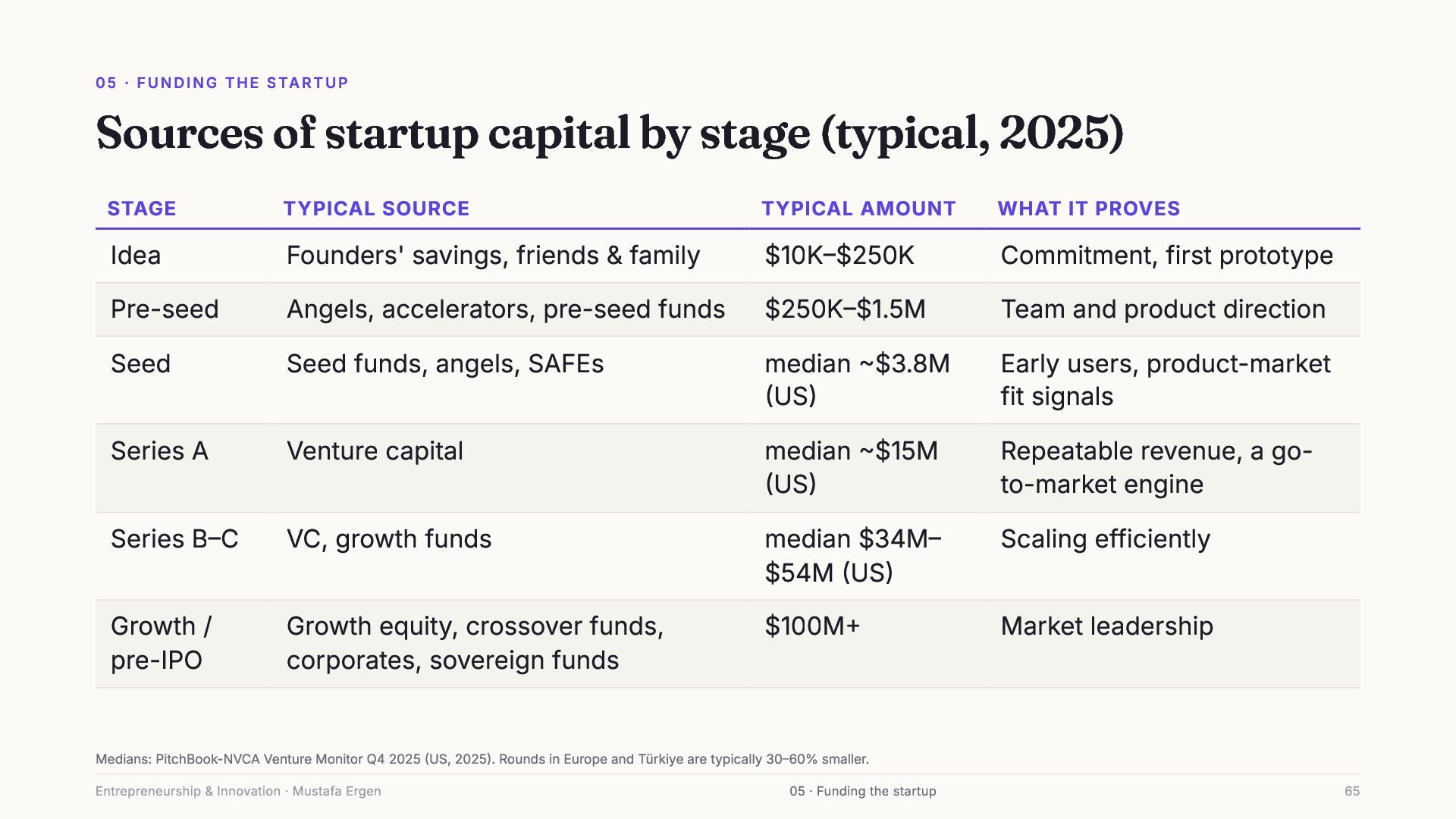
T H E S TA R T U P Sources of startup capital by stage (typical, 2025) STAGE TYPICAL SOURCE TYPICAL AMOUNT WHAT IT PROVES Idea Founders' savings, friends & family $10K–$250K Commitment, first prototype Pre-seed Angels, accelerators, pre-seed funds $250K–$1.5M Team and product direction Seed Seed funds, angels, SAFEs median ~$3.8M (US) Early users, product-market fit signals Series A Venture capital median ~$15M (US) Repeatable revenue, a goto-market engine Series B–C VC, growth funds median $34M– $54M (US) Scaling efficiently Growth / pre-IPO Growth equity, crossover funds, corporates, sovereign funds $100M+ Market leadership Medians: PitchBook-NVCA Venture Monitor Q4 2025 (US, 2025). Rounds in Europe and Türkiye are typically 30–60% smaller. Entrepreneurship & Innovation · Mustafa Ergen 05 · Funding the startup 65 -
0 5 · F U N D I N G
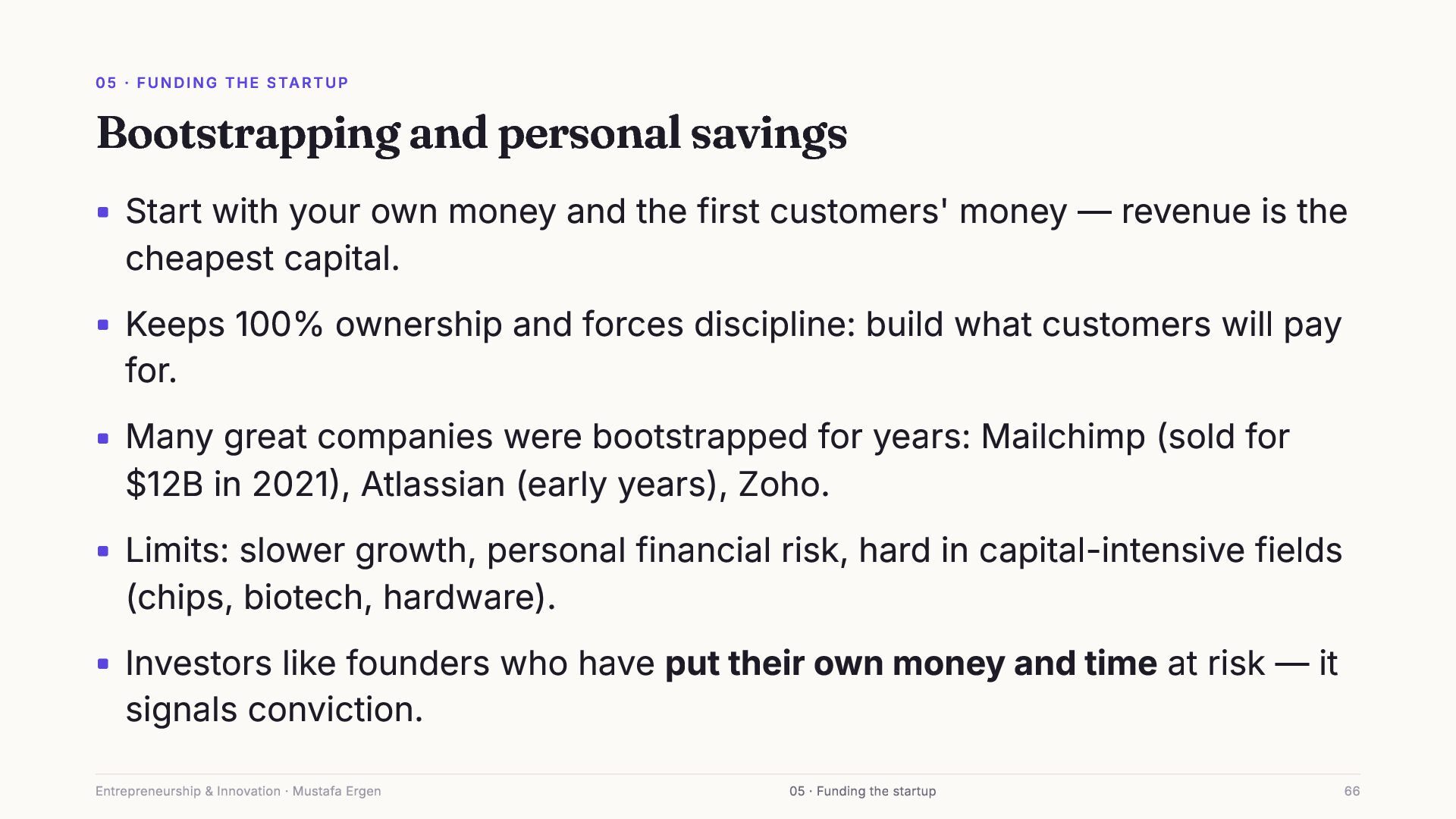
T H E S TA R T U P Bootstrapping and personal savings Start with your own money and the first customers' money — revenue is the cheapest capital. Keeps 100% ownership and forces discipline: build what customers will pay for. Many great companies were bootstrapped for years: Mailchimp (sold for $12B in 2021), Atlassian (early years), Zoho. Limits: slower growth, personal financial risk, hard in capital-intensive fields (chips, biotech, hardware). Investors like founders who have put their own money and time at risk — it signals conviction. Entrepreneurship & Innovation · Mustafa Ergen 05 · Funding the startup 66 -
0 5 · F U N D I N G
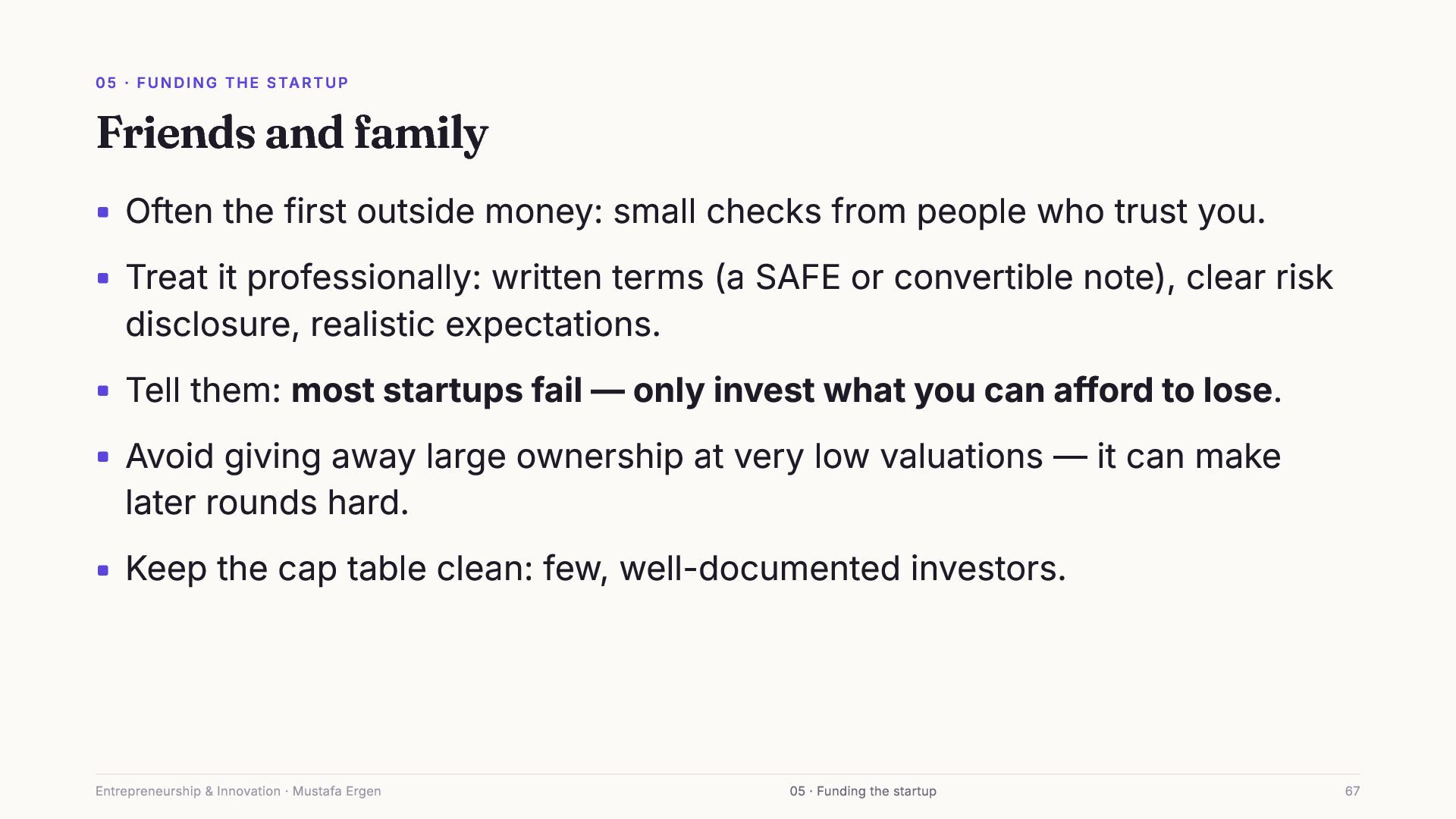
T H E S TA R T U P Friends and family Often the first outside money: small checks from people who trust you. Treat it professionally: written terms (a SAFE or convertible note), clear risk disclosure, realistic expectations. Tell them: most startups fail — only invest what you can afford to lose. Avoid giving away large ownership at very low valuations — it can make later rounds hard. Keep the cap table clean: few, well-documented investors. Entrepreneurship & Innovation · Mustafa Ergen 05 · Funding the startup 67 -
0 5 · F U N D I N G
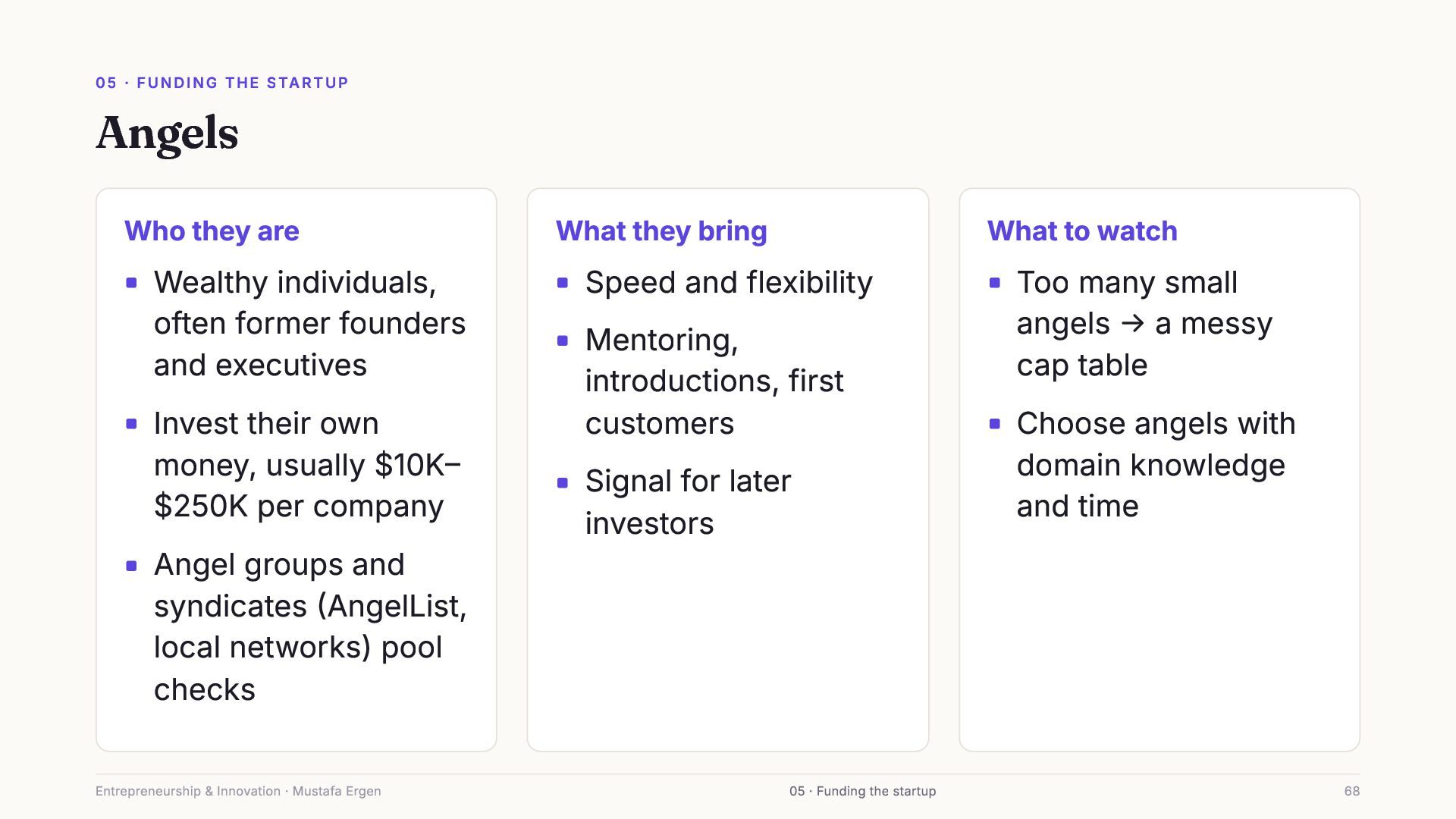
T H E S TA R T U P Angels Who they are Wealthy individuals, often former founders and executives Invest their own money, usually $10K– $250K per company Angel groups and syndicates (AngelList, local networks) pool checks Entrepreneurship & Innovation · Mustafa Ergen What they bring What to watch Speed and flexibility Mentoring, introductions, first customers Signal for later investors 05 · Funding the startup Too many small angels → a messy cap table Choose angels with domain knowledge and time 68 -
0 5 · F U N D I N G
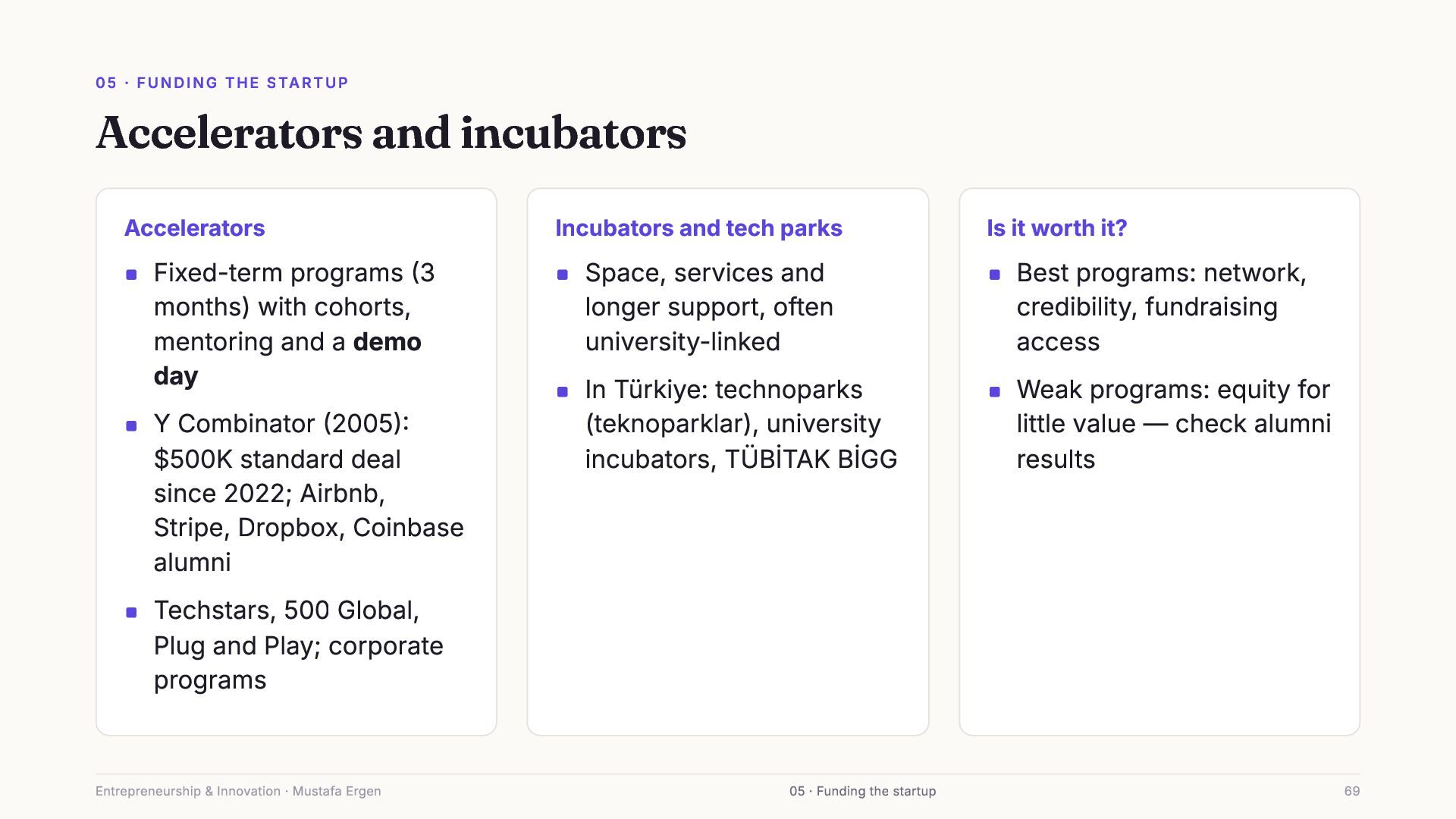
T H E S TA R T U P Accelerators and incubators Accelerators Fixed-term programs (3 months) with cohorts, mentoring and a demo day Y Combinator (2005): $500K standard deal since 2022; Airbnb, Stripe, Dropbox, Coinbase alumni Techstars, 500 Global, Plug and Play; corporate programs Entrepreneurship & Innovation · Mustafa Ergen Incubators and tech parks Space, services and longer support, often university-linked In Türkiye: technoparks (teknoparklar), university incubators, TÜBİTAK BİGG 05 · Funding the startup Is it worth it? Best programs: network, credibility, fundraising access Weak programs: equity for little value — check alumni results 69 -
0 5 · F U N D I N G
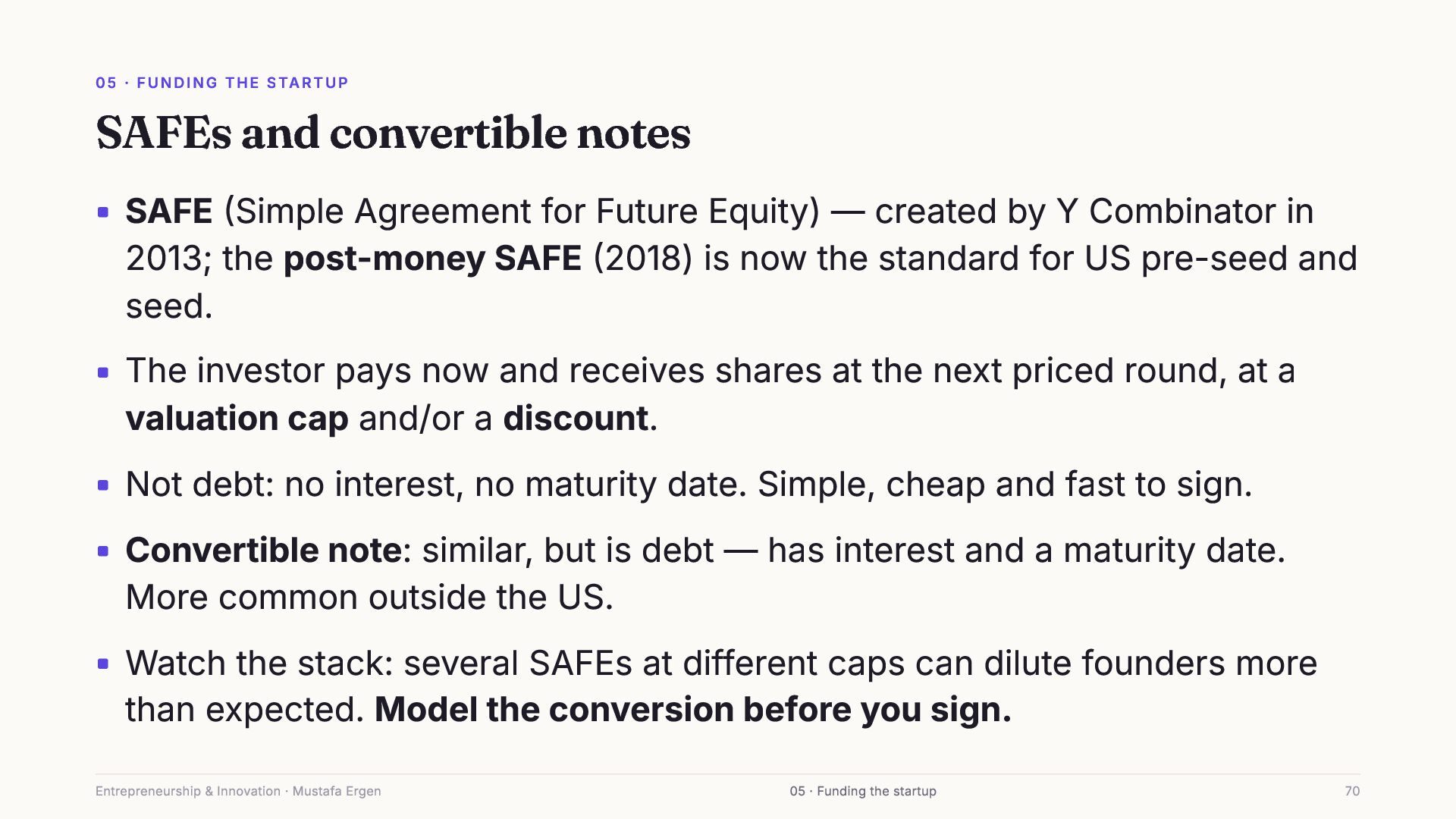
T H E S TA R T U P SAFEs and convertible notes SAFE (Simple Agreement for Future Equity) — created by Y Combinator in 2013; the post-money SAFE (2018) is now the standard for US pre-seed and seed. The investor pays now and receives shares at the next priced round, at a valuation cap and/or a discount. Not debt: no interest, no maturity date. Simple, cheap and fast to sign. Convertible note: similar, but is debt — has interest and a maturity date. More common outside the US. Watch the stack: several SAFEs at different caps can dilute founders more than expected. Model the conversion before you sign. Entrepreneurship & Innovation · Mustafa Ergen 05 · Funding the startup 70 -
0 5 · F U N D I N G
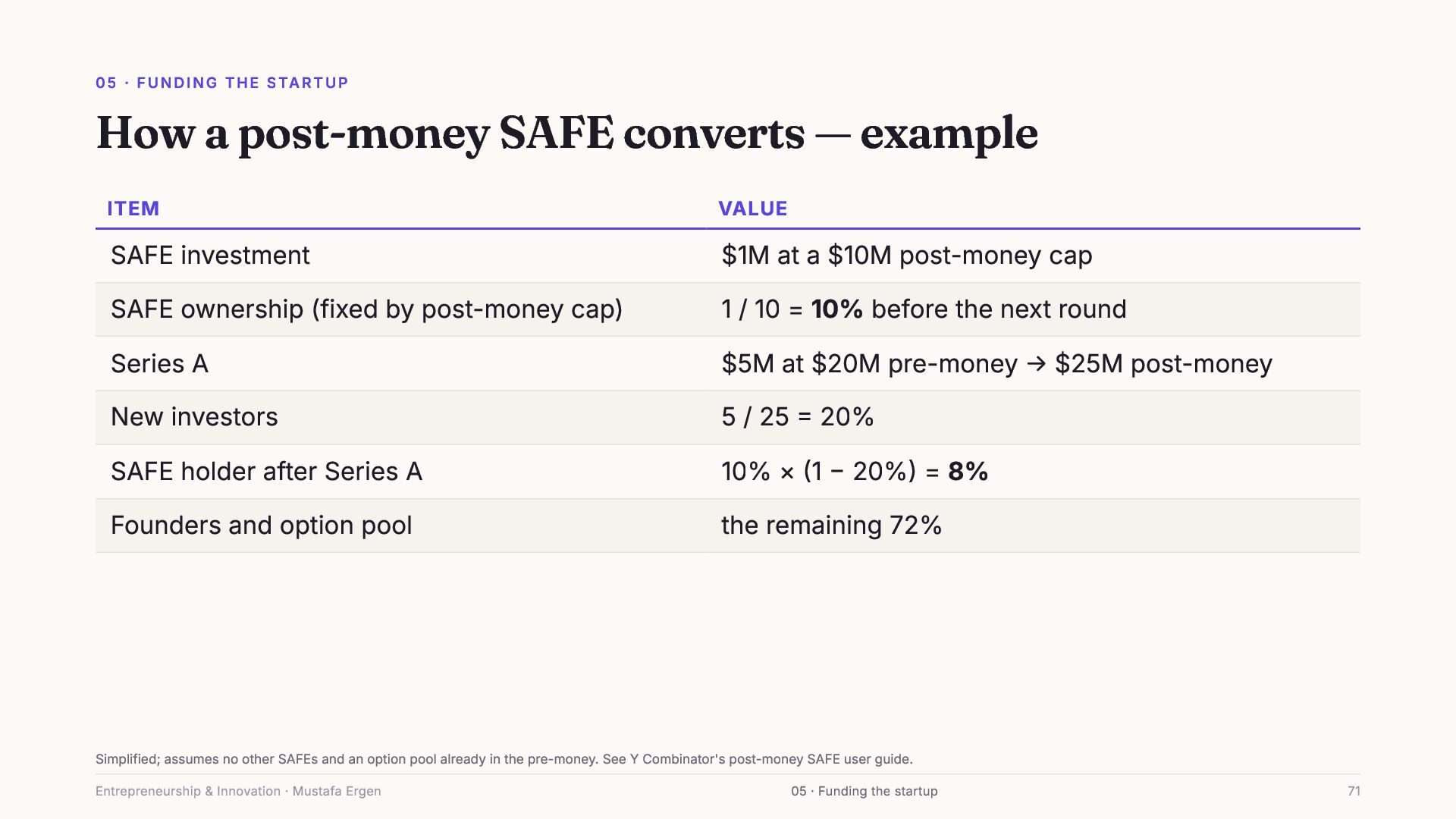
T H E S TA R T U P How a post-money SAFE converts — example ITEM VALUE SAFE investment $1M at a $10M post-money cap SAFE ownership (fixed by post-money cap) 1 / 10 = 10% before the next round Series A $5M at $20M pre-money → $25M post-money New investors 5 / 25 = 20% SAFE holder after Series A 10% × (1 − 20%) = 8% Founders and option pool the remaining 72% Simplified; assumes no other SAFEs and an option pool already in the pre-money. See Y Combinator's post-money SAFE user guide. Entrepreneurship & Innovation · Mustafa Ergen 05 · Funding the startup 71 -
0 5 · F U N D I N G
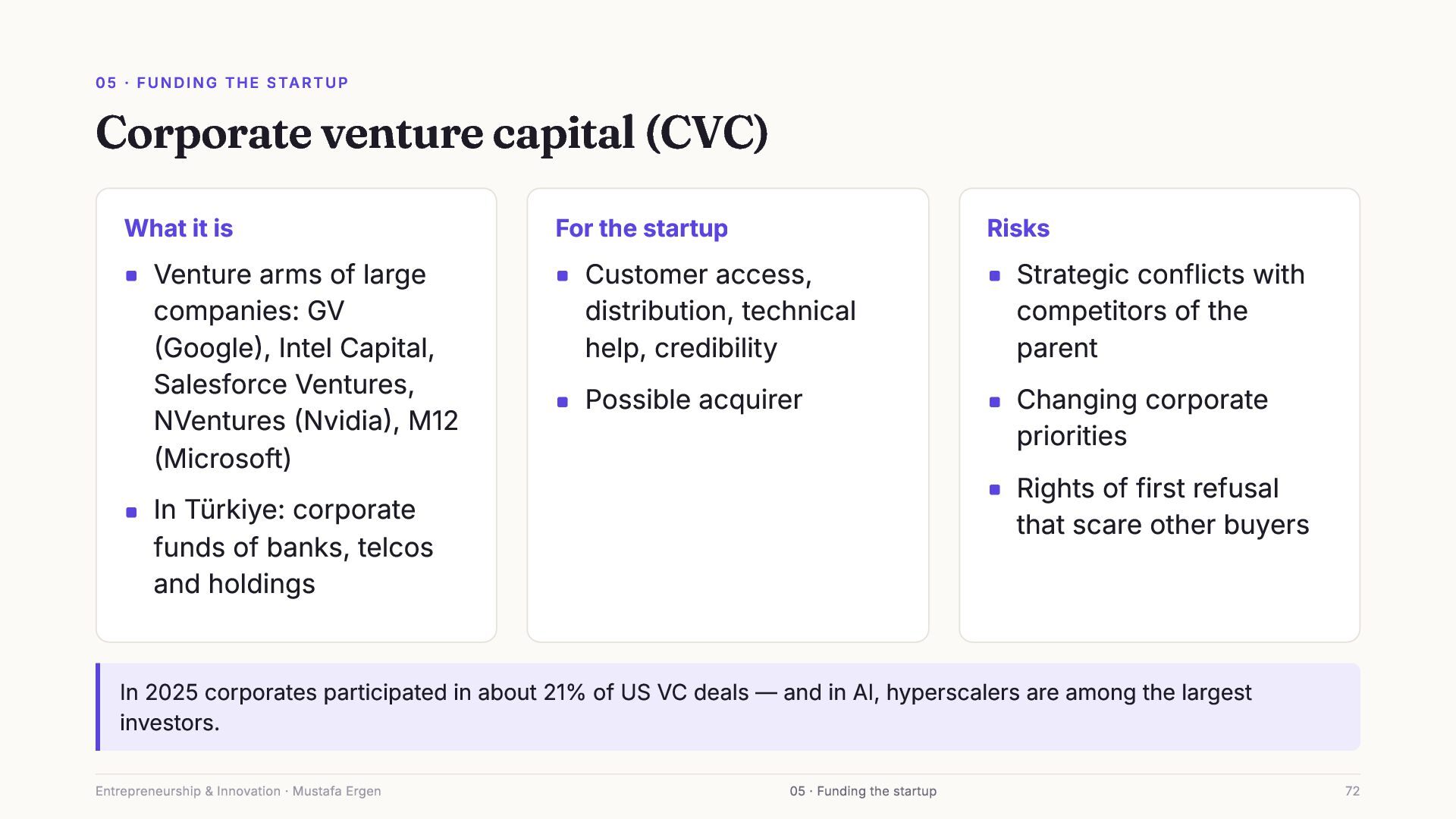
T H E S TA R T U P Corporate venture capital (CVC) What it is Venture arms of large companies: GV (Google), Intel Capital, Salesforce Ventures, NVentures (Nvidia), M12 (Microsoft) In Türkiye: corporate funds of banks, telcos and holdings For the startup Risks Customer access, distribution, technical help, credibility Possible acquirer Strategic conflicts with competitors of the parent Changing corporate priorities Rights of first refusal that scare other buyers In 2025 corporates participated in about 21% of US VC deals — and in AI, hyperscalers are among the largest investors. Entrepreneurship & Innovation · Mustafa Ergen 05 · Funding the startup 72 -
0 5 · F U N D I N G
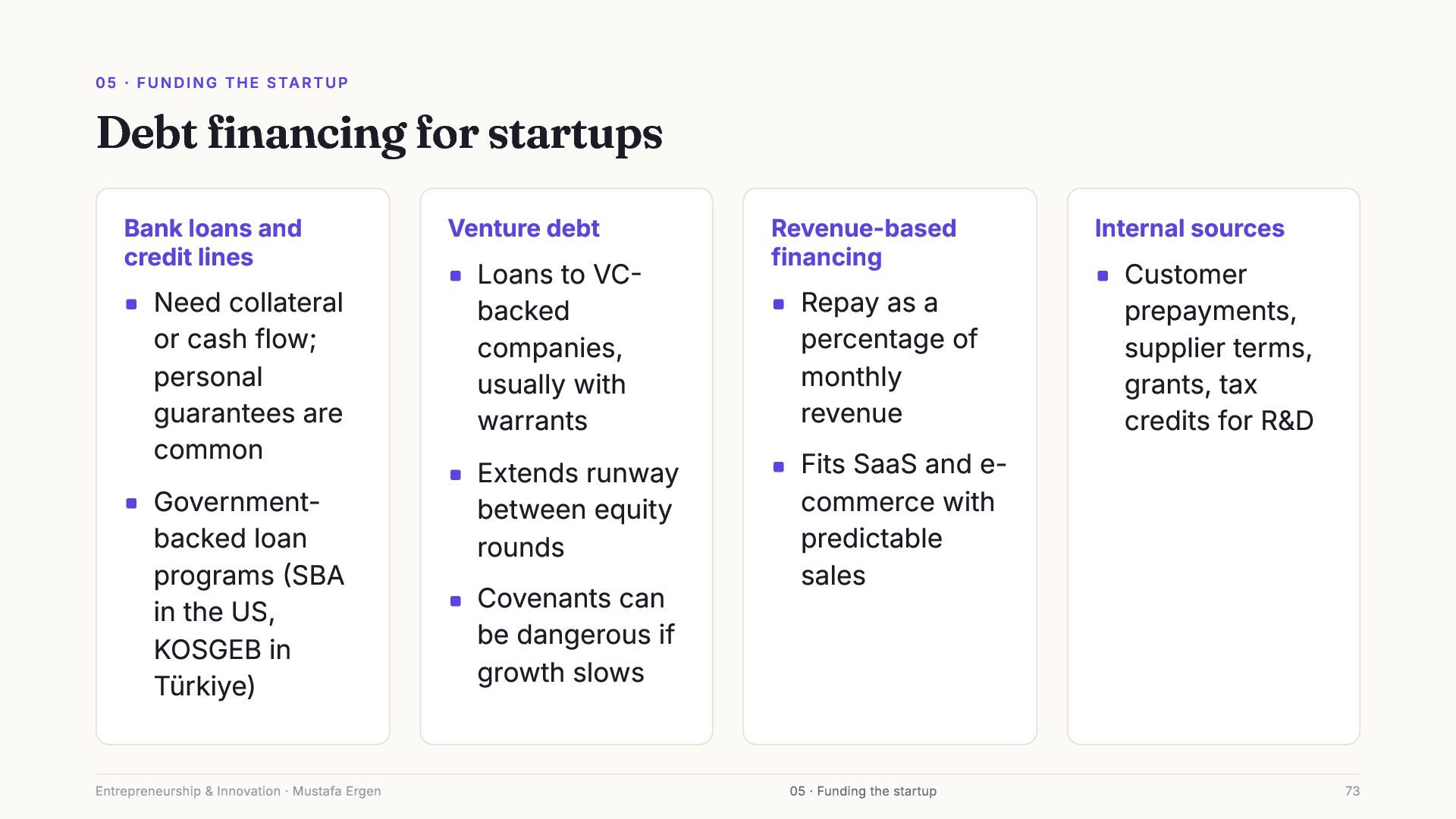
T H E S TA R T U P Debt financing for startups Bank loans and credit lines Need collateral or cash flow; personal guarantees are common Governmentbacked loan programs (SBA in the US, KOSGEB in Türkiye) Entrepreneurship & Innovation · Mustafa Ergen Venture debt Loans to VCbacked companies, usually with warrants Extends runway between equity rounds Covenants can be dangerous if growth slows Revenue-based financing Repay as a percentage of monthly revenue Fits SaaS and ecommerce with predictable sales 05 · Funding the startup Internal sources Customer prepayments, supplier terms, grants, tax credits for R&D 73 -
0 5 · F U N D I N G
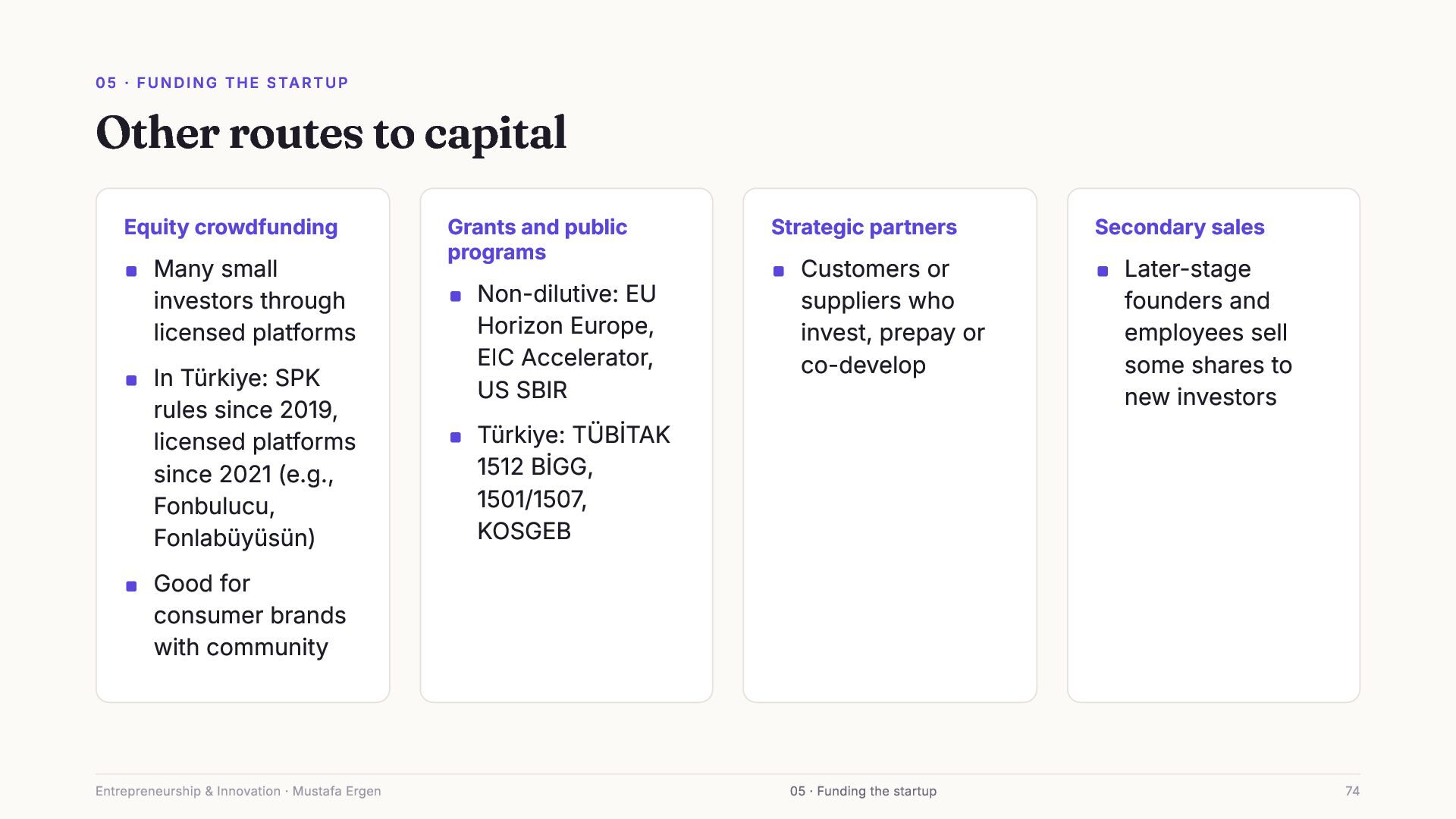
T H E S TA R T U P Other routes to capital Equity crowdfunding Many small investors through licensed platforms In Türkiye: SPK rules since 2019, licensed platforms since 2021 (e.g., Fonbulucu, Fonlabüyüsün) Good for consumer brands with community Entrepreneurship & Innovation · Mustafa Ergen Grants and public programs Non-dilutive: EU Horizon Europe, EIC Accelerator, US SBIR Türkiye: TÜBİTAK 1512 BİGG, 1501/1507, KOSGEB Strategic partners Customers or suppliers who invest, prepay or co-develop 05 · Funding the startup Secondary sales Later-stage founders and employees sell some shares to new investors 74 -
06 How venture capital works The money behind high-tech startups:
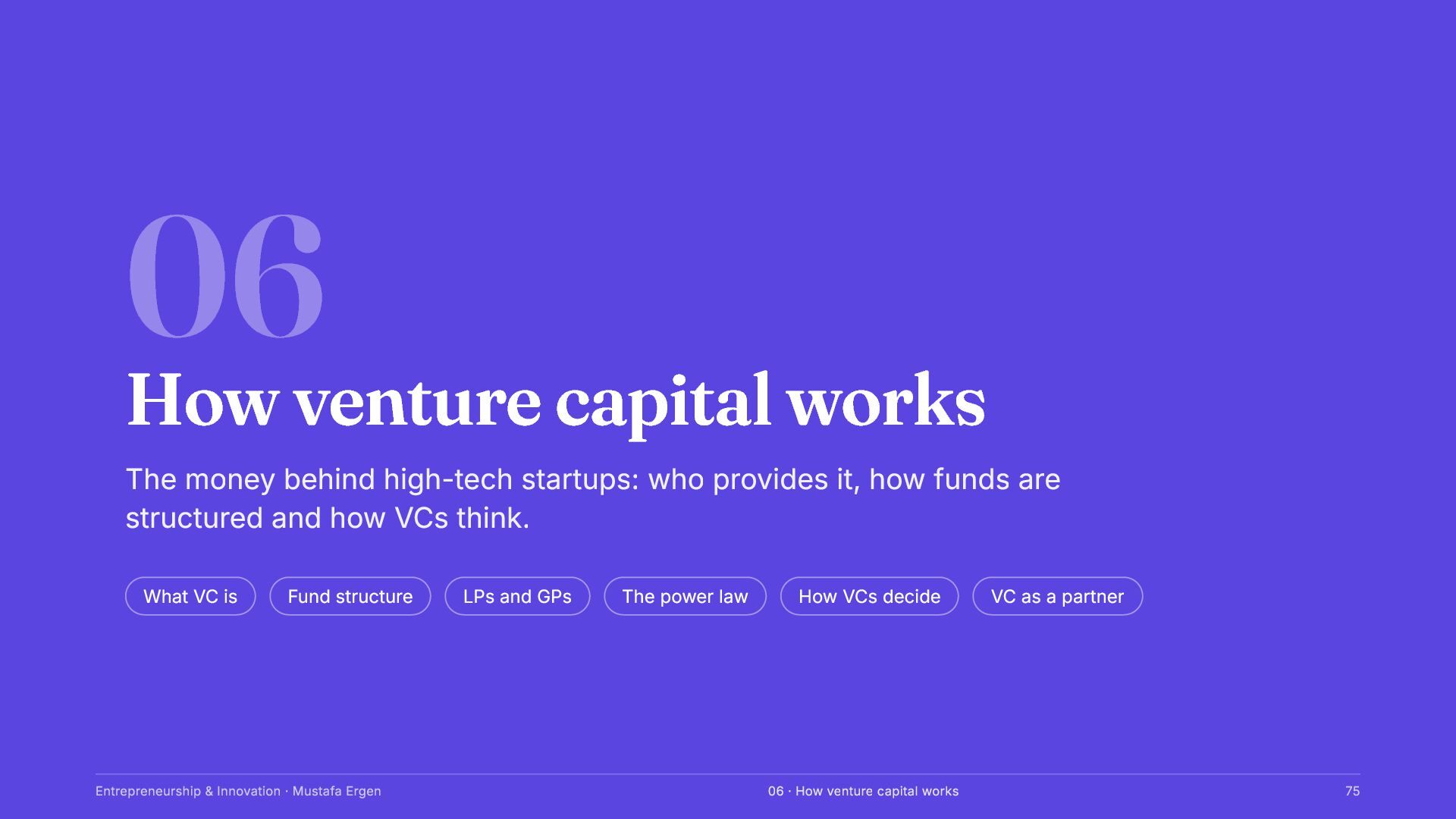
who provides it, how funds are structured and how VCs think. What VC is Fund structure Entrepreneurship & Innovation · Mustafa Ergen LPs and GPs The power law How VCs decide 06 · How venture capital works VC as a partner 75 -
0 6 · H OW V E N T U
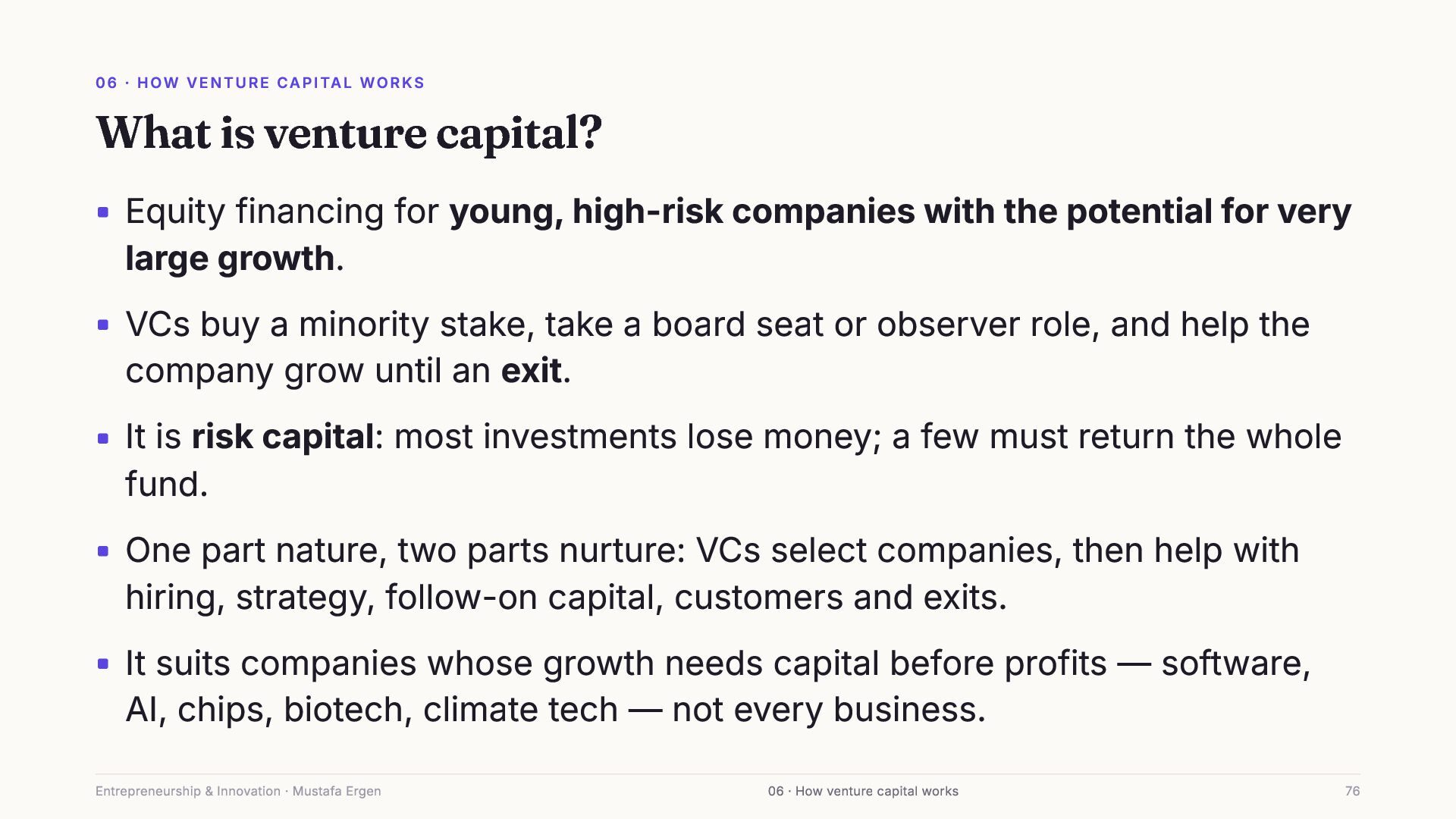
R E CA P I TA L WO R KS What is venture capital? Equity financing for young, high-risk companies with the potential for very large growth. VCs buy a minority stake, take a board seat or observer role, and help the company grow until an exit. It is risk capital: most investments lose money; a few must return the whole fund. One part nature, two parts nurture: VCs select companies, then help with hiring, strategy, follow-on capital, customers and exits. It suits companies whose growth needs capital before profits — software, AI, chips, biotech, climate tech — not every business. Entrepreneurship & Innovation · Mustafa Ergen 06 · How venture capital works 76 -
0 6 · H OW V E N T U
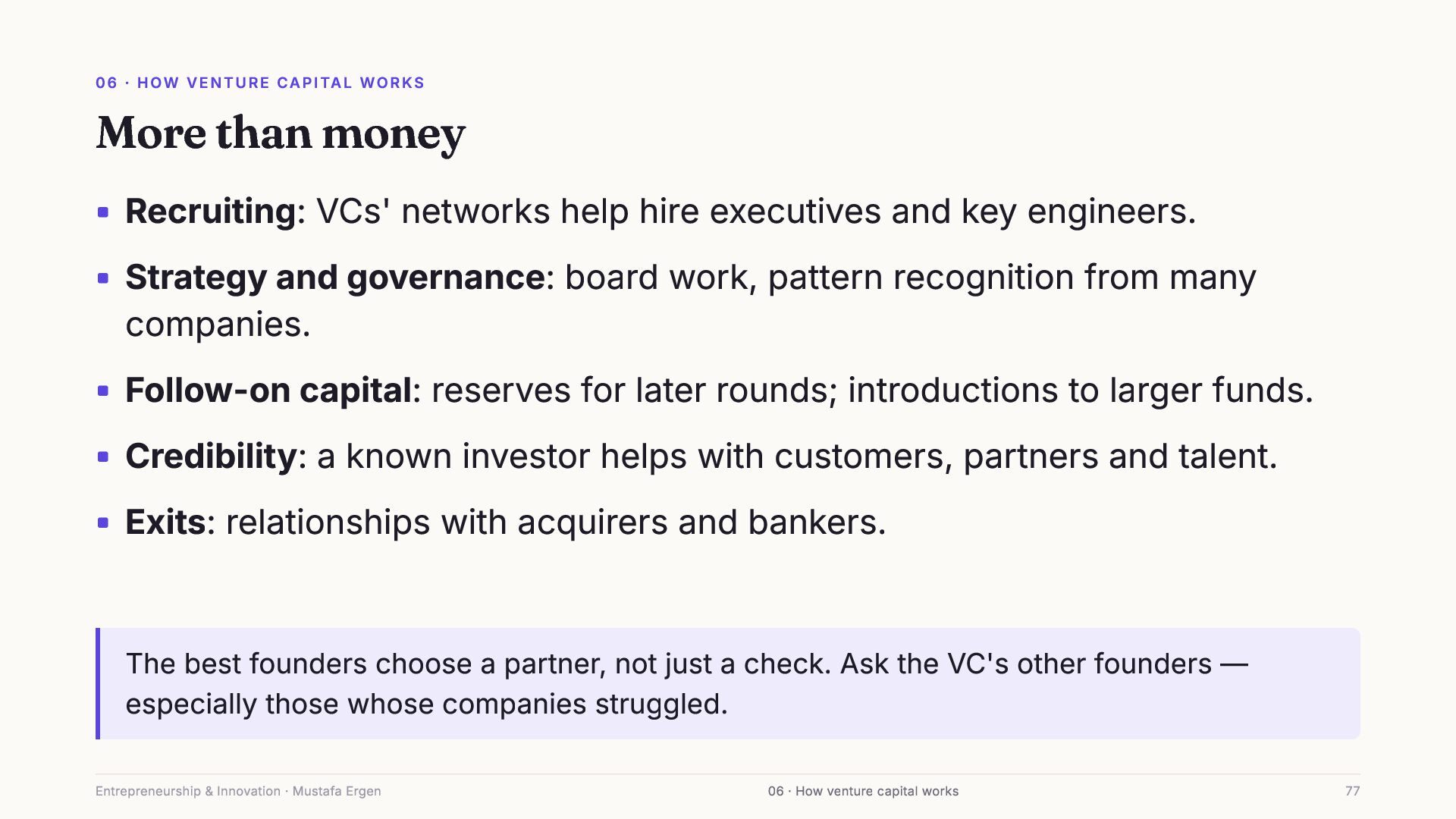
R E CA P I TA L WO R KS More than money Recruiting: VCs' networks help hire executives and key engineers. Strategy and governance: board work, pattern recognition from many companies. Follow-on capital: reserves for later rounds; introductions to larger funds. Credibility: a known investor helps with customers, partners and talent. Exits: relationships with acquirers and bankers. The best founders choose a partner, not just a check. Ask the VC's other founders — especially those whose companies struggled. Entrepreneurship & Innovation · Mustafa Ergen 06 · How venture capital works 77 -
0 6 · H OW V E N T U
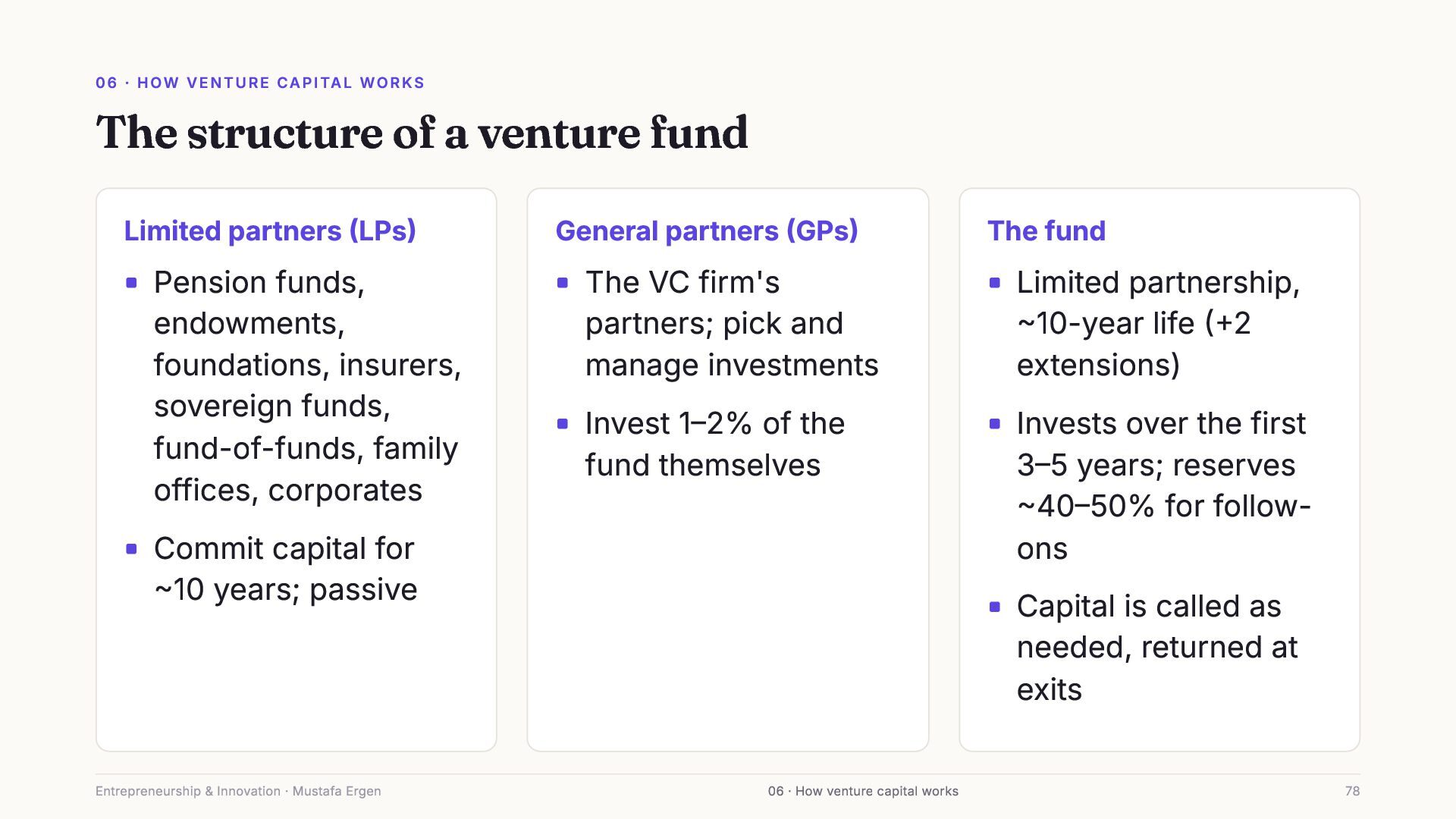
R E CA P I TA L WO R KS The structure of a venture fund Limited partners (LPs) Pension funds, endowments, foundations, insurers, sovereign funds, fund-of-funds, family offices, corporates Commit capital for ~10 years; passive Entrepreneurship & Innovation · Mustafa Ergen General partners (GPs) The VC firm's partners; pick and manage investments Invest 1–2% of the fund themselves 06 · How venture capital works The fund Limited partnership, ~10-year life (+2 extensions) Invests over the first 3–5 years; reserves ~40–50% for followons Capital is called as needed, returned at exits 78 -
0 6 · H OW V E N T U
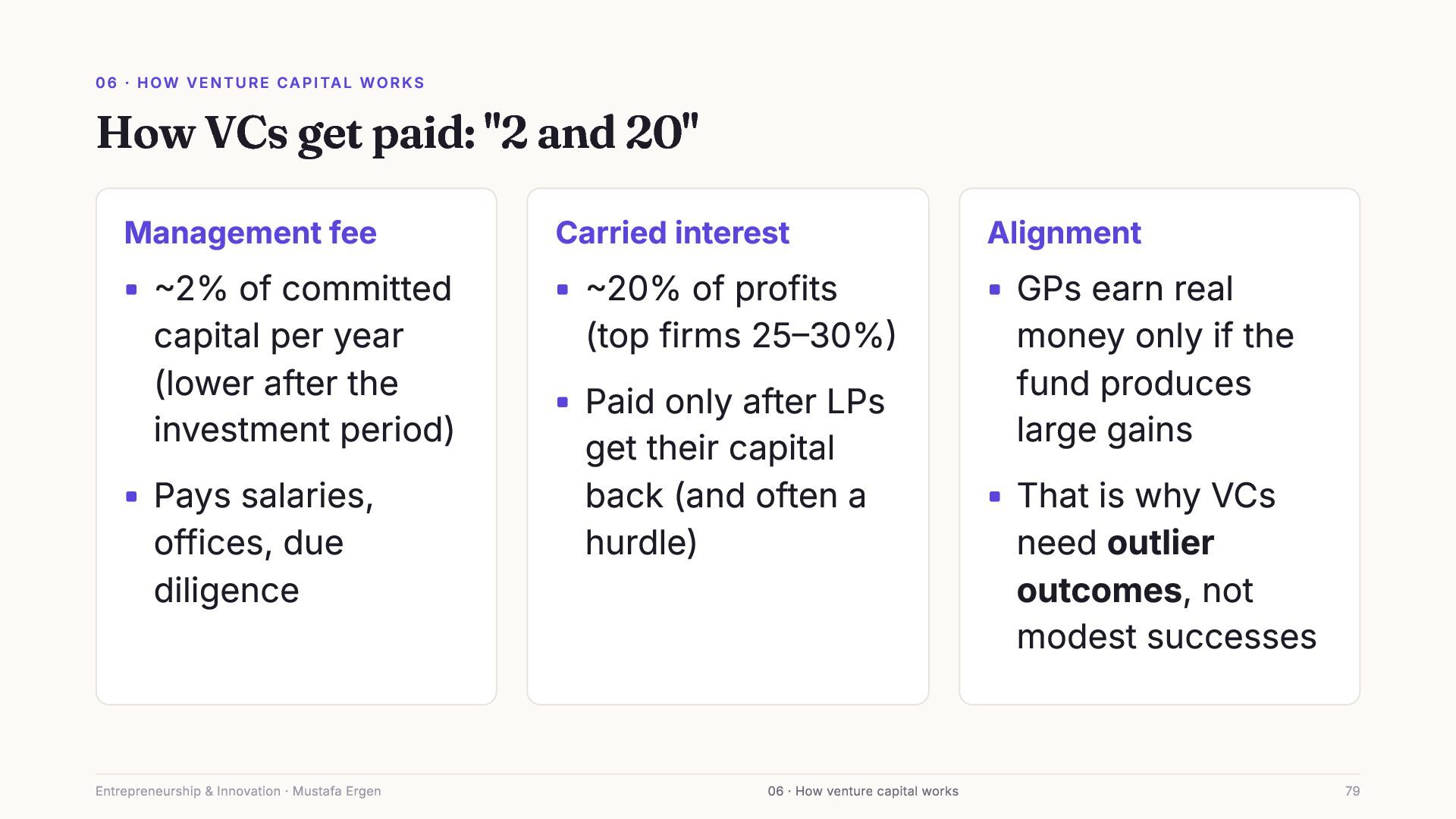
R E CA P I TA L WO R KS How VCs get paid: "2 and 20" Management fee ~2% of committed capital per year (lower after the investment period) Pays salaries, offices, due diligence Entrepreneurship & Innovation · Mustafa Ergen Carried interest ~20% of profits (top firms 25–30%) Paid only after LPs get their capital back (and often a hurdle) 06 · How venture capital works Alignment GPs earn real money only if the fund produces large gains That is why VCs need outlier outcomes, not modest successes 79 -
0 6 · H OW V E N T U
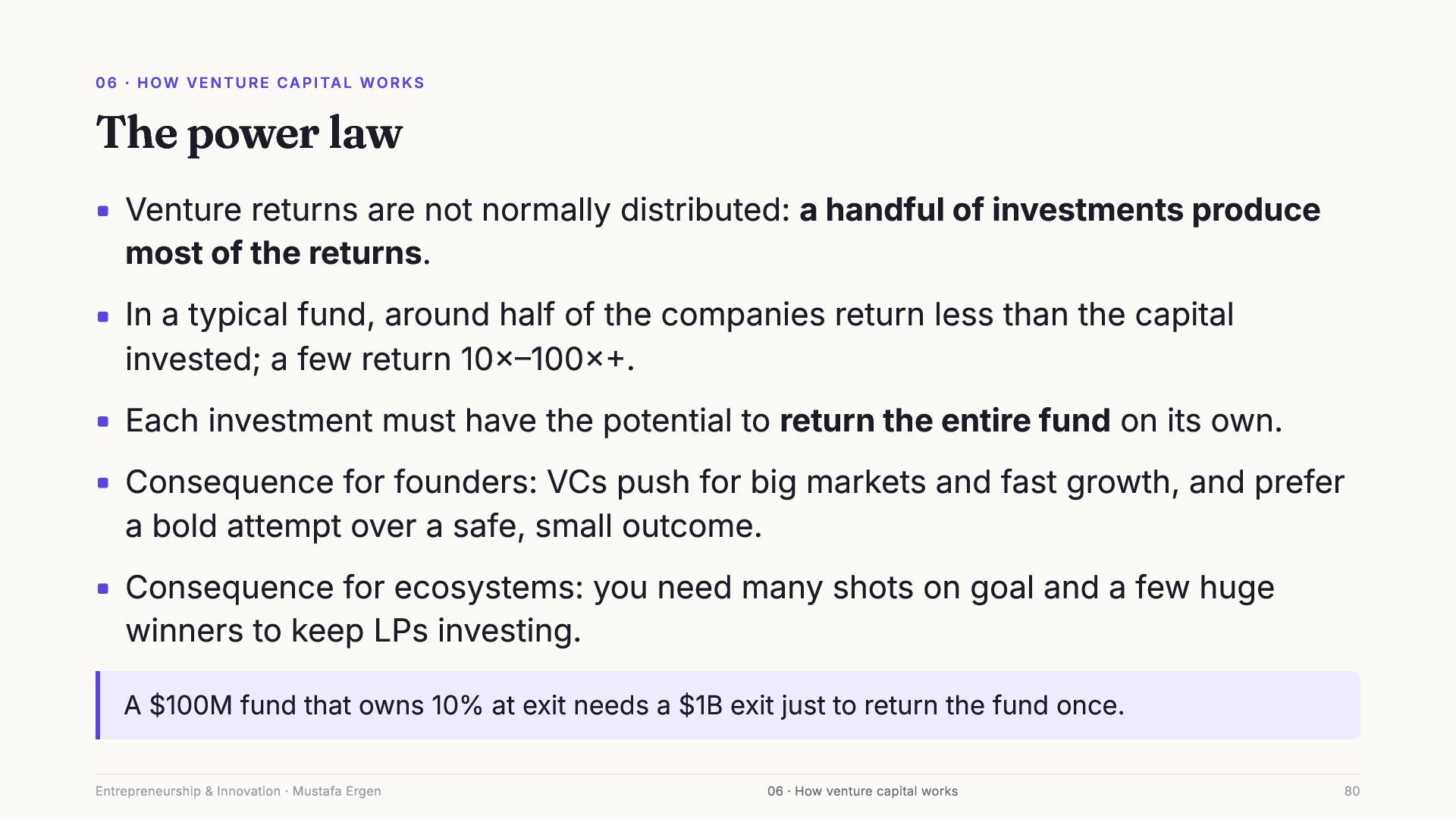
R E CA P I TA L WO R KS The power law Venture returns are not normally distributed: a handful of investments produce most of the returns. In a typical fund, around half of the companies return less than the capital invested; a few return 10×–100×+. Each investment must have the potential to return the entire fund on its own. Consequence for founders: VCs push for big markets and fast growth, and prefer a bold attempt over a safe, small outcome. Consequence for ecosystems: you need many shots on goal and a few huge winners to keep LPs investing. A $100M fund that owns 10% at exit needs a $1B exit just to return the fund once. Entrepreneurship & Innovation · Mustafa Ergen 06 · How venture capital works 80 -
0 6 · H OW V E N T U
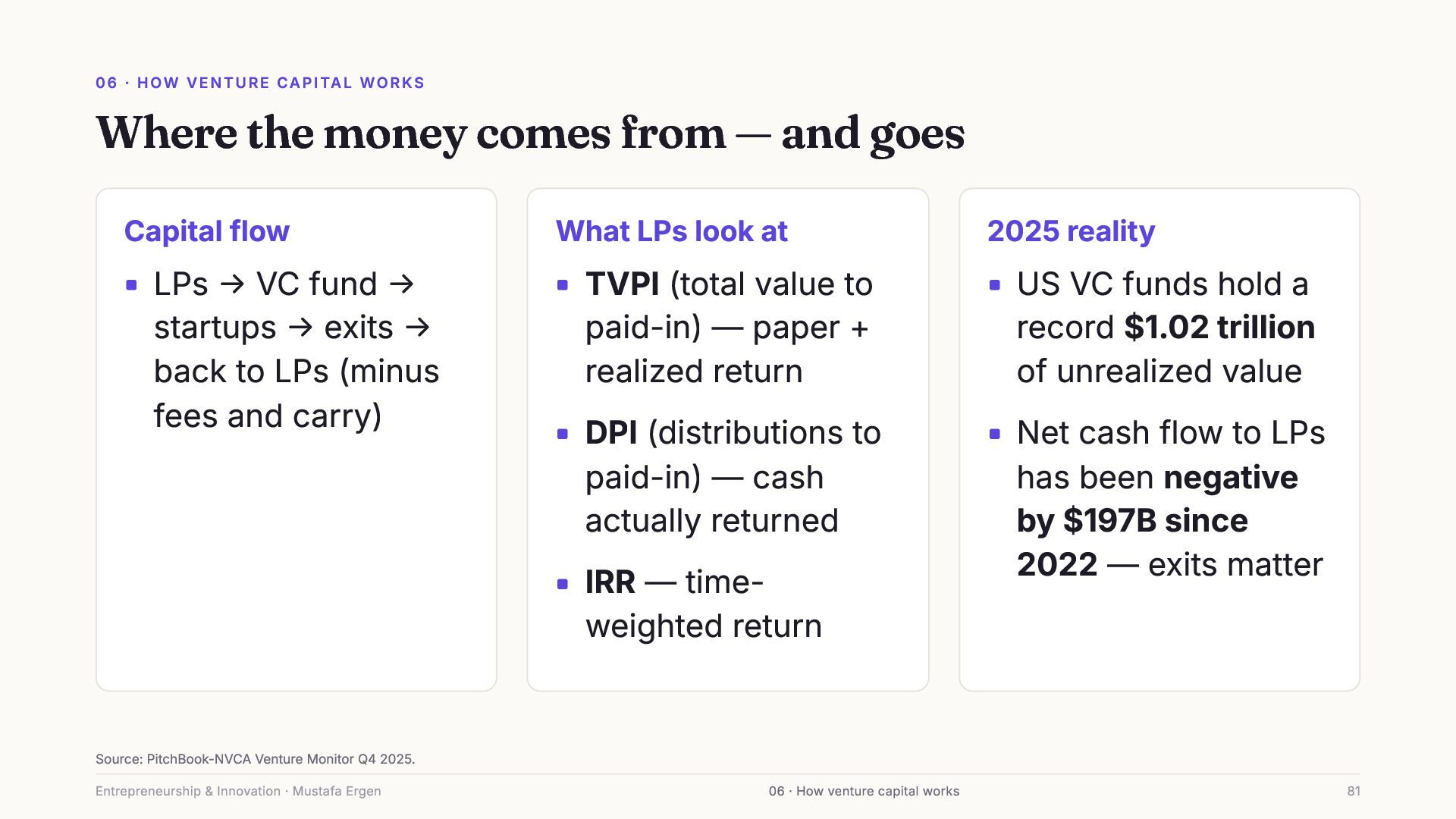
R E CA P I TA L WO R KS Where the money comes from — and goes Capital flow LPs → VC fund → startups → exits → back to LPs (minus fees and carry) What LPs look at TVPI (total value to paid-in) — paper + realized return DPI (distributions to paid-in) — cash actually returned IRR — timeweighted return 2025 reality US VC funds hold a record $1.02 trillion of unrealized value Net cash flow to LPs has been negative by $197B since 2022 — exits matter Source: PitchBook-NVCA Venture Monitor Q4 2025. Entrepreneurship & Innovation · Mustafa Ergen 06 · How venture capital works 81 -
0 6 · H OW V E N T U
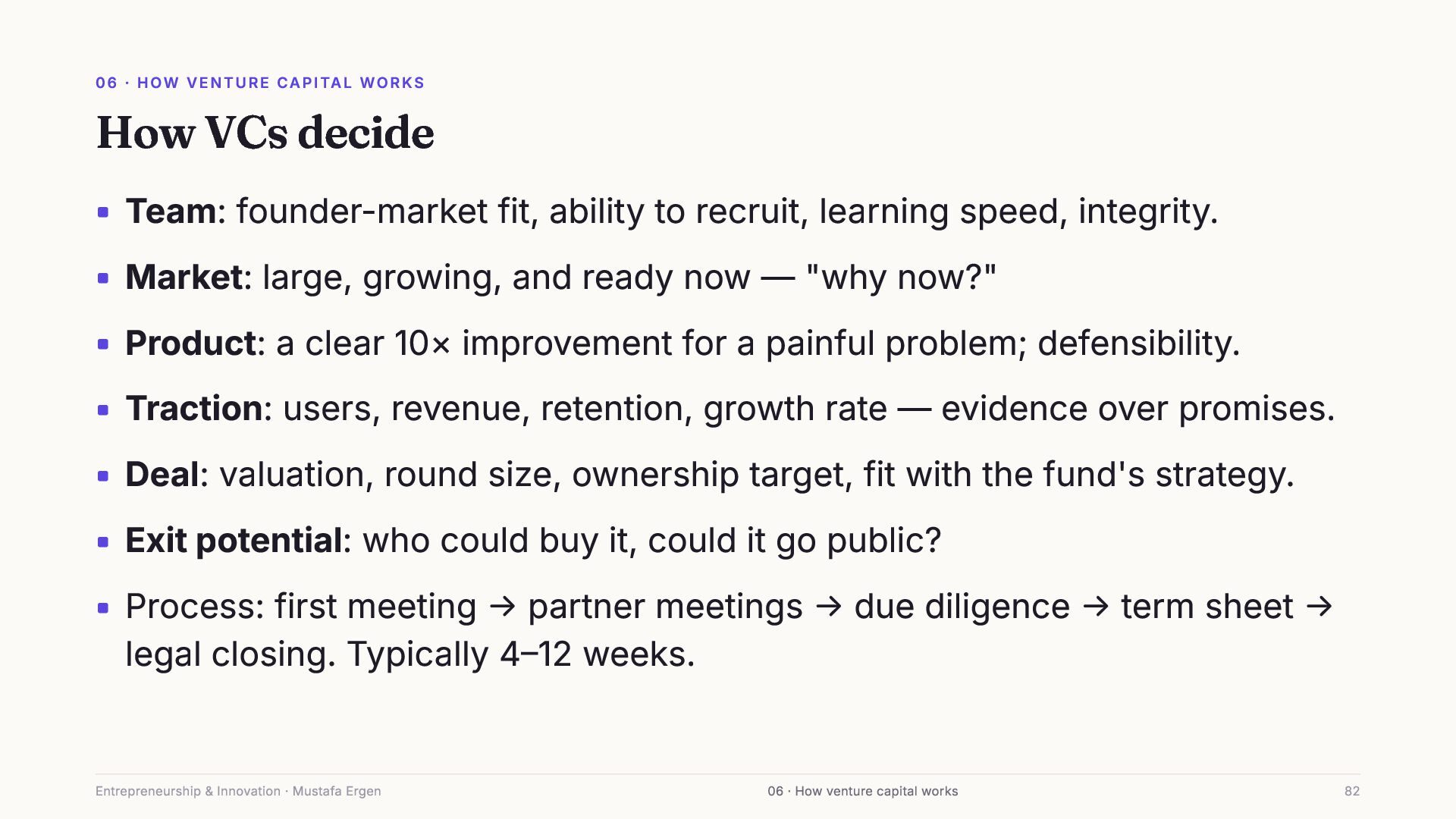
R E CA P I TA L WO R KS How VCs decide Team: founder-market fit, ability to recruit, learning speed, integrity. Market: large, growing, and ready now — "why now?" Product: a clear 10× improvement for a painful problem; defensibility. Traction: users, revenue, retention, growth rate — evidence over promises. Deal: valuation, round size, ownership target, fit with the fund's strategy. Exit potential: who could buy it, could it go public? Process: first meeting → partner meetings → due diligence → term sheet → legal closing. Typically 4–12 weeks. Entrepreneurship & Innovation · Mustafa Ergen 06 · How venture capital works 82 -
0 6 · H OW V E N T U
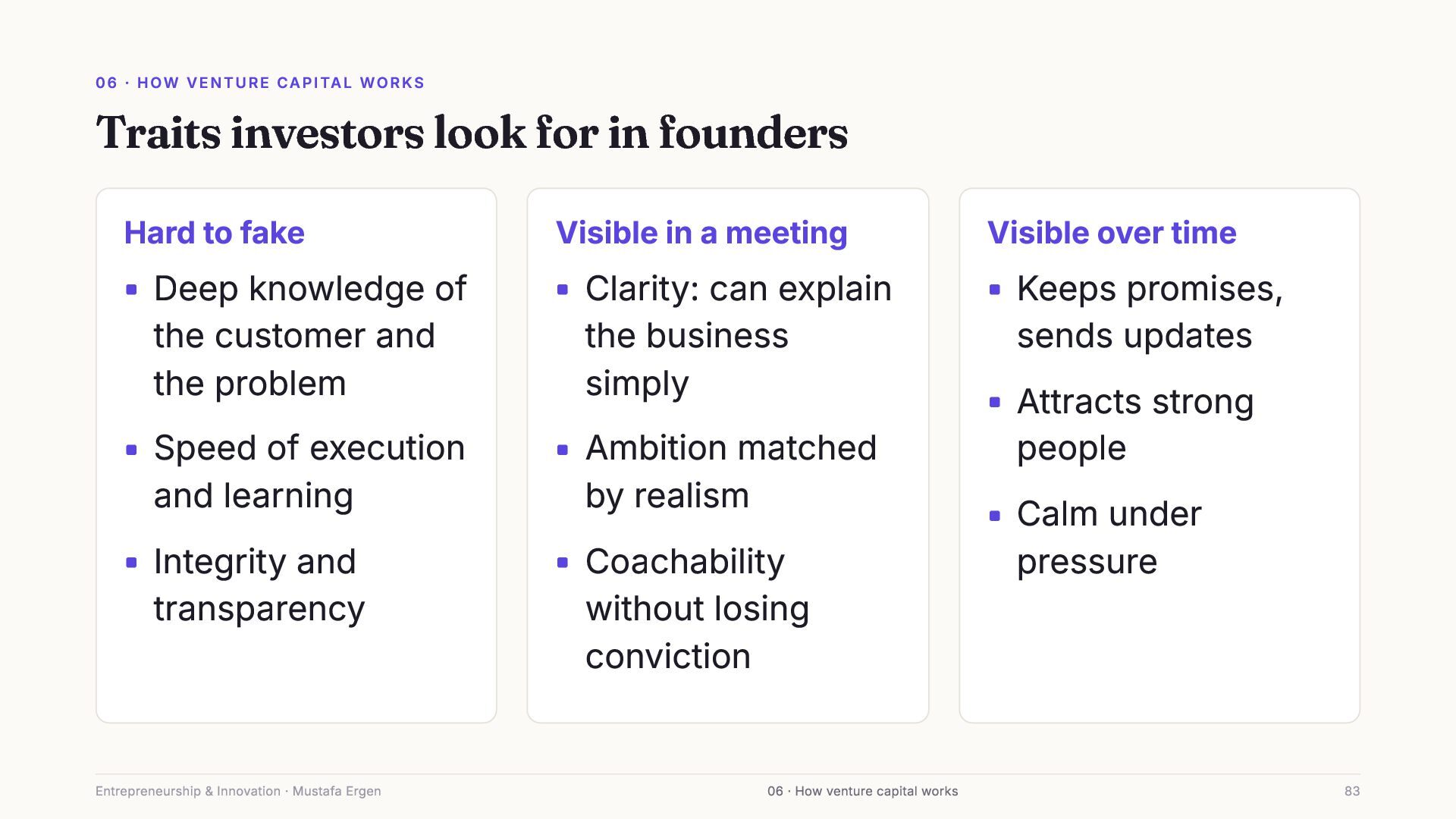
R E CA P I TA L WO R KS Traits investors look for in founders Hard to fake Deep knowledge of the customer and the problem Speed of execution and learning Integrity and transparency Entrepreneurship & Innovation · Mustafa Ergen Visible in a meeting Clarity: can explain the business simply Ambition matched by realism Coachability without losing conviction 06 · How venture capital works Visible over time Keeps promises, sends updates Attracts strong people Calm under pressure 83 -
0 6 · H OW V E N T U
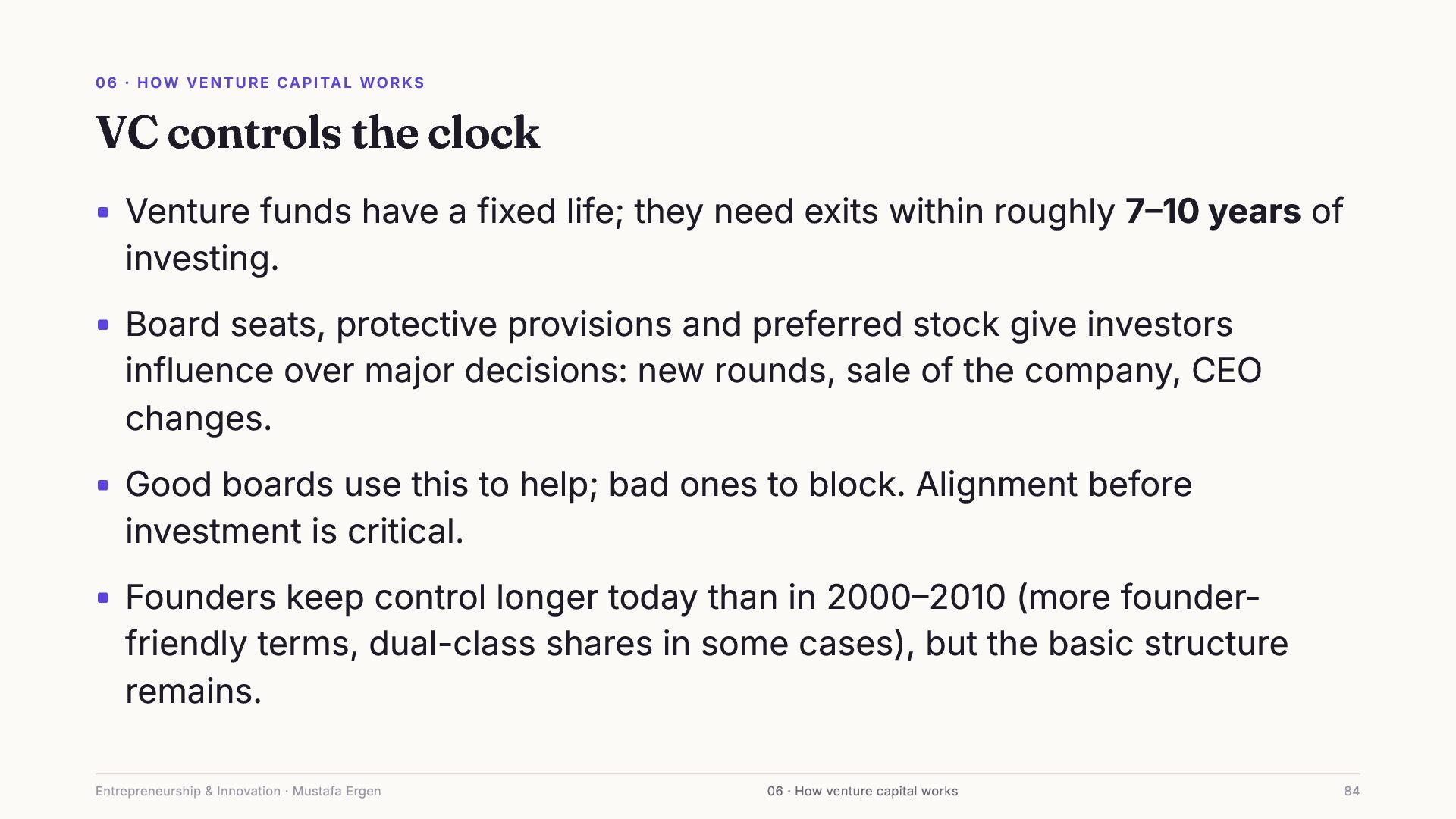
R E CA P I TA L WO R KS VC controls the clock Venture funds have a fixed life; they need exits within roughly 7–10 years of investing. Board seats, protective provisions and preferred stock give investors influence over major decisions: new rounds, sale of the company, CEO changes. Good boards use this to help; bad ones to block. Alignment before investment is critical. Founders keep control longer today than in 2000–2010 (more founderfriendly terms, dual-class shares in some cases), but the basic structure remains. Entrepreneurship & Innovation · Mustafa Ergen 06 · How venture capital works 84 -
0 6 · H OW V E N T U
R E CA P I TA L WO R KS VC outside the United States Europe: the second-largest venture region; strong in fintech, AI, climate, defense (London, Paris, Berlin, Stockholm, Munich). China: large state-guided funds; activity fell sharply after 2021 and is focused on deep tech and self-sufficiency. India: third-largest startup ecosystem by number of unicorns; strong SaaS and consumer internet. Middle East: Gulf sovereign funds (PIF, Mubadala, QIA, ADQ) are now among the largest LPs and direct investors in AI. Türkiye: a small but active market, known for gaming, e-commerce, fintech and B2B SaaS (see chapter 17). Entrepreneurship & Innovation · Mustafa Ergen 06 · How venture capital works 85 -
07 A brief history of venture capital Risk capital is
as old as trade itself; the modern venture fund is less than 80 years old. Maritime trade The steam engine Entrepreneurship & Innovation · Mustafa Ergen ARD and Doriot Arthur Rock Sand Hill Road 07 · A brief history of venture capital The AI era 86 -
07 · A B R I E F H I
S TO RY O F V E N T U R E CA P I TA L Technology, politics and capital Every wave of innovation needed three things: a technology, a political order that protected property and contracts, and a way to pool risk capital. Free flow of information (printing, then telegraph, then internet) lowered the cost of finding opportunities and partners. Capital markets — from Venetian partnerships to stock exchanges — let many people share risk. Venture capital is one more such tool: a contract to share the risk and reward of building something new. Entrepreneurship & Innovation · Mustafa Ergen 07 · A brief history of venture capital 87 -
07 · A B R I E F H I
S TO RY O F V E N T U R E CA P I TA L Maritime trade: the first venture model Medieval Venice and Genoa used the commenda: a passive investor financed a voyage, the merchant sailed and worked, and profits were split (often ¾ to ¼). Losses were limited to what the investor put in — an early form of limited liability. Joint-stock companies (Dutch East India Company, 1602) let thousands share in risky long-distance trade, and created the first stock exchange in Amsterdam. Risk of shipwreck and piracy is like startup risk today: many voyages fail, a few return fortunes. Entrepreneurship & Innovation · Mustafa Ergen 07 · A brief history of venture capital 88 -
07 · A B R I E F H I
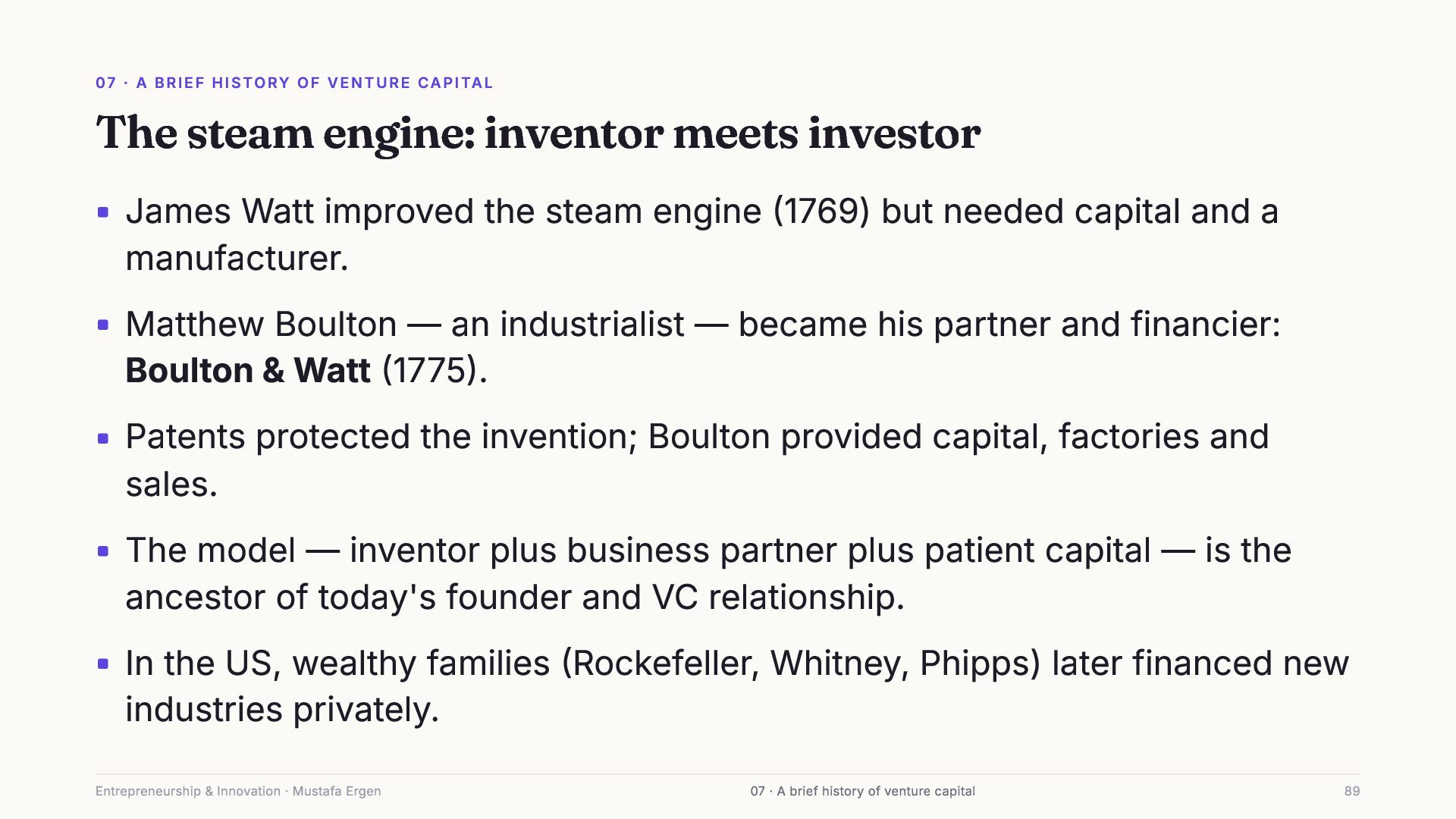
S TO RY O F V E N T U R E CA P I TA L The steam engine: inventor meets investor James Watt improved the steam engine (1769) but needed capital and a manufacturer. Matthew Boulton — an industrialist — became his partner and financier: Boulton & Watt (1775). Patents protected the invention; Boulton provided capital, factories and sales. The model — inventor plus business partner plus patient capital — is the ancestor of today's founder and VC relationship. In the US, wealthy families (Rockefeller, Whitney, Phipps) later financed new industries privately. Entrepreneurship & Innovation · Mustafa Ergen 07 · A brief history of venture capital 89 -
07 · A B R I E F H I
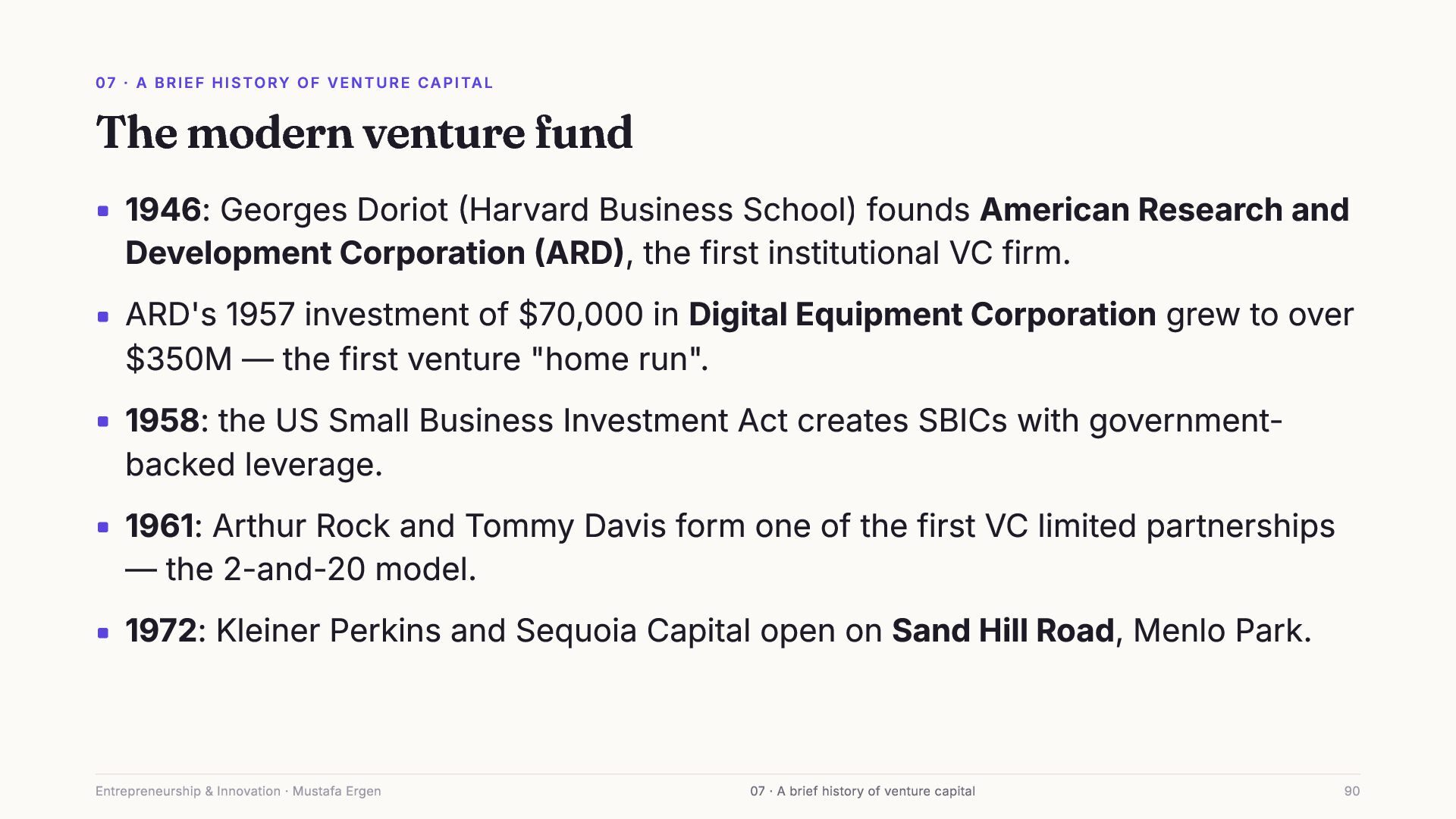
S TO RY O F V E N T U R E CA P I TA L The modern venture fund 1946: Georges Doriot (Harvard Business School) founds American Research and Development Corporation (ARD), the first institutional VC firm. ARD's 1957 investment of $70,000 in Digital Equipment Corporation grew to over $350M — the first venture "home run". 1958: the US Small Business Investment Act creates SBICs with governmentbacked leverage. 1961: Arthur Rock and Tommy Davis form one of the first VC limited partnerships — the 2-and-20 model. 1972: Kleiner Perkins and Sequoia Capital open on Sand Hill Road, Menlo Park. Entrepreneurship & Innovation · Mustafa Ergen 07 · A brief history of venture capital 90 -
07 · A B R I E F H I
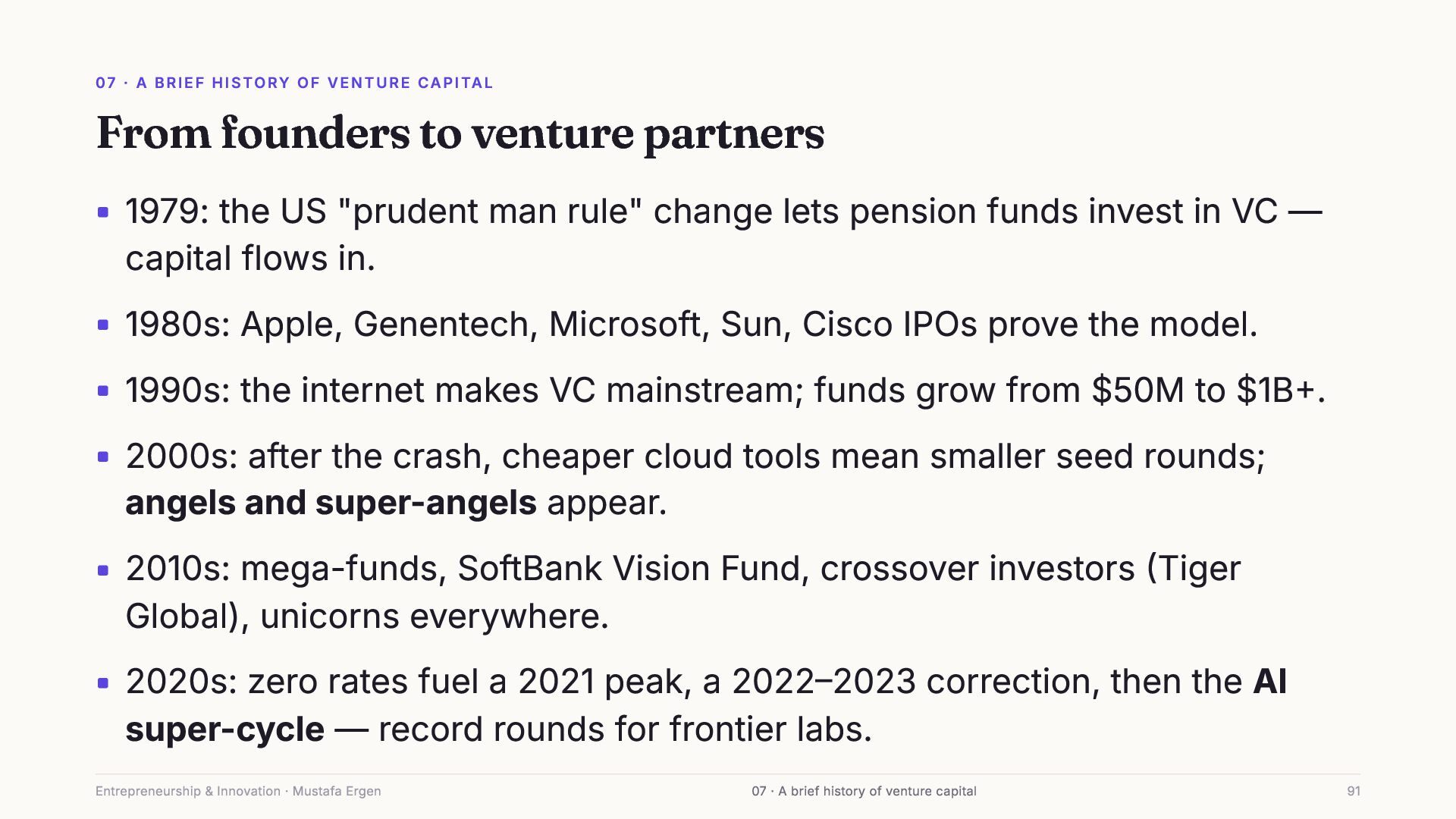
S TO RY O F V E N T U R E CA P I TA L From founders to venture partners 1979: the US "prudent man rule" change lets pension funds invest in VC — capital flows in. 1980s: Apple, Genentech, Microsoft, Sun, Cisco IPOs prove the model. 1990s: the internet makes VC mainstream; funds grow from $50M to $1B+. 2000s: after the crash, cheaper cloud tools mean smaller seed rounds; angels and super-angels appear. 2010s: mega-funds, SoftBank Vision Fund, crossover investors (Tiger Global), unicorns everywhere. 2020s: zero rates fuel a 2021 peak, a 2022–2023 correction, then the AI super-cycle — record rounds for frontier labs. Entrepreneurship & Innovation · Mustafa Ergen 07 · A brief history of venture capital 91 -
07 · A B R I E F H I
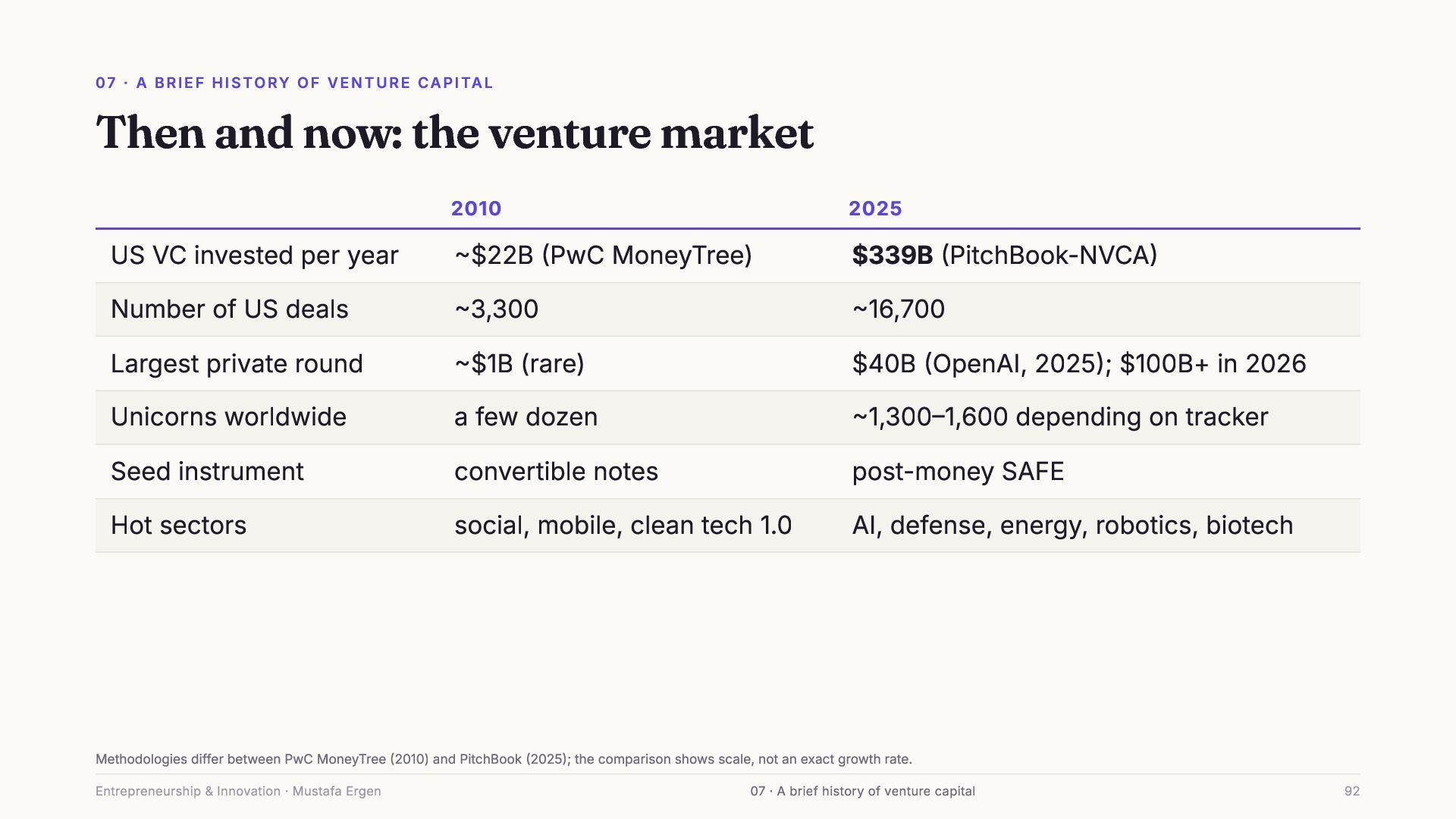
S TO RY O F V E N T U R E CA P I TA L Then and now: the venture market 2010 2025 US VC invested per year ~$22B (PwC MoneyTree) $339B (PitchBook-NVCA) Number of US deals ~3,300 ~16,700 Largest private round ~$1B (rare) $40B (OpenAI, 2025); $100B+ in 2026 Unicorns worldwide a few dozen ~1,300–1,600 depending on tracker Seed instrument convertible notes post-money SAFE Hot sectors social, mobile, clean tech 1.0 AI, defense, energy, robotics, biotech Methodologies differ between PwC MoneyTree (2010) and PitchBook (2025); the comparison shows scale, not an exact growth rate. Entrepreneurship & Innovation · Mustafa Ergen 07 · A brief history of venture capital 92 -
08 The venture market today Data for 2025 and 2026:
record AI rounds, concentration in a few companies, and a slowly reopening exit market. Deal value AI share Entrepreneurship & Innovation · Mustafa Ergen Megadeals Exits and IPOs Fundraising Unicorns 08 · The venture market today 93 -
0 8 · T H E V E N T
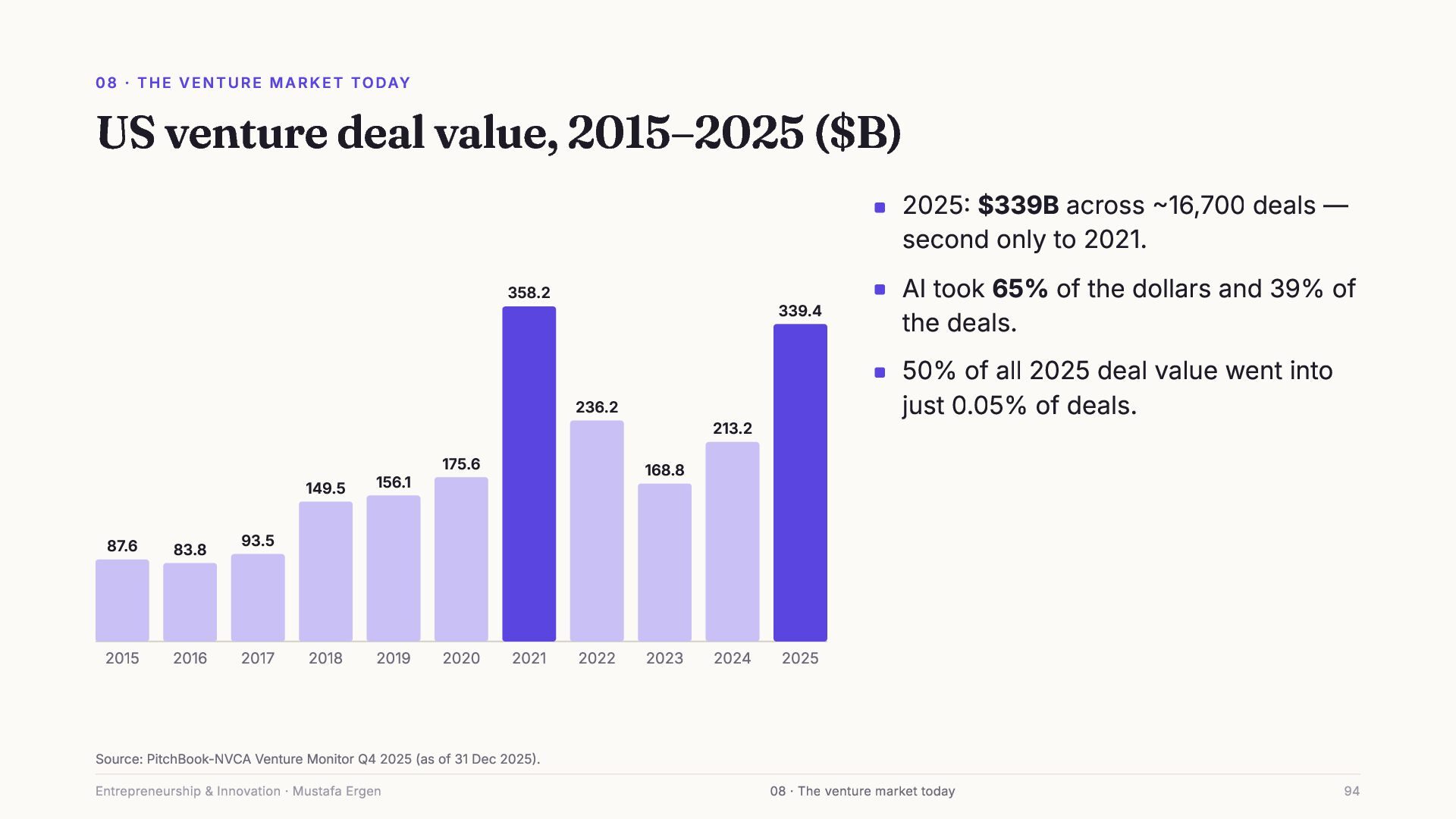
U R E M A R K E T TO DAY US venture deal value, 2015–2025 ($B) 358.2 339.4 236.2 87.6 83.8 93.5 2015 2016 2017 149.5 156.1 2018 2019 175.6 2020 213.2 2025: $339B across ~16,700 deals — second only to 2021. AI took 65% of the dollars and 39% of the deals. 50% of all 2025 deal value went into just 0.05% of deals. 168.8 2021 2022 2023 2024 2025 Source: PitchBook-NVCA Venture Monitor Q4 2025 (as of 31 Dec 2025). Entrepreneurship & Innovation · Mustafa Ergen 08 · The venture market today 94 -
0 8 · T H E V E N T
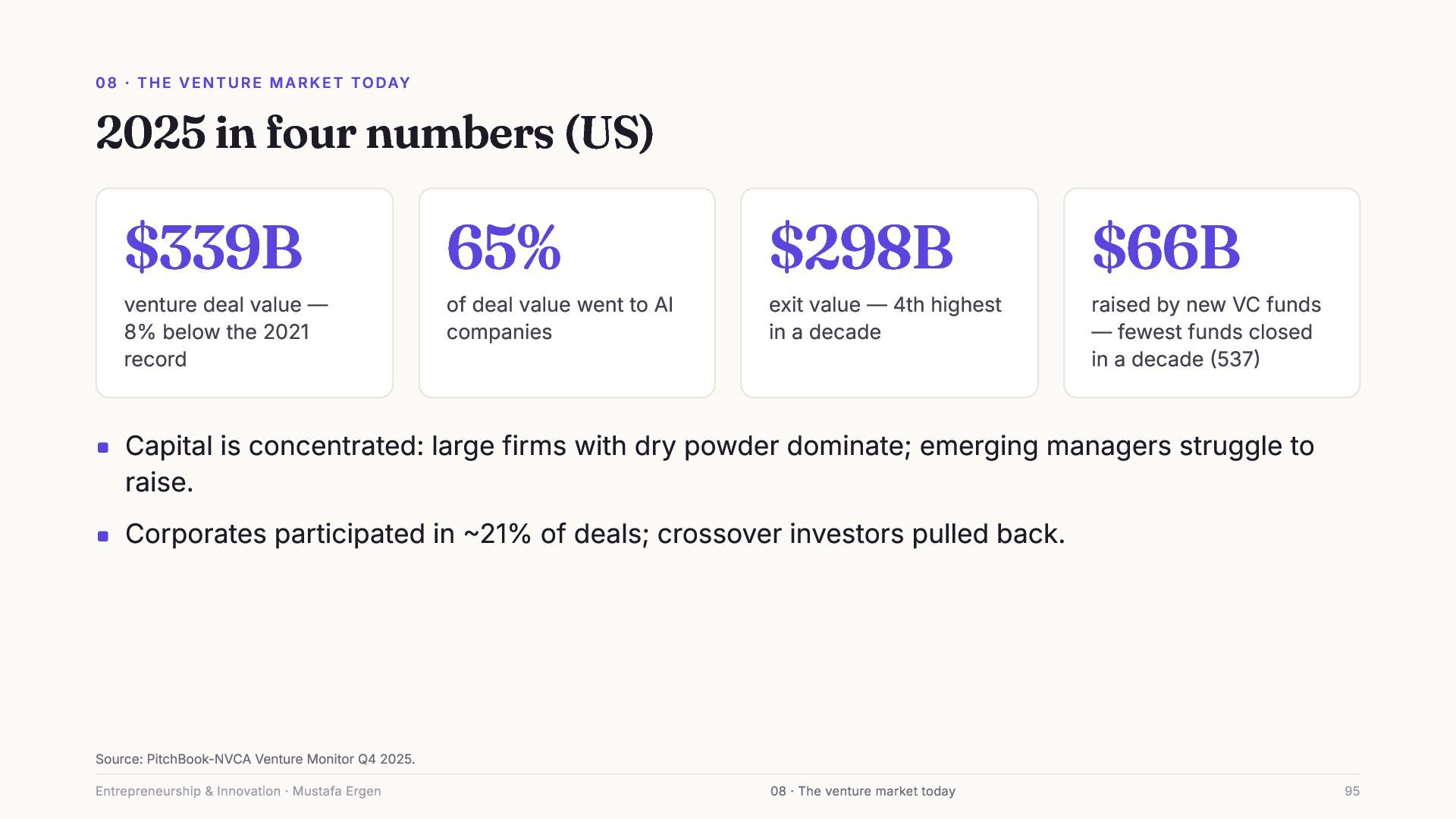
U R E M A R K E T TO DAY 2025 in four numbers (US) $339B venture deal value — 8% below the 2021 record 65% of deal value went to AI companies $298B exit value — 4th highest in a decade $66B raised by new VC funds — fewest funds closed in a decade (537) Capital is concentrated: large firms with dry powder dominate; emerging managers struggle to raise. Corporates participated in ~21% of deals; crossover investors pulled back. Source: PitchBook-NVCA Venture Monitor Q4 2025. Entrepreneurship & Innovation · Mustafa Ergen 08 · The venture market today 95 -
0 8 · T H E V E N T
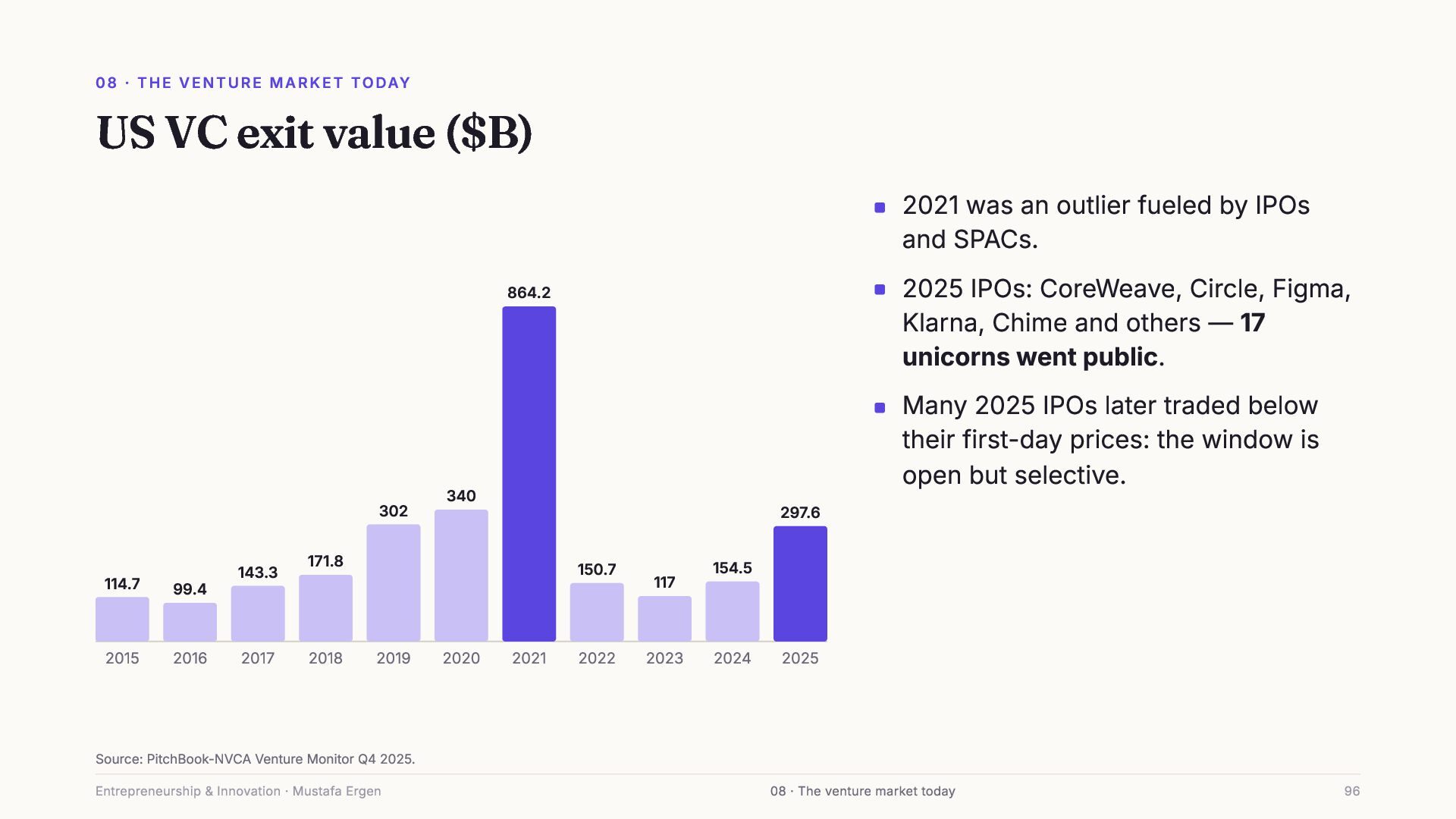
U R E M A R K E T TO DAY US VC exit value ($B) 2021 was an outlier fueled by IPOs and SPACs. 2025 IPOs: CoreWeave, Circle, Figma, Klarna, Chime and others — 17 unicorns went public. Many 2025 IPOs later traded below their first-day prices: the window is open but selective. 864.2 302 114.7 99.4 2015 2016 143.3 2017 340 297.6 171.8 2018 150.7 2019 2020 2021 2022 117 2023 154.5 2024 2025 Source: PitchBook-NVCA Venture Monitor Q4 2025. Entrepreneurship & Innovation · Mustafa Ergen 08 · The venture market today 96 -
0 8 · T H E V E N T
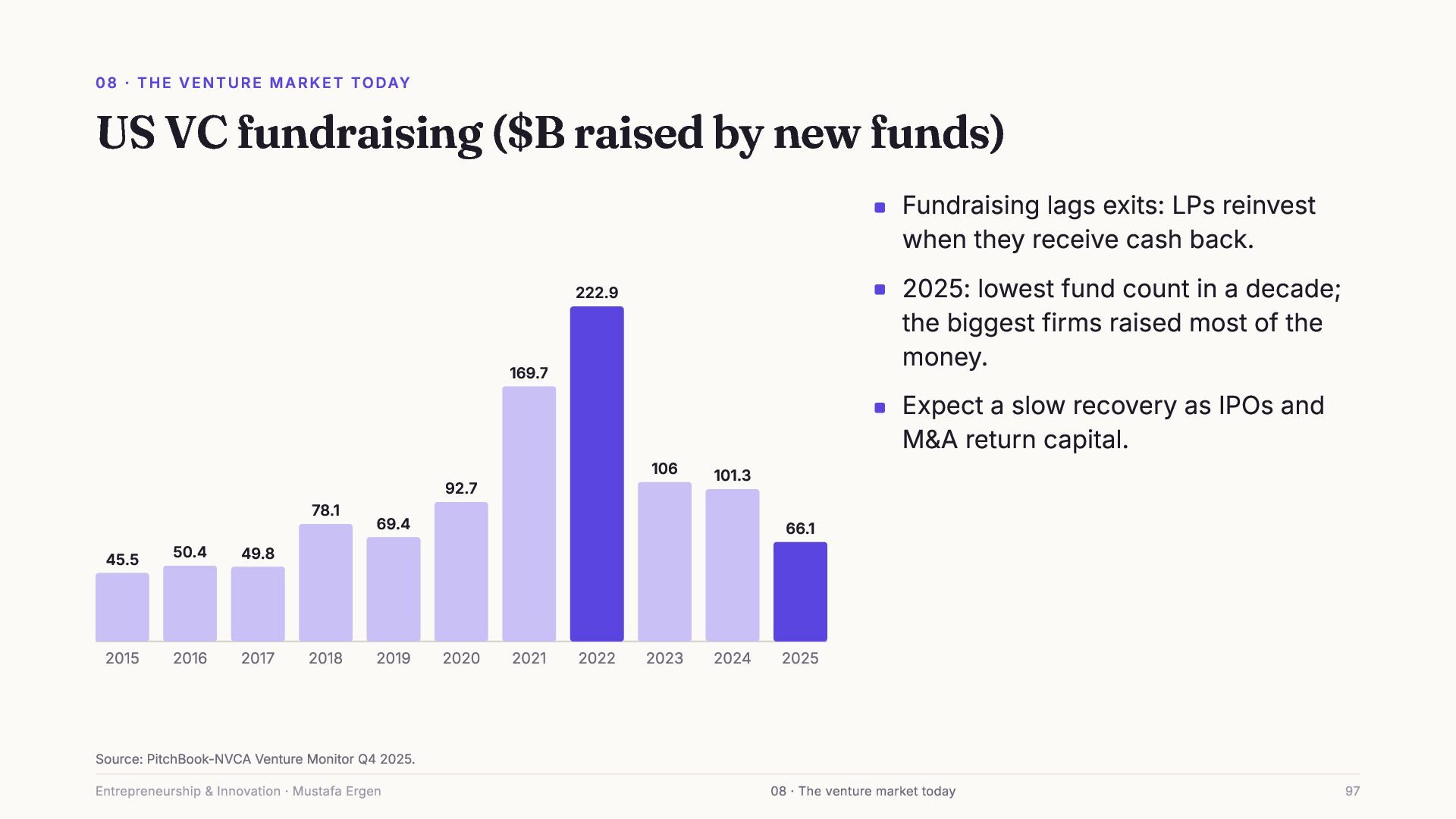
U R E M A R K E T TO DAY US VC fundraising ($B raised by new funds) Fundraising lags exits: LPs reinvest when they receive cash back. 2025: lowest fund count in a decade; the biggest firms raised most of the money. Expect a slow recovery as IPOs and M&A return capital. 222.9 169.7 78.1 45.5 50.4 49.8 2015 2016 2017 2018 106 92.7 101.3 69.4 2019 66.1 2020 2021 2022 2023 2024 2025 Source: PitchBook-NVCA Venture Monitor Q4 2025. Entrepreneurship & Innovation · Mustafa Ergen 08 · The venture market today 97 -
0 8 · T H E V E N T
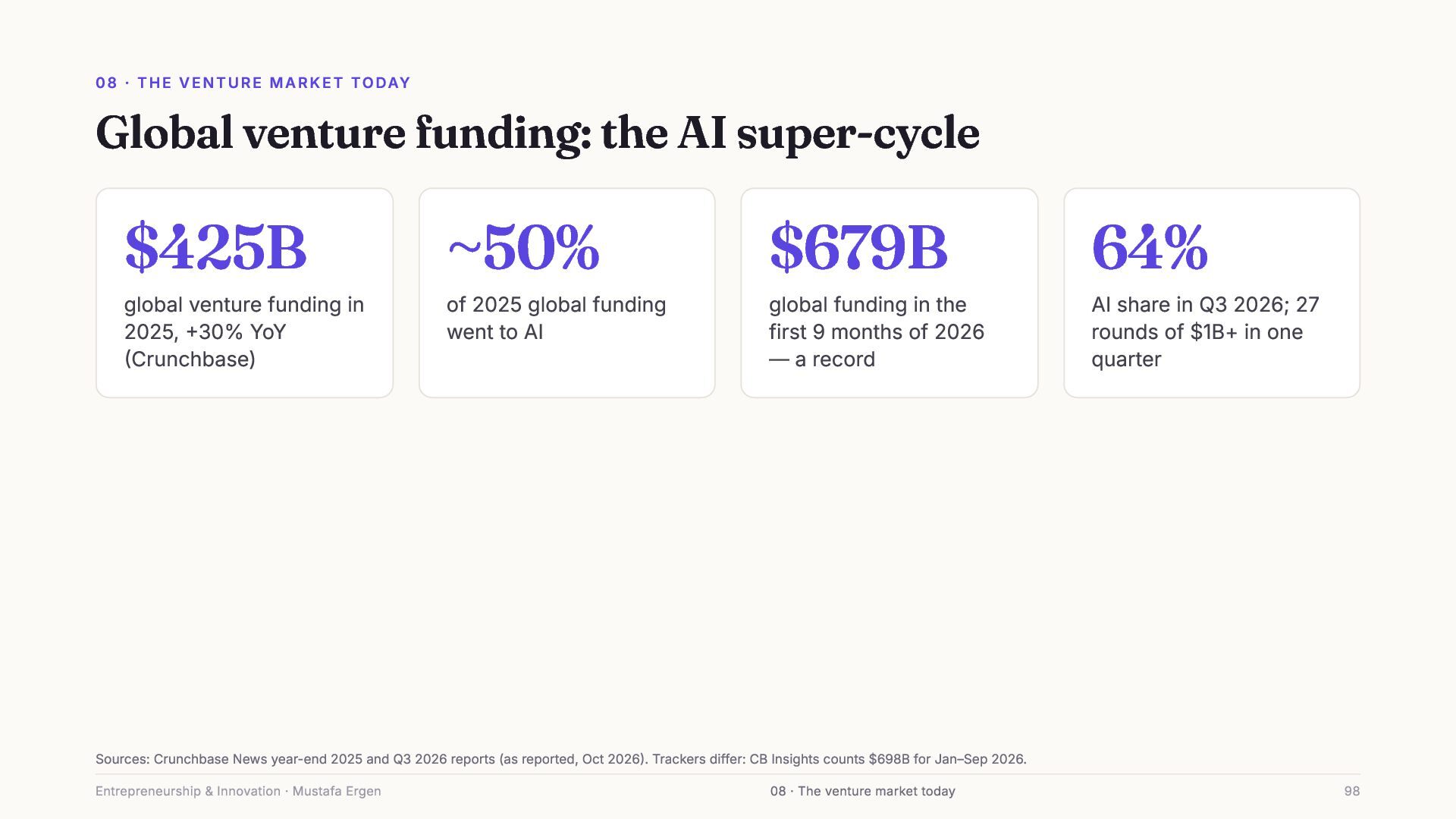
U R E M A R K E T TO DAY Global venture funding: the AI super-cycle $425B global venture funding in 2025, +30% YoY (Crunchbase) ~50% of 2025 global funding went to AI $679B global funding in the first 9 months of 2026 — a record 64% AI share in Q3 2026; 27 rounds of $1B+ in one quarter Sources: Crunchbase News year-end 2025 and Q3 2026 reports (as reported, Oct 2026). Trackers differ: CB Insights counts $698B for Jan–Sep 2026. Entrepreneurship & Innovation · Mustafa Ergen 08 · The venture market today 98 -
0 8 · T H E V E N T
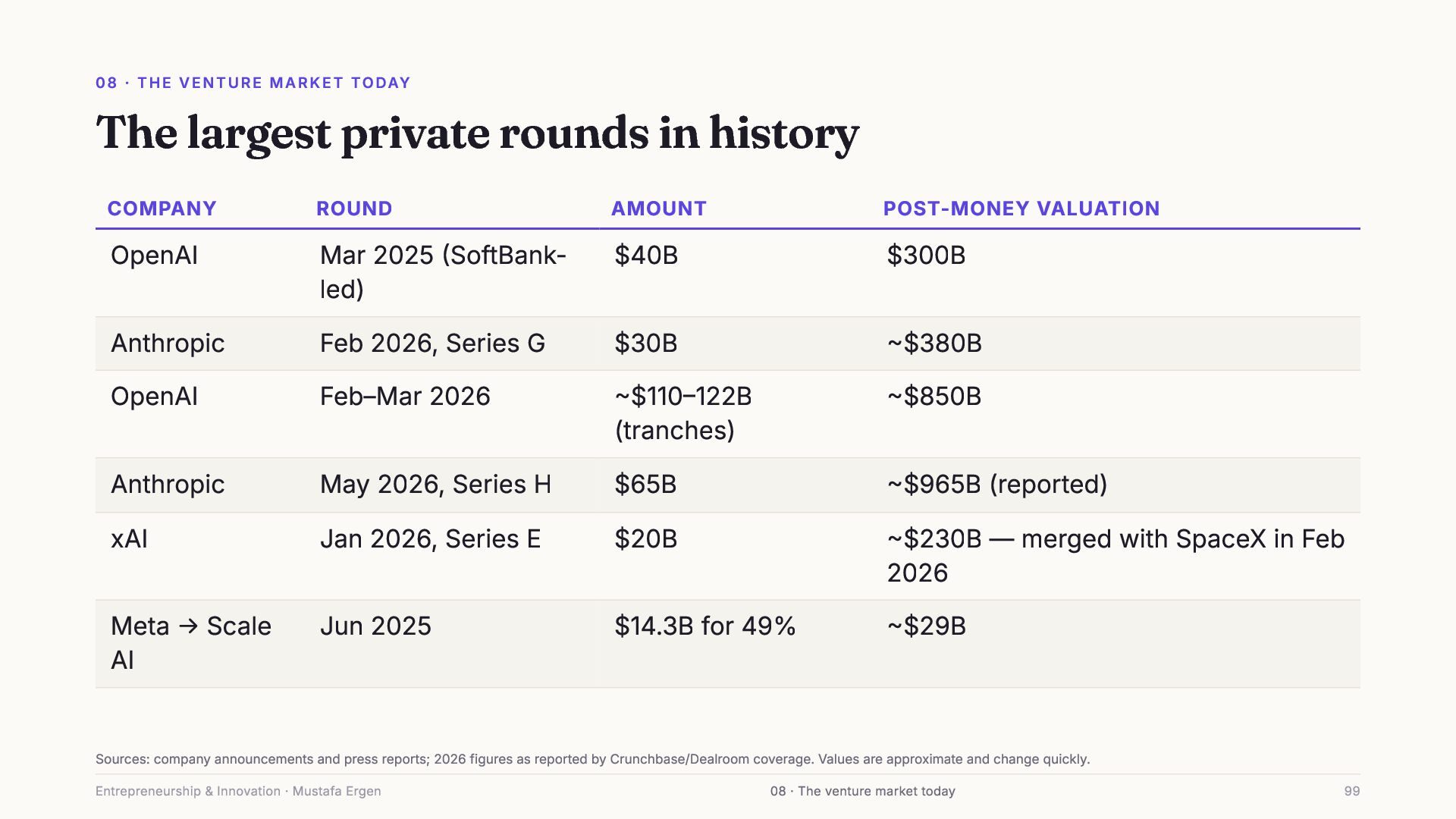
U R E M A R K E T TO DAY The largest private rounds in history COMPANY ROUND AMOUNT POST-MONEY VALUATION OpenAI Mar 2025 (SoftBankled) $40B $300B Anthropic Feb 2026, Series G $30B ~$380B OpenAI Feb–Mar 2026 ~$110–122B (tranches) ~$850B Anthropic May 2026, Series H $65B ~$965B (reported) xAI Jan 2026, Series E $20B Meta → Scale AI ~$230B — merged with SpaceX in Feb 2026 Jun 2025 $14.3B for 49% ~$29B Sources: company announcements and press reports; 2026 figures as reported by Crunchbase/Dealroom coverage. Values are approximate and change quickly. Entrepreneurship & Innovation · Mustafa Ergen 08 · The venture market today 99 -
0 8 · T H E V E N T
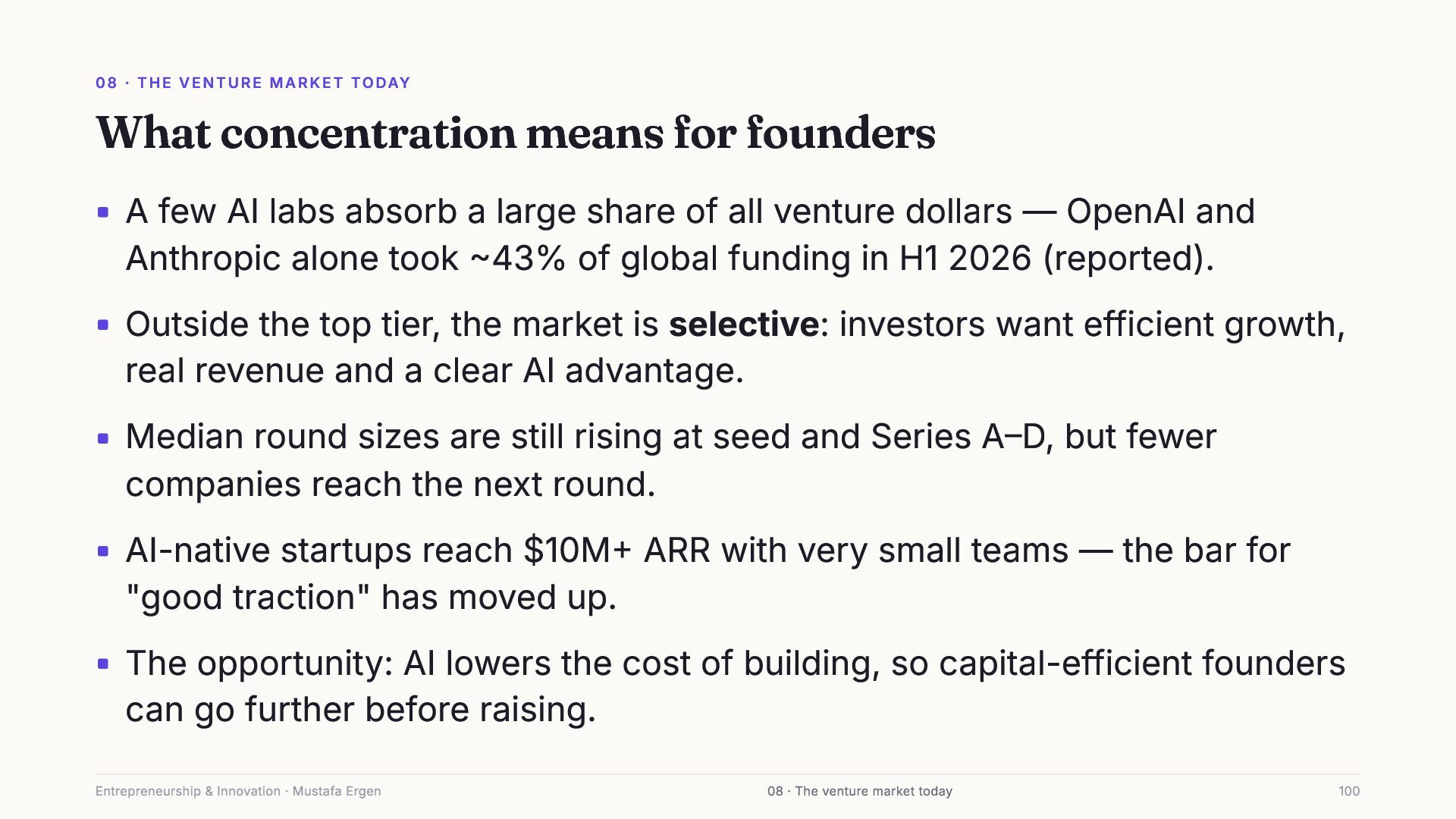
U R E M A R K E T TO DAY What concentration means for founders A few AI labs absorb a large share of all venture dollars — OpenAI and Anthropic alone took ~43% of global funding in H1 2026 (reported). Outside the top tier, the market is selective: investors want efficient growth, real revenue and a clear AI advantage. Median round sizes are still rising at seed and Series A–D, but fewer companies reach the next round. AI-native startups reach $10M+ ARR with very small teams — the bar for "good traction" has moved up. The opportunity: AI lowers the cost of building, so capital-efficient founders can go further before raising. Entrepreneurship & Innovation · Mustafa Ergen 08 · The venture market today 100 -
0 8 · T H E V E N T
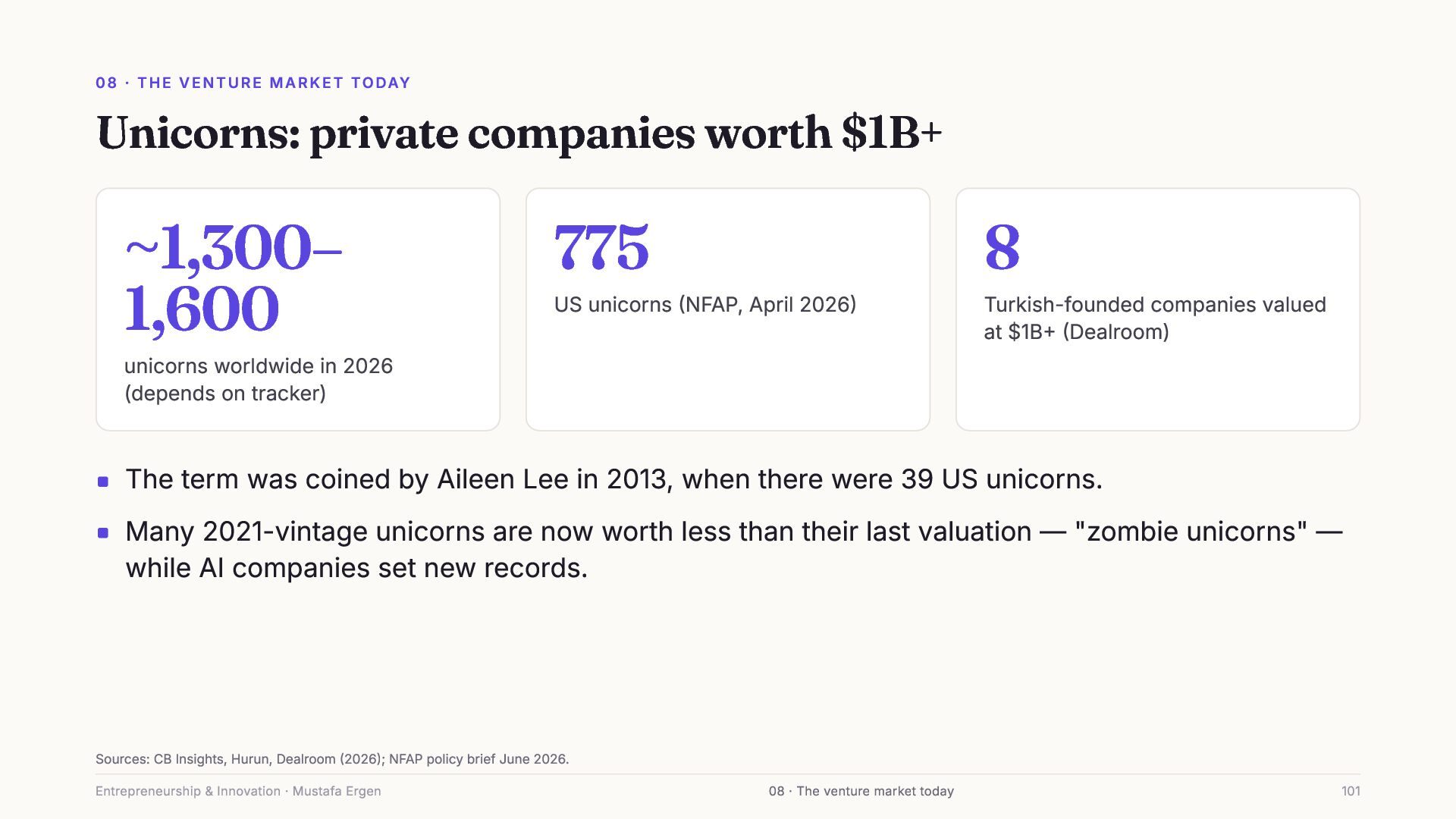
U R E M A R K E T TO DAY Unicorns: private companies worth $1B+ ~1,300– 1,600 775 US unicorns (NFAP, April 2026) unicorns worldwide in 2026 (depends on tracker) 8 Turkish-founded companies valued at $1B+ (Dealroom) The term was coined by Aileen Lee in 2013, when there were 39 US unicorns. Many 2021-vintage unicorns are now worth less than their last valuation — "zombie unicorns" — while AI companies set new records. Sources: CB Insights, Hurun, Dealroom (2026); NFAP policy brief June 2026. Entrepreneurship & Innovation · Mustafa Ergen 08 · The venture market today 101 -
09 The impact of venture capital Why a small asset
class has an outsized effect on jobs, R&D and entire industries. Returns Economic weight Entrepreneurship & Innovation · Mustafa Ergen R&D and patents New industries Jobs 09 · The impact of venture capital 102 -
0 9 · T H E I M PAC T
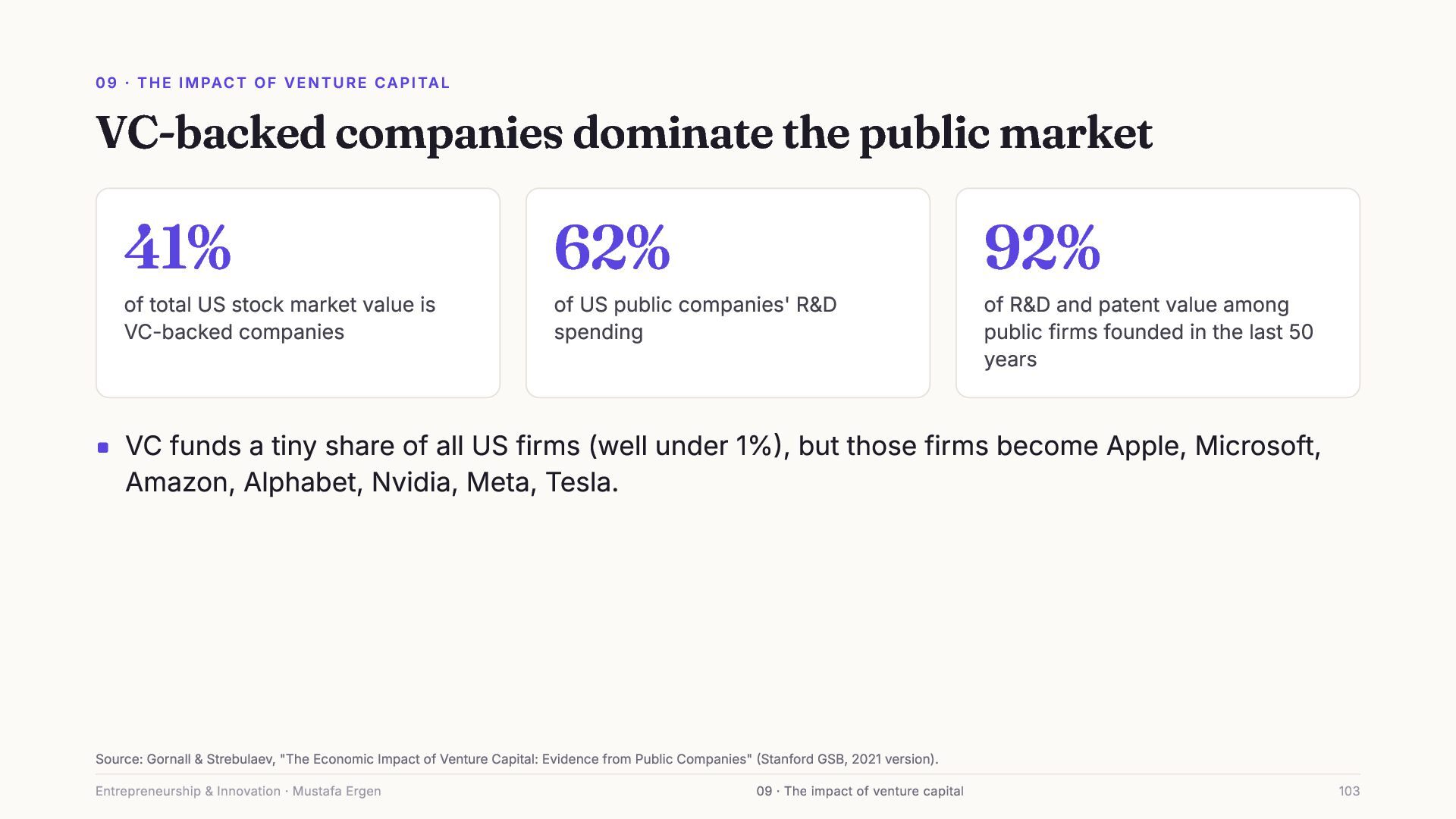
O F V E N T U R E CA P I TA L VC-backed companies dominate the public market 41% of total US stock market value is VC-backed companies 62% of US public companies' R&D spending 92% of R&D and patent value among public firms founded in the last 50 years VC funds a tiny share of all US firms (well under 1%), but those firms become Apple, Microsoft, Amazon, Alphabet, Nvidia, Meta, Tesla. Source: Gornall & Strebulaev, "The Economic Impact of Venture Capital: Evidence from Public Companies" (Stanford GSB, 2021 version). Entrepreneurship & Innovation · Mustafa Ergen 09 · The impact of venture capital 103 -
0 9 · T H E I M PAC T
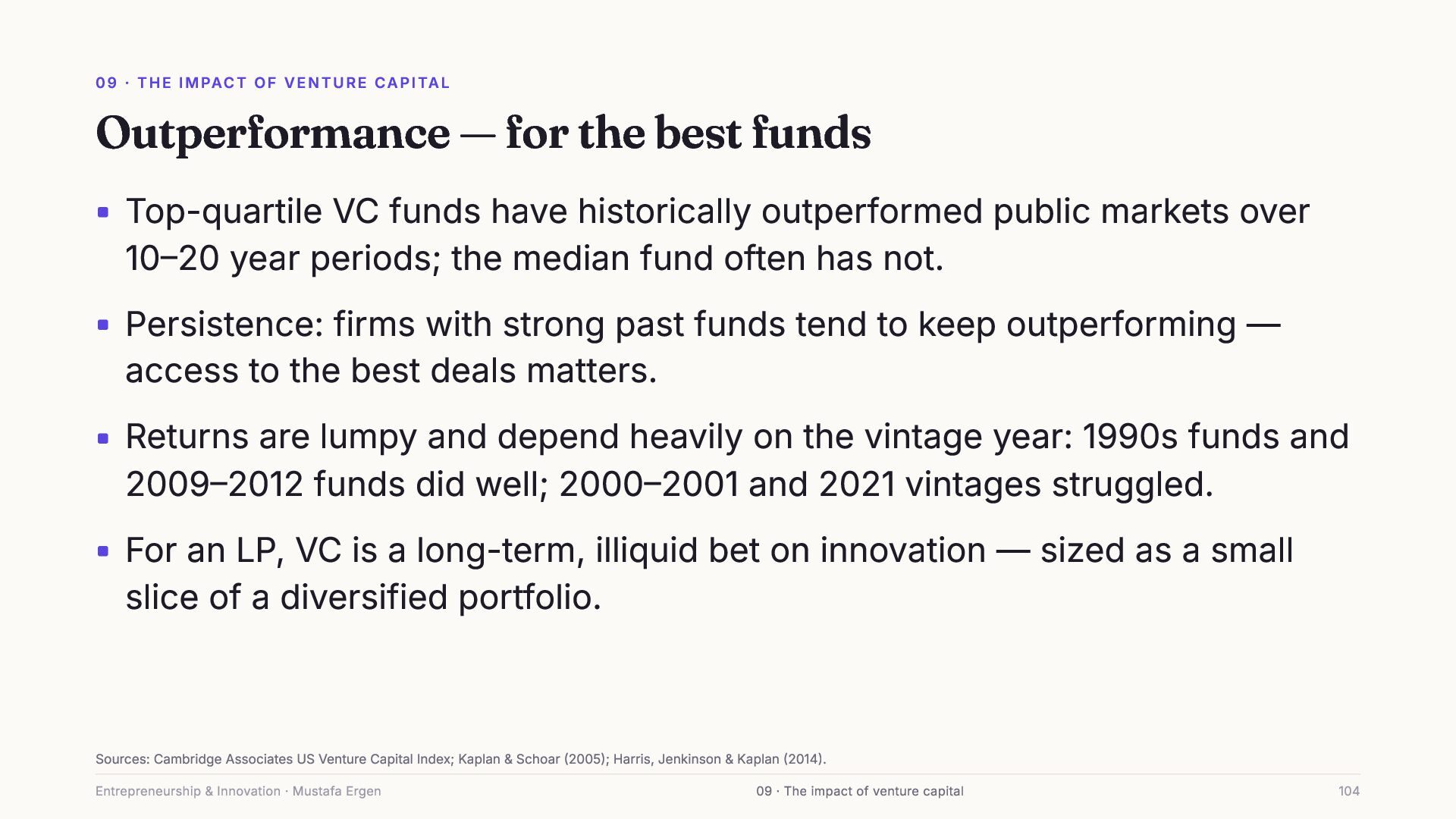
O F V E N T U R E CA P I TA L Outperformance — for the best funds Top-quartile VC funds have historically outperformed public markets over 10–20 year periods; the median fund often has not. Persistence: firms with strong past funds tend to keep outperforming — access to the best deals matters. Returns are lumpy and depend heavily on the vintage year: 1990s funds and 2009–2012 funds did well; 2000–2001 and 2021 vintages struggled. For an LP, VC is a long-term, illiquid bet on innovation — sized as a small slice of a diversified portfolio. Sources: Cambridge Associates US Venture Capital Index; Kaplan & Schoar (2005); Harris, Jenkinson & Kaplan (2014). Entrepreneurship & Innovation · Mustafa Ergen 09 · The impact of venture capital 104 -
0 9 · T H E I M PAC T
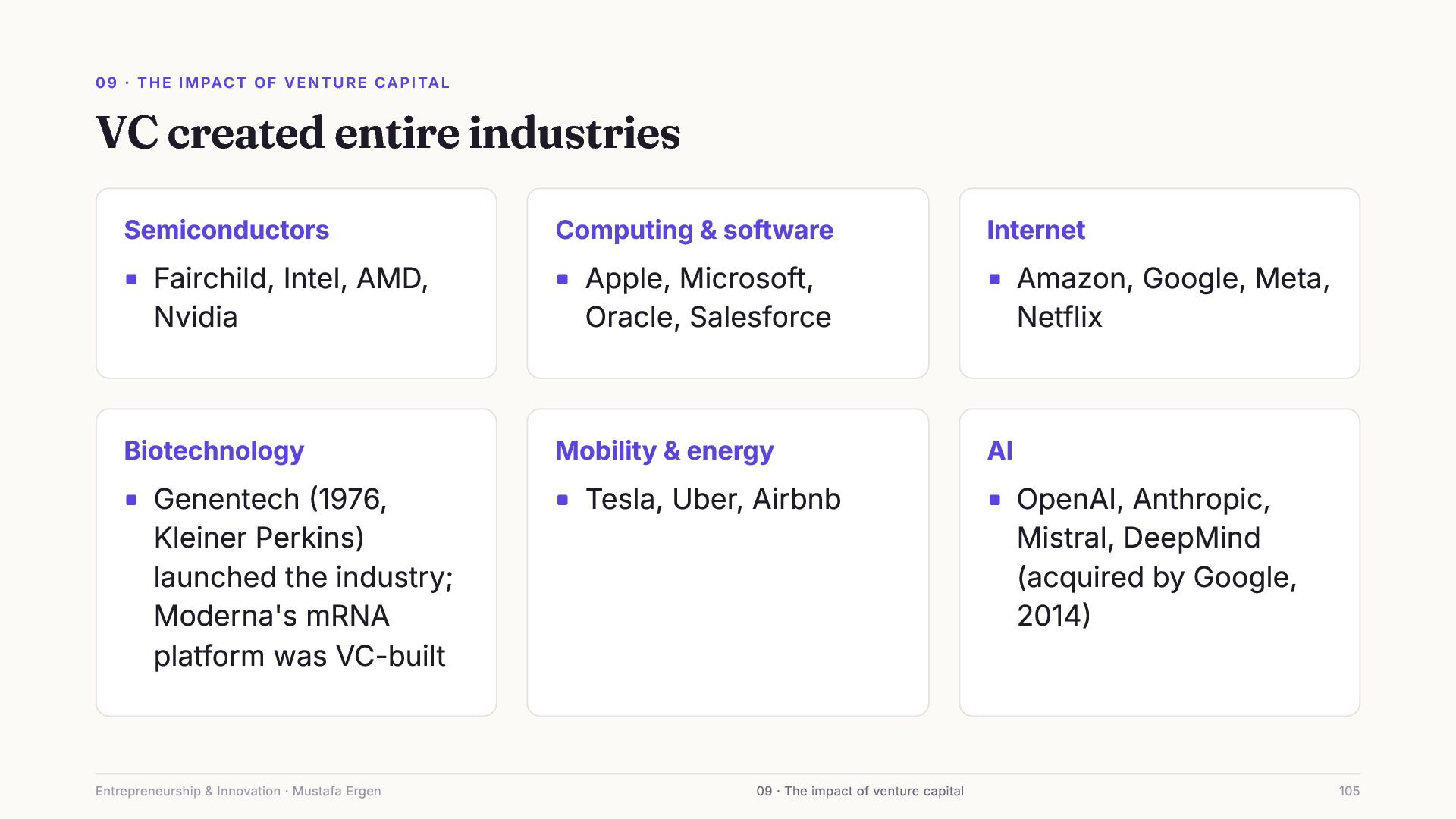
O F V E N T U R E CA P I TA L VC created entire industries Semiconductors Fairchild, Intel, AMD, Nvidia Biotechnology Genentech (1976, Kleiner Perkins) launched the industry; Moderna's mRNA platform was VC-built Entrepreneurship & Innovation · Mustafa Ergen Computing & software Internet Apple, Microsoft, Oracle, Salesforce Mobility & energy Tesla, Uber, Airbnb 09 · The impact of venture capital Amazon, Google, Meta, Netflix AI OpenAI, Anthropic, Mistral, DeepMind (acquired by Google, 2014) 105 -
0 9 · T H E I M PAC T
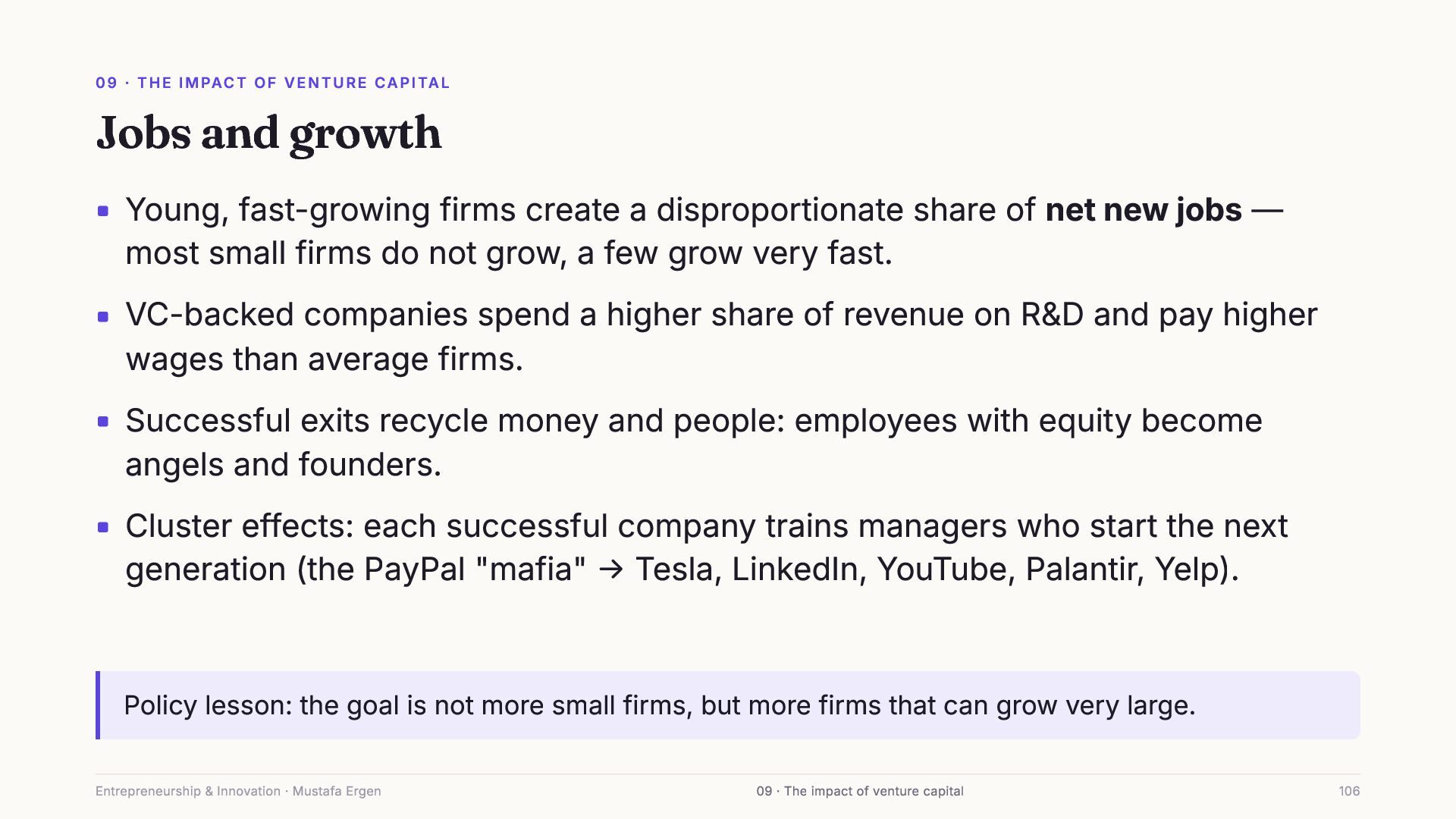
O F V E N T U R E CA P I TA L Jobs and growth Young, fast-growing firms create a disproportionate share of net new jobs — most small firms do not grow, a few grow very fast. VC-backed companies spend a higher share of revenue on R&D and pay higher wages than average firms. Successful exits recycle money and people: employees with equity become angels and founders. Cluster effects: each successful company trains managers who start the next generation (the PayPal "mafia" → Tesla, LinkedIn, YouTube, Palantir, Yelp). Policy lesson: the goal is not more small firms, but more firms that can grow very large. Entrepreneurship & Innovation · Mustafa Ergen 09 · The impact of venture capital 106 -
10 The pitch How to tell investors a story they
can believe — the slides, the order and the rules. What a good pitch does Entrepreneurship & Innovation · Mustafa Ergen The 14 elements Rules for slides A sample deck 10 · The pitch Common mistakes 107 -
1 0 · T H E P I TC H
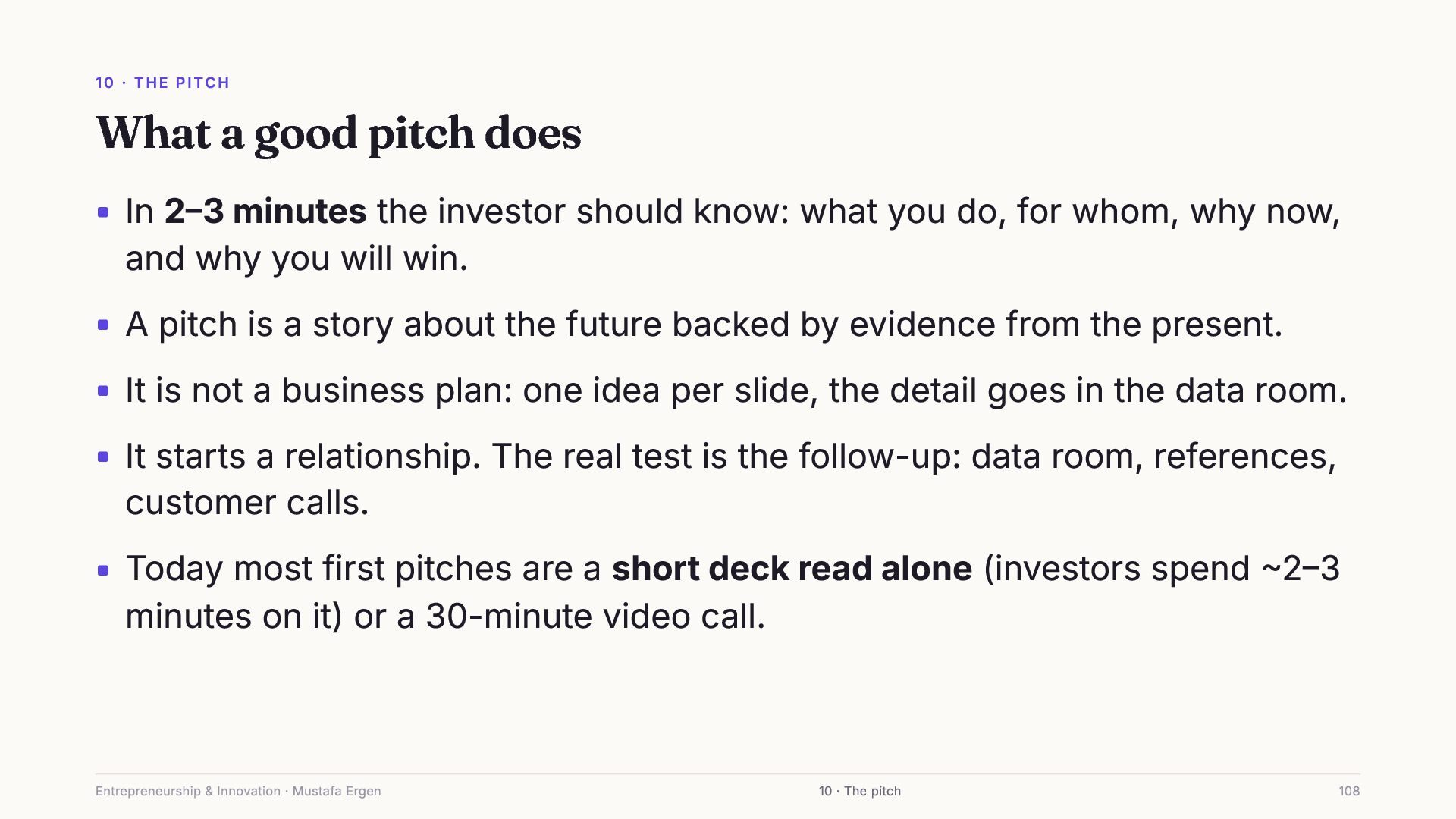
What a good pitch does In 2–3 minutes the investor should know: what you do, for whom, why now, and why you will win. A pitch is a story about the future backed by evidence from the present. It is not a business plan: one idea per slide, the detail goes in the data room. It starts a relationship. The real test is the follow-up: data room, references, customer calls. Today most first pitches are a short deck read alone (investors spend ~2–3 minutes on it) or a 30-minute video call. Entrepreneurship & Innovation · Mustafa Ergen 10 · The pitch 108 -
1 0 · T H E P I TC H
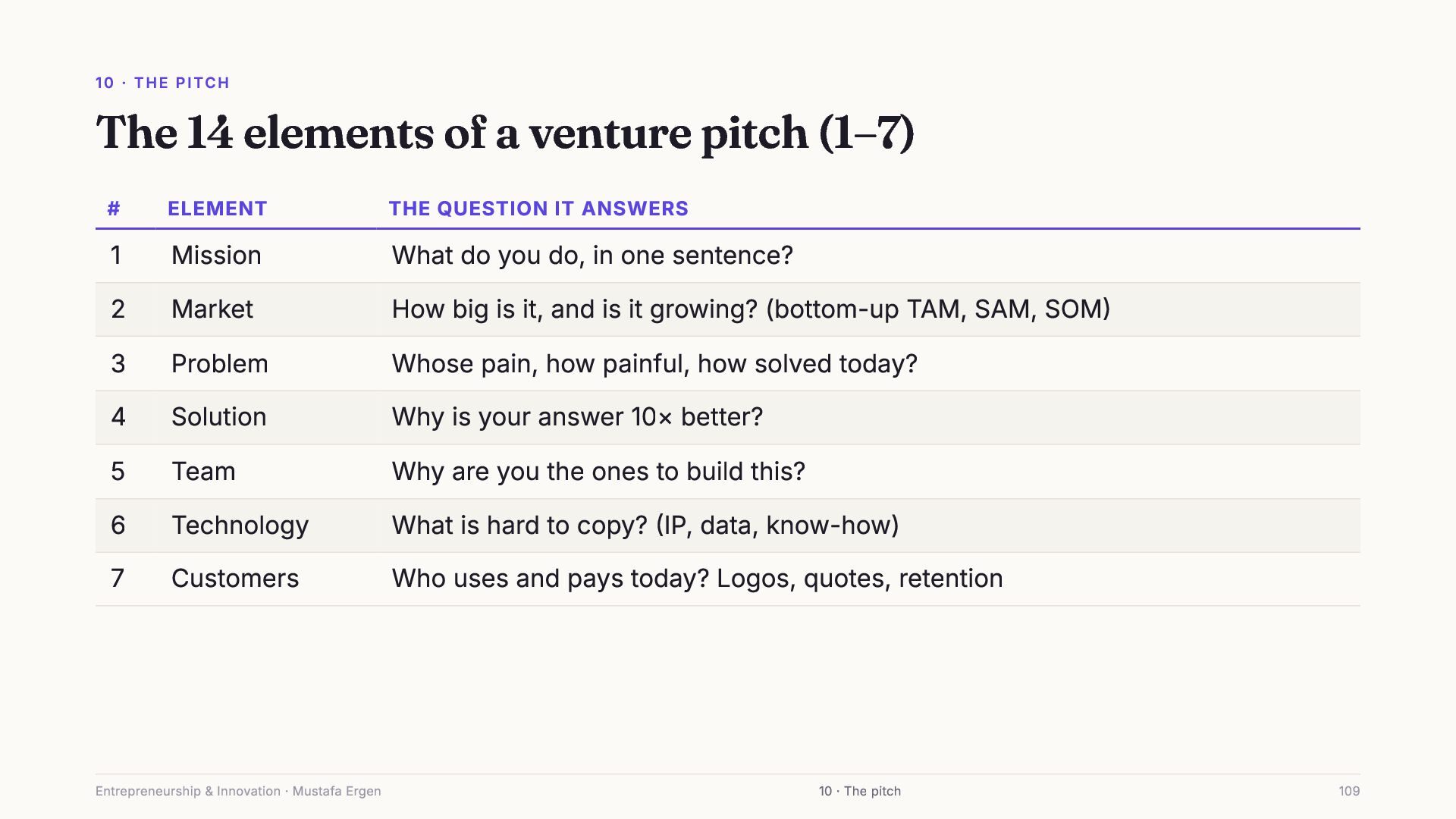
The 14 elements of a venture pitch (1–7) # ELEMENT THE QUESTION IT ANSWERS 1 Mission What do you do, in one sentence? 2 Market How big is it, and is it growing? (bottom-up TAM, SAM, SOM) 3 Problem Whose pain, how painful, how solved today? 4 Solution Why is your answer 10× better? 5 Team Why are you the ones to build this? 6 Technology What is hard to copy? (IP, data, know-how) 7 Customers Who uses and pays today? Logos, quotes, retention Entrepreneurship & Innovation · Mustafa Ergen 10 · The pitch 109 -
1 0 · T H E P I TC H
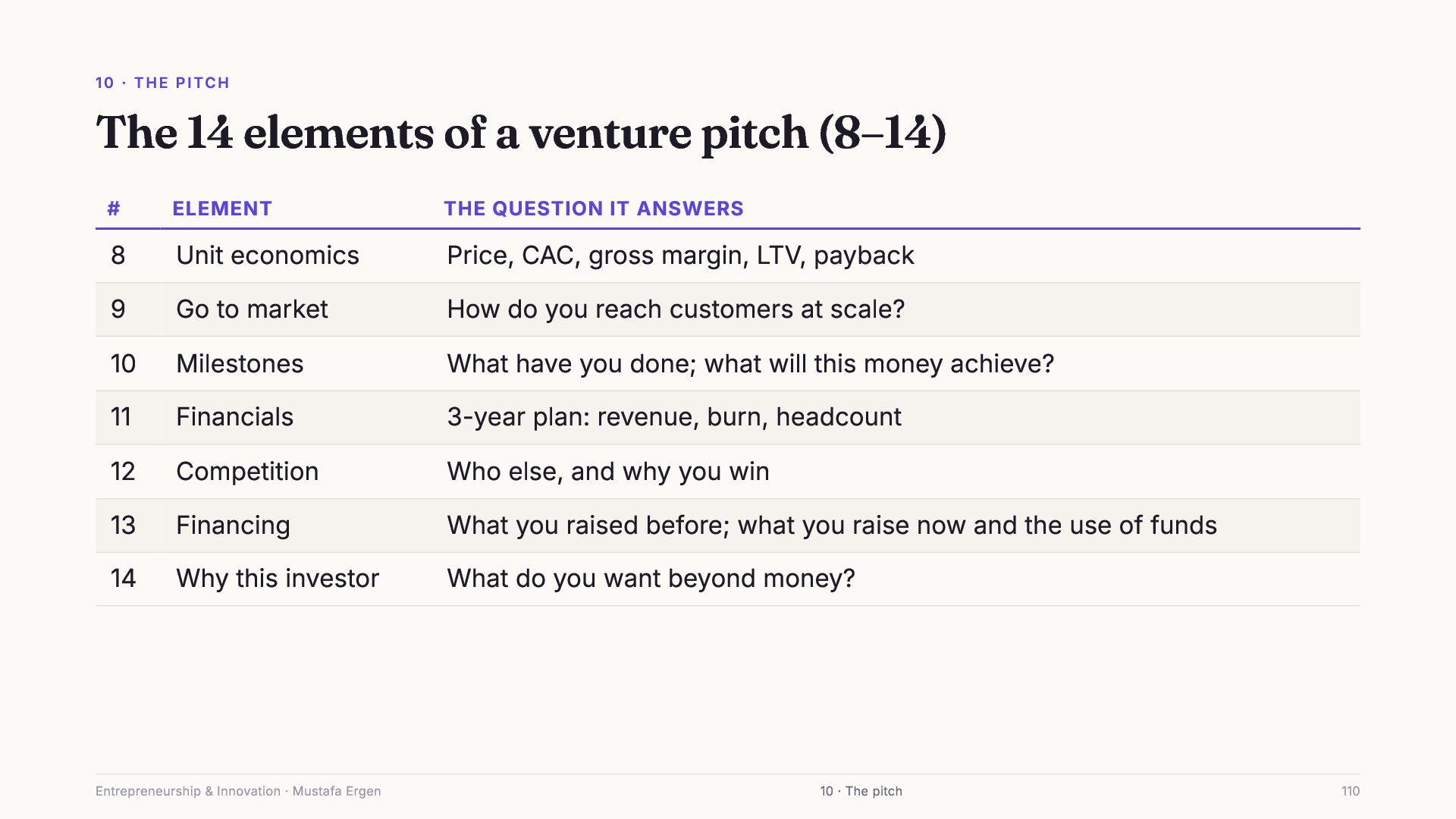
The 14 elements of a venture pitch (8–14) # ELEMENT THE QUESTION IT ANSWERS 8 Unit economics Price, CAC, gross margin, LTV, payback 9 Go to market How do you reach customers at scale? 10 Milestones What have you done; what will this money achieve? 11 Financials 3-year plan: revenue, burn, headcount 12 Competition Who else, and why you win 13 Financing What you raised before; what you raise now and the use of funds 14 Why this investor What do you want beyond money? Entrepreneurship & Innovation · Mustafa Ergen 10 · The pitch 110 -
1 0 · T H E P I TC H
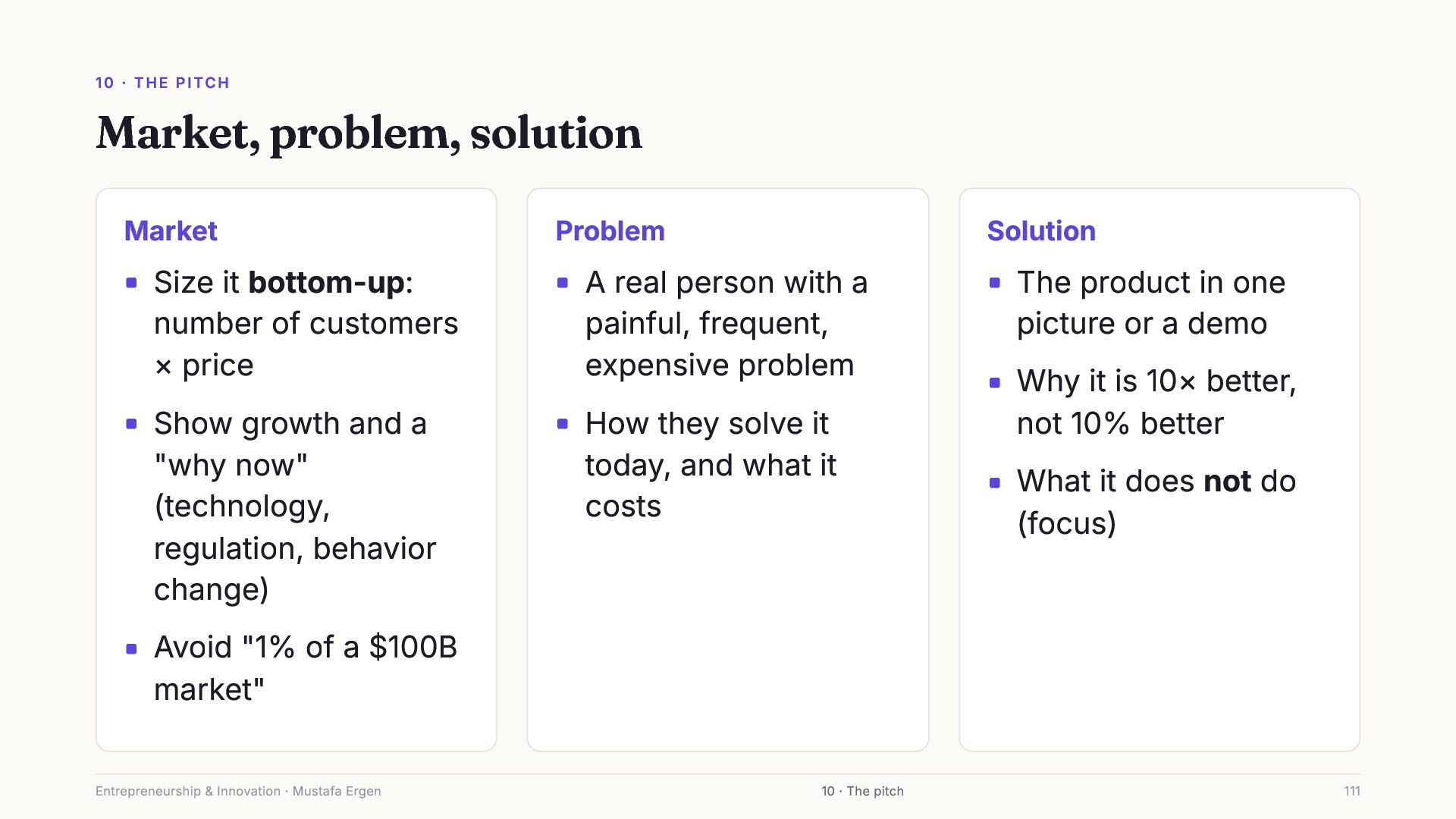
Market, problem, solution Market Size it bottom-up: number of customers × price Show growth and a "why now" (technology, regulation, behavior change) Avoid "1% of a $100B market" Entrepreneurship & Innovation · Mustafa Ergen Problem Solution A real person with a painful, frequent, expensive problem How they solve it today, and what it costs 10 · The pitch The product in one picture or a demo Why it is 10× better, not 10% better What it does not do (focus) 111 -
1 0 · T H E P I TC H
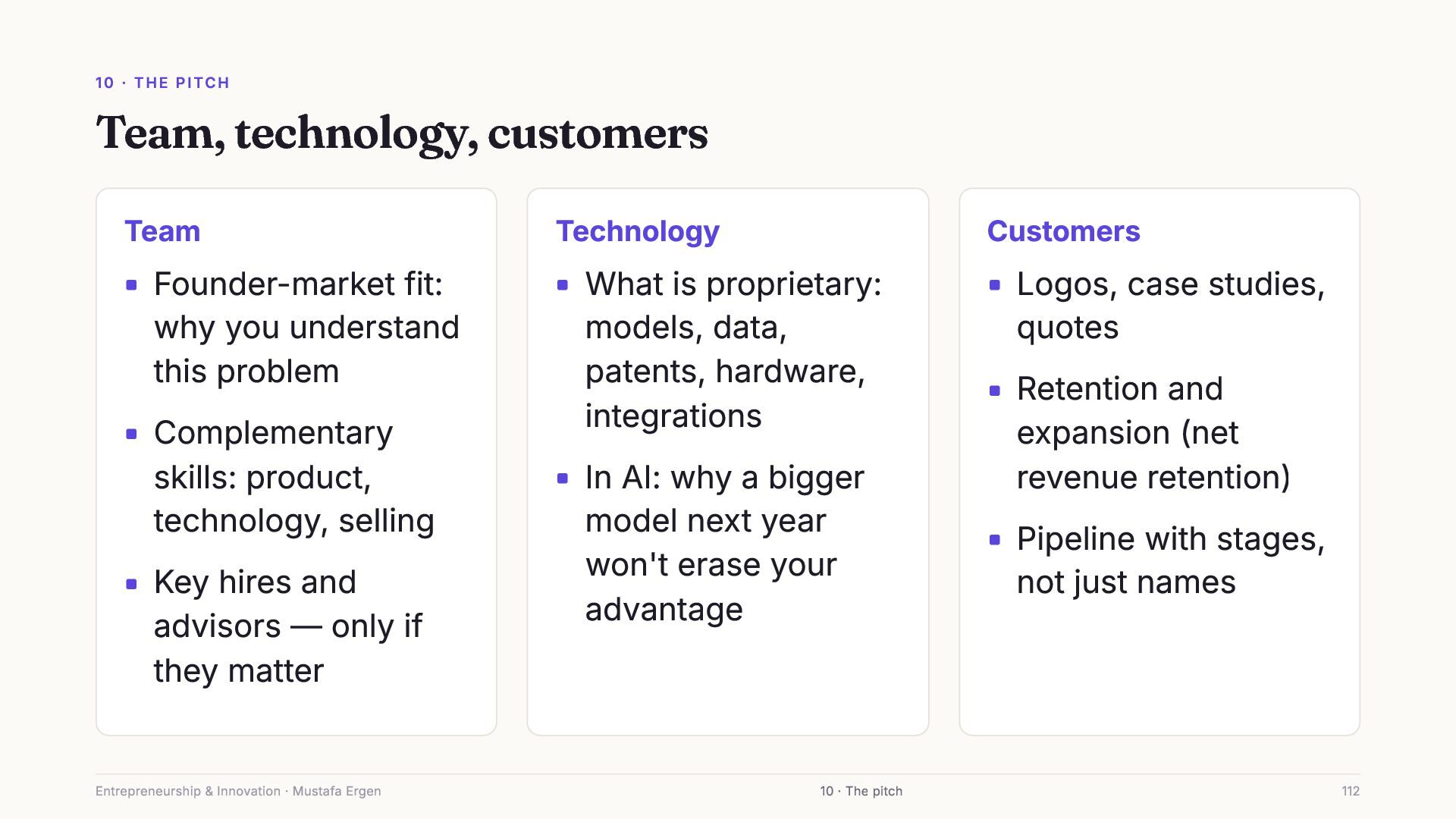
Team, technology, customers Team Founder-market fit: why you understand this problem Complementary skills: product, technology, selling Key hires and advisors — only if they matter Entrepreneurship & Innovation · Mustafa Ergen Technology Customers What is proprietary: models, data, patents, hardware, integrations In AI: why a bigger model next year won't erase your advantage 10 · The pitch Logos, case studies, quotes Retention and expansion (net revenue retention) Pipeline with stages, not just names 112 -
1 0 · T H E P I TC H
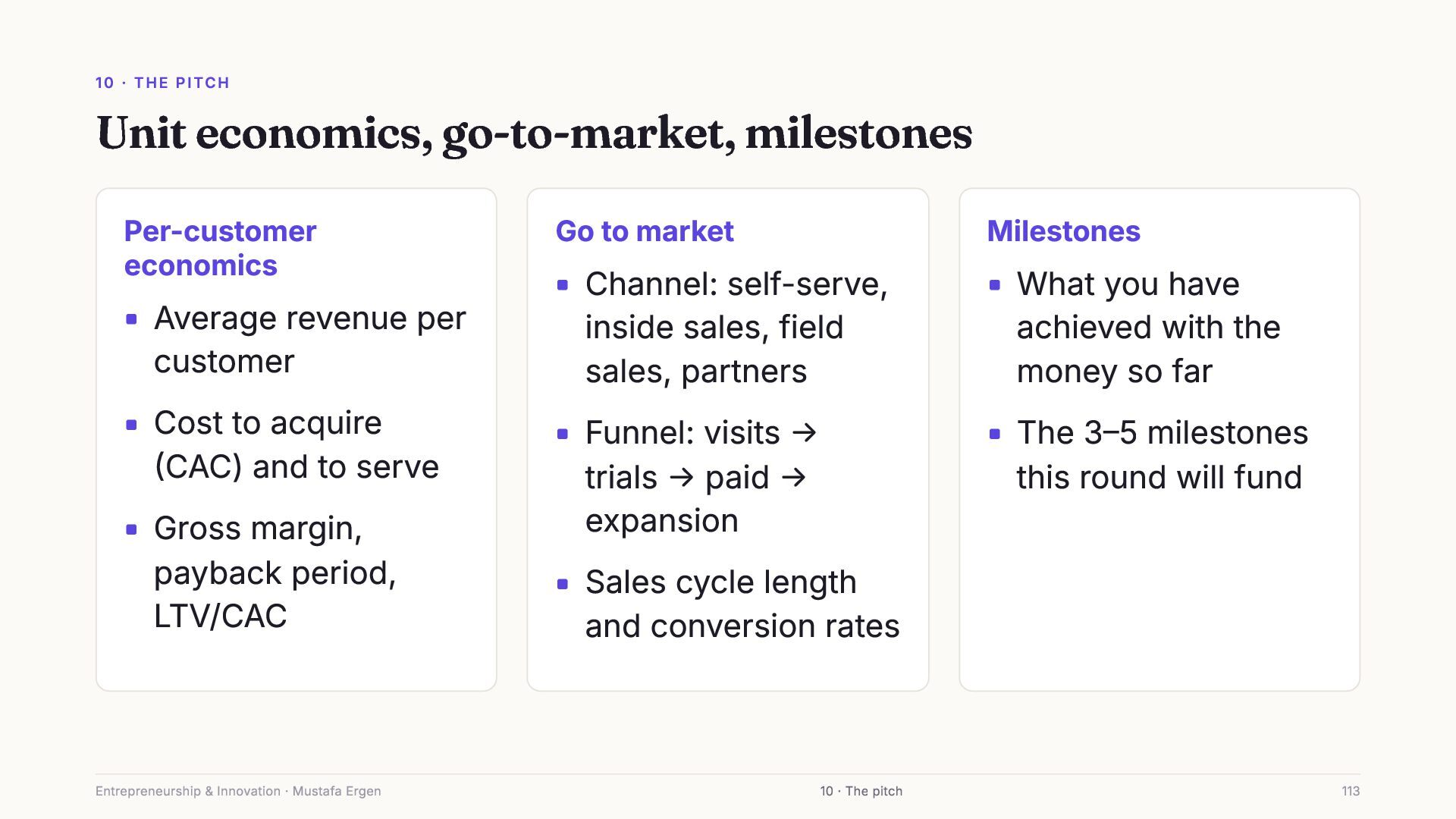
Unit economics, go-to-market, milestones Per-customer economics Average revenue per customer Cost to acquire (CAC) and to serve Gross margin, payback period, LTV/CAC Entrepreneurship & Innovation · Mustafa Ergen Go to market Milestones Channel: self-serve, inside sales, field sales, partners Funnel: visits → trials → paid → expansion Sales cycle length and conversion rates 10 · The pitch What you have achieved with the money so far The 3–5 milestones this round will fund 113 -
1 0 · T H E P I TC H
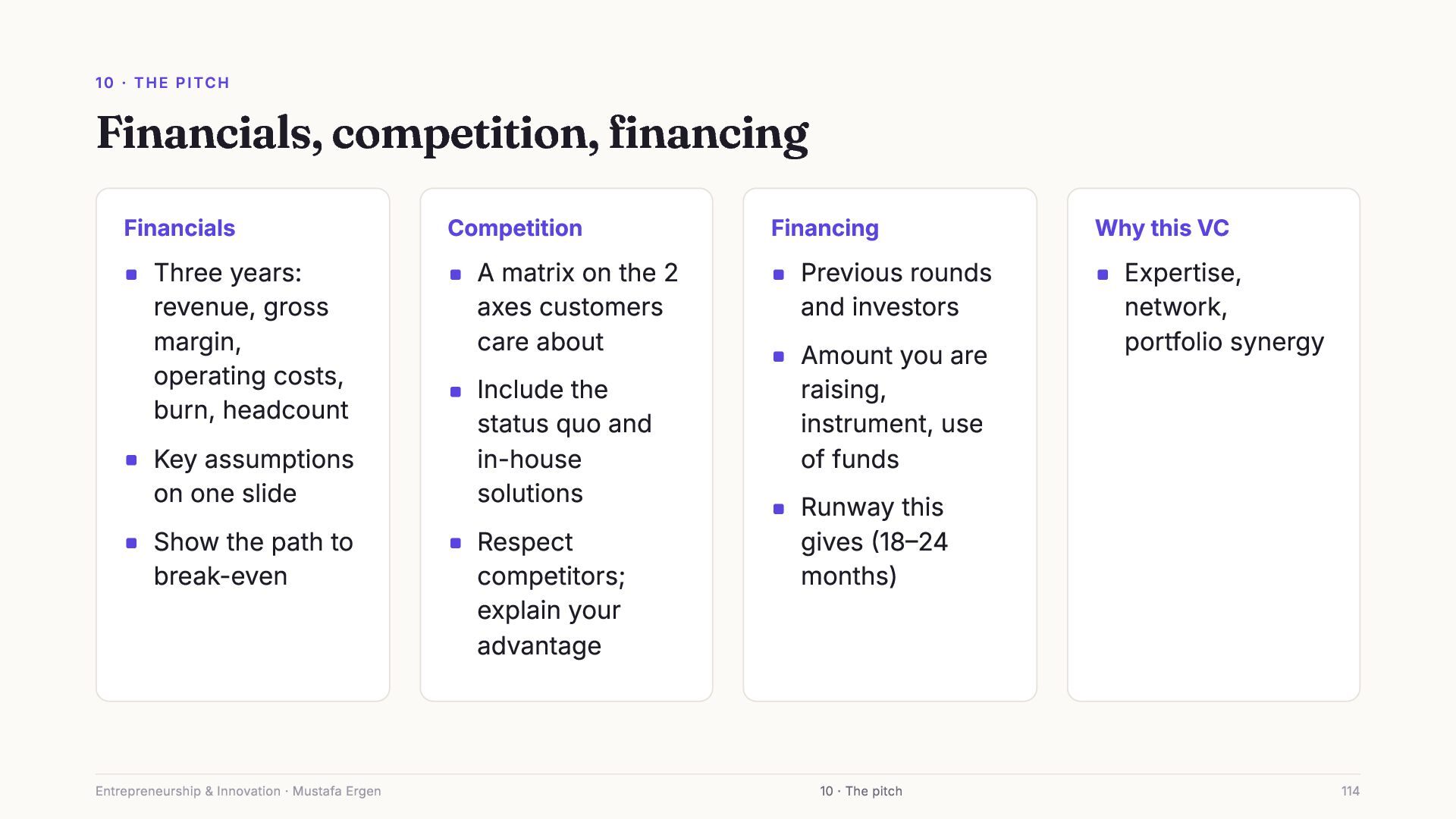
Financials, competition, financing Financials Three years: revenue, gross margin, operating costs, burn, headcount Key assumptions on one slide Show the path to break-even Entrepreneurship & Innovation · Mustafa Ergen Competition A matrix on the 2 axes customers care about Include the status quo and in-house solutions Respect competitors; explain your advantage Financing Previous rounds and investors Amount you are raising, instrument, use of funds Runway this gives (18–24 months) 10 · The pitch Why this VC Expertise, network, portfolio synergy 114 -
1 0 · T H E P I TC H
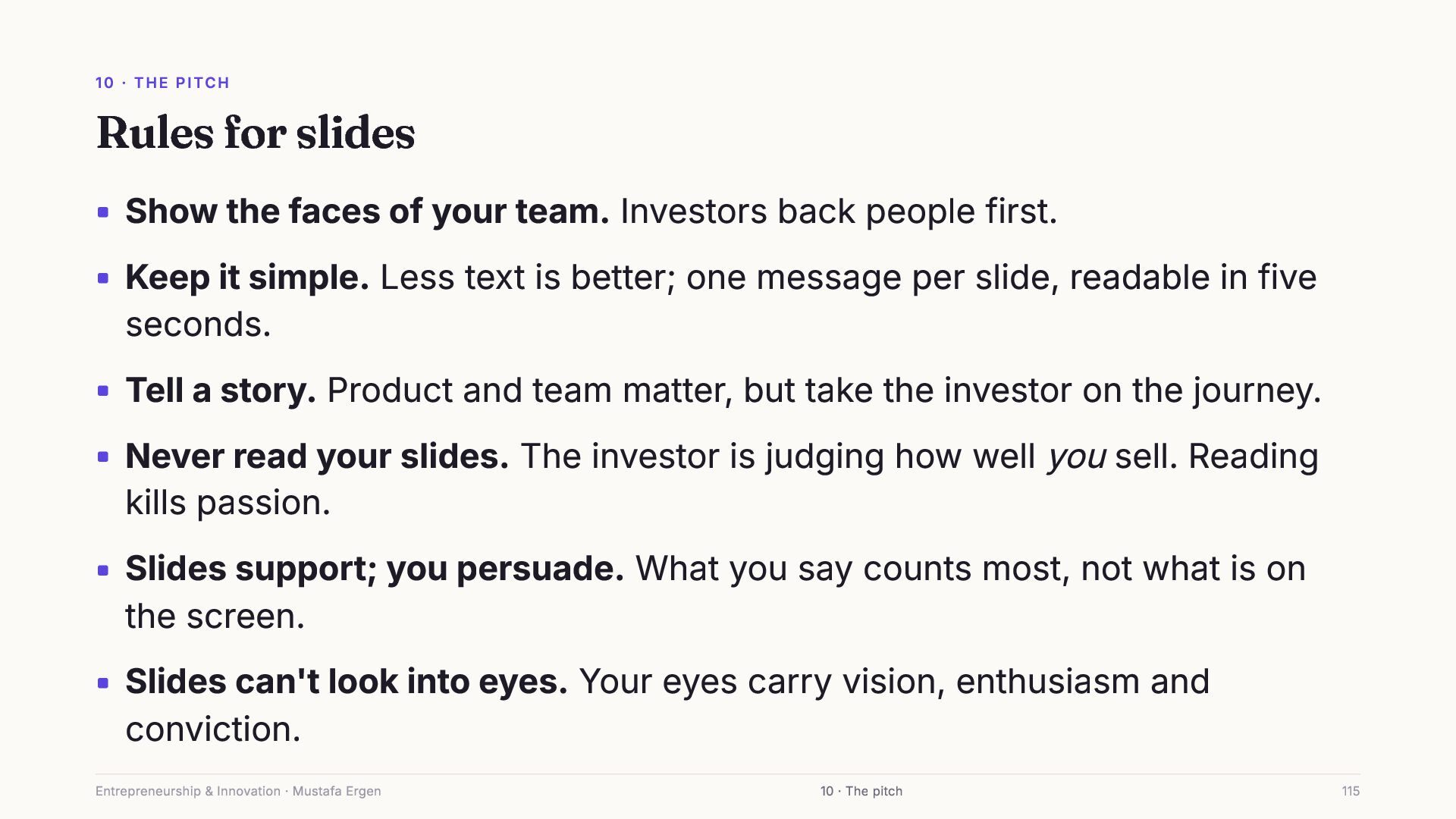
Rules for slides Show the faces of your team. Investors back people first. Keep it simple. Less text is better; one message per slide, readable in five seconds. Tell a story. Product and team matter, but take the investor on the journey. Never read your slides. The investor is judging how well you sell. Reading kills passion. Slides support; you persuade. What you say counts most, not what is on the screen. Slides can't look into eyes. Your eyes carry vision, enthusiasm and conviction. Entrepreneurship & Innovation · Mustafa Ergen 10 · The pitch 115 -
1 0 · T H E P I TC H
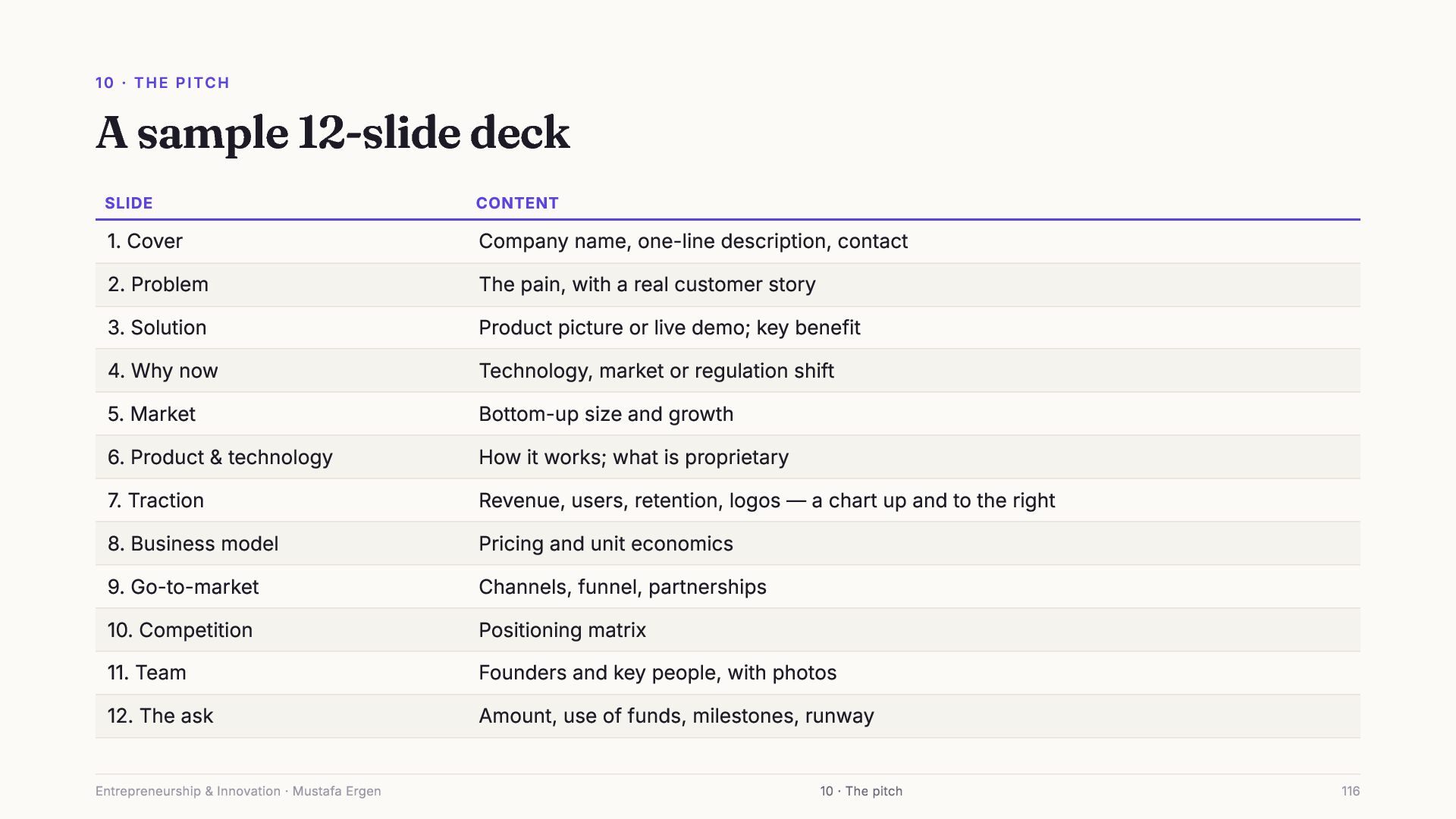
A sample 12-slide deck SLIDE CONTENT 1. Cover Company name, one-line description, contact 2. Problem The pain, with a real customer story 3. Solution Product picture or live demo; key benefit 4. Why now Technology, market or regulation shift 5. Market Bottom-up size and growth 6. Product & technology How it works; what is proprietary 7. Traction Revenue, users, retention, logos — a chart up and to the right 8. Business model Pricing and unit economics 9. Go-to-market Channels, funnel, partnerships 10. Competition Positioning matrix 11. Team Founders and key people, with photos 12. The ask Amount, use of funds, milestones, runway Entrepreneurship & Innovation · Mustafa Ergen 10 · The pitch 116 -
1 0 · T H E P I TC H
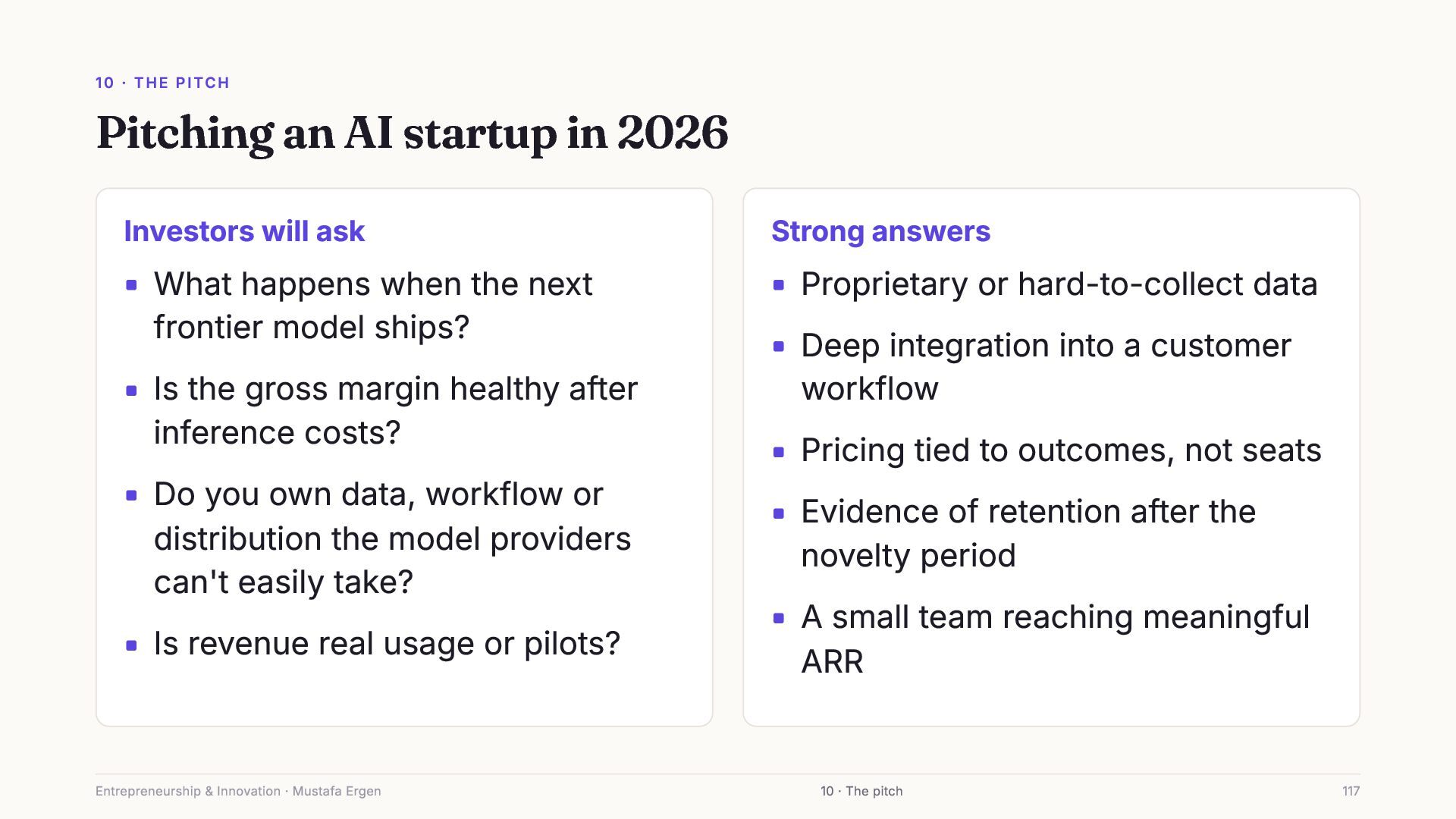
Pitching an AI startup in 2026 Investors will ask What happens when the next frontier model ships? Is the gross margin healthy after inference costs? Do you own data, workflow or distribution the model providers can't easily take? Is revenue real usage or pilots? Entrepreneurship & Innovation · Mustafa Ergen Strong answers Proprietary or hard-to-collect data Deep integration into a customer workflow Pricing tied to outcomes, not seats Evidence of retention after the novelty period A small team reaching meaningful ARR 10 · The pitch 117 -
1 0 · T H E P I TC H
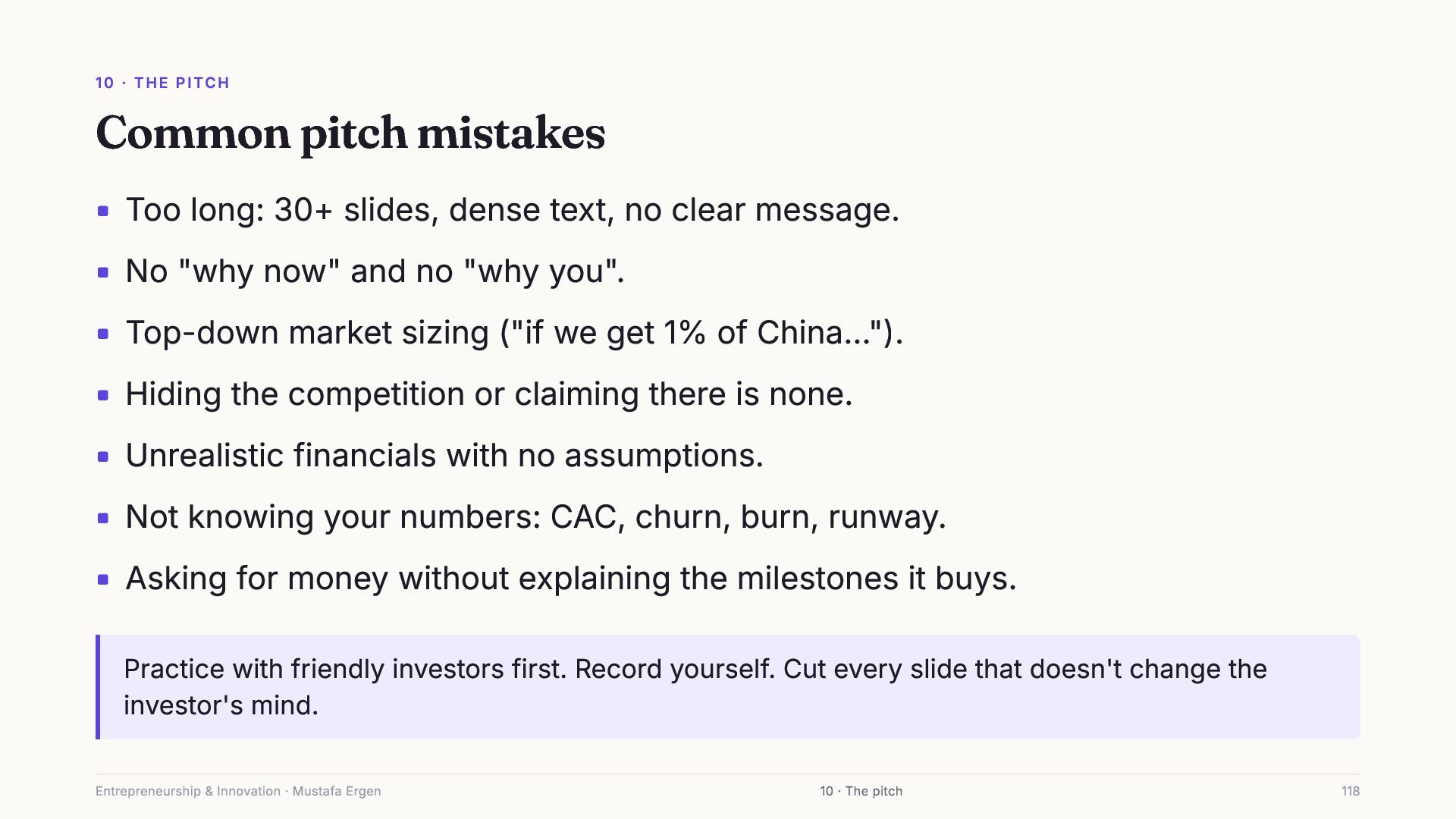
Common pitch mistakes Too long: 30+ slides, dense text, no clear message. No "why now" and no "why you". Top-down market sizing ("if we get 1% of China…"). Hiding the competition or claiming there is none. Unrealistic financials with no assumptions. Not knowing your numbers: CAC, churn, burn, runway. Asking for money without explaining the milestones it buys. Practice with friendly investors first. Record yourself. Cut every slide that doesn't change the investor's mind. Entrepreneurship & Innovation · Mustafa Ergen 10 · The pitch 118 -
11 Financials and valuation Building a financial model, understanding per-customer
economics, and how startups are valued. Expense plan Revenue plan Entrepreneurship & Innovation · Mustafa Ergen Unit economics SaaS & AI metrics Burn and runway 11 · Financials and valuation Valuation Cap tables 119 -
1 1 · F I N A N C I
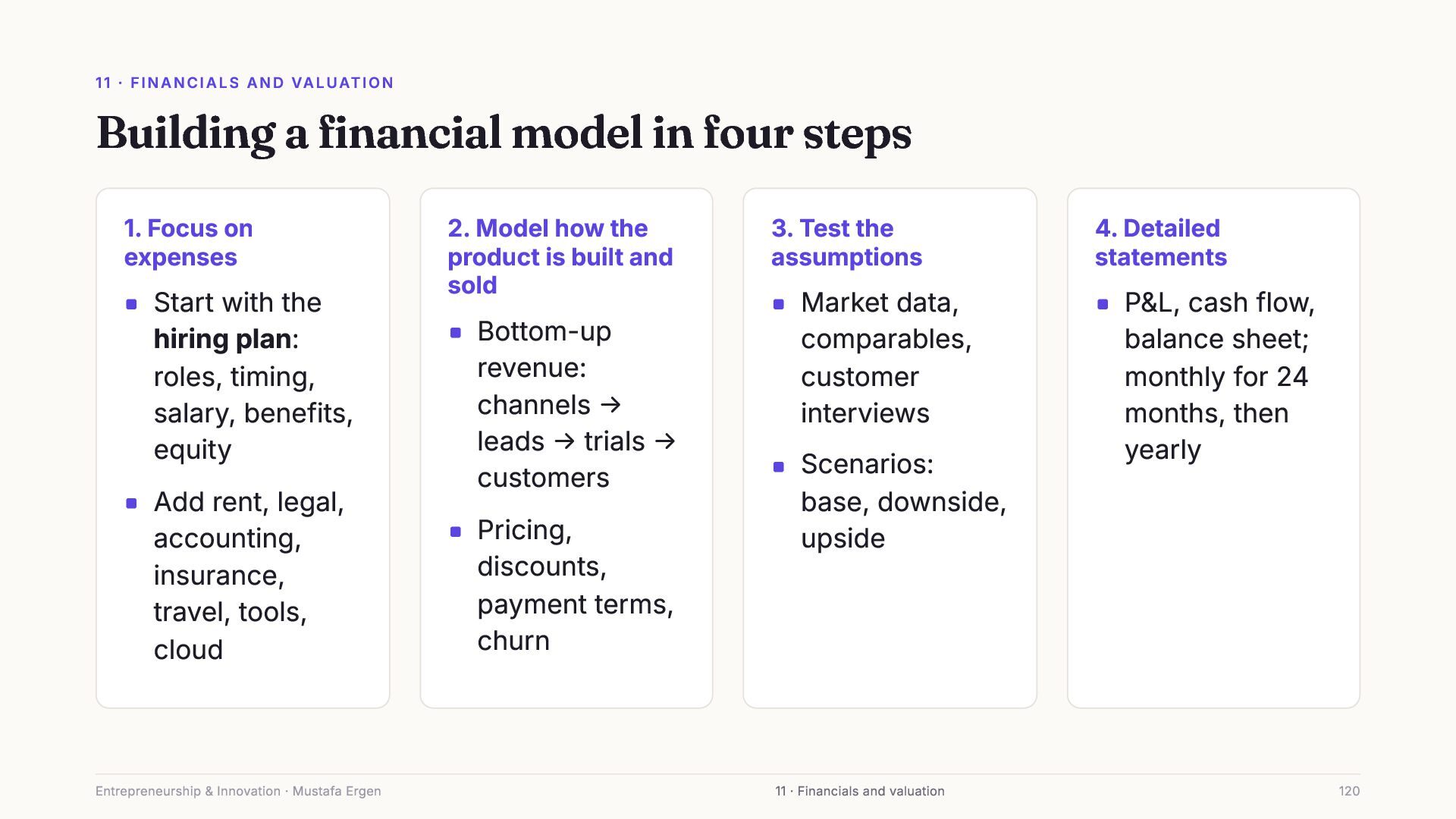
A L S A N D VA L UAT I O N Building a financial model in four steps 1. Focus on expenses Start with the hiring plan: roles, timing, salary, benefits, equity Add rent, legal, accounting, insurance, travel, tools, cloud Entrepreneurship & Innovation · Mustafa Ergen 2. Model how the product is built and sold Bottom-up revenue: channels → leads → trials → customers Pricing, discounts, payment terms, churn 3. Test the assumptions Market data, comparables, customer interviews Scenarios: base, downside, upside 11 · Financials and valuation 4. Detailed statements P&L, cash flow, balance sheet; monthly for 24 months, then yearly 120 -
1 1 · F I N A N C I
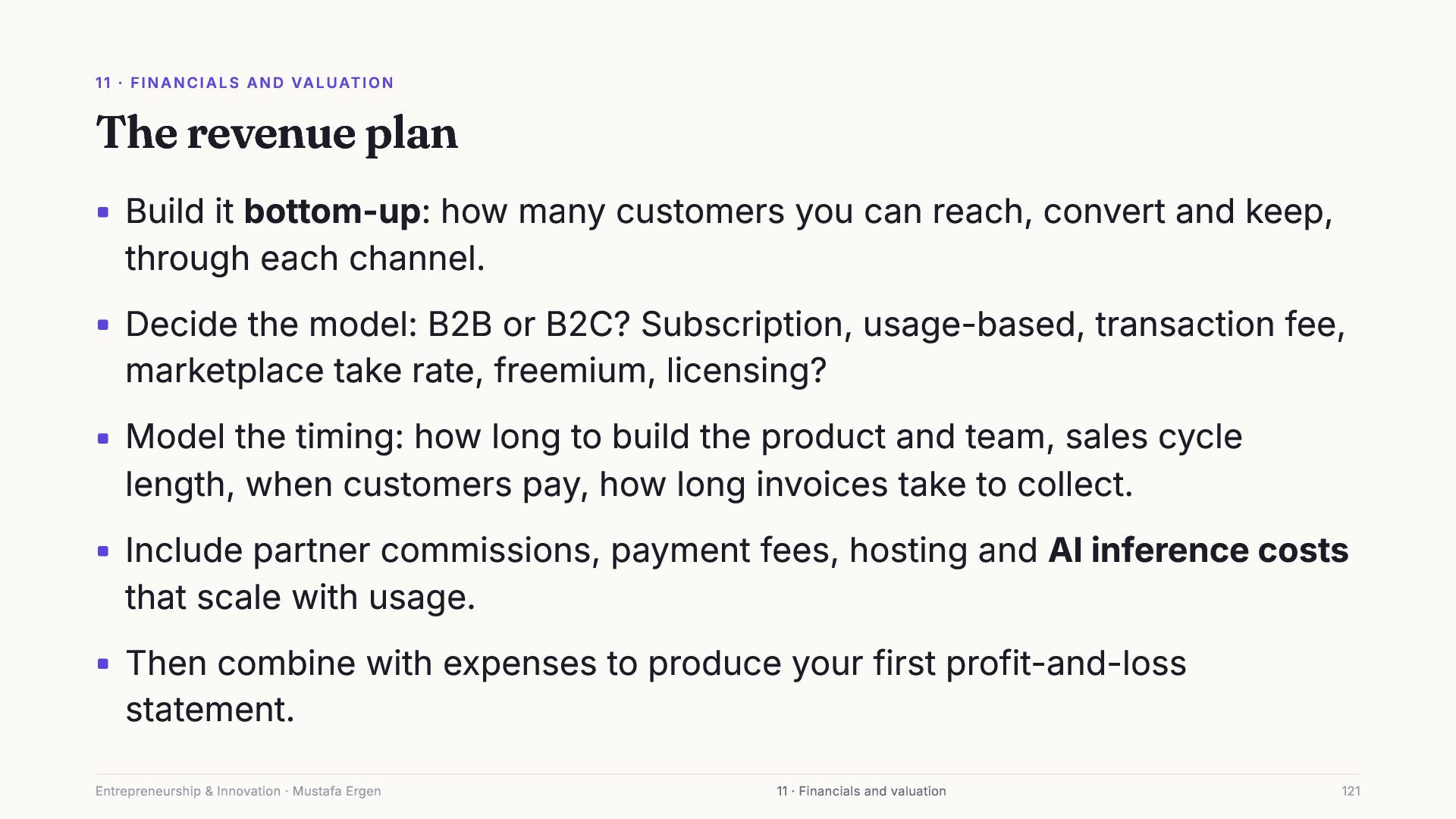
A L S A N D VA L UAT I O N The revenue plan Build it bottom-up: how many customers you can reach, convert and keep, through each channel. Decide the model: B2B or B2C? Subscription, usage-based, transaction fee, marketplace take rate, freemium, licensing? Model the timing: how long to build the product and team, sales cycle length, when customers pay, how long invoices take to collect. Include partner commissions, payment fees, hosting and AI inference costs that scale with usage. Then combine with expenses to produce your first profit-and-loss statement. Entrepreneurship & Innovation · Mustafa Ergen 11 · Financials and valuation 121 -
1 1 · F I N A N C I
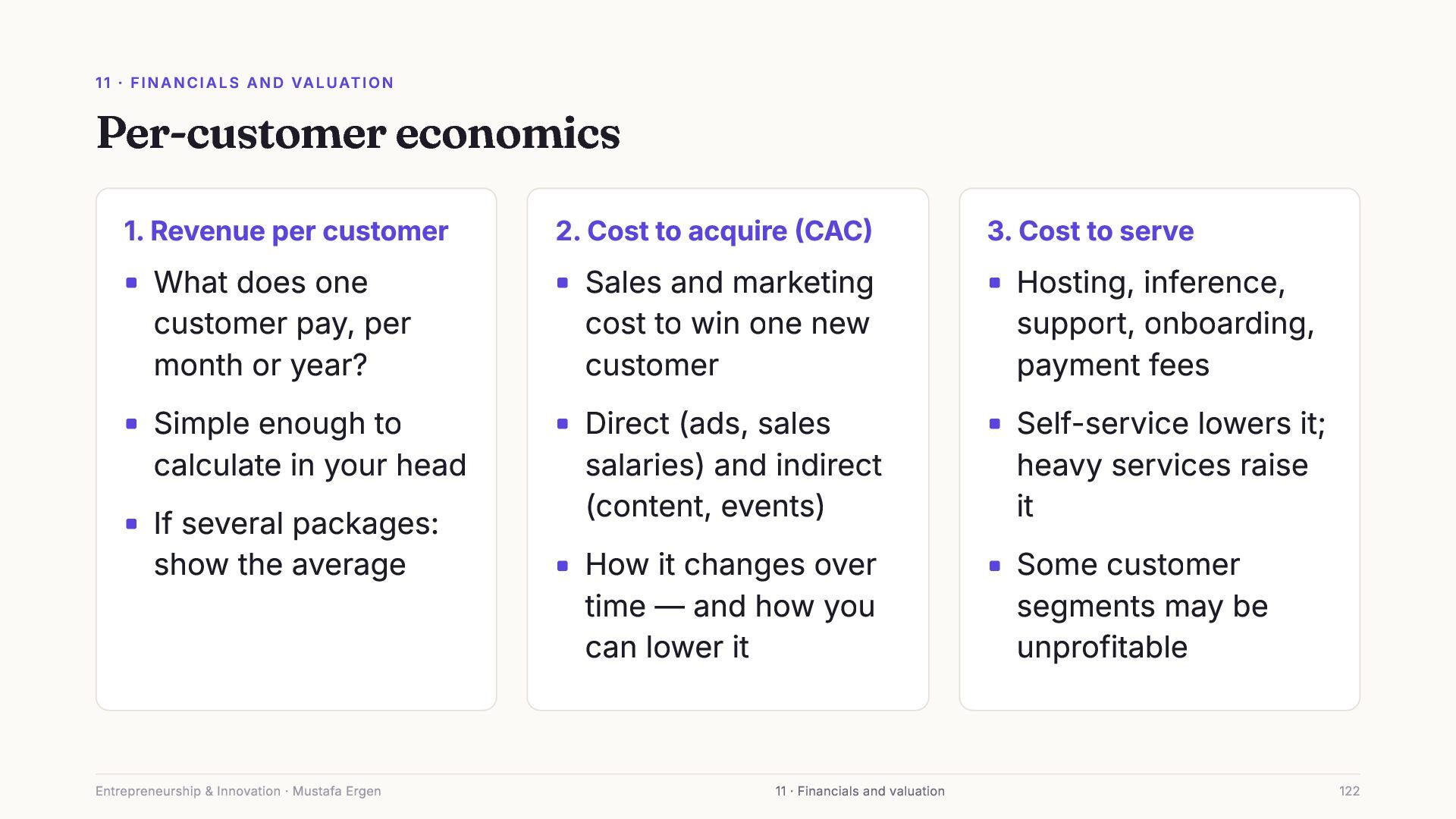
A L S A N D VA L UAT I O N Per-customer economics 1. Revenue per customer 2. Cost to acquire (CAC) What does one customer pay, per month or year? Simple enough to calculate in your head If several packages: show the average Sales and marketing cost to win one new customer Direct (ads, sales salaries) and indirect (content, events) How it changes over time — and how you can lower it Entrepreneurship & Innovation · Mustafa Ergen 11 · Financials and valuation 3. Cost to serve Hosting, inference, support, onboarding, payment fees Self-service lowers it; heavy services raise it Some customer segments may be unprofitable 122 -
1 1 · F I N A N C I
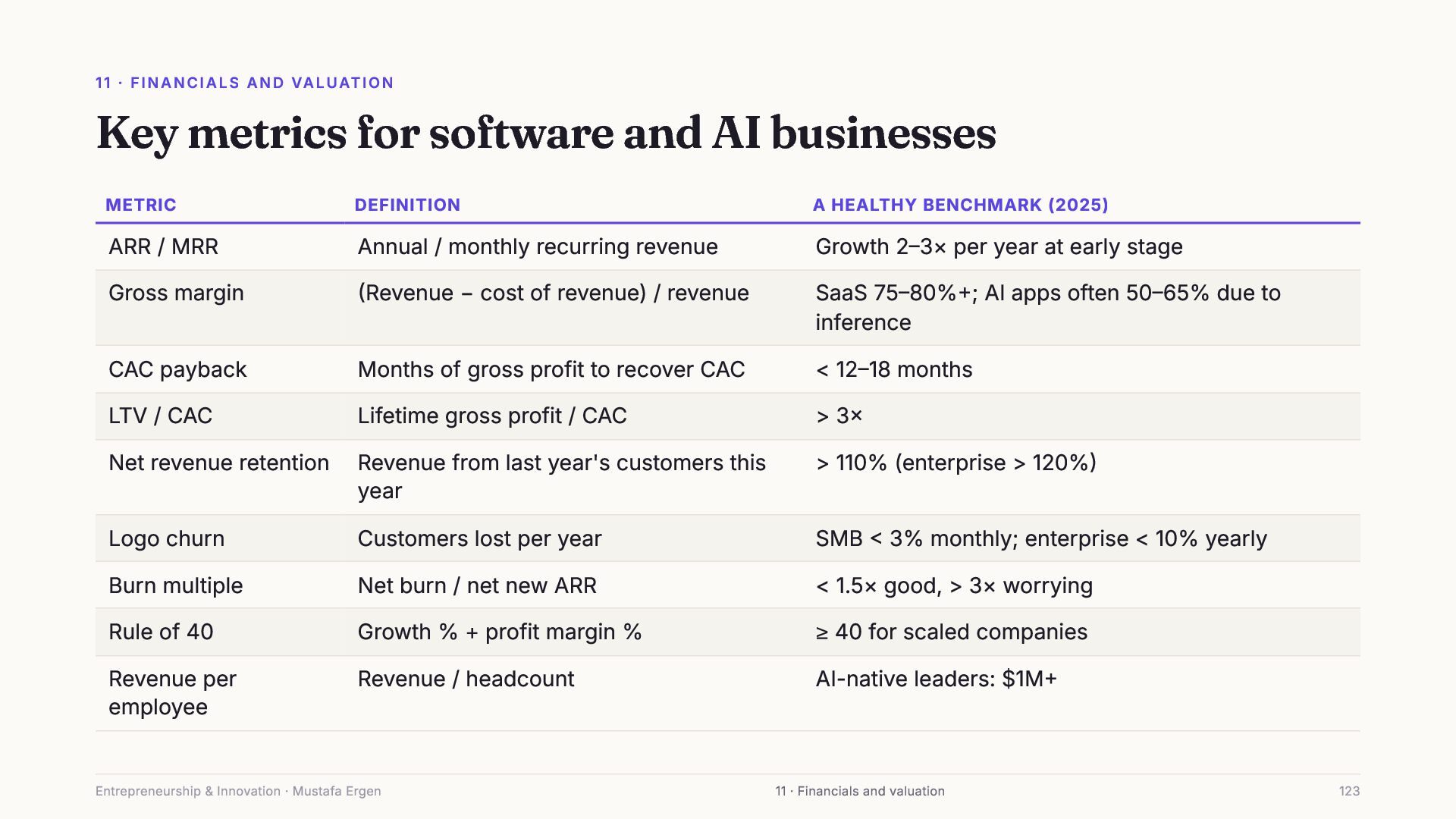
A L S A N D VA L UAT I O N Key metrics for software and AI businesses METRIC DEFINITION A HEALTHY BENCHMARK (2025) ARR / MRR Annual / monthly recurring revenue Growth 2–3× per year at early stage Gross margin (Revenue − cost of revenue) / revenue SaaS 75–80%+; AI apps often 50–65% due to inference CAC payback Months of gross profit to recover CAC < 12–18 months LTV / CAC Lifetime gross profit / CAC > 3× Net revenue retention Revenue from last year's customers this year > 110% (enterprise > 120%) Logo churn Customers lost per year SMB < 3% monthly; enterprise < 10% yearly Burn multiple Net burn / net new ARR < 1.5× good, > 3× worrying Rule of 40 Growth % + profit margin % ≥ 40 for scaled companies Revenue per employee Revenue / headcount AI-native leaders: $1M+ Entrepreneurship & Innovation · Mustafa Ergen 11 · Financials and valuation 123 -
1 1 · F I N A N C I
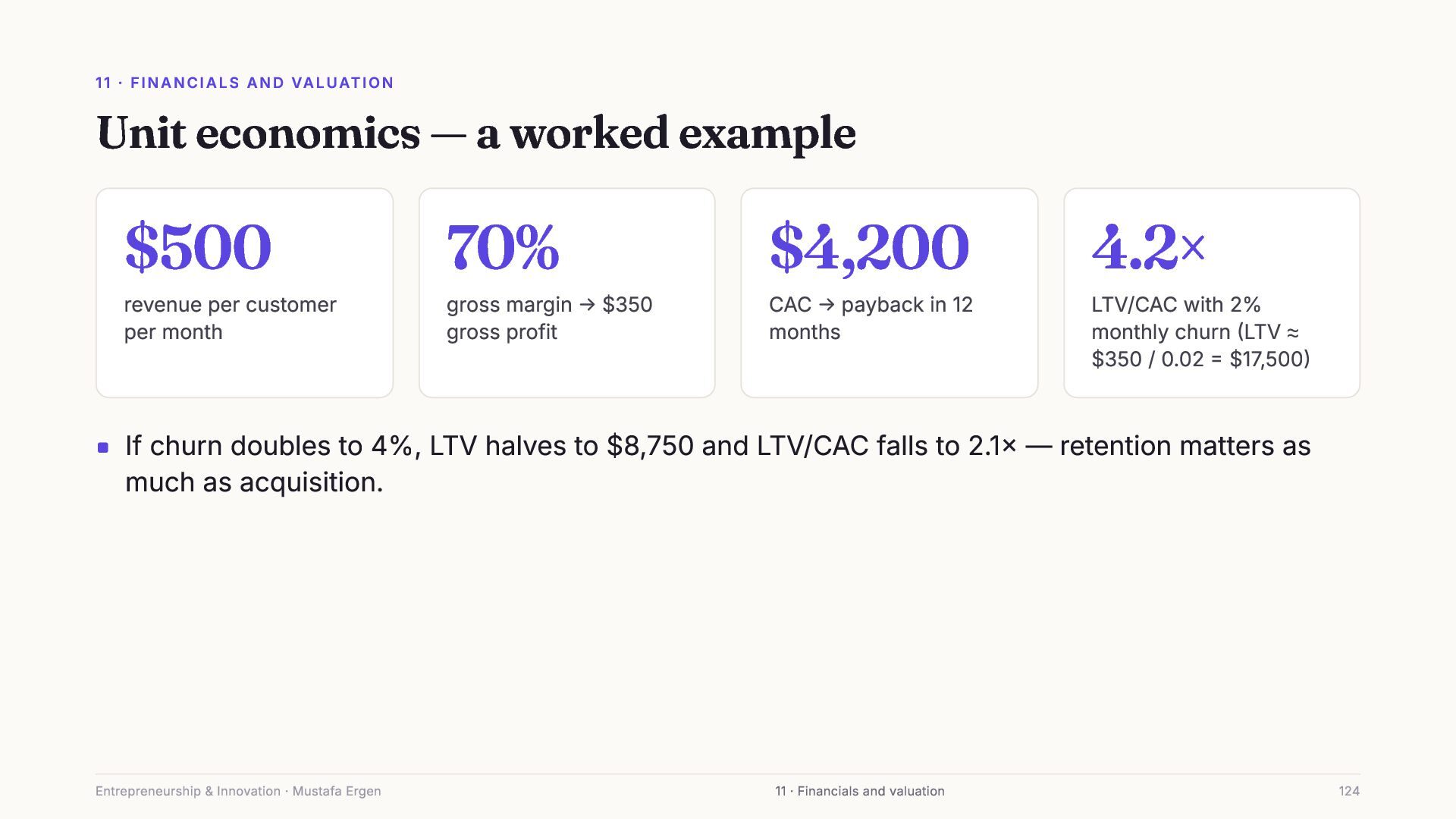
A L S A N D VA L UAT I O N Unit economics — a worked example $500 revenue per customer per month 70% gross margin → $350 gross profit $4,200 CAC → payback in 12 months 4.2× LTV/CAC with 2% monthly churn (LTV ≈ $350 / 0.02 = $17,500) If churn doubles to 4%, LTV halves to $8,750 and LTV/CAC falls to 2.1× — retention matters as much as acquisition. Entrepreneurship & Innovation · Mustafa Ergen 11 · Financials and valuation 124 -
1 1 · F I N A N C I
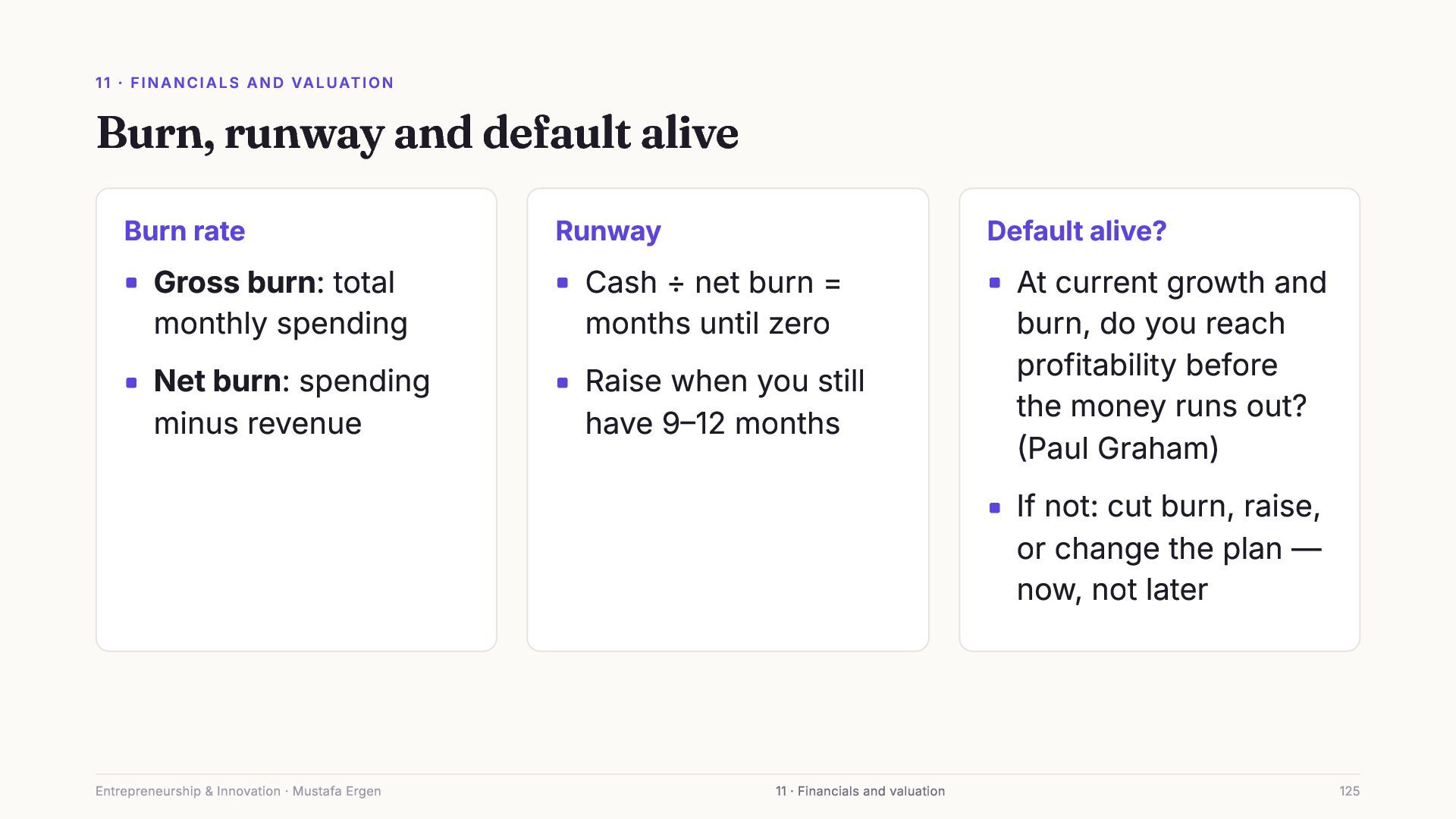
A L S A N D VA L UAT I O N Burn, runway and default alive Burn rate Gross burn: total monthly spending Net burn: spending minus revenue Entrepreneurship & Innovation · Mustafa Ergen Runway Default alive? Cash ÷ net burn = months until zero Raise when you still have 9–12 months 11 · Financials and valuation At current growth and burn, do you reach profitability before the money runs out? (Paul Graham) If not: cut burn, raise, or change the plan — now, not later 125 -
1 1 · F I N A N C I
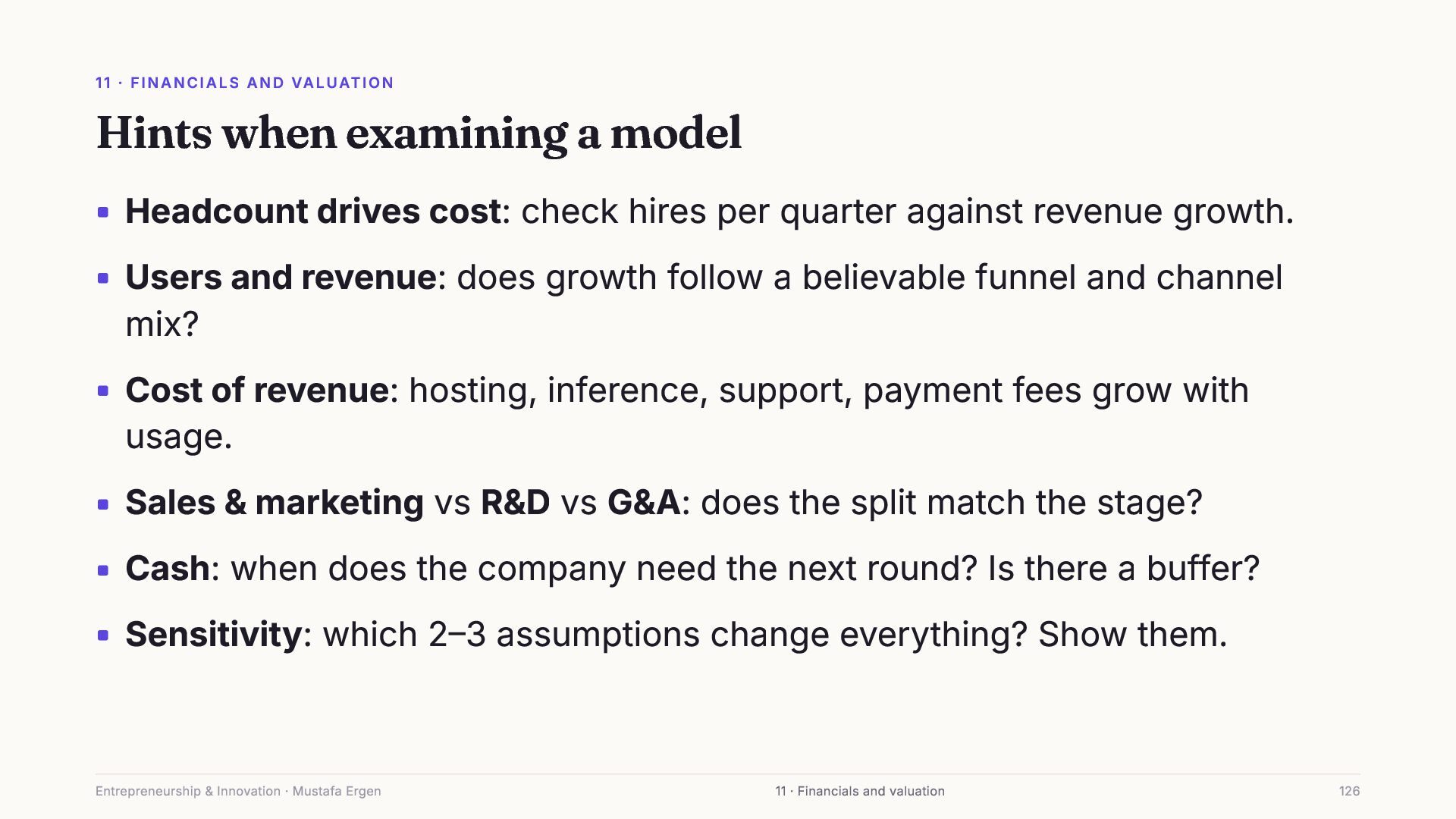
A L S A N D VA L UAT I O N Hints when examining a model Headcount drives cost: check hires per quarter against revenue growth. Users and revenue: does growth follow a believable funnel and channel mix? Cost of revenue: hosting, inference, support, payment fees grow with usage. Sales & marketing vs R&D vs G&A: does the split match the stage? Cash: when does the company need the next round? Is there a buffer? Sensitivity: which 2–3 assumptions change everything? Show them. Entrepreneurship & Innovation · Mustafa Ergen 11 · Financials and valuation 126 -
1 1 · F I N A N C I
A L S A N D VA L UAT I O N From financials to valuation Investors use the plan to estimate the funding needed and as one input to valuation during due diligence. Due diligence: the investigation before signing — team references, customers, technology, legal, financials, cap table. At early stages, valuation is mostly a negotiation driven by round size and target ownership (VCs often want 15–25% in a priced round). Later, valuation follows metrics: revenue multiples, growth, margins, and comparable public companies. Entrepreneurship & Innovation · Mustafa Ergen 11 · Financials and valuation 127 -
1 1 · F I N A N C I
A L S A N D VA L UAT I O N Valuation methods Early stage Market comparables of similar rounds Ownership-based: round size ÷ target stake Scorecard and Berkus methods (team, product, market, traction) VC method: expected exit value ÷ target return multiple Entrepreneurship & Innovation · Mustafa Ergen Later stage Fund reporting Revenue or ARR multiples vs public peers EBITDA multiples for profitable companies Discounted cash flow (DCF) 11 · Financials and valuation Portfolio marks follow IPEV guidelines; can take years to prove a winner 128 -
1 1 · F I N A N C I
A L S A N D VA L UAT I O N The VC method — an example Expected exit in 7 years: company with $100M revenue × 5× revenue multiple = $500M exit value. The VC targets 10× return at this stage → post-money today = $500M ÷ 10 = $50M. Expected dilution from future rounds: 40% → adjusted post-money = $50M × 0.6 = $30M. Investing $6M → pre-money $24M, investor owns 20%. The answer depends on assumptions — which is why valuation is a negotiation, not a calculation. Entrepreneurship & Innovation · Mustafa Ergen 11 · Financials and valuation 129 -
1 1 · F I N A N C I
A L S A N D VA L UAT I O N Pre-money, post-money and the cap table FOUNDERS OPTION POOL SEED INVESTORS SERIES A TOTAL Before seed 10.0M (100%) — — — 10.0M Seed: $2M at $8M pre; 1.25M-share pool created in the pre-money 10.0M (71.1%) 1.25M (8.9%) 2.81M (20.0%) — 14.06M Series A: $10M at $40M pre; pool topped up to 10% post 10.0M (54.6%) 1.83M (10.0%) 2.81M (15.4%) 3.66M (20.0%) 18.30M Illustrative. Price per share = pre-money valuation ÷ fully diluted shares before the round (fully diluted includes the option pool). Investors usually require the pool top-up to come out of the pre-money — so it dilutes founders, not them. Entrepreneurship & Innovation · Mustafa Ergen 11 · Financials and valuation 130 -
1 1 · F I N A N C I
A L S A N D VA L UAT I O N Valuation then and now Then (dot-com): eyeballs and page views; many companies with no revenue went public. 2010s: SaaS made recurring revenue the standard; ARR multiples; "growth at all costs" in 2020–2021, when public SaaS traded at 15–20× revenue. 2022–2023 correction: multiples fell to 5–7×; down rounds and flat rounds became common. 2024–2026: AI companies command very high multiples on fast-growing revenue; the rest of software is valued on efficient growth and profitability. Lesson: raise on a valuation you can grow into. A high price today can mean a painful down round later. Entrepreneurship & Innovation · Mustafa Ergen 11 · Financials and valuation 131 -
12 Building the team Leadership, organization, hiring, equity and culture
— the company is its people. Leadership Co-founders Entrepreneurship & Innovation · Mustafa Ergen Organization Hiring Equity and options Culture and teams 12 · Building the team Family businesses 132 -
12 · BUILDING THE TEAM How to build the team
The first 10 hires define the company's culture and speed more than any later decision. Hire for slope over intercept: people who learn fast beat people with more experience but less drive. Founders hire for gaps: technical founders need commercial strength, and vice versa. With AI tools, early teams are smaller — each person must own a larger area. Use your investors' and advisors' networks; the best people are rarely looking for a job. Entrepreneurship & Innovation · Mustafa Ergen 12 · Building the team 133 -
12 · BUILDING THE TEAM Leadership Effective leaders Create a
clear vision and keep repeating it Set high standards and hold people to them Earn trust through honesty and consistency Listen, then decide Entrepreneurship & Innovation · Mustafa Ergen Four vital tasks In early stages Hire and develop great people Set direction and priorities Make sure there is enough cash Build the culture by example 12 · Building the team Plan, but stay flexible Lead from the front: sell, recruit, build 134 -
12 · BUILDING THE TEAM Co-founders Choosing Complementary skills, shared
values, history of working together Decide on roles early: who is CEO? Entrepreneurship & Innovation · Mustafa Ergen Equity split Founder conflict Discuss early; equal splits are fine if contributions are equal Vesting: 4 years with a 1-year cliff for everyone, founders included 12 · Building the team One of the top reasons startups die Write a founders' agreement: roles, decision rights, what happens if someone leaves 135 -
12 · BUILDING THE TEAM Organization: hierarchical vs flat Standard
org chart CEO → functional heads (engineering, product, sales, marketing, finance, operations) Clear accountability; slower decisions Entrepreneurship & Innovation · Mustafa Ergen Flat organization Small teams owning outcomes end-to-end Fast; needs strong communication and senior people 12 · Building the team In practice Startups start flat and add structure as they grow (~50+ people) Remote and hybrid teams need written processes and clear ownership 136 -
12 · BUILDING THE TEAM Board, advisors, CEO Board of
directors Founders, investors, independent members Governance, hiring/firing the CEO, approving budgets and financings Entrepreneurship & Innovation · Mustafa Ergen Advisory board CEO and president Domain experts, customers, technical gurus No legal duties; paid with small equity (0.1–0.5%, vesting) 12 · Building the team CEO: vision, strategy, capital, team, culture President/COO: execution, operations, scaling 137 -
12 · BUILDING THE TEAM Hiring the right people Write
a job analysis: tasks, responsibilities, skills, knowledge and abilities needed. Write a clear job description: mission of the role, outcomes expected in 6–12 months, location/remote, compensation range. Source widely: referrals (best), LinkedIn, GitHub, local communities, university labs, startup job boards (Wellfound, YC Work at a Startup); in Türkiye also Kariyer.net and Techcareer. Avoid hiring mistakes: don't hire in a hurry, don't hire only people like you, don't skip references. Use work samples (paid take-home or trial days) — they predict performance better than interviews. Entrepreneurship & Innovation · Mustafa Ergen 12 · Building the team 138 -
12 · BUILDING THE TEAM Interviews and references Plan the
interview Decide what you're testing before the meeting Same core questions for every candidate Mix: skills test, past behavior ("tell me about a time…"), culture Entrepreneurship & Innovation · Mustafa Ergen Conduct it well Check references Sell the mission — top people have options Listen 80%, talk 20% Score independently before discussing 12 · Building the team Always, including back-channel references Ask: "Would you hire this person again?" Look for patterns, not one opinion 139 -
12 · BUILDING THE TEAM Equity: stock options and RSUs
Option pool Typically 10–15% of the company before Series A, refreshed later Vesting Instruments 4 years, 1-year cliff, monthly after that Acceleration on change of control (single/double trigger) Stock options (ISOs/NSOs in the US) — right to buy at a strike price RSUs at later stages In Türkiye: options are still hard to use; many startups use foreign holding structures — a policy gap to close Equity turns employees into owners. Explain it clearly: number of shares, strike price, total shares, what happens at exit. Entrepreneurship & Innovation · Mustafa Ergen 12 · Building the team 140 -
12 · BUILDING THE TEAM Company culture What it is
How decisions are really made, what gets rewarded, what is tolerated Entrepreneurship & Innovation · Mustafa Ergen Characteristics of strong cultures A clear mission people believe in Respect, openness, fast feedback High standards with psychological safety Fun — work people enjoy 12 · Building the team How to build it Write the values, then live them — especially in hiring and firing Leaders' behavior is the culture 141 -
12 · BUILDING THE TEAM Teams that work Advantages of
teams Better decisions, more ideas, shared ownership Entrepreneurship & Innovation · Mustafa Ergen Common errors What makes teams work Unclear goals and roles Too large (keep under ~8) No authority to decide Rewards only for individuals 12 · Building the team Clear, measurable goals Trust and constructive conflict Leaders who remove obstacles Regular feedback loops 142 -
12 · BUILDING THE TEAM Empowerment, job design and rewards
Empowerment Give people authority and resources with responsibility Works best with trained, informed, trusted people Entrepreneurship & Innovation · Mustafa Ergen Job design Rewards Job enlargement and rotation Job enrichment: more autonomy, feedback, ownership Flexible and remote work 12 · Building the team Salary, bonus, equity Recognition — often more powerful than money Growth: learning and promotion paths 143 -
12 · BUILDING THE TEAM Family businesses and succession Family
businesses A large share of companies in Türkiye and Europe Strength: long-term view, trust Weakness: hiring by loyalty, not skill; reluctance to share equity Entrepreneurship & Innovation · Mustafa Ergen Succession plan Serial founders Choose and train the successor early Separate ownership from management Bring in professional managers and independent board members 12 · Building the team Many founders start again after an exit — with more capital, a network and fewer mistakes 144 -
13 The term sheet The key economic and control terms
of a venture investment — what they mean and what is market standard today. Rounds and process Valuation and shares Liquidation preference Anti-dilution Vesting Investor rights Control terms Entrepreneurship & Innovation · Mustafa Ergen 13 · The term sheet 145 -
13 · THE TERM SHEET What is a term sheet?
A short (3–10 page) document setting out the main terms of an investment before lawyers write the full agreements. Mostly non-binding, except confidentiality, exclusivity ("no-shop", usually 30–60 days) and costs. Two kinds of terms: economics (valuation, liquidation preference, antidilution, option pool) and control (board, protective provisions, voting, dragalong). In the US the NVCA model documents (updated October 2025) are the starting point; in Europe, BVCA/Invest Europe models; in Türkiye, agreements are often adapted from these. Entrepreneurship & Innovation · Mustafa Ergen 13 · The term sheet 146 -
13 · THE TERM SHEET The investment process STEP WHAT
HAPPENS TYPICAL TIME First meetings Pitch, partner meetings 2–4 weeks Term sheet Negotiation of key terms; signed, exclusivity starts 1–2 weeks Due diligence Legal, financial, technical, commercial, references 2–6 weeks Definitive agreements Charter (articles), stock purchase, investors' rights, voting, ROFR/co-sale 2–4 weeks Closing Signatures, funds wired, shares issued 1 day Post-closing Board set-up, reporting, cap table update ongoing Entrepreneurship & Innovation · Mustafa Ergen 13 · The term sheet 147 -
13 · THE TERM SHEET Rounds, shares and capital Investment
round Seed, Series A, B, C… each with its own class of preferred stock Entrepreneurship & Innovation · Mustafa Ergen Share capital Pre-money valuation ÷ fully diluted shares = price per share Fully diluted: all shares + options + warrants + convertibles Type of share Common: founders, employees Preferred: investors — with liquidation preference, conversion, anti-dilution and voting rights 13 · The term sheet Tranches Money in steps tied to milestones; NVCA's 2025 update added standard tranche mechanics 148 -
13 · THE TERM SHEET Valuation and milestones The headline
number Pre-money: value before new money Post-money = premoney + new investment Entrepreneurship & Innovation · Mustafa Ergen What really matters The option pool inside the premoney ("option pool shuffle") Liquidation preference and participation Ratchets or milestone conditions 13 · The term sheet Ratchet If performance or the next round's price falls below a target, investors get extra shares Rare and founderunfriendly; avoid if possible 149 -
13 · THE TERM SHEET Liquidation preference What it is
In a sale or liquidation, preferred holders get their money back before common holders Variants Why it matters 1× non-participating (market standard): get 1× back or convert to common — whichever is more Participating: get 1× back and share in the rest ("double dip") Multiples (2×, 3×): seen in bad markets or very late stages In a modest exit, preferences decide who gets paid In 2025 the large majority of US VC deals used 1× non-participating preferences. Entrepreneurship & Innovation · Mustafa Ergen 13 · The term sheet 150 -
13 · THE TERM SHEET Liquidation preference — example ($10M
invested for 25%) EXIT VALUE 1× NON-PARTICIPATING 1× PARTICIPATING FOUNDERS/COMMON GET (NON-PART. / PART.) $8M Investor takes $8M (all) $8M $0 / $0 $20M $10M (preference > 25% × $20M) $10M + 25% × $10M = $12.5M $10M / $7.5M $40M $10M (preference = 25% × $40M) $10M + 25% × $30M = $17.5M $30M / $22.5M $100M Converts: 25% × $100M = $25M $10M + 25% × $90M = $32.5M $75M / $67.5M Entrepreneurship & Innovation · Mustafa Ergen 13 · The term sheet 151 -
13 · THE TERM SHEET Dividends, redemption, conversion Dividend rights
Usually noncumulative and only "when declared" — startups rarely pay dividends Cumulative dividends are a red flag Entrepreneurship & Innovation · Mustafa Ergen Redemption Conversion Investors can force the company to buy back shares after X years Rare in the US today; still seen in some markets 13 · The term sheet Preferred converts to common at any time (1:1, adjusted for splits and antidilution) Automatic conversion at a qualified IPO or majority vote 152 -
13 · THE TERM SHEET Anti-dilution protection What it does
If a later round is priced lower (a down round), earlier investors' conversion price is adjusted Entrepreneurship & Innovation · Mustafa Ergen Types Carve-outs Broad-based weighted average — market standard; adjustment depends on how much is raised at the lower price Narrow-based weighted average — stronger for investors Full ratchet — conversion price drops to the new price, regardless of amount; very harsh for founders 13 · The term sheet Option grants, conversions, strategic deals don't trigger it 153 -
13 · THE TERM SHEET Founder shares and vesting Founder
vesting Founders' shares vest over 4 years (1-year cliff); credit for time already worked is negotiable Protects everyone if a founder leaves early Entrepreneurship & Innovation · Mustafa Ergen Acceleration Leaver provisions Single trigger: vesting accelerates on sale Double trigger (common): on sale and termination without cause 13 · The term sheet "Good leaver" vs "bad leaver": price at which the company buys back unvested or vested shares Common in Europe and Türkiye 154 -
13 · THE TERM SHEET Investor rights Pre-emption / prorata
Right to invest in future rounds to keep ownership percentage Entrepreneurship & Innovation · Mustafa Ergen ROFR and co-sale Right of first refusal: company/investors can buy shares a founder wants to sell Co-sale (tagalong): investors can sell alongside founders on the same terms Information rights Registration rights Monthly or quarterly financials, annual budget, audit Right to have shares registered in an IPO (demand, piggyback, S-3) 13 · The term sheet 155 -
13 · THE TERM SHEET Drag-along and exit Drag-along If
the board and a majority of preferred (and often common) approve a sale, all shareholders must sell on the same terms Prevents small holders from blocking an exit Entrepreneurship & Innovation · Mustafa Ergen Bring-along / tag-along Minority holders can join a sale on the same terms 13 · The term sheet Exit provisions Investors may require the company to pursue an exit after a number of years Negotiate: who decides, minimum price, founders' protection 156 -
13 · THE TERM SHEET Control terms Board of directors
Typical Series A board: 2 founders, 1 investor, (1 independent) — or 2–1–2 later Board observers: no vote, attend meetings Entrepreneurship & Innovation · Mustafa Ergen Voting rights Preferred votes with common on an asconverted basis Protective provisions Preferred holders' veto over: new senior shares, changing the charter, sale of the company, debt above a limit, dividends, changing board size 13 · The term sheet Representations and warranties The company and founders confirm facts: capitalization, IP ownership, no litigation, financial statements 157 -
13 · THE TERM SHEET Other clauses Confidentiality and IP
Every employee and founder assigns IP to the company and signs confidentiality agreements Exclusivity (no-shop) 30–60 days not to negotiate with others Entrepreneurship & Innovation · Mustafa Ergen Employee option plan Fees and expenses Size of the pool; vesting standards Conditions precedent Company usually pays investors' legal fees (capped) Enforceability Due diligence, legal opinions, approvals, key hires, IP transfers before closing 13 · The term sheet Mostly non-binding; governing law and jurisdiction 158 -
13 · THE TERM SHEET Negotiating a term sheet Focus
on the terms that matter: valuation, option pool, liquidation preference, board, protective provisions. Don't fight every comma. Know the market standard — use NVCA, BVCA or YC documents and ask other founders. Have more than one term sheet if you can; competition is the best negotiating tool. Hire a lawyer who does venture deals often — it saves money. Remember: you will work with this investor for 7–10 years. Terms that look like a win today can damage the relationship. Entrepreneurship & Innovation · Mustafa Ergen 13 · The term sheet 159 -
14 The board and governance How a venture-backed board works,
the legal duties of directors and how to make the board useful. Composition Duties Entrepreneurship & Innovation · Mustafa Ergen Alignment Audit and controls Effective boards Evaluation 14 · The board and governance 160 -
1 4 · T H E B OA R D
A N D G OV E R N A N C E The board of a venture-backed company Typically small (3–7 members): founders/CEO, investor directors, independent directors. Unique features: directors appointed by investors with their own fund interests; fast-changing strategy; frequent financings. Its job: hire, support and if needed replace the CEO; approve strategy, budgets, financings and exits; oversee risk and compliance. Meets every 6–8 weeks early on, quarterly later. Good boards spend most time on strategy, not reporting. Entrepreneurship & Innovation · Mustafa Ergen 14 · The board and governance 161 -
1 4 · T H E B OA R D
A N D G OV E R N A N C E Directors' legal duties Duty of care Be informed; read the materials; ask questions; take time to decide Duty of loyalty Act in the interest of the company and all shareholders — not just your fund Disclose conflicts; abstain when conflicted Business judgment rule Courts don't second-guess decisions made in good faith, informed, without conflict Hard cases Sales where preferred and common get very different outcomes; down rounds; insider financings Based on Delaware law (where most US VC-backed companies are incorporated). Turkish Commercial Code (TTK 6102) gives board members similar duties of care and loyalty. Entrepreneurship & Innovation · Mustafa Ergen 14 · The board and governance 162 -
1 4 · T H E B OA R D
A N D G OV E R N A N C E How to achieve an aligned board Align expectations early Before investing: agree on vision, milestones, exit expectations and timeline Entrepreneurship & Innovation · Mustafa Ergen Four main areas Strategy and goals Team and CEO performance Capital and financing plan Exit options 14 · The board and governance Behavior No surprises: bad news early Board pre-reads 48 hours before One-on-ones between meetings Separate session without management (executive session) 163 -
1 4 · T H E B OA R D
A N D G OV E R N A N C E Audit committee and internal controls Audit committee Oversees financial reporting, auditors, internal controls Needed once the company is larger or preparing for an IPO Entrepreneurship & Innovation · Mustafa Ergen Early internal controls Two signatures for payments above a threshold Monthly bank reconciliations Expense policy, separation of duties Cap table maintained carefully (Carta, Pulley, or a law firm) 14 · The board and governance Later-stage controls Annual audit, revenue recognition (ASC 606 / IFRS 15) SOX-readiness before an IPO; security and data-protection compliance (GDPR, KVKK) 164 -
1 4 · T H E B OA R D
A N D G OV E R N A N C E Board composition and roles Investor directors Bring pattern recognition and networks; may face fund conflicts Entrepreneurship & Innovation · Mustafa Ergen Independent directors Industry operators; balance founders and investors Board observers No vote; attend meetings; keep confidentiality 14 · The board and governance Company counsel Advises the company, not individual directors; records minutes Ensures approvals are properly documented 165 -
1 4 · T H E B OA R D
A N D G OV E R N A N C E Effective vs ineffective boards Ineffective boards Meetings are long status reports Directors unprepared or distracted by their own fund Founders hide bad news No independent voices Avoid hard CEO conversations Entrepreneurship & Innovation · Mustafa Ergen Effective boards Short reporting, long strategy discussion Clear agenda and decisions Trust and candor Help between meetings: hiring, customers, financing Regular self-evaluation 14 · The board and governance 166 -
1 4 · T H E B OA R D
A N D G OV E R N A N C E At minimum, every director should… All directors Read materials before meetings Understand cash position and runway Keep information confidential Entrepreneurship & Innovation · Mustafa Ergen Independent directors Represent the company's long-term interests Mediate between founders and investors VC directors Disclose conflicts between their fund and the company Remember their duty is to all shareholders 14 · The board and governance Founder directors Report honestly; separate the CEO role from the shareholder role 167 -
1 4 · T H E B OA R D
A N D G OV E R N A N C E Evaluation and logistics Annual CEO review: board agrees goals at the start of the year and reviews performance, compensation and development at the end. Board self-evaluation: a short anonymous survey each year — meeting quality, mix of skills, relationship with management. Peer review: directors give each other feedback, led by the chair or lead independent director. Logistics: fixed calendar, standard board pack (KPIs, cash, hiring, product, risks), written minutes, consents for decisions between meetings. Adapted from the NVCA's guidance on the basic responsibilities of VC-backed company directors. Entrepreneurship & Innovation · Mustafa Ergen 14 · The board and governance 168 -
15 The founder mindset The personal attributes that separate founders
who keep going from those who stop — and how to build them. Risk taking Self-starter Entrepreneurship & Innovation · Mustafa Ergen Discipline Lifelong learning Accepting failure 15 · The founder mindset Global entrepreneur Reputation 169 -
15 · THE FOUNDER MINDSET Risk taking Entrepreneurs don't love
risk — they manage it. They take moderate, calculated risks and reduce them step by step. Each stage removes one kind of risk: team risk, technology risk, market risk, financing risk, scaling risk. Ask: what is the cheapest experiment that tells me whether this works? Personal risk is real: savings, career, family. Discuss it openly with the people it affects. Entrepreneurship & Innovation · Mustafa Ergen 15 · The founder mindset 170 -
15 · THE FOUNDER MINDSET Individual attitudes Self-starter Doesn't wait
for permission or perfect information Creates momentum: first customers, first prototype, first hire Entrepreneurship & Innovation · Mustafa Ergen Positive thinker Sees problems as puzzles to solve Optimism grounded in facts Discipline Does the boring work: follow-ups, accounts, details Keeps promises to customers, investors and team 15 · The founder mindset Objectivity Looks at data even when it hurts Separates ego from decisions 171 -
15 · THE FOUNDER MINDSET Learning and selling Lifelong learner
Reads, asks, experiments; learns from customers and competitors In the AI era: relearns tools every few months Entrepreneurship & Innovation · Mustafa Ergen Marketing ability Every founder is a salesperson — to customers, investors, recruits and the press Tell a clear story; listen more than you talk 15 · The founder mindset Investing in yourself Health, sleep, relationships — a long game needs stamina Mentors and peer founder groups 172 -
15 · THE FOUNDER MINDSET Accept failure — and learn
fast Most startups fail; many successful founders failed before (Rovio made 51 games before Angry Birds; Slack began as a failed game company). In Silicon Valley a failed startup is often seen as experience; in many places it is still a stigma — that culture must change. Fail cheaply and early: test assumptions before building everything. After failure: be honest with investors and employees, close properly, reflect, try again. "Ever tried. Ever failed. No matter. Try again. Fail again. Fail better." — Samuel Beckett Entrepreneurship & Innovation · Mustafa Ergen 15 · The founder mindset 173 -
15 · THE FOUNDER MINDSET The global entrepreneur Think global
from day one Software and AI travel; local markets may be too small Design for international customers, currencies, regulation Entrepreneurship & Innovation · Mustafa Ergen Risk and reward Bigger markets, more competition, more complexity Reputation and relationships How to develop a global mindset Trust is the currency: deliver what you promise Relationships with diaspora founders and investors open doors Live or work abroad; learn languages Build a diverse team Attend global events; sell abroad early 15 · The founder mindset 174 -
15 · THE FOUNDER MINDSET The founder's mindset in practice
Mark Zuckerberg started Facebook at Harvard in 2004, focused on one campus, then expanded school by school — dominate a small market first. He refused early acquisition offers (Yahoo offered ~$1B in 2006), betting on a bigger future. He kept product focus: "move fast" — then changed the motto when scale demanded stability. Many lessons are universal: obsession with users, speed, keeping control of the vision, hiring strong operators (Sheryl Sandberg in 2008). Some are cautionary: growth at any cost created privacy and trust problems that cost far more later. The film The Social Network (2010) dramatized the story; the details are contested — read the real history. Entrepreneurship & Innovation · Mustafa Ergen 15 · The founder mindset 175 -
15 · THE FOUNDER MINDSET Habits of resilient founders Write
down weekly priorities and review them every Friday. Talk to at least five customers every week. Know your cash and runway at all times. Build a small personal board: a mentor, a peer founder, a coach or friend outside the company. Protect sleep, exercise and family time — burnout destroys more startups than competitors. Celebrate small wins with the team. Entrepreneurship & Innovation · Mustafa Ergen 15 · The founder mindset 176 -
16 Venture trends for the next decade Where capital and
talent are moving: AI, deep tech, energy, life sciences, defense — and new regions. AI everywhere Deep tech and chips Climate and energy Life sciences Defense and space New regions Governments Entrepreneurship & Innovation · Mustafa Ergen 16 · Venture trends for the next decade 177 -
1 6 · V E N T U R E
T R E N D S F O R T H E N E XT D E CA D E Six big shifts 1. AI as infrastructure Every software product becomes AI-native; agents automate knowledge work 4. Life sciences + AI AI drug discovery, GLP-1 and obesity, gene editing Entrepreneurship & Innovation · Mustafa Ergen 2. Compute and energy Data centers need chips, power and cooling; energy becomes a tech sector again 5. Defense, security, space Defense tech, cybersecurity, satellites, drones 16 · Venture trends for the next decade 3. Deep tech Semiconductors, robotics, quantum, new materials 6. Geography Capital follows talent: Gulf, India, Europe's AI hubs 178 -
1 6 · V E N T U R E
T R E N D S F O R T H E N E XT D E CA D E AI: from models to agents 2023–2024: chat assistants and copilots. 2025–2026: agents that use tools, write and run code, and complete multi-step tasks. Enterprise AI spending grew from $1.7B (2023) to $37B (2025) according to Menlo Ventures. Pricing shifts from seats to usage and outcomes — "service as software". Risks to watch: margin pressure from inference costs, dependence on model providers, regulation (EU AI Act phases in through 2026–2027), data rights. Opportunities for startups: vertical AI (law, health, finance, industry), AI security and trust, data infrastructure, devices at the edge. Source: Menlo Ventures, cited in PitchBook-NVCA Venture Monitor Q4 2025. Entrepreneurship & Innovation · Mustafa Ergen 16 · Venture trends for the next decade 179 -
1 6 · V E N T U R E
T R E N D S F O R T H E N E XT D E CA D E Semiconductors and compute Why it matters AI demand made chips the most strategic industry in the world Nvidia became the first $4T company in 2025 Entrepreneurship & Innovation · Mustafa Ergen Where startups play Specialized AI accelerators and inference chips Photonics and networking, memory, advanced packaging Chip design tools with AI 16 · Venture trends for the next decade Policy US CHIPS Act ($52B), EU Chips Act, Japan, Korea, India subsidies Export controls shape who can buy what 180 -
1 6 · V E N T U R E
T R E N D S F O R T H E N E XT D E CA D E Climate and energy tech $40.5B global climate tech venture and growth investment in 2025, +8% YoY ~$14B went to energy startups — strongest in three years 44% of energy funding went to fusion and fission The driver changed: power demand from AI data centers now pulls capital into generation, storage, grid software and nuclear. Solar and batteries keep getting cheaper; the bottleneck is grid connections, permitting and storage. Source: Sightline Climate, 2025 Climate Tech Investment Trends (Jan 2026). Other trackers report $38–49B. Entrepreneurship & Innovation · Mustafa Ergen 16 · Venture trends for the next decade 181 -
1 6 · V E N T U R E
T R E N D S F O R T H E N E XT D E CA D E Energy: what changed since 2010 Clean tech 1.0 (2006–2011) Big bets on solar panels, biofuels, electric cars Many failures (Solyndra); VCs lost money and left Entrepreneurship & Innovation · Mustafa Ergen Today Lessons Solar module prices fell ~90% since 2010; batteries ~90% since 2010 Software and data: smart grids, demand response, virtual power plants Storage, heat pumps, EV charging, grid-scale batteries Advanced nuclear and fusion attract billions 16 · Venture trends for the next decade Hardware needs patient capital and project finance, not only VC Policy (US IRA, EU Green Deal) shapes demand — and can change 182 -
1 6 · V E N T U R E
T R E N D S F O R T H E N E XT D E CA D E Life sciences The opportunity Aging populations, chronic disease, obesity (GLP-1 drugs reshaped pharma) AI for protein design, drug discovery, trial design (Isomorphic Labs raised $600M in 2025) Entrepreneurship & Innovation · Mustafa Ergen The challenge Venture model Developing a new drug costs $2B+ and takes 10– 15 years High regulatory risk; long time to revenue 16 · Venture trends for the next decade Specialist funds and company-creation studios (Flagship → Moderna) Pharma partnerships and licensing deals provide non-dilutive capital Medtech and digital health: shorter cycles, different regulation (FDA/CE) 183 -
1 6 · V E N T U R E
T R E N D S F O R T H E N E XT D E CA D E Defense, security and space Defense tech Europe and the US are re-arming; startups like Anduril, Helsing, Shield AI attract large rounds Drones, autonomy, sensors, electronic warfare Cybersecurity Space AI raises both attacks and defenses; identity, cloud and AI-model security Reusable rockets cut launch costs dramatically; satellite internet (Starlink, Kuiper) Earth observation, inorbit services Türkiye has strengths here: defense industry, drones, satellite programs — and an engineering talent base. Entrepreneurship & Innovation · Mustafa Ergen 16 · Venture trends for the next decade 184 -
1 6 · V E N T U R E
T R E N D S F O R T H E N E XT D E CA D E New regions and global trends Concentration The Bay Area and New York took ~64% of US deal value in 2025 Rising hubs India (Bengaluru), the Gulf (Riyadh, Abu Dhabi, Doha), Europe's AI centers (London, Paris, Munich) Southeast Asia, Latin America, Africa — smaller, growing Capital flows Gulf sovereign funds and Asian investors fund global AI Remote work Teams are distributed; founders can hire anywhere, but capital still clusters Source for US concentration: PitchBook-NVCA Venture Monitor Q4 2025. Entrepreneurship & Innovation · Mustafa Ergen 16 · Venture trends for the next decade 185 -
1 6 · V E N T U R E
T R E N D S F O R T H E N E XT D E CA D E What governments can do Capital Fund-of-funds that invest through private VCs (EIF in Europe, Yozma in Israel, 1993) Co-investment with angels; tax relief for earlystage investors Entrepreneurship & Innovation · Mustafa Ergen Talent Startup and talent visas; easy hiring of foreign engineers Strong universities and research funding Rules Workable stockoption taxation Fast company formation and closing; modern bankruptcy law Limit noncompetes; protect trade secrets 16 · Venture trends for the next decade Demand Public procurement from startups; regulatory sandboxes 186 -
17 The Turkish startup ecosystem Strengths, numbers and gaps —
and what it would take to build a larger venture economy in Türkiye. Market data Turcorns Entrepreneurship & Innovation · Mustafa Ergen Gaming Policy and programs What is missing 17 · The Turkish startup ecosystem 187 -
1 7 · T H E T U R K
I S H S TA R T U P E C O S Y S T E M Türkiye in numbers ~$590M invested in Turkish startups in 2025 across ~306 rounds (startups.watch) ~$1.1B in 2024 — 2025 was a lower year without mega-deals 8 companies founded in Türkiye valued at $1B+ (Dealroom) Methods differ: KPMG counts $1.4B of total startup deal volume in 2025 (incl. M&A), down from $2.6B in 2024. Gaming remains the largest source of large rounds and exits. Sources: startups.watch via Serkan Ünsal, Sabah, Jan 2026; KPMG Türkiye Startup Investments 2025 (Mar 2026); Dealroom (2026). Entrepreneurship & Innovation · Mustafa Ergen 17 · The Turkish startup ecosystem 188 -
1 7 · T H E T U R K
I S H S TA R T U P E C O S Y S T E M Turkish companies that passed $1B COMPANY SECTOR MILESTONE Peak Games Mobile games Acquired by Zynga for $1.8B (2020) — Türkiye's first unicorn exit Getir Quick commerce Valued at ~$12B in 2022; heavy restructuring and exit from most markets in 2023–2024 Dream Games Mobile games Royal Match; CVC-led deal valuing it at ~$5B (2024) Trendyol E-commerce Majority owned by Alibaba; decacorn valuation Insider Marketing AI / SaaS Unicorn in 2022 Hepsiburada E-commerce Nasdaq IPO (2021); Kaspi.kz acquired control (2024) Others Gaming, marketplaces Letgo, Loom Games and a new generation of gaming studios Valuations as reported; they change over time. Sources: company announcements, Dealroom, press reports. Entrepreneurship & Innovation · Mustafa Ergen 17 · The Turkish startup ecosystem 189 -
1 7 · T H E T U R K
I S H S TA R T U P E C O S Y S T E M Why gaming worked Talent Strong engineers, designers, data scientists Experienced teams from Peak, Gram Games, Rollic spawned new studios Entrepreneurship & Innovation · Mustafa Ergen Model Global market from day one via app stores Data-driven live operations; fast iteration Capital Exits recycled money and people: Zynga's purchases (Peak, Gram, Rollic) funded angels and new funds 17 · The Turkish startup ecosystem Lesson One successful exit can create a whole sector — exactly the "Fairchildren" pattern 190 -
1 7 · T H E T U R K
I S H S TA R T U P E C O S Y S T E M Programs and institutions Public TÜBİTAK (BİGG 1512, 1501, 1507), KOSGEB, development agencies Technoparks (teknoparklar) with tax incentives for R&D staff Public fund-of-funds such as Türkiye Büyüme Fonu Entrepreneurship & Innovation · Mustafa Ergen Private Market infrastructure VC funds, corporate VCs of banks, telcos and holdings Angel networks (licensed by the Treasury), accelerators, university incubators 17 · The Turkish startup ecosystem Venture capital investment funds (GSYF) and trusts (GSYO) regulated by SPK Equity crowdfunding platforms since 2021 191 -
1 7 · T H E T U R K
I S H S TA R T U P E C O S Y S T E M What is still missing Capital Few experienced VC partners; small funds; little growthstage money in lira or dollars Rules Culture Employee stock options are hard and taxed unfavorably → many startups use foreign holdings (UK, Delaware, Netherlands) Slow company formation, share transfers and liquidation Fear of failure; family structures; reluctance to share equity Macro Inflation and currency volatility make planning and valuation hard Capital is there; venture capitalists are not. Don't wait for mass — create mass. Entrepreneurship & Innovation · Mustafa Ergen 17 · The Turkish startup ecosystem 192 -
1 7 · T H E T U R K
I S H S TA R T U P E C O S Y S T E M An agenda for founders and policymakers Founders: build for global markets from day one; use AI to stay small and capitalefficient; set up clean legal structures early. Angels and successful founders: reinvest, mentor, and share know-how — every exit should seed ten new companies. Corporates: buy from startups, run real pilots, acquire teams. Universities: tech transfer that serves founders, not bureaucracy; entrepreneurship in engineering curricula. Government: workable option taxation, fund-of-funds through private managers, talent visas, predictable rules. Diaspora: Turkish engineers and founders abroad are a bridge to Silicon Valley capital and customers. Entrepreneurship & Innovation · Mustafa Ergen 17 · The Turkish startup ecosystem 193 -
18 Appendix: glossary and resources A venture-capital glossary, frequently asked
questions, model documents and further reading. Glossary A–Z FAQ Entrepreneurship & Innovation · Mustafa Ergen Model legal documents Data sources Reading list 18 · Appendix: glossary and resources 194 -
1 8 · A P P E N D I
X : G LO S SA RY A N D R E S O U R C E S Venture capital glossary (1/4) A–C Accredited investor — an investor who meets wealth/income tests to join private offerings Angel — an individual investing personal money in early-stage companies ARR — annual recurring revenue Burn rate — monthly cash spent (gross) or lost (net) Cap table — list of all shareholders, options and convertibles Carried interest (carry) — the GPs' share of fund profits, usually 20% Entrepreneurship & Innovation · Mustafa Ergen C–D Cliff — period before any vesting (usually 1 year) Convertible note — debt that converts into equity in a later round Down round — a round priced below the previous one Drag-along — forces minority holders to join an approved sale Dry powder — committed but uninvested capital Due diligence — investigation before investing 18 · Appendix: glossary and resources 195 -
1 8 · A P P E N D I
X : G LO S SA RY A N D R E S O U R C E S Venture capital glossary (2/4) E–L Exit — sale, merger or IPO that turns shares into cash Fully diluted — all shares including options, warrants and convertibles General partner (GP) — manager of a venture fund IPO — initial public offering IRR — internal rate of return Limited partner (LP) — investor in a venture fund Entrepreneurship & Innovation · Mustafa Ergen L–P Liquidation preference — preferred holders' right to be paid first Lock-up — period after an IPO when insiders cannot sell (often 180 days) Management fee — annual fee paid to the GP (~2%) Option pool — shares reserved for employee equity Pari passu — ranking equally Post-money / pre-money — company value after / before new investment 18 · Appendix: glossary and resources 196 -
1 8 · A P P E N D I
X : G LO S SA RY A N D R E S O U R C E S Venture capital glossary (3/4) P–R Preferred stock — shares with rights common stock lacks Pro-rata right — right to invest to keep your ownership share Product-market fit — strong evidence the market wants the product Protective provisions — investor veto rights on key decisions Ratchet — anti-dilution or performance adjustment giving investors more shares Recapitalization — restructuring of a company's capital, often after a crisis Entrepreneurship & Innovation · Mustafa Ergen R–S Right of first refusal (ROFR) — right to buy shares before outsiders SAFE — simple agreement for future equity Secondary — sale of existing shares (not new money for the company) Seed — first institutional round Series A, B, C — successive priced rounds of preferred stock SPAC — special purpose acquisition company 18 · Appendix: glossary and resources 197 -
1 8 · A P P E N D I
X : G LO S SA RY A N D R E S O U R C E S Venture capital glossary (4/4) T–U TAM / SAM / SOM — total, serviceable and obtainable market Tender offer — company or investor offers to buy shares from employees Term sheet — summary of investment terms Tranche — a portion of an investment released on a milestone TVPI / DPI — total value / distributions to paid-in capital Unicorn — private company valued at $1B+ (decacorn: $10B+) Entrepreneurship & Innovation · Mustafa Ergen V–Z Valuation cap — maximum valuation at which a SAFE or note converts Venture debt — loans to VC-backed companies Vesting — earning shares over time Vintage year — the year a fund starts investing Warrant — right to buy shares at a set price Zombie — company that survives but can't grow or raise 18 · Appendix: glossary and resources 198 -
1 8 · A P P E N D I
X : G LO S SA RY A N D R E S O U R C E S Frequently asked questions When should I raise money? When capital will clearly speed up a proven plan — not to find out whether there is a business What if no one invests? Treat it as data: improve traction, change the plan, or grow from revenue Entrepreneurship & Innovation · Mustafa Ergen How much should I raise? Enough for 18–24 months and the next set of milestones; expect 15– 25% dilution per round Should I sign an NDA with a VC? VCs rarely sign NDAs for a pitch; share the story, keep the secret sauce for diligence 18 · Appendix: glossary and resources How do I find investors? Warm introductions from founders they backed; target investors who do your stage and sector Do I need to incorporate abroad? Many Turkish startups use a US/UK holding for global investors; get tax and legal advice early 199 -
1 8 · A P P E N D I
X : G LO S SA RY A N D R E S O U R C E S Model legal documents (current versions) DOCUMENT PUBLISHER WHERE Term sheet, certificate of incorporation, stock purchase, investors' rights, voting, ROFR & co-sale, indemnification, management rights letter NVCA — updated Oct nvca.org/model-legal2025 (voting documents agreement June 2026) Post-money SAFE (valuation cap / discount / MFN) and pro-rata side letter Y Combinator ycombinator.com/documents Model documents for UK/European venture rounds BVCA bvca.co.uk Seed documents (open source) Series Seed seriesseed.com These replace the 2011 sample agreements that were attached to earlier editions of these notes. Always adapt documents with a qualified lawyer. Entrepreneurship & Innovation · Mustafa Ergen 18 · Appendix: glossary and resources 200 -
1 8 · A P P E N D I
X : G LO S SA RY A N D R E S O U R C E S Data sources used in these notes TOPIC SOURCE US venture deals, exits, fundraising PitchBook-NVCA Venture Monitor (quarterly) — nvca.org Global funding Crunchbase News, CB Insights State of Venture, Dealroom Climate tech Sightline Climate (formerly CTVC) Connectivity ITU Facts and Figures; Ericsson Mobility Report Immigrant founders National Foundation for American Policy (NFAP) Economic impact Gornall & Strebulaev, Stanford GSB Türkiye startups.watch, KPMG Türkiye, Dealroom Entrepreneurship & Innovation · Mustafa Ergen 18 · Appendix: glossary and resources 201 -
1 8 · A P P E N D I
X : G LO S SA RY A N D R E S O U R C E S Further reading Classics AnnaLee Saxenian — Regional Advantage Clayton Christensen — The Innovator's Dilemma Peter Drucker — Innovation and Entrepreneurship Geoffrey Moore — Crossing the Chasm Entrepreneurship & Innovation · Mustafa Ergen Building companies Eric Ries — The Lean Startup Ben Horowitz — The Hard Thing About Hard Things Peter Thiel — Zero to One Mustafa Ergen — Girişimci Kapital (2022 edition) 18 · Appendix: glossary and resources Venture capital Brad Feld & Jason Mendelson — Venture Deals Sebastian Mallaby — The Power Law Scott Kupor — Secrets of Sand Hill Road 202 -
“ Don't wait for critical mass. Create it. Prof. Dr.
Mustafa Ergen · mustafaergen.com · x.com/mustafaergen_ Entrepreneurship & Innovation · Mustafa Ergen 18 · Appendix: glossary and resources 203
 atabarezz
 kawanotron
 maijun
 masakiokuda
 enechain
 jmdc
 speakbuddy
 xinghr
 aokiplayer
 pokotyamu
 kuni29
 ryu1013
 sixtypercent
 tenderlove
 matthewcrist
 lara
 keavy
 lynnandtonic
 charlesmeaden
 reverentgeek
 greggifford
 lemiorhan
 tamaranovitovic
 garrettdimon
 jonoalderson