Upgrade to Pro — share decks privately, control downloads, hide ads and more …

Drafting & Relying Upon Effective Termination C...

Drafting & Relying Upon Effective Termination Clauses

Presented by Geoff Bartels. B.Com, LLB, MBA, Acc Spec Business Law.

Avatar for Bartels Business Lawyers

Bartels Business Lawyers

January 01, 2020

Other Decks in Business

Transcript

  1. TAKE AWAY  Drafting Effective Termination Clauses  Circumstances of

    termination  Termination versus rescission  Reducing Risk in terminating a contract including limitation of litigation Risk  Avoiding mistakes in exercising termination rights 2
  2. • encyclopaedia of legal draughtsmanship exhibits 372 separate examples •

    the intention of the parties is to reach completion • how draftsmanship can assist the parties bring the contract successful conclusion • contract working document allows the parties to regulate commercial dealings to mutual benefit 3
  3. MANY OTHER STAKEHOLDERS * employees on both sides * parts

    manufacturers, * carters * third party customers • Shareholders • PLEASE CONTINUE THE LIST 4
  4. THE WHAT IF’S OF DRAFTING critical issues that will lead

    a party to want to terminate what are the post commencement deal killers Instructions on the COMMERCIAL consequences of termination 5
  5. What ifs/2 alternative remedies to termination benefits from a contractual

    right to terminate rather than common law termination rights. 6
  6. HOW DO WE TERMINATE A CONTRACT  By successful completion

     By Agreement  In dispute  Unilaterally – for convenience 7
  7. FOUNDATION OF THE RIGHT OF TERMINATION  Under common law

     by a contractual right  by a statutory right. 8
  8. DISTINGUISHING TERMINATION FROM RESCISSION * avoidance of a contract retrospectively

    * contract must be void or voidable * events beyond the control of parties * performance has become impossible 9
  9. TERMINATION Right of party to bring a contract to end

    during performance because of breach  Of a fundamental term  of an intermediate term in such a way as to fundamentally effect delivery of the contract  renunciation – i.e. the refusal of a party to perform its obligation(s) under the contract. 10
  10. A CONTRACT IS TERMINATED • ongoing obligations under the contract

    are discontinued FOR BOTH PARTIES • replaced by secondary obligations to pay damages BY DEFAULTER • often referred to as - REPUDIATORY BREACH • ??? anticipatory breach or renunciation 11
  11. BREACH OF A CONDITION A FUNDAMENTAL TERM That goes to

    the heart of the contract Essential to delivery of the Contract 12
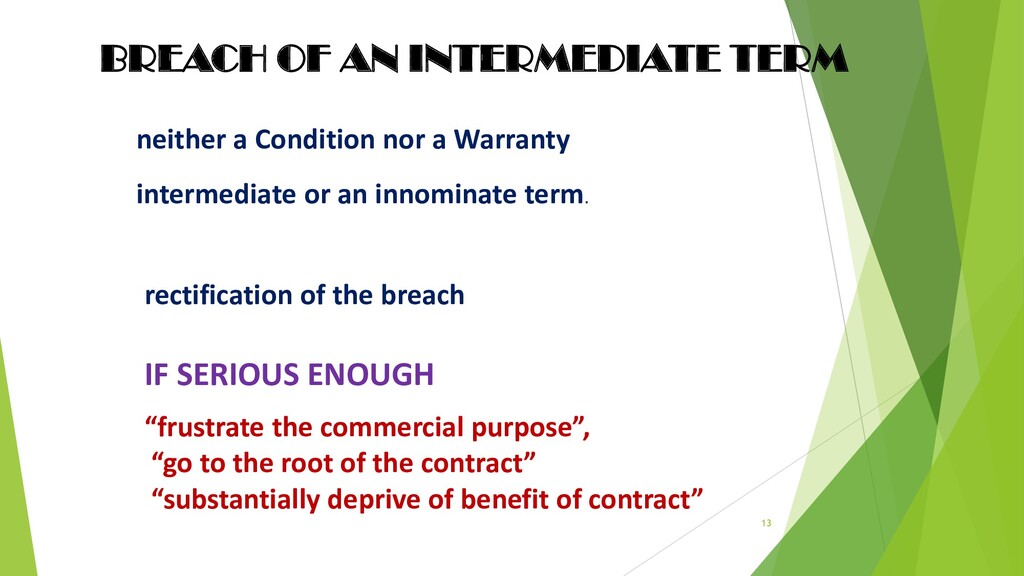
  12. BREACH OF AN INTERMEDIATE TERM neither a Condition nor a

    Warranty intermediate or an innominate term. rectification of the breach IF SERIOUS ENOUGH “frustrate the commercial purpose”, “go to the root of the contract” “substantially deprive of benefit of contract” 13
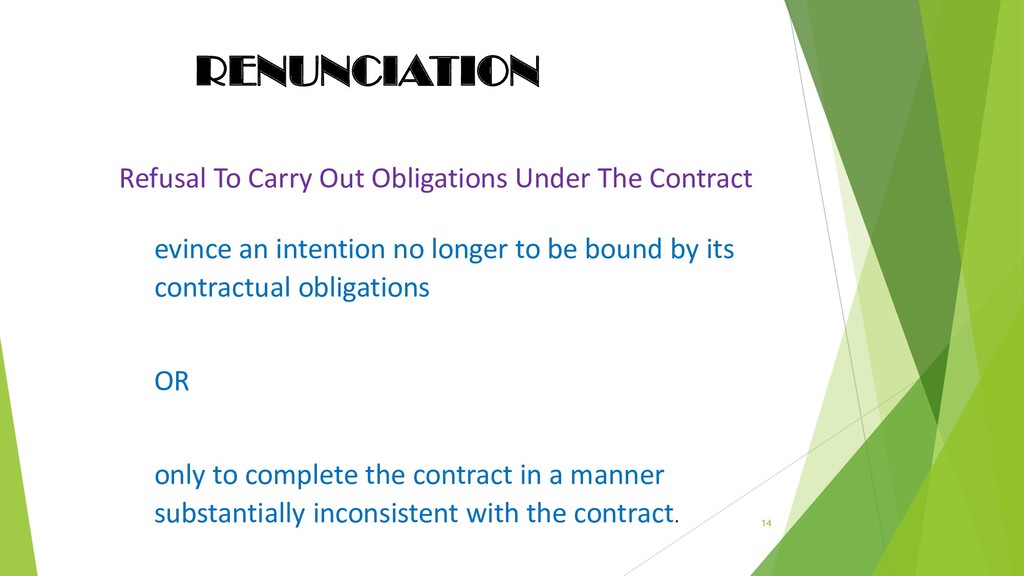
  13. RENUNCIATION Refusal To Carry Out Obligations Under The Contract evince

    an intention no longer to be bound by its contractual obligations OR only to complete the contract in a manner substantially inconsistent with the contract. 14
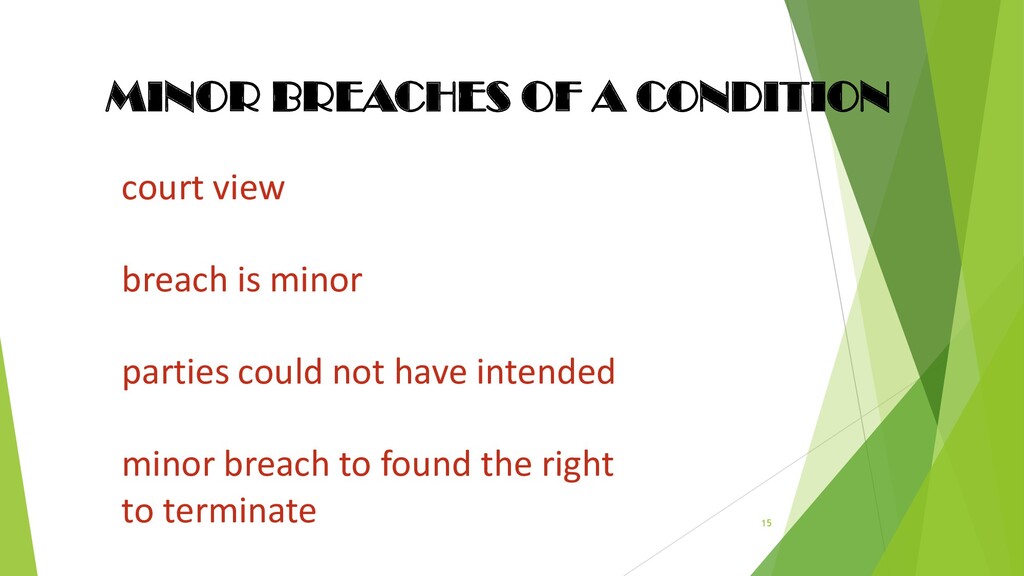
  14. MINOR BREACHES OF A CONDITION court view breach is minor

    parties could not have intended minor breach to found the right to terminate 15
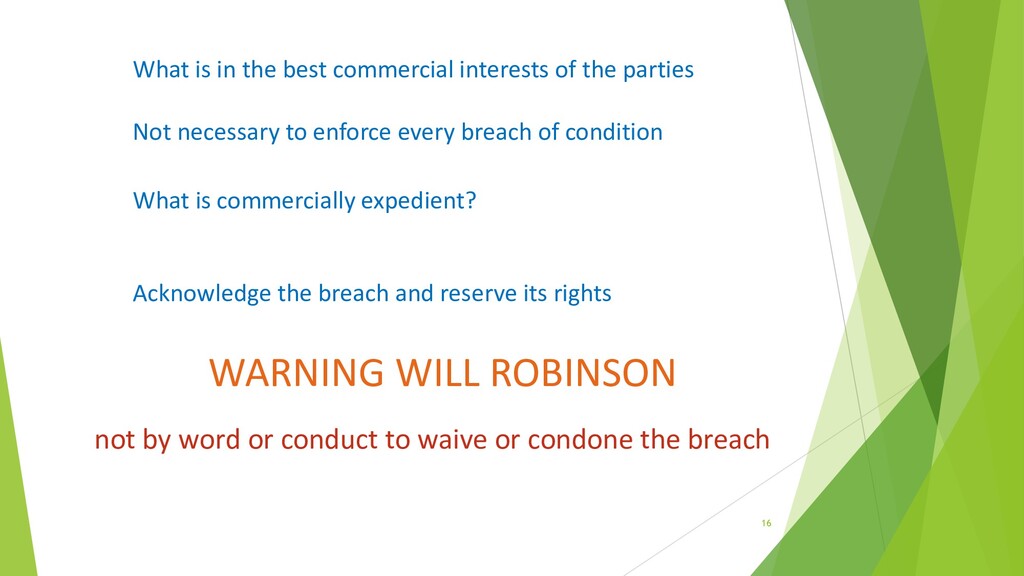
  15. What is in the best commercial interests of the parties

    Not necessary to enforce every breach of condition What is commercially expedient? Acknowledge the breach and reserve its rights WARNING WILL ROBINSON not by word or conduct to waive or condone the breach 16
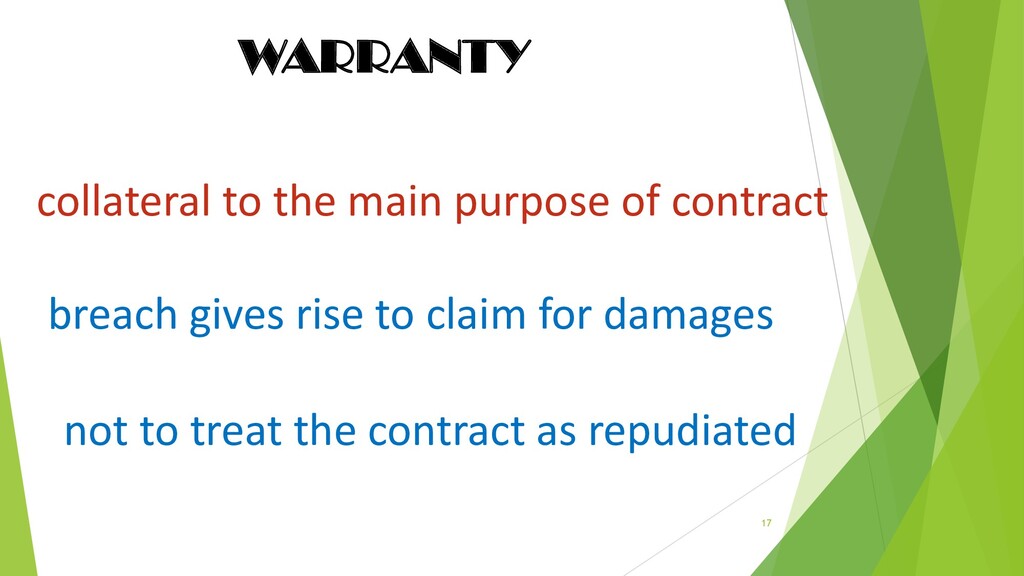
  16. WARRANTY collateral to the main purpose of contract breach gives

    rise to claim for damages not to treat the contract as repudiated 17
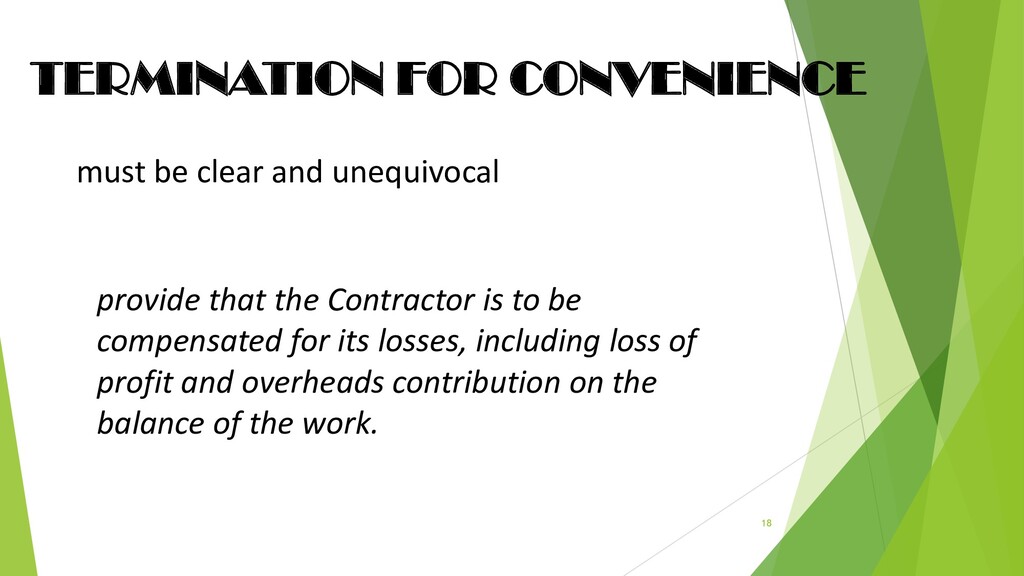
  17. TERMINATION FOR CONVENIENCE must be clear and unequivocal provide that

    the Contractor is to be compensated for its losses, including loss of profit and overheads contribution on the balance of the work. 18
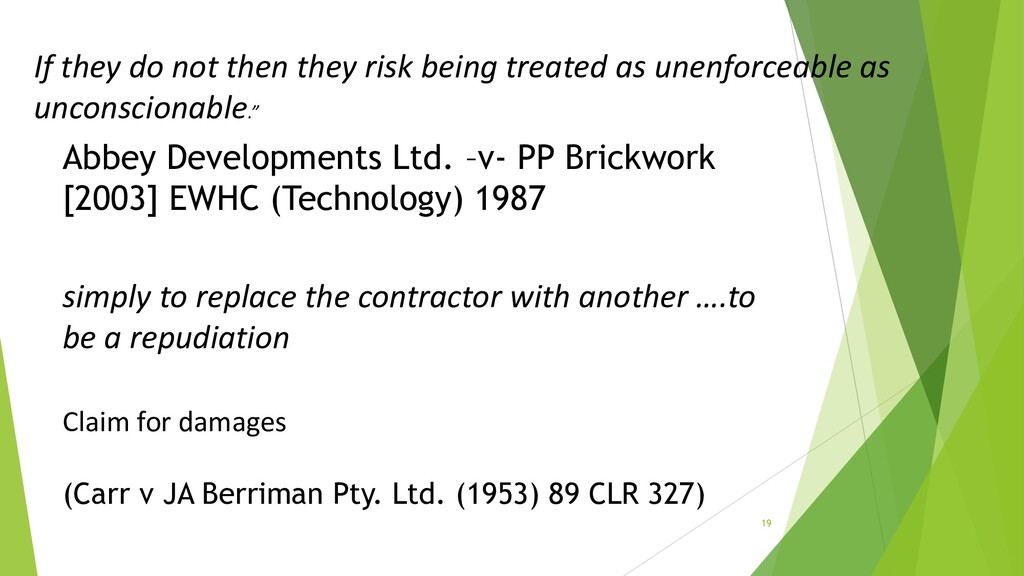
  18. If they do not then they risk being treated as

    unenforceable as unconscionable.” Abbey Developments Ltd. –v- PP Brickwork [2003] EWHC (Technology) 1987 simply to replace the contractor with another ….to be a repudiation Claim for damages (Carr v JA Berriman Pty. Ltd. (1953) 89 CLR 327) 19
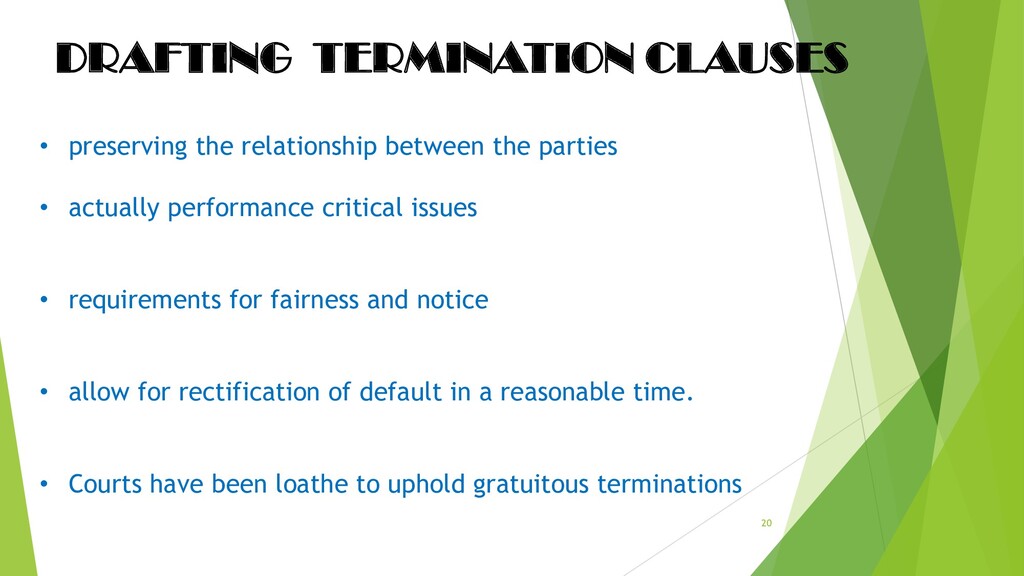
  19. DRAFTING TERMINATION CLAUSES • preserving the relationship between the parties

    • actually performance critical issues • requirements for fairness and notice • allow for rectification of default in a reasonable time. • Courts have been loathe to uphold gratuitous terminations 20
  20. TERMINATING THE CONTRACT A party may not terminate a contract

    in part. Except where contractual provision e.g. multiple product line contract or severable stages contract 21
  21. Affirm the contract contract is continuing seek damages and/or the

    rectification of the breach in the commercial interest breach cannot be relied upon again claim for damages arising from the breach remains 23
  22. Terminate accept the repudiation and claim damages Contract may provide

    how that is done test that there is a repudiatory breach 24
  23. COMMON LAW RIGHT OR CONTRACTUAL RIGHT? a matter of strategy

    contractual breach and a common law breach simultaneously the value of the remedy 26
  24. LIQUIDATED DAMAGES a genuine pre-estimate of the losses likely to

    be incurred by the non-defaulting party 27
  25. THE NOTICE common law and contractual rights If you choose

    one basis only query estoppel? Contract procedure followed strictly Invalid Notice 28
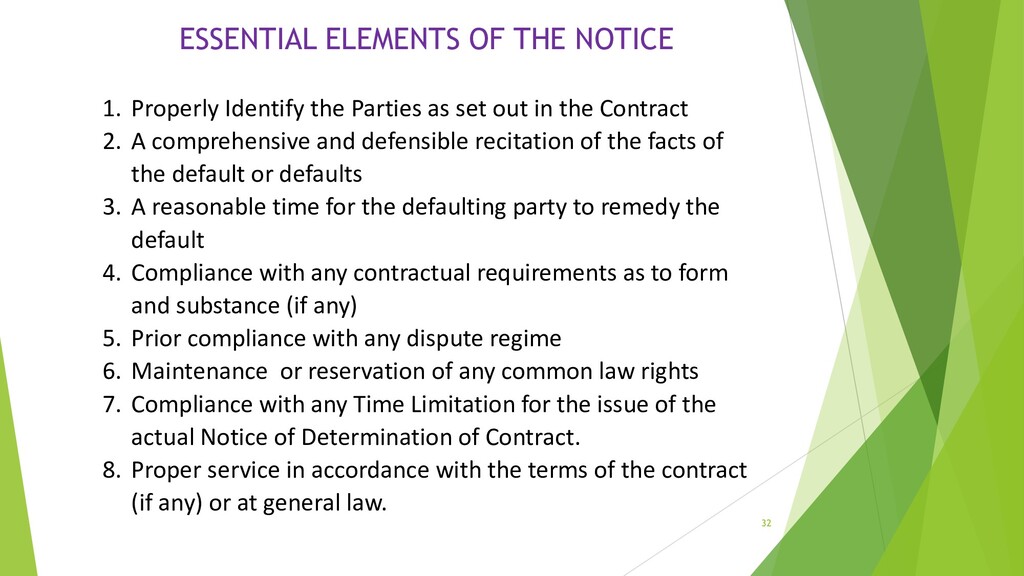
  26. ESSENTIAL ELEMENTS OF THE NOTICE 1. Properly Identify the Parties

    as set out in the Contract 2. A comprehensive and defensible recitation of the facts of the default or defaults 3. A reasonable time for the defaulting party to remedy the default 4. Compliance with any contractual requirements as to form and substance (if any) 5. Prior compliance with any dispute regime 6. Maintenance or reservation of any common law rights 7. Compliance with any Time Limitation for the issue of the actual Notice of Determination of Contract. 8. Proper service in accordance with the terms of the contract (if any) or at general law. 32
  27. EFFECT ON THE CONTRACT Discharge both parties from any continuing

    obligations Subject to competing costs of demobilisation Depending who is at fault 33
  28. DAMAGES Principal’s damages when at large include any losses incurred

    as a result of the breach. Contract is silent as to damages then the damages will be at large 34
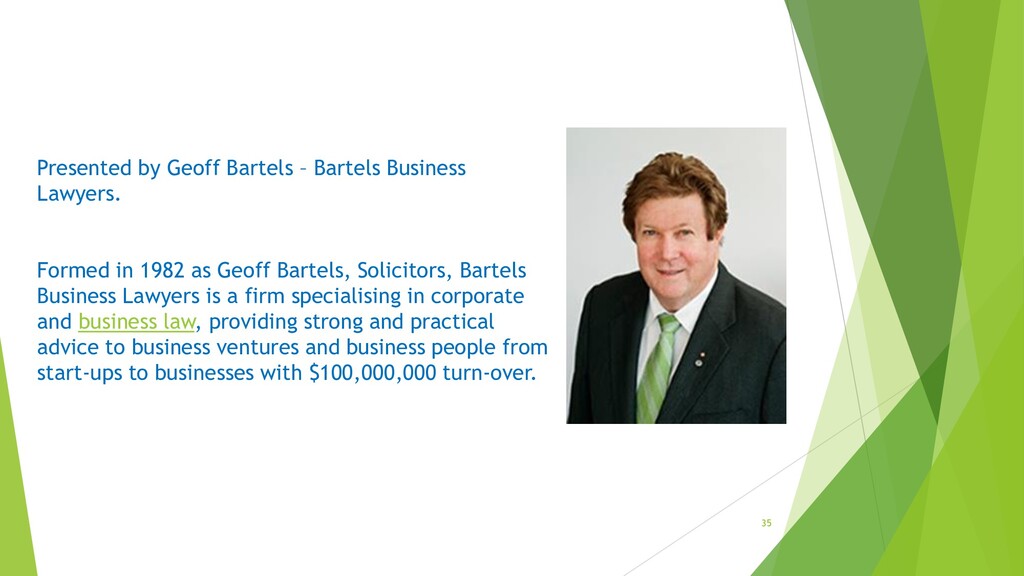
  29. Presented by Geoff Bartels – Bartels Business Lawyers. Formed in

    1982 as Geoff Bartels, Solicitors, Bartels Business Lawyers is a firm specialising in corporate and business law, providing strong and practical advice to business ventures and business people from start-ups to businesses with $100,000,000 turn-over. 35