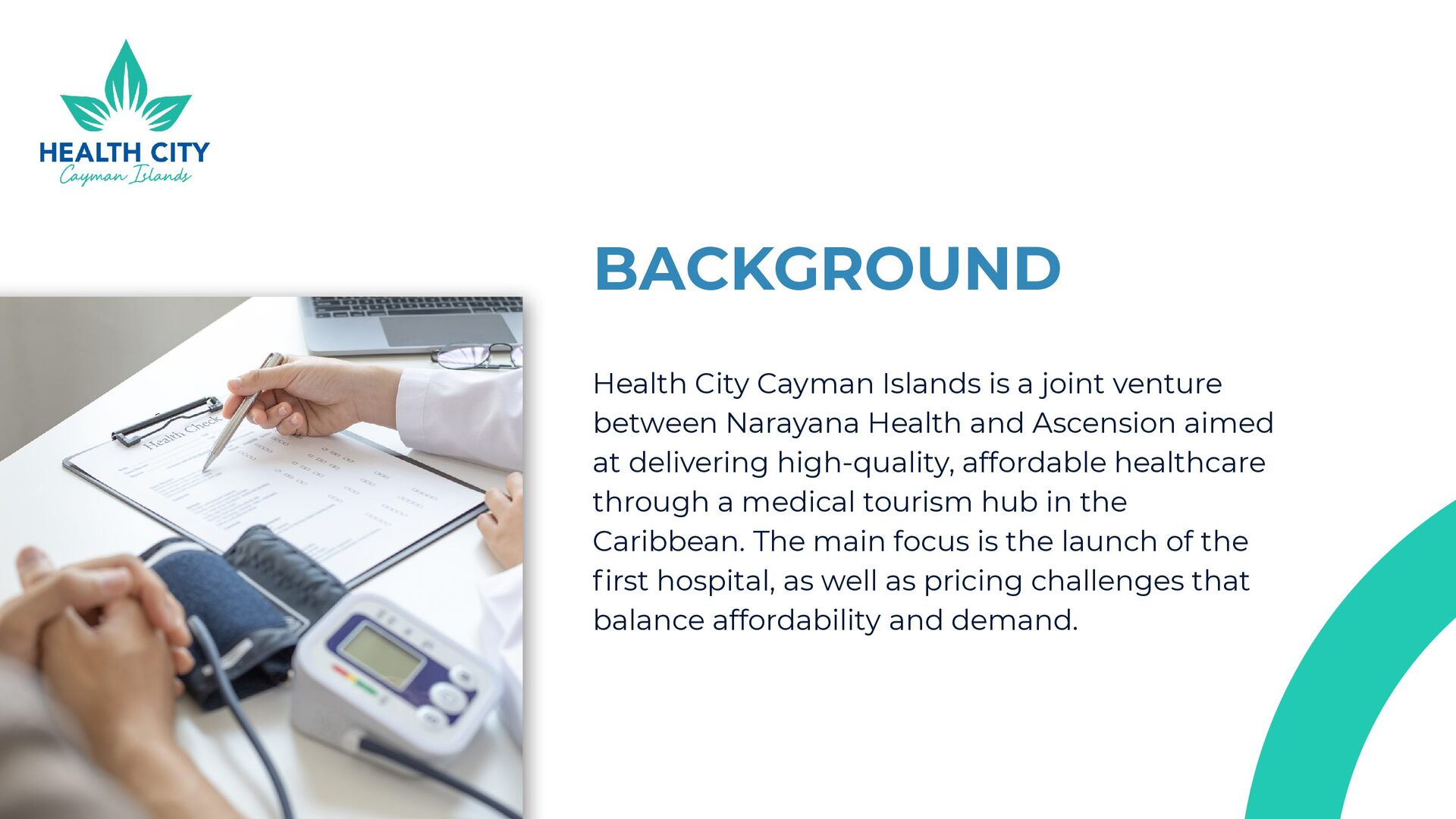
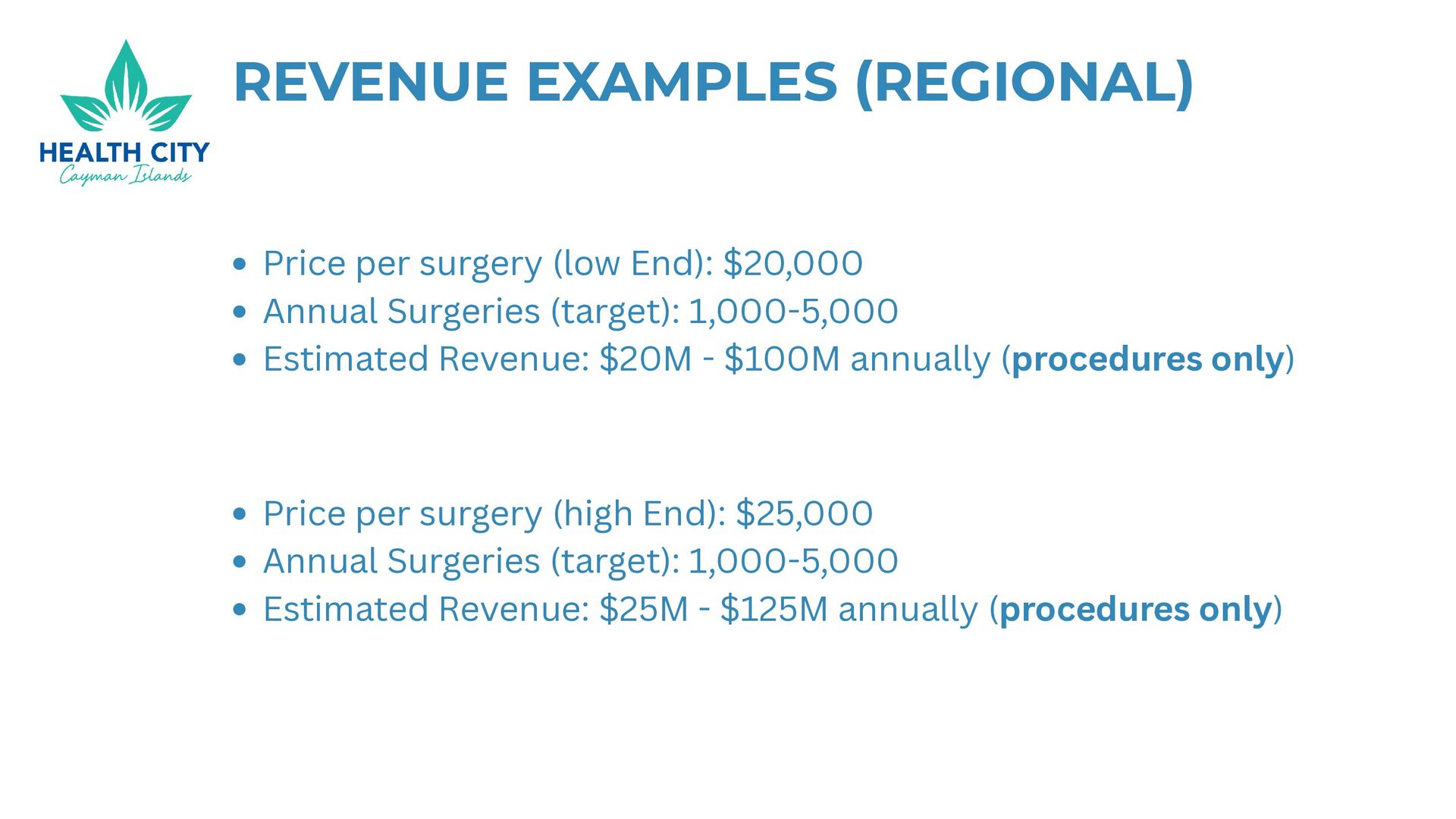
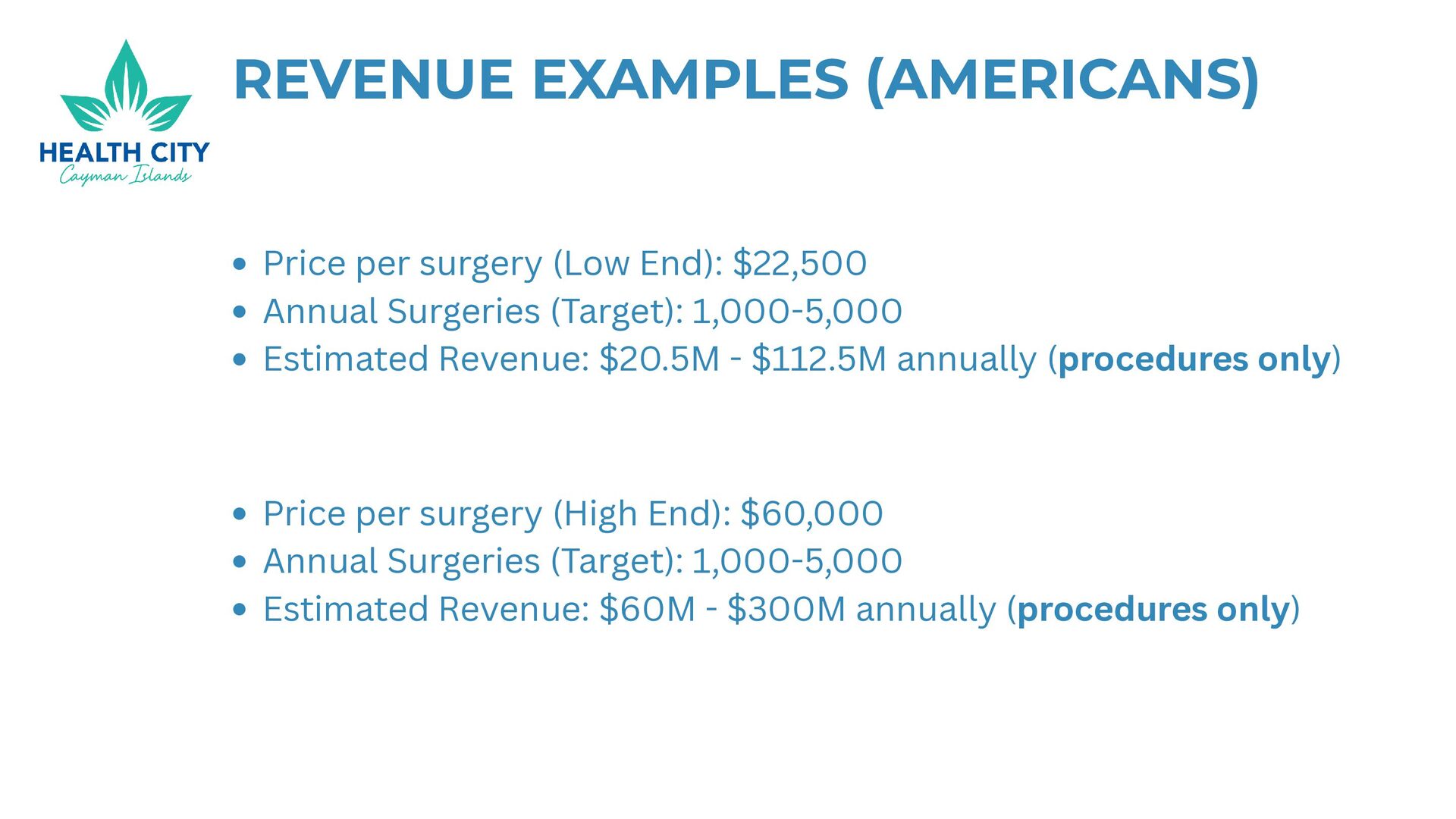
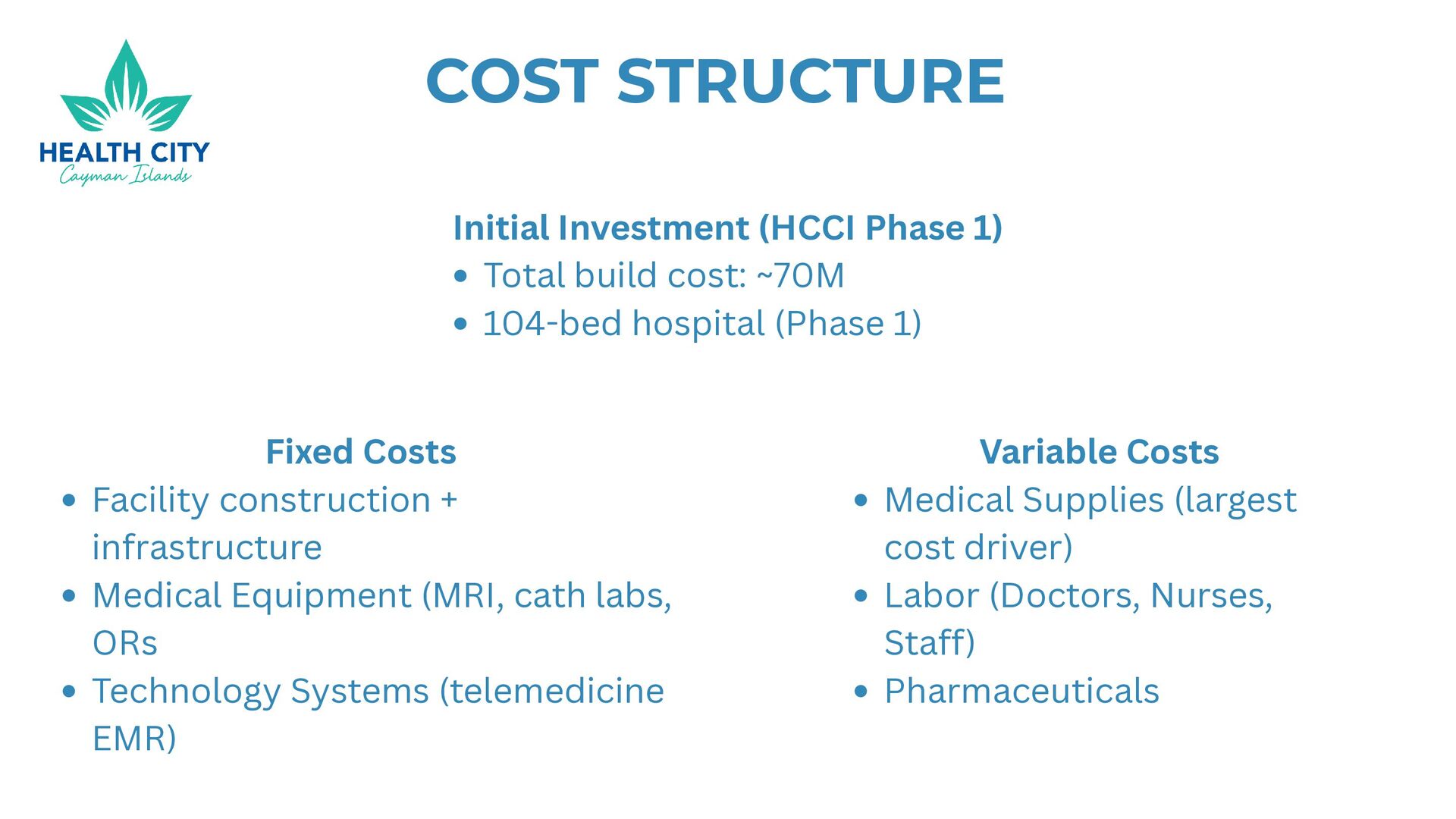
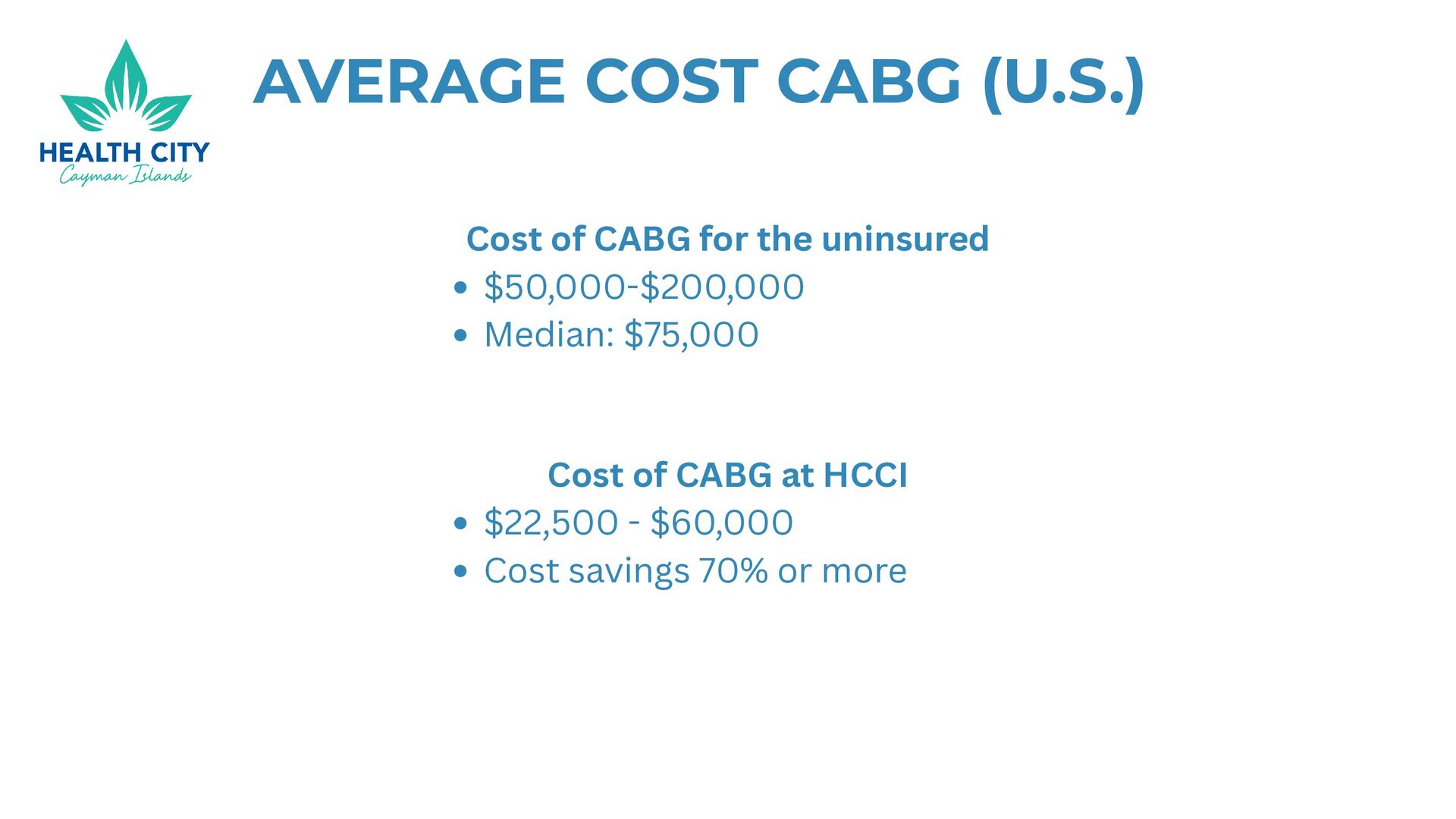
Narayana Health and Ascension aimed at delivering high-quality, affordable healthcare through a medical tourism hub in the Caribbean. The main focus is the launch of the first hospital, as well as pricing challenges that balance affordability and demand.
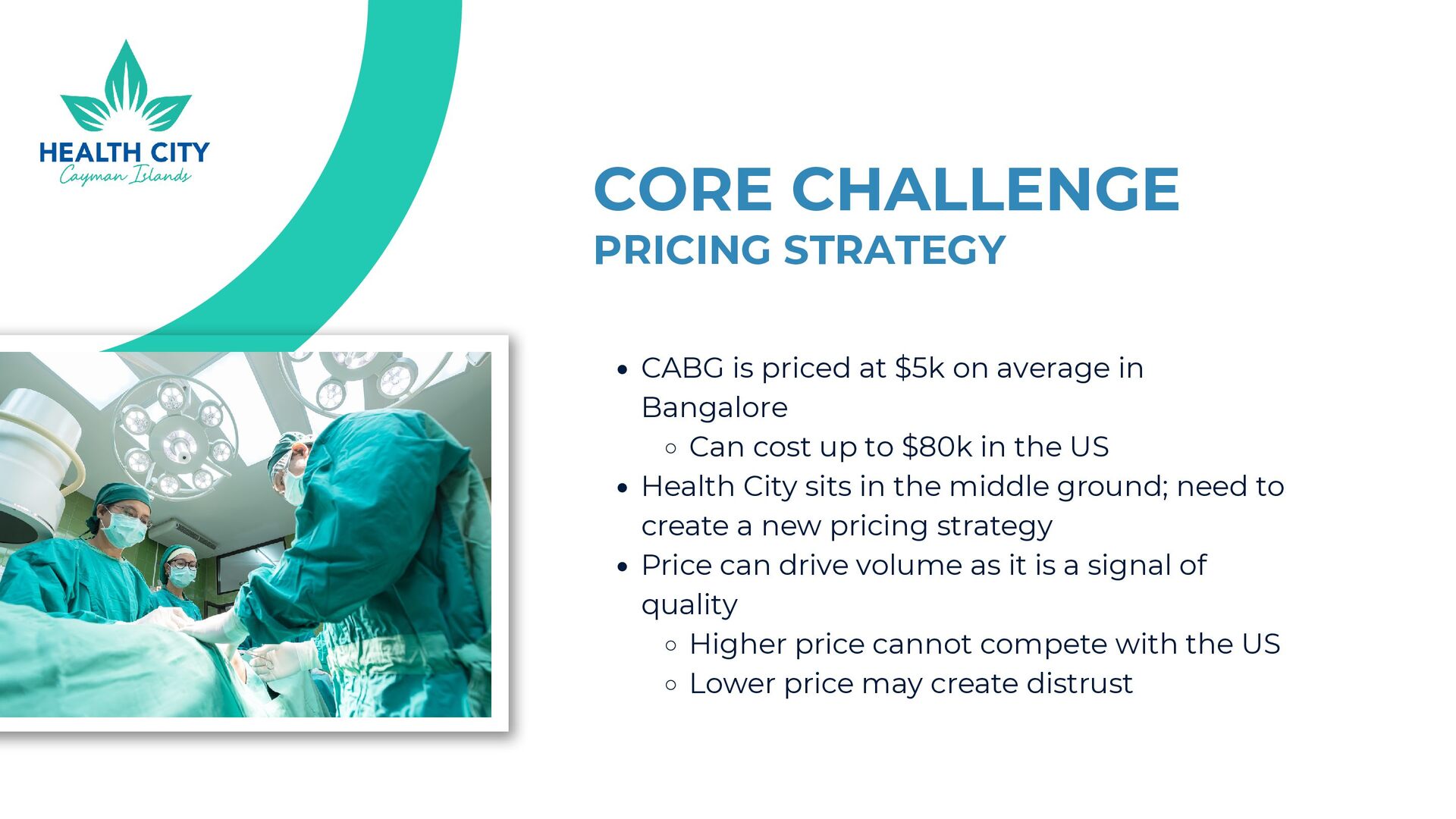
average in Bangalore Can cost up to $80k in the US Health City sits in the middle ground; need to create a new pricing strategy Price can drive volume as it is a signal of quality Higher price cannot compete with the US Lower price may create distrust
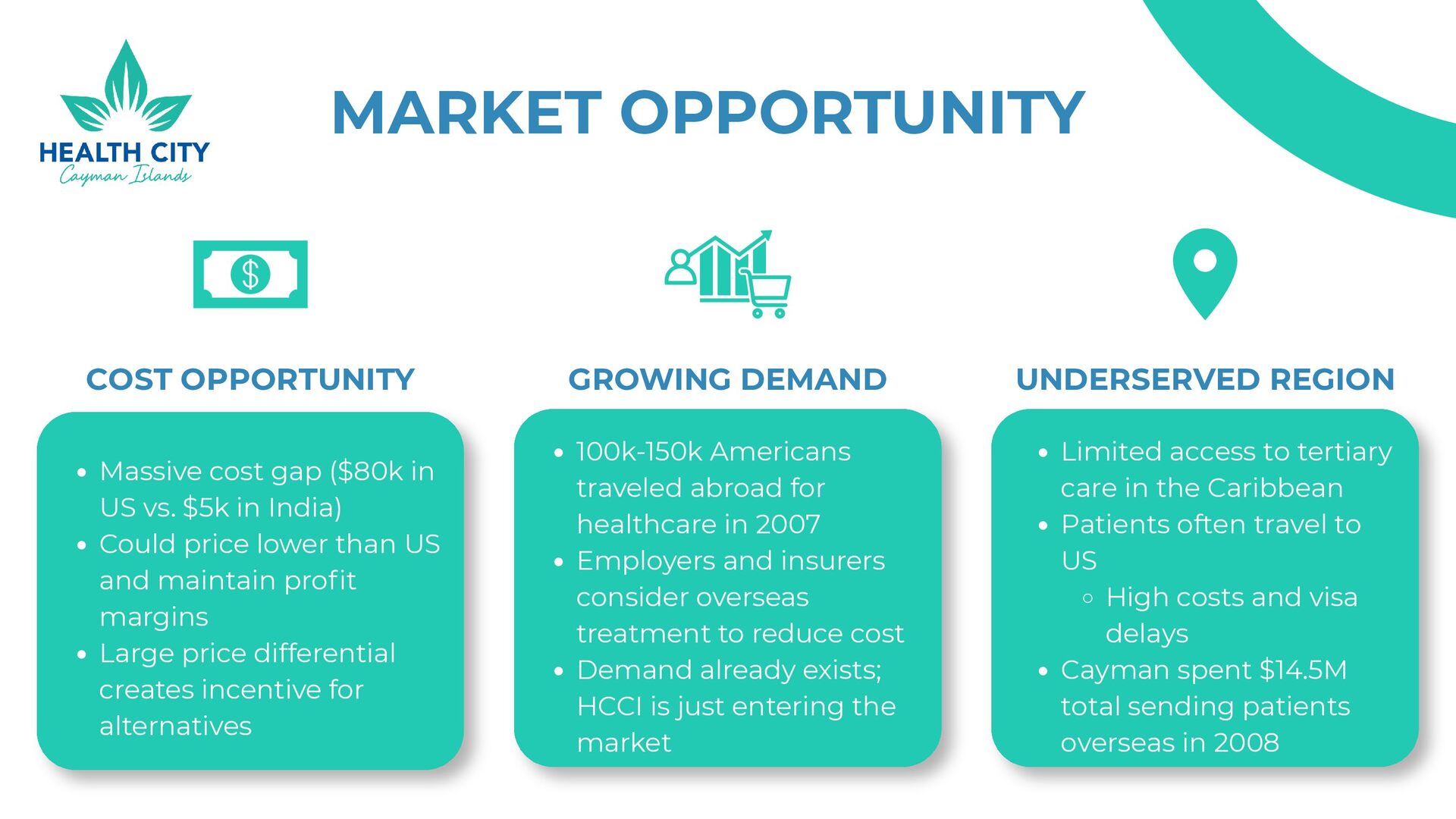
gap ($80k in US vs. $5k in India) Could price lower than US and maintain profit margins Large price differential creates incentive for alternatives 100k-150k Americans traveled abroad for healthcare in 2007 Employers and insurers consider overseas treatment to reduce cost Demand already exists; HCCI is just entering the market Limited access to tertiary care in the Caribbean Patients often travel to US High costs and visa delays Cayman spent $14.5M total sending patients overseas in 2008
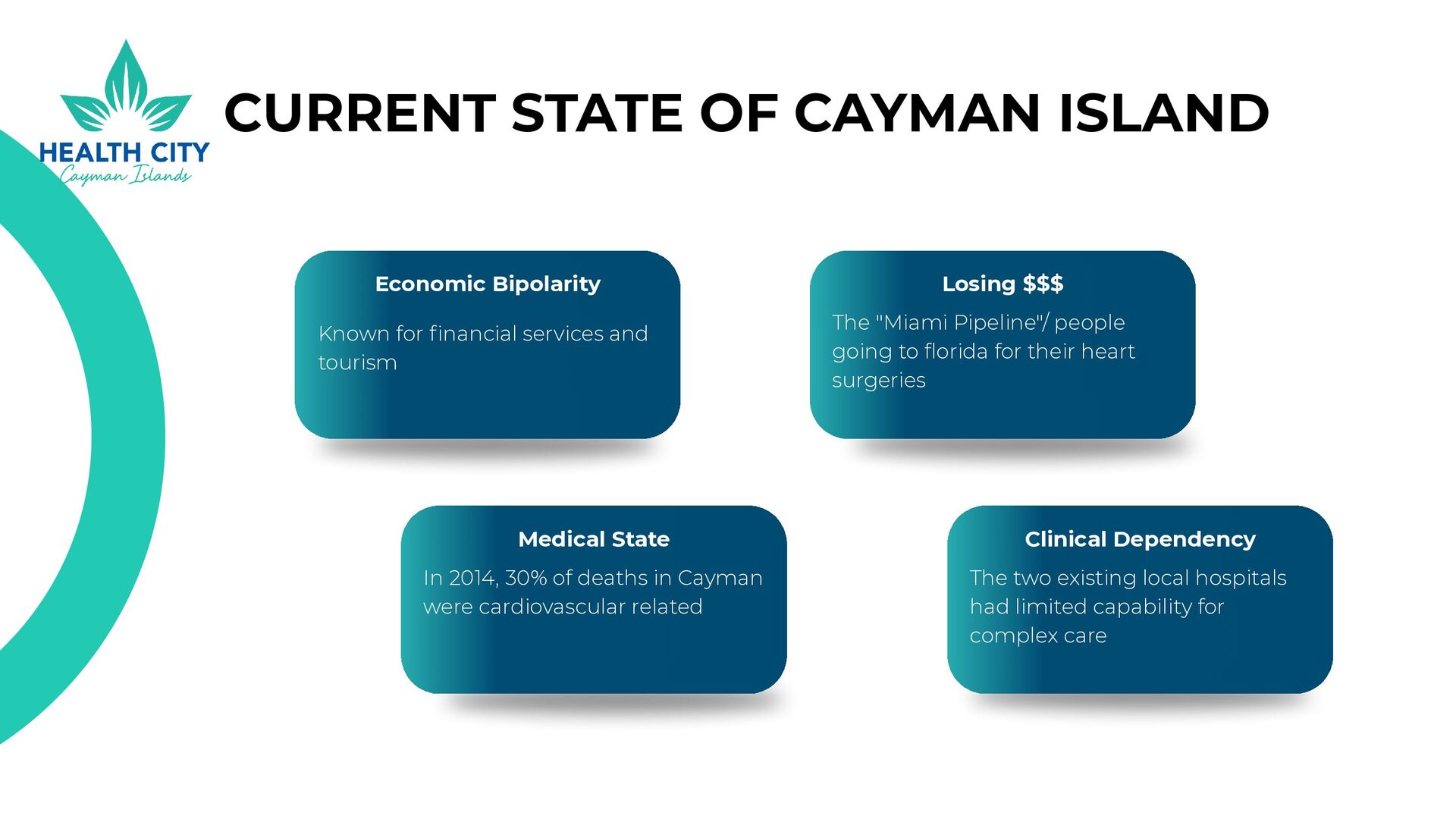
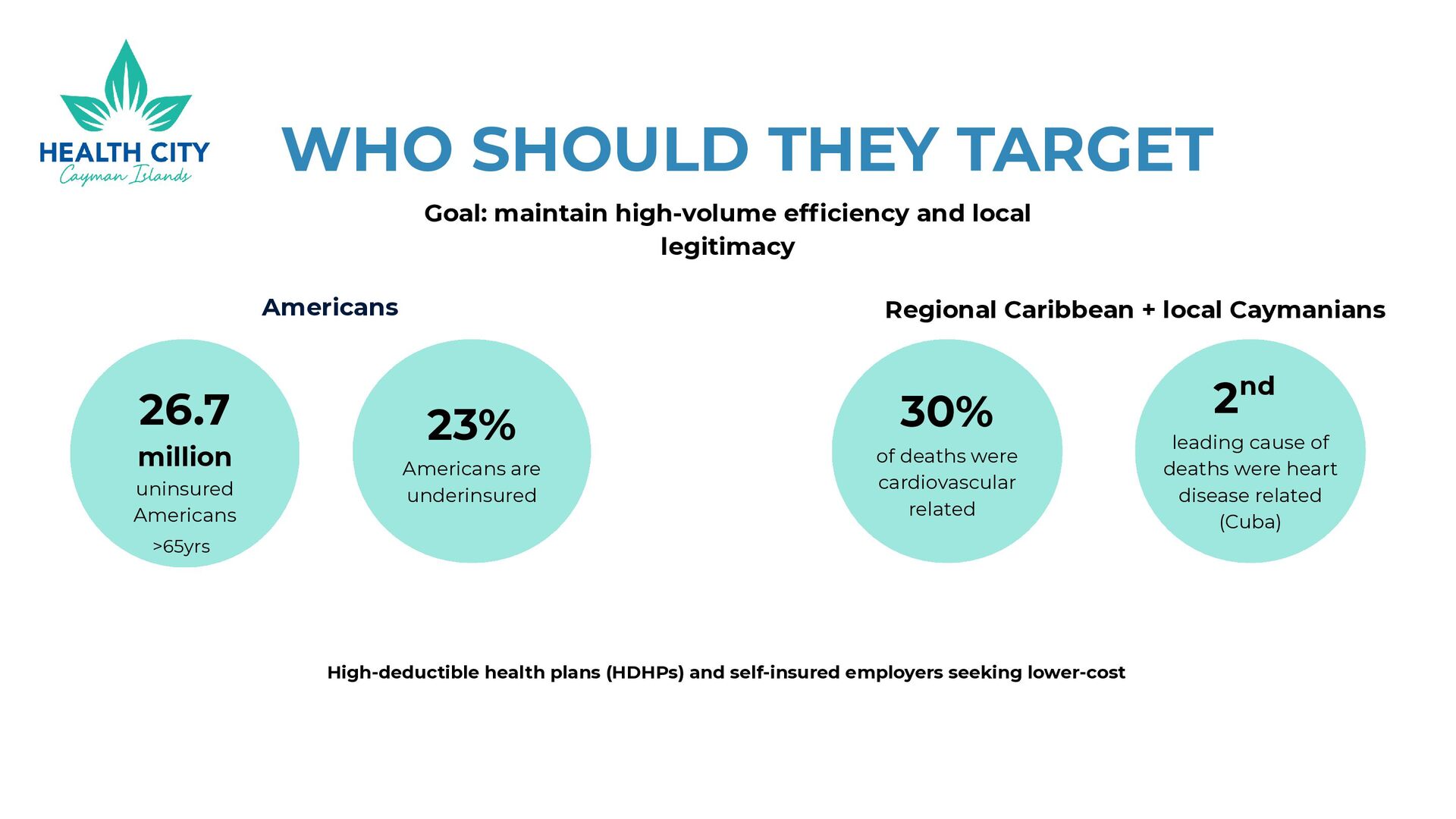
services and tourism Losing $$$ The "Miami Pipeline"/ people going to florida for their heart surgeries Medical State Clinical Dependency In 2014, 30% of deaths in Cayman were cardiovascular related The two existing local hospitals had limited capability for complex care
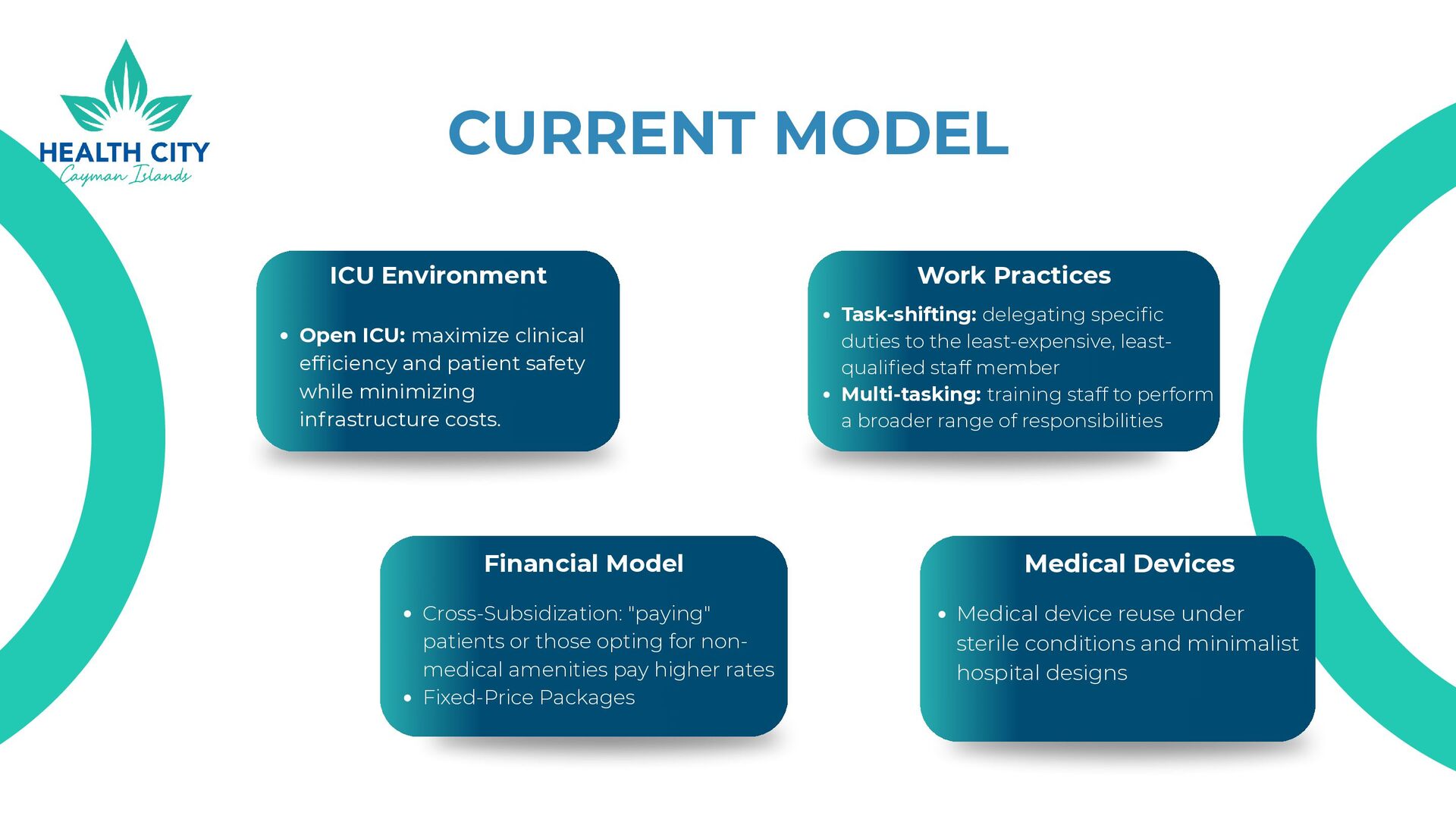
patient safety while minimizing infrastructure costs. Financial Model Cross-Subsidization: "paying" patients or those opting for nonmedical amenities pay higher rates Fixed-Price Packages Work Practices Task-shifting: delegating specific duties to the least-expensive, leastqualified staff member Multi-tasking: training staff to perform a broader range of responsibilities Medical Devices Medical device reuse under sterile conditions and minimalist hospital designs
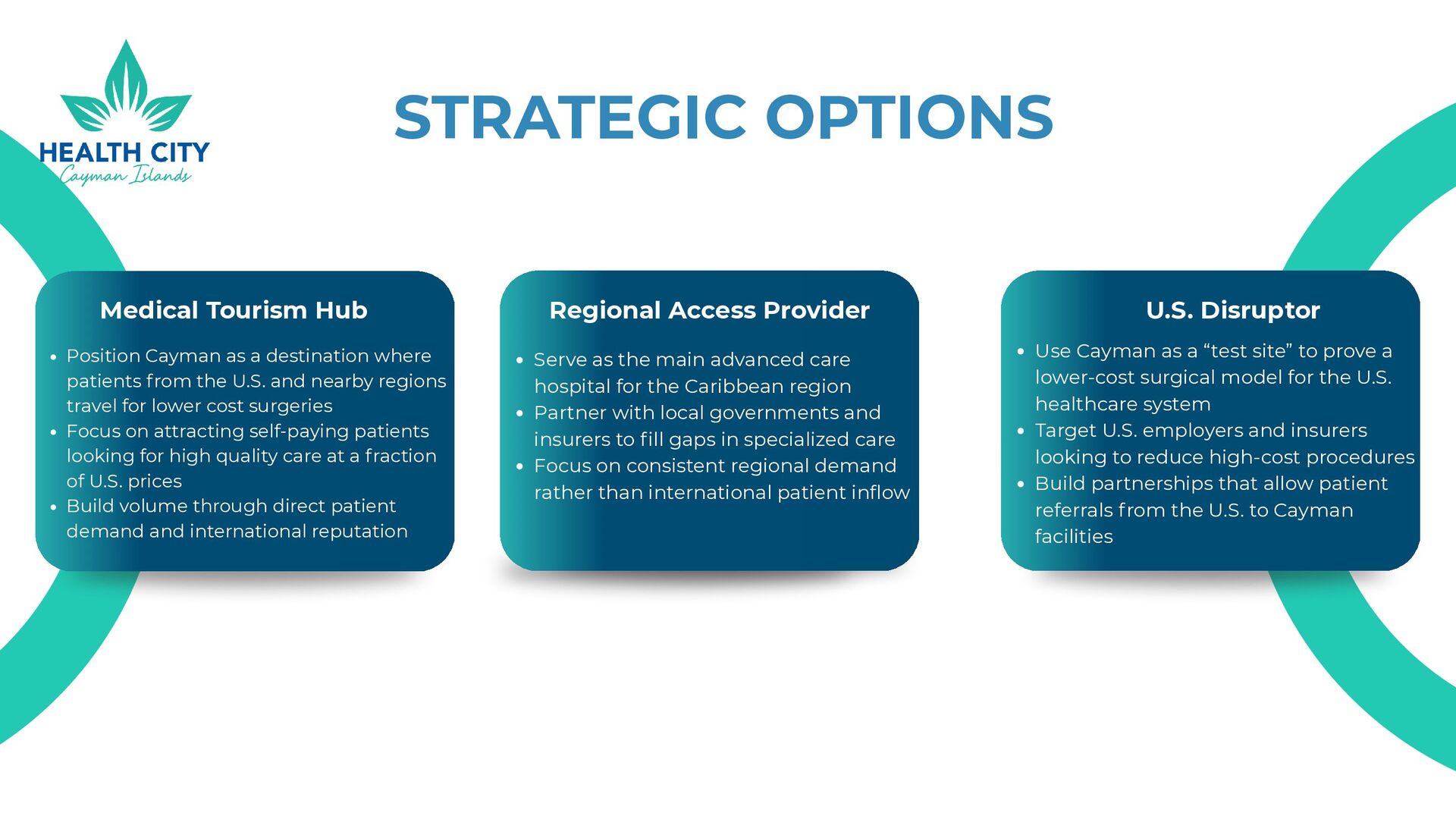
where patients from the U.S. and nearby regions travel for lower cost surgeries Focus on attracting self-paying patients looking for high quality care at a fraction of U.S. prices Build volume through direct patient demand and international reputation Regional Access Provider Serve as the main advanced care hospital for the Caribbean region Partner with local governments and insurers to fill gaps in specialized care Target: Caribbean Gov’t + Focus on consistent regional demand Patients rather than international patient inflow Pros: Volume, Mission Alignment Cons: Lower Revenue U.S. Disruptor Use Cayman as a “test site” to prove a lower-cost surgical model for the U.S. healthcare system Target U.S. employers and insurers Target:looking Emploers + Insurers to reduce high-cost procedures Pros: Massive Long-term upside Build partnerships that allow patient Cons: Slow Adoption, Complex referrals from the U.S. to Cayman facilities
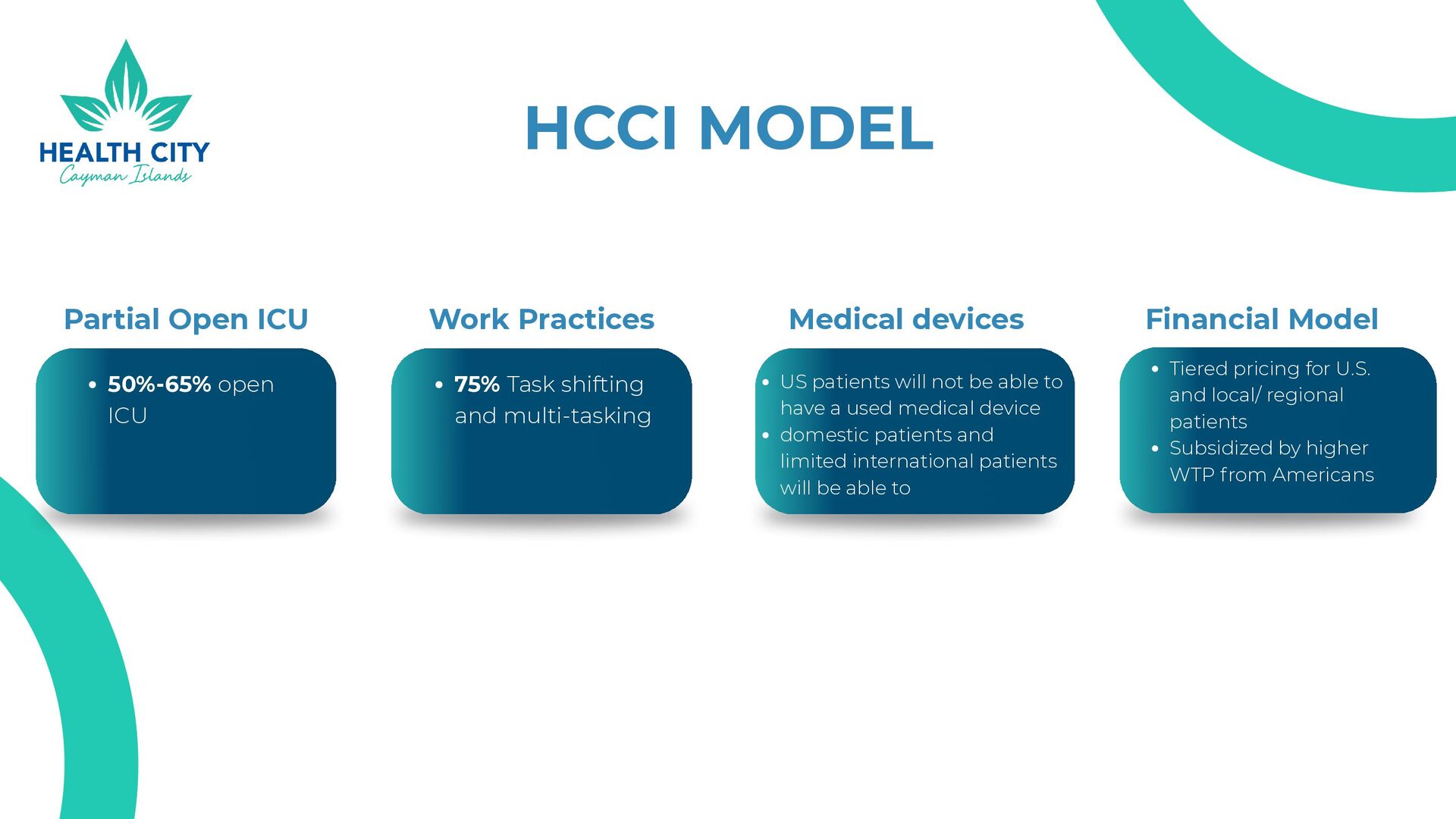
75% Task shifting and multi-tasking Medical devices US patients will not be able to have a used medical device domestic patients and limited international patients will be able to Financial Model Tiered pricing for U.S. and local/ regional patients Subsidized by higher WTP from Americans
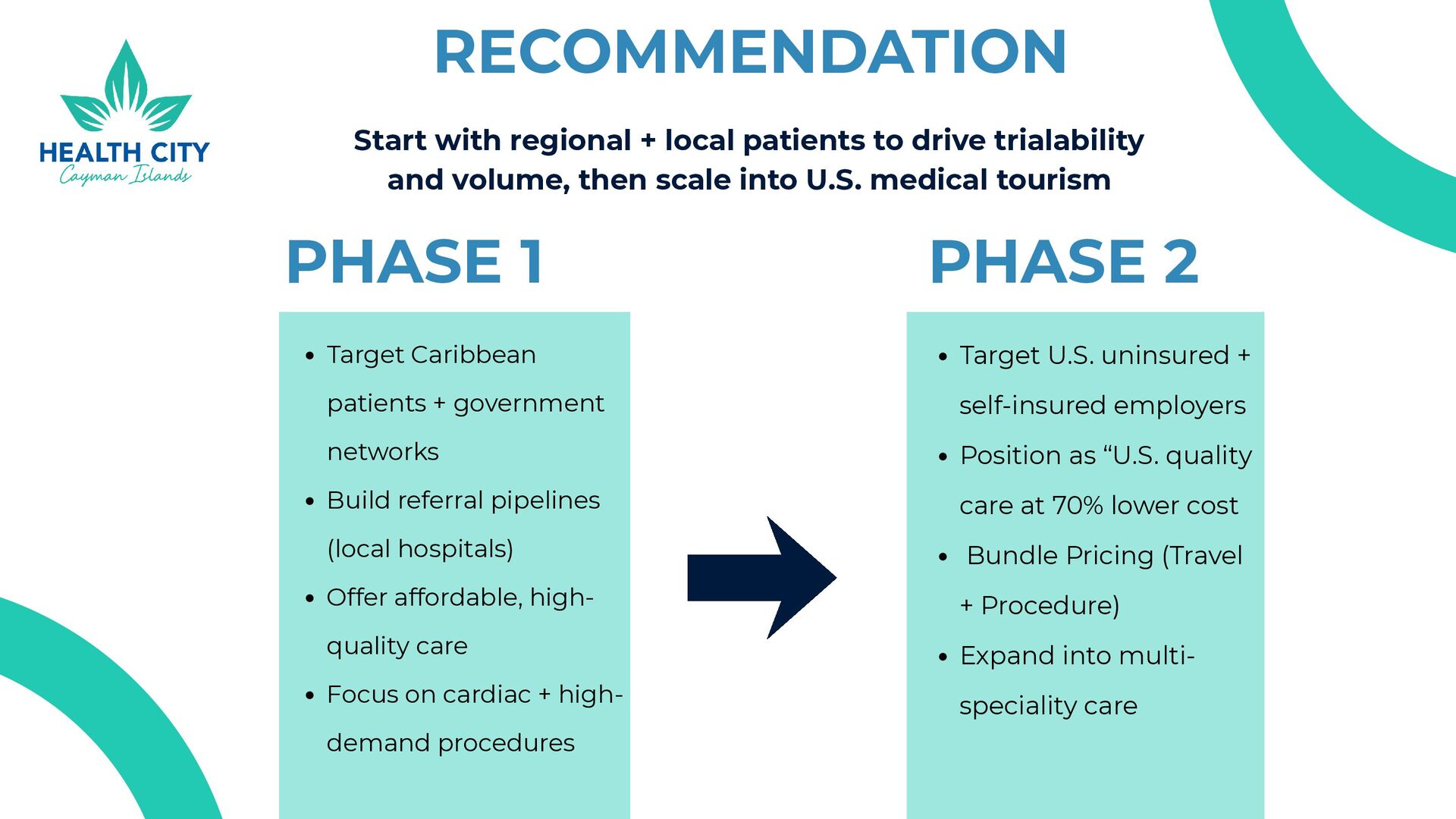
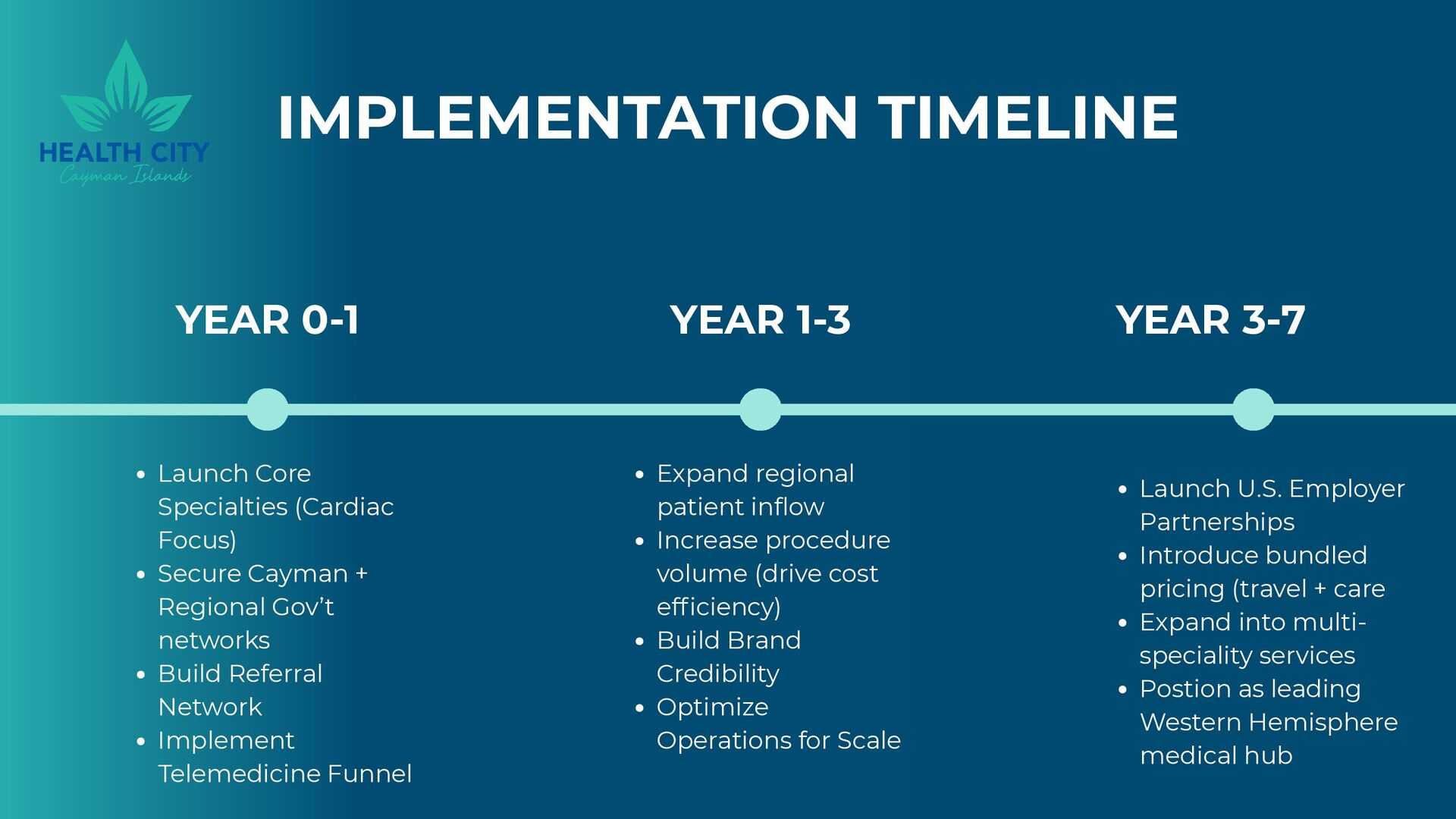
and volume, then scale into U.S. medical tourism PHASE 1 PHASE 2 Target Caribbean Target U.S. uninsured + patients + government self-insured employers networks Position as “U.S. quality Build referral pipelines care at 70% lower cost (local hospitals) Bundle Pricing (Travel Offer affordable, high- + Procedure) quality care Expand into multi- Focus on cardiac + high- speciality care demand procedures
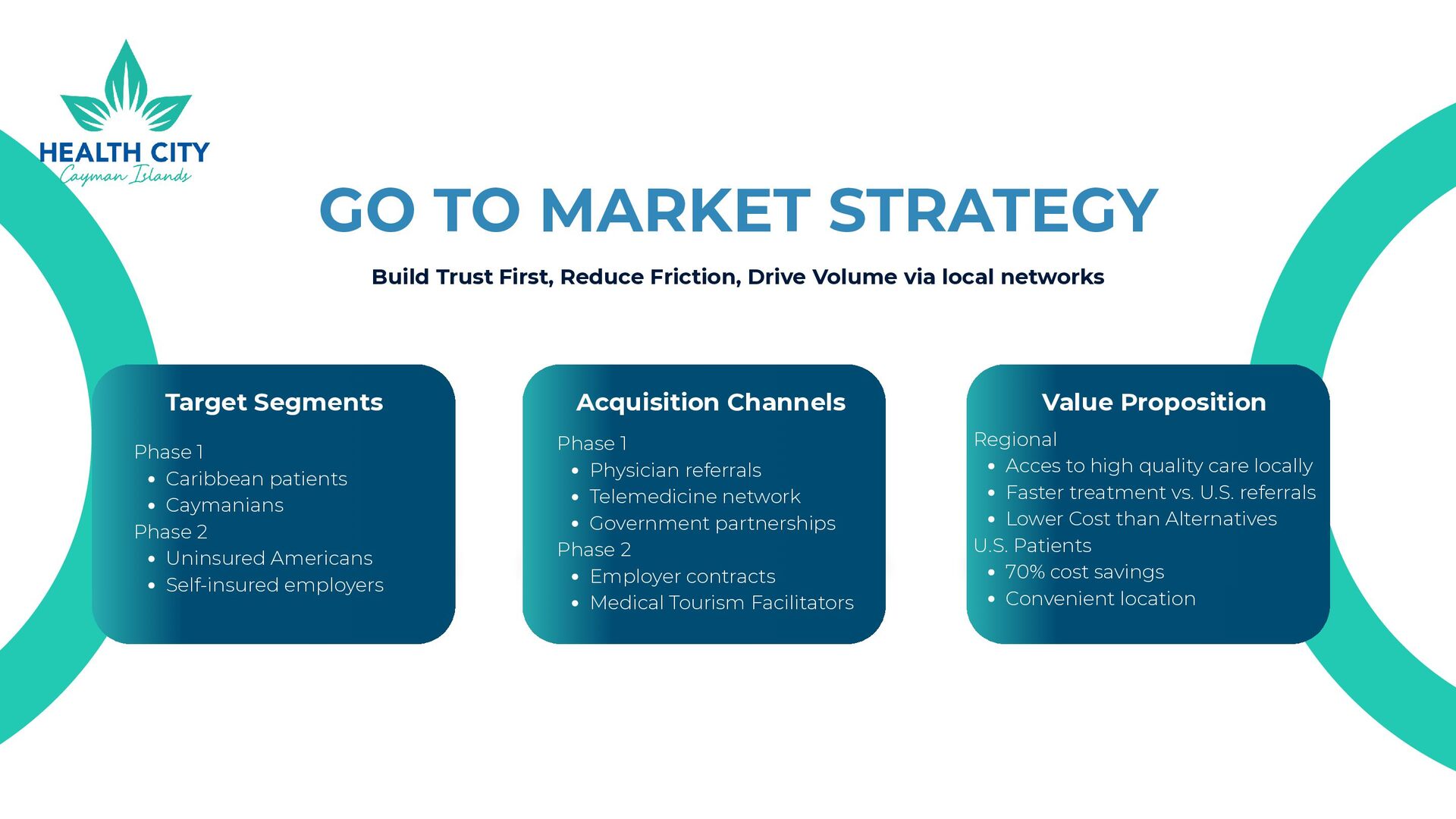
Volume via local networks Target Segments Acquisition Channels Value Proposition Phase 1 Caribbean patients Caymanians Phase 2 Uninsured Americans Self-insured employers Phase 1 Physician referrals Telemedicine network Government partnerships Phase 2 Employer contracts Medical Tourism Facilitators Regional Acces to high quality care locally Faster treatment vs. U.S. referrals Lower Cost than Alternatives U.S. Patients 70% cost savings Convenient location
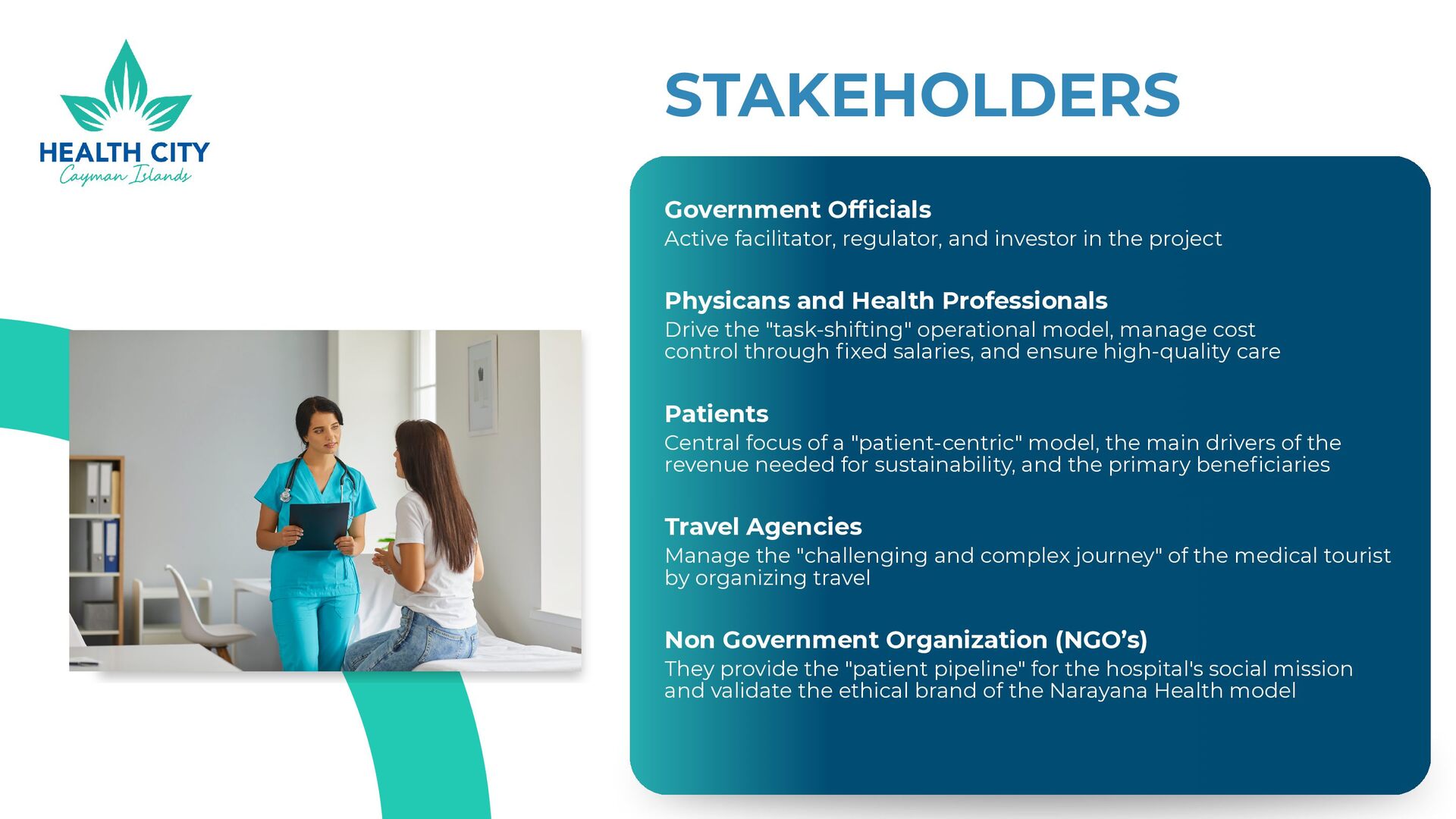
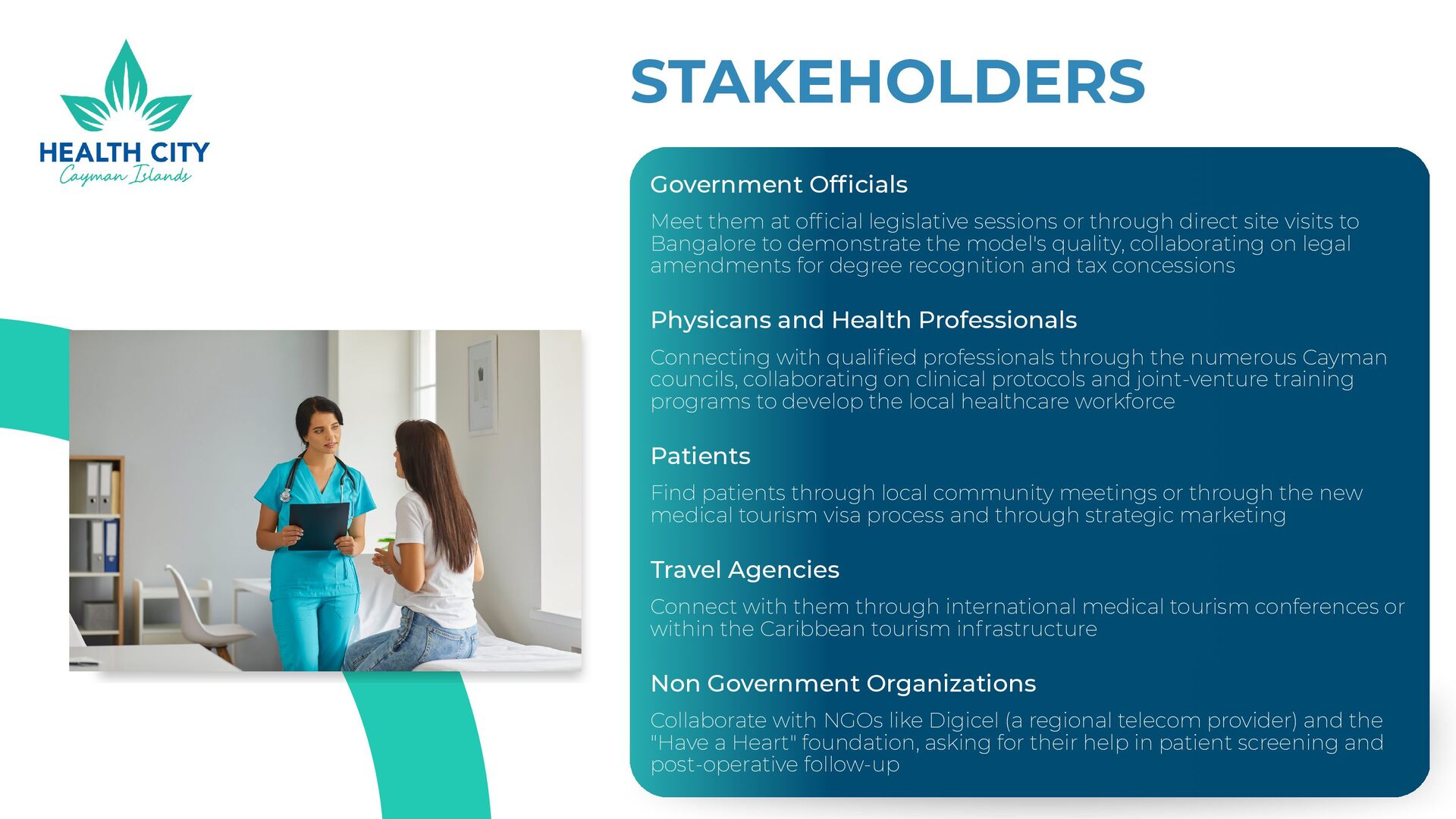
project Physicans and Health Professionals Drive the "task-shifting" operational model, manage cost control through fixed salaries, and ensure high-quality care Patients Central focus of a "patient-centric" model, the main drivers of the revenue needed for sustainability, and the primary beneficiaries Travel Agencies Manage the "challenging and complex journey" of the medical tourist by organizing travel Non Government Organization (NGO’s) They provide the "patient pipeline" for the hospital's social mission and validate the ethical brand of the Narayana Health model
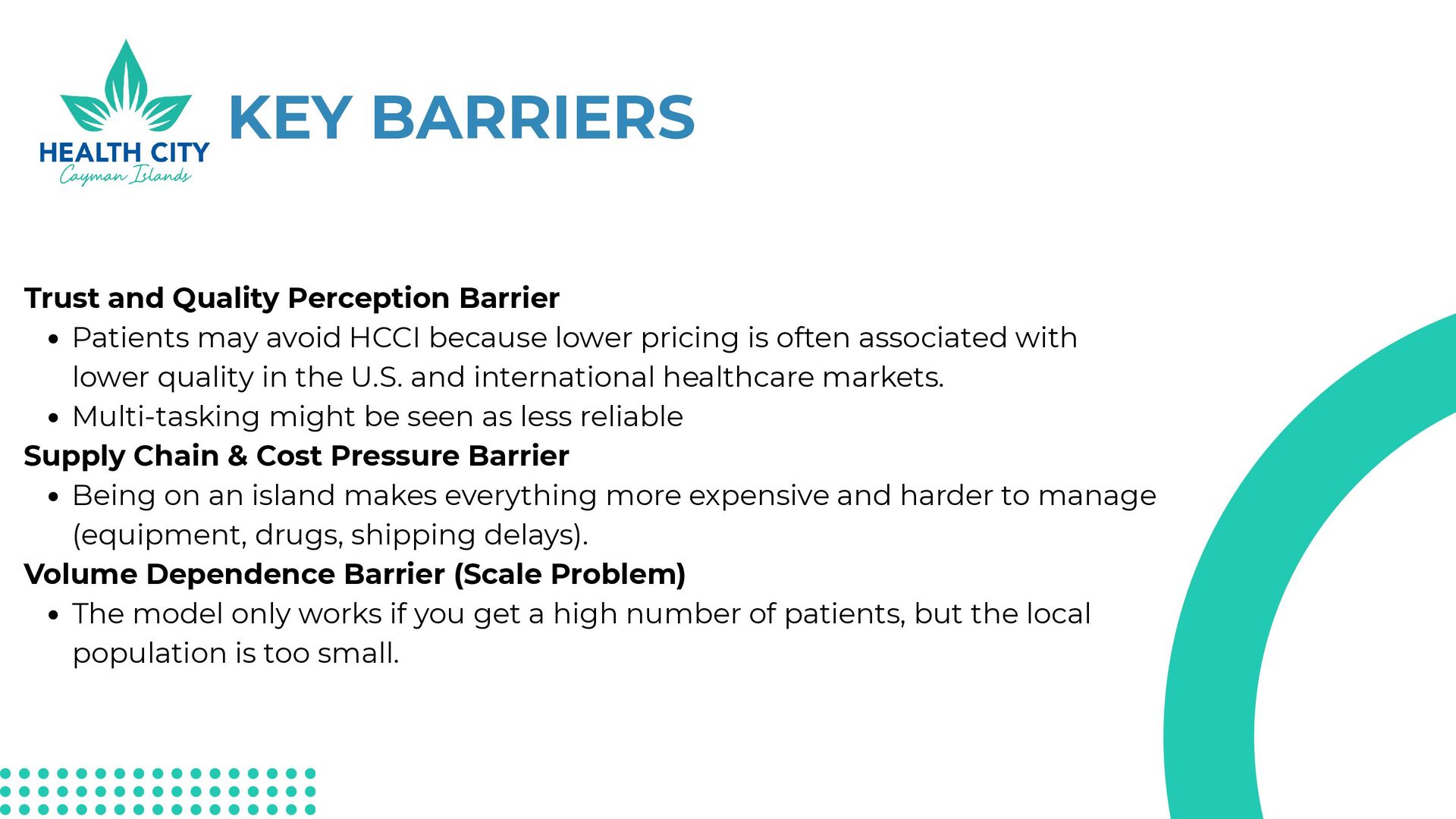
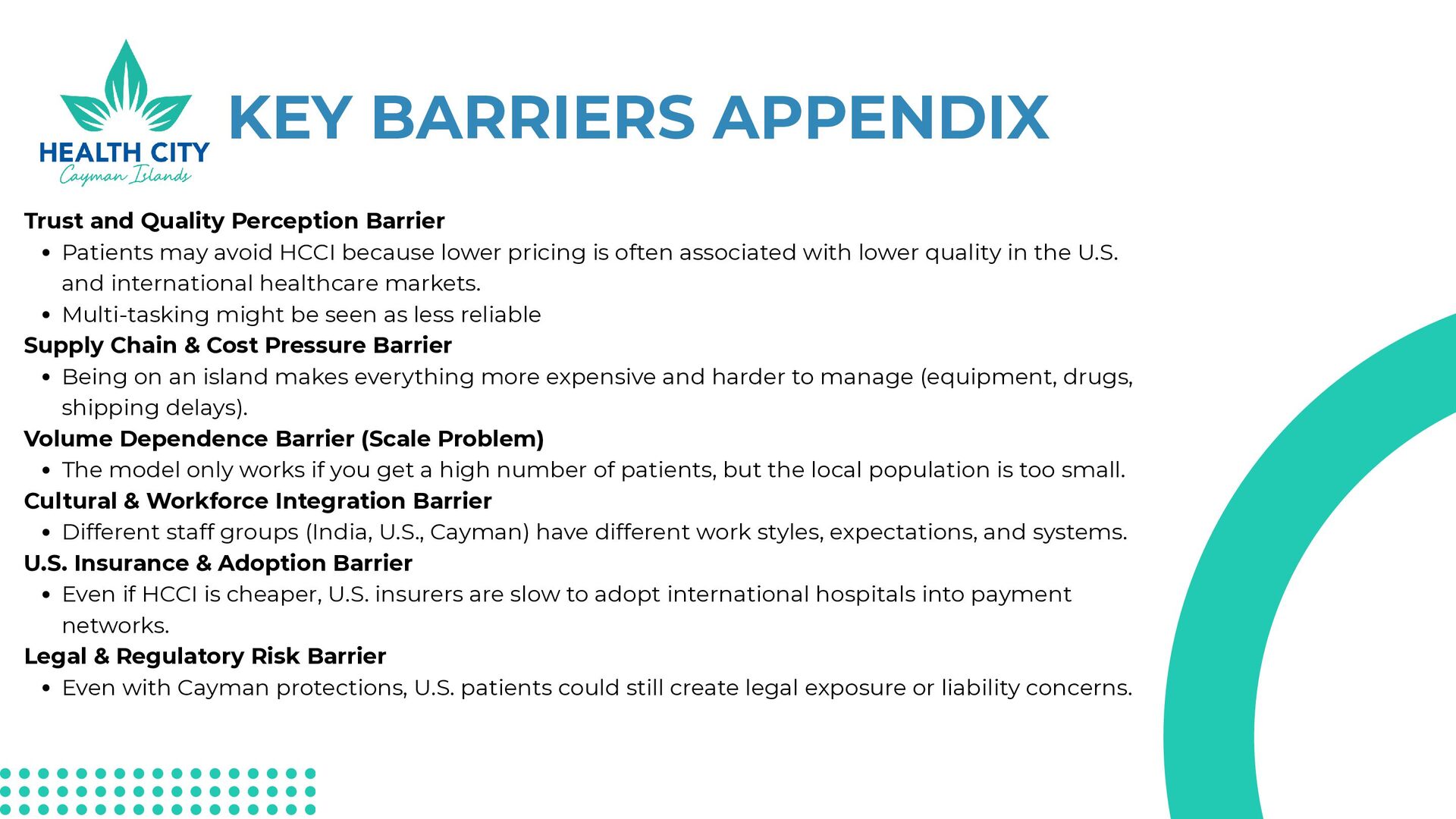
HCCI because lower pricing is often associated with lower quality in the U.S. and international healthcare markets. Multi-tasking might be seen as less reliable Supply Chain & Cost Pressure Barrier Being on an island makes everything more expensive and harder to manage (equipment, drugs, shipping delays). Volume Dependence Barrier (Scale Problem) The model only works if you get a high number of patients, but the local population is too small.
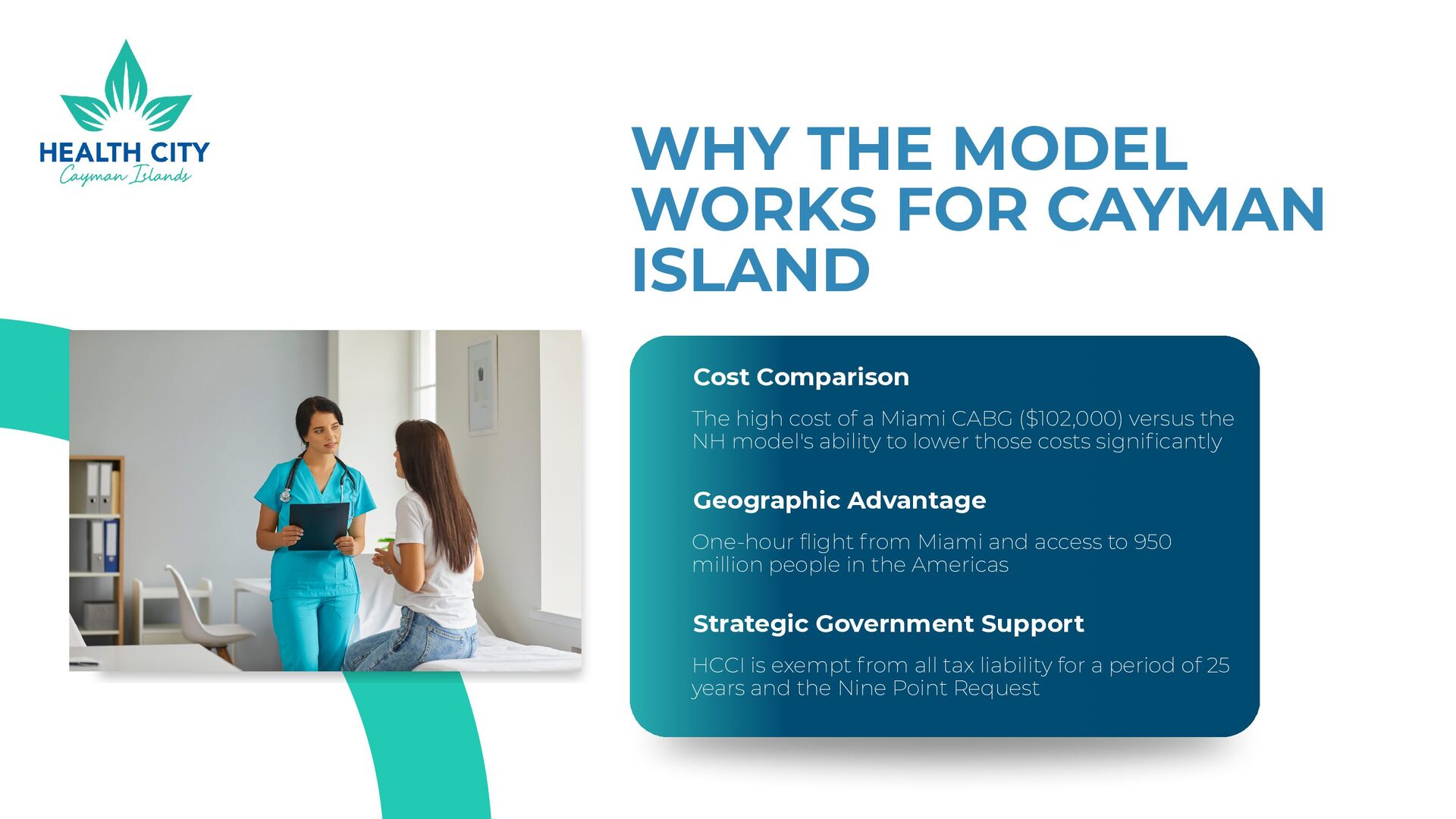
high cost of a Miami CABG ($102,000) versus the NH model's ability to lower those costs significantly Geographic Advantage One-hour flight from Miami and access to 950 million people in the Americas Strategic Government Support HCCI is exempt from all tax liability for a period of 25 years and the Nine Point Request
of Cayman Island Current Model Strategic Options HCCI Model Recommendation GTM Strategy Pricing Strategy Stakeholders Key Barriers Why the Model Works? Implementation Timeline APPENDIX WWW.REALLYGREATSITE.COM Strategic Options Strategic Options II Strategic Options III Pros/Cons Options Pros/Cons II Key Barriers Revenue Generation Volume-Driven Revenue Model Revenue Examples (Regional) Revenue Examples (U.S) Cost Structure 123 ANYWHERE ST., ANYCABG (U.S) Average Cost CITY Stakeholders Who Should We Target?
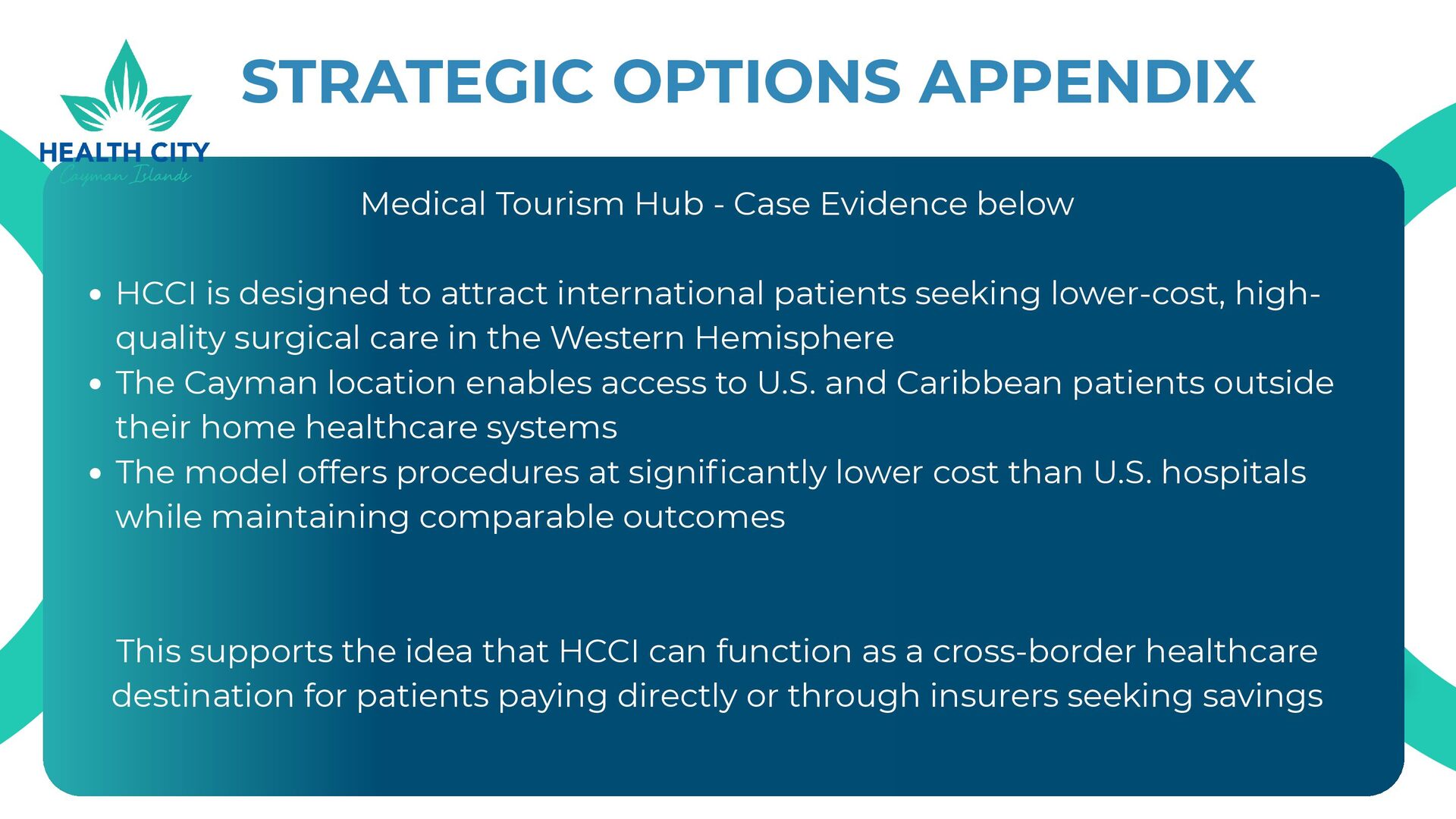
HCCI is designed to attract international patients seeking lower-cost, highquality surgical care in the Western Hemisphere The Cayman location enables access to U.S. and Caribbean patients outside their home healthcare systems The model offers procedures at significantly lower cost than U.S. hospitals while maintaining comparable outcomes This supports the idea that HCCI can function as a cross-border healthcare destination for patients paying directly or through insurers seeking savings
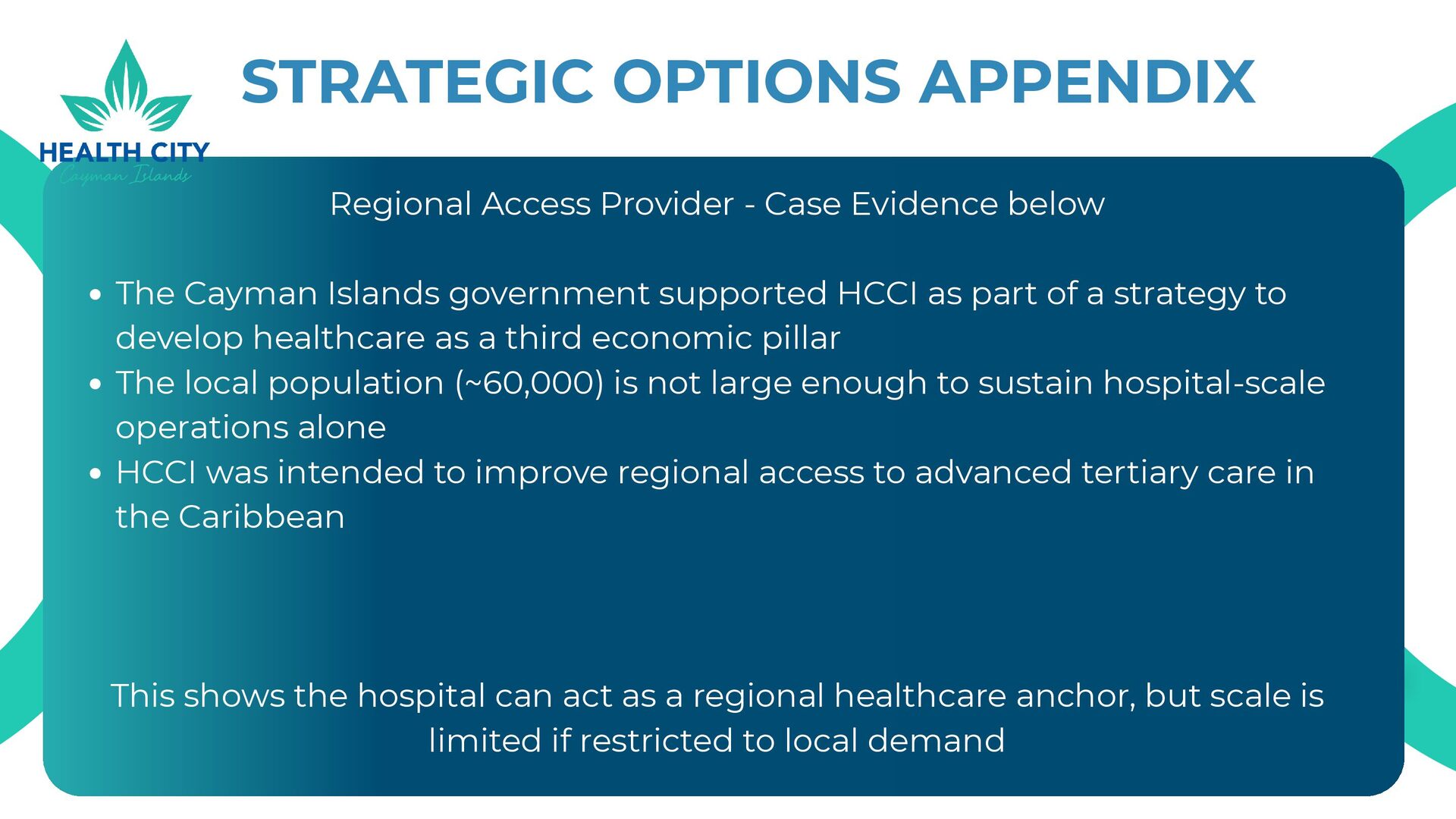
The Cayman Islands government supported HCCI as part of a strategy to develop healthcare as a third economic pillar The local population (~60,000) is not large enough to sustain hospital-scale operations alone HCCI was intended to improve regional access to advanced tertiary care in the Caribbean This shows the hospital can act as a regional healthcare anchor, but scale is limited if restricted to local demand
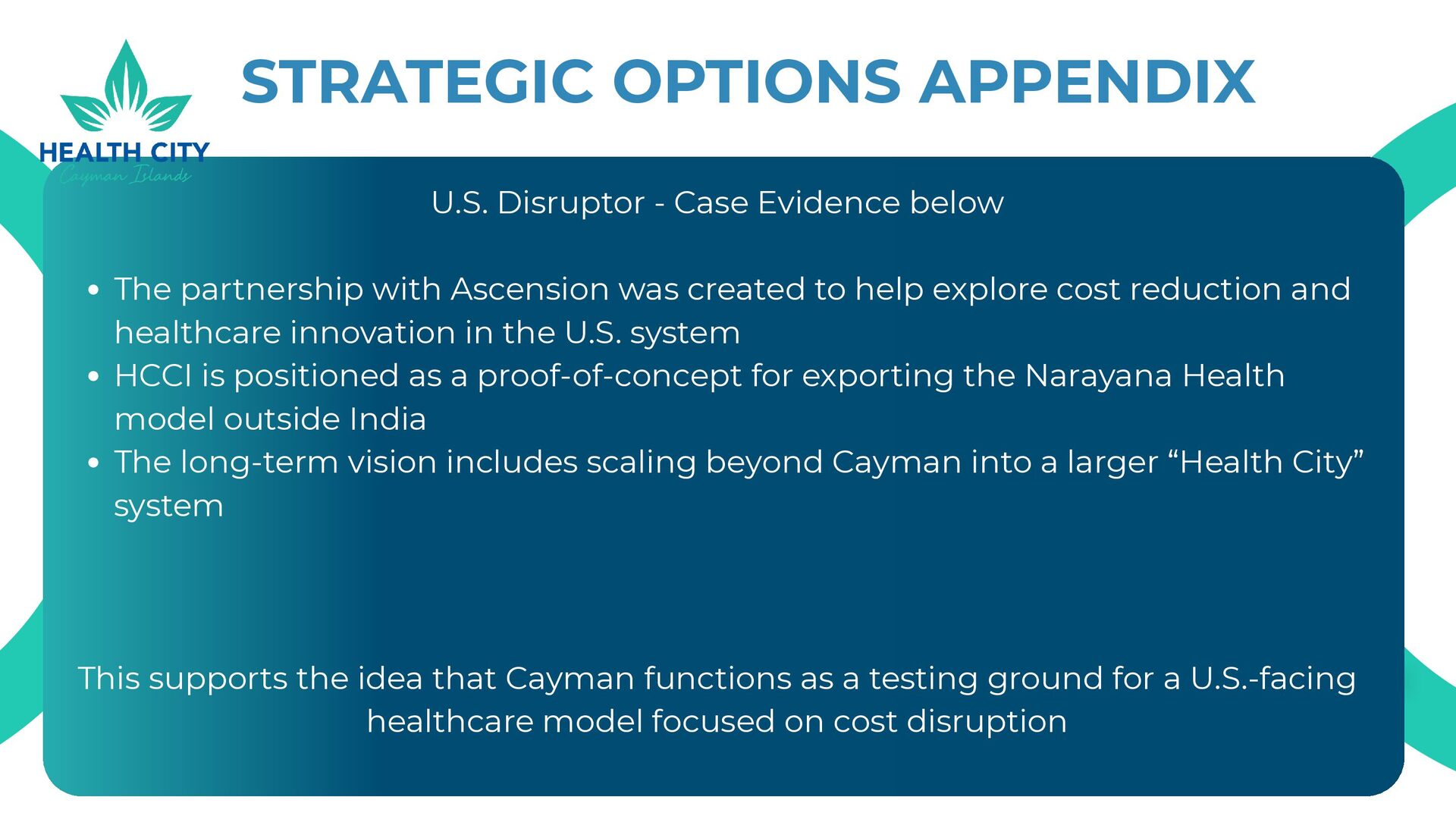
partnership with Ascension was created to help explore cost reduction and healthcare innovation in the U.S. system HCCI is positioned as a proof-of-concept for exporting the Narayana Health model outside India The long-term vision includes scaling beyond Cayman into a larger “Health City” system This supports the idea that Cayman functions as a testing ground for a U.S.-facing healthcare model focused on cost disruption
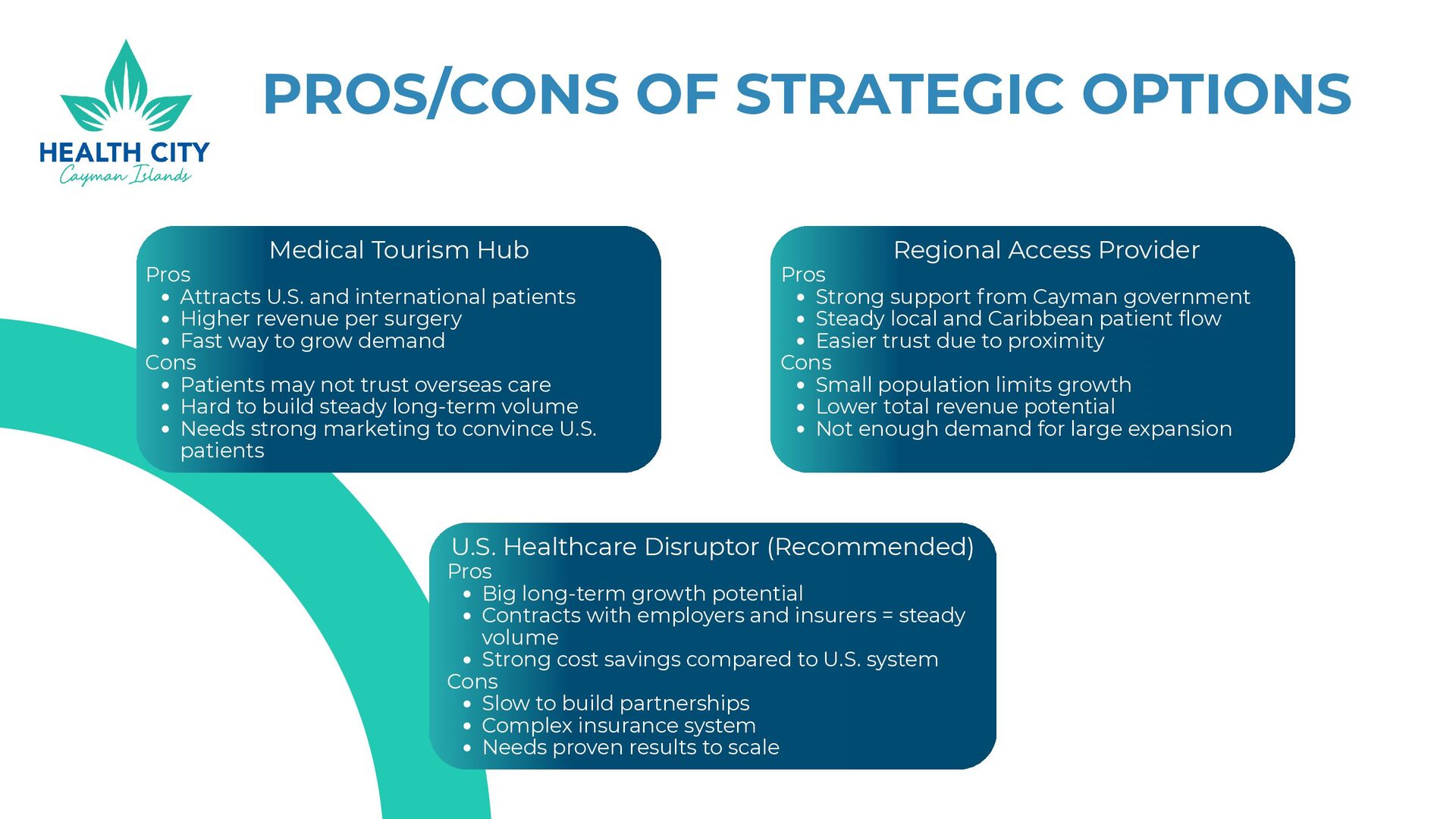
and international patients Higher revenue per surgery Fast way to grow demand Cons Patients may not trust overseas care Hard to build steady long-term volume Needs strong marketing to convince U.S. patients Regional Access Provider Pros Strong support from Cayman government Steady local and Caribbean patient flow Easier trust due to proximity Cons Small population limits growth Lower total revenue potential Not enough demand for large expansion U.S. Healthcare Disruptor (Recommended) Pros Big long-term growth potential Contracts with employers and insurers = steady volume Strong cost savings compared to U.S. system Cons Slow to build partnerships Complex insurance system Needs proven results to scale
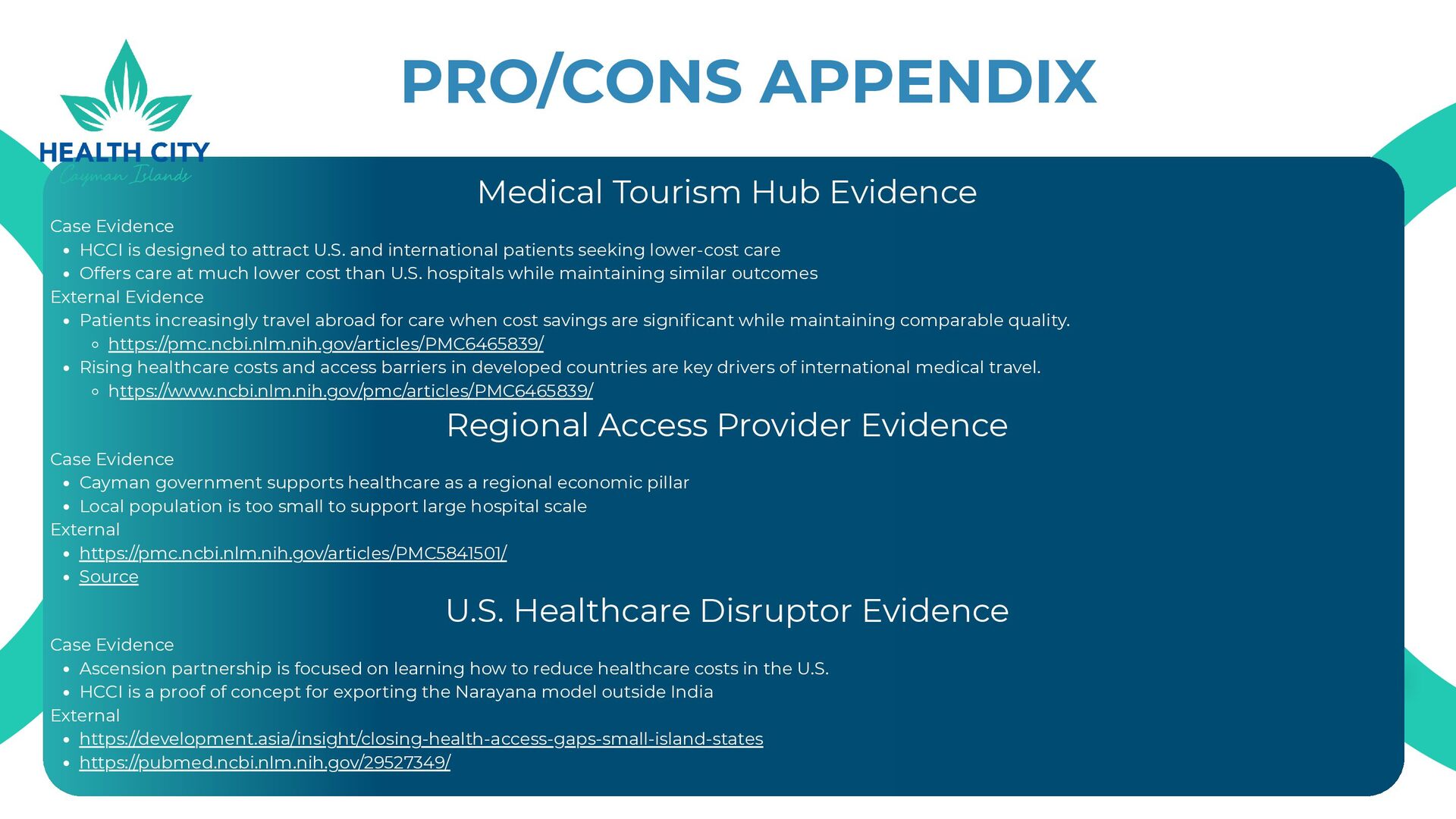
designed to attract U.S. and international patients seeking lower-cost care Offers care at much lower cost than U.S. hospitals while maintaining similar outcomes External Evidence Patients increasingly travel abroad for care when cost savings are significant while maintaining comparable quality. https://pmc.ncbi.nlm.nih.gov/articles/PMC6465839/ Rising healthcare costs and access barriers in developed countries are key drivers of international medical travel. https://www.ncbi.nlm.nih.gov/pmc/articles/PMC6465839/ Regional Access Provider Evidence Case Evidence Cayman government supports healthcare as a regional economic pillar Local population is too small to support large hospital scale External https://pmc.ncbi.nlm.nih.gov/articles/PMC5841501/ Source U.S. Healthcare Disruptor Evidence Case Evidence Ascension partnership is focused on learning how to reduce healthcare costs in the U.S. HCCI is a proof of concept for exporting the Narayana model outside India External https://development.asia/insight/closing-health-access-gaps-small-island-states https://pubmed.ncbi.nlm.nih.gov/29527349/
avoid HCCI because lower pricing is often associated with lower quality in the U.S. and international healthcare markets. Multi-tasking might be seen as less reliable Supply Chain & Cost Pressure Barrier Being on an island makes everything more expensive and harder to manage (equipment, drugs, shipping delays). Volume Dependence Barrier (Scale Problem) The model only works if you get a high number of patients, but the local population is too small. Cultural & Workforce Integration Barrier Different staff groups (India, U.S., Cayman) have different work styles, expectations, and systems. U.S. Insurance & Adoption Barrier Even if HCCI is cheaper, U.S. insurers are slow to adopt international hospitals into payment networks. Legal & Regulatory Risk Barrier Even with Cayman protections, U.S. patients could still create legal exposure or liability concerns.
through direct site visits to Bangalore to demonstrate the model's quality, collaborating on legal amendments for degree recognition and tax concessions Physicans and Health Professionals Connecting with qualified professionals through the numerous Cayman councils, collaborating on clinical protocols and joint-venture training programs to develop the local healthcare workforce Patients Find patients through local community meetings or through the new medical tourism visa process and through strategic marketing Travel Agencies Connect with them through international medical tourism conferences or within the Caribbean tourism infrastructure Non Government Organizations Collaborate with NGOs like Digicel (a regional telecom provider) and the "Have a Heart" foundation, asking for their help in patient screening and post-operative follow-up
legitimacy Americans 26.7 million uninsured Americans Regional Caribbean + local Caymanians 23% Americans are underinsured 30% of deaths were cardiovascular related >65yrs High-deductible health plans (HDHPs) and self-insured employers seeking lower-cost 2 nd leading cause of deaths were heart disease related (Cuba)


 blakedoman
 badams
 dougneiner
 reverentgeek
 ryanjones
 philnash
 aleyda
 bluesmoon
 akashhashmi
 inesmontani
 mlcsv
 samanthasiow
 techseoconnect