Share
Embed
SEC Rivalries
Market research project that examines SEC football rivalries and student engagement factors.
Blake Doman
August 16, 2026
Transcript
30 slides
-
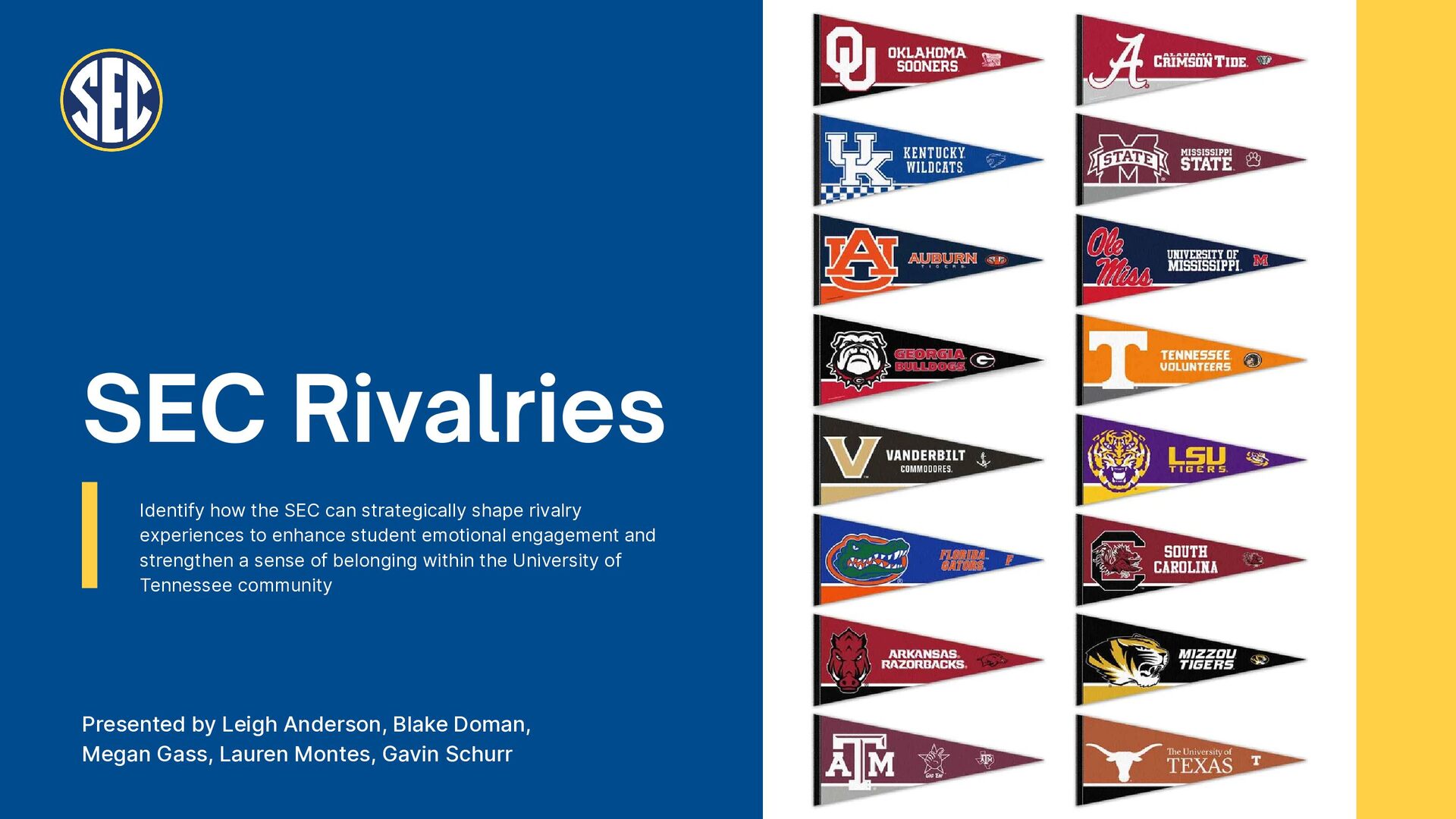
SEC Rivalries Identify how the SEC can strategically shape rivalry
experiences to enhance student emotional engagement and strengthen a sense of belonging within the University of Tennessee community Presented by Leigh Anderson, Blake Doman, Megan Gass, Lauren Montes, Gavin Schurr -
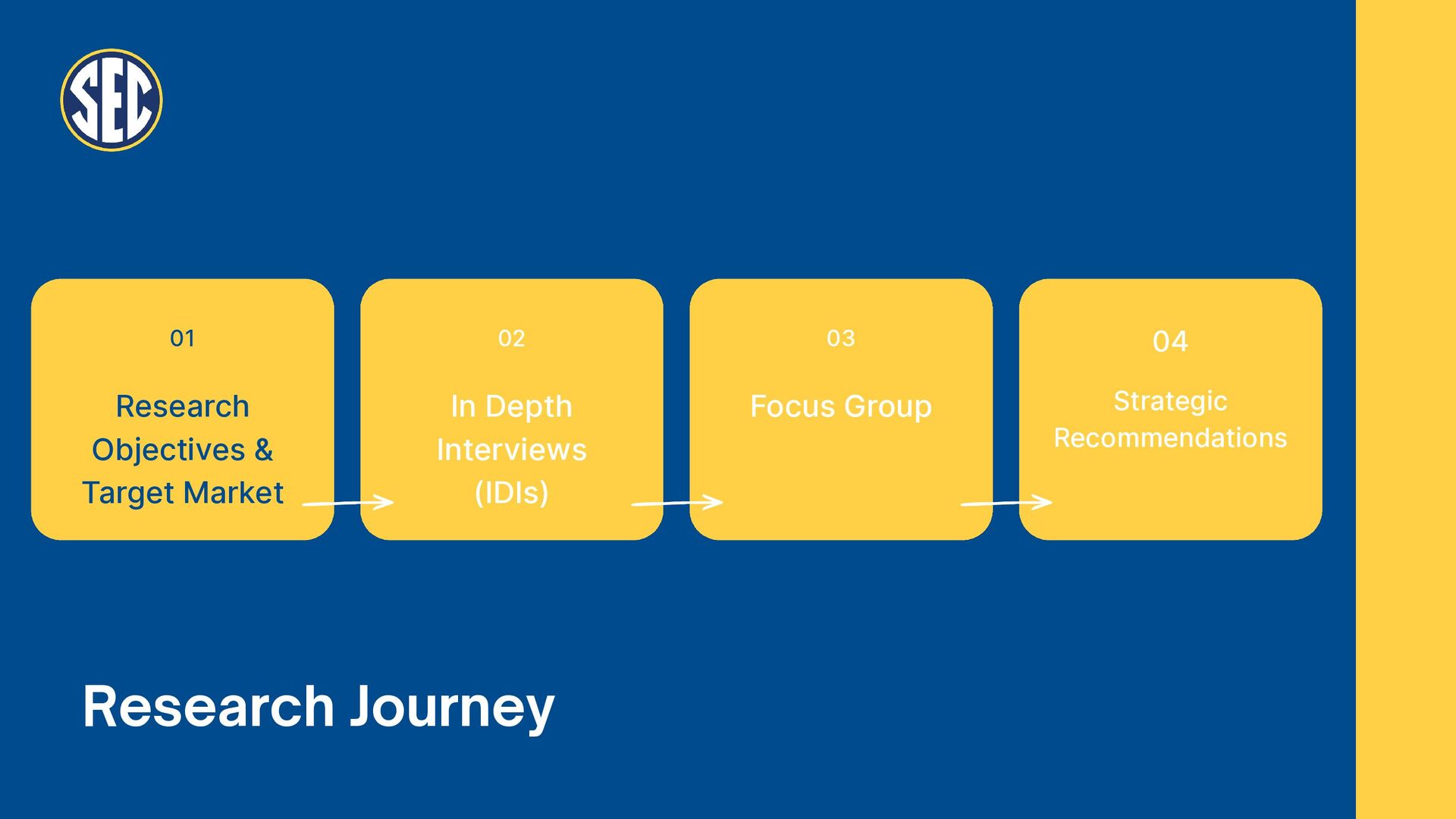
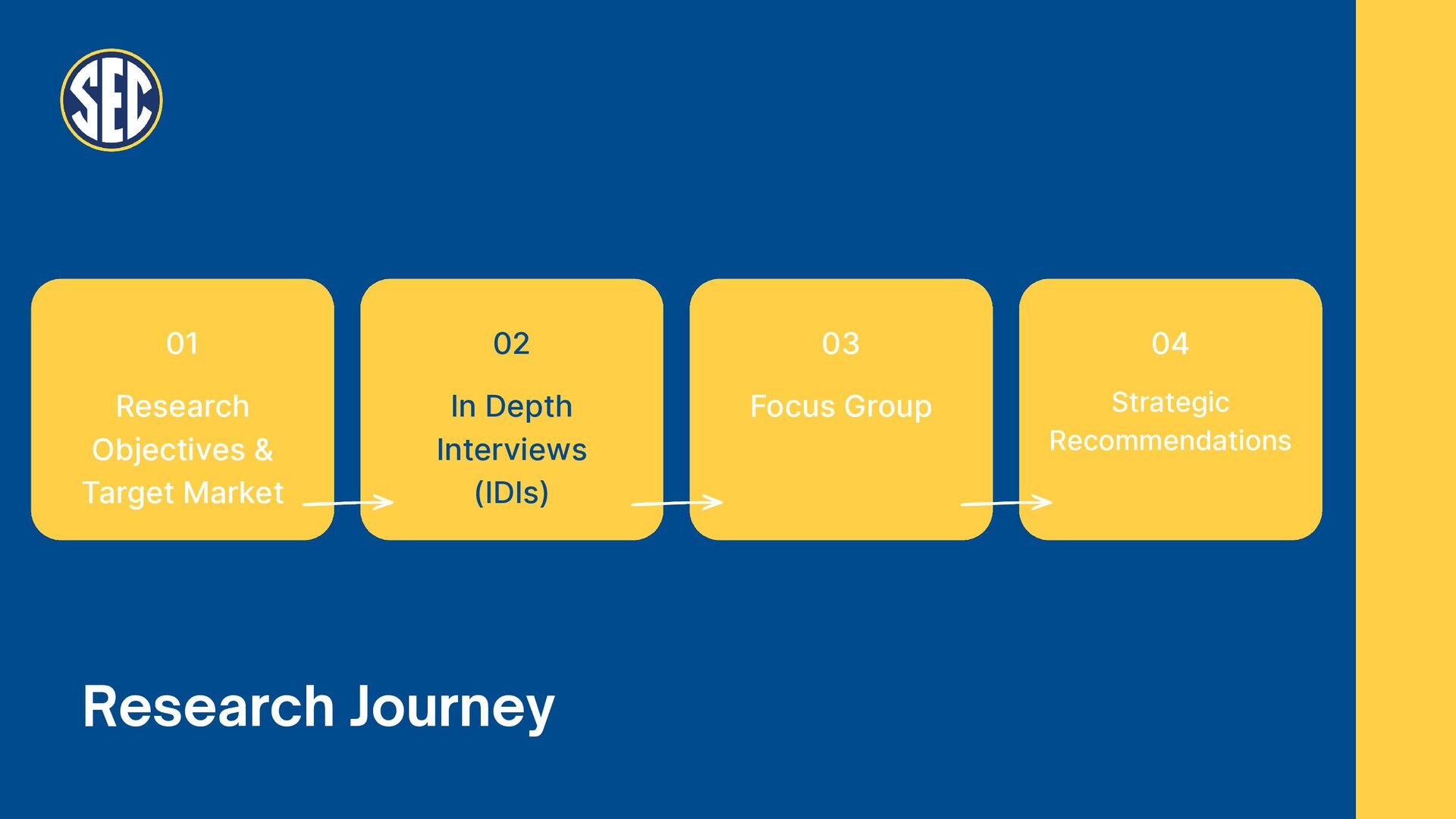
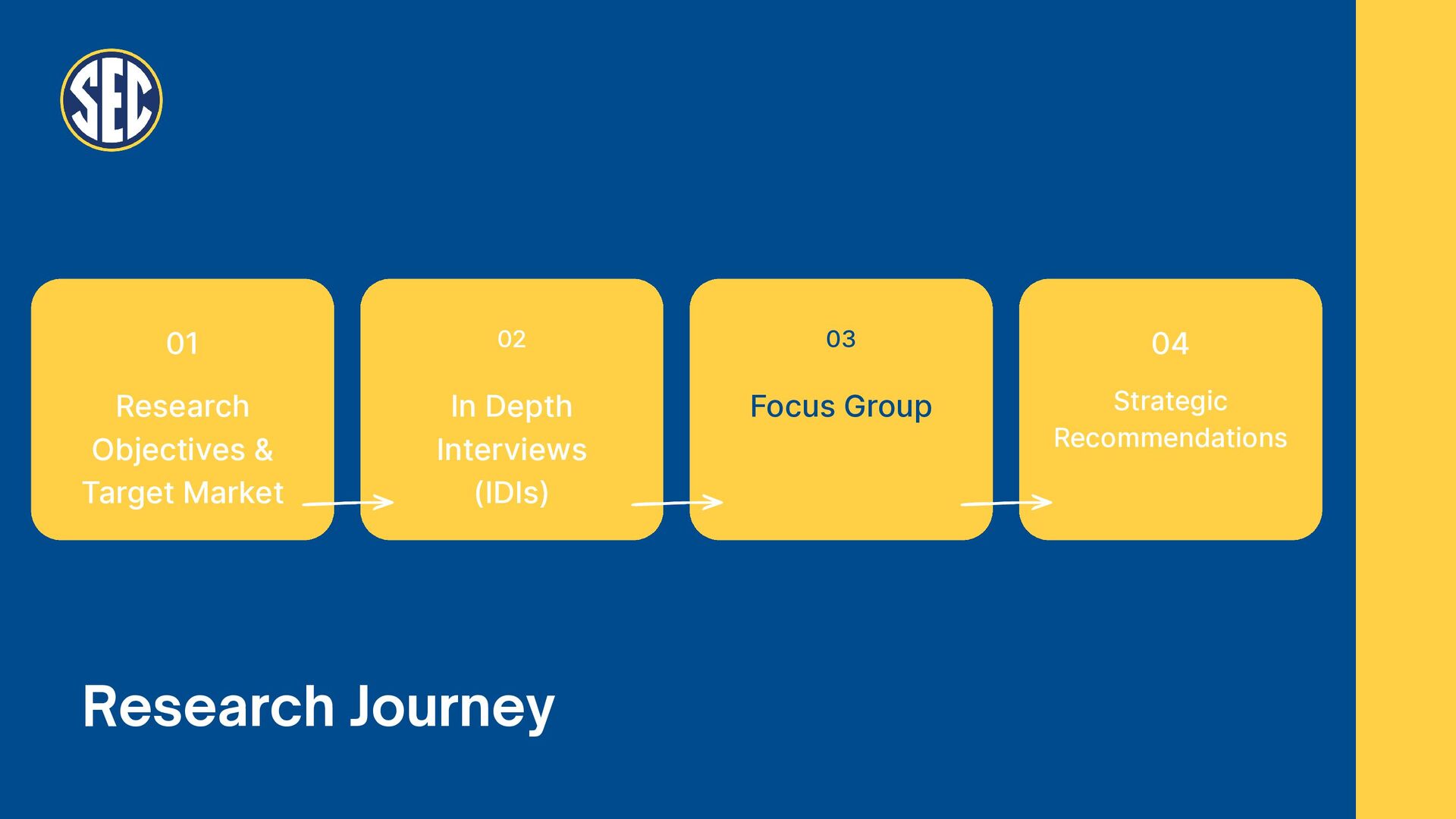
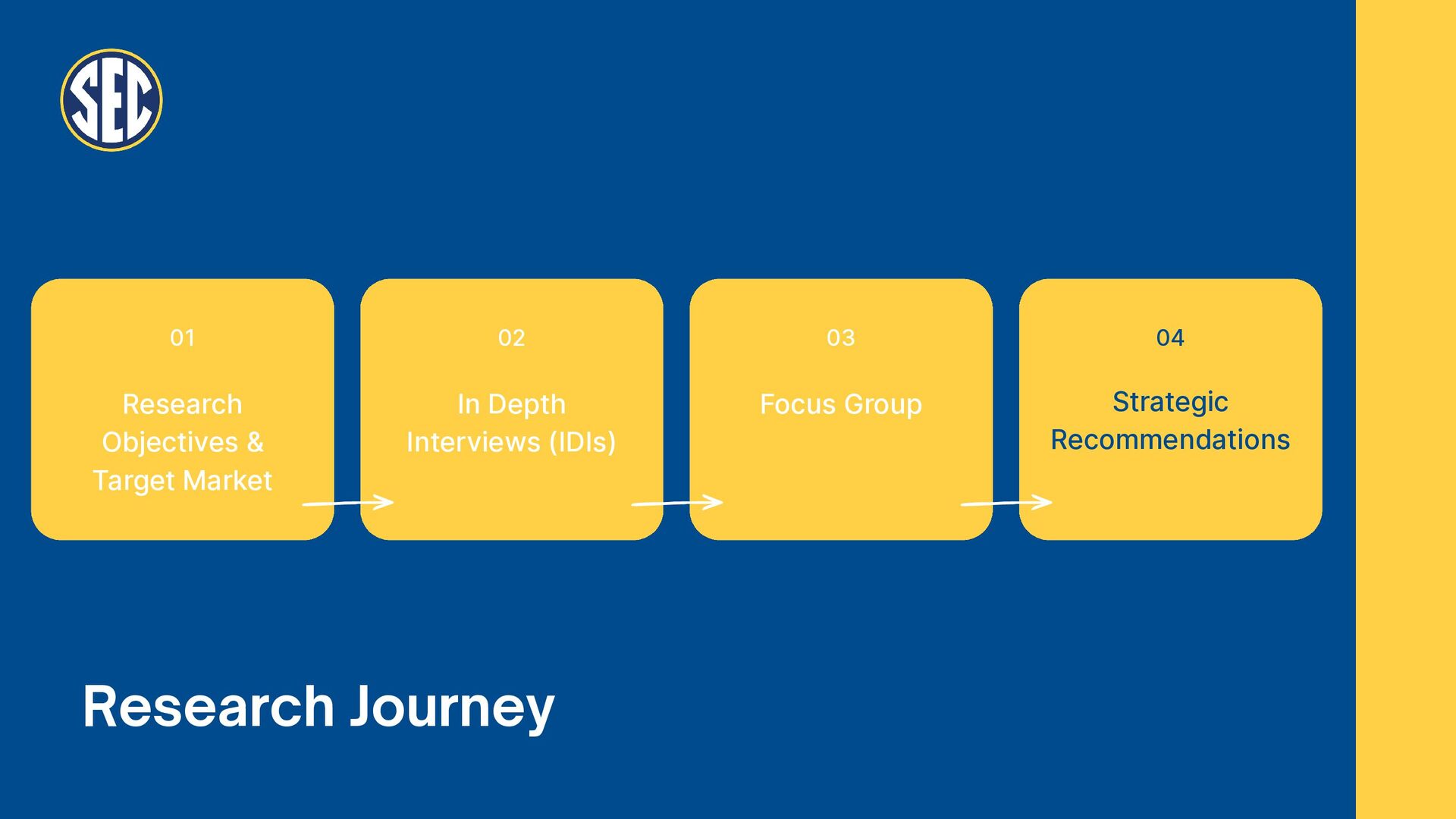
01 02 03 04 Research Objectives & Target Market In
Depth Interviews (IDIs) Focus Group Strategic Recommendations Research Journey -
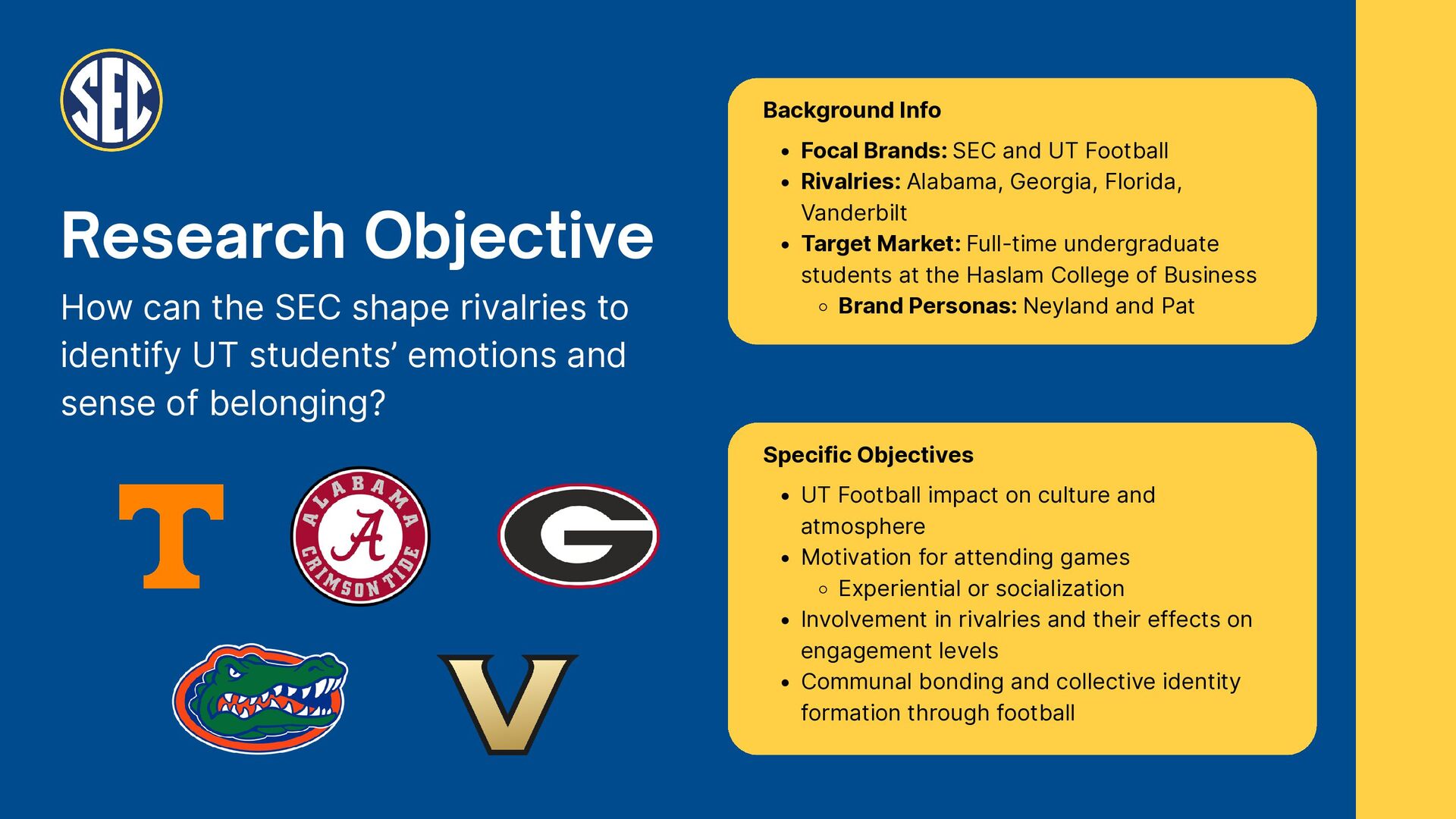
Background Info Research Objective How can the SEC shape rivalries
to identify UT students’ emotions and sense of belonging? Focal Brands: SEC and UT Football Rivalries: Alabama, Georgia, Florida, Vanderbilt Target Market: Full-time undergraduate students at the Haslam College of Business Brand Personas: Neyland and Pat Specific Objectives UT Football impact on culture and atmosphere Motivation for attending games Experiential or socialization Involvement in rivalries and their effects on engagement levels Communal bonding and collective identity formation through football -
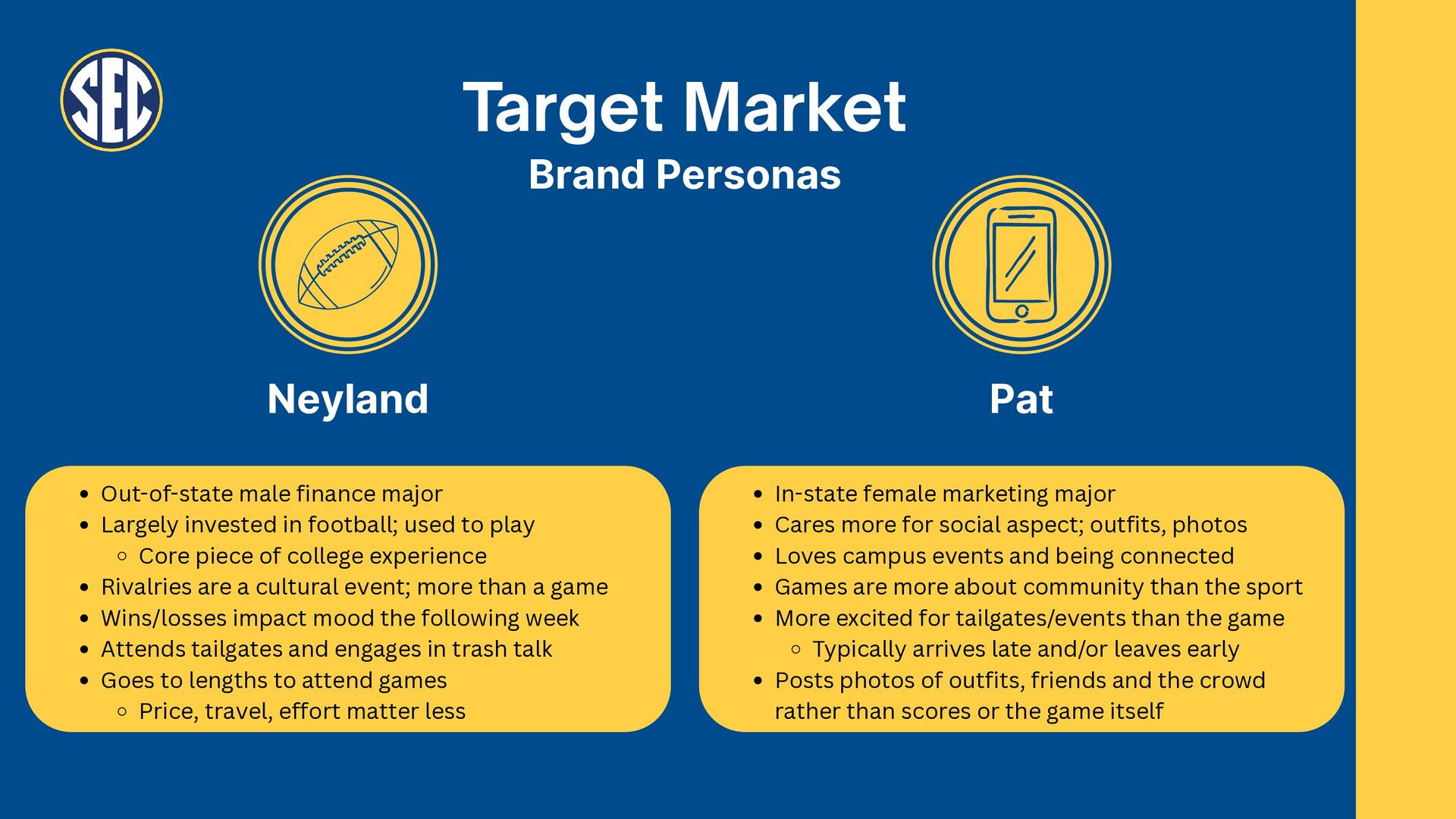
Target Market Brand Personas Neyland Out-of-state male finance major Largely
invested in football; used to play Core piece of college experience Rivalries are a cultural event; more than a game Wins/losses impact mood the following week Attends tailgates and engages in trash talk Goes to lengths to attend games Price, travel, effort matter less Pat In-state female marketing major Cares more for social aspect; outfits, photos Loves campus events and being connected Games are more about community than the sport More excited for tailgates/events than the game Typically arrives late and/or leaves early Posts photos of outfits, friends and the crowd rather than scores or the game itself -
01 02 03 04 Research Objectives & Target Market In
Depth Interviews (IDIs) Focus Group Strategic Recommendations Research Journey -
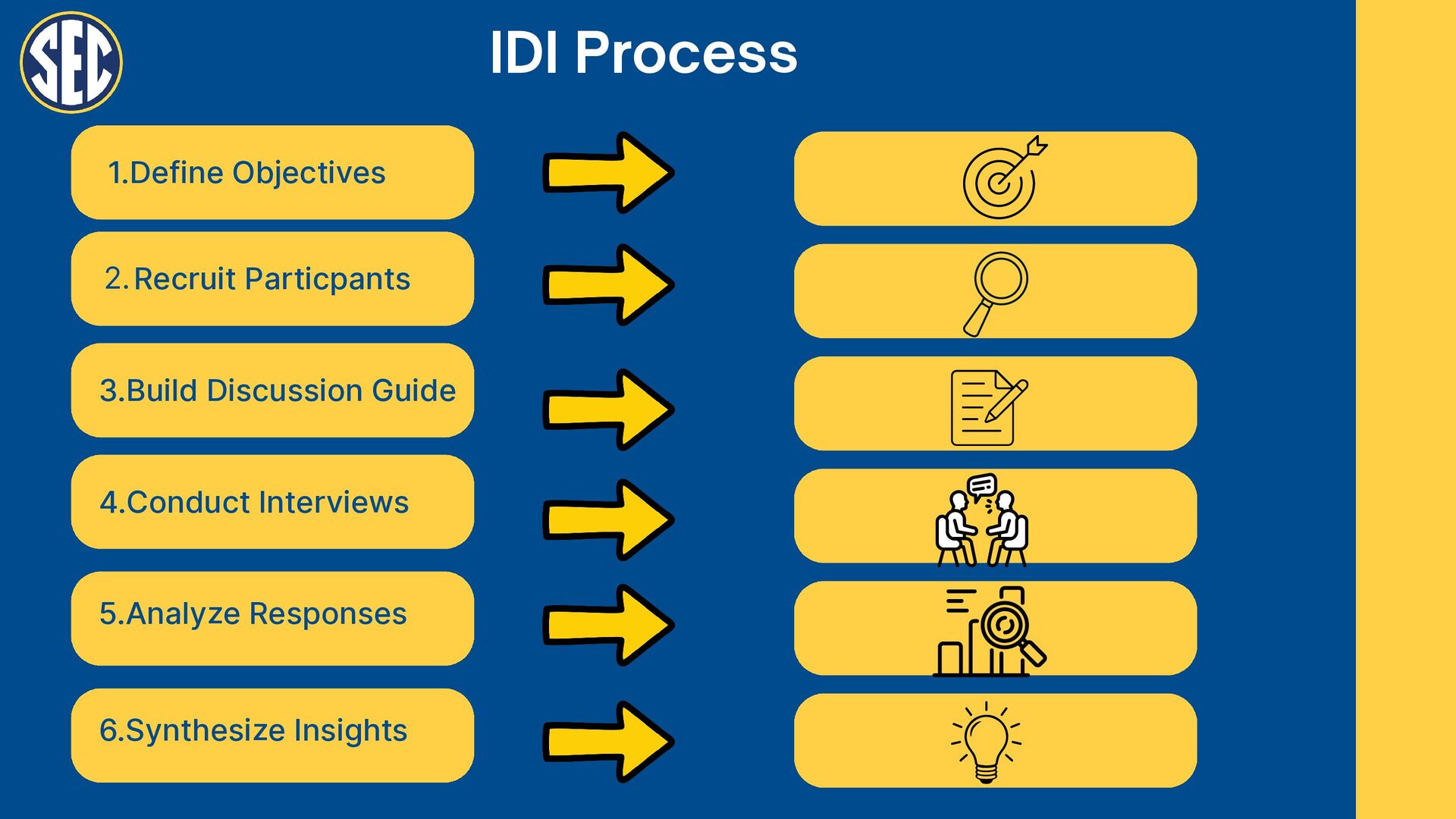
IDI Process 1.Define Objectives 2. Recruit Particpants 3.Build Discussion Guide
4.Conduct Interviews 5.Analyze Responses 6.Synthesize Insights -
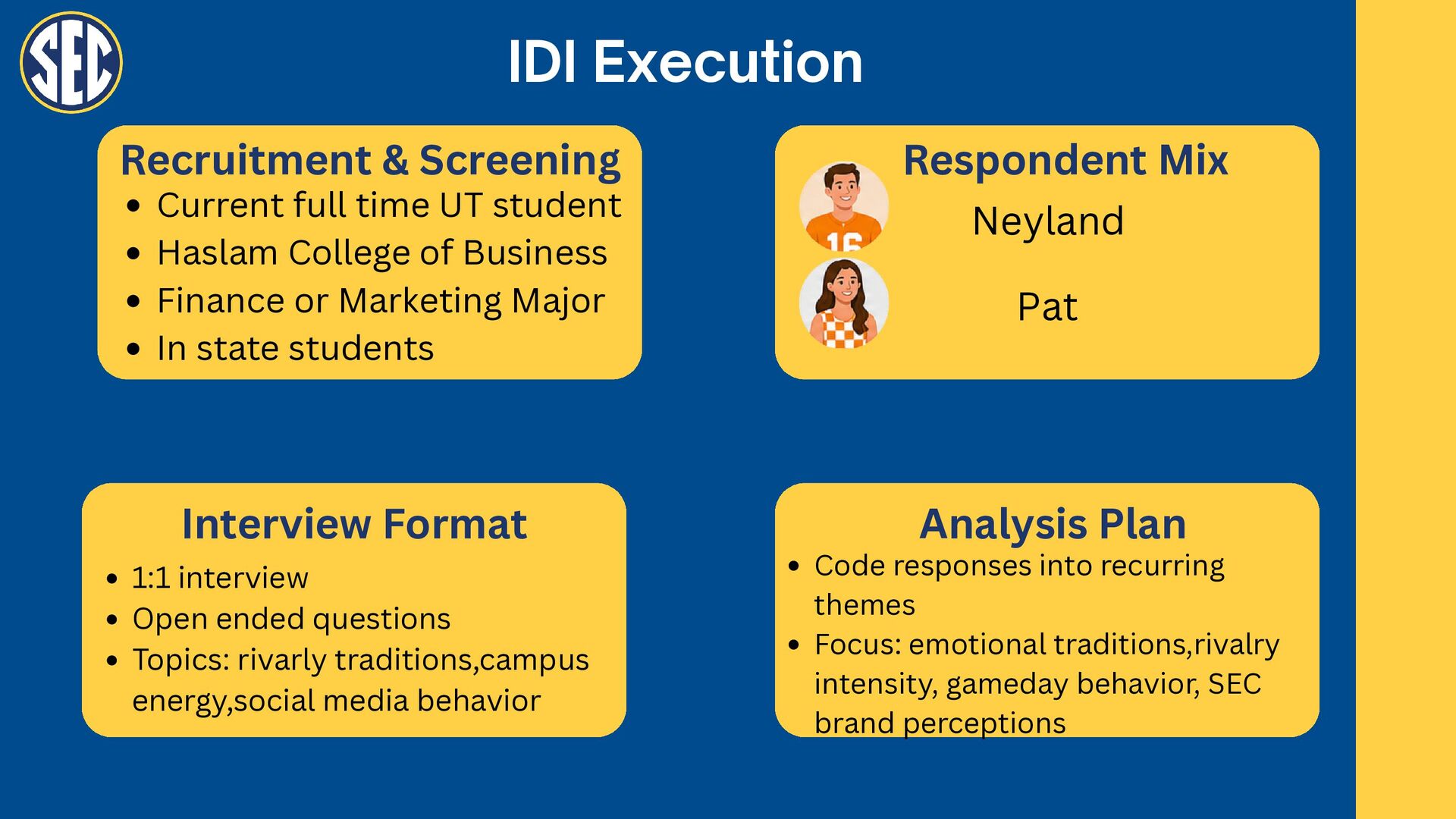
IDI Execution Recruitment & Screening Current full time UT student
Haslam College of Business Finance or Marketing Major In state students Interview Format 1:1 interview Open ended questions Topics: rivarly traditions,campus energy,social media behavior Respondent Mix Neyland Pat Analysis Plan Code responses into recurring themes Focus: emotional traditions,rivalry intensity, gameday behavior, SEC brand perceptions -
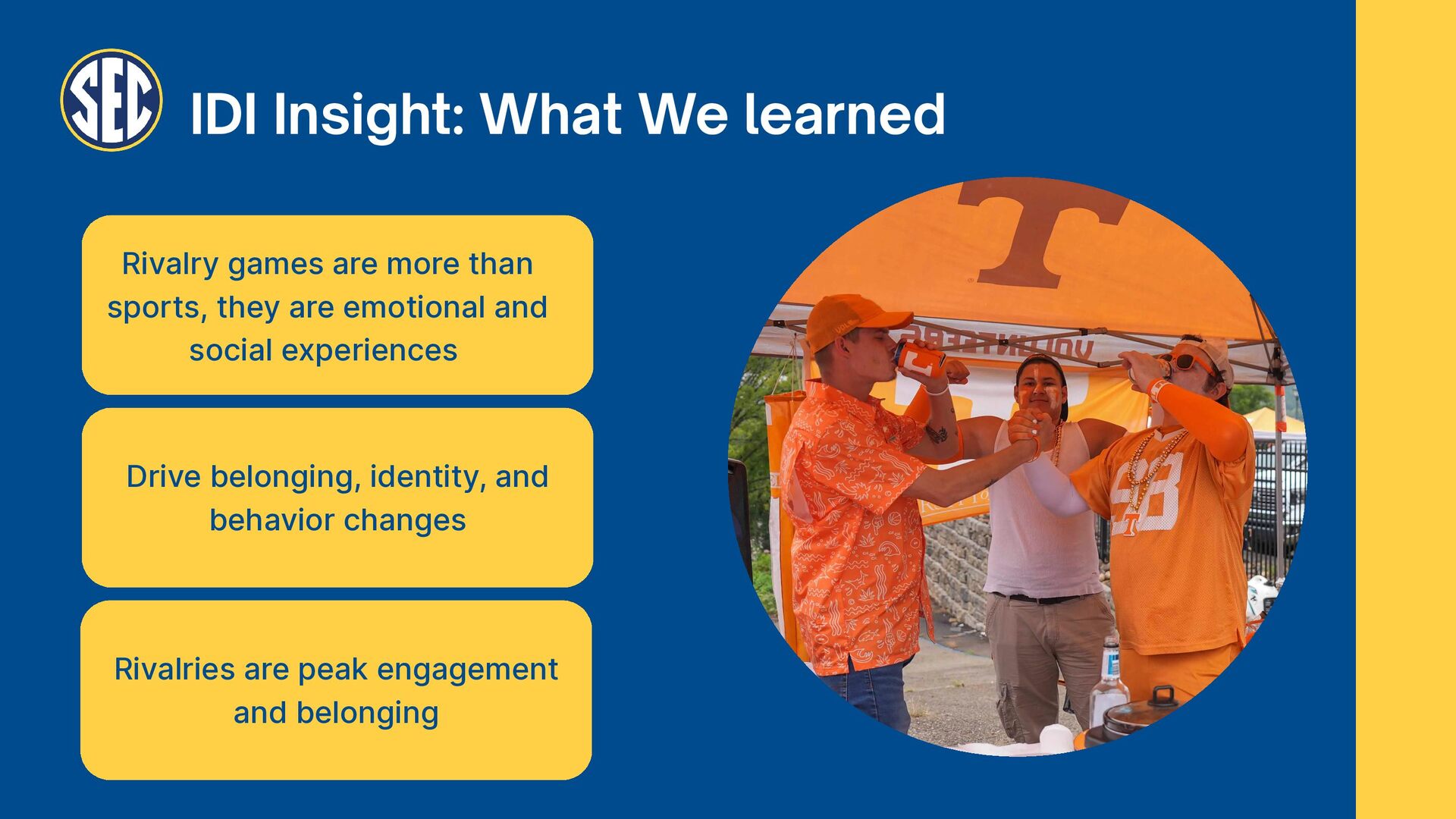
IDI Insight: What We learned Rivalry games are more than
sports, they are emotional and social experiences Drive belonging, identity, and behavior changes Rivalries are peak engagement and belonging -
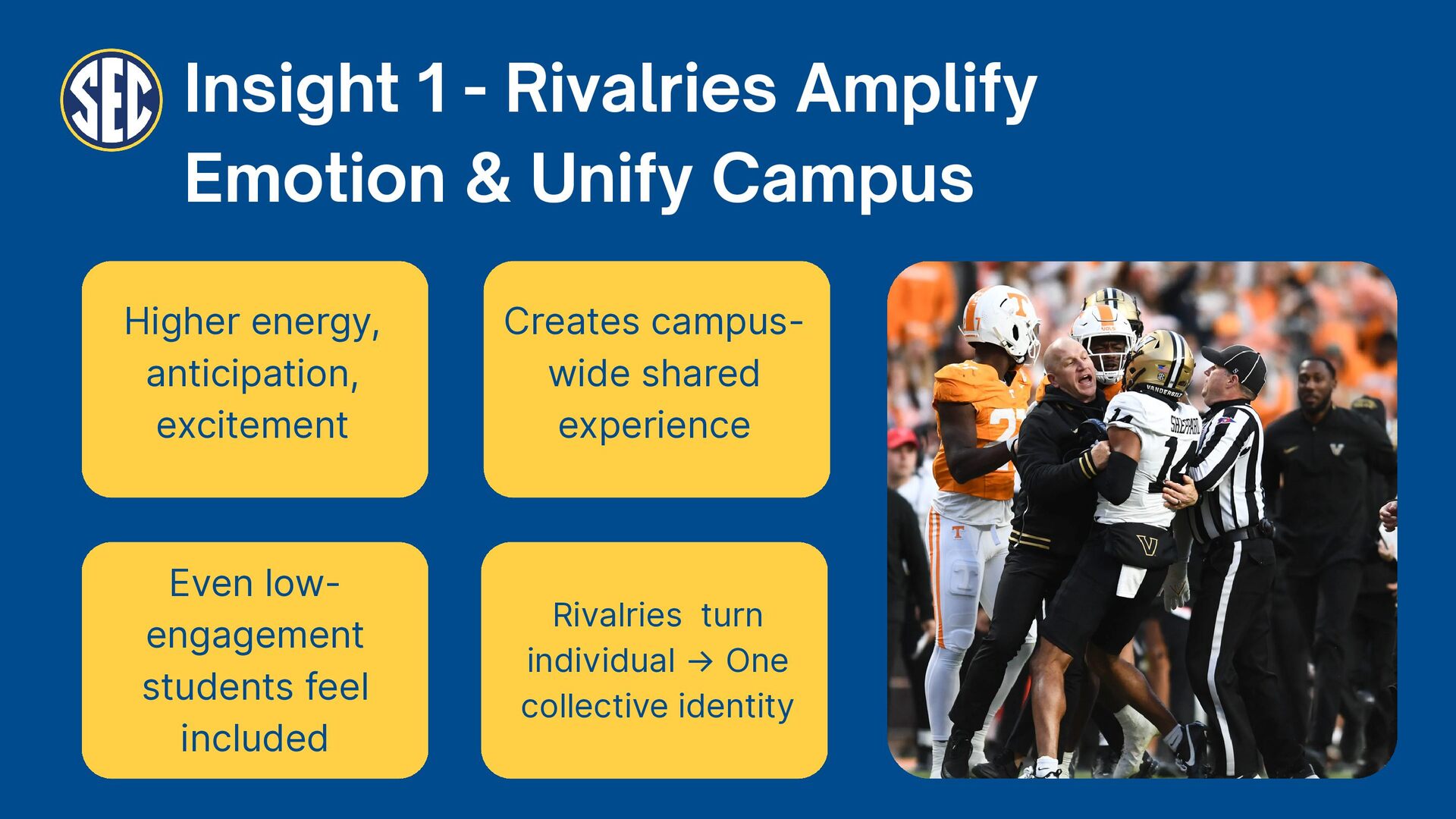
Insight 1 - Rivalries Amplify Emotion & Unify Campus Higher
energy, anticipation, excitement Creates campuswide shared experience Even lowengagement students feel included Rivalries turn individual → One collective identity -
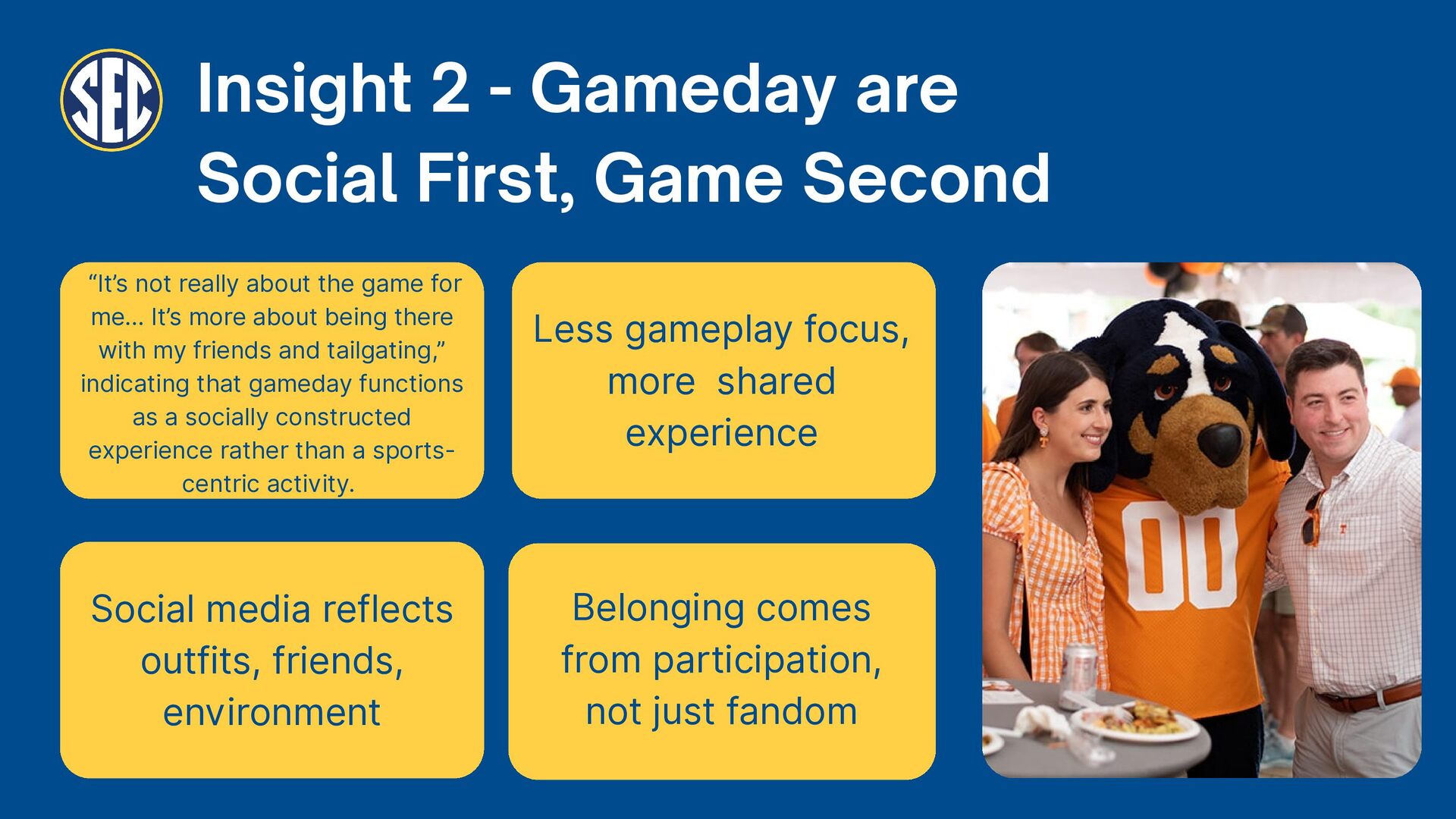
Insight 2 - Gameday are Social First, Game Second “It’s
not really about the game for me… It’s more about being there with my friends and tailgating,” indicating that gameday functions as a socially constructed experience rather than a sportscentric activity. Less gameplay focus, more shared experience Social media reflects outfits, friends, environment Belonging comes from participation, not just fandom -
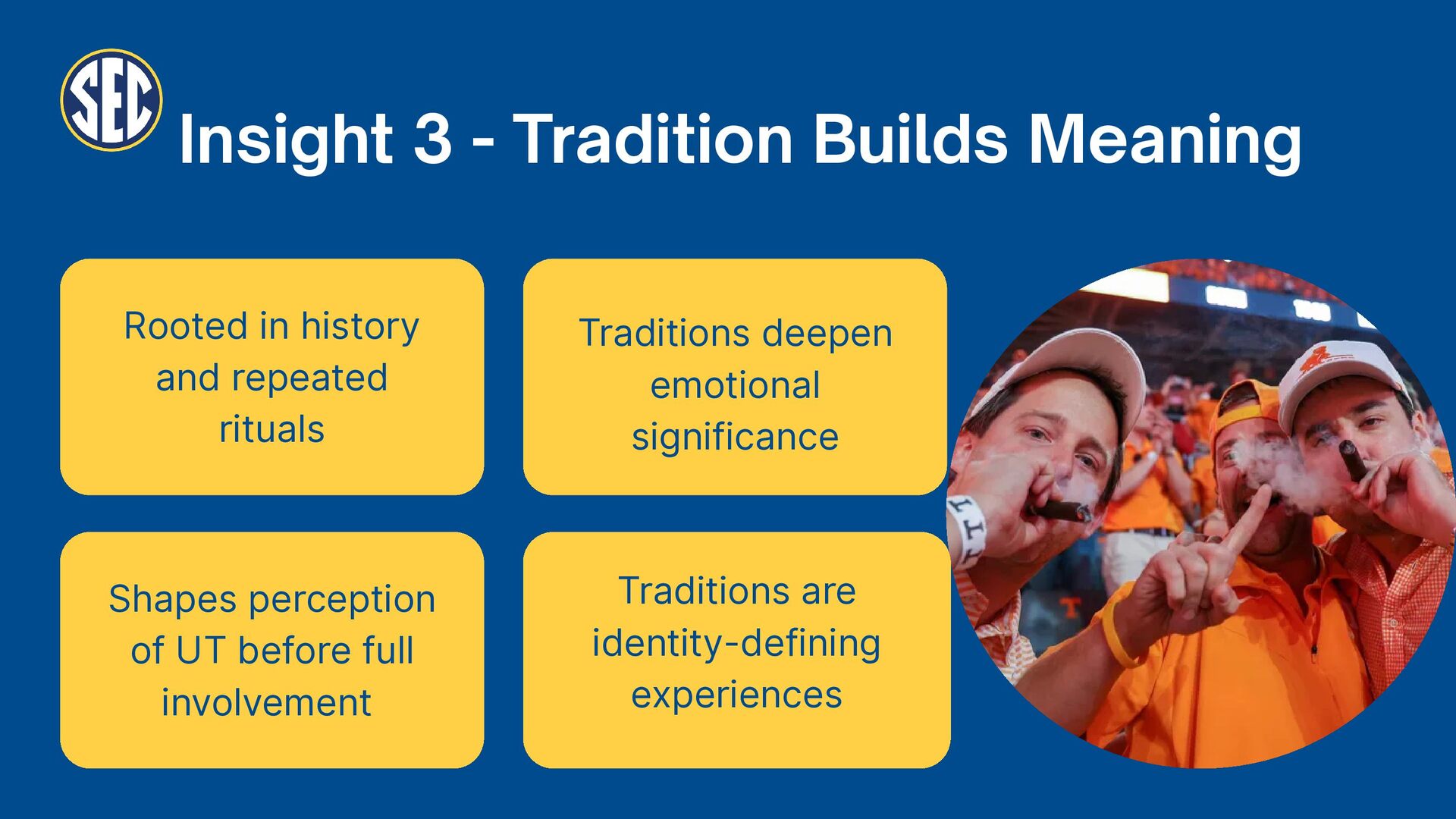
Insight 3 - Tradition Builds Meaning Rooted in history and
repeated rituals Traditions deepen emotional significance Shapes perception of UT before full involvement Traditions are identity-defining experiences -
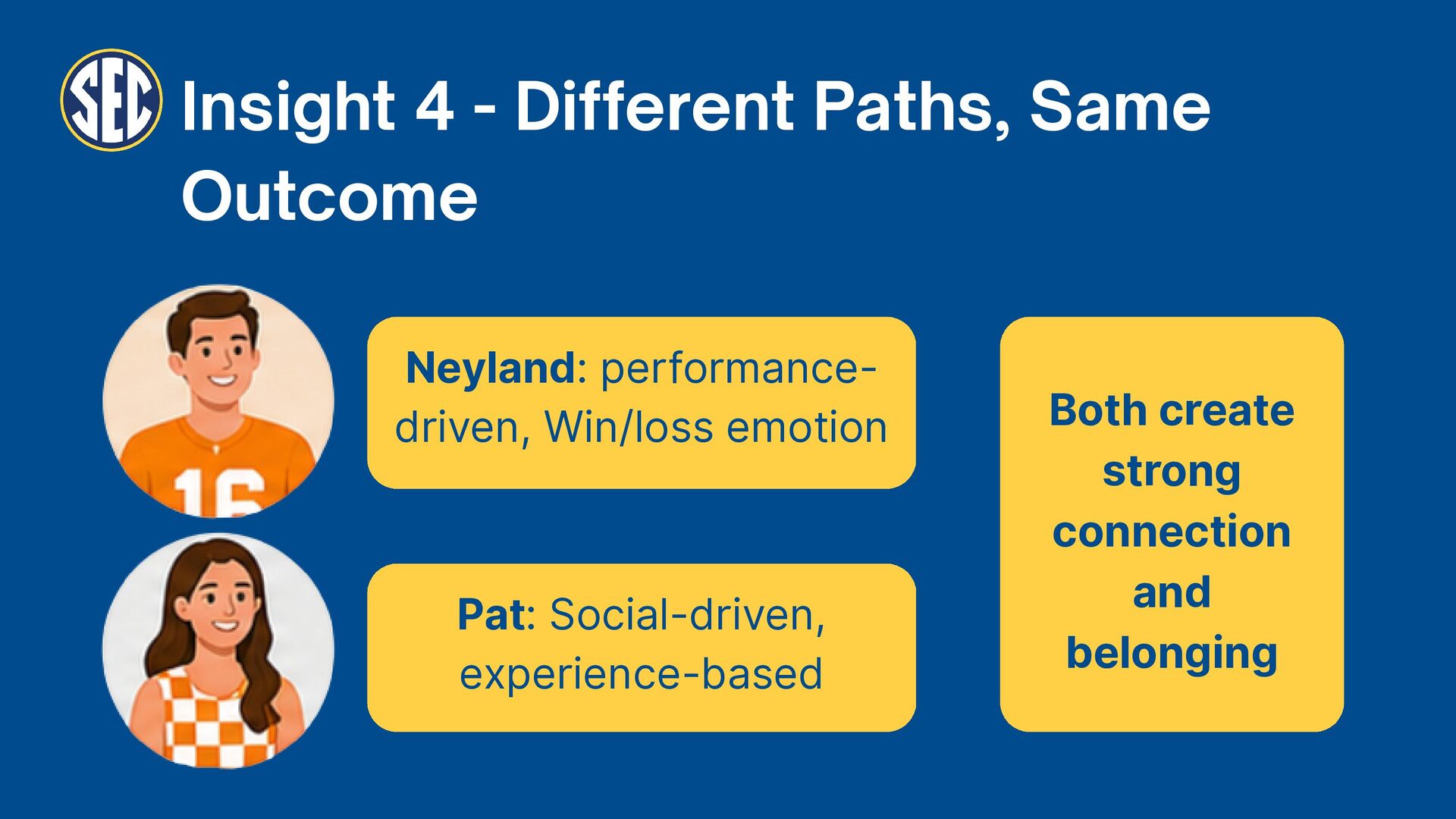
Insight 4 - Different Paths, Same Outcome Neyland: performancedriven, Win/loss
emotion Pat: Social-driven, experience-based Both create strong connection and belonging -
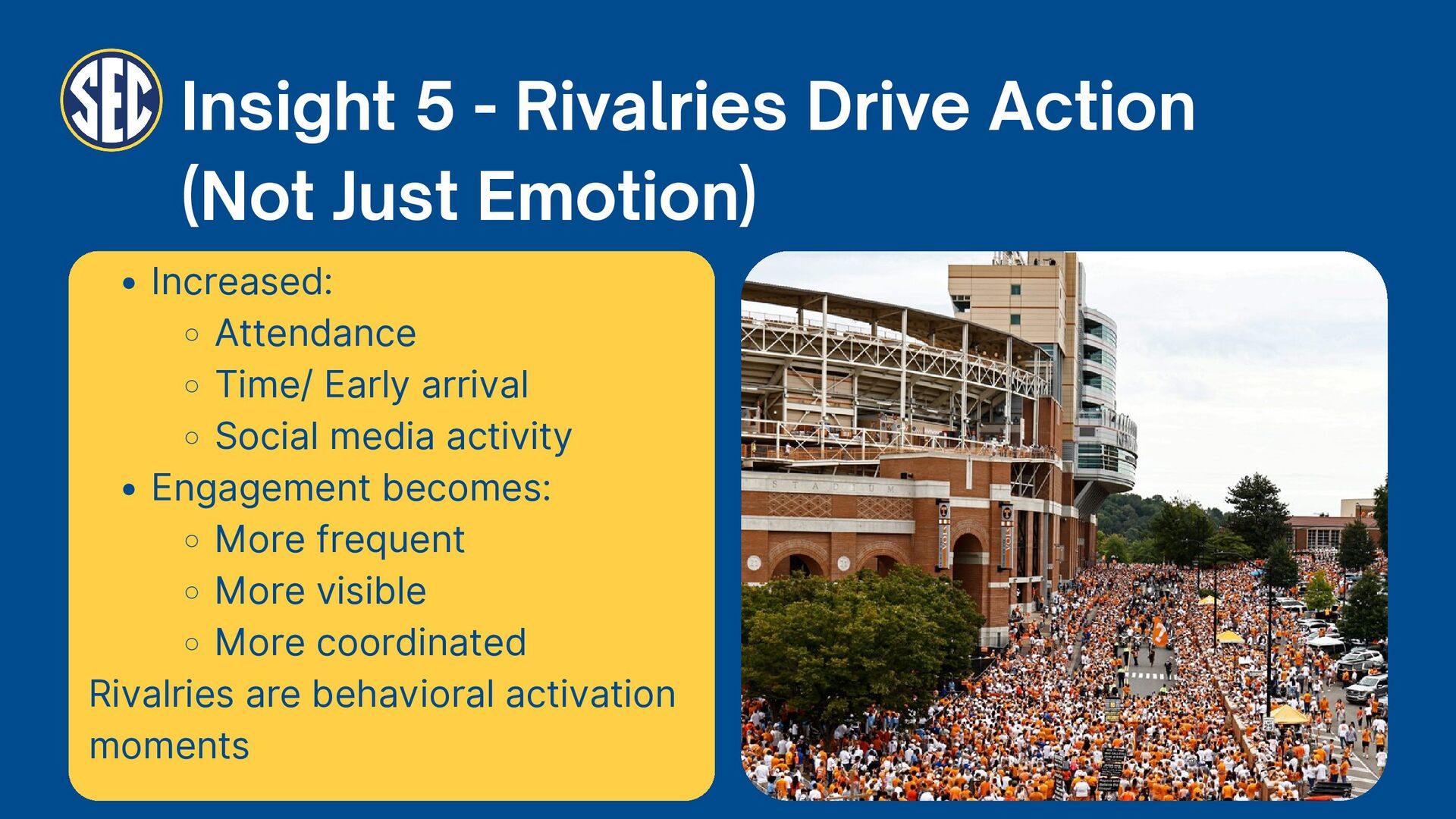
Insight 5 - Rivalries Drive Action (Not Just Emotion) Increased:
Attendance Time/ Early arrival Social media activity Engagement becomes: More frequent More visible More coordinated Rivalries are behavioral activation moments -
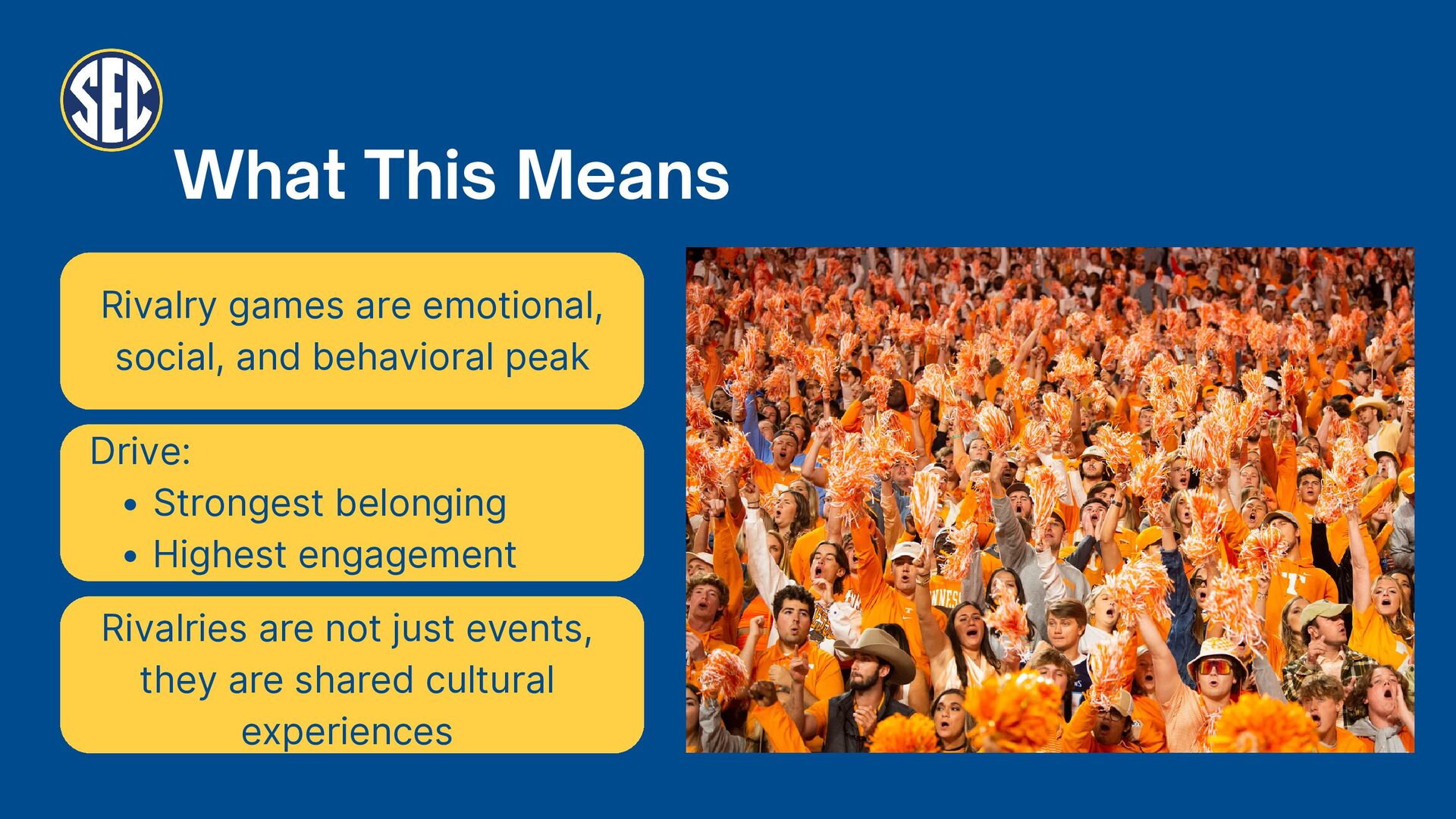
What This Means Rivalry games are emotional, social, and behavioral
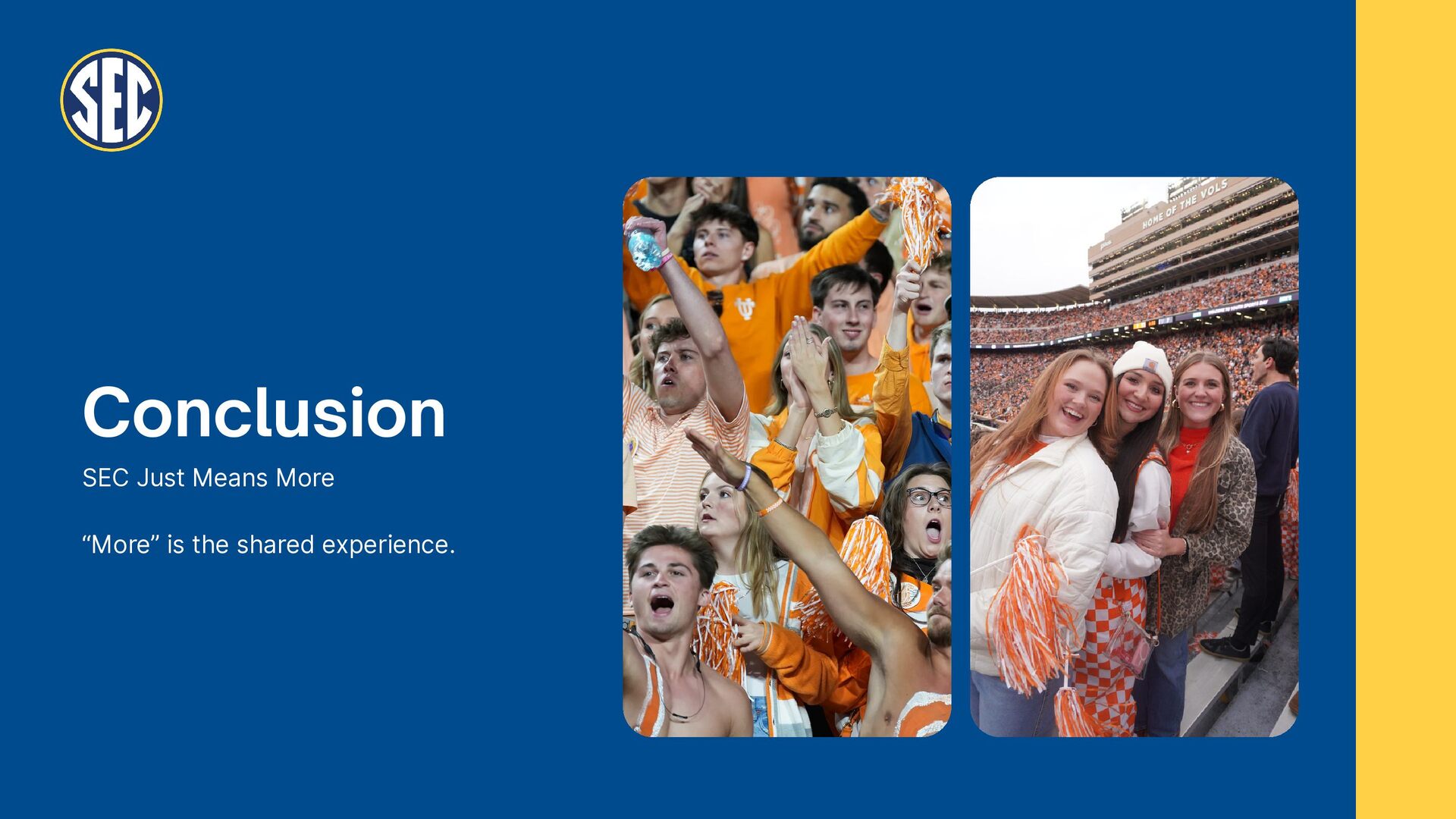
peak Drive: Strongest belonging Highest engagement Rivalries are not just events, they are shared cultural experiences -
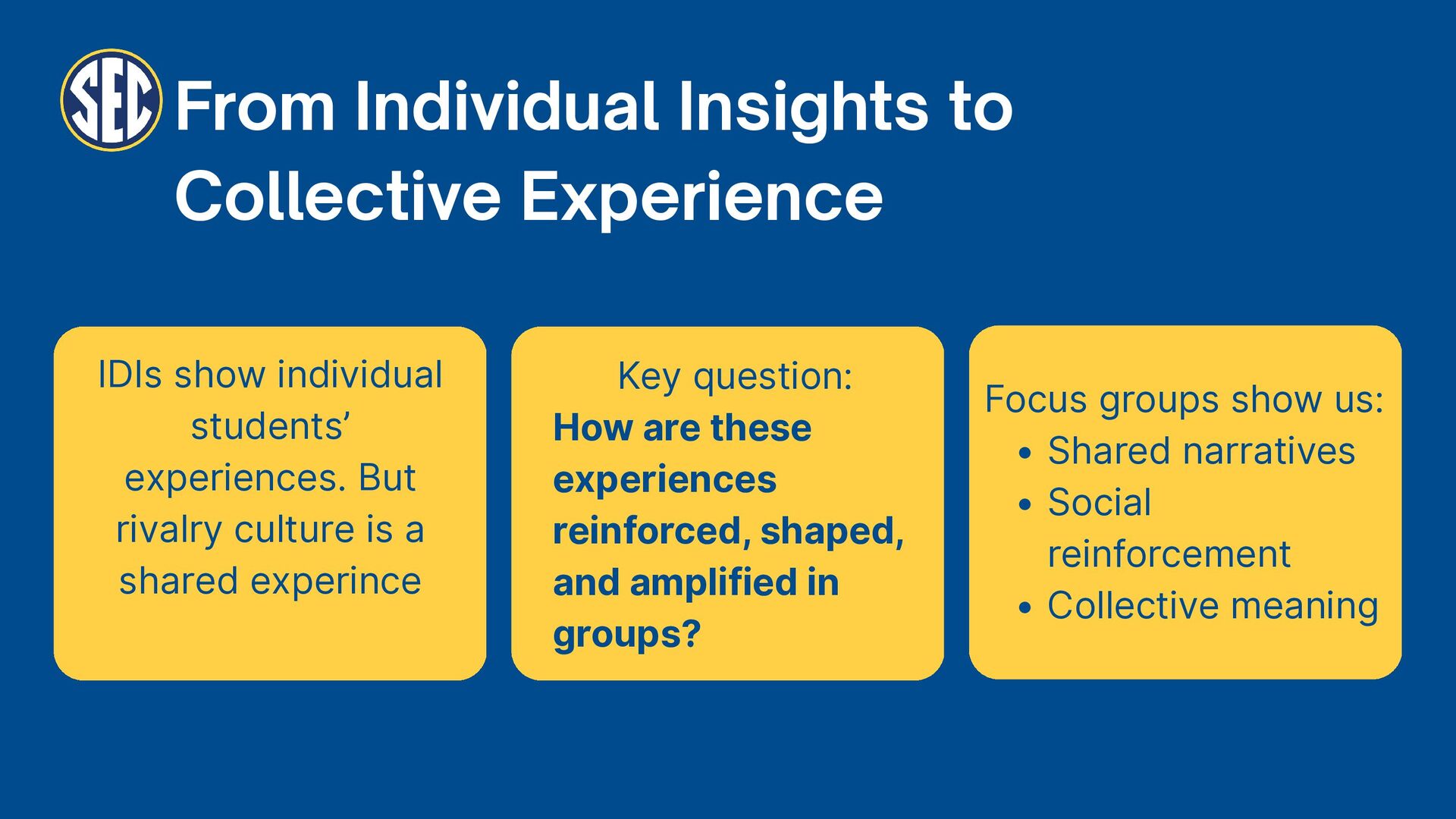
From Individual Insights to Collective Experience IDIs show individual students’
experiences. But rivalry culture is a shared experince Key question: How are these experiences reinforced, shaped, and amplified in groups? Focus groups show us: Shared narratives Social reinforcement Collective meaning -
01 02 03 04 Research Objectives & Target Market In
Depth Interviews (IDIs) Focus Group Strategic Recommendations Research Journey -
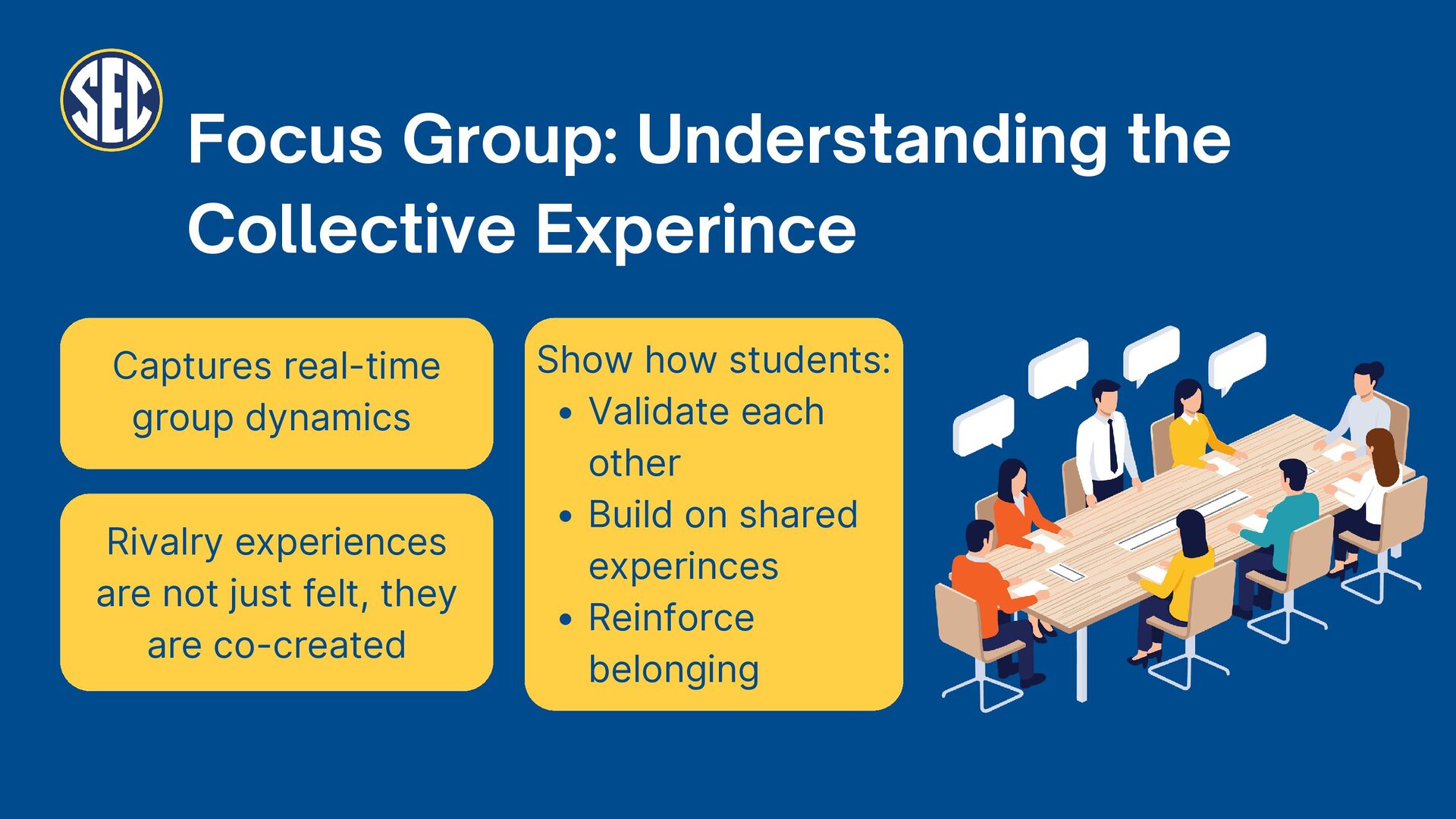
Focus Group: Understanding the Collective Experince Captures real-time group dynamics
Rivalry experiences are not just felt, they are co-created Show how students: Validate each other Build on shared experinces Reinforce belonging -
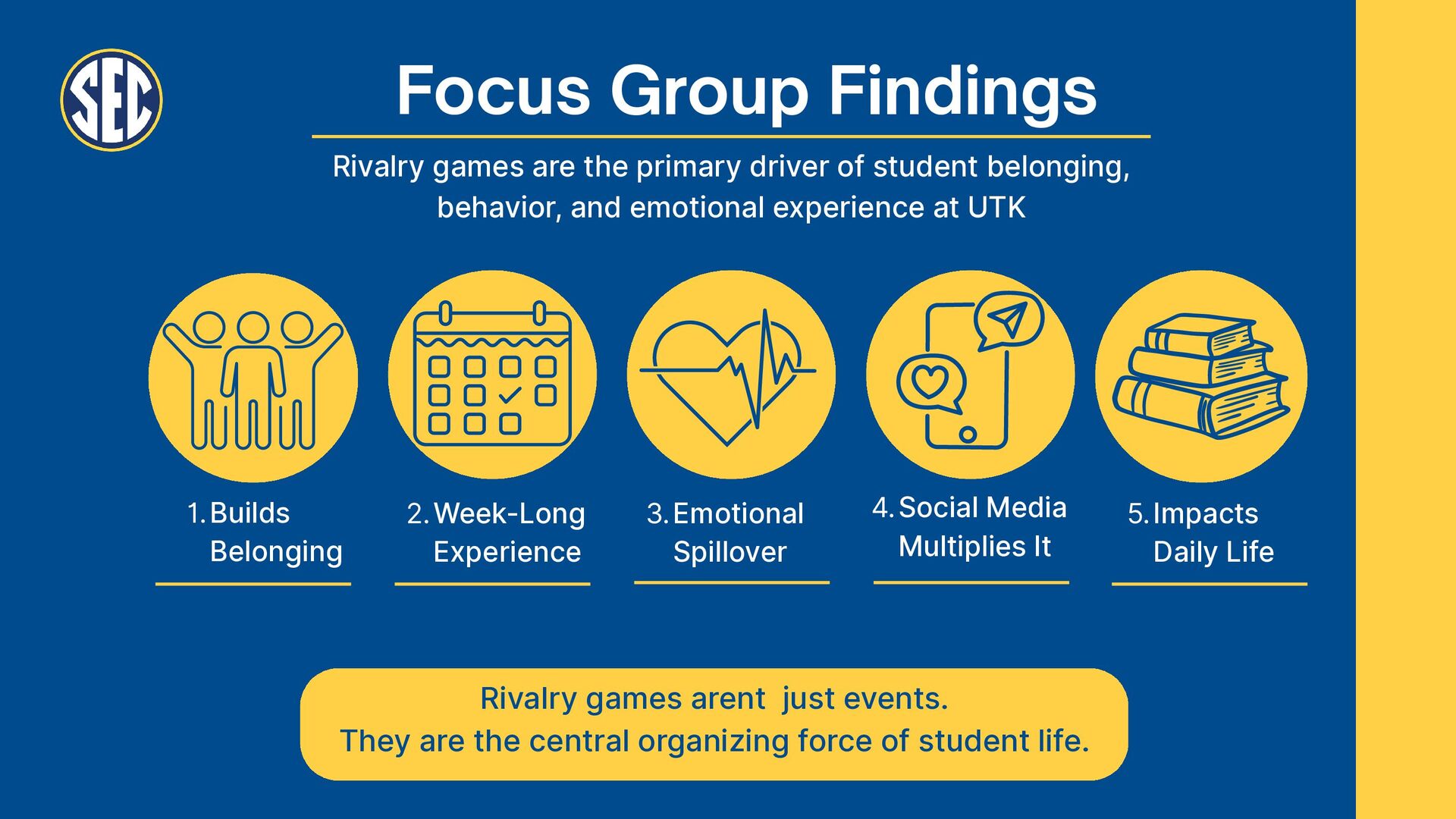
Focus Group Findings Rivalry games are the primary driver of
student belonging, behavior, and emotional experience at UTK 1.Builds Belonging 2.Week-Long Experience 3.Emotional Spillover 4.Social Media Multiplies It Rivalry games arent just events. They are the central organizing force of student life. 5.Impacts Daily Life -
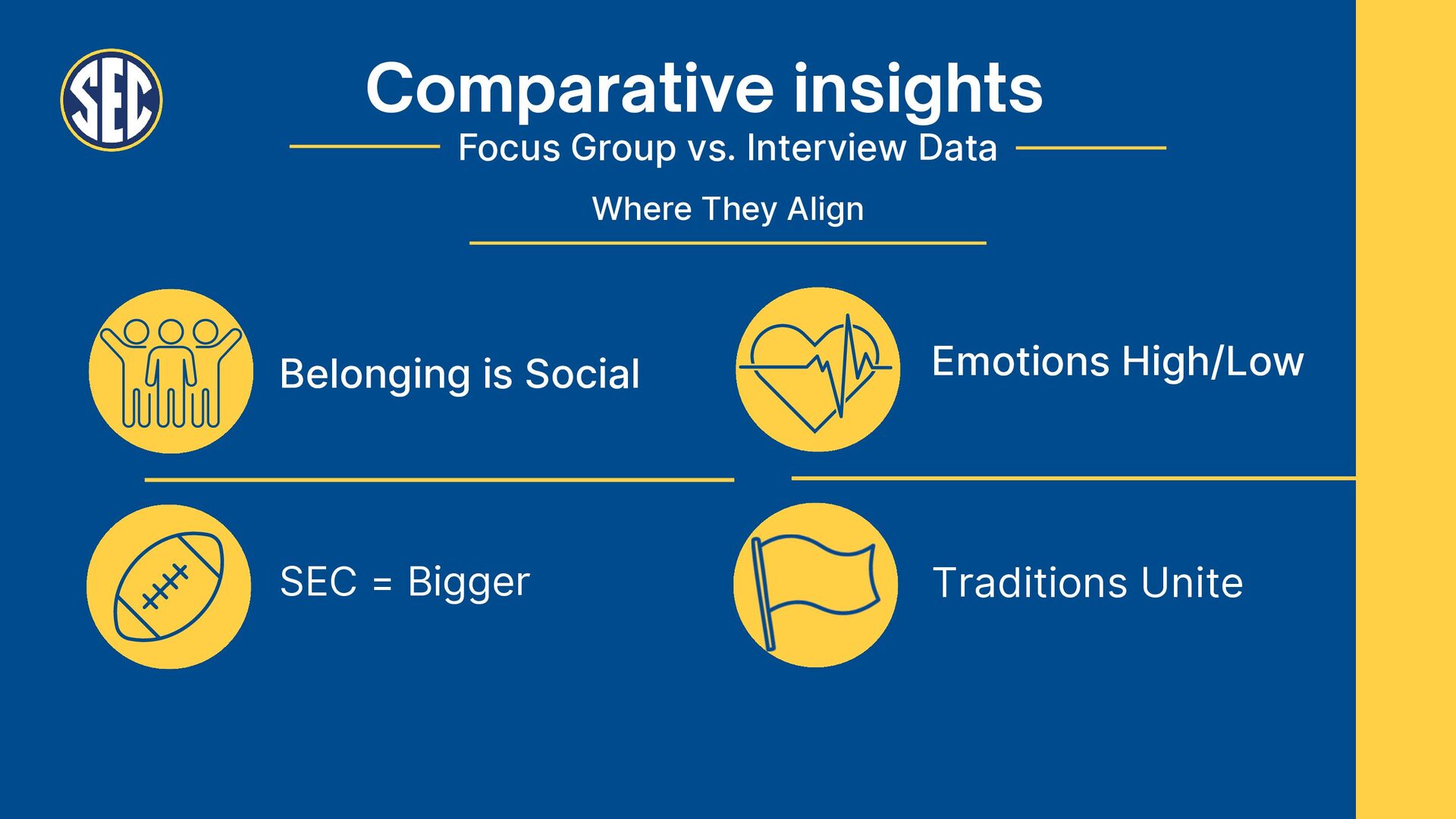
Comparative insights Focus Group vs. Interview Data Where They Align
Belonging is Social Emotions High/Low SEC = Bigger Traditions Unite -
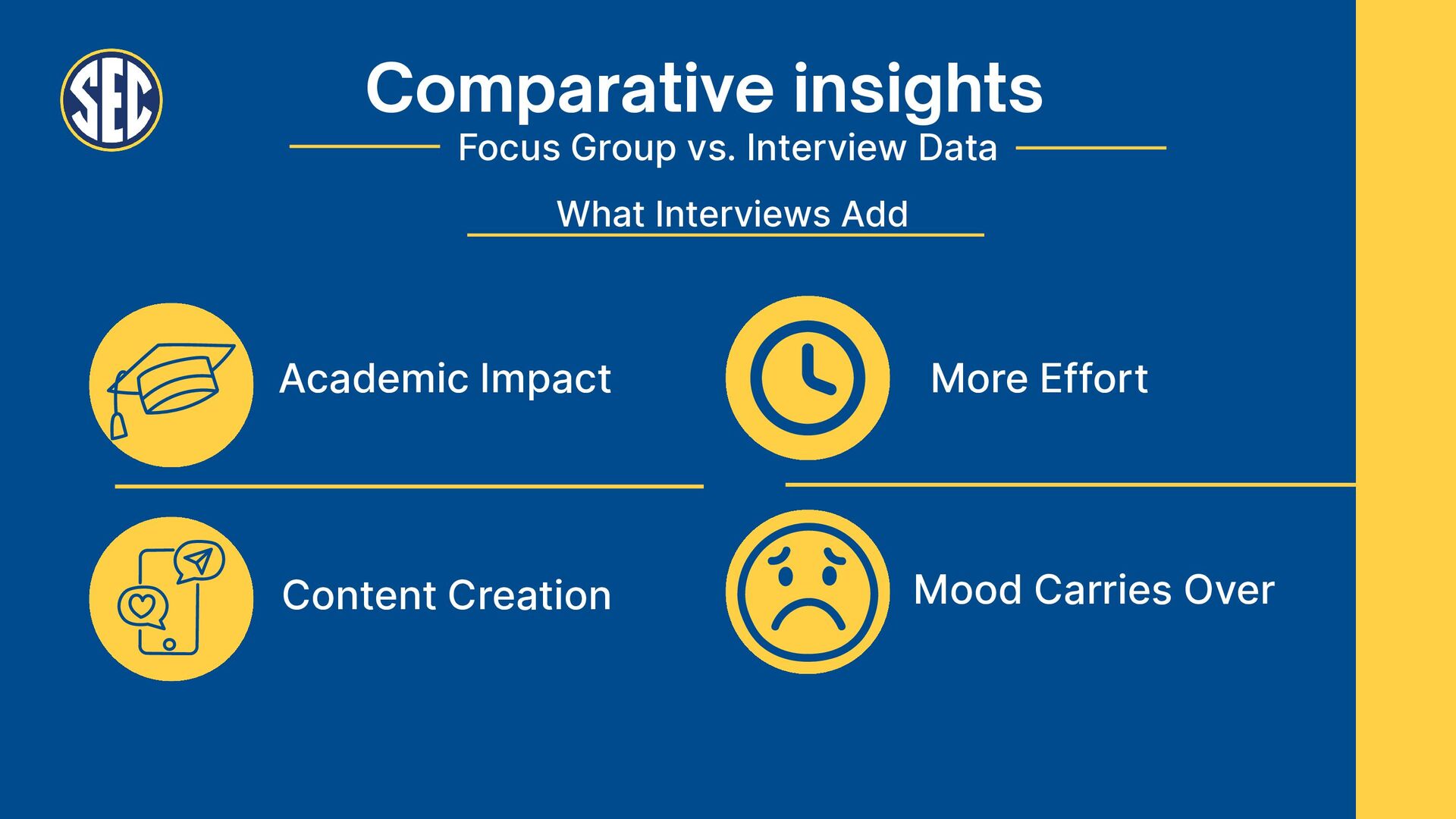
Comparative insights Focus Group vs. Interview Data What Interviews Add
Academic Impact More Effort Content Creation Mood Carries Over -
01 02 03 04 Research Objectives & Target Market In
Depth Interviews (IDIs) Focus Group Strategic Recommendations Research Journey -
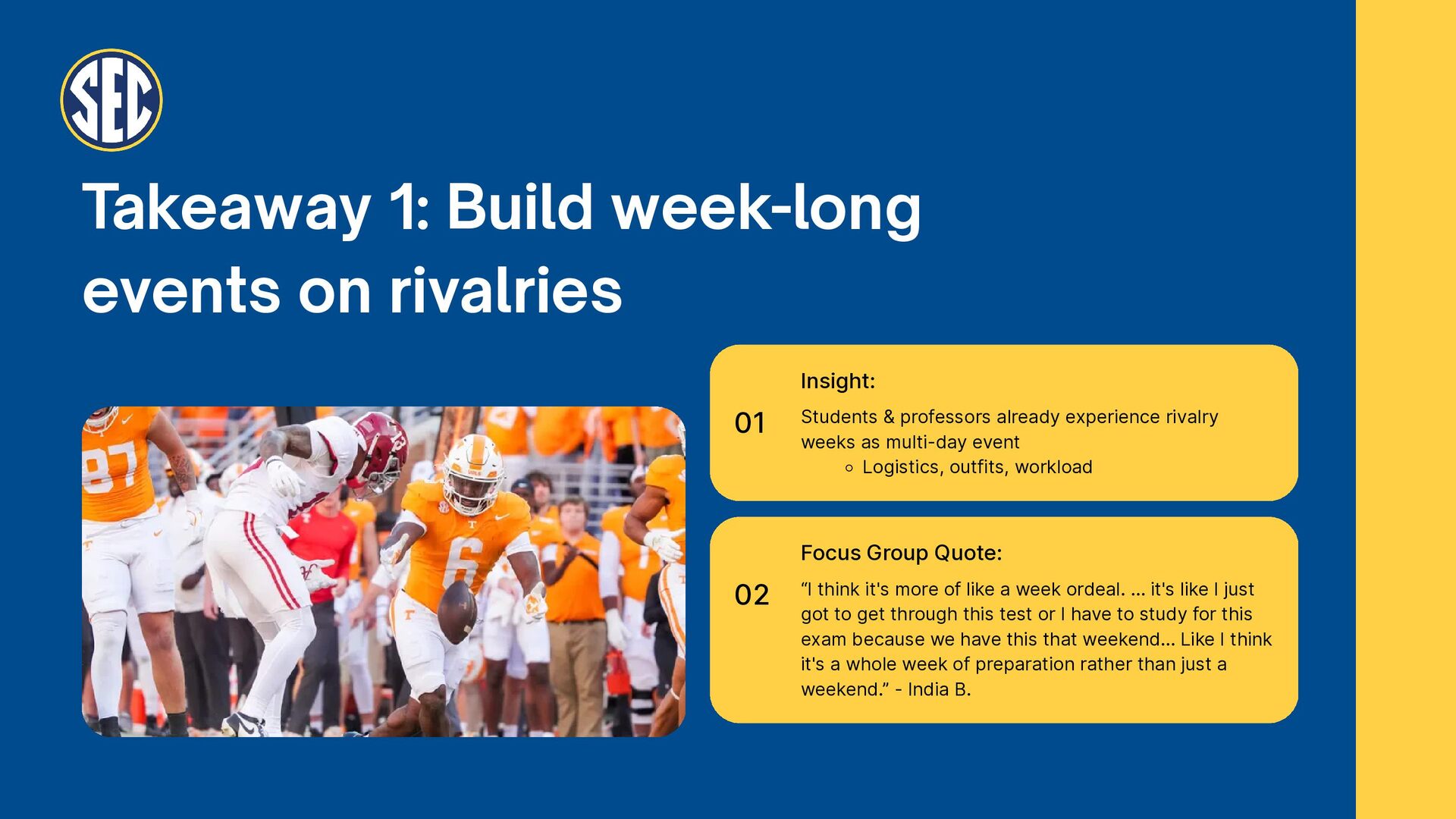
Takeaway 1: Build week-long events on rivalries Insight: 01 Students
& professors already experience rivalry weeks as multi-day event Logistics, outfits, workload Focus Group Quote: 02 “I think it's more of like a week ordeal. ... it's like I just got to get through this test or I have to study for this exam because we have this that weekend... Like I think it's a whole week of preparation rather than just a weekend.” - India B. -
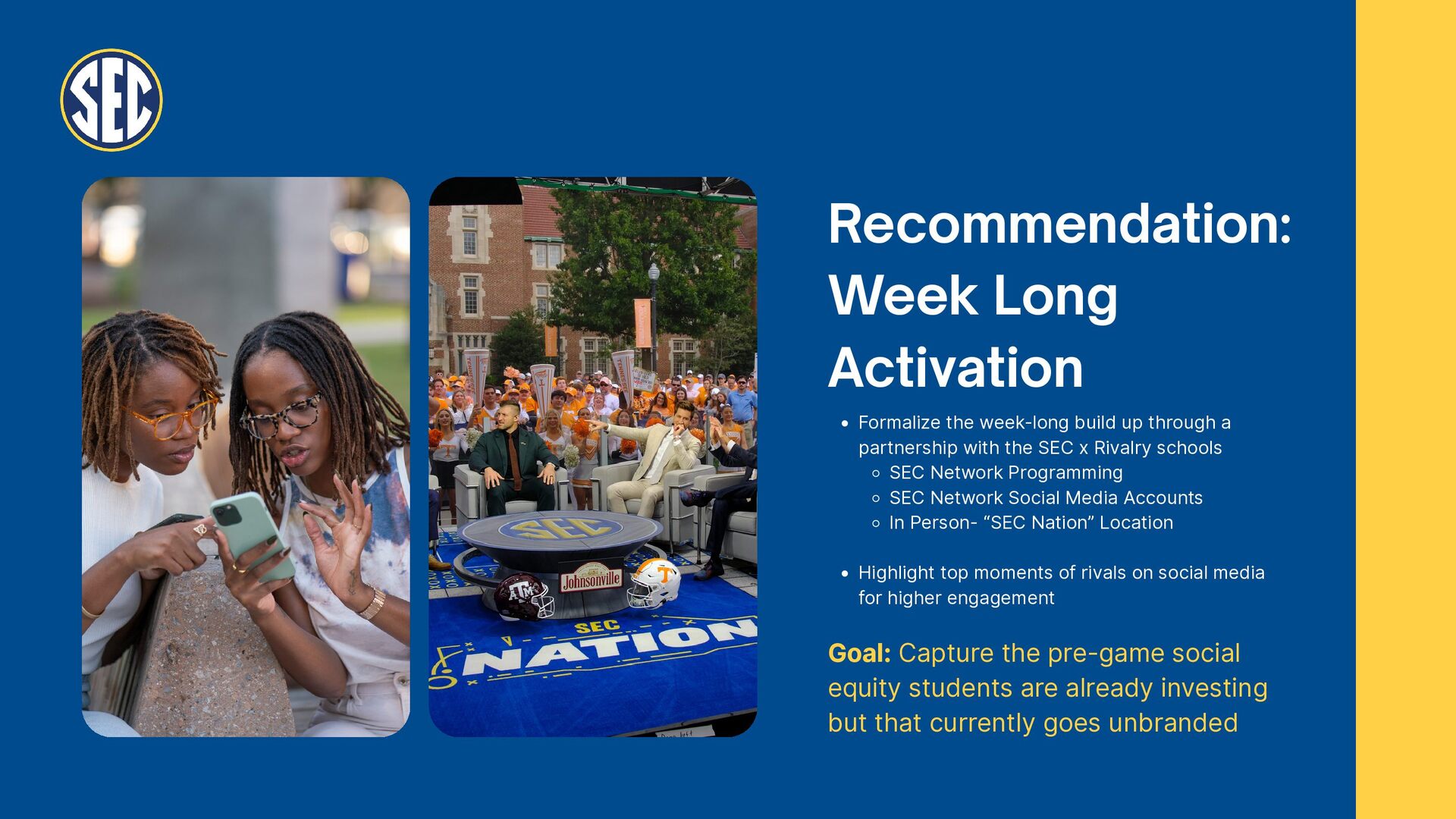
Recommendation: Week Long Activation Formalize the week-long build up through
a partnership with the SEC x Rivalry schools SEC Network Programming SEC Network Social Media Accounts In Person- “SEC Nation” Location Highlight top moments of rivals on social media for higher engagement Goal: Capture the pre-game social equity students are already investing but that currently goes unbranded -
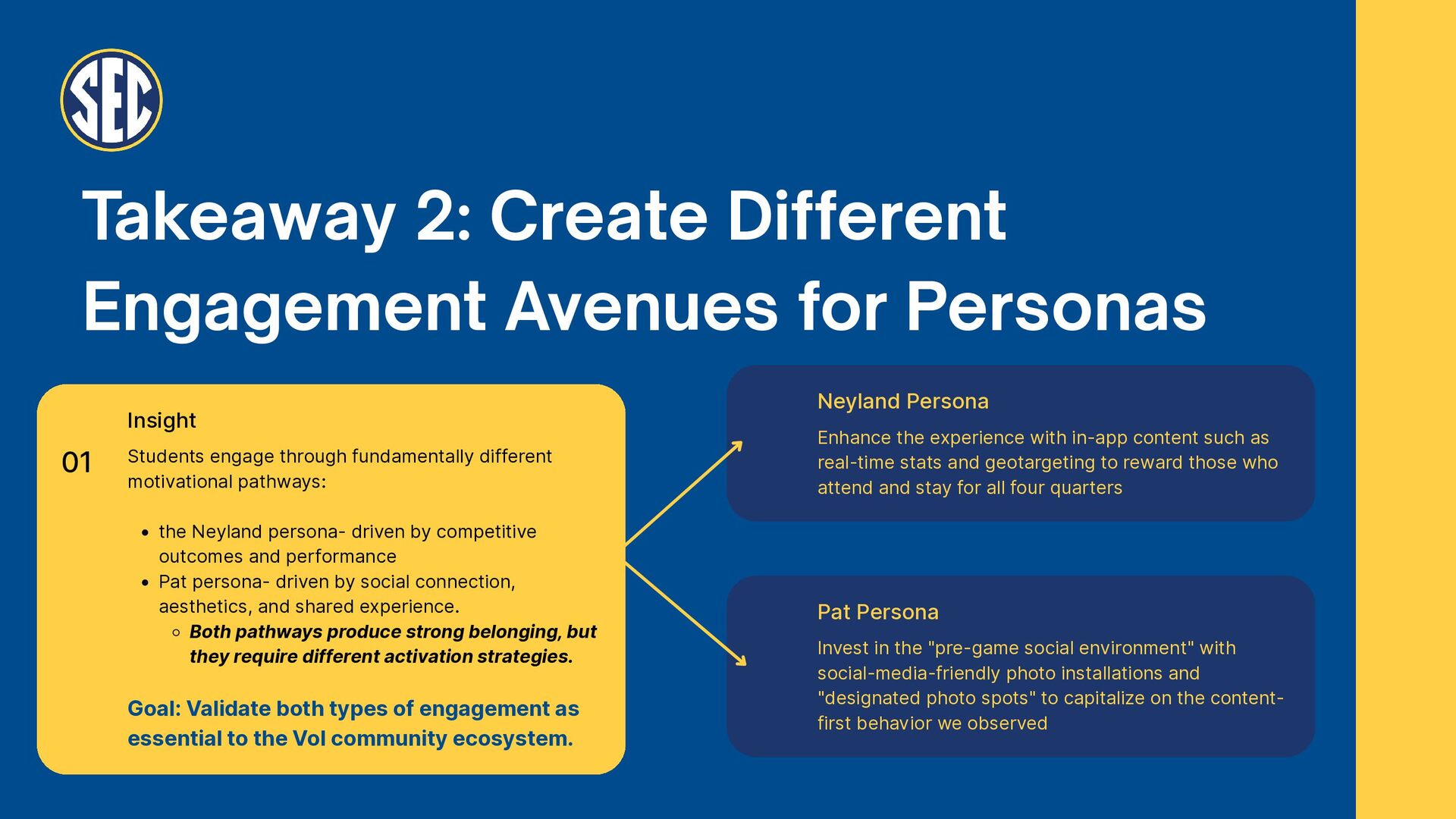
Takeaway 2: Create Different Engagement Avenues for Personas Insight 01
Students engage through fundamentally different motivational pathways: the Neyland persona- driven by competitive outcomes and performance Pat persona- driven by social connection, aesthetics, and shared experience. Both pathways produce strong belonging, but they require different activation strategies. Goal: Validate both types of engagement as essential to the Vol community ecosystem. Neyland Persona Enhance the experience with in-app content such as real-time stats and geotargeting to reward those who attend and stay for all four quarters Pat Persona Invest in the "pre-game social environment" with social-media-friendly photo installations and "designated photo spots" to capitalize on the contentfirst behavior we observed -
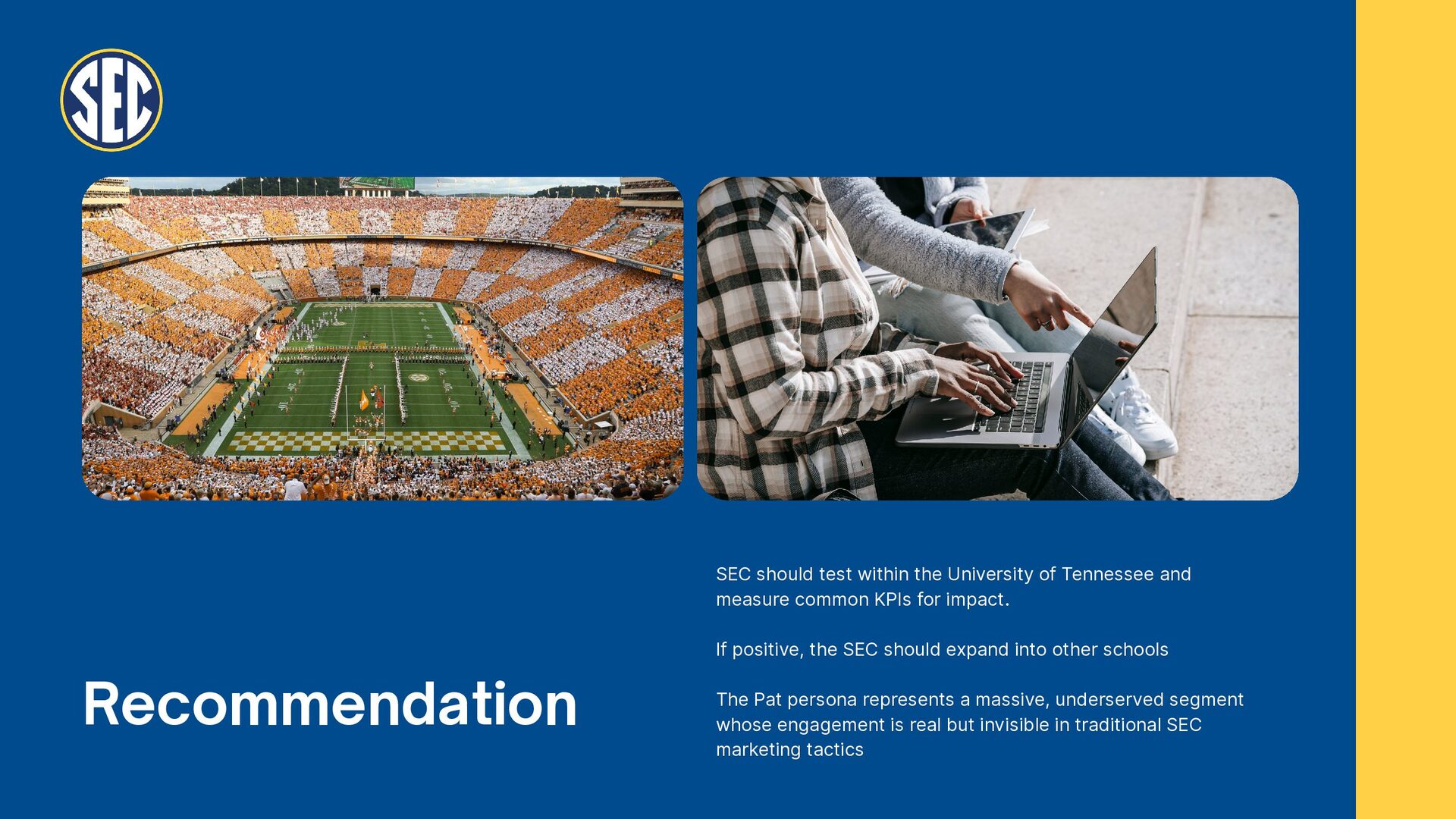
SEC should test within the University of Tennessee and measure
common KPIs for impact. If positive, the SEC should expand into other schools Recommendation The Pat persona represents a massive, underserved segment whose engagement is real but invisible in traditional SEC marketing tactics -
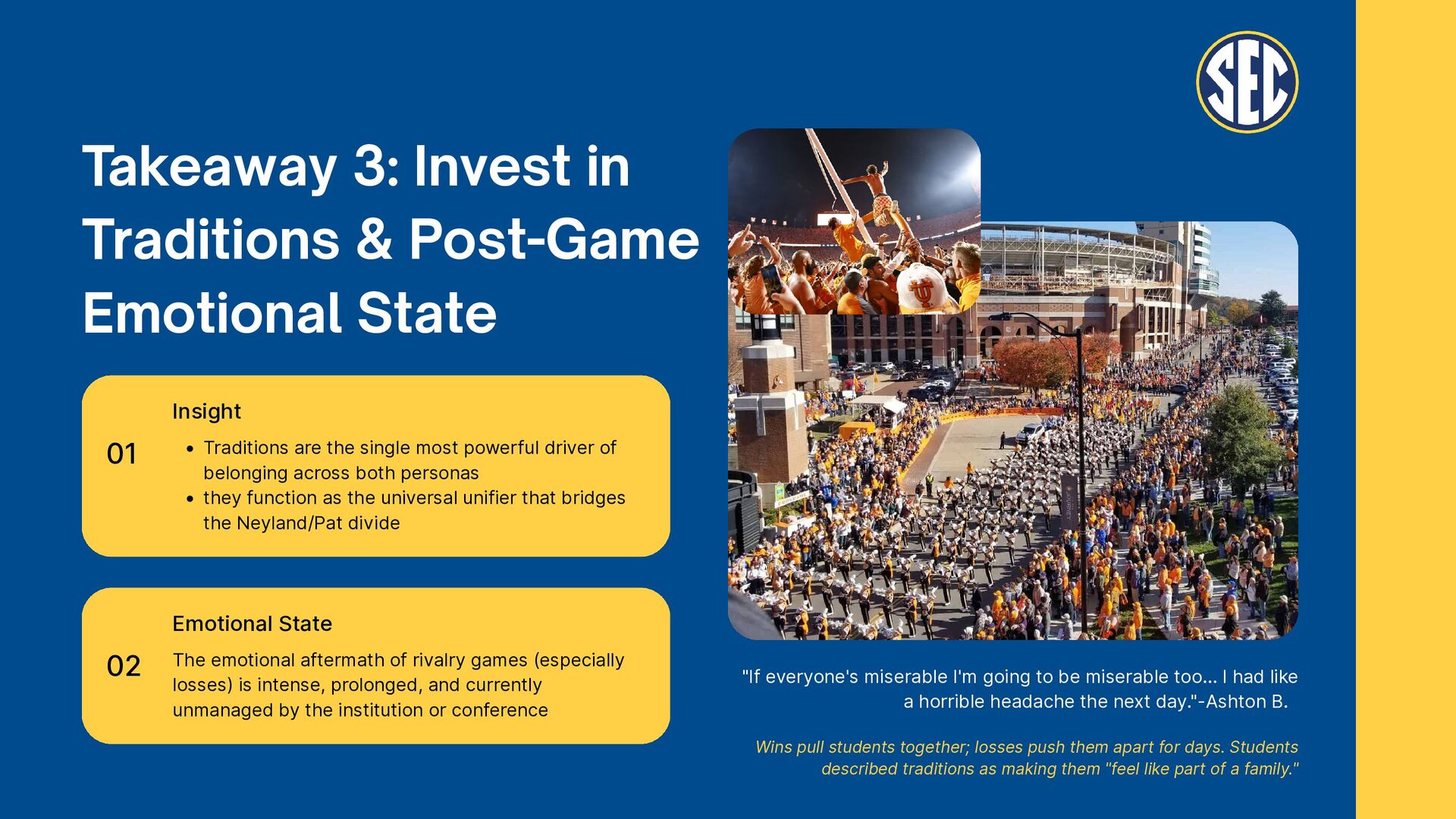
Takeaway 3: Invest in Traditions & Post-Game Emotional State Insight
01 Traditions are the single most powerful driver of belonging across both personas they function as the universal unifier that bridges the Neyland/Pat divide Emotional State 02 The emotional aftermath of rivalry games (especially losses) is intense, prolonged, and currently unmanaged by the institution or conference "If everyone's miserable I'm going to be miserable too… I had like a horrible headache the next day."-Ashton B. Wins pull students together; losses push them apart for days. Students described traditions as making them "feel like part of a family." -
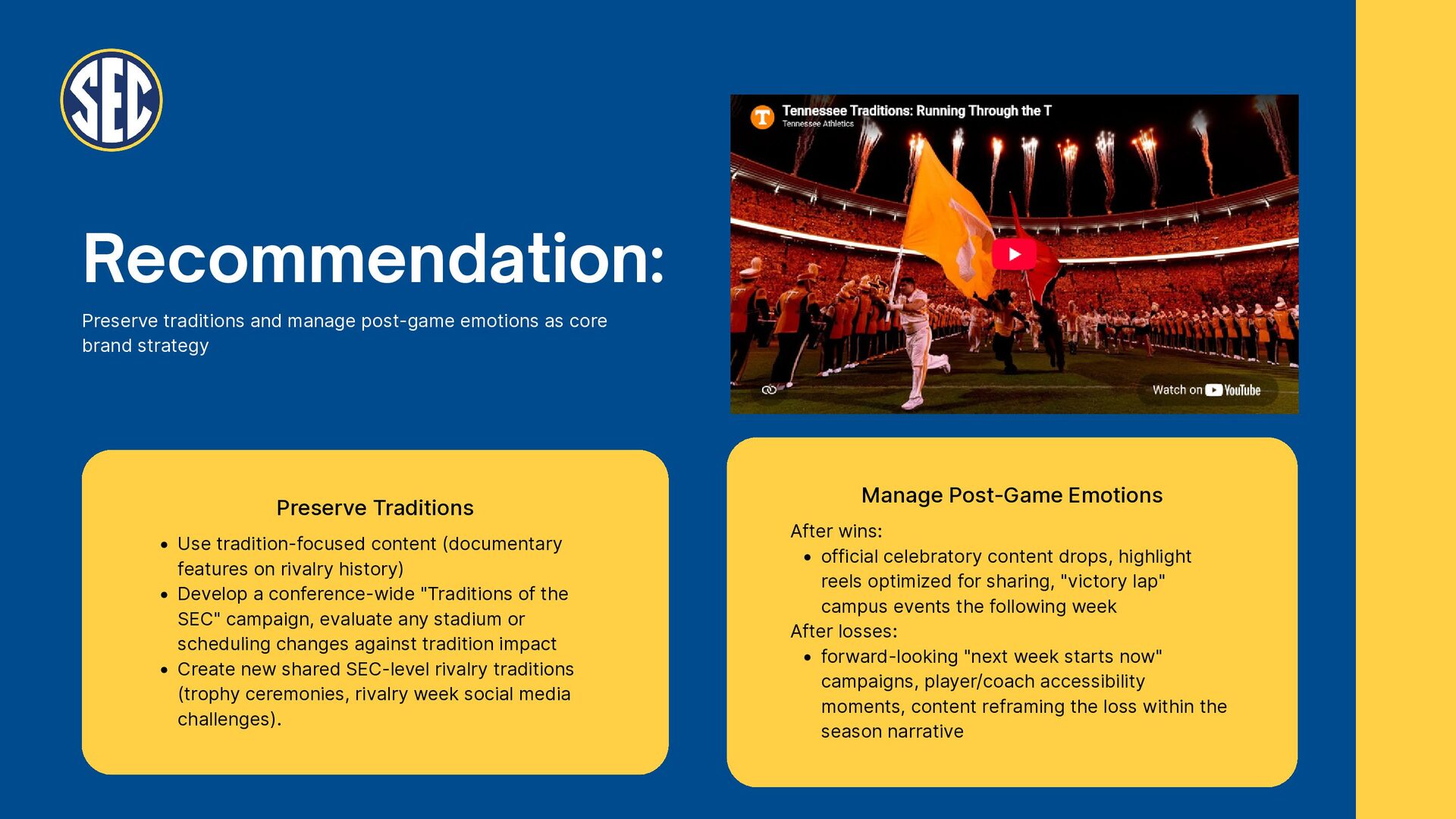
Recommendation: Preserve traditions and manage post-game emotions as core brand
strategy Preserve Traditions Use tradition-focused content (documentary features on rivalry history) Develop a conference-wide "Traditions of the SEC" campaign, evaluate any stadium or scheduling changes against tradition impact Create new shared SEC-level rivalry traditions (trophy ceremonies, rivalry week social media challenges). Manage Post-Game Emotions After wins: official celebratory content drops, highlight reels optimized for sharing, "victory lap" campus events the following week After losses: forward-looking "next week starts now" campaigns, player/coach accessibility moments, content reframing the loss within the season narrative -
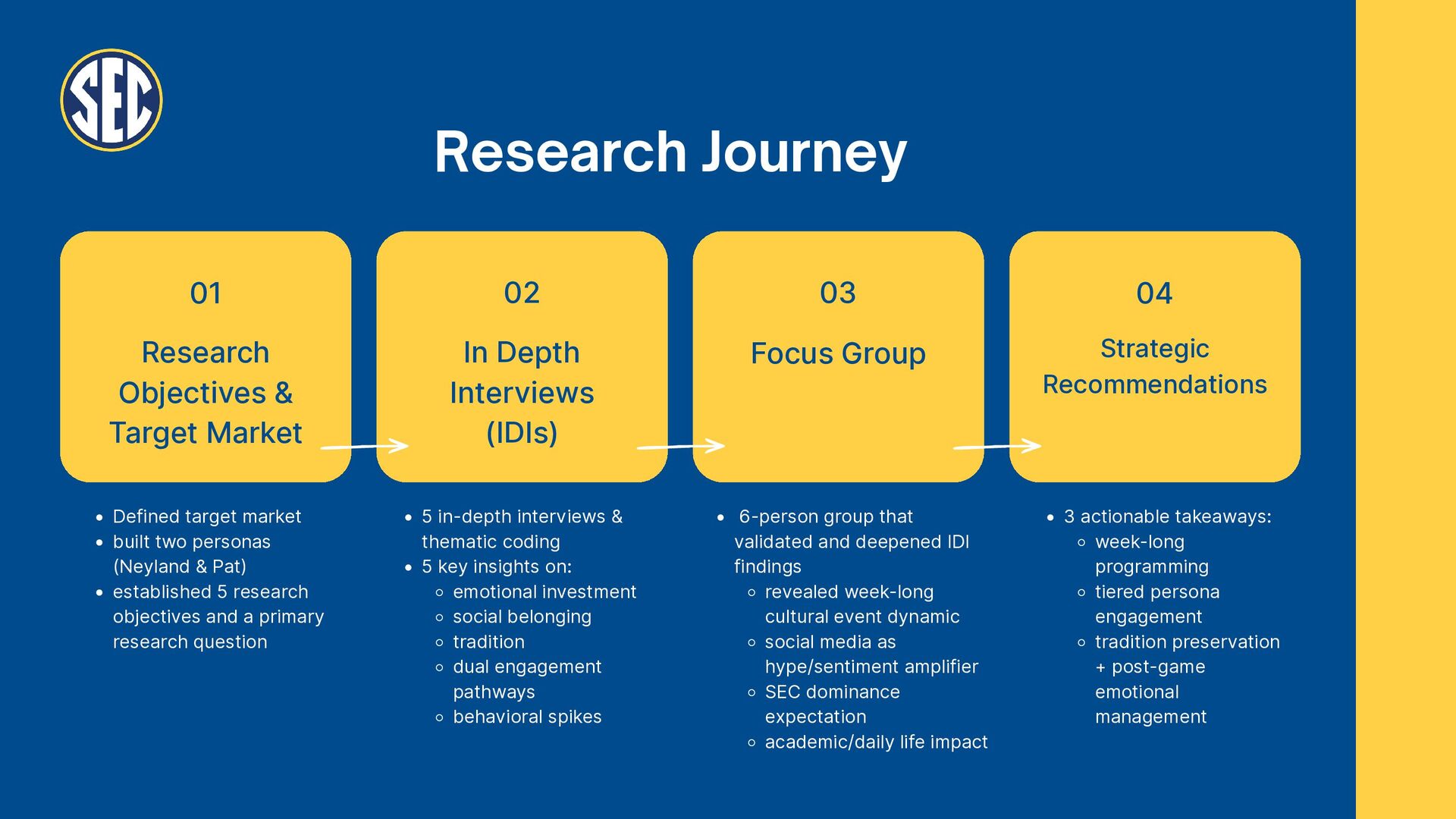
Research Journey 01 02 03 04 Research Objectives & Target
Market In Depth Interviews (IDIs) Focus Group Strategic Recommendations Defined target market built two personas (Neyland & Pat) established 5 research objectives and a primary research question 5 in-depth interviews & thematic coding 5 key insights on: emotional investment social belonging tradition dual engagement pathways behavioral spikes 6-person group that validated and deepened IDI findings revealed week-long cultural event dynamic social media as hype/sentiment amplifier SEC dominance expectation academic/daily life impact 3 actionable takeaways: week-long programming tiered persona engagement tradition preservation + post-game emotional management