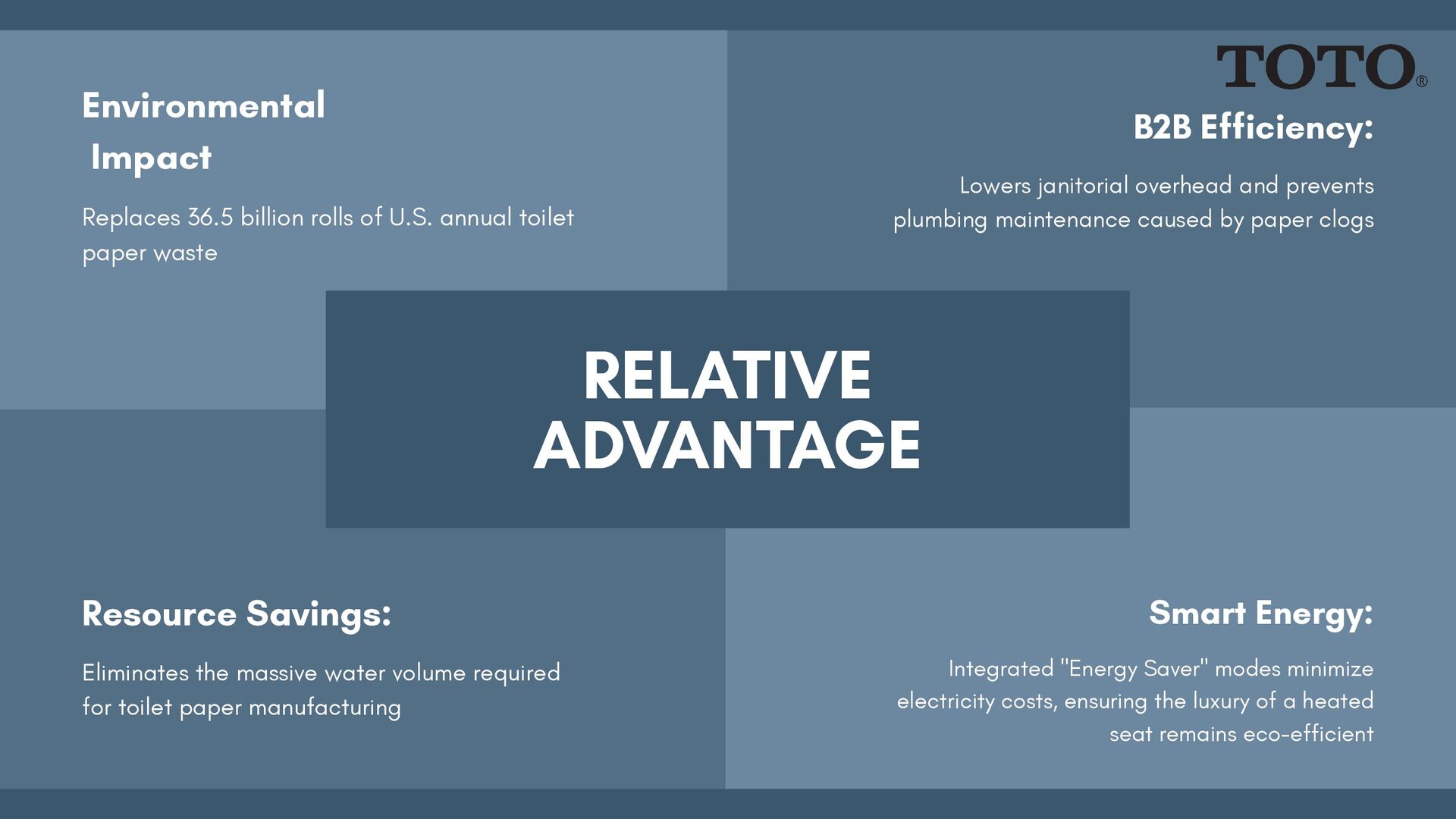
annual toilet paper waste Lowers janitorial overhead and prevents plumbing maintenance caused by paper clogs RELATIVE ADVANTAGE Resource Savings: Eliminates the massive water volume required for toilet paper manufacturing Smart Energy: Integrated "Energy Saver" modes minimize electricity costs, ensuring the luxury of a heated seat remains eco-efficient
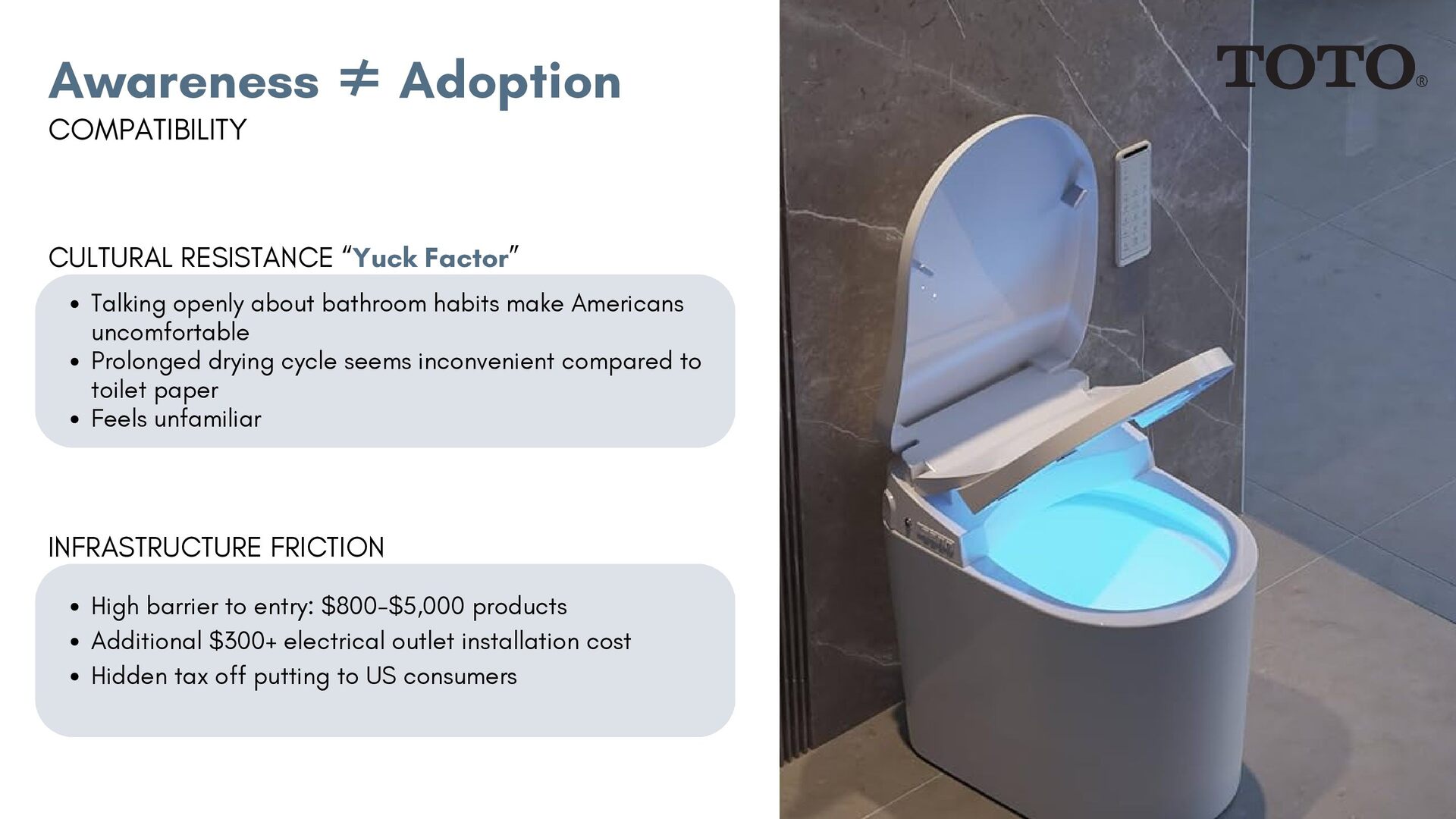
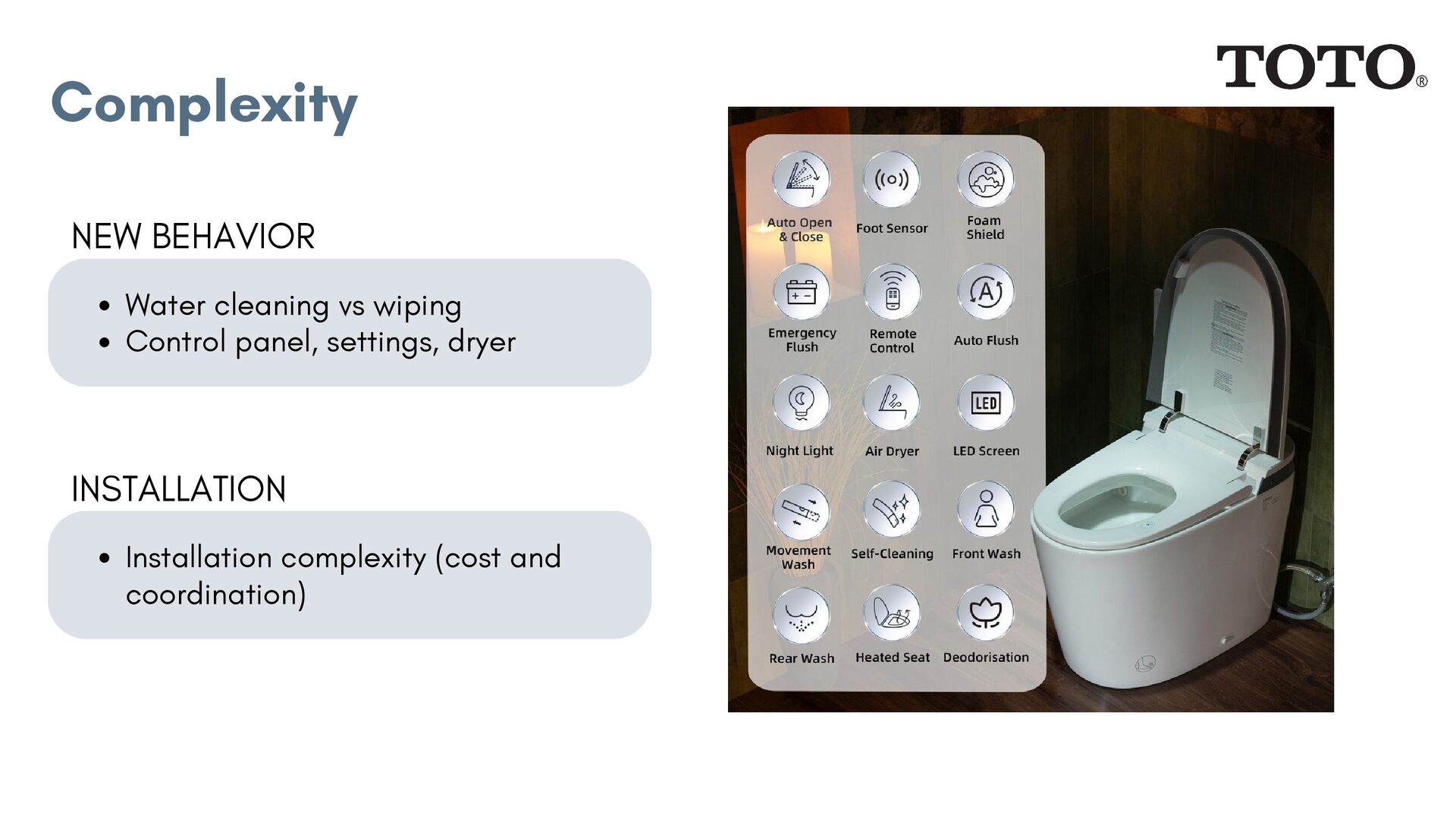
about bathroom habits make Americans uncomfortable Prolonged drying cycle seems inconvenient compared to toilet paper Feels unfamiliar INFRASTRUCTURE FRICTION High barrier to entry: $800-$5,000 products Additional $300+ electrical outlet installation cost Hidden tax off putting to US consumers
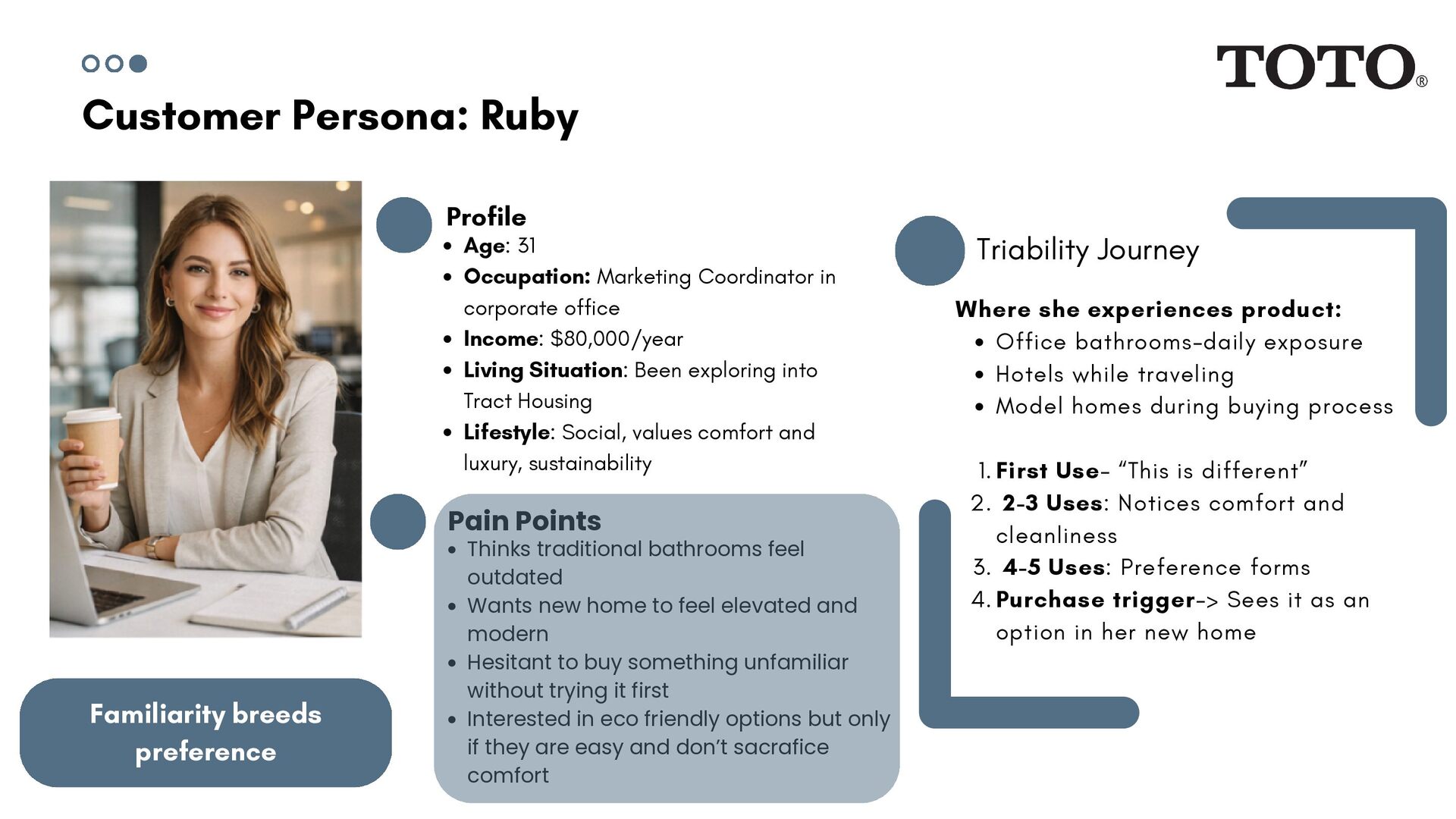
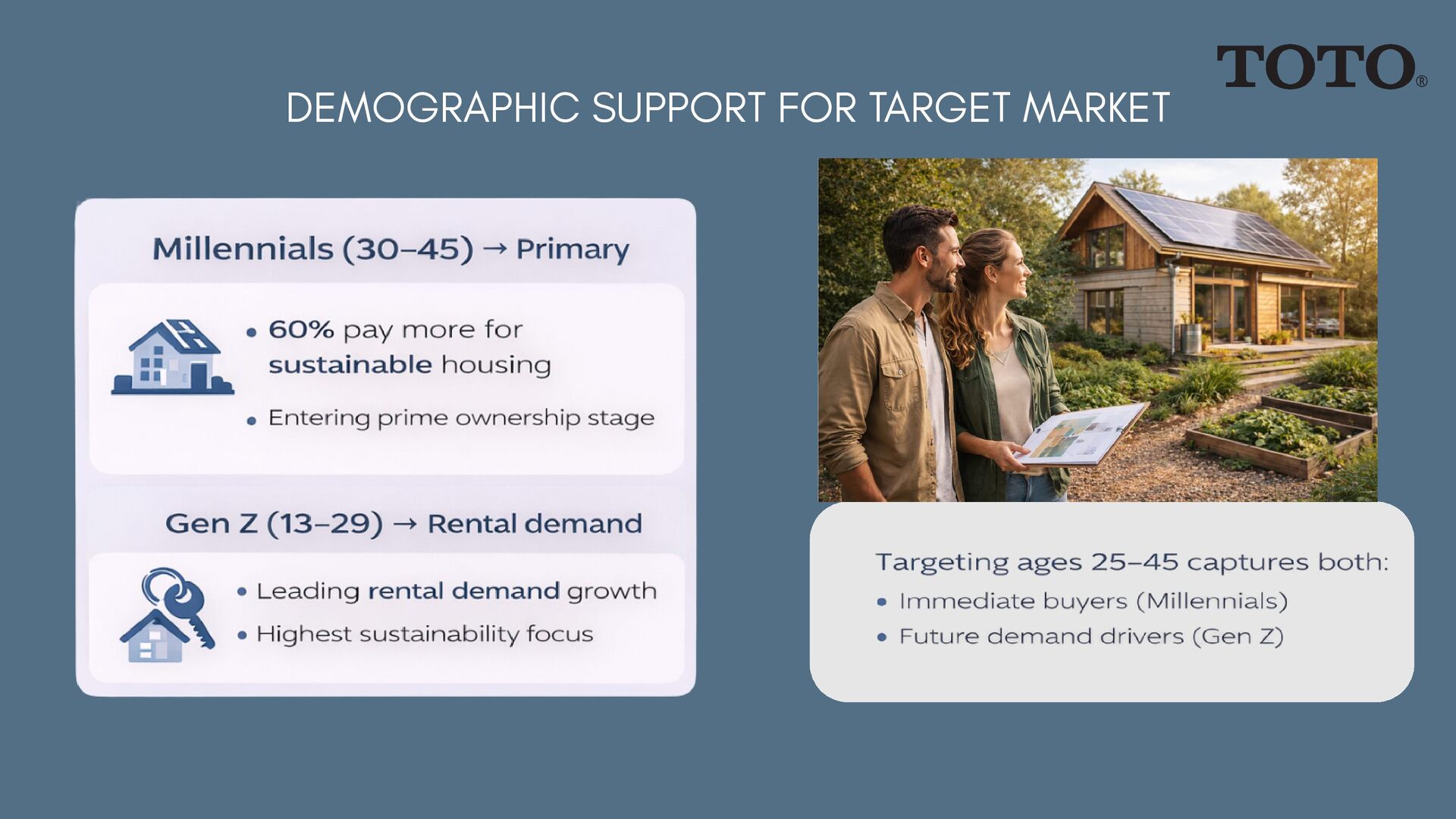
corporate office Income: $80,000/year Living Situation: Been exploring into Tract Housing Lifestyle: Social, values comfort and luxury, sustainability Pain Points Familiarity breeds preference Thinks traditional bathrooms feel outdated Wants new home to feel elevated and modern Hesitant to buy something unfamiliar without trying it first Interested in eco friendly options but only if they are easy and don’t sacrafice comfort Triability Journey Where she experiences product: Office bathrooms-daily exposure Hotels while traveling Model homes during buying process 1. First Use- “This is different” 2. 2-3 Uses: Notices comfort and cleanliness 3. 4-5 Uses: Preference forms 4. Purchase trigger-> Sees it as an option in her new home
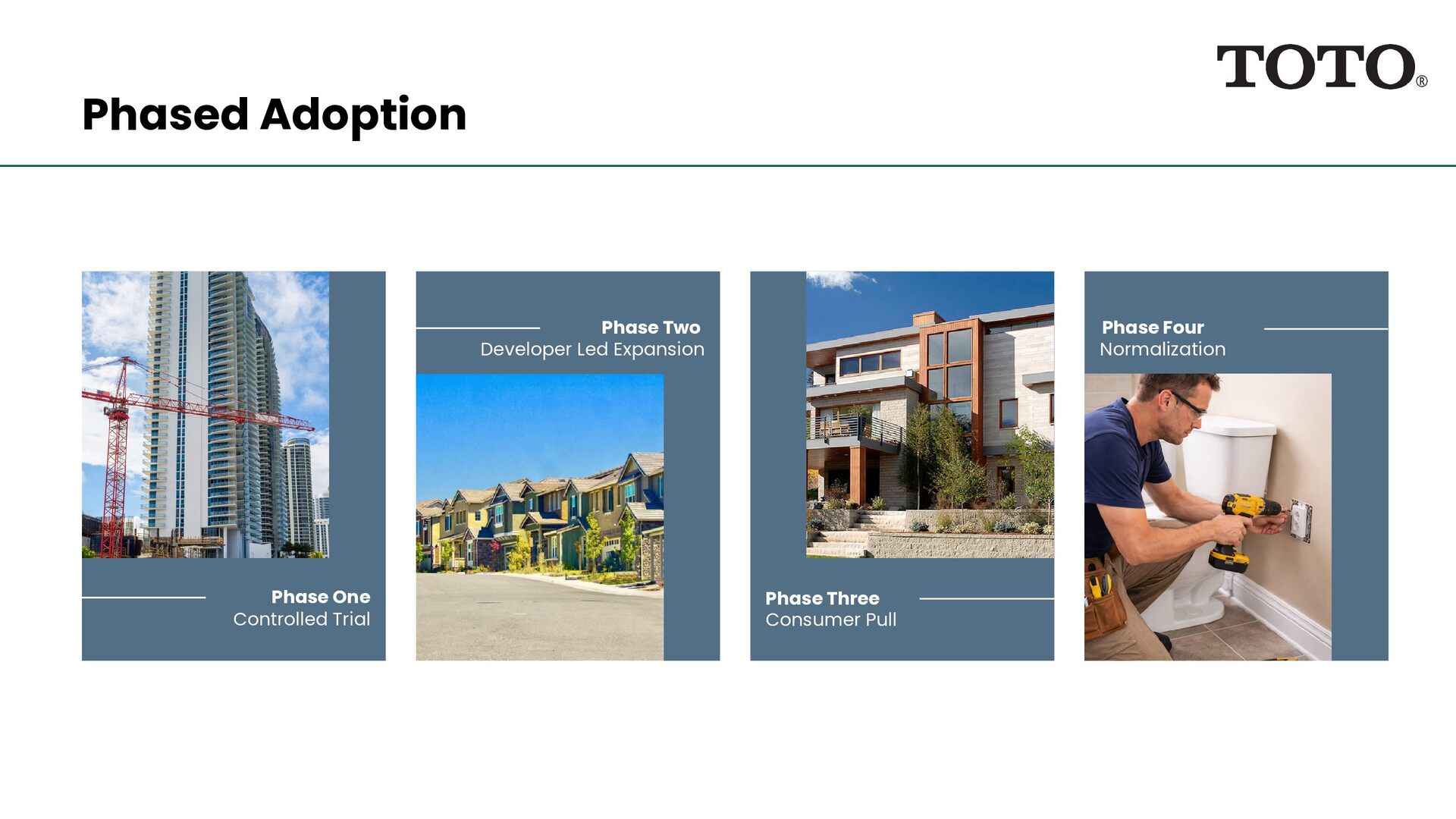
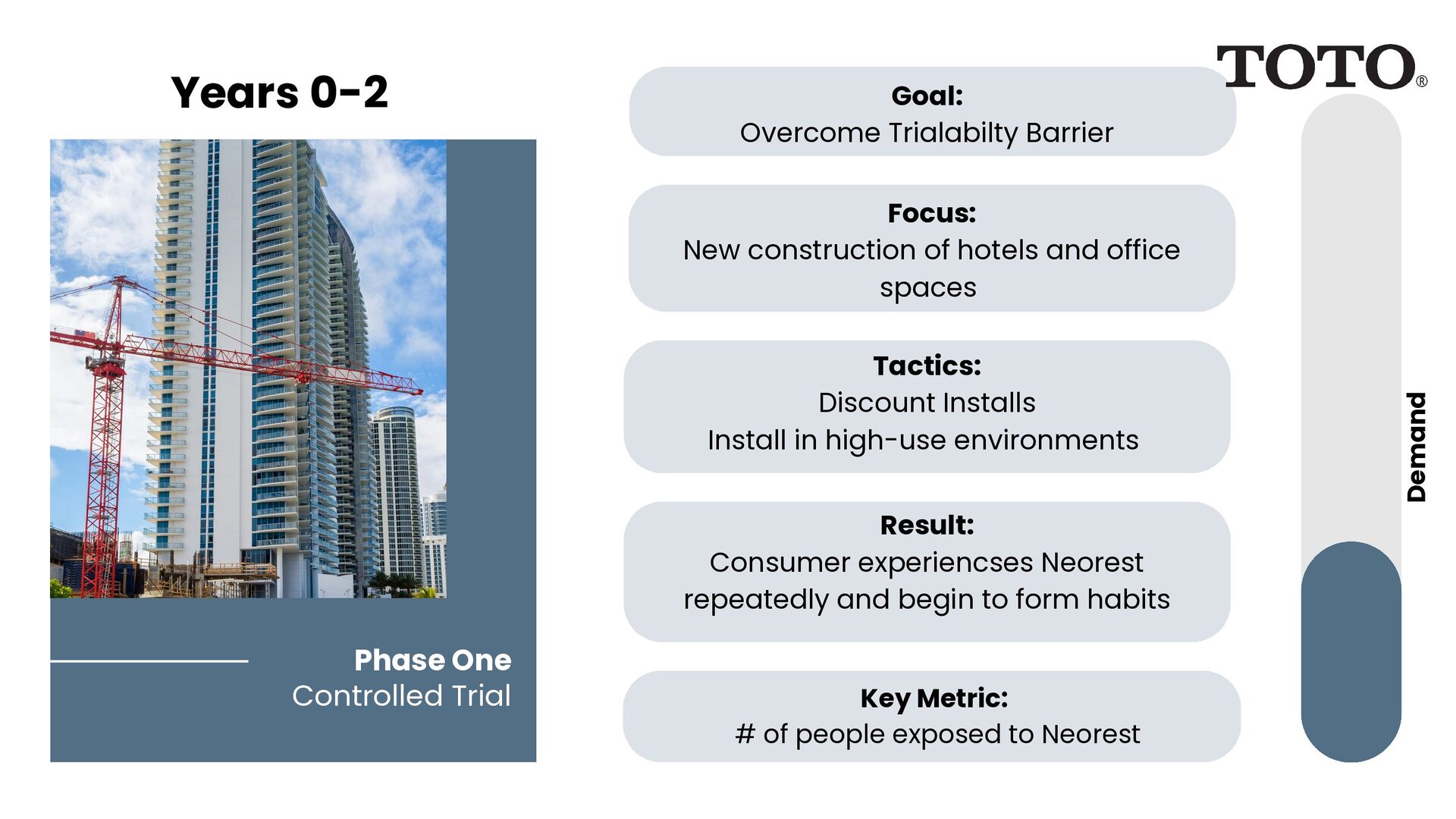
in high-use environments Result: Consumer experiencses Neorest repeatedly and begin to form habits Phase One Controlled Trial Key Metric: # of people exposed to Neorest Demand Focus: New construction of hotels and office spaces
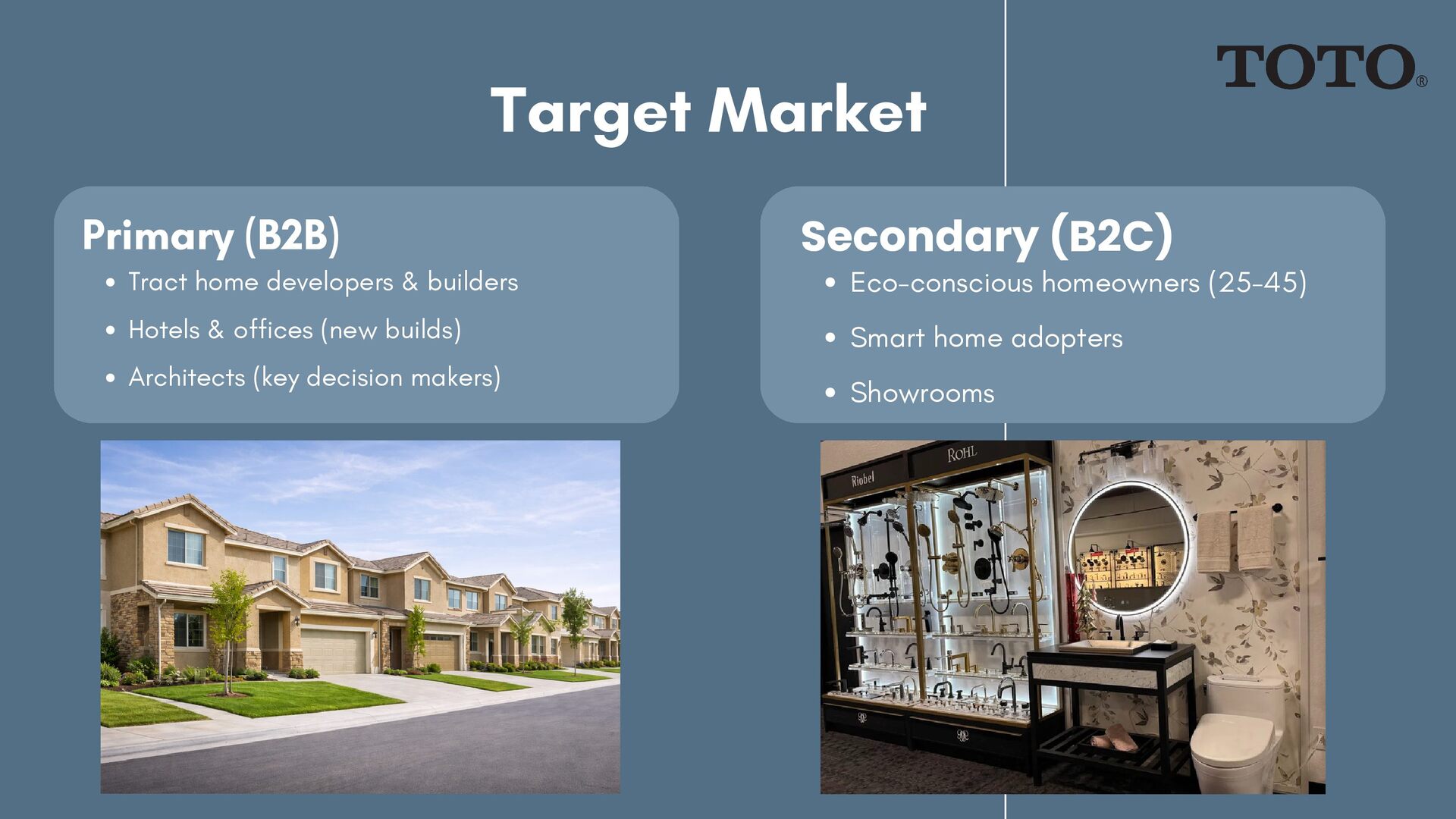
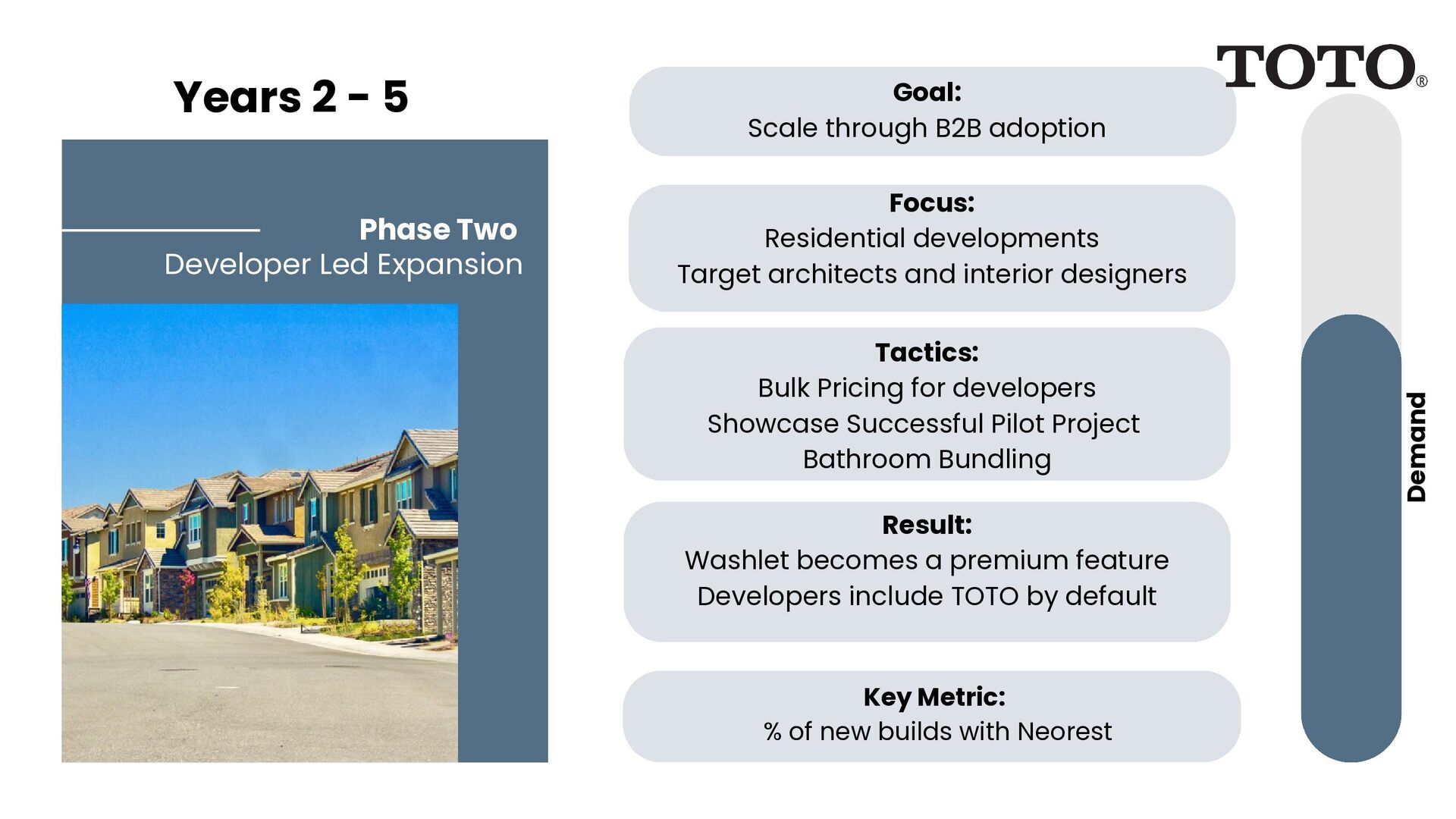
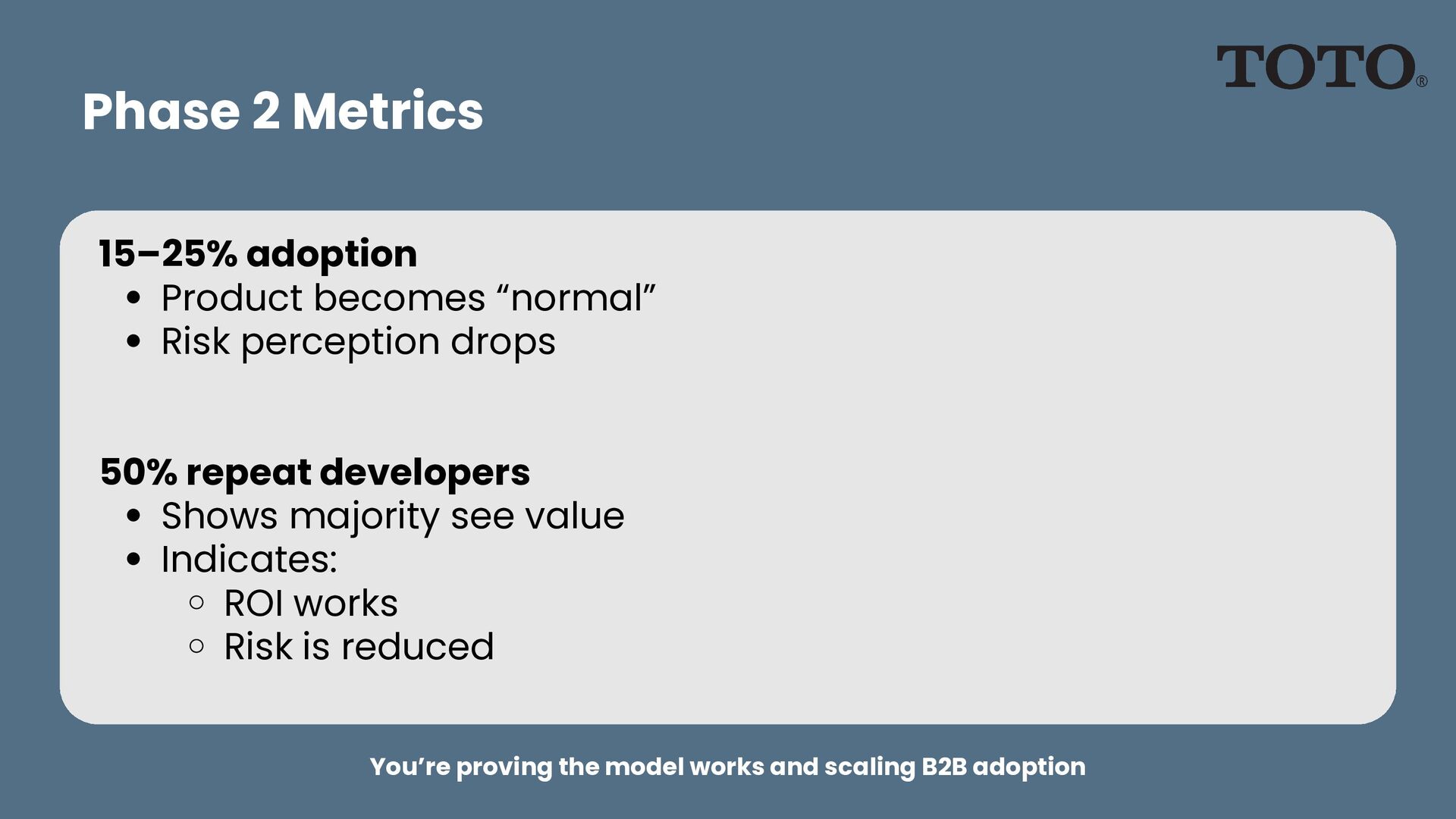
Focus: Residential developments Target architects and interior designers Tactics: Bulk Pricing for developers Showcase Successful Pilot Project Bathroom Bundling Result: Washlet becomes a premium feature Developers include TOTO by default Key Metric: % of new builds with Neorest Demand Years 2 - 5
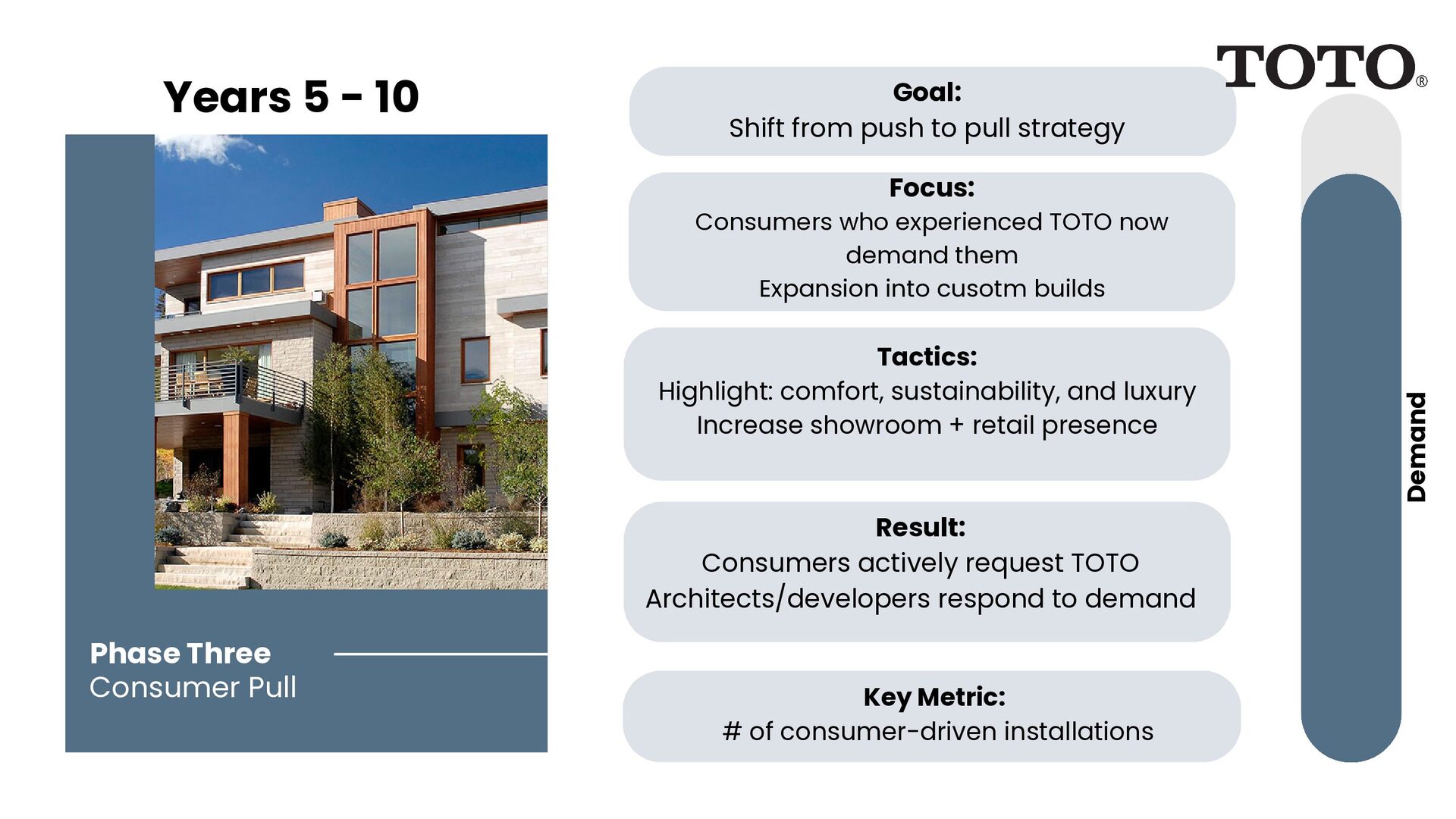
strategy Focus: Tactics: Highlight: comfort, sustainability, and luxury Increase showroom + retail presence Result: Consumers actively request TOTO Architects/developers respond to demand Phase Three Consumer Pull Key Metric: # of consumer-driven installations Demand Consumers who experienced TOTO now demand them Expansion into cusotm builds
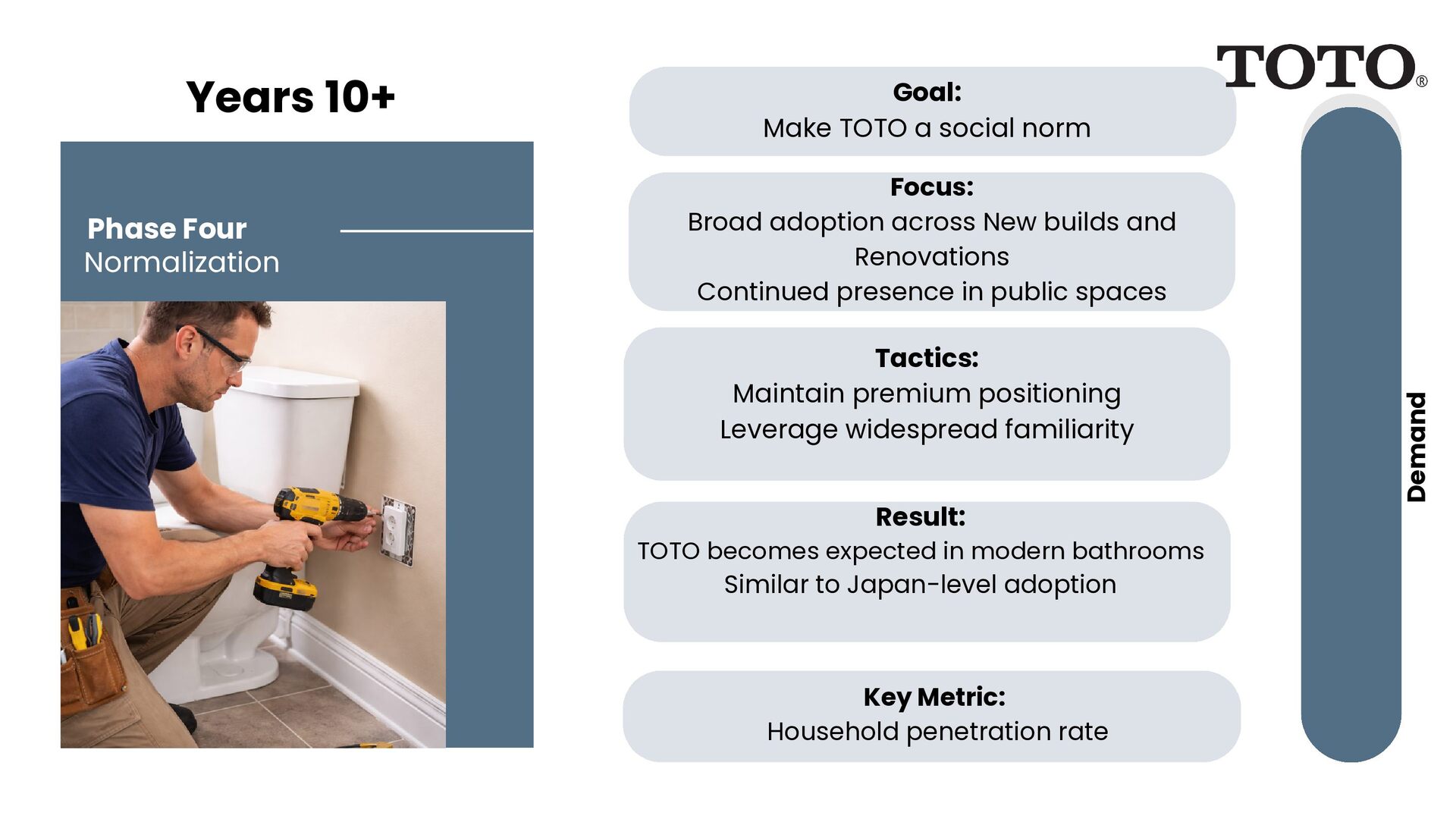
Broad adoption across New builds and Renovations Continued presence in public spaces Tactics: Maintain premium positioning Leverage widespread familiarity Result: TOTO becomes expected in modern bathrooms Similar to Japan-level adoption Key Metric: Household penetration rate Demand Years 10+
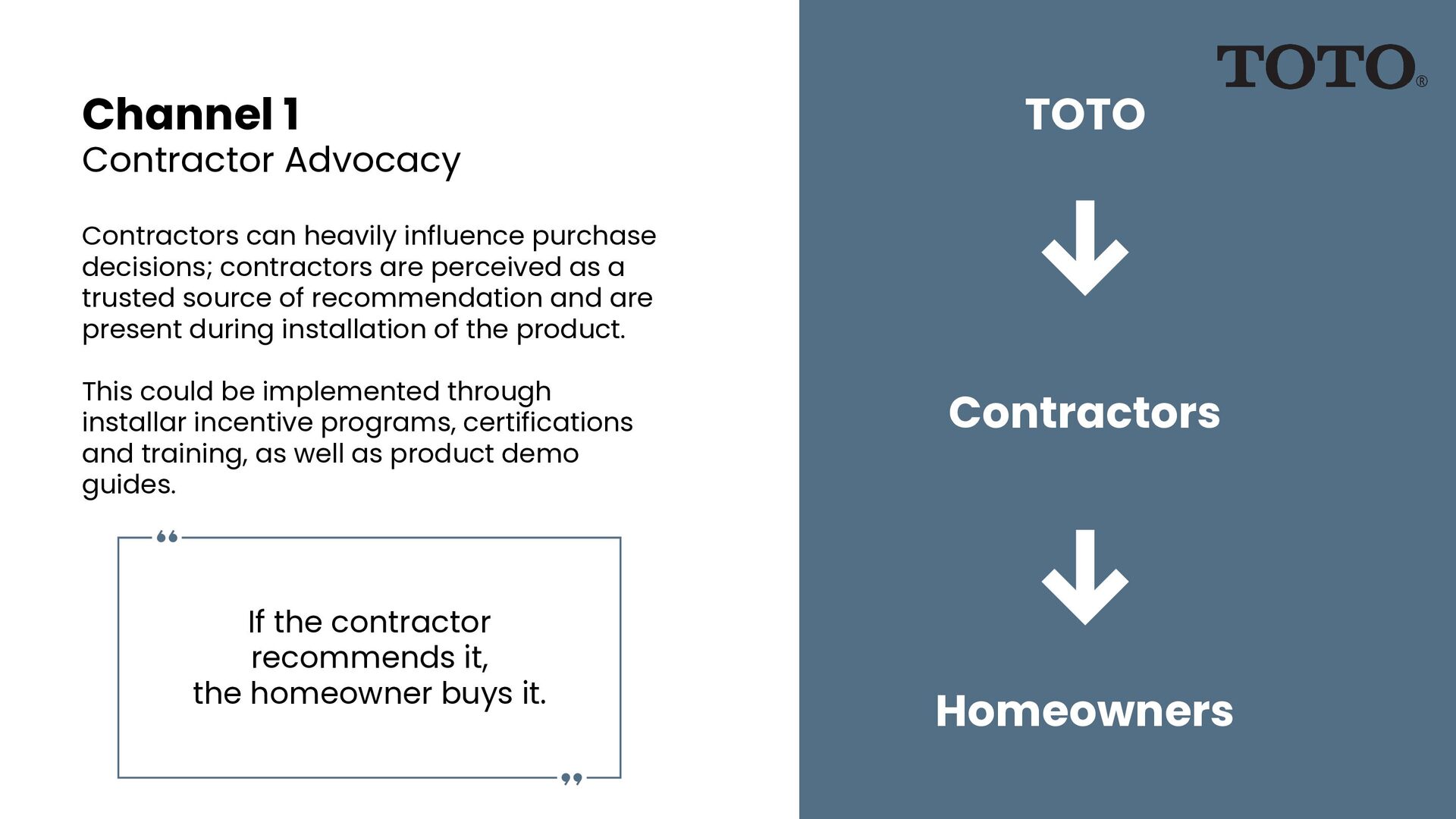
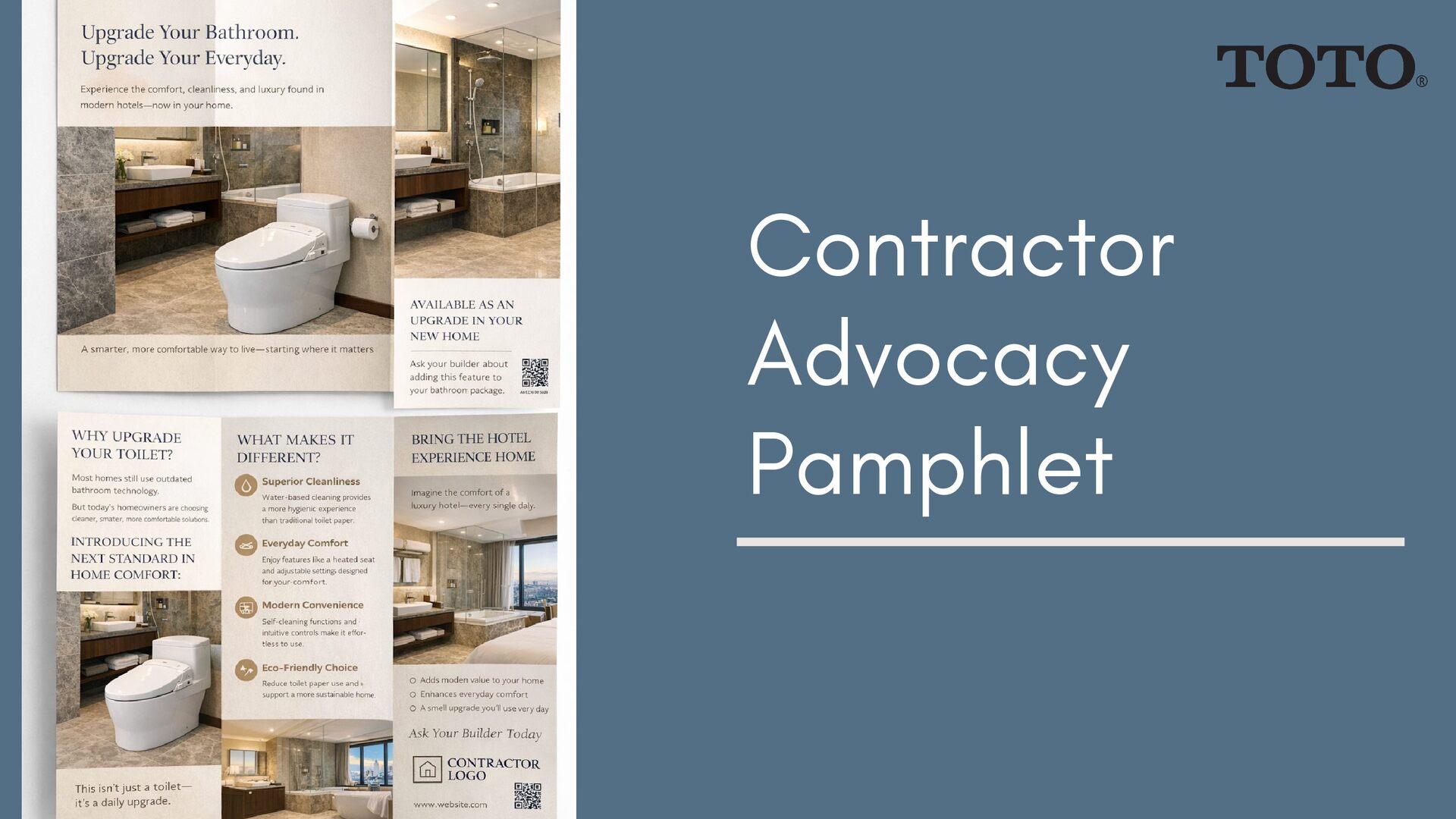
decisions; contractors are perceived as a trusted source of recommendation and are present during installation of the product. This could be implemented through installar incentive programs, certifications and training, as well as product demo guides. If the contractor recommends it, the homeowner buys it. Contractors Homeowners
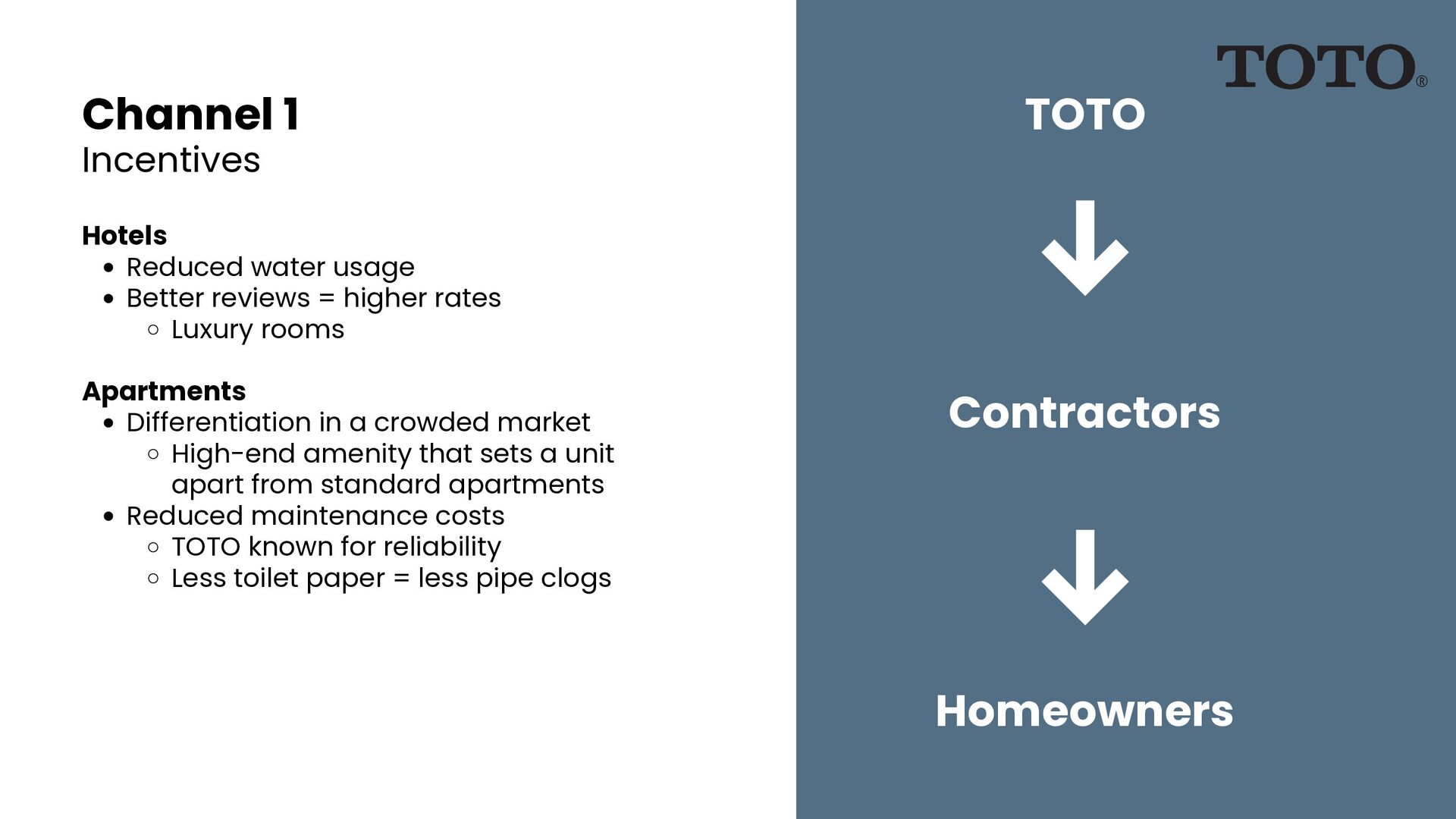
= higher rates Luxury rooms Apartments Differentiation in a crowded market High-end amenity that sets a unit apart from standard apartments Reduced maintenance costs TOTO known for reliability Less toilet paper = less pipe clogs Contractors Homeowners
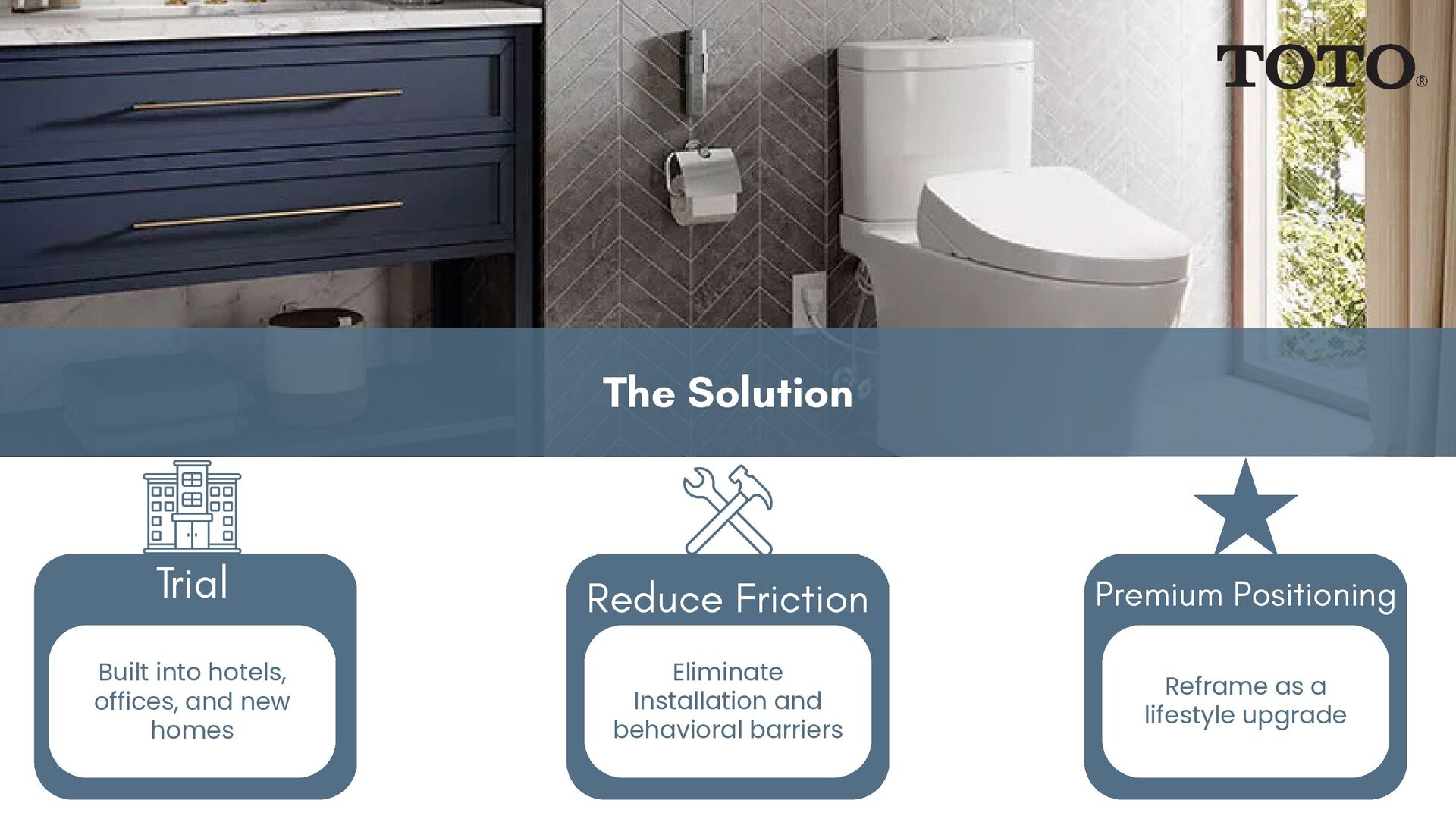
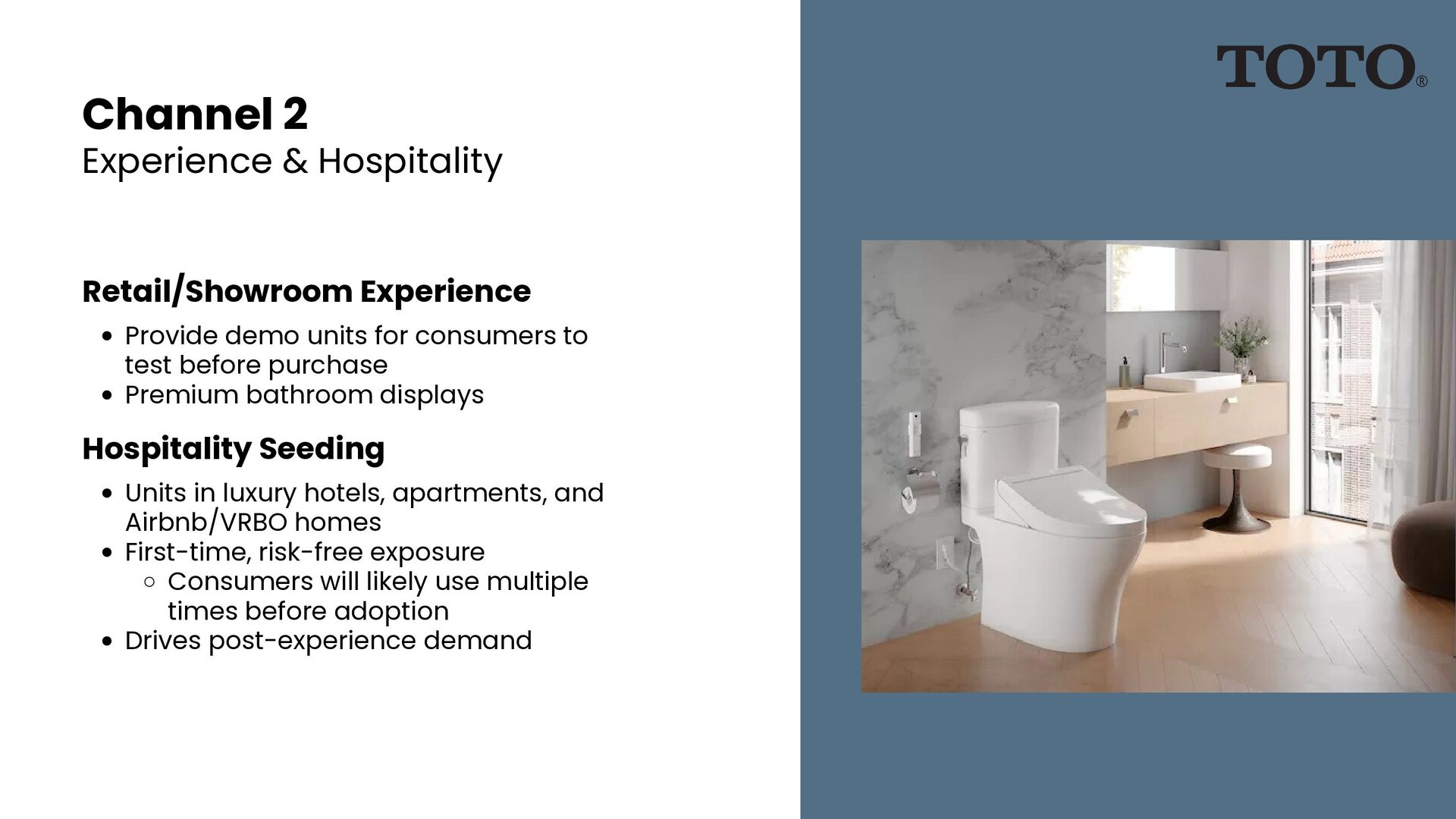
for consumers to test before purchase Premium bathroom displays Hospitality Seeding Units in luxury hotels, apartments, and Airbnb/VRBO homes First-time, risk-free exposure Consumers will likely use multiple times before adoption Drives post-experience demand
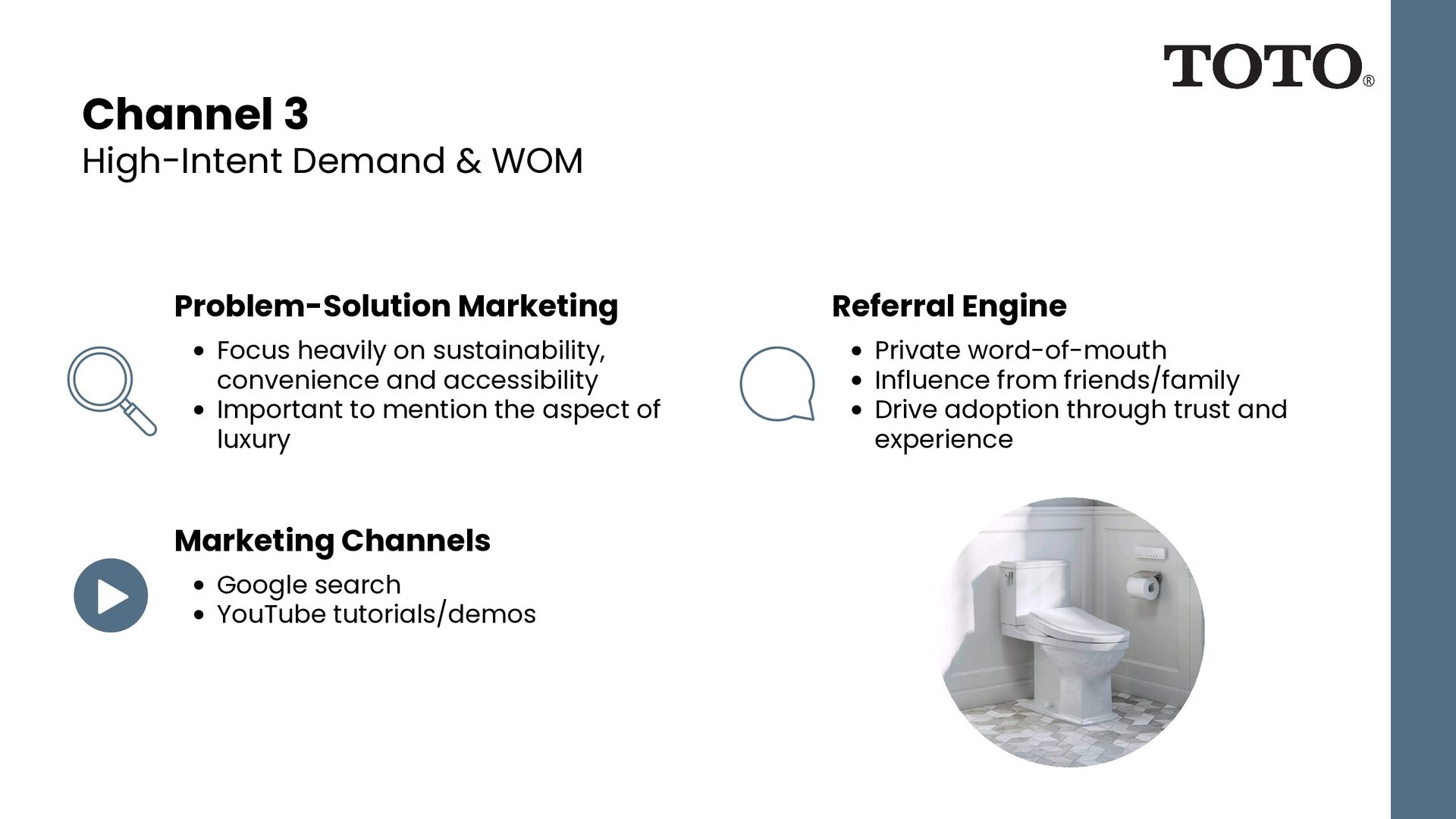
on sustainability, convenience and accessibility Important to mention the aspect of luxury Marketing Channels Google search YouTube tutorials/demos Referral Engine Private word-of-mouth Influence from friends/family Drive adoption through trust and experience
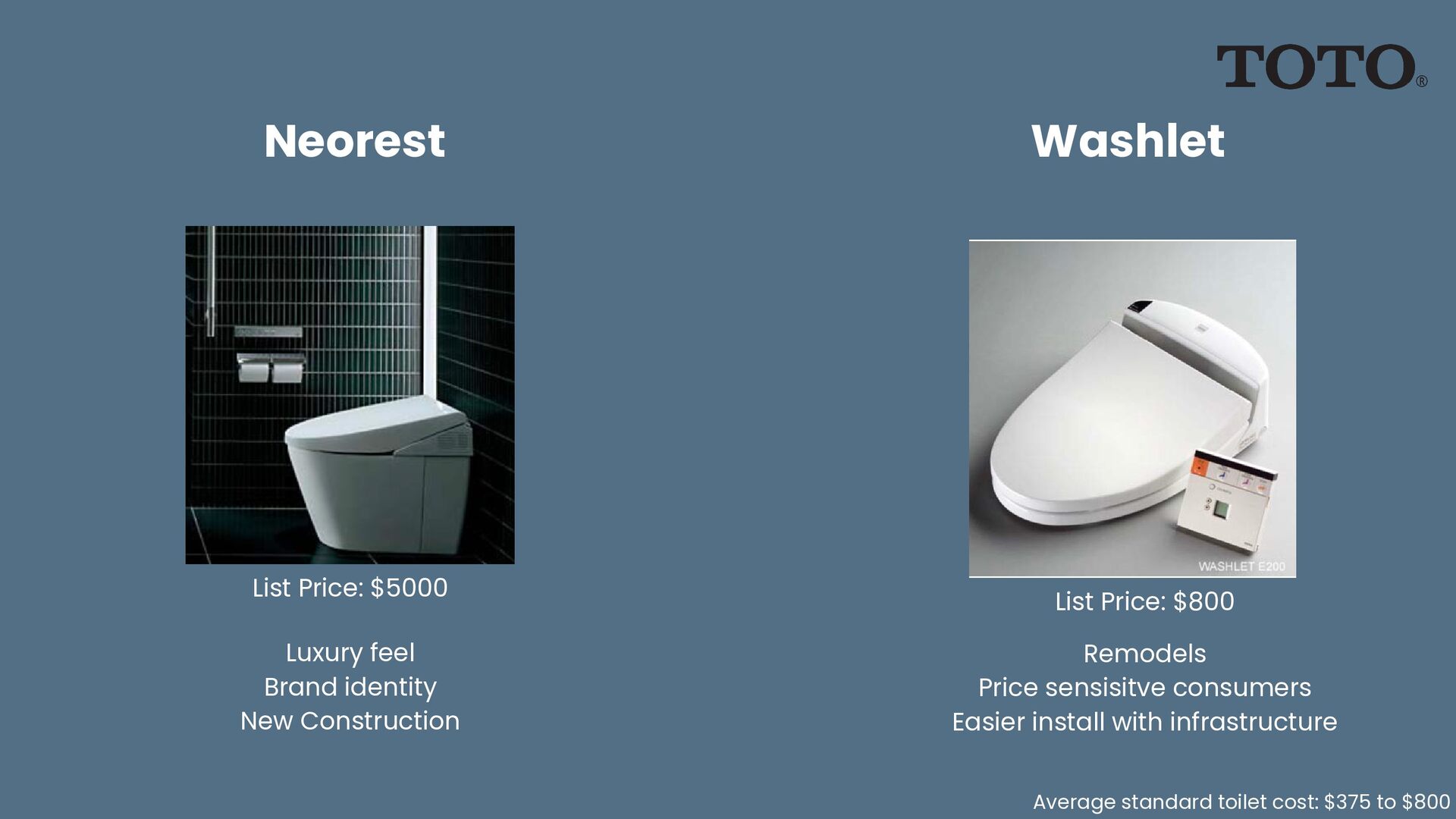
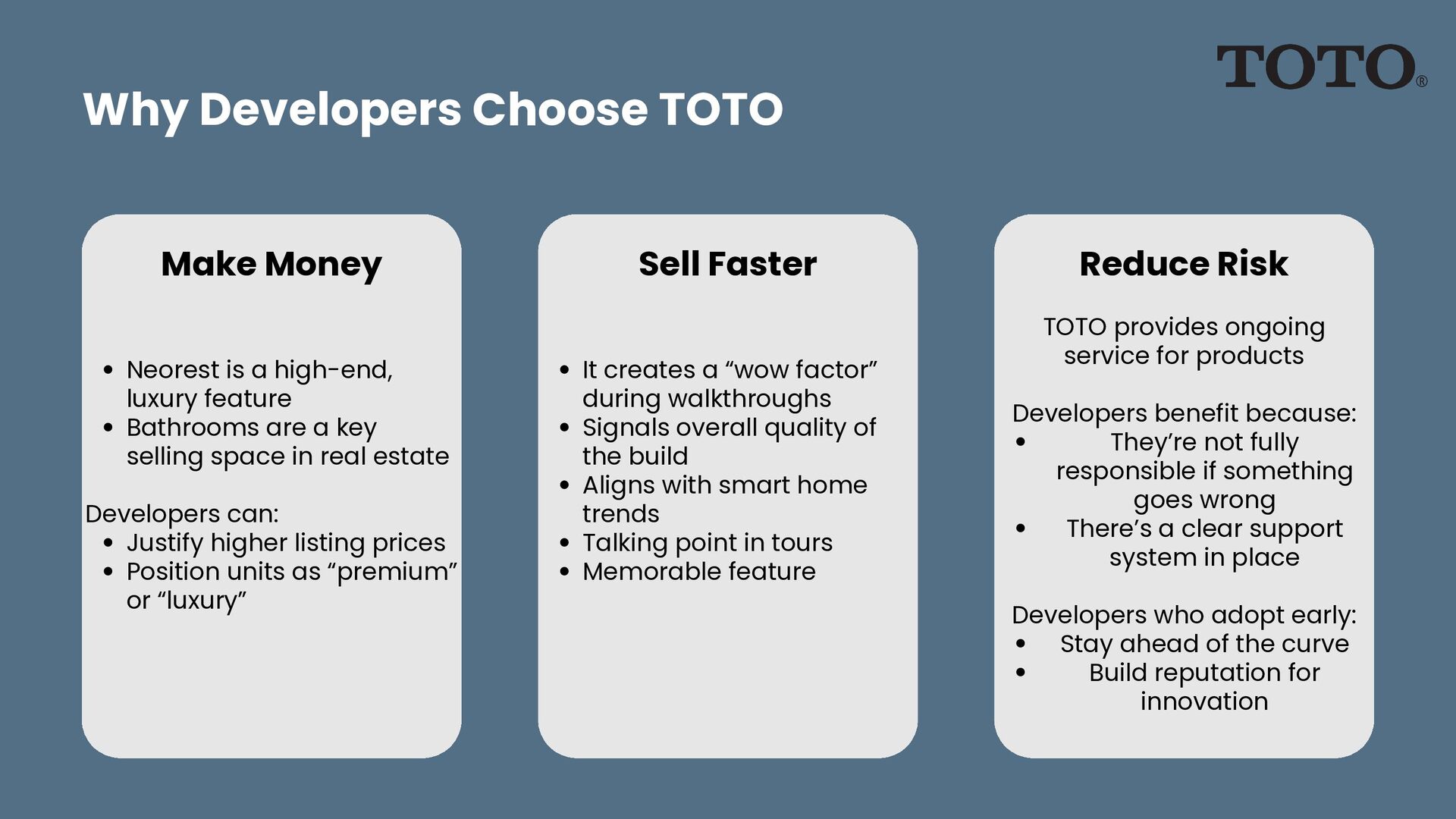
luxury feature Bathrooms are a key selling space in real estate Developers can: Justify higher listing prices Position units as “premium” or “luxury” Sell Faster It creates a “wow factor” during walkthroughs Signals overall quality of the build Aligns with smart home trends Talking point in tours Memorable feature Reduce Risk TOTO provides ongoing service for products Developers benefit because: They’re not fully responsible if something goes wrong There’s a clear support system in place Developers who adopt early: Stay ahead of the curve Build reputation for innovation
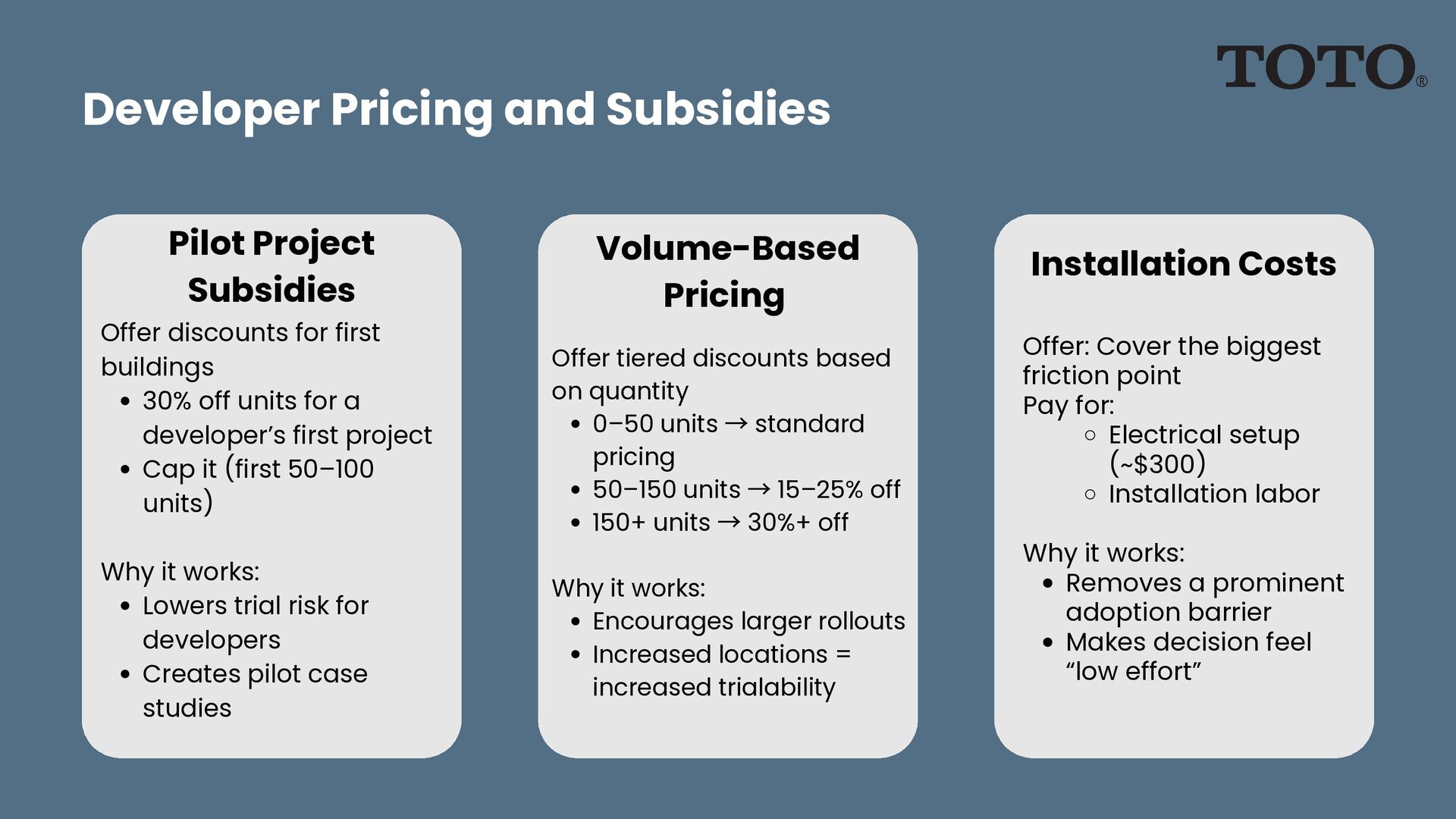
first buildings 30% off units for a developer’s first project Cap it (first 50–100 units) Why it works: Lowers trial risk for developers Creates pilot case studies Volume-Based Pricing Offer tiered discounts based on quantity 0–50 units standard pricing 50–150 units 15–25% off 150+ units 30%+ off → → → Why it works: Encourages larger rollouts Increased locations = increased trialability Installation Costs Offer: Cover the biggest friction point Pay for: Electrical setup (~$300) Installation labor Why it works: Removes a prominent adoption barrier Makes decision feel “low effort”
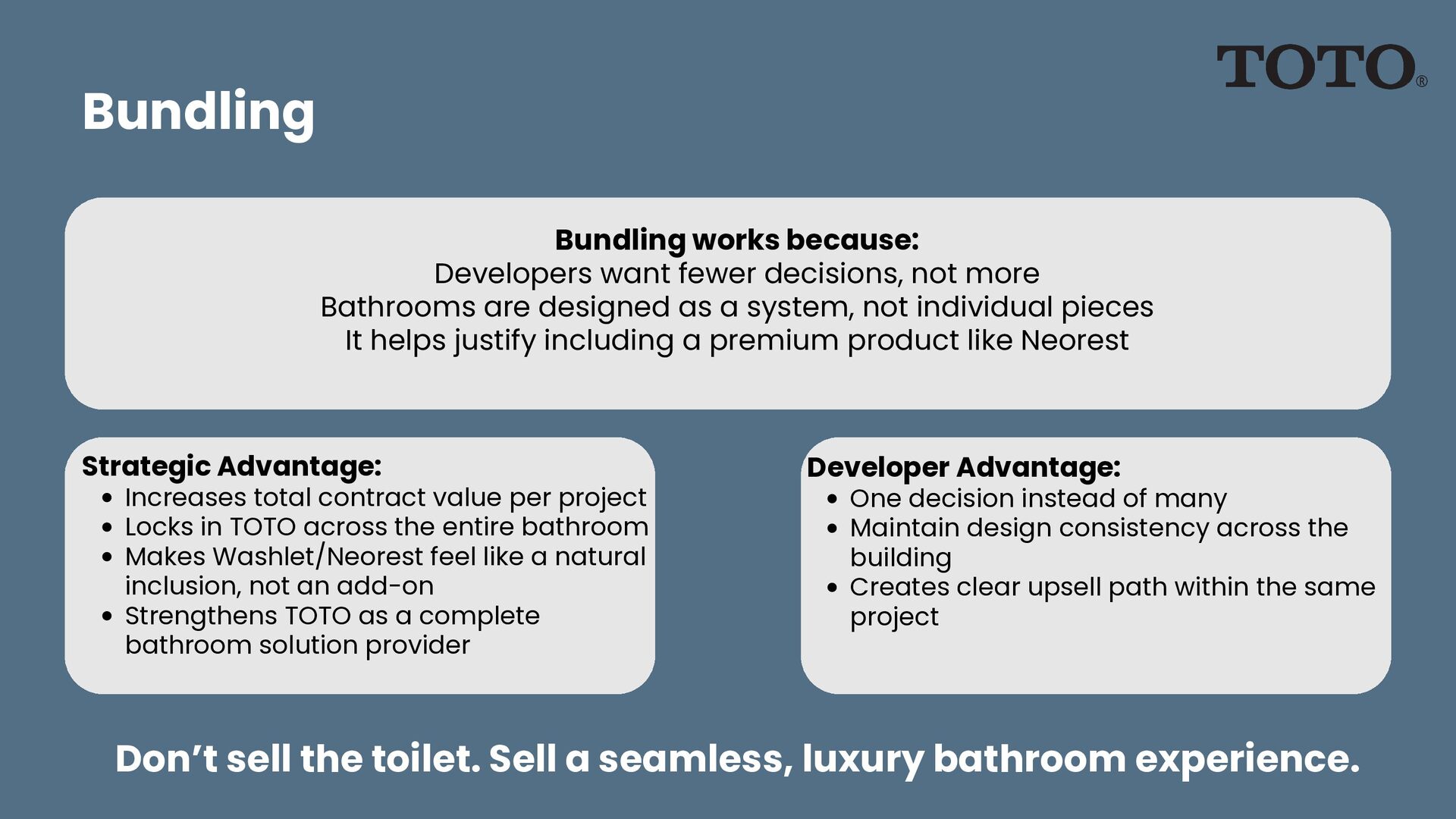
Bathrooms are designed as a system, not individual pieces It helps justify including a premium product like Neorest Strategic Advantage: Increases total contract value per project Locks in TOTO across the entire bathroom Makes Washlet/Neorest feel like a natural inclusion, not an add-on Strengthens TOTO as a complete bathroom solution provider Developer Advantage: One decision instead of many Maintain design consistency across the building Creates clear upsell path within the same project Don’t sell the toilet. Sell a seamless, luxury bathroom experience.
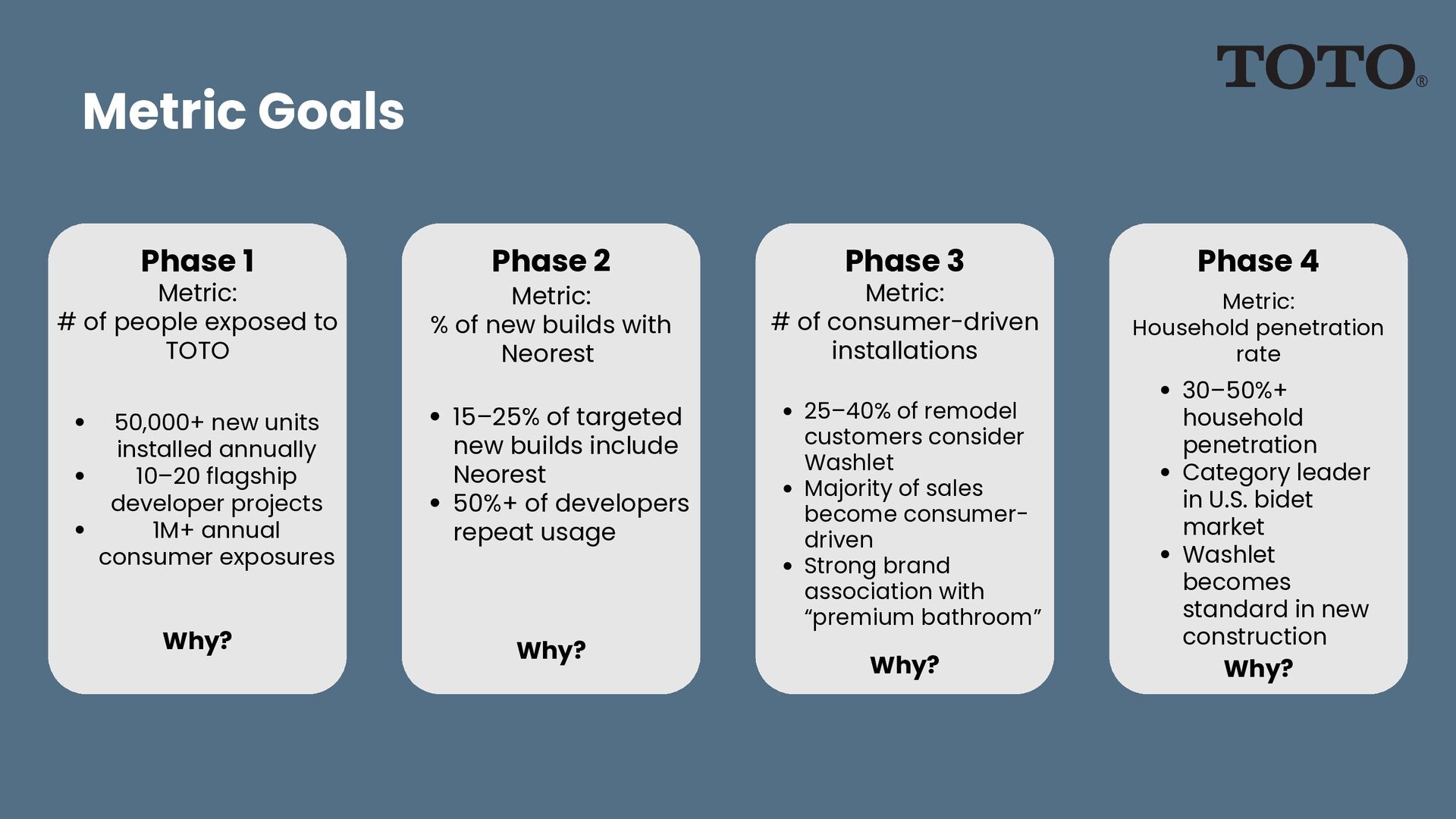
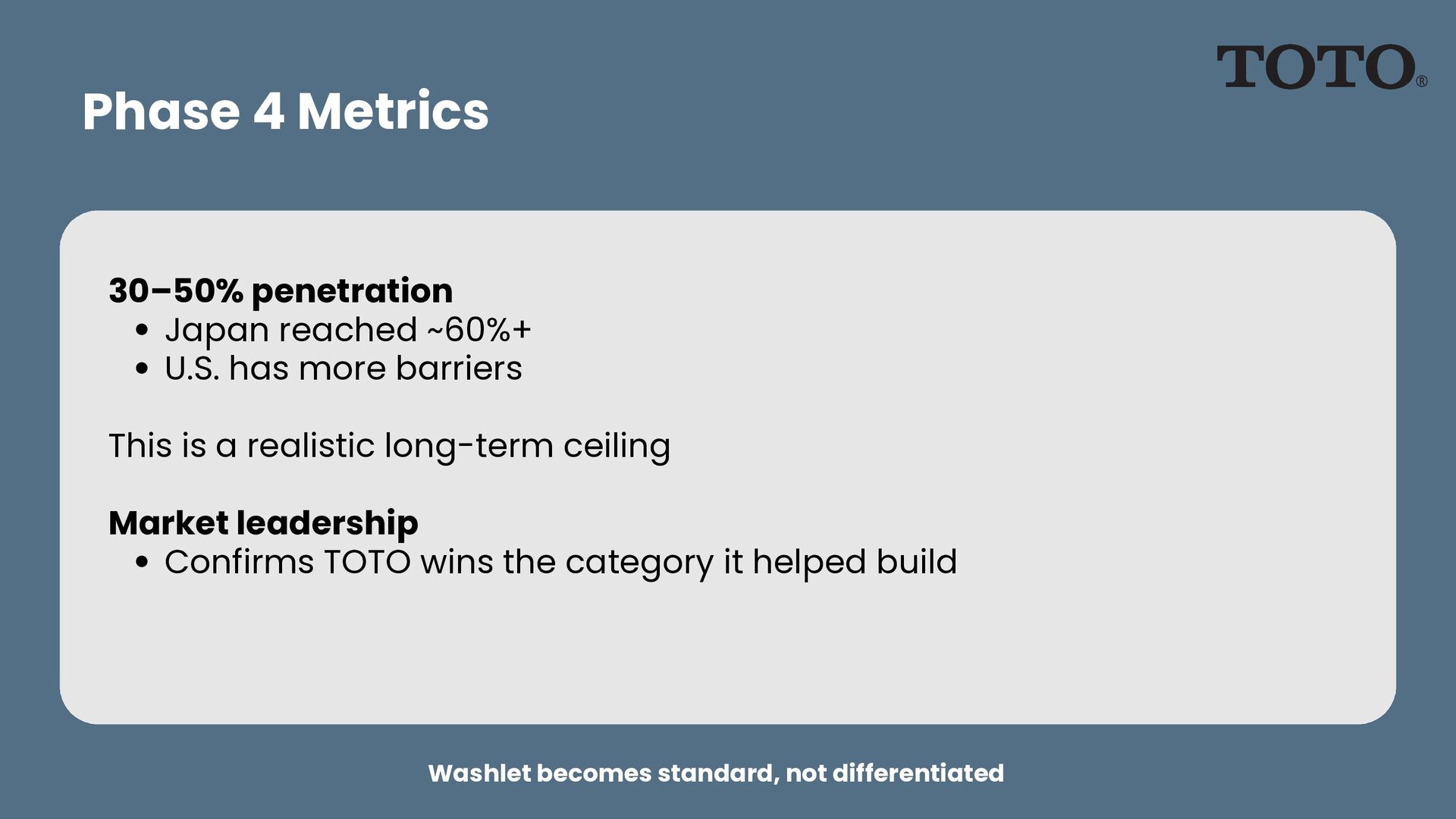
TOTO 50,000+ new units installed annually 10–20 flagship developer projects 1M+ annual consumer exposures Why? Phase 2 Metric: % of new builds with Neorest 15–25% of targeted new builds include Neorest 50%+ of developers repeat usage Why? Phase 3 Phase 4 Metric: # of consumer-driven installations Metric: Household penetration rate 25–40% of remodel customers consider Washlet Majority of sales become consumerdriven Strong brand association with “premium bathroom” 30–50%+ household penetration Category leader in U.S. bidet market Washlet becomes standard in new construction Why? Why?
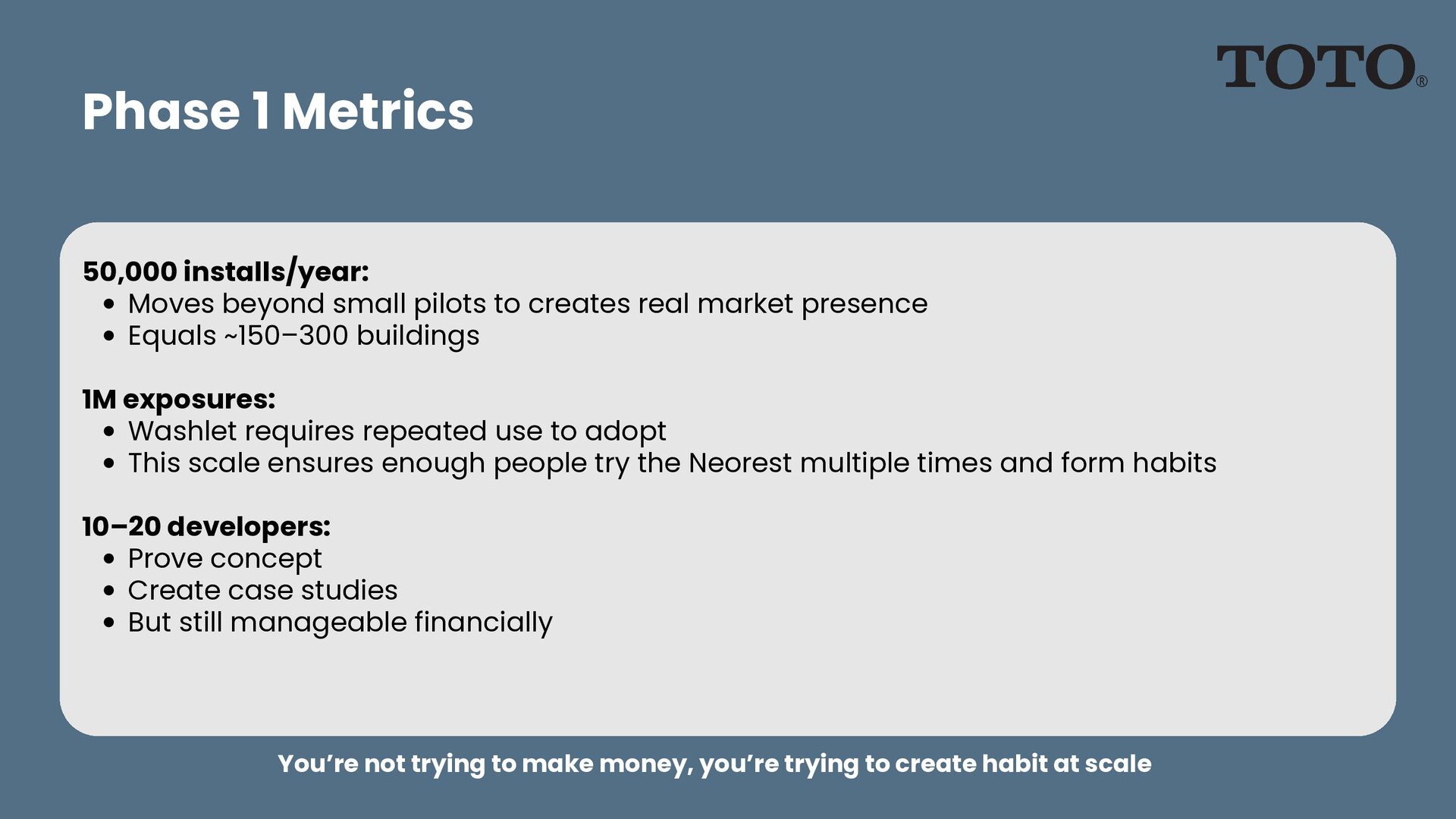
creates real market presence Equals ~150–300 buildings 1M exposures: Washlet requires repeated use to adopt This scale ensures enough people try the Neorest multiple times and form habits 10–20 developers: Prove concept Create case studies But still manageable financially You’re not trying to make money, you’re trying to create habit at scale
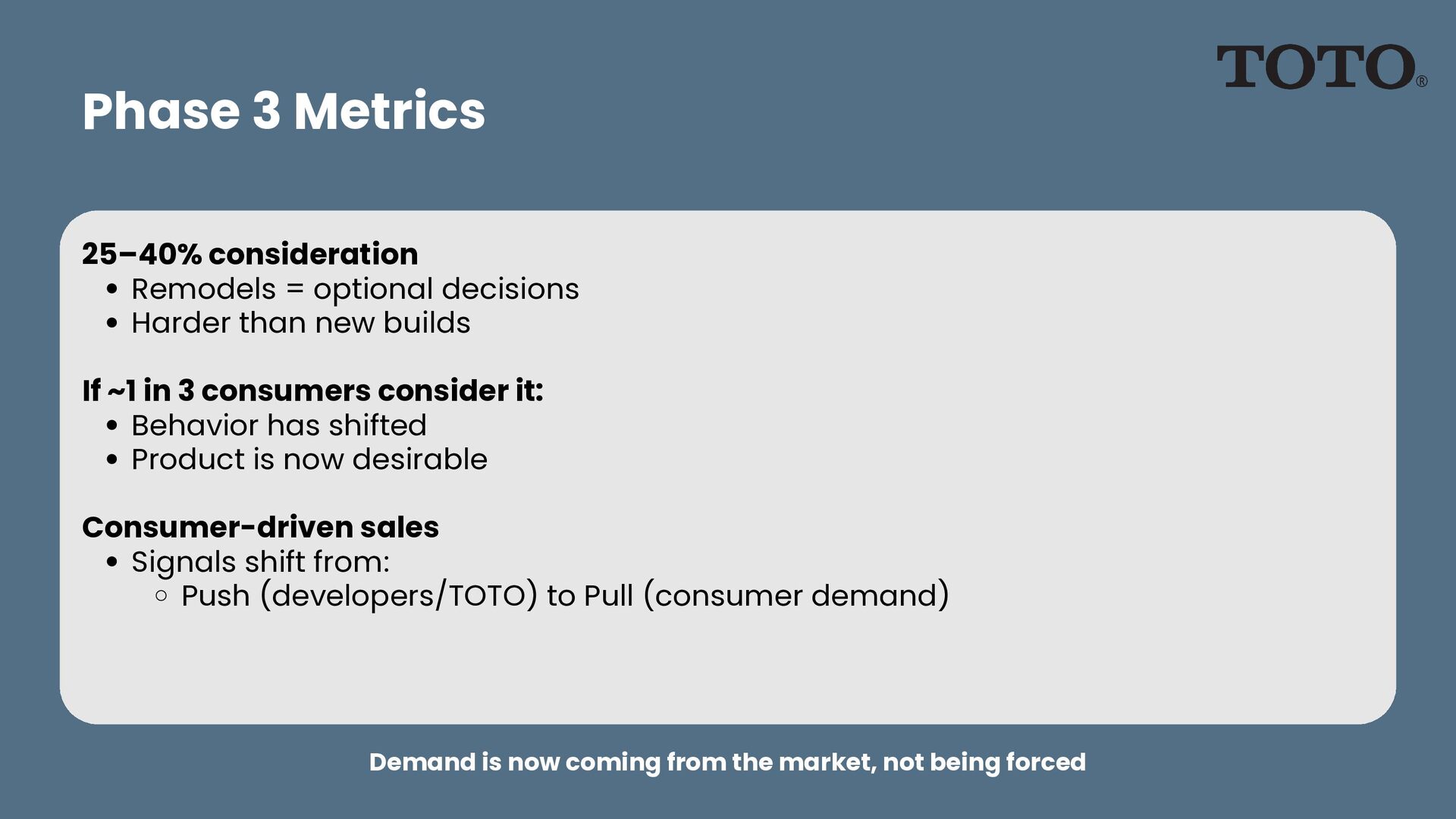
than new builds If ~1 in 3 consumers consider it: Behavior has shifted Product is now desirable Consumer-driven sales Signals shift from: Push (developers/TOTO) to Pull (consumer demand) Demand is now coming from the market, not being forced
more barriers This is a realistic long-term ceiling Market leadership Confirms TOTO wins the category it helped build Washlet becomes standard, not differentiated
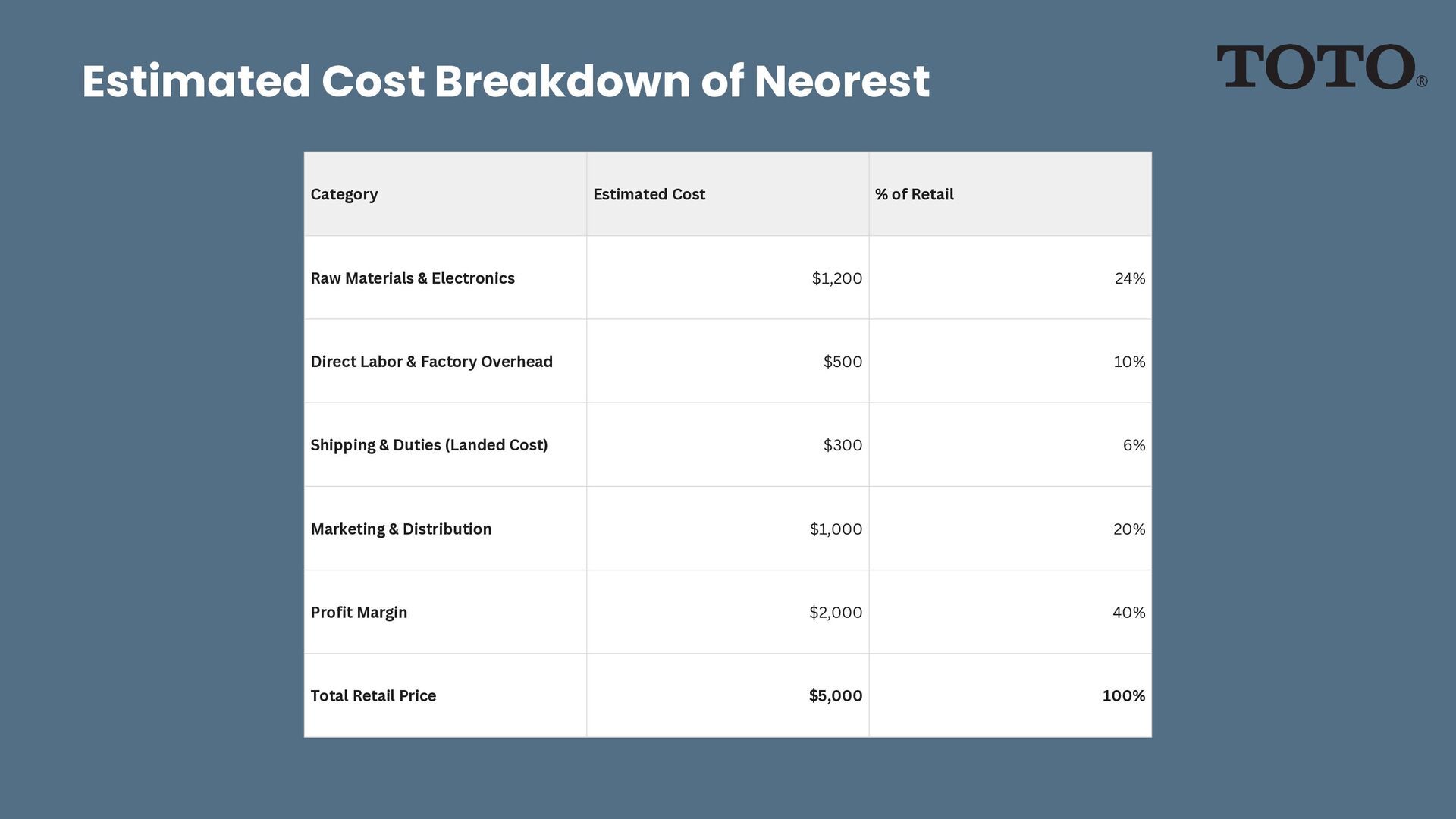
for "Stage One" (B2B pilots), you are asking TOTO to sell the product at or near its "Landed Cost." Even if TOTO makes $0 profit on the first 50 units in a hotel, the "Marketing Value" of those 50 units (providing thousands of guest trials) is worth far more than the $50,000 in lost margin. It is a "Customer Acquisition" expense, not a loss.
specific "problem-solving" queries. Instead of general branding, TOTO should bid on keywords like "how to reduce toilet paper waste," "hygienic bathroom upgrades," or "best bidet for pregnancy/mobility." YouTube Tutorials & Demos: Because the product has high Complexity, video is essential. Short, high-quality demos of the "Auto Open/Close" or "Ewater+" features help demystify the tech. These videos should focus on the solution (e.g., "The hands-free way to a cleaner bathroom").


 blakedoman
 tammyeverts
 apolaine
 cromwellryan
 lindahogenes
 frankvandijk
 aleyda
 danielanewman
 brettharned
 katiecoart
 michaelherold
 eileencodes