Upgrade to Pro — share decks privately, control downloads, hide ads and more …

Impact of Businesses on the economy in Australia

Sponsored · Your Podcast. Everywhere. Effortlessly. Share. Educate. Inspire. Entertain. You do you. We'll handle the rest. →

Impact of Businesses on the economy in Australia

Avatar for businesses

businesses

April 11, 2018

Other Decks in Business

Transcript

  1. Impact of businesses on the economy in Australia Abstract: Australian

    Business and Economy is the most thriving in the world and has made a stable base in the world economy. Australia was highly praised by various international organizations like International Monetary Fund for brilliant macroeconomic management and consistent economic reform. The small business sectors in Australia are the most significant part of its economy. The amount of investment in Australia is fourth largest in the world. The per capita Gross Domestic Product is marginally less than United States and United Kingdom which proves the high standard of Australian Economy. The development in the economic sector has led to the significant rise in the living standard of the citizens. Low inflation rate is also a positive characteristics of Australian economy which is absent in most of the developed countries. So, in this paper we will see the impact of the businesses on the economy. Introduction: The development of Australian economy can be traced back to the mid nineteenth century when production of wool began here. With the discovery of gold in the same decade Australia experienced economic growth and increase in population. The vast stretch of fertile lands and the huge natural resources of the country were mainly responsible for the sustained growth which the country experienced. From the Second World War the economic expansion in this country augmented highly and the boom period continued till 1970s. In 1987 the Australian Stock Exchange Limited was established which contributed to the economic advancement. Presently the main industries in Australia are mining, chemicals, industrial and transportation goods and food processing. Very recently the Knowledge based industries has began developing rapidly mainly due to the hi-tech and social changes. Information and Communications Technology today in Australia has a market of $80 billion. There are about twenty five thousand IT companies operating here. The major business areas in Australia are Import & Export, Insurance, and also Home based Business. There are approximately three
  2. million people in Australia and around 1.2 million small businesses.

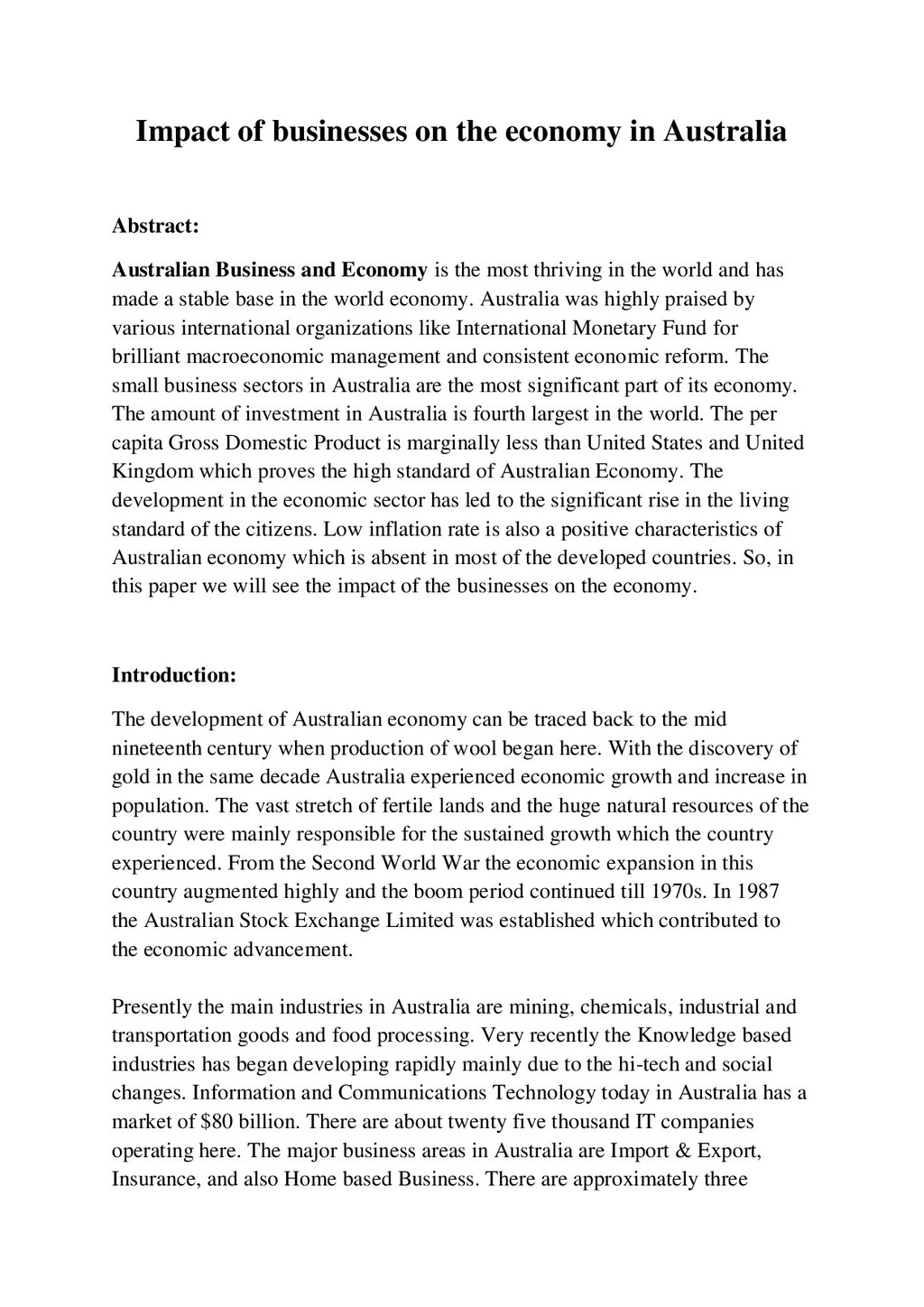
    A significant percentage of the goods produced by the small business sectors are exported. Figure 1 The infrastructure of the government of Australia has created a stable and strong base for the economy to grow. Though the country has free market economy the contribution of the government is very significant. This has made the country the second easiest economy for a new businessman and third easiest place to get a credit for business. There are very less restrictions in Australia in the field of trade and investment. The most important tax for almost all goods and businesses are GST and VAT. The world class infrastructure, extraordinary natural resource and right governmental policies have made Australia one of the most developed nations of the world. Here are some specifications of Australian Economy:  Currency- Australian Dollar  Fiscal year- 1st July to 30th June  Current GDP growth- 3.8%  Current Inflation rate- 2.5%
  3. The Australian Economy: role of business In Australia there are

    many types of businesses: small, medium and large. In Australia, large businesses account for approximately 3 per cent of all business enterprises. The Australian Bureau of Statistics refers to large businesses as „those employing 200 or more people‟. More than 80 per cent of all people currently in work are employed in large businesses. The largest employer being Woolworths Ltd with 94 408 employees. Businesses do not operate in isolation to the economy and economic changes can have a major impact on the business environment. The current state of the economy can have a major impact on the business environment. Economic conditions impacting on business can be measured by indicators such as:  the inflation rate as indicated by the Consumer Price Index (CPI)  the level of unemployment  consumer confidence and consumer spending  interest rates and the level of borrowings  wage rates and awards  business investment and business confidence  foreign exchange rates and the value of the Australian dollar Fluctuations in these indicators can have a major impact on business. The global economic crisis of 2008-09 had a major impact on business confidence. Many businesses had to lay of staff or scale back operations because of uncertain economic conditions. Contribution of Business to the Economy: Large businesses make a significant contribution to the Australian economy. Because of their size, large businesses are efficient producers of goods and services. In fact, according to recent statistics, large businesses contribute 56 percent of total revenues in Australia. Large businesses also play the following important roles:
  4. Provision of Employment: Large business requires significant numbers of employees,

    and employ around 33% of the Australian workforce. Australia‟s largest employers (Woolworths and Coles) each employ more than 94,000 employees. Employment levels such as this help to create and maintain jobs in economy. Consequently this means less unemployment and more income for the economy; demand for goods and services goes up; and spending is increased, resulting in more employment in the production of goods and services. Figure 2 Economics of the Scale and High levels of Production: Large businesses are able to produce significant quantities of goods at reduced cost. Economies of scale are achieved; large organisations incurr lower costs per unit of output because they operate on a large scale. Consequently, lower costs in production should result in lower prices for the consumer. Economies of scale also lead to higher and more efficient levels of production. In fact, large-scale account for about 70 per cent of all the goods and services produced by the private sector. This level of production makes up a considerable part of Australia‟s gross domestic product (GDP). GDP is a measure of all the goods and services produced in the economy in one year. On
  5. average, large-scale organisations contributed over 55 per cent of Australia‟s

    GDP. Improvements to Australia’s Industry Base: Large businesses help provide a solid industrial base in Australia by stimulating the growth of capital infrastructure. Large businesses, particularly transnational corporations, are large investors in equipment, machinery and state-of-the-art technology. Most large businesses are also concerned about developing world‟s best practice in their particular industry. This means that they are continuously trying to improve what they do so that they can be a world leader in their particular industry. Research, Development and Innovation: In the competitive search for better products and to develop world‟s best practice, large-scale organisations invest in research and development(R&D). Investment in R&D will not only help to develop better products and improved methods of production, it will have flow-on effects throughout industry and society. For example R&D by Telstra into communications technology could lead to improved communication systems for society in general. Innovation means doing things in new and better ways, developing novel and clever solutions to problems, using the skills and technologies of the future and overcoming barriers to improvement. Innovation is an important ingredient for success in all types and sizes of business. It is needed to take advantage of business opportunities and to solve problems. For example, in the communications industry 3G networks have allowed customers to access the Internet on a mobile phone handset. Export Earnings: Australia has traditionally been a large exporter of primary products and has had to rely on imported goods. However, in more recent times the Australian government has encouraged Australian industries to develop their own export markets. Australian exports help to earn foreign income for Australian businesses. The export of Australian manufactured goods has increased in recent years. This is important for Australia‟s future because it helps retain employment in Australia, while earning valuable foreign income at the same time.
  6. How Economy Impacted SMES in 2017? September 2016 was a

    mixed month for the Australian economy and one that brought both incredible milestones and sudden, unexpected troughs. To begin with, the end of the month saw Australia complete its 100thconsecutive quarter without a recession, continuing a 25-year growth streak that is the second highest in history. Given that this period includes the Great Recession, this is a remarkable achievement that underlines the strength and durability of the Australian economic model. Figure 3 This was followed by some surprising and less than reassuring news, however, as it was announced that the nation‟s GDP actively shrunk by 0.05% during the third quarter of 2016, despite predictions that it would increase by the same amount. While this may be seen by many as little more than a short-term blip (as opposed to the beginning of a sustained economic decline and a fully- fledged recession), there is no doubt that the economy faces a challenging start to the New Year while it awaits the results from quarter four. Make no mistake; another quarterly contraction could signal the official onset of a recession in Australia, which could have a devastating impact on unprepared SMEs nationwide. With this in mind, here are some predictions that may help small business owners to create contingency plans for the year ahead and cope in the event that the fourth quarter delivers less than positive results.
  7. China’s Economic Issues Drive Commodity Coasts Down: At the beginning

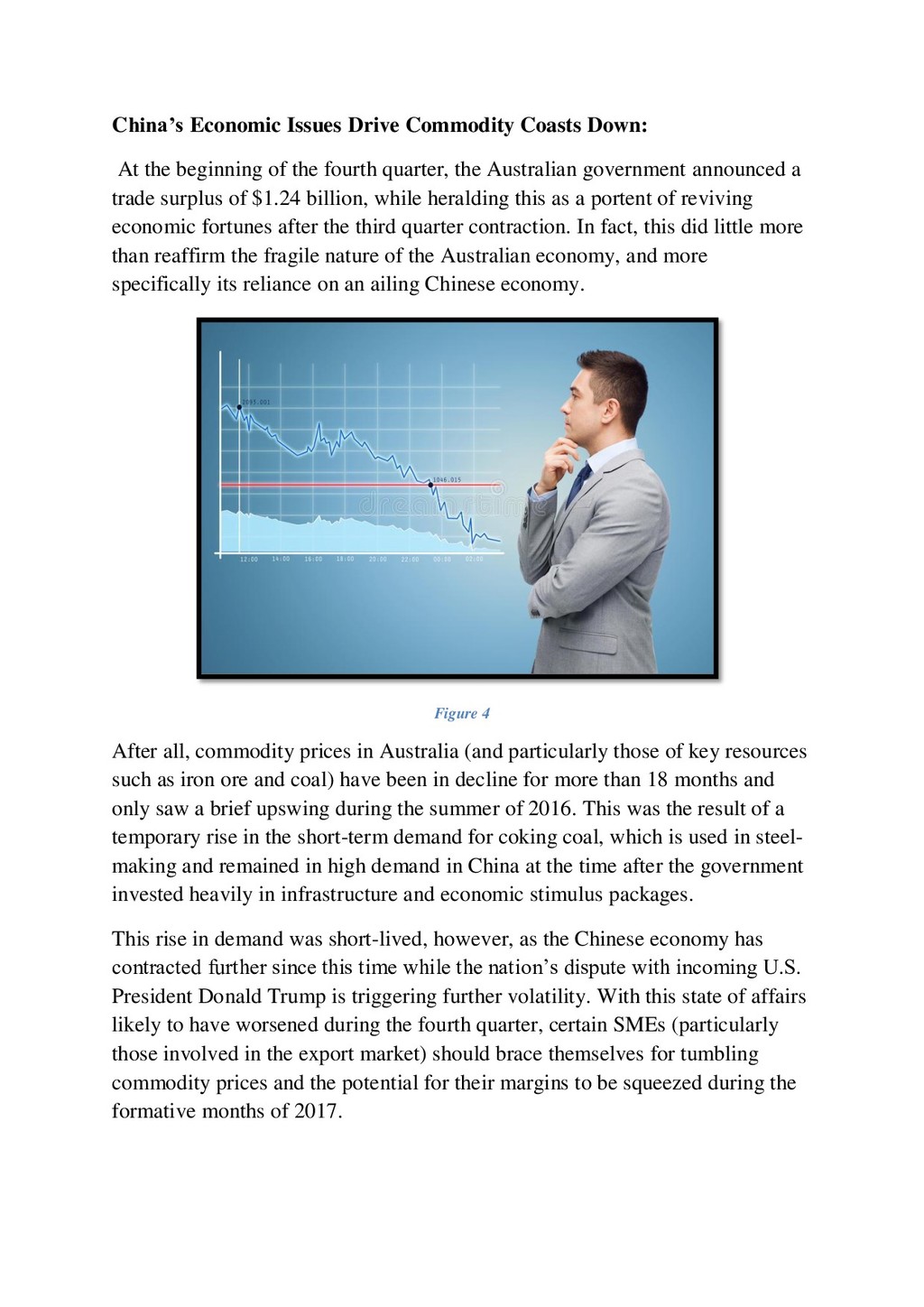
    of the fourth quarter, the Australian government announced a trade surplus of $1.24 billion, while heralding this as a portent of reviving economic fortunes after the third quarter contraction. In fact, this did little more than reaffirm the fragile nature of the Australian economy, and more specifically its reliance on an ailing Chinese economy. Figure 4 After all, commodity prices in Australia (and particularly those of key resources such as iron ore and coal) have been in decline for more than 18 months and only saw a brief upswing during the summer of 2016. This was the result of a temporary rise in the short-term demand for coking coal, which is used in steel- making and remained in high demand in China at the time after the government invested heavily in infrastructure and economic stimulus packages. This rise in demand was short-lived, however, as the Chinese economy has contracted further since this time while the nation‟s dispute with incoming U.S. President Donald Trump is triggering further volatility. With this state of affairs likely to have worsened during the fourth quarter, certain SMEs (particularly those involved in the export market) should brace themselves for tumbling commodity prices and the potential for their margins to be squeezed during the formative months of 2017.
  8. Tighter Regulation Will Reduce the Cost of Gas For SMEs:

    We have already touched on the fact that fourth quarter figures are likely to showcase a decline in commodity prices. One exception to this rule could be provided by the burgeoning LNG market, with exports of liquid, natural gas expected to peak at 52.4 million metric tons during the formative months of 2017. Not only does this create additional opportunities for those who are looking to trade commodities and national market indices, but it also also offers some hope for SMEs and manufacturers. After all, traditional gas prices in Australia have soared disproportionately as a result of a restricted supply in recent times, rising above and beyond export parity in the process. This is having a pronounced impact on the competitiveness of small businesses and independent manufacturers, and it is hoped that LNG growth could create greater balance in the marketplace. This may only be a short-term solution, unless the Australian government strive to regulate gas prices and reduce existing bans on exploration and discovery projects among the nation‟s fields. Without decisive action, we may see LNG growth and small business output diminish towards the end of 2017, while manufacturing output could record losses of $118 billion by the end of 2021. The Australian economy is still worrying Australian small business owners and operators according to a survey . Of the 1791 readers surveyed in November last year 33 per cent say they are "very concerned" about how the Australian economy will impact on their businesses performance. The Small business really the engine room of Australia’s economy? It seems that in Australian politics - and this campaign in particular - everyone loves a small business. Just before this year‟s federal budget, Treasurer Scott Morrison said of small businesses: “they are the hope of the side.” Somewhat less pithily, but no less adoringly, Labor‟s official policy on small business declares:
  9. “Small businesses make a huge contribution to national prosperity and

    supporting Australian jobs. Small businesses play a central role in the economy. Over 2 million businesses – sole traders, partnerships, trusts and small employers – have helped underpin 25 years of economic growth.” In fact, the only thing the major parties seem to disagree on is whether a small business has less than $2 million in annual revenues (the Labor definition) or less than $10 million (the Coalition definition). But do small businesses, for desperate want of a better term, create “jobs and growth”? The first relevant fact is that small businesses employ a lot of people. According to figures compiled by Saul Eslake, and discussed in a terrific piece by Adam Creighton in The Australian, business that employ fewer than 20 people account for roughly 45% of private sector employment. Businesses with 20-199 employees account for about 25%, and businesses with 200+ employees, around 20%. So small businesses are important employers. Check. Only problem is, they haven‟t created a lot of jobs in the last five years. As Creighton pointed out, those small business created 5% of the growth in private sector employment since 2010, while businesses with more than 200 employees created 65% of that growth. In one important sense, this should not be surprising. When looking at the landscape of firms of different sizes, existing firms exhibit what economists call “survivorship bias”. The very fact that a firm exists today means that it was created, and succeeded. Big firms were created and really succeeded. So it‟s likely that today‟s big firms are, on average, more successful than today small firms at, well, getting big. And the way that happens is by, you guessed it, employing more people. So much for the positive political economy of why politicians are desperate to ingratiate themselves with small businesses. There are a lot of them, hence a lot of potential votes. But the real question, of course, is what tax policy should be. The Labor party wants to cut the company tax rate from 30% to 25% only for businesses with
  10. less than $2 million turnover. The Coalition wants to do

    that for all businesses, but over 10 years. In the medium term both parties want to cut taxes for mainly for small businesses, albeit to varying degrees. To answer that question, we first need a quick primer on why everybody (at least until very recently in some cases) agreed that cutting company taxes help workers and the economy more broadly. Roughly speaking, the amount of “stuff” produced in the economy depends on two inputs: capital and labour. Lowering the company tax rate attracts more capital - especially since Australia is a small, open economy. More capital means more stuff because capital is useful in production. Moreover, more capital means that the marginal return to more labour goes up, too. That is because, generally speaking, capital and labour are complements in the production process. More of one makes more of the other more valuable at the margin. Aside: forget all the jibberish you have recently read about dividend imputation and franking credits. That‟s a second-order issue - the key is the complementarity between capital and labour. This increased marginal return to labour means more jobs and higher wages– capital made labour more valuable, and labour captures some of that benefit. This is why Treasury has estimated that two-thirds of the benefit from a cut in company taxes flows to workers. Now, do small businesses or big businesses use more capital? Answer: big businesses (See here, page 3). So it is big businesses that will increase the amount of capital they use the most from a cut in company taxes. And it is big businesses that will thus drive more employment growth and higher wages. To sum up. Small businesses employ lots of people. But they haven‟t driven much of the job growth in Australia over the past five years. And a company tax cut won‟t cause them to stimulate employment as much as it will for bigger businesses. We should cut company taxes, and we should cut them for all firms. But it makes no sense to favour small businesses over bigger ones.
  11. That‟s the economics of the matter. What we are witnessing

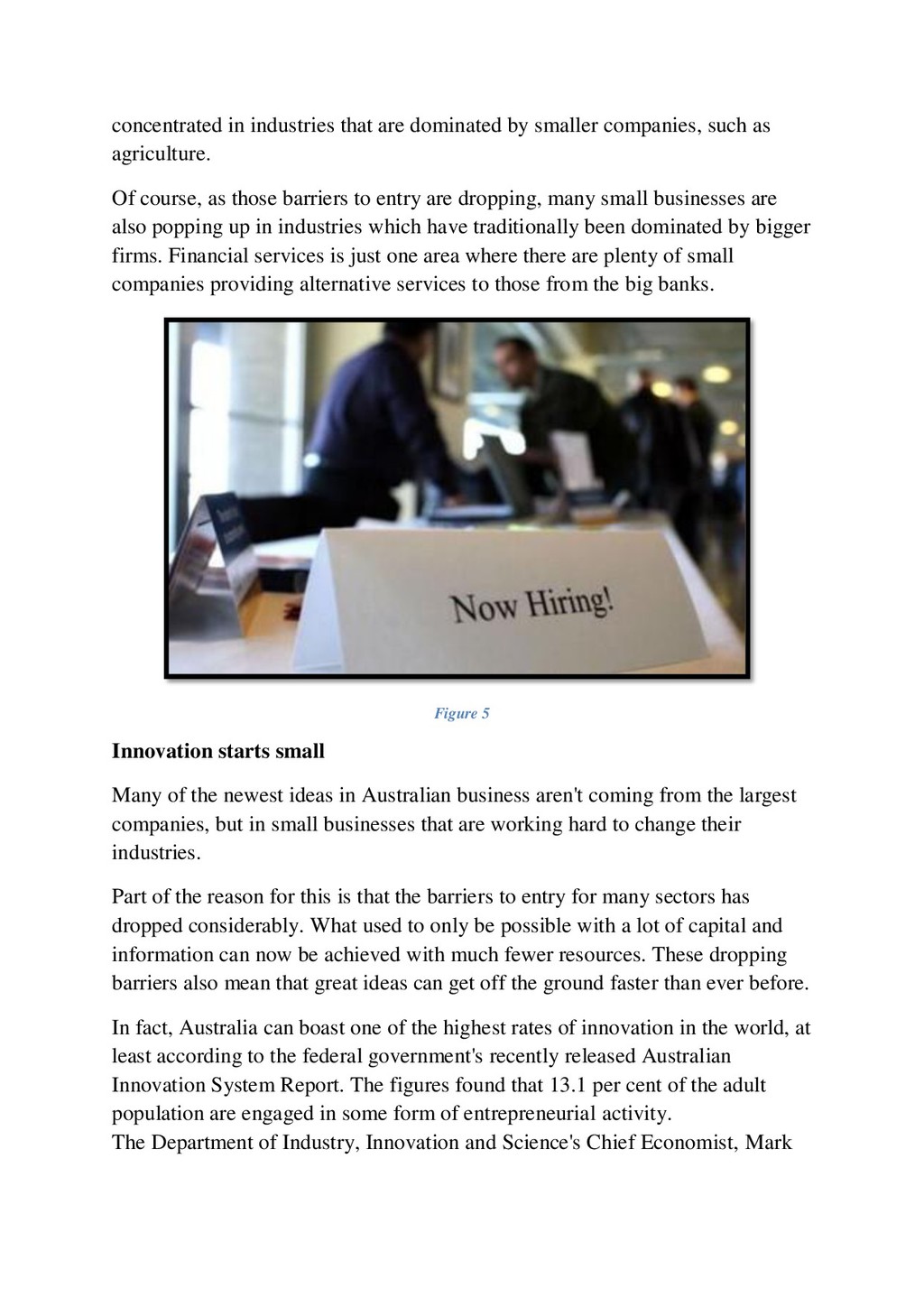
    in this election campaign - on both sides - is pure politics. How do Australian small businesses help the economy? You've probably heard a lot about just how valuable small businesses are for the Australian economy, and with good reason. These companies are driving some big changes throughout the country and will be essential for the country's continued success. So why are small companies so valuable to Australia's economy and to the country's success as a whole? Here are some of the main areas where small businesses are making their presence known. They make up the majority of the country's businesses Perhaps the most important sign of the strength behind Australia's small business sector is the sheer number of companies that fall into this bracket. In fact, according to the Australian Bureau of Statistics, there are 2.1 million actively trading businesses in the country, with 97 per cent having fewer than 20 employees. What's more, they account for a significant chunk of the economy - 35 per cent of all value generated in Australia, according to the Reserve Bank of Australia (RBA). With so many small businesses in the country falling into that category of fewer than 20 employees, it isn't surprising that they are also big contributors to a second major benefit to the economy: employment. Small companies are big hirers It isn't just the number of small businesses that make them important for the Australian economy. These companies are collectively the largest source of employment in Australia. The RBA found that small businesses are responsible for about half of all jobs outside of the financial sector. Perhaps unsurprisingly, those roles are
  12. concentrated in industries that are dominated by smaller companies, such

    as agriculture. Of course, as those barriers to entry are dropping, many small businesses are also popping up in industries which have traditionally been dominated by bigger firms. Financial services is just one area where there are plenty of small companies providing alternative services to those from the big banks. Figure 5 Innovation starts small Many of the newest ideas in Australian business aren't coming from the largest companies, but in small businesses that are working hard to change their industries. Part of the reason for this is that the barriers to entry for many sectors has dropped considerably. What used to only be possible with a lot of capital and information can now be achieved with much fewer resources. These dropping barriers also mean that great ideas can get off the ground faster than ever before. In fact, Australia can boast one of the highest rates of innovation in the world, at least according to the federal government's recently released Australian Innovation System Report. The figures found that 13.1 per cent of the adult population are engaged in some form of entrepreneurial activity. The Department of Industry, Innovation and Science's Chief Economist, Mark
  13. Cully, sent the following tweet highlighting just how important innovation

    is for Australian businesses. Smaller companies buy lots of goods This won't be relevant to B2C companies, but if anyone who is selling products to other organisations will have probably noticed just how much buying power the country's small businesses have. On the flip side, the breadth of services that small companies can provide means they are able to offer services that other firms, big companies and even the state and federal government will rely on. In fact, the Commonwealth has been increasing its efforts to procure services from small businesses as a way to boost the growth of these companies. Small businesses carry less debt than larger firms It's a bit of a cliche that smaller companies have to take on a lot of debt in order to start operating, a myth that isn't actually the case. To go back to the RBA, the study found that only 40 per cent of these companies are carrying debt, compared to 60 per cent of large firms (those with profits over the $5 million mark). Figure 6 This suggests that small businesses are keeping a close eye on their finances and are wary of putting themselves under unnecessary financial pressure. What's
  14. more, companies will have more resources to invest into the

    rest of their growth efforts. Small businesses turn into big businesses Today's start-ups are tomorrow's industry leaders, provided they can manage their early expansion in a sustainable way. For the Australian economy to be successful, it will need more home-grown companies that can keep pushing the boundaries and expanding their operations. In fact, this is one of the main reasons small businesses will use options like debtor finance because it can help small, fast-growing companies to maintain a consistent cash flow. For Australia's economy to grow, it needs plenty of small businesses with the ideas, passion and confidence to turn big ideas into concrete business initiatives. The good news is that many firms are already finding these opportunities across the country. Conclusion: Many of today‟s small businesses will be tomorrow‟s industry leaders. For the Australian economy to grow, it will need more small companies pushing the boundaries, and expanding their strategies and resources, to turn big ideas into industry initiatives.