Upgrade to Pro — share decks privately, control downloads, hide ads and more …

Hey, You can do it!

Sponsored · Ship Features Fearlessly Turn features on and off without deploys. Used by thousands of Ruby developers.

Hey, You can do it!

By JD

Avatar for Buzzvil

Buzzvil

July 14, 2021
Tweet

More Decks by Buzzvil

Other Decks in Programming

Transcript

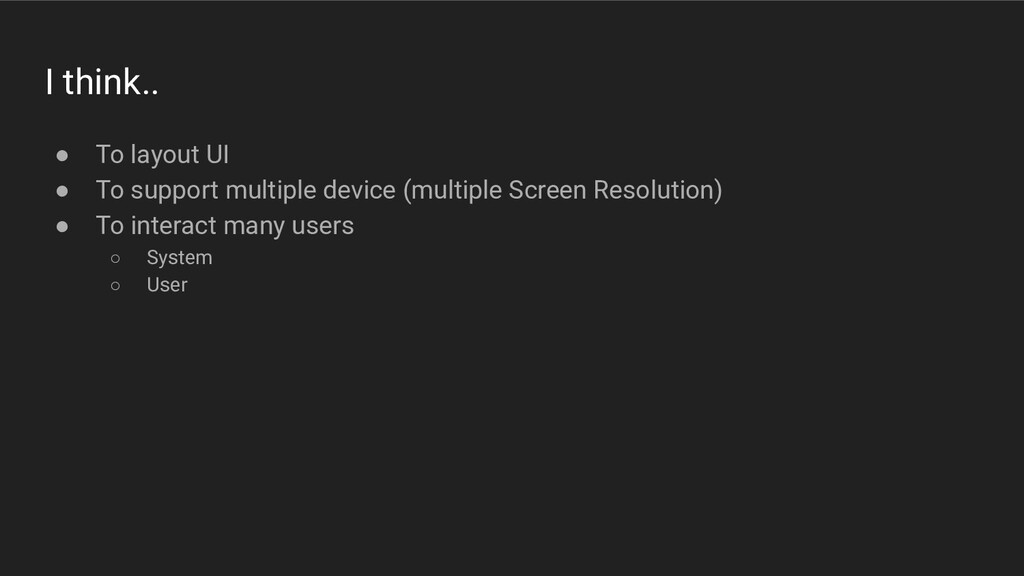
  1. I think.. • To layout UI • To support multiple

    device (multiple Screen Resolution) • To interact many users ◦ System ◦ User
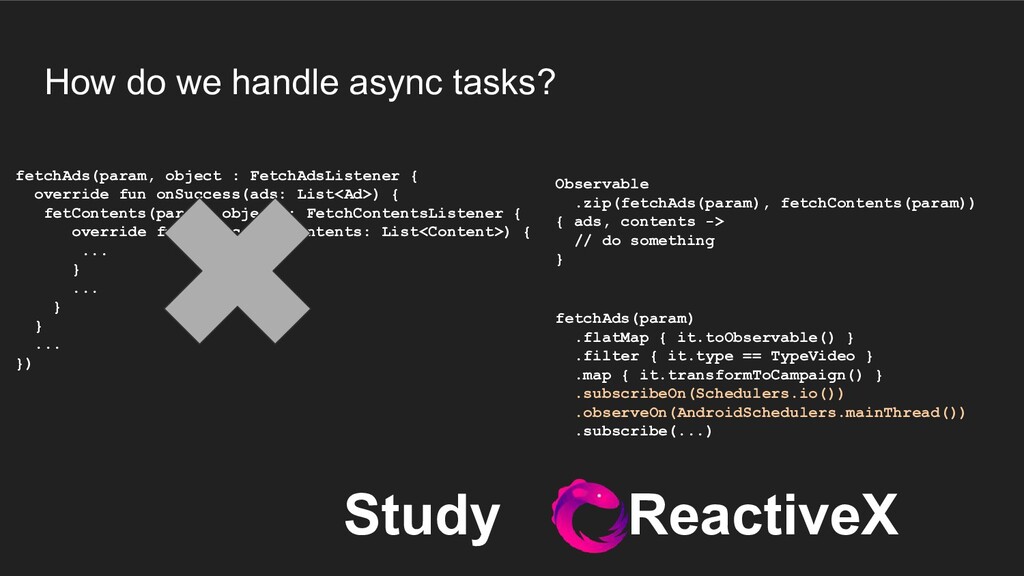
  2. How do we handle async tasks? fetchAds(param, object : FetchAdsListener

    { override fun onSuccess(ads: List<Ad>) { fetContents(param, object : FetchContentsListener { override fun onSuccess(contents: List<Content>) { ... } ... } } ... }) Observable .zip(fetchAds(param), fetchContents(param)) { ads, contents -> // do something } fetchAds(param) .flatMap { it.toObservable() } .filter { it.type == TypeVideo } .map { it.transformToCampaign() } .subscribeOn(Schedulers.io()) .observeOn(AndroidSchedulers.mainThread()) .subscribe(...) Study ReactiveX
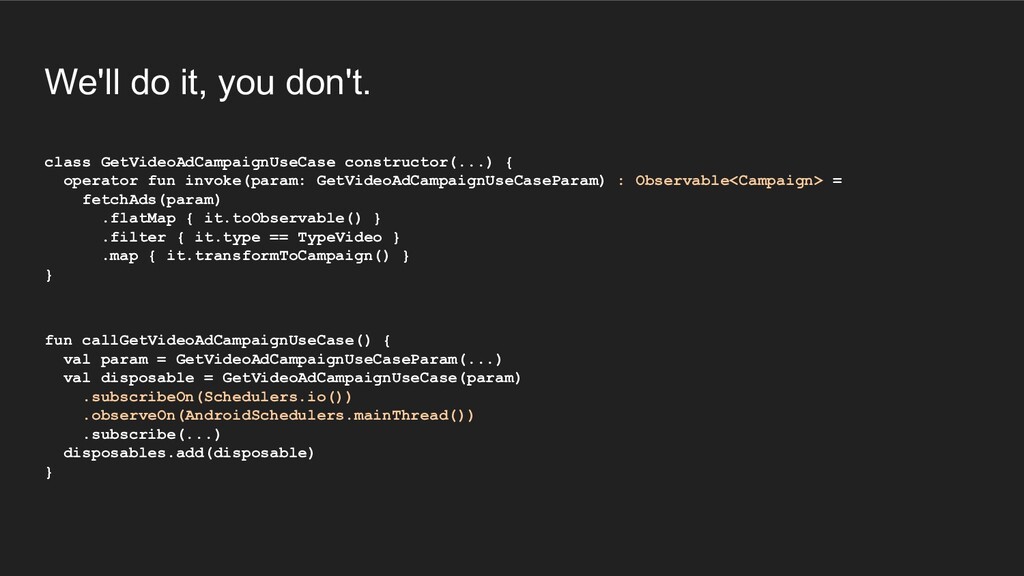
  3. We'll do it, you don't. class GetVideoAdCampaignUseCase constructor(...) { operator

    fun invoke(param: GetVideoAdCampaignUseCaseParam) : Observable<Campaign> = fetchAds(param) .flatMap { it.toObservable() } .filter { it.type == TypeVideo } .map { it.transformToCampaign() } } fun callGetVideoAdCampaignUseCase() { val param = GetVideoAdCampaignUseCaseParam(...) val disposable = GetVideoAdCampaignUseCase(param) .subscribeOn(Schedulers.io()) .observeOn(AndroidSchedulers.mainThread()) .subscribe(...) disposables.add(disposable) }
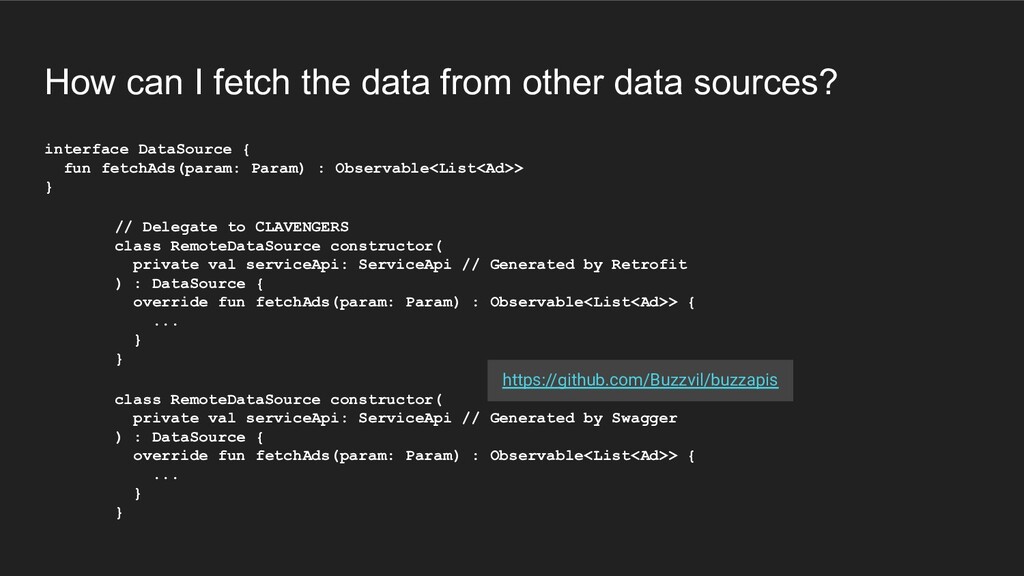
  4. How can I fetch the data from other data sources?

    interface DataSource { fun fetchAds(param: Param) : Observable<List<Ad>> } // Delegate to CLAVENGERS class RemoteDataSource constructor( private val serviceApi: ServiceApi // Generated by Retrofit ) : DataSource { override fun fetchAds(param: Param) : Observable<List<Ad>> { ... } } class RemoteDataSource constructor( private val serviceApi: ServiceApi // Generated by Swagger ) : DataSource { override fun fetchAds(param: Param) : Observable<List<Ad>> { ... } } https://github.com/Buzzvil/buzzapis
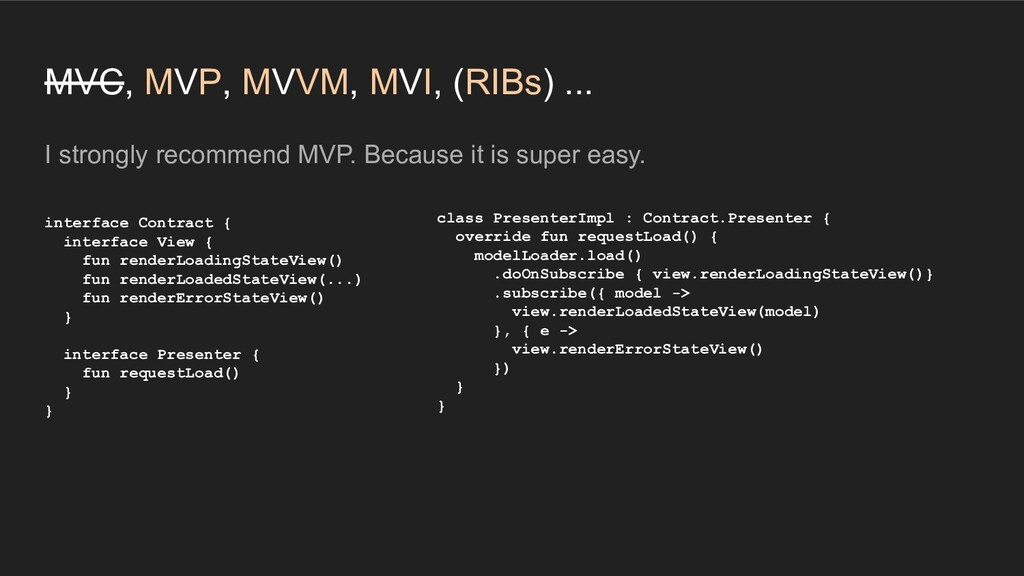
  5. MVC, MVP, MVVM, MVI, (RIBs) ... I strongly recommend MVP.

    Because it is super easy. interface Contract { interface View { fun renderLoadingStateView() fun renderLoadedStateView(...) fun renderErrorStateView() } interface Presenter { fun requestLoad() } } class PresenterImpl : Contract.Presenter { override fun requestLoad() { modelLoader.load() .doOnSubscribe { view.renderLoadingStateView()} .subscribe({ model -> view.renderLoadedStateView(model) }, { e -> view.renderErrorStateView() }) } }
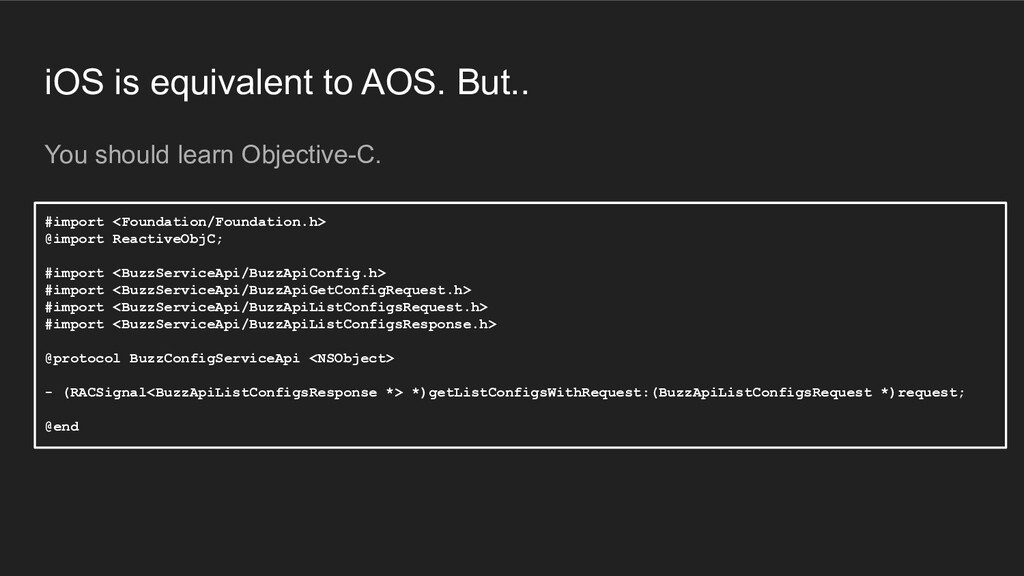
  6. iOS is equivalent to AOS. But.. You should learn Objective-C.

    #import <Foundation/Foundation.h> @import ReactiveObjC; #import <BuzzServiceApi/BuzzApiConfig.h> #import <BuzzServiceApi/BuzzApiGetConfigRequest.h> #import <BuzzServiceApi/BuzzApiListConfigsRequest.h> #import <BuzzServiceApi/BuzzApiListConfigsResponse.h> @protocol BuzzConfigServiceApi <NSObject> - (RACSignal<BuzzApiListConfigsResponse *> *)getListConfigsWithRequest:(BuzzApiListConfigsRequest *)request; @end
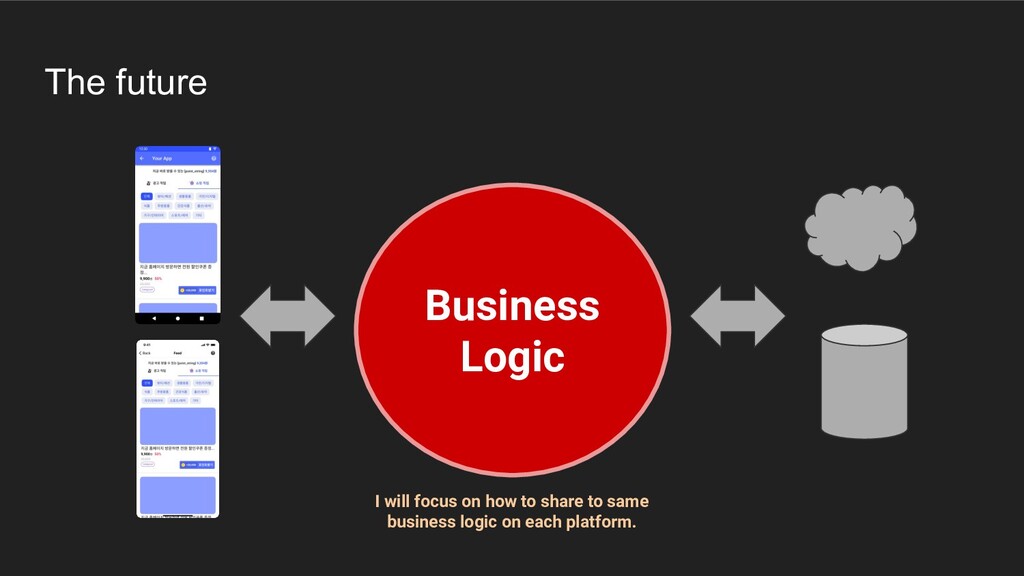
  7. The future Business Logic I will focus on how to

    share to same business logic on each platform.
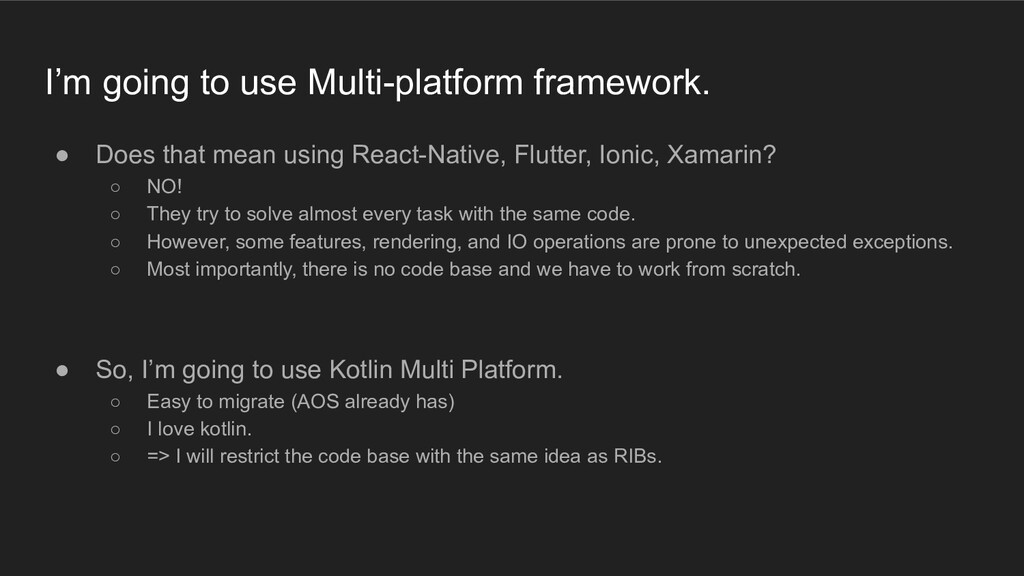
  8. I’m going to use Multi-platform framework. • Does that mean

    using React-Native, Flutter, Ionic, Xamarin? ◦ NO! ◦ They try to solve almost every task with the same code. ◦ However, some features, rendering, and IO operations are prone to unexpected exceptions. ◦ Most importantly, there is no code base and we have to work from scratch. • So, I’m going to use Kotlin Multi Platform. ◦ Easy to migrate (AOS already has) ◦ I love kotlin. ◦ => I will restrict the code base with the same idea as RIBs.
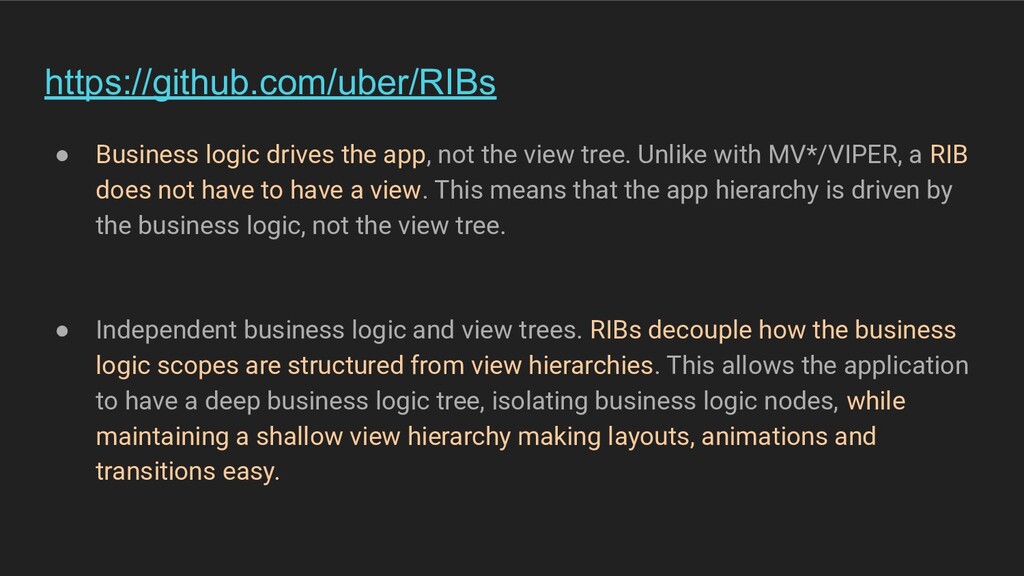
  9. https://github.com/uber/RIBs • Business logic drives the app, not the view

    tree. Unlike with MV*/VIPER, a RIB does not have to have a view. This means that the app hierarchy is driven by the business logic, not the view tree. • Independent business logic and view trees. RIBs decouple how the business logic scopes are structured from view hierarchies. This allows the application to have a deep business logic tree, isolating business logic nodes, while maintaining a shallow view hierarchy making layouts, animations and transitions easy.