Upgrade to Pro — share decks privately, control downloads, hide ads and more …

Consuming APIs for Fun and Profit

Sponsored · SiteGround - Reliable hosting with speed, security, and support you can count on.
Avatar for Carly Ho Carly Ho
November 13, 2018

Consuming APIs for Fun and Profit

Application Programming Interfaces, or APIs, are a great way to bring more data into your app or transform the data you already have by connecting it to other services—and a great way to get more people to engage with your application if you build one yourself. A whirlwind tour of some ways to get data from some well-documented sources, some tools to help build an API or proof-of-concept very quickly, and how to get data from a site that doesn't have its own API.

Avatar for Carly Ho

Carly Ho

November 13, 2018
Tweet

More Decks by Carly Ho

Other Decks in Technology

Transcript

  1. ﹡ Application Programming Interface ﹡ A way to programmatically retrieve

    data for display, transformation, etc. ﹡ Usually accessed via an endpoint URL ﹡ Usually returns data in JSON format W ' API
  2. H API ? ﹡ In PHP, we have file_get_contents and

    the native cURL ("client URL") implementation ﹡ We can also use Javascript in any page to perform API calls on particular browser events
  3. ⚠ A W f W ⚠ ﹡ There is danger

    inherent to getting data from a third party ﹡ External servers might be compromised unexpectedly ﹡ Sanitize data like you would your form inputs!
  4. G API D ﹡ The easiest way is to use

    file_get_contents('https://your-url.com /'), which, when returned to a variable, will fetch the contents ﹡ However, it'll be a string, rather than an object we can use
  5. JSON H P I ﹡ JSON (JavaScript Object Notation) is

    the format for most API data ﹡ When we use JavaScript to fetch API data, it can usually use it right away, but in PHP, whether we use file_get_contents or cURL we need to parse it ﹡ json_decode($string, true) turns the string into a JSON object.
  6. API K /T ? ﹡ An API might tell you

    that you need a key or a key and token to use it. ﹡ API keys are unique to accounts to determine sans credentials who's using the account for security or account privilege purposes ﹡ Tokens are generally application specific and paired with a key
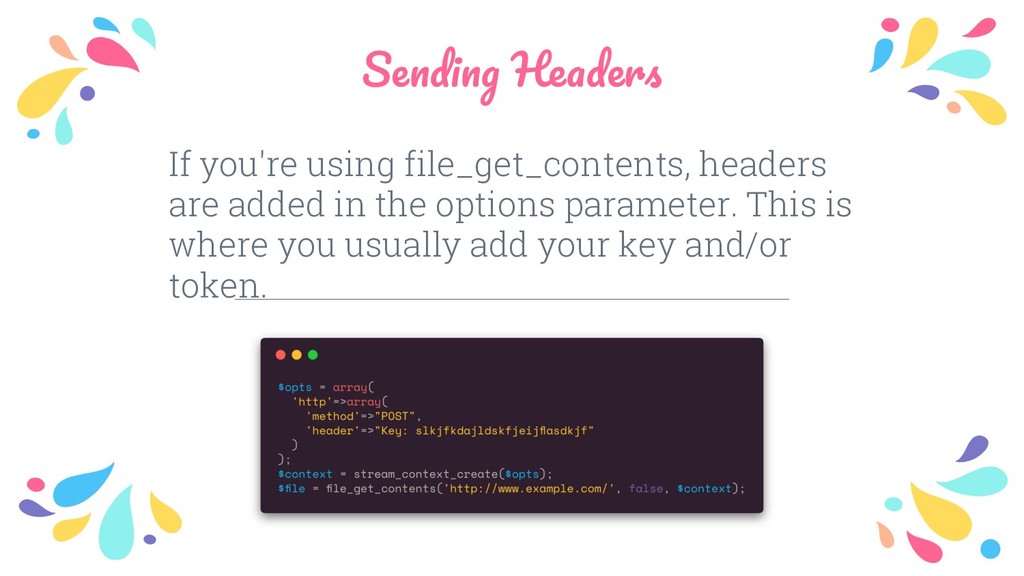
  7. S H If you're using file_get_contents, headers are added in

    the options parameter. This is where you usually add your key and/or token.
  8. W P ﹡ If you have a big spreadsheet or

    CSV but not time to DIY an application from scratch ﹡ Say, if you want to build some interactive charts on a webpage from spreadsheet data
  9. P T ﹡ Google Sheets has its own API https://developers.google.com/sheets/api/

    ﹡ Airtable a hosted database application that allows API access https://airtable.com
  10. W H API? ﹡ Gets people to engage with your

    application ﹡ You may want to access some of your data asynchronously from within the application ﹡ Building mobile apps
  11. W Y N ﹡ A database of information you want

    to access in whole or in part ﹡ A publicly-accessible PHP file that you can point requests to (that's it!)
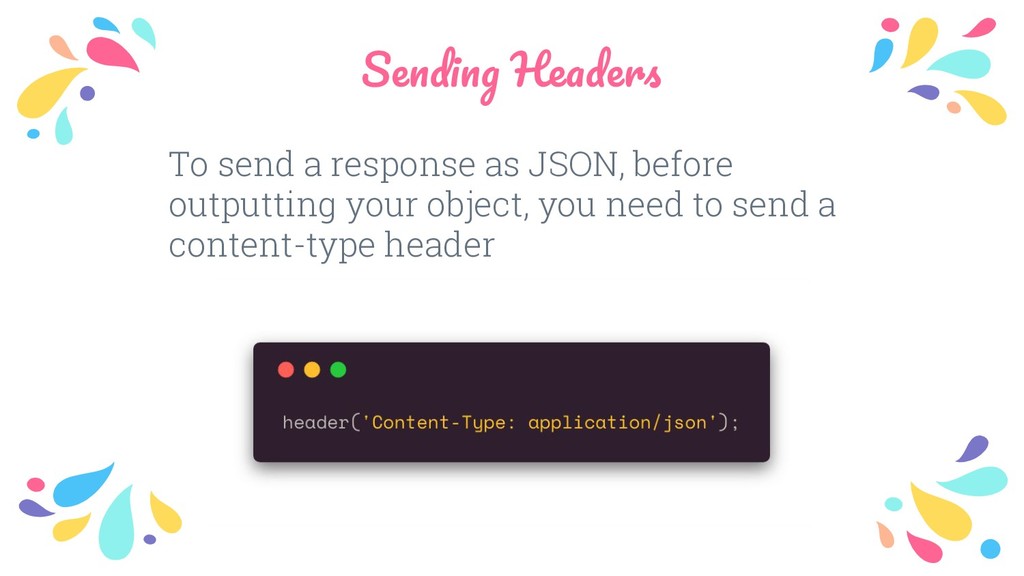
  12. S H To send a response as JSON, before outputting

    your object, you need to send a content-type header
  13. R JSON If your data can be put into an

    array or object, you can pass it through the json_encode function and echo the result after the header. If your content isn't conveniently available in that form, you can also manually format it: https://en.wikipedia.org/wiki/JSON#Data_types,_syntax _and_example
  14. H I API K ﹡ Each key should be unique

    ﹡ Store keys in user records and query for a match ﹡ You can do this manually for small applications, or automatically on account creation ﹡ An API key is like a password, so it should be possible to issue a new one
  15. T E f P API ﹡ Big tech companies keep

    deprecating APIs. Why? ﹡ To force traffic into their own channels ﹡ To prevent users from getting around ads ﹡ In response to security holes being discovered
  16. W S ﹡ Gets the content of an HTML page

    and parses it as XML nodes ﹡ Classes such as DOMDocument can navigate these nodes and return the content you want ﹡ More laborious and less reliable (esp. since page layouts can change)
  17. ⚠ M W ⚠ ﹡ This might be against the

    terms of service of a website ﹡ This can also be kind of rude if you're using up all of a site's bandwidth by scraping the content ﹡ You might get rate-limited or your script may get blocked, or your account might get suspended
  18. C J ﹡ Polite way to fetch data: on specified

    intervals, rather than than on page load ﹡ The crontab ("cron table") runs programs on scheduled intervals (see crontab.guru for formatting help) ﹡ You can use the scheduler to import data to a database by script a few times a day so you don't overload services
  19. N I S ﹡ This is not a solution for

    a production application ﹡ If a site you use doesn't have a public API, consider getting in touch to ask if that's on the roadmap or could be ﹡ If it's an open-source project, consider putting in a pull request to add API support