Phone: +61 491 128 767 Email: [email protected] / [email protected] Semester 2: Physics ½ Advanced Force Resolution, Connected Bodies, and Inclined Planes [2.4] Weekly Booklet Tutor Copy Outline: The Tension Force and Connected Bodies Strings and ropes pull, never push The tension force ISOLATION More than two connected bodies Connected bodies without strings Pulleys and Atwood Machines Tension is the same Simple Atwood machine Half Atwood machine 2D Force Resolution Perpendicular vectors are independent 2D problems can be split into two separate 1D problems Resolving vectors in 2D using trigonometry Adding and subtracting vectors in 2D Inclined Planes Perpendicular vectors are independent Objects only move parallel to incline Inclined planes force resolution Advanced Inclined Planes With friction Static objects with applied force Connected bodies on inclined planes Key Takeaways for Connected Bodies, Pulleys, Atwood Machines,and Inclined Planes Practice Questions Relevant Constants: 𝒈 = 𝟗. 𝟖 𝒎𝒔−𝟐 = 𝟗. 𝟖 𝑵 𝒌𝒈−𝟏
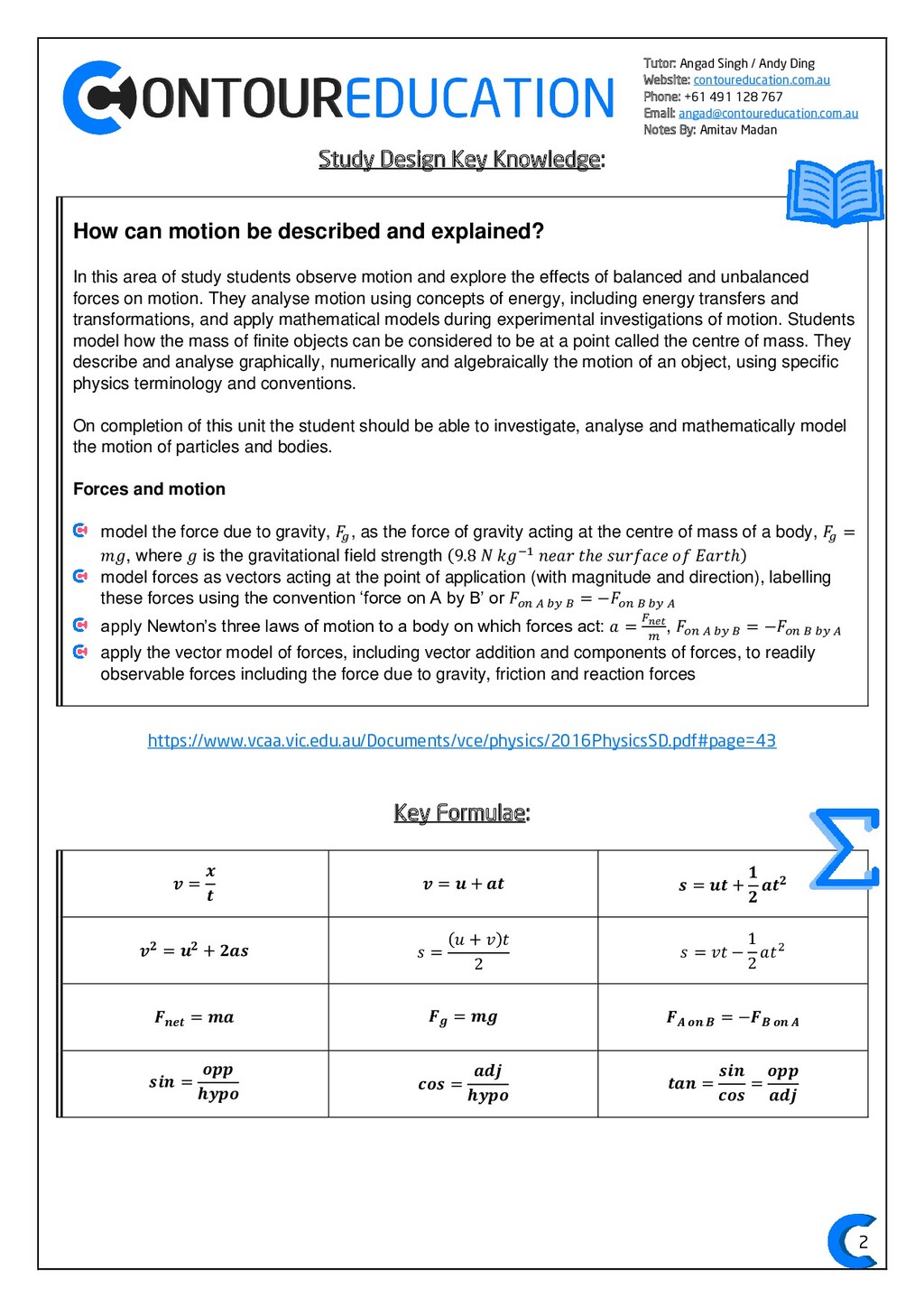
491 128 767 Email: [email protected] Notes By: Amitav Madan 2 Study Design Key Knowledge: How can motion be described and explained? In this area of study students observe motion and explore the effects of balanced and unbalanced forces on motion. They analyse motion using concepts of energy, including energy transfers and transformations, and apply mathematical models during experimental investigations of motion. Students model how the mass of finite objects can be considered to be at a point called the centre of mass. They describe and analyse graphically, numerically and algebraically the motion of an object, using specific physics terminology and conventions. On completion of this unit the student should be able to investigate, analyse and mathematically model the motion of particles and bodies. Forces and motion model the force due to gravity, 𝐹 𝑔, as the force of gravity acting at the centre of mass of a body, 𝐹 𝑔 = 𝑚𝑔, where 𝑔 is the gravitational field strength (9.8 𝑁 𝑘𝑔−1 𝑛𝑒𝑎𝑟 𝑡ℎ𝑒 𝑠𝑢𝑟𝑓𝑎𝑐𝑒 𝑜𝑓 𝐸𝑎𝑟𝑡ℎ) model forces as vectors acting at the point of application (with magnitude and direction), labelling these forces using the convention ‘force on A by B’ or 𝐹𝑜𝑛 𝐴 𝑏𝑦 𝐵 = −𝐹𝑜𝑛 𝐵 𝑏𝑦 𝐴 apply Newton’s three laws of motion to a body on which forces act: 𝑎 = 𝐹𝑛𝑒𝑡 𝑚 , 𝐹𝑜𝑛 𝐴 𝑏𝑦 𝐵 = −𝐹𝑜𝑛 𝐵 𝑏𝑦 𝐴 apply the vector model of forces, including vector addition and components of forces, to readily observable forces including the force due to gravity, friction and reaction forces https://www.vcaa.vic.edu.au/Documents/vce/physics/2016PhysicsSD.pdf#page=43 Key Formulae: 𝒗 = 𝒙 𝒕 𝒗 = 𝒖 + 𝒂𝒕 𝒔 = 𝒖𝒕 + 𝟏 𝟐 𝒂𝒕𝟐 𝒗𝟐 = 𝒖𝟐 + 𝟐𝒂𝒔 𝑠 = (𝑢 + 𝑣)𝑡 2 𝑠 = 𝑣𝑡 − 1 2 𝑎𝑡2 𝑭𝒏𝒆𝒕 = 𝒎𝒂 𝑭𝒈 = 𝒎𝒈 𝑭𝑨 𝒐𝒏 𝑩 = −𝑭𝑩 𝒐𝒏 𝑨 𝒔𝒊𝒏 = 𝒐𝒑𝒑 𝒉𝒚𝒑𝒐 𝒄𝒐𝒔 = 𝒂𝒅𝒋 𝒉𝒚𝒑𝒐 𝒕𝒂𝒏 = 𝒔𝒊𝒏 𝒄𝒐𝒔 = 𝒐𝒑𝒑 𝒂𝒅𝒋
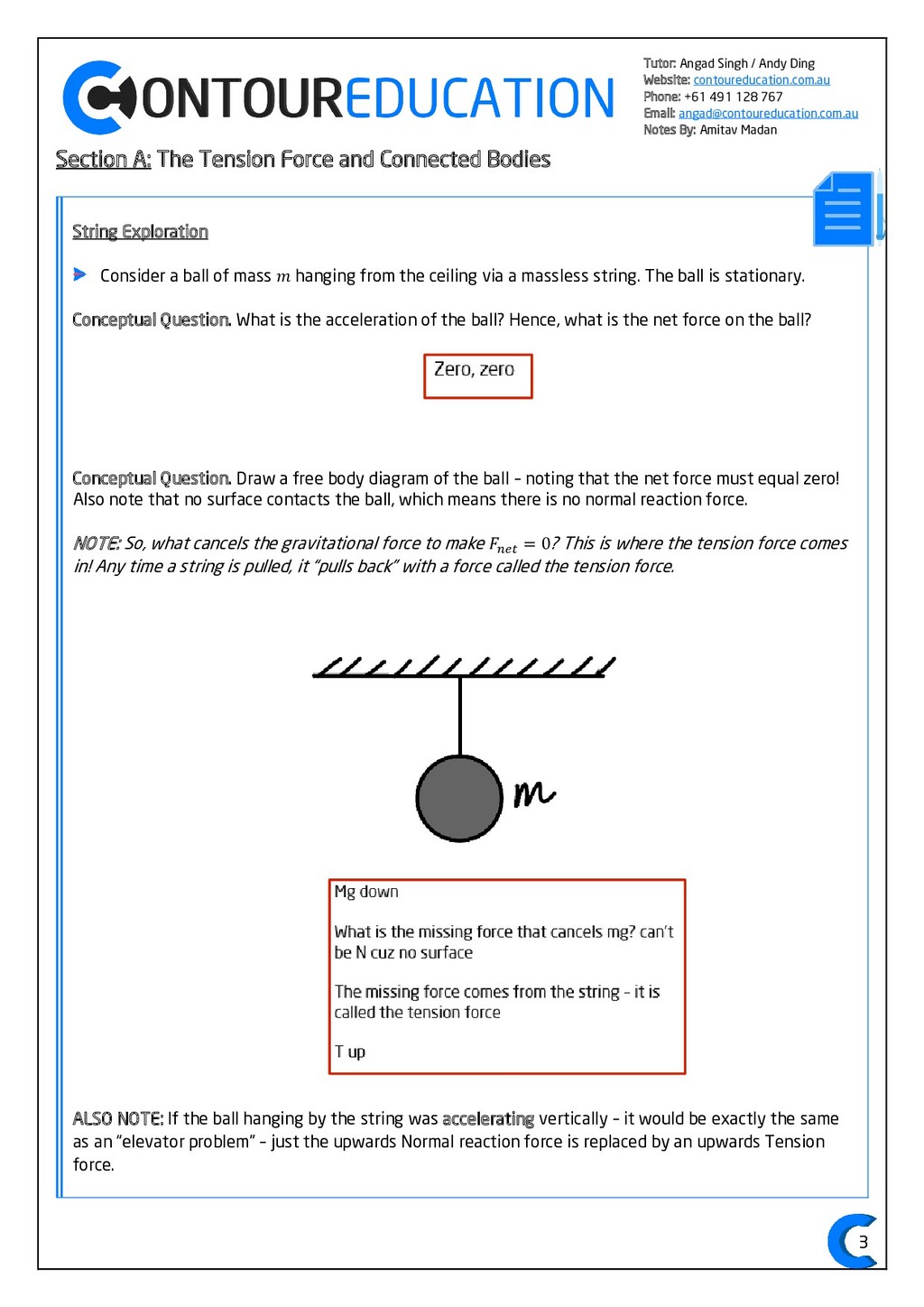
491 128 767 Email: [email protected] Notes By: Amitav Madan 3 Section A: The Tension Force and Connected Bodies String Exploration Consider a ball of mass 𝑚 hanging from the ceiling via a massless string. The ball is stationary. Conceptual Question. What is the acceleration of the ball? Hence, what is the net force on the ball? Conceptual Question. Draw a free body diagram of the ball – noting that the net force must equal zero! Also note that no surface contacts the ball, which means there is no normal reaction force. NOTE: So, what cancels the gravitational force to make 𝐹𝑛𝑒𝑡 = 0? This is where the tension force comes in! Any time a string is pulled, it “pulls back” with a force called the tension force. ALSO NOTE: If the ball hanging by the string was accelerating vertically – it would be exactly the same as an “elevator problem” – just the upwards Normal reaction force is replaced by an upwards Tension force.
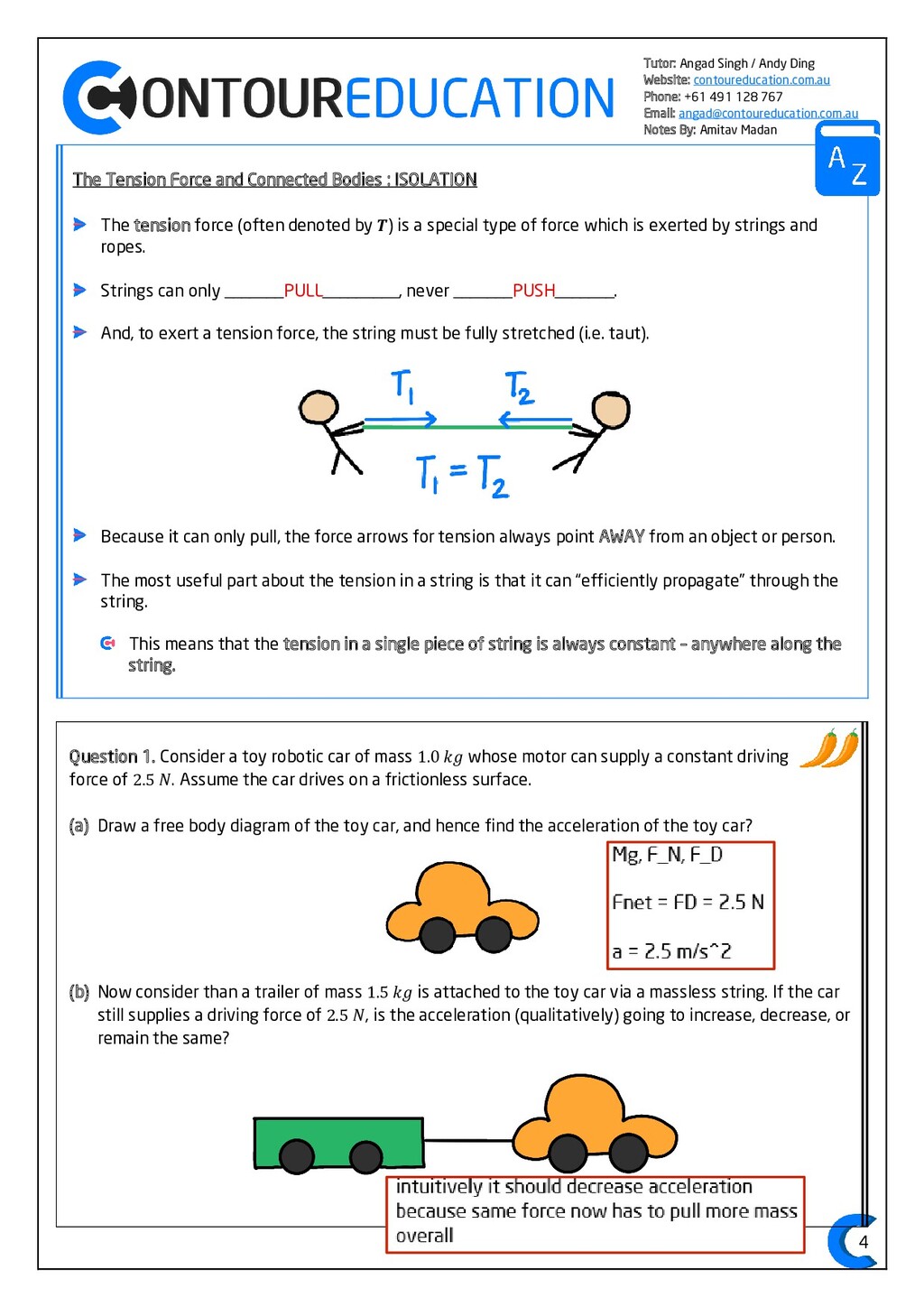
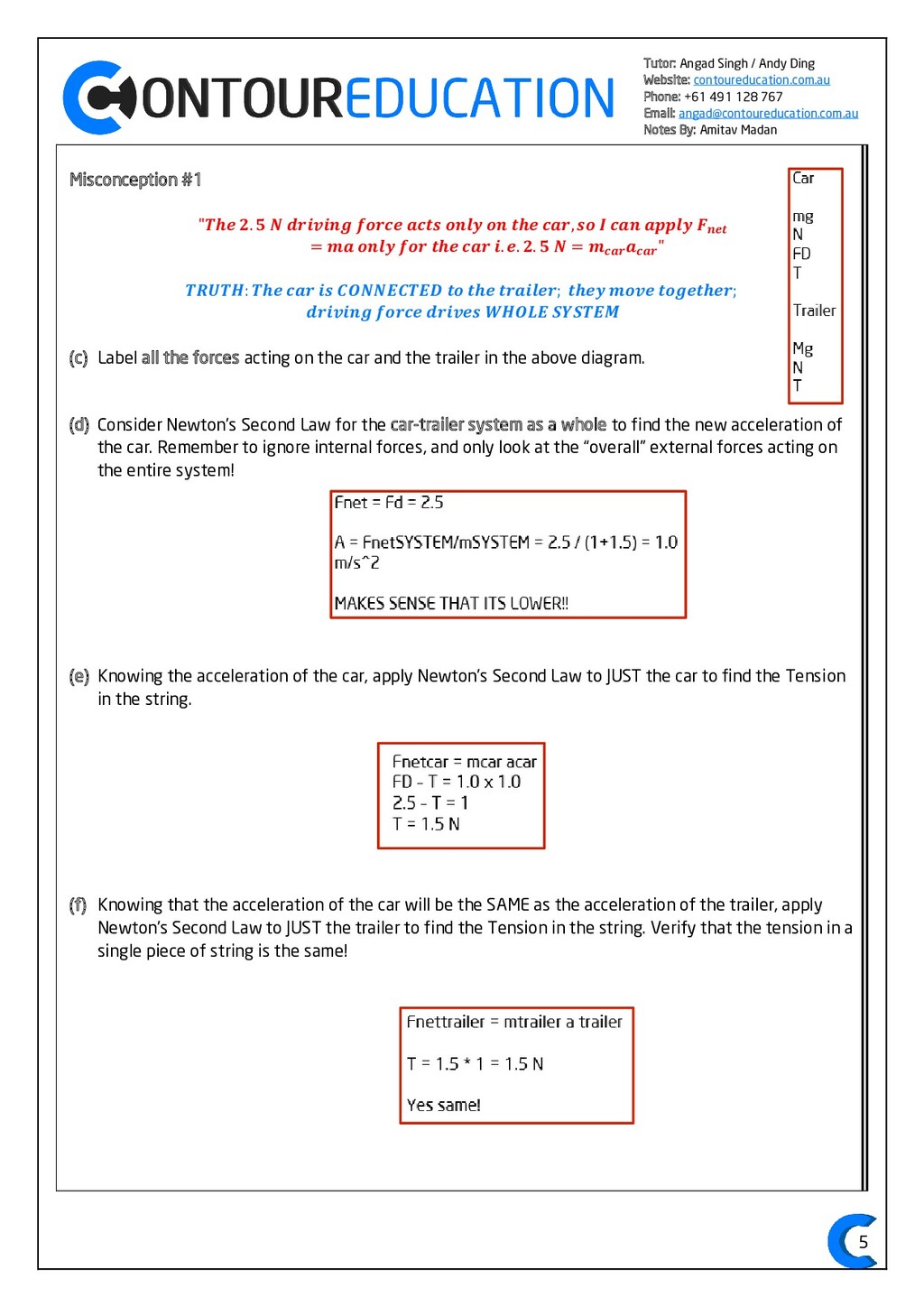
491 128 767 Email: [email protected] Notes By: Amitav Madan 4 The Tension Force and Connected Bodies : ISOLATION The tension force (often denoted by 𝑻) is a special type of force which is exerted by strings and ropes. Strings can only _______PULL_________, never _______PUSH_______. And, to exert a tension force, the string must be fully stretched (i.e. taut). Because it can only pull, the force arrows for tension always point AWAY from an object or person. The most useful part about the tension in a string is that it can “efficiently propagate” through the string. This means that the tension in a single piece of string is always constant – anywhere along the string. Question 1. Consider a toy robotic car of mass 1.0 𝑘𝑔 whose motor can supply a constant driving force of 2.5 𝑁. Assume the car drives on a frictionless surface. (a) Draw a free body diagram of the toy car, and hence find the acceleration of the toy car? (b) Now consider than a trailer of mass 1.5 𝑘𝑔 is attached to the toy car via a massless string. If the car still supplies a driving force of 2.5 𝑁, is the acceleration (qualitatively) going to increase, decrease, or remain the same?
491 128 767 Email: [email protected] Notes By: Amitav Madan 5 Misconception #1 "𝑻𝒉𝒆 𝟐. 𝟓 𝑵 𝒅𝒓𝒊𝒗𝒊𝒏𝒈 𝒇𝒐𝒓𝒄𝒆 𝒂𝒄𝒕𝒔 𝒐𝒏𝒍𝒚 𝒐𝒏 𝒕𝒉𝒆 𝒄𝒂𝒓, 𝒔𝒐 𝑰 𝒄𝒂𝒏 𝒂𝒑𝒑𝒍𝒚 𝑭𝒏𝒆𝒕 = 𝒎𝒂 𝒐𝒏𝒍𝒚 𝒇𝒐𝒓 𝒕𝒉𝒆 𝒄𝒂𝒓 𝒊. 𝒆. 𝟐. 𝟓 𝑵 = 𝒎𝒄𝒂𝒓 𝒂𝒄𝒂𝒓 " 𝑻𝑹𝑼𝑻𝑯: 𝑻𝒉𝒆 𝒄𝒂𝒓 𝒊𝒔 𝑪𝑶𝑵𝑵𝑬𝑪𝑻𝑬𝑫 𝒕𝒐 𝒕𝒉𝒆 𝒕𝒓𝒂𝒊𝒍𝒆𝒓; 𝒕𝒉𝒆𝒚 𝒎𝒐𝒗𝒆 𝒕𝒐𝒈𝒆𝒕𝒉𝒆𝒓; 𝒅𝒓𝒊𝒗𝒊𝒏𝒈 𝒇𝒐𝒓𝒄𝒆 𝒅𝒓𝒊𝒗𝒆𝒔 𝑾𝑯𝑶𝑳𝑬 𝑺𝒀𝑺𝑻𝑬𝑴 (c) Label all the forces acting on the car and the trailer in the above diagram. (d) Consider Newton’s Second Law for the car-trailer system as a whole to find the new acceleration of the car. Remember to ignore internal forces, and only look at the “overall” external forces acting on the entire system! (e) Knowing the acceleration of the car, apply Newton’s Second Law to JUST the car to find the Tension in the string. (f) Knowing that the acceleration of the car will be the SAME as the acceleration of the trailer, apply Newton’s Second Law to JUST the trailer to find the Tension in the string. Verify that the tension in a single piece of string is the same!
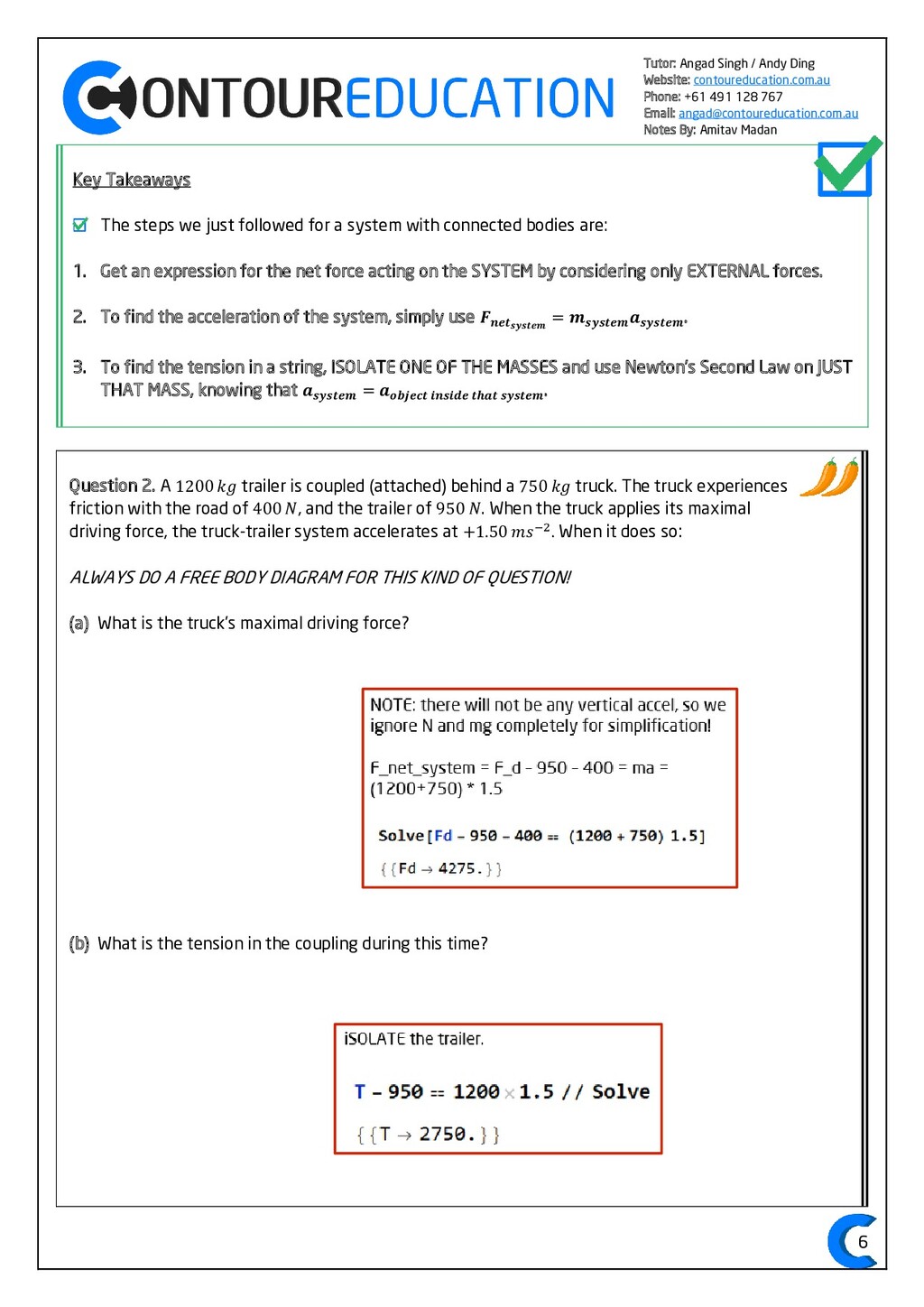
491 128 767 Email: [email protected] Notes By: Amitav Madan 6 Key Takeaways The steps we just followed for a system with connected bodies are: 1. Get an expression for the net force acting on the SYSTEM by considering only EXTERNAL forces. 2. To find the acceleration of the system, simply use 𝑭𝒏𝒆𝒕𝒔𝒚𝒔𝒕𝒆𝒎 = 𝒎𝒔𝒚𝒔𝒕𝒆𝒎 𝒂𝒔𝒚𝒔𝒕𝒆𝒎 . 3. To find the tension in a string, ISOLATE ONE OF THE MASSES and use Newton’s Second Law on JUST THAT MASS, knowing that 𝒂𝒔𝒚𝒔𝒕𝒆𝒎 = 𝒂𝒐𝒃𝒋𝒆𝒄𝒕 𝒊𝒏𝒔𝒊𝒅𝒆 𝒕𝒉𝒂𝒕 𝒔𝒚𝒔𝒕𝒆𝒎 . Question 2. A 1200 𝑘𝑔 trailer is coupled (attached) behind a 750 𝑘𝑔 truck. The truck experiences friction with the road of 400 𝑁, and the trailer of 950 𝑁. When the truck applies its maximal driving force, the truck-trailer system accelerates at +1.50 𝑚𝑠−2. When it does so: ALWAYS DO A FREE BODY DIAGRAM FOR THIS KIND OF QUESTION! (a) What is the truck’s maximal driving force? (b) What is the tension in the coupling during this time?
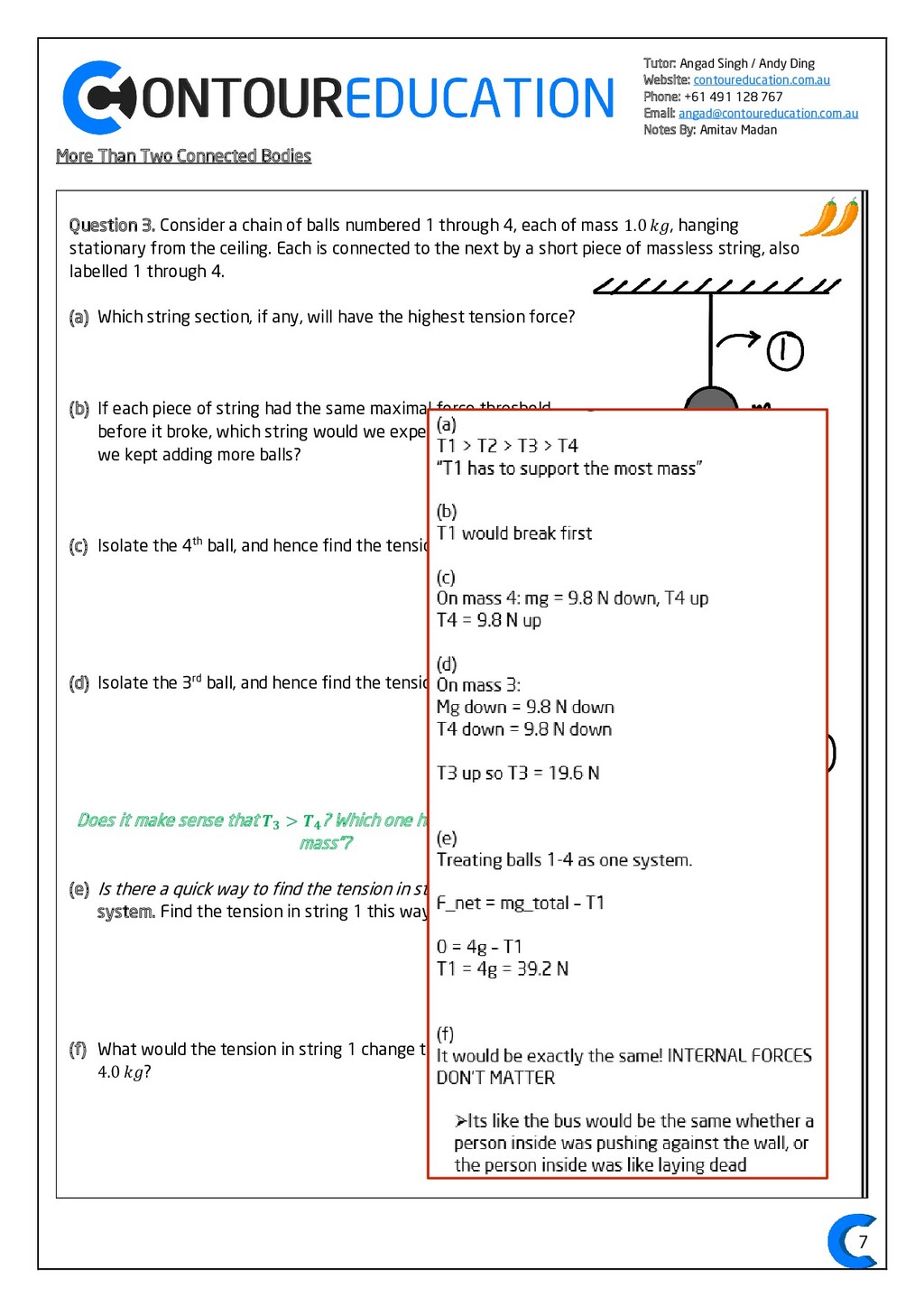
491 128 767 Email: [email protected] Notes By: Amitav Madan 7 More Than Two Connected Bodies Question 3. Consider a chain of balls numbered 1 through 4, each of mass 1.0 𝑘𝑔, hanging stationary from the ceiling. Each is connected to the next by a short piece of massless string, also labelled 1 through 4. (a) Which string section, if any, will have the highest tension force? (b) If each piece of string had the same maximal force threshold before it broke, which string would we expect to break first, if we kept adding more balls? (c) Isolate the 4th ball, and hence find the tension in string 4? (d) Isolate the 3rd ball, and hence find the tension in string 3? Does it make sense that 𝑻𝟑 > 𝑻𝟒 ? Which one has to “support more mass”? (e) Is there a quick way to find the tension in string 1? Yes! We can treat balls 1 through 4 as one system. Find the tension in string 1 this way! (f) What would the tension in string 1 change to, if the 4 balls were replaced by a single ball of mass 4.0 𝑘𝑔?
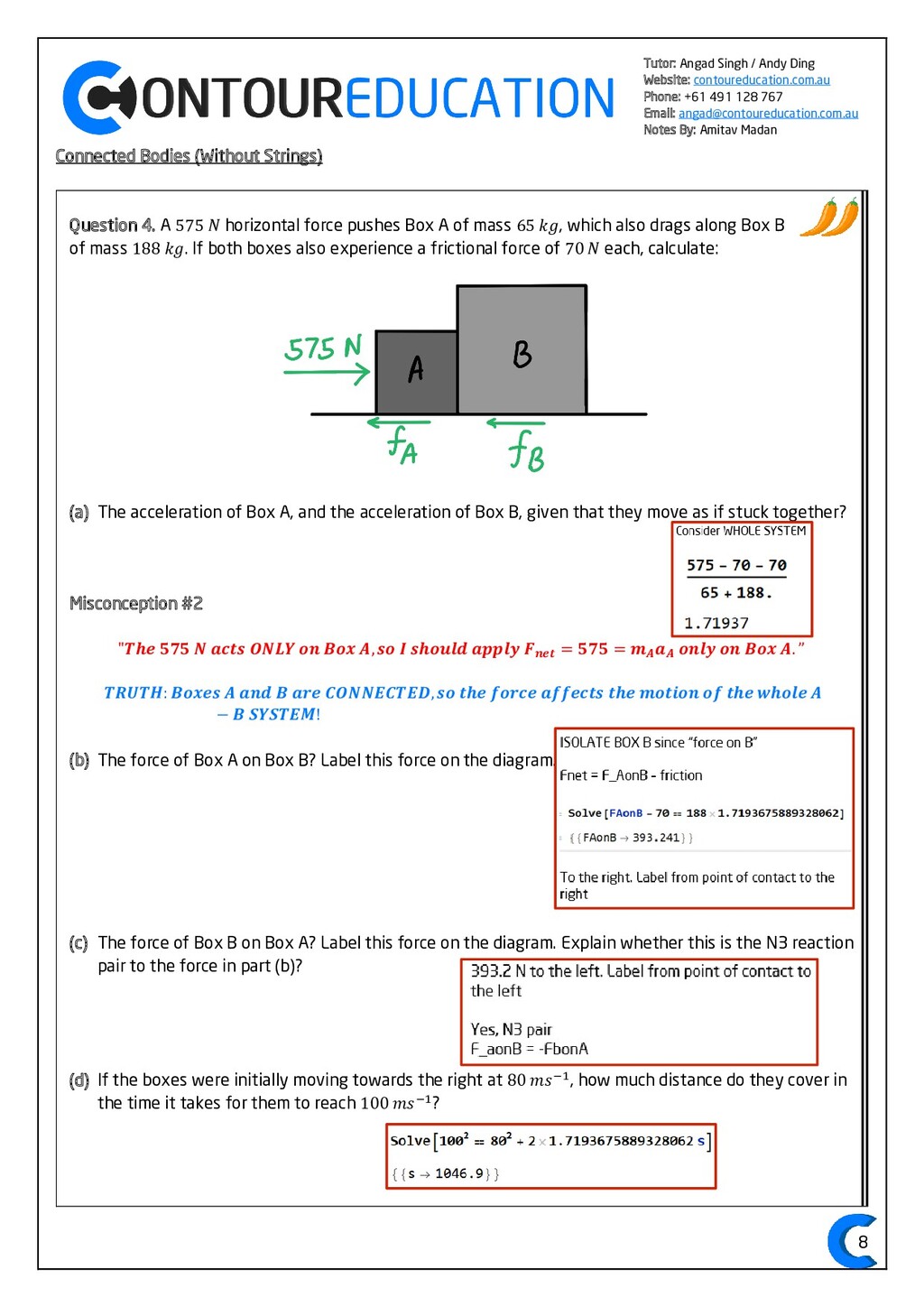
491 128 767 Email: [email protected] Notes By: Amitav Madan 8 Connected Bodies (Without Strings) Question 4. A 575 𝑁 horizontal force pushes Box A of mass 65 𝑘𝑔, which also drags along Box B of mass 188 𝑘𝑔. If both boxes also experience a frictional force of 70 𝑁 each, calculate: (a) The acceleration of Box A, and the acceleration of Box B, given that they move as if stuck together? Misconception #2 "𝑻𝒉𝒆 𝟓𝟕𝟓 𝑵 𝒂𝒄𝒕𝒔 𝑶𝑵𝑳𝒀 𝒐𝒏 𝑩𝒐𝒙 𝑨, 𝒔𝒐 𝑰 𝒔𝒉𝒐𝒖𝒍𝒅 𝒂𝒑𝒑𝒍𝒚 𝑭𝒏𝒆𝒕 = 𝟓𝟕𝟓 = 𝒎𝑨 𝒂𝑨 𝒐𝒏𝒍𝒚 𝒐𝒏 𝑩𝒐𝒙 𝑨. ” 𝑻𝑹𝑼𝑻𝑯: 𝑩𝒐𝒙𝒆𝒔 𝑨 𝒂𝒏𝒅 𝑩 𝒂𝒓𝒆 𝑪𝑶𝑵𝑵𝑬𝑪𝑻𝑬𝑫, 𝒔𝒐 𝒕𝒉𝒆 𝒇𝒐𝒓𝒄𝒆 𝒂𝒇𝒇𝒆𝒄𝒕𝒔 𝒕𝒉𝒆 𝒎𝒐𝒕𝒊𝒐𝒏 𝒐𝒇 𝒕𝒉𝒆 𝒘𝒉𝒐𝒍𝒆 𝑨 − 𝑩 𝑺𝒀𝑺𝑻𝑬𝑴! (b) The force of Box A on Box B? Label this force on the diagram. (c) The force of Box B on Box A? Label this force on the diagram. Explain whether this is the N3 reaction pair to the force in part (b)? (d) If the boxes were initially moving towards the right at 80 𝑚𝑠−1, how much distance do they cover in the time it takes for them to reach 100 𝑚𝑠−1?
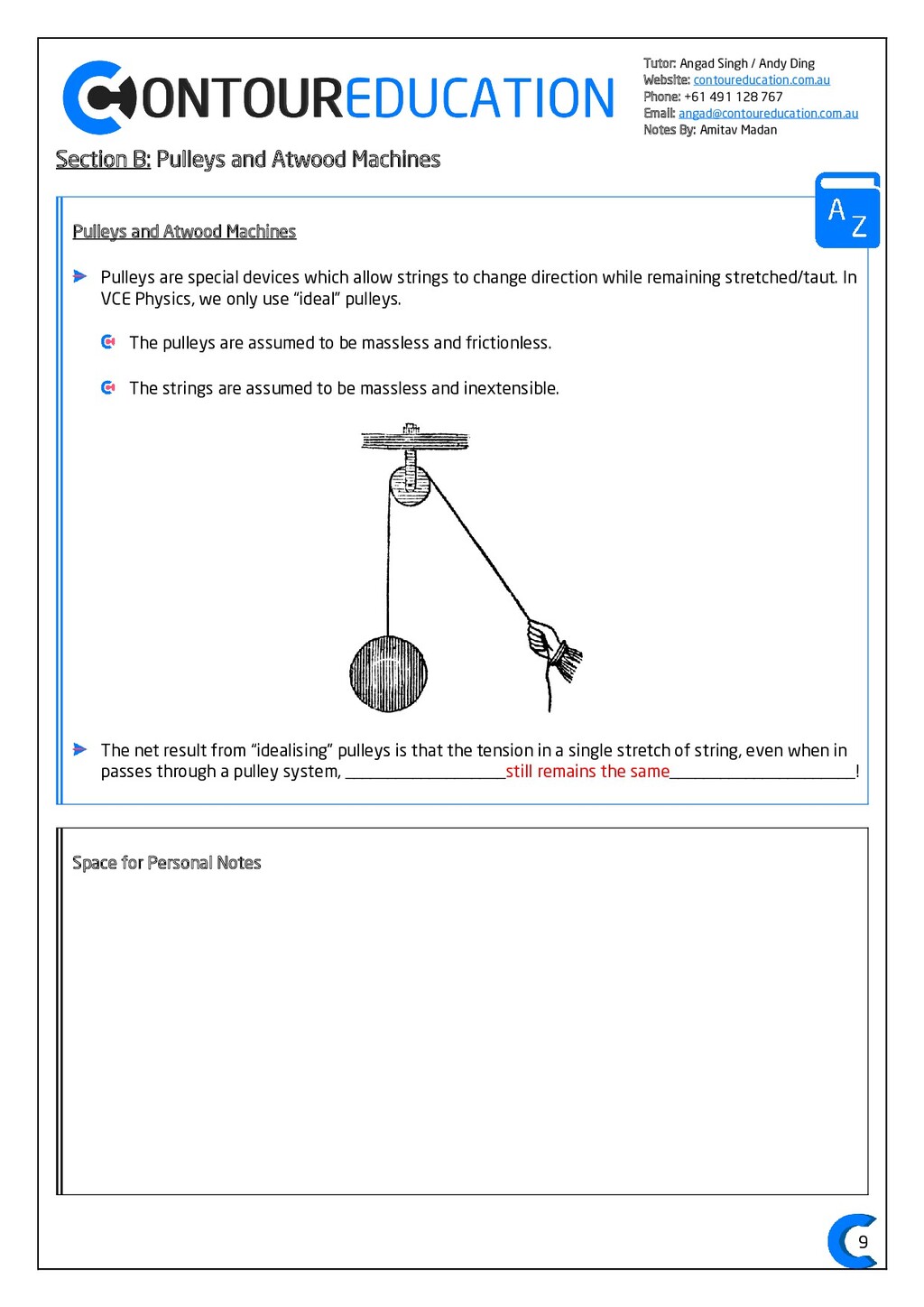
491 128 767 Email: [email protected] Notes By: Amitav Madan 9 Section B: Pulleys and Atwood Machines Pulleys and Atwood Machines Pulleys are special devices which allow strings to change direction while remaining stretched/taut. In VCE Physics, we only use “ideal” pulleys. The pulleys are assumed to be massless and frictionless. The strings are assumed to be massless and inextensible. The net result from “idealising” pulleys is that the tension in a single stretch of string, even when in passes through a pulley system, ___________________still remains the same______________________! Space for Personal Notes
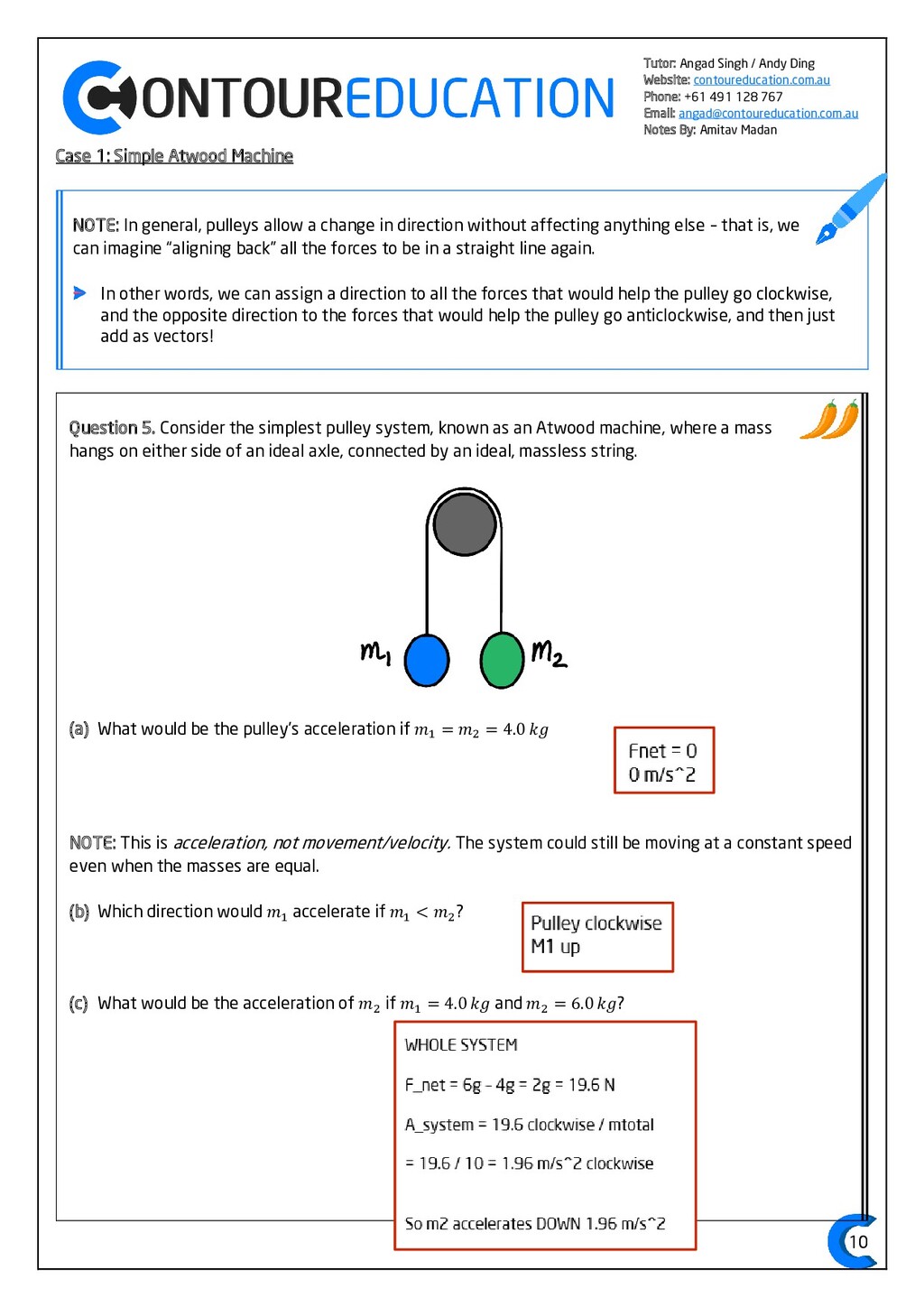
491 128 767 Email: [email protected] Notes By: Amitav Madan 10 Case 1: Simple Atwood Machine NOTE: In general, pulleys allow a change in direction without affecting anything else – that is, we can imagine “aligning back” all the forces to be in a straight line again. In other words, we can assign a direction to all the forces that would help the pulley go clockwise, and the opposite direction to the forces that would help the pulley go anticlockwise, and then just add as vectors! Question 5. Consider the simplest pulley system, known as an Atwood machine, where a mass hangs on either side of an ideal axle, connected by an ideal, massless string. (a) What would be the pulley’s acceleration if 𝑚1 = 𝑚2 = 4.0 𝑘𝑔 NOTE: This is acceleration, not movement/velocity. The system could still be moving at a constant speed even when the masses are equal. (b) Which direction would 𝑚1 accelerate if 𝑚1 < 𝑚2 ? (c) What would be the acceleration of 𝑚2 if 𝑚1 = 4.0 𝑘𝑔 and 𝑚2 = 6.0 𝑘𝑔?
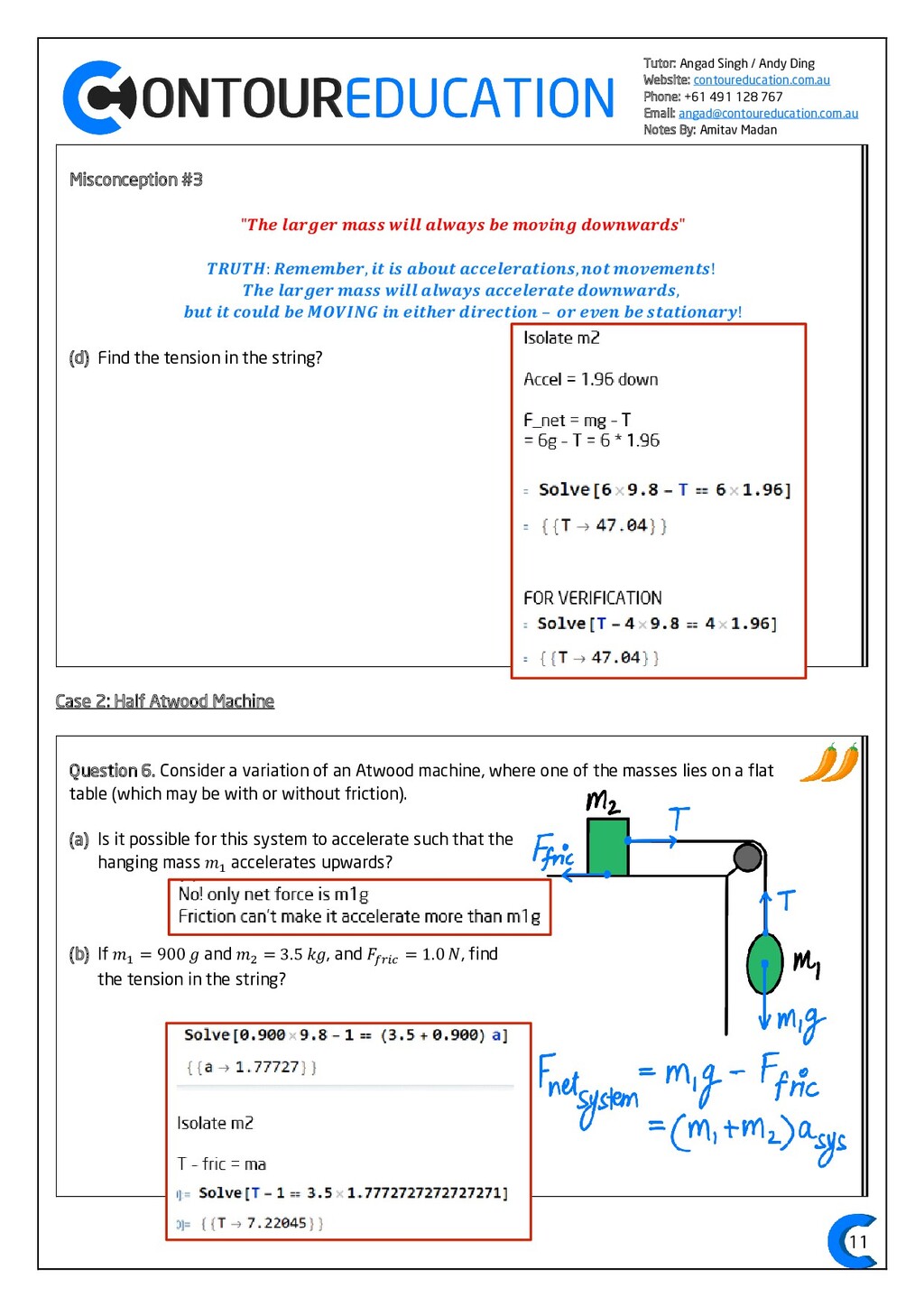
491 128 767 Email: [email protected] Notes By: Amitav Madan 11 Misconception #3 "𝑻𝒉𝒆 𝒍𝒂𝒓𝒈𝒆𝒓 𝒎𝒂𝒔𝒔 𝒘𝒊𝒍𝒍 𝒂𝒍𝒘𝒂𝒚𝒔 𝒃𝒆 𝒎𝒐𝒗𝒊𝒏𝒈 𝒅𝒐𝒘𝒏𝒘𝒂𝒓𝒅𝒔" 𝑻𝑹𝑼𝑻𝑯:𝑹𝒆𝒎𝒆𝒎𝒃𝒆𝒓, 𝒊𝒕 𝒊𝒔 𝒂𝒃𝒐𝒖𝒕 𝒂𝒄𝒄𝒆𝒍𝒆𝒓𝒂𝒕𝒊𝒐𝒏𝒔, 𝒏𝒐𝒕 𝒎𝒐𝒗𝒆𝒎𝒆𝒏𝒕𝒔! 𝑻𝒉𝒆 𝒍𝒂𝒓𝒈𝒆𝒓 𝒎𝒂𝒔𝒔 𝒘𝒊𝒍𝒍 𝒂𝒍𝒘𝒂𝒚𝒔 𝒂𝒄𝒄𝒆𝒍𝒆𝒓𝒂𝒕𝒆 𝒅𝒐𝒘𝒏𝒘𝒂𝒓𝒅𝒔, 𝒃𝒖𝒕 𝒊𝒕 𝒄𝒐𝒖𝒍𝒅 𝒃𝒆 𝑴𝑶𝑽𝑰𝑵𝑮 𝒊𝒏 𝒆𝒊𝒕𝒉𝒆𝒓 𝒅𝒊𝒓𝒆𝒄𝒕𝒊𝒐𝒏 – 𝒐𝒓 𝒆𝒗𝒆𝒏 𝒃𝒆 𝒔𝒕𝒂𝒕𝒊𝒐𝒏𝒂𝒓𝒚! (d) Find the tension in the string? Case 2: Half Atwood Machine Question 6. Consider a variation of an Atwood machine, where one of the masses lies on a flat table (which may be with or without friction). (a) Is it possible for this system to accelerate such that the hanging mass 𝑚1 accelerates upwards? (b) If 𝑚1 = 900 𝑔 and 𝑚2 = 3.5 𝑘𝑔, and 𝐹𝑓𝑟𝑖𝑐 = 1.0 𝑁, find the tension in the string?
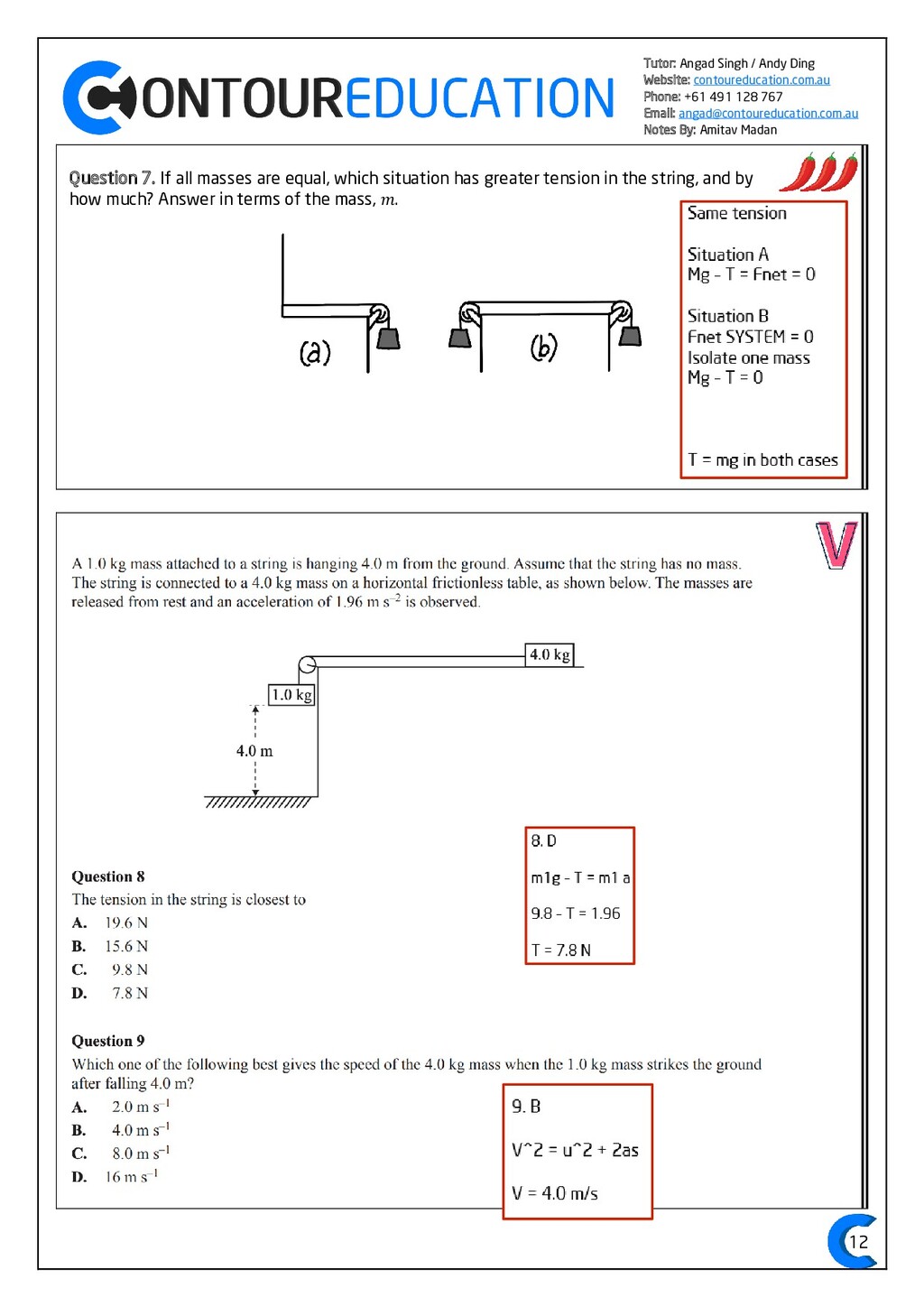
491 128 767 Email: [email protected] Notes By: Amitav Madan 12 Question 7. If all masses are equal, which situation has greater tension in the string, and by how much? Answer in terms of the mass, 𝑚.
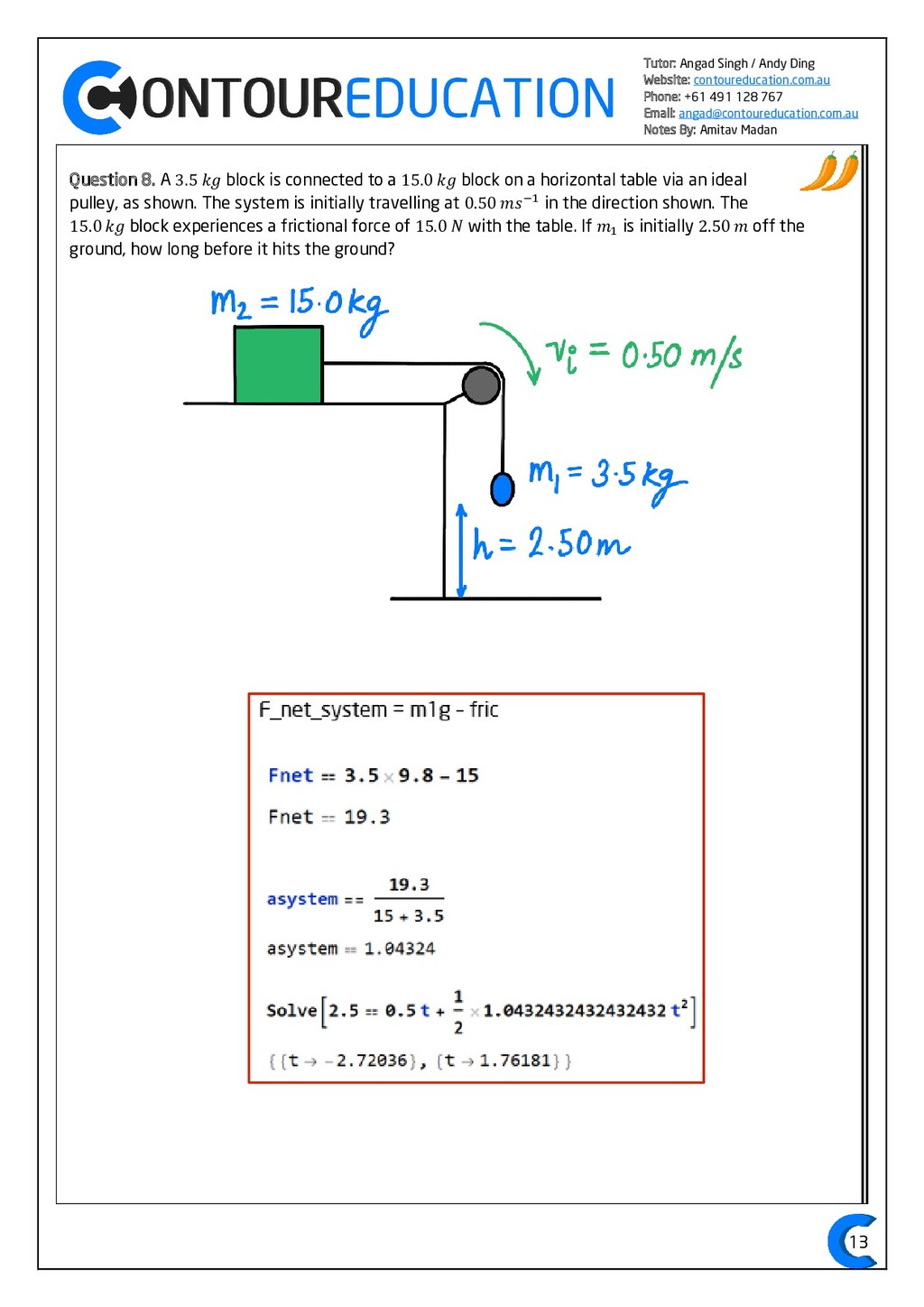
491 128 767 Email: [email protected] Notes By: Amitav Madan 13 Question 8. A 3.5 𝑘𝑔 block is connected to a 15.0 𝑘𝑔 block on a horizontal table via an ideal pulley, as shown. The system is initially travelling at 0.50 𝑚𝑠−1 in the direction shown. The 15.0 𝑘𝑔 block experiences a frictional force of 15.0 𝑁 with the table. If 𝑚1 is initially 2.50 𝑚 off the ground, how long before it hits the ground?
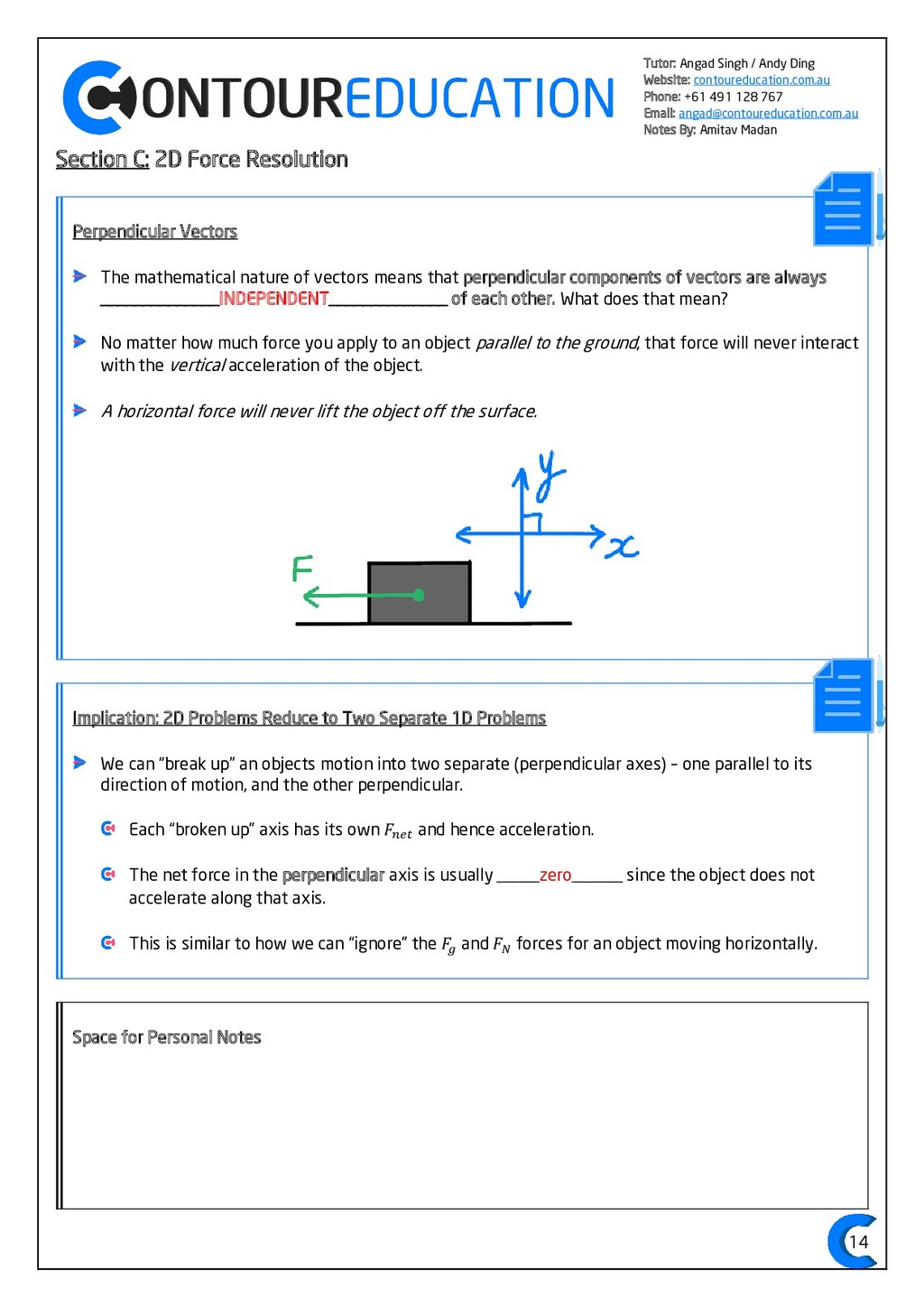
491 128 767 Email: [email protected] Notes By: Amitav Madan 14 Section C: 2D Force Resolution Perpendicular Vectors The mathematical nature of vectors means that perpendicular components of vectors are always ______________INDEPENDENT______________ of each other. What does that mean? No matter how much force you apply to an object parallel to the ground, that force will never interact with the vertical acceleration of the object. A horizontal force will never lift the object off the surface. Implication: 2D Problems Reduce to Two Separate 1D Problems We can “break up” an objects motion into two separate (perpendicular axes) – one parallel to its direction of motion, and the other perpendicular. Each “broken up” axis has its own 𝐹𝑛𝑒𝑡 and hence acceleration. The net force in the perpendicular axis is usually _____zero______ since the object does not accelerate along that axis. This is similar to how we can “ignore” the 𝐹 𝑔 and 𝐹𝑁 forces for an object moving horizontally. Space for Personal Notes
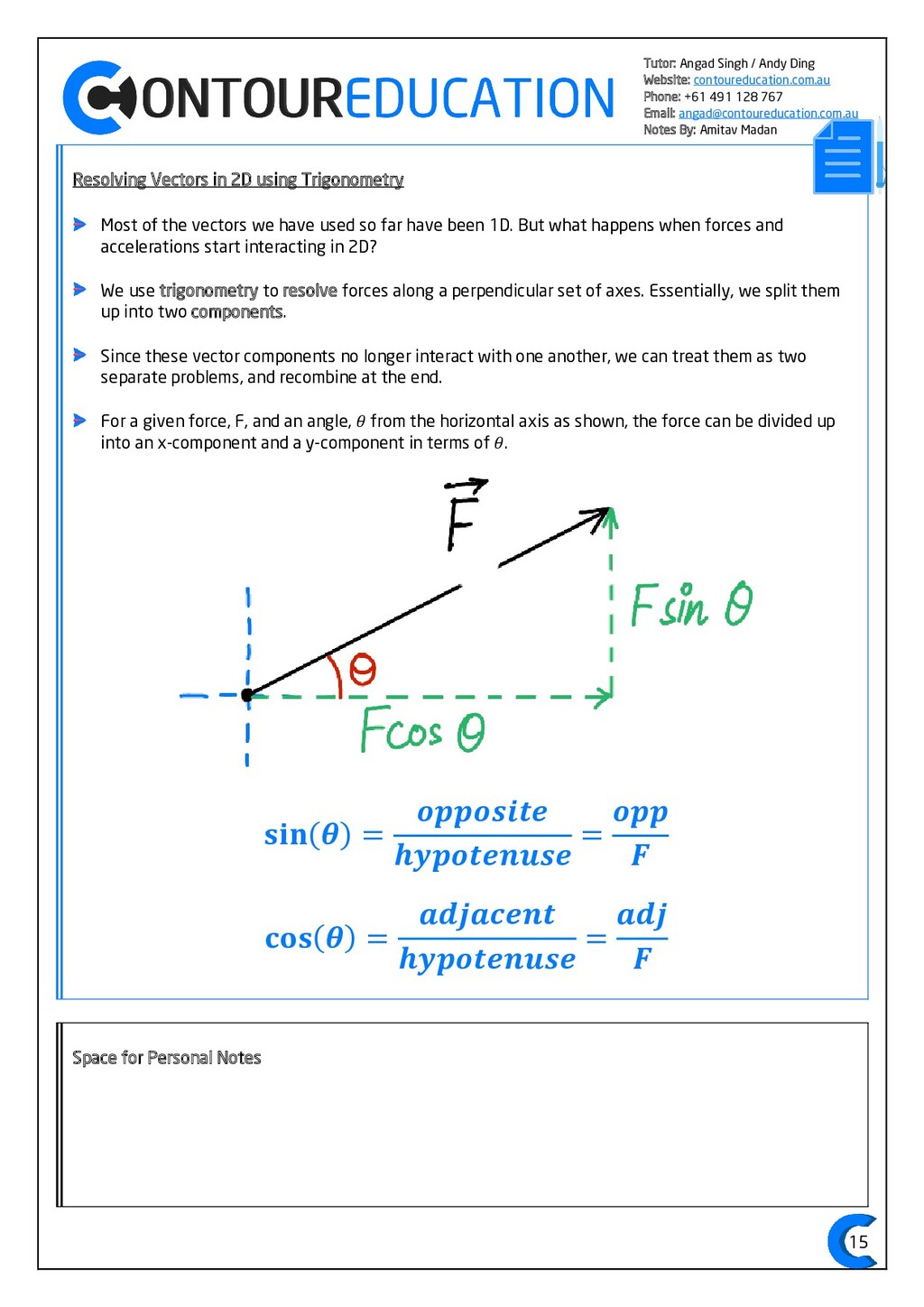
491 128 767 Email: [email protected] Notes By: Amitav Madan 15 Resolving Vectors in 2D using Trigonometry Most of the vectors we have used so far have been 1D. But what happens when forces and accelerations start interacting in 2D? We use trigonometry to resolve forces along a perpendicular set of axes. Essentially, we split them up into two components. Since these vector components no longer interact with one another, we can treat them as two separate problems, and recombine at the end. For a given force, F, and an angle, 𝜃 from the horizontal axis as shown, the force can be divided up into an x-component and a y-component in terms of 𝜃. 𝐬𝐢𝐧(𝜽) = 𝒐𝒑𝒑𝒐𝒔𝒊𝒕𝒆 𝒉𝒚𝒑𝒐𝒕𝒆𝒏𝒖𝒔𝒆 = 𝒐𝒑𝒑 𝑭 𝐜𝐨𝐬(𝜽) = 𝒂𝒅𝒋𝒂𝒄𝒆𝒏𝒕 𝒉𝒚𝒑𝒐𝒕𝒆𝒏𝒖𝒔𝒆 = 𝒂𝒅𝒋 𝑭 Space for Personal Notes
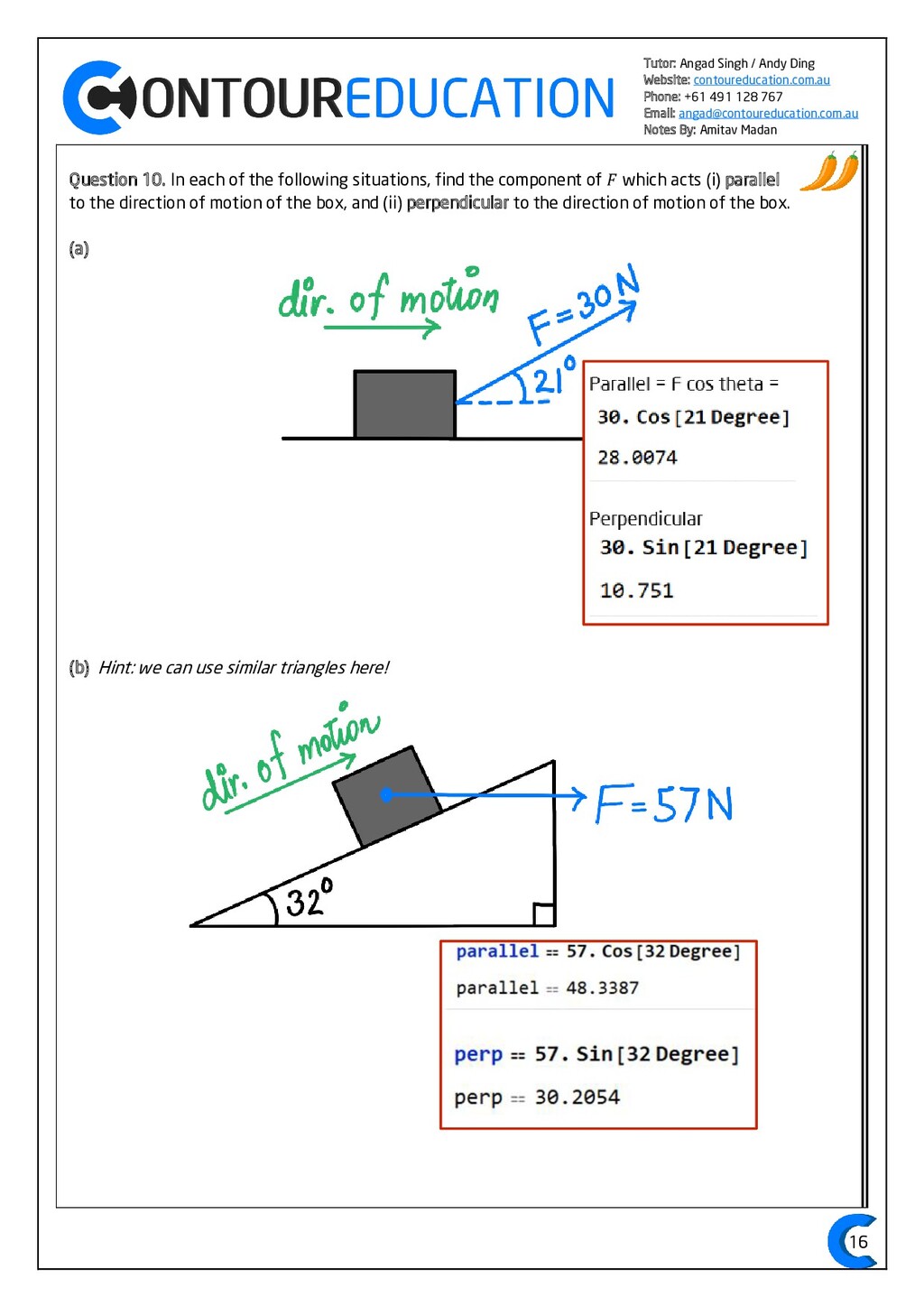
491 128 767 Email: [email protected] Notes By: Amitav Madan 16 Question 10. In each of the following situations, find the component of 𝐹 which acts (i) parallel to the direction of motion of the box, and (ii) perpendicular to the direction of motion of the box. (a) (b) Hint: we can use similar triangles here!
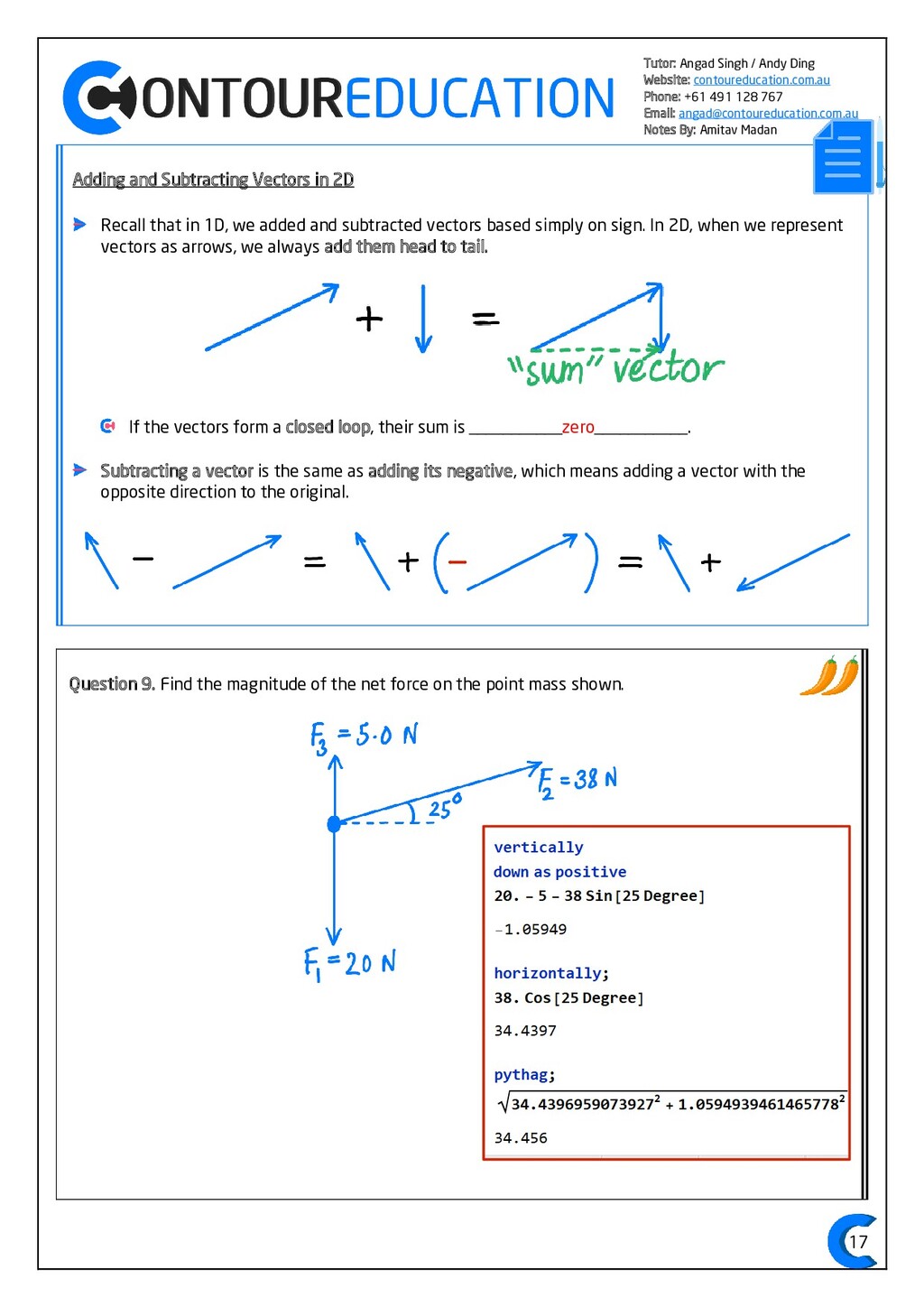
491 128 767 Email: [email protected] Notes By: Amitav Madan 17 Adding and Subtracting Vectors in 2D Recall that in 1D, we added and subtracted vectors based simply on sign. In 2D, when we represent vectors as arrows, we always add them head to tail. If the vectors form a closed loop, their sum is ___________zero___________. Subtracting a vector is the same as adding its negative, which means adding a vector with the opposite direction to the original. Question 9. Find the magnitude of the net force on the point mass shown.
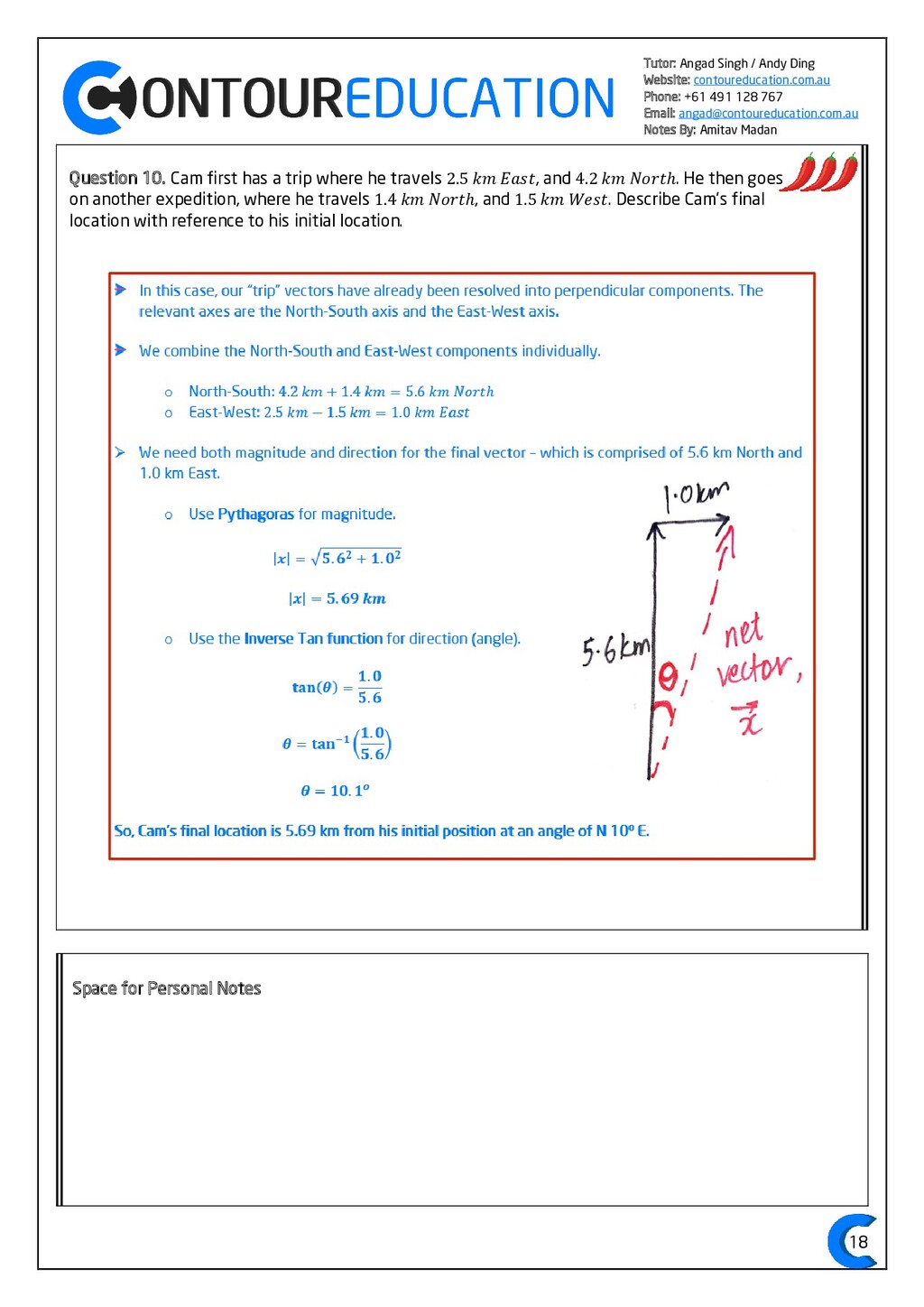
491 128 767 Email: [email protected] Notes By: Amitav Madan 18 Question 10. Cam first has a trip where he travels 2.5 𝑘𝑚 𝐸𝑎𝑠𝑡, and 4.2 𝑘𝑚 𝑁𝑜𝑟𝑡ℎ. He then goes on another expedition, where he travels 1.4 𝑘𝑚 𝑁𝑜𝑟𝑡ℎ, and 1.5 𝑘𝑚 𝑊𝑒𝑠𝑡. Describe Cam’s final location with reference to his initial location. Space for Personal Notes
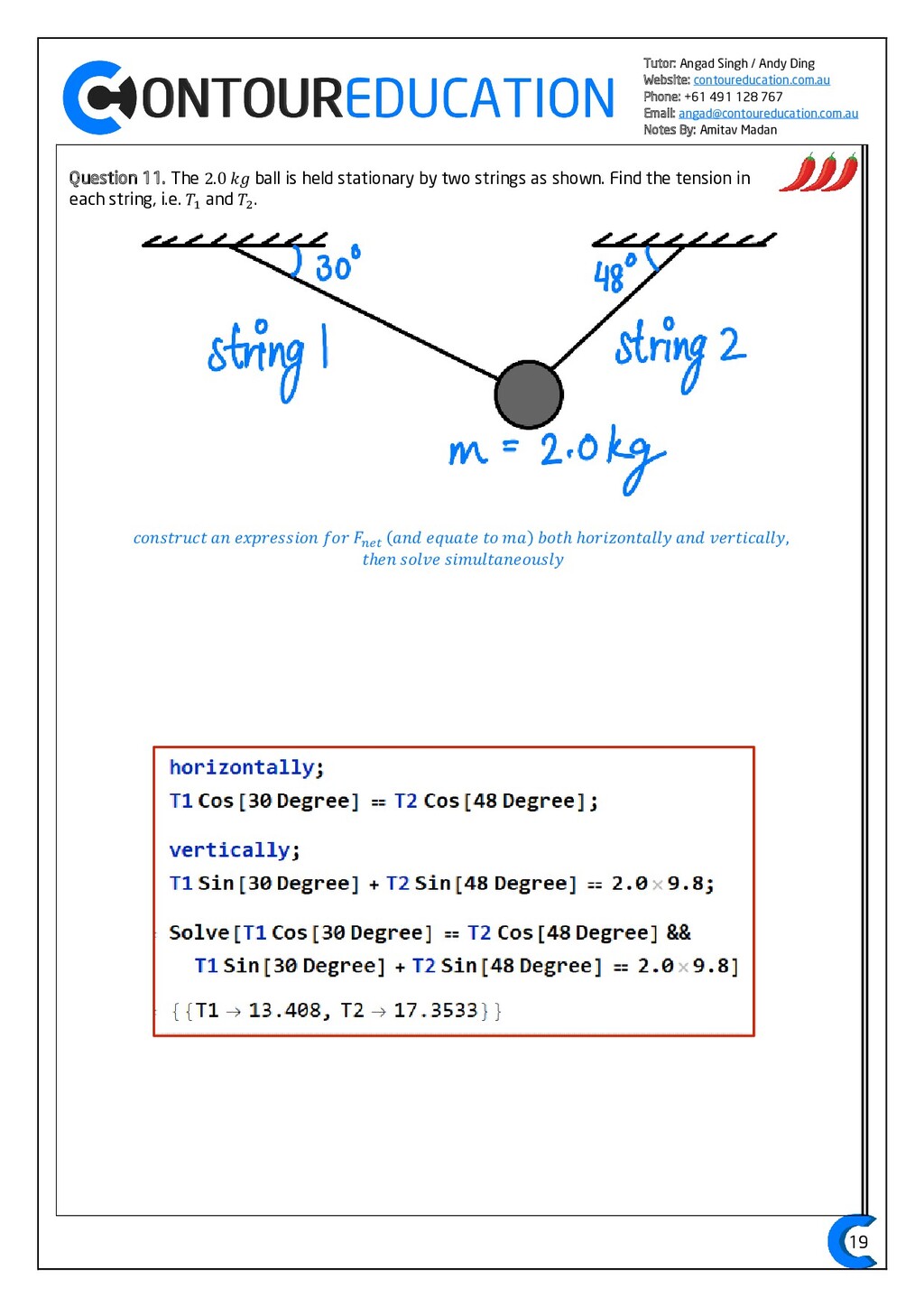
491 128 767 Email: [email protected] Notes By: Amitav Madan 19 Question 11. The 2.0 𝑘𝑔 ball is held stationary by two strings as shown. Find the tension in each string, i.e. 𝑇1 and 𝑇2 . 𝑐𝑜𝑛𝑠𝑡𝑟𝑢𝑐𝑡 𝑎𝑛 𝑒𝑥𝑝𝑟𝑒𝑠𝑠𝑖𝑜𝑛 𝑓𝑜𝑟 𝐹𝑛𝑒𝑡 (𝑎𝑛𝑑 𝑒𝑞𝑢𝑎𝑡𝑒 𝑡𝑜 𝑚𝑎) 𝑏𝑜𝑡ℎ ℎ𝑜𝑟𝑖𝑧𝑜𝑛𝑡𝑎𝑙𝑙𝑦 𝑎𝑛𝑑 𝑣𝑒𝑟𝑡𝑖𝑐𝑎𝑙𝑙𝑦, 𝑡ℎ𝑒𝑛 𝑠𝑜𝑙𝑣𝑒 𝑠𝑖𝑚𝑢𝑙𝑡𝑎𝑛𝑒𝑜𝑢𝑠𝑙𝑦
491 128 767 Email: [email protected] Notes By: Amitav Madan 20 Key Takeaways In general, when we combine vectors: 1. Draw a set of axes (a useful set is one with respect to which we have an angle). 2. Resolve all forces into perpendicular components. This is done using sine and cosine relationships in a force triangle. 3. Combine horizontal components completely independently to vertical components. 4. Recombine at the end to get the final vector. Space for Personal Notes
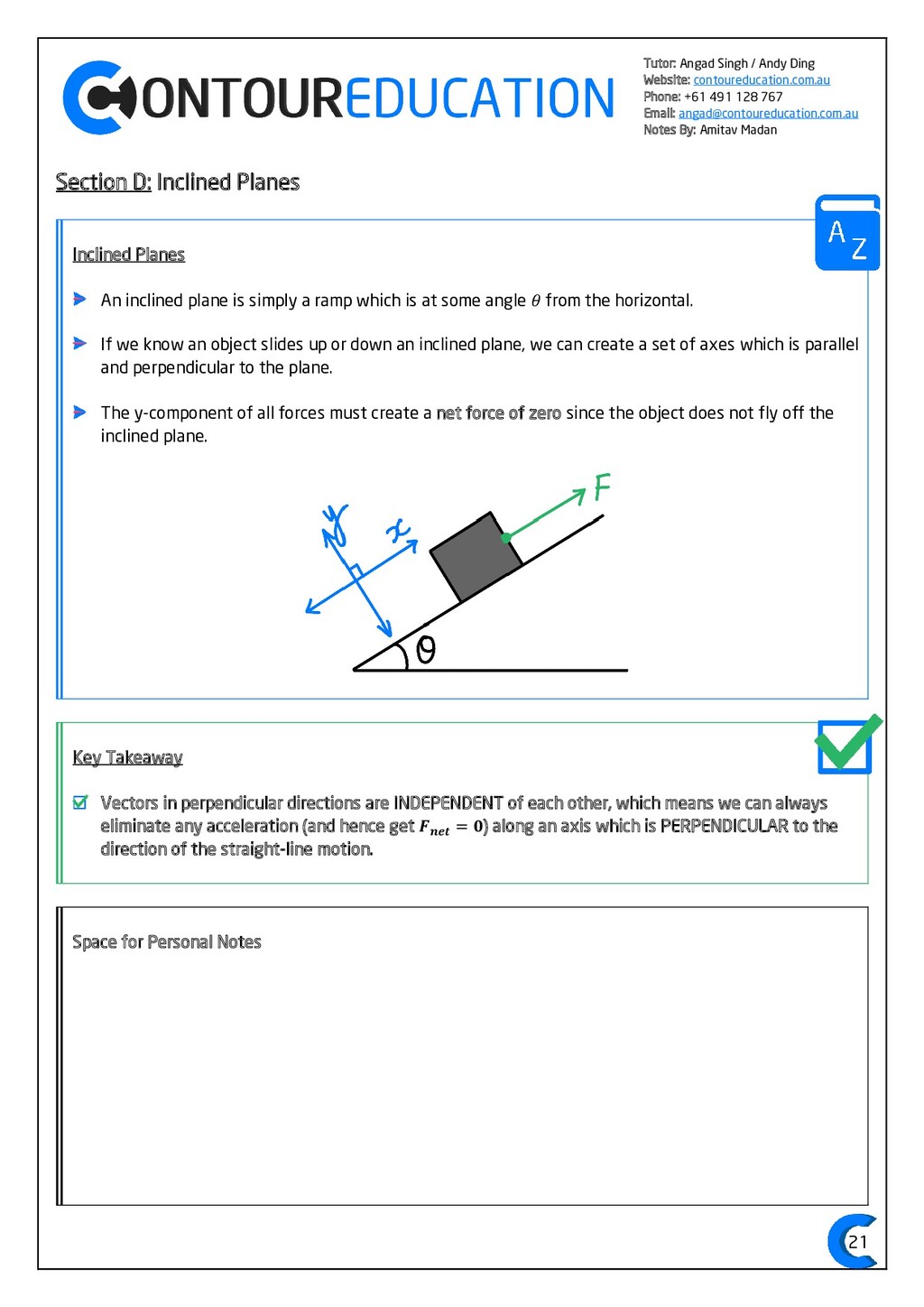
491 128 767 Email: [email protected] Notes By: Amitav Madan 21 Section D: Inclined Planes Inclined Planes An inclined plane is simply a ramp which is at some angle 𝜃 from the horizontal. If we know an object slides up or down an inclined plane, we can create a set of axes which is parallel and perpendicular to the plane. The y-component of all forces must create a net force of zero since the object does not fly off the inclined plane. Key Takeaway Vectors in perpendicular directions are INDEPENDENT of each other, which means we can always eliminate any acceleration (and hence get 𝑭𝒏𝒆𝒕 = 𝟎) along an axis which is PERPENDICULAR to the direction of the straight-line motion. Space for Personal Notes
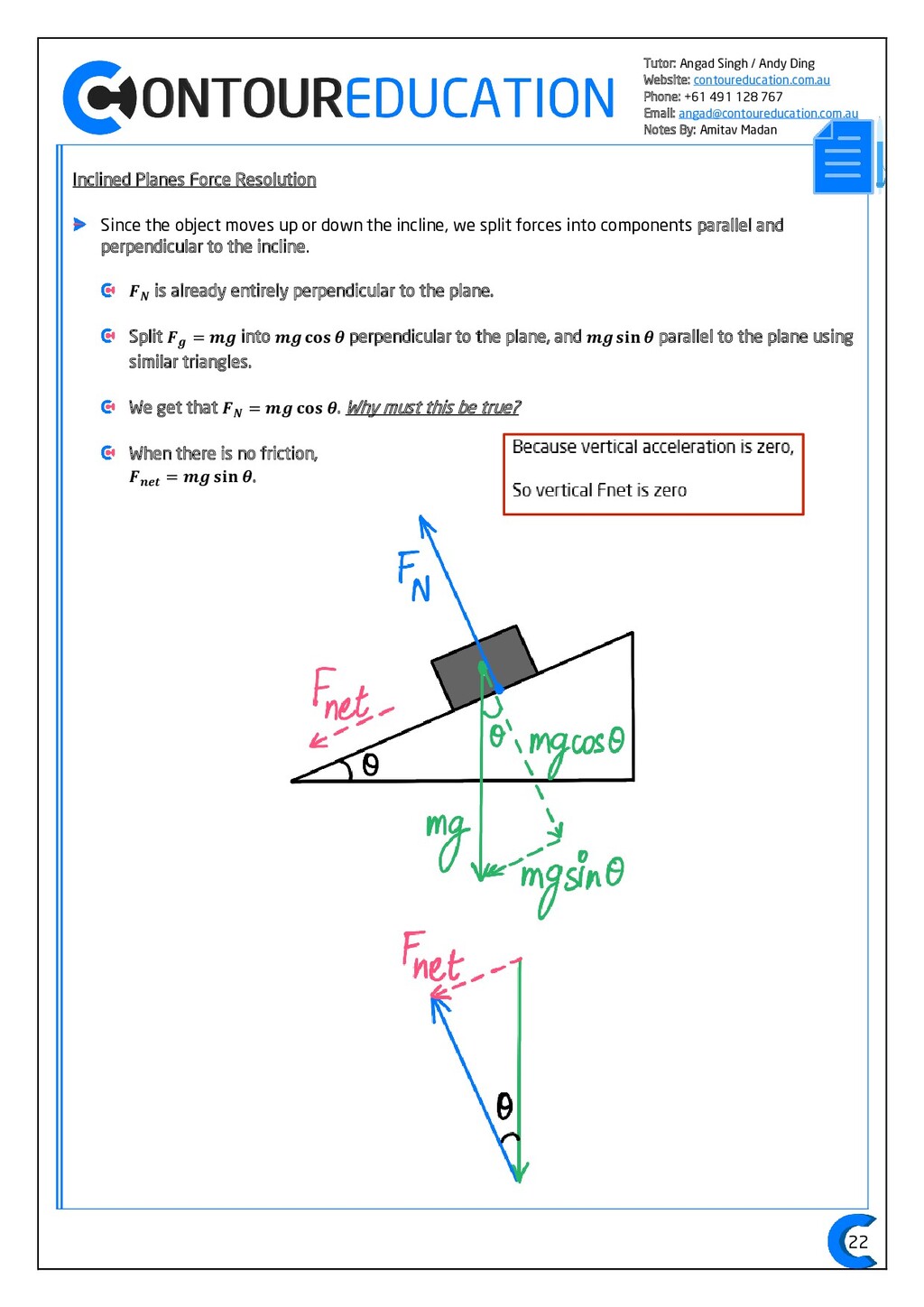
491 128 767 Email: [email protected] Notes By: Amitav Madan 22 Inclined Planes Force Resolution Since the object moves up or down the incline, we split forces into components parallel and perpendicular to the incline. 𝑭𝑵 is already entirely perpendicular to the plane. Split 𝑭𝒈 = 𝒎𝒈 into 𝒎𝒈 𝐜𝐨𝐬 𝜽 perpendicular to the plane, and 𝒎𝒈 𝐬𝐢𝐧 𝜽 parallel to the plane using similar triangles. We get that 𝑭𝑵 = 𝒎𝒈 𝐜𝐨𝐬 𝜽. Why must this be true? When there is no friction, 𝑭𝒏𝒆𝒕 = 𝒎𝒈 𝐬𝐢𝐧 𝜽.
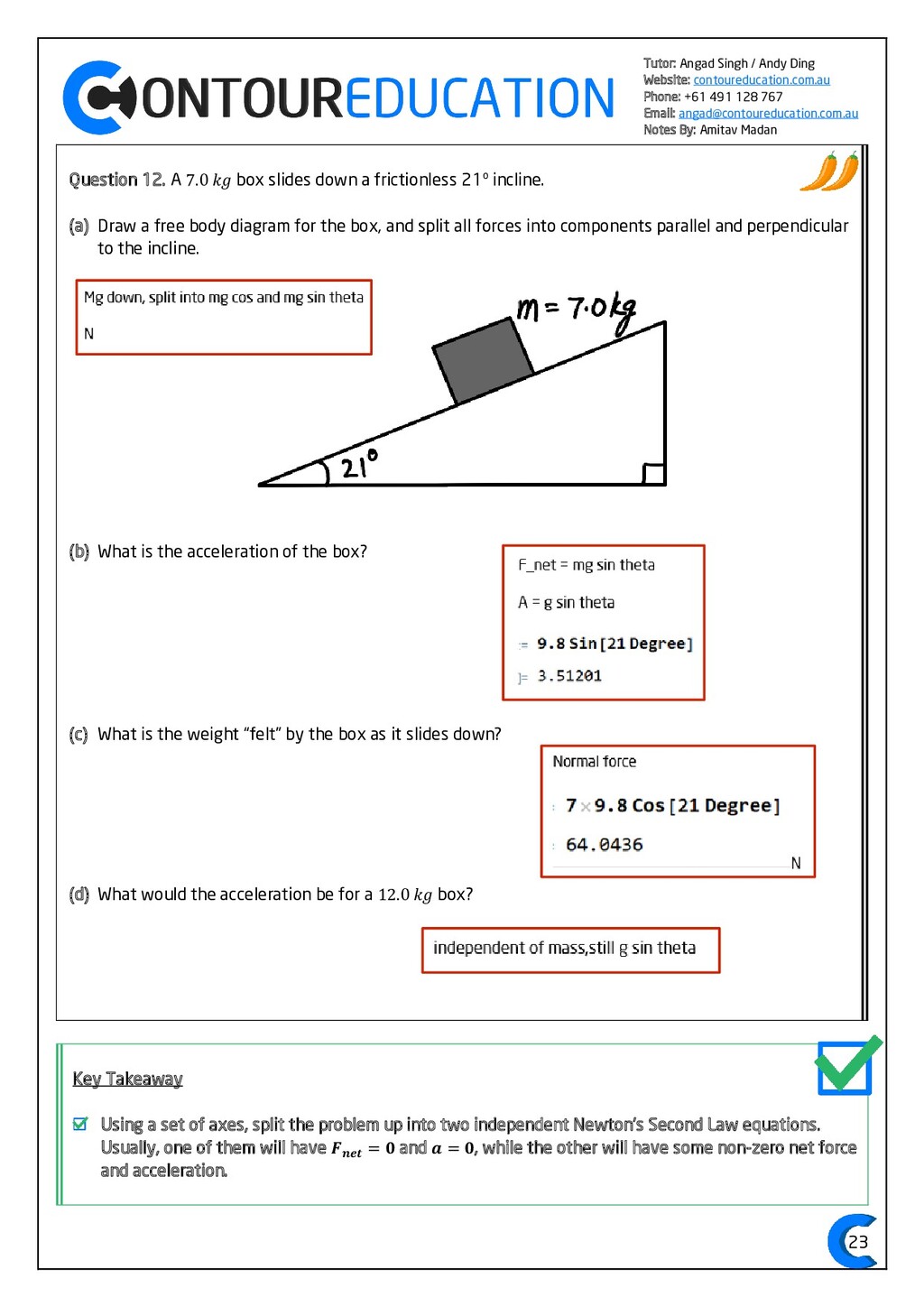
491 128 767 Email: [email protected] Notes By: Amitav Madan 23 Question 12. A 7.0 𝑘𝑔 box slides down a frictionless 21o incline. (a) Draw a free body diagram for the box, and split all forces into components parallel and perpendicular to the incline. (b) What is the acceleration of the box? (c) What is the weight “felt” by the box as it slides down? (d) What would the acceleration be for a 12.0 𝑘𝑔 box? Key Takeaway Using a set of axes, split the problem up into two independent Newton’s Second Law equations. Usually, one of them will have 𝑭𝒏𝒆𝒕 = 𝟎 and 𝒂 = 𝟎, while the other will have some non-zero net force and acceleration.
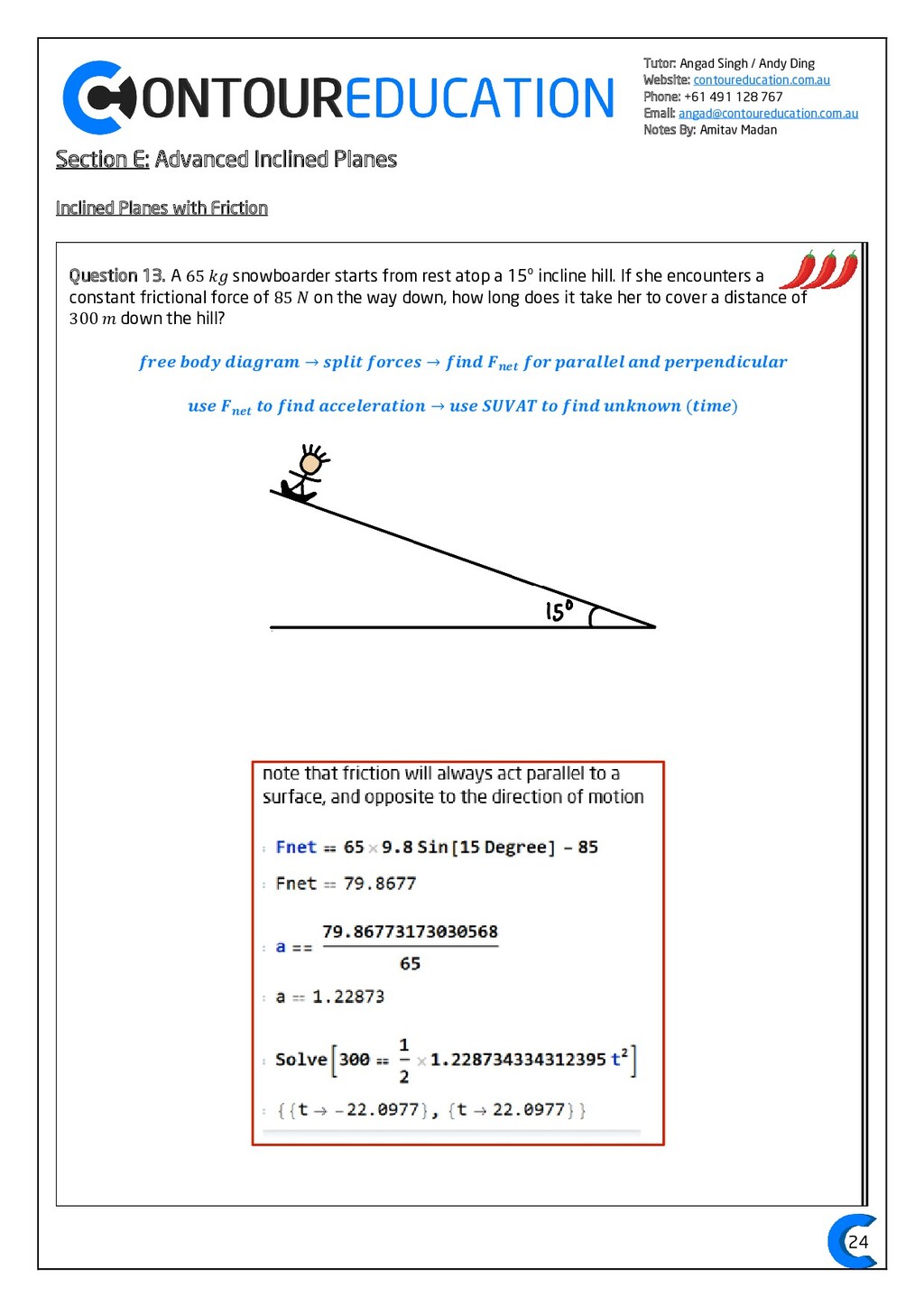
491 128 767 Email: [email protected] Notes By: Amitav Madan 24 Section E: Advanced Inclined Planes Inclined Planes with Friction Question 13. A 65 𝑘𝑔 snowboarder starts from rest atop a 15o incline hill. If she encounters a constant frictional force of 85 𝑁 on the way down, how long does it take her to cover a distance of 300 𝑚 down the hill? 𝒇𝒓𝒆𝒆 𝒃𝒐𝒅𝒚 𝒅𝒊𝒂𝒈𝒓𝒂𝒎 → 𝒔𝒑𝒍𝒊𝒕 𝒇𝒐𝒓𝒄𝒆𝒔 → 𝒇𝒊𝒏𝒅 𝑭𝒏𝒆𝒕 𝒇𝒐𝒓 𝒑𝒂𝒓𝒂𝒍𝒍𝒆𝒍 𝒂𝒏𝒅 𝒑𝒆𝒓𝒑𝒆𝒏𝒅𝒊𝒄𝒖𝒍𝒂𝒓 𝒖𝒔𝒆 𝑭𝒏𝒆𝒕 𝒕𝒐 𝒇𝒊𝒏𝒅 𝒂𝒄𝒄𝒆𝒍𝒆𝒓𝒂𝒕𝒊𝒐𝒏 → 𝒖𝒔𝒆 𝑺𝑼𝑽𝑨𝑻 𝒕𝒐 𝒇𝒊𝒏𝒅 𝒖𝒏𝒌𝒏𝒐𝒘𝒏 (𝒕𝒊𝒎𝒆)
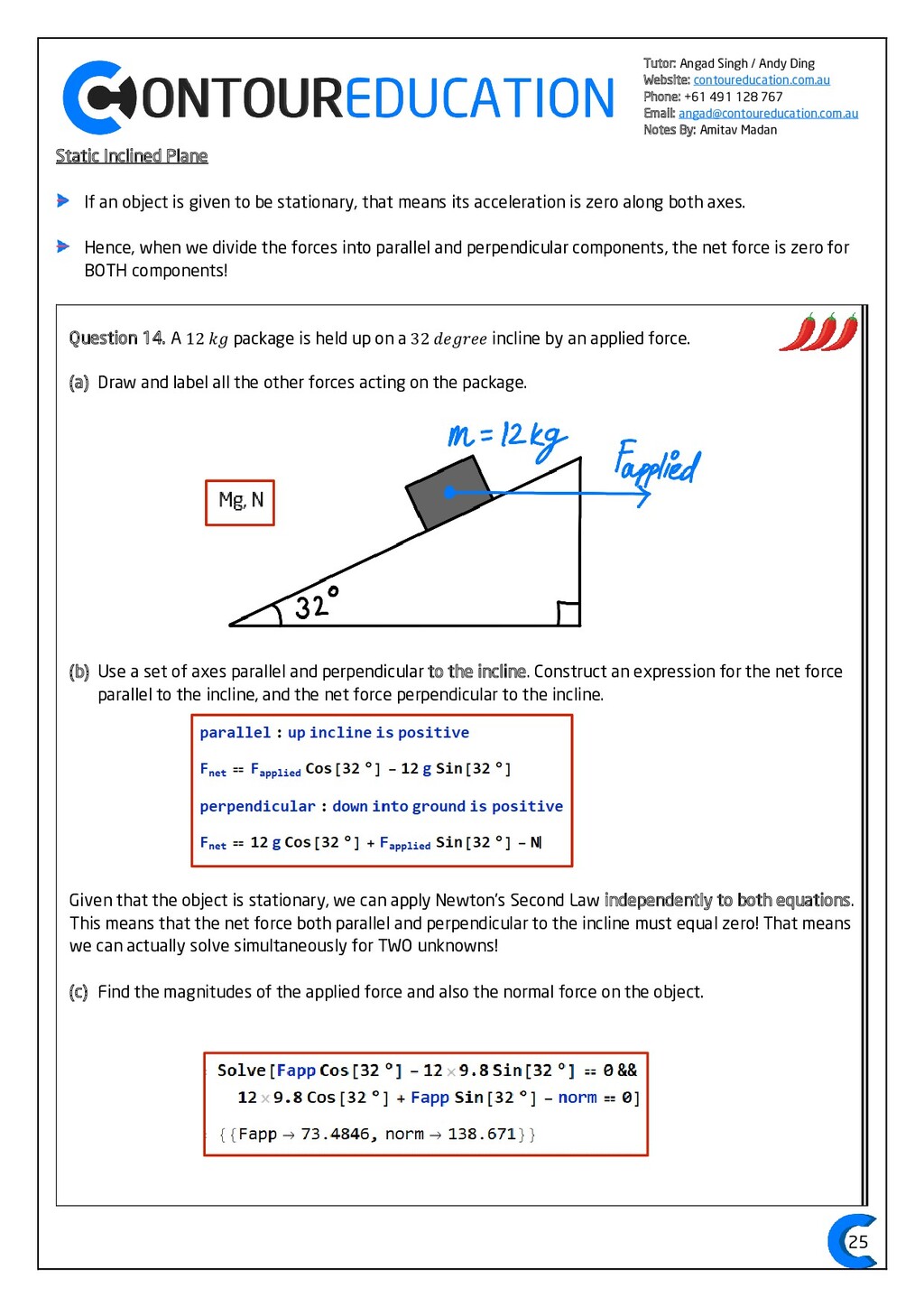
491 128 767 Email: [email protected] Notes By: Amitav Madan 25 Static Inclined Plane If an object is given to be stationary, that means its acceleration is zero along both axes. Hence, when we divide the forces into parallel and perpendicular components, the net force is zero for BOTH components! Question 14. A 12 𝑘𝑔 package is held up on a 32 𝑑𝑒𝑔𝑟𝑒𝑒 incline by an applied force. (a) Draw and label all the other forces acting on the package. (b) Use a set of axes parallel and perpendicular to the incline. Construct an expression for the net force parallel to the incline, and the net force perpendicular to the incline. Given that the object is stationary, we can apply Newton’s Second Law independently to both equations. This means that the net force both parallel and perpendicular to the incline must equal zero! That means we can actually solve simultaneously for TWO unknowns! (c) Find the magnitudes of the applied force and also the normal force on the object.
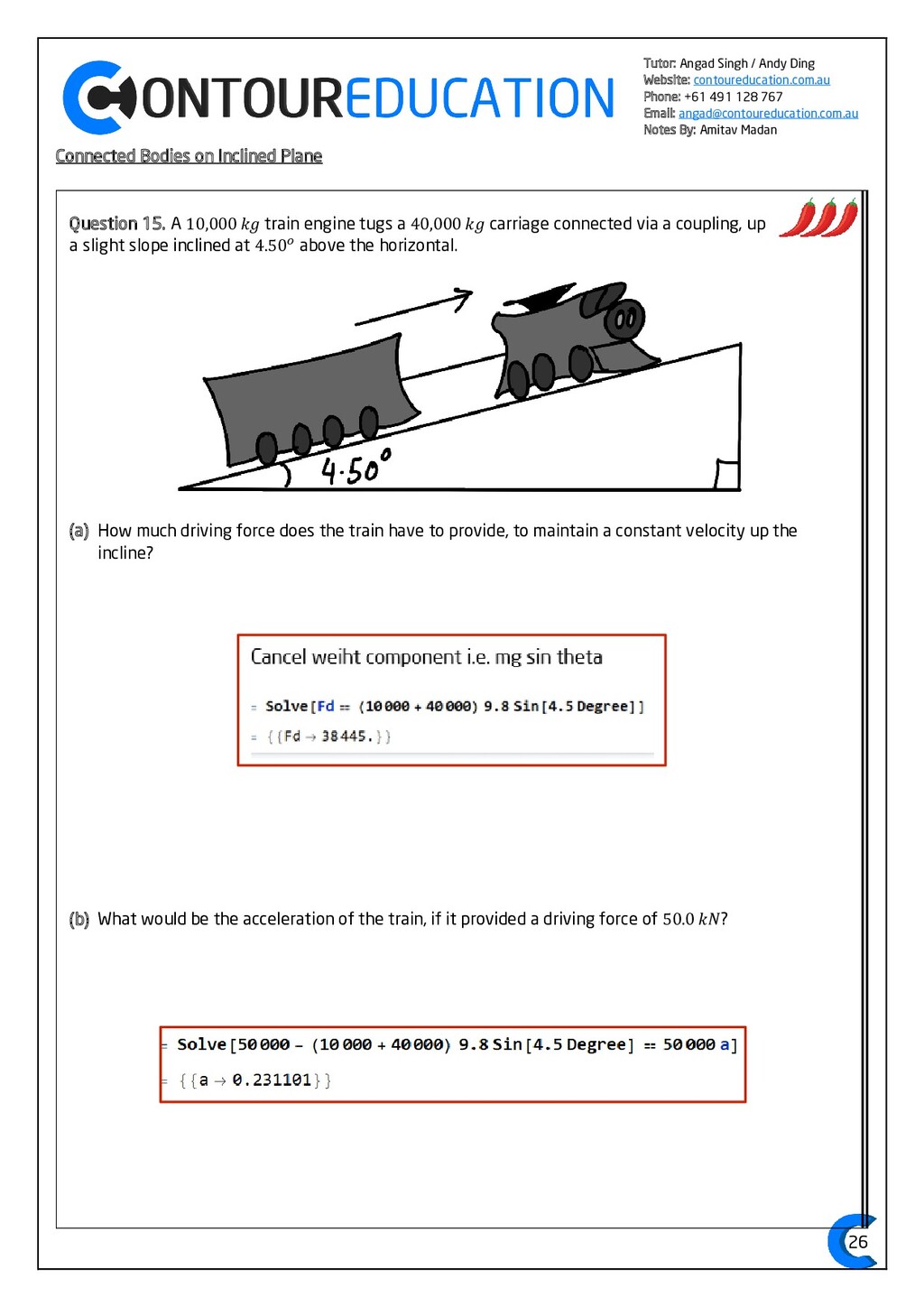
491 128 767 Email: [email protected] Notes By: Amitav Madan 26 Connected Bodies on Inclined Plane Question 15. A 10,000 𝑘𝑔 train engine tugs a 40,000 𝑘𝑔 carriage connected via a coupling, up a slight slope inclined at 4.50𝑜 above the horizontal. (a) How much driving force does the train have to provide, to maintain a constant velocity up the incline? (b) What would be the acceleration of the train, if it provided a driving force of 50.0 𝑘𝑁?
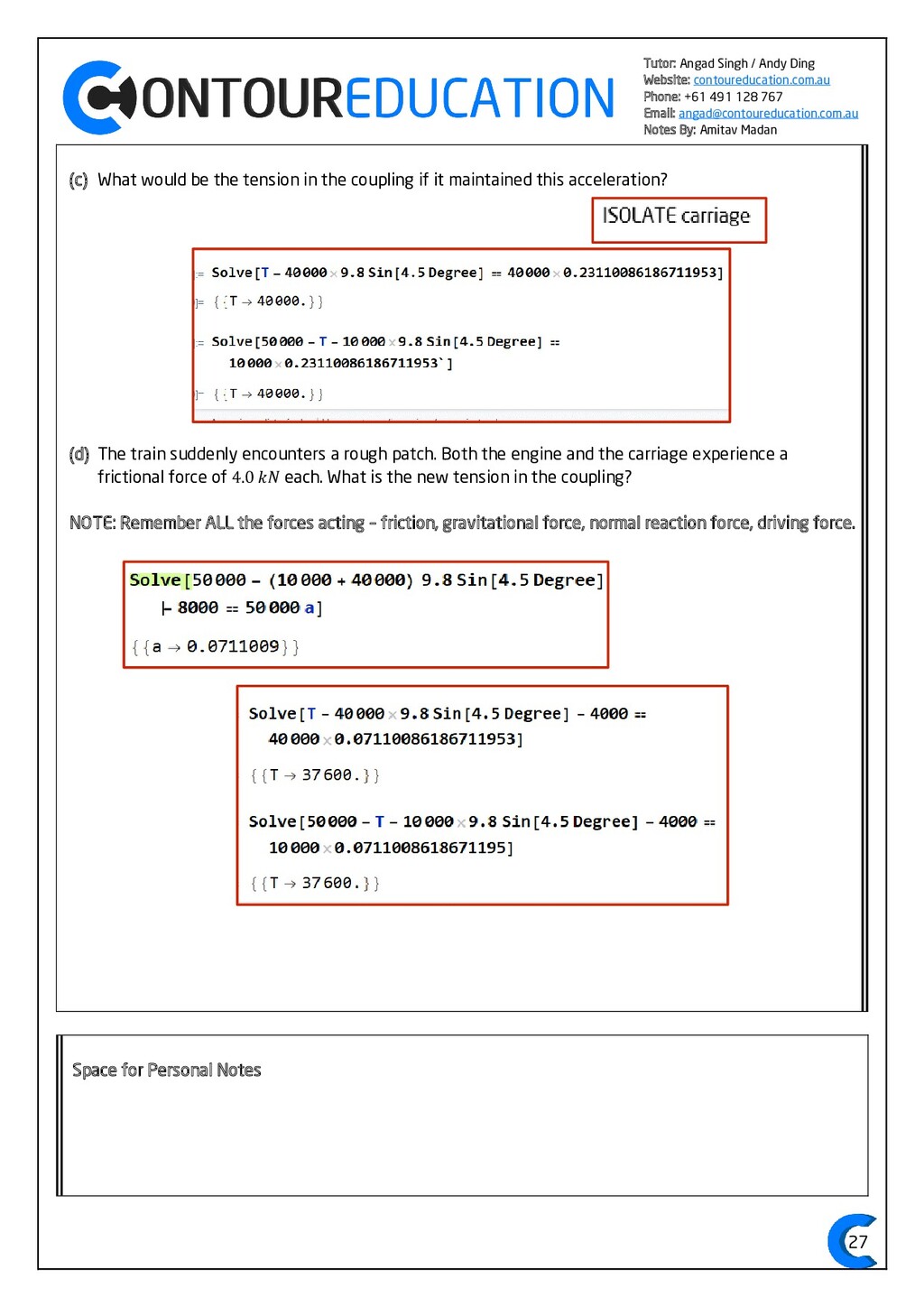
491 128 767 Email: [email protected] Notes By: Amitav Madan 27 (c) What would be the tension in the coupling if it maintained this acceleration? (d) The train suddenly encounters a rough patch. Both the engine and the carriage experience a frictional force of 4.0 𝑘𝑁 each. What is the new tension in the coupling? NOTE: Remember ALL the forces acting – friction, gravitational force, normal reaction force, driving force. Space for Personal Notes
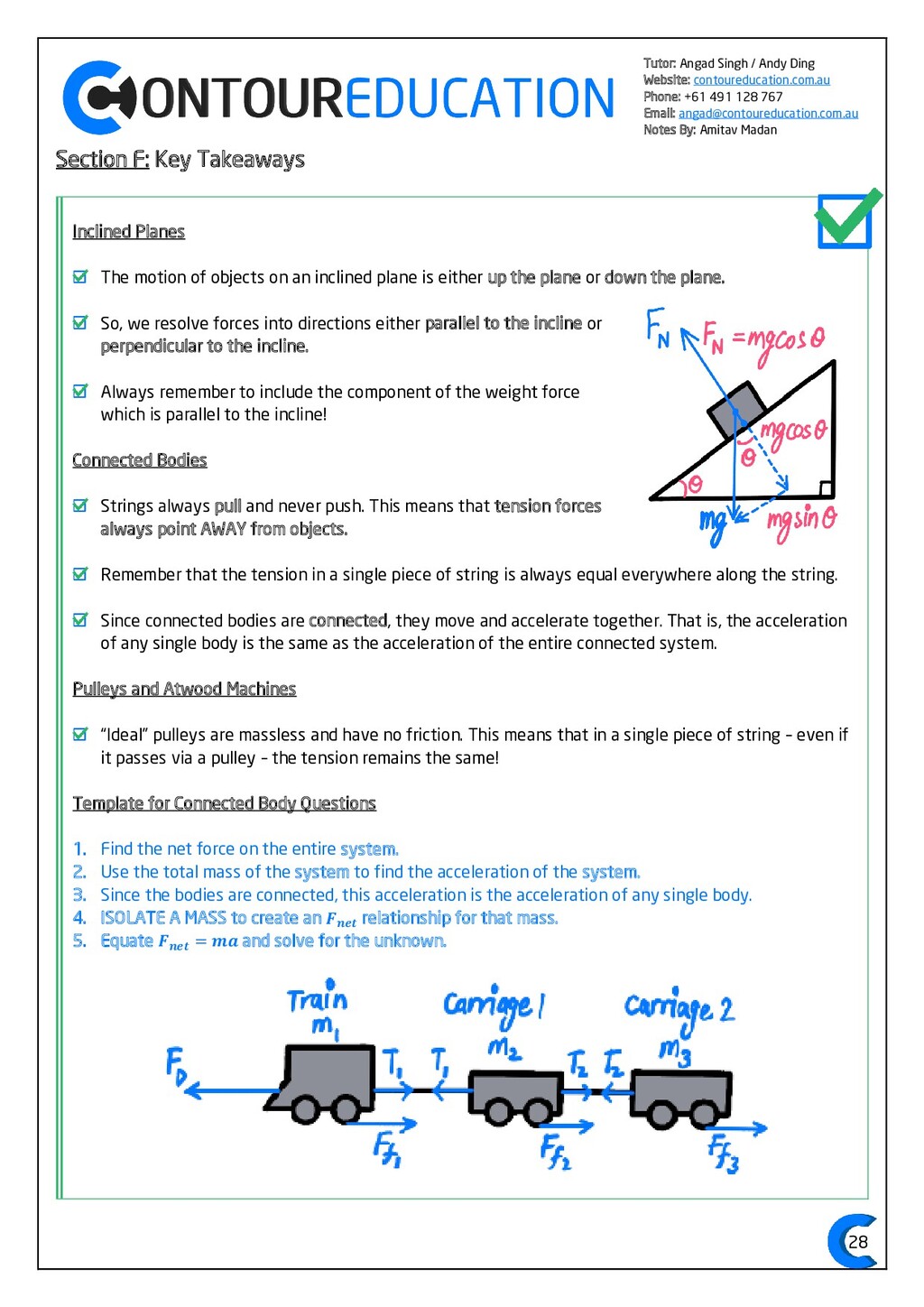
491 128 767 Email: [email protected] Notes By: Amitav Madan 28 Section F: Key Takeaways Inclined Planes The motion of objects on an inclined plane is either up the plane or down the plane. So, we resolve forces into directions either parallel to the incline or perpendicular to the incline. Always remember to include the component of the weight force which is parallel to the incline! Connected Bodies Strings always pull and never push. This means that tension forces always point AWAY from objects. Remember that the tension in a single piece of string is always equal everywhere along the string. Since connected bodies are connected, they move and accelerate together. That is, the acceleration of any single body is the same as the acceleration of the entire connected system. Pulleys and Atwood Machines “Ideal” pulleys are massless and have no friction. This means that in a single piece of string – even if it passes via a pulley – the tension remains the same! Template for Connected Body Questions 1. Find the net force on the entire system. 2. Use the total mass of the system to find the acceleration of the system. 3. Since the bodies are connected, this acceleration is the acceleration of any single body. 4. ISOLATE A MASS to create an 𝑭𝒏𝒆𝒕 relationship for that mass. 5. Equate 𝑭𝒏𝒆𝒕 = 𝒎𝒂 and solve for the unknown.
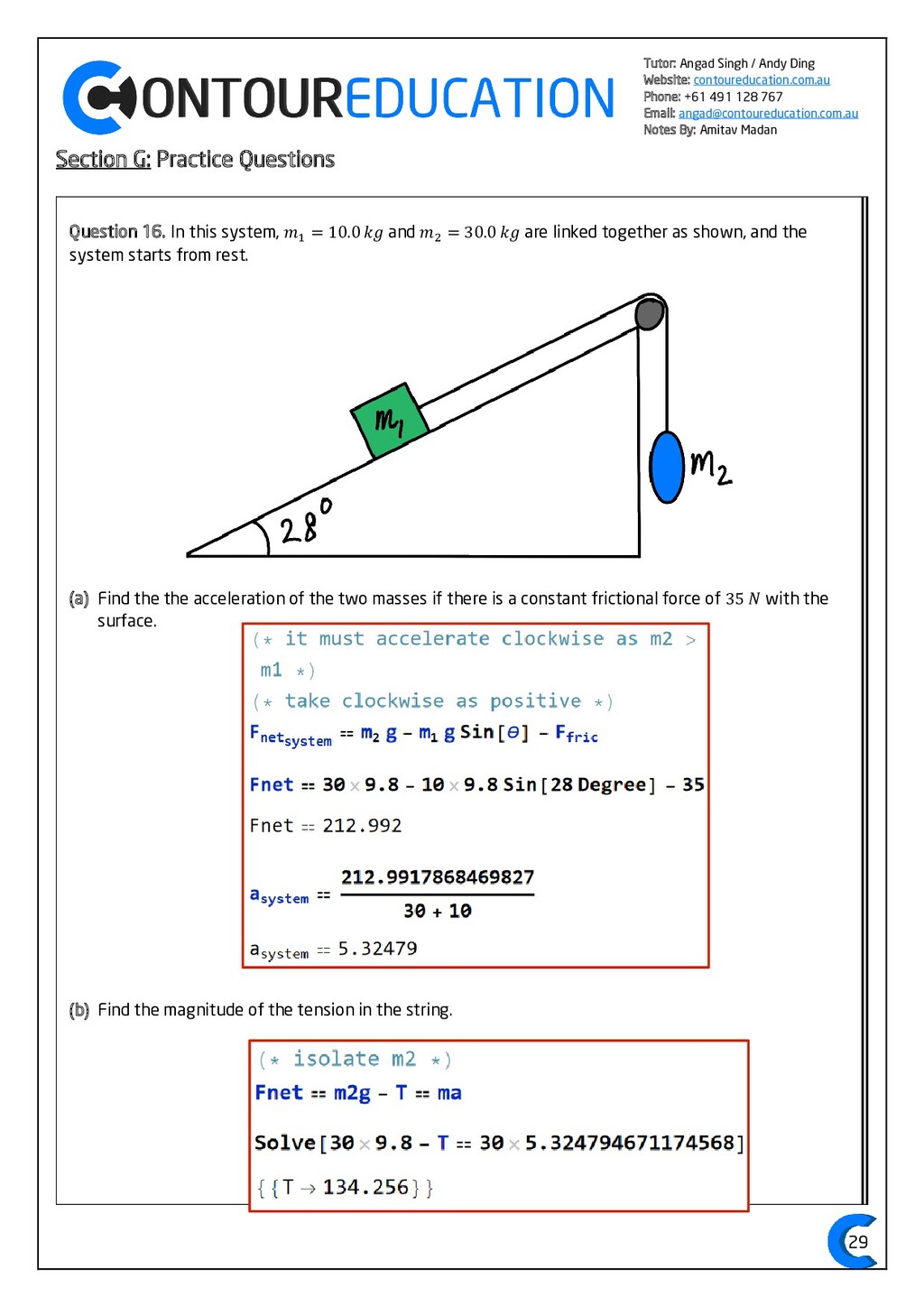
491 128 767 Email: [email protected] Notes By: Amitav Madan 29 Section G: Practice Questions Question 16. In this system, 𝑚1 = 10.0 𝑘𝑔 and 𝑚2 = 30.0 𝑘𝑔 are linked together as shown, and the system starts from rest. (a) Find the the acceleration of the two masses if there is a constant frictional force of 35 𝑁 with the surface. (b) Find the magnitude of the tension in the string.
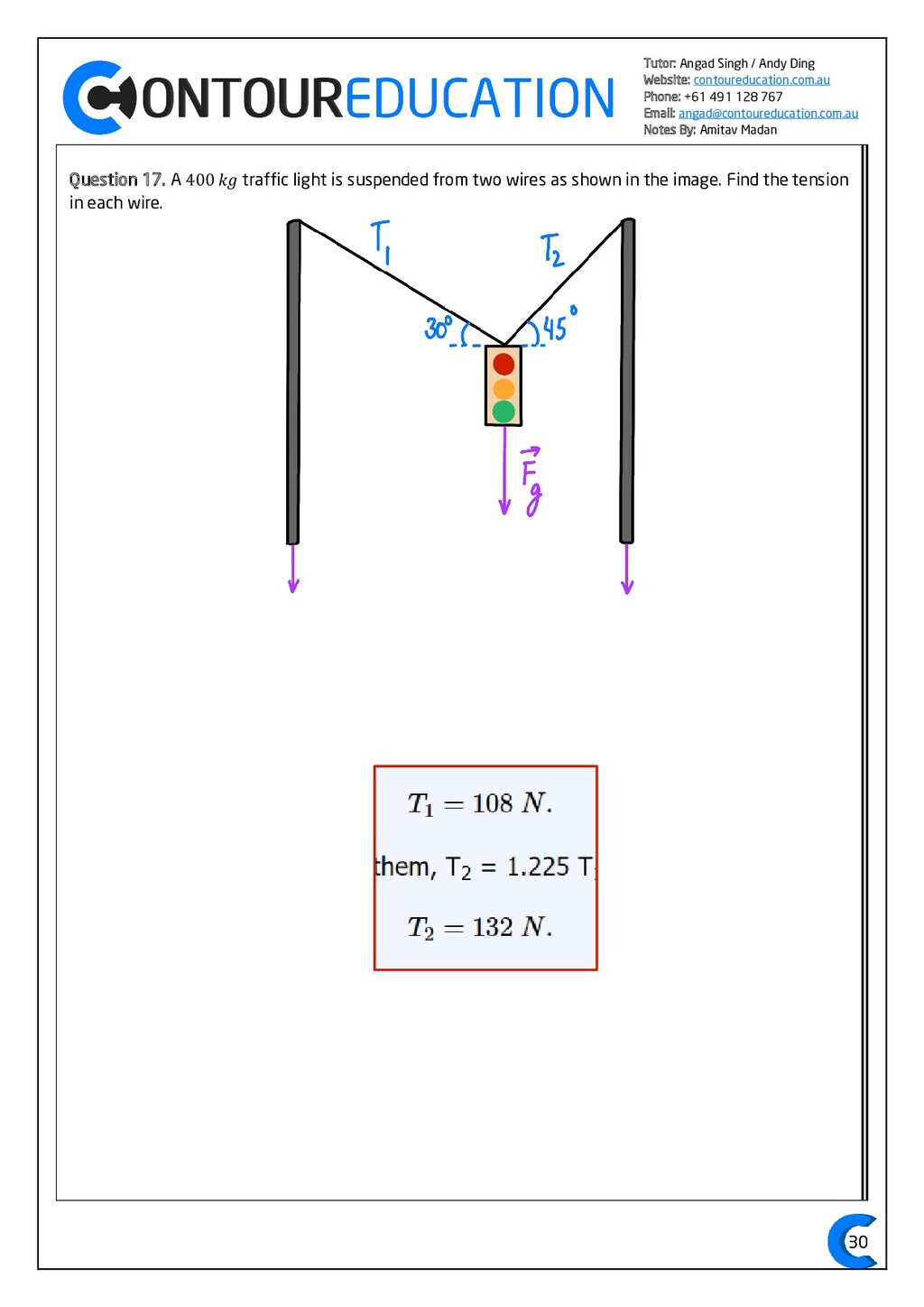
491 128 767 Email: [email protected] Notes By: Amitav Madan 30 Question 17. A 400 𝑘𝑔 traffic light is suspended from two wires as shown in the image. Find the tension in each wire.
491 128 767 Email: [email protected] Notes By: Amitav Madan 31 Section ZZ: Summary Section Pages The Tension Force and Connected Bodies Strings and ropes pull, never push The tension force ISOLATION More than two connected bodies Connected bodies without strings 3-8 Pulleys and Atwood Machines Tension is the same Simple Atwood machine Half Atwood machine 9-13 2D Force Resolution Perpendicular vectors are independent 2D problems can be split into two separate 1D problems Resolving vectors in 2D using trigonometry Adding and subtracting vectors in 2D 14-20 Inclined Planes Perpendicular vectors are independent Objects only move parallel to incline Inclined planes force resolution 21-23 Advanced Inclined Planes With friction Static objects with applied force Connected bodies on inclined planes 24-27 Key Takeaways for Connected Bodies, Pulleys, Atwood Machines,and Inclined Planes 28 Practice Questions 29-30


 hiola
hiola
 camel_404
 suisan
 ainischool
 drpoonamkc
 juanmartin2026
 akiraasano
 yatabe
 terasawat
 sciencetokyo
 honzajavorek
 pauljervisheath
 destraynor
 baasie
 axbom
axbom
 chriscoyier
 stephaniewalter
 stuffmc
 holman
 apolaine
 techseoconnect
 jakevdp