Upgrade to Pro — share decks privately, control downloads, hide ads and more …

Communicating & Convincing in a Remote Environment

Communicating & Convincing in a Remote Environment

Remote work removes the hallway conversation and the whiteboard, and with them much of the context we rely on to understand each other.
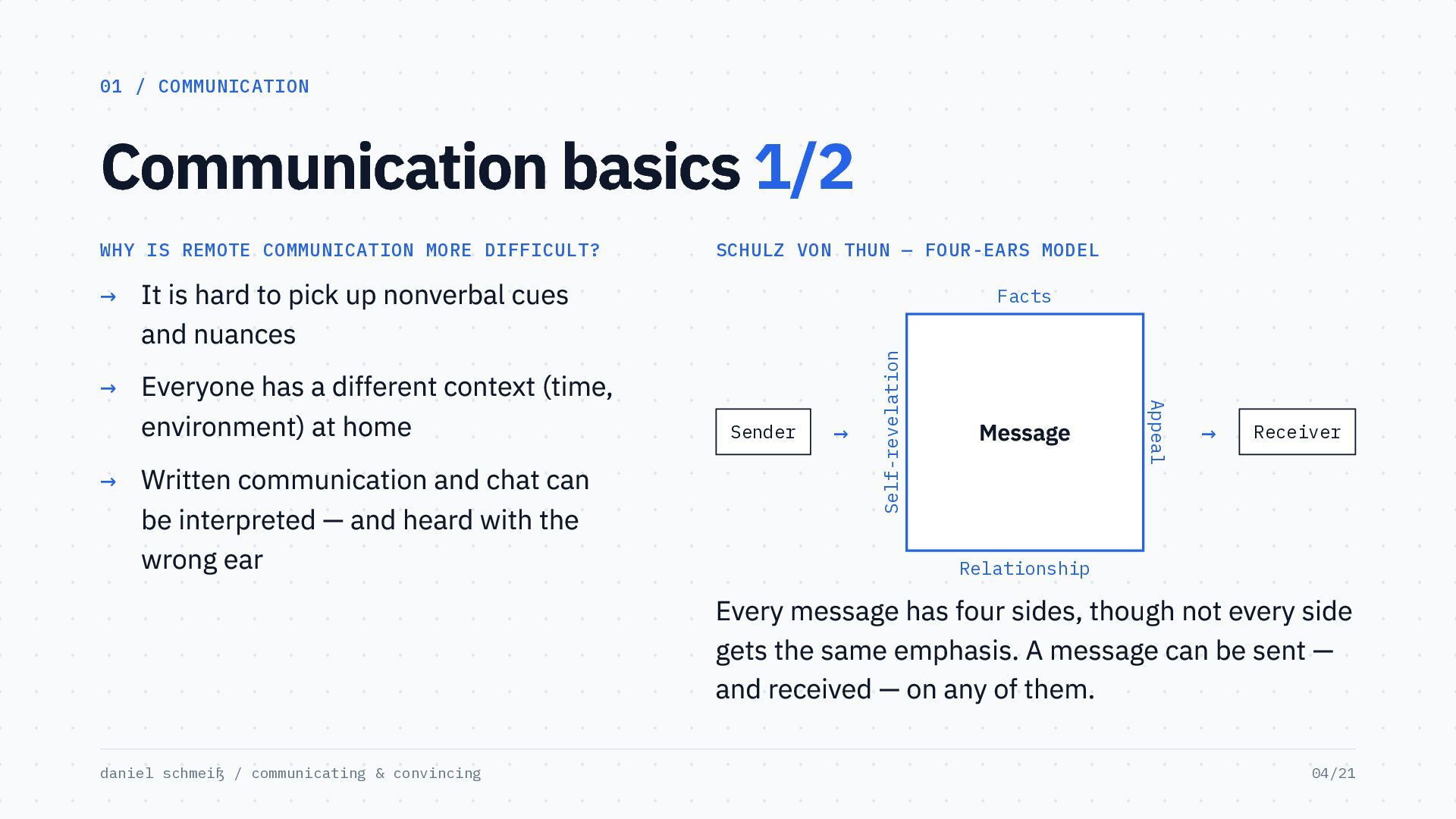
This talk covers how communication works (Schulz von Thun's four-ears model, Eric Berne's life positions) and what helps in distributed teams.

The main part is a toolbox of six techniques for clear arguments and better decisions, each with an example:

1. Situation, Complication, Resolution
2. Decision records
3. 5× why
4. Visualisation
5. DIBB: Data, Insights, Beliefs & Bets
6. Writing simply for busy readers

Daniel Schmeiß · https://www.linkedin.com/in/danielschmeiss/

Avatar for Daniel Schmeiß

Daniel Schmeiß

October 13, 2026

More Decks by Daniel Schmeiß

Other Decks in Education

Transcript

  1. // FIELD NOTES Communicating & Convincing in a remote environment

    — a little toolbox & experience Daniel Schmeiß linkedin.com/in/danielschmeiss
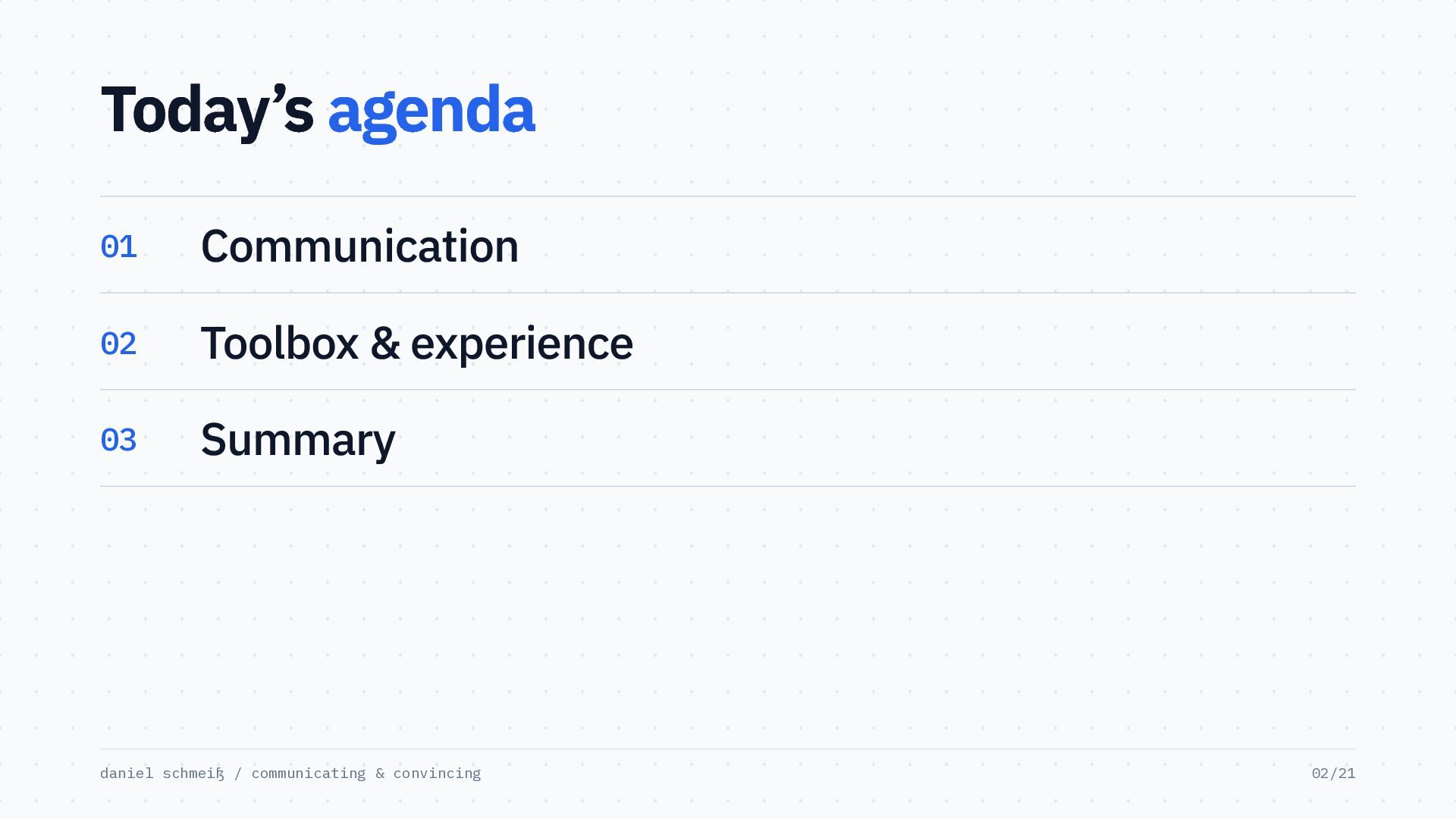
  2. Today’s agenda 01 Communication 02 Toolbox & experience 03 Summary

    daniel schmeiß / communicating & convincing 02/21
  3. 01 Communication How it works — and why remote makes

    it harder daniel schmeiß / communicating & convincing 03/21
  4. 01 / COMMUNICATION Communication basics 1/2 WHY IS REMOTE COMMUNICATION

    MORE DIFFICULT? SCHULZ VON THUN — FOUR-EARS MODEL → It is hard to pick up nonverbal cues and nuances environment) at home → Written communication and chat can be interpreted — and heard with the wrong ear Sender → Message Appeal → Everyone has a different context (time, Self-revelation Facts → Receiver Relationship Every message has four sides, though not every side gets the same emphasis. A message can be sent — and received — on any of them. daniel schmeiß / communicating & convincing 04/21
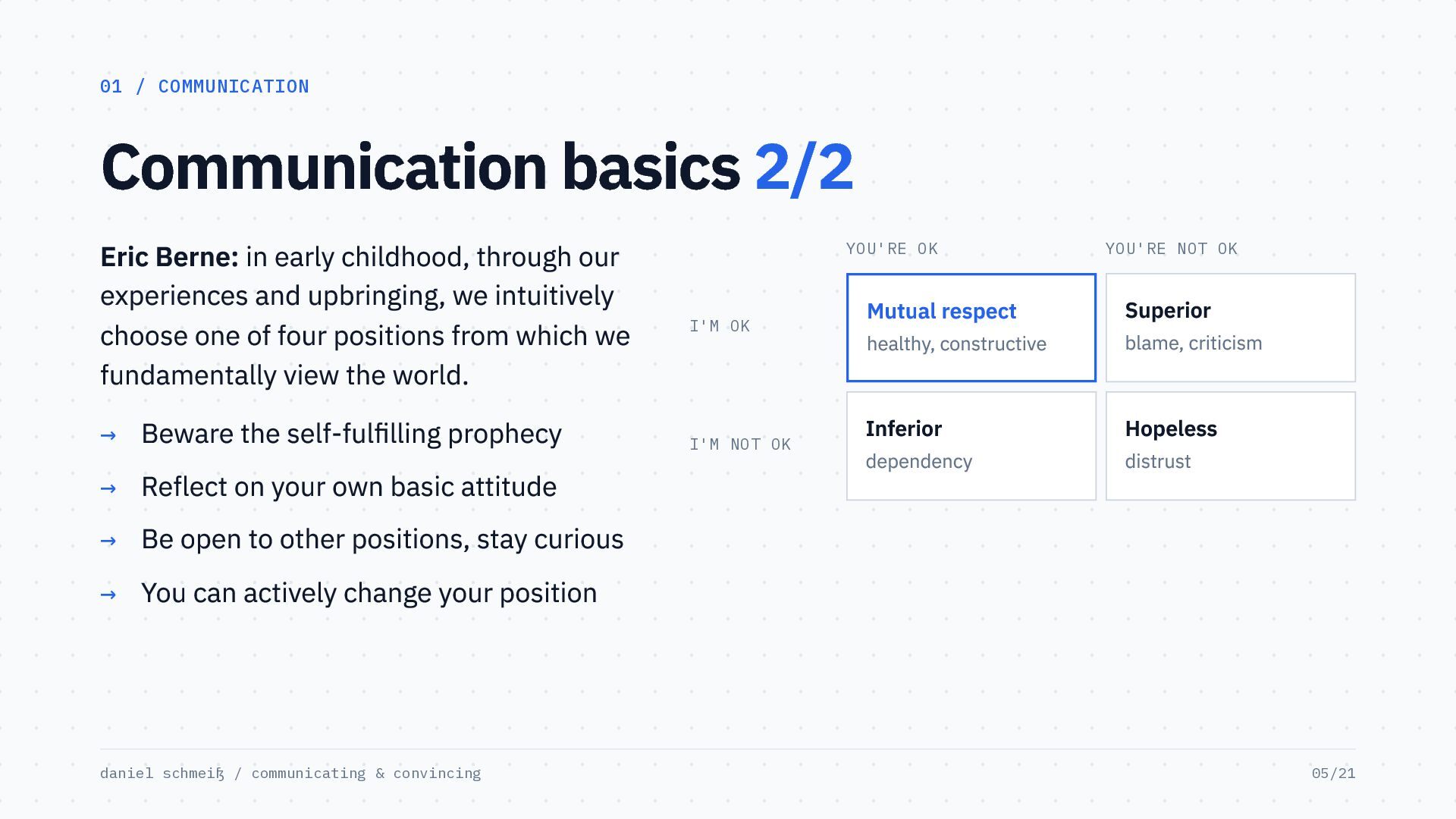
  5. 01 / COMMUNICATION Communication basics 2/2 YOU'RE OK Eric Berne:

    in early childhood, through our experiences and upbringing, we intuitively choose one of four positions from which we I'M OK YOU'RE NOT OK Mutual respect Superior healthy, constructive blame, criticism Inferior Hopeless dependency distrust fundamentally view the world. → Beware the self-fulfilling prophecy → Reflect on your own basic attitude I'M NOT OK → Be open to other positions, stay curious → You can actively change your position daniel schmeiß / communicating & convincing 05/21
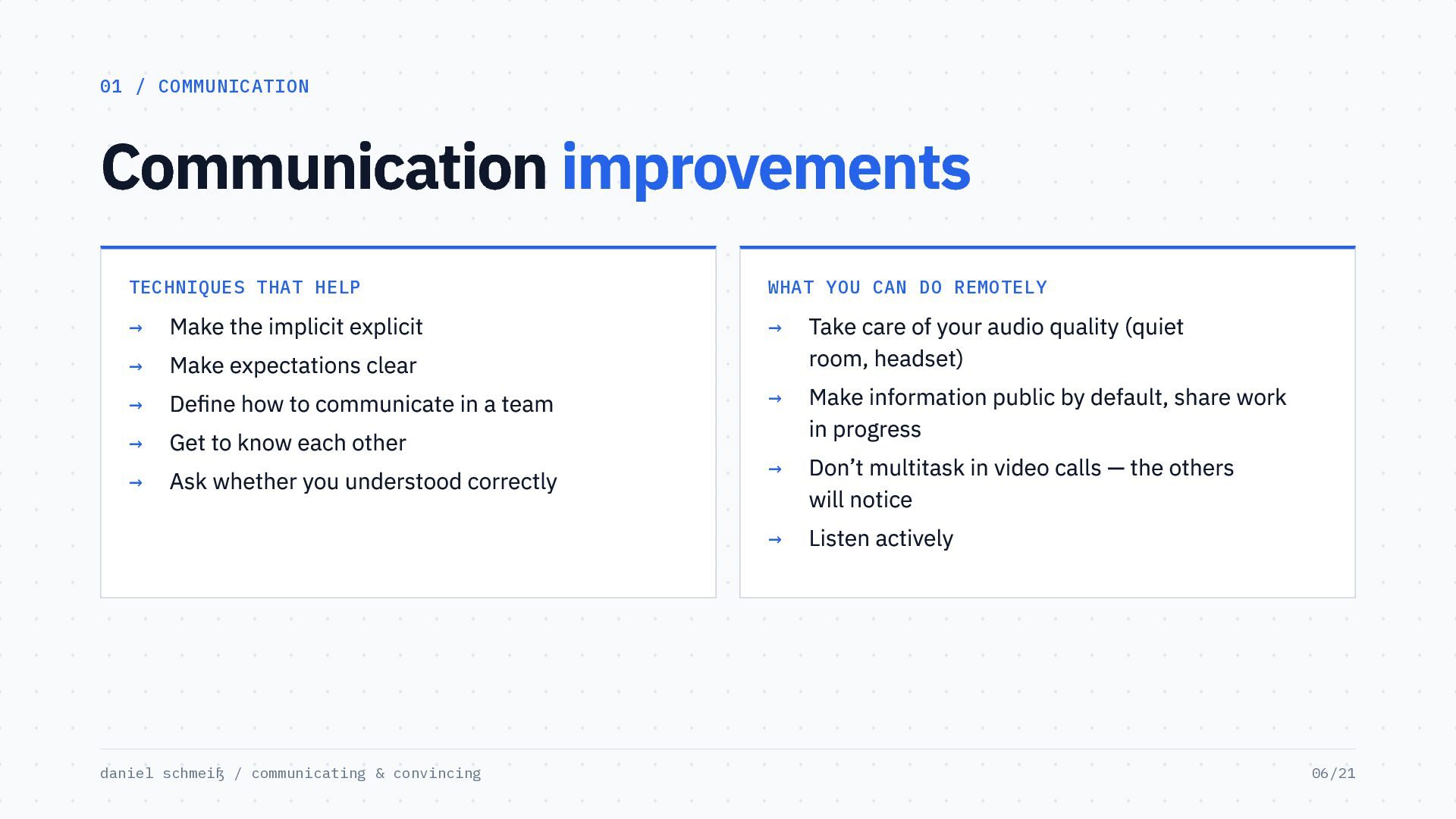
  6. 01 / COMMUNICATION Communication improvements TECHNIQUES THAT HELP WHAT YOU

    CAN DO REMOTELY → Make the implicit explicit → → Make expectations clear Take care of your audio quality (quiet room, headset) → Define how to communicate in a team → → Get to know each other Make information public by default, share work in progress → Ask whether you understood correctly → Don’t multitask in video calls — the others will notice → Listen actively daniel schmeiß / communicating & convincing 06/21
  7. 02 Toolbox & Experience Six tools for clear arguments and

    better decisions daniel schmeiß / communicating & convincing 07/21
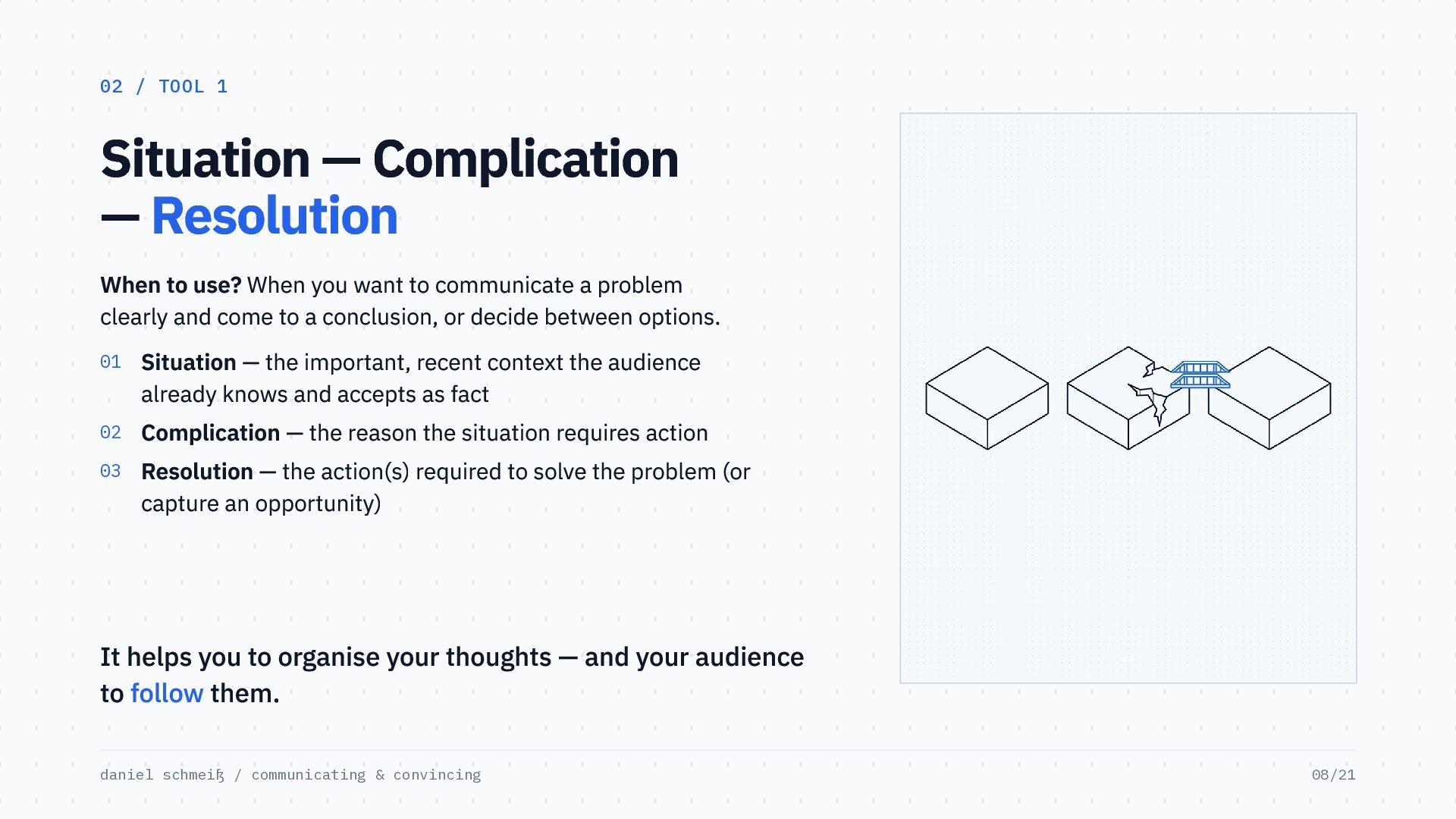
  8. 02 / TOOL 1 Situation — Complication — Resolution When

    to use? When you want to communicate a problem clearly and come to a conclusion, or decide between options. 01 Situation — the important, recent context the audience already knows and accepts as fact 02 Complication — the reason the situation requires action 03 Resolution — the action(s) required to solve the problem (or capture an opportunity) It helps you to organise your thoughts — and your audience to follow them. daniel schmeiß / communicating & convincing 08/21
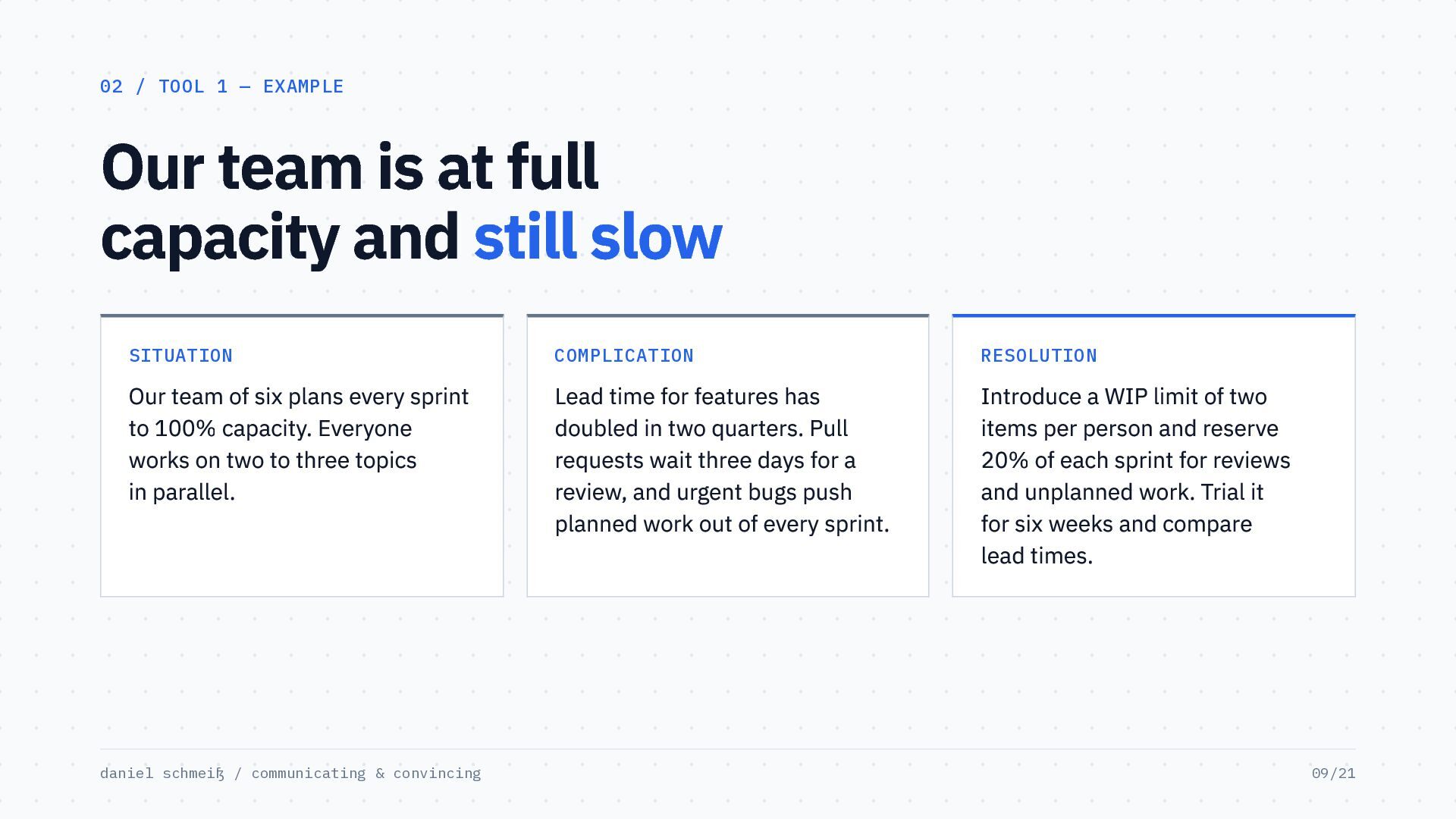
  9. 02 / TOOL 1 — EXAMPLE Our team is at

    full capacity and still slow SITUATION COMPLICATION RESOLUTION Our team of six plans every sprint to 100% capacity. Everyone works on two to three topics in parallel. Lead time for features has doubled in two quarters. Pull requests wait three days for a review, and urgent bugs push planned work out of every sprint. Introduce a WIP limit of two items per person and reserve 20% of each sprint for reviews and unplanned work. Trial it for six weeks and compare lead times. daniel schmeiß / communicating & convincing 09/21
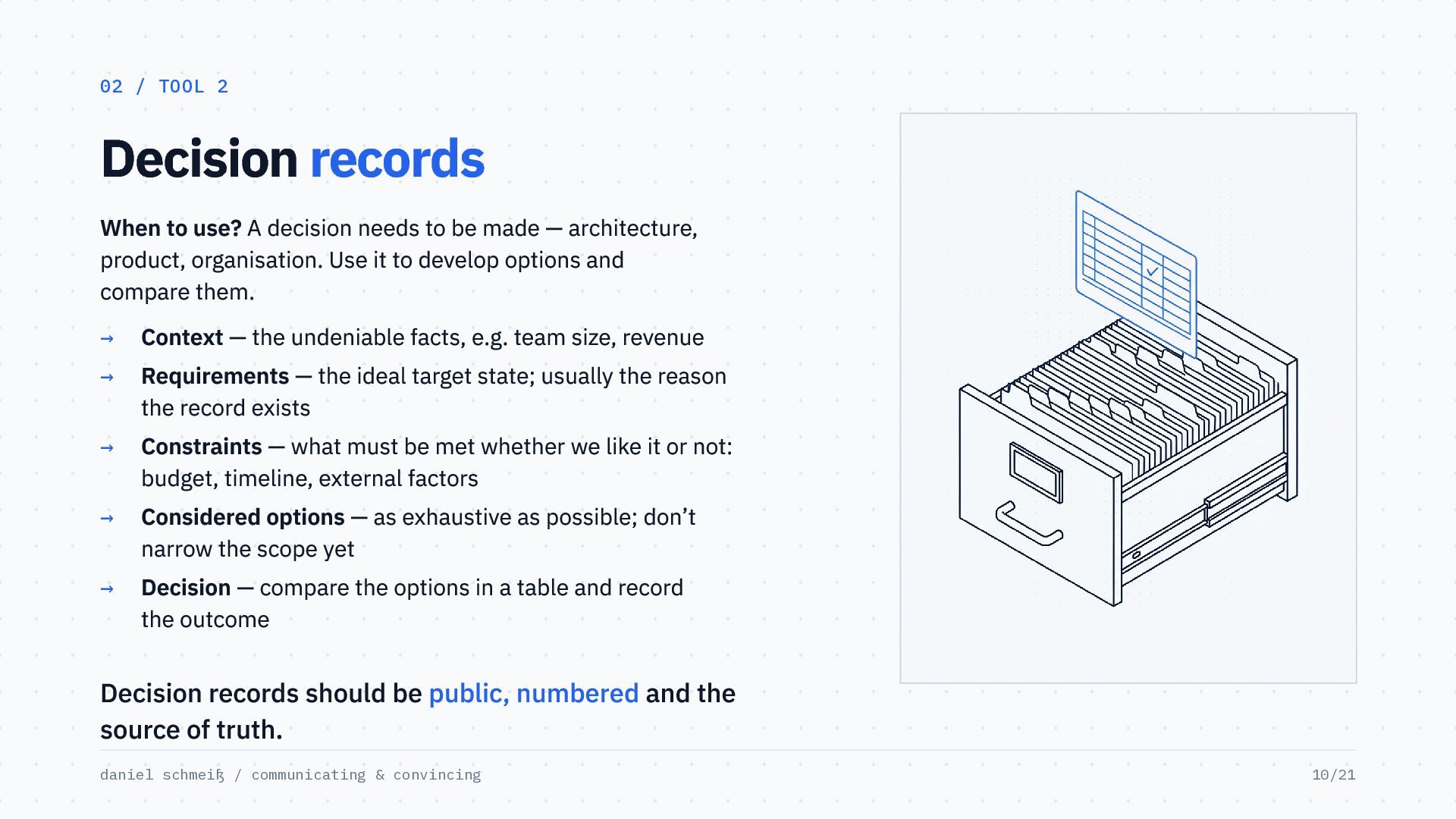
  10. 02 / TOOL 2 Decision records When to use? A

    decision needs to be made — architecture, product, organisation. Use it to develop options and compare them. → Context — the undeniable facts, e.g. team size, revenue → Requirements — the ideal target state; usually the reason the record exists → Constraints — what must be met whether we like it or not: budget, timeline, external factors → Considered options — as exhaustive as possible; don’t narrow the scope yet → Decision — compare the options in a table and record the outcome Decision records should be public, numbered and the source of truth. daniel schmeiß / communicating & convincing 10/21
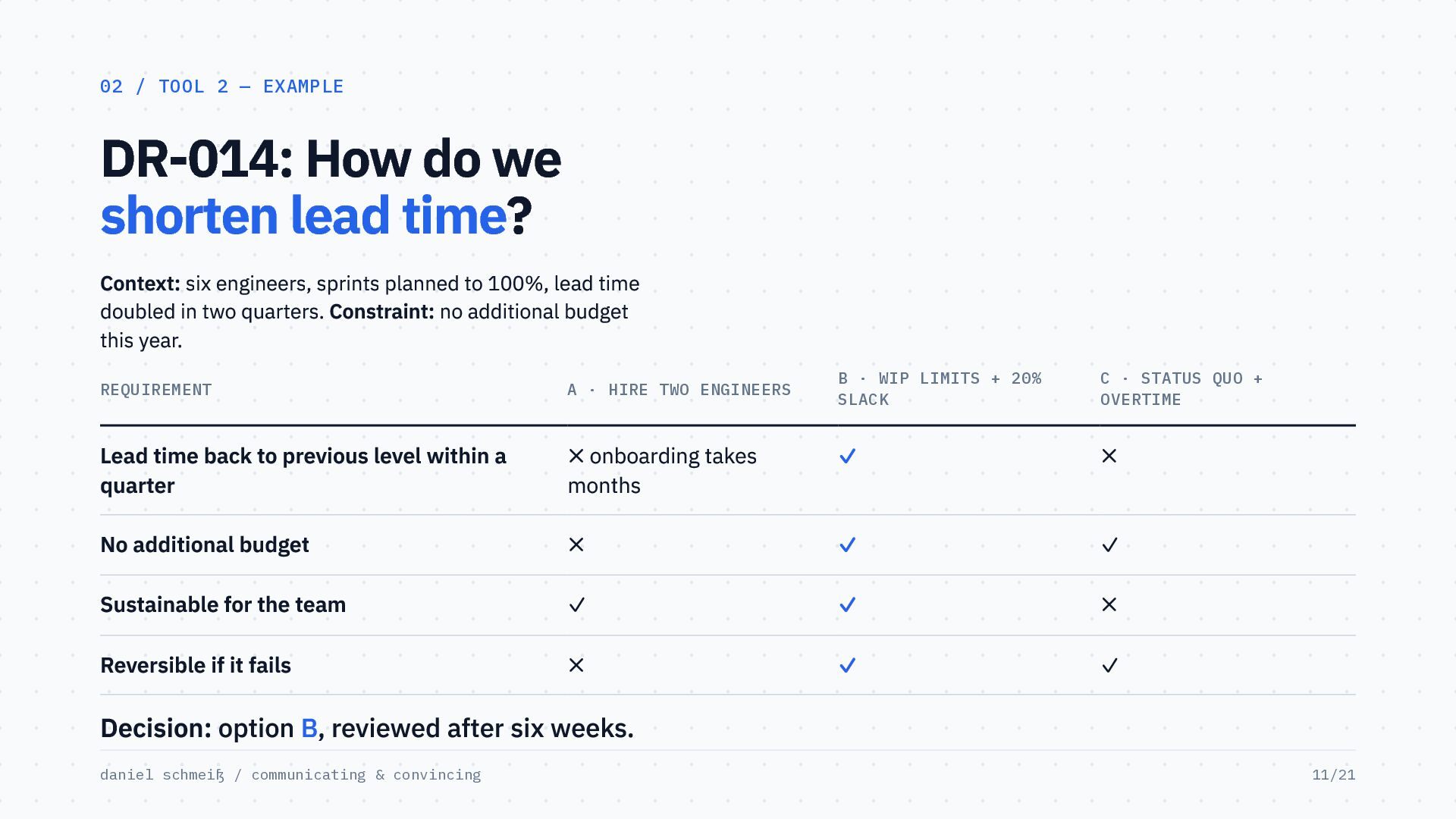
  11. 02 / TOOL 2 — EXAMPLE DR-014: How do we

    shorten lead time? Context: six engineers, sprints planned to 100%, lead time doubled in two quarters. Constraint: no additional budget this year. REQUIREMENT Lead time back to previous level within a quarter No additional budget Sustainable for the team Reversible if it fails A · HIRE TWO ENGINEERS B · WIP LIMITS + 20% SLACK C · STATUS QUO + OVERTIME ✗ onboarding takes ✓ ✗ ✗ ✓ ✗ ✓ ✓ ✓ ✓ ✗ ✓ months Decision: option B, reviewed after six weeks. daniel schmeiß / communicating & convincing 11/21
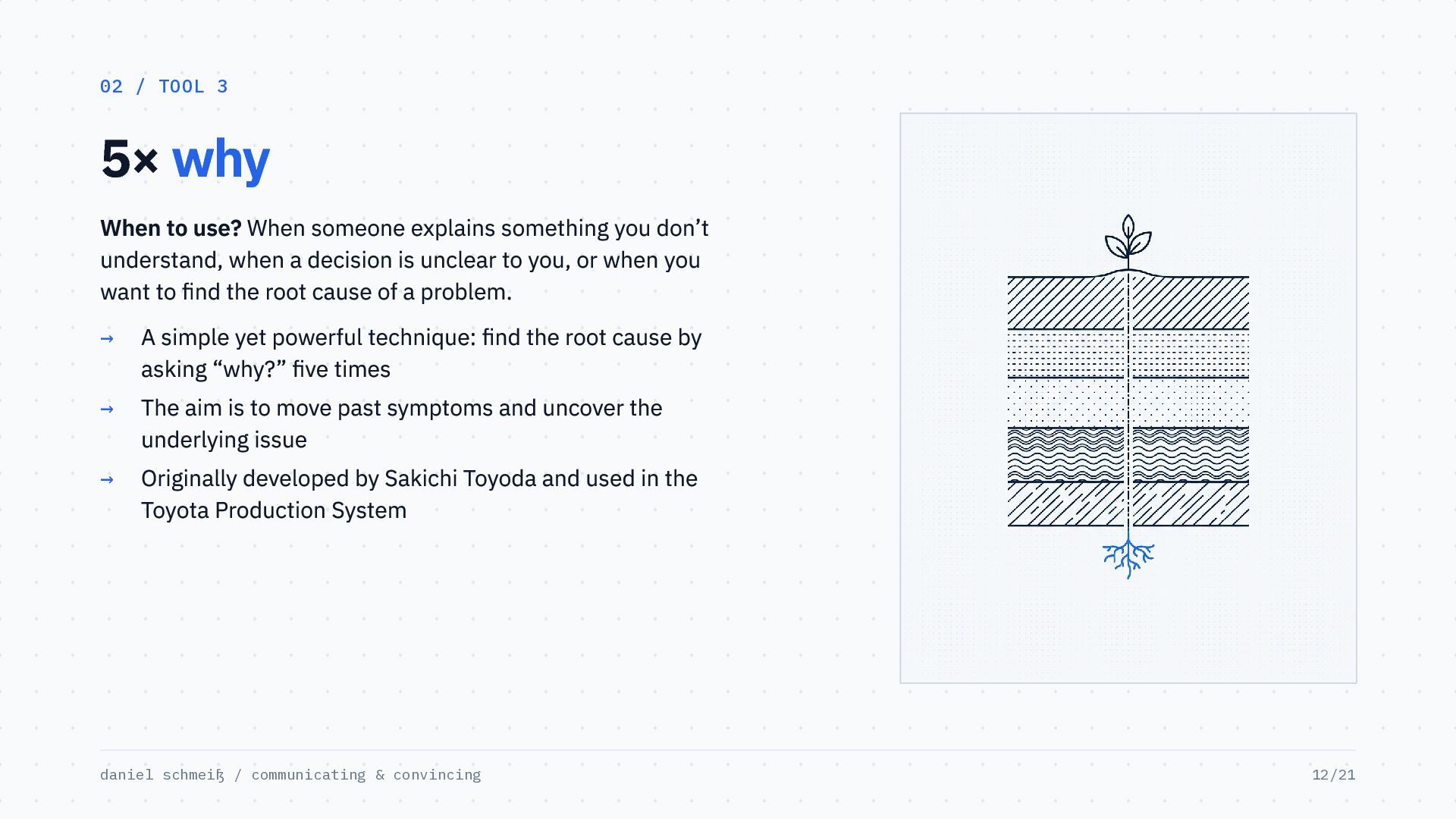
  12. 02 / TOOL 3 5× why When to use? When

    someone explains something you don’t understand, when a decision is unclear to you, or when you want to find the root cause of a problem. → A simple yet powerful technique: find the root cause by asking “why?” five times → The aim is to move past symptoms and uncover the underlying issue → Originally developed by Sakichi Toyoda and used in the Toyota Production System daniel schmeiß / communicating & convincing 12/21
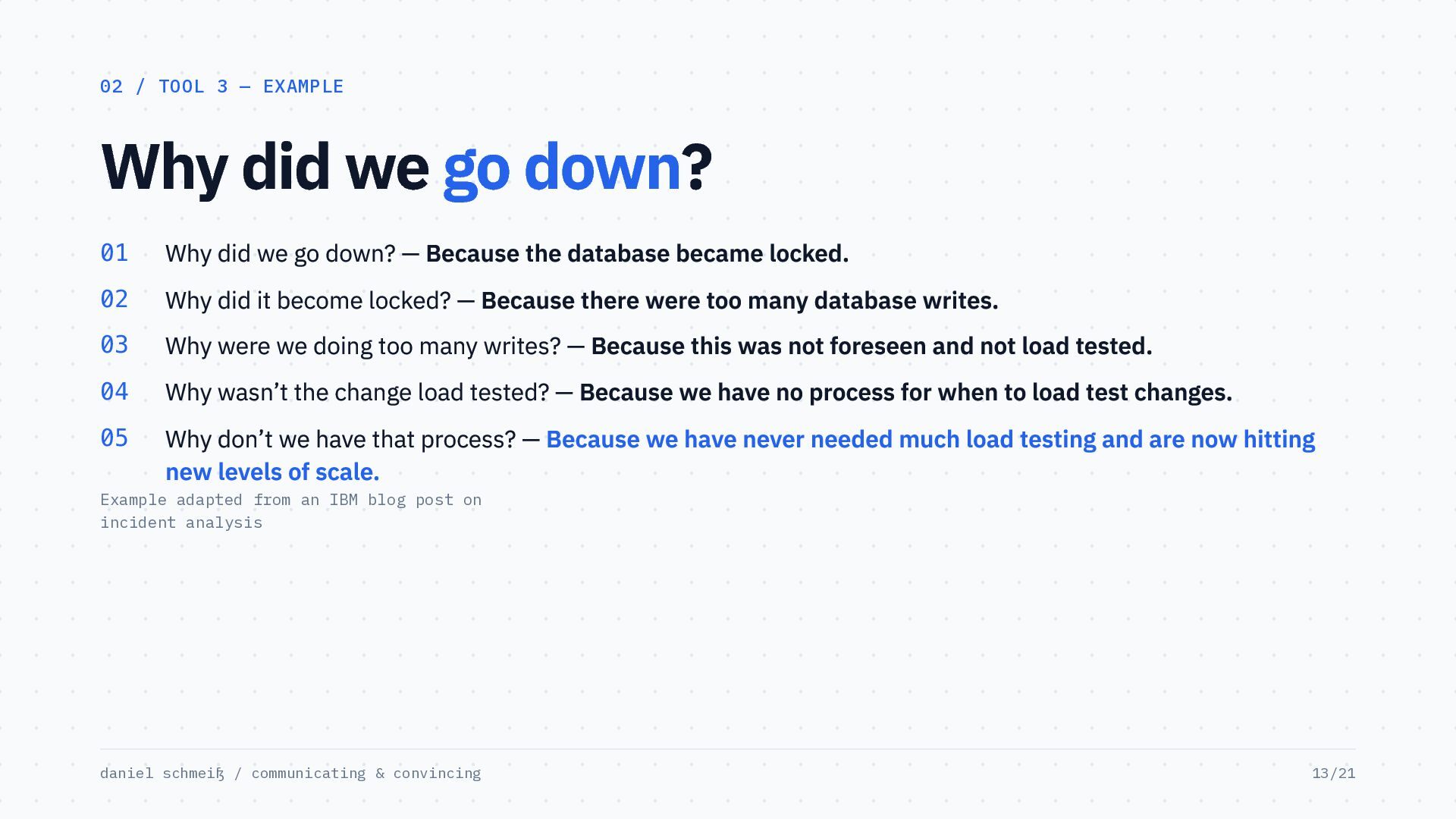
  13. 02 / TOOL 3 — EXAMPLE Why did we go

    down? 01 Why did we go down? — Because the database became locked. 02 Why did it become locked? — Because there were too many database writes. 03 Why were we doing too many writes? — Because this was not foreseen and not load tested. 04 Why wasn’t the change load tested? — Because we have no process for when to load test changes. 05 Why don’t we have that process? — Because we have never needed much load testing and are now hitting new levels of scale. Example adapted from an IBM blog post on incident analysis daniel schmeiß / communicating & convincing 13/21
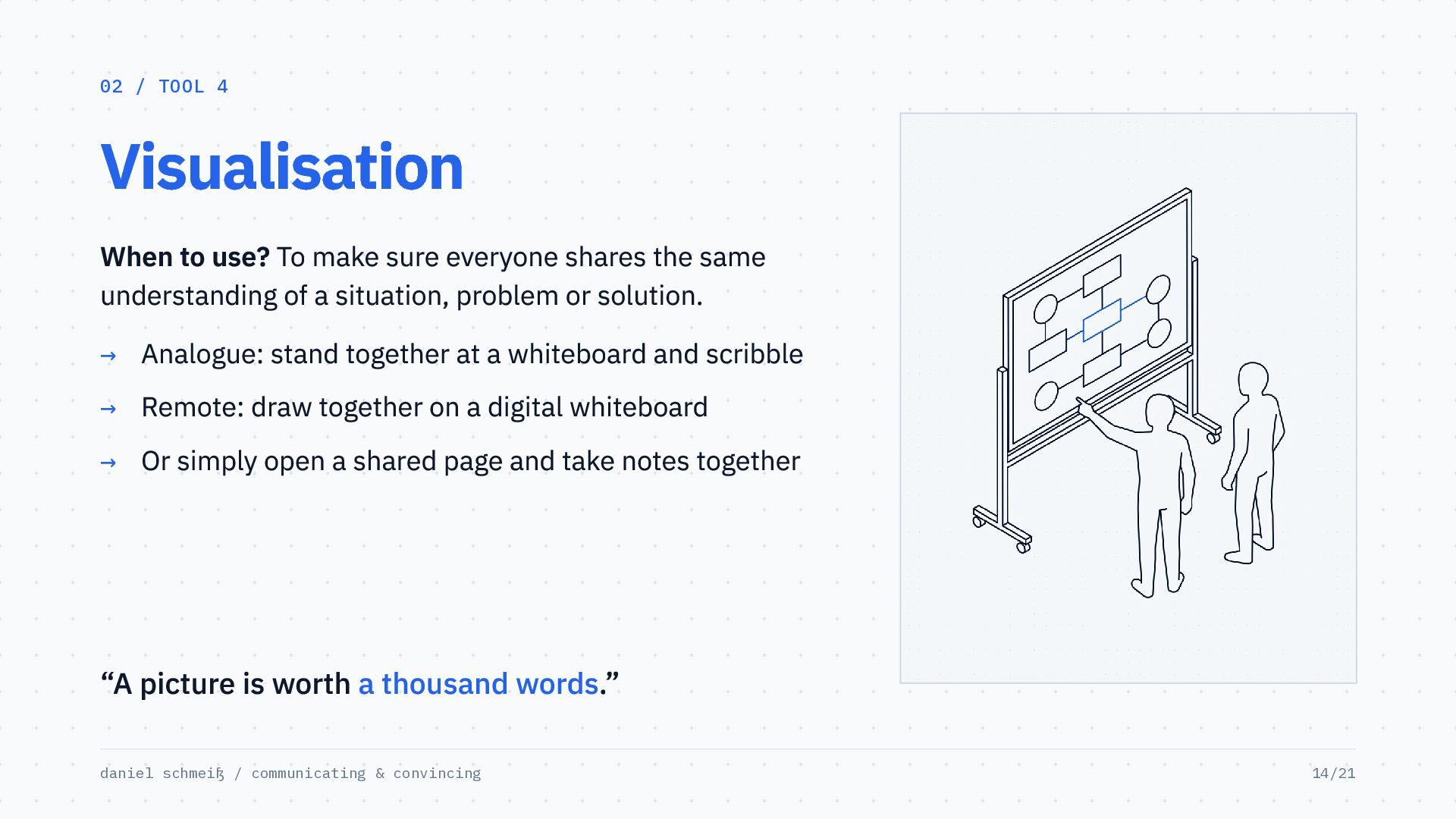
  14. 02 / TOOL 4 Visualisation When to use? To make

    sure everyone shares the same understanding of a situation, problem or solution. → Analogue: stand together at a whiteboard and scribble → Remote: draw together on a digital whiteboard → Or simply open a shared page and take notes together “A picture is worth a thousand words.” daniel schmeiß / communicating & convincing 14/21
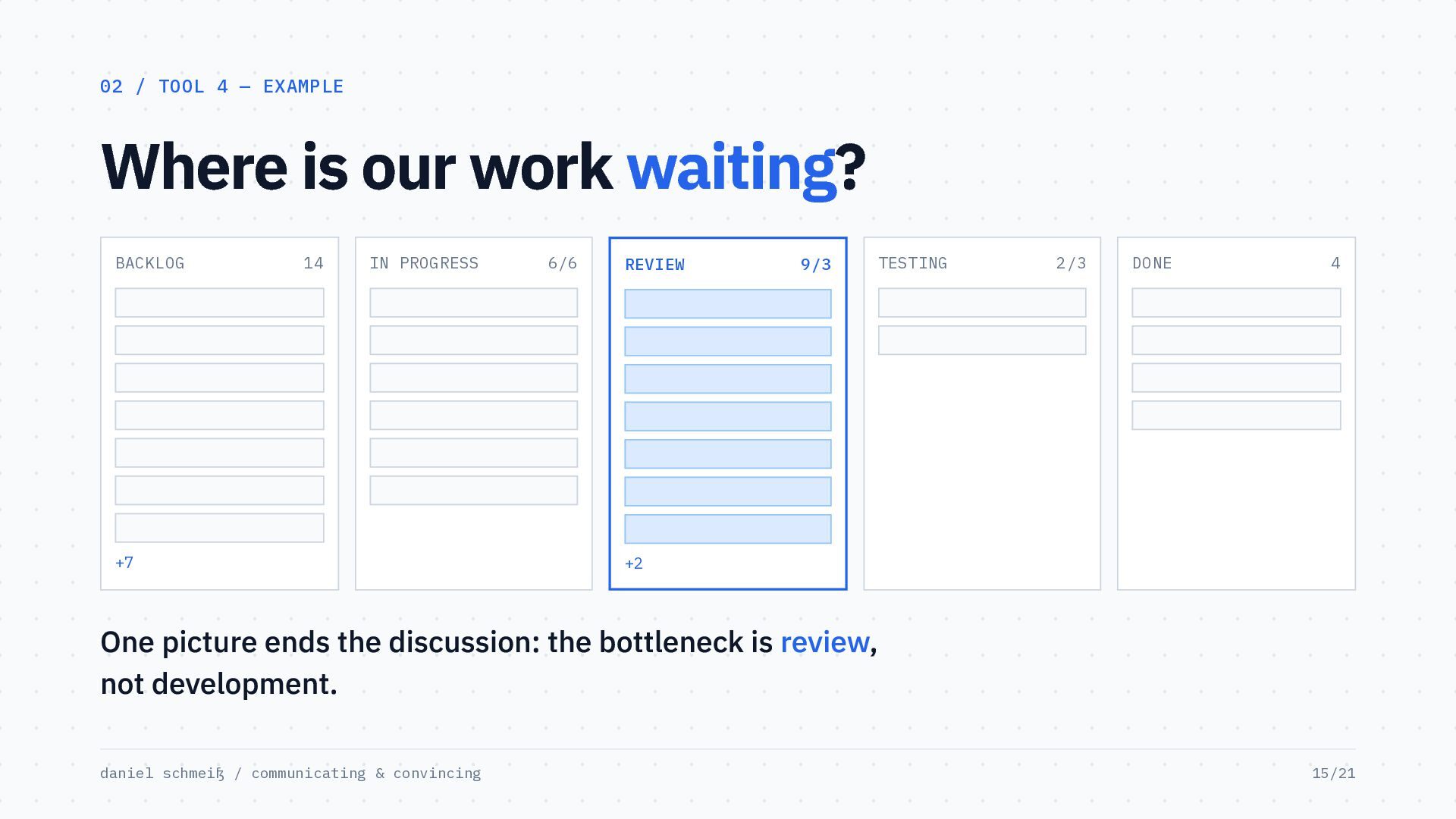
  15. 02 / TOOL 4 — EXAMPLE Where is our work

    waiting? BACKLOG 14 IN PROGRESS +7 6/6 REVIEW 9/3 TESTING 2/3 DONE 4 +2 One picture ends the discussion: the bottleneck is review, not development. daniel schmeiß / communicating & convincing 15/21
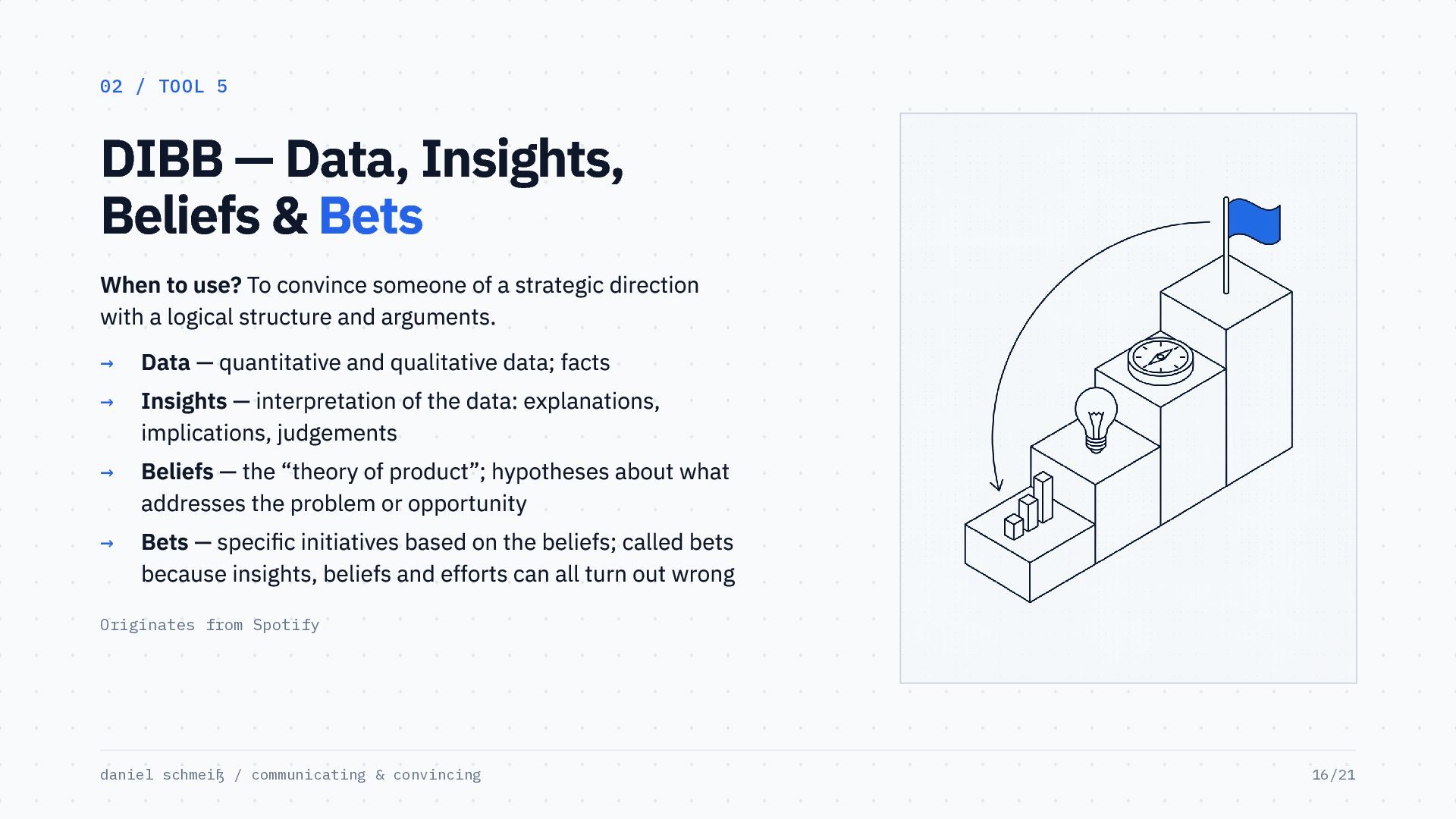
  16. 02 / TOOL 5 DIBB — Data, Insights, Beliefs &

    Bets When to use? To convince someone of a strategic direction with a logical structure and arguments. → Data — quantitative and qualitative data; facts → Insights — interpretation of the data: explanations, implications, judgements → Beliefs — the “theory of product”; hypotheses about what addresses the problem or opportunity → Bets — specific initiatives based on the beliefs; called bets because insights, beliefs and efforts can all turn out wrong Originates from Spotify daniel schmeiß / communicating & convincing 16/21
  17. 02 / TOOL 5 — EXAMPLE DIBB — an argument

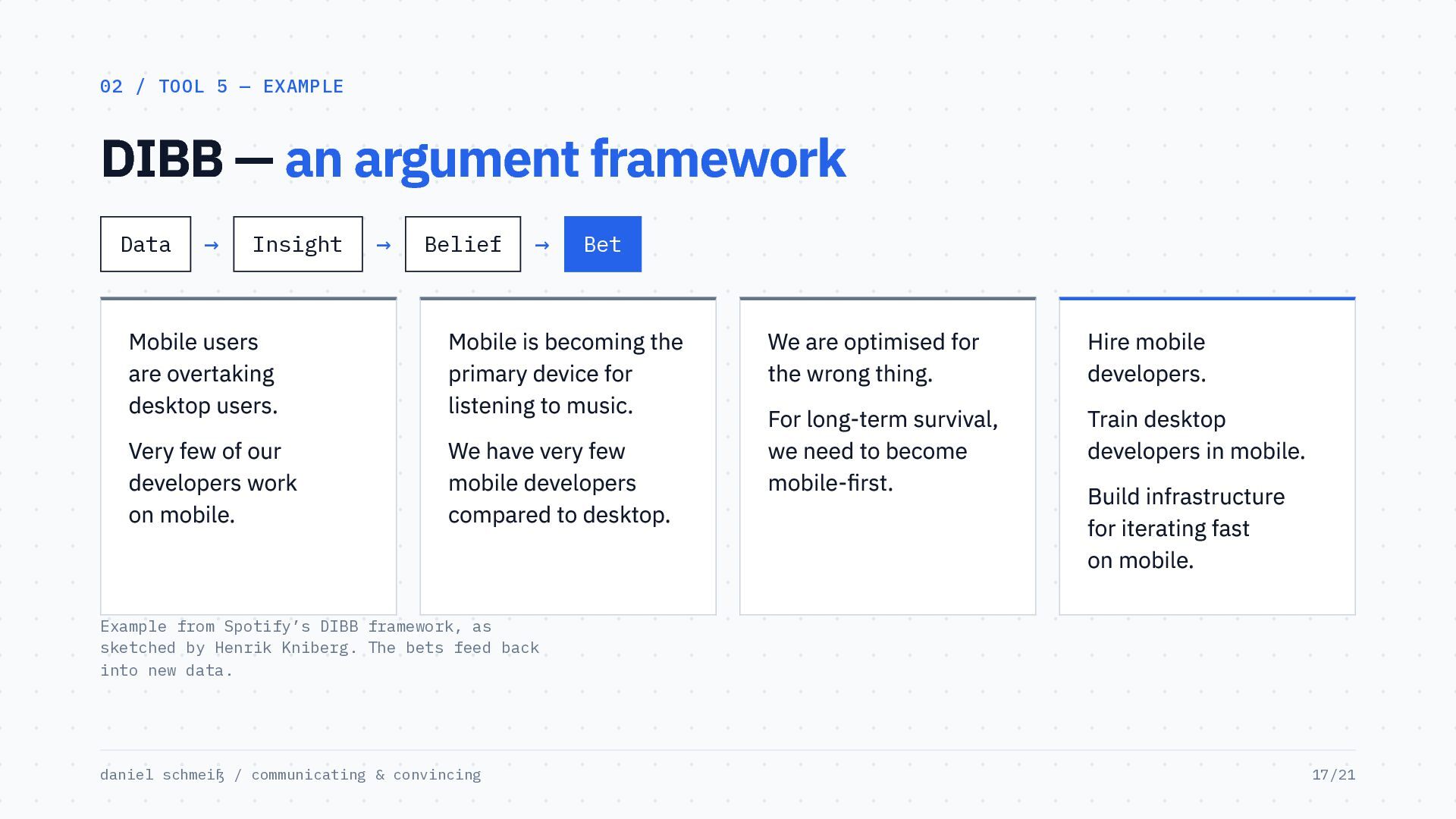
    framework Data → Insight → Belief → Bet Mobile users are overtaking desktop users. Mobile is becoming the primary device for listening to music. Very few of our developers work on mobile. We have very few mobile developers compared to desktop. We are optimised for the wrong thing. Hire mobile developers. For long-term survival, we need to become mobile-first. Train desktop developers in mobile. Build infrastructure for iterating fast on mobile. Example from Spotify’s DIBB framework, as sketched by Henrik Kniberg. The bets feed back into new data. daniel schmeiß / communicating & convincing 17/21
  18. 02 / TOOL 6 Write simple and clean When to

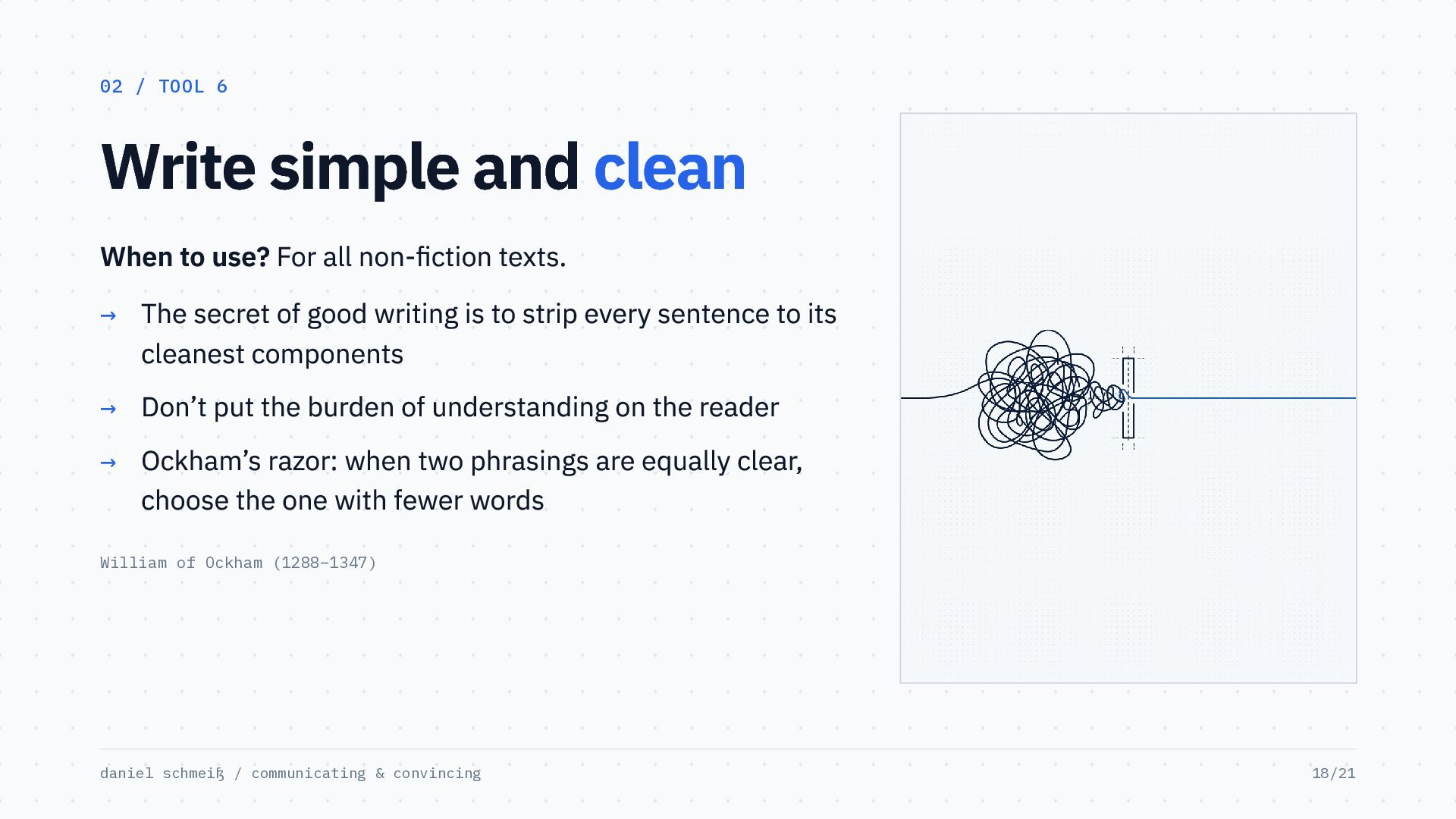
    use? For all non-fiction texts. → The secret of good writing is to strip every sentence to its cleanest components → Don’t put the burden of understanding on the reader → Ockham’s razor: when two phrasings are equally clear, choose the one with fewer words William of Ockham (1288–1347) daniel schmeiß / communicating & convincing 18/21
  19. 02 / TOOL 6 — EXAMPLE Writing for busy readers:

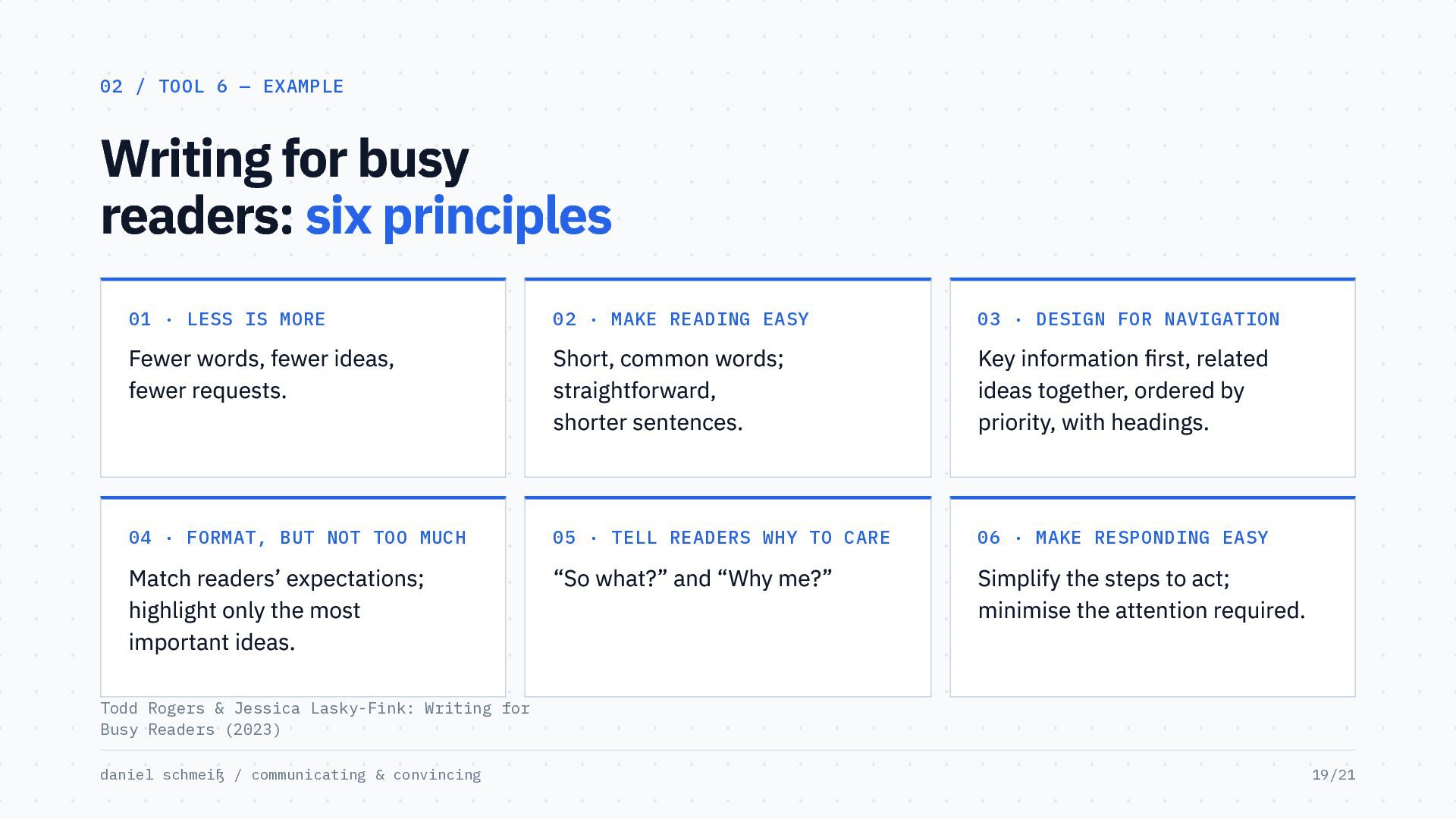
    six principles 01 · LESS IS MORE 02 · MAKE READING EASY 03 · DESIGN FOR NAVIGATION Fewer words, fewer ideas, fewer requests. Short, common words; straightforward, shorter sentences. Key information first, related ideas together, ordered by priority, with headings. 04 · FORMAT, BUT NOT TOO MUCH 05 · TELL READERS WHY TO CARE 06 · MAKE RESPONDING EASY Match readers’ expectations; highlight only the most important ideas. “So what?” and “Why me?” Simplify the steps to act; minimise the attention required. Todd Rogers & Jessica Lasky-Fink: Writing for Busy Readers (2023) daniel schmeiß / communicating & convincing 19/21
  20. SUMMARY Make the implicit explicit. Be aware of how communication

    works, write simply — and use the tools. daniel schmeiß / communicating & convincing 20/21
  21. // THE END Thank you. Make the implicit explicit —

    and use the tools. Daniel Schmeiß linkedin.com/in/danielschmeiss