Three Reasons to Adopt Collaborative Modelling...

Daniel Sack
November 18, 2026

Three Reasons to Adopt Collaborative Modelling in Software Design - We build faster. Are we building the right thing?

Software architecture is a team sport. Yet, many architecture decisions are still made by a small group of experts, while critical knowledge remains fragmented across teams, domains, and organizational boundaries. The result: bottlenecks, misunderstandings and slow architectural evolution.

Collaborative Modelling (CoMo) in software design offers a different approach. Rather than relying on a single technique, it brings architects, developers, domain experts, and other stakeholders together to build a shared understanding of systems, their context, and the challenges they face. Practices such as EventStorming demonstrate the power of collaborative modelling, but they represent only a small part of a broader set of collaborative modelling techniques.

At its core, Collaborative Modelling in software design is not about creating better models – it is about enabling better conversations that lead to better architecture!

This talk explores three practical reasons why collaborative modelling has become an essential architectural practice:

1) Creating shared understanding across teams and domains.
2) Early discovery of assumptions, misunderstandings, and hidden risks, before they become expensive
3) Reducing architectural bottlenecks by distributing knowledge and responsibility.

Participants will discover the principles behind collaborative modelling and explore where these practices create the greatest impact. They will learn how collaborative modelling helps teams make more informed decisions, align architecture with business needs, and evolve complex systems more effectively. They will leave with practical ideas for making architecture a shared capability rather than the responsibility of a few individuals.

Daniel Sack

November 18, 2026

Annual Pro sale · Save $30

Have presentations of your own?

Share with private links, password protection, and more control over your work.

Transcript

33 slides
  1. SOFTWARE ARCHITECTURE GATHERING 2026 Three Reasons to Adopt Collaborative Modelling

    in Software Design We build faster. Are we building the right thing? Tom Asel · Daniel Sack
  2. ACT 1 What’s going wrong? Development is where it surfaces

    – communication is where it starts. 2 1 · What’s going wrong 2 · What we need 3 · Why it works 4 · Where AI fits Closing
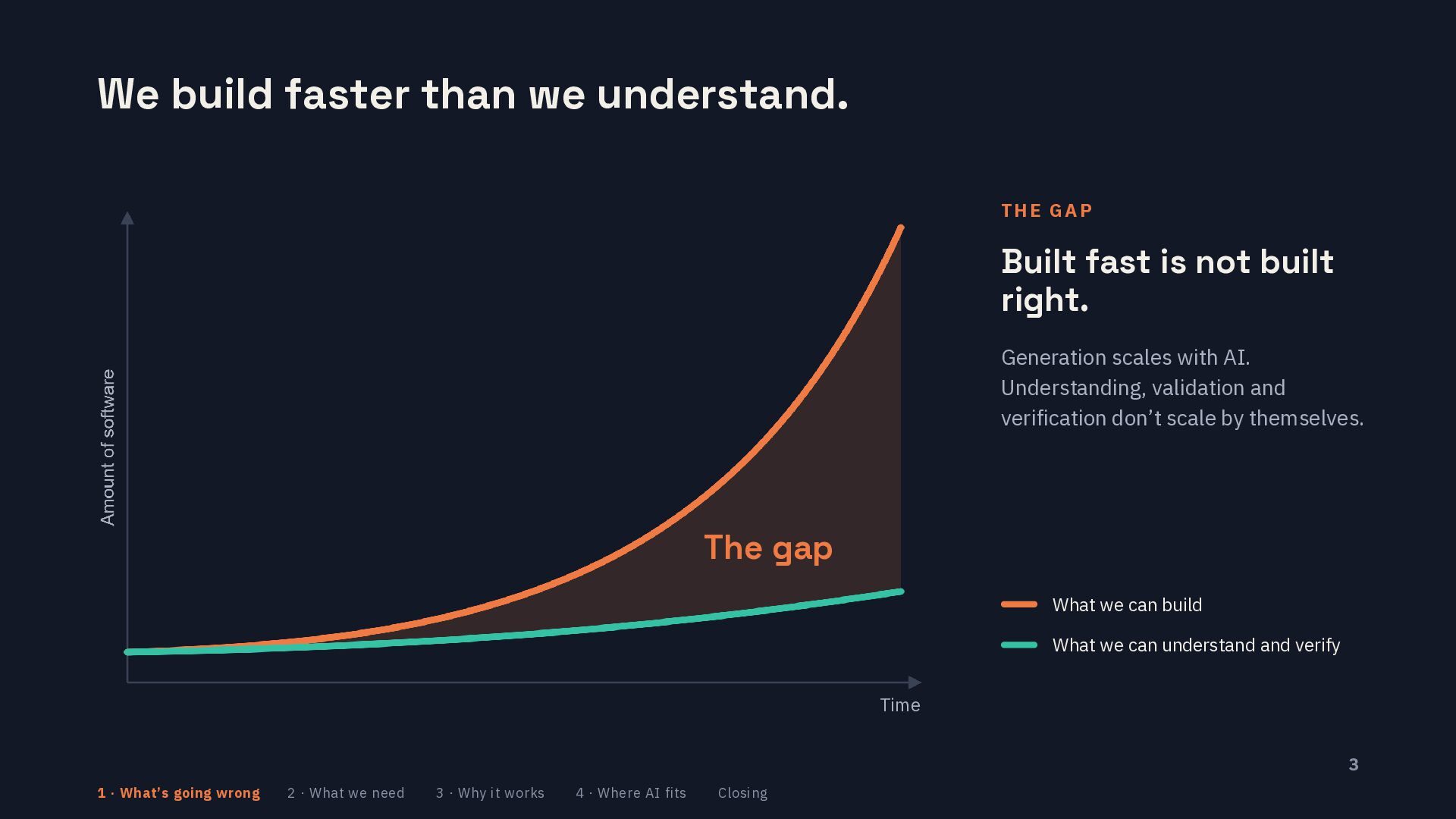
  3. We build faster than we understand. THE GAP Built fast

    is not built right. Generation scales with AI. Understanding, validation and verification don’t scale by themselves. The gap What we can build What we can understand and verify Time 3 1 · What’s going wrong 2 · What we need 3 · Why it works 4 · Where AI fits Closing
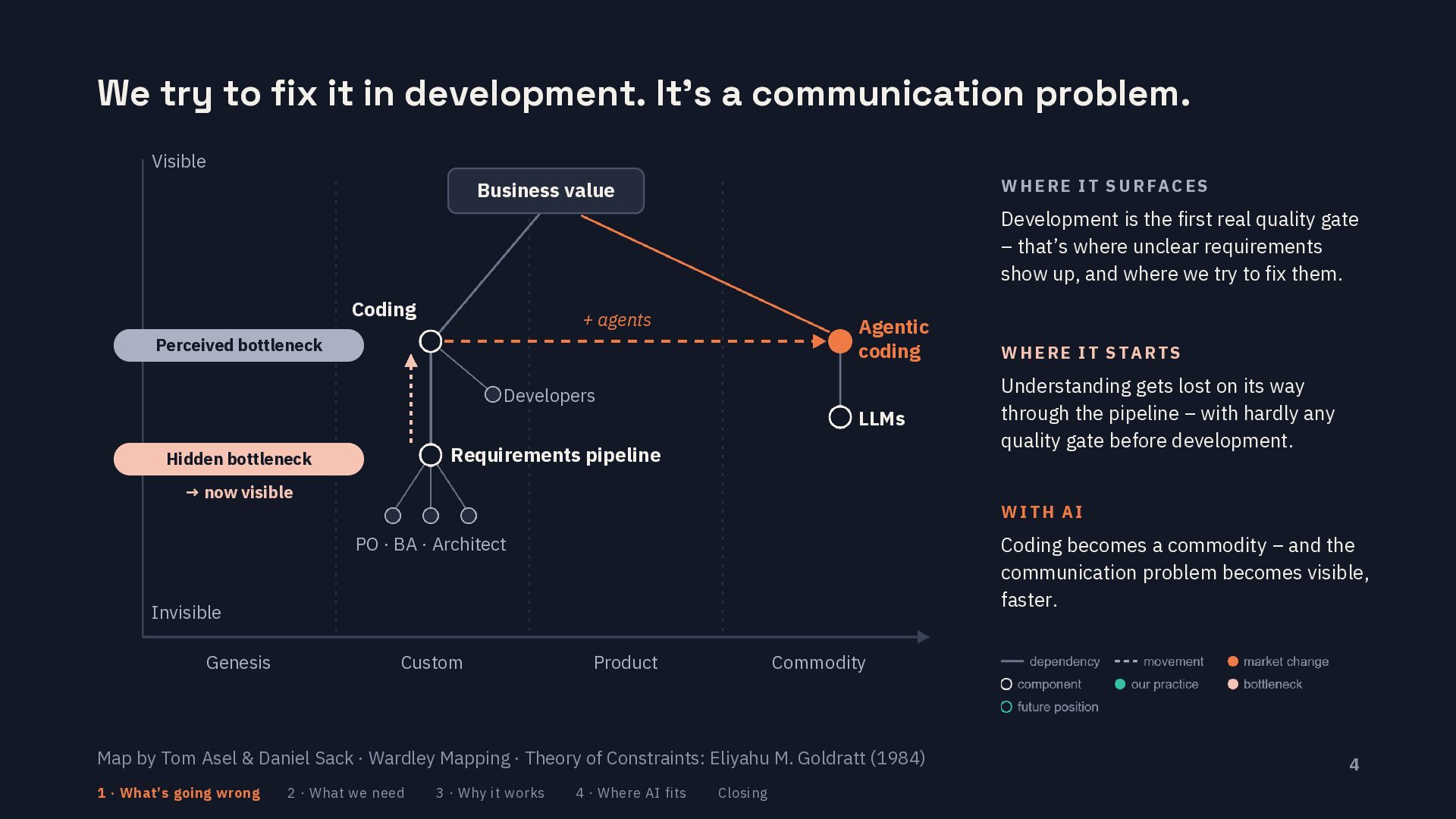
  4. We try to fix it in development. It’s a communication

    problem. Visible WHERE IT SURFACES Business value Development is the first real quality gate – that’s where unclear requirements show up, and where we try to fix them. Coding + agents Agentic coding Perceived bottleneck Developers LLMs Requirements pipeline Hidden bottleneck → now visible Coding becomes a commodity – and the communication problem becomes visible, faster. Invisible Custom Product Commodity Map by Tom Asel & Daniel Sack · Wardley Mapping · Theory of Constraints: Eliyahu M. Goldratt (1984) 1 · What’s going wrong Understanding gets lost on its way through the pipeline – with hardly any quality gate before development. WITH AI PO · BA · Architect Genesis WHERE IT STARTS 2 · What we need 3 · Why it works 4 · Where AI fits Closing 4
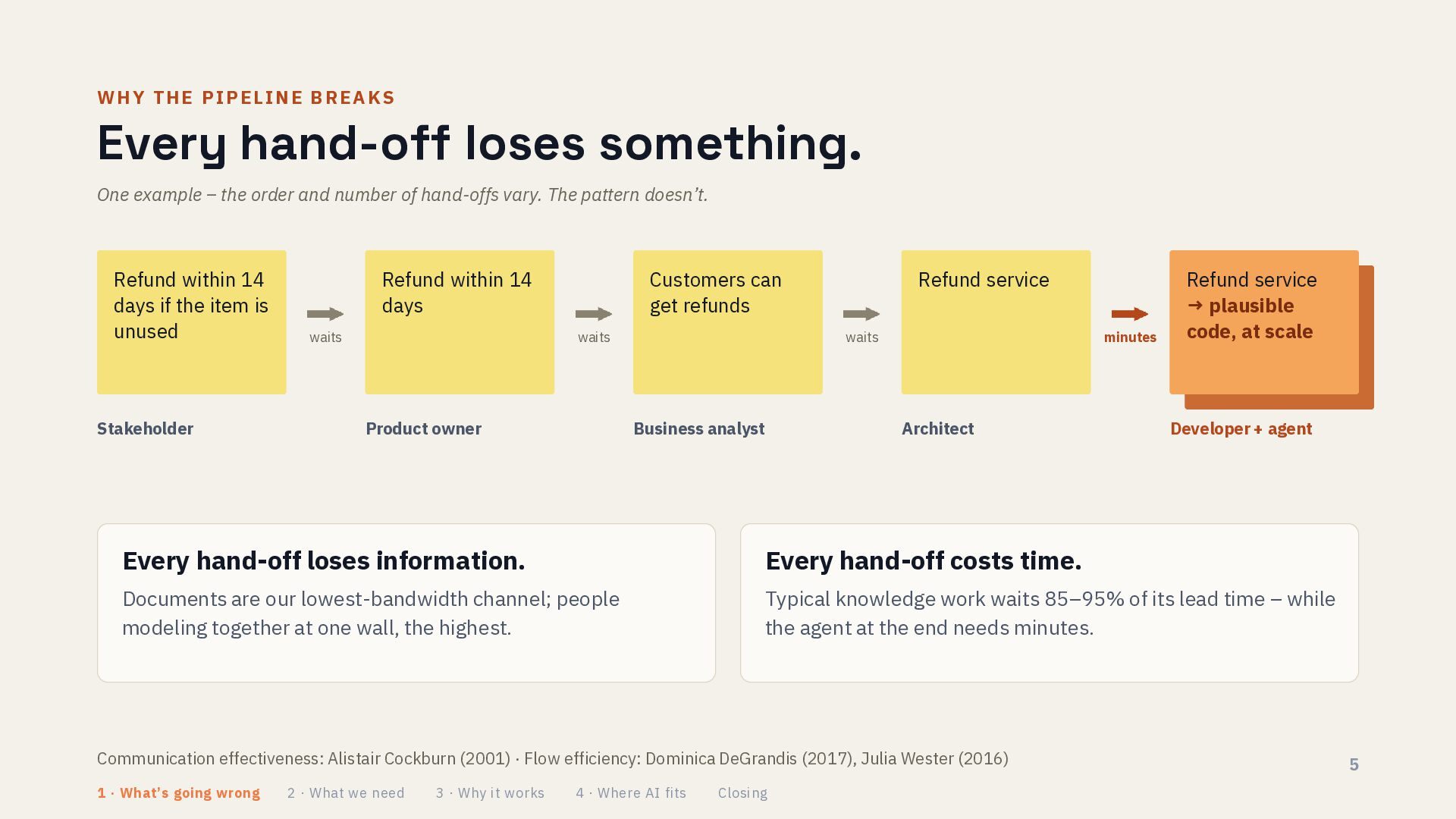
  5. WHY THE PIPELINE BREAKS Every hand-off loses something. One example

    – the order and number of hand-offs vary. The pattern doesn’t. Refund within 14 days if the item is unused Stakeholder Refund within 14 days waits Customers can get refunds waits Product owner Refund service waits Business analyst minutes Architect Refund service → plausible code, at scale Developer + agent Every hand-off loses information. Every hand-off costs time. Documents are our lowest-bandwidth channel; people modeling together at one wall, the highest. Typical knowledge work waits 85–95% of its lead time – while the agent at the end needs minutes. Communication effectiveness: Alistair Cockburn (2001) · Flow efficiency: Dominica DeGrandis (2017), Julia Wester (2016) 1 · What’s going wrong 2 · What we need 3 · Why it works 4 · Where AI fits Closing 5
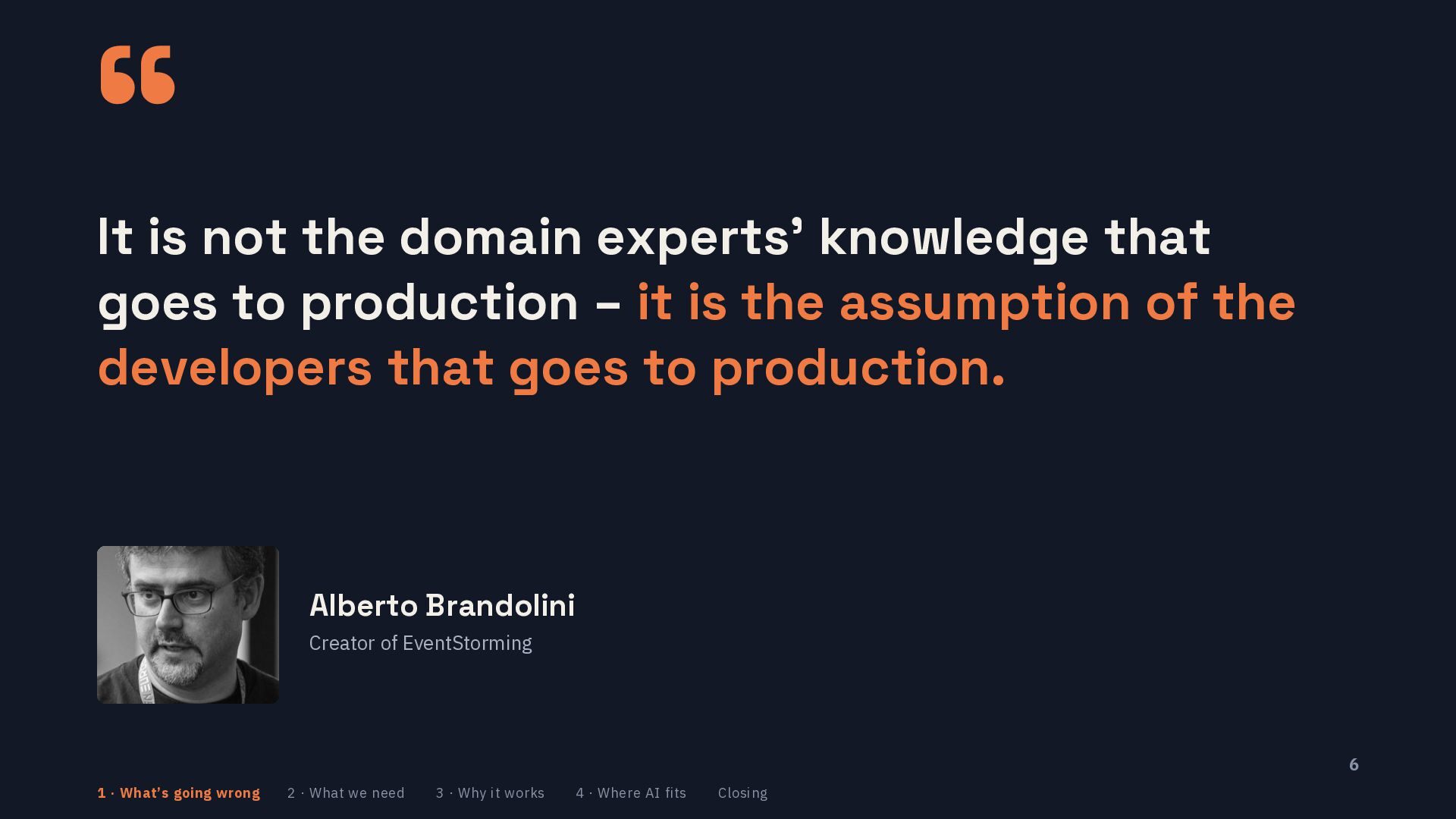
  6. “ It is not the domain experts’ knowledge that goes

    to production – it is the assumption of the developers that goes to production. Alberto Brandolini Creator of EventStorming 6 1 · What’s going wrong 2 · What we need 3 · Why it works 4 · Where AI fits Closing
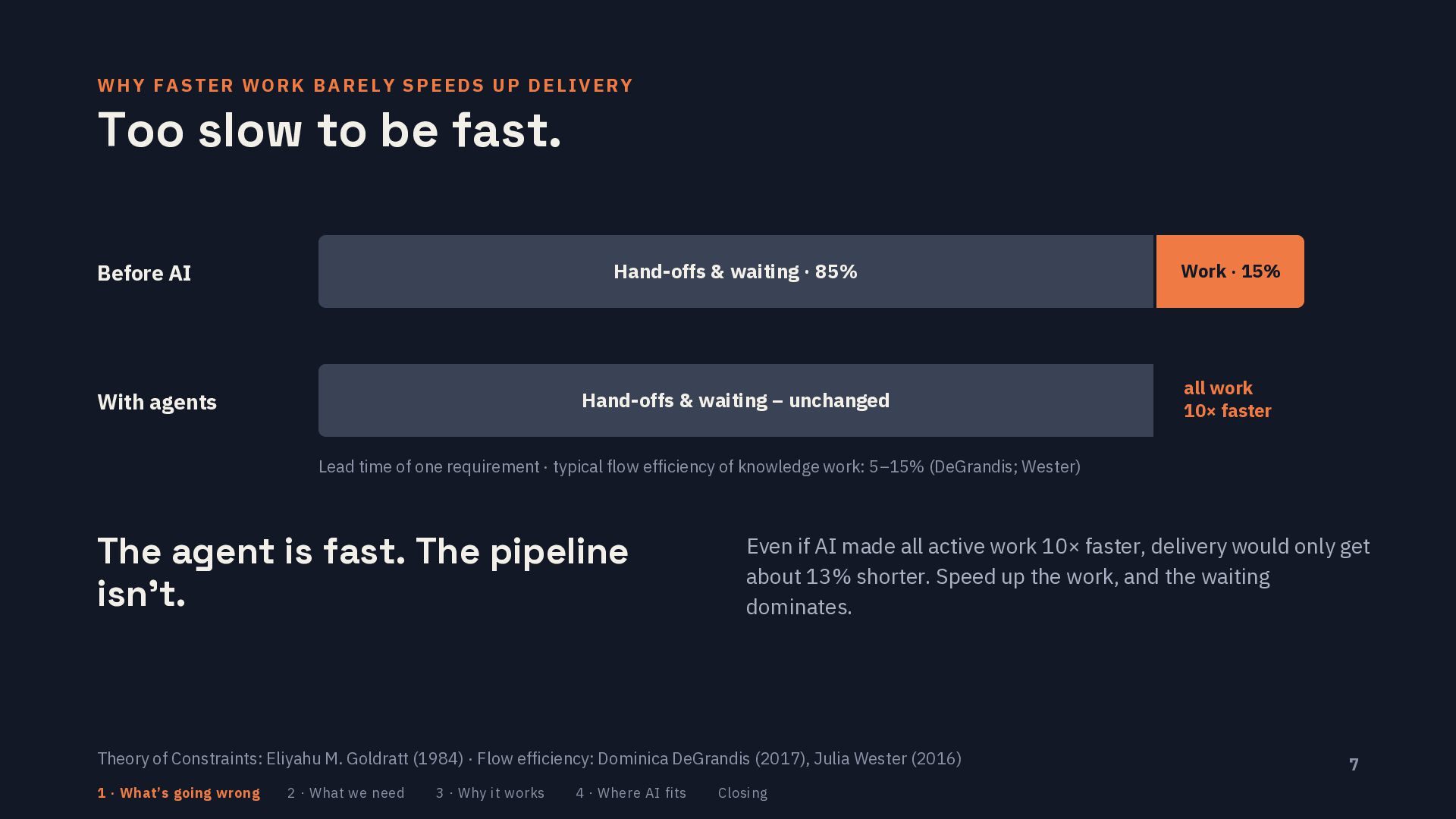
  7. WHY FASTER WORK BARELY SPEEDS UP DELIVERY Too slow to

    be fast. Before AI Hand-offs & waiting · 85% Work · 15% With agents Hand-offs & waiting – unchanged all work 10× faster Lead time of one requirement · typical flow efficiency of knowledge work: 5–15% (DeGrandis; Wester) The agent is fast. The pipeline isn’t. Even if AI made all active work 10× faster, delivery would only get about 13% shorter. Speed up the work, and the waiting dominates. Theory of Constraints: Eliyahu M. Goldratt (1984) · Flow efficiency: Dominica DeGrandis (2017), Julia Wester (2016) 1 · What’s going wrong 2 · What we need 3 · Why it works 4 · Where AI fits Closing 7
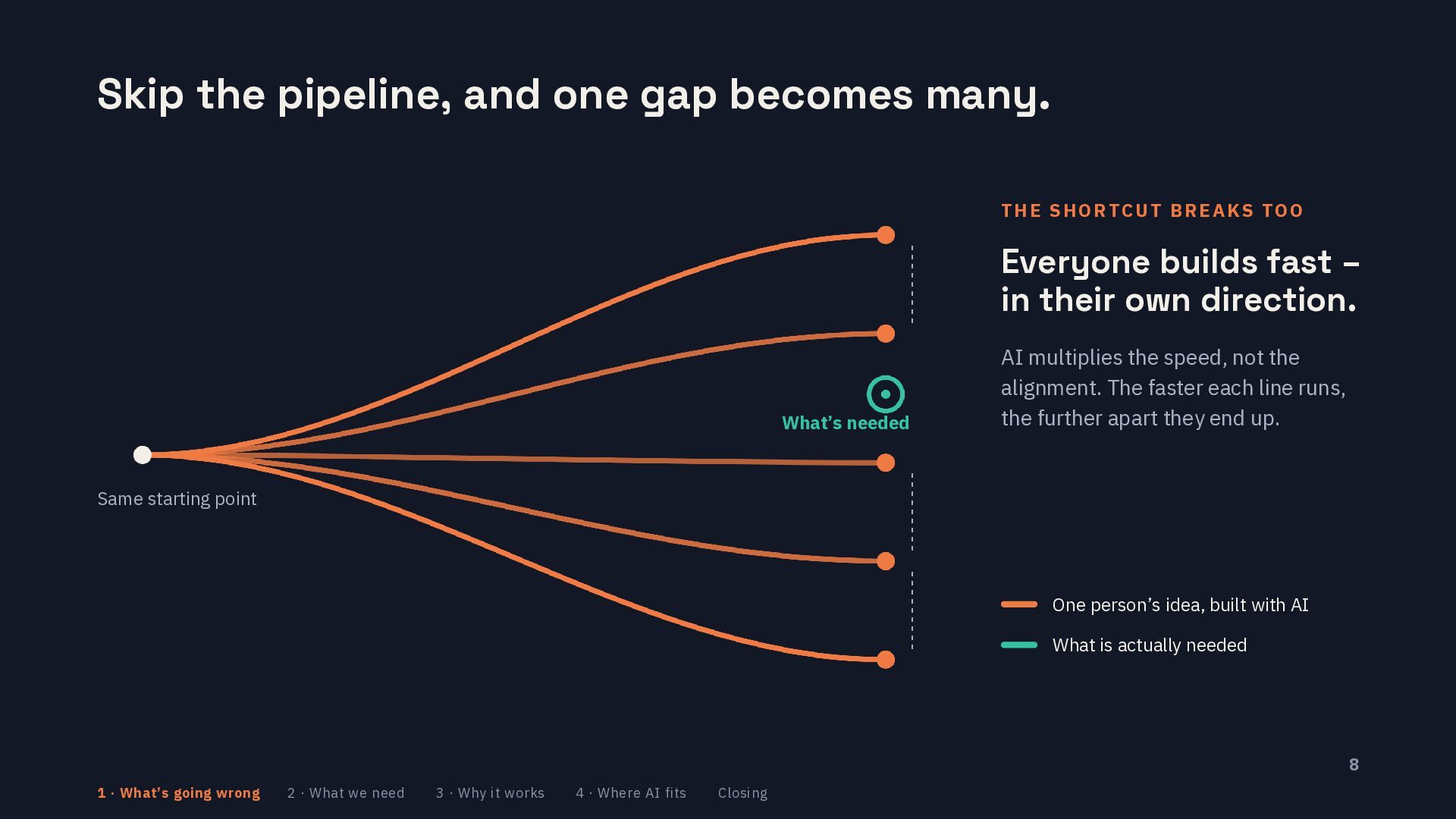
  8. Skip the pipeline, and one gap becomes many. THE SHORTCUT

    BREAKS TOO Everyone builds fast – in their own direction. What’s needed AI multiplies the speed, not the alignment. The faster each line runs, the further apart they end up. Same starting point One person’s idea, built with AI What is actually needed 8 1 · What’s going wrong 2 · What we need 3 · Why it works 4 · Where AI fits Closing
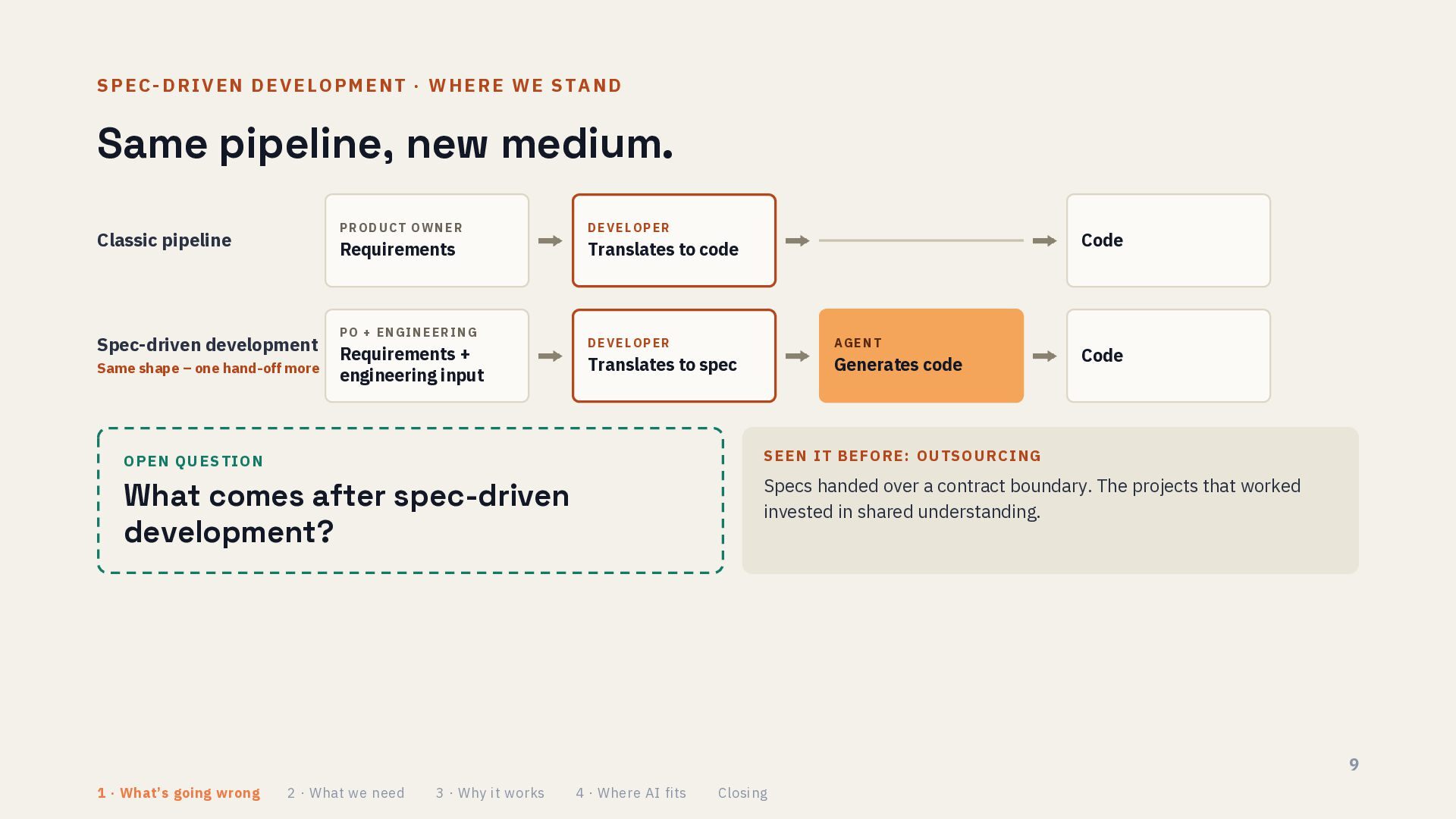
  9. SPEC-DRIVEN DEVELOPMENT · WHERE WE STAND Same pipeline, new medium.

    Classic pipeline Spec-driven development Same shape – one hand-off more PRODUCT OWNER DEVELOPER Requirements Translates to code PO + ENGINEERING Requirements + engineering input Code DEVELOPER AGENT Translates to spec Generates code Code OPEN QU EST IO N SEEN IT BEF ORE : OUTSOURC I N G What comes after spec-driven development? Specs handed over a contract boundary. The projects that worked invested in shared understanding. 9 1 · What’s going wrong 2 · What we need 3 · Why it works 4 · Where AI fits Closing
  10. ACT 2 What do we need? A collaboration system around

    one shared model. 10 1 · What’s going wrong 2 · What we need 3 · Why it works 4 · Where AI fits Closing
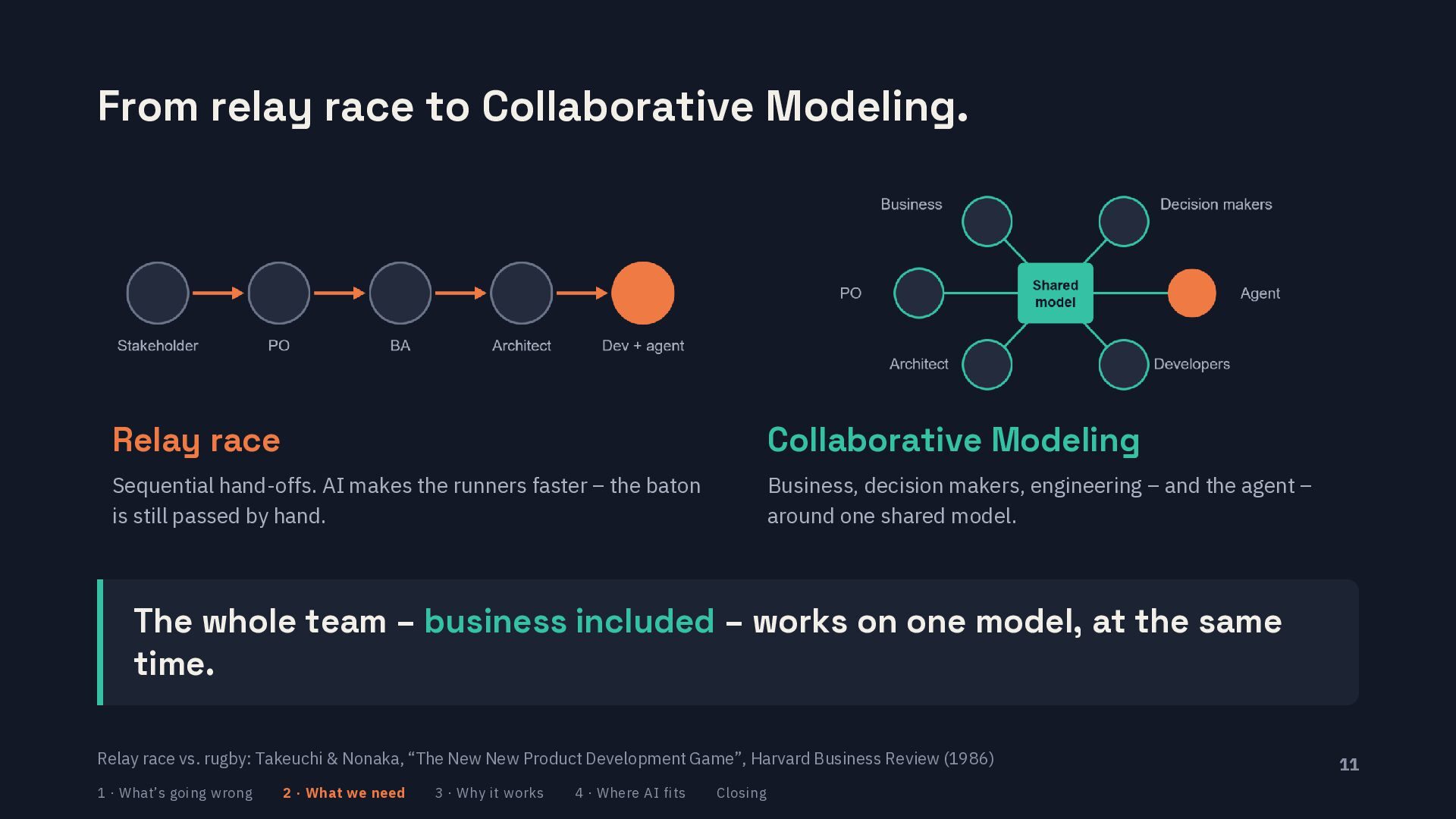
  11. From relay race to Collaborative Modeling. Relay race Collaborative Modeling

    Sequential hand-offs. AI makes the runners faster – the baton is still passed by hand. Business, decision makers, engineering – and the agent – around one shared model. The whole team – business included – works on one model, at the same time. Relay race vs. rugby: Takeuchi & Nonaka, “The New New Product Development Game”, Harvard Business Review (1986) 1 · What’s going wrong 2 · What we need 3 · Why it works 4 · Where AI fits Closing 11
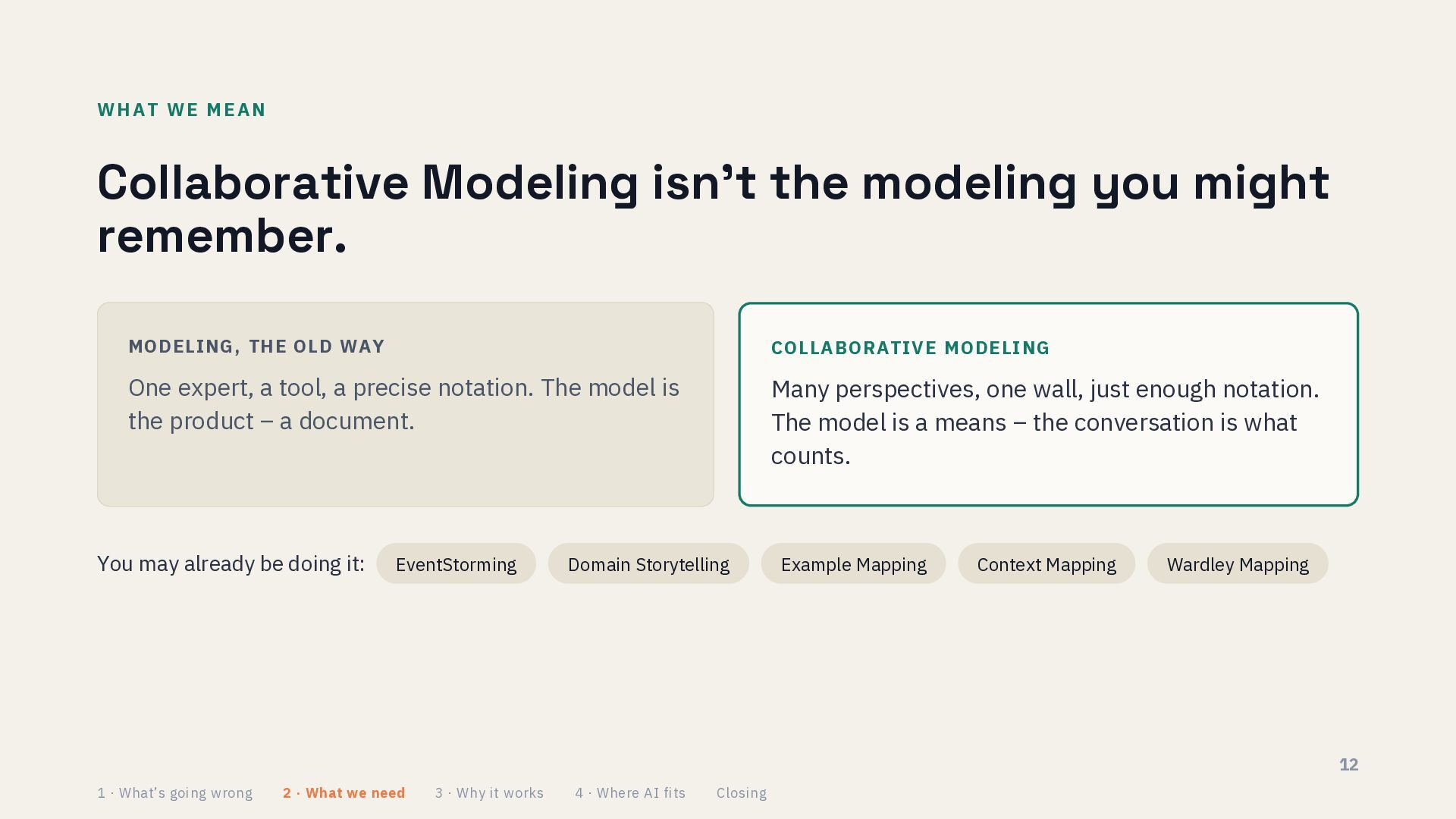
  12. WHAT WE MEAN Collaborative Modeling isn’t the modeling you might

    remember. MODELING, THE OLD WAY COLLABORATIVE MODELING One expert, a tool, a precise notation. The model is the product – a document. Many perspectives, one wall, just enough notation. The model is a means – the conversation is what counts. You may already be doing it: EventStorming Domain Storytelling Example Mapping Context Mapping Wardley Mapping 12 1 · What’s going wrong 2 · What we need 3 · Why it works 4 · Where AI fits Closing
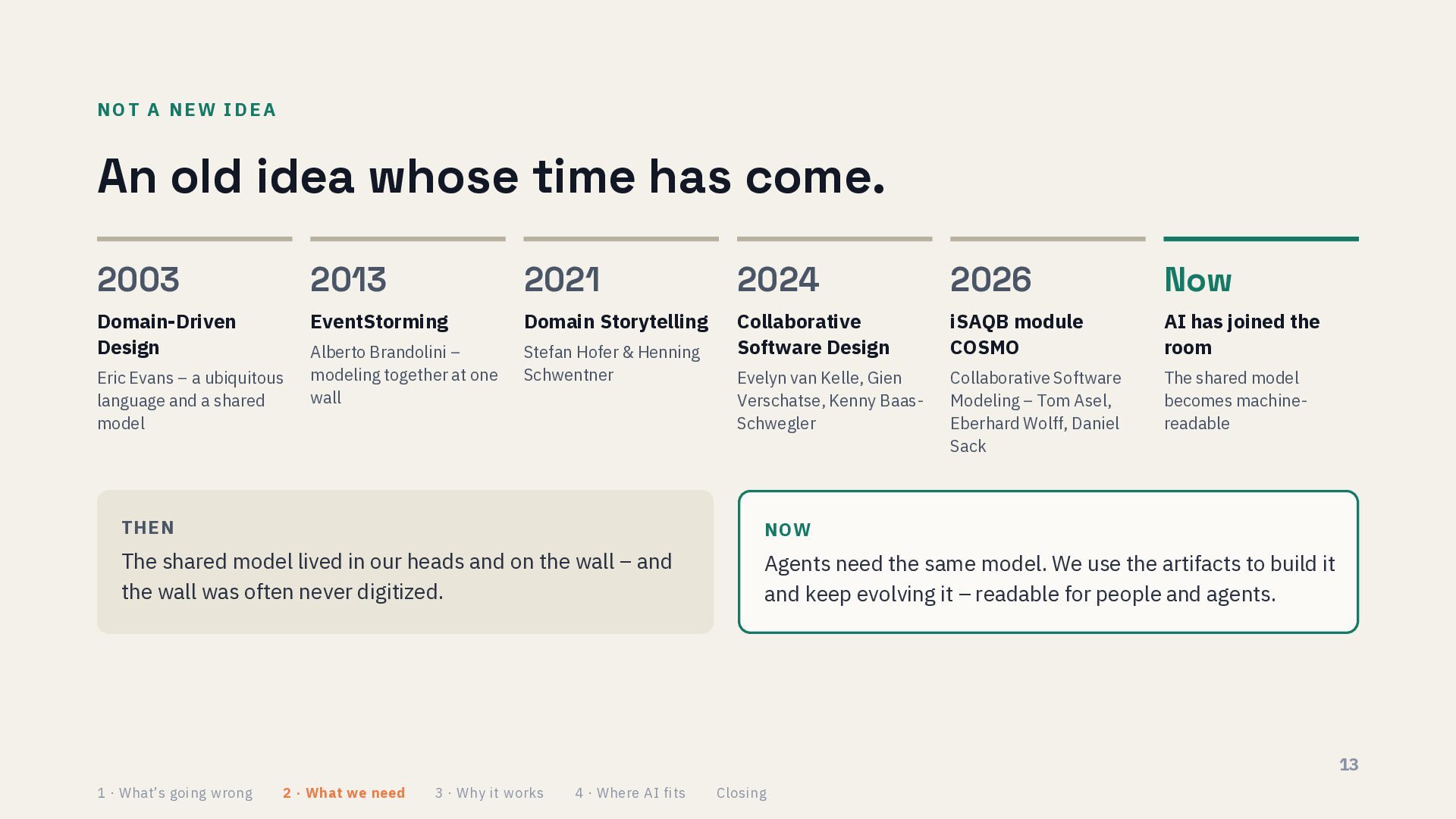
  13. NOT A NEW IDEA An old idea whose time has

    come. 2003 2013 2021 2024 2026 Now Domain-Driven Design EventStorming Domain Storytelling Alberto Brandolini – modeling together at one wall Stefan Hofer & Henning Schwentner Collaborative Software Design iSAQB module COSMO AI has joined the room Evelyn van Kelle, Gien Verschatse, Kenny BaasSchwegler Collaborative Software Modeling – Tom Asel, Eberhard Wolff, Daniel Sack The shared model becomes machinereadable Eric Evans – a ubiquitous language and a shared model THEN NOW The shared model lived in our heads and on the wall – and the wall was often never digitized. Agents need the same model. We use the artifacts to build it and keep evolving it – readable for people and agents. 13 1 · What’s going wrong 2 · What we need 3 · Why it works 4 · Where AI fits Closing
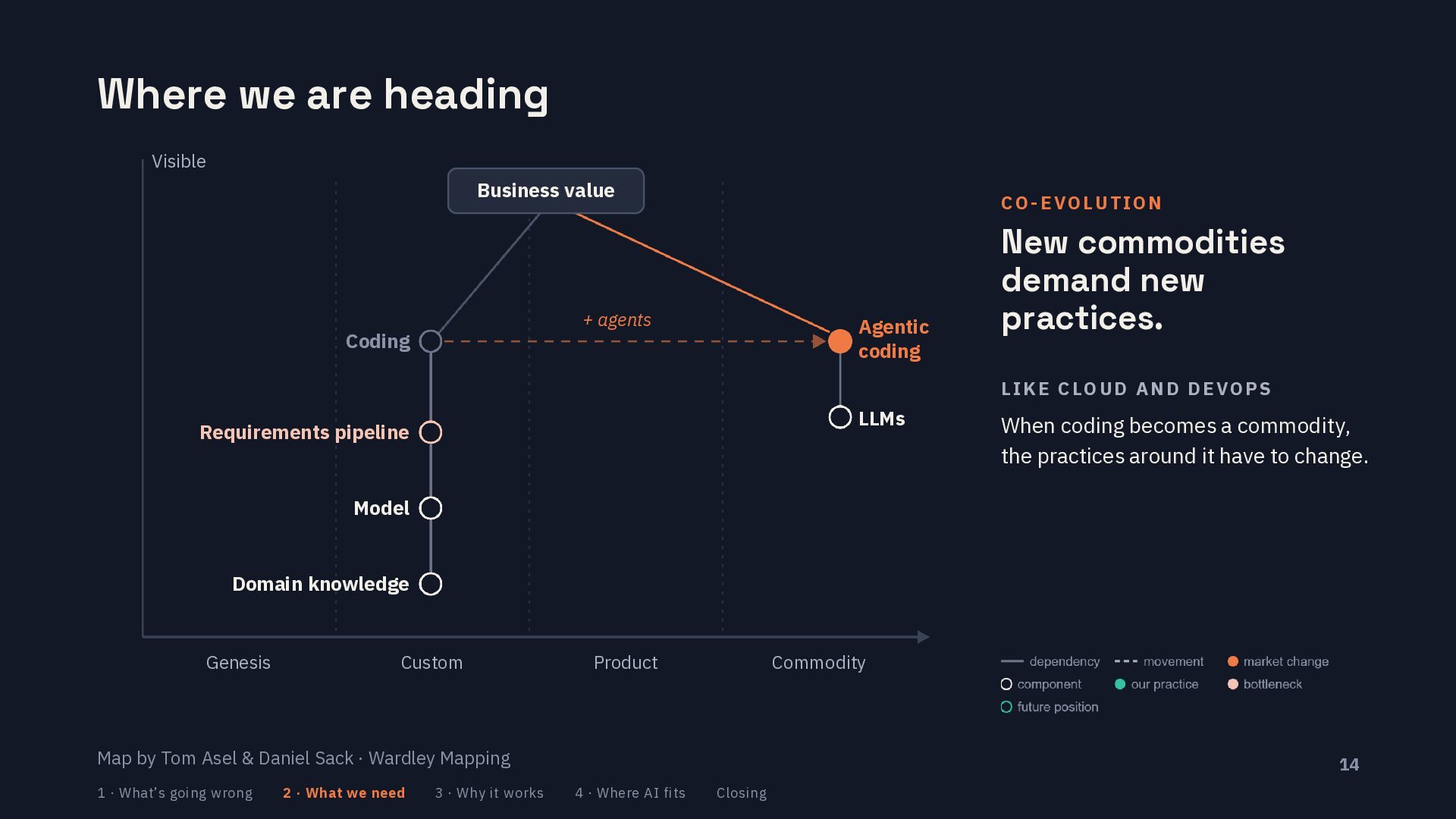
  14. Where we are heading Visible Business value CO-EVOLUTION + agents

    Coding Agentic coding New commodities demand new practices. LIKE CLOUD AND DEVOPS LLMs Requirements pipeline When coding becomes a commodity, the practices around it have to change. Model Domain knowledge Genesis Custom Product Commodity Map by Tom Asel & Daniel Sack · Wardley Mapping 1 · What’s going wrong 2 · What we need 3 · Why it works 14 4 · Where AI fits Closing
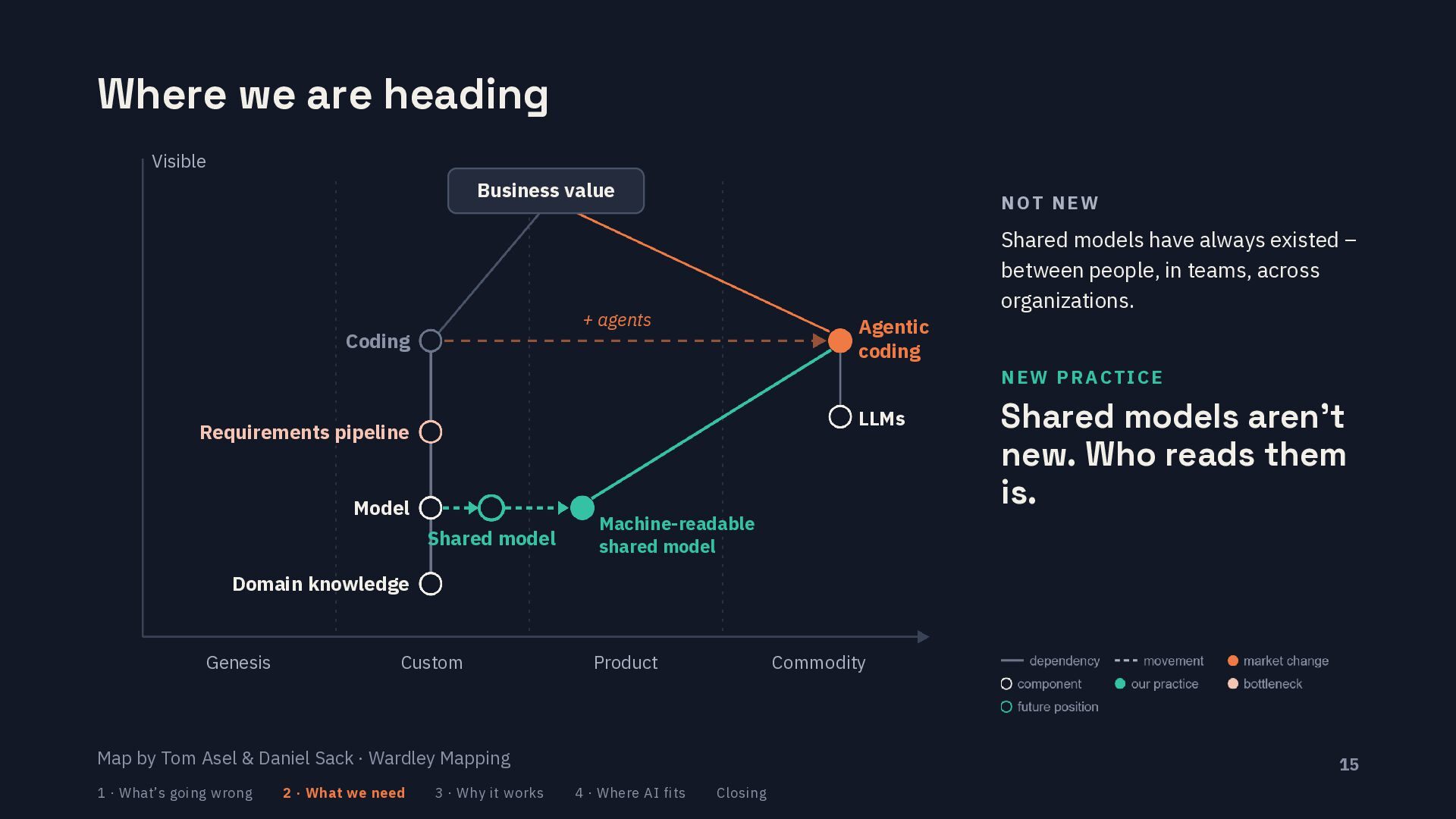
  15. Where we are heading Visible Business value NOT NEW Shared

    models have always existed – between people, in teams, across organizations. + agents Coding Agentic coding NEW PRACTICE LLMs Requirements pipeline Model Shared model Machine-readable shared model Shared models aren’t new. Who reads them is. Domain knowledge Genesis Custom Product Commodity Map by Tom Asel & Daniel Sack · Wardley Mapping 1 · What’s going wrong 2 · What we need 3 · Why it works 15 4 · Where AI fits Closing
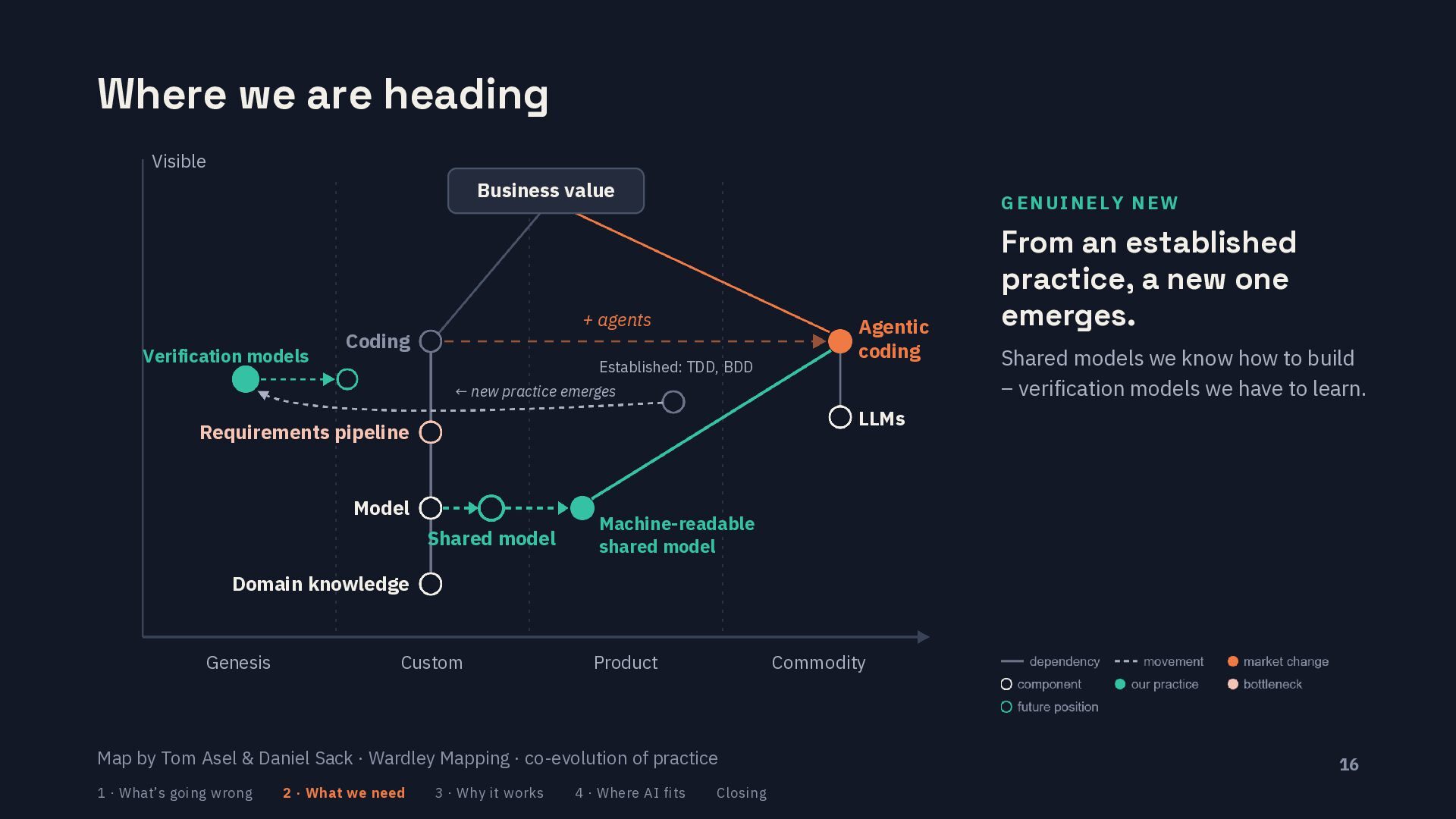
  16. Where we are heading Visible Business value Verification models GENUINELY

    NEW + agents Coding Established: TDD, BDD Agentic coding ← new practice emerges From an established practice, a new one emerges. Shared models we know how to build – verification models we have to learn. LLMs Requirements pipeline Model Shared model Machine-readable shared model Domain knowledge Genesis Custom Product Commodity Map by Tom Asel & Daniel Sack · Wardley Mapping · co-evolution of practice 1 · What’s going wrong 2 · What we need 3 · Why it works 4 · Where AI fits Closing 16
  17. Where we are heading Visible Business value Verification models THE

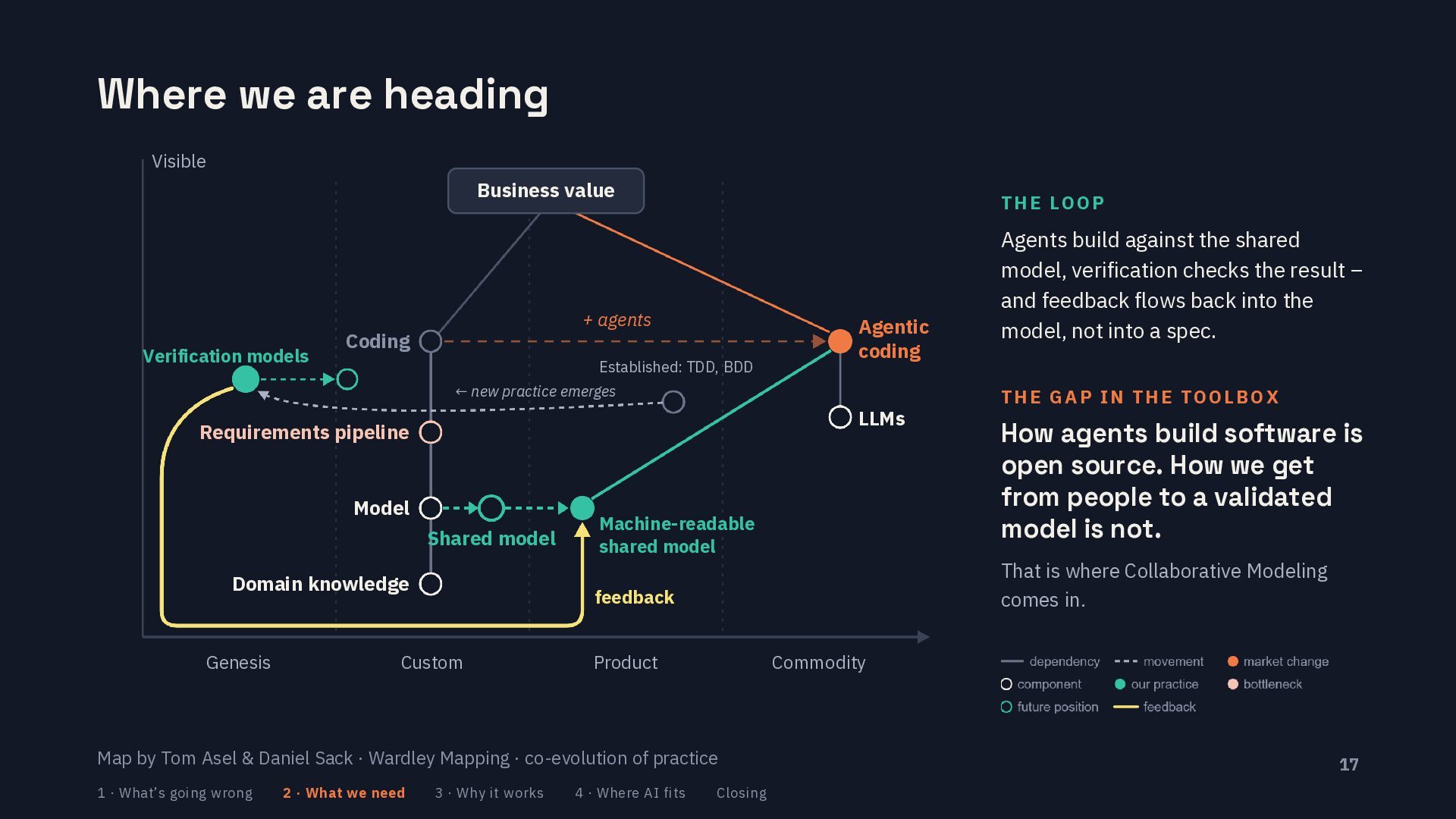
    LOOP + agents Coding Established: TDD, BDD Agentic coding ← new practice emerges LLMs Requirements pipeline Model Shared model Domain knowledge Genesis Machine-readable shared model Product 2 · What we need 3 · Why it works 4 · Where AI fits How agents build software is open source. How we get from people to a validated model is not. Commodity Map by Tom Asel & Daniel Sack · Wardley Mapping · co-evolution of practice 1 · What’s going wrong THE GAP IN THE TOOLBOX That is where Collaborative Modeling comes in. feedback Custom Agents build against the shared model, verification checks the result – and feedback flows back into the model, not into a spec. Closing 17
  18. ACT 3 Why does it work? Three reasons – three

    answers to Act 1. 18 1 · What’s going wrong 2 · What we need 3 · Why it works 4 · Where AI fits Closing
  19. OUR THESIS When AI writes the code, Collaborative Modeling pays

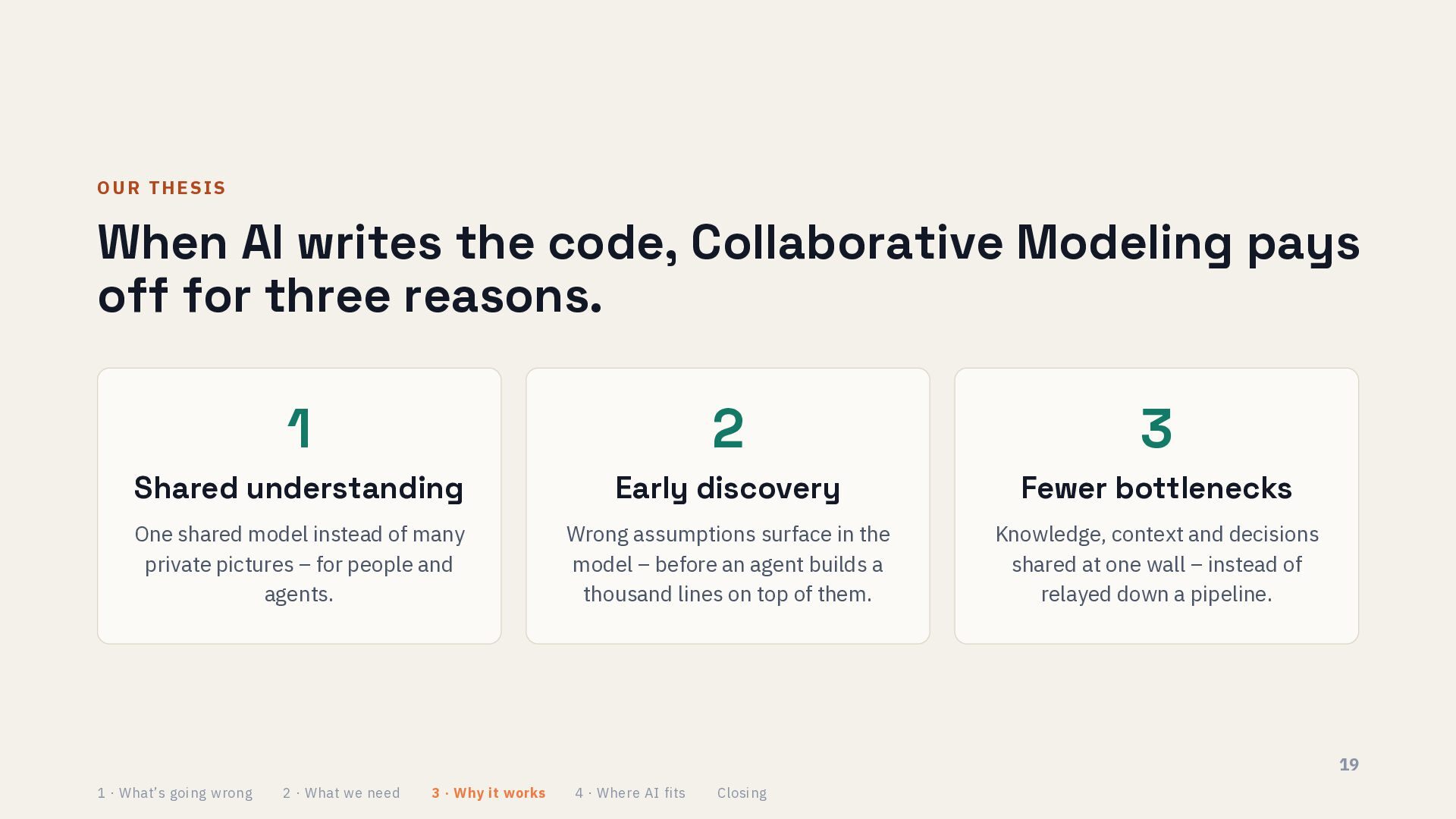
    off for three reasons. 1 2 3 Shared understanding Early discovery Fewer bottlenecks One shared model instead of many private pictures – for people and agents. Wrong assumptions surface in the model – before an agent builds a thousand lines on top of them. Knowledge, context and decisions shared at one wall – instead of relayed down a pipeline. 19 1 · What’s going wrong 2 · What we need 3 · Why it works 4 · Where AI fits Closing
  20. REASON 1 · SHARED UNDERSTANDING → THE SHARED MODEL Without

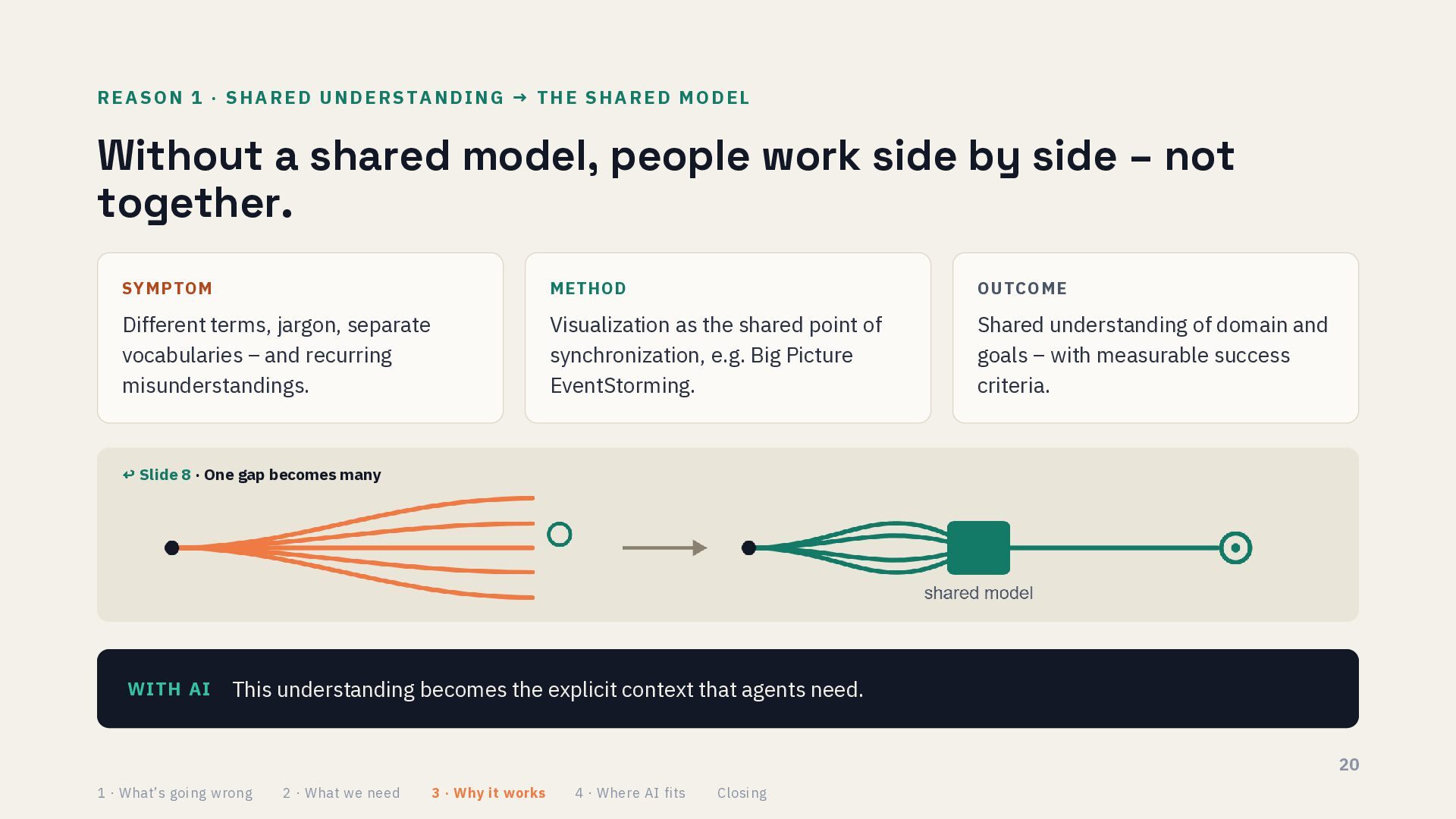
    a shared model, people work side by side – not together. SYMPTOM METHOD OUTCOME Different terms, jargon, separate vocabularies – and recurring misunderstandings. Visualization as the shared point of synchronization, e.g. Big Picture EventStorming. Shared understanding of domain and goals – with measurable success criteria. Slide 8 · One gap becomes many WITH AI This understanding becomes the explicit context that agents need. 20 1 · What’s going wrong 2 · What we need 3 · Why it works 4 · Where AI fits Closing
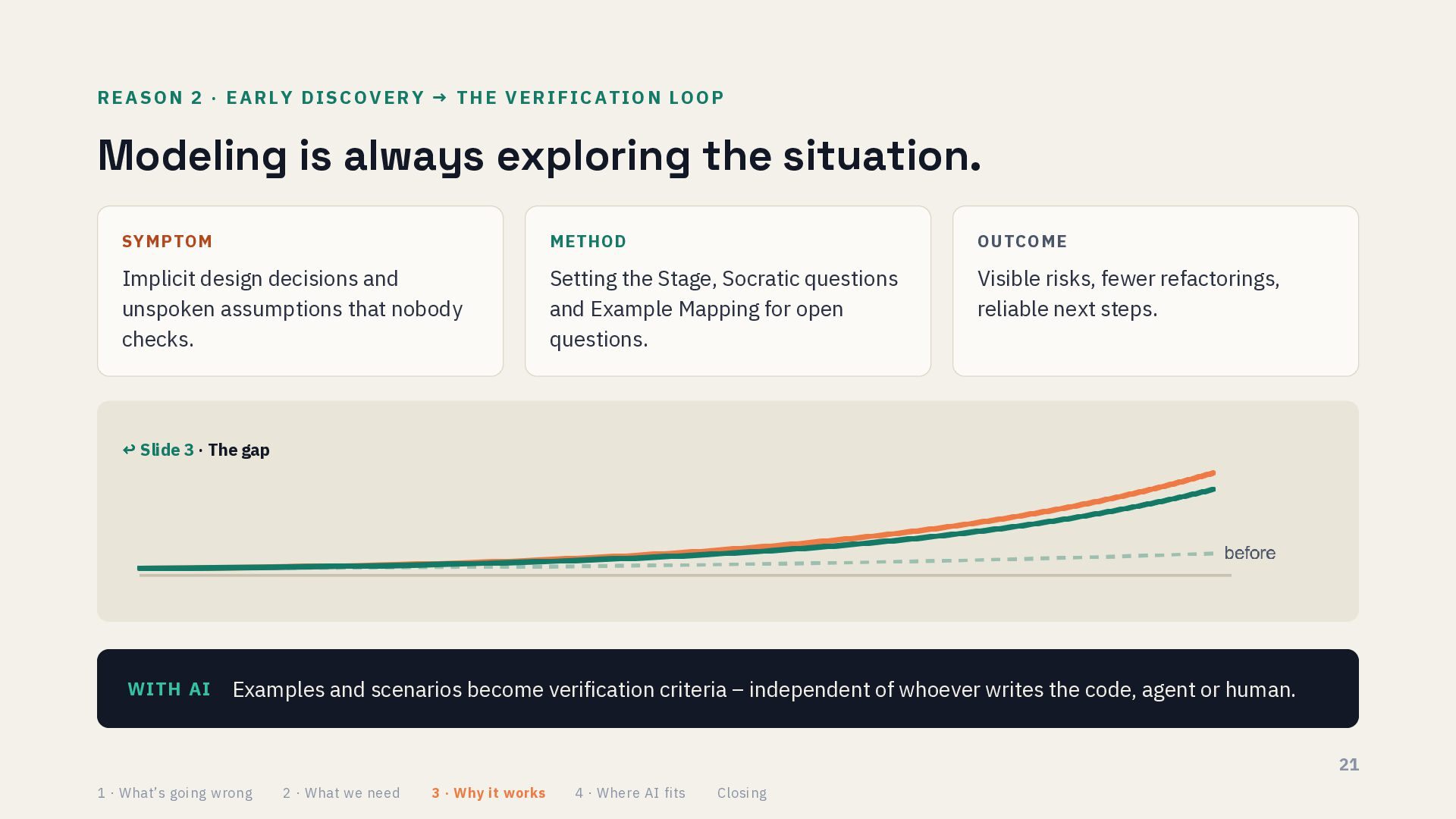
  21. REASON 2 · EARLY DISCOVERY → THE VERIFICATION LOOP Modeling

    is always exploring the situation. SYMPTOM METHOD OUTCOME Implicit design decisions and unspoken assumptions that nobody checks. Setting the Stage, Socratic questions and Example Mapping for open questions. Visible risks, fewer refactorings, reliable next steps. Slide 3 · The gap WITH AI Examples and scenarios become verification criteria – independent of whoever writes the code, agent or human. 21 1 · What’s going wrong 2 · What we need 3 · Why it works 4 · Where AI fits Closing
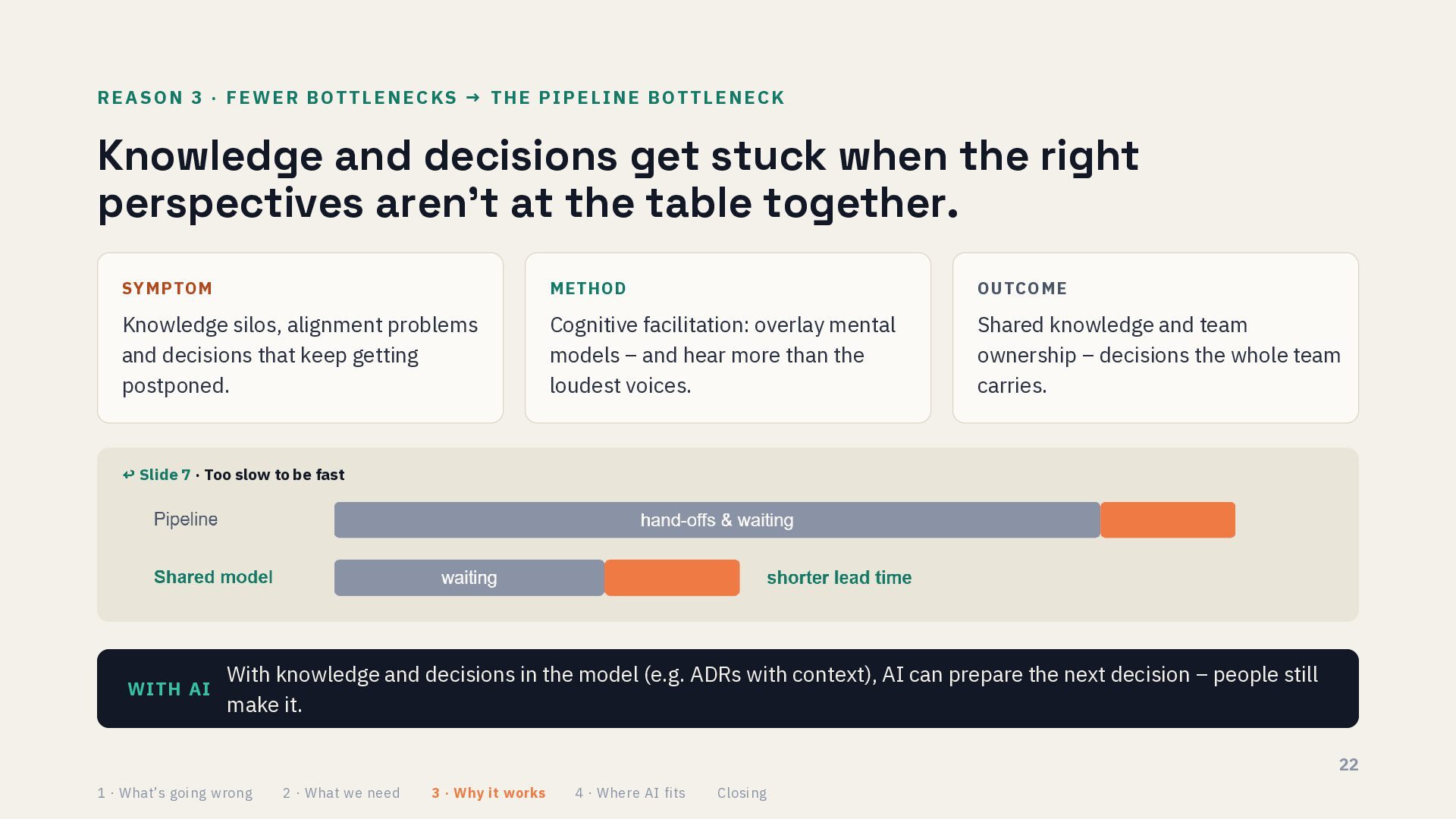
  22. REASON 3 · FEWER BOTTLENECKS → THE PIPELINE BOTTLENECK Knowledge

    and decisions get stuck when the right perspectives aren’t at the table together. SYMPTOM METHOD OUTCOME Knowledge silos, alignment problems and decisions that keep getting postponed. Cognitive facilitation: overlay mental models – and hear more than the loudest voices. Shared knowledge and team ownership – decisions the whole team carries. Slide 7 · Too slow to be fast WITH AI With knowledge and decisions in the model (e.g. ADRs with context), AI can prepare the next decision – people still make it. 22 1 · What’s going wrong 2 · What we need 3 · Why it works 4 · Where AI fits Closing
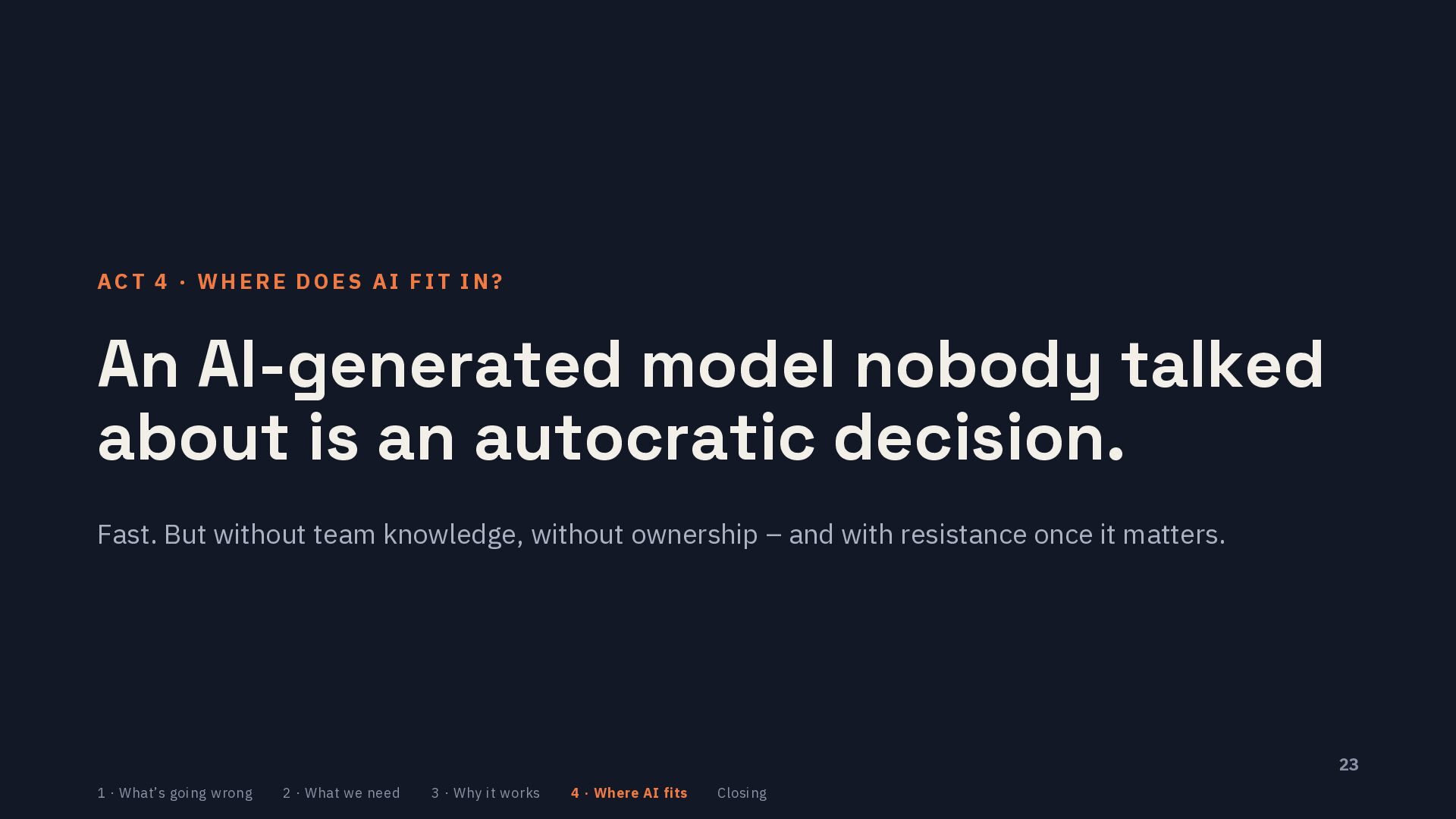
  23. ACT 4 · WHERE DOES AI FIT IN? An AI-generated

    model nobody talked about is an autocratic decision. Fast. But without team knowledge, without ownership – and with resistance once it matters. 23 1 · What’s going wrong 2 · What we need 3 · Why it works 4 · Where AI fits Closing
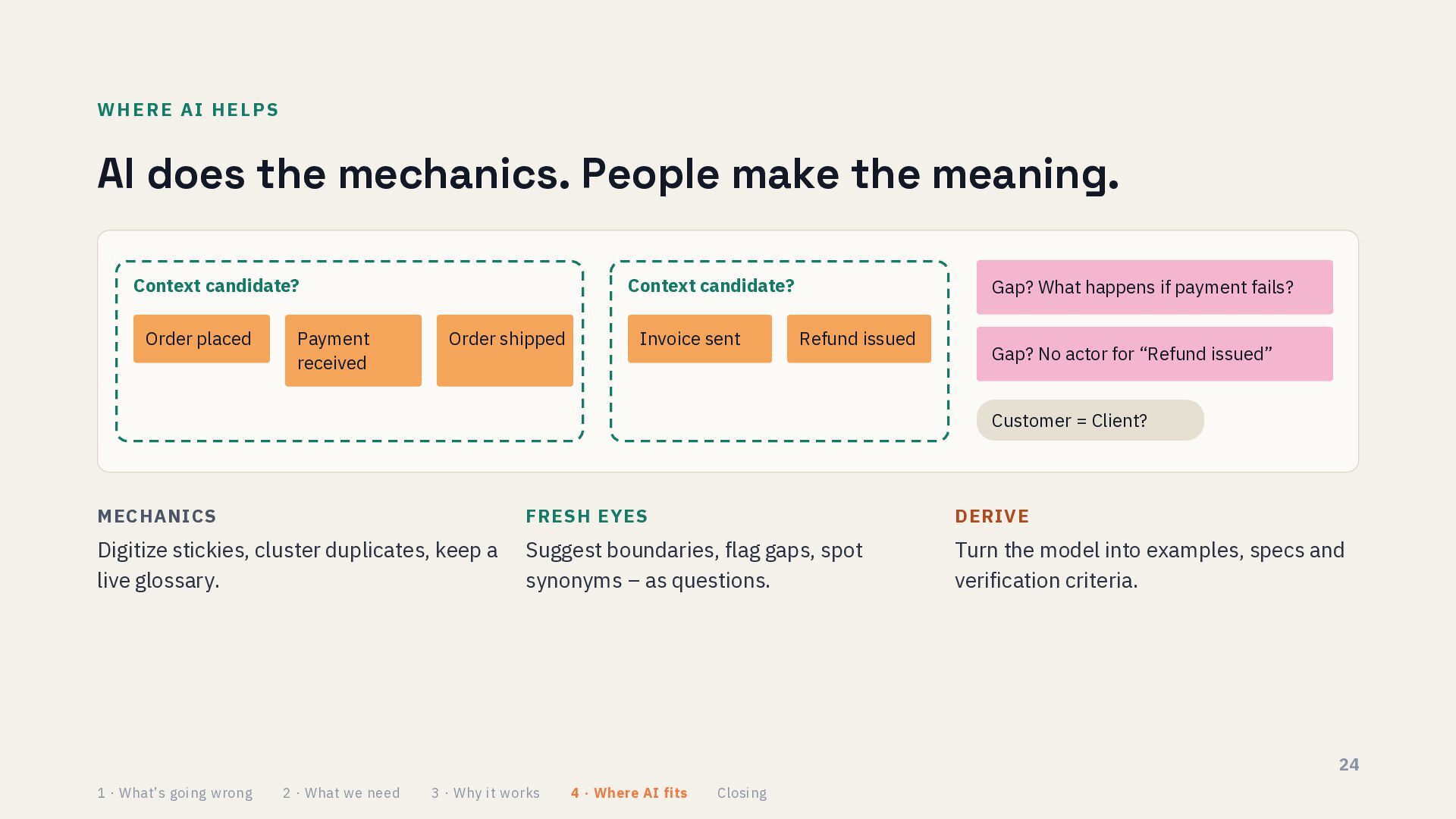
  24. WHERE AI HELPS AI does the mechanics. People make the

    meaning. Context candidate? Order placed Payment received Context candidate? Order shipped Invoice sent Gap? What happens if payment fails? Refund issued Gap? No actor for “Refund issued” Customer = Client? MECHANICS FRESH EYES DERIVE Digitize stickies, cluster duplicates, keep a live glossary. Suggest boundaries, flag gaps, spot synonyms – as questions. Turn the model into examples, specs and verification criteria. 24 1 · What’s going wrong 2 · What we need 3 · Why it works 4 · Where AI fits Closing
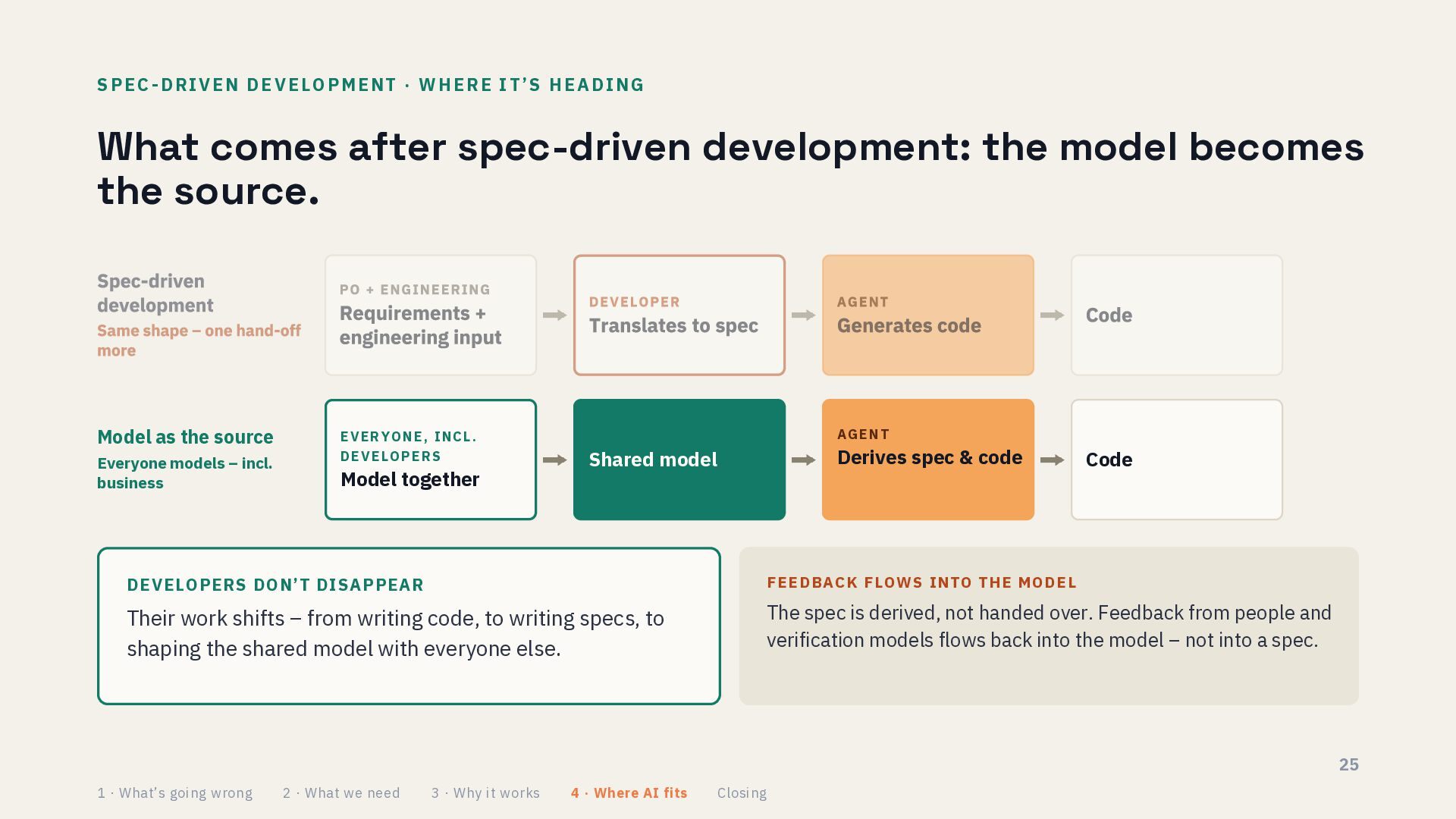
  25. SPEC-DRIVEN DEVELOPMENT · WHERE IT’S HEADING What comes after spec-driven

    development: the model becomes the source. Model as the source Everyone models – incl. business E V E R Y O N E , IN C L . DEVELOPERS Model together AGENT Derives spec & code Shared model Code DEVELOPERS DON’T DISAPPEAR FEEDBACK FLOWS INTO THE MODEL Their work shifts – from writing code, to writing specs, to shaping the shared model with everyone else. The spec is derived, not handed over. Feedback from people and verification models flows back into the model – not into a spec. 25 1 · What’s going wrong 2 · What we need 3 · Why it works 4 · Where AI fits Closing
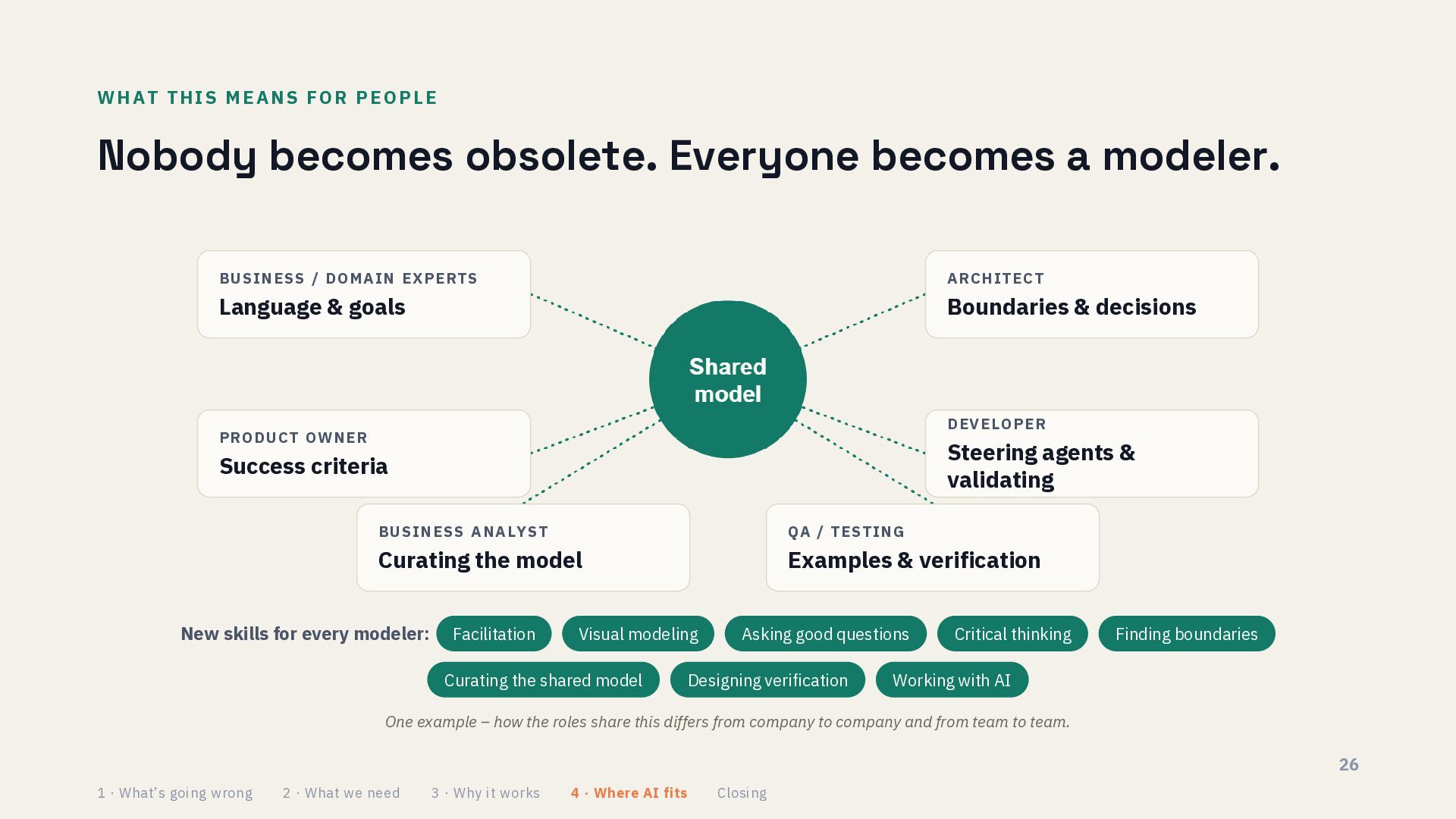
  26. WHAT THIS MEANS FOR PEOPLE Nobody becomes obsolete. Everyone becomes

    a modeler. BU SINESS / DOMAIN EXPER TS ARCHIT EC T Language & goals Boundaries & decisions DEVELOP E R PRODU CT OWNER Steering agents & validating Success criteria BUSINESS ANALYST QA / TEST IN G Curating the model Examples & verification New skills for every modeler: Facilitation Visual modeling Curating the shared model Asking good questions Designing verification Critical thinking Finding boundaries Working with AI One example – how the roles share this differs from company to company and from team to team. 26 1 · What’s going wrong 2 · What we need 3 · Why it works 4 · Where AI fits Closing
  27. CLOSING What’s next? Close the gap – starting on Monday.

    27 1 · What’s going wrong 2 · What we need 3 · Why it works 4 · Where AI fits Closing
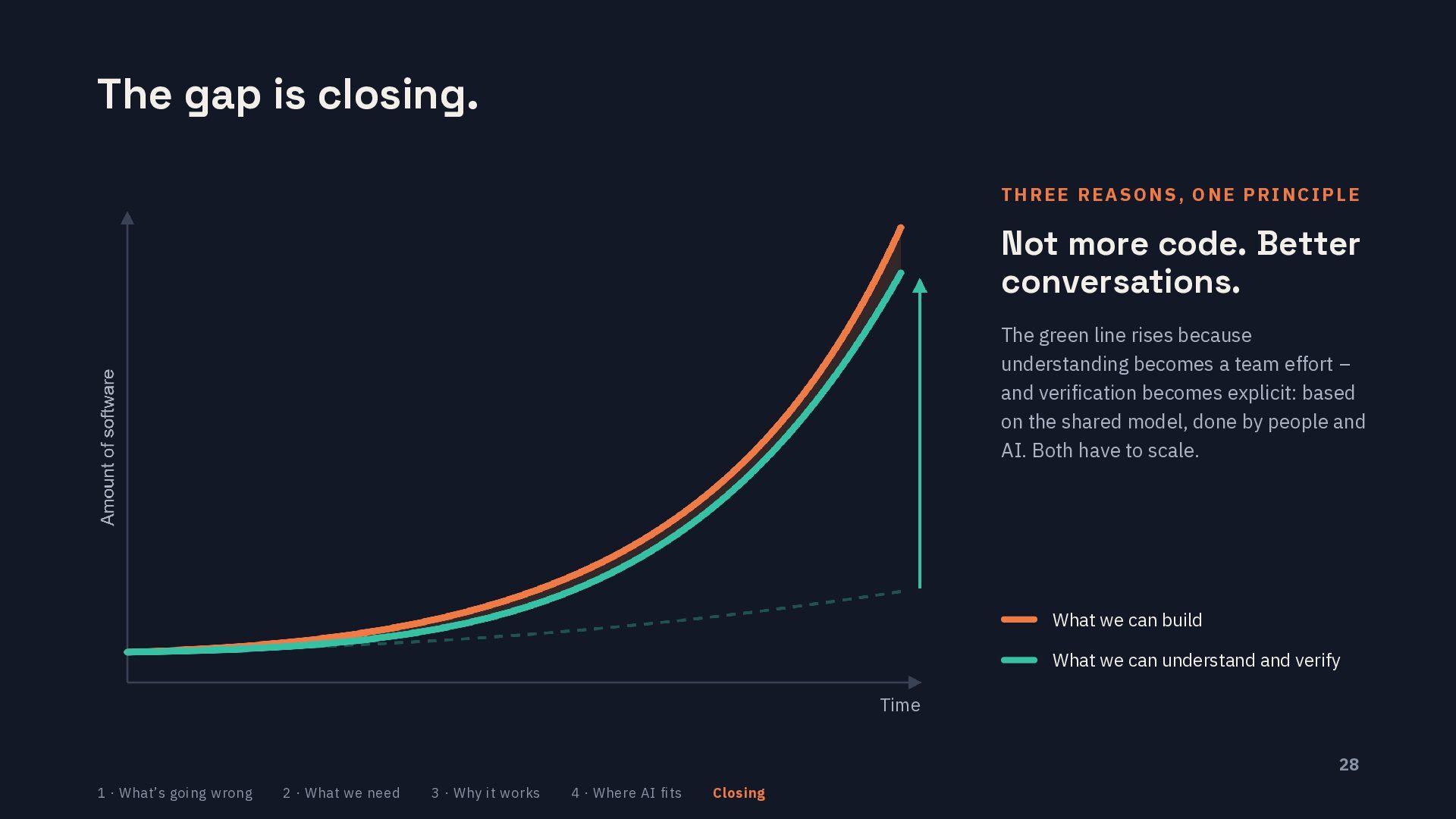
  28. The gap is closing. THREE REASONS, ONE PRINCIPLE Not more

    code. Better conversations. The green line rises because understanding becomes a team effort – and verification becomes explicit: based on the shared model, done by people and AI. Both have to scale. What we can build What we can understand and verify Time 28 1 · What’s going wrong 2 · What we need 3 · Why it works 4 · Where AI fits Closing
  29. When code costs nothing, understanding is everything. Collaborative Modeling: better

    conversations for better architecture. 29 1 · What’s going wrong 2 · What we need 3 · Why it works 4 · Where AI fits Closing
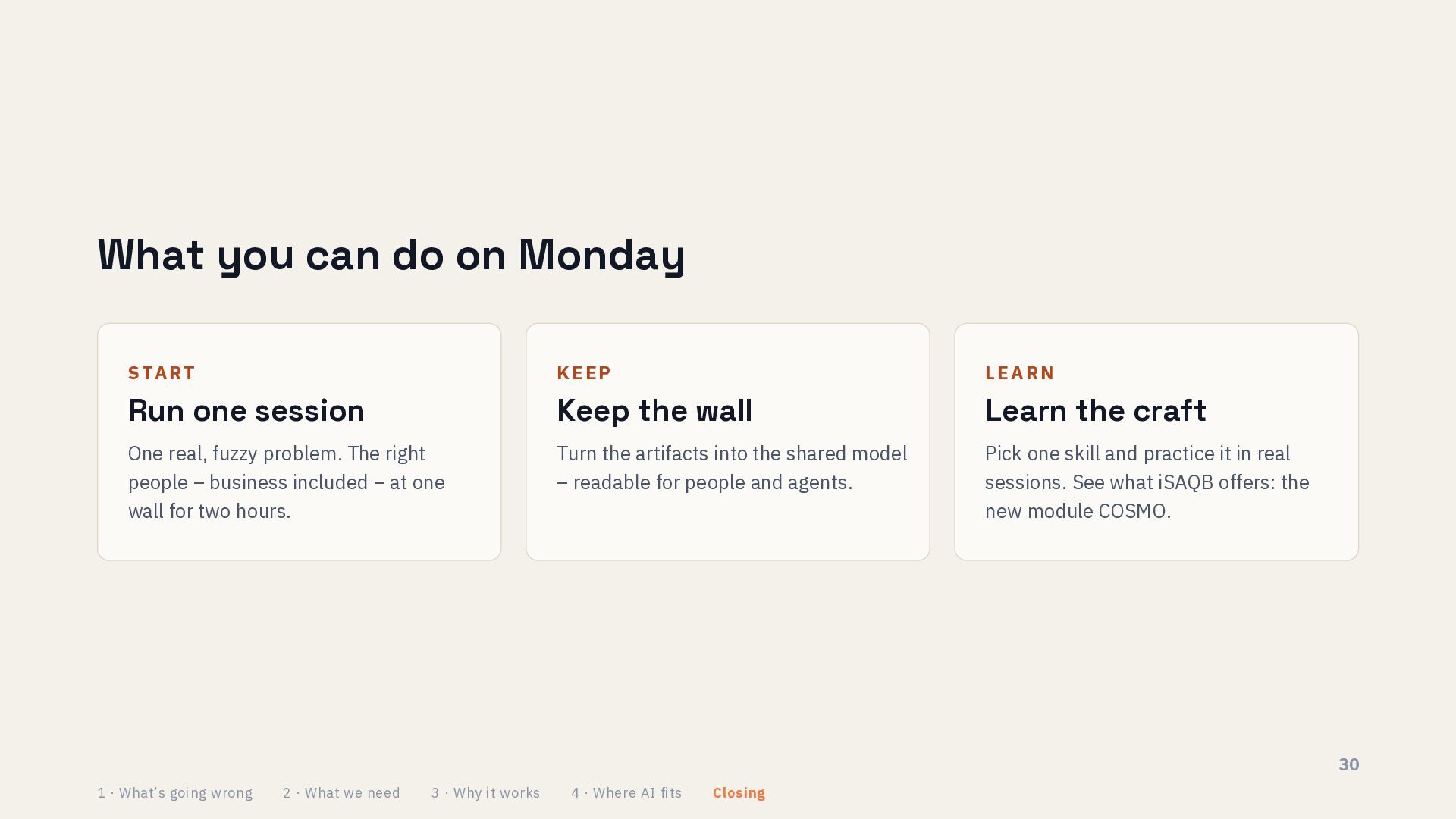
  30. What you can do on Monday START KEEP LEARN Run

    one session Keep the wall Learn the craft One real, fuzzy problem. The right people – business included – at one wall for two hours. Turn the artifacts into the shared model – readable for people and agents. Pick one skill and practice it in real sessions. See what iSAQB offers: the new module COSMO. 30 1 · What’s going wrong 2 · What we need 3 · Why it works 4 · Where AI fits Closing
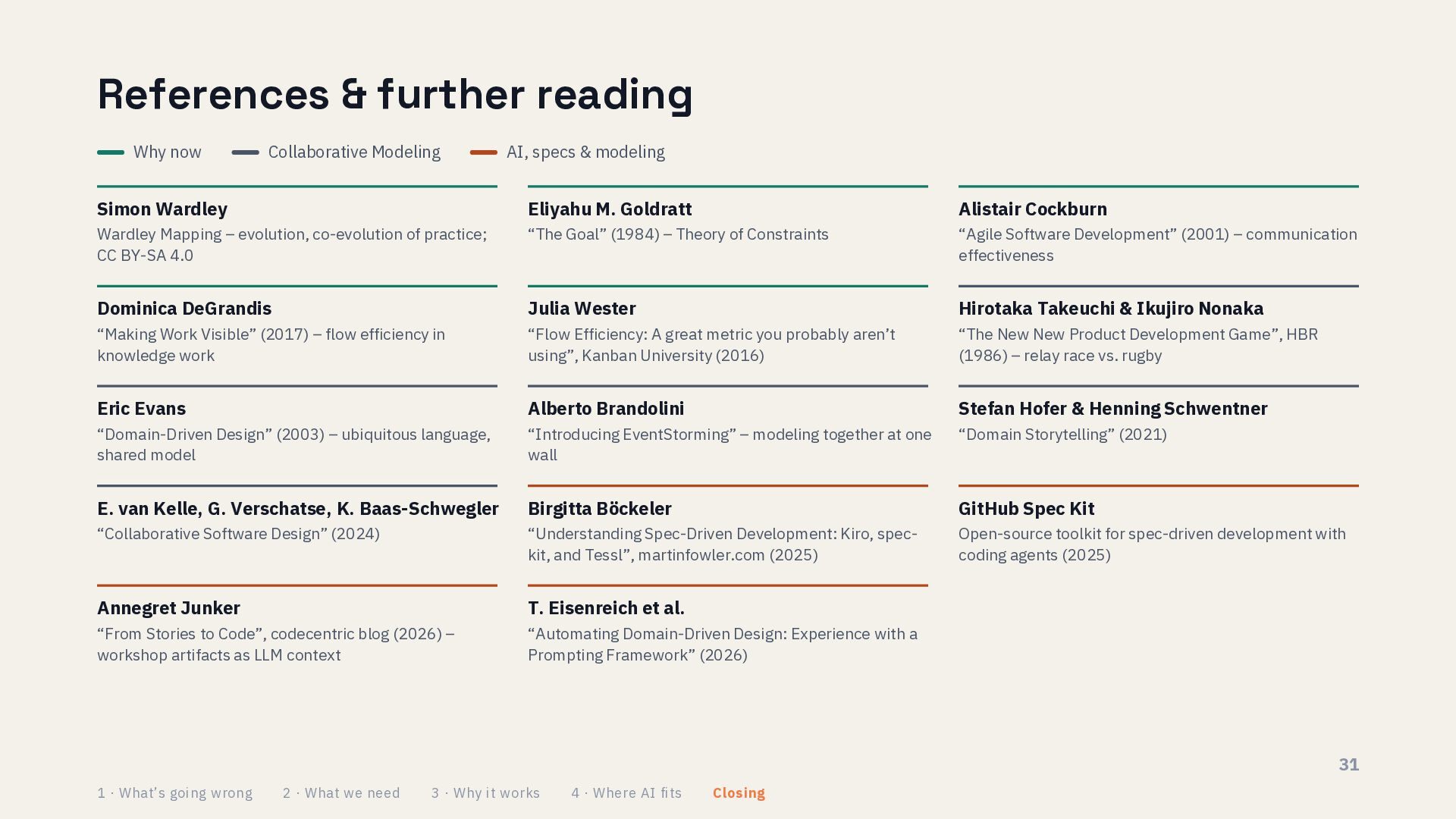
  31. References & further reading Why now Collaborative Modeling AI, specs

    & modeling Simon Wardley Eliyahu M. Goldratt Alistair Cockburn Wardley Mapping – evolution, co-evolution of practice; CC BY-SA 4.0 “The Goal” (1984) – Theory of Constraints “Agile Software Development” (2001) – communication effectiveness Dominica DeGrandis Julia Wester Hirotaka Takeuchi & Ikujiro Nonaka “Making Work Visible” (2017) – flow efficiency in knowledge work “Flow Efficiency: A great metric you probably aren’t using”, Kanban University (2016) “The New New Product Development Game”, HBR (1986) – relay race vs. rugby Eric Evans Alberto Brandolini Stefan Hofer & Henning Schwentner “Domain-Driven Design” (2003) – ubiquitous language, shared model “Introducing EventStorming” – modeling together at one wall “Domain Storytelling” (2021) E. van Kelle, G. Verschatse, K. Baas-Schwegler Birgitta Böckeler GitHub Spec Kit “Collaborative Software Design” (2024) “Understanding Spec-Driven Development: Kiro, speckit, and Tessl”, martinfowler.com (2025) Open-source toolkit for spec-driven development with coding agents (2025) Annegret Junker T. Eisenreich et al. “From Stories to Code”, codecentric blog (2026) – workshop artifacts as LLM context “Automating Domain-Driven Design: Experience with a Prompting Framework” (2026) 31 1 · What’s going wrong 2 · What we need 3 · Why it works 4 · Where AI fits Closing
  32. FEEDBACK How did we do? Scan the code and rate

    this talk in the conference app. It takes a minute – and helps us and the program team. Three Reasons to Adopt Collaborative Modelling in Software Design Tom Asel & Daniel Sack · Software Architecture Gathering 2026 32 1 · What’s going wrong 2 · What we need 3 · Why it works 4 · Where AI fits Closing
  33. Thank you – let’s keep modeling together. Tom Asel Daniel

    Sack Co-founder & Head of Architecture Architect & Facilitator · COSMO trainer COSMO trainer Co-founder of ComoCamp [email protected] [email protected] linkedin.com/in/tom-asel linkedin.com/in/daniel-sack-at WHAT ISAQB OFFERS JOIN THE COMMUNITY The new CPSA-Advanced module COSMO – Collaborative Software Modeling: the skills from this talk, learned hands-on. ComoCamp – the Collaborative Modeling Unconference comocamp.org isaqb.org/trainings/find-a-training socreatory.com/en/trainings/cosmo training.techtalk.at/trainings/cosmo 33 1 · What’s going wrong 2 · What we need 3 · Why it works 4 · Where AI fits Closing

More Decks by Daniel Sack

Other Decks in Business