Upgrade to Pro
— share decks privately, control downloads, hide ads and more …
Speaker Deck
Sign up for free
Menu
Search
Features
All features
Private URLs
Password Protection
Custom URLS
Scheduled publishing
Remove Branding
Restrict embedding
Deck Collections
Notes
Features
All features
Private URLs
Password Protection
Custom URLS
Scheduled publishing
Remove Branding
Restrict embedding
Deck Collections
Notes
Explore
Featured decks
Featured speakers
Programming
Technology
Storyboards
Explore
Featured decks
Featured speakers
Programming
Technology
Storyboards
Pricing
Search
Sign in
Sign up for free
The search for single transits
Search
Dan Foreman-Mackey
May 08, 2015
Science
350
1
Share
Embed
Copy iframe code
Copy JS code
Copy link
Start on current slide
The search for single transits
My short talk from the Sagan Fellows Symposium at Caltech
Dan Foreman-Mackey
May 08, 2015
More Decks by Dan Foreman-Mackey
See All by Dan Foreman-Mackey
Open software for Astronomical Data Analysis
dfm
0
240
Open Software for Astrophysics, AAS241
dfm
2
630
My research talk for CCA promotion
dfm
1
830
Astronomical software
dfm
1
790
emcee-odi
dfm
1
780
Exoplanet population inference: a tutorial
dfm
3
540
Data-driven discovery in the astronomical time domain
dfm
6
780
TensorFlow for astronomers
dfm
6
910
How to find a transiting exoplanets
dfm
1
550
Other Decks in Science
See All in Science
[Relay webinaire eBIS actu n°16] Amélioration de la survie des JB avec la génétique - Introduction
institutdelelevage
PRO
0
390
Where does the rigor go? Research software and the future of trustworthy science.
arfon
0
380
20260820_アウトカムが二値のデータに対するCausal Impact@LINEヤフー Data Science Share #2 / Causal Impact for Binary Outcomes
brainpadpr
3
1.5k
O(log n)-Approximation Algorithms for Bipartiteness Ratio
tasusu
0
280
「念のためのログ保存」を組織全体でやめるためのポリシーと仕組み作り
i2tsuki
4
420
Path integral polarons for real semiconductors
jarvist
0
120
How a camera trap data standard enabled an ecosystem of interoperable tools
peterdesmet
0
150
[Webinaire InnOvin] Coup de Chaud : Comment préserver la santé des animaux
institutdelelevage
PRO
0
240
「AIエージェントを作る」とは、何を設計することか
salt2
0
240
機械学習 - pandas入門
trycycle
PRO
0
780
GKE上でオセロの強化学習やってみた
akasan
0
120
はじめてのグラフ信号サンプリング
arthur1
0
140
Featured
See All Featured
Design of three-dimensional binary manipulators for pick-and-place task avoiding obstacles (IECON2024)
konakalab
0
630
DBのスキルで生き残る技術 - AI時代におけるテーブル設計の勘所
soudai
PRO
68
59k
Deep Space Network (abreviated)
tonyrice
0
380
The AI Search Optimization Roadmap by Aleyda Solis
aleyda
2
6.3k
RailsConf & Balkan Ruby 2019: The Past, Present, and Future of Rails at GitHub
eileencodes
141
35k
Navigating Algorithm Shifts & AI Overviews - #SMXNext
aleyda
1
1.7k
Fantastic passwords and where to find them - at NoRuKo
philnash
53
4k
JavaScript: Past, Present, and Future - NDC Porto 2020
reverentgeek
52
6.1k
Tips & Tricks on How to Get Your First Job In Tech
honzajavorek
1
810
How STYLIGHT went responsive
nonsquared
100
6.3k
Efficient Content Optimization with Google Search Console & Apps Script
katarinadahlin
PRO
1
930
Connecting the Dots Between Site Speed, User Experience & Your Business [WebExpo 2025]
tammyeverts
11
1.1k
Transcript
Single the search for Transits Dan Foreman-Mackey NYU→UW // github.com/dfm
// @exoplaneteer // dfm.io
David W. Hogg NYU Bernhard Schölkopf MPI-IS
Population Inference
treatment of false positives, dependent parameters, uncertainties & selection effects
open source tools applicable to all existing & future exoplanet missions occurrence rate period, radius, mass, eccentricity, multiplicity, mutual inclination, etc. Flexible & robust inference of the exoplanet population
1 catalog of planet (candidates) measurement of completeness 2 3
measurement of precision Ingredients of a population inference
101 102 orbital period [days] 100 101 planet radius [R
] Data from NASA Exoplanet Archive
101 102 orbital period [days] 100 101 planet radius [R
] Data from NASA Exoplanet Archive
100 101 102 103 104 105 orbital period [days] 100
101 planet radius [R ] Data from NASA Exoplanet Archive
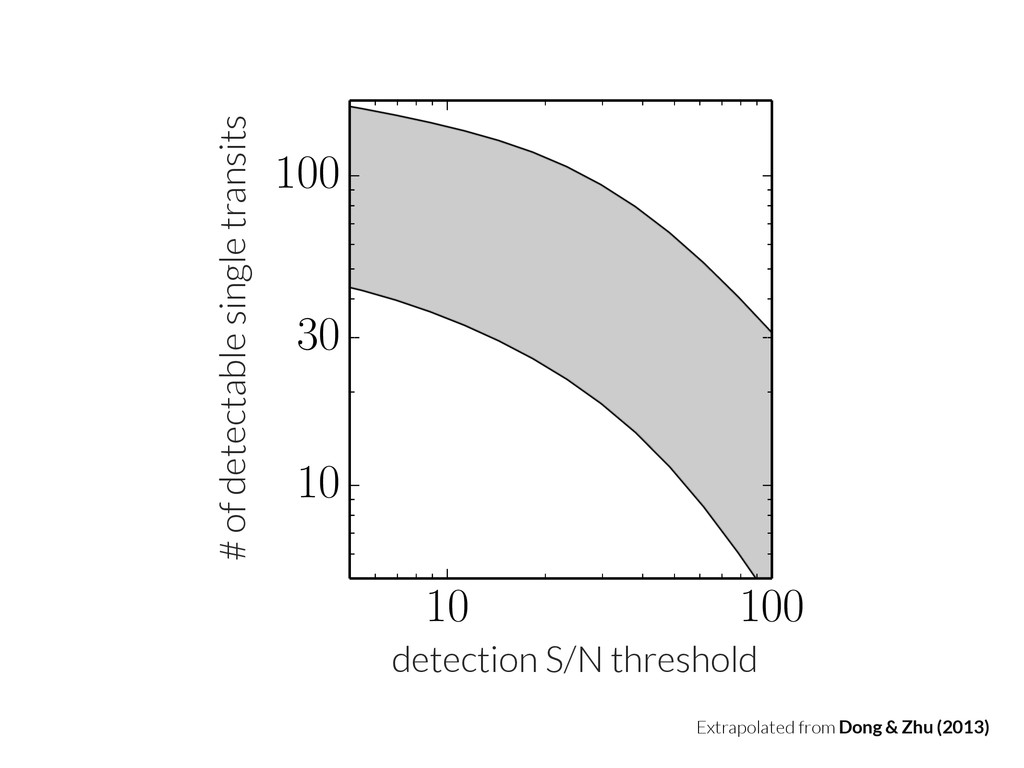
10 100 f 10 30 100 N detection S/N threshold
# of detectable single transits Extrapolated from Dong & Zhu (2013)
How to find a Transiting Planet the traditional way…
1 de-trending grid search in period, phase, and duration 2
3 vetting of candidates How to find a (periodic) transit signal
False Alarms & False Positives
How to find a Transiting Planet the Planet Hunters way…
None
Can we Teach the Machine to Learn™?
Bernhard Schölkopf MPI-IS Get rid of the pipeline!
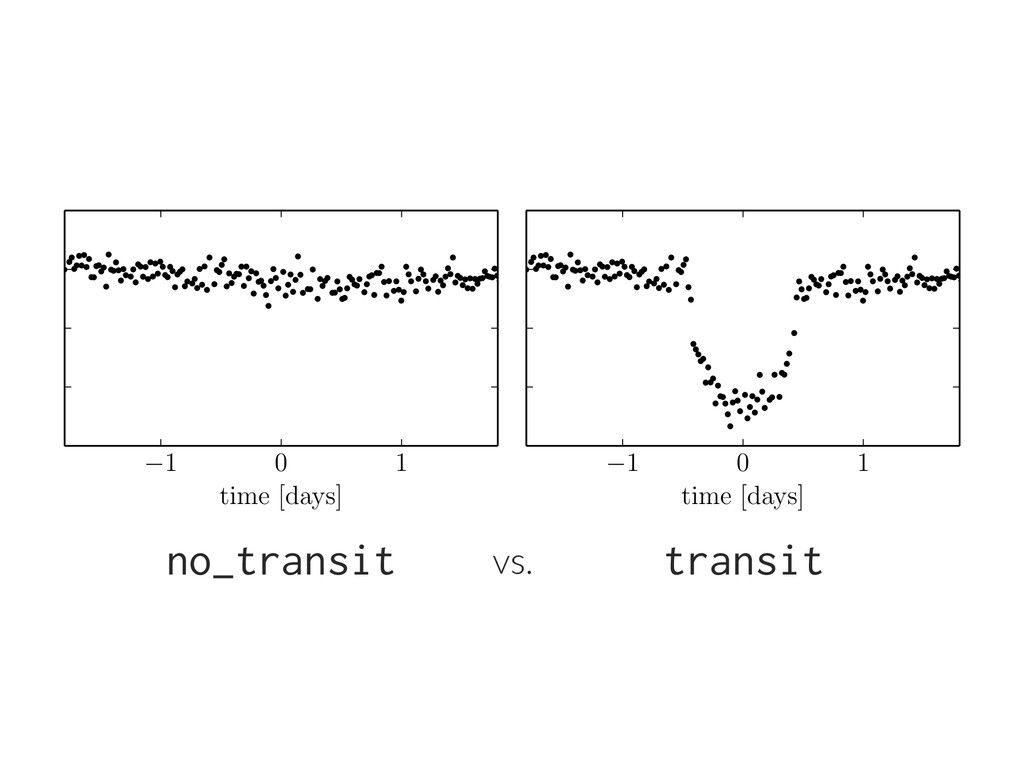
no_transit transit vs. 1 0 1 time [days] 1 0
1 time [days] Supervised Classification
Supervised Classification
Random Forest™ Classification NYC LA 10 8 NYC LA 7
2 NYC LA 3 6 Raining Sunny Car Subway NYC LA 0 6 NYC LA 3 0 NYC LA 0 2 NYC LA 7 0 Beach Park decision tree
Random Forest™ Classification NYC LA 10 8 NYC LA 7
2 NYC LA 3 6 Raining Sunny Car Subway NYC LA 0 6 NYC LA 3 0 NYC LA 0 2 NYC LA 7 0 Beach Park decision tree
light curve sections simulated transits held-out light curve features training
set test set
200 400 600 800 1000 1200 1400 time [KBJD] 0.003
0.002 0.001 0.000 0.001 0.002 0.003 0.004
no_transit transit vs. 1 0 1 time [days] 1 0
1 time [days]
scikit-learn.org
Preliminary Results
light curves false positives transit candidate 3,000 273 1
9821962 9847647 10544712 9834736 9763612 9763027 2 0 2 10554152
2 0 2 9776926 time since transit [days] 9821962 9847647 10544712 9834736 9763612 9763027 2 0 2 10554152 2 0 2 9776926 time since transit [days] 10602068 10286702 10518652 9775416 9821962 9847647 10544712 9834736 9763612 9763027 False Positives
3.0 3.3 3.6 3.9 log10 P/day 0.21 0.22 0.23 0.24
t0 830.8 KBJD [hr] 0.58 0.60 0.62 b 1.2 1.8 2.4 3.0 Rp [RJ ] 0.15 0.30 0.45 0.60 e 3.0 3.3 3.6 3.9 log10 P/day 0.21 0.22 0.23 0.24 t0 830.8 KBJD [hr] 0.58 0.60 0.62 b 0.15 0.30 0.45 0.60 e 824 826 828 830 832 834 836 838 0.90 0.92 0.94 0.96 0.98 1.00 1.02 824 826 828 830 832 834 836 838 0.90 0.92 0.94 0.96 0.98 1.00 1.02 824 826 828 830 832 834 836 0.90 0.92 0.94 0.96 0.98 1.00 1.02
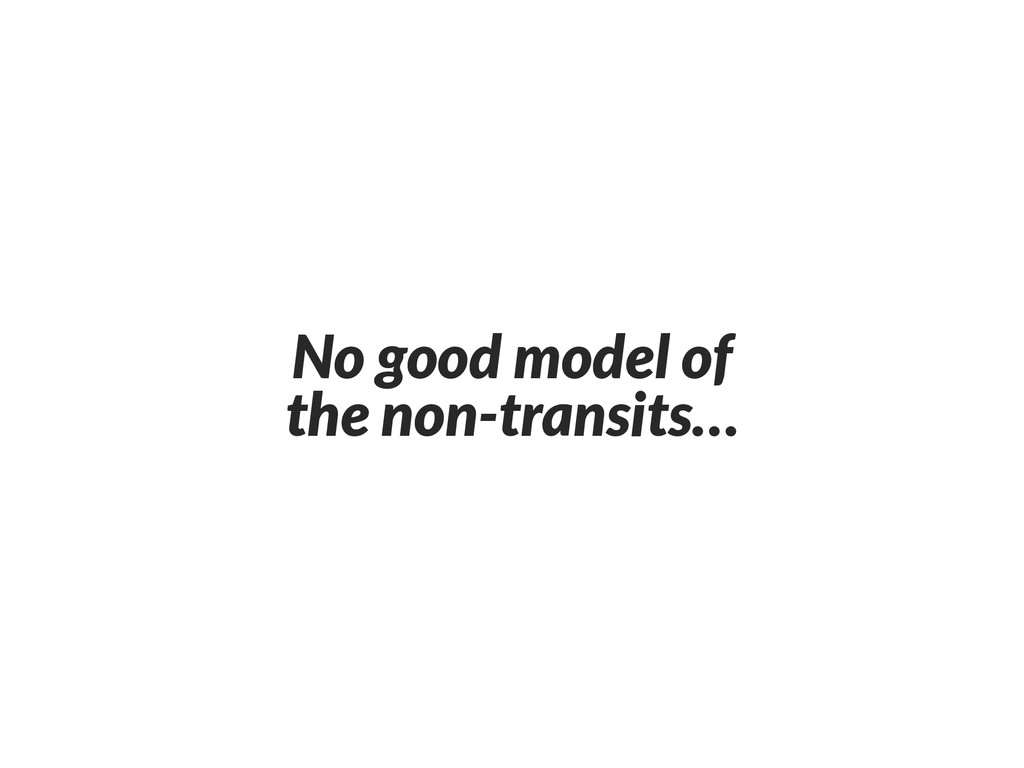
No good model of the non-transits…
Temporary solution: Template likelihoods
1 can discover single transits using supervised classification false positives
are still a problem (but maybe less) 2 3 would like to combine method with realistic noise model Conclusions


 dfm
 institutdelelevage
 arfon
 brainpadpr
 tasusu
 i2tsuki
 jarvist
 peterdesmet
 salt2
 trycycle
 akasan
 arthur1
 konakalab
 soudai
 tonyrice
 aleyda
 eileencodes
 philnash
 reverentgeek
 honzajavorek
 nonsquared
 katarinadahlin
 tammyeverts