Upgrade to Pro — share decks privately, control downloads, hide ads and more …

How Generative Engine Optimization (GEO) Is Res...

How Generative Engine Optimization (GEO) Is Reshaping Search Marketing in 2026

This case study examines how Go Fish Digital, a U.S. digital marketing agency, applied a structured GEO
program to its own content over a 90-day period in 2025 in order to win visibility and qualified leads inside
AI-driven search environments. The results illustrate a pattern now showing up across the industry: content
engineered for how large language models retrieve and cite information can outperform content built only for
traditional keyword ranking — both in reach and, notably, in lead quality.

Avatar for Mantashaa Sayed

Mantashaa Sayed

June 20, 2026

More Decks by Mantashaa Sayed

Other Decks in Business

Transcript

  1. DIGITAL MARKETING CASE STUDY / 2026 Winning the AI Answer

    How Generative Engine Optimization (GEO) Is Reshaping Search Marketing in 2026 A focused case study on how a digital marketing agency restructured its content for ChatGPT, Perplexity, Copilot, and Google AI Overviews — and the measurable lift in AI-sourced traffic, leads, and conversions that followed. Prepared for: Marketing Strategy Review Compiled June 2026 · Sources: agency-published performance data and 2025-2026 industry research
  2. WINNING THE AI ANSWER GEO Case Study · 2026 Compiled

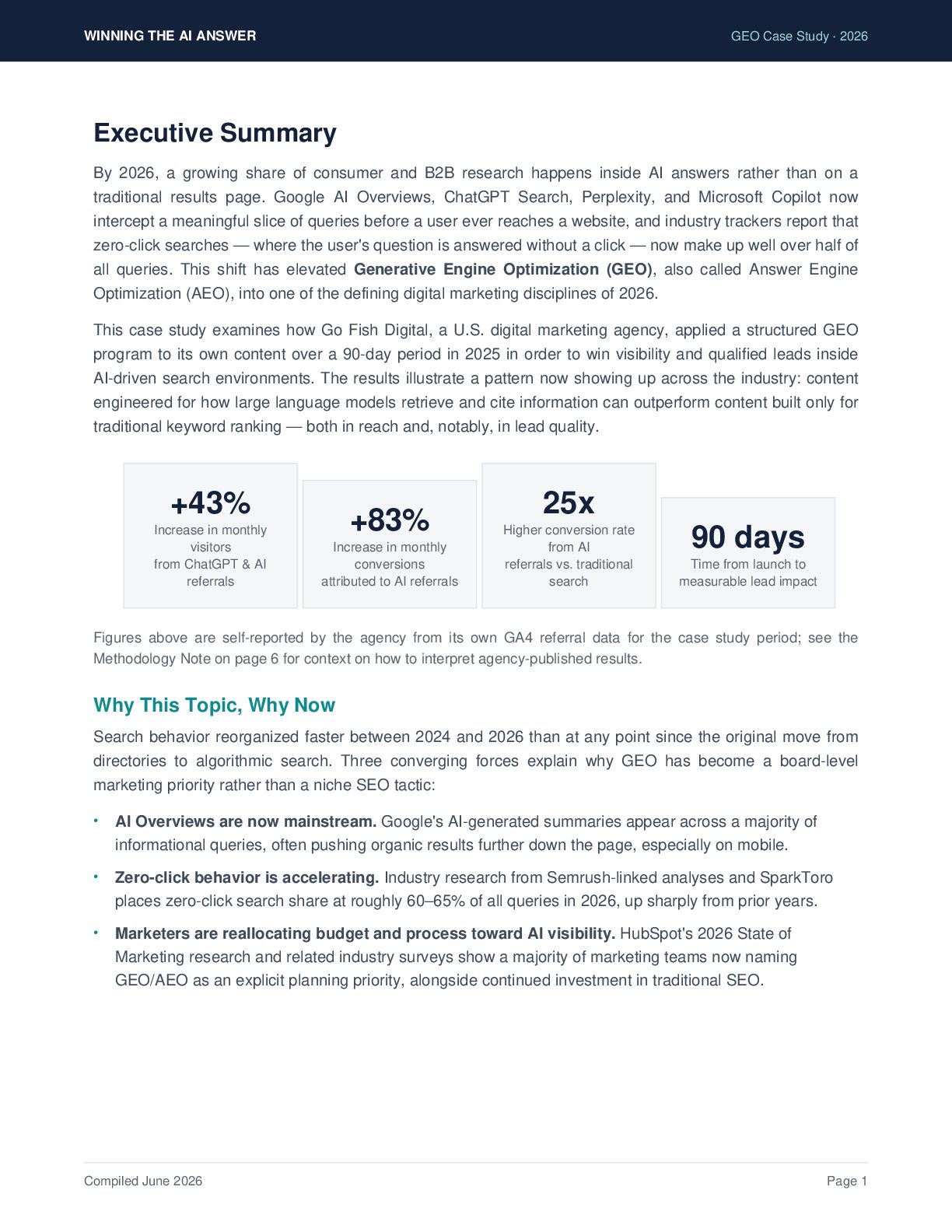
    June 2026 Page 1 Executive Summary By 2026, a growing share of consumer and B2B research happens inside AI answers rather than on a traditional results page. Google AI Overviews, ChatGPT Search, Perplexity, and Microsoft Copilot now intercept a meaningful slice of queries before a user ever reaches a website, and industry trackers report that zero-click searches — where the user's question is answered without a click — now make up well over half of all queries. This shift has elevated Generative Engine Optimization (GEO), also called Answer Engine Optimization (AEO), into one of the defining digital marketing disciplines of 2026. This case study examines how Go Fish Digital, a U.S. digital marketing agency, applied a structured GEO program to its own content over a 90-day period in 2025 in order to win visibility and qualified leads inside AI-driven search environments. The results illustrate a pattern now showing up across the industry: content engineered for how large language models retrieve and cite information can outperform content built only for traditional keyword ranking — both in reach and, notably, in lead quality. +43% Increase in monthly visitors from ChatGPT & AI referrals +83% Increase in monthly conversions attributed to AI referrals 25x Higher conversion rate from AI referrals vs. traditional search 90 days Time from launch to measurable lead impact Figures above are self-reported by the agency from its own GA4 referral data for the case study period; see the Methodology Note on page 6 for context on how to interpret agency-published results. Why This Topic, Why Now Search behavior reorganized faster between 2024 and 2026 than at any point since the original move from directories to algorithmic search. Three converging forces explain why GEO has become a board-level marketing priority rather than a niche SEO tactic: • AI Overviews are now mainstream. Google's AI-generated summaries appear across a majority of informational queries, often pushing organic results further down the page, especially on mobile. • Zero-click behavior is accelerating. Industry research from Semrush-linked analyses and SparkToro places zero-click search share at roughly 60–65% of all queries in 2026, up sharply from prior years. • Marketers are reallocating budget and process toward AI visibility. HubSpot's 2026 State of Marketing research and related industry surveys show a majority of marketing teams now naming GEO/AEO as an explicit planning priority, alongside continued investment in traditional SEO.
  3. WINNING THE AI ANSWER GEO Case Study · 2026 Compiled

    June 2026 Page 2 Background: The Challenge Go Fish Digital is a mid-sized U.S. digital marketing agency competing for enterprise SEO and GEO engagements. Heading into the case study period, the agency had a healthy traditional organic search presence, but an audit of its own site told a familiar story for 2025–2026: traffic and rankings in classic Google search were stable, yet the agency had almost no measurable presence inside the AI platforms that its own prospective clients were increasingly using to research vendors — ChatGPT, Copilot, and Google's AI Overviews and AI Mode. That gap mattered because the buyers researching GEO agencies are, almost by definition, already using AI tools to do that research. A prospective client typing a question like “best GEO agency for B2B SaaS” into ChatGPT would not encounter Go Fish Digital in the answer, regardless of how well the agency ranked on page one of classic Google. The team treated this as a controlled internal test case: if a structured GEO program could move the needle on their own site within a single quarter, the methodology would be credible enough to sell — and replicate — for clients. The objective was threefold: increase the frequency with which the brand was cited inside AI-generated answers for buyer-intent queries, grow referral traffic arriving directly from AI platforms, and confirm whether that traffic converted into qualified leads at a rate that justified the investment. Why Generic SEO Wasn't Enough Traditional SEO optimizes for a ranking algorithm that returns a list of links. Generative engines work differently: a model retrieves passages, reasons across multiple sources, and synthesizes a single answer, often expanding one question into several related sub-questions before composing a response (a process sometimes called “query fan-out”). Content that ranks well but isn't structured for extraction — clear claims, defined entities, fact-dense passages, consistent terminology — is easy for a crawler to index but hard for a language model to confidently quote or cite. That distinction became the starting point for the agency's strategy.
  4. WINNING THE AI ANSWER GEO Case Study · 2026 Compiled

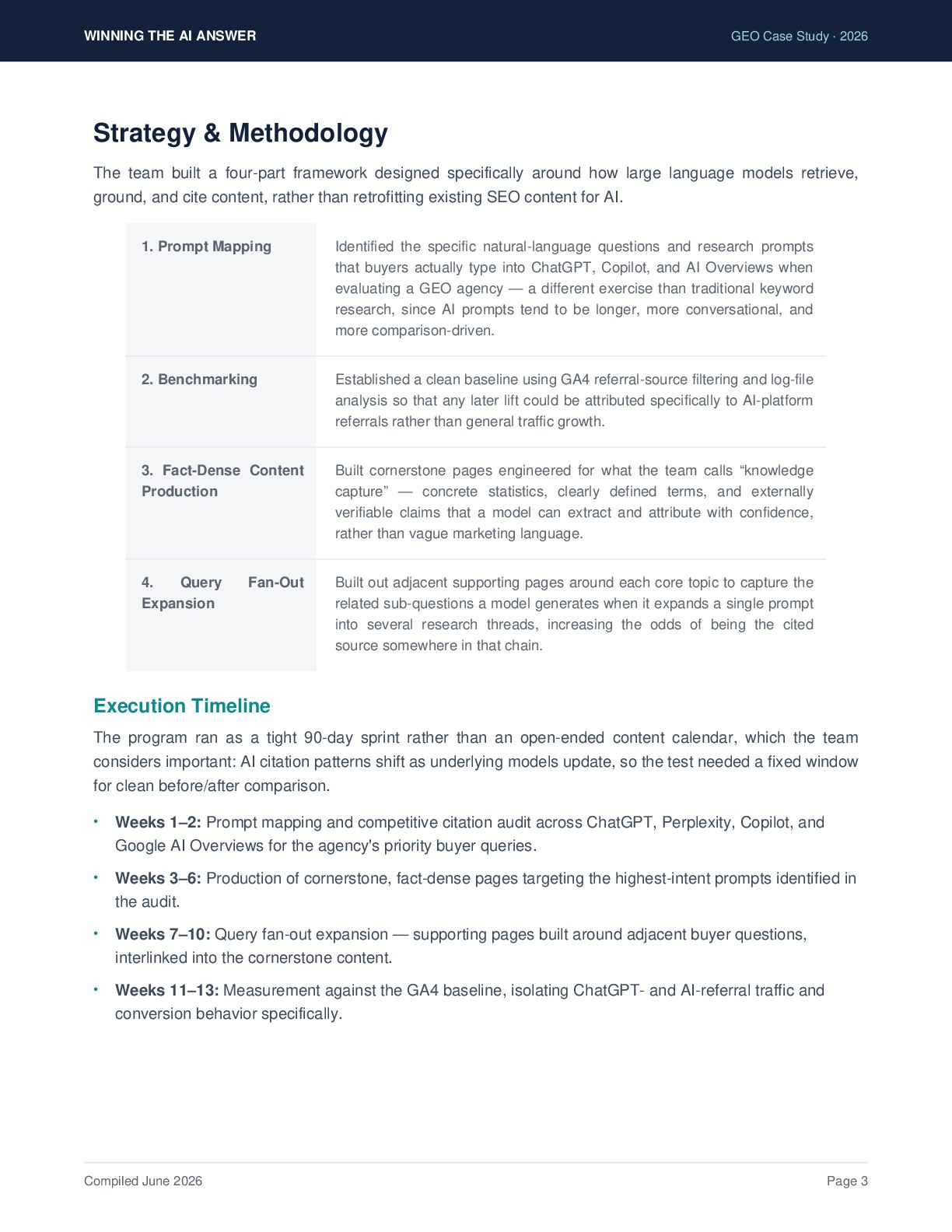
    June 2026 Page 3 Strategy & Methodology The team built a four-part framework designed specifically around how large language models retrieve, ground, and cite content, rather than retrofitting existing SEO content for AI. 1. Prompt Mapping Identified the specific natural-language questions and research prompts that buyers actually type into ChatGPT, Copilot, and AI Overviews when evaluating a GEO agency — a different exercise than traditional keyword research, since AI prompts tend to be longer, more conversational, and more comparison-driven. 2. Benchmarking Established a clean baseline using GA4 referral-source filtering and log-file analysis so that any later lift could be attributed specifically to AI-platform referrals rather than general traffic growth. 3. Fact-Dense Content Production Built cornerstone pages engineered for what the team calls “knowledge capture” — concrete statistics, clearly defined terms, and externally verifiable claims that a model can extract and attribute with confidence, rather than vague marketing language. 4. Query Fan-Out Expansion Built out adjacent supporting pages around each core topic to capture the related sub-questions a model generates when it expands a single prompt into several research threads, increasing the odds of being the cited source somewhere in that chain. Execution Timeline The program ran as a tight 90-day sprint rather than an open-ended content calendar, which the team considers important: AI citation patterns shift as underlying models update, so the test needed a fixed window for clean before/after comparison. • Weeks 1–2: Prompt mapping and competitive citation audit across ChatGPT, Perplexity, Copilot, and Google AI Overviews for the agency's priority buyer queries. • Weeks 3–6: Production of cornerstone, fact-dense pages targeting the highest-intent prompts identified in the audit. • Weeks 7–10: Query fan-out expansion — supporting pages built around adjacent buyer questions, interlinked into the cornerstone content. • Weeks 11–13: Measurement against the GA4 baseline, isolating ChatGPT- and AI-referral traffic and conversion behavior specifically.
  5. WINNING THE AI ANSWER GEO Case Study · 2026 Compiled

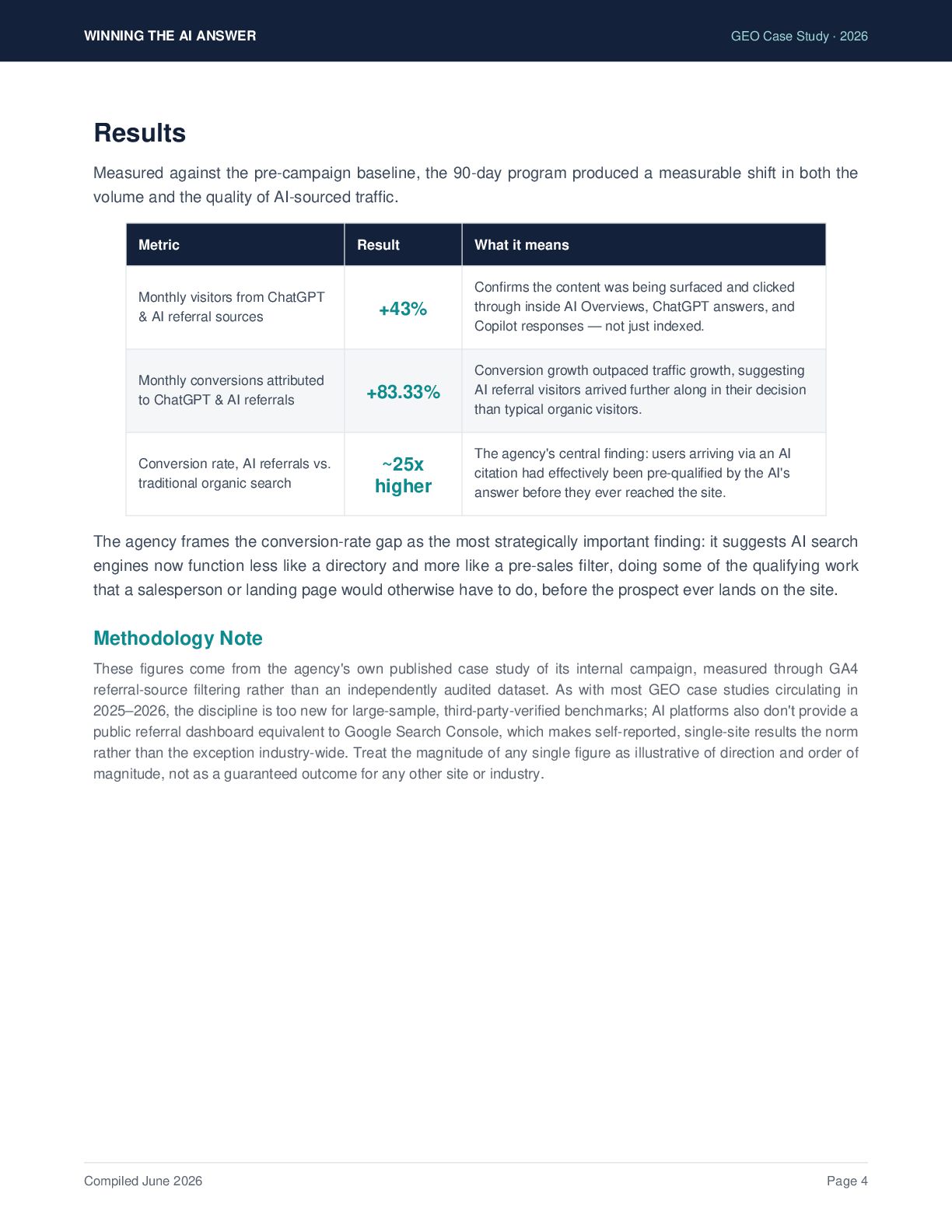
    June 2026 Page 4 Results Measured against the pre-campaign baseline, the 90-day program produced a measurable shift in both the volume and the quality of AI-sourced traffic. Metric Result What it means Monthly visitors from ChatGPT & AI referral sources +43% Confirms the content was being surfaced and clicked through inside AI Overviews, ChatGPT answers, and Copilot responses — not just indexed. Monthly conversions attributed to ChatGPT & AI referrals +83.33% Conversion growth outpaced traffic growth, suggesting AI referral visitors arrived further along in their decision than typical organic visitors. Conversion rate, AI referrals vs. traditional organic search ~25x higher The agency's central finding: users arriving via an AI citation had effectively been pre-qualified by the AI's answer before they ever reached the site. The agency frames the conversion-rate gap as the most strategically important finding: it suggests AI search engines now function less like a directory and more like a pre-sales filter, doing some of the qualifying work that a salesperson or landing page would otherwise have to do, before the prospect ever lands on the site. Methodology Note These figures come from the agency's own published case study of its internal campaign, measured through GA4 referral-source filtering rather than an independently audited dataset. As with most GEO case studies circulating in 2025–2026, the discipline is too new for large-sample, third-party-verified benchmarks; AI platforms also don't provide a public referral dashboard equivalent to Google Search Console, which makes self-reported, single-site results the norm rather than the exception industry-wide. Treat the magnitude of any single figure as illustrative of direction and order of magnitude, not as a guaranteed outcome for any other site or industry.
  6. WINNING THE AI ANSWER GEO Case Study · 2026 Compiled

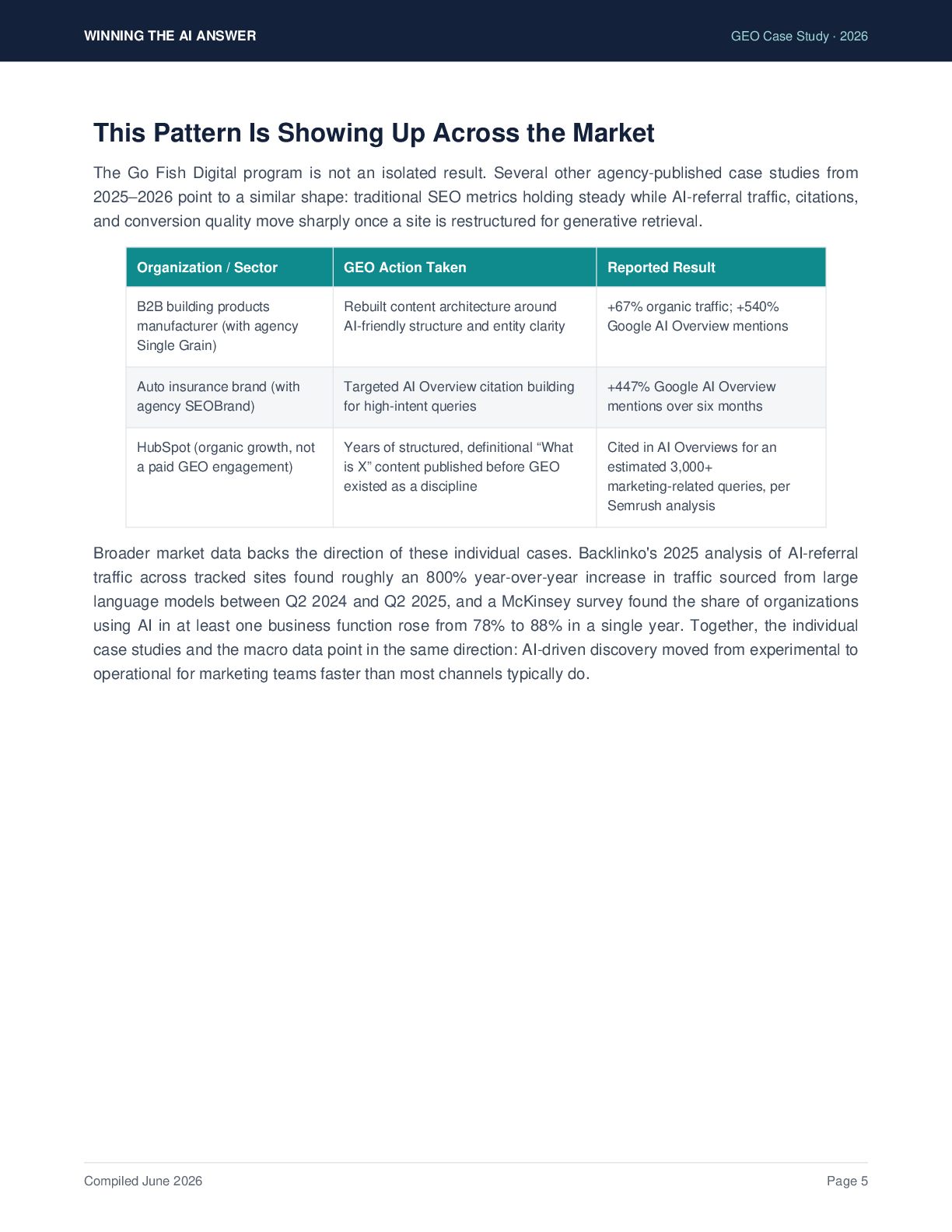
    June 2026 Page 5 This Pattern Is Showing Up Across the Market The Go Fish Digital program is not an isolated result. Several other agency-published case studies from 2025–2026 point to a similar shape: traditional SEO metrics holding steady while AI-referral traffic, citations, and conversion quality move sharply once a site is restructured for generative retrieval. Organization / Sector GEO Action Taken Reported Result B2B building products manufacturer (with agency Single Grain) Rebuilt content architecture around AI-friendly structure and entity clarity +67% organic traffic; +540% Google AI Overview mentions Auto insurance brand (with agency SEOBrand) Targeted AI Overview citation building for high-intent queries +447% Google AI Overview mentions over six months HubSpot (organic growth, not a paid GEO engagement) Years of structured, definitional “What is X” content published before GEO existed as a discipline Cited in AI Overviews for an estimated 3,000+ marketing-related queries, per Semrush analysis Broader market data backs the direction of these individual cases. Backlinko's 2025 analysis of AI-referral traffic across tracked sites found roughly an 800% year-over-year increase in traffic sourced from large language models between Q2 2024 and Q2 2025, and a McKinsey survey found the share of organizations using AI in at least one business function rose from 78% to 88% in a single year. Together, the individual case studies and the macro data point in the same direction: AI-driven discovery moved from experimental to operational for marketing teams faster than most channels typically do.
  7. WINNING THE AI ANSWER GEO Case Study · 2026 Compiled

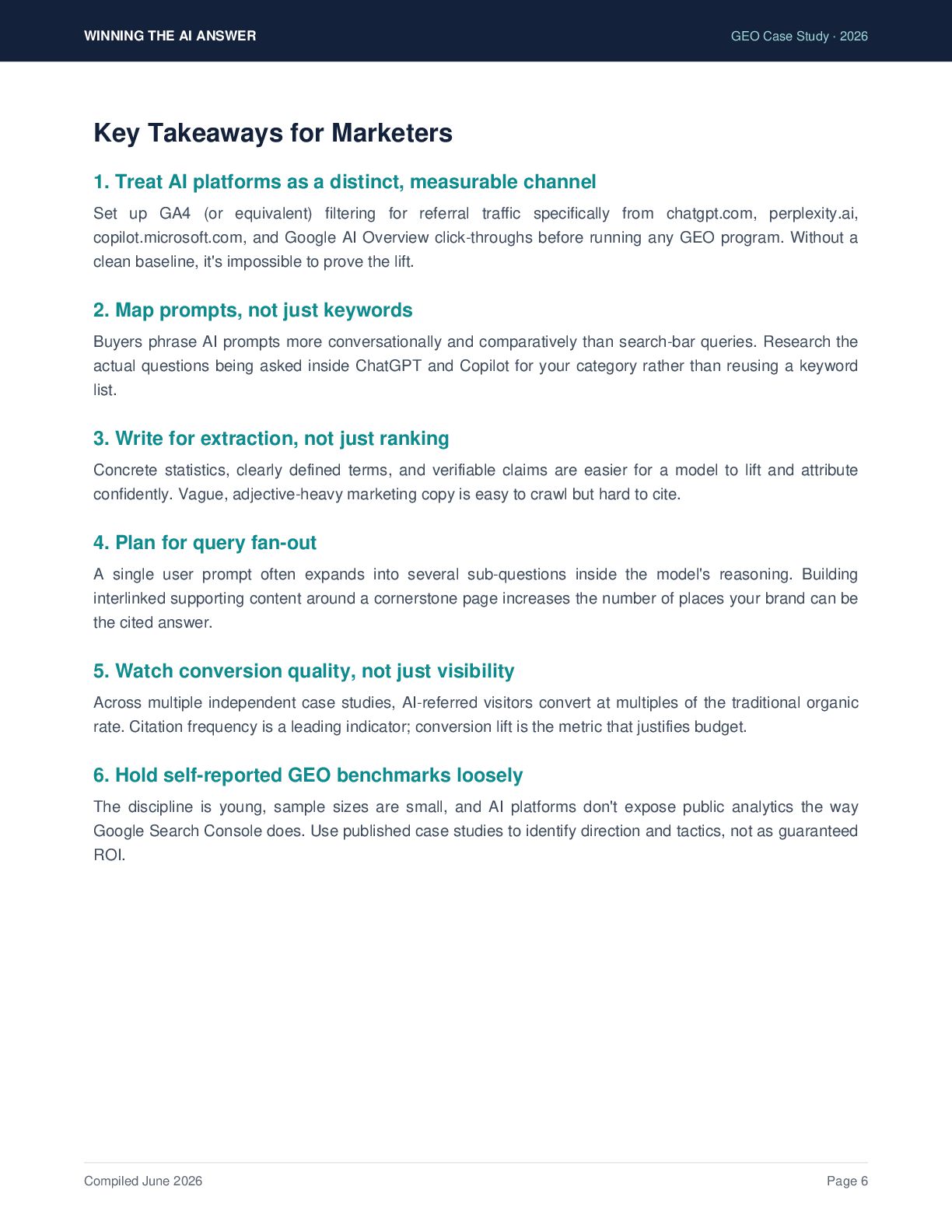
    June 2026 Page 6 Key Takeaways for Marketers 1. Treat AI platforms as a distinct, measurable channel Set up GA4 (or equivalent) filtering for referral traffic specifically from chatgpt.com, perplexity.ai, copilot.microsoft.com, and Google AI Overview click-throughs before running any GEO program. Without a clean baseline, it's impossible to prove the lift. 2. Map prompts, not just keywords Buyers phrase AI prompts more conversationally and comparatively than search-bar queries. Research the actual questions being asked inside ChatGPT and Copilot for your category rather than reusing a keyword list. 3. Write for extraction, not just ranking Concrete statistics, clearly defined terms, and verifiable claims are easier for a model to lift and attribute confidently. Vague, adjective-heavy marketing copy is easy to crawl but hard to cite. 4. Plan for query fan-out A single user prompt often expands into several sub-questions inside the model's reasoning. Building interlinked supporting content around a cornerstone page increases the number of places your brand can be the cited answer. 5. Watch conversion quality, not just visibility Across multiple independent case studies, AI-referred visitors convert at multiples of the traditional organic rate. Citation frequency is a leading indicator; conversion lift is the metric that justifies budget. 6. Hold self-reported GEO benchmarks loosely The discipline is young, sample sizes are small, and AI platforms don't expose public analytics the way Google Search Console does. Use published case studies to identify direction and tactics, not as guaranteed ROI.
  8. WINNING THE AI ANSWER GEO Case Study · 2026 Compiled

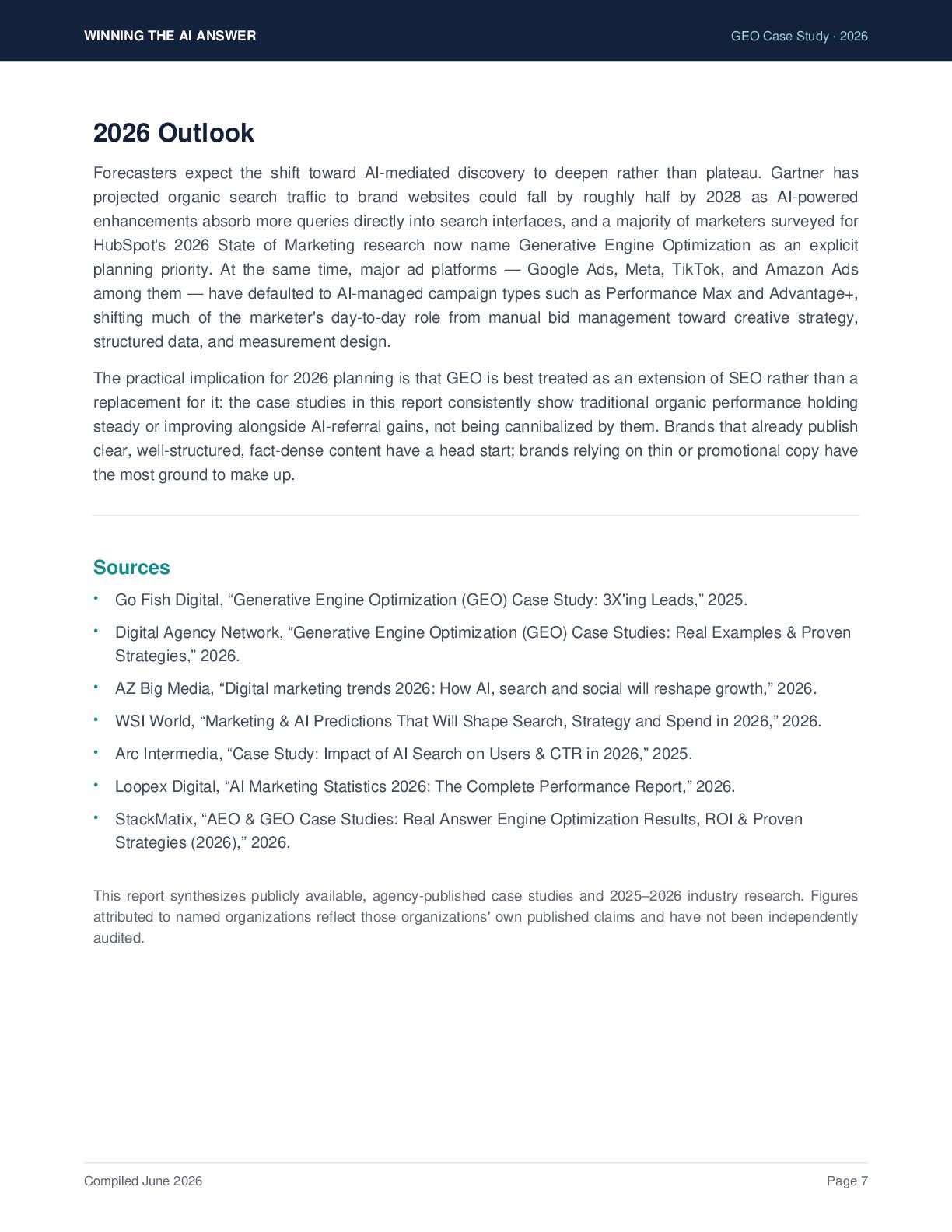
    June 2026 Page 7 2026 Outlook Forecasters expect the shift toward AI-mediated discovery to deepen rather than plateau. Gartner has projected organic search traffic to brand websites could fall by roughly half by 2028 as AI-powered enhancements absorb more queries directly into search interfaces, and a majority of marketers surveyed for HubSpot's 2026 State of Marketing research now name Generative Engine Optimization as an explicit planning priority. At the same time, major ad platforms — Google Ads, Meta, TikTok, and Amazon Ads among them — have defaulted to AI-managed campaign types such as Performance Max and Advantage+, shifting much of the marketer's day-to-day role from manual bid management toward creative strategy, structured data, and measurement design. The practical implication for 2026 planning is that GEO is best treated as an extension of SEO rather than a replacement for it: the case studies in this report consistently show traditional organic performance holding steady or improving alongside AI-referral gains, not being cannibalized by them. Brands that already publish clear, well-structured, fact-dense content have a head start; brands relying on thin or promotional copy have the most ground to make up. Sources • Go Fish Digital, “Generative Engine Optimization (GEO) Case Study: 3X'ing Leads,” 2025. • Digital Agency Network, “Generative Engine Optimization (GEO) Case Studies: Real Examples & Proven Strategies,” 2026. • AZ Big Media, “Digital marketing trends 2026: How AI, search and social will reshape growth,” 2026. • WSI World, “Marketing & AI Predictions That Will Shape Search, Strategy and Spend in 2026,” 2026. • Arc Intermedia, “Case Study: Impact of AI Search on Users & CTR in 2026,” 2025. • Loopex Digital, “AI Marketing Statistics 2026: The Complete Performance Report,” 2026. • StackMatix, “AEO & GEO Case Studies: Real Answer Engine Optimization Results, ROI & Proven Strategies (2026),” 2026. This report synthesizes publicly available, agency-published case studies and 2025–2026 industry research. Figures attributed to named organizations reflect those organizations' own published claims and have not been independently audited.