Upgrade to Pro — share decks privately, control downloads, hide ads and more …

Repeatable results with AI

Repeatable results with AI

My talk on the Software Engineering Leadership Summit 2026 in Norway.

Avatar for Dan Kuida

Dan Kuida PRO

October 11, 2026

Video

More Decks by Dan Kuida

Other Decks in Programming

Transcript

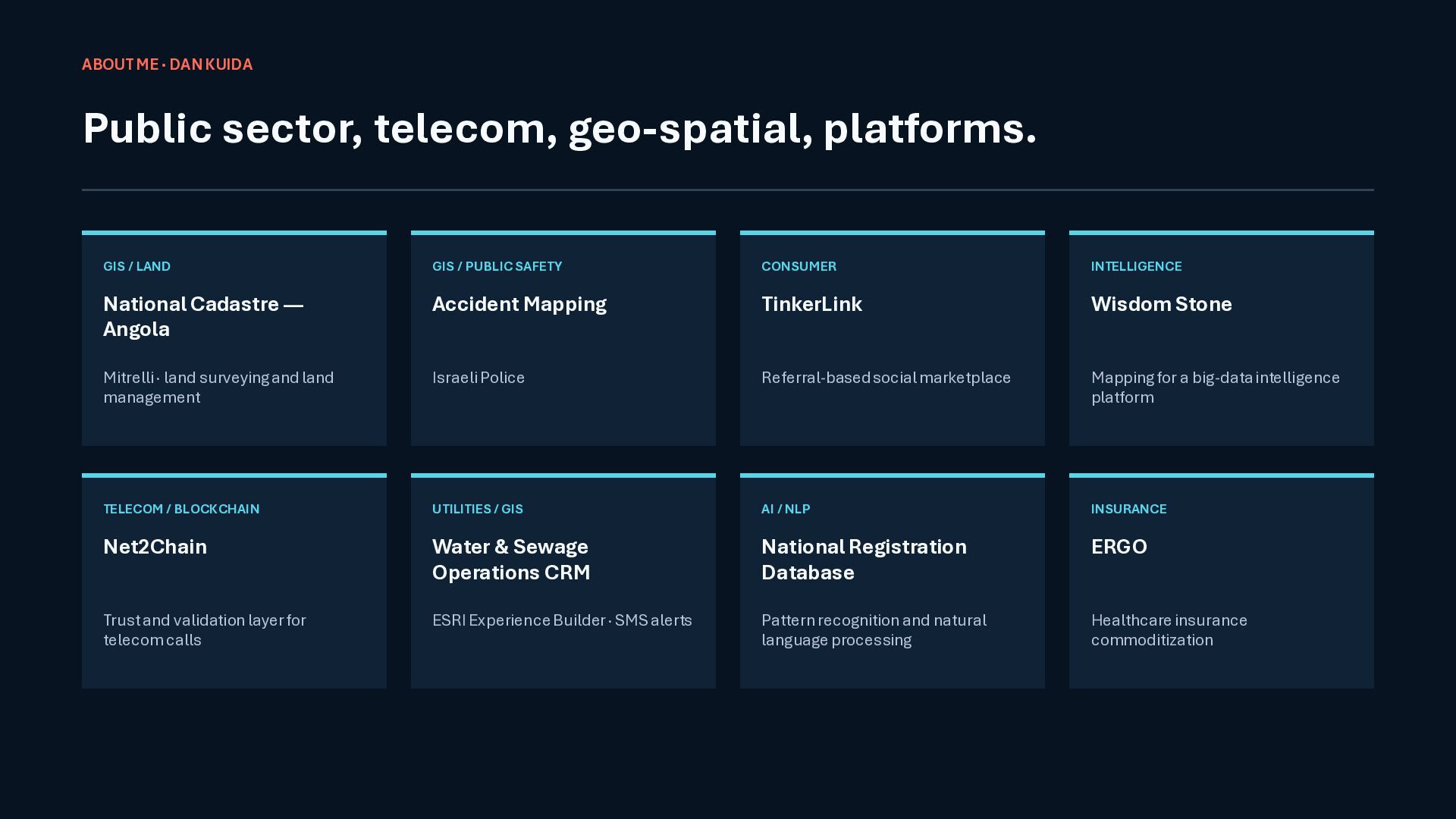
  1. ABOUT ME · DAN KUIDA Public sector, telecom, geo-spatial, platforms.

    GIS / LAND GIS / PUBLIC SAFETY CONSUMER INTELLIGENCE National Cadastre — Angola Accident Mapping TinkerLink Wisdom Stone Mitrelli · land surveying and land management Israeli Police Referral-based social marketplace Mapping for a big-data intelligence platform TELECOM / BLOCKCHAIN UTILITIES / GIS AI / NLP INSURANCE Net2Chain Water & Sewage Operations CRM National Registration Database ERGO Trust and validation layer for telecom calls ESRI Experience Builder · SMS alerts Pattern recognition and natural language processing Healthcare insurance commoditization
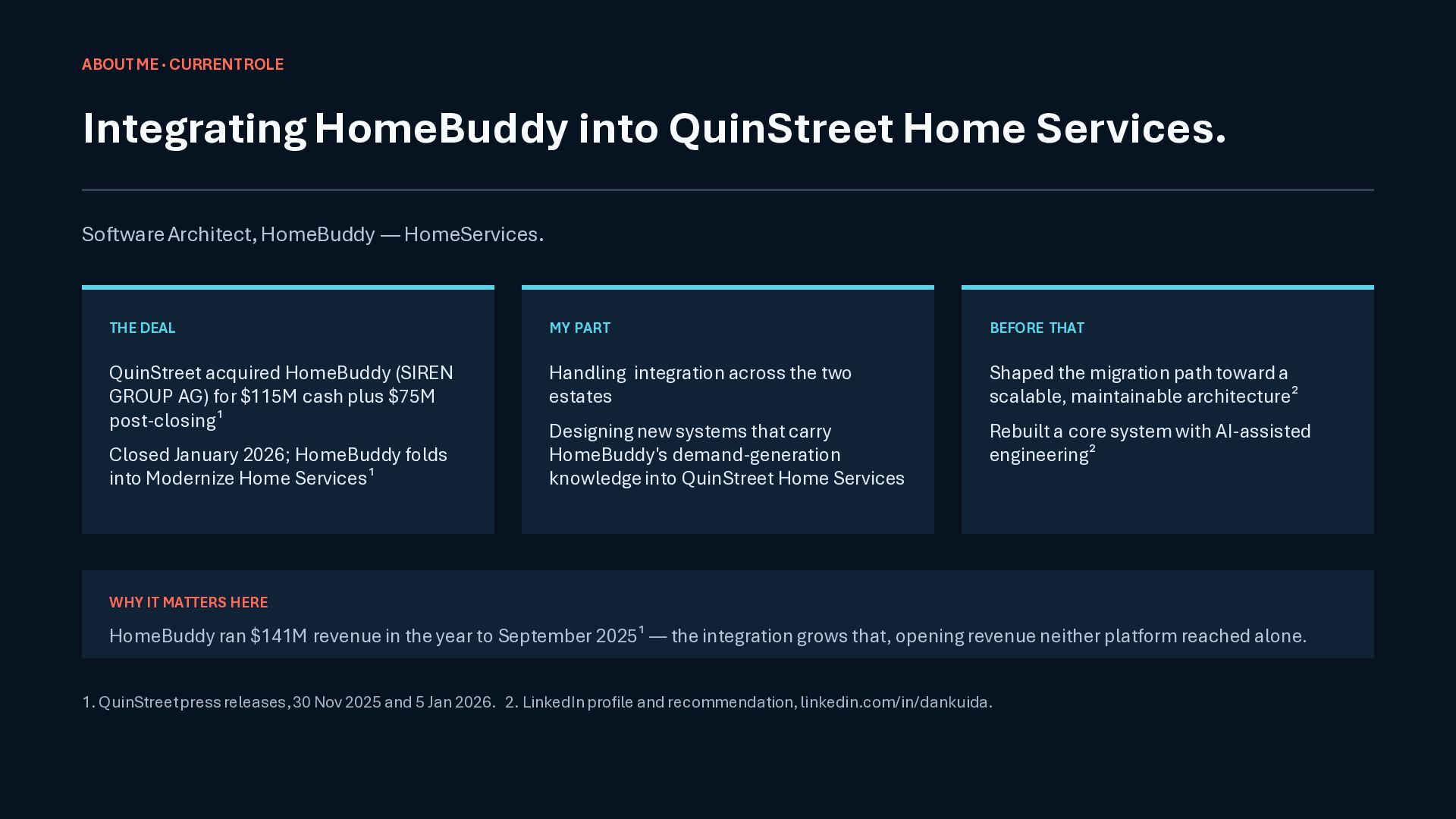
  2. ABOUT ME · CURRENT ROLE Integrating HomeBuddy into QuinStreet Home

    Services. Software Architect, HomeBuddy — HomeServices. THE DEAL MY PART BEFORE THAT QuinStreet acquired HomeBuddy (SIREN GROUP AG) for $115M cash plus $75M post-closing¹ Handling integration across the two estates Shaped the migration path toward a scalable, maintainable architecture² Designing new systems that carry HomeBuddy's demand-generation knowledge into QuinStreet Home Services Rebuilt a core system with AI-assisted engineering² Closed January 2026; HomeBuddy folds into Modernize Home Services¹ WHY IT MATTERS HERE HomeBuddy ran $141M revenue in the year to September 2025¹ — the integration grows that, opening revenue neither platform reached alone. 1. QuinStreet press releases, 30 Nov 2025 and 5 Jan 2026. 2. LinkedIn profile and recommendation, linkedin.com/in/dankuida.
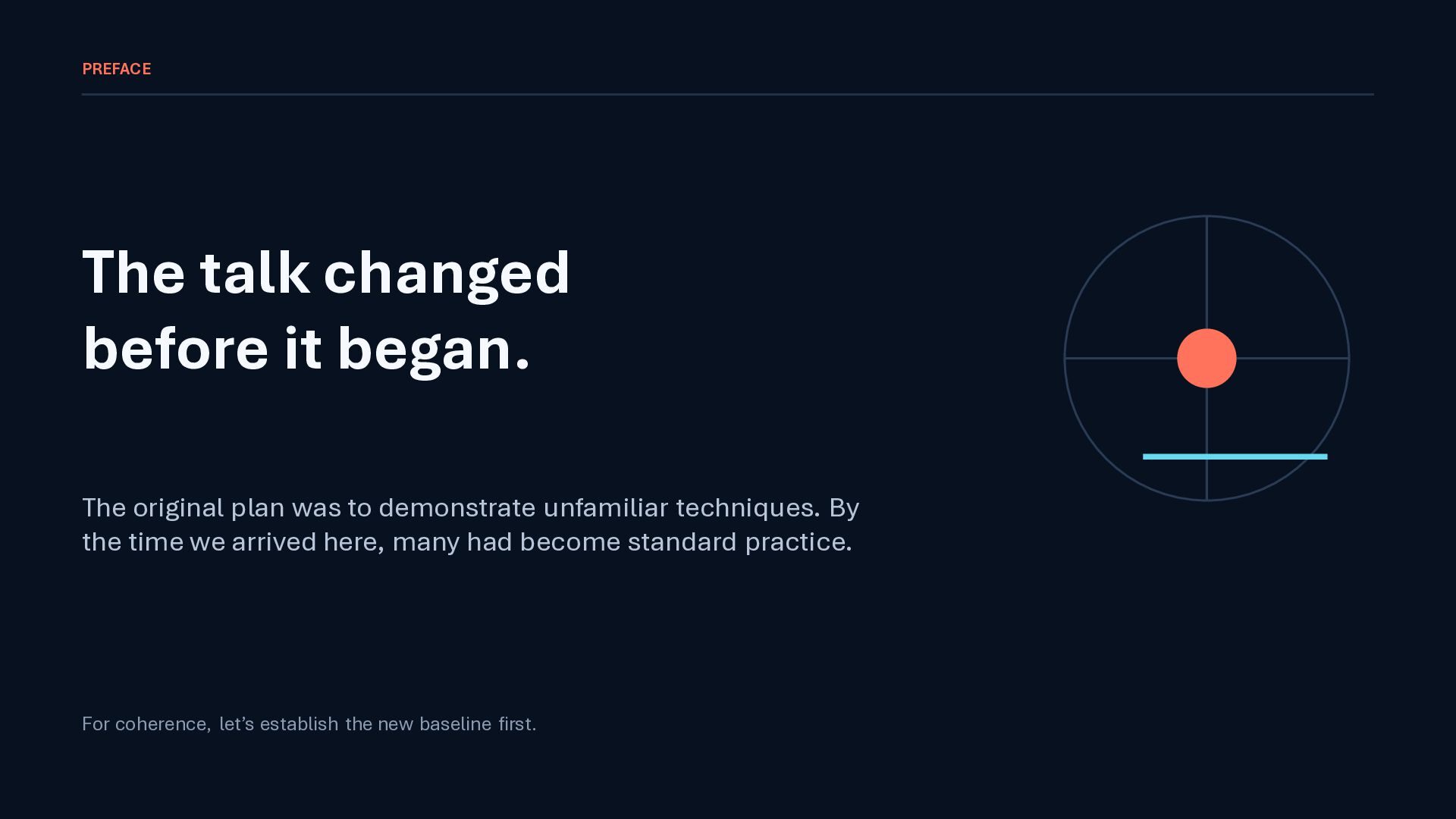
  3. PREFACE The talk changed before it began. The original plan

    was to demonstrate unfamiliar techniques. By the time we arrived here, many had become standard practice. For coherence, let’s establish the new baseline first.
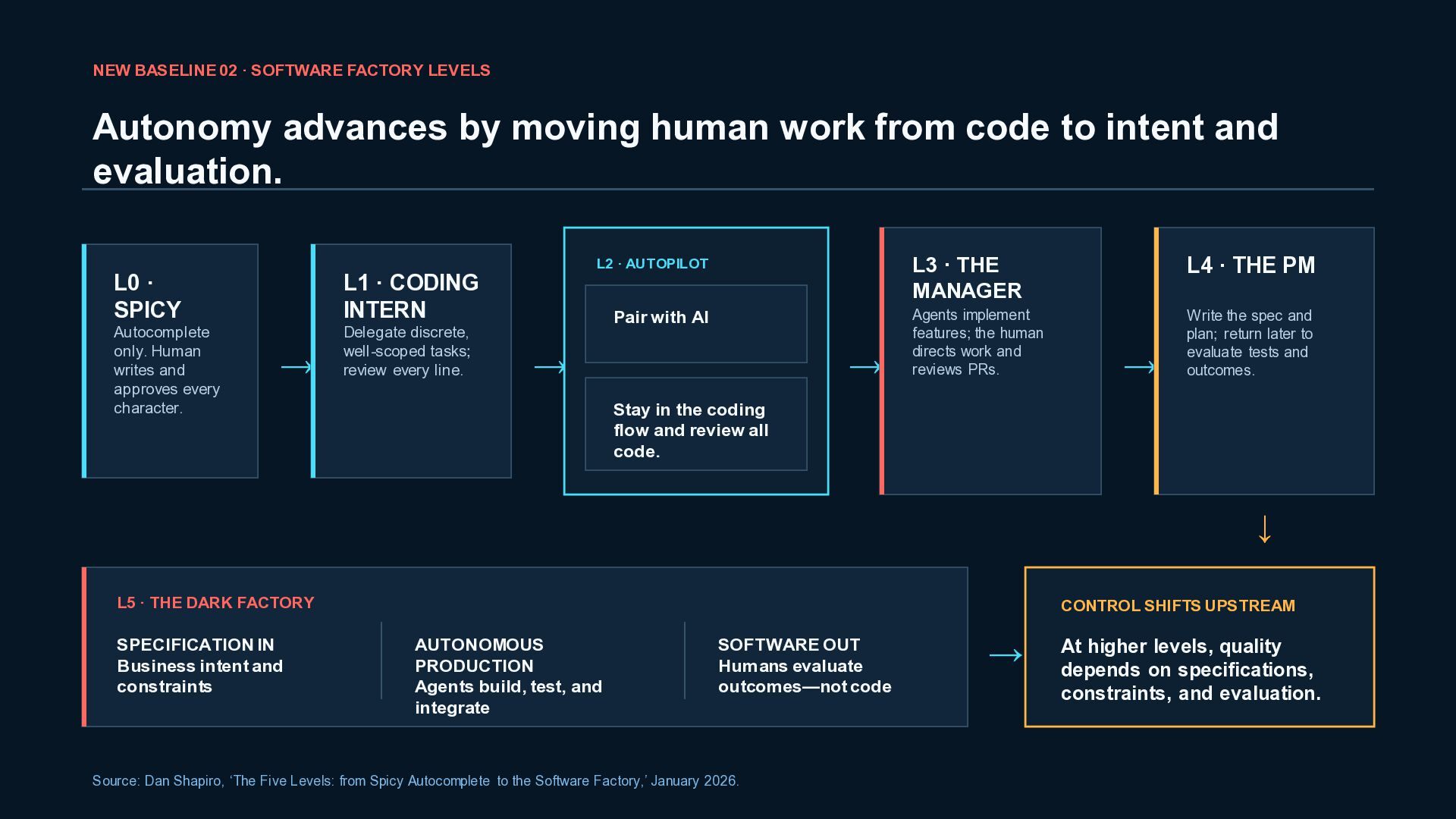
  4. NEW BASELINE 02 · SOFTWARE FACTORY LEVELS Autonomy advances by

    moving human work from code to intent and evaluation. L0 · SPICY L1 · CODING INTERN Autocomplete only. Human writes and approves every character. Delegate discrete, well-scoped tasks; review every line. → L2 · AUTOPILOT Pair with AI → → L3 · THE MANAGER L4 · THE PM Agents implement features; the human directs work and reviews PRs. Write the spec and plan; return later to evaluate tests and outcomes. → Stay in the coding flow and review all code. ↓ L5 · THE DARK FACTORY SPECIFICATION IN Business intent and constraints CONTROL SHIFTS UPSTREAM AUTONOMOUS PRODUCTION Agents build, test, and integrate SOFTWARE OUT Humans evaluate outcomes—not code Source: Dan Shapiro, ‘The Five Levels: from Spicy Autocomplete to the Software Factory,’ January 2026. → At higher levels, quality depends on specifications, constraints, and evaluation.
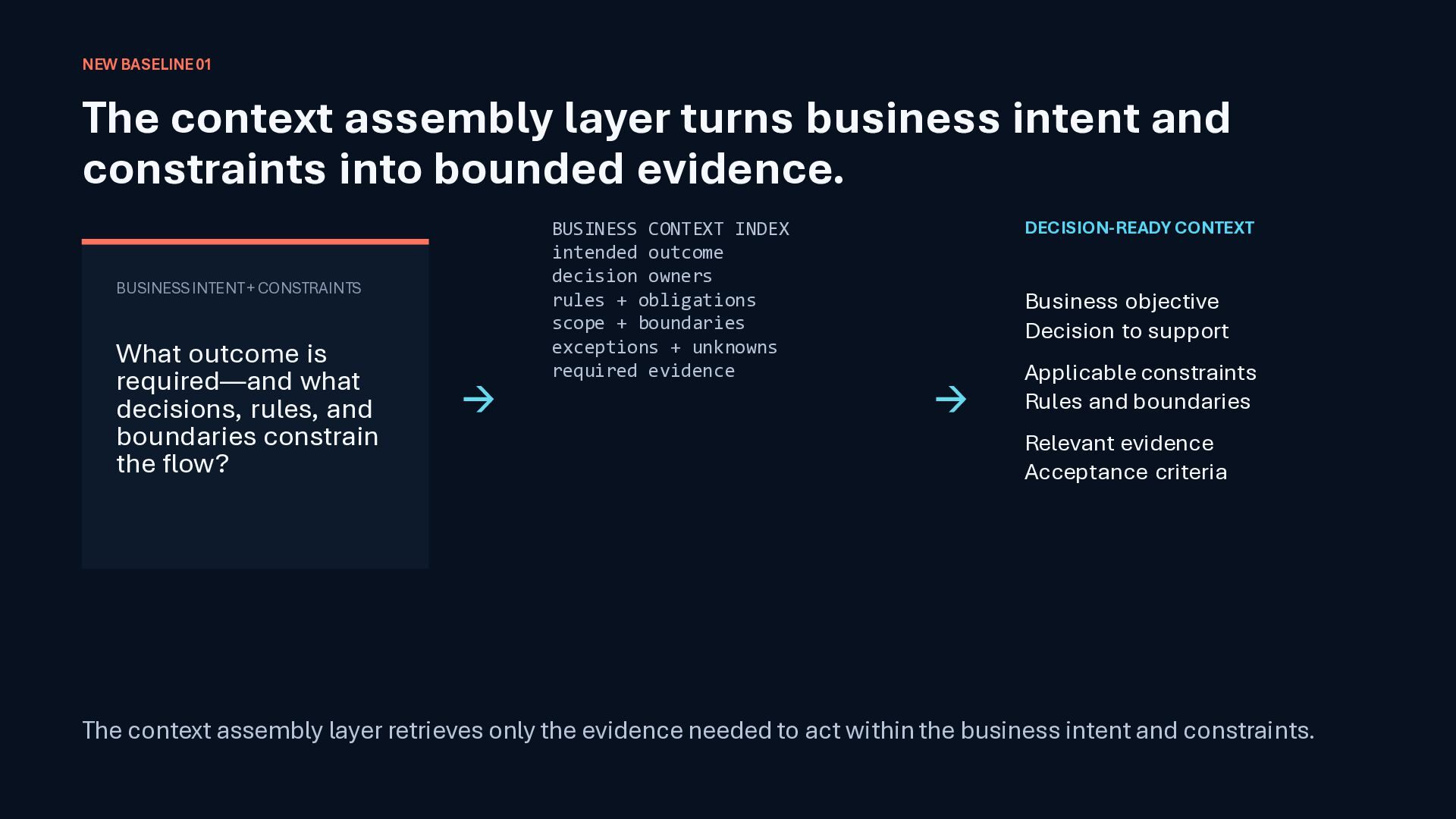
  5. NEW BASELINE 01 The context assembly layer turns business intent

    and constraints into bounded evidence. BUSINESS INTENT + CONSTRAINTS What outcome is required—and what decisions, rules, and boundaries constrain the flow? → BUSINESS CONTEXT INDEX intended outcome decision owners rules + obligations scope + boundaries exceptions + unknowns required evidence DECISION-READY CONTEXT Business objective Decision to support → Applicable constraints Rules and boundaries Relevant evidence Acceptance criteria The context assembly layer retrieves only the evidence needed to act within the business intent and constraints.
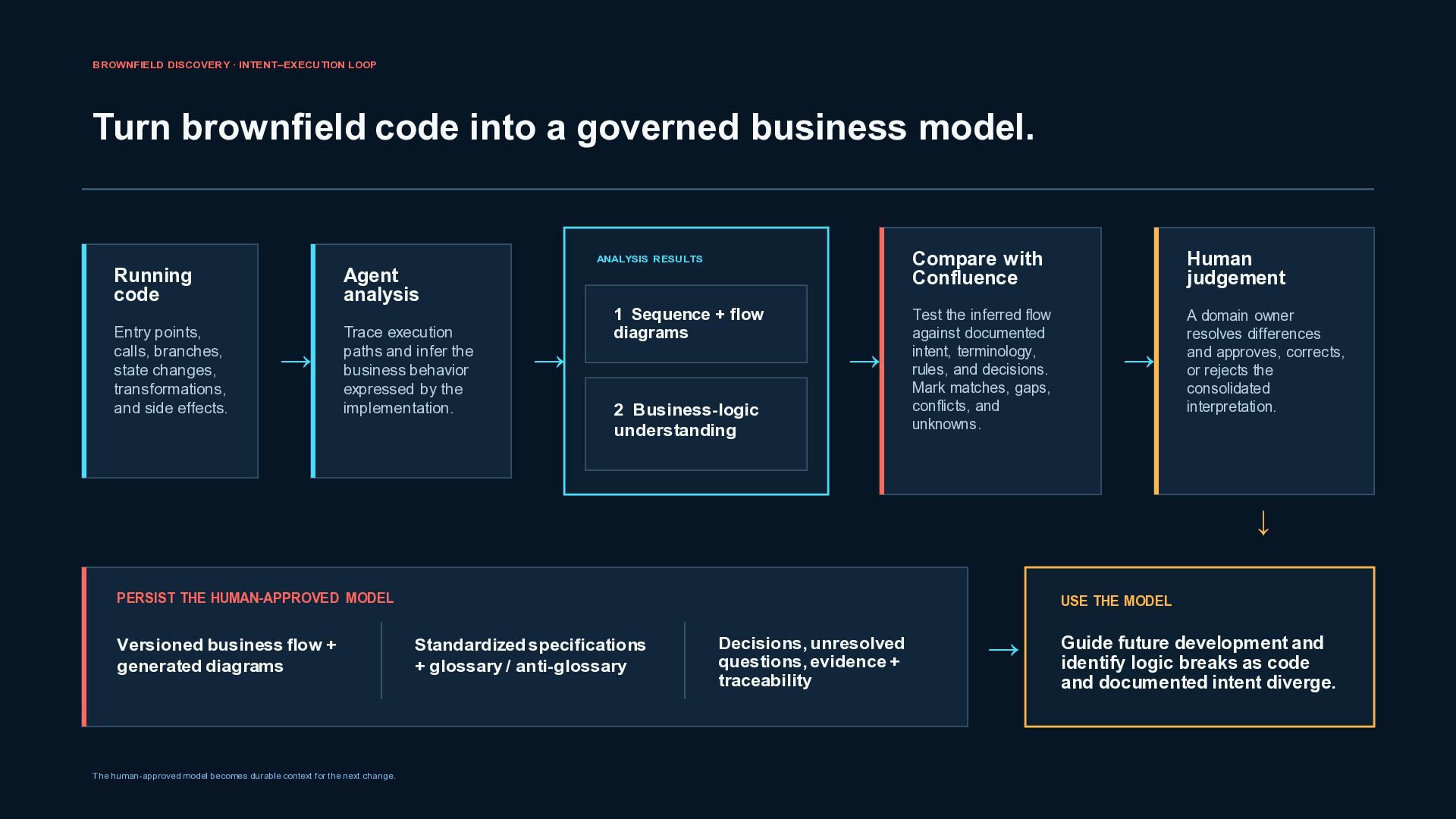
  6. BROWNFIELD DISCOVERY · INTENT–EXECUTION LOOP Turn brownfield code into a

    governed business model. ANALYSIS RESULTS Running code Agent analysis Entry points, calls, branches, state changes, transformations, and side effects. Trace execution paths and infer the business behavior expressed by the implementation. → → 1 Sequence + flow diagrams → 2 Business-logic understanding Compare with Confluence Human judgement Test the inferred flow against documented intent, terminology, rules, and decisions. Mark matches, gaps, conflicts, and unknowns. A domain owner resolves differences and approves, corrects, or rejects the consolidated interpretation. → ↓ PERSIST THE HUMAN-APPROVED MODEL Versioned business flow + generated diagrams The human-approved model becomes durable context for the next change. USE THE MODEL Standardized specifications + glossary / anti-glossary Decisions, unresolved questions, evidence + traceability → Guide future development and identify logic breaks as code and documented intent diverge.
  7. DURABLE INTENT · PERSISTENCE LAYER Persistence turns one discovery into

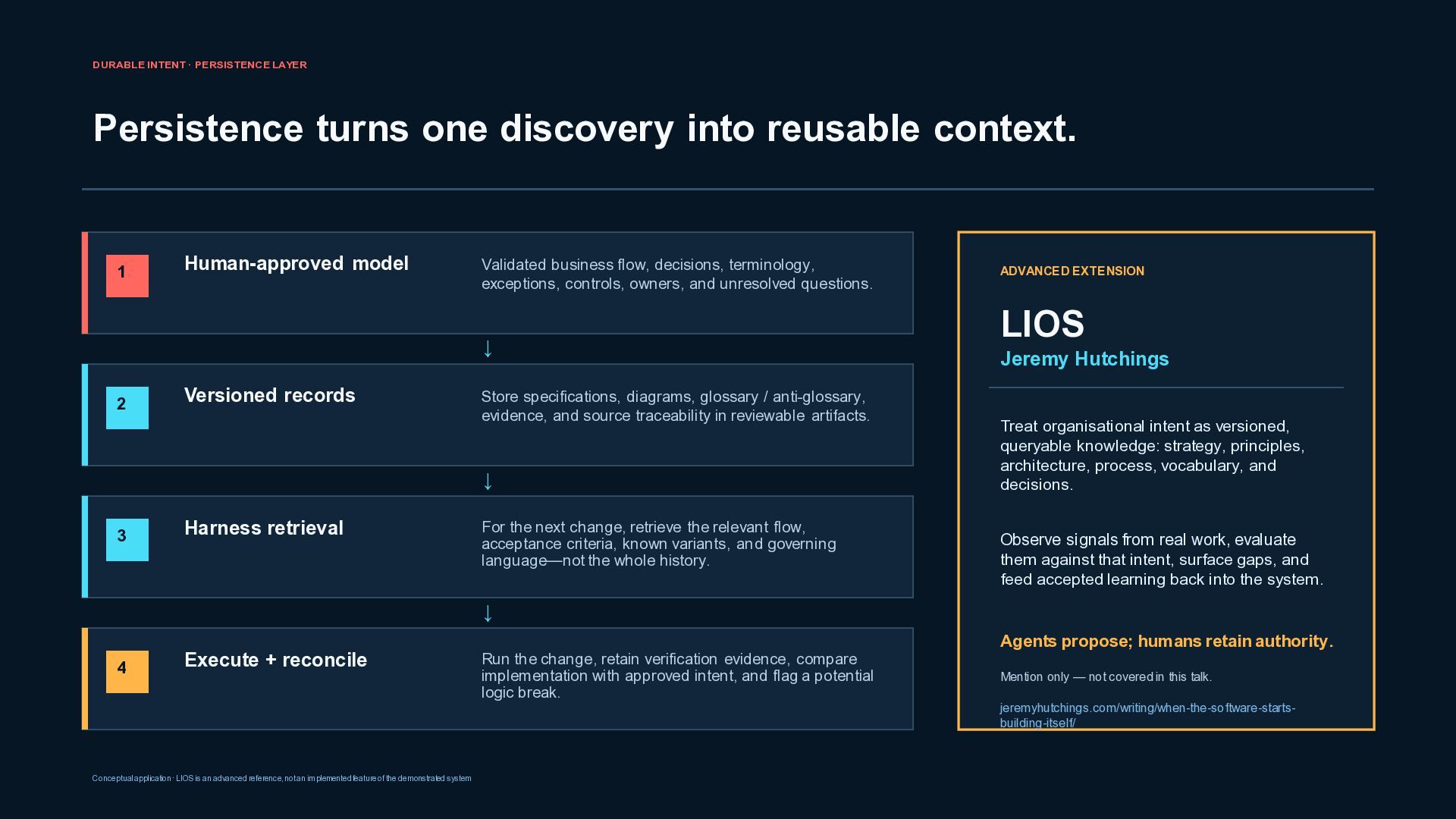
    reusable context. 1 Human-approved model Validated business flow, decisions, terminology, exceptions, controls, owners, and unresolved questions. ↓ 2 Versioned records Store specifications, diagrams, glossary / anti-glossary, evidence, and source traceability in reviewable artifacts. ↓ 3 Harness retrieval For the next change, retrieve the relevant flow, acceptance criteria, known variants, and governing language—not the whole history. ADVANCED EXTENSION LIOS Jeremy Hutchings Treat organisational intent as versioned, queryable knowledge: strategy, principles, architecture, process, vocabulary, and decisions. Observe signals from real work, evaluate them against that intent, surface gaps, and feed accepted learning back into the system. ↓ 4 Execute + reconcile Conceptual application · LIOS is an advanced reference, not an implemented feature of the demonstrated system Run the change, retain verification evidence, compare implementation with approved intent, and flag a potential logic break. Agents propose; humans retain authority. Mention only — not covered in this talk. jeremyhutchings.com/writing/when-the-software-startsbuilding-itself/
  8. NEW BASELINE 03 · DOCUMENTATION PIPELINE Turn Confluence into governed

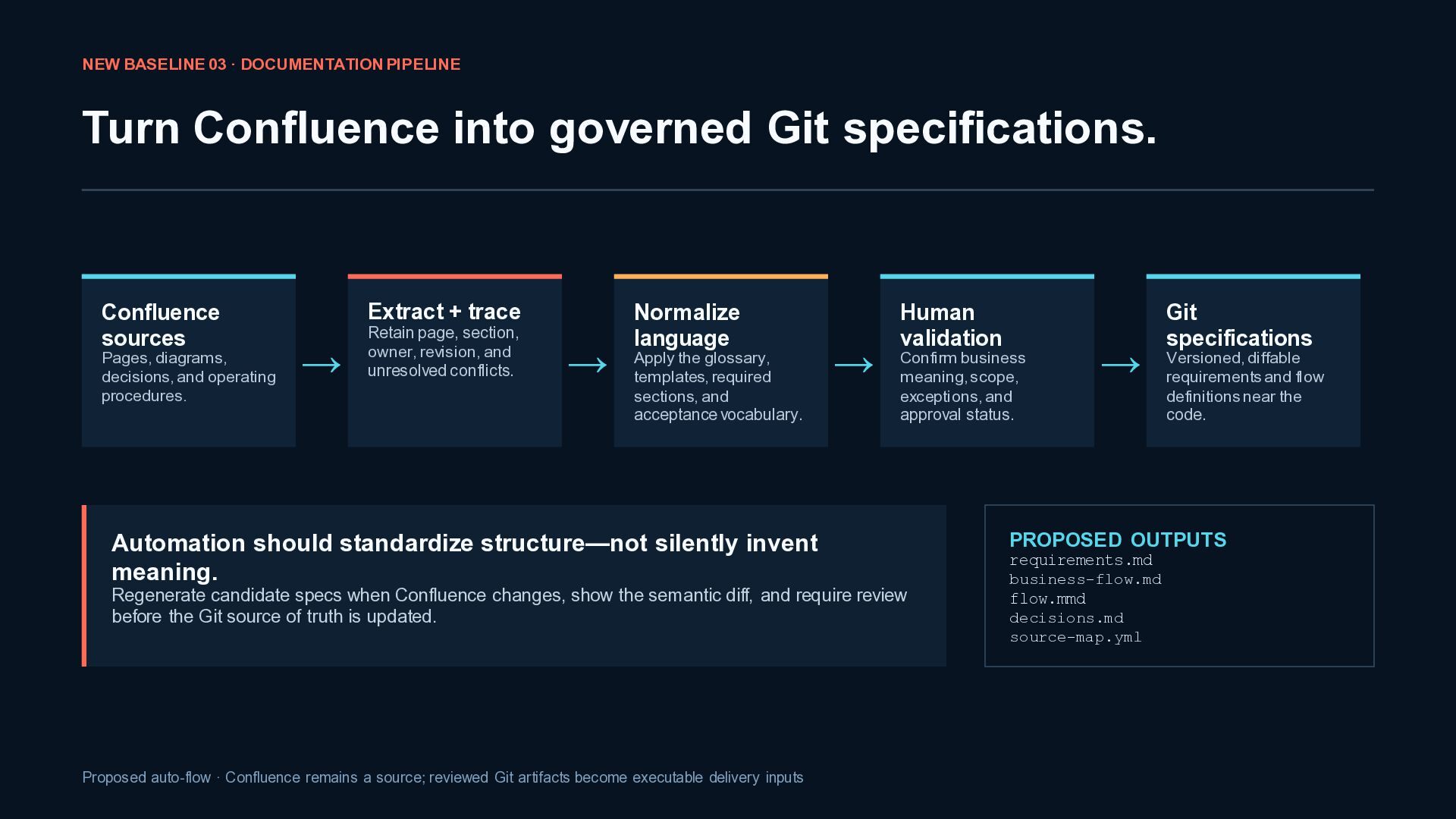
    Git specifications. Confluence sources Pages, diagrams, decisions, and operating procedures. Extract + trace → Retain page, section, owner, revision, and unresolved conflicts. → Normalize language Apply the glossary, templates, required sections, and acceptance vocabulary. Automation should standardize structure—not silently invent meaning. → Human validation Confirm business meaning, scope, exceptions, and approval status. Regenerate candidate specs when Confluence changes, show the semantic diff, and require review before the Git source of truth is updated. Proposed auto-flow · Confluence remains a source; reviewed Git artifacts become executable delivery inputs → Git specifications Versioned, diffable requirements and flow definitions near the code. PROPOSED OUTPUTS requirements.md business-flow.md flow.mmd decisions.md source-map.yml
  9. NEW BASELINE 04 · SEMANTIC LANGUAGE Design interviews establish the

    semantic contract for the LLM. Canonical glossary structure Design interviews Capture how participants describe concepts, decisions, outcomes, and boundaries. Identify terms that groups interpret differently. Output: reviewed definitions, examples, owners, and open questions. Anti-glossary controls semantic drift Canonical term Approved language → Definition + boundaries Precise meaning and exclusions Aliases + owner Recognized alternatives and change authority Ambiguous or legacy term Flag it and provide the approved alternative. Unsupported interpretation Show the conflicting definition or evidence. Unknown or disputed term Stop and request a design decision. The harness uses the glossary to detect semantic drift—not to let the model redefine the domain. The same governed vocabulary can later align requirements, processes, data products, metrics, and policies. Proposed semantic practice · Design owners approve definitions and changes
  10. TWO DURABLE LAYERS Keep project operating logic separate from the

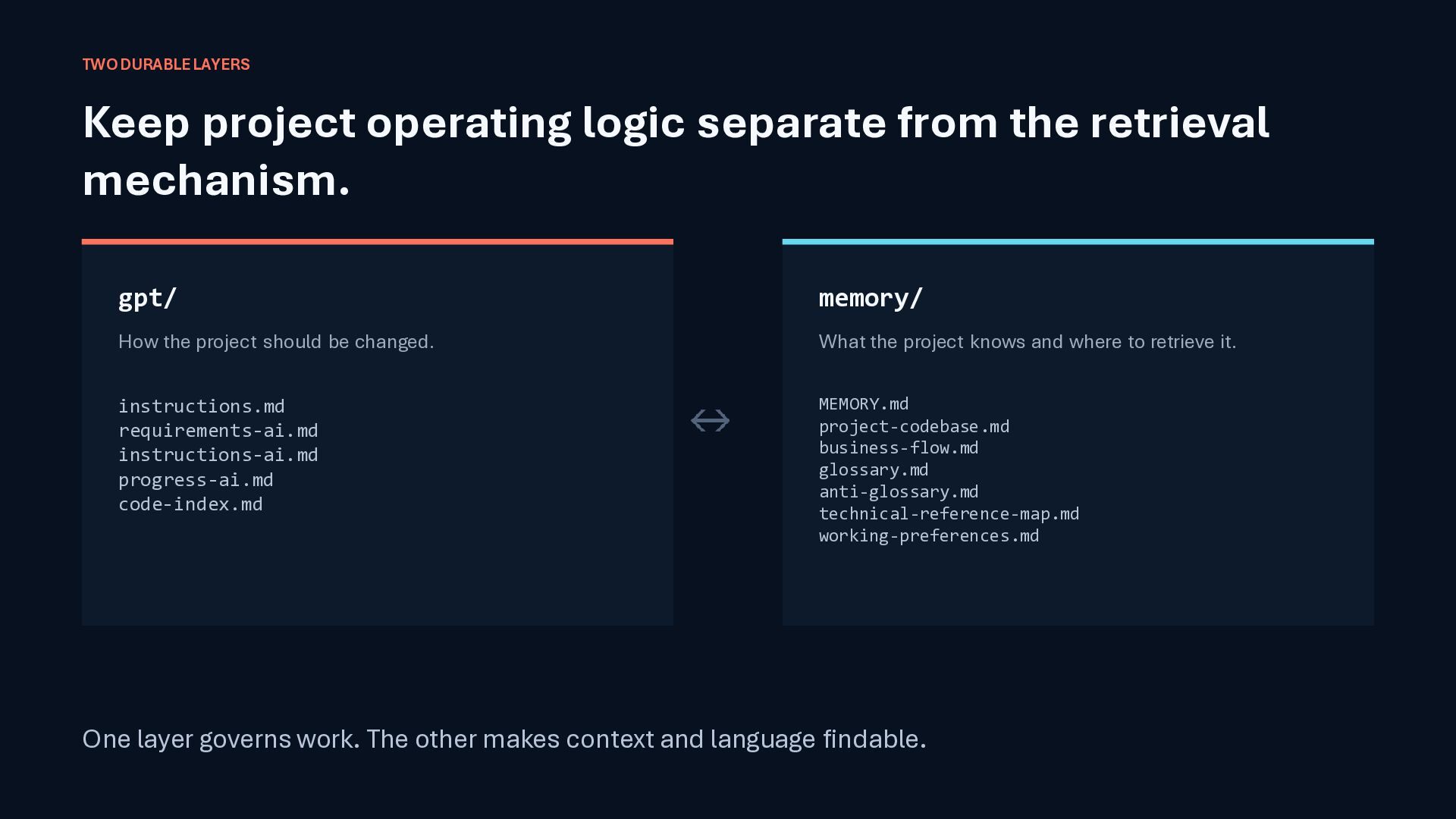
    retrieval mechanism. gpt/ memory/ How the project should be changed. What the project knows and where to retrieve it. instructions.md requirements-ai.md instructions-ai.md progress-ai.md code-index.md MEMORY.md project-codebase.md business-flow.md glossary.md anti-glossary.md technical-reference-map.md working-preferences.md One layer governs work. The other makes context and language findable.
  11. RUNTIME COMPOSITION The harness combines policy and knowledge at runtime.

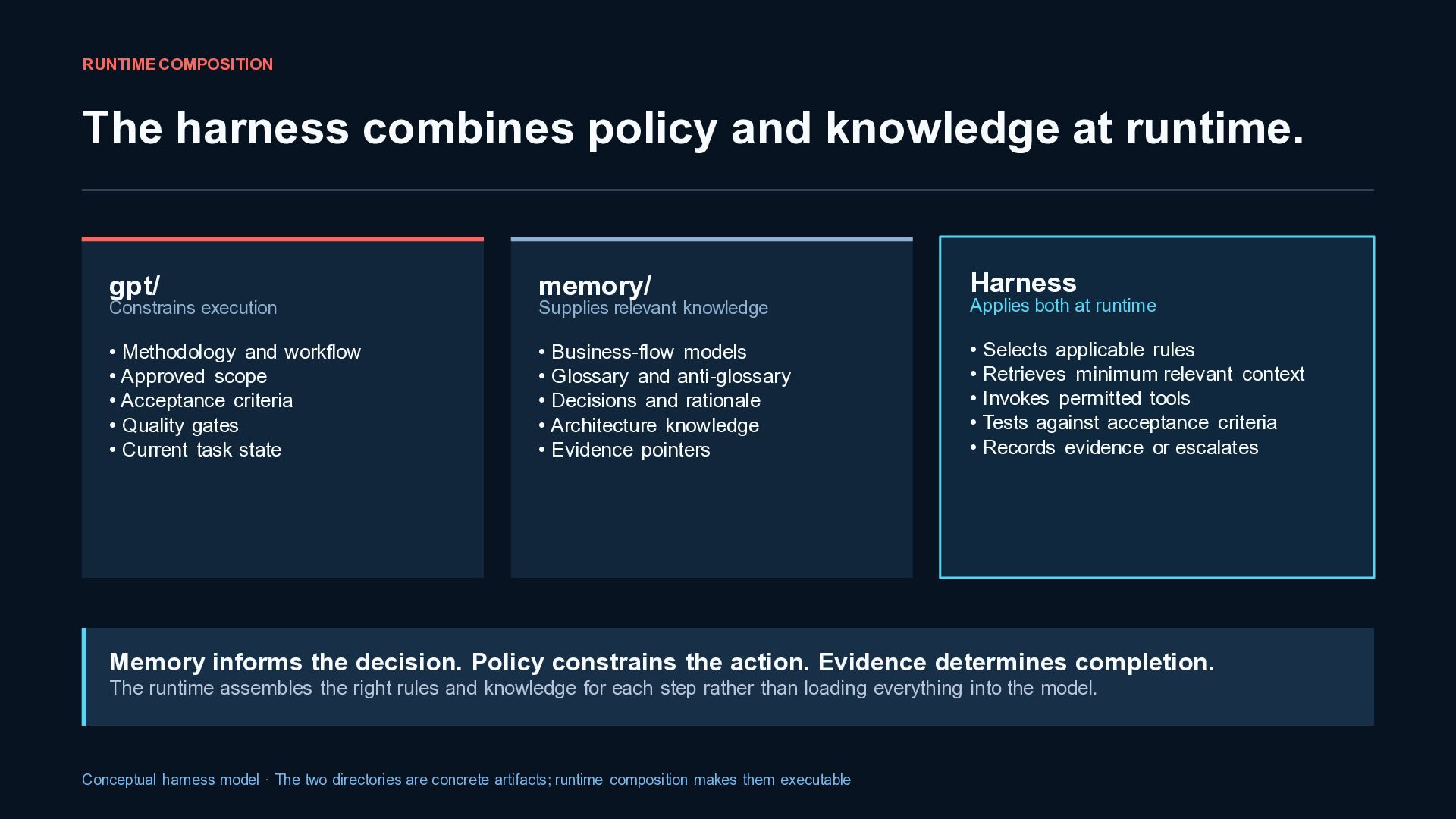
    gpt/ memory/ Harness • Methodology and workflow • Approved scope • Acceptance criteria • Quality gates • Current task state • Business-flow models • Glossary and anti-glossary • Decisions and rationale • Architecture knowledge • Evidence pointers • Selects applicable rules • Retrieves minimum relevant context • Invokes permitted tools • Tests against acceptance criteria • Records evidence or escalates Constrains execution Supplies relevant knowledge Applies both at runtime Memory informs the decision. Policy constrains the action. Evidence determines completion. The runtime assembles the right rules and knowledge for each step rather than loading everything into the model. Conceptual harness model · The two directories are concrete artifacts; runtime composition makes them executable
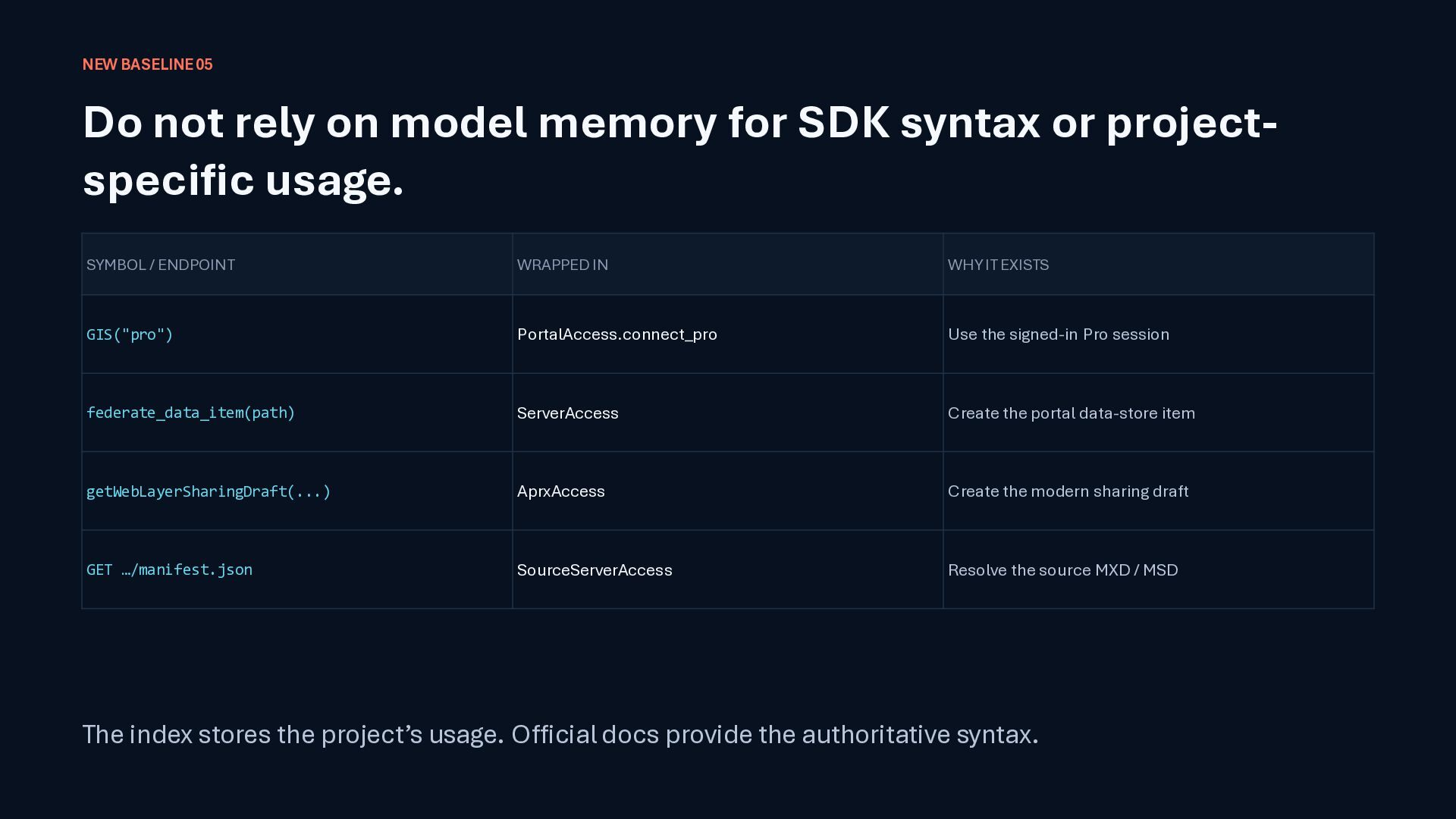
  12. NEW BASELINE 05 Do not rely on model memory for

    SDK syntax or projectspecific usage. SYMBOL / ENDPOINT WRAPPED IN WHY IT EXISTS GIS("pro") PortalAccess.connect_pro Use the signed-in Pro session federate_data_item(path) ServerAccess Create the portal data-store item getWebLayerSharingDraft(...) AprxAccess Create the modern sharing draft GET …/manifest.json SourceServerAccess Resolve the source MXD / MSD The index stores the project’s usage. Official docs provide the authoritative syntax.
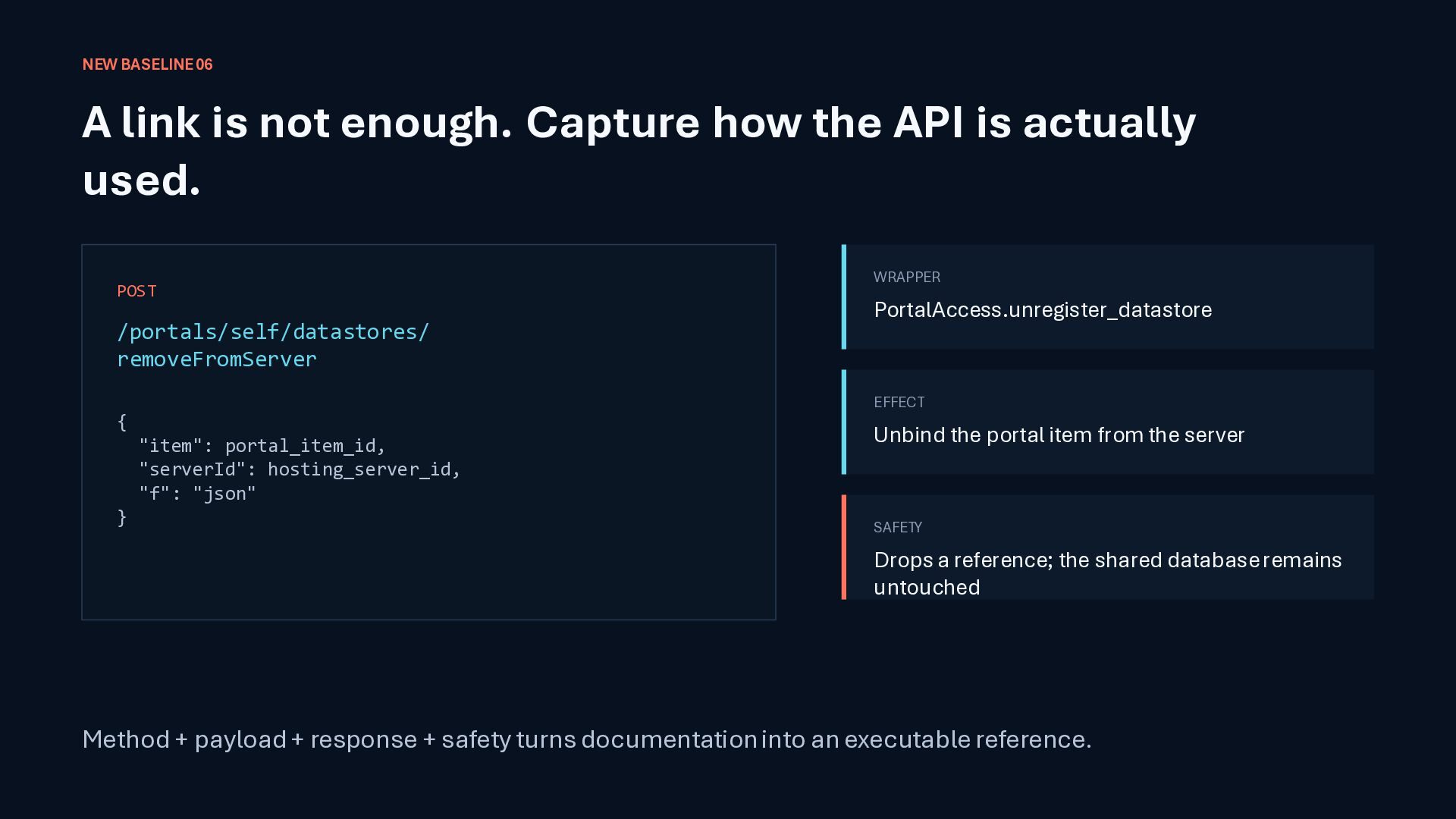
  13. NEW BASELINE 06 A link is not enough. Capture how

    the API is actually used. POST /portals/self/datastores/ removeFromServer WRAPPER PortalAccess.unregister_datastore EFFECT { "item": portal_item_id, "serverId": hosting_server_id, "f": "json" } Unbind the portal item from the server SAFETY Drops a reference; the shared database remains untouched Method + payload + response + safety turns documentation into an executable reference.
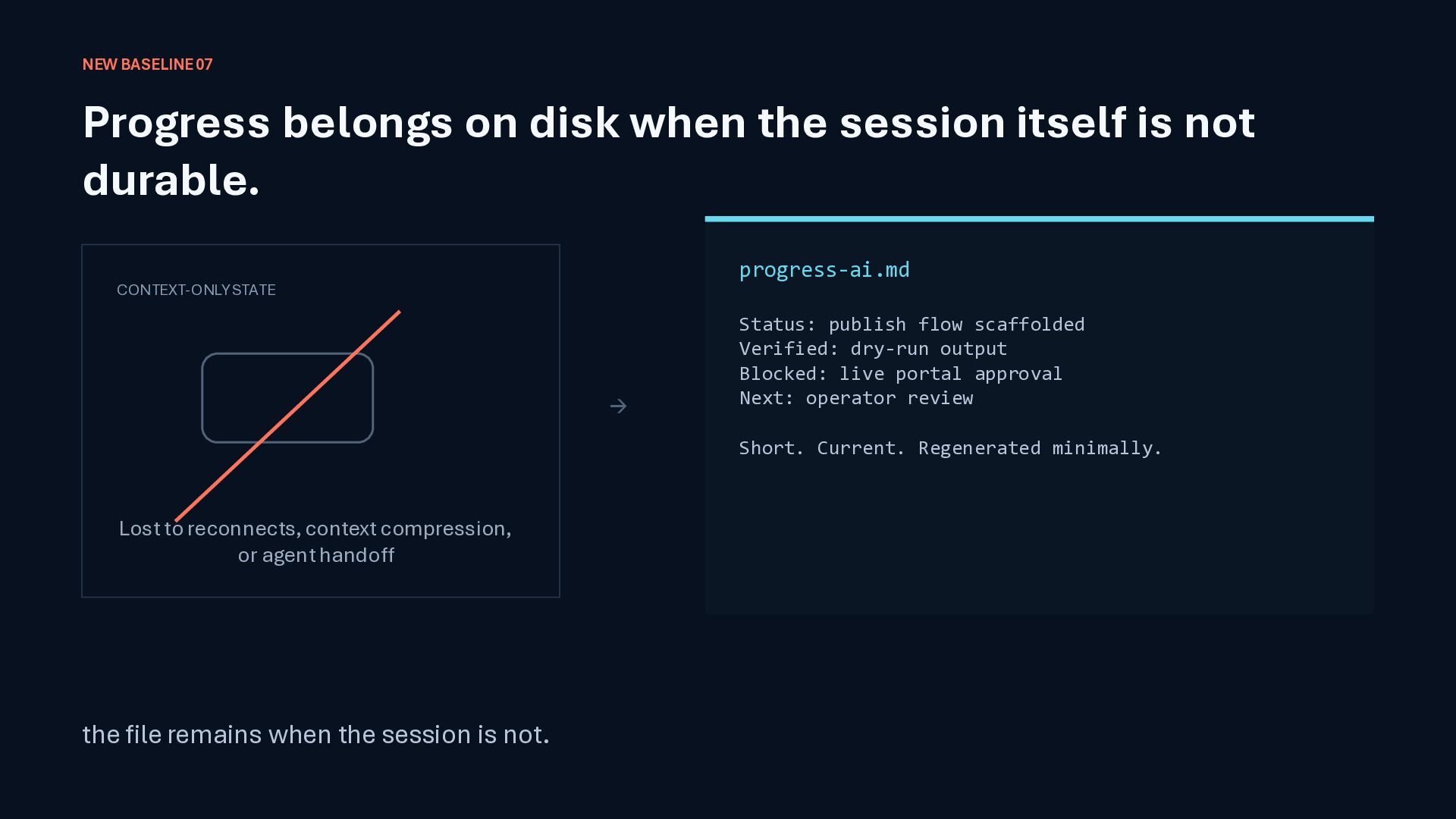
  14. NEW BASELINE 07 Progress belongs on disk when the session

    itself is not durable. progress-ai.md CONTEXT-ONLY STATE → Status: publish flow scaffolded Verified: dry-run output Blocked: live portal approval Next: operator review Short. Current. Regenerated minimally. Lost to reconnects, context compression, or agent handoff the file remains when the session is not.
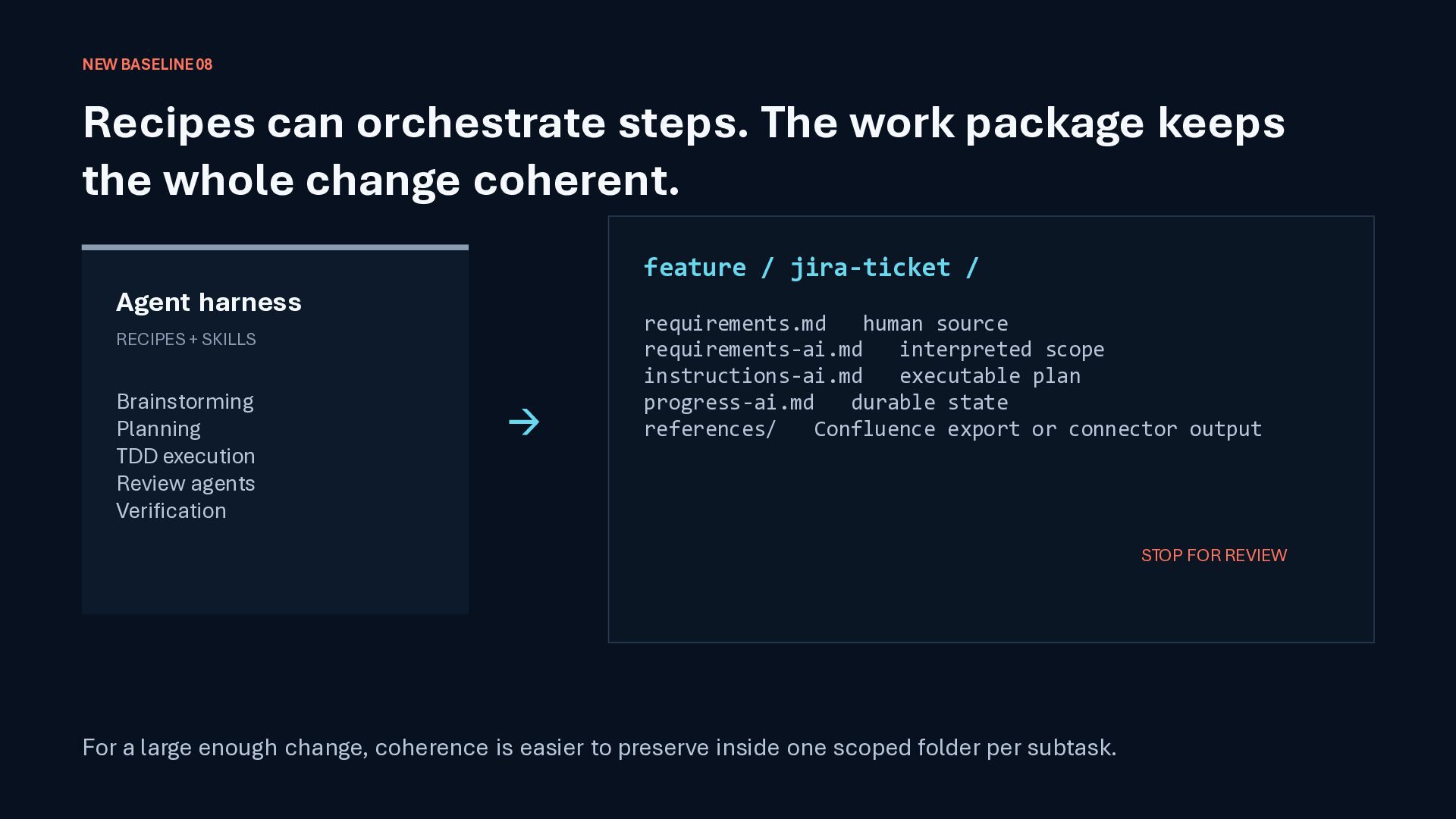
  15. NEW BASELINE 08 Recipes can orchestrate steps. The work package

    keeps the whole change coherent. feature / jira-ticket / Agent harness RECIPES + SKILLS Brainstorming Planning TDD execution Review agents Verification → requirements.md human source requirements-ai.md interpreted scope instructions-ai.md executable plan progress-ai.md durable state references/ Confluence export or connector output STOP FOR REVIEW For a large enough change, coherence is easier to preserve inside one scoped folder per subtask.
  16. END PREFACE Now we can discuss repeatable results with AI.

    The techniques may have become familiar. The question that remains is how to combine them into a production-quality system. Human judgment sets direction. Machine execution supplies speed and consistency.
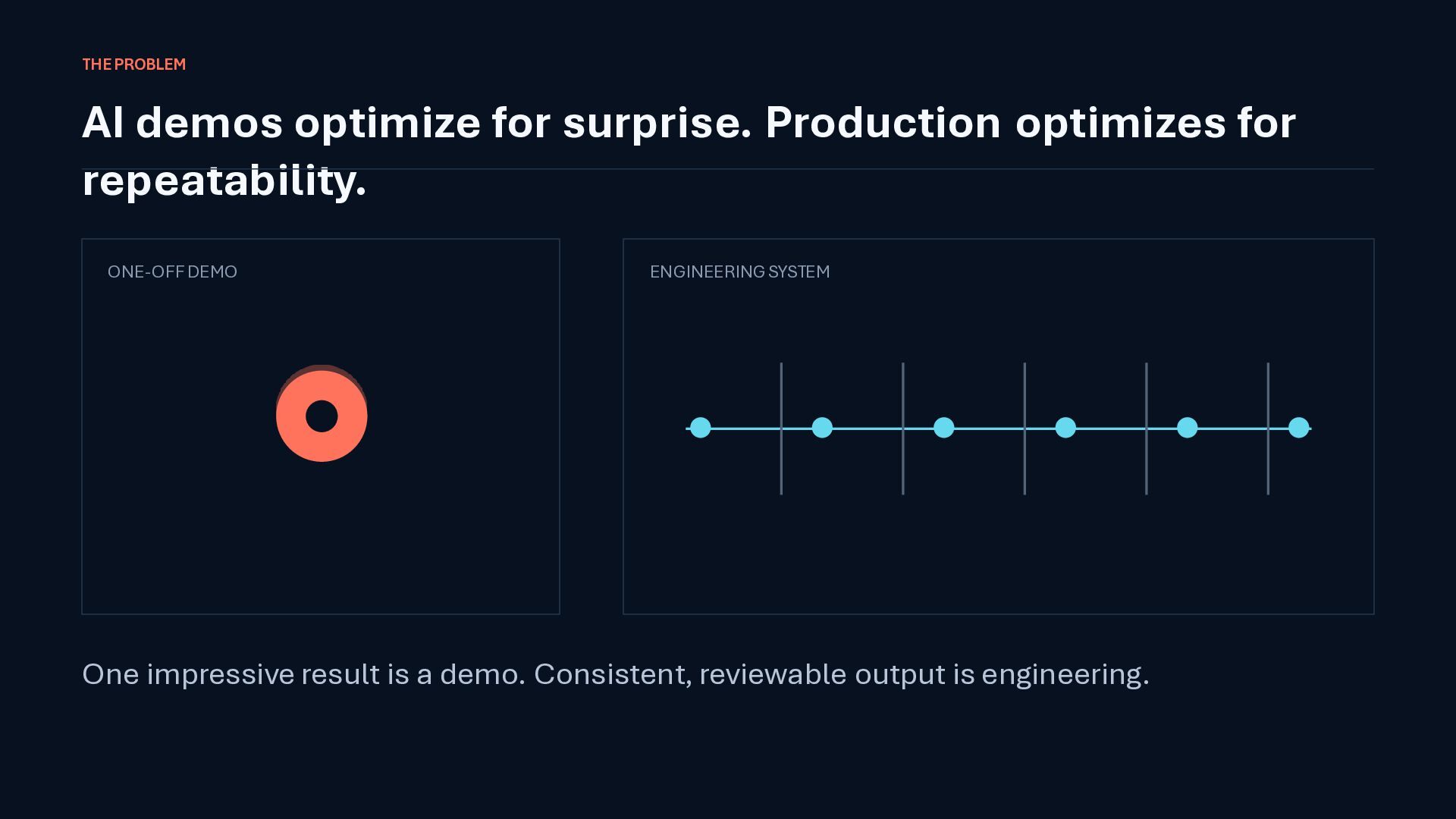
  17. THE PROBLEM AI demos optimize for surprise. Production optimizes for

    repeatability. ONE-OFF DEMO ENGINEERING SYSTEM One impressive result is a demo. Consistent, reviewable output is engineering.
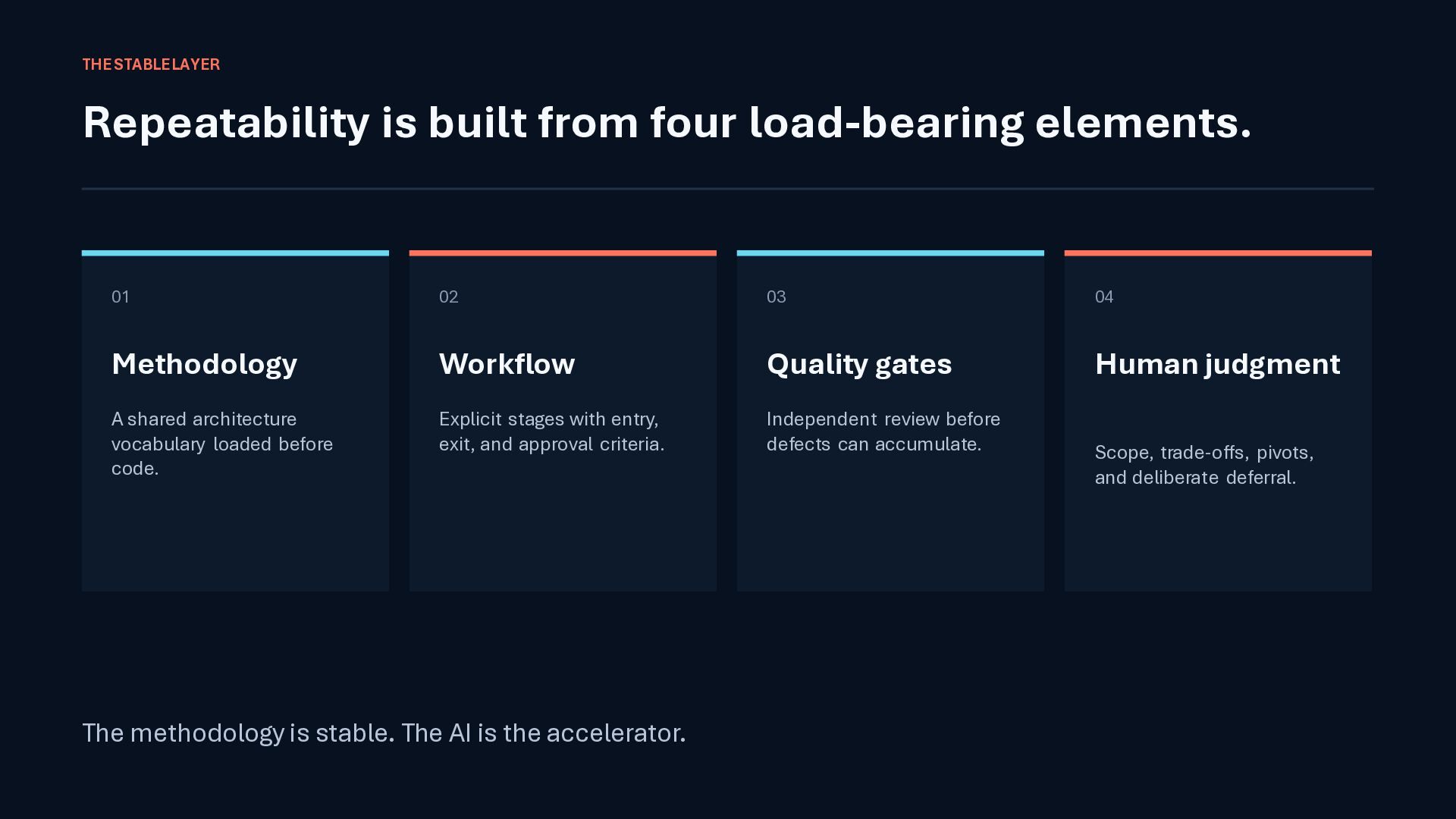
  18. THE STABLE LAYER Repeatability is built from four load-bearing elements.

    01 02 03 04 Methodology Workflow Quality gates Human judgment A shared architecture vocabulary loaded before code. Explicit stages with entry, exit, and approval criteria. Independent review before defects can accumulate. The methodology is stable. The AI is the accelerator. Scope, trade-offs, pivots, and deliberate deferral.
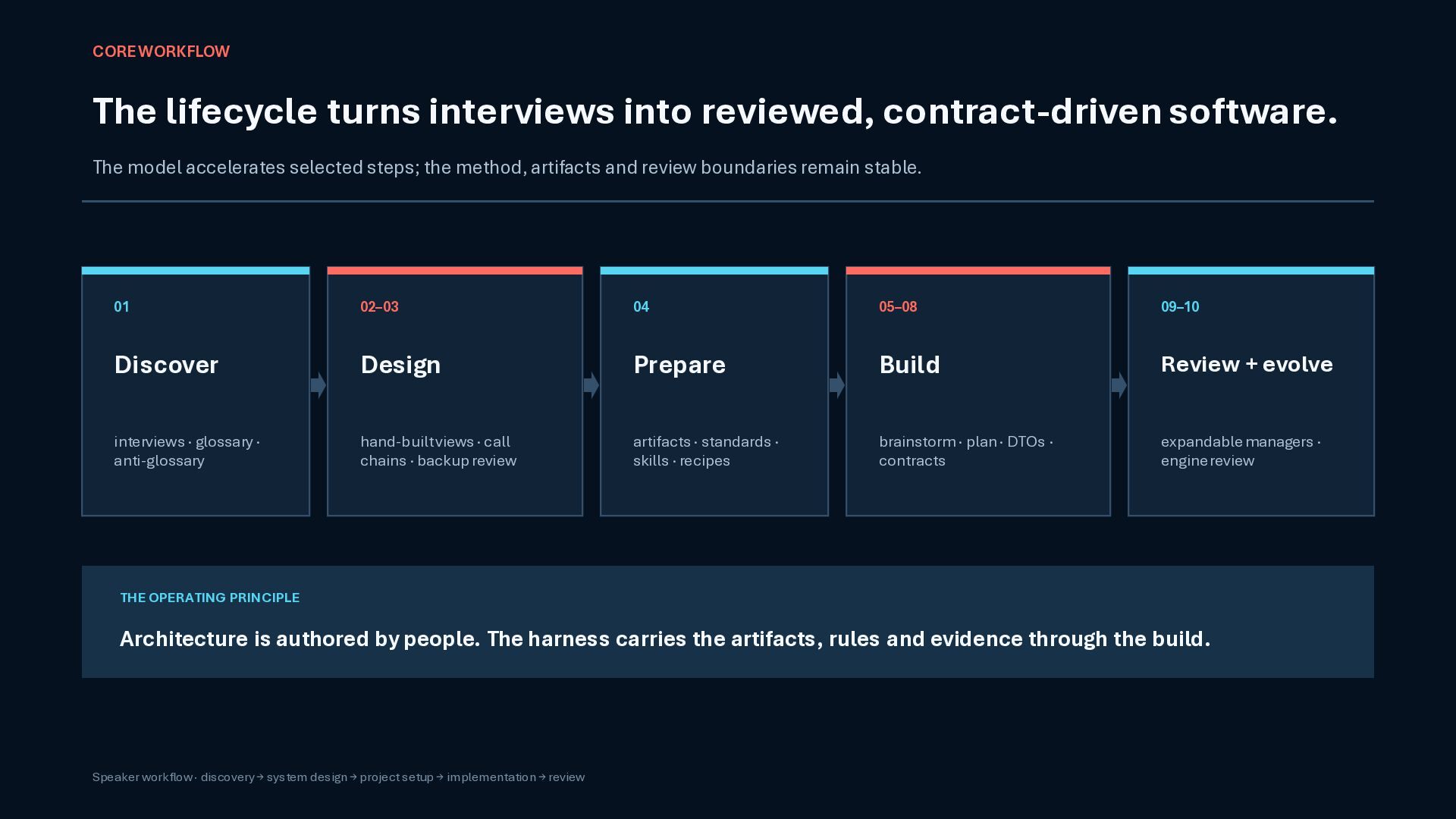
  19. CORE WORKFLOW The lifecycle turns interviews into reviewed, contract-driven software.

    The model accelerates selected steps; the method, artifacts and review boundaries remain stable. 01 02–03 04 05–08 09–10 Discover Design Prepare Build Review + evolve interviews · glossary · anti-glossary hand-built views · call chains · backup review artifacts · standards · skills · recipes brainstorm · plan · DTOs · contracts expandable managers · engine review THE OPERATING PRINCIPLE Architecture is authored by people. The harness carries the artifacts, rules and evidence through the build. Speaker workflow · discovery → system design → project setup → implementation → review
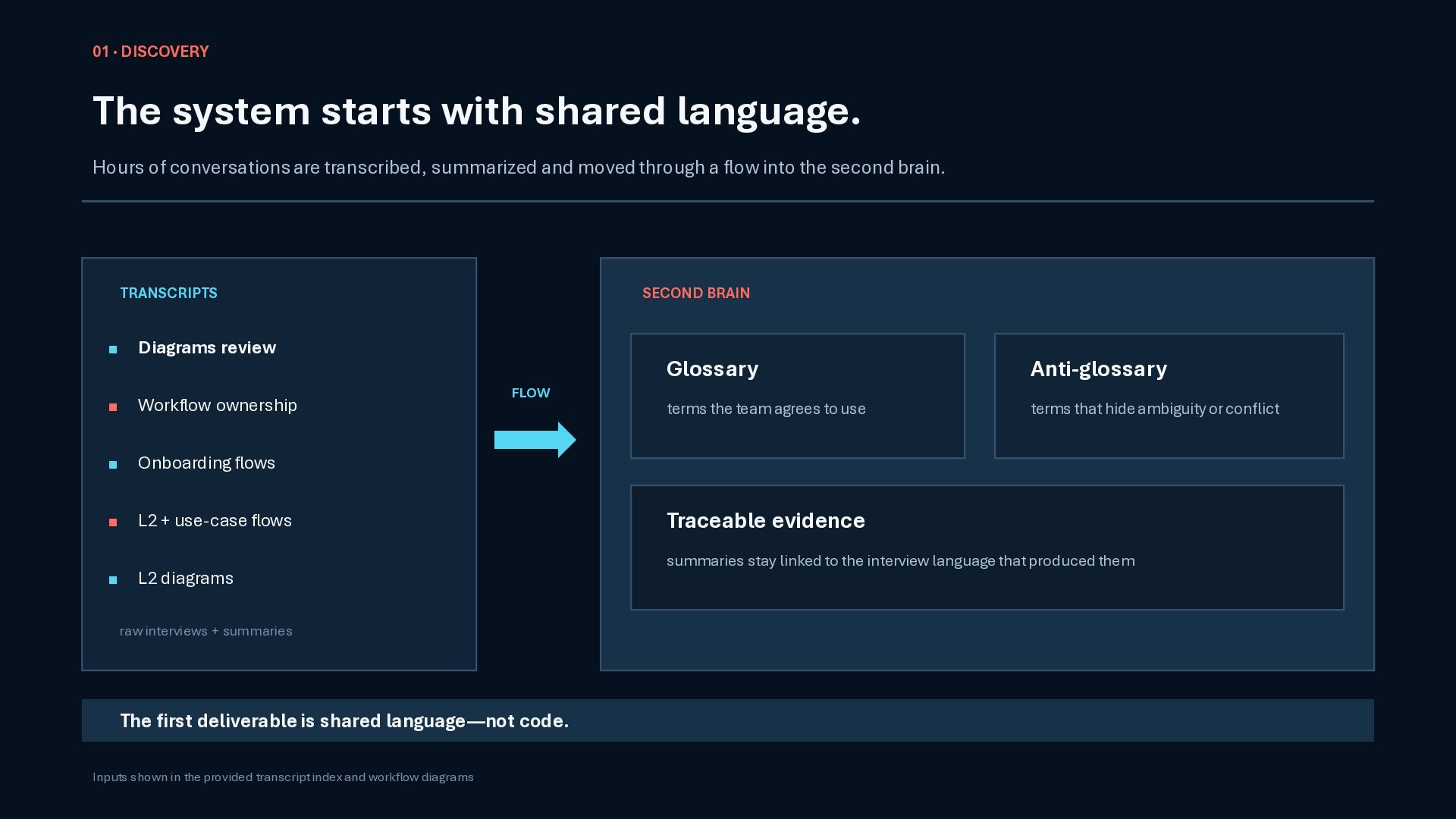
  20. 01 · DISCOVERY The system starts with shared language. Hours

    of conversations are transcribed, summarized and moved through a flow into the second brain. TRANSCRIPTS SECOND BRAIN Diagrams review Workflow ownership FLOW Glossary Anti-glossary terms the team agrees to use terms that hide ambiguity or conflict Onboarding flows L2 + use-case flows L2 diagrams raw interviews + summaries The first deliverable is shared language—not code. Inputs shown in the provided transcript index and workflow diagrams Traceable evidence summaries stay linked to the interview language that produced them
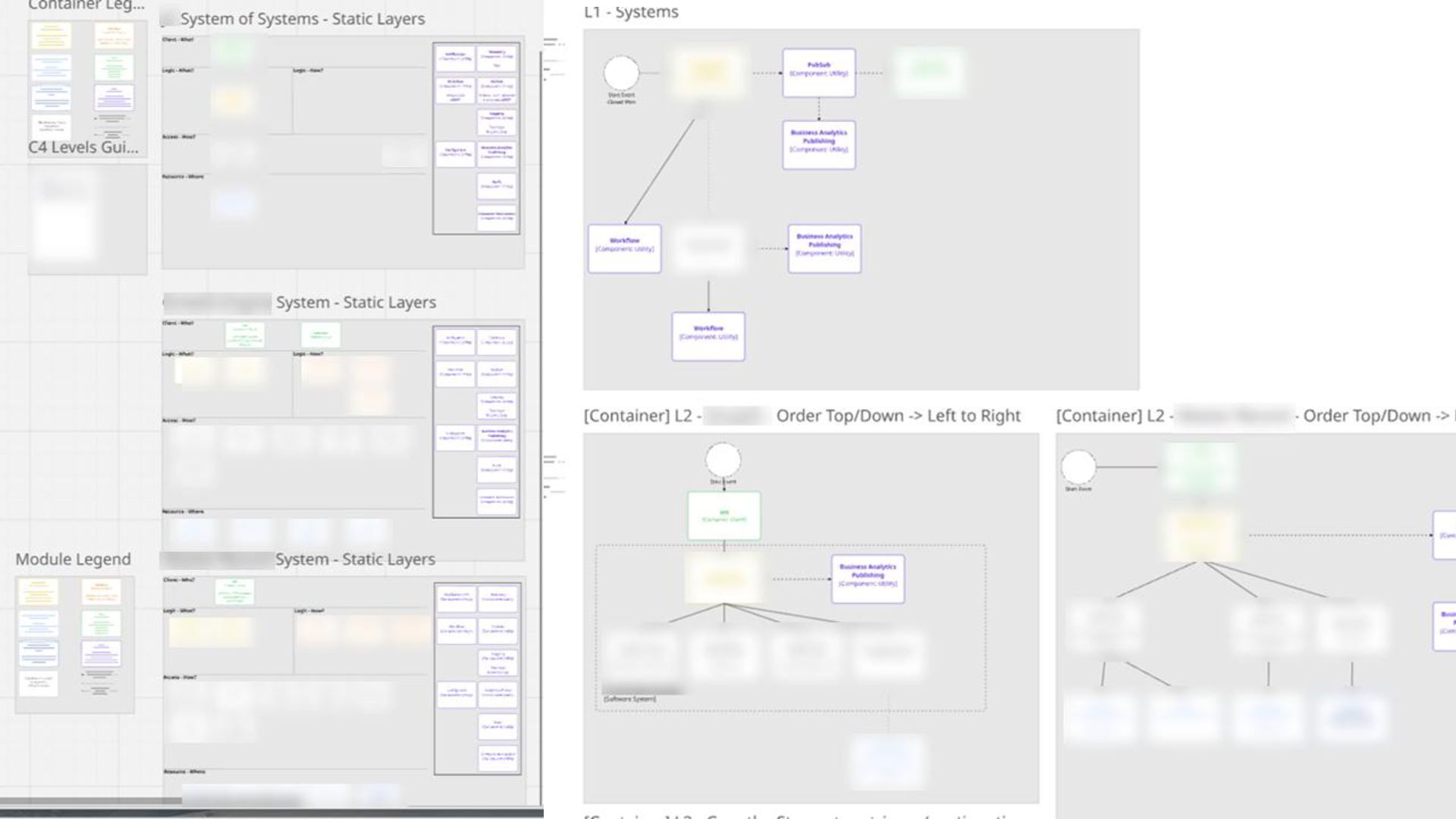
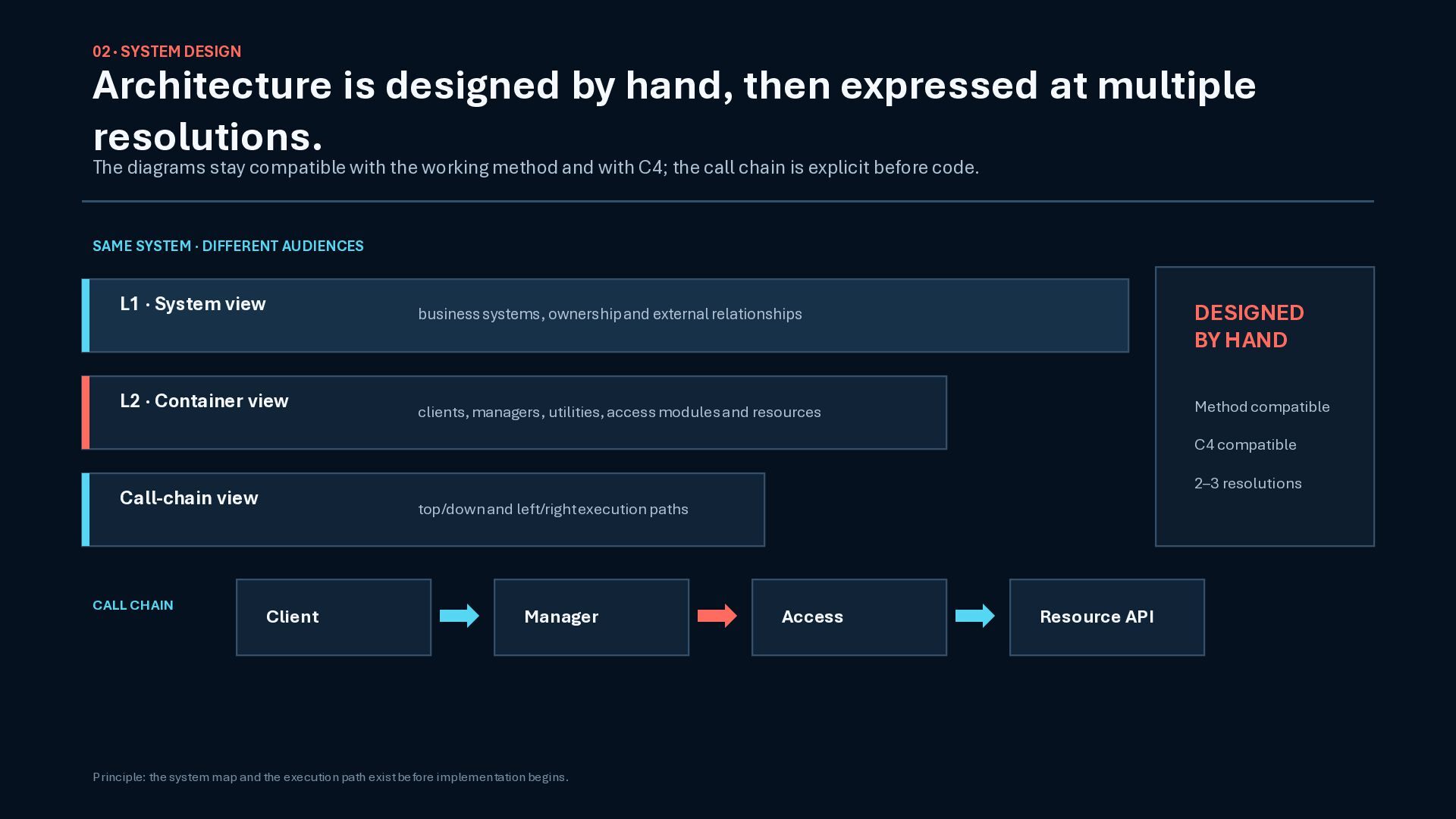
  21. 02 · SYSTEM DESIGN Architecture is designed by hand, then

    expressed at multiple resolutions. The diagrams stay compatible with the working method and with C4; the call chain is explicit before code. SAME SYSTEM · DIFFERENT AUDIENCES L1 · System view L2 · Container view business systems, ownership and external relationships DESIGNED BY HAND clients, managers, utilities, access modules and resources Method compatible C4 compatible 2–3 resolutions Call-chain view CALL CHAIN top/down and left/right execution paths Client Manager Principle: the system map and the execution path exist before implementation begins. Access Resource API
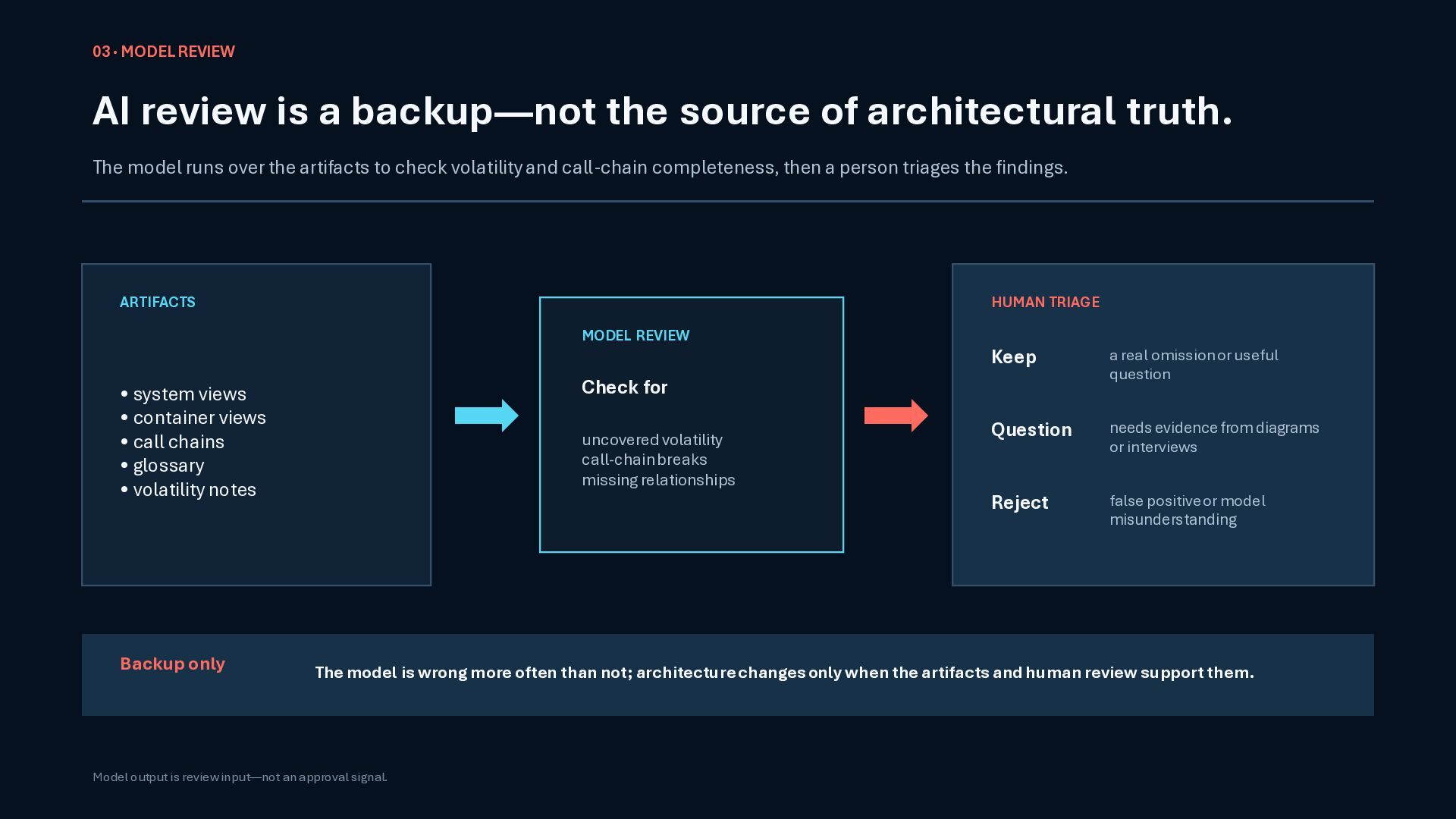
  22. 03 · MODEL REVIEW AI review is a backup—not the

    source of architectural truth. The model runs over the artifacts to check volatility and call-chain completeness, then a person triages the findings. ARTIFACTS HUMAN TRIAGE MODEL REVIEW a real omission or useful question Question needs evidence from diagrams or interviews Reject false positive or model misunderstanding Check for • system views • container views • call chains • glossary • volatility notes Backup only Keep uncovered volatility call-chain breaks missing relationships The model is wrong more often than not; architecture changes only when the artifacts and human review support them. Model output is review input—not an approval signal.
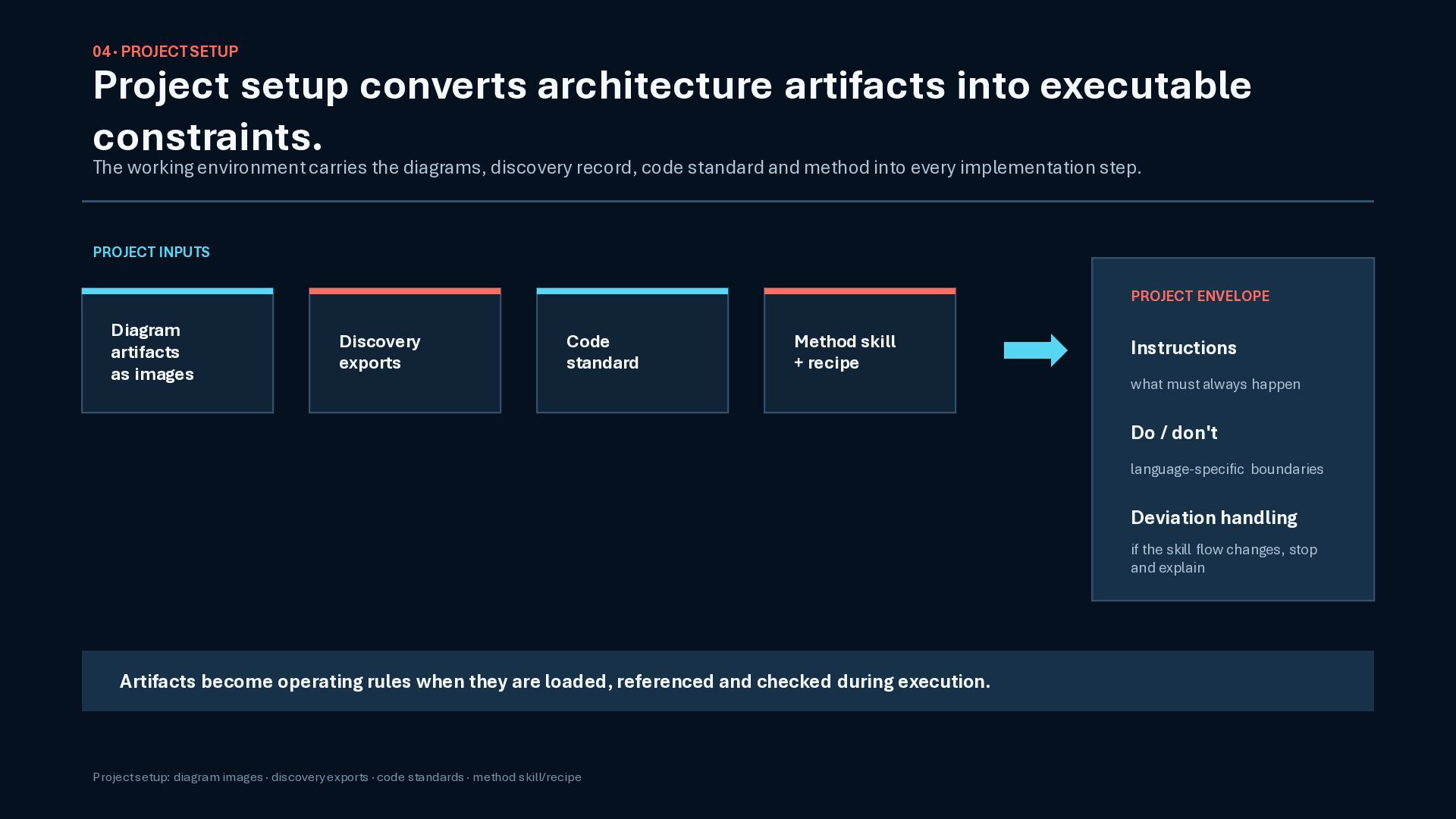
  23. 04 · PROJECT SETUP Project setup converts architecture artifacts into

    executable constraints. The working environment carries the diagrams, discovery record, code standard and method into every implementation step. PROJECT INPUTS PROJECT ENVELOPE Diagram artifacts as images Discovery exports Code standard Method skill + recipe Instructions what must always happen Do / don't language-specific boundaries Deviation handling if the skill flow changes, stop and explain Artifacts become operating rules when they are loaded, referenced and checked during execution. Project setup: diagram images · discovery exports · code standards · method skill/recipe
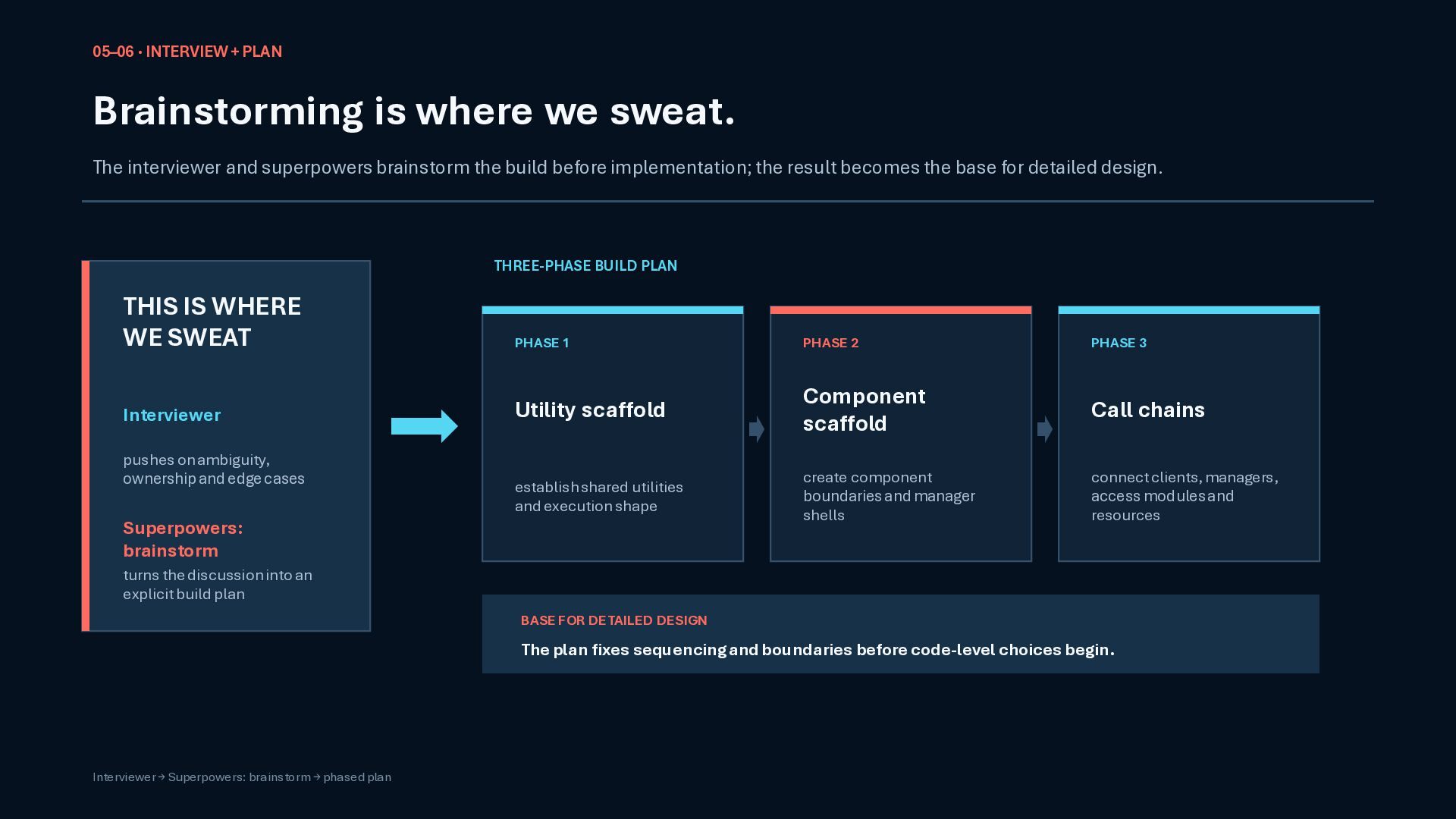
  24. 05–06 · INTERVIEW + PLAN Brainstorming is where we sweat.

    The interviewer and superpowers brainstorm the build before implementation; the result becomes the base for detailed design. THREE-PHASE BUILD PLAN THIS IS WHERE WE SWEAT PHASE 1 PHASE 2 PHASE 3 Interviewer Utility scaffold Component scaffold Call chains establish shared utilities and execution shape create component boundaries and manager shells connect clients, managers, access modules and resources pushes on ambiguity, ownership and edge cases Superpowers: brainstorm turns the discussion into an explicit build plan BASE FOR DETAILED DESIGN The plan fixes sequencing and boundaries before code-level choices begin. Interviewer → Superpowers: brainstorm → phased plan
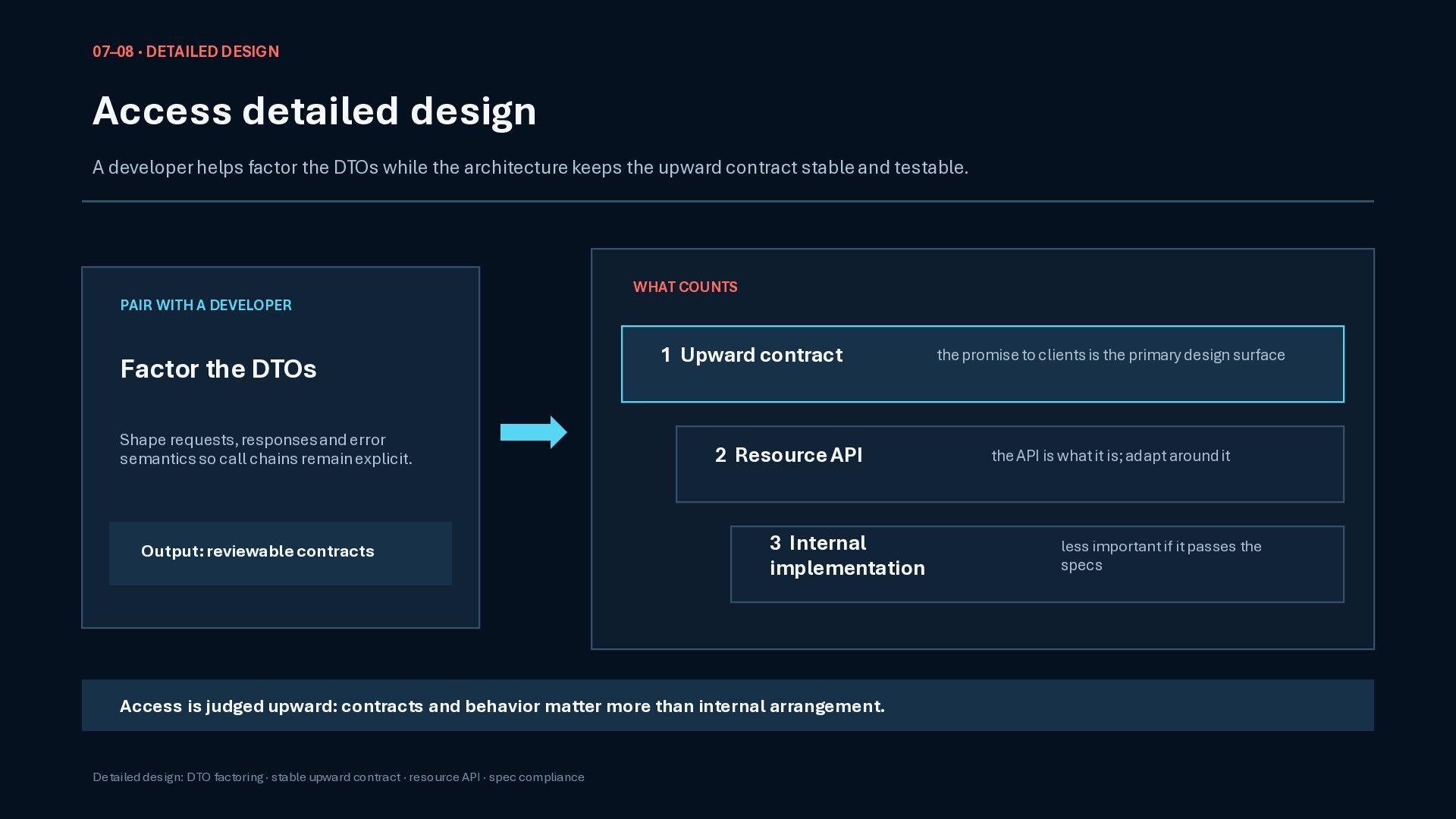
  25. 07–08 · DETAILED DESIGN Access detailed design A developer helps

    factor the DTOs while the architecture keeps the upward contract stable and testable. PAIR WITH A DEVELOPER Factor the DTOs Shape requests, responses and error semantics so call chains remain explicit. Output: reviewable contracts WHAT COUNTS 1 Upward contract 2 Resource API 3 Internal implementation Access is judged upward: contracts and behavior matter more than internal arrangement. Detailed design: DTO factoring · stable upward contract · resource API · spec compliance the promise to clients is the primary design surface the API is what it is; adapt around it less important if it passes the specs
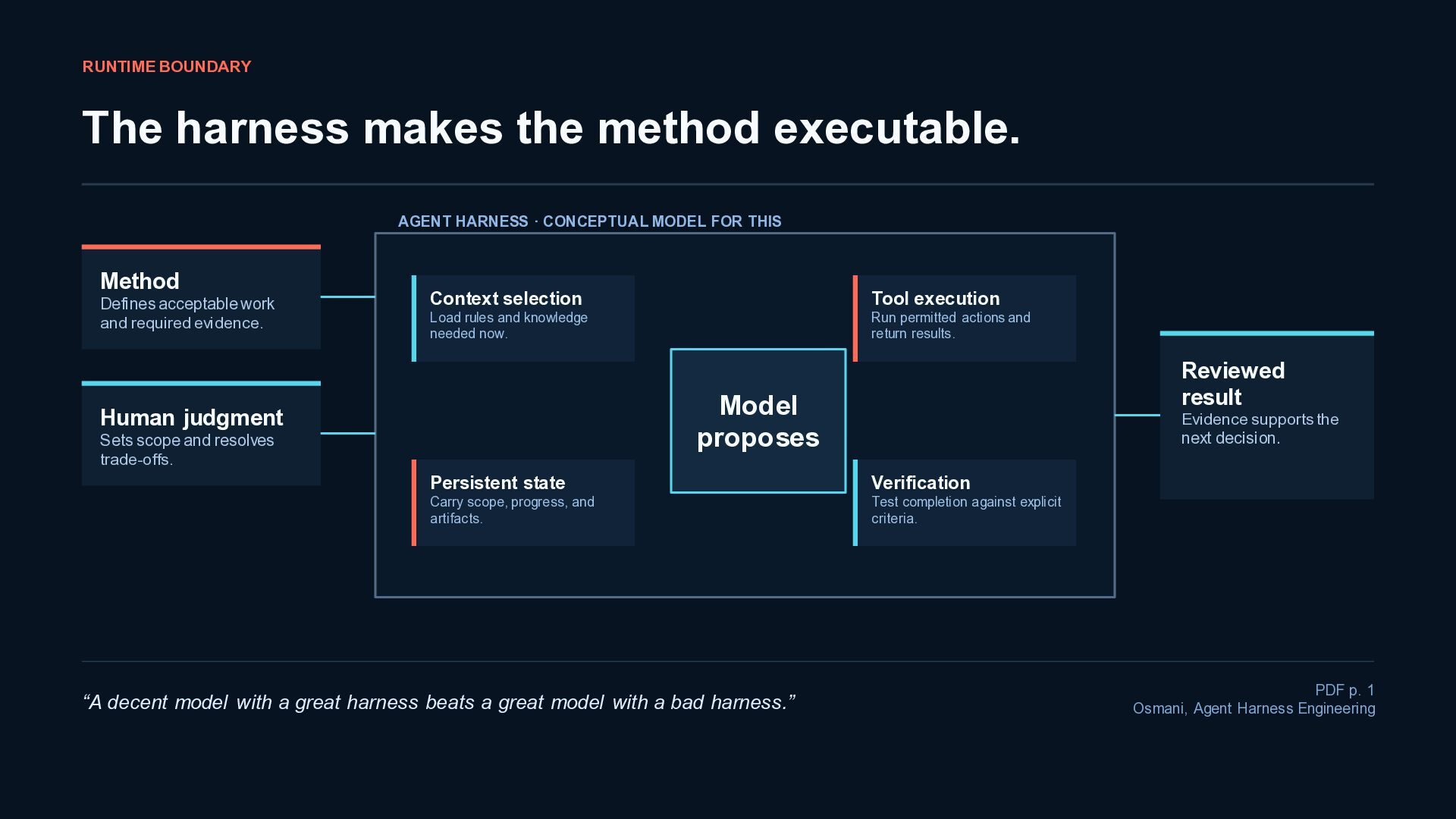
  26. RUNTIME BOUNDARY The harness makes the method executable. AGENT HARNESS

    · CONCEPTUAL MODEL FOR THIS TALK Method Defines acceptable work and required evidence. Context selection Tool execution Load rules and knowledge needed now. Run permitted actions and return results. Reviewed result Model proposes Human judgment Sets scope and resolves trade-offs. Evidence supports the next decision. Persistent state Verification Carry scope, progress, and artifacts. Test completion against explicit criteria. “A decent model with a great harness beats a great model with a bad harness.” PDF p. 1 Osmani, Agent Harness Engineering
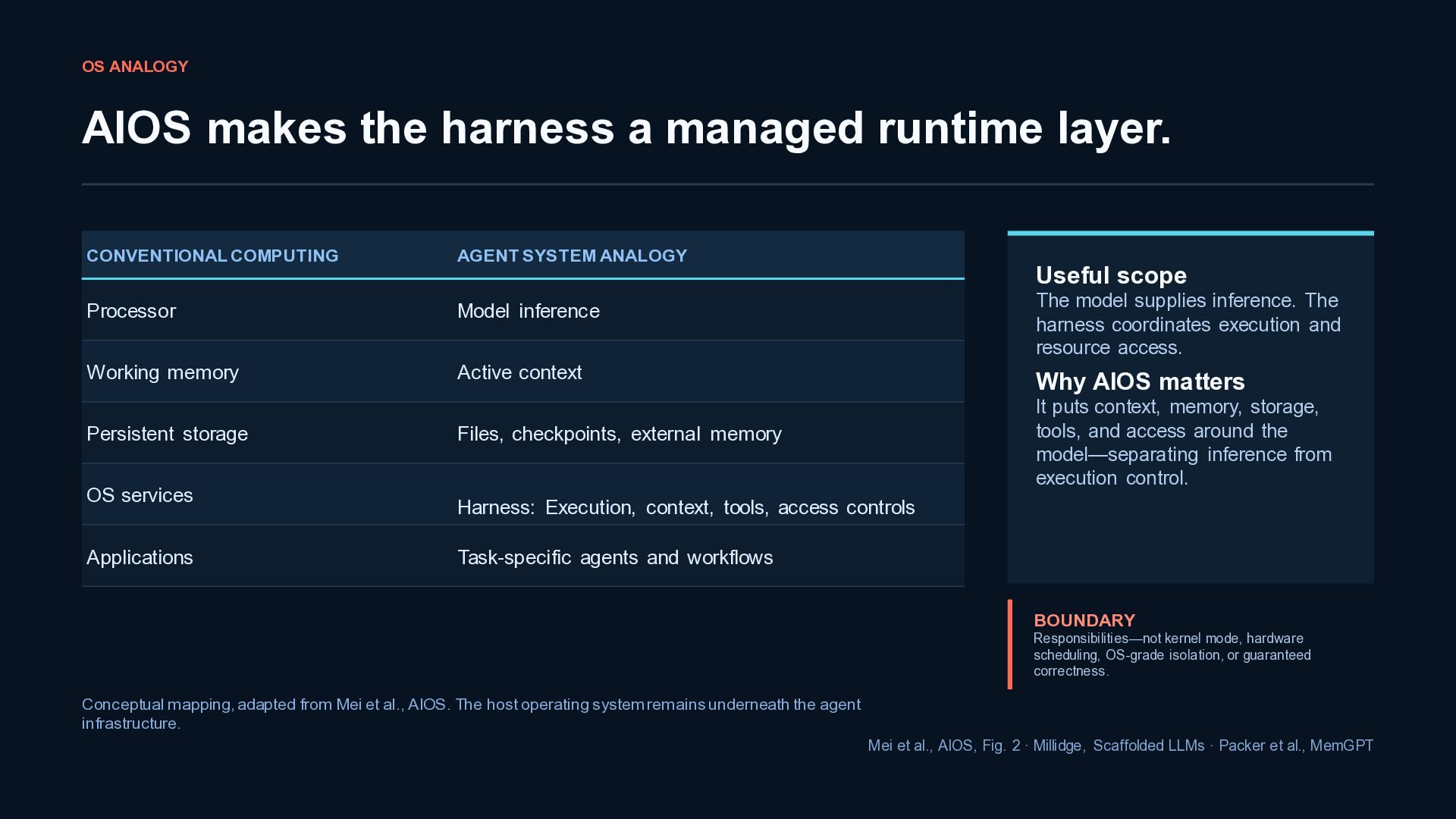
  27. OS ANALOGY AIOS makes the harness a managed runtime layer.

    CONVENTIONAL COMPUTING AGENT SYSTEM ANALOGY Processor Model inference The model supplies inference. The harness coordinates execution and resource access. Working memory Active context Why AIOS matters Files, checkpoints, external memory It puts context, memory, storage, tools, and access around the model—separating inference from execution control. Persistent storage OS services Applications Useful scope Harness: Execution, context, tools, access controls Task-specific agents and workflows BOUNDARY Responsibilities—not kernel mode, hardware scheduling, OS-grade isolation, or guaranteed correctness. Conceptual mapping, adapted from Mei et al., AIOS. The host operating system remains underneath the agent infrastructure. Mei et al., AIOS, Fig. 2 · Millidge, Scaffolded LLMs · Packer et al., MemGPT
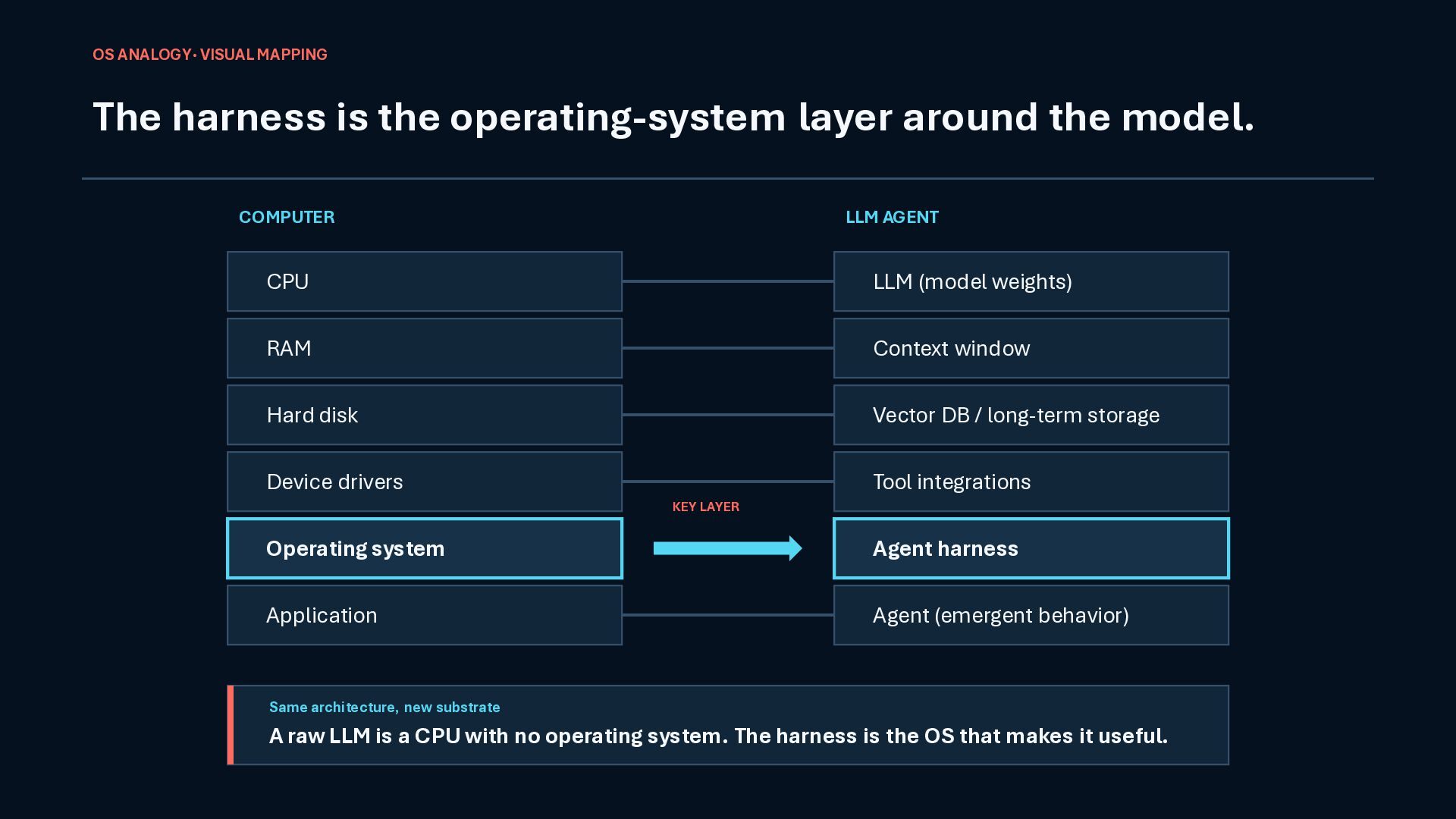
  28. OS ANALOGY · VISUAL MAPPING The harness is the operating-system

    layer around the model. COMPUTER LLM AGENT CPU LLM (model weights) RAM Context window Hard disk Vector DB / long-term storage Device drivers Tool integrations KEY LAYER Operating system Agent harness Application Agent (emergent behavior) Same architecture, new substrate A raw LLM is a CPU with no operating system. The harness is the OS that makes it useful.
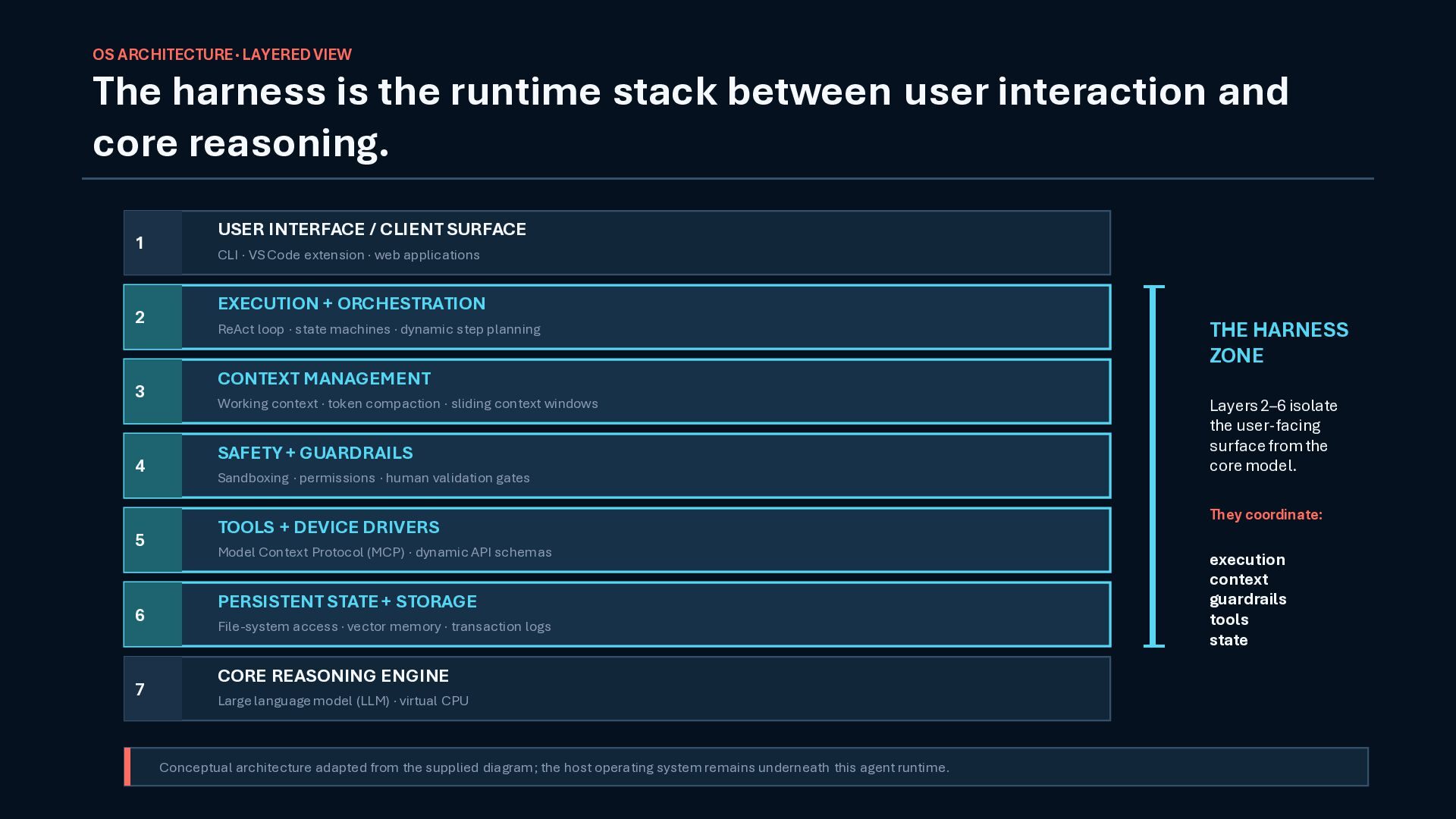
  29. OS ARCHITECTURE · LAYERED VIEW The harness is the runtime

    stack between user interaction and core reasoning. 1 2 3 4 5 6 7 USER INTERFACE / CLIENT SURFACE CLI · VS Code extension · web applications EXECUTION + ORCHESTRATION ReAct loop · state machines · dynamic step planning CONTEXT MANAGEMENT Working context · token compaction · sliding context windows SAFETY + GUARDRAILS Sandboxing · permissions · human validation gates TOOLS + DEVICE DRIVERS Model Context Protocol (MCP) · dynamic API schemas PERSISTENT STATE + STORAGE File-system access · vector memory · transaction logs CORE REASONING ENGINE Large language model (LLM) · virtual CPU Conceptual architecture adapted from the supplied diagram; the host operating system remains underneath this agent runtime. THE HARNESS ZONE Layers 2–6 isolate the user-facing surface from the core model. They coordinate: execution context guardrails tools state
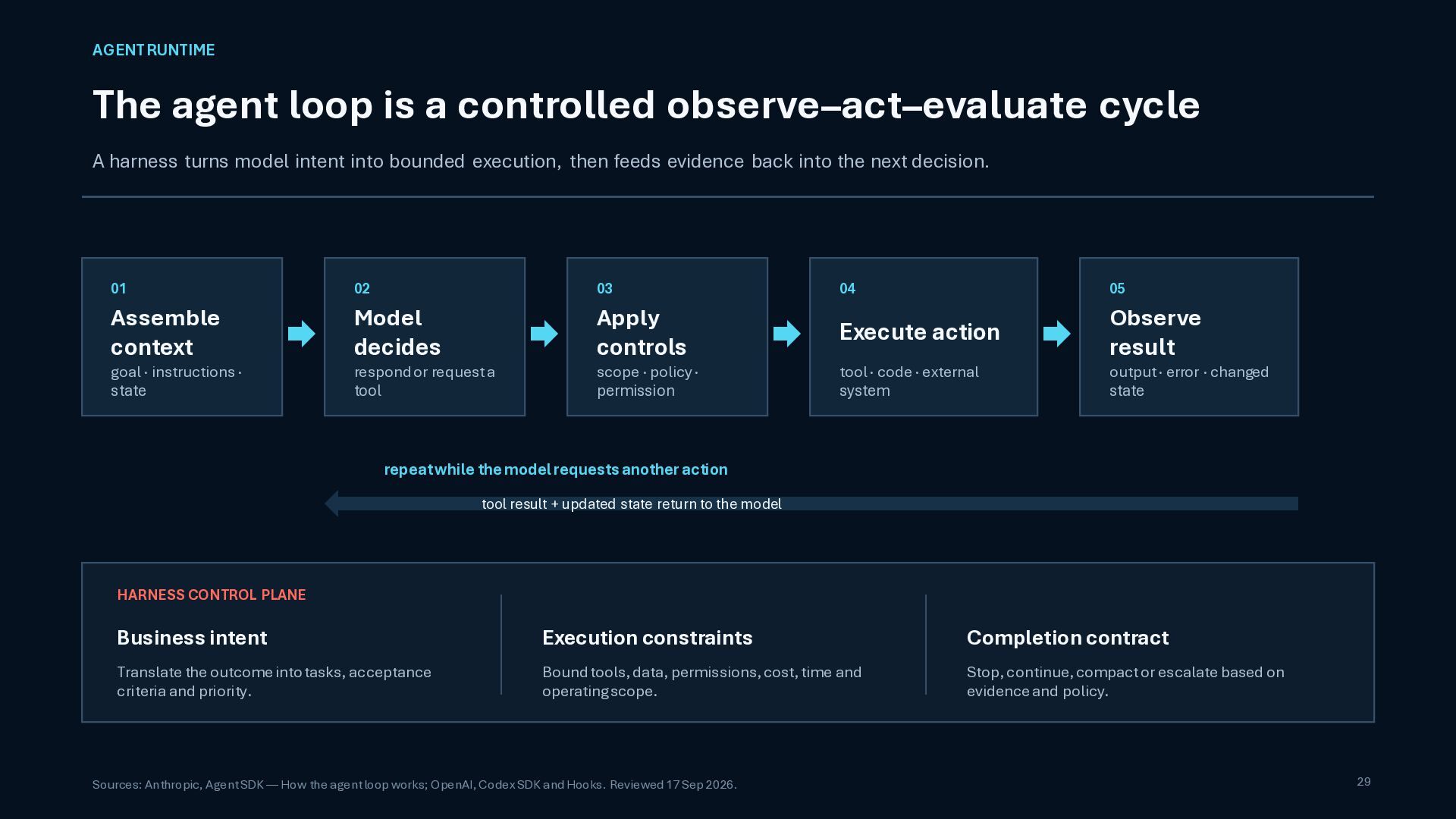
  30. AGENT RUNTIME The agent loop is a controlled observe–act–evaluate cycle

    A harness turns model intent into bounded execution, then feeds evidence back into the next decision. 01 02 03 04 05 Assemble context Model decides Apply controls Execute action Observe result goal · instructions · state respond or request a tool scope · policy · permission tool · code · external system output · error · changed state repeat while the model requests another action tool result + updated state return to the model HARNESS CONTROL PLANE Business intent Execution constraints Completion contract Translate the outcome into tasks, acceptance criteria and priority. Bound tools, data, permissions, cost, time and operating scope. Stop, continue, compact or escalate based on evidence and policy. Sources: Anthropic, Agent SDK — How the agent loop works; OpenAI, Codex SDK and Hooks. Reviewed 17 Sep 2026. 29
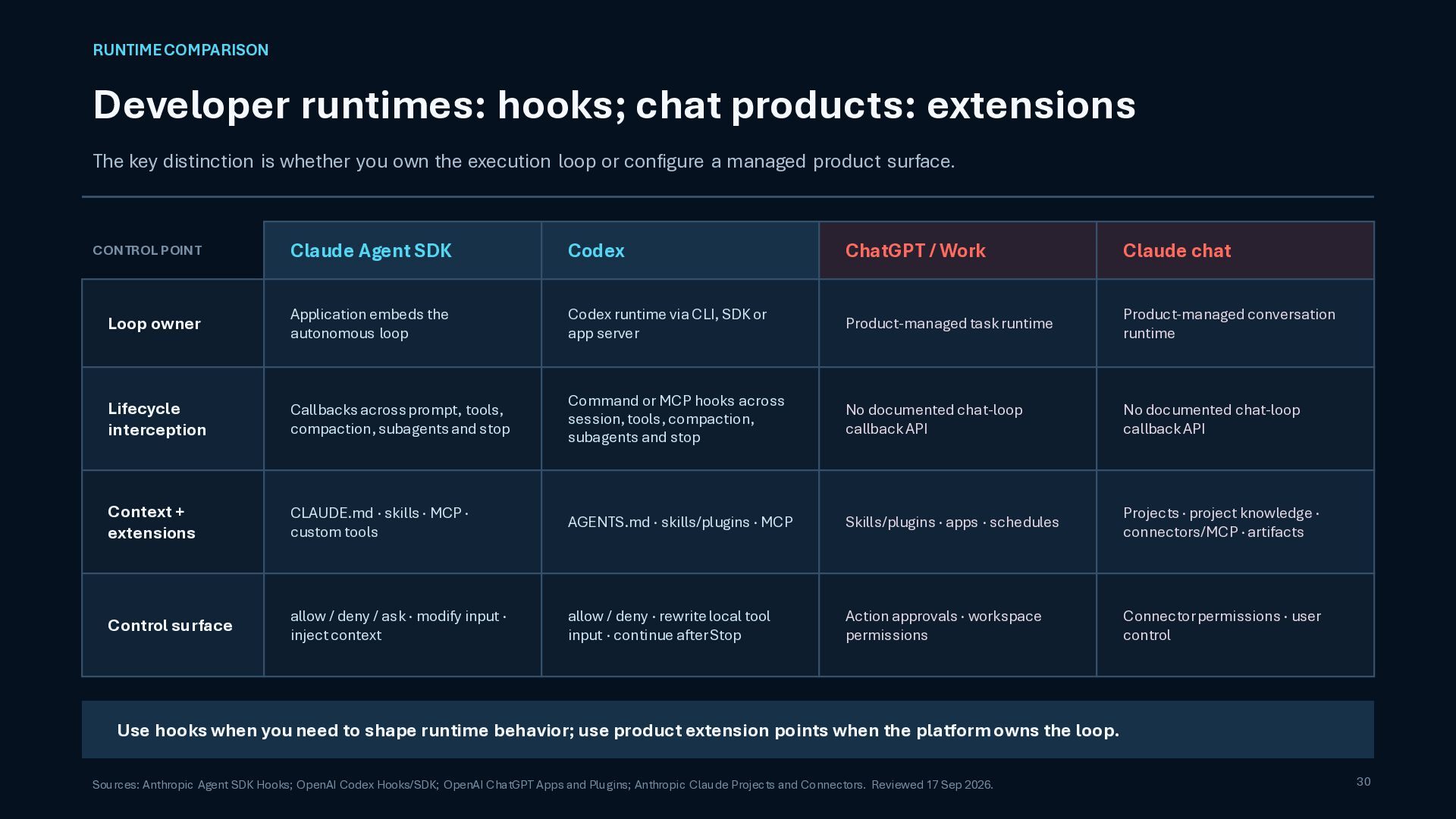
  31. RUNTIME COMPARISON Developer runtimes: hooks; chat products: extensions The key

    distinction is whether you own the execution loop or configure a managed product surface. CONTROL POINT Claude Agent SDK Codex ChatGPT / Work Claude chat Loop owner Application embeds the autonomous loop Codex runtime via CLI, SDK or app server Product-managed task runtime Product-managed conversation runtime Lifecycle interception Callbacks across prompt, tools, compaction, subagents and stop Command or MCP hooks across session, tools, compaction, subagents and stop No documented chat-loop callback API No documented chat-loop callback API Context + extensions CLAUDE.md · skills · MCP · custom tools AGENTS.md · skills/plugins · MCP Skills/plugins · apps · schedules Projects · project knowledge · connectors/MCP · artifacts Control surface allow / deny / ask · modify input · inject context allow / deny · rewrite local tool input · continue after Stop Action approvals · workspace permissions Connector permissions · user control Use hooks when you need to shape runtime behavior; use product extension points when the platform owns the loop. Sources: Anthropic Agent SDK Hooks; OpenAI Codex Hooks/SDK; OpenAI ChatGPT Apps and Plugins; Anthropic Claude Projects and Connectors. Reviewed 17 Sep 2026. 30
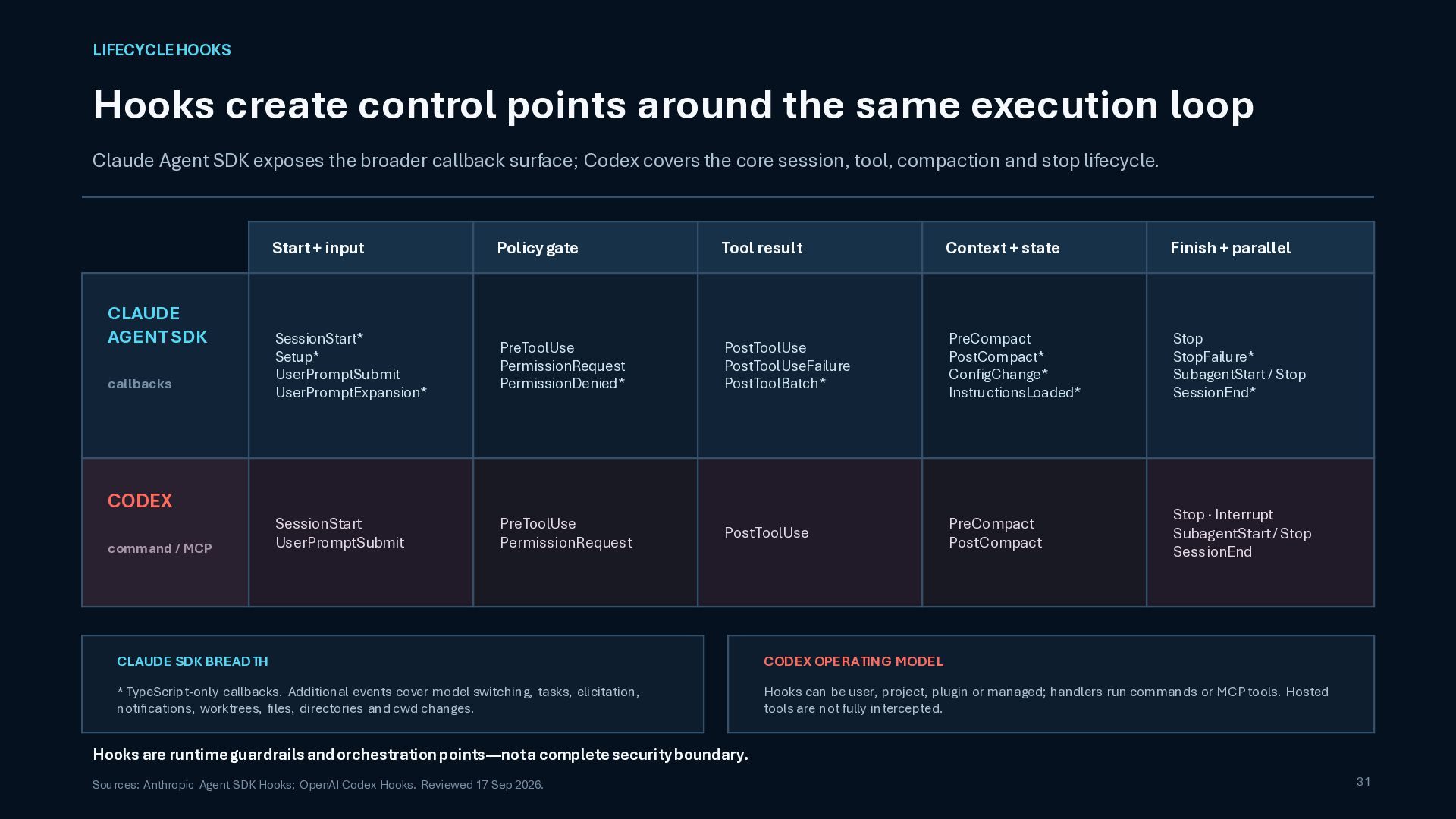
  32. LIFECYCLE HOOKS Hooks create control points around the same execution

    loop Claude Agent SDK exposes the broader callback surface; Codex covers the core session, tool, compaction and stop lifecycle. CLAUDE AGENT SDK callbacks Start + input Policy gate Tool result Context + state Finish + parallel SessionStart* Setup* UserPromptSubmit UserPromptExpansion* PreToolUse PermissionRequest PermissionDenied* PostToolUse PostToolUseFailure PostToolBatch* PreCompact PostCompact* ConfigChange* InstructionsLoaded* Stop StopFailure* SubagentStart / Stop SessionEnd* SessionStart UserPromptSubmit PreToolUse PermissionRequest PostToolUse PreCompact PostCompact Stop · Interrupt SubagentStart / Stop SessionEnd CODEX command / MCP CLAUDE SDK BREADTH CODEX OPERATING MODEL * TypeScript-only callbacks. Additional events cover model switching, tasks, elicitation, notifications, worktrees, files, directories and cwd changes. Hooks can be user, project, plugin or managed; handlers run commands or MCP tools. Hosted tools are not fully intercepted. Hooks are runtime guardrails and orchestration points—not a complete security boundary. Sources: Anthropic Agent SDK Hooks; OpenAI Codex Hooks. Reviewed 17 Sep 2026. 31
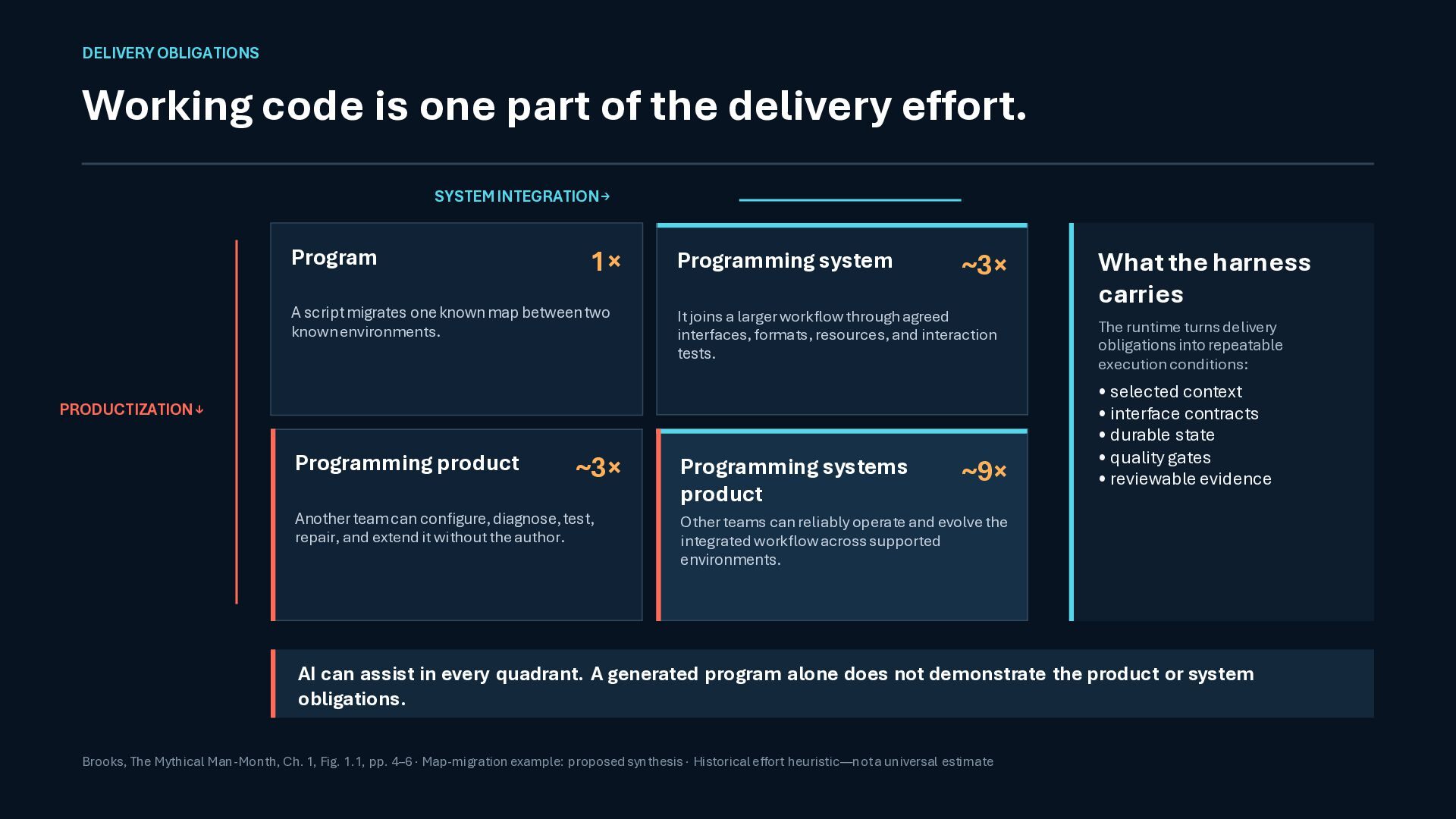
  33. DELIVERY OBLIGATIONS Working code is one part of the delivery

    effort. SYSTEM INTEGRATION → Program 1× A script migrates one known map between two known environments. Programming system ~3× It joins a larger workflow through agreed interfaces, formats, resources, and interaction tests. PRODUCTIZATION ↓ Programming product ~3× Another team can configure, diagnose, test, repair, and extend it without the author. Programming systems product ~9× What the harness carries The runtime turns delivery obligations into repeatable execution conditions: • selected context • interface contracts • durable state • quality gates • reviewable evidence Other teams can reliably operate and evolve the integrated workflow across supported environments. AI can assist in every quadrant. A generated program alone does not demonstrate the product or system obligations. Brooks, The Mythical Man-Month, Ch. 1, Fig. 1.1, pp. 4–6 · Map-migration example: proposed synthesis · Historical effort heuristic—not a universal estimate
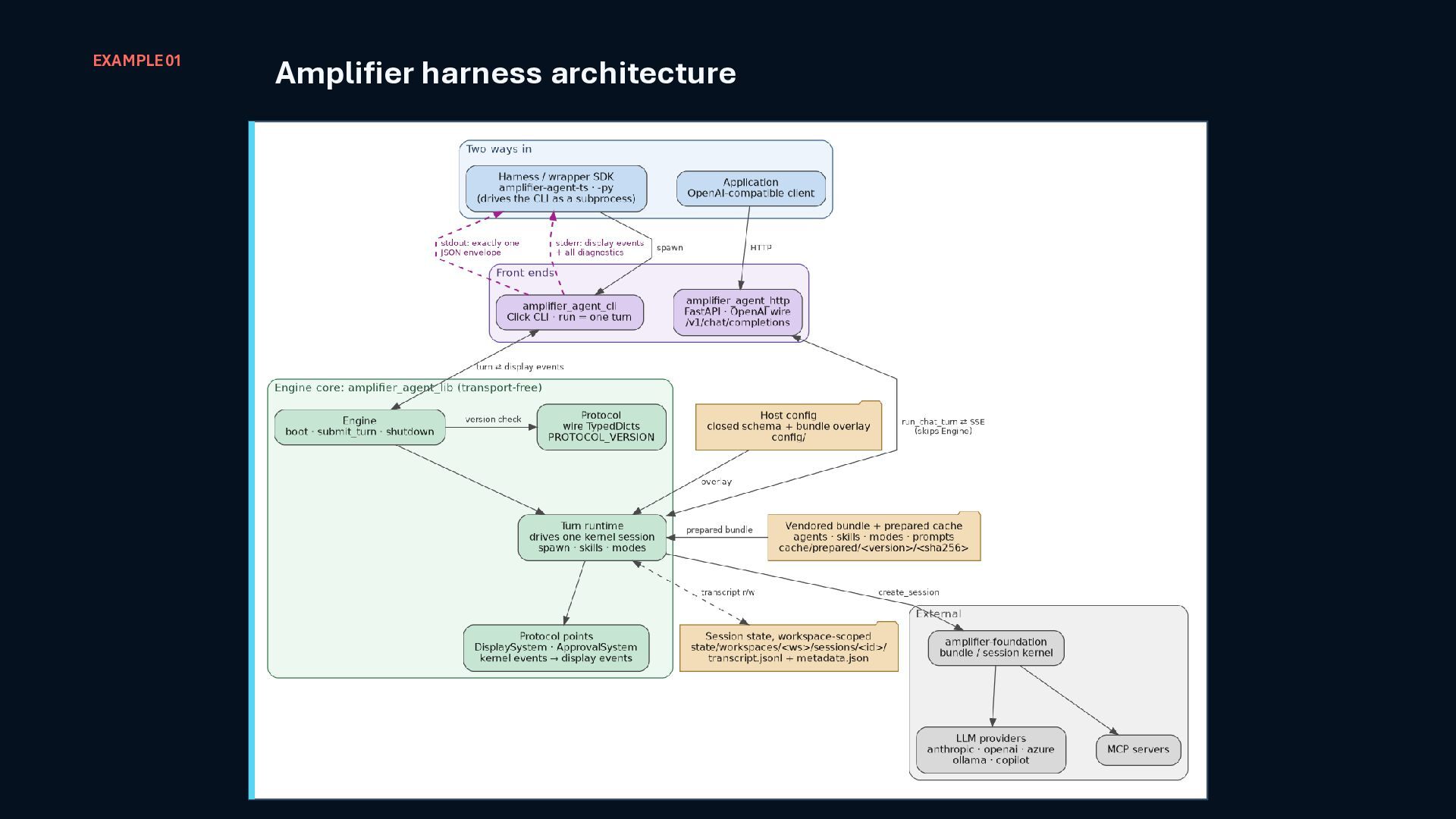
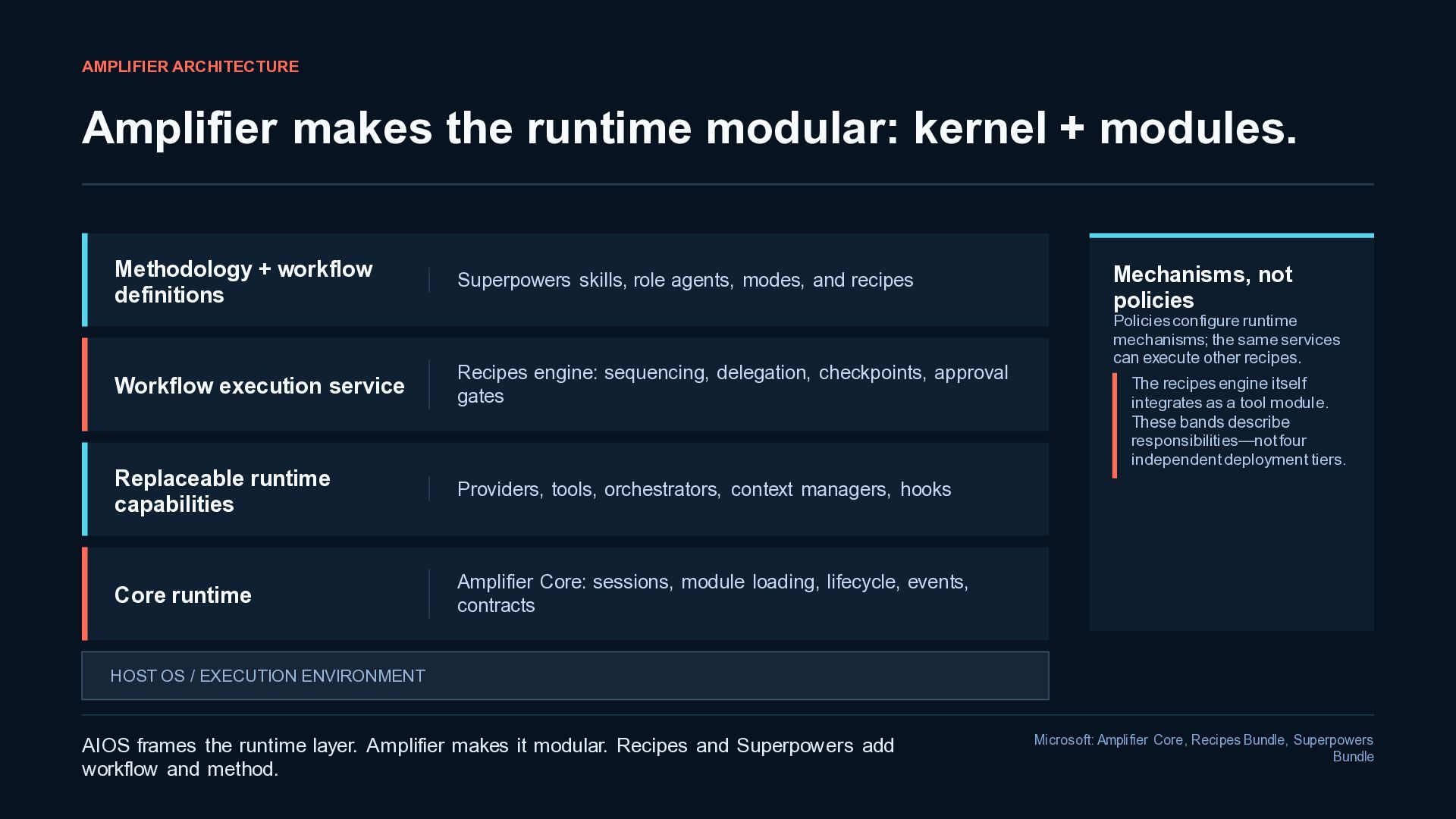
  34. AMPLIFIER ARCHITECTURE Amplifier makes the runtime modular: kernel + modules.

    Methodology + workflow definitions Superpowers skills, role agents, modes, and recipes Workflow execution service Recipes engine: sequencing, delegation, checkpoints, approval gates Replaceable runtime capabilities Providers, tools, orchestrators, context managers, hooks Core runtime Amplifier Core: sessions, module loading, lifecycle, events, contracts Mechanisms, not policies Policies configure runtime mechanisms; the same services can execute other recipes. The recipes engine itself integrates as a tool module. These bands describe responsibilities—not four independent deployment tiers. HOST OS / EXECUTION ENVIRONMENT AIOS frames the runtime layer. Amplifier makes it modular. Recipes and Superpowers add workflow and method. Microsoft: Amplifier Core, Recipes Bundle, Superpowers Bundle
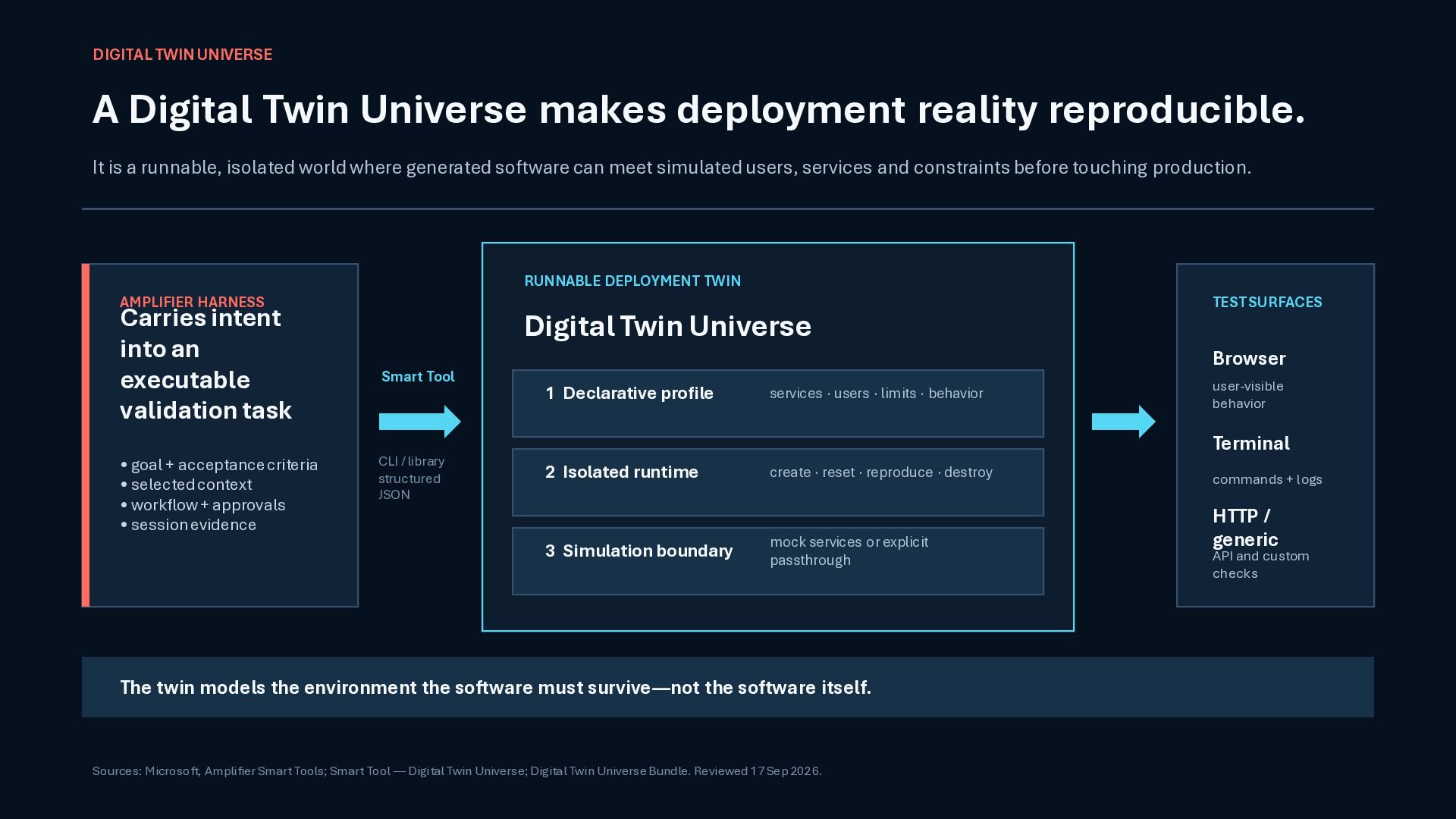
  35. DIGITAL TWIN UNIVERSE A Digital Twin Universe makes deployment reality

    reproducible. It is a runnable, isolated world where generated software can meet simulated users, services and constraints before touching production. RUNNABLE DEPLOYMENT TWIN AMPLIFIER HARNESS Carries intent into an executable validation task • goal + acceptance criteria • selected context • workflow + approvals • session evidence Digital Twin Universe Smart Tool CLI / library structured JSON TEST SURFACES Browser 1 Declarative profile services · users · limits · behavior user-visible behavior Terminal 2 Isolated runtime 3 Simulation boundary create · reset · reproduce · destroy mock services or explicit passthrough The twin models the environment the software must survive—not the software itself. Sources: Microsoft, Amplifier Smart Tools; Smart Tool — Digital Twin Universe; Digital Twin Universe Bundle. Reviewed 17 Sep 2026. commands + logs HTTP / generic API and custom checks
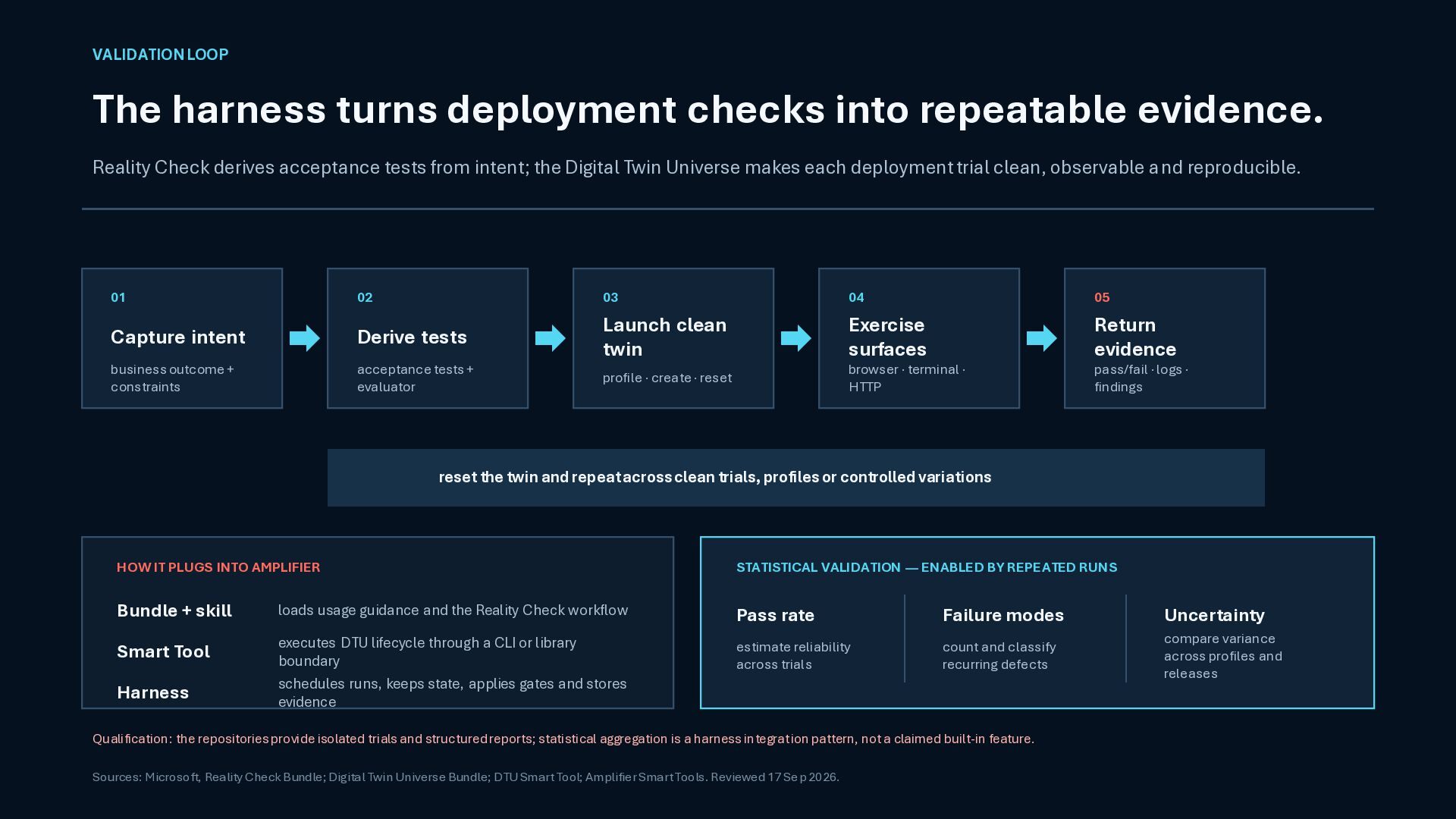
  36. VALIDATION LOOP The harness turns deployment checks into repeatable evidence.

    Reality Check derives acceptance tests from intent; the Digital Twin Universe makes each deployment trial clean, observable a nd reproducible. 01 02 03 04 05 Capture intent Derive tests business outcome + constraints acceptance tests + evaluator Launch clean twin Exercise surfaces Return evidence browser · terminal · HTTP profile · create · reset pass/fail · logs · findings reset the twin and repeat across clean trials, profiles or controlled variations HOW IT PLUGS INTO AMPLIFIER STATISTICAL VALIDATION — ENABLED BY REPEATED RUNS Bundle + skill loads usage guidance and the Reality Check workflow Pass rate Failure modes Uncertainty Smart Tool executes DTU lifecycle through a CLI or library boundary estimate reliability across trials count and classify recurring defects Harness schedules runs, keeps state, applies gates and stores evidence compare variance across profiles and releases Qualification: the repositories provide isolated trials and structured reports; statistical aggregation is a harness integration pattern, not a claimed built-in feature. Sources: Microsoft, Reality Check Bundle; Digital Twin Universe Bundle; DTU Smart Tool; Amplifier Smart Tools. Reviewed 17 Se p 2026.
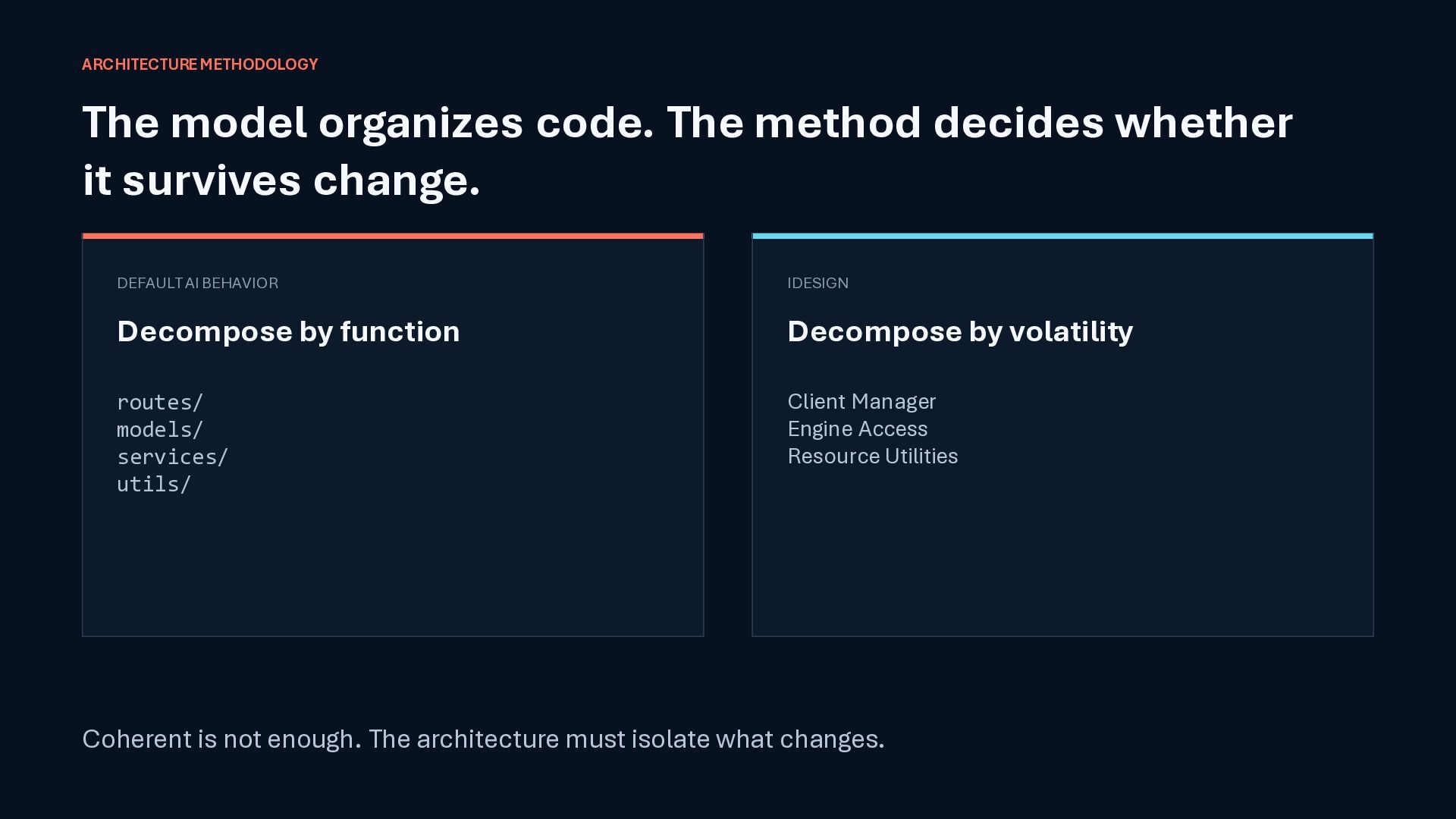
  37. ARCHITECTURE METHODOLOGY The model organizes code. The method decides whether

    it survives change. DEFAULT AI BEHAVIOR IDESIGN Decompose by function Decompose by volatility routes/ models/ services/ utils/ Client Manager Engine Access Resource Utilities Coherent is not enough. The architecture must isolate what changes.
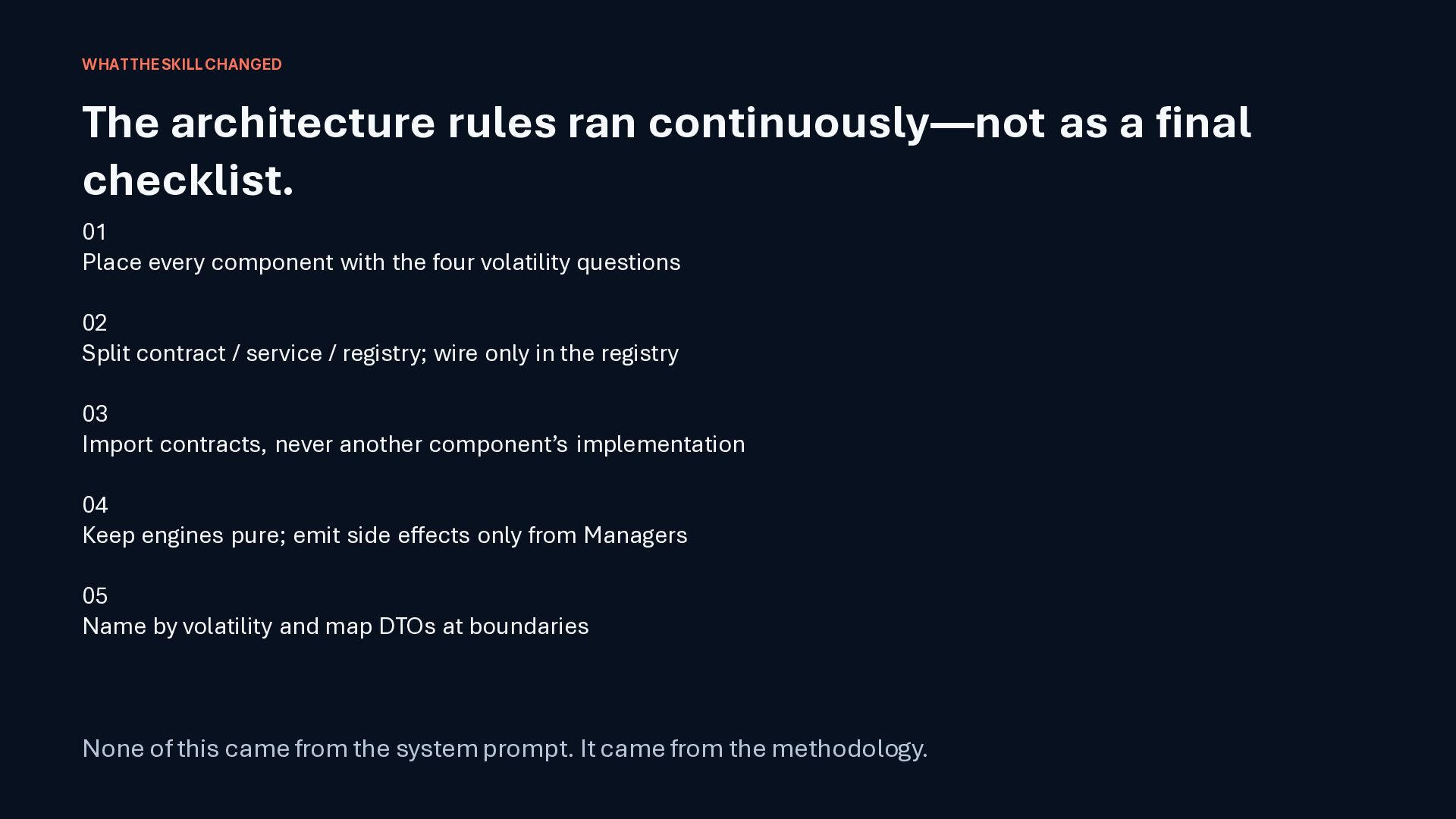
  38. WHAT THE SKILL CHANGED The architecture rules ran continuously—not as

    a final checklist. 01 Place every component with the four volatility questions 02 Split contract / service / registry; wire only in the registry 03 Import contracts, never another component’s implementation 04 Keep engines pure; emit side effects only from Managers 05 Name by volatility and map DTOs at boundaries None of this came from the system prompt. It came from the methodology.
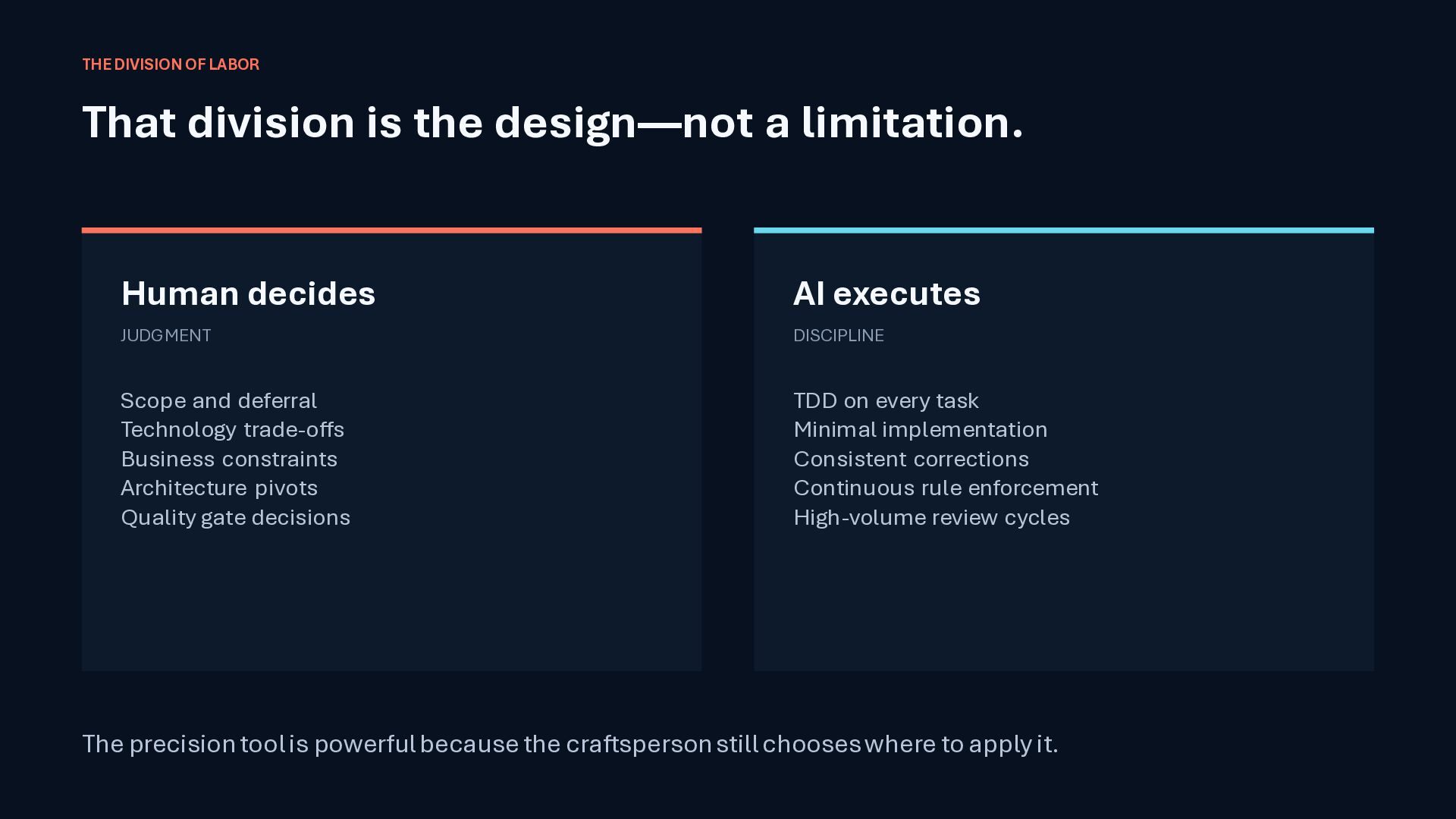
  39. THE DIVISION OF LABOR That division is the design—not a

    limitation. Human decides AI executes JUDGMENT DISCIPLINE Scope and deferral Technology trade-offs Business constraints Architecture pivots Quality gate decisions × TDD on every task Minimal implementation Consistent corrections Continuous rule enforcement High-volume review cycles The precision tool is powerful because the craftsperson still chooses where to apply it.
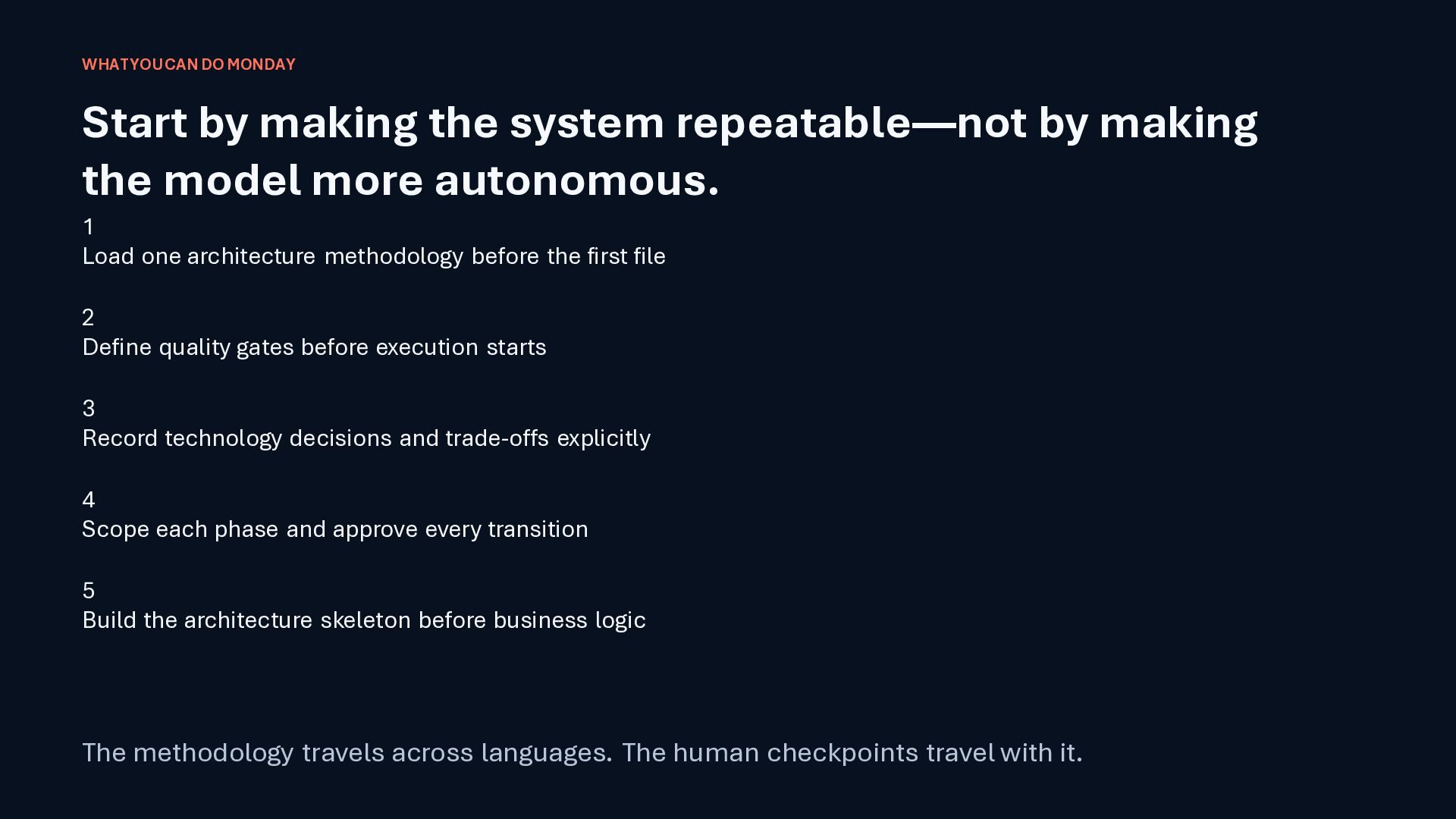
  40. WHAT YOU CAN DO MONDAY Start by making the system

    repeatable—not by making the model more autonomous. 1 Load one architecture methodology before the first file 2 Define quality gates before execution starts 3 Record technology decisions and trade-offs explicitly 4 Scope each phase and approve every transition 5 Build the architecture skeleton before business logic The methodology travels across languages. The human checkpoints travel with it.