Upgrade to Pro — share decks privately, control downloads, hide ads and more …

eBPF Hookpoint Gotchas: Why Your Program Fires ...

Sponsored · Ship Features Fearlessly Turn features on and off without deploys. Used by thousands of Ruby developers.

eBPF Hookpoint Gotchas: Why Your Program Fires (or Fails) in Unexpected Ways

eBPF programs often behave differently than developers expect, not because of incorrect logic, but because of subtle behaviours of the hookpoints themselves. In this talk, we focus on a small set of high-impact, commonly misunderstood attachment types — kprobes/fentry, tracepoints and uprobes, and expose the internal kernel mechanics that cause surprising edge cases.

Rather than attempting to cover all eBPF hooks, this session distills a practical set of real-world gotchas that routinely affect production tools, explaining why they occur and how to work around them.

Avatar for Donia Chaiehloudj

Donia Chaiehloudj

February 11, 2026
Tweet

More Decks by Donia Chaiehloudj

Other Decks in Technology

Transcript

  1. © 2024 Isovalent. All Rights Reserved. 1 eBPF Hookpoint Gotchas:

    Why Your Program Fires (or Fails) in Unexpected Ways Chris Tarazi, Sr. Staff Software Engineer Donia Chaiehloudj, Software Engineer and Community
  2. © 2024 Isovalent. All Rights Reserved. 2 Overview • Tracing

    hookpoint overview • Generic gotchas: • Kernel versions • Different architectures • Performance • uprobe dynamic links gotchas • kprobe/uprobe inlining gotchas • Nested executions gotchas
  3. © 2024 Isovalent. All Rights Reserved. 3 Tracing hookpoint overview

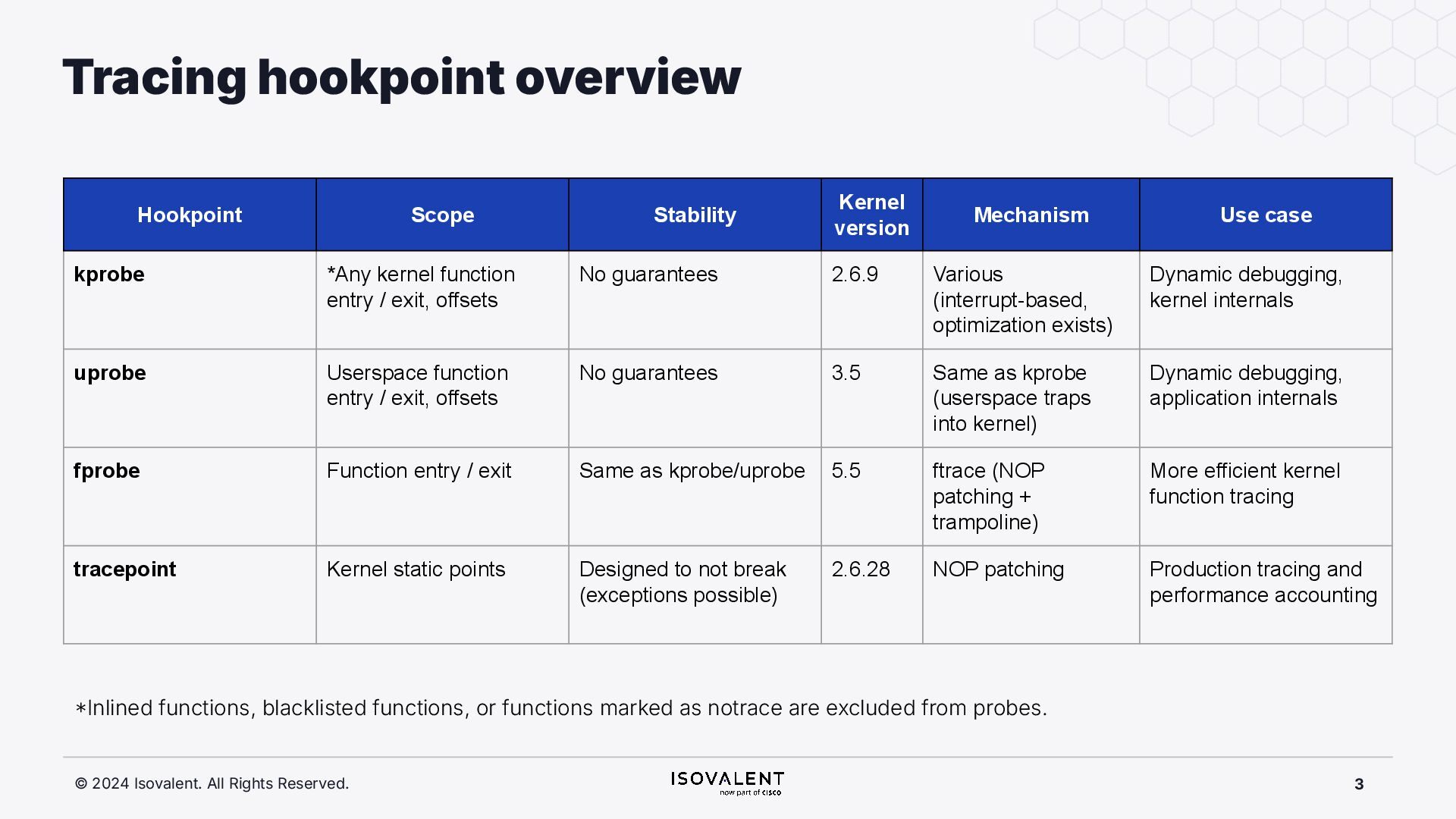
    Inlined functions, blacklisted functions, or functions marked as notrace are excluded from probes. Hookpoint Scope Stability Kernel version Mechanism Use case kprobe *Any kernel function entry / exit, offsets No guarantees 2.6.9 Various (interrupt-based, optimization exists) Dynamic debugging, kernel internals uprobe Userspace function entry / exit, offsets No guarantees 3.5 Same as kprobe (userspace traps into kernel) Dynamic debugging, application internals fprobe Function entry / exit Same as kprobe/uprobe 5.5 ftrace (NOP patching + trampoline) More efficient kernel function tracing tracepoint Kernel static points Designed to not break (exceptions possible) 2.6.28 NOP patching Production tracing and performance accounting
  4. © 2024 Isovalent. All Rights Reserved. 4 Hookpoints performance overview

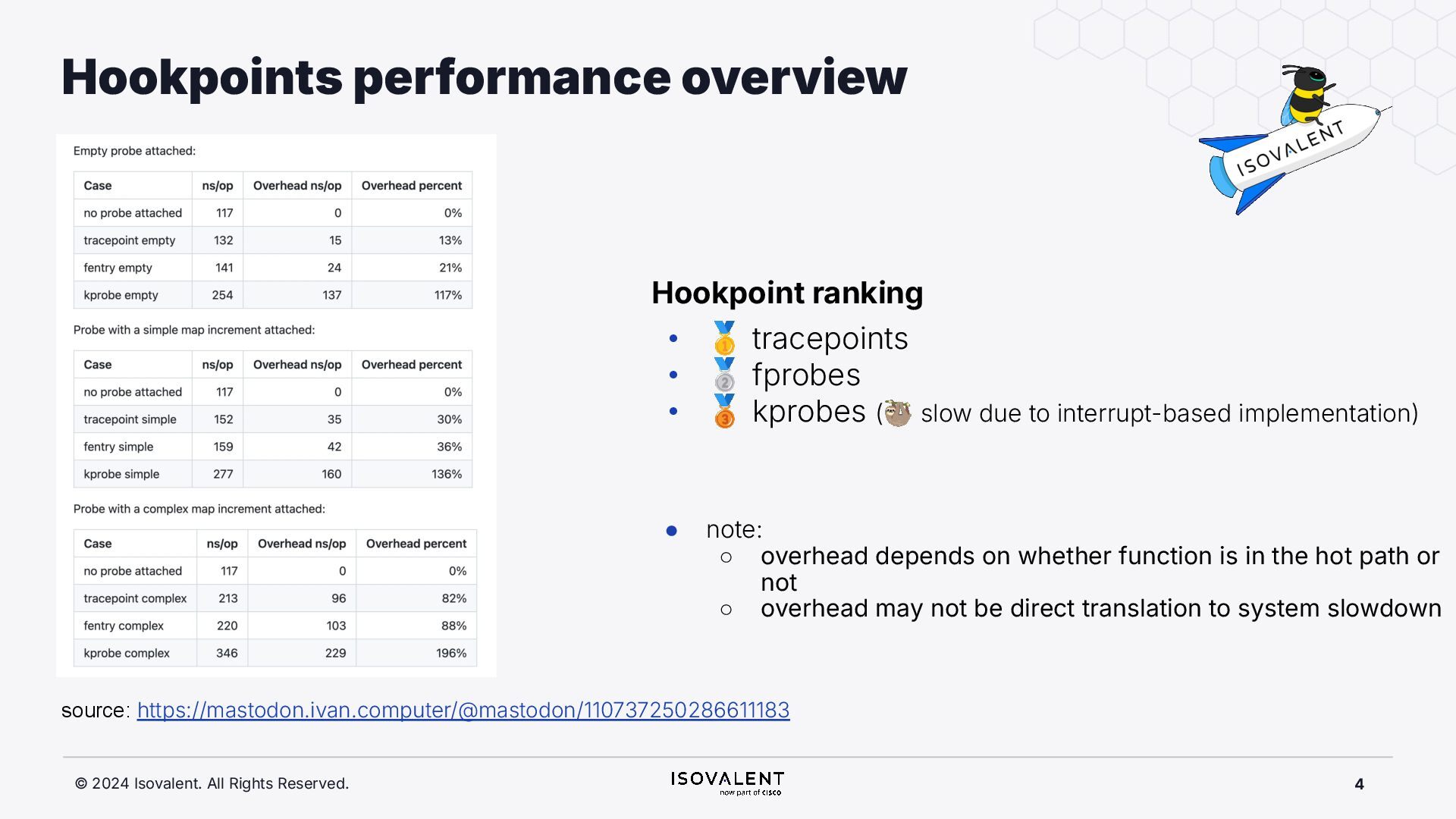
    Hookpoint ranking • 🥇 tracepoints • 🥈 fprobes • 🥉 kprobes (🦥 slow due to interrupt-based implementation) • note: ◦ overhead depends on whether function is in the hot path or not ◦ overhead may not be direct translation to system slowdown source: https://mastodon.ivan.computer/@mastodon/110737250286611183
  5. © 2024 Isovalent. All Rights Reserved. 6 Gotcha #1 Kernel

    versions kprobes, fprobes have no stability guarantee:
  6. © 2024 Isovalent. All Rights Reserved. 7 Gotcha #1 Kernel

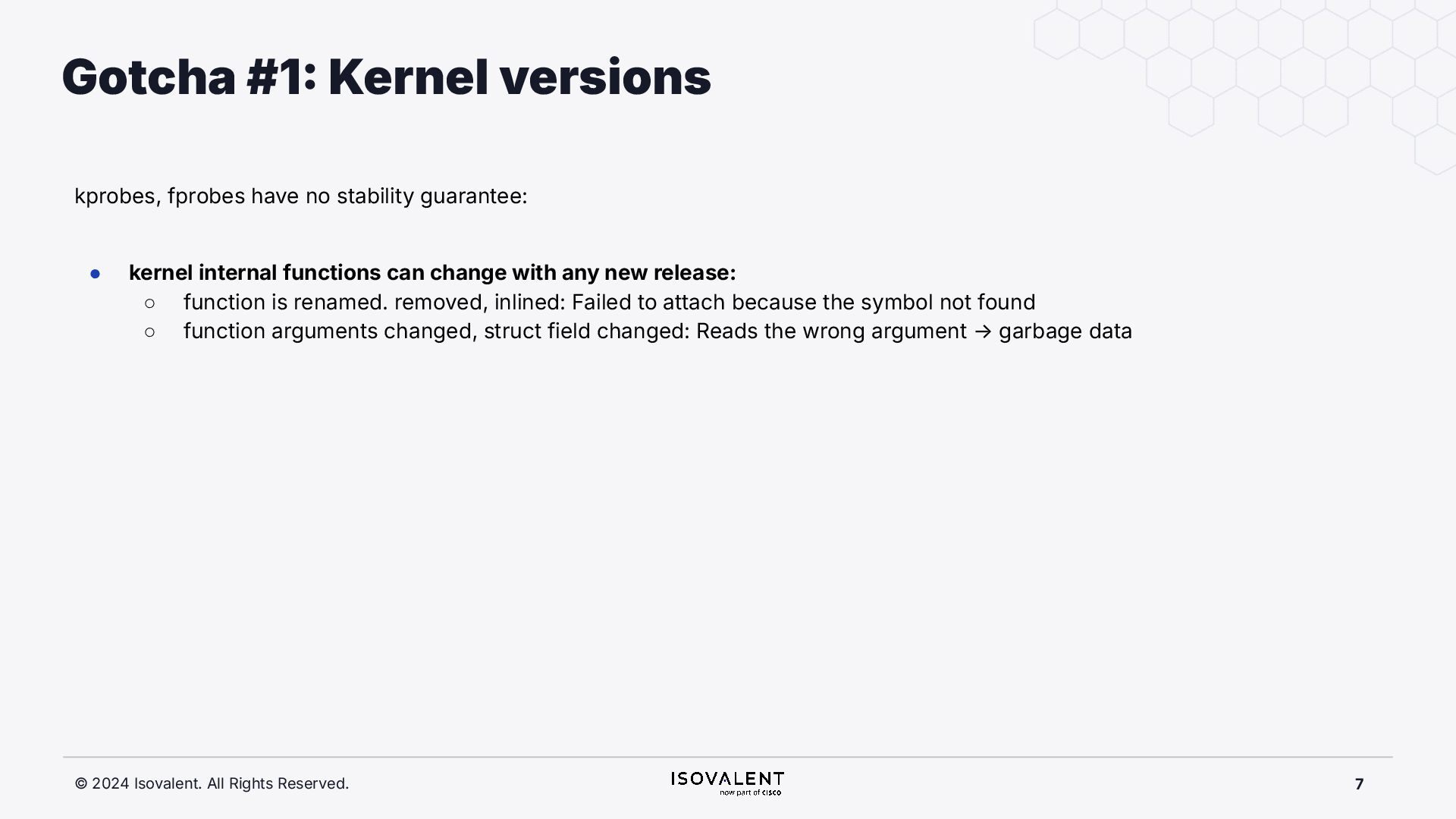
    versions kprobes, fprobes have no stability guarantee: • kernel internal functions can change with any new release: ◦ function is renamed. removed, inlined: Failed to attach because the symbol not found ◦ function arguments changed, struct field changed: Reads the wrong argument → garbage data
  7. © 2024 Isovalent. All Rights Reserved. 8 Gotcha #1 Kernel

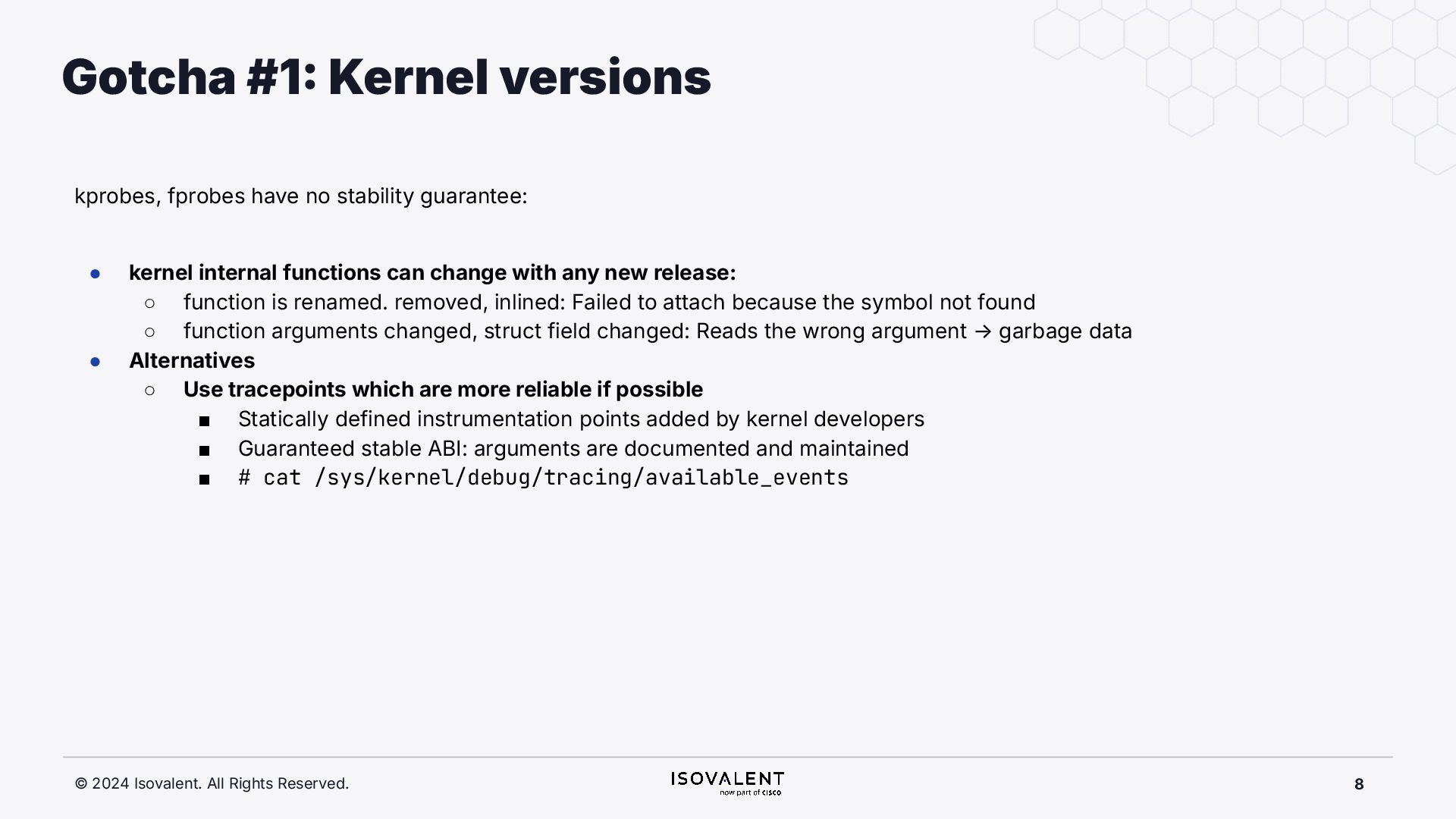
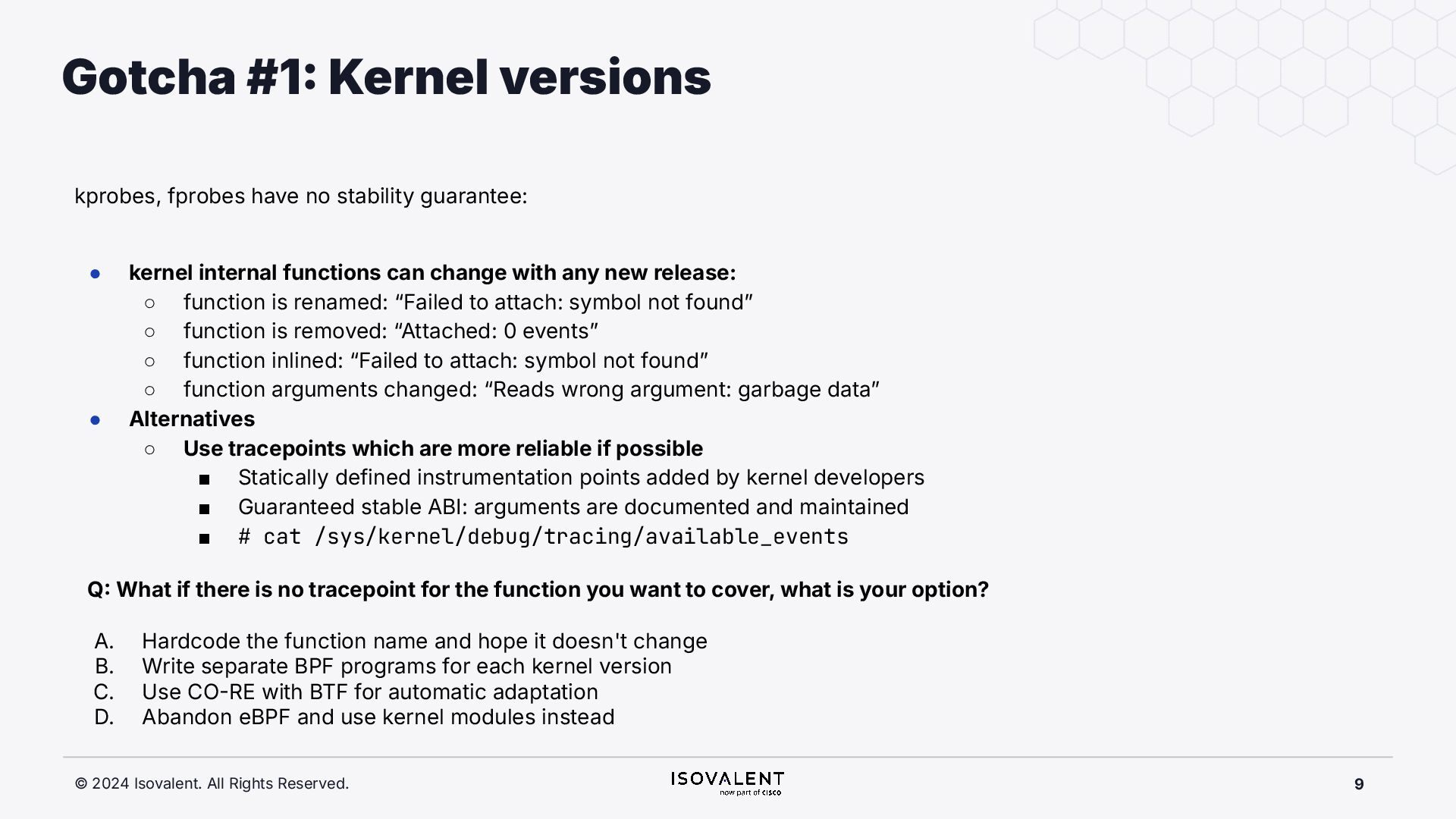
    versions kprobes, fprobes have no stability guarantee: • kernel internal functions can change with any new release: ◦ function is renamed. removed, inlined: Failed to attach because the symbol not found ◦ function arguments changed, struct field changed: Reads the wrong argument → garbage data • Alternatives ◦ Use tracepoints which are more reliable if possible ▪ Statically defined instrumentation points added by kernel developers ▪ Guaranteed stable ABI: arguments are documented and maintained ▪ # cat /sys/kernel/debug/tracing/available_events
  8. © 2024 Isovalent. All Rights Reserved. 9 Gotcha #1 Kernel

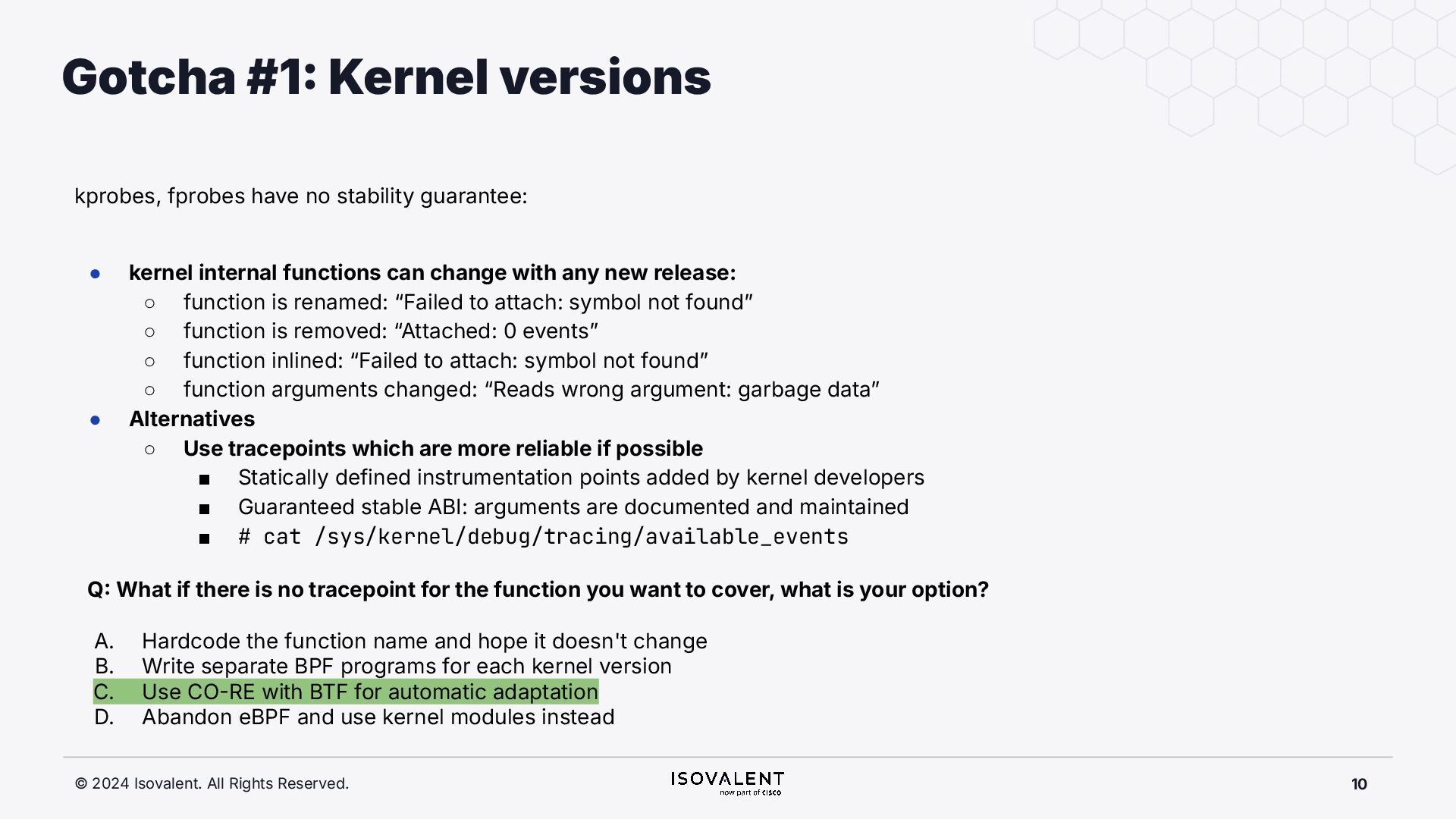
    versions kprobes, fprobes have no stability guarantee: • kernel internal functions can change with any new release: ◦ function is renamed: “Failed to attach: symbol not foundˮ ◦ function is removed: “Attached: 0 eventsˮ ◦ function inlined: “Failed to attach: symbol not foundˮ ◦ function arguments changed: “Reads wrong argument: garbage dataˮ • Alternatives ◦ Use tracepoints which are more reliable if possible ▪ Statically defined instrumentation points added by kernel developers ▪ Guaranteed stable ABI: arguments are documented and maintained ▪ # cat /sys/kernel/debug/tracing/available_events Q What if there is no tracepoint for the function you want to cover, what is your option? A. Hardcode the function name and hope it doesn't change B. Write separate BPF programs for each kernel version C. Use CORE with BTF for automatic adaptation D. Abandon eBPF and use kernel modules instead
  9. © 2024 Isovalent. All Rights Reserved. 10 Gotcha #1 Kernel

    versions kprobes, fprobes have no stability guarantee: • kernel internal functions can change with any new release: ◦ function is renamed: “Failed to attach: symbol not foundˮ ◦ function is removed: “Attached: 0 eventsˮ ◦ function inlined: “Failed to attach: symbol not foundˮ ◦ function arguments changed: “Reads wrong argument: garbage dataˮ • Alternatives ◦ Use tracepoints which are more reliable if possible ▪ Statically defined instrumentation points added by kernel developers ▪ Guaranteed stable ABI: arguments are documented and maintained ▪ # cat /sys/kernel/debug/tracing/available_events Q What if there is no tracepoint for the function you want to cover, what is your option? A. Hardcode the function name and hope it doesn't change B. Write separate BPF programs for each kernel version C. Use CORE with BTF for automatic adaptation D. Abandon eBPF and use kernel modules instead
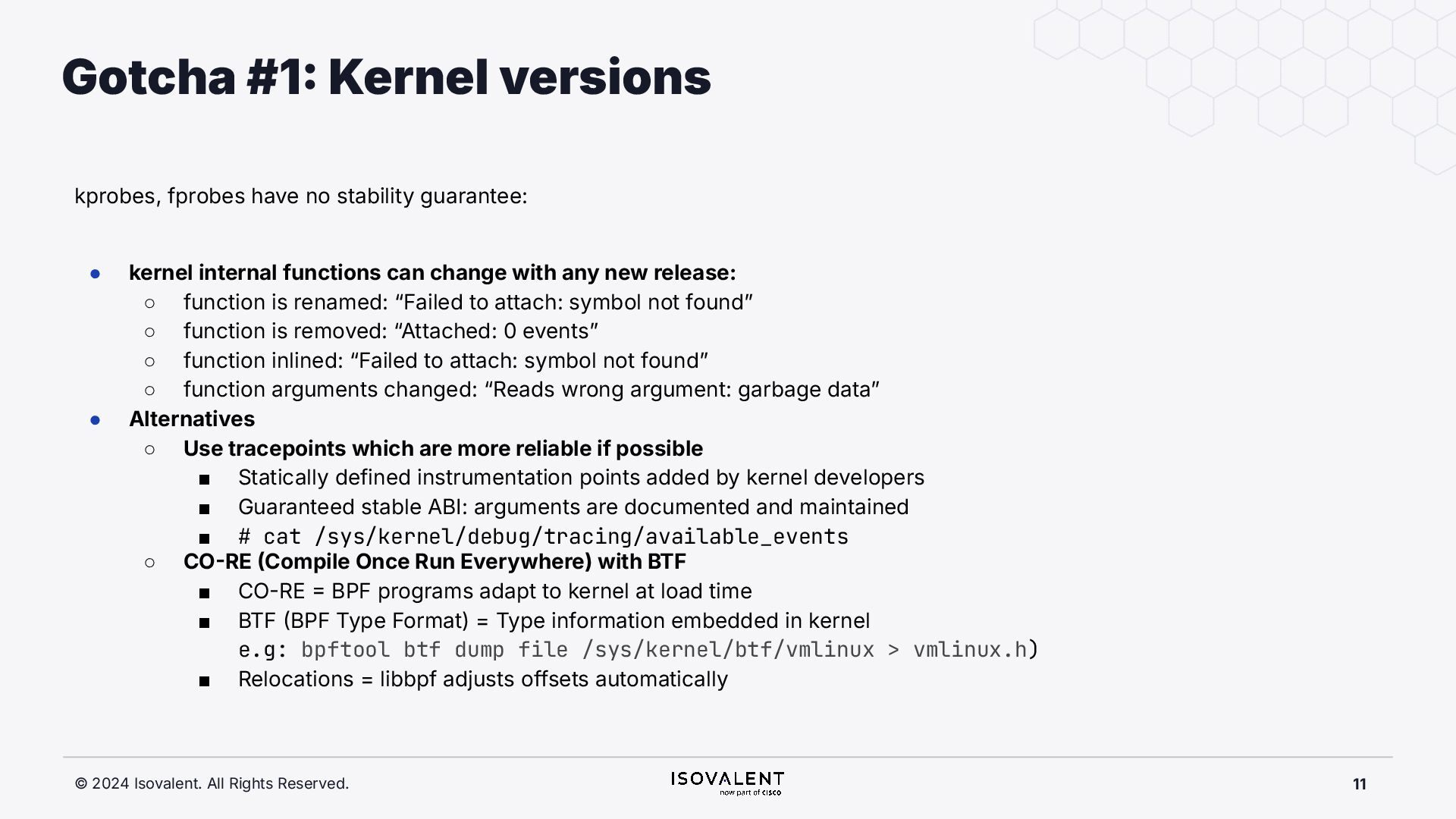
  10. © 2024 Isovalent. All Rights Reserved. 11 Gotcha #1 Kernel

    versions kprobes, fprobes have no stability guarantee: • kernel internal functions can change with any new release: ◦ function is renamed: “Failed to attach: symbol not foundˮ ◦ function is removed: “Attached: 0 eventsˮ ◦ function inlined: “Failed to attach: symbol not foundˮ ◦ function arguments changed: “Reads wrong argument: garbage dataˮ • Alternatives ◦ Use tracepoints which are more reliable if possible ▪ Statically defined instrumentation points added by kernel developers ▪ Guaranteed stable ABI: arguments are documented and maintained ▪ # cat /sys/kernel/debug/tracing/available_events ◦ CORE Compile Once Run Everywhere) with BTF ▪ CORE  BPF programs adapt to kernel at load time ▪ BTF BPF Type Format) = Type information embedded in kernel e.g: bpftool btf dump file /sys/kernel/btf/vmlinux > vmlinux.h) ▪ Relocations = libbpf adjusts offsets automatically
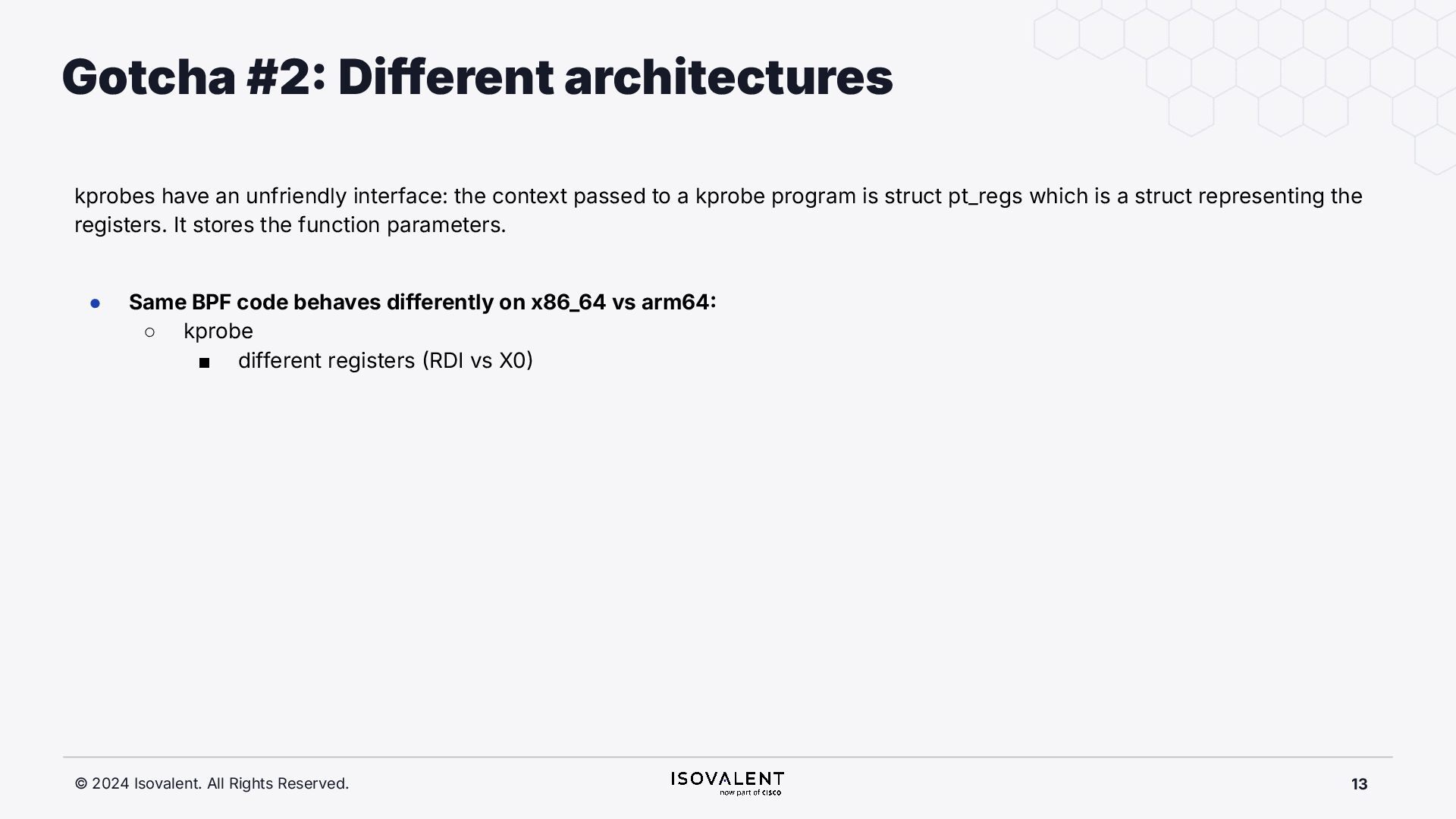
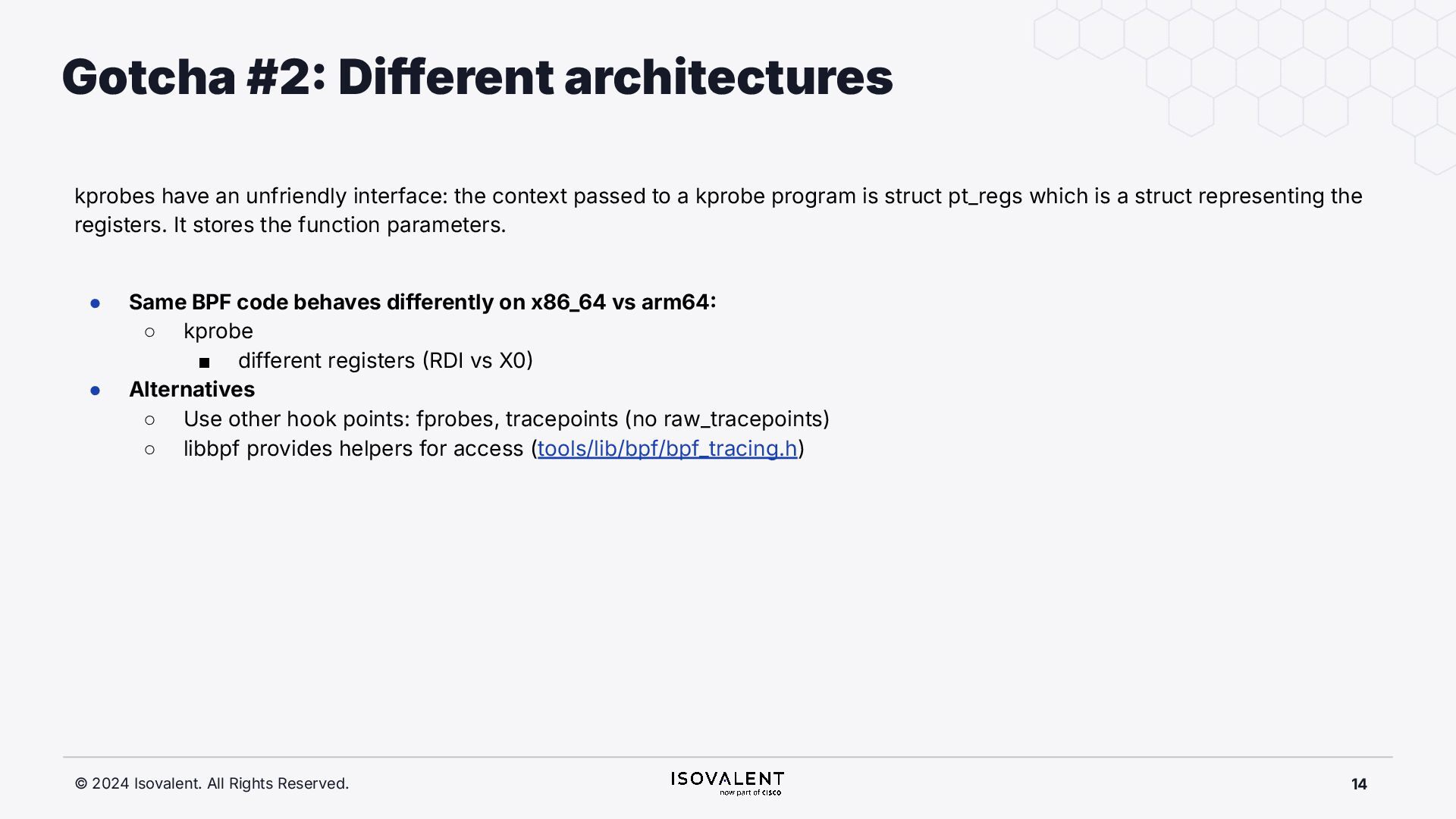
  11. © 2024 Isovalent. All Rights Reserved. 13 Gotcha #2 Different

    architectures kprobes have an unfriendly interface: the context passed to a kprobe program is struct pt_regs which is a struct representing the registers. It stores the function parameters. • Same BPF code behaves differently on x86_64 vs arm64 ◦ kprobe ▪ different registers RDI vs X0
  12. © 2024 Isovalent. All Rights Reserved. 14 Gotcha #2 Different

    architectures kprobes have an unfriendly interface: the context passed to a kprobe program is struct pt_regs which is a struct representing the registers. It stores the function parameters. • Same BPF code behaves differently on x86_64 vs arm64 ◦ kprobe ▪ different registers RDI vs X0 • Alternatives ◦ Use other hook points: fprobes, tracepoints (no raw_tracepoints) ◦ libbpf provides helpers for access (tools/lib/bpf/bpf_tracing.h)
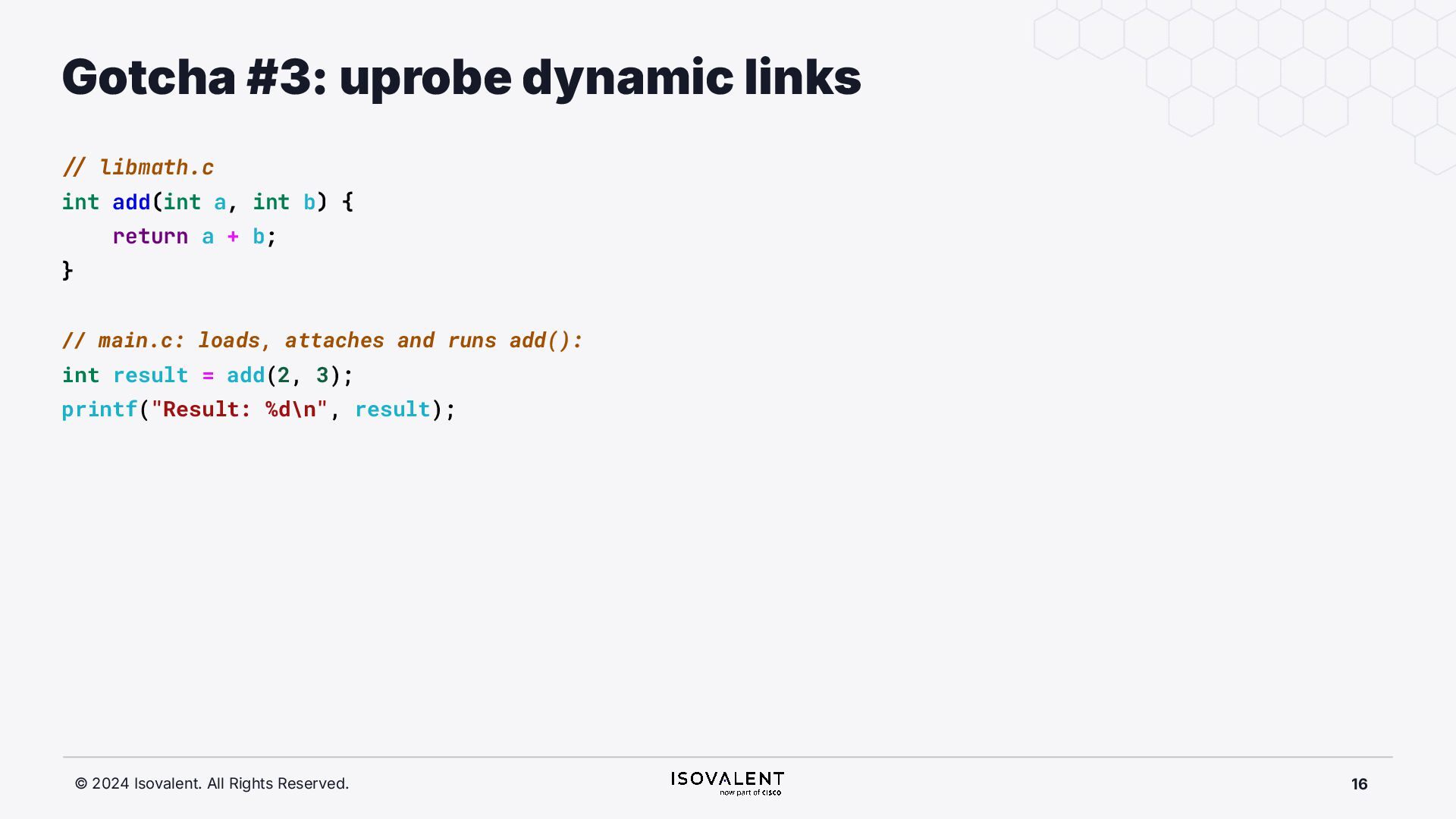
  13. © 2024 Isovalent. All Rights Reserved. 16 Gotcha #3: uprobe

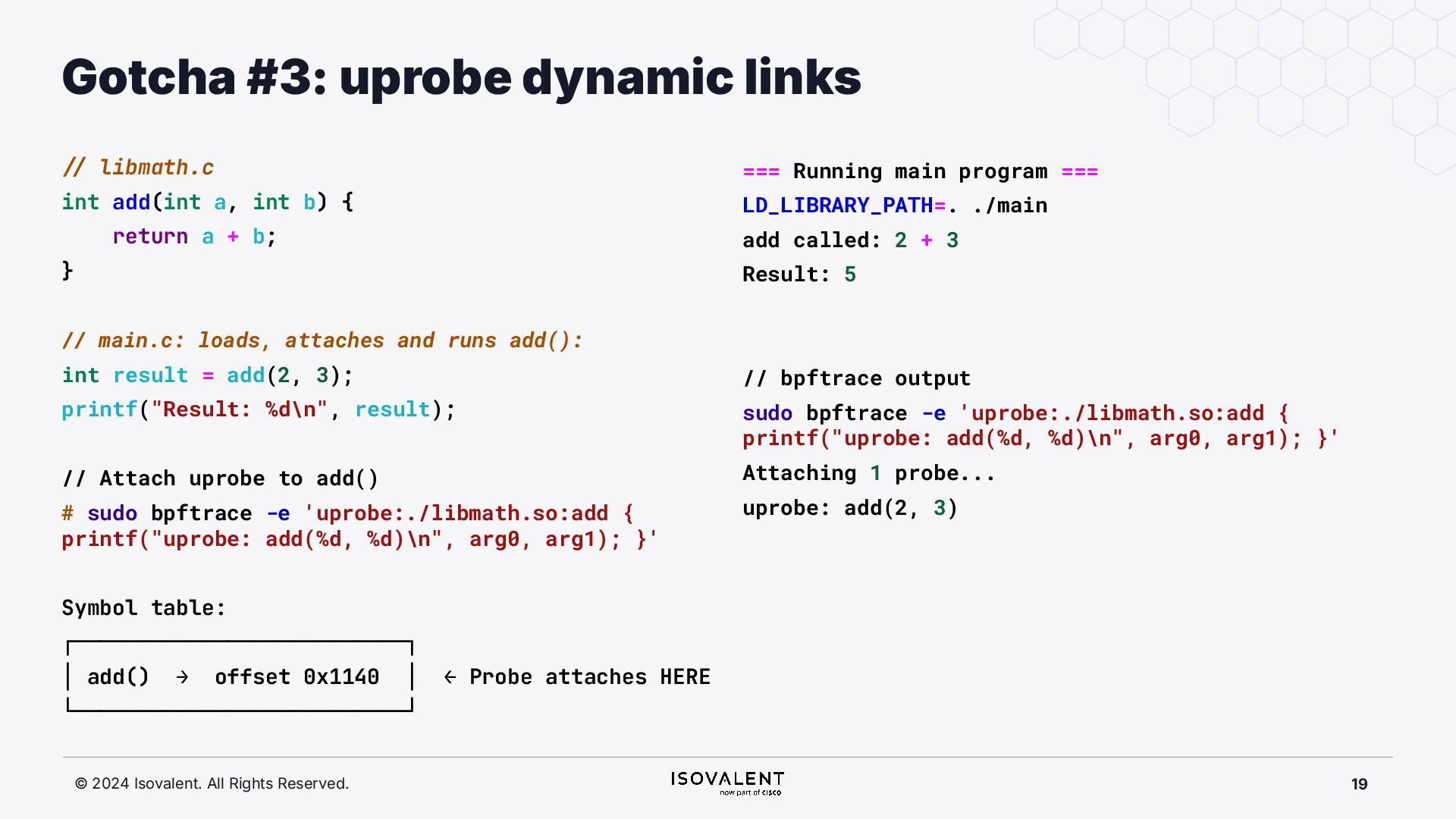
    dynamic links */ libmath.c int add(int a, int b) { return a + b; } // main.c: loads, attaches and runs add(): int result = add(2, 3); printf("Result: %d\n", result);
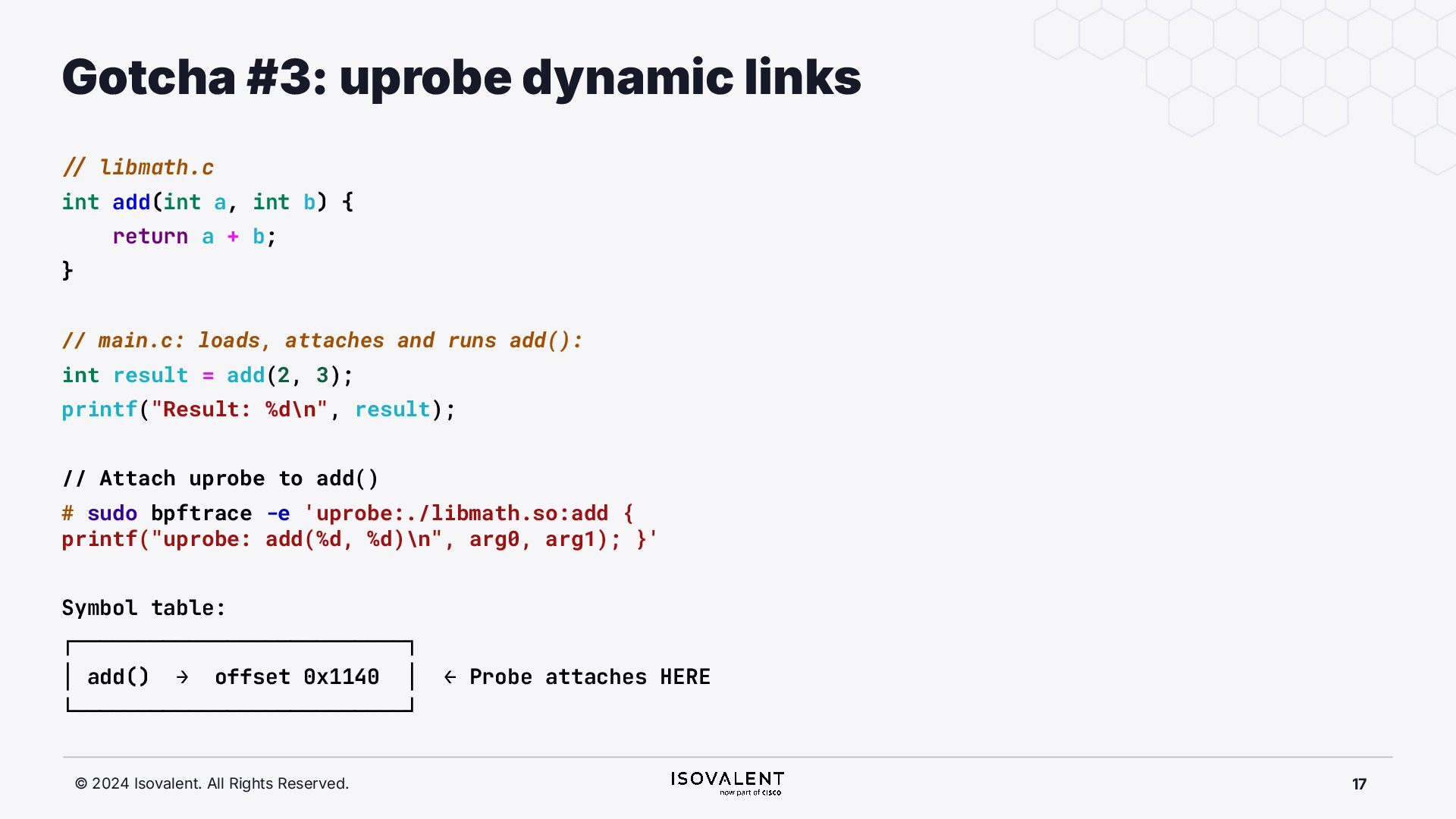
  14. © 2024 Isovalent. All Rights Reserved. 17 Gotcha #3: uprobe

    dynamic links */ libmath.c int add(int a, int b) { return a + b; } // main.c: loads, attaches and runs add(): int result = add(2, 3); printf("Result: %d\n", result); // Attach uprobe to add() # sudo bpftrace -e 'uprobe:./libmath.so:add { printf("uprobe: add(%d, %d)\n", arg0, arg1); }' Symbol table: ┌──────────────────────────┐ │ add() → offset 0x1140 │ ← Probe attaches HERE └──────────────────────────┘
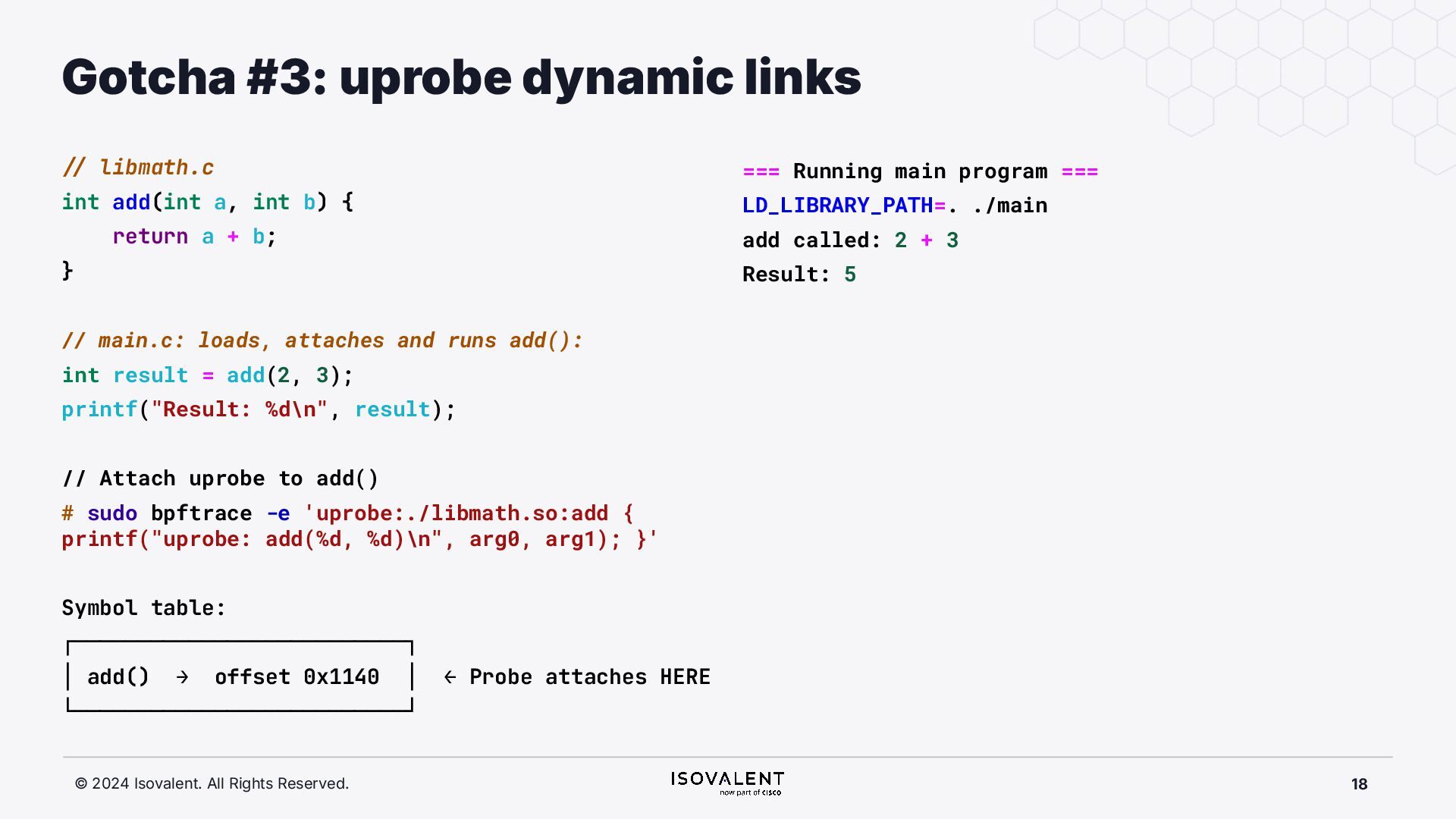
  15. © 2024 Isovalent. All Rights Reserved. 18 Gotcha #3: uprobe

    dynamic links */ libmath.c int add(int a, int b) { return a + b; } // main.c: loads, attaches and runs add(): int result = add(2, 3); printf("Result: %d\n", result); // Attach uprobe to add() # sudo bpftrace -e 'uprobe:./libmath.so:add { printf("uprobe: add(%d, %d)\n", arg0, arg1); }' Symbol table: ┌──────────────────────────┐ │ add() → offset 0x1140 │ ← Probe attaches HERE └──────────────────────────┘ === Running main program === LD_LIBRARY_PATH=. ./main add called: 2 + 3 Result: 5
  16. © 2024 Isovalent. All Rights Reserved. 19 Gotcha #3: uprobe

    dynamic links === Running main program === LD_LIBRARY_PATH=. ./main add called: 2 + 3 Result: 5 // bpftrace output sudo bpftrace -e 'uprobe:./libmath.so:add { printf("uprobe: add(%d, %d)\n", arg0, arg1); }' Attaching 1 probe... uprobe: add(2, 3) */ libmath.c int add(int a, int b) { return a + b; } // main.c: loads, attaches and runs add(): int result = add(2, 3); printf("Result: %d\n", result); // Attach uprobe to add() # sudo bpftrace -e 'uprobe:./libmath.so:add { printf("uprobe: add(%d, %d)\n", arg0, arg1); }' Symbol table: ┌──────────────────────────┐ │ add() → offset 0x1140 │ ← Probe attaches HERE └──────────────────────────┘
  17. © 2024 Isovalent. All Rights Reserved. 20 Gotcha #3: uprobe

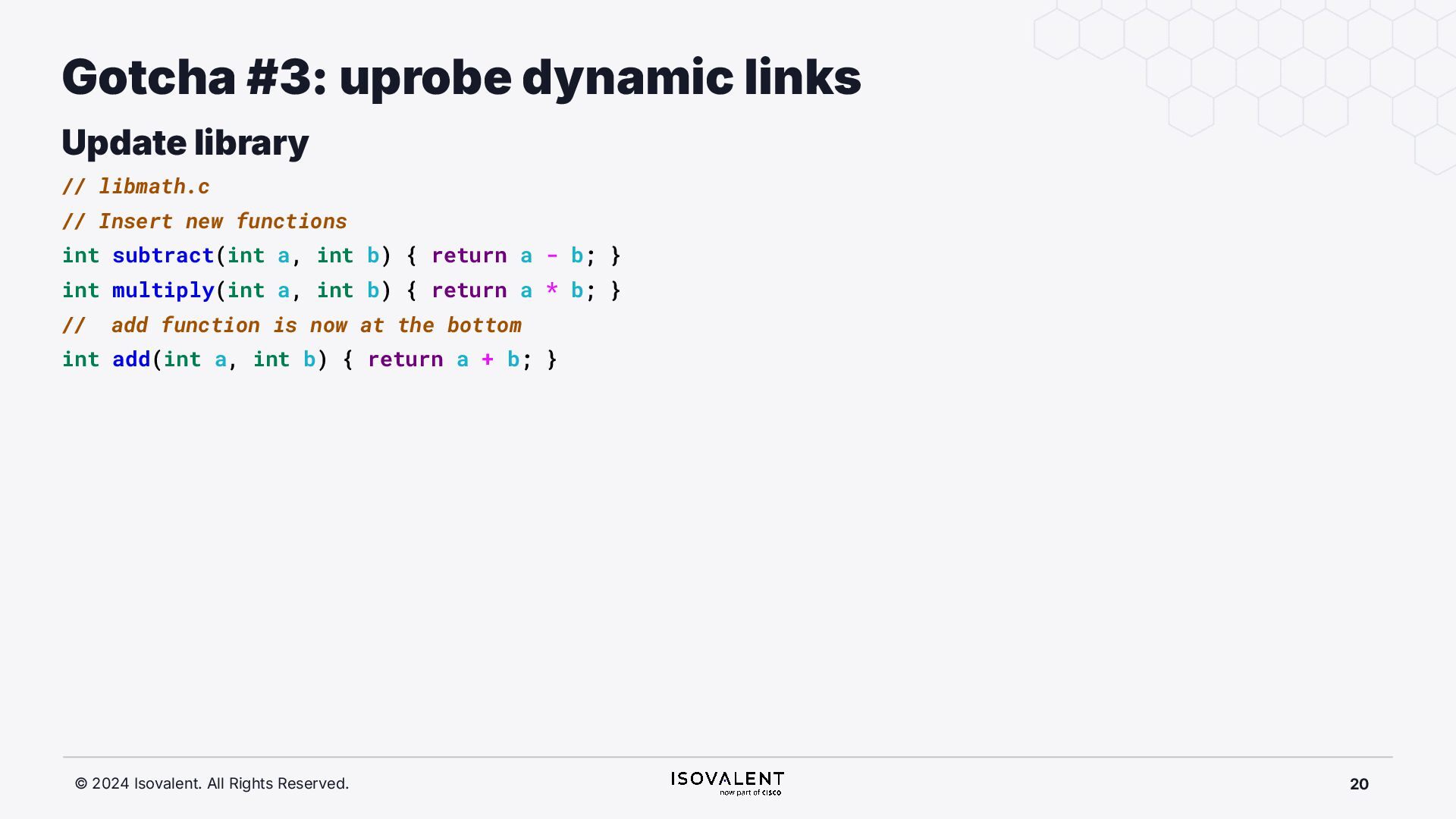
    dynamic links Update library // libmath.c // Insert new functions int subtract(int a, int b) { return a - b; } int multiply(int a, int b) { return a * b; } // add function is now at the bottom int add(int a, int b) { return a + b; }
  18. © 2024 Isovalent. All Rights Reserved. 21 Gotcha #3: uprobe

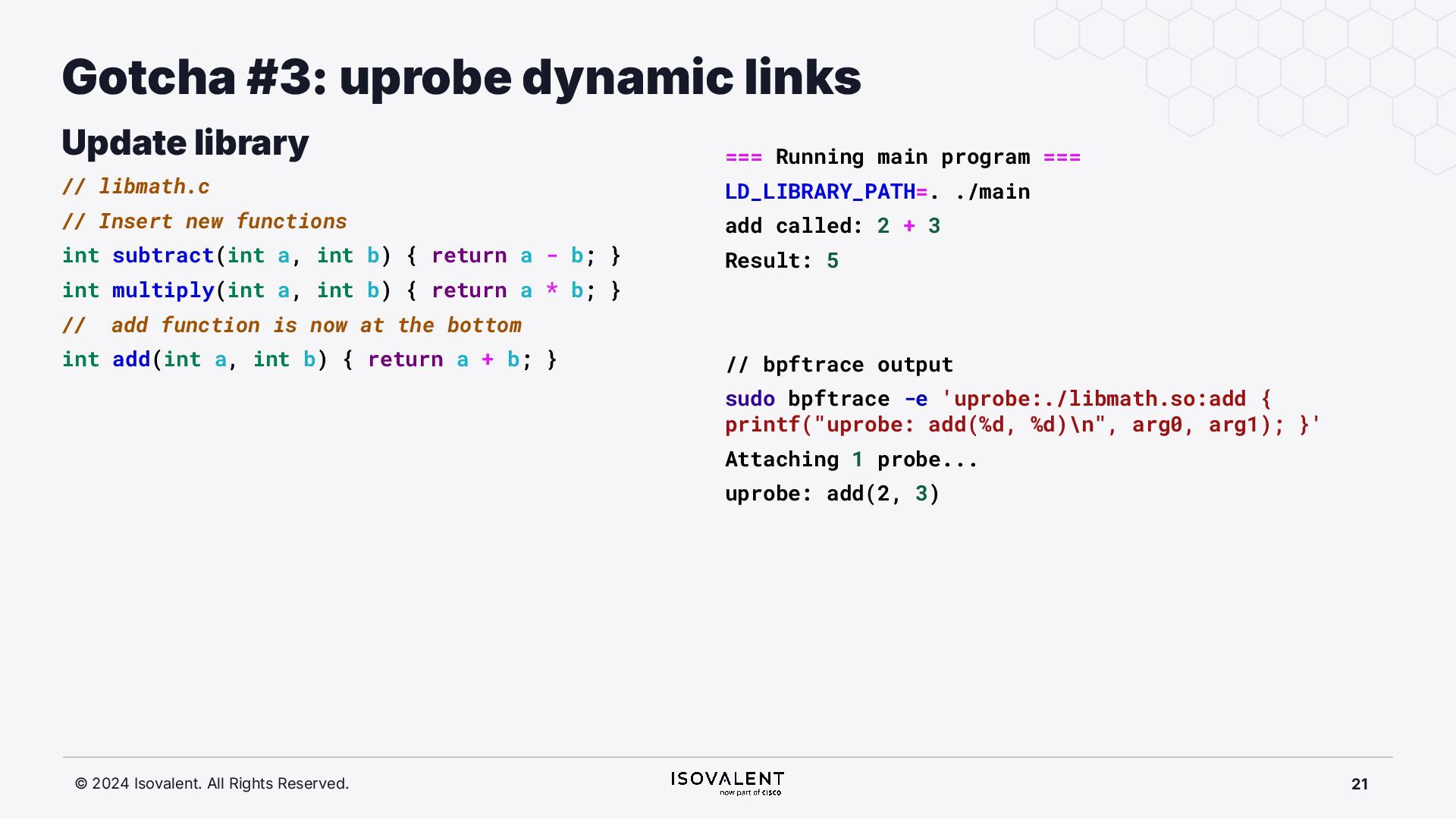
    dynamic links Update library // libmath.c // Insert new functions int subtract(int a, int b) { return a - b; } int multiply(int a, int b) { return a * b; } // add function is now at the bottom int add(int a, int b) { return a + b; } === Running main program === LD_LIBRARY_PATH=. ./main add called: 2 + 3 Result: 5 // bpftrace output sudo bpftrace -e 'uprobe:./libmath.so:add { printf("uprobe: add(%d, %d)\n", arg0, arg1); }' Attaching 1 probe... uprobe: add(2, 3)
  19. © 2024 Isovalent. All Rights Reserved. 22 Gotcha #3: uprobe

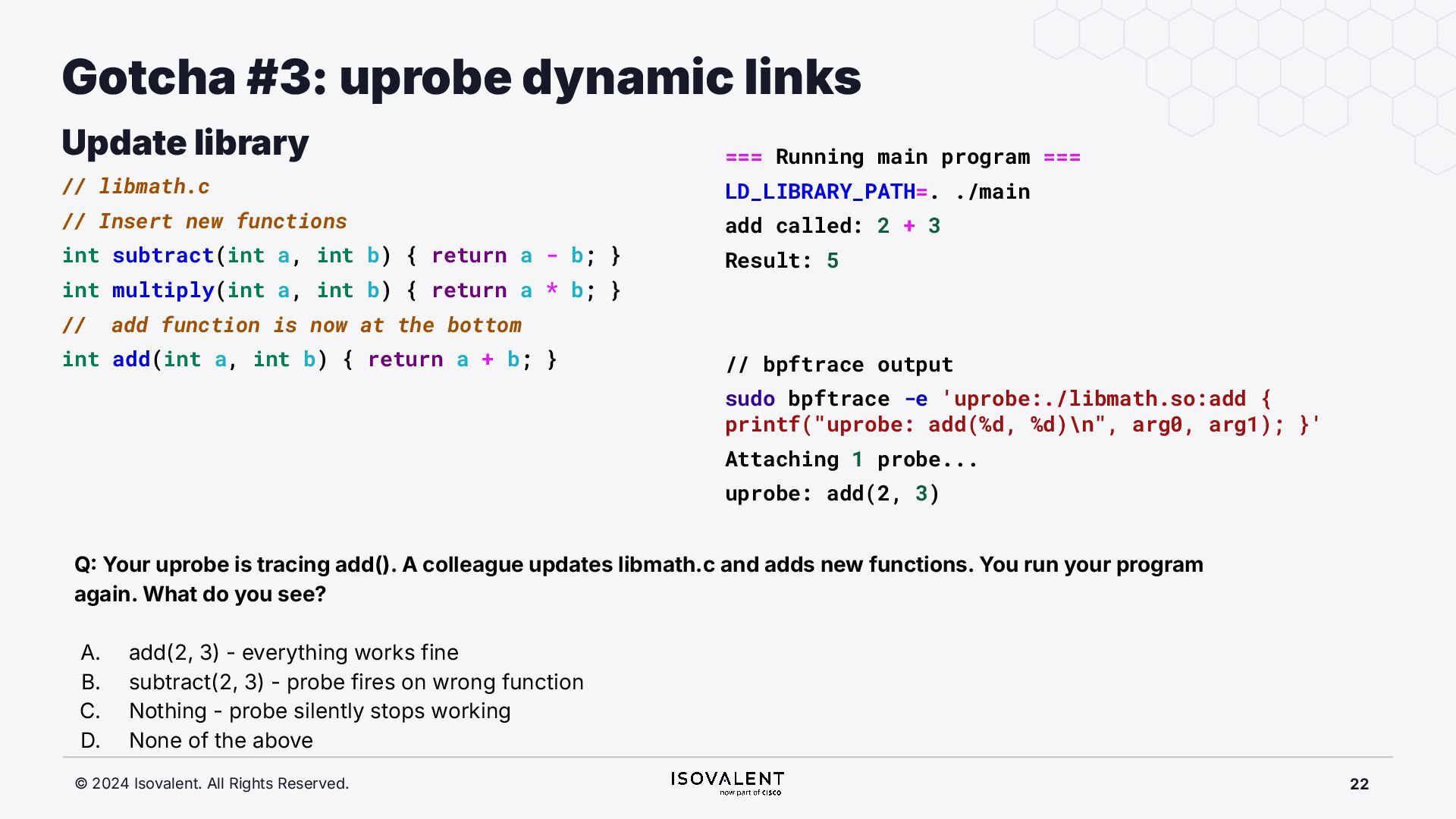
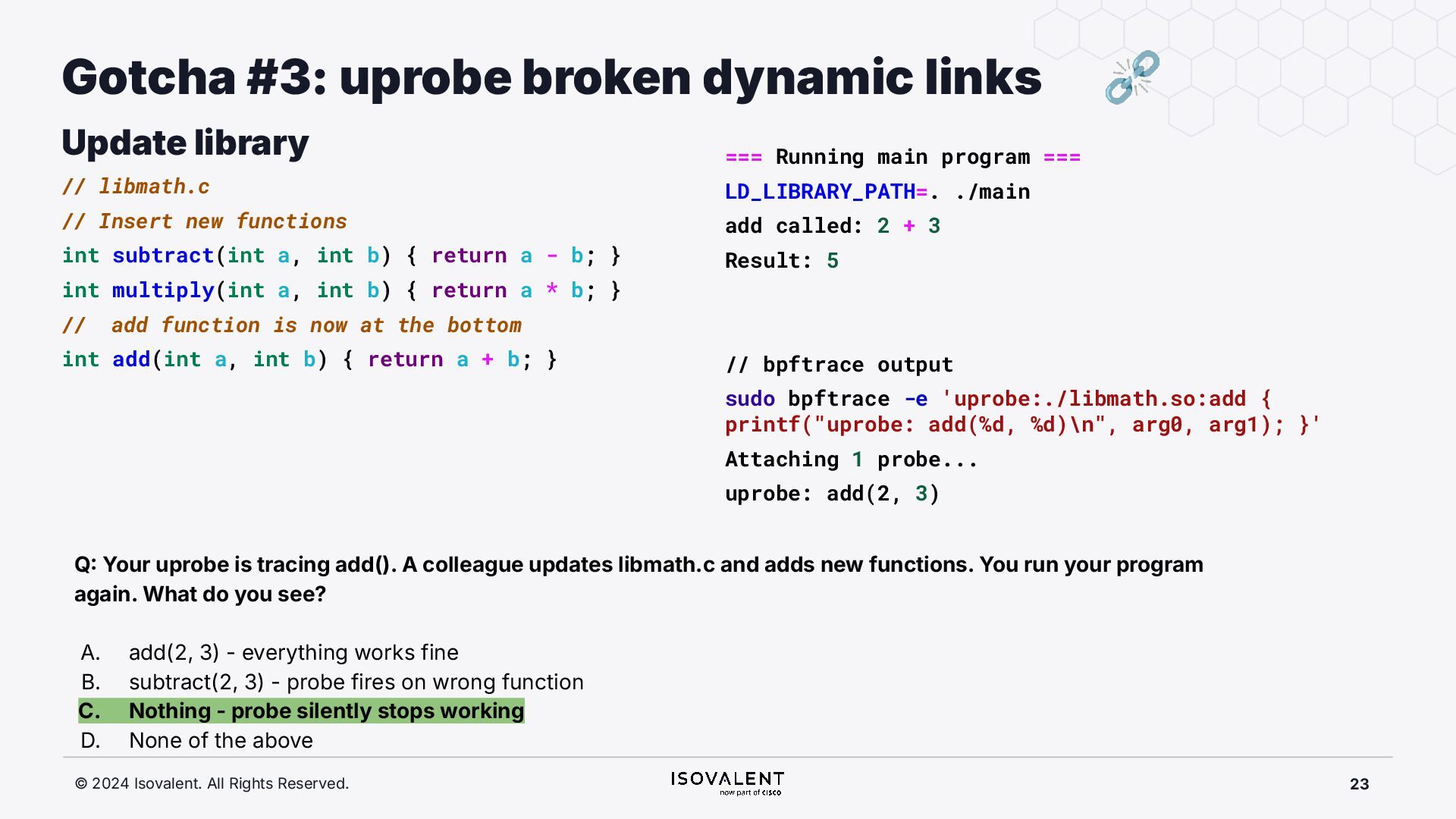
    dynamic links Update library // libmath.c // Insert new functions int subtract(int a, int b) { return a - b; } int multiply(int a, int b) { return a * b; } // add function is now at the bottom int add(int a, int b) { return a + b; } === Running main program === LD_LIBRARY_PATH=. ./main add called: 2 + 3 Result: 5 // bpftrace output sudo bpftrace -e 'uprobe:./libmath.so:add { printf("uprobe: add(%d, %d)\n", arg0, arg1); }' Attaching 1 probe... uprobe: add(2, 3) Q Your uprobe is tracing add(). A colleague updates libmath.c and adds new functions. You run your program again. What do you see? A. add(2, 3) - everything works fine B. subtract(2, 3) - probe fires on wrong function C. Nothing - probe silently stops working D. None of the above
  20. © 2024 Isovalent. All Rights Reserved. 23 Gotcha #3: uprobe

    broken dynamic links 󰺼 Update library // libmath.c // Insert new functions int subtract(int a, int b) { return a - b; } int multiply(int a, int b) { return a * b; } // add function is now at the bottom int add(int a, int b) { return a + b; } === Running main program === LD_LIBRARY_PATH=. ./main add called: 2 + 3 Result: 5 // bpftrace output sudo bpftrace -e 'uprobe:./libmath.so:add { printf("uprobe: add(%d, %d)\n", arg0, arg1); }' Attaching 1 probe... uprobe: add(2, 3) Q Your uprobe is tracing add(). A colleague updates libmath.c and adds new functions. You run your program again. What do you see? A. add(2, 3) - everything works fine B. subtract(2, 3) - probe fires on wrong function C. Nothing - probe silently stops working D. None of the above
  21. © 2024 Isovalent. All Rights Reserved. 24 Gotcha #3: uprobe

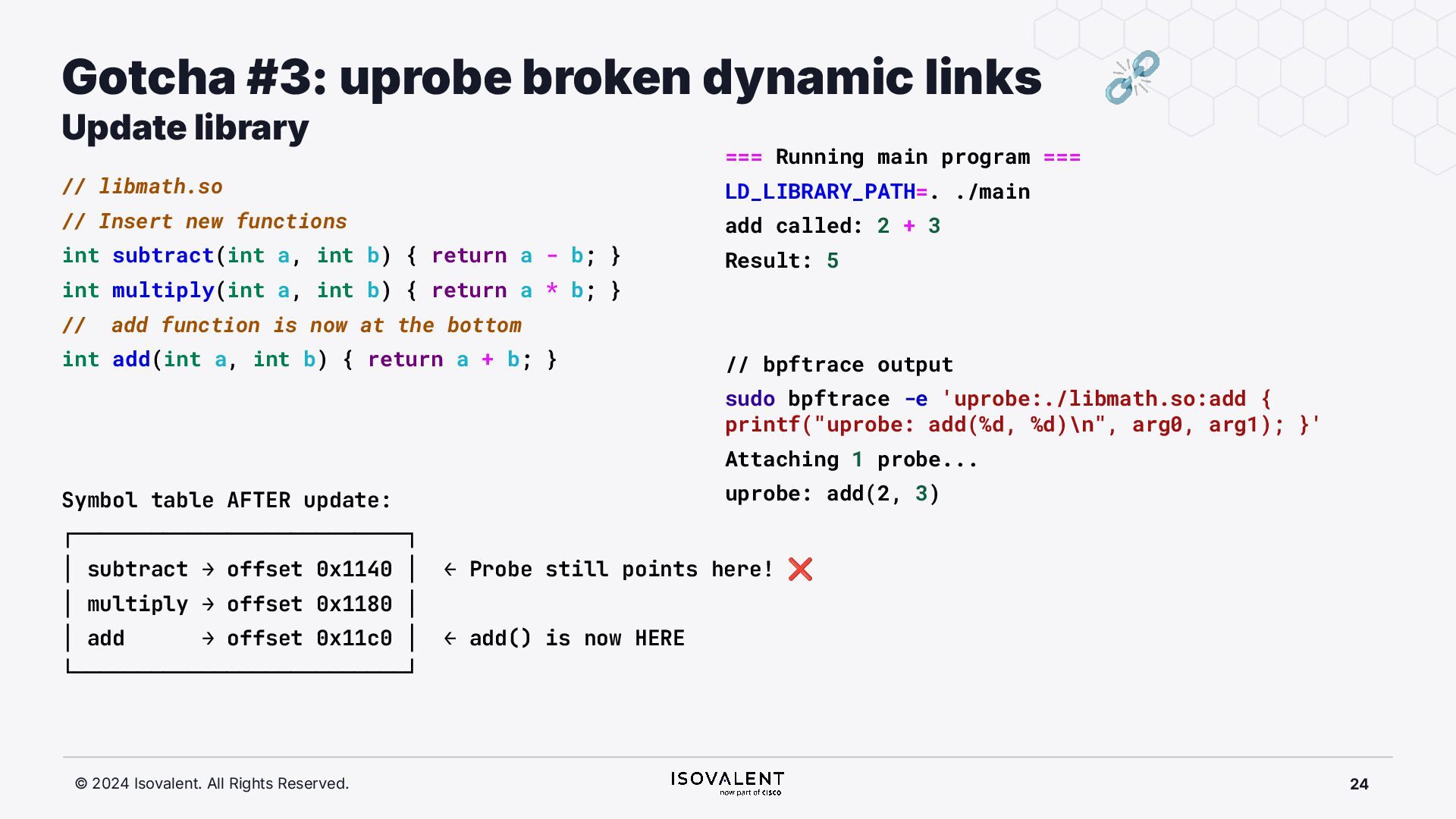
    broken dynamic links 󰺼 Update library // libmath.so // Insert new functions int subtract(int a, int b) { return a - b; } int multiply(int a, int b) { return a * b; } // add function is now at the bottom int add(int a, int b) { return a + b; } === Running main program === LD_LIBRARY_PATH=. ./main add called: 2 + 3 Result: 5 // bpftrace output sudo bpftrace -e 'uprobe:./libmath.so:add { printf("uprobe: add(%d, %d)\n", arg0, arg1); }' Attaching 1 probe... uprobe: add(2, 3) Symbol table AFTER update: ┌──────────────────────────┐ │ subtract → offset 0x1140 │ ← Probe still points here! ❌ │ multiply → offset 0x1180 │ │ add → offset 0x11c0 │ ← add() is now HERE └──────────────────────────┘
  22. © 2024 Isovalent. All Rights Reserved. 25 Gotcha #3: uprobe

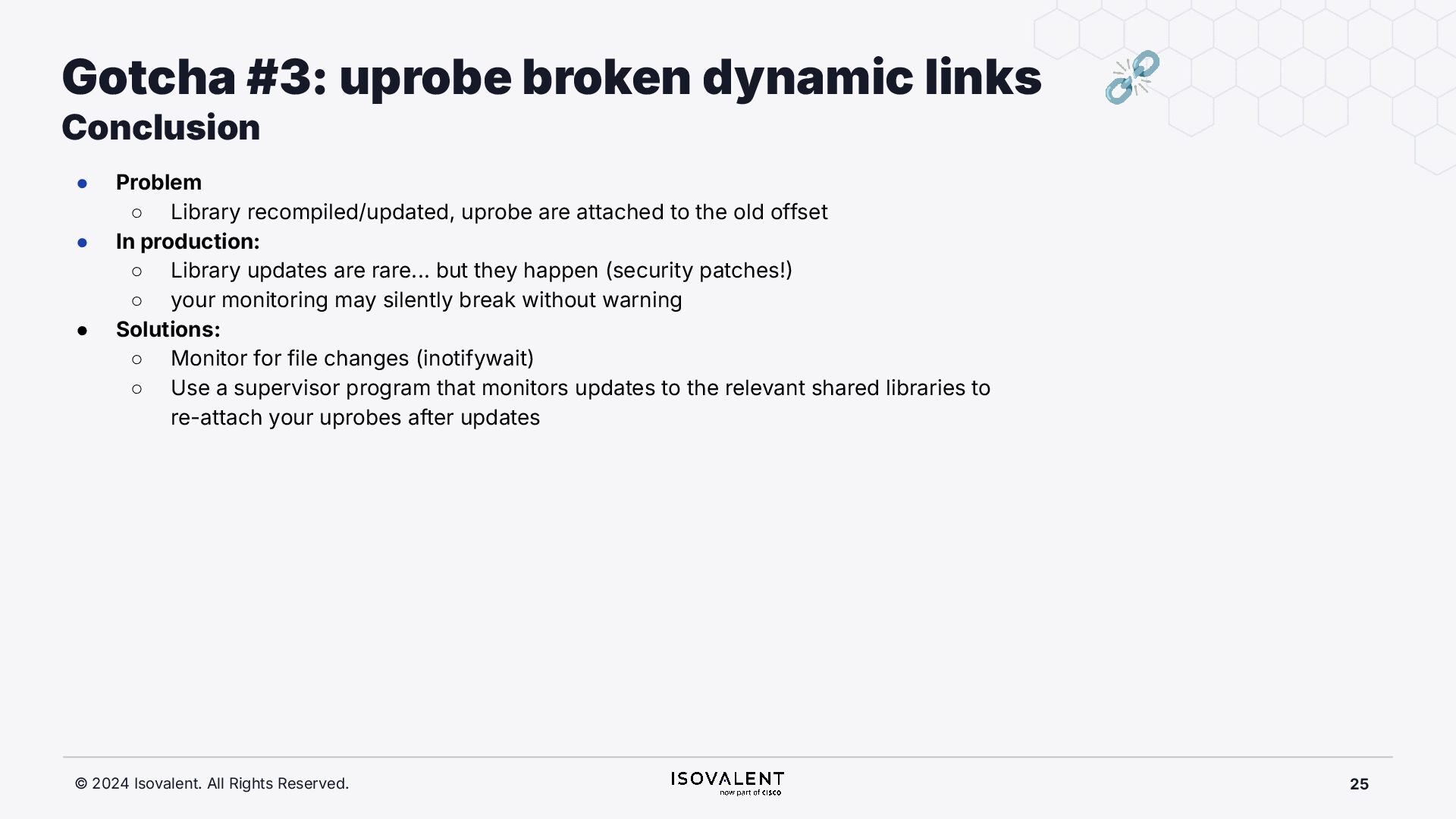
    broken dynamic links 󰺼 Conclusion • Problem ◦ Library recompiled/updated, uprobe are attached to the old offset • In production: ◦ Library updates are rare... but they happen (security patches! ◦ your monitoring may silently break without warning • Solutions: ◦ Monitor for file changes (inotifywait) ◦ Use a supervisor program that monitors updates to the relevant shared libraries to re-attach your uprobes after updates
  23. © 2024 Isovalent. All Rights Reserved. 28 What is inlining?

    Inlining is an optimization where a function call is replaced with the actual code of the function itself at the point of call.
  24. © 2024 Isovalent. All Rights Reserved. 29 Gotcha #4: kprobe/uprobe

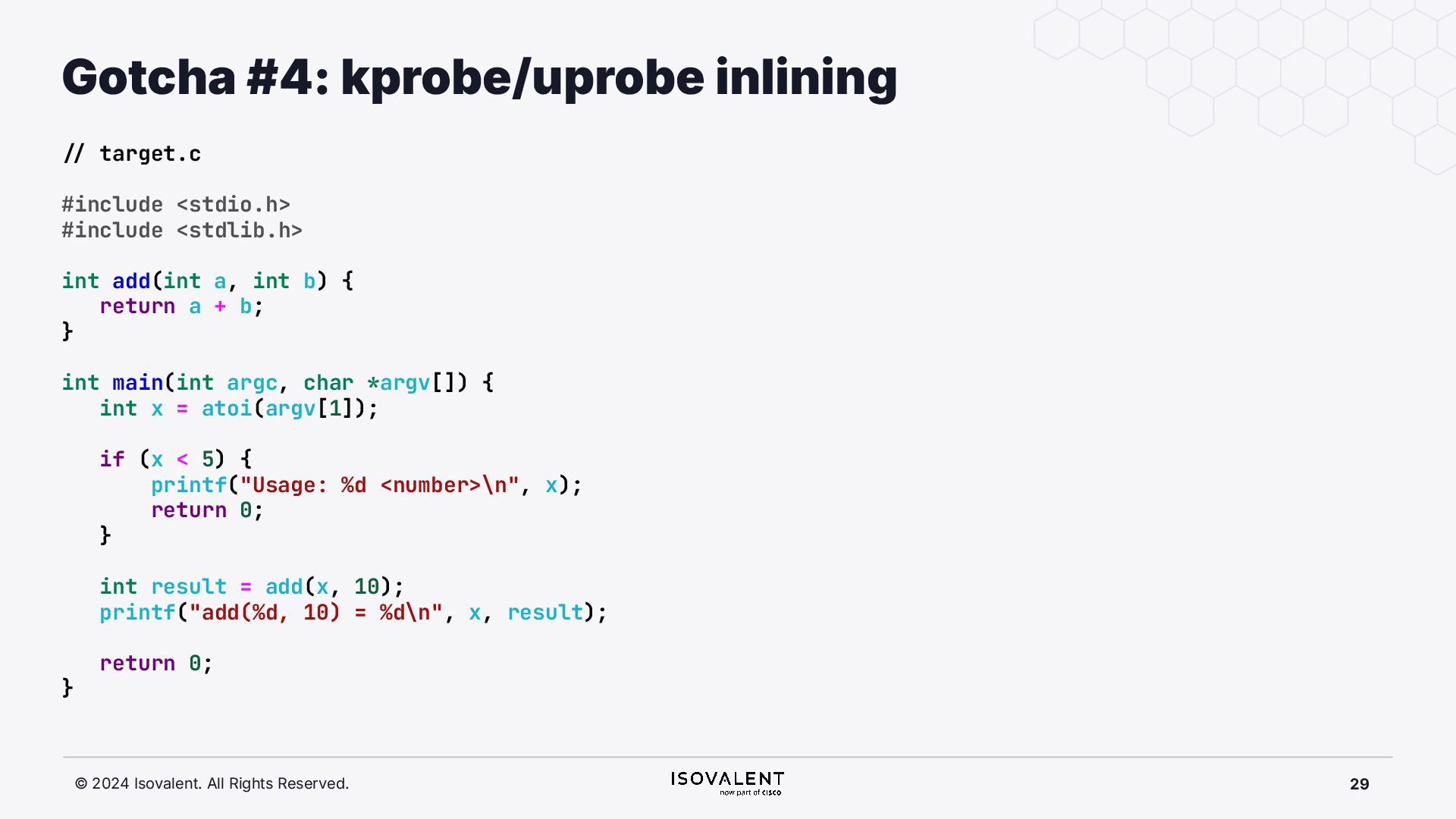
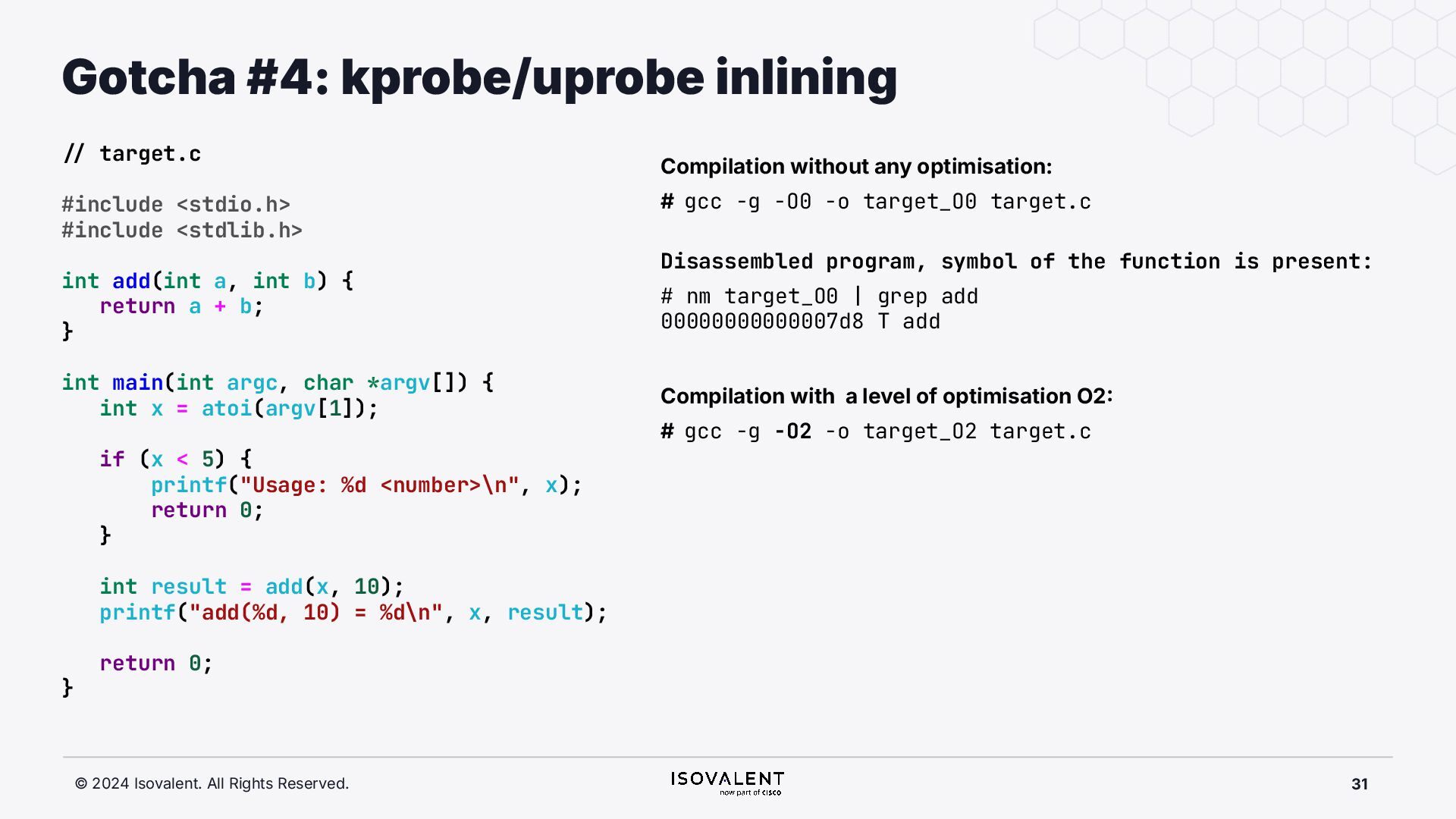
    inlining ./ target.c #include <stdio.h> #include <stdlib.h> int add(int a, int b) { return a + b; } int main(int argc, char *argv[]) { int x = atoi(argv[1]); if (x < 5) { printf("Usage: %d <number>\n", x); return 0; } int result = add(x, 10); printf("add(%d, 10) = %d\n", x, result); return 0; }
  25. © 2024 Isovalent. All Rights Reserved. 30 Gotcha #4: kprobe/uprobe

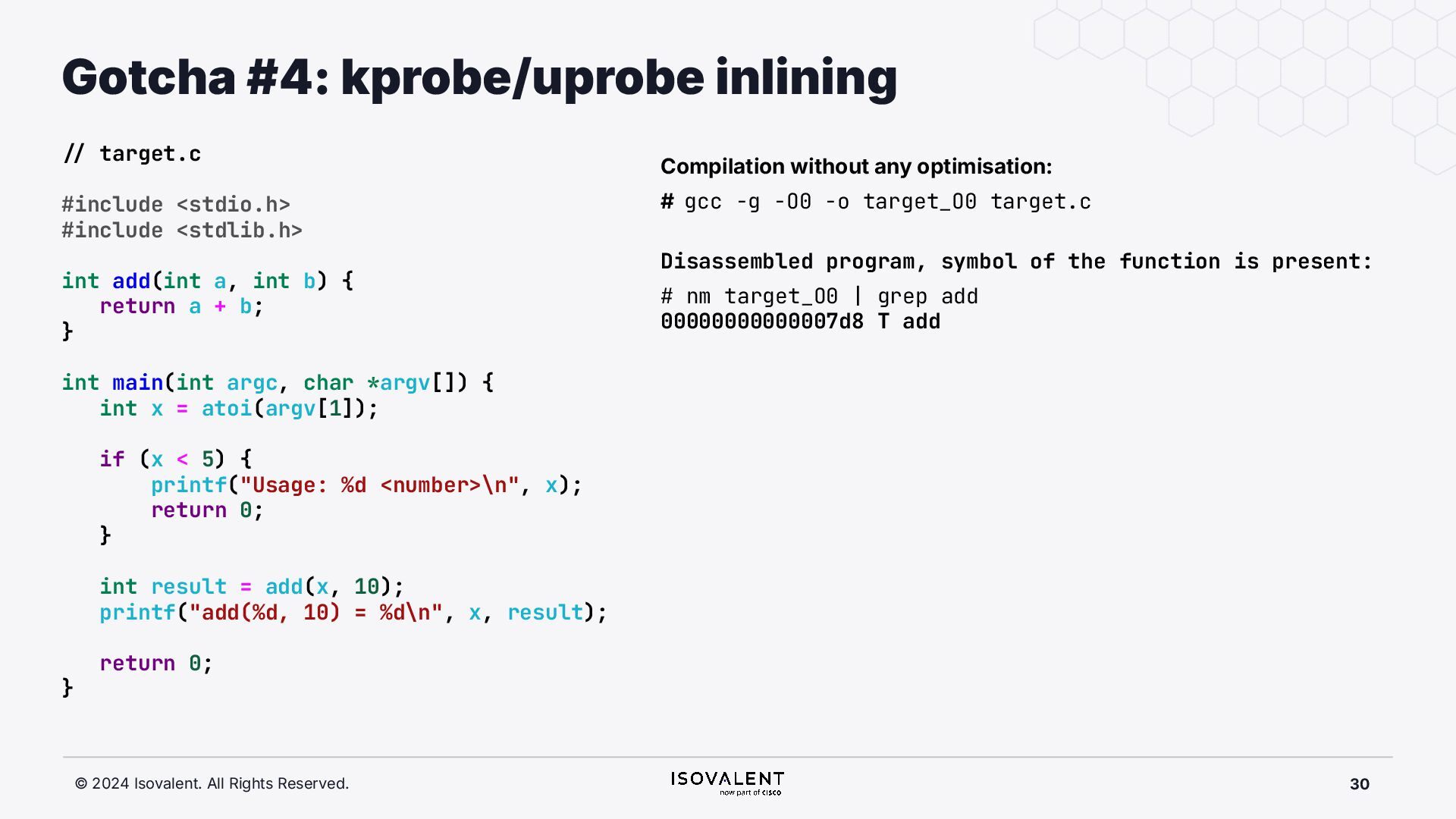
    inlining ./ target.c #include <stdio.h> #include <stdlib.h> int add(int a, int b) { return a + b; } int main(int argc, char *argv[]) { int x = atoi(argv[1]); if (x < 5) { printf("Usage: %d <number>\n", x); return 0; } int result = add(x, 10); printf("add(%d, 10) = %d\n", x, result); return 0; } Compilation without any optimisation: # gcc -g -O0 -o target_O0 target.c Disassembled program, symbol of the function is present: # nm target_O0 | grep add 00000000000007d8 T add
  26. © 2024 Isovalent. All Rights Reserved. 31 Gotcha #4: kprobe/uprobe

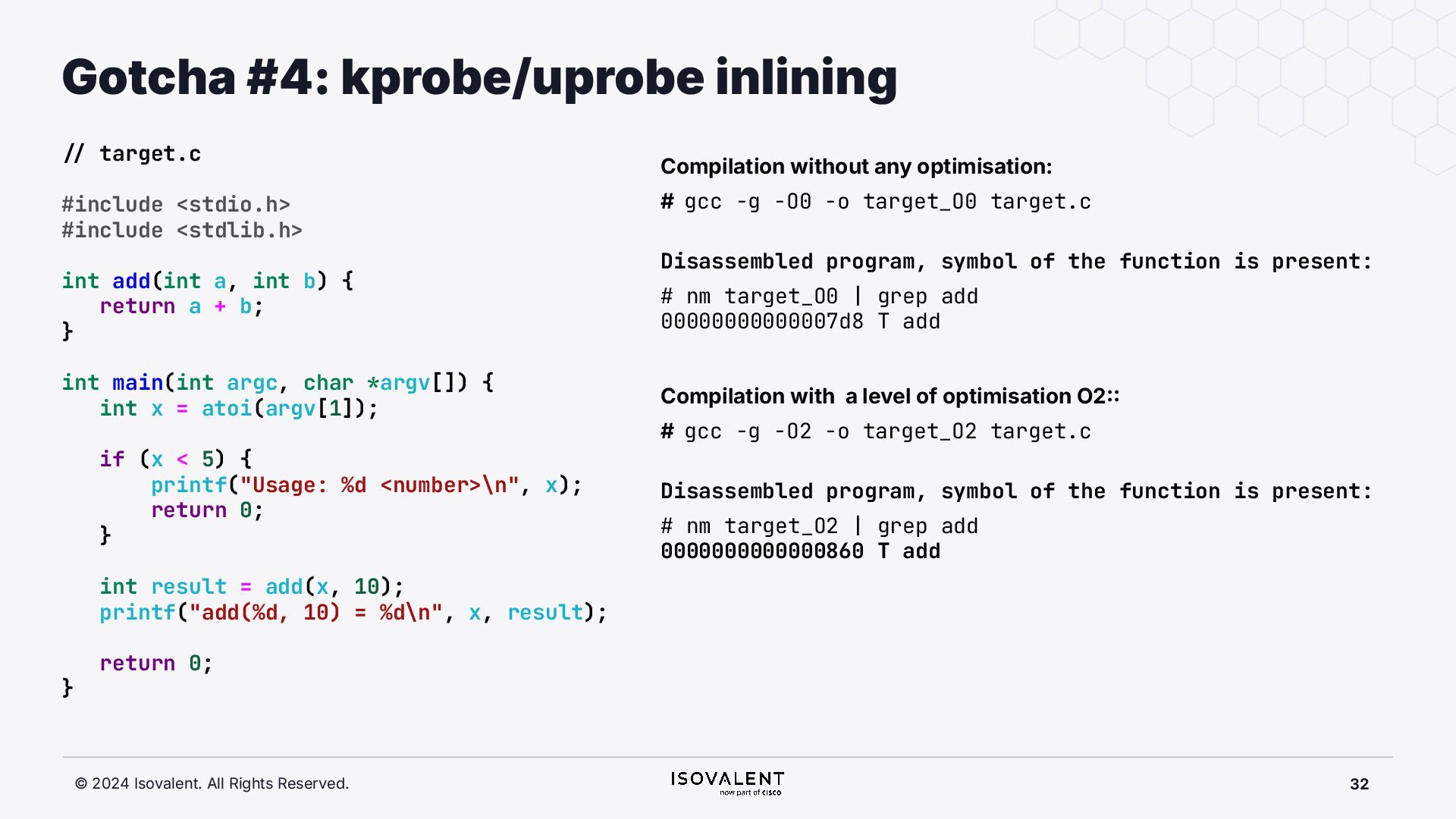
    inlining ./ target.c #include <stdio.h> #include <stdlib.h> int add(int a, int b) { return a + b; } int main(int argc, char *argv[]) { int x = atoi(argv[1]); if (x < 5) { printf("Usage: %d <number>\n", x); return 0; } int result = add(x, 10); printf("add(%d, 10) = %d\n", x, result); return 0; } Compilation without any optimisation: # gcc -g -O0 -o target_O0 target.c Disassembled program, symbol of the function is present: # nm target_O0 | grep add 00000000000007d8 T add Compilation with a level of optimisation O2 # gcc -g -O2 -o target_O2 target.c
  27. © 2024 Isovalent. All Rights Reserved. 32 Gotcha #4: kprobe/uprobe

    inlining ./ target.c #include <stdio.h> #include <stdlib.h> int add(int a, int b) { return a + b; } int main(int argc, char *argv[]) { int x = atoi(argv[1]); if (x < 5) { printf("Usage: %d <number>\n", x); return 0; } int result = add(x, 10); printf("add(%d, 10) = %d\n", x, result); return 0; } Compilation without any optimisation: # gcc -g -O0 -o target_O0 target.c Disassembled program, symbol of the function is present: # nm target_O0 | grep add 00000000000007d8 T add Compilation with a level of optimisation O2 # gcc -g -O2 -o target_O2 target.c Disassembled program, symbol of the function is present: # nm target_O2 | grep add 0000000000000860 T add
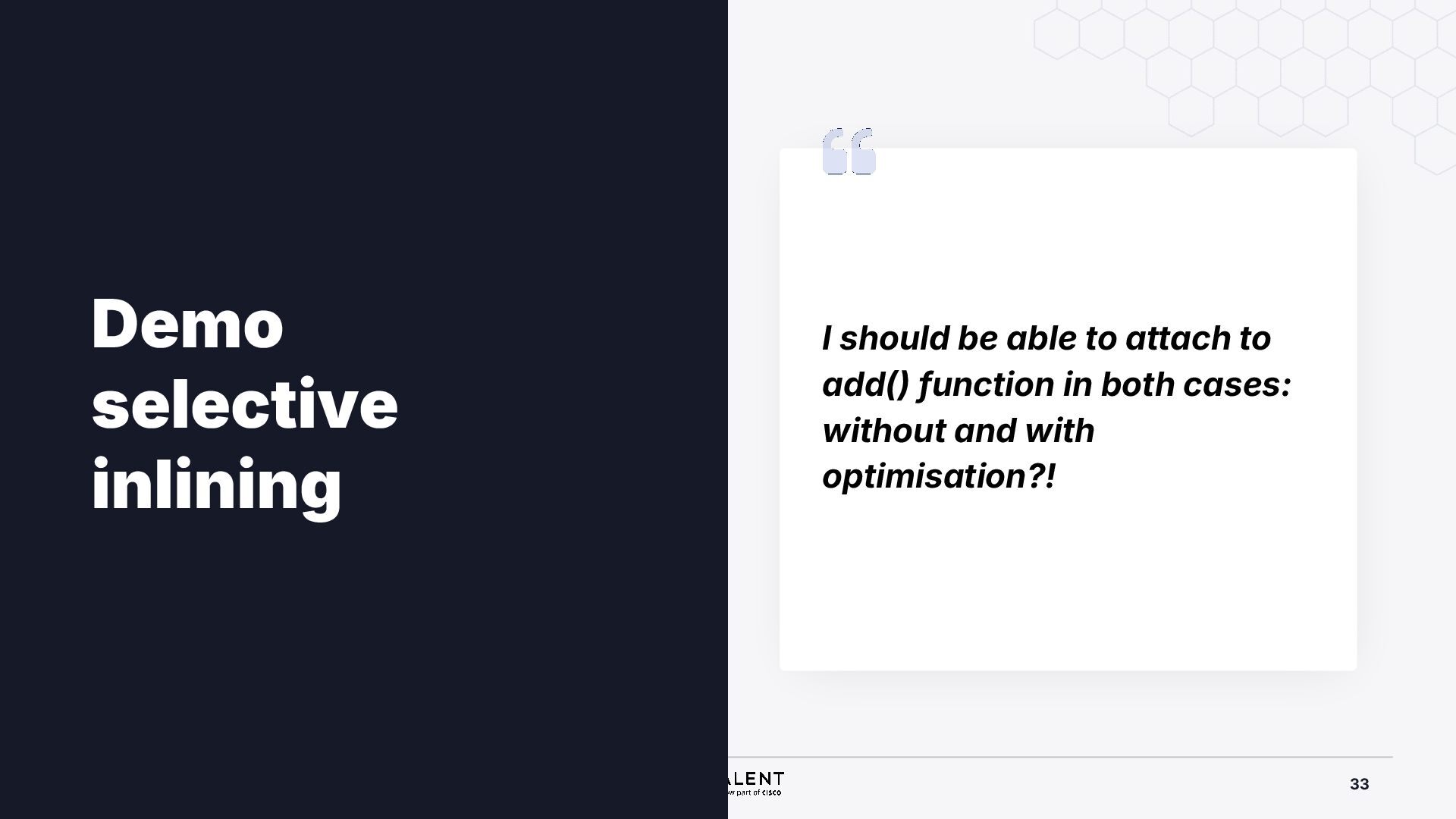
  28. © 2024 Isovalent. All Rights Reserved. 33 Demo selective inlining

    I should be able to attach to add() function in both cases: without and with optimisation?!
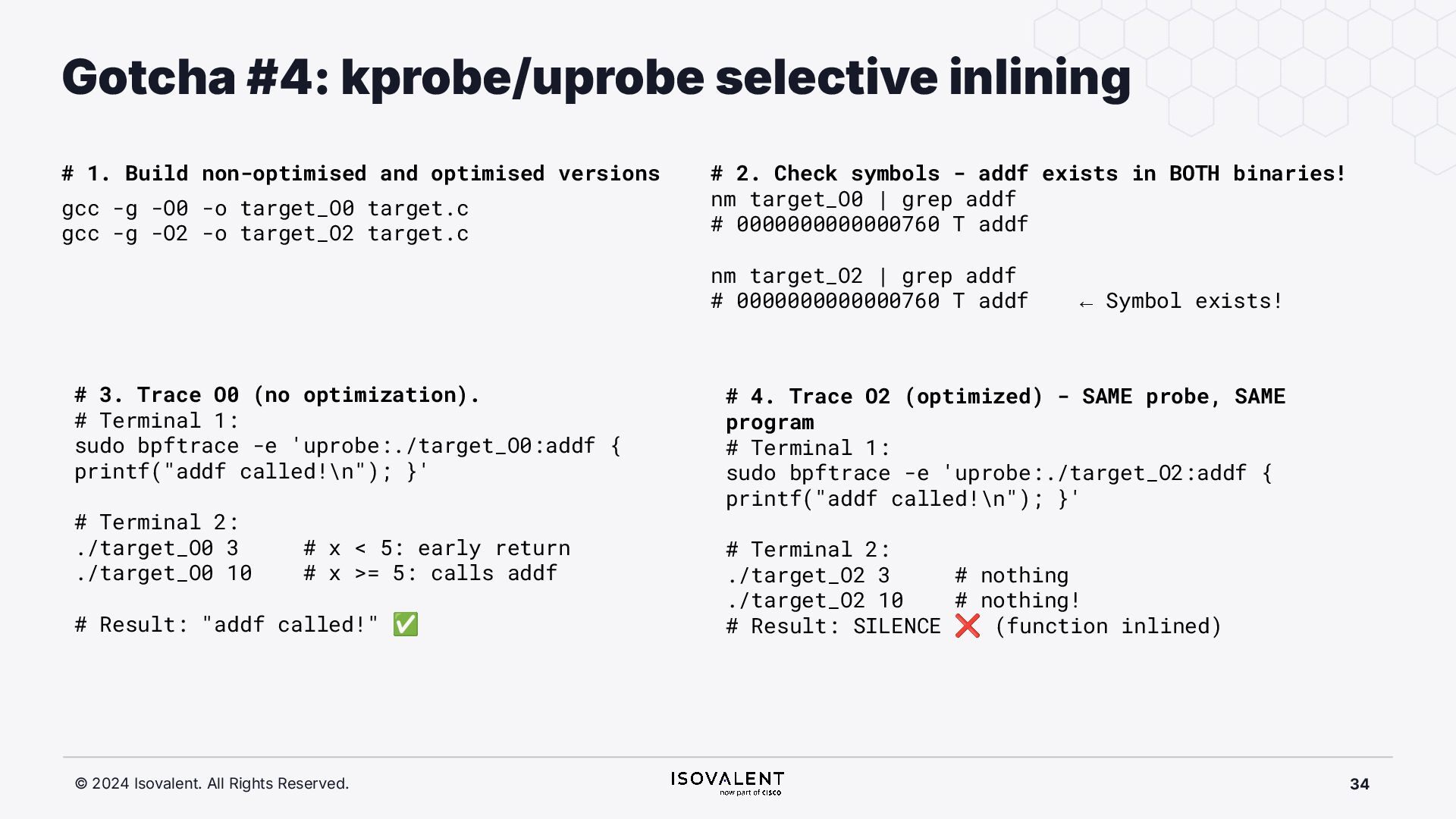
  29. © 2024 Isovalent. All Rights Reserved. 34 Gotcha #4: kprobe/uprobe

    selective inlining # 1. Build non-optimised and optimised versions gcc -g -O0 -o target_O0 target.c gcc -g -O2 -o target_O2 target.c # 2. Check symbols - addf exists in BOTH binaries! nm target_O0 | grep addf # 0000000000000760 T addf nm target_O2 | grep addf # 0000000000000760 T addf ← Symbol exists! # 3. Trace O0 (no optimization). # Terminal 1: sudo bpftrace -e 'uprobe:./target_O0:addf { printf("addf called!\n"); }' # Terminal 2: ./target_O0 3 # x < 5: early return ./target_O0 10 # x >= 5: calls addf # Result: "addf called!" ✅ # 4. Trace O2 (optimized) - SAME probe, SAME program # Terminal 1: sudo bpftrace -e 'uprobe:./target_O2:addf { printf("addf called!\n"); }' # Terminal 2: ./target_O2 3 # nothing ./target_O2 10 # nothing! # Result: SILENCE ❌ (function inlined)
  30. © 2024 Isovalent. All Rights Reserved. 35 Gotcha #4: kprobe/uprobe

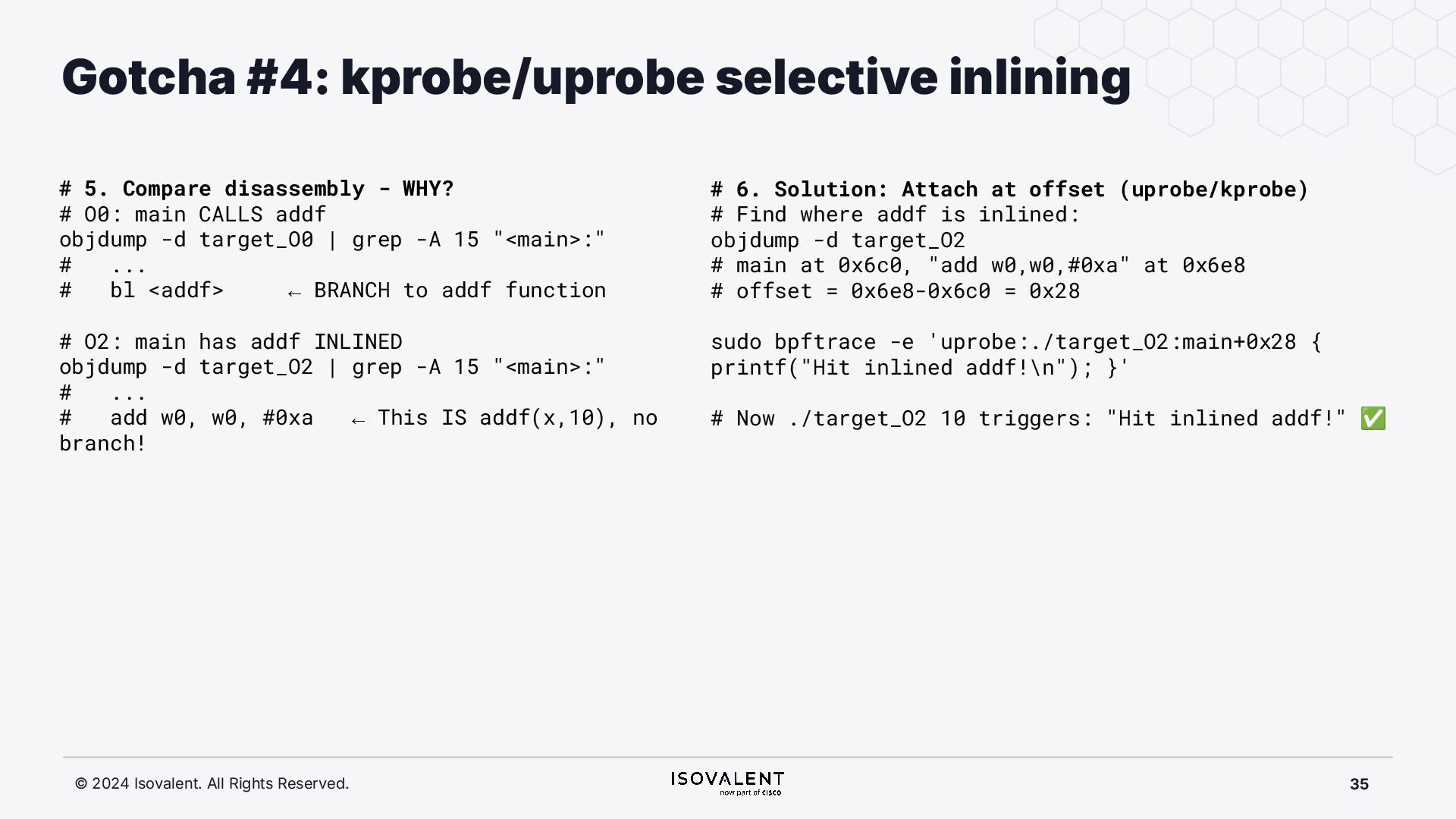
    selective inlining # 5. Compare disassembly - WHY? # O0: main CALLS addf objdump -d target_O0 | grep -A 15 "<main>:" # ... # bl <addf> ← BRANCH to addf function # O2: main has addf INLINED objdump -d target_O2 | grep -A 15 "<main>:" # ... # add w0, w0, #0xa ← This IS addf(x,10), no branch! # 6. Solution: Attach at offset (uprobe/kprobe) # Find where addf is inlined: objdump -d target_O2 # main at 0x6c0, "add w0,w0,#0xa" at 0x6e8 # offset = 0x6e8-0x6c0 = 0x28 sudo bpftrace -e 'uprobe:./target_O2:main+0x28 { printf("Hit inlined addf!\n"); }' # Now ./target_O2 10 triggers: "Hit inlined addf!" ✅
  31. © 2024 Isovalent. All Rights Reserved. 36 Gotcha #4: kprobe/uprobe

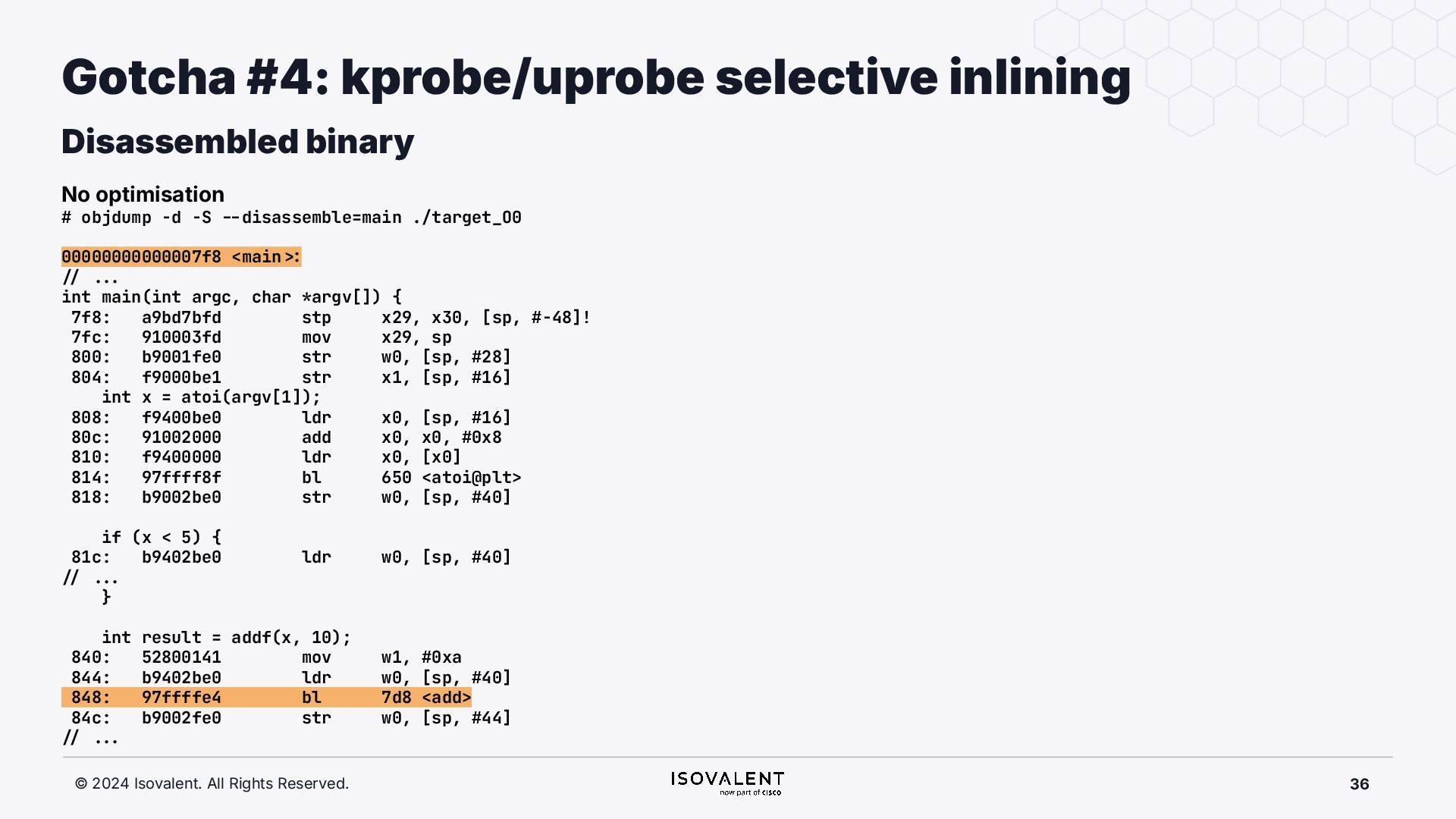
    selective inlining Disassembled binary No optimisation # objdump -d -S .-disassemble=main ./target_O0 00000000000007f8 <main.: ./ ... int main(int argc, char *argv[]) { 7f8: a9bd7bfd stp x29, x30, [sp, #-48]! 7fc: 910003fd mov x29, sp 800: b9001fe0 str w0, [sp, #28] 804: f9000be1 str x1, [sp, #16] int x = atoi(argv[1]); 808: f9400be0 ldr x0, [sp, #16] 80c: 91002000 add x0, x0, #0x8 810: f9400000 ldr x0, [x0] 814: 97ffff8f bl 650 <atoi@plt> 818: b9002be0 str w0, [sp, #40] if (x < 5) { 81c: b9402be0 ldr w0, [sp, #40] ./ ... } int result = addf(x, 10); 840: 52800141 mov w1, #0xa 844: b9402be0 ldr w0, [sp, #40] 848: 97ffffe4 bl 7d8 <add> 84c: b9002fe0 str w0, [sp, #44] ./ ...
  32. © 2024 Isovalent. All Rights Reserved. 37 Gotcha #4: kprobe/uprobe

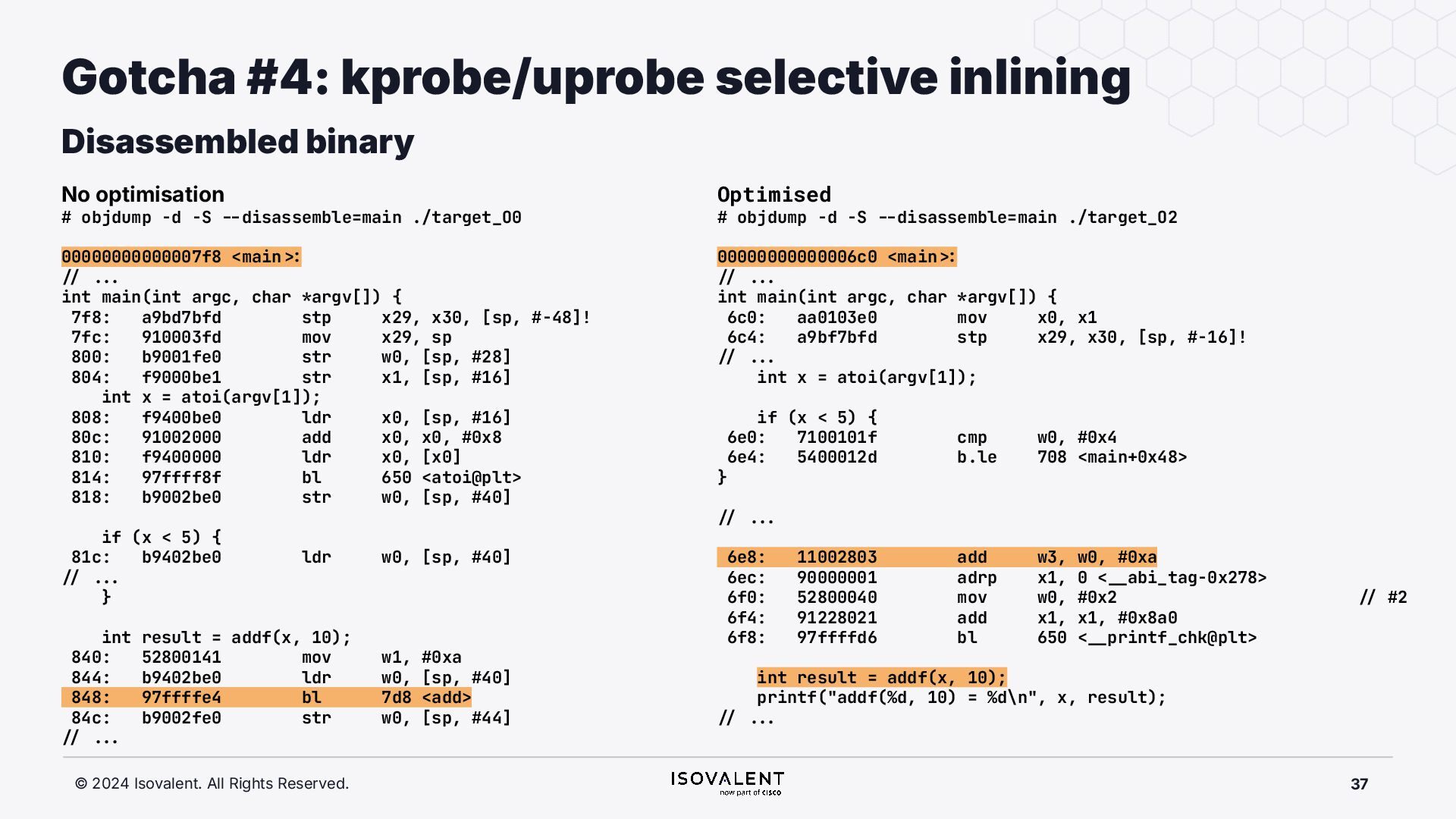
    selective inlining Disassembled binary No optimisation # objdump -d -S .-disassemble=main ./target_O0 00000000000007f8 <main.: ./ ... int main(int argc, char *argv[]) { 7f8: a9bd7bfd stp x29, x30, [sp, #-48]! 7fc: 910003fd mov x29, sp 800: b9001fe0 str w0, [sp, #28] 804: f9000be1 str x1, [sp, #16] int x = atoi(argv[1]); 808: f9400be0 ldr x0, [sp, #16] 80c: 91002000 add x0, x0, #0x8 810: f9400000 ldr x0, [x0] 814: 97ffff8f bl 650 <atoi@plt> 818: b9002be0 str w0, [sp, #40] if (x < 5) { 81c: b9402be0 ldr w0, [sp, #40] ./ ... } int result = addf(x, 10); 840: 52800141 mov w1, #0xa 844: b9402be0 ldr w0, [sp, #40] 848: 97ffffe4 bl 7d8 <add> 84c: b9002fe0 str w0, [sp, #44] ./ ... Optimised # objdump -d -S .-disassemble=main ./target_O2 00000000000006c0 <main.: ./ ... int main(int argc, char *argv[]) { 6c0: aa0103e0 mov x0, x1 6c4: a9bf7bfd stp x29, x30, [sp, #-16]! ./ ... int x = atoi(argv[1]); if (x < 5) { 6e0: 7100101f cmp w0, #0x4 6e4: 5400012d b.le 708 <main+0x48> } ./ ... 6e8: 11002803 add w3, w0, #0xa 6ec: 90000001 adrp x1, 0 <._abi_tag-0x278> 6f0: 52800040 mov w0, #0x2 ./ #2 6f4: 91228021 add x1, x1, #0x8a0 6f8: 97ffffd6 bl 650 <._printf_chk@plt> int result = addf(x, 10); printf("addf(%d, 10) = %d\n", x, result); ./ ...
  33. © 2024 Isovalent. All Rights Reserved. 38 Gotcha #4: kprobe/uprobe

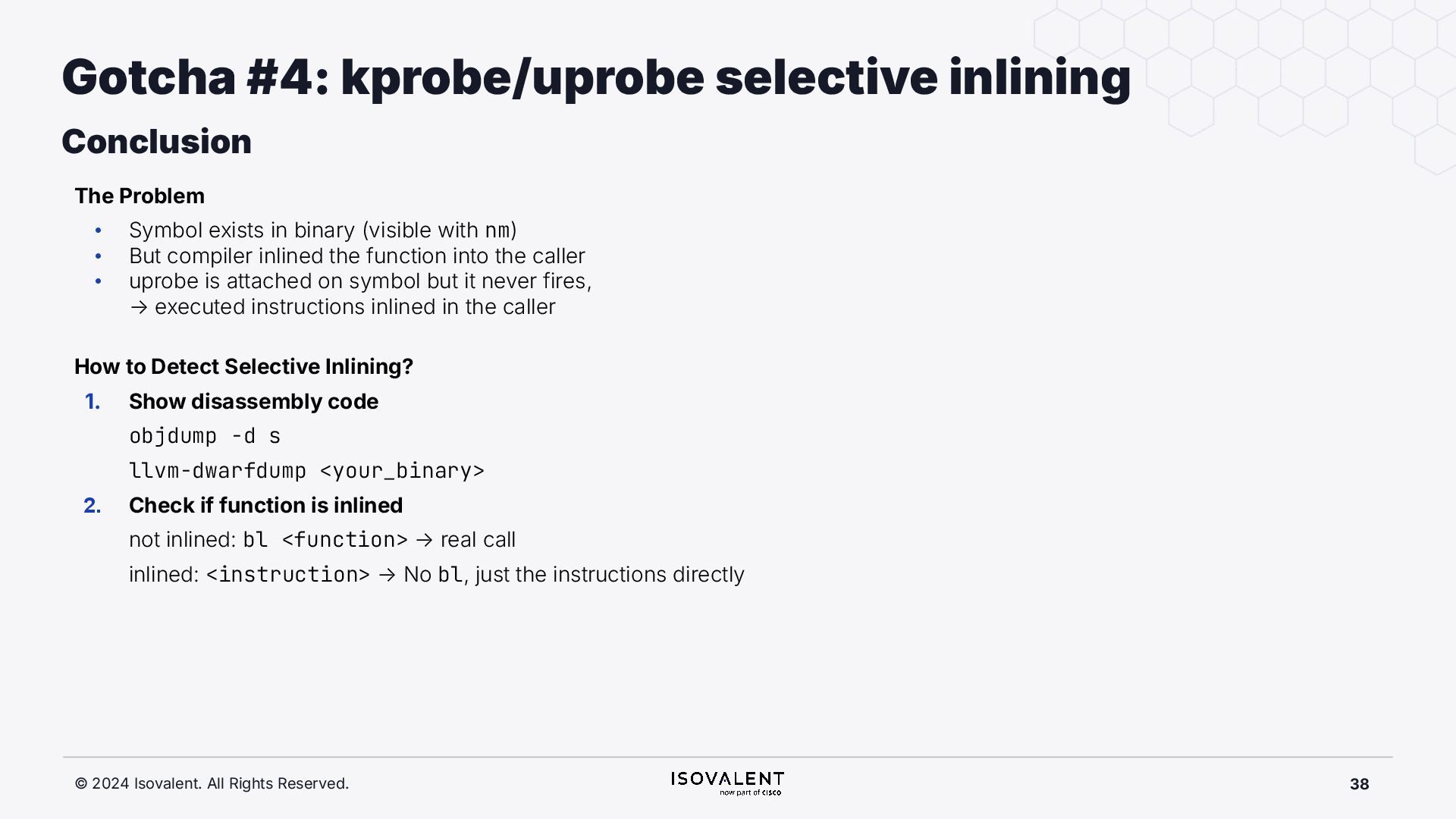
    selective inlining Conclusion The Problem • Symbol exists in binary (visible with nm) • But compiler inlined the function into the caller • uprobe is attached on symbol but it never fires, → executed instructions inlined in the caller How to Detect Selective Inlining? 1. Show disassembly code objdump -d s llvm-dwarfdump <your_binary> 2. Check if function is inlined not inlined: bl <function> → real call inlined: <instruction> → No bl, just the instructions directly
  34. © 2024 Isovalent. All Rights Reserved. 39 Gotcha #4: kprobe/uprobe

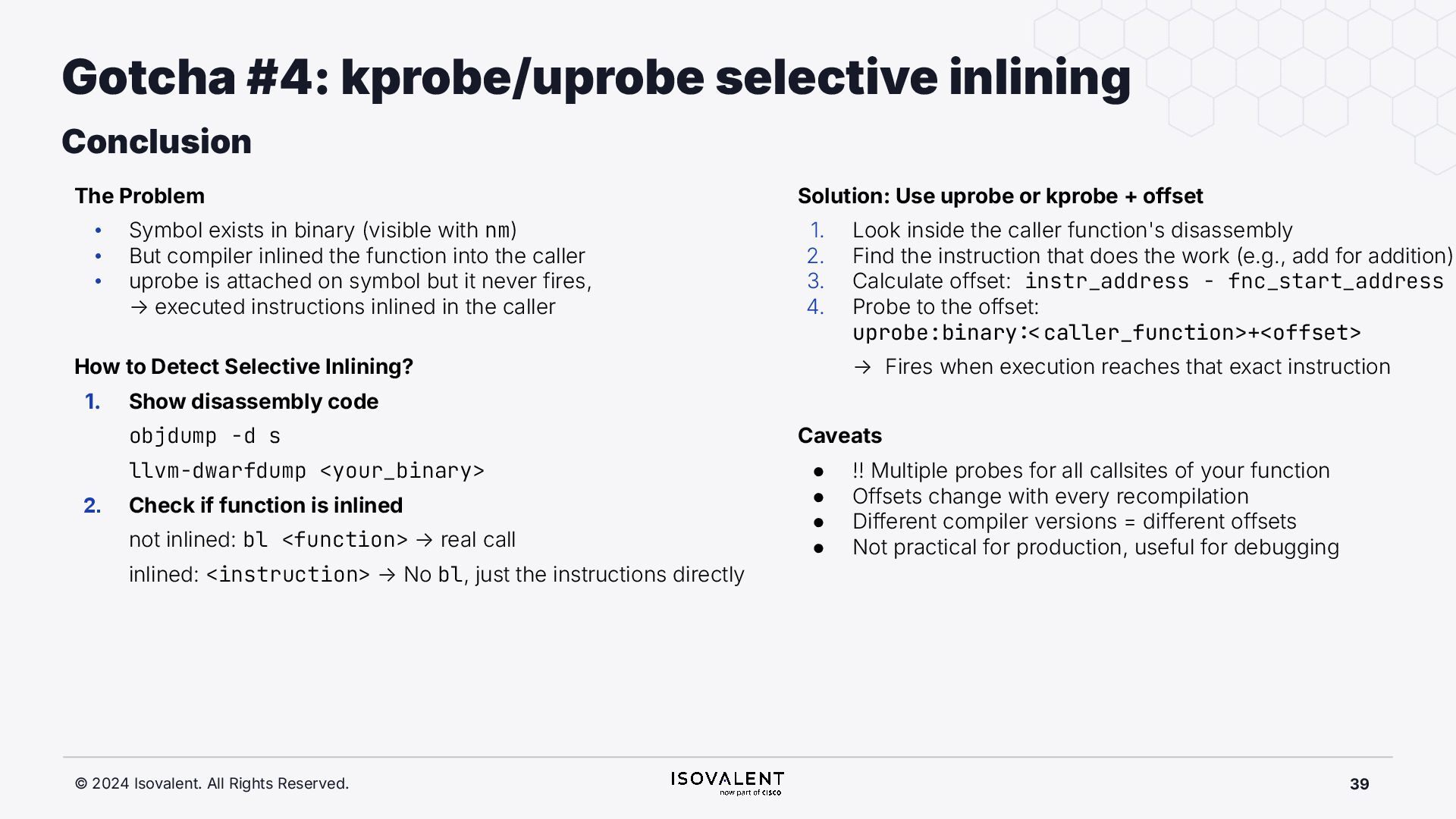
    selective inlining Conclusion The Problem • Symbol exists in binary (visible with nm) • But compiler inlined the function into the caller • uprobe is attached on symbol but it never fires, → executed instructions inlined in the caller How to Detect Selective Inlining? 1. Show disassembly code objdump -d s llvm-dwarfdump <your_binary> 2. Check if function is inlined not inlined: bl <function> → real call inlined: <instruction> → No bl, just the instructions directly Solution: Use uprobe or kprobe + offset 1. Look inside the caller function's disassembly 2. Find the instruction that does the work (e.g., add for addition) 3. Calculate offset: instr_address - fnc_start_address 4. Probe to the offset: uprobe:binary><caller_function>+<offset> → Fires when execution reaches that exact instruction Caveats • ‼ Multiple probes for all callsites of your function • Offsets change with every recompilation • Different compiler versions = different offsets • Not practical for production, useful for debugging
  35. © 2024 Isovalent. All Rights Reserved. 41 Gotcha #5: kprobe/uprobe

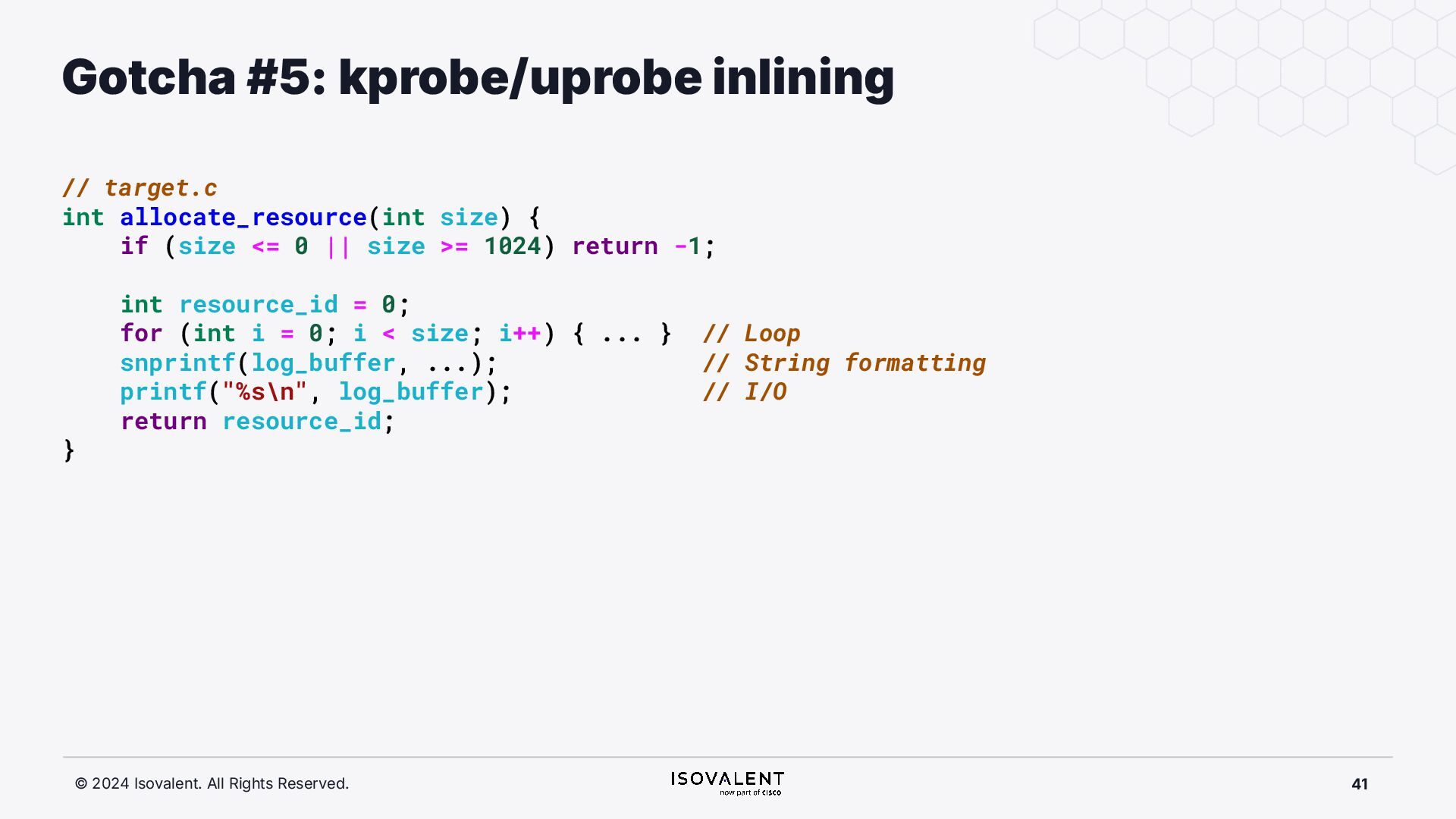
    inlining // target.c int allocate_resource(int size) { if (size <= 0 || size >= 1024) return -1; int resource_id = 0; for (int i = 0; i < size; i++) { ... } // Loop snprintf(log_buffer, ...); // String formatting printf("%s\n", log_buffer); // I/O return resource_id; }
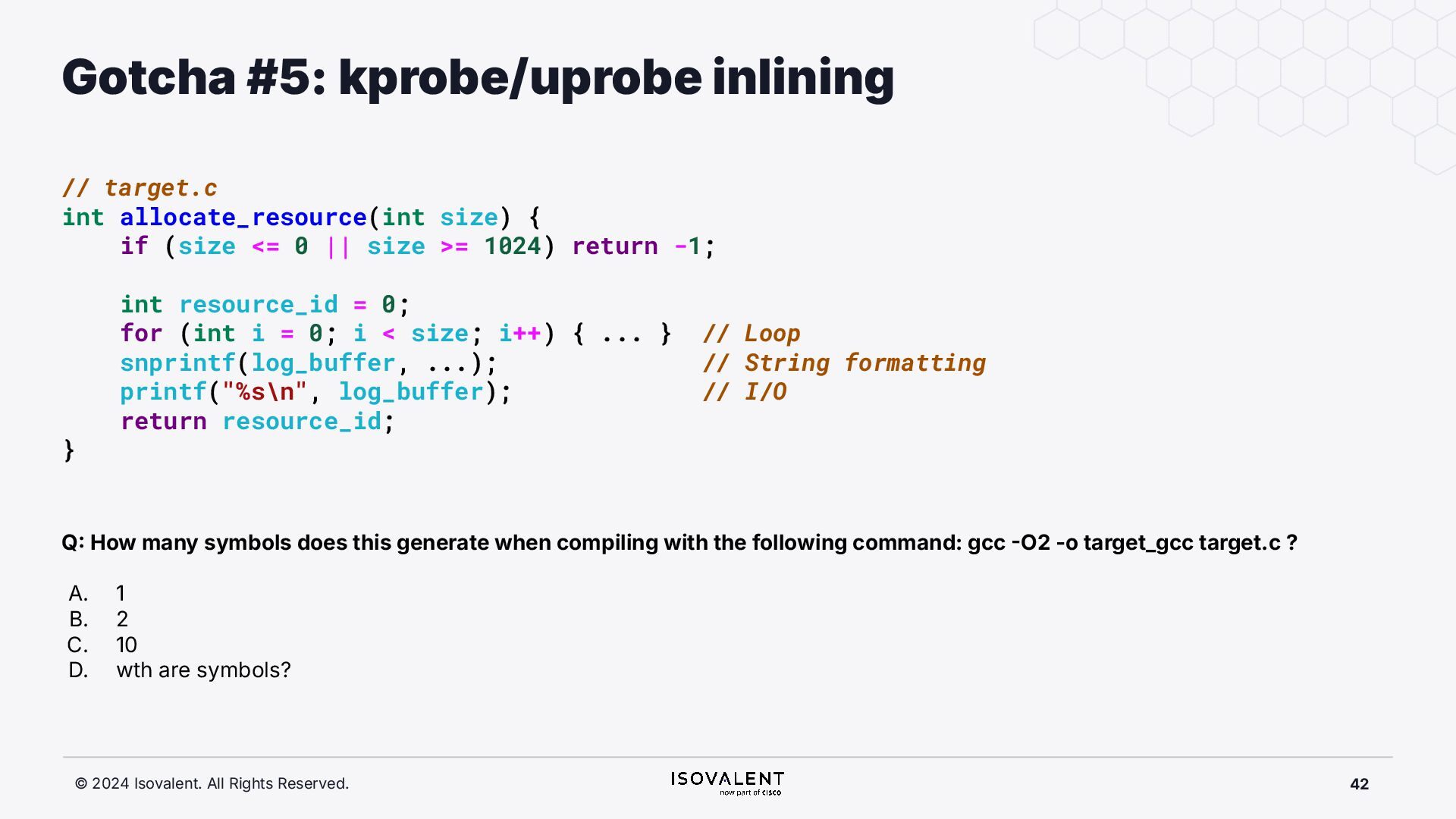
  36. © 2024 Isovalent. All Rights Reserved. 42 // target.c int

    allocate_resource(int size) { if (size <= 0 || size >= 1024) return -1; int resource_id = 0; for (int i = 0; i < size; i++) { ... } // Loop snprintf(log_buffer, ...); // String formatting printf("%s\n", log_buffer); // I/O return resource_id; } Q How many symbols does this generate when compiling with the following command: gcc O2 -o target_gcc target.c ? A. 1 B. 2 C. 10 D. wth are symbols? Gotcha #5: kprobe/uprobe inlining
  37. © 2024 Isovalent. All Rights Reserved. 43 Gotcha #5: kprobe/uprobe

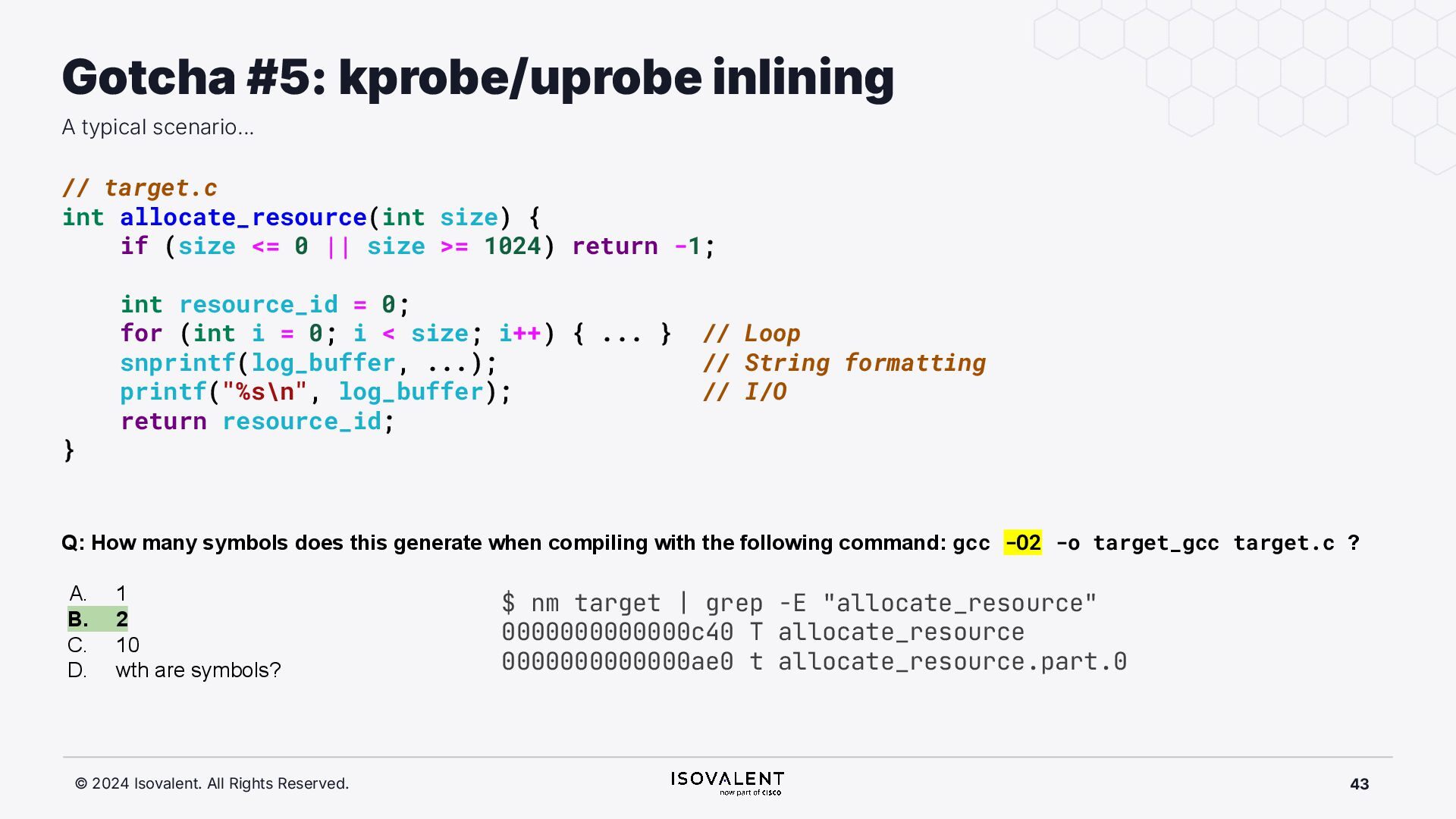
    inlining A typical scenario... // target.c int allocate_resource(int size) { if (size <= 0 || size >= 1024) return -1; int resource_id = 0; for (int i = 0; i < size; i++) { ... } // Loop snprintf(log_buffer, ...); // String formatting printf("%s\n", log_buffer); // I/O return resource_id; } Q: How many symbols does this generate when compiling with the following command: gcc -O2 -o target_gcc target.c ? A. 1 B. 2 C. 10 D. wth are symbols? $ nm target | grep -E "allocate_resource" 0000000000000c40 T allocate_resource 0000000000000ae0 t allocate_resource.part.0
  38. © 2024 Isovalent. All Rights Reserved. 44 Gotcha #5: kprobe/uprobe

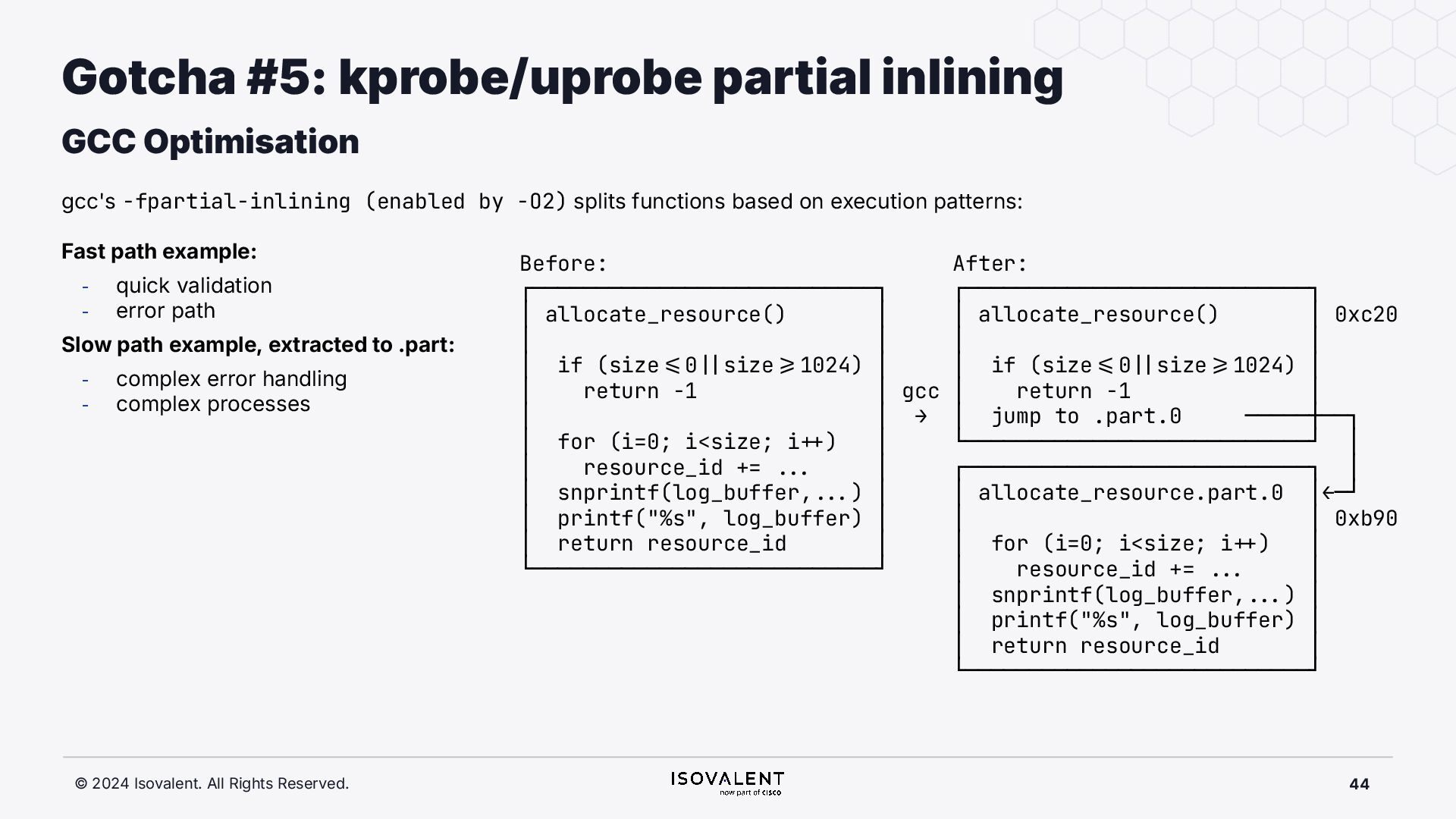
    partial inlining GCC Optimisation Before: After: ┌───────────────────────────┐ ┌───────────────────────────┐ │ allocate_resource() │ │ allocate_resource() │ 0xc20 │ │ │ │ │ if (size>=0>|size>=1024) │ │ if (size>=0>|size>=1024) │ │ return -1 │ gcc │ return -1 │ │ │ → │ jump to .part.0 ─────┼──┐ │ for (i=0; i<size; i>+) │ └───────────────────────────┘ │ │ resource_id += >>. │ ┌───────────────────────────┐ │ │ snprintf(log_buffer,>>.) │ │ allocate_resource.part.0 │←─┘ │ printf("%s", log_buffer) │ │ │ 0xb90 │ return resource_id │ │ for (i=0; i<size; i>+) │ └───────────────────────────┘ │ resource_id += >>. │ │ snprintf(log_buffer,>>.) │ │ printf("%s", log_buffer) │ │ return resource_id │ └───────────────────────────┘ gcc's -fpartial-inlining (enabled by -O2) splits functions based on execution patterns: Fast path example: - quick validation - error path Slow path example, extracted to .part: - complex error handling - complex processes
  39. © 2024 Isovalent. All Rights Reserved. 45 Gotcha #5: kprobe/uprobe

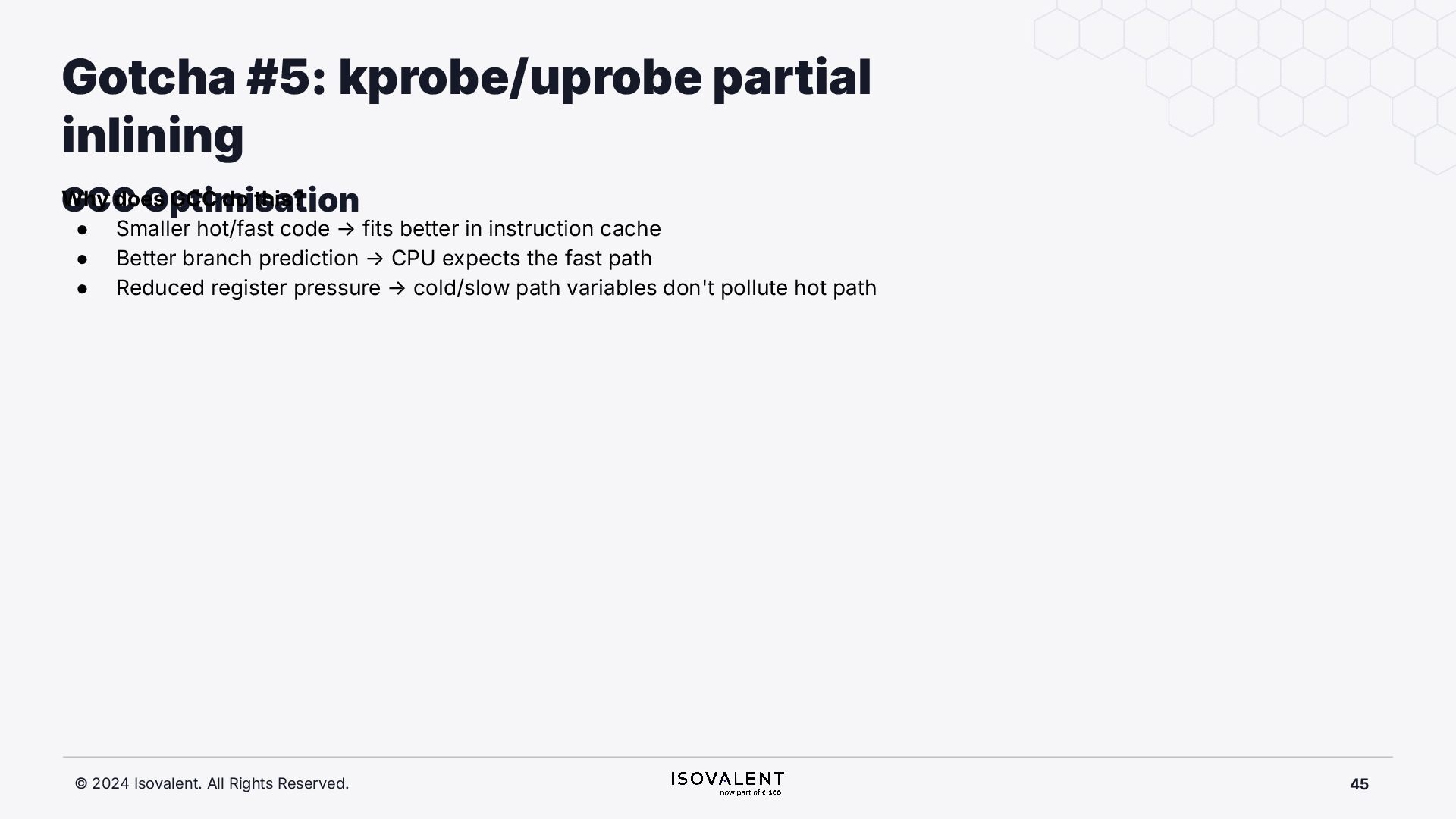
    partial inlining GCC Optimisation Why does GCC do this? • Smaller hot/fast code → fits better in instruction cache • Better branch prediction → CPU expects the fast path • Reduced register pressure → cold/slow path variables don't pollute hot path
  40. © 2024 Isovalent. All Rights Reserved. 46 Gotcha #5: kprobe/uprobe

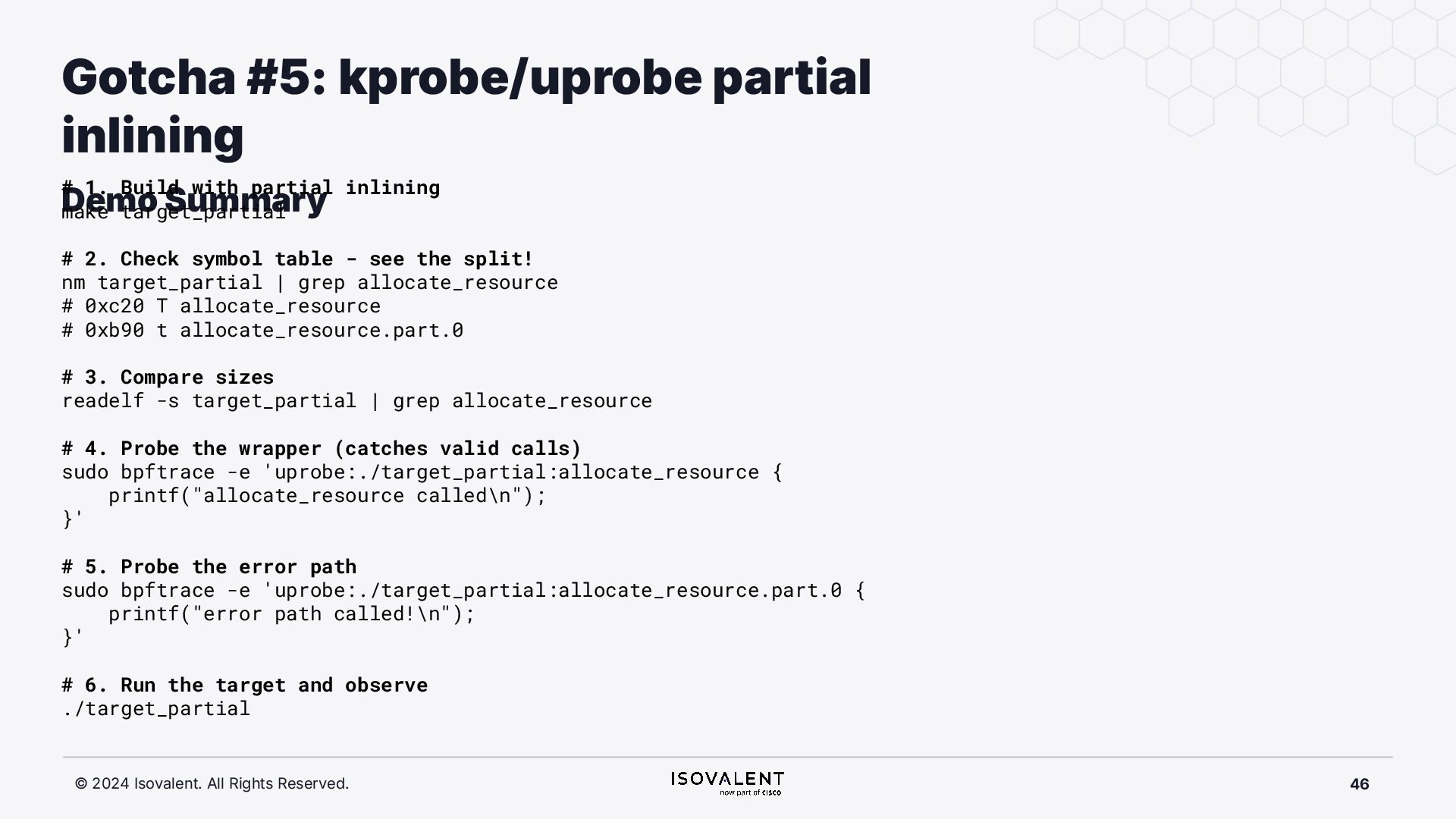
    partial inlining Demo Summary # 1. Build with partial inlining make target_partial # 2. Check symbol table - see the split! nm target_partial | grep allocate_resource # 0xc20 T allocate_resource # 0xb90 t allocate_resource.part.0 # 3. Compare sizes readelf -s target_partial | grep allocate_resource # 4. Probe the wrapper (catches valid calls) sudo bpftrace -e 'uprobe:./target_partial:allocate_resource { printf("allocate_resource called\n"); }' # 5. Probe the error path sudo bpftrace -e 'uprobe:./target_partial:allocate_resource.part.0 { printf("error path called!\n"); }' # 6. Run the target and observe ./target_partial
  41. © 2024 Isovalent. All Rights Reserved. 47 Demo partial inlining

    So what about kprobe/uprobe attachments and symbols?
  42. © 2024 Isovalent. All Rights Reserved. 48 Gotcha #5: kprobe/uprobe

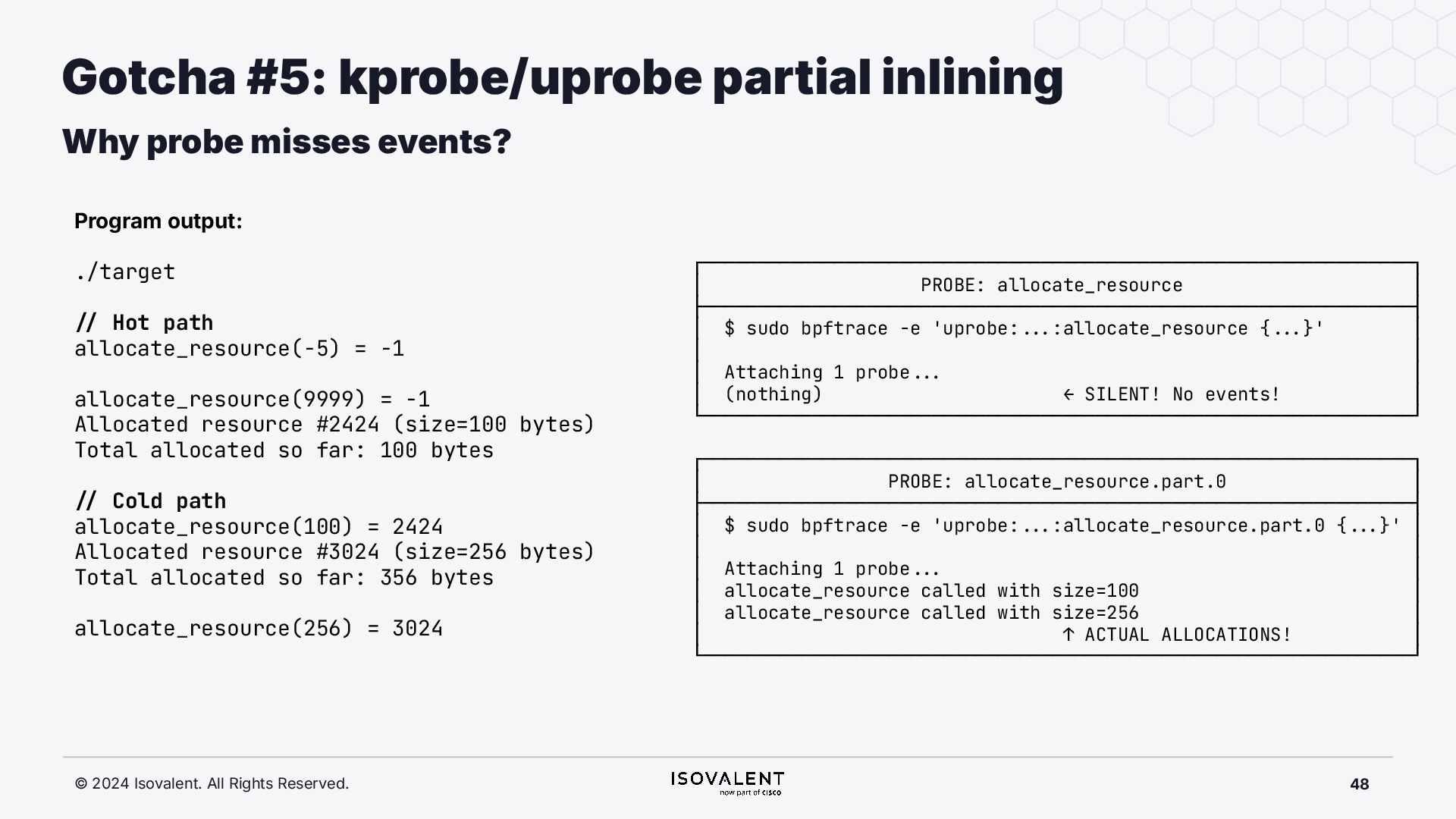
    partial inlining Why probe misses events? ┌─────────────────────────────────────────────────────────────────┐ │ PROBE: allocate_resource │ ├─────────────────────────────────────────────────────────────────┤ │ $ sudo bpftrace -e 'uprobe:>>.:allocate_resource {>>.}' │ │ │ │ Attaching 1 probe>>. │ │ (nothing) ← SILENT! No events! │ └─────────────────────────────────────────────────────────────────┘ ┌─────────────────────────────────────────────────────────────────┐ │ PROBE: allocate_resource.part.0 │ ├─────────────────────────────────────────────────────────────────┤ │ $ sudo bpftrace -e 'uprobe:>>.:allocate_resource.part.0 {>>.}' │ │ │ │ Attaching 1 probe>>. │ │ allocate_resource called with size=100 │ │ allocate_resource called with size=256 │ │ ↑ ACTUAL ALLOCATIONS! │ └─────────────────────────────────────────────────────────────────┘ Program output: ./target ./ Hot path allocate_resource(-5) = -1 allocate_resource(9999) = -1 Allocated resource #2424 (size=100 bytes) Total allocated so far: 100 bytes ./ Cold path allocate_resource(100) = 2424 Allocated resource #3024 (size=256 bytes) Total allocated so far: 356 bytes allocate_resource(256) = 3024
  43. © 2024 Isovalent. All Rights Reserved. 49 Gotcha #5: kprobe/uprobe

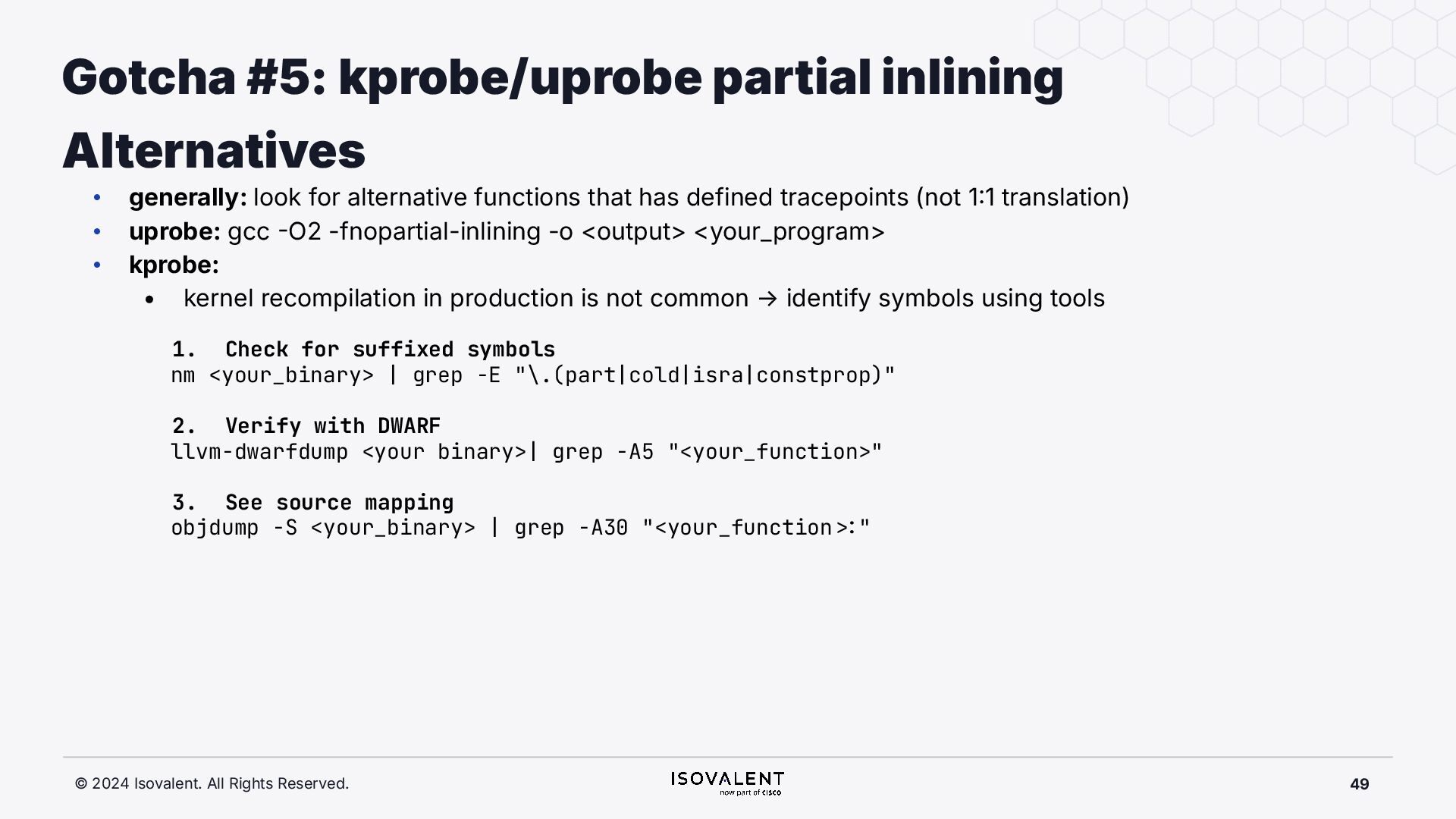
    partial inlining Alternatives • generally: look for alternative functions that has defined tracepoints (not 11 translation) • uprobe: gcc O2 -fnopartial-inlining -o <output> <your_program> • kprobe: • kernel recompilation in production is not common → identify symbols using tools 1. Check for suffixed symbols nm <your_binary> | grep -E "\.(part|cold|isra|constprop)" 2. Verify with DWARF llvm-dwarfdump <your binary>| grep -A5 "<your_function>" 3. See source mapping objdump -S <your_binary> | grep -A30 "<your_function>:"
  44. © 2024 Isovalent. All Rights Reserved. 51 Gotcha #6: missed

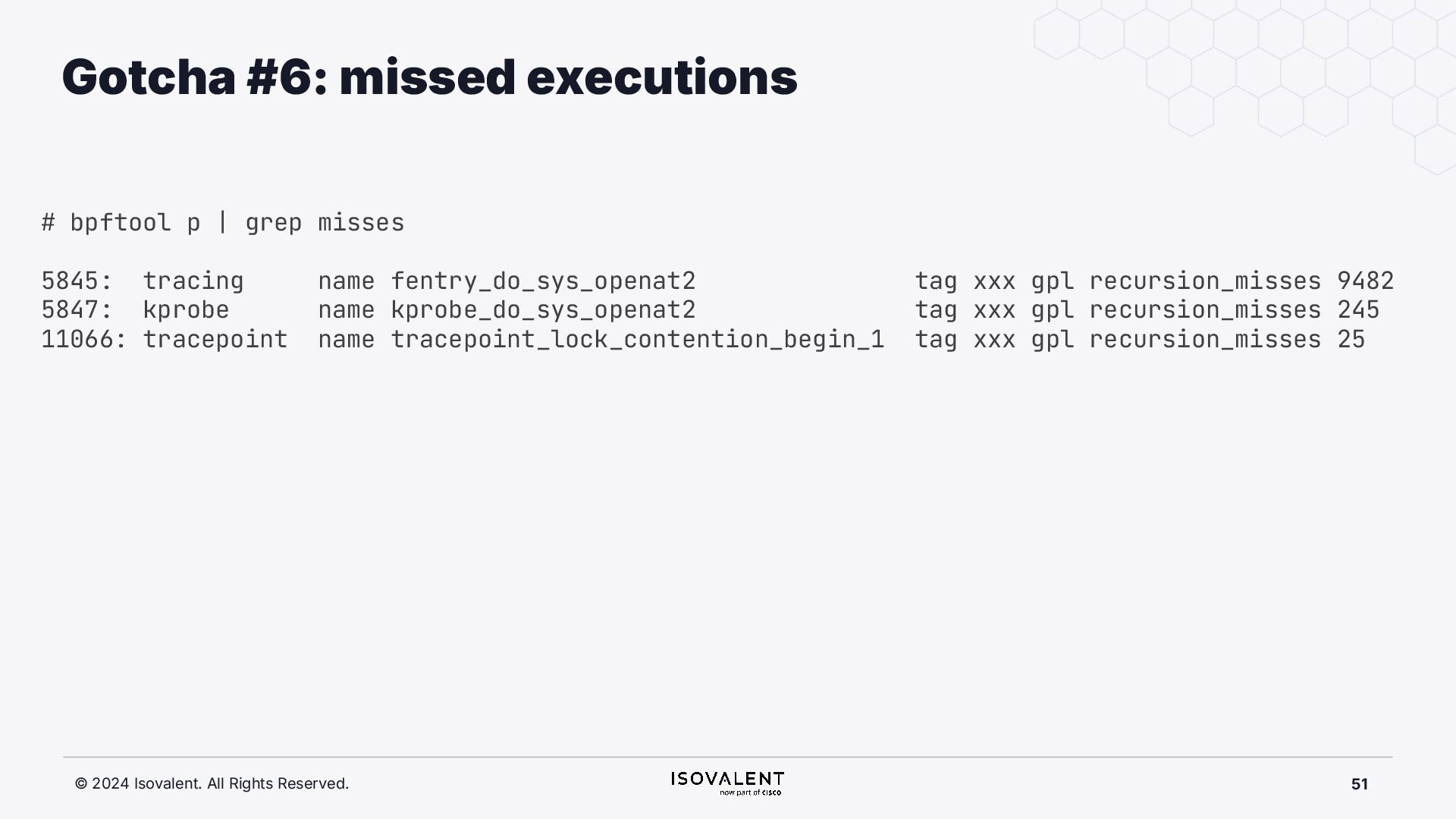
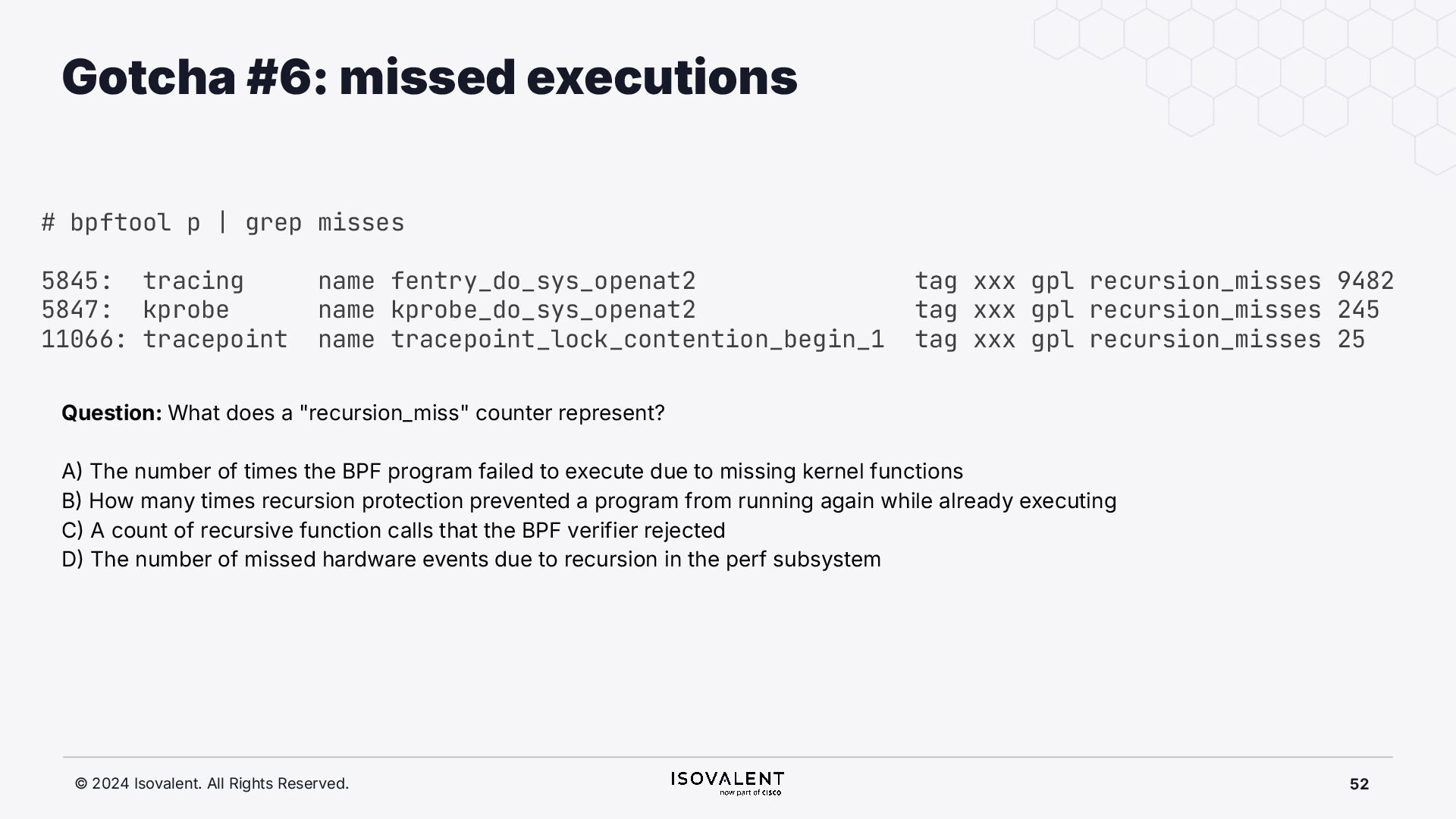
    executions # bpftool p | grep misses 5845: tracing name fentry_do_sys_openat2 tag xxx gpl recursion_misses 9482 5847: kprobe name kprobe_do_sys_openat2 tag xxx gpl recursion_misses 245 11066: tracepoint name tracepoint_lock_contention_begin_1 tag xxx gpl recursion_misses 25
  45. © 2024 Isovalent. All Rights Reserved. 52 Gotcha #6: missed

    executions Question: What does a "recursion_miss" counter represent? A The number of times the BPF program failed to execute due to missing kernel functions B How many times recursion protection prevented a program from running again while already executing C A count of recursive function calls that the BPF verifier rejected D The number of missed hardware events due to recursion in the perf subsystem # bpftool p | grep misses 5845: tracing name fentry_do_sys_openat2 tag xxx gpl recursion_misses 9482 5847: kprobe name kprobe_do_sys_openat2 tag xxx gpl recursion_misses 245 11066: tracepoint name tracepoint_lock_contention_begin_1 tag xxx gpl recursion_misses 25
  46. © 2024 Isovalent. All Rights Reserved. 53 Question: What does

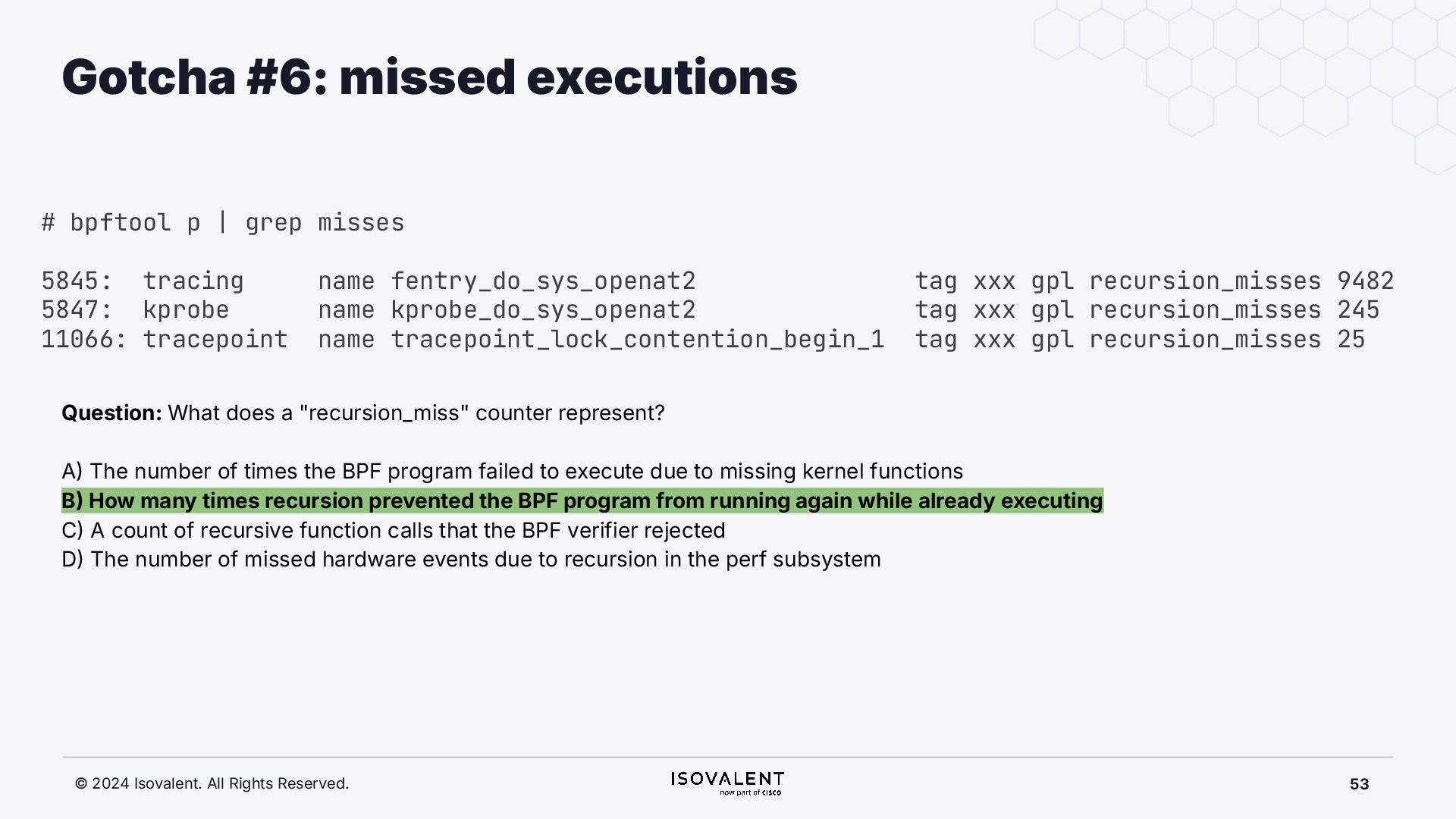
    a "recursion_miss" counter represent? A The number of times the BPF program failed to execute due to missing kernel functions B How many times recursion prevented the BPF program from running again while already executing C A count of recursive function calls that the BPF verifier rejected D The number of missed hardware events due to recursion in the perf subsystem # bpftool p | grep misses 5845: tracing name fentry_do_sys_openat2 tag xxx gpl recursion_misses 9482 5847: kprobe name kprobe_do_sys_openat2 tag xxx gpl recursion_misses 245 11066: tracepoint name tracepoint_lock_contention_begin_1 tag xxx gpl recursion_misses 25 Gotcha #6: missed executions
  47. © 2024 Isovalent. All Rights Reserved. 54 Gotcha #6: missed

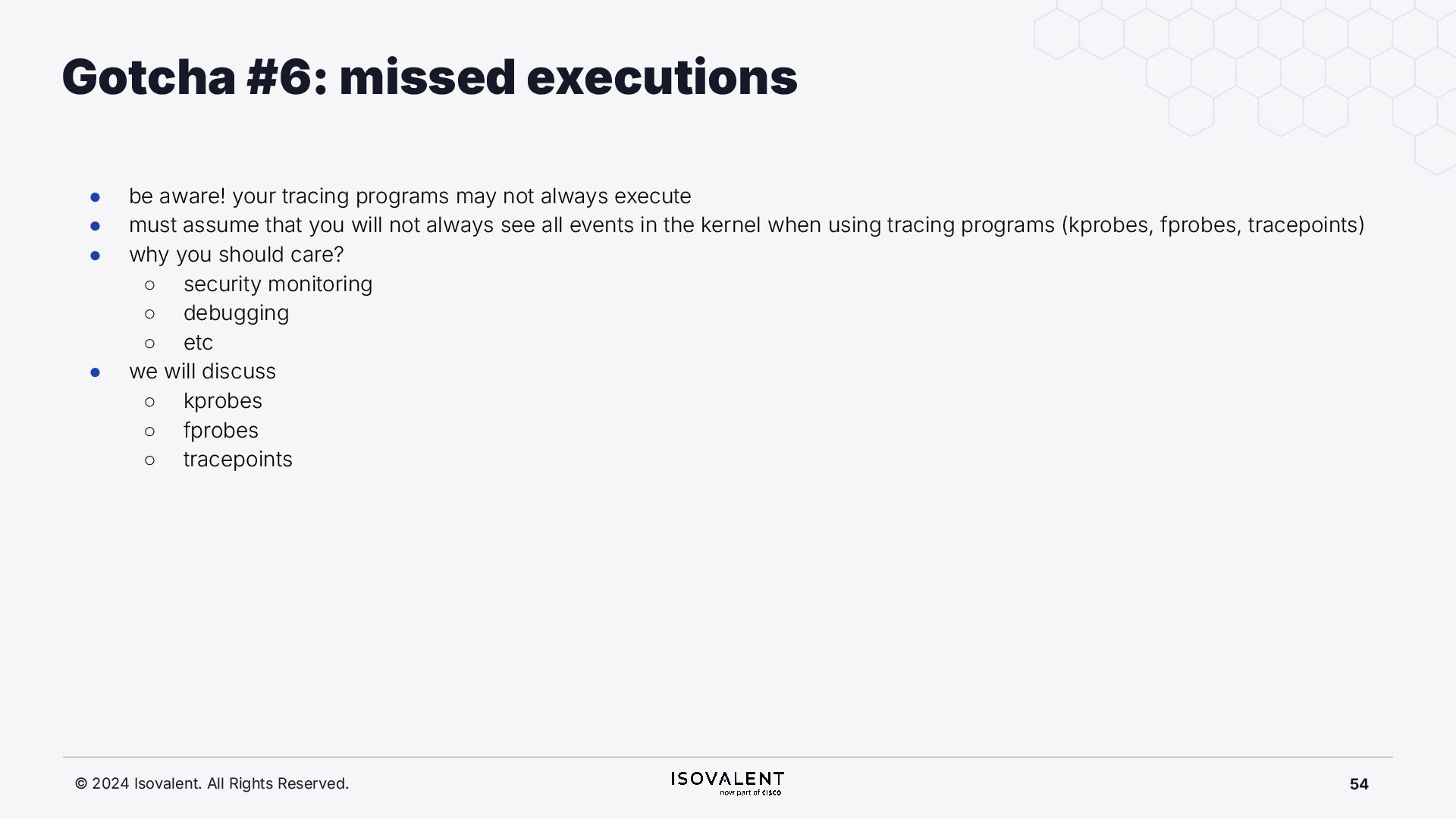
    executions • be aware! your tracing programs may not always execute • must assume that you will not always see all events in the kernel when using tracing programs (kprobes, fprobes, tracepoints) • why you should care? ◦ security monitoring ◦ debugging ◦ etc • we will discuss ◦ kprobes ◦ fprobes ◦ tracepoints
  48. © 2024 Isovalent. All Rights Reserved. 55 Gotcha #6: missed

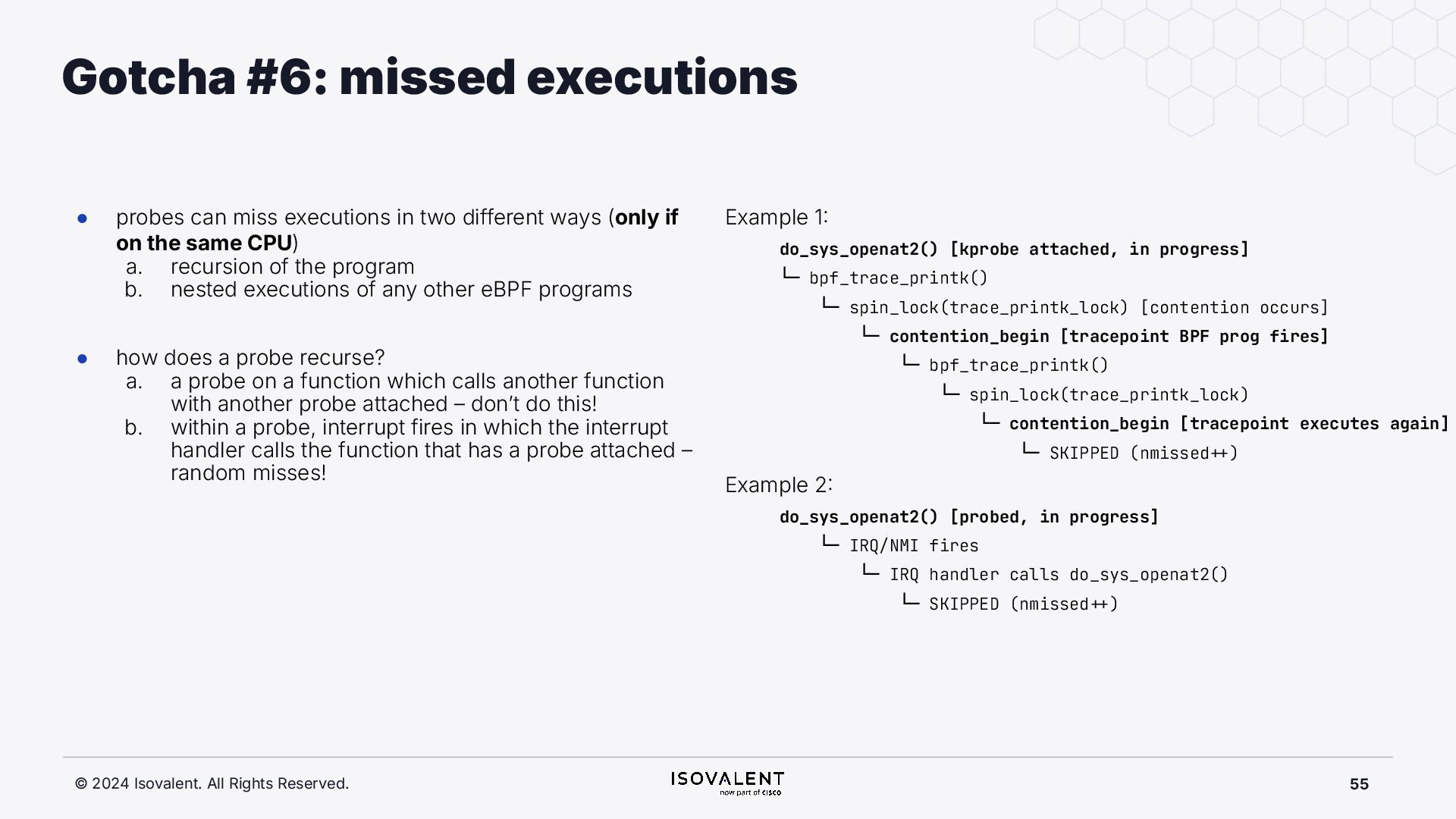
    executions Example 1 do_sys_openat2() [kprobe attached, in progress] └─ bpf_trace_printk() └─ spin_lock(trace_printk_lock) [contention occurs] └─ contention_begin [tracepoint BPF prog fires] └─ bpf_trace_printk() └─ spin_lock(trace_printk_lock) └─ contention_begin [tracepoint executes again] └─ SKIPPED (nmissed=+) Example 2 do_sys_openat2() [probed, in progress] └─ IRQ/NMI fires └─ IRQ handler calls do_sys_openat2() └─ SKIPPED (nmissed=+) • probes can miss executions in two different ways (only if on the same CPU) a. recursion of the program b. nested executions of any other eBPF programs • how does a probe recurse? a. a probe on a function which calls another function with another probe attached – donʼt do this! b. within a probe, interrupt fires in which the interrupt handler calls the function that has a probe attached – random misses!
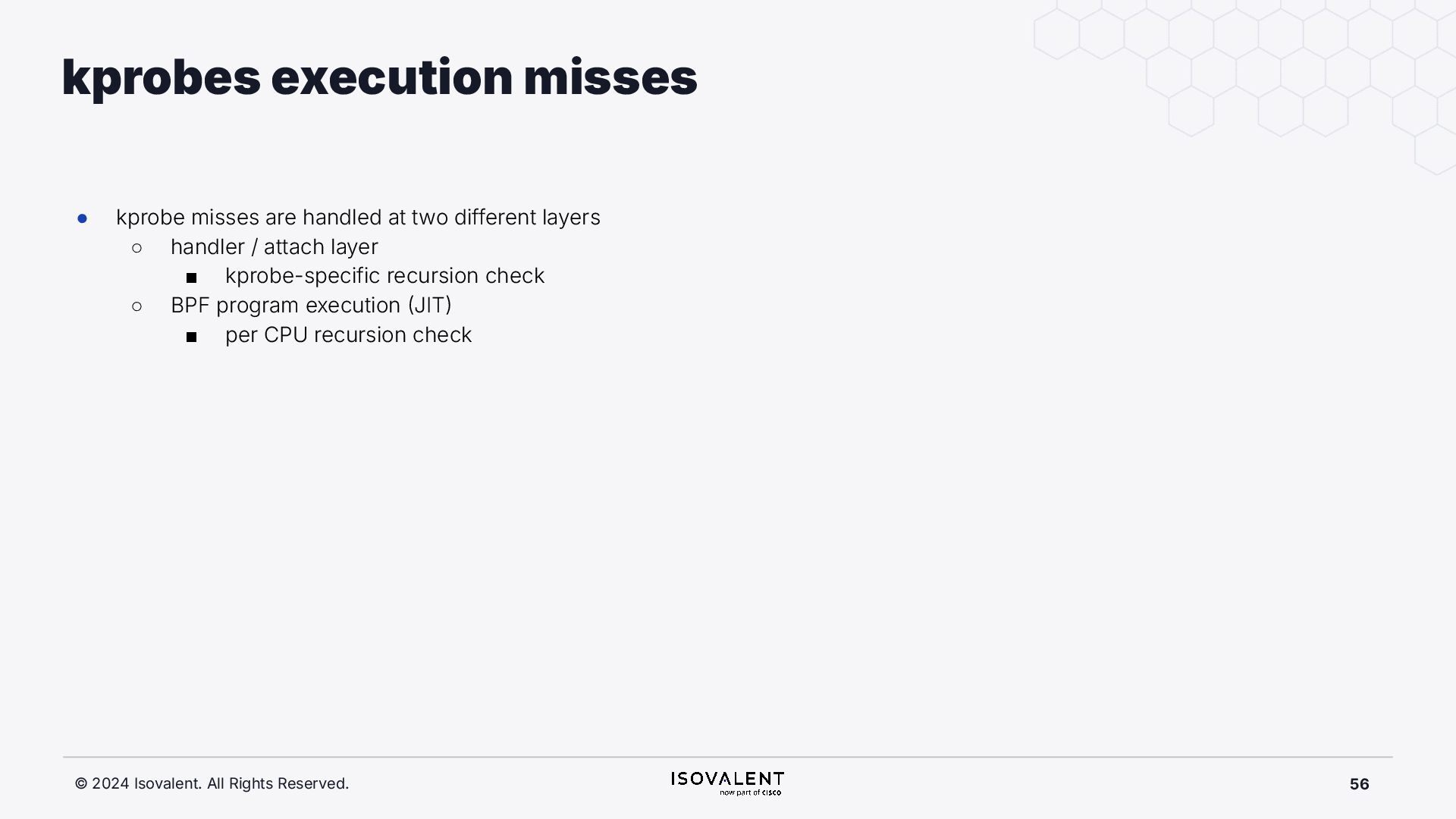
  49. © 2024 Isovalent. All Rights Reserved. 56 kprobes execution misses

    • kprobe misses are handled at two different layers ◦ handler / attach layer ▪ kprobe-specific recursion check ◦ BPF program execution JIT ▪ per CPU recursion check
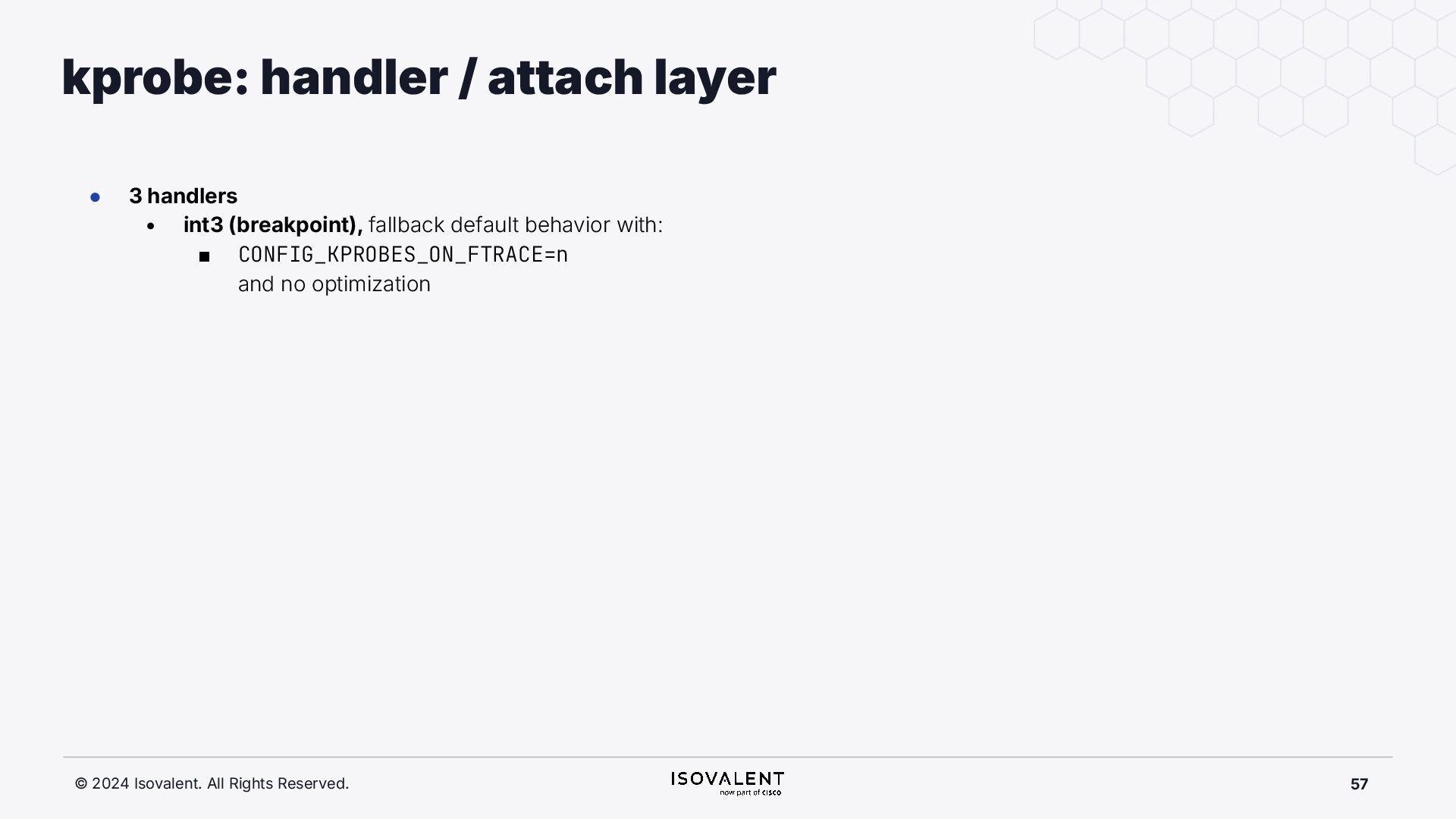
  50. © 2024 Isovalent. All Rights Reserved. 57 kprobe: handler /

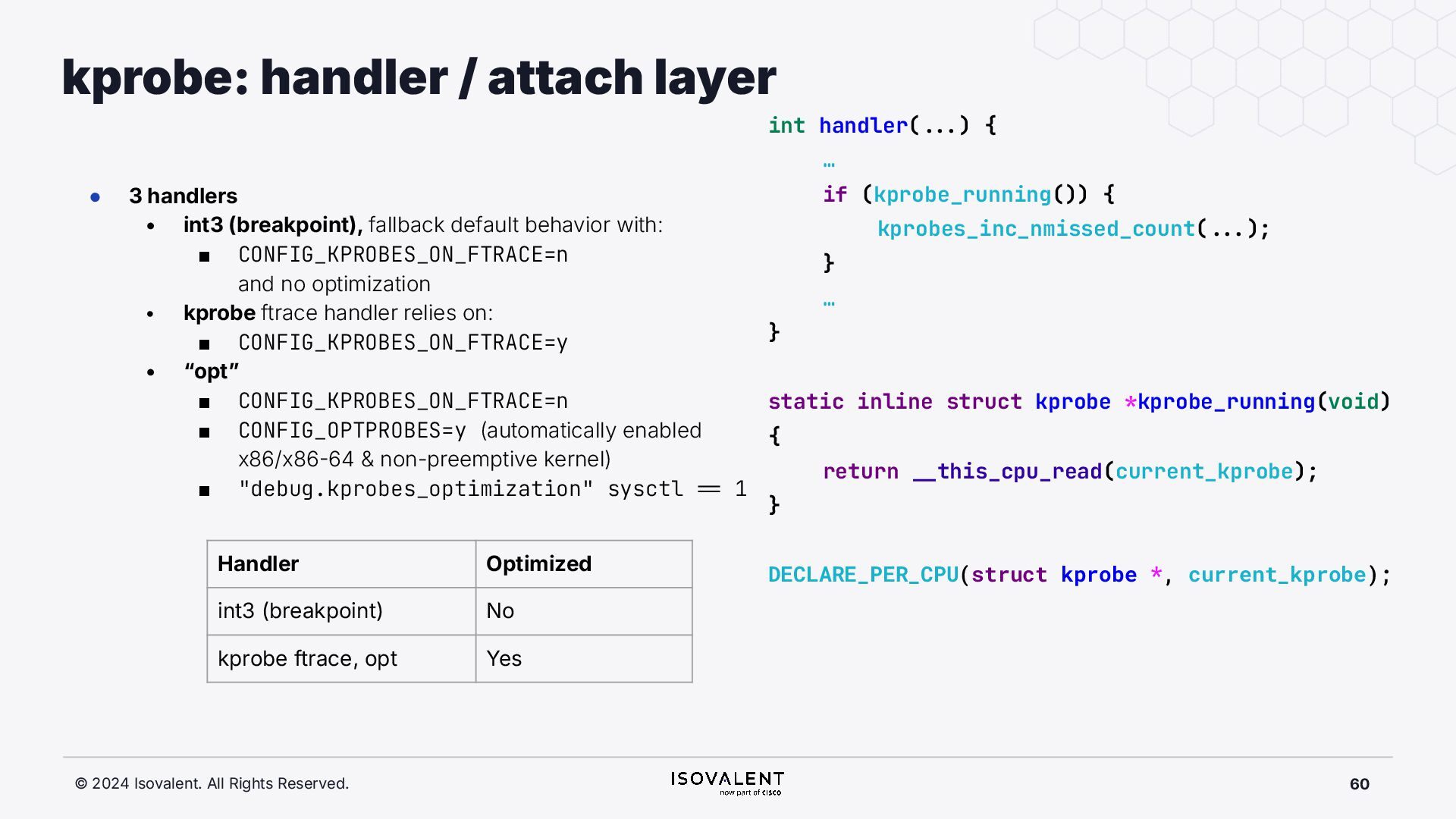
    attach layer • 3 handlers • int3 (breakpoint), fallback default behavior with: ▪ CONFIG_KPROBES_ON_FTRACE=n and no optimization
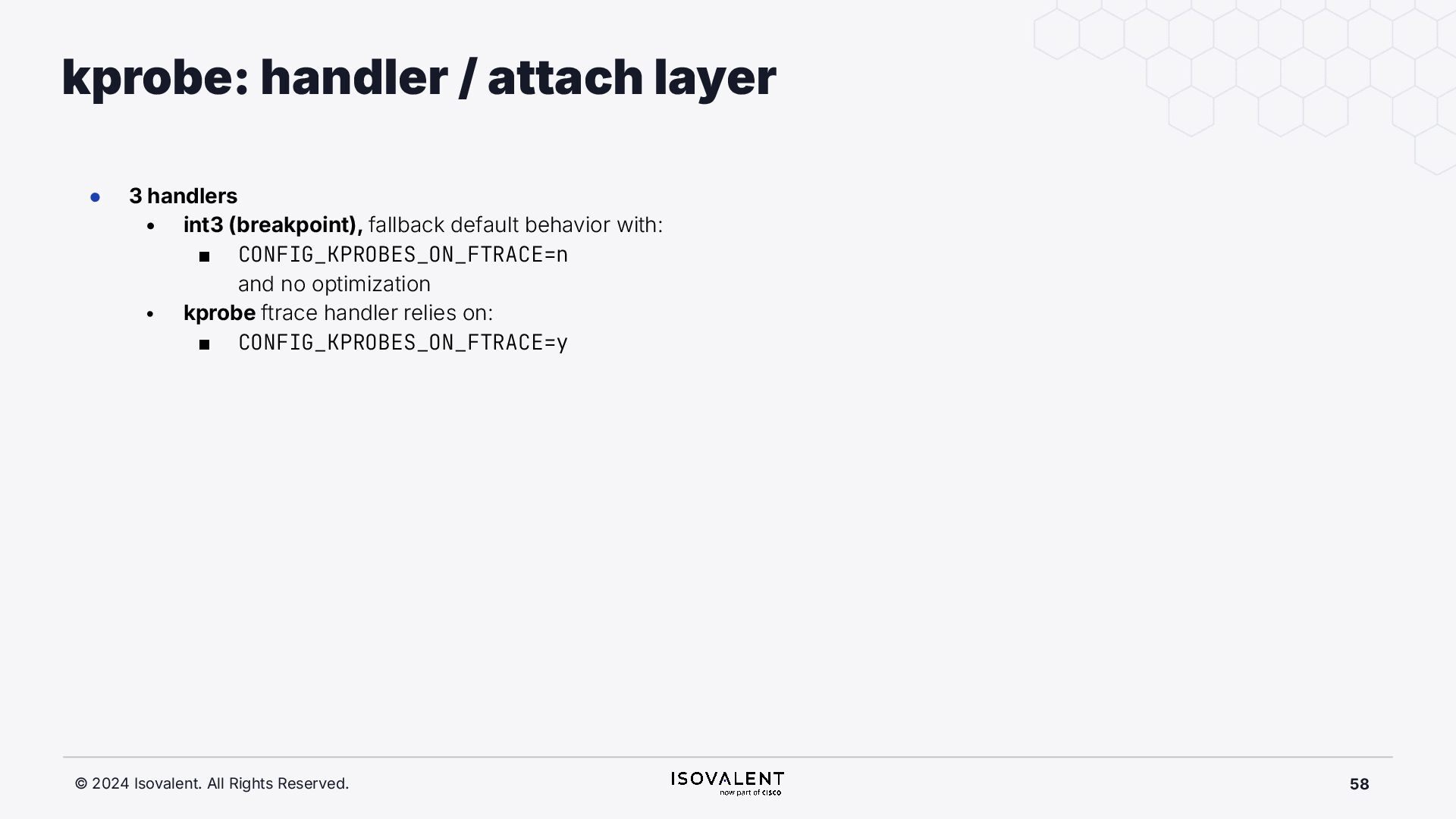
  51. © 2024 Isovalent. All Rights Reserved. 58 kprobe: handler /

    attach layer • 3 handlers • int3 (breakpoint), fallback default behavior with: ▪ CONFIG_KPROBES_ON_FTRACE=n and no optimization • kprobe ftrace handler relies on: ▪ CONFIG_KPROBES_ON_FTRACE=y
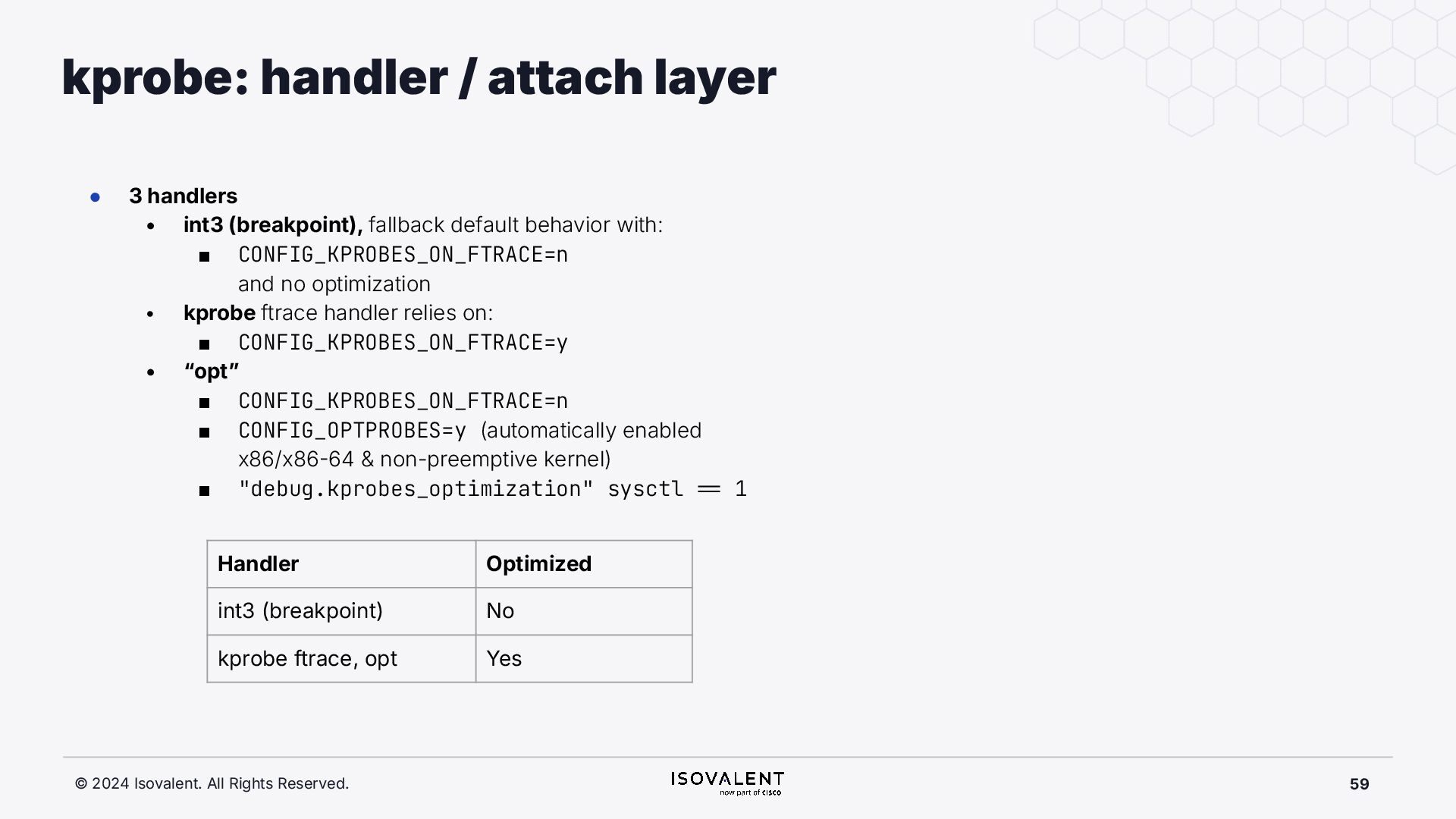
  52. © 2024 Isovalent. All Rights Reserved. 59 kprobe: handler /

    attach layer • 3 handlers • int3 (breakpoint), fallback default behavior with: ▪ CONFIG_KPROBES_ON_FTRACE=n and no optimization • kprobe ftrace handler relies on: ▪ CONFIG_KPROBES_ON_FTRACE=y • “optˮ ▪ CONFIG_KPROBES_ON_FTRACE=n ▪ CONFIG_OPTPROBES=y (automatically enabled x86/x8664 & non-preemptive kernel) ▪ "debug.kprobes_optimization" sysctl == 1 Handler Optimized int3 (breakpoint) No kprobe ftrace, opt Yes
  53. © 2024 Isovalent. All Rights Reserved. 60 kprobe: handler /

    attach layer • 3 handlers • int3 (breakpoint), fallback default behavior with: ▪ CONFIG_KPROBES_ON_FTRACE=n and no optimization • kprobe ftrace handler relies on: ▪ CONFIG_KPROBES_ON_FTRACE=y • “optˮ ▪ CONFIG_KPROBES_ON_FTRACE=n ▪ CONFIG_OPTPROBES=y (automatically enabled x86/x8664 & non-preemptive kernel) ▪ "debug.kprobes_optimization" sysctl == 1 int handler(...) { … if (kprobe_running()) { kprobes_inc_nmissed_count(...); } … } static inline struct kprobe *kprobe_running(void) { return ._this_cpu_read(current_kprobe); } DECLARE_PER_CPU(struct kprobe *, current_kprobe); Handler Optimized int3 (breakpoint) No kprobe ftrace, opt Yes
  54. © 2024 Isovalent. All Rights Reserved. 61 kprobe: BPF program

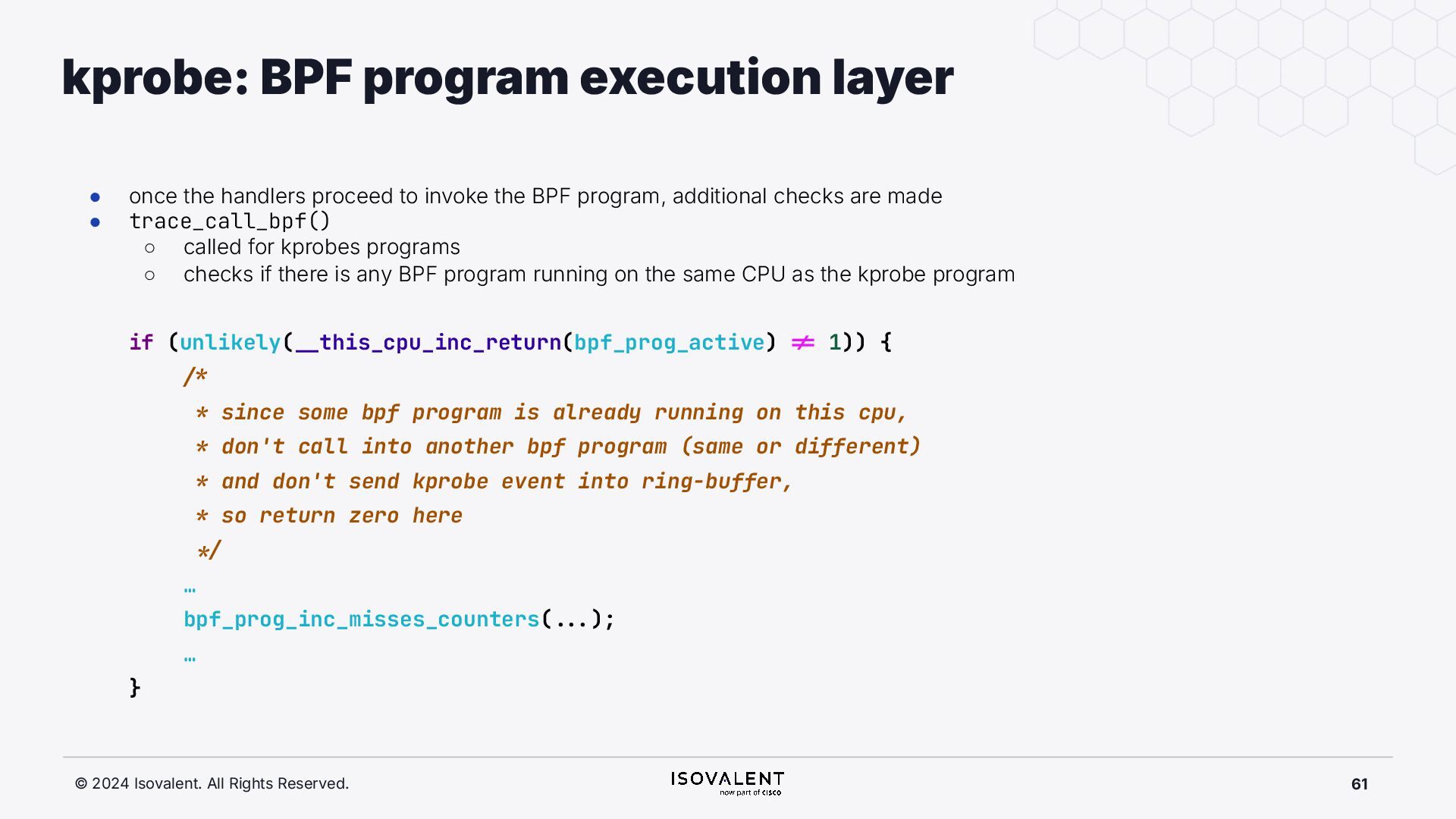
    execution layer • once the handlers proceed to invoke the BPF program, additional checks are made • trace_call_bpf() ◦ called for kprobes programs ◦ checks if there is any BPF program running on the same CPU as the kprobe program if (unlikely(._this_cpu_inc_return(bpf_prog_active) .= 1)) { ** * since some bpf program is already running on this cpu, * don't call into another bpf program (same or different) * and don't send kprobe event into ring-buffer, * so return zero here */ … bpf_prog_inc_misses_counters(...); … }
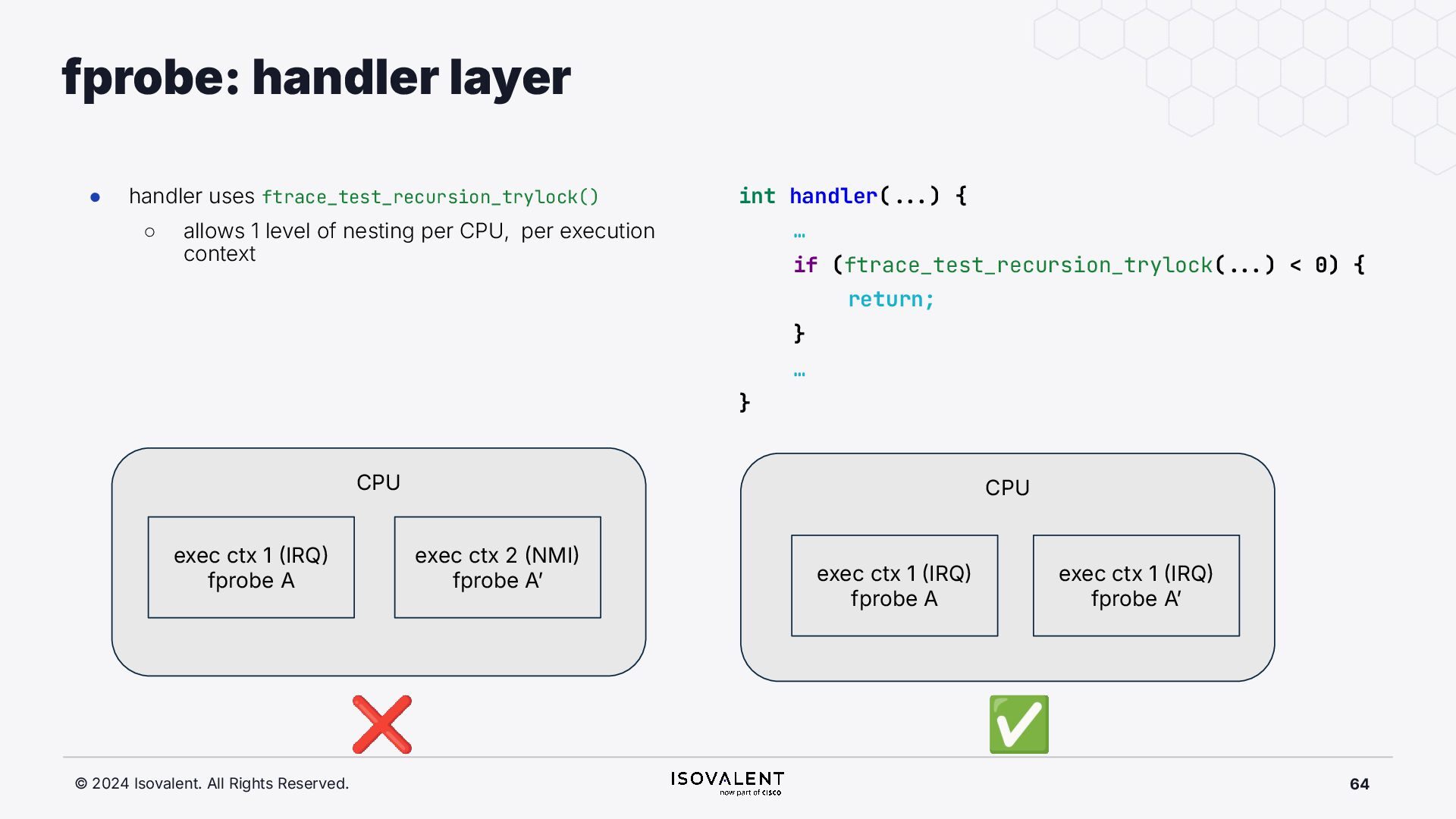
  55. © 2024 Isovalent. All Rights Reserved. 62 fprobe: handler layer

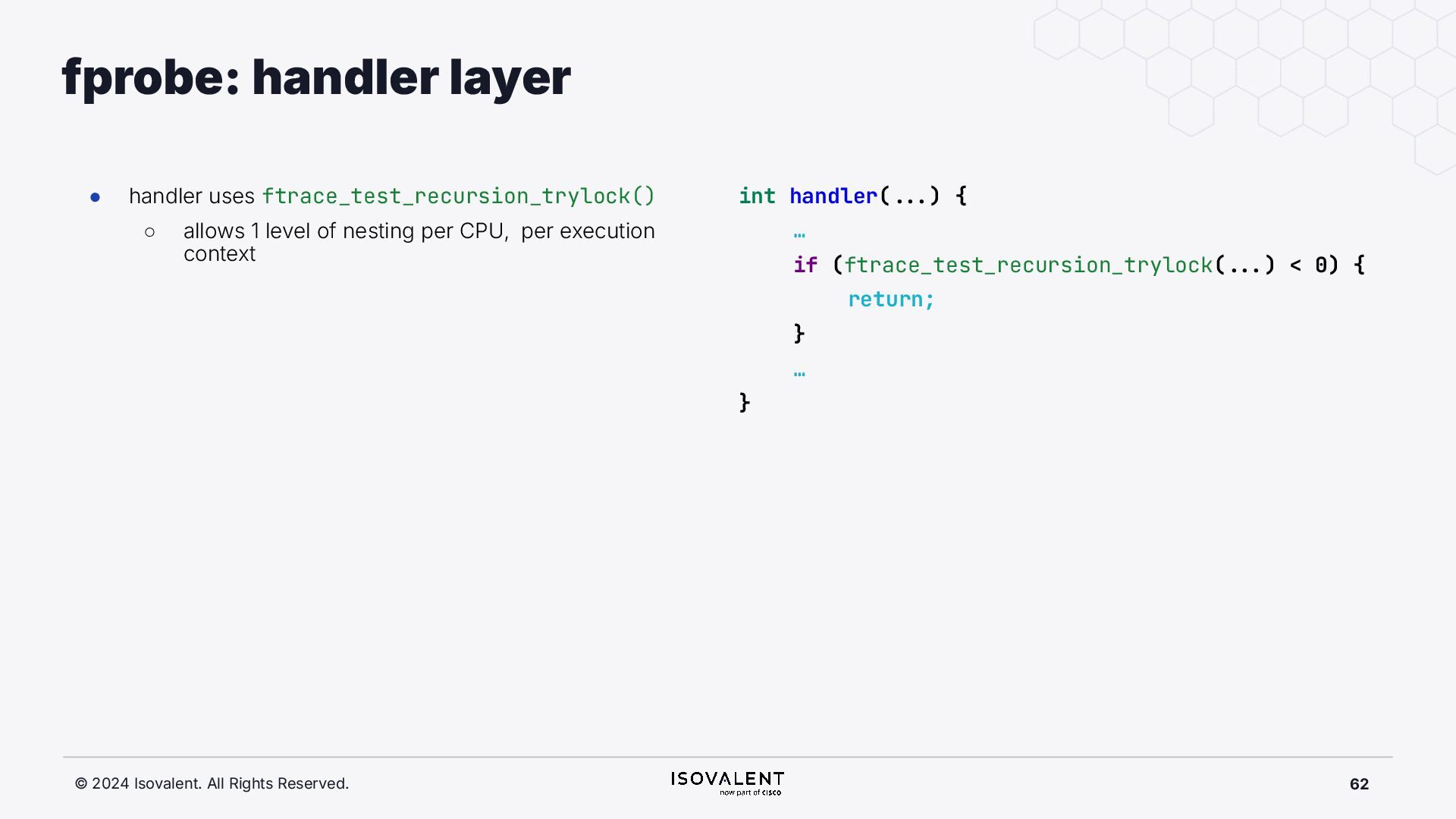
    • handler uses ftrace_test_recursion_trylock() ◦ allows 1 level of nesting per CPU, per execution context int handler(...) { … if (ftrace_test_recursion_trylock(...) < 0) { return; } … }
  56. © 2024 Isovalent. All Rights Reserved. 63 fprobe: handler layer

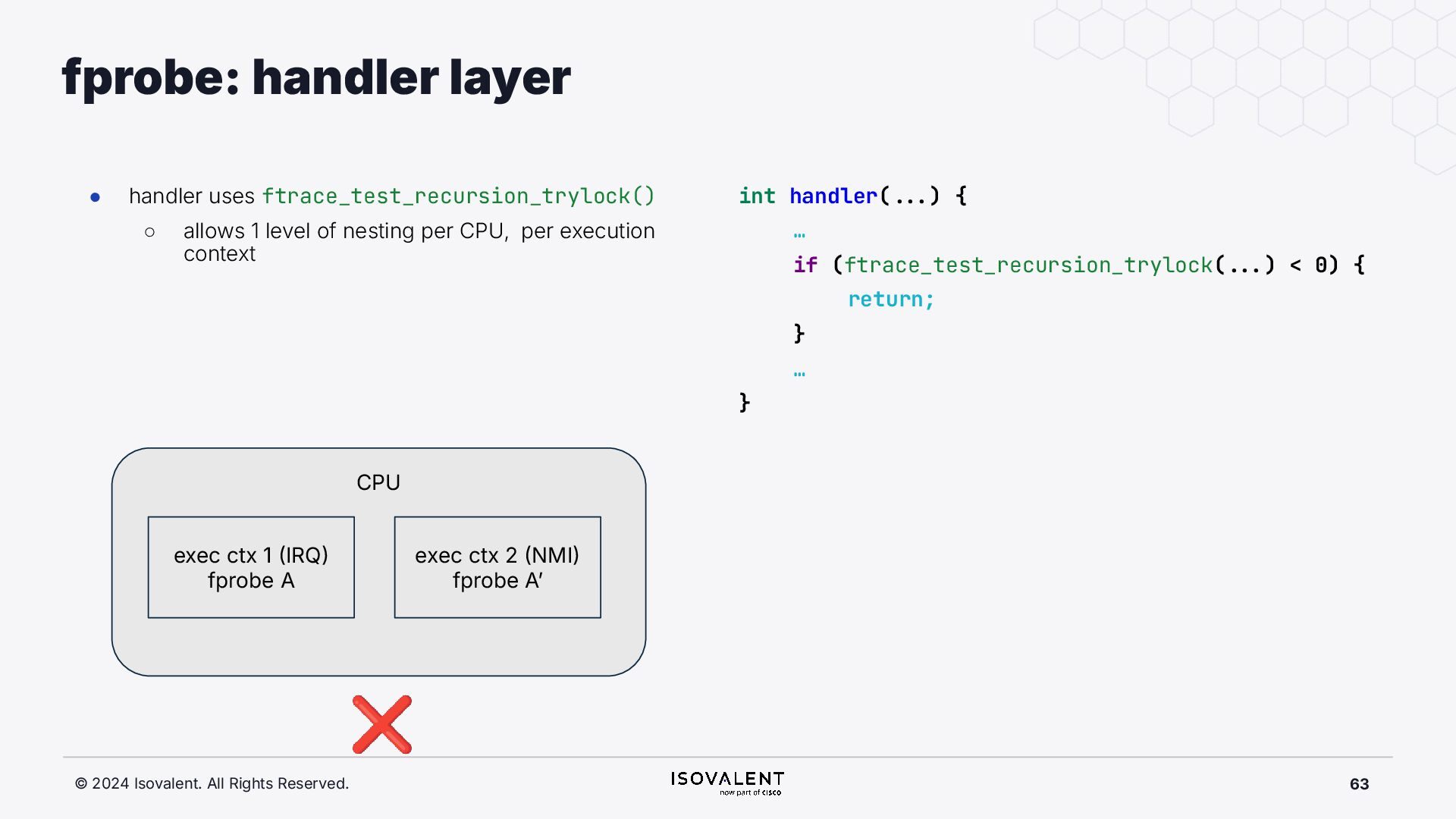
    • handler uses ftrace_test_recursion_trylock() ◦ allows 1 level of nesting per CPU, per execution context int handler(...) { … if (ftrace_test_recursion_trylock(...) < 0) { return; } … } CPU exec ctx 1 IRQ fprobe A exec ctx 2 NMI fprobe Aʼ ❌
  57. © 2024 Isovalent. All Rights Reserved. 64 fprobe: handler layer

    • handler uses ftrace_test_recursion_trylock() ◦ allows 1 level of nesting per CPU, per execution context int handler(...) { … if (ftrace_test_recursion_trylock(...) < 0) { return; } … } CPU exec ctx 1 IRQ fprobe A exec ctx 2 NMI fprobe Aʼ ❌ ✅ CPU exec ctx 1 IRQ fprobe A exec ctx 1 IRQ fprobe Aʼ
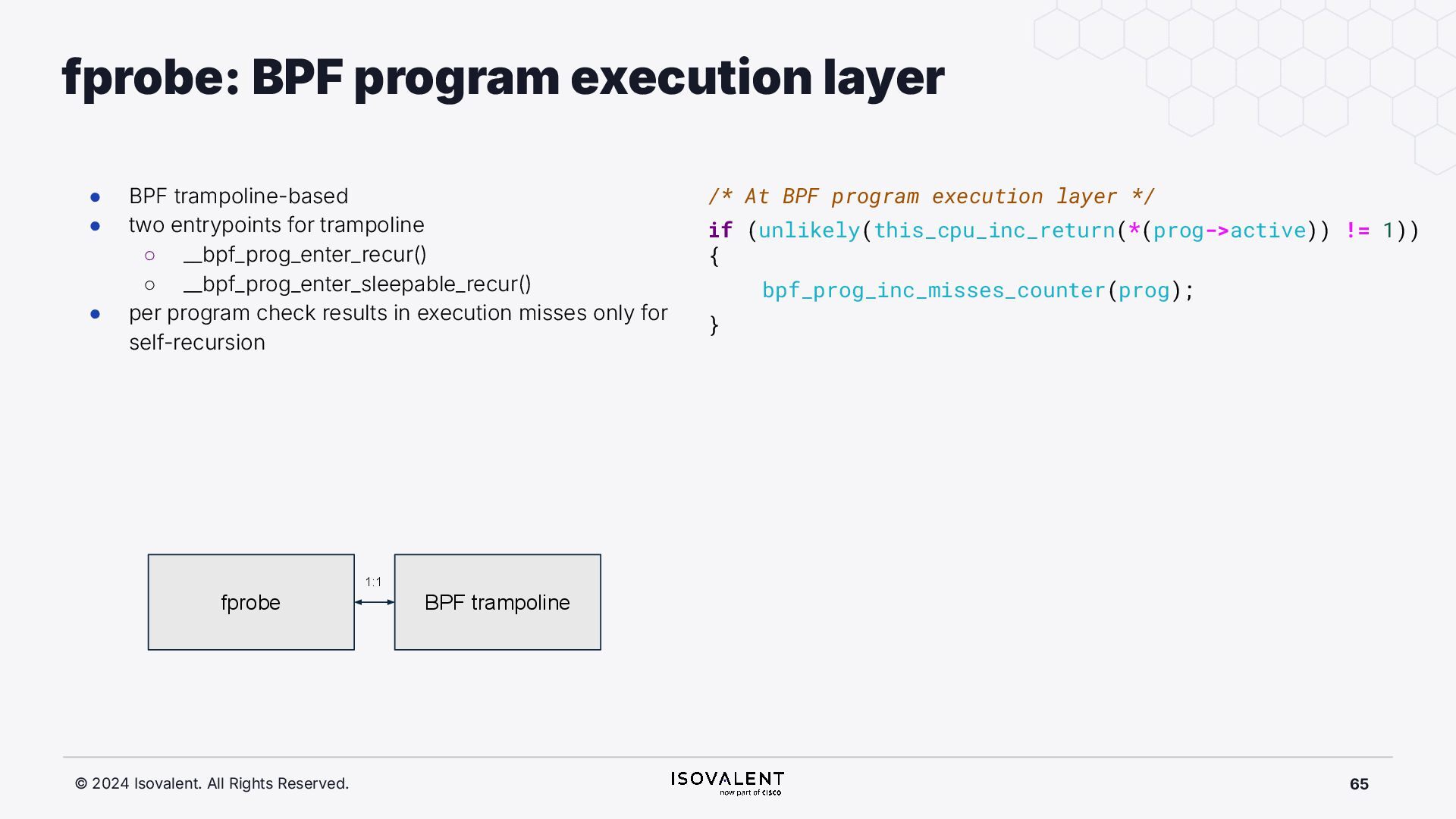
  58. © 2024 Isovalent. All Rights Reserved. 65 fprobe: BPF program

    execution layer • BPF trampoline-based • two entrypoints for trampoline ◦ __bpf_prog_enter_recur() ◦ __bpf_prog_enter_sleepable_recur() • per program check results in execution misses only for self-recursion /* At BPF program execution layer */ if (unlikely(this_cpu_inc_return(*(prog->active)) != 1)) { bpf_prog_inc_misses_counter(prog); } fprobe BPF trampoline 1:1
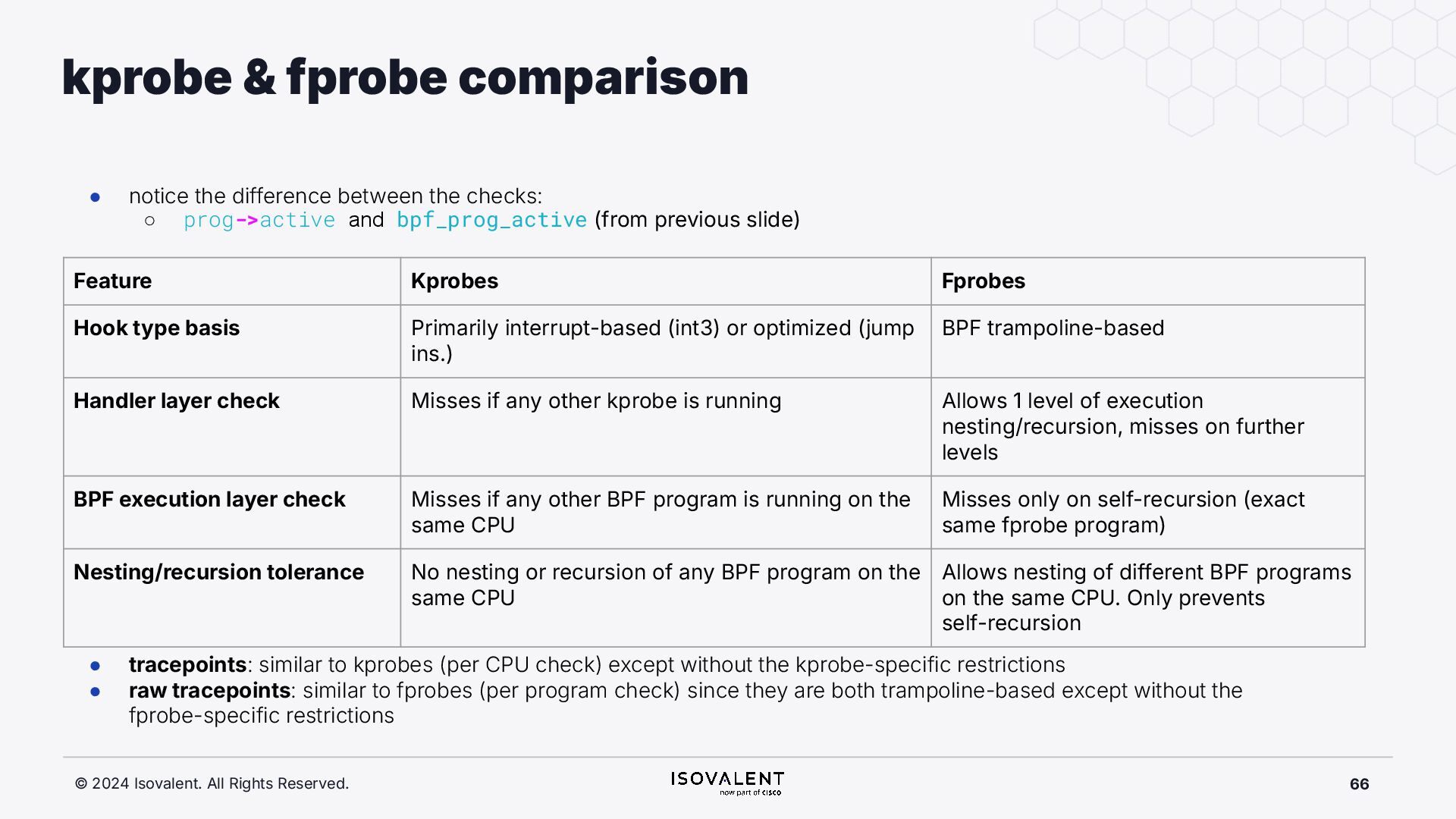
  59. © 2024 Isovalent. All Rights Reserved. 66 kprobe & fprobe

    comparison • notice the difference between the checks: ◦ prog->active and bpf_prog_active (from previous slide) Feature Kprobes Fprobes Hook type basis Primarily interrupt-based (int3) or optimized (jump ins.) BPF trampoline-based Handler layer check Misses if any other kprobe is running Allows 1 level of execution nesting/recursion, misses on further levels BPF execution layer check Misses if any other BPF program is running on the same CPU Misses only on self-recursion (exact same fprobe program) Nesting/recursion tolerance No nesting or recursion of any BPF program on the same CPU Allows nesting of different BPF programs on the same CPU. Only prevents self-recursion • tracepoints: similar to kprobes (per CPU check) except without the kprobe-specific restrictions • raw tracepoints: similar to fprobes (per program check) since they are both trampoline-based except without the fprobe-specific restrictions
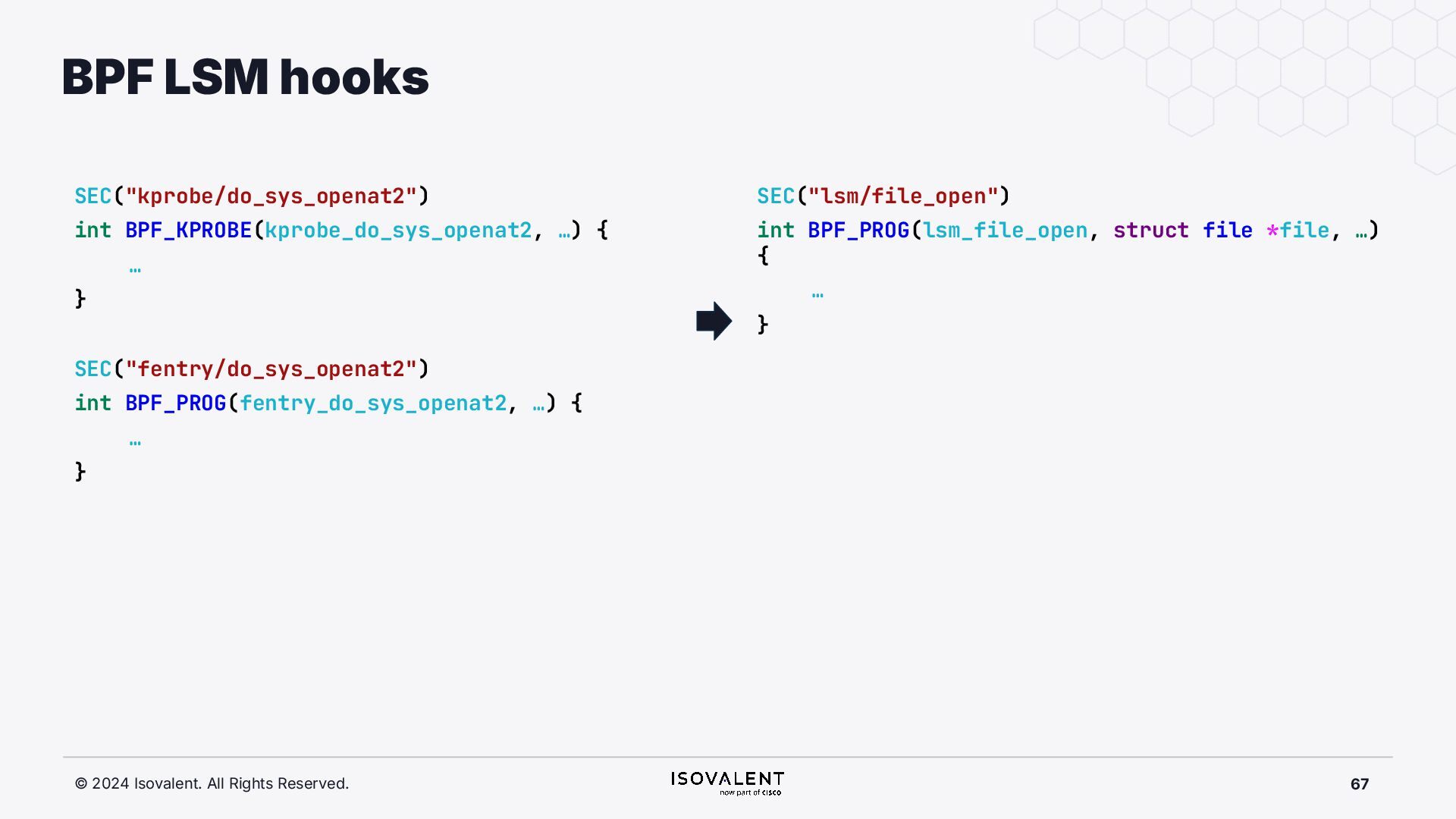
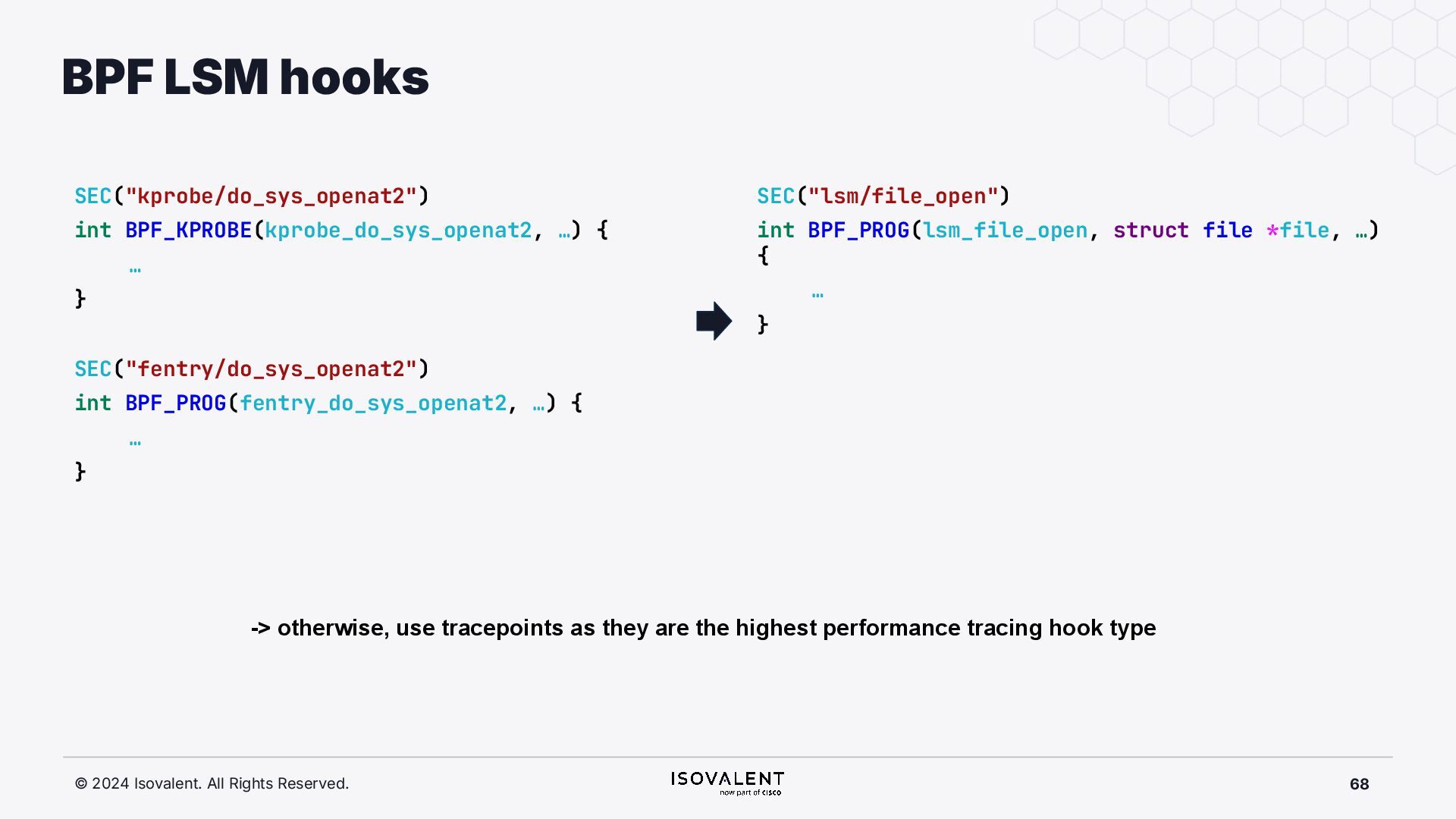
  60. © 2024 Isovalent. All Rights Reserved. 67 BPF LSM hooks

    SEC("kprobe/do_sys_openat2") int BPF_KPROBE(kprobe_do_sys_openat2, …) { … } SEC("fentry/do_sys_openat2") int BPF_PROG(fentry_do_sys_openat2, …) { … } SEC("lsm/file_open") int BPF_PROG(lsm_file_open, struct file *file, …) { … }
  61. © 2024 Isovalent. All Rights Reserved. 68 BPF LSM hooks

    SEC("kprobe/do_sys_openat2") int BPF_KPROBE(kprobe_do_sys_openat2, …) { … } SEC("fentry/do_sys_openat2") int BPF_PROG(fentry_do_sys_openat2, …) { … } SEC("lsm/file_open") int BPF_PROG(lsm_file_open, struct file *file, …) { … } -> otherwise, use tracepoints as they are the highest performance tracing hook type
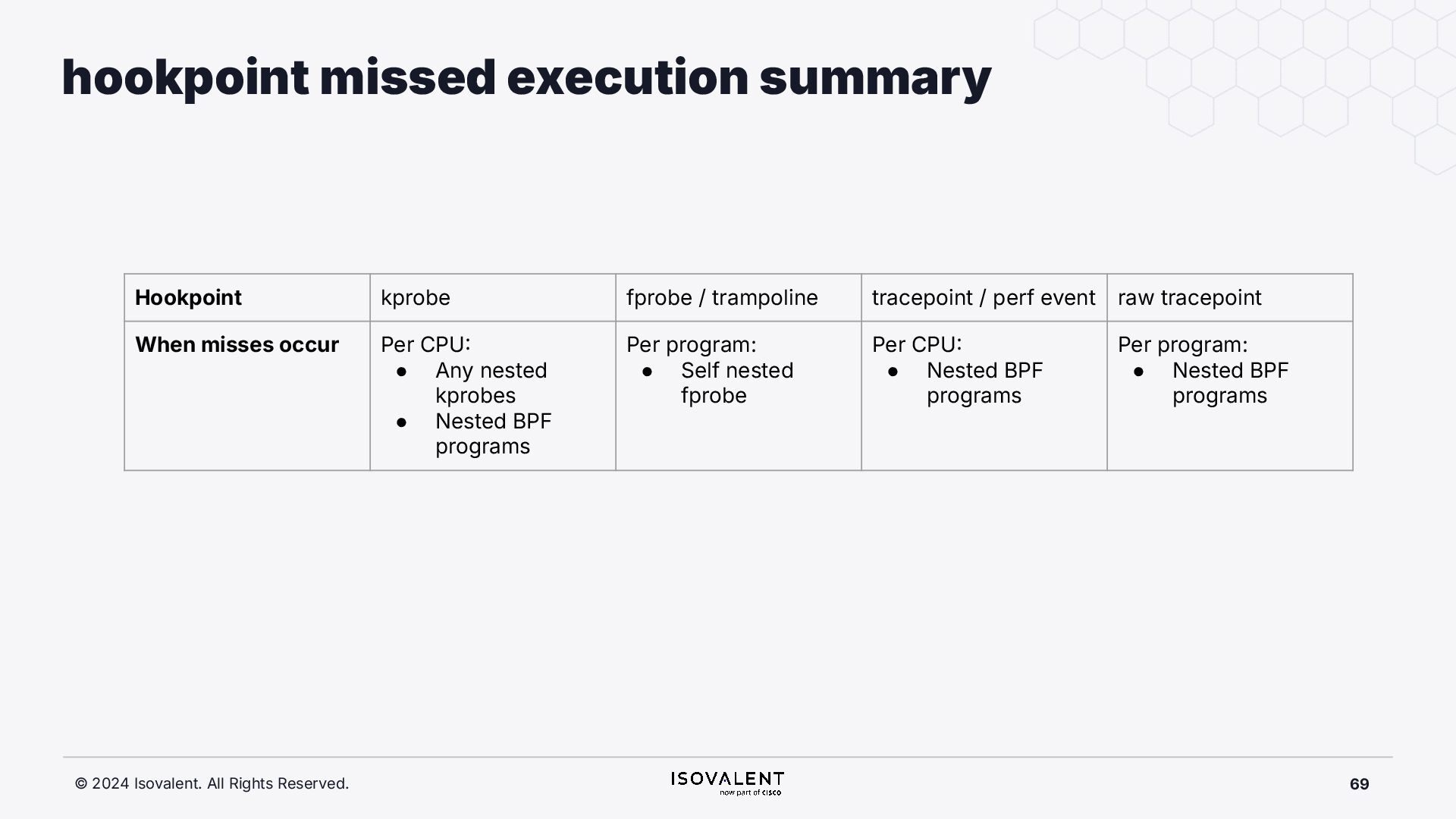
  62. © 2024 Isovalent. All Rights Reserved. 69 hookpoint missed execution

    summary Hookpoint kprobe fprobe / trampoline tracepoint / perf event raw tracepoint When misses occur Per CPU • Any nested kprobes • Nested BPF programs Per program: • Self nested fprobe Per CPU • Nested BPF programs Per program: • Nested BPF programs
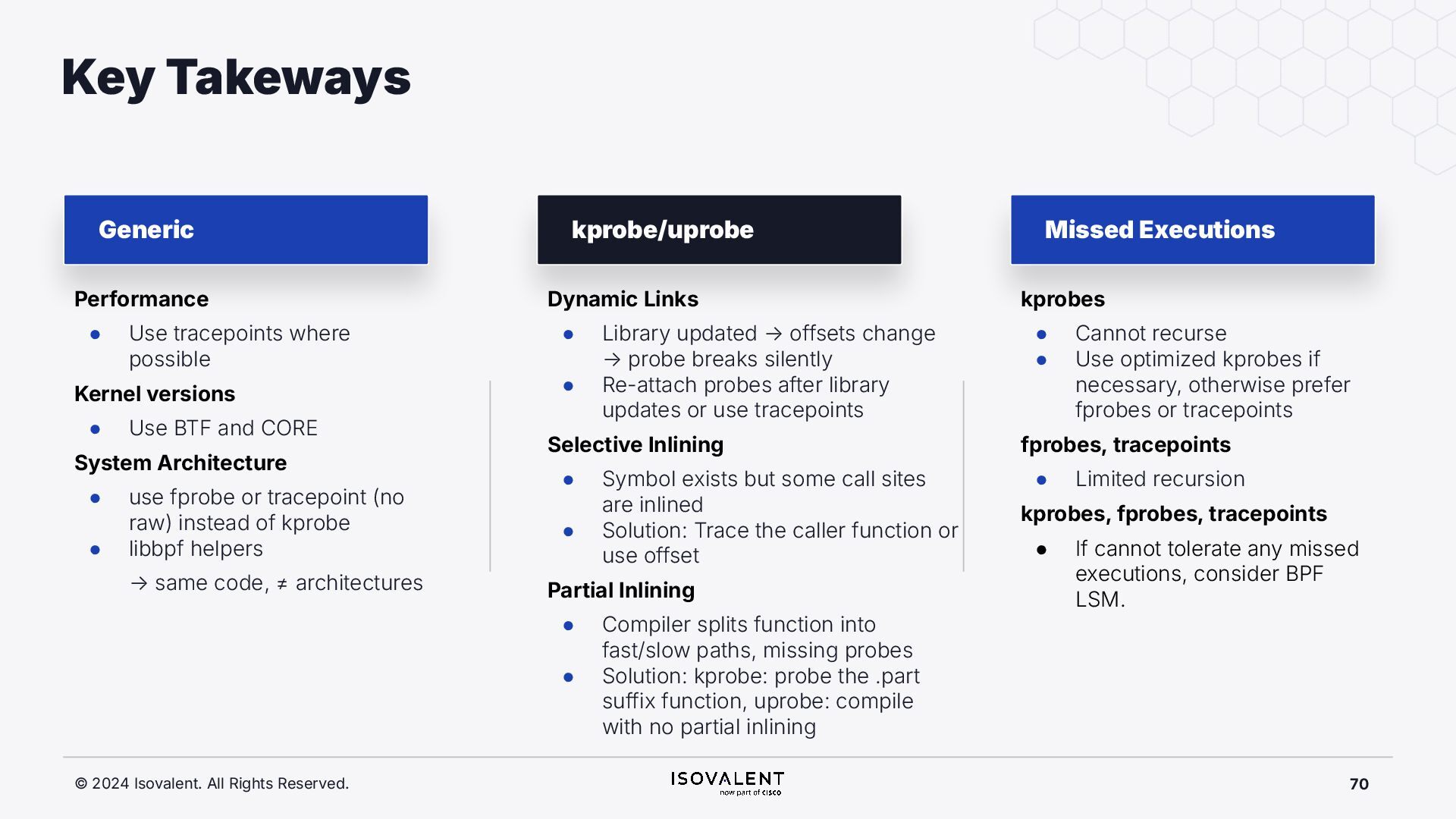
  63. © 2024 Isovalent. All Rights Reserved. 70 Key Takeways Generic

    Performance • Use tracepoints where possible Kernel versions • Use BTF and CORE System Architecture • use fprobe or tracepoint (no raw) instead of kprobe • libbpf helpers → same code, ≠ architectures kprobe/uprobe Dynamic Links • Library updated → offsets change → probe breaks silently • Re-attach probes after library updates or use tracepoints Selective Inlining • Symbol exists but some call sites are inlined • Solution: Trace the caller function or use offset Partial Inlining • Compiler splits function into fast/slow paths, missing probes • Solution: kprobe: probe the .part suffix function, uprobe: compile with no partial inlining Missed Executions kprobes • Cannot recurse • Use optimized kprobes if necessary, otherwise prefer fprobes or tracepoints fprobes, tracepoints • Limited recursion kprobes, fprobes, tracepoints • If cannot tolerate any missed executions, consider BPF LSM.
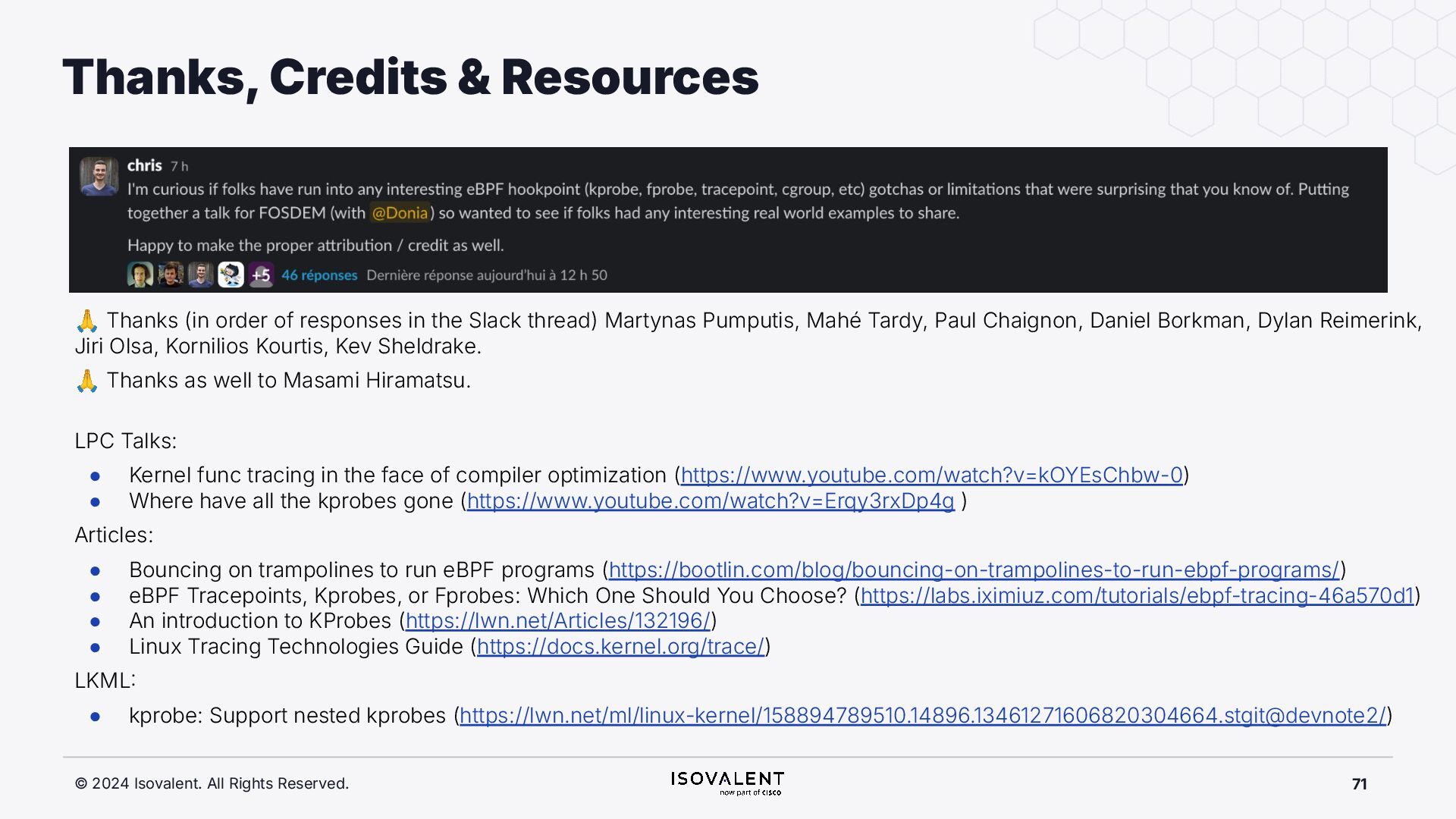
  64. © 2024 Isovalent. All Rights Reserved. 71 Thanks, Credits &

    Resources 🙏 Thanks (in order of responses in the Slack thread) Martynas Pumputis, Mahé Tardy, Paul Chaignon, Daniel Borkman, Dylan Reimerink, Jiri Olsa, Kornilios Kourtis, Kev Sheldrake. 🙏 Thanks as well to Masami Hiramatsu. LPC Talks: • Kernel func tracing in the face of compiler optimization (https://www.youtube.com/watch?v=kOYEsChbw-0) • Where have all the kprobes gone (https://www.youtube.com/watch?v=Erqy3rxDp4g ) Articles: • Bouncing on trampolines to run eBPF programs (https://bootlin.com/blog/bouncing-on-trampolines-to-run-ebpf-programs/) • eBPF Tracepoints, Kprobes, or Fprobes: Which One Should You Choose? (https://labs.iximiuz.com/tutorials/ebpf-tracing-46a570d1) • An introduction to KProbes (https://lwn.net/Articles/132196/) • Linux Tracing Technologies Guide (https://docs.kernel.org/trace/) LKML • kprobe: Support nested kprobes (https://lwn.net/ml/linux-kernel/158894789510.14896.13461271606820304664.stgit@devnote2/)