Upgrade to PRO for Only $50/Year—Limited-Time Offer! 🔥

FY 2024: MDC 25 - HIV and Unrelated, Ungroupab...

Avatar for e4health e4health PRO
April 04, 2024
130

FY 2024: MDC 25 - HIV and Unrelated, Ungroupable DRGs

Avatar for e4health

e4health PRO

April 04, 2024
Tweet

Transcript

  1. H I M | C O D I N G

    & C D I | H E A LT H I T | R E V C Y C L E Empowering Better Health e4health tackles healthcare’s data, quality and revenue challenges empowering your providers to focus on better care.
  2. Objectives • Review MDC 25- HIV with a focus on

    selected diagnoses and procedures • Learner will acquire a basic understanding of the diagnoses and procedures included in MDC-25 • Discuss Query opportunities in MDC-25 • Review coding clinics relevant to the chosen topics in each DRG
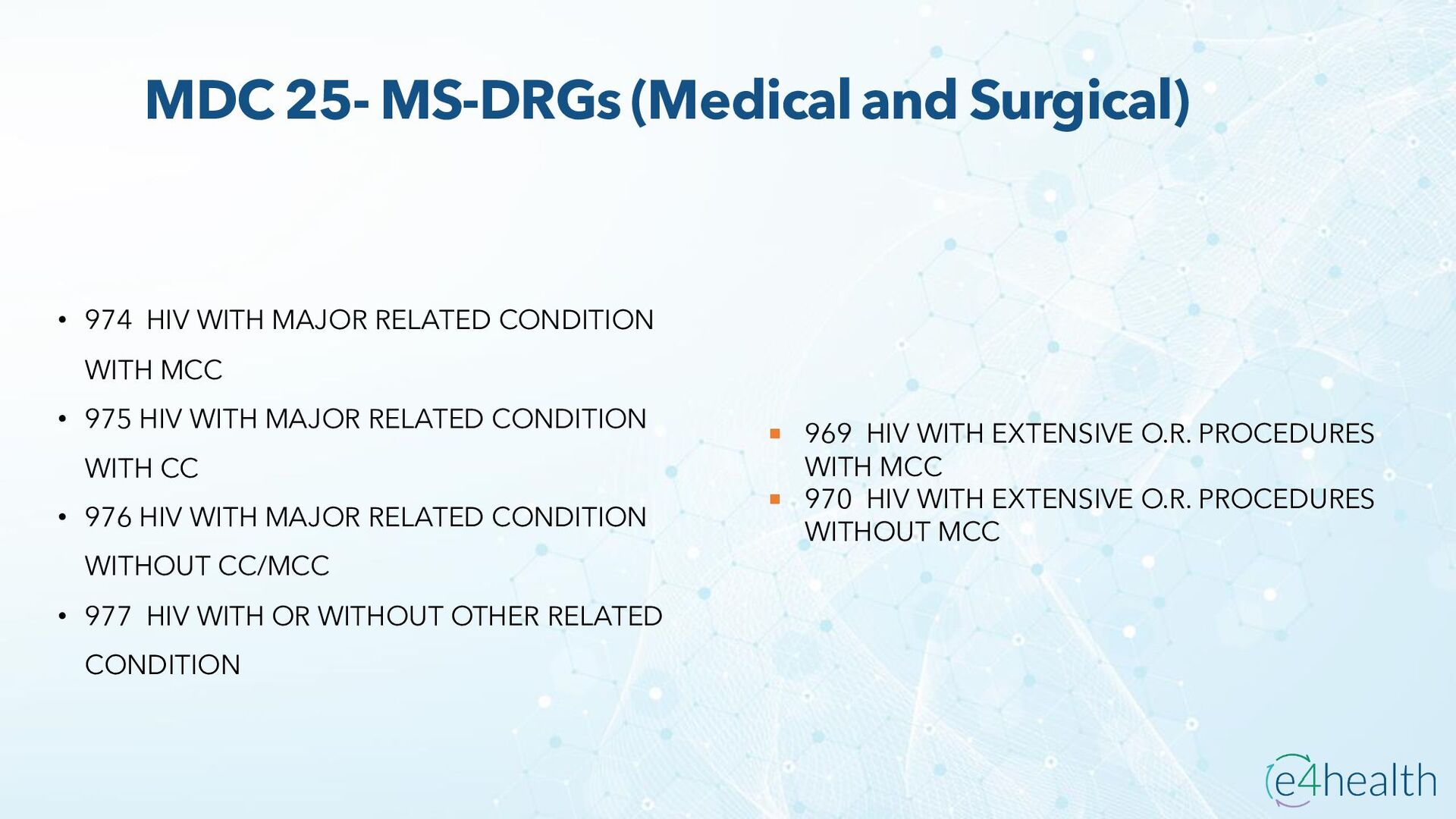
  3. MDC 25- MS-DRGs (Medical and Surgical) • 974 HIV WITH

    MAJOR RELATED CONDITION WITH MCC • 975 HIV WITH MAJOR RELATED CONDITION WITH CC • 976 HIV WITH MAJOR RELATED CONDITION WITHOUT CC/MCC • 977 HIV WITH OR WITHOUT OTHER RELATED CONDITION  969 HIV WITH EXTENSIVE O.R. PROCEDURES WITH MCC  970 HIV WITH EXTENSIVE O.R. PROCEDURES WITHOUT MCC
  4. Coding Guidelines for Human Immunodeficiency Virus (HIV) • Acquired immunodeficiency

    syndrome (AIDS) is coded to B20, HIV disease • Only confirmed cases of HIV are coded • Sequencing HIV codes: • Patient admitted for HIV-related condition: Code first HIV disease (B20) followed by additional diagnosis codes for all reported HIV-related conditions • An exception to this guideline is if the reason for admission is hemolytic-uremic syndrome associated with HIV disease. Assign code D59.31, Infection-associated hemolytic-uremic syndrome, followed by code B20, Human immunodeficiency virus [HIV] disease • Patient with HIV disease admitted for unrelated condition: Code first the unrelated condition as PDx followed by code HIV code (B20) • Asymptomatic human immunodeficiency virus: Code Z21, Asymptomatic HIV infection, is assigned for patients with HIV but are asymptomatic. • Is documented as "HIV positive," "known HIV," "HIV test positive," or similar terminology • Code Z21 is not assigned for patients diagnosed with "AIDS," or "HIV disease" or having conditions resulting from HIV positive status
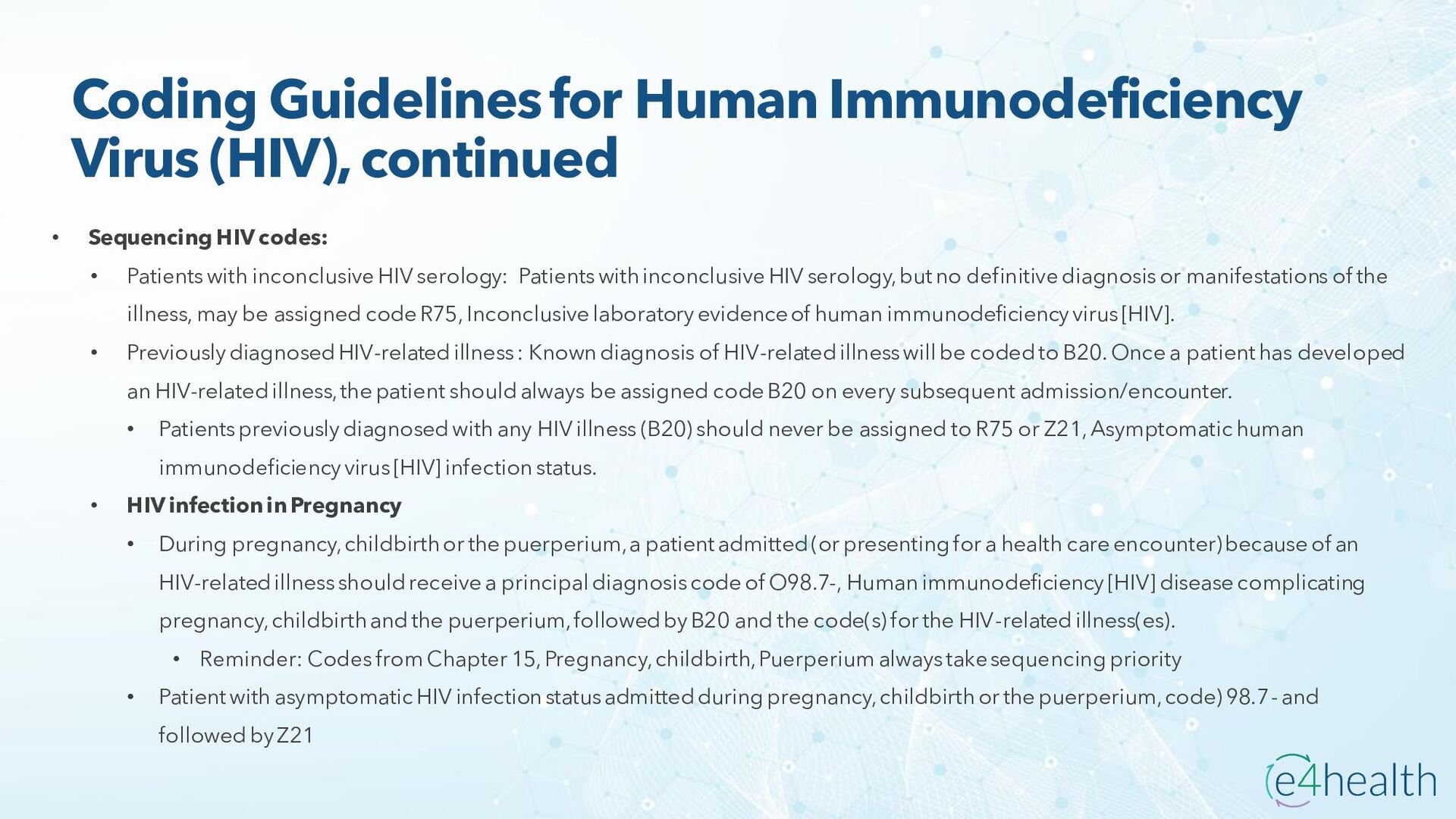
  5. Coding Guidelines for Human Immunodeficiency Virus (HIV), continued • Sequencing

    HIV codes: • Patients with inconclusive HIV serology: Patients with inconclusive HIV serology, but no definitive diagnosis or manifestations of the illness, may be assigned code R75, Inconclusive laboratory evidence of human immunodeficiency virus [HIV]. • Previously diagnosed HIV-related illness : Known diagnosis of HIV-related illness will be coded to B20. Once a patient has developed an HIV-related illness, the patient should always be assigned code B20 on every subsequent admission/encounter. • Patients previously diagnosed with any HIV illness (B20) should never be assigned to R75 or Z21, Asymptomatic human immunodeficiency virus [HIV] infection status. • HIV infection in Pregnancy • During pregnancy, childbirth or the puerperium, a patient admitted (or presenting for a health care encounter) because of an HIV-related illness should receive a principal diagnosis code of O98.7-, Human immunodeficiency [HIV] disease complicating pregnancy, childbirth and the puerperium, followed by B20 and the code(s) for the HIV-related illness(es). • Reminder: Codes from Chapter 15, Pregnancy, childbirth, Puerperium always takesequencing priority • Patient with asymptomatic HIV infection status admitted during pregnancy, childbirth or the puerperium, code) 98.7- and followed by Z21
  6. Coding Guidelines for Human Immunodeficiency Virus (HIV), continued • Sequencing

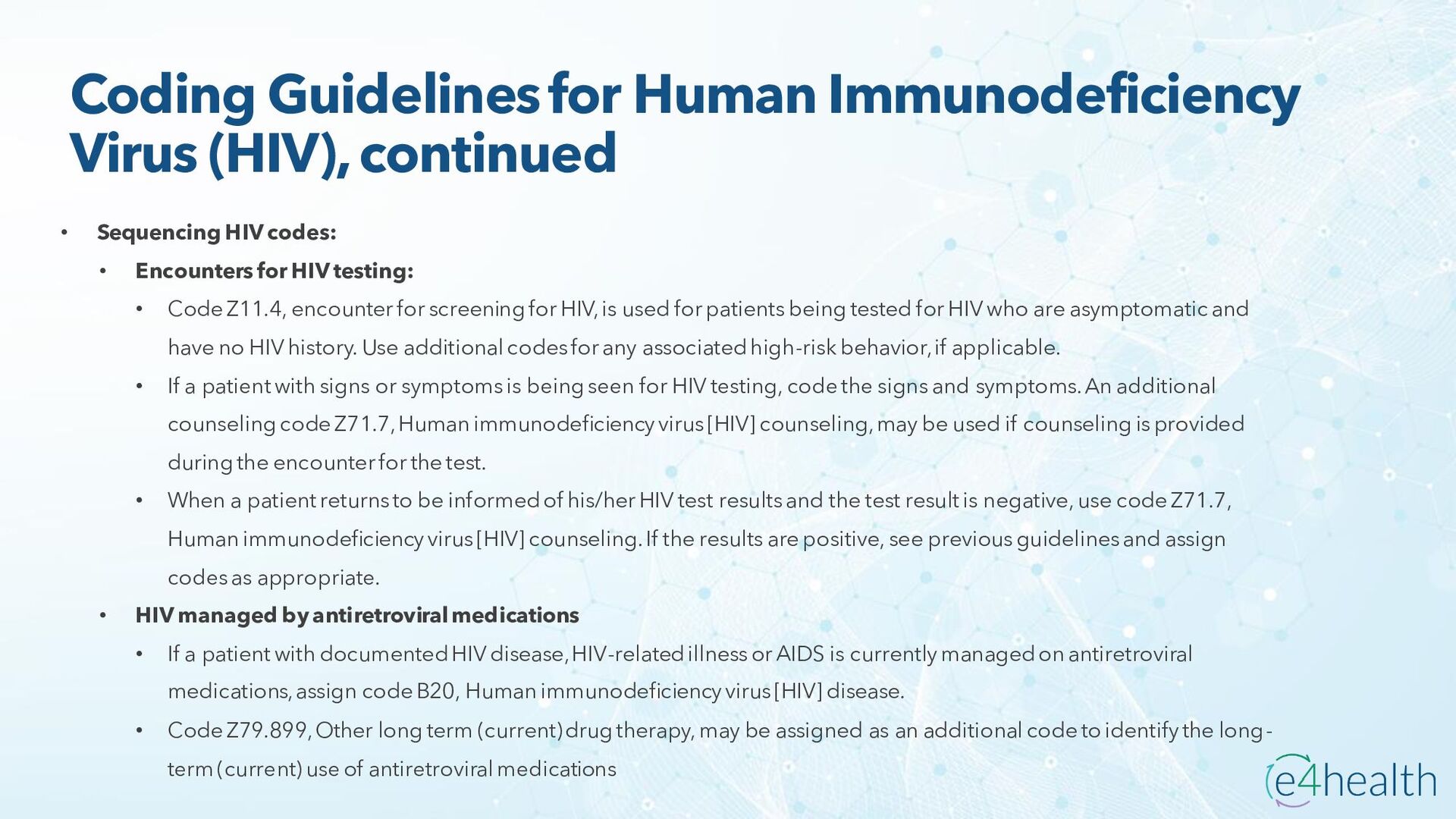
    HIV codes: • Encounters for HIV testing: • Code Z11.4, encounter for screening for HIV, is used for patients being tested for HIV who are asymptomatic and have no HIV history. Use additional codes for any associated high-risk behavior, if applicable. • If a patient with signs or symptoms is being seen for HIV testing, code the signs and symptoms. An additional counseling code Z71.7, Human immunodeficiency virus [HIV] counseling, may be used if counseling is provided during the encounter for the test. • When a patient returns to be informed of his/her HIV test results and the test result is negative, use code Z71.7, Human immunodeficiency virus [HIV] counseling. If the results are positive, see previous guidelines and assign codes as appropriate. • HIV managed by antiretroviral medications • If a patient with documented HIV disease, HIV-related illness or AIDS is currently managed on antiretroviral medications, assign code B20, Human immunodeficiency virus [HIV] disease. • Code Z79.899, Other long term (current) drug therapy, may be assigned as an additional code to identify the long- term (current) use of antiretroviral medications
  7. History of HIV managed by medication Coding clinic first quarter

    2022 pages 36-37 • Question: My facility has interpreted new HIV coding guideline I.C.1.a.2.i "History of HIV managed by medication" to mean that code B20, HIV disease, should be reported for any HIV positive patient on antiretrovirals, regardless of whether the documentation states the patient has ever had an HIV-defining illness or has HIV disease. Could you please clarify if this was the intent of this new guideline? • Answer: The intent of the guideline is to provide guidance that code B20 is appropriate for patients documented with HIV disease on antiretrovirals and to align with the guidance published in Coding Clinic, Fourth Quarter 2020, pages 97-98, that clarified HIV disease is specifically classified to code B20. • It would NOT BE appropriate to report code B20 without provider documentation of an HIV related illness, HIV disease or AIDS. • A diagnosis of "HIV" or "HIV positive" without documentation of HIV disease, an HIV related illness, or AIDS should be assigned code Z21, Asymptomatic human immunodeficiency virus [HIV] infection status." • However, the provider should be queried for clarification when the documentation is unclear regarding the patient's HIV status. This is also consistent with the advice published in Coding Clinic,First Quarter 2019, pages 8-11.
  8. Human Immunodeficiency Virus and Related Conditions Coding Clinic First Quarter

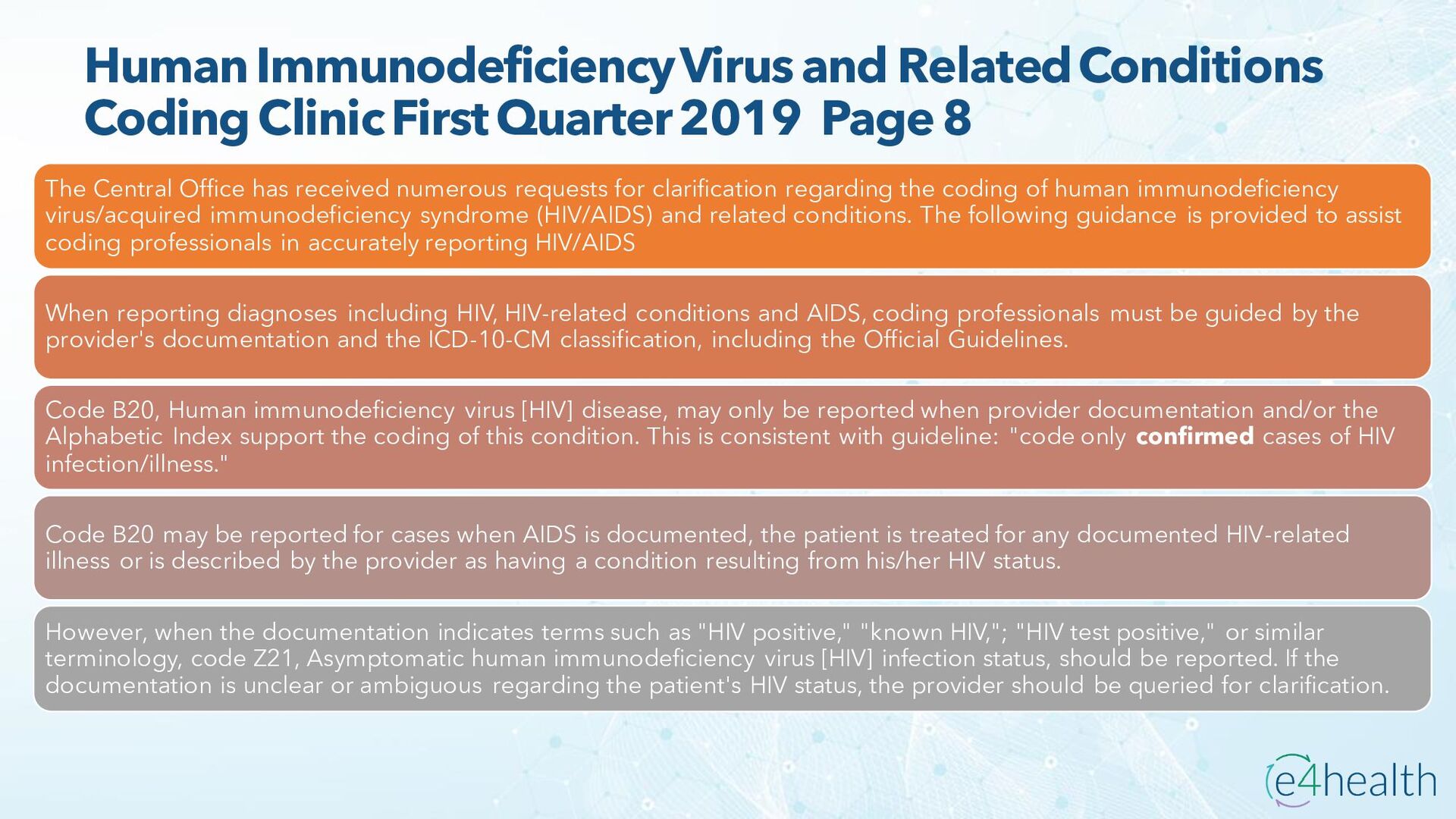
    2019 Page 8 The Central Office has received numerous requests for clarification regarding the coding of human immunodeficiency virus/acquired immunodeficiency syndrome (HIV/AIDS) and related conditions. The following guidance is provided to assist coding professionals in accurately reporting HIV/AIDS When reporting diagnoses including HIV, HIV-related conditions and AIDS, coding professionals must be guided by the provider's documentation and the ICD-10-CM classification, including the Official Guidelines. Code B20, Human immunodeficiency virus [HIV] disease, may only be reported when provider documentation and/or the Alphabetic Index support the coding of this condition. This is consistent with guideline: "code only confirmed cases of HIV infection/illness." Code B20 may be reported for cases when AIDS is documented, the patient is treated for any documented HIV-related illness or is described by the provider as having a condition resulting from his/her HIV status. However, when the documentation indicates terms such as "HIV positive," "known HIV,"; "HIV test positive," or similar terminology, code Z21, Asymptomatic human immunodeficiency virus [HIV] infection status, should be reported. If the documentation is unclear or ambiguous regarding the patient's HIV status, the provider should be queried for clarification.
  9. Human Immunodeficiency Virus and Related Conditions Coding Clinic First Quarter

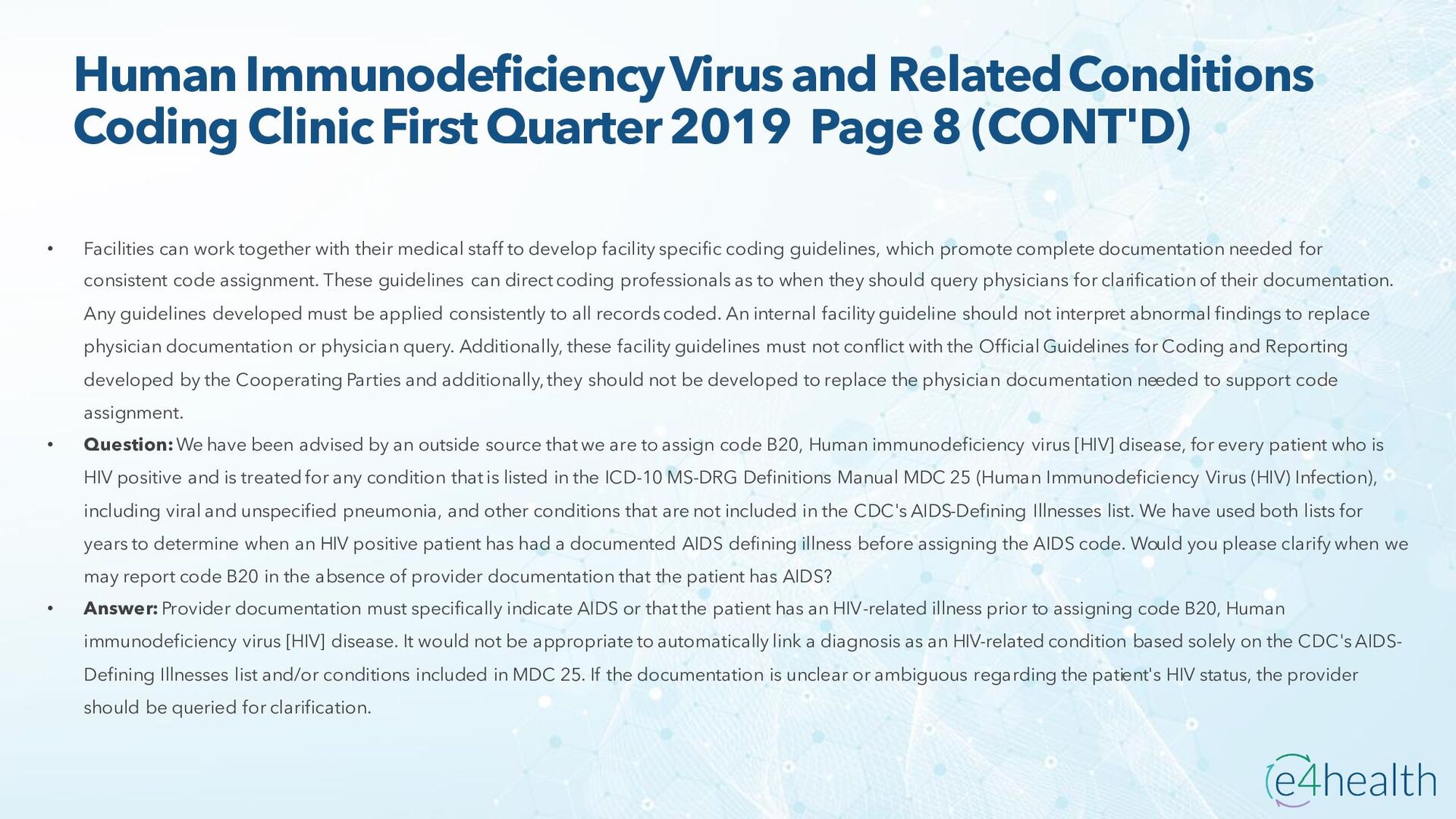
    2019 Page 8 (CONT'D) • Facilities can work together with their medical staff to develop facility specific coding guidelines, which promote complete documentation needed for consistent code assignment. These guidelines can direct coding professionals as to when they should query physicians for clarification of their documentation. Any guidelines developed must be applied consistently to all records coded. An internal facility guideline should not interpret abnormal findings to replace physician documentation or physician query. Additionally, these facility guidelines must not conflict with the Official Guidelines for Coding and Reporting developed by the Cooperating Parties and additionally, they should not be developed to replace the physician documentation needed to support code assignment. • Question: We have been advised by an outside source that we are to assign code B20, Human immunodeficiency virus [HIV] disease, for every patient who is HIV positive and is treated for any condition that is listed in the ICD-10 MS-DRG Definitions Manual MDC 25 (Human Immunodeficiency Virus (HIV) Infection), including viral and unspecified pneumonia, and other conditions that are not included in the CDC's AIDS-Defining Illnesses list. We have used both lists for years to determine when an HIV positive patient has had a documented AIDS defining illness before assigning the AIDS code. Would you please clarify when we may report code B20 in the absence of provider documentation that the patient has AIDS? • Answer: Provider documentation must specifically indicate AIDS or that the patient has an HIV-related illness prior to assigning code B20, Human immunodeficiency virus [HIV] disease. It would not be appropriate to automatically link a diagnosis as an HIV-related condition based solely on the CDC's AIDS- Defining Illnesses list and/or conditions included in MDC 25. If the documentation is unclear or ambiguous regarding the patient's HIV status, the provider should be queried for clarification.
  10. HUMAN IMMUNODEFICIENCY VIRUS AND RELATED CONDITIONS CODING CLINIC FIRST QUARTER

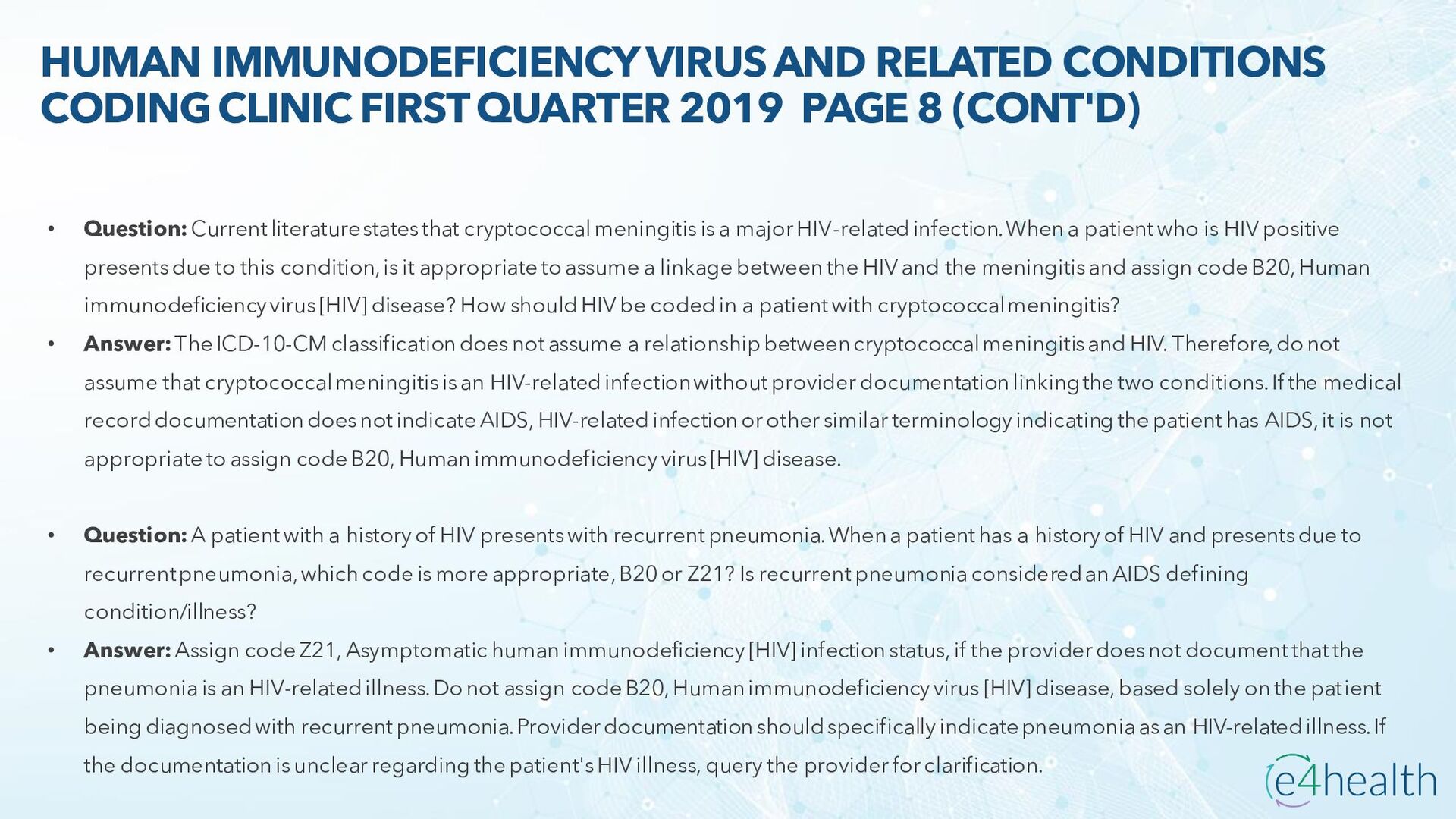
    2019 PAGE 8 (CONT'D) • Question: Current literature states that cryptococcal meningitis is a major HIV-related infection. When a patient who is HIV positive presents due to this condition, is it appropriate to assume a linkage between the HIV and the meningitis and assign code B20, Human immunodeficiency virus [HIV] disease? How should HIV be coded in a patient with cryptococcal meningitis? • Answer: The ICD-10-CM classification does not assume a relationship between cryptococcal meningitis and HIV. Therefore, do not assume that cryptococcal meningitis is an HIV-related infection without provider documentation linking the two conditions. If the medical record documentation does not indicate AIDS, HIV-related infection or other similar terminology indicating the patient has AIDS, it is not appropriate to assign code B20, Human immunodeficiency virus [HIV] disease. • Question: A patient with a history of HIV presents with recurrent pneumonia. When a patient has a history of HIV and presents due to recurrent pneumonia, which code is more appropriate, B20 or Z21? Is recurrent pneumonia considered an AIDS defining condition/illness? • Answer: Assign code Z21, Asymptomatic human immunodeficiency [HIV] infection status, if the provider does not document that the pneumonia is an HIV-related illness. Do not assign code B20, Human immunodeficiency virus [HIV] disease, based solely on the patient being diagnosed with recurrent pneumonia. Provider documentation should specifically indicate pneumonia as an HIV-related illness. If the documentation is unclear regarding the patient's HIV illness, query the provider for clarification.
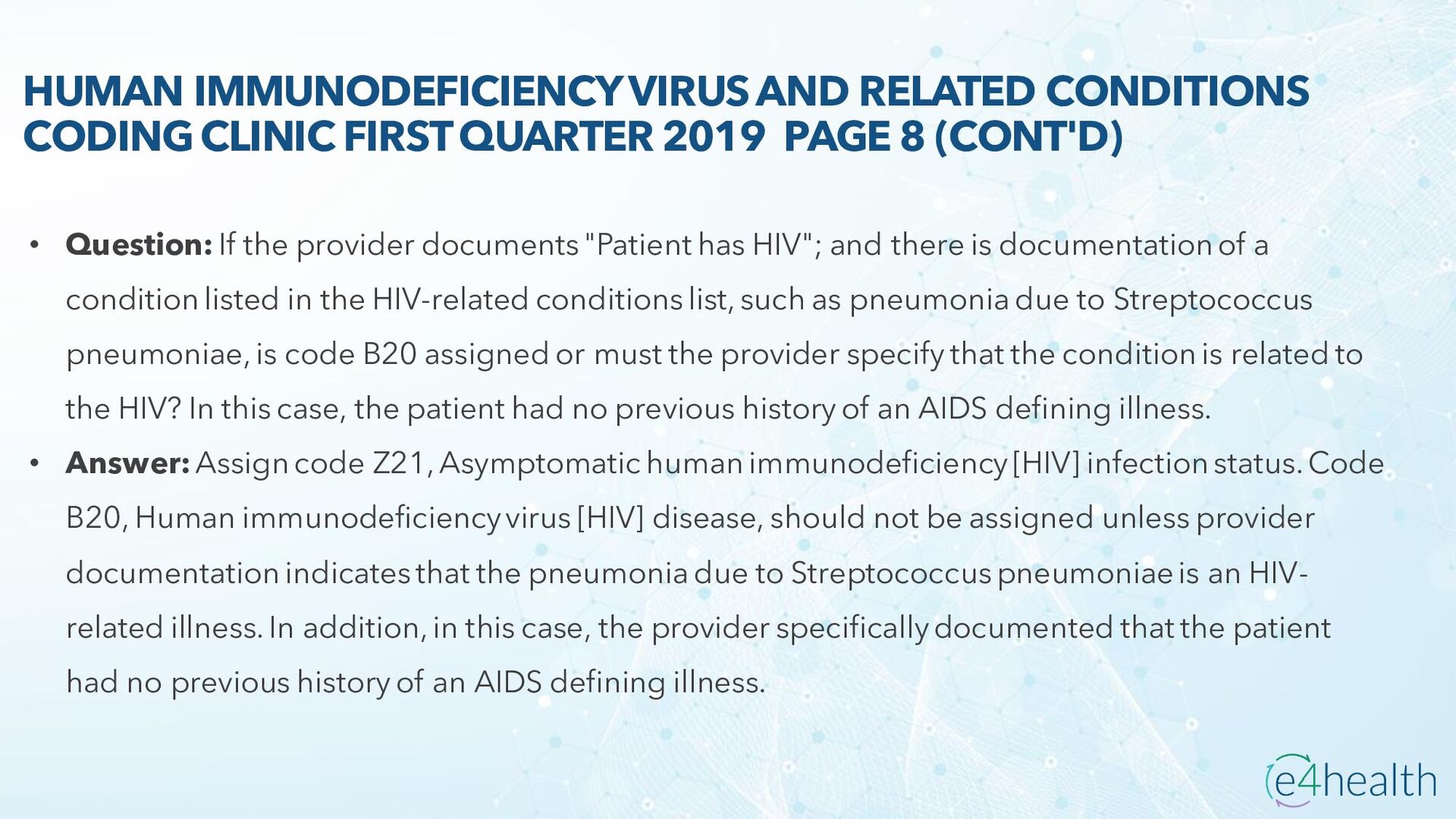
  11. • Question: If the provider documents "Patient has HIV"; and

    there is documentation of a condition listed in the HIV-related conditions list, such as pneumonia due to Streptococcus pneumoniae, is code B20 assigned or must the provider specify that the condition is related to the HIV? In this case, the patient had no previous history of an AIDS defining illness. • Answer: Assign code Z21, Asymptomatic human immunodeficiency [HIV] infection status. Code B20, Human immunodeficiency virus [HIV] disease, should not be assigned unless provider documentation indicates that the pneumonia due to Streptococcus pneumoniae is an HIV- related illness. In addition, in this case, the provider specifically documented that the patient had no previous history of an AIDS defining illness. HUMAN IMMUNODEFICIENCY VIRUS AND RELATED CONDITIONS CODING CLINIC FIRST QUARTER 2019 PAGE 8 (CONT'D)
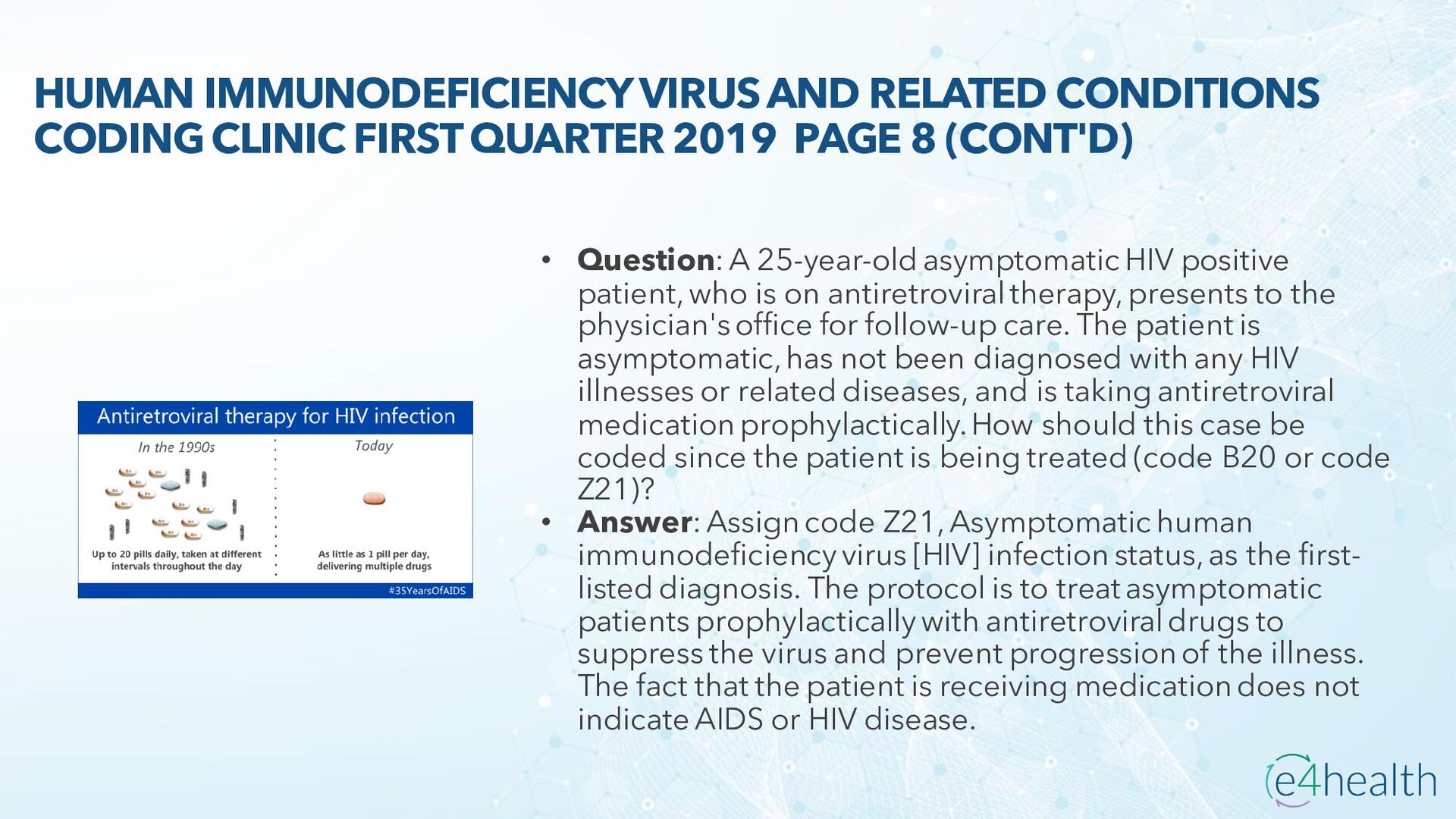
  12. • Question: A 25-year-old asymptomatic HIV positive patient, who is

    on antiretroviral therapy, presents to the physician's office for follow-up care. The patient is asymptomatic, has not been diagnosed with any HIV illnesses or related diseases, and is taking antiretroviral medication prophylactically. How should this case be coded since the patient is being treated (code B20 or code Z21)? • Answer: Assign code Z21, Asymptomatic human immunodeficiency virus [HIV] infection status, as the first- listed diagnosis. The protocol is to treat asymptomatic patients prophylactically with antiretroviral drugs to suppress the virus and prevent progression of the illness. The fact that the patient is receiving medication does not indicate AIDS or HIV disease. HUMAN IMMUNODEFICIENCY VIRUS AND RELATED CONDITIONS CODING CLINIC FIRST QUARTER 2019 PAGE 8 (CONT'D)
  13. Immunodeficiency Status with HIV (Correction notice) Coding Clinic first quarter

    2021 Page 52 • Coding Clinic, Fourth Quarter 2020, pages 10- 11, stated, "Code D84.81, Immunodeficiency due to conditions classified elsewhere, was created for an immunocompromised state due to a specific medical condition such as HIV, AIDS, certain cancers and genetic disorders that are classified elsewhere in ICD-10- CM." • This is a misstatement, as it is NOT appropriate to assign code D84.81, Immunodeficiency due to conditions classified elsewhere, together with code B20, Human immunodeficiency virus [HIV] disease. • Immunocompromise/ immunodeficiency is part of the clinical picture in HIV disease, and code B20 captures fully the immunocompromised state • The Excludes1 note under code D84.81, excluding B20, confirms that HIV/AIDS is not coded here
  14. HIV Disease Coding Clinic Fourth Quarter 2020 Page 97 •

    Question: A 68-year-old male was admitted due to anemia. The patient also has a past medical history of HIV disease, currently on antiretrovirals (ARVs). The patient had a history of CD4 count less than 200 with a current CD4 of 335. The provider's diagnostic statement listed, "HIV disease on ARVs (CD4 335, VL undetectable)" as a secondary diagnosis. What is the appropriate HIV code for this patient? • Answer: Assign code B20, Human immunodeficiency virus [HIV] disease, for this patient. The provider documented HIV disease, which is specifically classified to code B20. As with any other condition, query the provi • Question: A 55-year-old with a personal history of end-stage renal disease (ESRD) and long-standing history of HIV disease presented due to influenza. The provider documented HIV disease on current treatment with a CD4 level over 1,000 and an undetectable viral load. What is the appropriate HIV code for this patient? • Answer: Assign code B20, Human immunodeficiency virus [HIV] disease, for this patient. Provider documentation indicated HIV disease, which is specifically classified to code B20. As with any other condition, query the provider for clarification when there is conflicting documentation. This Photo by Unknown author is licensed under CC BY-NC-ND.
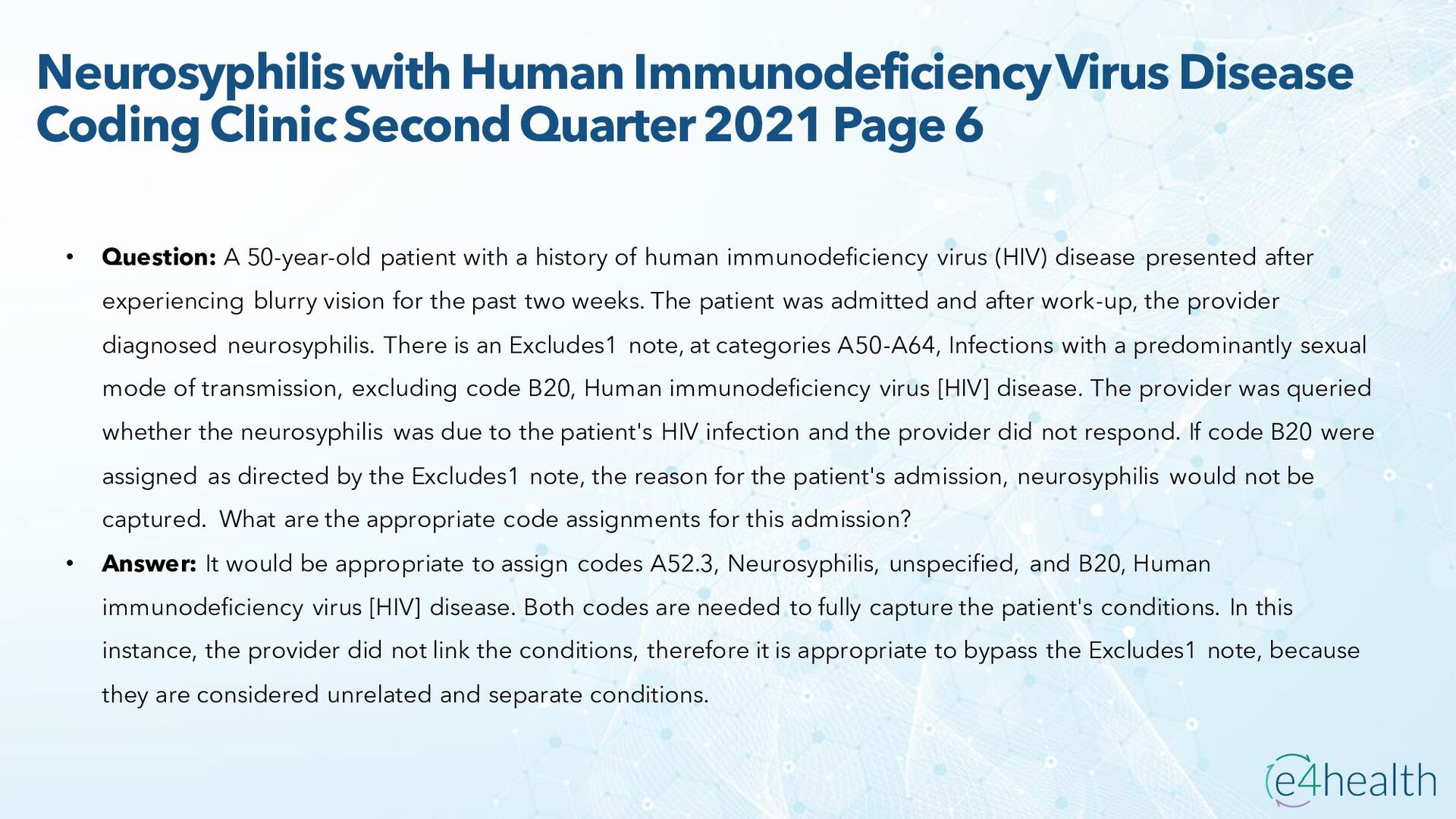
  15. Neurosyphilis with Human Immunodeficiency Virus Disease Coding Clinic Second Quarter

    2021 Page 6 • Question: A 50-year-old patient with a history of human immunodeficiency virus (HIV) disease presented after experiencing blurry vision for the past two weeks. The patient was admitted and after work-up, the provider diagnosed neurosyphilis. There is an Excludes1 note, at categories A50-A64, Infections with a predominantly sexual mode of transmission, excluding code B20, Human immunodeficiency virus [HIV] disease. The provider was queried whether the neurosyphilis was due to the patient's HIV infection and the provider did not respond. If code B20 were assigned as directed by the Excludes1 note, the reason for the patient's admission, neurosyphilis would not be captured. What are the appropriate code assignments for this admission? • Answer: It would be appropriate to assign codes A52.3, Neurosyphilis, unspecified, and B20, Human immunodeficiency virus [HIV] disease. Both codes are needed to fully capture the patient's conditions. In this instance, the provider did not link the conditions, therefore it is appropriate to bypass the Excludes1 note, because they are considered unrelated and separate conditions.
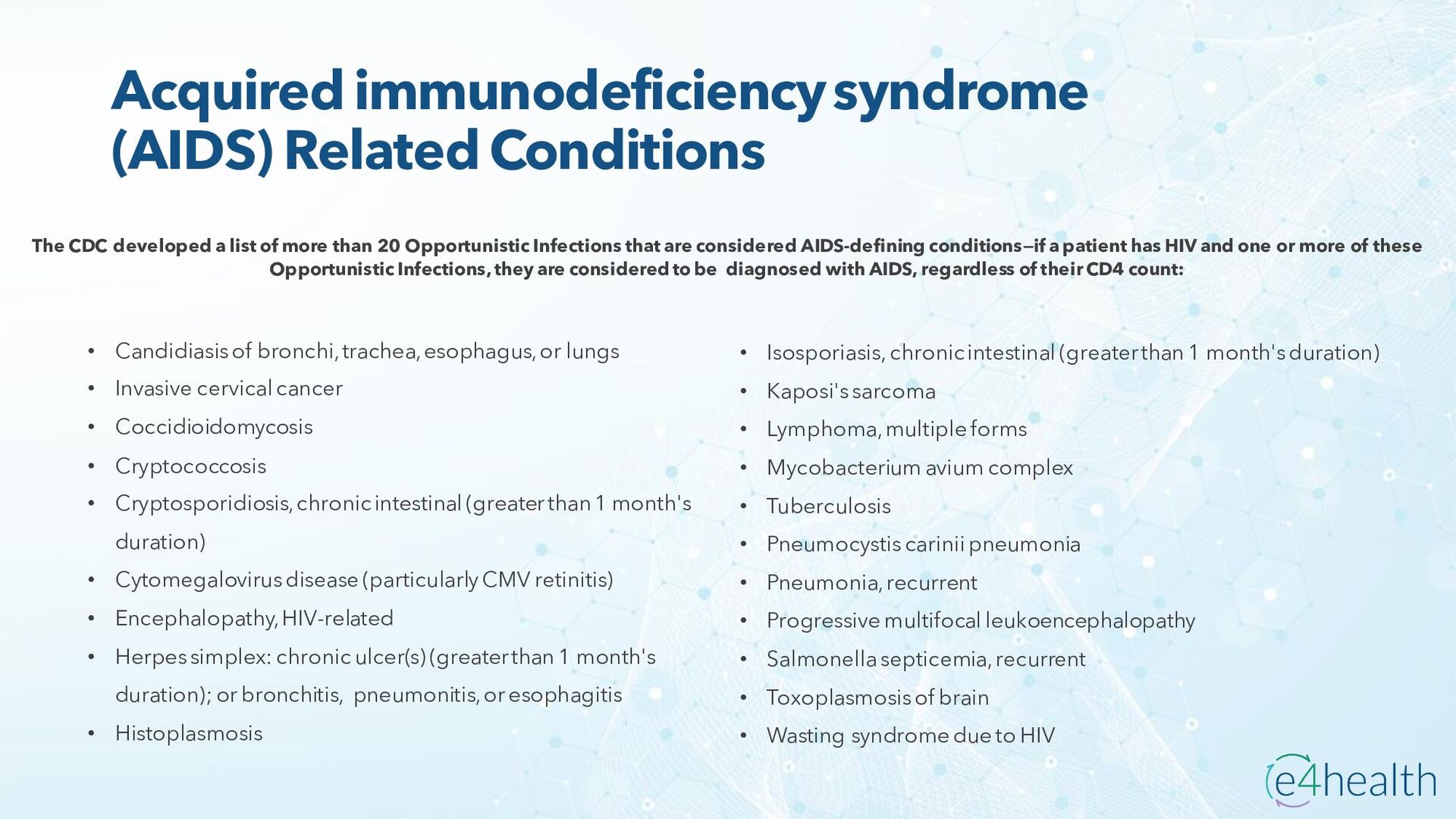
  16. Acquired immunodeficiency syndrome (AIDS) Related Conditions • Candidiasis of bronchi,

    trachea, esophagus, or lungs • Invasive cervical cancer • Coccidioidomycosis • Cryptococcosis • Cryptosporidiosis, chronic intestinal (greater than 1 month's duration) • Cytomegalovirus disease (particularly CMV retinitis) • Encephalopathy, HIV-related • Herpes simplex: chronic ulcer(s) (greater than 1 month's duration); or bronchitis, pneumonitis, or esophagitis • Histoplasmosis • Isosporiasis, chronic intestinal (greater than 1 month's duration) • Kaposi's sarcoma • Lymphoma, multiple forms • Mycobacterium avium complex • Tuberculosis • Pneumocystis carinii pneumonia • Pneumonia, recurrent • Progressive multifocal leukoencephalopathy • Salmonella septicemia, recurrent • Toxoplasmosis of brain • Wasting syndrome due to HIV The CDC developed a list of more than 20 Opportunistic Infections that are considered AIDS-defining conditions—if a patient has HIV and one or more of these Opportunistic Infections, they are considered to be diagnosed with AIDS, regardless of their CD4 count:
  17. Human Immunodeficiency Virus (HIV) Query opportunities • If documentation is

    unclear, clarify: • HIV positive (is a lab result) should be further clarified as: • Asymptomatic • Has not progress to AIDS • The reason for admission: • AIDS-related condition (i.e., pneumonia) • Unrelated condition (i.e., fracture)
  18. Human Immunodeficiency Virus (HIV) Query opportunities, Continued • Document any

    associated diagnoses/conditions: • Sepsis • Pancytopenia • Specificity of encephalopathy • Malnutrition • Decubitus ulcers • Fractures • Other infectious process: fungal rashes/infection • Non-compliance
  19. References • AHA ICD-10-CM and ICD-10-PCS Coding Handbook • ICD-10-PCS:

    An Applied Approach 2023 • Cengage: 3-2-1 CODE IT! • Medical Terminology Systems: A Body Systems Approach, 8th edition • 3M Clinical Documentation Improvement System Reference • Human Immunodeficiency Virus (HIV) Infection - Infectious Diseases - Merck Manuals Professional Edition • Antiretroviral Treatment of HIV Infection - Infectious Diseases - Merck Manuals Professional Edition • The Stages of HIV Infection | NIH 20