Share
Embed
Is It Really Worth Sending Your Dog to Overnight Training
Explore whether overnight dog training is worth the investment with this Prestige K9 guide. It explains program routines, costs, potential benefits, and limitations, plus key questions to ask trainers. Learn why your dog’s individual needs, owner involvement, handover sessions, and consistent practice at home matter when choosing a program.
Ellis Olivia
November 18, 2026
Transcript
7 slides
-
Is It Really Worth Sending Your Dog to Overnight Training?
I get some version of this question now and then: is dog overnight training actually worth the money? Or is it just an expensive way to feel less guilty about not training your own dog? That price tag deserves a straight answer, especially since dog training comes in several formats and prices, and overnight programs sit at the top of that range. What Does Overnight Training Actually Involve? Boarding and training for your dog means your dog moves in with a trainer, usually for one to several weeks, trading one weekly session for daily, structured work. -
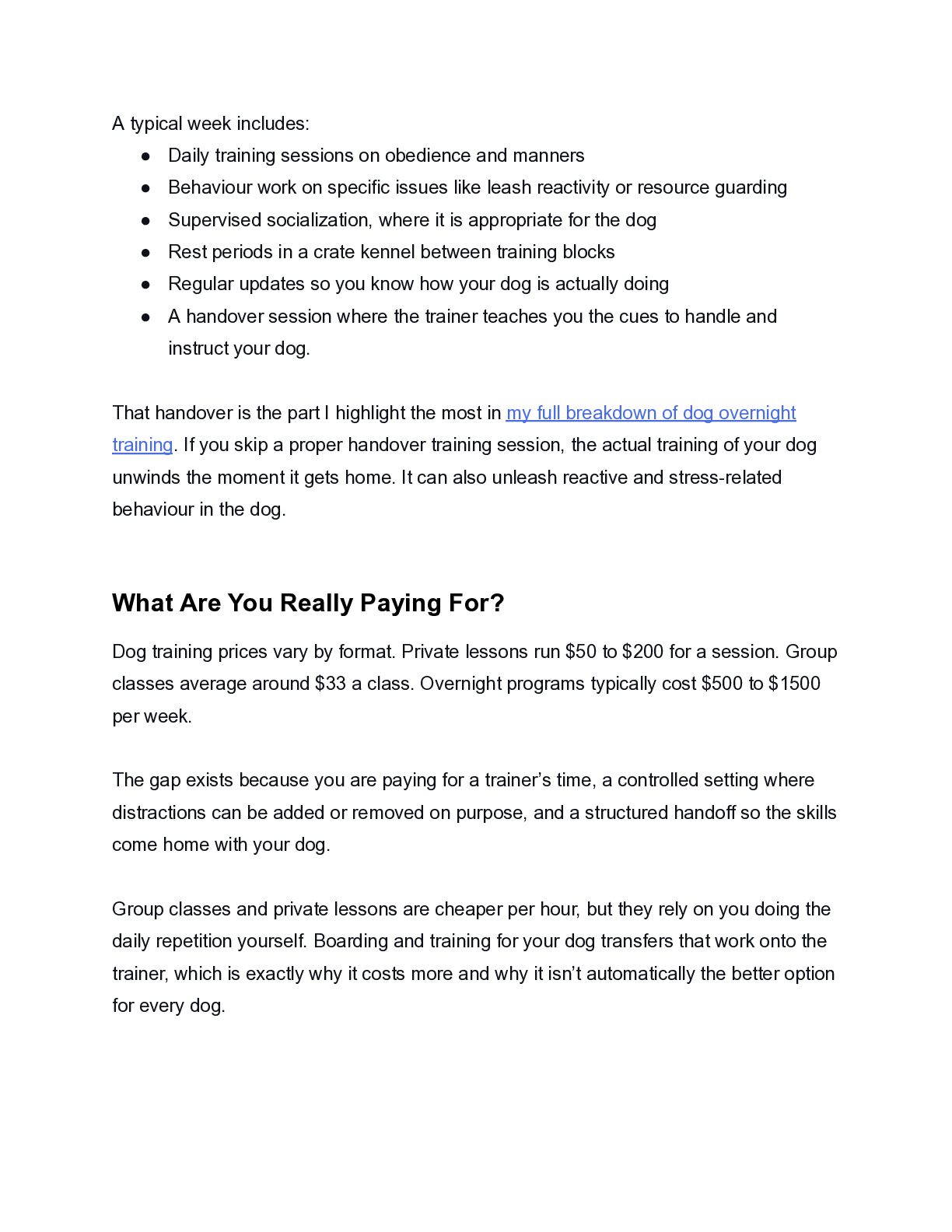
A typical week includes: • Daily training sessions on obedience
and manners • Behaviour work on specific issues like leash reactivity or resource guarding • Supervised socialization, where it is appropriate for the dog • Rest periods in a crate kennel between training blocks • Regular updates so you know how your dog is actually doing • A handover session where the trainer teaches you the cues to handle and instruct your dog. That handover is the part I highlight the most in my full breakdown of dog overnight training. If you skip a proper handover training session, the actual training of your dog unwinds the moment it gets home. It can also unleash reactive and stress-related behaviour in the dog. What Are You Really Paying For? Dog training prices vary by format. Private lessons run $50 to $200 for a session. Group classes average around $33 a class. Overnight programs typically cost $500 to $1500 per week. The gap exists because you are paying for a trainer’s time, a controlled setting where distractions can be added or removed on purpose, and a structured handoff so the skills come home with your dog. Group classes and private lessons are cheaper per hour, but they rely on you doing the daily repetition yourself. Boarding and training for your dog transfers that work onto the trainer, which is exactly why it costs more and why it isn’t automatically the better option for every dog. -
Is Overnight Training Worth It for Every Dog? Like other
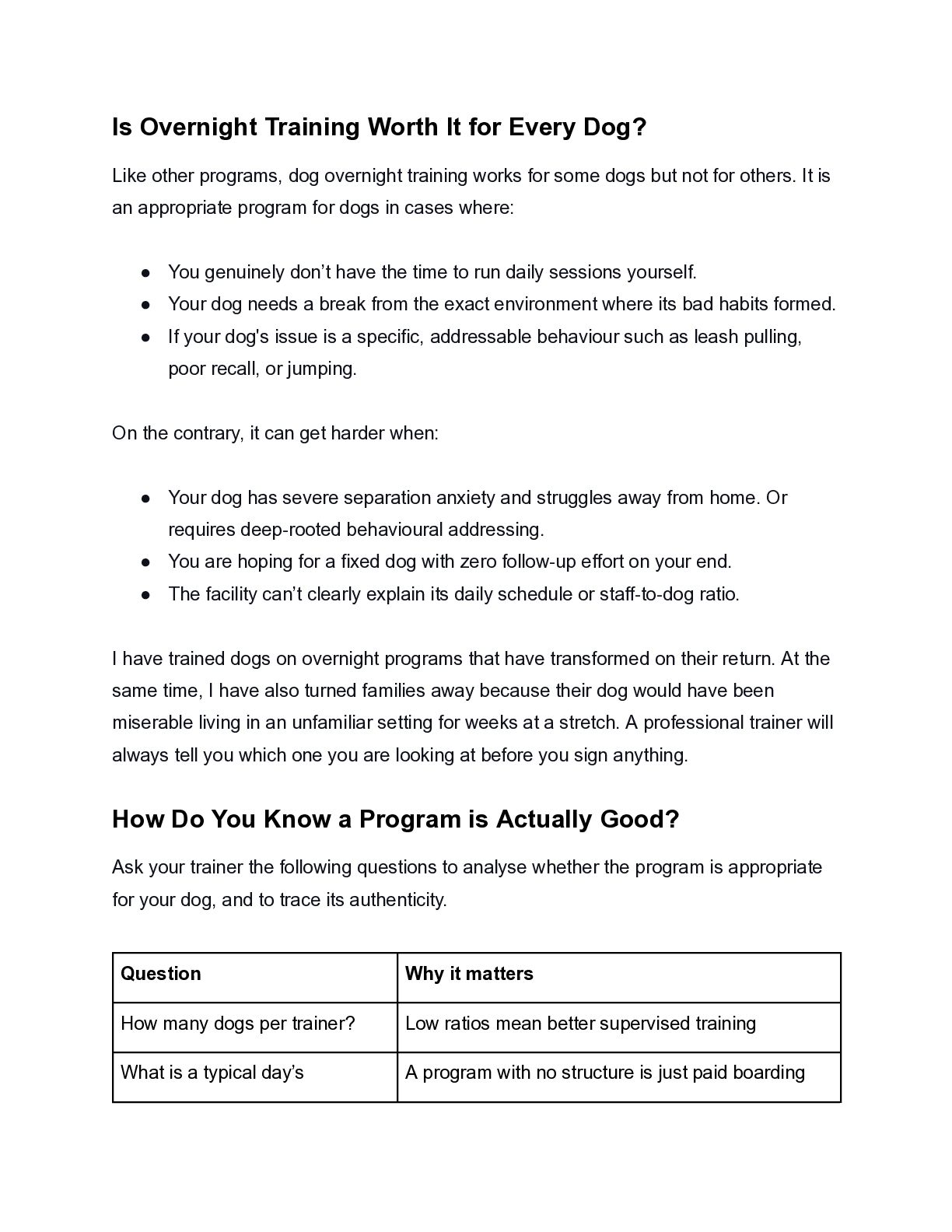
programs, dog overnight training works for some dogs but not for others. It is an appropriate program for dogs in cases where: • You genuinely don’t have the time to run daily sessions yourself. • Your dog needs a break from the exact environment where its bad habits formed. • If your dog's issue is a specific, addressable behaviour such as leash pulling, poor recall, or jumping. On the contrary, it can get harder when: • Your dog has severe separation anxiety and struggles away from home. Or requires deep-rooted behavioural addressing. • You are hoping for a fixed dog with zero follow-up effort on your end. • The facility can’t clearly explain its daily schedule or staff-to-dog ratio. I have trained dogs on overnight programs that have transformed on their return. At the same time, I have also turned families away because their dog would have been miserable living in an unfamiliar setting for weeks at a stretch. A professional trainer will always tell you which one you are looking at before you sign anything. How Do You Know a Program is Actually Good? Ask your trainer the following questions to analyse whether the program is appropriate for your dog, and to trace its authenticity. Question Why it matters How many dogs per trainer? Low ratios mean better supervised training What is a typical day’s A program with no structure is just paid boarding -
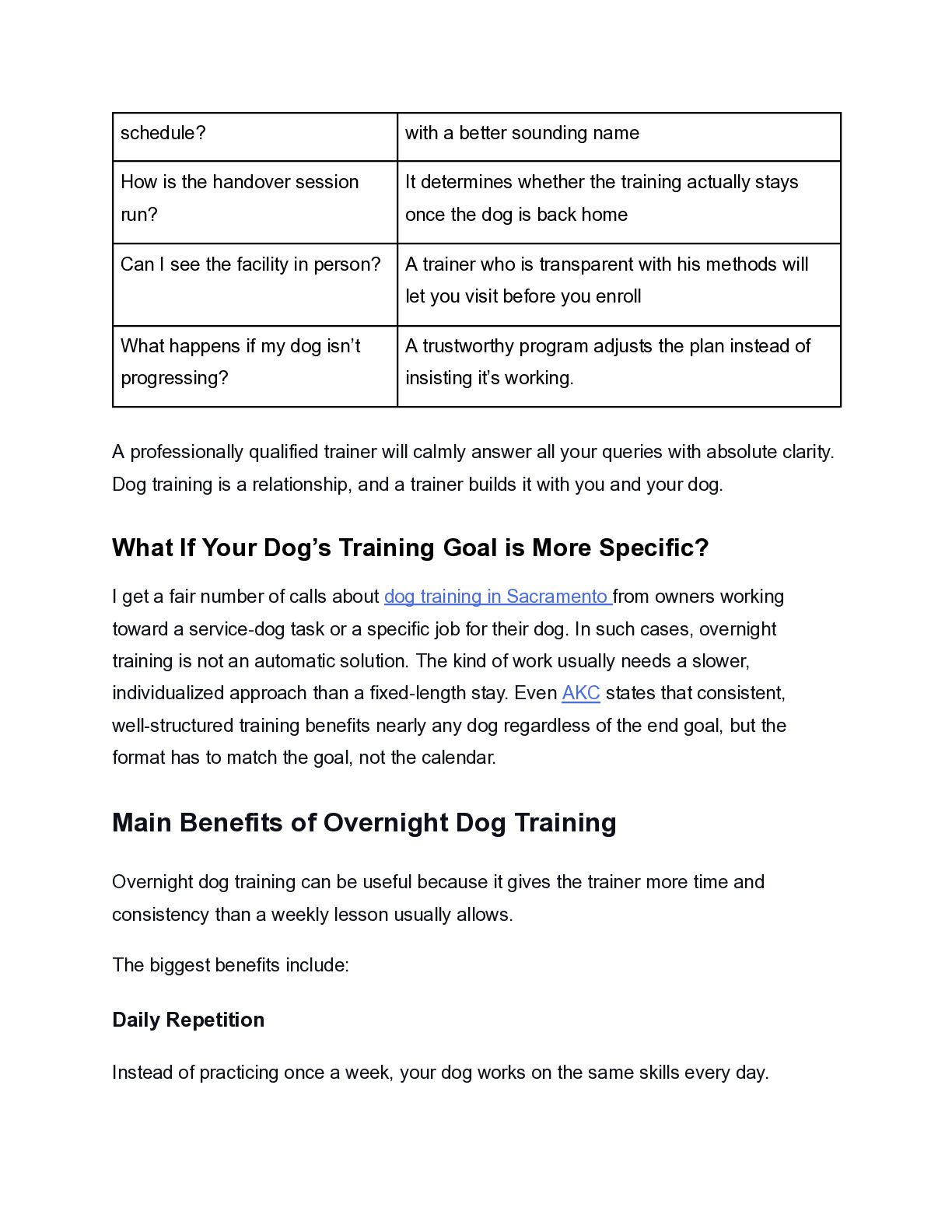
schedule? with a better sounding name How is the handover
session It determines whether the training actually stays run? once the dog is back home Can I see the facility in person? A trainer who is transparent with his methods will let you visit before you enroll What happens if my dog isn’t A trustworthy program adjusts the plan instead of progressing? insisting it’s working. A professionally qualified trainer will calmly answer all your queries with absolute clarity. Dog training is a relationship, and a trainer builds it with you and your dog. What If Your Dog’s Training Goal is More Specific? I get a fair number of calls about dog training in Sacramento from owners working toward a service-dog task or a specific job for their dog. In such cases, overnight training is not an automatic solution. The kind of work usually needs a slower, individualized approach than a fixed-length stay. Even AKC states that consistent, well-structured training benefits nearly any dog regardless of the end goal, but the format has to match the goal, not the calendar. Main Benefits of Overnight Dog Training Overnight dog training can be useful because it gives the trainer more time and consistency than a weekly lesson usually allows. The biggest benefits include: Daily Repetition Instead of practicing once a week, your dog works on the same skills every day. -
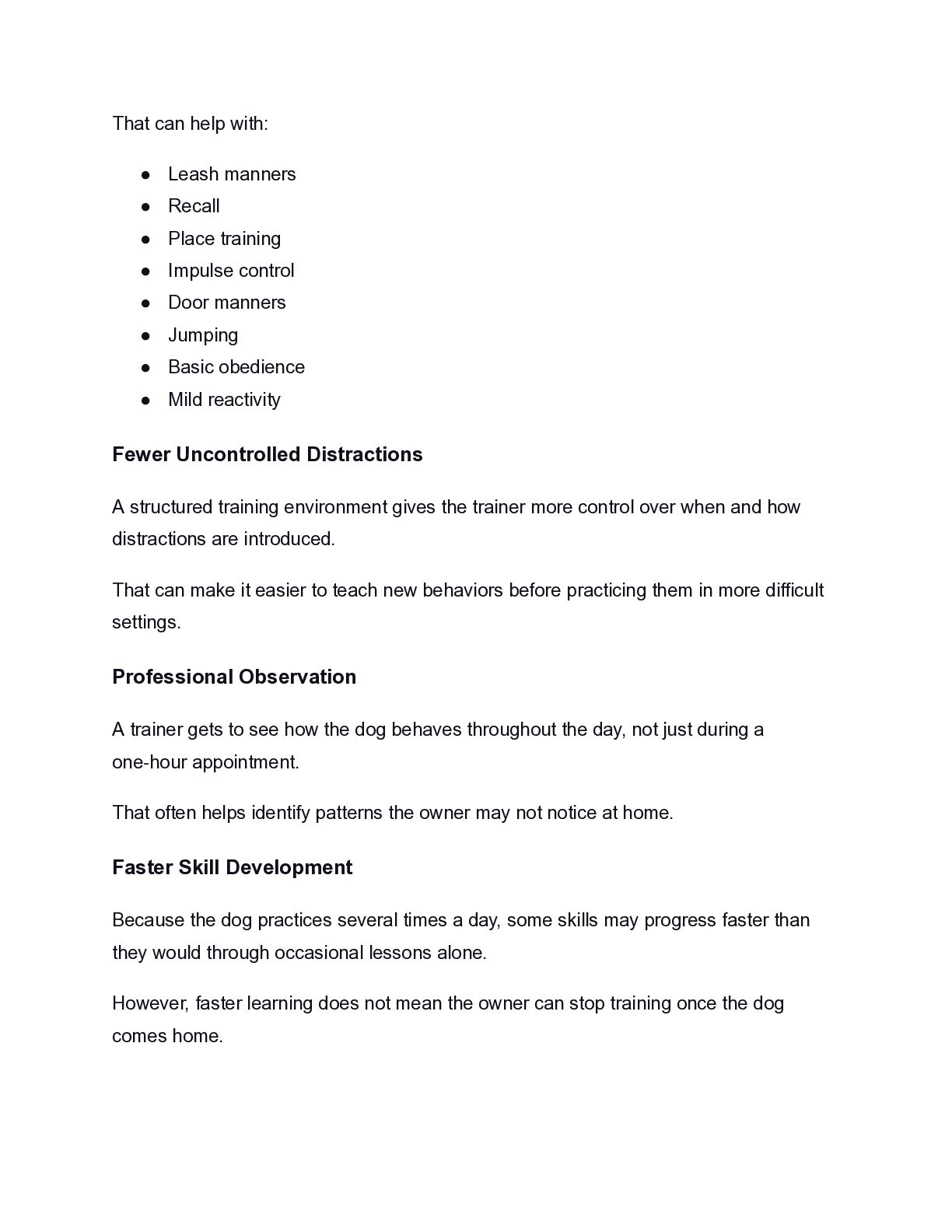
That can help with: • Leash manners • Recall •
Place training • Impulse control • Door manners • Jumping • Basic obedience • Mild reactivity Fewer Uncontrolled Distractions A structured training environment gives the trainer more control over when and how distractions are introduced. That can make it easier to teach new behaviors before practicing them in more difficult settings. Professional Observation A trainer gets to see how the dog behaves throughout the day, not just during a one-hour appointment. That often helps identify patterns the owner may not notice at home. Faster Skill Development Because the dog practices several times a day, some skills may progress faster than they would through occasional lessons alone. However, faster learning does not mean the owner can stop training once the dog comes home. -
What Happens After Your Dog Comes Home? This is the
part most owners underestimate; it is important to understand that your dog didn’t acquire a permanent personality trait in three weeks. It learned habits that may fade without upkeep. The first two weeks at home decide whether the investment was worth it. Expect some regression as your dog adjusts back to your routine, rules, and inconsistencies. Homes don't look like the training facility, and dogs read context. A good program builds good handover and follow-up sessions. It is always a good idea to ask the trainers about inclusions and expectations for the dogs after training. Why Choose Prestige K9 Prestige K9 is built around honest answers. When you consider us for your dog boarding or training needs, we talk through what actually fits the dog. Our services include private lessons, day training, behaviour modification programs, boarding, and day care, among others. Spencer Bowman, the renowned champion trainer, understands the root cause of an issue or behaviour before working with a dog. We run small, structured training with real handover sessions so the training comes home with your dog. How Long Does Overnight Dog Training Take? There is no single length that works for every dog. Some programs last several days, while others continue for multiple weeks. The appropriate length depends on: • The dog’s age • Training history • Temperament • Behavior goals -
• Severity of the problem • How quickly the dog
adjusts • The level of reliability the owner expects Basic obedience may require less time than behavior modification. A dog learning recall and leash manners may progress faster than a dog working through long-standing reactivity or fear. Instead of choosing a program only by length, ask what the trainer expects to accomplish during that period. Conclusion Boarding or Overnight training for your dog can absolutely be worth it. Dogs will come back to build a better relationship and communication with their owners. Always talk to the trainer; trust your instincts; you will know what works and what doesn’t for your dog. Visit the facility, ask the right questions, and choose the format that matches your dog’s actual needs.