Upgrade to Pro — share decks privately, control downloads, hide ads and more …

The Commit You Can't Take Back: Conscience in a...

The Commit You Can't Take Back: Conscience in a Career That Builds the Future

Every engineer eventually faces a commit they're not sure they should make. I've faced a few—and walked away from work I couldn't reconcile, including offensive AI targeting in defense and pivotal moments building cryptographic and financial infrastructure where the right call cost something real. This keynote isn't a lecture on morality. It's a candid account from twenty years in the rooms where these decisions get made: defense contracts, DARPA programs, crypto and distributed finance, and now AI. We'll talk about dual-use technology—the same embedding pipeline that powers search can power surveillance—and the quiet, compounding pressure to just ship. We'll talk about what it actually costs to say "no," why "I just built the tool" stopped being a defense years ago, and how to build a career where your conscience and your craft don't have to be enemies. You write the future for a living. This is a conversation about doing it on purpose.

Avatar for Eric Mann

Eric Mann

October 17, 2026

More Decks by Eric Mann

Other Decks in Technology

Transcript

  1. The Commit You Can't Take Back Conscience in a career

    that builds the future Eric Mann — PHP 8.3/8.4 Release Manager · O'Reilly author · PHP Architect Security Corner
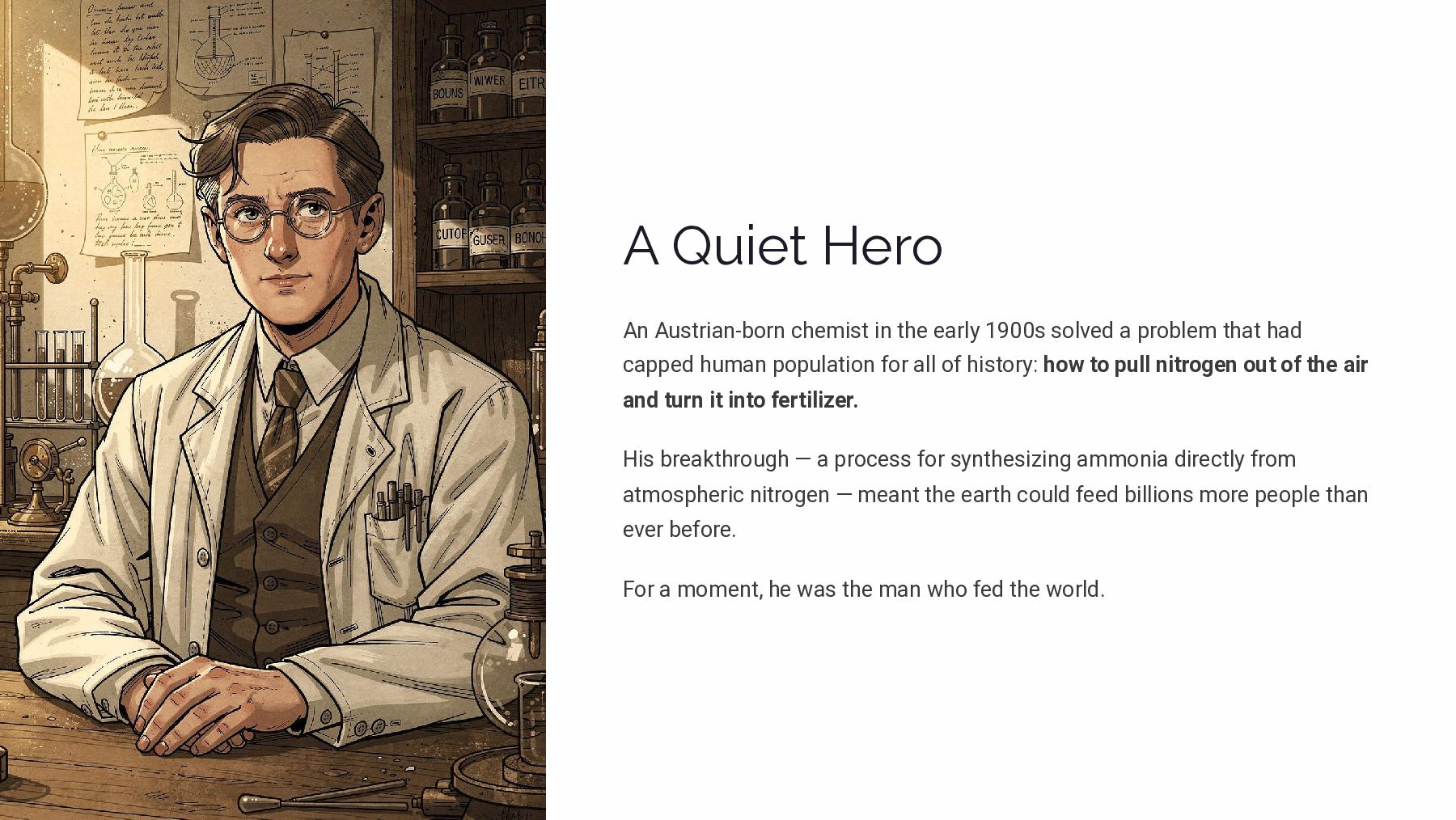
  2. A Quiet Hero An Austrian-born chemist in the early 1900s

    solved a problem that had capped human population for all of history: how to pull nitrogen out of the air and turn it into fertilizer. His breakthrough — a process for synthesizing ammonia directly from atmospheric nitrogen — meant the earth could feed billions more people than ever before. For a moment, he was the man who fed the world.
  3. "Bread from Air" Before this discovery, crop yields were hard-capped

    by available nitrogen. Nobel Prize in Chemistry, 1918. Estimates: the nitrogen in roughly half the protein in every human body alive today traces back to this discovery.
  4. The Same Brilliance, Pointed Elsewhere His name was Fritz Haber.

    Same man. Same lab. Same genius for chemistry at industrial scale. "A scientist belongs to the world in peacetime and to his country in war." World War I: Haber personally led Germany's chemical weapons program.
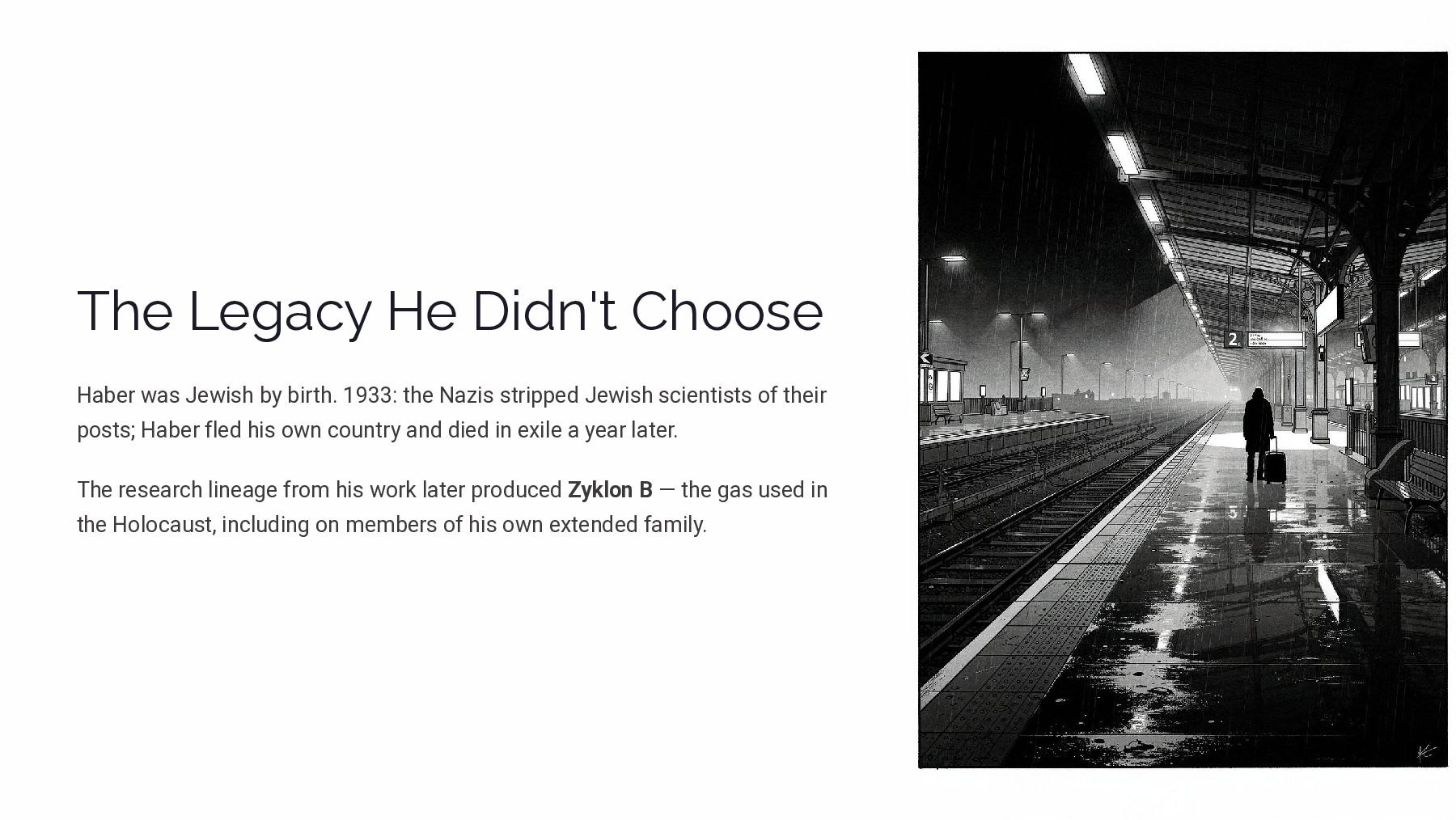
  5. The Legacy He Didn't Choose Haber was Jewish by birth.

    1933: the Nazis stripped Jewish scientists of their posts; Haber fled his own country and died in exile a year later. The research lineage from his work later produced Zyklon B — the gas used in the Holocaust, including on members of his own extended family.
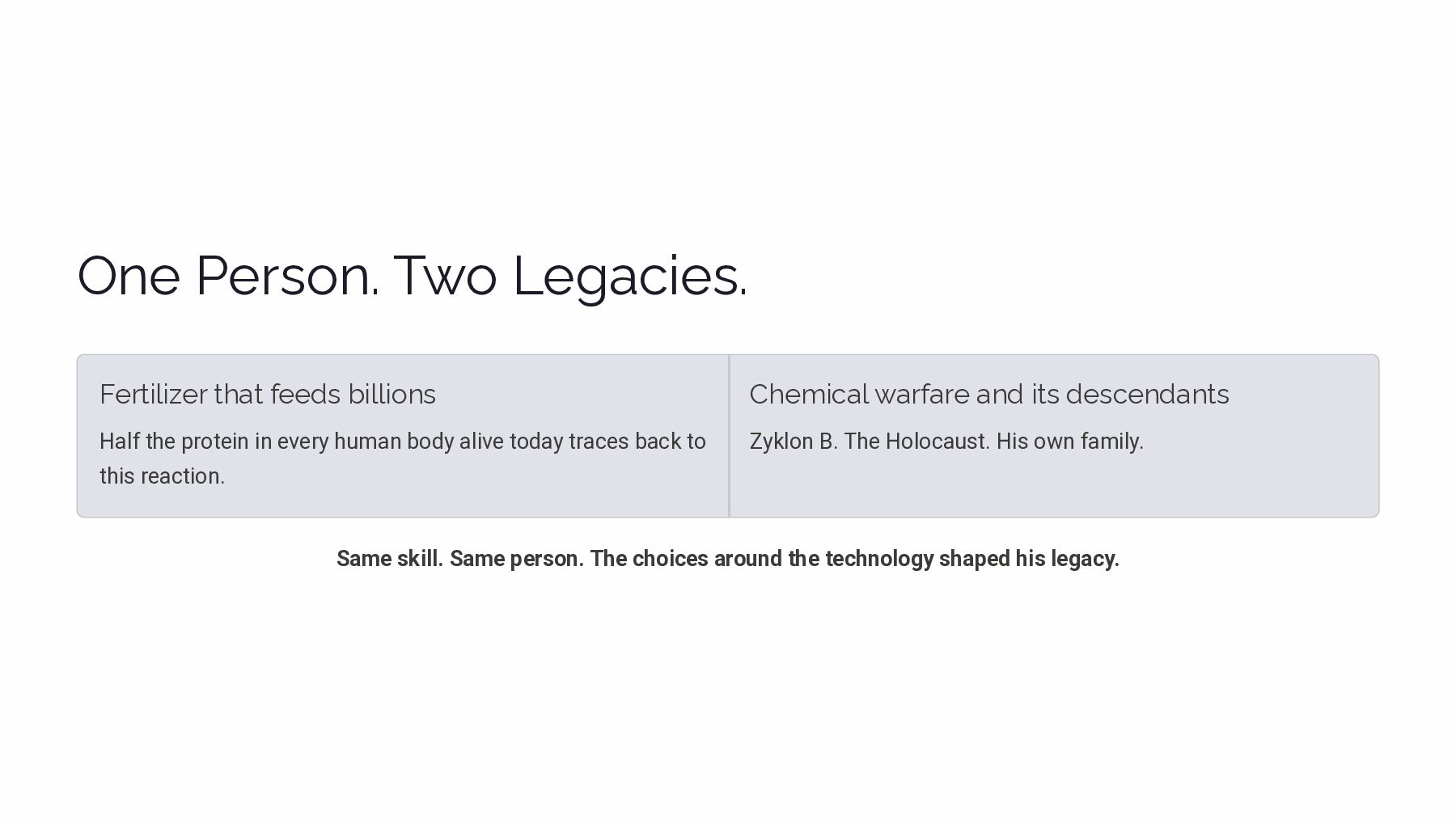
  6. One Person. Two Legacies. Fertilizer that feeds billions Chemical warfare

    and its descendants Half the protein in every human body alive today traces back to Zyklon B. The Holocaust. His own family. this reaction. Same skill. Same person. The choices around the technology shaped his legacy.
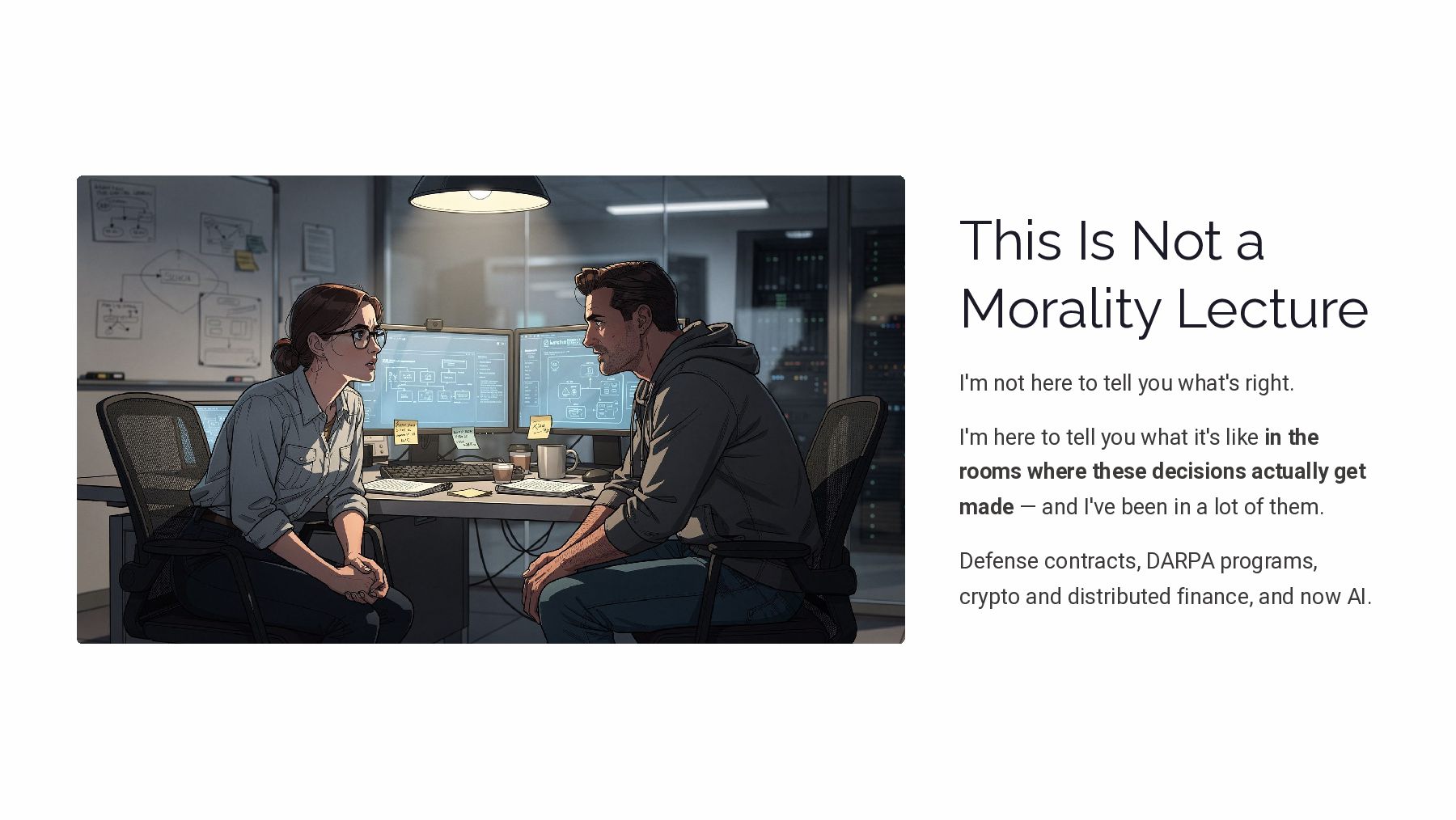
  7. This Is Not a Morality Lecture I'm not here to

    tell you what's right. I'm here to tell you what it's like in the rooms where these decisions actually get made — and I've been in a lot of them. Defense contracts, DARPA programs, crypto and distributed finance, and now AI.
  8. All Software Is Political It's not just the code we

    choose to write. It's the code we choose not to write. Inaction is a choice Every abstraction encodes a value Often one with louder consequences than action. Whether you meant it to or not.
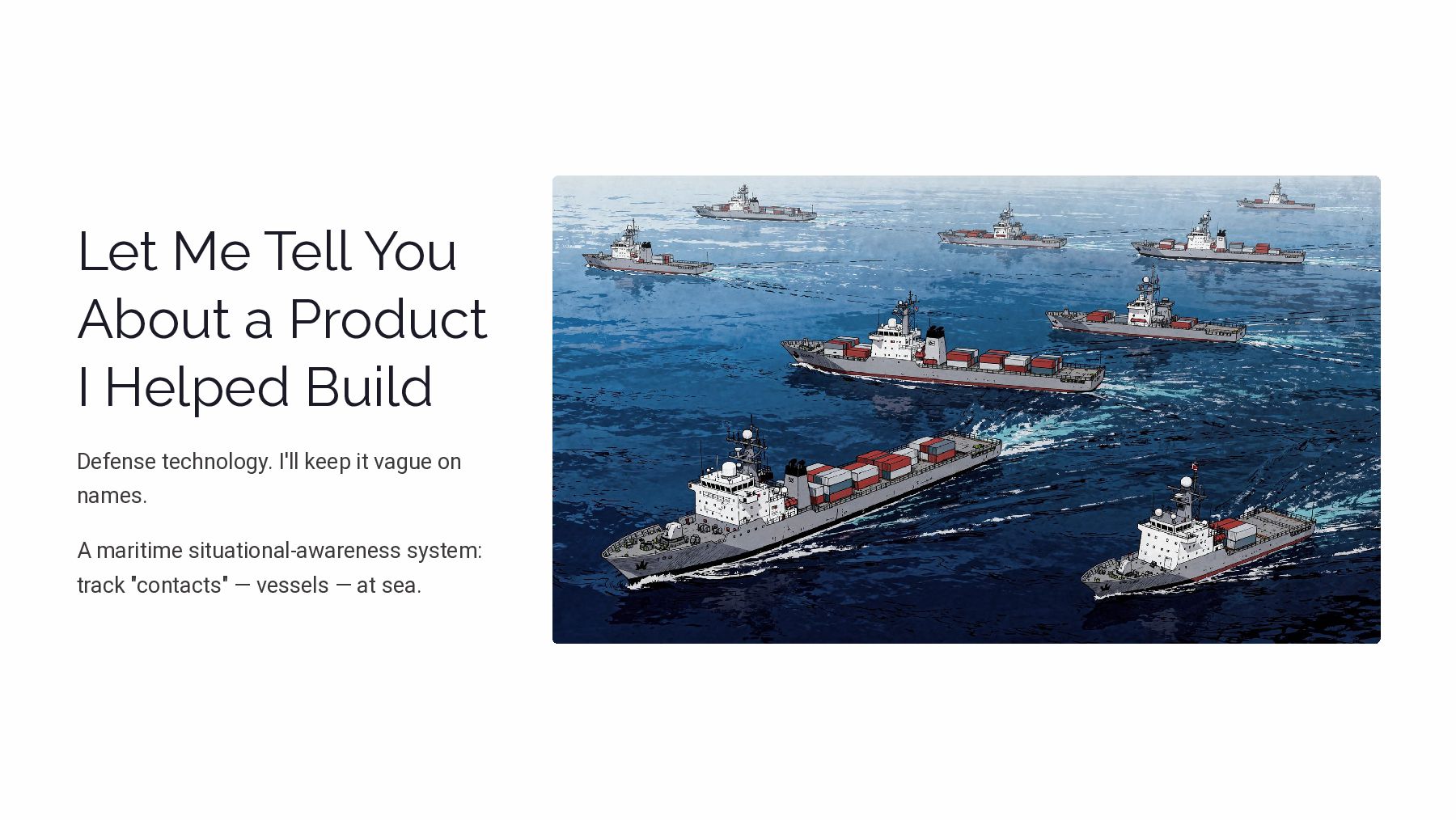
  9. Let Me Tell You About a Product I Helped Build

    Defense technology. I'll keep it vague on names. A maritime situational-awareness system: track "contacts" — vessels — at sea.
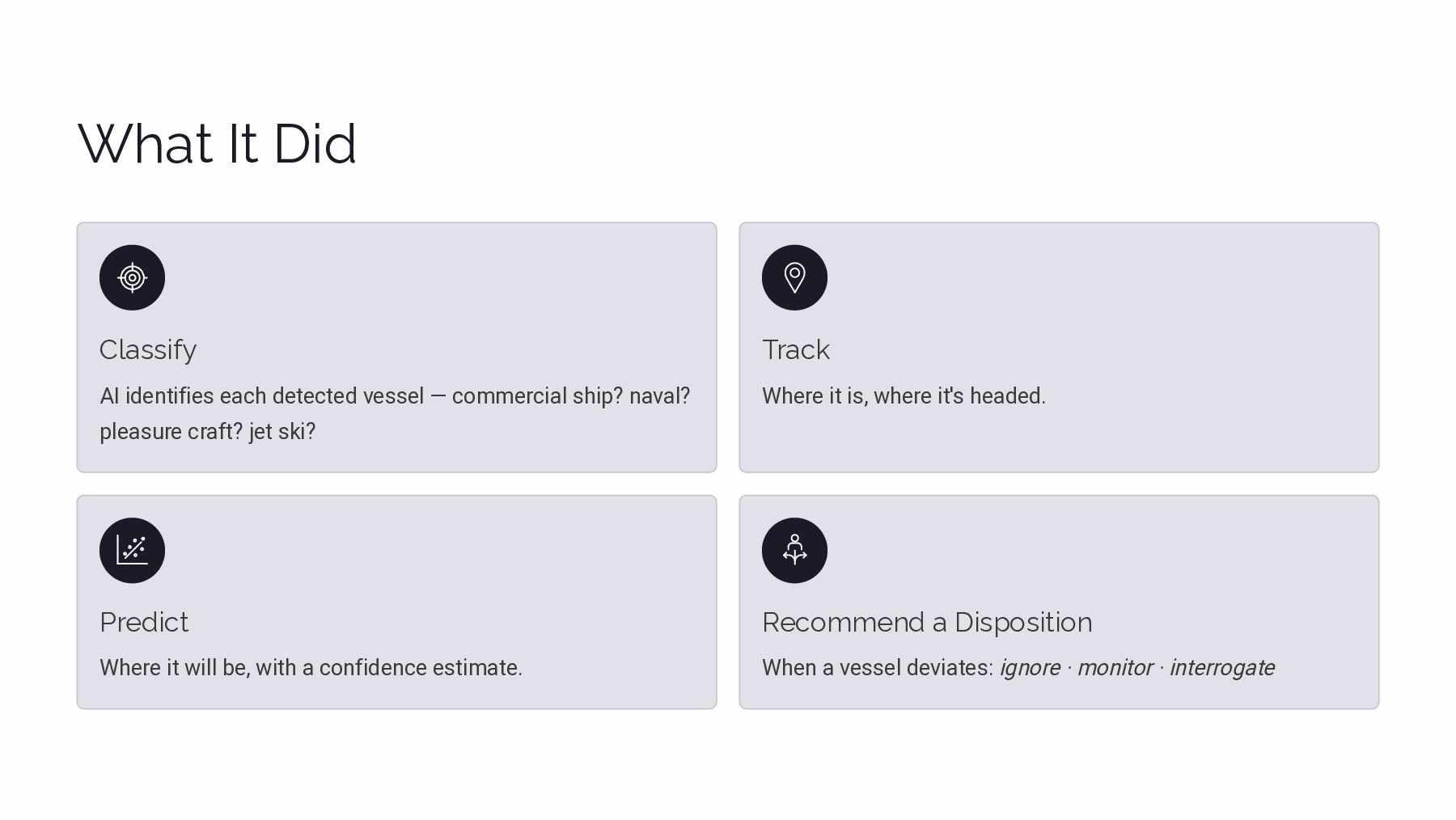
  10. What It Did Classify Track AI identifies each detected vessel

    — commercial ship? naval? Where it is, where it's headed. pleasure craft? jet ski? Predict Recommend a Disposition Where it will be, with a confidence estimate. When a vessel deviates: ignore · monitor · interrogate
  11. It Worked. Exceptionally well. We built and validated it on

    unclassified test data. Our defense customers took it into classified environments and repurposed it for their own missions. Once the tool leaves your hands, its purpose is no longer yours to define.
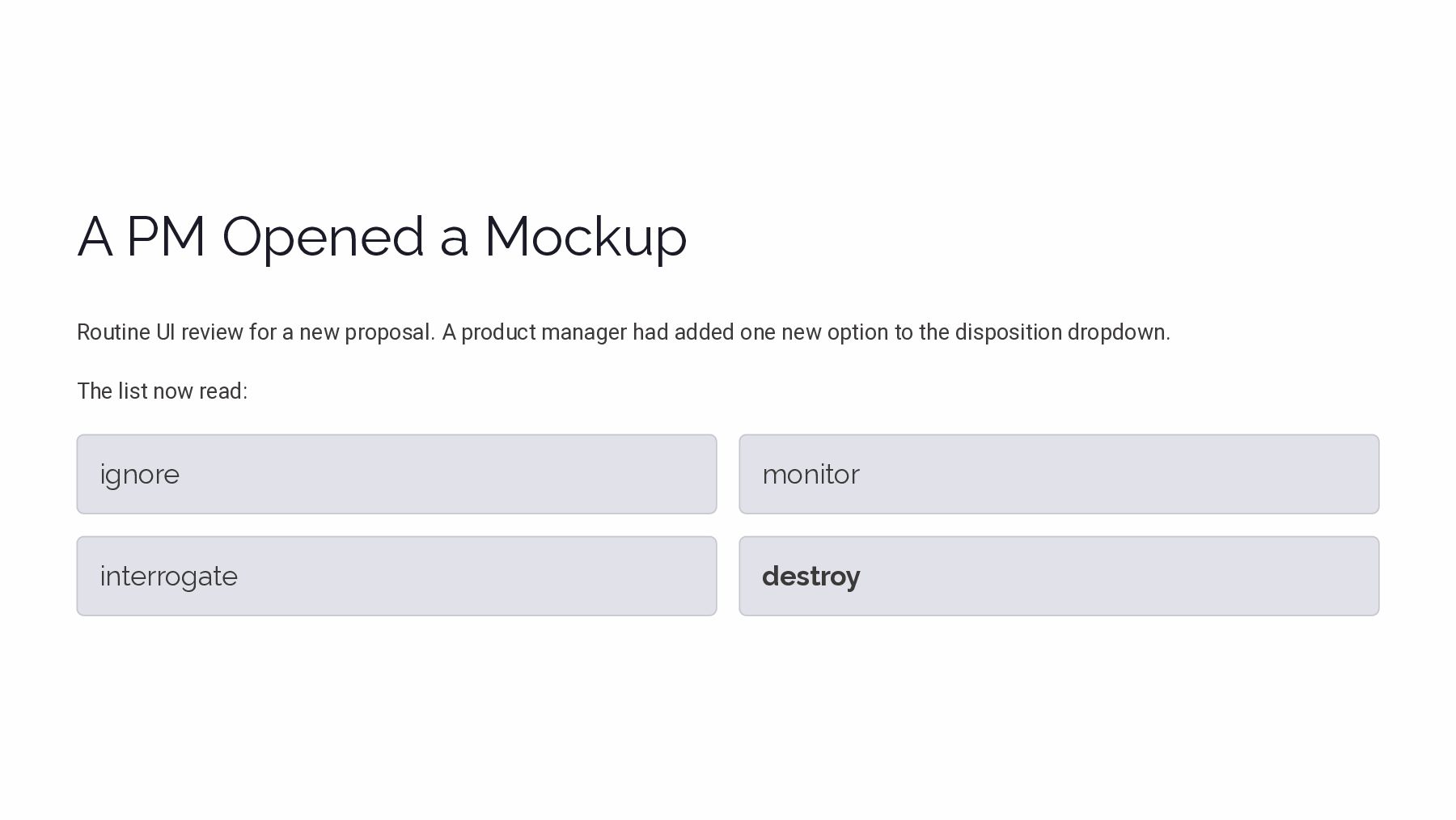
  12. A PM Opened a Mockup Routine UI review for a

    new proposal. A product manager had added one new option to the disposition dropdown. The list now read: ignore monitor interrogate destroy
  13. That Was the Day I Understood What We'd Built I

    had told myself we built a tracking tool. A situational-awareness tool. One dropdown option turned it into the front half of a kill chain. "We just built the tracking" was never actually true. Tracking became targeting.
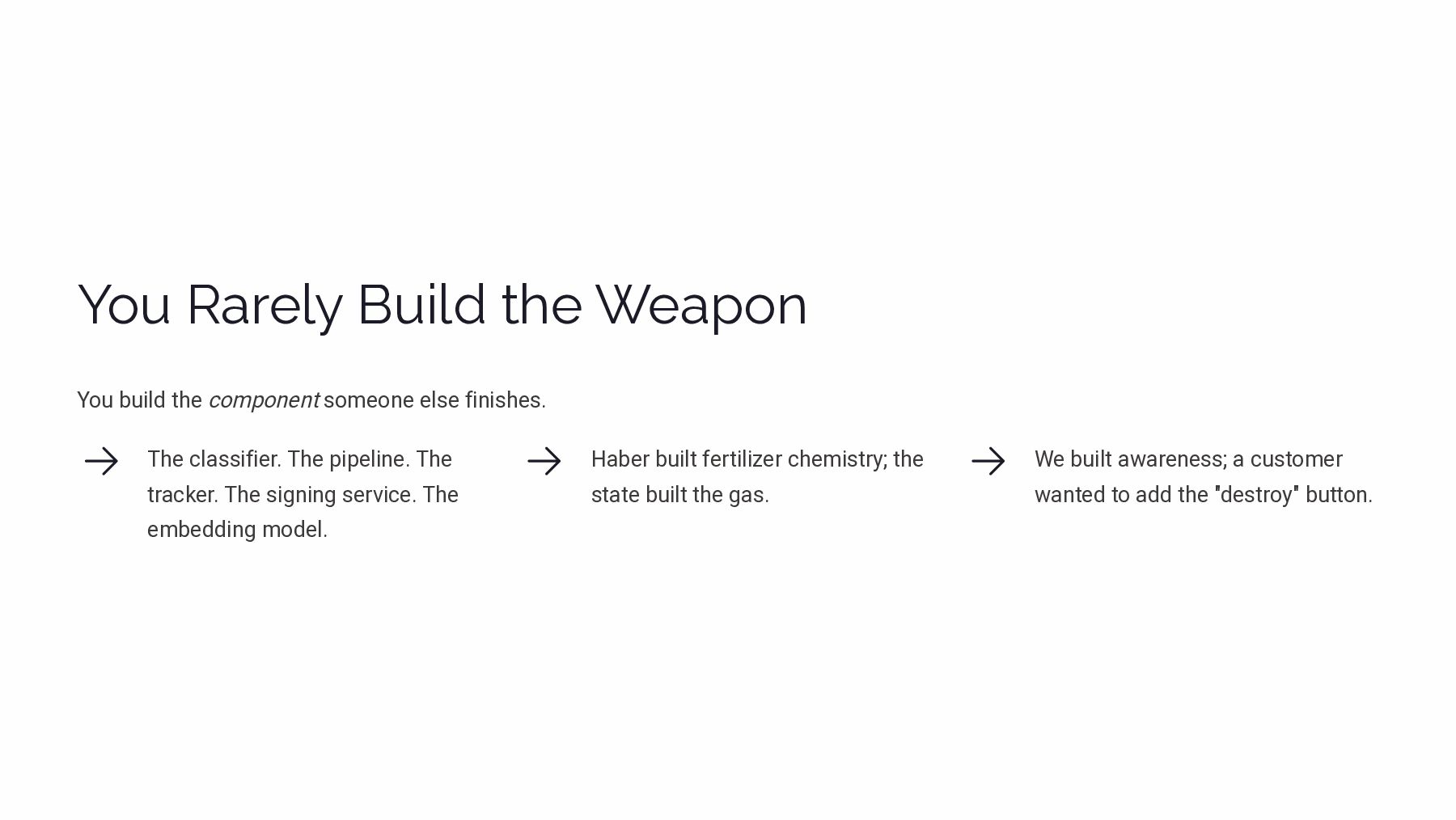
  14. You Rarely Build the Weapon You build the component someone

    else finishes. The classifier. The pipeline. The Haber built fertilizer chemistry; the We built awareness; a customer tracker. The signing service. The state built the gas. wanted to add the "destroy" button. embedding model.
  15. The Same Pipeline, Pointed Two Ways The embedding pipeline that

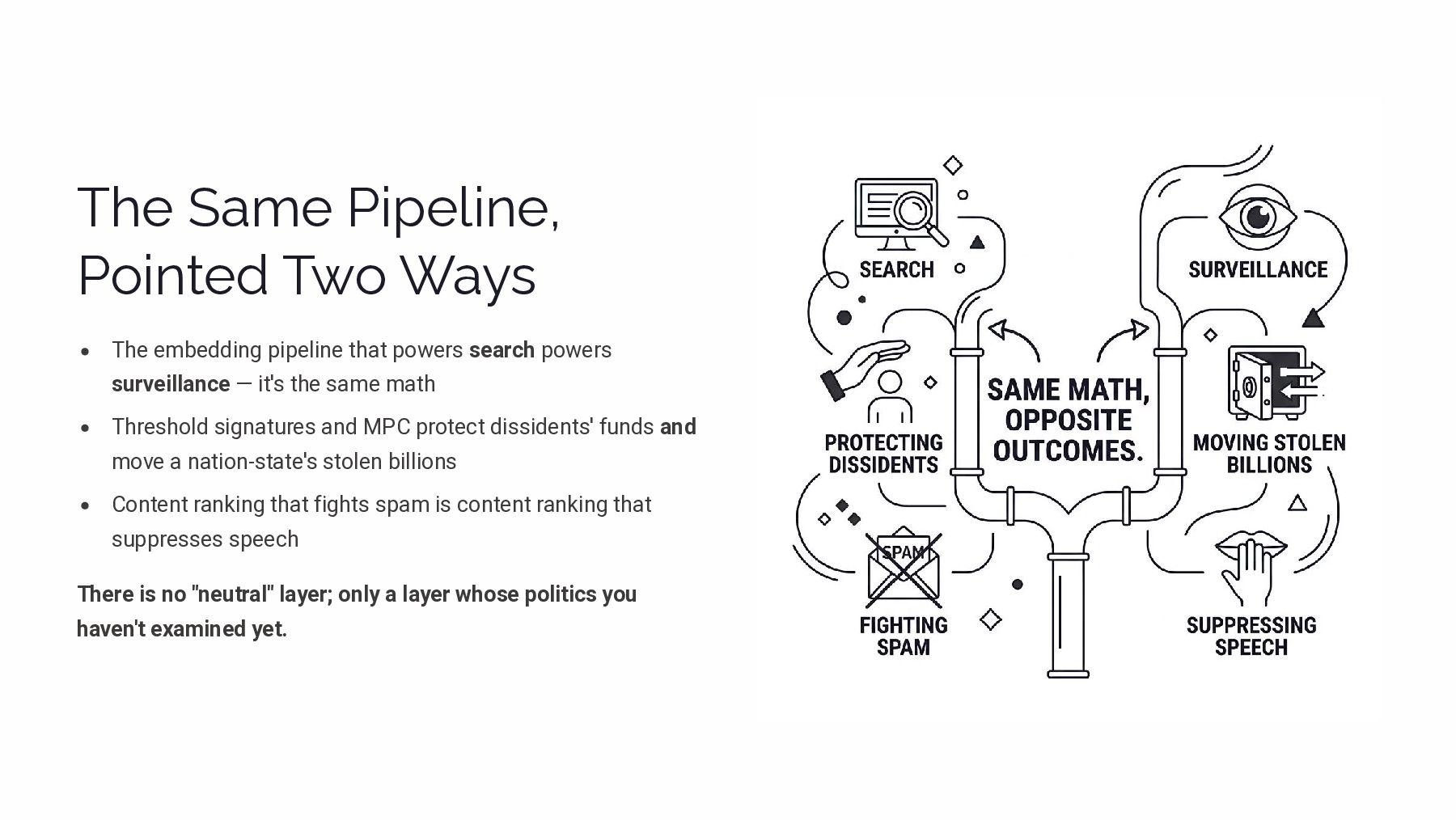
    powers search powers surveillance — it's the same math Threshold signatures and MPC protect dissidents' funds and move a nation-state's stolen billions Content ranking that fights spam is content ranking that suppresses speech There is no "neutral" layer; only a layer whose politics you haven't examined yet.
  16. Crypto Taught Me the Same Lesson I left defense partly

    to build financial infrastructure with actual guardrails — "crypto with guardrails," permissioned validators, not "code is law." And I still had to walk away from work where the privacy-advocate culture quietly tolerated laundering and real-world harm. The dilemma doesn't respect industry lines. It followed me.
  17. A $1.5 Billion Case Study 21 February 2025 Entry point

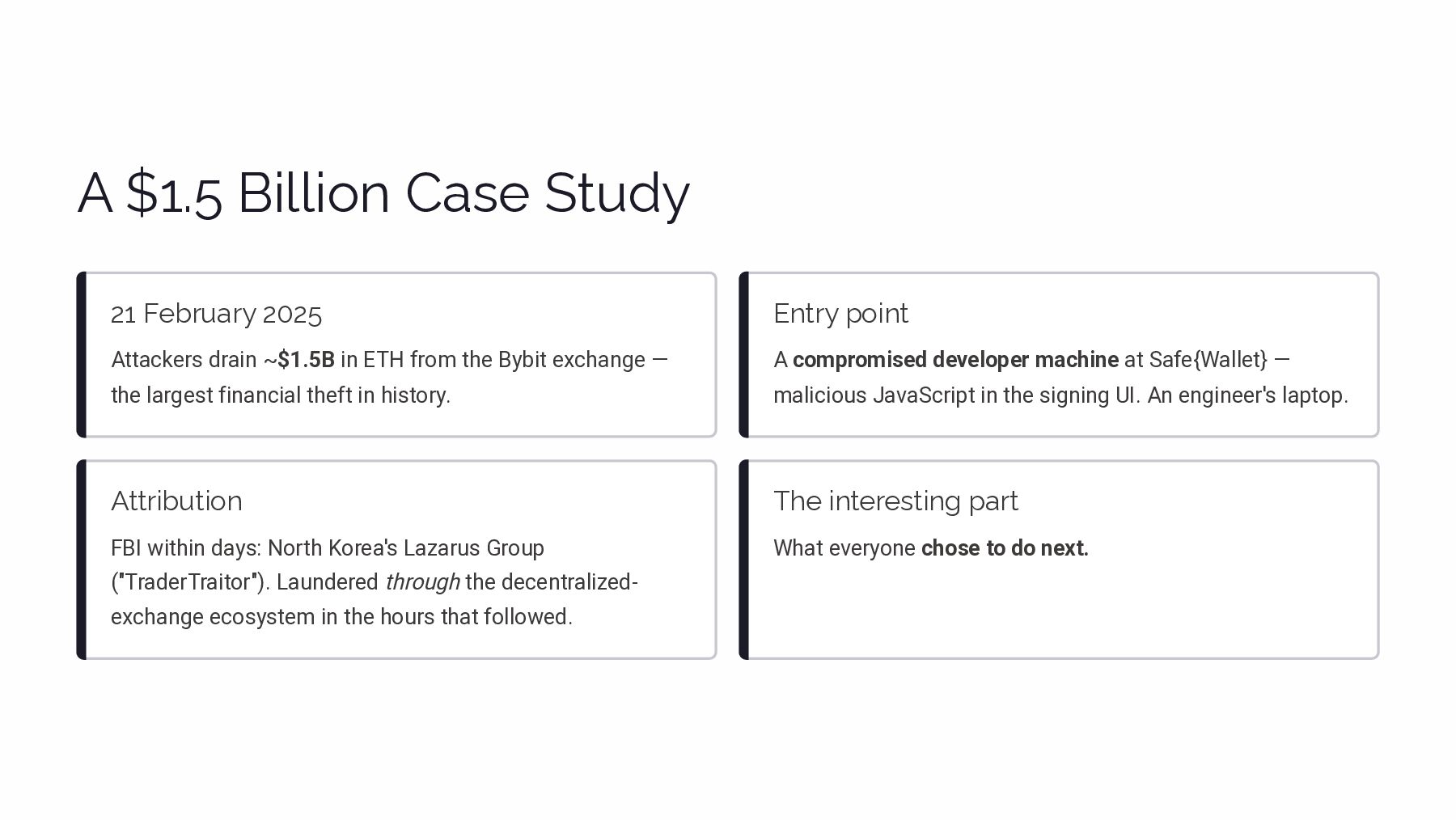
    Attackers drain ~$1.5B in ETH from the Bybit exchange — A compromised developer machine at Safe{Wallet} — the largest financial theft in history. malicious JavaScript in the signing UI. An engineer's laptop. Attribution The interesting part FBI within days: North Korea's Lazarus Group What everyone chose to do next. ("TraderTraitor"). Laundered through the decentralizedexchange ecosystem in the hours that followed.
  18. Follow the Money All the Way Down This is not

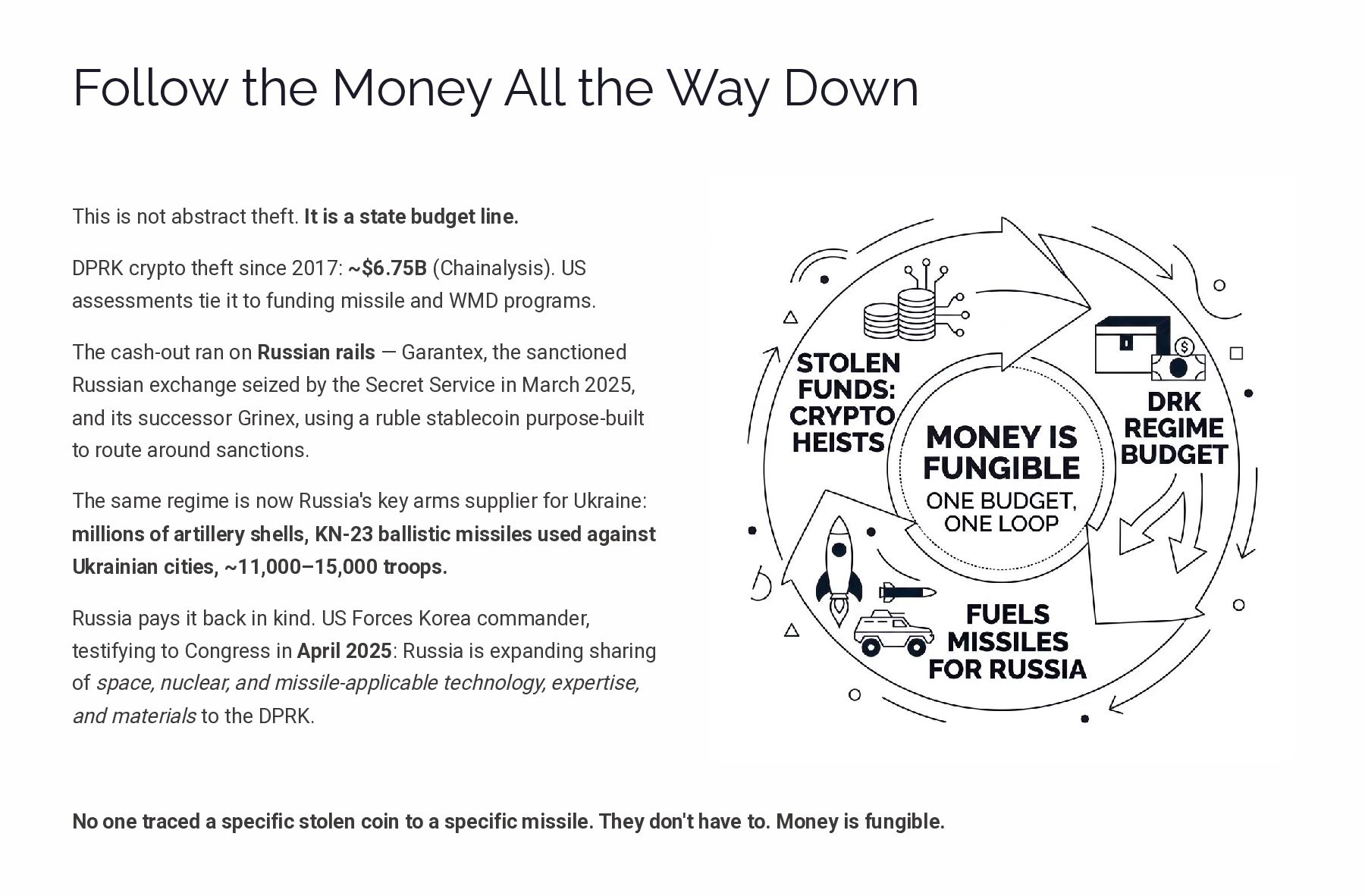
    abstract theft. It is a state budget line. DPRK crypto theft since 2017: ~$6.75B (Chainalysis). US assessments tie it to funding missile and WMD programs. The cash-out ran on Russian rails — Garantex, the sanctioned Russian exchange seized by the Secret Service in March 2025, and its successor Grinex, using a ruble stablecoin purpose-built to route around sanctions. The same regime is now Russia's key arms supplier for Ukraine: millions of artillery shells, KN-23 ballistic missiles used against Ukrainian cities, ~11,000–15,000 troops. Russia pays it back in kind. US Forces Korea commander, testifying to Congress in April 2025: Russia is expanding sharing of space, nuclear, and missile-applicable technology, expertise, and materials to the DPRK. No one traced a specific stolen coin to a specific missile. They don't have to. Money is fungible.
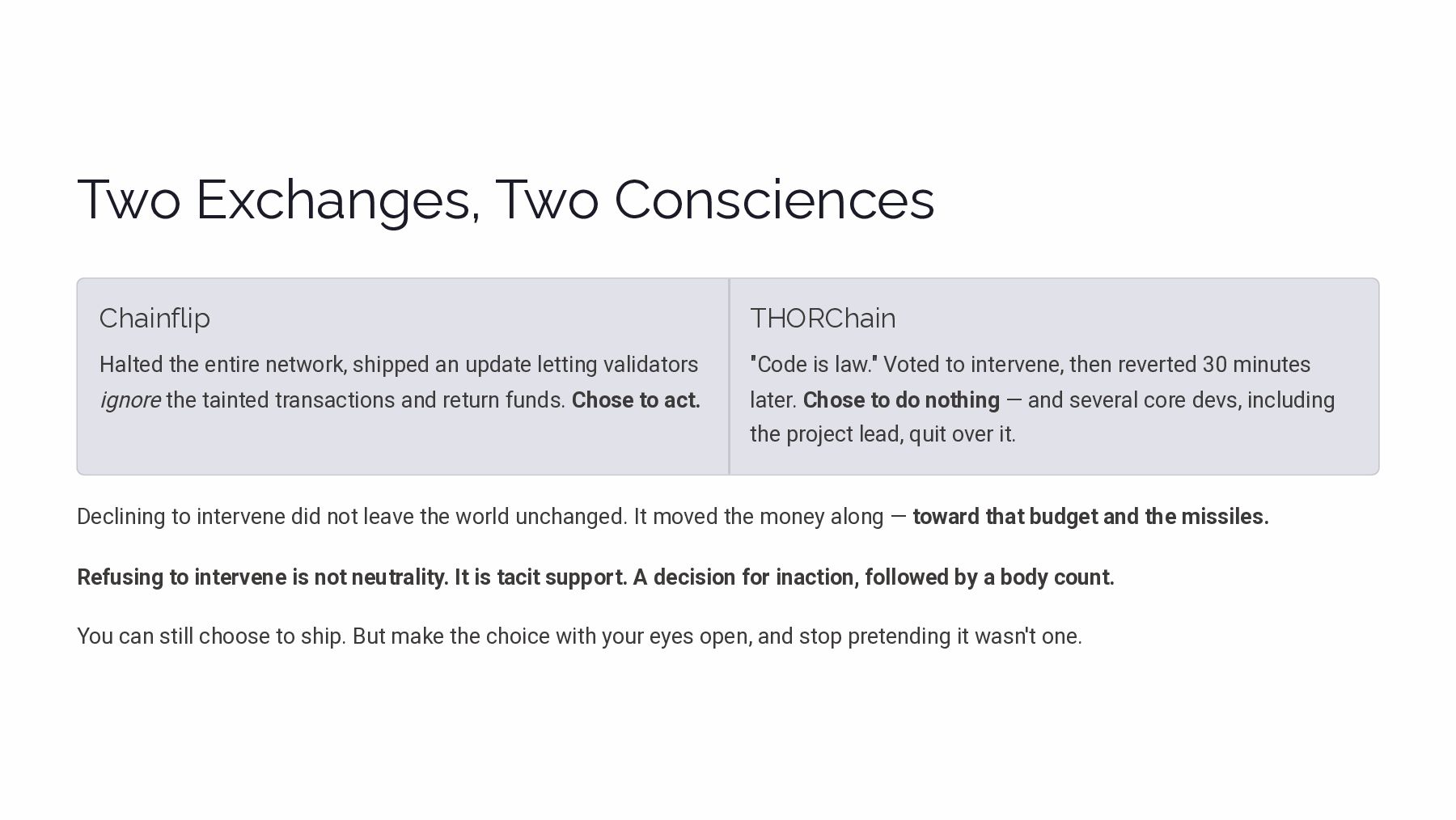
  19. Two Exchanges, Two Consciences Chainflip THORChain Halted the entire network,

    shipped an update letting validators "Code is law." Voted to intervene, then reverted 30 minutes ignore the tainted transactions and return funds. Chose to act. later. Chose to do nothing — and several core devs, including the project lead, quit over it. Declining to intervene did not leave the world unchanged. It moved the money along — toward that budget and the missiles. Refusing to intervene is not neutrality. It is tacit support. A decision for inaction, followed by a body count. You can still choose to ship. But make the choice with your eyes open, and stop pretending it wasn't one.
  20. This Is Playing Out Right Now, at the Frontier Right

    now. And possibly inside the tool some of you used to build your slides.
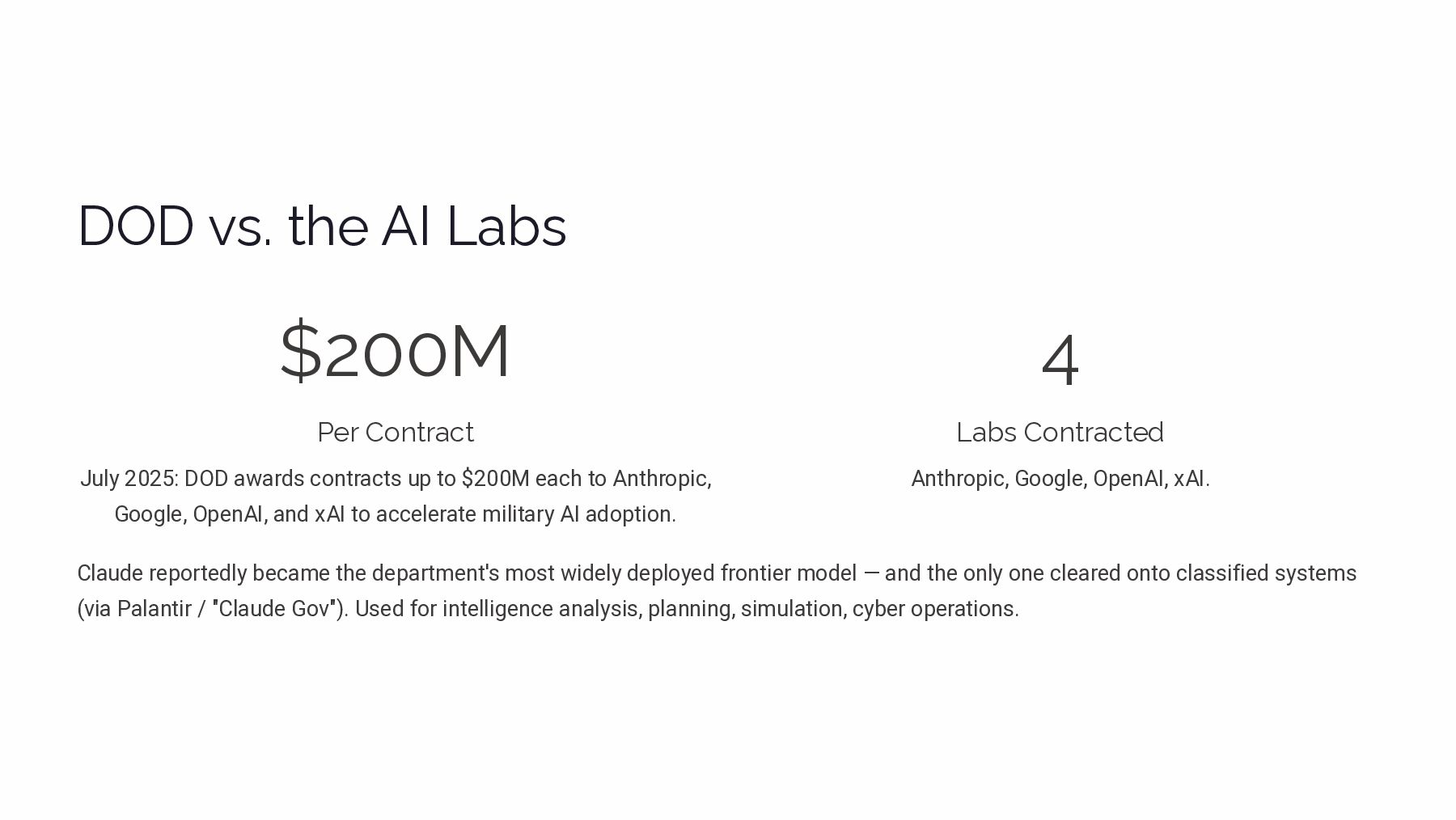
  21. DOD vs. the AI Labs $200M 4 Per Contract Labs

    Contracted July 2025: DOD awards contracts up to $200M each to Anthropic, Anthropic, Google, OpenAI, xAI. Google, OpenAI, and xAI to accelerate military AI adoption. Claude reportedly became the department's most widely deployed frontier model — and the only one cleared onto classified systems (via Palantir / "Claude Gov"). Used for intelligence analysis, planning, simulation, cyber operations.
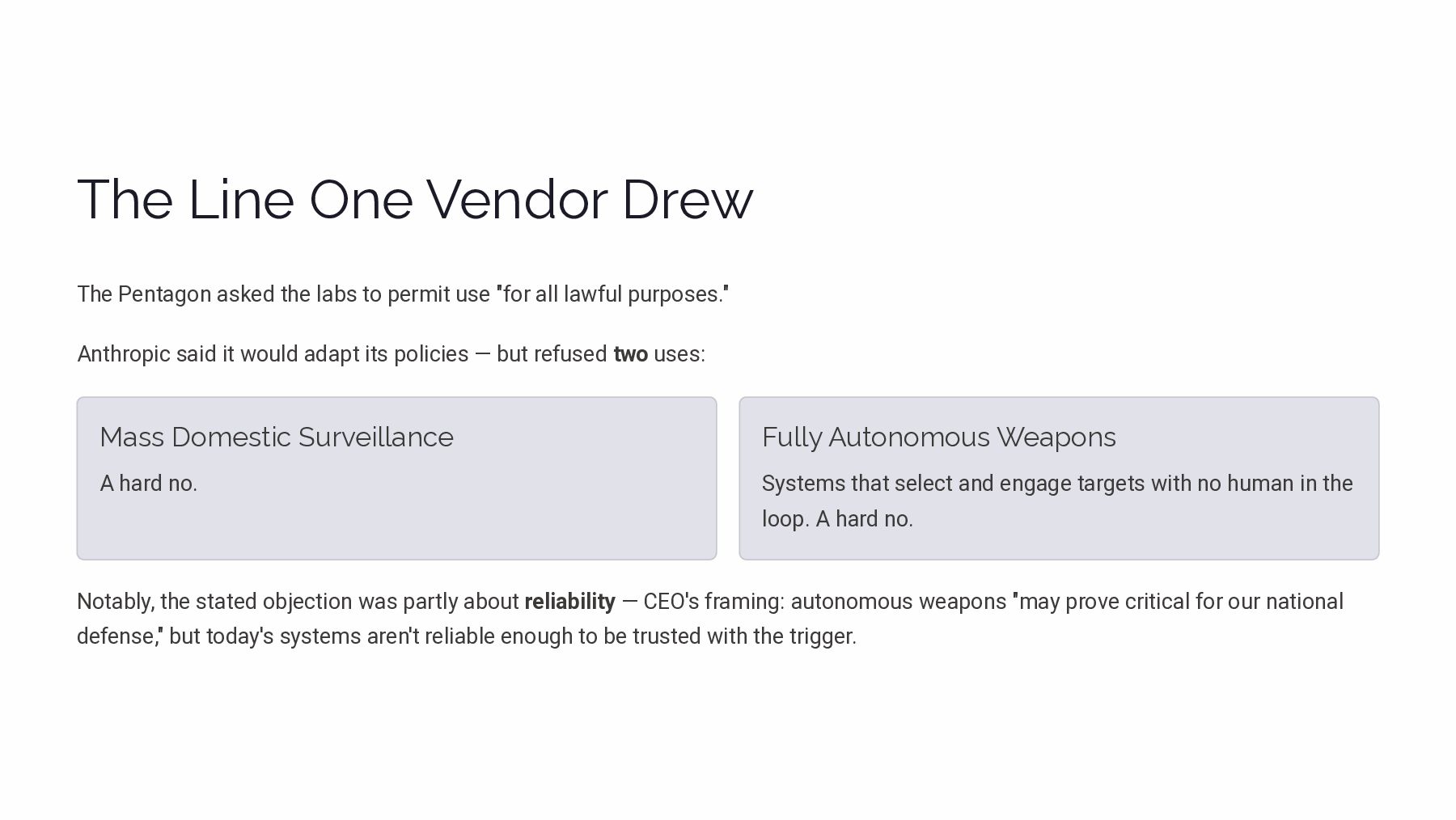
  22. The Line One Vendor Drew The Pentagon asked the labs

    to permit use "for all lawful purposes." Anthropic said it would adapt its policies — but refused two uses: Mass Domestic Surveillance Fully Autonomous Weapons A hard no. Systems that select and engage targets with no human in the loop. A hard no. Notably, the stated objection was partly about reliability — CEO's framing: autonomous weapons "may prove critical for our national defense," but today's systems aren't reliable enough to be trusted with the trigger.
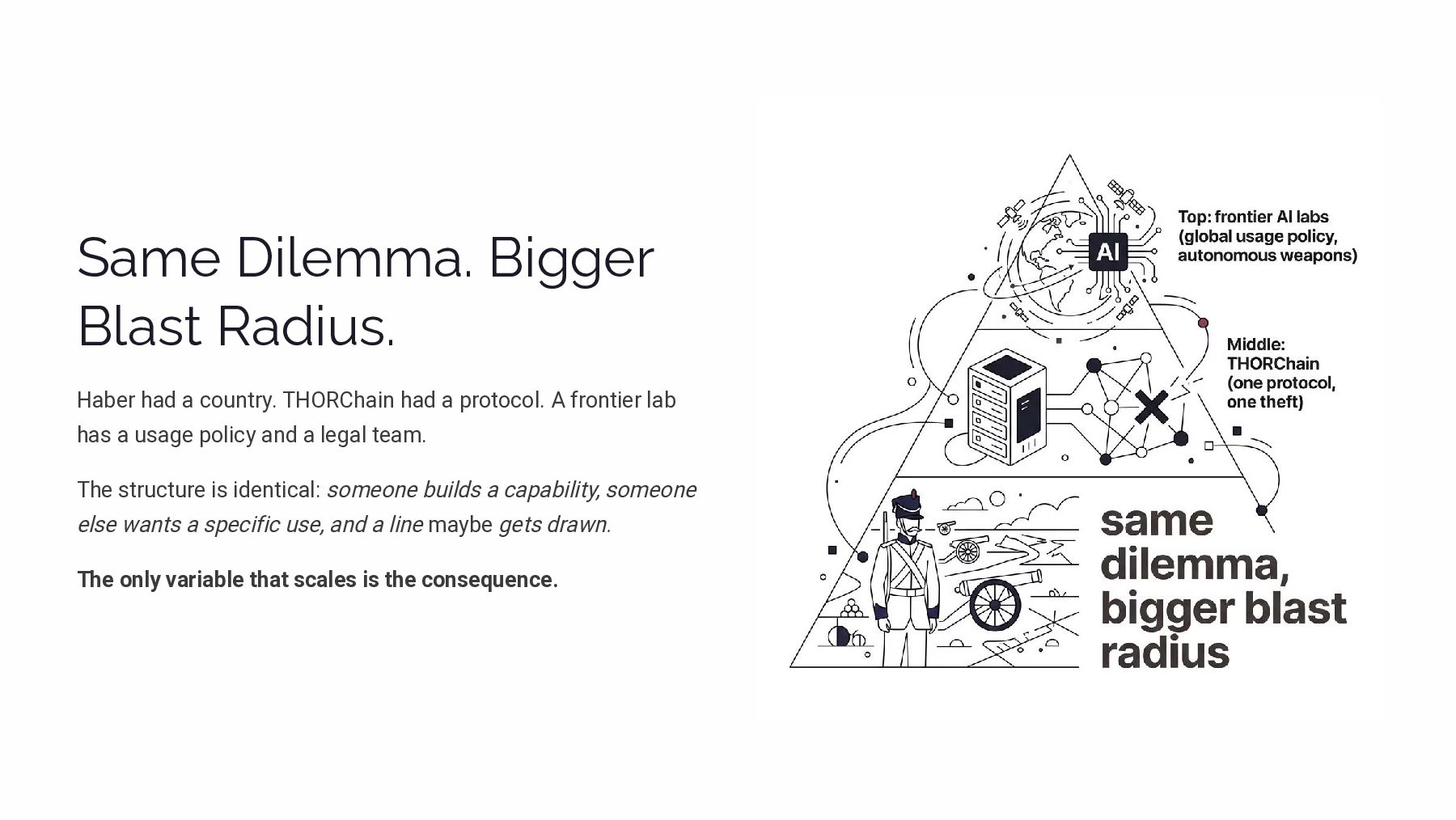
  23. Same Dilemma. Bigger Blast Radius. Haber had a country. THORChain

    had a protocol. A frontier lab has a usage policy and a legal team. The structure is identical: someone builds a capability, someone else wants a specific use, and a line maybe gets drawn. The only variable that scales is the consequence.
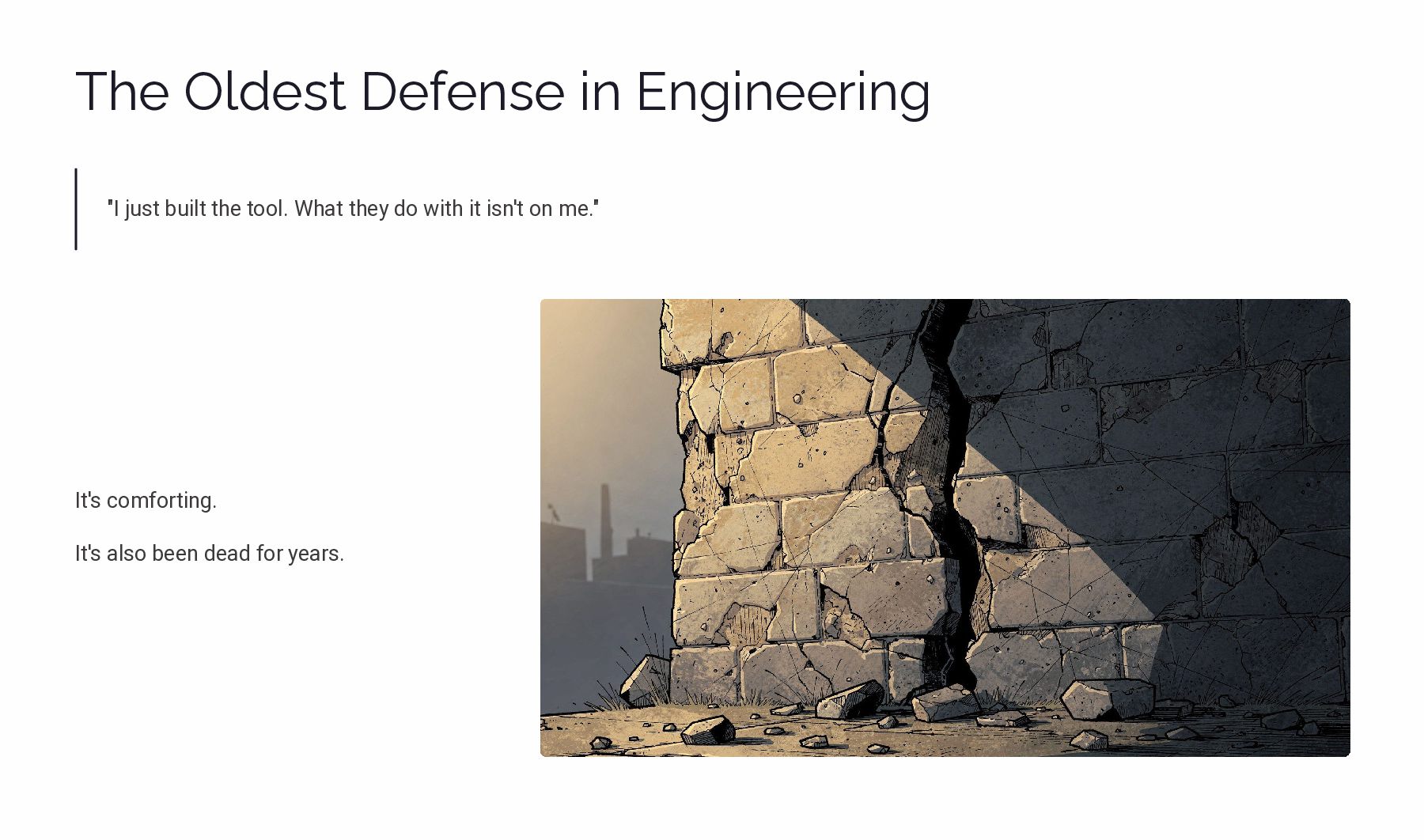
  24. The Oldest Defense in Engineering "I just built the tool.

    What they do with it isn't on me." It's comforting. It's also been dead for years.
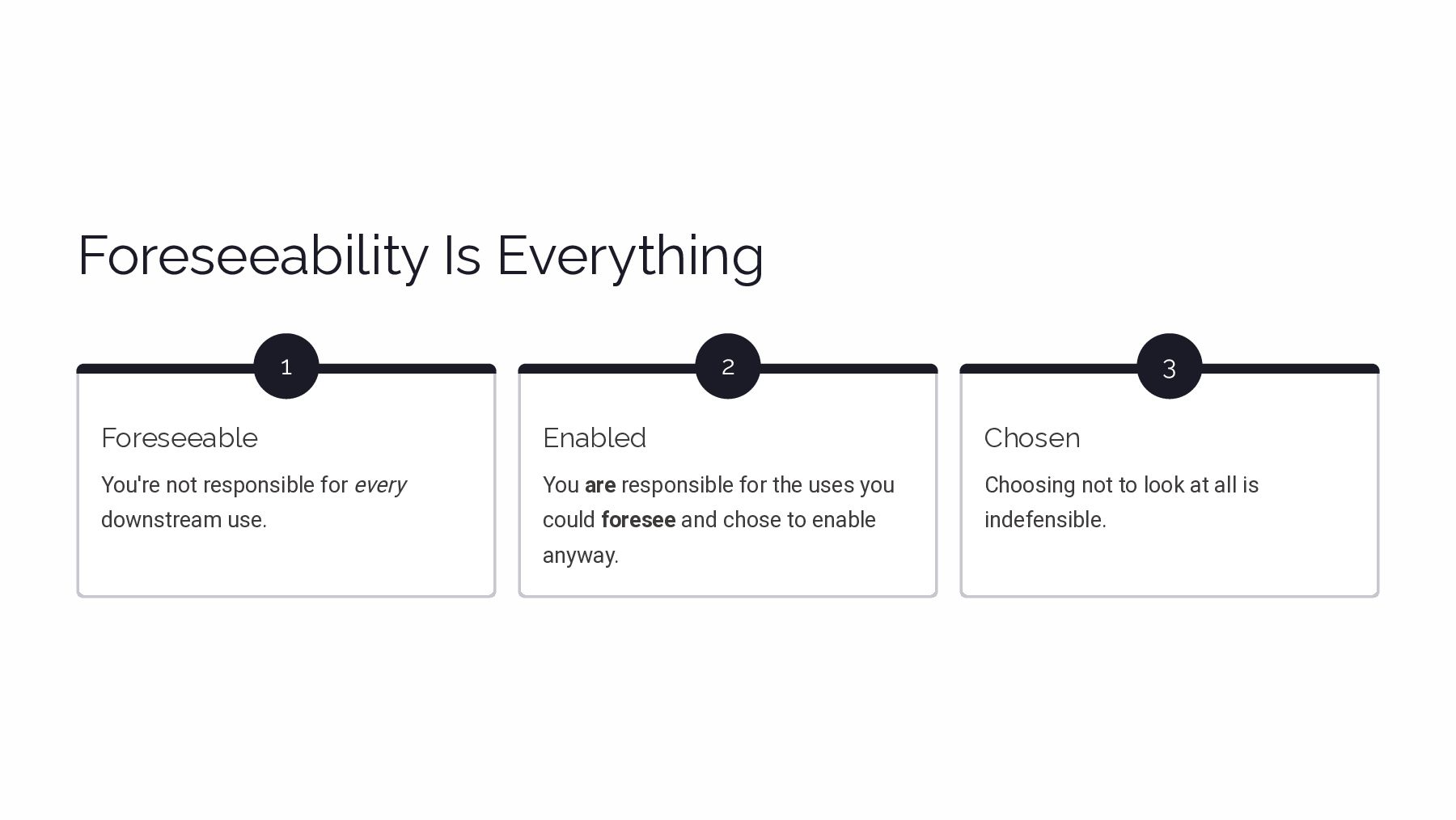
  25. Foreseeability Is Everything 1 2 3 Foreseeable Enabled Chosen You're

    not responsible for every You are responsible for the uses you Choosing not to look at all is downstream use. could foresee and chose to enable indefensible. anyway.
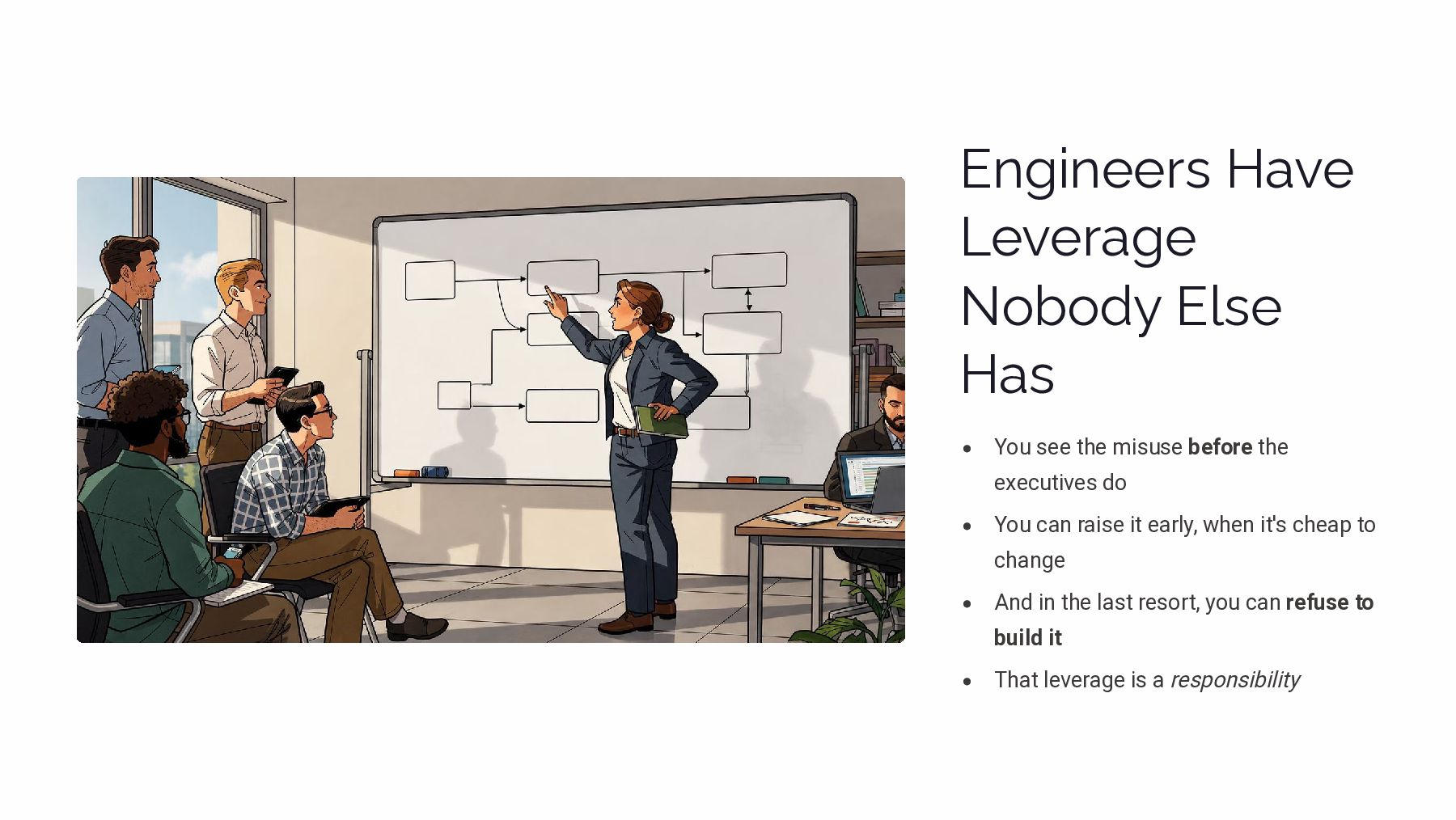
  26. Engineers Have Leverage Nobody Else Has You see the misuse

    before the executives do You can raise it early, when it's cheap to change And in the last resort, you can refuse to build it That leverage is a responsibility
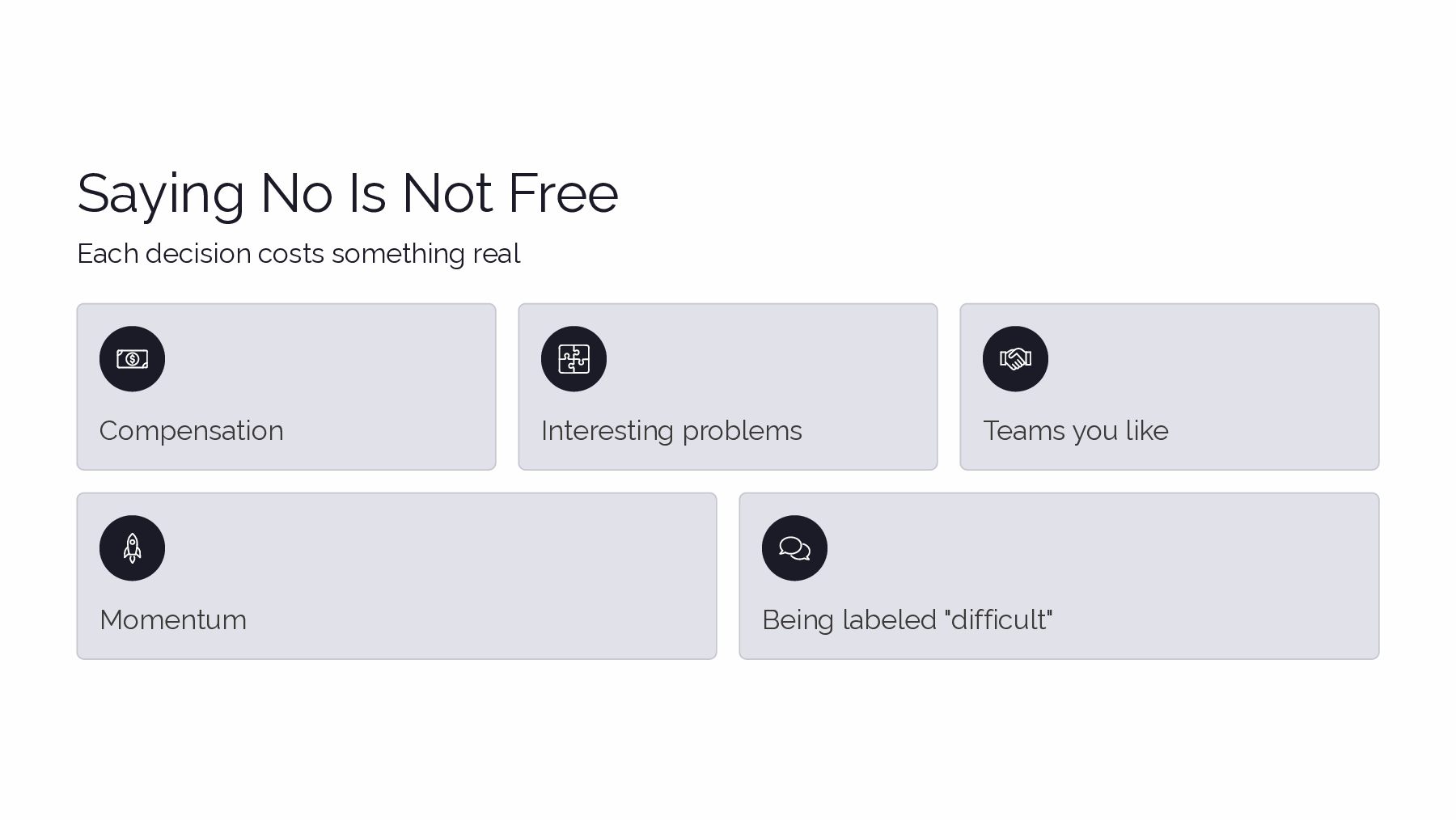
  27. Saying No Is Not Free Each decision costs something real

    Compensation Momentum Interesting problems Teams you like Being labeled "difficult"
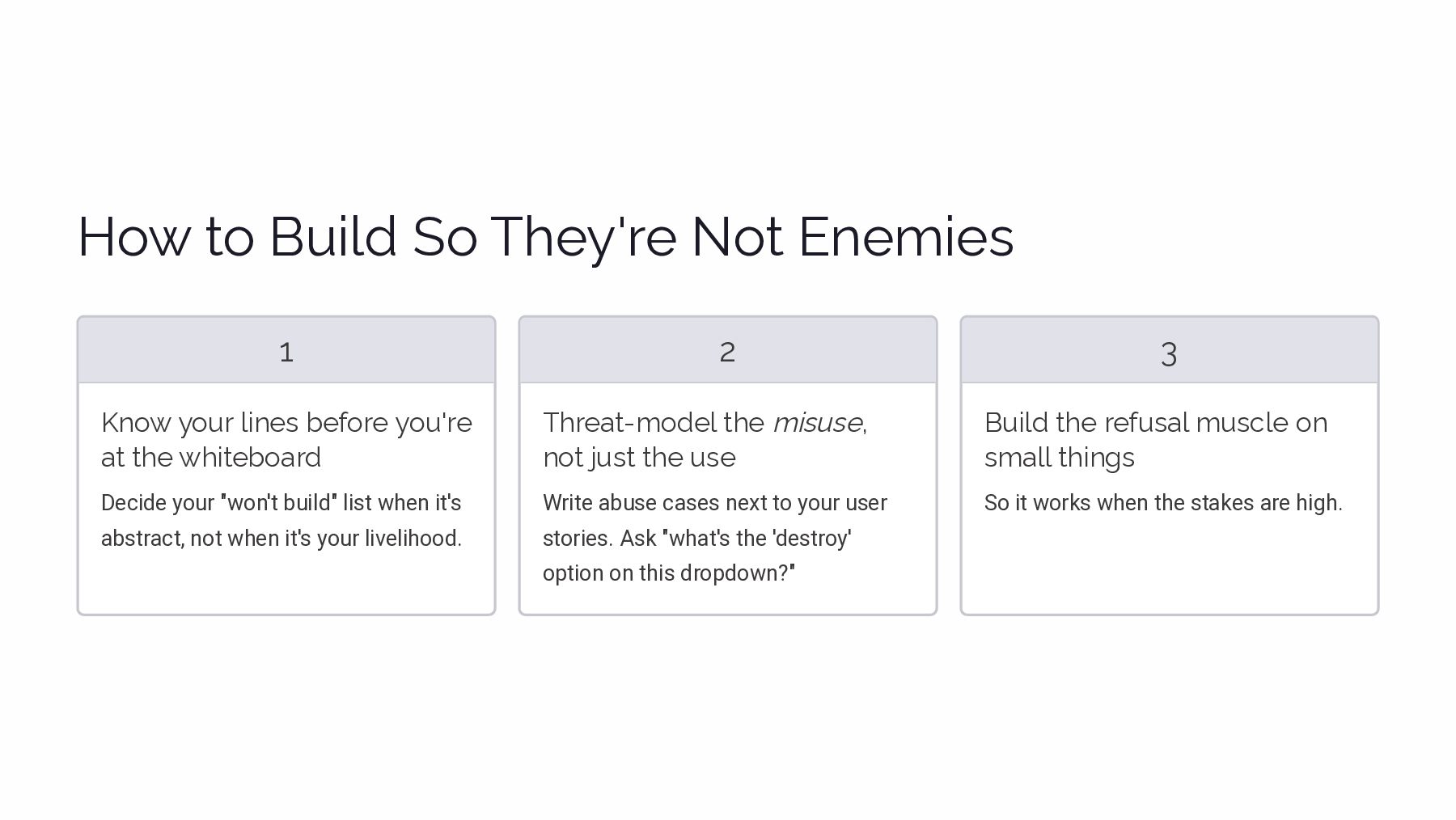
  28. How to Build So They're Not Enemies 1 2 3

    Know your lines before you're at the whiteboard Threat-model the misuse, not just the use Build the refusal muscle on small things Decide your "won't build" list when it's Write abuse cases next to your user So it works when the stakes are high. abstract, not when it's your livelihood. stories. Ask "what's the 'destroy' option on this dropdown?"
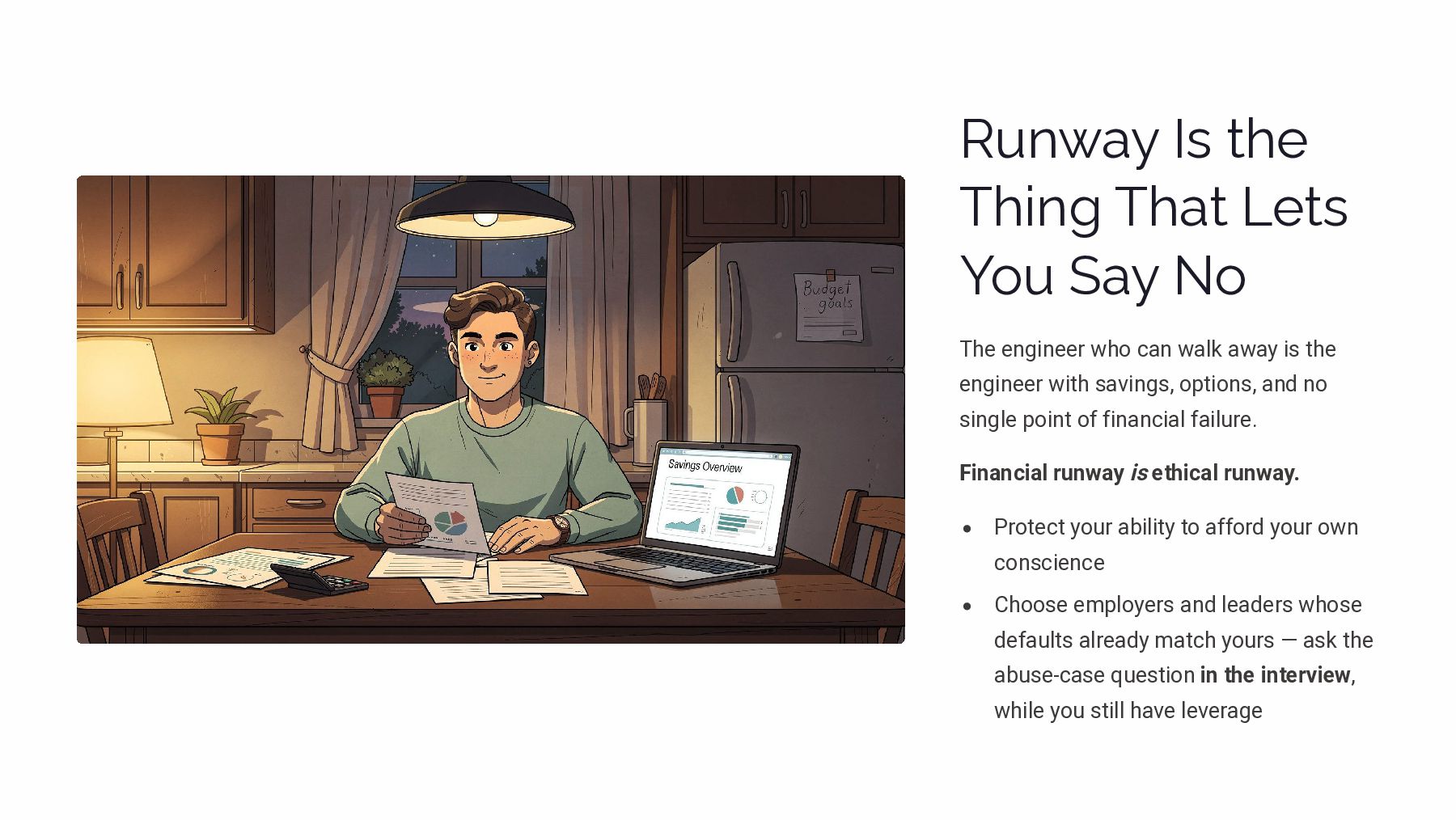
  29. Runway Is the Thing That Lets You Say No The

    engineer who can walk away is the engineer with savings, options, and no single point of financial failure. Financial runway is ethical runway. Protect your ability to afford your own conscience Choose employers and leaders whose defaults already match yours — ask the abuse-case question in the interview, while you still have leverage
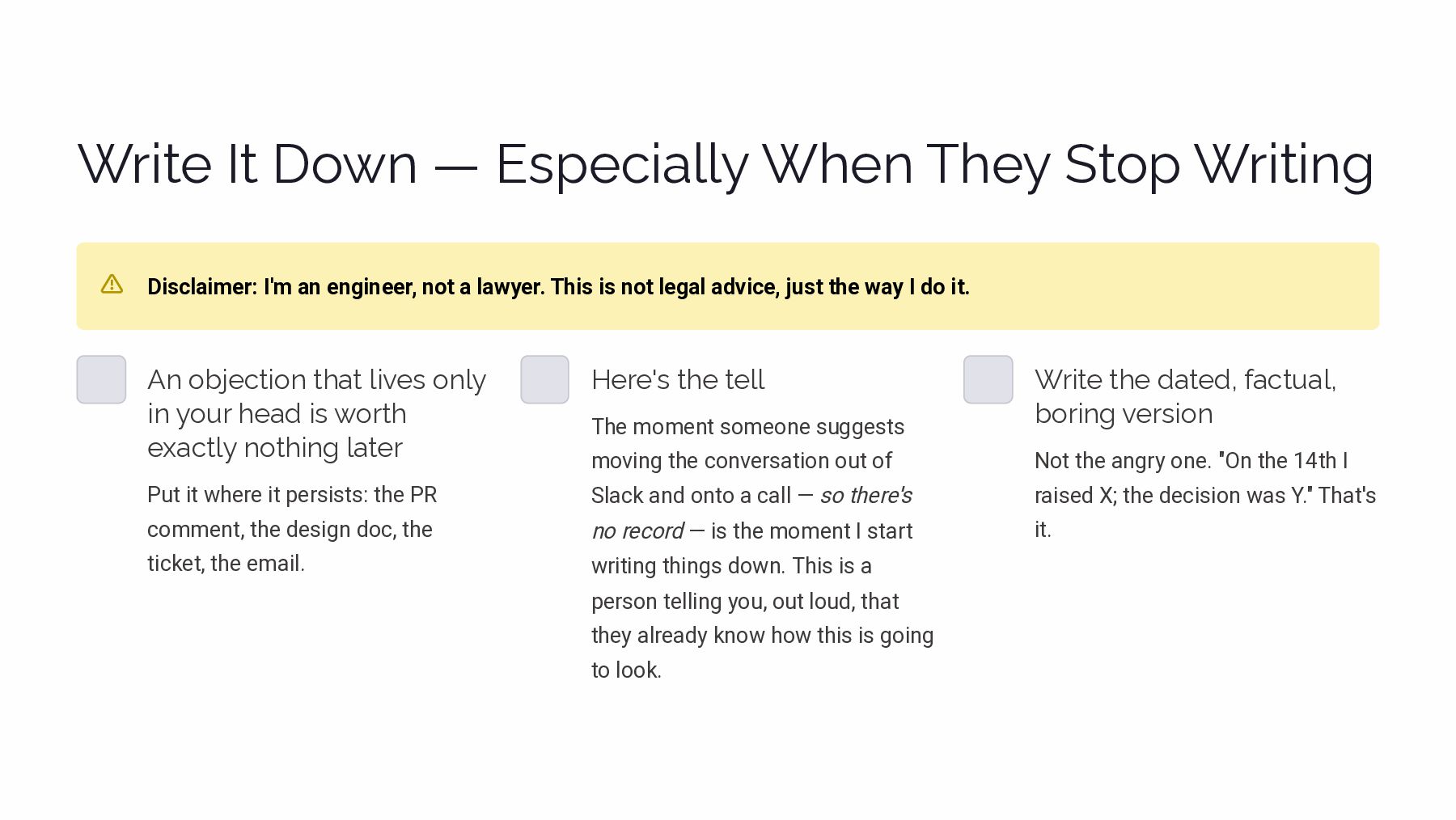
  30. Write It Down — Especially When They Stop Writing Disclaimer:

    I'm an engineer, not a lawyer. This is not legal advice, just the way I do it. An objection that lives only in your head is worth exactly nothing later Here's the tell The moment someone suggests Write the dated, factual, boring version moving the conversation out of Not the angry one. "On the 14th I Put it where it persists: the PR Slack and onto a call — so there's raised X; the decision was Y." That's comment, the design doc, the no record — is the moment I start it. ticket, the email. writing things down. This is a person telling you, out loud, that they already know how this is going to look.
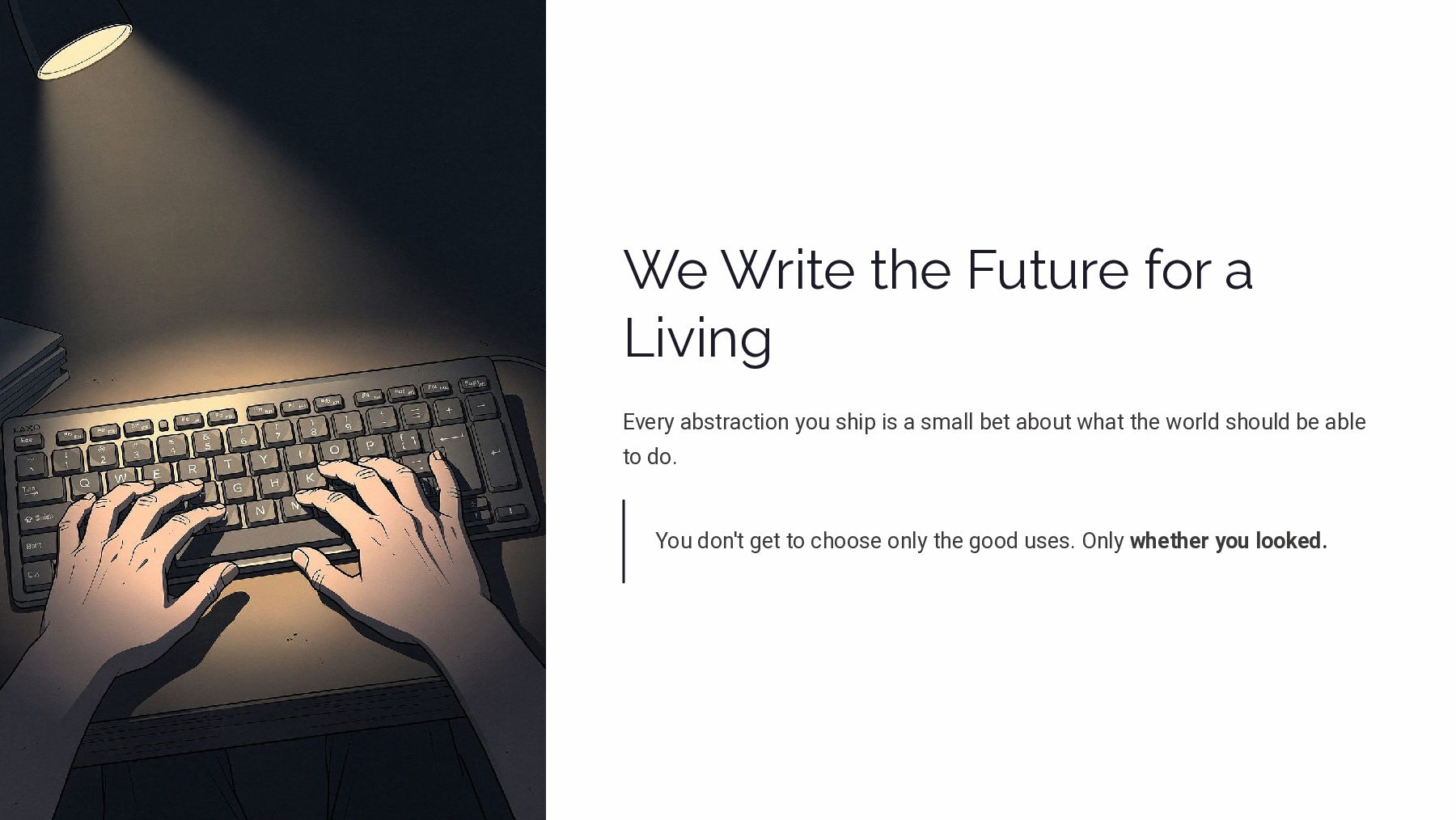
  31. We Write the Future for a Living Every abstraction you

    ship is a small bet about what the world should be able to do. You don't get to choose only the good uses. Only whether you looked.
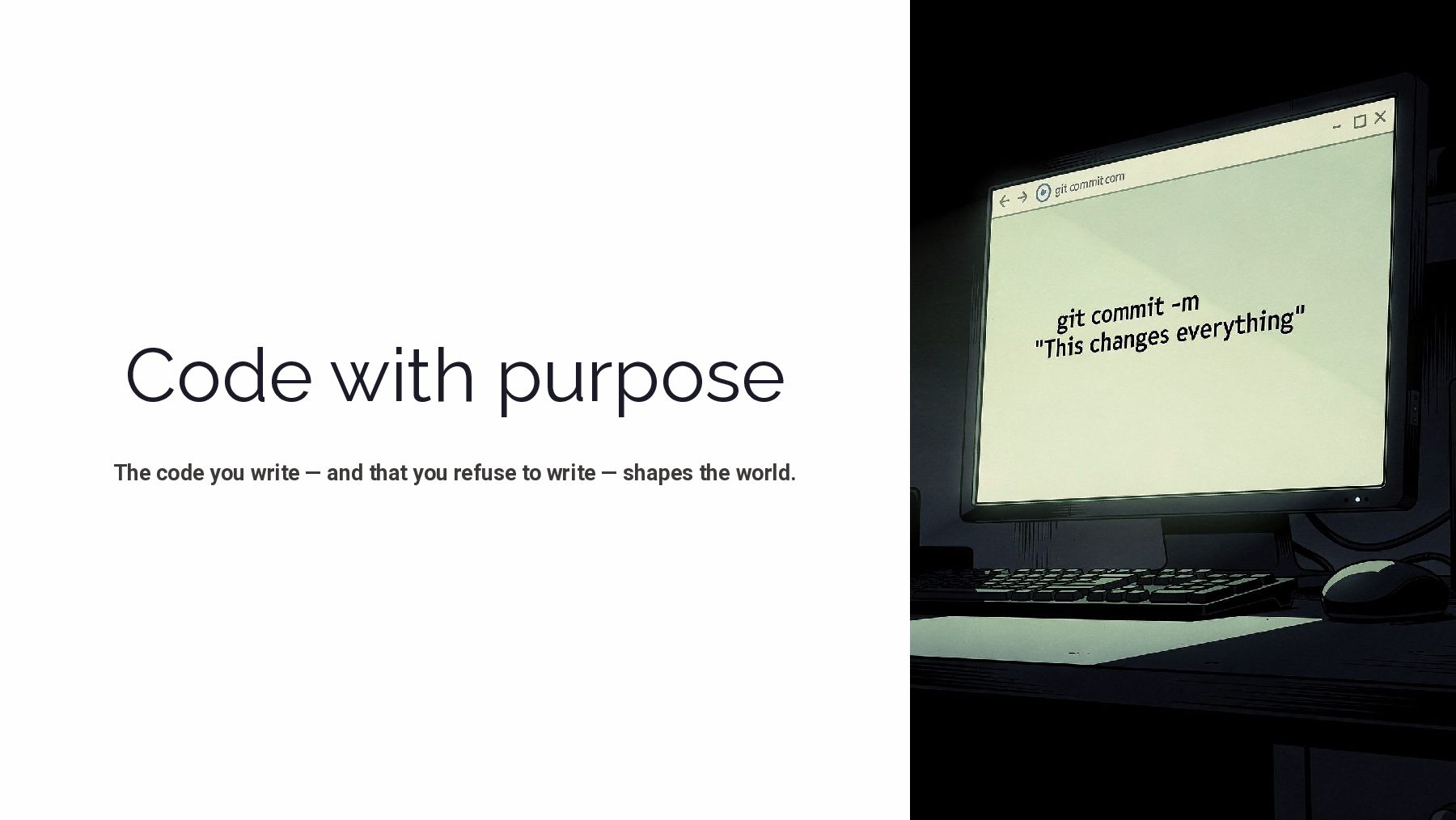
  32. Code with purpose The code you write — and that

    you refuse to write — shapes the world.
  33. Contact / Thanks Eric Mann Find me online PHP Architect

    Security Corner · "The Politics of Code" (April @ericmann (tekton.network / X) 2025) eamann.com · eric.mann.blog