Build Predictable, Reliable AI Agents with AgentScript
Understand how Agent Script combines structured steps with AI reasoning so admins can improve action selection, enforce critical processes, and build more reliable agents.
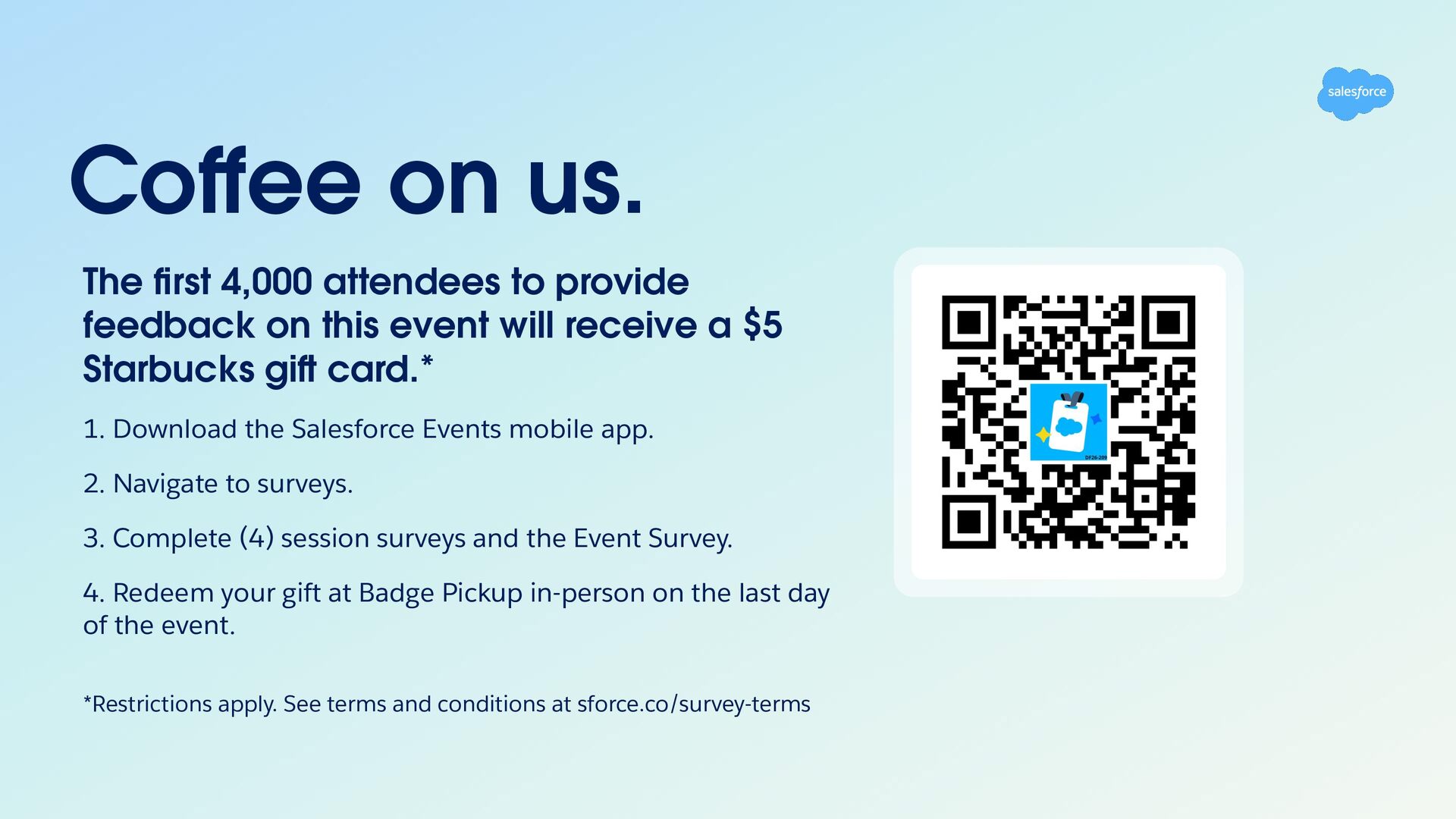
on this event will receive a $5 Starbucks gi card.* 1. Download the Salesforce Events mobile app. 2. Navigate to surveys. 3. Complete (4) session surveys and the Event Survey. 4. Redeem your gift at Badge Pickup in-person on the last day of the event. *Restrictions apply. See terms and conditions at sforce.co/survey-terms
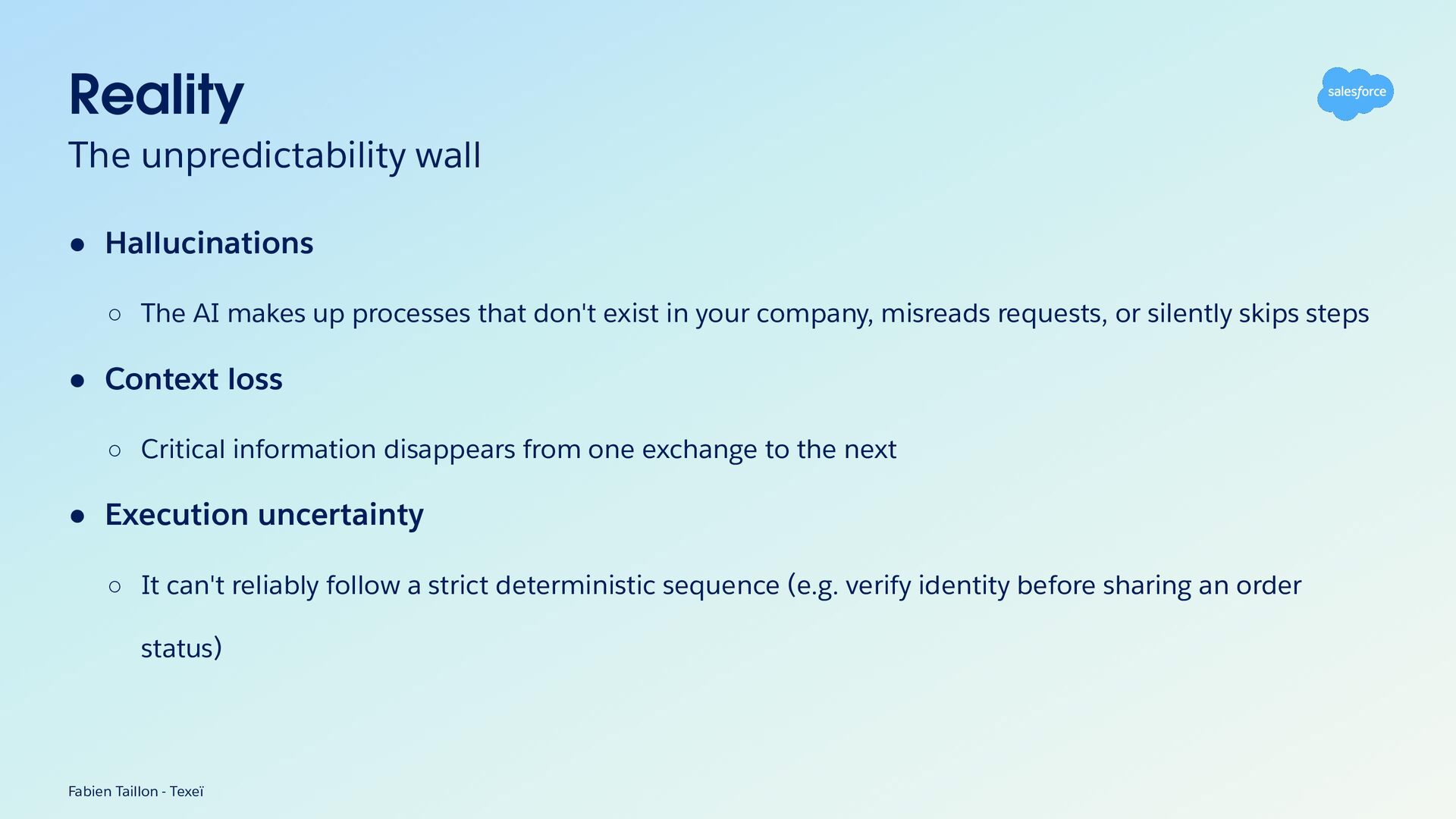
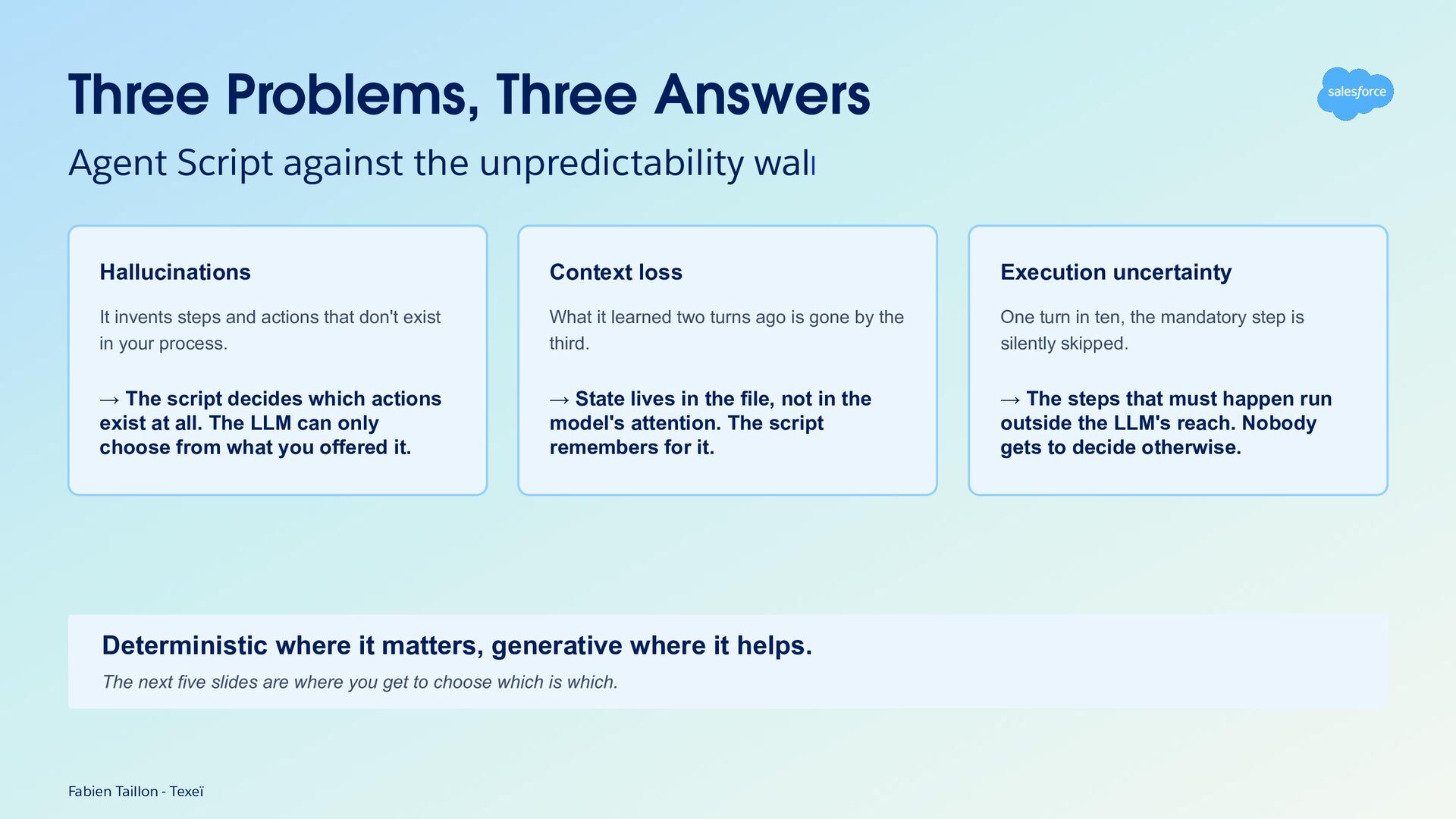
up processes that don't exist in your company, misreads requests, or silently skips steps • Context loss ◦ Critical information disappears from one exchange to the next • Execution uncertainty ◦ It can't reliably follow a strict deterministic sequence (e.g. verify identity before sharing an order status) Fabien Taillon - Texeï
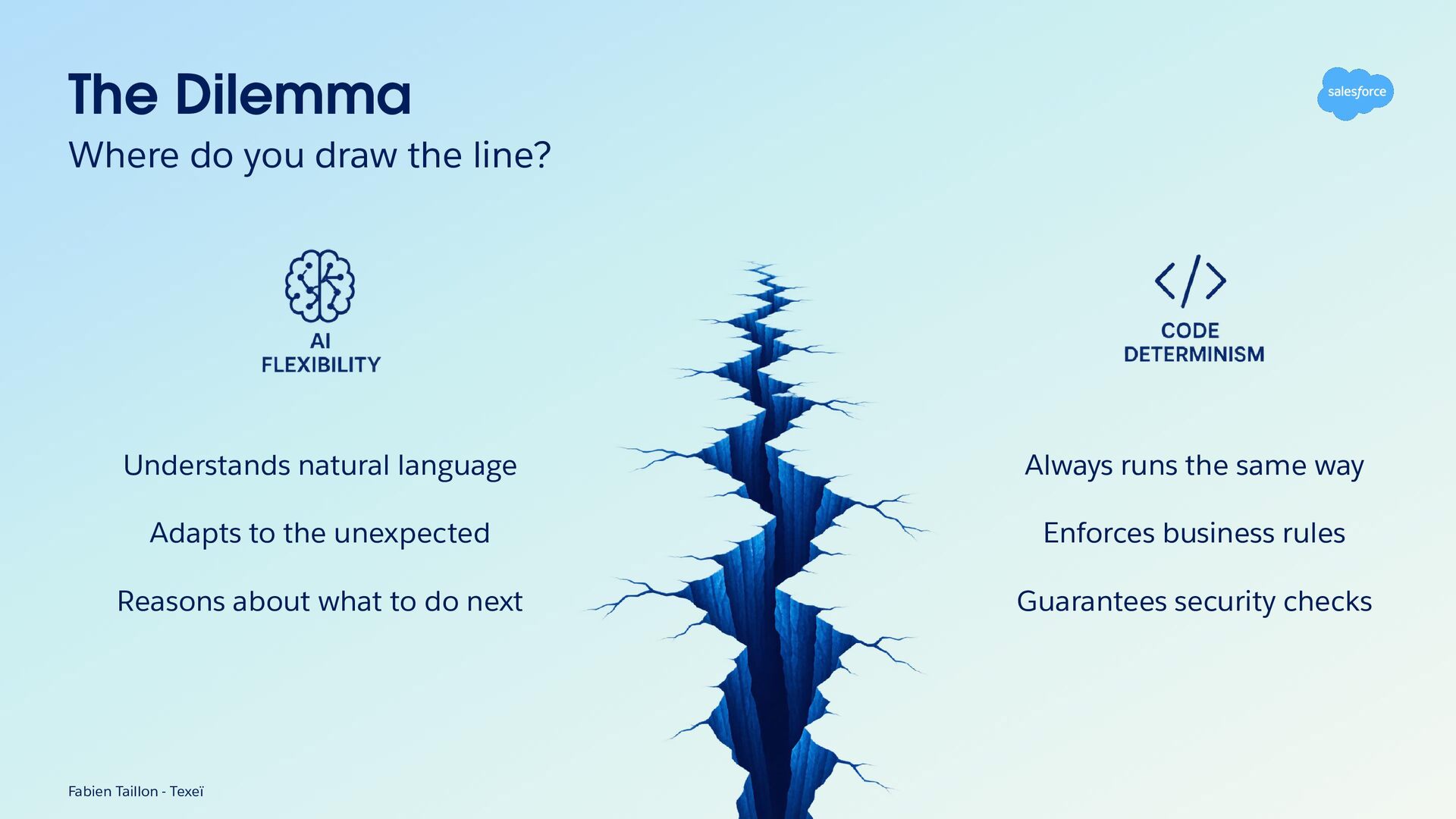
language Always runs the same way Adapts to the unexpected Enforces business rules Reasons about what to do next Guarantees security checks Fabien Taillon - Texeï
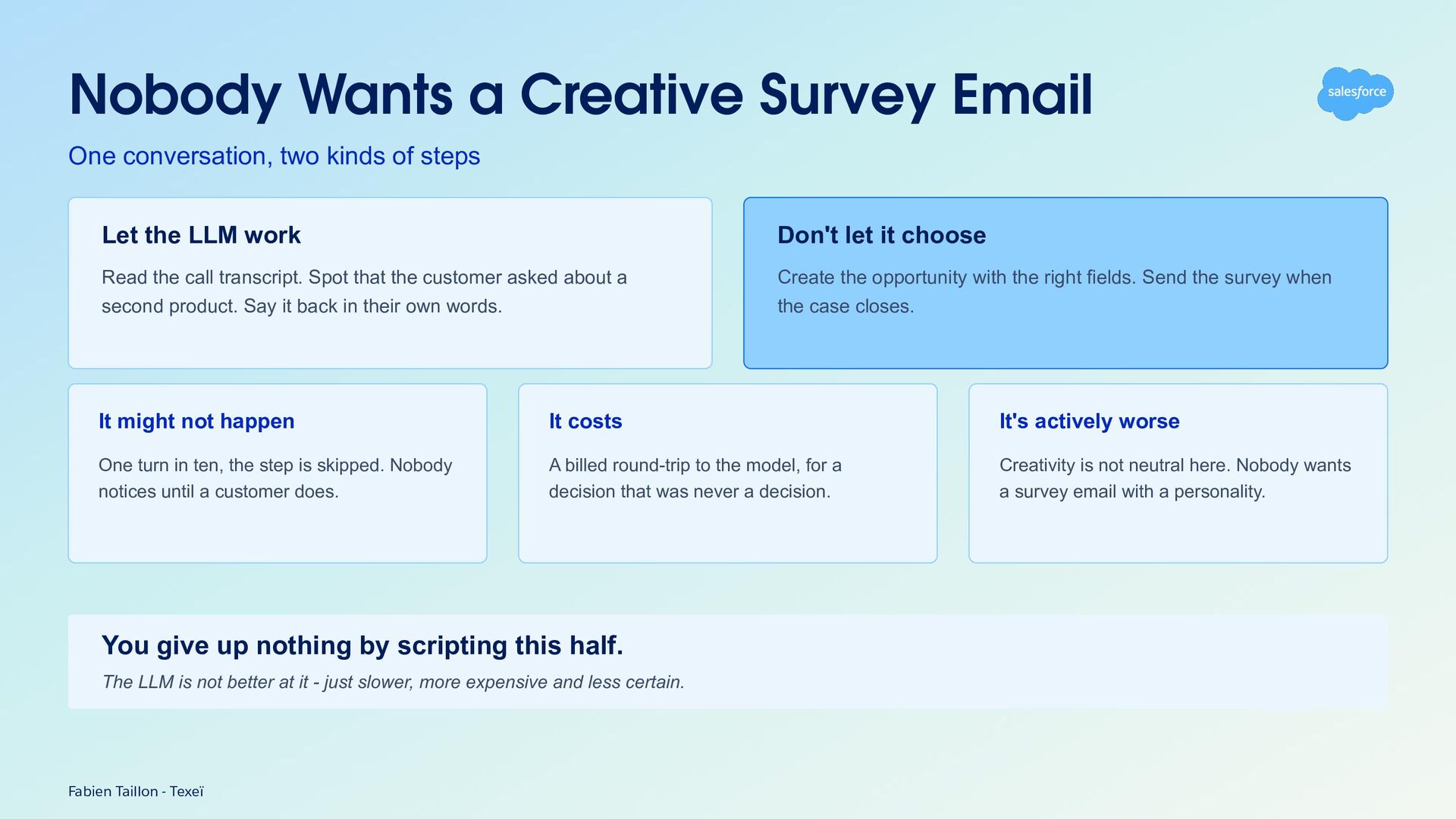
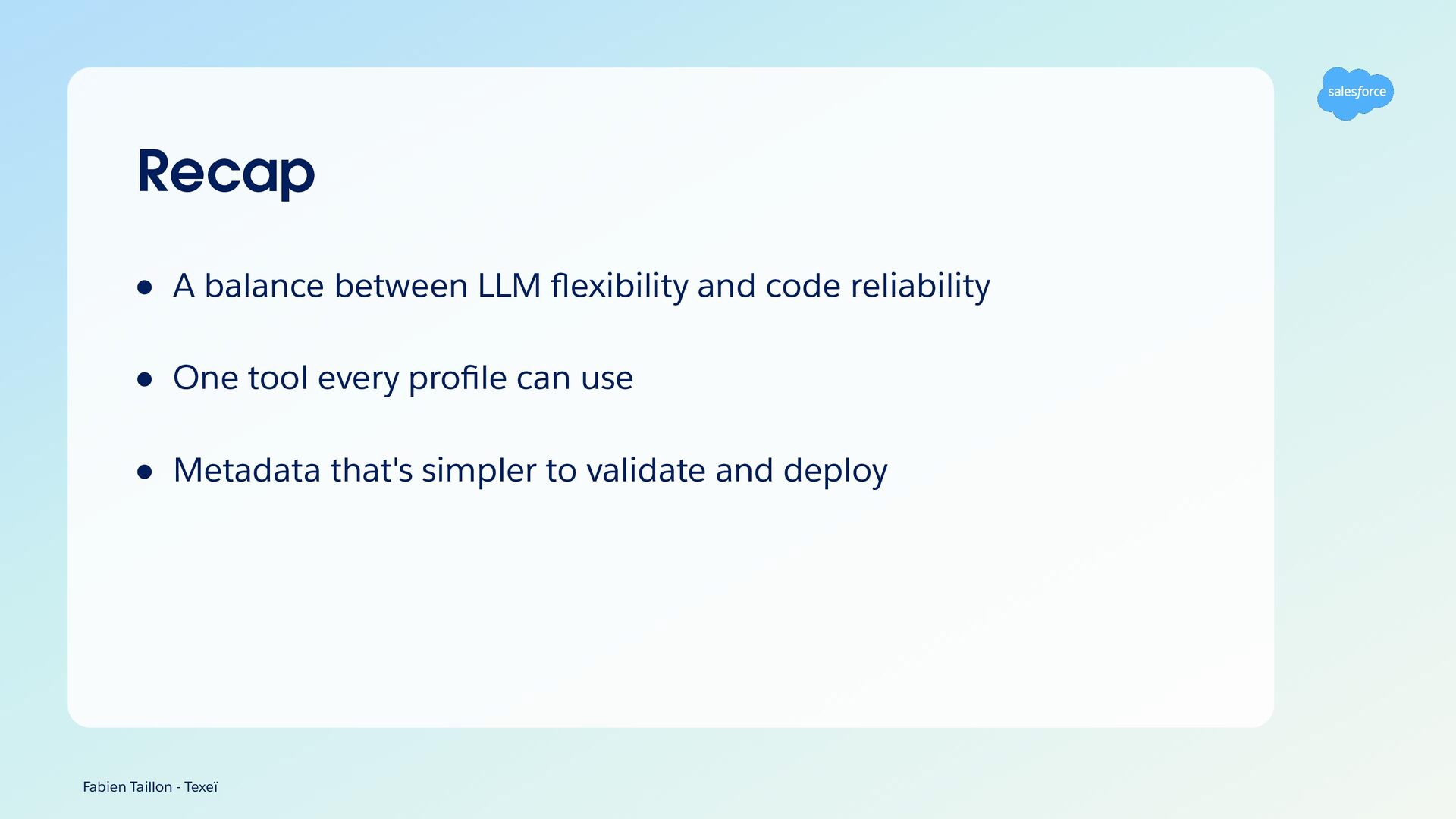
of steps Let the LLM work Don't let it choose Read the call transcript. Spot that the customer asked about a second product. Say it back in their own words. Create the opportunity with the right fields. Send the survey when the case closes. It might not happen It costs It's actively worse One turn in ten, the step is skipped. Nobody notices until a customer does. A billed round-trip to the model, for a decision that was never a decision. Creativity is not neutral here. Nobody wants a survey email with a personality. You give up nothing by scripting this half. The LLM is not better at it - just slower, more expensive and less certain. Fabien Taillon - Texeï
Hallucinations Context loss Execution uncertainty It invents steps and actions that don't exist in your process. What it learned two turns ago is gone by the third. One turn in ten, the mandatory step is silently skipped. → The script decides which actions exist at all. The LLM can only choose from what you offered it. → State lives in the file, not in the model's attention. The script remembers for it. → The steps that must happen run outside the LLM's reach. Nobody gets to decide otherwise. Deterministic where it matters, generative where it helps. The next five slides are where you get to choose which is which. Fabien Taillon - Texeï
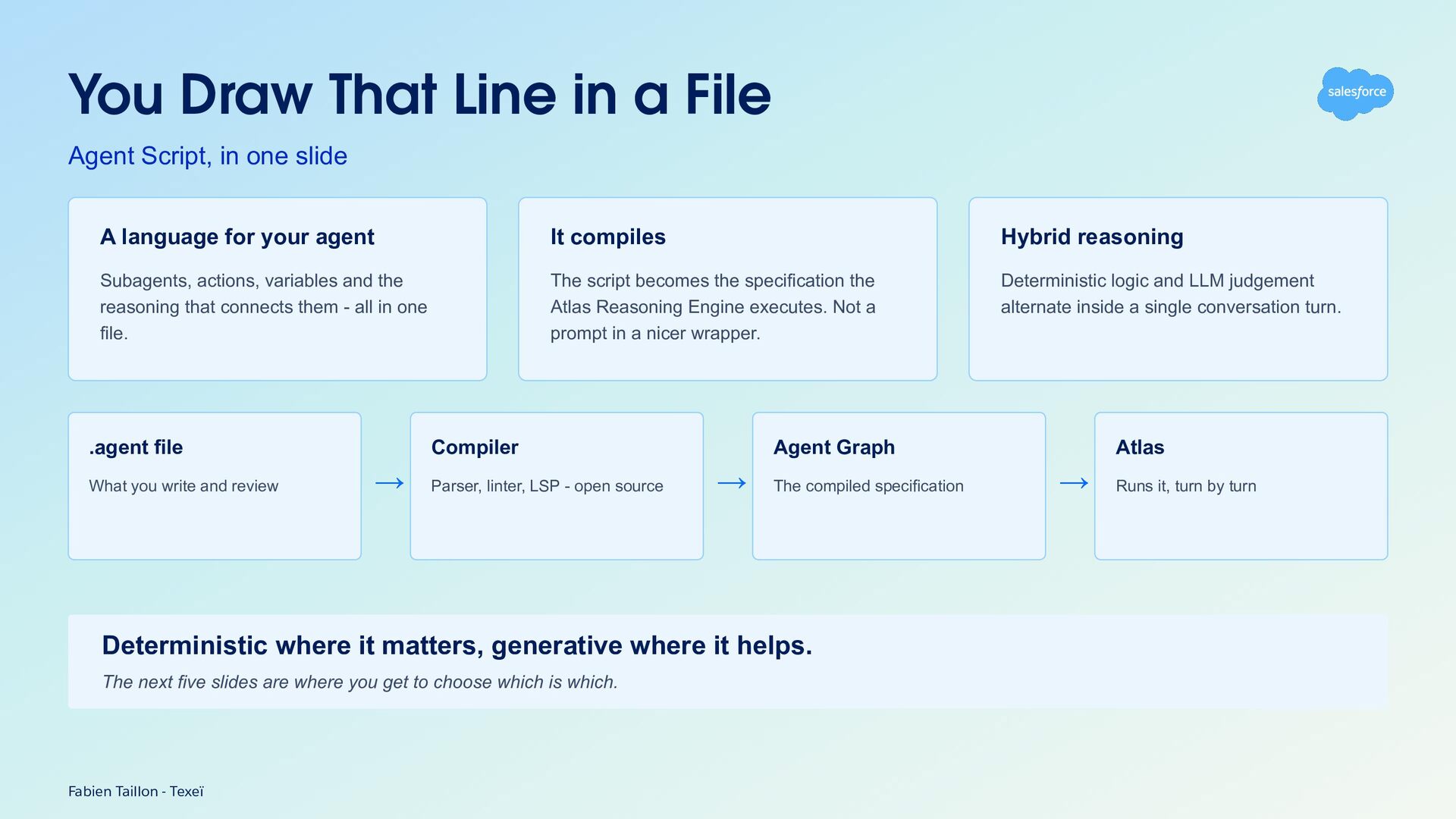
one slide A language for your agent It compiles Hybrid reasoning Subagents, actions, variables and the reasoning that connects them - all in one file. The script becomes the specification the Atlas Reasoning Engine executes. Not a prompt in a nicer wrapper. Deterministic logic and LLM judgement alternate inside a single conversation turn. .agent file What you write and review Compiler → Parser, linter, LSP - open source Agent Graph → The compiled specification Deterministic where it matters, generative where it helps. The next five slides are where you get to choose which is which. Fabien Taillon - Texeï Atlas → Runs it, turn by turn
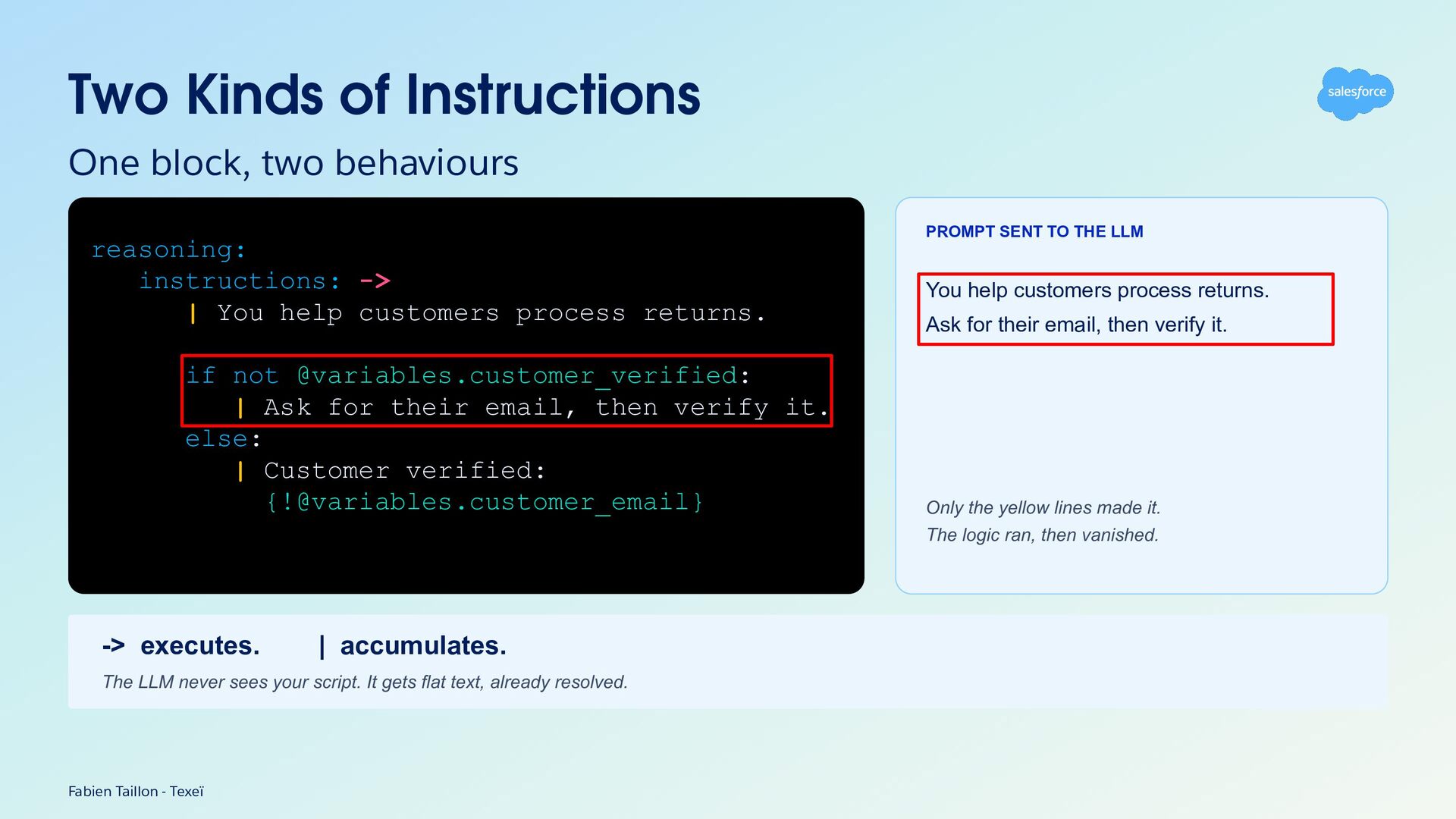
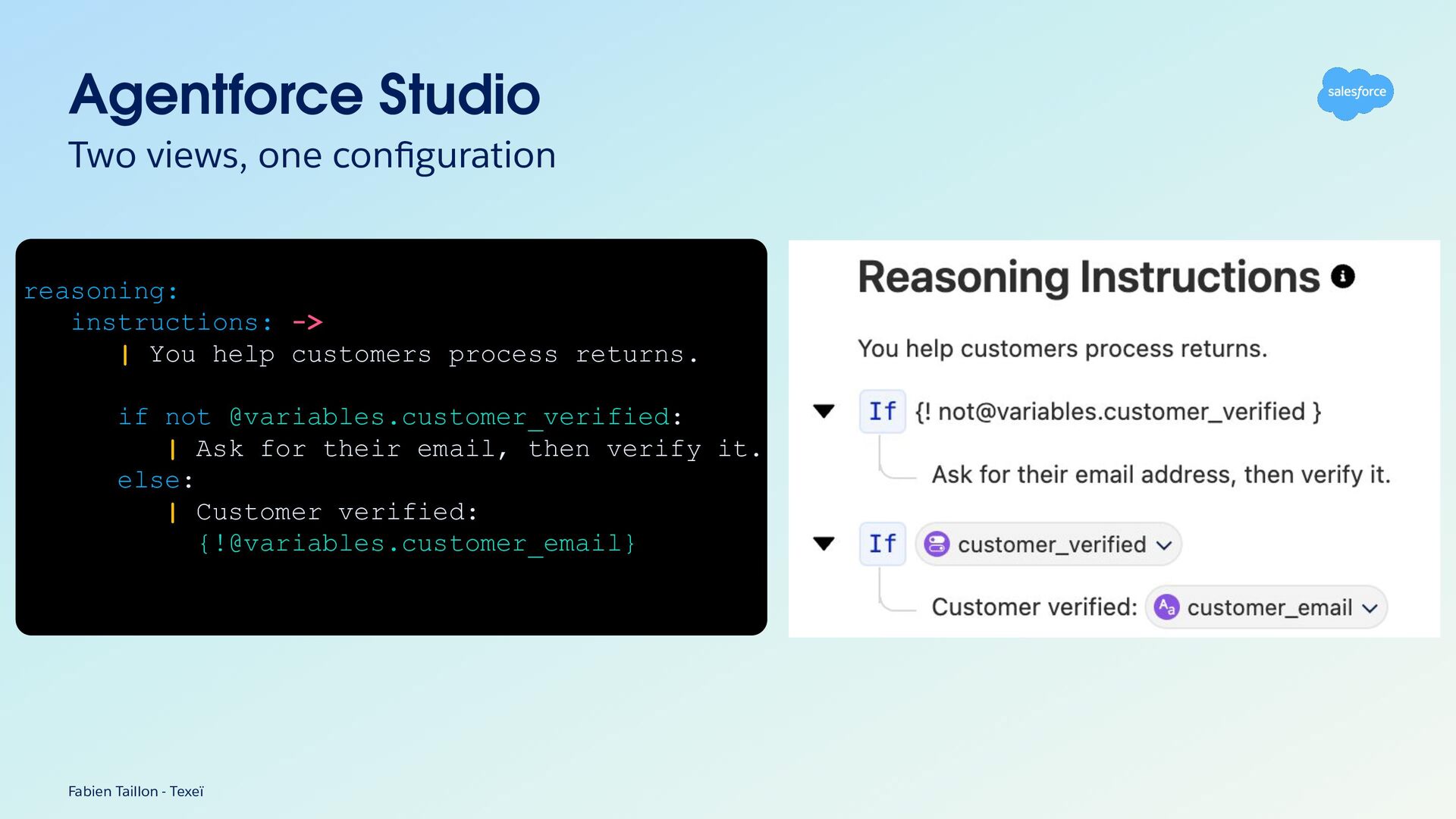
TO THE LLM reasoning: instructions: -> | You help customers process returns. if not @variables.customer_verified: | Ask for their email, then verify it. else: | Customer verified: {[email protected]_email} You help customers process returns. Ask for their email, then verify it. Only the yellow lines made it. The logic ran, then vanished. -> executes. | accumulates. The LLM never sees your script. It gets flat text, already resolved. Fabien Taillon - Texeï
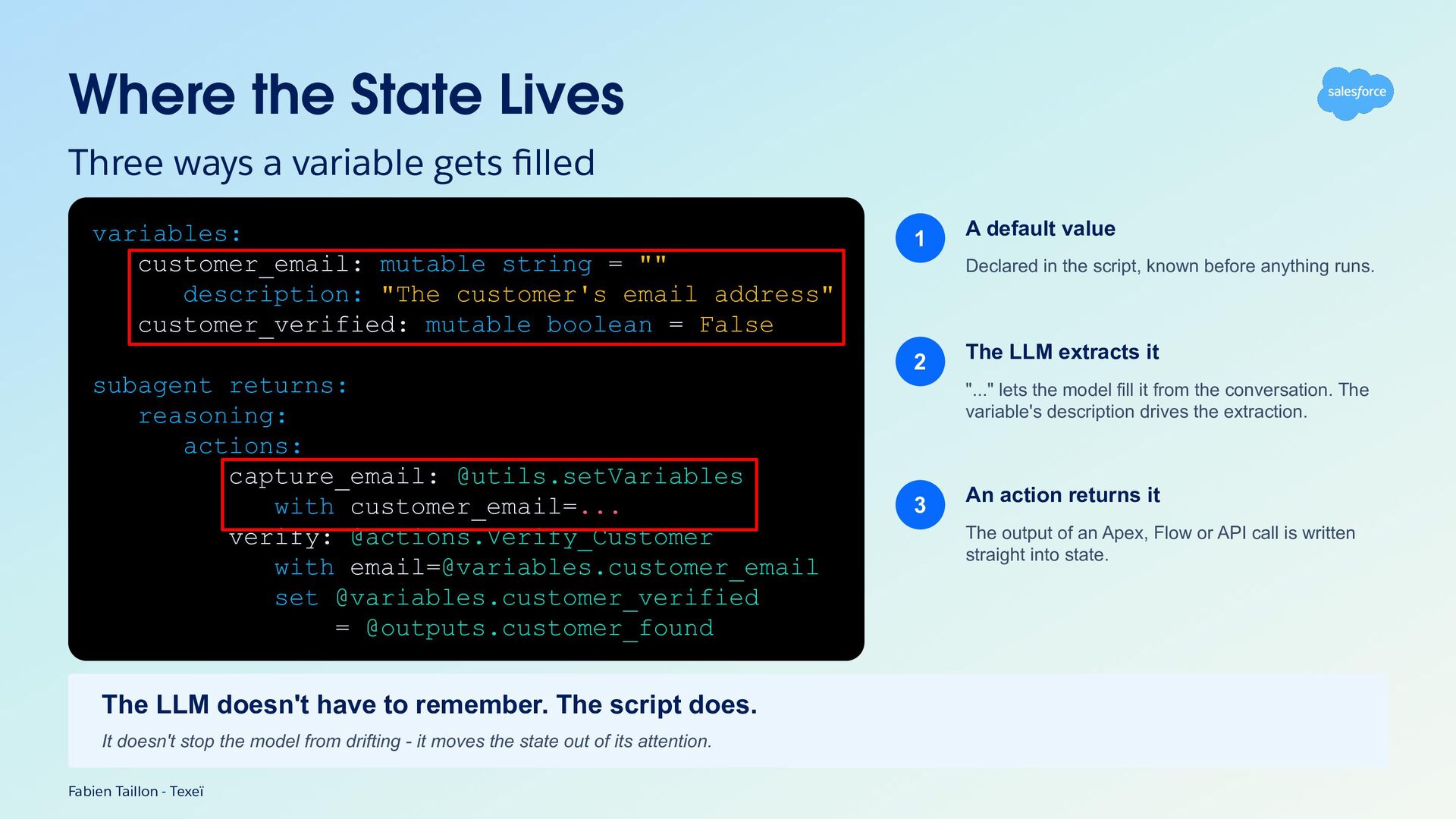
variables: customer_email: mutable string = "" description: "The customer's email address" customer_verified: mutable boolean = False 1 Declared in the script, known before anything runs. 2 subagent returns: reasoning: actions: capture_email: @utils.setVariables with customer_email=... verify: @actions.Verify_Customer with [email protected]_email set @variables.customer_verified = @outputs.customer_found The LLM doesn't have to remember. The script does. It doesn't stop the model from drifting - it moves the state out of its attention. Fabien Taillon - Texeï A default value The LLM extracts it "..." lets the model fill it from the conversation. The variable's description drives the extraction. 3 An action returns it The output of an Apex, Flow or API call is written straight into state.
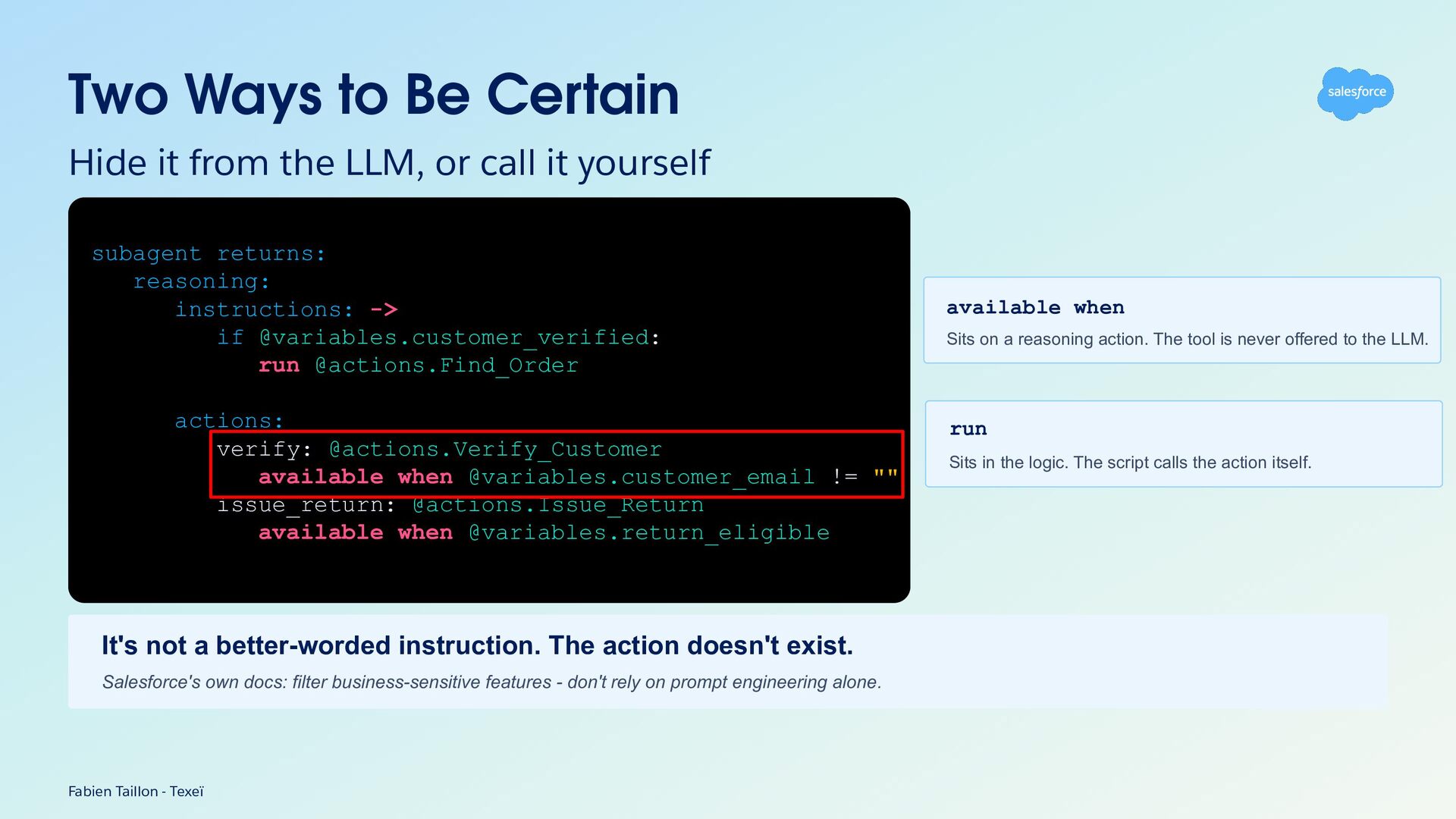
or call it yourself subagent returns: reasoning: instructions: -> if @variables.customer_verified: run @actions.Find_Order actions: verify: @actions.Verify_Customer available when @variables.customer_email != "" issue_return: @actions.Issue_Return available when @variables.return_eligible It's not a better-worded instruction. The action doesn't exist. Salesforce's own docs: filter business-sensitive features - don't rely on prompt engineering alone. Fabien Taillon - Texeï available when Sits on a reasoning action. The tool is never offered to the LLM. run Sits in the logic. The script calls the action itself.
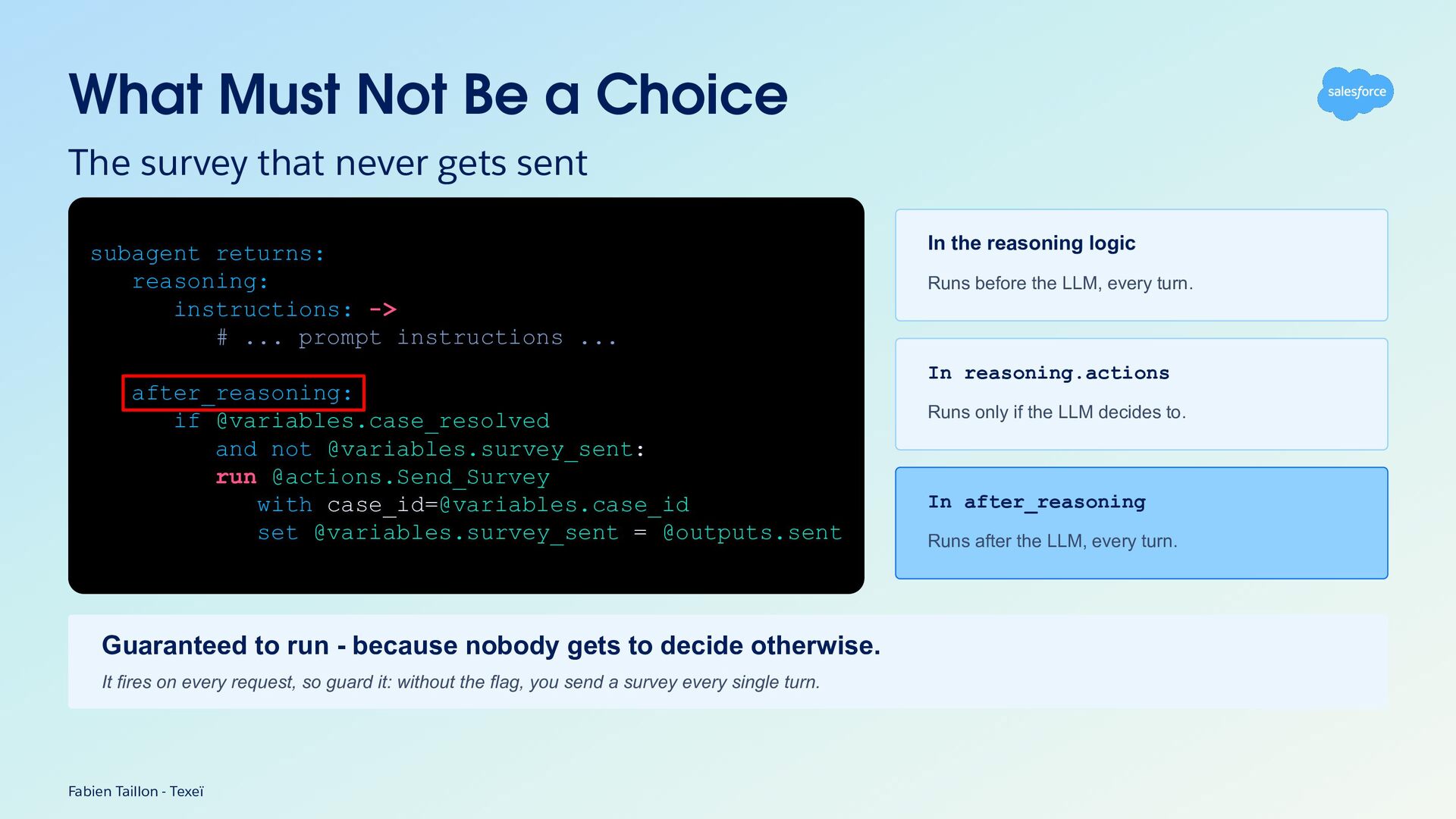
gets sent subagent returns: reasoning: instructions: -> # ... prompt instructions ... In the reasoning logic Runs before the LLM, every turn. In reasoning.actions after_reasoning: if @variables.case_resolved and not @variables.survey_sent: run @actions.Send_Survey with [email protected]_id set @variables.survey_sent = @outputs.sent Guaranteed to run - because nobody gets to decide otherwise. It fires on every request, so guard it: without the flag, you send a survey every single turn. Fabien Taillon - Texeï Runs only if the LLM decides to. In after_reasoning Runs after the LLM, every turn.
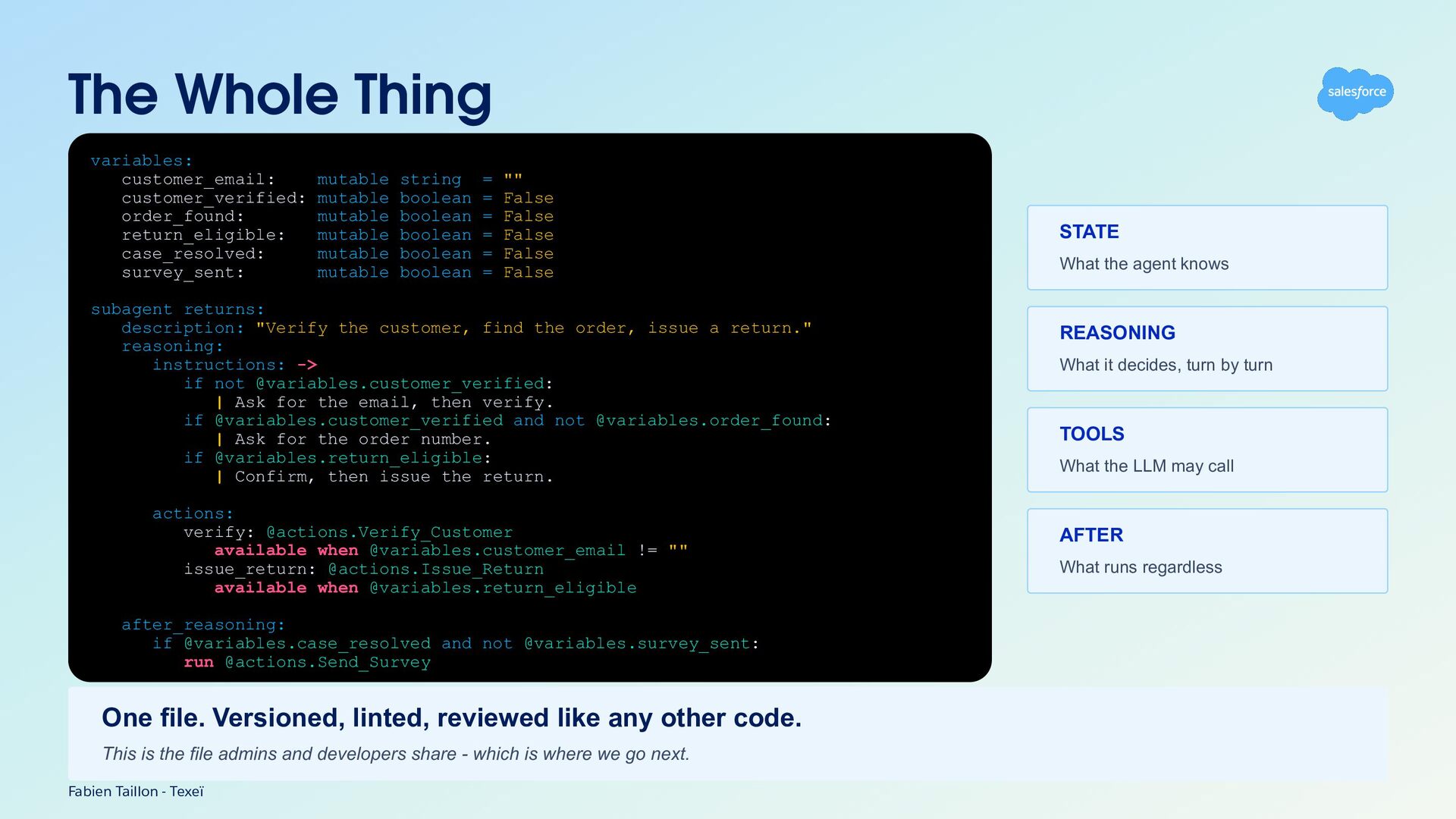
mutable boolean = False order_found: mutable boolean = False return_eligible: mutable boolean = False case_resolved: mutable boolean = False survey_sent: mutable boolean = False subagent returns: description: "Verify the customer, find the order, issue a return." reasoning: instructions: -> if not @variables.customer_verified: | Ask for the email, then verify. if @variables.customer_verified and not @variables.order_found: | Ask for the order number. if @variables.return_eligible: | Confirm, then issue the return. actions: verify: @actions.Verify_Customer available when @variables.customer_email != "" issue_return: @actions.Issue_Return available when @variables.return_eligible after_reasoning: if @variables.case_resolved and not @variables.survey_sent: run @actions.Send_Survey One file. Versioned, linted, reviewed like any other code. This is the file admins and developers share - which is where we go next. Fabien Taillon - Texeï STATE What the agent knows REASONING What it decides, turn by turn TOOLS What the LLM may call AFTER What runs regardless
You help customers process returns. if not @variables.customer_verified: | Ask for their email, then verify it. else: | Customer verified: {[email protected]_email} Fabien Taillon - Texeï
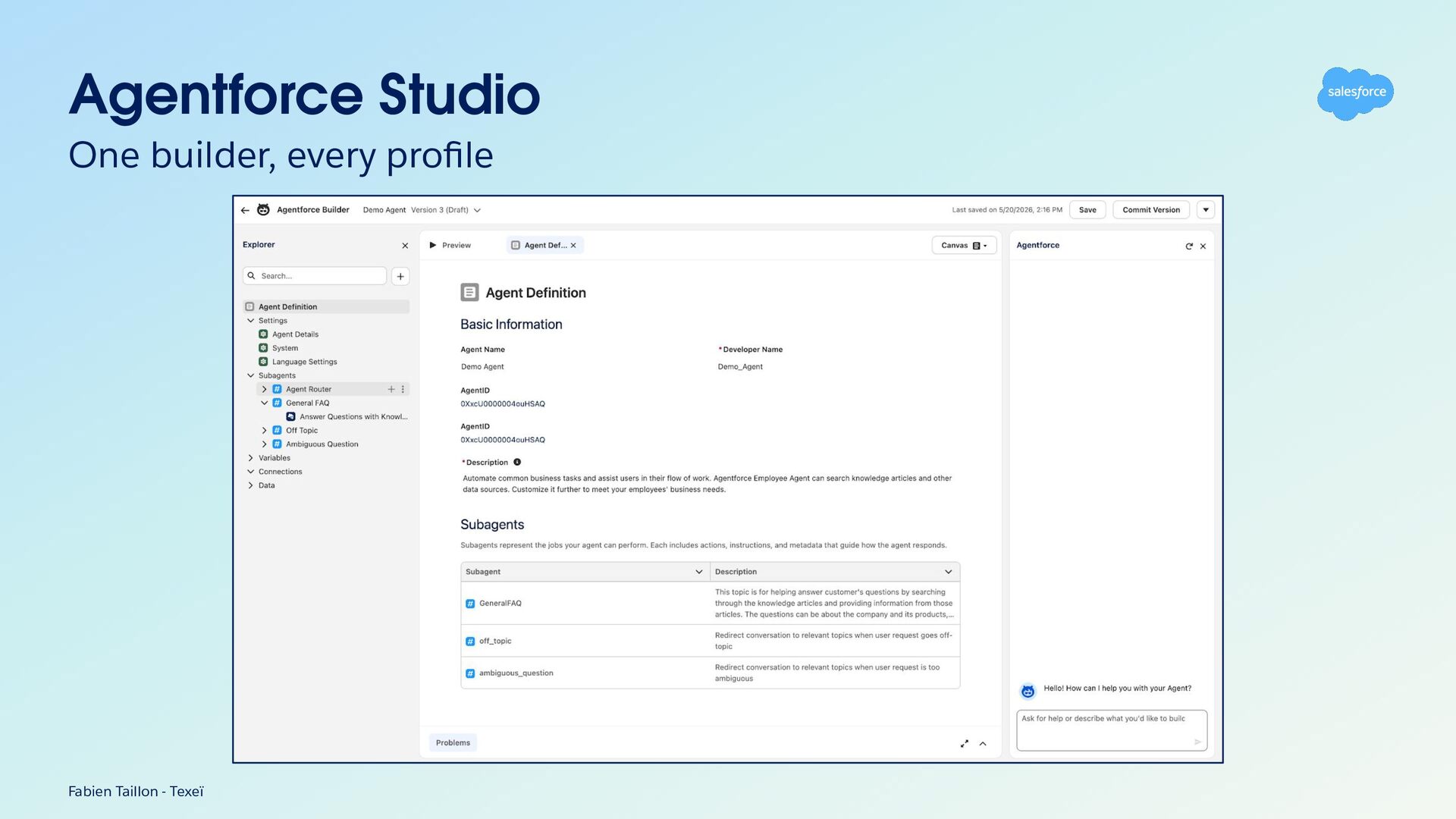
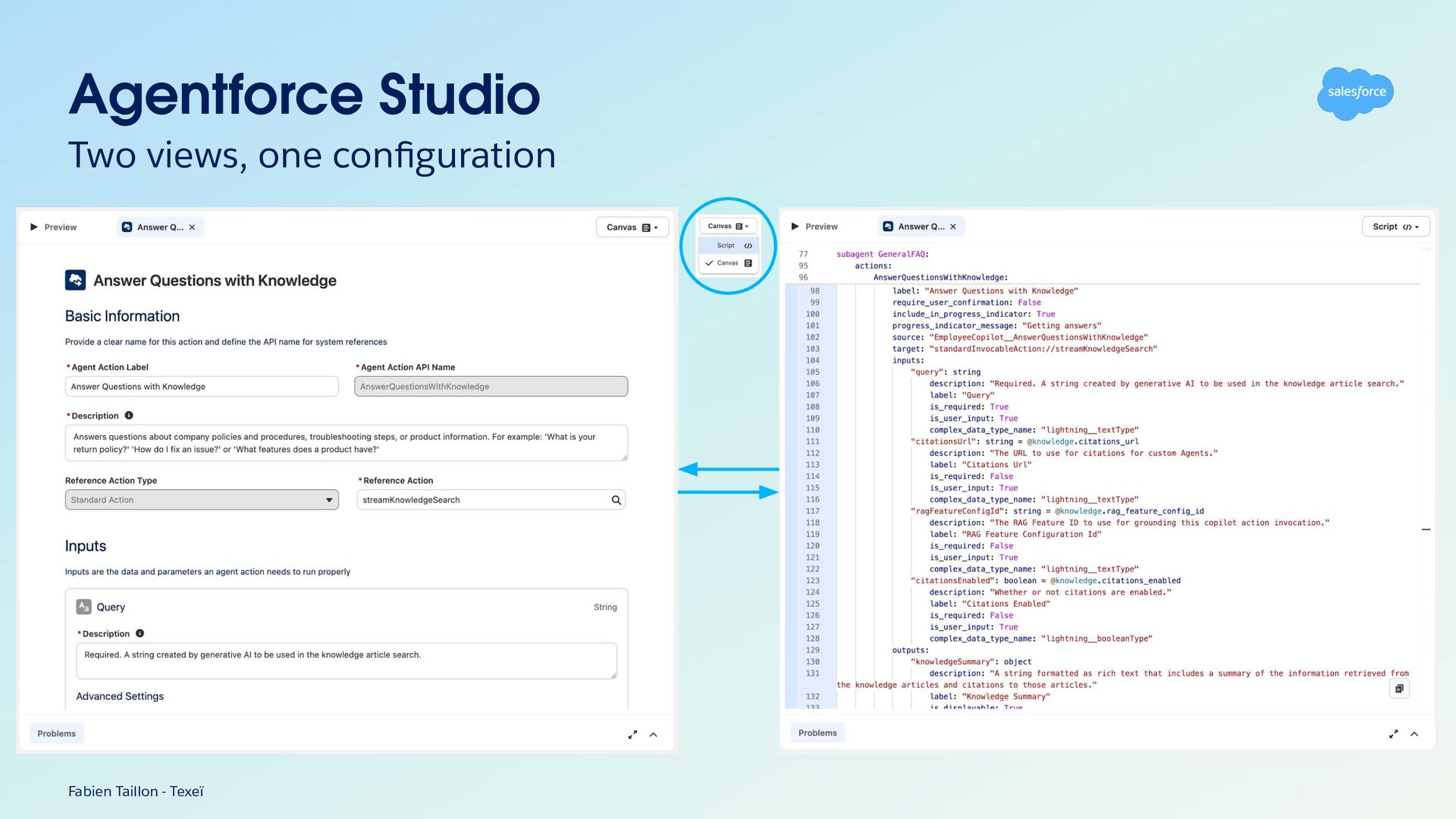
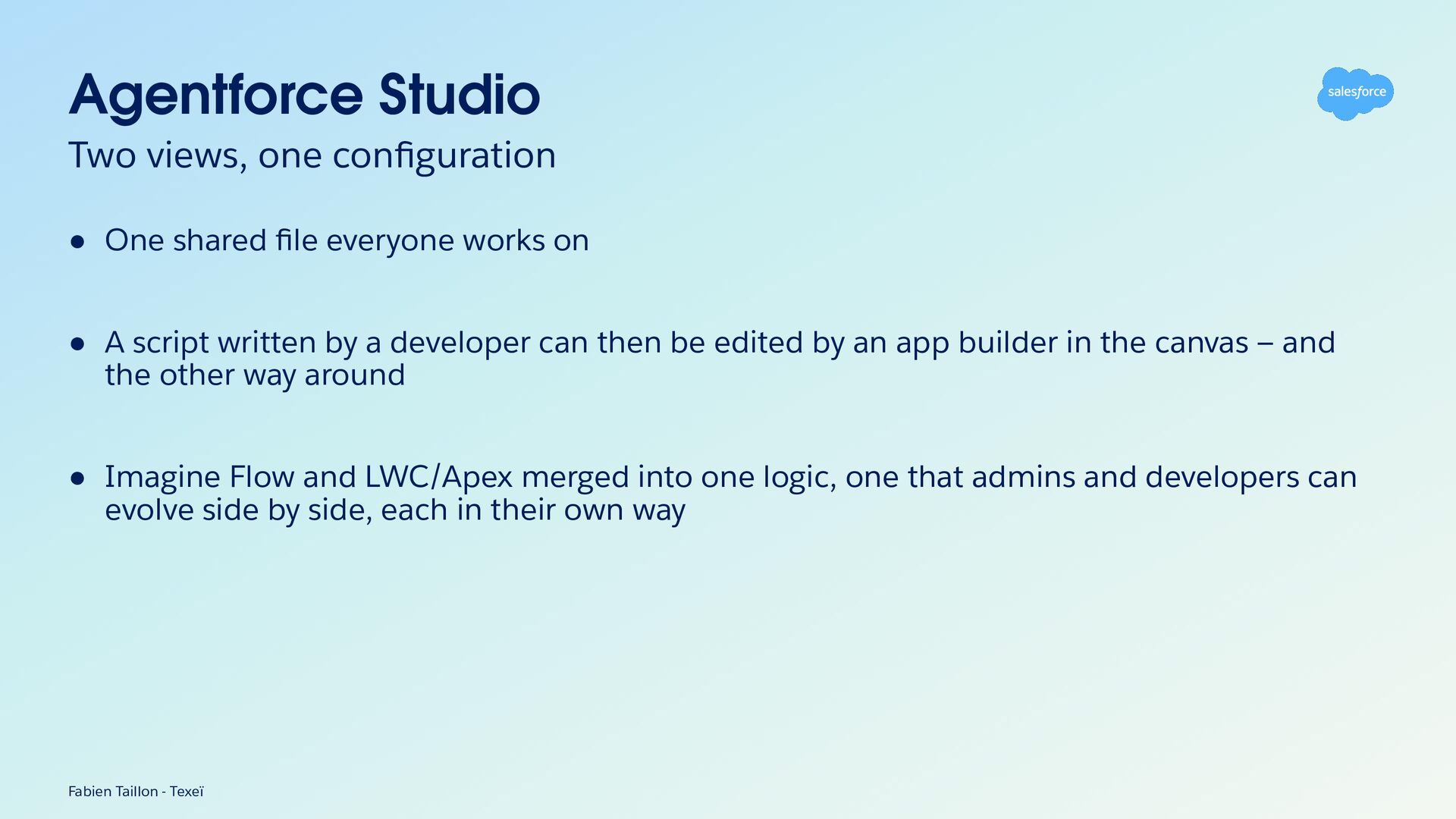
everyone works on • A script written by a developer can then be edited by an app builder in the canvas — and the other way around • Imagine Flow and LWC/Apex merged into one logic, one that admins and developers can evolve side by side, each in their own way Fabien Taillon - Texeï
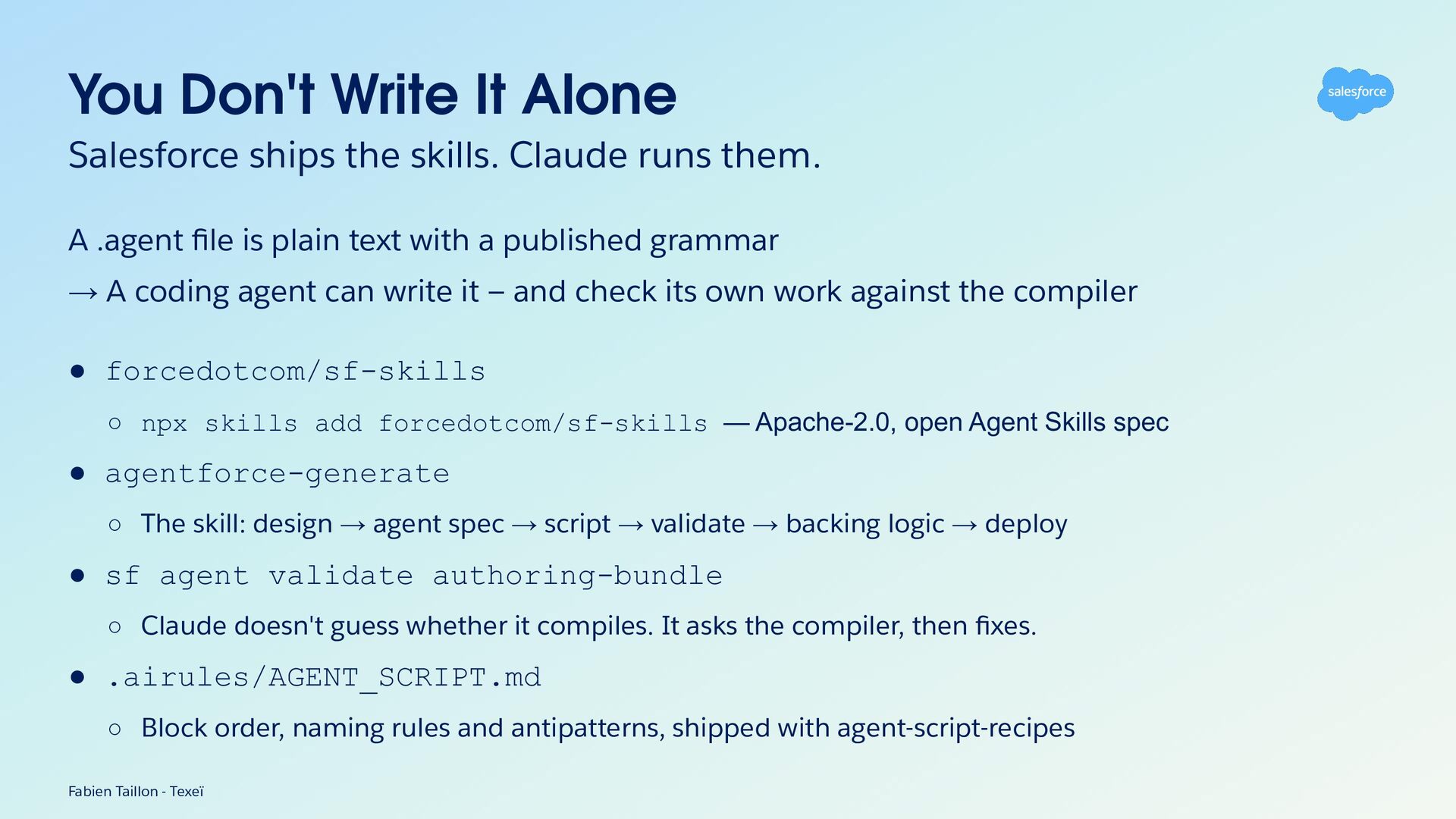
runs them. A .agent file is plain text with a published grammar → A coding agent can write it — and check its own work against the compiler • forcedotcom/sf-skills ◦ npx skills add forcedotcom/sf-skills — Apache-2.0, open Agent Skills spec • agentforce-generate ◦ The skill: design → agent spec → script → validate → backing logic → deploy • sf agent validate authoring-bundle ◦ Claude doesn't guess whether it compiles. It asks the compiler, then fixes. • .airules/AGENT_SCRIPT.md ◦ Block order, naming rules and antipatterns, shipped with agent-script-recipes Fabien Taillon - Texeï
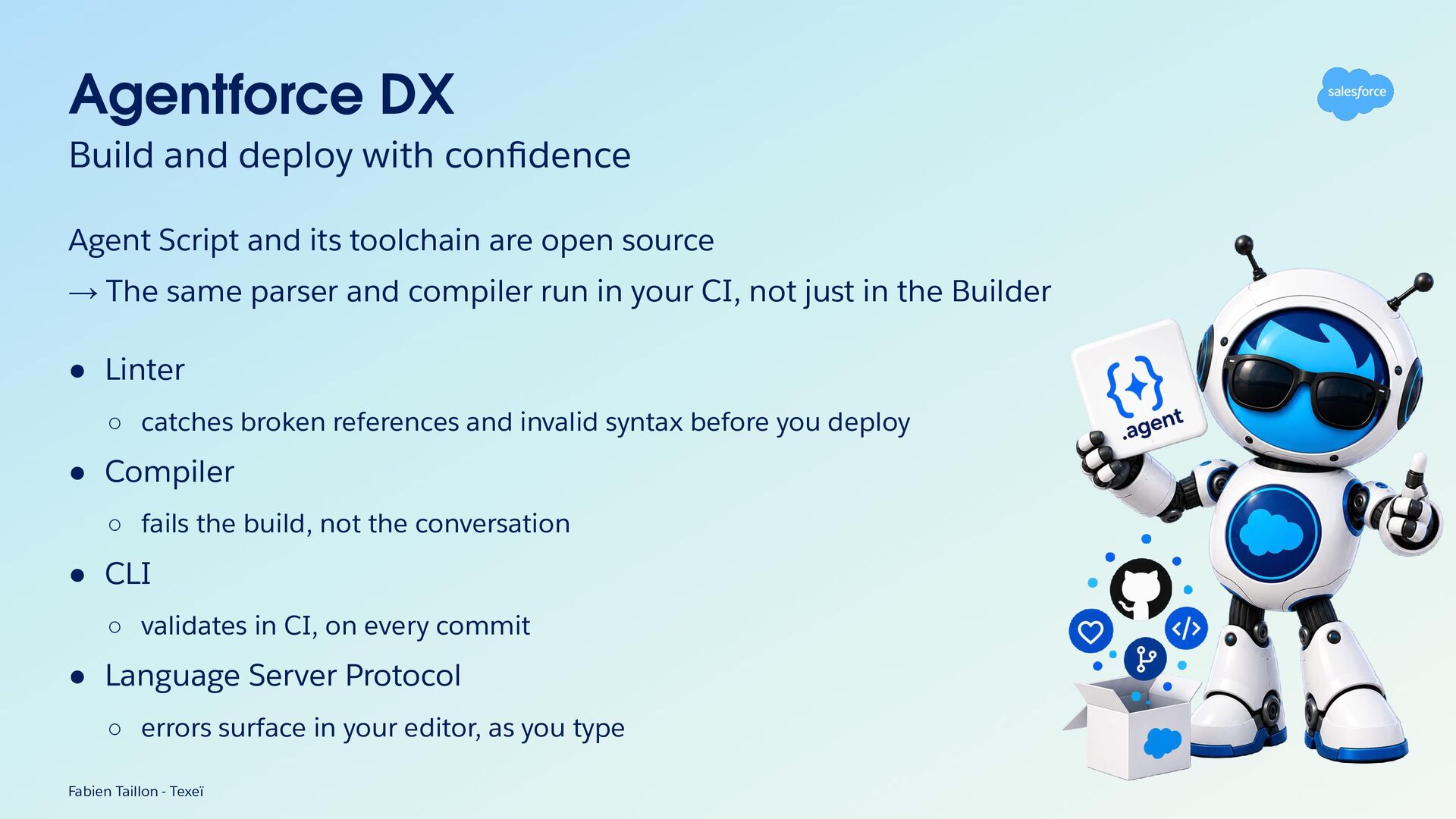
its toolchain are open source → The same parser and compiler run in your CI, not just in the Builder • Linter ◦ catches broken references and invalid syntax before you deploy • Compiler ◦ fails the build, not the conversation • CLI ◦ validates in CI, on every commit • Language Server Protocol ◦ errors surface in your editor, as you type Fabien Taillon - Texeï
on this event will receive a $5 Starbucks gi card.* 1. Download the Salesforce Events mobile app. 2. Navigate to surveys. 3. Complete (4) session surveys and the Event Survey. 4. Redeem your gift at Badge Pickup in-person on the last day of the event. *Restrictions apply. See terms and conditions at sforce.co/survey-terms


 fabientaillon
 persolserverworks
 tatamiya
 glaforge
 furuton
 mikanichinose
 bgpat
bgpat
 mkdev10
 munakata
 kazuho
 takanorip
 codmoninc
 shuta13
 swwweet
 katiecoart
 portentint
 madoxten
 eileencodes
 brad_frost
 brettharned
 schroneko
 rkendrick25
 jonoalderson
 kneath
 raygrieselhuber