Australian Commercial Shipping and Freight Market Analysis: Strategic Revitalisation and Regulatory Frameworks
This report focuses specifically on commercial merchant shipping and freight trade, separating commercial vessel operations from general maritime safety regulation, search and rescue, and emergency response
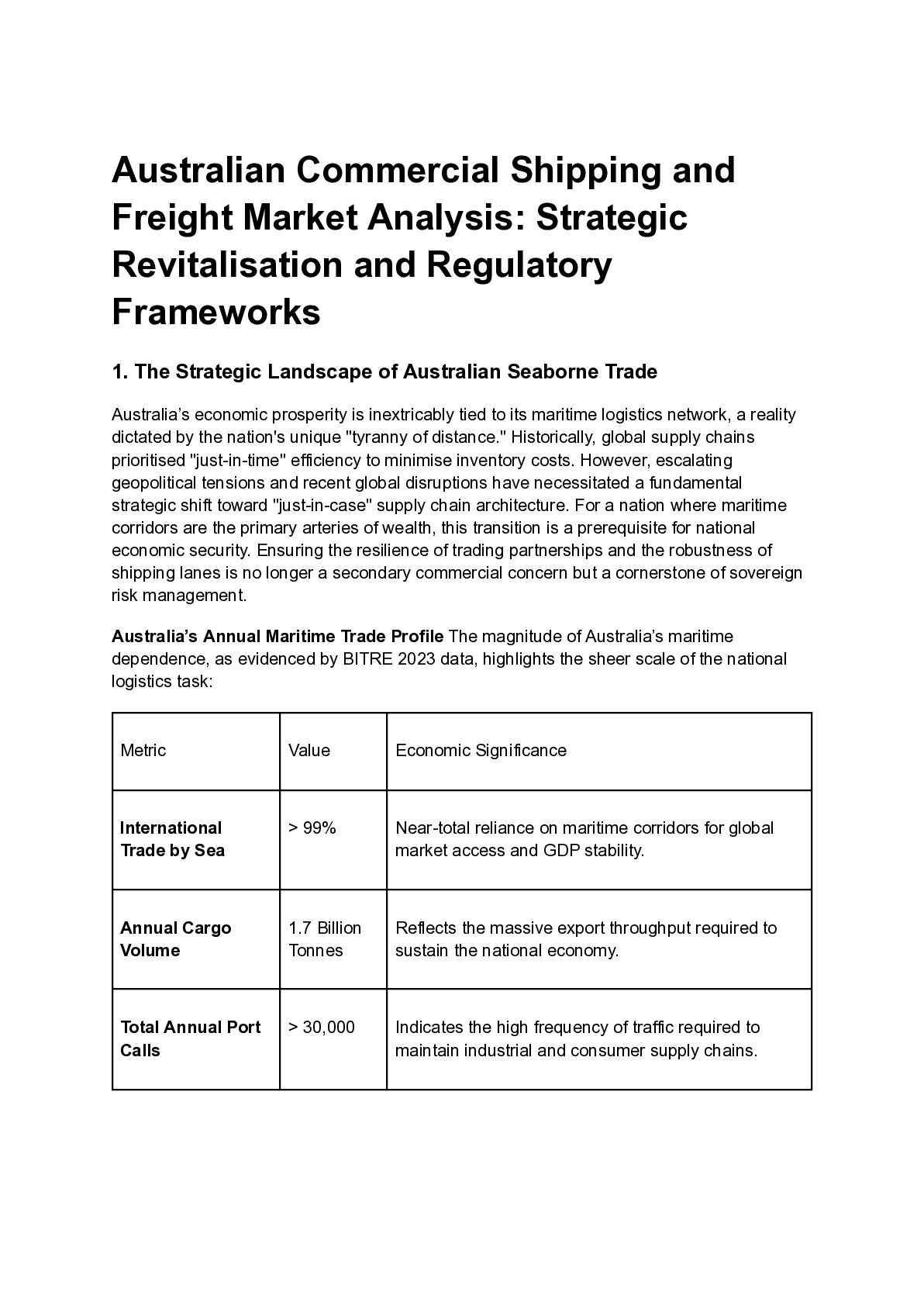
Regulatory Frameworks 1. The Strategic Landscape of Australian Seaborne Trade Australia’s economic prosperity is inextricably tied to its maritime logistics network, a reality dictated by the nation's unique "tyranny of distance." Historically, global supply chains prioritised "just-in-time" efficiency to minimise inventory costs. However, escalating geopolitical tensions and recent global disruptions have necessitated a fundamental strategic shift toward "just-in-case" supply chain architecture. For a nation where maritime corridors are the primary arteries of wealth, this transition is a prerequisite for national economic security. Ensuring the resilience of trading partnerships and the robustness of shipping lanes is no longer a secondary commercial concern but a cornerstone of sovereign risk management. Australia’s Annual Maritime Trade Profile The magnitude of Australia’s maritime dependence, as evidenced by BITRE 2023 data, highlights the sheer scale of the national logistics task: Metric Value Economic Significance International Trade by Sea > 99% Near-total reliance on maritime corridors for global market access and GDP stability. Annual Cargo Volume 1.7 Billion Tonnes Reflects the massive export throughput required to sustain the national economy. Total Annual Port Calls > 30,000 Indicates the high frequency of traffic required to maintain industrial and consumer supply chains.
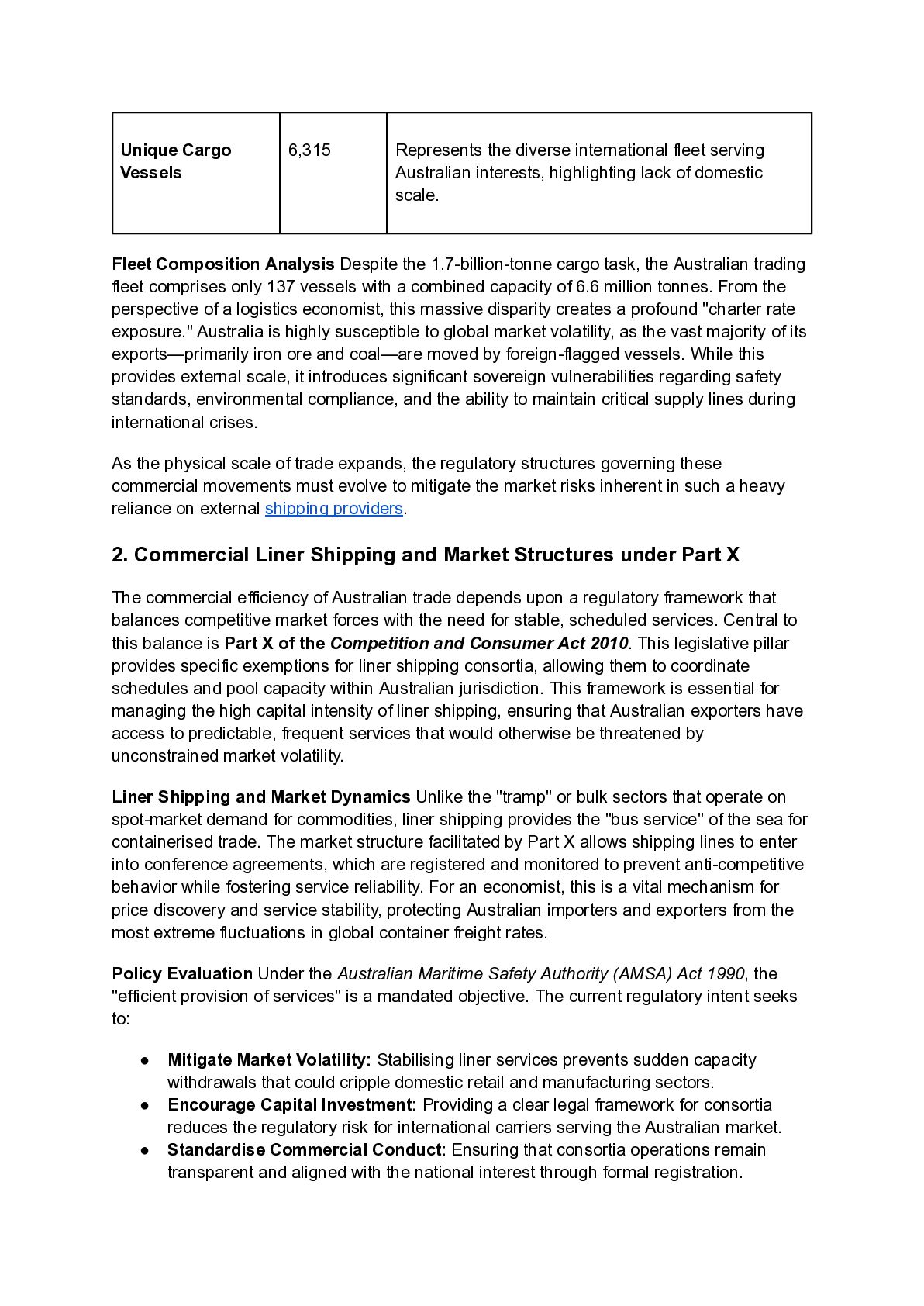
Australian interests, highlighting lack of domestic scale. Fleet Composition Analysis Despite the 1.7-billion-tonne cargo task, the Australian trading fleet comprises only 137 vessels with a combined capacity of 6.6 million tonnes. From the perspective of a logistics economist, this massive disparity creates a profound "charter rate exposure." Australia is highly susceptible to global market volatility, as the vast majority of its exports—primarily iron ore and coal—are moved by foreign-flagged vessels. While this provides external scale, it introduces significant sovereign vulnerabilities regarding safety standards, environmental compliance, and the ability to maintain critical supply lines during international crises. As the physical scale of trade expands, the regulatory structures governing these commercial movements must evolve to mitigate the market risks inherent in such a heavy reliance on external shipping providers. 2. Commercial Liner Shipping and Market Structures under Part X The commercial efficiency of Australian trade depends upon a regulatory framework that balances competitive market forces with the need for stable, scheduled services. Central to this balance is Part X of the Competition and Consumer Act 2010. This legislative pillar provides specific exemptions for liner shipping consortia, allowing them to coordinate schedules and pool capacity within Australian jurisdiction. This framework is essential for managing the high capital intensity of liner shipping, ensuring that Australian exporters have access to predictable, frequent services that would otherwise be threatened by unconstrained market volatility. Liner Shipping and Market Dynamics Unlike the "tramp" or bulk sectors that operate on spot-market demand for commodities, liner shipping provides the "bus service" of the sea for containerised trade. The market structure facilitated by Part X allows shipping lines to enter into conference agreements, which are registered and monitored to prevent anti-competitive behavior while fostering service reliability. For an economist, this is a vital mechanism for price discovery and service stability, protecting Australian importers and exporters from the most extreme fluctuations in global container freight rates. Policy Evaluation Under the Australian Maritime Safety Authority (AMSA) Act 1990, the "efficient provision of services" is a mandated objective. The current regulatory intent seeks to: • Mitigate Market Volatility: Stabilising liner services prevents sudden capacity withdrawals that could cripple domestic retail and manufacturing sectors. • Encourage Capital Investment: Providing a clear legal framework for consortia reduces the regulatory risk for international carriers serving the Australian market. • Standardise Commercial Conduct: Ensuring that consortia operations remain transparent and aligned with the national interest through formal registration.
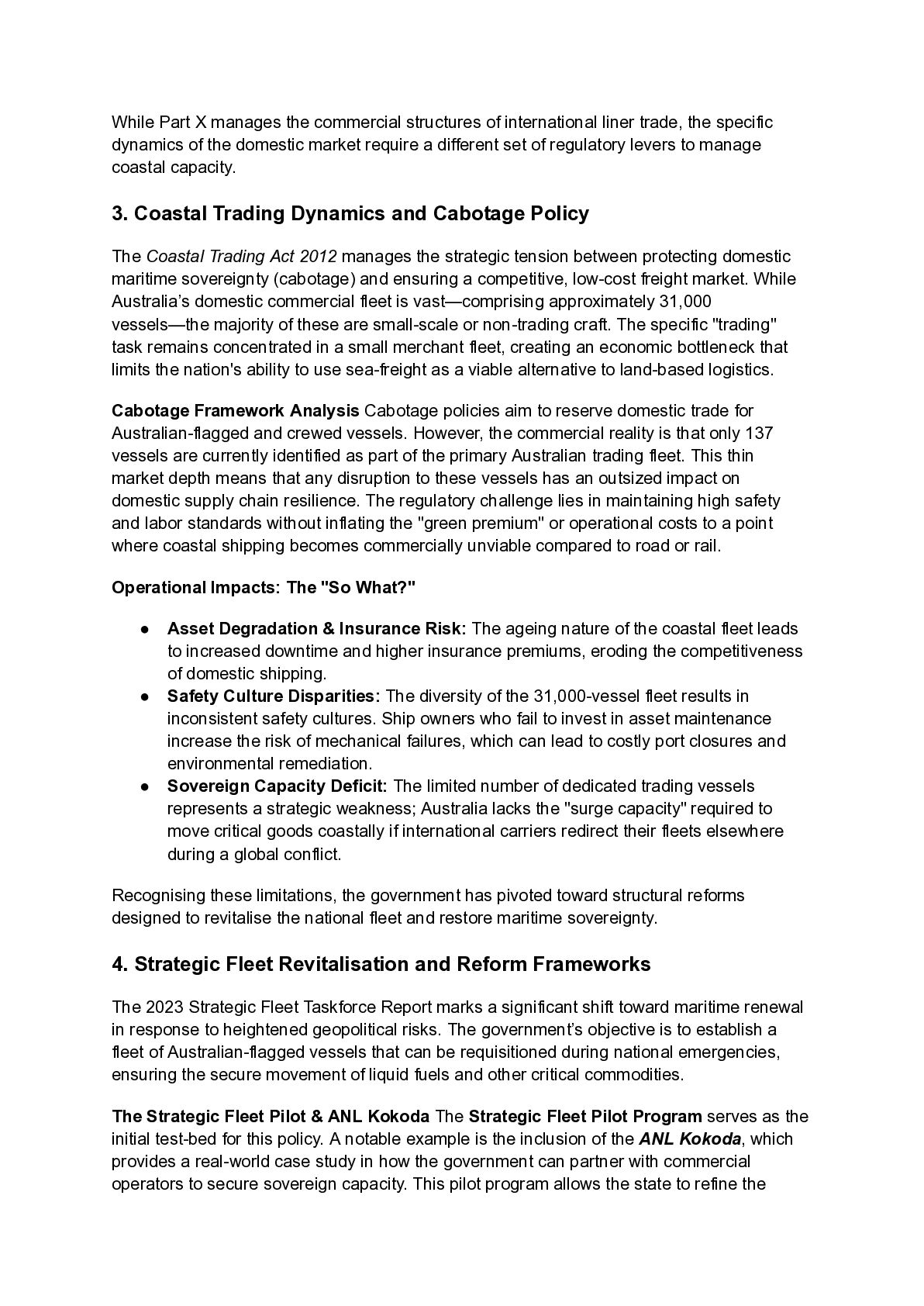
trade, the specific dynamics of the domestic market require a different set of regulatory levers to manage coastal capacity. 3. Coastal Trading Dynamics and Cabotage Policy The Coastal Trading Act 2012 manages the strategic tension between protecting domestic maritime sovereignty (cabotage) and ensuring a competitive, low-cost freight market. While Australia’s domestic commercial fleet is vast—comprising approximately 31,000 vessels—the majority of these are small-scale or non-trading craft. The specific "trading" task remains concentrated in a small merchant fleet, creating an economic bottleneck that limits the nation's ability to use sea-freight as a viable alternative to land-based logistics. Cabotage Framework Analysis Cabotage policies aim to reserve domestic trade for Australian-flagged and crewed vessels. However, the commercial reality is that only 137 vessels are currently identified as part of the primary Australian trading fleet. This thin market depth means that any disruption to these vessels has an outsized impact on domestic supply chain resilience. The regulatory challenge lies in maintaining high safety and labor standards without inflating the "green premium" or operational costs to a point where coastal shipping becomes commercially unviable compared to road or rail. Operational Impacts: The "So What?" • Asset Degradation & Insurance Risk: The ageing nature of the coastal fleet leads to increased downtime and higher insurance premiums, eroding the competitiveness of domestic shipping. • Safety Culture Disparities: The diversity of the 31,000-vessel fleet results in inconsistent safety cultures. Ship owners who fail to invest in asset maintenance increase the risk of mechanical failures, which can lead to costly port closures and environmental remediation. • Sovereign Capacity Deficit: The limited number of dedicated trading vessels represents a strategic weakness; Australia lacks the "surge capacity" required to move critical goods coastally if international carriers redirect their fleets elsewhere during a global conflict. Recognising these limitations, the government has pivoted toward structural reforms designed to revitalise the national fleet and restore maritime sovereignty. 4. Strategic Fleet Revitalisation and Reform Frameworks The 2023 Strategic Fleet Taskforce Report marks a significant shift toward maritime renewal in response to heightened geopolitical risks. The government’s objective is to establish a fleet of Australian-flagged vessels that can be requisitioned during national emergencies, ensuring the secure movement of liquid fuels and other critical commodities. The Strategic Fleet Pilot & ANL Kokoda The Strategic Fleet Pilot Program serves as the initial test-bed for this policy. A notable example is the inclusion of the ANL Kokoda, which provides a real-world case study in how the government can partner with commercial operators to secure sovereign capacity. This pilot program allows the state to refine the
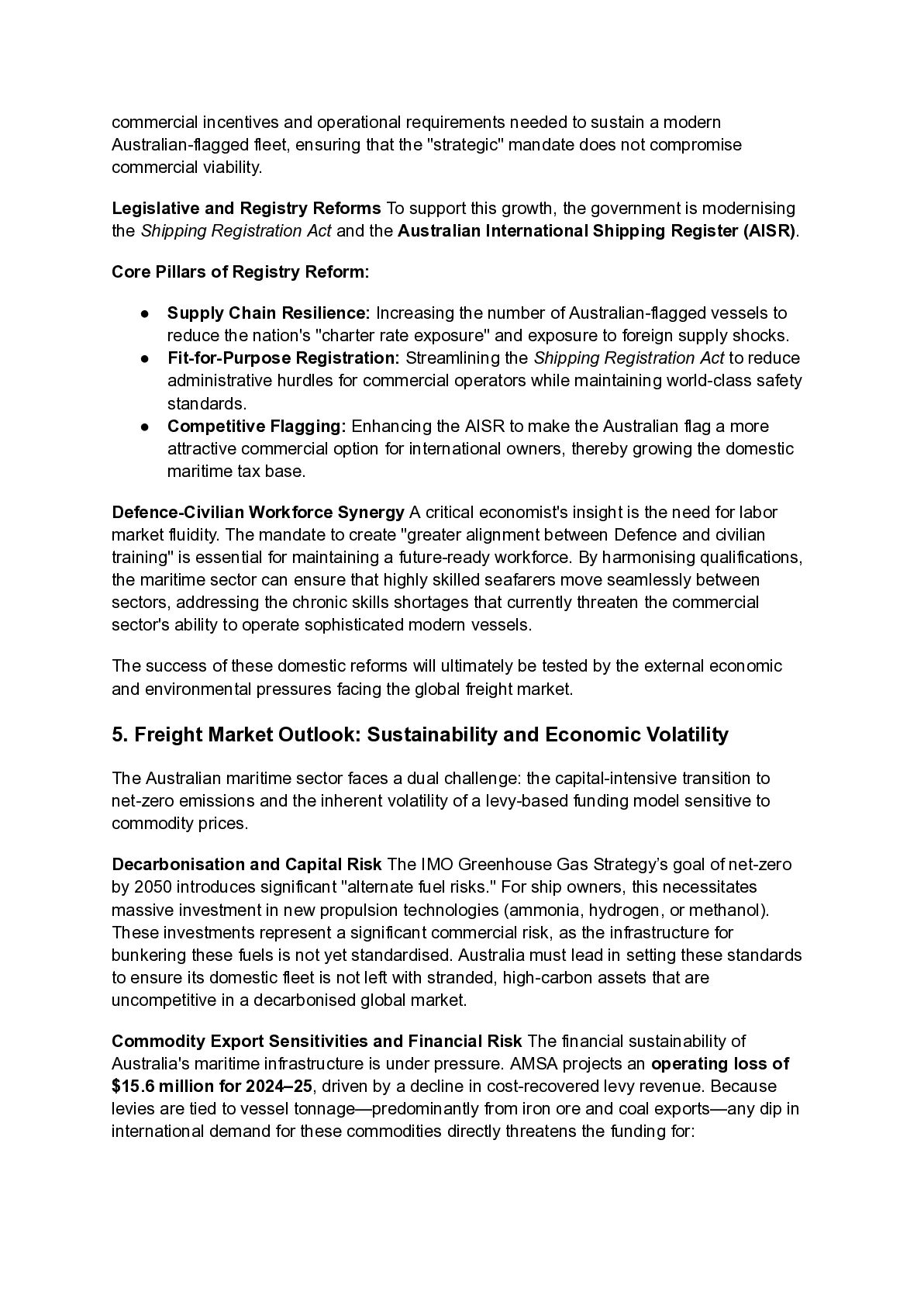
Australian-flagged fleet, ensuring that the "strategic" mandate does not compromise commercial viability. Legislative and Registry Reforms To support this growth, the government is modernising the Shipping Registration Act and the Australian International Shipping Register (AISR). Core Pillars of Registry Reform: • Supply Chain Resilience: Increasing the number of Australian-flagged vessels to reduce the nation's "charter rate exposure" and exposure to foreign supply shocks. • Fit-for-Purpose Registration: Streamlining the Shipping Registration Act to reduce administrative hurdles for commercial operators while maintaining world-class safety standards. • Competitive Flagging: Enhancing the AISR to make the Australian flag a more attractive commercial option for international owners, thereby growing the domestic maritime tax base. Defence-Civilian Workforce Synergy A critical economist's insight is the need for labor market fluidity. The mandate to create "greater alignment between Defence and civilian training" is essential for maintaining a future-ready workforce. By harmonising qualifications, the maritime sector can ensure that highly skilled seafarers move seamlessly between sectors, addressing the chronic skills shortages that currently threaten the commercial sector's ability to operate sophisticated modern vessels. The success of these domestic reforms will ultimately be tested by the external economic and environmental pressures facing the global freight market. 5. Freight Market Outlook: Sustainability and Economic Volatility The Australian maritime sector faces a dual challenge: the capital-intensive transition to net-zero emissions and the inherent volatility of a levy-based funding model sensitive to commodity prices. Decarbonisation and Capital Risk The IMO Greenhouse Gas Strategy’s goal of net-zero by 2050 introduces significant "alternate fuel risks." For ship owners, this necessitates massive investment in new propulsion technologies (ammonia, hydrogen, or methanol). These investments represent a significant commercial risk, as the infrastructure for bunkering these fuels is not yet standardised. Australia must lead in setting these standards to ensure its domestic fleet is not left with stranded, high-carbon assets that are uncompetitive in a decarbonised global market. Commodity Export Sensitivities and Financial Risk The financial sustainability of Australia's maritime infrastructure is under pressure. AMSA projects an operating loss of $15.6 million for 2024–25, driven by a decline in cost-recovered levy revenue. Because levies are tied to vessel tonnage—predominantly from iron ore and coal exports—any dip in international demand for these commodities directly threatens the funding for:
modern port operations. • Aids to Navigation (AtoN): The physical and digital lighthouses and beacons that ensure safe passage through sensitive areas like the Great Barrier Reef. Digital Piracy and Cyber-Security In the modern era, "digital piracy" via cyber-attacks on navigation systems and port operations has superseded physical piracy as the primary threat to commercial continuity. Protecting the integrity of maritime data networks is now a critical component of risk management. A single breach could paralyze a major port, leading to losses far exceeding the cost of traditional physical security. Strategic Synthesis The long-term commercial viability of Australia’s maritime trade rests on five strategic priorities: Risk-based regulation, Incident management, Environment protection, Engagement, and Business transformation. By modernising the national fleet, refining the registry, and securing the funding for critical navigation infrastructure, Australia can mitigate its sovereign risks and ensure that its maritime logistics network remains a source of economic strength in an increasingly volatile world.


 stanby_inc
 mercari_inc
 yoshikikonishi_
 openwork
 takeshisumida_
 canvasedge
 noritaka88tax
 progmat
 xinghr
 gatechnologies
 synergymarketing
 ikuodanaka
 honzajavorek
 aleyda
 chrislema
 seathinner
 reverentgeek
 skipperchong
 codingconduct
 popppiees
 frankvandijk
 panda_program
 holman
 greggifford