Upgrade to Pro — share decks privately, control downloads, hide ads and more …

An Introduction To Fixed Income Investing Using...

An Introduction To Fixed Income Investing Using Active ETFs

Fidante Partners forms long-term alliances with talented investment teams to support and grow specialist investment management businesses.

https://www.fidante.com/

1. The basics of fixed income investing
2. The key risks and return drivers in fixed income
3. What is driving fixed income markets at the moment?
4. Summary of listed products
5. How to use Active ETFs in a portfolio
6. ActiveX performance update

Avatar for FidantePartners

FidantePartners

August 13, 2021

Other Decks in Business

Transcript

  1. WITH SAM MORRIS, CFA & MATTHEW HOLBERTON, CFA An introduction

    to fixed income investing using Active ETFs July 2021
  2. This material has been prepared by Fidante Partners Limited ABN

    94 002 835 592 AFSL 234668 (Fidante), the responsible entity of the Ardea Real Outcome Fund and the ActiveX Ardea Real Outcome Bond Fund (Managed Fund) and Kapstream Absolute Return Income Fund and ActiveX Kapstream Absolute Return Income Fund (Managed Fund) (“Funds”). It is general information only and is not intended to provide you with financial advice or take into account your objectives, financial situation or needs. No person guarantees the performance of, or rate of return from, any product or strategy relating to this material nor the repayment of capital in relation to an investment in such product or strategy. An investment in any such product or strategy is not a deposit with, nor another liability of Fidante nor any of its related bodies corporate, associates or employees. Investment in any product or strategy relating to this material is subject to investment risks, including possible delays in repayment and loss of income and capital invested. Past performance is not a reliable indicator of future performance. Any projections are based on assumptions which we believe are reasonable, but are subject to change and should not be relied upon. The information in this material is not a recommendation, offer or solicitation to buy or sell any securities or to adopt any investment strategy. The opinions expressed may change as subsequent conditions vary. Neither of Fidante nor any of its respective related bodies corporate, associates and employees, shall have any liability whatsoever (in negligence or otherwise) for any loss howsoever arising from any use of the material or otherwise in connection with the material. The Product Disclosure Statement (PDS) for the Fund(s), issued by Fidante, should be considered before deciding whether to acquire or hold units in the Fund(s). The PDS can be obtained by calling 13 51 53 or visiting www.fidante.com. You should consider the applicable disclosure document or product disclosure statement (PDS) and any additional information booklet for the relevant Fund before deciding whether to acquire or continue to hold an interest in the Fund. For exchange traded products, the PDS can be obtained from your financial adviser, Link Market Services on +61 1800 441 104 or on our website www.fidanteactivex.com.au, for other products, the PDS can be obtained from your financial adviser, Fidante Partners’ Investor Services team on 13 51 53 or website www.fidante.com.au. Neither Fidante nor any of its related bodies corporate guarantee the performance of the Funds, any particular rate of return or return of capital. Past performance is not a reliable indicator of future performance. Please also refer to the Financial Services Guide on our website. This material does not constitute legal, tax, financial or accounting advice or opinion and is not intended to be used as the basis for making an investment decision. No offer of any financial product may be made prior to the delivery of any PDS for any product in accordance with applicable law. Fidante, its related bodies corporate, its directors and employees and associates of each may receive remuneration in respect of advice and other financial services provided by Fidante. Fidante has entered into various arrangements with investment managers or other parties in connection with the distribution and administration of financial products to which this material relates. In connection with those arrangements, Fidante may receive remuneration or other benefits in respect of financial services provided by Fidante.
  3. 3 1. The basics of fixed income investing 2. The

    key risks and return drivers in fixed income 3. What is driving fixed income markets at the moment? 4. Summary of listed products 5. How to use Active ETFs in a portfolio 6.ActiveX performance update 7.Q&A AGENDA
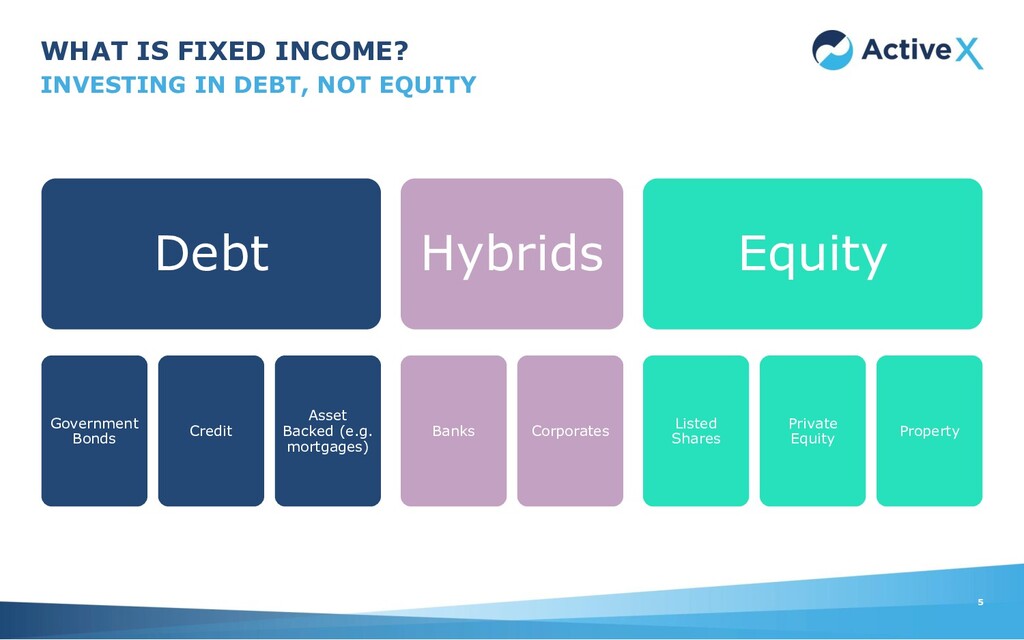
  4. 5 INVESTING IN DEBT, NOT EQUITY WHAT IS FIXED INCOME?

    Debt Government Bonds Credit Asset Backed (e.g. mortgages) Hybrids Banks Corporates Equity Listed Shares Private Equity Property
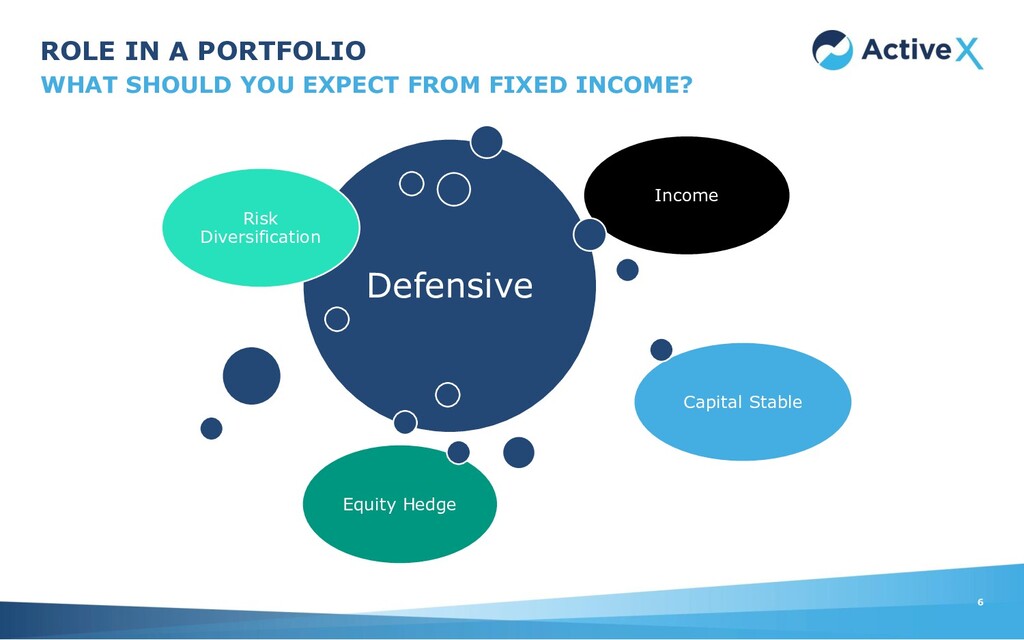
  5. 6 WHAT SHOULD YOU EXPECT FROM FIXED INCOME? ROLE IN

    A PORTFOLIO Defensive Risk Diversification Income Capital Stable Equity Hedge
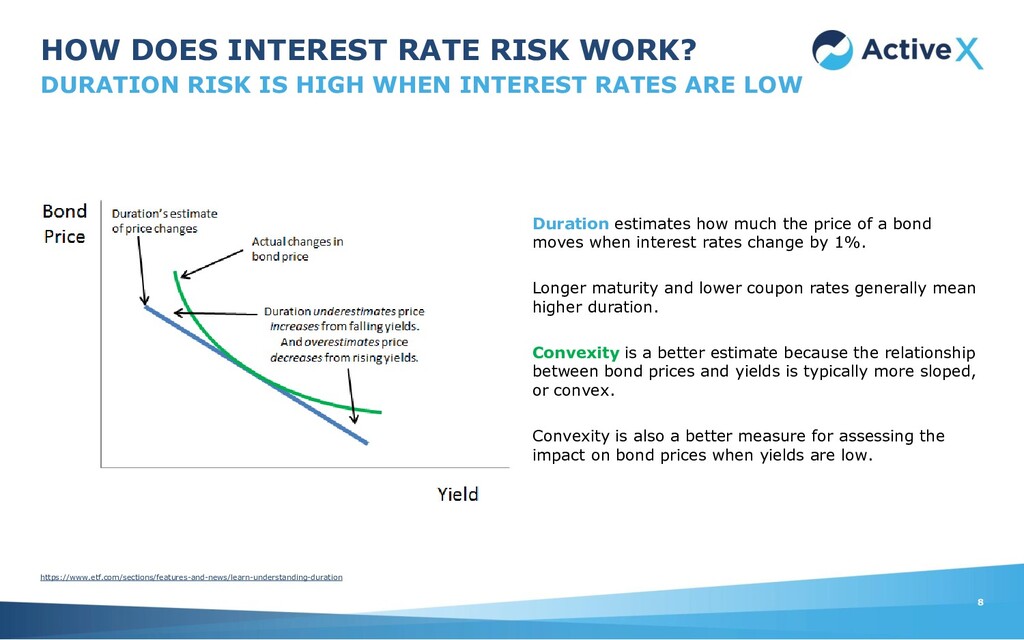
  6. 8 HOW DOES INTEREST RATE RISK WORK? DURATION RISK IS

    HIGH WHEN INTEREST RATES ARE LOW https://www.etf.com/sections/features-and-news/learn-understanding-duration Duration estimates how much the price of a bond moves when interest rates change by 1%. Longer maturity and lower coupon rates generally mean higher duration. Convexity is a better estimate because the relationship between bond prices and yields is typically more sloped, or convex. Convexity is also a better measure for assessing the impact on bond prices when yields are low.
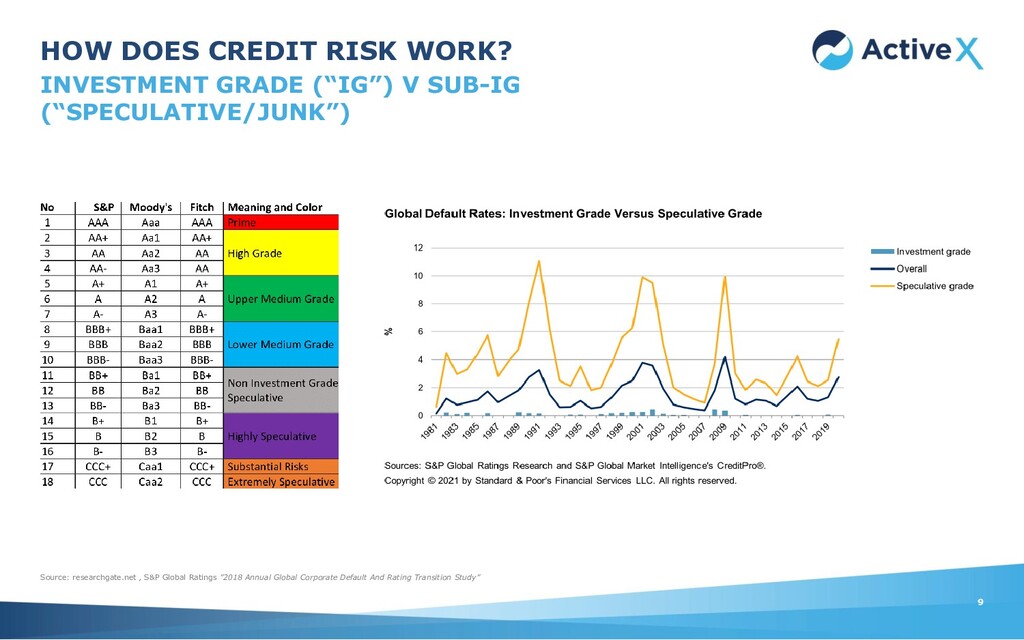
  7. HOW DOES CREDIT RISK WORK? 9 INVESTMENT GRADE (“IG”) V

    SUB-IG (“SPECULATIVE/JUNK”) Source: researchgate.net , S&P Global Ratings ”2018 Annual Global Corporate Default And Rating Transition Study”
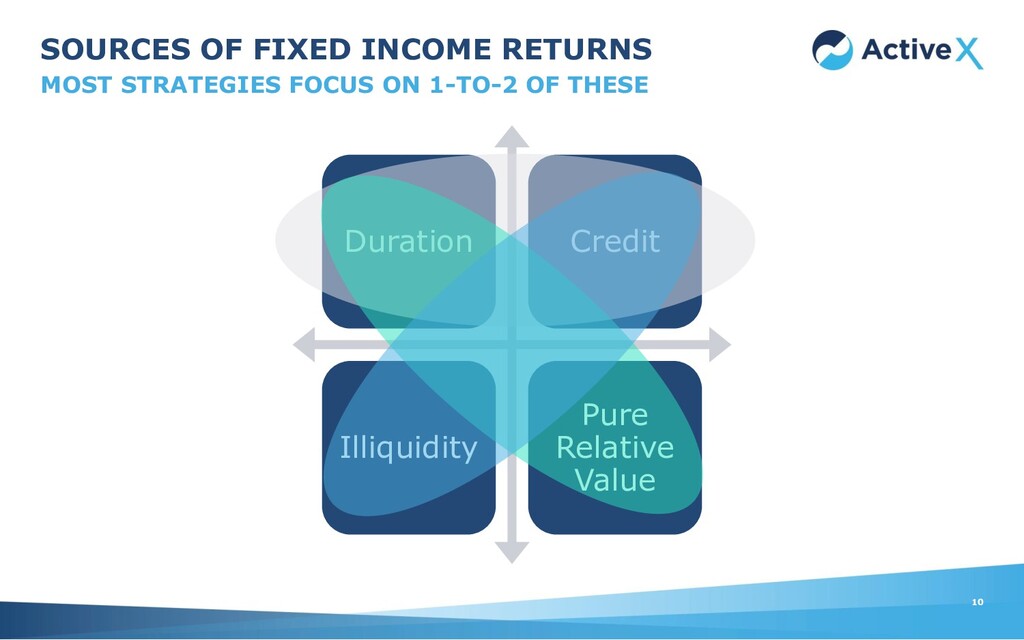
  8. 10 MOST STRATEGIES FOCUS ON 1-TO-2 OF THESE SOURCES OF

    FIXED INCOME RETURNS Duration Credit Illiquidity Pure Relative Value
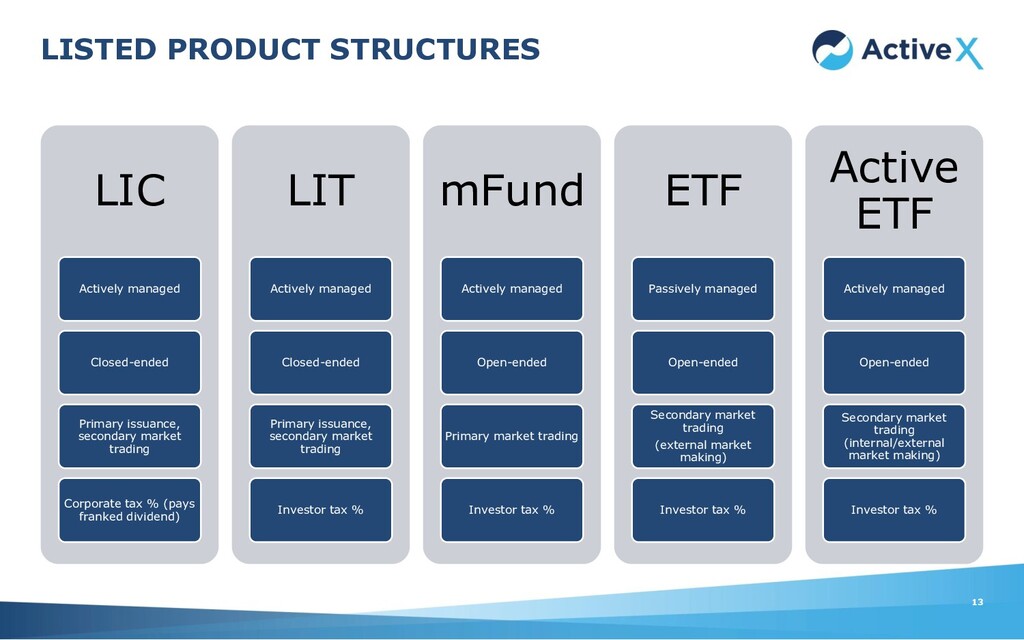
  9. 13 LISTED PRODUCT STRUCTURES LIC Actively managed Closed-ended Primary issuance,

    secondary market trading Corporate tax % (pays franked dividend) LIT Actively managed Closed-ended Primary issuance, secondary market trading Investor tax % mFund Actively managed Open-ended Primary market trading Investor tax % ETF Passively managed Open-ended Secondary market trading (external market making) Investor tax % Active ETF Actively managed Open-ended Secondary market trading (internal/external market making) Investor tax %
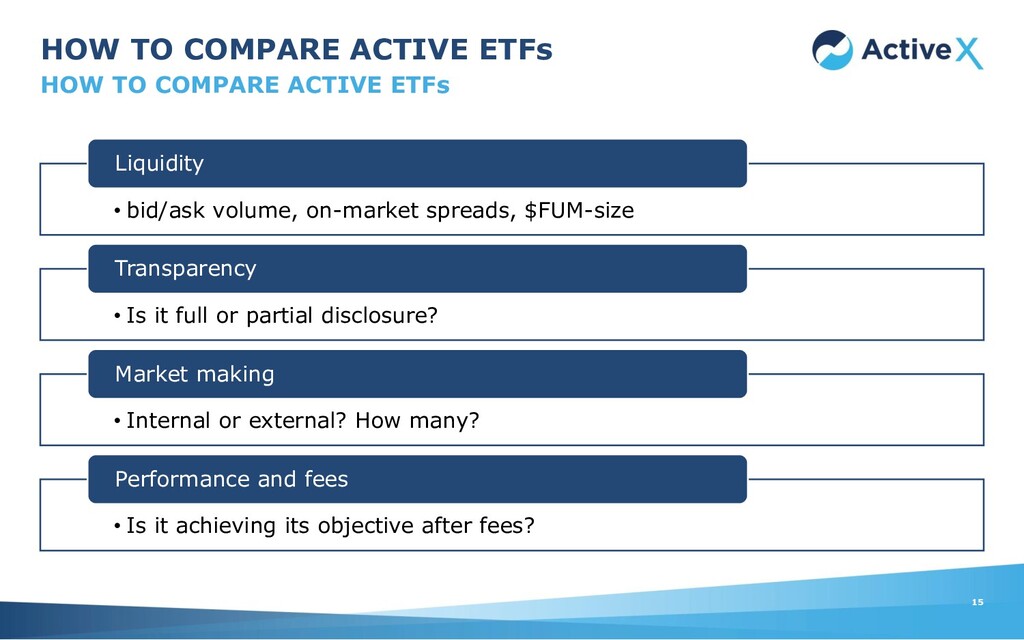
  10. 15 HOW TO COMPARE ACTIVE ETFs HOW TO COMPARE ACTIVE

    ETFs • bid/ask volume, on-market spreads, $FUM-size Liquidity • Is it full or partial disclosure? Transparency • Internal or external? How many? Market making • Is it achieving its objective after fees? Performance and fees