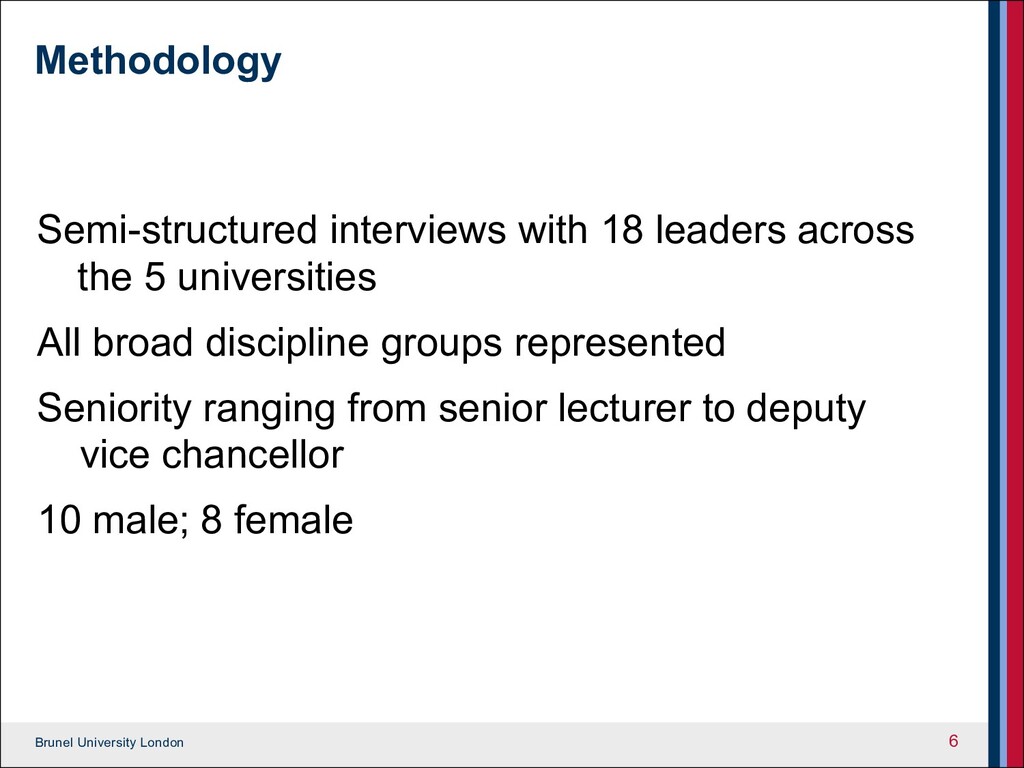
work in research career development, we wanted: • To understand the career journeys and leadership experiences of academic leaders • To inform the literature and training and development for “the next generation” of academic leaders beyond “prestige factors” 3
Foundation for HE’s Efficiency Exchange project Project team: Brunel University London University of Manchester University of Hertfordshire King’s College London University of Edinburgh Vitae – international researcher development organisation 4
leaders (Peters and Ryan 2015) Academics leaders are interesting because they have achieved promotion based on prestige factors – not suitability for the post in leadership / management terms The role itself can involve a focus on other aspects and cause identity-conflict and dissatisfaction (Blackmore 2015, Kandiko-Howson and Coate 2015) 5
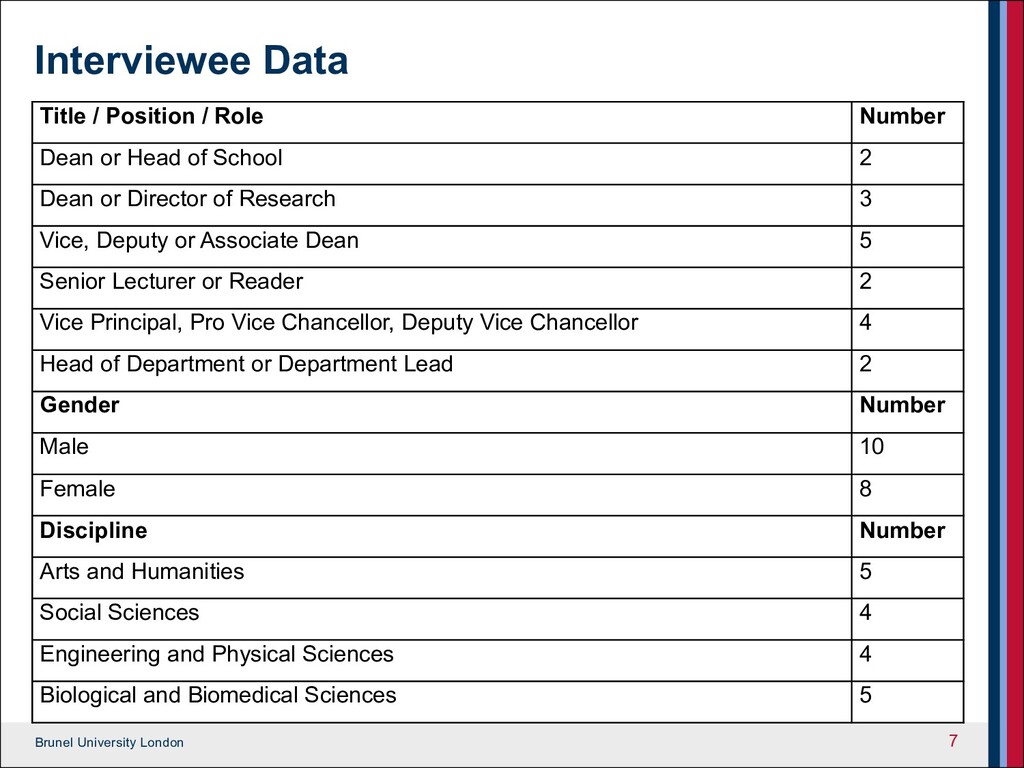
Number Dean or Head of School 2 Dean or Director of Research 3 Vice, Deputy or Associate Dean 5 Senior Lecturer or Reader 2 Vice Principal, Pro Vice Chancellor, Deputy Vice Chancellor 4 Head of Department or Department Lead 2 Gender Number Male 10 Female 8 Discipline Number Arts and Humanities 5 Social Sciences 4 Engineering and Physical Sciences 4 Biological and Biomedical Sciences 5 7
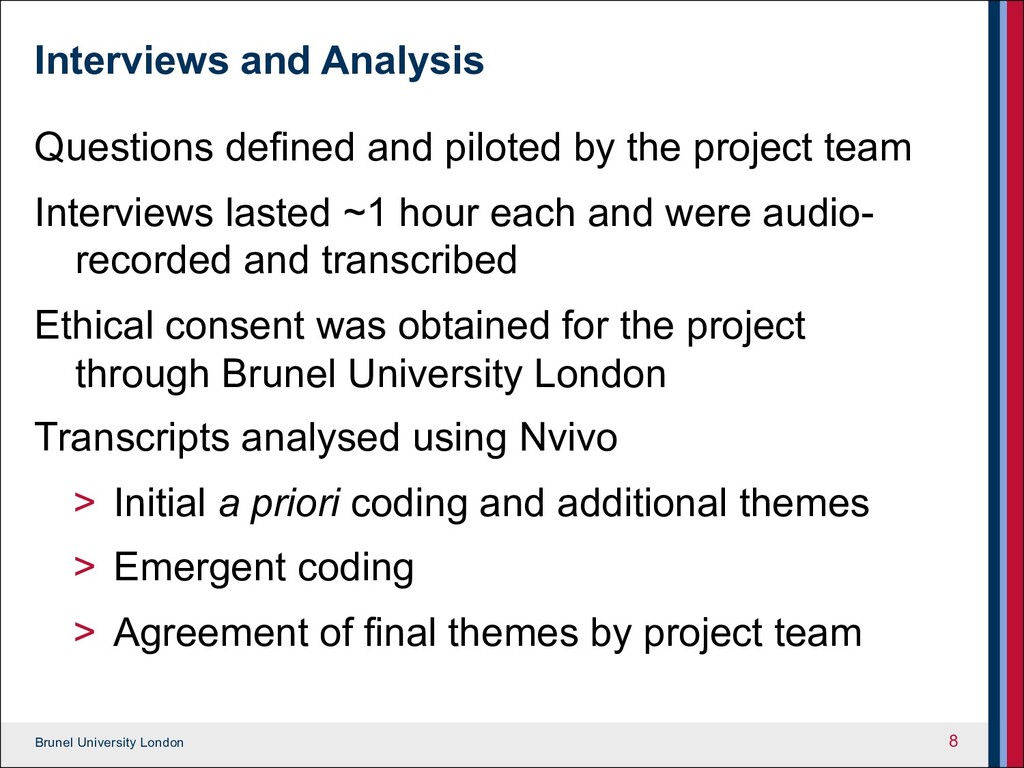
by the project team Interviews lasted ~1 hour each and were audio- recorded and transcribed Ethical consent was obtained for the project through Brunel University London Transcripts analysed using Nvivo > Initial a priori coding and additional themes > Emergent coding > Agreement of final themes by project team 8
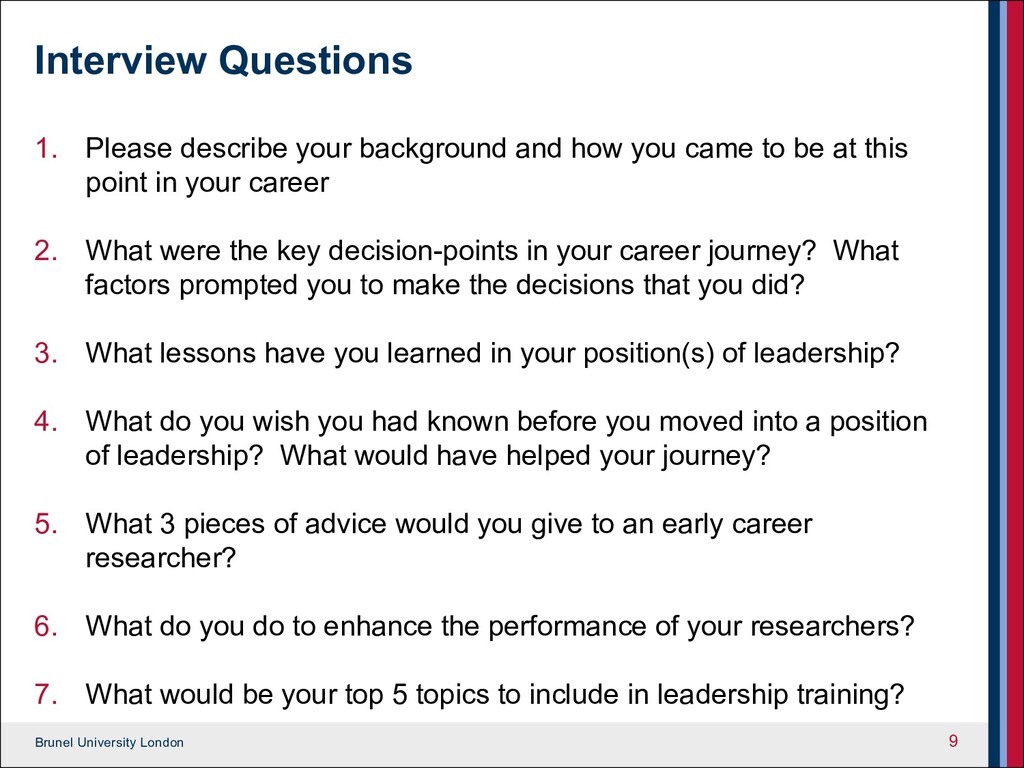
and how you came to be at this point in your career 2. What were the key decision-points in your career journey? What factors prompted you to make the decisions that you did? 3. What lessons have you learned in your position(s) of leadership? 4. What do you wish you had known before you moved into a position of leadership? What would have helped your journey? 5. What 3 pieces of advice would you give to an early career researcher? 6. What do you do to enhance the performance of your researchers? 7. What would be your top 5 topics to include in leadership training? 9
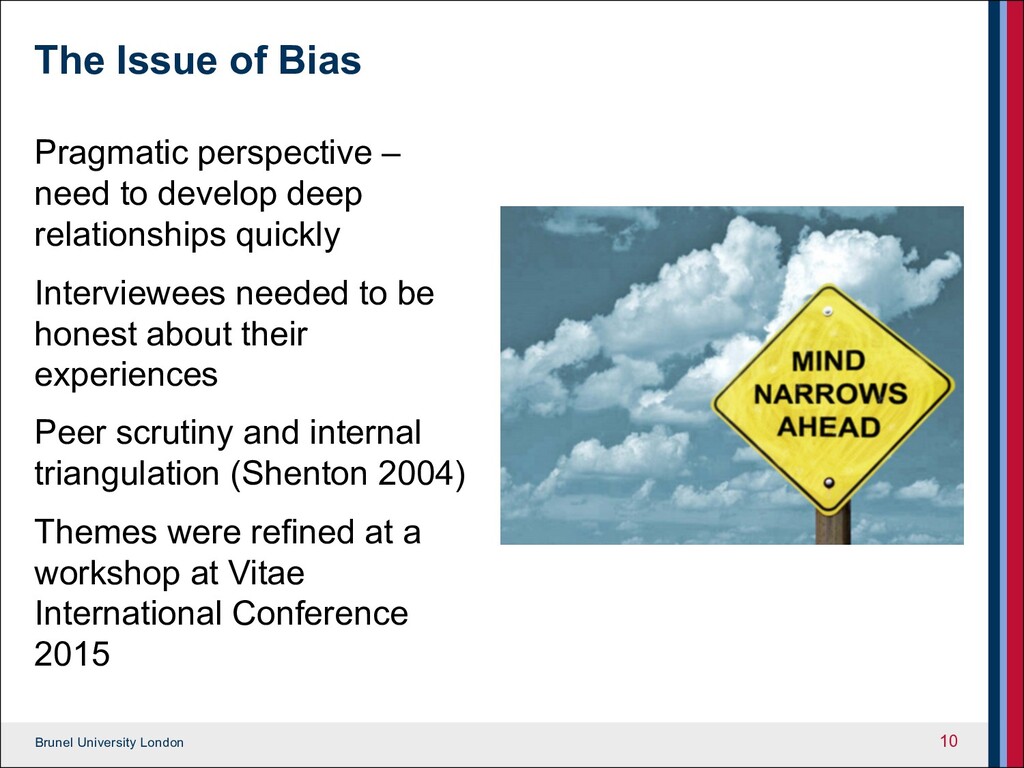
need to develop deep relationships quickly Interviewees needed to be honest about their experiences Peer scrutiny and internal triangulation (Shenton 2004) Themes were refined at a workshop at Vitae International Conference 2015 10
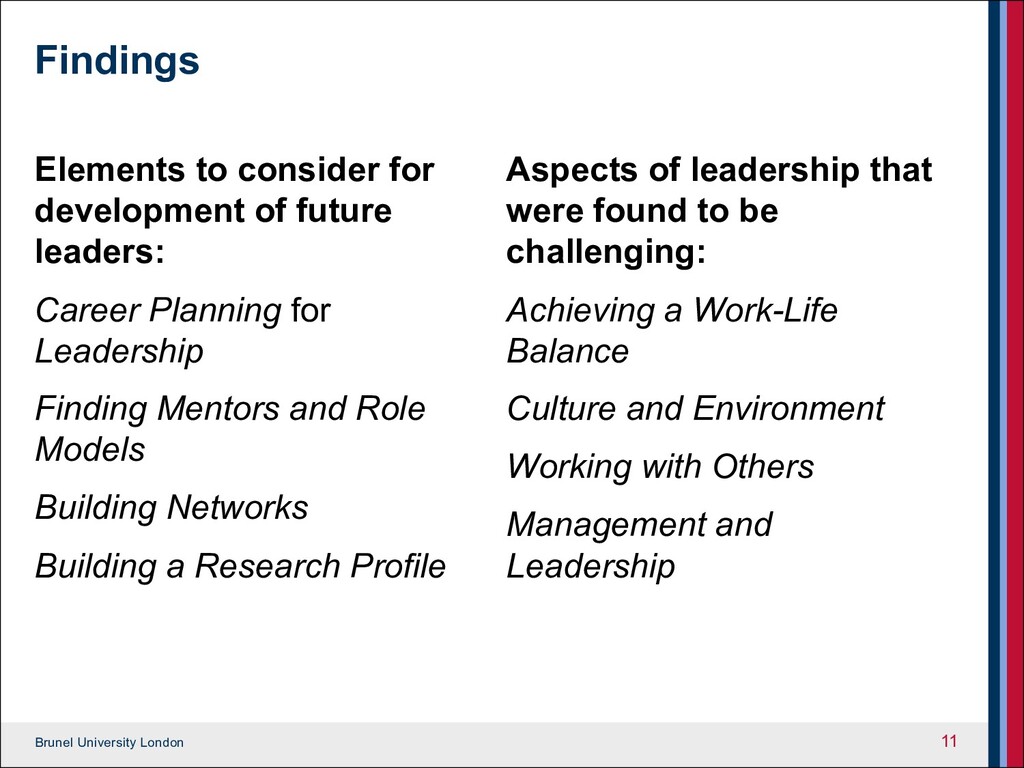
future leaders: Career Planning for Leadership Finding Mentors and Role Models Building Networks Building a Research Profile Aspects of leadership that were found to be challenging: Achieving a Work-Life Balance Culture and Environment Working with Others Management and Leadership 11
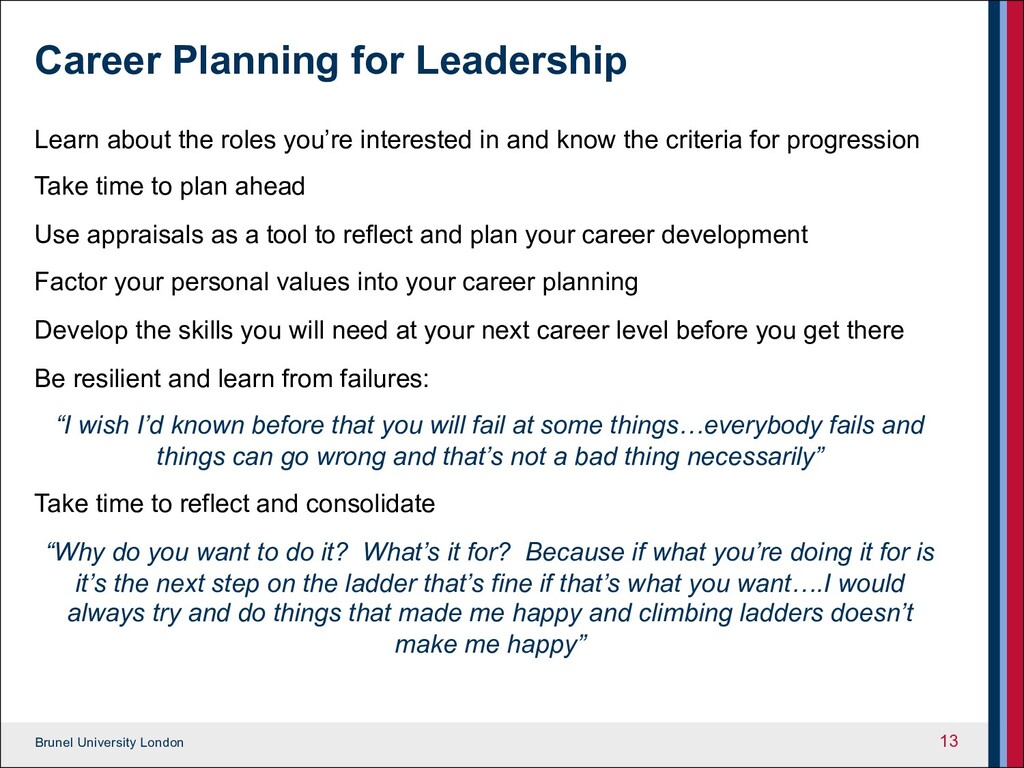
roles you’re interested in and know the criteria for progression Take time to plan ahead Use appraisals as a tool to reflect and plan your career development Factor your personal values into your career planning Develop the skills you will need at your next career level before you get there Be resilient and learn from failures: “I wish I’d known before that you will fail at some things…everybody fails and things can go wrong and that’s not a bad thing necessarily” Take time to reflect and consolidate “Why do you want to do it? What’s it for? Because if what you’re doing it for is it’s the next step on the ladder that’s fine if that’s what you want….I would always try and do things that made me happy and climbing ladders doesn’t make me happy” 13
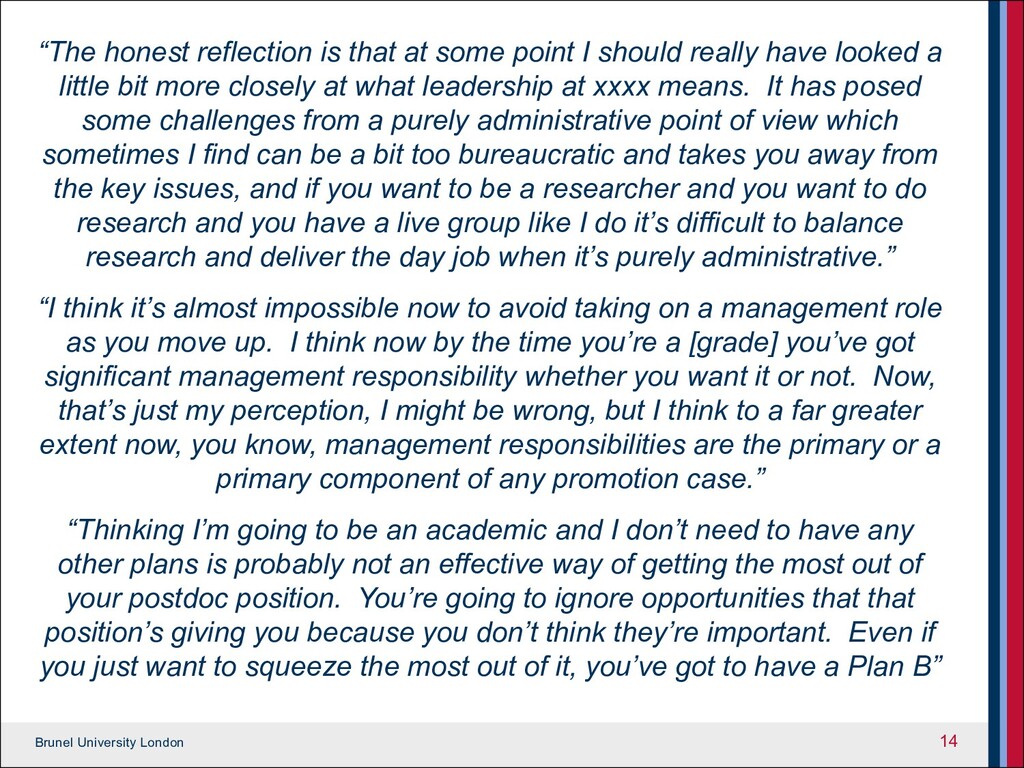
point I should really have looked a little bit more closely at what leadership at xxxx means. It has posed some challenges from a purely administrative point of view which sometimes I find can be a bit too bureaucratic and takes you away from the key issues, and if you want to be a researcher and you want to do research and you have a live group like I do it’s difficult to balance research and deliver the day job when it’s purely administrative.” “I think it’s almost impossible now to avoid taking on a management role as you move up. I think now by the time you’re a [grade] you’ve got significant management responsibility whether you want it or not. Now, that’s just my perception, I might be wrong, but I think to a far greater extent now, you know, management responsibilities are the primary or a primary component of any promotion case.” “Thinking I’m going to be an academic and I don’t need to have any other plans is probably not an effective way of getting the most out of your postdoc position. You’re going to ignore opportunities that that position’s giving you because you don’t think they’re important. Even if you just want to squeeze the most out of it, you’ve got to have a Plan B” 14
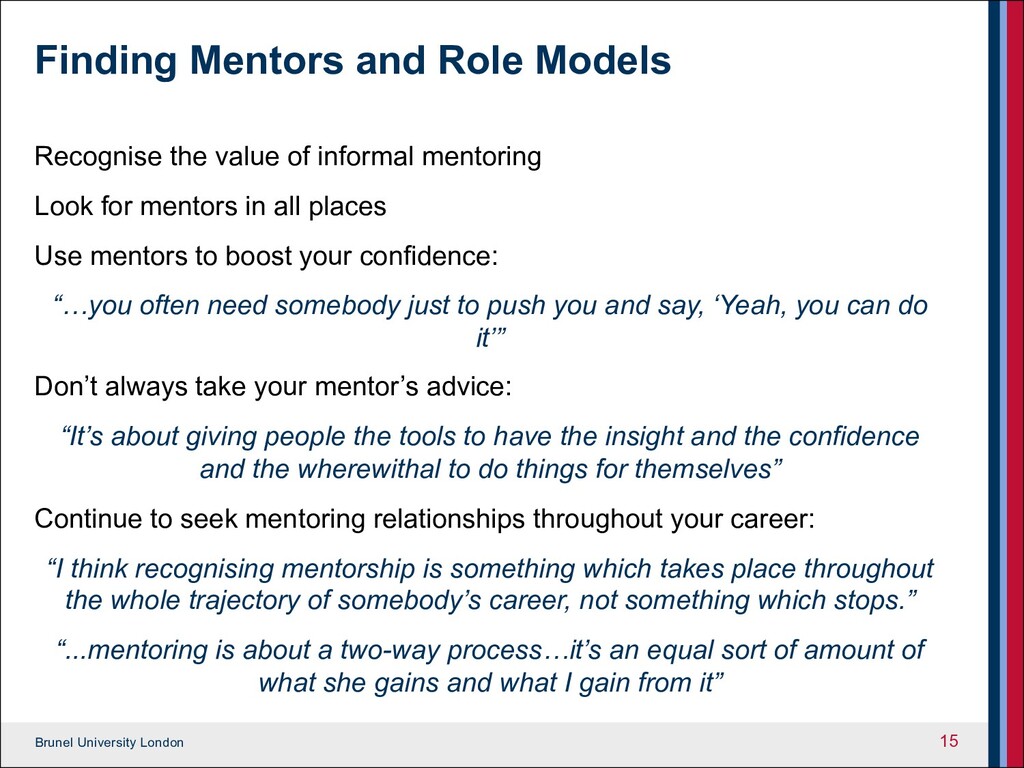
value of informal mentoring Look for mentors in all places Use mentors to boost your confidence: “…you often need somebody just to push you and say, ‘Yeah, you can do it’” Don’t always take your mentor’s advice: “It’s about giving people the tools to have the insight and the confidence and the wherewithal to do things for themselves” Continue to seek mentoring relationships throughout your career: “I think recognising mentorship is something which takes place throughout the whole trajectory of somebody’s career, not something which stops.” “...mentoring is about a two-way process…it’s an equal sort of amount of what she gains and what I gain from it” 15
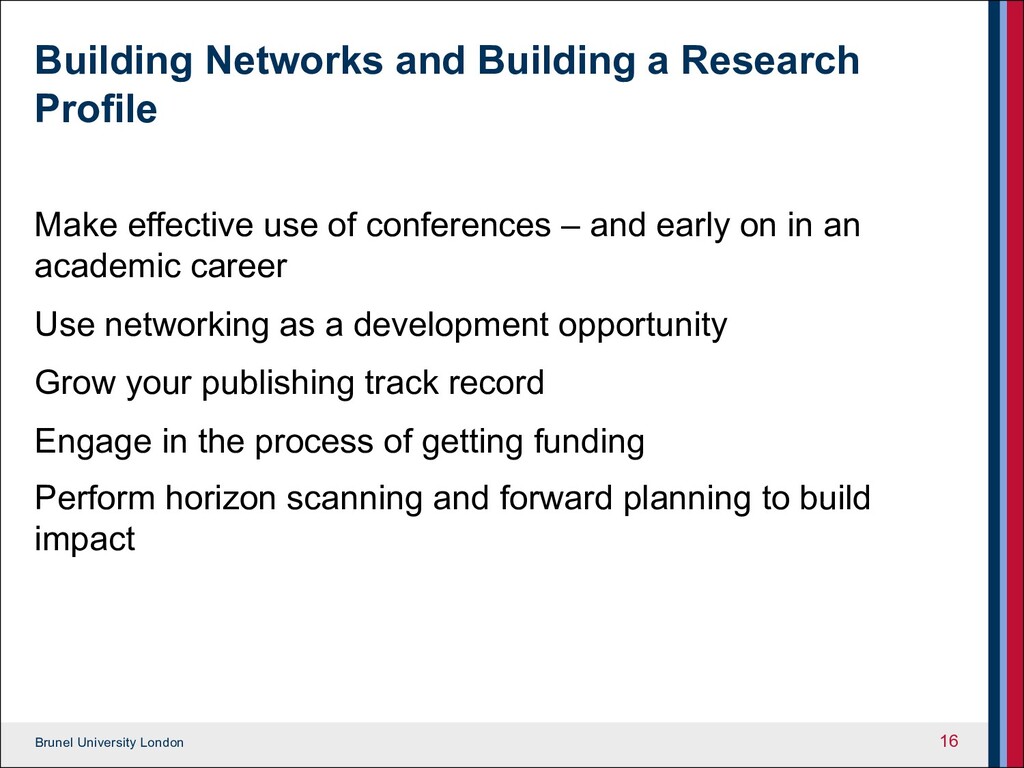
Make effective use of conferences – and early on in an academic career Use networking as a development opportunity Grow your publishing track record Engage in the process of getting funding Perform horizon scanning and forward planning to build impact 16
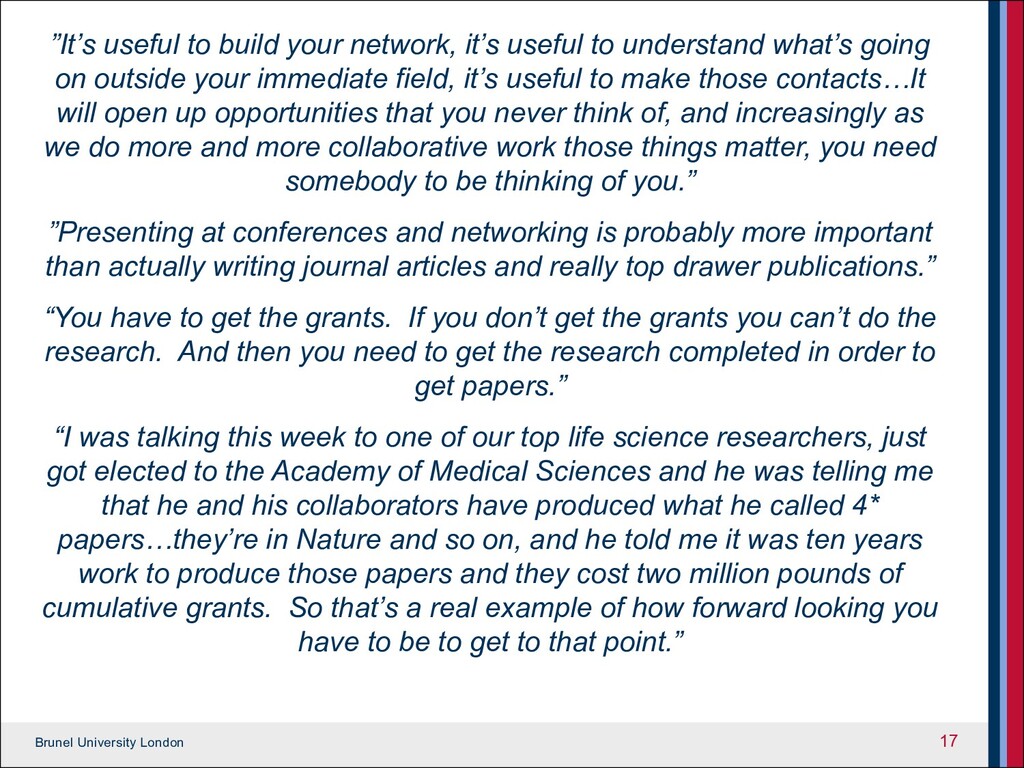
useful to understand what’s going on outside your immediate field, it’s useful to make those contacts…It will open up opportunities that you never think of, and increasingly as we do more and more collaborative work those things matter, you need somebody to be thinking of you.” ”Presenting at conferences and networking is probably more important than actually writing journal articles and really top drawer publications.” “You have to get the grants. If you don’t get the grants you can’t do the research. And then you need to get the research completed in order to get papers.” “I was talking this week to one of our top life science researchers, just got elected to the Academy of Medical Sciences and he was telling me that he and his collaborators have produced what he called 4* papers…they’re in Nature and so on, and he told me it was ten years work to produce those papers and they cost two million pounds of cumulative grants. So that’s a real example of how forward looking you have to be to get to that point.” 17
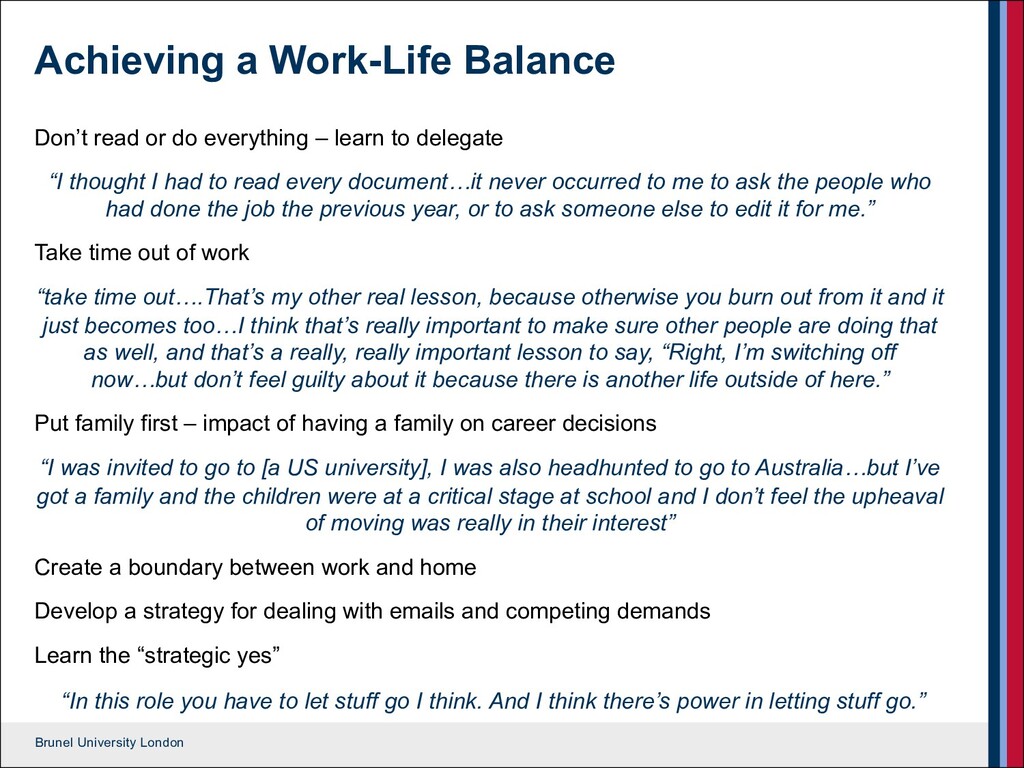
do everything – learn to delegate “I thought I had to read every document…it never occurred to me to ask the people who had done the job the previous year, or to ask someone else to edit it for me.” Take time out of work “take time out….That’s my other real lesson, because otherwise you burn out from it and it just becomes too…I think that’s really important to make sure other people are doing that as well, and that’s a really, really important lesson to say, “Right, I’m switching off now…but don’t feel guilty about it because there is another life outside of here.” Put family first – impact of having a family on career decisions “I was invited to go to [a US university], I was also headhunted to go to Australia…but I’ve got a family and the children were at a critical stage at school and I don’t feel the upheaval of moving was really in their interest” Create a boundary between work and home Develop a strategy for dealing with emails and competing demands Learn the “strategic yes” “In this role you have to let stuff go I think. And I think there’s power in letting stuff go.”
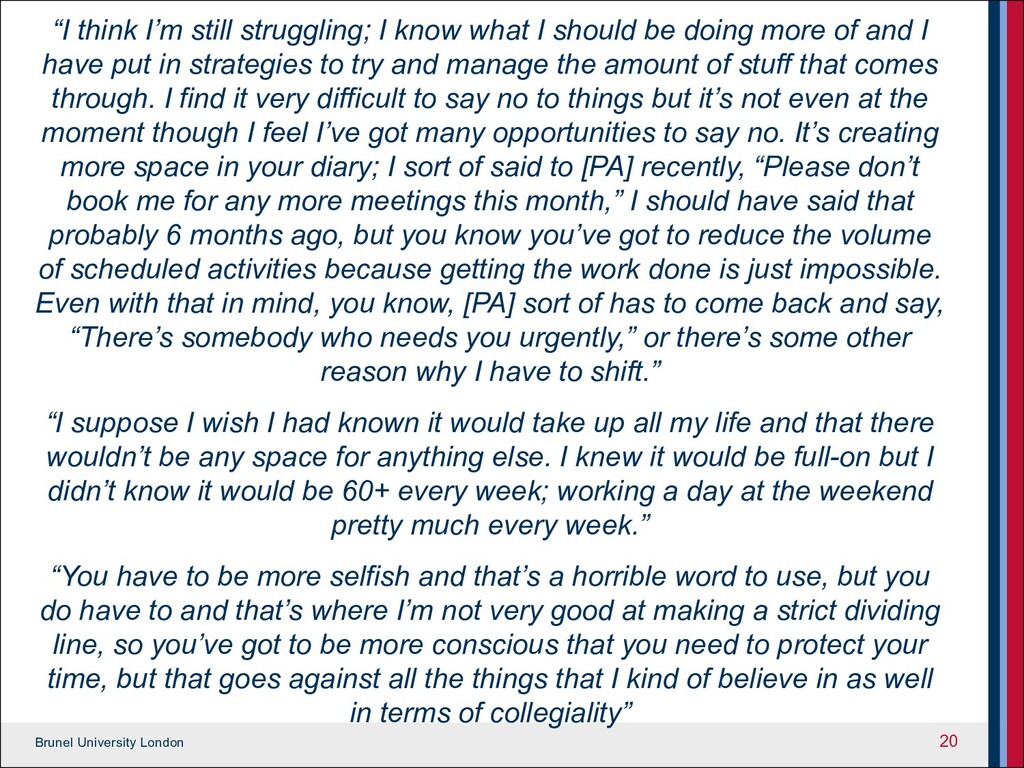
what I should be doing more of and I have put in strategies to try and manage the amount of stuff that comes through. I find it very difficult to say no to things but it’s not even at the moment though I feel I’ve got many opportunities to say no. It’s creating more space in your diary; I sort of said to [PA] recently, “Please don’t book me for any more meetings this month,” I should have said that probably 6 months ago, but you know you’ve got to reduce the volume of scheduled activities because getting the work done is just impossible. Even with that in mind, you know, [PA] sort of has to come back and say, “There’s somebody who needs you urgently,” or there’s some other reason why I have to shift.” “I suppose I wish I had known it would take up all my life and that there wouldn’t be any space for anything else. I knew it would be full-on but I didn’t know it would be 60+ every week; working a day at the weekend pretty much every week.” “You have to be more selfish and that’s a horrible word to use, but you do have to and that’s where I’m not very good at making a strict dividing line, so you’ve got to be more conscious that you need to protect your time, but that goes against all the things that I kind of believe in as well in terms of collegiality” 20
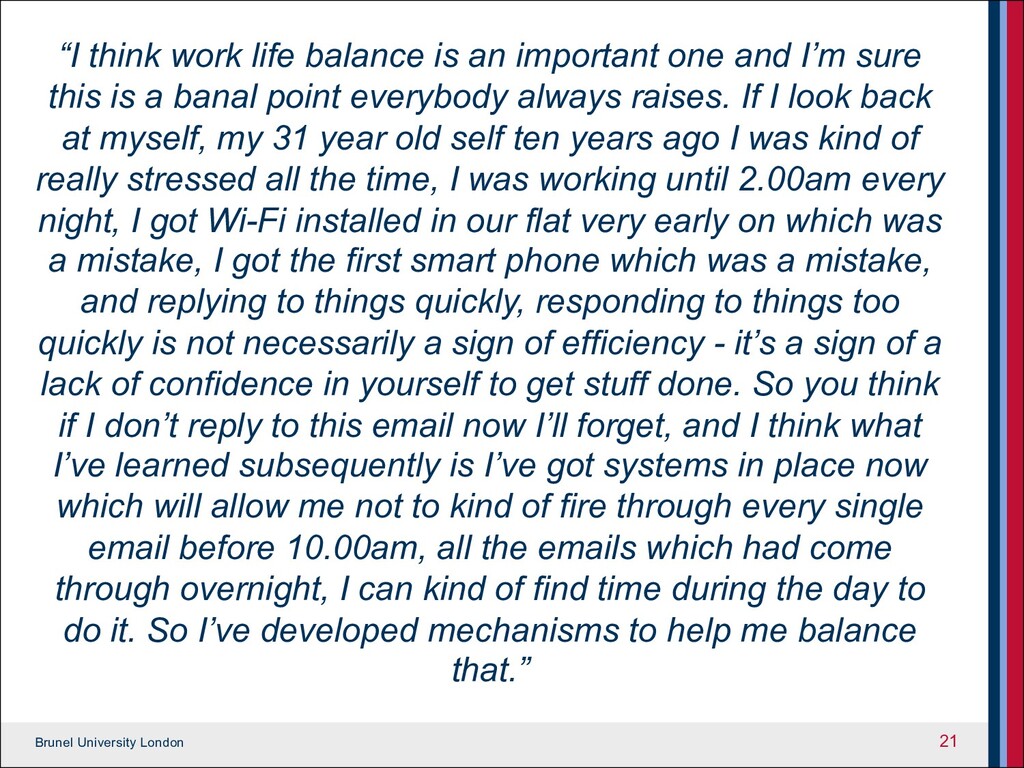
important one and I’m sure this is a banal point everybody always raises. If I look back at myself, my 31 year old self ten years ago I was kind of really stressed all the time, I was working until 2.00am every night, I got Wi-Fi installed in our flat very early on which was a mistake, I got the first smart phone which was a mistake, and replying to things quickly, responding to things too quickly is not necessarily a sign of efficiency - it’s a sign of a lack of confidence in yourself to get stuff done. So you think if I don’t reply to this email now I’ll forget, and I think what I’ve learned subsequently is I’ve got systems in place now which will allow me not to kind of fire through every single email before 10.00am, all the emails which had come through overnight, I can kind of find time during the day to do it. So I’ve developed mechanisms to help me balance that.” 21
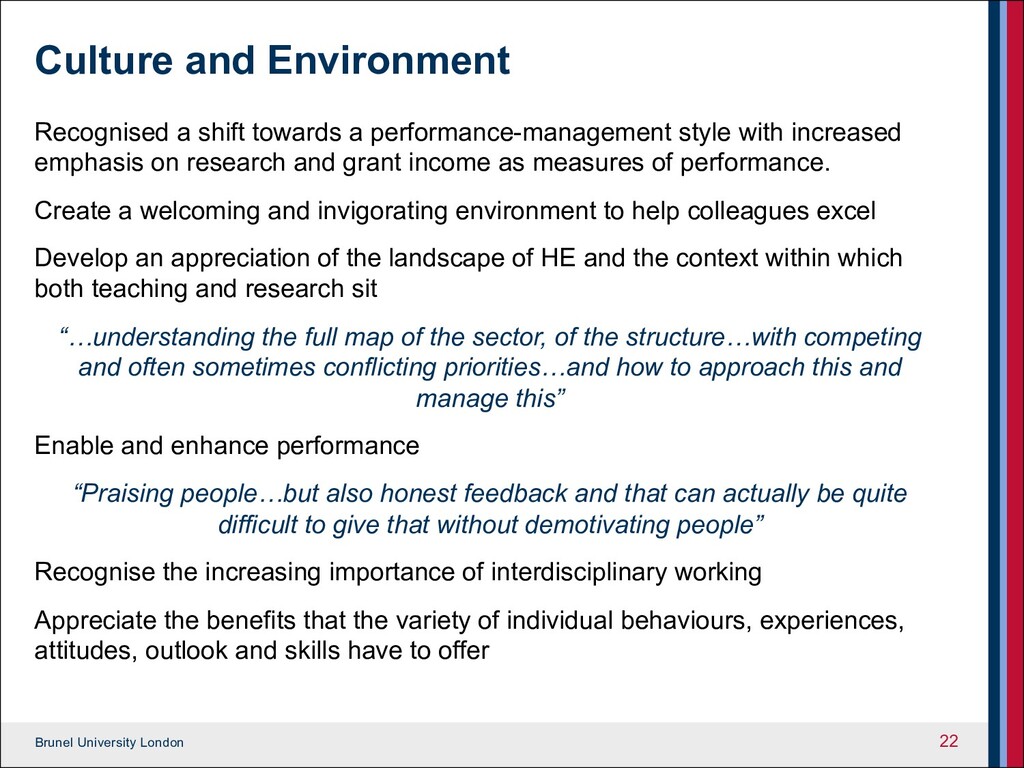
a performance-management style with increased emphasis on research and grant income as measures of performance. Create a welcoming and invigorating environment to help colleagues excel Develop an appreciation of the landscape of HE and the context within which both teaching and research sit “…understanding the full map of the sector, of the structure…with competing and often sometimes conflicting priorities…and how to approach this and manage this” Enable and enhance performance “Praising people…but also honest feedback and that can actually be quite difficult to give that without demotivating people” Recognise the increasing importance of interdisciplinary working Appreciate the benefits that the variety of individual behaviours, experiences, attitudes, outlook and skills have to offer 22
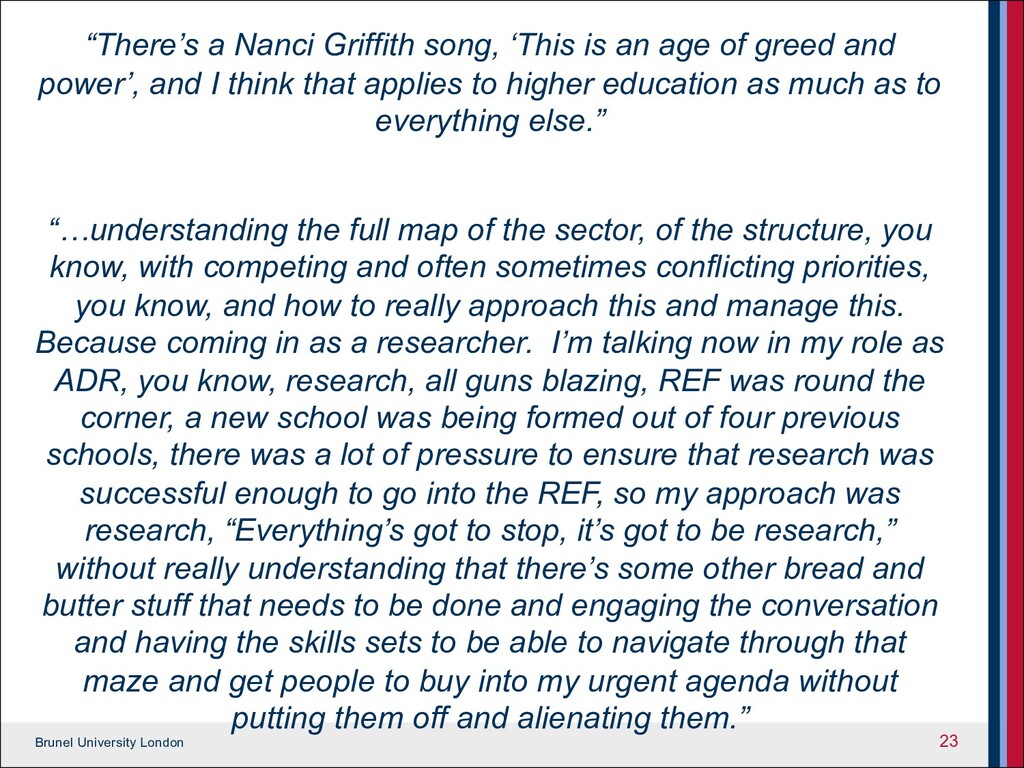
an age of greed and power’, and I think that applies to higher education as much as to everything else.” “…understanding the full map of the sector, of the structure, you know, with competing and often sometimes conflicting priorities, you know, and how to really approach this and manage this. Because coming in as a researcher. I’m talking now in my role as ADR, you know, research, all guns blazing, REF was round the corner, a new school was being formed out of four previous schools, there was a lot of pressure to ensure that research was successful enough to go into the REF, so my approach was research, “Everything’s got to stop, it’s got to be research,” without really understanding that there’s some other bread and butter stuff that needs to be done and engaging the conversation and having the skills sets to be able to navigate through that maze and get people to buy into my urgent agenda without putting them off and alienating them.” 23
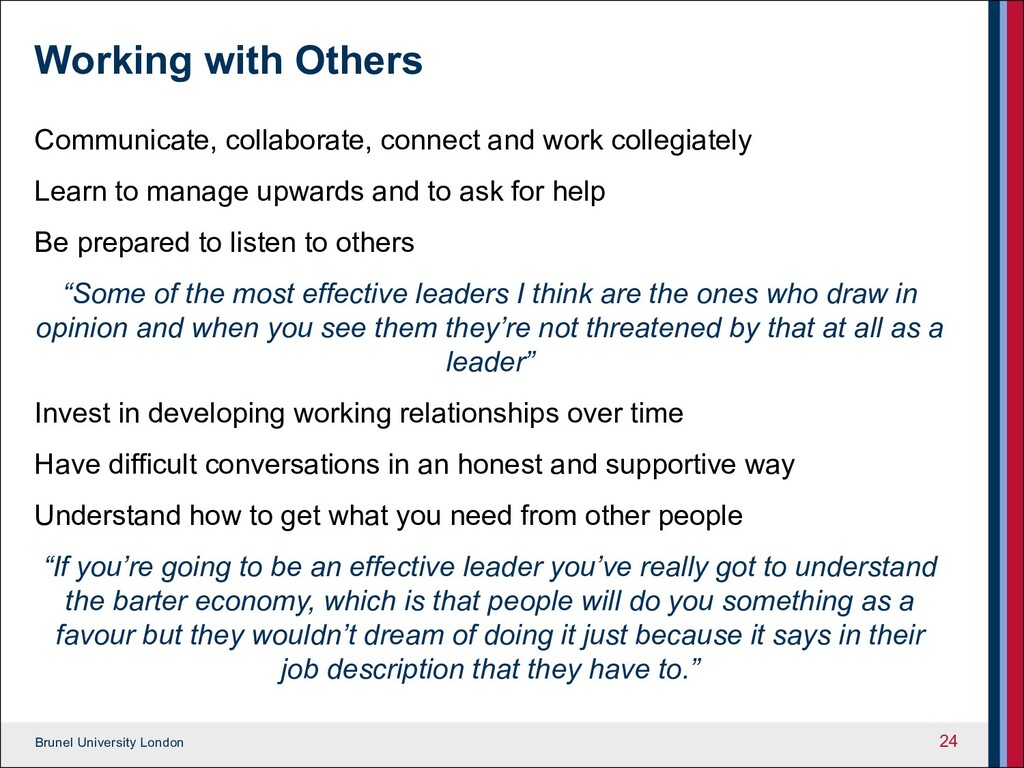
work collegiately Learn to manage upwards and to ask for help Be prepared to listen to others “Some of the most effective leaders I think are the ones who draw in opinion and when you see them they’re not threatened by that at all as a leader” Invest in developing working relationships over time Have difficult conversations in an honest and supportive way Understand how to get what you need from other people “If you’re going to be an effective leader you’ve really got to understand the barter economy, which is that people will do you something as a favour but they wouldn’t dream of doing it just because it says in their job description that they have to.” 24
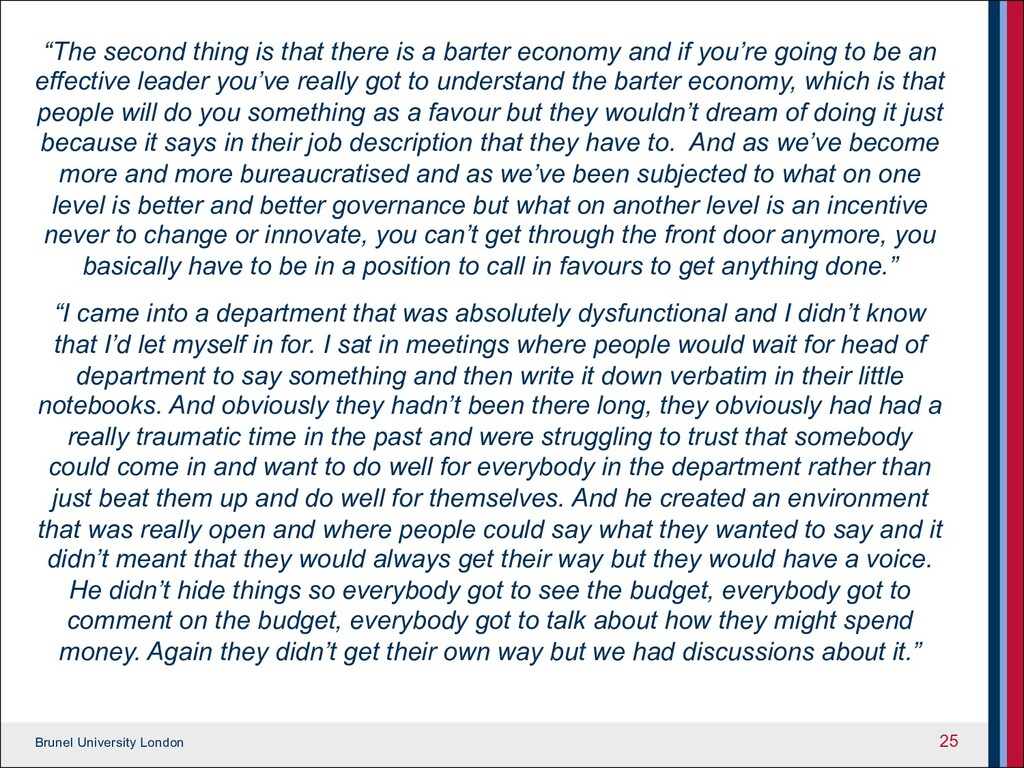
a barter economy and if you’re going to be an effective leader you’ve really got to understand the barter economy, which is that people will do you something as a favour but they wouldn’t dream of doing it just because it says in their job description that they have to. And as we’ve become more and more bureaucratised and as we’ve been subjected to what on one level is better and better governance but what on another level is an incentive never to change or innovate, you can’t get through the front door anymore, you basically have to be in a position to call in favours to get anything done.” “I came into a department that was absolutely dysfunctional and I didn’t know that I’d let myself in for. I sat in meetings where people would wait for head of department to say something and then write it down verbatim in their little notebooks. And obviously they hadn’t been there long, they obviously had had a really traumatic time in the past and were struggling to trust that somebody could come in and want to do well for everybody in the department rather than just beat them up and do well for themselves. And he created an environment that was really open and where people could say what they wanted to say and it didn’t meant that they would always get their way but they would have a voice. He didn’t hide things so everybody got to see the budget, everybody got to comment on the budget, everybody got to talk about how they might spend money. Again they didn’t get their own way but we had discussions about it.” 25
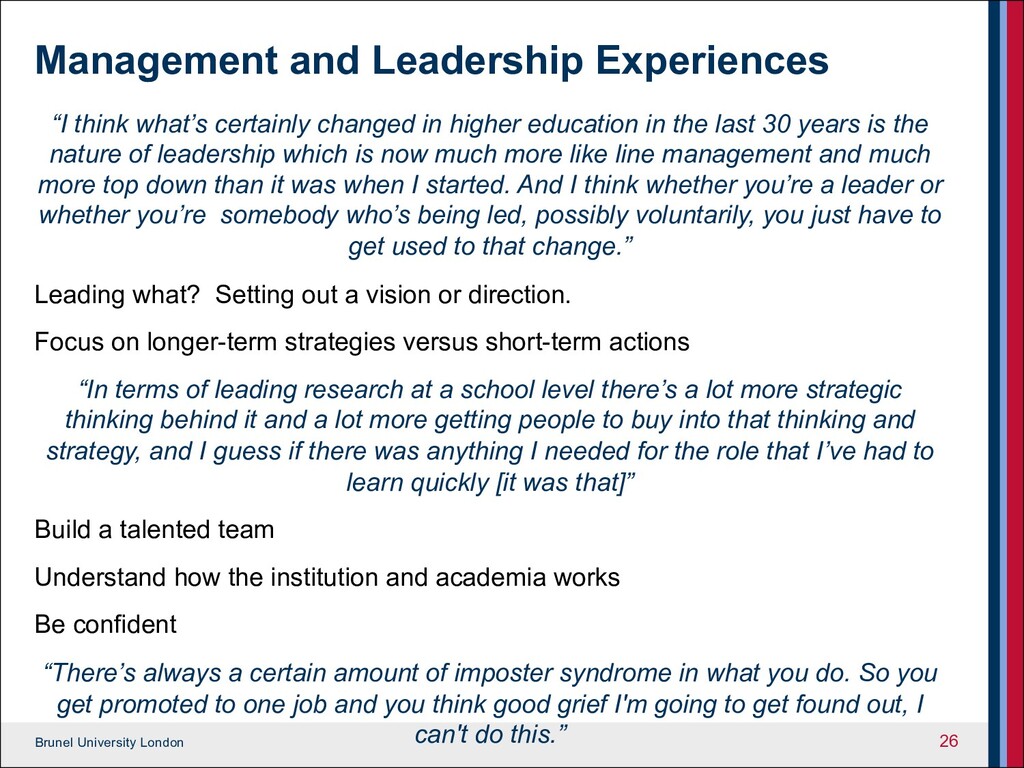
certainly changed in higher education in the last 30 years is the nature of leadership which is now much more like line management and much more top down than it was when I started. And I think whether you’re a leader or whether you’re somebody who’s being led, possibly voluntarily, you just have to get used to that change.” Leading what? Setting out a vision or direction. Focus on longer-term strategies versus short-term actions “In terms of leading research at a school level there’s a lot more strategic thinking behind it and a lot more getting people to buy into that thinking and strategy, and I guess if there was anything I needed for the role that I’ve had to learn quickly [it was that]” Build a talented team Understand how the institution and academia works Be confident “There’s always a certain amount of imposter syndrome in what you do. So you get promoted to one job and you think good grief I'm going to get found out, I can't do this.” 26
role in that sense because you move from an academic in a body of people, or a colleague in a body of people into suddenly having this title that most people in the body who haven’t done that role, everybody in the body who haven’t done that that role believes they have some real authority and power. You have virtually none. And one of the ways that they can function is by creating a distance between themselves and the role. So you become head. And for lots of people you stop being you… And I was told that the day I stopped being head of department I would become me again. And I remember hearing that and thinking that can't be true, but for some people it was. They would come into my office and be completely different from how they were the week before when I wasn’t head, because I was now head of department, and I found that absolutely bizarre.” “And of course lots of the leadership stuff in higher education isn’t leadership at all its management. It’s just about effectively sitting in a chair and being responsible for some stuff. And that’s not an interesting role or an interesting job I don’t think. I also believe in academic leadership as being about collegiate leadership. So the idea that, and it’s very unfashionable, apart from in the best institutions interestingly, it’s very unfashionable to think that you would cycle this stuff between a community of colleagues who therefore see themselves as stewards of the department or an academic entity rather than leaders, the person, you know leader until they’re killed or retire, you know that strikes me you’re going to lead in a very different way if that’s your mind-set rather than in three years’ time I'm going to step back into the ranks and be the person who is going to now be watching somebody else lead the entity that I’ve led for that small period of time, that built on the other people.” 27
us to do things and to not speak up about it. I was on a research council panel meeting last week and I didn’t mind the fact that I had very long days associated with it, but when they were sending me paperwork at midnight the night before the meeting I took the view that I wasn’t going to read it. And I went to the meeting and said, “I haven’t read this therefore I can't comment on it” and I was the person actually leading that section. And my advice was that they would have to defer it until the next meeting. Because there’s a lot of pressure on people to do things and I just said, “Sorry that’s not reasonable. You’re asking me to do a job with integrity”.” 28
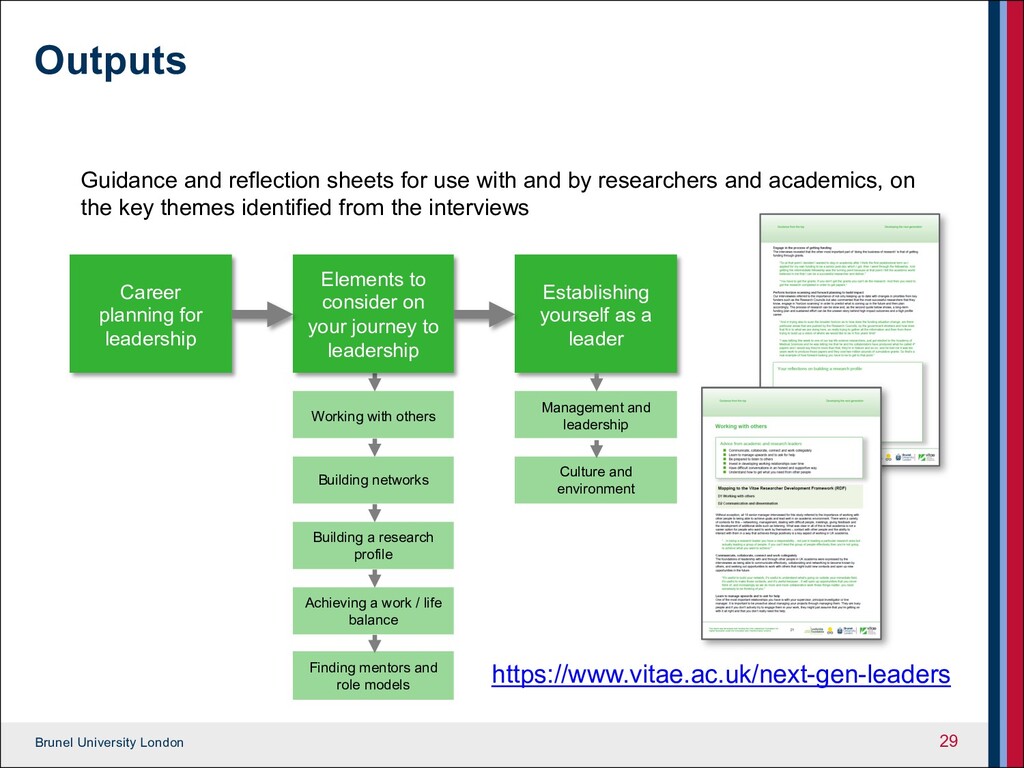
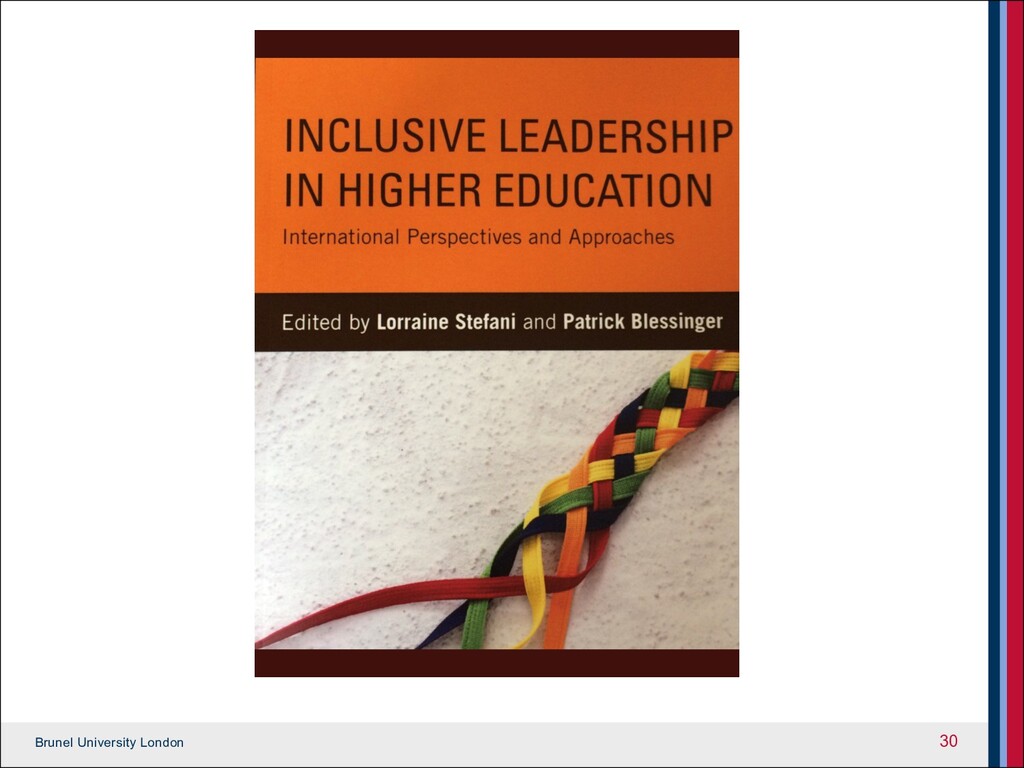
and by researchers and academics, on the key themes identified from the interviews Outputs Career planning for leadership Elements to consider on your journey to leadership Establishing yourself as a leader Working with others Building networks Building a research profile Achieving a work / life balance Finding mentors and role models Management and leadership Culture and environment https://www.vitae.ac.uk/next-gen-leaders 29
luck / serendipity” and instinctive leadership Roles of courage, compassion and resilience in modern HEI leadership Educational developers as DVCs (or equiv) in research intensive HEIs 31
universities: in tension with the efficiency and effectiveness agenda? Paper presented at the Society for Research into Higher Education Annual Research Conference, Newport, UK. Kandiko-Howson, Camille and Coate, Kelly (2015) The Prestige Economy and Mid-career Academic Women: Strategies, Choices and Motivation, Paper presented at the Society for Research into Higher Education Annual Research Conference, Newport, UK. Peters, Kim and Ryan, Michelle (2015) Leading Higher Education: Higher Education Leadership and Management Survey, London: Leadership Foundation for Higher Education Shenton, A.K. (2004) ‘Strategies for ensuring trustworthiness in qualitative research projects’, Education for Information, 22, pp. 63– 75.
Alison Mitchell (Vitae), Dr Anna Price (Queen Mary University of London and formerly of King’s College London), Dr Judith Williams (Manchester University), Dr Louisa Lawes (formerly of Edinburgh University) and Dr Rodney Day (University of Hertfordshire) This research was funded by the Leadership Foundation for Higher Education, Innovation and Transformation Fund. 33


 dragon2
 naoji_taniguchi_ksk_0827
 signer
 pawan_pharm
 matleenalaakso
 frievea
 aokiplayer
 ainischool
 jdbedics
 addyosmani
 stephenakadiri
 greggifford
 shlominoach
 sarafernandez
 inesmontani
 nwiizo
 paigeccino
 mraible
 jct
 axbom
 aleyda