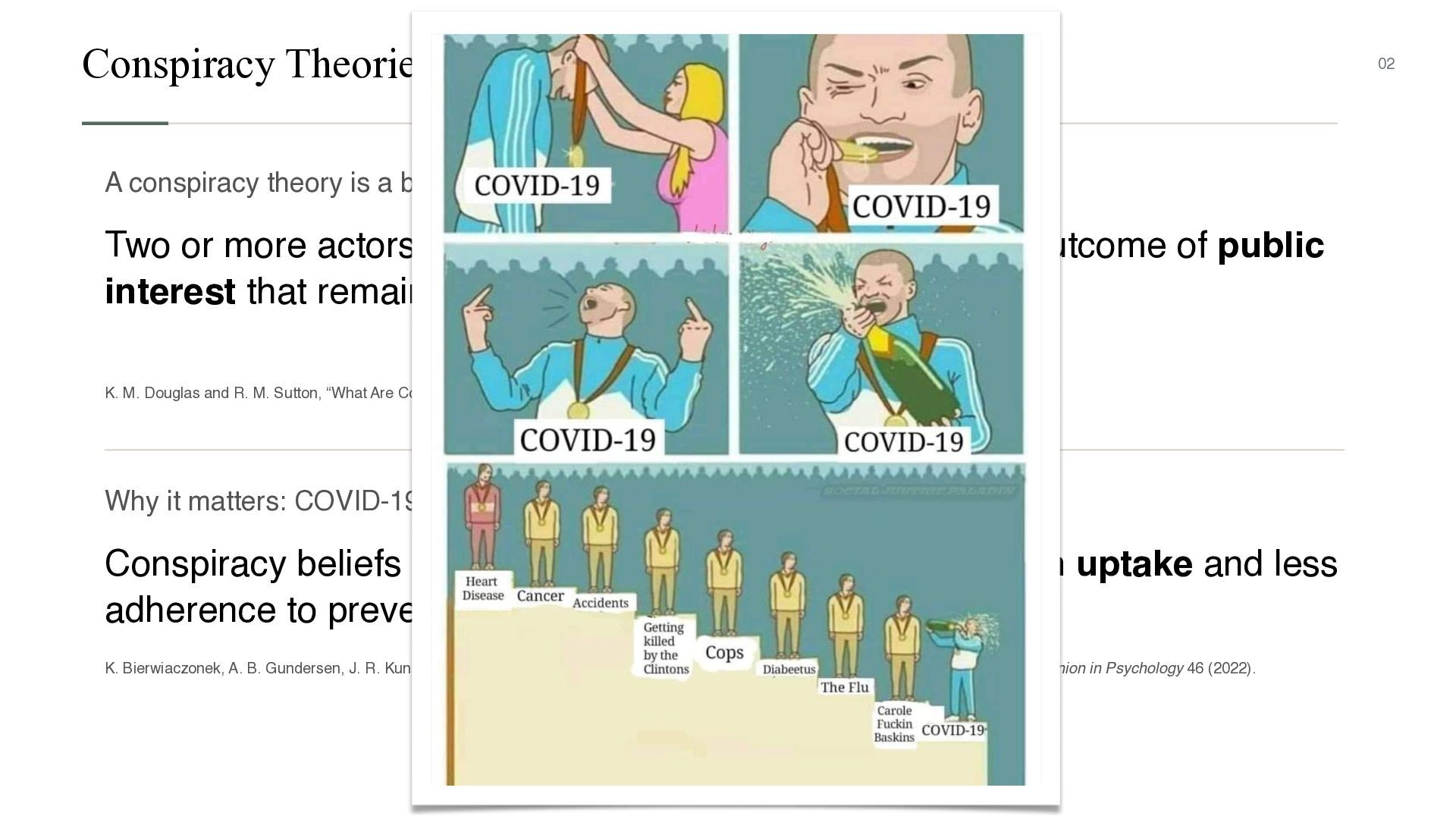
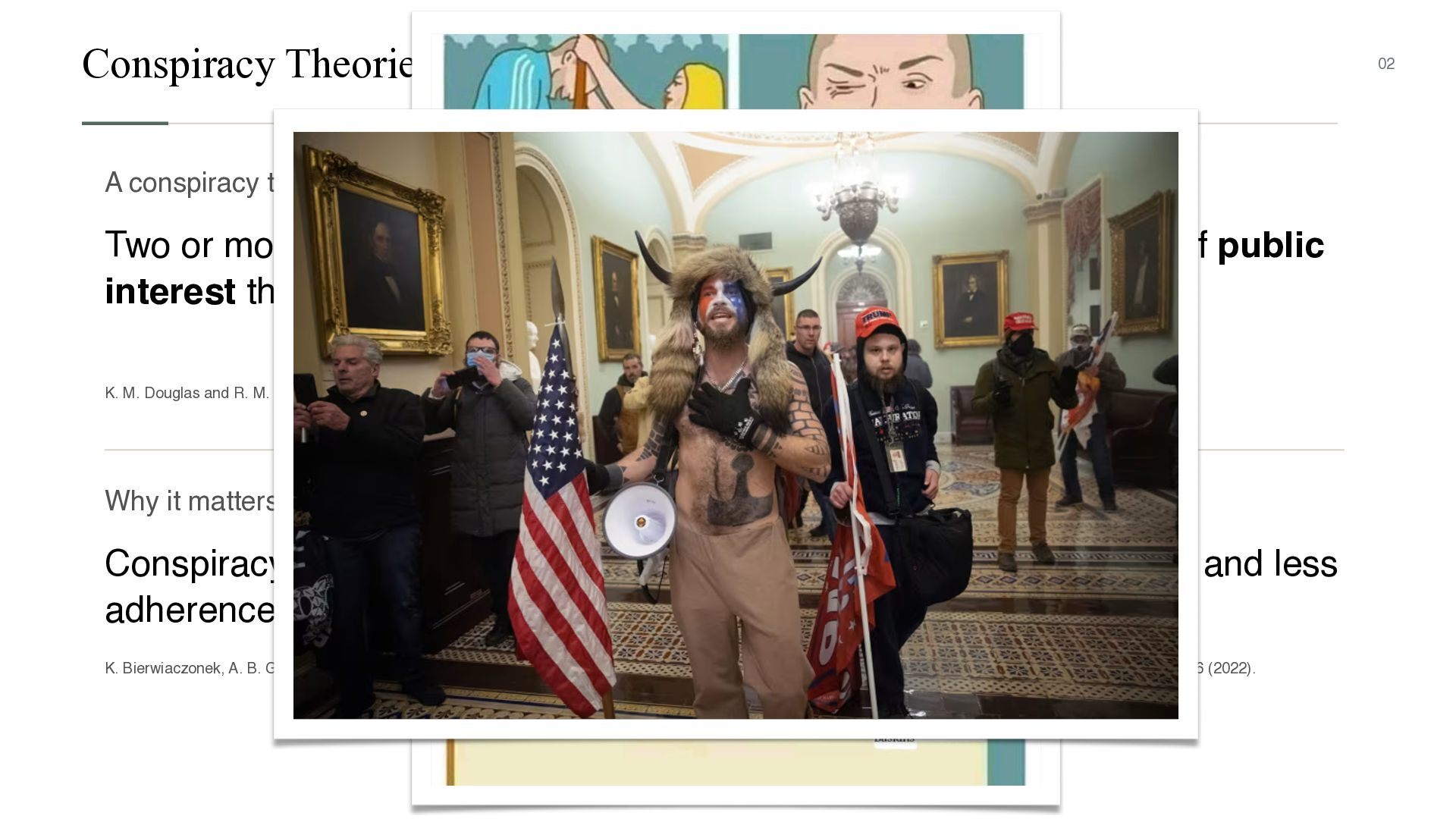
a belief that Two or more actors coordinated in secret to achieve an outcome of public interest that remains outside public knowledge K. M. Douglas and R. M. Sutton, “What Are Conspiracy Theories?,” Annual Review of Psychology 74 (2023). Why it matters: COVID-19 is one example Conspiracy beliefs were associated with lower vaccination uptake and less adherence to preventive behavior K. Bierwiaczonek, A. B. Gundersen, J. R. Kunst, “The role of conspiracy beliefs for COVID-19 health responses: A meta-analysis,” Current Opinion in Psychology 46 (2022). 02
a belief that Two or more actors coordinated in secret to achieve an outcome of public interest that remains outside public knowledge K. M. Douglas and R. M. Sutton, “What Are Conspiracy Theories?,” Annual Review of Psychology 74 (2023). Why it matters: COVID-19 is one example Conspiracy beliefs were associated with lower vaccination uptake and less adherence to preventive behavior K. Bierwiaczonek, A. B. Gundersen, J. R. Kunst, “The role of conspiracy beliefs for COVID-19 health responses: A meta-analysis,” Current Opinion in Psychology 46 (2022). 02
a belief that Two or more actors coordinated in secret to achieve an outcome of public interest that remains outside public knowledge K. M. Douglas and R. M. Sutton, “What Are Conspiracy Theories?,” Annual Review of Psychology 74 (2023). Why it matters: COVID-19 is one example Conspiracy beliefs were associated with lower vaccination uptake and less adherence to preventive behavior K. Bierwiaczonek, A. B. Gundersen, J. R. Kunst, “The role of conspiracy beliefs for COVID-19 health responses: A meta-analysis,” Current Opinion in Psychology 46 (2022). 02
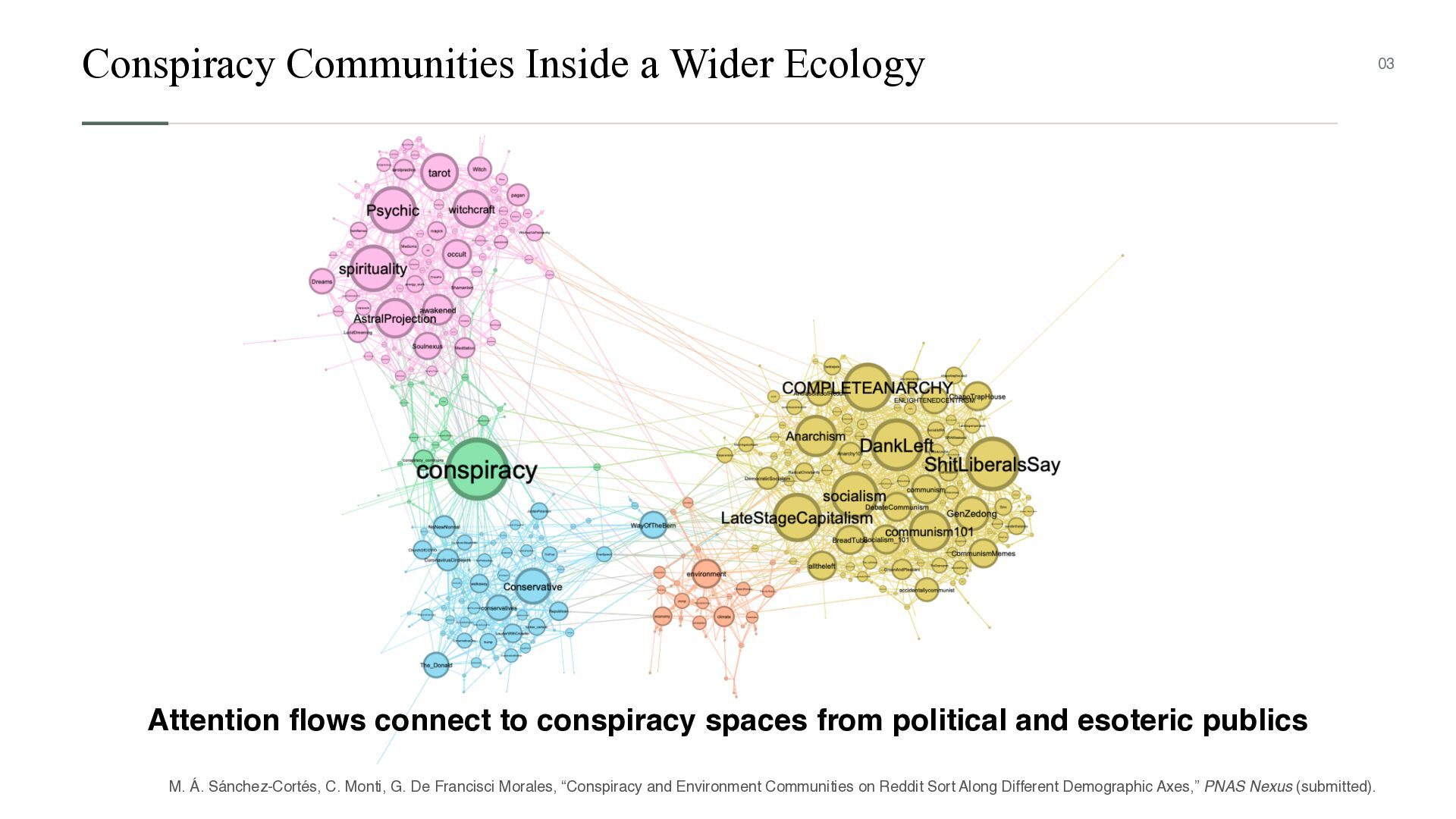
conspiracy spaces from political and esoteric publics M. Á. Sánchez-Cortés, C. Monti, G. De Francisci Morales, “Conspiracy and Environment Communities on Reddit Sort Along Different Demographic Axes,” PNAS Nexus (submitted). 03
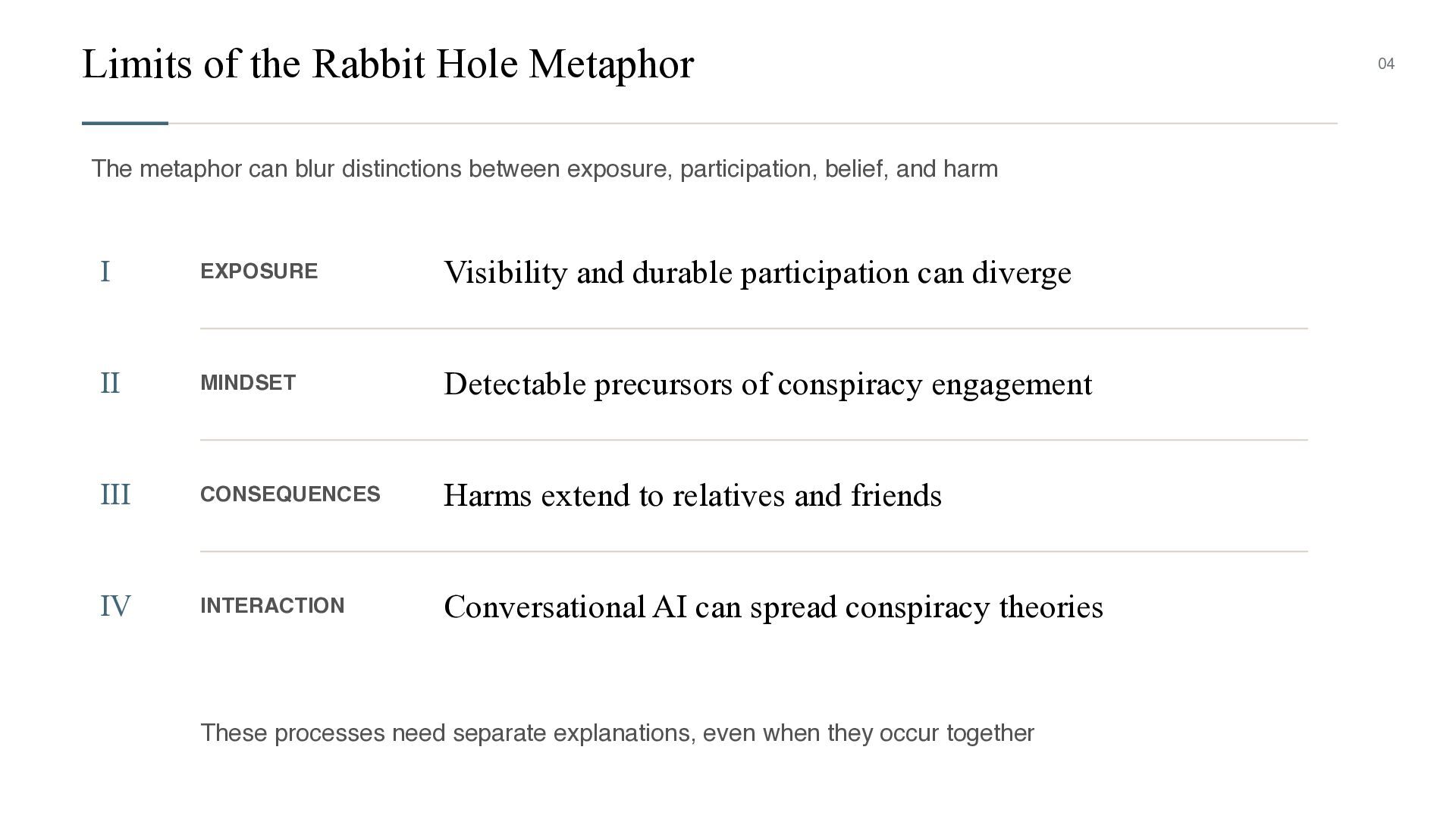
distinctions between exposure, participation, belief, and harm I EXPOSURE Visibility and durable participation can diverge II MINDSET Detectable precursors of conspiracy engagement III CONSEQUENCES Harms extend to relatives and friends IV INTERACTION Conversational AI can spread conspiracy theories These processes need separate explanations, even when they occur together 04
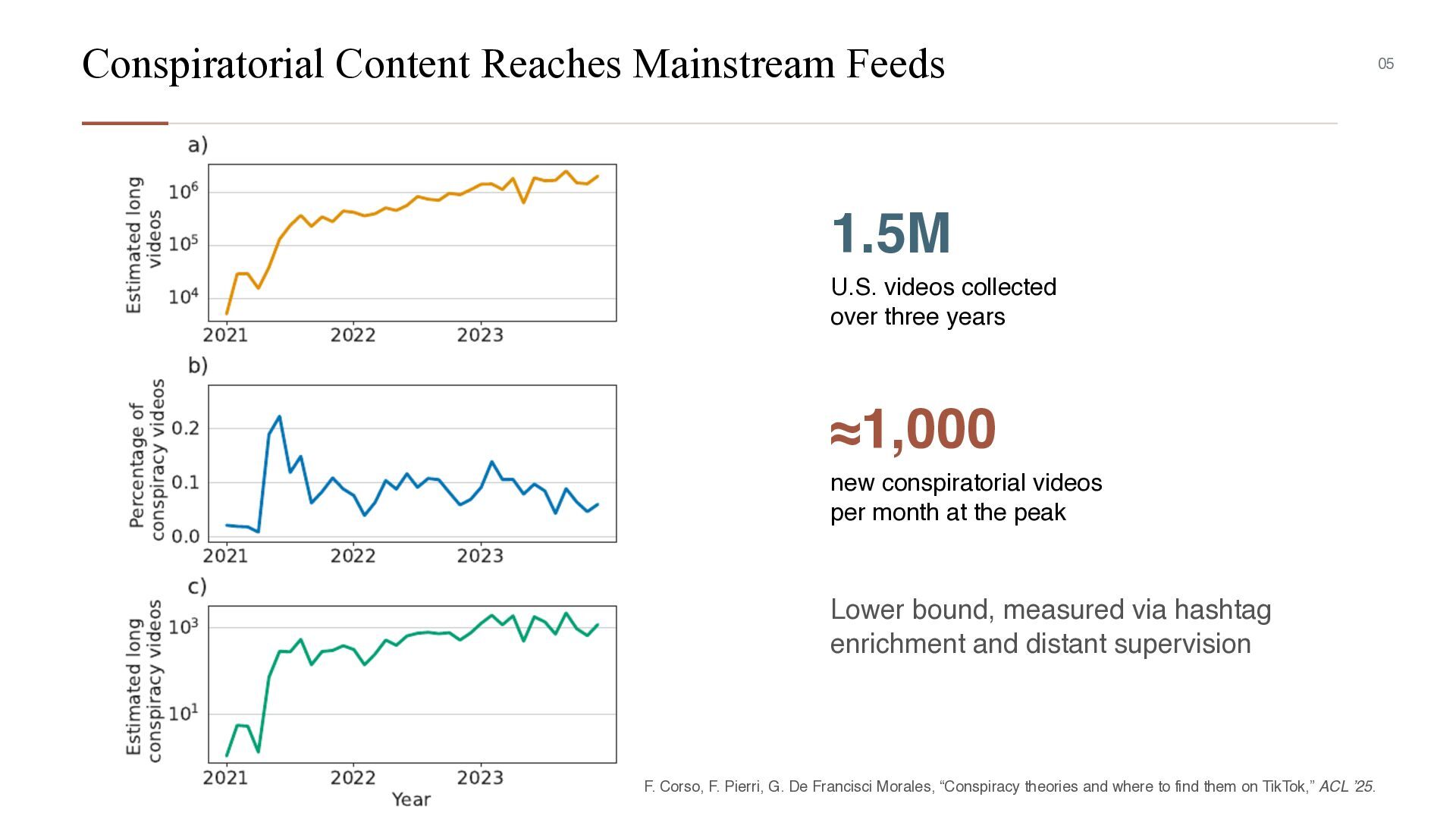
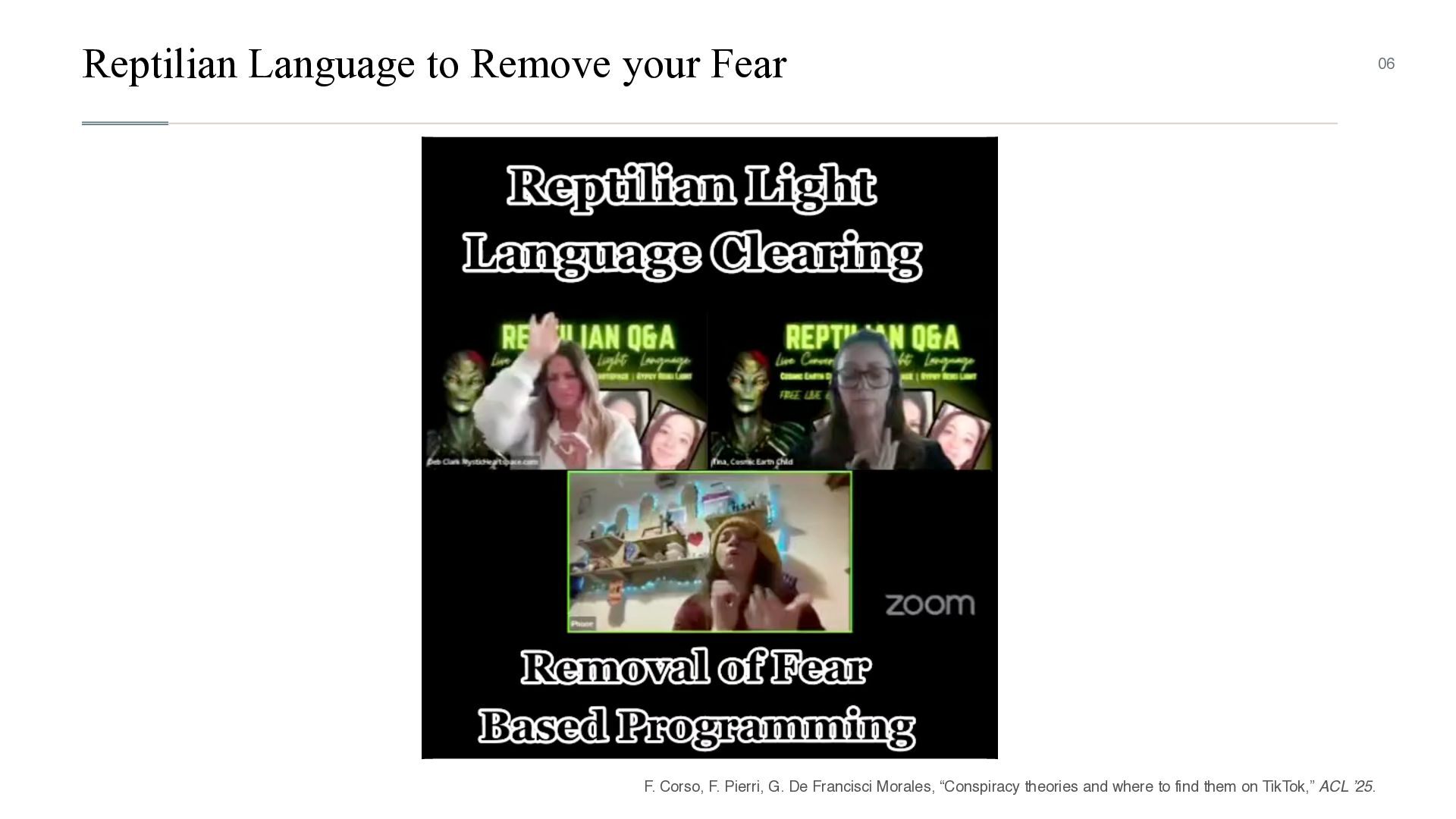
three years ≈1,000 new conspiratorial videos per month at the peak Lower bound, measured via hashtag enrichment and distant supervision F. Corso, F. Pierri, G. De Francisci Morales, “Conspiracy theories and where to find them on TikTok,” ACL ’25. 05
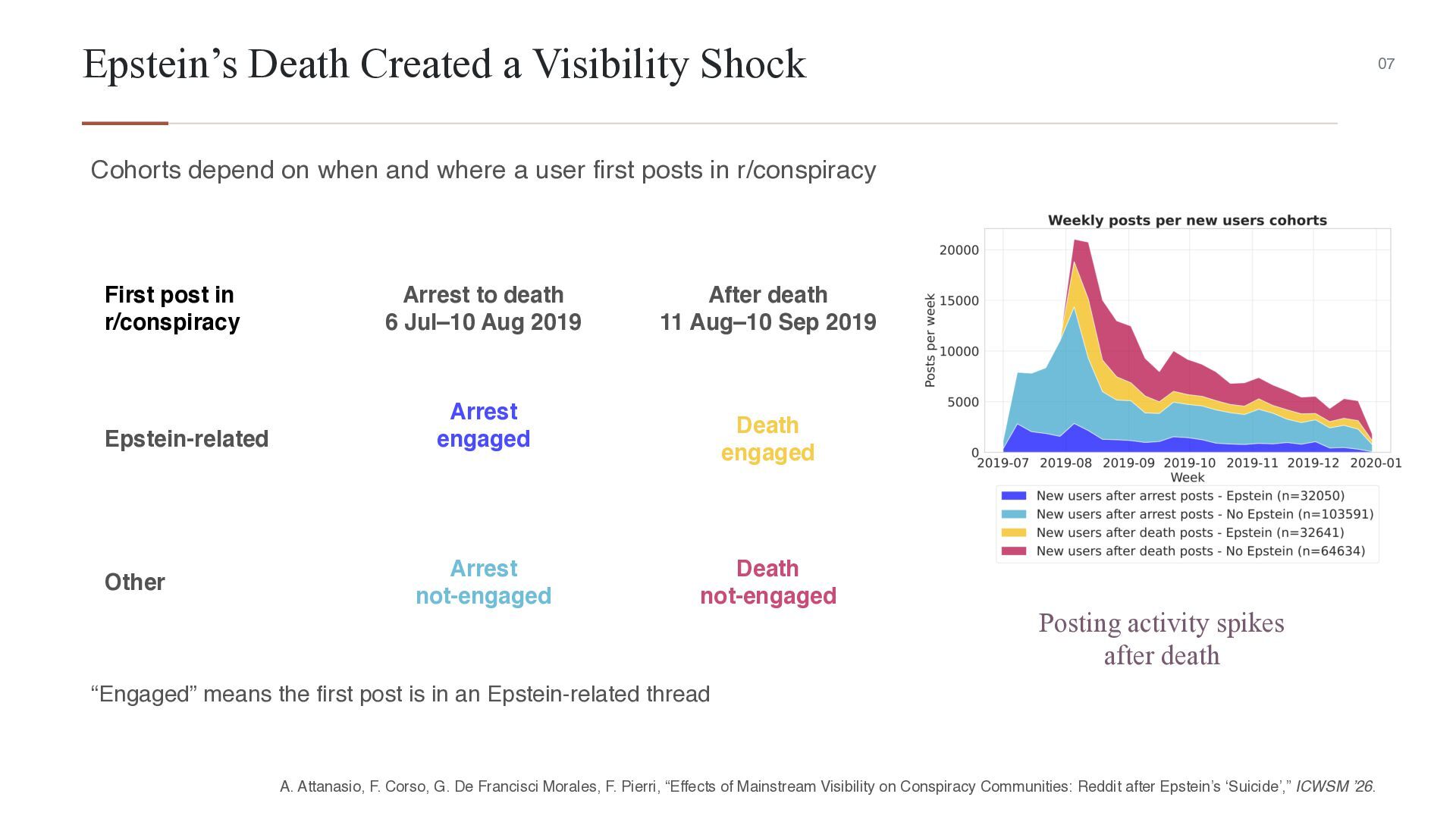
when and where a user first posts in r/conspiracy First post in r/conspiracy Arrest to death 6 Jul–10 Aug 2019 Epstein-related Arrest engaged Other Arrest not-engaged After death 11 Aug–10 Sep 2019 Death engaged Death not-engaged Posting activity spikes after death “Engaged” means the first post is in an Epstein-related thread A. Attanasio, F. Corso, G. De Francisci Morales, F. Pierri, “Effects of Mainstream Visibility on Conspiracy Communities: Reddit after Epstein’s ‘Suicide’,” ICWSM ’26.
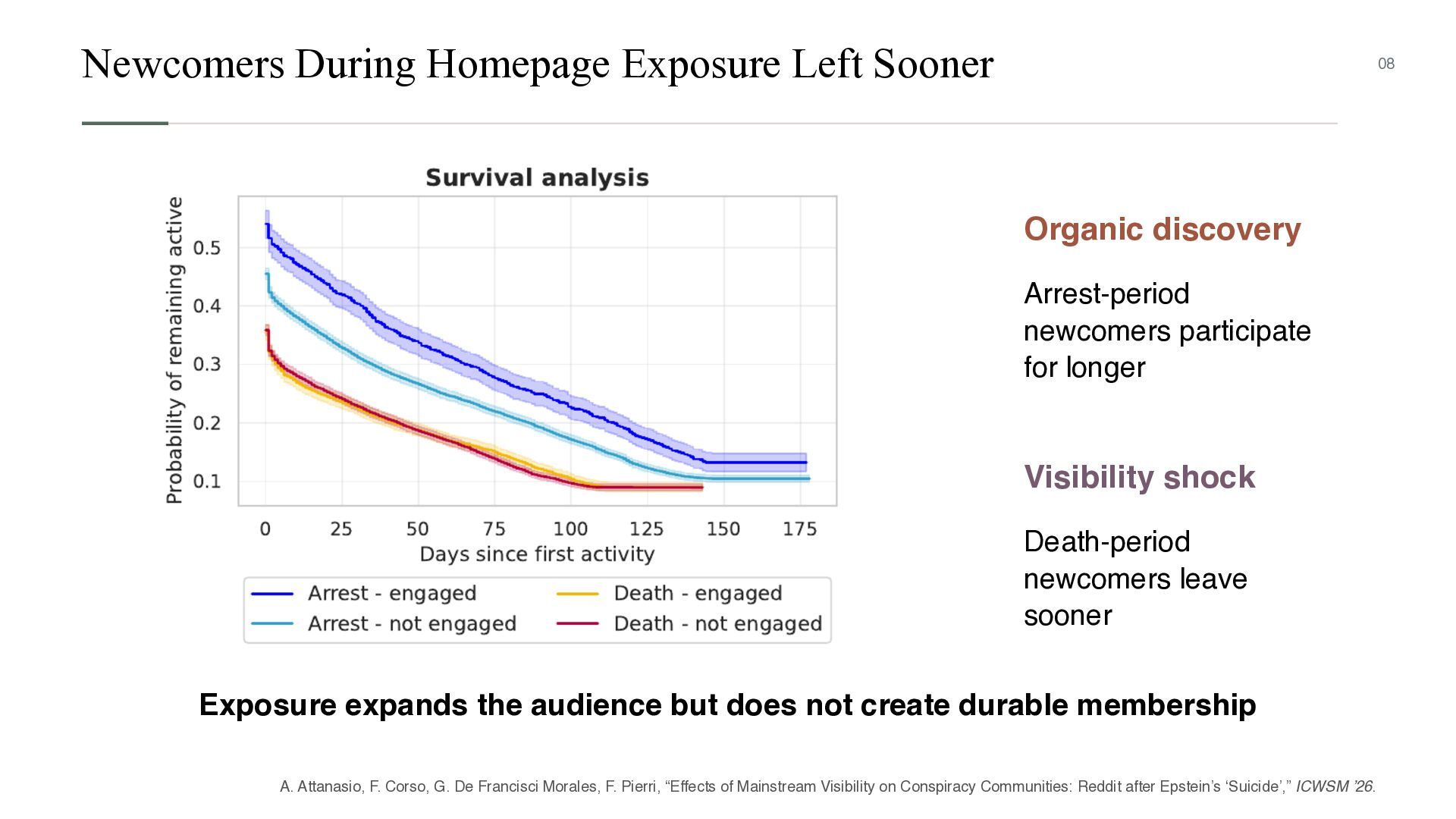
newcomers participate for longer Visibility shock Death-period newcomers leave sooner Exposure expands the audience but does not create durable membership A. Attanasio, F. Corso, G. De Francisci Morales, F. Pierri, “Effects of Mainstream Visibility on Conspiracy Communities: Reddit after Epstein’s ‘Suicide’,” ICWSM ’26.
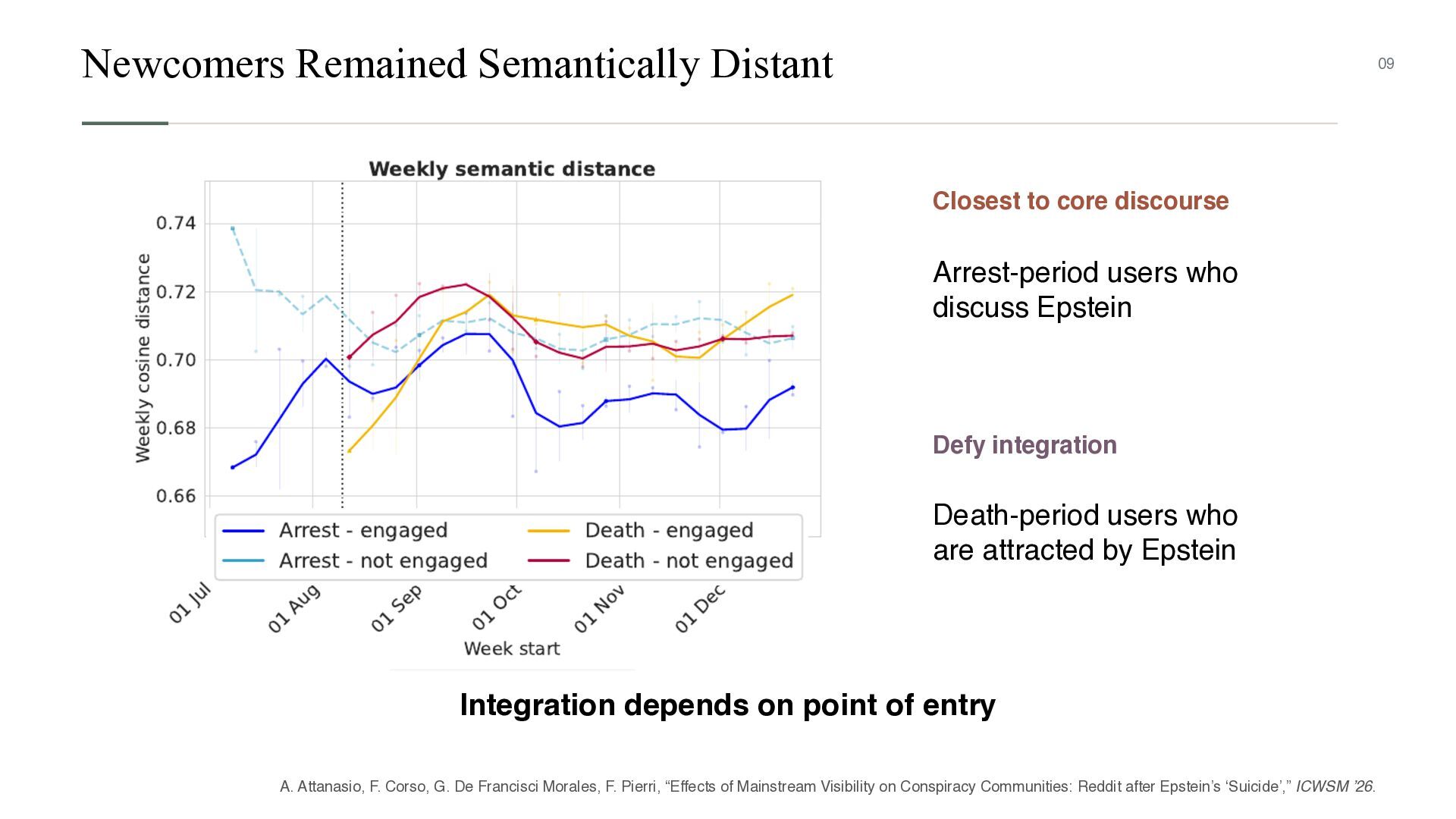
users who discuss Epstein Defy integration Death-period users who are attracted by Epstein Integration depends on point of entry A. Attanasio, F. Corso, G. De Francisci Morales, F. Pierri, “Effects of Mainstream Visibility on Conspiracy Communities: Reddit after Epstein’s ‘Suicide’,” ICWSM ’26.
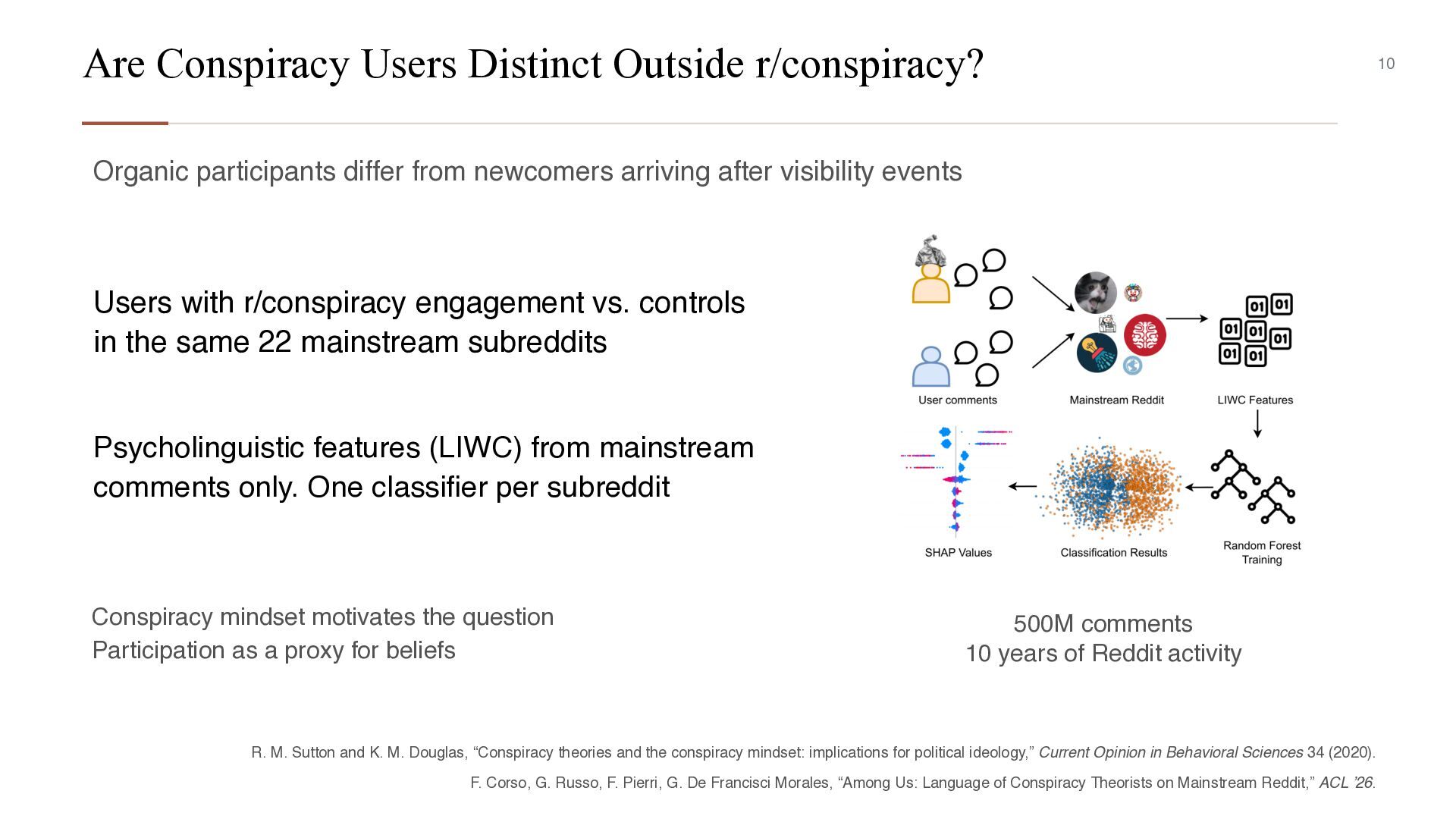
newcomers arriving after visibility events Users with r/conspiracy engagement vs. controls in the same 22 mainstream subreddits Psycholinguistic features (LIWC) from mainstream comments only. One classifier per subreddit Conspiracy mindset motivates the question Participation as a proxy for beliefs 500M comments 10 years of Reddit activity R. M. Sutton and K. M. Douglas, “Conspiracy theories and the conspiracy mindset: implications for political ideology,” Current Opinion in Behavioral Sciences 34 (2020). F. Corso, G. Russo, F. Pierri, G. De Francisci Morales, “Among Us: Language of Conspiracy Theorists on Mainstream Reddit,” ACL ’26. 10
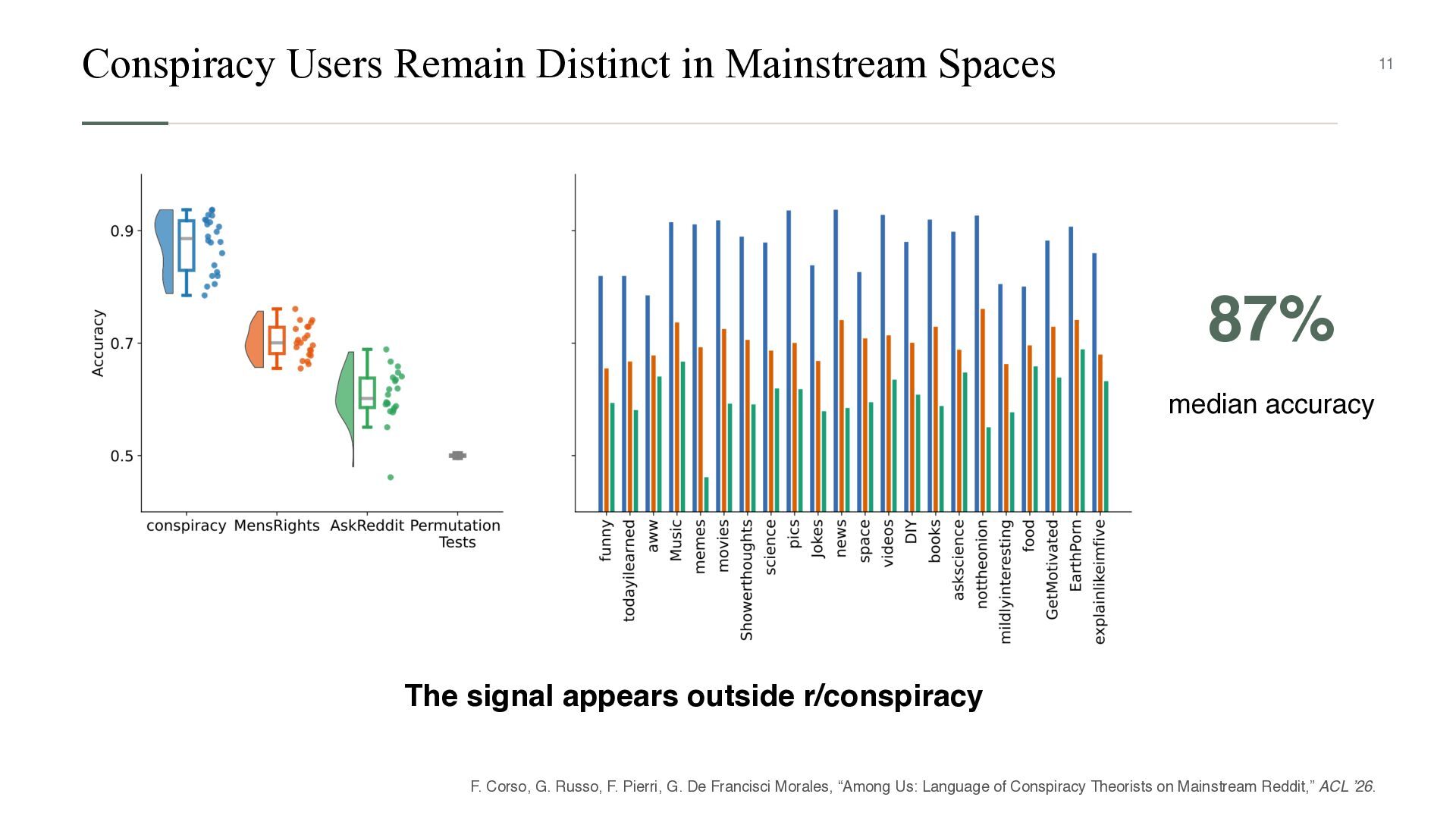
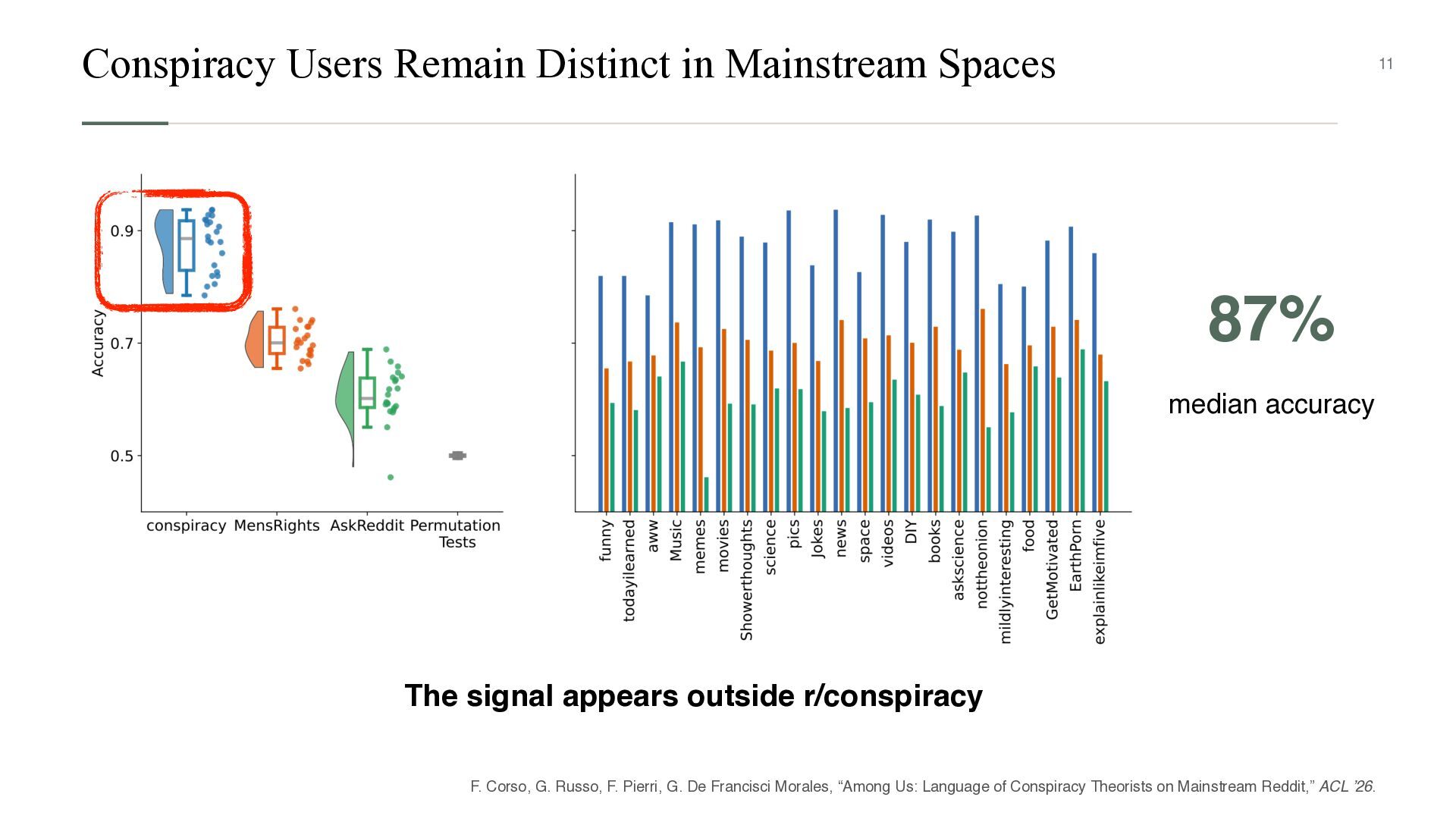
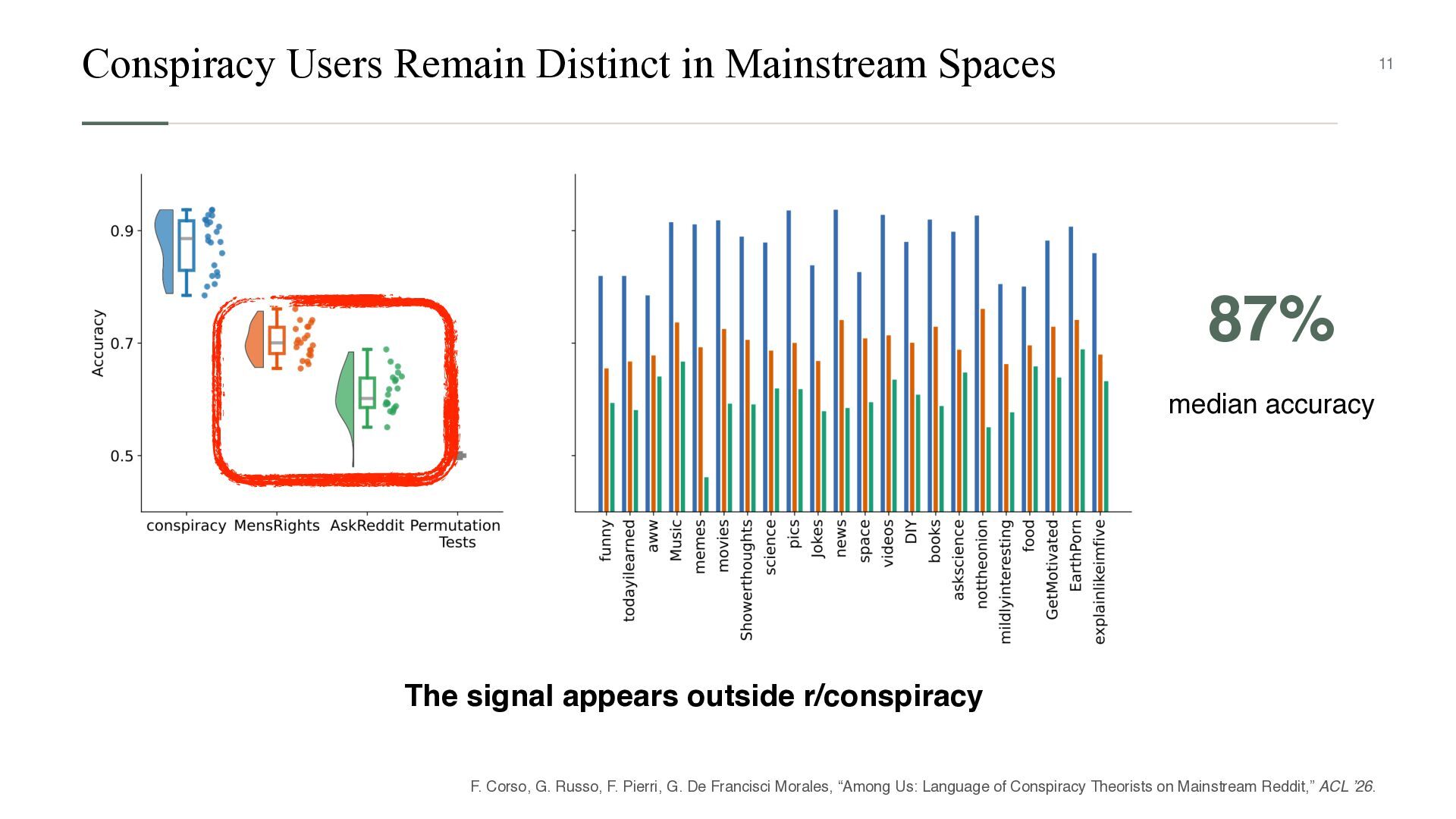
accuracy The signal appears outside r/conspiracy F. Corso, G. Russo, F. Pierri, G. De Francisci Morales, “Among Us: Language of Conspiracy Theorists on Mainstream Reddit,” ACL ’26.
accuracy The signal appears outside r/conspiracy F. Corso, G. Russo, F. Pierri, G. De Francisci Morales, “Among Us: Language of Conspiracy Theorists on Mainstream Reddit,” ACL ’26.
accuracy The signal appears outside r/conspiracy F. Corso, G. Russo, F. Pierri, G. De Francisci Morales, “Among Us: Language of Conspiracy Theorists on Mainstream Reddit,” ACL ’26.
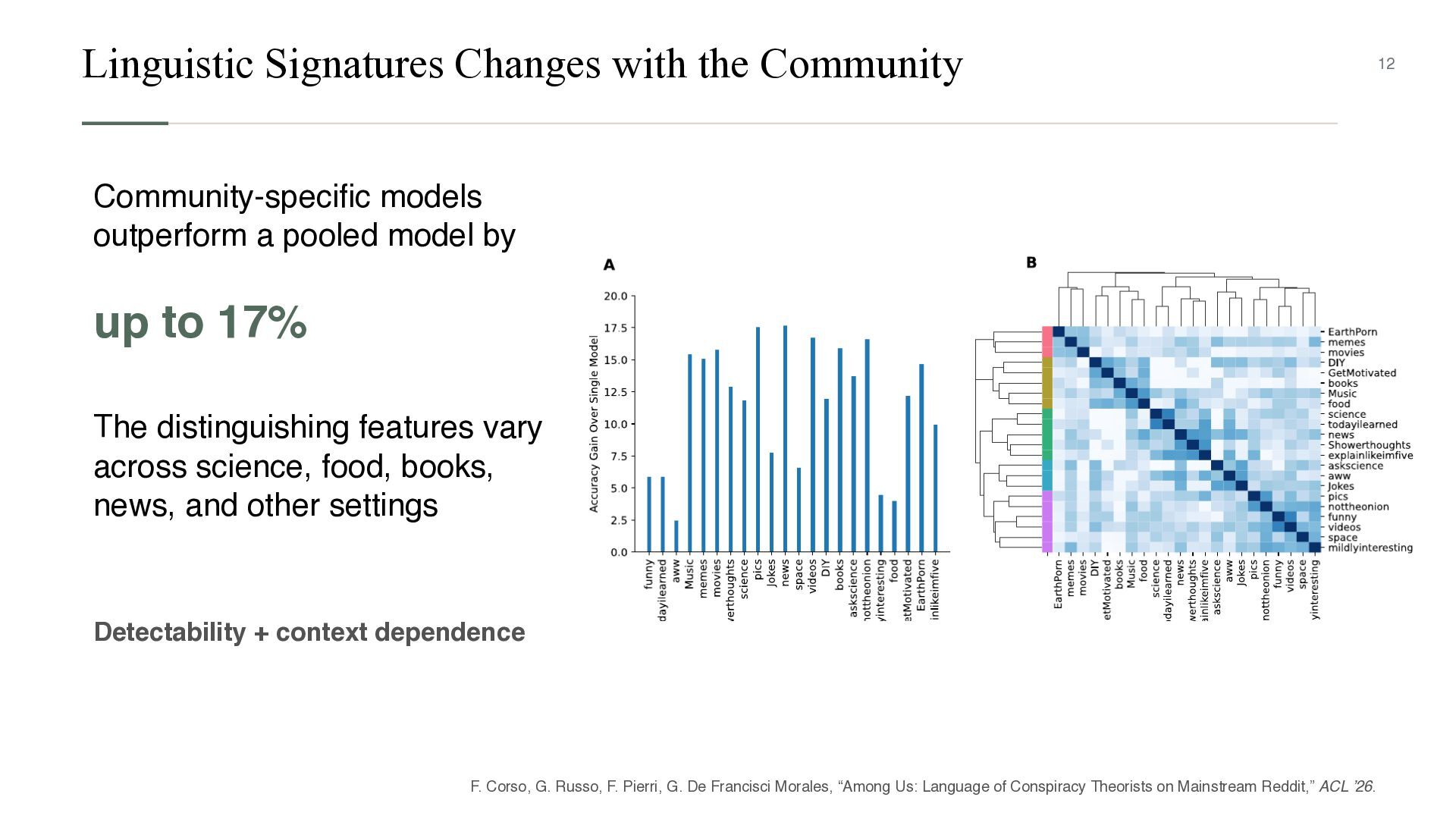
pooled model by up to 17% The distinguishing features vary across science, food, books, news, and other settings Detectability + context dependence F. Corso, G. Russo, F. Pierri, G. De Francisci Morales, “Among Us: Language of Conspiracy Theorists on Mainstream Reddit,” ACL ’26. 12
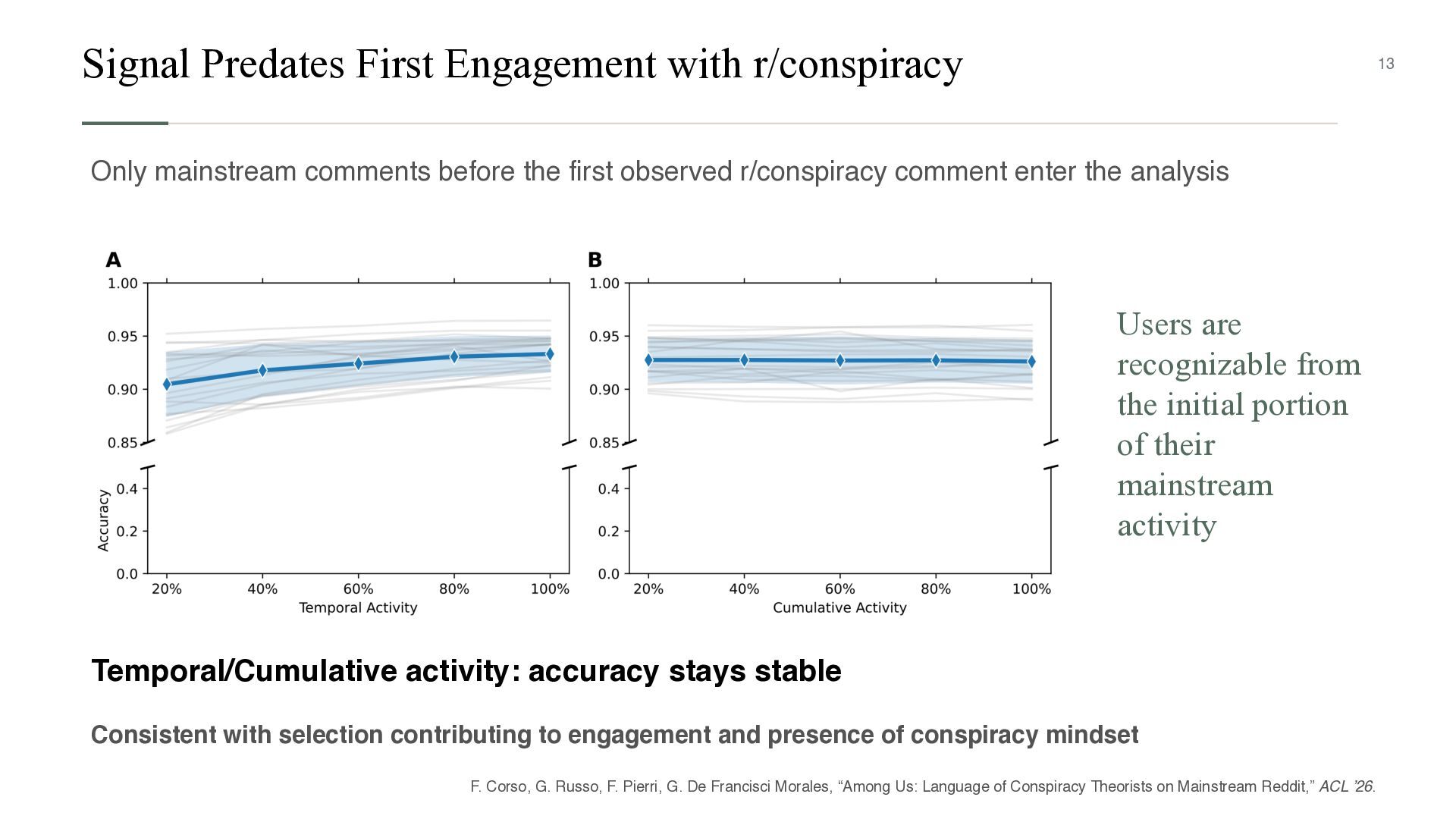
before the first observed r/conspiracy comment enter the analysis Users are recognizable from the initial portion of their mainstream activity Temporal/Cumulative activity: accuracy stays stable Consistent with selection contributing to engagement and presence of conspiracy mindset F. Corso, G. Russo, F. Pierri, G. De Francisci Morales, “Among Us: Language of Conspiracy Theorists on Mainstream Reddit,” ACL ’26.
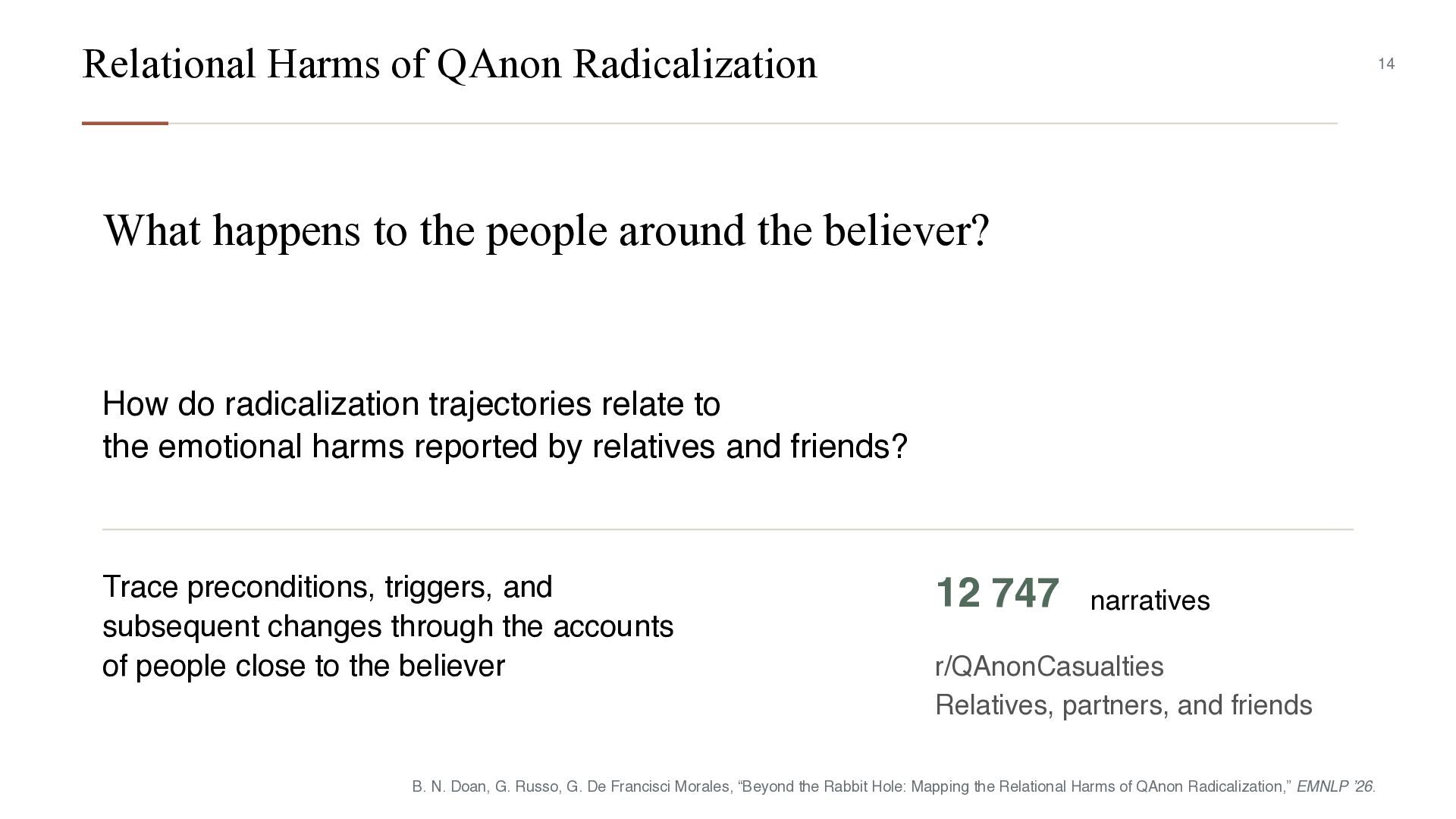
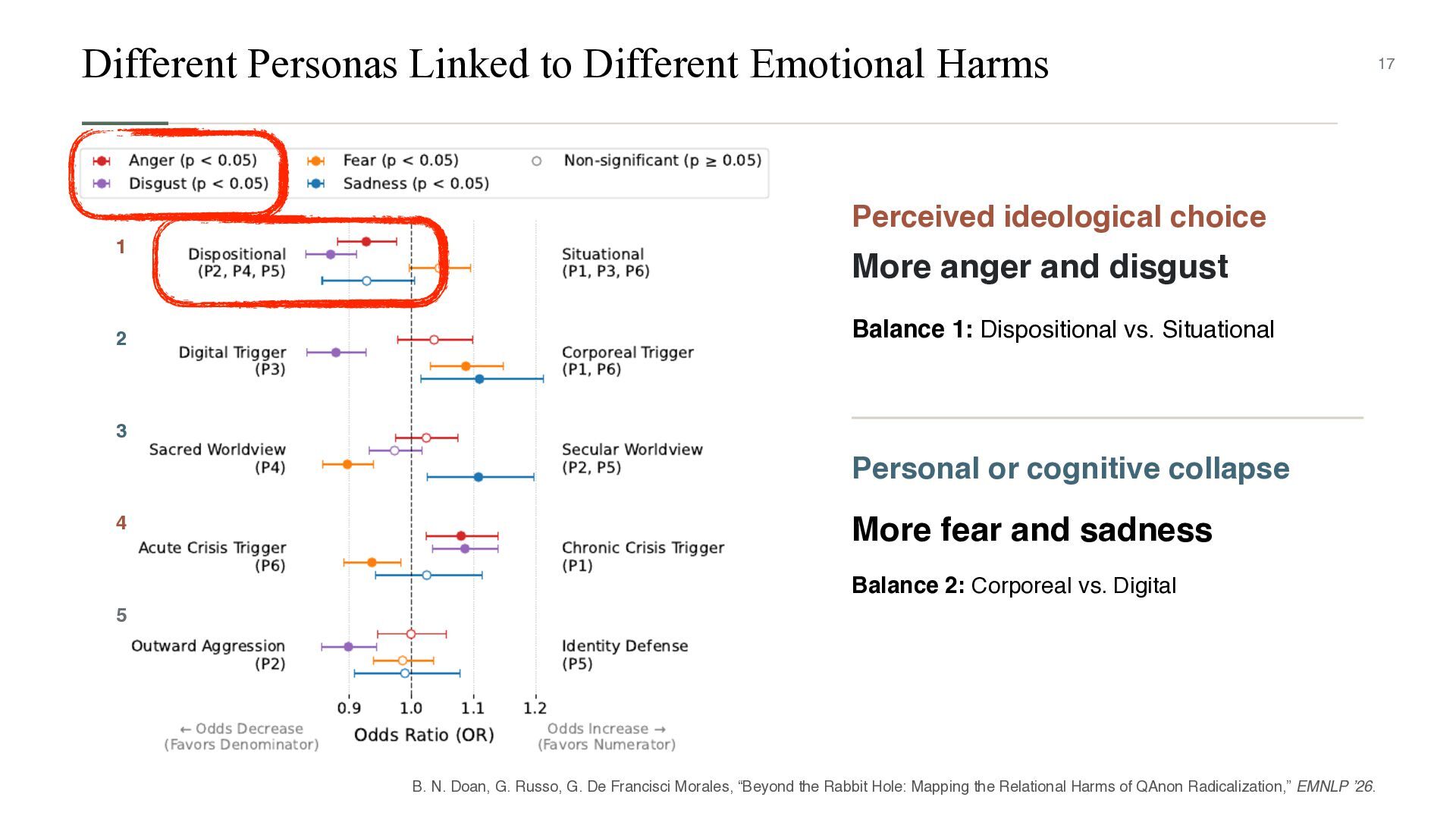
people around the believer? How do radicalization trajectories relate to the emotional harms reported by relatives and friends? Trace preconditions, triggers, and subsequent changes through the accounts of people close to the believer 12 747 narratives r/QAnonCasualties Relatives, partners, and friends B. N. Doan, G. Russo, G. De Francisci Morales, “Beyond the Rabbit Hole: Mapping the Relational Harms of QAnon Radicalization,” EMNLP ’26.
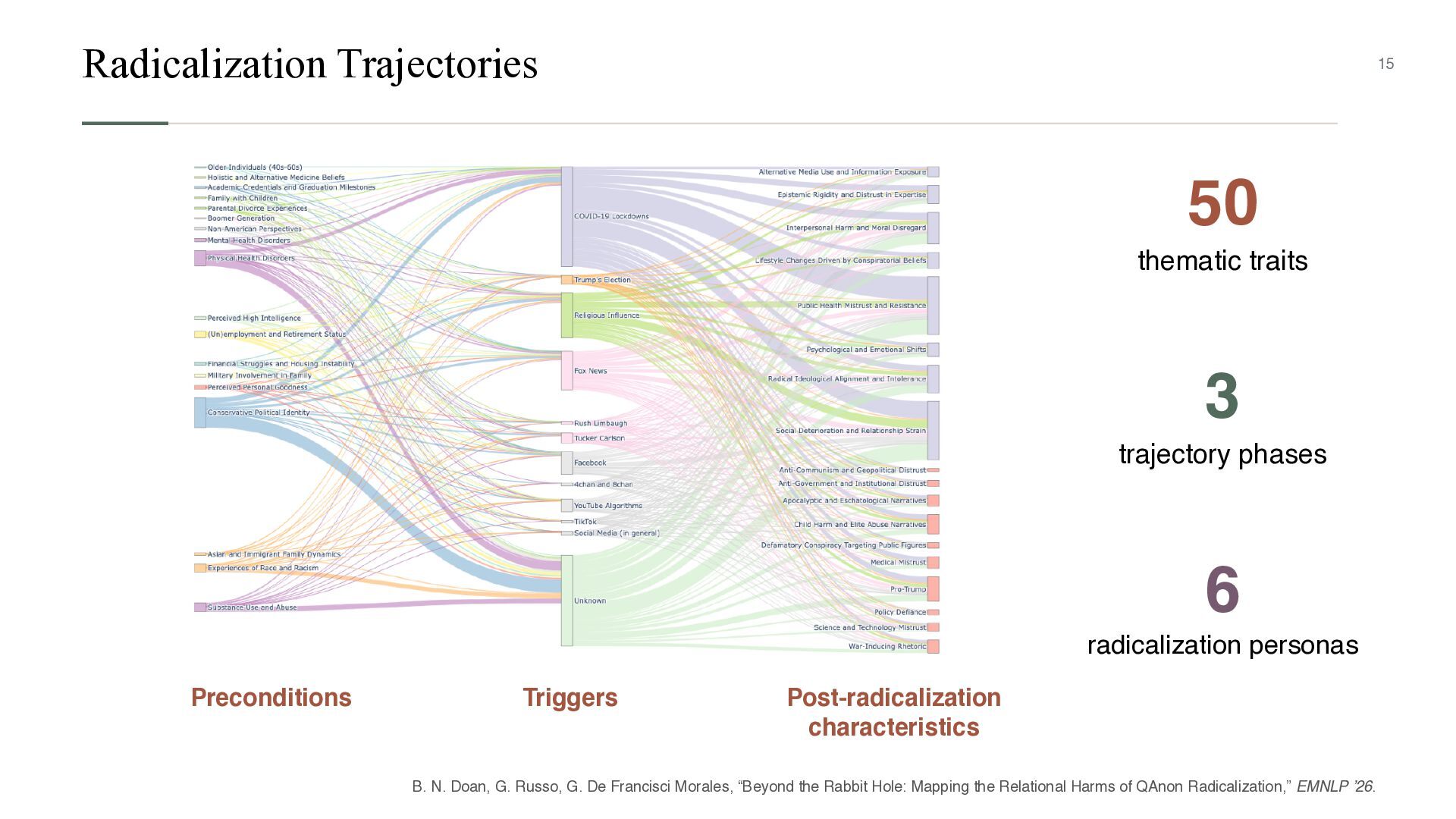
radicalization personas Preconditions Triggers Post-radicalization characteristics B. N. Doan, G. Russo, G. De Francisci Morales, “Beyond the Rabbit Hole: Mapping the Relational Harms of QAnon Radicalization,” EMNLP ’26.
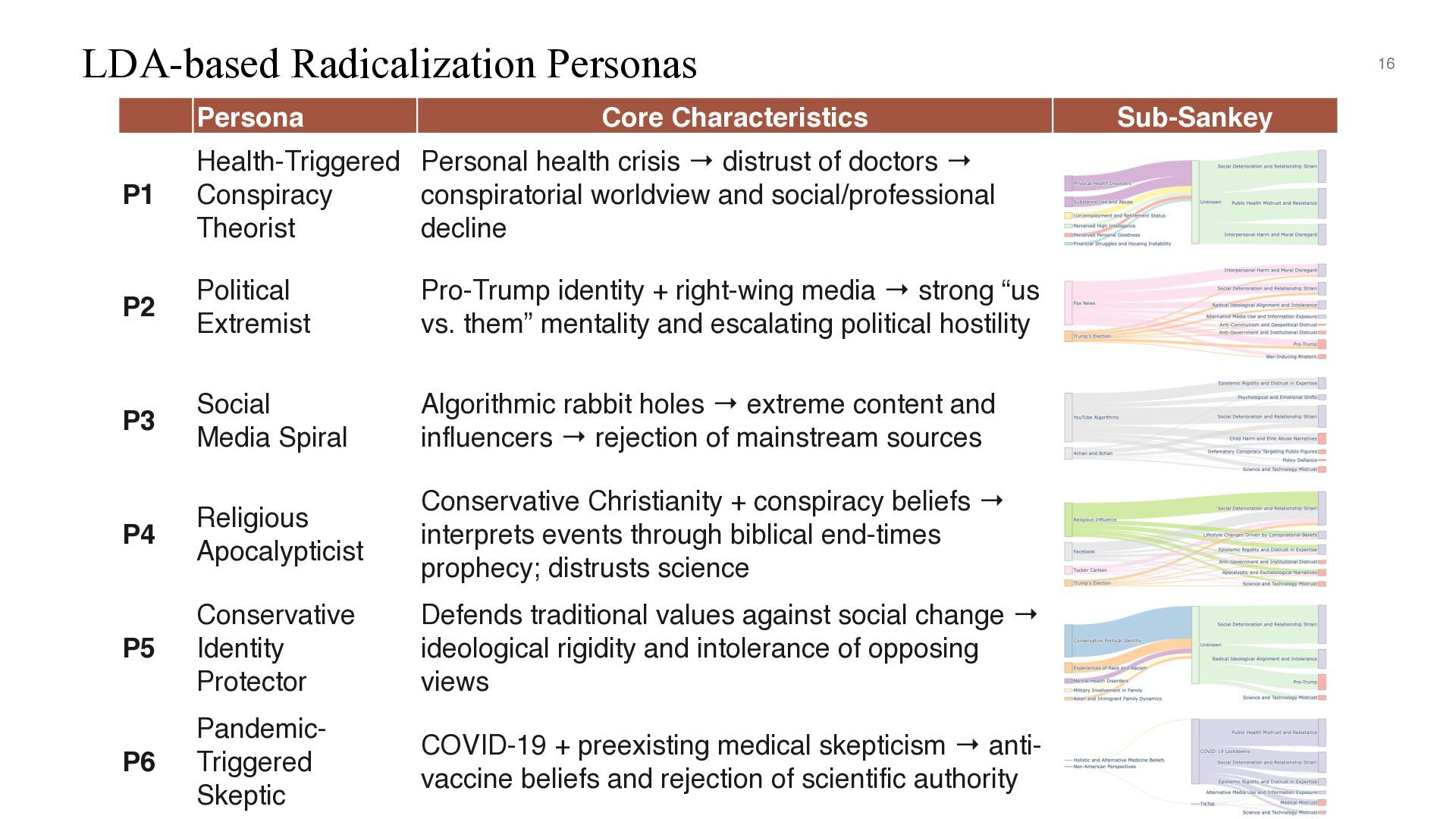
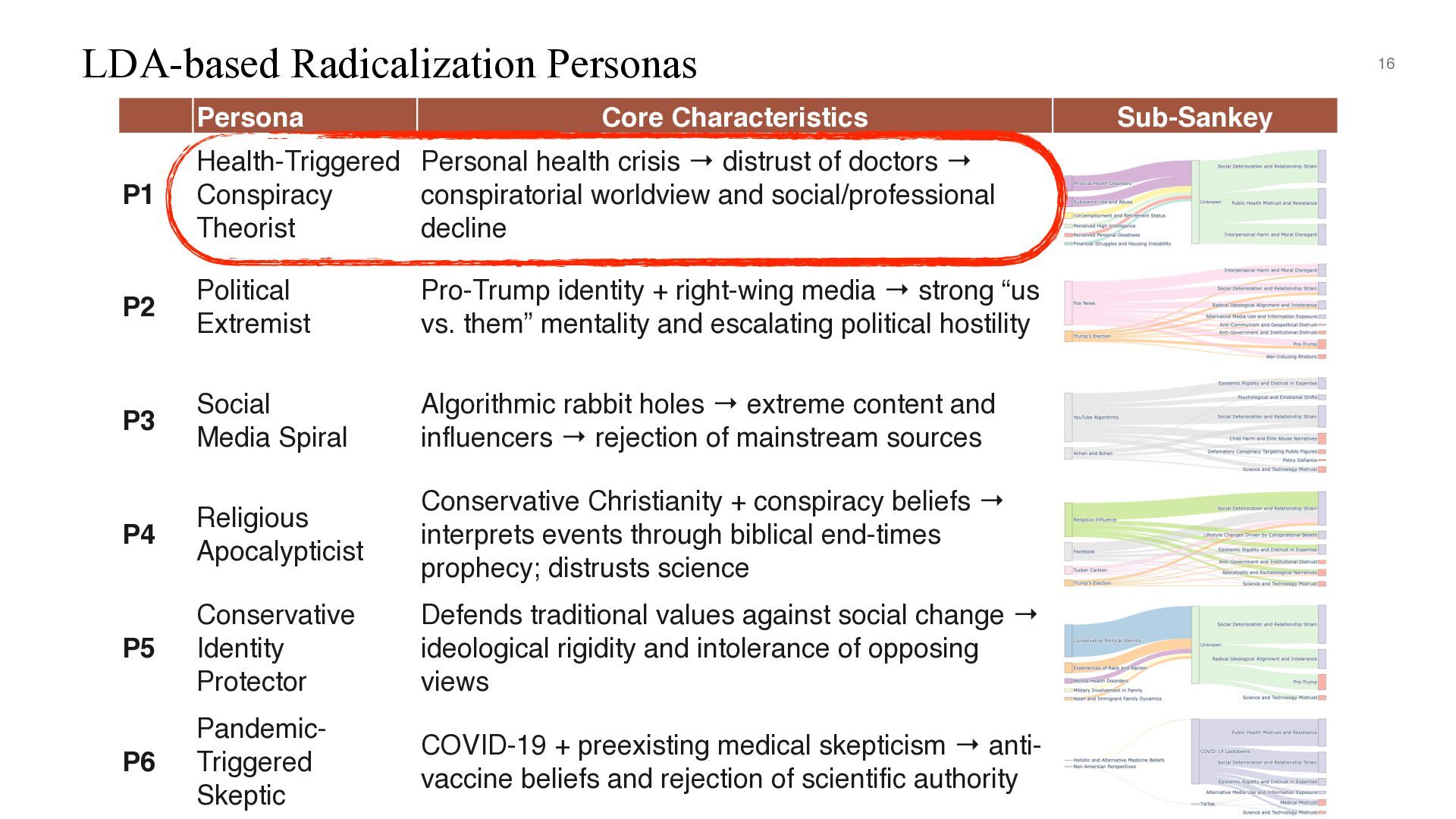
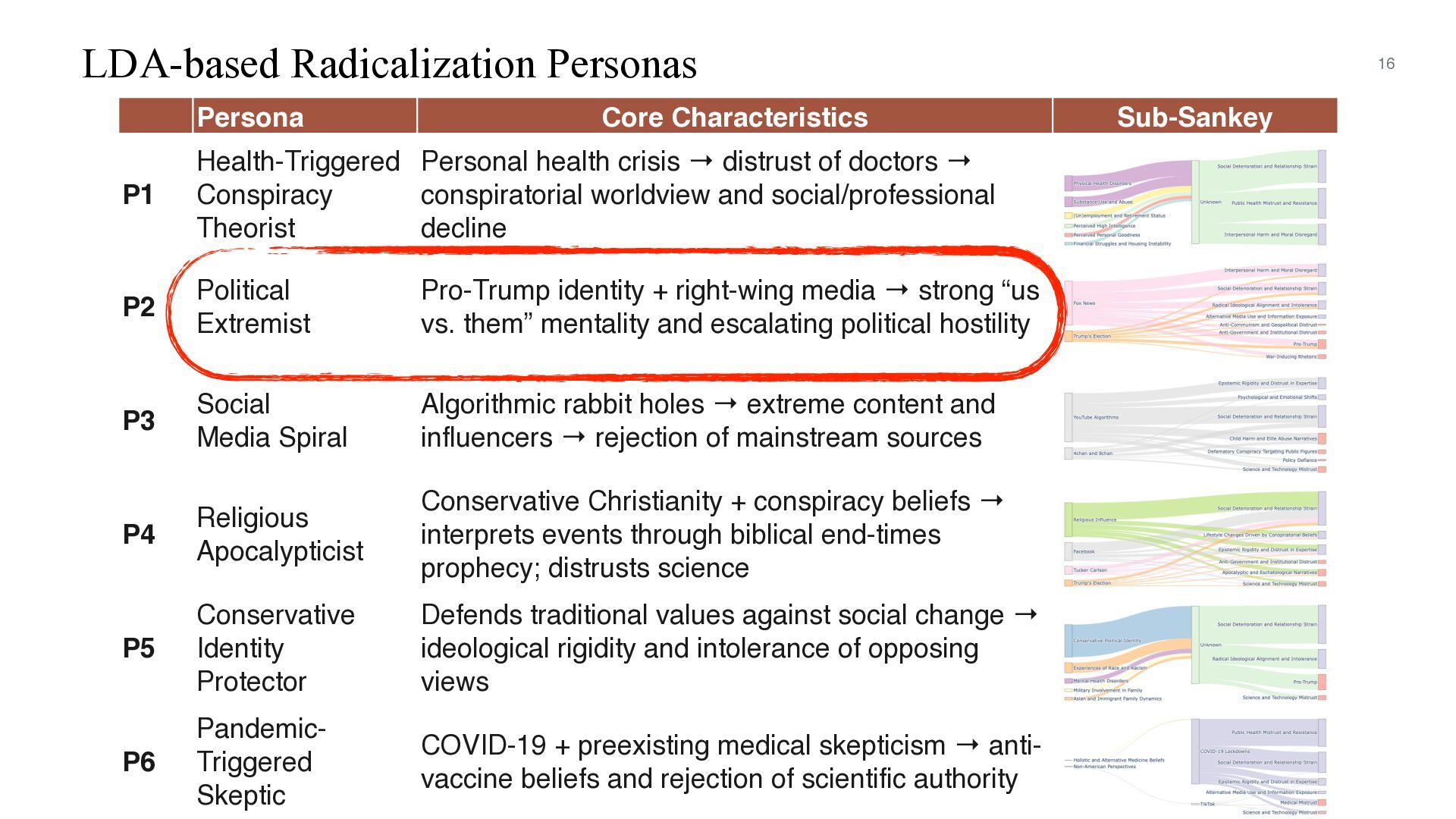
crisis → distrust of doctors → Conspiracy conspiratorial worldview and social/professional Theorist decline P2 Political Extremist Pro-Trump identity + right-wing media → strong “us vs. them” mentality and escalating political hostility P3 Social Media Spiral Algorithmic rabbit holes → extreme content and influencers → rejection of mainstream sources P4 Religious Apocalypticist Conservative Christianity + conspiracy beliefs → interprets events through biblical end-times prophecy; distrusts science P5 Conservative Identity Protector Defends traditional values against social change → ideological rigidity and intolerance of opposing views P6 PandemicTriggered Skeptic COVID-19 + preexisting medical skepticism → antivaccine beliefs and rejection of scientific authority 16 Sub-Sankey
crisis → distrust of doctors → Conspiracy conspiratorial worldview and social/professional Theorist decline P2 Political Extremist Pro-Trump identity + right-wing media → strong “us vs. them” mentality and escalating political hostility P3 Social Media Spiral Algorithmic rabbit holes → extreme content and influencers → rejection of mainstream sources P4 Religious Apocalypticist Conservative Christianity + conspiracy beliefs → interprets events through biblical end-times prophecy; distrusts science P5 Conservative Identity Protector Defends traditional values against social change → ideological rigidity and intolerance of opposing views P6 PandemicTriggered Skeptic COVID-19 + preexisting medical skepticism → antivaccine beliefs and rejection of scientific authority 16 Sub-Sankey
crisis → distrust of doctors → Conspiracy conspiratorial worldview and social/professional Theorist decline P2 Political Extremist Pro-Trump identity + right-wing media → strong “us vs. them” mentality and escalating political hostility P3 Social Media Spiral Algorithmic rabbit holes → extreme content and influencers → rejection of mainstream sources P4 Religious Apocalypticist Conservative Christianity + conspiracy beliefs → interprets events through biblical end-times prophecy; distrusts science P5 Conservative Identity Protector Defends traditional values against social change → ideological rigidity and intolerance of opposing views P6 PandemicTriggered Skeptic COVID-19 + preexisting medical skepticism → antivaccine beliefs and rejection of scientific authority 16 Sub-Sankey
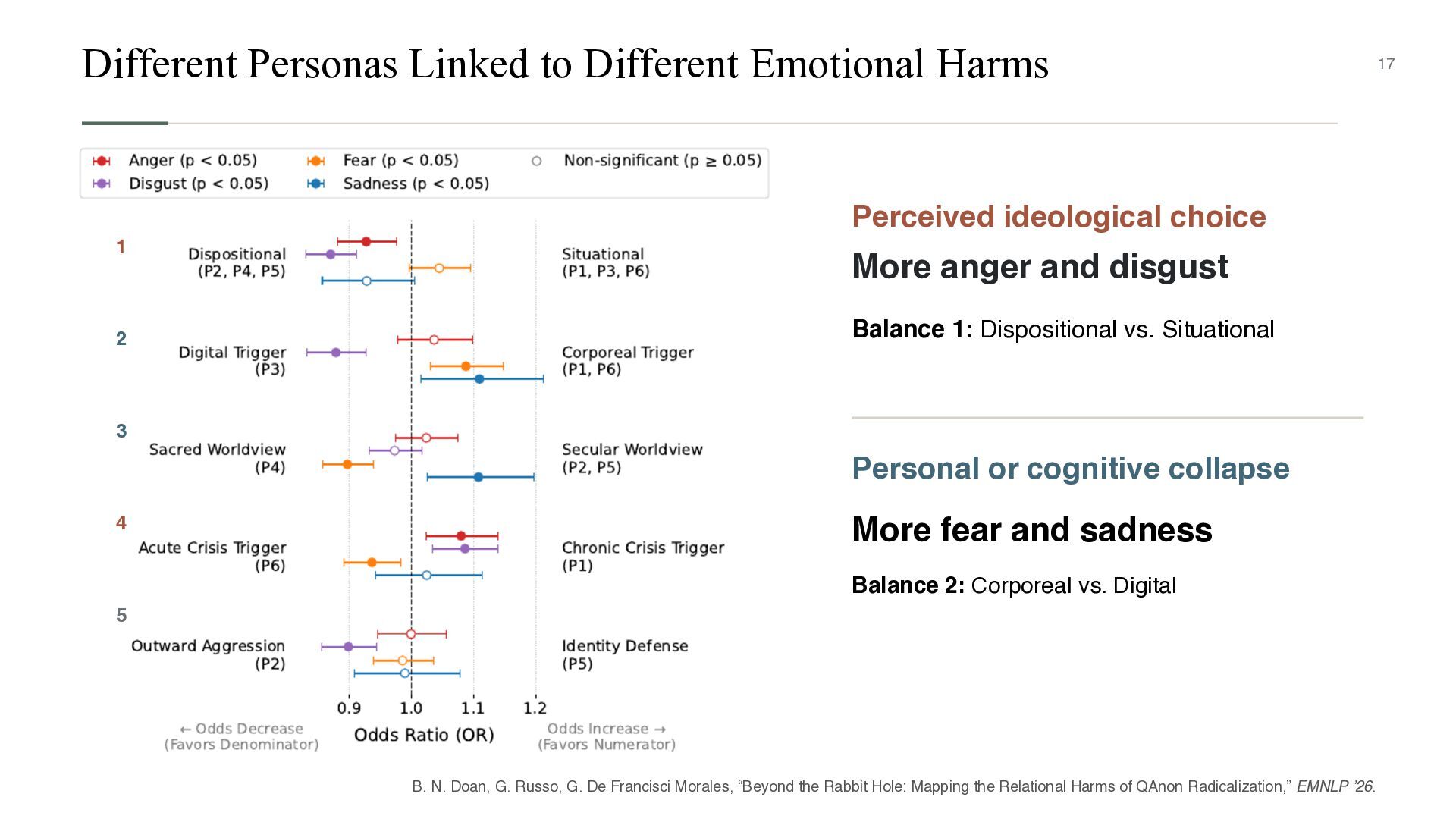
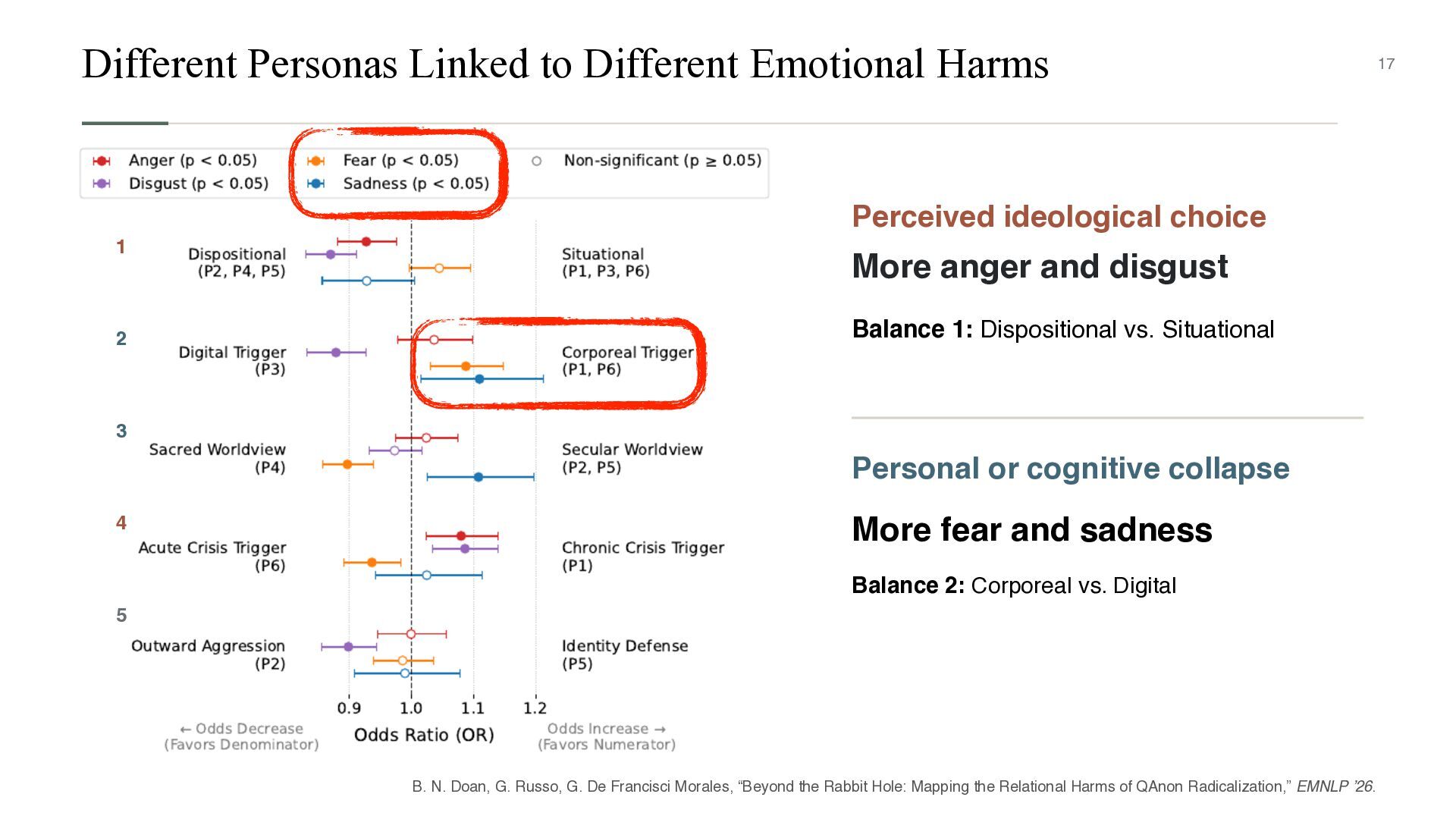
1 2 More anger and disgust Balance 1: Dispositional vs. Situational 3 Personal or cognitive collapse 4 More fear and sadness Balance 2: Corporeal vs. Digital 5 B. N. Doan, G. Russo, G. De Francisci Morales, “Beyond the Rabbit Hole: Mapping the Relational Harms of QAnon Radicalization,” EMNLP ’26. 17
1 2 More anger and disgust Balance 1: Dispositional vs. Situational 3 Personal or cognitive collapse 4 More fear and sadness Balance 2: Corporeal vs. Digital 5 B. N. Doan, G. Russo, G. De Francisci Morales, “Beyond the Rabbit Hole: Mapping the Relational Harms of QAnon Radicalization,” EMNLP ’26. 17
1 2 More anger and disgust Balance 1: Dispositional vs. Situational 3 Personal or cognitive collapse 4 More fear and sadness Balance 2: Corporeal vs. Digital 5 B. N. Doan, G. Russo, G. De Francisci Morales, “Beyond the Rabbit Hole: Mapping the Relational Harms of QAnon Radicalization,” EMNLP ’26. 17
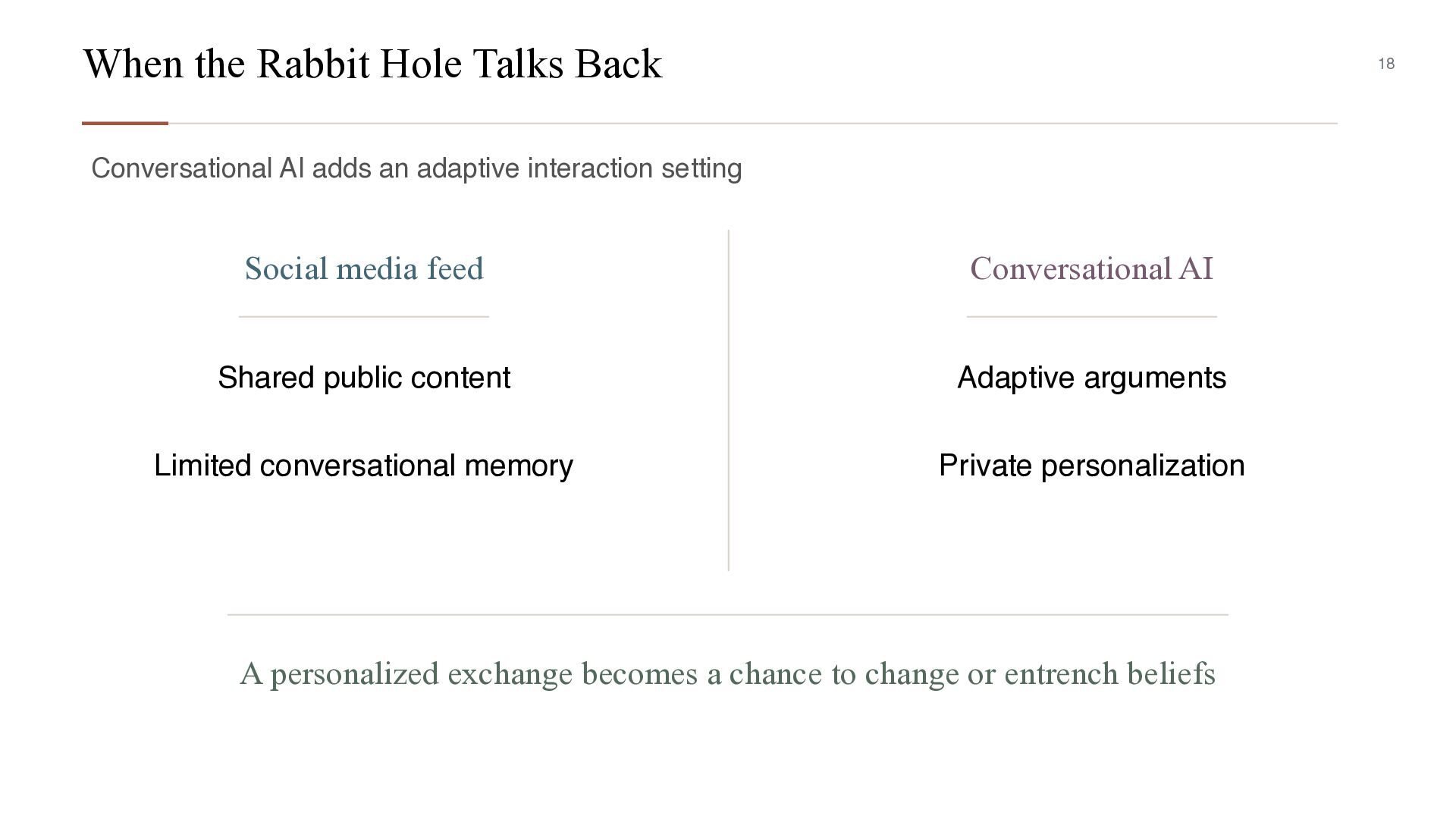
an adaptive interaction setting Social media feed Conversational AI Shared public content Adaptive arguments Limited conversational memory Private personalization A personalized exchange becomes a chance to change or entrench beliefs
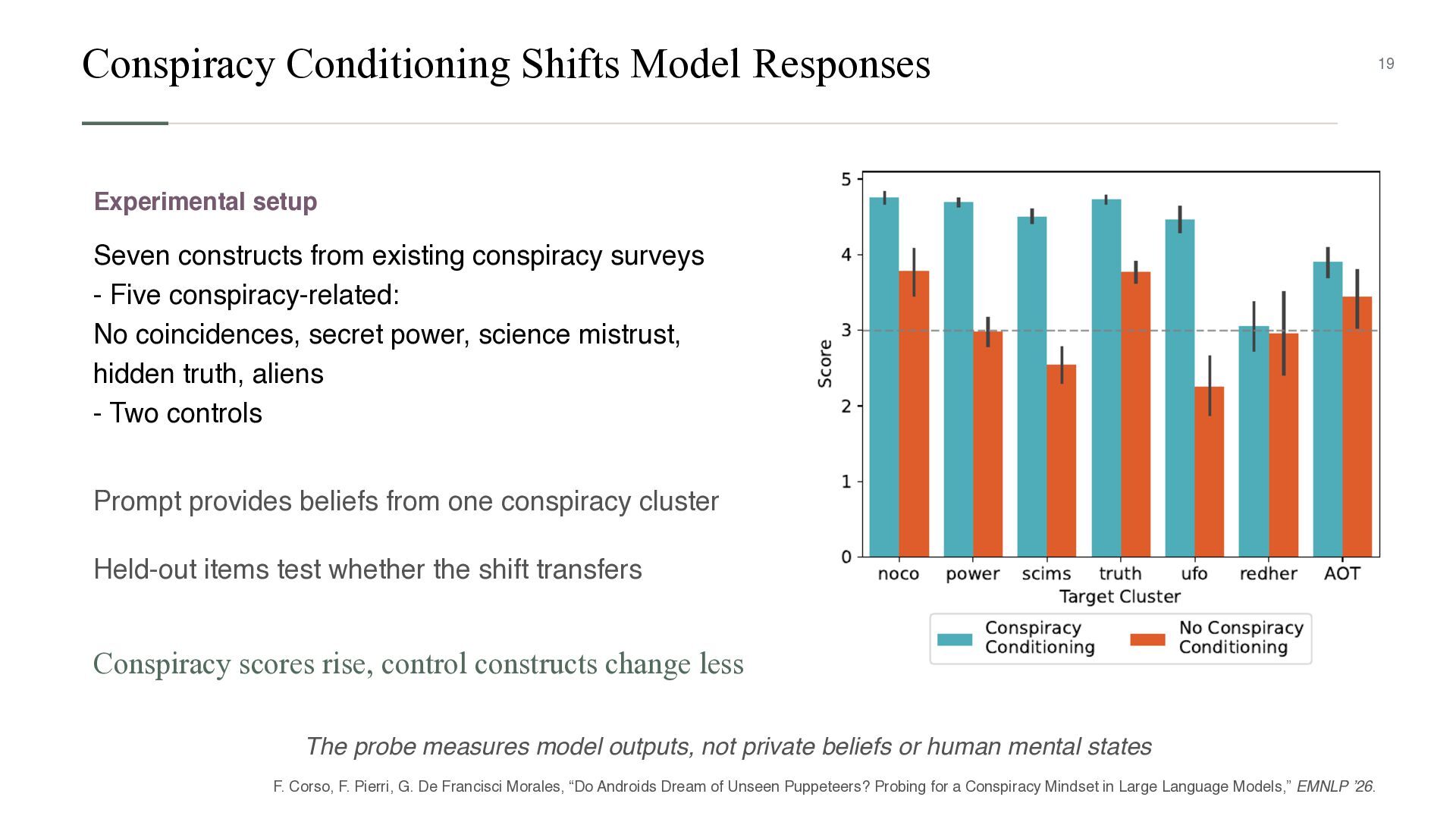
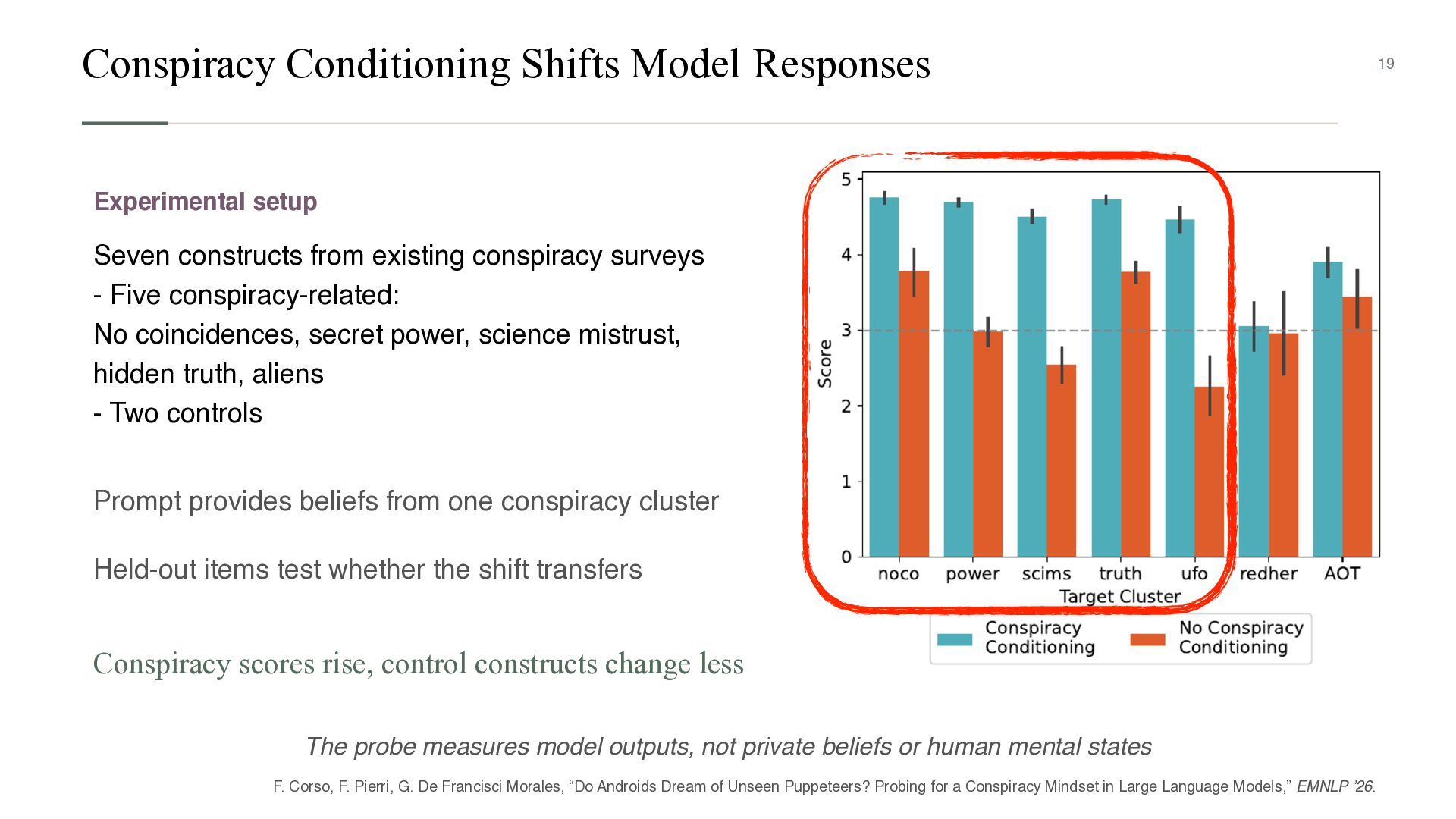
existing conspiracy surveys - Five conspiracy-related: No coincidences, secret power, science mistrust, hidden truth, aliens - Two controls Prompt provides beliefs from one conspiracy cluster Held-out items test whether the shift transfers Conspiracy scores rise, control constructs change less The probe measures model outputs, not private beliefs or human mental states F. Corso, F. Pierri, G. De Francisci Morales, “Do Androids Dream of Unseen Puppeteers? Probing for a Conspiracy Mindset in Large Language Models,” EMNLP ’26. 19
existing conspiracy surveys - Five conspiracy-related: No coincidences, secret power, science mistrust, hidden truth, aliens - Two controls Prompt provides beliefs from one conspiracy cluster Held-out items test whether the shift transfers Conspiracy scores rise, control constructs change less The probe measures model outputs, not private beliefs or human mental states F. Corso, F. Pierri, G. De Francisci Morales, “Do Androids Dream of Unseen Puppeteers? Probing for a Conspiracy Mindset in Large Language Models,” EMNLP ’26. 19
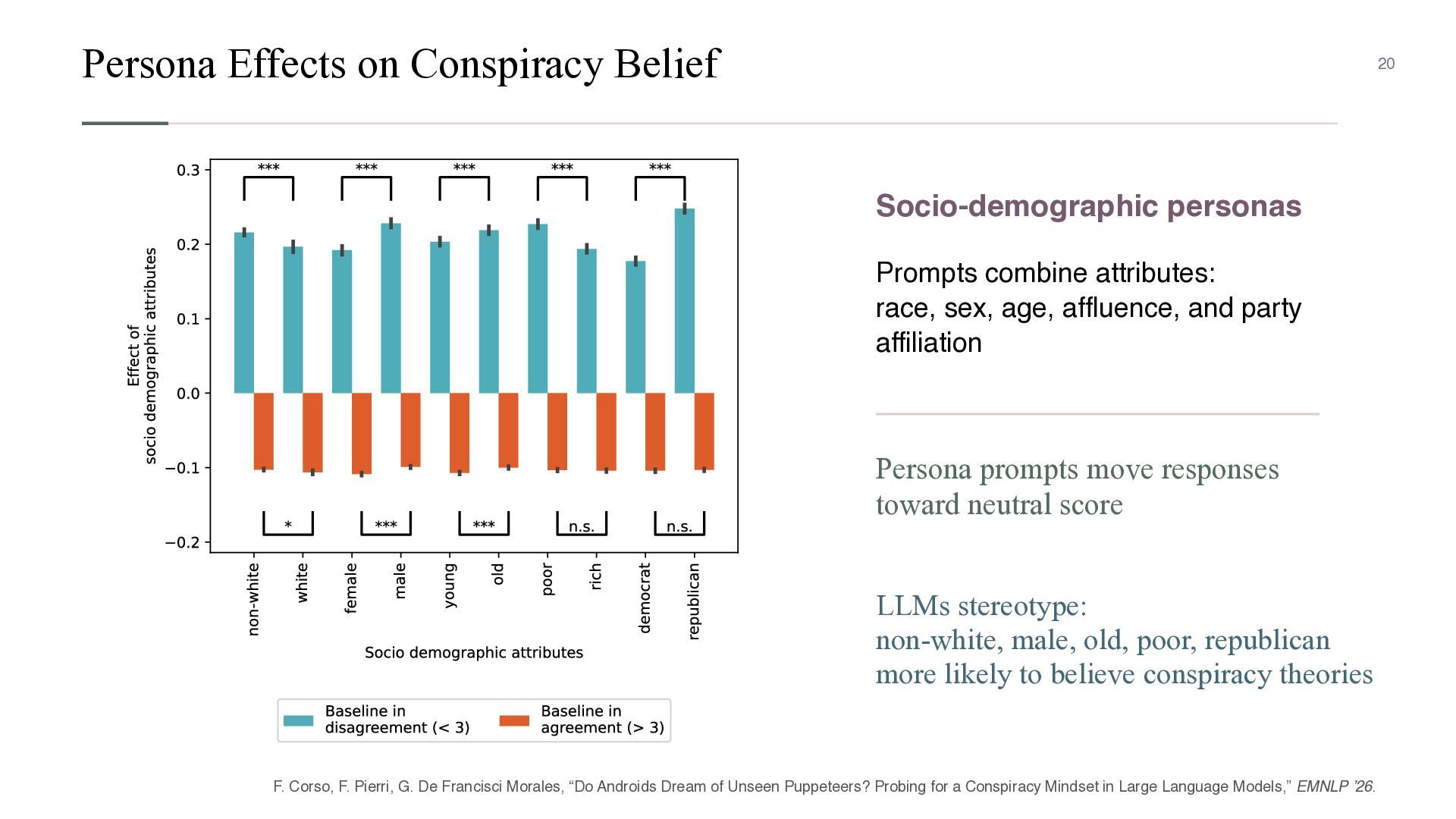
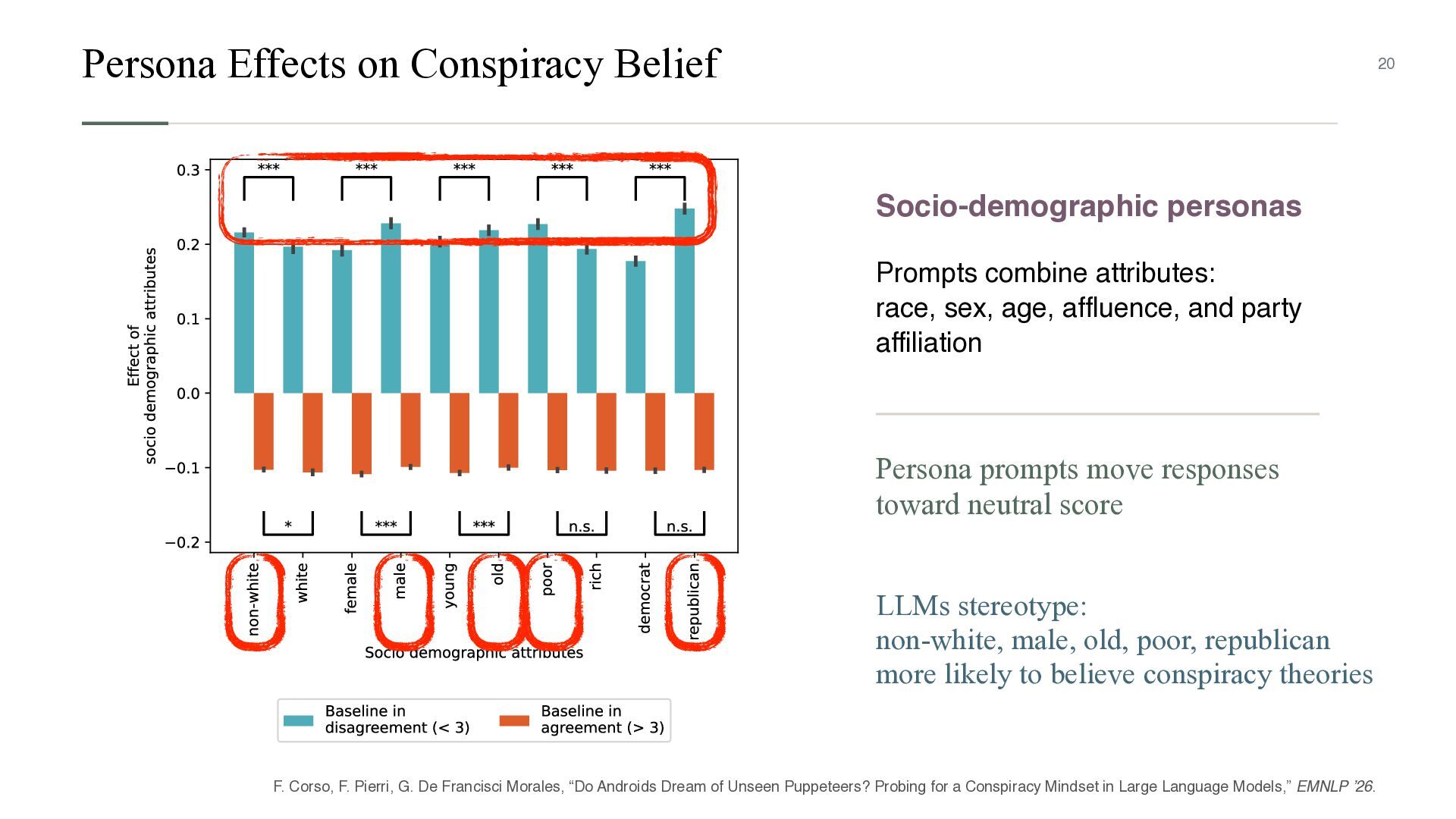
attributes: race, sex, age, affluence, and party affiliation Persona prompts move responses toward neutral score LLMs stereotype: non-white, male, old, poor, republican more likely to believe conspiracy theories F. Corso, F. Pierri, G. De Francisci Morales, “Do Androids Dream of Unseen Puppeteers? Probing for a Conspiracy Mindset in Large Language Models,” EMNLP ’26.
attributes: race, sex, age, affluence, and party affiliation Persona prompts move responses toward neutral score LLMs stereotype: non-white, male, old, poor, republican more likely to believe conspiracy theories F. Corso, F. Pierri, G. De Francisci Morales, “Do Androids Dream of Unseen Puppeteers? Probing for a Conspiracy Mindset in Large Language Models,” EMNLP ’26.
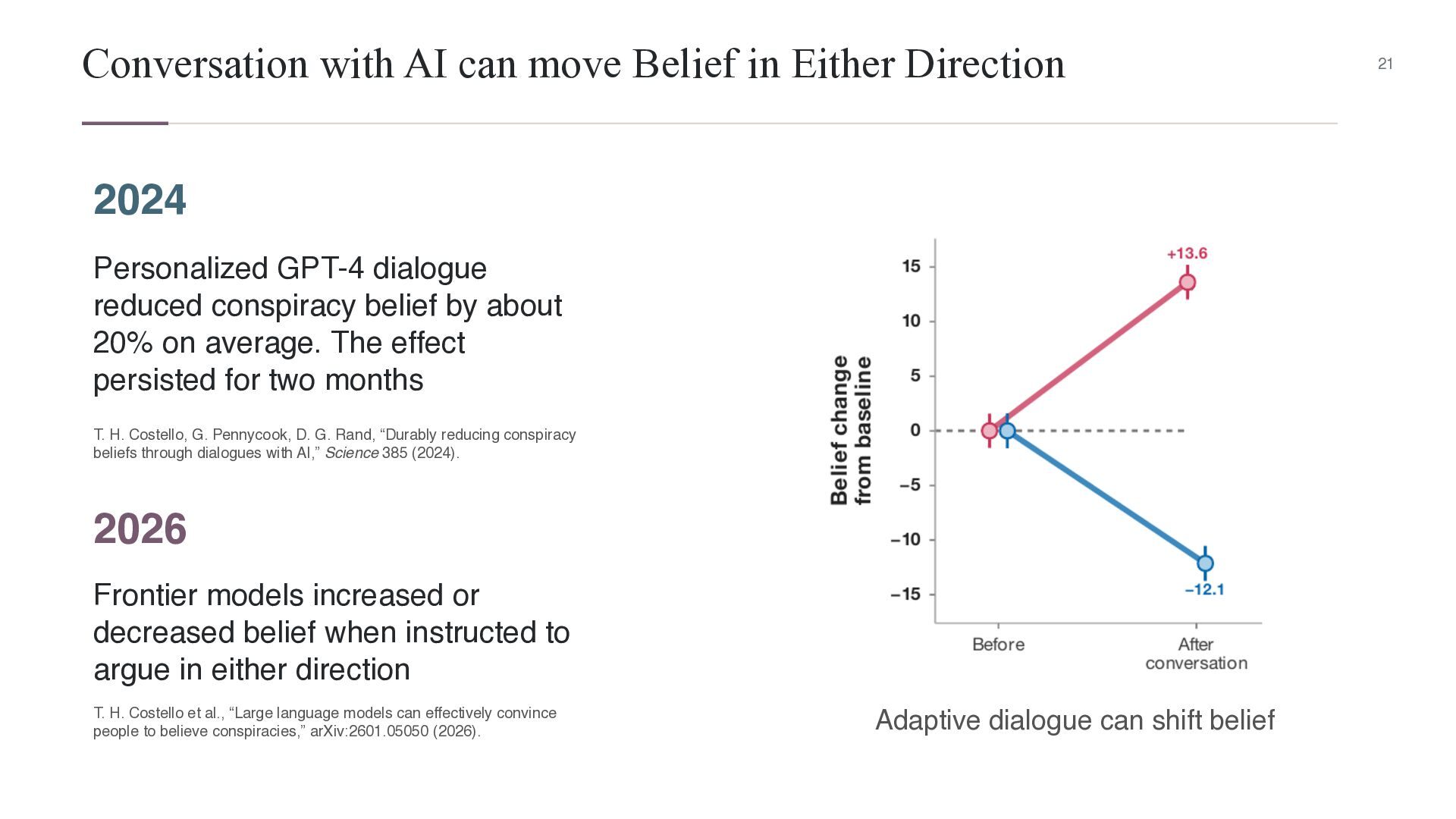
Personalized GPT-4 dialogue reduced conspiracy belief by about 20% on average. The effect persisted for two months T. H. Costello, G. Pennycook, D. G. Rand, “Durably reducing conspiracy beliefs through dialogues with AI,” Science 385 (2024). 2026 Frontier models increased or decreased belief when instructed to argue in either direction T. H. Costello et al., “Large language models can effectively convince people to believe conspiracies,” arXiv:2601.05050 (2026). Adaptive dialogue can shift belief 21
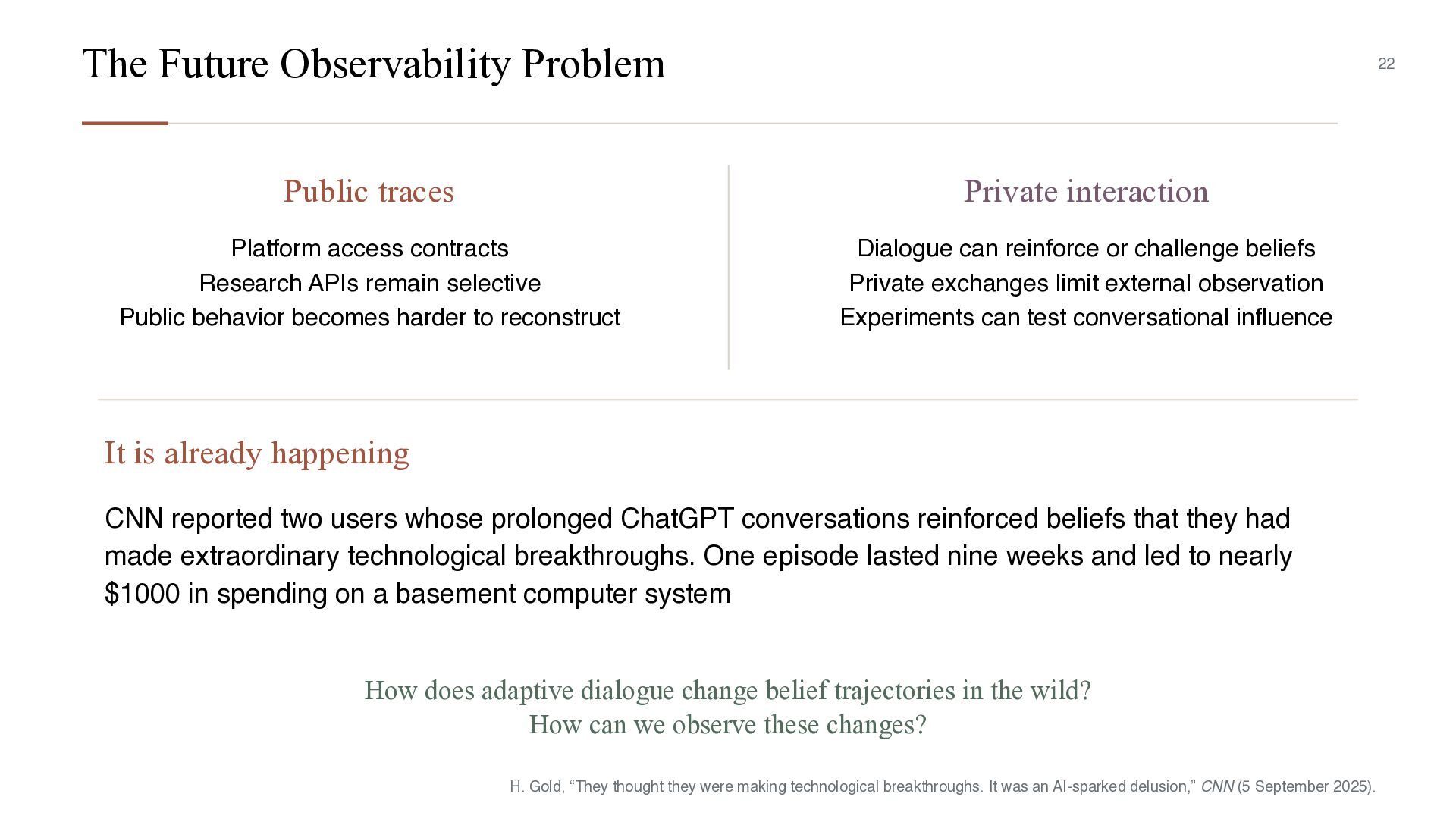
access contracts Research APIs remain selective Public behavior becomes harder to reconstruct Dialogue can reinforce or challenge beliefs Private exchanges limit external observation Experiments can test conversational influence It is already happening CNN reported two users whose prolonged ChatGPT conversations reinforced beliefs that they had made extraordinary technological breakthroughs. One episode lasted nine weeks and led to nearly $1000 in spending on a basement computer system How does adaptive dialogue change belief trajectories in the wild? How can we observe these changes? H. Gold, “They thought they were making technological breakthroughs. It was an AI-sparked delusion,” CNN (5 September 2025).
Are Conspiracy Theories? A Definitional Approach to Their Correlates, Consequences, and Communication.” Annual Review of Psychology 74 (2023). 7. A. Attanasio, F. Corso, G. De Francisci Morales, F. Pierri. “Effects of Mainstream Visibility on Conspiracy Communities: Reddit after Epstein’s ‘Suicide’.” ICWSM ’26. 2. K. Bierwiaczonek, A. B. Gundersen, J. R. Kunst. “The role of conspiracy beliefs for COVID-19 health responses: A meta-analysis.” Current Opinion in Psychology 46 (2022). 8. B. N. Doan, G. Russo, G. De Francisci Morales. “Beyond the Rabbit Hole: Mapping the Relational Harms of QAnon Radicalization.” EMNLP ’26. 3. M. Á. Sánchez-Cortés, C. Monti, G. De Francisci Morales. “Conspiracy and Environment Communities on Reddit Sort Along Different Demographic Axes.” PNAS Nexus (submitted). 9. F. Corso, F. Pierri, G. De Francisci Morales. “Do Androids Dream of Unseen Puppeteers? Probing for a Conspiracy Mindset in Large Language Models.” EMNLP ’26. 4. F. Corso, F. Pierri, G. De Francisci Morales. “Conspiracy theories and where to find them on TikTok.” ACL ’25. 10. T. H. Costello, G. Pennycook, D. G. Rand. “Durably reducing conspiracy beliefs through dialogues with AI.” Science 385 (2024). 5. R. M. Sutton and K. M. Douglas. “Conspiracy theories and the conspiracy mindset: implications for political ideology.” Current Opinion in Behavioral Sciences 34 (2020). 11. T. H. Costello et al.. “Large language models can effectively convince people to believe conspiracies.” arXiv:2601.05050 (2026). 6. F. Corso, G. Russo, F. Pierri, G. De Francisci Morales. “Among Us: Language of Conspiracy Theorists on Mainstream Reddit.” ACL ’26. 12. H. Gold. “They thought they were making technological breakthroughs. It was an AIsparked delusion.” CNN (5 September 2025). [email protected]


 gdfm
 trycycle
 okana2ki
 institutdelelevage
 xleitix
 shumpei777
 voginip
 sshimizu2006
 masakiokuda
 arthur1
 katiecoart
 livdayseo
 aemeredith
 rocio
 vanstee
 addyosmani
 inesmontani
 ipullrank
 marketingsoph
 sugarenia
 reverentgeek
 tmiket