Upgrade to Pro — share decks privately, control downloads, hide ads and more …

Presentation at ICC'11 in Paris by Guillaume To...

Avatar for Guillaume Guillaume
October 09, 2026

Presentation at ICC'11 in Paris by Guillaume Touya on CollaGen

Avatar for Guillaume

Guillaume

October 09, 2026

More Decks by Guillaume

Other Decks in Research

Transcript

  1. 1 CollaGen: Collaboration between Automatic Cartographic Generalisation Processes Guillaume Touya,

    Cécile Duchêne COGIT Lab IGN France International Cartographic Conference 2011
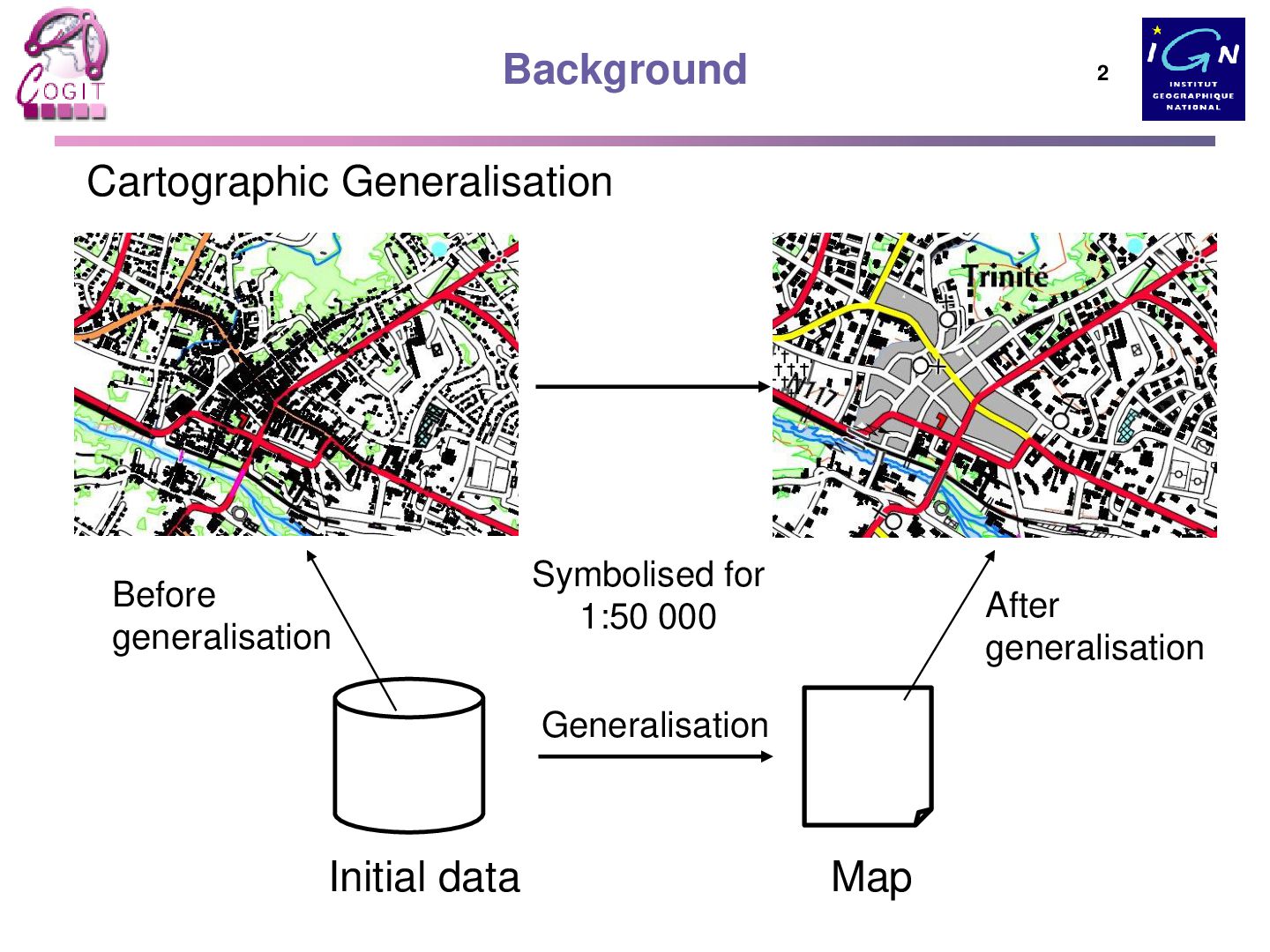
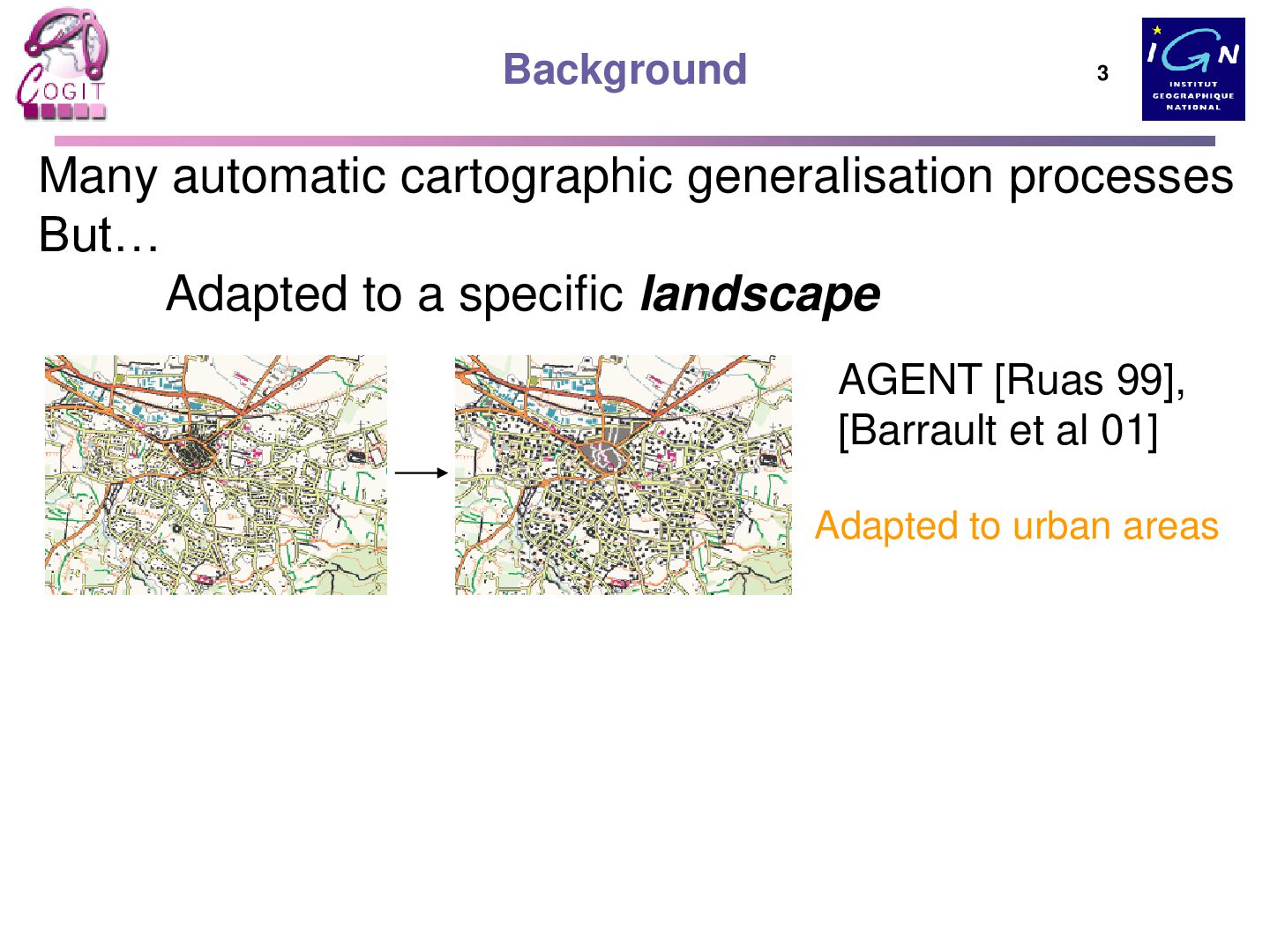
  2. Background 3 Many automatic cartographic generalisation processes But… Adapted to

    a specific landscape AGENT [Ruas 99], [Barrault et al 01] Adapted to urban areas
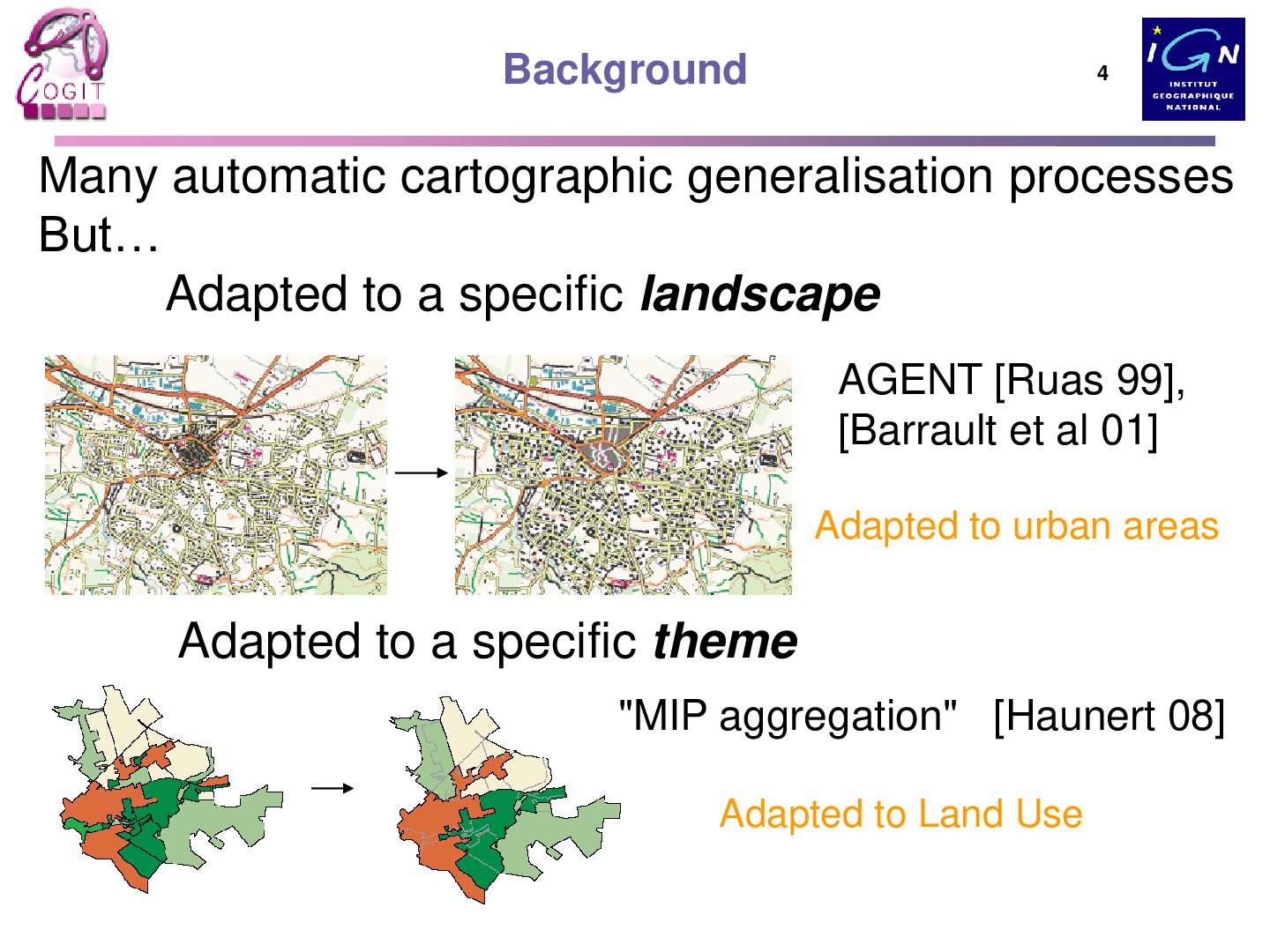
  3. Background 4 Many automatic cartographic generalisation processes But… Adapted to

    a specific landscape AGENT [Ruas 99], [Barrault et al 01] Adapted to urban areas Adapted to a specific theme "MIP aggregation" [Haunert 08] Adapted to Land Use
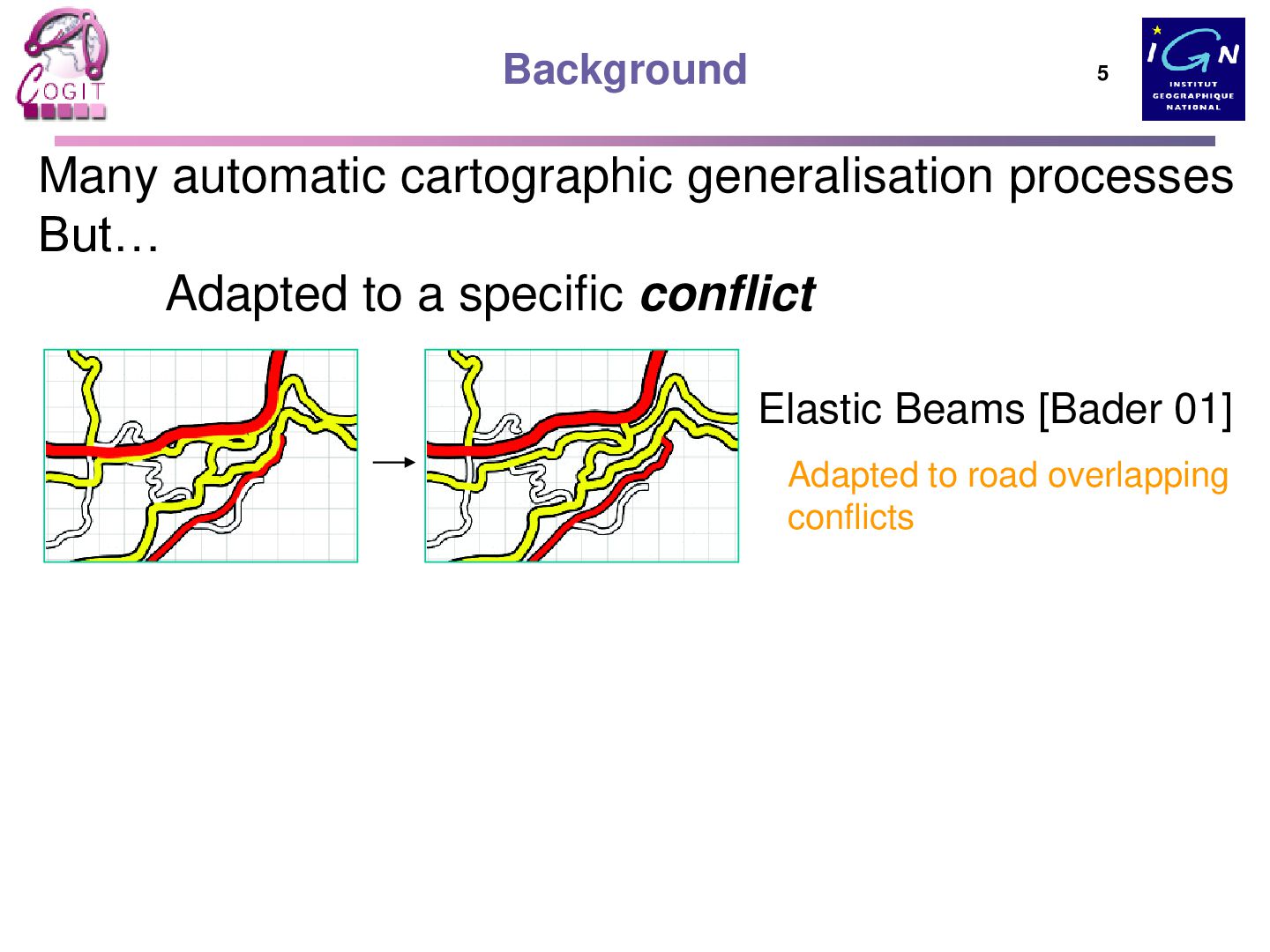
  4. Background 5 Many automatic cartographic generalisation processes But… Adapted to

    a specific conflict Elastic Beams [Bader 01] Adapted to road overlapping conflicts
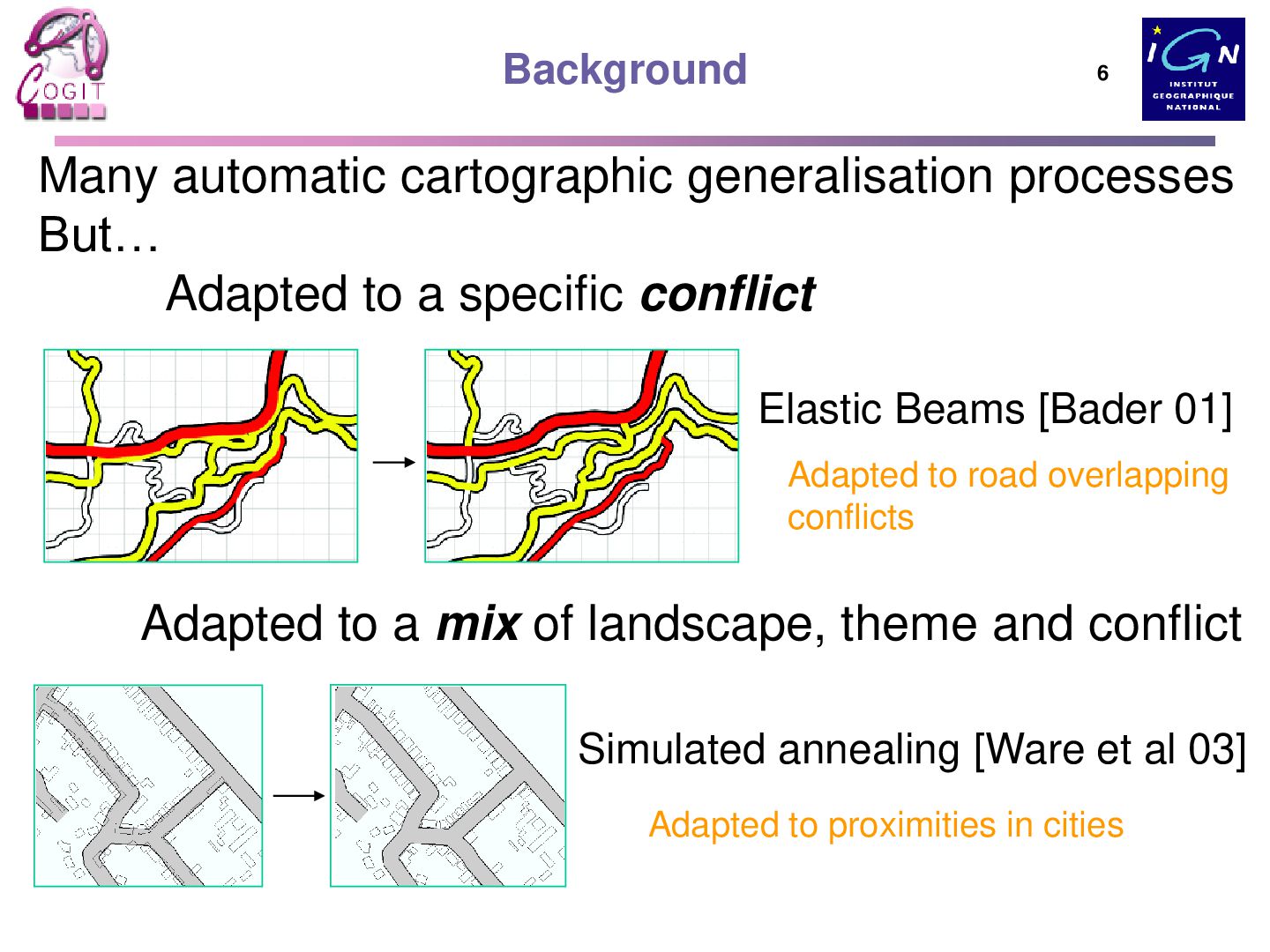
  5. Background 6 Many automatic cartographic generalisation processes But… Adapted to

    a specific conflict Elastic Beams [Bader 01] Adapted to road overlapping conflicts Adapted to a mix of landscape, theme and conflict Simulated annealing [Ware et al 03] Adapted to proximities in cities
  6. Background 7 • Great diversity of generalisation processes • No

    process able to solve all generalisation problems • Very different ways to parameterise a process • How to benefit from the diversity to generalise complete maps ?
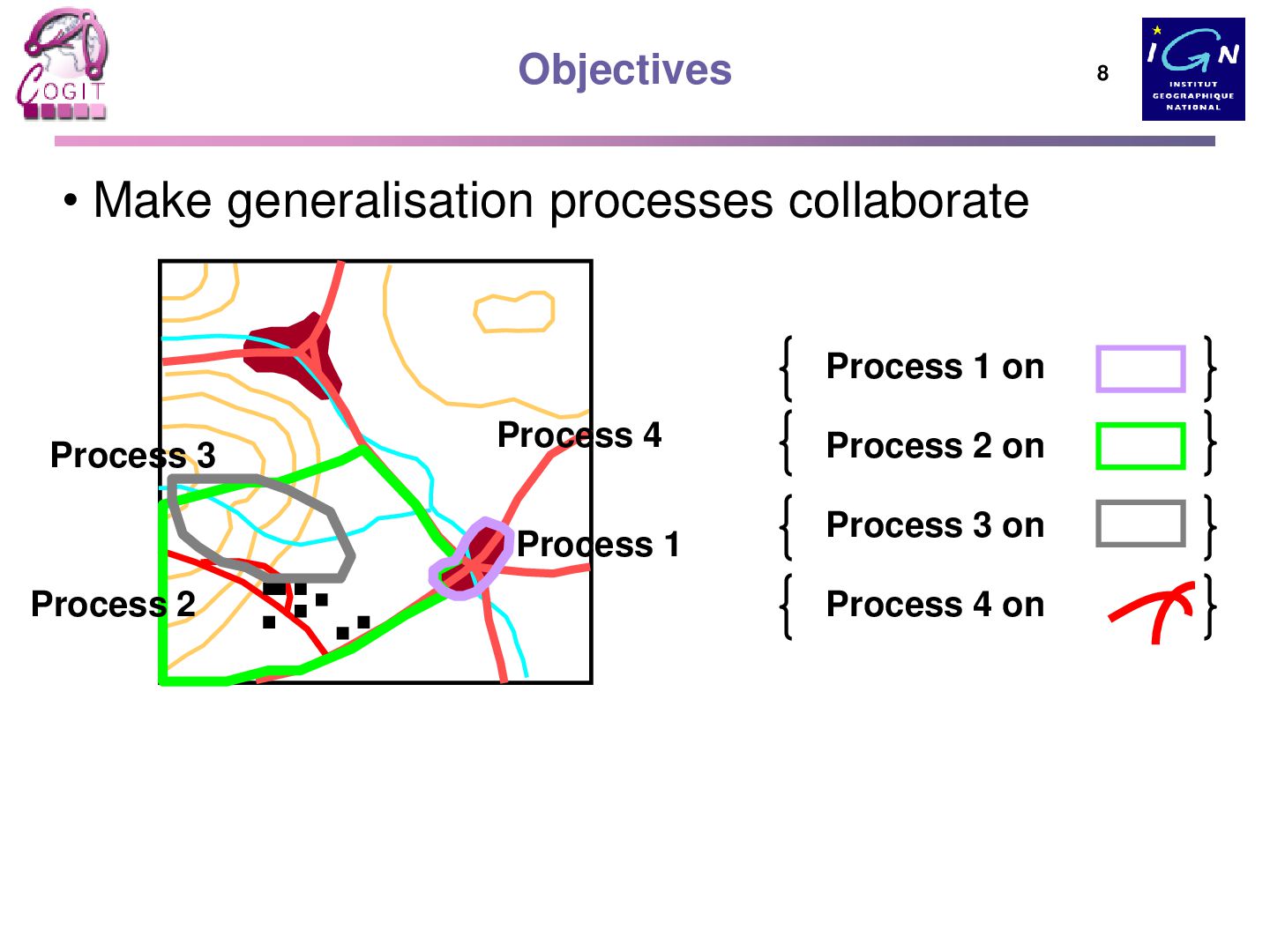
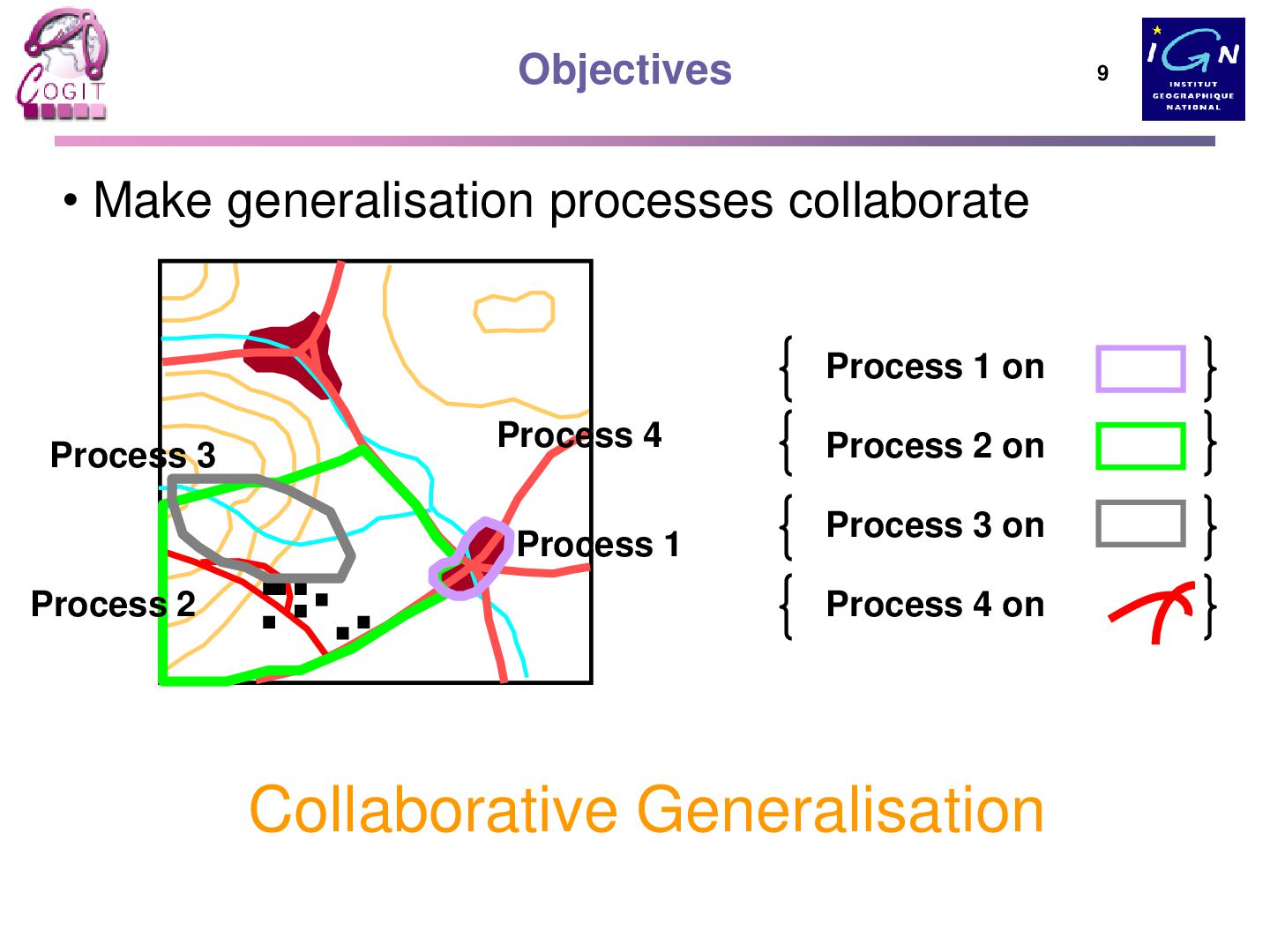
  7. Objectives 8 • Make generalisation processes collaborate Process 1 on

    Process 3 Process 4 Process 1 Process 2 Process 2 on Process 3 on Process 4 on
  8. Objectives 9 • Make generalisation processes collaborate Process 1 on

    Process 3 Process 4 Process 1 Process 2 Process 2 on Process 3 on Process 4 on Collaborative Generalisation
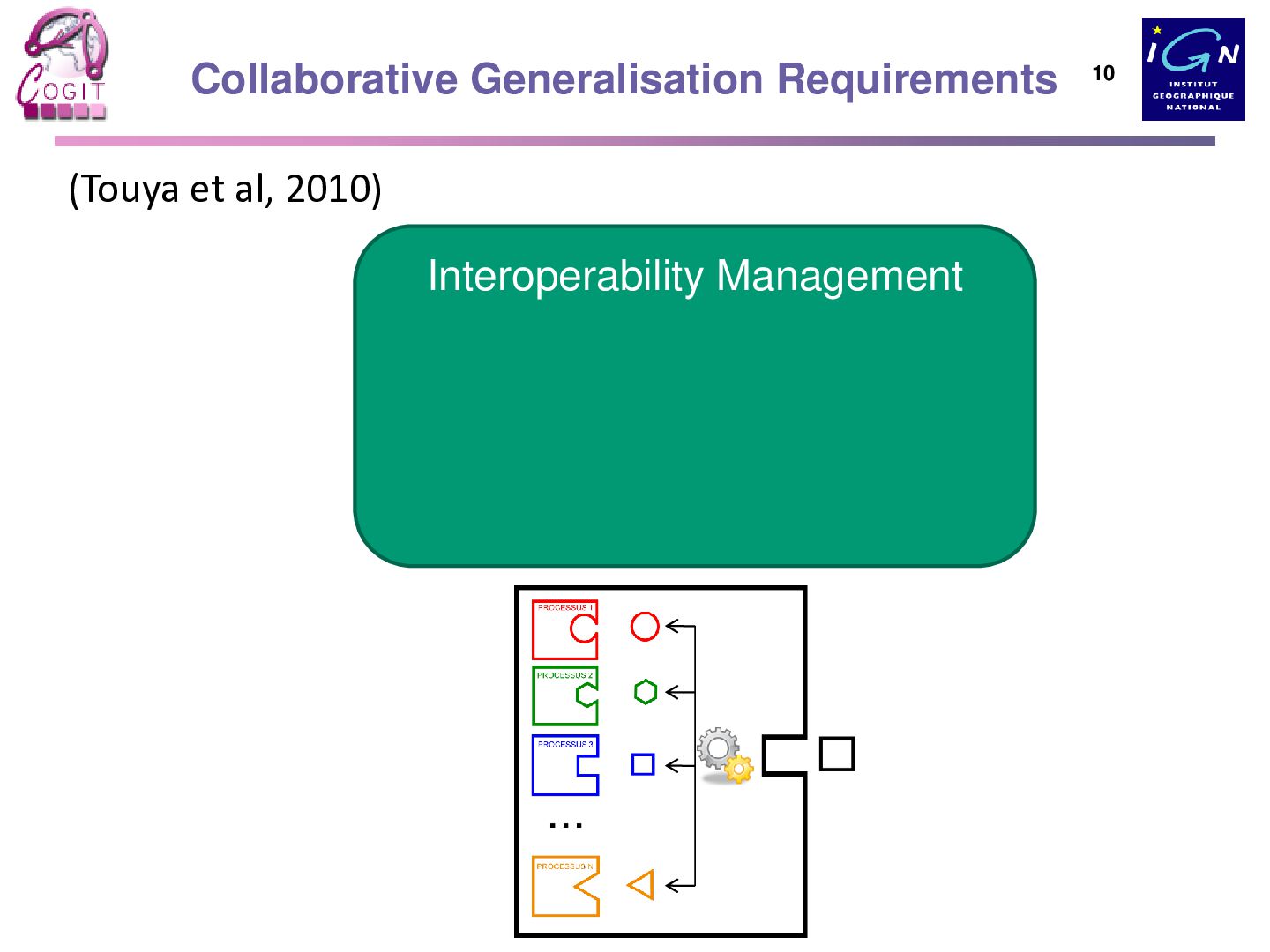
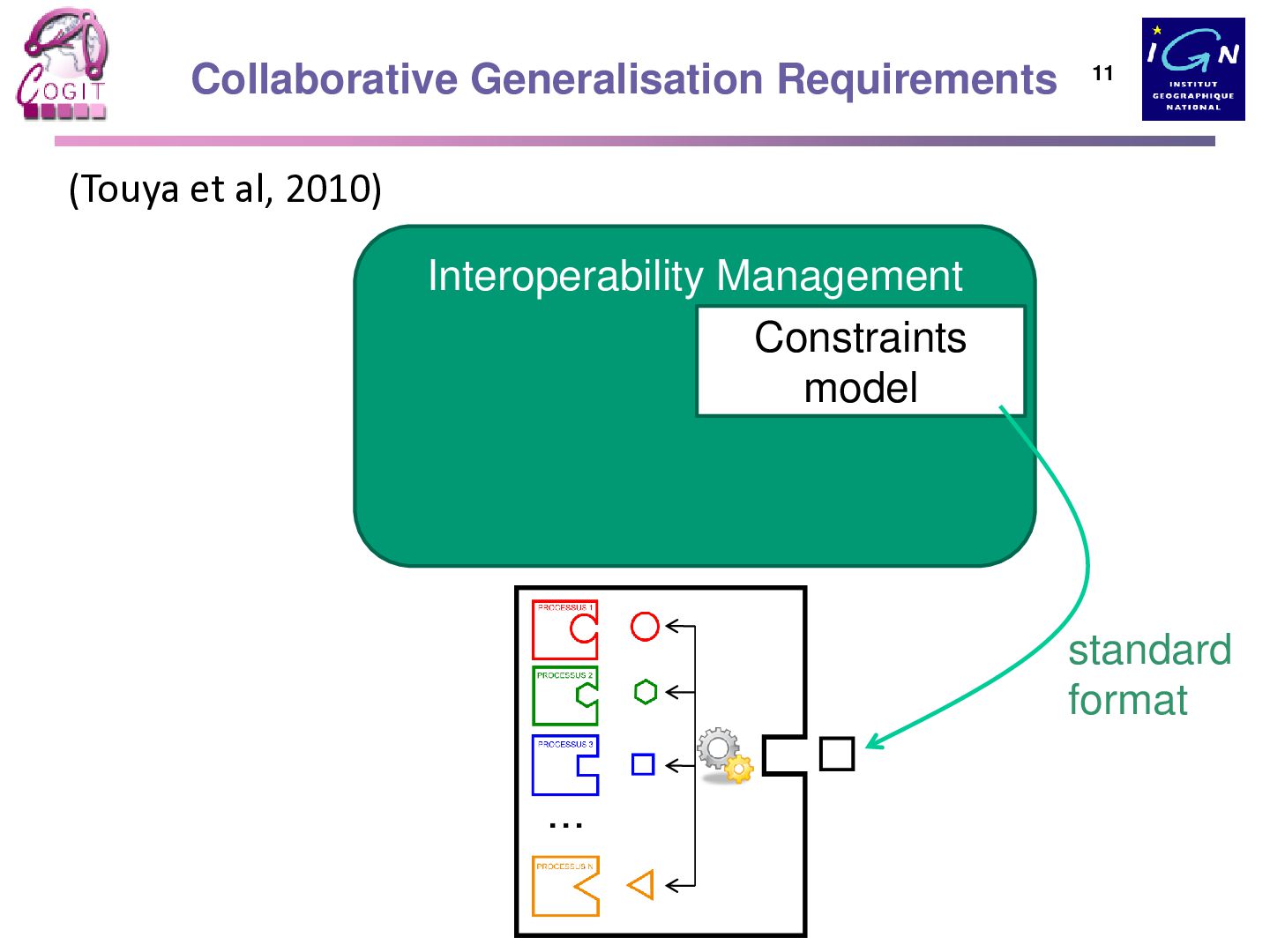
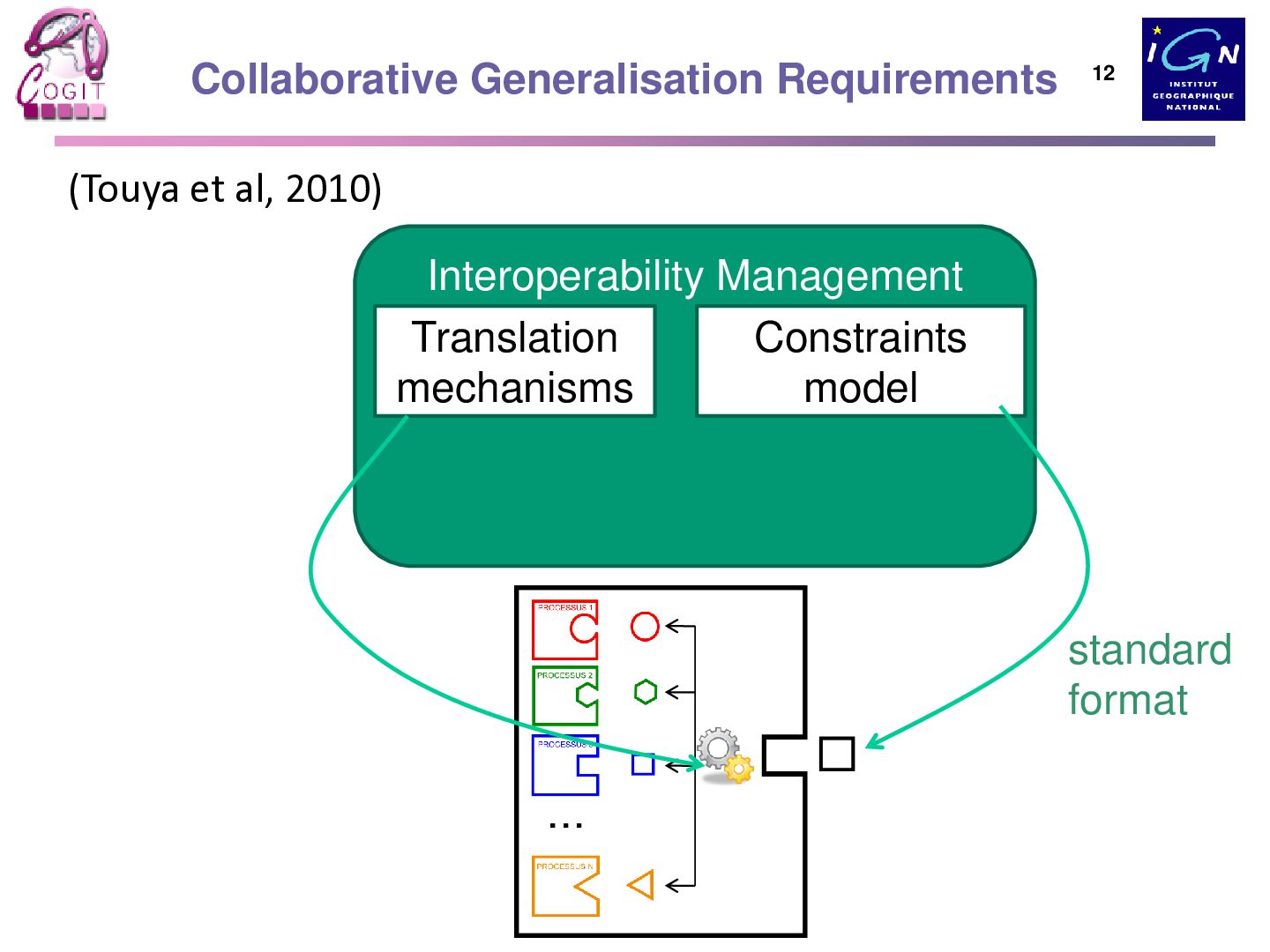
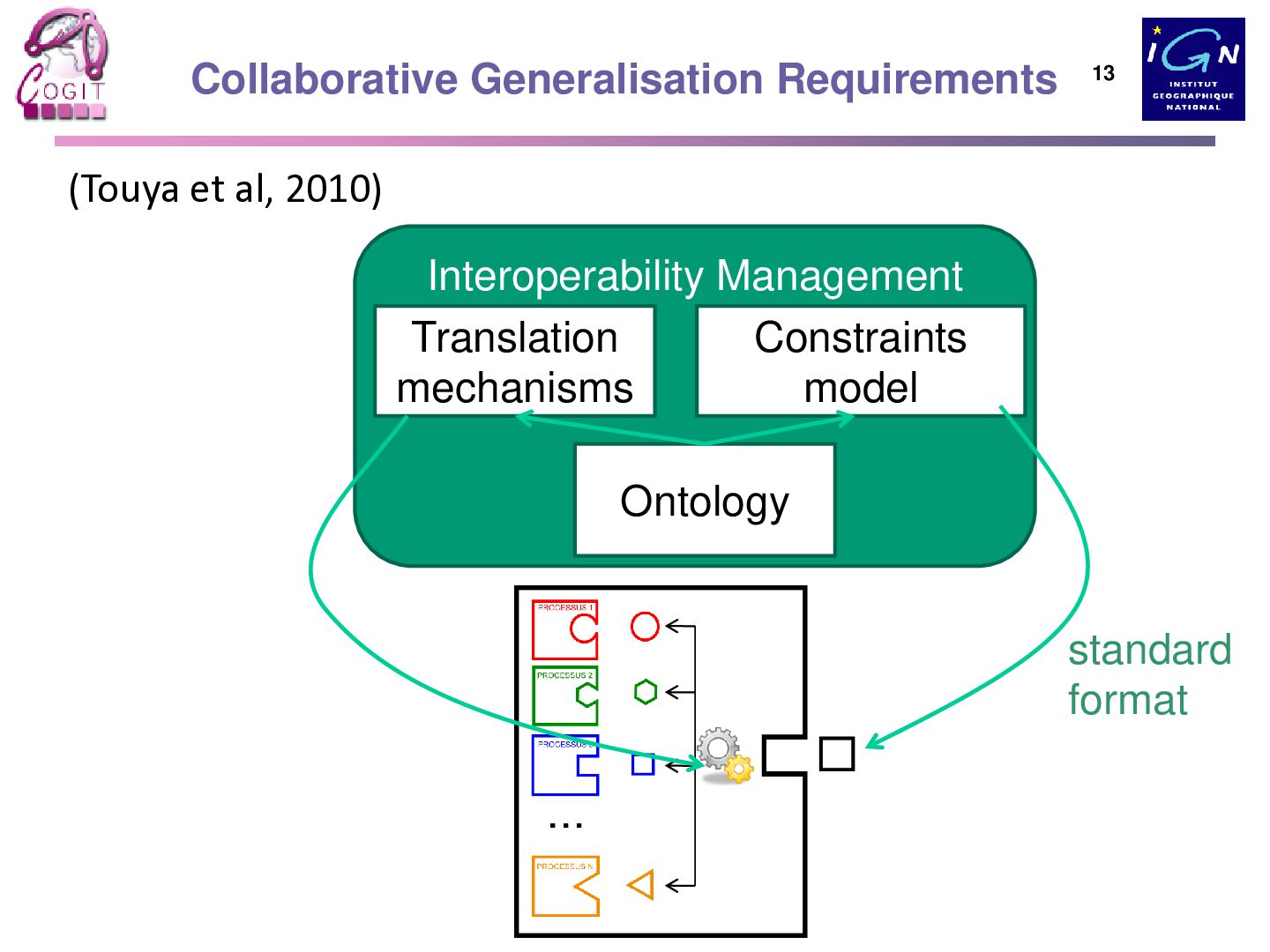
  9. Collaborative Generalisation Requirements 13 (Touya et al, 2010) Interoperability Management

    Translation Constraints mechanisms model Ontology standard format
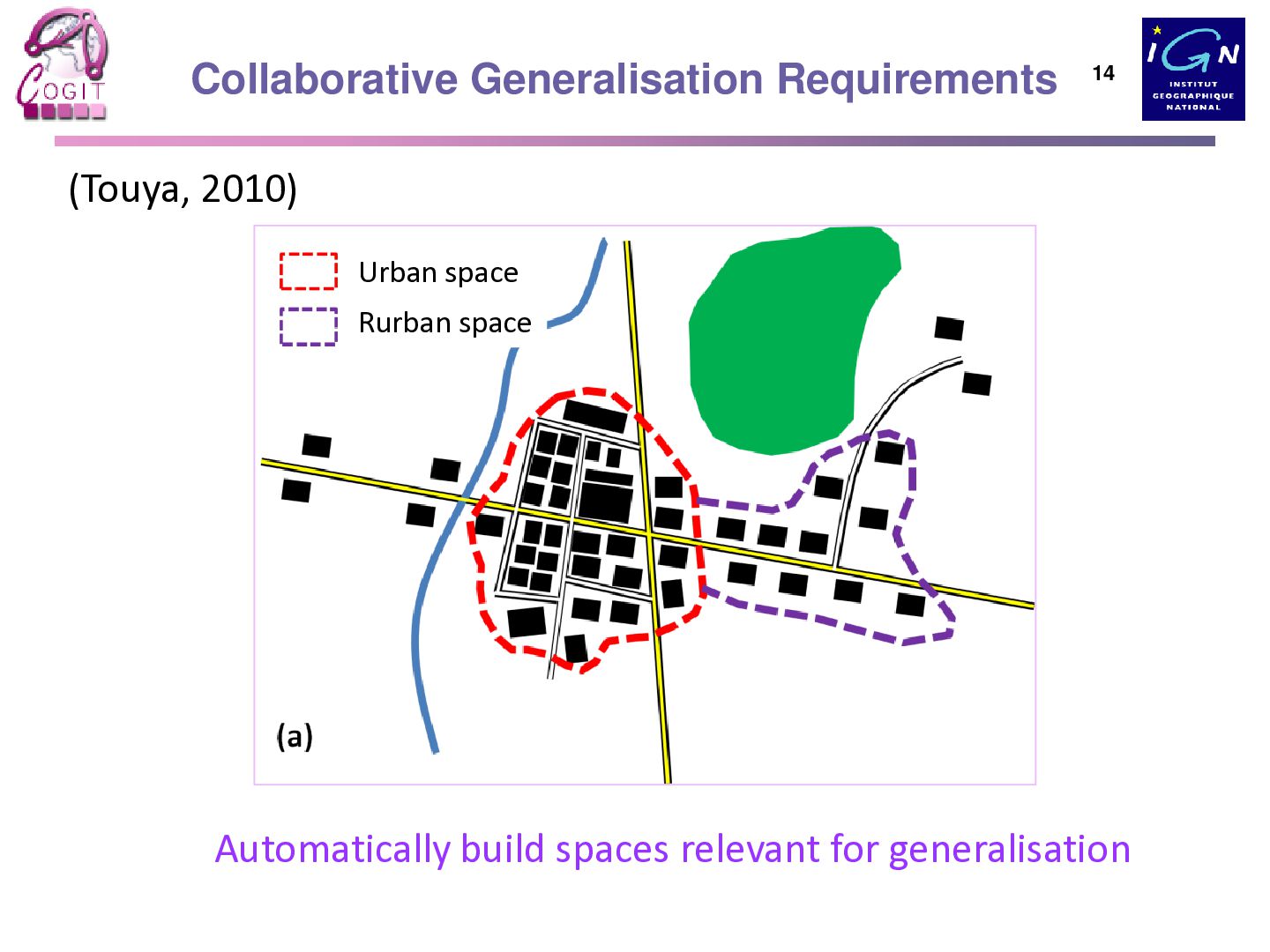
  10. Collaborative Generalisation Requirements 14 (Touya, 2010) Urban space Rurban space

    Automatically build spaces relevant for generalisation
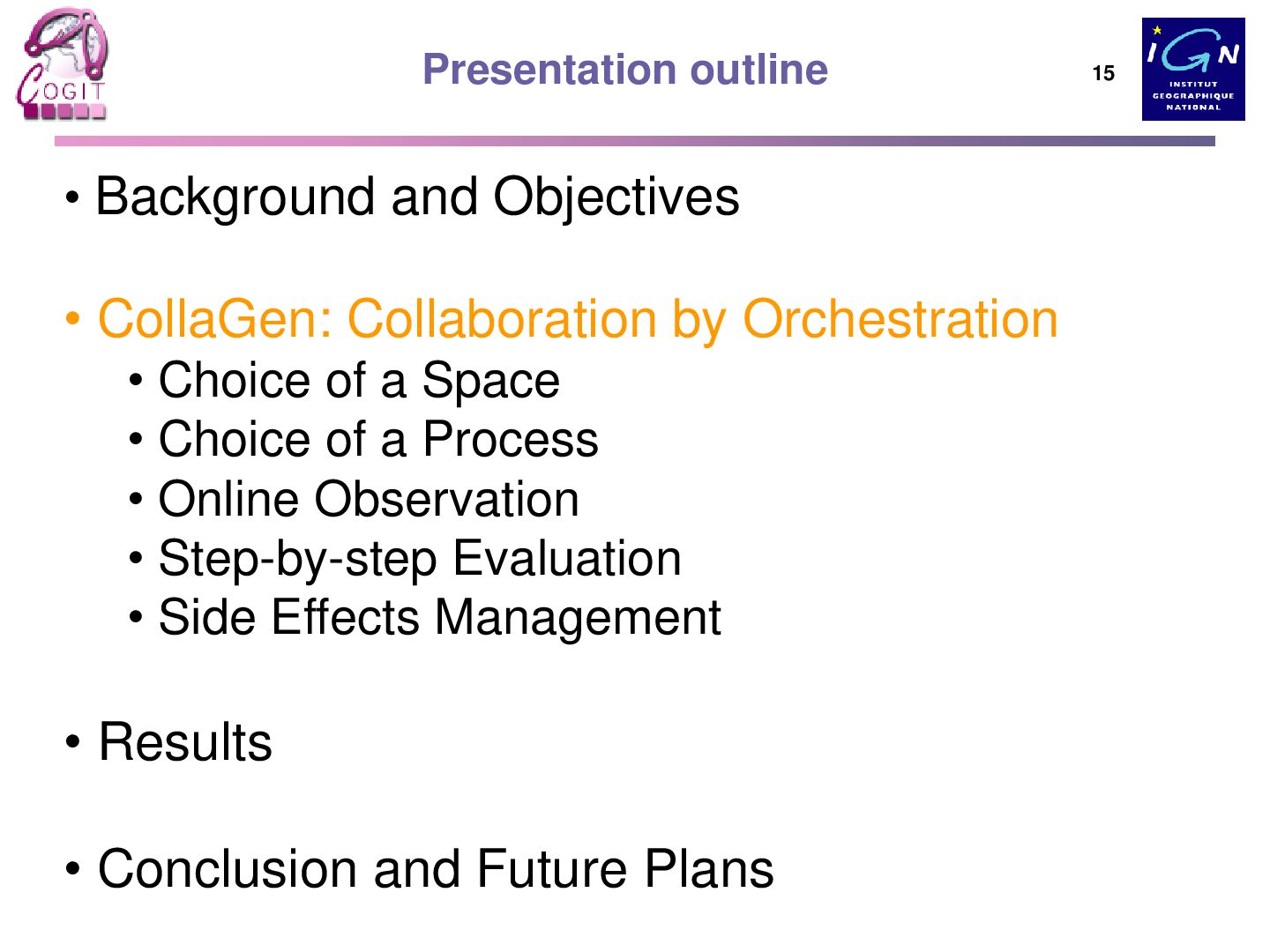
  11. Presentation outline • Background and Objectives • CollaGen: Collaboration by

    Orchestration • Choice of a Space • Choice of a Process • Online Observation • Step-by-step Evaluation • Side Effects Management • Results • Conclusion and Future Plans 15
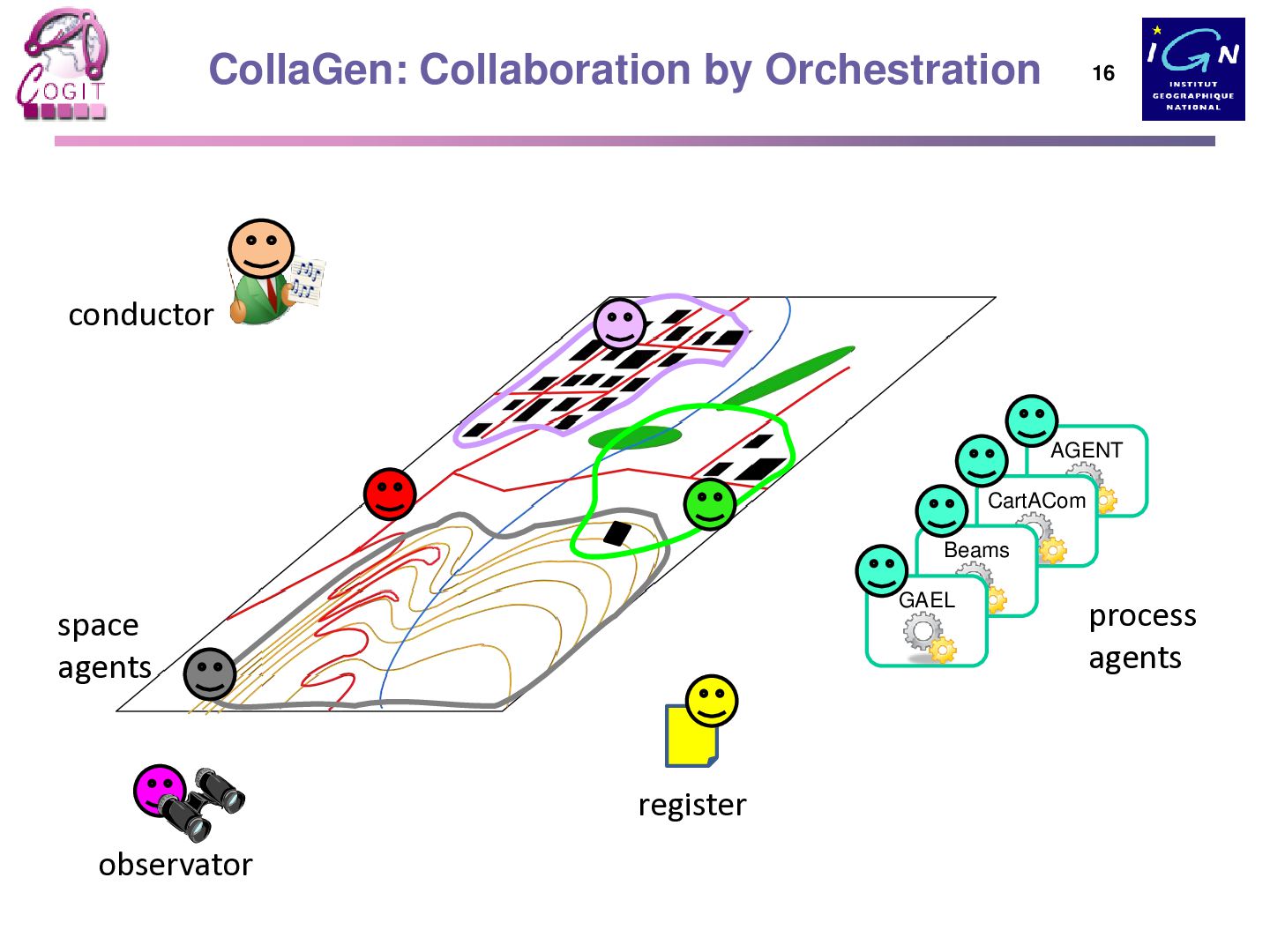
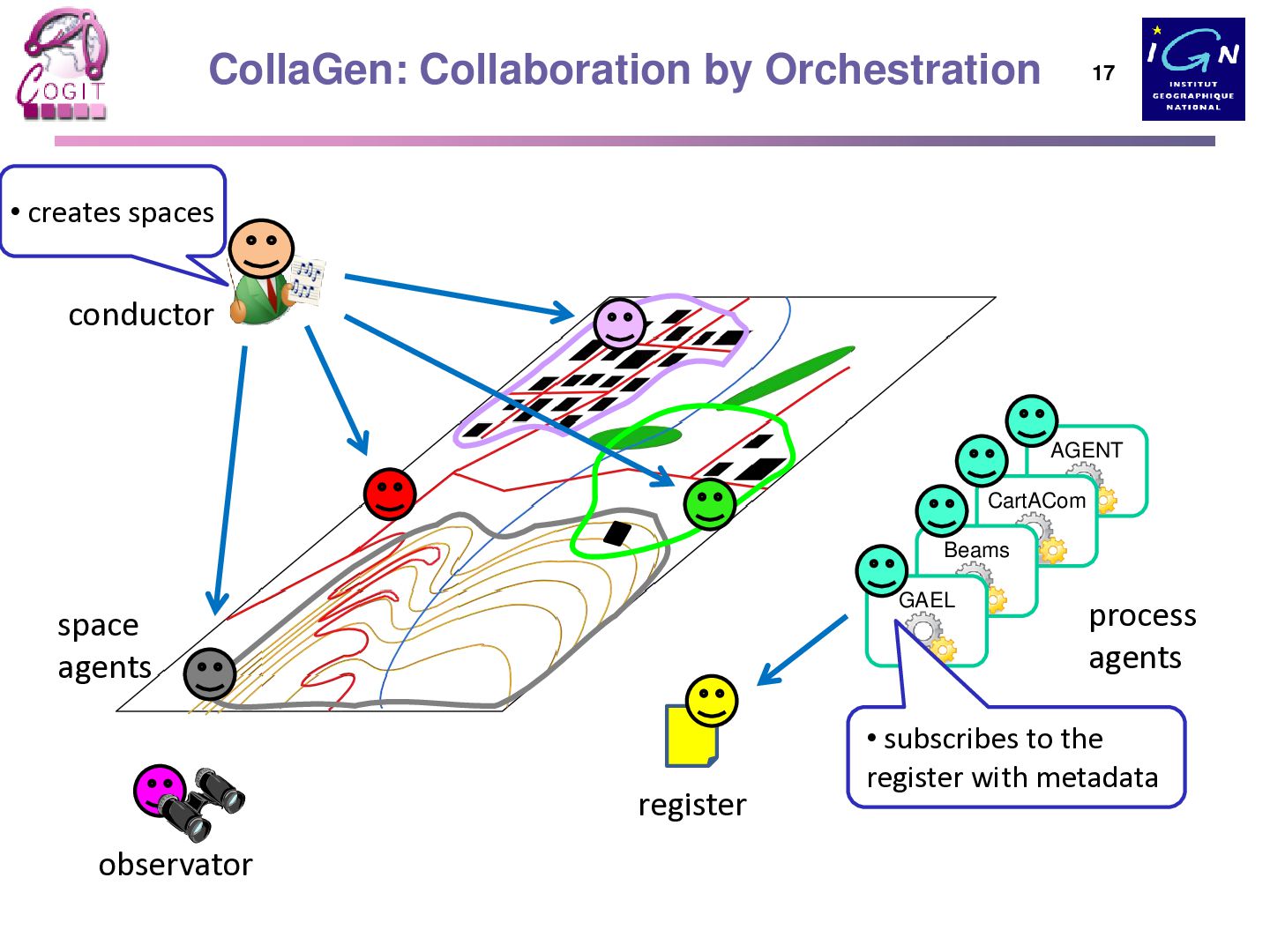
  12. CollaGen: Collaboration by Orchestration 17 • creates spaces conductor AGENT

    CartACom Beams GAEL space agents register observator process agents • subscribes to the register with metadata
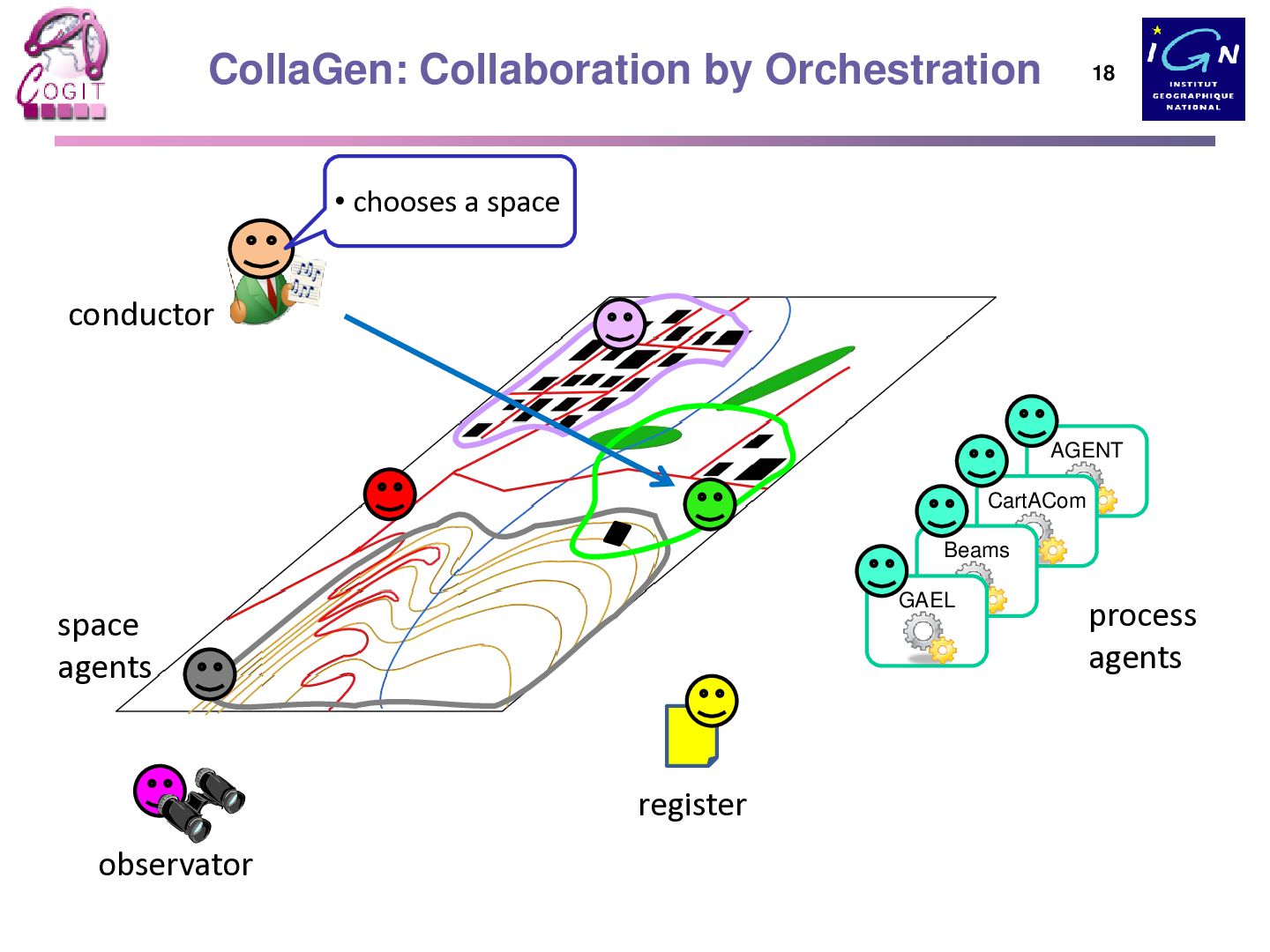
  13. CollaGen: Collaboration by Orchestration 18 • chooses a space conductor

    AGENT CartACom Beams GAEL space agents register observator process agents
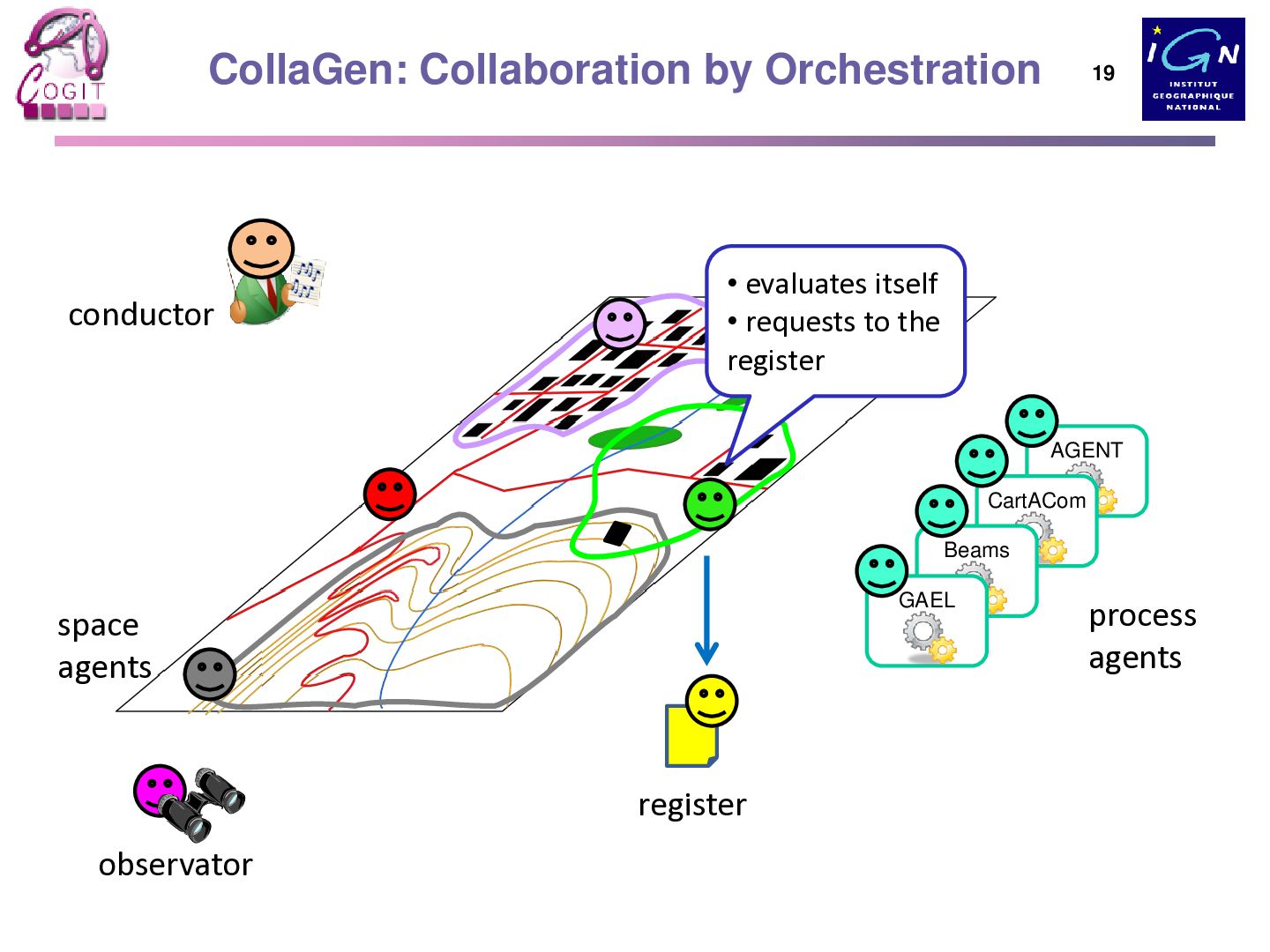
  14. CollaGen: Collaboration by Orchestration conductor 19 • evaluates itself •

    requests to the register AGENT CartACom Beams GAEL space agents register observator process agents
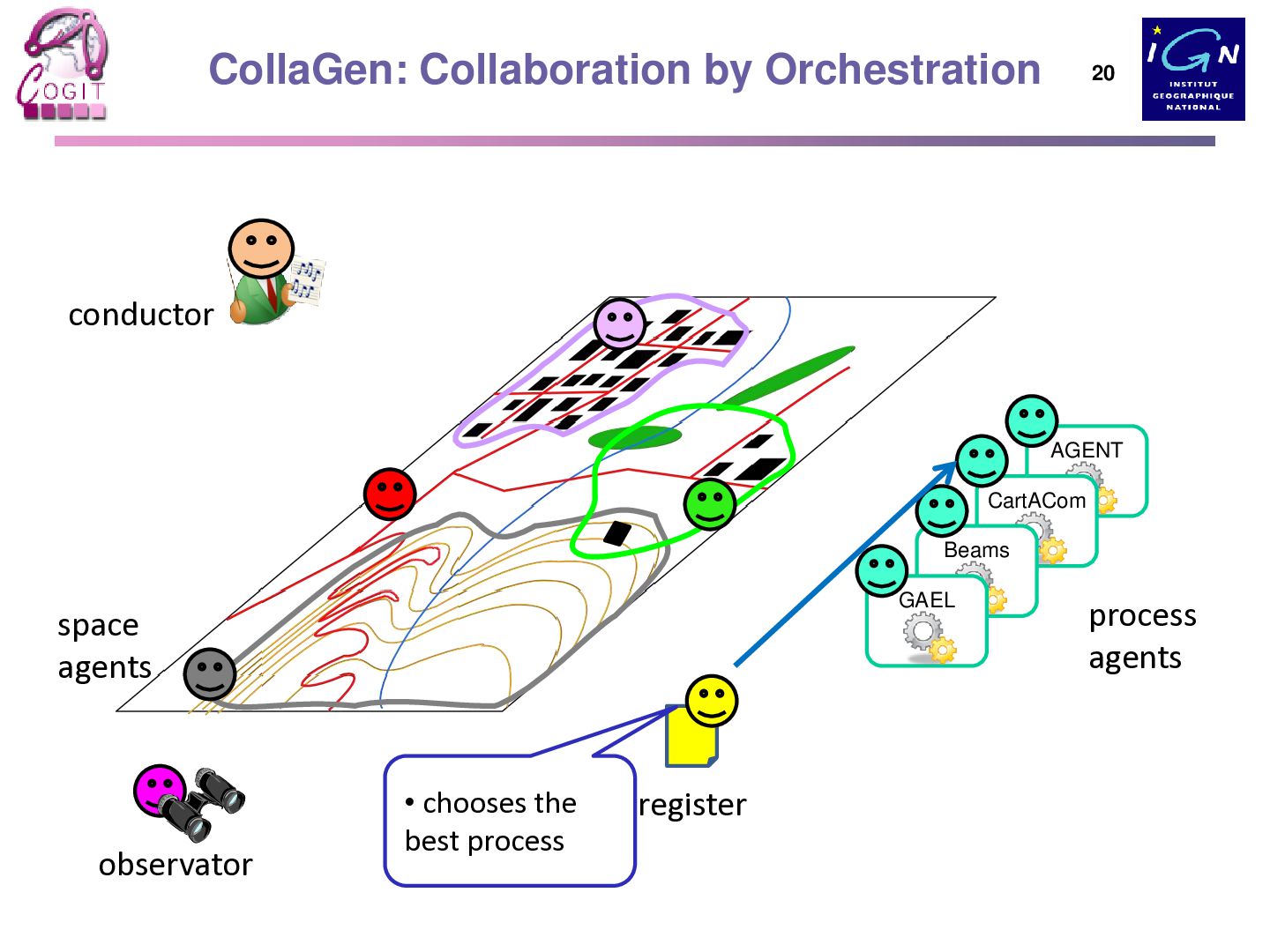
  15. CollaGen: Collaboration by Orchestration 20 conductor AGENT CartACom Beams GAEL

    space agents observator • chooses the best process register process agents
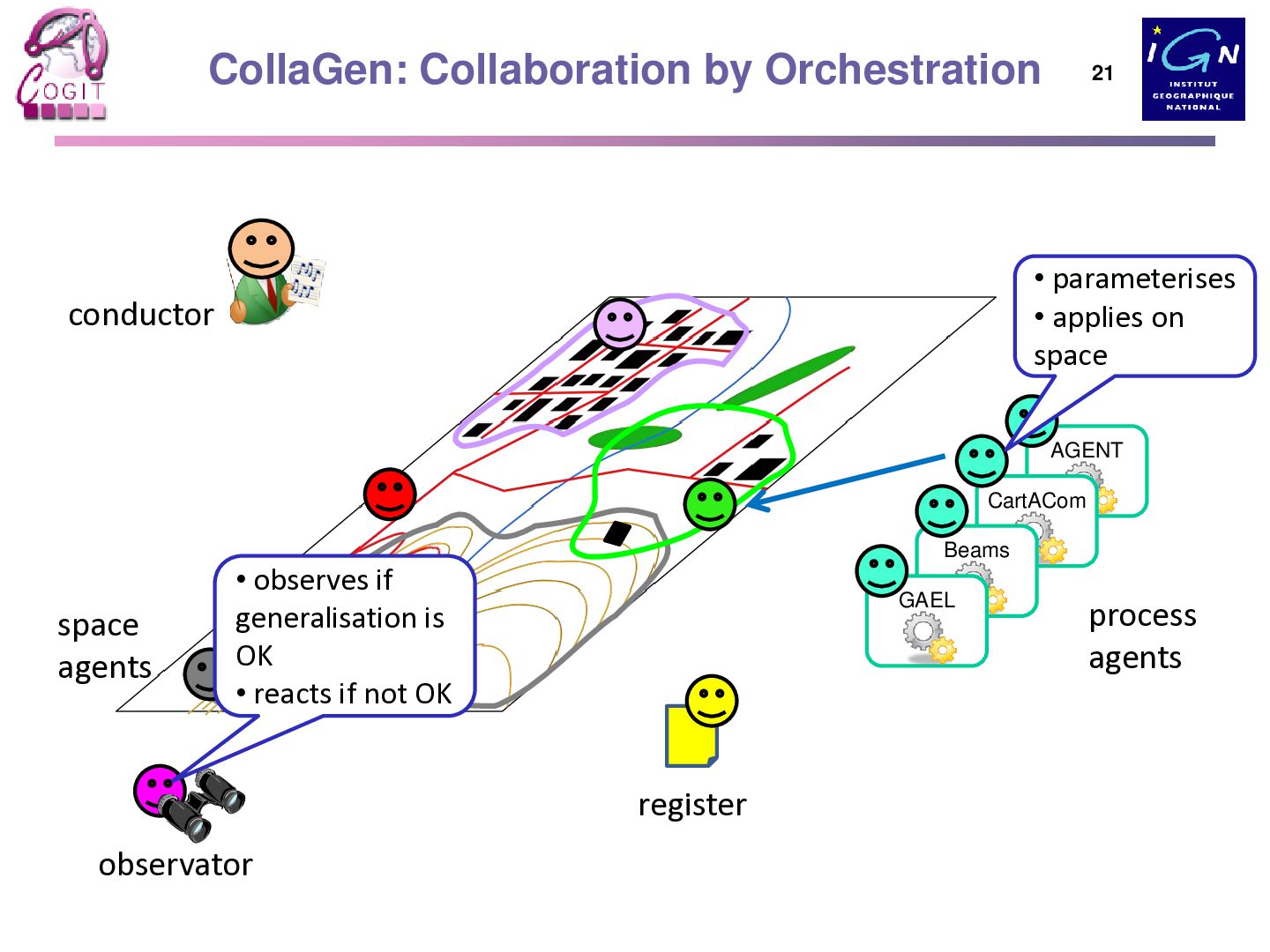
  16. CollaGen: Collaboration by Orchestration 21 • parameterises • applies on

    space conductor AGENT CartACom space agents Beams • observes if generalisation is OK • reacts if not OK GAEL register observator process agents
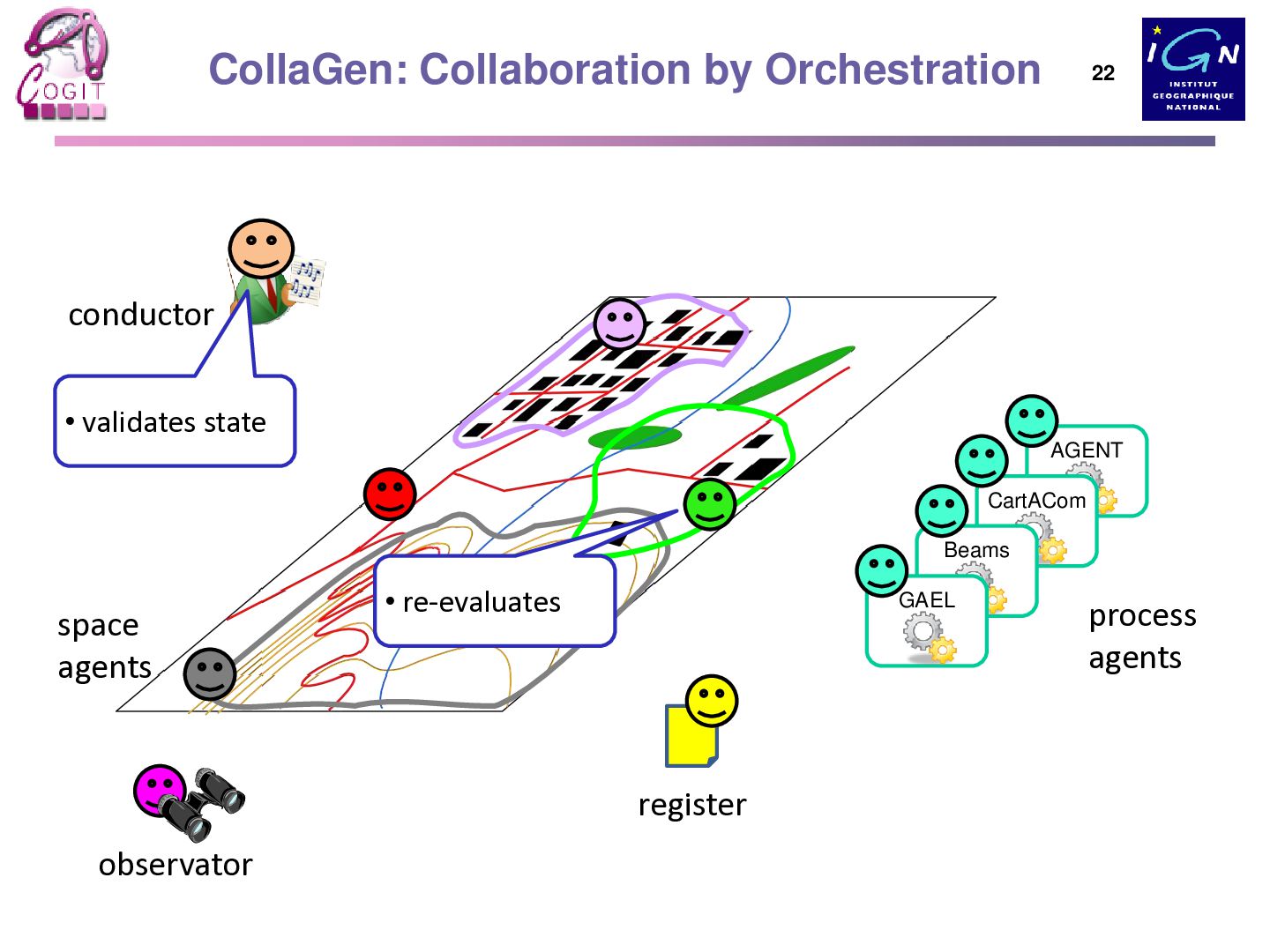
  17. CollaGen: Collaboration by Orchestration 22 conductor • validates state AGENT

    CartACom Beams space agents • re-evaluates GAEL register observator process agents
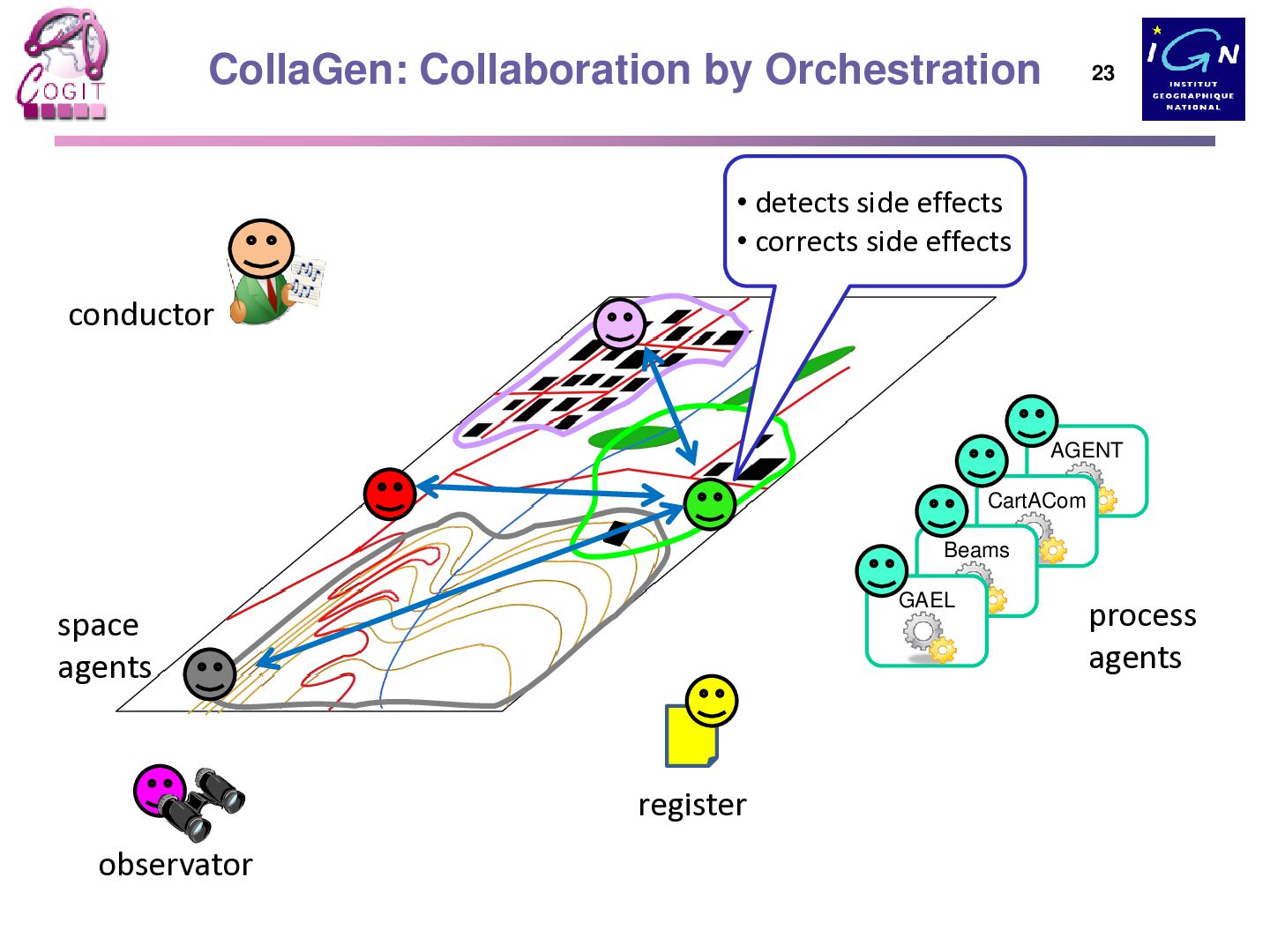
  18. CollaGen: Collaboration by Orchestration 23 • detects side effects •

    corrects side effects conductor AGENT CartACom Beams GAEL space agents register observator process agents
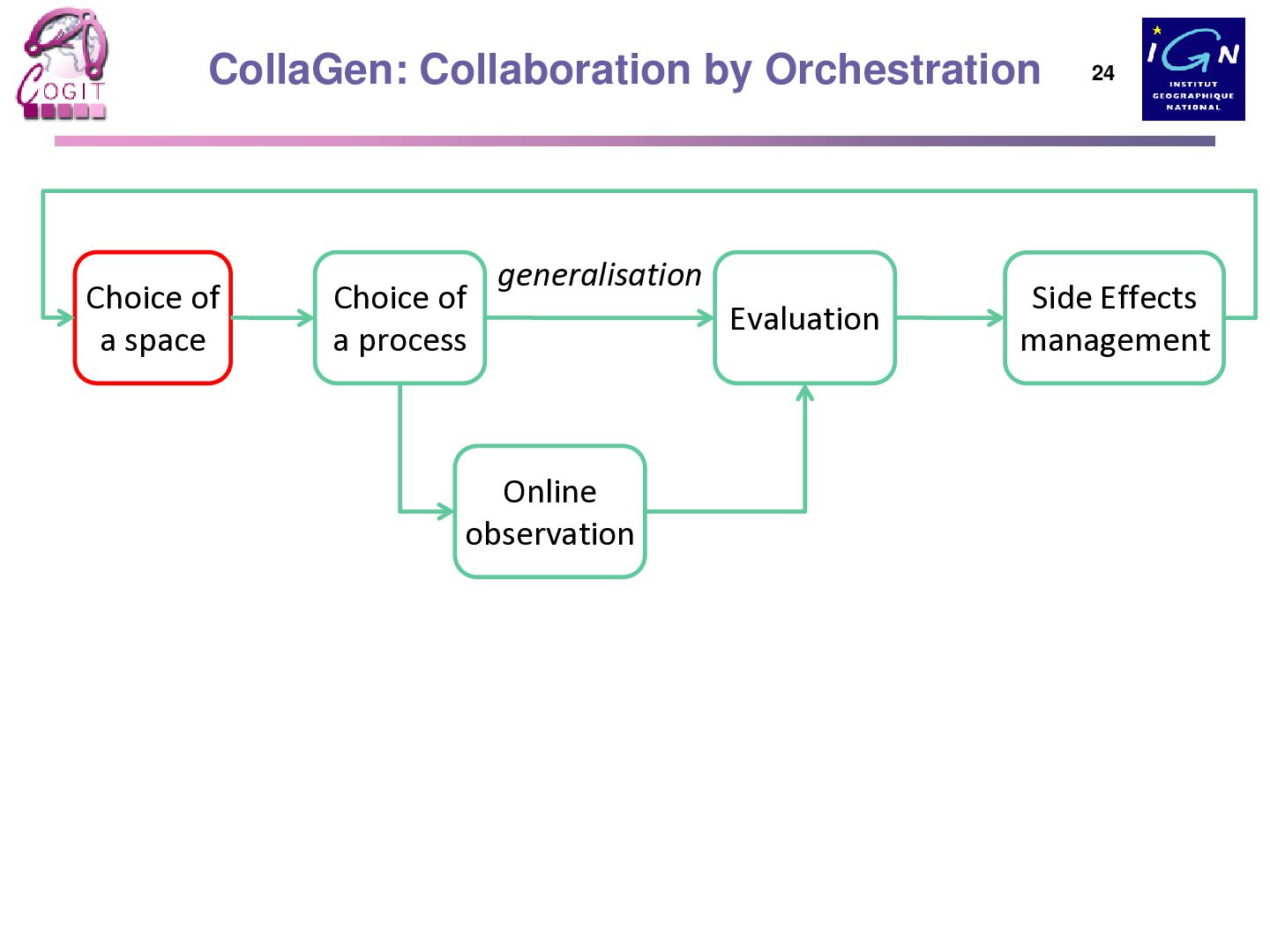
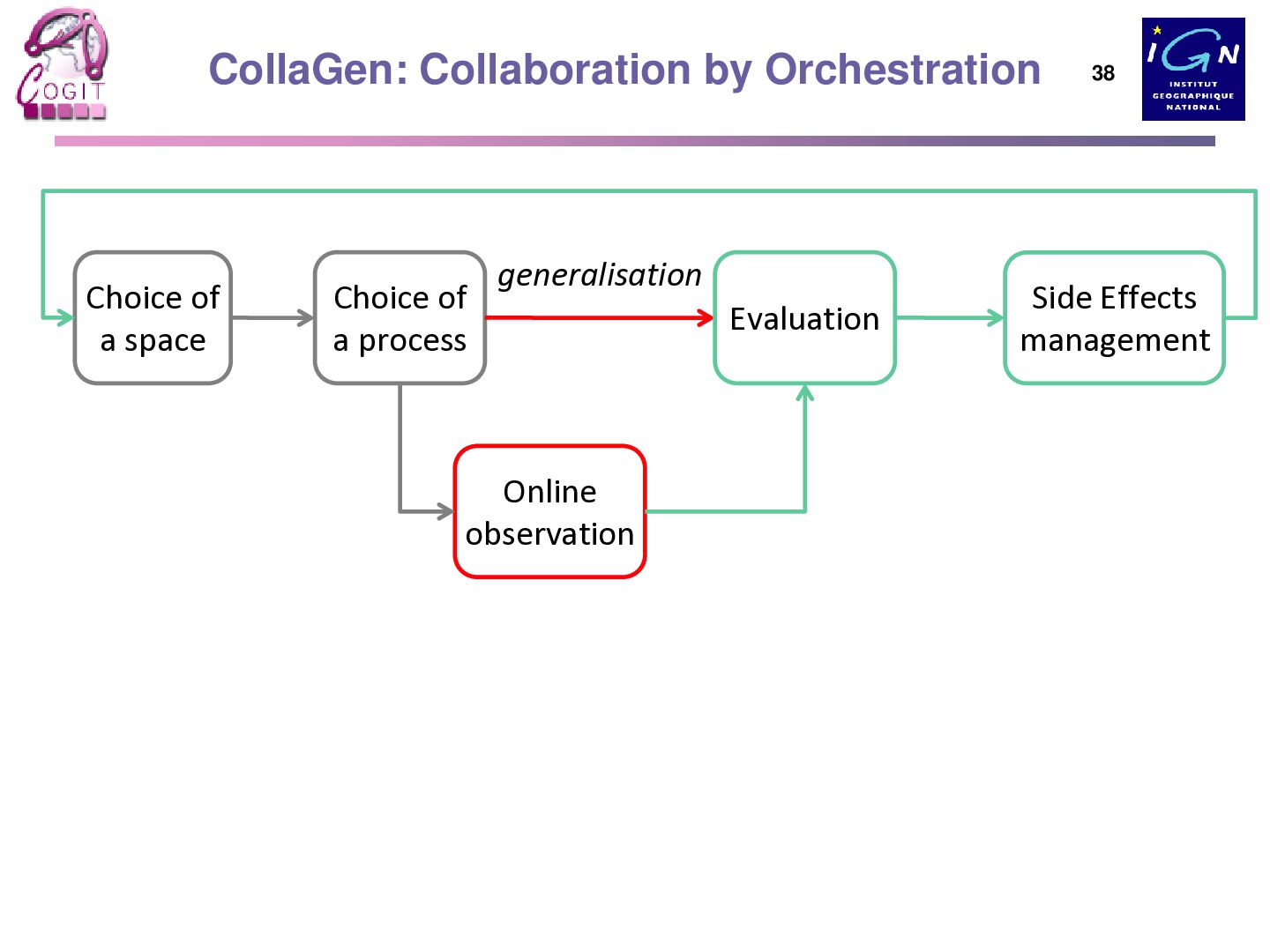
  19. CollaGen: Collaboration by Orchestration Choice of a space Choice of

    a process generalisation Online observation Evaluation 24 Side Effects management
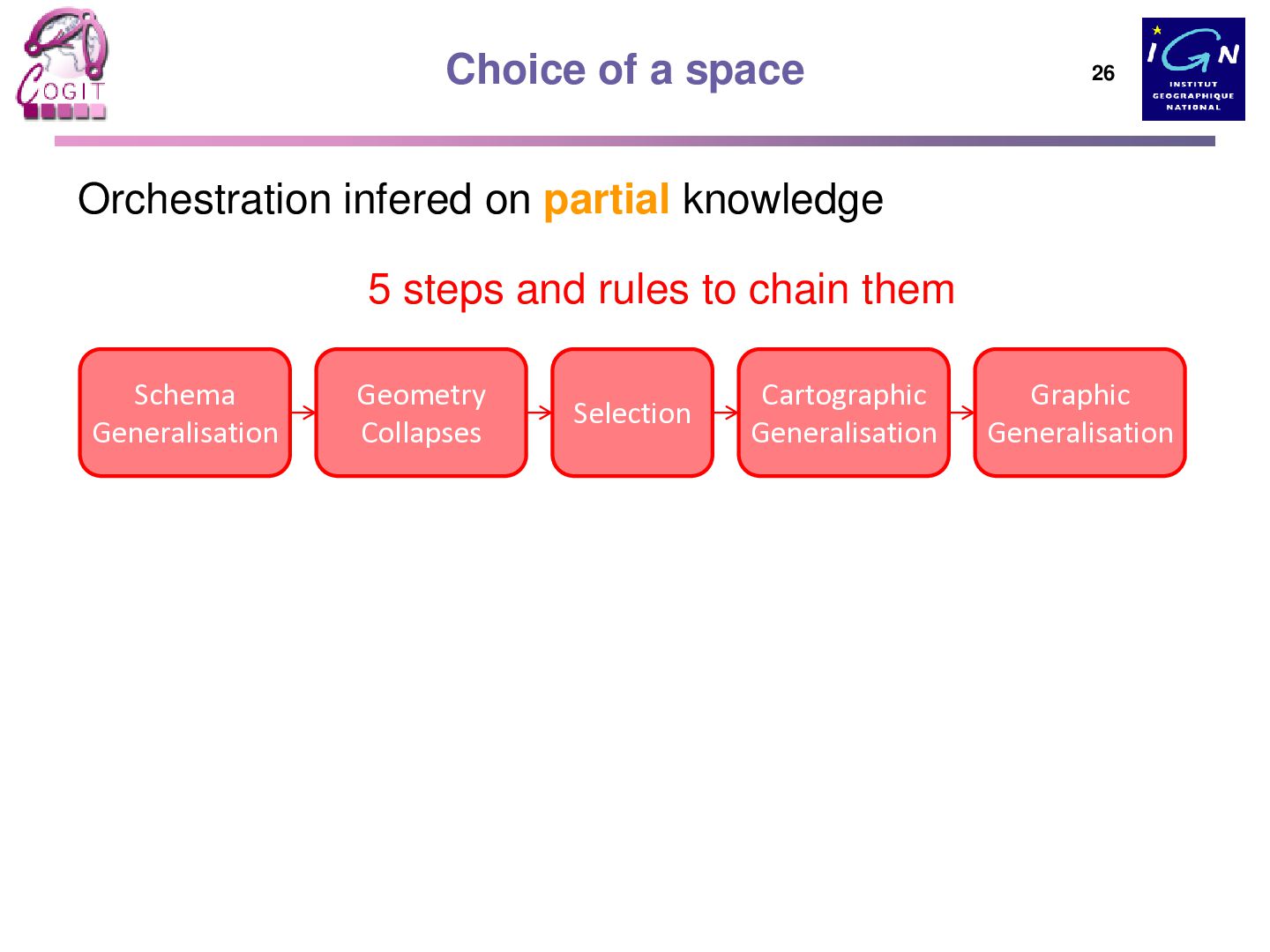
  20. Choice of a space 26 Orchestration infered on partial knowledge

    5 steps and rules to chain them Schema Generalisation Geometry Collapses Selection Cartographic Generalisation Graphic Generalisation
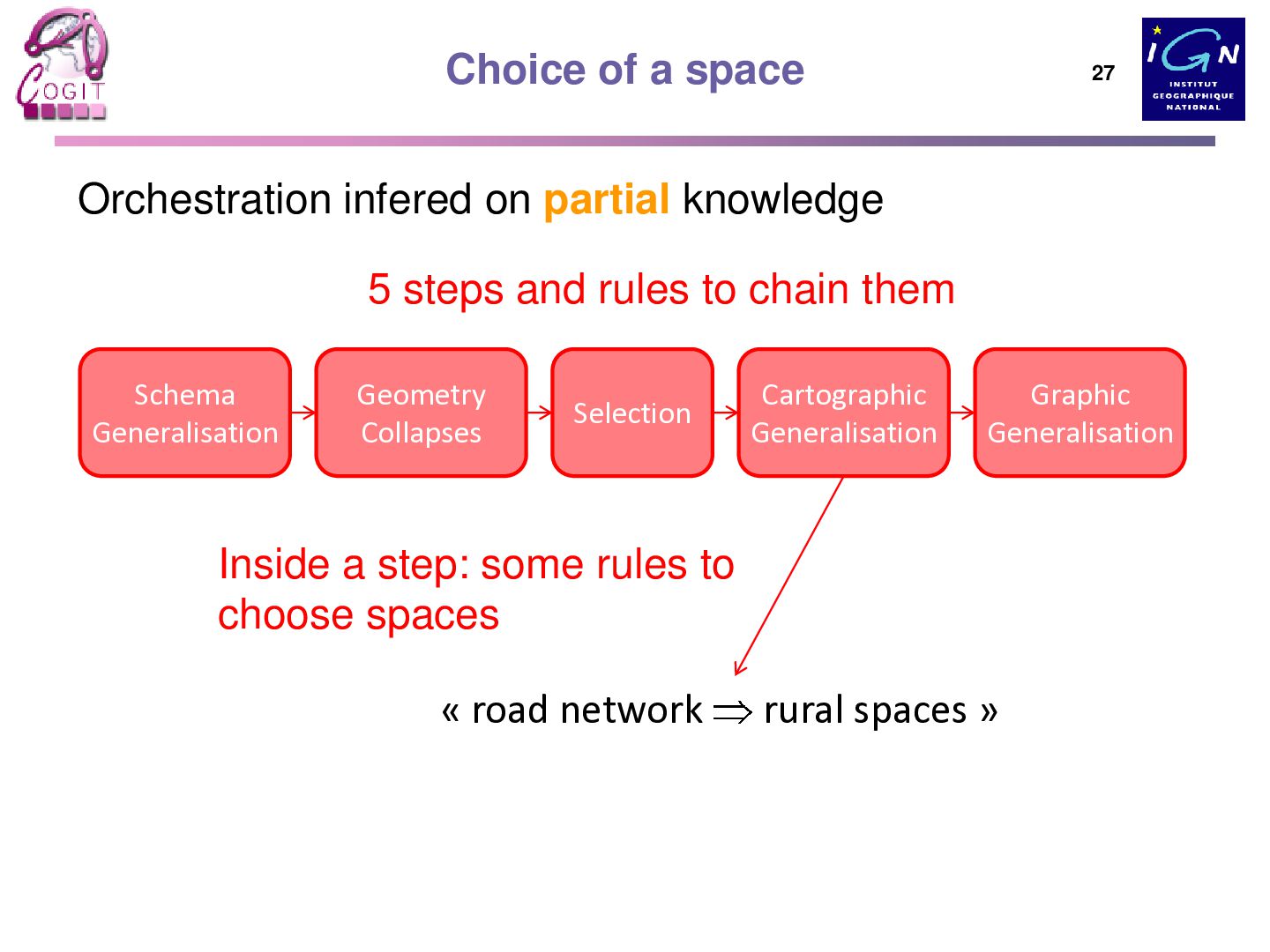
  21. Choice of a space 27 Orchestration infered on partial knowledge

    5 steps and rules to chain them Schema Generalisation Geometry Collapses Selection Cartographic Generalisation Graphic Generalisation Inside a step: some rules to choose spaces « road network rural spaces »
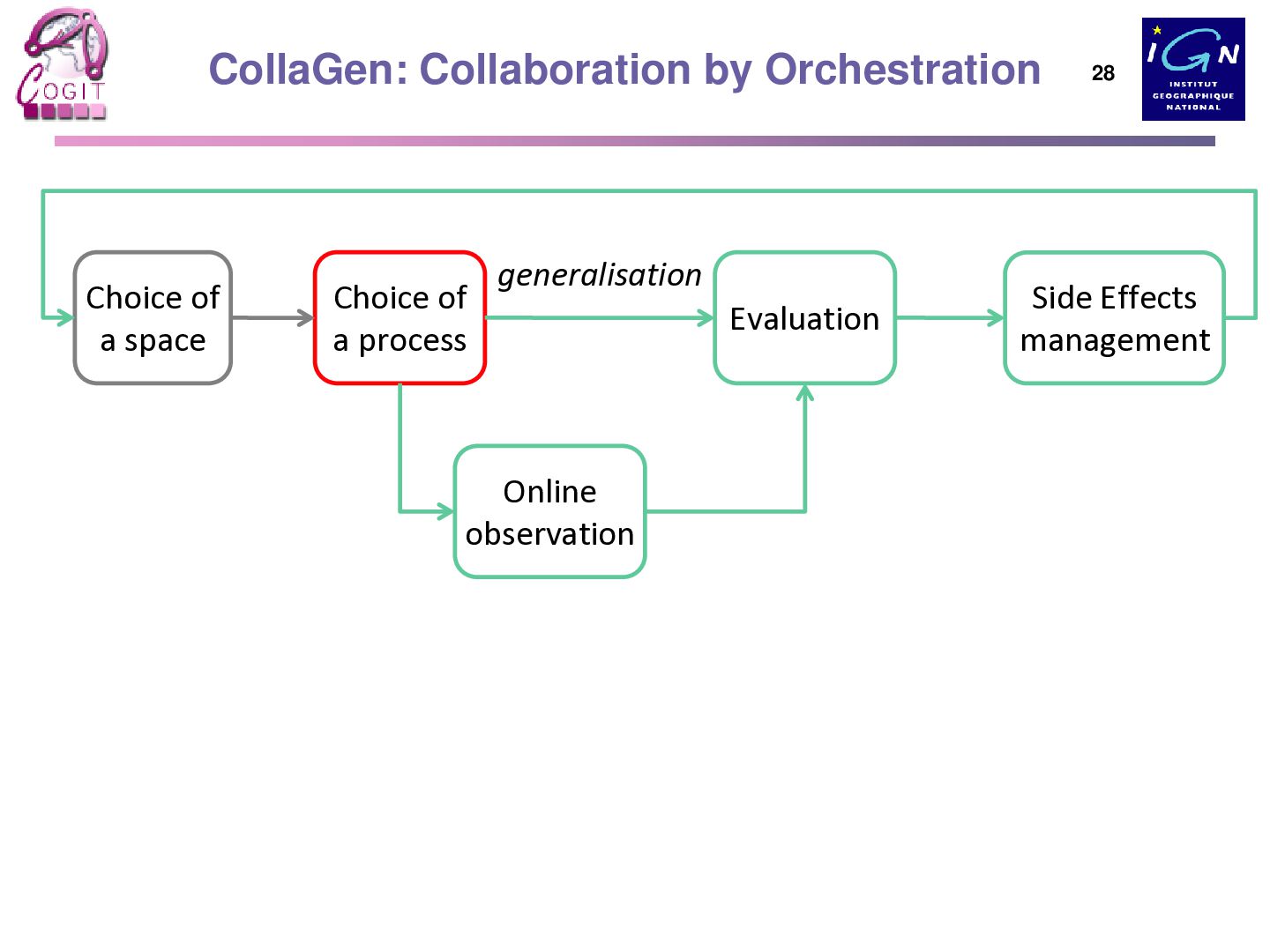
  22. CollaGen: Collaboration by Orchestration Choice of a space Choice of

    a process generalisation Online observation Evaluation 28 Side Effects management
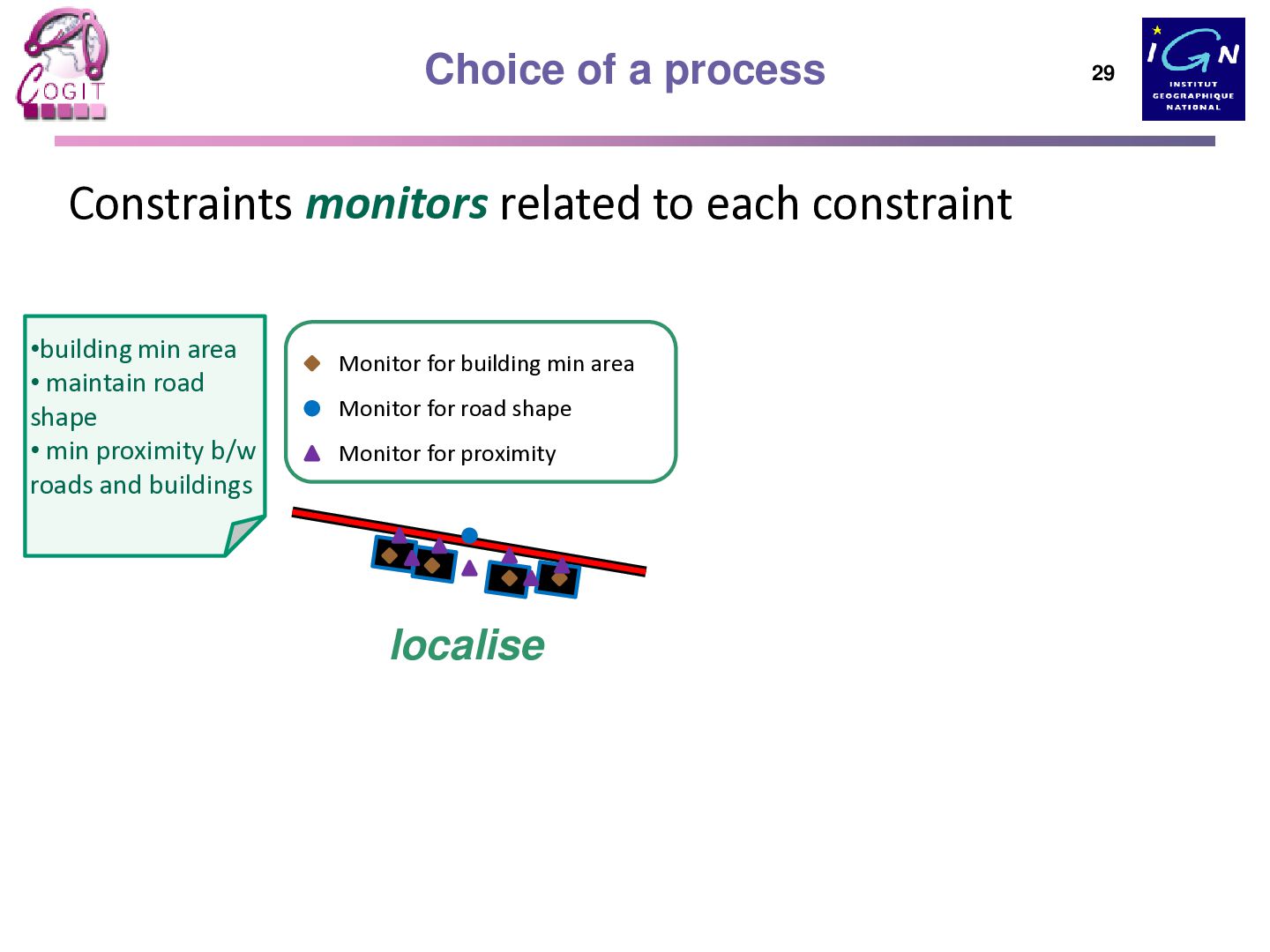
  23. Choice of a process Constraints monitors related to each constraint

    •building min area • maintain road shape • min proximity b/w roads and buildings Monitor for building min area Monitor for road shape Monitor for proximity localise 29
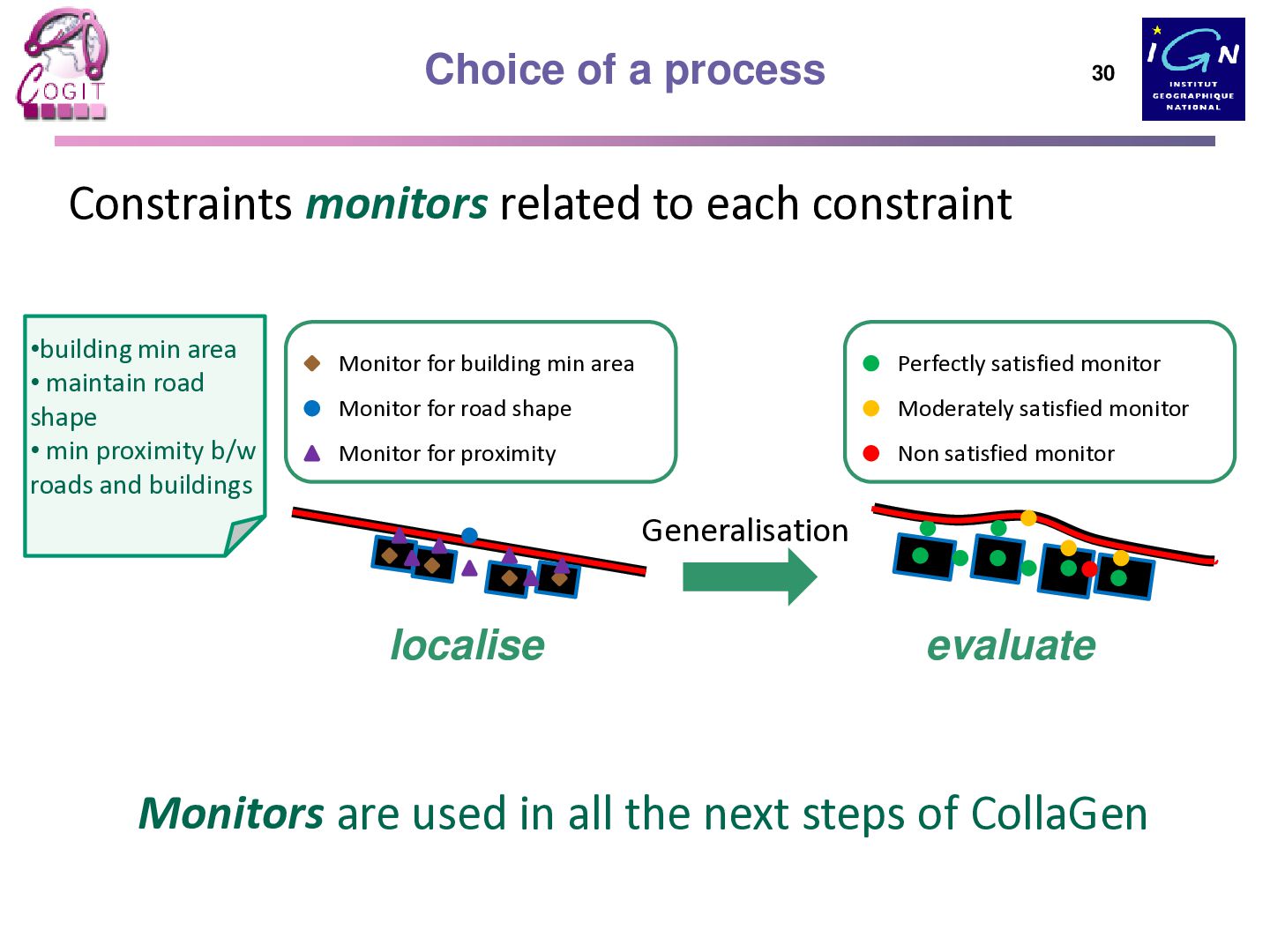
  24. Choice of a process 30 Constraints monitors related to each

    constraint •building min area • maintain road shape • min proximity b/w roads and buildings Monitor for building min area Perfectly satisfied monitor Monitor for road shape Moderately satisfied monitor Monitor for proximity Non satisfied monitor Generalisation localise evaluate Monitors are used in all the next steps of CollaGen
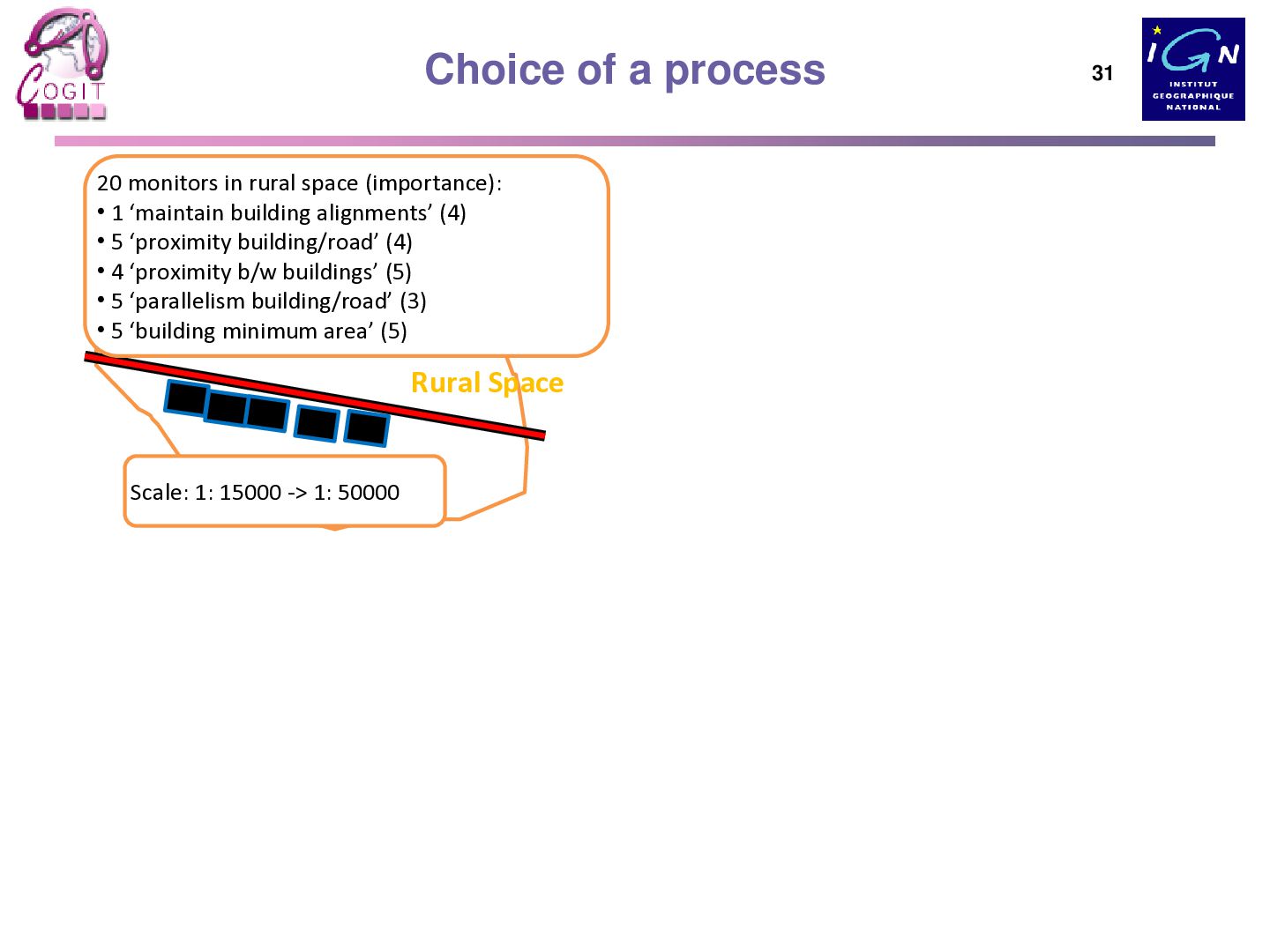
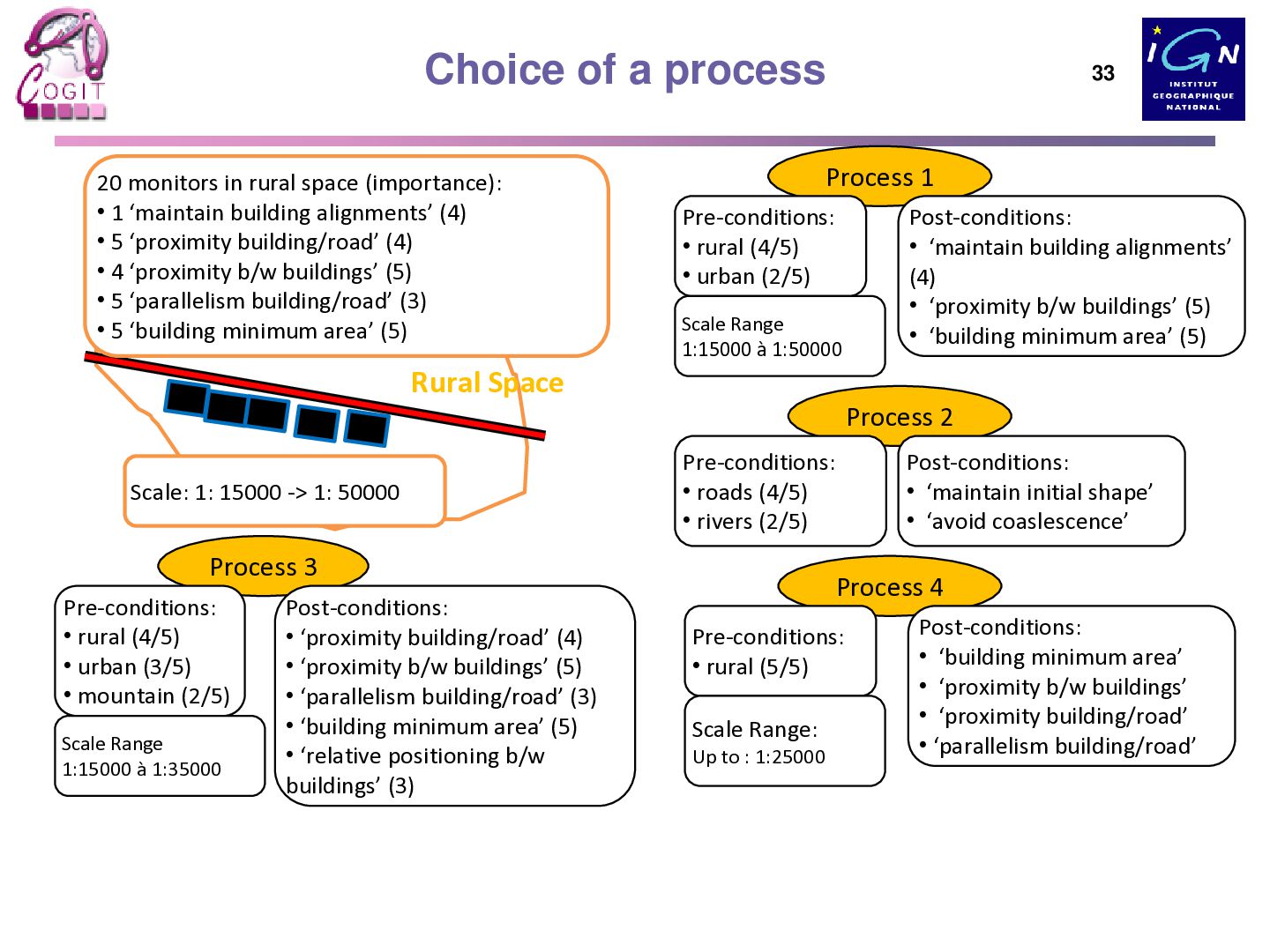
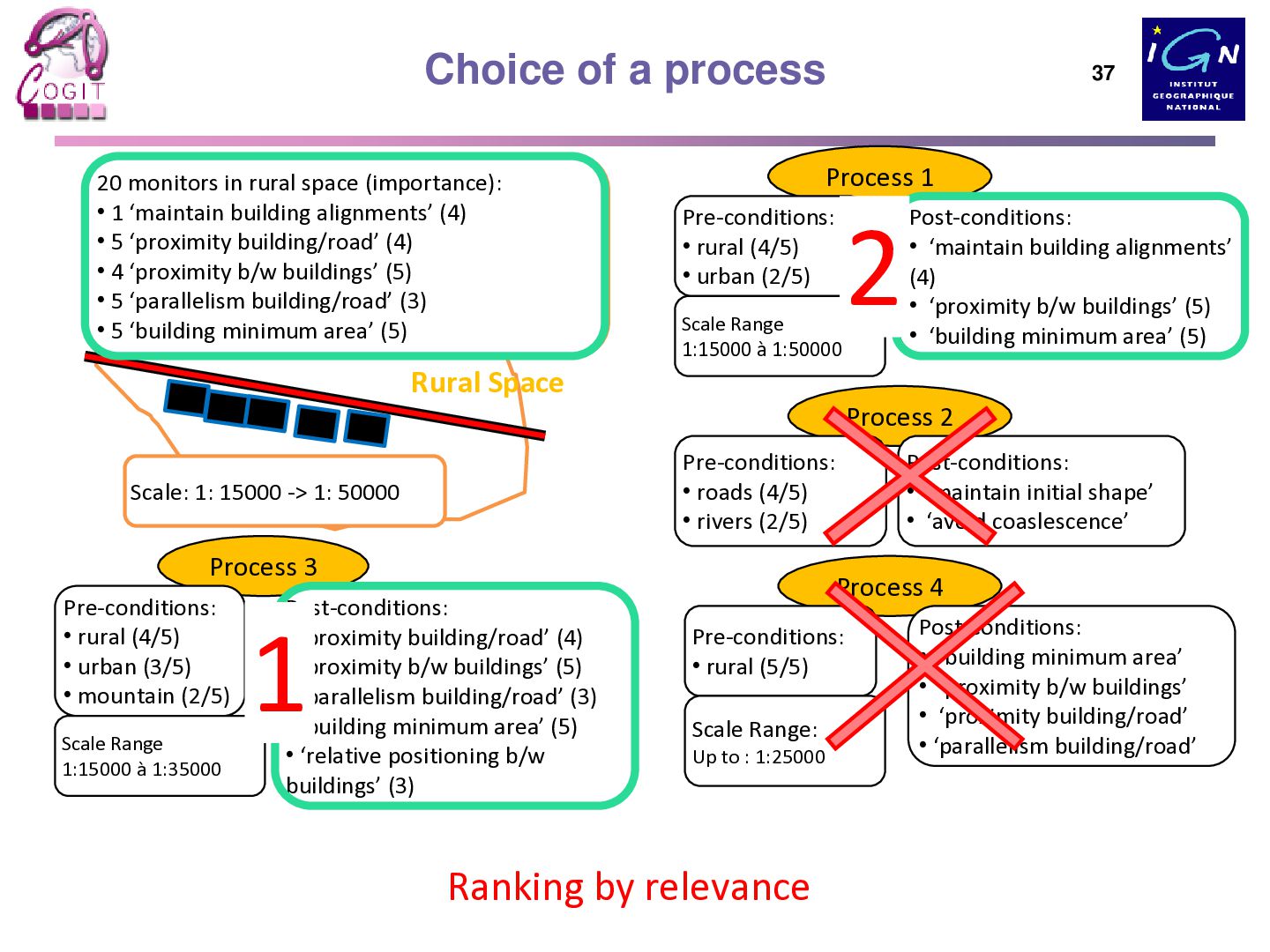
  25. Choice of a process 20 monitors in rural space (importance):

    • 1 ‘maintain building alignments’ (4) • 5 ‘proximity building/road’ (4) • 4 ‘proximity b/w buildings’ (5) • 5 ‘parallelism building/road’ (3) • 5 ‘building minimum area’ (5) Rural Space Scale: 1: 15000 -> 1: 50000 31
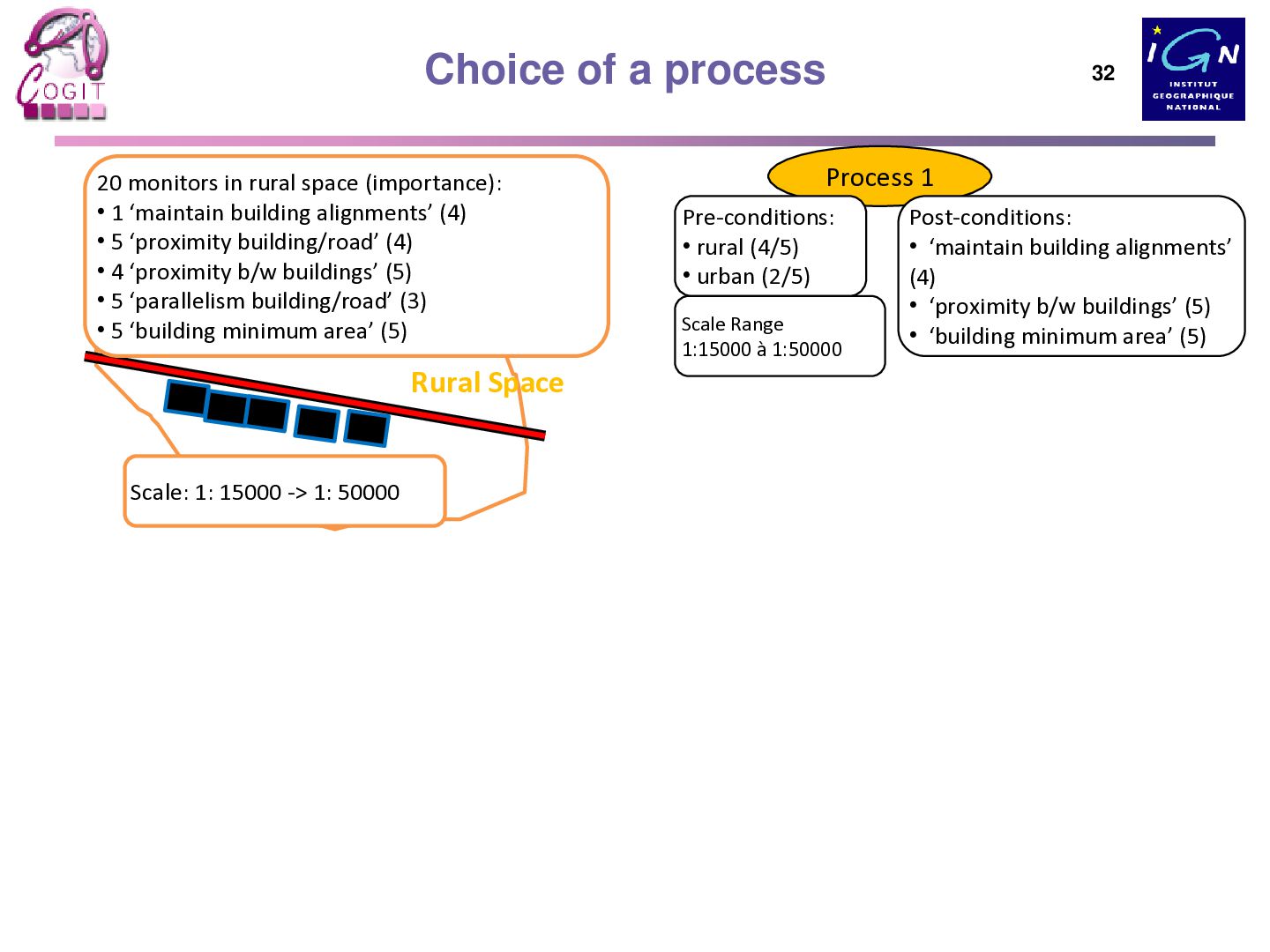
  26. Choice of a process 20 monitors in rural space (importance):

    • 1 ‘maintain building alignments’ (4) • 5 ‘proximity building/road’ (4) • 4 ‘proximity b/w buildings’ (5) • 5 ‘parallelism building/road’ (3) • 5 ‘building minimum area’ (5) Rural Space Scale: 1: 15000 -> 1: 50000 32 Process 1 Pre-conditions: • rural (4/5) • urban (2/5) Scale Range 1:15000 à 1:50000 Post-conditions: • ‘maintain building alignments’ (4) • ‘proximity b/w buildings’ (5) • ‘building minimum area’ (5)
  27. Choice of a process 20 monitors in rural space (importance):

    • 1 ‘maintain building alignments’ (4) • 5 ‘proximity building/road’ (4) • 4 ‘proximity b/w buildings’ (5) • 5 ‘parallelism building/road’ (3) • 5 ‘building minimum area’ (5) 33 Process 1 Pre-conditions: • rural (4/5) • urban (2/5) Scale Range 1:15000 à 1:50000 Post-conditions: • ‘maintain building alignments’ (4) • ‘proximity b/w buildings’ (5) • ‘building minimum area’ (5) Rural Space Process 2 Scale: 1: 15000 -> 1: 50000 Pre-conditions: • roads (4/5) • rivers (2/5) Process 3 Pre-conditions: • rural (4/5) • urban (3/5) • mountain (2/5) Scale Range 1:15000 à 1:35000 Post-conditions: • ‘proximity building/road’ (4) • ‘proximity b/w buildings’ (5) • ‘parallelism building/road’ (3) • ‘building minimum area’ (5) • ‘relative positioning b/w buildings’ (3) Post-conditions: • ‘maintain initial shape’ • ‘avoid coaslescence’ Process 4 Pre-conditions: • rural (5/5) Scale Range: Up to : 1:25000 Post-conditions: • ‘building minimum area’ • ‘proximity b/w buildings’ • ‘proximity building/road’ • ‘parallelism building/road’
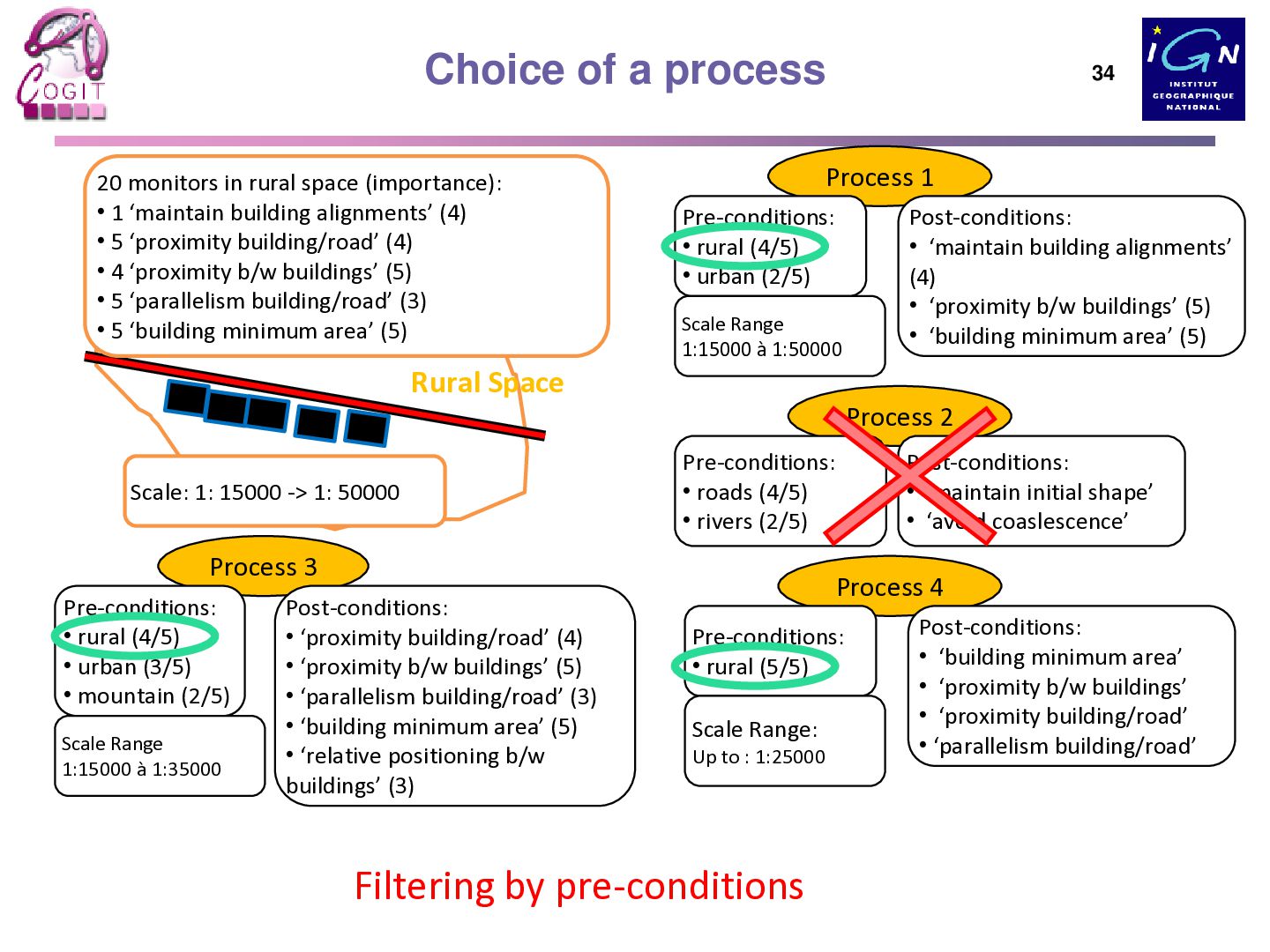
  28. Choice of a process 20 monitors in rural space (importance):

    • 1 ‘maintain building alignments’ (4) • 5 ‘proximity building/road’ (4) • 4 ‘proximity b/w buildings’ (5) • 5 ‘parallelism building/road’ (3) • 5 ‘building minimum area’ (5) 34 Process 1 Pre-conditions: • rural (4/5) • urban (2/5) Scale Range 1:15000 à 1:50000 Post-conditions: • ‘maintain building alignments’ (4) • ‘proximity b/w buildings’ (5) • ‘building minimum area’ (5) Rural Space Process 2 Scale: 1: 15000 -> 1: 50000 Pre-conditions: • roads (4/5) • rivers (2/5) Process 3 Pre-conditions: • rural (4/5) • urban (3/5) • mountain (2/5) Scale Range 1:15000 à 1:35000 Post-conditions: • ‘proximity building/road’ (4) • ‘proximity b/w buildings’ (5) • ‘parallelism building/road’ (3) • ‘building minimum area’ (5) • ‘relative positioning b/w buildings’ (3) Post-conditions: • ‘maintain initial shape’ • ‘avoid coaslescence’ Process 4 Pre-conditions: • rural (5/5) Scale Range: Up to : 1:25000 Filtering by pre-conditions Post-conditions: • ‘building minimum area’ • ‘proximity b/w buildings’ • ‘proximity building/road’ • ‘parallelism building/road’
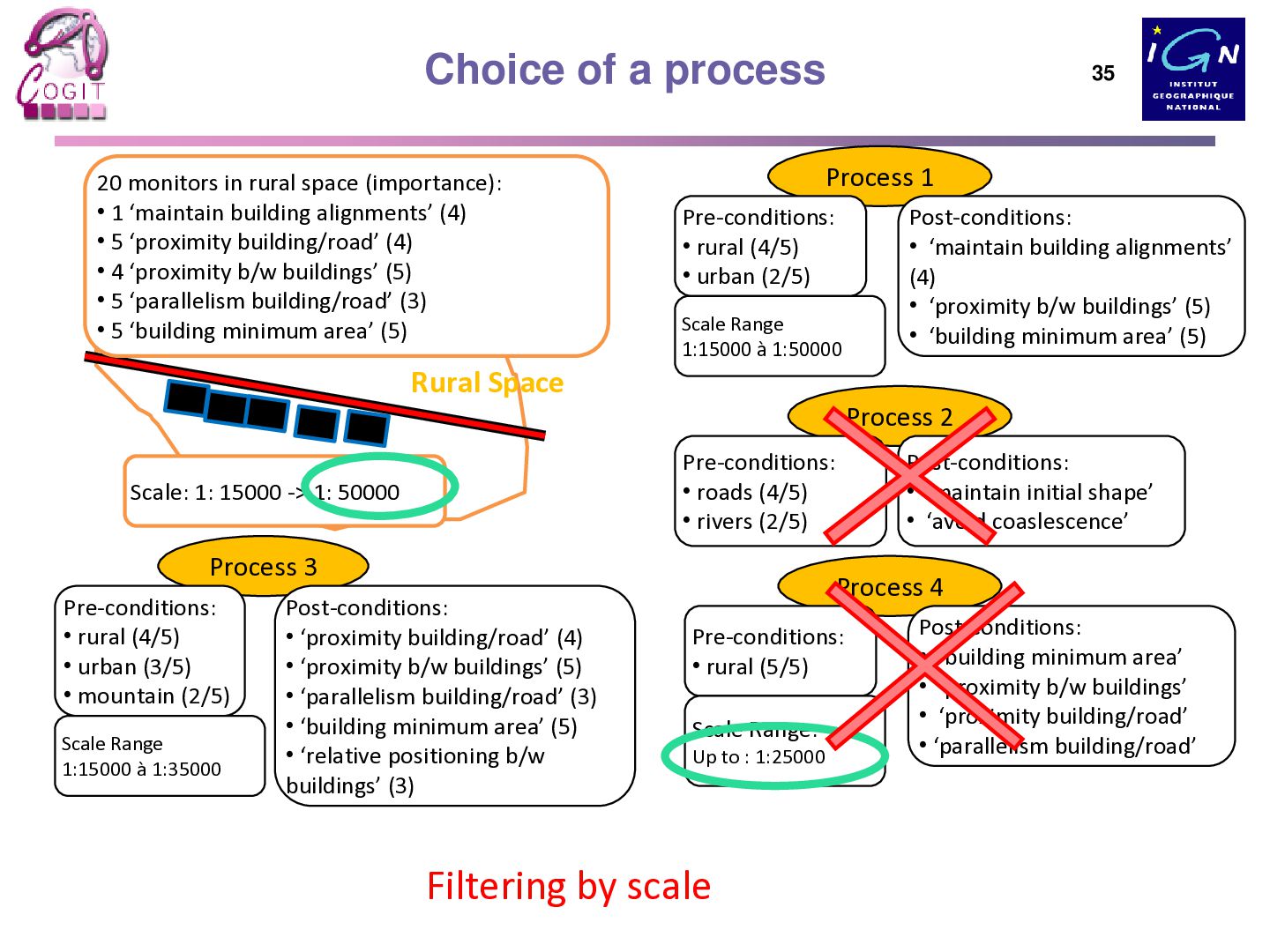
  29. Choice of a process 20 monitors in rural space (importance):

    • 1 ‘maintain building alignments’ (4) • 5 ‘proximity building/road’ (4) • 4 ‘proximity b/w buildings’ (5) • 5 ‘parallelism building/road’ (3) • 5 ‘building minimum area’ (5) 35 Process 1 Pre-conditions: • rural (4/5) • urban (2/5) Scale Range 1:15000 à 1:50000 Post-conditions: • ‘maintain building alignments’ (4) • ‘proximity b/w buildings’ (5) • ‘building minimum area’ (5) Rural Space Process 2 Pre-conditions: • roads (4/5) • rivers (2/5) Scale: 1: 15000 -> 1: 50000 Process 3 Pre-conditions: • rural (4/5) • urban (3/5) • mountain (2/5) Scale Range 1:15000 à 1:35000 Post-conditions: • ‘proximity building/road’ (4) • ‘proximity b/w buildings’ (5) • ‘parallelism building/road’ (3) • ‘building minimum area’ (5) • ‘relative positioning b/w buildings’ (3) Post-conditions: • ‘maintain initial shape’ • ‘avoid coaslescence’ Process 4 Pre-conditions: • rural (5/5) Scale Range: Up to : 1:25000 Filtering by scale Post-conditions: • ‘building minimum area’ • ‘proximity b/w buildings’ • ‘proximity building/road’ • ‘parallelism building/road’
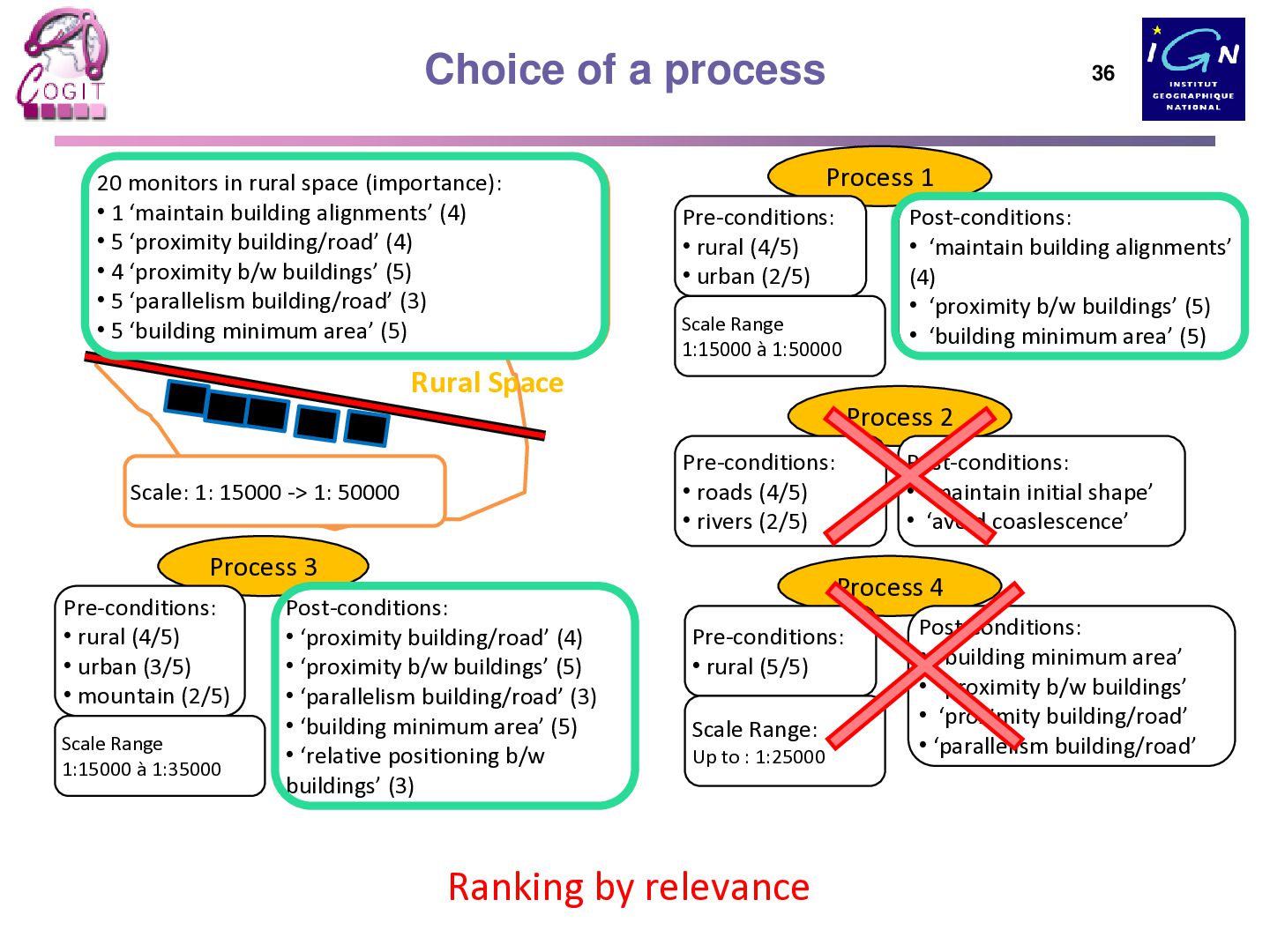
  30. Choice of a process 20 monitors in rural space (importance):

    • 1 ‘maintain building alignments’ (4) • 5 ‘proximity building/road’ (4) • 4 ‘proximity b/w buildings’ (5) • 5 ‘parallelism building/road’ (3) • 5 ‘building minimum area’ (5) 36 Process 1 Pre-conditions: • rural (4/5) • urban (2/5) Scale Range 1:15000 à 1:50000 Post-conditions: • ‘maintain building alignments’ (4) • ‘proximity b/w buildings’ (5) • ‘building minimum area’ (5) Rural Space Process 2 Pre-conditions: • roads (4/5) • rivers (2/5) Scale: 1: 15000 -> 1: 50000 Process 3 Pre-conditions: • rural (4/5) • urban (3/5) • mountain (2/5) Scale Range 1:15000 à 1:35000 Post-conditions: • ‘proximity building/road’ (4) • ‘proximity b/w buildings’ (5) • ‘parallelism building/road’ (3) • ‘building minimum area’ (5) • ‘relative positioning b/w buildings’ (3) Post-conditions: • ‘maintain initial shape’ • ‘avoid coaslescence’ Process 4 Pre-conditions: • rural (5/5) Scale Range: Up to : 1:25000 Ranking by relevance Post-conditions: • ‘building minimum area’ • ‘proximity b/w buildings’ • ‘proximity building/road’ • ‘parallelism building/road’
  31. Choice of a process 20 monitors in rural space (importance):

    • 1 ‘maintain building alignments’ (4) • 5 ‘proximity building/road’ (4) • 4 ‘proximity b/w buildings’ (5) • 5 ‘parallelism building/road’ (3) • 5 ‘building minimum area’ (5) 37 Process 1 Pre-conditions: • rural (4/5) • urban (2/5) Scale Range 1:15000 à 1:50000 2 Post-conditions: • ‘maintain building alignments’ (4) • ‘proximity b/w buildings’ (5) • ‘building minimum area’ (5) Rural Space Process 2 Pre-conditions: • roads (4/5) • rivers (2/5) Scale: 1: 15000 -> 1: 50000 Process 3 Pre-conditions: • rural (4/5) • urban (3/5) • mountain (2/5) Scale Range 1:15000 à 1:35000 Post-conditions: • ‘proximity building/road’ (4) • ‘proximity b/w buildings’ (5) • ‘parallelism building/road’ (3) • ‘building minimum area’ (5) • ‘relative positioning b/w buildings’ (3) 1 Post-conditions: • ‘maintain initial shape’ • ‘avoid coaslescence’ Process 4 Pre-conditions: • rural (5/5) Scale Range: Up to : 1:25000 Ranking by relevance Post-conditions: • ‘building minimum area’ • ‘proximity b/w buildings’ • ‘proximity building/road’ • ‘parallelism building/road’
  32. CollaGen: Collaboration by Orchestration Choice of a space Choice of

    a process generalisation Online observation Evaluation 38 Side Effects management
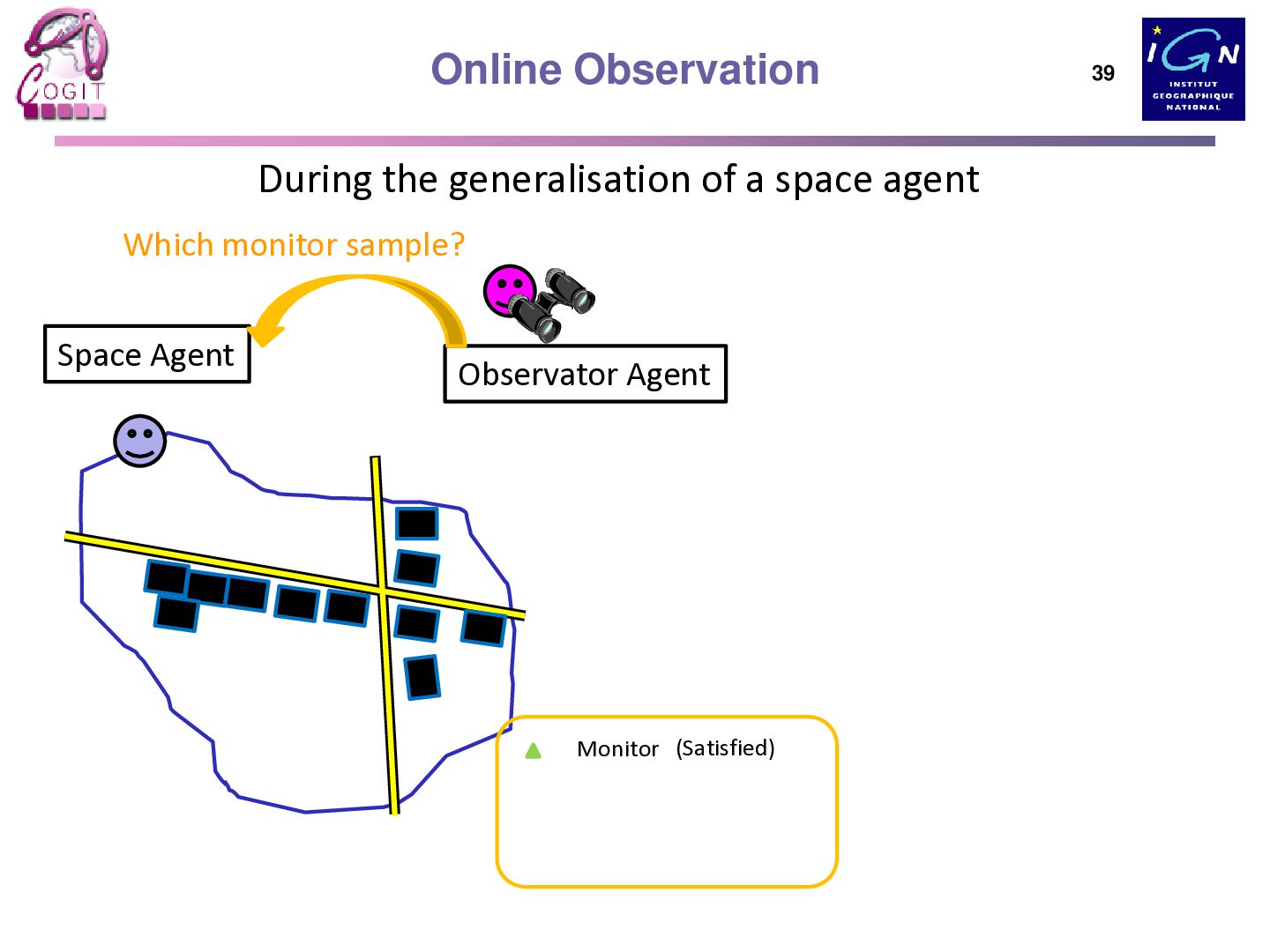
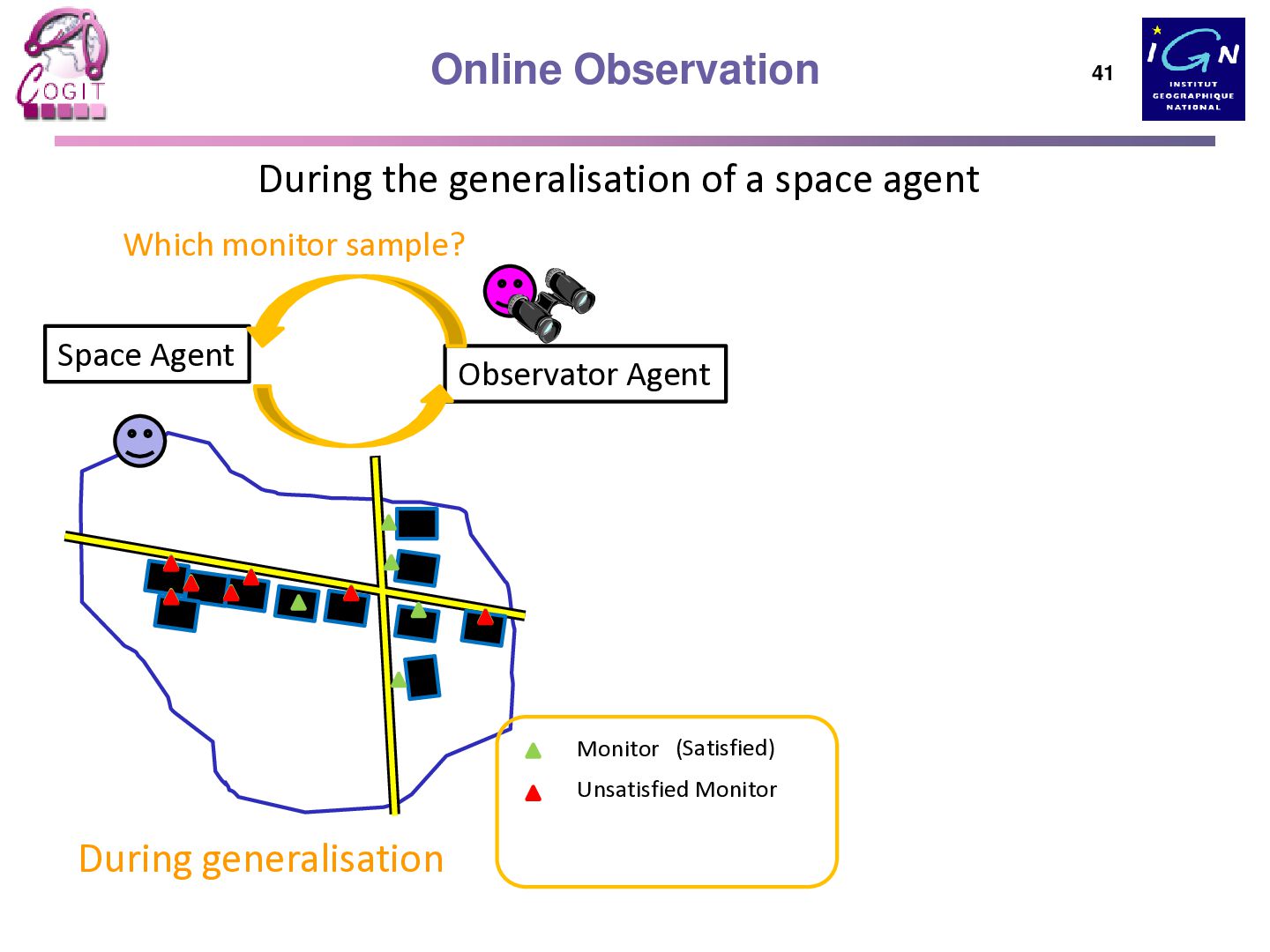
  33. Online Observation During the generalisation of a space agent Which

    monitor sample? Space Agent Observator Agent Monitor (Satisfied) 39
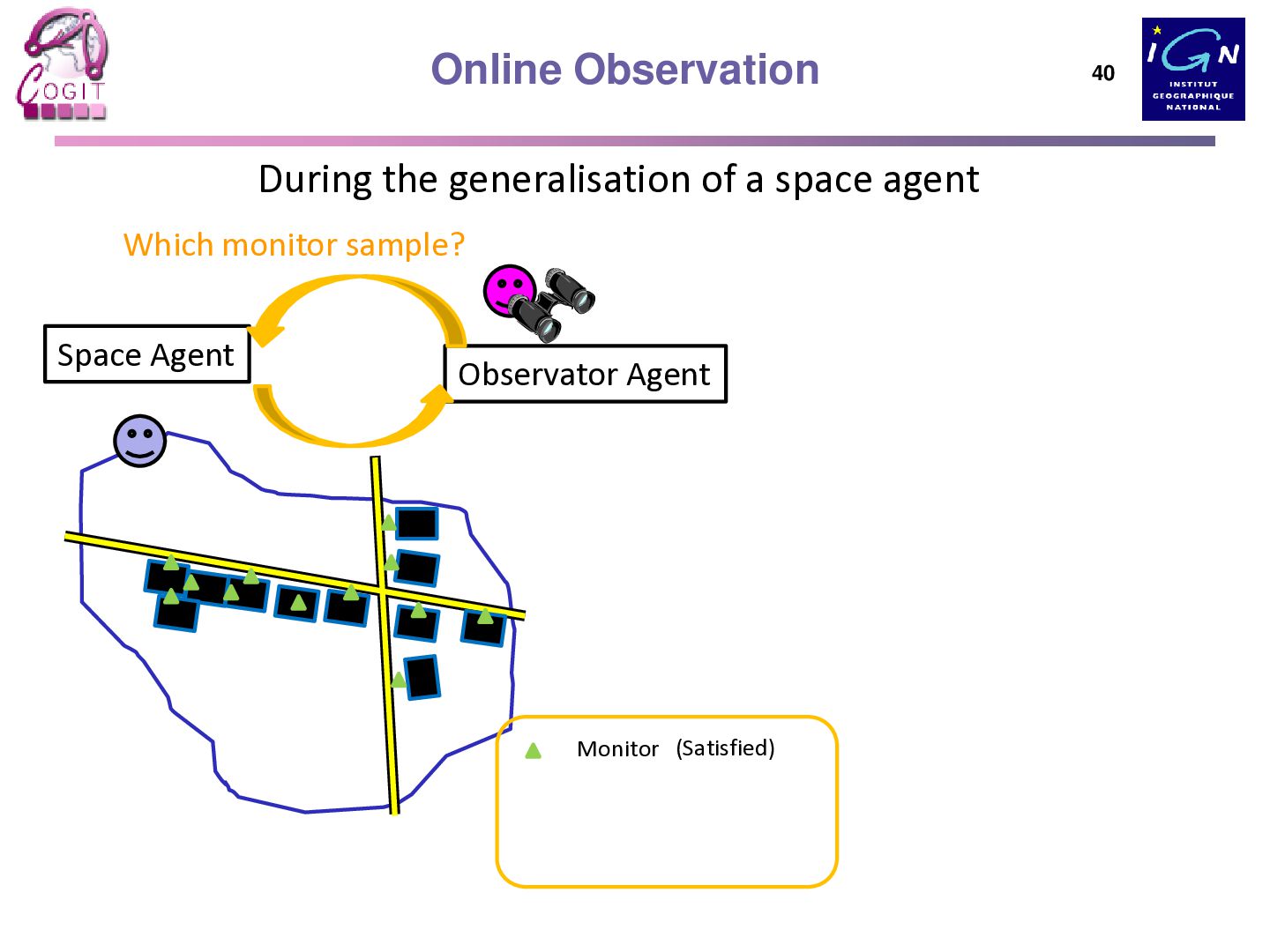
  34. Online Observation During the generalisation of a space agent Which

    monitor sample? Space Agent Observator Agent Monitor (Satisfied) 40
  35. Online Observation During the generalisation of a space agent Which

    monitor sample? Space Agent Observator Agent Monitor (Satisfied) Unsatisfied Monitor During generalisation 41
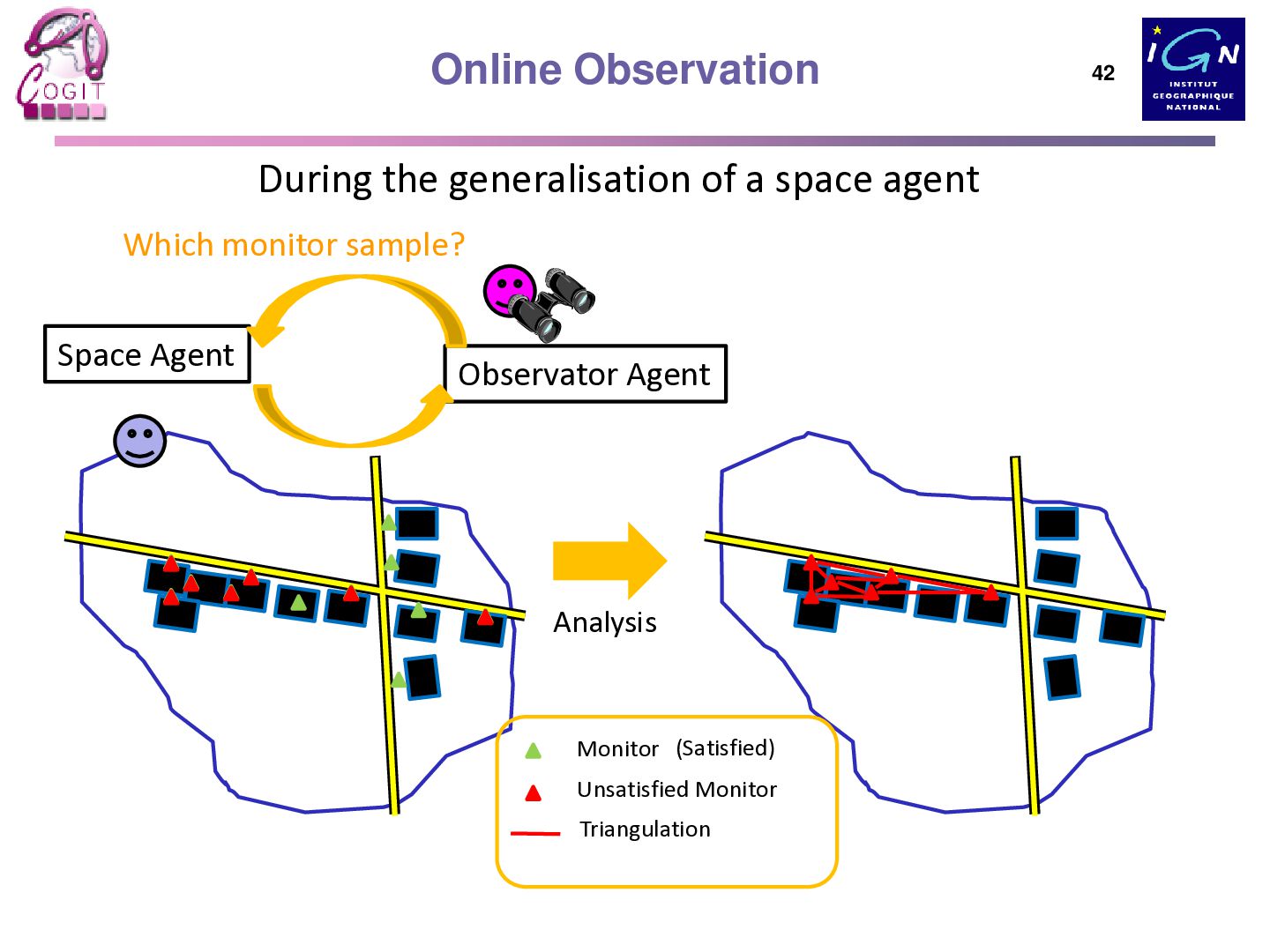
  36. Online Observation During the generalisation of a space agent Which

    monitor sample? Space Agent Observator Agent Analysis Monitor (Satisfied) Unsatisfied Monitor Triangulation 42
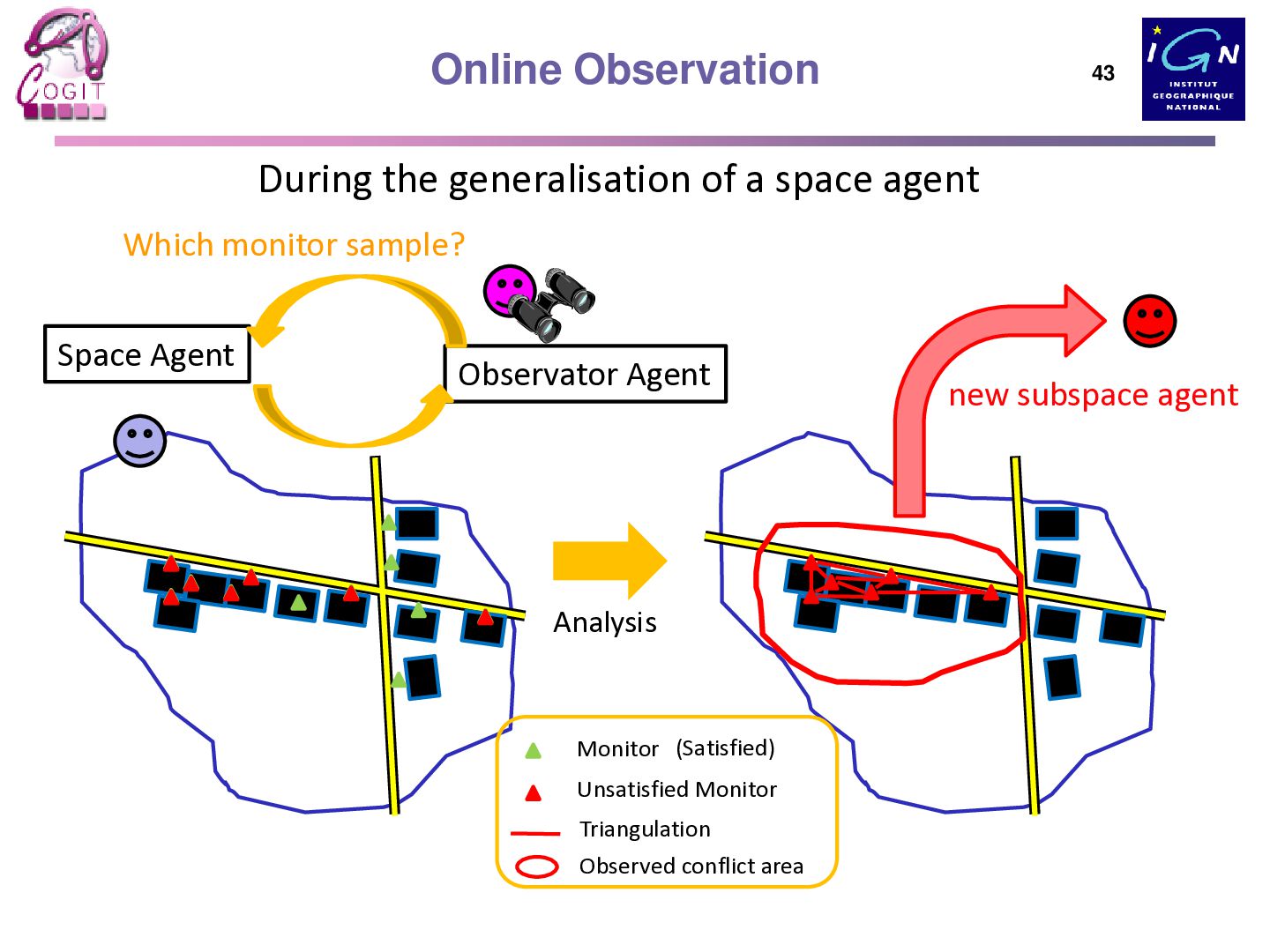
  37. Online Observation 43 During the generalisation of a space agent

    Which monitor sample? Space Agent Observator Agent Analysis Monitor (Satisfied) Unsatisfied Monitor Triangulation Observed conflict area new subspace agent
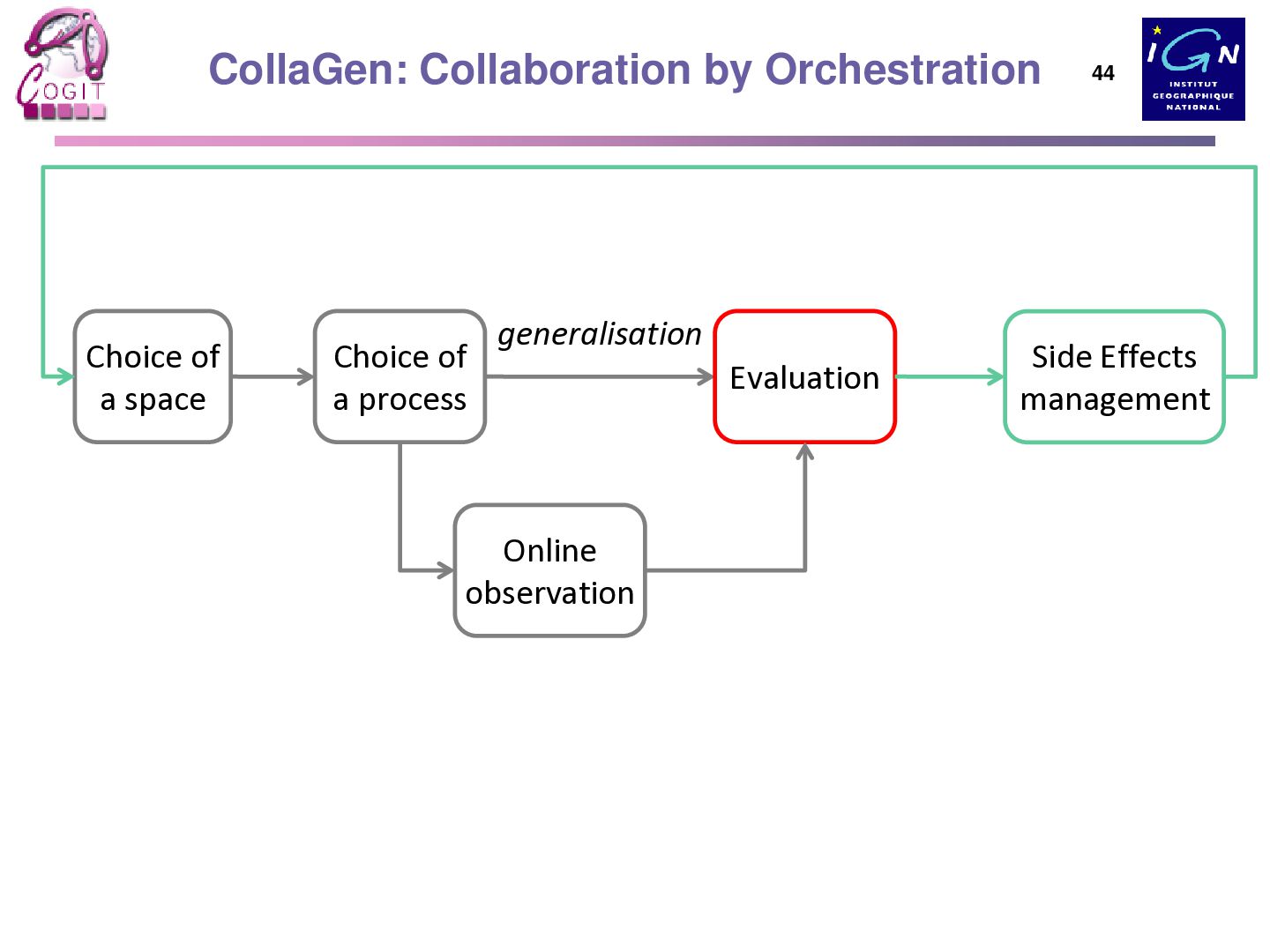
  38. CollaGen: Collaboration by Orchestration Choice of a space Choice of

    a process generalisation Online observation Evaluation 44 Side Effects management
  39. CollaGen: Collaboration by Orchestration Choice of a space Choice of

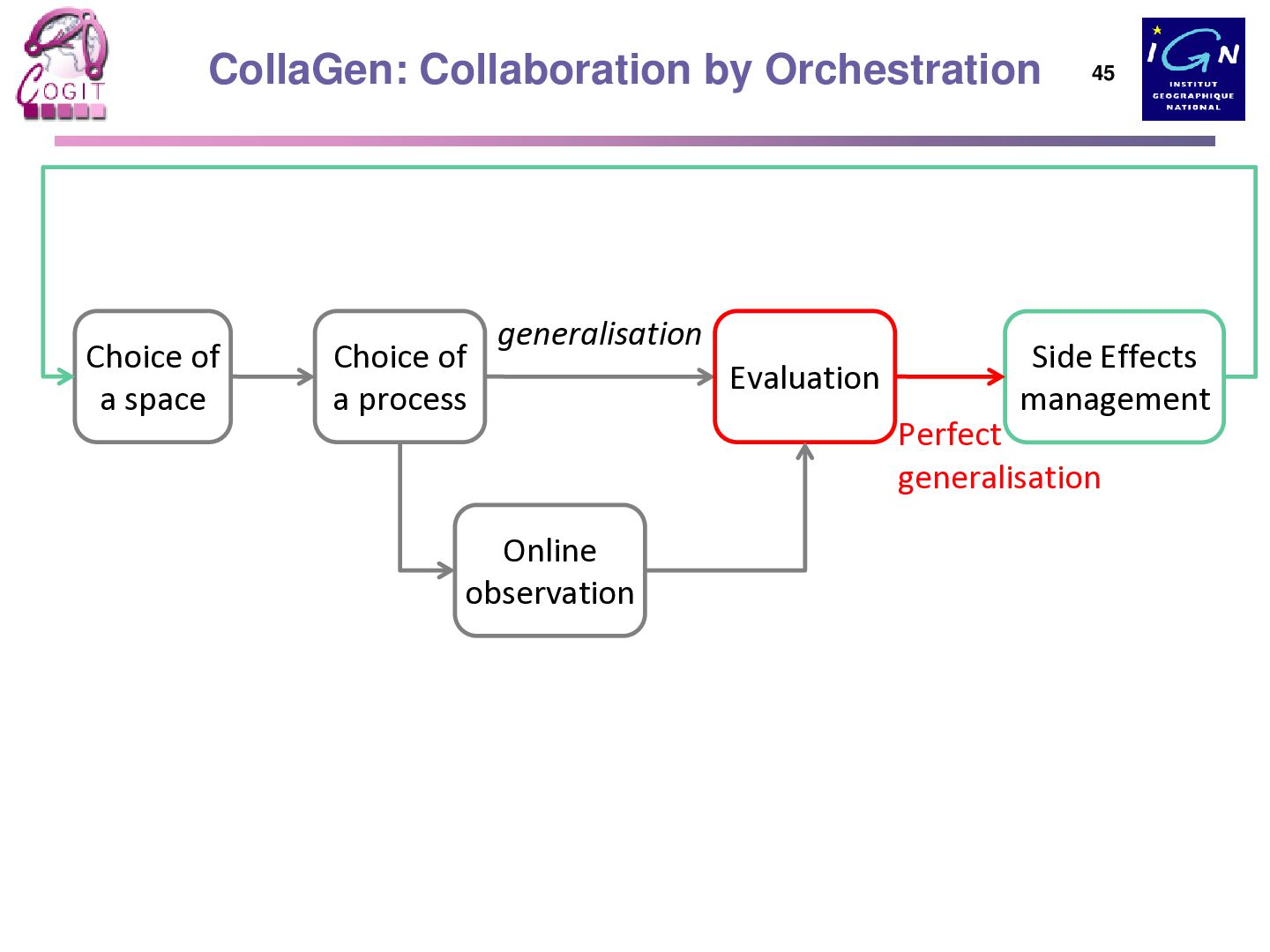
    a process generalisation Evaluation 45 Side Effects management Perfect generalisation Online observation
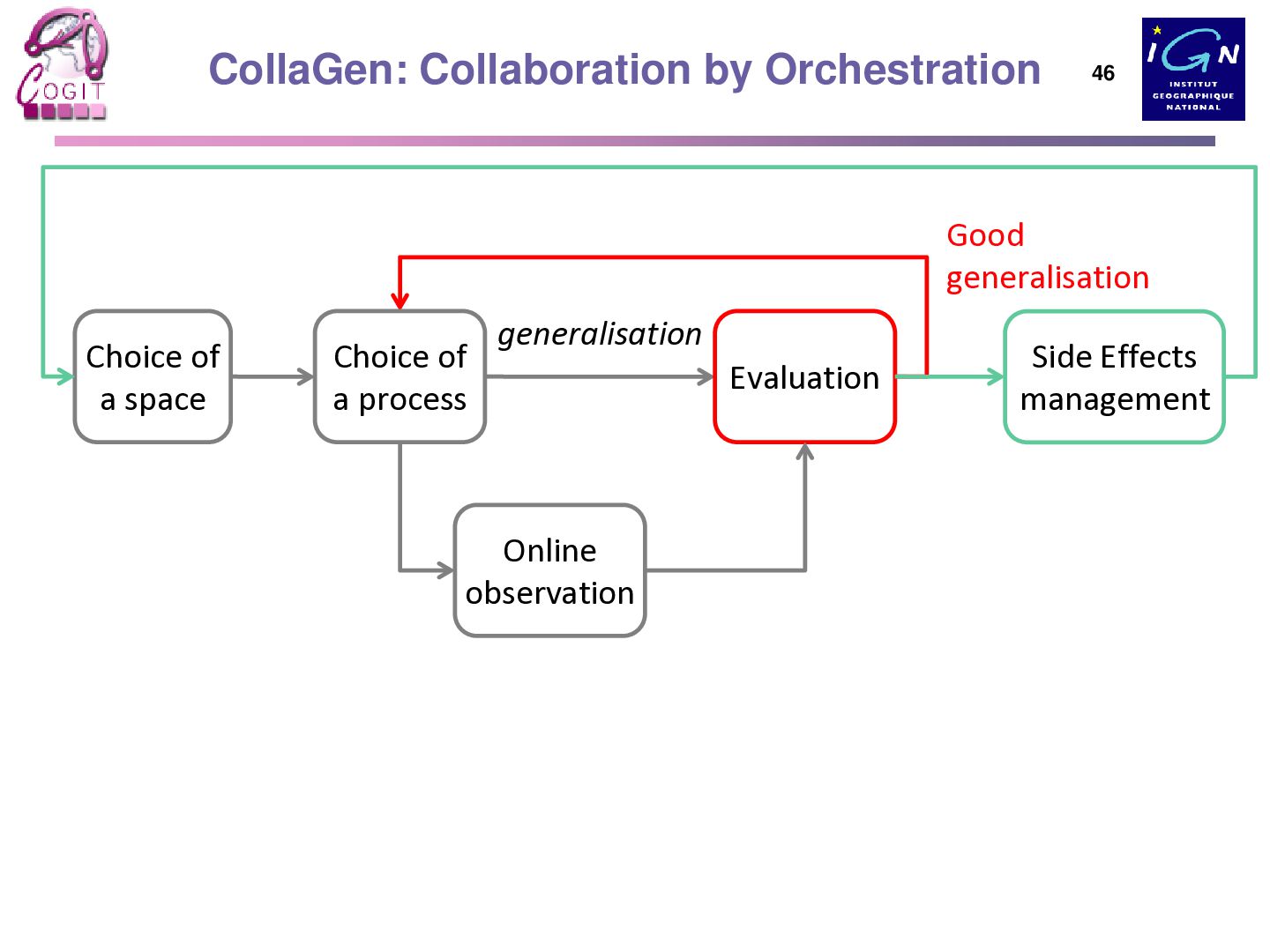
  40. CollaGen: Collaboration by Orchestration 46 Good generalisation Choice of a

    space Choice of a process generalisation Online observation Evaluation Side Effects management
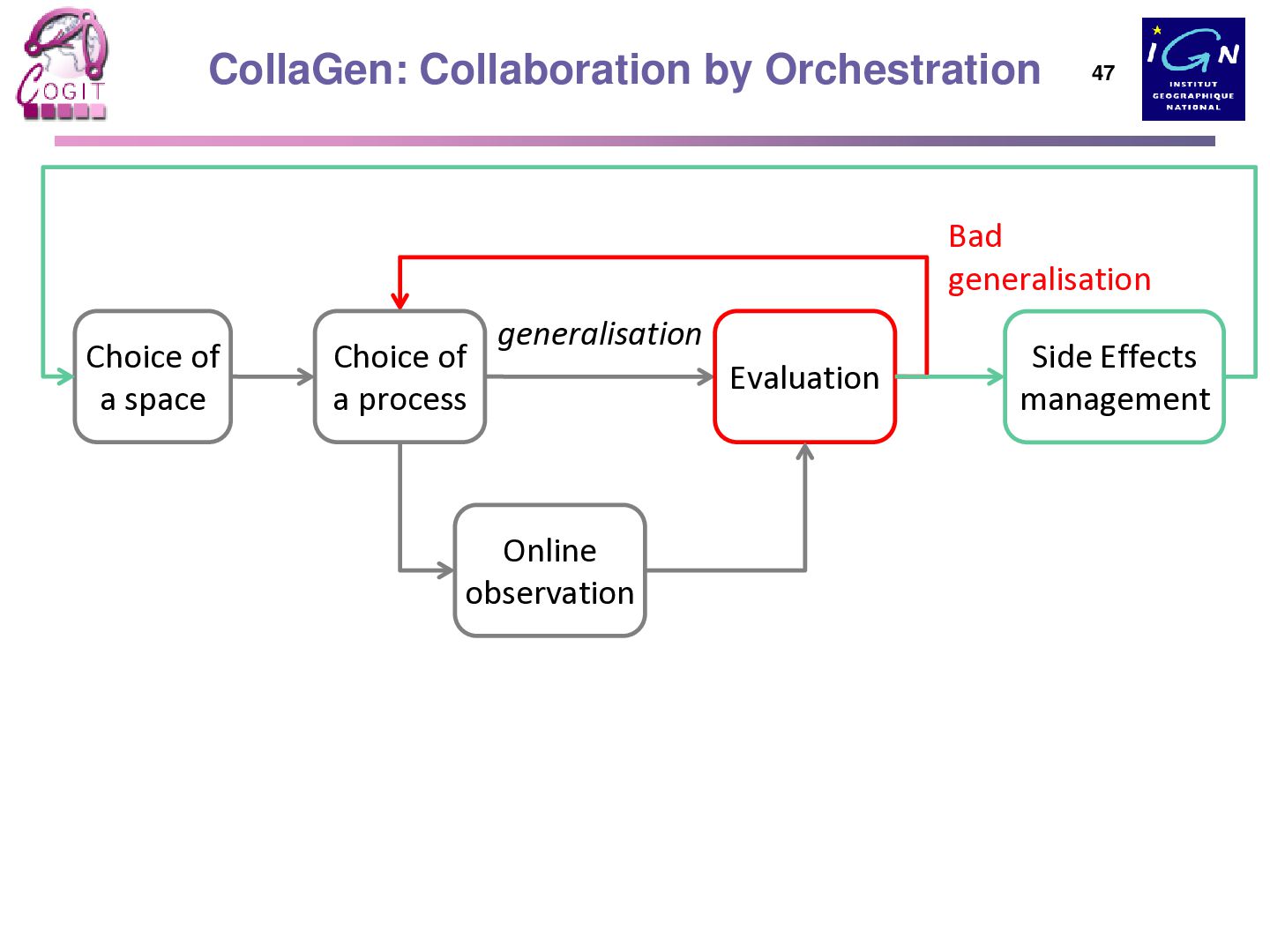
  41. CollaGen: Collaboration by Orchestration 47 Bad generalisation Choice of a

    space Choice of a process generalisation Online observation Evaluation Side Effects management
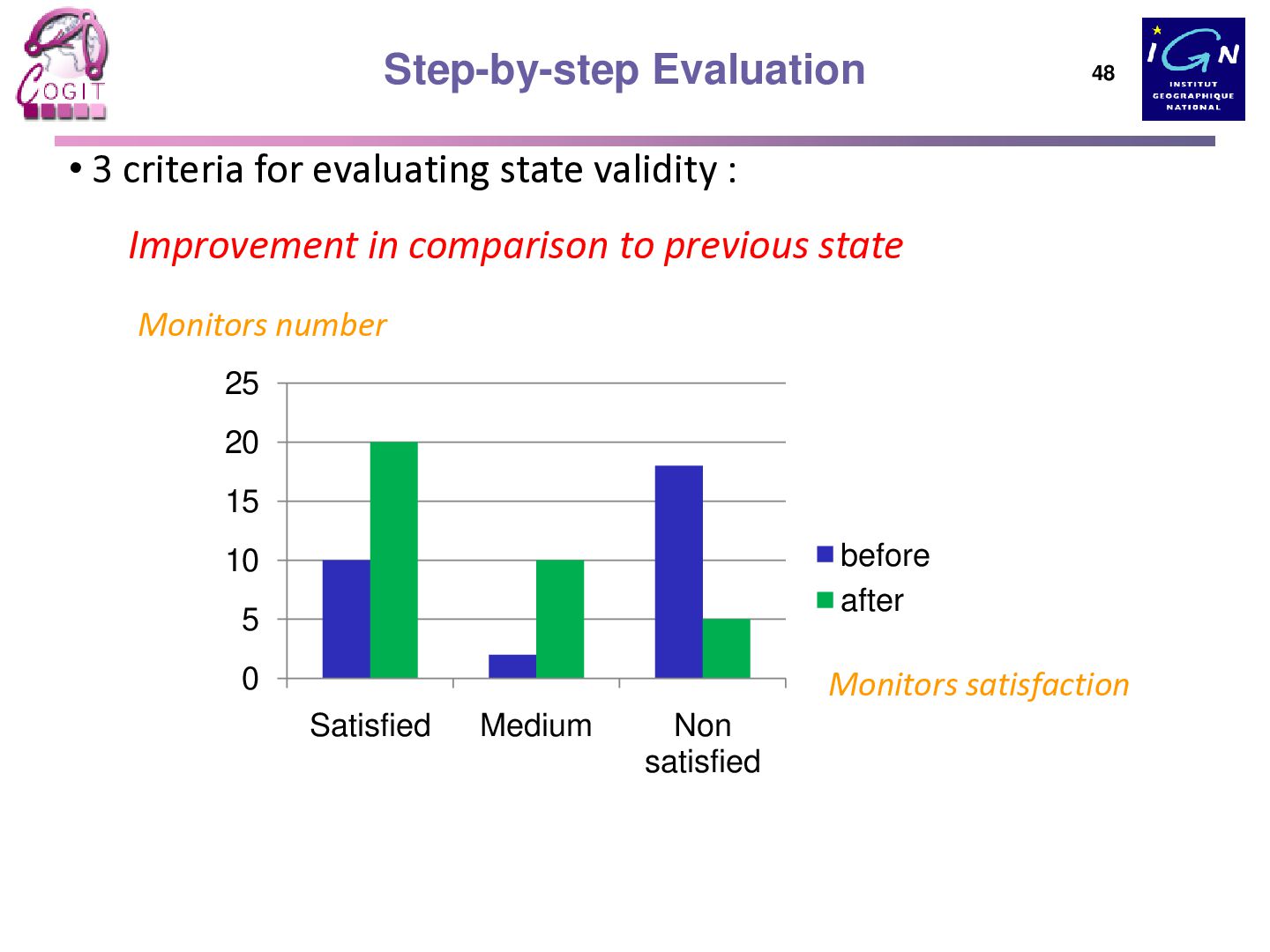
  42. Step-by-step Evaluation 48 • 3 criteria for evaluating state validity

    : Improvement in comparison to previous state Monitors number 25 20 15 before after 10 5 0 Monitors satisfaction Satisfied Medium Non satisfied
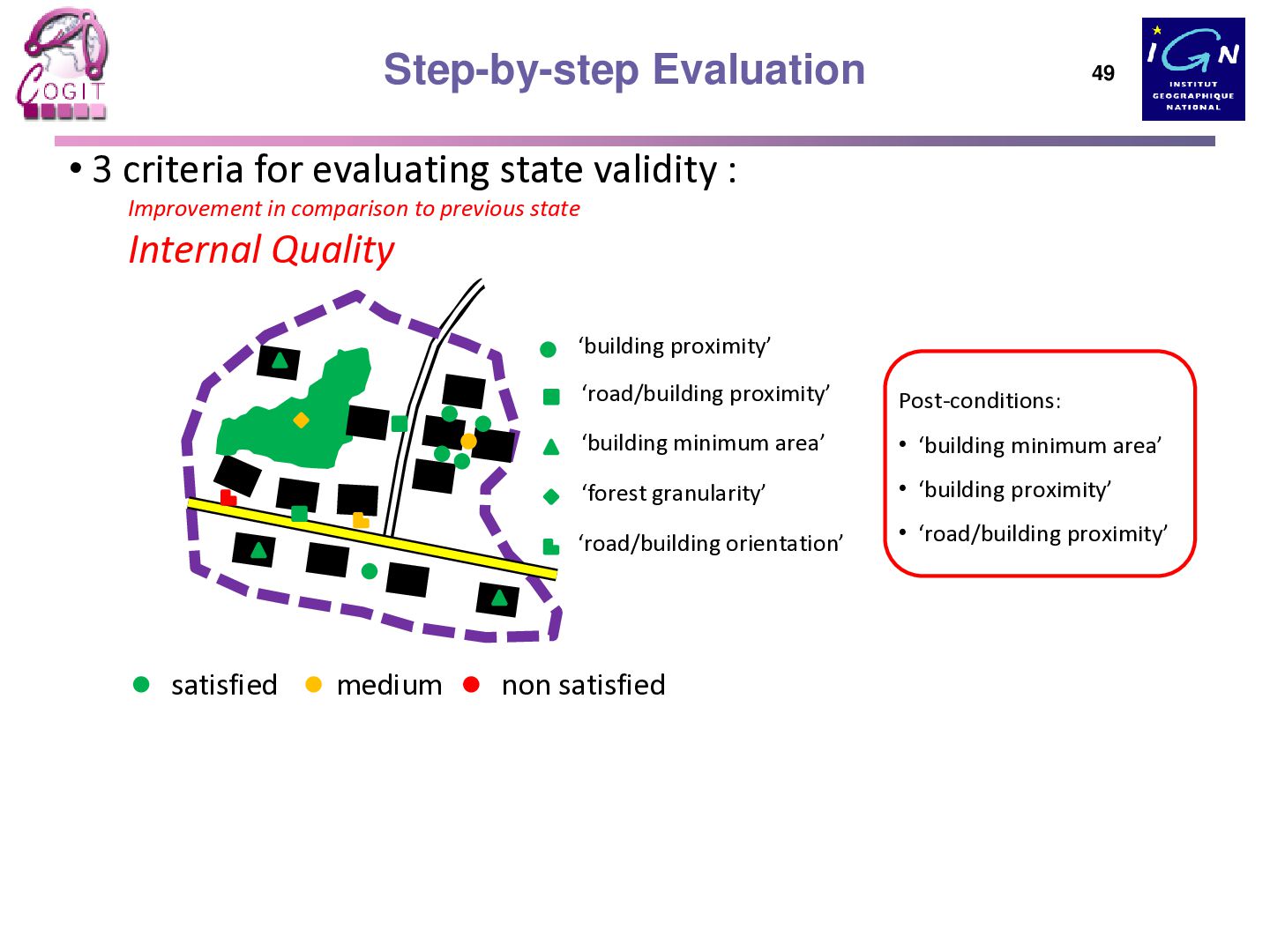
  43. Step-by-step Evaluation 49 • 3 criteria for evaluating state validity

    : Improvement in comparison to previous state Internal Quality ‘building proximity’ satisfied medium ‘road/building proximity’ Post-conditions: ‘building minimum area’ • ‘building minimum area’ ‘forest granularity’ • ‘building proximity’ ‘road/building orientation’ • ‘road/building proximity’ non satisfied
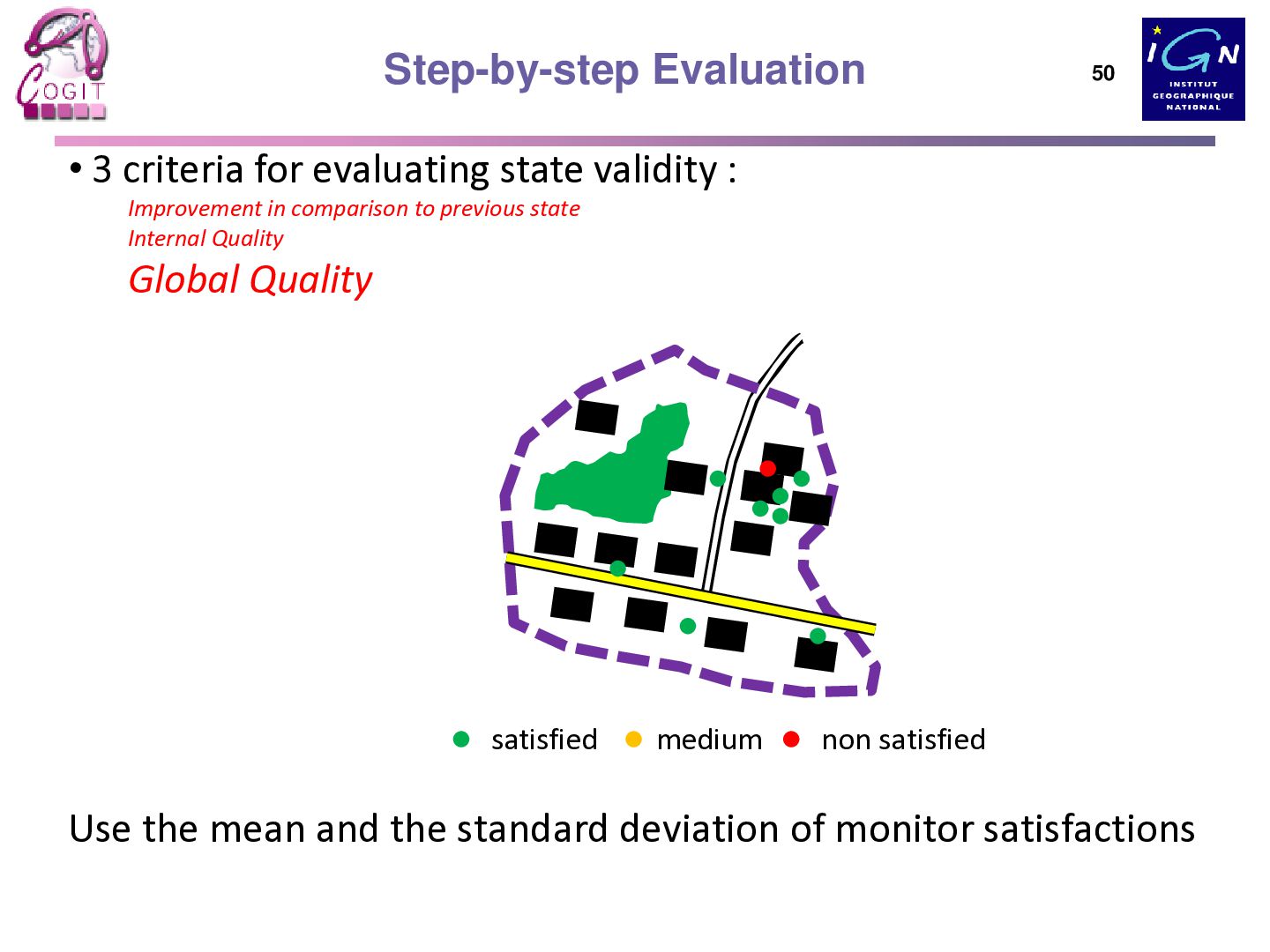
  44. Step-by-step Evaluation 50 • 3 criteria for evaluating state validity

    : Improvement in comparison to previous state Internal Quality Global Quality satisfied medium non satisfied Use the mean and the standard deviation of monitor satisfactions
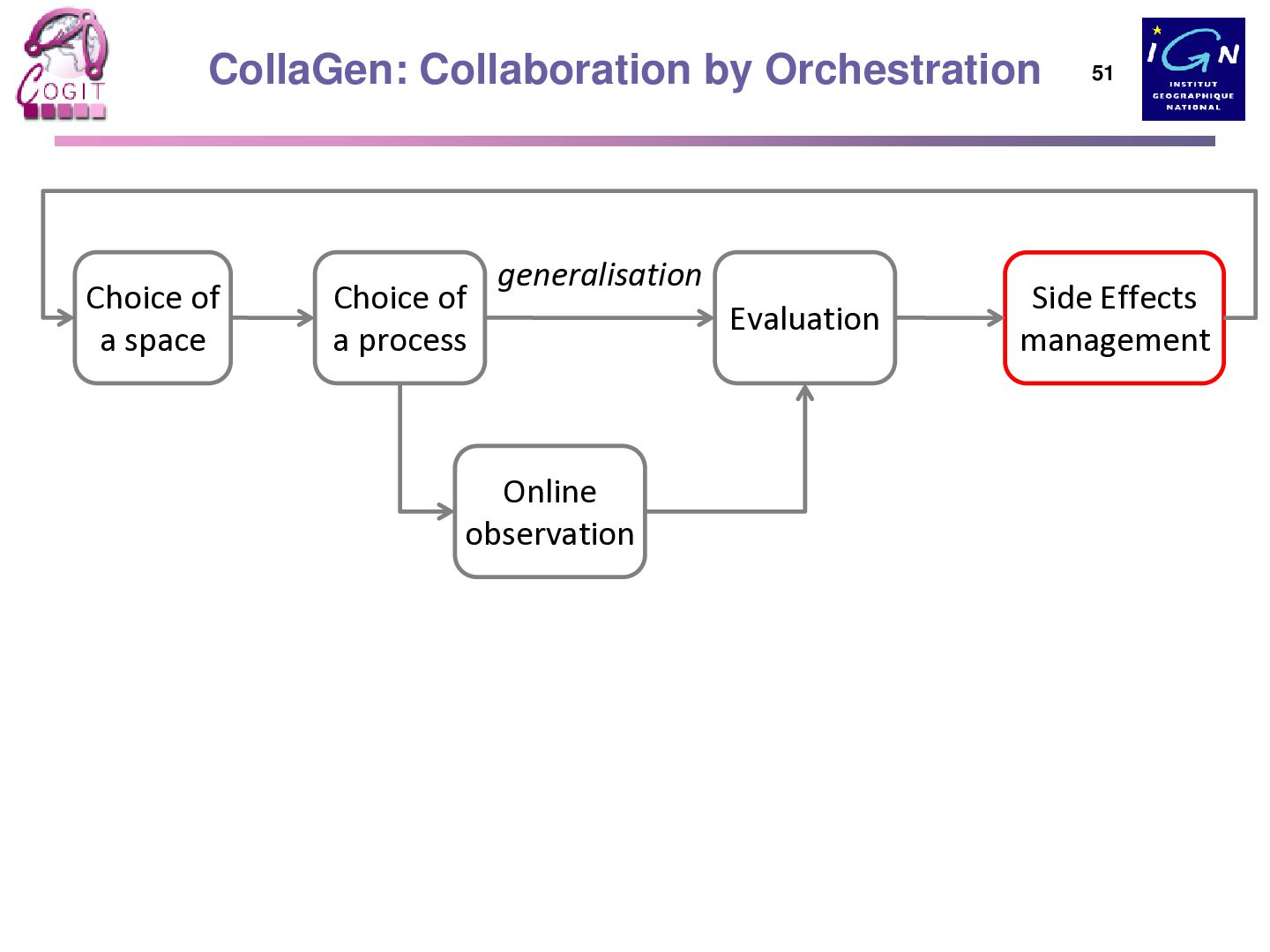
  45. CollaGen: Collaboration by Orchestration Choice of a space Choice of

    a process generalisation Online observation Evaluation 51 Side Effects management
  46. Conclusion CollaGen allows automatic orchestration of generalisation processes with good

    results • Orchestration inference with partial knowledge 59
  47. Conclusion CollaGen allows automatic orchestration of generalisation processes with good

    results • Orchestration inference with partial knowledge • Generalisation process register 60
  48. Conclusion CollaGen allows automatic orchestration of generalisation processes with good

    results • Orchestration inference with partial knowledge • Generalisation process register • Online observation and dynamic correction 61
  49. Conclusion CollaGen allows automatic orchestration of generalisation processes with good

    results • Orchestration inference with partial knowledge • Generalisation process register • Online observation and dynamic correction • Global and generic evaluation methods 62
  50. Conclusion CollaGen allows automatic orchestration of generalisation processes with good

    results • Orchestration inference with partial knowledge • Generalisation process register • Online observation and dynamic correction • Global and generic evaluation methods • Side effects management system 63
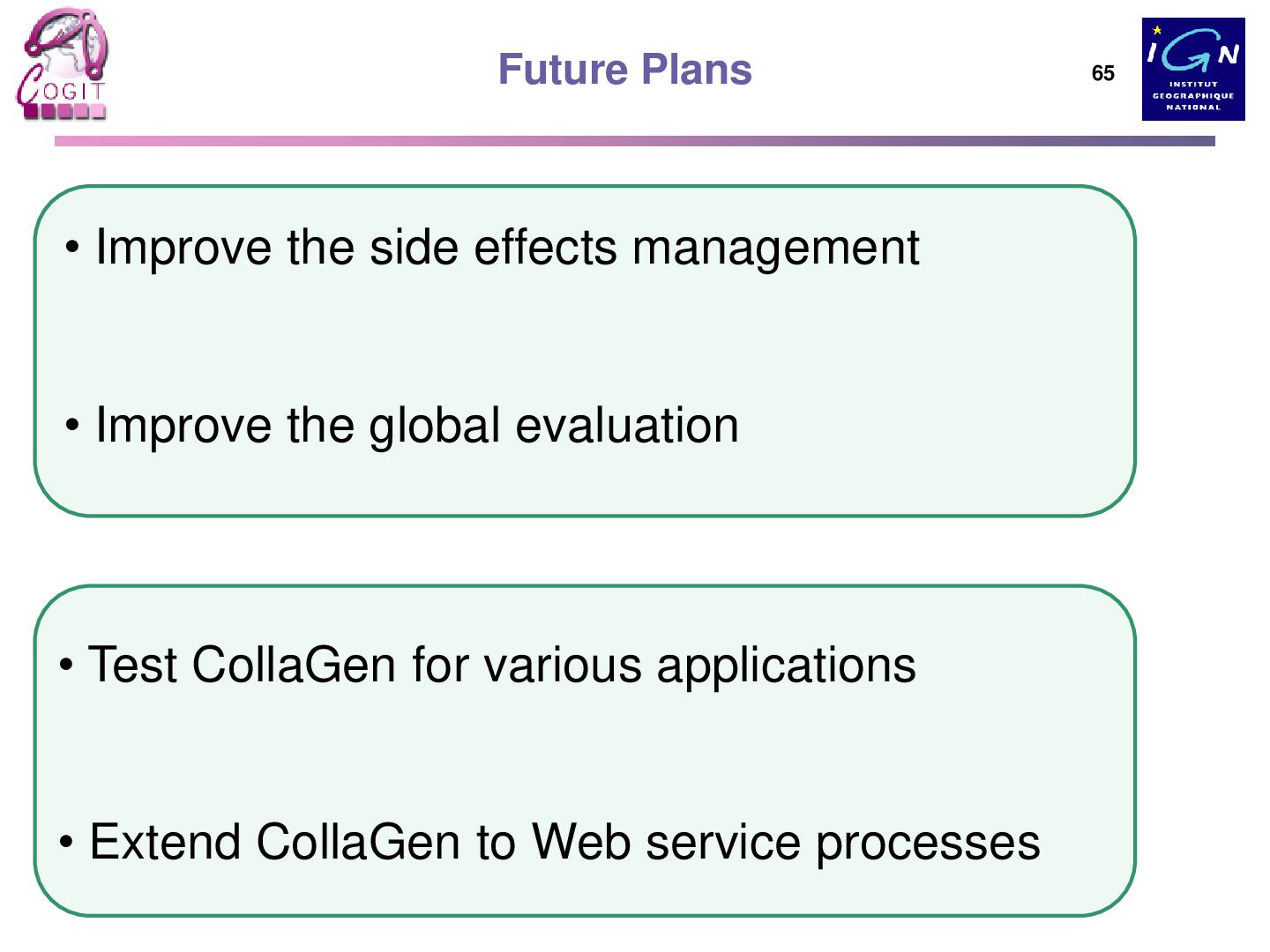
  51. Future Plans • Improve the side effects management • Improve

    the global evaluation • Test CollaGen for various applications • Extend CollaGen to Web service processes 65
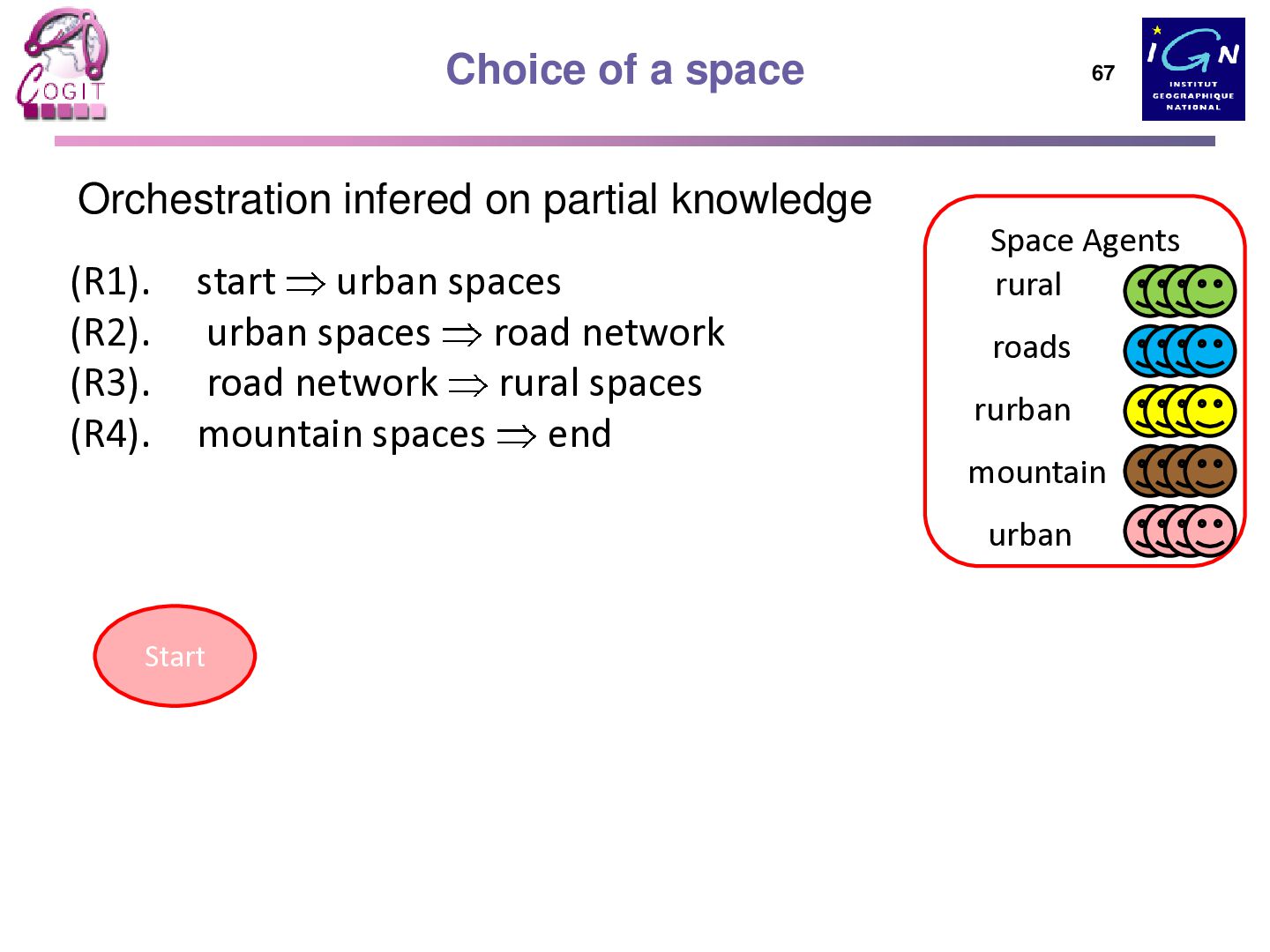
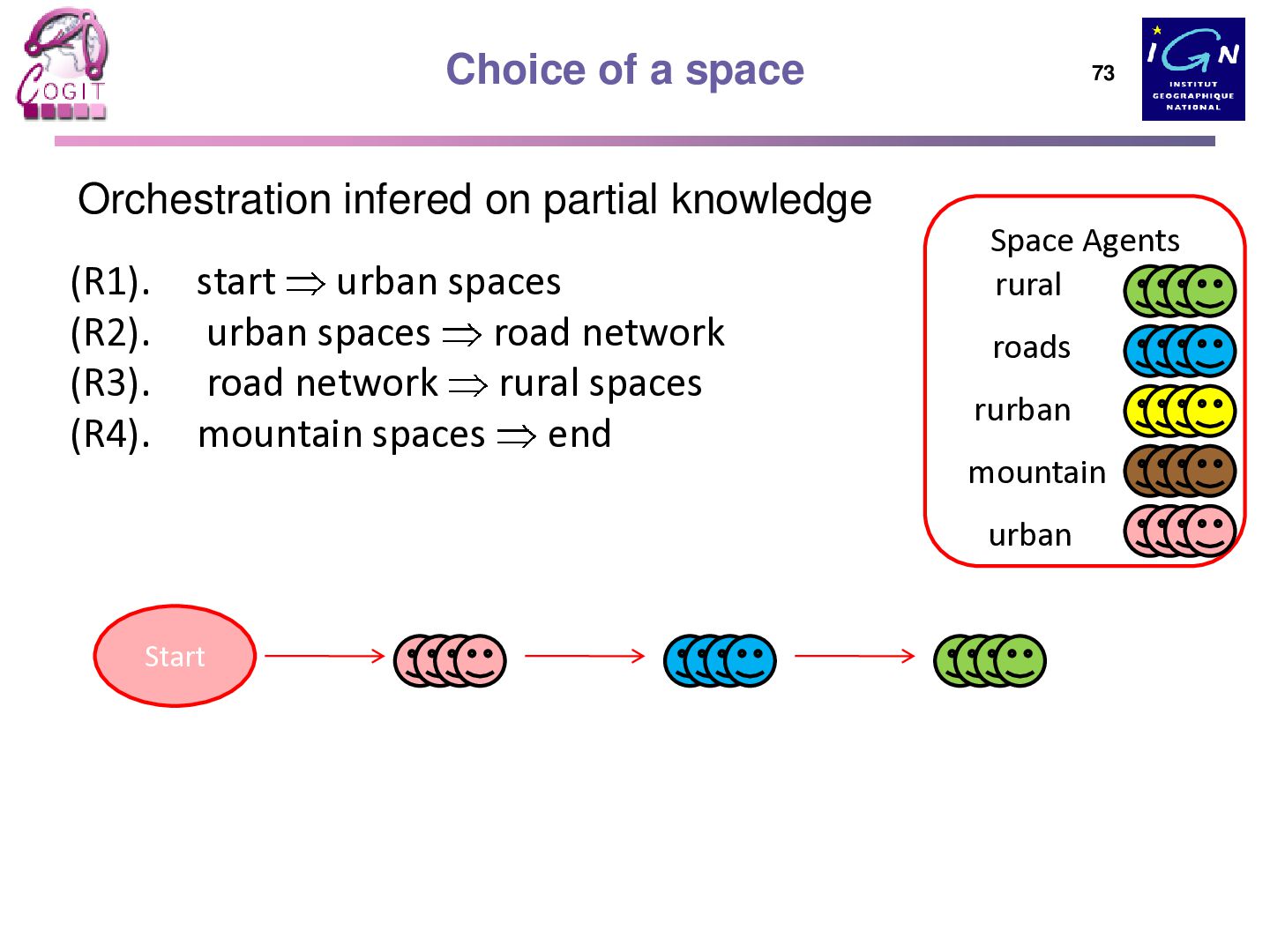
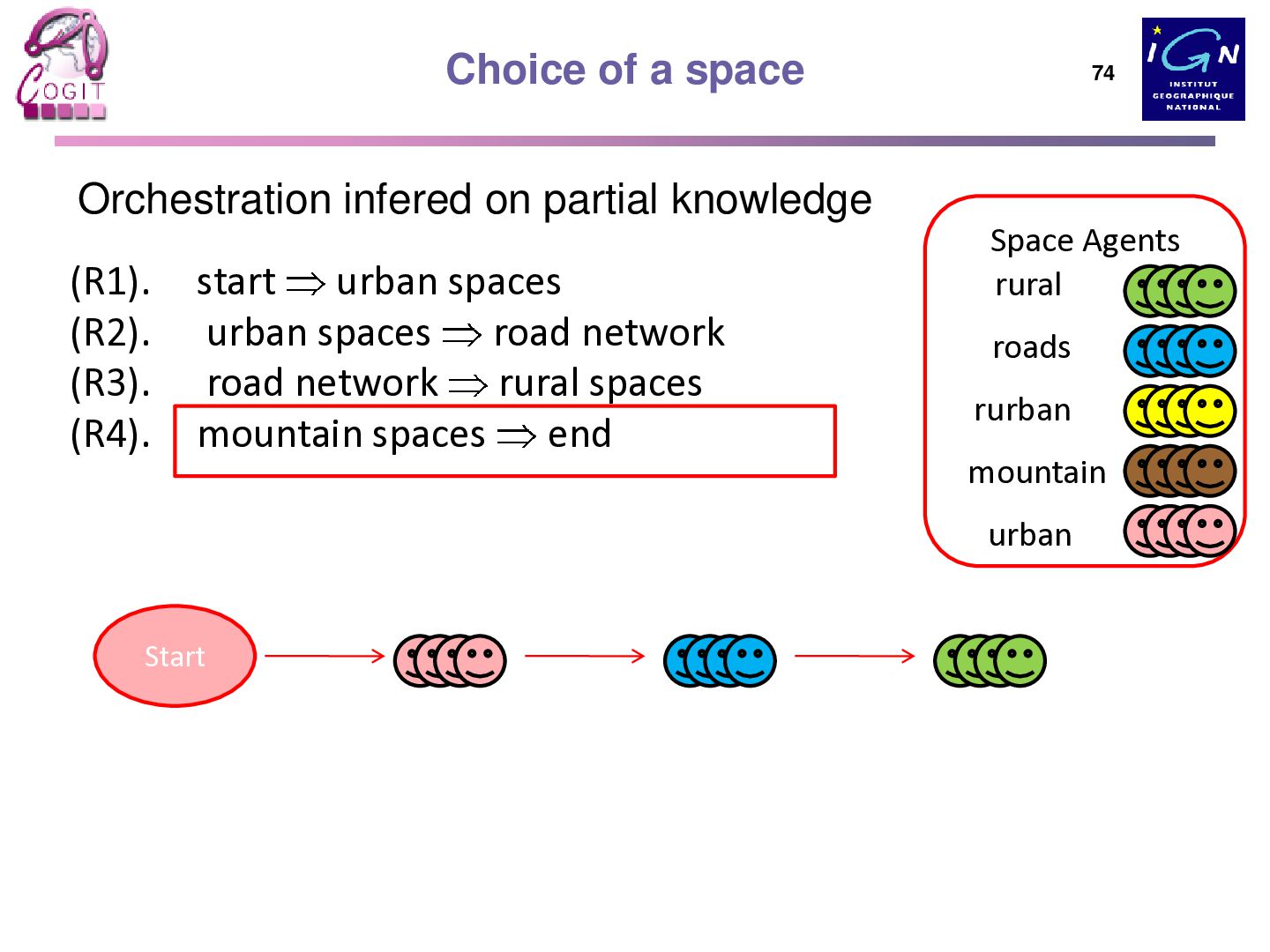
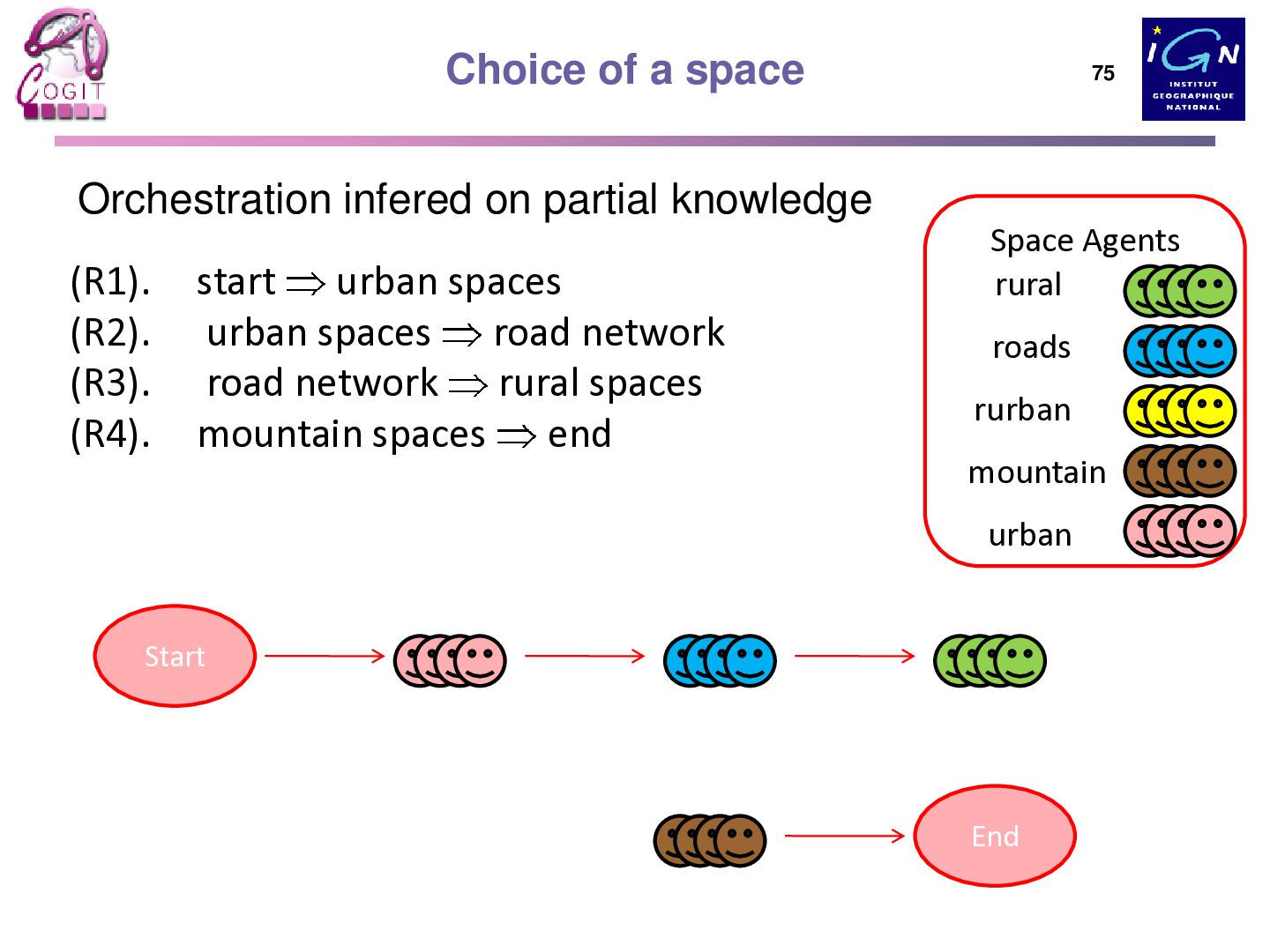
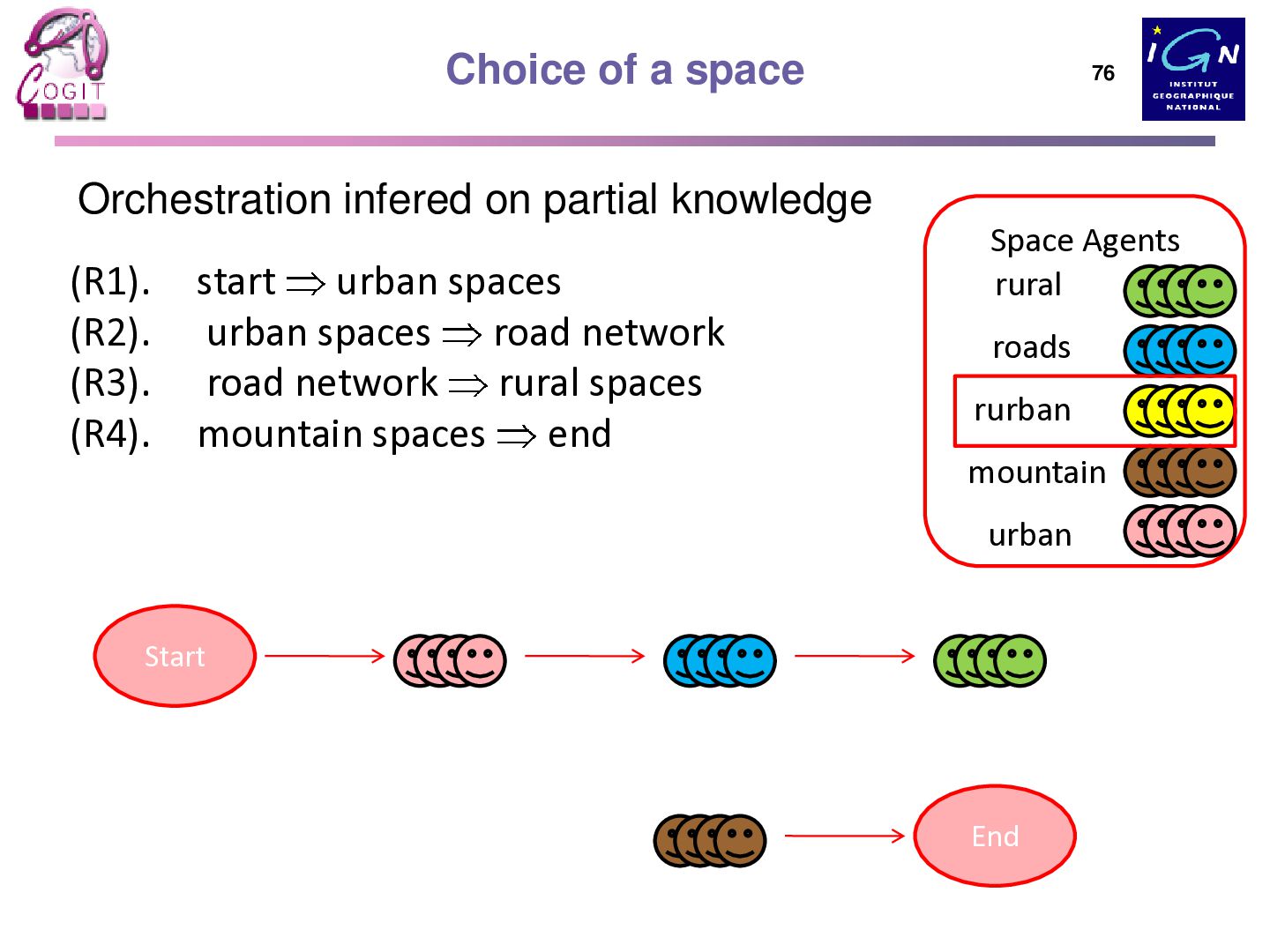
  52. Choice of a space 67 Orchestration infered on partial knowledge

    (R1). (R2). (R3). (R4). start urban spaces urban spaces road network road network rural spaces mountain spaces end Space Agents rural roads rurban mountain urban Start
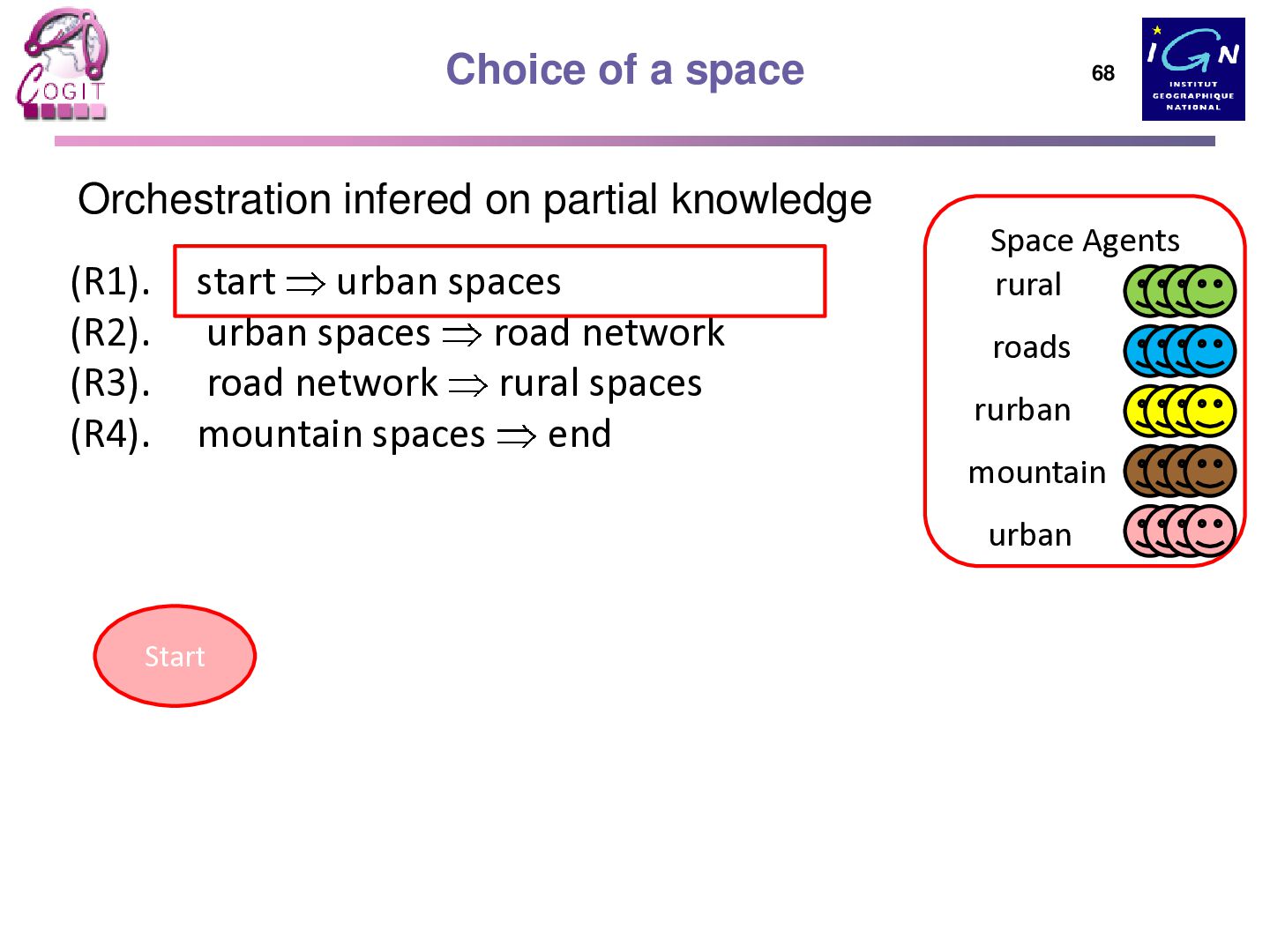
  53. Choice of a space 68 Orchestration infered on partial knowledge

    (R1). (R2). (R3). (R4). start urban spaces urban spaces road network road network rural spaces mountain spaces end Space Agents rural roads rurban mountain urban Start
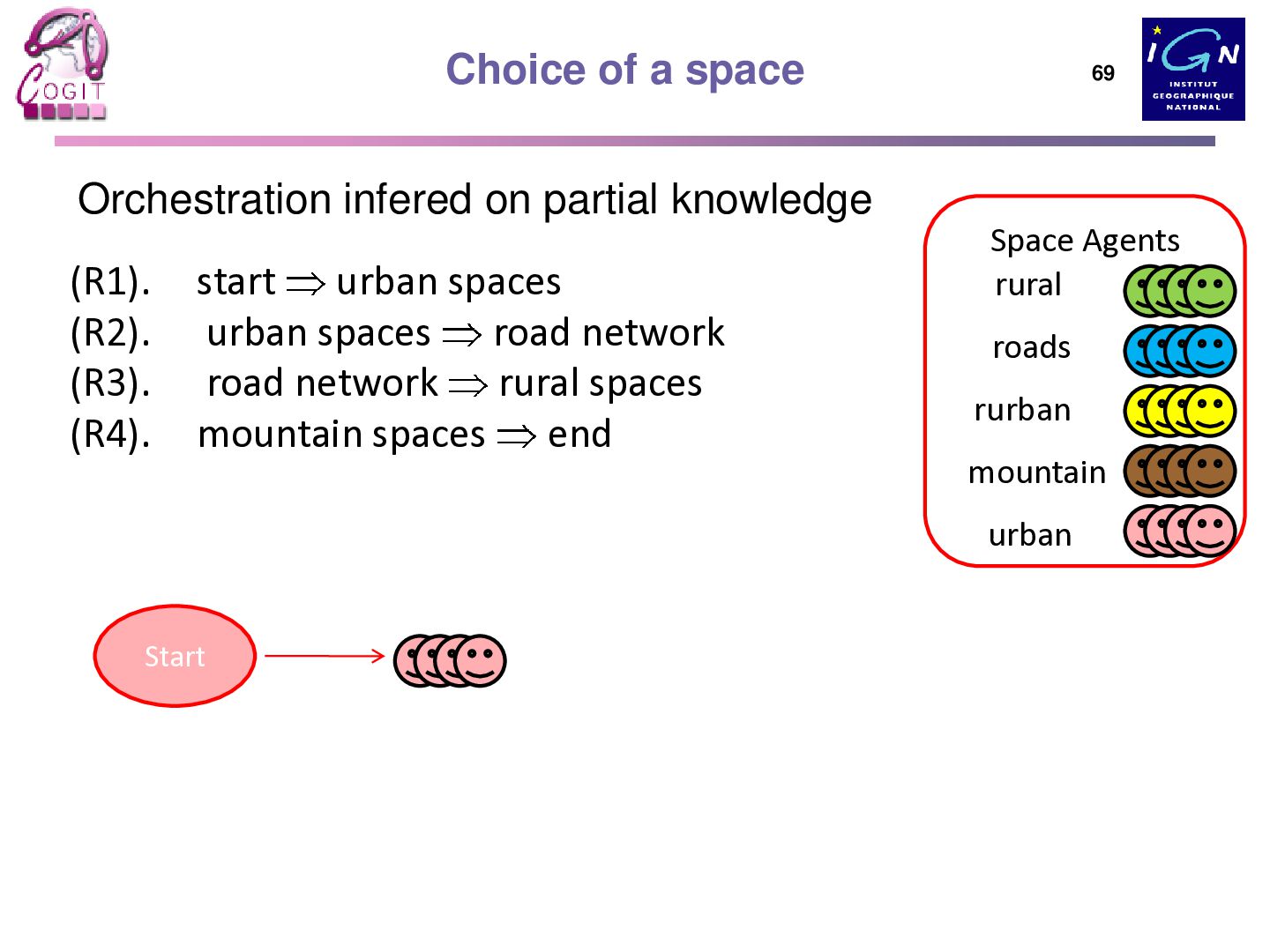
  54. Choice of a space 69 Orchestration infered on partial knowledge

    (R1). (R2). (R3). (R4). start urban spaces urban spaces road network road network rural spaces mountain spaces end Space Agents rural roads rurban mountain urban Start
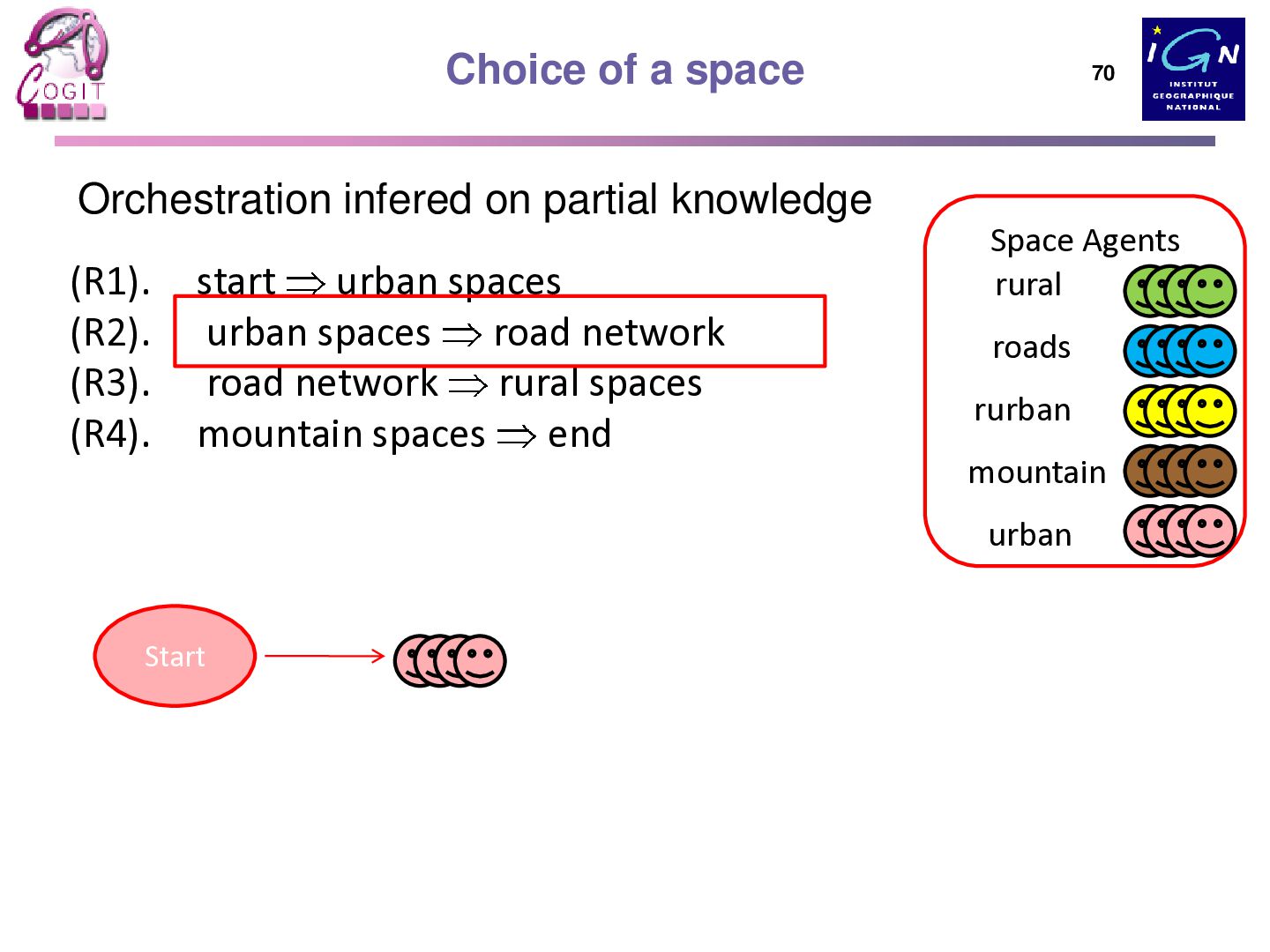
  55. Choice of a space 70 Orchestration infered on partial knowledge

    (R1). (R2). (R3). (R4). start urban spaces urban spaces road network road network rural spaces mountain spaces end Space Agents rural roads rurban mountain urban Start
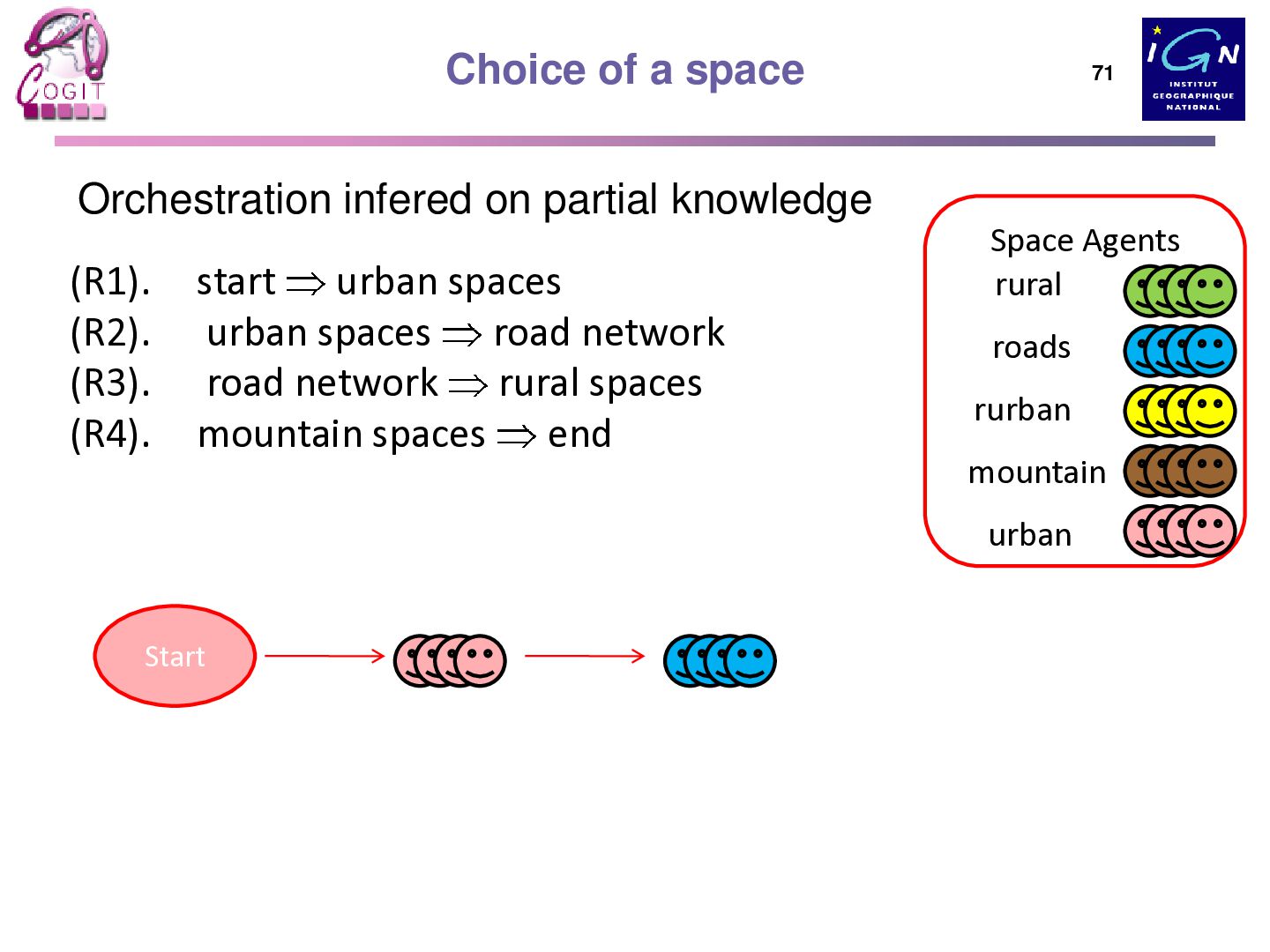
  56. Choice of a space 71 Orchestration infered on partial knowledge

    (R1). (R2). (R3). (R4). start urban spaces urban spaces road network road network rural spaces mountain spaces end Space Agents rural roads rurban mountain urban Start
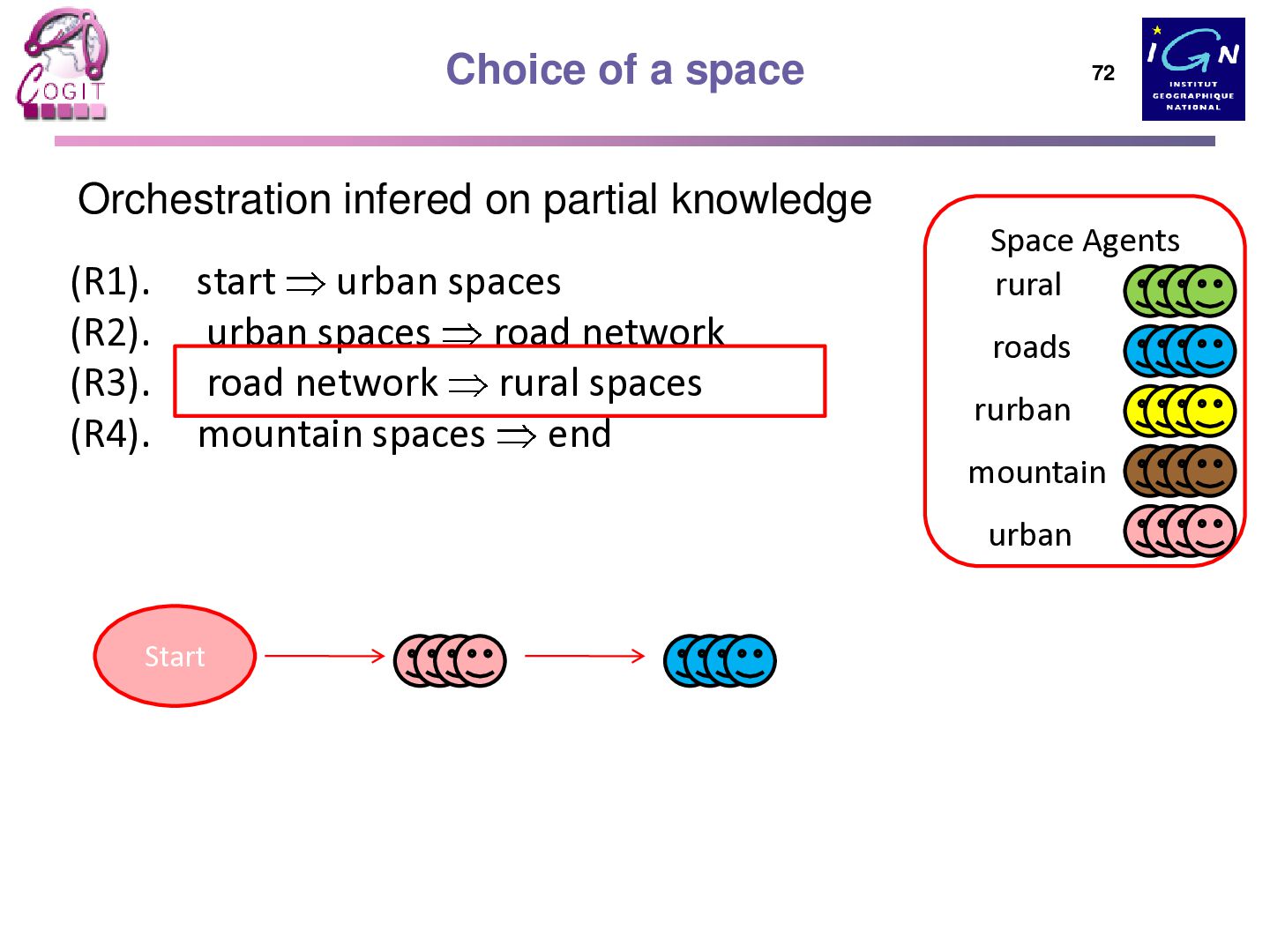
  57. Choice of a space 72 Orchestration infered on partial knowledge

    (R1). (R2). (R3). (R4). start urban spaces urban spaces road network road network rural spaces mountain spaces end Space Agents rural roads rurban mountain urban Start
  58. Choice of a space 73 Orchestration infered on partial knowledge

    (R1). (R2). (R3). (R4). start urban spaces urban spaces road network road network rural spaces mountain spaces end Space Agents rural roads rurban mountain urban Start
  59. Choice of a space 74 Orchestration infered on partial knowledge

    (R1). (R2). (R3). (R4). start urban spaces urban spaces road network road network rural spaces mountain spaces end Space Agents rural roads rurban mountain urban Start
  60. Choice of a space 75 Orchestration infered on partial knowledge

    (R1). (R2). (R3). (R4). start urban spaces urban spaces road network road network rural spaces mountain spaces end Space Agents rural roads rurban mountain urban Start End
  61. Choice of a space 76 Orchestration infered on partial knowledge

    (R1). (R2). (R3). (R4). start urban spaces urban spaces road network road network rural spaces mountain spaces end Space Agents rural roads rurban mountain urban Start End
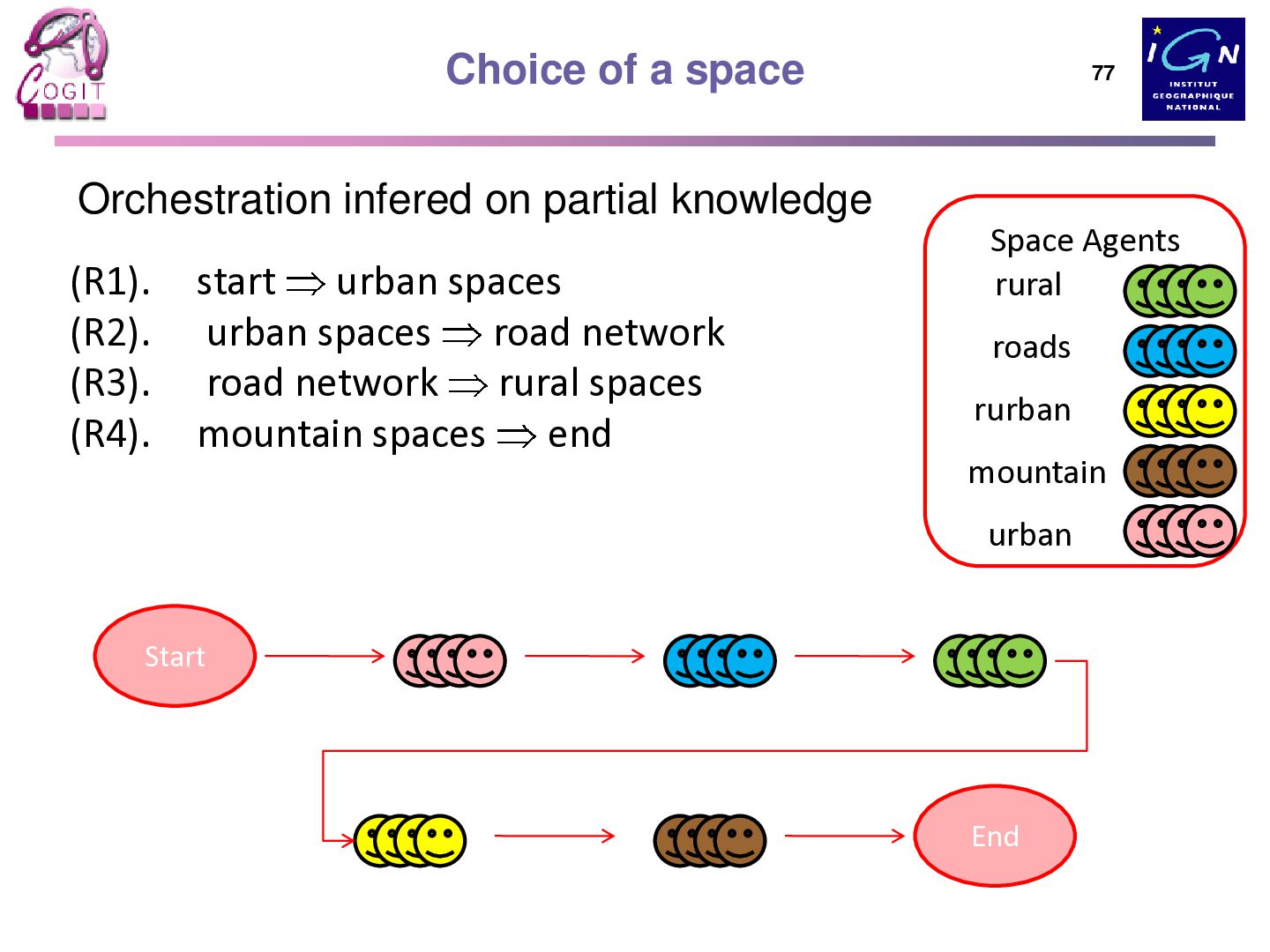
  62. Choice of a space 77 Orchestration infered on partial knowledge

    (R1). (R2). (R3). (R4). start urban spaces urban spaces road network road network rural spaces mountain spaces end Space Agents rural roads rurban mountain urban Start End
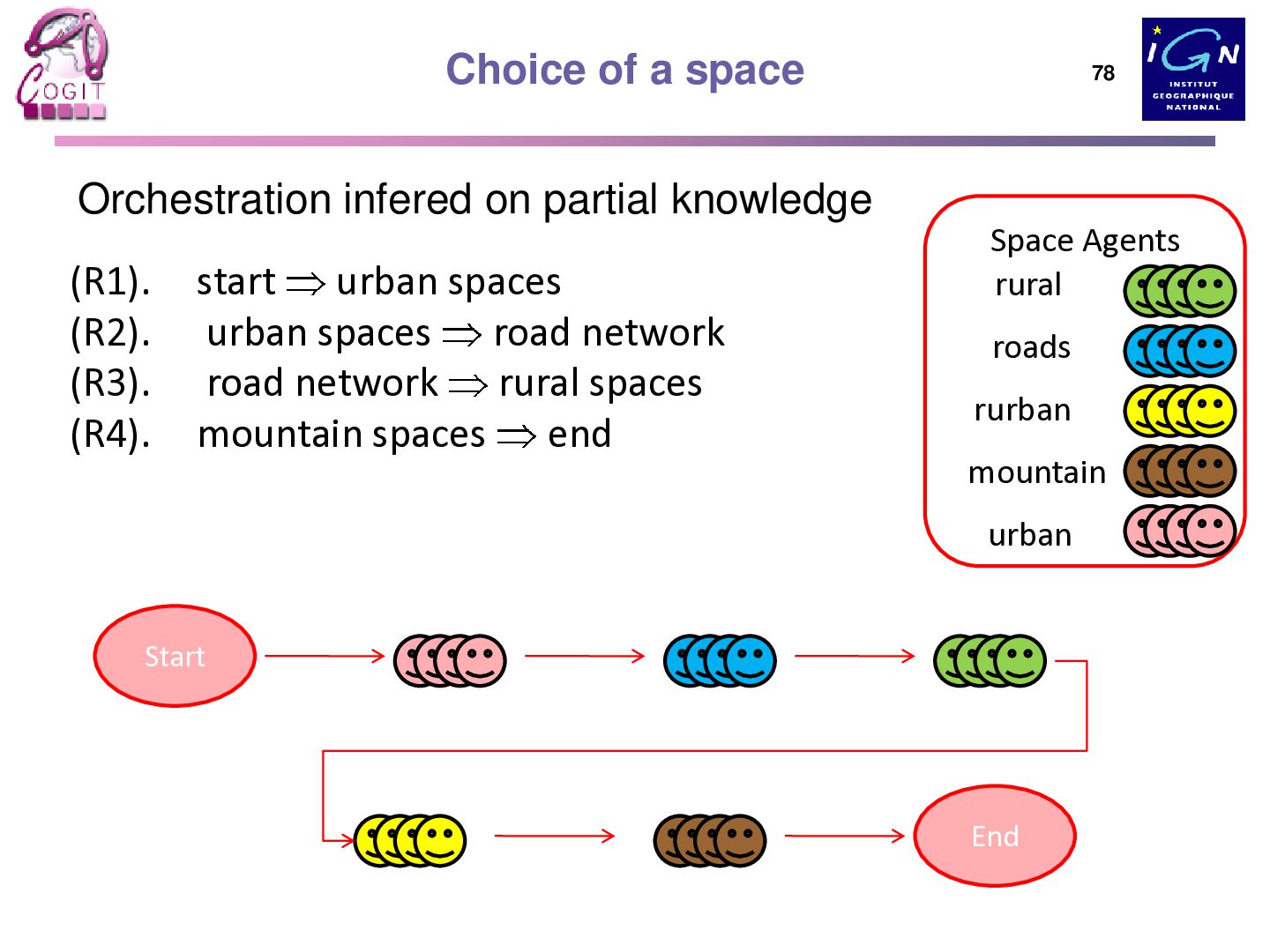
  63. Choice of a space 78 Orchestration infered on partial knowledge

    (R1). (R2). (R3). (R4). start urban spaces urban spaces road network road network rural spaces mountain spaces end Space Agents rural roads rurban mountain urban Start End
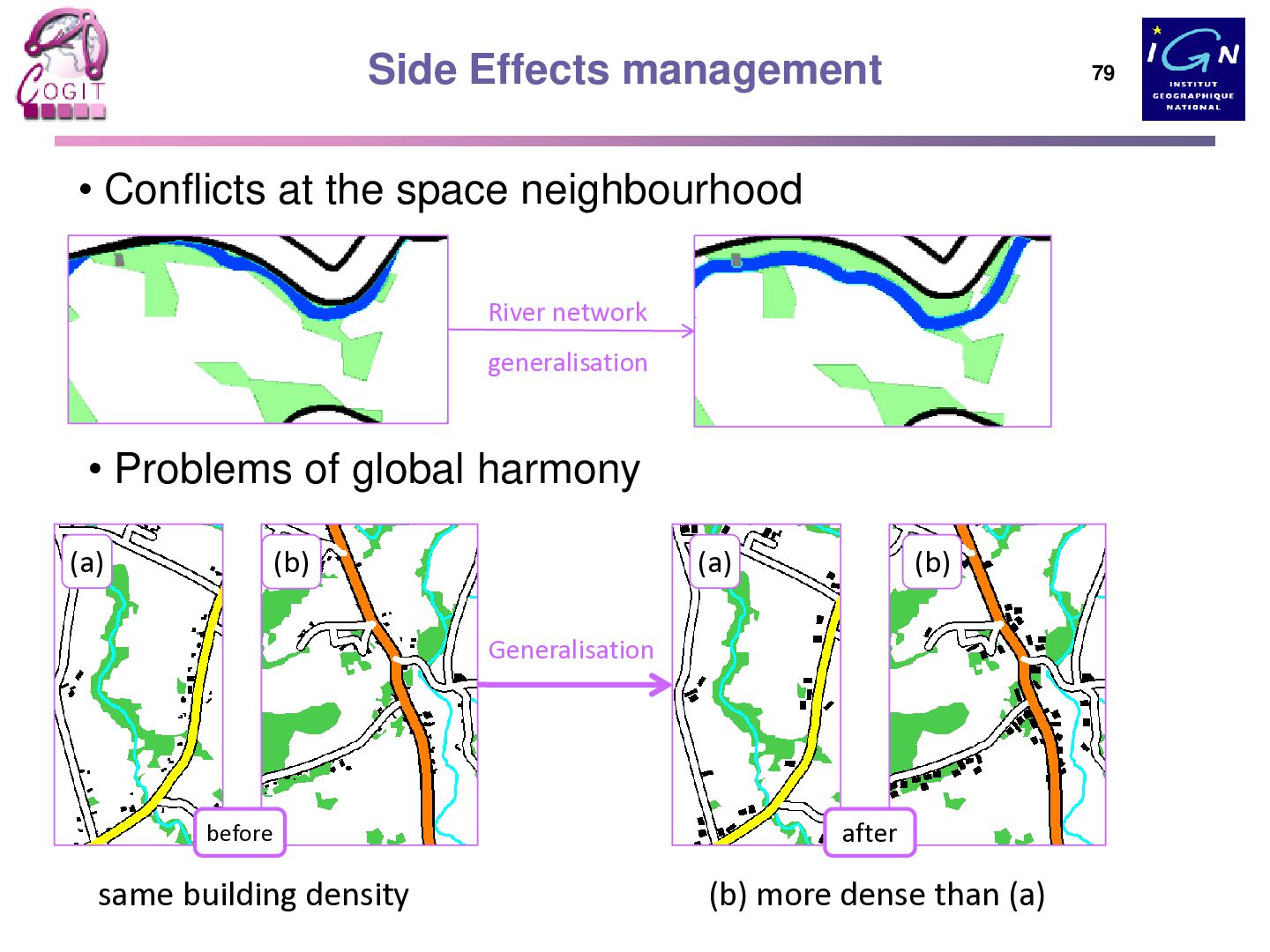
  64. Side Effects management 79 • Conflicts at the space neighbourhood

    River network generalisation • Problems of global harmony (a) (a) (b) (b) Generalisation before after same building density (b) more dense than (a)
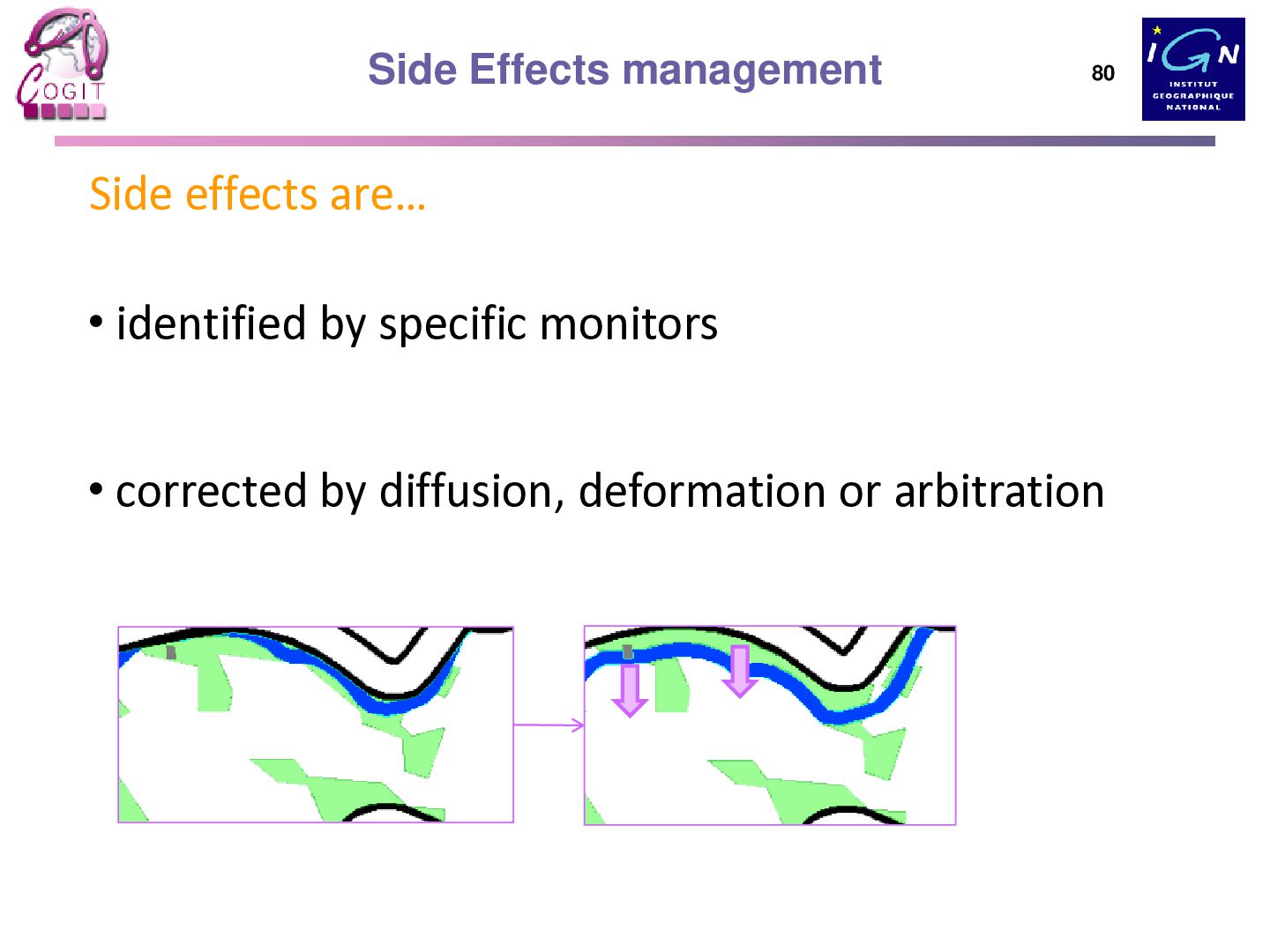
  65. Side Effects management 80 Side effects are… • identified by

    specific monitors • corrected by diffusion, deformation or arbitration