Share
Embed
The future of data analysis
Hadley Wickham
July 04, 2012
Transcript
44 slides
-
Hadley Wickham Assistant Professor / Dobelman Family Junior Chair Department
of Statistics / Rice University The future of data analysis July 2012 @ hadleyw ickham Monday, July 9, 12 -
Hadley Wickham Assistant Professor / Dobelman Family Junior Chair Department
of Statistics / Rice University The future of data analysis July 2012 @ hadleyw ickham near ^ Monday, July 9, 12 -
Hadley Wickham Data Scientist in Residence Metamarkets July 2012 The
future of data analysis @ hadleyw ickham near ^ Monday, July 9, 12 -
Data analysis is the process by which data becomes understanding,
knowledge and insight Data analysis is the process by which data becomes understanding, knowledge and insight Monday, July 9, 12 -
Data analysis is the process by which data becomes understanding,
knowledge and insight Data analysis is the process by which data becomes understanding, knowledge and insight Monday, July 9, 12 -
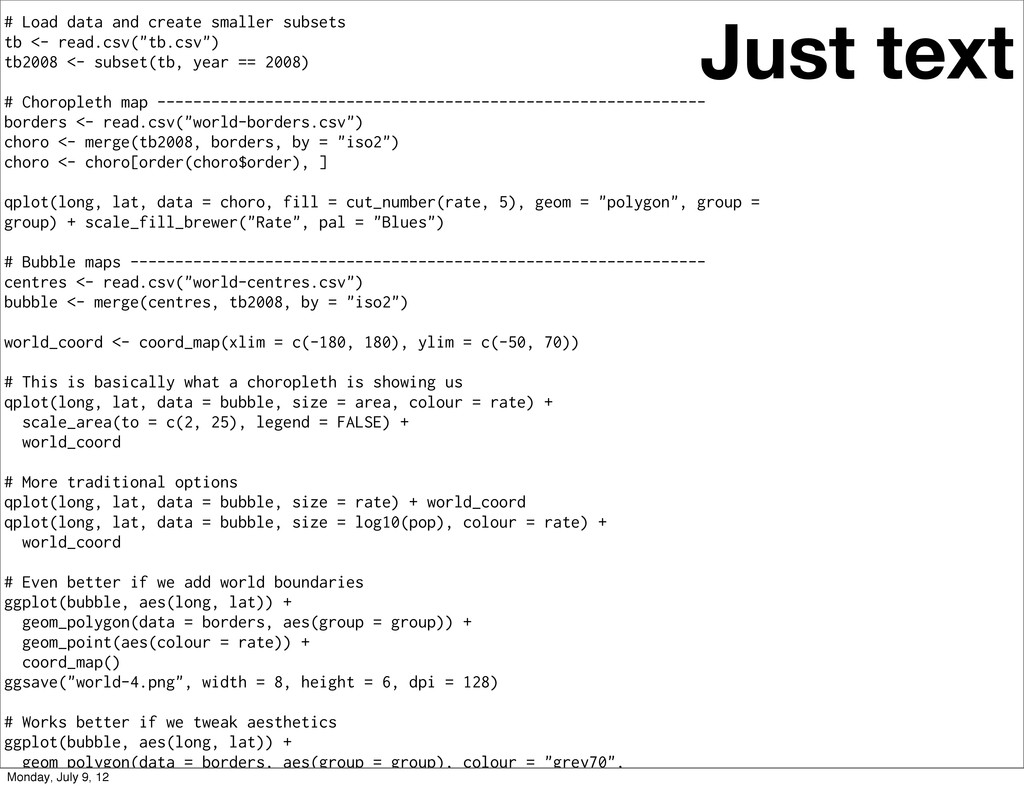
# Load data and create smaller subsets tb <- read.csv("tb.csv")
tb2008 <- subset(tb, year == 2008) # Choropleth map ------------------------------------------------------------- borders <- read.csv("world-borders.csv") choro <- merge(tb2008, borders, by = "iso2") choro <- choro[order(choro$order), ] qplot(long, lat, data = choro, fill = cut_number(rate, 5), geom = "polygon", group = group) + scale_fill_brewer("Rate", pal = "Blues") # Bubble maps ---------------------------------------------------------------- centres <- read.csv("world-centres.csv") bubble <- merge(centres, tb2008, by = "iso2") world_coord <- coord_map(xlim = c(-180, 180), ylim = c(-50, 70)) # This is basically what a choropleth is showing us qplot(long, lat, data = bubble, size = area, colour = rate) + scale_area(to = c(2, 25), legend = FALSE) + world_coord # More traditional options qplot(long, lat, data = bubble, size = rate) + world_coord qplot(long, lat, data = bubble, size = log10(pop), colour = rate) + world_coord # Even better if we add world boundaries ggplot(bubble, aes(long, lat)) + geom_polygon(data = borders, aes(group = group)) + geom_point(aes(colour = rate)) + coord_map() ggsave("world-4.png", width = 8, height = 6, dpi = 128) # Works better if we tweak aesthetics ggplot(bubble, aes(long, lat)) + geom_polygon(data = borders, aes(group = group), colour = "grey70", fill = NA) + Just text Monday, July 9, 12 -
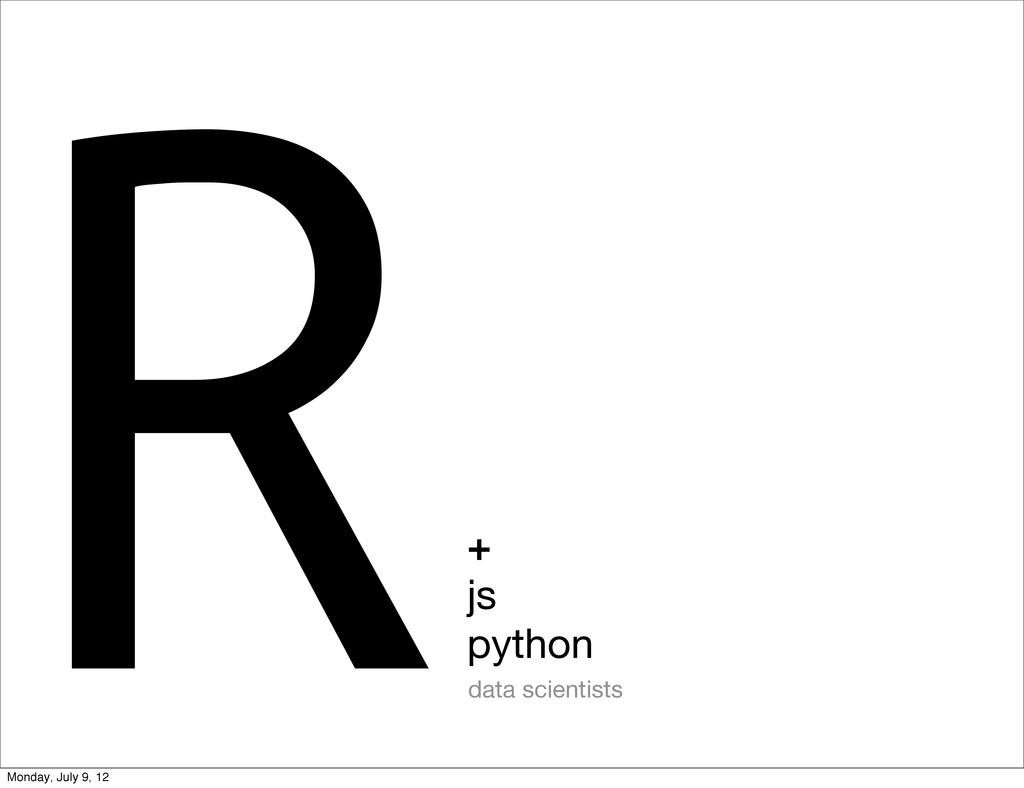
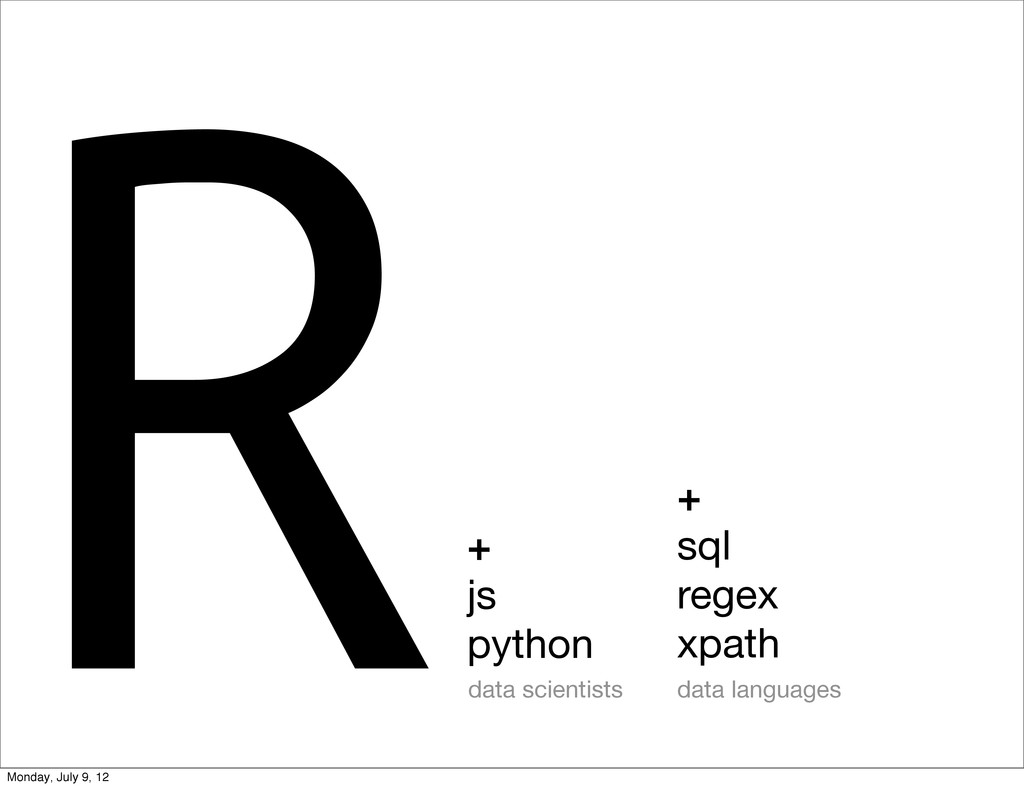
R + js python data scientists + sql regex xpath
data languages Monday, July 9, 12 -
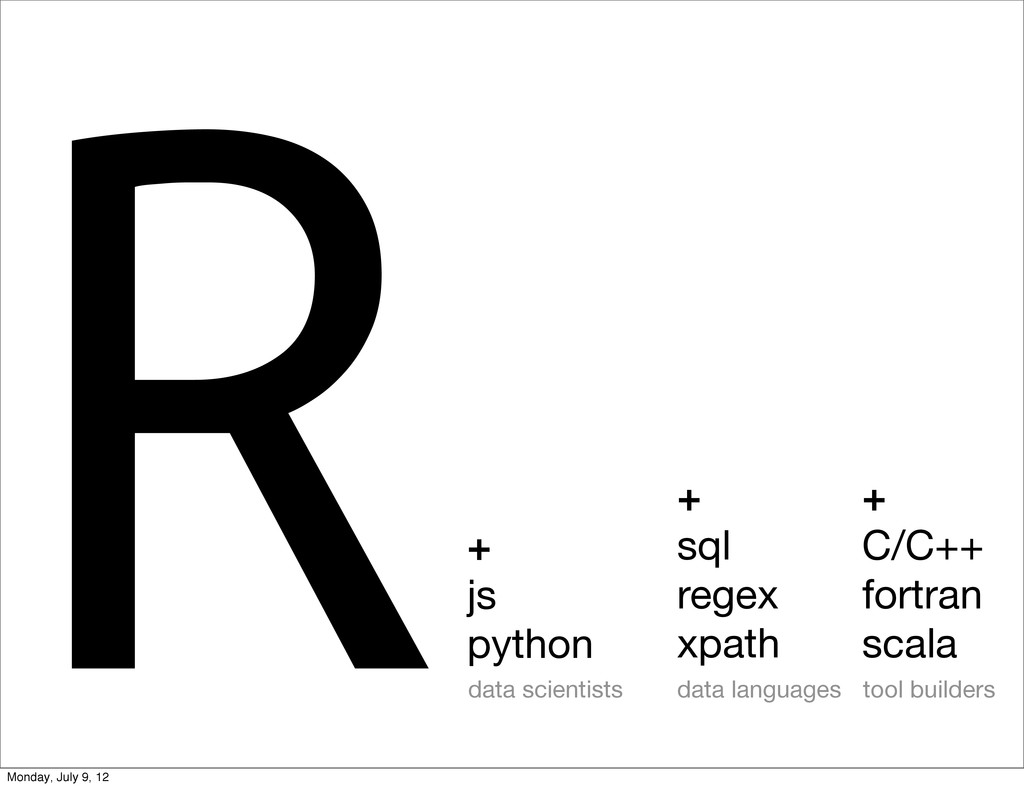
R + js python data scientists + C/C++ fortran scala
tool builders + sql regex xpath data languages Monday, July 9, 12 -
The future is already here – it’s just not evenly
distributed. William Gibson Monday, July 9, 12 -
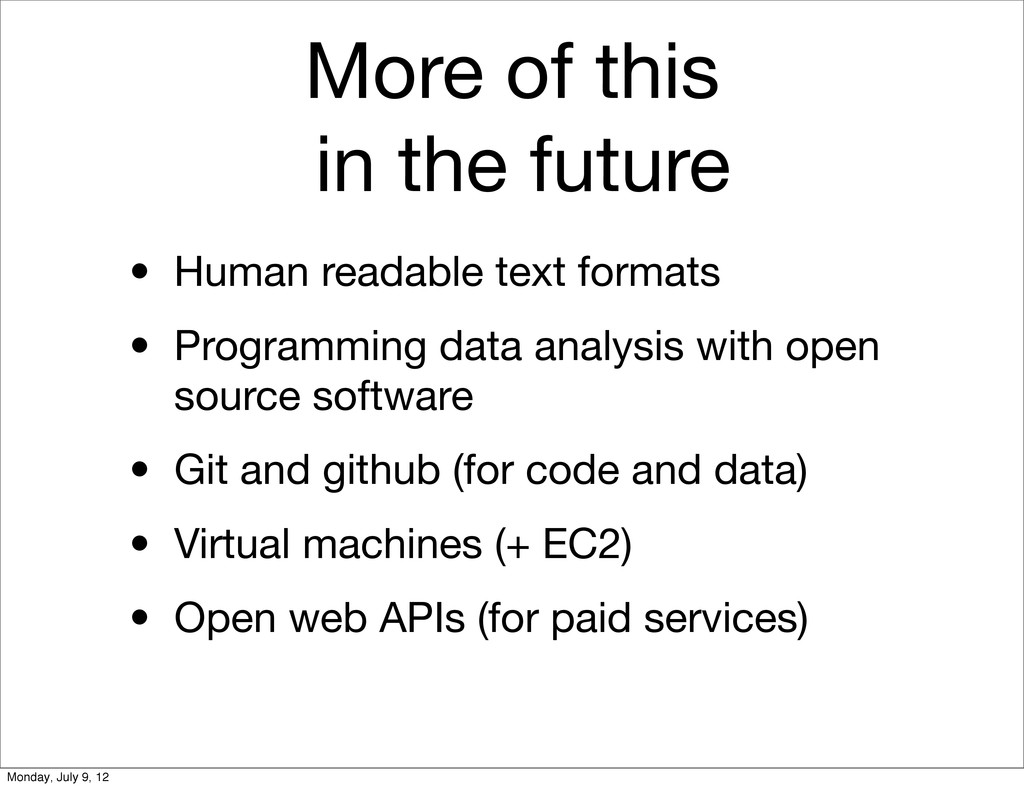
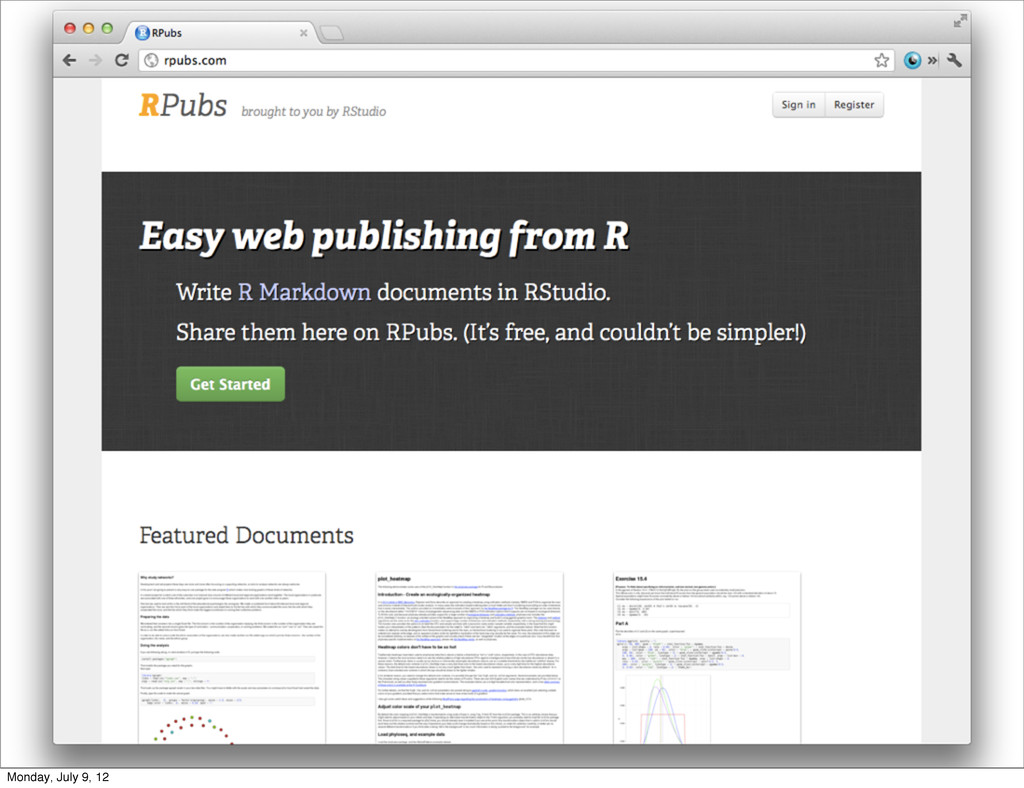
More of this in the future • Human readable text
formats • Programming data analysis with open source software • Git and github (for code and data) • Virtual machines (+ EC2) • Open web APIs (for paid services) Monday, July 9, 12 -
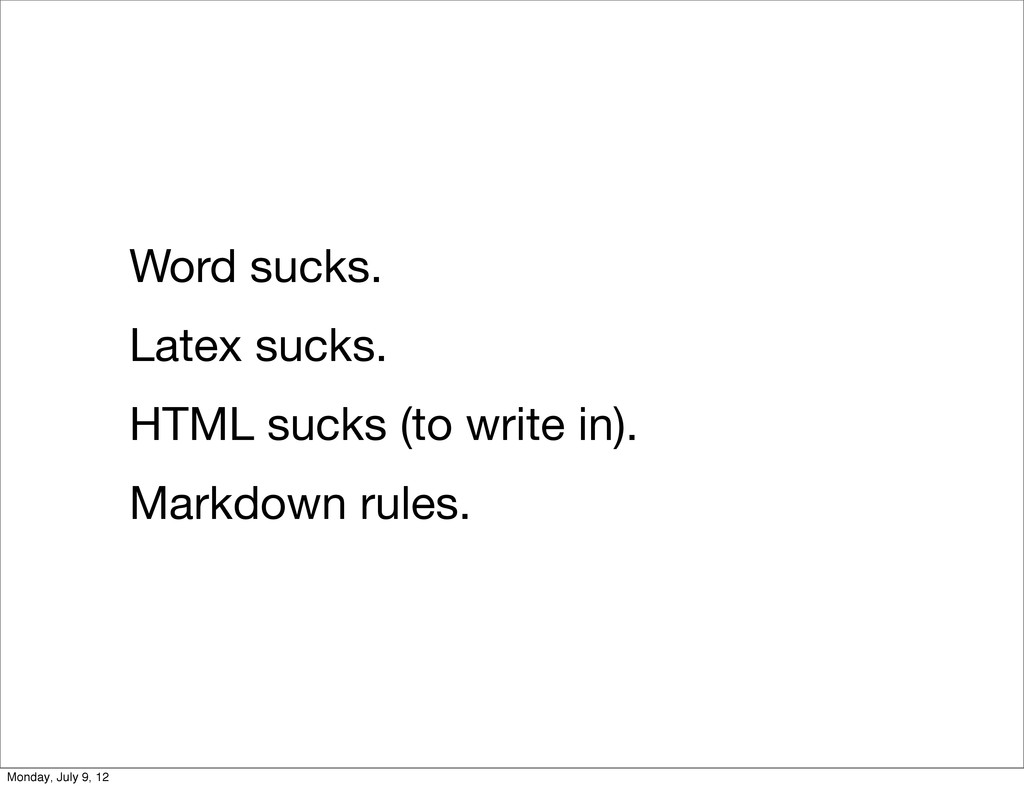
Word sucks. Latex sucks. HTML sucks (to write in). Markdown
rules. Monday, July 9, 12 -
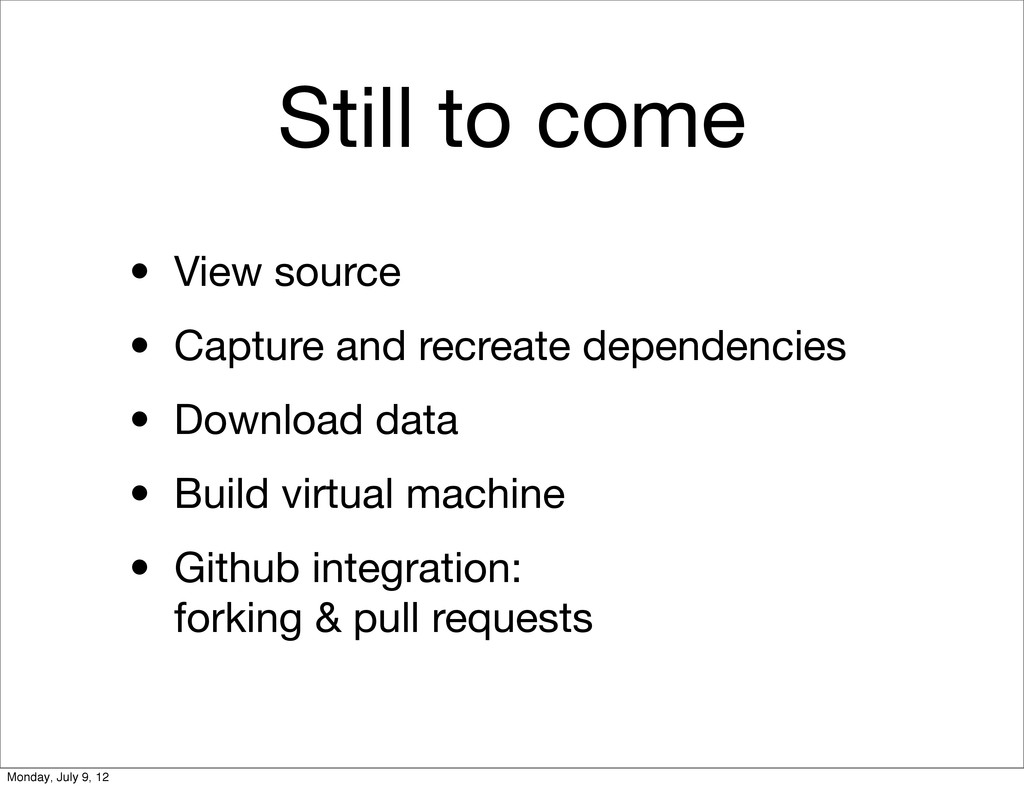
Still to come • View source • Capture and recreate
dependencies • Download data • Build virtual machine • Github integration: forking & pull requests Monday, July 9, 12 -
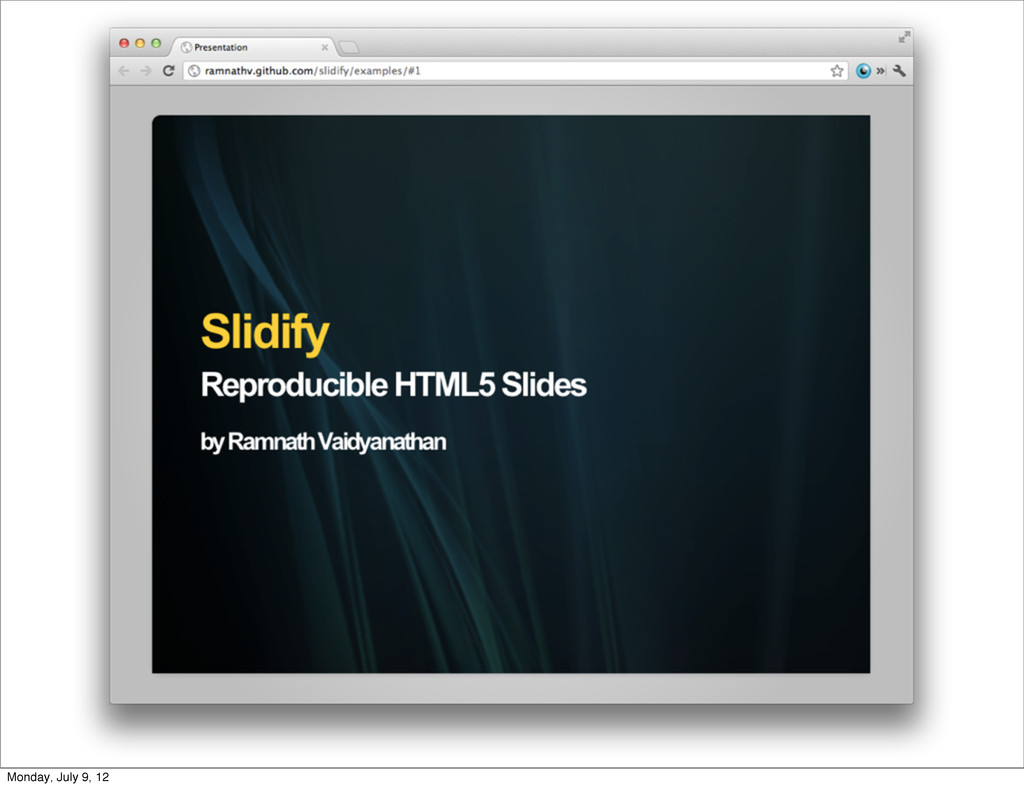
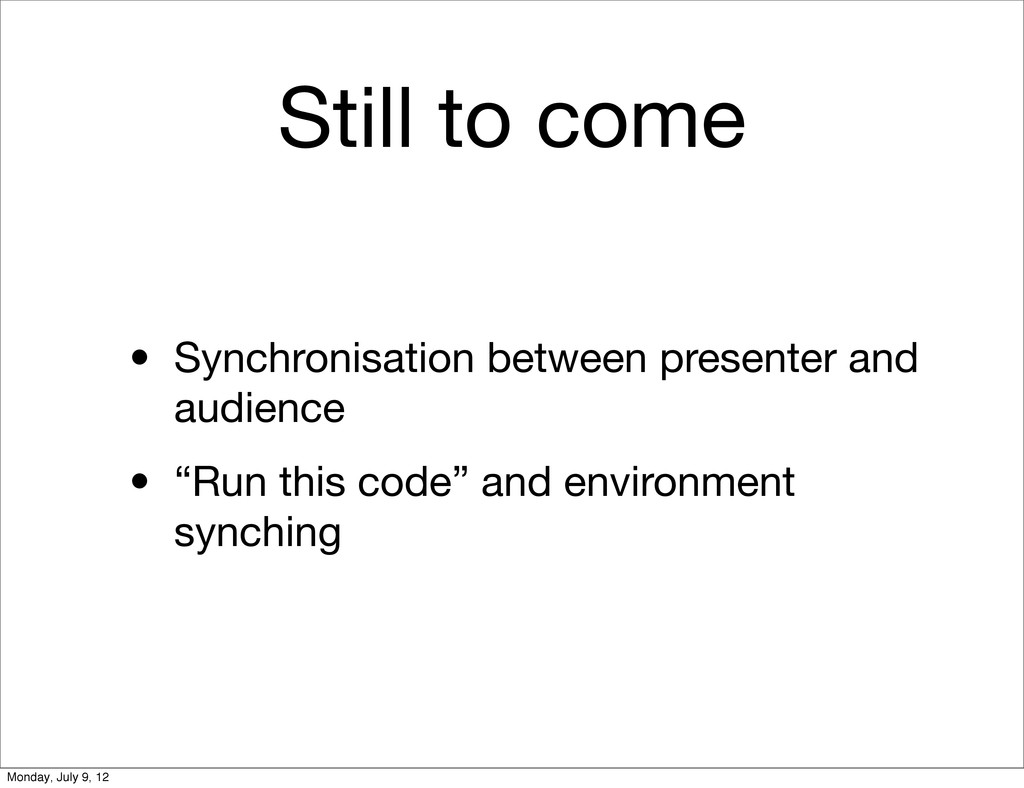
Still to come • Synchronisation between presenter and audience •
“Run this code” and environment synching Monday, July 9, 12 -
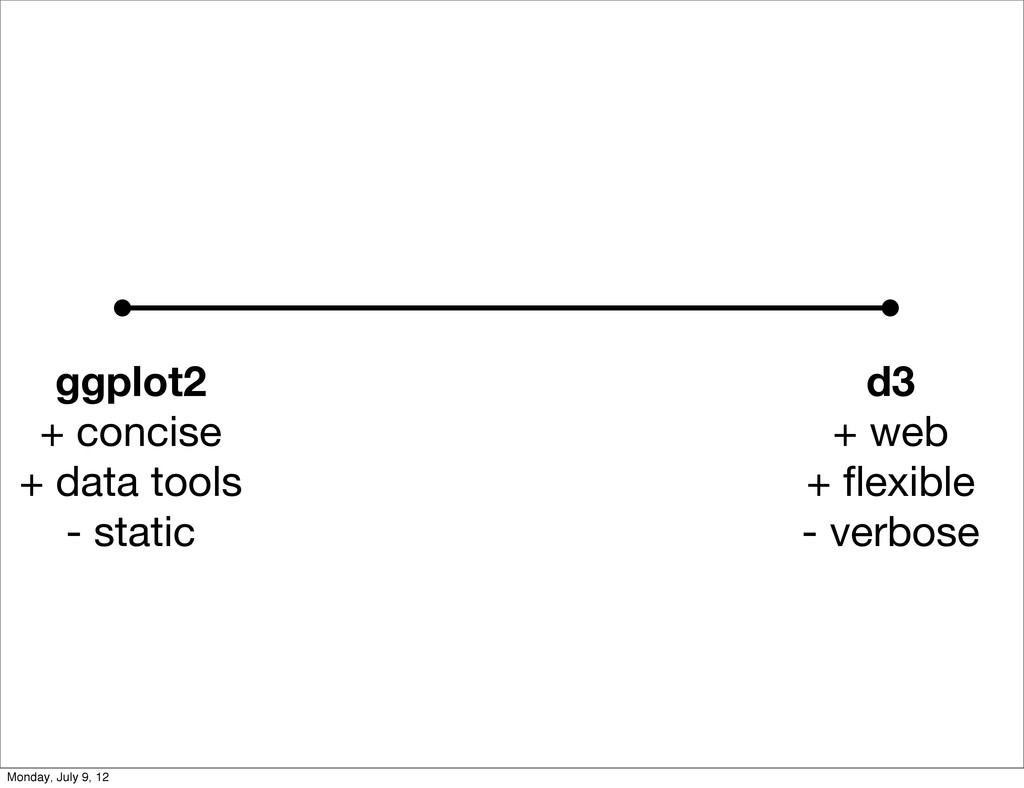
ggplot2 + concise + data tools - static d3 +
web + flexible - verbose Monday, July 9, 12 -
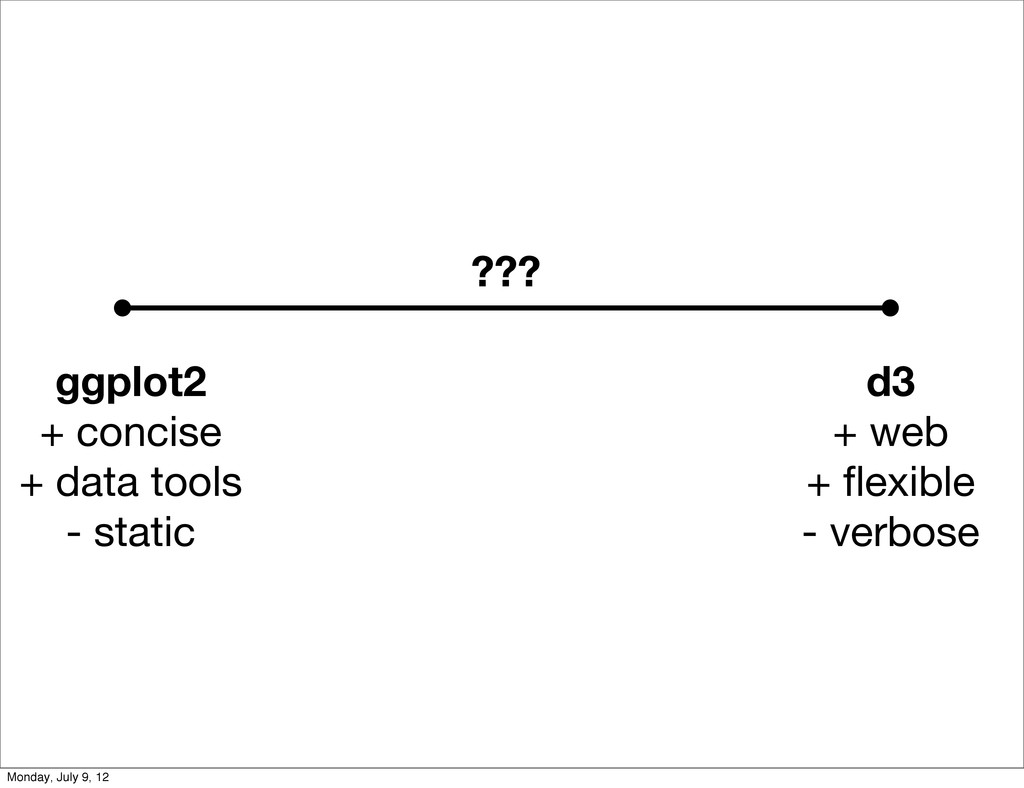
ggplot2 + concise + data tools - static d3 +
web + flexible - verbose ??? Monday, July 9, 12 -
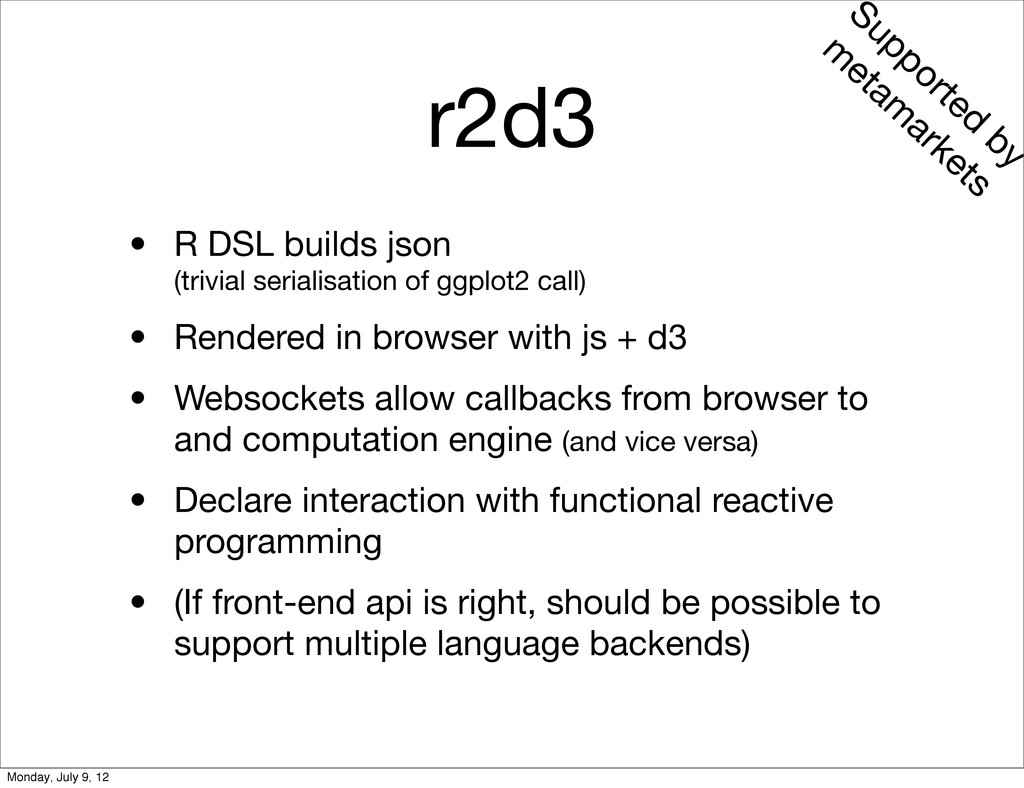
r2d3 • R DSL builds json (trivial serialisation of ggplot2
call) • Rendered in browser with js + d3 • Websockets allow callbacks from browser to and computation engine (and vice versa) • Declare interaction with functional reactive programming • (If front-end api is right, should be possible to support multiple language backends) Supported by m etam arkets Monday, July 9, 12 -
Hybrid computation In browser (js) Local compute (R, python, ...)
Distributed compute The future is heterogeneous Monday, July 9, 12 -
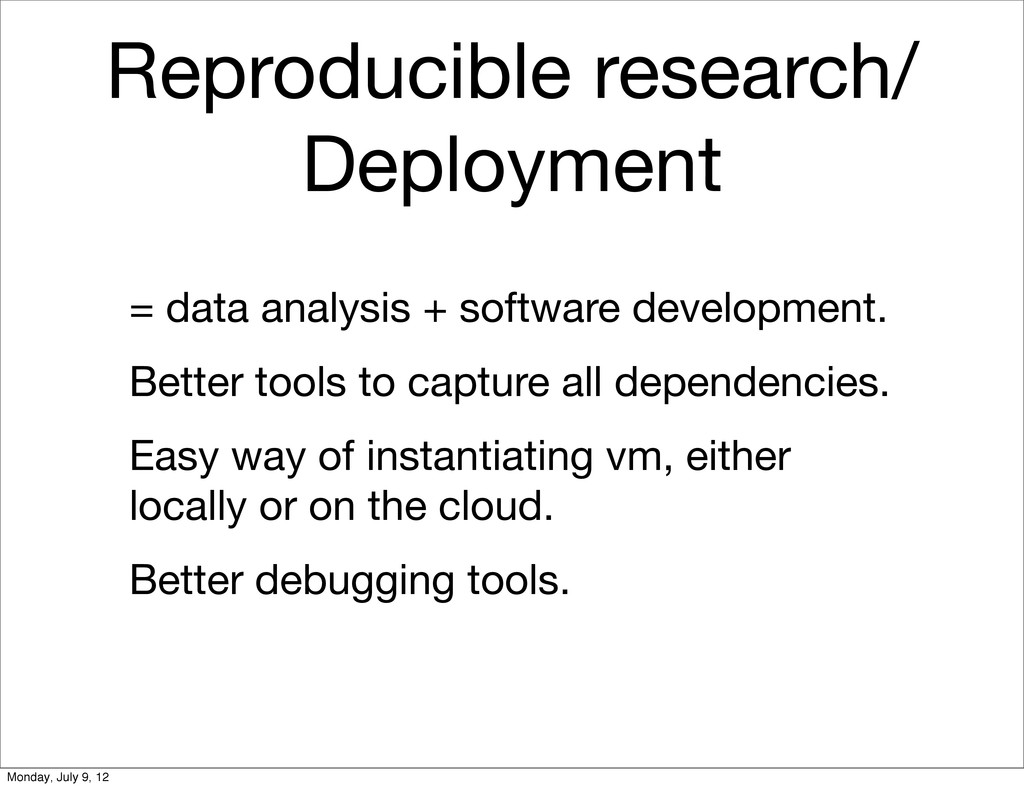
Reproducible research/ Deployment = data analysis + software development. Better
tools to capture all dependencies. Easy way of instantiating vm, either locally or on the cloud. Better debugging tools. Monday, July 9, 12 -
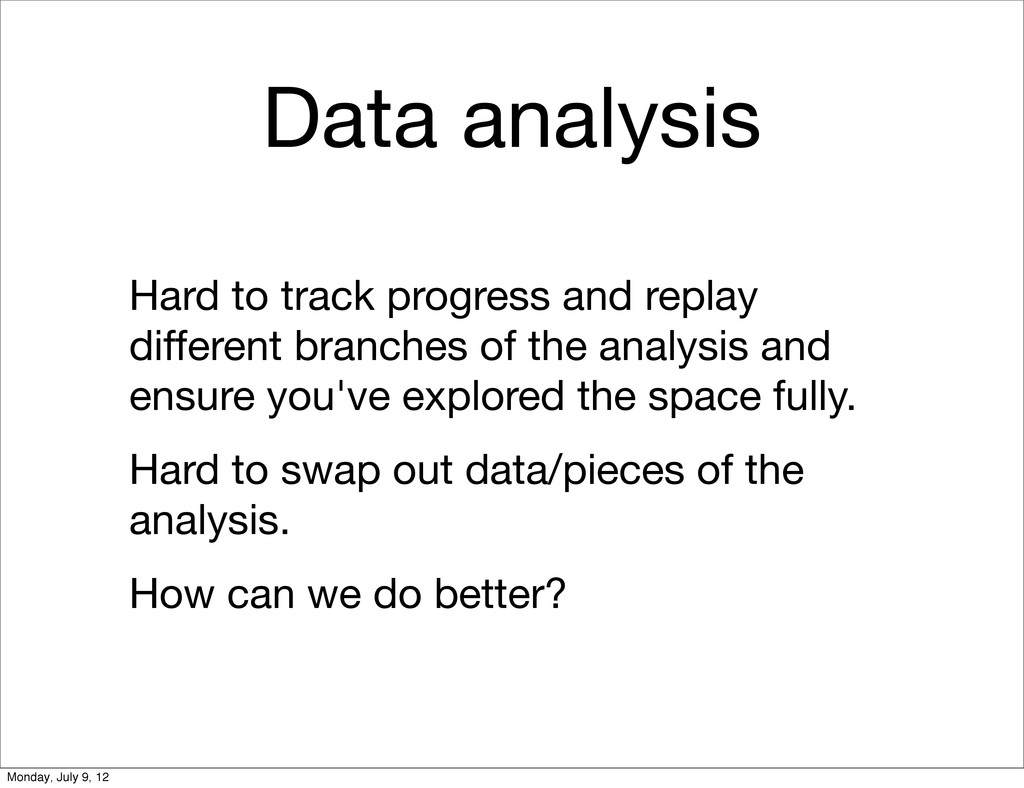
Data analysis Hard to track progress and replay different branches
of the analysis and ensure you've explored the space fully. Hard to swap out data/pieces of the analysis. How can we do better? Monday, July 9, 12 -
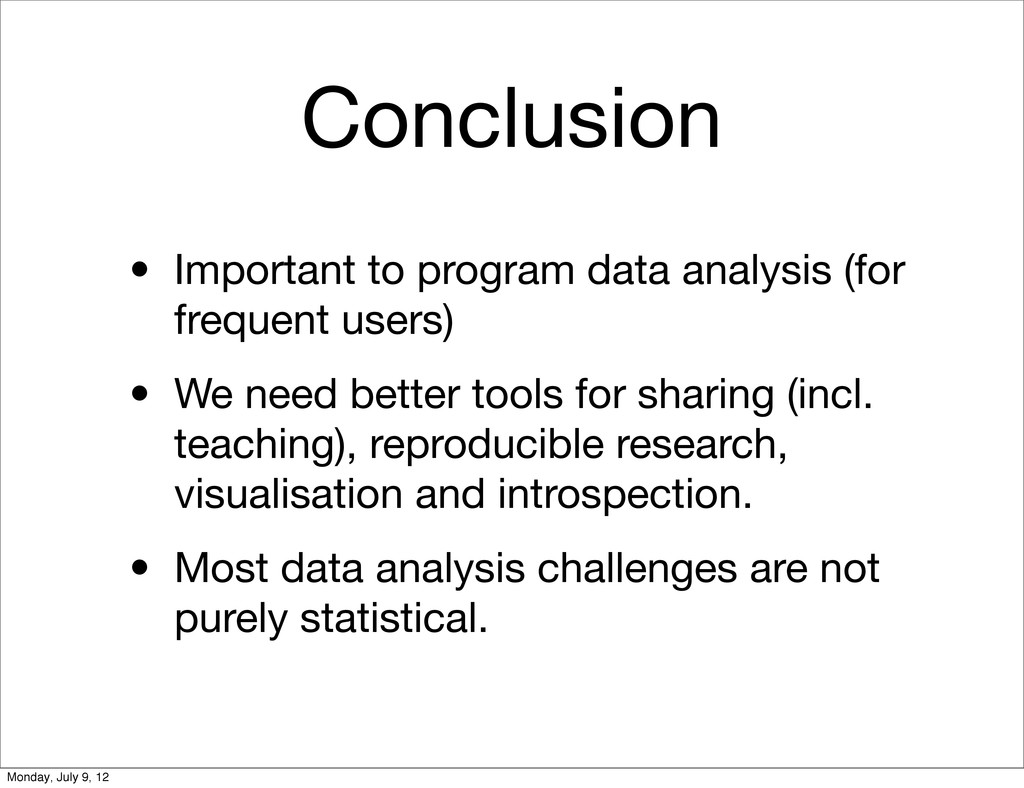
Conclusion • Important to program data analysis (for frequent users)
• We need better tools for sharing (incl. teaching), reproducible research, visualisation and introspection. • Most data analysis challenges are not purely statistical. Monday, July 9, 12