Upgrade to Pro — share decks privately, control downloads, hide ads and more …

The Service Mesh: Solving Microservice Chaos (A...

Sponsored · Your Podcast. Everywhere. Effortlessly. Share. Educate. Inspire. Entertain. You do you. We'll handle the rest.

The Service Mesh: Solving Microservice Chaos (And When You Actually Need One)

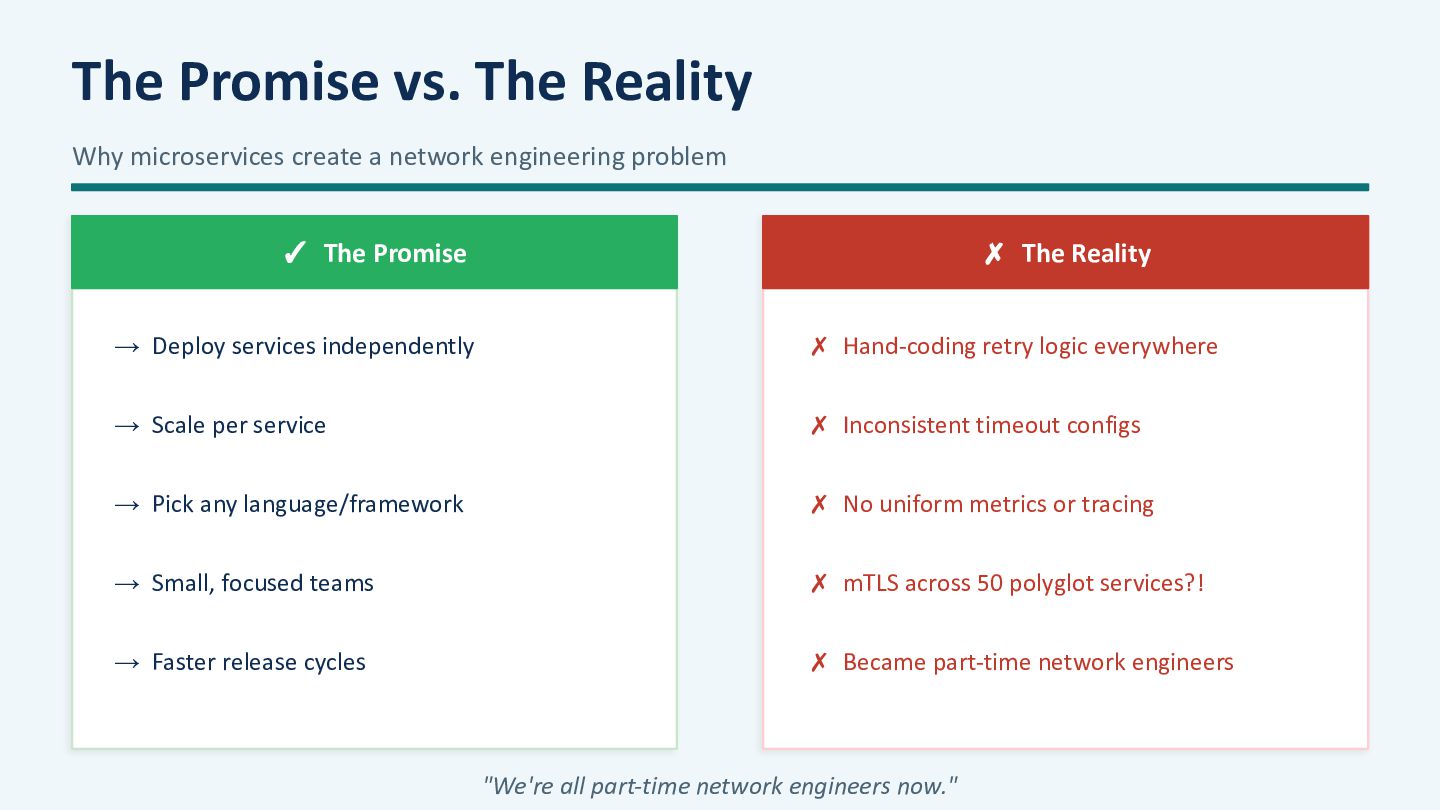
Microservices promised speed and independence, but for many SREs and developers, they delivered network complexity. Suddenly, we're all part-time network engineers. We have to code retry logic, timeouts, and circuit breakers into every service. We struggle to get uniform "golden signal" metrics. And how do we enforce that all 50 of our polyglot services are communicating securely over mTLS?

This is the "microservice tax," and it's holding us back.

Enter the service mesh. You've heard the buzzwords, Istio, Linkerd, but what is a mesh, and what problems does it actually solve? Is it just hype, or is it the key to taming a complex distributed system?

We'll cover the three pillars of a mesh:

*Reliability: Automatic retries, timeouts, and circuit breakers.

*Observability: Uniform metrics, logging, and tracing for every call.

*Security: Automatic mTLS (encryption) and fine-grained authorization policies.

Avatar for Hannah Olukoye

Hannah Olukoye

May 20, 2026

More Decks by Hannah Olukoye

Other Decks in Technology

Transcript

  1. The Service Mesh Solving Microservice Chaos (And When You Actually

    Need One) Mofesola Babalola Staff Reliability Engineer Hannah Olukoye Engineering Manager
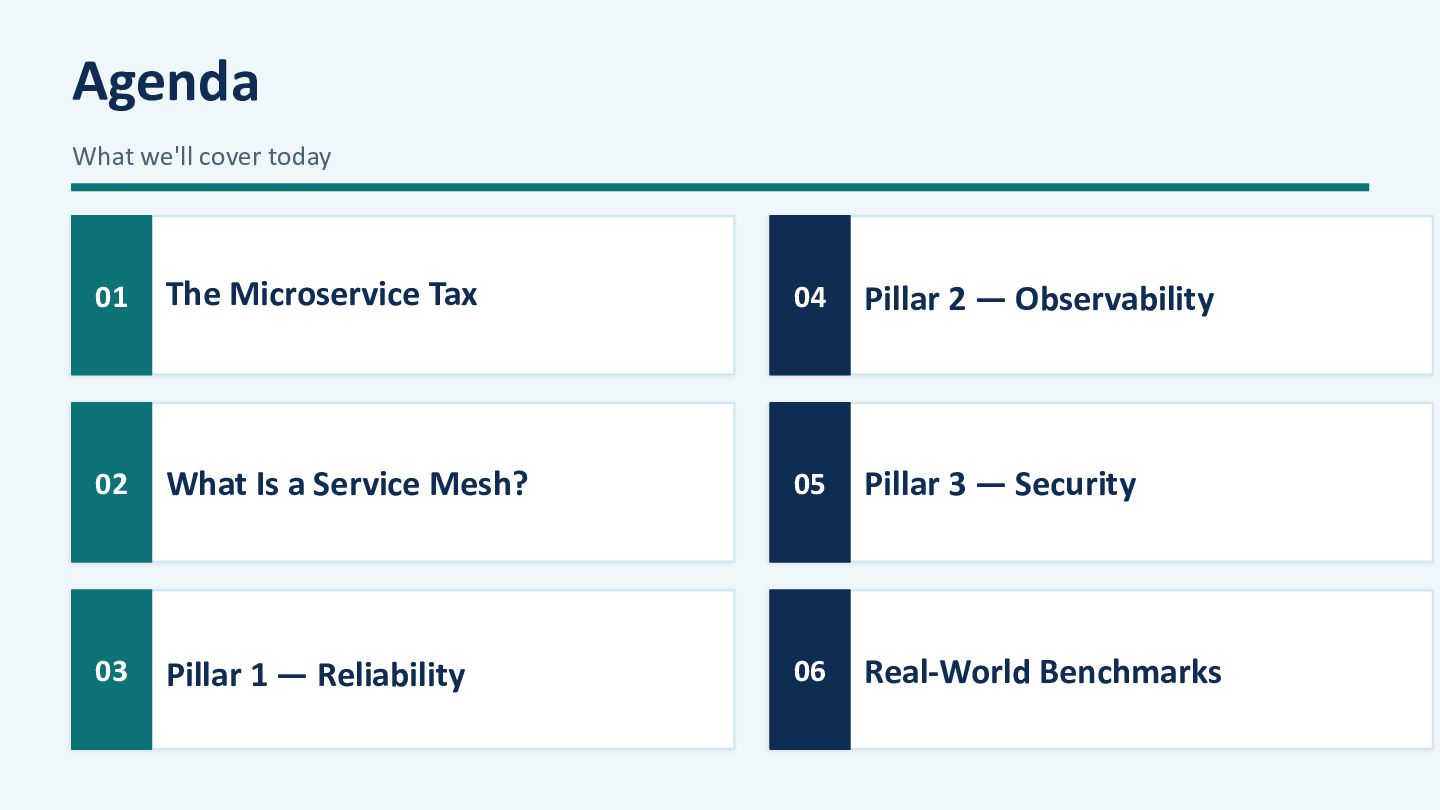
  2. Agenda What we'll cover today 01 The Microservice Tax 02

    What Is a Service Mesh? 03 Pillar 1 — Reliability 04 Pillar 2 — Observability 05 Pillar 3 — Security 06 Real-World Benchmarks
  3. The Promise vs. The Reality Why microservices create a network

    engineering problem ✓ The Promise → Deploy services independently → Scale per service → Pick any language/framework → Small, focused teams → Faster release cycles ✗ The Reality ✗ Hand-coding retry logic everywhere ✗ Inconsistent timeout configs ✗ No uniform metrics or tracing ✗ mTLS across 50 polyglot services?! ✗ Became part-time network engineers "We're all part-time network engineers now."
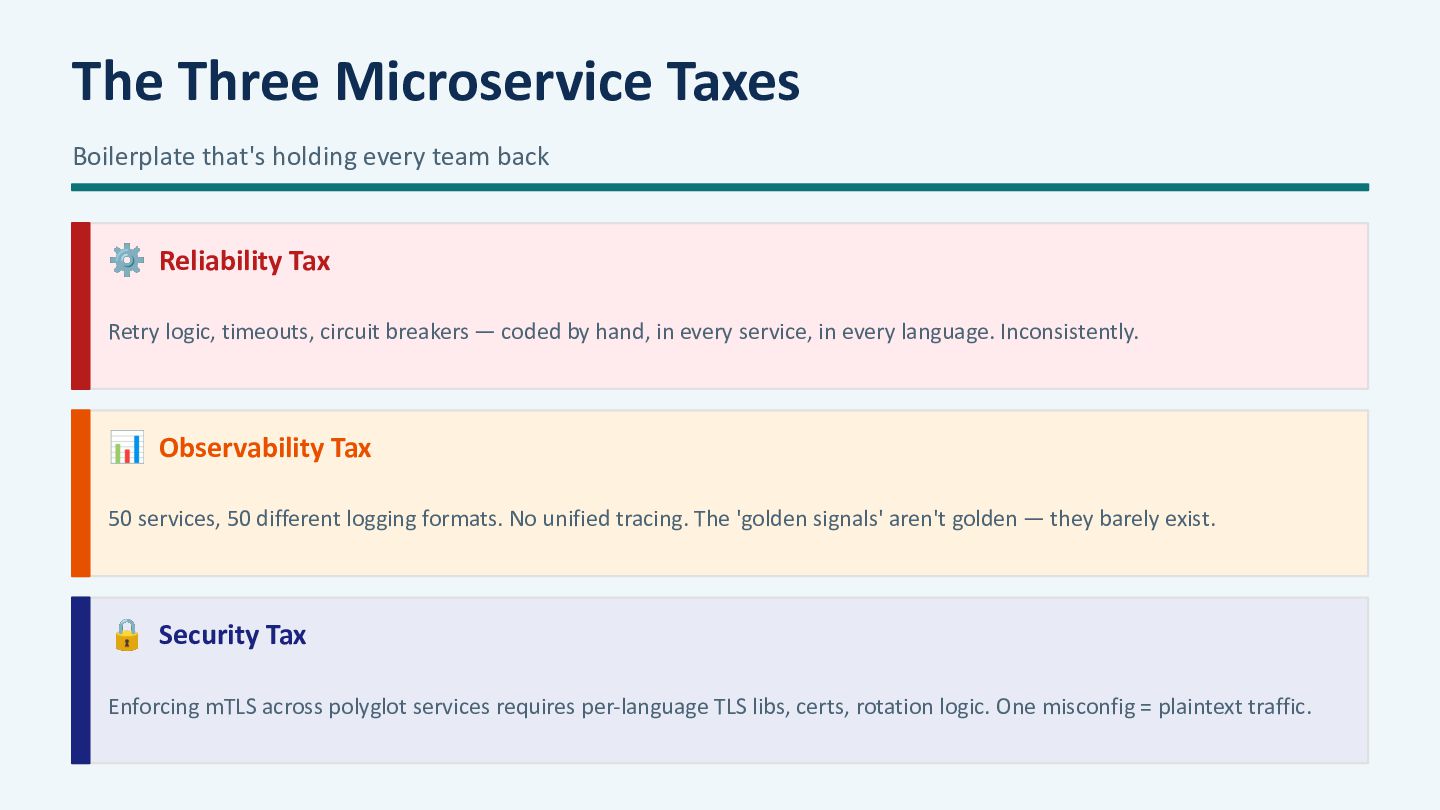
  4. The Three Microservice Taxes Boilerplate that's holding every team back

    ⚙ Reliability Tax Retry logic, timeouts, circuit breakers — coded by hand, in every service, in every language. Inconsistently. 📊 Observability Tax 50 services, 50 different logging formats. No unified tracing. The 'golden signals' aren't golden — they barely exist. 🔒 Security Tax Enforcing mTLS across polyglot services requires per-language TLS libs, certs, rotation logic. One misconfig = plaintext traffic.
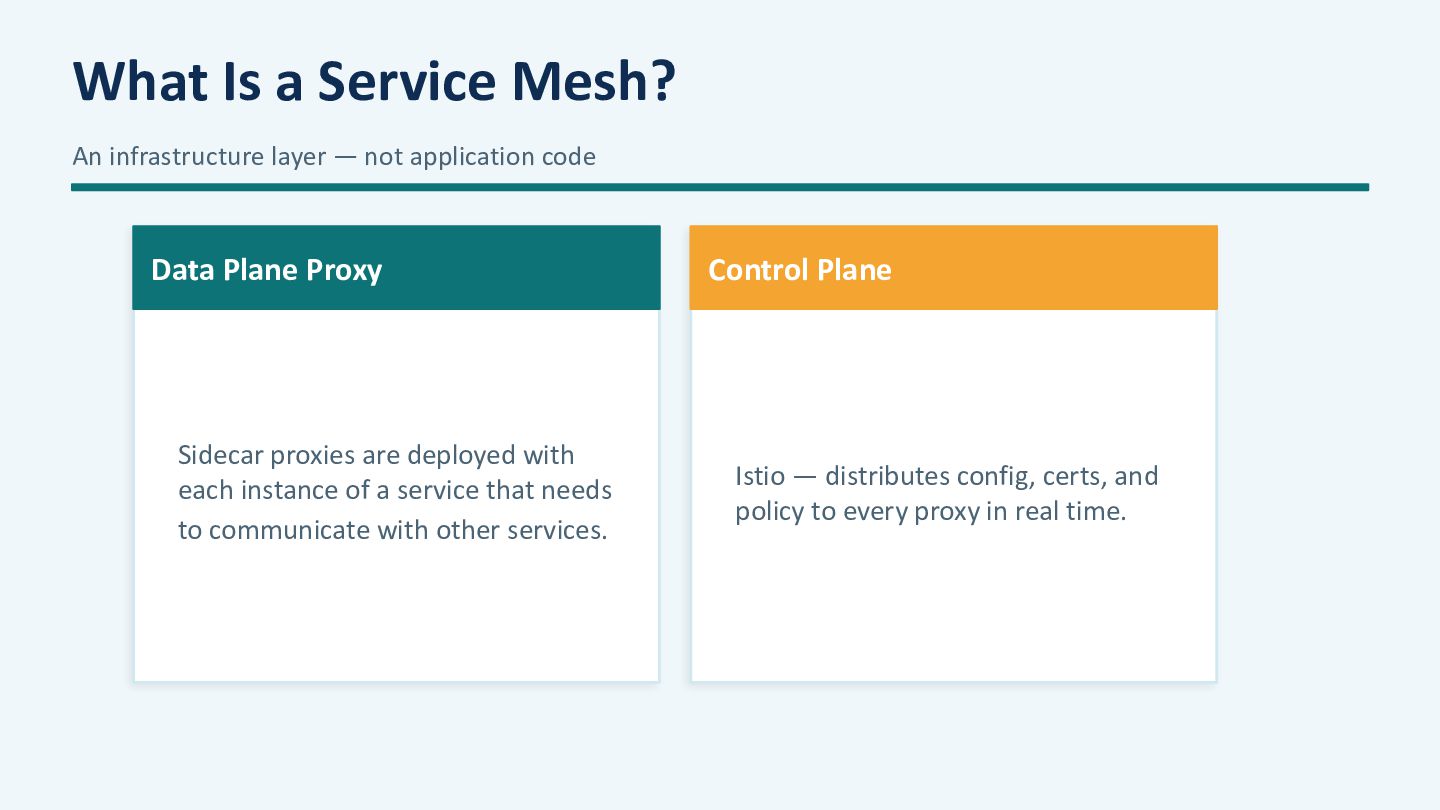
  5. What Is a Service Mesh? An infrastructure layer — not

    application code Data Plane Proxy Sidecar proxies are deployed with each instance of a service that needs to communicate with other services. Control Plane Istio — distributes config, certs, and policy to every proxy in real time.
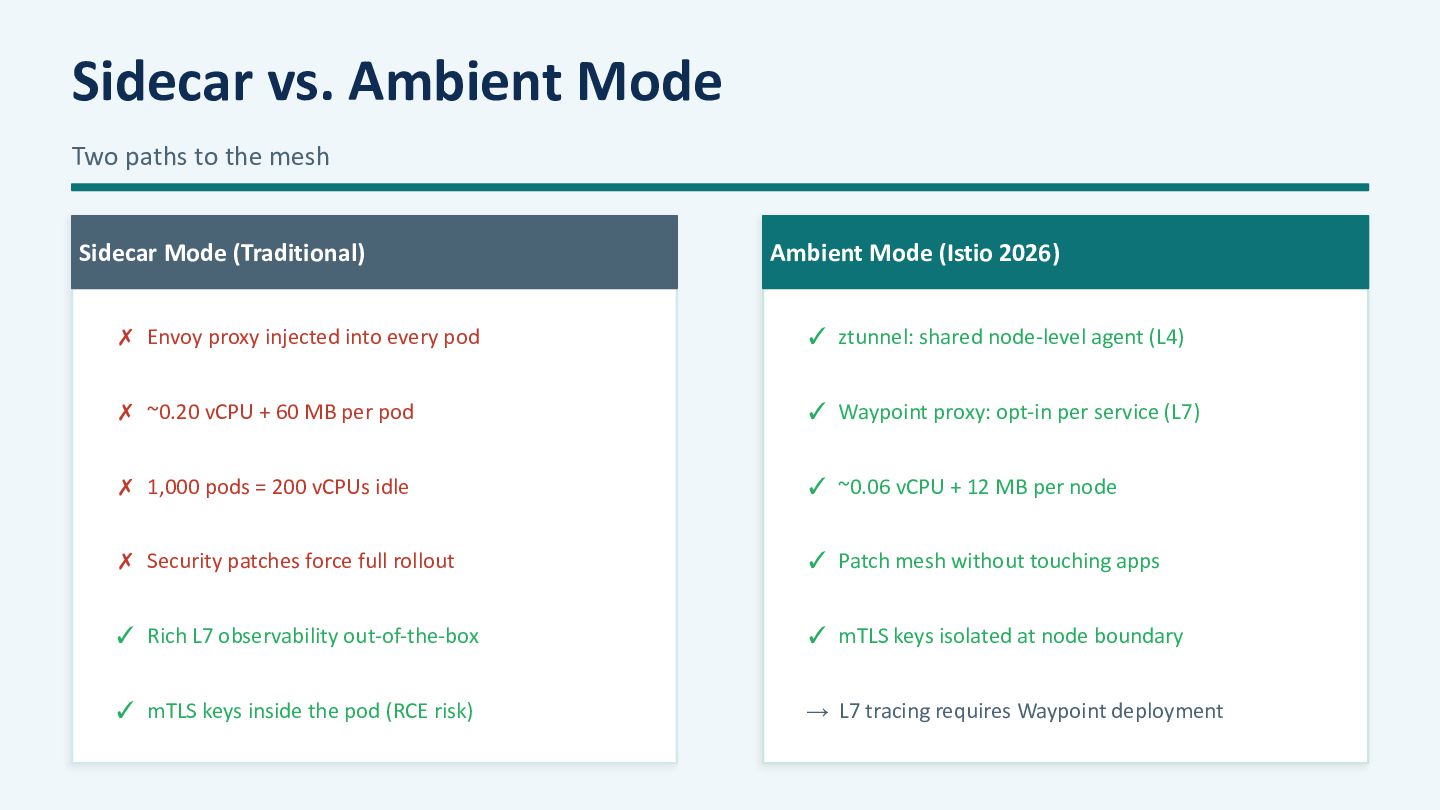
  6. Sidecar vs. Ambient Mode Two paths to the mesh Sidecar

    Mode (Traditional) ✗ Envoy proxy injected into every pod ✗ ~0.20 vCPU + 60 MB per pod ✗ 1,000 pods = 200 vCPUs idle ✗ Security patches force full rollout ✓ Rich L7 observability out-of-the-box ✓ mTLS keys inside the pod (RCE risk) Ambient Mode (Istio 2026) ✓ ztunnel: shared node-level agent (L4) ✓ Waypoint proxy: opt-in per service (L7) ✓ ~0.06 vCPU + 12 MB per node ✓ Patch mesh without touching apps ✓ mTLS keys isolated at node boundary → L7 tracing requires Waypoint deployment
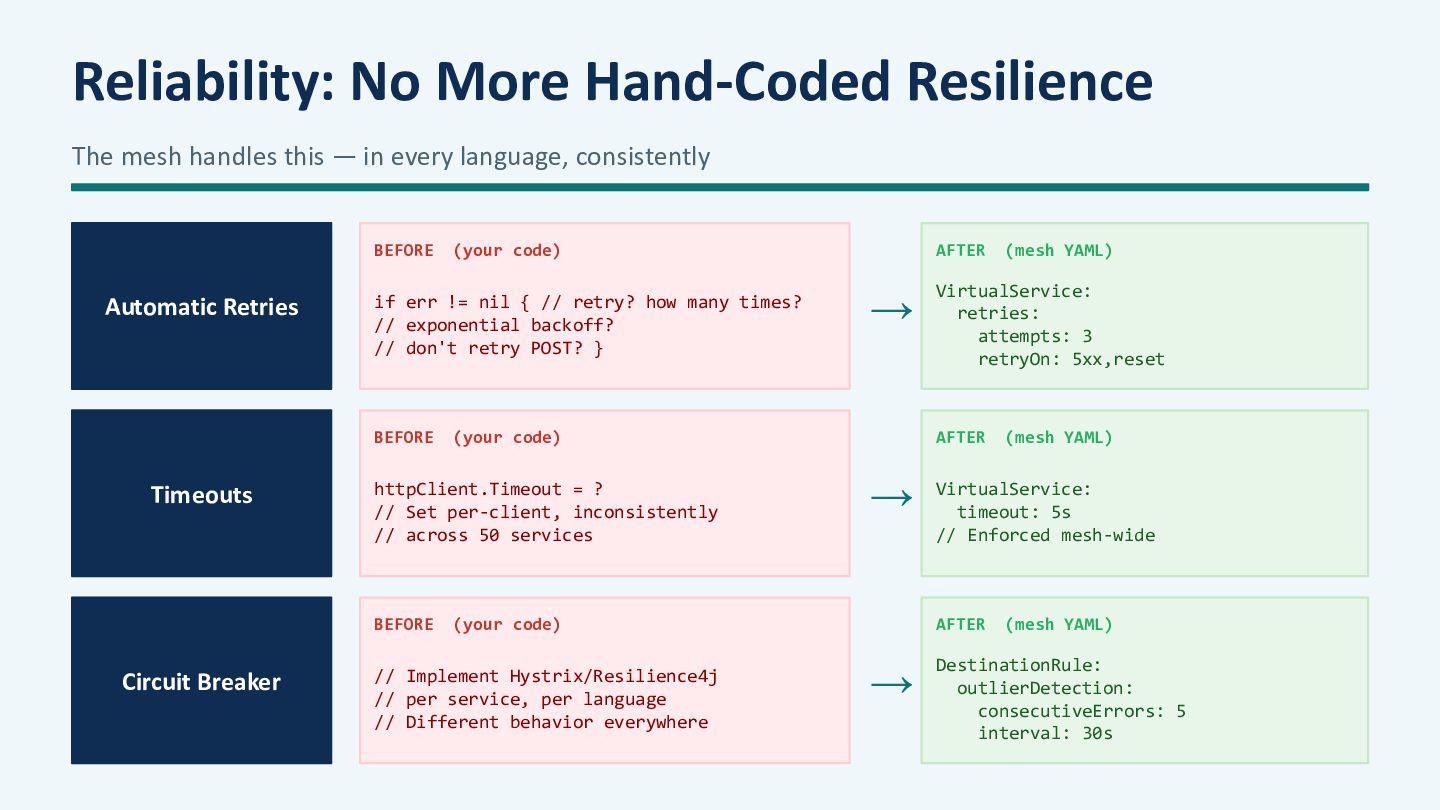
  7. Reliability: No More Hand-Coded Resilience The mesh handles this —

    in every language, consistently Automatic Retries BEFORE (your code) if err != nil { // retry? how many times? // exponential backoff? // don't retry POST? } → AFTER (mesh YAML) VirtualService: retries: attempts: 3 retryOn: 5xx,reset Timeouts BEFORE (your code) httpClient.Timeout = ? // Set per-client, inconsistently // across 50 services → AFTER (mesh YAML) VirtualService: timeout: 5s // Enforced mesh-wide Circuit Breaker BEFORE (your code) // Implement Hystrix/Resilience4j // per service, per language // Different behavior everywhere → AFTER (mesh YAML) DestinationRule: outlierDetection: consecutiveErrors: 5 interval: 30s
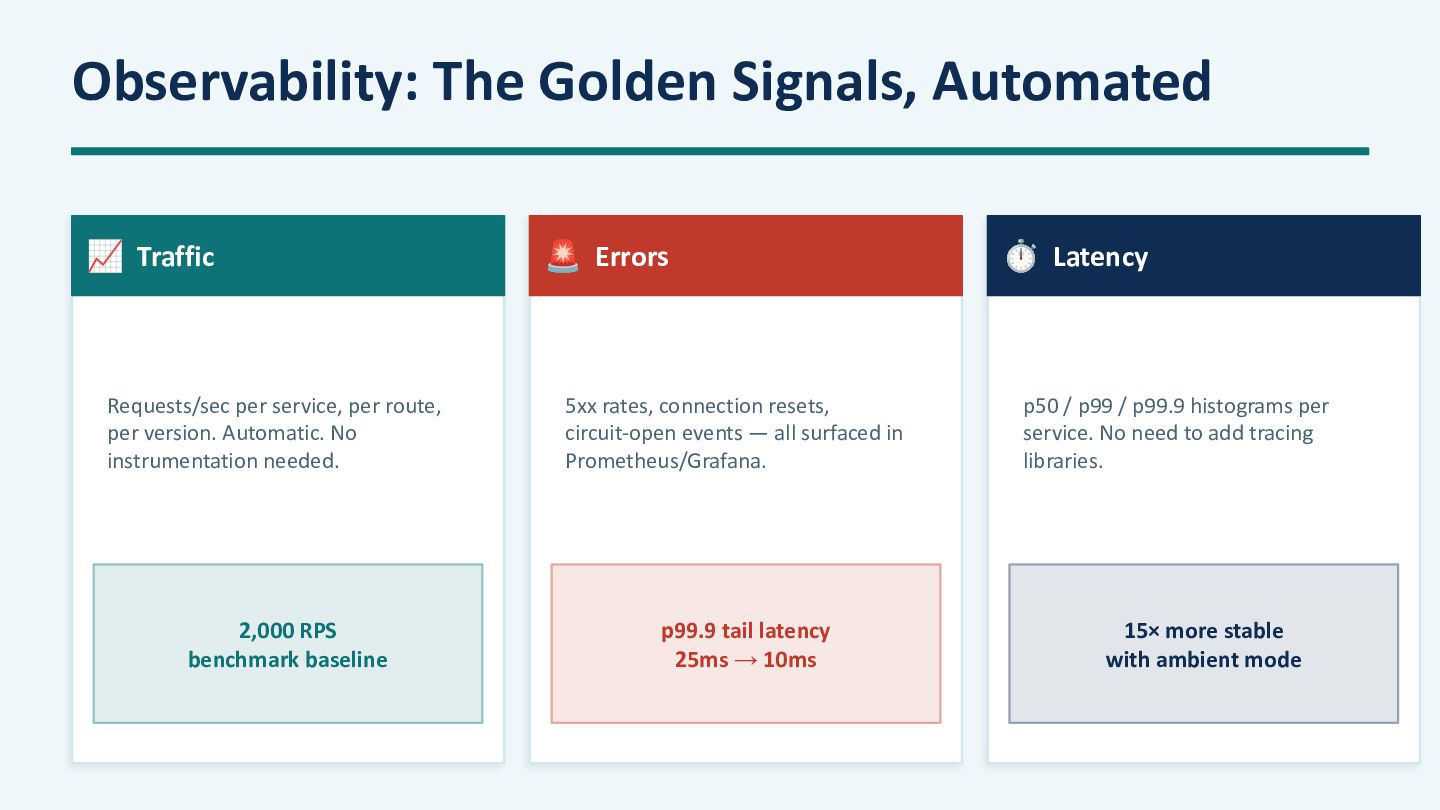
  8. Observability: The Golden Signals, Automated 📈 Traffic Requests/sec per service,

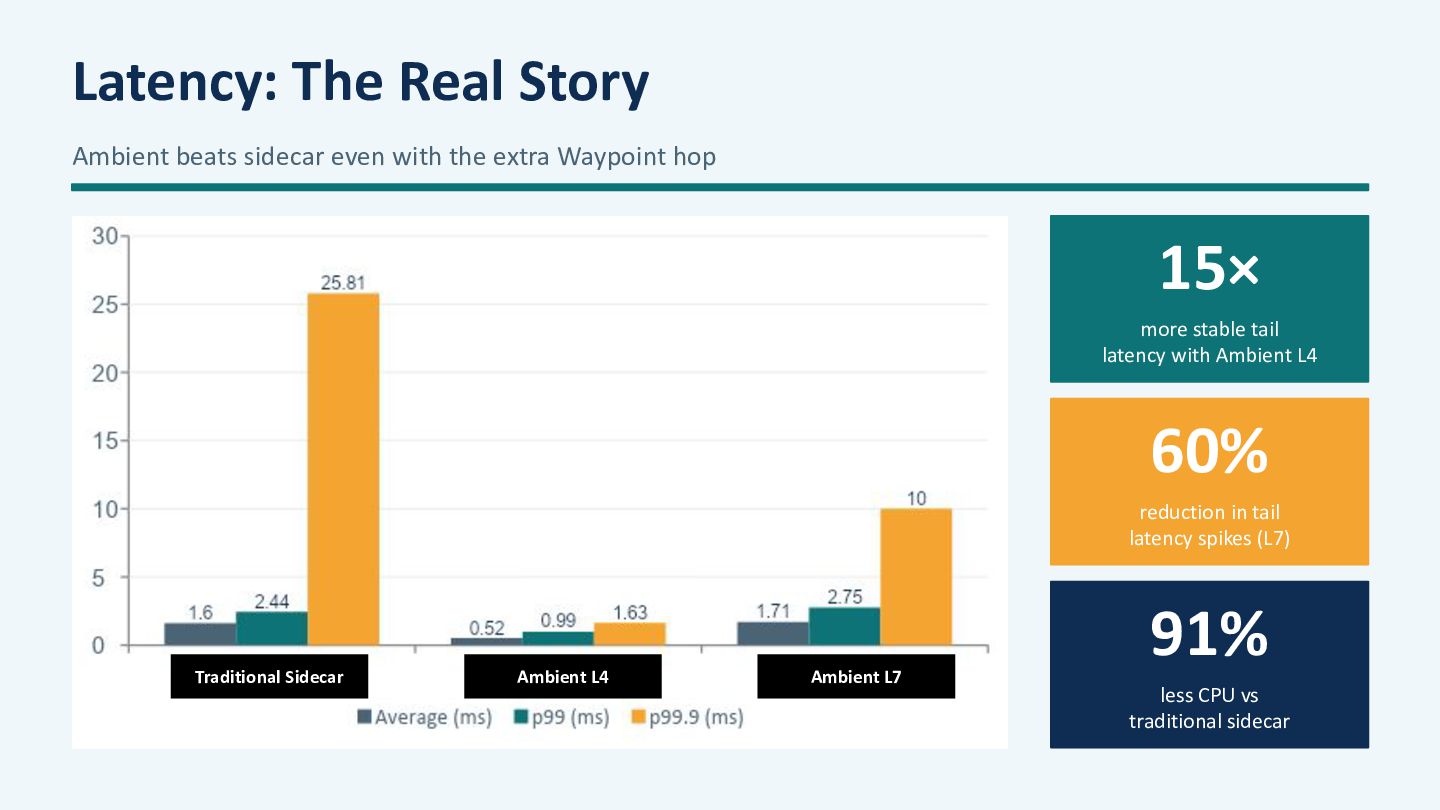
    per route, per version. Automatic. No instrumentation needed. 2,000 RPS benchmark baseline 🚨 Errors 5xx rates, connection resets, circuit-open events — all surfaced in Prometheus/Grafana. p99.9 tail latency 25ms → 10ms ⏱ Latency p50 / p99 / p99.9 histograms per service. No need to add tracing libraries. 15× more stable with ambient mode
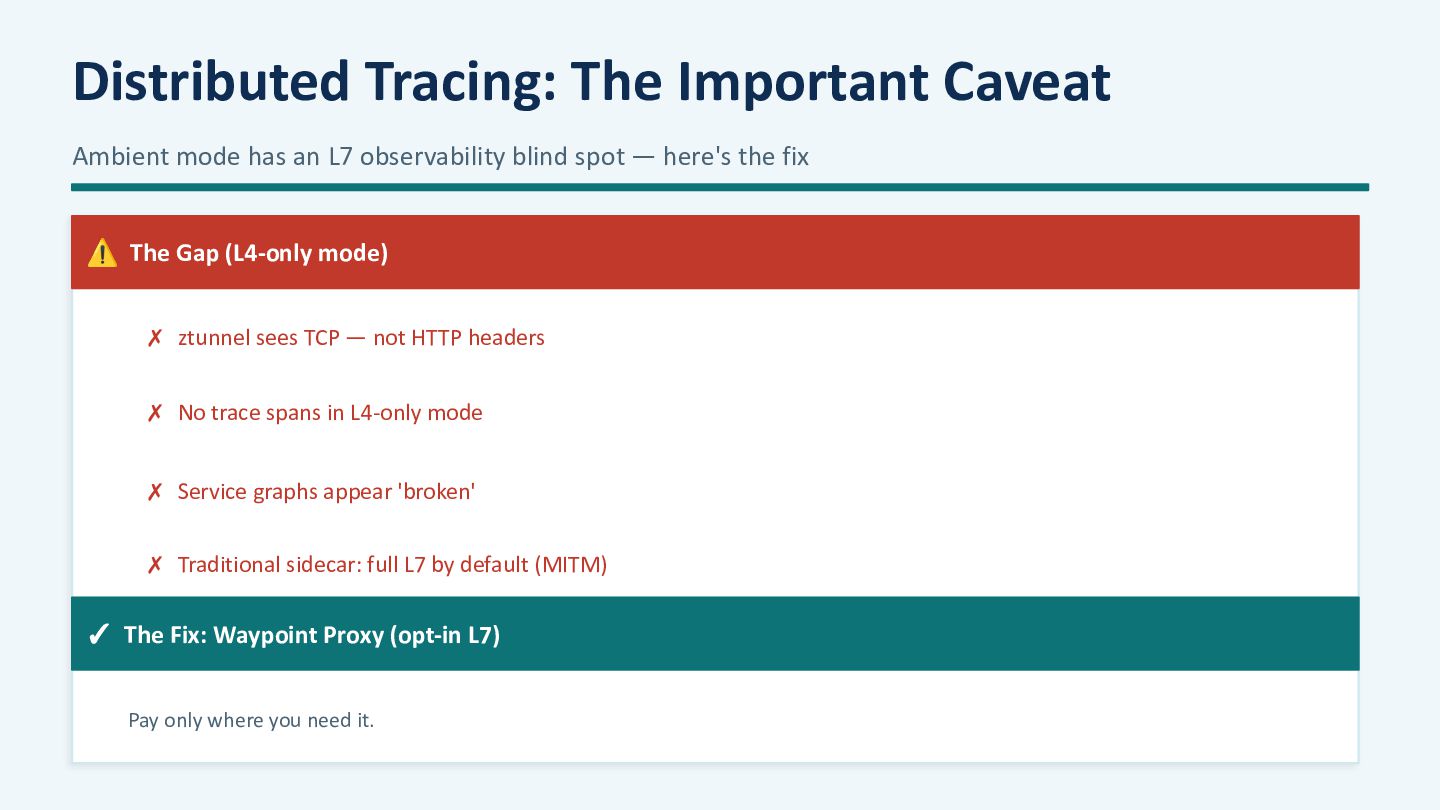
  9. Distributed Tracing: The Important Caveat Ambient mode has an L7

    observability blind spot — here's the fix ⚠ The Gap (L4-only mode) ✗ ztunnel sees TCP — not HTTP headers ✗ No trace spans in L4-only mode ✗ Service graphs appear 'broken' ✗ Traditional sidecar: full L7 by default (MITM) ✓ The Fix: Waypoint Proxy (opt-in L7) Pay only where you need it.
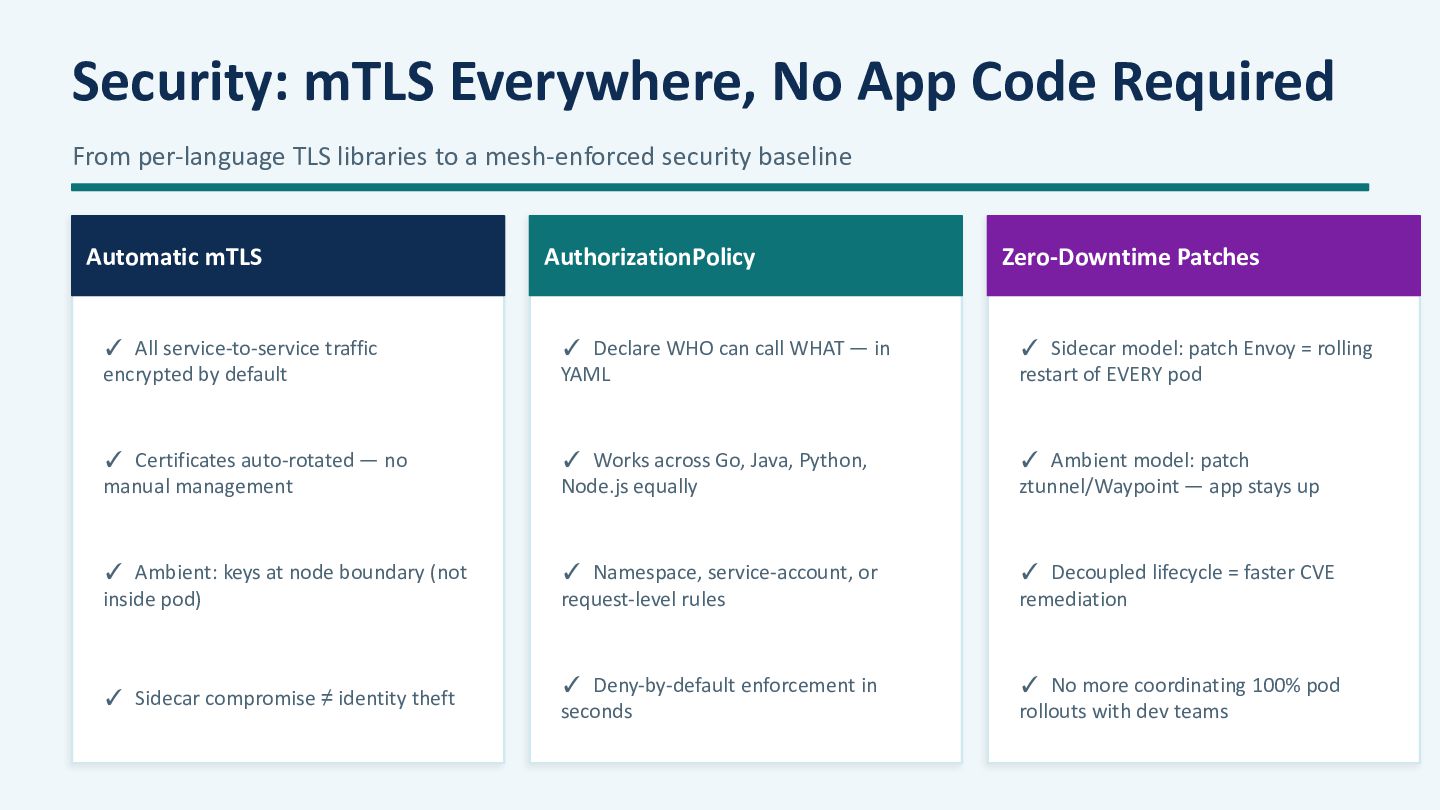
  10. Security: mTLS Everywhere, No App Code Required From per-language TLS

    libraries to a mesh-enforced security baseline Automatic mTLS ✓ All service-to-service traffic encrypted by default ✓ Certificates auto-rotated — no manual management ✓ Ambient: keys at node boundary (not inside pod) ✓ Sidecar compromise ≠ identity theft AuthorizationPolicy ✓ Declare WHO can call WHAT — in YAML ✓ Works across Go, Java, Python, Node.js equally ✓ Namespace, service-account, or request-level rules ✓ Deny-by-default enforcement in seconds Zero-Downtime Patches ✓ Sidecar model: patch Envoy = rolling restart of EVERY pod ✓ Ambient model: patch ztunnel/Waypoint — app stays up ✓ Decoupled lifecycle = faster CVE remediation ✓ No more coordinating 100% pod rollouts with dev teams
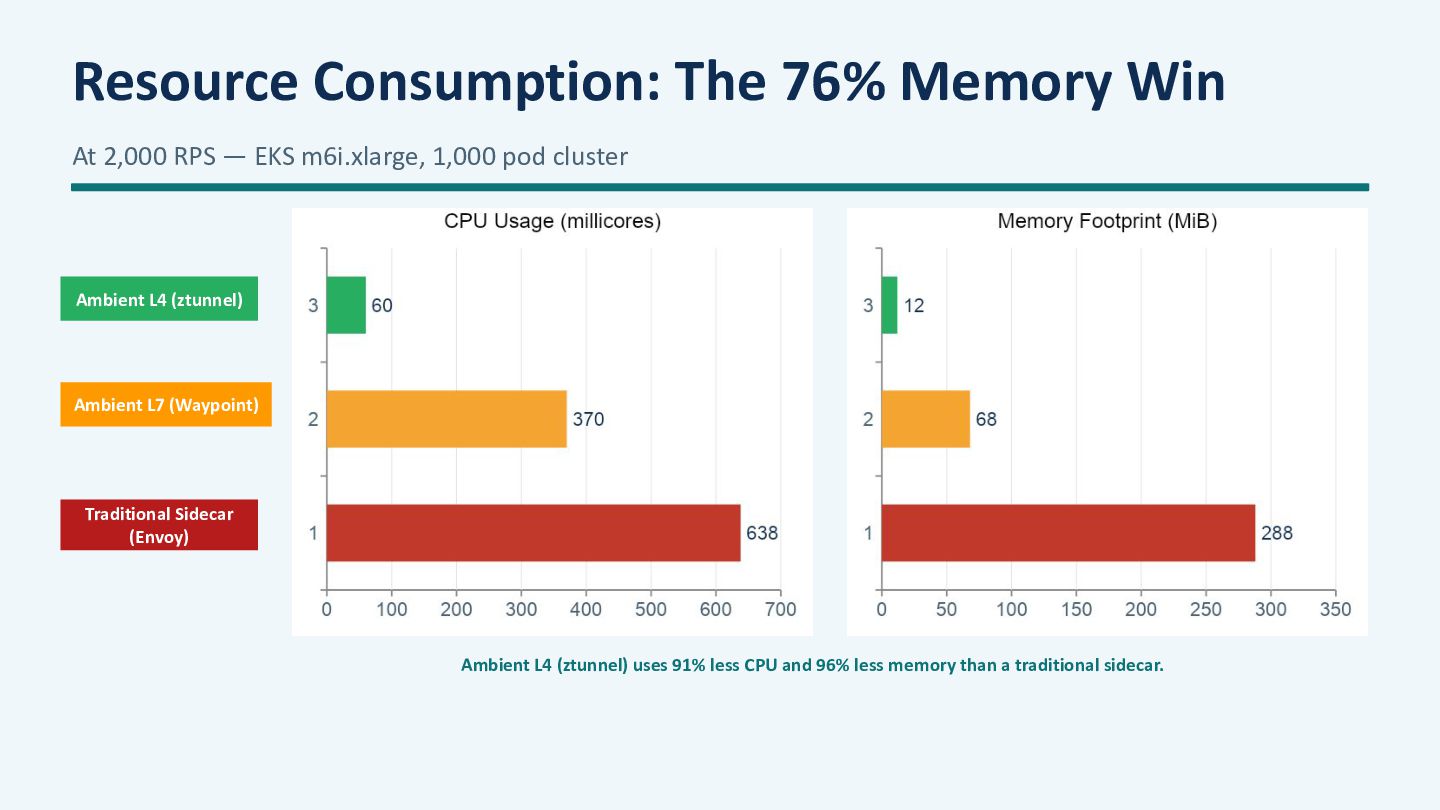
  11. Resource Consumption: The 76% Memory Win At 2,000 RPS —

    EKS m6i.xlarge, 1,000 pod cluster Ambient L4 (ztunnel) uses 91% less CPU and 96% less memory than a traditional sidecar. Ambient L4 (ztunnel) Ambient L7 (Waypoint) Traditional Sidecar (Envoy)
  12. Latency: The Real Story Ambient beats sidecar even with the

    extra Waypoint hop 15× more stable tail latency with Ambient L4 60% reduction in tail latency spikes (L7) 91% less CPU vs traditional sidecar Ambient L4 Ambient L7 Traditional Sidecar
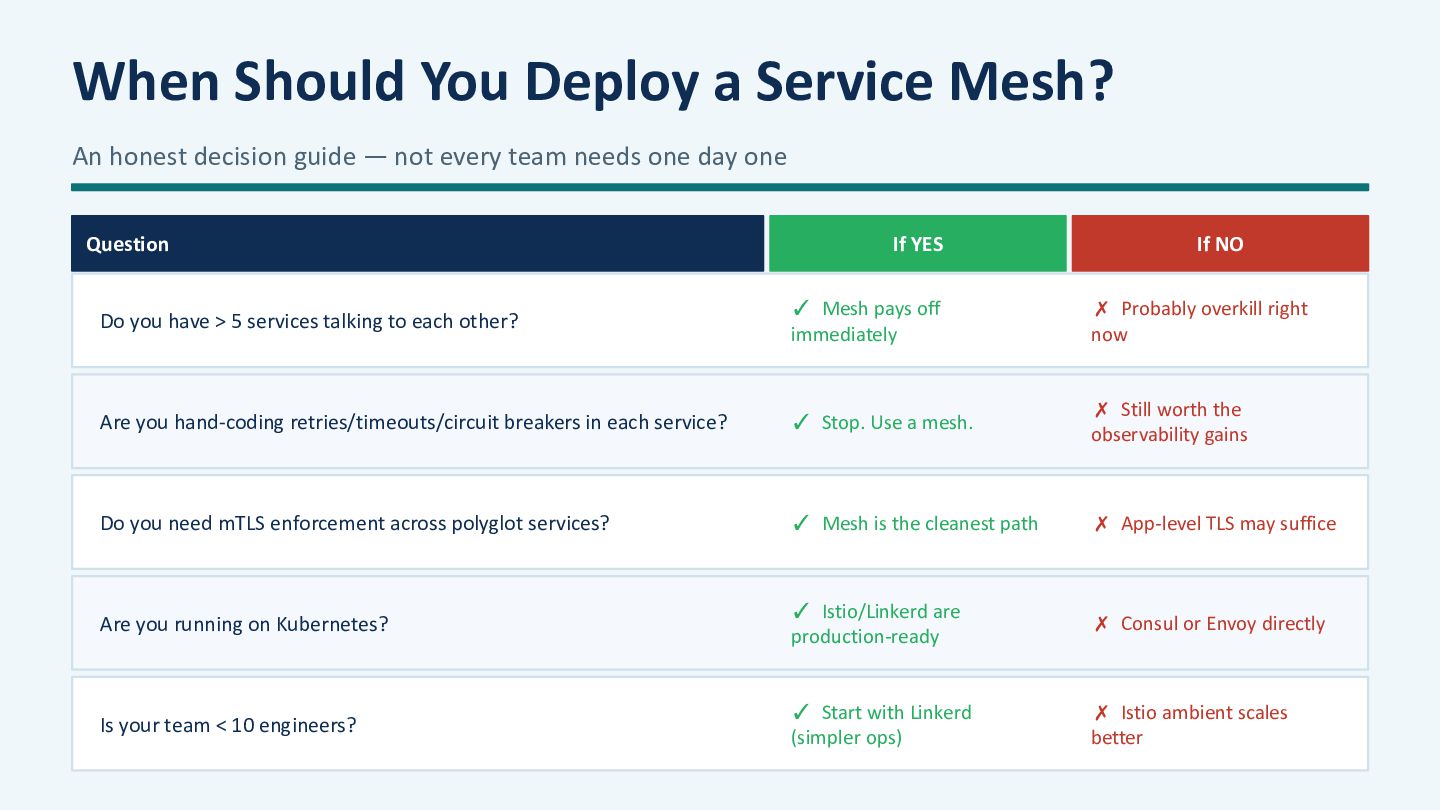
  13. When Should You Deploy a Service Mesh? An honest decision

    guide — not every team needs one day one Question If YES If NO Do you have > 5 services talking to each other? ✓ Mesh pays off immediately ✗ Probably overkill right now Are you hand-coding retries/timeouts/circuit breakers in each service? ✓ Stop. Use a mesh. ✗ Still worth the observability gains Do you need mTLS enforcement across polyglot services? ✓ Mesh is the cleanest path ✗ App-level TLS may suffice Are you running on Kubernetes? ✓ Istio/Linkerd are production-ready ✗ Consul or Envoy directly Is your team < 10 engineers? ✓ Start with Linkerd (simpler ops) ✗ Istio ambient scales better