engineering approach to the future society -- Kenji Hiramoto Director General of Digital Infrastructure Center IT Promotion Agence, Japan Information-technology Promotion Agency, Japan
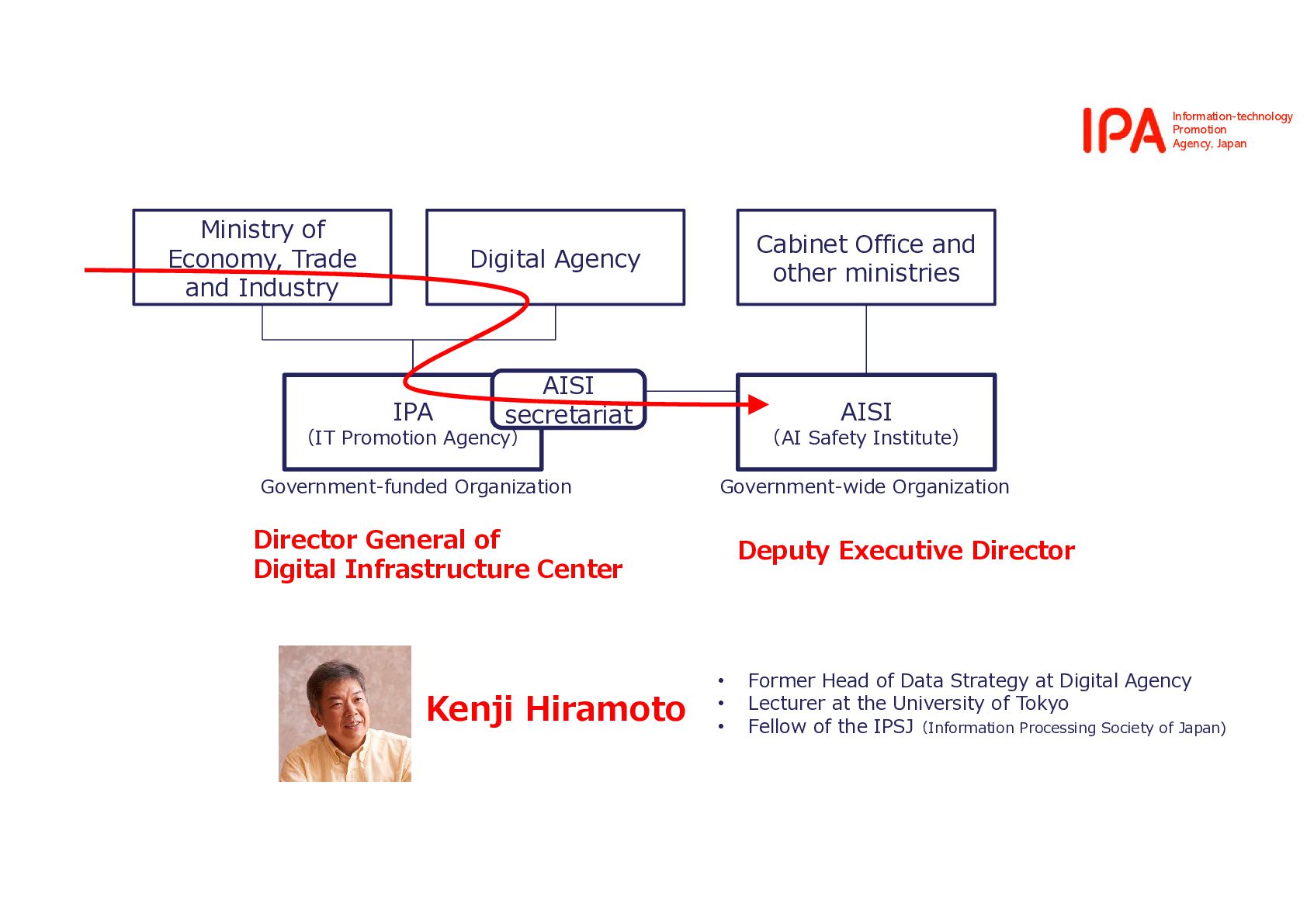
IPA Digital Agency Cabinet Office and other ministries AISI secretariat AISI (IT Promotion Agency) (AI Safety Institute) Government-funded Organization Government-wide Organization Director General of Digital Infrastructure Center Kenji Hiramoto Deputy Executive Director • • • Former Head of Data Strategy at Digital Agency Lecturer at the University of Tokyo Fellow of the IPSJ(Information Processing Society of Japan)
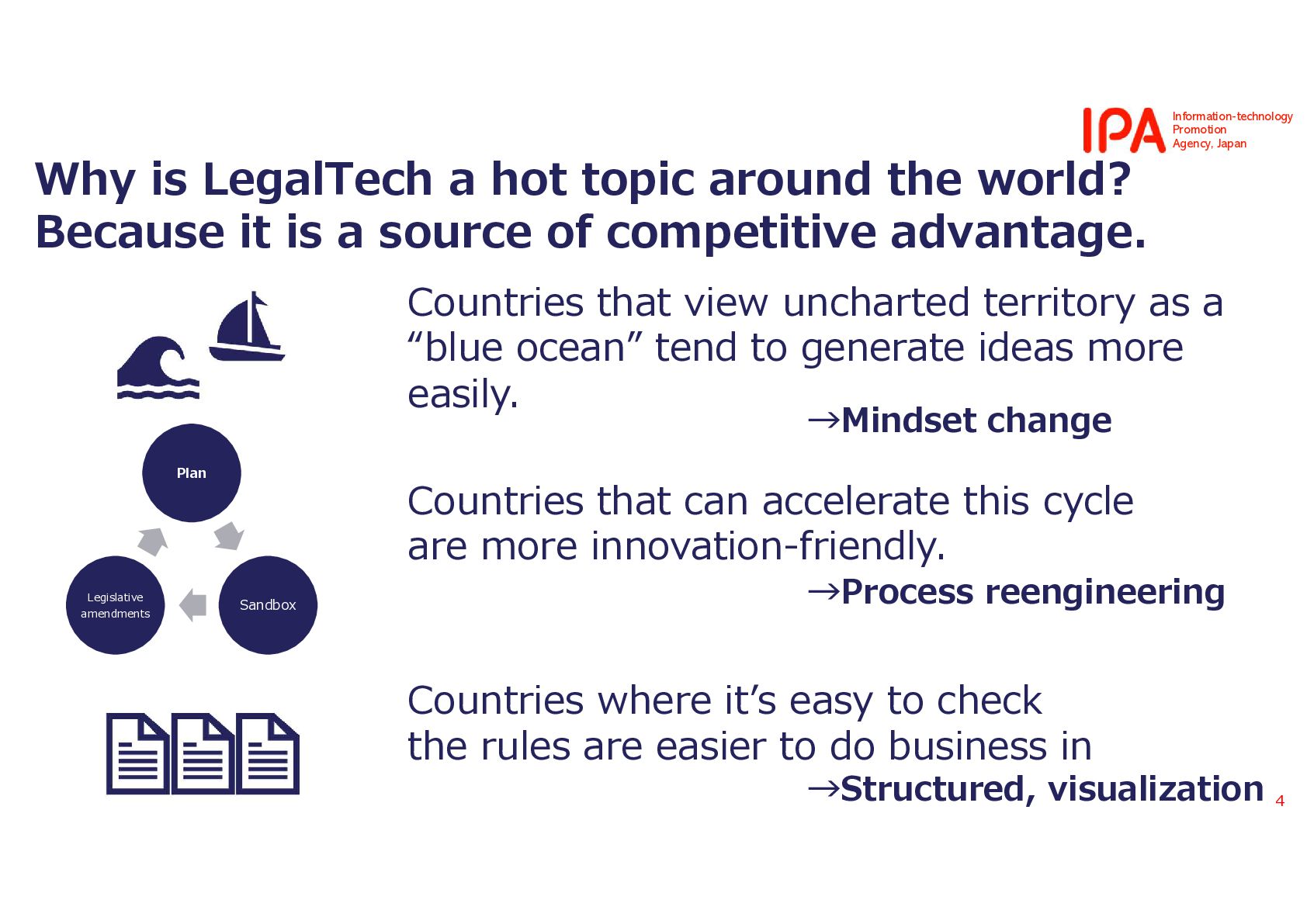
it is a source of competitive advantage. Information-technology Promotion Agency, Japan Countries that view uncharted territory as a “blue ocean” tend to generate ideas more easily. →Mindset change Plan Legislative amendments Countries that can accelerate this cycle are more innovation-friendly. Sandbox →Process reengineering Countries where it’s easy to check the rules are easier to do business in →Structured, visualization 4
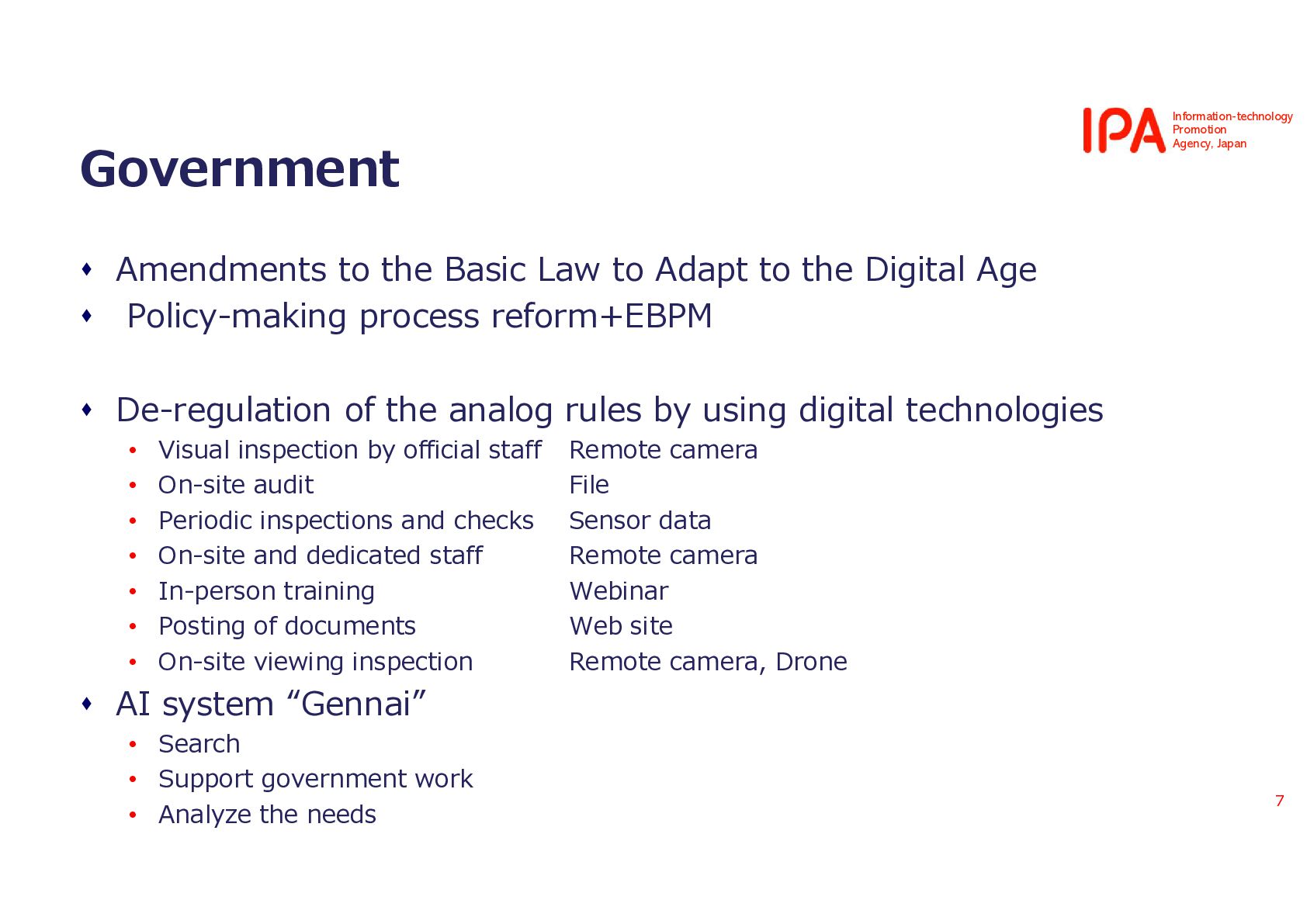
Law to Adapt to the Digital Age Policy-making process reform+EBPM De-regulation of the analog rules by using digital technologies • • • • • • • Visual inspection by official staff On-site audit Periodic inspections and checks On-site and dedicated staff In-person training Posting of documents On-site viewing inspection Remote camera File Sensor data Remote camera Webinar Web site Remote camera, Drone AI system “Gennai” • Search • Support government work • Analyze the needs 7
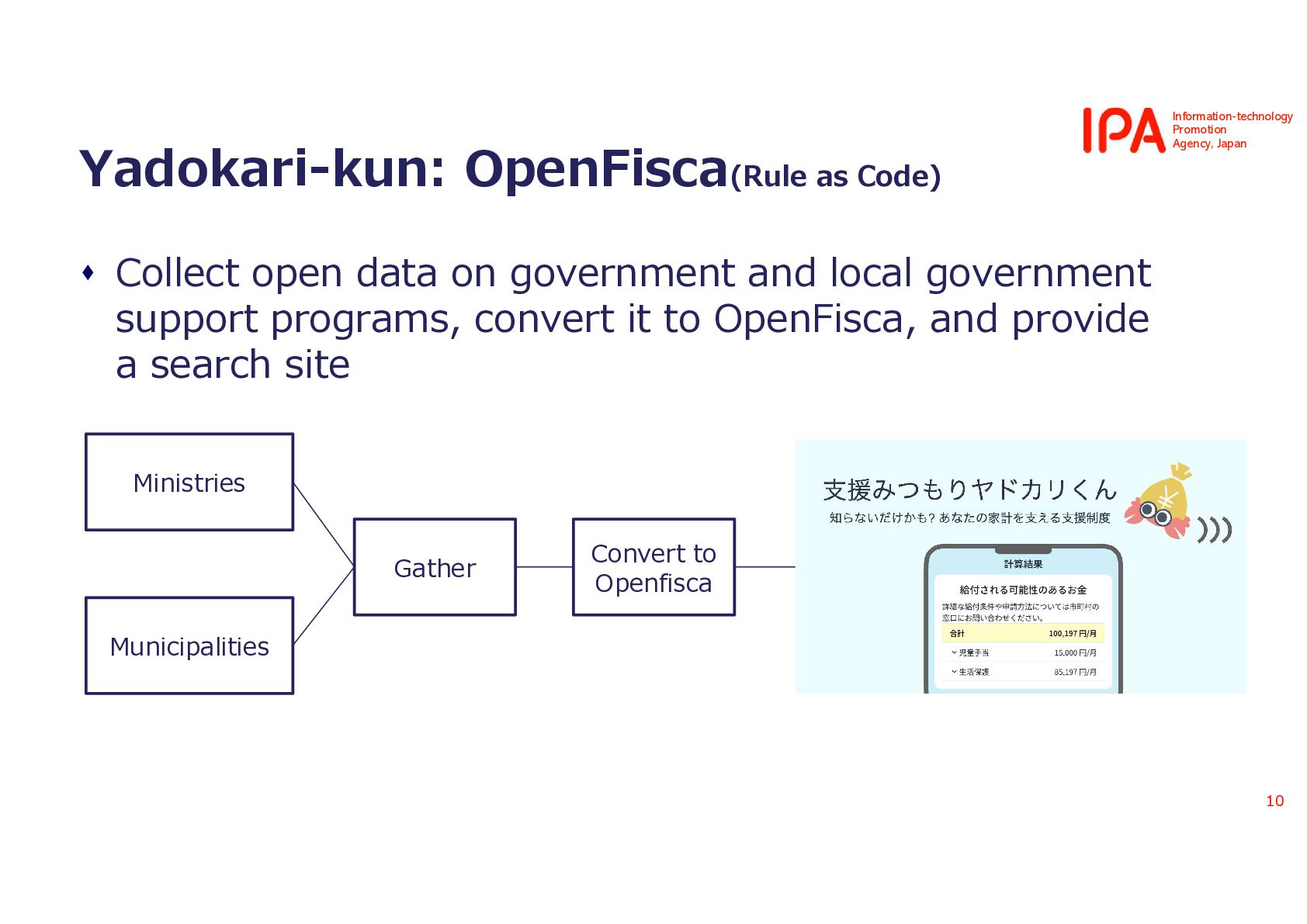
open data on government and local government support programs, convert it to OpenFisca, and provide a search site Ministries Gather Convert to Openfisca Municipalities 10
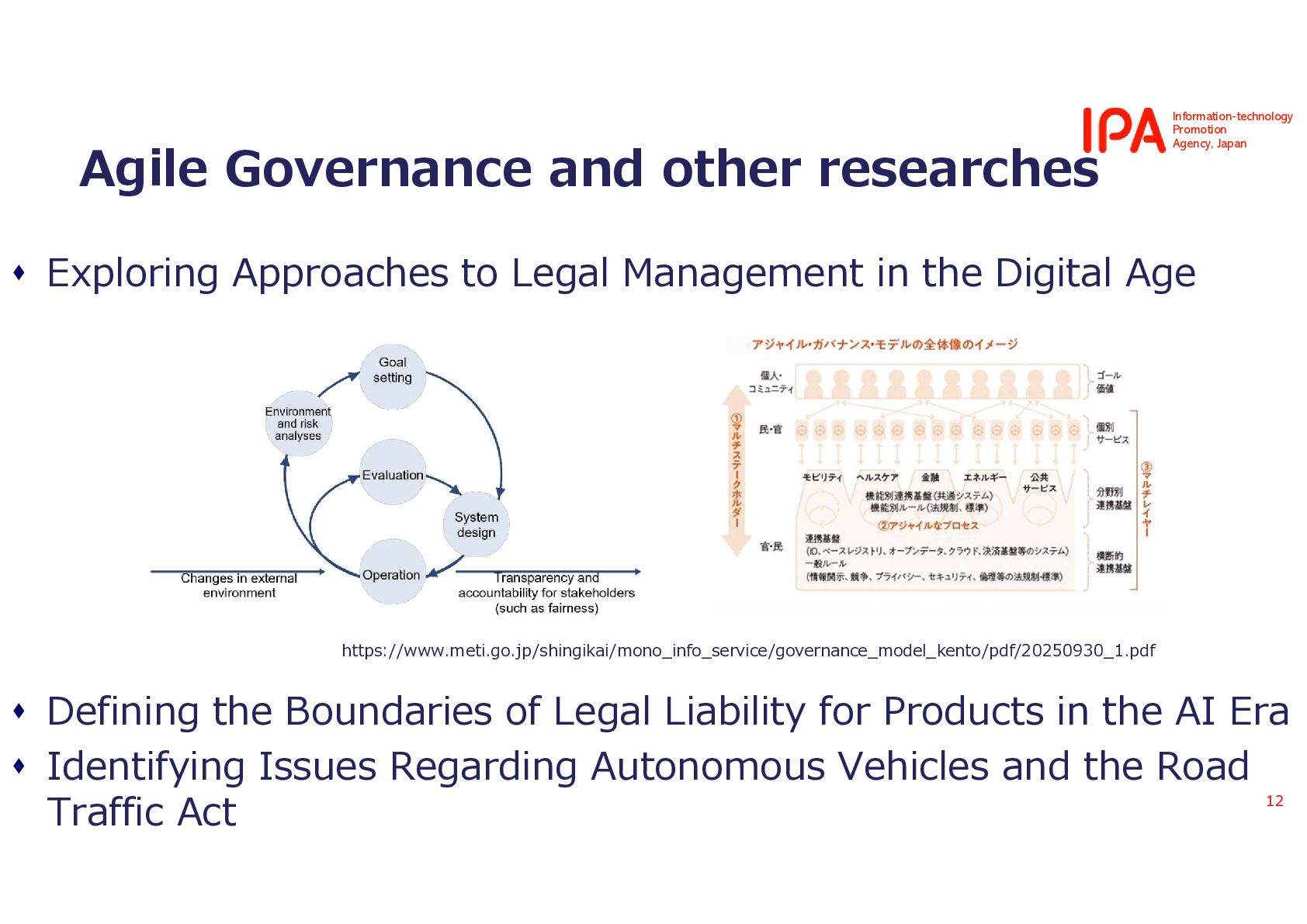
Exploring Approaches to Legal Management in the Digital Age https://www.meti.go.jp/shingikai/mono_info_service/governance_model_kento/pdf/20250930_1.pdf Defining the Boundaries of Legal Liability for Products in the AI Era Identifying Issues Regarding Autonomous Vehicles and the Road Traffic Act 12
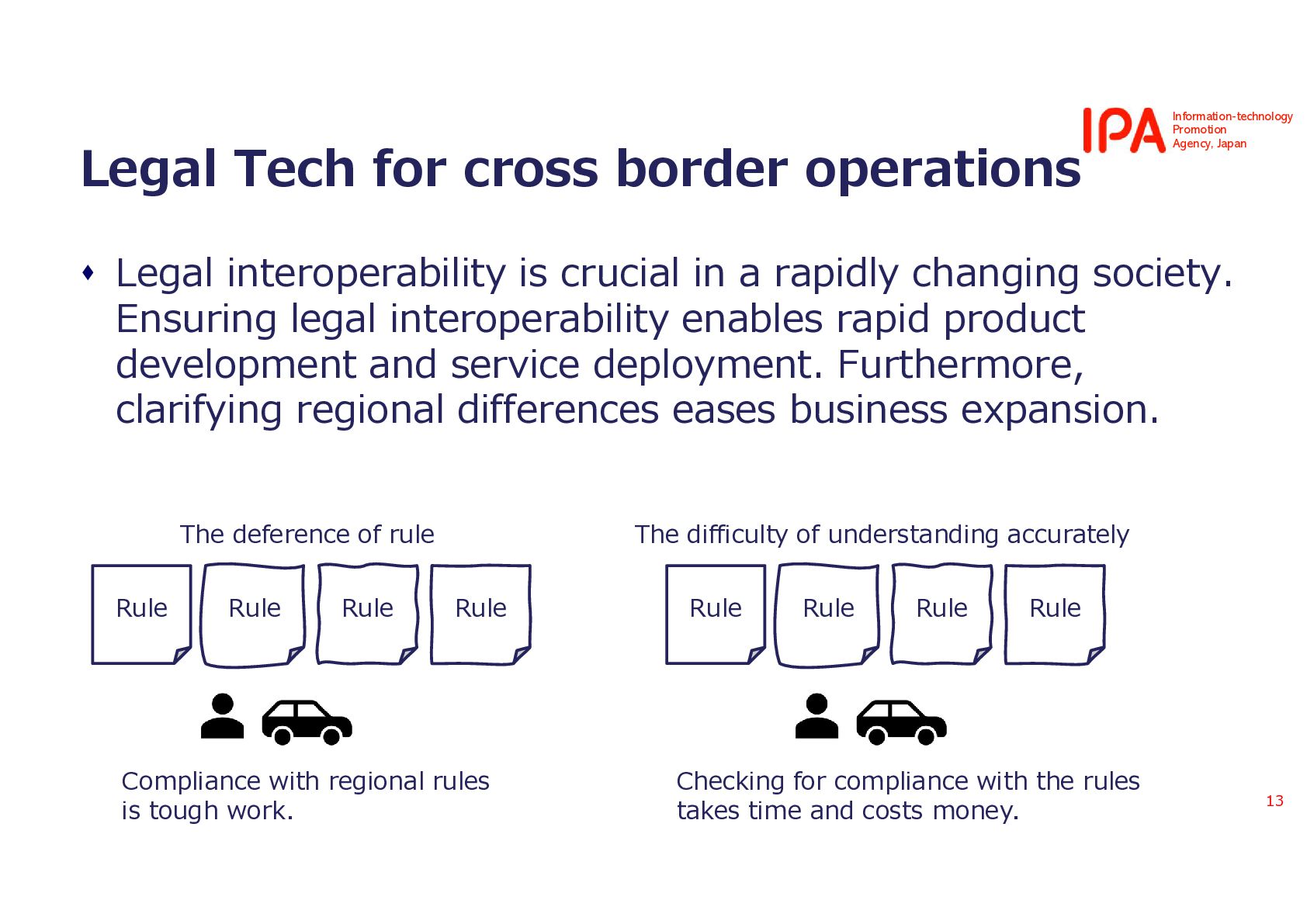
Legal interoperability is crucial in a rapidly changing society. Ensuring legal interoperability enables rapid product development and service deployment. Furthermore, clarifying regional differences eases business expansion. The deference of rule Rule Rule Rule The difficulty of understanding accurately Rule Compliance with regional rules is tough work. Rule Rule Rule Rule Checking for compliance with the rules takes time and costs money. 13
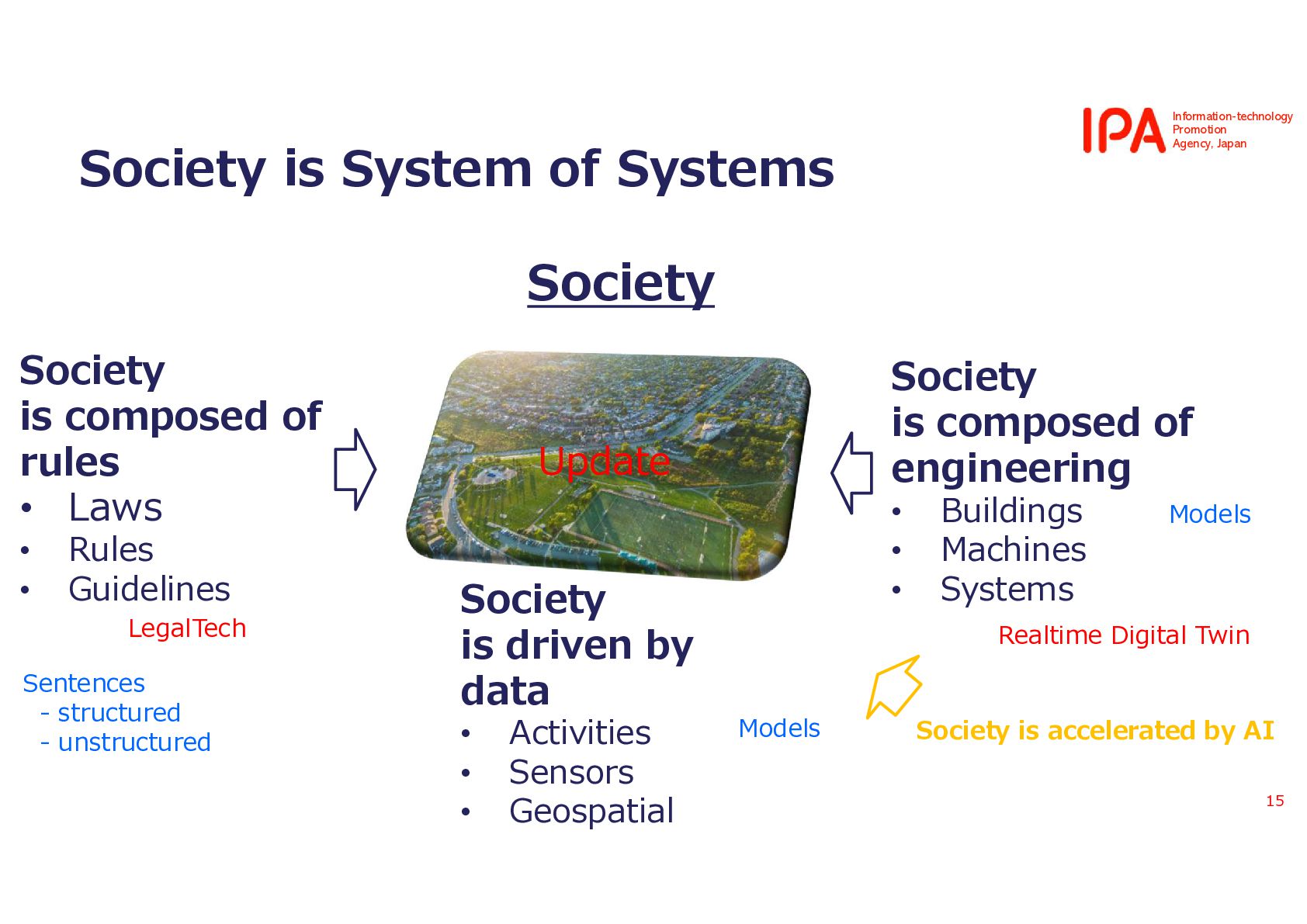
Society is composed of rules • Laws • • Rules Guidelines LegalTech Sentences - structured - unstructured Society is composed of engineering Update Society is driven by data • • • Activities Sensors Geospatial • • • Buildings Machines Systems Models Realtime Digital Twin Models Society is accelerated by AI 15
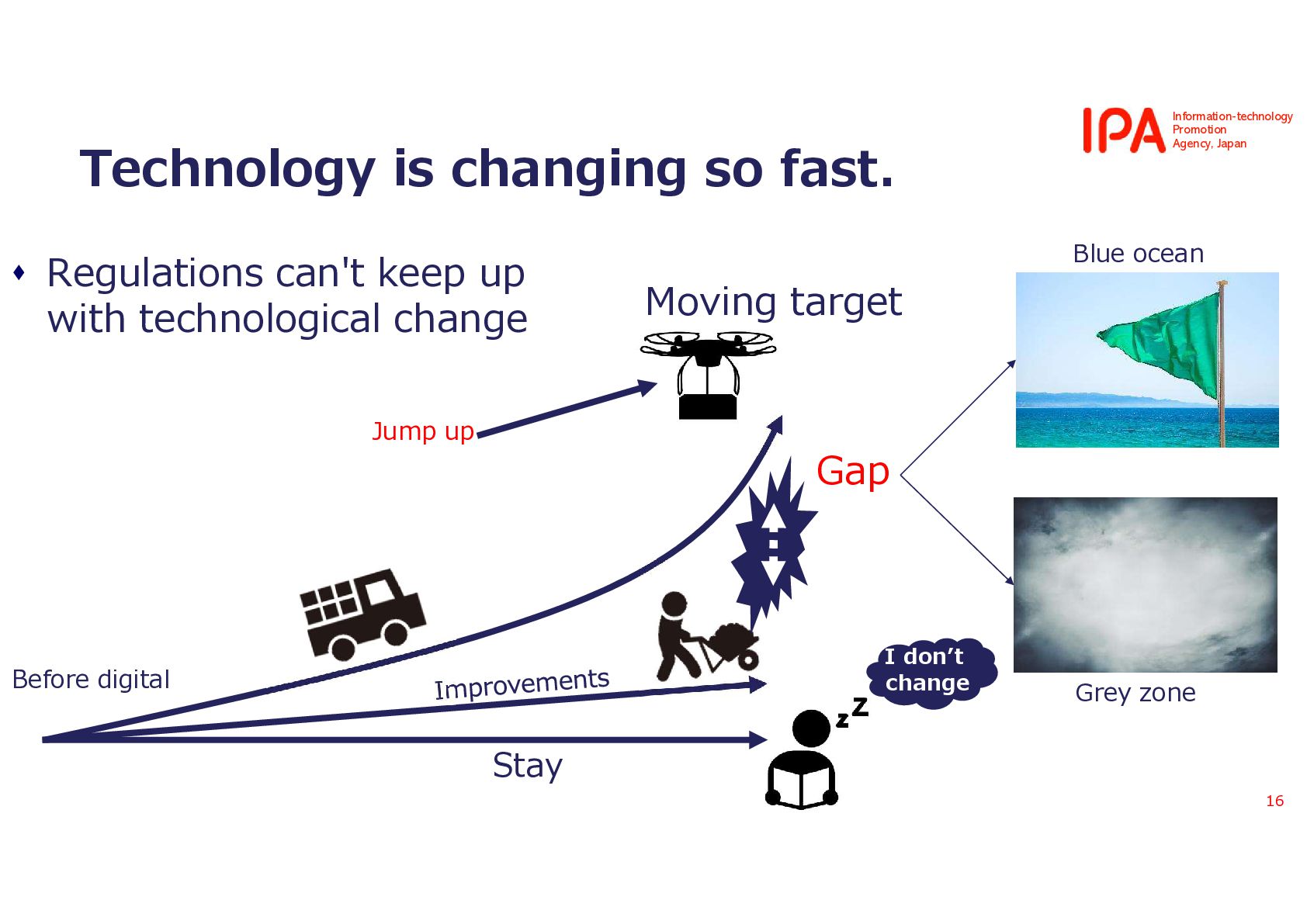
with technological change Jump up Information-technology Promotion Agency, Japan Blue ocean Moving target Gap I don’t change Before digital Stay Grey zone 16
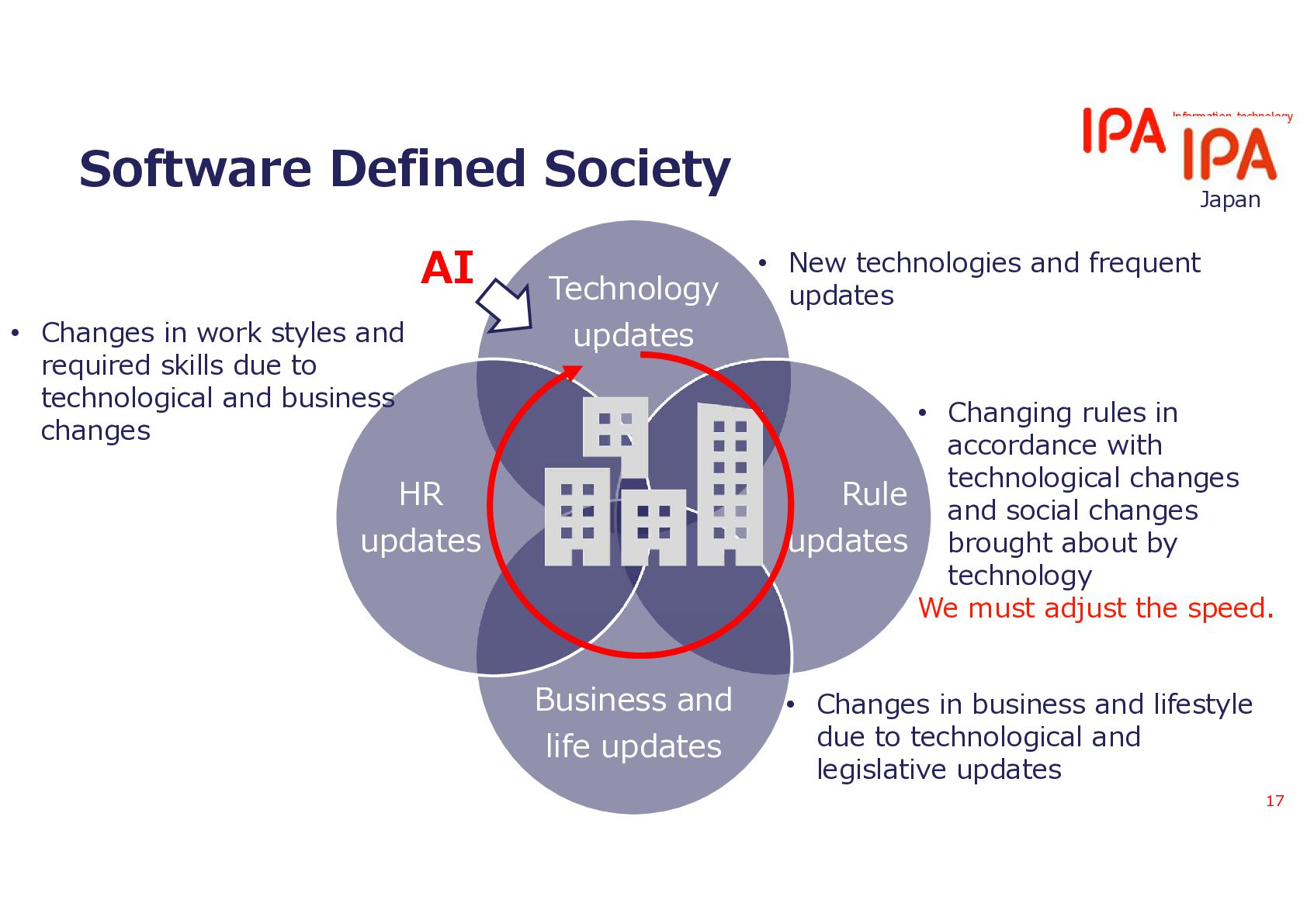
required skills due to technological and business changes Technology updates Information-technology Promotion Agency, Japan Japan • New technologies and frequent updates • Changing rules in accordance with technological changes Rule and social changes updates brought about by technology We must adjust the speed. HR updates Business and life updates • Changes in business and lifestyle due to technological and legislative updates 17
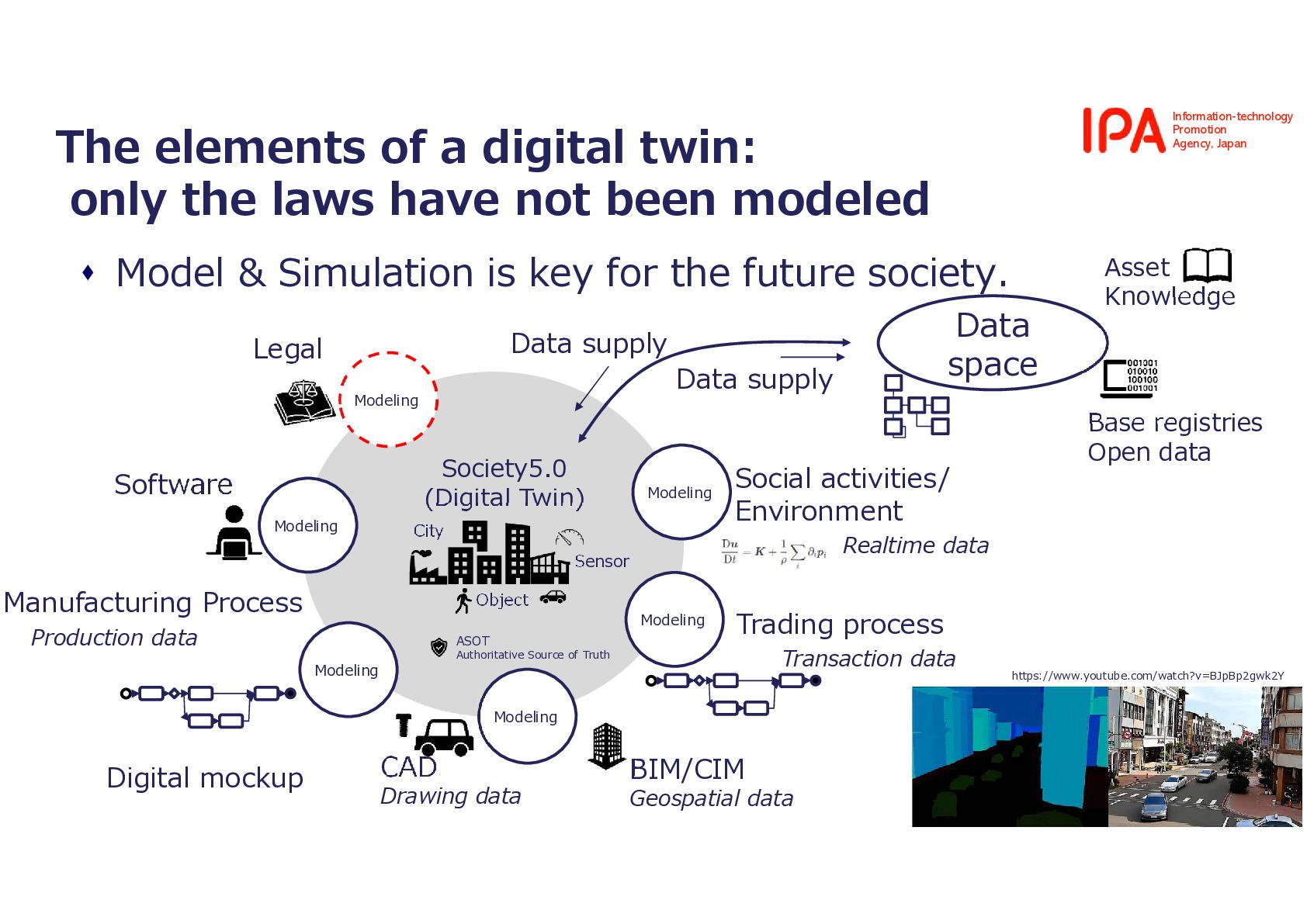
only the laws have not been modeled Model & Simulation is key for the future society. Data space Data supply Legal Data supply Modeling Society5.0 (Digital Twin) Software Modeling Modeling City Social activities/ Environment Object Modeling Production data ASOT Trading process Transaction data Authoritative Source of Truth Modeling Base registries Open data Realtime data Sensor Manufacturing Process Asset Knowledge https://www.youtube.com/watch?v=BJpBp2gwk2Y Modeling Digital mockup CAD Drawing data BIM/CIM Geospatial data 18
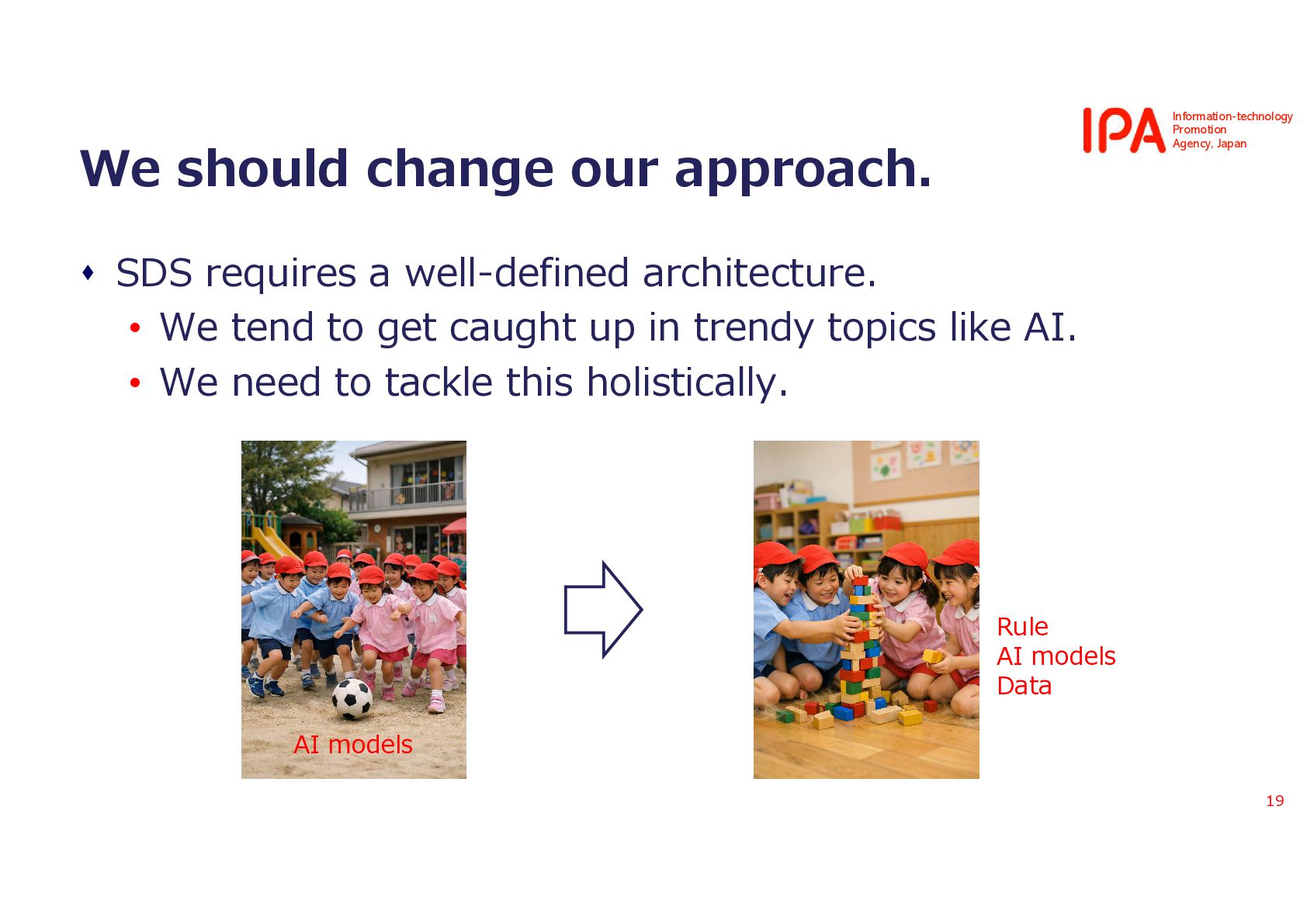
SDS requires a well-defined architecture. • We tend to get caught up in trendy topics like AI. • We need to tackle this holistically. Rule AI models Data AI models 19
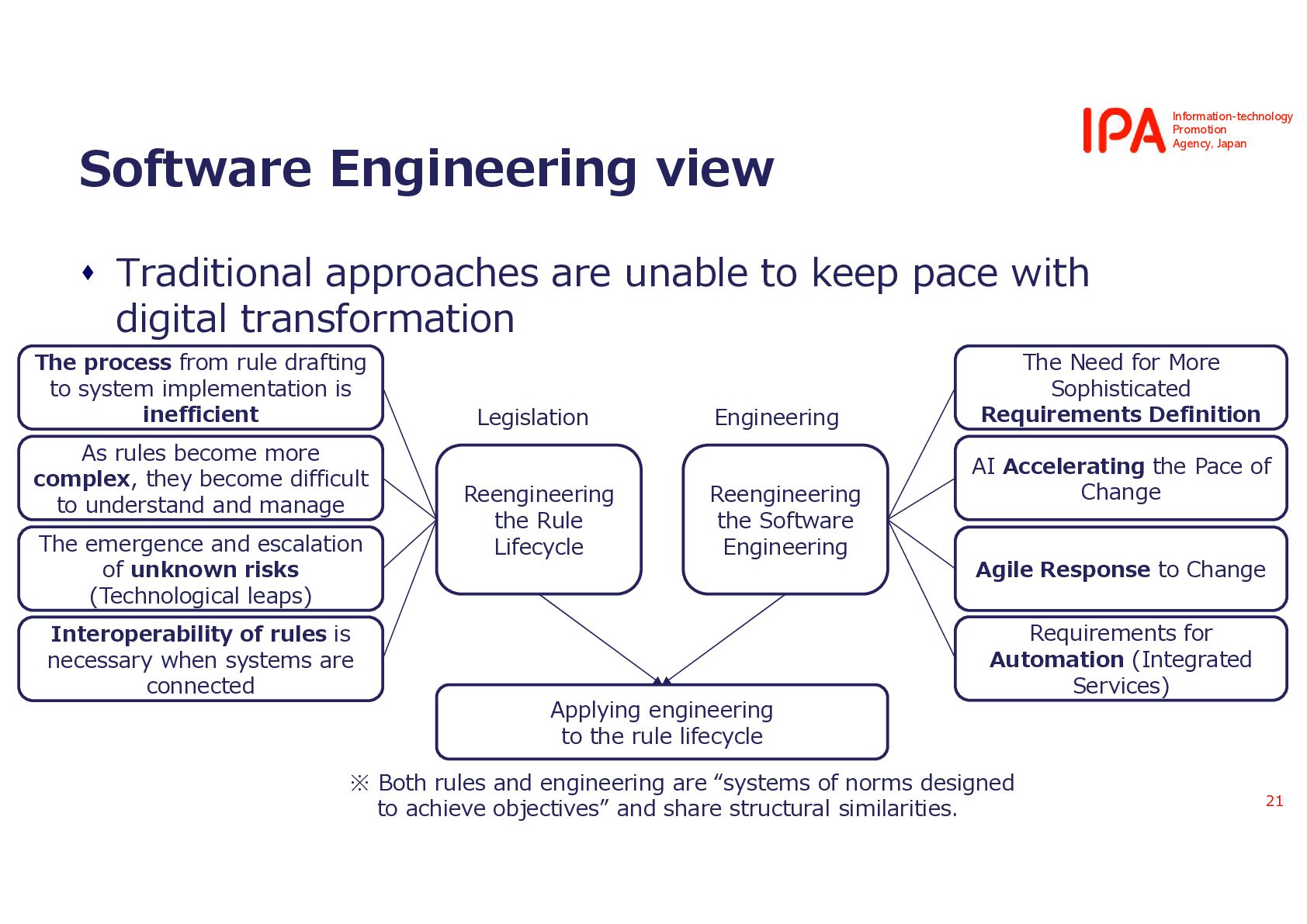
are unable to keep pace with digital transformation The process from rule drafting to system implementation is inefficient As rules become more complex, they become difficult to understand and manage The emergence and escalation of unknown risks (Technological leaps) Interoperability of rules is necessary when systems are connected Legislation Reengineering the Rule Lifecycle Engineering Reengineering the Software Engineering Applying engineering to the rule lifecycle The Need for More Sophisticated Requirements Definition AI Accelerating the Pace of Change Agile Response to Change Requirements for Automation (Integrated Services) ※ Both rules and engineering are “systems of norms designed to achieve objectives” and share structural similarities. 21
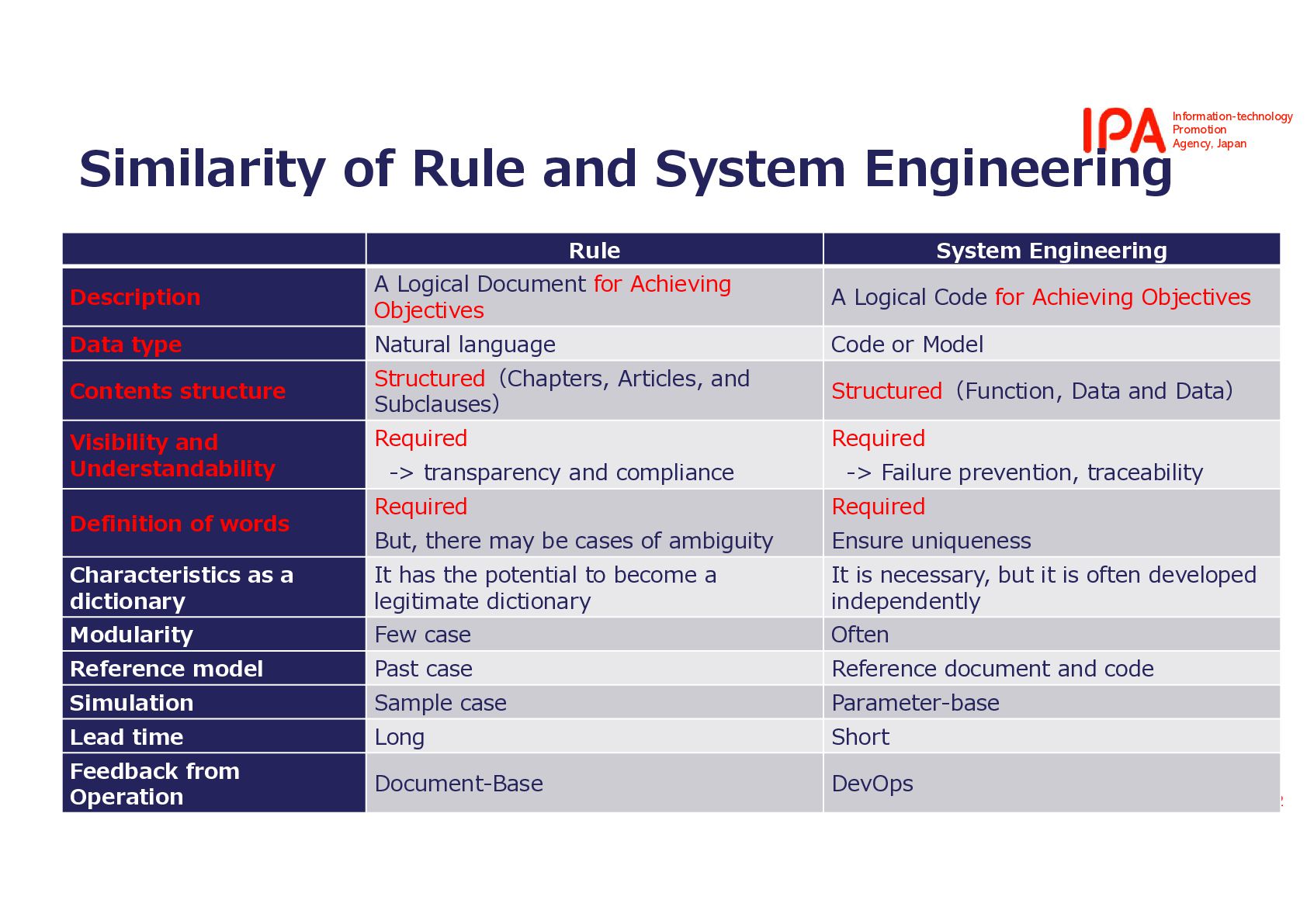
Rule System Engineering Description A Logical Document for Achieving Objectives A Logical Code for Achieving Objectives Data type Natural language Code or Model Contents structure Structured(Chapters, Articles, and Subclauses) Structured(Function, Data and Data) Required Required -> transparency and compliance -> Failure prevention, traceability Required Required But, there may be cases of ambiguity Ensure uniqueness Characteristics as a dictionary It has the potential to become a legitimate dictionary It is necessary, but it is often developed independently Modularity Few case Often Reference model Past case Reference document and code Simulation Sample case Parameter-base Lead time Long Short Feedback from Operation Document-Base DevOps Visibility and Understandability Definition of words 22
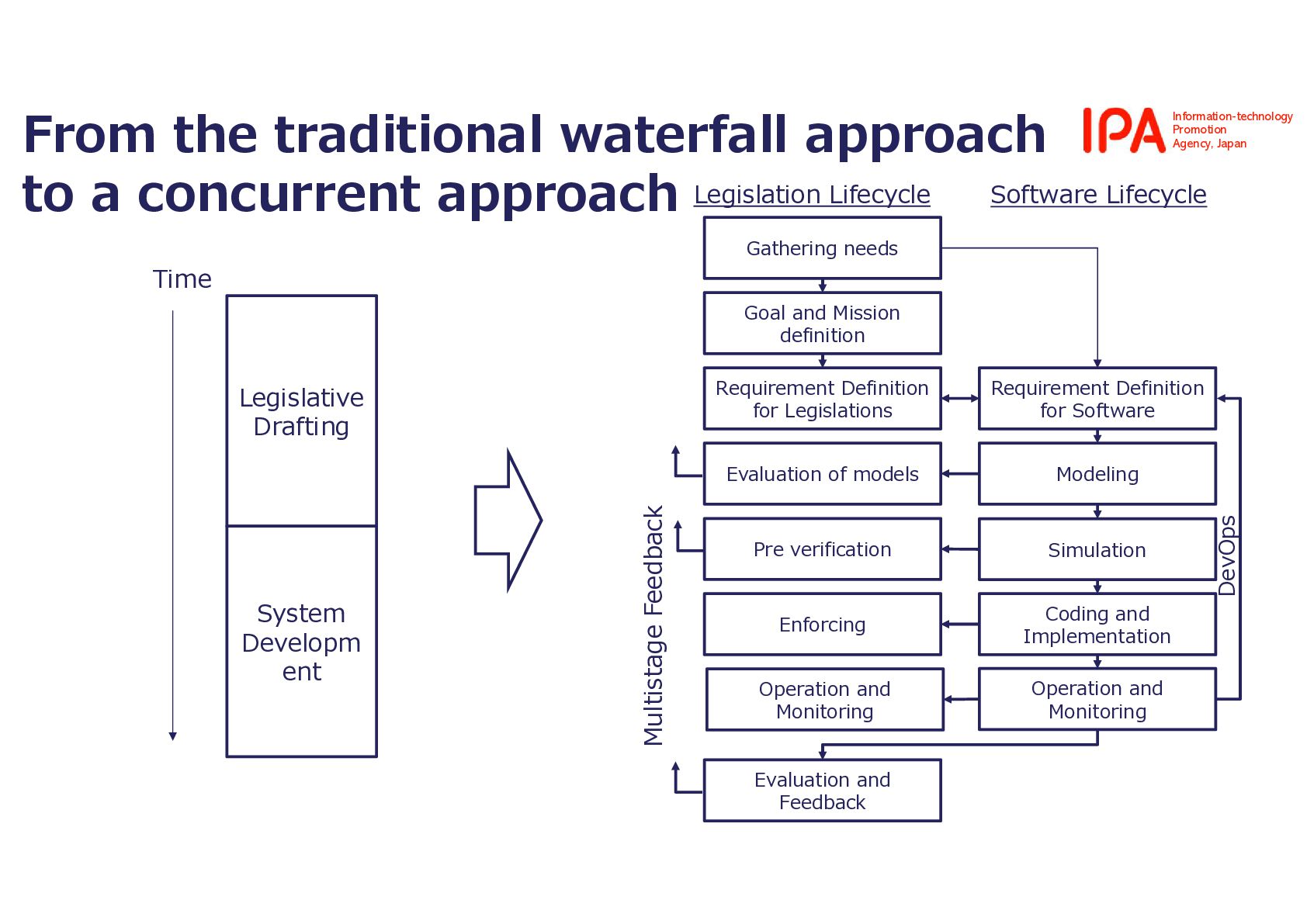
Lifecycle Software Lifecycle Information-technology Promotion Agency, Japan Gathering needs Time System Developm ent Multistage Feedback Legislative Drafting Requirement Definition for Legislations Requirement Definition for Software Evaluation of models Modeling Pre verification Simulation Enforcing Coding and Implementation Operation and Monitoring Operation and Monitoring Evaluation and Feedback DevOps Goal and Mission definition
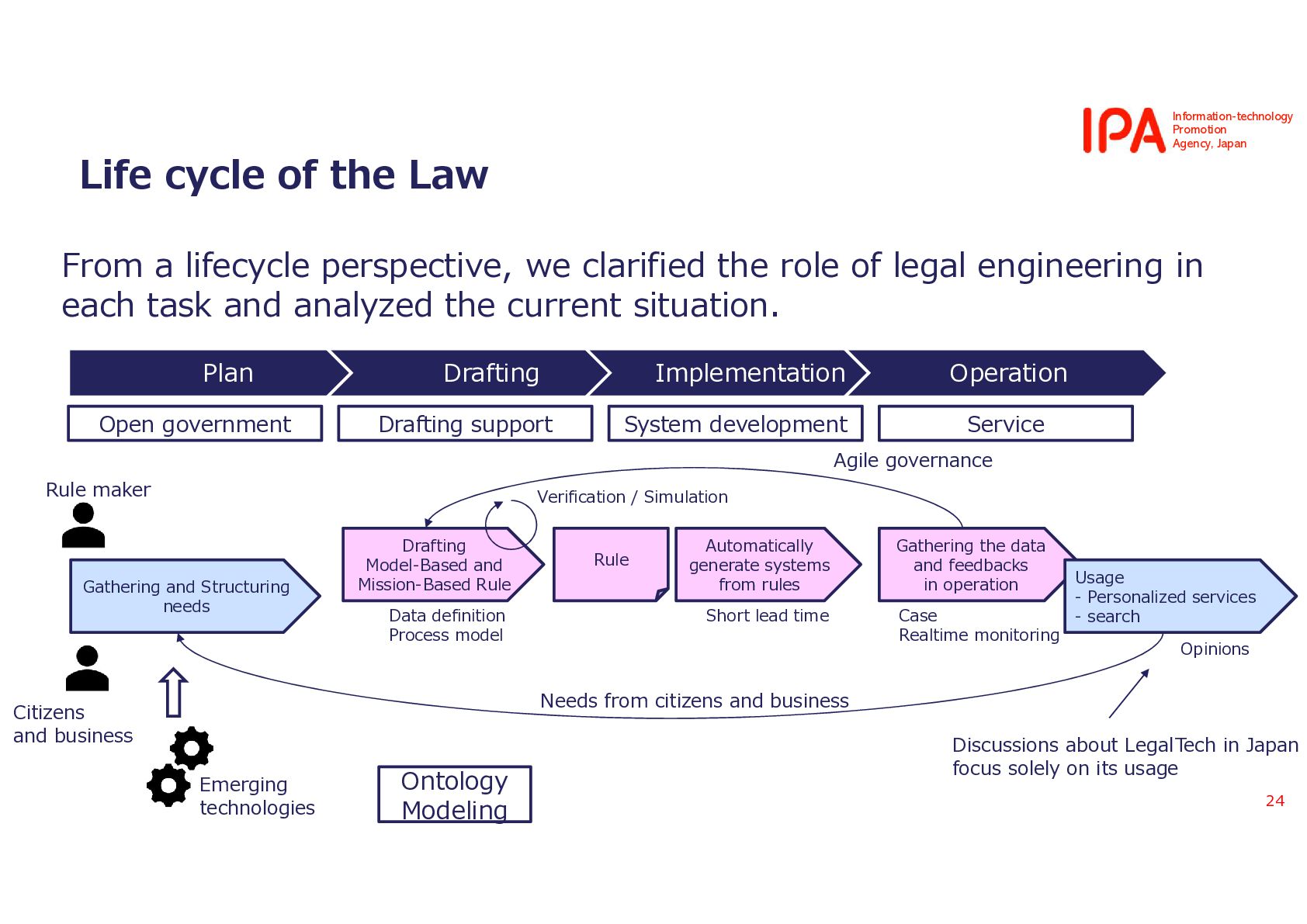
a lifecycle perspective, we clarified the role of legal engineering in each task and analyzed the current situation. Plan Open government Drafting Implementation Operation Drafting support System development Service Agile governance Rule maker Verification / Simulation Gathering and Structuring needs Drafting Model-Based and Mission-Based Rule Data definition Process model Rule Automatically generate systems from rules Gathering the data and feedbacks in operation Short lead time Case Realtime monitoring Usage - Personalized services - search Opinions Needs from citizens and business Citizens and business Emerging technologies Ontology Modeling Discussions about LegalTech in Japan focus solely on its usage 24
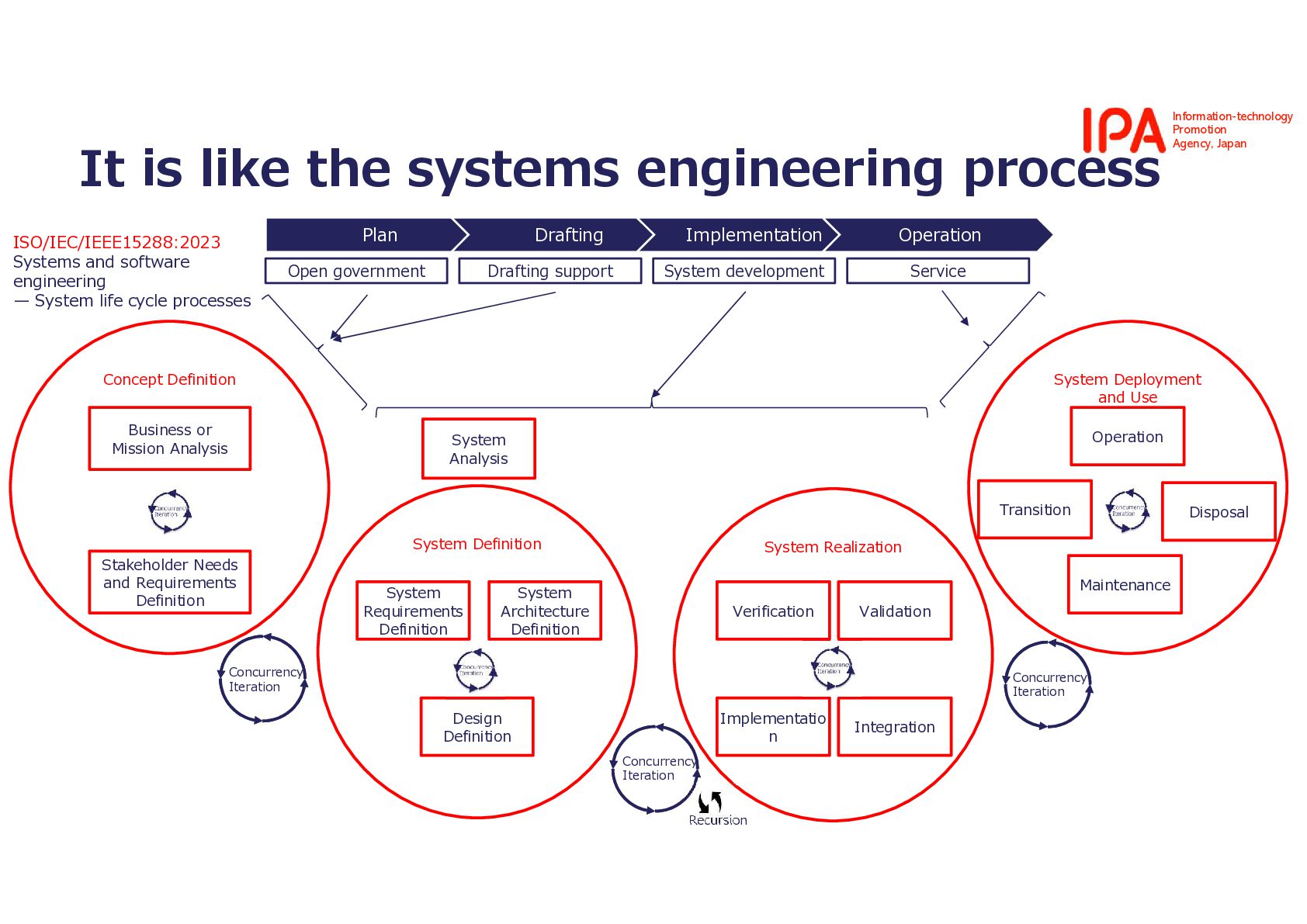
software engineering — System life cycle processes Plan Open government Drafting Implementation Operation Drafting support System development Service Concept Definition Business or Mission Analysis System Deployment and Use Operation System Analysis Transition System Definition Stakeholder Needs and Requirements Definition Information-technology Promotion Agency, Japan System Requirements Definition Disposal System Realization Maintenance System Architecture Definition Verification Validation Concurrency Iteration Concurrency Iteration Design Definition Implementatio n Concurrency Iteration Recursion Integration
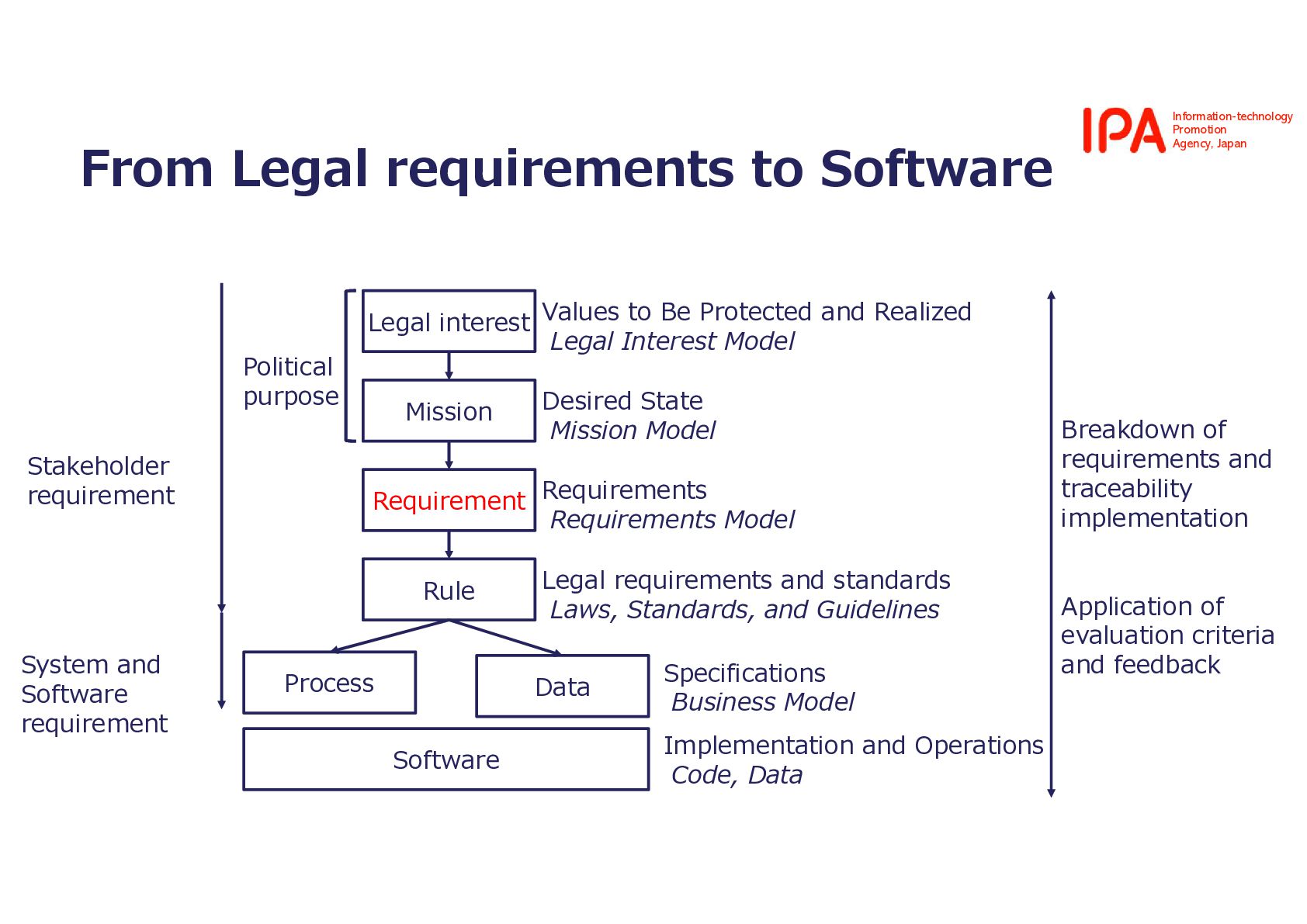
interest Values to Be Protected and Realized Legal Interest Model Mission Desired State Mission Model Requirement Requirements Requirements Model Rule System and Software requirement Information-technology Promotion Agency, Japan Process Legal requirements and standards Laws, Standards, and Guidelines Data Software Specifications Business Model Implementation and Operations Code, Data Breakdown of requirements and traceability implementation Application of evaluation criteria and feedback
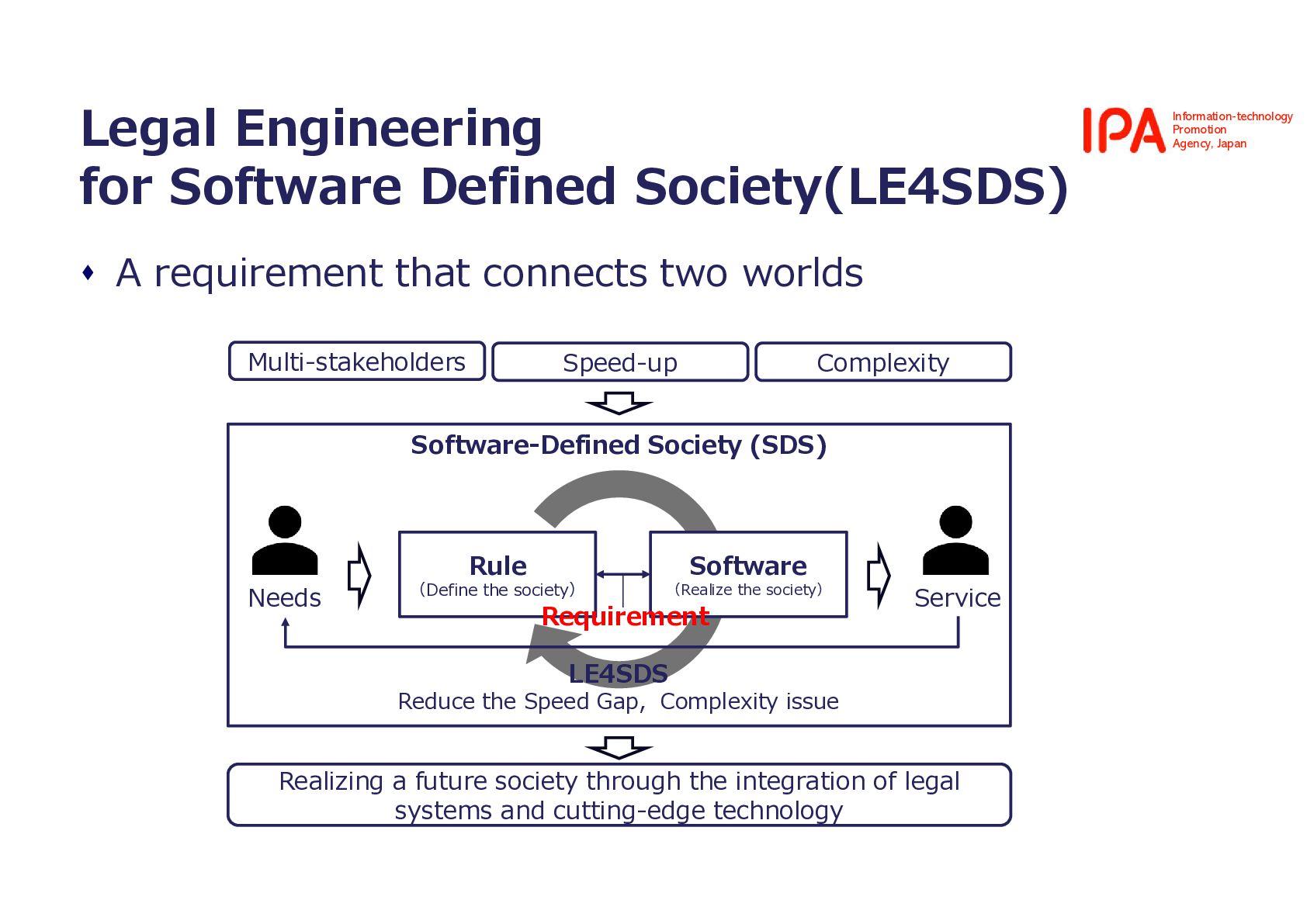
connects two worlds Multi-stakeholders Speed-up Complexity Software-Defined Society (SDS) Rule Needs (Define the society) Software (Realize the society) Requirement Service LE4SDS Reduce the Speed Gap, Complexity issue Realizing a future society through the integration of legal systems and cutting-edge technology Information-technology Promotion Agency, Japan
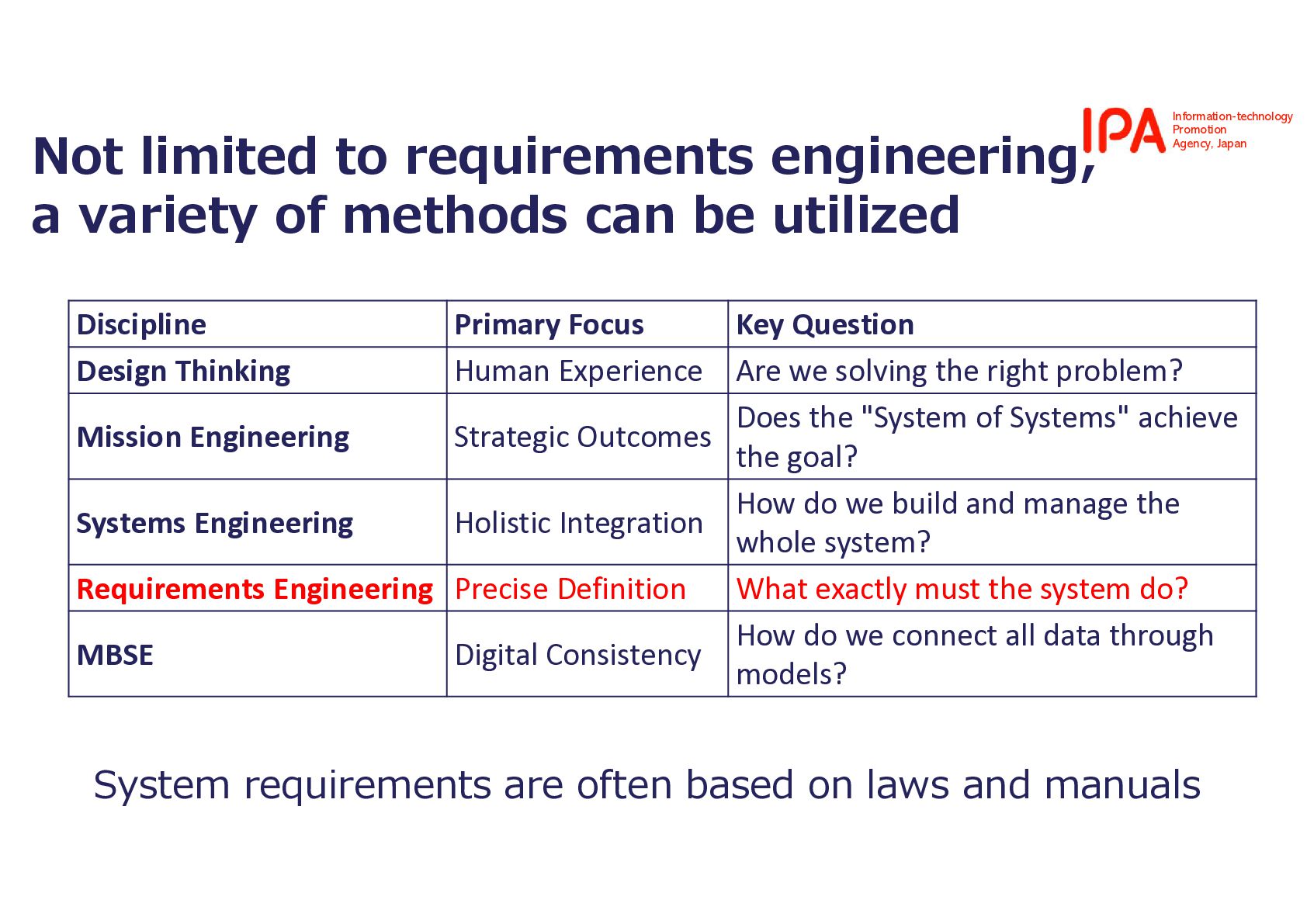
be utilized Information-technology Promotion Agency, Japan Discipline Design Thinking Primary Focus Key Question Human Experience Are we solving the right problem? Does the "System of Systems" achieve Mission Engineering Strategic Outcomes the goal? How do we build and manage the Systems Engineering Holistic Integration whole system? Requirements Engineering Precise Definition What exactly must the system do? How do we connect all data through MBSE Digital Consistency models? System requirements are often based on laws and manuals
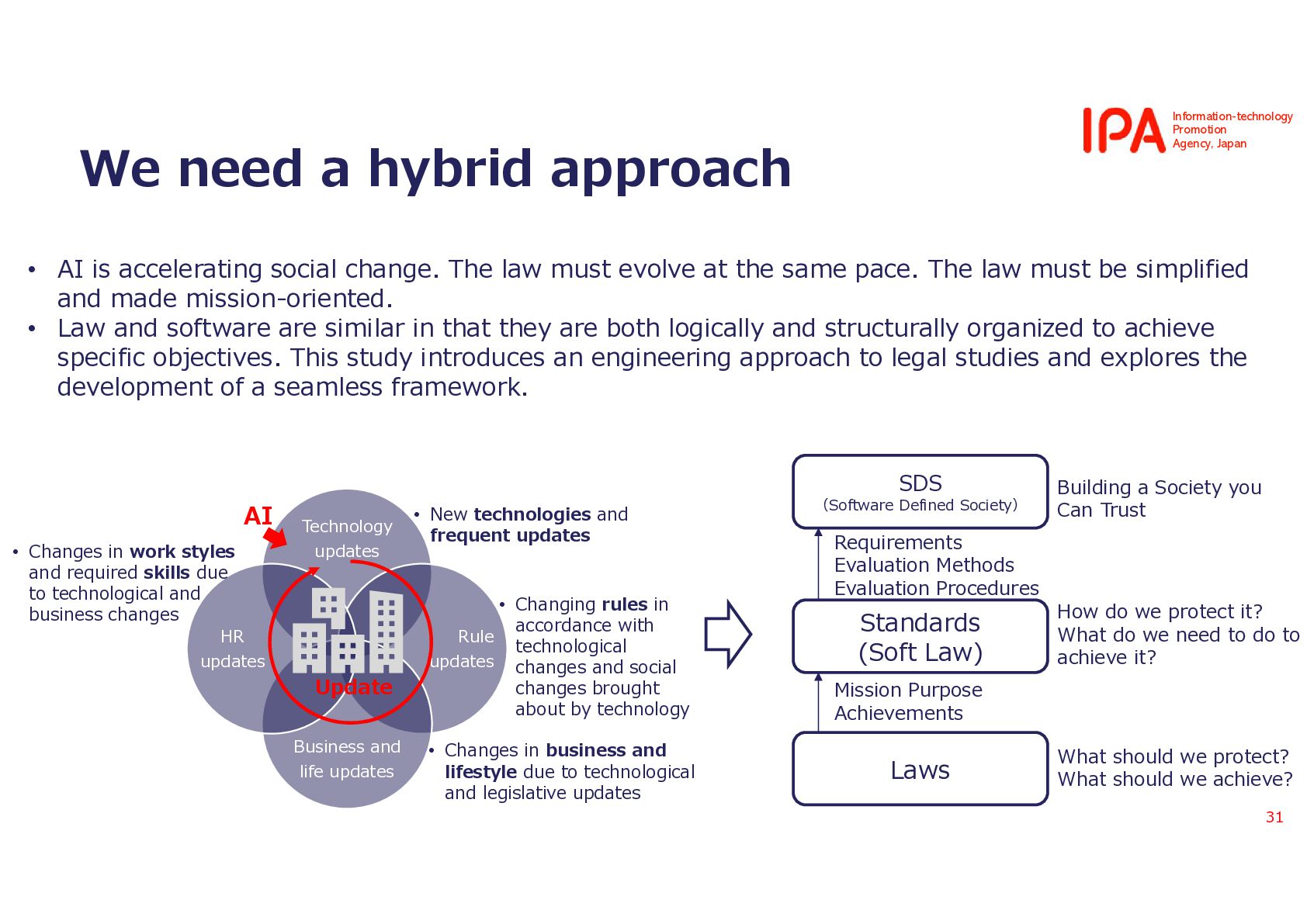
AI is accelerating social change. The law must evolve at the same pace. The law must be simplified and made mission-oriented. • Law and software are similar in that they are both logically and structurally organized to achieve specific objectives. This study introduces an engineering approach to legal studies and explores the development of a seamless framework. SDS AI • Changes in work styles and required skills due to technological and business changes HR updates Technology updates Update Business and life updates • New technologies and frequent updates • Changing rules in accordance with Rule technological updates changes and social changes brought about by technology • Changes in business and lifestyle due to technological and legislative updates (Software Defined Society) Requirements Evaluation Methods Evaluation Procedures Standards (Soft Law) Building a Society you Can Trust How do we protect it? What do we need to do to achieve it? Mission Purpose Achievements Laws What should we protect? What should we achieve? 31
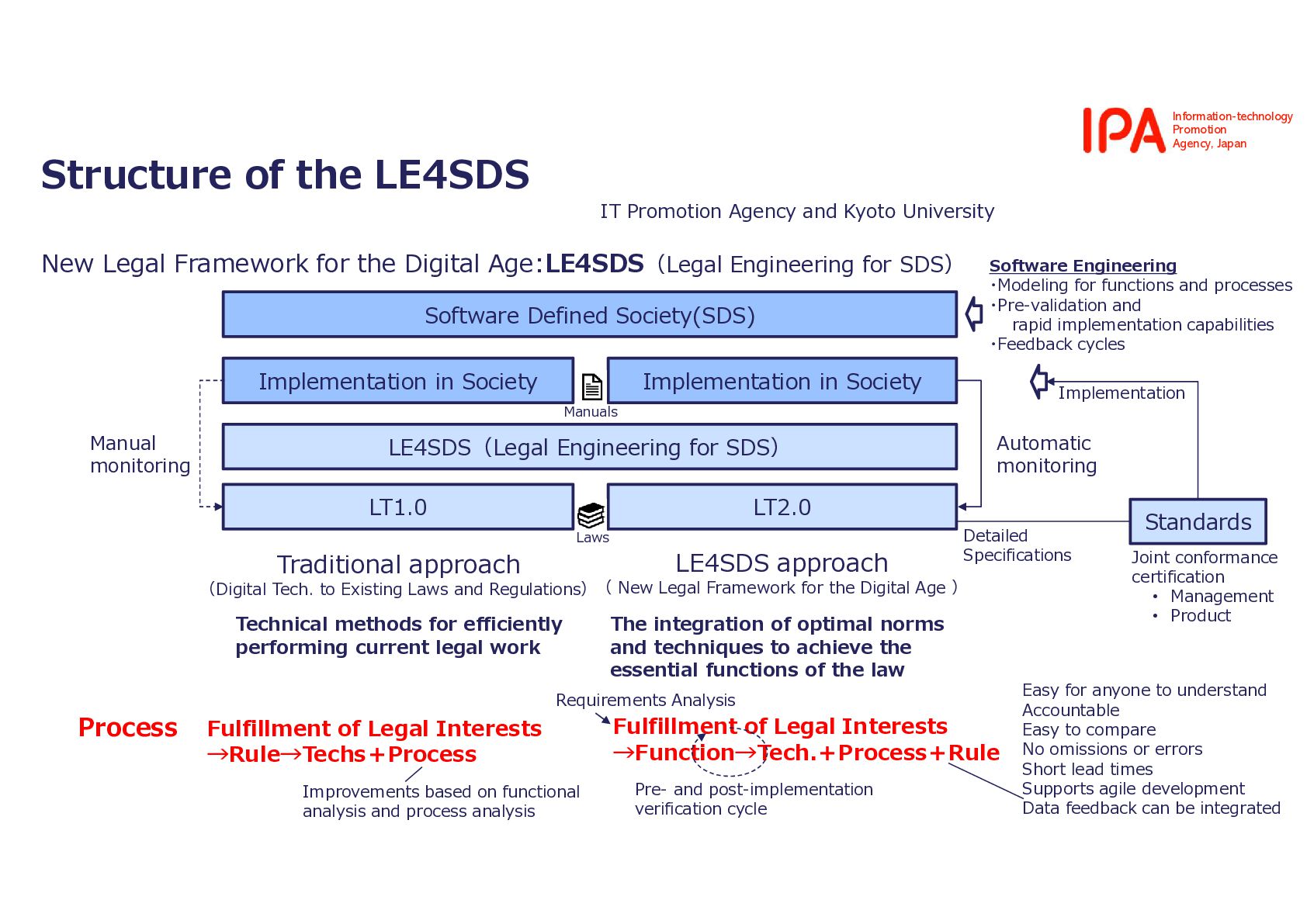
Agency and Kyoto University New Legal Framework for the Digital Age:LE4SDS(Legal Engineering for SDS) Software Defined Society(SDS) Implementation in Society Software Engineering ・Modeling for functions and processes ・Pre-validation and rapid implementation capabilities ・Feedback cycles Implementation in Society Implementation Manuals Manual monitoring Automatic monitoring LE4SDS(Legal Engineering for SDS) LT1.0 LT2.0 Laws Traditional approach LE4SDS approach Technical methods for efficiently performing current legal work The integration of optimal norms and techniques to achieve the essential functions of the law Detailed Specifications (Digital Tech. to Existing Laws and Regulations)( New Legal Framework for the Digital Age ) Requirements Analysis Process Fulfillment of Legal Interests →Rule→Techs+Process Improvements based on functional analysis and process analysis Fulfillment of Legal Interests →Function→Tech.+Process+Rule Pre- and post-implementation verification cycle Standards Joint conformance certification • Management • Product Easy for anyone to understand Accountable Easy to compare No omissions or errors Short lead times Supports agile development Data feedback can be integrated
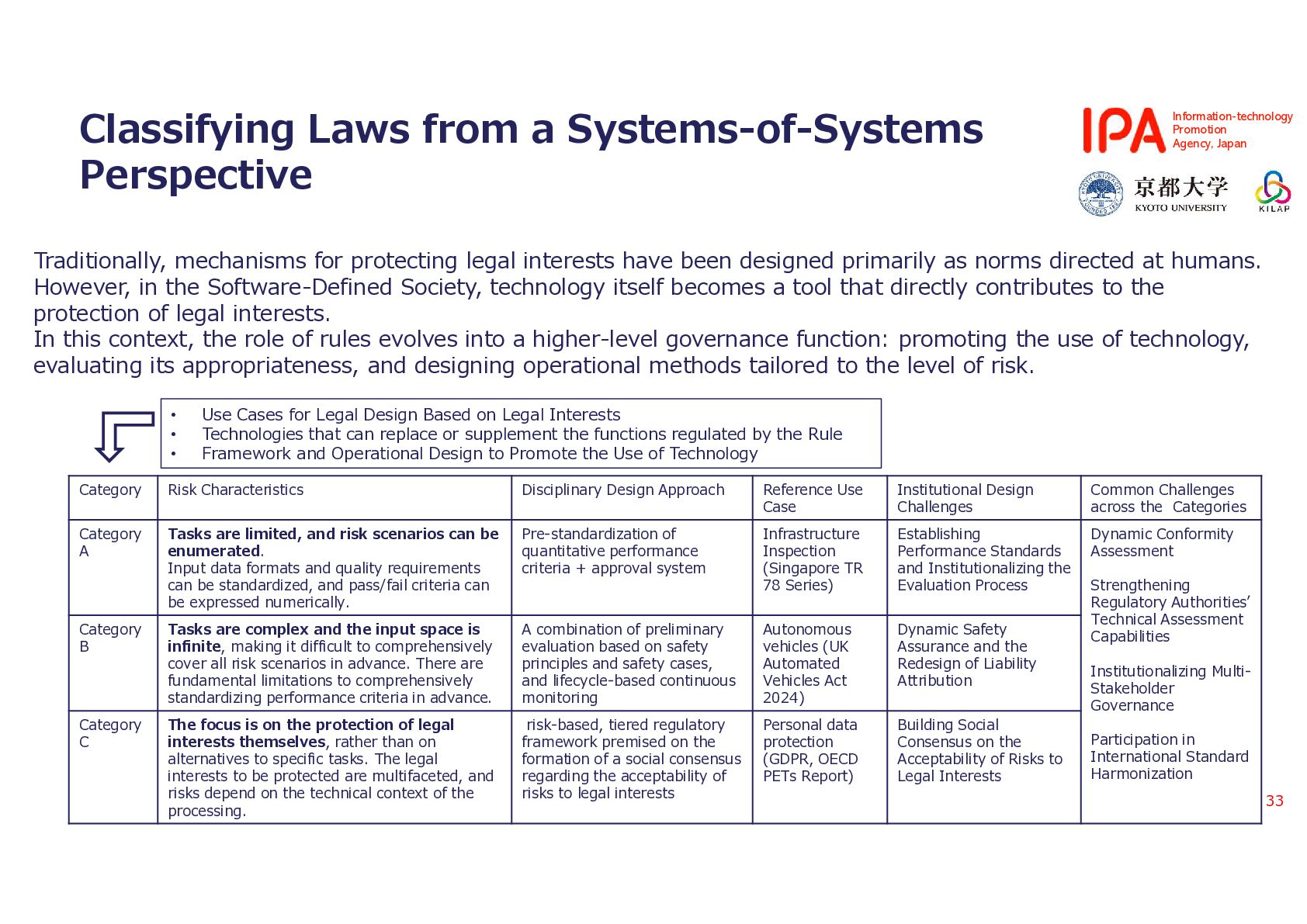
Traditionally, mechanisms for protecting legal interests have been designed primarily as norms directed at humans. However, in the Software-Defined Society, technology itself becomes a tool that directly contributes to the protection of legal interests. In this context, the role of rules evolves into a higher-level governance function: promoting the use of technology, evaluating its appropriateness, and designing operational methods tailored to the level of risk. • • • Use Cases for Legal Design Based on Legal Interests Technologies that can replace or supplement the functions regulated by the Rule Framework and Operational Design to Promote the Use of Technology Category Risk Characteristics Disciplinary Design Approach Reference Use Case Institutional Design Challenges Common Challenges across the Categories Category A Tasks are limited, and risk scenarios can be enumerated. Input data formats and quality requirements can be standardized, and pass/fail criteria can be expressed numerically. Pre-standardization of quantitative performance criteria + approval system Infrastructure Inspection (Singapore TR 78 Series) Establishing Performance Standards and Institutionalizing the Evaluation Process Dynamic Conformity Assessment Tasks are complex and the input space is infinite, making it difficult to comprehensively cover all risk scenarios in advance. There are fundamental limitations to comprehensively standardizing performance criteria in advance. A combination of preliminary evaluation based on safety principles and safety cases, and lifecycle-based continuous monitoring Autonomous vehicles (UK Automated Vehicles Act 2024) Dynamic Safety Assurance and the Redesign of Liability Attribution The focus is on the protection of legal interests themselves, rather than on alternatives to specific tasks. The legal interests to be protected are multifaceted, and risks depend on the technical context of the processing. risk-based, tiered regulatory framework premised on the formation of a social consensus regarding the acceptability of risks to legal interests Personal data protection (GDPR, OECD PETs Report) Building Social Consensus on the Acceptability of Risks to Legal Interests Category B Category C Strengthening Regulatory Authorities’ Technical Assessment Capabilities Institutionalizing MultiStakeholder Governance Participation in International Standard Harmonization 33
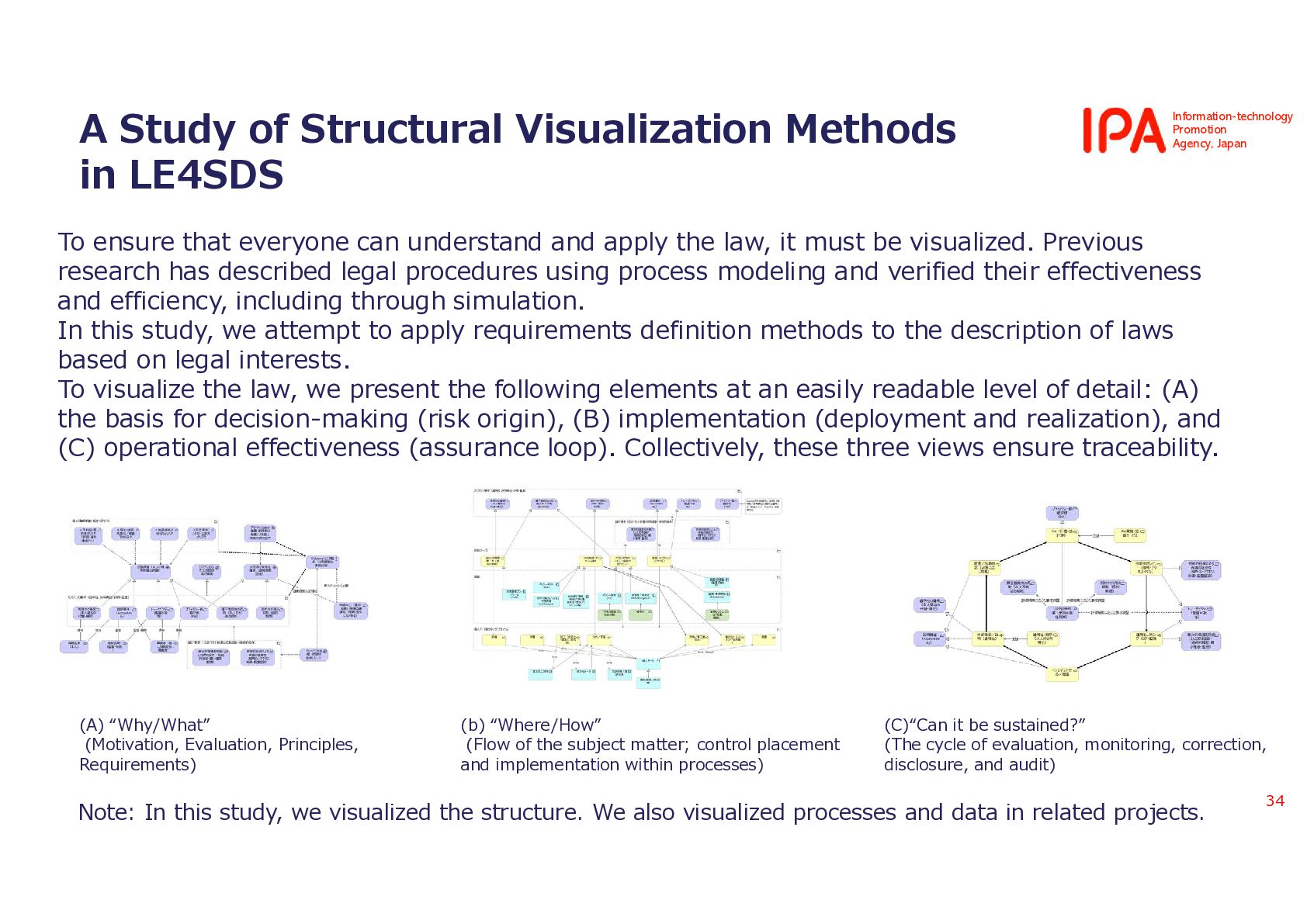
Agency, Japan To ensure that everyone can understand and apply the law, it must be visualized. Previous research has described legal procedures using process modeling and verified their effectiveness and efficiency, including through simulation. In this study, we attempt to apply requirements definition methods to the description of laws based on legal interests. To visualize the law, we present the following elements at an easily readable level of detail: (A) the basis for decision-making (risk origin), (B) implementation (deployment and realization), and (C) operational effectiveness (assurance loop). Collectively, these three views ensure traceability. (A) “Why/What” (Motivation, Evaluation, Principles, Requirements) (b) “Where/How” (Flow of the subject matter; control placement and implementation within processes) (C)“Can it be sustained?” (The cycle of evaluation, monitoring, correction, disclosure, and audit) Note: In this study, we visualized the structure. We also visualized processes and data in related projects. 34
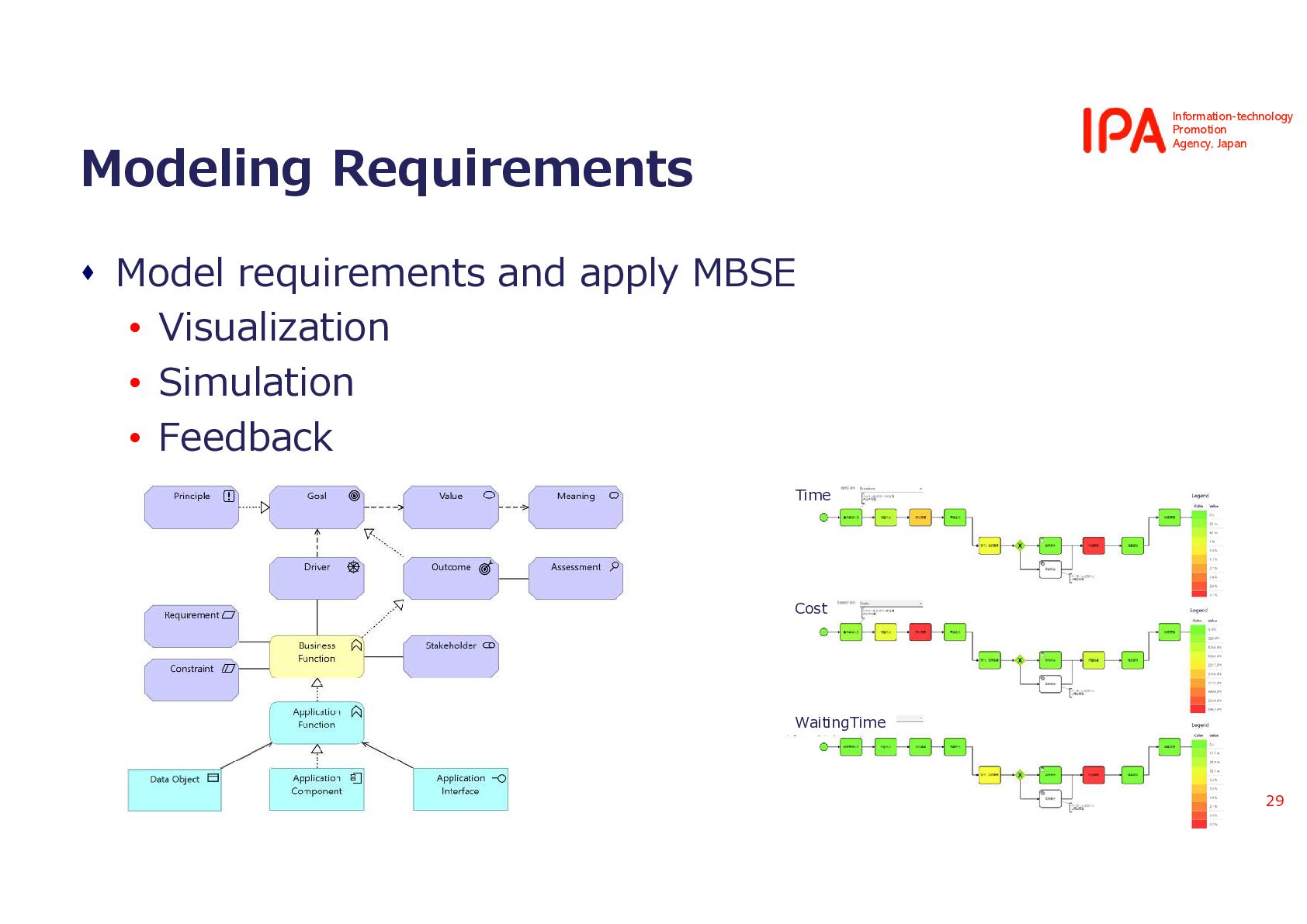
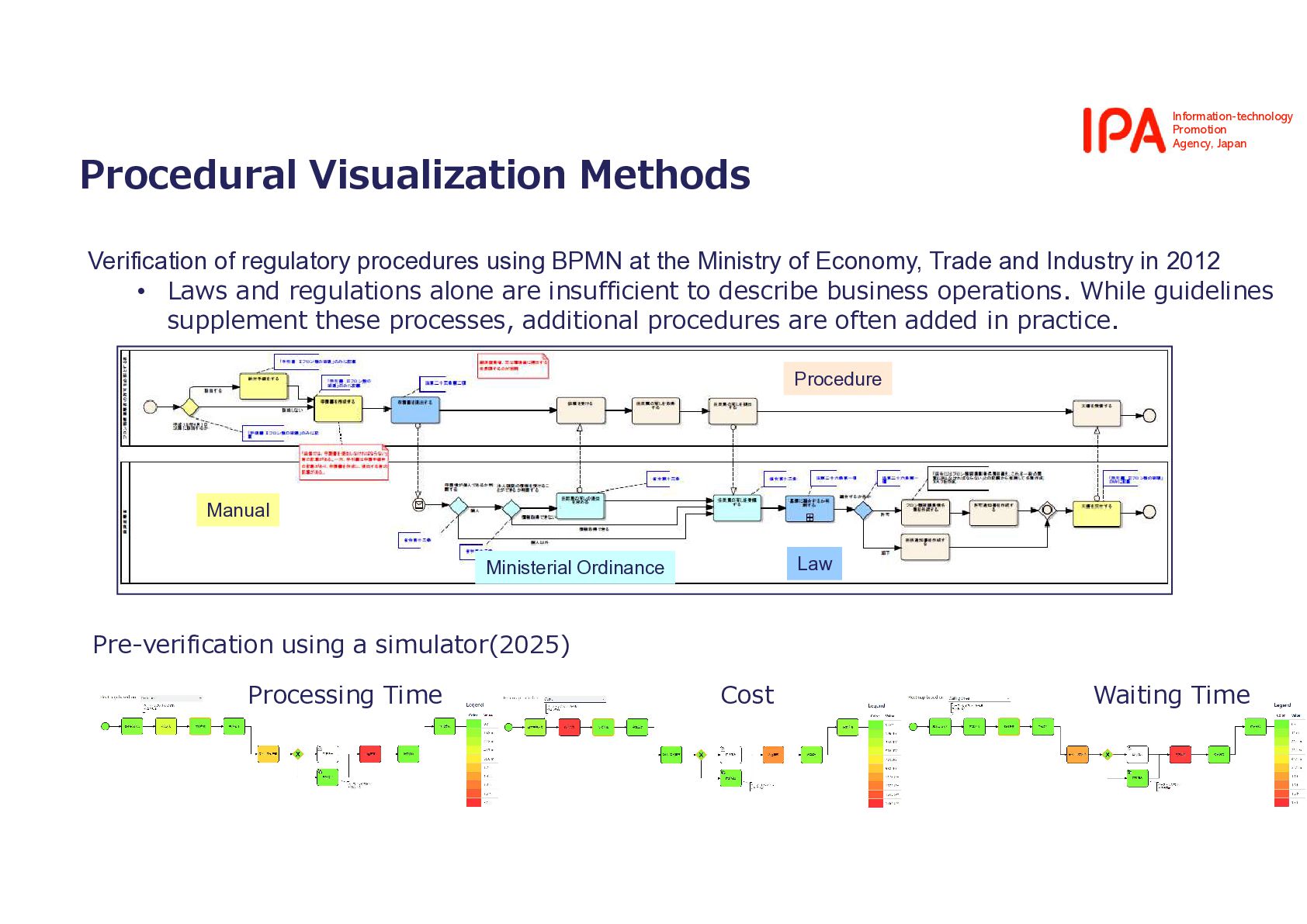
procedures using BPMN at the Ministry of Economy, Trade and Industry in 2012 • Laws and regulations alone are insufficient to describe business operations. While guidelines supplement these processes, additional procedures are often added in practice. Procedure Manual Law Ministerial Ordinance Pre-verification using a simulator(2025) Processing Time Cost Waiting Time 35
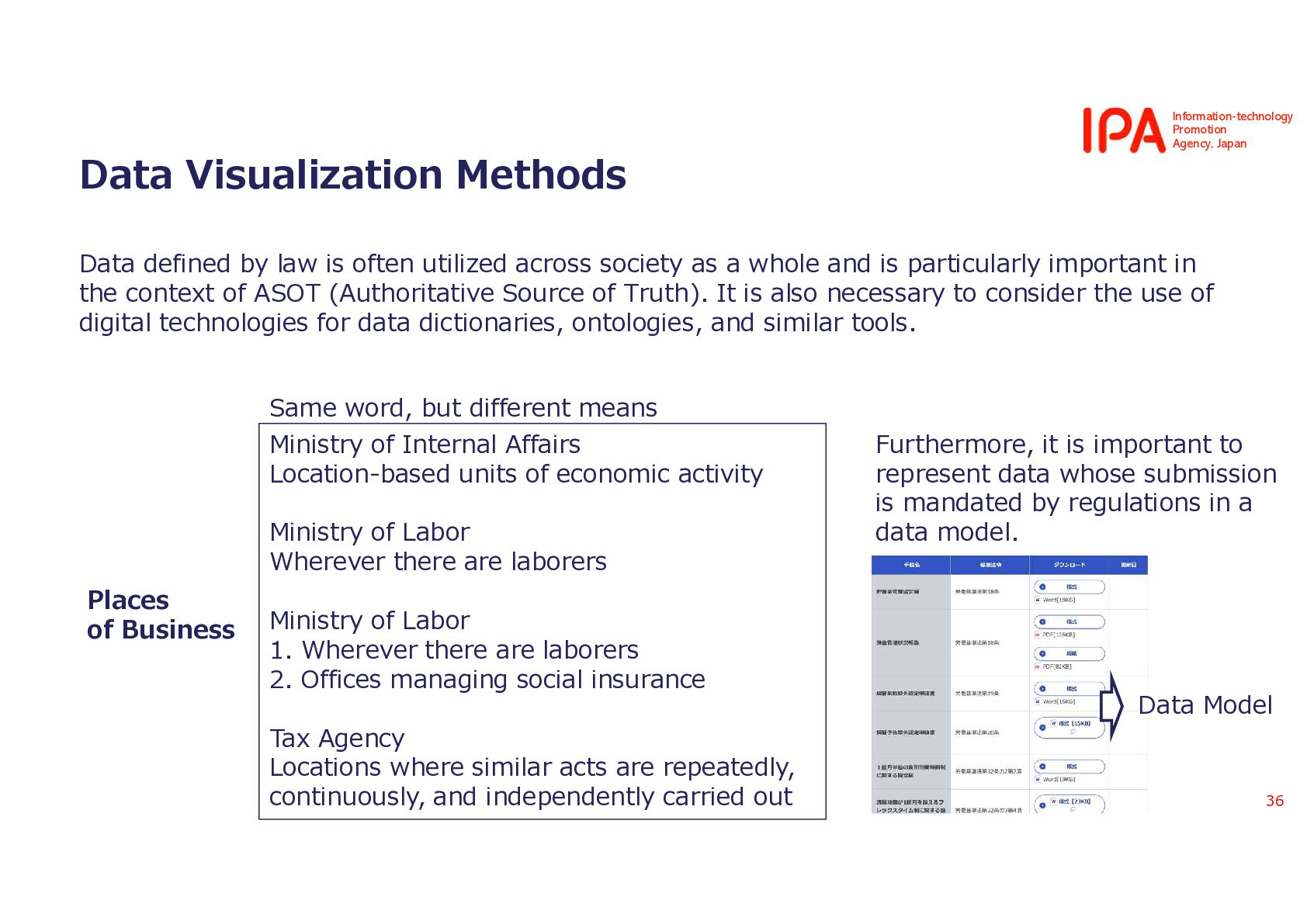
law is often utilized across society as a whole and is particularly important in the context of ASOT (Authoritative Source of Truth). It is also necessary to consider the use of digital technologies for data dictionaries, ontologies, and similar tools. Same word, but different means Ministry of Internal Affairs Location-based units of economic activity Ministry of Labor Wherever there are laborers Places of Business Ministry of Labor 1. Wherever there are laborers 2. Offices managing social insurance Tax Agency Locations where similar acts are repeatedly, continuously, and independently carried out Furthermore, it is important to represent data whose submission is mandated by regulations in a data model. Data Model 36
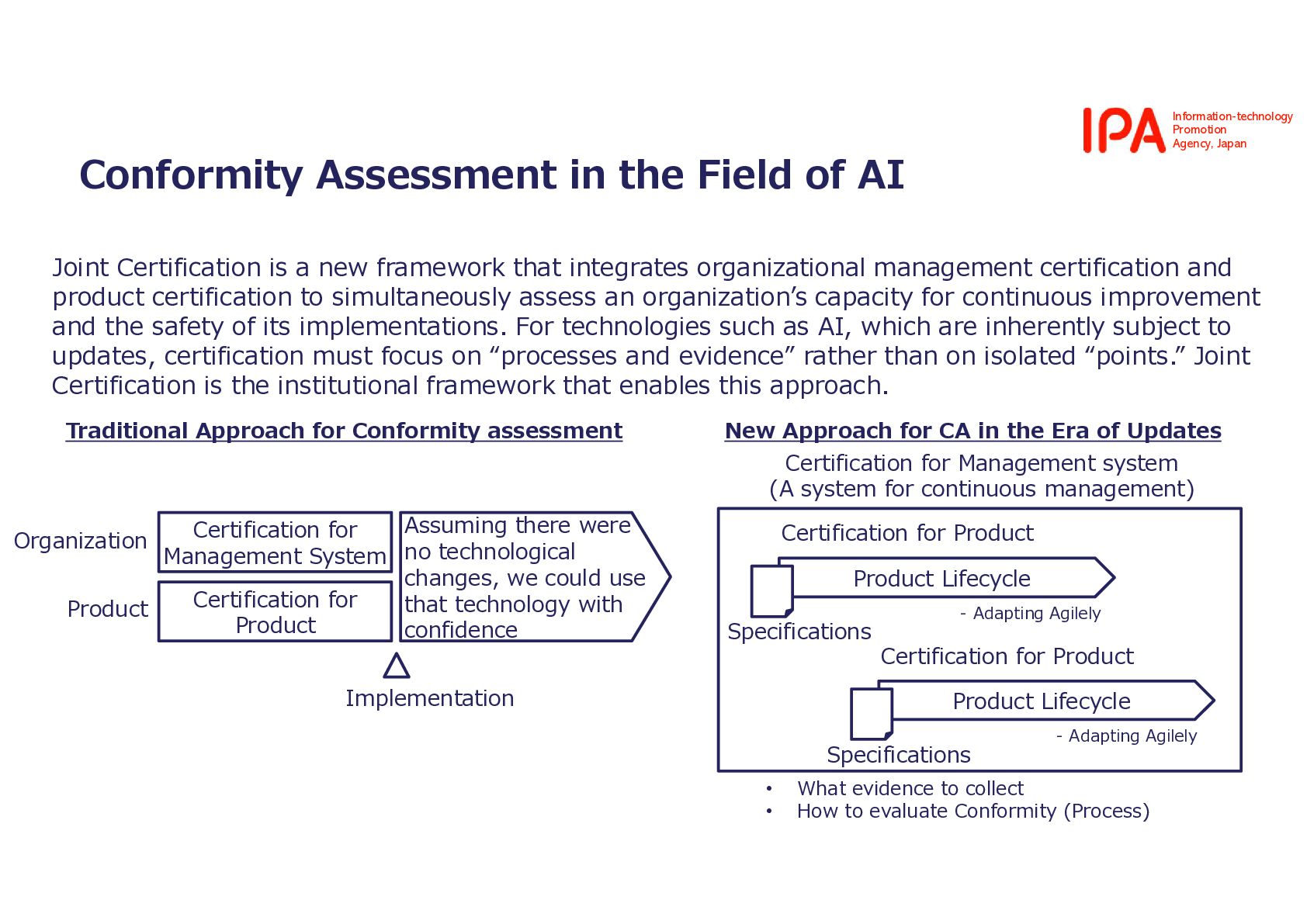
AI Joint Certification is a new framework that integrates organizational management certification and product certification to simultaneously assess an organization’s capacity for continuous improvement and the safety of its implementations. For technologies such as AI, which are inherently subject to updates, certification must focus on “processes and evidence” rather than on isolated “points.” Joint Certification is the institutional framework that enables this approach. Traditional Approach for Conformity assessment Assuming there were Certification for Management System no technological changes, we could use Certification for that technology with Product Product confidence New Approach for CA in the Era of Updates Certification for Management system (A system for continuous management) Certification for Product Organization Product Lifecycle Specifications Implementation - Adapting Agilely Certification for Product Product Lifecycle Specifications • • - Adapting Agilely What evidence to collect How to evaluate Conformity (Process)
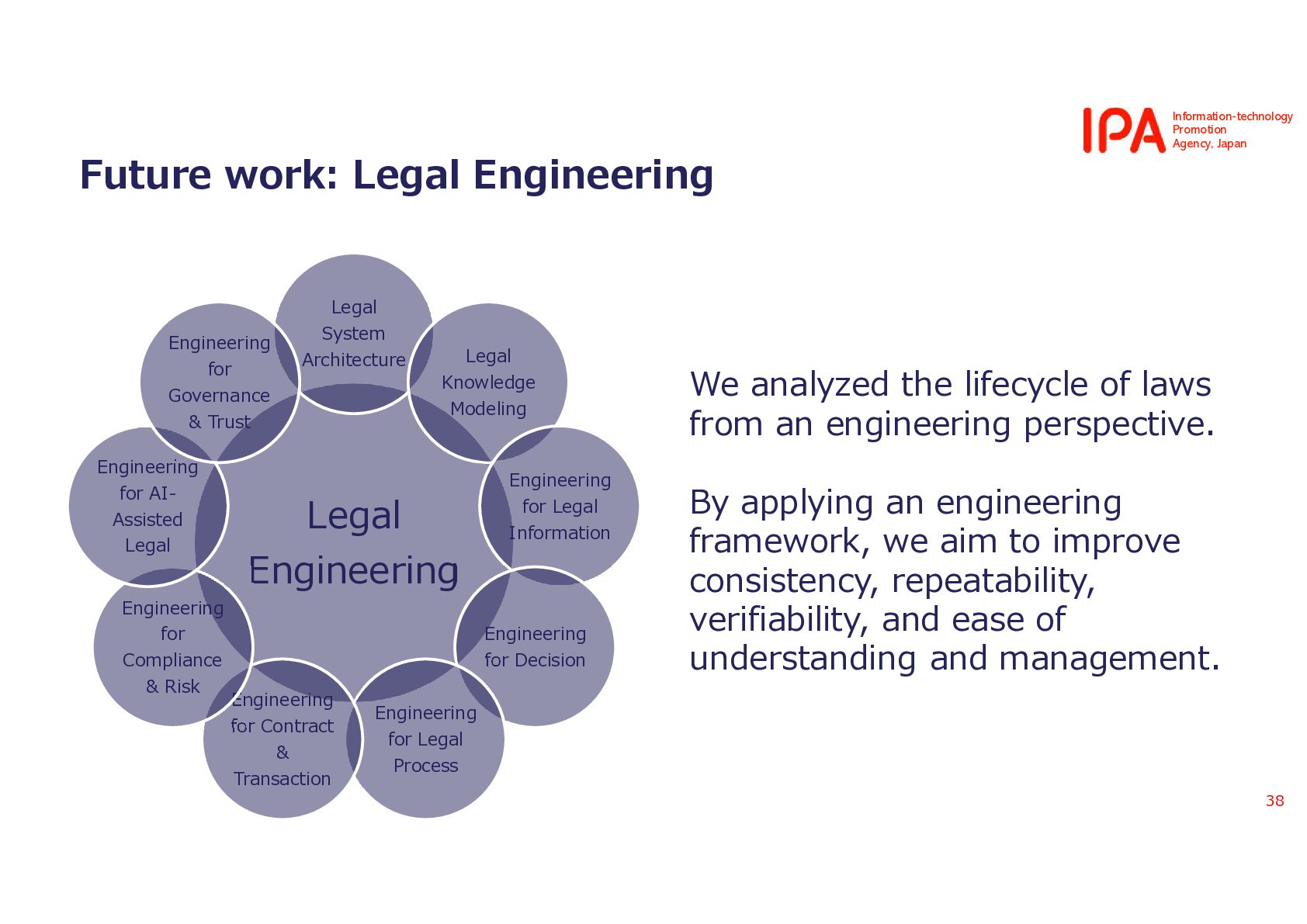
for AIAssisted Legal Engineering for Compliance & Risk Legal System Architecture Legal Knowledge Modeling Legal Engineering Engineering for Legal Information Engineering for Decision Engineering for Contract & Transaction Information-technology Promotion Agency, Japan We analyzed the lifecycle of laws from an engineering perspective. By applying an engineering framework, we aim to improve consistency, repeatability, verifiability, and ease of understanding and management. Engineering for Legal Process 38


 hiramotok
 arnekittler
 mercari_inc
 ideininc
 maruishi
 mediphone
 m3c
m3c
 updater_pr
 daiksy
 makaibito
 fullerene_inc
 kgmotors
.jpg) ikuodanaka
ikuodanaka
 signer
 rasagy
 rocio
rocio
 csswizardry
 livdayseo
 marketingsoph
 marktimemedia
 cassininazir
 tmiket
 chriscoyier
 addyosmani