The Competitive Advantage Belongs to Companies That Can Continuously Evolve. Kenji Hiramoto Chief Knowledge Officer(CKO), IPA Deputy Executive Director, AISI AISI Japan AI Safety Institute Japan AI Safety Institute
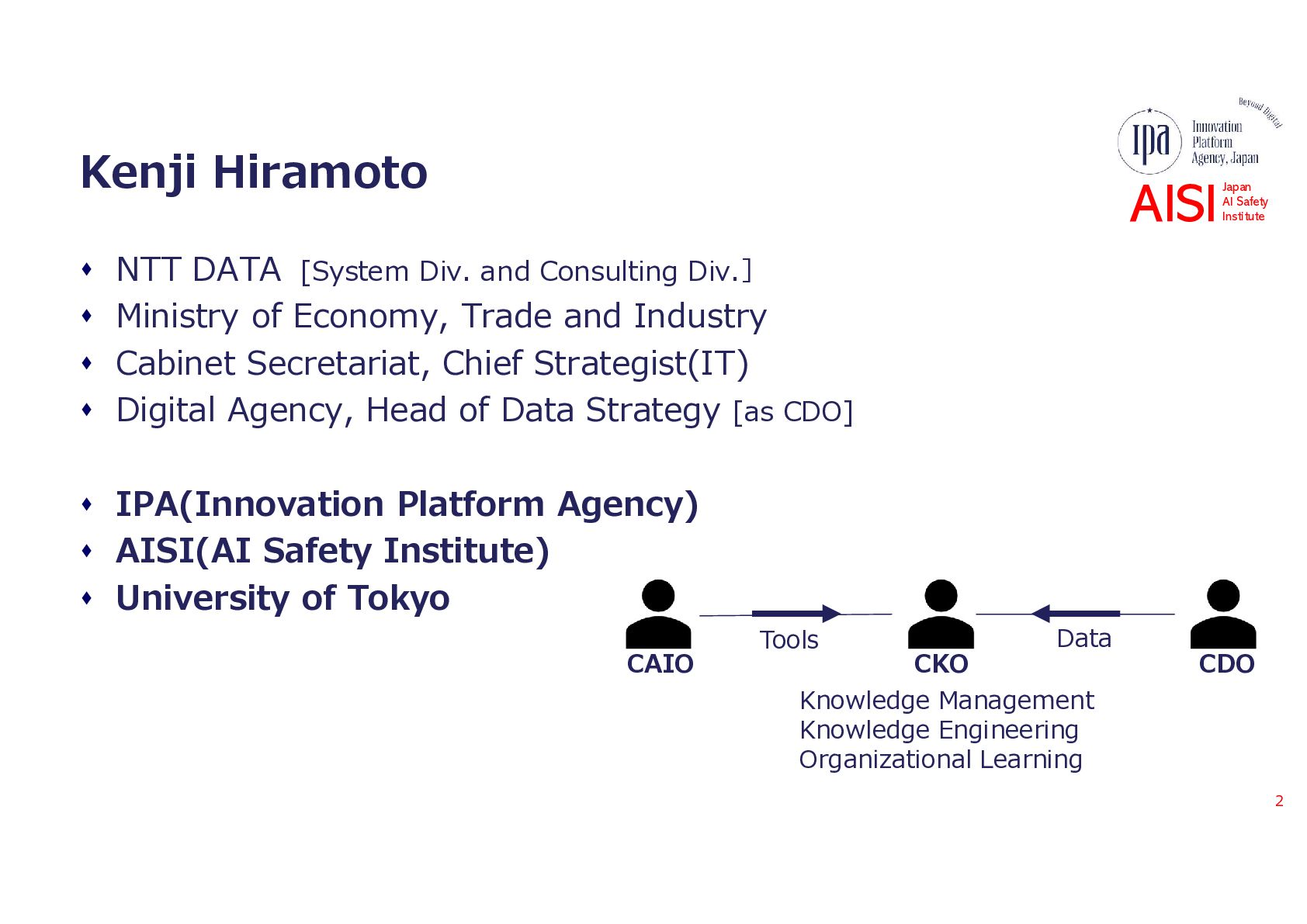
[System Div. and Consulting Div.] Ministry of Economy, Trade and Industry Cabinet Secretariat, Chief Strategist(IT) Digital Agency, Head of Data Strategy [as CDO] IPA(Innovation Platform Agency) AISI(AI Safety Institute) University of Tokyo CAIO Tools Data CKO Knowledge Management Knowledge Engineering Organizational Learning CDO 2
every large enterprise is adopting AI. AI is no longer a differentiator. It is becoming infrastructure—like electricity, the Internet, or cloud computing. The companies that win will not be those with the best AI. They will be those who can continuously evolve faster than everyone else. Japan AI Safety Institute
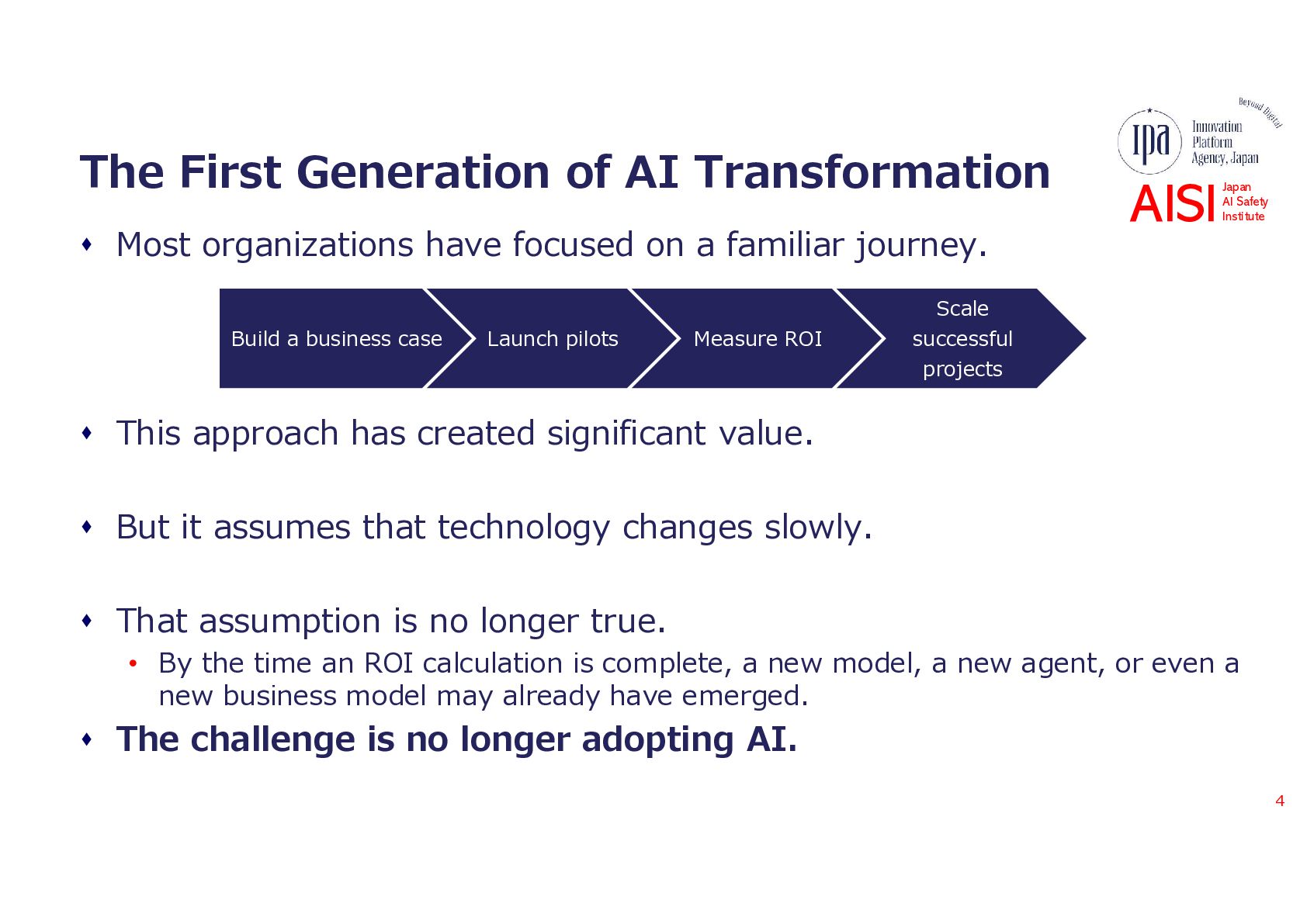
focused on a familiar journey. Build a business case Launch pilots Measure ROI AISI Japan AI Safety Institute Scale successful projects This approach has created significant value. But it assumes that technology changes slowly. That assumption is no longer true. • By the time an ROI calculation is complete, a new model, a new agent, or even a new business model may already have emerged. The challenge is no longer adopting AI. 4
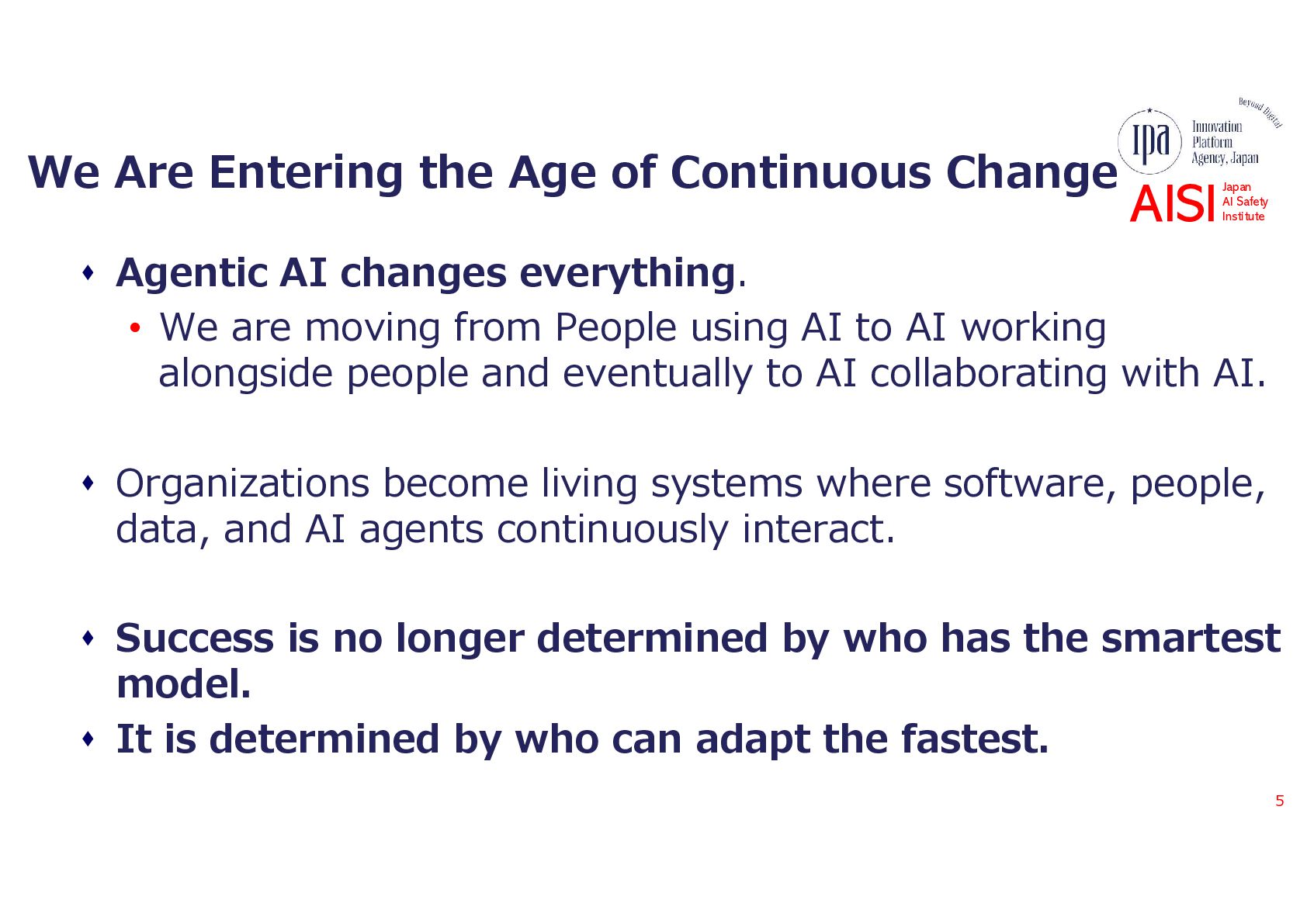
AI Safety Institute Agentic AI changes everything. • We are moving from People using AI to AI working alongside people and eventually to AI collaborating with AI. Organizations become living systems where software, people, data, and AI agents continuously interact. Success is no longer determined by who has the smartest model. It is determined by who can adapt the fastest. 5
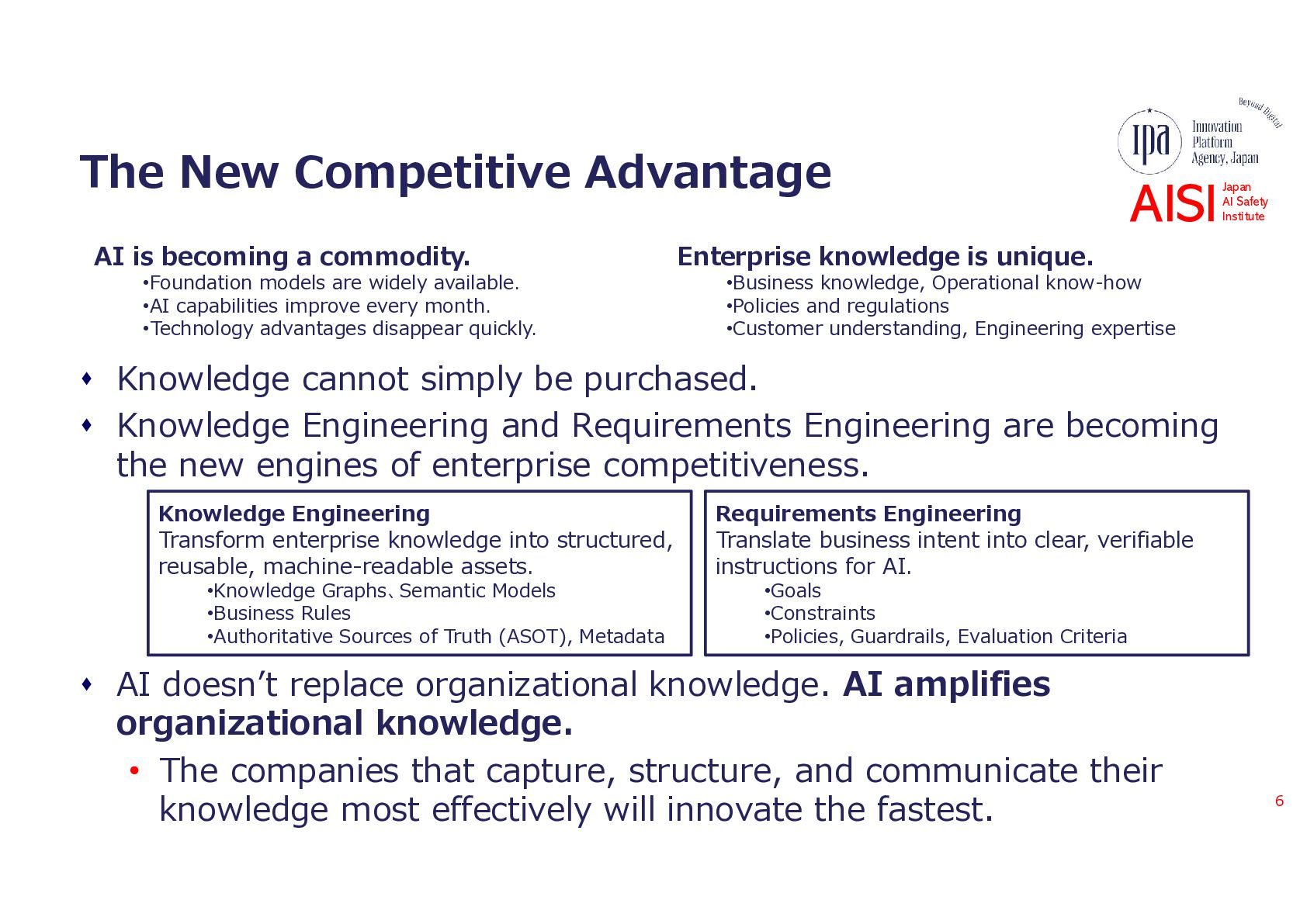
models are widely available. •AI capabilities improve every month. •Technology advantages disappear quickly. AISI Japan AI Safety Institute Enterprise knowledge is unique. •Business knowledge, Operational know-how •Policies and regulations •Customer understanding, Engineering expertise Knowledge cannot simply be purchased. Knowledge Engineering and Requirements Engineering are becoming the new engines of enterprise competitiveness. Knowledge Engineering Transform enterprise knowledge into structured, reusable, machine-readable assets. •Knowledge Graphs、Semantic Models •Business Rules •Authoritative Sources of Truth (ASOT), Metadata Requirements Engineering Translate business intent into clear, verifiable instructions for AI. •Goals •Constraints •Policies, Guardrails, Evaluation Criteria AI doesn’t replace organizational knowledge. AI amplifies organizational knowledge. • The companies that capture, structure, and communicate their knowledge most effectively will innovate the fastest. 6
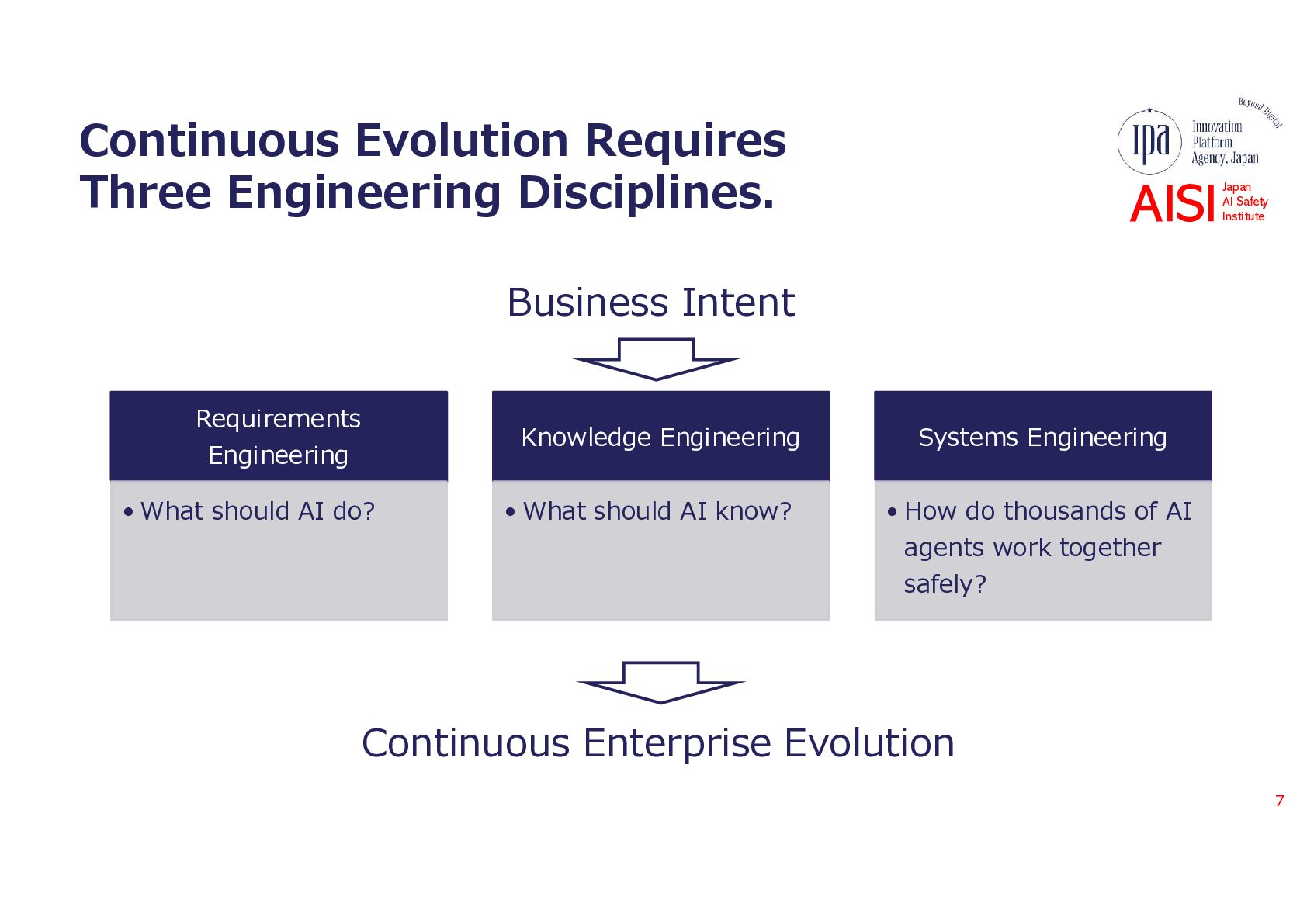
Institute Business Intent Requirements Engineering Knowledge Engineering Systems Engineering • What should AI do? • What should AI know? • How do thousands of AI agents work together safely? Continuous Enterprise Evolution 7
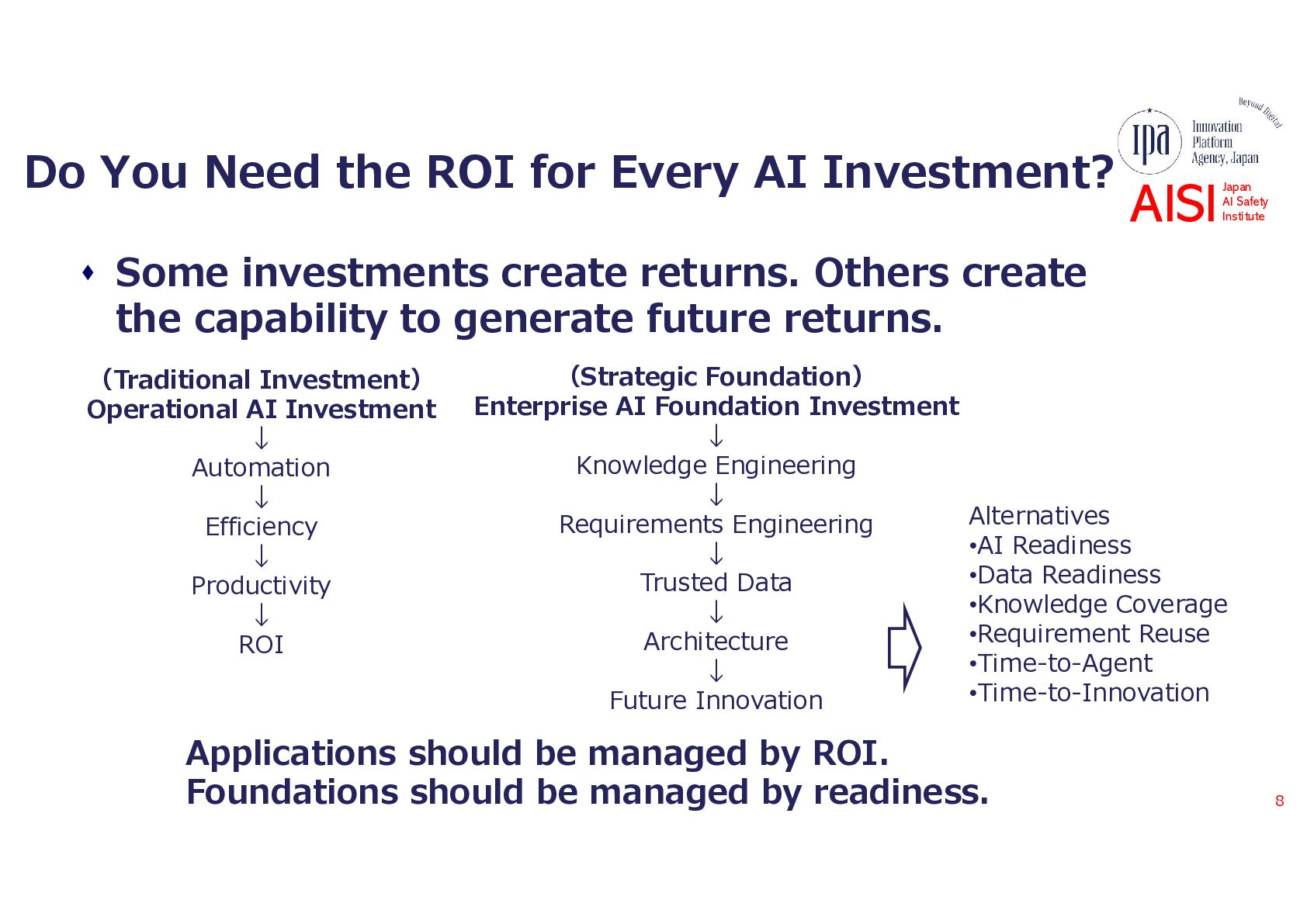
Japan AI Safety Institute Some investments create returns. Others create the capability to generate future returns. (Traditional Investment) Operational AI Investment ↓ Automation ↓ Efficiency ↓ Productivity ↓ ROI (Strategic Foundation) Enterprise AI Foundation Investment ↓ Knowledge Engineering ↓ Alternatives Requirements Engineering •AI Readiness ↓ •Data Readiness Trusted Data •Knowledge Coverage ↓ •Requirement Reuse Architecture •Time-to-Agent ↓ •Time-to-Innovation Future Innovation Applications should be managed by ROI. Foundations should be managed by readiness. 8
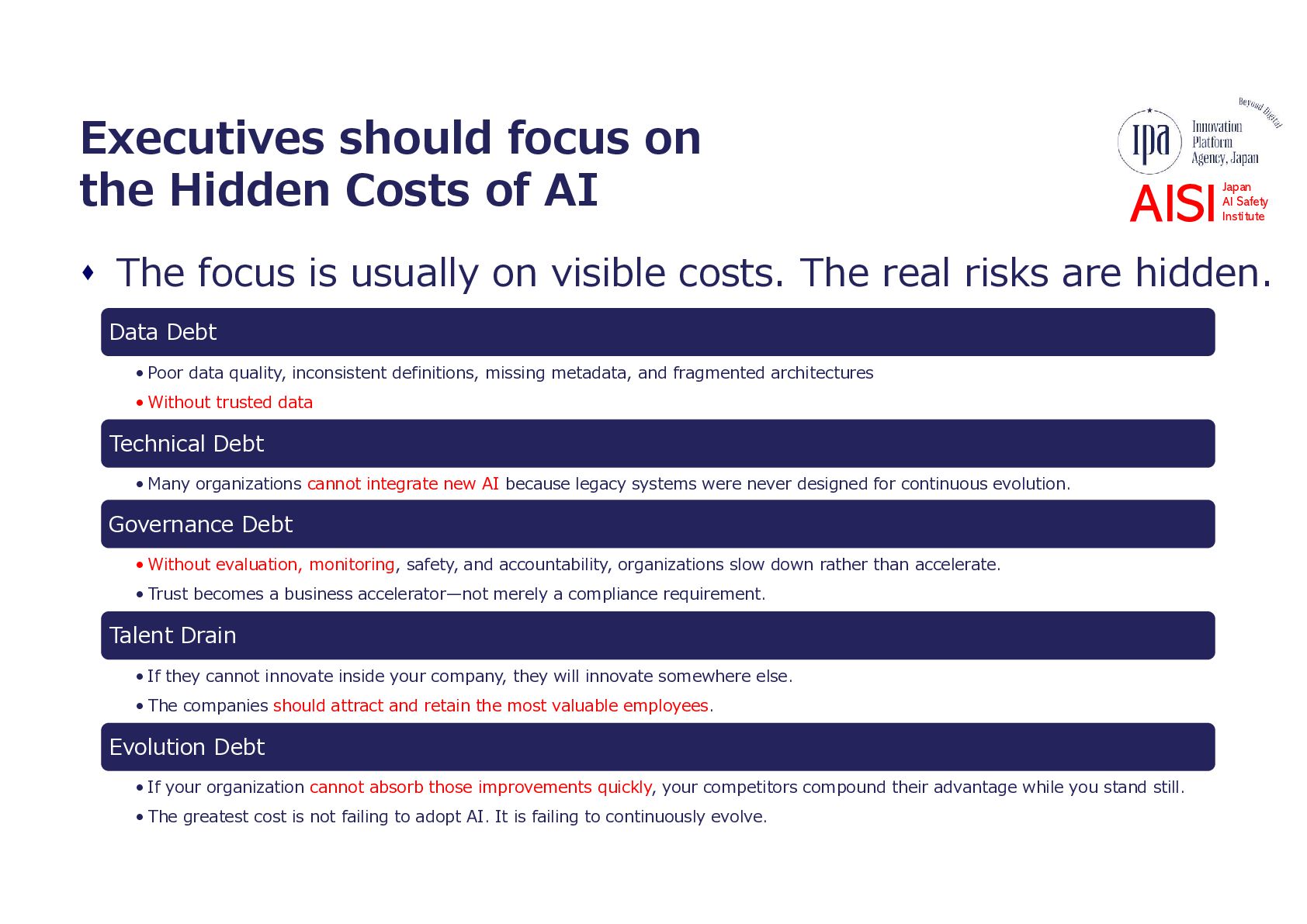
Japan AI Safety Institute The focus is usually on visible costs. The real risks are hidden. Data Debt • Poor data quality, inconsistent definitions, missing metadata, and fragmented architectures • Without trusted data Technical Debt • Many organizations cannot integrate new AI because legacy systems were never designed for continuous evolution. Governance Debt • Without evaluation, monitoring, safety, and accountability, organizations slow down rather than accelerate. • Trust becomes a business accelerator—not merely a compliance requirement. Talent Drain • If they cannot innovate inside your company, they will innovate somewhere else. • The companies should attract and retain the most valuable employees. Evolution Debt • If your organization cannot absorb those improvements quickly, your competitors compound their advantage while you stand still. • The greatest cost is not failing to adopt AI. It is failing to continuously evolve.
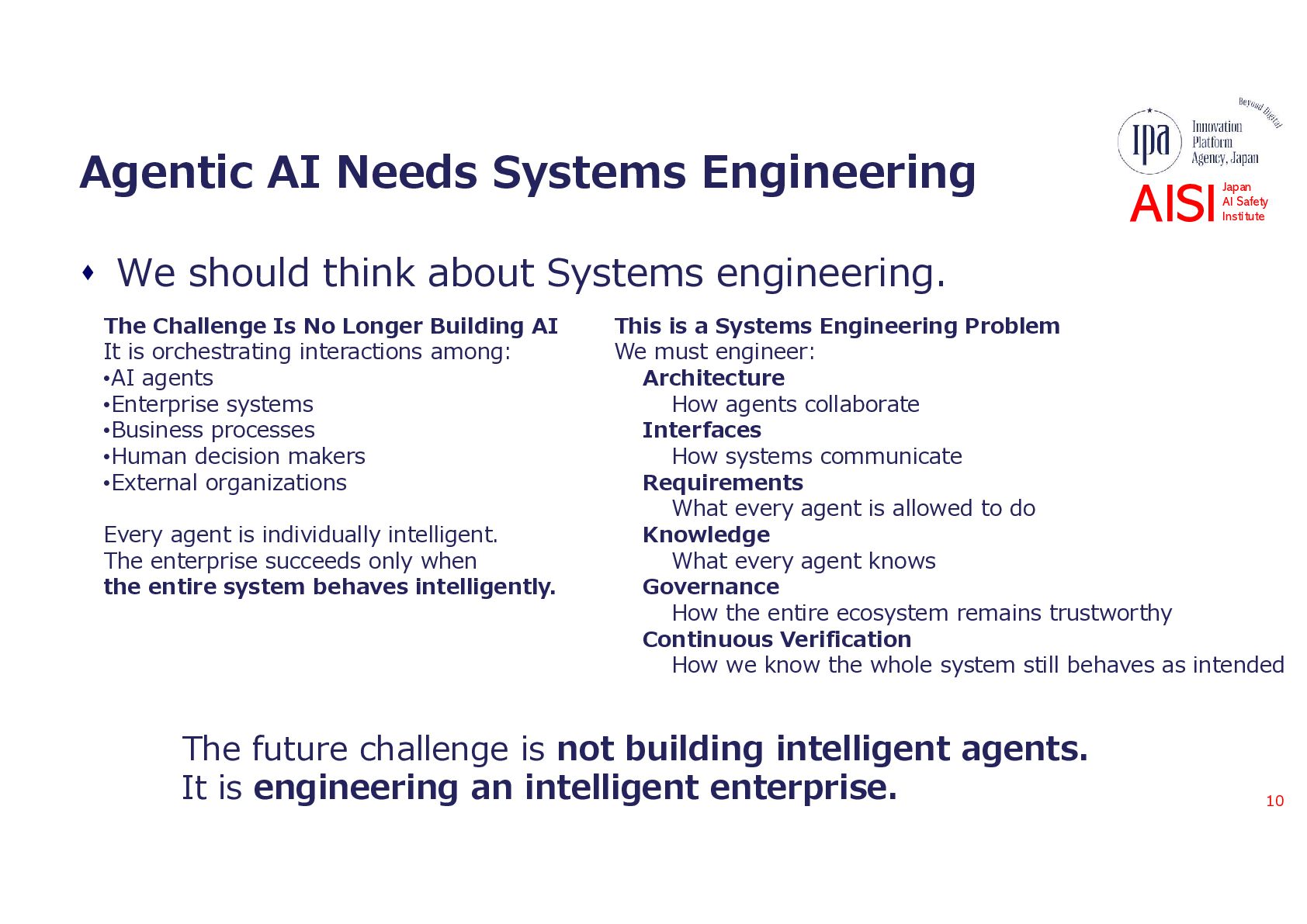
We should think about Systems engineering. The Challenge Is No Longer Building AI It is orchestrating interactions among: •AI agents •Enterprise systems •Business processes •Human decision makers •External organizations Every agent is individually intelligent. The enterprise succeeds only when the entire system behaves intelligently. This is a Systems Engineering Problem We must engineer: Architecture How agents collaborate Interfaces How systems communicate Requirements What every agent is allowed to do Knowledge What every agent knows Governance How the entire ecosystem remains trustworthy Continuous Verification How we know the whole system still behaves as intended The future challenge is not building intelligent agents. It is engineering an intelligent enterprise. 10
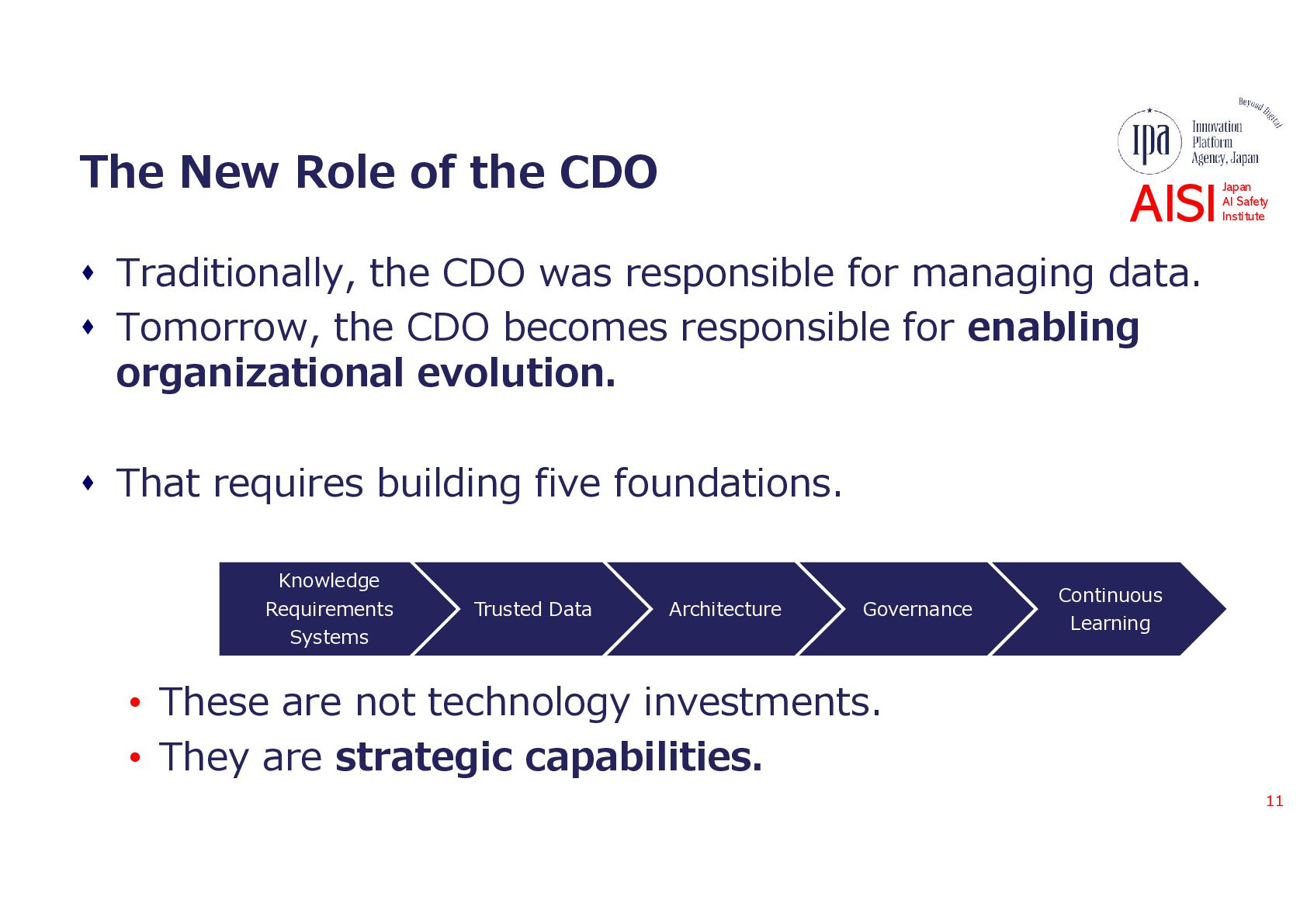
Institute Traditionally, the CDO was responsible for managing data. Tomorrow, the CDO becomes responsible for enabling organizational evolution. That requires building five foundations. Knowledge Requirements Systems Trusted Data Architecture Governance Continuous Learning • These are not technology investments. • They are strategic capabilities. 11
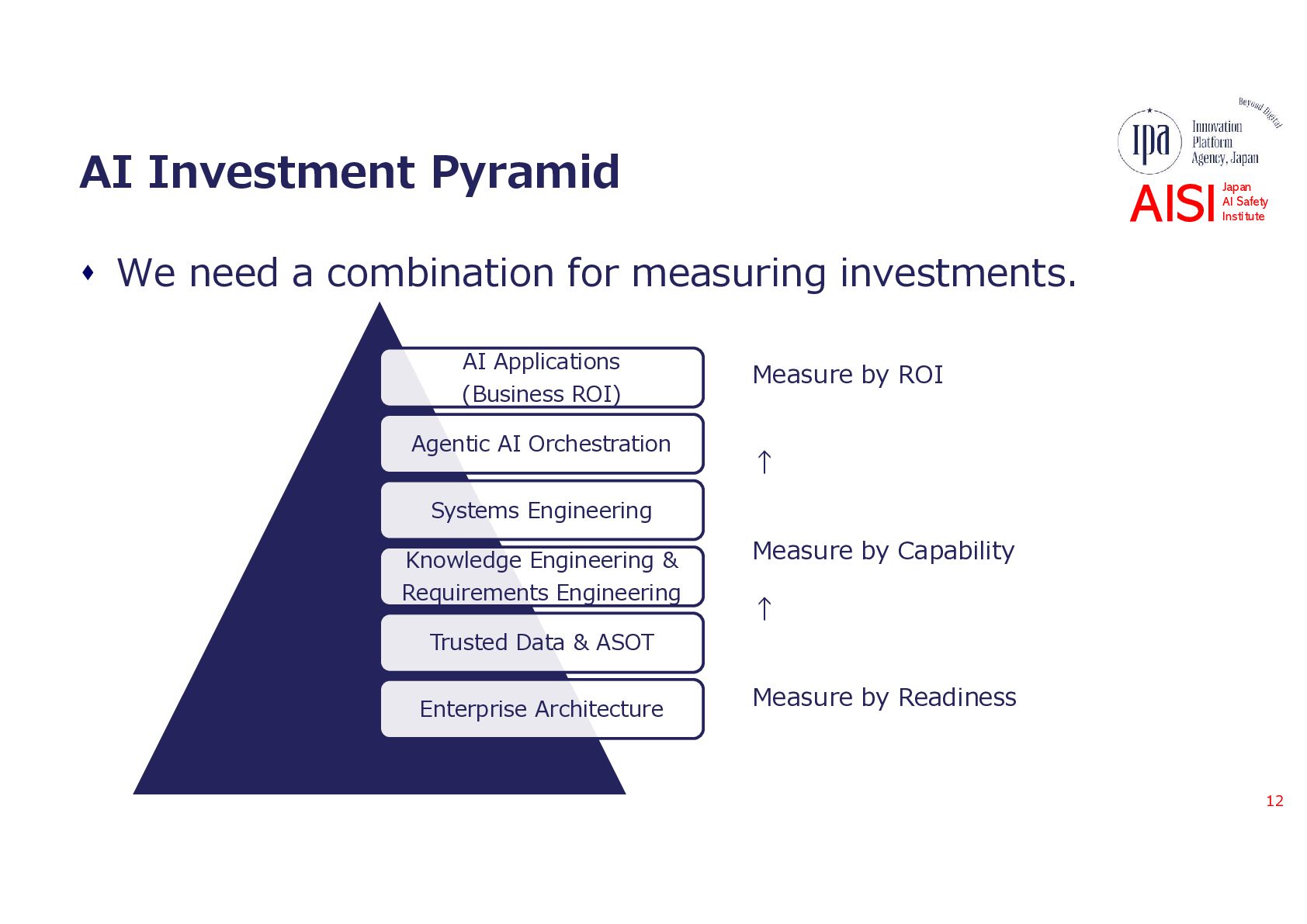
need a combination for measuring investments. AI Applications (Business ROI) Agentic AI Orchestration Measure by ROI ↑ Systems Engineering Knowledge Engineering & Requirements Engineering Measure by Capability ↑ Trusted Data & ASOT Enterprise Architecture Measure by Readiness 12
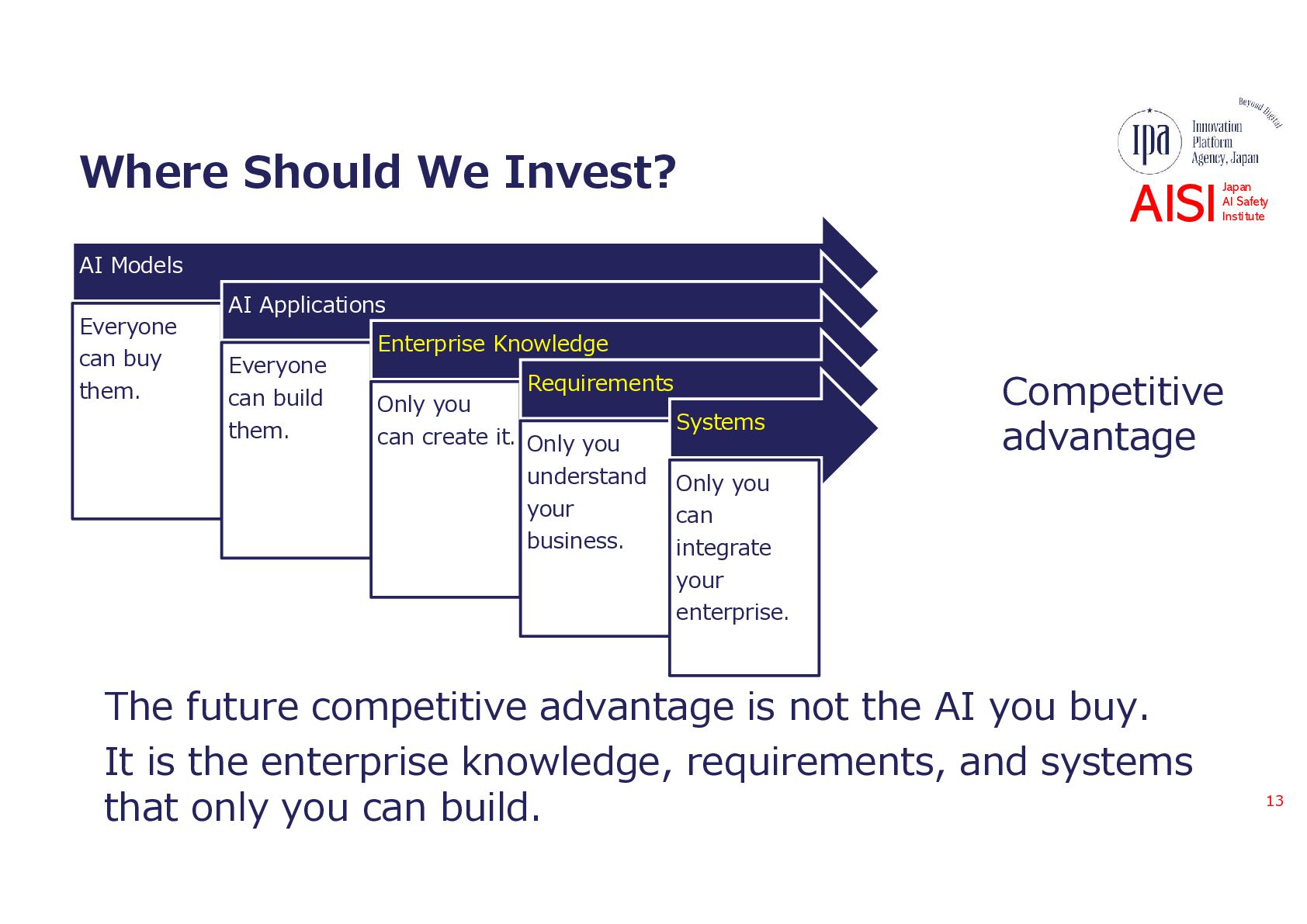
Models Everyone can buy them. AI Applications Everyone can build them. Enterprise Knowledge Requirements Only you can create it. Only you understand your business. Systems Competitive advantage Only you can integrate your enterprise. The future competitive advantage is not the AI you buy. It is the enterprise knowledge, requirements, and systems that only you can build. 13


 hiramotok
 iwashi86
 uluru_hr
 updater_pr
 progmat
 ideininc
 freee
freee
 so_kotani
 tbpgr
tbpgr
 fullkaiten
 e5ua
e5ua
 uemura2024
 greatworks
 jacobian
 eileencodes
 ryanjones
 brad_frost
 popppiees
 jnunemaker
 tammyeverts
 baasie
 techseoconnect
 katarinadahlin
 mayunak
 signer