Upgrade to Pro — share decks privately, control downloads, hide ads and more …

The AI Search Playbook

The AI Search Playbook

Most "AI search" content on the internet right now is either too abstract to act on, or too tactical to compound. I want to put the operating system I actually use with clients in front of more people in this region, specifically Series A founders and SME marketing leads who can't justify a six-month transformation but also can't keep losing share of voice every quarter.

Avatar for Ridho Putradi S'Gara

Ridho Putradi S'Gara

June 09, 2026

More Decks by Ridho Putradi S'Gara

Other Decks in Marketing & SEO

Transcript

  1. SEARCH AGENCY The AI Search Playbook A field guide to

    staying visible when the answer, not the link, becomes the destination. Sharing session · SEO · AEO · GEO · search.agency
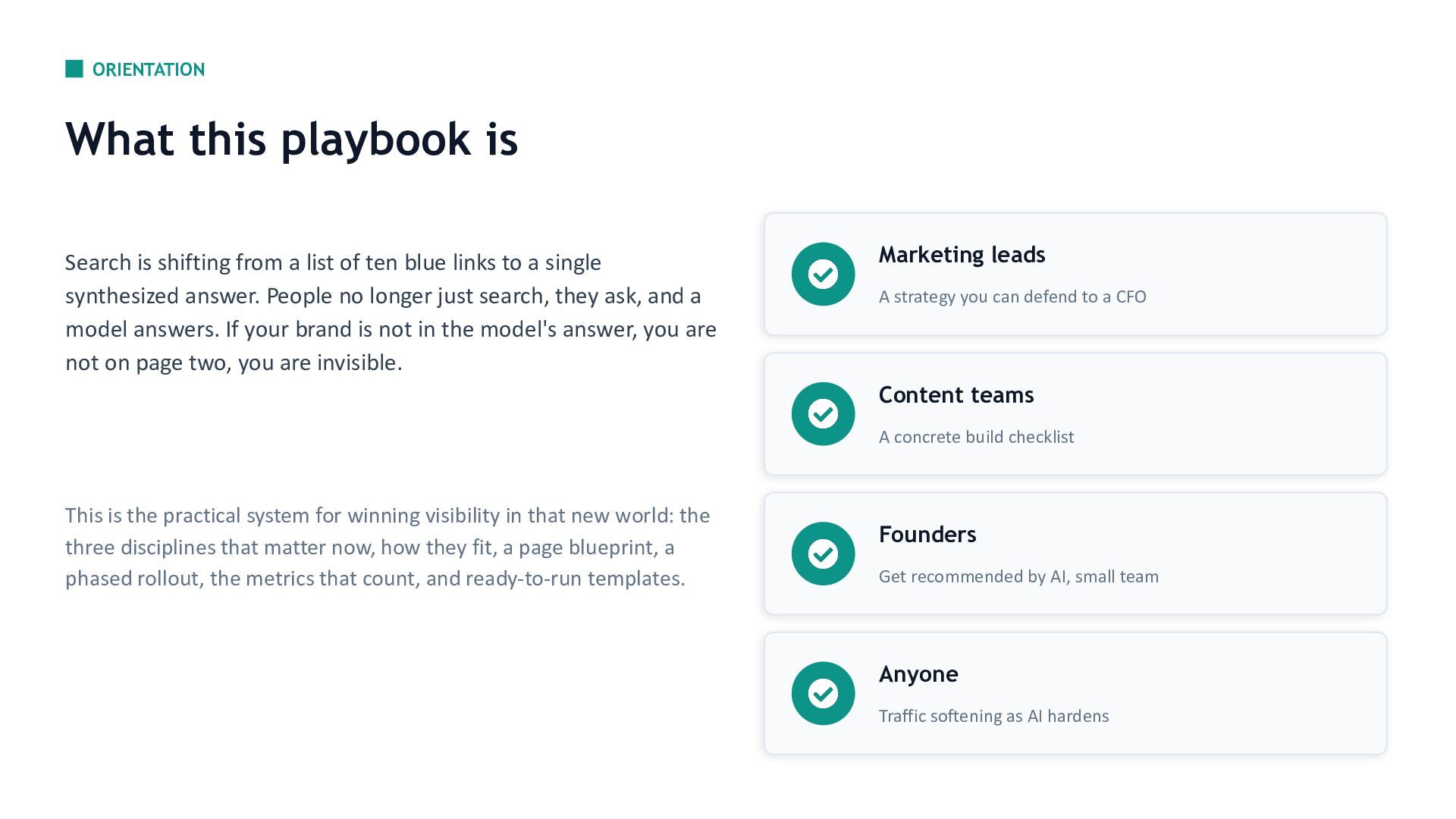
  2. ORIENTATION What this playbook is Search is shifting from a

    list of ten blue links to a single synthesized answer. People no longer just search, they ask, and a model answers. If your brand is not in the model's answer, you are not on page two, you are invisible. This is the practical system for winning visibility in that new world: the three disciplines that matter now, how they fit, a page blueprint, a phased rollout, the metrics that count, and ready-to-run templates. Marketing leads A strategy you can defend to a CFO Content teams A concrete build checklist Founders Get recommended by AI, small team Anyone Traffic softening as AI hardens
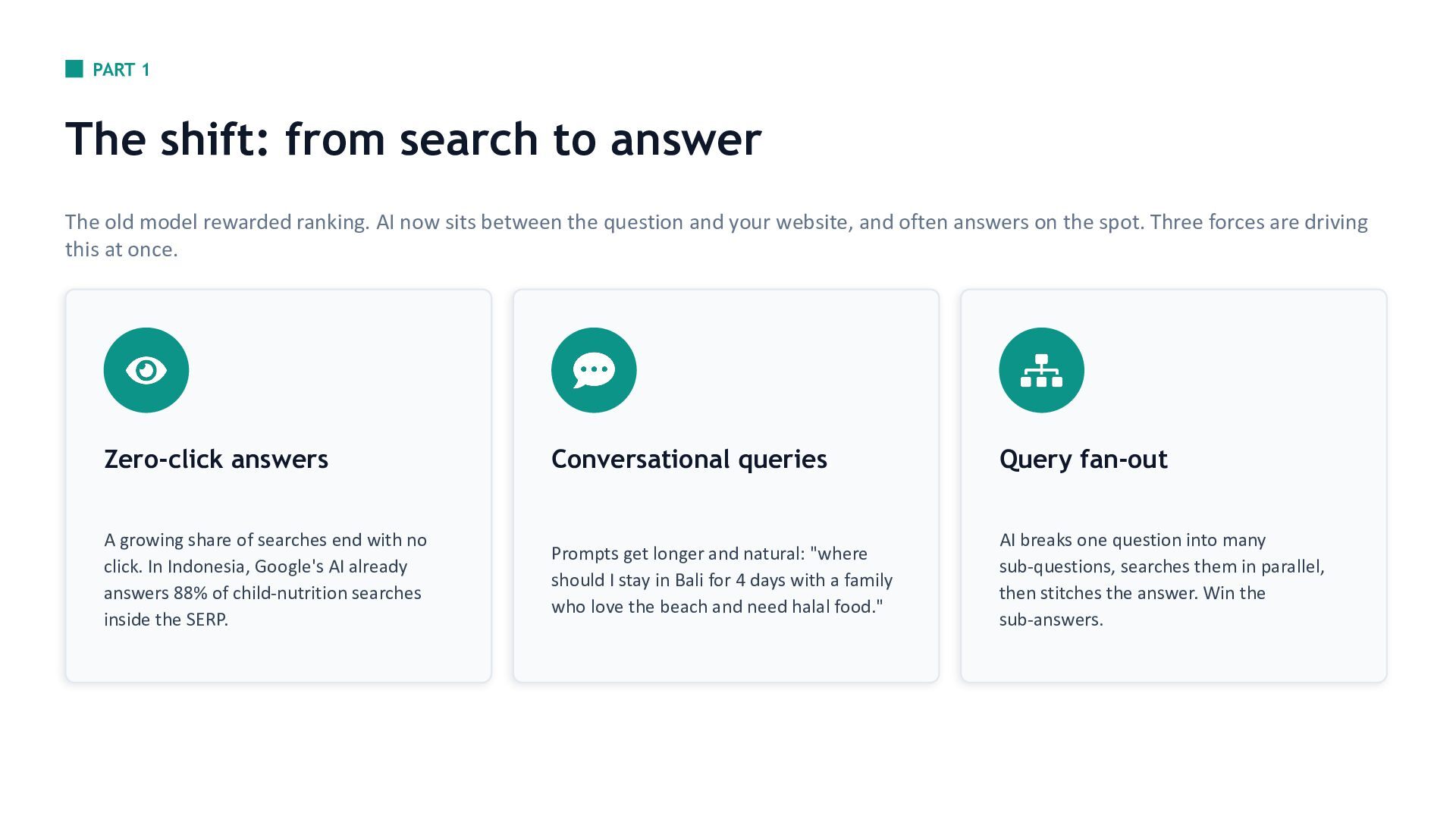
  3. PART 1 The shift: from search to answer The old

    model rewarded ranking. AI now sits between the question and your website, and often answers on the spot. Three forces are driving this at once. Zero-click answers A growing share of searches end with no click. In Indonesia, Google's AI already answers 88% of child-nutrition searches inside the SERP. Conversational queries Prompts get longer and natural: "where should I stay in Bali for 4 days with a family who love the beach and need halal food." Query fan-out AI breaks one question into many sub-questions, searches them in parallel, then stitches the answer. Win the sub-answers.
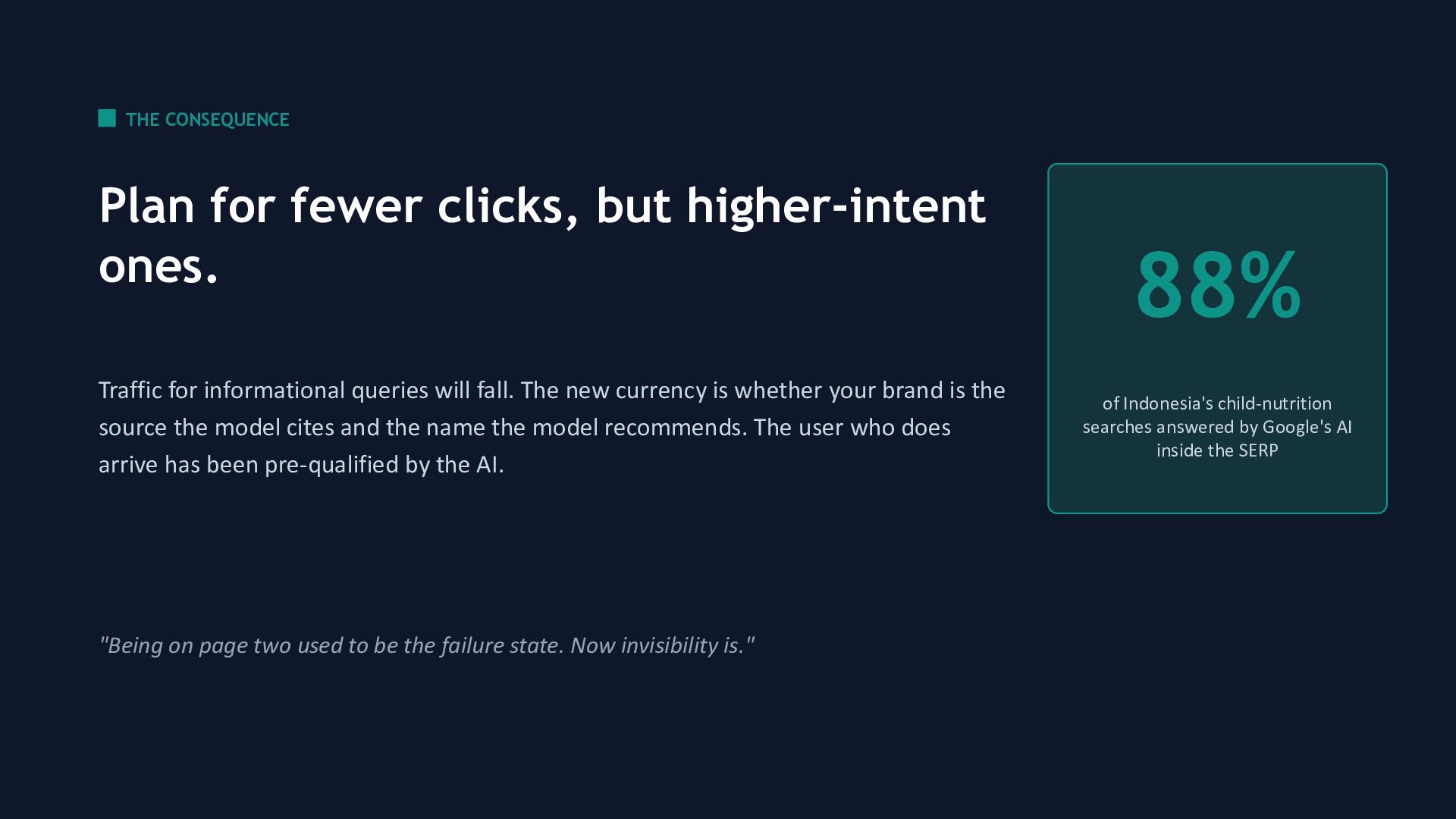
  4. THE CONSEQUENCE Plan for fewer clicks, but higher-intent ones. Traffic

    for informational queries will fall. The new currency is whether your brand is the source the model cites and the name the model recommends. The user who does arrive has been pre-qualified by the AI. 88% of Indonesia's child-nutrition searches answered by Google's AI inside the SERP "Being on page two used to be the failure state. Now invisibility is."
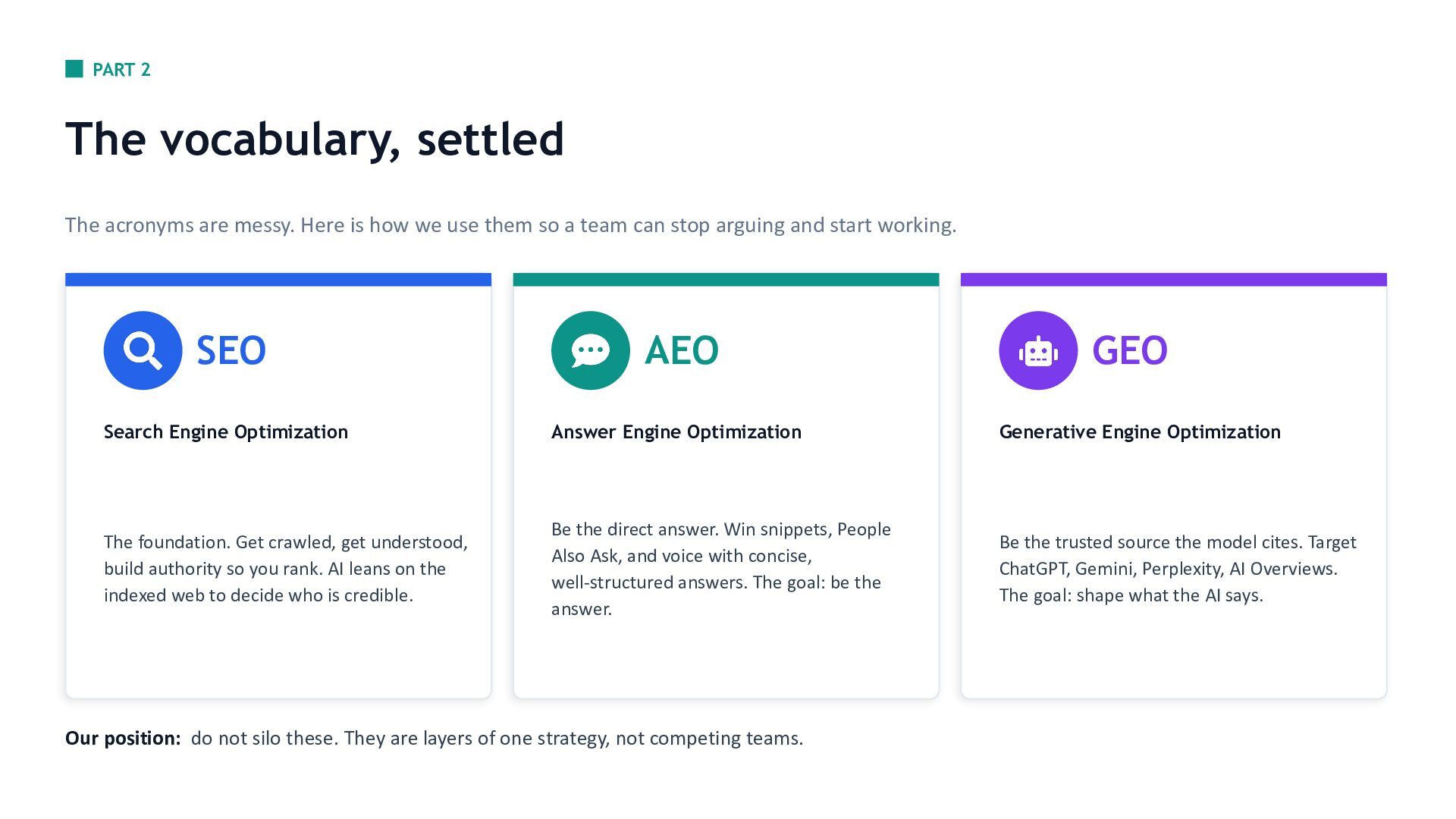
  5. PART 2 The vocabulary, settled The acronyms are messy. Here

    is how we use them so a team can stop arguing and start working. SEO Search Engine Optimization The foundation. Get crawled, get understood, build authority so you rank. AI leans on the indexed web to decide who is credible. AEO Answer Engine Optimization Be the direct answer. Win snippets, People Also Ask, and voice with concise, well-structured answers. The goal: be the answer. GEO Generative Engine Optimization Be the trusted source the model cites. Target ChatGPT, Gemini, Perplexity, AI Overviews. The goal: shape what the AI says. Our position: do not silo these. They are layers of one strategy, not competing teams.
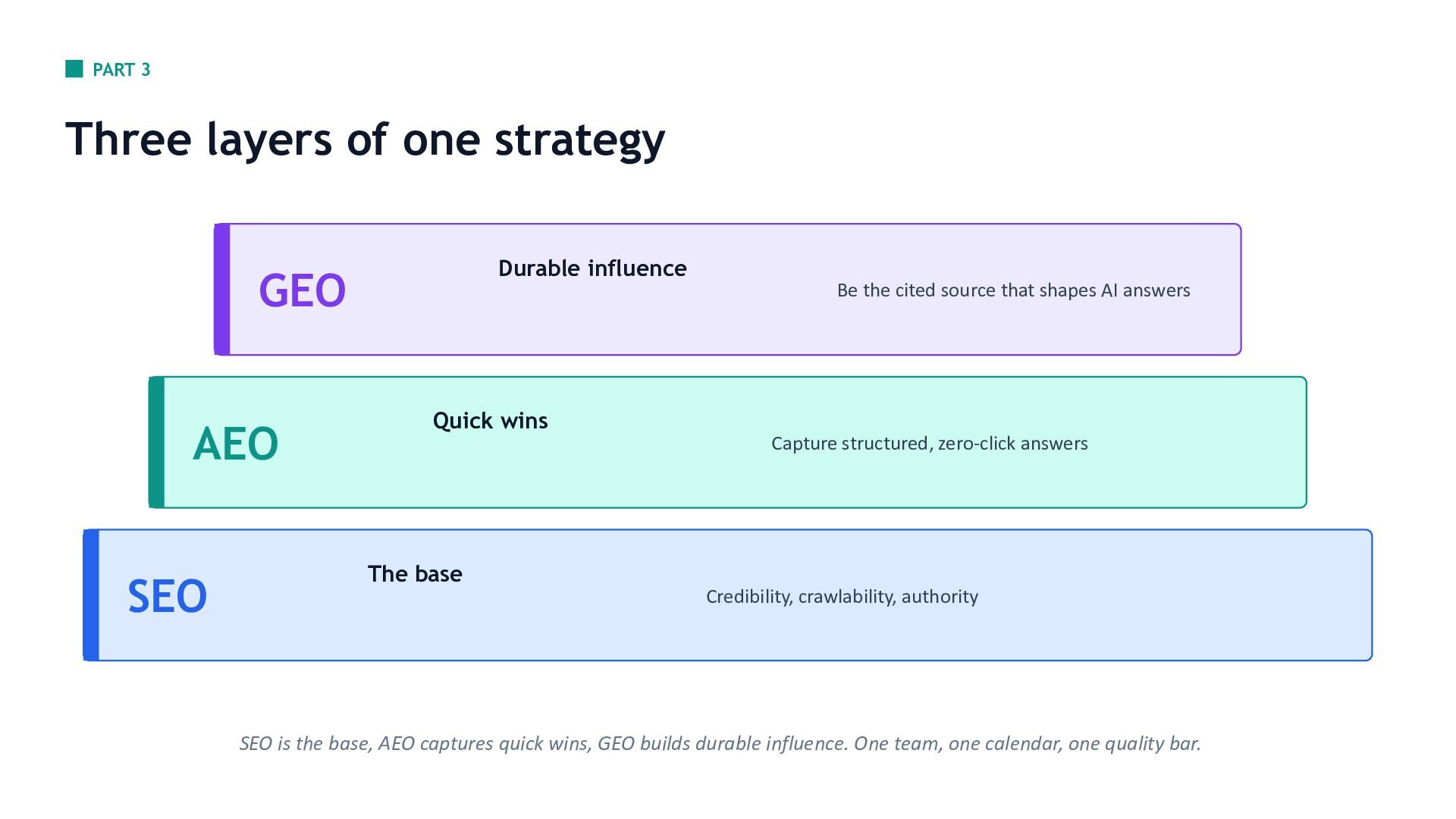
  6. PART 3 Three layers of one strategy GEO Durable influence

    Be the cited source that shapes AI answers AEO Quick wins Capture structured, zero-click answers SEO The base Credibility, crawlability, authority SEO is the base, AEO captures quick wins, GEO builds durable influence. One team, one calendar, one quality bar.
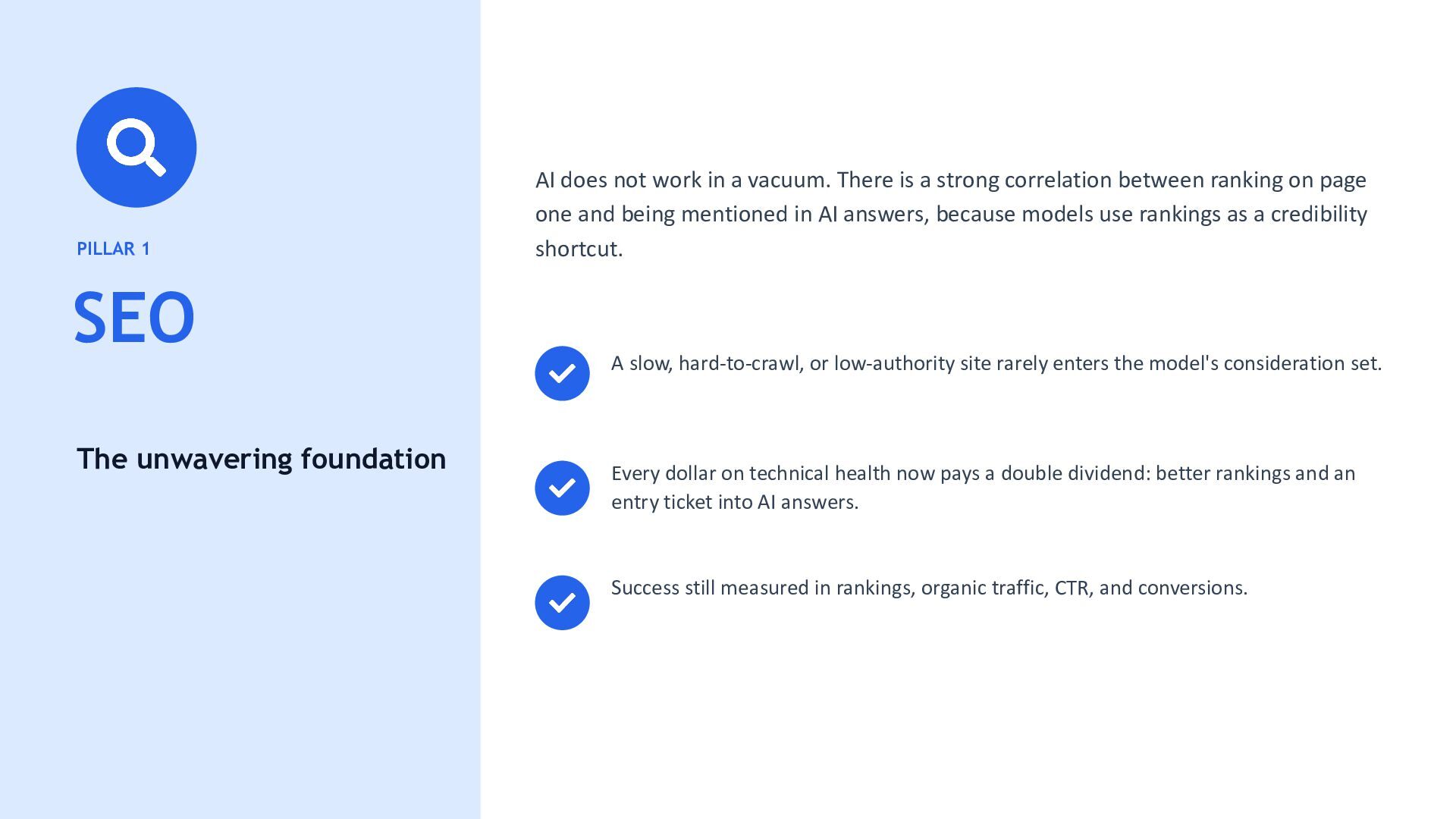
  7. PILLAR 1 SEO The unwavering foundation AI does not work

    in a vacuum. There is a strong correlation between ranking on page one and being mentioned in AI answers, because models use rankings as a credibility shortcut. A slow, hard-to-crawl, or low-authority site rarely enters the model's consideration set. Every dollar on technical health now pays a double dividend: better rankings and an entry ticket into AI answers. Success still measured in rankings, organic traffic, CTR, and conversions.
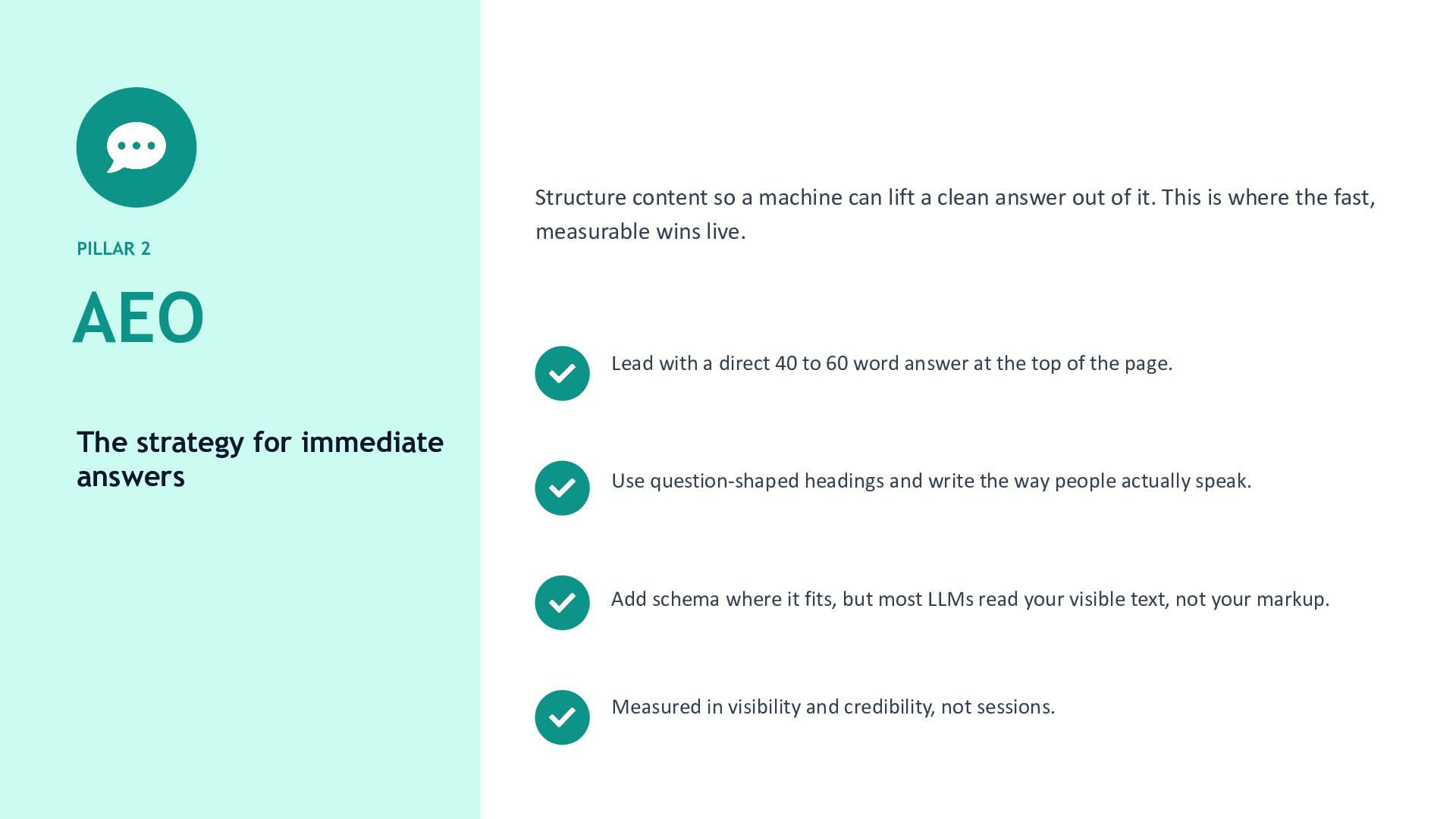
  8. PILLAR 2 AEO The strategy for immediate answers Structure content

    so a machine can lift a clean answer out of it. This is where the fast, measurable wins live. Lead with a direct 40 to 60 word answer at the top of the page. Use question-shaped headings and write the way people actually speak. Add schema where it fits, but most LLMs read your visible text, not your markup. Measured in visibility and credibility, not sessions.
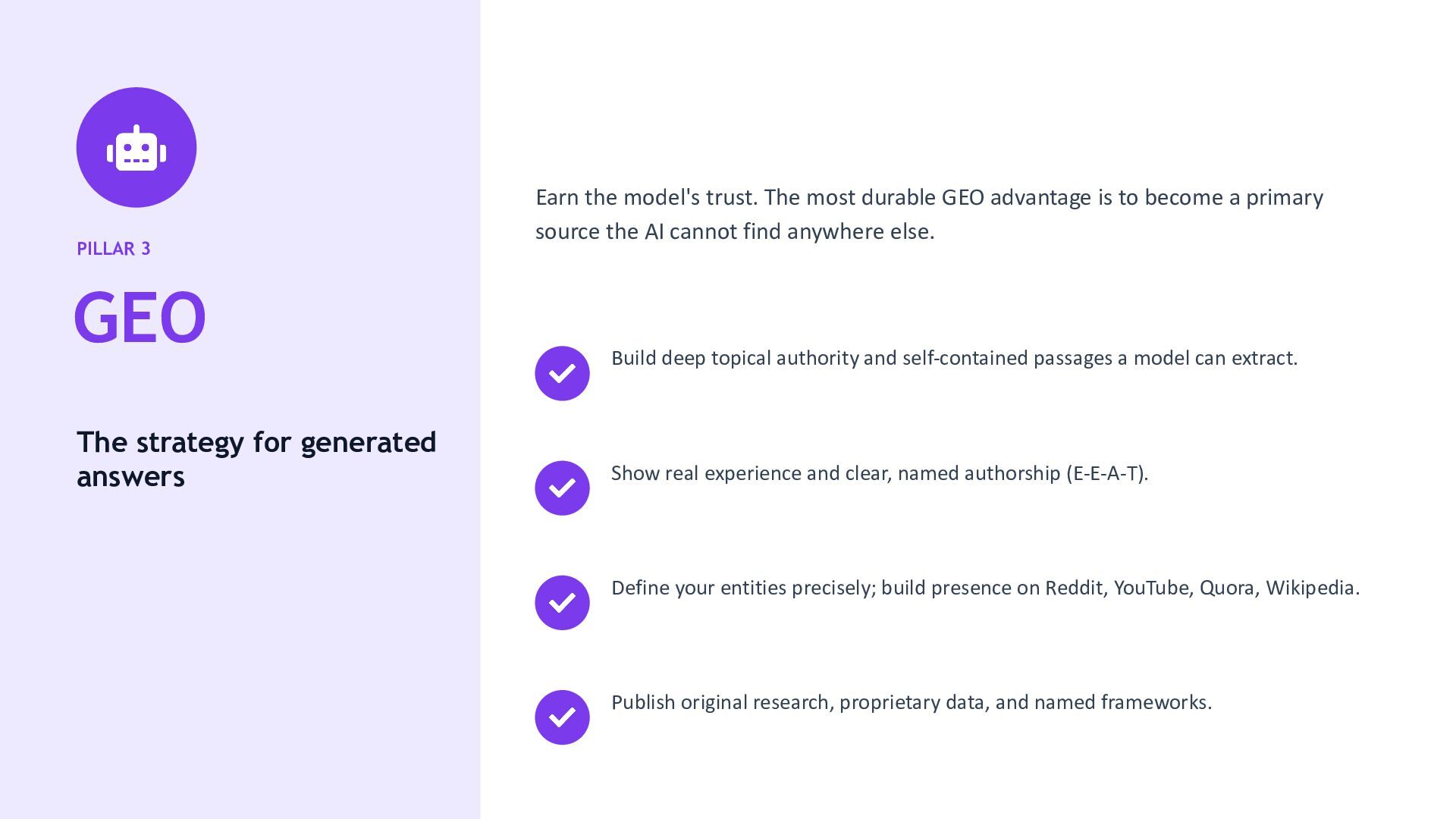
  9. PILLAR 3 GEO The strategy for generated answers Earn the

    model's trust. The most durable GEO advantage is to become a primary source the AI cannot find anywhere else. Build deep topical authority and self-contained passages a model can extract. Show real experience and clear, named authorship (E-E-A-T). Define your entities precisely; build presence on Reddit, YouTube, Quora, Wikipedia. Publish original research, proprietary data, and named frameworks.
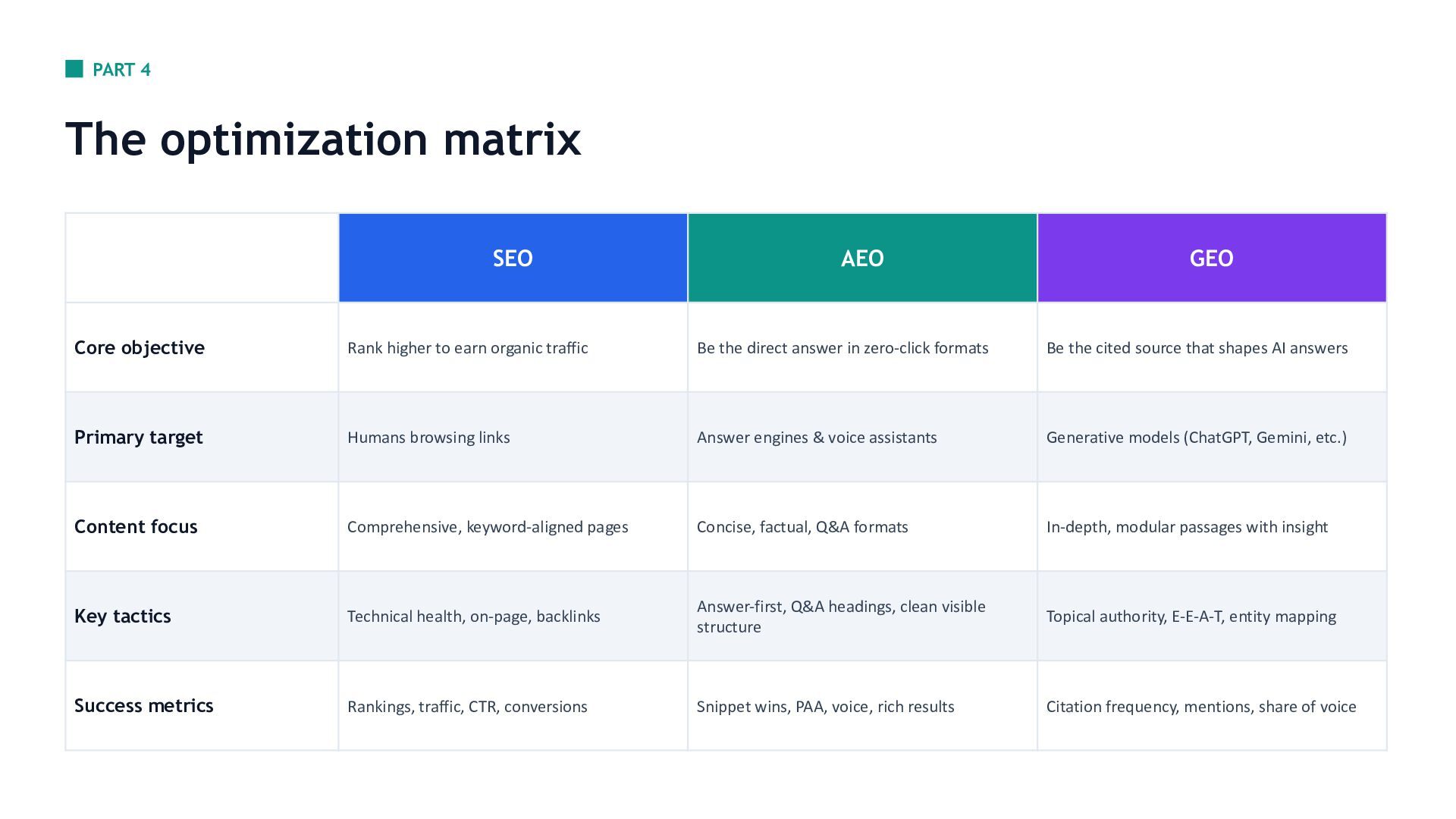
  10. PART 4 The optimization matrix SEO AEO GEO Core objective

    Rank higher to earn organic traffic Be the direct answer in zero-click formats Be the cited source that shapes AI answers Primary target Humans browsing links Answer engines & voice assistants Generative models (ChatGPT, Gemini, etc.) Content focus Comprehensive, keyword-aligned pages Concise, factual, Q&A formats In-depth, modular passages with insight Key tactics Technical health, on-page, backlinks Answer-first, Q&A headings, clean visible structure Topical authority, E-E-A-T, entity mapping Success metrics Rankings, traffic, CTR, conversions Snippet wins, PAA, voice, rich results Citation frequency, mentions, share of voice
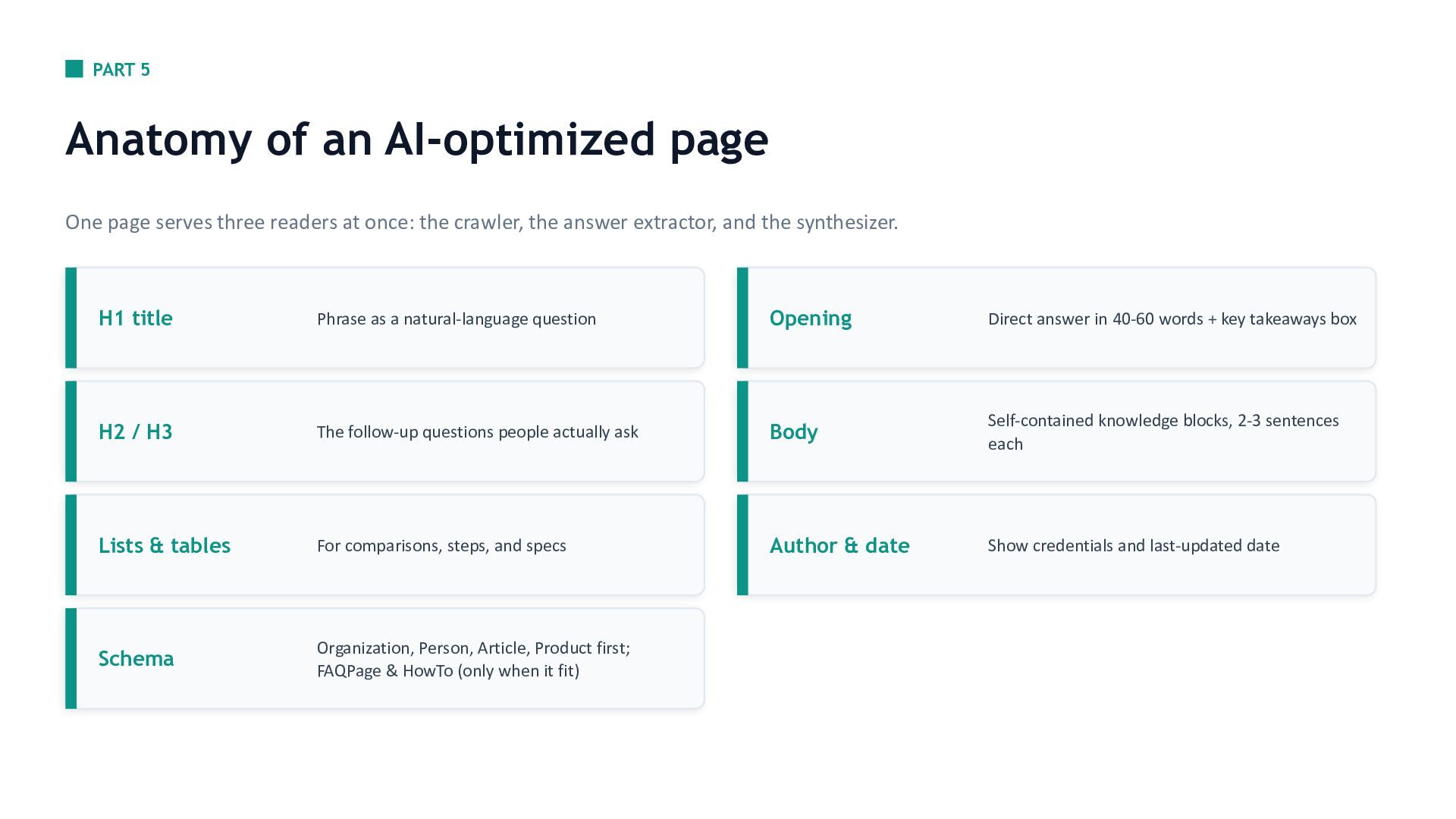
  11. PART 5 Anatomy of an AI-optimized page One page serves

    three readers at once: the crawler, the answer extractor, and the synthesizer. H1 title Phrase as a natural-language question Opening Direct answer in 40-60 words + key takeaways box H2 / H3 The follow-up questions people actually ask Body Self-contained knowledge blocks, 2-3 sentences each Lists & tables For comparisons, steps, and specs Author & date Show credentials and last-updated date Schema Organization, Person, Article, Product first; FAQPage & HowTo (only when it fit)
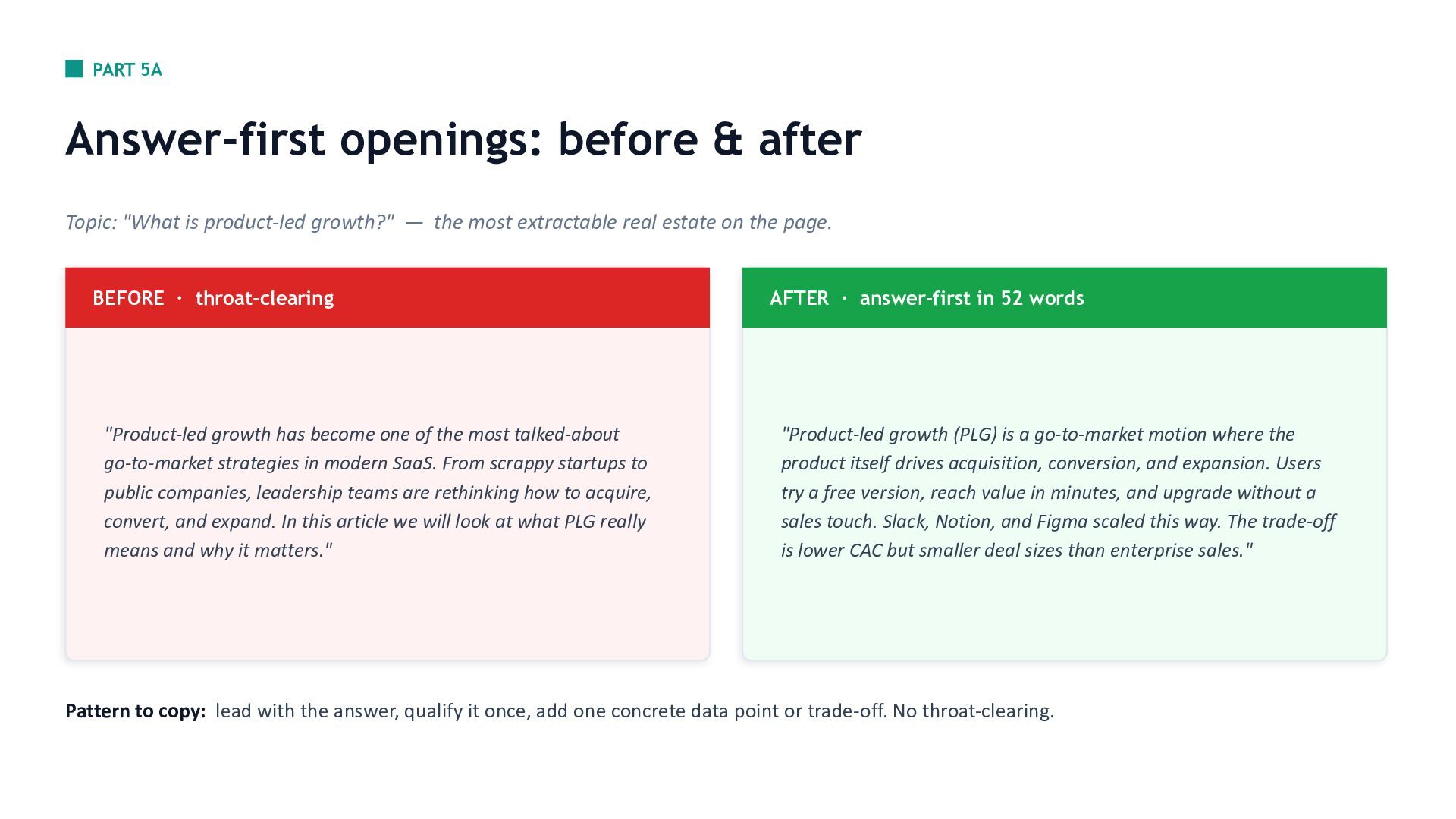
  12. PART 5A Answer-first openings: before & after Topic: "What is

    product-led growth?" — the most extractable real estate on the page. BEFORE · throat-clearing "Product-led growth has become one of the most talked-about go-to-market strategies in modern SaaS. From scrappy startups to public companies, leadership teams are rethinking how to acquire, convert, and expand. In this article we will look at what PLG really means and why it matters." AFTER · answer-first in 52 words "Product-led growth (PLG) is a go-to-market motion where the product itself drives acquisition, conversion, and expansion. Users try a free version, reach value in minutes, and upgrade without a sales touch. Slack, Notion, and Figma scaled this way. The trade-off is lower CAC but smaller deal sizes than enterprise sales." Pattern to copy: lead with the answer, qualify it once, add one concrete data point or trade-off. No throat-clearing.
  13. PART 5B Schema markup: what it really does for AI

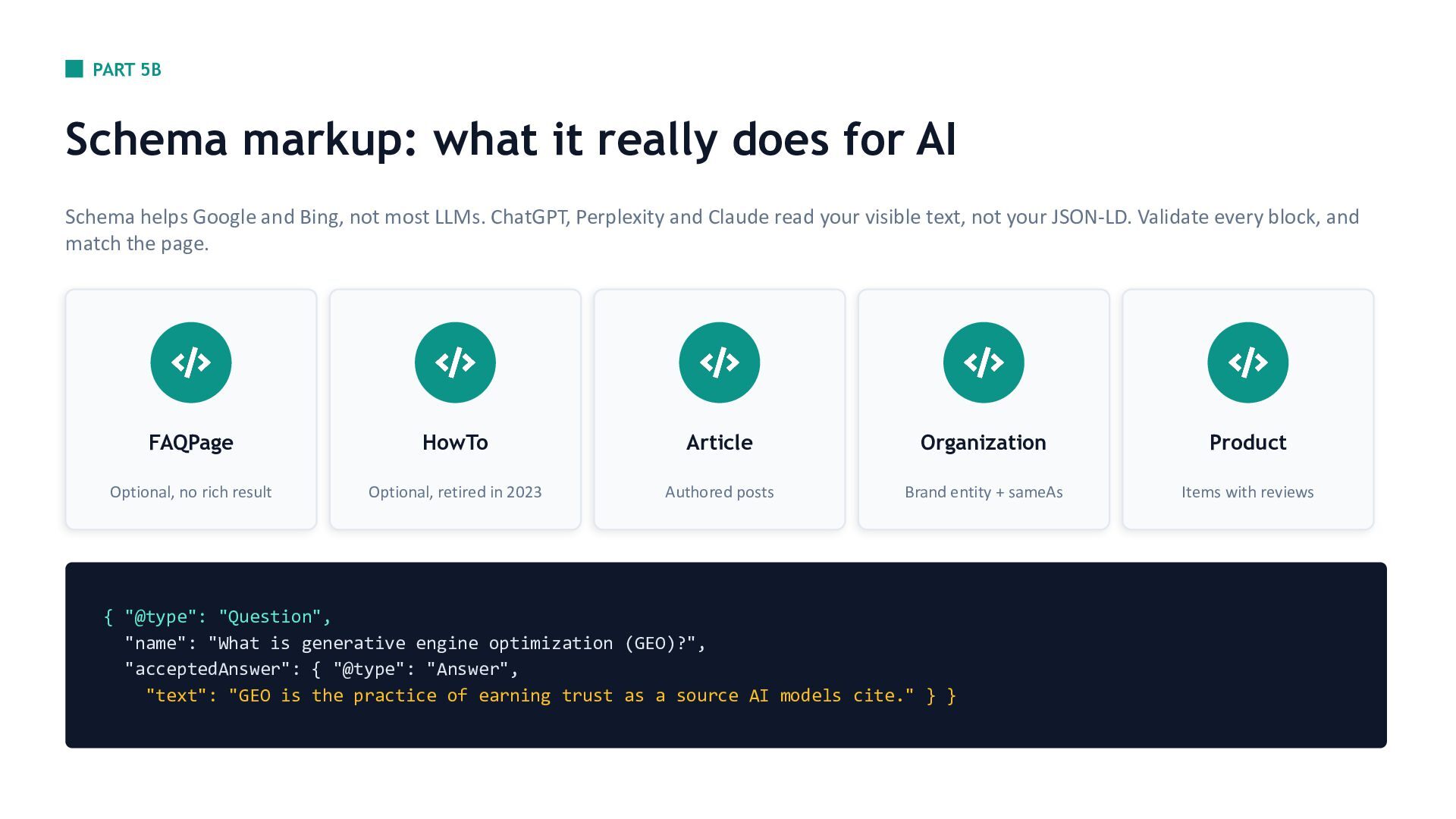
    Schema helps Google and Bing, not most LLMs. ChatGPT, Perplexity and Claude read your visible text, not your JSON-LD. Validate every block, and match the page. FAQPage Optional, no rich result HowTo Optional, retired in 2023 Article Authored posts Organization Brand entity + sameAs Product Items with reviews { "@type": "Question", "name": "What is generative engine optimization (GEO)?", "acceptedAnswer": { "@type": "Answer", "text": "GEO is the practice of earning trust as a source AI models cite." } }
  14. PART 5C Query fan-out: one prompt, a dozen sub-queries PROMPT

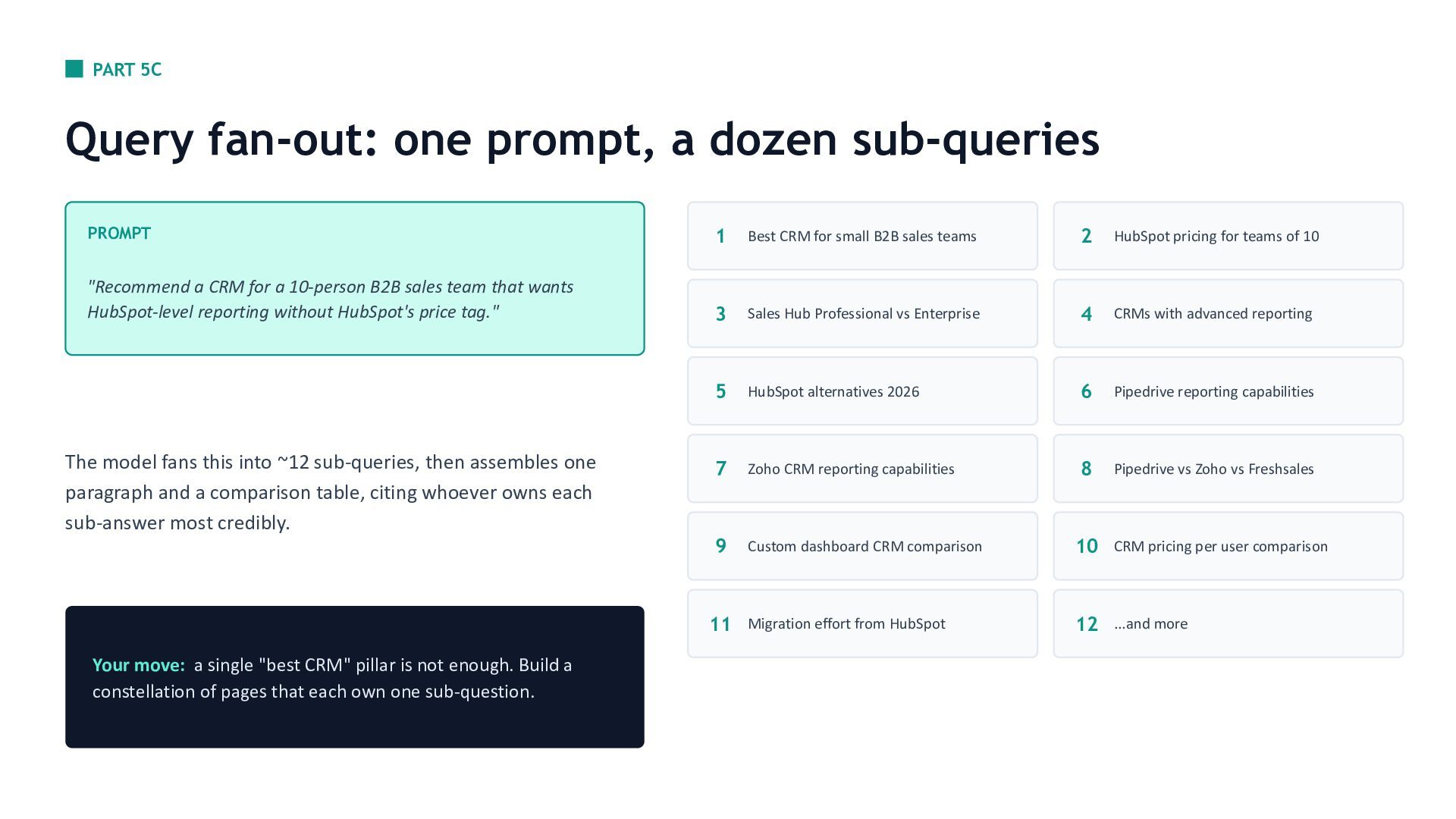
    "Recommend a CRM for a 10-person B2B sales team that wants HubSpot-level reporting without HubSpot's price tag." The model fans this into ~12 sub-queries, then assembles one paragraph and a comparison table, citing whoever owns each sub-answer most credibly. Your move: a single "best CRM" pillar is not enough. Build a constellation of pages that each own one sub-question. 1 Best CRM for small B2B sales teams 2 HubSpot pricing for teams of 10 3 Sales Hub Professional vs Enterprise 4 CRMs with advanced reporting 5 HubSpot alternatives 2026 6 Pipedrive reporting capabilities 7 Zoho CRM reporting capabilities 8 Pipedrive vs Zoho vs Freshsales 9 Custom dashboard CRM comparison 10 CRM pricing per user comparison 11 Migration effort from HubSpot 12 ...and more
  15. PART 5D Decision frameworks: the format AI rewards A weighted

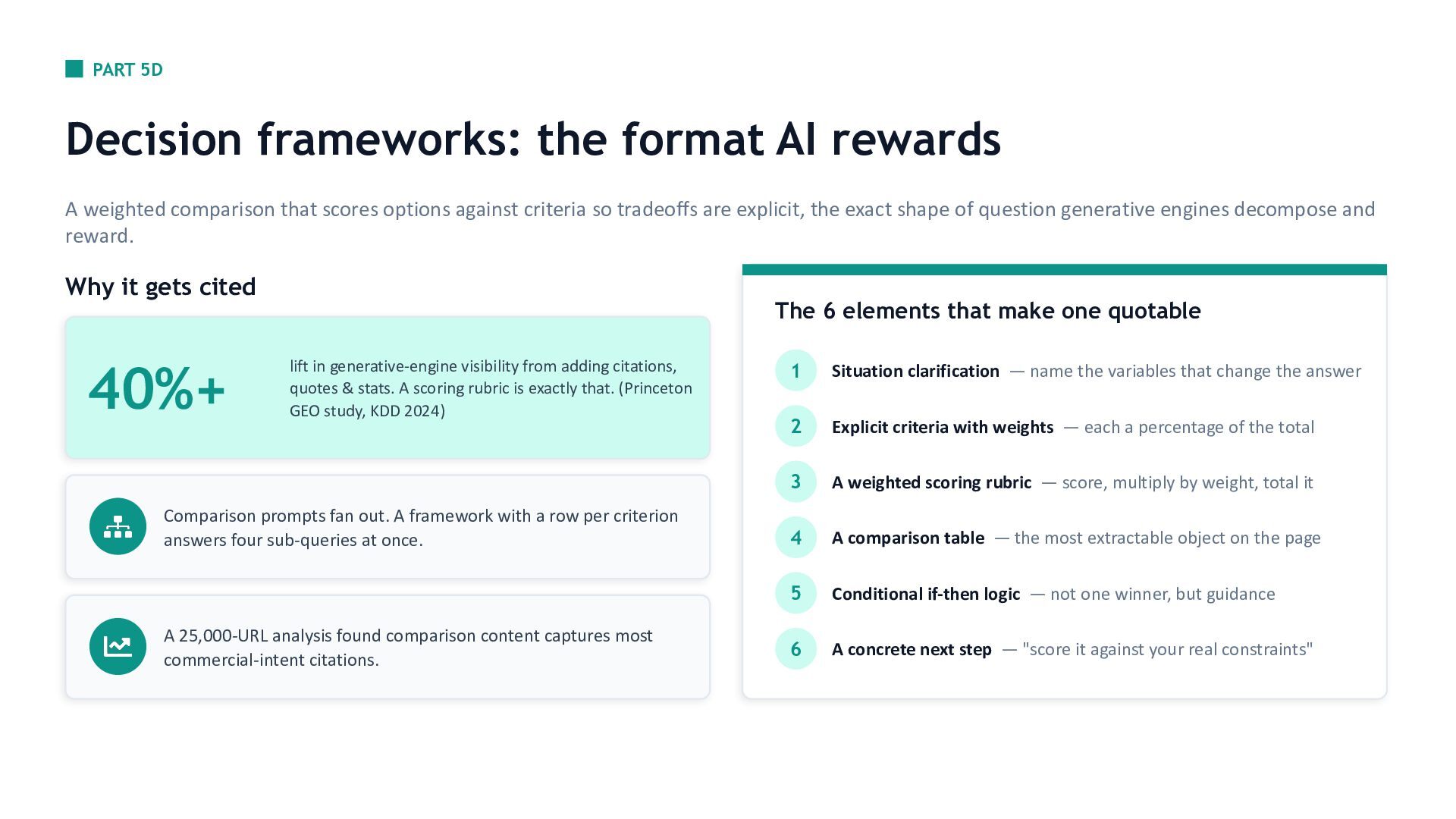
    comparison that scores options against criteria so tradeoffs are explicit, the exact shape of question generative engines decompose and reward. Why it gets cited 40%+ lift in generative-engine visibility from adding citations, quotes & stats. A scoring rubric is exactly that. (Princeton GEO study, KDD 2024) Comparison prompts fan out. A framework with a row per criterion answers four sub-queries at once. A 25,000-URL analysis found comparison content captures most commercial-intent citations. The 6 elements that make one quotable 1 Situation clarification — name the variables that change the answer 2 Explicit criteria with weights — each a percentage of the total 3 A weighted scoring rubric — score, multiply by weight, total it 4 A comparison table — the most extractable object on the page 5 Conditional if-then logic — not one winner, but guidance 6 A concrete next step — "score it against your real constraints"
  16. PART 5D · WORKED EXAMPLE Your core SEO strategy, scored

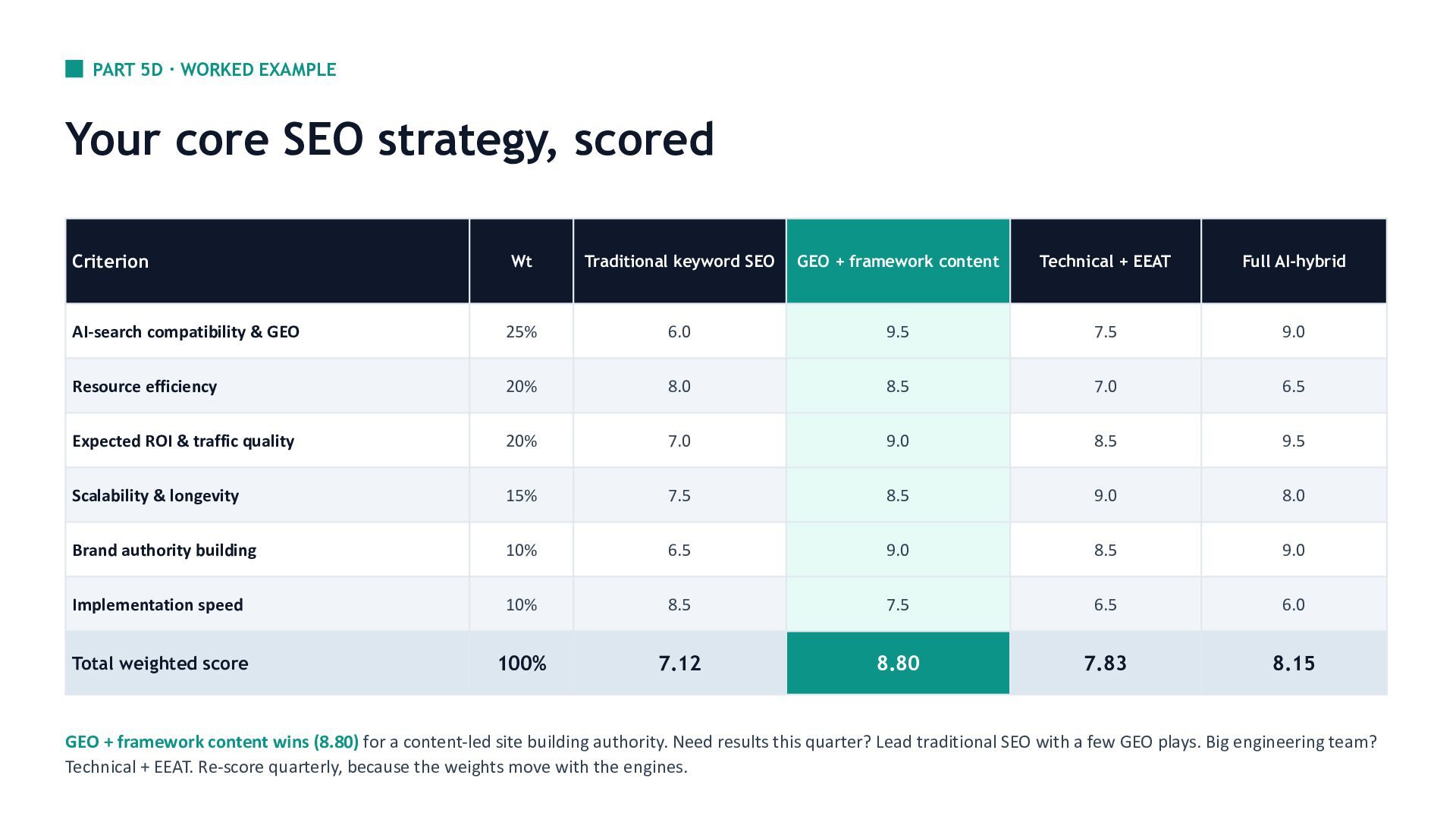
    Criterion Wt Traditional keyword SEO GEO + framework content Technical + EEAT Full AI-hybrid AI-search compatibility & GEO 25% 6.0 9.5 7.5 9.0 Resource efficiency 20% 8.0 8.5 7.0 6.5 Expected ROI & traffic quality 20% 7.0 9.0 8.5 9.5 Scalability & longevity 15% 7.5 8.5 9.0 8.0 Brand authority building 10% 6.5 9.0 8.5 9.0 Implementation speed 10% 8.5 7.5 6.5 6.0 Total weighted score 100% 7.12 8.80 7.83 8.15 GEO + framework content wins (8.80) for a content-led site building authority. Need results this quarter? Lead traditional SEO with a few GEO plays. Big engineering team? Technical + EEAT. Re-score quarterly, because the weights move with the engines.
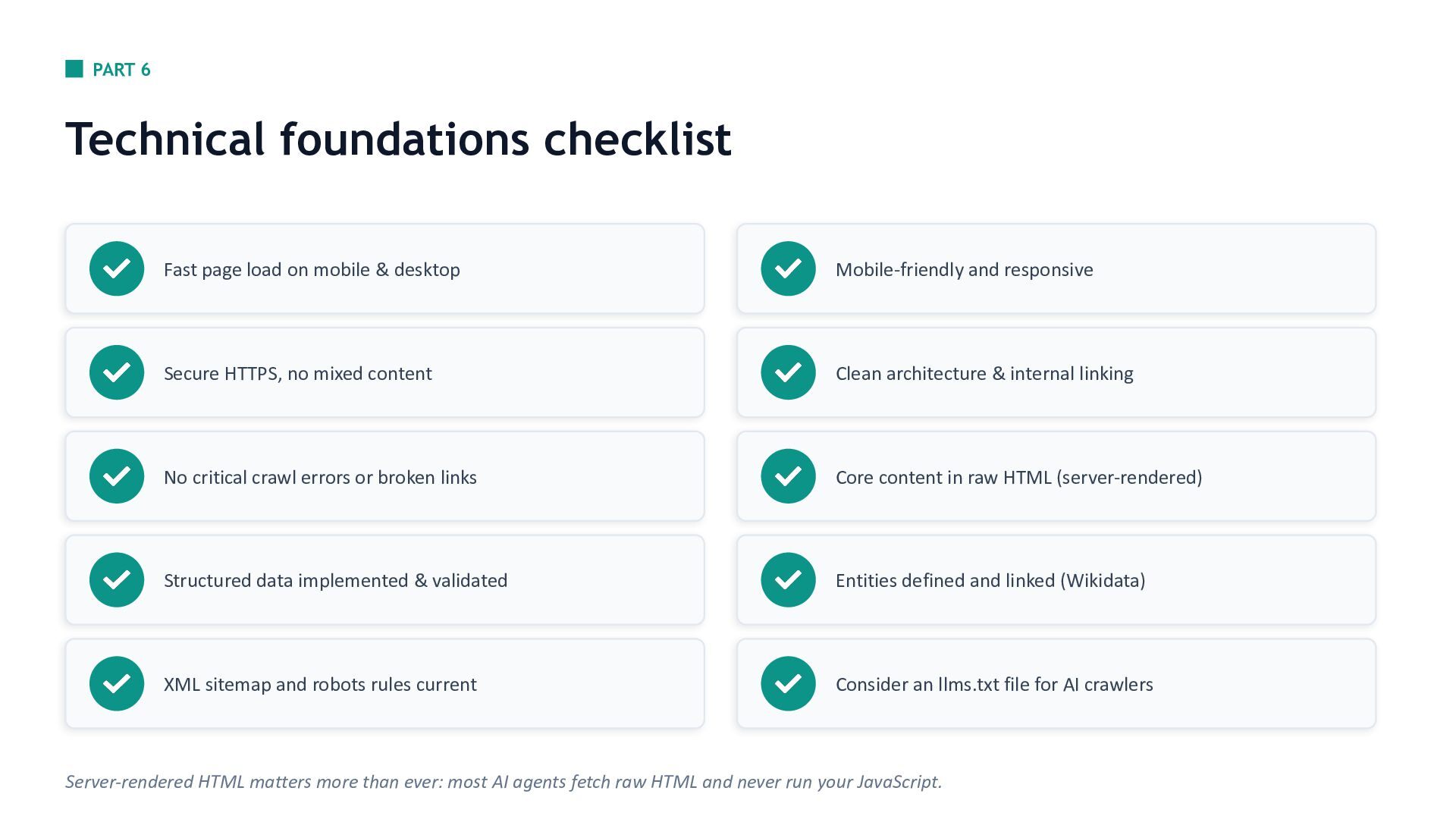
  17. PART 6 Technical foundations checklist Fast page load on mobile

    & desktop Mobile-friendly and responsive Secure HTTPS, no mixed content Clean architecture & internal linking No critical crawl errors or broken links Core content in raw HTML (server-rendered) Structured data implemented & validated Entities defined and linked (Wikidata) XML sitemap and robots rules current Consider an llms.txt file for AI crawlers Server-rendered HTML matters more than ever: most AI agents fetch raw HTML and never run your JavaScript.
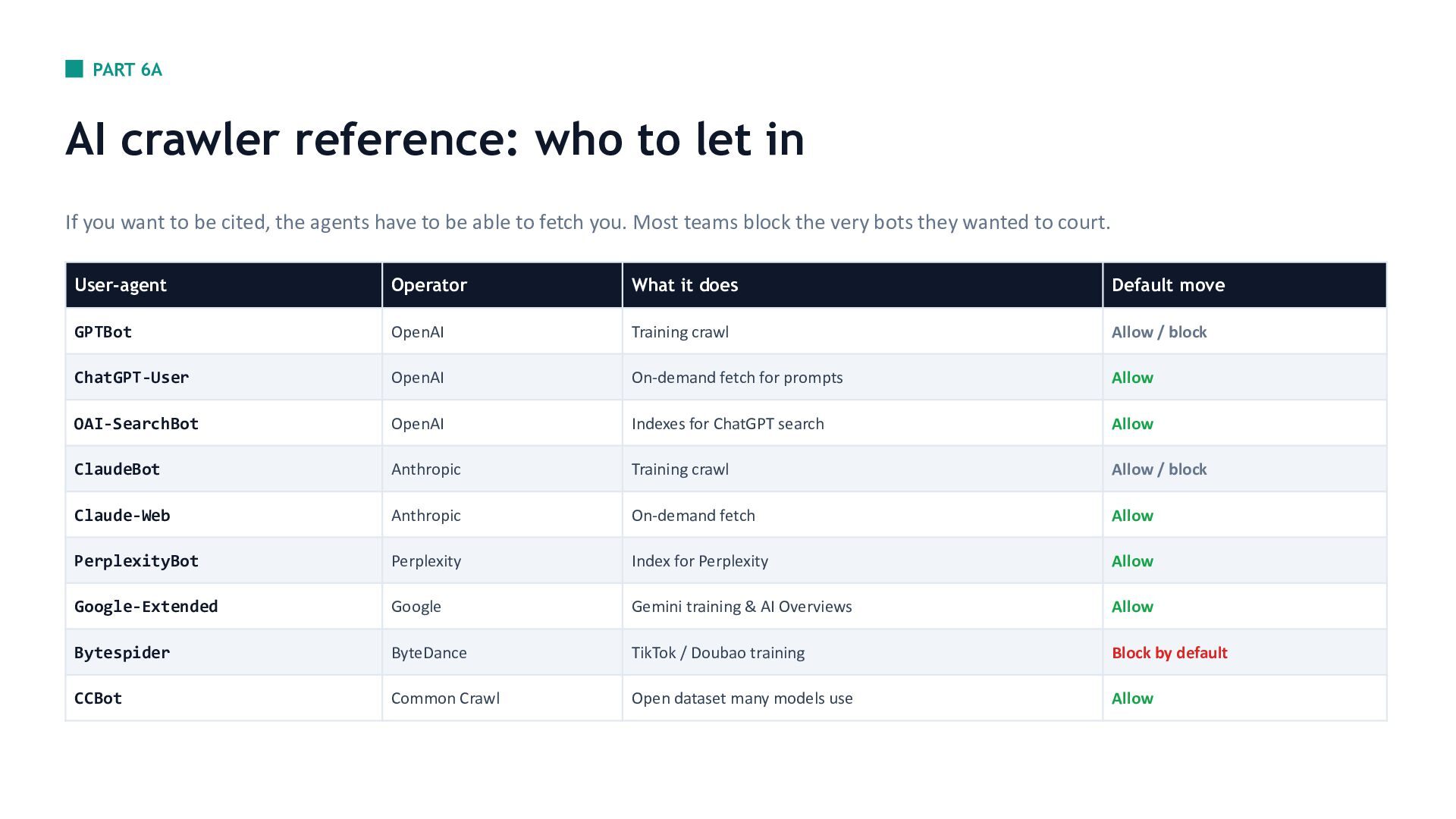
  18. PART 6A AI crawler reference: who to let in If

    you want to be cited, the agents have to be able to fetch you. Most teams block the very bots they wanted to court. User-agent Operator What it does Default move GPTBot OpenAI Training crawl Allow / block ChatGPT-User OpenAI On-demand fetch for prompts Allow OAI-SearchBot OpenAI Indexes for ChatGPT search Allow ClaudeBot Anthropic Training crawl Allow / block Claude-Web Anthropic On-demand fetch Allow PerplexityBot Perplexity Index for Perplexity Allow Google-Extended Google Gemini training & AI Overviews Allow Bytespider ByteDance TikTok / Doubao training Block by default CCBot Common Crawl Open dataset many models use Allow
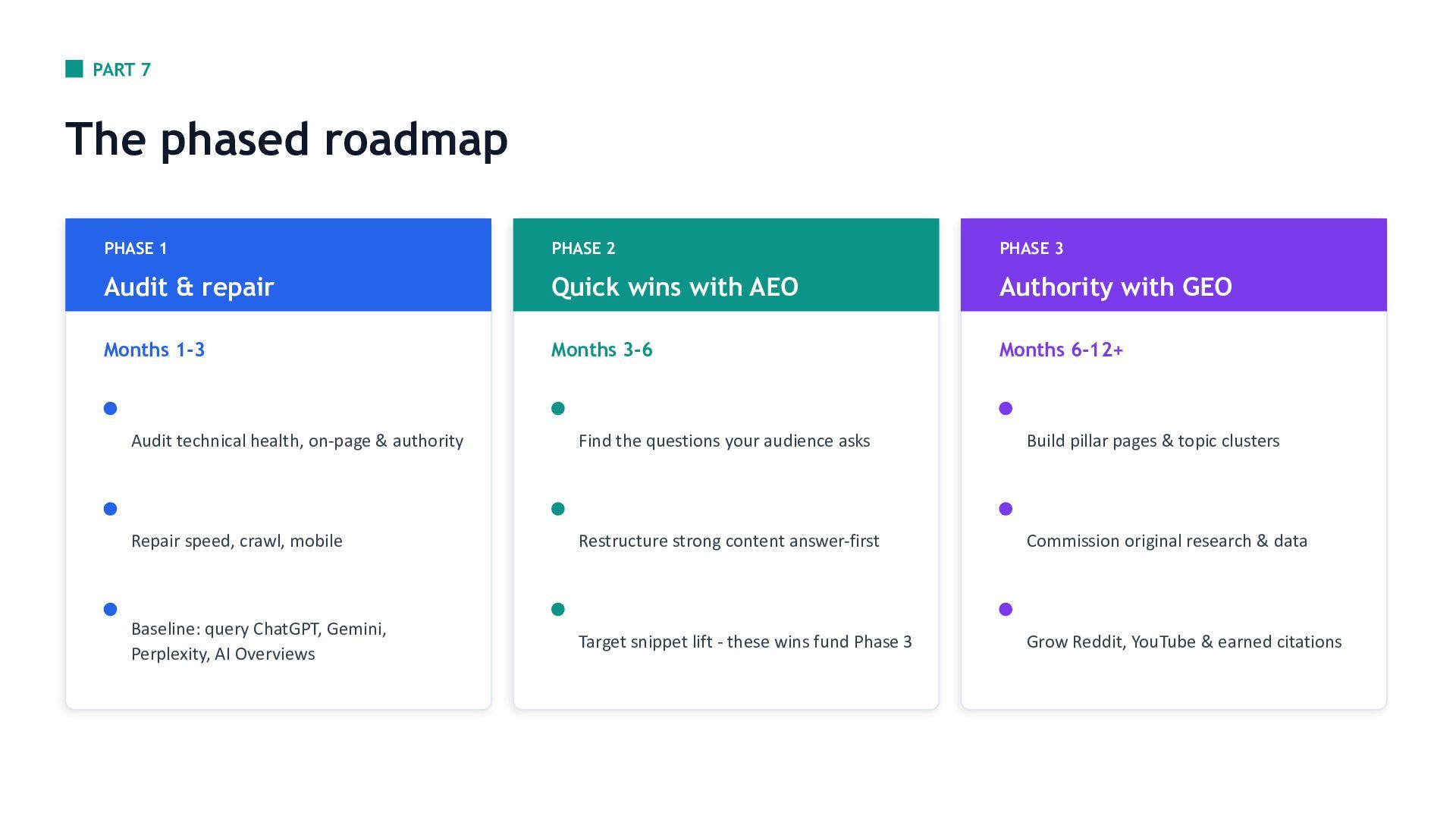
  19. PART 7 The phased roadmap PHASE 1 Audit & repair

    Months 1-3 Audit technical health, on-page & authority Repair speed, crawl, mobile Baseline: query ChatGPT, Gemini, Perplexity, AI Overviews PHASE 2 Quick wins with AEO Months 3-6 Find the questions your audience asks Restructure strong content answer-first Target snippet lift - these wins fund Phase 3 PHASE 3 Authority with GEO Months 6-12+ Build pillar pages & topic clusters Commission original research & data Grow Reddit, YouTube & earned citations
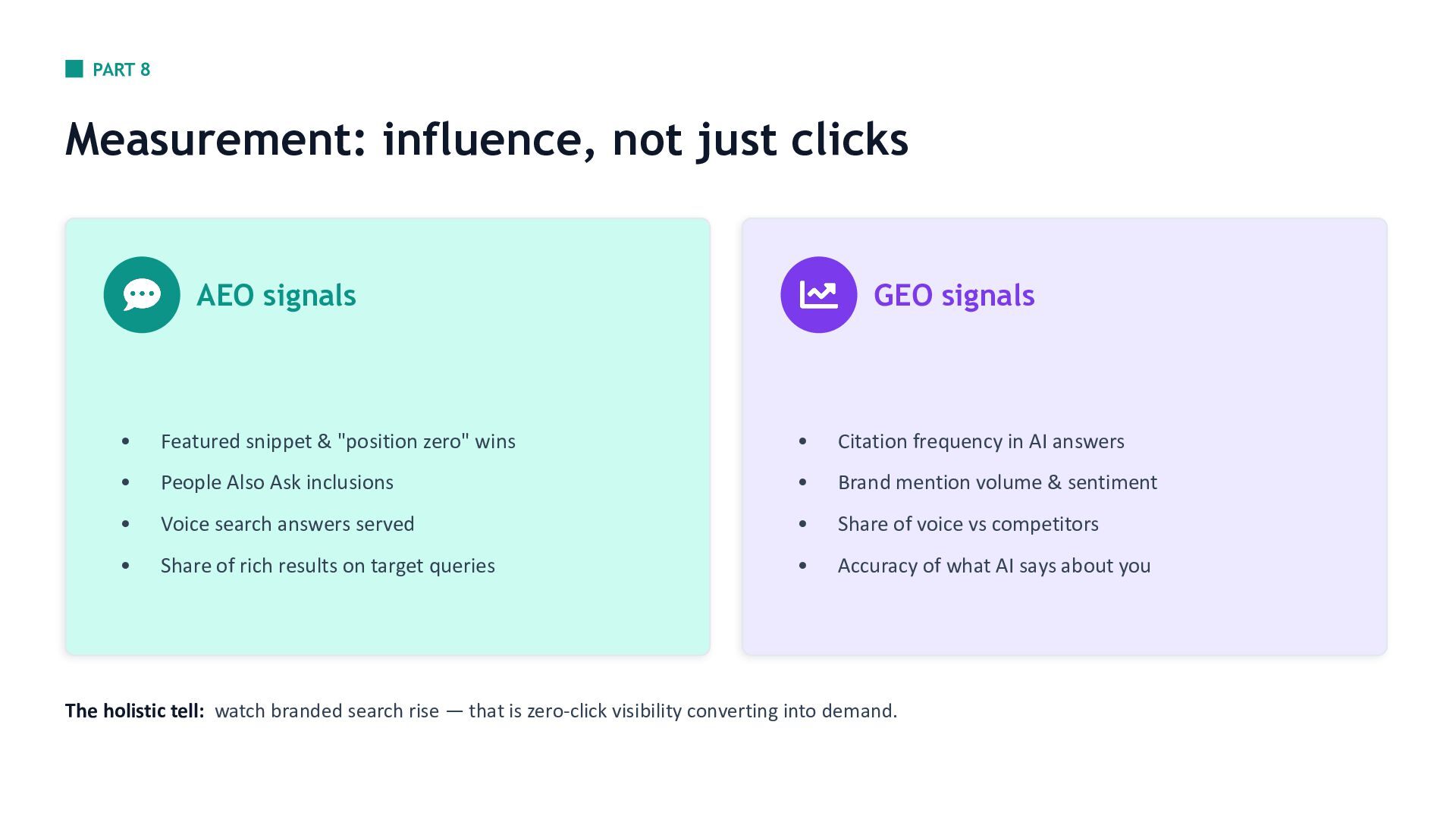
  20. PART 8 Measurement: influence, not just clicks AEO signals •

    Featured snippet & "position zero" wins • People Also Ask inclusions • Voice search answers served • Share of rich results on target queries GEO signals • Citation frequency in AI answers • Brand mention volume & sentiment • Share of voice vs competitors • Accuracy of what AI says about you The holistic tell: watch branded search rise — that is zero-click visibility converting into demand.
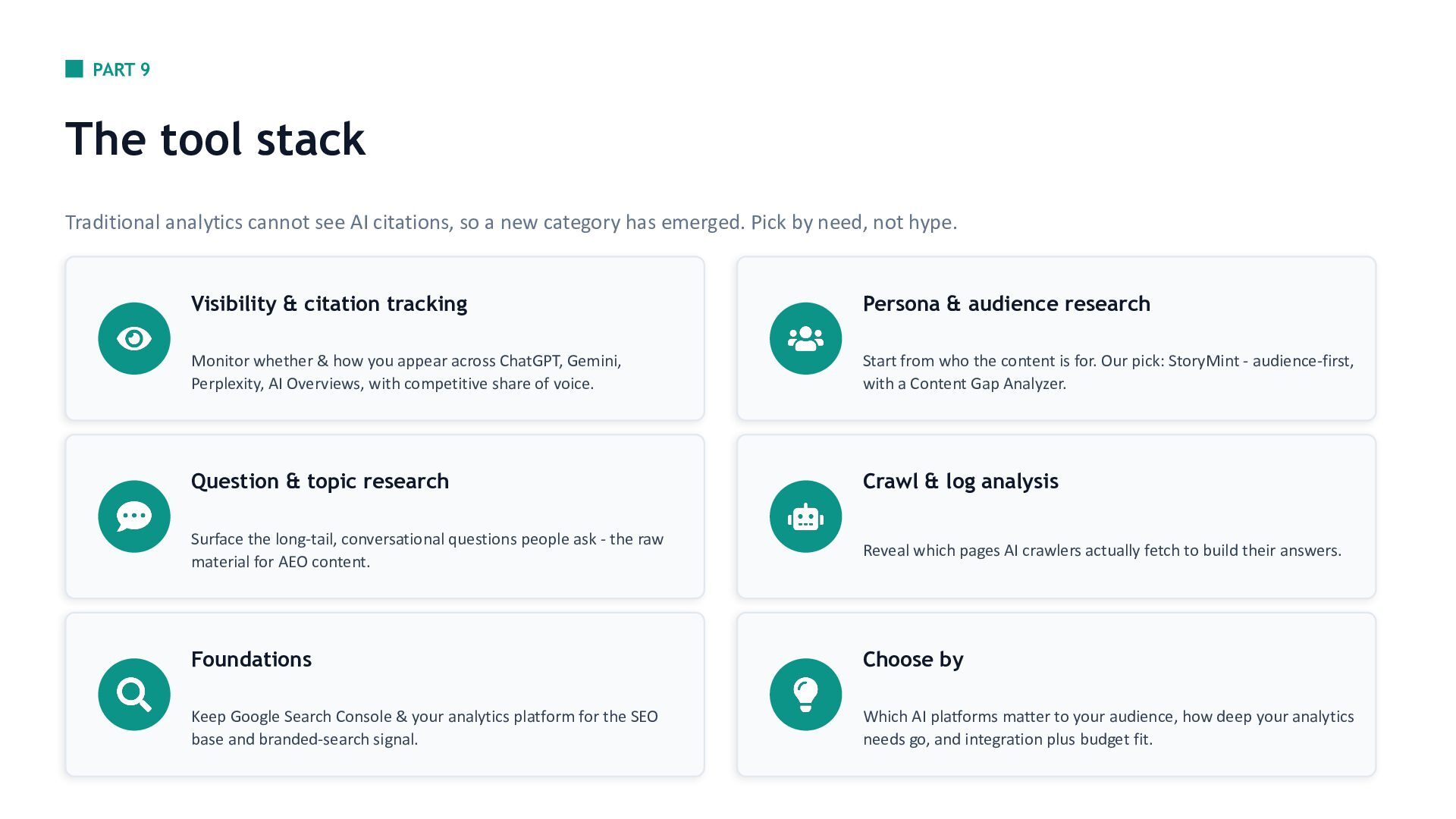
  21. PART 9 The tool stack Traditional analytics cannot see AI

    citations, so a new category has emerged. Pick by need, not hype. Visibility & citation tracking Monitor whether & how you appear across ChatGPT, Gemini, Perplexity, AI Overviews, with competitive share of voice. Persona & audience research Start from who the content is for. Our pick: StoryMint - audience-first, with a Content Gap Analyzer. Question & topic research Surface the long-tail, conversational questions people ask - the raw material for AEO content. Crawl & log analysis Reveal which pages AI crawlers actually fetch to build their answers. Foundations Keep Google Search Console & your analytics platform for the SEO base and branded-search signal. Choose by Which AI platforms matter to your audience, how deep your analytics needs go, and integration plus budget fit.
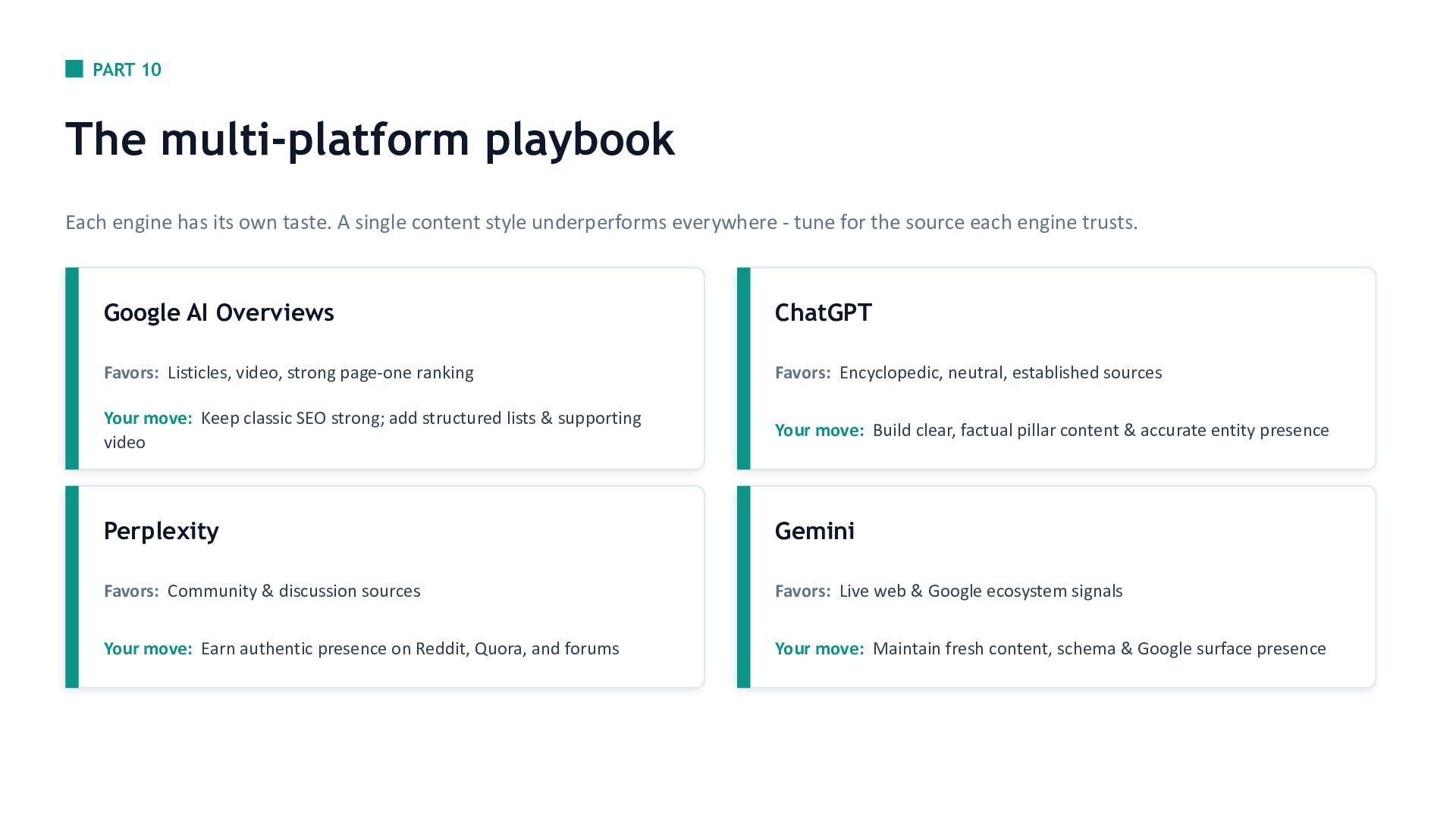
  22. PART 10 The multi-platform playbook Each engine has its own

    taste. A single content style underperforms everywhere - tune for the source each engine trusts. Google AI Overviews Favors: Listicles, video, strong page-one ranking Your move: Keep classic SEO strong; add structured lists & supporting video ChatGPT Favors: Encyclopedic, neutral, established sources Your move: Build clear, factual pillar content & accurate entity presence Perplexity Favors: Community & discussion sources Your move: Earn authentic presence on Reddit, Quora, and forums Gemini Favors: Live web & Google ecosystem signals Your move: Maintain fresh content, schema & Google surface presence
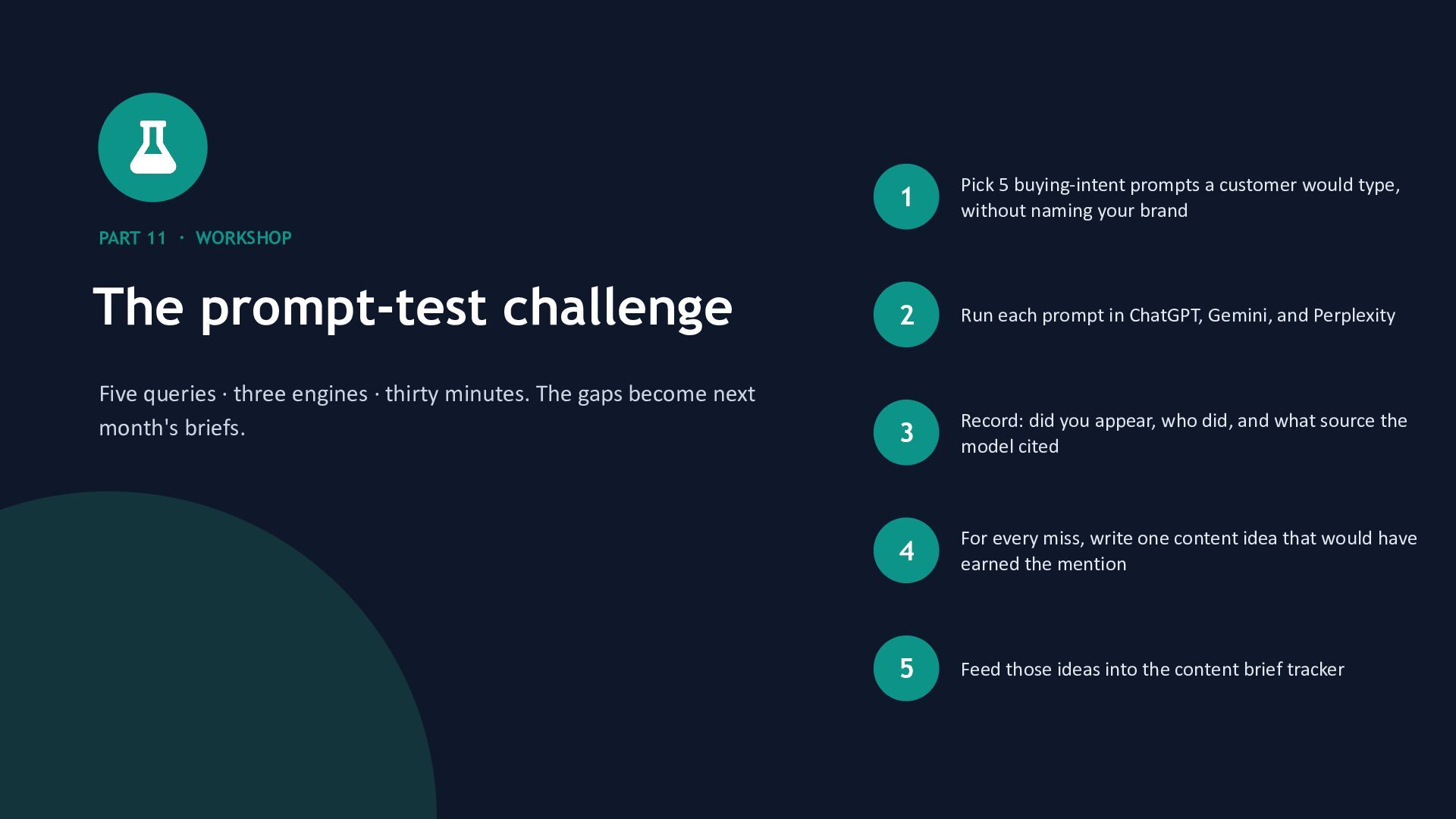
  23. PART 11 · WORKSHOP The prompt-test challenge Five queries ·

    three engines · thirty minutes. The gaps become next month's briefs. 1 Pick 5 buying-intent prompts a customer would type, without naming your brand 2 Run each prompt in ChatGPT, Gemini, and Perplexity 3 Record: did you appear, who did, and what source the model cited 4 For every miss, write one content idea that would have earned the mention 5 Feed those ideas into the content brief tracker
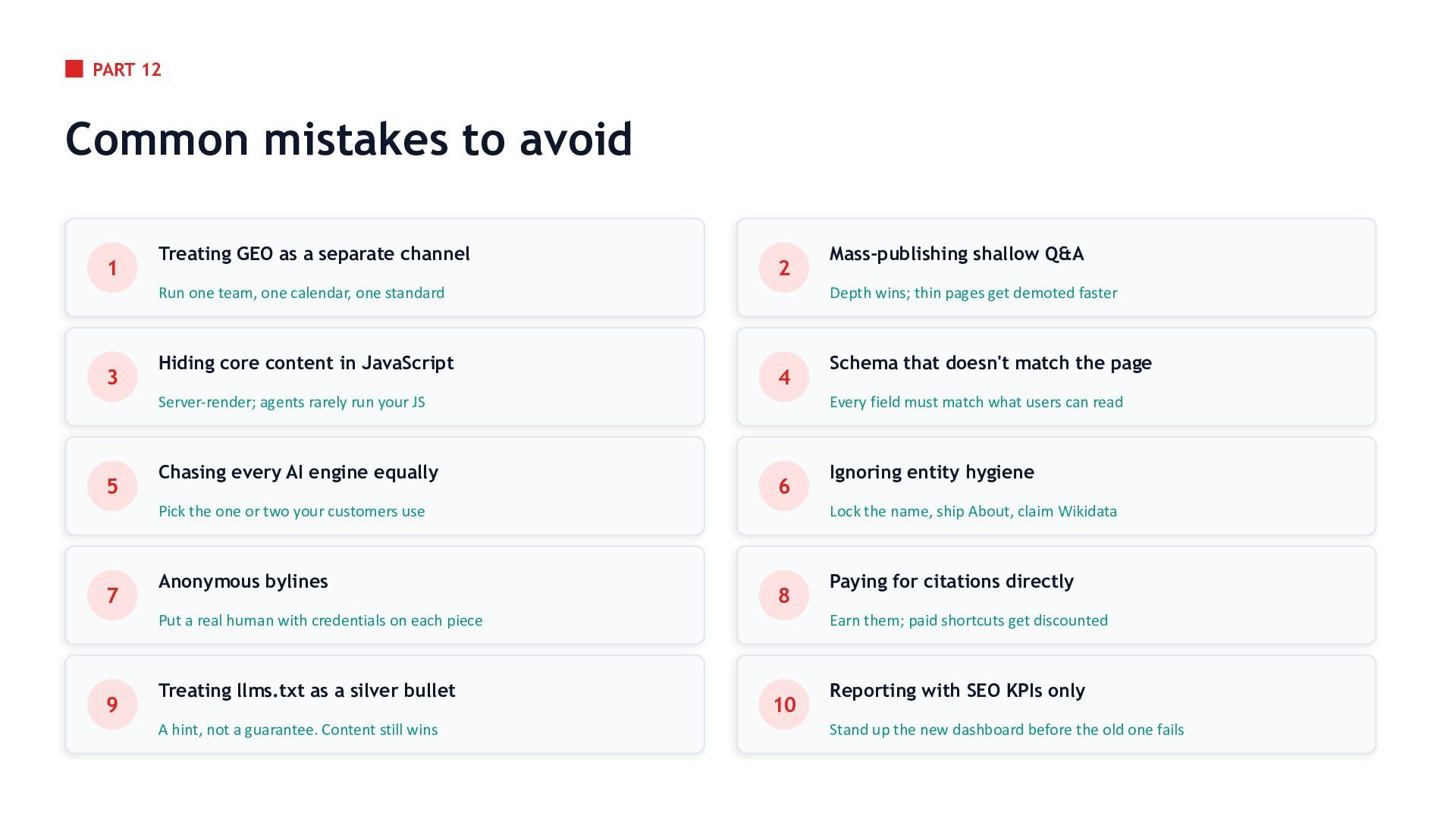
  24. PART 12 Common mistakes to avoid 1 Treating GEO as

    a separate channel Run one team, one calendar, one standard 2 Mass-publishing shallow Q&A Depth wins; thin pages get demoted faster 3 Hiding core content in JavaScript Server-render; agents rarely run your JS 4 Schema that doesn't match the page Every field must match what users can read 5 Chasing every AI engine equally Pick the one or two your customers use 6 Ignoring entity hygiene Lock the name, ship About, claim Wikidata 7 Anonymous bylines Put a real human with credentials on each piece 8 Paying for citations directly Earn them; paid shortcuts get discounted 9 Treating llms.txt as a silver bullet A hint, not a guarantee. Content still wins 10 Reporting with SEO KPIs only Stand up the new dashboard before the old one fails
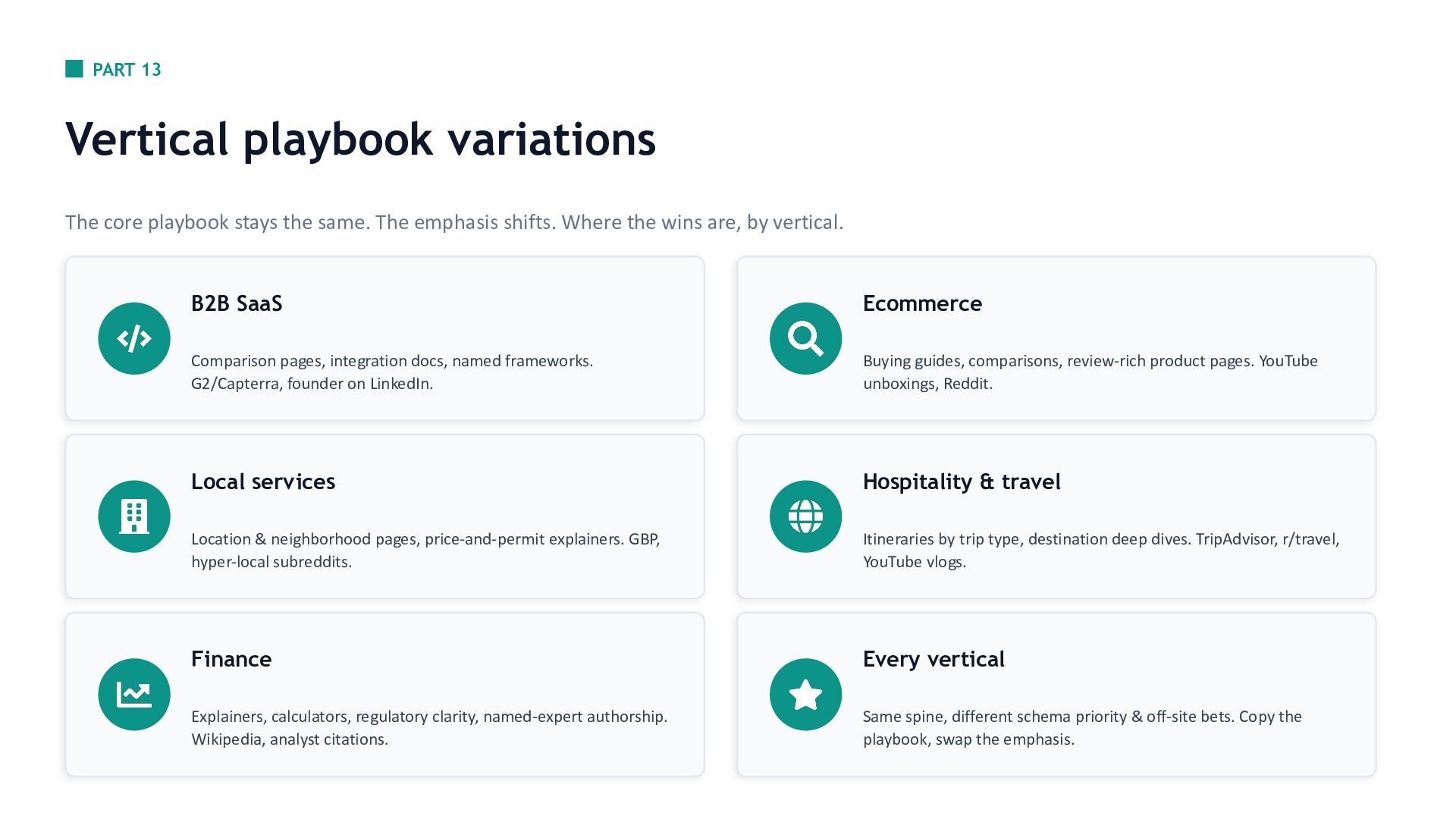
  25. PART 13 Vertical playbook variations The core playbook stays the

    same. The emphasis shifts. Where the wins are, by vertical. B2B SaaS Comparison pages, integration docs, named frameworks. G2/Capterra, founder on LinkedIn. Ecommerce Buying guides, comparisons, review-rich product pages. YouTube unboxings, Reddit. Local services Location & neighborhood pages, price-and-permit explainers. GBP, hyper-local subreddits. Hospitality & travel Itineraries by trip type, destination deep dives. TripAdvisor, r/travel, YouTube vlogs. Finance Explainers, calculators, regulatory clarity, named-expert authorship. Wikipedia, analyst citations. Every vertical Same spine, different schema priority & off-site bets. Copy the playbook, swap the emphasis.
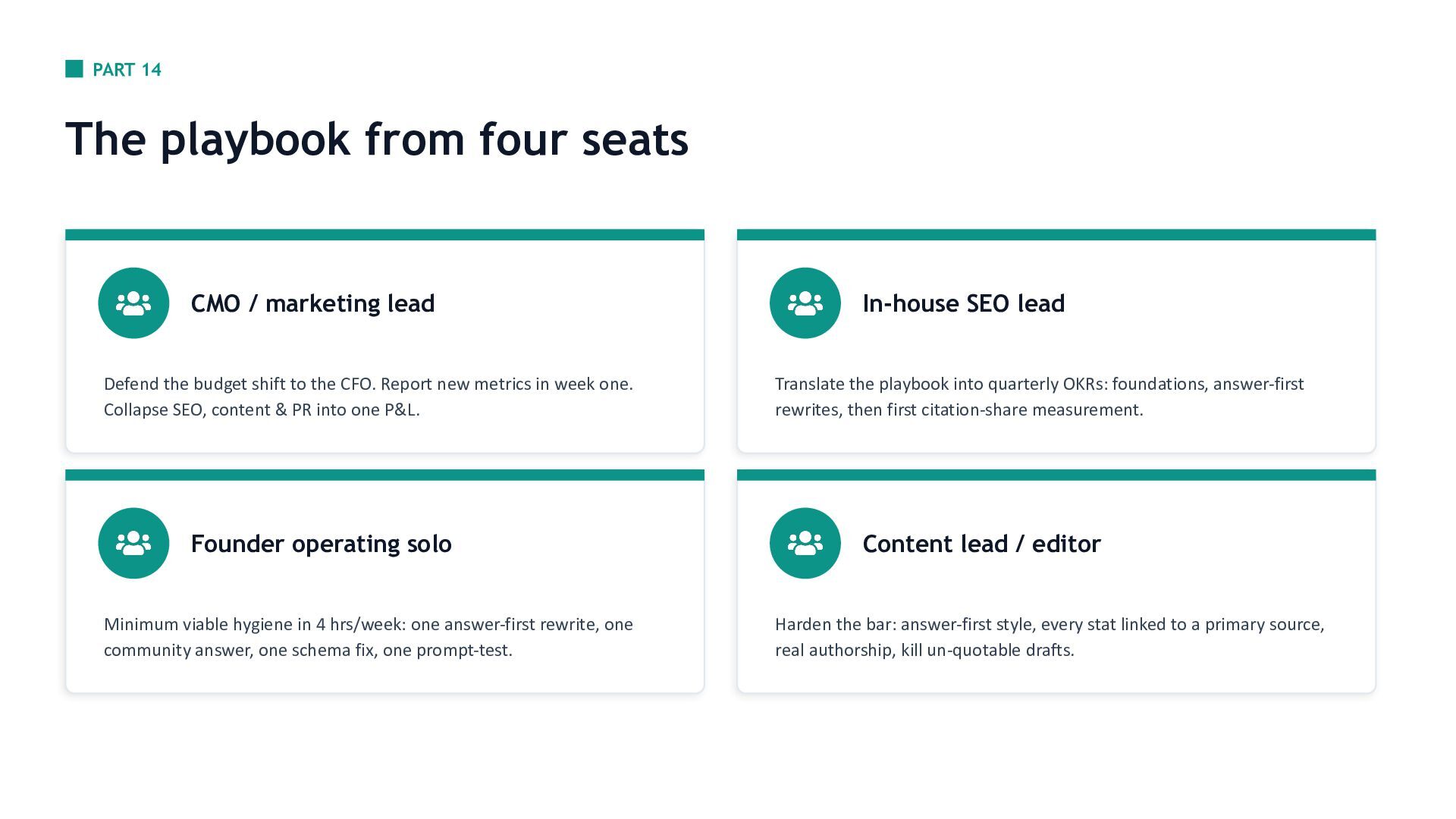
  26. PART 14 The playbook from four seats CMO / marketing

    lead Defend the budget shift to the CFO. Report new metrics in week one. Collapse SEO, content & PR into one P&L. In-house SEO lead Translate the playbook into quarterly OKRs: foundations, answer-first rewrites, then first citation-share measurement. Founder operating solo Minimum viable hygiene in 4 hrs/week: one answer-first rewrite, one community answer, one schema fix, one prompt-test. Content lead / editor Harden the bar: answer-first style, every stat linked to a primary source, real authorship, kill un-quotable drafts.
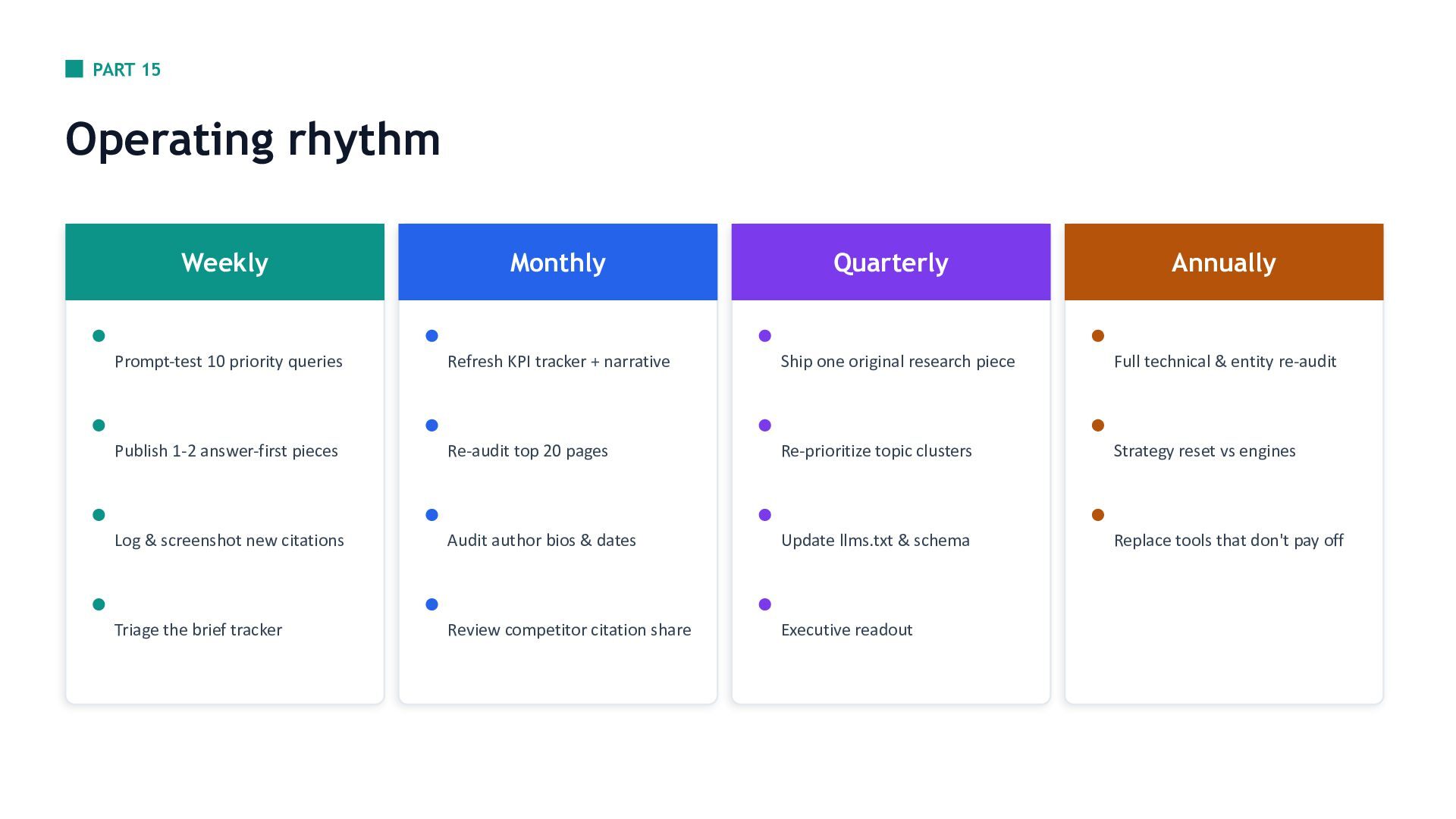
  27. PART 15 Operating rhythm Weekly Prompt-test 10 priority queries Publish

    1-2 answer-first pieces Log & screenshot new citations Triage the brief tracker Monthly Refresh KPI tracker + narrative Re-audit top 20 pages Audit author bios & dates Review competitor citation share Quarterly Ship one original research piece Re-prioritize topic clusters Update llms.txt & schema Executive readout Annually Full technical & entity re-audit Strategy reset vs engines Replace tools that don't pay off
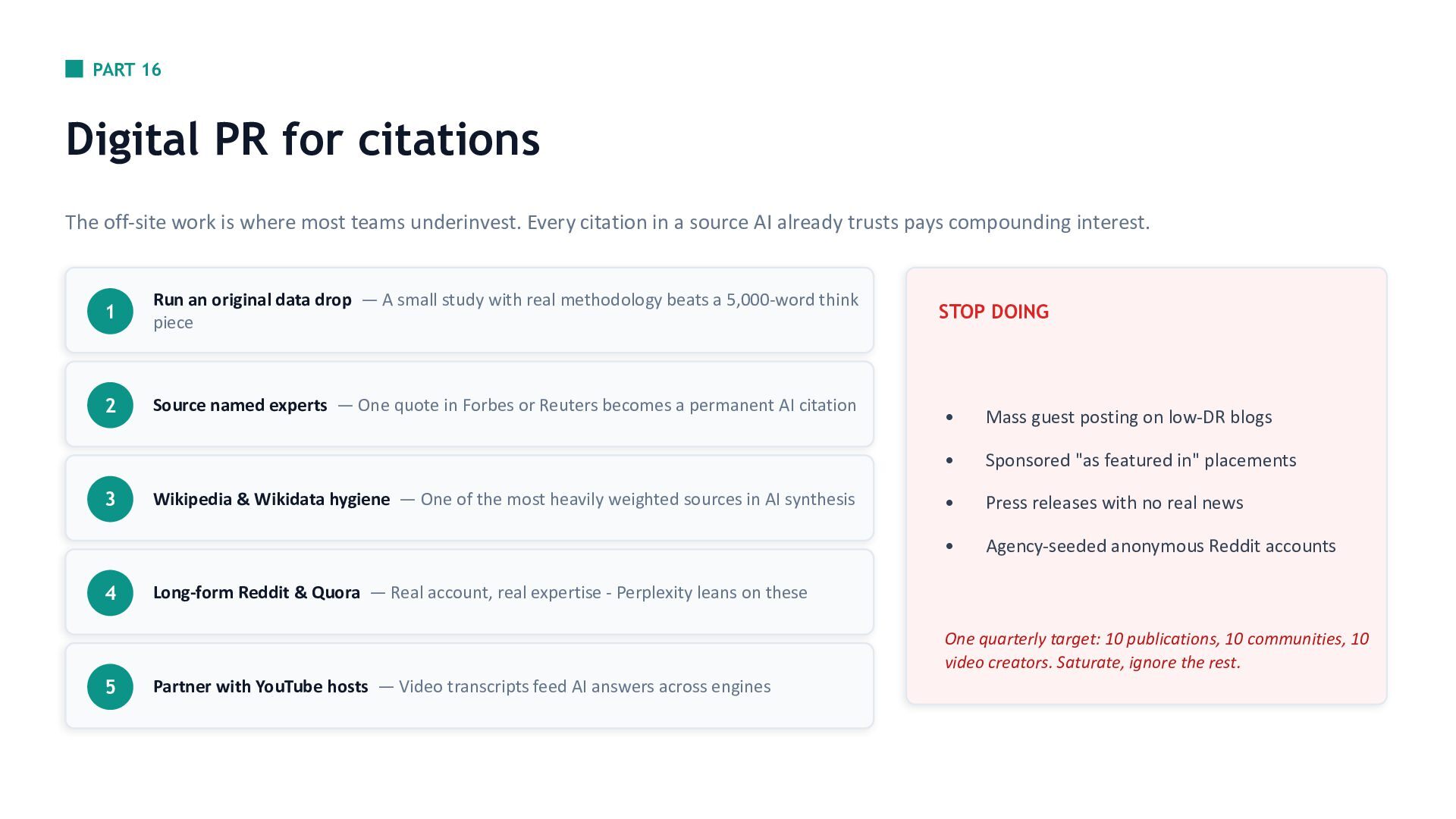
  28. PART 16 Digital PR for citations The off-site work is

    where most teams underinvest. Every citation in a source AI already trusts pays compounding interest. 1 Run an original data drop — A small study with real methodology beats a 5,000-word think piece 2 Source named experts — One quote in Forbes or Reuters becomes a permanent AI citation 3 Wikipedia & Wikidata hygiene — One of the most heavily weighted sources in AI synthesis 4 Long-form Reddit & Quora — Real account, real expertise - Perplexity leans on these 5 Partner with YouTube hosts — Video transcripts feed AI answers across engines STOP DOING • Mass guest posting on low-DR blogs • Sponsored "as featured in" placements • Press releases with no real news • Agency-seeded anonymous Reddit accounts One quarterly target: 10 publications, 10 communities, 10 video creators. Saturate, ignore the rest.
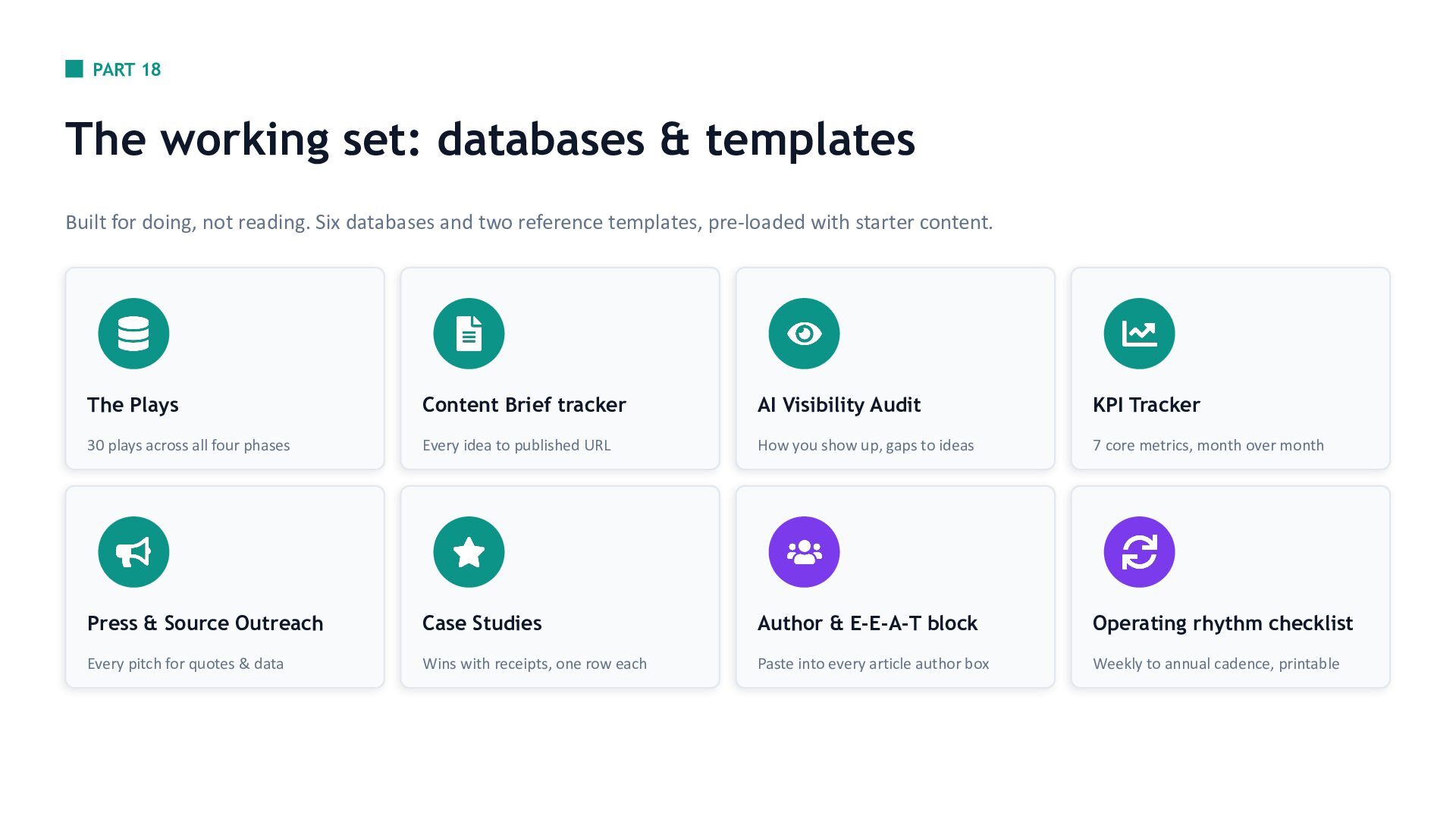
  29. PART 18 The working set: databases & templates Built for

    doing, not reading. Six databases and two reference templates, pre-loaded with starter content. The Plays 30 plays across all four phases Content Brief tracker Every idea to published URL AI Visibility Audit How you show up, gaps to ideas KPI Tracker 7 core metrics, month over month Press & Source Outreach Every pitch for quotes & data Case Studies Wins with receipts, one row each Author & E-E-A-T block Paste into every article author box Operating rhythm checklist Weekly to annual cadence, printable
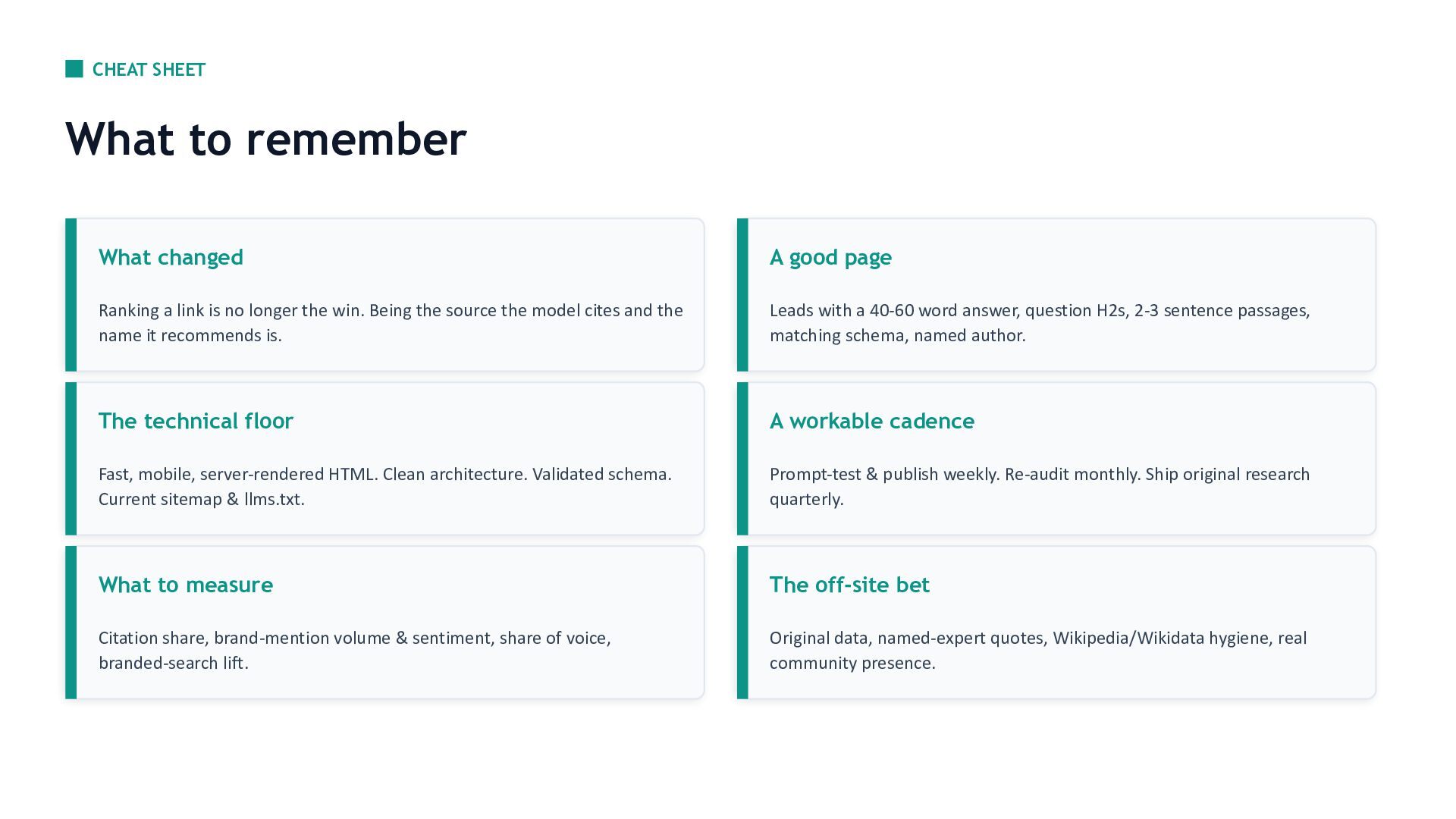
  30. CHEAT SHEET What to remember What changed Ranking a link

    is no longer the win. Being the source the model cites and the name it recommends is. A good page Leads with a 40-60 word answer, question H2s, 2-3 sentence passages, matching schema, named author. The technical floor Fast, mobile, server-rendered HTML. Clean architecture. Validated schema. Current sitemap & llms.txt. A workable cadence Prompt-test & publish weekly. Re-audit monthly. Ship original research quarterly. What to measure Citation share, brand-mention volume & sentiment, share of voice, branded-search lift. The off-site bet Original data, named-expert quotes, Wikipedia/Wikidata hygiene, real community presence.
  31. THE FIRST MOVE THIS WEEK Run the prompt-test workshop. Five

    queries · three engines · thirty minutes. The gaps become next month's briefs. Read Parts 1-3 once for the mental model, then live in Parts 5-9 as you execute. Built by Search Agency search.agency · IG @searchdotagency