Upgrade to Pro — share decks privately, control downloads, hide ads and more …

How to Stop Procrastination And Get Things Done...

How to Stop Procrastination And Get Things Done With Ease | Inner Coach

Discover the Inner Coach Method for Transforming Your Inner Procrastinator, Mastering Your Time, And Boosting Your Productivity
Procrastination is one of the main barriers blocking you from getting up, taking the right actions and living the dream life you really want.
Learn how to release procrastination, struggle and overwhelm, and move forward with ease and inner alignment in moving forward with your biggest goals - in business, relationships and health!
Presented by Patrick Dominguez, CEO and Founder of Inner Coach

Avatar for Inner Coach

Inner Coach

July 05, 2022

Other Decks in Business

Transcript

  1. This presentation is going to show you how you can
    be your own Inner Coach. So that you can coach yourself to: Release the procrastination and let go of the inner struggle and resistance… Achieve your most exciting goals and dreams with greater ease and inner alignment… And Have what matters to you most in life.
  2. This presentation is designed to give you a radically different

    and more effective approach than much of the conventional advice you may have seen or tried.
  3. My name is Patrick Dominguez, and I’m the founder and

    CEO of Inner Coach. I’ve coached and trained 1,000s of small business owners over the last 14 years. In that time, I’ve seen that for entrepreneurs or solo-preneurs, procrastination is unfortunately an all too-common reason why they don’t realize their business dreams.
  4. This guide to overcoming procrastination is based on what’s proven

    to work with 100s of clients in 15 different countries around the world. Many of these people are normally high achievers who found themselves painfully procrastinating in an area of life that matters.
  5. First, what is procrastination? Procrastination is when you're avoiding taking

    action towards a goal or dream or something you really care about.
  6. Signs of procrastination •Avoidance of something you want to do

    •Self-sabotage •Dragging your feet, putting things off •Being really busy doing other things - “I’m too busy to (do procrastinated tasks) At the core, it all amounts to procrastination - we are not taking steps towards what we want.
  7. Examples of procrastination You want a successful business… but you're

    not taking action to put yourself out there. You want to get fit… but you don't take the action steps like going to the gym or exercising at home. You want to get into a new love relationship… but you put off getting on yourself onto online dating sites.
  8. Question for you What are YOU procrastinating on? Take a

    moment right now, and choose at least one thing – that will massively enhance your learning from this presentation
  9. What is the cost of procrastination? 1. Being frustrated with

    yourself. Frequent negative self-talk. Beating yourself up for not taking the action. 2. The energy drain of the inner struggle (part of you wants to move forward, part of you is resisting). 3. Ultimately, the biggest issue is that you don't get the thing that you really want – your dream relationship, business, or body - and you feel bad about yourself.
  10. I want to start by sharing some of the conventional

    approaches of procrastination provided by many coaches and experts. Here’s the thing – they DO work some of the time with some people. But they often DON’T work and I will explain why.
  11. Conventional approach #1: Take a baby step What's the smallest

    baby step or mini-step you can take toward the task or goal you’re avoiding? For example, work out for 1 minute. The idea behind this is to help you minimize the resistance, get started and build momentum.
  12. Conventional approach #2: Set micro goals This is similar to

    approach #1. Instead of going for a really daunting goal, like making a $100,000 in your business this year or writing a book - which can conjure up a lot of resistance right away…. You set smaller goals that are easier to achieve. Such as get one client, or write one blog post on your topic. And then build from there.
  13. Conventional approach #3: Get an accountability partner The idea here

    is that you meet with an accountability partner on a regular basis. Each time you meet, you check in on whether you took the actions you committed to taking in your last meeting. The idea that you leverage the energy of being accountable and not wanting to disappointment your partner.
  14. However… why do conventional approaches so often NOT work? I've

    coached and trained thousands of business owners for 14 years. And I've seen lots of people use these conventional approaches (and others) and they still get stuck in procrastination. Why? (See if you can guess the answer, before turning to the next slide)
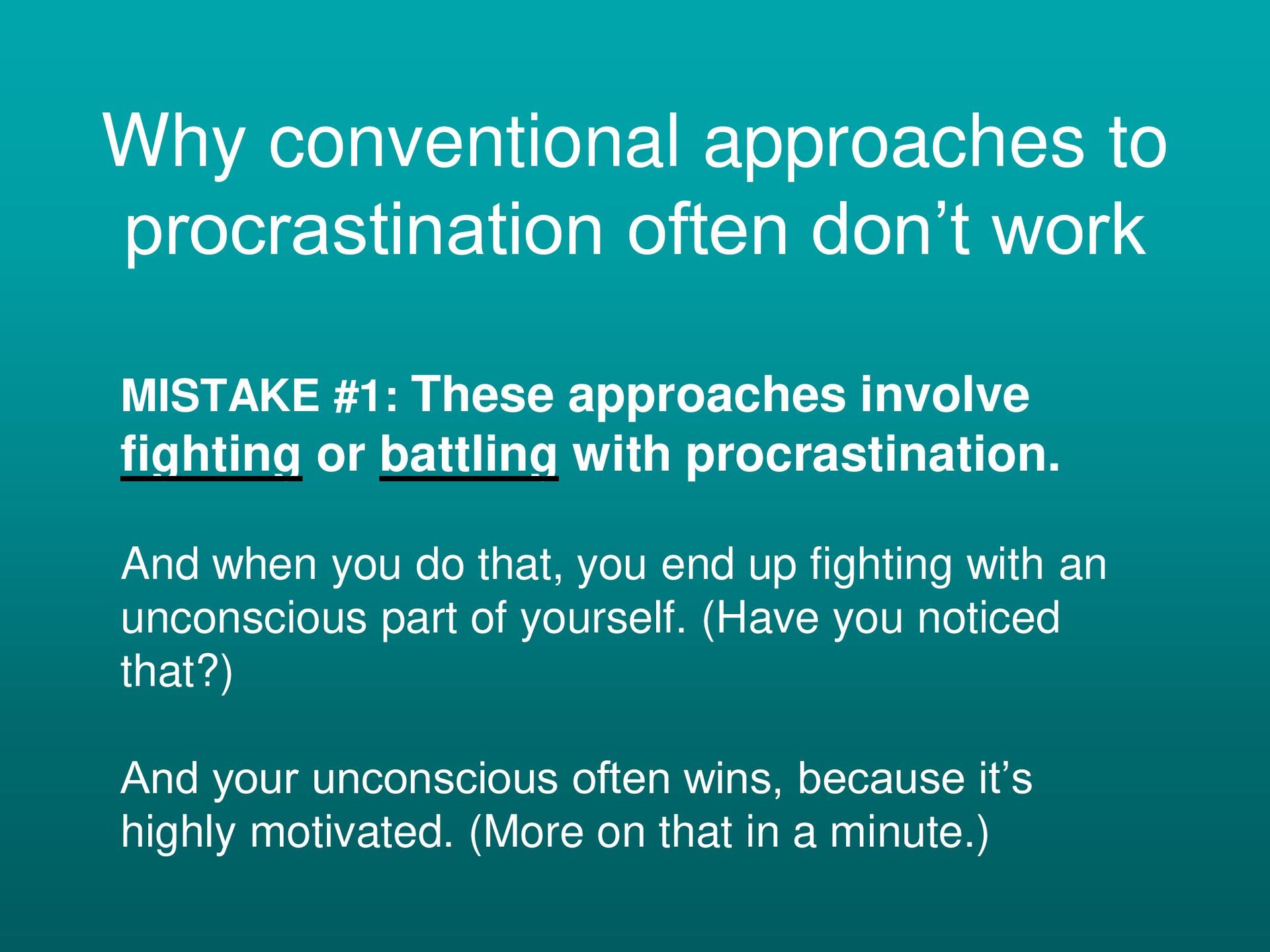
  15. Why conventional approaches to procrastination often don’t work MISTAKE #1:

    These approaches involve fighting or battling with procrastination. And when you do that, you end up fighting with an unconscious part of yourself. (Have you noticed that?) And your unconscious often wins, because it’s highly motivated. (More on that in a minute.)
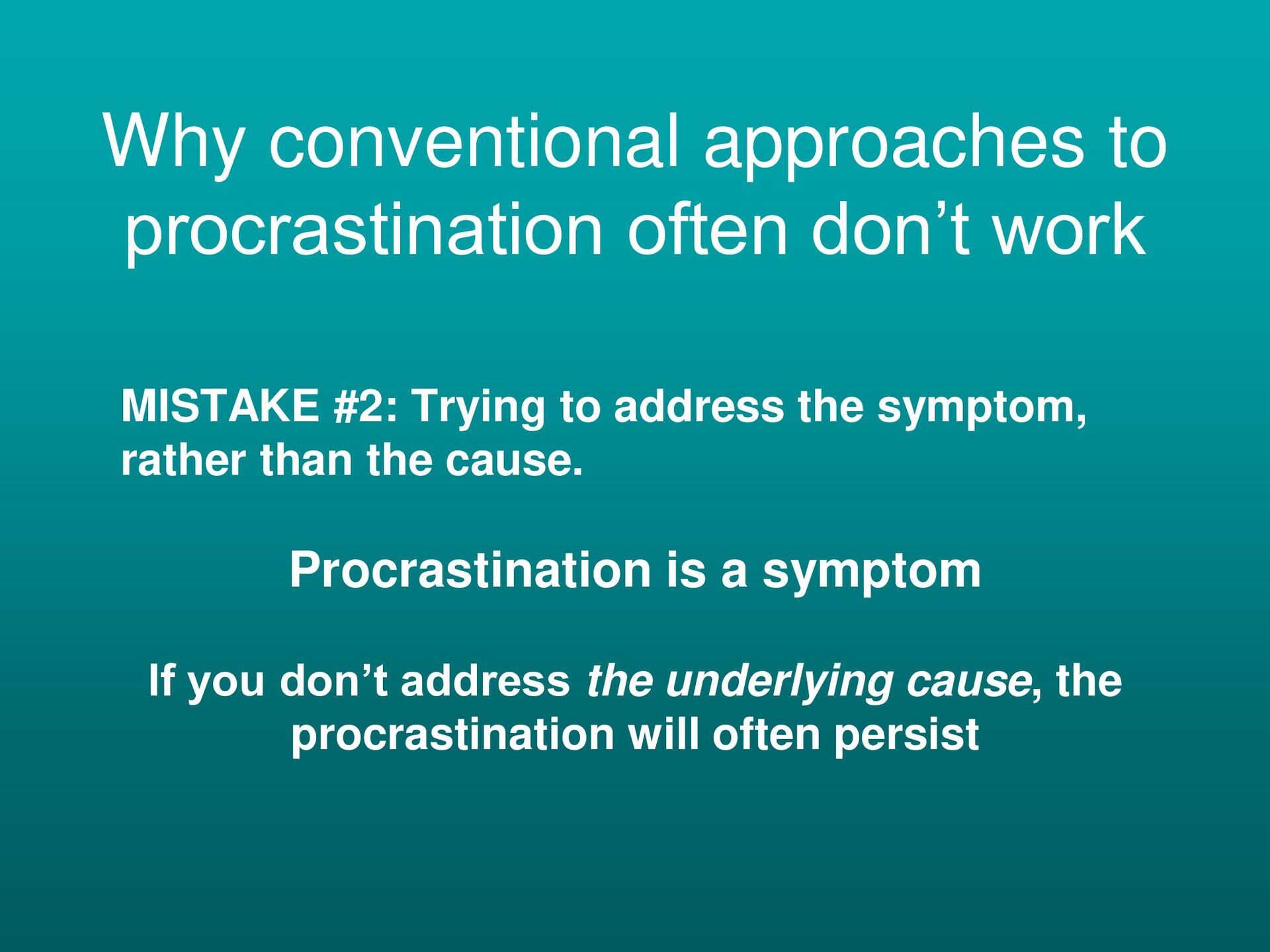
  16. Why conventional approaches to procrastination often don’t work MISTAKE #2:

    Trying to address the symptom, rather than the cause. Procrastination is a symptom If you don’t address the underlying cause, the procrastination will often persist
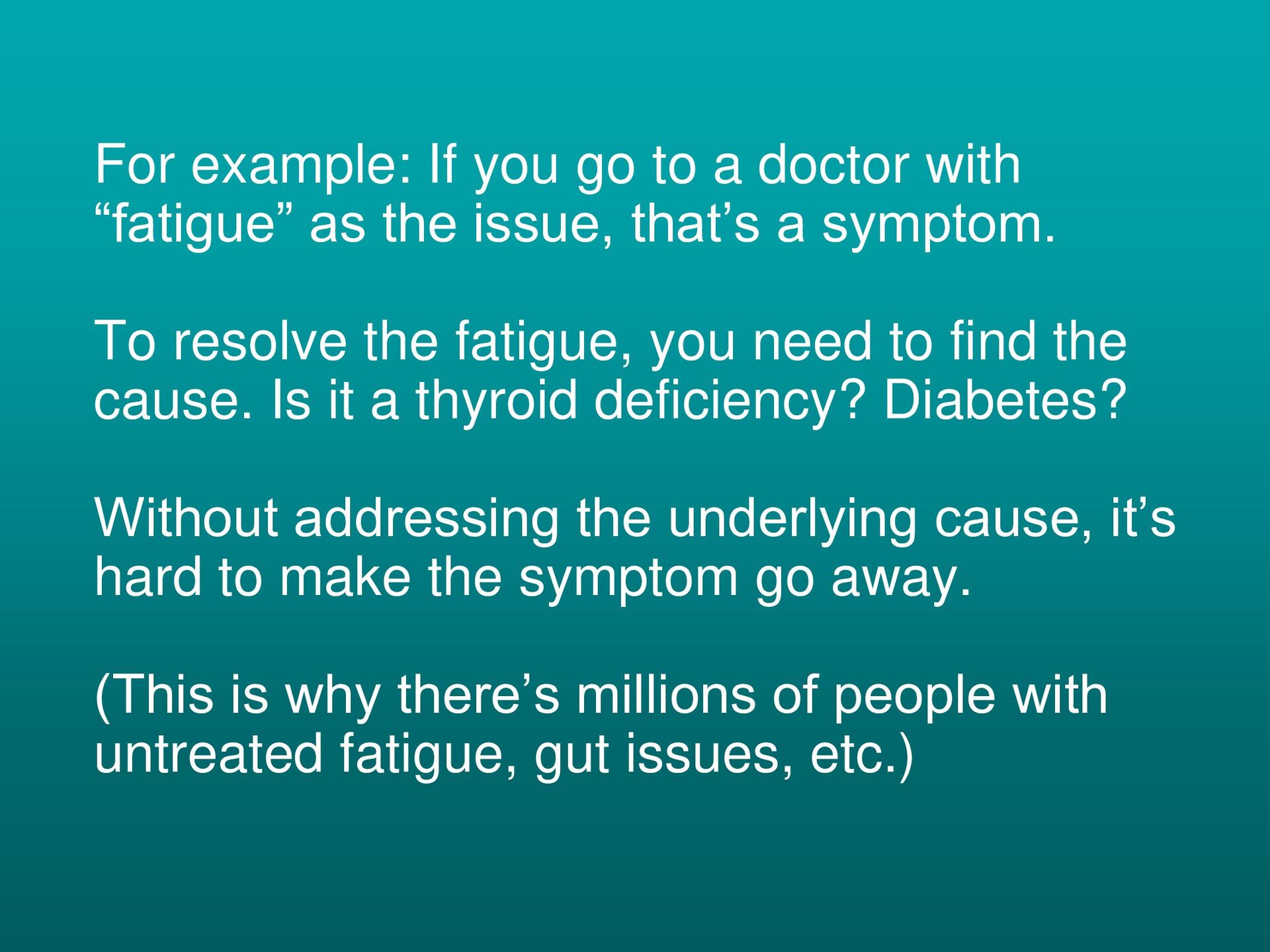
  17. For example: If you go to a doctor with “fatigue”

    as the issue, that’s a symptom. To resolve the fatigue, you need to find the cause. Is it a thyroid deficiency? Diabetes? Without addressing the underlying cause, it’s hard to make the symptom go away. (This is why there’s millions of people with untreated fatigue, gut issues, etc.)
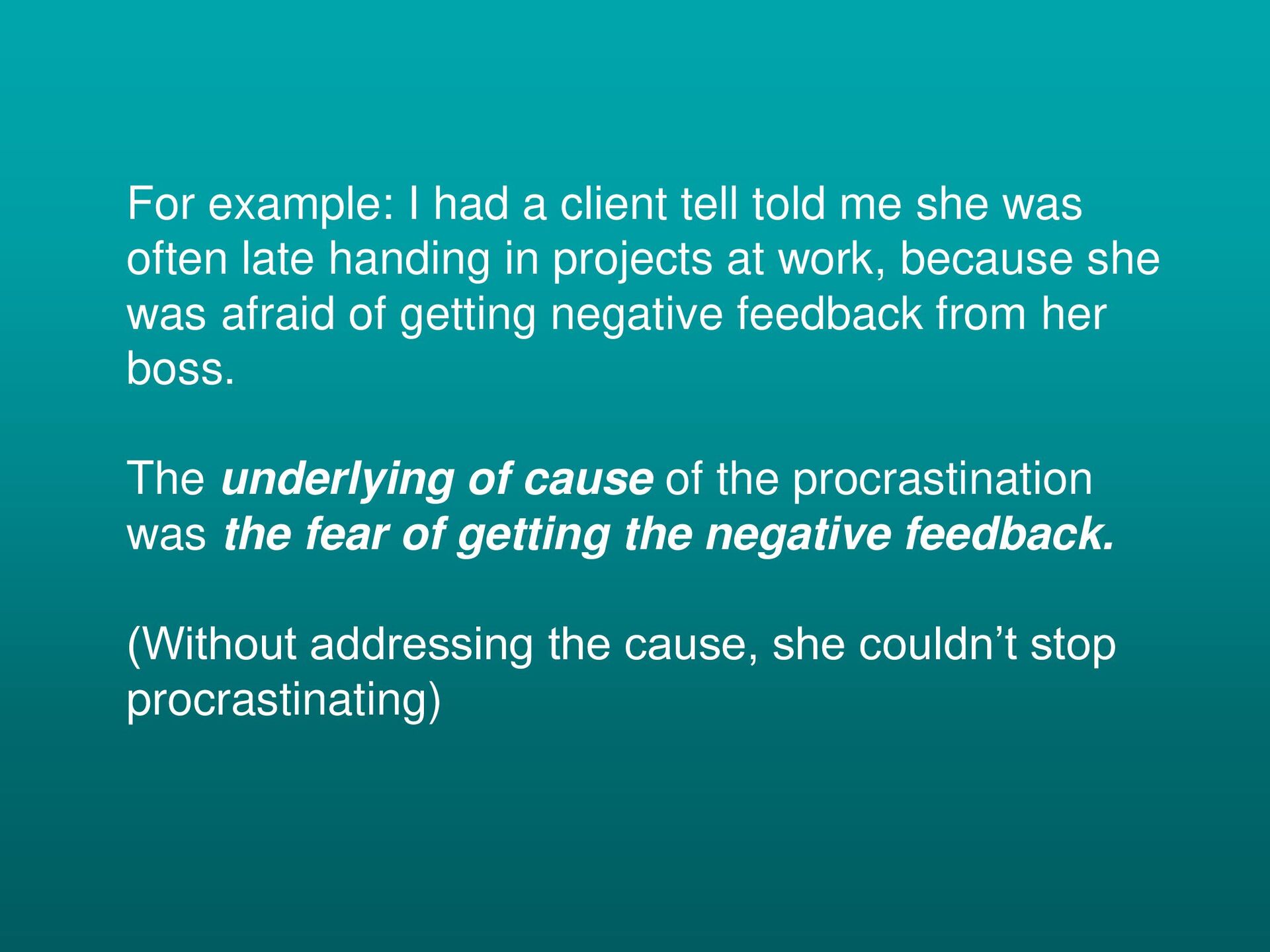
  18. For example: I had a client tell told me she

    was often late handing in projects at work, because she was afraid of getting negative feedback from her boss. The underlying of cause of the procrastination was the fear of getting the negative feedback. (Without addressing the cause, she couldn’t stop procrastinating)
  19. Whenever there’s persistent or chronic procrastination, there's a deeper underlying

    cause. Procrastination is a sign that you need to look for the deeper cause, and work with that.
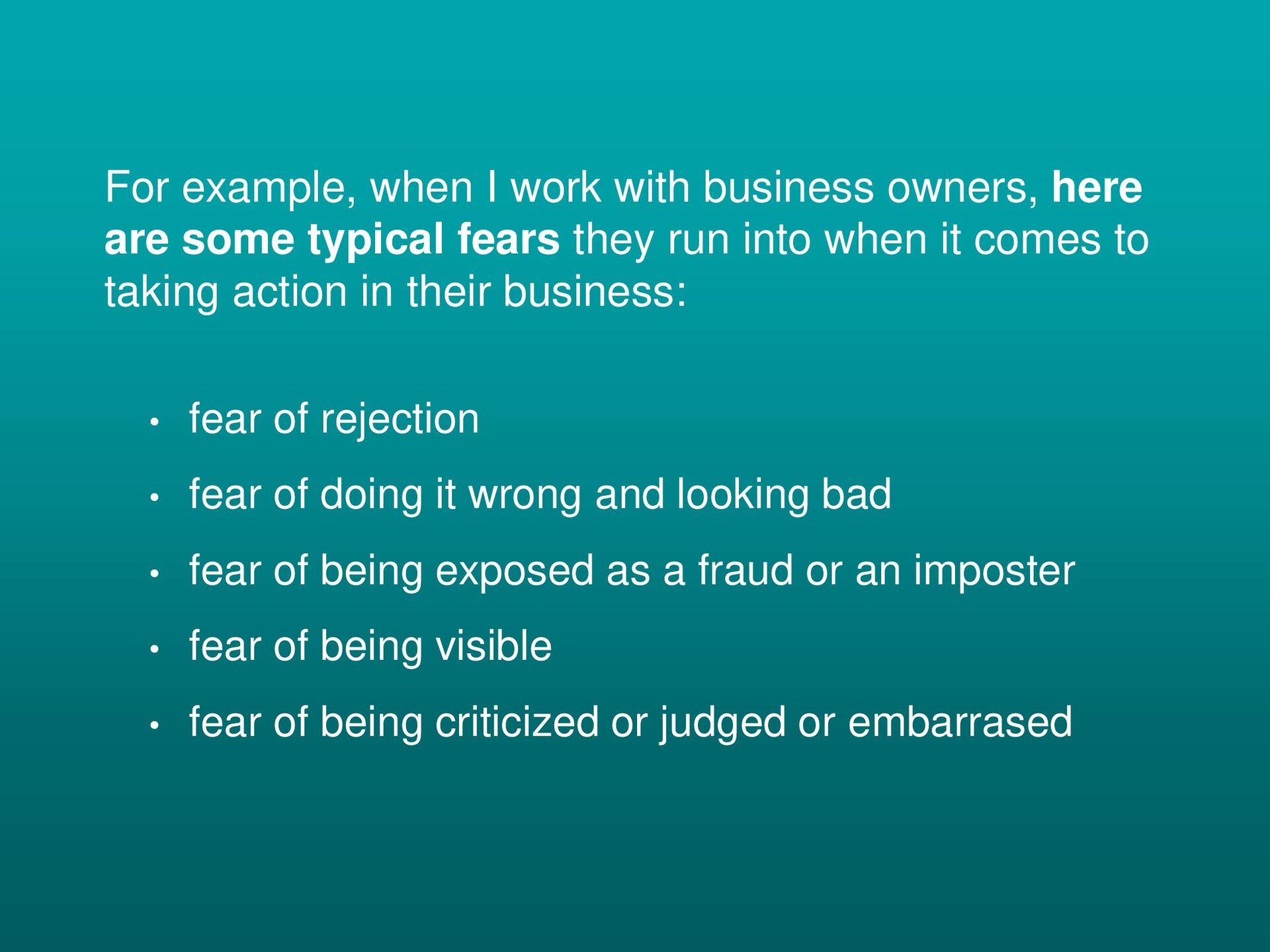
  20. For example, when I work with business owners, here are

    some typical fears they run into when it comes to taking action in their business: • fear of rejection • fear of doing it wrong and looking bad • fear of being exposed as a fraud or an imposter • fear of being visible • fear of being criticized or judged or embarrased
  21. Now look for yourself. Take a look at whatever you're

    procrastinating on and notice - is there an underlying fear of something bad happening? (Take a moment right now to look inside – this could be a game changer for you)
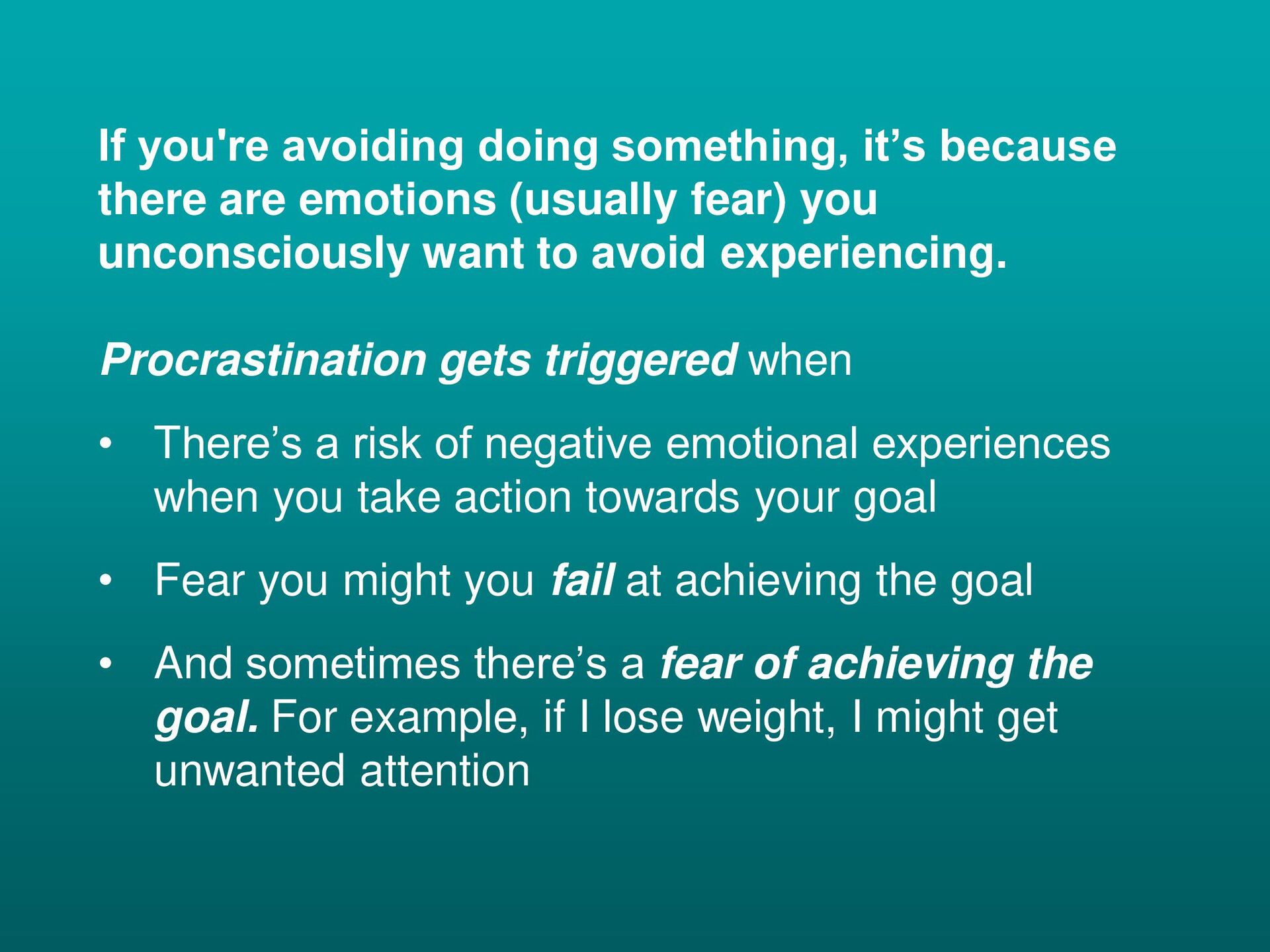
  22. If you're avoiding doing something, it’s because there are emotions

    (usually fear) you unconsciously want to avoid experiencing. Procrastination gets triggered when • There’s a risk of negative emotional experiences when you take action towards your goal • Fear you might you fail at achieving the goal • And sometimes there’s a fear of achieving the goal. For example, if I lose weight, I might get unwanted attention
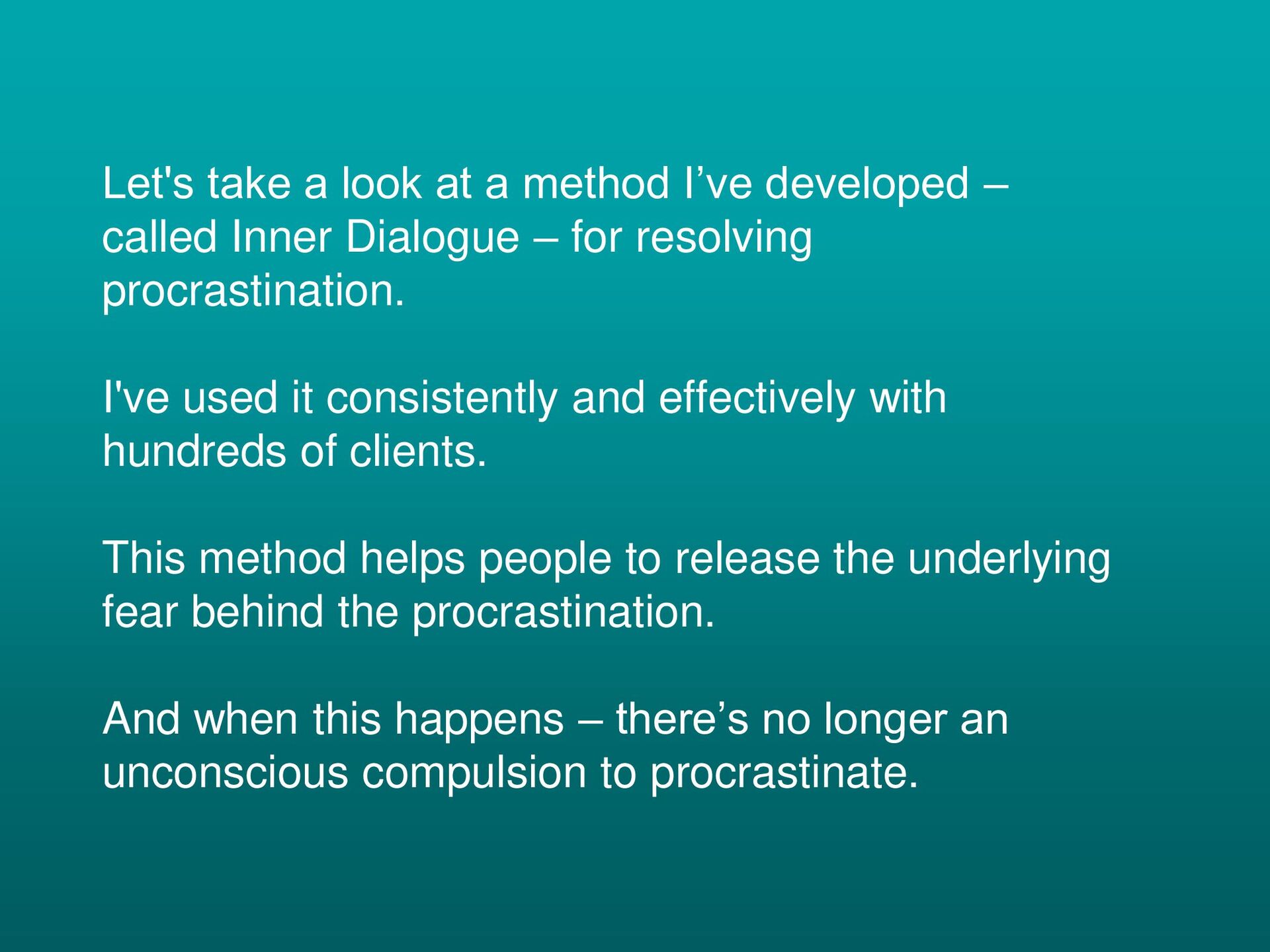
  23. Let's take a look at a method I’ve developed –

    called Inner Dialogue – for resolving procrastination. I've used it consistently and effectively with hundreds of clients. This method helps people to release the underlying fear behind the procrastination. And when this happens – there’s no longer an unconscious compulsion to procrastinate.
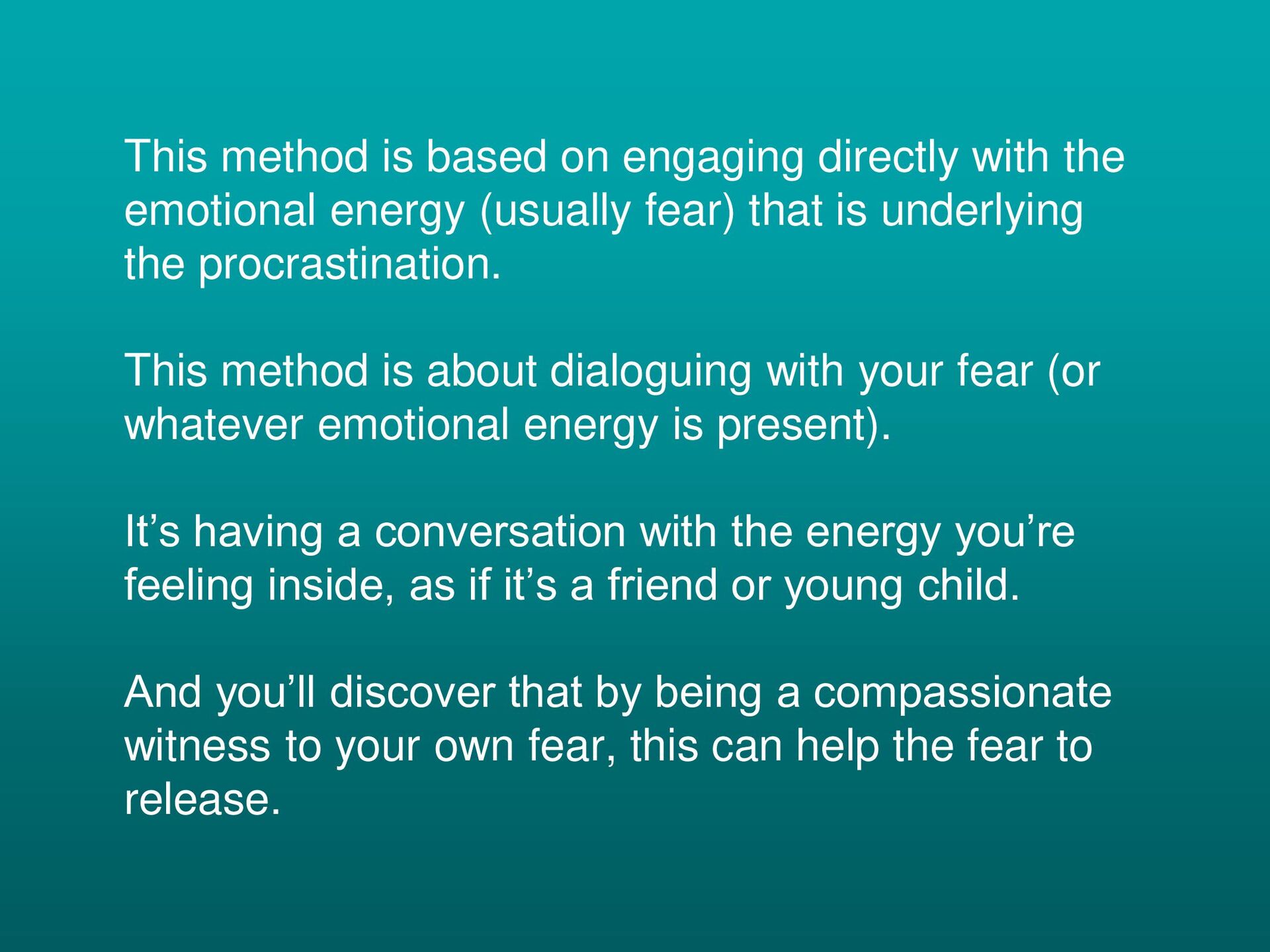
  24. This method is based on engaging directly with the emotional

    energy (usually fear) that is underlying the procrastination. This method is about dialoguing with your fear (or whatever emotional energy is present). It’s having a conversation with the energy you’re feeling inside, as if it’s a friend or young child. And you’ll discover that by being a compassionate witness to your own fear, this can help the fear to release.
  25. Here's the basic outline that you can do on your

    own. It takes about 5 to 10 minutes (and 5 minutes once you’re familiar with it). You can do it on your own, or have friend guide you through it. (And you can go into it in more depth with my book, which you can find at www.InnerCoach.com)
  26. Step 1: Find where you feel it in the body

    Think of the thing that you are procrastinating on. And as you think about taking action towards the thing, notice what energy (emotions and sensations) arises in your body. And allow yourself to feel the energy of procrastination in your body. Do this in a quiet place where there's no distractions. Then notice where in your body you feel the energy. For example in your chest, or in your gut.
  27. Step 2: Welcome this energy and ask if you may

    speak to it. Simply say to the energy you’re feeling, “Welcome. May I ask you some questions to get to know you better?” Engage with this energy with compassion, acceptance and curiosity. Be a compassionate observer (without judgement, analysis, wanting it to go away, or trying to change it).
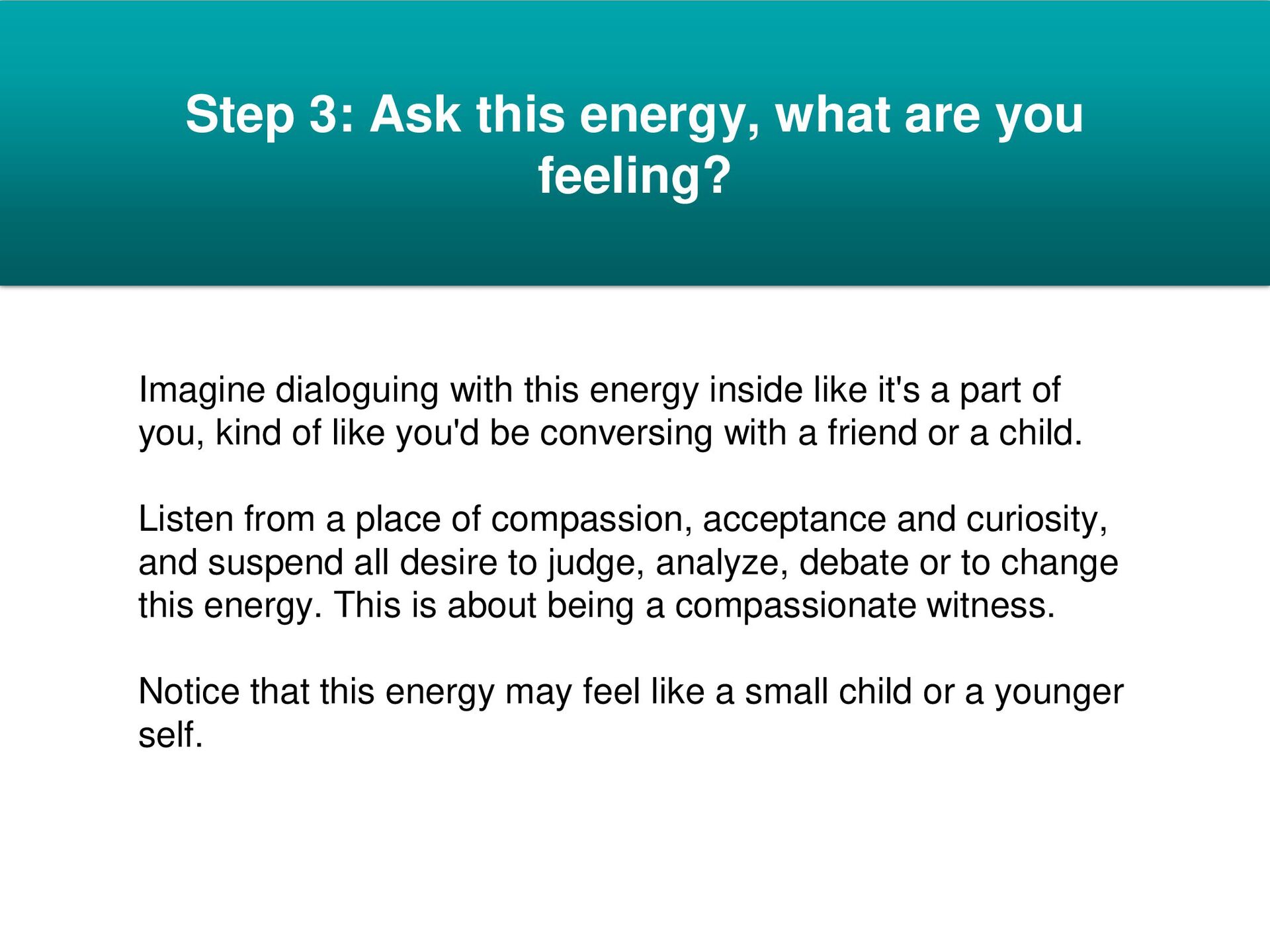
  28. Step 3: Ask this energy, what are you feeling? Imagine

    dialoguing with this energy inside like it's a part of you, kind of like you'd be conversing with a friend or a child. Listen from a place of compassion, acceptance and curiosity, and suspend all desire to judge, analyze, debate or to change this energy. This is about being a compassionate witness. Notice that this energy may feel like a small child or a younger self.
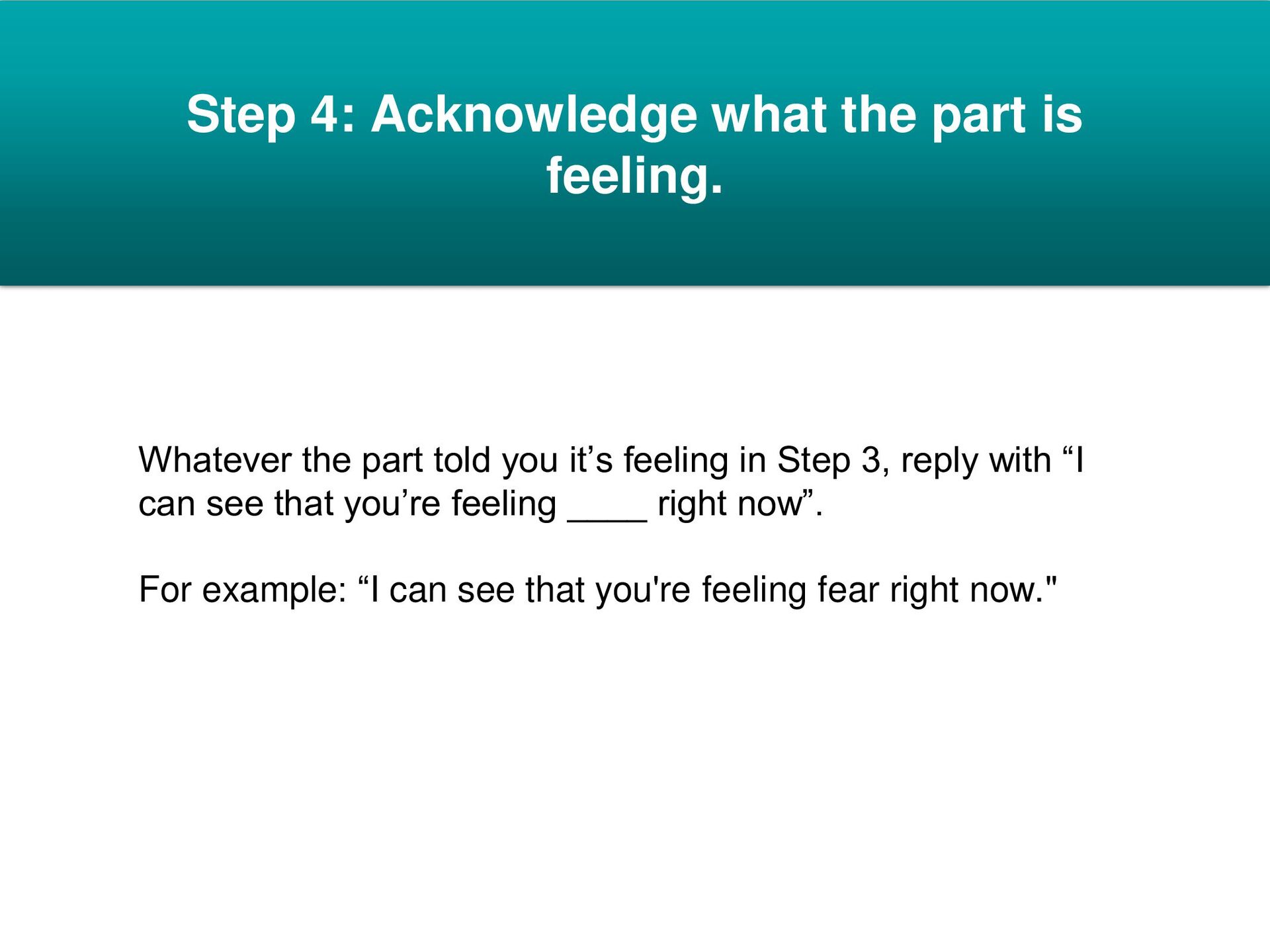
  29. Step 4: Acknowledge what the part is feeling. Whatever the

    part told you it’s feeling in Step 3, reply with “I can see that you’re feeling ____ right now”. For example: “I can see that you're feeling fear right now."
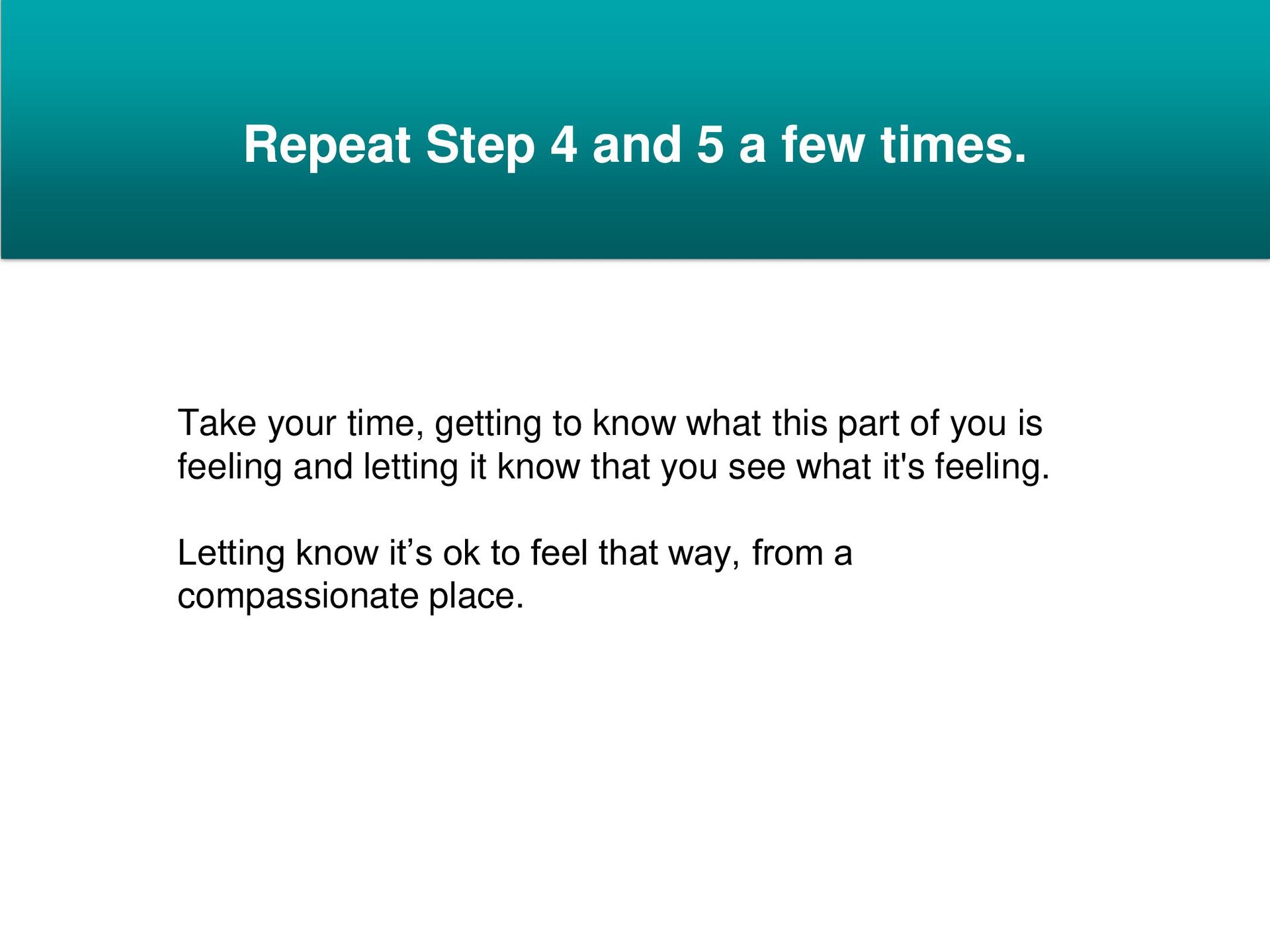
  30. Repeat Step 4 and 5 a few times. Take your

    time, getting to know what this part of you is feeling and letting it know that you see what it's feeling. Letting know it’s ok to feel that way, from a compassionate place.
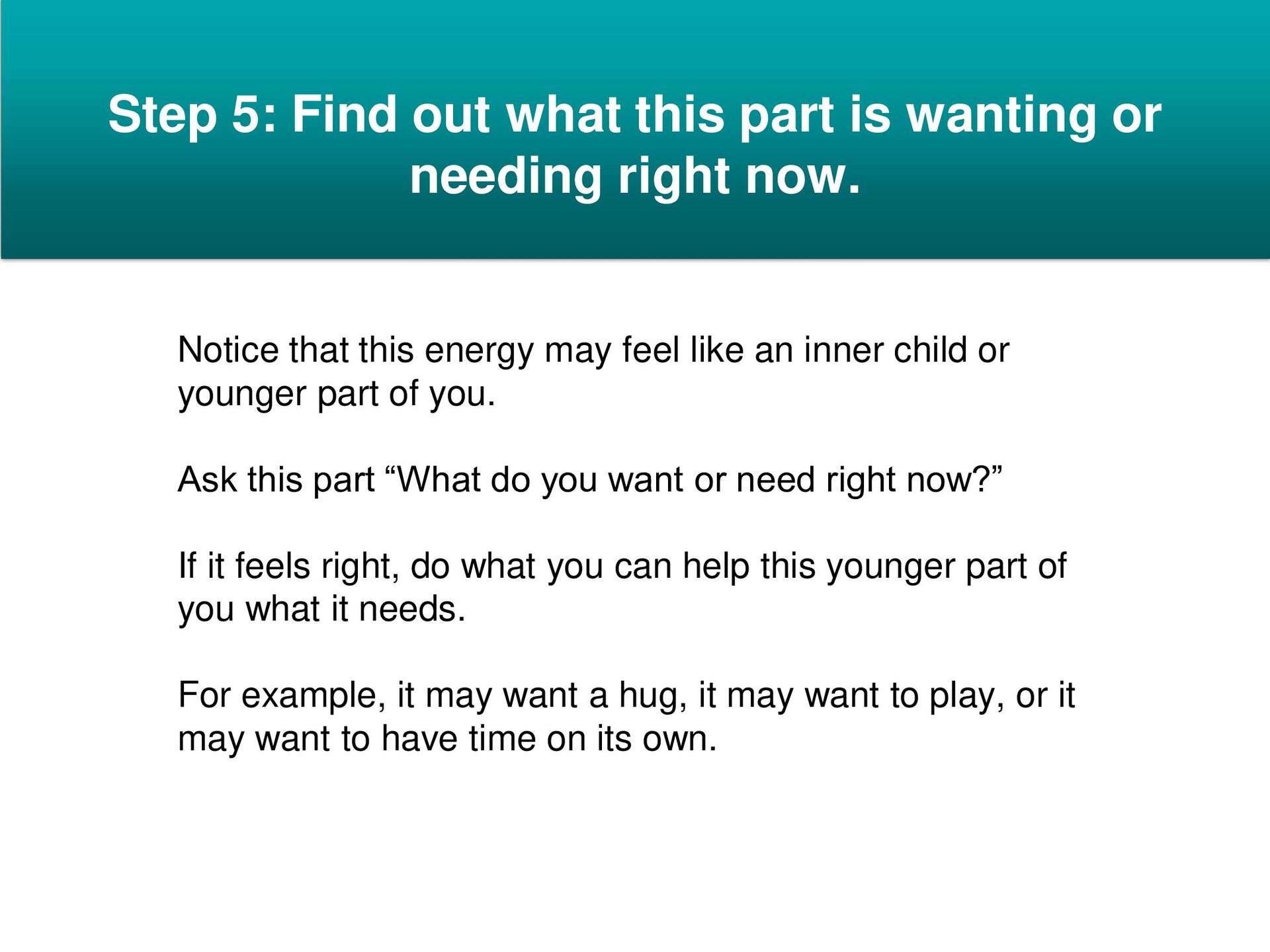
  31. Step 5: Find out what this part is wanting or

    needing right now. Notice that this energy may feel like an inner child or younger part of you. Ask this part “What do you want or need right now?” If it feels right, do what you can help this younger part of you what it needs. For example, it may want a hug, it may want to play, or it may want to have time on its own.
  32. Step 6: Completion Thank the part for sharing itself with

    you. Let the part know you care for it, you’re here for it, and you have it’s back.
  33. Why this method works • Instead of fighting the fear

    (or other emotions) you’re feeling inside, you’re befriending it • There’s a part of you that’s been suppressed… and when it has a chance to be seen, heard, loved and supported… you form a new, empowering, supportive relationship with the part of you that’s been driving the procrastination • This part of you has been trying to keep you safe, because it’s a afraid of what might happen. You get to befriend this part, help it get its needs met… and you become the protective adult in the relationship.
  34. The benefits of doing this process • Greater inner peace

    • Decreasing the fear or other emotions that come up underneath your procrastination • And ultimately, you can move toward your goals and dreams with more inner alignment – and less struggle with parts of you that are resisting
  35. Give this process a try and watch how quickly your

    procrastination can shift when you engage with the procrastination energy, rather than fighting it. For more transformational tools, training and coaching, visit our Inner Coach website www.innercoach.com