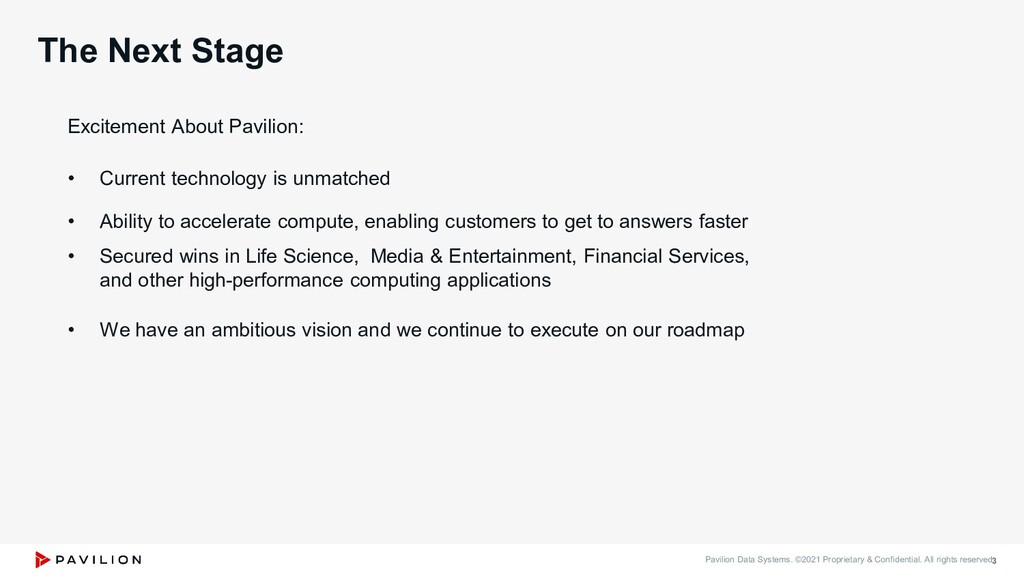
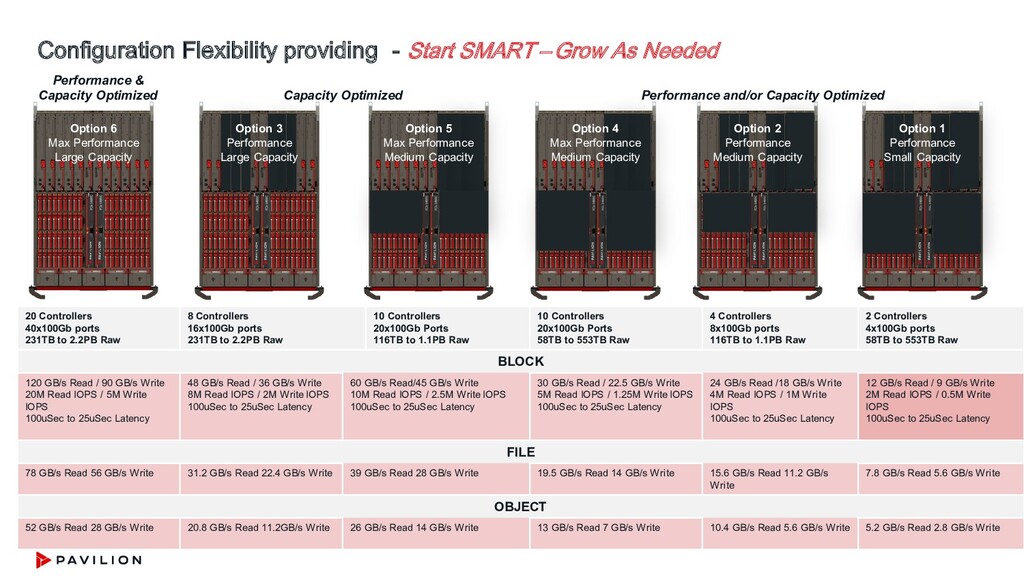
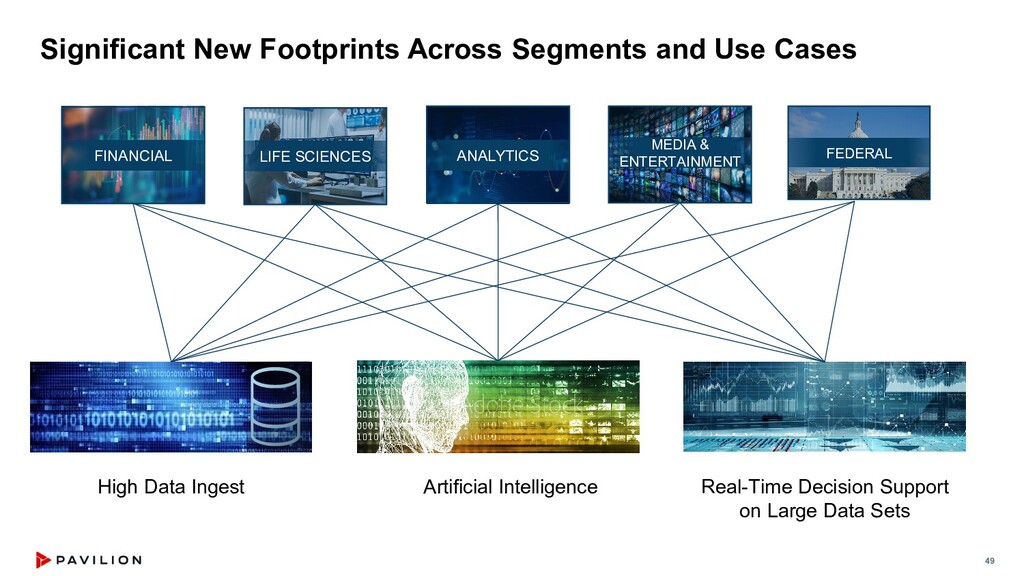
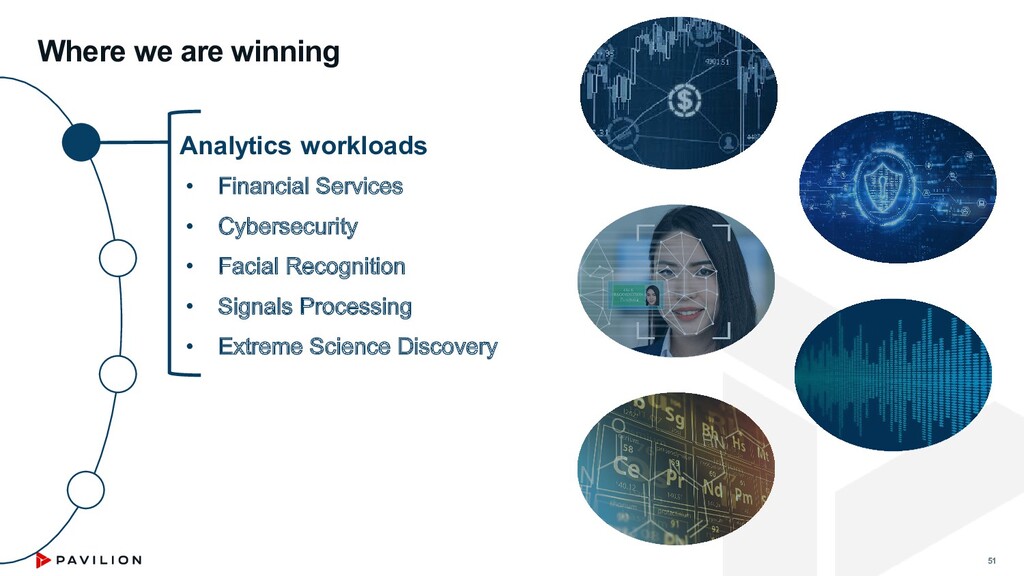
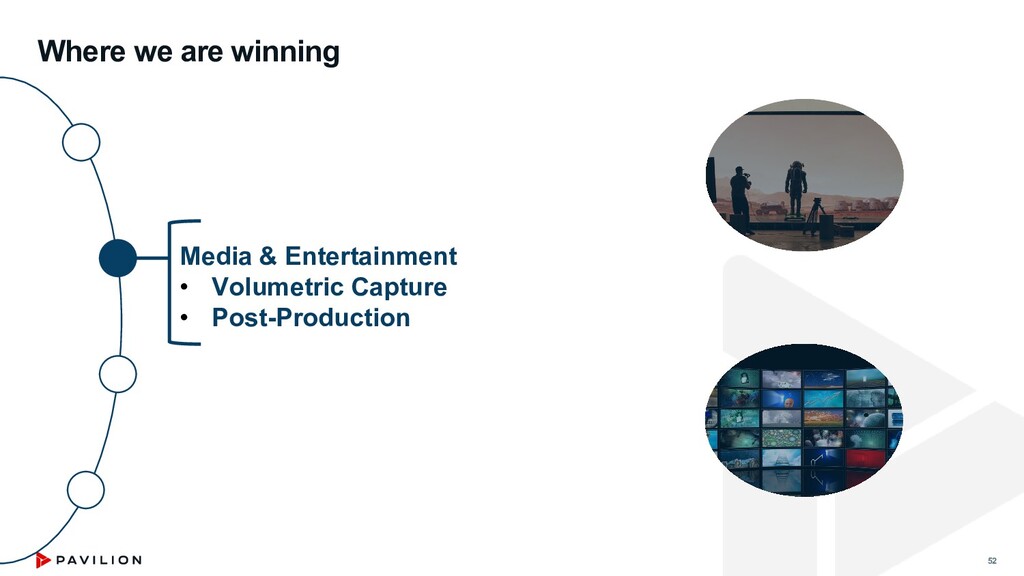
The Next Stage Excitement About Pavilion: • Current technology is unmatched • Ability to accelerate compute, enabling customers to get to answers faster • Secured wins in Life Science, Media & Entertainment, Financial Services, and other high-performance computing applications • We have an ambitious vision and we continue to execute on our roadmap 3
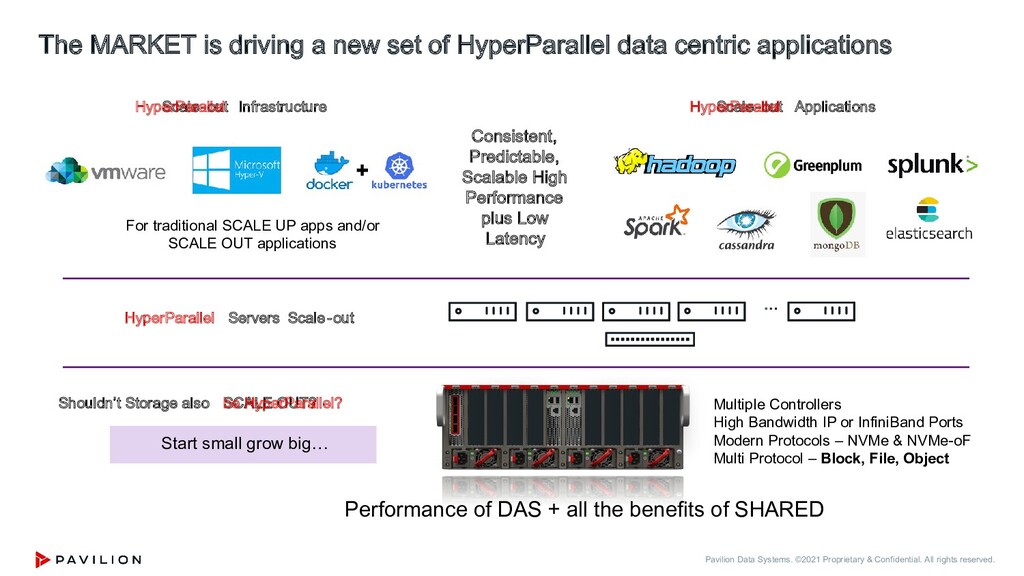
The MARKET is driving a new set of HyperParallel data centric applications … Applications Infrastructure For traditional SCALE UP apps and/or SCALE OUT applications Consistent, Predictable, Scalable High Performance plus Low Latency Performance of DAS + all the benefits of SHARED Start small grow big… Multiple Controllers High Bandwidth IP or InfiniBand Ports Modern Protocols – NVMe & NVMe-oF Multi Protocol – Block, File, Object Scale-out HyperParallel Scale-out HyperParallel Servers Scale-out HyperParallel SCALE OUT? Shouldn’t Storage also be HyperParallel?
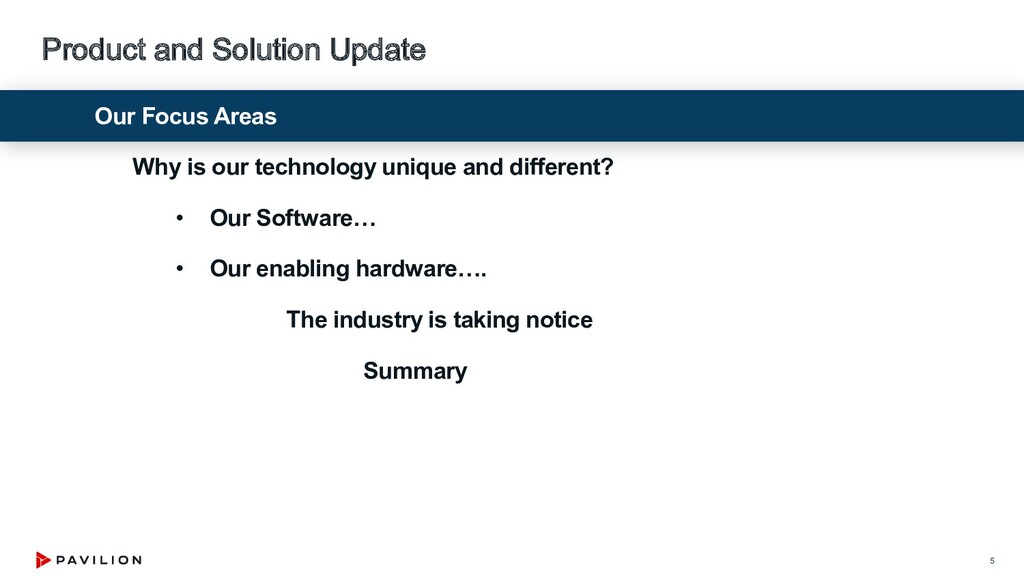
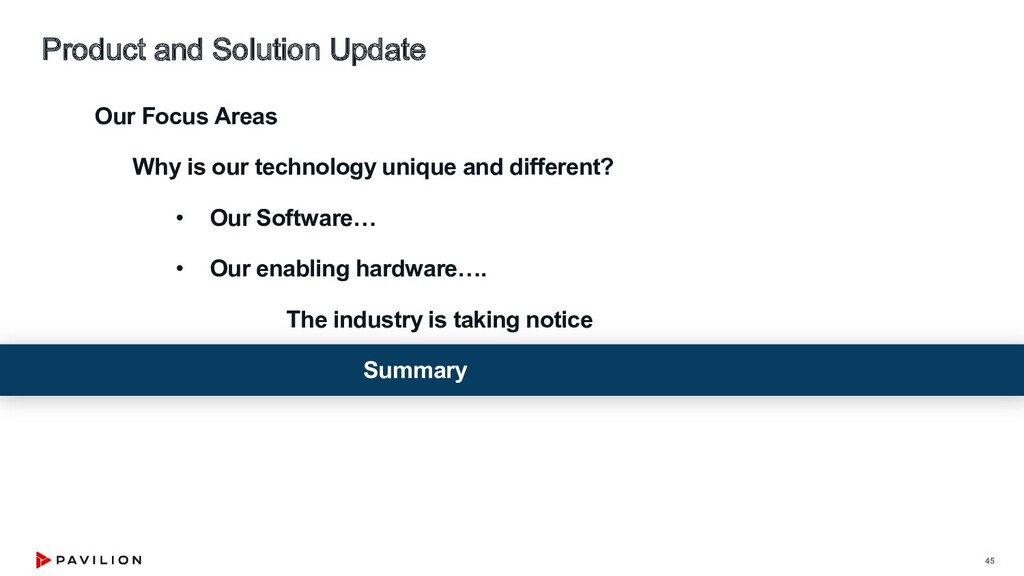
technology unique and different? • Our Software… • Our enabling hardware…. The industry is taking notice Summary Why is our technology unique and different? • Our Software… 8
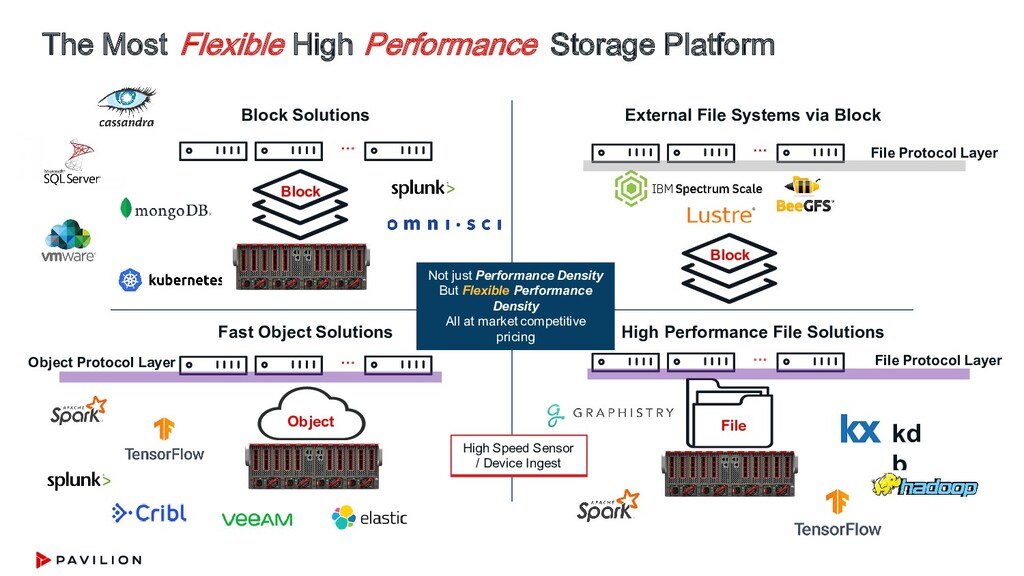
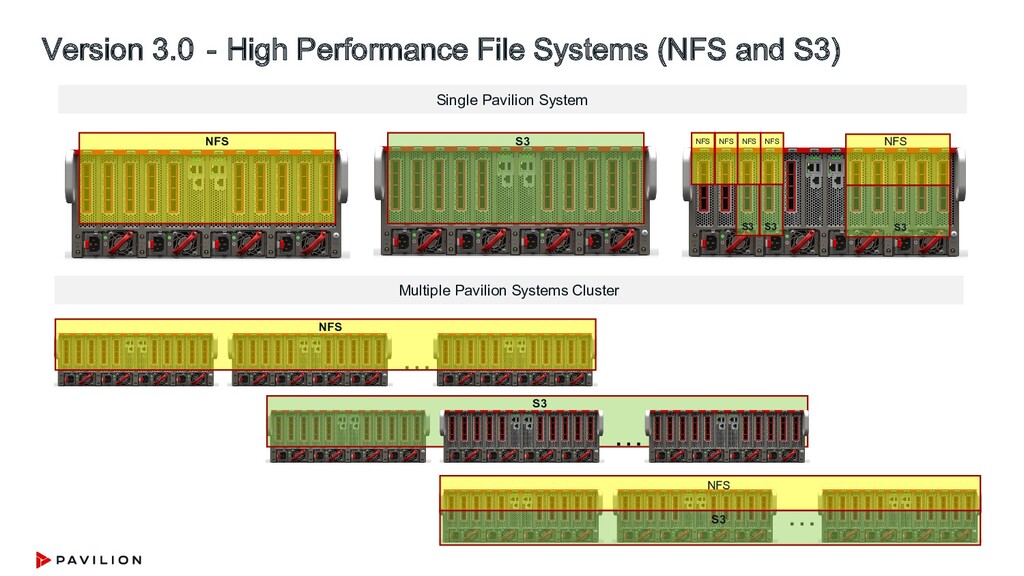
… Object … Fast Object Solutions … Block … File External File Systems via Block High Performance File Solutions File Protocol Layer File Protocol Layer Object Protocol Layer kd b High Speed Sensor / Device Ingest Not just Performance Density But Flexible Performance Density All at market competitive pricing
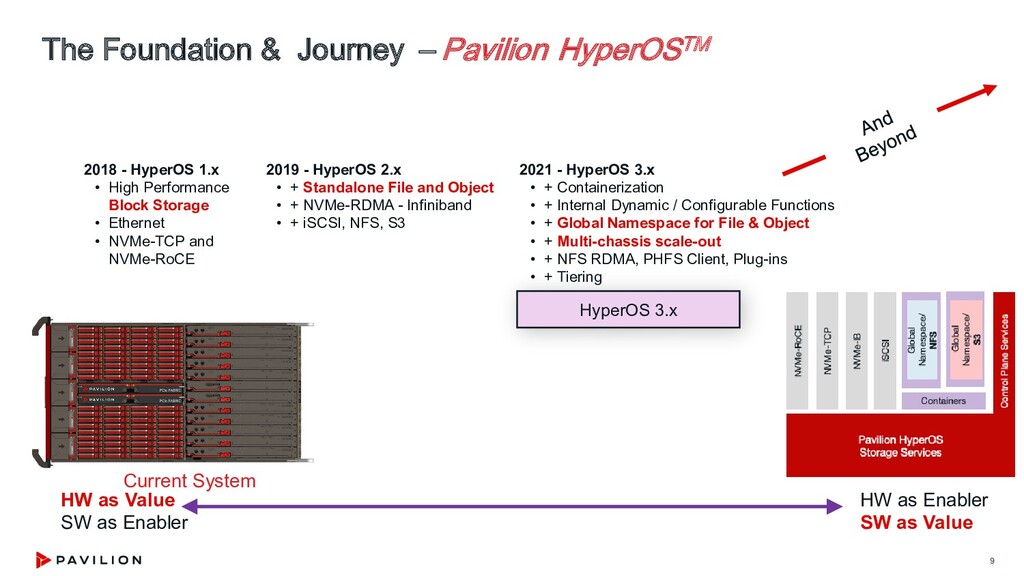
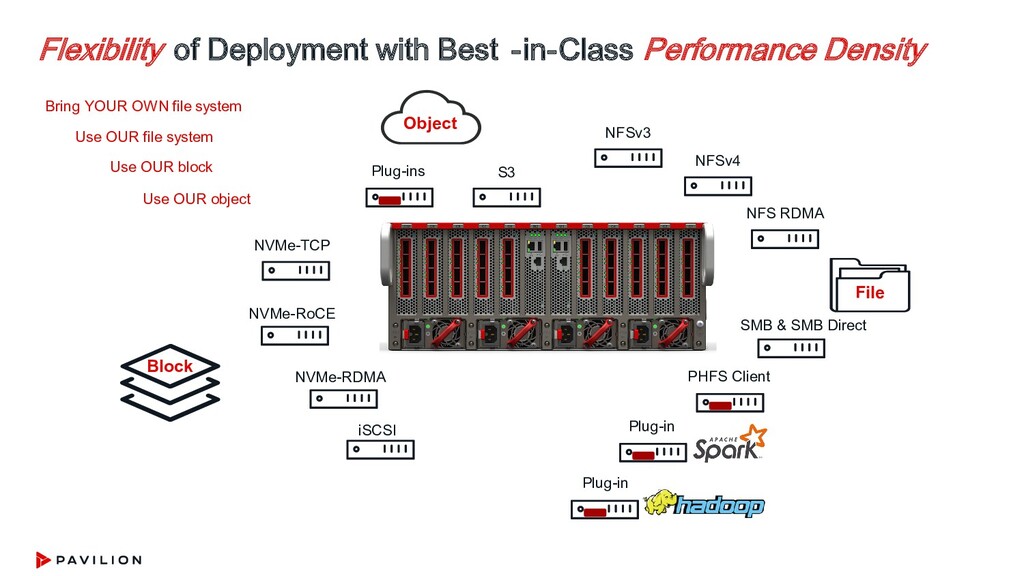
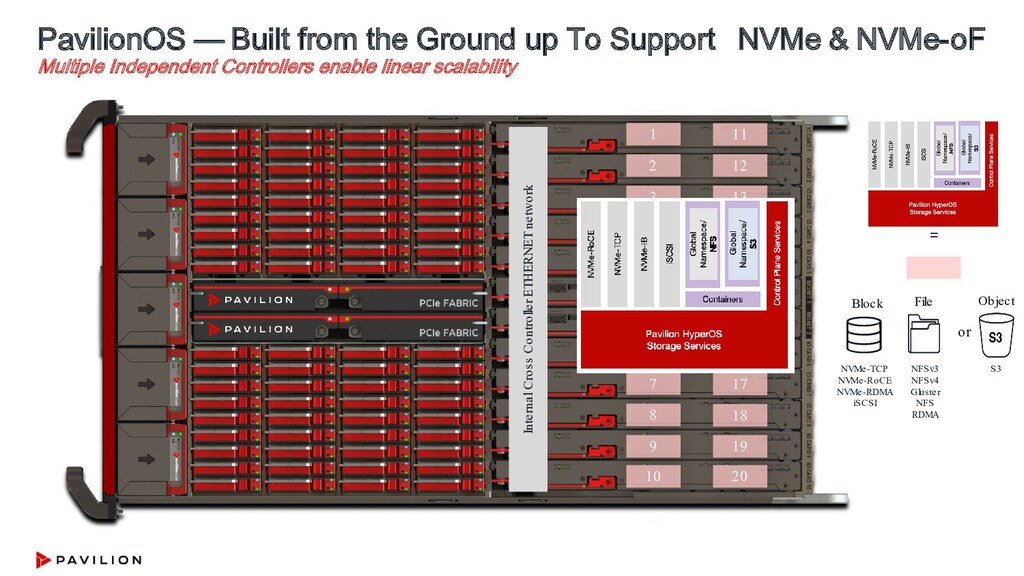
OWN file system Use OUR file system Use OUR block Use OUR object NFSv3 NFSv4 NFS RDMA PHFS Client Plug-in Plug-in SMB & SMB Direct File S3 Plug-ins Object NVMe-TCP NVMe-RoCE NVMe-RDMA iSCSI Block
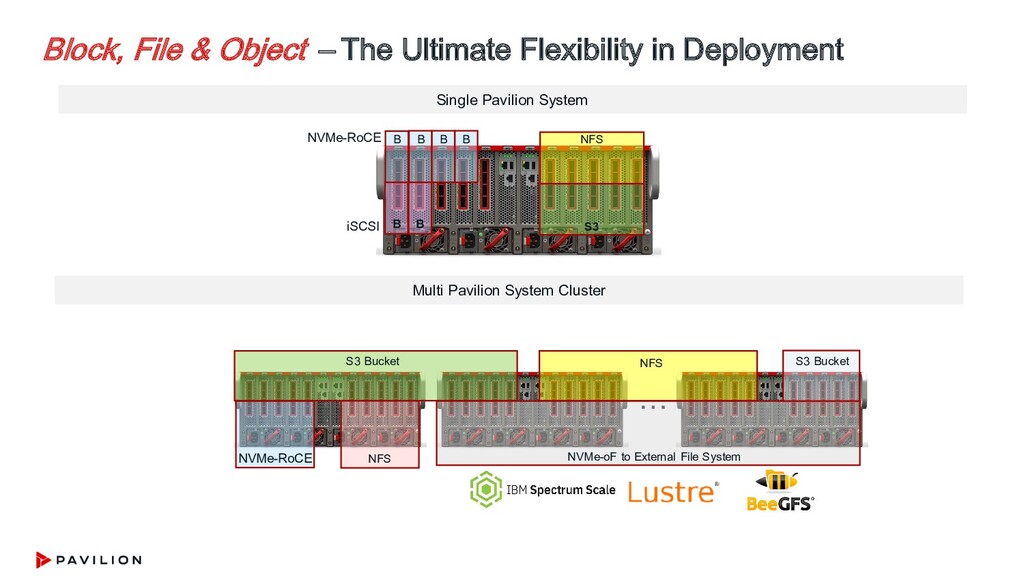
Single Pavilion System B B B B NFS B B S3 NVMe-RoCE iSCSI Multi Pavilion System Cluster … NFS NVMe-RoCE NFS S3 Bucket S3 Bucket NVMe-oF to External File System
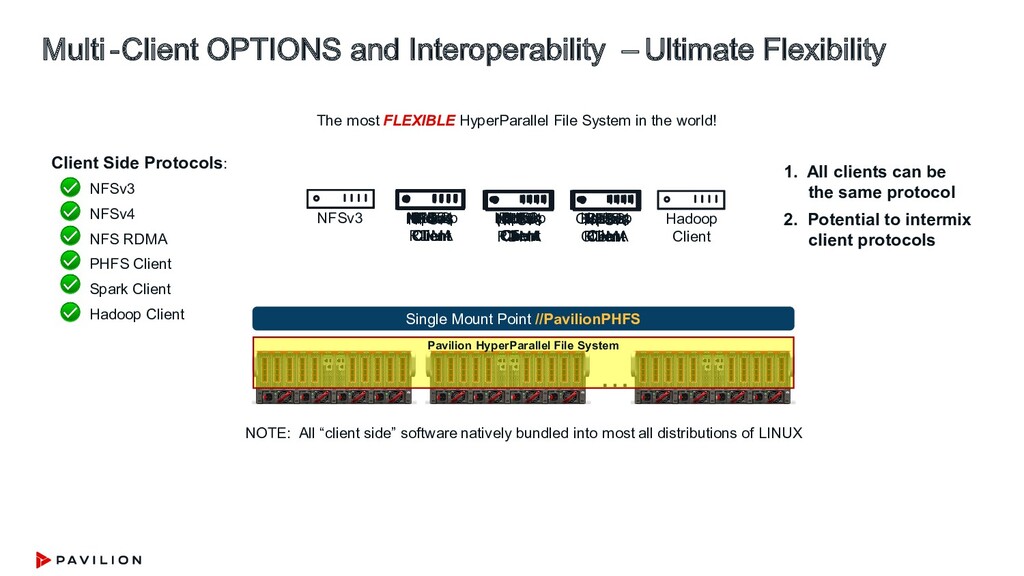
HyperParallel File System Single Mount Point //PavilionPHFS NOTE: All “client side” software natively bundled into most all distributions of LINUX NFSv3 NFSv3 NFSv3 NFSv4 NFSv4 NFSv4 PHFS Client PHFS Client PHFS Client NFS RDMA NFS RDMA NFS RDMA Spark Client Spark Client Spark Client Hadoop Client Hadoop Client Hadoop Client NFSv3 NFSv4 pNFS Gluster Client Hadoop Client Client Side Protocols: • NFSv3 • NFSv4 • NFS RDMA • PHFS Client • Spark Client • Hadoop Client 1. All clients can be the same protocol 2. Potential to intermix client protocols The most FLEXIBLE HyperParallel File System in the world!
technology unique and different? • Our Software… • Our enabling hardware…. The industry is taking notice Summary Why is our technology unique and different? • Our enabling hardware… 21
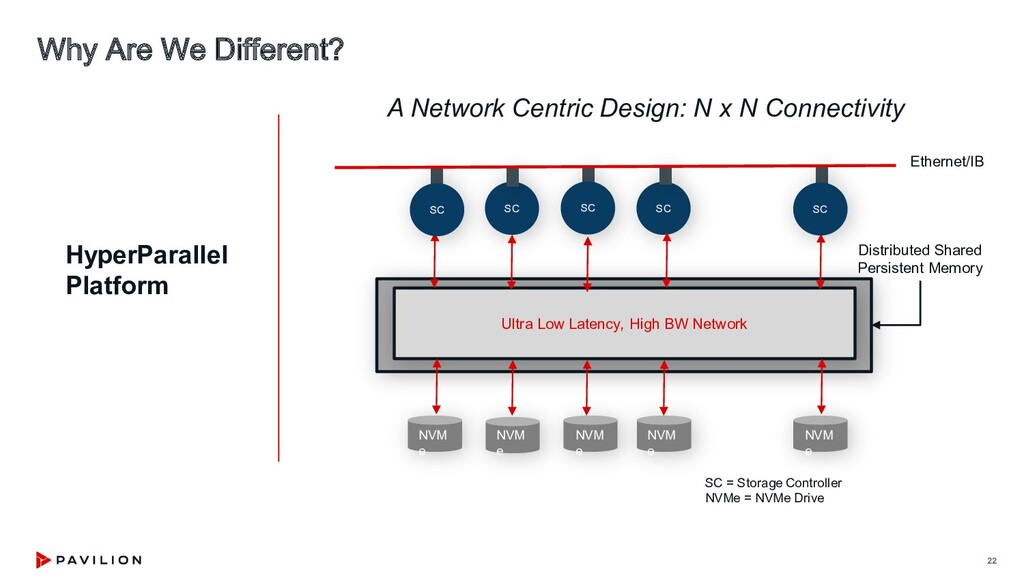
= NVMe Drive Ultra Low Latency, High BW Network SC SC Distributed Shared Persistent Memory Ethernet/IB SC SC SC NVM e NVM e NVM e NVM e NVM e HyperParallel Platform A Network Centric Design: N x N Connectivity
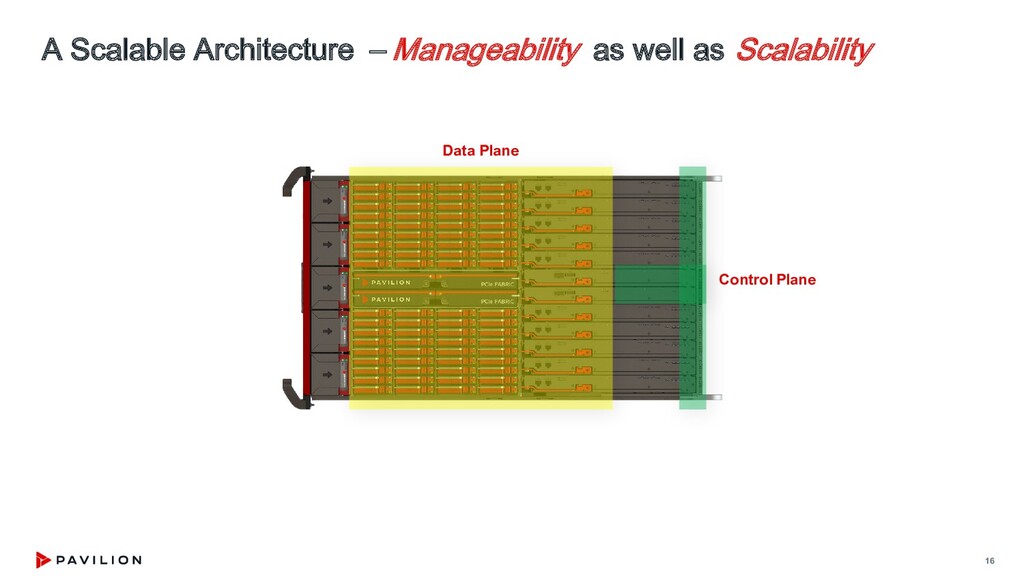
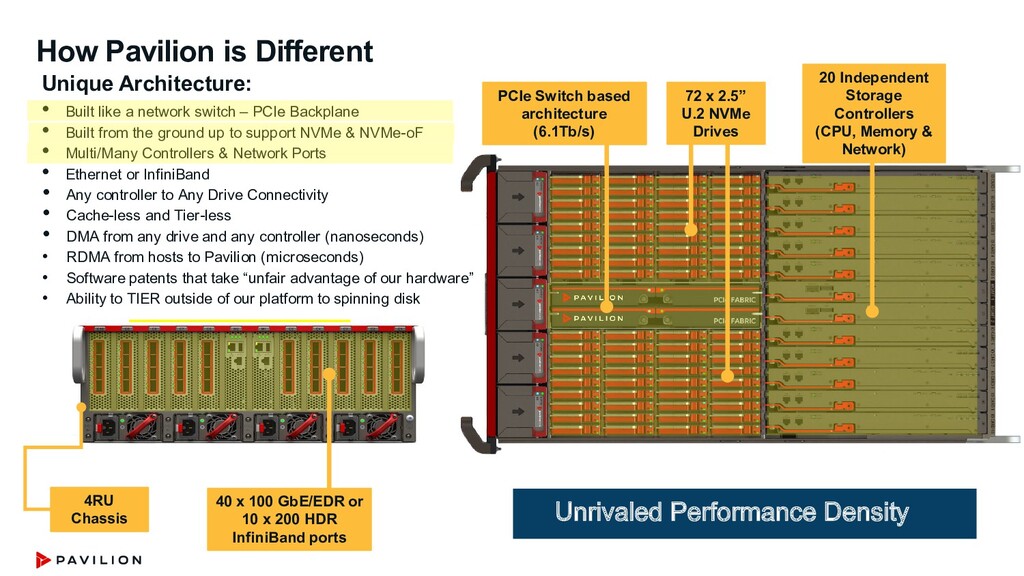
Independent Storage Controllers (CPU, Memory & Network) Unique Architecture: • Built like a network switch – PCIe Backplane • Built from the ground up to support NVMe & NVMe-oF • Multi/Many Controllers & Network Ports • Ethernet or InfiniBand 4RU Chassis 40 x 100 GbE/EDR or 10 x 200 HDR InfiniBand ports 72 x 2.5” U.2 NVMe Drives Unrivaled Performance Density • Any controller to Any Drive Connectivity • Cache-less and Tier-less • DMA from any drive and any controller (nanoseconds) • RDMA from hosts to Pavilion (microseconds) • Software patents that take “unfair advantage of our hardware” • Ability to TIER outside of our platform to spinning disk
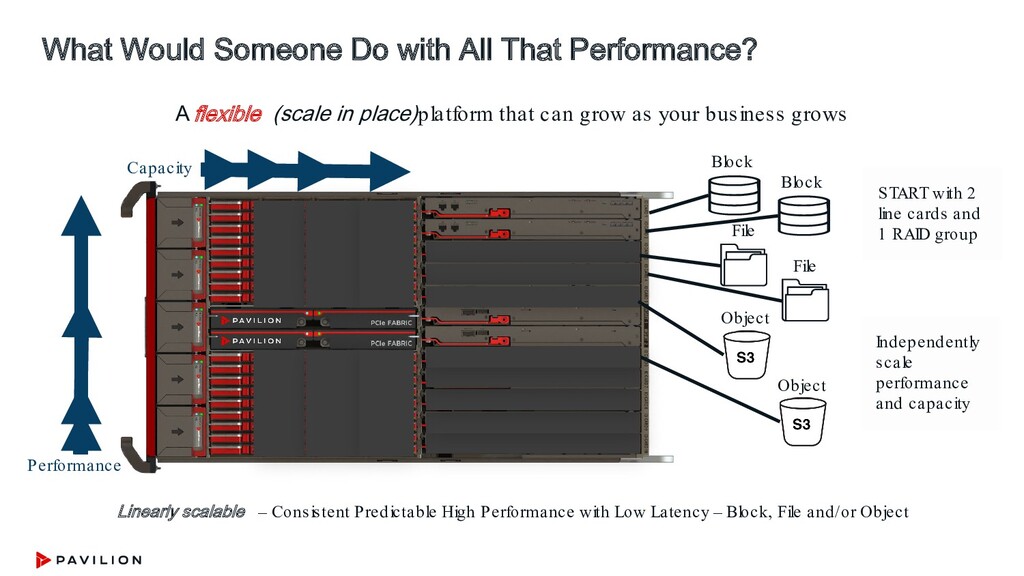
(scale in place)platform that can grow as your business grows Block Block File File Object Object Independently scale performance and capacity Linearly scalable – Consistent Predictable High Performance with Low Latency – Block, File and/or Object Performance Capacity START with 2 line cards and 1 RAID group
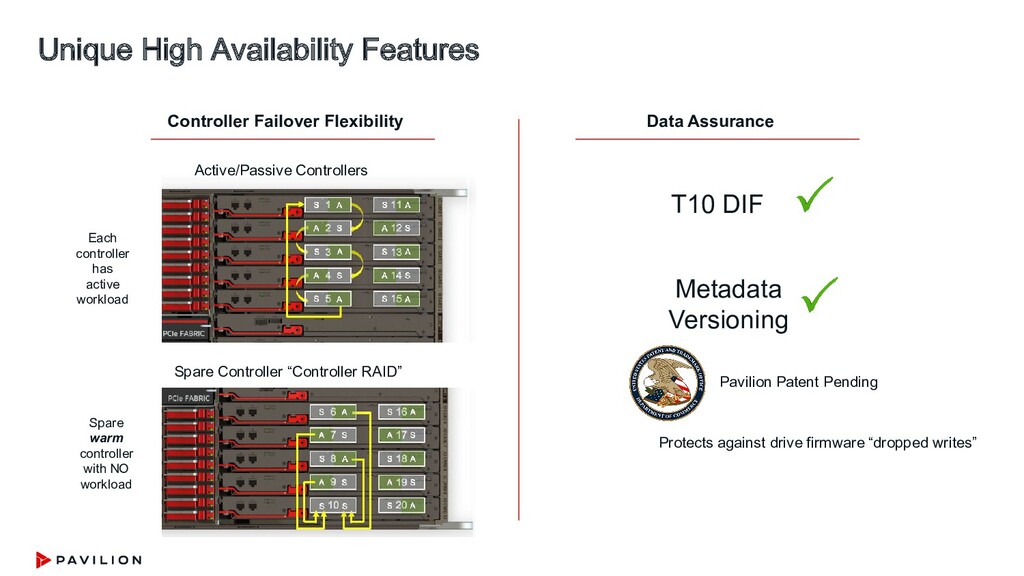
DIF Metadata Versioning Pavilion Patent Pending Protects against drive firmware “dropped writes” Active/Passive Controllers Each controller has active workload Spare Controller “Controller RAID” Spare warm controller with NO workload
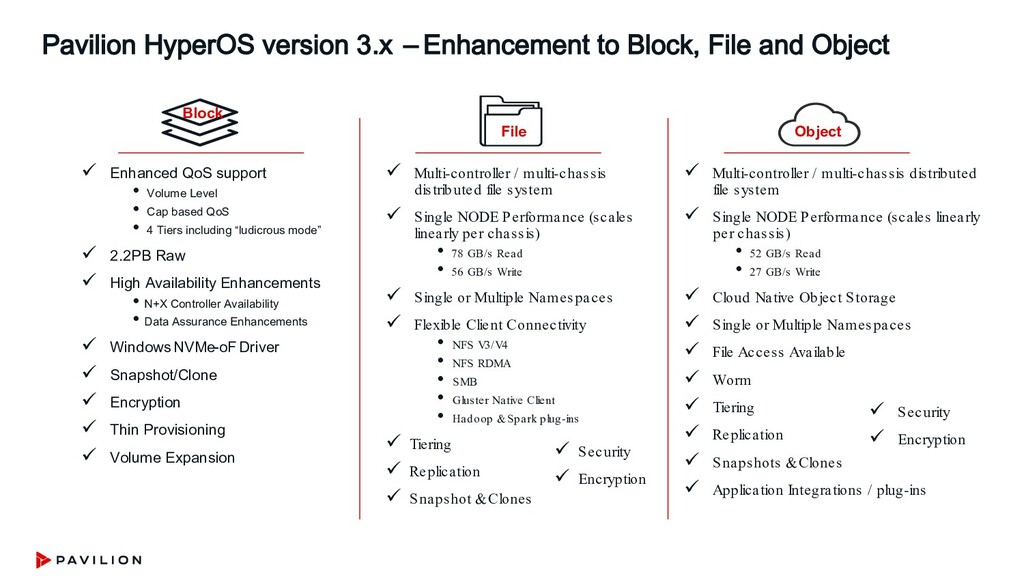
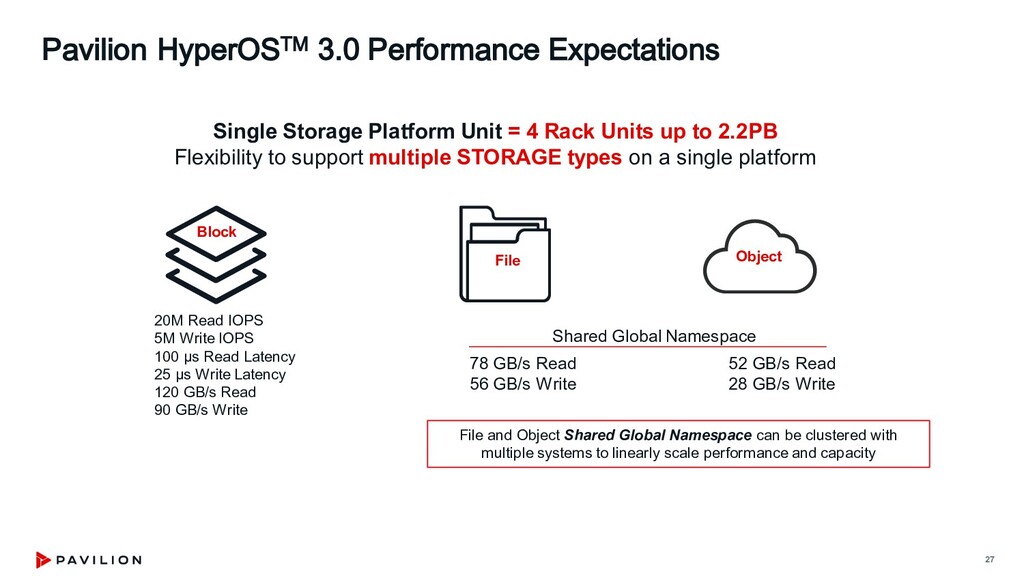
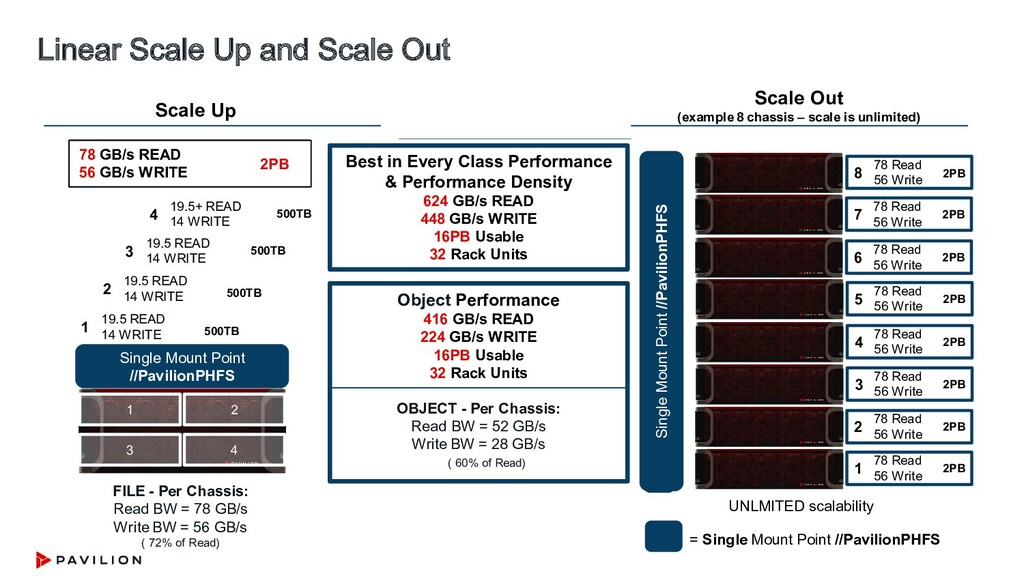
Storage Platform Unit = 4 Rack Units up to 2.2PB Flexibility to support multiple STORAGE types on a single platform File and Object Shared Global Namespace can be clustered with multiple systems to linearly scale performance and capacity 20M Read IOPS 5M Write IOPS 100 µs Read Latency 25 µs Write Latency 120 GB/s Read 90 GB/s Write 78 GB/s Read 56 GB/s Write 52 GB/s Read 28 GB/s Write Shared Global Namespace
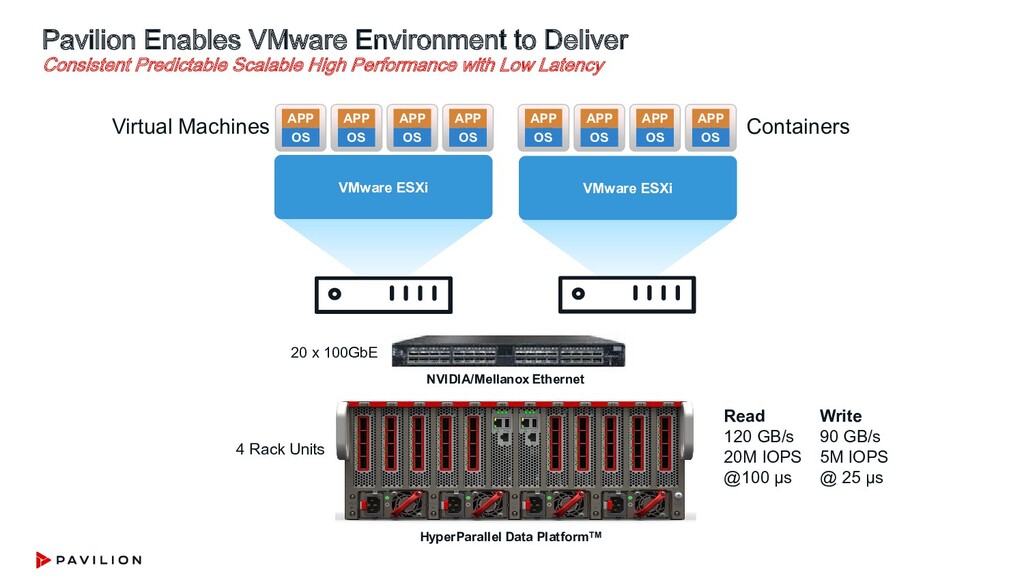
Performance with Low Latency HyperParallel Data PlatformTM NVIDIA/Mellanox Ethernet 20 x 100GbE 4 Rack Units Containers Virtual Machines Read 120 GB/s 20M IOPS @100 µs Write 90 GB/s 5M IOPS @ 25 µs VM VM VM VM VM VM VM VM VMware ESXi VMware ESXi APP OS APP OS APP OS APP OS APP OS APP OS APP OS APP OS
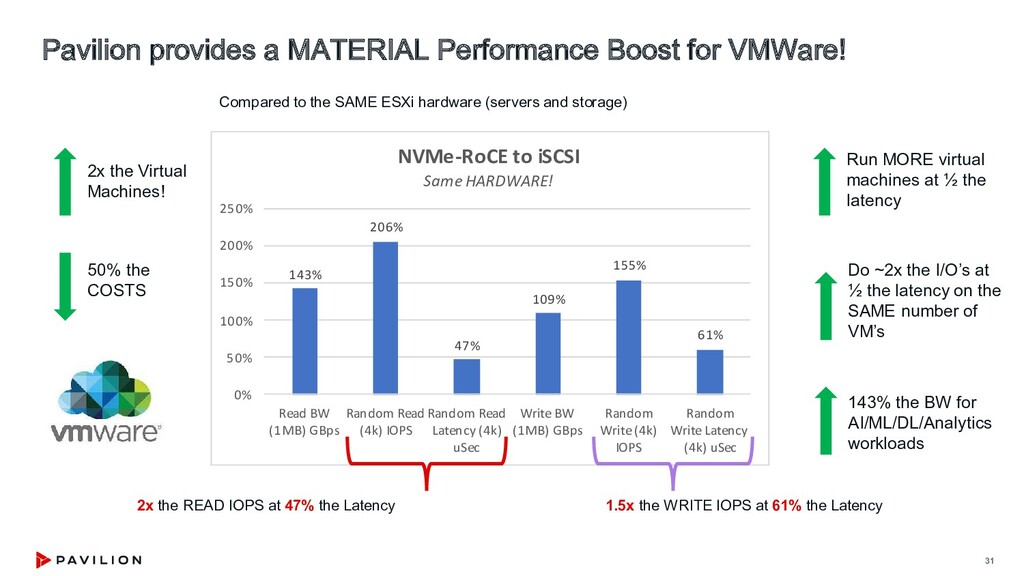
47% 109% 155% 61% 0% 50% 100% 150% 200% 250% Read BW (1MB) GBps Random Read (4k) IOPS Random Read Latency (4k) uSec Write BW (1MB) GBps Random Write (4k) IOPS Random Write Latency (4k) uSec NVMe-RoCE to iSCSI Same HARDWARE! 2x the READ IOPS at 47% the Latency 1.5x the WRITE IOPS at 61% the Latency Compared to the SAME ESXi hardware (servers and storage) 2x the Virtual Machines! 50% the COSTS Run MORE virtual machines at ½ the latency Do ~2x the I/O’s at ½ the latency on the SAME number of VM’s 143% the BW for AI/ML/DL/Analytics workloads 31
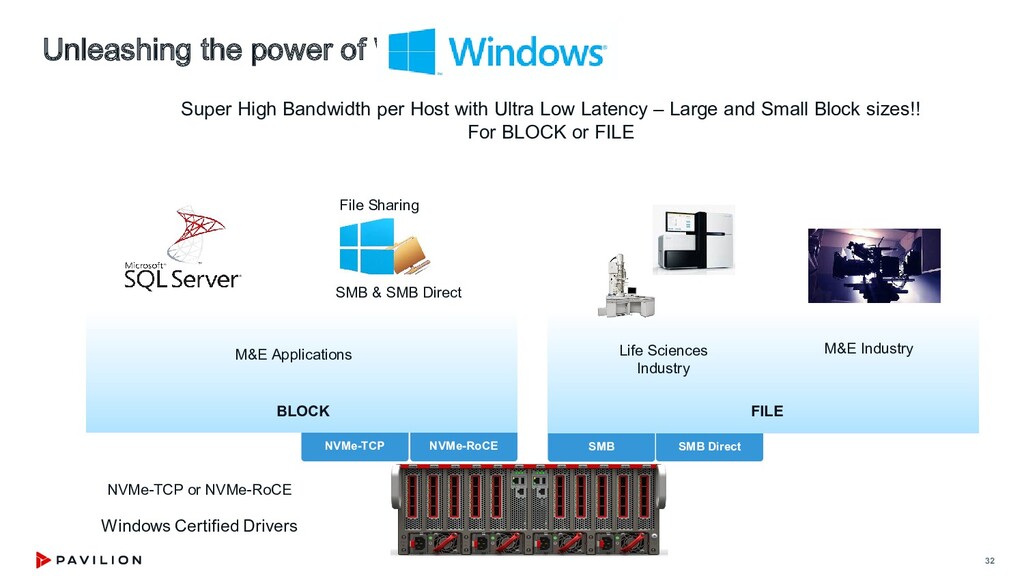
NVMe-TCP or NVMe-RoCE Windows Certified Drivers SMB SMB & SMB Direct File Sharing BLOCK FILE M&E Applications M&E Industry Life Sciences Industry Super High Bandwidth per Host with Ultra Low Latency – Large and Small Block sizes!! For BLOCK or FILE
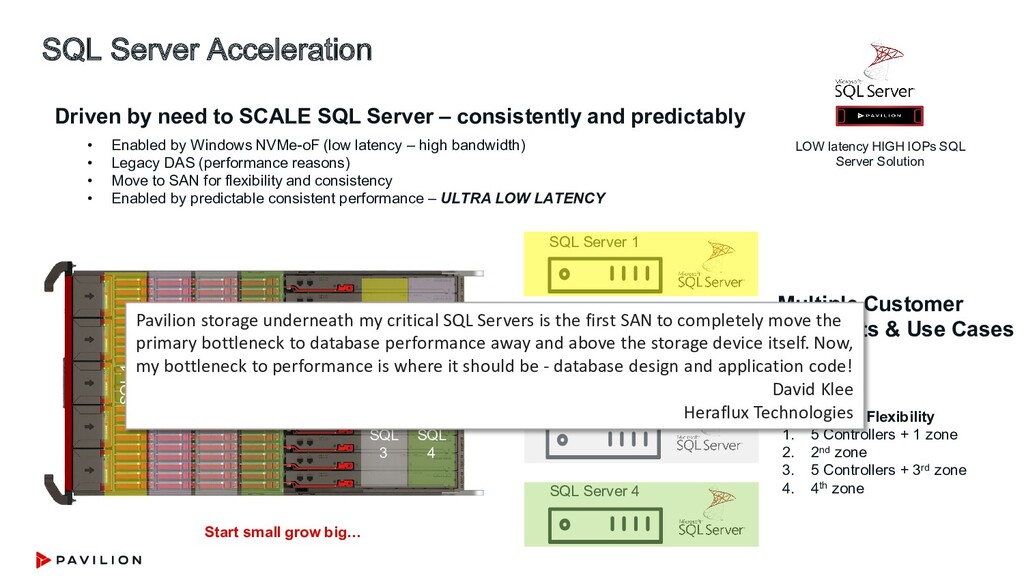
SQL Server 2 SQL 2 SQL 2 SQL Server 3 SQL 3 SQL 3 SQL Server 4 SQL 4 SQL 4 Driven by need to SCALE SQL Server – consistently and predictably • Enabled by Windows NVMe-oF (low latency – high bandwidth) • Legacy DAS (performance reasons) • Move to SAN for flexibility and consistency • Enabled by predictable consistent performance – ULTRA LOW LATENCY Multiple Customer Segments & Use Cases Enabled by Flexibility 1. 5 Controllers + 1 zone 2. 2nd zone 3. 5 Controllers + 3rd zone 4. 4th zone Start small grow big… SQL Server 1 SQL 1 SQL 1 Pavilion storage underneath my critical SQL Servers is the first SAN to completely move the primary bottleneck to database performance away and above the storage device itself. Now, my bottleneck to performance is where it should be - database design and application code! David Klee Heraflux Technologies
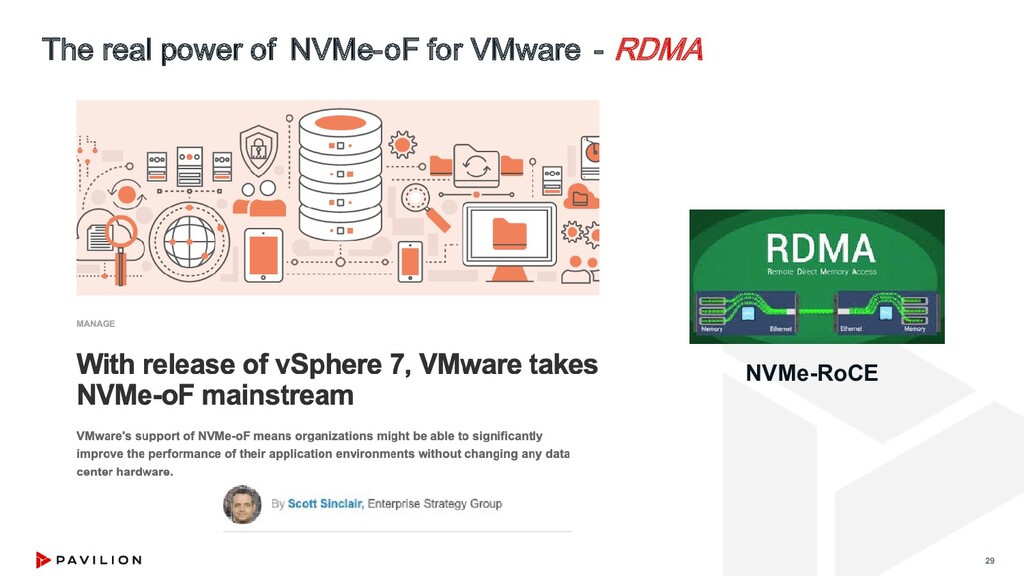
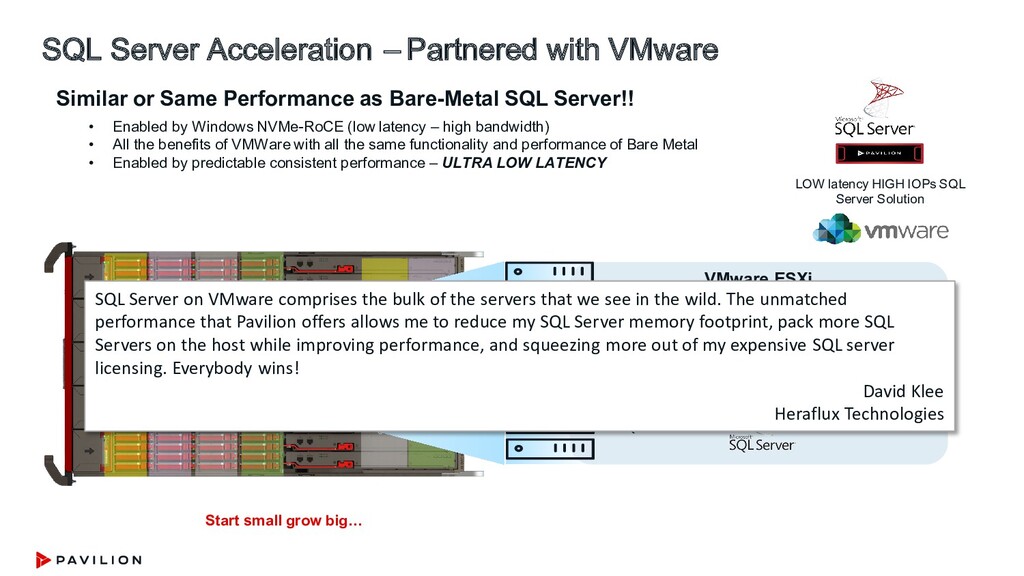
IOPs SQL Server Solution VMWare 2 VMWar e 2 VMWare 3 VMWar e 3 VMWare 4 VMWar e 4 Similar or Same Performance as Bare-Metal SQL Server!! • Enabled by Windows NVMe-RoCE (low latency – high bandwidth) • All the benefits of VMWare with all the same functionality and performance of Bare Metal • Enabled by predictable consistent performance – ULTRA LOW LATENCY Start small grow big… VMWare 1 VMWar e 1 VMware ESXi NVMe-RoCE SQL Server on VMware comprises the bulk of the servers that we see in the wild. The unmatched performance that Pavilion offers allows me to reduce my SQL Server memory footprint, pack more SQL Servers on the host while improving performance, and squeezing more out of my expensive SQL server licensing. Everybody wins! David Klee Heraflux Technologies
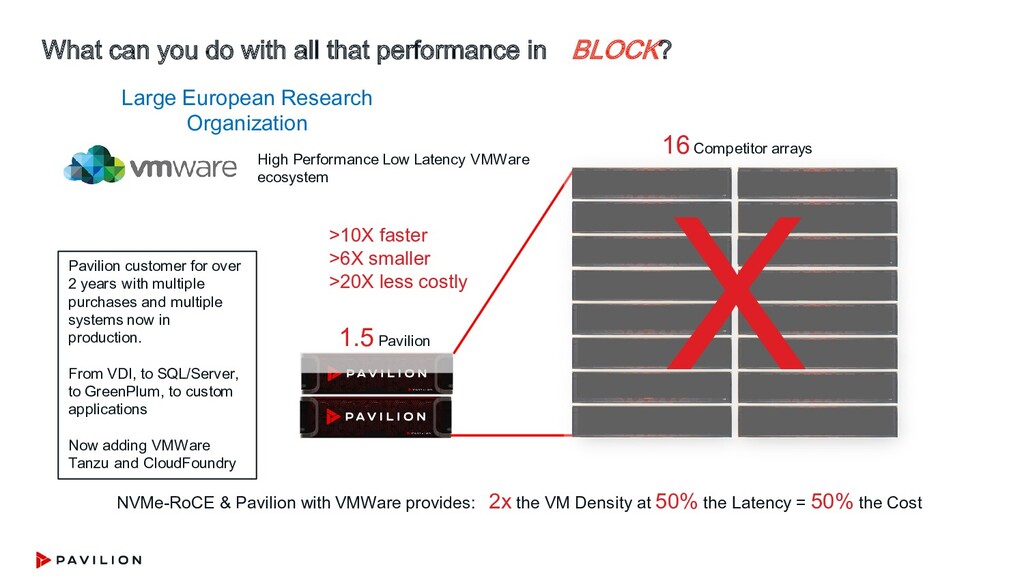
16 Competitor arrays High Performance Low Latency VMWare ecosystem Large European Research Organization 1.5 Pavilion Pavilion customer for over 2 years with multiple purchases and multiple systems now in production. From VDI, to SQL/Server, to GreenPlum, to custom applications Now adding VMWare Tanzu and CloudFoundry NVMe-RoCE & Pavilion with VMWare provides: 2x the VM Density at 50% the Latency = 50% the Cost >10X faster >6X smaller >20X less costly X
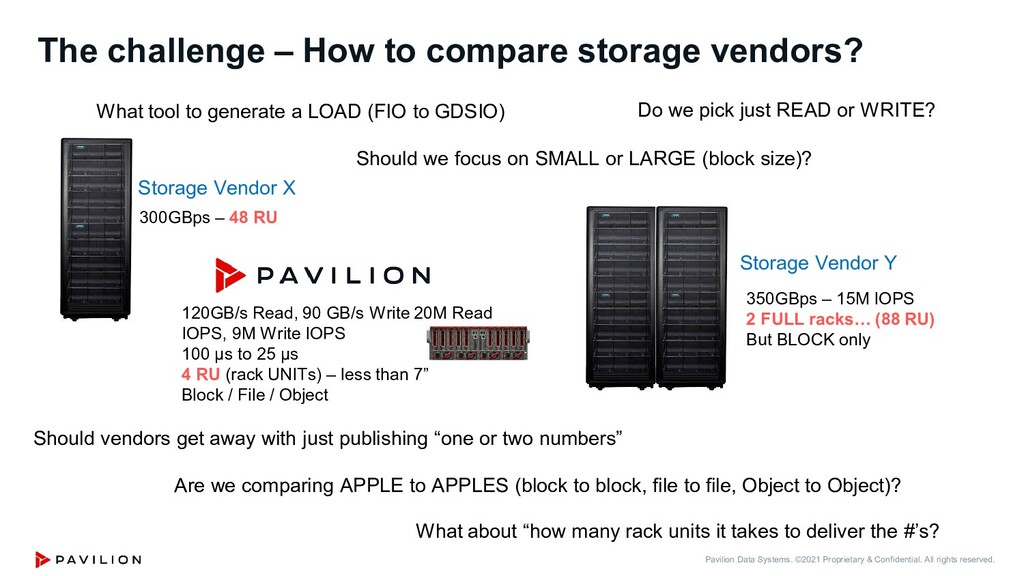
The challenge – How to compare storage vendors? What tool to generate a LOAD (FIO to GDSIO) Do we pick just READ or WRITE? Should we focus on SMALL or LARGE (block size)? Should vendors get away with just publishing “one or two numbers” What about “how many rack units it takes to deliver the #’s? Are we comparing APPLE to APPLES (block to block, file to file, Object to Object)? 350GBps – 15M IOPS 2 FULL racks… (88 RU) But BLOCK only Storage Vendor Y 300GBps – 48 RU Storage Vendor X 120GB/s Read, 90 GB/s Write 20M Read IOPS, 9M Write IOPS 100 µs to 25 µs 4 RU (rack UNITs) – less than 7” Block / File / Object
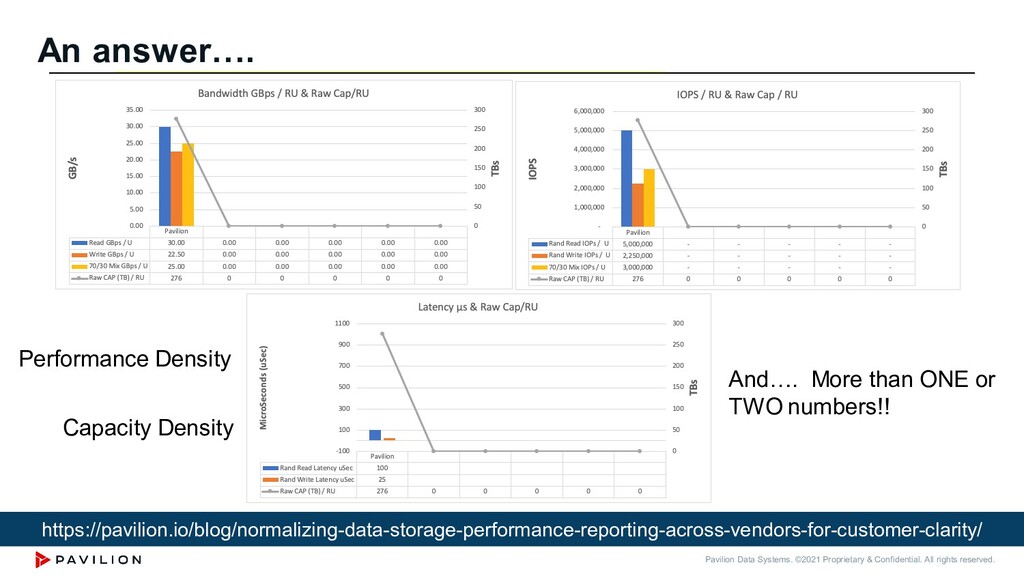
An answer…. And…. More than ONE or TWO numbers!! Performance Density Capacity Density https://pavilion.io/blog/normalizing-data-storage-performance-reporting-across-vendors-for-customer-clarity/
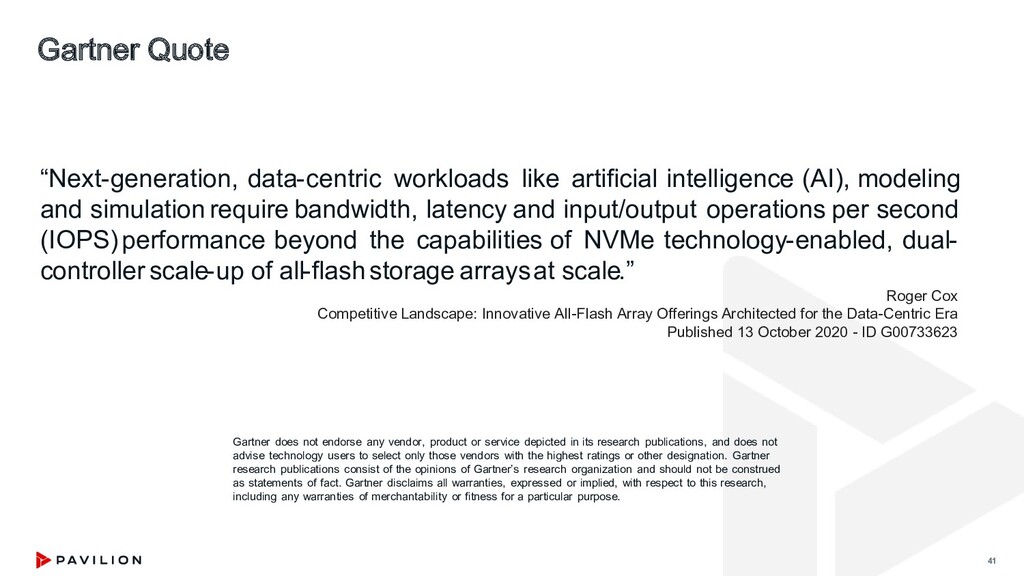
and simulation require bandwidth, latency and input/output operations per second (IOPS)performance beyond the capabilities of NVMe technology-enabled, dual- controller scale-up of all-flashstorage arraysat scale.” Roger Cox Competitive Landscape: Innovative All-Flash Array Offerings Architected for the Data-Centric Era Published 13 October 2020 - ID G00733623 Gartner does not endorse any vendor, product or service depicted in its research publications, and does not advise technology users to select only those vendors with the highest ratings or other designation. Gartner research publications consist of the opinions of Gartner’s research organization and should not be construed as statements of fact. Gartner disclaims all warranties, expressed or implied, with respect to this research, including any warranties of merchantability or fitness for a particular purpose. 41
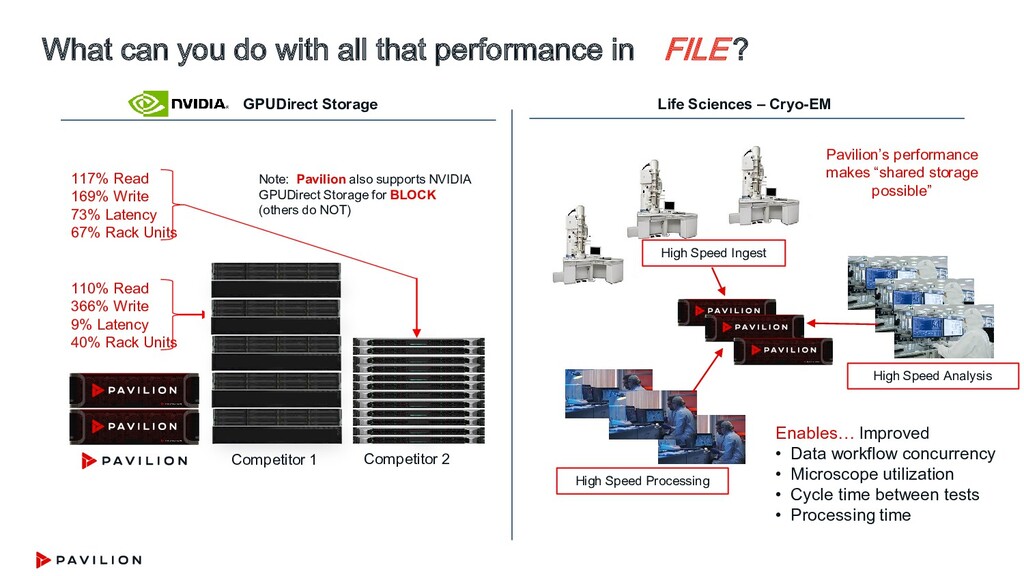
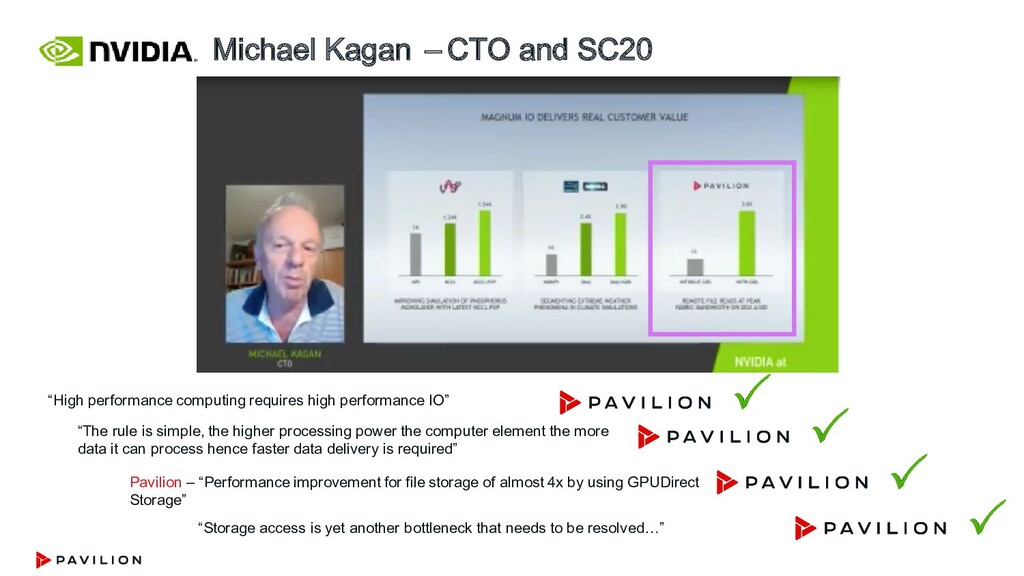
high performance IO” “The rule is simple, the higher processing power the computer element the more data it can process hence faster data delivery is required” “Storage access is yet another bottleneck that needs to be resolved…” Pavilion – “Performance improvement for file storage of almost 4x by using GPUDirect Storage”
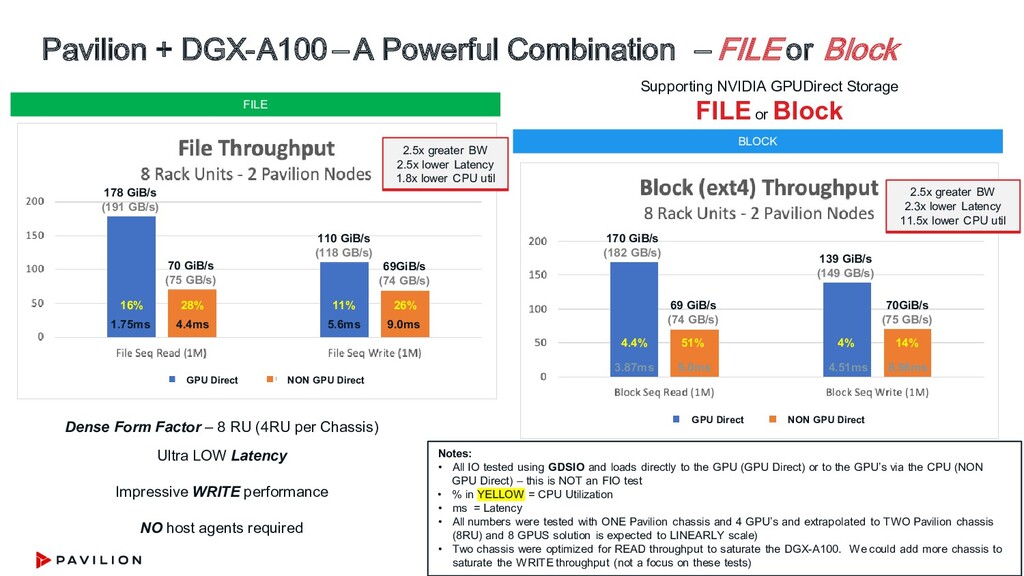
43 70 GiB/s (75 GB/s) 178 GiB/s (191 GB/s) 110 GiB/s (118 GB/s) 69GiB/s (74 GB/s) 9.0ms 1.75ms 4.4ms 5.6ms 26% 16% 28% 11% BLOCK 69 GiB/s (74 GB/s) 170 GiB/s (182 GB/s) 139 GiB/s (149 GB/s) 70GiB/s (75 GB/s) 8.96ms 3.87ms 9.0ms 4.51ms 14% 4.4% 51% 4% Supporting NVIDIA GPUDirect Storage FILEor Block Dense Form Factor – 8 RU (4RU per Chassis) Ultra LOW Latency Impressive WRITE performance Notes: • All IO tested using GDSIO and loads directly to the GPU (GPU Direct) or to the GPU’s via the CPU (NON GPU Direct) – this is NOT an FIO test • % in YELLOW = CPU Utilization • ms = Latency • All numbers were tested with ONE Pavilion chassis and 4 GPU’s and extrapolated to TWO Pavilion chassis (8RU) and 8 GPUS solution is expected to LINEARLY scale) • Two chassis were optimized for READ throughput to saturate the DGX-A100. We could add more chassis to saturate the WRITE throughput (not a focus on these tests) NO host agents required FILE 2.5x greater BW 2.5x lower Latency 1.8x lower CPU util 2.5x greater BW 2.3x lower Latency 11.5x lower CPU util GPU Direct NON GPU Direct GPU Direct NON GPU Direct
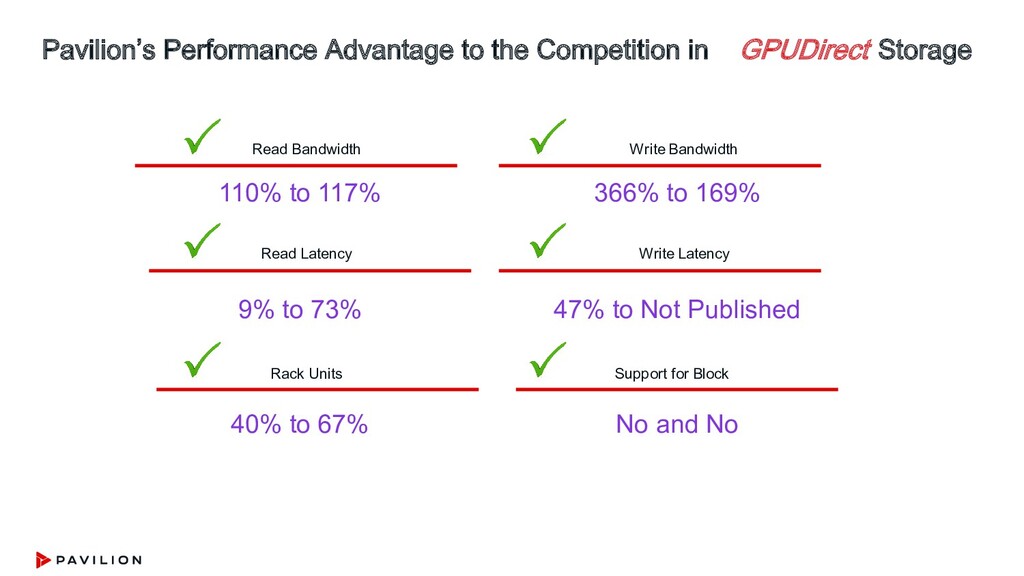
Bandwidth Write Bandwidth Rack Units Support for Block 40% to 67% 110% to 117% 366% to 169% Read Latency Write Latency 9% to 73% 47% to Not Published No and No
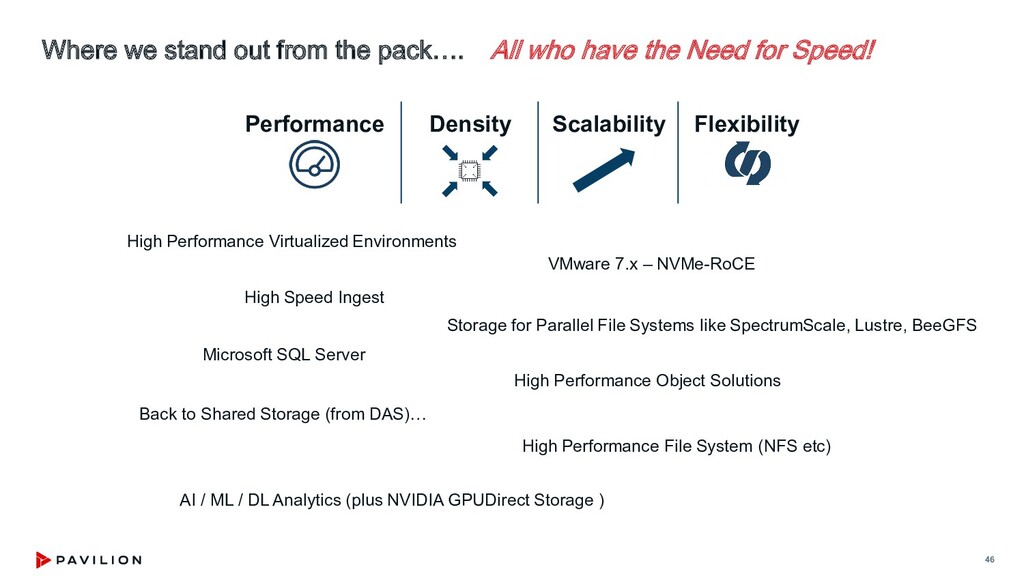
the Need for Speed! 46 Flexibility Performance Density Scalability VMware 7.x – NVMe-RoCE Storage for Parallel File Systems like SpectrumScale, Lustre, BeeGFS Microsoft SQL Server High Performance Object Solutions High Performance File System (NFS etc) Back to Shared Storage (from DAS)… AI / ML / DL Analytics (plus NVIDIA GPUDirect Storage ) High Speed Ingest High Performance Virtualized Environments
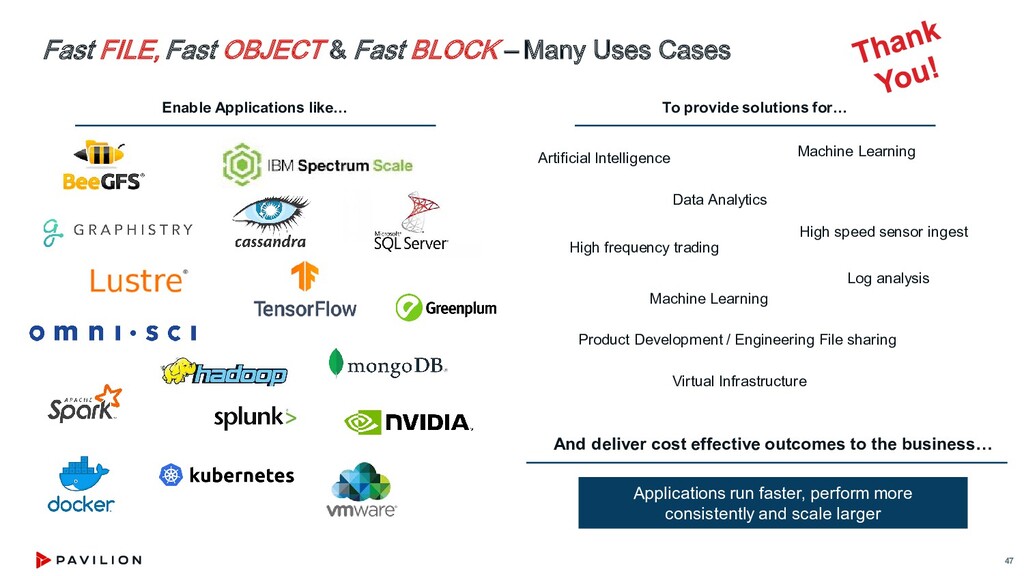
Cases 47 Applications run faster, perform more consistently and scale larger To provide solutions for… And deliver cost effective outcomes to the business… High speed sensor ingest High frequency trading Machine Learning Artificial Intelligence Data Analytics Virtual Infrastructure Log analysis Product Development / Engineering File sharing Machine Learning Enable Applications like…


 itpresstour
 puhitaku
 prog893
 rfdnxbro
 4o1sobblue
 makocchi
 techtekt
 keeg
keeg
 pfn
pfn
 endonanana
 yamanoku
 raspython3
 koukihosaka
 jacobtomlinson
 gurzu
gurzu
 jonoalderson
 inesmontani
 deanohume
 mojombo
 sonatard
 62gerente
 morganepeng
 techseoconnect
 tenderlove
 tammyeverts