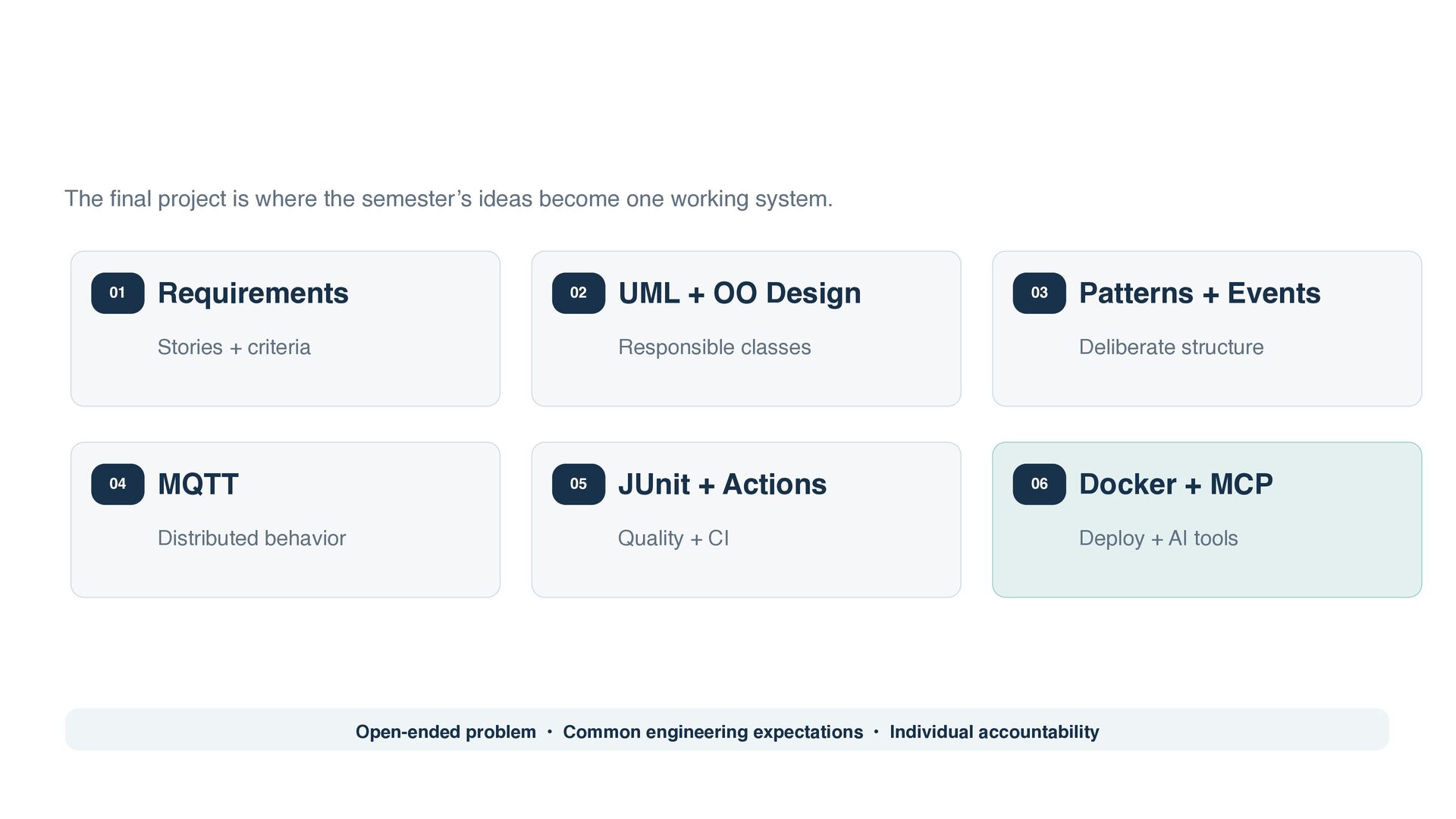
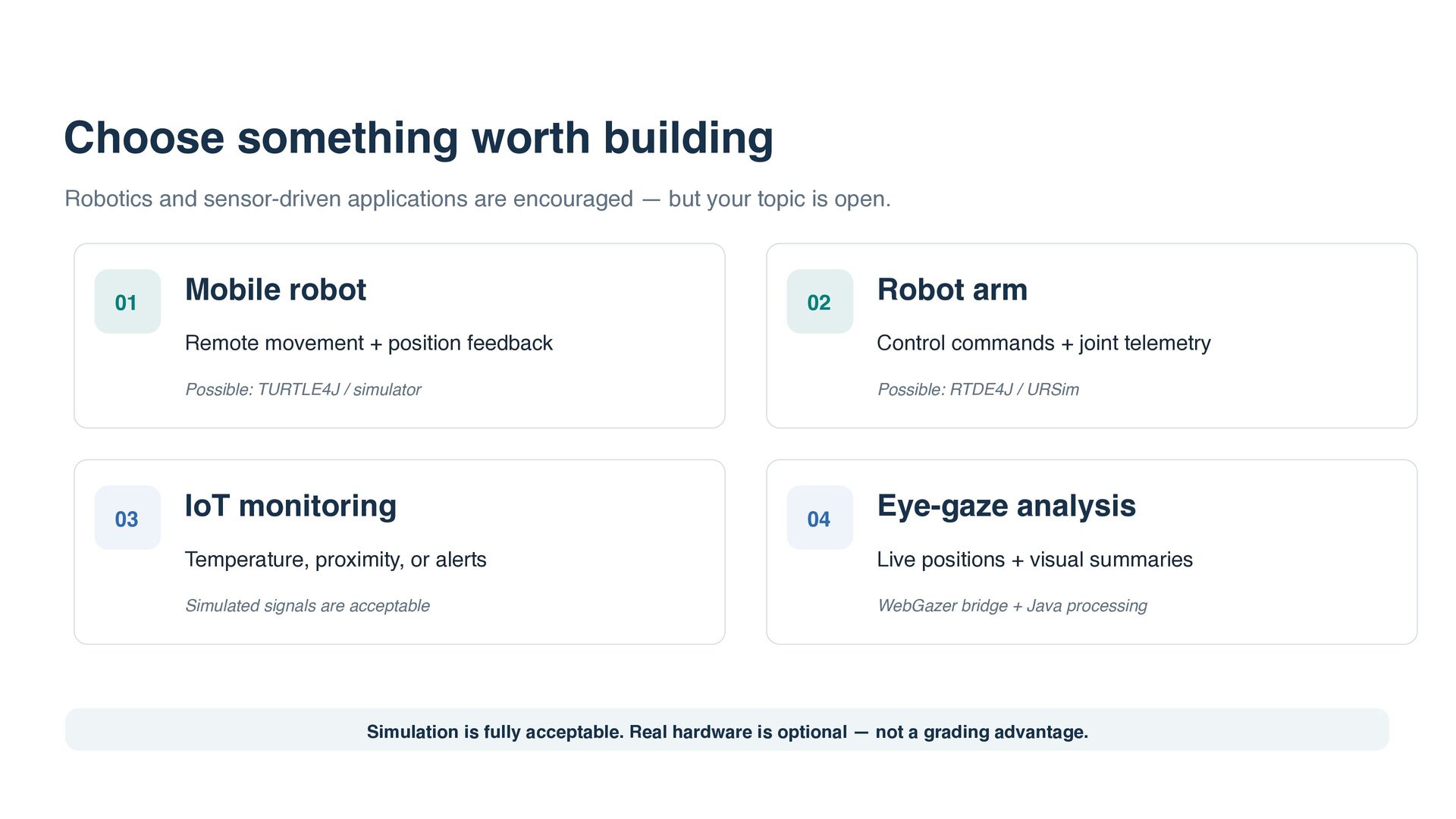
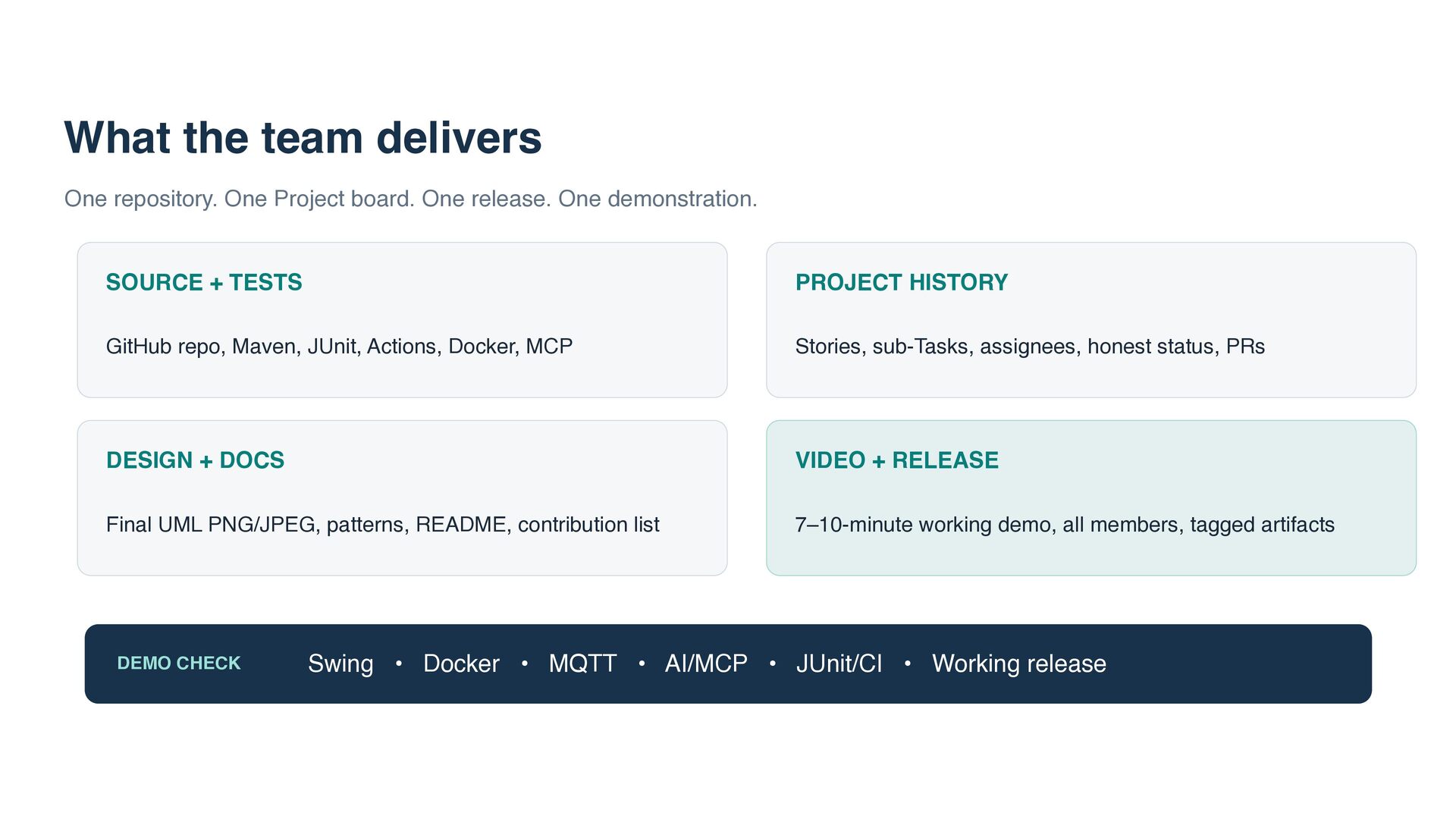
— but your topic is open. 01 03 Mobile robot 02 Robot arm Remote movement + position feedback Control commands + joint telemetry Possible: TURTLE4J / simulator Possible: RTDE4J / URSim IoT monitoring 04 Eye-gaze analysis Temperature, proximity, or alerts Live positions + visual summaries Simulated signals are acceptable WebGazer bridge + Java processing Simulation is fully acceptable. Real hardware is optional — not a grading advantage.
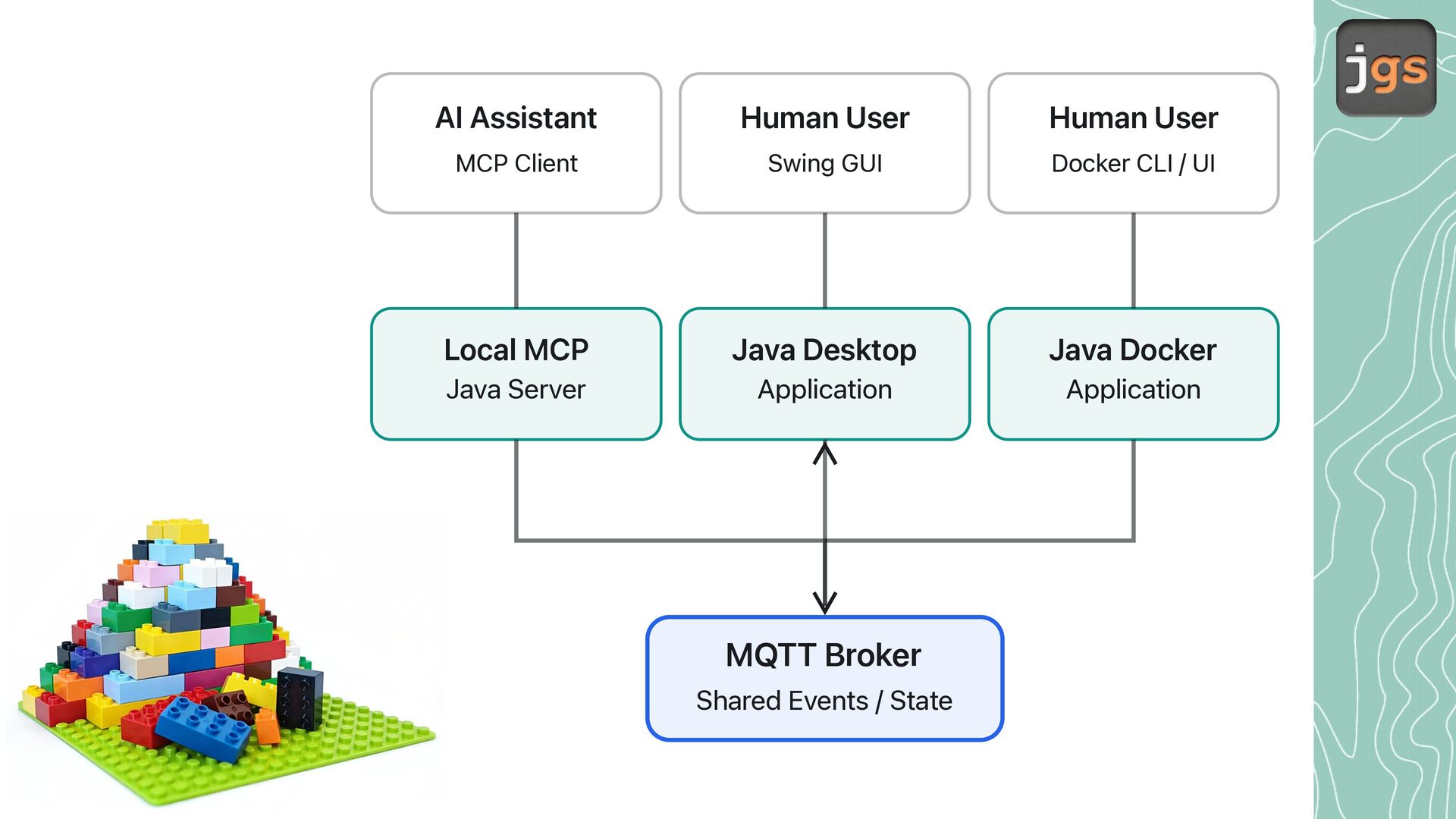
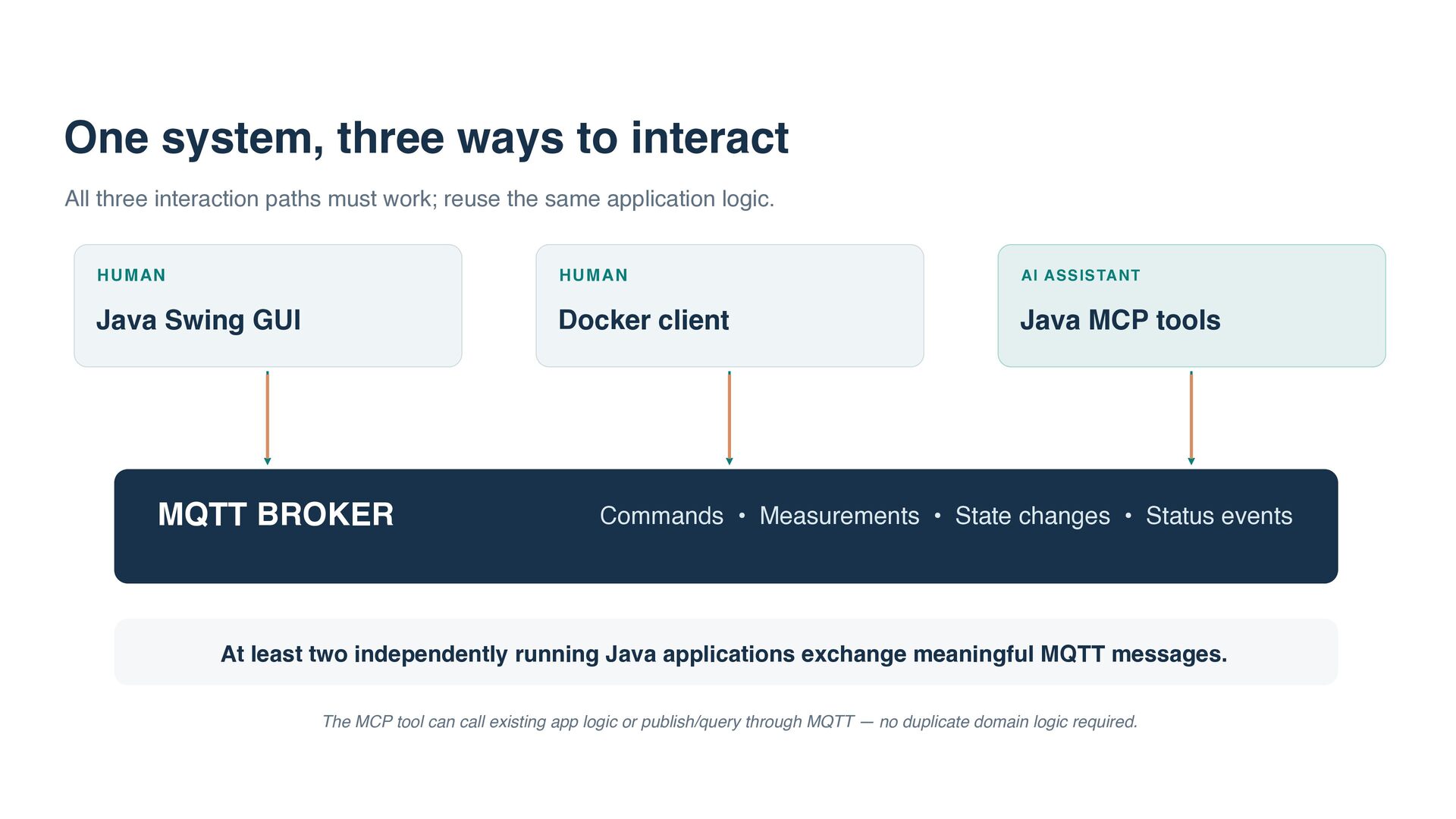
must work; reuse the same application logic. HUMAN HUMAN AI ASSISTANT Java Swing GUI Docker client Java MCP tools MQTT BROKER Commands • Measurements • State changes • Status events At least two independently running Java applications exchange meaningful MQTT messages. The MCP tool can call existing app logic or publish/query through MQTT — no duplicate domain logic required.
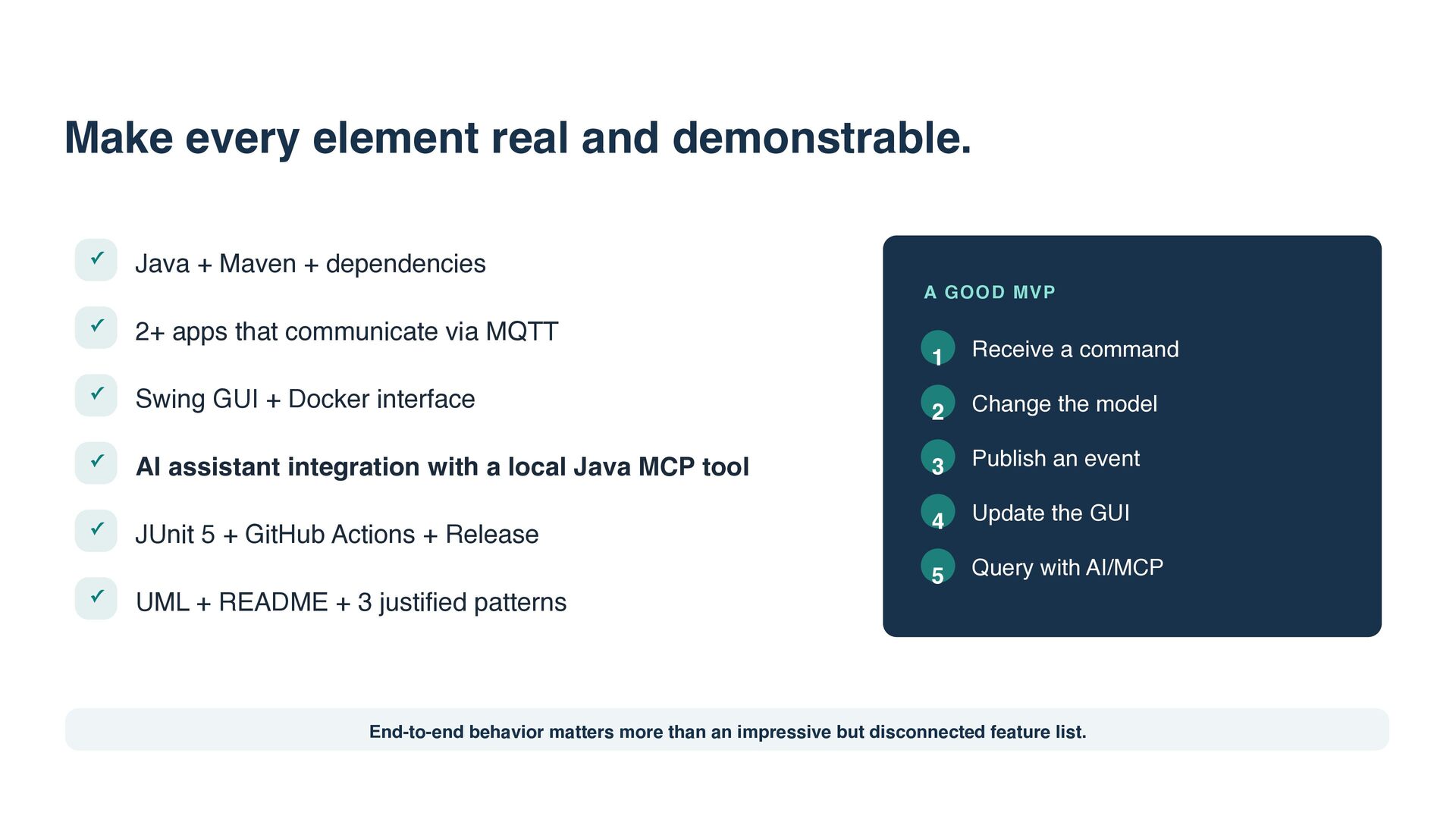
+ dependencies A GOOD MVP ✓ 2+ apps that communicate via MQTT 1 Receive a command ✓ Swing GUI + Docker interface 2 Change the model ✓ AI assistant integration with a local Java MCP tool 3 Publish an event 4 Update the GUI 5 Query with AI/MCP ✓ ✓ JUnit 5 + GitHub Actions + Release UML + README + 3 justified patterns End-to-end behavior matters more than an impressive but disconnected feature list.
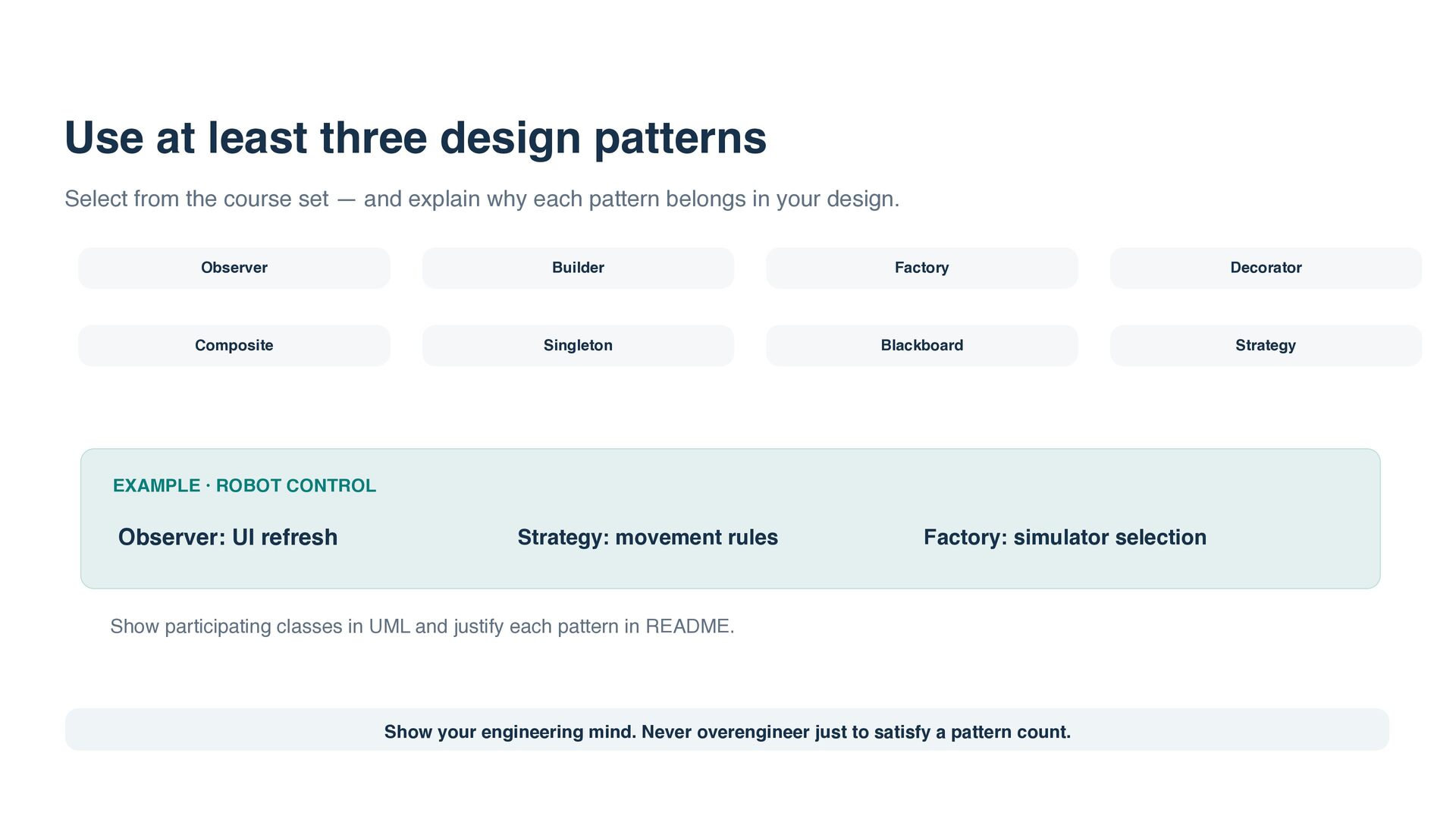
set — and explain why each pattern belongs in your design. Observer Builder Factory Decorator Composite Singleton Blackboard Strategy EXAMPLE · ROBOT CONTROL Observer: UI refresh Strategy: movement rules Factory: simulator selection Show participating classes in UML and justify each pattern in README. Show your engineering mind. Never overengineer just to satisfy a pattern count.
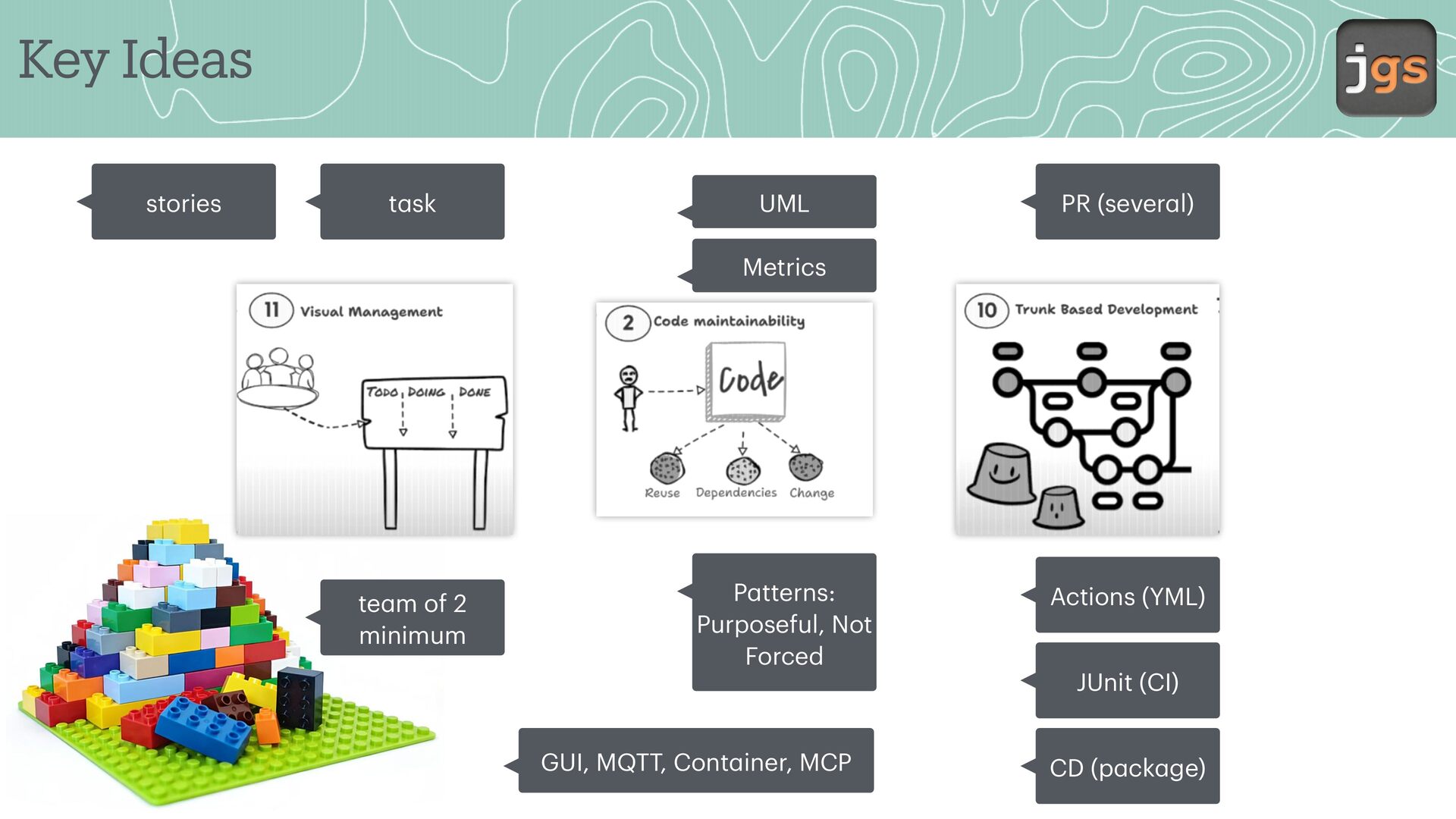
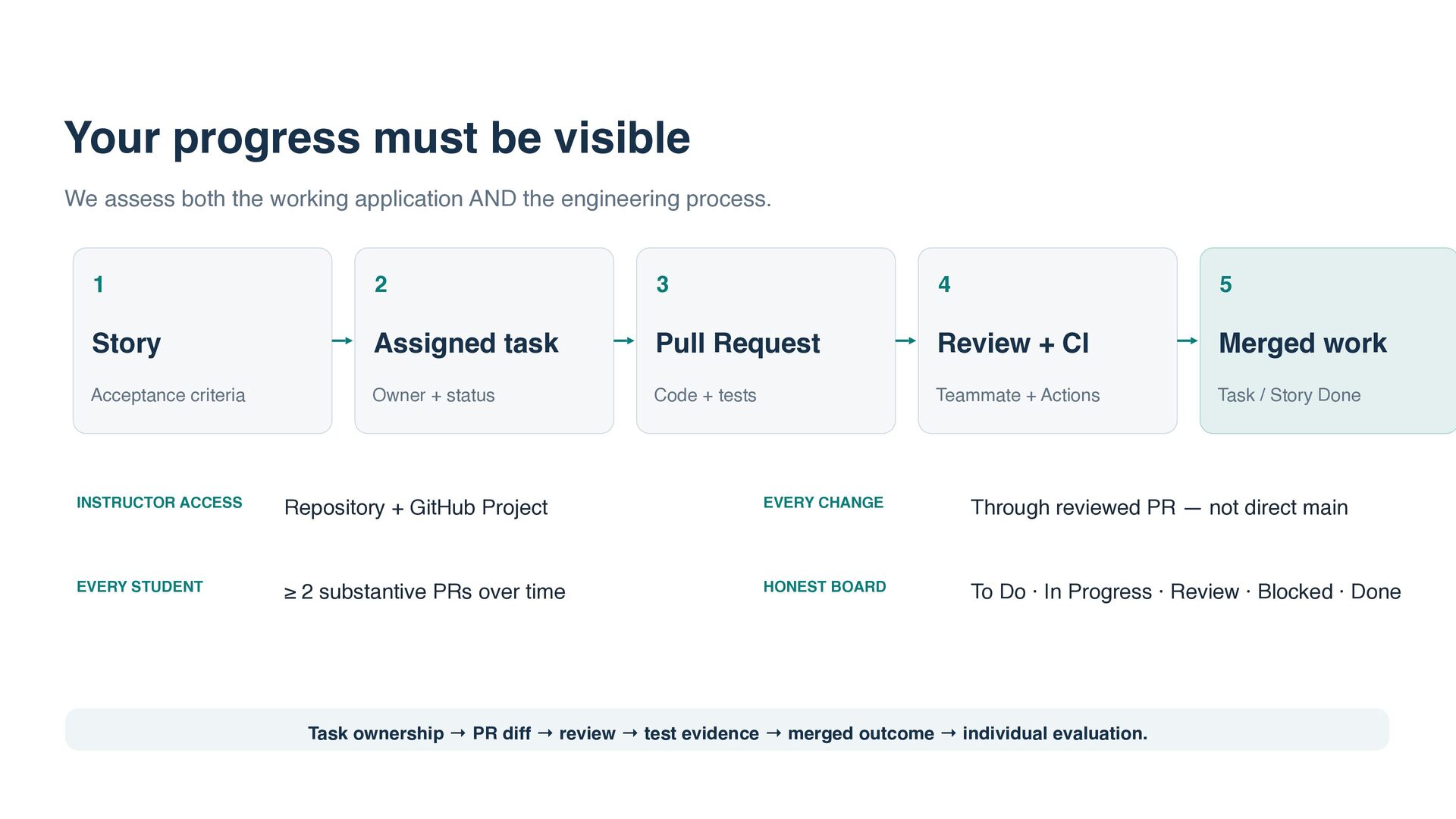
application AND the engineering process. 1 2 3 4 5 Story Assigned task Pull Request Review + CI Merged work Acceptance criteria Owner + status Code + tests Teammate + Actions Task / Story Done INSTRUCTOR ACCESS Repository + GitHub Project EVERY CHANGE Through reviewed PR — not direct main EVERY STUDENT ≥ 2 substantive PRs over time HONEST BOARD To Do · In Progress · Review · Blocked · Done Task ownership → PR diff → review → test evidence → merged outcome → individual evaluation.
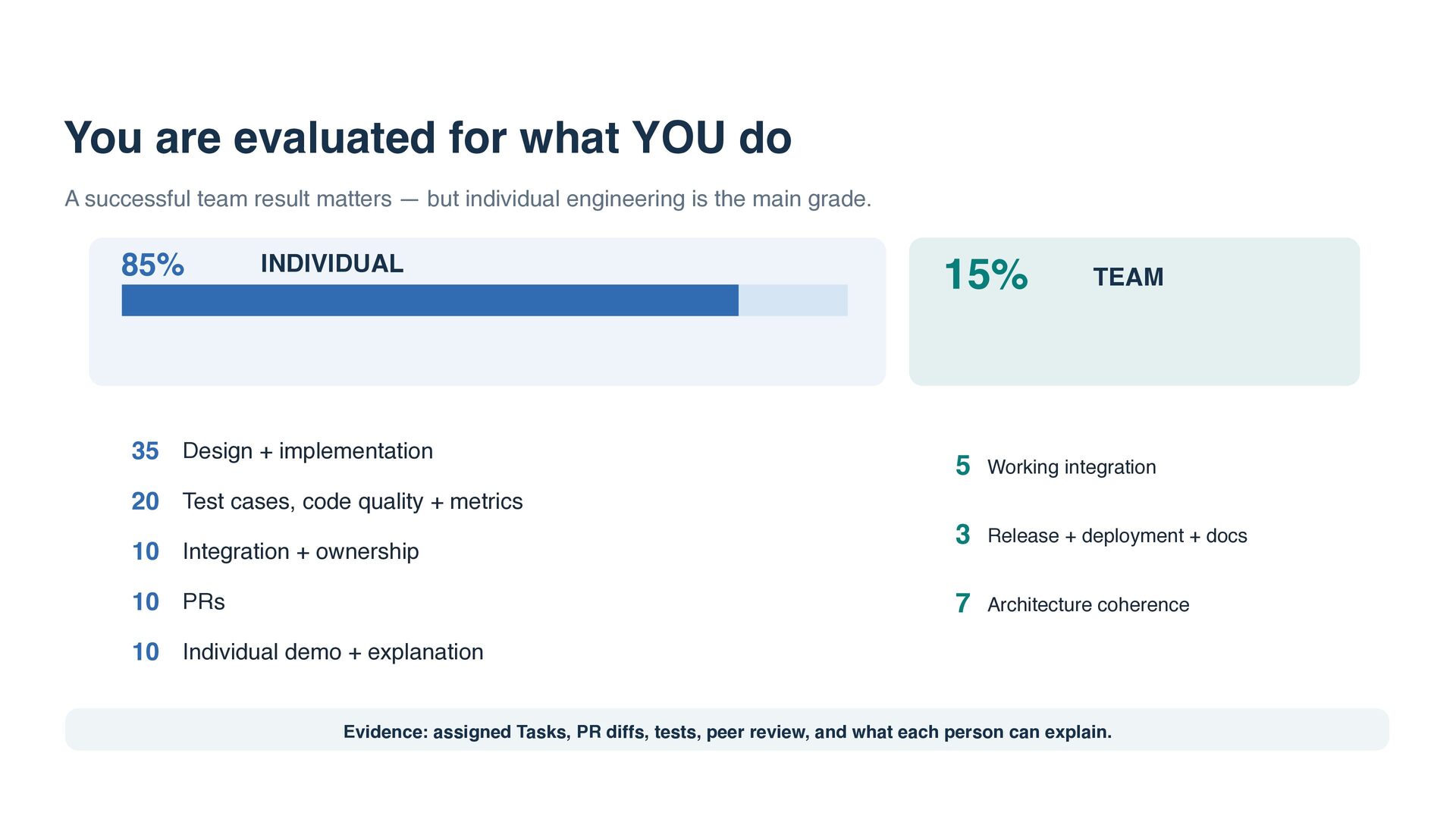
result matters — but individual engineering is the main grade. 85% INDIVIDUAL 35 Design + implementation 15% TEAM 5 Working integration 20 Test cases, code quality + metrics 10 Integration + ownership 10 PRs 3 Release + deployment + docs 7 Architecture coherence 10 Individual demo + explanation Evidence: assigned Tasks, PR diffs, tests, peer review, and what each person can explain.
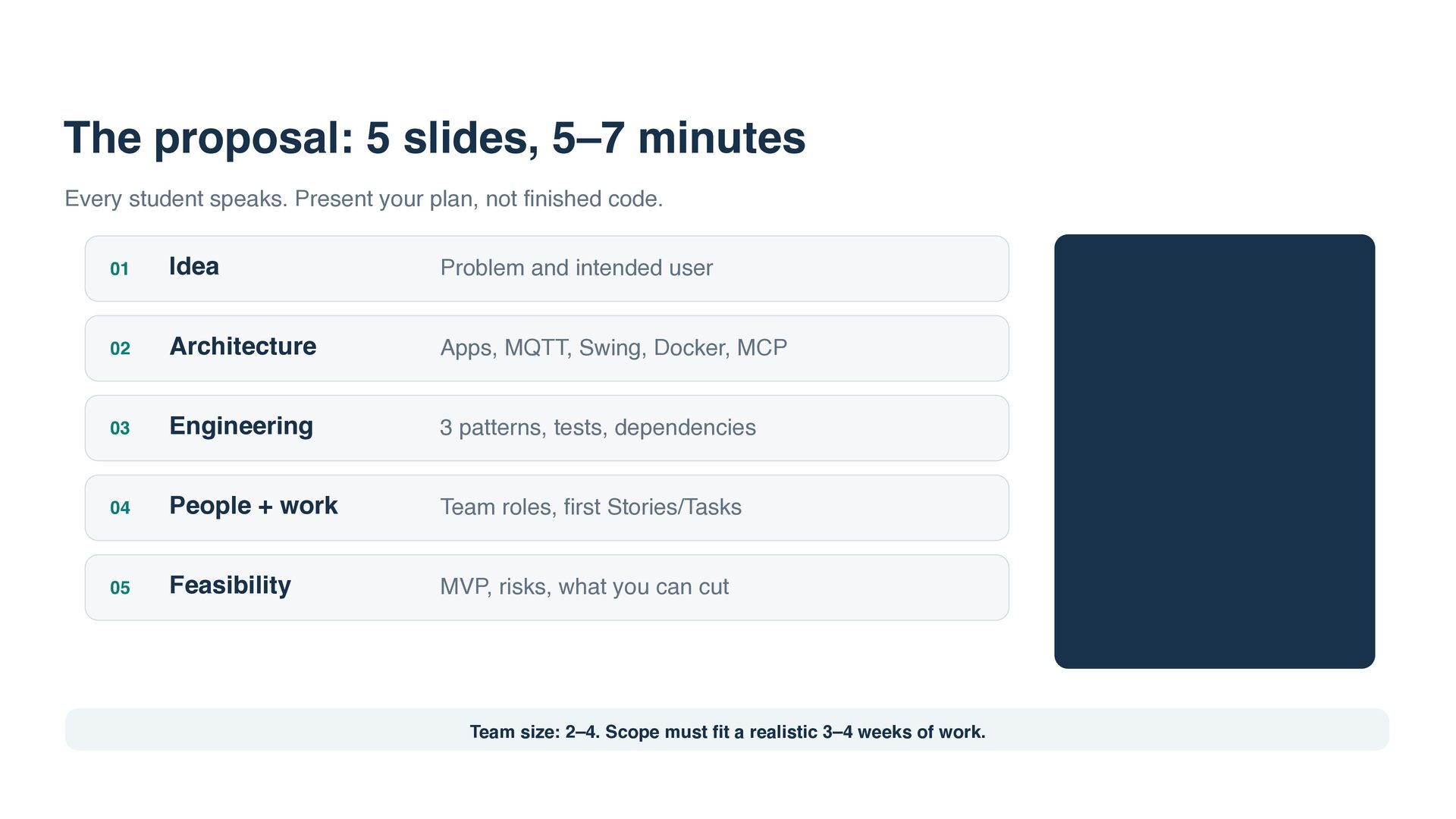
your plan, not finished code. 01 Idea Problem and intended user 02 Architecture Apps, MQTT, Swing, Docker, MCP 03 Engineering 3 patterns, tests, dependencies 04 People + work Team roles, first Stories/Tasks 05 Feasibility MVP, risks, what you can cut Team size: 2–4. Scope must fit a realistic 3–4 weeks of work.
Fall 2026 Copyright Notice. These slides are provided exclusively for educational use in CSC 3100 within the California State University system. Redistribution or use for any other purpose is prohibited without prior written permission.


 javiergs
 t0yohei
 ryunen344
 dalinaum
 sylph01
 raeminkang
 kasacchiful
 yahir0
 yuuu
 kamina_zzz
 vivion
 naruogram
 rkaga
 cargoodrich
 trallard
 chikuwait
 aleyda
 erikaheidi
 bkeepers
 lara
 codingconduct
 shlominoach
 pedronauck