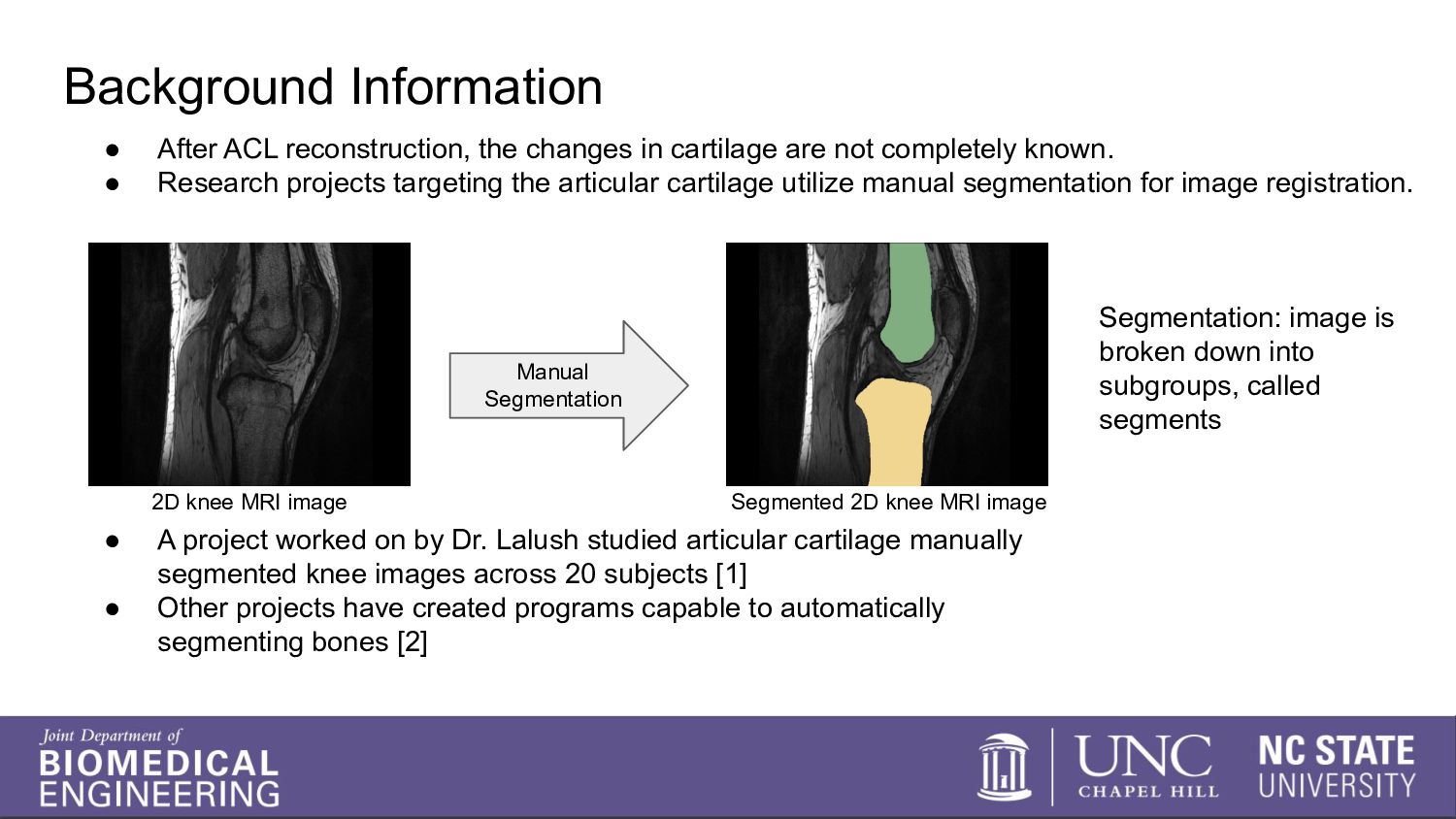
are not completely known. • Research projects targeting the articular cartilage utilize manual segmentation for image registration. Manual Segmentation • A project worked on by Dr. Lalush studied articular cartilage manually segmented knee images across 20 subjects [1] • Other projects have created programs capable to automatically segmenting bones [2] Segmentation: image is broken down into subgroups, called segments 2D knee MRI image Segmented 2D knee MRI image
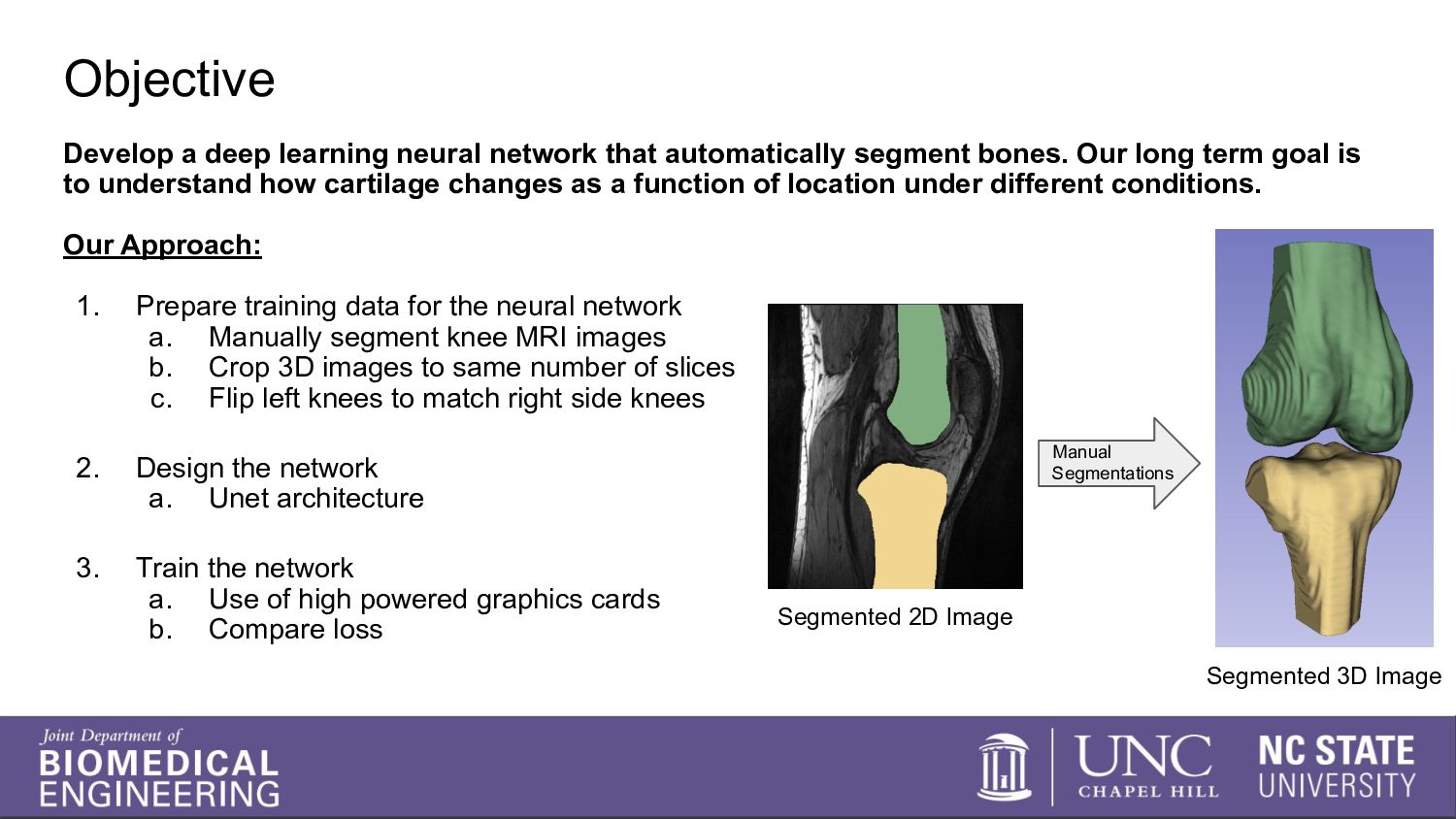
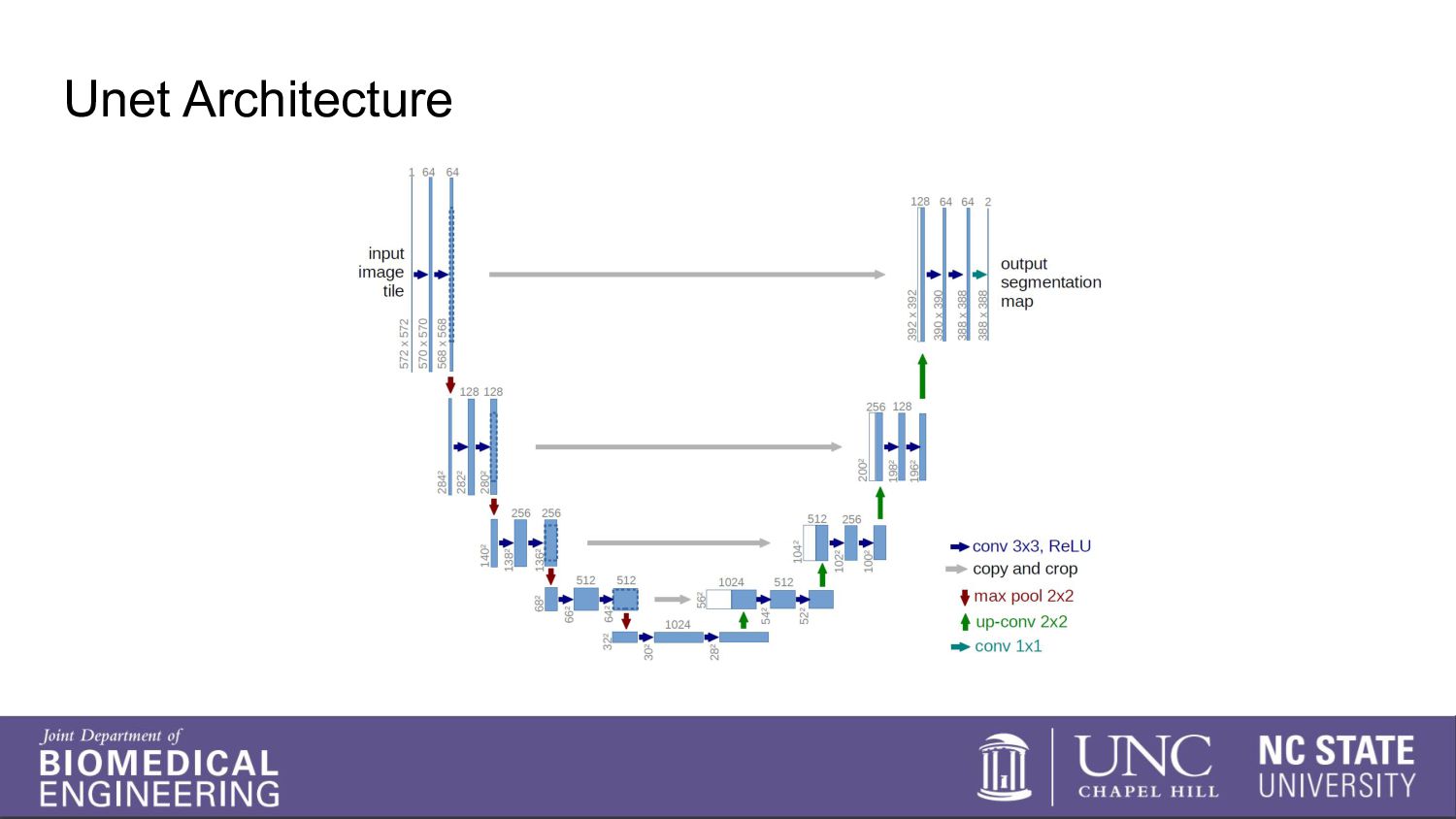
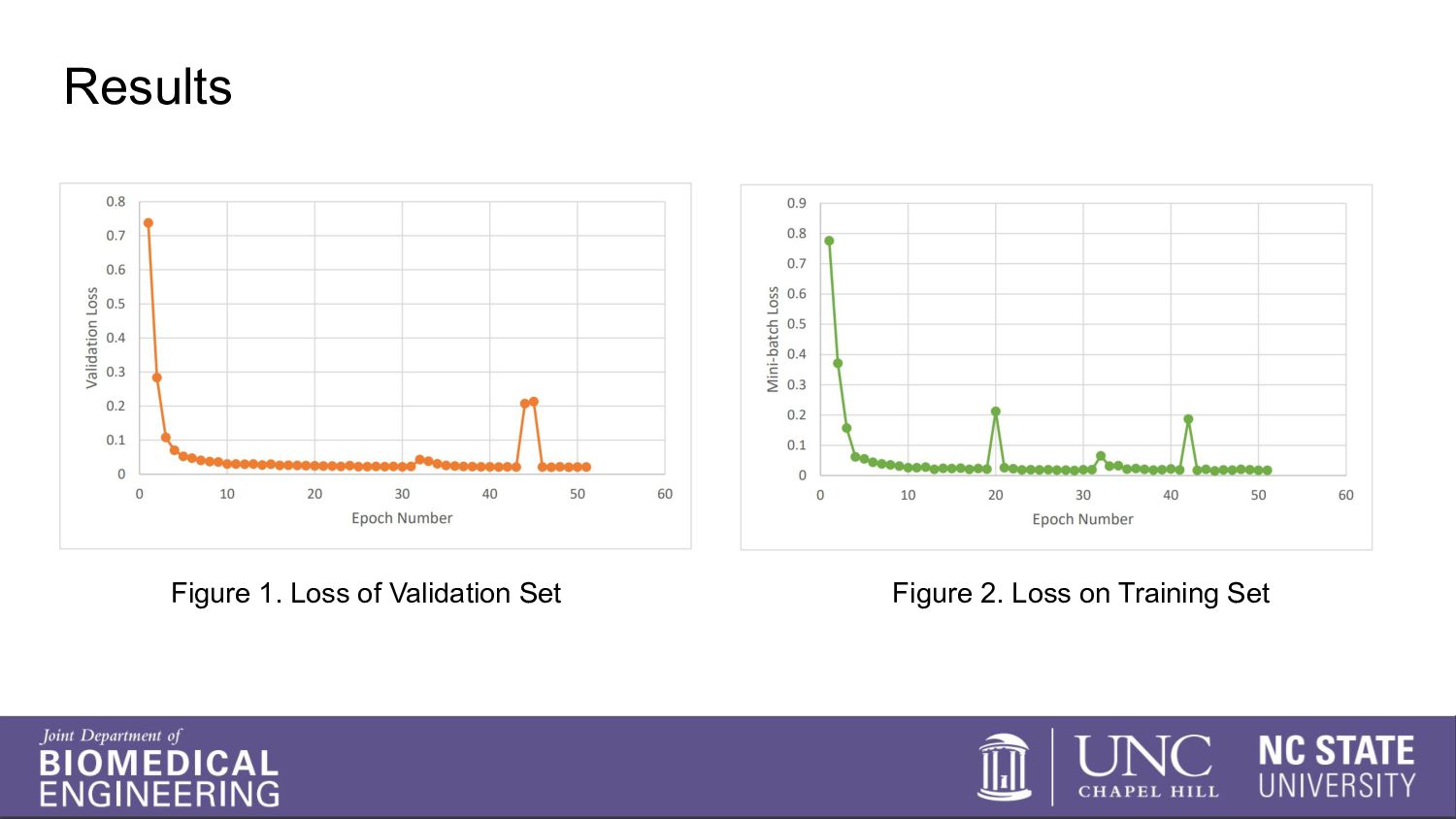
bones. Our long term goal is to understand how cartilage changes as a function of location under different conditions. Our Approach: 1. Prepare training data for the neural network a. Manually segment knee MRI images b. Crop 3D images to same number of slices c. Flip left knees to match right side knees 2. Design the network a. Unet architecture 3. Train the network a. Use of high powered graphics cards b. Compare loss Manual Segmentations Segmented 3D Image Segmented 2D Image
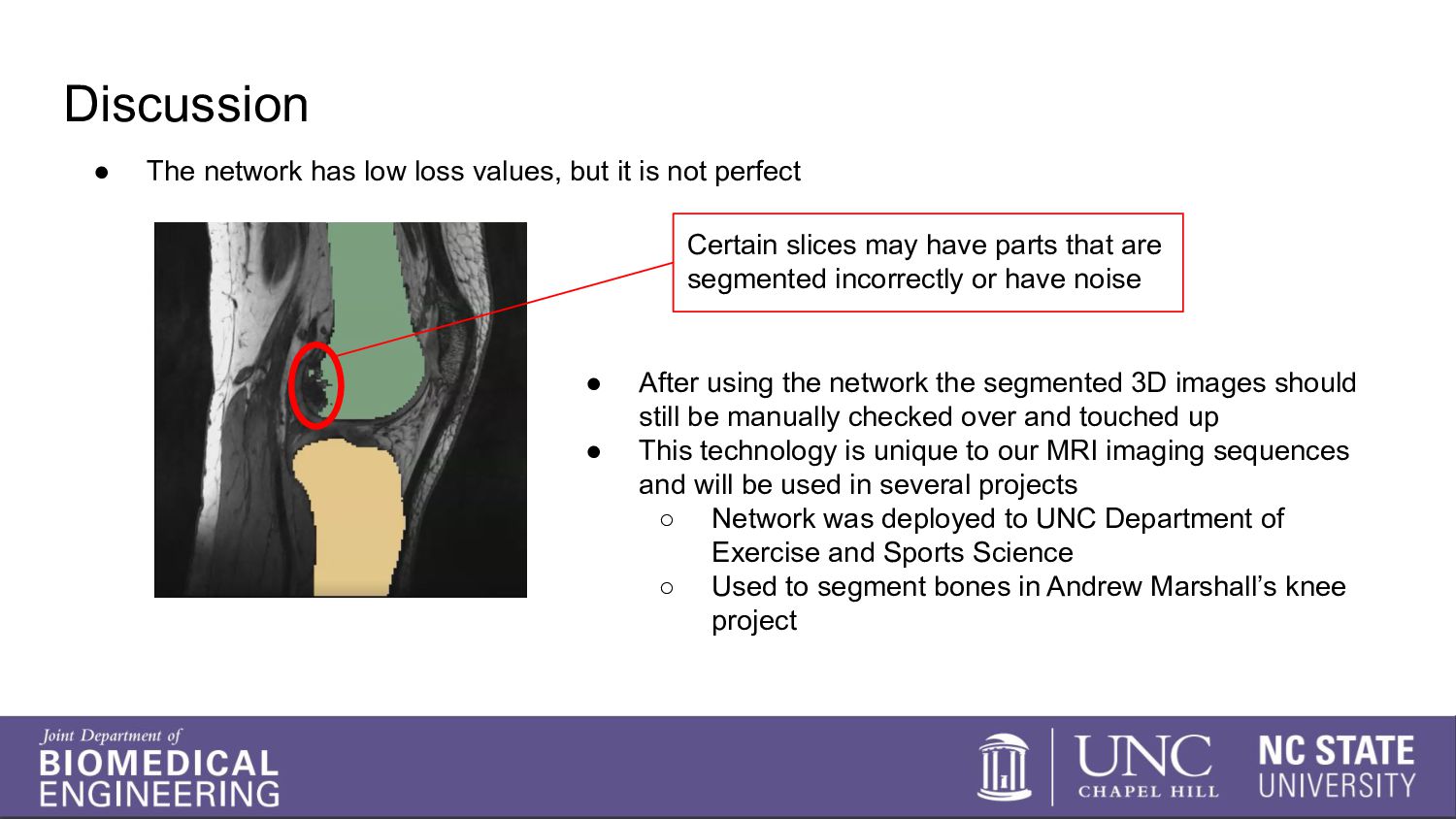
is not perfect Certain slices may have parts that are segmented incorrectly or have noise • After using the network the segmented 3D images should still be manually checked over and touched up • This technology is unique to our MRI imaging sequences and will be used in several projects ◦ Network was deployed to UNC Department of Exercise and Sports Science ◦ Used to segment bones in Andrew Marshall’s knee project
developed that can automatically segment bones and has been put to use • Our next project is to develop a network to automatically segment the cartilage • From here we can start looking into strain maps of the changes in cartilage mapped on the femur and tibia Thank you to the Abrams Scholars Program for providing me this opportunity and Dr. Lalush for mentoring me through this project. Data for this project was funded by grants from the Arthritis Foundation and UNC Thurston Arthritis Research Center.
Lalush D, Spang JT, Nissman D, Pietrosimone B. In Vivo Compositional Changes in the Articular Cartilage of the Patellofemoral Joint Following Anterior Cruciate Ligament Reconstruction. Arthritis Care Res (Hoboken). 2021 Jan 18:10.1002/acr.24561. doi: 10.1002/acr.24561. Epub ahead of print. PMID: 33460530; PMCID: PMC8286261. [2] Shen, W., Xu, W., Zhang, H., Sun, Z., Ma, J., Ma, X., Zhou, S., Guo, S., & Wang, Y. (n.d.). Automatic segmentation of the femur and tibia bones from X-ray images based on pure dilated residual U-Net. https://doi.org/10.3934/ipi.2020057


 resolutionfoundation
 wataruuuuu
 institutdelelevage
 takehaya
 yumaichikawa
 murakawatakuya
 sishi
sishi
 ftakahashi
 mongodb
 katarinadahlin
 watany
 wayneb77
 keavy
keavy
 aleyda
 gurzu
gurzu
 stuffmc
 marcelosomers
 smashingmag
 chikuwait
 techseoconnect

![References [1] Boling MC, Dupell M, Pfeiffer SJ, Wallace K,](https://files.speakerdeck.com/presentations/277b247d20ab4722ae69f8775042b5f5/slide_7.jpg)