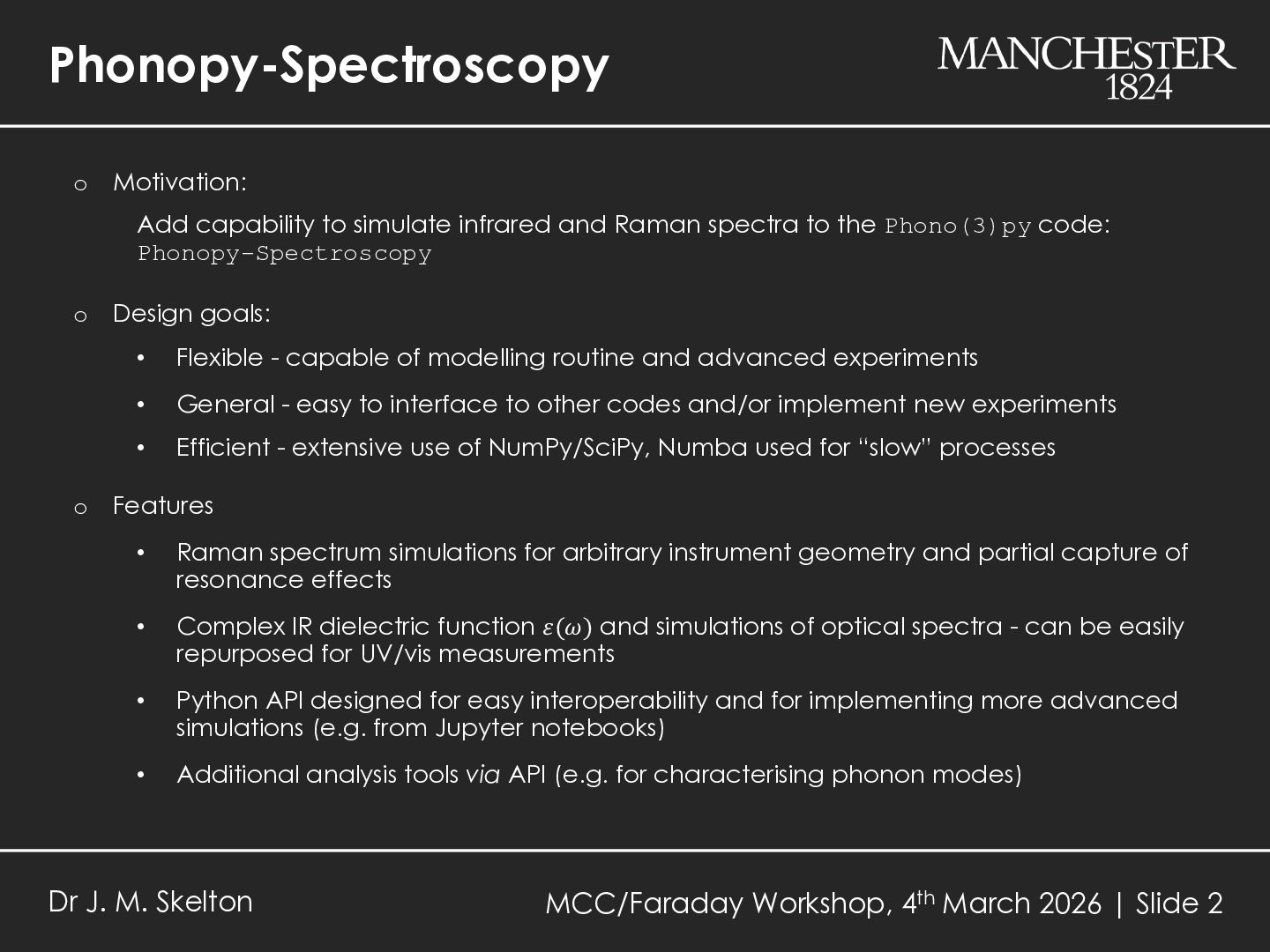
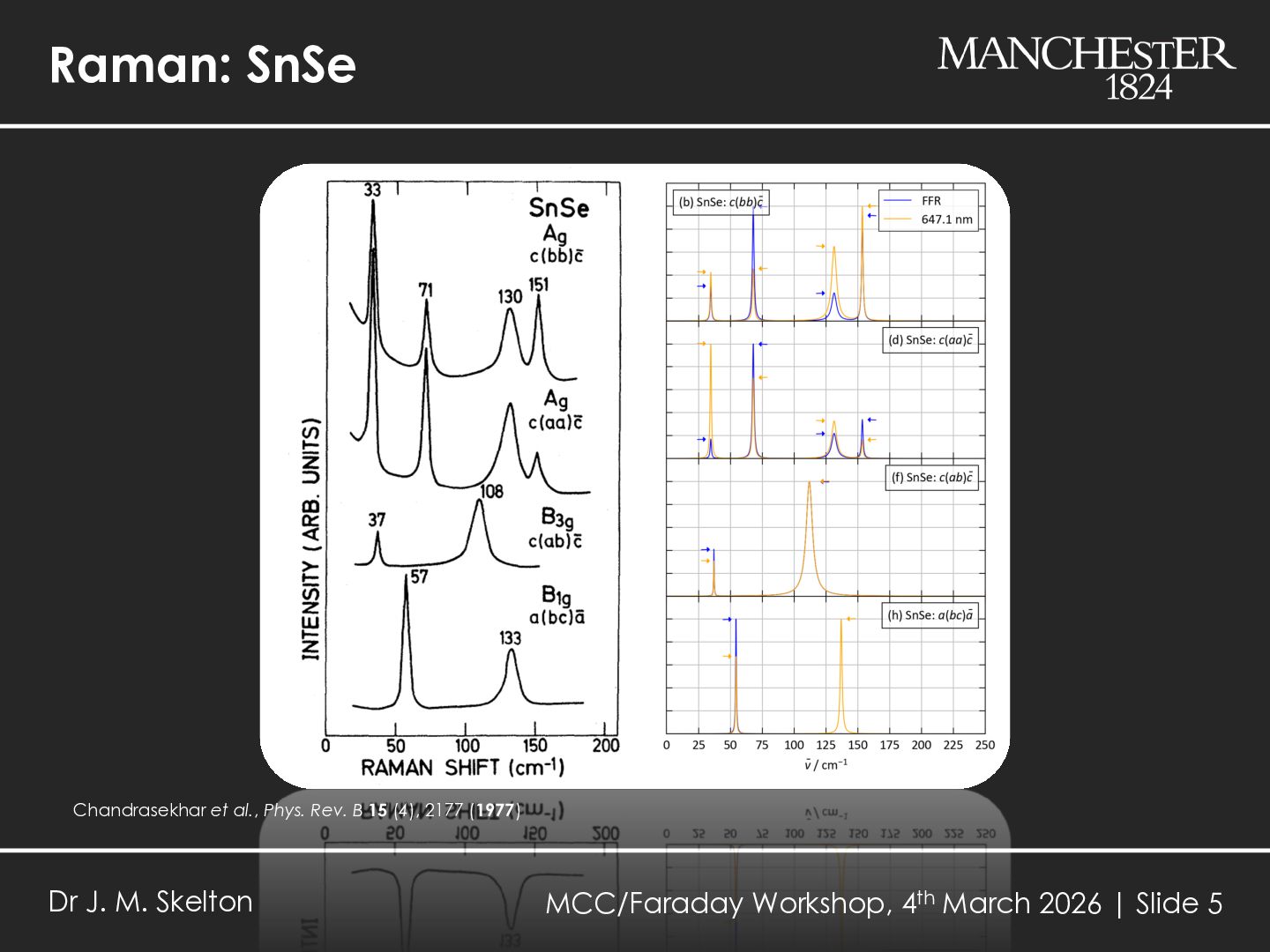
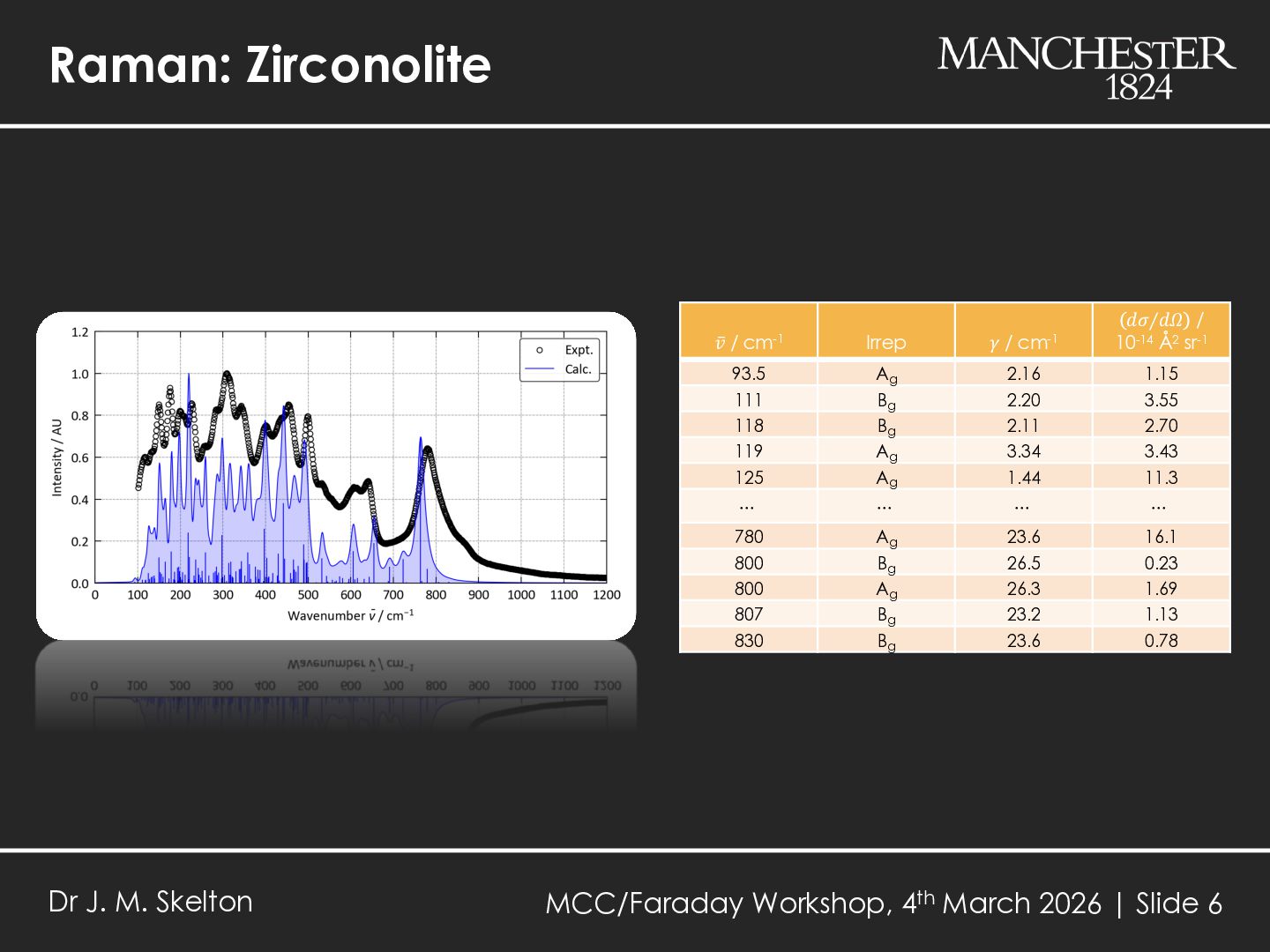
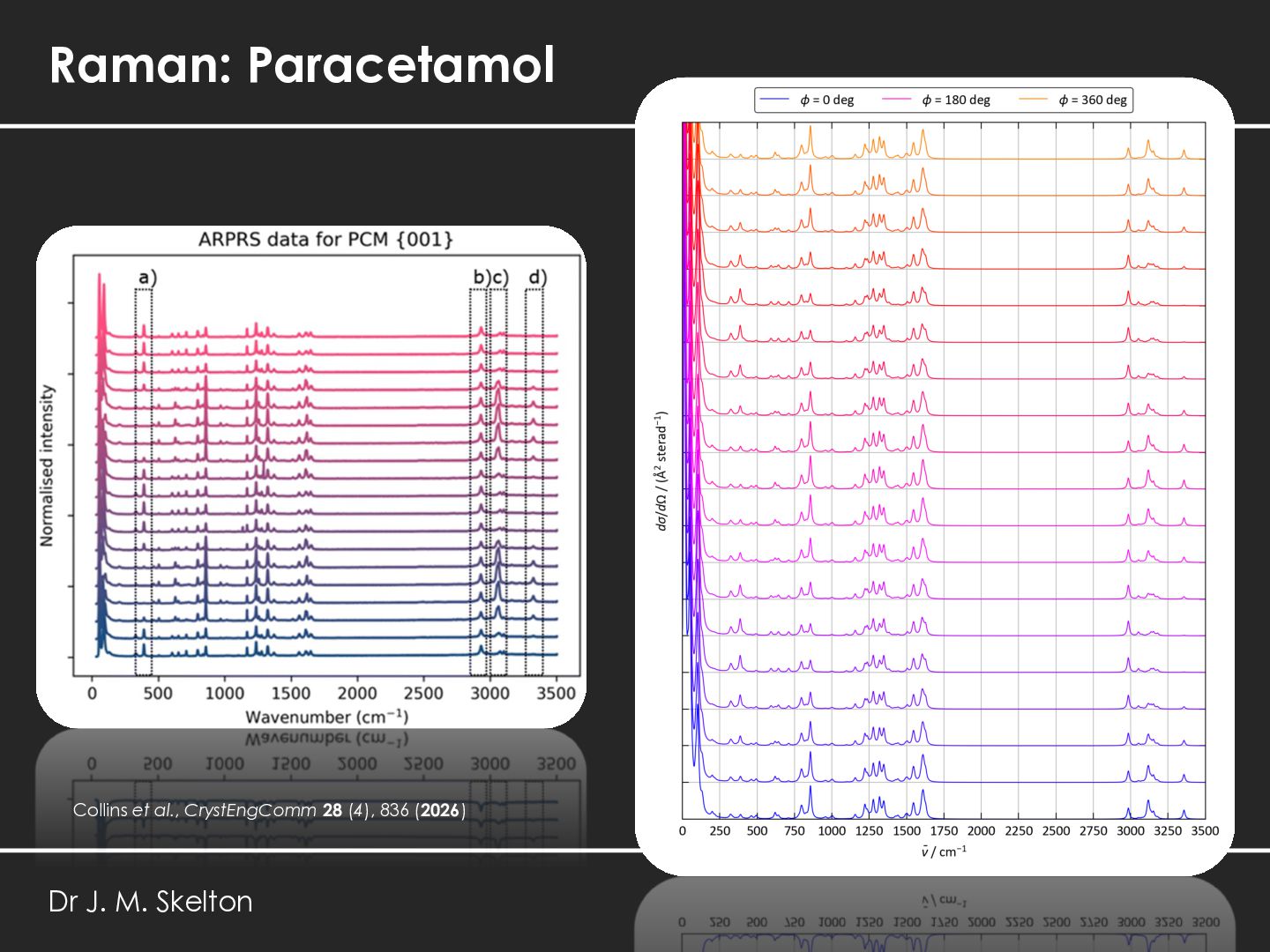
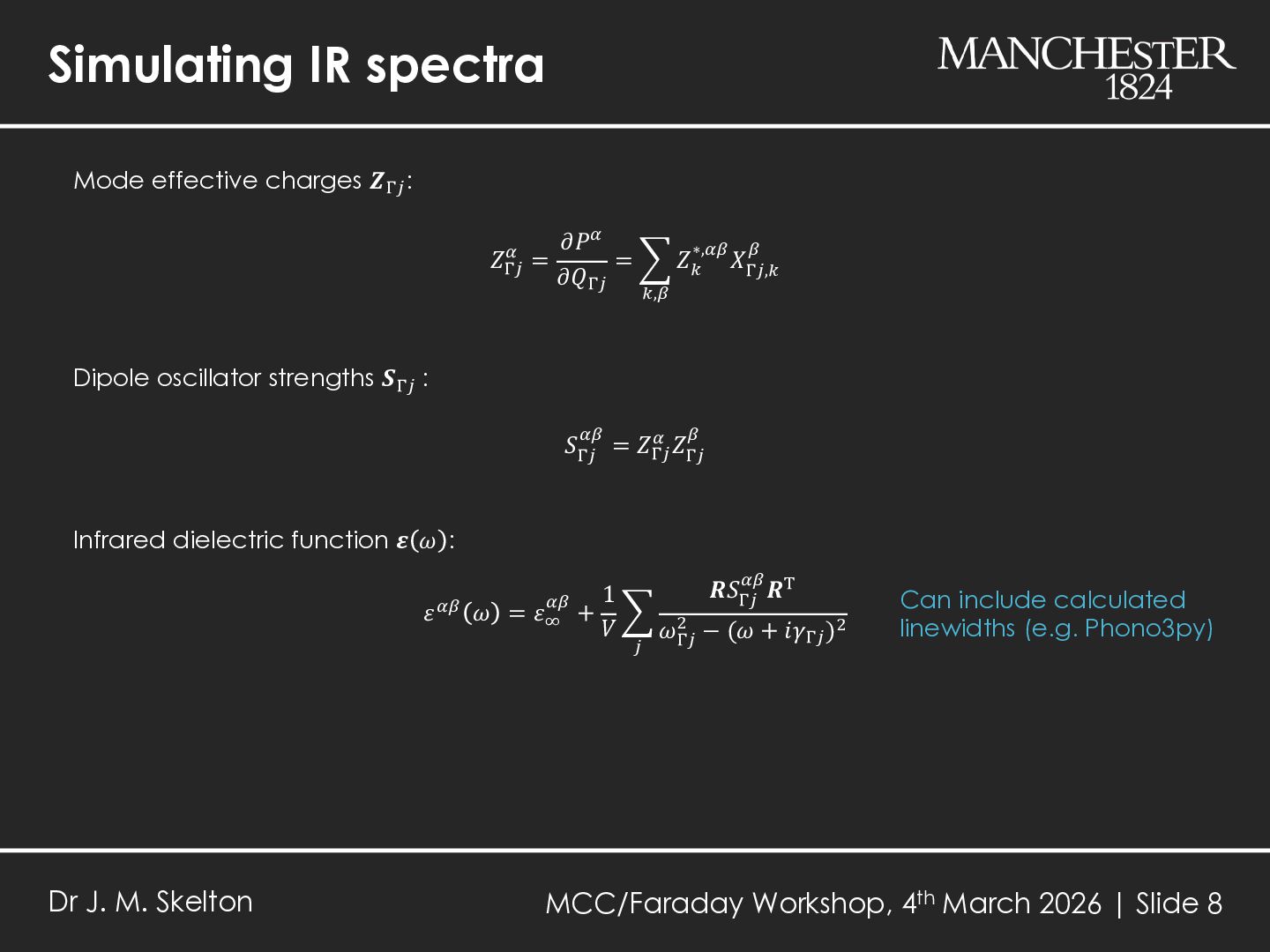
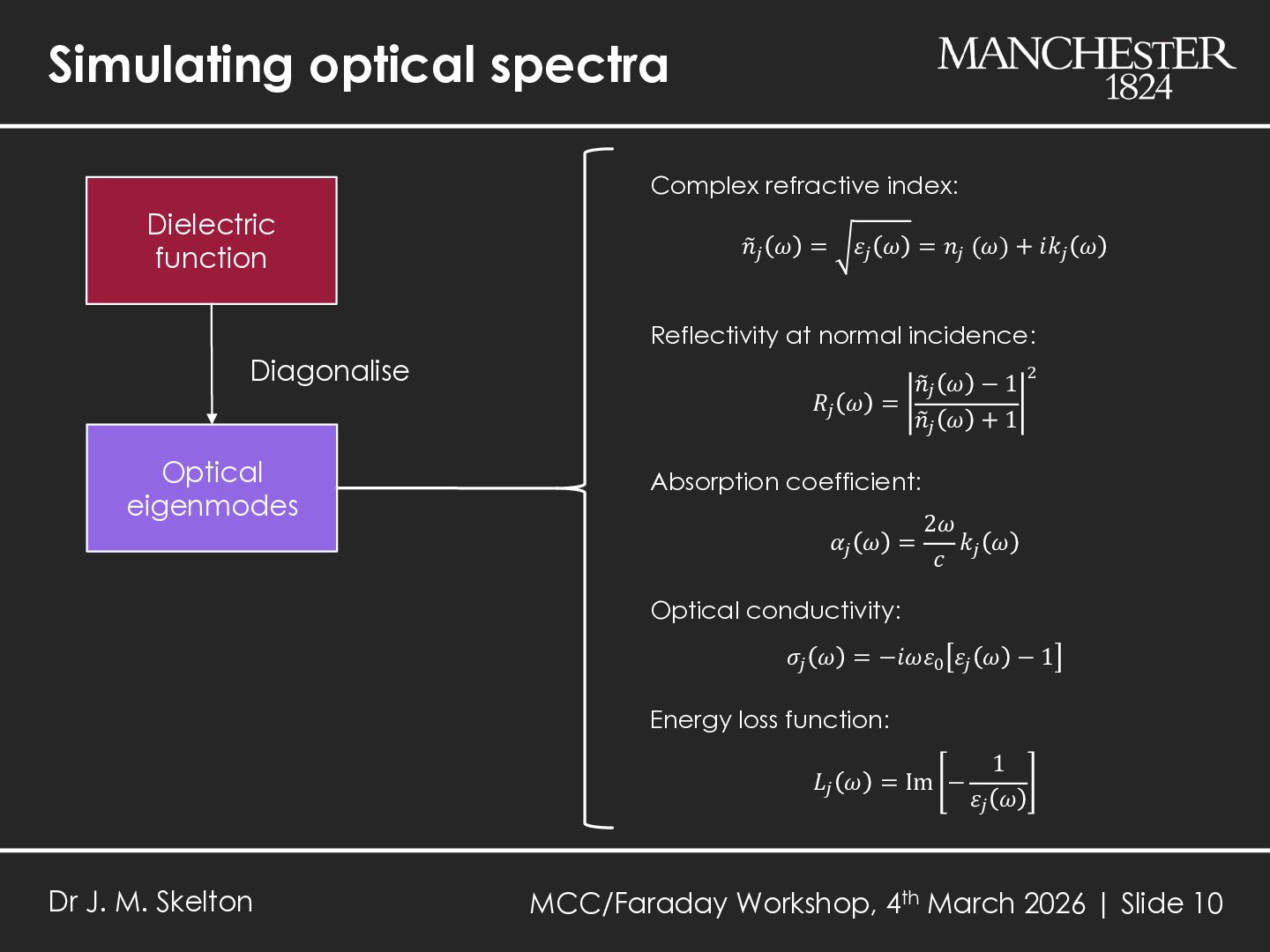
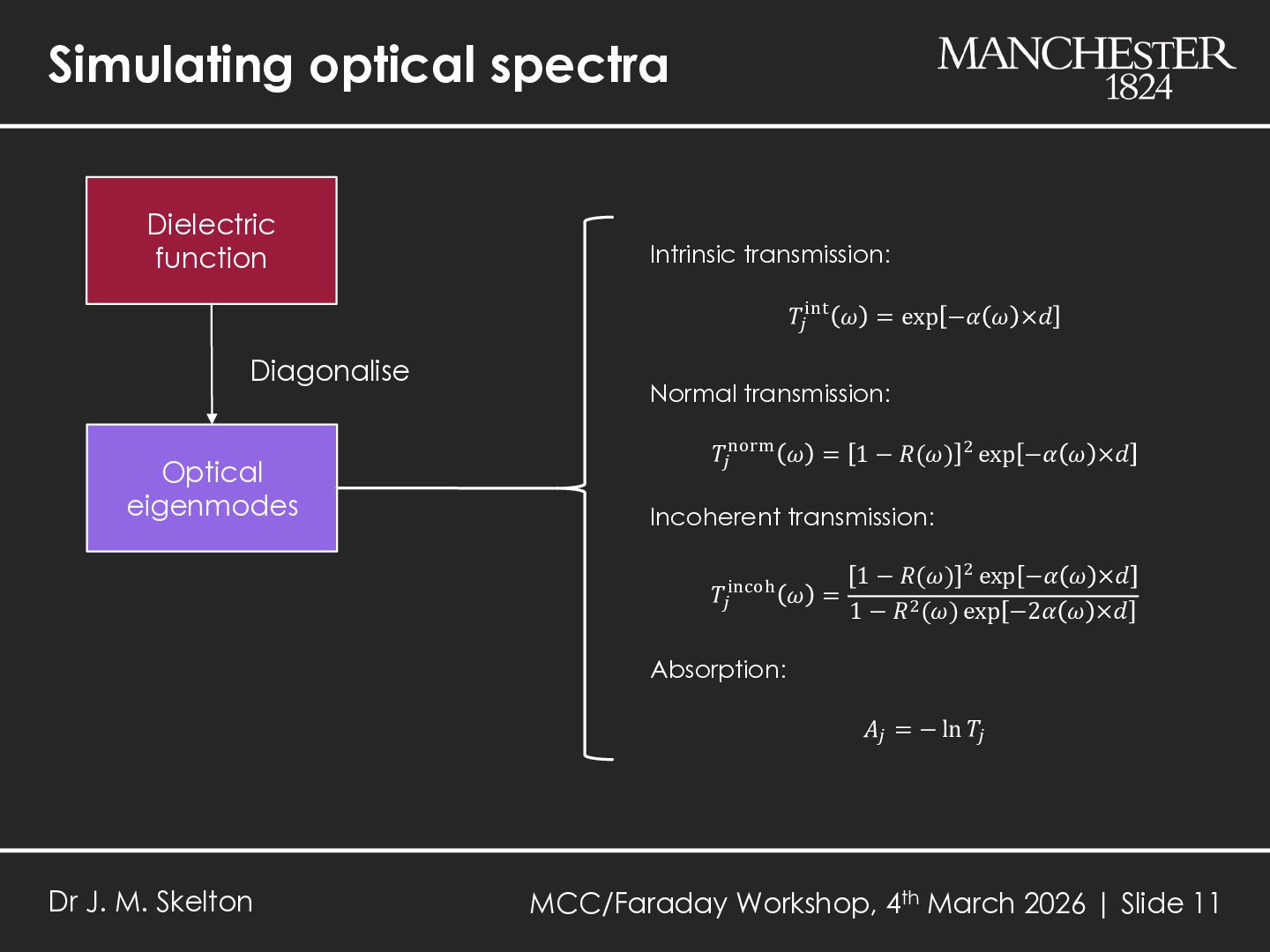
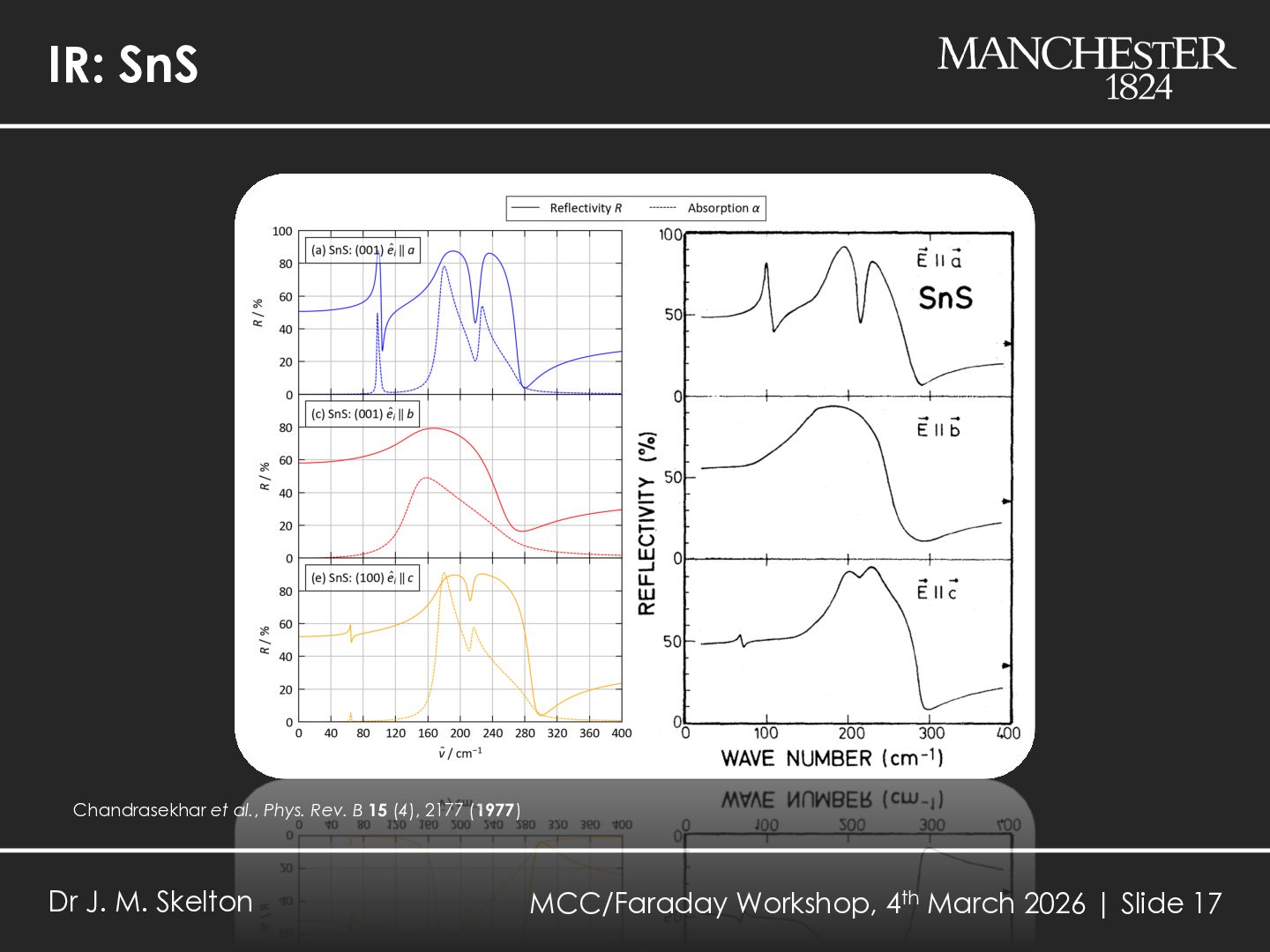
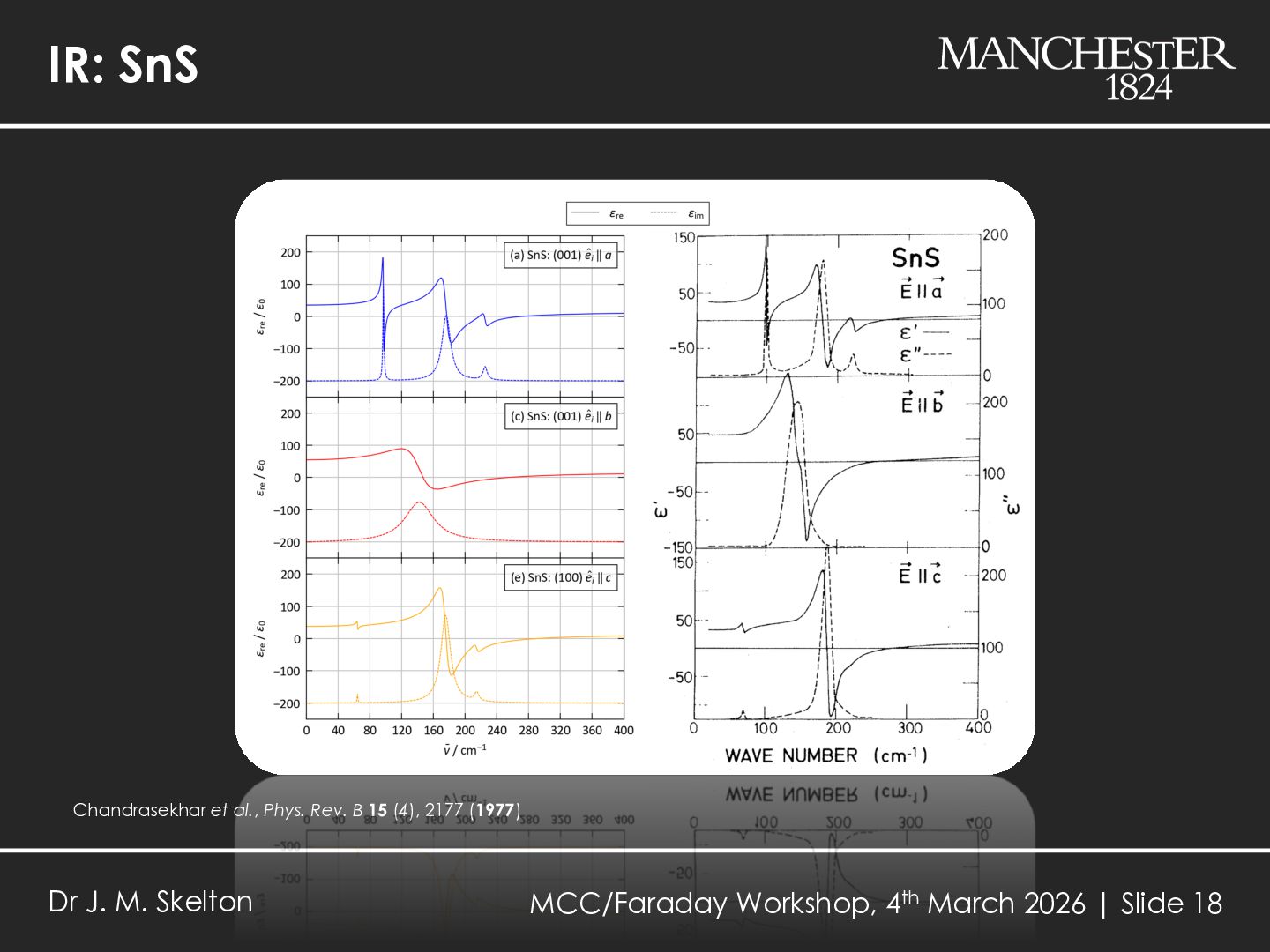
| Slide 2 o Motivation: Add capability to simulate infrared and Raman spectra to the Phono(3)py code: Phonopy-Spectroscopy o Design goals: • Flexible - capable of modelling routine and advanced experiments • General - easy to interface to other codes and/or implement new experiments • Efficient - extensive use of NumPy/SciPy, Numba used for “slow” processes o Features • Raman spectrum simulations for arbitrary instrument geometry and partial capture of resonance effects • Complex IR dielectric function 𝜀(𝜔) and simulations of optical spectra - can be easily repurposed for UV/vis measurements • Python API designed for easy interoperability and for implementing more advanced simulations (e.g. from Jupyter notebooks) • Additional analysis tools via API (e.g. for characterising phonon modes)
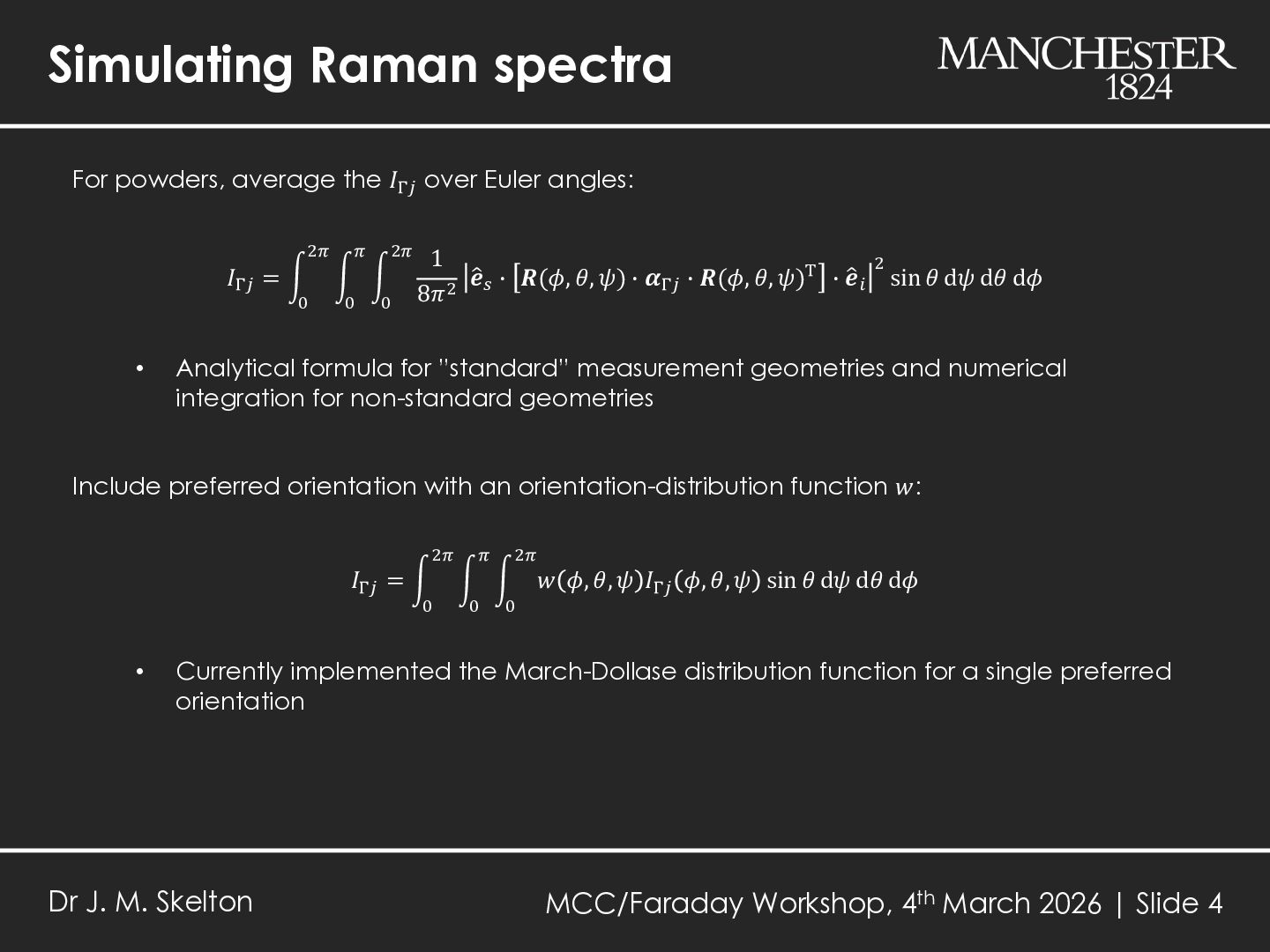
the 𝐼!" over Euler angles: 𝐼!" = H - '. H - . H - '. 1 8𝜋' 0 𝒆, 2 𝑹(𝜙, 𝜃, 𝜓) 2 𝜶!" 2 𝑹(𝜙, 𝜃, 𝜓)% 2 0 𝒆& ' sin 𝜃 d𝜓 d𝜃 d𝜙 • Analytical formula for ”standard” measurement geometries and numerical integration for non-standard geometries Include preferred orientation with an orientation-distribution function 𝑤: 𝐼!" = H - '. H - . H - '. 𝑤 𝜙, 𝜃, 𝜓 𝐼!" 𝜙, 𝜃, 𝜓 sin 𝜃 d𝜓 d𝜃 d𝜙 • Currently implemented the March-Dollase distribution function for a single preferred orientation MCC/Faraday Workshop, 4th March 2026 | Slide 4
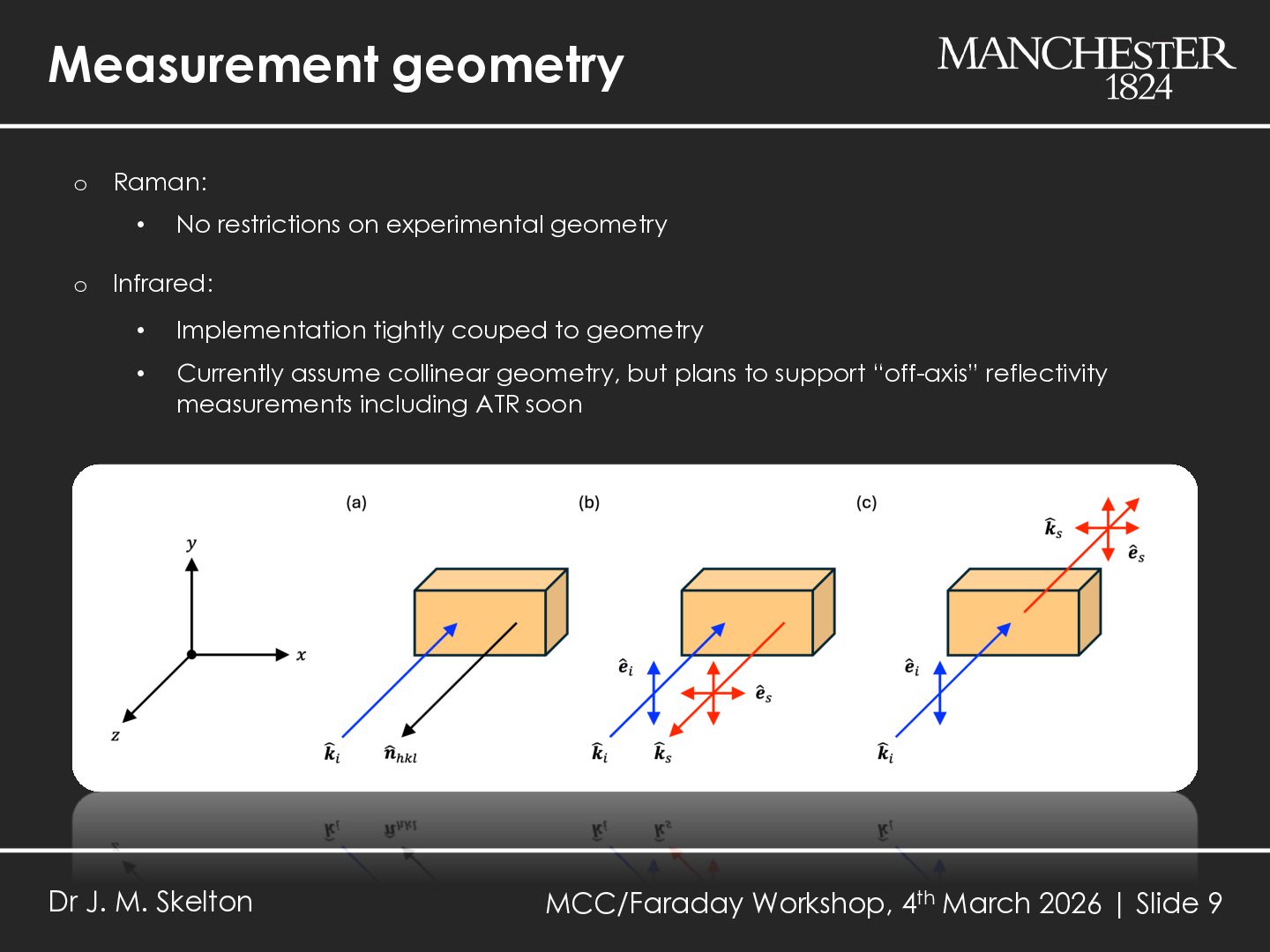
restrictions on experimental geometry o Infrared: • Implementation tightly couped to geometry • Currently assume collinear geometry, but plans to support “off-axis” reflectivity measurements including ATR soon MCC/Faraday Workshop, 4th March 2026 | Slide 9
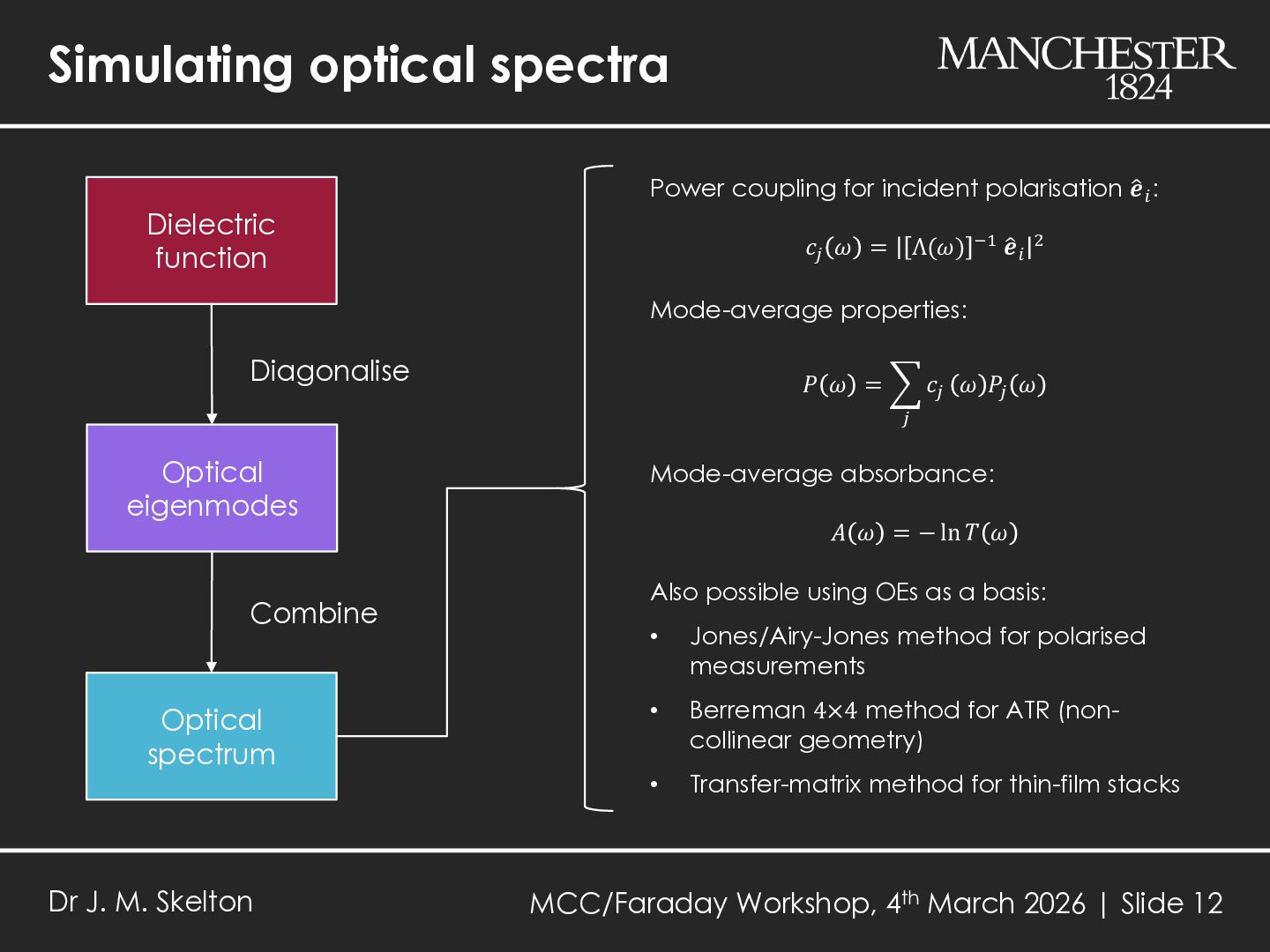
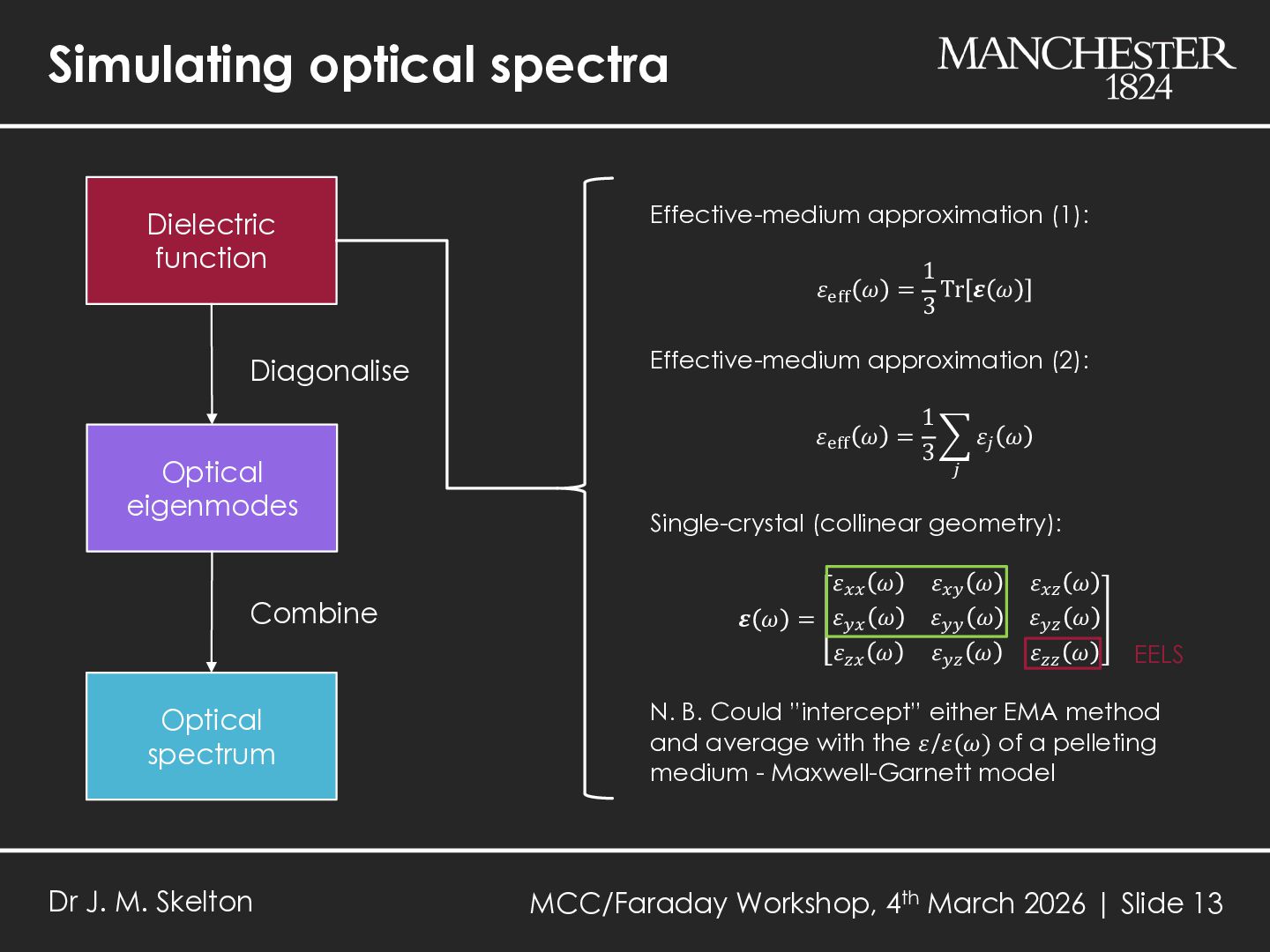
3 Tr 𝜺 𝜔 Effective-medium approximation (2): 𝜀@AA 𝜔 = 1 3 E " 𝜀" 𝜔 Single-crystal (collinear geometry): 𝜺 𝜔 = 𝜀BB 𝜔 𝜀BC 𝜔 𝜀BD 𝜔 𝜀CB 𝜔 𝜀CC 𝜔 𝜀CD 𝜔 𝜀DB 𝜔 𝜀CD 𝜔 𝜀DD 𝜔 N. B. Could ”intercept” either EMA method and average with the 𝜀/𝜀(𝜔) of a pelleting medium - Maxwell-Garnett model Dr J. M. Skelton Dielectric function Optical eigenmodes Optical spectrum Diagonalise Combine EELS MCC/Faraday Workshop, 4th March 2026 | Slide 13
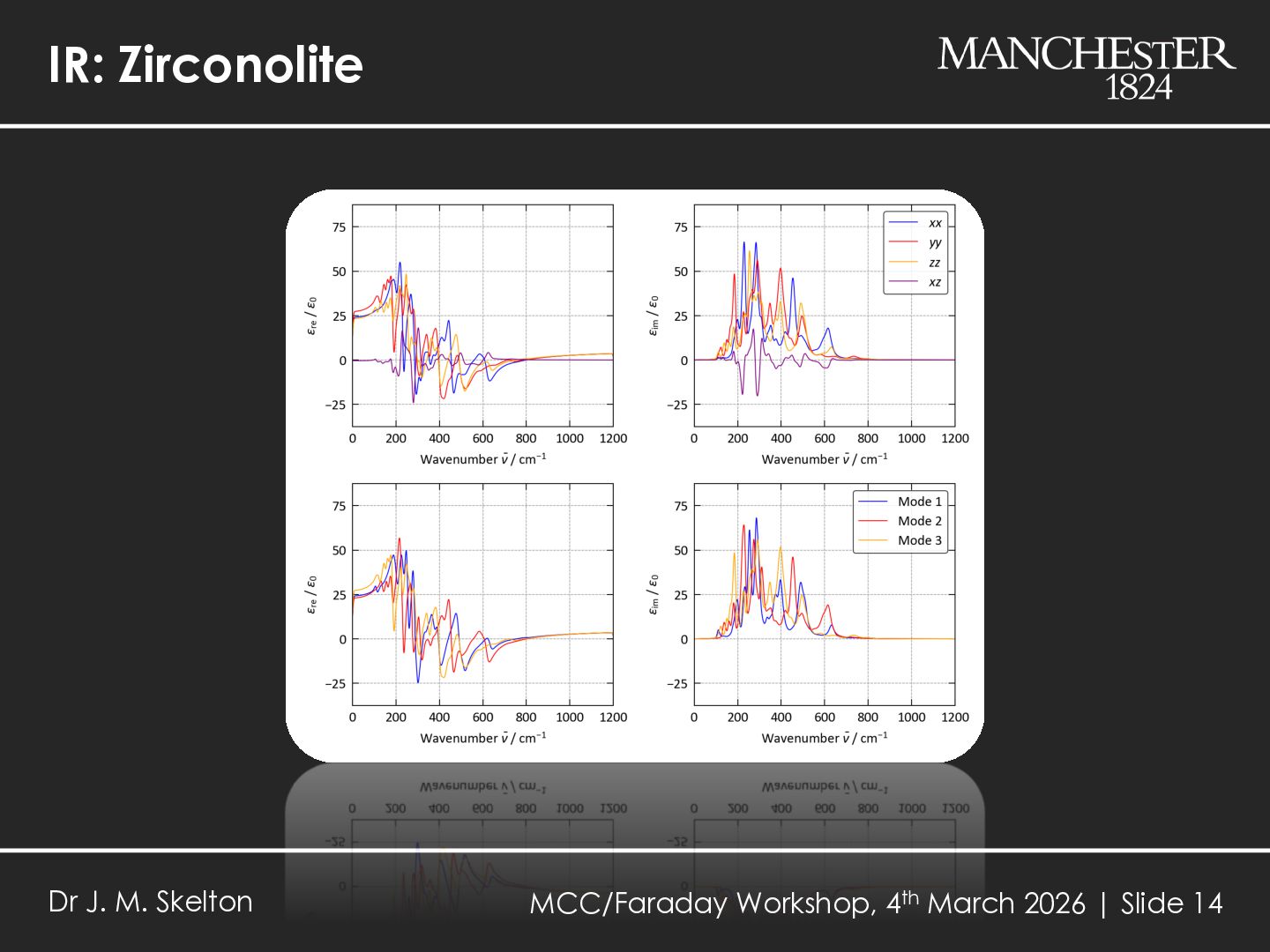
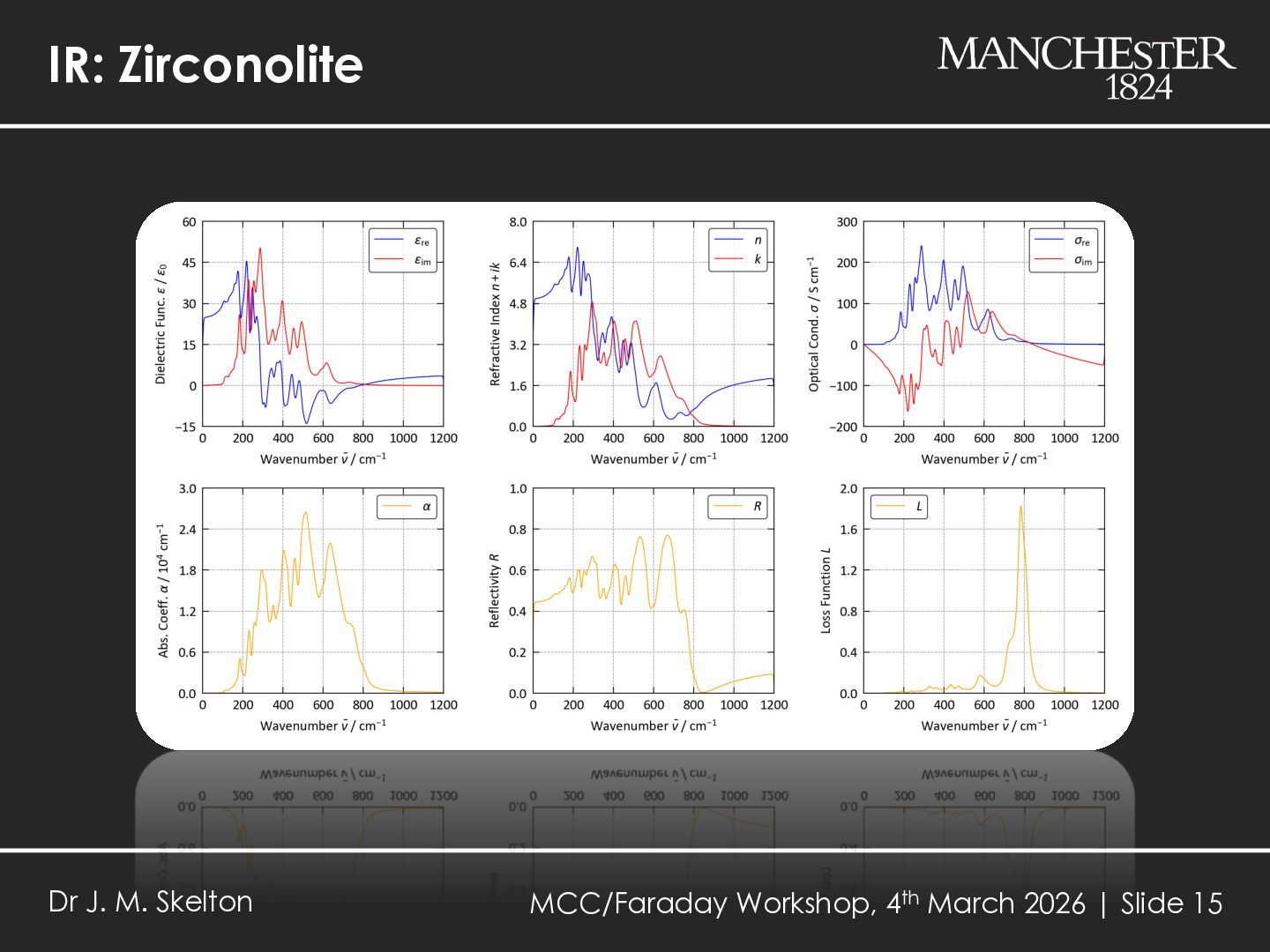
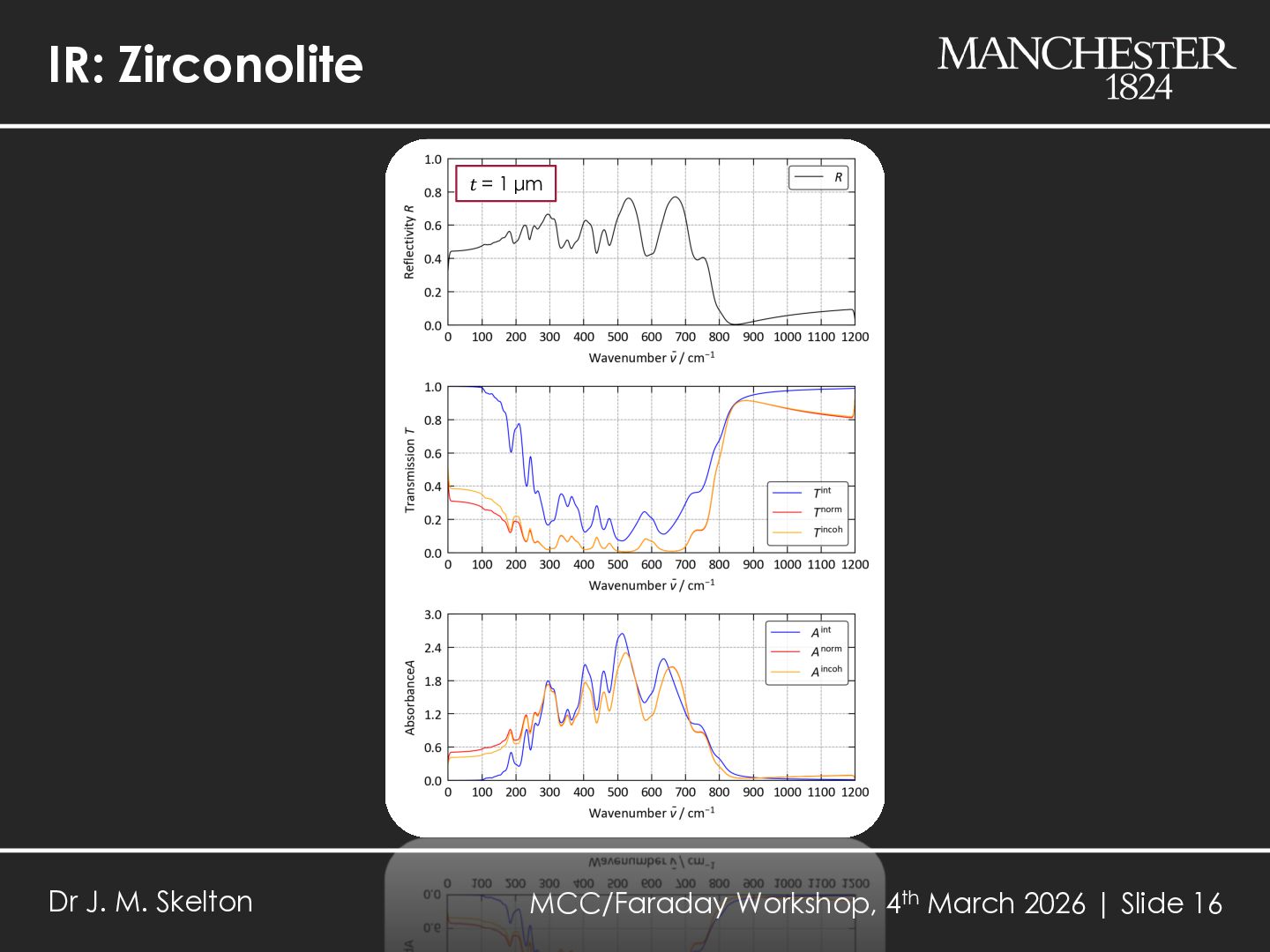
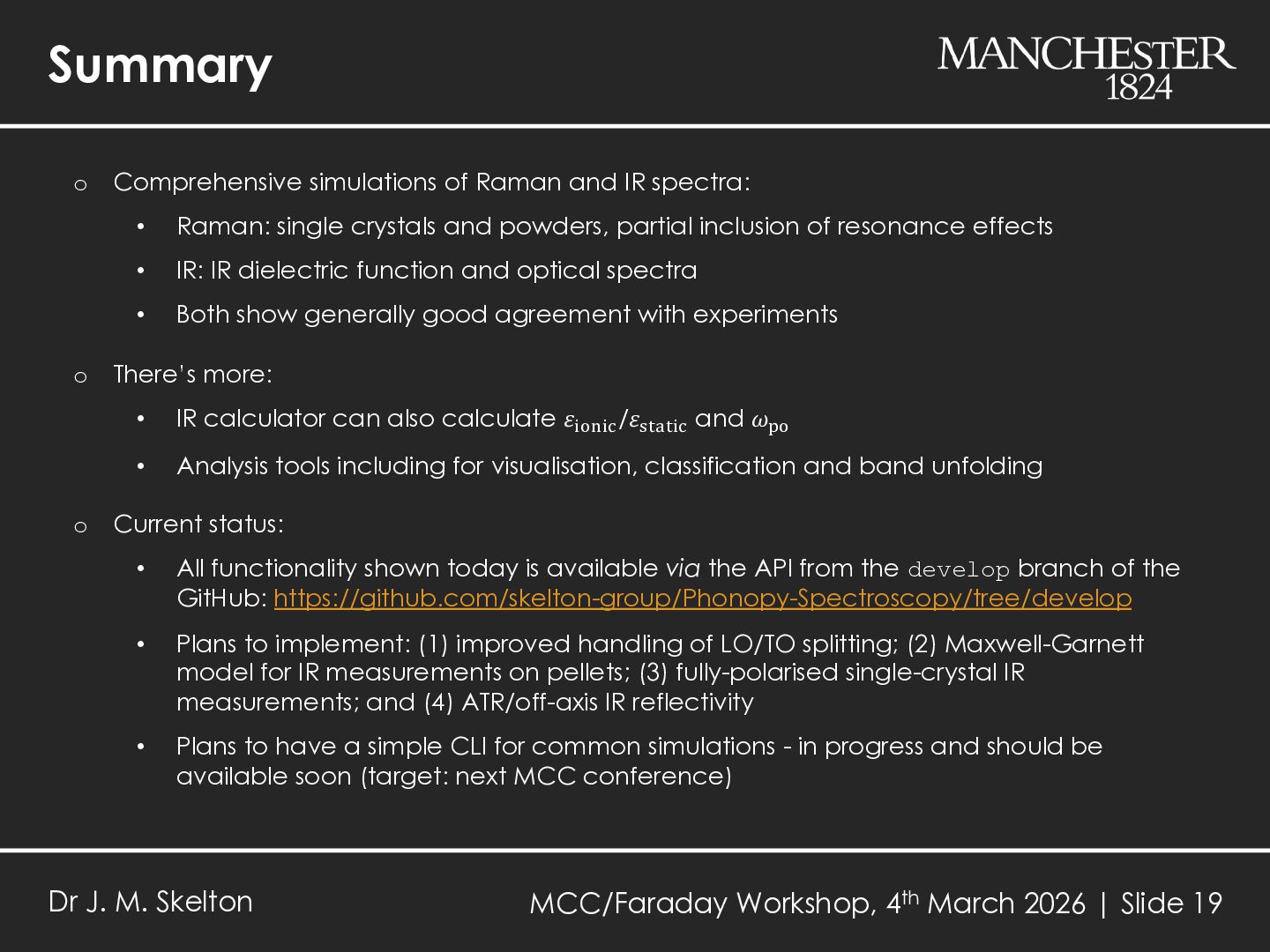
Raman: single crystals and powders, partial inclusion of resonance effects • IR: IR dielectric function and optical spectra • Both show generally good agreement with experiments o There’s more: • IR calculator can also calculate 𝜀6976< /𝜀E8F86< and 𝜔G9 • Analysis tools including for visualisation, classification and band unfolding o Current status: • All functionality shown today is available via the API from the develop branch of the GitHub: https://github.com/skelton-group/Phonopy-Spectroscopy/tree/develop • Plans to implement: (1) improved handling of LO/TO splitting; (2) Maxwell-Garnett model for IR measurements on pellets; (3) fully-polarised single-crystal IR measurements; and (4) ATR/off-axis IR reflectivity • Plans to have a simple CLI for common simulations - in progress and should be available soon (target: next MCC conference) Dr J. M. Skelton MCC/Faraday Workshop, 4th March 2026 | Slide 19
checks): o Jonathan Skelton (UoM) o Anuradha Pallipurath (UoL) o Chidimma Umeh (UoM) Beta testing (i.e. bug squashing): o Joseph Flitcroft (UoM) o Guanping Li (UoM) o David Collins (UoL) … plus other collaborators too numerous to mention MCC/Faraday Workshop, 4th March 2026 | Slide 20


 jmskelton
 tasusu
 salt2
salt2
 analokmaus
 institutdelelevage
 hanbao
 naospon
 brainpadpr
 tagtag
 akasan
 nagano
 trycycle
 hf149
hf149
 nikkihalliwell
 andyhume
 retrage
 apolaine
 eileencodes
 raygrieselhuber
 brad_frost
 aleyda
 cassininazir
 tenderlove
 pauljervisheath
 sugarenia